US11123701B2 - Device and process under conditions close to the supercritical range or under supercritical conditions - Google Patents
Device and process under conditions close to the supercritical range or under supercritical conditions Download PDFInfo
- Publication number
- US11123701B2 US11123701B2 US16/764,670 US201816764670A US11123701B2 US 11123701 B2 US11123701 B2 US 11123701B2 US 201816764670 A US201816764670 A US 201816764670A US 11123701 B2 US11123701 B2 US 11123701B2
- Authority
- US
- United States
- Prior art keywords
- salt
- inorganic salt
- concentration
- aqueous fluid
- hydroxide
- Prior art date
- Legal status (The legal status is an assumption and is not a legal conclusion. Google has not performed a legal analysis and makes no representation as to the accuracy of the status listed.)
- Active
Links
- 238000000034 method Methods 0.000 title claims abstract description 59
- 229910017053 inorganic salt Inorganic materials 0.000 claims abstract description 121
- 239000012530 fluid Substances 0.000 claims abstract description 104
- 150000004679 hydroxides Chemical class 0.000 claims abstract description 82
- XLYOFNOQVPJJNP-UHFFFAOYSA-N water Substances O XLYOFNOQVPJJNP-UHFFFAOYSA-N 0.000 claims abstract description 68
- 239000000203 mixture Substances 0.000 claims abstract description 38
- 238000005259 measurement Methods 0.000 claims abstract description 20
- 150000003839 salts Chemical class 0.000 claims description 79
- HEMHJVSKTPXQMS-UHFFFAOYSA-M Sodium hydroxide Chemical compound [OH-].[Na+] HEMHJVSKTPXQMS-UHFFFAOYSA-M 0.000 claims description 57
- 238000007254 oxidation reaction Methods 0.000 claims description 11
- 238000010438 heat treatment Methods 0.000 claims description 10
- 230000003647 oxidation Effects 0.000 claims description 10
- WMFOQBRAJBCJND-UHFFFAOYSA-M Lithium hydroxide Chemical compound [Li+].[OH-] WMFOQBRAJBCJND-UHFFFAOYSA-M 0.000 claims description 6
- KWYUFKZDYYNOTN-UHFFFAOYSA-M Potassium hydroxide Chemical compound [OH-].[K+] KWYUFKZDYYNOTN-UHFFFAOYSA-M 0.000 claims description 6
- 150000002894 organic compounds Chemical class 0.000 claims description 4
- 238000012544 monitoring process Methods 0.000 claims description 3
- 235000002639 sodium chloride Nutrition 0.000 description 84
- CDBYLPFSWZWCQE-UHFFFAOYSA-L Sodium Carbonate Chemical compound [Na+].[Na+].[O-]C([O-])=O CDBYLPFSWZWCQE-UHFFFAOYSA-L 0.000 description 39
- PMZURENOXWZQFD-UHFFFAOYSA-L Sodium Sulfate Chemical compound [Na+].[Na+].[O-]S([O-])(=O)=O PMZURENOXWZQFD-UHFFFAOYSA-L 0.000 description 23
- -1 for example Substances 0.000 description 20
- 229910052938 sodium sulfate Inorganic materials 0.000 description 18
- 238000002347 injection Methods 0.000 description 17
- 239000007924 injection Substances 0.000 description 17
- 238000005260 corrosion Methods 0.000 description 16
- 230000007797 corrosion Effects 0.000 description 16
- 239000000243 solution Substances 0.000 description 15
- 239000012071 phase Substances 0.000 description 14
- 238000001556 precipitation Methods 0.000 description 13
- 239000002699 waste material Substances 0.000 description 12
- 235000011152 sodium sulphate Nutrition 0.000 description 11
- LFQSCWFLJHTTHZ-UHFFFAOYSA-N Ethanol Chemical compound CCO LFQSCWFLJHTTHZ-UHFFFAOYSA-N 0.000 description 9
- 229910001914 chlorine tetroxide Inorganic materials 0.000 description 9
- VLTRZXGMWDSKGL-UHFFFAOYSA-M perchlorate Chemical compound [O-]Cl(=O)(=O)=O VLTRZXGMWDSKGL-UHFFFAOYSA-M 0.000 description 9
- 230000008021 deposition Effects 0.000 description 8
- 239000007832 Na2SO4 Substances 0.000 description 7
- 239000000047 product Substances 0.000 description 7
- 238000012360 testing method Methods 0.000 description 7
- FAPWRFPIFSIZLT-UHFFFAOYSA-M Sodium chloride Chemical compound [Na+].[Cl-] FAPWRFPIFSIZLT-UHFFFAOYSA-M 0.000 description 6
- TVWHTOUAJSGEKT-UHFFFAOYSA-N chlorine trioxide Chemical compound [O]Cl(=O)=O TVWHTOUAJSGEKT-UHFFFAOYSA-N 0.000 description 6
- 239000007787 solid Substances 0.000 description 6
- 239000007864 aqueous solution Substances 0.000 description 5
- XTVVROIMIGLXTD-UHFFFAOYSA-N copper(II) nitrate Chemical compound [Cu+2].[O-][N+]([O-])=O.[O-][N+]([O-])=O XTVVROIMIGLXTD-UHFFFAOYSA-N 0.000 description 5
- 238000009616 inductively coupled plasma Methods 0.000 description 5
- PXHVJJICTQNCMI-UHFFFAOYSA-N nickel Substances [Ni] PXHVJJICTQNCMI-UHFFFAOYSA-N 0.000 description 5
- 239000002244 precipitate Substances 0.000 description 5
- SQGYOTSLMSWVJD-UHFFFAOYSA-N silver(1+) nitrate Chemical compound [Ag+].[O-]N(=O)=O SQGYOTSLMSWVJD-UHFFFAOYSA-N 0.000 description 5
- 238000004611 spectroscopical analysis Methods 0.000 description 5
- VTYYLEPIZMXCLO-UHFFFAOYSA-L Calcium carbonate Chemical compound [Ca+2].[O-]C([O-])=O VTYYLEPIZMXCLO-UHFFFAOYSA-L 0.000 description 4
- CSNNHWWHGAXBCP-UHFFFAOYSA-L Magnesium sulfate Chemical compound [Mg+2].[O-][S+2]([O-])([O-])[O-] CSNNHWWHGAXBCP-UHFFFAOYSA-L 0.000 description 4
- LRHPLDYGYMQRHN-UHFFFAOYSA-N N-Butanol Chemical compound CCCCO LRHPLDYGYMQRHN-UHFFFAOYSA-N 0.000 description 4
- 229910019142 PO4 Inorganic materials 0.000 description 4
- UIIMBOGNXHQVGW-UHFFFAOYSA-M Sodium bicarbonate Chemical compound [Na+].OC([O-])=O UIIMBOGNXHQVGW-UHFFFAOYSA-M 0.000 description 4
- VSCWAEJMTAWNJL-UHFFFAOYSA-K aluminium trichloride Chemical compound Cl[Al](Cl)Cl VSCWAEJMTAWNJL-UHFFFAOYSA-K 0.000 description 4
- 229910003481 amorphous carbon Inorganic materials 0.000 description 4
- 239000008346 aqueous phase Substances 0.000 description 4
- 239000011324 bead Substances 0.000 description 4
- ZCCIPPOKBCJFDN-UHFFFAOYSA-N calcium nitrate Chemical compound [Ca+2].[O-][N+]([O-])=O.[O-][N+]([O-])=O ZCCIPPOKBCJFDN-UHFFFAOYSA-N 0.000 description 4
- 238000006243 chemical reaction Methods 0.000 description 4
- PHFQLYPOURZARY-UHFFFAOYSA-N chromium trinitrate Chemical compound [Cr+3].[O-][N+]([O-])=O.[O-][N+]([O-])=O.[O-][N+]([O-])=O PHFQLYPOURZARY-UHFFFAOYSA-N 0.000 description 4
- UFMZWBIQTDUYBN-UHFFFAOYSA-N cobalt dinitrate Chemical compound [Co+2].[O-][N+]([O-])=O.[O-][N+]([O-])=O UFMZWBIQTDUYBN-UHFFFAOYSA-N 0.000 description 4
- QTMDXZNDVAMKGV-UHFFFAOYSA-L copper(ii) bromide Chemical compound [Cu+2].[Br-].[Br-] QTMDXZNDVAMKGV-UHFFFAOYSA-L 0.000 description 4
- 238000001027 hydrothermal synthesis Methods 0.000 description 4
- RLJMLMKIBZAXJO-UHFFFAOYSA-N lead nitrate Chemical compound [O-][N+](=O)O[Pb]O[N+]([O-])=O RLJMLMKIBZAXJO-UHFFFAOYSA-N 0.000 description 4
- IIPYXGDZVMZOAP-UHFFFAOYSA-N lithium nitrate Chemical compound [Li+].[O-][N+]([O-])=O IIPYXGDZVMZOAP-UHFFFAOYSA-N 0.000 description 4
- 239000000155 melt Substances 0.000 description 4
- IOLCXVTUBQKXJR-UHFFFAOYSA-M potassium bromide Chemical compound [K+].[Br-] IOLCXVTUBQKXJR-UHFFFAOYSA-M 0.000 description 4
- NLKNQRATVPKPDG-UHFFFAOYSA-M potassium iodide Chemical compound [K+].[I-] NLKNQRATVPKPDG-UHFFFAOYSA-M 0.000 description 4
- 238000011160 research Methods 0.000 description 4
- 238000005070 sampling Methods 0.000 description 4
- JHJLBTNAGRQEKS-UHFFFAOYSA-M sodium bromide Chemical compound [Na+].[Br-] JHJLBTNAGRQEKS-UHFFFAOYSA-M 0.000 description 4
- 229910000029 sodium carbonate Inorganic materials 0.000 description 4
- VWDWKYIASSYTQR-UHFFFAOYSA-N sodium nitrate Chemical compound [Na+].[O-][N+]([O-])=O VWDWKYIASSYTQR-UHFFFAOYSA-N 0.000 description 4
- ZSUXOVNWDZTCFN-UHFFFAOYSA-L tin(ii) bromide Chemical compound Br[Sn]Br ZSUXOVNWDZTCFN-UHFFFAOYSA-L 0.000 description 4
- JTDNNCYXCFHBGG-UHFFFAOYSA-L tin(ii) iodide Chemical compound I[Sn]I JTDNNCYXCFHBGG-UHFFFAOYSA-L 0.000 description 4
- 239000011701 zinc Substances 0.000 description 4
- JIAARYAFYJHUJI-UHFFFAOYSA-L zinc dichloride Chemical compound [Cl-].[Cl-].[Zn+2] JIAARYAFYJHUJI-UHFFFAOYSA-L 0.000 description 4
- UAYWVJHJZHQCIE-UHFFFAOYSA-L zinc iodide Chemical compound I[Zn]I UAYWVJHJZHQCIE-UHFFFAOYSA-L 0.000 description 4
- NLXLAEXVIDQMFP-UHFFFAOYSA-N Ammonia chloride Chemical compound [NH4+].[Cl-] NLXLAEXVIDQMFP-UHFFFAOYSA-N 0.000 description 3
- WCUXLLCKKVVCTQ-UHFFFAOYSA-M Potassium chloride Chemical compound [Cl-].[K+] WCUXLLCKKVVCTQ-UHFFFAOYSA-M 0.000 description 3
- 239000011651 chromium Substances 0.000 description 3
- 230000001276 controlling effect Effects 0.000 description 3
- 238000001816 cooling Methods 0.000 description 3
- ORTQZVOHEJQUHG-UHFFFAOYSA-L copper(II) chloride Chemical compound Cl[Cu]Cl ORTQZVOHEJQUHG-UHFFFAOYSA-L 0.000 description 3
- 150000002484 inorganic compounds Chemical class 0.000 description 3
- 229910010272 inorganic material Inorganic materials 0.000 description 3
- XEEYBQQBJWHFJM-UHFFFAOYSA-N iron Substances [Fe] XEEYBQQBJWHFJM-UHFFFAOYSA-N 0.000 description 3
- 239000011777 magnesium Substances 0.000 description 3
- YIXJRHPUWRPCBB-UHFFFAOYSA-N magnesium nitrate Chemical compound [Mg+2].[O-][N+]([O-])=O.[O-][N+]([O-])=O YIXJRHPUWRPCBB-UHFFFAOYSA-N 0.000 description 3
- MIVBAHRSNUNMPP-UHFFFAOYSA-N manganese(2+);dinitrate Chemical compound [Mn+2].[O-][N+]([O-])=O.[O-][N+]([O-])=O MIVBAHRSNUNMPP-UHFFFAOYSA-N 0.000 description 3
- 229910052751 metal Chemical class 0.000 description 3
- 239000002184 metal Chemical class 0.000 description 3
- KBJMLQFLOWQJNF-UHFFFAOYSA-N nickel(ii) nitrate Chemical compound [Ni+2].[O-][N+]([O-])=O.[O-][N+]([O-])=O KBJMLQFLOWQJNF-UHFFFAOYSA-N 0.000 description 3
- 150000003013 phosphoric acid derivatives Chemical class 0.000 description 3
- KMUONIBRACKNSN-UHFFFAOYSA-N potassium dichromate Chemical compound [K+].[K+].[O-][Cr](=O)(=O)O[Cr]([O-])(=O)=O KMUONIBRACKNSN-UHFFFAOYSA-N 0.000 description 3
- FVAUCKIRQBBSSJ-UHFFFAOYSA-M sodium iodide Chemical compound [Na+].[I-] FVAUCKIRQBBSSJ-UHFFFAOYSA-M 0.000 description 3
- 150000003467 sulfuric acid derivatives Chemical class 0.000 description 3
- KEQXNNJHMWSZHK-UHFFFAOYSA-L 1,3,2,4$l^{2}-dioxathiaplumbetane 2,2-dioxide Chemical compound [Pb+2].[O-]S([O-])(=O)=O KEQXNNJHMWSZHK-UHFFFAOYSA-L 0.000 description 2
- UNMYWSMUMWPJLR-UHFFFAOYSA-L Calcium iodide Chemical compound [Ca+2].[I-].[I-] UNMYWSMUMWPJLR-UHFFFAOYSA-L 0.000 description 2
- 229910021580 Cobalt(II) chloride Inorganic materials 0.000 description 2
- 229910021582 Cobalt(II) fluoride Inorganic materials 0.000 description 2
- 229910021584 Cobalt(II) iodide Inorganic materials 0.000 description 2
- 229910021591 Copper(I) chloride Inorganic materials 0.000 description 2
- 229910021595 Copper(I) iodide Inorganic materials 0.000 description 2
- 229910021590 Copper(II) bromide Inorganic materials 0.000 description 2
- 229910021592 Copper(II) chloride Inorganic materials 0.000 description 2
- 229910021594 Copper(II) fluoride Inorganic materials 0.000 description 2
- MYMOFIZGZYHOMD-UHFFFAOYSA-N Dioxygen Chemical compound O=O MYMOFIZGZYHOMD-UHFFFAOYSA-N 0.000 description 2
- 229910003803 Gold(III) chloride Inorganic materials 0.000 description 2
- 229910021575 Iron(II) bromide Inorganic materials 0.000 description 2
- 229910021577 Iron(II) chloride Inorganic materials 0.000 description 2
- 229910000003 Lead carbonate Inorganic materials 0.000 description 2
- 229910021568 Manganese(II) bromide Inorganic materials 0.000 description 2
- 229910021570 Manganese(II) fluoride Inorganic materials 0.000 description 2
- 229910002651 NO3 Inorganic materials 0.000 description 2
- 229910021585 Nickel(II) bromide Inorganic materials 0.000 description 2
- 229910021586 Nickel(II) chloride Inorganic materials 0.000 description 2
- 229910021587 Nickel(II) fluoride Inorganic materials 0.000 description 2
- 229910021588 Nickel(II) iodide Inorganic materials 0.000 description 2
- VMHLLURERBWHNL-UHFFFAOYSA-M Sodium acetate Chemical compound [Na+].CC([O-])=O VMHLLURERBWHNL-UHFFFAOYSA-M 0.000 description 2
- 229910021626 Tin(II) chloride Inorganic materials 0.000 description 2
- FMRLDPWIRHBCCC-UHFFFAOYSA-L Zinc carbonate Chemical compound [Zn+2].[O-]C([O-])=O FMRLDPWIRHBCCC-UHFFFAOYSA-L 0.000 description 2
- ILRRQNADMUWWFW-UHFFFAOYSA-K aluminium phosphate Chemical compound O1[Al]2OP1(=O)O2 ILRRQNADMUWWFW-UHFFFAOYSA-K 0.000 description 2
- DIZPMCHEQGEION-UHFFFAOYSA-H aluminium sulfate (anhydrous) Chemical compound [Al+3].[Al+3].[O-]S([O-])(=O)=O.[O-]S([O-])(=O)=O.[O-]S([O-])(=O)=O DIZPMCHEQGEION-UHFFFAOYSA-H 0.000 description 2
- SWLVFNYSXGMGBS-UHFFFAOYSA-N ammonium bromide Chemical compound [NH4+].[Br-] SWLVFNYSXGMGBS-UHFFFAOYSA-N 0.000 description 2
- BFNBIHQBYMNNAN-UHFFFAOYSA-N ammonium sulfate Chemical compound N.N.OS(O)(=O)=O BFNBIHQBYMNNAN-UHFFFAOYSA-N 0.000 description 2
- 229910052921 ammonium sulfate Inorganic materials 0.000 description 2
- SOIFLUNRINLCBN-UHFFFAOYSA-N ammonium thiocyanate Chemical compound [NH4+].[S-]C#N SOIFLUNRINLCBN-UHFFFAOYSA-N 0.000 description 2
- 238000013459 approach Methods 0.000 description 2
- QVGXLLKOCUKJST-UHFFFAOYSA-N atomic oxygen Chemical compound [O] QVGXLLKOCUKJST-UHFFFAOYSA-N 0.000 description 2
- WAKZZMMCDILMEF-UHFFFAOYSA-H barium(2+);diphosphate Chemical compound [Ba+2].[Ba+2].[Ba+2].[O-]P([O-])([O-])=O.[O-]P([O-])([O-])=O WAKZZMMCDILMEF-UHFFFAOYSA-H 0.000 description 2
- 239000011575 calcium Substances 0.000 description 2
- 229910000019 calcium carbonate Inorganic materials 0.000 description 2
- WGEFECGEFUFIQW-UHFFFAOYSA-L calcium dibromide Chemical compound [Ca+2].[Br-].[Br-] WGEFECGEFUFIQW-UHFFFAOYSA-L 0.000 description 2
- 229910001640 calcium iodide Inorganic materials 0.000 description 2
- 150000004649 carbonic acid derivatives Chemical class 0.000 description 2
- 229910052804 chromium Inorganic materials 0.000 description 2
- GVPFVAHMJGGAJG-UHFFFAOYSA-L cobalt dichloride Chemical compound [Cl-].[Cl-].[Co+2] GVPFVAHMJGGAJG-UHFFFAOYSA-L 0.000 description 2
- KTVIXTQDYHMGHF-UHFFFAOYSA-L cobalt(2+) sulfate Chemical compound [Co+2].[O-]S([O-])(=O)=O KTVIXTQDYHMGHF-UHFFFAOYSA-L 0.000 description 2
- AVWLPUQJODERGA-UHFFFAOYSA-L cobalt(2+);diiodide Chemical compound [Co+2].[I-].[I-] AVWLPUQJODERGA-UHFFFAOYSA-L 0.000 description 2
- BZRRQSJJPUGBAA-UHFFFAOYSA-L cobalt(ii) bromide Chemical compound Br[Co]Br BZRRQSJJPUGBAA-UHFFFAOYSA-L 0.000 description 2
- YCYBZKSMUPTWEE-UHFFFAOYSA-L cobalt(ii) fluoride Chemical compound F[Co]F YCYBZKSMUPTWEE-UHFFFAOYSA-L 0.000 description 2
- 150000001875 compounds Chemical class 0.000 description 2
- PDZKZMQQDCHTNF-UHFFFAOYSA-M copper(1+);thiocyanate Chemical compound [Cu+].[S-]C#N PDZKZMQQDCHTNF-UHFFFAOYSA-M 0.000 description 2
- OXBLHERUFWYNTN-UHFFFAOYSA-M copper(I) chloride Chemical compound [Cu]Cl OXBLHERUFWYNTN-UHFFFAOYSA-M 0.000 description 2
- 229910000009 copper(II) carbonate Inorganic materials 0.000 description 2
- JZCCFEFSEZPSOG-UHFFFAOYSA-L copper(II) sulfate pentahydrate Chemical compound O.O.O.O.O.[Cu+2].[O-]S([O-])(=O)=O JZCCFEFSEZPSOG-UHFFFAOYSA-L 0.000 description 2
- GWFAVIIMQDUCRA-UHFFFAOYSA-L copper(ii) fluoride Chemical compound [F-].[F-].[Cu+2] GWFAVIIMQDUCRA-UHFFFAOYSA-L 0.000 description 2
- 239000011646 cupric carbonate Substances 0.000 description 2
- 238000011161 development Methods 0.000 description 2
- ZASWJUOMEGBQCQ-UHFFFAOYSA-L dibromolead Chemical compound Br[Pb]Br ZASWJUOMEGBQCQ-UHFFFAOYSA-L 0.000 description 2
- RJYMRRJVDRJMJW-UHFFFAOYSA-L dibromomanganese Chemical compound Br[Mn]Br RJYMRRJVDRJMJW-UHFFFAOYSA-L 0.000 description 2
- FPHIOHCCQGUGKU-UHFFFAOYSA-L difluorolead Chemical compound F[Pb]F FPHIOHCCQGUGKU-UHFFFAOYSA-L 0.000 description 2
- 229910001882 dioxygen Inorganic materials 0.000 description 2
- 239000007789 gas Substances 0.000 description 2
- RJHLTVSLYWWTEF-UHFFFAOYSA-K gold trichloride Chemical compound Cl[Au](Cl)Cl RJHLTVSLYWWTEF-UHFFFAOYSA-K 0.000 description 2
- ACCCMOQWYVYDOT-UHFFFAOYSA-N hexane-1,1-diol Chemical compound CCCCCC(O)O ACCCMOQWYVYDOT-UHFFFAOYSA-N 0.000 description 2
- NMCUIPGRVMDVDB-UHFFFAOYSA-L iron dichloride Chemical compound Cl[Fe]Cl NMCUIPGRVMDVDB-UHFFFAOYSA-L 0.000 description 2
- SURQXAFEQWPFPV-UHFFFAOYSA-L iron(2+) sulfate heptahydrate Chemical compound O.O.O.O.O.O.O.[Fe+2].[O-]S([O-])(=O)=O SURQXAFEQWPFPV-UHFFFAOYSA-L 0.000 description 2
- GYCHYNMREWYSKH-UHFFFAOYSA-L iron(ii) bromide Chemical compound [Fe+2].[Br-].[Br-] GYCHYNMREWYSKH-UHFFFAOYSA-L 0.000 description 2
- SHXXPRJOPFJRHA-UHFFFAOYSA-K iron(iii) fluoride Chemical compound F[Fe](F)F SHXXPRJOPFJRHA-UHFFFAOYSA-K 0.000 description 2
- HWSZZLVAJGOAAY-UHFFFAOYSA-L lead(II) chloride Chemical compound Cl[Pb]Cl HWSZZLVAJGOAAY-UHFFFAOYSA-L 0.000 description 2
- 229910000156 lead(II) phosphate Inorganic materials 0.000 description 2
- 239000007788 liquid Substances 0.000 description 2
- XQHAGELNRSUUGU-UHFFFAOYSA-M lithium chlorate Chemical compound [Li+].[O-]Cl(=O)=O XQHAGELNRSUUGU-UHFFFAOYSA-M 0.000 description 2
- 229910000032 lithium hydrogen carbonate Inorganic materials 0.000 description 2
- 229910001386 lithium phosphate Inorganic materials 0.000 description 2
- INHCSSUBVCNVSK-UHFFFAOYSA-L lithium sulfate Inorganic materials [Li+].[Li+].[O-]S([O-])(=O)=O INHCSSUBVCNVSK-UHFFFAOYSA-L 0.000 description 2
- HQRPHMAXFVUBJX-UHFFFAOYSA-M lithium;hydrogen carbonate Chemical compound [Li+].OC([O-])=O HQRPHMAXFVUBJX-UHFFFAOYSA-M 0.000 description 2
- 239000011654 magnesium acetate Substances 0.000 description 2
- 229910052943 magnesium sulfate Inorganic materials 0.000 description 2
- SQQMAOCOWKFBNP-UHFFFAOYSA-L manganese(II) sulfate Chemical compound [Mn+2].[O-]S([O-])(=O)=O SQQMAOCOWKFBNP-UHFFFAOYSA-L 0.000 description 2
- 238000004519 manufacturing process Methods 0.000 description 2
- MINVSWONZWKMDC-UHFFFAOYSA-L mercuriooxysulfonyloxymercury Chemical compound [Hg+].[Hg+].[O-]S([O-])(=O)=O MINVSWONZWKMDC-UHFFFAOYSA-L 0.000 description 2
- NGYIMTKLQULBOO-UHFFFAOYSA-L mercury dibromide Chemical compound Br[Hg]Br NGYIMTKLQULBOO-UHFFFAOYSA-L 0.000 description 2
- LWJROJCJINYWOX-UHFFFAOYSA-L mercury dichloride Chemical compound Cl[Hg]Cl LWJROJCJINYWOX-UHFFFAOYSA-L 0.000 description 2
- YLMXTGWAYICZRY-UHFFFAOYSA-N methyl 2,5-bis(2,2,2-trifluoroethoxy)benzoate Chemical compound COC(=O)C1=CC(OCC(F)(F)F)=CC=C1OCC(F)(F)F YLMXTGWAYICZRY-UHFFFAOYSA-N 0.000 description 2
- 229910052759 nickel Inorganic materials 0.000 description 2
- QMMRZOWCJAIUJA-UHFFFAOYSA-L nickel dichloride Chemical compound Cl[Ni]Cl QMMRZOWCJAIUJA-UHFFFAOYSA-L 0.000 description 2
- IPLJNQFXJUCRNH-UHFFFAOYSA-L nickel(2+);dibromide Chemical compound [Ni+2].[Br-].[Br-] IPLJNQFXJUCRNH-UHFFFAOYSA-L 0.000 description 2
- 229910000008 nickel(II) carbonate Inorganic materials 0.000 description 2
- ZULUUIKRFGGGTL-UHFFFAOYSA-L nickel(ii) carbonate Chemical compound [Ni+2].[O-]C([O-])=O ZULUUIKRFGGGTL-UHFFFAOYSA-L 0.000 description 2
- DBJLJFTWODWSOF-UHFFFAOYSA-L nickel(ii) fluoride Chemical compound F[Ni]F DBJLJFTWODWSOF-UHFFFAOYSA-L 0.000 description 2
- BFSQJYRFLQUZKX-UHFFFAOYSA-L nickel(ii) iodide Chemical compound I[Ni]I BFSQJYRFLQUZKX-UHFFFAOYSA-L 0.000 description 2
- 229910052760 oxygen Inorganic materials 0.000 description 2
- 239000001301 oxygen Substances 0.000 description 2
- 235000021317 phosphate Nutrition 0.000 description 2
- 239000002798 polar solvent Substances 0.000 description 2
- 229920005862 polyol Polymers 0.000 description 2
- 150000003077 polyols Chemical class 0.000 description 2
- SCVFZCLFOSHCOH-UHFFFAOYSA-M potassium acetate Chemical compound [K+].CC([O-])=O SCVFZCLFOSHCOH-UHFFFAOYSA-M 0.000 description 2
- 229910000028 potassium bicarbonate Inorganic materials 0.000 description 2
- 239000011736 potassium bicarbonate Substances 0.000 description 2
- TYJJADVDDVDEDZ-UHFFFAOYSA-M potassium hydrogencarbonate Chemical compound [K+].OC([O-])=O TYJJADVDDVDEDZ-UHFFFAOYSA-M 0.000 description 2
- 229910001487 potassium perchlorate Inorganic materials 0.000 description 2
- 239000012286 potassium permanganate Substances 0.000 description 2
- OTYBMLCTZGSZBG-UHFFFAOYSA-L potassium sulfate Chemical compound [K+].[K+].[O-]S([O-])(=O)=O OTYBMLCTZGSZBG-UHFFFAOYSA-L 0.000 description 2
- 229910052939 potassium sulfate Inorganic materials 0.000 description 2
- ZNNZYHKDIALBAK-UHFFFAOYSA-M potassium thiocyanate Chemical compound [K+].[S-]C#N ZNNZYHKDIALBAK-UHFFFAOYSA-M 0.000 description 2
- 230000000750 progressive effect Effects 0.000 description 2
- BDERNNFJNOPAEC-UHFFFAOYSA-N propan-1-ol Chemical compound CCCO BDERNNFJNOPAEC-UHFFFAOYSA-N 0.000 description 2
- 238000004064 recycling Methods 0.000 description 2
- 230000001105 regulatory effect Effects 0.000 description 2
- 229920006395 saturated elastomer Polymers 0.000 description 2
- ADZWSOLPGZMUMY-UHFFFAOYSA-M silver bromide Chemical compound [Ag]Br ADZWSOLPGZMUMY-UHFFFAOYSA-M 0.000 description 2
- LKZMBDSASOBTPN-UHFFFAOYSA-L silver carbonate Substances [Ag].[O-]C([O-])=O LKZMBDSASOBTPN-UHFFFAOYSA-L 0.000 description 2
- REYHXKZHIMGNSE-UHFFFAOYSA-M silver monofluoride Chemical compound [F-].[Ag+] REYHXKZHIMGNSE-UHFFFAOYSA-M 0.000 description 2
- 239000011734 sodium Substances 0.000 description 2
- 229910000030 sodium bicarbonate Inorganic materials 0.000 description 2
- 239000011780 sodium chloride Substances 0.000 description 2
- BAZAXWOYCMUHIX-UHFFFAOYSA-M sodium perchlorate Chemical compound [Na+].[O-]Cl(=O)(=O)=O BAZAXWOYCMUHIX-UHFFFAOYSA-M 0.000 description 2
- 229910001488 sodium perchlorate Inorganic materials 0.000 description 2
- 239000002904 solvent Substances 0.000 description 2
- 238000003860 storage Methods 0.000 description 2
- DTMHTVJOHYTUHE-UHFFFAOYSA-N thiocyanogen Chemical compound N#CSSC#N DTMHTVJOHYTUHE-UHFFFAOYSA-N 0.000 description 2
- AXZWODMDQAVCJE-UHFFFAOYSA-L tin(II) chloride (anhydrous) Chemical compound [Cl-].[Cl-].[Sn+2] AXZWODMDQAVCJE-UHFFFAOYSA-L 0.000 description 2
- 229910000375 tin(II) sulfate Inorganic materials 0.000 description 2
- TWQULNDIKKJZPH-UHFFFAOYSA-K trilithium;phosphate Chemical compound [Li+].[Li+].[Li+].[O-]P([O-])([O-])=O TWQULNDIKKJZPH-UHFFFAOYSA-K 0.000 description 2
- RYFMWSXOAZQYPI-UHFFFAOYSA-K trisodium phosphate Chemical compound [Na+].[Na+].[Na+].[O-]P([O-])([O-])=O RYFMWSXOAZQYPI-UHFFFAOYSA-K 0.000 description 2
- 239000002351 wastewater Substances 0.000 description 2
- 239000011667 zinc carbonate Substances 0.000 description 2
- 229910000010 zinc carbonate Inorganic materials 0.000 description 2
- 239000011592 zinc chloride Substances 0.000 description 2
- NWONKYPBYAMBJT-UHFFFAOYSA-L zinc sulfate Chemical compound [Zn+2].[O-]S([O-])(=O)=O NWONKYPBYAMBJT-UHFFFAOYSA-L 0.000 description 2
- 229910000368 zinc sulfate Inorganic materials 0.000 description 2
- MFEVGQHCNVXMER-UHFFFAOYSA-L 1,3,2$l^{2}-dioxaplumbetan-4-one Chemical compound [Pb+2].[O-]C([O-])=O MFEVGQHCNVXMER-UHFFFAOYSA-L 0.000 description 1
- ZXSQEZNORDWBGZ-UHFFFAOYSA-N 1,3-dihydropyrrolo[2,3-b]pyridin-2-one Chemical compound C1=CN=C2NC(=O)CC2=C1 ZXSQEZNORDWBGZ-UHFFFAOYSA-N 0.000 description 1
- QLOKJRIVRGCVIM-UHFFFAOYSA-N 1-[(4-methylsulfanylphenyl)methyl]piperazine Chemical compound C1=CC(SC)=CC=C1CN1CCNCC1 QLOKJRIVRGCVIM-UHFFFAOYSA-N 0.000 description 1
- WHQOKFZWSDOTQP-UHFFFAOYSA-N 2,3-dihydroxypropyl 4-aminobenzoate Chemical compound NC1=CC=C(C(=O)OCC(O)CO)C=C1 WHQOKFZWSDOTQP-UHFFFAOYSA-N 0.000 description 1
- PAWQVTBBRAZDMG-UHFFFAOYSA-N 2-(3-bromo-2-fluorophenyl)acetic acid Chemical compound OC(=O)CC1=CC=CC(Br)=C1F PAWQVTBBRAZDMG-UHFFFAOYSA-N 0.000 description 1
- SIWNEELMSUHJGO-UHFFFAOYSA-N 2-(4-bromophenyl)-4,5,6,7-tetrahydro-[1,3]oxazolo[4,5-c]pyridine Chemical compound C1=CC(Br)=CC=C1C(O1)=NC2=C1CCNC2 SIWNEELMSUHJGO-UHFFFAOYSA-N 0.000 description 1
- XZXYQEHISUMZAT-UHFFFAOYSA-N 2-[(2-hydroxy-5-methylphenyl)methyl]-4-methylphenol Chemical compound CC1=CC=C(O)C(CC=2C(=CC=C(C)C=2)O)=C1 XZXYQEHISUMZAT-UHFFFAOYSA-N 0.000 description 1
- GCZWLZBNDSJSQF-UHFFFAOYSA-N 2-isothiocyanatohexane Chemical compound CCCCC(C)N=C=S GCZWLZBNDSJSQF-UHFFFAOYSA-N 0.000 description 1
- JHWIEAWILPSRMU-UHFFFAOYSA-N 2-methyl-3-pyrimidin-4-ylpropanoic acid Chemical compound OC(=O)C(C)CC1=CC=NC=N1 JHWIEAWILPSRMU-UHFFFAOYSA-N 0.000 description 1
- BZSXEZOLBIJVQK-UHFFFAOYSA-N 2-methylsulfonylbenzoic acid Chemical compound CS(=O)(=O)C1=CC=CC=C1C(O)=O BZSXEZOLBIJVQK-UHFFFAOYSA-N 0.000 description 1
- DDFHBQSCUXNBSA-UHFFFAOYSA-N 5-(5-carboxythiophen-2-yl)thiophene-2-carboxylic acid Chemical compound S1C(C(=O)O)=CC=C1C1=CC=C(C(O)=O)S1 DDFHBQSCUXNBSA-UHFFFAOYSA-N 0.000 description 1
- KLZUFWVZNOTSEM-UHFFFAOYSA-K Aluminium flouride Chemical compound F[Al](F)F KLZUFWVZNOTSEM-UHFFFAOYSA-K 0.000 description 1
- ATRRKUHOCOJYRX-UHFFFAOYSA-N Ammonium bicarbonate Chemical compound [NH4+].OC([O-])=O ATRRKUHOCOJYRX-UHFFFAOYSA-N 0.000 description 1
- UXVMQQNJUSDDNG-UHFFFAOYSA-L Calcium chloride Chemical compound [Cl-].[Cl-].[Ca+2] UXVMQQNJUSDDNG-UHFFFAOYSA-L 0.000 description 1
- XTEGARKTQYYJKE-UHFFFAOYSA-M Chlorate Chemical class [O-]Cl(=O)=O XTEGARKTQYYJKE-UHFFFAOYSA-M 0.000 description 1
- VEXZGXHMUGYJMC-UHFFFAOYSA-M Chloride anion Chemical compound [Cl-] VEXZGXHMUGYJMC-UHFFFAOYSA-M 0.000 description 1
- VYZAMTAEIAYCRO-UHFFFAOYSA-N Chromium Chemical compound [Cr] VYZAMTAEIAYCRO-UHFFFAOYSA-N 0.000 description 1
- DGAQECJNVWCQMB-PUAWFVPOSA-M Ilexoside XXIX Chemical compound C[C@@H]1CC[C@@]2(CC[C@@]3(C(=CC[C@H]4[C@]3(CC[C@@H]5[C@@]4(CC[C@@H](C5(C)C)OS(=O)(=O)[O-])C)C)[C@@H]2[C@]1(C)O)C)C(=O)O[C@H]6[C@@H]([C@H]([C@@H]([C@H](O6)CO)O)O)O.[Na+] DGAQECJNVWCQMB-PUAWFVPOSA-M 0.000 description 1
- TWRXJAOTZQYOKJ-UHFFFAOYSA-L Magnesium chloride Chemical compound [Mg+2].[Cl-].[Cl-] TWRXJAOTZQYOKJ-UHFFFAOYSA-L 0.000 description 1
- MPCRDALPQLDDFX-UHFFFAOYSA-L Magnesium perchlorate Chemical compound [Mg+2].[O-]Cl(=O)(=O)=O.[O-]Cl(=O)(=O)=O MPCRDALPQLDDFX-UHFFFAOYSA-L 0.000 description 1
- GLFNIEUTAYBVOC-UHFFFAOYSA-L Manganese chloride Chemical compound Cl[Mn]Cl GLFNIEUTAYBVOC-UHFFFAOYSA-L 0.000 description 1
- DAOANAATJZWTSJ-UHFFFAOYSA-N N-Decanoylmorpholine Chemical compound CCCCCCCCCC(=O)N1CCOCC1 DAOANAATJZWTSJ-UHFFFAOYSA-N 0.000 description 1
- NRGASMOOLIDAMN-UHFFFAOYSA-H O.O.O.O.O.O.O.O.[Zn++].[Zn++].[Zn++].[O-]P([O-])([O-])=O.[O-]P([O-])([O-])=O Chemical compound O.O.O.O.O.O.O.O.[Zn++].[Zn++].[Zn++].[O-]P([O-])([O-])=O.[O-]P([O-])([O-])=O NRGASMOOLIDAMN-UHFFFAOYSA-H 0.000 description 1
- 229910000831 Steel Inorganic materials 0.000 description 1
- HCHKCACWOHOZIP-UHFFFAOYSA-N Zinc Chemical compound [Zn] HCHKCACWOHOZIP-UHFFFAOYSA-N 0.000 description 1
- 150000001242 acetic acid derivatives Chemical class 0.000 description 1
- 229910045601 alloy Inorganic materials 0.000 description 1
- 239000000956 alloy Substances 0.000 description 1
- JLDSOYXADOWAKB-UHFFFAOYSA-N aluminium nitrate Chemical compound [Al+3].[O-][N+]([O-])=O.[O-][N+]([O-])=O.[O-][N+]([O-])=O JLDSOYXADOWAKB-UHFFFAOYSA-N 0.000 description 1
- 229910000329 aluminium sulfate Inorganic materials 0.000 description 1
- ZRGUXTGDSGGHLR-UHFFFAOYSA-K aluminum;triperchlorate Chemical compound [Al+3].[O-]Cl(=O)(=O)=O.[O-]Cl(=O)(=O)=O.[O-]Cl(=O)(=O)=O ZRGUXTGDSGGHLR-UHFFFAOYSA-K 0.000 description 1
- 239000001099 ammonium carbonate Substances 0.000 description 1
- 235000012501 ammonium carbonate Nutrition 0.000 description 1
- KHPLPBHMTCTCHA-UHFFFAOYSA-N ammonium chlorate Chemical compound N.OCl(=O)=O KHPLPBHMTCTCHA-UHFFFAOYSA-N 0.000 description 1
- 235000019270 ammonium chloride Nutrition 0.000 description 1
- LDDQLRUQCUTJBB-UHFFFAOYSA-N ammonium fluoride Chemical compound [NH4+].[F-] LDDQLRUQCUTJBB-UHFFFAOYSA-N 0.000 description 1
- UKFWSNCTAHXBQN-UHFFFAOYSA-N ammonium iodide Chemical compound [NH4+].[I-] UKFWSNCTAHXBQN-UHFFFAOYSA-N 0.000 description 1
- 229940107816 ammonium iodide Drugs 0.000 description 1
- ZRIUUUJAJJNDSS-UHFFFAOYSA-N ammonium phosphates Chemical compound [NH4+].[NH4+].[NH4+].[O-]P([O-])([O-])=O ZRIUUUJAJJNDSS-UHFFFAOYSA-N 0.000 description 1
- 235000011130 ammonium sulphate Nutrition 0.000 description 1
- 229910052924 anglesite Inorganic materials 0.000 description 1
- TZCXTZWJZNENPQ-UHFFFAOYSA-L barium sulfate Chemical compound [Ba+2].[O-]S([O-])(=O)=O TZCXTZWJZNENPQ-UHFFFAOYSA-L 0.000 description 1
- HUTDDBSSHVOYJR-UHFFFAOYSA-H bis[(2-oxo-1,3,2$l^{5},4$l^{2}-dioxaphosphaplumbetan-2-yl)oxy]lead Chemical compound [Pb+2].[Pb+2].[Pb+2].[O-]P([O-])([O-])=O.[O-]P([O-])([O-])=O HUTDDBSSHVOYJR-UHFFFAOYSA-H 0.000 description 1
- CODNYICXDISAEA-UHFFFAOYSA-N bromine monochloride Chemical compound BrCl CODNYICXDISAEA-UHFFFAOYSA-N 0.000 description 1
- 150000001649 bromium compounds Chemical class 0.000 description 1
- NKWPZUCBCARRDP-UHFFFAOYSA-L calcium bicarbonate Chemical compound [Ca+2].OC([O-])=O.OC([O-])=O NKWPZUCBCARRDP-UHFFFAOYSA-L 0.000 description 1
- 229910000020 calcium bicarbonate Inorganic materials 0.000 description 1
- 229910001622 calcium bromide Inorganic materials 0.000 description 1
- YALMXYPQBUJUME-UHFFFAOYSA-L calcium chlorate Chemical compound [Ca+2].[O-]Cl(=O)=O.[O-]Cl(=O)=O YALMXYPQBUJUME-UHFFFAOYSA-L 0.000 description 1
- WUKWITHWXAAZEY-UHFFFAOYSA-L calcium difluoride Chemical compound [F-].[F-].[Ca+2] WUKWITHWXAAZEY-UHFFFAOYSA-L 0.000 description 1
- ULNANYUIHXBXRN-UHFFFAOYSA-L calcium dihydroxy(dioxo)chromium Chemical compound [Ca+2].O[Cr](O)(=O)=O ULNANYUIHXBXRN-UHFFFAOYSA-L 0.000 description 1
- 229940046413 calcium iodide Drugs 0.000 description 1
- 150000005323 carbonate salts Chemical class 0.000 description 1
- BVKZGUZCCUSVTD-UHFFFAOYSA-N carbonic acid Chemical class OC(O)=O BVKZGUZCCUSVTD-UHFFFAOYSA-N 0.000 description 1
- WIKQEUJFZPCFNJ-UHFFFAOYSA-N carbonic acid;silver Chemical compound [Ag].[Ag].OC(O)=O WIKQEUJFZPCFNJ-UHFFFAOYSA-N 0.000 description 1
- 230000003197 catalytic effect Effects 0.000 description 1
- 150000001805 chlorine compounds Chemical class 0.000 description 1
- ZCDOYSPFYFSLEW-UHFFFAOYSA-N chromate(2-) Chemical class [O-][Cr]([O-])(=O)=O ZCDOYSPFYFSLEW-UHFFFAOYSA-N 0.000 description 1
- ZKJMJQVGBCLHFL-UHFFFAOYSA-K chromium(3+);triperchlorate Chemical compound [Cr+3].[O-]Cl(=O)(=O)=O.[O-]Cl(=O)(=O)=O.[O-]Cl(=O)(=O)=O ZKJMJQVGBCLHFL-UHFFFAOYSA-K 0.000 description 1
- 238000004140 cleaning Methods 0.000 description 1
- BSUSEPIPTZNHMN-UHFFFAOYSA-L cobalt(2+);diperchlorate Chemical compound [Co+2].[O-]Cl(=O)(=O)=O.[O-]Cl(=O)(=O)=O BSUSEPIPTZNHMN-UHFFFAOYSA-L 0.000 description 1
- 229910000335 cobalt(II) sulfate Inorganic materials 0.000 description 1
- IQYVXTLKMOTJKI-UHFFFAOYSA-L cobalt(ii) chlorate Chemical compound [Co+2].[O-]Cl(=O)=O.[O-]Cl(=O)=O IQYVXTLKMOTJKI-UHFFFAOYSA-L 0.000 description 1
- 238000004891 communication Methods 0.000 description 1
- 239000010949 copper Substances 0.000 description 1
- LSXDOTMGLUJQCM-UHFFFAOYSA-M copper(i) iodide Chemical compound I[Cu] LSXDOTMGLUJQCM-UHFFFAOYSA-M 0.000 description 1
- YRNNKGFMTBWUGL-UHFFFAOYSA-L copper(ii) perchlorate Chemical compound [Cu+2].[O-]Cl(=O)(=O)=O.[O-]Cl(=O)(=O)=O YRNNKGFMTBWUGL-UHFFFAOYSA-L 0.000 description 1
- GEZOTWYUIKXWOA-UHFFFAOYSA-L copper;carbonate Chemical compound [Cu+2].[O-]C([O-])=O GEZOTWYUIKXWOA-UHFFFAOYSA-L 0.000 description 1
- PWGQHOJABIQOOS-UHFFFAOYSA-N copper;dioxido(dioxo)chromium Chemical compound [Cu+2].[O-][Cr]([O-])(=O)=O PWGQHOJABIQOOS-UHFFFAOYSA-N 0.000 description 1
- 235000019854 cupric carbonate Nutrition 0.000 description 1
- 238000001514 detection method Methods 0.000 description 1
- FMSYTQMJOCCCQS-UHFFFAOYSA-L difluoromercury Chemical compound F[Hg]F FMSYTQMJOCCCQS-UHFFFAOYSA-L 0.000 description 1
- 150000002009 diols Chemical class 0.000 description 1
- QQZXOHQQJZHMJQ-UHFFFAOYSA-N dioxido(dioxo)chromium;mercury(1+) Chemical compound [Hg+].[Hg+].[O-][Cr]([O-])(=O)=O QQZXOHQQJZHMJQ-UHFFFAOYSA-N 0.000 description 1
- AXZAYXJCENRGIM-UHFFFAOYSA-J dipotassium;tetrabromoplatinum(2-) Chemical compound [K+].[K+].[Br-].[Br-].[Br-].[Br-].[Pt+2] AXZAYXJCENRGIM-UHFFFAOYSA-J 0.000 description 1
- OJKANDGLELGDHV-UHFFFAOYSA-N disilver;dioxido(dioxo)chromium Chemical compound [Ag+].[Ag+].[O-][Cr]([O-])(=O)=O OJKANDGLELGDHV-UHFFFAOYSA-N 0.000 description 1
- 238000004090 dissolution Methods 0.000 description 1
- 230000000694 effects Effects 0.000 description 1
- 238000011156 evaluation Methods 0.000 description 1
- RAQDACVRFCEPDA-UHFFFAOYSA-L ferrous carbonate Chemical compound [Fe+2].[O-]C([O-])=O RAQDACVRFCEPDA-UHFFFAOYSA-L 0.000 description 1
- 150000002222 fluorine compounds Chemical class 0.000 description 1
- 159000000011 group IA salts Chemical class 0.000 description 1
- 229910052736 halogen Inorganic materials 0.000 description 1
- 150000002367 halogens Chemical class 0.000 description 1
- 239000013529 heat transfer fluid Substances 0.000 description 1
- 239000000413 hydrolysate Substances 0.000 description 1
- 229910001026 inconel Inorganic materials 0.000 description 1
- 239000010805 inorganic waste Substances 0.000 description 1
- 150000004694 iodide salts Chemical class 0.000 description 1
- SUOTZEJYYPISIE-UHFFFAOYSA-N iron(2+);dinitrate;hexahydrate Chemical compound O.O.O.O.O.O.[Fe+2].[O-][N+]([O-])=O.[O-][N+]([O-])=O SUOTZEJYYPISIE-UHFFFAOYSA-N 0.000 description 1
- CKFMJXZQTNRXGX-UHFFFAOYSA-L iron(2+);diperchlorate Chemical compound [Fe+2].[O-]Cl(=O)(=O)=O.[O-]Cl(=O)(=O)=O CKFMJXZQTNRXGX-UHFFFAOYSA-L 0.000 description 1
- LEAMSPPOALICQN-UHFFFAOYSA-H iron(2+);diphosphate;octahydrate Chemical compound O.O.O.O.O.O.O.O.[Fe+2].[Fe+2].[Fe+2].[O-]P([O-])([O-])=O.[O-]P([O-])([O-])=O LEAMSPPOALICQN-UHFFFAOYSA-H 0.000 description 1
- MOUPNEIJQCETIW-UHFFFAOYSA-N lead chromate Chemical compound [Pb+2].[O-][Cr]([O-])(=O)=O MOUPNEIJQCETIW-UHFFFAOYSA-N 0.000 description 1
- YADSGOSSYOOKMP-UHFFFAOYSA-N lead dioxide Inorganic materials O=[Pb]=O YADSGOSSYOOKMP-UHFFFAOYSA-N 0.000 description 1
- NGXWSRYOFVTCCT-UHFFFAOYSA-L lead(2+);dichlorate Chemical compound [Pb+2].[O-]Cl(=O)=O.[O-]Cl(=O)=O NGXWSRYOFVTCCT-UHFFFAOYSA-L 0.000 description 1
- VRNINGUKUJWZTH-UHFFFAOYSA-L lead(2+);dithiocyanate Chemical compound [Pb+2].[S-]C#N.[S-]C#N VRNINGUKUJWZTH-UHFFFAOYSA-L 0.000 description 1
- 229910000376 lead(II) sulfate Inorganic materials 0.000 description 1
- RQQRAHKHDFPBMC-UHFFFAOYSA-L lead(ii) iodide Chemical compound I[Pb]I RQQRAHKHDFPBMC-UHFFFAOYSA-L 0.000 description 1
- 239000007791 liquid phase Substances 0.000 description 1
- XIXADJRWDQXREU-UHFFFAOYSA-M lithium acetate Chemical compound [Li+].CC([O-])=O XIXADJRWDQXREU-UHFFFAOYSA-M 0.000 description 1
- AMXOYNBUYSYVKV-UHFFFAOYSA-M lithium bromide Chemical compound [Li+].[Br-] AMXOYNBUYSYVKV-UHFFFAOYSA-M 0.000 description 1
- XGZVUEUWXADBQD-UHFFFAOYSA-L lithium carbonate Chemical compound [Li+].[Li+].[O-]C([O-])=O XGZVUEUWXADBQD-UHFFFAOYSA-L 0.000 description 1
- KWGKDLIKAYFUFQ-UHFFFAOYSA-M lithium chloride Chemical compound [Li+].[Cl-] KWGKDLIKAYFUFQ-UHFFFAOYSA-M 0.000 description 1
- PQXKHYXIUOZZFA-UHFFFAOYSA-M lithium fluoride Chemical compound [Li+].[F-] PQXKHYXIUOZZFA-UHFFFAOYSA-M 0.000 description 1
- HSZCZNFXUDYRKD-UHFFFAOYSA-M lithium iodide Chemical compound [Li+].[I-] HSZCZNFXUDYRKD-UHFFFAOYSA-M 0.000 description 1
- MHCFAGZWMAWTNR-UHFFFAOYSA-M lithium perchlorate Chemical compound [Li+].[O-]Cl(=O)(=O)=O MHCFAGZWMAWTNR-UHFFFAOYSA-M 0.000 description 1
- ZJZXSOKJEJFHCP-UHFFFAOYSA-M lithium;thiocyanate Chemical compound [Li+].[S-]C#N ZJZXSOKJEJFHCP-UHFFFAOYSA-M 0.000 description 1
- UEGPKNKPLBYCNK-UHFFFAOYSA-L magnesium acetate Chemical compound [Mg+2].CC([O-])=O.CC([O-])=O UEGPKNKPLBYCNK-UHFFFAOYSA-L 0.000 description 1
- 235000011285 magnesium acetate Nutrition 0.000 description 1
- 229940069446 magnesium acetate Drugs 0.000 description 1
- OTCKOJUMXQWKQG-UHFFFAOYSA-L magnesium bromide Chemical compound [Mg+2].[Br-].[Br-] OTCKOJUMXQWKQG-UHFFFAOYSA-L 0.000 description 1
- ZLNQQNXFFQJAID-UHFFFAOYSA-L magnesium carbonate Chemical compound [Mg+2].[O-]C([O-])=O ZLNQQNXFFQJAID-UHFFFAOYSA-L 0.000 description 1
- ORUIBWPALBXDOA-UHFFFAOYSA-L magnesium fluoride Chemical compound [F-].[F-].[Mg+2] ORUIBWPALBXDOA-UHFFFAOYSA-L 0.000 description 1
- BLQJIBCZHWBKSL-UHFFFAOYSA-L magnesium iodide Chemical compound [Mg+2].[I-].[I-] BLQJIBCZHWBKSL-UHFFFAOYSA-L 0.000 description 1
- GVALZJMUIHGIMD-UHFFFAOYSA-H magnesium phosphate Chemical compound [Mg+2].[Mg+2].[Mg+2].[O-]P([O-])([O-])=O.[O-]P([O-])([O-])=O GVALZJMUIHGIMD-UHFFFAOYSA-H 0.000 description 1
- 235000019341 magnesium sulphate Nutrition 0.000 description 1
- NNNSKJSUQWKSAM-UHFFFAOYSA-L magnesium;dichlorate Chemical compound [Mg+2].[O-]Cl(=O)=O.[O-]Cl(=O)=O NNNSKJSUQWKSAM-UHFFFAOYSA-L 0.000 description 1
- 239000011702 manganese sulphate Substances 0.000 description 1
- 235000007079 manganese sulphate Nutrition 0.000 description 1
- XMWCXZJXESXBBY-UHFFFAOYSA-L manganese(ii) carbonate Chemical compound [Mn+2].[O-]C([O-])=O XMWCXZJXESXBBY-UHFFFAOYSA-L 0.000 description 1
- BRMYZIKAHFEUFJ-UHFFFAOYSA-L mercury diacetate Chemical compound CC(=O)O[Hg]OC(C)=O BRMYZIKAHFEUFJ-UHFFFAOYSA-L 0.000 description 1
- YFDLHELOZYVNJE-UHFFFAOYSA-L mercury diiodide Chemical compound I[Hg]I YFDLHELOZYVNJE-UHFFFAOYSA-L 0.000 description 1
- OFLBFFWZLSHZSP-UHFFFAOYSA-L mercury(1+);carbonate Chemical compound [Hg+].[Hg+].[O-]C([O-])=O OFLBFFWZLSHZSP-UHFFFAOYSA-L 0.000 description 1
- IAAGFJZKWTXVRK-UHFFFAOYSA-L mercury(2+);dichlorate Chemical compound [Hg+2].[O-]Cl(=O)=O.[O-]Cl(=O)=O IAAGFJZKWTXVRK-UHFFFAOYSA-L 0.000 description 1
- 229910000371 mercury(I) sulfate Inorganic materials 0.000 description 1
- GBZANUMDJPCQHY-UHFFFAOYSA-L mercury(ii) thiocyanate Chemical compound [Hg+2].[S-]C#N.[S-]C#N GBZANUMDJPCQHY-UHFFFAOYSA-L 0.000 description 1
- 238000006386 neutralization reaction Methods 0.000 description 1
- RRIWRJBSCGCBID-UHFFFAOYSA-L nickel sulfate hexahydrate Chemical compound O.O.O.O.O.O.[Ni+2].[O-]S([O-])(=O)=O RRIWRJBSCGCBID-UHFFFAOYSA-L 0.000 description 1
- RZLUIDROFNIMHF-UHFFFAOYSA-L nickel(2+);dichlorate Chemical compound [Ni+2].[O-]Cl(=O)=O.[O-]Cl(=O)=O RZLUIDROFNIMHF-UHFFFAOYSA-L 0.000 description 1
- ZLQBNKOPBDZKDP-UHFFFAOYSA-L nickel(2+);diperchlorate Chemical compound [Ni+2].[O-]Cl(=O)(=O)=O.[O-]Cl(=O)(=O)=O ZLQBNKOPBDZKDP-UHFFFAOYSA-L 0.000 description 1
- 150000002823 nitrates Chemical class 0.000 description 1
- 239000007800 oxidant agent Substances 0.000 description 1
- 238000001139 pH measurement Methods 0.000 description 1
- VLTRZXGMWDSKGL-UHFFFAOYSA-N perchloric acid Chemical class OCl(=O)(=O)=O VLTRZXGMWDSKGL-UHFFFAOYSA-N 0.000 description 1
- HSAJRDKFYZAGLU-UHFFFAOYSA-M perchloryloxymercury Chemical compound [Hg+].[O-]Cl(=O)(=O)=O HSAJRDKFYZAGLU-UHFFFAOYSA-M 0.000 description 1
- NBIIXXVUZAFLBC-UHFFFAOYSA-K phosphate Chemical compound [O-]P([O-])([O-])=O NBIIXXVUZAFLBC-UHFFFAOYSA-K 0.000 description 1
- KGRJUMGAEQQVFK-UHFFFAOYSA-L platinum(2+);dibromide Chemical compound Br[Pt]Br KGRJUMGAEQQVFK-UHFFFAOYSA-L 0.000 description 1
- 230000008092 positive effect Effects 0.000 description 1
- 235000011056 potassium acetate Nutrition 0.000 description 1
- 235000015497 potassium bicarbonate Nutrition 0.000 description 1
- BWHMMNNQKKPAPP-UHFFFAOYSA-L potassium carbonate Chemical compound [K+].[K+].[O-]C([O-])=O BWHMMNNQKKPAPP-UHFFFAOYSA-L 0.000 description 1
- VKJKEPKFPUWCAS-UHFFFAOYSA-M potassium chlorate Chemical compound [K+].[O-]Cl(=O)=O VKJKEPKFPUWCAS-UHFFFAOYSA-M 0.000 description 1
- 239000001103 potassium chloride Substances 0.000 description 1
- 235000011164 potassium chloride Nutrition 0.000 description 1
- NROKBHXJSPEDAR-UHFFFAOYSA-M potassium fluoride Chemical compound [F-].[K+] NROKBHXJSPEDAR-UHFFFAOYSA-M 0.000 description 1
- 229940086066 potassium hydrogencarbonate Drugs 0.000 description 1
- FGIUAXJPYTZDNR-UHFFFAOYSA-N potassium nitrate Chemical compound [K+].[O-][N+]([O-])=O FGIUAXJPYTZDNR-UHFFFAOYSA-N 0.000 description 1
- 235000011151 potassium sulphates Nutrition 0.000 description 1
- 229940116357 potassium thiocyanate Drugs 0.000 description 1
- 230000002028 premature Effects 0.000 description 1
- 238000011084 recovery Methods 0.000 description 1
- 239000011833 salt mixture Substances 0.000 description 1
- 239000012266 salt solution Substances 0.000 description 1
- 238000000926 separation method Methods 0.000 description 1
- CQLFBEKRDQMJLZ-UHFFFAOYSA-M silver acetate Chemical compound [Ag+].CC([O-])=O CQLFBEKRDQMJLZ-UHFFFAOYSA-M 0.000 description 1
- 229940071536 silver acetate Drugs 0.000 description 1
- 229910001958 silver carbonate Inorganic materials 0.000 description 1
- 229940096017 silver fluoride Drugs 0.000 description 1
- HKZLPVFGJNLROG-UHFFFAOYSA-M silver monochloride Chemical compound [Cl-].[Ag+] HKZLPVFGJNLROG-UHFFFAOYSA-M 0.000 description 1
- 229910001961 silver nitrate Inorganic materials 0.000 description 1
- YDHABVNRCBNRNZ-UHFFFAOYSA-M silver perchlorate Chemical compound [Ag+].[O-]Cl(=O)(=O)=O YDHABVNRCBNRNZ-UHFFFAOYSA-M 0.000 description 1
- FJOLTQXXWSRAIX-UHFFFAOYSA-K silver phosphate Chemical compound [Ag+].[Ag+].[Ag+].[O-]P([O-])([O-])=O FJOLTQXXWSRAIX-UHFFFAOYSA-K 0.000 description 1
- YPNVIBVEFVRZPJ-UHFFFAOYSA-L silver sulfate Chemical compound [Ag+].[Ag+].[O-]S([O-])(=O)=O YPNVIBVEFVRZPJ-UHFFFAOYSA-L 0.000 description 1
- KQTXIZHBFFWWFW-UHFFFAOYSA-L silver(I) carbonate Inorganic materials [Ag]OC(=O)O[Ag] KQTXIZHBFFWWFW-UHFFFAOYSA-L 0.000 description 1
- 229910052708 sodium Inorganic materials 0.000 description 1
- 239000001632 sodium acetate Substances 0.000 description 1
- 235000017281 sodium acetate Nutrition 0.000 description 1
- 235000017557 sodium bicarbonate Nutrition 0.000 description 1
- PXLIDIMHPNPGMH-UHFFFAOYSA-N sodium chromate Chemical compound [Na+].[Na+].[O-][Cr]([O-])(=O)=O PXLIDIMHPNPGMH-UHFFFAOYSA-N 0.000 description 1
- KIEOKOFEPABQKJ-UHFFFAOYSA-N sodium dichromate Chemical compound [Na+].[Na+].[O-][Cr](=O)(=O)O[Cr]([O-])(=O)=O KIEOKOFEPABQKJ-UHFFFAOYSA-N 0.000 description 1
- PUZPDOWCWNUUKD-UHFFFAOYSA-M sodium fluoride Chemical compound [F-].[Na+] PUZPDOWCWNUUKD-UHFFFAOYSA-M 0.000 description 1
- 239000004317 sodium nitrate Substances 0.000 description 1
- 235000010344 sodium nitrate Nutrition 0.000 description 1
- 238000007614 solvation Methods 0.000 description 1
- 235000011150 stannous chloride Nutrition 0.000 description 1
- ANOBYBYXJXCGBS-UHFFFAOYSA-L stannous fluoride Chemical compound F[Sn]F ANOBYBYXJXCGBS-UHFFFAOYSA-L 0.000 description 1
- 239000010959 steel Substances 0.000 description 1
- 238000009284 supercritical water oxidation Methods 0.000 description 1
- RBTVSNLYYIMMKS-UHFFFAOYSA-N tert-butyl 3-aminoazetidine-1-carboxylate;hydrochloride Chemical compound Cl.CC(C)(C)OC(=O)N1CC(N)C1 RBTVSNLYYIMMKS-UHFFFAOYSA-N 0.000 description 1
- 150000003567 thiocyanates Chemical class 0.000 description 1
- OBBXFSIWZVFYJR-UHFFFAOYSA-L tin(2+);sulfate Chemical compound [Sn+2].[O-]S([O-])(=O)=O OBBXFSIWZVFYJR-UHFFFAOYSA-L 0.000 description 1
- 230000007704 transition Effects 0.000 description 1
- QORWJWZARLRLPR-UHFFFAOYSA-H tricalcium bis(phosphate) Chemical compound [Ca+2].[Ca+2].[Ca+2].[O-]P([O-])([O-])=O.[O-]P([O-])([O-])=O QORWJWZARLRLPR-UHFFFAOYSA-H 0.000 description 1
- LWIHDJKSTIGBAC-UHFFFAOYSA-K tripotassium phosphate Chemical compound [K+].[K+].[K+].[O-]P([O-])([O-])=O LWIHDJKSTIGBAC-UHFFFAOYSA-K 0.000 description 1
- 229910052725 zinc Inorganic materials 0.000 description 1
- DJWUNCQRNNEAKC-UHFFFAOYSA-L zinc acetate Chemical compound [Zn+2].CC([O-])=O.CC([O-])=O DJWUNCQRNNEAKC-UHFFFAOYSA-L 0.000 description 1
- VNDYJBBGRKZCSX-UHFFFAOYSA-L zinc bromide Chemical compound Br[Zn]Br VNDYJBBGRKZCSX-UHFFFAOYSA-L 0.000 description 1
- 235000004416 zinc carbonate Nutrition 0.000 description 1
- GTQFPPIXGLYKCZ-UHFFFAOYSA-L zinc chlorate Chemical compound [Zn+2].[O-]Cl(=O)=O.[O-]Cl(=O)=O GTQFPPIXGLYKCZ-UHFFFAOYSA-L 0.000 description 1
- 235000005074 zinc chloride Nutrition 0.000 description 1
- BHHYHSUAOQUXJK-UHFFFAOYSA-L zinc fluoride Chemical compound F[Zn]F BHHYHSUAOQUXJK-UHFFFAOYSA-L 0.000 description 1
- ONDPHDOFVYQSGI-UHFFFAOYSA-N zinc nitrate Chemical compound [Zn+2].[O-][N+]([O-])=O.[O-][N+]([O-])=O ONDPHDOFVYQSGI-UHFFFAOYSA-N 0.000 description 1
- 229960001763 zinc sulfate Drugs 0.000 description 1
- 239000011686 zinc sulphate Substances 0.000 description 1
Images


Classifications
-
- B—PERFORMING OPERATIONS; TRANSPORTING
- B01—PHYSICAL OR CHEMICAL PROCESSES OR APPARATUS IN GENERAL
- B01J—CHEMICAL OR PHYSICAL PROCESSES, e.g. CATALYSIS OR COLLOID CHEMISTRY; THEIR RELEVANT APPARATUS
- B01J3/00—Processes of utilising sub-atmospheric or super-atmospheric pressure to effect chemical or physical change of matter; Apparatus therefor
- B01J3/008—Processes carried out under supercritical conditions
-
- B—PERFORMING OPERATIONS; TRANSPORTING
- B01—PHYSICAL OR CHEMICAL PROCESSES OR APPARATUS IN GENERAL
- B01J—CHEMICAL OR PHYSICAL PROCESSES, e.g. CATALYSIS OR COLLOID CHEMISTRY; THEIR RELEVANT APPARATUS
- B01J19/00—Chemical, physical or physico-chemical processes in general; Their relevant apparatus
- B01J19/24—Stationary reactors without moving elements inside
- B01J19/247—Suited for forming thin films
-
- B—PERFORMING OPERATIONS; TRANSPORTING
- B01—PHYSICAL OR CHEMICAL PROCESSES OR APPARATUS IN GENERAL
- B01J—CHEMICAL OR PHYSICAL PROCESSES, e.g. CATALYSIS OR COLLOID CHEMISTRY; THEIR RELEVANT APPARATUS
- B01J4/00—Feed or outlet devices; Feed or outlet control devices
- B01J4/008—Feed or outlet control devices
-
- B—PERFORMING OPERATIONS; TRANSPORTING
- B01—PHYSICAL OR CHEMICAL PROCESSES OR APPARATUS IN GENERAL
- B01J—CHEMICAL OR PHYSICAL PROCESSES, e.g. CATALYSIS OR COLLOID CHEMISTRY; THEIR RELEVANT APPARATUS
- B01J2203/00—Processes utilising sub- or super atmospheric pressure
-
- B—PERFORMING OPERATIONS; TRANSPORTING
- B01—PHYSICAL OR CHEMICAL PROCESSES OR APPARATUS IN GENERAL
- B01J—CHEMICAL OR PHYSICAL PROCESSES, e.g. CATALYSIS OR COLLOID CHEMISTRY; THEIR RELEVANT APPARATUS
- B01J2204/00—Aspects relating to feed or outlet devices; Regulating devices for feed or outlet devices
- B01J2204/002—Aspects relating to feed or outlet devices; Regulating devices for feed or outlet devices the feeding side being of particular interest
-
- B—PERFORMING OPERATIONS; TRANSPORTING
- B01—PHYSICAL OR CHEMICAL PROCESSES OR APPARATUS IN GENERAL
- B01J—CHEMICAL OR PHYSICAL PROCESSES, e.g. CATALYSIS OR COLLOID CHEMISTRY; THEIR RELEVANT APPARATUS
- B01J2219/00—Chemical, physical or physico-chemical processes in general; Their relevant apparatus
- B01J2219/00049—Controlling or regulating processes
- B01J2219/00051—Controlling the temperature
-
- B—PERFORMING OPERATIONS; TRANSPORTING
- B01—PHYSICAL OR CHEMICAL PROCESSES OR APPARATUS IN GENERAL
- B01J—CHEMICAL OR PHYSICAL PROCESSES, e.g. CATALYSIS OR COLLOID CHEMISTRY; THEIR RELEVANT APPARATUS
- B01J2219/00—Chemical, physical or physico-chemical processes in general; Their relevant apparatus
- B01J2219/00049—Controlling or regulating processes
- B01J2219/00182—Controlling or regulating processes controlling the level of reactants in the reactor vessel
-
- B—PERFORMING OPERATIONS; TRANSPORTING
- B01—PHYSICAL OR CHEMICAL PROCESSES OR APPARATUS IN GENERAL
- B01J—CHEMICAL OR PHYSICAL PROCESSES, e.g. CATALYSIS OR COLLOID CHEMISTRY; THEIR RELEVANT APPARATUS
- B01J2219/00—Chemical, physical or physico-chemical processes in general; Their relevant apparatus
- B01J2219/00049—Controlling or regulating processes
- B01J2219/00245—Avoiding undesirable reactions or side-effects
- B01J2219/00252—Formation of deposits other than coke
-
- B—PERFORMING OPERATIONS; TRANSPORTING
- B01—PHYSICAL OR CHEMICAL PROCESSES OR APPARATUS IN GENERAL
- B01J—CHEMICAL OR PHYSICAL PROCESSES, e.g. CATALYSIS OR COLLOID CHEMISTRY; THEIR RELEVANT APPARATUS
- B01J2219/00—Chemical, physical or physico-chemical processes in general; Their relevant apparatus
- B01J2219/24—Stationary reactors without moving elements inside
- B01J2219/2401—Reactors comprising multiple separate flow channels
- B01J2219/2402—Monolithic-type reactors
- B01J2219/2418—Feeding means
- B01J2219/2419—Feeding means for the reactants
-
- C—CHEMISTRY; METALLURGY
- C02—TREATMENT OF WATER, WASTE WATER, SEWAGE, OR SLUDGE
- C02F—TREATMENT OF WATER, WASTE WATER, SEWAGE, OR SLUDGE
- C02F11/00—Treatment of sludge; Devices therefor
- C02F11/06—Treatment of sludge; Devices therefor by oxidation
- C02F11/08—Wet air oxidation
- C02F11/086—Wet air oxidation in the supercritical state
-
- C—CHEMISTRY; METALLURGY
- C02—TREATMENT OF WATER, WASTE WATER, SEWAGE, OR SLUDGE
- C02F—TREATMENT OF WATER, WASTE WATER, SEWAGE, OR SLUDGE
- C02F5/00—Softening water; Preventing scale; Adding scale preventatives or scale removers to water, e.g. adding sequestering agents
- C02F5/08—Treatment of water with complexing chemicals or other solubilising agents for softening, scale prevention or scale removal, e.g. adding sequestering agents
- C02F5/083—Mineral agents
-
- Y—GENERAL TAGGING OF NEW TECHNOLOGICAL DEVELOPMENTS; GENERAL TAGGING OF CROSS-SECTIONAL TECHNOLOGIES SPANNING OVER SEVERAL SECTIONS OF THE IPC; TECHNICAL SUBJECTS COVERED BY FORMER USPC CROSS-REFERENCE ART COLLECTIONS [XRACs] AND DIGESTS
- Y02—TECHNOLOGIES OR APPLICATIONS FOR MITIGATION OR ADAPTATION AGAINST CLIMATE CHANGE
- Y02P—CLIMATE CHANGE MITIGATION TECHNOLOGIES IN THE PRODUCTION OR PROCESSING OF GOODS
- Y02P20/00—Technologies relating to chemical industry
- Y02P20/50—Improvements relating to the production of bulk chemicals
- Y02P20/54—Improvements relating to the production of bulk chemicals using solvents, e.g. supercritical solvents or ionic liquids
-
- Y—GENERAL TAGGING OF NEW TECHNOLOGICAL DEVELOPMENTS; GENERAL TAGGING OF CROSS-SECTIONAL TECHNOLOGIES SPANNING OVER SEVERAL SECTIONS OF THE IPC; TECHNICAL SUBJECTS COVERED BY FORMER USPC CROSS-REFERENCE ART COLLECTIONS [XRACs] AND DIGESTS
- Y02—TECHNOLOGIES OR APPLICATIONS FOR MITIGATION OR ADAPTATION AGAINST CLIMATE CHANGE
- Y02W—CLIMATE CHANGE MITIGATION TECHNOLOGIES RELATED TO WASTEWATER TREATMENT OR WASTE MANAGEMENT
- Y02W10/00—Technologies for wastewater treatment
- Y02W10/30—Wastewater or sewage treatment systems using renewable energies
- Y02W10/37—Wastewater or sewage treatment systems using renewable energies using solar energy
Definitions
- the present invention relates to the field of the treatment of an aqueous fluid containing an inorganic salt, in particular when this salt precipitates under conditions close to the supercritical range(s) and deteriorates the operation of the fluid treatment device.
- a fluid is said to be supercritical when it is heated above its critical temperature and pressurized to a pressure higher than its critical pressure.
- the fluid has “hybrid” properties lying between those of liquids and those of gases, and has a density close to that of the liquid, but features low viscosity and high diffusivity that are characteristic of the behavior of gases.
- Supercritical water is a solvent used in many processes because it has interesting properties.
- its dielectric constant falls and causes the water to pass from a polar solvent that dissociates under normal temperature and pressure conditions (NTPC), to a non-dissociating polar solvent that favors the precipitation of inorganic compounds.
- NTPC normal temperature and pressure conditions
- Molten salts are generally used for high temperature applications. In fact, their temperature stability, as well as their high calorific capacities coupled with low saturation vapor pressures and low viscosities, make them perfect candidates as a heat transfer fluid (solar, nuclear power plants . . . ). Furthermore, a molten salt has very specific solvation properties and can often dissolve a number of inorganic compounds. Molten salts are thus used in industry as a catalytic medium, and also in the steel industry. Therefore, the strong polarity of a molten salt, as well as its ionic character make it a good solvent for inorganic salts.
- the principle of supercritical hydrothermal oxidation for waste recycling has been known for more than 30 years, with numerous research studies having been carried out on the subject.
- the first is that of corrosion as a function of the nature of the waste to be treated, in particular for waste that contains halogens. Certain corrosion problems of reactor parts may generally occur more or less quickly as a function of the nature of the alloy used and the conditions of use.
- the second limitation concerns the precipitation of inorganic salts (sulfates, carbonates, phosphates . . . ). Salts are commonly present in water and particularly in wastewater, because they are very soluble in wastewater under ambient conditions of temperature and pressure.
- An object of the present invention is to solve the technical problem of providing a device and a process (or method) limiting or avoiding clogging of equipment by inorganic salts present in an aqueous fluid under conditions close to the supercritical range(s).
- the present invention also aims to solve the technical problem of dissolving, at least in part, one or more inorganic salts precipitated during the passage of an aqueous fluid containing them, under conditions close to the supercritical range(s), while limiting or avoiding the corrosion phenomena.
- the present invention also aims to solve the technical problem of providing a process and device for treating inorganic waste in an aqueous fluid where the water is under conditions close to the supercritical range(s), while limiting or avoiding the phenomena of corrosion. More particularly, the present invention aims to solve the technical problem of providing a device and process for supercritical hydrothermal oxidation (SOHO).
- SOHO supercritical hydrothermal oxidation
- the present invention also aims to solve the technical problems mentioned above in an industrial, reliable and reproducible manner.
- the inventors discovered, after many years of research focused on understanding the behavior of compounds in an aqueous fluid under conditions close to the supercritical ranges, that it was possible to solve one or more of the technical problems stated above.
- the inventors discovered that it is possible to dissolve inorganic salts in a molten hydroxide salt, while limiting or avoiding corrosion phenomena, by controlling the concentration or quantity of hydroxide salt to be injected as a function of the concentration or amount of the inorganic salts.
- Many industrial applications are foreseen.
- the invention relates to a process comprising:
- the measurement of the concentration or the quantity of inorganic salt leaving the device preferably, the measurement of the concentration or the quantity of inorganic salt leaving the device.
- aqueous mixture under conditions close to the supercritical range(s) or equivalent terms such as, for example, “aqueous fluid under conditions close to the supercritical range(s)” or, more generally, “under conditions close to the supercritical range(s)”, is understood to mean a fluid subjected to conditions of pressure and temperature close to the supercritical range of water, i.e. a pressure greater than 22.1 MPa and a temperature between 300° C. and 374° C., or to conditions of supercritical pressure and temperature for water, i.e. a pressure and temperature above the critical pressure and critical temperature of water.
- the process is intended, in particular, for the treatment of fluids with a high content of inorganic salts which cause clogging problems in a device containing this fluid under conditions close to the supercritical range(s), due to the precipitation of the inorganic salt under conditions close to the supercritical range(s).
- the present invention is applicable to any hydrothermal high temperature process where the presence of inorganic salts, soluble in an aqueous fluid under normal conditions of temperature and pressure (NCTP), but insoluble or poorly soluble in water under conditions close to the supercritical range(s), entails risks of clogging and the deposition of salt on the reactor walls.
- the invention further relates to a device capable of operating under supercritical conditions comprising:
- the invention further relates to a device capable of operating under supercritical conditions comprising:
- the process according to the invention may include one or more of the following characteristics, taken alone or in any technically feasible combination.
- the process according to the invention initially comprises the entry into a device of an aqueous fluid in the device containing at least one inorganic salt, wherein the aqueous fluid is under conditions close to the supercritical range(s).
- the aqueous fluid containing the inorganic salt is introduced into the device at a flow rate between 0.10 kg/h and 10,000 kg/h, for example between 1 and 1000 kg/h, advantageously at a flow rate between 50 kg/h and 150 kg/h, very advantageously at a flow rate between 80 kg/h and 100 kg/h.
- the device consists of one or more reactors capable of withstanding temperatures and pressures greater than the critical temperature and the critical pressure of water, respectively.
- the device may be a reactor usually used in supercritical hydrothermal oxidation processes.
- the aqueous fluid containing the inorganic salt also comprises organic compounds.
- organic compounds may be, for example, waste from industrial processes.
- this waste may be alcohol.
- the aqueous fluid introduced into said device may be a water/organic compound mixture, for example a water/alcohol mixture, which allows sufficient exotherm with an oxidizing agent, such as, for example, oxygen, to reach conditions close to the supercritical range(s).
- an oxidizing agent such as, for example, oxygen
- exothermic energy achieves supercritical conditions.
- Conditions close to the supercritical range are generally achieved by heating, most often in the form of traditional resistive heating.
- the temperature rise takes place firstly in a heat exchanger between the outgoing and incoming flows, then secondly by exothermic reaction.
- the alcohol is chosen from among C 2 -C 5 monoalcohols, C 2 -C 5 polyols and their mixtures.
- the water/alcohol mixture is a water/butanol/propanol mixture.
- the water of the aqueous fluid in the device is under conditions close to the supercritical range(s).
- the aqueous mixture may be heated between 300° C. and 600° C., for example between 350° C. and 550° C., and may be brought to a pressure between 22.1 and 50 MPa, for example between 22.1 and 30 MPa.
- the aqueous fluid is placed in the device under conditions close to the supercritical range(s), or is directly introduced into the device under conditions close to the supercritical range(s).
- the inorganic salt present in the aqueous fluid is chosen from salts insoluble in the aqueous mixture under conditions close to the supercritical range(s) of water.
- the inorganic salt is chosen from halide salts, alkaline salts, alkaline earth salts and metal salts.
- the process of the present invention covers the treatment of aqueous fluids comprising a phosphate salt, a sulfate salt and/or a carbonate salt.
- the process of the present invention covers the treatment of aqueous fluids comprising a halide salt, typically chloride.
- the inorganic salt is chosen from chlorides such as, for example, bromine chloride (BrCl), cobalt (II) chloride (CoCl 2 ), aluminum chloride (AlCl 3 ), ammonium chloride (NH 4 Cl), silver chloride (AgCl), calcium chloride (CaCl 2 ), copper (I) chloride (CuCl), copper (II) chloride (CuCl 2 ), iron (II) chloride (FeCl 2 ), sodium chloride (NaCl), zinc chloride (ZnCl 2 ), gold (III) chloride (AuCl 3 ), lead (II) chloride (PbCl 2 ), lithium chloride (LiCl), magnesium chloride (MgCl 2 ), manganese (II) chloride (MnCl 2 ), mercury (II) chloride (HgCl 2 ), nickel (II) chloride (NiCl 2 ), potassium chloride (KCl) or tin
- the inorganic salt is chosen so that the difference between the precipitation temperature of said inorganic salt and the critical temperature of water is less than 150° C., advantageously less than 50° C.
- the concentration of inorganic salt entering the device may be greater than, or equal to, the solubility limit of said salt under conditions close to the supercritical range(s). It may be, for example, between 0.1 g/l and 100 g/l. Advantageously, it may be between 1 g/l and 100 g/l, preferably between 5 g/l and 50 g/l.
- the concentration or amount of inorganic salt in the device is measured directly or indirectly. This measurement is preferably carried out before the inorganic salt enters the device. For example, it may be carried out by inductively coupled plasma spectrometry under the usual conditions known to those skilled in the art.
- An aqueous fluid containing at least one hydroxide salt is introduced into the device and brought into contact with the aqueous fluid containing at least one inorganic salt.
- the hydroxide salt is advantageously chosen from among potassium hydroxide, sodium hydroxide (soda) and lithium hydroxide.
- FIG. 1 compares the viscosity (curves 2) and density (curves 1) between water (dotted lines) and molten soda (solid lines).
- the aqueous fluid containing at least one hydroxide salt is a water/hydroxide salt mixture in the presence of at least one compound that oxidizes in the presence of dioxygen according to an exothermic reaction.
- the aqueous fluid containing at least one hydroxide salt may be a water/hydroxide salt/alcohol mixture, so as to allow sufficient exotherm to reach conditions close to the supercritical range(s).
- the alcohol is chosen from among C 2 -C 5 monoalcohols, C 2 -C 5 polyols, advantageously diols, and their mixtures.
- the water/hydroxide salt/alcohol mixture is a water/soda/alcohol mixture, advantageously a water/soda/hexanediol mixture.
- the aqueous fluid containing the hydroxide salt is injected into the device alternately with the aqueous fluid containing the inorganic salt, so as to continuously prevent the inorganic salts from being deposited in the device.
- the adequate quantity of hydroxide salt as a function of the concentration of inorganic species in the product to be treated is added directly in the device to the aqueous fluid containing the inorganic salt.
- the injection of the aqueous fluid containing the hydroxide salt may be coupled with that of the fluid to be treated, so as to no longer be able to adapt the concentration of the starting hydroxide salt, but rather the ratio of the input flows of the hydroxide salt and inorganic salt. This allows, in particular, the use of a single hydroxide salt solution for different types of waste, by simply adapting the flow rates of each of the flows.
- the aqueous flow containing the hydroxide salt is introduced into the device at a flow rate between 0.10 kg/h and 10,000 kg/h, for example between 1 and 1000 kg/h, advantageously at a flow rate between 50 kg/h and 150 kg/h, very advantageously at a flow rate between 80 kg/h and 100 kg/h.
- the aqueous fluid containing the hydroxide salt may be mixed with the aqueous fluid containing the inorganic salt before the latter enters the device.
- the aqueous fluid containing the hydroxide salt may be injected intermittently into the device.
- the aqueous fluid containing the hydroxide salt may be injected punctually at regular intervals in order to reduce the amount of salt deposited in the reactor.
- This approach is particularly advantageous since it makes it possible to limit the concentration or the quantity of hydroxide salt present in the device, and thus to limit, even to avoid, the corrosion phenomena all the more.
- the solution of products to be treated is injected continuously for a fixed period, which we will call t 1 . At the end of this period t 1 , the increase in the pressure differential in the system, due to the progressive deposition of salt, will have reached a limit fixed by the process.
- the product injection is then interrupted, so as to switch to the injection of the aqueous fluid containing the hydroxide salt, which is then injected for a period t 2 .
- the injection is again switched to the product to be treated for a new period t 1 , and so on.
- This procedure allows, in particular, the punctual removal of the salt plugs formed.
- the hydroxide salt may also participate in the reactions involved in the device. Knowing the solubility limits of the inorganic species present, the amount of salt precipitated during the period t 1 may therefore be estimated, so as to determine the required duration of the injection of hydroxide salt (knowing the concentration of said hydroxide salt) needed to dissolve the deposited salt.
- the pressure differential between the inlet and the outlet of the device is measured and the aqueous fluid containing the hydroxide salt is injected when said differential exceeds a predetermined pressure differential threshold value.
- this threshold value lies between 0.5 and 5 MPa, preferably between 2 and 3 MPa.
- the pulse injection of a sodium hydroxide solution into an aqueous fluid containing sodium sulfate makes it possible to limit clogging of the device, and therefore to limit the increase in pressure in the reactor, as shown in FIG. 5 . Premature interruption of the process, indicated by an arrow in FIG. 5 , is thus avoided.
- An aqueous fluid mixture containing an inorganic salt and a hydroxide salt is obtained in the device. Under conditions close to the supercritical range(s) of water, the hydroxide salt precipitates and then melts to form a molten salt phase. The inorganic salt precipitated in the aqueous fluid dissolves in the molten salt phase.
- the concentration or the amount of hydroxide salt is adjusted according to the solubility limit of said hydroxide salt at the given pressure and temperature as well as the concentration of inorganic species present in the fluid to be treated. If the solubility of the inorganic compound in the hydroxide salt is known, then the concentration of hydroxide salt should be adjusted according to this value. In the event that this value is not known, the concentration of hydroxide salt may then be adjusted on the basis of a solubility of between 30 and 60% by mass, advantageously between 35 and 45% by mass.
- the concentration of hydroxide salt may be greater than, or equal to, the limit of solubility of the salt under conditions close to the supercritical range(s), for example between 1 g/l and 200 g/l, advantageously between 2 g/l and 200 g/l, preferably between 10 g/l and 100 g/l.
- the quantity (or the concentration) of hydroxide salt may be adjusted so that the quantity (or concentration) of inorganic salt leaving the device is greater than 60%, advantageously greater than 75%, preferably greater 90% of the amount (or concentration) of inorganic salt entering the device.
- the adjustment of the concentration or amount of the hydroxide salt according to the concentration or amount of the inorganic salt may be carried out repeatedly in a discontinuous or continuous manner.
- the adjustment of the concentration or amount of salt based on the concentration or amount of the inorganic salt includes monitoring the concentration of inorganic salt input.
- the concentration of inorganic salt may be monitored at the outlet of the device.
- the monitoring of the inorganic salt concentration may be advantageously carried out by inductively coupled plasma (ICP) spectrometry.
- ICP inductively coupled plasma
- the process according to the invention comprises a preliminary step of measuring the solubility of the hydroxide salt in the aqueous fluid mixture under conditions close to the supercritical range(s).
- This preliminary measurement step may be carried out, for example, in an assembly comprising a metal tube in which an aqueous fluid containing a hydroxide salt of known concentration, continuously circulates.
- the tube is heated to the desired temperature and pressurized to 25 MPa.
- the tube is half filled with a filter comprising micrometric-size amorphous carbon beads, on the one hand so as to prevent the precipitated solid inorganic salts from being entrained in the flow, and, on the other hand so as to be able to slow down the flow of the molten hydroxide salt and allow a saturated concentration to be measured.
- the principle consists of playing on the differences in density and viscosity between molten soda and supercritical water, and using flow rates of the order of 1 ml/min so as to avoid turbulence phenomena. Because of these differences, the two phases do not flow at the same speed through the filter which acts as a porous medium, and which makes it possible to measure at the outlet, the saturation concentration of salt remaining in the water by sampling. and measurement by inductively coupled plasma spectrometry.
- the measured value corresponds to the solubility value of the hydroxide salt in the aqueous fluid for the given temperature.
- the salt concentration After a certain time, the salt concentration returns to its initial value, which signals the moment when the flow of molten salt reaches the outlet of the assembly and the system is then in steady state. We may then repeat the operation for different temperatures and thus obtain the solubility curve of the salt in question.
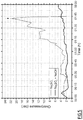
- FIG. 2 thus represents the solubility of soda in water at 25 MPa as a function of temperature.
- knowing these hydroxide salt solubility values makes it possible to evaluate the proportion of the molten salt phase formed after precipitation, and thus to determine the maximum amount of inorganic salt soluble in this molten hydroxide salt phase.
- the process comprises a preliminary step of measuring the solubility of the inorganic salt in the molten hydroxide salt under conditions close to the supercritical range(s).
- This measurement step consists, for example, in injecting an aqueous solution of an inorganic salt of known concentration, so as to precipitate the salt and to deposit it on the walls of the reactor, while ensuring that the output concentration is indeed that of the solubility limit under conditions close to the supercritical range(s) of water.
- the injection of the saline solution is interrupted, so as to be able to inject a solution of a hydroxide salt of known concentration in the system.
- the aim of this second step is to precipitate the hydroxide salt, which, when it melts, dissolves the deposit of inorganic salt, which is then entrained in the flow with the inorganic salt to dissolve in water under subcritical conditions.
- the respective concentrations of hydroxide salt and inorganic salt are then measured at the outlet, and the proportion of salt dissolved by the molten hydroxide salt is determined.
- Several samples are taken at regular time intervals for the same temperature, to verify that the concentration limit of inorganic salt in the molten hydroxide salt has been reached.
- This step makes it possible to determine the solubility of the inorganic salt in the hydroxide salt, and thus to optimally adjust the concentration or the quantity of said hydroxide salt to be introduced, so as to dissolve the inorganic salt precipitated in the reactor.
- this preliminary step may be carried out to measure the solubility of sodium sulfate in sodium hydroxide under the supercritical conditions of water, as shown in FIG. 3 .
- the dotted curve represents the solubility of sodium sulfate in water at 25 MPa.
- a sodium hydroxide solution is injected.
- the data for mass fractions of Na 2 SO 4 contained in the molten sodium hydroxide phase, as a function of time and of the concentration of the sodium hydroxide solution, tend to show that the saturation seems to be around 40% by mass of salt in the sodium hydroxide for temperatures between 400 and 420° C., as illustrated in FIG. 4 .
- the process according to the invention may be a supercritical hydrothermal oxidation process for treating an aqueous fluid containing inorganic salts.
- the aqueous fluid may be placed under pressure and temperature conditions below the conditions close to the supercritical range(s) after leaving the device in which the aqueous fluid is under conditions close to the supercritical range(s).
- the aqueous fluid is placed under normal conditions of temperature and pressure (NCTP) after leaving the device in which the aqueous fluid is under conditions close to the supercritical range(s).
- the invention also relates to a device capable of operating under conditions close to the supercritical range(s) comprising heating and pressurizing means that are capable of placing water under conditions close to the supercritical range(s), a line for introduction into the device of an aqueous fluid containing at least one inorganic salt, and a device for measuring the concentration or quantity of inorganic salt in the device, wherein the measurement is preferably carried out before the entry of the inorganic salt into the device, a line for bringing the inorganic salt into contact with an aqueous stream containing at least one hydroxide salt, so as to obtain in the device an aqueous fluid mixture containing an inorganic salt and a hydroxide salt, a device for adjusting the concentration or the quantity of hydroxide salt as a function of the concentration or amount of the inorganic salt needed to at least partly dissolve the inorganic salt, and, preferably, a device for measuring the concentration or the quantity of inorganic salt leaving the device.
- the heating and pressurizing means capable of placing water under conditions close to the supercritical range(s) are the usual means known to those skilled in the art.
- the aqueous fluid containing the hydroxide salt may be injected into the device alternately with the aqueous fluid containing the inorganic salt. Alternatively, it may be mixed with the aqueous fluid containing the inorganic salt before the latter enters the device. Alternatively, it may be injected discontinuously by pulse into the device.
- the aqueous fluid containing at least one inorganic salt is stored in a storage tank that is in fluid communication with the device according to the invention.
- the device comprises means capable of placing the water of the aqueous mixture in the device under conditions close to the supercritical range(s).
- the aqueous mixture may be heated between 300° C. and 600° C., for example between 350° C. and 550° C., and may be brought to a pressure between 22.1 and 50 MPa, advantageously between 22.1 and 30 MPa.
- the device comprises an outlet line for the fluid mixture, which comprises means for passing under subcritical conditions, i.e. at a temperature and pressure below the critical temperature and the critical pressure of the water, preferably NCTP.
- subcritical conditions i.e. at a temperature and pressure below the critical temperature and the critical pressure of the water, preferably NCTP.
- This passage out of the conditions close to the supercritical range(s) generally results in the resolubilization of all of the salts.
- the inorganic salt may be easily separated from the aqueous fluid, in particular for its subsequent use, its recycling or its recovery (for example its sale). Such separation means are known to those skilled in the art.
- the hydroxide salt may be recycled at the inlet of the device, possibly via a storage tank.
- the invention further relates to a solubility measurement device capable of operating under supercritical conditions comprising heating and pressurizing means capable of placing water under conditions close to the supercritical range(s), a line for introduction into the device of an aqueous fluid containing at least one inorganic salt, a device for measuring the concentration or quantity of inorganic salt entering the device, a line for bringing the inorganic salt into contact with an aqueous stream containing at least one hydroxide salt, so as to obtain in the device an aqueous fluid mixture containing an inorganic salt and a hydroxide salt, said line comprising a filter that is capable of retaining the precipitated inorganic salts and that is capable of causing the molten hydroxide salt to flow less rapidly than the aqueous fluid, and a device for measuring the saturation concentration of the hydroxide salt in the mixture of aqueous fluid.
- the heating and pressurizing means capable of placing water in conditions close to the supercritical range(s) are means known to those skilled in the art.
- the device comprises a tank containing an aqueous fluid containing at least one hydroxide salt.
- Said tank comprises a pump to allow the injection of said aqueous fluid into a line through which an aqueous fluid containing at least one inorganic salt circulates.
- said line comprises a filter composed of micrometric-size amorphous carbon beads, and which is capable of retaining the precipitated inorganic salts and of causing the molten hydroxide salt to flow less rapidly than the aqueous fluid.
- cooling system at the outlet of the line that is capable of re-passing the water of the aqueous mixture under subcritical conditions.
- the solubility measuring device further comprises an apparatus making it possible to measure the concentration of inorganic salt leaving the device.
- this apparatus comprises a conductimetric cell.
- said measuring device is placed directly at the outlet of the cooling system to which it is connected.
- said device is not connected to the cooling system and requires samples to be taken at the outlet of the cooler.
- the device includes a back pressure regulator to control the pressure within the device.
- the device comprises a fluid sampling system at the outlet of the line, which makes it possible to collect said fluid in order to carry out measurements, such as a pH measurement.
- the dissolution of the inorganic salts in the molten hydroxide salt makes it possible to limit, or even prevent, clogging of the device used during a hydrothermal process at high temperature. It avoids long shutdown times for reactor cleaning, as well as repeated alternation of the start-stop phase. Determining the optimum concentration or quantity of hydroxide salt to be introduced into the device as a function of the concentration or quantity of inorganic salts present in the aqueous fluid makes it possible to adjust the process in order to limit the corrosion phenomena, and to implement a reliable industrial process.
- the process makes it possible to control the injection of hydroxide salt, and, therefore, to limit the concentration or the quantity injected. This makes it possible to avoid, or at least reduce, the corrosion phenomena within the device.
- the device and the process according to the invention advantageously comprise a device for controlling the concentration of hydroxide salt present in, or injected into, the device under conditions close to the supercritical range(s).
- the invention also makes it possible to extend the field of waste treatable by a high-temperature hydrothermal process to include waste having a salt content greater than 10 g/l.
- FIG. 1 represents the densities (curves 1) and viscosities (curves 2) of water (dashed lines) and molten soda (solid lines) as a function of temperature.
- FIG. 2 represents the solubility of soda in water at 25 MPa as a function of the temperature, measured according to the protocol of example 1.
- FIG. 3 represents the solubility of sodium sulphate in water at 25 MPa (in dotted lines), and the evolution of the concentration of sodium sulphate at the outlet of the process during the precipitation and the deposition of salt, then to 0.05 mold during the transition to soda, for different times and different temperatures in a particular embodiment, according to the protocol of Example 2.
- FIG. 4 represents the evolution of the mass fractions of sodium sulphate in the molten soda phase as a function of time for different concentrations of soda solutions in an embodiment described in Example 2.
- FIG. 5 represents the evolution of the pressure differentials in the process of a test using pulse injection of soda (bold line), and of a test without soda injection according to a particular embodiment described in Example 3.
- the experimental setup consists of a metal tube in which a soda solution of known concentration circulates continuously.
- the tube is heated to the desired temperature and pressurized to 25 MPa.
- the tube is half filled with a filter composed of micrometric size amorphous carbon beads, firstly to prevent the precipitated solid inorganic salts from being entrained in the flow, and secondly to slow down the flow of soda and allow the measurement of a concentration at saturation.
- the two phases do not flow at the same speed through the filter (which acts as a porous medium), which allows us to measure the saturated salt concentration remaining in the water at the outlet (by sampling and ICP spectrometry measurement), which, in fact, corresponds to its solubility value for the given temperature.
- the salt concentration After a certain time, the salt concentration returns to its initial value, which signals the moment the flow of molten salt reaches the outlet of the assembly, wherein the system is then in steady state. The operation is repeated for different temperatures to thus obtain the solubility curve of the salt in question ( FIG. 2 ).
- a first step consists in injecting an aqueous solution of sodium sulphate (Na 2 SO 4 ) of known concentration, so as to precipitate the salt and effect a deposit on the walls of the reactor.
- the concentration at the outlet of the inorganic salt is, in fact, that of the solubility limit under the given temperature and pressure conditions.
- the injection of the saline solution is interrupted in order to be able to inject a sodium hydroxide solution (NaOH) of known concentration into the system.
- NaOH sodium hydroxide solution
- the soda precipitates, and then melts. It then dissolves the deposit of Na 2 SO 4 , which is then entrained in the stream with the soda.
- the sodium sulphate then re-dissolves in water under subcritical conditions.
- the respective NaOH and Na 2 SO 4 concentrations are measured by sampling at the outlet in order to measure the proportion of salt dissolved by the molten soda (knowing the solubility of Na 2 SO 4 ). Several samples are taken at regular time intervals for the same temperature, to verify that the salt concentration limit in the soda has been reached.
- Tests were carried out on an industrial scale. First, a typical waste, composed of a water/butanol/propanol mixture containing sodium sulfate at a concentration of 5 g/l, is treated by a supercritical hydrothermal oxidation process to allow sufficient exothermic oxidation. The presence of alcohol allows the mixture to be placed in supercritical conditions by reaction with dioxygen.
- a second step the same product is treated in an identical manner, with the difference that a temporary injection of hexanediol/water/soda solution is carried out regularly in order to reduce the clogging of the reactor by the salt.
- a waste to be treated by a supercritical hydrothermal oxidation process contains an inorganic salt of sodium sulfate at a concentration of 5 g/l.
- the effluent is injected into the process at a rate of 90 kg/h.
- precipitation occurs as of a temperature of 380° C. for a pressure of 25 MPa, wherein the salt concentration in the aqueous phase then drops to a value of 5 ppm.
- the amount of salt deposited in the process may then be estimated at 449.55 g/h.
- a waste treatment time of 15 min is chosen, so as to then be able to inject a sodium hydroxide solution, with a concentration of 4 g/l.
- the solubility of the soda is 200 ppm, which means that the amount of molten soda formed is 342 g/h.
- aqueous mixture composed of water and a 30 g/l sodium hydroxide concentration is introduced into a batch reactor. The whole is brought to supercritical conditions at 25 MPa and 500° C. After these conditions have been maintained for 60 minutes, the assembly is cooled and depressurized. The remaining solution is then analyzed by ICP spectrometry measurements. Almost all of the amount of sodium initially introduced is present in the aqueous phase. No trace of corrosion was detected (chromium and nickel levels below 1 ppm), while there were no traces of precipitation on the walls of the reactor. This example shows that a process and device according to the invention does not undergo clogging or corrosion.
- aqueous mixture composed of water and a 30 g/l sodium hydroxide concentration is prepared.
- the setup used consists of a 1 meter long tubular reactor, 3 ⁇ 4 inch in diameter and composed of inconel.
- the system operates continuously using a high pressure pump and a pressure regulating valve at the outlet of the assembly.
- the aqueous solution is thus injected at a flow rate of between 0.5 and 1.5 l/h, the setup is maintained at a pressure of 25 MPa and the temperature of the tubular reactor is brought to 450° C.
- the setup is maintained under these conditions for one hour without any overpressure being observed.
- the system is then shut down and cooled. No solid deposit is present in the reactor and no trace of corrosion is detected in the samples taken at the outlet of the assembly during the test.
- This example shows that a process and device according to the invention does not clog and does not undergo corrosion.
Landscapes
- Chemical & Material Sciences (AREA)
- Organic Chemistry (AREA)
- Chemical Kinetics & Catalysis (AREA)
- Treatment Of Water By Oxidation Or Reduction (AREA)
- Sampling And Sample Adjustment (AREA)
- Investigating Or Analyzing Non-Biological Materials By The Use Of Chemical Means (AREA)
Abstract
Description
-
- the entry into a device of an aqueous fluid containing at least one inorganic salt, the water of the aqueous fluid in the device being under supercritical conditions or close to the supercritical range,
- the measurement of the concentration or the amount of inorganic salt in the device, wherein this measurement is preferably carried out before the entry of the inorganic salt into the device,
- the bringing into contact of the inorganic salt with an aqueous stream containing at least one hydroxide salt, so as to obtain an aqueous fluid mixture in the device containing an inorganic salt and a hydroxide salt,
- the adjustment of the concentration or amount of the hydroxide salt as a function of the concentration or amount of the inorganic salt needed to at least partially solubilize the inorganic salt, and,
-
- heating and pressurizing means capable of placing water in conditions close to the supercritical range(s),
- a line for introducing an aqueous fluid into the device containing at least one inorganic salt,
- a device for measuring the concentration or the amount of inorganic salt in the device, wherein the measurement is preferably carried out before the entry of the inorganic salt into the device,
- a line for bringing the inorganic salt into contact with an aqueous fluid flow containing at least one hydroxide salt, so as to obtain in the device an aqueous fluid mixture containing an inorganic salt and a hydroxide salt,
- a device for adjusting the concentration or the quantity of the hydroxide salt as a function of the concentration or the quantity of the inorganic salt, so as to at least partially dissolve the inorganic salt, and
- preferably a device for measuring the concentration or the quantity of inorganic salt leaving the device.
-
- heating and pressurizing means capable of placing water in conditions close to the supercritical range(s),
- a line for introducing into the device an aqueous fluid containing at least one inorganic salt,
- a device for measuring the concentration or quantity of inorganic salt entering the device,
- a line for bringing the inorganic salt into contact with an aqueous fluid flow containing at least one hydroxide salt, so as to obtain in the device an aqueous fluid mixture containing an inorganic salt and a hydroxide salt, said line comprising a filter, preferably composed of amorphous carbon beads of micrometric size, capable of retaining the precipitated inorganic salts and capable of causing the molten hydroxide salt to flow less rapidly than the aqueous fluid, and
- a device for measuring the saturation concentration of the hydroxide salt in the aqueous fluid mixture.
Claims (20)
Applications Claiming Priority (3)
| Application Number | Priority Date | Filing Date | Title |
|---|---|---|---|
| FR1760895 | 2017-11-17 | ||
| FR1760895A FR3073754B1 (en) | 2017-11-17 | 2017-11-17 | DEVICE AND PROCEDURE IN CONDITIONS CLOSE TO THE SUPERCRITICAL OR SUPERCRITICAL FIELD |
| PCT/EP2018/081652 WO2019097032A1 (en) | 2017-11-17 | 2018-11-16 | Device and process under conditions close to the supercritical range or under supercritical conditions |
Publications (2)
| Publication Number | Publication Date |
|---|---|
| US20210077966A1 US20210077966A1 (en) | 2021-03-18 |
| US11123701B2 true US11123701B2 (en) | 2021-09-21 |
Family
ID=61599313
Family Applications (1)
| Application Number | Title | Priority Date | Filing Date |
|---|---|---|---|
| US16/764,670 Active US11123701B2 (en) | 2017-11-17 | 2018-11-16 | Device and process under conditions close to the supercritical range or under supercritical conditions |
Country Status (4)
| Country | Link |
|---|---|
| US (1) | US11123701B2 (en) |
| EP (1) | EP3710151B1 (en) |
| FR (1) | FR3073754B1 (en) |
| WO (1) | WO2019097032A1 (en) |
Citations (5)
| Publication number | Priority date | Publication date | Assignee | Title |
|---|---|---|---|---|
| US5543057A (en) * | 1995-03-13 | 1996-08-06 | Abitibi-Price, Inc. | Supercritical water oxidation of organics using a mobile surface |
| US5591415A (en) | 1994-01-27 | 1997-01-07 | Rpc Waste Management Services, Inc. | Reactor for supercritical water oxidation of waste |
| US6056883A (en) * | 1994-06-07 | 2000-05-02 | Abitibi Consolidated Inc. | Method and apparatus to remove inorganic scale from a supercritical water oxidation reactor |
| FR2858943A1 (en) | 2003-08-19 | 2005-02-25 | Toshiba Kk | Equipment for safely treating organic waste containing polychlorobiphenyls, (poly)vinyl chloride or radioactive substances |
| WO2016179258A1 (en) | 2015-05-04 | 2016-11-10 | Ohio University | Supercritical vessel and related methods of separating dissolved solids from a fluid |
-
2017
- 2017-11-17 FR FR1760895A patent/FR3073754B1/en active Active
-
2018
- 2018-11-16 EP EP18800230.7A patent/EP3710151B1/en active Active
- 2018-11-16 WO PCT/EP2018/081652 patent/WO2019097032A1/en not_active Ceased
- 2018-11-16 US US16/764,670 patent/US11123701B2/en active Active
Patent Citations (5)
| Publication number | Priority date | Publication date | Assignee | Title |
|---|---|---|---|---|
| US5591415A (en) | 1994-01-27 | 1997-01-07 | Rpc Waste Management Services, Inc. | Reactor for supercritical water oxidation of waste |
| US6056883A (en) * | 1994-06-07 | 2000-05-02 | Abitibi Consolidated Inc. | Method and apparatus to remove inorganic scale from a supercritical water oxidation reactor |
| US5543057A (en) * | 1995-03-13 | 1996-08-06 | Abitibi-Price, Inc. | Supercritical water oxidation of organics using a mobile surface |
| FR2858943A1 (en) | 2003-08-19 | 2005-02-25 | Toshiba Kk | Equipment for safely treating organic waste containing polychlorobiphenyls, (poly)vinyl chloride or radioactive substances |
| WO2016179258A1 (en) | 2015-05-04 | 2016-11-10 | Ohio University | Supercritical vessel and related methods of separating dissolved solids from a fluid |
Non-Patent Citations (4)
| Title |
|---|
| Borovaya, F. and Ravich, M., 1968. Solubulity of Sodium Carbonate and Orthophosphate in Aqueous Solutions of Sodium Hydroxide at Elevated Temperatures. Russian Journal of Inorganic Chemistry, 13(12), pp. 1720-1723. |
| INPI Search Report issued in French Application No. 1760895 and dated Jul. 16, 2018. |
| International Search Report issued in International Application No. PCT/EP2018/081652 and dated Jan. 25, 2019 (with English Translation). |
| National Research Council. Using supercritical water oxidation to treat hydrolysate from VX neutralization. National Academies Press, 1998. |
Also Published As
| Publication number | Publication date |
|---|---|
| FR3073754A1 (en) | 2019-05-24 |
| EP3710151B1 (en) | 2023-08-02 |
| US20210077966A1 (en) | 2021-03-18 |
| EP3710151A1 (en) | 2020-09-23 |
| FR3073754B1 (en) | 2021-07-23 |
| WO2019097032A1 (en) | 2019-05-23 |
Similar Documents
| Publication | Publication Date | Title |
|---|---|---|
| JP2025508642A (en) | Method and system for the purification and recycling of lithium-ion battery waste streams | |
| Refait et al. | Chemical composition and Gibbs standard free energy of formation of Fe (II)-Fe (III) hydroxysulphate green rust and Fe (II) hydroxide | |
| CN106517097B (en) | Molten salt deoxidation method and deoxidized molten salt | |
| US6764663B2 (en) | Process for producing vanadyl/vanadous sulphate | |
| Oomole et al. | Carbon dioxide-dolomite rock interaction during CO2 flooding process | |
| Fajaryanto et al. | Acid leaching and kinetics study of cobalt recovery from spent lithium-ion batteries with nitric acid | |
| CN106745151A (en) | Waste acid containing the zinc comprehensive treatment utilization method high | |
| JP2021524986A5 (en) | ||
| US20210077966A1 (en) | Device and process under conditions close to the supercritical range or under supercritical conditions | |
| JP2021524986A (en) | Electroplating of lithiated transition metal oxides using low-purity starting precursors | |
| Bye et al. | Optimal conditions for the reduction of selenate to selenite by hydrochloric acid | |
| US4224151A (en) | Preventing scale deposition from geothermal fluids | |
| Park et al. | Perchlorate degradation using aqueous titanium ions produced by oxidative dissolution of zero-valent titanium | |
| CN106868495B (en) | A kind of recovery and reuse method of cobalt salt chemical oxidation waste liquid | |
| US4330508A (en) | Removal of selenium (IV) and (VI) from acidic copper sulphate solutions | |
| WO2015141436A1 (en) | Cold-insulating tool | |
| WO2016018165A1 (en) | Simplified process for preparing electrolyte for vanadium redox batteries | |
| Smialowski et al. | Corrosion of iron in solutions containing ammonium nitrate | |
| Cho et al. | Electronic absorption spectra of U (III) ion in a LiCl–KCl eutectic melt at 450° C | |
| CN116535038A (en) | A process for treating non-radioactive production wastewater discharge pollutants exceeding the standard | |
| Moehs et al. | Fluorination of metal stannates | |
| EP1414753B1 (en) | Method for regeneration of used halide fluids | |
| Ahern et al. | Kinetics of trithionate degradation | |
| JP6267554B2 (en) | Cooler | |
| JP2019014612A (en) | Method for producing an aqueous solution of monochlorosulfamic acid salt |
Legal Events
| Date | Code | Title | Description |
|---|---|---|---|
| FEPP | Fee payment procedure |
Free format text: ENTITY STATUS SET TO UNDISCOUNTED (ORIGINAL EVENT CODE: BIG.); ENTITY STATUS OF PATENT OWNER: LARGE ENTITY |
|
| AS | Assignment |
Owner name: INSTITUT POLYTECHNIQUE DE BORDEAUX, FRANCE Free format text: ASSIGNMENT OF ASSIGNORS INTEREST;ASSIGNOR:AYMONIER, CYRIL;REEL/FRAME:053670/0533 Effective date: 20200623 Owner name: CENTRE NATIONAL DE LA RECHERCHE SCIENTIFIQUE, FRANCE Free format text: ASSIGNMENT OF ASSIGNORS INTEREST;ASSIGNOR:AYMONIER, CYRIL;REEL/FRAME:053670/0533 Effective date: 20200623 Owner name: UNIVERSITE DE BORDEAUX, FRANCE Free format text: ASSIGNMENT OF ASSIGNORS INTEREST;ASSIGNOR:AYMONIER, CYRIL;REEL/FRAME:053670/0533 Effective date: 20200623 Owner name: ECOLE NAT SUPERIEURE ARTS ET METIERS ENSAM, FRANCE Free format text: ASSIGNMENT OF ASSIGNORS INTEREST;ASSIGNOR:AYMONIER, CYRIL;REEL/FRAME:053670/0533 Effective date: 20200623 |
|
| STPP | Information on status: patent application and granting procedure in general |
Free format text: RESPONSE TO NON-FINAL OFFICE ACTION ENTERED AND FORWARDED TO EXAMINER |
|
| STPP | Information on status: patent application and granting procedure in general |
Free format text: NOTICE OF ALLOWANCE MAILED -- APPLICATION RECEIVED IN OFFICE OF PUBLICATIONS |
|
| STPP | Information on status: patent application and granting procedure in general |
Free format text: PUBLICATIONS -- ISSUE FEE PAYMENT RECEIVED |
|
| STCF | Information on status: patent grant |
Free format text: PATENTED CASE |
|
| MAFP | Maintenance fee payment |
Free format text: PAYMENT OF MAINTENANCE FEE, 4TH YEAR, LARGE ENTITY (ORIGINAL EVENT CODE: M1551); ENTITY STATUS OF PATENT OWNER: LARGE ENTITY Year of fee payment: 4 |