US11078335B2 - Method for preparing a graft copolymer with a polyolefin backbone and polyorganosiloxane pendant groups - Google Patents
Method for preparing a graft copolymer with a polyolefin backbone and polyorganosiloxane pendant groups Download PDFInfo
- Publication number
- US11078335B2 US11078335B2 US16/621,745 US201816621745A US11078335B2 US 11078335 B2 US11078335 B2 US 11078335B2 US 201816621745 A US201816621745 A US 201816621745A US 11078335 B2 US11078335 B2 US 11078335B2
- Authority
- US
- United States
- Prior art keywords
- carbon atoms
- hydrocarbon group
- independently
- subscript
- graft copolymer
- Prior art date
- Legal status (The legal status is an assumption and is not a legal conclusion. Google has not performed a legal analysis and makes no representation as to the accuracy of the status listed.)
- Active, expires
Links
- 0 *O[Si]([5*])([5*])[1*]C([H])(C)C([H])C.[15*]C([H])(C)C([H])([H])C Chemical compound *O[Si]([5*])([5*])[1*]C([H])(C)C([H])C.[15*]C([H])(C)C([H])([H])C 0.000 description 18
- KYLRWMVNLVEMJG-UHFFFAOYSA-N C.C.CCCC1=CC=C(CCC)C=C1.CCCC1=CC=CC(CCC)=C1 Chemical compound C.C.CCCC1=CC=C(CCC)C=C1.CCCC1=CC=CC(CCC)=C1 KYLRWMVNLVEMJG-UHFFFAOYSA-N 0.000 description 1
Classifications
-
- C—CHEMISTRY; METALLURGY
- C08—ORGANIC MACROMOLECULAR COMPOUNDS; THEIR PREPARATION OR CHEMICAL WORKING-UP; COMPOSITIONS BASED THEREON
- C08G—MACROMOLECULAR COMPOUNDS OBTAINED OTHERWISE THAN BY REACTIONS ONLY INVOLVING UNSATURATED CARBON-TO-CARBON BONDS
- C08G77/00—Macromolecular compounds obtained by reactions forming a linkage containing silicon with or without sulfur, nitrogen, oxygen or carbon in the main chain of the macromolecule
- C08G77/42—Block-or graft-polymers containing polysiloxane sequences
- C08G77/442—Block-or graft-polymers containing polysiloxane sequences containing vinyl polymer sequences
-
- C—CHEMISTRY; METALLURGY
- C08—ORGANIC MACROMOLECULAR COMPOUNDS; THEIR PREPARATION OR CHEMICAL WORKING-UP; COMPOSITIONS BASED THEREON
- C08F—MACROMOLECULAR COMPOUNDS OBTAINED BY REACTIONS ONLY INVOLVING CARBON-TO-CARBON UNSATURATED BONDS
- C08F210/00—Copolymers of unsaturated aliphatic hydrocarbons having only one carbon-to-carbon double bond
- C08F210/02—Ethene
-
- C—CHEMISTRY; METALLURGY
- C08—ORGANIC MACROMOLECULAR COMPOUNDS; THEIR PREPARATION OR CHEMICAL WORKING-UP; COMPOSITIONS BASED THEREON
- C08F—MACROMOLECULAR COMPOUNDS OBTAINED BY REACTIONS ONLY INVOLVING CARBON-TO-CARBON UNSATURATED BONDS
- C08F230/00—Copolymers of compounds having one or more unsaturated aliphatic radicals, each having only one carbon-to-carbon double bond, and containing phosphorus, selenium, tellurium or a metal
- C08F230/04—Copolymers of compounds having one or more unsaturated aliphatic radicals, each having only one carbon-to-carbon double bond, and containing phosphorus, selenium, tellurium or a metal containing a metal
- C08F230/08—Copolymers of compounds having one or more unsaturated aliphatic radicals, each having only one carbon-to-carbon double bond, and containing phosphorus, selenium, tellurium or a metal containing a metal containing silicon
-
- C—CHEMISTRY; METALLURGY
- C08—ORGANIC MACROMOLECULAR COMPOUNDS; THEIR PREPARATION OR CHEMICAL WORKING-UP; COMPOSITIONS BASED THEREON
- C08G—MACROMOLECULAR COMPOUNDS OBTAINED OTHERWISE THAN BY REACTIONS ONLY INVOLVING UNSATURATED CARBON-TO-CARBON BONDS
- C08G77/00—Macromolecular compounds obtained by reactions forming a linkage containing silicon with or without sulfur, nitrogen, oxygen or carbon in the main chain of the macromolecule
- C08G77/04—Polysiloxanes
- C08G77/06—Preparatory processes
- C08G77/08—Preparatory processes characterised by the catalysts used
-
- C—CHEMISTRY; METALLURGY
- C08—ORGANIC MACROMOLECULAR COMPOUNDS; THEIR PREPARATION OR CHEMICAL WORKING-UP; COMPOSITIONS BASED THEREON
- C08L—COMPOSITIONS OF MACROMOLECULAR COMPOUNDS
- C08L23/00—Compositions of homopolymers or copolymers of unsaturated aliphatic hydrocarbons having only one carbon-to-carbon double bond; Compositions of derivatives of such polymers
- C08L23/02—Compositions of homopolymers or copolymers of unsaturated aliphatic hydrocarbons having only one carbon-to-carbon double bond; Compositions of derivatives of such polymers not modified by chemical after-treatment
-
- C—CHEMISTRY; METALLURGY
- C08—ORGANIC MACROMOLECULAR COMPOUNDS; THEIR PREPARATION OR CHEMICAL WORKING-UP; COMPOSITIONS BASED THEREON
- C08L—COMPOSITIONS OF MACROMOLECULAR COMPOUNDS
- C08L83/00—Compositions of macromolecular compounds obtained by reactions forming in the main chain of the macromolecule a linkage containing silicon with or without sulfur, nitrogen, oxygen or carbon only; Compositions of derivatives of such polymers
- C08L83/04—Polysiloxanes
-
- C—CHEMISTRY; METALLURGY
- C08—ORGANIC MACROMOLECULAR COMPOUNDS; THEIR PREPARATION OR CHEMICAL WORKING-UP; COMPOSITIONS BASED THEREON
- C08L—COMPOSITIONS OF MACROMOLECULAR COMPOUNDS
- C08L83/00—Compositions of macromolecular compounds obtained by reactions forming in the main chain of the macromolecule a linkage containing silicon with or without sulfur, nitrogen, oxygen or carbon only; Compositions of derivatives of such polymers
- C08L83/04—Polysiloxanes
- C08L83/06—Polysiloxanes containing silicon bound to oxygen-containing groups
-
- C—CHEMISTRY; METALLURGY
- C08—ORGANIC MACROMOLECULAR COMPOUNDS; THEIR PREPARATION OR CHEMICAL WORKING-UP; COMPOSITIONS BASED THEREON
- C08G—MACROMOLECULAR COMPOUNDS OBTAINED OTHERWISE THAN BY REACTIONS ONLY INVOLVING UNSATURATED CARBON-TO-CARBON BONDS
- C08G77/00—Macromolecular compounds obtained by reactions forming a linkage containing silicon with or without sulfur, nitrogen, oxygen or carbon in the main chain of the macromolecule
- C08G77/04—Polysiloxanes
- C08G77/12—Polysiloxanes containing silicon bound to hydrogen
-
- C—CHEMISTRY; METALLURGY
- C08—ORGANIC MACROMOLECULAR COMPOUNDS; THEIR PREPARATION OR CHEMICAL WORKING-UP; COMPOSITIONS BASED THEREON
- C08G—MACROMOLECULAR COMPOUNDS OBTAINED OTHERWISE THAN BY REACTIONS ONLY INVOLVING UNSATURATED CARBON-TO-CARBON BONDS
- C08G77/00—Macromolecular compounds obtained by reactions forming a linkage containing silicon with or without sulfur, nitrogen, oxygen or carbon in the main chain of the macromolecule
- C08G77/04—Polysiloxanes
- C08G77/14—Polysiloxanes containing silicon bound to oxygen-containing groups
-
- C—CHEMISTRY; METALLURGY
- C08—ORGANIC MACROMOLECULAR COMPOUNDS; THEIR PREPARATION OR CHEMICAL WORKING-UP; COMPOSITIONS BASED THEREON
- C08G—MACROMOLECULAR COMPOUNDS OBTAINED OTHERWISE THAN BY REACTIONS ONLY INVOLVING UNSATURATED CARBON-TO-CARBON BONDS
- C08G77/00—Macromolecular compounds obtained by reactions forming a linkage containing silicon with or without sulfur, nitrogen, oxygen or carbon in the main chain of the macromolecule
- C08G77/04—Polysiloxanes
- C08G77/14—Polysiloxanes containing silicon bound to oxygen-containing groups
- C08G77/16—Polysiloxanes containing silicon bound to oxygen-containing groups to hydroxyl groups
-
- C—CHEMISTRY; METALLURGY
- C08—ORGANIC MACROMOLECULAR COMPOUNDS; THEIR PREPARATION OR CHEMICAL WORKING-UP; COMPOSITIONS BASED THEREON
- C08G—MACROMOLECULAR COMPOUNDS OBTAINED OTHERWISE THAN BY REACTIONS ONLY INVOLVING UNSATURATED CARBON-TO-CARBON BONDS
- C08G77/00—Macromolecular compounds obtained by reactions forming a linkage containing silicon with or without sulfur, nitrogen, oxygen or carbon in the main chain of the macromolecule
- C08G77/04—Polysiloxanes
- C08G77/14—Polysiloxanes containing silicon bound to oxygen-containing groups
- C08G77/18—Polysiloxanes containing silicon bound to oxygen-containing groups to alkoxy or aryloxy groups
-
- C—CHEMISTRY; METALLURGY
- C08—ORGANIC MACROMOLECULAR COMPOUNDS; THEIR PREPARATION OR CHEMICAL WORKING-UP; COMPOSITIONS BASED THEREON
- C08G—MACROMOLECULAR COMPOUNDS OBTAINED OTHERWISE THAN BY REACTIONS ONLY INVOLVING UNSATURATED CARBON-TO-CARBON BONDS
- C08G77/00—Macromolecular compounds obtained by reactions forming a linkage containing silicon with or without sulfur, nitrogen, oxygen or carbon in the main chain of the macromolecule
- C08G77/04—Polysiloxanes
- C08G77/20—Polysiloxanes containing silicon bound to unsaturated aliphatic groups
-
- C—CHEMISTRY; METALLURGY
- C08—ORGANIC MACROMOLECULAR COMPOUNDS; THEIR PREPARATION OR CHEMICAL WORKING-UP; COMPOSITIONS BASED THEREON
- C08L—COMPOSITIONS OF MACROMOLECULAR COMPOUNDS
- C08L43/00—Compositions of homopolymers or copolymers of compounds having one or more unsaturated aliphatic radicals, each having only one carbon-to-carbon double bond, and containing boron, silicon, phosphorus, selenium, tellurium or a metal; Compositions of derivatives of such polymers
- C08L43/04—Homopolymers or copolymers of monomers containing silicon
-
- C—CHEMISTRY; METALLURGY
- C08—ORGANIC MACROMOLECULAR COMPOUNDS; THEIR PREPARATION OR CHEMICAL WORKING-UP; COMPOSITIONS BASED THEREON
- C08L—COMPOSITIONS OF MACROMOLECULAR COMPOUNDS
- C08L83/00—Compositions of macromolecular compounds obtained by reactions forming in the main chain of the macromolecule a linkage containing silicon with or without sulfur, nitrogen, oxygen or carbon only; Compositions of derivatives of such polymers
- C08L83/10—Block- or graft-copolymers containing polysiloxane sequences
Definitions
- This invention relates to a method for preparing a graft copolymer having a polyolefin main chain (backbone) and a polyorganosiloxane pendant group. More particularly, the method described herein provide control in number of graft segments and the ability to keep the polyolefin main chain intact.
- a method for preparing a graft copolymer having a polyolefin backbone and polyorganosiloxane pendant groups may be performed using different catalysts.
- the graft copolymer having a polyolefin backbone and polyorganosiloxane pendant groups be prepared by a method comprising:
- the silane grafted polyolefin may have a saturated polyolefin backbone (optionally with aliphatically unsaturated endblocking groups).
- the silane grafted polyolefin (and optionally all other starting materials used in step 1) may be free of (meth)acrylate functional groups. “Free of (meth)acrylate functional groups” means containing no acrylate or methacrylate functionality or an amount of acrylate and/or methacrylate functionality non-detectable by IR analysis.
- the polyolefin used to prepare A) may be a homopolymer or a copolymer of different monomers.
- the polyolefin used to prepare starting material A) may be, for example, a polyethylene, a poly(ethylene/octene) copolymer, a polypropylene, or a polystyrene.
- the polyolefin may be a polyethylene or a polypropylene.
- the polyolefin may be a polyethylene or a poly(ethylene/octene) copolymer.
- the catalyst may be a Lewis Acid catalyst or a hydrosilylation reaction catalyst. Radical polymerization catalysts (such as peroxides, anhydrides, and maleic acids) are generally avoided to prevent degradation of the polyolefin.
- Step 1) may be performed by any convenient means, such as heating and/or mixing.
- Heating may be performed at a temperature of 50° C. to 150° C., alternatively 80° C. to 110° C.
- Mixing may be performed by any convenient means, in either batch or continuous equipment.
- Step 1) may be performed in solution, i.e., starting materials comprising A), B), and C) may be dissolved in starting material D), the solvent.
- Step 2) may be performed, for example, when the graft copolymer has a siloxane pendant group with a silicon bonded substituent such as OH, H, OR, and/or an epoxy-functional organic group, where each R is independently a monovalent hydrocarbon group of 1 to 18 carbon atoms or a monovalent halogenated hydrocarbon group of 1 to 18 carbon atoms.
- a suitable capping agent may be a silane with one substituent capable of reacting with the OH, H, OR, or epoxy functionality.
- the capping agent may have formula: R 3 SiR 14 , where R 14 is a substituent capable of reaction with one or more of OH, H, OR, or epoxy functionality, such as H or hydrocarbyloxy (e.g., alkoxy).
- R 14 is a substituent capable of reaction with one or more of OH, H, OR, or epoxy functionality, such as H or hydrocarbyloxy (e.g., alkoxy).
- an organohydridosilane capping agent may be added in step 2), with heating to temperatures of 50° C. to 200° C., alternatively 100° C. to 120° C.
- the organohydridosilane may have formula R 3 SiH, where each R is independently a monovalent hydrocarbon group of 1 to 18 carbon atoms or a monovalent halogenated hydrocarbon group of 1 to 18 carbon atoms.
- Suitable monovalent hydrocarbon groups for R include alkyl, alkenyl, and aryl, as defined herein.
- each R may be independently selected from the group consisting of methyl, vinyl, allyl, and phenyl; alternatively each R may be independently selected from the group consisting of methyl and phenyl.
- R is as defined above.
- the capping agent may have formula R 3 SiOR, where R is as defined above when the polyorganosiloxane has two or more silicon bonded OR groups.
- Step 3) may be performed by any convenient means such as solvent extraction, precipitation and filtering, or stripping and/or distillation optionally at reduced pressure.
- the silane grafted polyolefin may comprise units of formulae
- Each R is independently a monovalent hydrocarbon group of 1 to 18 carbon atoms or a monovalent halogenated hydrocarbon group of 1 to 18 carbon atoms.
- Suitable monovalent hydrocarbon groups for R include alkyl, alkenyl, and aryl, as defined herein.
- each R may be independently selected from the group consisting of methyl, vinyl, allyl, and phenyl; alternatively each R may be independently selected from the group consisting of methyl and phenyl.
- Each R 5 is independently selected from R or OR, where R is as described above.
- each R 5 is a monovalent hydrocarbon group of 1 to 18 carbon atoms or a monovalent halogenated hydrocarbon group of 1 to 18 carbon atoms as described above for R.
- Each R 1 is independently a divalent hydrocarbon group of 2 to 50 carbon atoms. Suitable divalent hydrocarbon groups for R 1 are exemplified by an alkylene group such as ethylene, propylene, butylene, hexylene, or octylene; an arylene group such as phenylene, or an alkylarylene group such as:
- each R 1 is an alkylene group such as octylene.
- Each R 15 is independently H, a monovalent hydrocarbon group of 1 to 18 carbon atoms or a monovalent halogenated hydrocarbon group of 1 to 18 carbon atoms, as described herein for R.
- each R 15 may be H or an alkyl group of 1 to 6 carbon atoms.
- each R 15 may be H.
- Subscript m is at least 1.
- Subscript n is at least 1.
- subscripts m and n may have values such that a quantity m/(m+n) may have a value such that 0.01 mol % ⁇ m/(m+n) ⁇ 10 mol %.
- subscripts m and n may have values sufficient to provide the copolymer with a Mn of 1,000 to 500,000.
- This silane grafted polyolefin may further comprise R 12 endblocking groups at each terminus.
- Each R 12 may independently be a saturated monovalent hydrocarbon group, such as an alkyl group (e.g., methyl) or an unsaturated monovalent hydrocarbon group having one or more double bonds (e.g., a monovalent hydrocarbon group comprising vinyl, vinyline, or vinylidene functionality).
- silane grafted polyolefins are commercially available, for example, polyethylene grafted with silicon bonded methoxy groups, which is commercially available as SI-LINKTM DFDA from The Dow Chemical Company of Midland Mich., U.S.A. Examples include SI-LINKTM DFDA 6451 NT, SI-LINKTM DFDA 5480, SI-LINKTM DFDA 5480 NT, SI-LINKTM DFDA 5451 NT, and combinations thereof. Examples of such silane grafted polyolefins and methods for their preparation are disclosed, for example in U.S. Patent Application Publications 2010/0181092 and 2010/0209705, and U.S. Pat. No. 8,426,519.
- B) the polyorganosiloxane may have formula
- Subscript o is 5 to 500, alternatively 10 to 500.
- subscript o may be 15 to 400.
- subscript o may be 20 to 300.
- subscript o may be 25 to 200.
- subscript o may be 50 to 150.
- Suitable polyorganosiloxanes and methods for their preparation are known in the art.
- Polyorganosiloxanes in which R 6 is a hydrogen atom may be used to prepare polyorganosiloxanes with other functional groups.
- a silane having an aliphatically unsaturated hydrocarbon group may be reacted with an SiH functional polyorganosiloxane in the presence of a hydrosilylation catalyst to prepare the polyorganosiloxane having the silyl moiety of formula —R 1 —SiR a (OR) b .
- the alkoxysilane may have formula R 13 SiR a (OR) b , where R and subscripts a and b are as described above, and R 13 is a monovalent aliphatically unsaturated hydrocarbon group, such as alkenyl or alkynyl, as defined herein.
- the catalyst may be a Lewis Acid catalyst.
- Lewis Acid catalysts such as those containing boron are suitable.
- the Lewis Acid catalyst may be selected from (C 5 F 4 )(C 6 F 5 ) 2 B; (C 5 F 4 ) 3 B; (C 6 F 5 )BF 2 ; BF(C 6 F 5 ) 2 ; B(C 6 F 5 ) 3 ; BCl 2 (C 6 F 5 ); BCl(C 6 F 5 ) 2 ; B(C 6 H 5 )(C 6 F 5 ) 2 ; B(C 6 H 5 ) 2 (C 6 F 5 ); [C 6 H 4 (mCF 3 )] 3 B; [C 6 H 4 (pOCF 3 )] 3 B; (C 6 F 5 )B(OH) 2 ; (C 6 F 5 ) 2 BOH; (C 6 F 5 ) 2 BH; (C 6 F 5 )BH 2 ; (C 7 H 11 )B(C 6 F 5 ) 2
- each R 3 is independently R or OR; and each R 4 is independently R, H, OR, or OH or a silyl moiety of formula —R 1 —SiR a (OR) b , where subscript a and subscript b are as described above.
- a by-product such as a hydrocarbon, halogenated hydrocarbon, or alcohol may be produced.
- This graft copolymer may further comprise R 12 endblocking groups at each terminus.
- Each R 12 may independently be a saturated monovalent hydrocarbon group, such as an alkyl group (e.g., methyl) or an unsaturated monovalent hydrocarbon group having one or more double bonds (e.g., a monovalent hydrocarbon group comprising vinyl, vinyline, or vinylidene functionality).
- the silane grafted polyolefin may be an SiH functional silane grafted polyolefin comprising units of formulae
- R 15 , R 1 , and subscripts m and n are as described above, and each R 8 is selected from R (as described above) and H.
- Examples of such silane grafted polyolefins and methods for their preparation are disclosed, for example, in U.S. Pat. No. 6,624,254.
- This silane grafted polyolefin may further comprise R 12 endblocking groups at each terminus.
- Each R 12 may independently be a saturated monovalent hydrocarbon group, such as an alkyl group (e.g., methyl) or an unsaturated monovalent hydrocarbon group having one or more double bonds (e.g., a monovalent hydrocarbon group comprising vinyl, vinyline, or vinylidene functionality).
- B) the polyorganosiloxane may have formula
- the catalyst may be a Lewis Acid catalyst, and alternatively a Piers-Rubinsztajn reaction catalyst, as described above.
- each R 16 is independently R or H
- each R 17 is independently R, OR, or OH.
- R 9 is OH
- a by-product such as hydrogen may be produced.
- R 9 is OR, then a by-product such as a hydrocarbon will be produced.
- This graft copolymer may further comprise R 12 endblocking groups at each terminus.
- Each R 12 may independently be a saturated monovalent hydrocarbon group, such as an alkyl group (e.g., methyl) or an unsaturated monovalent hydrocarbon group having one or more double bonds (e.g., a monovalent hydrocarbon group comprising vinyl, vinyline, or vinylidene functionality).
- the silane grafted polyolefin may be the SiH functional silane grafted polyolefin described above comprising units of formulae
- R 15 , R 1 , R 8 , and subscripts m and n are as described above.
- B) the polyorganosiloxane may have formula
- R is as described above and R 21 is an epoxy-functional organic group, and each R 22 is independently selected from R and R 21 .
- suitable epoxy-functional organic groups include glycidoxyalkyl groups such as glycidoxypropyl.
- Suitable polyorganosiloxanes and methods for their preparation are known in the art.
- the catalyst may be a Lewis Acid catalyst, and alternatively a Piers-Rubinsztajn reaction catalyst, as described above.
- each R 23 is independently selected from R (as described above) and H
- each R 24 is independently R or an epoxy-functional organic group as described above
- each R 25 is a divalent organic group, such as a divalent hydrocarbon group or a divalent oxygenated hydrocarbon group. Suitable divalent hydrocarbon groups for R 25 are as described above for R 1 .
- This graft copolymer may further comprise R 12 endblocking groups at each terminus.
- Each R 12 may independently be a saturated monovalent hydrocarbon group, such as an alkyl group (e.g., methyl) or an unsaturated monovalent hydrocarbon group having one or more double bonds (e.g., a monovalent hydrocarbon group comprising vinyl, vinyline, or vinylidene functionality).
- the silane grafted polyolefin may be the SiH functional silane grafted polyolefin described above comprising units of formulae
- R 11 is an aliphatically unsaturated monovalent hydrocarbon group of 2 to 18 carbon atoms.
- R 11 may be alkenyl or alkynyl as defined herein. Suitable polyorganosiloxanes and methods for their preparation are known in the art.
- starting material C) is a hydrosilylation reaction catalyst.
- Hydrosilylation reaction catalysts include platinum group metal catalysts, which known in the art and are commercially available. Such hydrosilylation catalysts can be a metal selected from platinum, rhodium, ruthenium, palladium, osmium, and iridium.
- the hydrosilylation catalyst may be a compound of such a metal, for example, chloroplatinic acid, chloroplatinic acid hexahydrate, platinum dichloride, and complexes of said compounds with low molecular weight organopolysiloxanes or platinum compounds microencapsulated in a matrix or coreshell type structure.
- Complexes of platinum with low molecular weight organopolysiloxanes include 1,3-diethenyl-1,1,3,3-tetramethyldisiloxane complexes with platinum. These complexes may be microencapsulated in a resin matrix.
- a hydrosilylation catalyst may comprise 1,3-diethenyl-1,1,3,3-tetramethyldisiloxane complex with platinum.
- Exemplary hydrosilylation catalysts are described in U.S. Pat. Nos. 3,159,601; 3,220,972; 3,296,291; 3,419,593; 3,516,946; 3,814,730; 3,989,668; 4,784,879; 5,036,117; and 5,175,325 and EP 0 347 895 B.
- Microencapsulated hydrosilylation catalysts and methods of preparing them are known in the art, as exemplified in U.S. Pat. Nos. 4,766,176 and 5,017,654.
- R 20 is a divalent hydrocarbon group of 2 to 50 carbon atoms
- each R 18 is independently R or H
- each R 19 is independently R or R 11 .
- This graft copolymer may further comprise R 12 endblocking groups at each terminus.
- Each R 12 may independently be a saturated monovalent hydrocarbon group, such as an alkyl group (e.g., methyl) or an unsaturated monovalent hydrocarbon group having one or more double bonds (e.g., a monovalent hydrocarbon group comprising vinyl, vinyline, or vinylidene functionality).
- Starting material D) for each embodiment of the method described above is a solvent.
- Suitable solvents include hydrocarbon solvents and/or alcohols.
- Suitable hydrocarbon solvents include alkanes such as hexane and/or heptane; aromatic solvents such as benzene, toluene and/or xylene; and/or cycloalkanes such as cyclohexane.
- Suitable alcohols include methanol, ethanol, propanol and/or butanol.
- the amount of solvent is sufficient to compatibilize starting materials A) and B), which may be sufficient to make an optically clear solution of the starting materials used in step 1).
- the exact amount of solvent will depend on various factors including the selection of starting materials A) and B), however, the amount of solvent may be at least 80%, alternatively 80% to 95%, based on combined weights of all starting materials combined in step 1).
- the units in the graft copolymer produced may be randomly distributed in the copolymer.
- the copolymer may be a block copolymer with the units shown above arranged in blocks.
- the methods described herein may provide the benefit that ⁇ 5% of starting material A) based on the amount of starting material A) added before beginning step 1) and/or ⁇ 5% of starting material B) based on the amount of starting material B) added before beginning step 1) remains unreacted after step 1).
- the graft copolymer prepared by the method may have a crystallization temperature at least 20° C. lower than the crystallization temperature of the silane grafted polyolefin used as starting material A), where crystallization temperature is measured by DSC.
- a 250 mL 1 neck round bottom flask was loaded with the following: MCR-H11 (25.00 g, 0.3258 mols Si, 0.01984 mols SiH), toluene (75.00 g), and vinylmethyldimethoxysilane (target: 2.89 g, 0.0219 mols).
- MCR-H11 (25.00 g, 0.3258 mols Si, 0.01984 mols SiH)
- toluene 75.00 g
- vinylmethyldimethoxysilane target: 2.89 g, 0.0219 mols
- Example 1 the following starting materials were used to make a graft copolymer.
- Starting material d1) was ACS Grade toluene was available from Fischer Scientific.
- starting material b1) After dissolving starting material a1) in the toluene, starting material b1) in an amount of 1.26 g (corresponding to 0.000905 mols SiMe(OMe) 2 functionality) was added to the flask. A total of 0.036 g of starting material c1) was added to the flask. After 1 min a small amount of foaming occurred, likely evidence of gas formation. The solution in the flask was heated at 85° C. for 1 hour. Endcapper trimethylmethoxysilane (0.23 g, 0.0022 mol) was then added to the flask, and heating was continued at 85° C. for 20 min. The flask contents were analyzed by IR analysis, which showed unreacted SiH remaining.
- a graft copolymer by reacting b2) a mono-SiH terminated polydimethylsiloxane (PDMS) with a2) a methoxy (SiOMe) grafted low density polyethylene.
- PDMS polydimethylsiloxane
- SiOMe methoxy grafted low density polyethylene
- the following starting materials were used.
- Starting material c2) was B(C 6 F 5 ) 3 delivered 5 wt % in toluene.
- Starting material d2) was ACS grade toluene, commercially available from Fisher Scientific.
- the graft copolymer was prepared as follows: a 250 mL wide-mouth borosilicate glass bottle was loaded with: 20.0 g of a2) the low density polyethylene grafted with silicon bonded methoxy groups described above, 2.55 g of b2) the polydimethylsiloxane described above, and 90.21 g of d2) the toluene to prepare a 20% NVC solution.
- the bottle was equipped with a Teflon stir paddle attached to a glass stir shaft. A nitrogen purge was applied.
- the solution in the bottle was heated using an oil bath at an oil temperature of 110° C. The solution was clear once all of a2) the low density polyethylene dissolved.
- triethylsilane was then added to the bottle.
- the triethylsilane was added after incorporation of b) the polydimethylsiloxane to stabilize the resulting graft copolymer by endcapping any residual SiOMe groups which are sterically accessible to groups of formula (Si—O—SiEt 3 ). Heating was continued at 110° C. for 1 hour.
- the bottle contents were poured onto a Teflon sheet while still hot in a fume hood.
- IR analysis of a hot pressed film formed from the bottle contents showed no detectable SiH.
- the hot pressed film was smooth, flexible, tough, and translucent.
- a graft copolymer was prepared by a method comprising reacting a b3) monoepoxy-terminated siloxane with a3) an SiH grafted polyolefin.
- the following starting materials were used.
- Starting material a3) was a polyethylene-octene copolymer having silicon bonded hydrogen atoms, which was prepared with 3.2% of a silane monomer, ODMS.
- Starting material d3) was toluene purified via solvent purification system.
- Starting material d3′) was HPLC grade methanol, which was commercially available from Fisher.
- the graft copolymer was prepared as follows. In a glove box, a 2 dram vial was loaded with 50 mg of starting material a3) the SiH grafted polyolefin, 47 mg of b3), the epoxy-terminated PDMS, 1 mL of toluene, and a Teflon stirbar. This reaction mixture was heated using a heating block at 100° C. until it became translucent. Starting material c3) in an amount of 5 uL of a 10 mg/mL solution in toluene was added, and heating at 100° C. was continued for 18 hours. The vial was then removed from the glovebox and the graft copolymer was precipitated into rapidly stirring methanol, and isolated by filtration and drying on high vacuum (100 mTorr) overnight.
- Results analyzed by 1 H NMR spectrum showed complete consumption of peaks associated with the epoxide moiety on starting material b3).
- Preliminary GPC results gave a Mn of 23 kiloDaltons, which is consistent with 1 polydimethylsiloxane from b3) per polyolefin chain from a3), however, under the GPC conditions used, starting material b3) exhibited a Mw of 1900 g/mol. Therefore the GPC results may be consistent with quantitative functionalization.
- a graft copolymer was prepared by a method comprising reacting b4) a vinylpentamethyldisiloxane with a4) a SiH grafted polyolefin.
- the following starting materials were used.
- Toluene was purified via a solvent purification system.
- Starting material b4) was vinylpentamethyldisiloxane available from Gelest.
- the graft copolymer was prepared as follows. In a glove box, a 2 dram vial was loaded with 50 mg of a4) the SiH grafted polyolefin described above, 4.9 mg of b4) pentamethyldisiloxane, 1 mL of toluene, and a Teflon stirbar. This reaction mixture was heated using a heating block at 100° C. until the reaction mixture became translucent. Starting material c4), Karstedt's catalyst (10 uL of a 0.2 wt % solution in toluene) was then added to the vial, and the heating was continued at 100° C. for 2.5 hours. The vial was then removed from the glovebox and the graft copolymer was precipitated into rapidly stirring methanol. The graft copolymer was then isolated by filtration and dried on high vacuum (100 mTorr) overnight.
- Results analyzed by 1 H NMR showed 96% conversion by integration of Si—H peak (4 ppm) vs total aliphatic protons (2448 total) and 2.8 disiloxane units per chain by integration of Si-Me peaks.
- GPC showed a qualitative increase in M n to 20,505 g/mol.
- a 100 mL round bottom flask (with magnetic stir bar) was loaded with 4.46 g of mono-vinyl terminated polydimethylsiloxane having a DP of 94 and 0.660 mmol vinyl content, 0.5 g of a poly(ethylene-octene) copolymer having pendant SiH functionality, in an amount of 0.660 mmol SiH, and 28.11 g toluene.
- the resulting mixture was heated using an aluminum block at a temperature of 105° C.
- a catalyst solution containing 924 ppm Pt (0.054 g of solution) was added. This amounted to 10 ppm Pt based on solids in the mixture. The mixture was heated at 105° C.
- the resulting product was stripped to dryness using a rotary evaporator at an oil bath temperature of 120° C. and pressure of 1 to 2 mm Hg. The flask was left on the rotary evaporator for 30 minutes after the bulk of the solvent was removed. The resulting product was a high viscosity liquid at 120° C. with just a very light haze. This product at room temperature was gel-like with a light haze.
- Tcryst crystallization temperature
- the graft copolymers described herein may provide multiple benefits, e.g., from the olefin adding semi-crystallinity, solvent resistance, toughness (e.g. strain hardening), melt processability/strength, and/or low cost; with the siloxane adding environmental and thermal stability, permeability, soft touch, polar functionality and/or low temperature capability.
- the methods for preparing the graft copolymers described herein may have the advantage (over graft copolymers having polyorganosiloxane backbones with polyolefin pendant groups) of allowing for the lengths of both the polyolefin and polyorganosiloxane components to be kept constant while changing the amount of each component independently.
- graft or comb copolymers with multiple junction points may also lead to better load distribution, increasing mechanical strength.
- junction points i.e., where the siloxane pendant groups bond to the polyolefin main chains
- a graft copolymer where the semi-crystalline hard blocks constitute the main chain and the siloxane soft blocks are pendent can also pack easily into lamellar morphologies, which are of interest for barrier properties and optical applications.
- Structures of the graft copolymer described herein may provide one or more of the following application advantages.
- Thermoplastic elastomers where the hard block is typically the minority component are most effectively generated through a main chain hard block architecture since it most closely mimics the well-established ABA conformation.
- These materials may be useful as reinforced silicone elastomers where the semi-crystalline polyolefin phase serves as the reinforcement.
- the surface activity of the polyorganosiloxane pendant groups and the ease with which they present themselves at the air interface is expected to be beneficial for reducing the coefficient of friction when the graft copolymer is added as an additive to polyolefin homopolymers.
- the methods for preparing the graft copolymers described herein may avoid degradation of the polyolefin backbone that can occur when radical reaction is used to prepare a polyolefin polyorganosiloxane copolymer.
- the graft copolymer described herein may be used neat as a thermoplastic elastomer or as a compatibilizer in compositions containing both a polyolefin and a polyorganosiloxane.
- disclosure of a range of, for example, 2.0 to 4.0 includes the subsets of, for example, 2.1 to 3.5, 2.3 to 3.4, 2.6 to 3.7, and 3.8 to 4.0, as well as any other subset subsumed in the range.
- disclosure of Markush groups includes the entire group and also any individual members and subgroups subsumed therein.
- disclosure of the Markush group a hydrogen atom, an alkyl group, an alkenyl group, and an aryl group includes the member alkyl individually; the subgroup alkyl and aryl; and any other individual member and subgroup subsumed therein.
- Alkyl refers to a cyclic or linear, branched or unbranched, saturated monovalent hydrocarbon group. Alkyl is exemplified by, but not limited to, methyl, ethyl, propyl, 1-methylethyl, butyl, 1-methylpropyl, 2-methylpropyl, 1,1-dimethylethyl, pentyl, 1-methylbutyl, 1-ethylpropyl, 2-methylbutyl, 3-methylbutyl, 1,2-dimethylpropyl, 2,2-dimethylpropyl; and hexyl, heptyl, octyl, nonyl, and decyl, as well as other cyclic or branched saturated monovalent hydrocarbon groups with 6 or more carbon atoms.
- Alkyl groups have at least one carbon atom.
- alkyl groups may have 1 to 12 carbon atoms, alternatively 1 to 10 carbon atoms, alternatively 1 to 6 carbon atoms, alternatively 1 to 4 carbon atoms, alternatively 1 to 2 carbon atoms, and alternatively 1 carbon atom.
- Alkenyl means a branched, or unbranched unsaturated monovalent hydrocarbon group, where the monovalent hydrocarbon group has a double bond.
- Alkenyl groups include vinyl, ethenyl, allyl, and hexenyl, and branched isomers thereof. Alkenyl groups have at least 2 carbon atoms. Alternatively, alkenyl groups may have 2 to 12 carbon atoms, alternatively 2 to 10 carbon atoms, alternatively 2 to 6 carbon atoms, alternatively 2 to 4 carbon atoms, and alternatively 2 carbon atoms.
- Alkynyl means a branched, or unbranched unsaturated monovalent hydrocarbon group, where the monovalent hydrocarbon group has a triple bond.
- Alkynyl groups include ethynyl and propynyl. Alkynyl groups have at least 2 carbon atoms. Alternatively, alkynyl groups may have 2 to 12 carbon atoms, alternatively 2 to 10 carbon atoms, alternatively 2 to 6 carbon atoms, alternatively 2 to 4 carbon atoms, and alternatively 2 carbon atoms.
- Aryl means a hydrocarbon group derived from an arene by removal of a hydrogen atom from a ring carbon atom, and may optionally have pendant hydrocarbon groups.
- Aryl is exemplified by, but not limited to, phenyl, naphthyl, benzyl, tolyl, xylyl, phenylethyl, phenyl propyl, and phenyl butyl.
- Aryl groups have at least 5 carbon atoms.
- Monocyclic aryl groups may have 5 to 12 carbon atoms, alternatively 6 to 9 carbon atoms, and alternatively 6 to 8 carbon atoms.
- Polycyclic aryl groups may have 7 to 17 carbon atoms, alternatively 7 to 14 carbon atoms, and alternatively 9 to 12 carbon atoms.
- Carbocycle and “carbocyclic” refer to a hydrocarbon ring.
- Carbocycles may be monocyclic or polycyclic, e.g., bicyclic or with more than two rings.
- Bicyclic carbocycles may be fused, bridged, or spiro polycyclic rings.
- Carbocycles have at least 3 carbon atoms.
- Monocyclic carbocycles may have 3 to 9 carbon atoms, alternatively 4 to 7 carbon atoms, and alternatively 5 to 6 carbon atoms.
- Polycyclic carbocycles may have 7 to 17 carbon atoms, alternatively 7 to 14 carbon atoms, and alternatively 9 to 10 carbon atoms.
- Carbocycles may be saturated (e.g., cyclopentane or cyclohexane), partially unsaturated (e.g., cyclopentene, cyclohexene or norbornadiene), or fully unsaturated (e.g., cyclopentadiene or cycloheptatriene).
- saturated e.g., cyclopentane or cyclohexane
- partially unsaturated e.g., cyclopentene, cyclohexene or norbornadiene
- fully unsaturated e.g., cyclopentadiene or cycloheptatriene
- Cycloalkyl refers to a saturated hydrocarbon group including a carbocycle. Cycloalkyl groups are exemplified by cyclobutyl, cyclopentyl, cyclohexyl, and methylcyclohexyl. Cycloalkyl groups have at least 3 carbon atoms. Monocyclic cycloalkyl groups may have 3 to 9 carbon atoms, alternatively 4 to 7 carbon atoms, and alternatively 5 to 6 carbon atoms. Polycyclic cycloalkyl groups may have 7 to 17 carbon atoms, alternatively 7 to 14 carbon atoms, and alternatively 9 to 10 carbon atoms.
- Halogenated hydrocarbon means a hydrocarbon where one or more hydrogen atoms bonded to a carbon atom have been formally replaced with a halogen atom.
- Halogenated hydrocarbon groups include haloalkyl groups, halogenated carbocyclic groups, and haloalkenyl groups.
- Haloalkyl groups include fluorinated alkyl groups such as trifluoromethyl (CF 3 ), fluoromethyl, trifluoroethyl, 2-fluoropropyl, 3,3,3-trifluoropropyl, 4,4,4-trifluorobutyl, 4,4,4,3,3-pentafluorobutyl, 5,5,5,4,4,3,3-heptafluoropentyl, 6,6,6,5,5,4,4,3,3-nonafluorohexyl, 8,8,8,7,7-pentafluorooctyl, 2,2-difluorocyclopropyl, 2,3-difluorocyclobutyl, 3,4-difluorocyclohexyl, and 3,4-difluoro-5-methylcycloheptyl; and chlorinated alkyl groups such as chloromethyl, 3-chloropropyl 2,2-dichlorocyclopropyl, 2,3-dichlorocyclopentyl.
Landscapes
- Chemical & Material Sciences (AREA)
- Health & Medical Sciences (AREA)
- Chemical Kinetics & Catalysis (AREA)
- Medicinal Chemistry (AREA)
- Polymers & Plastics (AREA)
- Organic Chemistry (AREA)
- Silicon Polymers (AREA)
- Other Resins Obtained By Reactions Not Involving Carbon-To-Carbon Unsaturated Bonds (AREA)
Abstract
Description
- 1) combining starting materials comprising
- A) a silane grafted polyolefin having, per molecule, at least one silicon bonded reactive substituent,
- B) a polyorganosiloxane having, per molecule, at least one silicon bonded reactive substituent,
- C) a catalyst for reacting the reactive substituent of starting material A) and the reactive substituent for starting material B), and
- D) a solvent;
optionally, 2) capping a residual reactive substituent after step 1); and optionally, 3) recovering the graft copolymer from a reaction product prepared by step 1) or, when present, step 2). The method may optionally further comprise forming A) the silane-grafted polyolefin having, per molecule, at least one silicon bonded reactive substituent, by a method comprising grafting a silane moiety onto a polyolefin by metallocene catalysis before step 1), and/or the method may optionally further comprise forming B) the polyorganosiloxane having, per molecule, at least one silicon bonded reactive substituent, by a method comprising reacting an alkoxysilane having at least one aliphatically unsaturated hydrocarbon group of 2 to 18 carbon atoms with a SiH functional polyorganosiloxane by hydrosilylation catalysis before step 1).


Alternatively, each R1 is an alkylene group such as octylene.

where R is as described above; R6 is selected from H, OR, or OH or a silyl moiety of formula —R1—SiRa(OR)b, where subscript a is 0 to 2, subscript b is 1 to 3, and a quantity (a+b)=3, where R1 is as described above; and each R7 is independently selected from R and R6. Subscript o is 5 to 500, alternatively 10 to 500. Alternatively subscript o may be 15 to 400. Alternatively, subscript o may be 20 to 300. Alternatively, subscript o may be 25 to 200. Alternatively, subscript o may be 50 to 150. Suitable polyorganosiloxanes and methods for their preparation are known in the art. Polyorganosiloxanes in which R6 is a hydrogen atom may be used to prepare polyorganosiloxanes with other functional groups. For example, a silane having an aliphatically unsaturated hydrocarbon group may be reacted with an SiH functional polyorganosiloxane in the presence of a hydrosilylation catalyst to prepare the polyorganosiloxane having the silyl moiety of formula —R1—SiRa(OR)b. For example, the alkoxysilane may have formula R13SiRa(OR)b, where R and subscripts a and b are as described above, and R13 is a monovalent aliphatically unsaturated hydrocarbon group, such as alkenyl or alkynyl, as defined herein.

where R, R1, R15, m, n, and o are as described above. In this embodiment, each R3 is independently R or OR; and each R4 is independently R, H, OR, or OH or a silyl moiety of formula —R1—SiRa(OR)b, where subscript a and subscript b are as described above. A by-product, such as a hydrocarbon, halogenated hydrocarbon, or alcohol may be produced.

where R15, R1, and subscripts m and n are as described above, and each R8 is selected from R (as described above) and H. Examples of such silane grafted polyolefins and methods for their preparation are disclosed, for example, in U.S. Pat. No. 6,624,254.

where R is as described above and R9 is selected from OR and OH, and each R10 is independently selected from R and R9. Suitable polyorganosiloxanes and methods for their preparation are known in the art. In this embodiment, C) the catalyst may be a Lewis Acid catalyst, and alternatively a Piers-Rubinsztajn reaction catalyst, as described above.

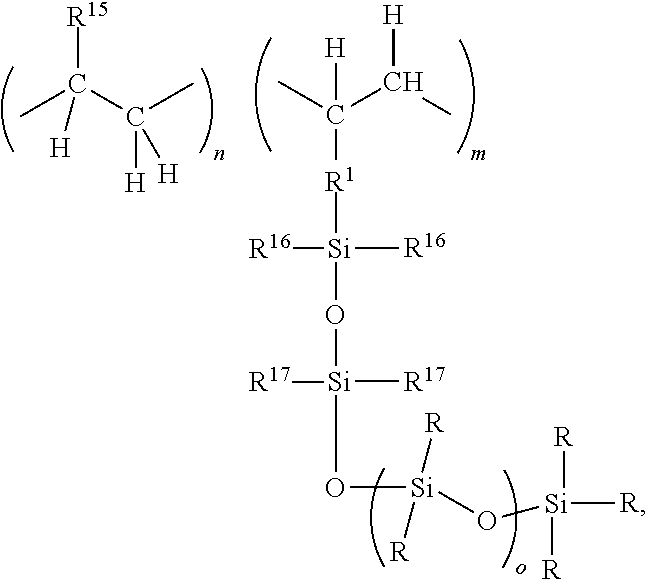
where R, R1, R15, m, n and o are as described above, each R16 is independently R or H, each R17 is independently R, OR, or OH. When R9 is OH, then a by-product such as hydrogen may be produced. When R9 is OR, then a by-product such as a hydrocarbon will be produced.

where R15, R1, R8, and subscripts m and n are as described above.

where R is as described above and R21 is an epoxy-functional organic group, and each R22 is independently selected from R and R21. Examples of suitable epoxy-functional organic groups include glycidoxyalkyl groups such as glycidoxypropyl. Suitable polyorganosiloxanes and methods for their preparation are known in the art. In this embodiment, C) the catalyst may be a Lewis Acid catalyst, and alternatively a Piers-Rubinsztajn reaction catalyst, as described above.

where R, R1, R15, m, n and o are as described above, each R23 is independently selected from R (as described above) and H, each R24 is independently R or an epoxy-functional organic group as described above, and each R25 is a divalent organic group, such as a divalent hydrocarbon group or a divalent oxygenated hydrocarbon group. Suitable divalent hydrocarbon groups for R25 are as described above for R1. Suitable divalent oxygenated hydrocarbon groups may have formula: or an oxygenated hydrocarbon group of 2 to 50 carbon atoms, such as a group of formula —(CR2)p—O—(CR2)q—, where R is as described above, subscript p≥1, subscript q≥1 and a quantity (p+q)=2 to 50.

where R15, R1, R8, and subscripts m and n are as described above. In this embodiment, B) the polyorganosiloxane has formula

where R11 is an aliphatically unsaturated monovalent hydrocarbon group of 2 to 18 carbon atoms. R11 may be alkenyl or alkynyl as defined herein. Suitable polyorganosiloxanes and methods for their preparation are known in the art. In this embodiment, starting material C) is a hydrosilylation reaction catalyst. Hydrosilylation reaction catalysts include platinum group metal catalysts, which known in the art and are commercially available. Such hydrosilylation catalysts can be a metal selected from platinum, rhodium, ruthenium, palladium, osmium, and iridium. Alternatively, the hydrosilylation catalyst may be a compound of such a metal, for example, chloroplatinic acid, chloroplatinic acid hexahydrate, platinum dichloride, and complexes of said compounds with low molecular weight organopolysiloxanes or platinum compounds microencapsulated in a matrix or coreshell type structure. Complexes of platinum with low molecular weight organopolysiloxanes include 1,3-diethenyl-1,1,3,3-tetramethyldisiloxane complexes with platinum. These complexes may be microencapsulated in a resin matrix. Alternatively, a hydrosilylation catalyst may comprise 1,3-diethenyl-1,1,3,3-tetramethyldisiloxane complex with platinum. Exemplary hydrosilylation catalysts are described in U.S. Pat. Nos. 3,159,601; 3,220,972; 3,296,291; 3,419,593; 3,516,946; 3,814,730; 3,989,668; 4,784,879; 5,036,117; and 5,175,325 and EP 0 347 895 B. Microencapsulated hydrosilylation catalysts and methods of preparing them are known in the art, as exemplified in U.S. Pat. Nos. 4,766,176 and 5,017,654.

where R15, R1, R, m, n, and o are as described above, R20 is a divalent hydrocarbon group of 2 to 50 carbon atoms, each R18 is independently R or H, and each R19 is independently R or R11.
| TABLE 1 | |||
| Sample | Tcryst, ° C. | ||
| SiH Pendant Polyethylene (Starting Material) | 97.1 | ||
| PE-Graft-PDMS copolymer (Product) | 64.7 | ||
| TABLE 2 |
| Abbreviations |
| Abbreviation | Meaning |
| bp | Boiling point |
| DP | Degree of polymerization |
| DSC | Differential scanning calorimetry |
| Et | ethyl |
| FW | Formula weight |
| GPC | Gel permeation chromatography |
| IR | Infra-red |
| Pa · s | Pascal seconds |
| Me | methyl |
| mg | milligram |
| Mn | Number average molecular weight |
| Mw | Weight average molecular weight |
| NMR | Nuclear magnetic resonance |
| NVC | Nonvolatile content |
| ODMS | octenyldimethylsilane |
| PDMS | Polydimethylsiloxane |
| Tg | Glass transition temperature calculated from the half |
| extrapolated tangents method | |
| Tm | Melting temperature |
| uL | microliter |
Claims (13)


Priority Applications (1)
| Application Number | Priority Date | Filing Date | Title |
|---|---|---|---|
| US16/621,745 US11078335B2 (en) | 2017-07-25 | 2018-07-18 | Method for preparing a graft copolymer with a polyolefin backbone and polyorganosiloxane pendant groups |
Applications Claiming Priority (3)
| Application Number | Priority Date | Filing Date | Title |
|---|---|---|---|
| US201762536635P | 2017-07-25 | 2017-07-25 | |
| US16/621,745 US11078335B2 (en) | 2017-07-25 | 2018-07-18 | Method for preparing a graft copolymer with a polyolefin backbone and polyorganosiloxane pendant groups |
| PCT/US2018/042588 WO2019023008A1 (en) | 2017-07-25 | 2018-07-18 | Method for preparing a graft copolymer with a polyolefin backbone and polyorganosiloxane pendant groups |
Publications (2)
| Publication Number | Publication Date |
|---|---|
| US20200157286A1 US20200157286A1 (en) | 2020-05-21 |
| US11078335B2 true US11078335B2 (en) | 2021-08-03 |
Family
ID=63209658
Family Applications (1)
| Application Number | Title | Priority Date | Filing Date |
|---|---|---|---|
| US16/621,745 Active 2038-09-16 US11078335B2 (en) | 2017-07-25 | 2018-07-18 | Method for preparing a graft copolymer with a polyolefin backbone and polyorganosiloxane pendant groups |
Country Status (5)
| Country | Link |
|---|---|
| US (1) | US11078335B2 (en) |
| EP (1) | EP3665210B1 (en) |
| JP (1) | JP7256169B2 (en) |
| CN (1) | CN110933947B (en) |
| WO (1) | WO2019023008A1 (en) |
Families Citing this family (17)
| Publication number | Priority date | Publication date | Assignee | Title |
|---|---|---|---|---|
| CA3101628A1 (en) | 2018-03-19 | 2019-09-26 | Dow Silicones Corporation | Hot melt adhesive composition containing a polyolefin - polydiorganoosiloxane copolymer and methods for the preparation and use thereof |
| US11332583B2 (en) | 2018-03-19 | 2022-05-17 | Dow Silicones Corporation | Polyolefin-polydiorganosiloxane block copolymer and hydrosilylation reaction method for the synthesis thereof |
| EP3768766B8 (en) | 2018-03-19 | 2025-11-05 | Dow Silicones Corporation | Polyolefin-polydiorganosiloxane block copolymer and method for the synthesis thereof |
| CA3093558A1 (en) | 2018-03-19 | 2019-09-26 | Dow Silicones Corporation | Polyorganosiloxane hot melt adhesive compositions containing polyolefin - polydiorganoosiloxane copolymers and methods for the preparation and use thereof |
| EP3824017B1 (en) | 2018-07-17 | 2022-09-14 | Dow Silicones Corporation | Polysiloxane resin - polyolefin copolymer and methods for the preparation and use thereof |
| CN113950514B (en) * | 2019-06-04 | 2023-01-24 | 美国陶氏有机硅公司 | Thermally Initiated Acid-Catalyzed Reaction Between Silyl Hydrides and α-β Unsaturated Esters |
| KR20230028305A (en) | 2020-06-24 | 2023-02-28 | 다우 글로벌 테크놀로지스 엘엘씨 | Method for producing multifunctional organosiloxane and composition containing the same |
| CN116234858B (en) * | 2020-06-24 | 2025-05-06 | 美国陶氏有机硅公司 | Compositions and methods for reacting organosilicon compounds with silicon-based hydrides catalyzed by fluorinated arylborane Lewis acids |
| WO2021262492A1 (en) * | 2020-06-24 | 2021-12-30 | Dow Silicones Corporation | Composition and method for silyl hydride reaction catalyzed by fluorinated arylborane lewis acids |
| WO2022173909A1 (en) * | 2021-02-10 | 2022-08-18 | Dow Silicones Corporation | Silicone-polyolefin hybrid elastomers |
| CN113024816B (en) * | 2021-03-30 | 2022-12-23 | 中国日用化学研究院有限公司 | Comb-type aminosiloxane-allyl polydimethylsiloxane co-modified organic silicon and preparation method thereof |
| CN113150486A (en) * | 2021-03-31 | 2021-07-23 | 大连理工大学 | Siloxane-based ceramic polyolefin and preparation method and application thereof |
| CN112979854B (en) * | 2021-03-31 | 2022-04-08 | 大连理工大学 | Polyolefin elastomer containing siloxane and preparation method and application thereof |
| WO2023235176A1 (en) * | 2022-05-31 | 2023-12-07 | Dow Global Technologies Llc | Moisture curable silicon polyolefin polymer and process |
| CN115558153B (en) * | 2022-09-28 | 2023-08-29 | 苏州泰吉诺新材料科技有限公司 | Liquid metal chemical anti-overflow foam and preparation method thereof |
| CN117924794B (en) * | 2024-01-23 | 2026-03-03 | 哈尔滨工业大学 | Preparation method of heat-resistant heat-insulating organic silicon aerogel material based on Piers-Rubinsztajn reaction |
| WO2026030416A1 (en) * | 2024-07-31 | 2026-02-05 | Dow Global Technologies Llc | Hydrosilylation for functionalization of polyolefin particles |
Citations (80)
| Publication number | Priority date | Publication date | Assignee | Title |
|---|---|---|---|---|
| US3159601A (en) | 1962-07-02 | 1964-12-01 | Gen Electric | Platinum-olefin complex catalyzed addition of hydrogen- and alkenyl-substituted siloxanes |
| US3175993A (en) | 1961-10-16 | 1965-03-30 | Dow Corning | Polyfunctional siloxanes containing terminal alkoxyl groups |
| US3220972A (en) | 1962-07-02 | 1965-11-30 | Gen Electric | Organosilicon process using a chloroplatinic acid reaction product as the catalyst |
| US3296291A (en) | 1962-07-02 | 1967-01-03 | Gen Electric | Reaction of silanes with unsaturated olefinic compounds |
| GB1093904A (en) | 1964-12-04 | 1967-12-06 | Dow Corning | Organosilicon compositions |
| US3419593A (en) | 1965-05-17 | 1968-12-31 | Dow Corning | Catalysts for the reaction of = sih with organic compounds containing aliphatic unsaturation |
| US3516946A (en) | 1967-09-29 | 1970-06-23 | Gen Electric | Platinum catalyst composition for hydrosilation reactions |
| US3660443A (en) | 1967-05-31 | 1972-05-02 | Rhone Poulenc Sa | Process for the alkylation of halogenated silicon and tin compounds |
| US3663649A (en) | 1964-04-02 | 1972-05-16 | Union Carbide Corp | Thermoplastic olefinic siloxane-ethylene polymer block copolymers |
| US3691257A (en) | 1968-03-29 | 1972-09-12 | Midland Silicones Ltd | Organic polymers containing siloxane-organic block copolymers |
| US3814730A (en) | 1970-08-06 | 1974-06-04 | Gen Electric | Platinum complexes of unsaturated siloxanes and platinum containing organopolysiloxanes |
| US3989668A (en) | 1975-07-14 | 1976-11-02 | Dow Corning Corporation | Method of making a silicone elastomer and the elastomer prepared thereby |
| US4370358A (en) | 1980-09-22 | 1983-01-25 | General Electric Company | Ultraviolet curable silicone adhesives |
| US4584355A (en) | 1984-10-29 | 1986-04-22 | Dow Corning Corporation | Silicone pressure-sensitive adhesive process and product with improved lap-shear stability-I |
| US4585836A (en) | 1984-10-29 | 1986-04-29 | Dow Corning Corporation | Silicone pressure-sensitive adhesive process and product with improved lap-shear stability-II |
| US4591622A (en) | 1984-10-29 | 1986-05-27 | Dow Corning Corporation | Silicone pressure-sensitive adhesive process and product thereof |
| US4611042A (en) | 1985-10-03 | 1986-09-09 | Dow Corning Corporation | Resinous copolymeric siloxanes containing alkenyldimethylsiloxanes |
| US4707531A (en) | 1985-02-22 | 1987-11-17 | Toray Silicone Co., Ltd. | Method for producing organosilicon polymers and the polymers prepared thereby |
| US4766176A (en) | 1987-07-20 | 1988-08-23 | Dow Corning Corporation | Storage stable heat curable organosiloxane compositions containing microencapsulated platinum-containing catalysts |
| US4784879A (en) | 1987-07-20 | 1988-11-15 | Dow Corning Corporation | Method for preparing a microencapsulated compound of a platinum group metal |
| EP0347895A2 (en) | 1988-06-23 | 1989-12-27 | Toray Silicone Company, Limited | Method for preparing a particulate material comprising a platinum-containing hydrosilylation catalyst and a silicone resin. |
| JPH0315444A (en) | 1989-06-13 | 1991-01-23 | Yokogawa Medical Syst Ltd | Base line component removing method for ir method in mri |
| US5017654A (en) | 1988-06-30 | 1991-05-21 | Toray Silicone Company, Limited | Thermosetting organosiloxane composition |
| US5036117A (en) | 1989-11-03 | 1991-07-30 | Dow Corning Corporation | Heat-curable silicone compositions having improved bath life |
| US5175325A (en) | 1991-02-14 | 1992-12-29 | Dow Corning Limited | Platinum complexes and use thereof |
| US5310843A (en) | 1991-10-17 | 1994-05-10 | Dow Corning Toray Silicone Co., Ltd. | Organopolysiloxane and method for the preparation thereof |
| US5654356A (en) | 1995-01-27 | 1997-08-05 | Tateho Chemical Industries Co., Ltd. | Flame retardant polyolefin compound having low smoking and toxicity |
| WO1997047665A1 (en) | 1996-06-13 | 1997-12-18 | University Of Waterloo | Hydrosilylation of polypropylene |
| US5744541A (en) | 1996-04-15 | 1998-04-28 | Dow Corning Asia, Ltd. | Copolymer of polypropylene and organopolysiloxane and method for preparation thereof |
| WO1998033842A1 (en) | 1997-01-31 | 1998-08-06 | Dsm N.V. | Process for the reaction of polyolefins with hydrosilanes |
| US5910547A (en) | 1996-07-17 | 1999-06-08 | Fmc Corporation | Protected functionalized heterotelechelic polymers and processes for preparing the same |
| US6084030A (en) | 1995-08-04 | 2000-07-04 | Dsm Copolymer, Inc. | Branched polymers with polyolefin arms |
| US6127502A (en) | 1998-12-21 | 2000-10-03 | Dow Corning Corporation | Polyorganosiloxanes having at least one organofunctional group with multiple hydrolyzable groups |
| US6175031B1 (en) | 2000-03-07 | 2001-01-16 | Dow Corning Asia, Ltd. | Method for synthesizing silicon compounds that contain a substituent bonded to silicon through a silicon-carbon linkage |
| US6265518B1 (en) | 1998-12-21 | 2001-07-24 | Dow Corning Corporation | Organosilicon endcapper having one silicon-bonded hydrogen atom |
| WO2002081551A1 (en) | 2001-04-07 | 2002-10-17 | Dow Corning Corporation | Process for the condensation of compounds having silicon bonded hydroxy or alkoxy groups |
| US6624254B1 (en) | 1999-01-21 | 2003-09-23 | The Dow Chemical Company | Silane functionalized olefin interpolymer derivatives |
| WO2003093369A1 (en) | 2002-05-01 | 2003-11-13 | Dow Corning Corporation | Compositions having improved bath life |
| WO2003093349A1 (en) | 2002-05-01 | 2003-11-13 | Dow Corning Corporation | Organohydrogensilicon compounds |
| US6753438B2 (en) | 2000-04-15 | 2004-06-22 | Dow Corning Corporation | Process for the condensation of compounds having silicon bonded hydroxy or alkoxy groups |
| US7064173B2 (en) | 2002-12-30 | 2006-06-20 | General Electric Company | Silicone condensation reaction |
| US20060155090A1 (en) | 2005-01-07 | 2006-07-13 | Goldschmidt Gmbh | Siloxane block copolymers |
| US7087686B2 (en) | 2001-08-06 | 2006-08-08 | Bp Chemicals Limited | Chain growth reaction process |
| US7148370B1 (en) | 2005-07-20 | 2006-12-12 | General Electric Company | Process for synthesis of diorganosilanes by disproportionation of hydridosiloxanes |
| WO2007008765A2 (en) | 2005-07-11 | 2007-01-18 | Dow Global Technologies Inc. | Silane-grafted olefin polymers, compositions and articles prepared therefrom, and methods for making the same |
| US7355089B2 (en) | 2004-03-17 | 2008-04-08 | Dow Global Technologies Inc. | Compositions of ethylene/α-olefin multi-block interpolymer for elastic films and laminates |
| EP1907495A2 (en) | 2005-07-22 | 2008-04-09 | Dow Corning Corporation | Organosiloxane compositions |
| US20090156776A1 (en) | 2005-04-20 | 2009-06-18 | Slawomir Rubinsztajn | Process for making siloxane oligomer |
| US20100181092A1 (en) | 2007-06-27 | 2010-07-22 | Cree Stephen H | Crosslinkable Blends of Polyolefin Elastomers and Silane Copolymers for Increased Flexibility Cable Insulation |
| US20100209705A1 (en) | 2007-09-24 | 2010-08-19 | Lin Thomas S | Moisture-Curable Compositions, and a Process for Making the Compositions |
| WO2011032172A1 (en) | 2009-09-14 | 2011-03-17 | Dow Global Technologies Inc. | Polymers comprising units derived from ethylene and siloxane |
| US20110136979A1 (en) * | 2008-08-01 | 2011-06-09 | Cogen Jeffrey M | Silicone-Thermoplastic Polymer Reactive Blends and Copolymer Products |
| WO2011083047A1 (en) | 2010-01-06 | 2011-07-14 | Dow Corning Corporation | Modified polyolefins |
| US20110172367A1 (en) | 2008-07-03 | 2011-07-14 | Michael Backer | Grafted Polyethylene |
| US8017693B2 (en) | 2003-08-27 | 2011-09-13 | Mitsui Chemicals, Inc. | Polyolefin functional at each end |
| US20120178867A1 (en) | 2009-09-16 | 2012-07-12 | Mohamed Esseghir | Process for Producing Crosslinked, Melt-Shaped Articles |
| WO2012103080A1 (en) | 2011-01-26 | 2012-08-02 | Dow Global Technologies Llc | Process for making a polyolefin-polysiloxane block copolymer |
| US20120283388A1 (en) | 2010-01-06 | 2012-11-08 | Michael Backer | Polyolefins modified by silicones |
| US20120283362A1 (en) * | 2010-01-06 | 2012-11-08 | Michael Backer | Organopolysiloxanes containing an unsaturated group |
| US8476375B2 (en) | 2008-07-03 | 2013-07-02 | Dow Corning Corporation | Polymers modified by silanes |
| US8501894B2 (en) | 2011-03-25 | 2013-08-06 | Exxonmobil Chemical Patents Inc. | Hydrosilyation of vinyl macromers with metallocenes |
| US8569417B2 (en) | 2008-07-03 | 2013-10-29 | Dow Corning Corporation | Modified polyolefins |
| US20140161858A1 (en) | 2010-10-01 | 2014-06-12 | University Of Tennessee Research Foundation | Multigraft Copolymers as Superelastomers |
| US8859709B2 (en) | 2010-12-22 | 2014-10-14 | Dow Corning Corporation | Method of forming polyhedral oligomeric silsesquioxane compounds |
| WO2015000851A1 (en) | 2013-07-01 | 2015-01-08 | Societe Des Polymeres Techniques | Polyolefin film with non-stick surface properties |
| WO2015017068A1 (en) | 2013-07-31 | 2015-02-05 | Exxonmobil Chemical Patents Inc. | Comb-star viscosity modifier and its compositions |
| US9181379B2 (en) | 2010-01-06 | 2015-11-10 | Dow Corning Corporation | Modified polyolefins |
| US20150376482A1 (en) | 2013-02-11 | 2015-12-31 | Dow Corning Corporation | Moisture-Curable Hot Melt Silicone Adhesive Compositions Including An Alkoxy-Functional Siloxane Reactive Resin |
| US9237865B2 (en) | 2002-10-18 | 2016-01-19 | Medtronic Minimed, Inc. | Analyte sensors and methods for making and using them |
| US9273163B2 (en) | 2012-09-24 | 2016-03-01 | Exxonmobil Chemical Patents Inc. | Hydrosilation of vinyl-terminated macromonomers |
| US9388265B2 (en) | 2011-01-19 | 2016-07-12 | Dow Corning Corporation | Method for producing silyl-functionalized polyolefins and silyl-functionalized polyolefins with silyl monomer incorporation |
| US20160200909A1 (en) | 2012-12-31 | 2016-07-14 | Dow Global Technologies Llc | A Composition, Articles Made Therefrom, and Method of Making the Articles |
| US9441079B2 (en) | 2012-11-20 | 2016-09-13 | 3M Innovative Properties Company | Block copolymer comprising polyorganosiloxane block and polyolefin block |
| US20160376482A1 (en) | 2014-03-11 | 2016-12-29 | Henkel Ag & Co. Kgaa | UV-Reactive Hot-Melt Adhesive for Laminating Transparent Films |
| US20170022223A1 (en) * | 2014-03-10 | 2017-01-26 | Kyoto University | Method for producing surface-modified base material, method for producing joined body, new hydrosilane compound, surface treatment agent, surface treatment agent kit, and surface-modified base material |
| US20170133121A1 (en) | 2014-06-27 | 2017-05-11 | Haiyang Yu | Cold Shrink Article for Electrical Device |
| WO2017091720A1 (en) | 2015-11-25 | 2017-06-01 | General Cable Technologies Corporation | Hydrosilylation crosslinking of polyolefin cable components |
| US9862867B2 (en) | 2013-02-11 | 2018-01-09 | Dow Corning Corporation | Alkoxy-functional organopolysiloxane resin and polymer and related methods for forming same |
| WO2019068357A1 (en) * | 2017-10-06 | 2019-04-11 | Wacker Chemie Ag | PREPARATION OF SILOXANES IN THE PRESENCE OF CATIONIC SILICON (II) COMPOUNDS |
| US20200407512A1 (en) * | 2018-03-19 | 2020-12-31 | Dow Silicones Corporation | Polyolefin-polydiorganosiloxane block copolymer and method for the synthesis thereof |
Family Cites Families (6)
| Publication number | Priority date | Publication date | Assignee | Title |
|---|---|---|---|---|
| JP2710797B2 (en) * | 1988-10-20 | 1998-02-10 | 三井東圧化学株式会社 | Method for producing polyolefin resin composition |
| JP2710805B2 (en) * | 1988-11-18 | 1998-02-10 | 三井東圧化学株式会社 | Method for producing polyolefin resin composition |
| JP3014136B2 (en) * | 1990-11-06 | 2000-02-28 | 三井化学株式会社 | Method for producing polyolefin resin composition |
| JPH11279241A (en) * | 1998-03-27 | 1999-10-12 | Dow Corning Toray Silicone Co Ltd | Siloxane-grafted vinyl polymer and its production |
| JP2002037947A (en) | 2000-07-25 | 2002-02-06 | Mitsui Chemicals Inc | Curable composition and application thereof |
| CN105524284B (en) * | 2016-01-12 | 2018-12-11 | 浙江大学 | A kind of polysiloxanes-polyethylene graft copolymer and its preparation method and application |
-
2018
- 2018-07-18 WO PCT/US2018/042588 patent/WO2019023008A1/en not_active Ceased
- 2018-07-18 EP EP18755590.9A patent/EP3665210B1/en active Active
- 2018-07-18 US US16/621,745 patent/US11078335B2/en active Active
- 2018-07-18 CN CN201880045666.5A patent/CN110933947B/en active Active
- 2018-07-18 JP JP2020500692A patent/JP7256169B2/en active Active
Patent Citations (84)
| Publication number | Priority date | Publication date | Assignee | Title |
|---|---|---|---|---|
| US3175993A (en) | 1961-10-16 | 1965-03-30 | Dow Corning | Polyfunctional siloxanes containing terminal alkoxyl groups |
| US3159601A (en) | 1962-07-02 | 1964-12-01 | Gen Electric | Platinum-olefin complex catalyzed addition of hydrogen- and alkenyl-substituted siloxanes |
| US3220972A (en) | 1962-07-02 | 1965-11-30 | Gen Electric | Organosilicon process using a chloroplatinic acid reaction product as the catalyst |
| US3296291A (en) | 1962-07-02 | 1967-01-03 | Gen Electric | Reaction of silanes with unsaturated olefinic compounds |
| US3663649A (en) | 1964-04-02 | 1972-05-16 | Union Carbide Corp | Thermoplastic olefinic siloxane-ethylene polymer block copolymers |
| GB1093904A (en) | 1964-12-04 | 1967-12-06 | Dow Corning | Organosilicon compositions |
| US3419593A (en) | 1965-05-17 | 1968-12-31 | Dow Corning | Catalysts for the reaction of = sih with organic compounds containing aliphatic unsaturation |
| US3660443A (en) | 1967-05-31 | 1972-05-02 | Rhone Poulenc Sa | Process for the alkylation of halogenated silicon and tin compounds |
| US3516946A (en) | 1967-09-29 | 1970-06-23 | Gen Electric | Platinum catalyst composition for hydrosilation reactions |
| US3691257A (en) | 1968-03-29 | 1972-09-12 | Midland Silicones Ltd | Organic polymers containing siloxane-organic block copolymers |
| US3814730A (en) | 1970-08-06 | 1974-06-04 | Gen Electric | Platinum complexes of unsaturated siloxanes and platinum containing organopolysiloxanes |
| US3989668A (en) | 1975-07-14 | 1976-11-02 | Dow Corning Corporation | Method of making a silicone elastomer and the elastomer prepared thereby |
| US4370358A (en) | 1980-09-22 | 1983-01-25 | General Electric Company | Ultraviolet curable silicone adhesives |
| US4584355A (en) | 1984-10-29 | 1986-04-22 | Dow Corning Corporation | Silicone pressure-sensitive adhesive process and product with improved lap-shear stability-I |
| US4585836A (en) | 1984-10-29 | 1986-04-29 | Dow Corning Corporation | Silicone pressure-sensitive adhesive process and product with improved lap-shear stability-II |
| US4591622A (en) | 1984-10-29 | 1986-05-27 | Dow Corning Corporation | Silicone pressure-sensitive adhesive process and product thereof |
| US4707531A (en) | 1985-02-22 | 1987-11-17 | Toray Silicone Co., Ltd. | Method for producing organosilicon polymers and the polymers prepared thereby |
| US4611042A (en) | 1985-10-03 | 1986-09-09 | Dow Corning Corporation | Resinous copolymeric siloxanes containing alkenyldimethylsiloxanes |
| US4766176A (en) | 1987-07-20 | 1988-08-23 | Dow Corning Corporation | Storage stable heat curable organosiloxane compositions containing microencapsulated platinum-containing catalysts |
| US4784879A (en) | 1987-07-20 | 1988-11-15 | Dow Corning Corporation | Method for preparing a microencapsulated compound of a platinum group metal |
| EP0347895A2 (en) | 1988-06-23 | 1989-12-27 | Toray Silicone Company, Limited | Method for preparing a particulate material comprising a platinum-containing hydrosilylation catalyst and a silicone resin. |
| US5017654A (en) | 1988-06-30 | 1991-05-21 | Toray Silicone Company, Limited | Thermosetting organosiloxane composition |
| JPH0315444A (en) | 1989-06-13 | 1991-01-23 | Yokogawa Medical Syst Ltd | Base line component removing method for ir method in mri |
| US5036117A (en) | 1989-11-03 | 1991-07-30 | Dow Corning Corporation | Heat-curable silicone compositions having improved bath life |
| US5175325A (en) | 1991-02-14 | 1992-12-29 | Dow Corning Limited | Platinum complexes and use thereof |
| US5310843A (en) | 1991-10-17 | 1994-05-10 | Dow Corning Toray Silicone Co., Ltd. | Organopolysiloxane and method for the preparation thereof |
| US5654356A (en) | 1995-01-27 | 1997-08-05 | Tateho Chemical Industries Co., Ltd. | Flame retardant polyolefin compound having low smoking and toxicity |
| US6084030A (en) | 1995-08-04 | 2000-07-04 | Dsm Copolymer, Inc. | Branched polymers with polyolefin arms |
| US5744541A (en) | 1996-04-15 | 1998-04-28 | Dow Corning Asia, Ltd. | Copolymer of polypropylene and organopolysiloxane and method for preparation thereof |
| WO1997047665A1 (en) | 1996-06-13 | 1997-12-18 | University Of Waterloo | Hydrosilylation of polypropylene |
| US5910547A (en) | 1996-07-17 | 1999-06-08 | Fmc Corporation | Protected functionalized heterotelechelic polymers and processes for preparing the same |
| WO1998033842A1 (en) | 1997-01-31 | 1998-08-06 | Dsm N.V. | Process for the reaction of polyolefins with hydrosilanes |
| US6127502A (en) | 1998-12-21 | 2000-10-03 | Dow Corning Corporation | Polyorganosiloxanes having at least one organofunctional group with multiple hydrolyzable groups |
| US6265518B1 (en) | 1998-12-21 | 2001-07-24 | Dow Corning Corporation | Organosilicon endcapper having one silicon-bonded hydrogen atom |
| US6624254B1 (en) | 1999-01-21 | 2003-09-23 | The Dow Chemical Company | Silane functionalized olefin interpolymer derivatives |
| US6175031B1 (en) | 2000-03-07 | 2001-01-16 | Dow Corning Asia, Ltd. | Method for synthesizing silicon compounds that contain a substituent bonded to silicon through a silicon-carbon linkage |
| US6753438B2 (en) | 2000-04-15 | 2004-06-22 | Dow Corning Corporation | Process for the condensation of compounds having silicon bonded hydroxy or alkoxy groups |
| WO2002081551A1 (en) | 2001-04-07 | 2002-10-17 | Dow Corning Corporation | Process for the condensation of compounds having silicon bonded hydroxy or alkoxy groups |
| US7087686B2 (en) | 2001-08-06 | 2006-08-08 | Bp Chemicals Limited | Chain growth reaction process |
| WO2003093369A1 (en) | 2002-05-01 | 2003-11-13 | Dow Corning Corporation | Compositions having improved bath life |
| WO2003093349A1 (en) | 2002-05-01 | 2003-11-13 | Dow Corning Corporation | Organohydrogensilicon compounds |
| US9237865B2 (en) | 2002-10-18 | 2016-01-19 | Medtronic Minimed, Inc. | Analyte sensors and methods for making and using them |
| US7064173B2 (en) | 2002-12-30 | 2006-06-20 | General Electric Company | Silicone condensation reaction |
| US8017693B2 (en) | 2003-08-27 | 2011-09-13 | Mitsui Chemicals, Inc. | Polyolefin functional at each end |
| US7355089B2 (en) | 2004-03-17 | 2008-04-08 | Dow Global Technologies Inc. | Compositions of ethylene/α-olefin multi-block interpolymer for elastic films and laminates |
| US20060155090A1 (en) | 2005-01-07 | 2006-07-13 | Goldschmidt Gmbh | Siloxane block copolymers |
| US20090156776A1 (en) | 2005-04-20 | 2009-06-18 | Slawomir Rubinsztajn | Process for making siloxane oligomer |
| WO2007008765A2 (en) | 2005-07-11 | 2007-01-18 | Dow Global Technologies Inc. | Silane-grafted olefin polymers, compositions and articles prepared therefrom, and methods for making the same |
| US7148370B1 (en) | 2005-07-20 | 2006-12-12 | General Electric Company | Process for synthesis of diorganosilanes by disproportionation of hydridosiloxanes |
| EP1907495A2 (en) | 2005-07-22 | 2008-04-09 | Dow Corning Corporation | Organosiloxane compositions |
| US8088869B2 (en) | 2005-07-22 | 2012-01-03 | Dow Corning Europe Sa | Organosiloxane compositions |
| US20100181092A1 (en) | 2007-06-27 | 2010-07-22 | Cree Stephen H | Crosslinkable Blends of Polyolefin Elastomers and Silane Copolymers for Increased Flexibility Cable Insulation |
| US20100209705A1 (en) | 2007-09-24 | 2010-08-19 | Lin Thomas S | Moisture-Curable Compositions, and a Process for Making the Compositions |
| US8476375B2 (en) | 2008-07-03 | 2013-07-02 | Dow Corning Corporation | Polymers modified by silanes |
| US8569417B2 (en) | 2008-07-03 | 2013-10-29 | Dow Corning Corporation | Modified polyolefins |
| US20110172367A1 (en) | 2008-07-03 | 2011-07-14 | Michael Backer | Grafted Polyethylene |
| US20110136979A1 (en) * | 2008-08-01 | 2011-06-09 | Cogen Jeffrey M | Silicone-Thermoplastic Polymer Reactive Blends and Copolymer Products |
| US8426519B2 (en) | 2008-08-01 | 2013-04-23 | Union Carbide Chemicals & Plastics Technology Llc | Silicone-thermoplastic polymer reactive blends and copolymer products |
| WO2011032172A1 (en) | 2009-09-14 | 2011-03-17 | Dow Global Technologies Inc. | Polymers comprising units derived from ethylene and siloxane |
| US20120178867A1 (en) | 2009-09-16 | 2012-07-12 | Mohamed Esseghir | Process for Producing Crosslinked, Melt-Shaped Articles |
| US8835548B2 (en) | 2009-09-16 | 2014-09-16 | Union Carbide Chemicals & Plastics Technology Llc | Process for producing crosslinked, melt-shaped articles |
| US9493615B2 (en) | 2010-01-06 | 2016-11-15 | Dow Corning Corporation | Organopolysiloxanes containing an unsaturated group |
| US20120283388A1 (en) | 2010-01-06 | 2012-11-08 | Michael Backer | Polyolefins modified by silicones |
| US20120283362A1 (en) * | 2010-01-06 | 2012-11-08 | Michael Backer | Organopolysiloxanes containing an unsaturated group |
| WO2011083047A1 (en) | 2010-01-06 | 2011-07-14 | Dow Corning Corporation | Modified polyolefins |
| US9181379B2 (en) | 2010-01-06 | 2015-11-10 | Dow Corning Corporation | Modified polyolefins |
| US20140161858A1 (en) | 2010-10-01 | 2014-06-12 | University Of Tennessee Research Foundation | Multigraft Copolymers as Superelastomers |
| US8859709B2 (en) | 2010-12-22 | 2014-10-14 | Dow Corning Corporation | Method of forming polyhedral oligomeric silsesquioxane compounds |
| US9388265B2 (en) | 2011-01-19 | 2016-07-12 | Dow Corning Corporation | Method for producing silyl-functionalized polyolefins and silyl-functionalized polyolefins with silyl monomer incorporation |
| WO2012103080A1 (en) | 2011-01-26 | 2012-08-02 | Dow Global Technologies Llc | Process for making a polyolefin-polysiloxane block copolymer |
| US8501894B2 (en) | 2011-03-25 | 2013-08-06 | Exxonmobil Chemical Patents Inc. | Hydrosilyation of vinyl macromers with metallocenes |
| US9273163B2 (en) | 2012-09-24 | 2016-03-01 | Exxonmobil Chemical Patents Inc. | Hydrosilation of vinyl-terminated macromonomers |
| US9441079B2 (en) | 2012-11-20 | 2016-09-13 | 3M Innovative Properties Company | Block copolymer comprising polyorganosiloxane block and polyolefin block |
| US20160200909A1 (en) | 2012-12-31 | 2016-07-14 | Dow Global Technologies Llc | A Composition, Articles Made Therefrom, and Method of Making the Articles |
| US20150376482A1 (en) | 2013-02-11 | 2015-12-31 | Dow Corning Corporation | Moisture-Curable Hot Melt Silicone Adhesive Compositions Including An Alkoxy-Functional Siloxane Reactive Resin |
| US9862867B2 (en) | 2013-02-11 | 2018-01-09 | Dow Corning Corporation | Alkoxy-functional organopolysiloxane resin and polymer and related methods for forming same |
| WO2015000851A1 (en) | 2013-07-01 | 2015-01-08 | Societe Des Polymeres Techniques | Polyolefin film with non-stick surface properties |
| WO2015017068A1 (en) | 2013-07-31 | 2015-02-05 | Exxonmobil Chemical Patents Inc. | Comb-star viscosity modifier and its compositions |
| US20170022223A1 (en) * | 2014-03-10 | 2017-01-26 | Kyoto University | Method for producing surface-modified base material, method for producing joined body, new hydrosilane compound, surface treatment agent, surface treatment agent kit, and surface-modified base material |
| US20160376482A1 (en) | 2014-03-11 | 2016-12-29 | Henkel Ag & Co. Kgaa | UV-Reactive Hot-Melt Adhesive for Laminating Transparent Films |
| US20170133121A1 (en) | 2014-06-27 | 2017-05-11 | Haiyang Yu | Cold Shrink Article for Electrical Device |
| WO2017091720A1 (en) | 2015-11-25 | 2017-06-01 | General Cable Technologies Corporation | Hydrosilylation crosslinking of polyolefin cable components |
| WO2019068357A1 (en) * | 2017-10-06 | 2019-04-11 | Wacker Chemie Ag | PREPARATION OF SILOXANES IN THE PRESENCE OF CATIONIC SILICON (II) COMPOUNDS |
| US20200407512A1 (en) * | 2018-03-19 | 2020-12-31 | Dow Silicones Corporation | Polyolefin-polydiorganosiloxane block copolymer and method for the synthesis thereof |
Non-Patent Citations (25)
| Title |
|---|
| "Encyclopedia Of Polymer Science and Technology", vol. 11, 15 April 2003, WILEY, US, article "Silicones", pages: 765 - 841, XP007918236 |
| "Silicones", Apr. 15, 2003 (Apr. 15, 2003), Encyclopedia of Polymer Science and Techno, Wiley, US, pp. 765-841, XP007918236, pp. 801-805. |
| Bulsari et al., Hydrosilylation of impact polypropylene co-polymer in a twin-screw extruder. Journal of Elastomers & Plastics vol. 40 Issue4 pp. 365-380, 2008. |
| Ciolino, A. E., et al. (2004). "Synthesis of polybutadiene-graft-poly(dimethylsiloxane) and polyethylene-graft-poly (dimethylsiloxane) copolymers with hydrosilylation reactions." Journal of Polymer Science Part A: Polymer Chemistry 42(12): 2920-2930. |
| Coughlin et co. Macromolecules 2001; 34:8034. |
| Dziubek, K et co. J Therm Anal Calorim 2016; 125: 1287. |
| Graiver., Graft and block copolymers with polysiloxane and vinyl polymersegments. Silicon Chemistry. 2002, p. 107-120, vol. 1, No. 2. Norwell, Maine. |
| Inoue, et al. Reactions of Organozinc Coordination Compounds. Journal of Organometallic Chemistry, p. 11-16. |
| Long et al. Surface characteristics of hydro silylated polypropylene. Journal of Applied Polymer Science. vol. 88, Issue14, pp. 3117-3131 2003. |
| Louis., "Karstedt Catalyst-Catalyzed stepgrowthh co-polyaddition of 1, 9-decadiene and 1, 1, 3, 3,-tetramethyldisiloxane." Journal of Organometallic Chemistry. 2006, p. 2031-2036, vol. 691, No. 9. Elsevier, Amsterdam. |
| Macromolecules 2005, 38:1061. "A New polycondensation process for the preparation of polysiloxane copolymers". |
| Macromolecules, 2003, 36 (2), pp. 368-372. |
| Malz, H. et al., Hydrosilylation of terminal Double Bonds. Polymer Engineering and Science, Dec. 1998, vol. 38, No. 12. p. 1976-1984. |
| Rudin., "Modern Methods of Polymer Characterization." John Wiley & Sons. 1991, p. 103-112, New York. |
| Sam, J et al. Dow Corning. J. Am. Chem. Soc. (1961) 83(6) 1351. |
| Sarkar, B et co.; Nanomaterials 2012; 2: 445. |
| Shearer et al., Free radical hydrosilylation of polypropylene. Journal of Applied Polymer Science. vol. 65, Issue3, 439-447 (1997). |
| Tolinski, M.; Additives for Polyolefins 2015, chapter 7, p. 71. |
| Uozumi, T., et al. (2000). "Synthesis of functionalized alternating olefin copolymer and modification to graft copolymer by hydrosilylation." Journal of Polymer Science Part A: Polymer Chemistry 38(10): 1844-1847. |
| Waddon, A.J. et co. Nano Letters 2002; 10:1149. |
| Waddon., "Crystal Structure of Polyhedral OligomericSilsequioxane (POSS) Nano-materials: A Study by X-rayDiffraction and Electron Microscopy." 2003, p. 4555-4561, vol. 15. |
| Zhang, H X, Et al, "Prepareation and properties of propylene/POSS copolymer with rac-Et (Ind) 2ZrXl2 catalyst", European Polymer Journal, Pergamon Press Ltd. Oxford, GB, vol. 45, No. 1, Jan. 1, 2009 (Jan. 1, 2009), pp. 40-46, XP025869132. |
| ZHANG, H.X. ; SHIN, Y.J. ; YOON, K.B. ; LEE, D.H.: "Preparation and properties of propylene/POSS copolymer with rac-Et(Ind)"2ZrCl"2 catalyst", EUROPEAN POLYMER JOURNAL, PERGAMON PRESS LTD OXFORD, GB, vol. 45, no. 1, 1 January 2009 (2009-01-01), GB, pages 40 - 46, XP025869132, ISSN: 0014-3057, DOI: 10.1016/j.eurpolymj.2008.09.029 |
| Zheng, et al.; Novel Polyolefin Nanocomposites; Macromolecules 2001; 34, 8034-8039. |
| Zhou, et al., "Palladium-Catalyzed Negishi Cross-Coupling Reactions of Unactivated Alkyl Iodides, Bromides, Chlorides, and Tosylates"; J. AM, Chem, Soc., vol. 125, No. 41, 2003, pp. 12627-12630. |
Also Published As
| Publication number | Publication date |
|---|---|
| EP3665210B1 (en) | 2022-02-23 |
| WO2019023008A1 (en) | 2019-01-31 |
| JP7256169B2 (en) | 2023-04-11 |
| US20200157286A1 (en) | 2020-05-21 |
| EP3665210A1 (en) | 2020-06-17 |
| CN110933947A (en) | 2020-03-27 |
| JP2020528942A (en) | 2020-10-01 |
| CN110933947B (en) | 2022-08-02 |
Similar Documents
| Publication | Publication Date | Title |
|---|---|---|
| US11078335B2 (en) | Method for preparing a graft copolymer with a polyolefin backbone and polyorganosiloxane pendant groups | |
| JP3086258B2 (en) | Functionalized polyorganosiloxanes and one method of making them | |
| CN101772551B (en) | Cross-linkable masses based on organosilicon compounds | |
| EP0230619B1 (en) | Silicone-modified epoxy resins having improved impact resistance | |
| US11814555B2 (en) | Hot melt adhesive compositions containing polyolefin-polydiorganosiloxane copolymers and methods for the preparation and use thereof | |
| US11702512B2 (en) | Polysiloxane resin-polyolefin copolymer and methods for the preparation and use thereof | |
| US11193051B2 (en) | Hot melt adhesive composition containing a polyolefin-polydiorganosiloxane copolymer and methods for the preparation and use thereof | |
| US20140350278A1 (en) | Polymerizable Hybrid Polysiloxanes and Preparation | |
| JP2012121950A (en) | Curable silicone composition and silicone resin cured product | |
| CN113260640B (en) | Interpenetrating network polymer comprising organopolysiloxane crosslinked product and (meth)acrylic polymer and method for producing same | |
| CN1989179A (en) | Cross-linkable siloxane urea copolymers | |
| JP4723289B2 (en) | SiH group-containing compound, method for producing the same, curable composition using SiH group-containing compound, and cured product thereof | |
| JP2001089570A (en) | Production of alkoxylated resin/polymer organosilicone network sturctural material and article produced from it | |
| US4079037A (en) | Alkenyloxy silicon compositions | |
| US9045599B2 (en) | Amphiphilic resin-linear organosiloxane block copolymers | |
| WO2006057218A1 (en) | Curable composition and semiconductor device sealed/coated with such curable composition | |
| EP3581607B1 (en) | Novel mesogen-silicon compound (co)polymer and thermoplastic elastomer | |
| JP2006213899A (en) | Curable composition and semiconductor device encapsulated with the composition | |
| JP3210320B2 (en) | Silicone rubber composition | |
| JP2004175887A (en) | Curable composition | |
| JP2011099036A (en) | Cured product excellent in heat resistance | |
| JP2007138098A (en) | Shape-retainable curable composition | |
| Dey et al. | High-performance thermoplastic elastomers based on silicones | |
| JPS6338378B2 (en) | ||
| JP2007224095A (en) | Curing agent, curable composition and cured product |
Legal Events
| Date | Code | Title | Description |
|---|---|---|---|
| FEPP | Fee payment procedure |
Free format text: ENTITY STATUS SET TO UNDISCOUNTED (ORIGINAL EVENT CODE: BIG.); ENTITY STATUS OF PATENT OWNER: LARGE ENTITY |
|
| STPP | Information on status: patent application and granting procedure in general |
Free format text: DOCKETED NEW CASE - READY FOR EXAMINATION |
|
| STPP | Information on status: patent application and granting procedure in general |
Free format text: NOTICE OF ALLOWANCE MAILED -- APPLICATION RECEIVED IN OFFICE OF PUBLICATIONS |
|
| STPP | Information on status: patent application and granting procedure in general |
Free format text: AWAITING TC RESP., ISSUE FEE NOT PAID |
|
| AS | Assignment |
Owner name: DOW SILICONES CORPORATION, MICHIGAN Free format text: ASSIGNMENT OF ASSIGNORS INTEREST;ASSIGNORS:SWIER, STEVEN;KEAN, ZACHARY;HORSTMAN, JOHN;SIGNING DATES FROM 20180718 TO 20180720;REEL/FRAME:056640/0137 |
|
| STPP | Information on status: patent application and granting procedure in general |
Free format text: PUBLICATIONS -- ISSUE FEE PAYMENT RECEIVED |
|
| STPP | Information on status: patent application and granting procedure in general |
Free format text: PUBLICATIONS -- ISSUE FEE PAYMENT VERIFIED |
|
| STCF | Information on status: patent grant |
Free format text: PATENTED CASE |
|
| MAFP | Maintenance fee payment |
Free format text: PAYMENT OF MAINTENANCE FEE, 4TH YEAR, LARGE ENTITY (ORIGINAL EVENT CODE: M1551); ENTITY STATUS OF PATENT OWNER: LARGE ENTITY Year of fee payment: 4 |