US11077429B2 - Catalyst composite for conversion of methane gas and method for converting methane gas using the same - Google Patents
Catalyst composite for conversion of methane gas and method for converting methane gas using the same Download PDFInfo
- Publication number
- US11077429B2 US11077429B2 US16/233,686 US201816233686A US11077429B2 US 11077429 B2 US11077429 B2 US 11077429B2 US 201816233686 A US201816233686 A US 201816233686A US 11077429 B2 US11077429 B2 US 11077429B2
- Authority
- US
- United States
- Prior art keywords
- methane gas
- conversion
- zro
- catalyst
- propanol
- Prior art date
- Legal status (The legal status is an assumption and is not a legal conclusion. Google has not performed a legal analysis and makes no representation as to the accuracy of the status listed.)
- Active, expires
Links
- FUUAFSBENBYCFX-UHFFFAOYSA-N C.C.C.CC=O.CC=O.CC=O.CCO.CO.CO.CO.CO.CO.CO Chemical compound C.C.C.CC=O.CC=O.CC=O.CCO.CO.CO.CO.CO.CO.CO FUUAFSBENBYCFX-UHFFFAOYSA-N 0.000 description 1
- HWAJVWJRHRKCDH-MWEYTBTFSA-N [2HH].[2HH].[HH].[HH].[HH].[HH].[HH].[HH].[HH].[HH].[HH].[HH].[HH].[HH].[HH].[HH].[HH].[HH].[HH].[HH].[HH].[HH].[HH].[HH].[HH].[HH].[HH].[HH].[HH].[HH].[HH].[HH].[HH].[HH].[HH].[HH].[HH].[HH].[HH].[HH].[HH].[HH].[HH].[HH].[HH].[HH].[HH].[HH].[HH].[HH].[HH].[HH].[HH].[HH].[HH].[HH].[HH].[HH].[HH].[HH].[HH].[HH].[HH].[HH].[HH].[HH].[HH].[HH].[HH].[HH].[HH].[HH].[HH].[HH].[HH].[HH].[HH].[HH].[HH].[HH].[HH].[HH].[HH].[HH].[HH].[HH].[HH].[HH].[HH].[HH].[HH].[HH].[HH].[HH].[HH].[HH].[HH].[HH].[HH].[HH].[HH].[HH].[HH].[HH].[HH].[HH].[HH].[HH].[HH].[HH].[HH].[HH].[HH].[HH].[HH].[HH].[HH].[HH].[HH].[HH].[HH].[HH].[HH].[HH].[HH].[HH].[HH].[HH].[HH].[HH].[HH].[HH].[HH].[HH].[HH].[HH].[HH].[HH].[HH].[HH].[HH].[HH].[HH].[HH].[HH].[HH].[HH].[HH].[HH].[HH].[HH].[HH].[HH].[HH].[HH].[HH].[HH].[HH].[HH].[HH].[HH].[HH].[HH].[HH].[HH].[HH].[HH].[HH].[HH].[HH].[HH].[HH].[HH].[HH].[HH].[HH].[HH].[HH].[HH].[HH].[HH].[HH].[HH].[HH].[HH].[HH].[HH].[HH].[HH].[HH].[HH].[HH].[HH].[HH].[HH].[HH].[HH].[HH].[HH].[HH].[HH].[HH].[HH].[HH].[HH].[HH].[HH].[HH].[HH].[HH].[HH].[HH].[HH].[HH].[HH].[HH].[HH].[HH].[HH].[HH].[HH].[HH].[HH].[HH].[HH].[HH].[HH].[HH].[HH].[HH].[HH].[HH].[HH].[HH].[HH].[HH].[HH].[HH].[HH].[HH].[HH].[HH].[HH].[HH].[HH].[HH].[HH].[HH].[HH].[HH].[HH].[HH].[HH].[HH].[HH].[HH].[HH].[HH].[HH].[HH].[HH].[HH].[HH].[HH].[HH].[HH].[HH].[HH].[HH].[HH].[HH].[HH].[HH].[HH].[HH].[HH].[HH].[HH].[HH].[HH].[HH].[HH].[HH].[HH].[HH].[HH].[HH].[HH].[HH].[HH].[HH].[HH].[HH].[HH].[HH].[HH].[HH].[HH].[HH].[HH].[Ni] Chemical compound [2HH].[2HH].[HH].[HH].[HH].[HH].[HH].[HH].[HH].[HH].[HH].[HH].[HH].[HH].[HH].[HH].[HH].[HH].[HH].[HH].[HH].[HH].[HH].[HH].[HH].[HH].[HH].[HH].[HH].[HH].[HH].[HH].[HH].[HH].[HH].[HH].[HH].[HH].[HH].[HH].[HH].[HH].[HH].[HH].[HH].[HH].[HH].[HH].[HH].[HH].[HH].[HH].[HH].[HH].[HH].[HH].[HH].[HH].[HH].[HH].[HH].[HH].[HH].[HH].[HH].[HH].[HH].[HH].[HH].[HH].[HH].[HH].[HH].[HH].[HH].[HH].[HH].[HH].[HH].[HH].[HH].[HH].[HH].[HH].[HH].[HH].[HH].[HH].[HH].[HH].[HH].[HH].[HH].[HH].[HH].[HH].[HH].[HH].[HH].[HH].[HH].[HH].[HH].[HH].[HH].[HH].[HH].[HH].[HH].[HH].[HH].[HH].[HH].[HH].[HH].[HH].[HH].[HH].[HH].[HH].[HH].[HH].[HH].[HH].[HH].[HH].[HH].[HH].[HH].[HH].[HH].[HH].[HH].[HH].[HH].[HH].[HH].[HH].[HH].[HH].[HH].[HH].[HH].[HH].[HH].[HH].[HH].[HH].[HH].[HH].[HH].[HH].[HH].[HH].[HH].[HH].[HH].[HH].[HH].[HH].[HH].[HH].[HH].[HH].[HH].[HH].[HH].[HH].[HH].[HH].[HH].[HH].[HH].[HH].[HH].[HH].[HH].[HH].[HH].[HH].[HH].[HH].[HH].[HH].[HH].[HH].[HH].[HH].[HH].[HH].[HH].[HH].[HH].[HH].[HH].[HH].[HH].[HH].[HH].[HH].[HH].[HH].[HH].[HH].[HH].[HH].[HH].[HH].[HH].[HH].[HH].[HH].[HH].[HH].[HH].[HH].[HH].[HH].[HH].[HH].[HH].[HH].[HH].[HH].[HH].[HH].[HH].[HH].[HH].[HH].[HH].[HH].[HH].[HH].[HH].[HH].[HH].[HH].[HH].[HH].[HH].[HH].[HH].[HH].[HH].[HH].[HH].[HH].[HH].[HH].[HH].[HH].[HH].[HH].[HH].[HH].[HH].[HH].[HH].[HH].[HH].[HH].[HH].[HH].[HH].[HH].[HH].[HH].[HH].[HH].[HH].[HH].[HH].[HH].[HH].[HH].[HH].[HH].[HH].[HH].[HH].[HH].[HH].[HH].[HH].[HH].[HH].[HH].[HH].[HH].[HH].[HH].[HH].[HH].[HH].[HH].[HH].[HH].[HH].[HH].[Ni] HWAJVWJRHRKCDH-MWEYTBTFSA-N 0.000 description 1
Images




Classifications
-
- B—PERFORMING OPERATIONS; TRANSPORTING
- B01—PHYSICAL OR CHEMICAL PROCESSES OR APPARATUS IN GENERAL
- B01J—CHEMICAL OR PHYSICAL PROCESSES, e.g. CATALYSIS OR COLLOID CHEMISTRY; THEIR RELEVANT APPARATUS
- B01J21/00—Catalysts comprising the elements, oxides, or hydroxides of magnesium, boron, aluminium, carbon, silicon, titanium, zirconium, or hafnium
- B01J21/06—Silicon, titanium, zirconium or hafnium; Oxides or hydroxides thereof
- B01J21/066—Zirconium or hafnium; Oxides or hydroxides thereof
-
- B—PERFORMING OPERATIONS; TRANSPORTING
- B01—PHYSICAL OR CHEMICAL PROCESSES OR APPARATUS IN GENERAL
- B01J—CHEMICAL OR PHYSICAL PROCESSES, e.g. CATALYSIS OR COLLOID CHEMISTRY; THEIR RELEVANT APPARATUS
- B01J21/00—Catalysts comprising the elements, oxides, or hydroxides of magnesium, boron, aluminium, carbon, silicon, titanium, zirconium, or hafnium
- B01J21/18—Carbon
-
- B—PERFORMING OPERATIONS; TRANSPORTING
- B01—PHYSICAL OR CHEMICAL PROCESSES OR APPARATUS IN GENERAL
- B01J—CHEMICAL OR PHYSICAL PROCESSES, e.g. CATALYSIS OR COLLOID CHEMISTRY; THEIR RELEVANT APPARATUS
- B01J23/00—Catalysts comprising metals or metal oxides or hydroxides, not provided for in group B01J21/00
- B01J23/70—Catalysts comprising metals or metal oxides or hydroxides, not provided for in group B01J21/00 of the iron group metals or copper
- B01J23/74—Iron group metals
- B01J23/75—Cobalt
-
- B—PERFORMING OPERATIONS; TRANSPORTING
- B01—PHYSICAL OR CHEMICAL PROCESSES OR APPARATUS IN GENERAL
- B01J—CHEMICAL OR PHYSICAL PROCESSES, e.g. CATALYSIS OR COLLOID CHEMISTRY; THEIR RELEVANT APPARATUS
- B01J23/00—Catalysts comprising metals or metal oxides or hydroxides, not provided for in group B01J21/00
- B01J23/70—Catalysts comprising metals or metal oxides or hydroxides, not provided for in group B01J21/00 of the iron group metals or copper
- B01J23/74—Iron group metals
- B01J23/755—Nickel
-
- B01J35/0013—
-
- B01J35/0033—
-
- B01J35/006—
-
- B—PERFORMING OPERATIONS; TRANSPORTING
- B01—PHYSICAL OR CHEMICAL PROCESSES OR APPARATUS IN GENERAL
- B01J—CHEMICAL OR PHYSICAL PROCESSES, e.g. CATALYSIS OR COLLOID CHEMISTRY; THEIR RELEVANT APPARATUS
- B01J35/00—Catalysts, in general, characterised by their form or physical properties
- B01J35/19—Catalysts containing parts with different compositions
-
- B—PERFORMING OPERATIONS; TRANSPORTING
- B01—PHYSICAL OR CHEMICAL PROCESSES OR APPARATUS IN GENERAL
- B01J—CHEMICAL OR PHYSICAL PROCESSES, e.g. CATALYSIS OR COLLOID CHEMISTRY; THEIR RELEVANT APPARATUS
- B01J35/00—Catalysts, in general, characterised by their form or physical properties
- B01J35/20—Catalysts, in general, characterised by their form or physical properties characterised by their non-solid state
- B01J35/23—Catalysts, in general, characterised by their form or physical properties characterised by their non-solid state in a colloidal state
-
- B—PERFORMING OPERATIONS; TRANSPORTING
- B01—PHYSICAL OR CHEMICAL PROCESSES OR APPARATUS IN GENERAL
- B01J—CHEMICAL OR PHYSICAL PROCESSES, e.g. CATALYSIS OR COLLOID CHEMISTRY; THEIR RELEVANT APPARATUS
- B01J35/00—Catalysts, in general, characterised by their form or physical properties
- B01J35/30—Catalysts, in general, characterised by their form or physical properties characterised by their physical properties
- B01J35/33—Electric or magnetic properties
-
- B—PERFORMING OPERATIONS; TRANSPORTING
- B01—PHYSICAL OR CHEMICAL PROCESSES OR APPARATUS IN GENERAL
- B01J—CHEMICAL OR PHYSICAL PROCESSES, e.g. CATALYSIS OR COLLOID CHEMISTRY; THEIR RELEVANT APPARATUS
- B01J35/00—Catalysts, in general, characterised by their form or physical properties
- B01J35/40—Catalysts, in general, characterised by their form or physical properties characterised by dimensions, e.g. grain size
-
- B—PERFORMING OPERATIONS; TRANSPORTING
- B01—PHYSICAL OR CHEMICAL PROCESSES OR APPARATUS IN GENERAL
- B01J—CHEMICAL OR PHYSICAL PROCESSES, e.g. CATALYSIS OR COLLOID CHEMISTRY; THEIR RELEVANT APPARATUS
- B01J35/00—Catalysts, in general, characterised by their form or physical properties
- B01J35/40—Catalysts, in general, characterised by their form or physical properties characterised by dimensions, e.g. grain size
- B01J35/45—Nanoparticles
-
- B—PERFORMING OPERATIONS; TRANSPORTING
- B01—PHYSICAL OR CHEMICAL PROCESSES OR APPARATUS IN GENERAL
- B01J—CHEMICAL OR PHYSICAL PROCESSES, e.g. CATALYSIS OR COLLOID CHEMISTRY; THEIR RELEVANT APPARATUS
- B01J35/00—Catalysts, in general, characterised by their form or physical properties
- B01J35/50—Catalysts, in general, characterised by their form or physical properties characterised by their shape or configuration
-
- B—PERFORMING OPERATIONS; TRANSPORTING
- B01—PHYSICAL OR CHEMICAL PROCESSES OR APPARATUS IN GENERAL
- B01J—CHEMICAL OR PHYSICAL PROCESSES, e.g. CATALYSIS OR COLLOID CHEMISTRY; THEIR RELEVANT APPARATUS
- B01J35/00—Catalysts, in general, characterised by their form or physical properties
- B01J35/50—Catalysts, in general, characterised by their form or physical properties characterised by their shape or configuration
- B01J35/51—Spheres
-
- B—PERFORMING OPERATIONS; TRANSPORTING
- B01—PHYSICAL OR CHEMICAL PROCESSES OR APPARATUS IN GENERAL
- B01J—CHEMICAL OR PHYSICAL PROCESSES, e.g. CATALYSIS OR COLLOID CHEMISTRY; THEIR RELEVANT APPARATUS
- B01J35/00—Catalysts, in general, characterised by their form or physical properties
- B01J35/50—Catalysts, in general, characterised by their form or physical properties characterised by their shape or configuration
- B01J35/54—Bars or plates
-
- B—PERFORMING OPERATIONS; TRANSPORTING
- B01—PHYSICAL OR CHEMICAL PROCESSES OR APPARATUS IN GENERAL
- B01J—CHEMICAL OR PHYSICAL PROCESSES, e.g. CATALYSIS OR COLLOID CHEMISTRY; THEIR RELEVANT APPARATUS
- B01J37/00—Processes, in general, for preparing catalysts; Processes, in general, for activation of catalysts
- B01J37/0009—Use of binding agents; Moulding; Pressing; Powdering; Granulating; Addition of materials ameliorating the mechanical properties of the product catalyst
- B01J37/0018—Addition of a binding agent or of material, later completely removed among others as result of heat treatment, leaching or washing,(e.g. forming of pores; protective layer, desintegrating by heat)
-
- B—PERFORMING OPERATIONS; TRANSPORTING
- B01—PHYSICAL OR CHEMICAL PROCESSES OR APPARATUS IN GENERAL
- B01J—CHEMICAL OR PHYSICAL PROCESSES, e.g. CATALYSIS OR COLLOID CHEMISTRY; THEIR RELEVANT APPARATUS
- B01J37/00—Processes, in general, for preparing catalysts; Processes, in general, for activation of catalysts
- B01J37/009—Preparation by separation, e.g. by filtration, decantation, screening
-
- B—PERFORMING OPERATIONS; TRANSPORTING
- B01—PHYSICAL OR CHEMICAL PROCESSES OR APPARATUS IN GENERAL
- B01J—CHEMICAL OR PHYSICAL PROCESSES, e.g. CATALYSIS OR COLLOID CHEMISTRY; THEIR RELEVANT APPARATUS
- B01J37/00—Processes, in general, for preparing catalysts; Processes, in general, for activation of catalysts
- B01J37/02—Impregnation, coating or precipitation
- B01J37/03—Precipitation; Co-precipitation
- B01J37/031—Precipitation
-
- B—PERFORMING OPERATIONS; TRANSPORTING
- B01—PHYSICAL OR CHEMICAL PROCESSES OR APPARATUS IN GENERAL
- B01J—CHEMICAL OR PHYSICAL PROCESSES, e.g. CATALYSIS OR COLLOID CHEMISTRY; THEIR RELEVANT APPARATUS
- B01J37/00—Processes, in general, for preparing catalysts; Processes, in general, for activation of catalysts
- B01J37/02—Impregnation, coating or precipitation
- B01J37/03—Precipitation; Co-precipitation
- B01J37/031—Precipitation
- B01J37/033—Using Hydrolysis
-
- B—PERFORMING OPERATIONS; TRANSPORTING
- B01—PHYSICAL OR CHEMICAL PROCESSES OR APPARATUS IN GENERAL
- B01J—CHEMICAL OR PHYSICAL PROCESSES, e.g. CATALYSIS OR COLLOID CHEMISTRY; THEIR RELEVANT APPARATUS
- B01J37/00—Processes, in general, for preparing catalysts; Processes, in general, for activation of catalysts
- B01J37/08—Heat treatment
-
- B—PERFORMING OPERATIONS; TRANSPORTING
- B01—PHYSICAL OR CHEMICAL PROCESSES OR APPARATUS IN GENERAL
- B01J—CHEMICAL OR PHYSICAL PROCESSES, e.g. CATALYSIS OR COLLOID CHEMISTRY; THEIR RELEVANT APPARATUS
- B01J37/00—Processes, in general, for preparing catalysts; Processes, in general, for activation of catalysts
- B01J37/34—Irradiation by, or application of, electric, magnetic or wave energy, e.g. ultrasonic waves ; Ionic sputtering; Flame or plasma spraying; Particle radiation
- B01J37/341—Irradiation by, or application of, electric, magnetic or wave energy, e.g. ultrasonic waves ; Ionic sputtering; Flame or plasma spraying; Particle radiation making use of electric or magnetic fields, wave energy or particle radiation
- B01J37/343—Irradiation by, or application of, electric, magnetic or wave energy, e.g. ultrasonic waves ; Ionic sputtering; Flame or plasma spraying; Particle radiation making use of electric or magnetic fields, wave energy or particle radiation of ultrasonic wave energy
-
- C—CHEMISTRY; METALLURGY
- C07—ORGANIC CHEMISTRY
- C07C—ACYCLIC OR CARBOCYCLIC COMPOUNDS
- C07C27/00—Processes involving the simultaneous production of more than one class of oxygen-containing compounds
- C07C27/10—Processes involving the simultaneous production of more than one class of oxygen-containing compounds by oxidation of hydrocarbons
-
- C—CHEMISTRY; METALLURGY
- C07—ORGANIC CHEMISTRY
- C07C—ACYCLIC OR CARBOCYCLIC COMPOUNDS
- C07C31/00—Saturated compounds having hydroxy or O-metal groups bound to acyclic carbon atoms
- C07C31/02—Monohydroxylic acyclic alcohols
- C07C31/04—Methanol
-
- C—CHEMISTRY; METALLURGY
- C07—ORGANIC CHEMISTRY
- C07C—ACYCLIC OR CARBOCYCLIC COMPOUNDS
- C07C31/00—Saturated compounds having hydroxy or O-metal groups bound to acyclic carbon atoms
- C07C31/02—Monohydroxylic acyclic alcohols
- C07C31/08—Ethanol
-
- C—CHEMISTRY; METALLURGY
- C07—ORGANIC CHEMISTRY
- C07C—ACYCLIC OR CARBOCYCLIC COMPOUNDS
- C07C31/00—Saturated compounds having hydroxy or O-metal groups bound to acyclic carbon atoms
- C07C31/02—Monohydroxylic acyclic alcohols
- C07C31/10—Monohydroxylic acyclic alcohols containing three carbon atoms
-
- C—CHEMISTRY; METALLURGY
- C07—ORGANIC CHEMISTRY
- C07C—ACYCLIC OR CARBOCYCLIC COMPOUNDS
- C07C49/00—Ketones; Ketenes; Dimeric ketenes; Ketonic chelates
- C07C49/04—Saturated compounds containing keto groups bound to acyclic carbon atoms
- C07C49/08—Acetone
-
- C—CHEMISTRY; METALLURGY
- C25—ELECTROLYTIC OR ELECTROPHORETIC PROCESSES; APPARATUS THEREFOR
- C25B—ELECTROLYTIC OR ELECTROPHORETIC PROCESSES FOR THE PRODUCTION OF COMPOUNDS OR NON-METALS; APPARATUS THEREFOR
- C25B11/00—Electrodes; Manufacture thereof not otherwise provided for
- C25B11/04—Electrodes; Manufacture thereof not otherwise provided for characterised by the material
- C25B11/051—Electrodes formed of electrocatalysts on a substrate or carrier
- C25B11/073—Electrodes formed of electrocatalysts on a substrate or carrier characterised by the electrocatalyst material
- C25B11/091—Electrodes formed of electrocatalysts on a substrate or carrier characterised by the electrocatalyst material consisting of at least one catalytic element and at least one catalytic compound; consisting of two or more catalytic elements or catalytic compounds
-
- C—CHEMISTRY; METALLURGY
- C25—ELECTROLYTIC OR ELECTROPHORETIC PROCESSES; APPARATUS THEREFOR
- C25B—ELECTROLYTIC OR ELECTROPHORETIC PROCESSES FOR THE PRODUCTION OF COMPOUNDS OR NON-METALS; APPARATUS THEREFOR
- C25B3/00—Electrolytic production of organic compounds
- C25B3/01—Products
- C25B3/07—Oxygen containing compounds
-
- C—CHEMISTRY; METALLURGY
- C25—ELECTROLYTIC OR ELECTROPHORETIC PROCESSES; APPARATUS THEREFOR
- C25B—ELECTROLYTIC OR ELECTROPHORETIC PROCESSES FOR THE PRODUCTION OF COMPOUNDS OR NON-METALS; APPARATUS THEREFOR
- C25B3/00—Electrolytic production of organic compounds
- C25B3/20—Processes
- C25B3/23—Oxidation
-
- C—CHEMISTRY; METALLURGY
- C25—ELECTROLYTIC OR ELECTROPHORETIC PROCESSES; APPARATUS THEREFOR
- C25B—ELECTROLYTIC OR ELECTROPHORETIC PROCESSES FOR THE PRODUCTION OF COMPOUNDS OR NON-METALS; APPARATUS THEREFOR
- C25B3/00—Electrolytic production of organic compounds
- C25B3/20—Processes
- C25B3/25—Reduction
-
- B—PERFORMING OPERATIONS; TRANSPORTING
- B01—PHYSICAL OR CHEMICAL PROCESSES OR APPARATUS IN GENERAL
- B01J—CHEMICAL OR PHYSICAL PROCESSES, e.g. CATALYSIS OR COLLOID CHEMISTRY; THEIR RELEVANT APPARATUS
- B01J2523/00—Constitutive chemical elements of heterogeneous catalysts
- B01J2523/40—Constitutive chemical elements of heterogeneous catalysts of Group IV (IVA or IVB) of the Periodic Table
- B01J2523/48—Zirconium
Definitions
- the following disclosure relates to a catalyst composite for conversion of methane gas and a method for converting methane gas using the same. More particularly, the following disclosure relates to a catalyst composite for conversion of methane gas by which activation energy of methane is reduced and the potential of an electrode is controlled to produce alcohols with high efficiency even at room temperature under ambient pressure, as well as to a method for converting methane gas using the same.
- Methane is an important ingredient which occupies 21.4% of main energy sources of natural gas and is important fuel used for industrial or living applications.
- methane emits carbon dioxide in a relatively small amount upon the combustion of natural gas. Therefore, methane is very suitable for substitute energy until a carbon-free energy source is developed sufficiently.
- emission of methane gas has been ignored even though it has an effect upon a greenhouse effect potentially to at least 30 times of the effect of carbon dioxide, and has been regarded as an insignificant problem.
- global warming and development of shale gas aggravate emission of methane gas.
- the energy required for modifying syngas in the first reaction is higher than the energy emission from the second reaction, which suggests that additional energy is required for converting methane into methanol.
- Patent Document 1 Korean Patent Publication No. 10-0606856
- Patent Document 2 U.S. Pat. No. 9,480,974
- the present disclosure is designed to solve the problems of the related art, and an embodiment of the present disclosure is directed to converting methane gas efficiently into alcohols by carrying out electrochemical oxidation of methane gas at room temperature under ambient pressure.
- the present disclosure is directed to providing a method for converting methane gas into 2-propanol and 1-propanol with a high conversion efficiency of 60% or more by carrying out nucleophilic addition and free radical addition using a carbonate electrolyte and ZrO 2 /Co 3 O 4 nanocomposite as a catalyst.
- a catalyst composite for conversion of methane gas which includes: Co 3 O 4 nanoplates or NiCo 2 O 4 nanowires; and ZrO 2 nanoparticles adsorbed to the surface of the Co 3 O 4 nanoplates or NiCo 2 O 4 nanowires, and is used for converting methane gas into alcohols.
- the elemental ratio of Co to Zr in the catalyst composite may be 0.2:1-6.5:1.
- the elemental ratio of Co to Zr in the catalyst composite may be 0.4:1-0.5:1.
- the elemental ratio of Zr:Ni:Co in the composite may be 0.1-2.5:2-3:5.
- the molar compositional ratio of the Co 3 O 4 nanoplates or NiCo 2 O 4 nanowires to the ZrO 2 nanoparticles is 1:0.1-1:10.
- the ZrO 2 nanoparticles may have a spherical shape, rod-like shape, hollow shape, ellipsoidal solid shape, or the like.
- the ZrO 2 nanoparticles may have an average particle diameter of 10 nm-1 ⁇ m, and the Co 3 O 4 nanoplates may have an average particle diameter of 1 ⁇ m-10 ⁇ m.
- the catalyst composite may be formed by complexation through physical binding.
- an electrochemical catalyst for conversion of methane gas which includes: a conductive substrate selected from graphite paper, graphene, carbon black, copper, nickel and alumina; a catalyst composite layer for conversion of methane gas defined above, formed on the conductive substrate; and optionally, a cover layer for protecting the catalyst composite layer for conversion of methane gas.
- a method for preparing a catalyst composite for conversion of methane gas including the steps of: (a) introducing ZrOCl 2 hydrate, Co(NO 3 ) 2 hydrate and hydroxide to water and dissolving them therein to obtain an aqueous precursor solution; (b) heating the aqueous precursor solution to 150-250° C. to precipitate ZrO 2 /Co 3 O 4 composite powder; (c) carrying out centrifugal separation of the product of step (b) to obtain ZrO 2 /Co 3 O 4 powder; and (d) washing the ZrO 2 /Co 3 O 4 powder of step (c) and carrying out heat treatment at 400-600° C. to obtain a ZrO 2 /Co 3 O 4 catalyst composite.
- the hydroxide may be any one selected from Na(OH), K(OH), Ca(OH) 2 and Sr(OH) 2 .
- the ZrOCl 2 hydrate and Co(NO 3 ) 2 hydrate may be mixed at a molar compositional ratio of 1:1-1:6.
- a method for conversion of methane gas including: carrying out electrochemical oxidation of methane gas in the presence of a conductive graphite electrode surface-coated with the ZrO 2 /Co 3 O 4 catalyst composite and a carbonate electrolyte to convert methane gas into alcohols.
- the coating may be carried out by adding a dispersion of the ZrO 2 /Co 3 O 4 catalyst composite in water to a graphite electrode, followed by drying.
- the electrode surface-coated with the ZrO 2 /Co 3 O 4 catalyst composite may be further coated with a protective layer on the catalyst composite layer.
- a step of removing oxygen may be further carried out through bubbling of methane in a carbonate electrolyte before the electrochemical oxidation.
- the final product obtained by the electrochemical oxidation may include at least one selected from 1-propanol, 2-propanol, methanol, formaldehyde, ethanol, acetaldehyde and acetone.
- 1-propanol and 2-propanol may be produced from acetaldehyde.
- 1-propanol and 2-propanol may be produced through nucleophilic addition and free radical addition.
- the electrochemical oxidation may be carried out at room temperature under ambient pressure.
- the electrochemical oxidation may be carried out under pressure to increase the solubility of methane.
- the method for converting methane gas of the present disclosure it is possible to convert methane gas into 2-propanol and 1-propanol with a high conversion efficiency of 60% or more by carrying out nucleophilic addition and free radical addition using a carbonate electrolyte and ZrO 2 /Co 3 O 4 nanocomposite as a catalyst in order to convert methane gas efficiently into alcohols through electrochemical oxidation of methane gas at room temperature under ambient pressure. Therefore, the present disclosure provides a method for converting methane occupying 70% or more of shale gas into useful alcohols with ease in a cost-efficient manner, and thus is very useful for the petrochemical industry hereafter.
- FIG. 1 is a schematic view illustrating a process of methane conversion through electrochemical oxidation.
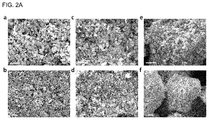
- FIG. 2A is a scanning electron microscopic (SEM) image of the ZrO 2 /Co 3 O 4 catalyst nanocomposite according to the present disclosure.
- FIG. 2B is a SEM image of the ZrO 2 /NiCo 2 O 4 catalyst nanocomposite according to the present disclosure.
- a) and e) are 0.2-ZrO 2 /NiCo 2 O 4 samples
- b) and f) are 0.5-ZrO 2 /NiCo 2 O 4 samples
- c) and g) are 1.0-ZrO 2 /NiCo 2 O 4 samples
- d) and h) are 2.0-ZrO 2 /NiCo 2 O 4 samples.
- the Ni—Co nano-alloy or nanocomposite support shows a nanowire shape and Zr oxide is adsorbed thereon.
- the diameter of nanowires tends to increase as the ratio of Zr increases.
- FIG. 3 is a transmission electron microscopic (TEM) image of the ZrO 2 /Co 3 O 4 nanocomposite according to the present disclosure.
- FIG. 4A shows the results of X-ray diffractometry (XRD) spectrum depending on the ratio of ZrO 2 to Co 3 O 4 in the ZrO 2 /Co 3 O 4 nanocomposite according to Example 1.
- FIG. 4B shows the results of XRD spectrum of pure Co 3 O 4 according to Comparative Example 1.
- FIG. 5A - FIG. 5C show X-ray photoelectron spectroscopy (XPS) signals of the catalysts according to Example 1 and Comparative Example 1.
- XPS X-ray photoelectron spectroscopy
- FIG. 6 shows the linear sweep voltammetry (LSV) curve of ZrO 2 /Co 3 O 4 in CH 4 -saturated carbonate electrolyte.
- FIG. 7 shows 1 H-NMR spectrum of the reaction product after carrying out reaction for 12 hours.
- FIG. 8 shows the amount of CH 4 remaining in the reactor after carrying out reaction for 3, 6, or 12 hours.
- FIG. 9 shows the results of calculation of conversion efficiency into acetaldehyde, 1-propanol and 2-propanol.
- FIG. 10 shows a mechanism of production of 1-propanol and 2-propanol from acetaldehyde.
- the catalyst composite for conversion of methane gas includes: Co 3 O 4 nanoplates or NiCo 2 O 4 nanowires; and ZrO 2 nanoparticles adsorbed to the surface of the Co 3 O 4 nanoplates or NiCo 2 O 4 nanowires, and is used for converting methane gas into alcohols.
- the molar compositional ratio of the Co 3 O 4 nanoplates or NiCo 2 O 4 nanowires to the ZrO 2 nanoparticles is 1:0.1-1:10, more preferably 1:2-1:8, and even more preferably 1:3-1:6.
- the elemental ratio of Co to Zr in the catalyst composite is preferably 0.2:1-6.5:1.
- the ratio is not within the above-defined range, the properties of the catalyst are changed significantly and conversion of methane gas ratio is reduced rapidly. Thus, it is important to provide the above-defined elemental ratio.
- the elemental ratio of Co to Zr in the catalyst composite is preferably 0.4:1-0.5:1. Particularly, when the elemental ratio of Co to Zr is 0.4:1-0.5:1, it is possible to maximize current density, and thus to improve electrochemical methane conversion efficiency significantly.
- the ZrO 2 nanoparticles may have a spherical shape, rod-like shape, hollow shape, ellipsoidal solid shape, or the like.
- the ZrO 2 nanoparticles have an average particle diameter of 10 nm-1 ⁇ m.
- the Co 3 O 4 nanoplates preferably have an average particle diameter of 1 ⁇ m-10 ⁇ m. Since bulk Co 3 O 4 has a particle diameter of about 10 ⁇ m and the particle size of Co 3 O 4 particles is decreased as the ratio of ZrO 2 is increased, the average particle diameter becomes 1 ⁇ m-10 ⁇ m.
- the catalyst composite may be formed by complexation through physical binding. Since the composite is formed merely by physical adsorption not by chemical binding, it is possible to obtain an advantageous effect in terms of electrochemical methane conversion efficiency.
- the electrochemical catalyst for conversion of methane gas includes: a conductive substrate selected from graphite paper, graphene, carbon black, copper, nickel and alumina; a catalyst composite layer for conversion of methane gas formed on the conductive substrate; and optionally, a cover layer for protecting the catalyst composite layer for conversion of methane gas.
- a Zr precursor e.g. ZrOCl 2 hydrate
- Co precursor e.g. Co(NO 3 ) 2 hydrate
- hydroxide e.g., hydroxide
- the hydroxide may be any one selected from Na(OH), K(OH), Ca(OH) 2 and Sr(OH) 2 , more preferably Na(OH), but the scope of the present disclosure is not limited thereto. Any hydroxide may be used as long as it can induce precipitation.
- the ZrOCl 2 hydrate and Co(NO 3 ) 2 hydrate are mixed preferably at a molar compositional ratio of 1:1-1:6.
- the aqueous precursor solution is heated to 150-250° C. to precipitate a ZrO 2 /Co 3 O 4 composite powder (step b).
- the heating may be carried out preferably at 160-220° C., more preferably 170-200° C. to precipitate the product.
- step (b) is subjected to centrifugal separation to obtain ZrO 2 /Co 3 O 4 composite powder.
- step (c) the ZrO 2 /Co 3 O 4 composite powder of step (c) is washed and dried, and then heat treated at 400-600° C. to obtain a ZrO 2 /Co 3 O 4 catalyst composite.
- the heat treatment may be carried out at 450-550° C.
- Ni precursor e.g. NiCl 2
- Co precursor e.g. CoCl 2 .H 2 O
- Zr precursor ZrCl 4
- structure-forming agent e.g. urea
- surfactant e.g. hexadecyltrimethylammonium bromide
- the aqueous precursor solution is heated to 150-250° C. to precipitate a ZrO 2 /Co 3 O 4 composite powder.
- the heating is carried out preferably to 100-140° C. to precipitate the product.
- the product obtained from the preceding step is subjected to centrifugal separation to obtain composite powder.
- the resultant composite powder is washed and dried, and heat treated preferably at 400-600° C. to obtain a catalyst composite.
- the ZrO 2 /Co 3 O 4 nanocomposite catalyst or ZrO 2 /NiCo 2 O 4 nanocomposite catalyst according to the present disclosure may be coated with graphene to improve catalytic activity, or the like, significantly.
- a hydrothermal process may be used for graphene coating.
- the ZrO 2 /Co 3 O 4 nanocomposite catalyst or ZrO 2 /NiCo 2 O 4 nanocomposite catalyst according to the present disclosure and graphene may be dissolved into water. Then, heat treatment may be carried out at high temperature under pressure, and then the product may be subjected to washing and drying.
- FIG. 1 is a schematic view illustrating a process for ethane gas conversion using electrochemical oxidation.
- the method for conversion of methane gas according to the present disclosure will be explained with reference to FIG. 1 .
- the method for conversion of methane gas according to the present disclosure includes converting methane gas into alcohols at a graphite electrode surface-coated with the ZrO 2 /Co 3 O 4 catalyst composite through electrochemical oxidation.
- the coating may be carried out by adding a dispersion of the ZrO 2 /Co 3 O 4 catalyst composite in water to a graphite electrode, followed by drying.
- the electrode surface-coated with the ZrO 2 /Co 3 O 4 catalyst composite may be further coated with a protective layer on the catalyst composite layer.
- a step of dissolving methane into a carbonate electrolyte through bubbling of methane to remove oxygen may be further carried out, before the electrochemical oxidation.
- the final product obtained by the electrochemical oxidation may include at least one selected from 1-propanol, 2-propanol, methanol, formaldehyde, ethanol, acetaldehyde and acetone, wherein the main product may include 1-propanol and 2-propanol.
- Acetaldehyde is an important intermediate and may be used for producing 1-propanol and 2-propanol.
- 1-propanol and 2-propanol may be produced through nucleophilic addition and free radical addition.
- the electrochemical oxidation may be carried out at room temperature under ambient pressure, it may be carried out under pressure to increase the solubility of methane.
- Example 1-1 Preparation of ZrO 2 /Co 3 O 4 Nanocomposite Catalyst
- the ZrO 2 /Co 3 O 4 nanocomposite was obtained through a precipitation process and hydrothermal process.
- 0.1611 g of ZrOCl 2 .8H 2 O 99.0%, Junsei, Japan
- 0.291 g of Co(NO 3 ) 2 .6H 2 O (98%, Aldrich, US)
- 9.6 g of NaOH 96%, Samchun, Korea
- DI deionized water
- the amount of Co(NO 3 ) 2 .6H 2 O was varied without any change in the other conditions to obtain ZrO 2 /Co 3 O 4 nanocomposites having different compositions. Particularly, the amount of Co(NO 3 ) 2 .6H 2 O was controlled to 0.582 g to obtain the second sample (‘1-4 ZrO 2 /Co 3 O 4 sample’ or ‘1-4 sample’), and to 0.873 g to obtain the third sample (‘1-6 ZrO 2 /Co 3 O 4 sample’ or ‘1-6 sample’).
- the elemental ratio of Co to Zr is about 0.28:1, about 0.45:1 and about 6.3:1 in 1-2 sample, 1-4 sample and 1-6 sample, respectively.
- Example 1-2 Preparation of ZrO 2 /NiCo 2 O 4 Nanocomposite Catalyst
- the resultant solution was transferred to a 60 mL autoclave container and heated at 120° C. for 48 hours. Then, the solution was subjected to centrifugal separation to obtain powder and the powder was washed with deionized water six times. Finally, 0.5-ZrO 2 :NiCo 2 O 4 sample was obtained after carrying out thermal annealing at 500° C. for 3 hours.
- the amount of ZrCl 4 was varied without any change in the other conditions to obtain catalysts having different compositions. Particularly, the amount of ZrCl 4 was controlled to 0.047 g to obtain the second sample (‘0.2-ZrO 2 :NiCo 2 O 4 sample’ or ‘0.2 sample’), to 0.234 g to obtain the third sample (‘1.0-ZrO 2 :NiCo 2 O 4 sample’ or ‘1.0 sample’), and to 0.468 g to obtain to 0.234 g to obtain the fourth sample (‘2.0-ZrO 2 :NiCo 2 O 4 sample’ or ‘2.0 sample’).
- the elemental ratio of Zr:Ni:Co is about 0.2:2.5:5, 0.5:2.5:5, 1:2.5:5, and 2:2.5:5 in 0.2 sample, 0.5 sample, 1.0 sample and 2.0 sample, respectively.
- Example 1-3 Preparation of ZrO 2 /Co 3 O 4 Nanocomposite Catalyst Coated with Graphene
- the ZrO 2 /Co 3 O 4 nanocomposite according to Example 1-1 was coated with graphene to obtain a ZrO 2 /Co 3 O 4 nanocomposite catalyst coated with graphene.
- each of 1-2, 1-4 and 1-6 samples according to Example 1-1 and graphene were provided with a controlled weight ratio of 1:0.5, 1:1 and 1:2, and then dissolved in 40 mL of deionized water (DI) for 30 minutes under agitation in the same manner as described above. Then, the resultant solution was transferred to an autoclave container and heated at 180° C. for 24 hours. Then, the solution was subjected to centrifugal separation to obtain powder, and the powder was washed with deionized water three times. Finally, the resultant product was dried at 70° C.
- DI deionized water
- Example 1-4 Preparation of ZrO 2 /NiCo 2 O 4 Nanocomposite Catalyst Coated with Graphene
- Example 1-2 The ZrO 2 /NiCo 2 O 4 nanocomposite according to Example 1-2 was coated with graphene in the same manner as described in Example 1-3 to obtain a ZrO 2 /NiCo 2 O 4 nanocomposite catalyst coated with graphene.
- a pure Co 3 O 4 sample was obtained in the same manner as the preparation of 1-4 ZrO 2 /Co 3 O 4 , except that no ZrOCl 2 .8H 2 O was added to obtain a catalyst.
- a ZrO 2 /NiO sample was obtained in the same manner as the preparation of 1-4 ZrO 2 /Co 3 O 4 , except that 0.582 g of Ni(NO 3 ) 2 .6H 2 O (97%, Aldrich, US) was added instead of Co(NO 3 ) 2 .6H 2 O to obtain a catalyst.
- the working electrode was obtained by dispersing the catalyst composite powder sample according to Example 1 into deionized water at a concentration of 3 mg/mL under agitation for 30 minutes to form a dispersion, dropping 5.7 mL of the dispersion to graphite paper (20 cm 2 ) and carrying out drying at room temperature.
- Test Example 1 SEM and TEM Image Analysis of Catalyst
- ZrO 2 /Co 3 O 4 nanocomposites 1-2 ZrO 2 /Co 3 O 4 , 1-4 ZrO 2 /Co 3 O 4 , and 1-6 ZrO 2 /Co 3 O 4 ) having different compositions were observed through scanning electron microscopy (SEM). The resultant images are shown in FIG. 2 (scale bar: 1 ⁇ m). It can be seen from FIG. 2 that oval nanoparticles of ZrO 2 having a uniform size are formed and adsorbed to the surface of Co 3 O 4 plates in all of the samples. As the amount of Co 3 O 4 is increased, the particle size of Co 3 O 4 is increased gradually until it becomes bulk. This may affect the catalytic properties of ZrO 2 /Co 3 O 4 nanocomposites.
- the pure Co 3 O 4 particles according to Comparative Example 1 have a large particle diameter of 10 ⁇ m or more.
- the size of Co 3 O 4 plates may be controlled by co-precipitation of ZrO 2 .
- the Zr/Co ratio is decreased.
- the large Co 3 O 4 plates are surrounded with small ZrO 2 particles, which causes a rapid drop in Zr/Co ratio.
- FIG. 3 illustrates a transmission electron microscopic (TEM) image of 1-4 ZrO 2 /Co 3 O 4 nanocomposite.
- TEM transmission electron microscopic
- Test Example 2 XRD and XPS Spectrum Analysis of Catalyst
- FIG. 4A shows the results of X-ray diffractometry (XRD) spectrum depending on the ratio of ZrO 2 to Co 3 O 4 in the ZrO 2 /Co 3 O 4 nanocomposite according to Example 1
- FIG. 4B shows the results of XRD spectrum of pure Co 3 O 4 according to Comparative Example 1.
- FIG. 5A -FIG. 5 C show X-ray photoelectron spectroscopy (XPS) signals of the catalysts according to Example 1 and Comparative Example 1.
- XPS X-ray photoelectron spectroscopy
- the crystal structures of ZrO 2 /Co 3 O 4 composites having different ratios were analyzed by XRD with Cu-K ⁇ irradiation and compared with the crystal structure of pure Co 3 O 4 .
- the diffraction peaks of ZrO 2 are related with a monoclinic phase and those of Co 3 O 4 are related with a cubic structure.
- typical (001), (100), (011), ( ⁇ 111) and (022) surfaces of ZrO 2 are observed at 17.5°, 24.2°, 24.6°, 28.3° and 50.3°.
- the intensities of all related peaks became gradually decreased as the amount of Co 3 O 4 increased.
- Typical (111), (311) and (440) surfaces of Co 3 O 4 are observed at 19.0°, 36.9° and 65.2°, and show the same change in peak intensity according to the amount of ZrO 2 .
- the above data explain the microstructure and crystal structure of each ZrO 2 /Co 3 O 4 nanocomposite.
- the surface state related with specific local selectivity of CH 4 oxidation can be explained through the XPS results of FIG. 5A - FIG. 5C . It is shown that the signal of Co—Zr binding energy does not undergo a significant shift according to a change in ratio of the constitutional ingredients. However, the intensities of Co signals are changed clearly according to a decrease in amount of Co. The Zr signals are also changed but are changed less significantly as compared to the Co signals.
- O1s peaks at 530 eV and 532 eV are derived from the lattice oxygen and oxygen on the irregular surface, respectively.
- the peak at 532 eV is related with the chemical adsorption on the surface or a defect, such as dissociated oxygen or hydroxyl group.
- the Co 3 O 4 surface is covered easily with a single layer of chemically adsorbed oxygen. In this case, a peak appears at 532 eV in O1s spectrum of pure Co 3 O 4 , which suggests the surface adsorption ability of Co 3 O 4 .
- Co 3 O 4 nanoplates or NiCo 2 O 4 nanowires form a composite with ZrO 2 nanoparticles merely by physical binding, not by chemical binding can be determined through XRD spectrum analysis. Since the complex is formed merely by physical adsorption, not by chemical binding, it is possible to obtain an advantageous effect in terms of electrochemical conversion efficiency of methane.
- a glassy carbon disc electrode was introduced to load a catalyst and used as a working electrode.
- FIG. 6 shows the linear sweep voltammetry (LSV) curve of ZrO 2 /Co 3 O 4 in a CH 4 -saturated carbonate electrolyte.
- LSV linear sweep voltammetry
- 1-6 ZrO 2 /Co 3 O 4 sample and 1-4 ZrO 2 /Co 3 O 4 sample show the same J-V curve tendency but show relatively low current density. This is because the surface adsorption ability of carbonate ions is low due to a lower amount of ZrO 2 .
- FIG. 7 shows 1 H-NMR spectrum of the reaction product after carrying out reaction for 12 hours.
- the main product includes 1-propanol and 2-propanol but methanol, ethanol, acetaldehyde and acetone are also observed as byproducts.
- a typical 1H-NMR peak of methanol is positioned at 3.3-3.5 ppm and may be overlapped with the peak of 1-propanol.
- a 1H-NMR peak of ethanol appears at the same position as the peak of 2-propanol. However, the number of sub-peaks of ethanol is different from that of 2-propanol. Therefore, it is thought that the product is 2-propanol.
- FIG. 8 shows the amount of CH 4 remaining in the reactor after carrying out reaction for 3, 6, or 12 hours.
- consumption of CH 4 and production of the products can be determined by carrying out gas chromatography (GC) and GC-mass spectrometry (MS) as a function of time.
- GC gas chromatography
- MS GC-mass spectrometry
- methanol and formaldehyde are the first products of methane oxidation. It is known that formaldehyde is an oxidation product of methanol. After comparing the amount of products containing two carbon atoms, ethanol and acetaldehyde, with each other, it is determined that acetaldehyde is a main product of the addition reaction between methane and formaldehyde. Further, the amount of acetaldehyde is decreased with time, which suggests that acetaldehyde plays a key role in production of 1-propanol and 2-propanol. After carrying out reaction for 12 hours, 1-propanol and 2-propanol become main stable products of methane oxidation, which corresponds to the results of 1H-NMR.
- FIG. 9 shows the results of calculation of conversion efficiency into acetaldehyde, 1-propanol and 2-propanol. After carrying out reaction for 12 hours, it is shown that the main products, 1-propanol and 2-propanol, show a total production efficiency of 60% or more.
- Acetaldehyde is an important product. Production of acetaldehyde is depicted in the following Reaction Scheme.
- methane is oxidized by an oxidant (carbonate) to form methanol, which is oxidized continuously to form formaldehyde. Then, several reactions occur to form methane, methanol and formaldehyde from methane, methanol and formaldehyde as reactants. Therefore, production and accumulation of acetaldehyde occur promptly and significantly, which corresponds to the results of Table 1.
- FIG. 10 shows a mechanism of production of 1-propanol and 2-propanol from acetaldehyde.
- the process is the most important reaction of methane conversion.
- the methyl group of methane functions as a nucleophilic agent and attacks the carbonyl carbon of acetaldehyde. Therefore, nucleophilic addition occurs to form one of the main products in conversion of methane, i.e. 2-propanol.
- To search a route capable of producing 1-propanol all reaction conditions are considered. As shown in (b1)-(b3), it can be seen that free radical addition is suitable.
- Co 3 O 4 and carbonate participate in formation of methyl radicals from methane. Since carbonate radicals have a relatively low production energy as compared to hydroxyl radicals, they may be produced through anodic oxidation with the aid of Co 3 O 4 during electrochemical oxidation. The carbonate radicals function as intermediates to produce methyl radicals from the reaction of methane.
- acetaldehyde maintains an equilibrium between isomers, acetaldehyde and vinyl alcohol.
- the arrangement of vinyl alcohol requires an energy higher than formation of acetaldehyde by 45 kJ mol ⁇ 1 , the energy may be accomplished in the presence of carbonate.
- the product follows the Markovnikov's rule, which suggests that reaction of methane with vinyl alcohol produces 2-propanol as a main product.
- the present disclosure does not provide particular test results, it is shown that the ZrO 2 /Co 3 O 4 nanocomposite catalyst coated with graphene according to Example 1-3 shows significantly improved catalytic activity in methane oxidation as compared to the ZrO 2 /Co 3 O 4 nanocomposite catalyst.
- the ZrO 2 /NiCo 2 O 4 nanocomposite catalyst obtained by using a Ni—Co alloy or composite, NiCo 2 O 4 , as a catalyst support according to Example 1-2 shows improved catalytic activity as compared to the ZrO 2 /Co 3 O 4 nanocomposite catalyst using Co 3 O 4 support according to Example 1-1, as can be seen from an upward shift of the J-V curve for methane oxidation.
- the ZrO 2 /NiCo 2 O 4 nanocomposite catalyst shows improved catalytic activity capable of initiating methane oxidation.
- the ZrO 2 /NiCo 2 O 4 nanocomposite catalyst coated with graphene according to Example 1-4 specifically shows improved anti-poisoning property and durability as compared to the other groups of catalysts according to the present disclosure.
Landscapes
- Chemical & Material Sciences (AREA)
- Organic Chemistry (AREA)
- Engineering & Computer Science (AREA)
- Chemical Kinetics & Catalysis (AREA)
- Materials Engineering (AREA)
- Physics & Mathematics (AREA)
- Metallurgy (AREA)
- Electrochemistry (AREA)
- Optics & Photonics (AREA)
- Health & Medical Sciences (AREA)
- Plasma & Fusion (AREA)
- Toxicology (AREA)
- Thermal Sciences (AREA)
- Catalysts (AREA)
- Crystallography & Structural Chemistry (AREA)
- Dispersion Chemistry (AREA)
Abstract
Description

| TABLE 1 | |||||||
| 1- | 2- | ||||||
| Reaction | Methanol | Ethanol | propanol | propanol | Acetone | ||
| time | [μg | Formaldehyde | [μg | Acetaldehyde | [μg | [μg | [μg |
| [h] | mL−1] | [μg mL−1] | mL−1] | [μg mL−1] | mL−1] | mL−1] | mL−1] |
| 3 | 29.95 | 0.88 | 0 | 261.50 | 0.50 | 19.53 | 0 |
| 6 | 33.15 | 1.11 | 0.49 | 170.34 | 56.51 | 101.74 | 3.82 |
| 12 | 33.71 | 1.10 | 35.21 | 153.42 | 1336.12 | 1315.56 | 14.16 |

Claims (17)
Applications Claiming Priority (2)
| Application Number | Priority Date | Filing Date | Title |
|---|---|---|---|
| KR1020170183449A KR102077263B1 (en) | 2017-12-29 | 2017-12-29 | Catalyst composite for conversion of mathane gas and method for converting mathane gas using the same |
| KR10-2017-0183449 | 2017-12-29 |
Publications (2)
| Publication Number | Publication Date |
|---|---|
| US20190224650A1 US20190224650A1 (en) | 2019-07-25 |
| US11077429B2 true US11077429B2 (en) | 2021-08-03 |
Family
ID=67261114
Family Applications (1)
| Application Number | Title | Priority Date | Filing Date |
|---|---|---|---|
| US16/233,686 Active 2039-06-12 US11077429B2 (en) | 2017-12-29 | 2018-12-27 | Catalyst composite for conversion of methane gas and method for converting methane gas using the same |
Country Status (2)
| Country | Link |
|---|---|
| US (1) | US11077429B2 (en) |
| KR (1) | KR102077263B1 (en) |
Families Citing this family (5)
| Publication number | Priority date | Publication date | Assignee | Title |
|---|---|---|---|---|
| US11855309B2 (en) * | 2017-09-08 | 2023-12-26 | Lg Chem, Ltd. | Interconnect for a solid oxide fuel cell, its manufacturing method, and a solid oxide fuel cell |
| KR102561473B1 (en) * | 2019-10-24 | 2023-08-01 | 서강대학교 산학협력단 | Method for continuous flow conversion of methane and apparatus for continuous flow conversion of methane |
| CN113447557B (en) * | 2021-05-27 | 2022-12-02 | 西安电子科技大学芜湖研究院 | Based on hollow six mango star Co 3 O 4 Methanol sensor made of material, preparation method and application |
| KR102757327B1 (en) | 2021-12-24 | 2025-01-22 | 한국과학기술원 | Method of Screening Catalyst by Shifting Scaling Relations |
| KR102778637B1 (en) * | 2022-11-25 | 2025-03-12 | 서강대학교산학협력단 | Electrochemical continuous flow reactor and methane conversion method of converting methane to ethanol using the same |
Citations (11)
| Publication number | Priority date | Publication date | Assignee | Title |
|---|---|---|---|---|
| US3736267A (en) * | 1969-06-02 | 1973-05-29 | Norton Co | Catalyst and catalyst carrier composition |
| US4957896A (en) * | 1988-03-24 | 1990-09-18 | Toyota Jidosha Kabushiki Kaisha Cataler Industrial Co. Ltd | Catalyst for purification of exhaust gases |
| US5314673A (en) * | 1992-02-18 | 1994-05-24 | E. I. Du Pont De Nemours And Company | Process for the conversion of N2 O |
| US6071476A (en) * | 1997-11-14 | 2000-06-06 | Motorola, Inc. | Exhaust gas sensor |
| US6361896B1 (en) * | 1996-04-19 | 2002-03-26 | Zentrum Fur Sonnenenergie Und Wasserstoff-Forschung Baden Wuetternberg Gemeinnuetzige Stiftung | Device and method for combined purification and compression of hydrogen containing CO and the use thereof in fuel cell assemblies |
| KR100606856B1 (en) | 2004-10-11 | 2006-08-01 | 김문찬 | Room Temperature Oxidation Catalyst for Fuel Cell and Manufacturing Method |
| US20080248373A1 (en) * | 2006-11-20 | 2008-10-09 | In-Hyuk Son | Anode for fuel cell, membrane-electrode assembly for fuel cell including same, and fuel cell system including same |
| US20120095268A1 (en) * | 2010-10-18 | 2012-04-19 | Anna Lee Tonkovich | Microchannel processor |
| US20130071761A1 (en) * | 2011-09-16 | 2013-03-21 | Khalil Amine | Catalytic cathode for lithium-air batteries |
| US9480974B2 (en) | 2014-09-22 | 2016-11-01 | Council Of Scientific & Industrial Research | Nano Ni—CeO2 catalyst for syngas production and its preparation thereof |
| WO2017182923A1 (en) * | 2016-04-18 | 2017-10-26 | Sabic Global Technologies B.V. | Oxygen evolution electrocatalysts with carbon coated cobalt (ii, iii) oxide layers |
Family Cites Families (2)
| Publication number | Priority date | Publication date | Assignee | Title |
|---|---|---|---|---|
| KR101164024B1 (en) * | 2009-12-24 | 2012-07-18 | 한국화학연구원 | Cobalt based catalysts for reforming of methane by carbon dioxide, and production method of synthesis gas using them |
| WO2012061728A2 (en) | 2010-11-05 | 2012-05-10 | University Of Connecticut | Electrochemical reactor for co2 conversion, utilization and associated carbonate electrocatalyst |
-
2017
- 2017-12-29 KR KR1020170183449A patent/KR102077263B1/en active Active
-
2018
- 2018-12-27 US US16/233,686 patent/US11077429B2/en active Active
Patent Citations (11)
| Publication number | Priority date | Publication date | Assignee | Title |
|---|---|---|---|---|
| US3736267A (en) * | 1969-06-02 | 1973-05-29 | Norton Co | Catalyst and catalyst carrier composition |
| US4957896A (en) * | 1988-03-24 | 1990-09-18 | Toyota Jidosha Kabushiki Kaisha Cataler Industrial Co. Ltd | Catalyst for purification of exhaust gases |
| US5314673A (en) * | 1992-02-18 | 1994-05-24 | E. I. Du Pont De Nemours And Company | Process for the conversion of N2 O |
| US6361896B1 (en) * | 1996-04-19 | 2002-03-26 | Zentrum Fur Sonnenenergie Und Wasserstoff-Forschung Baden Wuetternberg Gemeinnuetzige Stiftung | Device and method for combined purification and compression of hydrogen containing CO and the use thereof in fuel cell assemblies |
| US6071476A (en) * | 1997-11-14 | 2000-06-06 | Motorola, Inc. | Exhaust gas sensor |
| KR100606856B1 (en) | 2004-10-11 | 2006-08-01 | 김문찬 | Room Temperature Oxidation Catalyst for Fuel Cell and Manufacturing Method |
| US20080248373A1 (en) * | 2006-11-20 | 2008-10-09 | In-Hyuk Son | Anode for fuel cell, membrane-electrode assembly for fuel cell including same, and fuel cell system including same |
| US20120095268A1 (en) * | 2010-10-18 | 2012-04-19 | Anna Lee Tonkovich | Microchannel processor |
| US20130071761A1 (en) * | 2011-09-16 | 2013-03-21 | Khalil Amine | Catalytic cathode for lithium-air batteries |
| US9480974B2 (en) | 2014-09-22 | 2016-11-01 | Council Of Scientific & Industrial Research | Nano Ni—CeO2 catalyst for syngas production and its preparation thereof |
| WO2017182923A1 (en) * | 2016-04-18 | 2017-10-26 | Sabic Global Technologies B.V. | Oxygen evolution electrocatalysts with carbon coated cobalt (ii, iii) oxide layers |
Non-Patent Citations (13)
Also Published As
| Publication number | Publication date |
|---|---|
| KR20190081121A (en) | 2019-07-09 |
| KR102077263B1 (en) | 2020-02-13 |
| US20190224650A1 (en) | 2019-07-25 |
Similar Documents
| Publication | Publication Date | Title |
|---|---|---|
| Qiu et al. | Catalyst support effect on ammonia decomposition over Ni/MgAl2O4 towards hydrogen production | |
| He et al. | Photocatalytic hydrogen evolution of nanoporous CoFe2O4 and NiFe2O4 for water splitting | |
| US20190224650A1 (en) | Catalyst composite for conversion of methane gas and method for converting methane gas using the same | |
| Pu et al. | Core-shell nickel catalysts for the steam reforming of acetic acid | |
| Lin et al. | A review on catalysts for electrocatalytic and photocatalytic reduction of N2 to ammonia | |
| Lytkina et al. | Influence of the support structure and composition of Ni–Cu-based catalysts on hydrogen production by methanol steam reforming | |
| Moogi et al. | Influence of catalyst synthesis methods on anti-coking strength of perovskites derived catalysts in biogas dry reforming for syngas production | |
| Xiang et al. | Tuning interfacial structures for better catalysis of water electrolysis | |
| Jeon et al. | Harnessing strong metal–support interaction to proliferate the dry reforming of methane performance by in situ reduction | |
| Gouget et al. | In situ solid–gas reactivity of nanoscaled metal borides from molten salt synthesis | |
| Zhu et al. | Structure–reactivity relationships in CO2 hydrogenation to C2+ chemicals on Fe-based catalysts | |
| Nazir et al. | Development of CuAg/Cu2O nanoparticles on carbon nitride surface for methanol oxidation and selective conversion of carbon dioxide into formate | |
| Kosinski et al. | Methanol reforming by nanostructured Pd/Sm-doped ceria catalysts | |
| Sheng et al. | Emerging applications of nanocatalysts synthesized by flame aerosol processes | |
| Moura Souza et al. | Niobium: a promising Pd co-electrocatalyst for ethanol electrooxidation reactions | |
| Yuan et al. | Atomic strategy to boost the solar heating ammonia decomposition of cobalt-based catalyst | |
| Da Costa-Serra et al. | Co/ZnO and Ni/ZnO catalysts for hydrogen production by bioethanol steam reforming. Influence of ZnO support morphology on the catalytic properties of Co and Ni active phases | |
| Li et al. | Improved activity of Ru/CeO2 catalyst for CO2 methanation by enhanced electronic metal–support interaction | |
| He et al. | Grain boundary and interface interaction of metal (copper/indium) oxides to boost efficient electrocatalytic carbon dioxide reduction into syngas | |
| Mondal et al. | Selective methodology for developing PtCo NPs and performance screening for energy efficient electro-catalysis in direct ethanol fuel cell | |
| Li et al. | Ni nanoparticles supported on high surface area carborundum for enhanced hydrogen production by ammonia decomposition | |
| Zhang et al. | Cu-(Ga0. 2Cr0. 2Mn0. 2Ni0. 2Zn0. 2) 3O4 heterojunction derived from high entropy oxide precursor and its photocatalytic activity for CO2 reduction with water vapor | |
| Shen et al. | Hydrogen production by ethanol steam reforming over Ni-doped LaNi x Co 1− x O3− δ perovskites prepared by EDTA-citric acid sol–gel method | |
| Barakat | CoNi/CNTs composite as effective and stable electrode for oxygen evaluation reaction in alkaline media | |
| Zhang et al. | Ni-doped In2O3 photothermal coupling catalyzed boosted carbon dioxide hydrogenation to methanol |
Legal Events
| Date | Code | Title | Description |
|---|---|---|---|
| AS | Assignment |
Owner name: INDUSTRY-ACADEMIC COOPERATION FOUNDATION, YONSEI U Free format text: ASSIGNMENT OF ASSIGNORS INTEREST;ASSIGNORS:PARK, JONG HYEOK;KIM, JIWON;MA, MING;SIGNING DATES FROM 20181218 TO 20181219;REEL/FRAME:047860/0960 Owner name: INDUSTRY-ACADEMIC COOPERATION FOUNDATION, YONSEI UNIVERSITY, KOREA, REPUBLIC OF Free format text: ASSIGNMENT OF ASSIGNORS INTEREST;ASSIGNORS:PARK, JONG HYEOK;KIM, JIWON;MA, MING;SIGNING DATES FROM 20181218 TO 20181219;REEL/FRAME:047860/0960 |
|
| FEPP | Fee payment procedure |
Free format text: ENTITY STATUS SET TO UNDISCOUNTED (ORIGINAL EVENT CODE: BIG.); ENTITY STATUS OF PATENT OWNER: SMALL ENTITY |
|
| FEPP | Fee payment procedure |
Free format text: ENTITY STATUS SET TO SMALL (ORIGINAL EVENT CODE: SMAL); ENTITY STATUS OF PATENT OWNER: SMALL ENTITY |
|
| STPP | Information on status: patent application and granting procedure in general |
Free format text: NON FINAL ACTION MAILED |
|
| STPP | Information on status: patent application and granting procedure in general |
Free format text: NON FINAL ACTION MAILED |
|
| STPP | Information on status: patent application and granting procedure in general |
Free format text: RESPONSE TO NON-FINAL OFFICE ACTION ENTERED AND FORWARDED TO EXAMINER |
|
| STPP | Information on status: patent application and granting procedure in general |
Free format text: NOTICE OF ALLOWANCE MAILED -- APPLICATION RECEIVED IN OFFICE OF PUBLICATIONS |
|
| STPP | Information on status: patent application and granting procedure in general |
Free format text: PUBLICATIONS -- ISSUE FEE PAYMENT RECEIVED |
|
| STPP | Information on status: patent application and granting procedure in general |
Free format text: PUBLICATIONS -- ISSUE FEE PAYMENT VERIFIED |
|
| STCF | Information on status: patent grant |
Free format text: PATENTED CASE |
|
| MAFP | Maintenance fee payment |
Free format text: PAYMENT OF MAINTENANCE FEE, 4TH YR, SMALL ENTITY (ORIGINAL EVENT CODE: M2551); ENTITY STATUS OF PATENT OWNER: SMALL ENTITY Year of fee payment: 4 |