US11076596B2 - Substituted trifluoromethyloxadiazoles for combating phytopathogenic fungi - Google Patents
Substituted trifluoromethyloxadiazoles for combating phytopathogenic fungi Download PDFInfo
- Publication number
- US11076596B2 US11076596B2 US16/644,733 US201816644733A US11076596B2 US 11076596 B2 US11076596 B2 US 11076596B2 US 201816644733 A US201816644733 A US 201816644733A US 11076596 B2 US11076596 B2 US 11076596B2
- Authority
- US
- United States
- Prior art keywords
- alkyl
- group
- ring member
- methyl
- phenyl
- Prior art date
- Legal status (The legal status is an assumption and is not a legal conclusion. Google has not performed a legal analysis and makes no representation as to the accuracy of the status listed.)
- Expired - Fee Related
Links
- 0 *N([1*])**C1=NOC(C(F)(F)F)=N1 Chemical compound *N([1*])**C1=NOC(C(F)(F)F)=N1 0.000 description 30
- IXMVJCBZVKGFNI-UHFFFAOYSA-N CC1=CC=C(C)C=C1.CC1=CC=C(C)N=C1.CC1=CC=C(C)N=C1.CC1=CC=C(C)S1.CC1=CN=C(C)N=C1.CC1=CN=C(C)N=C1.CC1=CSC(C)=C1.CC1=CSC(C)=C1 Chemical compound CC1=CC=C(C)C=C1.CC1=CC=C(C)N=C1.CC1=CC=C(C)N=C1.CC1=CC=C(C)S1.CC1=CN=C(C)N=C1.CC1=CN=C(C)N=C1.CC1=CSC(C)=C1.CC1=CSC(C)=C1 IXMVJCBZVKGFNI-UHFFFAOYSA-N 0.000 description 1
- ONUBEUWFJODMPK-UHFFFAOYSA-N CC1=NN(C)C(OC(F)F)=C1C(F)(F)S(=O)(=O)C1=NOC(C)(C)C1.CC1=NN(C)C(OC(F)F)=C1C(F)S(=O)(=O)C1=NOC(C)(C)C1.CC1=NN(C)C(OC(F)F)=C1CS(=O)(=O)C1=NOC(C)(C)C1F.CC1=NN(C)N=C1C(F)(F)S(=O)(=O)C1=NOC(C)(C)C1.CC1=NN(C)N=C1C(F)S(=O)(=O)C1=NOC(C)(C)C1.CC1=NN(C)N=C1CS(=O)(=O)C1=NOC(C)(C)C1.CC1=NN(C)N=C1CS(=O)(=O)C1=NOC(C)(C)C1F Chemical compound CC1=NN(C)C(OC(F)F)=C1C(F)(F)S(=O)(=O)C1=NOC(C)(C)C1.CC1=NN(C)C(OC(F)F)=C1C(F)S(=O)(=O)C1=NOC(C)(C)C1.CC1=NN(C)C(OC(F)F)=C1CS(=O)(=O)C1=NOC(C)(C)C1F.CC1=NN(C)N=C1C(F)(F)S(=O)(=O)C1=NOC(C)(C)C1.CC1=NN(C)N=C1C(F)S(=O)(=O)C1=NOC(C)(C)C1.CC1=NN(C)N=C1CS(=O)(=O)C1=NOC(C)(C)C1.CC1=NN(C)N=C1CS(=O)(=O)C1=NOC(C)(C)C1F ONUBEUWFJODMPK-UHFFFAOYSA-N 0.000 description 1
- WMQTYYANCBNSNU-UHFFFAOYSA-N CC1=NN(C)C(OC(F)F)=C1C(F)(F)S(=O)(=O)C1=NOC(C)(C)C1F.CC1=NN(C)N=C1C(F)(F)S(=O)(=O)C1=NOC(C)(C)C1F Chemical compound CC1=NN(C)C(OC(F)F)=C1C(F)(F)S(=O)(=O)C1=NOC(C)(C)C1F.CC1=NN(C)N=C1C(F)(F)S(=O)(=O)C1=NOC(C)(C)C1F WMQTYYANCBNSNU-UHFFFAOYSA-N 0.000 description 1
Classifications
-
- A—HUMAN NECESSITIES
- A01—AGRICULTURE; FORESTRY; ANIMAL HUSBANDRY; HUNTING; TRAPPING; FISHING
- A01N—PRESERVATION OF BODIES OF HUMANS OR ANIMALS OR PLANTS OR PARTS THEREOF; BIOCIDES, e.g. AS DISINFECTANTS, AS PESTICIDES OR AS HERBICIDES; PEST REPELLANTS OR ATTRACTANTS; PLANT GROWTH REGULATORS
- A01N43/00—Biocides, pest repellants or attractants, or plant growth regulators containing heterocyclic compounds
- A01N43/72—Biocides, pest repellants or attractants, or plant growth regulators containing heterocyclic compounds having rings with nitrogen atoms and oxygen or sulfur atoms as ring hetero atoms
- A01N43/80—Biocides, pest repellants or attractants, or plant growth regulators containing heterocyclic compounds having rings with nitrogen atoms and oxygen or sulfur atoms as ring hetero atoms five-membered rings with one nitrogen atom and either one oxygen atom or one sulfur atom in positions 1,2
-
- A—HUMAN NECESSITIES
- A01—AGRICULTURE; FORESTRY; ANIMAL HUSBANDRY; HUNTING; TRAPPING; FISHING
- A01N—PRESERVATION OF BODIES OF HUMANS OR ANIMALS OR PLANTS OR PARTS THEREOF; BIOCIDES, e.g. AS DISINFECTANTS, AS PESTICIDES OR AS HERBICIDES; PEST REPELLANTS OR ATTRACTANTS; PLANT GROWTH REGULATORS
- A01N43/00—Biocides, pest repellants or attractants, or plant growth regulators containing heterocyclic compounds
- A01N43/72—Biocides, pest repellants or attractants, or plant growth regulators containing heterocyclic compounds having rings with nitrogen atoms and oxygen or sulfur atoms as ring hetero atoms
- A01N43/82—Biocides, pest repellants or attractants, or plant growth regulators containing heterocyclic compounds having rings with nitrogen atoms and oxygen or sulfur atoms as ring hetero atoms five-membered rings with three ring hetero atoms
-
- C—CHEMISTRY; METALLURGY
- C07—ORGANIC CHEMISTRY
- C07D—HETEROCYCLIC COMPOUNDS
- C07D271/00—Heterocyclic compounds containing five-membered rings having two nitrogen atoms and one oxygen atom as the only ring hetero atoms
- C07D271/02—Heterocyclic compounds containing five-membered rings having two nitrogen atoms and one oxygen atom as the only ring hetero atoms not condensed with other rings
- C07D271/06—1,2,4-Oxadiazoles; Hydrogenated 1,2,4-oxadiazoles
-
- C—CHEMISTRY; METALLURGY
- C07—ORGANIC CHEMISTRY
- C07D—HETEROCYCLIC COMPOUNDS
- C07D413/00—Heterocyclic compounds containing two or more hetero rings, at least one ring having nitrogen and oxygen atoms as the only ring hetero atoms
- C07D413/02—Heterocyclic compounds containing two or more hetero rings, at least one ring having nitrogen and oxygen atoms as the only ring hetero atoms containing two hetero rings
- C07D413/12—Heterocyclic compounds containing two or more hetero rings, at least one ring having nitrogen and oxygen atoms as the only ring hetero atoms containing two hetero rings linked by a chain containing hetero atoms as chain links
Definitions
- the present invention relates to trifluoromethyloxadiazoles of the formula I, or the N-oxides, or the agriculturally useful salts thereof, and the use thereof for controlling phytopathogenic fungi; to a method for combating phytopathogenic harmful fungi, which process comprises treating the fungi, the plants, the soil or seeds to be protected against fungal attack, with an effective amount of at least one compound of the formula I, or an N-oxide, or an agriculturally acceptable salt thereof; and to agrochemical compositions comprising at least one compound of the formula I, or an N-oxide, or an agriculturally acceptable salt thereof; and to agrochemical compositions further comprising seeds.
- the present invention relates to compounds of the formula I, or the N-oxides, or the agriculturally acceptable salts thereof,
- Agriculturally acceptable salts of the compounds of the formula I encompass especially the salts of those cations or the acid addition salts of those acids whose cations and anions, respectively, have no adverse effect on the fungicidal action of the compounds I.
- Suitable cations are thus in particular the ions of the alkali metals, preferably sodium and potassium, of the alkaline earth metals, preferably calcium, magnesium and barium, of the transition metals, preferably manganese, copper, zinc and iron, and also the ammonium ion which, if desired, may be substituted with one to four C 1 -C 4 -alkyl substituents and/or one phenyl or benzyl substituent, preferably diisopropylammonium, tetramethylammonium, tetrabutylammonium, trimethylbenzylammonium, furthermore phosphonium ions, sulfonium ions, preferably tri(C 1 -C 4 -alkyl)sul
- Anions of acceptable acid addition salts are primarily chloride, bromide, fluoride, hydrogensulfate, sulfate, dihydrogenphosphate, hydrogenphosphate, phosphate, nitrate, bicarbonate, carbonate, hexafluorosilicate, hexafluorophosphate, benzoate, and the anions of C 1 -C 4 -alkanoic acids, preferably formate, acetate, propionate and butyrate. They can be formed by reacting a compound I with an acid of the corresponding anion, preferably of hydrochloric acid, hydrobromic acid, sulfuric acid, phosphoric acid or nitric acid.
- Stereoisomers of the formula I can exist as one or more stereoisomers.
- the various stereoisomers include enantiomers, diastereomers, atropisomers arising from restricted rotation about a single bond of asymmetric groups and geometric isomers. They also form part of the subject matter of the present invention.
- one stereoisomer may be more active and/or may exhibit beneficial effects when enriched relative to the other stereoisomer(s) or when separated from the other stereoisomer(s). Additionally, the skilled artisan knows how to separate, enrich, and/or to selectively prepare said stereoisomers.
- the compounds of the invention may be present as a mixture of stereoisomers, e.g. a racemate, individual stereoisomers, or as an optically active form.
- the embodiments of the intermediates obtained during preparation of compounds I correspond to the embodiments of the compounds of formula I.
- the term “compounds I” refers to compounds of the formula I.
- C n -C m indicates the number of carbon atoms possible in each case in the substituent or substituent moiety in question.
- halogen refers to fluorine, chlorine, bromine and iodine.
- oxo refers to an oxygen atom ⁇ O, which is bound to a carbon atom or sulfur atom, thus forming, for example, a ketonyl —C( ⁇ O)— or sulfinyl —S( ⁇ O)— group.
- C 1 -C 6 -alkyl refers to a straight-chained or branched saturated hydrocarbon group having 1 to 6 carbon atoms, for example methyl, ethyl, propyl, 1-methylethyl, butyl, 1-methylpropyl, 2-methylpropyl, and 1,1-dimethylethyl.
- C 2 -C 6 -alkenyl refers to a straight-chain or branched unsaturated hydrocarbon radical having 2 to 6 carbon atoms and a double bond in any position, such as ethenyl, 1-propenyl, 2-propenyl (allyl), 1-methylethenyl, 1-butenyl, 2-butenyl, 3-butenyl, 1-methyl-1-propenyl, 2-methyl-1-propenyl, 1-methyl-2-propenyl, 2-methyl-2-propenyl.
- C 2 -C 6 -alkynyl refers to a straight-chain or branched unsaturated hydrocarbon radical having 2 to 6 carbon atoms and containing at least one triple bond, such as ethynyl, 1-propynyl, 2-propynyl (propargyl), 1-butynyl, 2-butynyl, 3-butynyl, 1-methyl-2-propynyl.
- C 1 -C 6 -haloalkyl refers to a straight-chained or branched alkyl group having 1 to 6 carbon atoms (as defined above), wherein some or all of the hydrogen atoms in these groups may be replaced by halogen atoms as mentioned above, for example chloromethyl, bromomethyl, dichloromethyl, trichloromethyl, fluoromethyl, difluoromethyl, trifluoromethyl, chlorofluoromethyl, dichlorofluoromethyl, chlorodifluoromethyl, 1-chloroethyl, 1-bromoethyl, 1-fluoroethyl, 2-fluoroethyl, 2,2-difluoroethyl, 2,2,2-trifluoroethyl, 2-chloro-2-fluoroethyl, 2-chloro-2,2-difluoroethyl, 2,2-dichloro-2-fluoroethyl, 2,2,2-trichloro
- C 1 -C 6 -alkoxy refers to a straight-chain or branched alkyl group having 1 to 6 carbon atoms (as defined above) which is bonded via an oxygen, at any position in the alkyl group, for example methoxy, ethoxy, n-propoxy, 1-methylethoxy, butoxy, 1-methylpropoxy, 2-methylpropoxy or 1,1-dimethylethoxy.
- C 1 -C 6 -haloalkoxy refers to a C 1 -C 6 -alkoxy group as defined above, wherein some or all of the hydrogen atoms may be replaced by halogen atoms as mentioned above, for example, OCH 2 F, OCHF 2 , OCF 3 , OCH 2 Cl, OCHCl 2 , OCCl 3 , chlorofluoromethoxy, dichlorofluoromethoxy, chlorodifluoromethoxy, 2-fluoroethoxy, 2-chloroethoxy, 2-bromoethoxy, 2-iodoethoxy, 2,2-difluoroethoxy, 2,2,2-trifluoroethoxy, 2-chloro-2-fluoroethoxy, 2-chloro-2,2-difluoroethoxy, 2,2-dichloro-2-fluoroethoxy, 2,2,2-trichloroethoxy, OC 2 F 5 , 2-fluoropropoxy, 3-fluoro
- phenyl-C 1 -C 4 -alkyl or heteroaryl-C 1 -C 4 -alkyl refer to alkyl having 1 to 4 carbon atoms (as defined above), wherein one hydrogen atom of the alkyl radical is replaced by a phenyl or hetereoaryl radical respectively.
- C 1 -C 4 -alkoxy-C 1 -C 4 -alkyl refers to alkyl having 1 to 4 carbon atoms (as defined above), wherein one hydrogen atom of the alkyl radical is replaced by a C 1 -C 4 -alkoxy group (as defined above).
- C 1 -C 4 -alkylthio-C 1 -C 4 -alkyl refers to alkyl having 1 to 4 carbon atoms (as defined above), wherein one hydrogen atom of the alkyl radical is replaced by a C 1 -C 4 -alkylthio group.
- C 1 -C 6 -alkylthio refers to straight-chain or branched alkyl groups having 1 to 6 carbon atoms (as defined above) bonded via a sulfur atom.
- C 1 -C 6 -haloalkylthio refers to straight-chain or branched haloalkyl group having 1 to 6 carbon atoms (as defined above) bonded through a sulfur atom, at any position in the haloalkyl group.
- C 1 -C 6 -alkylsulfinyl refers to straight-chain or branched alkyl groups having 1 to 6 carbon atoms (as defined above) bonded through a —S( ⁇ O)— moiety, at any position in the alkyl group, for example methylsulfinyl and ethylsulfinyl, and the like.
- C 1 -C 6 -haloalkylsulfinyl refers to straight-chain or branched haloalkyl group having 1 to 6 carbon atoms (as defined above), bonded through a —S( ⁇ O)— moiety, at any position in the haloalkyl group.
- C 1 -C 6 -alkylsulfonyl refers to straight-chain or branched alkyl groups having 1 to 6 carbon atoms (as defined above), bonded through a —S( ⁇ O) 2 — moiety, at any position in the alkyl group, for example methylsulfonyl.
- C 1 -C 6 -haloalkylsulfonyl refers to straight-chain or branched haloalkyl group having 1 to 6 carbon atoms (as defined above), bonded through a —S( ⁇ O) 2 — moiety, at any position in the haloalkyl group.
- C 3 -C 8 -cycloalkyl-C 1 -C 6 -alkyl refers to alkyl having 1 to 6 carbon atoms, wherein one hydrogen atom of the alkyl radical is replaced by a C 3 -C 8 -cycloalkyl group.
- hydroxyC 1 -C 4 -alkyl refers to alkyl having 1 to 4 carbon atoms, wherein one hydrogen atom of the alkyl radical is replaced by a OH group.
- aminoC 1 -C 4 -alkyl refers to alkyl having 1 to 4 carbon atoms, wherein one hydrogen atom of the alkyl radical is replaced by a NH 2 group.
- C 1 -C 6 -alkylamino refers to an amino group, which is substituted with one residue independently selected from the group that is defined by the term C 1 -C 6 -alkyl.
- diC 1 -C 6 -alkylamino refers to an amino group, which is substituted with two residues independently selected from the group that is defined by the term C 1 -C 6 -alkyl.
- C 1 -C 4 -alkylamino-C 1 -C 4 -alkyl refers to refers to alkyl having 1 to 4 carbon atoms (as defined above), wherein one hydrogen atom of the alkyl radical is replaced by a C 1 -C 4 -alkyl-NH— group which is bound through the nitrogen.
- diC 1 -C 4 -alkylamino-C 1 -C 4 -alkyl refers to alkyl having 1 to 4 carbon atoms (as defined above), wherein one hydrogen atom of the alkyl radical is replaced by a (C 1 -C 4 -alkyl) 2 N— group which is bound through the nitrogen.
- aminocarbonyl-C 1 -C 4 -alkyl refers to alkyl having 1 to 4 carbon atoms, wherein one hydrogen atom of the alkyl radical is replaced by a —(C ⁇ O)—NH 2 group.
- C 2 -C 6 -alkenyl refers to a straight-chain or branched unsaturated hydrocarbon radical having 2 to 6 carbon atoms and a double bond in any position, such as ethenyl, 1-propenyl, 2-propenyl (allyl), 1-methylethenyl, 1-butenyl, 2-butenyl, 3-butenyl, 1-methyl-1-propenyl, 2-methyl-1-propenyl, 1-methyl-2-propenyl, 2-methyl-2-propenyl.
- C 2 -C 6 -alkynyl refers to a straight-chain or branched unsaturated hydrocarbon radical having 2 to 6 carbon atoms and containing at least one triple bond, such as ethynyl, 1-propynyl, 2-propynyl (propargyl), 1-butynyl, 2-butynyl, 3-butynyl, 1-methyl-2-propynyl.
- C 3 -C 8 -cycloalkyl refers to monocyclic saturated hydrocarbon radicals having 3 to 8 carbon ring members such as cyclopropyl (C 3 H 5 ), cyclobutyl, cyclopentyl, cyclohexyl, cycloheptyl or cyclooctyl.
- C 3 -C 8 -cycloalkyl refers to monocyclic saturated hydrocarbon radicals having 3 to 8 carbon ring members such as cyclopropyl (C 3 H 5 ), cyclobutyl, cyclopentyl, cyclohexyl, cycloheptyl or cyclooctyl.
- C( ⁇ O)—C 1 -C 4 -alkyl or “C( ⁇ O)—C 1 -C 4 -alkoxy” refer to a radical which is attached through the carbon atom of the —C( ⁇ O)— group as indicated by the number valence of the carbon atom.
- aliphatic refers to compounds or radicals composed of carbon and hydrogen and which are non-aromatic compounds.
- An “alicyclic” compound or radical is an organic compound that is both aliphatic and cyclic. They contain one or more all-carbon rings which may be either saturated or unsaturated, but do not have aromatic character.
- cyclic moiety or “cyclic group” refer to a radical which is an alicyclic ring or an aromatic ring, such as, for example, phenyl or heteroaryl.
- any of the aliphatic or cyclic groups are unsubstituted or substituted with . . . ” refers to aliphatic groups, cyclic groups and groups, which contain an aliphatic and a cyclic moiety in one group, such as in, for example, C 3 -C 8 -cycloalkyl-C 1 -C 4 -alkyl; therefore, a group which contains an aliphatic and a cyclic moiety both of these moieties may be substituted or unsubstituted independently of each other.
- phenyl refers to an aromatic ring systems including six carbon atoms (commonly referred to as benzene ring. In association with the group A the term “phenyl” is to be interpreted as a benzene ring or phenylene ring, which is attached to both, the oxadiazole moiety and the group L.
- heteroaryl refers to aromatic monocyclic or polycyclic ring systems including besides carbon atoms 1, 2, 3 or 4 heteroatoms independently selected from the group consisting of N, O and S as ring member atoms with the provision that the heterocycle cannot contain 2 contiguous atoms selected from O and S.
- saturated 3- to 7-membered carbocycle is to be understood as meaning monocyclic saturated carbocycles having 3, 4 or 5 carbon ring members. Examples include cyclopropyl, cyclopentyl, cyclohexyl, cycloheptyl, and the like.
- the term “3- to 10-membered saturated, partially unsaturated or aromatic mono- or bicyclic heterocycle, wherein the ring member atoms of said mono- or bicyclic heterocycle include besides carbon atoms further 1, 2, 3 or 4 heteroatoms selected from N, O and S as ring member atoms with the provision that the heterocycle cannot contain 2 contiguous atoms selected from O and S”, is to be understood as meaning both, aromatic mono- and bicyclic heteroaromatic ring systems, and also saturated and partially unsaturated heterocycles, for example:
- a 3- or 4-membered saturated heterocycle which contains 1 or 2 heteroatoms from the group consisting of N, O and S as ring members such as oxirane, aziridine, thiirane, oxetane, azetidine, thiethane, [1,2]dioxetane, [1,2]dithietane, [1,2]diazetidine;
- a 5- or 6-membered saturated or partially unsaturated heterocycle which contains 1, 2 or 3 heteroatoms from the group consisting of N, O and S as ring members such as 2-tetrahydrofuranyl, 3-tetrahydrofuranyl, 2-tetrahydrothienyl, 3-tetrahydrothienyl, 2-pyrrolidinyl, 3-pyrrolidinyl, 3-isoxazolidinyl, 4-isoxazolidinyl, 5-isoxazolidinyl, 3-isothiazolidinyl, 4-isothiazolidinyl, 5-isothiazolidinyl, 3-pyrazolidinyl, 4-pyrazolidinyl, 5-pyrazolidinyl, 2-oxazolidinyl, 4-oxazolidinyl, 5-oxazolidinyl, 2-thiazolidinyl, 4-thiazolidinyl, 5-thiazolidinyl, 2-imidazolidinyl, 4-imidazolidinyl, 1,
- 5- or 6-membered heteroaryl or the term “5- or 6-membered aromatic heterocycle” refer to aromatic ring systems including besides carbon atoms, 1, 2, 3 or 4 heteroatoms independently selected from the group consisting of N, O and S, for example, a 5-membered heteroaryl such as pyrrol-1-yl, pyrrol-2-yl, pyrrol-3-yl, thien-2-yl, thien-3-yl, furan-2-yl, furan-3-yl, pyrazol-1-yl, pyrazol-3-yl, pyrazol-4-yl, pyrazol-5-yl, imidazol-1-yl, imidazol-2-yl, imidazol-4-yl, imidazol-5-yl, oxazol-2-yl, oxazol-4-yl, oxazol-5-yl, isoxazol-3-yl, isoxazol-4-yl,
- a 6-membered heteroaryl such as pyridin-2-yl, pyridin-3-yl, pyridin-4-yl, pyridazin-3-yl, pyridazin-4-yl, pyrimidin-2-yl, pyrimidin-4-yl, pyrimidin-5-yl, pyrazin-2-yl and 1,3,5-triazin-2-yl and 1,2,4-triazin-3-yl.
- the embodiments of the intermediates correspond to the embodiments of the compounds I. Preference is given to those compounds I and, where applicable, also to compounds of all subformulae provided herein, e. g. formulae I.1, I.2, I.1a, I.A, I.B, I.C, I.D, I.E, I.F, I.G, I.H, I.J, I.K.
- group A is phenyl which is unsubstituted or substituted with 1, 2, 3 or 4 identical or different groups R A as defined or preferably defined herein and wherein the group L is attached to the phenyl ring in para-position with regard to the oxadiazole group.
- A is phenyl which is unsubstituted or substituted with 1, 2, 3 or 4 identical or different groups R A as defined or preferably defined herein and wherein the group L is attached to the phenyl ring in meta-position with regard to the oxadiazole group.
- A is phenyl which is substituted with 1 or 2 identical or different groups R A as defined or preferably defined herein and wherein the group L is attached to the phenyl ring in para-position with regard to the oxadiazole group.
- oxadiazole In one embodiment A is a 6-membered aromatic heterocycle, wherein the ring member atoms of the aromatic heterocycle include besides carbon atoms 1 or 2 nitrogen atoms as ring member atoms; and wherein the aromatic heterocycle is unsubstituted or substituted with 1 or 2 identical or different groups R A as defined or preferably defined herein; particularly R A is chlorine, fluorine or methyl.
- A is a 6-membered aromatic heterocycle, wherein the ring member atoms of the aromatic heterocycle include besides carbon atoms 1 or 2 nitrogen atoms as ring member atoms; and wherein the aromatic heterocycle is unsubstituted or substituted with 1 or 2 identical or different groups R A as defined or preferably defined herein; particularly R A is chlorine, fluorine or methyl; and wherein the group L is attached to the 6-membered aromatic heterocycle in para-position with regard to the oxadiazole group.
- A is a 5-membered aromatic heterocycle, in particular a thiophene ring, more particularly a 2,5-thiophenyl ring, wherein the ring member atoms of the heterocycle include besides carbon atoms 1, 2, 3 or 4 heteroatoms selected from N, O and S as ring member atoms with the provision that the heterocycle cannot contain 2 contiguous atoms selected from O and S; and wherein the cyclic groups A are unsubstituted or substituted with 1 or 2 identical or different groups R A as defined or preferably defined herein; particularly R A is chlorine, fluorine or methyl.
- the invention relates to compounds of the formula I, wherein the moiety A is defined as in subformulae (A.1) to (A.30),
- #1 denotes the position which is bound to the oxadiazole moiety and #2 denotes the position, which is connected to the group L of compounds of the formula I; and wherein A is unsubstituted or substituted with 1 or 2 identical or different groups R A and wherein R A is as defined or preferably defined herein.
- a as defined in any one of subformulae (A.1) to (A.30) is unsubstituted or substituted with 1 or 2 identical or different groups R A ; and wherein R A is chlorine, fluorine or methyl.
- a as defined in any one of subformulae (A.1) to (A.30) is unsubstituted.
- R A is independently selected from the group consisting of halogen, C 1 -C 6 -alkyl or C 3 -C 8 -cycloalkyl. In another preferred embodiment, R A is independently selected from the group consisting of halogen, methyl or ethyl. More preferably R A is independently selected from the group consisting of halogen, in particular R A is fluorine.
- R 1 is a saturated or partially unsaturated monocyclic 5- or 6-membered carbocycle, wherein 1 or 2 ring member atoms of the carbocycle are substituted with radicals independently selected from the group consisting of R 11 , R 12 , R 13 and R 14 ; wherein R 11 is # ⁇ N—O—R 3 ; R 12 is # ⁇ N—N(R 4 ) 2 ; R 13 is #—C( ⁇ N—O—R 3 )R 5 ; R 14 is #—C( ⁇ N—N(R 4 ) 2 )R 5 ; and wherein # indicates the position which is attached to the ring member atom of the carbocycle; and wherein the ring member atoms of the carbocycle are further unsubstituted or further substituted with additional 1, 2, 3, 4 or up to the maximum possible number of identical or different radicals selected from the group consisting of halogen, oxo, C 1 -C 6 -alkyl and C 3 -C 8 -
- Embodiment 1.2 R 1 is as defined in Embodiment 1.1; and wherein R 3 is as defined in Embodiment 3.3 below; and wherein R 4 is as defined in Embodiment 4.3 below; and wherein R 5 is as defined in Embodiment 5.2 below.
- Embodiment 1.3 R 1 is as defined in Embodiment 1.1; and wherein R 3 is as defined in Embodiment 3.3 below; and wherein R 4 is as defined in Embodiment 4.3 below; and wherein R 5 is as defined in Embodiment 5.3 below.
- Embodiment 1.4 is a saturated or partially unsaturated monocyclic 5- or 6-membered carbocycle, wherein 1 or 2 ring member atoms of the carbocycle are substituted with radical R 11 : # ⁇ N—O—R 3 ; and wherein # indicates the position which is attached to the ring member atom of the carbocycle; and wherein the ring member atoms of the carbocycle are further unsubstituted or further substituted with additional 1, 2, 3, 4 or up to the maximum possible number of identical or different radicals selected from the group consisting of oxo, methyl, ethyl, fluorine and chlorine; and wherein R 3 is as defined in Embodiment 3.1 below.
- Embodiment 1.5 R 1 is as defined in Embodiment 1.4; and wherein R 3 is as defined in Embodiment 3.2 below.
- Embodiment 1.6 R 1 is as defined in Embodiment 1.4; and wherein R 3 is as defined in Embodiment 3.3 below.
- Embodiment 1.7 R 1 is a saturated or partially unsaturated monocyclic 5- or 6-membered carbocycle, wherein 1 or 2 ring member atoms of the carbocycle are substituted with radical R 12 : # ⁇ N—N(R 4 ) 2 ; and wherein # indicates the position which is attached to the ring member atom of the carbocycle; and wherein the ring member atoms of the carbocycle are further unsubstituted or further substituted with additional 1, 2, 3, 4 or up to the maximum possible number of identical or different radicals selected from the group consisting of oxo, methyl, ethyl, fluorine and chlorine; and wherein R 4 is as defined in Embodiment 4.1 below.
- Embodiment 1.8 R 1 is as defined in Embodiment 1.7; and wherein R 4 is as defined in Embodiment 4.2 below.
- Embodiment 1.9 R 1 is as defined in Embodiment 1.7; and wherein R 4 is as defined in Embodiment 4.3 below.
- R 1 is selected from the group consisting of the carbocycles R1.1 to R1.18
- # denotes the position which is bound to the group —NR 2 —; and wherein the radicals R 3 and R 4 are as defined or preferably defined herein for compounds of the formula I; and wherein the ring member atoms of the carbocycles are further unsubstituted or further substituted with 1, 2, 3, 4 or up to the maximum possible number of identical or different radicals selected from the group consisting of halogen, cyano, C 1 -C 6 -alkyl, C 1 -C 6 -haloalkyl, C 1 -C 6 -alkoxy, C 1 -C 6 -haloalkoxy and C 3 -C 8 -cycloalkyl.
- R 1 is selected from carbocycles R1.1 to R1.9 as defined in Embodiment 1.10; wherein R 3 is as defined in Embodiment 3.2 below and wherein the ring member atoms of the carbocycles are further unsubstituted or further substituted with 1, 2, 3, 4 or up to the maximum possible number of identical or different radicals selected from the group consisting of halogen, C 1 -C 6 -alkyl and C 3 -C 8 -cycloalkyl.
- Embodiment 1.12 R 1 is selected from carbocycles R1.1 to R1.9 as defined in Embodiment 1.10; wherein R 3 is as defined in Embodiment 3.3 below and wherein the ring member atoms of the carbocycles are further unsubstituted or further substituted with 1, 2, 3, 4 or up to the maximum possible number of identical or different radicals selected from the group consisting of halogen, C 1 -C 6 -alkyl and C 3 -C 8 -cycloalkyl.
- Embodiment 1.13 R 1 is selected from carbocycles R1.10 to R1.18 as defined in Embodiment 1.10; wherein R 4 is as defined in Embodiment 4.2 below and wherein the ring member atoms of the carbocycles are further unsubstituted or further substituted with 1, 2, 3, 4 or up to the maximum possible number of identical or different radicals selected from the group consisting of halogen, C 1 -C 6 -alkyl and C 3 -C 8 -cycloalkyl.
- Embodiment 1.14 R 1 is selected from carbocycles R1.10 to R1.18 as defined in Embodiment 1.10; wherein R 4 is as defined in Embodiment 4.3 below and wherein the ring member atoms of the carbocycles are further unsubstituted or further substituted with 1, 2, 3, 4 or up to the maximum possible number of identical or different radicals selected from the group consisting of halogen, C 1 -C 6 -alkyl and C 3 -C 8 -cycloalkyl.
- R 1 is a saturated or partially unsaturated monocyclic 5- or 6-membered carbocycle, wherein 1 ring member atom of the carbocycle is substituted with radicals selected from the group consisting of R 11 , R 12 , R 13 and R 14 ; wherein
- R 11 is # ⁇ N—O—R 3 ;
- R 12 is # ⁇ N—N(R 4 ) 2 ;
- R 13 is #—C( ⁇ N—O—R 3 )R 5 ;
- R 14 is #—C( ⁇ N—N(R 4 ) 2 )R 5 ; and wherein # indicates the position which is attached to the ring member atom of the carbocycle; and wherein the ring member atoms of the carbocycle are further unsubstituted or further substituted with additional 1, 2, 3, 4 or up to the maximum possible number of identical or different radicals selected from the group consisting of halogen, oxo, C 1 -C 6 -alkyl and C 3 -C 8 -cycloalkyl; and wherein R 3 is as defined in Embodiment 3.1 below; and wherein R 4 is as defined in Embodiment 4.1 below; and wherein R 5 is as defined in Embodiment 5.1 below; with the exception of compounds, wherein the group —NR 2
- Embodiment 1.16 R 1 is selected from groups R1.1, R1.2, R1.3, R1.4, R1.5, R1.19 and R1.20 as defined in Embodiment 1.10; wherein R 3 is as defined in Embodiment 3.3 below and wherein the ring member atoms of the carbocycles are further unsubstituted or further substituted with 1, 2, 3, 4 or up to the maximum possible number of identical or different radicals selected from the group consisting of halogen, C 1 -C 6 -alkyl and C 3 -C 8 -cycloalkyl.
- R1a is selected from the group consisting of halogen, oxo, cyano, C 1 -C 6 -alkyl, C 1 -C 6 -haloalkyl, C 1 -C 6 -alkoxy, C 1 -C 6 -haloalkoxy and C 3 -C 8 -cycloalkyl.
- R1a is selected from the group consisting of fluorine, chlorine, oxo, cyano, methyl, ethyl, methoxy, trifluoromethyl, trifluoromethoxy, difluoromethyl, difluoromethoxy or cyclopropyl.
- R1a is selected from the group consisting of halogen, oxo, C 1 -C 6 -alkyl and C 3 -C 8 -cycloalkyl; particularly from oxo, methyl, ethyl, fluorine and chlorine; more particularly from fluorine and chlorine.
- R 2 is hydrogen, formyl, C 1 -C 6 -alkyl, C 1 -C 6 -alkoxy, allyl, propargyl or C 3 -C 8 -cycloalkyl.
- Embodiment 2.2 R 2 is hydrogen, formyl, methyl, ethyl, n-propyl, iso-propyl, methoxy, ethyoxy, propyloxy, allyl, propargyl or cyclopropyl.
- Embodiment 2.3 R 2 is hydrogen, formyl, methyl, ethyl, methoxy, ethoxy or propyloxy.
- Embodiment 2.4 R 2 is hydrogen.
- R 3 is independently selected from hydrogen, C 1 -C 6 -alkyl, C 2 -C 6 -alkenyl, C 2 -C 6 -alkynyl, C 3 -C 8 -cycloalkyl, C 3 -C 8 -cycloalkenyl, phenyl, phenyl-C 1 -C 4 -alkyl, or a five- to six-membered aromatic heterocycle, which, in addition to carbon atoms, contains 1 to 3 heteroatoms from the group consisting of O, N and S as ring members with the provision that the heterocycle cannot contain 2 contiguous atoms selected from O and S; and wherein any of the above-mentioned aliphatic or cyclic groups are unsubstituted or substituted with 1, 2, 3 or up to the maximum possible number of identical or different radicals selected from the group consisting of halogen, C 1 -C 6 -alkyl and C 3 -C 8 -cyclo
- Embodiment 3.2 is independently selected from hydrogen, C 1 -C 6 -alkyl, C 2 -C 6 -alkenyl, C 2 -C 6 -alkynyl or C 3 -C 8 -cycloalkyl; wherein any of the above-mentioned aliphatic or cyclic groups are unsubstituted or substituted with 1, 2, 3 or up to the maximum possible number of identical or different radicals selected from the group consisting of halogen, C 1 -C 6 -alkyl and C 3 -C 8 -cycloalkyl.
- Embodiment 3.3 is independently selected from hydrogen, methyl, ethyl, n-propyl, iso-propyl, allyl, propargyl or cyclopropyl; and wherein any of the above-mentioned aliphatic or cyclic groups are unsubstituted or substituted with 1, 2, 3 or up to the maximum possible number of identical or different radicals selected from the group consisting of fluorine and chlorine.
- Embodiment 4.1 R 4 is independently selected from hydrogen, halogen, cyano, formyl, C 1 -C 6 -alkyl, C 1 -C 6 -alkoxy, C 2 -C 6 -alkenyl, C 2 -C 6 -alkynyl, C 3 -C 6 -cycloalkyl, C 3 -C 6 -cycloalkenyl, C( ⁇ O)—(C 1 -C 6 -alkyl), C( ⁇ O)—(C 1 -C 6 -alkoxy), phenyl and a 3- to 10-membered saturated, partially unsaturated or aromatic mono- or bicyclic heterocycle; and wherein the ring member atoms of said 3- to 10-membered saturated, partially unsaturated or aromatic mono- or bicyclic heterocycle include besides carbon atoms further 1, 2 or 3 heteroatoms selected from N, O and S as ring member atoms with the provision that the heterocycle cannot contain 2 contiguous atoms selected
- Embodiment 4.2 is independently selected from hydrogen, formyl, C 1 -C 6 -alkyl, C 1 -C 6 -alkoxy, C 2 -C 6 -alkenyl, C 2 -C 6 -alkynyl, C 3 -C 6 -cycloalkyl, C( ⁇ O)—(C 1 -C 6 -alkyl), C( ⁇ O)—(C 1 -C 6 -alkoxy) and phenyl; and wherein any of the above-mentioned aliphatic or cyclic groups are unsubstituted or substituted with 1, 2, 3, 4 or up to the maximum possible number of identical or different radicals selected from the group consisting of halogen, C 1 -C 6 -alkyl and C 3 -C 8 -cycloalkyl.
- R 4 is independently selected from hydrogen, methyl, ethyl, n-propyl, iso-propyl, allyl, propargyl or cyclopropyl; and wherein any of the above-mentioned aliphatic or cyclic groups are unsubstituted or substituted with 1, 2, 3, 4 or up to the maximum possible number of identical or different radicals selected from the group consisting of methyl, ethyl, fluorine and chlorine.
- R 5 is hydrogen, cyano, C 1 -C 6 -alkyl, C 2 -C 6 -alkenyl, C 2 -C 6 -alkynyl, C 1 -C 6 -alkoxy, C 3 -C 6 -cycloalkyl, C( ⁇ O)—C 1 -C 6 -alkyl, C( ⁇ O)—C 1 -C 6 -alkoxy, C 1 -C 4 -alkylamino, diC 1 -C 4 -alkylamino, phenyl-C 1 -C 4 -alkyl, heteroaryl-C 1 -C 4 -alkyl or phenyl; wherein the heteroaryl group in heteroaryl-C 1 -C 4 -alkyl is a 5- or 6-membered aromatic heterocycle, wherein the ring member atoms of said 5- or 6-membered aromatic hetero
- Embodiment 5.2 R 5 is hydrogen, cyano, C 1 -C 4 -alkyl, C 1 -C 6 -alkoxy, C 3 -C 6 -cycloalkyl, C( ⁇ O)—C 1 -C 4 -alkyl or C( ⁇ O)—C 1 -C 4 -alkoxy; wherein any of the above-mentioned aliphatic groups are unsubstituted or substituted with 1, 2, 3 or up to the maximum possible number of identical or different radicals selected from the group consisting of methyl, ethyl, fluorine and chlorine.
- Embodiment 5.3 R 5 is hydrogen or methyl.
- the group L is —C( ⁇ O)—.
- the embodiments E.1 to E.96 listed in Table E represent preferred combinations of the embodiments, which are defined above for each of the variables L, R 1 and R 2 .
- the invention relates to compounds of the formula I, or the N-oxides, or the agriculturally acceptable salts thereof, wherein
- the invention relates to compounds of the formula I.1 or to compounds of the formula I.2, or the N-oxides, or the agriculturally acceptable salts thereof
- n 0, 1 or 2; and wherein the meaning of the variables L, R 1 and R 2 are as defined herein for compounds of the formula I or as defined in embodiments E.1 to E.96 in Table E; and wherein R A is as defined or preferably defined herein for compounds of the formula I; with the exception of compounds, wherein the group —NR 2 — and a radical selected from the group consisting of R 13 and R 14 are attached to the same ring member atom of the carbocycle of R 1 .
- a preferred embodiment relates to compounds of the formula I.1 or to compounds of the formula I.2 as defined above, wherein the meaning of the variables L, R 1 and R 2 are as defined herein for compounds of the formula I or as defined in embodiments E.1 to E.96 in Table E; and wherein n is 0 or 1 and R A is halogen, C 1 -C 6 -alkyl or C 3 -C 8 -cycloalkyl; in particular fluorine; with the exception of compounds, wherein the group —NR 2 — and a radical selected from the group consisting of R 13 and R 14 are attached to the same ring member atom of the carbocycle of R 1 .
- Another more preferred embodiment relates to compounds of the formula I.1 or to compounds of the formula I.2 as defined above, wherein the meaning of the variables L, R 1 and R 2 are as defined herein for compounds of the formula I or as defined in embodiments E.1 to E.96 in Table E; and wherein n is 0; with the exception of compounds, wherein the group —NR 2 — and a radical selected from the group consisting of R 13 and R 14 are attached to the same ring member atom of the carbocycle of R 1 .
- the invention relates to compounds of formula I.1, or the N-oxides, or the agriculturally acceptable salts thereof, wherein:
- the invention relates to compounds of formula I.1, or the N-oxides, or the agriculturally acceptable salts thereof, wherein:
- the invention relates to compounds of formula I.1, or the N-oxides, or the agriculturally acceptable salts thereof, wherein:
- the invention relates to compounds of formula I.1, or the N-oxides, or the agriculturally acceptable salts thereof, wherein:
- the invention relates to compounds of formula I.1, or the N-oxides, or the agriculturally acceptable salts thereof, wherein:
- the invention relates to compounds of formula I.1, or the N-oxides, or the agriculturally acceptable salts thereof, wherein:
- the present invention relates to compounds of the formulae I.A, I.B, I.C, I.D, I.E, I.F, I.G, I.H, I.J, and I.K, wherein the radicals R 2 and R 3 are as defined or preferably defined herein:
- Table 1 Compounds of the formula I.A, in which R 2 and R 3 for each individual compound corresponds in each case to one line A-1 to A-73 of Table A (compounds I.A.A-1 to I.A.A-73).
- R 2 is hydrogen and R 3 is iso-propyl (corresponding to the definition A-5 in Table A) is named I.A.A-5.
- Table 2 Compounds of the formula I.B, in which R 2 and R 3 for each individual compound corresponds in each case to one line A-1 to A-73 of Table A (compounds I.B.A-1 to I.B.A-73).
- Table 3 Compounds of the formula I.C, in which R 2 and R 3 for each individual compound corresponds in each case to one line A-1 to A-73 of Table A (compounds I.C.A-1 to I.C.A-73)
- Table 4 Compounds of the formula I.D, in which R 2 and R 3 for each individual compound corresponds in each case to one line A-1 to A-73 of Table A (compounds I.D.A-1 to I.D.A-73).
- Table 5 Compounds of the formula I.E, in which R 2 and R 3 for each individual compound corresponds in each case to one line A-1 to A-73 of Table A (compounds I.E.A-1 to I.E.A-73).
- Table 6 Compounds of the formula I.F, in which R 2 and R 3 for each individual compound corresponds in each case to one line A-1 to A-73 of Table A (compounds I.F.A-1 to I.F.A-73).
- Table 7 Compounds of the formula I.G, in which R 2 and R 3 for each individual compound corresponds in each case to one line A-1 to A-73 of Table A (compounds I.G.A-1 to I.G.A-73).
- Table 8 Compounds of the formula I.H, in which R 2 and R 3 for each individual compound corresponds in each case to one line A-1 to A-73 of Table A (compounds I.H.A-1 to I.H.A-73)
- Table 9 Compounds of the formula I.J, in which R 2 and R 3 for each individual compound corresponds in each case to one line A-1 to A-73 of Table A (compounds I.J.A-1 to I.J.A-73).
- Table 10 Compounds of the formula I.K, in which R 2 and R 3 for each individual compound corresponds in each case to one line A-1 to A-73 of Table A (compounds I.K.A-1 to I.K.A-73).
- Table 11 Compounds I.A′.A-1 to I.A′.A-73, I.B′.A-1 to I.B′.A-73, I.C′.A-1 to I.C′.A-73, I.D′.A-1 to I.D′.A-73, I.E′.A-1 to I.E′.A-73, I.F′.A-1 to I.F′.A-73, I.G′.A-1 to I.G′.A-73, I.H′.A-1 to I.H′.A-73, I.J′.A-1 to I.J′.A-73, I.K′.A-1 to I.K′.A-73, which are identical in their structural constitution as compounds I.A.A-1 to I.A.A-73, I.B.A-1 to I.B.A-73, I.C.A-1 to I.C.A-73, I.D.A-1 to I.D.A-73, I.E.A-1 to I.E
- the present invention relates to compounds of the formulae I.L, I.M, I.N, I.O, I.P, I.Q, I.R, and I.S and to their use for controlling phytopathogenic fungi, wherein the radicals R 2 and R 4 are as defined or preferably defined herein.
- Table 12 Compounds of the formula I.J, in which R 2 and R 4 for each individual compound corresponds in each case to one line B-1 to B-216 of Table B (compounds I.J.B-1 to I.J.B-216).
- R 2 is hydrogen and both radicals R 4 are methyl (corresponding to the definition B-11 in Table B) is named I.J.B-11.
- Table 13 Compounds of the formula I.K, in which R 2 and R 4 for each individual compound corresponds in each case to one line B-1 to B-216 of Table B (compounds I.K.B-1 to I.K.B-216).
- Table 14 Compounds of the formula I.L, in which R 2 and R 4 for each individual compound corresponds in each case to one line B-1 to B-216 of Table B (compounds I.L.B-1 to I.L.B-216)
- Table 15 Compounds of the formula I.M, in which R 2 and R 4 for each individual compound corresponds in each case to one line B-1 to B-216 of Table B (compounds I.M.B-1 to I.M.B-216).
- Table 16 Compounds of the formula I.N, in which R 2 and R 4 for each individual compound corresponds in each case to one line B-1 to B-216 of Table B (compounds I.N.B-1 to I.N.B-216).
- Table 17 Compounds of the formula I.O, in which R 2 and R 4 for each individual compound corresponds in each case to one line B-1 to B-216 of Table B (compounds I.O.B-1 to I.O.B-216).
- Table 18 Compounds of the formula I.P, in which R 2 and R 4 for each individual compound corresponds in each case to one line B-1 to B-216 of Table B (compounds I.P.B-1 to I.P.B-216).
- Table 19 Compounds of the formula I.Q, in which R 2 and R 4 for each individual compound corresponds in each case to one line B-1 to B-216 of Table B (compounds I.Q.B-1 to I.Q.B-216)
- Table 20 Compounds I.L′.B-1 to I.L′.B-216, I.M′.B-1 to I.M′.B-216, I.N′.B-1 to I.N′.B-216, I.O′.B-1 to I.O′.B-216, I.P′.B-1 to I.P′.B-216, I.Q′.B-1 to I.Q′.B-216, I.R′.B-1 to I.R′.B-216 and I.S′.B-1 to I.S′.B-216, which are identical in their structural constitution as compounds I.J.B-1 to I.J.B-216, I.K.B-1 to I.K.B-216, I.L.B-1 to I.L.B-216
- oxadiazole compounds of formula I can be accessed by treating nitriles II with hydroxylamine or its hydrochloric acid salt in an organic solvent and in the presence of a base.
- nitriles II with hydroxylamine or its hydrochloric acid salt
- a base for example, WO 2009/074950, WO 2006/013104, EP 1932843.
- the intermediate hydroxyacetamidine is reacted with trifluoroacetic anhydride (TFAA) in an organic solvent, preferably an ethereal solvent, at temperatures between 0° C. and 100° C., preferably at room temperature, as previously described in WO 2013/008162.
- TFAA trifluoroacetic anhydride
- Compounds of formula III, wherein the cycle B is a saturated or partially unsaturated monocyclic 3- to 8-membered carbocycle can be prepared from compounds of formula IV wherein LG is a leaving group, for example a halogen, such as chlorine or bromine, or LG is an organic alcoholate, such as para-nitrophenol or N-hydroxybenzotriazole, e. g. by reaction with commercially available primary aminocylcoalkanone or aminocycloalkenone (e.g.
- aminocyclopentanone or aminocyclohexanone as depicted in the scheme below, and in the presence of a base, such as potassium carbonate or triethylamine, in a suitable solvent, such as, dimethylformamide or acetonitrile, and at a temperature between 0° C. and 85° C.
- a base such as potassium carbonate or triethylamine
- a suitable solvent such as, dimethylformamide or acetonitrile
- base such as, for example pyridine
- an organic solvent preferably an alcohol solvent like methanol or ethanol
- Compounds of formula V can be prepared from amide group containing compounds of formula VI, which are commercially available, by reaction with commercially available 3-halo cycloalkandiones such as 3-halo-cyclopentadione or 3-halo-cyclohexandione, wherein LG represents a halogen leaving group, such as, for example, chlorine or bromine.
- the transformation takes place optionally in the presence of a base, such as triethylamine or potassium carbonate, in a suitable organic solvent, such as, for example, benzene, toluene, dimethylformamide or acetonitrile, and at a temperature between 0° C. and 120° C., preferably at elevated temperatures between 80° C. and 100° C.
- a base such as triethylamine or potassium carbonate
- a suitable organic solvent such as, for example, benzene, toluene, dimethylformamide or acetonitrile
- diketone compounds of formula V exist in a keto-enol-tautomeric equilibrium, which favors the enol tautomer and therefore promotes the oxime ether formation at the latter described ring position of formula IIb.
- Hydrazide containing compounds of the formula IId can be prepared from the respective diketone compounds of the formula VIII in an analogous fashion as described earlier for compounds of the formula IIb. It should be noted that diketone compounds V exist in a keto-enol-tautomeric equilibrium, which favors the enol tautomer and therefore promotes the hydrazone formation at the latter described ring position of formula IId. For related examples reference is made to the cited references in the description for the synthesis of compound IIb.
- R 1 is a saturated or partially unsaturated monocyclic 3- to 8-membered carbocycle, wherein 1 ring member atom of the carbocycle is substituted with a radical R 13 or R 14 ; wherein R 13 is #—C( ⁇ N—O—R 3 )R 5 ; and R 14 is #—C( ⁇ N—N(R 4 ) 2 )R 5 ; and wherein R 2 is hydrogen; can be obtained in analogy to the processes described for preparation of compounds of formula IIa to IId starting with the reaction depicted below:
- Compounds of formula II, wherein R 2 is not hydrogen can be prepared from compounds II, wherein R 2 is hydrogen, by reaction with compounds of the formula LG-R 2 , wherein LG is a leaving group, for example a halogen, such as bromine or iodine, or LG is an organic sulfonate, such as mesyl sulfonate or toluenyl sulfonate, and in the presence of a base like sodium hydride, triethylamine or potassium carbonate, in a suitable organic solvent, such as tetrahydrofuran, dichloromethane, toluene, dimethylformamide, and at a temperature between 0° C. and 100° C.
- LG is a leaving group, for example a halogen, such as bromine or iodine
- LG is an organic sulfonate, such as mesyl sulfonate or toluenyl sulfonate, and in the presence of
- the compounds I and the compositions according to the invention are particularly important in the control of a multitude of phytopathogenic fungi on various cultivated plants, such as cereals, e. g. wheat, rye, barley, triticale, oats or rice; beet, e. g. sugar beet or fodder beet; fruits, such as pomes, stone fruits or soft fruits, e. g.
- compounds I and compositions thereof, respectively are used for controlling a multitude of fungi on field crops, such as potatoes sugar beets, tobacco, wheat, rye, barley, oats, rice, corn, cotton, soybeans, rape, legumes, sunflowers, coffee or sugar cane; fruits; vines; ornamentals; or vegetables, such as cucumbers, tomatoes, beans or squashes.
- field crops such as potatoes sugar beets, tobacco, wheat, rye, barley, oats, rice, corn, cotton, soybeans, rape, legumes, sunflowers, coffee or sugar cane; fruits; vines; ornamentals; or vegetables, such as cucumbers, tomatoes, beans or squashes.
- plant propagation material is to be understood to denote all the generative parts of the plant such as seeds and vegetative plant material such as cuttings and tubers (e. g. potatoes), which can be used for the multiplication of the plant. This includes seeds, roots, fruits, tubers, bulbs, rhizomes, shoots, sprouts and other parts of plants, including seedlings and young plants, which are to be transplanted after germination or after emergence from soil. These young plants may also be protected before transplantation by a total or partial treatment by immersion or pouring.
- treatment of plant propagation materials with compounds I and compositions thereof, respectively is used for controlling a multitude of fungi on cereals, such as wheat, rye, barley and oats; rice, corn, cotton and soybeans.
- cultiva plants is to be understood as including plants which have been modified by mutagenesis or genetic engineering in order to provide a new trait to a plant or to modify an already present trait.
- Mutagenesis includes techniques of random mutagenesis using X-rays or mutagenic chemicals, but also techniques of targeted mutagenesis, to create mutations at a specific locus of a plant genome.
- Targeted mutagenesis techniques frequently use oligonucleotides or proteins like CRISPR/Cas, zinc-finger nucleases, TALENs or meganucleases to achieve the targeting effect.
- Genetic engineering usually uses recombinant DNA techniques to create modifications in a plant genome which under natural circumstances cannot readily be obtained by cross breeding, mutagenesis or natural recombination.
- one or more genes are integrated into the genome of a plant to add a trait or improve a trait.
- transgenic plants These integrated genes are also referred to as transgenes in the art, while plant comprising such transgenes are referred to as transgenic plants.
- the process of plant transformation usually produces several transformation events, which differ in the genomic locus in which a transgene has been integrated. Plants comprising a specific transgene on a specific genomic locus are usually described as comprising a specific “event”, which is referred to by a specific event name. Traits which have been introduced in plants or have been modified include herbicide tolerance, insect resistance, increased yield and tolerance to abiotic conditions, like drought.
- Herbicide tolerance has been created by using mutagenesis as well as using genetic engineering. Plants which have been rendered tolerant to acetolactate synthase (ALS) inhibitor herbicides by mutagenesis and breeding comprise plant varieties commercially available under the name Clearfield®.
- ALS acetolactate synthase
- Herbicide tolerance has been created via the use of transgenes to glyphosate, glufosinate, 2,4-D, dicamba, oxynil herbicides, like bromoxynil and ioxynil, sulfonylurea herbicides, ALS inhibitors and 4-hydroxyphenylpyruvate dioxygenase (HPPD) inhibitors, like isoxaflutole and mesotrione.
- transgenes to glyphosate, glufosinate, 2,4-D, dicamba, oxynil herbicides, like bromoxynil and ioxynil, sulfonylurea herbicides, ALS inhibitors and 4-hydroxyphenylpyruvate dioxygenase (HPPD) inhibitors, like isoxaflutole and mesotrione.
- HPPD 4-hydroxyphenylpyruvate dioxygenase
- Transgenes which have been used to provide herbicide tolerance traits comprise: for tolerance to glyphosate: cp4 epsps, epsps grg23ace5, mepsps, 2mepsps, gat4601, gat4621, goxv247; for tolerance to glufosinate: pat and bar, for tolerance to 2,4-D: aad-1, aad-12; for tolerance to dicamba: dmo; for tolerance to oxynil herbicies: bxn; for tolerance to sulfonylurea herbicides: zm-hra, csr1-2, gm-hra, S4-HrA; for tolerance to ALS inhibitors: csr1-2; and for tolerance to HPPD inhibitors: hppdPF, W336, avhppd-03.
- Transgenic corn events comprising herbicide tolerance genes include, but are not limited to, DAS40278, MON801, MON802, MON809, MON810, MON832, MON87411, MON87419, MON87427, MON88017, MON89034, NK603, GA21, MZHGOJG, HCEM485, VCO- ⁇ 1981-5, 676, 678, 680, 33121, 4114, 59122, 98140, Bt10, Bt176, CBH-351, DBT418, DLL25, MS3, MS6, MZIR098, T25, TC1507 and TC6275.
- Transgenic soybean events comprising herbicide tolerance genes include, but are not limited to, GTS 40-3-2, MON87705, MON87708, MON87712, MON87769, MON89788, A2704-12, A2704-21, A5547-127, A5547-35, DP356043, DAS44406-6, DAS68416-4, DAS-81419-2, GU262, SYHT ⁇ H2, W62, W98, FG72 and CV127.
- Transgenic cotton events comprising herbicide tolerance genes include, but are not limited to, 19-51a, 31707, 42317, 81910, 281-24-236, 3006-210-23, BXN10211, BXN10215, BXN10222, BXN10224, MON1445, MON1698, MON88701, MON88913, GHB119, GHB614, LLCotton25, T303-3 and T304-40.
- Transgenic canola events comprising herbicide tolerance genes are for example, but not excluding others, MON88302, HCR-1, HCN10, HCN28, HCN92, MS1, MS8, PHY14, PHY23, PHY35, PHY36, RF1, RF2 and RF3.
- Transgenes which have most frequently been used are toxin genes of Bacillus spp. and synthetic variants thereof, like cry1A, cry1Ab, cry1Ab-Ac, cry1Ac, cry1A.105, cry1F, cry1Fa2, cry2Ab2, cry2Ae, mcry3A, ecry3.1Ab, cry3Bb1, cry34Ab1, cry35Ab1, cry9C, vip3A(a), vip3Aa20.
- genes of plant origin such as genes coding for protease inhibitors, like CpTI and pinII, have been transferred to other plants.
- a further approach uses transgenes such as dvsnf7 to produce double-stranded RNA in plants.
- Transgenic corn events comprising genes for insecticidal proteins or double stranded RNA include, but are not limited to, Bt10, Bt11, Bt176, MON801, MON802, MON809, MON810, MON863, MON87411, MON88017, MON89034, 33121, 4114, 5307, 59122, TC1507, TC6275, CBH-351, MIR162, DBT418 and MZIR098.
- Transgenic soybean events comprising genes for insecticidal proteins include, but are not limited to, MON87701, MON87751 and DAS-81419.
- Transgenic cotton events comprising genes for insecticidal proteins include, but are not limited to, SGK321, MON531, MON757, MON1076, MON15985, 31707, 31803, 31807, 31808, 42317, BNLA-601, Event1, COT67B, COT102, T303-3, T304-40, GFM Cry1A, GK12, MLS 9124, 281-24-236, 3006-210-23, GHB119 and SGK321.
- transgene athb17 being present for example in corn event MON87403, or by using the transgene bbx32, being present for example in the soybean event MON87712.
- Cultivated plants comprising a modified oil content have been created by using the transgenes: gm-fad2-1, Pj.D6D, Nc.Fad3, fad2-1A and fatb1-A. Soybean events comprising at least one of these genes are: 260-05, MON87705 and MON87769.
- transgene cspB comprised by the corn event MON87460 and by using the transgene Hahb-4, comprised by soybean event IND- ⁇ 41 ⁇ -5.
- Preferred combinations of traits are combinations of herbicide tolerance traits to different groups of herbicides, combinations of insect tolerance to different kind of insects, in particular tolerance to lepidopteran and coleopteran insects, combinations of herbicide tolerance with one or several types of insect resistance, combinations of herbicide tolerance with increased yield as well as combinations of herbicide tolerance and tolerance to abiotic conditions.
- Plants comprising singular or stacked traits as well as the genes and events providing these traits are well known in the art.
- detailed information as to the mutagenized or integrated genes and the respective events are available from websites of the organizations “International Service for the Acquisition of Agri-biotech Applications (ISAAA)” (http://www.isaaa.org/gmapprovaldatabase) and the “Center for Environmental Risk Assessment (CERA)” (http://cera-gmc.org/GMCropDatabase).
- effects which are specific to a cultivated plant comprising a certain gene or event may result in effects which are specific to a cultivated plant comprising a certain gene or event. These effects might involve changes in growth behavior or changed resistance to biotic or abiotic stress factors. Such effects may in particular comprise enhanced yield, enhanced resistance or tolerance to insects, nematodes, fungal, bacterial, mycoplasma , viral or viroid pathogens as well as early vigour, early or delayed ripening, cold or heat tolerance as well as changed amino acid or fatty acid spectrum or content.
- the compounds I and compositions thereof, respectively, are particularly suitable for controlling the following plant diseases:
- Albugo spp. white rust on ornamentals, vegetables (e. g. A. candida ) and sunflowers (e. g. A. tragopogonis ); Alternaria spp. ( Alternaria leaf spot) on vegetables (e.g. A. daucior A. porri ), oilseed rape ( A. brassicicola or brassicae ), sugar beets ( A. tenuis ), fruits (e.g. A. grandis ), rice, soybeans, potatoes and tomatoes (e. g. A. solani, A. grandis or A. alternata ), tomatoes (e. g. A. solani or A. alternata ) and wheat (e.g. A. A.
- Ophiostoma ) spp. (rot or wilt) on broad-leaved trees and evergreens, e. g. C. ulmi (Dutch elm disease) on elms; Cercospora spp. ( Cercospora leaf spots) on corn (e. g. Gray leaf spot: C. zeae - maydis ), rice, sugar beets (e. g. C. beticola ), sugar cane, vegetables, coffee, soybeans (e. g. C. sojina or C. kikuchii ) and rice; Cladobotryum (syn. Dactylium ) spp. (e.g. C. C.
- mycophilum (formerly Dactylium dendroides , teleomorph: Nectria albertinii, Nectria rosella syn. Hypomyces rosellus ) on mushrooms; Cladosporium spp. on tomatoes (e. g. C. fulvurm : leaf mold) and cereals, e. g. C. herbarum (black ear) on wheat; Claviceps purpurea (ergot) on cereals; Cochliobolus (anamorph: Helminthosporium of Bipolaris ) spp. (leaf spots) on corn ( C. carbonum ), cereals (e. g. C. sativus , anamorph: B.
- sorokiniana and rice (e. g. C. miyabeanus , anamorph: H. oryzae ); Colletotrichum (teleomorph: Glomerella ) spp. (anthracnose) on cotton (e. g. C. gossypii ), corn (e. g. C. graminicola : Anthracnose stalk rot), soft fruits, potatoes (e. g. C. coccodes : black dot), beans (e. g. C. lindemuthianum ), soybeans (e. g. C. truncatum or C. gloeosporioides ), vegetables (e.g. C. lagenarium or C.
- fruits e.g. C. acutatum
- coffee e.g. C. coffeanum or C. kahawae
- C. gloeosporioides on various crops
- Corticium spp. e. g. C. sasakii (sheath blight) on rice
- Corynespora cassiicola leaf spots
- Cycloconium spp. e. g. C. oleaginum on olive trees
- Cylindrocarpon spp. e. g.
- teleomorph Nectria or Neonectria spp.
- fruit trees canker or young vine decline
- teleomorph Nectria or Neonectria spp.
- fruit trees canker or young vine decline
- teleomorph Nectria or Neonectria spp.
- vines e. g. C. liriodendri
- teleomorph Neonectria liriodendri : Black Foot Disease
- Dematophora teleomorph: Rosellinia ) necatrix (root and stem rot) on soybeans
- Diaporthe spp. e. g. D. phaseolorum (damping off) on soybeans
- Drechslera ser. Helminthosporium , teleomorph: Pyrenophora ) spp. on corn, cereals, such as barley (e.
- Microsphaera diffusa prowdery mildew
- Monilinia spp. e. g. M. laxa, M. fructicola and M. fructigena (syn. Monilia spp.: bloom and twig blight, brown rot) on stone fruits and other rosaceous plants
- Mycosphaerella spp. on cereals, bananas, soft fruits and ground nuts, such as e. g. M. graminicola (anamorph: Zymoseptoria tritici formerly Septoria tritici : Septoria blotch) on wheat or M. fijiensis (syn.
- Phyllostica zeae on corn; Phomopsis spp. on sunflowers, vines (e. g. P. viticola : can and leaf spot) and soybeans (e. g. stem rot: P. phaseol , teleomorph: Diaporthe phaseolorum ); Physoderma maydis (brown spots) on corn; Phytophthora spp. (wilt, root, leaf, fruit and stem root) on various plants, such as paprika and cucurbits (e. g. P. capsic ), soybeans (e. g. P. megasperma , syn. P. sojae ), potatoes and tomatoes (e. g. P.
- Plasmodiophora brassicae club root
- Plasmopara spp. e. g. P. viticola (grapevine downy mildew) on vines and P. halstedii on sunflowers
- Plasmopara spp. e. g. P. viticola (grapevine downy mildew) on vines and P. halstedii on sunflowers
- Podosphaera spp. powdery mildew) on rosaceous plants, hop, pome and soft fruits (e. g. P. leucotricha on apples) and curcurbits ( P. xanthii ); Polymyxa spp., e.
- Puccinia spp. rusts on various plants, e. g. P. triticina (brown or leaf rust), P. striiformis (stripe or yellow rust), P. hordei (dwarf rust), P. graminis (stem or black rust) or P. recondita (brown or leaf rust) on cereals, such as e. g. wheat, barley or rye, P. kuehnii (orange rust) on sugar cane and P.
- Pyrenopeziza spp. e.g. P. brassicae on oilseed rape
- Pyrenophora anamorph: Drechslera ) tritici - repentis (tan spot) on wheat or P. teres (net blotch) on barley
- Pyricularia spp. e. g. P. oryzae (teleomorph: Magnaporthe grisea : rice blast) on rice and P. grisea on turf and cereals
- Pythium spp. (damping-off) on turf, rice, corn, wheat, cotton, oilseed rape, sunflowers, soybeans, sugar beets, vegetables and various other plants (e. g. P.
- Ramularia spp. e. g. R. collo - cygni (Ramularia leaf spots, Physiological leaf spots) on barley and R. beticola on sugar beets
- Rhizoctonia spp. on cotton, rice, potatoes, turf, corn, oilseed rape, potatoes, sugar beets, vegetables and various other plants, e. g. R. solani (root and stem rot) on soybeans, R. solani (sheath blight) on rice or R.
- Athelia rolfsii on soybeans, peanut, vegetables, corn, cereals and ornamentals; Septoria spp. on various plants, e. g. S. glycines (brown spot) on soybeans, S. tritici (syn. Zymoseptoria tritici, Septoria blotch) on wheat and S . (syn. Stagonospora ) nodorum ( Stagonospora blotch) on cereals; Uncinula (syn. Erysiphe ) necator (powdery mildew, anamorph: Oidium tuckeri ) on vines; Setosphaeria spp.
- nodorum Stagonospora blotch, teleomorph: Leptosphaeria [syn. Phaeosphaeria ] nodorum , syn. Septoria nodorum ) on wheat; Synchytrium endobioticum on potatoes (potato wart disease); Taphrina spp., e. g. T. deformans (leaf curl disease) on peaches and T. pruni (plum pocket) on plums; Thielaviopsis spp. (black root rot) on tobacco, pome fruits, vegetables, soybeans and cotton, e. g. T. basicola (syn. Chalara elegans ); Tilletia spp.
- the compounds I, their mixtures with other active compounds as defined herein and compositions thereof, respectively, are particularly suitable for controlling the following plant diseases: Puccinia spp. (rusts) on various plants, for example, but not limited to P. triticina (brown or leaf rust), P. striiformis (stripe or yellow rust), P. hordei (dwarf rust), P. graminis (stem or black rust) or P. recondita (brown or leaf rust) on cereals, such as e. g.
- Puccinia sorghi common rust
- Puccinia polysora Puccinia polysora (southern rust) on maize
- P. sorghi common rust
- P. polysora saphern rust
- P. coronata e.g. on oats, P. sorghi und P. polysora on corn
- Puccinia spp. on other crops, e.g. P. heliathi on sunflower, P. arachidis on peanuts
- Uromyces spp. on pulses and other crops, e.g.
- the compounds I and compositions thereof, respectively, are also suitable for controlling harmful fungi in the protection of stored products or harvest and in the protection of materials.
- protection of materials is to be understood to denote the protection of technical and non-living materials, such as adhesives, glues, wood, paper and paperboard, textiles, leather, paint dispersions, plastics, cooling lubricants, fiber or fabrics, against the infestation and destruction by harmful microorganisms, such as fungi and bacteria.
- Ascomycetes such as Ophiostoma spp., Ceratocystis spp., Aureobasidium pullulans, Sclerophoma spp., Chaetomium spp., Humicola spp., Petriella spp., Trichurus spp.; Basidiomycetes such as Coniophora spp., Coriolus spp., Gloeophyllum spp., Lentinus spp., Pleurotus spp., Poria spp., Serpula spp.
- yeast fungi are worthy of note: Candida spp. and Saccharomyces cerevisae.
- the method of treatment according to the invention can also be used in the field of protecting stored products or harvest against attack of fungi and microorganisms.
- the term “stored products” is understood to denote natural substances of plant or animal origin and their processed forms, which have been taken from the natural life cycle and for which long-term protection is desired.
- Stored products of crop plant origin such as plants or parts thereof, for example stalks, leafs, tubers, seeds, fruits or grains, can be protected in the freshly harvested state or in processed form, such as pre-dried, moistened, comminuted, ground, pressed or roasted, which process is also known as post-harvest treatment.
- stored products are timber, whether in the form of crude timber, such as construction timber, electricity pylons and barriers, or in the form of finished articles, such as furniture or objects made from wood.
- Stored products of animal origin are hides, leather, furs, hairs and the like.
- the combinations according the present invention can prevent disadvantageous effects such as decay, discoloration or mold.
- stored products is understood to denote natural substances of plant origin and their processed forms, more preferably fruits and their processed forms, such as pomes, stone fruits, soft fruits and citrus fruits and their processed forms.
- the compounds I and compositions thereof, respectively, may be used for improving the health of a plant.
- the invention also relates to a method for improving plant health by treating a plant, its propagation material and/or the locus where the plant is growing or is to grow with an effective amount of compounds I and compositions thereof, respectively.
- plant health is to be understood to denote a condition of the plant and/or its products which is determined by several indicators alone or in combination with each other such as yield (e. g. increased biomass and/or increased content of valuable ingredients), plant vigor (e. g. improved plant growth and/or greener leaves (“greening effect”)), quality (e. g. improved content or composition of certain ingredients) and tolerance to abiotic and/or biotic stress.
- yield e. g. increased biomass and/or increased content of valuable ingredients
- plant vigor e. g. improved plant growth and/or greener leaves (“greening effect”)
- quality e. g. improved content or composition of certain ingredients
- tolerance to abiotic and/or biotic stress e. g. improved content or composition of certain ingredients
- the compounds of formula I can be present in different crystal modifications whose biological activity may differ. They are likewise subject matter of the present invention.
- the compounds I are employed as such or in form of compositions by treating the fungi or the plants, plant propagation materials, such as seeds, soil, surfaces, materials or rooms to be protected from fungal attack with a fungicidally effective amount of the active substances.
- the application can be carried out both before and after the infection of the plants, plant propagation materials, such as seeds, soil, surfaces, materials or rooms by the fungi.
- Plant propagation materials may be treated with compounds I as such or a composition comprising at least one compound I prophylactically either at or before planting or transplanting.
- the invention also relates to agrochemical compositions comprising an auxiliary and at least one compound I according to the invention.
- An agrochemical composition comprises a fungicidally effective amount of a compound I.
- the term “effective amount” denotes an amount of the composition or of the compounds I, which is sufficient for controlling harmful fungi on cultivated plants or in the protection of materials and which does not result in a substantial damage to the treated plants. Such an amount can vary in a broad range and is dependent on various factors, such as the fungal species to be controlled, the treated cultivated plant or material, the climatic conditions and the specific compound I used.
- compositions e. g. solutions, emulsions, suspensions, dusts, powders, pastes, granules, pressings, capsules, and mixtures thereof.
- composition types are suspensions (e. g. SC, OD, FS), emulsifiable concentrates (e. g. EC), emulsions (e. g. EW, EO, ES, ME), capsules (e. g. CS, ZC), pastes, pastilles, wettable powders or dusts (e. g. WP, SP, WS, DP, DS), pressings (e. g.
- compositions types are defined in the “Catalogue of pesticide formulation types and international coding system”, Technical Monograph No. 2, 6 th Ed. May 2008, CropLife International.
- compositions are prepared in a known manner, such as described by Mollet and Grubemann, Formulation technology, Wiley VCH, Weinheim, 2001; or Knowles, New developments in crop protection product formulation, Agrow Reports DS243, T&F Informa, London, 2005.
- Suitable auxiliaries are solvents, liquid carriers, solid carriers or fillers, surfactants, dispersants, emulsifiers, wetters, adjuvants, solubilizers, penetration enhancers, protective colloids, adhesion agents, thickeners, humectants, repellents, attractants, feeding stimulants, compatibilizers, bactericides, anti-freezing agents, anti-foaming agents, colorants, tackifiers and binders.
- Suitable solvents and liquid carriers are water and organic solvents, such as mineral oil fractions of medium to high boiling point, e. g. kerosene, diesel oil; oils of vegetable or animal origin; aliphatic, cyclic and aromatic hydrocarbons, e. g. toluene, paraffin, tetrahydronaphthalene, alkylated naphthalenes; alcohols, e. g. ethanol, propanol, butanol, benzyl alcohol, cyclohexanol; glycols; DMSO; ketones, e. g. cyclohexanone; esters, e. g.
- mineral oil fractions of medium to high boiling point e. g. kerosene, diesel oil
- oils of vegetable or animal origin oils of vegetable or animal origin
- aliphatic, cyclic and aromatic hydrocarbons e. g. toluene, paraffin, tetrahydronaphthalene, al
- lactates carbonates, fatty acid esters, gamma-butyrolactone; fatty acids; phosphonates; amines; amides, e. g. N-methyl pyrrolidone, fatty acid dimethyl amides; and mixtures thereof.
- Suitable solid carriers or fillers are mineral earths, e. g. silicates, silica gels, talc, kaolins, limestone, lime, chalk, clays, dolomite, diatomaceous earth, bentonite, calcium sulfate, magnesium sulfate, magnesium oxide; polysaccharides, e. g. cellulose, starch; fertilizers, e. g. ammonium sulfate, ammonium phosphate, ammonium nitrate, ureas; products of vegetable origin, e. g. cereal meal, tree bark meal, wood meal, nutshell meal, and mixtures thereof.
- mineral earths e. g. silicates, silica gels, talc, kaolins, limestone, lime, chalk, clays, dolomite, diatomaceous earth, bentonite, calcium sulfate, magnesium sulfate, magnesium oxide
- polysaccharides e. g. cellulose, star
- Suitable surfactants are surface-active compounds, such as anionic, cationic, nonionic and amphoteric surfactants, block polymers, polyelectrolytes, and mixtures thereof. Such surfactants can be used as emulsifier, dispersant, solubilizer, wetter, penetration enhancer, protective colloid, or adjuvant. Examples of surfactants are listed in McCutcheon's, Vol. 1: Emulsifiers & Detergents, McCutcheon's Directories, Glen Rock, USA, 2008 (International Ed. or North American Ed.).
- Suitable anionic surfactants are alkali, alkaline earth or ammonium salts of sulfonates, sulfates, phosphates, carboxylates, and mixtures thereof.
- sulfonates are alkylaryl sulfonates, diphenyl sulfonates, alpha-olefin sulfonates, lignin sulfonates, sulfonates of fatty acids and oils, sulfonates of ethoxylated alkylphenols, sulfonates of alkoxylated arylphenols, sulfonates of condensed naphthalenes, sulfonates of dodecyl- and tridecylbenzenes, sulfonates of naphthalenes and alkyl naphthalenes, sulfosuccinates or sulfosuccinamates.
- Examples of sulfates are sulfates of fatty acids and oils, of ethoxylated alkylphenols, of alcohols, of ethoxylated alcohols, or of fatty acid esters.
- Examples of phosphates are phosphate esters.
- Examples of carboxylates are alkyl carboxylates, and carboxylated alcohol or alkylphenol ethoxylates.
- Suitable nonionic surfactants are alkoxylates, N-substituted fatty acid amides, amine oxides, esters, sugar-based surfactants, polymeric surfactants, and mixtures thereof.
- alkoxylates are compounds such as alcohols, alkylphenols, amines, amides, arylphenols, fatty acids or fatty acid esters which have been alkoxylated with 1 to 50 equivalents.
- Ethylene oxide and/or propylene oxide may be employed for the alkoxylation, preferably ethylene oxide.
- N-substituted fatty acid amides are fatty acid glucamides or fatty acid alkanolamides.
- esters are fatty acid esters, glycerol esters or monoglycerides.
- sugar-based surfactants are sorbitans, ethoxylated sorbitans, sucrose and glucose esters or alkylpolyglucosides.
- polymeric surfactants are home- or copolymers of vinyl pyrrolidone, vinyl alcohols, or vinyl acetate.
- Suitable cationic surfactants are quaternary surfactants, for example quaternary ammonium compounds with one or two hydrophobic groups, or salts of long-chain primary amines.
- Suitable amphoteric surfactants are alkylbetains and imidazolines.
- Suitable block polymers are block polymers of the A-B or A-B-A type comprising blocks of polyethylene oxide and polypropylene oxide, or of the A-B-C type comprising alkanol, polyethylene oxide and polypropylene oxide.
- Suitable polyelectrolytes are polyacids or polybases. Examples of polyacids are alkali salts of polyacrylic acid or polyacid comb polymers. Examples of polybases are polyvinyl amines or polyethylene amines.
- Suitable adjuvants are compounds, which have a negligible or even no pesticidal activity themselves, and which improve the biological performance of the compound I on the target.
- Suitable thickeners are polysaccharides (e. g. xanthan gum, carboxymethyl cellulose), inorganic clays (organically modified or unmodified), polycarboxylates, and silicates.
- Suitable bactericides are bronopol and isothiazolinone derivatives such as alkylisothiazolinones and benzisothiazolinones.
- Suitable anti-freezing agents are ethylene glycol, propylene glycol, urea and glycerin.
- Suitable anti-foaming agents are silicones, long chain alcohols, and salts of fatty acids.
- Suitable colorants are pigments of low water solubility and water-soluble dyes.
- examples are inorganic colorants (e. g. iron oxide, titan oxide, iron hexacyanoferrate) and organic colorants (e. g. alizarin-, azo- and phthalocyanine colorants).
- Suitable tackifiers or binders are polyvinyl pyrrolidones, polyvinyl acetates, polyvinyl alcohols, polyacrylates, biological or synthetic waxes, and cellulose ethers.
- composition types and their preparation are:
- a compound I and 5-15 wt % wetting agent e. g. alcohol alkoxylates
- a water-soluble solvent e. g. alcohols
- a compound I and 1-10 wt % dispersant e. g. polyvinyl pyrrolidone
- organic solvent e. g. cyclohexanone
- emulsifiers e. g. calcium dodecylbenzenesulfonate and castor oil ethoxylate
- water-insoluble organic solvent e. g. aromatic hydrocarbon
- Emulsions (EW, EO, ES)
- emulsifiers e. g. calcium dodecylbenzenesulfonate and castor oil ethoxylate
- 20-40 wt % water-insoluble organic solvent e. g. aromatic hydrocarbon
- a compound I In an agitated ball mill, 20-60 wt % of a compound I are comminuted with addition of 2-10 wt % dispersants and wetting agents (e. g. sodium lignosulfonate and alcohol ethoxylate), 0.1-2 wt % thickener (e. g. xanthan gum) and water ad 100 wt % to give a fine active substance suspension. Dilution with water gives a stable suspension of the active substance.
- dispersants and wetting agents e. g. sodium lignosulfonate and alcohol ethoxylate
- 0.1-2 wt % thickener e. g. xanthan gum
- water ad 100 wt % to give a fine active substance suspension. Dilution with water gives a stable suspension of the active substance.
- binder e. g. polyvinyl alcohol
- a compound I 50-80 wt % of a compound I are ground finely with addition of dispersants and wetting agents (e. g. sodium lignosulfonate and alcohol ethoxylate) ad 100 wt % and prepared as water-dispersible or water-soluble granules by means of technical appliances (e. g. extrusion, spray tower, fluidized bed). Dilution with water gives a stable dispersion or solution of the active substance.
- dispersants and wetting agents e. g. sodium lignosulfonate and alcohol ethoxylate
- wt % of a compound I are ground in a rotor-stator mill with addition of 1-5 wt % dispersants (e. g. sodium lignosulfonate), 1-3 wt % wetting agents (e. g. alcohol ethoxylate) and solid carrier (e. g. silica gel) ad 100 wt %. Dilution with water gives a stable dispersion or solution of the active substance.
- dispersants e. g. sodium lignosulfonate
- wetting agents e. g. alcohol ethoxylate
- solid carrier e. g. silica gel
- a compound I In an agitated ball mill, 5-25 wt % of a compound I are comminuted with addition of 3-10 wt % dispersants (e. g. sodium lignosulfonate), 1-5 wt % thickener (e. g. carboxymethyl cellulose) and water ad 100 wt % to give a fine suspension of the active substance. Dilution with water gives a stable suspension of the active substance.
- dispersants e. g. sodium lignosulfonate
- 1-5 wt % thickener e. g. carboxymethyl cellulose
- wt % of a compound I are added to 5-30 wt % organic solvent blend (e. g. fatty acid dimethyl amide and cyclohexanone), 10-25 wt % surfactant blend (e. g. alcohol ethoxylate and arylphenol ethoxylate), and water ad 100%. This mixture is stirred for 1 h to produce spontaneously a thermodynamically stable microemulsion.
- organic solvent blend e. g. fatty acid dimethyl amide and cyclohexanone
- surfactant blend e. g. alcohol ethoxylate and arylphenol ethoxylate
- An oil phase comprising 5-50 wt % of a compound I, 0-40 wt % water insoluble organic solvent (e. g. aromatic hydrocarbon), 2-15 wt % acrylic monomers (e. g. methylmethacrylate, methacrylic acid and a di- or triacrylate) are dispersed into an aqueous solution of a protective colloid (e. g. polyvinyl alcohol). Radical polymerization results in the formation of poly(meth)acrylate microcapsules.
- an oil phase comprising 5-50 wt % of a compound I according to the invention, 0-40 wt % water insoluble organic solvent (e. g. aromatic hydrocarbon), and an isocyanate monomer (e. g.
- diphenylmethene-4,4′-diisocyanatae are dispersed into an aqueous solution of a protective colloid (e. g. polyvinyl alcohol).
- a protective colloid e. g. polyvinyl alcohol.
- the addition of a polyamine results in the formation of polyurea microcapsules.
- the monomers amount to 1-10 wt %.
- the wt % relate to the total CS composition.
- 1-10 wt % of a compound I are ground finely and mixed intimately with solid carrier (e. g. finely divided kaolin) ad 100 wt %.
- solid carrier e. g. finely divided kaolin
- a compound I is ground finely and associated with solid carrier (e. g. silicate) ad 100 wt %.
- solid carrier e. g. silicate
- Granulation is achieved by extrusion, spray-drying or fluidized bed.
- organic solvent e. g. aromatic hydrocarbon
- compositions types i) to xiii) may optionally comprise further auxiliaries, such as 0.1-1 wt % bactericides, 5-15 wt % anti-freezing agents, 0.1-1 wt % anti-foaming agents, and 0.1-1 wt % colorants.
- auxiliaries such as 0.1-1 wt % bactericides, 5-15 wt % anti-freezing agents, 0.1-1 wt % anti-foaming agents, and 0.1-1 wt % colorants.
- the agrochemical compositions generally comprise between 0.01 and 95%, preferably between 0.1 and 90%, more preferably between 1 and 70%, and in particular between 10 and 60%, by weight of active substance.
- the active substances are employed in a purity of from 90% to 100%, preferably from 95% to 100% (according to NMR spectrum).
- compositions in question give, after two-to-tenfold dilution, active substance concentrations of from 0.01 to 60% by weight, preferably from 0.1 to 40%, in the ready-to-use preparations. Application can be carried out before or during sowing.
- Methods for applying compound I and compositions thereof, respectively, onto plant propagation material, especially seeds include dressing, coating, pelleting, dusting, and soaking as well as in-furrow application methods.
- compound I or the compositions thereof, respectively are applied on to the plant propagation material by a method such that germination is not induced, e. g. by seed dressing, pelleting, coating and dusting.
- the amounts of active substances applied are, depending on the kind of effect desired, from 0.001 to 2 kg per ha, preferably from 0.005 to 2 kg per ha, more preferably from 0.05 to 0.9 kg per ha, and in particular from 0.1 to 0.75 kg per ha.
- amounts of active substance of from 0.1 to 1000 g, preferably from 1 to 1000 g, more preferably from 1 to 100 g and most preferably from 5 to 100 g, per 100 kilogram of plant propagation material (preferably seeds) are generally required.
- the amount of active substance applied depends on the kind of application area and on the desired effect. Amounts customarily applied in the protection of materials are 0.001 g to 2 kg, preferably 0.005 g to 1 kg, of active substance per cubic meter of treated material.
- oils, wetters, adjuvants, fertilizer, or micronutrients, and further pesticides may be added to the active substances or the compositions comprising them as premix or, if appropriate not until immediately prior to use (tank mix).
- pesticides e. g. herbicides, insecticides, fungicides, growth regulators, safeners, biopesticides
- These agents can be admixed with the compositions according to the invention in a weight ratio of 1:100 to 100:1, preferably 1:10 to 10:1.
- a pesticide is generally a chemical or biological agent (such as pestidal active ingredient, compound, composition, virus, bacterium, antimicrobial or disinfectant) that through its effect deters, incapacitates, kills or otherwise discourages pests.
- Target pests can include insects, plant pathogens, weeds, mollusks, birds, mammals, fish, nematodes (roundworms), and microbes that destroy property, cause nuisance, spread disease or are vectors for disease.
- pesticide includes also plant growth regulators that alter the expected growth, flowering, or reproduction rate of plants; defoliants that cause leaves or other foliage to drop from a plant, usually to facilitate harvest; desiccants that promote drying of living tissues, such as unwanted plant tops; plant activators that activate plant physiology for defense of against certain pests; safeners that reduce unwanted herbicidal action of pesticides on crop plants; and plant growth promoters that affect plant physiology e.g. to increase plant growth, biomass, yield or any other quality parameter of the harvestable goods of a crop plant.
- the user applies the composition according to the invention usually from a predosage device, a knapsack sprayer, a spray tank, a spray plane, or an irrigation system.
- the agrochemical composition is made up with water, buffer, and/or further auxiliaries to the desired application concentration and the ready-to-use spray liquor or the agrochemical composition according to the invention is thus obtained.
- 20 to 2000 liters, preferably 50 to 400 liters, of the ready-to-use spray liquor are applied per hectare of agricultural useful area.
- composition according to the invention such as parts of a kit or parts of a binary or ternary mixture may be mixed by the user himself in a spray tank or any other kind of vessel used for applications (e. g. seed treater drums, seed pelleting machinery, knapsack sprayer) and further auxiliaries may be added, if appropriate.
- a spray tank or any other kind of vessel used for applications (e. g. seed treater drums, seed pelleting machinery, knapsack sprayer) and further auxiliaries may be added, if appropriate.
- one embodiment of the invention is a kit for preparing a usable pesticidal composition, the kit comprising a) a composition comprising component 1) as defined herein and at least one auxiliary; and b) a composition comprising component 2) as defined herein and at least one auxiliary; and optionally c) a composition comprising at least one auxiliary and optionally a further active component 3) as defined herein.
- pesticides II e. g. pesticidally-active substances and biopesticides
- the compounds I in conjunction with which the compounds I can be used, is intended to illustrate the possible combinations but does not limit them:
- component 2 The active substances referred to as component 2, their preparation and their activity e. g. against harmful fungi is known (cf.: http://www.alanwood.net/pesticides/); these substances are commercially available.
- the compounds described by IUPAC nomenclature, their preparation and their pesticidal activity are also known (cf. Can. J. Plant Sci.
- the present invention furthermore relates to agrochemical compositions comprising a mixture of at least one compound I (component 1) and at least one further active substance useful for plant protection, e. g. selected from the groups A) to O) (component 2), in particular one further fungicide, e. g. one or more fungicide from the groups A) to K), as described above, and if desired one suitable solvent or solid carrier.
- agrochemical compositions comprising a mixture of at least one compound I (component 1) and at least one further active substance useful for plant protection, e. g. selected from the groups A) to O) (component 2), in particular one further fungicide, e. g. one or more fungicide from the groups A) to K), as described above, and if desired one suitable solvent or solid carrier.
- Those mixtures are of particular interest, since many of them at the same application rate show higher efficiencies against harmful fungi.
- the order of application is not essential for working of the present invention.
- the time between both applications may vary e. g. between 2 hours to 7 days. Also a broader range is possible ranging from 0.25 hour to 30 days, preferably from 0.5 hour to 14 days, particularly from 1 hour to 7 days or from 1.5 hours to 5 days, even more preferred from 2 hours to 1 day.
- the weight ratio of the component 1) and the component 2) generally depends from the properties of the active components used, usually it is in the range of from 1:10,000 to 10,000:1, often it is in the range of from 1:100 to 100:1, regularly in the range of from 1:50 to 50:1, preferably in the range of from 1:20 to 20:1, more preferably in the range of from 1:10 to 10:1, even more preferably in the range of from 1:4 to 4:1 and in particular in the range of from 1:2 to 2:1.
- the weight ratio of the component 1) and the component 2) usually is in the range of from 1000:1 to 1:1, often in the range of from 100:1 to 1:1, regularly in the range of from 50:1 to 1:1, preferably in the range of from 20:1 to 1:1, more preferably in the range of from 10:1 to 1:1, even more preferably in the range of from 4:1 to 1:1 and in particular in the range of from 2:1 to 1:1.
- the weight ratio of the component 1) and the component 2) usually is in the range of from 1:1 to 1:1000, often in the range of from 1:1 to 1:100, regularly in the range of from 1:1 to 1:50, preferably in the range of from 1:1 to 1:20, more preferably in the range of from 1:1 to 1:10, even more preferably in the range of from 1:1 to 1:4 and in particular in the range of from 1:1 to 1:2.
- the weight ratio of component 1) and component 2) depends from the properties of the active substances used, usually it is in the range of from 1:100 to 100:1, regularly in the range of from 1:50 to 50:1, preferably in the range of from 1:20 to 20:1, more preferably in the range of from 1:10 to 10:1 and in particular in the range of from 1:4 to 4:1, and the weight ratio of component 1) and component 3) usually it is in the range of from 1:100 to 100:1, regularly in the range of from 1:50 to 50:1, preferably in the range of from 1:20 to 20:1, more preferably in the range of from 1:10 to 10:1 and in particular in the range of from 1:4 to 4:1.
- any further active components are, if desired, added in a ratio of from 20:1 to 1:20 to the component 1).
- the present invention furthermore relates to mixtures comprising one compound of the formula I (component 1, a group represented by the expression “(I)”) and one pesticide II (component 2), wherein pesticide II is an active ingredient selected from the groups A) to O) defined above.
- C-1 to C-684 listed in Table C below relate to mixtures comprising as active components one of the in the present specification individualized compounds of the formula I, which is selected from the group of compounds I.A.A-1 to I.A.A-73, I.B.A-1 to I.B.A-73, I.C.A-1 to I.C.A-73, I.D.A-1 to I.D.A-73, I.E.A-1 to I.E.A-73, I.F.A-1 to I.F.A-73, I.G.A-1 to I.G.A-73, I.H.A-1 to I.H.A-73, I.J.B-1 to I.J.B-216, I.K.B-1 to I.K.B-216, I.L.B-1 to I.L.B-216, I.M.B-1 to I.M.B-216, I.N.B-1 to I.N.B-216, I.O.B-1 to I.O.B-216
- compositions described in Table C comprise the active components in synergistically effective amounts.
- C-1 (1)+(A.1.1), C-2: (1)+(A.1.2), C-3: (1)+(A.1.3), C-4: (1)+(A.1.4), C-5: (1)+(A.1.5), C-6: (I)+(A.1.6), C-7: (I)+(A.1.7), C-8: (I)+(A.1.8), C-9: (I)+(A.1.9), C-10: (I)+(A.1.10), C-11: (I)+(A.1.11), C-12: (I)+(A.1.12), C-13: (I)+(A.1.13), C-14: (I)+(A.1.14), C-15: (I)+(A.1.15), C-16: (I)+(A.1.16), C-17: (I)+(A.1.17), C-18: (I)+(A.1.18), C-19: (I)+(A.1.19), C-20: (I)+(A.1.20), C-21: (I)+(A.1.21), C
- the mixtures of active substances can be prepared as compositions comprising besides the active ingredients at least one inert ingredient (auxiliary) by usual means, e. g. by the means given for the compositions of compounds I.
- the mixtures of active substances according to the present invention are suitable as fungicides, as are the compounds of formula I. They are distinguished by an outstanding effectiveness against a broad spectrum of phytopathogenic fungi, especially from the classes of the Ascomycetes, Basidiomycetes, Deuteromycetes and Peronosporomycetes (syn. Oomycetes). In addition, it is referred to the explanations regarding the fungicidal activity of the compounds and the compositions containing compounds I, respectively.
- the compounds of formula I can be prepared according to the methods outlined below.
- Step 2 Preparation of N-[(2E)-2-methoxyiminocyclopentyl]-4-[5-(trifluoromethyl)-1,2,4-oxadiazol-3-yl]benzamide
- the spray solutions were prepared in several steps:
- the stock solution were prepared: a mixture of acetone and/or dimethylsulfoxide and the wetting agent/emulsifier Wettol, which is based on ethoxylated alkylphenoles, in a relation (volume) solvent-emulsifier of 99 to 1 was added to 25 mg of the compound to give a total of 5 ml. Water was then added to total volume of 100 ml. This stock solution was diluted with the described solvent-emulsifier-water mixture to the given concentration.
- Leaves of pot-grown soy bean seedlings were sprayed to run-off with an aqueous suspension, containing the concentration of active ingredient or their mixture as described below.
- the plants were allowed to air-dry.
- the trial plants were cultivated for 2 days in a greenhouse chamber at 23 to 27° C. and a relative humidity between 60 and 80%.
- the plants were inoculated with spores of Phakopsora pachyrhizi
- the plants were transferred to a humid chamber with a relative humidity of about 95% and 20 to 24° C. for 24 hours.
- the trial plants were cultivated for fourteen days in a greenhouse chamber at 23 to 27° C. and a relative humidity between 60 and 80%.
- the extent of fungal attack on the leaves was visually assessed as % diseased leaf area.
Landscapes
- Life Sciences & Earth Sciences (AREA)
- Organic Chemistry (AREA)
- Chemical & Material Sciences (AREA)
- Health & Medical Sciences (AREA)
- Plant Pathology (AREA)
- Engineering & Computer Science (AREA)
- Dentistry (AREA)
- General Health & Medical Sciences (AREA)
- Wood Science & Technology (AREA)
- Zoology (AREA)
- Environmental Sciences (AREA)
- Pest Control & Pesticides (AREA)
- Agronomy & Crop Science (AREA)
- Plural Heterocyclic Compounds (AREA)
- Heterocyclic Carbon Compounds Containing A Hetero Ring Having Nitrogen And Oxygen As The Only Ring Hetero Atoms (AREA)
- Agricultural Chemicals And Associated Chemicals (AREA)
Abstract
Description

wherein
- A is phenyl or a 5- or 6-membered aromatic heterocycle; wherein the ring member atoms of the aromatic heterocycle include besides carbon atoms 1, 2, 3 or 4 heteroatoms selected from N, O and S as ring member atoms with the provision that the heterocycle cannot contain 2 contiguous atoms selected from O and S; and wherein the phenyl ring or the aromatic heterocycle is unsubstituted or substituted with 1, 2, 3 or 4 identical or different groups RA; wherein
- RA is halogen, cyano, C1-C6-alkyl, C1-C6-haloalkyl, C1-C6-alkoxy or C1-C6-haloalkoxy;
- L is —C(═O)— or —C(═S)—;
- R1 is a saturated or partially unsaturated monocyclic 3- to 8-membered carbocycle; wherein 1 or 2 ring member atoms of the carbocycle are substituted with radicals independently selected from the group consisting of R11, R12, R13 and R14; wherein R11 is #═N—O—R3; R12 is #═N—N(R4)2; R13 is #—C(═N—O—R3)R5; R14 is #—C(═N—N(R4)2)R5; and wherein # indicates the position which is attached to the ring member atom of the carbocycle; and wherein the ring member atoms of the carbocycle are further unsubstituted or further substituted with additional 1, 2, 3, 4 or up to the maximum possible number of identical or different radicals R1a;
- R1a is halogen, oxo, cyano, NO2, OH, SH, NH2, C1-C6-alkyl, C1-C6-haloalkyl, C1-C6-alkoxy, C1-C6-haloalkoxy, C1-C6-alkylthio, C1-C6-haloalkylthio, C3-C8-cycloalkyl, —NHSO2—C1-C4-alkyl, (C═O)—C1-C4-alkyl, C(═O)—C1-C4-alkoxy, C1-C6-alkylsulfonyl, hydroxyC1-C4-alkyl, C(═O)—NH2, C(═O)—NH(C1-C4-alkyl), C1-C4-alkylthio-C1-C4-alkyl, aminoC1-C4-alkyl, C1-C4-alkylamino-C1-C4-alkyl, diC1-C4-alkylamino-C1-C4-alkyl, aminocarbonyl-C1-C4-alkyl or C1-C4-alkoxy-C1-C4-alkyl;
- R2 is hydrogen, formyl, C1-C6-alkyl, C2-C6-alkenyl, C2-C6-alkynyl, C1-C6-alkoxy, C3-C8-cycloalkyl;
- R3 is independently selected from the group consisting of hydrogen, C1-C6-alkyl, C2-C6-alkenyl, C2-C6-alkynyl, C3-C8-cycloalkyl, C3-C8-cycloalkenyl, phenyl, phenyl-C1-C4-alkyl, heteroaryl-C1-C4-alkyl, or a 3- to 10-membered saturated, partially unsaturated or aromatic mono- or bicyclic heterocycle; and wherein the ring member atoms of said 3- to 10-membered saturated, partially unsaturated or aromatic mono- or bicyclic heterocycle include besides carbon atoms 1, 2 or 3 heteroatoms selected from N, O and S as ring member atoms with the provision that the heterocycle cannot contain 2 contiguous atoms selected from O and S; and wherein any of the above-mentioned aliphatic or cyclic groups are unsubstituted or substituted with 1, 2, 3 or up to the maximum possible number of identical or different radicals selected from the group consisting of halogen, C1-C6-alkyl and C3-C8-cycloalkyl;
- R4 is independently selected from the group consisting of hydrogen, halogen, cyano, formyl, C1-C6-alkyl, C1-C6-alkoxy, C2-C6-alkenyl, C2-C6-alkynyl, C3-C6-cycloalkyl, C3-C6-cycloalkenyl, C(═O)—(C1-C6-alkyl), C(═O)—(C1-C6-alkoxy), phenyl-C1-C4-alkyl, heteroaryl-C1-C4-alkyl, phenyl, naphthyl, a 3- to 10-membered saturated, partially unsaturated or aromatic mono- or bicyclic heterocycle and a 3- to 10-membered saturated or partially unsaturated bicyclic carbocycle; wherein the heteroaryl group in heteroaryl-C1-C4-alkyl is a 5- or 6-membered aromatic heterocycle, wherein the ring member atoms of said 5- or 6-membered aromatic heterocycle include besides carbon atoms 1, 2 or 3 heteroatoms selected from N, O and S as ring member atoms with the provision that the aromatic heterocycle cannot contain 2 contiguous atoms selected from O and S; and wherein the ring member atoms of said 3- to 10-membered saturated, partially unsaturated or aromatic mono- or bicyclic heterocycle include besides carbon atoms further 1, 2 or 3 heteroatoms selected from N, O and S as ring member atoms with the provision that the heterocycle cannot contain 2 contiguous atoms selected from O and S; and wherein 1 or 2 carbon ring member atoms of the heterocycle may be replaced by 1 or 2 groups independently selected from —C(═O)— and —C(═S)—; and wherein any of the above-mentioned aliphatic or cyclic groups are unsubstituted or substituted with 1, 2, 3, 4 or up to the maximum possible number of identical or different radicals selected from the group consisting of halogen, C1-C6-alkyl and C3-C8-cycloalkyl;
- R5 is hydrogen, C1-C6-alkyl, amino, cyano, C1-C4-alkylamino, diC1-C4-alkylamino, C1-C6-alkoxy, C2-C6-alkenyl, C2-C6-alkynyl, C3-C6-cycloalkyl, C3-C6-cycloalkenyl, C(═O)—(C1-C6-alkyl), C(═O)—(C1-C6-alkoxy), phenyl-C1-C4-alkyl, heteroaryl-C1-C4-alkyl, phenyl, naphthyl, a 3- to 10-membered saturated, partially unsaturated or aromatic mono- or bicyclic heterocycle or a 3- to 10-membered saturated or partially unsaturated bicyclic carbocycle; wherein the heteroaryl group in heteroaryl-C1-C4-alkyl is a 5- or 6-membered aromatic heterocycle, wherein the ring member atoms of said 5- or 6-membered aromatic heterocycle include besides carbon atoms 1, 2 or 3 heteroatoms selected from N, O and S as ring member atoms with the provision that the aromatic heterocycle cannot contain 2 contiguous atoms selected from O and S; and wherein the ring member atoms of said 3- to 10-membered saturated, partially unsaturated or aromatic mono- or bicyclic heterocycle include besides carbon atoms further 1, 2 or 3 heteroatoms selected from N, O and S as ring member atoms with the provision that the heterocycle cannot contain 2 contiguous atoms selected from O and S; and wherein 1 or 2 carbon ring member atoms of the heterocycle may be replaced by 1 or 2 groups independently selected from —C(═O)— and —C(═S)—; and wherein any of the above-mentioned aliphatic or cyclic groups are unsubstituted or substituted with 1, 2, 3, 4 or up to the maximum possible number of identical or different radicals selected from the group consisting of halogen, C1-C6-alkyl and C3-C8-cycloalkyl;
with the exception of compounds, wherein the group —NR2— and a radical selected from the group consisting of R13 and R14 are attached to the same ring member atom of the carbocycle of R1.
a 7-membered saturated or partially unsaturated heterocycle such as tetra- and hexahydroazepinyl, such as 2,3,4,5-tetrahydro[1H]azepin-1-,-2-,-3-,-4-,-5-,-6- or -7-yl, 3,4,5,6-tetrahydro[2H]azepin-2-,-3-,-4-,-5-,-6- or -7-yl, 2,3,4,7-tetrahydro[1H]azepin-1-,-2-,-3-,-4-,-5-,-6- or -7-yl, 2,3,6,7-tetrahydro[1H]azepin-1-,-2-,-3-,-4-,-5-,-6- or -7-yl, hexahydroazepin-1-,-2-,-3- or -4-yl, tetra- and hexahydrooxepinyl such as 2,3,4,5-tetrahydro[1H]oxepin-2-,-3-,-4-,-5-,-6- or -7-yl, 2,3,4,7-tetrahydro[1H]oxepin-2-,-3-,-4-,-5-,-6- or -7-yl, 2,3,6,7-tetrahydro[1H]oxepin-2-,-3-,-4-,-5-,-6- or -7-yl, hexahydroazepin-1-,-2-,-3- or -4-yl, tetra- and hexahydro-1,3-diazepinyl, tetra- and hexahydro-1,4-diazepinyl, tetra- and hexahydro-1,3-oxazepinyl, tetra- and hexahydro-1,4-oxazepinyl, tetra- and hexahydro-1,3-dioxepinyl, tetra- and hexahydro-1,4-dioxepinyl and the corresponding -ylidene radicals.


wherein #1 denotes the position which is bound to the oxadiazole moiety and #2 denotes the position, which is connected to the group L of compounds of the formula I; and wherein A is unsubstituted or substituted with 1 or 2 identical or different groups RA and wherein RA is as defined or preferably defined herein. In another embodiment A as defined in any one of subformulae (A.1) to (A.30) is unsubstituted or substituted with 1 or 2 identical or different groups RA; and wherein RA is chlorine, fluorine or methyl. In a preferred embodiment A as defined in any one of subformulae (A.1) to (A.30) is unsubstituted.

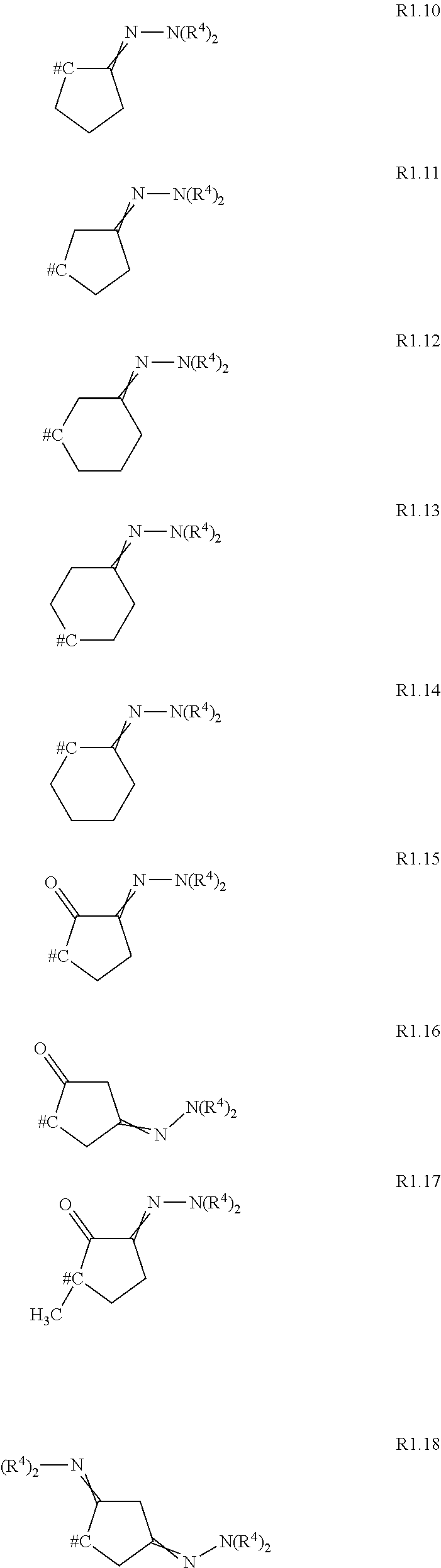

wherein # denotes the position which is bound to the group —NR2—; and wherein the radicals R3 and R4 are as defined or preferably defined herein for compounds of the formula I; and wherein the ring member atoms of the carbocycles are further unsubstituted or further substituted with 1, 2, 3, 4 or up to the maximum possible number of identical or different radicals selected from the group consisting of halogen, cyano, C1-C6-alkyl, C1-C6-haloalkyl, C1-C6-alkoxy, C1-C6-haloalkoxy and C3-C8-cycloalkyl.
| TABLE E | |||||
| Embodiment | L | R1 | R2 | ||
| E.1 | —C(═O)— | 1.1 | 2.1 | ||
| E.2 | —C(═O)— | 1.2 | 2.1 | ||
| E.3 | —C(═O)— | 1.3 | 2.1 | ||
| E.4 | —C(═O)— | 1.4 | 2.1 | ||
| E.5 | —C(═O)— | 1.5 | 2.1 | ||
| E.6 | —C(═O)— | 1.6 | 2.1 | ||
| E.7 | —C(═O)— | 1.7 | 2.1 | ||
| E.8 | —C(═O)— | 1.8 | 2.1 | ||
| E.9 | —C(═O)— | 1.9 | 2.1 | ||
| E.10 | —C(═O)— | 1.10 | 2.1 | ||
| E.11 | —C(═O)— | 1.11 | 2.1 | ||
| E.12 | —C(═O)— | 1.12 | 2.1 | ||
| E.13 | —C(═O)— | 1.13 | 2.1 | ||
| E.14 | —C(═O)— | 1.14 | 2.1 | ||
| E.15 | —C(═O)— | 1.15 | 2.1 | ||
| E.16 | —C(═O)— | 1.16 | 2.1 | ||
| E.17 | —C(═O)— | 1.1 | 2.2 | ||
| E.18 | —C(═O)— | 1.2 | 2.2 | ||
| E.19 | —C(═O)— | 1.3 | 2.2 | ||
| E.20 | —C(═O)— | 1.4 | 2.2 | ||
| E.21 | —C(═O)— | 1.5 | 2.2 | ||
| E.22 | —C(═O)— | 1.6 | 2.2 | ||
| E.23 | —C(═O)— | 1.7 | 2.2 | ||
| E.24 | —C(═O)— | 1.8 | 2.2 | ||
| E.25 | —C(═O)— | 1.9 | 2.2 | ||
| E.26 | —C(═O)— | 1.10 | 2.2 | ||
| E.27 | —C(═O)— | 1.11 | 2.2 | ||
| E.28 | —C(═O)— | 1.12 | 2.2 | ||
| E.29 | —C(═O)— | 1.13 | 2.2 | ||
| E.30 | —C(═O)— | 1.14 | 2.2 | ||
| E.31 | —C(═O)— | 1.15 | 2.2 | ||
| E.32 | —C(═O)— | 1.16 | 2.2 | ||
| E.33 | —C(═O)— | 1.1 | 2.4 | ||
| E.34 | —C(═O)— | 1.2 | 2.4 | ||
| E.35 | —C(═O)— | 1.3 | 2.4 | ||
| E.36 | —C(═O)— | 1.4 | 2.4 | ||
| E.37 | —C(═O)— | 1.5 | 2.4 | ||
| E.38 | —C(═O)— | 1.6 | 2.4 | ||
| E.39 | —C(═O)— | 1.7 | 2.4 | ||
| E.40 | —C(═O)— | 1.8 | 2.4 | ||
| E.41 | —C(═O)— | 1.9 | 2.4 | ||
| E.42 | —C(═O)— | 1.10 | 2.4 | ||
| E.43 | —C(═O)— | 1.11 | 2.4 | ||
| E.44 | —C(═O)— | 1.12 | 2.4 | ||
| E.45 | —C(═O)— | 1.13 | 2.4 | ||
| E.46 | —C(═O)— | 1.14 | 2.4 | ||
| E.47 | —C(═O)— | 1.15 | 2.4 | ||
| E.48 | —C(═O)— | 1.16 | 2.4 | ||
| E.49 | —C(═S)— | 1.1 | 2.1 | ||
| E.50 | —C(═S)— | 1.2 | 2.1 | ||
| E.51 | —C(═S)— | 1.3 | 2.1 | ||
| E.52 | —C(═S)— | 1.4 | 2.1 | ||
| E.53 | —C(═S)— | 1.5 | 2.1 | ||
| E.54 | —C(═S)— | 1.6 | 2.1 | ||
| E.55 | —C(═S)— | 1.7 | 2.1 | ||
| E.56 | —C(═S)— | 1.8 | 2.1 | ||
| E.57 | —C(═S)— | 1.9 | 2.1 | ||
| E.58 | —C(═S)— | 1.10 | 2.1 | ||
| E.59 | —C(═S)— | 1.11 | 2.1 | ||
| E.60 | —C(═S)— | 1.12 | 2.1 | ||
| E.61 | —C(═S)— | 1.13 | 2.1 | ||
| E.62 | —C(═S)— | 1.14 | 2.1 | ||
| E.63 | —C(═S)— | 1.15 | 2.1 | ||
| E.64 | —C(═S)— | 1.16 | 2.1 | ||
| E.65 | —C(═S)— | 1.1 | 2.2 | ||
| E.66 | —C(═S)— | 1.2 | 2.2 | ||
| E.67 | —C(═S)— | 1.3 | 2.2 | ||
| E.68 | —C(═S)— | 1.4 | 2.2 | ||
| E.69 | —C(═S)— | 1.5 | 2.2 | ||
| E.70 | —C(═S)— | 1.6 | 2.2 | ||
| E.71 | —C(═S)— | 1.7 | 2.2 | ||
| E.72 | —C(═S)— | 1.8 | 2.2 | ||
| E.73 | —C(═S)— | 1.9 | 2.2 | ||
| E.74 | —C(═S)— | 1.10 | 2.2 | ||
| E.75 | —C(═S)— | 1.11 | 2.2 | ||
| E.76 | —C(═S)— | 1.12 | 2.2 | ||
| E.77 | —C(═S)— | 1.13 | 2.2 | ||
| E.78 | —C(═S)— | 1.14 | 2.2 | ||
| E.79 | —C(═S)— | 1.15 | 2.2 | ||
| E.80 | —C(═S)— | 1.16 | 2.2 | ||
| E.81 | —C(═S)— | 1.1 | 2.4 | ||
| E.82 | —C(═S)— | 1.2 | 2.4 | ||
| E.83 | —C(═S)— | 1.3 | 2.4 | ||
| E.84 | —C(═S)— | 1.4 | 2.4 | ||
| E.85 | —C(═S)— | 1.5 | 2.4 | ||
| E.86 | —C(═S)— | 1.6 | 2.4 | ||
| E.87 | —C(═S)— | 1.7 | 2.4 | ||
| E.88 | —C(═S)— | 1.8 | 2.4 | ||
| E.89 | —C(═S)— | 1.9 | 2.4 | ||
| E.90 | —C(═S)— | 1.10 | 2.4 | ||
| E.91 | —C(═S)— | 1.11 | 2.4 | ||
| E.92 | —C(═S)— | 1.12 | 2.4 | ||
| E.93 | —C(═S)— | 1.13 | 2.4 | ||
| E.94 | —C(═S)— | 1.14 | 2.4 | ||
| E.95 | —C(═S)— | 1.15 | 2.4 | ||
| E.96 | —C(═S)— | 1.16 | 2.4 | ||
- A is a group selected from subformulae (A.1) to (A.30); and wherein the phenyl ring or the aromatic heterocycle is unsubstituted or substituted with 1 or 2 identical or different groups RA; wherein
- RA is halogen, cyano, C1-C6-alkyl, C1-C6-haloalkyl, C1-C6-alkoxy or C1-C6-haloalkoxy;
- L is —C(═O)— or —C(═S)—;
- R1 is selected from the group consisting of the carbocycles R1.1 to R1.22


- wherein # denotes the position which is bound to the group —NR2—; and wherein the ring member atoms of the carbocycles are further unsubstituted or further substituted with 1, 2, 3, 4 or up to the maximum possible number of identical or different radicals selected from the group consisting of halogen, cyano, C1-C6-alkyl, C1-C6-haloalkyl, C1-C6-alkoxy, C1-C6-haloalkoxy and C3-C8-cycloalkyl;
- R2 is hydrogen, formyl, C1-C6-alkyl, C1-C6-alkoxy, allyl, propargyl or C3-C8-cycloalkyl;
- R3 is independently selected from the group consisting of hydrogen, C1-C6-alkyl, C2-C6-alkenyl, C2-C6-alkynyl or C3-C8-cycloalkyl; wherein any of the above-mentioned aliphatic or cyclic groups are unsubstituted or substituted with 1, 2, 3 or up to the maximum possible number of identical or different radicals selected from the group consisting of halogen, C1-C6-alkyl and C3-C8-cycloalkyl;
- R4 is independently selected from the group consisting of hydrogen, formyl, C1-C6-alkyl, C1-C6-alkoxy, C2-C6-alkenyl, C2-C6-alkynyl, C3-C6-cycloalkyl, C(═O)—(C1-C6-alkyl), C(═O)—(C1-C6-alkoxy) and phenyl; and wherein any of the above-mentioned aliphatic or cyclic groups are unsubstituted or substituted with 1, 2, 3, 4 or up to the maximum possible number of identical or different radicals selected from the group consisting of halogen, C1-C6-alkyl and C3-C8-cycloalkyl;
- R5 is hydrogen, cyano, C1-C4-alkyl, C1-C6-alkoxy, C3-C6-cycloalkyl, C(═O)—C1-C4-alkyl or C(═O)—C1-C4-alkoxy; wherein any of the above-mentioned aliphatic groups are unsubstituted or substituted with 1, 2, 3 or up to the maximum possible number of identical or different radicals selected from the group consisting of methyl, ethyl, fluorine and chlorine.

wherein n is 0, 1 or 2; and wherein the meaning of the variables L, R1 and R2 are as defined herein for compounds of the formula I or as defined in embodiments E.1 to E.96 in Table E; and wherein RA is as defined or preferably defined herein for compounds of the formula I; with the exception of compounds, wherein the group —NR2— and a radical selected from the group consisting of R13 and R14 are attached to the same ring member atom of the carbocycle of R1. A preferred embodiment relates to compounds of the formula I.1 or to compounds of the formula I.2 as defined above, wherein the meaning of the variables L, R1 and R2 are as defined herein for compounds of the formula I or as defined in embodiments E.1 to E.96 in Table E; and wherein n is 0 or 1 and RA is halogen, C1-C6-alkyl or C3-C8-cycloalkyl; in particular fluorine; with the exception of compounds, wherein the group —NR2— and a radical selected from the group consisting of R13 and R14 are attached to the same ring member atom of the carbocycle of R1. Another more preferred embodiment relates to compounds of the formula I.1 or to compounds of the formula I.2 as defined above, wherein the meaning of the variables L, R1 and R2 are as defined herein for compounds of the formula I or as defined in embodiments E.1 to E.96 in Table E; and wherein n is 0; with the exception of compounds, wherein the group —NR2— and a radical selected from the group consisting of R13 and R14 are attached to the same ring member atom of the carbocycle of R1.
- RA is halogen, C1-C6-alkyl or C3-C8-cycloalkyl;
- n is 0 or 1; preferably n is 0;
- L is —C(═O)—;
- R1 is as defined herein for compounds of the formula I, or as preferably defined in any one of Embodiments 1.1 to 1.14;
- R2 is hydrogen, formyl, C1-C6-alkyl, C1-C6-alkoxy, allyl, propargyl or C3-C8-cycloalkyl; with the exception of compounds, wherein the group —NR2— and a radical selected from the group consisting of R13 and R14 are attached to the same ring member atom of the carbocycle of R1.
- n is 0;
- L is —C(═O)—;
- R1 is selected from the group consisting of groups R1.1, R1.2, R1.3, R1.4, R1.5, R1.19 and R1.20 as defined in Embodiment 1.10;
- R2 is hydrogen, formyl, C1-C6-alkyl, C1-C6-alkoxy, allyl, propargyl or C3-C8-cycloalkyl;
- R3 is hydrogen, methyl, ethyl, n-propyl, iso-propyl, allyl, propargyl or cyclopropyl; and wherein any of the above-mentioned aliphatic or cyclic groups are unsubstituted or substituted with 1, 2, 3 or up to the maximum possible number of identical or different radicals selected from the group consisting of fluorine and chlorine.
- n is 0;
- L is —C(═O)—;
- R1 is selected from the group consisting of groups R1.1, R1.2, R1.3, R1.4, R1.5, R1.19 and R1.20 as defined in Embodiment 1.10;
- R2 is hydrogen, formyl, methyl, ethyl, n-propyl, iso-propyl, methoxy, ethyoxy, propyloxy, allyl, propargyl or cyclopropyl;
- R3 is hydrogen, methyl, ethyl, n-propyl, iso-propyl, allyl, propargyl or cyclopropyl.
- RA is halogen, C1-C6-alkyl or C3-C8-cycloalkyl;
- n is 0 or 1; preferably n is 0;
- L is —C(═O)—;
- R1 is a group R1.1 as defined in Embodiment 1.10 herein;
- R2 is hydrogen, formyl, C1-C6-alkyl, C1-C6-alkoxy, allyl, propargyl or C3-C8-cycloalkyl;
- R3 is hydrogen, C1-C6-alkyl, C2-C6-alkenyl, C2-C6-alkynyl, C3-C8-cycloalkyl, C3-C8-cycloalkenyl, phenyl, phenyl-C1-C4-alkyl, or a five- to six-membered aromatic heterocycle, which, in addition to carbon atoms, contains 1 to 3 heteroatoms from the group consisting of O, N and S as ring members with the provision that the heterocycle cannot contain 2 contiguous atoms selected from O and S; and wherein any of the above-mentioned aliphatic or cyclic groups are unsubstituted or substituted with 1, 2, 3 or up to the maximum possible number of identical or different radicals selected from the group consisting of halogen, C1-C6-alkyl and C3-C8-cycloalkyl.
- n is 0;
- L is —C(═O)—;
- R1 is a group R1.1 as defined in Embodiment 1.10 herein;
- R2 is hydrogen, formyl, C1-C6-alkyl, C1-C6-alkoxy, allyl, propargyl or C3-C8-cycloalkyl;
- R3 is hydrogen, methyl, ethyl, n-propyl, iso-propyl, allyl, propargyl or cyclopropyl; and wherein any of the above-mentioned aliphatic or cyclic groups are unsubstituted or substituted with 1, 2, 3 or up to the maximum possible number of identical or different radicals selected from the group consisting of fluorine and chlorine.
- n is 0;
- L is —C(═O)—;
- R1 is a group R1.1 as defined in Embodiment 1.10 herein;
- R2 is hydrogen, formyl, methyl, ethyl, methoxy, ethoxy or propyloxy;
- R3 is hydrogen, methyl, ethyl, n-propyl, iso-propyl, allyl, propargyl or cyclopropyl.


| TABLE A | ||||
| No. | R2 | R3 | ||
| A-1 | H | H | ||
| A-2 | H | CH3 | ||
| A-3 | H | CH2CH3 | ||
| A-4 | H | CH2CH2CH3 | ||
| A-5 | H | CH(CH3)2 | ||
| A-6 | H | CH2CH2CH2CH3 | ||
| A-7 | H | CH(CH3)CH2CH3 | ||
| A-8 | H | CH2CH(CH3)CH3 | ||
| A-9 | H | CH(CH2CH3)2 | ||
| A-10 | H | C(CH3)3 | ||
| A-11 | CH3 | CH3 | ||
| A-12 | CH3 | CH2CH3 | ||
| A-13 | CH3 | CH2CH2CH3 | ||
| A-14 | CH3 | CH(CH3)2 | ||
| A-15 | CH3 | CH2CH2CH2CH3 | ||
| A-16 | CH3 | CH(CH3)CH2CH3 | ||
| A-17 | CH3 | CH2CH(CH3)CH3 | ||
| A-18 | CH3 | CH(CH2CH3)2 | ||
| A-19 | CH3 | C(CH3)3 | ||
| A-20 | CH2CH3 | CH3 | ||
| A-21 | CH2CH3 | CH2CH3 | ||
| A-22 | CH2CH3 | CH2CH2CH3 | ||
| A-23 | CH2CH3 | CH(CH3)2 | ||
| A-24 | CH2CH3 | CH2CH2CH2CH3 | ||
| A-25 | CH2CH3 | CH(CH3)CH2CH3 | ||
| A-26 | CH2CH3 | CH2CH(CH3)CH3 | ||
| A-27 | CH2CH3 | CH(CH2CH3)2 | ||
| A-28 | CH2CH3 | C(CH3)3 | ||
| A-29 | CH2CH2CH3 | CH3 | ||
| A-30 | CH2CH2CH3 | CH2CH3 | ||
| A-31 | CH2CH2CH3 | CH2CH2CH3 | ||
| A-32 | CH2CH2CH3 | CH(CH3)2 | ||
| A-33 | CH2CH2CH3 | CH2CH2CH2CH3 | ||
| A-34 | CH2CH2CH3 | CH(CH3)CH2CH3 | ||
| A-35 | CH2CH2CH3 | CH2CH(CH3)CH3 | ||
| A-36 | CH2CH2CH3 | CH(CH2CH3)2 | ||
| A-37 | CH2CH2CH3 | C(CH3)3 | ||
| A-38 | CH(CH3)2 | CH3 | ||
| A-39 | CH(CH3)2 | CH2CH3 | ||
| A-40 | CH(CH3)2 | CH2CH2CH3 | ||
| A-41 | CH(CH3)2 | CH(CH3)2 | ||
| A-42 | CH(CH3)2 | CH2CH2CH2CH3 | ||
| A-43 | CH(CH3)2 | CH(CH3)CH2CH3 | ||
| A-44 | CH(CH3)2 | CH2CH(CH3)CH3 | ||
| A-45 | CH(CH3)2 | CH(CH2CH3)2 | ||
| A-46 | CH(CH3)2 | C(CH3)3 | ||
| A-47 | cyclopropyl | CH3 | ||
| A-48 | cyclopropyl | CH2CH3 | ||
| A-49 | cyclopropyl | CH2CH2CH3 | ||
| A-50 | cyclopropyl | CH(CH3)2 | ||
| A-51 | cyclopropyl | CH2CH2CH2CH3 | ||
| A-52 | cyclopropyl | CH(CH3)CH2CH3 | ||
| A-53 | cyclopropyl | CH2CH(CH3)CH3 | ||
| A-54 | cyclopropyl | CH(CH2CH3)2 | ||
| A-55 | cyclopropyl | C(CH3)3 | ||
| A-56 | allyl | CH3 | ||
| A-57 | allyl | CH2CH3 | ||
| A-58 | allyl | CH2CH2CH3 | ||
| A-59 | allyl | CH(CH3)2 | ||
| A-60 | allyl | CH2CH2CH2CH3 | ||
| A-61 | allyl | CH(CH3)CH2CH3 | ||
| A-62 | allyl | CH2CH(CH3)CH3 | ||
| A-63 | allyl | CH(CH2CH3)2 | ||
| A-64 | allyl | C(CH3)3 | ||
| A-65 | C(═O)H | CH3 | ||
| A-66 | C(═O)H | CH2CH3 | ||
| A-67 | C(═O)H | CH2CH2CH3 | ||
| A-68 | C(═O)H | CH(CH3)2 | ||
| A-69 | C(═O)H | CH2CH2CH2CH3 | ||
| A-70 | C(═O)H | CH(CH3)CH2CH3 | ||
| A-71 | C(═O)H | CH2CH(CH3)CH3 | ||
| A-72 | C(═O)H | CH(CH2CH3)2 | ||
| A-73 | C(═O)H | C(CH3)3 | ||


| TABLE B | ||||
| No. | R2 | R4, R4 | ||
| B-1 | H | H, H | ||
| B-2 | H | H, CH3 | ||
| B-3 | H | H, CH2CH3 | ||
| B-4 | H | H, CH2CH2CH3 | ||
| B-5 | H | H, CH(CH3)2 | ||
| B-6 | H | H, CH2CH2CH2CH3 | ||
| B-7 | H | H, CH(CH3)CH2CH3 | ||
| B-8 | H | H, CH2CH(CH3)CH3 | ||
| B-9 | H | H, CH(CH2CH3)2 | ||
| B-10 | H | H, C(CH3)3 | ||
| B-11 | H | CH3, CH3 | ||
| B-12 | H | CH3, CH2CH3 | ||
| B-13 | H | CH3, CH2CH2CH3 | ||
| B-14 | H | CH3, CH(CH3)2 | ||
| B-15 | H | CH3, CH2CH2CH2CH3 | ||
| B-16 | H | CH3, CH(CH3)CH2CH3 | ||
| B-17 | H | CH3, CH2CH(CH3)CH3 | ||
| B-18 | H | CH3, CH(CH2CH3)2 | ||
| B-19 | H | CH3, C(CH3)3 | ||
| B-20 | H | CH2CH3, CH2CH3 | ||
| B-21 | H | CH2CH3, CH2CH2CH3 | ||
| B-22 | H | CH2CH3, CH(CH3)2 | ||
| B-23 | H | CH2CH3, CH2CH2CH2CH3 | ||
| B-24 | H | CH2CH3, CH(CH3)CH2CH3 | ||
| B-25 | H | CH2CH3, CH2CH(CH3)CH3 | ||
| B-26 | H | CH2CH3, CH(CH2CH3)2 | ||
| B-27 | H | CH2CH3, C(CH3)3 | ||
| B-28 | CH3 | H, H | ||
| B-29 | CH3 | H, CH3 | ||
| B-30 | CH3 | H, CH2CH3 | ||
| B-31 | CH3 | H, CH2CH2CH3 | ||
| B-32 | CH3 | H, CH(CH3)2 | ||
| B-33 | CH3 | H, CH2CH2CH2CH3 | ||
| B-34 | CH3 | H, CH(CH3)CH2CH3 | ||
| B-35 | CH3 | H, CH2CH(CH3)CH3 | ||
| B-36 | CH3 | H, CH(CH2CH3)2 | ||
| B-37 | CH3 | H, C(CH3)3 | ||
| B-38 | CH3 | CH3, CH3 | ||
| B-39 | CH3 | CH3, CH2CH3 | ||
| B-40 | CH3 | CH3, CH2CH2CH3 | ||
| B-41 | CH3 | CH3, CH(CH3)2 | ||
| B-42 | CH3 | CH3, CH2CH2CH2CH3 | ||
| B-43 | CH3 | CH3, CH(CH3)CH2CH3 | ||
| B-44 | CH3 | CH3, CH2CH(CH3)CH3 | ||
| B-45 | CH3 | CH3, CH(CH2CH3)2 | ||
| B-46 | CH3 | CH3, C(CH3)3 | ||
| B-47 | CH3 | CH2CH3, CH2CH3 | ||
| B-48 | CH3 | CH2CH3, CH2CH2CH3 | ||
| B-49 | CH3 | CH2CH3, CH(CH3)2 | ||
| B-50 | CH3 | CH2CH3, CH2CH2CH2CH3 | ||
| B-51 | CH3 | CH2CH3, CH(CH3)CH2CH3 | ||
| B-52 | CH3 | CH2CH3, CH2CH(CH3)CH3 | ||
| B-53 | CH3 | CH2CH3, CH(CH2CH3)2 | ||
| B-54 | CH3 | CH2CH3, C(CH3)3 | ||
| B-55 | CH2CH3 | H, H | ||
| B-56 | CH2CH3 | H, CH3 | ||
| B-57 | CH2CH3 | H, CH2CH3 | ||
| B-58 | CH2CH3 | H, CH2CH2CH3 | ||
| B-59 | CH2CH3 | H, CH(CH3)2 | ||
| B-60 | CH2CH3 | H, CH2CH2CH2CH3 | ||
| B-61 | CH2CH3 | H, CH(CH3)CH2CH3 | ||
| B-62 | CH2CH3 | H, CH2CH(CH3)CH3 | ||
| B-63 | CH2CH3 | H, CH(CH2CH3)2 | ||
| B-64 | CH2CH3 | H, C(CH3)3 | ||
| B-65 | CH2CH3 | CH3, CH3 | ||
| B-66 | CH2CH3 | CH3, CH2CH3 | ||
| B-67 | CH2CH3 | CH3, CH2CH2CH3 | ||
| B-68 | CH2CH3 | CH3, CH(CH3)2 | ||
| B-69 | CH2CH3 | CH3, CH2CH2CH2CH3 | ||
| B-70 | CH2CH3 | CH3, CH(CH3)CH2CH3 | ||
| B-71 | CH2CH3 | CH3, CH2CH(CH3)CH3 | ||
| B-72 | CH2CH3 | CH3, CH(CH2CH3)2 | ||
| B-73 | CH2CH3 | CH3, C(CH3)3 | ||
| B-74 | CH2CH3 | CH2CH3, CH2CH3 | ||
| B-75 | CH2CH3 | CH2CH3, CH2CH2CH3 | ||
| B-76 | CH2CH3 | CH2CH3, CH(CH3)2 | ||
| B-77 | CH2CH3 | CH2CH3, CH2CH2CH2CH3 | ||
| B-78 | CH2CH3 | CH2CH3, CH(CH3)CH2CH3 | ||
| B-79 | CH2CH3 | CH2CH3, CH2CH(CH3)CH3 | ||
| B-80 | CH2CH3 | CH2CH3, CH(CH2CH3)2 | ||
| B-81 | CH2CH3 | CH2CH3, C(CH3)3 | ||
| B-82 | CH2CH2CH3 | H, H | ||
| B-83 | CH2CH2CH3 | H, CH3 | ||
| B-84 | CH2CH2CH3 | H, CH2CH3 | ||
| B-85 | CH2CH2CH3 | H, CH2CH2CH3 | ||
| B-86 | CH2CH2CH3 | H, CH(CH3)2 | ||
| B-87 | CH2CH2CH3 | H, CH2CH2CH2CH3 | ||
| B-88 | CH2CH2CH3 | H, CH(CH3)CH2CH3 | ||
| B-89 | CH2CH2CH3 | H, CH2CH(CH3)CH3 | ||
| B-90 | CH2CH2CH3 | H, CH(CH2CH3)2 | ||
| B-91 | CH2CH2CH3 | H, C(CH3)3 | ||
| B-92 | CH2CH2CH3 | CH3, CH3 | ||
| B-93 | CH2CH2CH3 | CH3, CH2CH3 | ||
| B-94 | CH2CH2CH3 | CH3, CH2CH2CH3 | ||
| B-95 | CH2CH2CH3 | CH3, CH(CH3)2 | ||
| B-96 | CH2CH2CH3 | CH3, CH2CH2CH2CH3 | ||
| B-97 | CH2CH2CH3 | CH3, CH(CH3)CH2CH3 | ||
| B-98 | CH2CH2CH3 | CH3, CH2CH(CH3)CH3 | ||
| B-99 | CH2CH2CH3 | CH3, CH(CH2CH3)2 | ||
| B-100 | CH2CH2CH3 | CH3, C(CH3)3 | ||
| B-101 | CH2CH2CH3 | CH2CH3, CH2CH3 | ||
| B-102 | CH2CH2CH3 | CH2CH3, CH2CH2CH3 | ||
| B-103 | CH2CH2CH3 | CH2CH3, CH(CH3)2 | ||
| B-104 | CH2CH2CH3 | CH2CH3, CH2CH2CH2CH3 | ||
| B-105 | CH2CH2CH3 | CH2CH3, CH(CH3)CH2CH3 | ||
| B-106 | CH2CH2CH3 | CH2CH3, CH2CH(CH3)CH3 | ||
| B-107 | CH2CH2CH3 | CH2CH3, CH(CH2CH3)2 | ||
| B-108 | CH2CH2CH3 | CH2CH3, C(CH3)3 | ||
| B-109 | CH(CH3)2 | H, H | ||
| B-110 | CH(CH3)2 | H, CH3 | ||
| B-111 | CH(CH3)2 | H, CH2CH3 | ||
| B-112 | CH(CH3)2 | H, CH2CH2CH3 | ||
| B-113 | CH(CH3)2 | H, CH(CH3)2 | ||
| B-114 | CH(CH3)2 | H, CH2CH2CH2CH3 | ||
| B-115 | CH(CH3)2 | H, CH(CH3)CH2CH3 | ||
| B-116 | CH(CH3)2 | H, CH2CH(CH3)CH3 | ||
| B-117 | CH(CH3)2 | H, CH(CH2CH3)2 | ||
| B-118 | CH(CH3)2 | H, C(CH3)3 | ||
| B-119 | CH(CH3)2 | CH3, CH3 | ||
| B-120 | CH(CH3)2 | CH3, CH2CH3 | ||
| B-121 | CH(CH3)2 | CH3, CH2CH2CH3 | ||
| B-122 | CH(CH3)2 | CH3, CH(CH3)2 | ||
| B-123 | CH(CH3)2 | CH3, CH2CH2CH2CH3 | ||
| B-124 | CH(CH3)2 | CH3, CH(CH3)CH2CH3 | ||
| B-125 | CH(CH3)2 | CH3, CH2CH(CH3)CH3 | ||
| B-126 | CH(CH3)2 | CH3, CH(CH2CH3)2 | ||
| B-127 | CH(CH3)2 | CH3, C(CH3)3 | ||
| B-128 | CH(CH3)2 | CH2CH3, CH2CH3 | ||
| B-129 | CH(CH3)2 | CH2CH3, CH2CH2CH3 | ||
| B-130 | CH(CH3)2 | CH2CH3, CH(CH3)2 | ||
| B-131 | CH(CH3)2 | CH2CH3, CH2CH2CH2CH3 | ||
| B-132 | CH(CH3)2 | CH2CH3, CH(CH3)CH2CH3 | ||
| B-133 | CH(CH3)2 | CH2CH3, CH2CH(CH3)CH3 | ||
| B-134 | CH(CH3)2 | CH2CH3, CH(CH2CH3)2 | ||
| B-135 | CH(CH3)2 | CH2CH3, C(CH3)3 | ||
| B-136 | cyclopropyl | H, H | ||
| B-137 | cyclopropyl | H, CH3 | ||
| B-138 | cyclopropyl | H, CH2CH3 | ||
| B-139 | cyclopropyl | H, CH2CH2CH3 | ||
| B-140 | cyclopropyl | H, CH(CH3)2 | ||
| B-141 | cyclopropyl | H, CH2CH2CH2CH3 | ||
| B-142 | cyclopropyl | H, CH(CH3)CH2CH3 | ||
| B-143 | cyclopropyl | H, CH2CH(CH3)CH3 | ||
| B-144 | cyclopropyl | H, CH(CH2CH3)2 | ||
| B-145 | cyclopropyl | H, C(CH3)3 | ||
| B-146 | cyclopropyl | CH3, CH3 | ||
| B-147 | cyclopropyl | CH3, CH2CH3 | ||
| B-148 | cyclopropyl | CH3, CH2CH2CH3 | ||
| B-149 | cyclopropyl | CH3, CH(CH3)2 | ||
| B-150 | cyclopropyl | CH3, CH2CH2CH2CH3 | ||
| B-151 | cyclopropyl | CH3, CH(CH3)CH2CH3 | ||
| B-152 | cyclopropyl | CH3, CH2CH(CH3)CH3 | ||
| B-153 | cyclopropyl | CH3, CH(CH2CH3)2 | ||
| B-154 | cyclopropyl | CH3, C(CH3)3 | ||
| B-155 | cyclopropyl | CH2CH3, CH2CH3 | ||
| B-156 | cyclopropyl | CH2CH3, CH2CH2CH3 | ||
| B-157 | cyclopropyl | CH2CH3, CH(CH3)2 | ||
| B-158 | cyclopropyl | CH2CH3, CH2CH2CH2CH3 | ||
| B-159 | cyclopropyl | CH2CH3, CH(CH3)CH2CH3 | ||
| B-160 | cyclopropyl | CH2CH3, CH2CH(CH3)CH3 | ||
| B-161 | cyclopropyl | CH2CH3, CH(CH2CH3)2 | ||
| B-162 | cyclopropyl | CH2CH3, C(CH3)3 | ||
| B-163 | allyl | H, H | ||
| B-164 | allyl | H, CH3 | ||
| B-165 | allyl | H, CH2CH3 | ||
| B-166 | allyl | H, CH2CH2CH3 | ||
| B-167 | allyl | H, CH(CH3)2 | ||
| B-168 | allyl | H, CH2CH2CH2CH3 | ||
| B-169 | allyl | H, CH(CH3)CH2CH3 | ||
| B-170 | allyl | H, CH2CH(CH3)CH3 | ||
| B-171 | allyl | H, CH(CH2CH3)2 | ||
| B-172 | allyl | H, C(CH3)3 | ||
| B-173 | allyl | CH3, CH3 | ||
| B-174 | allyl | CH3, CH2CH3 | ||
| B-175 | allyl | CH3, CH2CH2CH3 | ||
| B-176 | allyl | CH3, CH(CH3)2 | ||
| B-177 | allyl | CH3, CH2CH2CH2CH3 | ||
| B-178 | allyl | CH3, CH(CH3)CH2CH3 | ||
| B-179 | allyl | CH3, CH2CH(CH3)CH3 | ||
| B-180 | allyl | CH3, CH(CH2CH3)2 | ||
| B-181 | allyl | CH3, C(CH3)3 | ||
| B-182 | allyl | CH2CH3, CH2CH3 | ||
| B-183 | allyl | CH2CH3, CH2CH2CH3 | ||
| B-184 | allyl | CH2CH3, CH(CH3)2 | ||
| B-185 | allyl | CH2CH3, CH2CH2CH2CH3 | ||
| B-186 | allyl | CH2CH3, CH(CH3)CH2CH3 | ||
| B-187 | allyl | CH2CH3, CH2CH(CH3)CH3 | ||
| B-188 | allyl | CH2CH3, CH(CH2CH3)2 | ||
| B-189 | allyl | CH2CH3, C(CH3)3 | ||
| B-190 | C(═O)H | H, H | ||
| B-191 | C(═O)H | H, CH3 | ||
| B-192 | C(═O)H | H, CH2CH3 | ||
| B-193 | C(═O)H | H, CH2CH2CH3 | ||
| B-194 | C(═O)H | H, CH(CH3)2 | ||
| B-195 | C(═O)H | H, CH2CH2CH2CH3 | ||
| B-196 | C(═O)H | H, CH(CH3)CH2CH3 | ||
| B-197 | C(═O)H | H, CH2CH(CH3)CH3 | ||
| B-198 | C(═O)H | H, CH(CH2CH3)2 | ||
| B-199 | C(═O)H | H, C(CH3)3 | ||
| B-200 | C(═O)H | CH3, CH3 | ||
| B-201 | C(═O)H | CH3, CH2CH3 | ||
| B-202 | C(═O)H | CH3, CH2CH2CH3 | ||
| B-203 | C(═O)H | CH3, CH(CH3)2 | ||
| B-204 | C(═O)H | CH3, CH2CH2CH2CH3 | ||
| B-205 | C(═O)H | CH3, CH(CH3)CH2CH3 | ||
| B-206 | C(═O)H | CH3, CH2CH(CH3)CH3 | ||
| B-207 | C(═O)H | CH3, CH(CH2CH3)2 | ||
| B-208 | C(═O)H | CH3, C(CH3)3 | ||
| B-209 | C(═O)H | CH2CH3, CH2CH3 | ||
| B-210 | C(═O)H | CH2CH3, CH2CH2CH3 | ||
| B-211 | C(═O)H | CH2CH3, CH(CH3)2 | ||
| B-212 | C(═O)H | CH2CH3, CH2CH2CH2CH3 | ||
| B-213 | C(═O)H | CH2CH3, CH(CH3)CH2CH3 | ||
| B-214 | C(═O)H | CH2CH3, CH2CH(CH3)CH3 | ||
| B-215 | C(═O)H | CH2CH3, CH(CH2CH3)2 | ||
| B-216 | C(═O)H | CH2CH3, C(CH3)3 | ||


-
- Inhibitors of complex III at Qo site: azoxystrobin (A.1.1), coumethoxystrobin (A.1.2), coumoxystrobin (A.1.3), dimoxystrobin (A.1.4), enestroburin (A.1.5), fenaminstrobin (A.1.6), fenoxystrobin/flufenoxystrobin (A.1.7), fluoxastrobin (A.1.8), kresoxim-methyl (A.1.9), mandestrobin (A.1.10), metominostrobin (A.1.11), orysastrobin (A.1.12), picoxystrobin (A.1.13), pyraclostrobin (A.1.14), pyrametostrobin (A.1.15), pyraoxystrobin (A.1.16), trifloxystrobin (A.1.17), 2-(2-(3-(2,6-dichlorophenyl)-1-methyl-allylideneaminooxymethyl)-phenyl)-2-methoxyimino-N-methyl-acetamide (A.1.18), pyribencarb (A.1.19), triclopyricarb/chloro-dincarb (A.1.20), famoxadone (A.1.21), fenamidone (A.1.21a), methyl-N-[2-[(1,4-dimethyl-5-phenyl-pyrazol-3-yl)oxylmethyl]phenyl]-N-methoxy-carbamate (A.1.22), metyltetrapole (A.1.25), (Z,2E)-5-[1-(2,4-dichlorophenyl)pyrazol-3-yl]-oxy-2-methoxyimino-N,3-dimethyl-pent-3-enamide (A.1.34), (Z2E)-5-[1-(4-chlorophenyl)pyrazol-3-yl]oxy-2-methoxyimino-N,3-dimethyl-pent-3-enamide (A.1.35), pyriminostrobin (A.1.36), bifujunzhi (A.1.37), 2-(ortho-((2,5-dimethylphenyl-oxymethylen)phenyl)-3-methoxy-acrylic acid methylester (A.1.38);
- inhibitors of complex III at Qi site: cyazofamid (A.2.1), amisulbrom (A.2.2), [(6S,7R,8R-8-benzyl-3-[(3-hydroxy-4-methoxy-pyridine-2-carbonyl)amino]-6-methyl4,9-di-oxo-1,5-dioxonan-7-yl] 2-methylpropanoate (A.2.3), fenpicoxamid (A.2.4), florylpicoxamid (A.2.5);
- inhibitors of complex II: benodanil (A.3.1), benzovindiflupyr (A.3.2), bixafen (A.3.3), boscalid (A.3.4), carboxin (A.3.5), fenfuram (A.3.6), fluopyram (A.3.7), flutolanil (A.3.8), fluxapyroxad (A.3.9), furametpyr (A.3.10), isofetamid (A.3.11), isopyrazam (A.3.12), mepronil (A.3.13), oxycarboxin (A.3.14), penflufen (A.3.15), penthiopyrad (A.3.16), pydiflumetofen (A.3.17), pyraziflumid (A.3.18), sedaxane (A.3.19), tecloftalam (A.3.20), thifluzamide (A.3.21), inpyrfluxam (A.3.22), pyrapropoyne (A.3.23), fluindapyr (A.3.28), N-[2-[2-chloro-4-(trifluoro-methyl)phenoxy]phenyl]-3-(difluoromethyl)-5-fluoro-1-methyl-pyrazole-4-carboxamide (A.3.29), methyl (E)-2-[2-[(5-cyano-2-methyl-phenoxy)methyl]phenyl]-3-methoxy-prop-2-enoate (A.3.30), isoflucypram (A.3.31), 2-(difluoromethyl)-N-(1,1,3-trimethyl-indan-4-yl)pyridine-3-carboxamide (A.3.32), 2-(difluoromethyl)-N-[(3R)-1,1,3-trimethylindan-4-yl]pyridine-3-carboxamide (A.3.33), 2-(difluoromethyl)-N-(3-ethyl-1,1-dimethyl-indan-4-yl)-pyridine-3-carboxamide (A.3.34), 2-(difluoromethyl)-N-[(3R)-3-ethyl-1,1-dimethyl-indan-4-yl]-pyridine-3-carboxamide (A.3.35), 2-(difluoromethyl)-N-(1,1-dimethyl-3-propyl-indan-4-yl)pyridine-3-carboxamide (A.3.36), 2-(difluoromethyl)-N-[(3R)-1,1-dimethyl-3-propyl-indan-4-yl]-pyridine-3-carboxamide (A.3.37), 2-(difluoromethyl)-N-(3-isobutyl-1,1-dimethyl-indan-4-yl)-pyridine-3-carboxamide (A.3.38), 2-(difluoromethyl)-N-[(3R)-3-isobutyl-1,1-dimethyl-indan-4-yl]pyridine-3-carboxamide (A.3.39);
- other respiration inhibitors: diflumetorim (A.4.1); nitrophenyl derivates: binapacryl (A.4.2), dinobuton (A.4.3), dinocap (A.4.4), fluazinam (A.4.5), meptyldinocap (A.4.6), ferimzone (A.4.7); organometal compounds: fentin salts, e. g. fentin-acetate (A.4.8), fentin chloride (A.4.9) or fentin hydroxide (A.4.10); ametoctradin (A.4.11); silthiofam (A.4.12);
B) Sterol Biosynthesis Inhibitors (SBI Fungicides) - C14 demethylase inhibitors: triazoles: azaconazole (B.1.1), bitertanol (B.1.2), bromuconazole (B.1.3), cyproconazole (B.1.4), difenoconazole (B.1.5), diniconazole (B.1.6), diniconazole-M (B.1.7), epoxiconazole (B.1.8), fenbuconazole (B.1.9), fluquinconazole (B.1.10), flusilazole (B.1.11), flutriafol (B.1.12), hexaconazole (B.1.13), imibenconazole (B.1.14), ipconazole (B.1.15), metconazole (B.1.17), myclobutanil (B.1.18), oxpoconazole (B.1.19), paclobutrazole (B.1.20), penconazole (B.1.21), propiconazole (B.1.22), prothio-conazole (B.1.23), simeconazole (B.1.24), tebuconazole (B.1.25), tetraconazole (B.1.26), triadimefon (B.1.27), triadimenol (B.1.28), triticonazole (B.1.29), uniconazole (B.1.30), 2-(2,4-difluorophenyl)-1,1-difluoro-3-(tetrazol-1-yl)-1-[5-[4-(2,2,2-trifluoroethoxy)phenyl]-2-pyridyl]propan-2-ol (B.1.31), 2-(2,4-difluorophenyl)-1,1-difluoro-3-(tetrazol-1-yl)-1-[5-[4-(trifluoromethoxy)phenyl]-2-pyridyl]propan-2-ol (B.1.32), ipfentrifluconazole (B.1.37), mefentrifluconazole (B.1.38), 2-(chloromethyl)-2-methyl-5-(p-tolylmethyl)-1-(1,2,4-triazol-1-ylmethyl)cyclopentanol (B.1.43); imidazoles: imazalil (B.1.44), pefurazoate (B.1.45), prochloraz (B.1.46), triflumizol (B.1.47); pyrimidines, pyridines, piperazines: fenarimol (B.1.49), pyrifenox (B.1.50), triforine (B.1.51), [3-(4-chloro-2-fluoro-phenyl)-5-(2,4-difluorophenyl)isoxazol-4-yl]-(3-pyridyl)methanol (B.1.52);
- Delta14-reductase inhibitors: aldimorph (B.2.1), dodemorph (B.2.2), dodemorph-acetate (B.2.3), fenpropimorph (B.2.4), tridemorph (B.2.5), fenpropidin (B.2.6), piperalin (B.2.7), spiroxamine (B.2.8);
- Inhibitors of 3-keto reductase: fenhexamid (B.3.1);
- Other Sterol biosynthesis inhibitors: chlorphenomizole (B.4.1);
C) Nucleic Acid Synthesis Inhibitors - phenylamides or acyl amino acid fungicides: benalaxyl (C.1.1), benalaxyl-M (C.1.2), kiralaxyl (C.1.3), metalaxyl (C.1.4), metalaxyl-M (C.1.5), ofurace (C.1.6), oxadixyl (C.1.7);
- other nucleic acid synthesis inhibitors: hymexazole (C.2.1), octhilinone (C.2.2), oxolinic acid (C.2.3), bupirimate (C.2.4), 5-fluorocytosine (C.2.5), 5-fluoro-2-(p-tolylmethoxy)pyrimidin-4-amine (C.2.6), 5-fluoro-2-(4-fluorophenylmethoxy)pyrimidin-4-amine (C.2.7), 5-fluoro-2-(4-chlorophenylmethoxy)pyrimidin-4 amine (C.2.8);
D) Inhibitors of Cell Division and Cytoskeleton - tubulin inhibitors: benomyl (D.1.1), carbendazim (D.1.2), fuberidazole (D1.3), thiabendazole (D.1.4), thiophanate-methyl (D.1.5), pyridachlometyl (D.1.6), N-ethyl-2-[(3-ethynyl-8-methyl-6-quinolyl)oxy]butanamide (D.1.8), N-ethyl-2-[(3-ethynyl-8-methyl-6-quinolyl)oxy]-2-methylsulfanyl-acetamide (D.1.9), 2-[(3-ethynyl-8-methyl-6-quinolyl)oxy]-N-(2-fluoroethyl)butanamide (D.1.10), 2-[(3-ethynyl-8-methyl-6-quinolyl)oxy]-N-(2-fluoroethyl)-2-methoxy-acetamide (D.1.11), 2-[(3-ethynyl-8-methyl-6-quinolyl)oxy]-N-propyl-butanamide (D.1.12), 2-[(3-ethynyl-8-methyl-6-quinolyl)oxy]-2-methoxy-N-propyl-acetamide (D.1.13), 2-[(3-ethynyl-8-methyl-6-quinolyl)oxy]-2-methylsulfanyl-N-propyl-acetamide (D.1.14), 2-[(3-ethynyl-8-methyl-6-quinolyl)oxy]-N-(2-fluoroethyl)-2-methylsulfanyl-acetamide (D.1.15), 4-(2-bromo-4-fluoro-phenyl)-N-(2-chloro-6-fluoro-phenyl)-2,5-dimethyl-pyrazol-3-amine (D.1.16);
- other cell division inhibitors: diethofencarb (D.2.1), ethaboxam (D.2.2), pencycuron (D.2.3), fluopicolide (D.2.4), zoxamide (D.2.5), metrafenone (D.2.6), pyriofenone (D.2.7);
E) Inhibitors of Amino Acid and Protein Synthesis - methionine synthesis inhibitors: cyprodinil (E.1.1), mepanipyrim (E.1.2), pyrimethanil (E.1.3);
- protein synthesis inhibitors: blasticidin-S (E.2.1), kasugamycin (E.2.2), kasugamycin hydro-chloride-hydrate (E.2.3), mildiomycin (E.2.4), streptomycin (E.2.5), oxytetracyclin (E.2.6);
F) Signal Transduction Inhibitors - MAP/histidine kinase inhibitors: fluoroimid (F.1.1), iprodione (F.1.2), procymidone (F.1.3), vinclozolin (F.1.4), fludioxonil (F.1.5);
- G protein inhibitors: quinoxyfen (F.2.1);
G) Lipid and Membrane Synthesis Inhibitors - Phospholipid biosynthesis inhibitors: edifenphos (G.1.1), iprobenfos (G.1.2), pyrazophos (G.1.3), isoprothiolane (G.1.4);
- lipid peroxidation: dicloran (G.2.1), quintozene (G.2.2), tecnazene (G.2.3), tolclofos-methyl (G.2.4), biphenyl (G.2.5), chloroneb (G.2.6), etridiazole (G.2.7);
- phospholipid biosynthesis and cell wall deposition: dimethomorph (G.3.1), flumorph (G.3.2), mandipropamid (G.3.3), pyrimorph (G.3.4), benthiavalicarb (G.3.5), iprovalicarb (G.3.6), valifenalate (G.3.7);
- compounds affecting cell membrane permeability and fatty acides: propamocarb (G.4.1);
- inhibitors of oxysterol binding protein: oxathiapiprolin (G.5.1), 2-{3-[2-(1-{[3,5-bis(difluoromethyl-1H-pyrazol-1-yl]acetyl}piperidin-4-yl)-1,3-thiazol-4-yl]-4,5-dihydro-1,2-oxazol-5-yl}-phenyl methanesulfonate (G.5.2), 2-{3-[2-(1-{[3,5-bis(difluoromethyl)-1H-pyrazol-1-yl]-acetyl}piperidin-4-yl) 1,3-thiazol-4-yl]-4,5-dihydro-1,2-oxazol-5-yl}-3-chlorophenyl methanesulfonate (G.5.3), 4-[1-[2-[3-(difluoromethyl)-5-methyl-pyrazol-1-yl]acetyl]-4-piperidyl]-N-tetralin-1-yl-pyridine-2-carboxamide (G.5.4), 4-[1-[2-[3,5-bis(difluoromethyl)pyrazol-1-yl]acetyl]-4-piperidyl]-N-tetralin-1-yl-pyridine-2-carboxamide (G.5.5), 4-[1-[2-[3-(difluoromethyl)-5-(tri-fluoromethyl)pyrazol-1-yl]acetyl]-4-piperidyl]-N-tetralin-1-yl-pyridine-2-carboxamide (G.5.6), 4-[1-[2-[5-cyclopropyl-3-(difluoromethyl)pyrazol-1-yl]acetyl]-4-piperidyl]-N-tetralin-1-yl-pyridine-2-carboxamide (G.5.7), 4-[1-[2-[5-methyl-3-(trifluoromethyl)pyrazol-1-yl]acetyl]-4-piperidyl]-N-tetralin-1-yl-pyridine-2-carboxamide (G.5.8), 4-[1-[2-[5-(difluoromethyl)-3-(trifluoro-methyl)pyrazol-1-yl]acetyl]-4-piperidyl]-N-tetralin-1-yl-pyridine-2-carboxamide (G.5.9), 4-[1-[2-[3,5-bis(trifluoromethyl)pyrazol-1-yl]acetyl]-4-piperidyl]-N-tetralin-1-yl-pyridine-2-carboxamide (G.5.10), (4-[1-[2-[5-cyclopropyl-3-(trifluoromethyl)pyrazol-1-yl]acetyl]-4-piperidyl]-V-tetralin-1-yl-pyridine-2-carboxamide (G.5.11);
H) Inhibitors with Multi Site Action - inorganic active substances: Bordeaux mixture (H.1.1), copper (H.1.2), copper acetate (H.1.3), copper hydroxide (H.1.4), copper oxychloride (H.1.5), basic copper sulfate (H.1.6), sulfur (H.1.7);
- thio- and dithiocarbamates: ferbam (H.2.1), mancozeb (H.2.2), maneb (H.2.3), metam (H.2.4), metiram (H.2.5), propineb (H.2.6), thiram (H.2.7), zineb (H.2.8), ziram (H.2.9);
- organochlorine compounds: anilazine (H.3.1), chlorothalonil (H.3.2), captafol (H.3.3), captan (H.3.4), folpet (H.3.5), dichlofluanid (H.3.6), dichlorophen (H.3.7), hexachlorobenzene (H.3.8), pentachlorphenole (H.3.9) and its salts, phthalide (H.3.10), tolylfluanid (H.3.11);
- guanidines and others: guanidine (H.4.1), dodine (H.4.2), dodine free base (H.4.3), guazatine (H.4.4), guazatine-acetate (H.4.5), iminoctadine (H.4.6), iminoctadine-triacetate (H.4.7), iminoctadine-tris(albesilate) (H.4.8), dithianon (H.4.9), 2,6-dimethyl-1H,5H[1,4]di-thiino[2,3-c:5,6-c′]dipyrrole-1,3,5,7(2H,6H)-tetraone (H.4.10);
I) Cell Wall Synthesis Inhibitors - inhibitors of glucan synthesis: validamycin (1.1.1), polyoxin B (1.1.2);
- melanin synthesis inhibitors: pyroquilon (1.2.1), tricyclazole (1.2.2), carpropamid (1.2.3), dicyclomet (1.2.4), fenoxanil (1.2.5);
J) Plant Defence Inducers - acibenzolar-S-methyl (J.1.1), probenazole (J.1.2), isotianil (J.1.3), tiadinil (J.1.4), prohexadione-calcium (J.1.5); phosphonates: fosetyl (J.1.6), fosetyl-aluminum (J.1.7), phosphorous acid and its salts (J.1.8), calcium phosphonate (J.1.11), potassium phosphonate (J.1.12), potassium or sodium bicarbonate (J.1.9), 4-cyclopropyl-N-(2,4-dimethoxyphenyl)thiadiazole-5-carboxamide (J.1.10);
K) Unknown Mode of Action - bronopol (K.1.1), chinomethionat (K.1.2), cyflufenamid (K.1.3), cymoxanil (K.1.4), dazomet (K.1.5), debacarb (K.1.6), diclocymet (K.1.7), diclomezine (K.1.8), difenzoquat (K.1.9), difenzoquat-methylsulfate (K.1.10), diphenylamin (K.1.11), fenitropan (K.1.12), fenpyrazamine (K.1.13), flumetover (K.1.14), flusulfamide (K.1.15), flutianil (K.1.16), harpin (K.1.17), methasulfocarb (K.1.18), nitrapyrin (K.1.19), nitrothal-isopropyl (K.1.20), tolprocarb (K.1.21), oxin-copper (K.1.22), proquinazid (K.1.23), tebufloquin (K.1.24), tecloftalam (K.1.25), triazoxide (K.1.26), N′-(4-(4-chloro-3-trifluoromethyl-phenoxy)-2,5-dimethyl-phenyl)-N-ethyl-N-methyl formamidine (K.1.27), N′-(4-(4-fluoro-3-trifluoromethyl-phenoxy)-2,5-dimethyl-phenyl)-N-ethyl-N-methyl formamidine (K.1.28), N′-[4-[[3-[(4-chlorophenyl)methyl]-1,2,4-thiadiazol-5-yl]-oxy]-2,5-dimethyl-phenyl]-N-ethyl-N-methyl-formamidine (K.1.29), N′-(5-bromo-6-indan-2-yloxy-2-methyl-3-pyridyl)-N-ethyl-N-methyl-formamidine (K.1.30), N′-[5-bromo-6-[1-(3,5-difluorophenyl)ethoxy]-2-methyl-3-pyridyl]-N-ethyl-methyl-formamidine (K.1.31), N′-[5-bromo-6-(4-isopropylcyclohexoxy)-2-methyl-3-pyridyl]-V-ethyl-V-methyl-formamidine (K.1.32), N′-[5-bromo-2-methyl-6-(1-phenylethoxy)-3-pyridyl]-N-ethyl-methyl-formamidine (K.1.33), N′-(2-methyl-5-trifluoromethyl-4-(3-trimethylsilanyl-propoxy)-phenyl)-N-ethyl-N-methyl formamidine (K.1.34), N′-(5-difluoromethyl-2-methyl-4-(3-trimethylsilanyl-propoxy)-phenyl)-N-ethyl-N-methyl formamidine (K.1.35), 2-(4-chloro-phenyl)-N-[4-(3,4-dimethoxy-phenyl)-isoxazol-5-yl]-2-prop-2-ynyloxy-acetamide (K.1.36), 3-[5-(4-chloro-phenyl)-2,3-dimethyl-isoxazolidin-3-yl]-pyridine (pyrisoxazole) (K.1.37), 3-[5-(4-methylphenyl)-2,3-dimethyl-isoxazolidin-3 yl]-pyridine (K.1.38), 5-chloro-1-(4,6-dimethoxy-pyrimidin-2-yl)-2-methyl-1H-benzoimidazole (K.1.39), ethyl (Z)-3-amino-2-cyano-3-phenyl-prop-2-enoate (K.1.40), picarbutrazox (K.1.41), pentyl N-[6-[[(Z)-[(1-methyltetrazol-5-yl)-phenyl-methylene]amino]oxymethyl]-2-pyridyl]carbamate (K.1.42), but-3-ynyl N-[6-[[(Z)-[(1-methyltetrazol-5-yl)-phenyl-methylene]amino]oxymethyl]-2-pyridyl]carbamate (K.1.43), ipflufenoquin (K.1.44), quinofumelin (K.1.47), 2-(6-benzyl-2-pyridyl)quinazoline (K.1.50), 2-[6-(3-fluoro-4-methoxy-phenyl)-5-methyl-2-pyridyl]quinazoline (K.1.51), dichlobentiazox (K.1.52), N′-(2,5-dimethyl-4-phenoxy-phenyl)-N-ethyl-N-methyl-formamidine (K.1.53), pyrifenamine (K.1.54);
M) Growth Regulators
abscisic acid (M.1.1), amidochlor, ancymidol, 6-benzylaminopurine, brassinolide, butralin, chlormequat, chlormequat chloride, choline chloride, cyclanilide, daminozide, dikegulac, dimethipin, 2,6-dimethylpuridine, ethephon, flumetralin, flurprimidol, fluthiacet, forchlorfenuron, gibberellic acid, inabenfide, indole-3-acetic acid, maleic hydrazide, mefluidide, mepiquat, mepiquat chloride, naphthaleneacetic acid, N-6-benzyladenine, paclobutrazol, prohexadione, prohexadione-calcium, prohydrojasmon, thidiazuron, triapenthenol, tributyl phosphorotrithioate, 2,3,5-tri-iodobenzoic acid, trinexapac-ethyl, uniconazole;
N) Herbicides from Classes N.1 to N.15
- N.1 Lipid biosynthesis inhibitors: alloxydim, alloxydim-sodium, butroxydim, clethodim, clodinafop, clodinafop-propargyl, cycloxydim, cyhalofop, cyhalofop-butyl, diclofop, diclofop-methyl, fenoxaprop, fenoxaprop-ethyl, fenoxaprop-P, fenoxaprop-P-ethyl, fluazifop, fluazifop-butyl, fluazifop-P, fluazifop-P-butyl, haloxyfop, haloxyfop-methyl, haloxyfop-P, haloxyfop-P-methyl, metamifop, pinoxaden, profoxydim, propaquizafop, quizalofop, quizalofop-ethyl, quizalofop-tefuryl, quizalofop-P, quizalofop-P-ethyl, quizalofop-P-tefuryl, sethoxydim, tepraloxydim, tralkoxydim, 4-(4′-chloro-4-cyclo-propyl-2′-fluoro[1,1′-biphenyl]-3-yl)-5-hydroxy-2,2,6,6-tetramethyl-2 pyran-3(6)-one (1312337-72-6); 4-(2′,4′-dichloro-4-cyclopropyl[1,1′-biphenyl]-3-yl)-5-hydroxy-2,2,6,6-tetramethyl-2H-pyran-3(6H)-one (1312337-45-3); 4-(4′-chloro-4-ethyl-2′-fluoro[1,1′-biphenyl]-3-yl)-5-hydroxy-2,2,6,6-tetramethyl-2H-pyran-3(6H)-one (1033757-93-5); 4-(2′,4′-dichloro-4-ethyl[1,1′-biphenyl]-3-yl)-2,2,6,6-tetramethyl-2H pyran-3,5(4H,6H)-dione (1312340-84-3); 5-(acetyloxy)-4-(4′-chloro-4-cyclopropyl-2′-fluoro[1,1′-biphenyl]-3-yl)-3,6-dihydro-2,2,6,6-tetramethyl-2H-pyran-3-one (1312337-48-6); 5-(acetyloxy)-4-(2′,4′-dichloro-4-cyclopropyl-[1,1′-biphenyl]-3-yl)-3,6-dihydro-2,2,6,6-tetra-methyl-2H pyran-3-one; 5-(acetyloxy)-4-(4′-chloro-4-ethyl-2′-fluoro[1,1′-biphenyl]-3-yl)-3,6-dihydro-2,2,6,6-tetramethyl-2 pyran-3-one (1312340-82-1); 5-(acetyloxy)-4-(2′,4′-di-chloro-4-ethyl[1,1′-biphenyl]-3-yl)-3,6-dihydro-2,2,6,6-tetramethyl-2H-pyran-3-one (1033760-55-2); 4-(4′-chloro-4-cyclopropyl-2′-fluoro[1,1′-biphenyl]-3-yl)-5,6-dihydro-2,2,6,6-tetramethyl-5-oxo-2H-pyran-3-yl carbonic acid methyl ester (1312337-51-1); 4-(2′,4′-dichloro-4-cyclopropyl-[1,1′-biphenyl]-3-yl)-5,6-dihydro-2,2,6,6-tetramethyl-5-oxo-2H pyran-3-yl carbonic acid methyl ester; 4-(4′-chloro-4-ethyl-2′-fluoro[1,1′-biphenyl]-3-yl)-5,6-dihydro-2,2,6,6-tetra-methyl-5-oxo-2H-pyran-3-yl carbonic acid methyl ester (1312340-83-2); 4-(2′,4′-dichloro-4-ethyl¬[1,1′-biphenyl]-3-yl)-5,6-dihydro-2,2,6,6-tetramethyl-5-oxo-2H-pyran-3-yl carbonic acid methyl ester (1033760-58-5); benfuresate, butylate, cycloate, dalapon, dimepiperate, EPTC, esprocarb, ethofumesate, flupropanate, molinate, orbencarb, pebulate, prosulfocarb, TCA, thiobencarb, tiocarbazil, triallate, vernolate;
- N.2 ALS inhibitors: amidosulfuron, azimsulfuron, bensulfuron, bensulfuron-methyl, chlorimuron, chlorimuron-ethyl, chlorsulfuron, cinosulfuron, cyclosulfamuron, ethametsulfuron, ethametsulfuron-methyl, ethoxysulfuron, flazasulfuron, flucetosulfuron, flupyrsulfuron, flupyrsulfuron-methyl-sodium, foramsulfuron, halosulfuron, halosulfuron-methyl, imazosulfuron, iodosulfuron, iodosulfuron-methyl-sodium, iofensulfuron, iofensulfuron-sodium, mesosulfuron, meta-zosulfuron, metsulfuron, metsulfuron-methyl, nicosulfuron, orthosulfamuron, oxasulfuron, primisulfuron, primisulfuron-methyl, propyrisulfuron, prosulfuron, pyrazosulfuron, pyrazosulfuron-ethyl, rimsulfuron, sulfometuron, sulfometuron-methyl, sulfosulfuron, thifensulfuron, thifensulfuron-methyl, triasulfuron, tribenuron, tribenuron-methyl, trifloxysulfuron, triflusulfuron, triflusulfuron-methyl, tritosulfuron, imazamethabenz, imazamethabenz-methyl, imazamox, imazapic, imazapyr, imazaquin, imazethapyr; cloransulam, cloransulam-methyl, diclosulam, flumetsulam, florasulam, metosulam, penoxsulam, pyrimisulfan, pyroxsulam; bispyribac, bispyribac-sodium, pyribenzoxim, pyriftalid, pyriminobac, pyriminobac-methyl, pyrithiobac, pyrithiobac-sodium, 4-[[[2-[(4,6-dimethoxy-2-pyrimidinyl)oxy]phenyl]methyl]amino]-benzoic acid-1-methylhethyl ester (420138-41-6), 4-[[[2-[(4,6-dimethoxy-2-pyrimidinyl)oxy]-phenyl]-methyl]amino]-benzoic acid propyl ester (420138-40-5), N-(4-bromophenyl)-2-[(4,6-dimethoxy-2-pyrimidinyl)oxy]benzenemethanamine (420138-01-8); flucarbazone, flucarbazone-sodium, propoxycarbazone, propoxycarbazone-sodium, thiencarbazone, thiencarbazone-methyl; triafamone;
- N.3 Photosynthesis inhibitors: amicarbazone; chlorotriazine; ametryn, atrazine, chloridazone, cyanazine, desmetryn, dimethametryn, hexazinone, metribuzin, prometon, prometryn, propazine, simazine, simetryn, terbumeton, terbuthylazin, terbutryn, trietazin; chlorobromuron, chlorotoluron, chloroxuron, dimefuron, diuron, fluometuron, isoproturon, isouron, linuron, metamitron, methabenzthiazuron, metobenzuron, metoxuron, monolinuron, neburon, siduron, tebuthiuron, thiadiazuron, desmedipham, karbutilat, phenmedipham, phenmediphamethyl, bromofenoxim, bromoxynil and its salts and esters, ioxynil and its salts and esters, bromacil, lenacil, terbacil, bentazon, bentazon-sodium, pyridate, pyridafol, pentanochlor, propanil; diquat, diquat-dibromide, paraquat, paraquat-dichloride, paraquat-dimetilsulfate;
- N.4 protoporphyrinogen-lX oxidase inhibitors: acifluorfen, acifluorfen-sodium, azafenidin, bencarbazone, benzfendizone, bifenox, butafenacil, carfentrazone, carfentrazone-ethyl, chlormethoxyfen, cinidon-ethyl, fluazolate, flufenpyr, flufenpyr-ethyl, flumiclorac, flumiclorac-pentyl, flumioxazin, fluoroglycofen, fluoroglycofen-ethyl, fluthiacet, fluthiacet-methyl, fomesafen, halosafen, lactofen, oxadiargyl, oxadiazon, oxyfluorfen, pentoxazone, profluazol, pyraclonil, pyraflufen, pyraflufen-ethyl, saflufenacil, sulfentrazone, thidiazimin, tiafenacil, trifludimoxazin, ethyl [3-[2-chloro-4-fluoro-5-(1-methyl-6-trifluoromethyl-2,4-dioxo-1,2,3,4-tetrahydropyrimidin-3-yl)phenoxy]-2-pyridyloxy]acetate (353292-31-6), N-ethyl-3-(2,6-dichloro-4-trifluoro-methylphenoxy)-5-methyl-1H-pyrazole-1-carboxamide (452098-92-9), tetrahydrofurfuryl-3-(2,6-dichloro-4-trifluoromethylphenoxy)-5-methyl-1H-pyrazole-1-carboxamide (915396-43-9), N-ethyl-3-(2-chloro-6-fluoro-4-trifluoromethylphenoxy)-5-methyl-1H-pyrazole-1-carboxamide (452099-05-7), tetrahydro-furfuryl-3-(2-chloro-6-fluoro-4-trifluoro-methylphenoxy)-5-methyl-1H-pyrazole-1-carboxamide (452100-03-7), 3-[7-fluoro-3-oxo-4-(prop-2-ynyl)-3,4-dihydro-2H-benzo[1,4]oxazin-6-yl]-1,5-dimethyl-6-thioxo-[1,3,5]triazinan-2,4-dione (451484-50-7), 2-(2,2,7-trifluoro-3-oxo-4-prop-2-ynyl-3,4-dihydro-2 h-benzo[1,4]oxazin-6-yl)-4,5,6,7-tetrahydro-isoindole-1,3-dione (1300118-96-0), 1-methyl-6-trifluoro-methyl-3-(2,2,7-tri-fluoro-3-oxo-4-prop-2-ynyl-3,4-dihydro-2H-benzo[1,4]oxazin-6-yl)-1H-pyrimidine-2,4-dione (1304113-05-0), methyl (E)-4-[2-chloro-5-[4-chloro-5-(difluoromethoxy)-1H-methyl-pyrazol-3-yl]-4-fluoro-phenoxy]-3-methoxy-but-2-enoate (948893-00-3), 3-[7-chloro-5-fluoro-2-(trifluoromethyl)-1H-benzimidazol-4-yl]-1-methyl-6-(trifluoromethyl)-1H-pyrimidine-2,4-dione (212754-02-4);
- N.5 Bleacher herbicides: beflubutamid, diflufenican, fluridone, flurochloridone, flurtamone, norflurazon, picolinafen, 4-(3-trifluoromethyl-phenoxy)-2-(4-trifluoromethylphenyl)pyrimidine (180608-33-7); benzobicyclon, benzofenap, bicyclopyrone, clomazone, fenquintrione, isoxaflutole, mesotrione, pyrasulfotole, pyrazolynate, pyrazoxyfen, sulcotrione, tefuryltrione, tembotrione, tolpyralate, topramezone; aclonifen, amitrole, flumeturon;
- N.6 EPSP synthase inhibitors: glyphosate, glyphosate-isopropylammonium, glyposate-potassium, glyphosate-trimesium (sulfosate);
- N.7 Glutamine synthase inhibitors: bilanaphos (bialaphos), bilanaphos-sodium, glufosinate, glufosinate-P, glufosinate-ammonium;
- N.8 DHP synthase inhibitors: asulam;
- N.9 Mitosis inhibitors: benfluralin, butralin, dinitramine, ethalfluralin, fluchloralin, oryzalin, pendimethalin, prodiamine, trifluralin; amiprophos, amiprophos-methyl, butamiphos; chlorthal, chlorthal-dimethyl, dithiopyr, thiazopyr, propyzamide, tebutam; carbetamide, chlorpropham, flamprop, flamprop-isopropyl, flamprop-methyl, flamprop-M-isopropyl, flamprop-M-methyl, propham;
- N.10 VLCFA inhibitors: acetochlor, alachlor, butachlor, dimethachlor, dimethenamid, dimethenamid-P, metazachlor, metolachlor, metolachlor-S, pethoxamid, pretilachlor, propachlor, propisochlor, thenylchlor, flufenacet, mefenacet, diphenamid, naproanilide, napropamide, napropamide-M, fentrazamide, anilofos, cafenstrole, fenoxasulfone, ipfencarbazone, piperophos, pyroxasulfone, isoxazoline compounds of the formulae II.1, II.2, II.3, II.4, II.5, II.6, II.7, II.8 and II.9


- N.11 Cellulose biosynthesis inhibitors: chlorthiamid, dichlobenil, flupoxam, indaziflam, isoxaben, triaziflam, 1-cyclohexyl-5-pentafluorphenyloxy-14-[1,2,4,6]thiatriazin-3-ylamine (175899-01-1);
- N.12 Decoupler herbicides: dinoseb, dinoterb, DNOC and its salts;
- N.13 Auxinic herbicides: 2,4-D and its salts and esters, clacyfos, 2,4-DB and its salts and esters, aminocyclopyrachlor and its salts and esters, aminopyralid and its salts such as aminopyralid-dimethylammonium, aminopyralid-tris(2-hydroxypropyl)ammonium and its esters, benazolin, benazolin-ethyl, chloramben and its salts and esters, clomeprop, clopyralid and its salts and esters, dicamba and its salts and esters, dichlorprop and its salts and esters, dichlorprop-P and its salts and esters, fluroxypyr, fluroxypyr-butometyl, fluroxypyrmeptyl, halauxifen and its salts and esters (943832-60-8); MCPA and its salts and esters, MCPA-thioethyl, MCPB and its salts and esters, mecoprop and its salts and esters, mecoprop-P and its salts and esters, picloram and its salts and esters, quinclorac, quinmerac, TBA (2,3,6) and its salts and esters, triclopyr and its salts and esters, 4-amino-3-chloro-6-(4-chloro-2-fluoro-3-methoxyphenyl)-5-fluoropyridine-2-carboxylic acid, benzyl 4-amino-3-chloro-6-(4-chloro-2-fluoro-3-methoxyphenyl)-5-fluoropyridine-2-carboxylate (1390661-72-9);
- N.14 Auxin transport inhibitors: diflufenzopyr, diflufenzopyr-sodium, naptalam, naptalam-sodium;
- N.15 Other herbicides: bromobutide, chlorflurenol, chlorflurenol-methyl, cinmethylin, cumyluron, cyclopyrimorate (499223-49-3) and its salts and esters, dalapon, dazomet, difenzoquat, difenzoquat-metilsulfate, dimethipin, DSMA, dymron, endothal and its salts, etobenzanid, flurenol, flurenol-butyl, flurprimidol, fosamine, fosamine-ammonium, indanofan, maleic hydrazide, mefluidide, metam, methiozolin (403640-27-7), methyl azide, methyl bromide, methyldymron, methyl iodide, MSMA, oleic acid, oxaziclomefone, pelargonic acid, pyributicarb, quinoclamine, tridiphane;
- O) Insecticides from classes O.1 to O.29
- O.1 Acetylcholine esterase (AChE) inhibitors: aldicarb (O.1.1), alanycarb (O.1.2), bendiocarb (O.1.3), benfuracarb (O.1.4), butocarboxim (O.1.5), butoxycarboxim (O.1.6), carbaryl (O.1.7), carbofuran (O.1.8), carbosulfan (O.1.9), ethiofencarb (O.1.10), fenobucarb (O.1.11), formetanate (O.1.12), furathiocarb (O.1.13), isoprocarb (O.1.14), methiocarb (O.1.15), methomyl (O.1.16), metolcarb (O.1.17), oxamyl (O.1.18), pirimicarb (O.1.19), propoxur (O.1.20), thiodicarb (O.1.21), thiofanox (O.1.22), trimethacarb (O.1.23), XMC (O.1.24), xylylcarb (O.1.25), triazamate (O.1.26), acephate (O.1.27), azamethiphos (O.1.28), azinphos-ethyl (O.1.29), azinphosmethyl (O.1.30), cadusafos (O.1.31), chlorethoxyfos (O.1.32), chlorfenvinphos (O.1.33), chlormephos (O.1.34), chlorpyrifos (O.1.35), chlorpyrifos-methyl (O.1.36), coumaphos (O.1.37), cyanophos (O.1.38), demeton-S-methyl (O.1.39), diazinon (O.1.40), dichlorvos/DDVP (O.1.41), dicrotophos (O.1.42), dimethoate (O.1.43), dimethylvinphos (O.1.44), disulfoton (O.1.45), EPN (O.1.46), ethion (O.1.47), ethoprophos (O.1.48), famphur (O.1.49), fenamiphos (O.1.50), fenitrothion (O.1.51), fenthion (O.1.52), fosthiazate (O.1.53), heptenophos (O.1.54), imicyafos (O.1.55), isofenphos (O.1.56), isopropyl O-(methoxyaminothio-phosphoryl) salicylate (O.1.57), isoxathion (O.1.58), malathion (O.1.59), mecarbam (O.1.60), methamidophos (O.1.61), methidathion (O.1.62), mevinphos (O.1.63), monocrotophos (O.1.64), naled (O.1.65), omethoate (O.1.66), oxydemeton-methyl (O.1.67), parathion (O.1.68), parathion-methyl (O.1.69), phenthoate (O.1.70), phorate (O.1.71), phosalone (O.1.72), phosmet (O.1.73), phosphamidon (O.1.74), phoxim (O.1.75), pirimiphos-methyl (O.1.76), profenofos (O.1.77), propetamphos (O.1.78), prothiofos (O.1.79), pyraclofos (O.1.80), pyridaphenthion (O.1.81), quinalphos (O.1.82), sulfotep (O.1.83), tebupirimfos (O.1.84), temephos (O.1.85), terbufos (O.1.86), tetrachlorvinphos (O.1.87), thiometon (O.1.88), triazophos (O.1.89), trichlorfon (O.1.90), vamidothion (O.1.91);
- O.2 GABA-gated chloride channel antagonists: endosulfan (O.2.1), chlordane (O.2.2), ethiprole (O.2.3), fipronil (O.2.4), flufiprole (O.2.5), pyrafluprole (O.2.6), pyriprole (O.2.7);
- O.3 Sodium channel modulators: acrinathrin (O.3.1), allethrin (O.3.2), d-cis-trans allethrin (O.3.3), d-trans allethrin (O.3.4), bifenthrin (O.3.5), kappa-bifenthrin (O.3.6), bioallethrin (O.3.7), bioallethrin S-cylclopentenyl (O.3.8), bioresmethrin (O.3.9), cycloprothrin (O.3.10), cyfluthrin (O.3.11), beta-cyfluthrin (O.3.12), cyhalothrin (O.3.13), lambda-cyhalothrin (O.3.14), gamma-cyhalothrin (O.3.15), cypermethrin (O.3.16), alpha-cypermethrin (O.3.17), beta-cypermethrin (O.3.18), theta-cypermethrin (O.3.19), zeta-cypermethrin (O.3.20), cyphenothrin (O.3.21), deltamethrin (O.3.22), empenthrin (O.3.23), esfenvalerate (O.3.24), etofenprox (O.3.25), fenpropathrin (O.3.26), fenvalerate (O.3.27), flucythrinate (O.3.28), flumethrin (O.3.29), tau-fluvalinate (O.3.30), halfenprox (O.3.31), heptafluthrin (O.3.32), imiprothrin (O.3.33), meperfluthrin (O.3.34), metofluthrin (O.3.35), momfluorothrin (O.3.36), epsilon-momfluorothrin (O.3.37), permethrin (O.3.38), phenothrin (O.3.39), prallethrin (O.3.40), profluthrin (O.3.41), pyrethrin (pyrethrum) (O.3.42), resmethrin (O.3.43), silafluofen (O.3.44), tefluthrin (O.3.45), kappa-tefluthrin (O.3.46), tetramethylfluthrin (O.3.47), tetramethrin (O.3.48), tralomethrin (O.3.49), transfluthrin (O.3.50), DDT (O.3.51), methoxychlor (O.3.52);
- O.4 Nicotinic acetylcholine receptor agonists (nAChR): acetamiprid (O.4.1), clothianidin (O.4.2), cycloxaprid (O.4.3), dinotefuran (O.4.4), imidacloprid (O.4.5), nitenpyram (O.4.6), thiacloprid (O.4.7), thiamethoxam (O.4.8), 4,5-dihydro-N-nitro-1-(2-oxiranylmethyl)-1H-imidazol-2-amine (O.4.9), (2E)-1-[(6-chloropyridin-3-yl)methyl]-N′-nitro-2-pentylidene-hydrazinecarboximidamide (O.4.10), 1-[(6-chloropyridin-3-yl)methyl]-7-methyl-8-nitro-5-propoxy-1,2,3,5,6,7-hexahydroimidazo[1,2-a]pyridine (O.4.11), nicotine (O.4.12), sulfoxaflor (O.4.13), flupyradifurone (O.4.14), triflumezopyrim (O.4.15);
- O.5 Nicotinic acetylcholine receptor allosteric activators: spinosad (O.5.1), spinetoram (O.5.2);
- O.6 Chloride channel activators: abamectin (O.6.1), emamectin benzoate (O.6.2), ivermectin (O.6.3), lepimectin (O.6.4), milbemectin (O.6.5);
- O.7 Juvenile hormone mimics: hydroprene (O.7.1), kinoprene (O.7.2), methoprene (O.7.3), fenoxycarb (O.7.4), pyriproxyfen (O.7.5);
- O.8 miscellaneous non-specific (multi-site) inhibitors: methyl bromide (O.8.1) and other alkyl halides, chloropicrin (O.8.2), sulfuryl fluoride (O.8.3), borax (O.8.4), tartar emetic (O.8.5);
- O.9 Chordotonal organ TRPV channel modulators: pymetrozine (O.9.1), pyrifluquinazon (O.9.2), flonicamid (O.9.3);
- O.10 Mite growth inhibitors: clofentezine (O.10.1), hexythiazox (O.10.2), diflovidazin (O.10.3), etoxazole (O.10.4);
- O.11 Microbial disruptors of insect midgut membranes: Bacillus thuringiensis, Bacillus sphaericus and the insecticdal proteins they produce: Bacillus thuringiensis subsp. Israelensis (O.11.1), Bacillus sphaericus (O.11.2), Bacillus thuringiensis subsp. aizawai (O.11.3), Bacillus thuringiensis subsp. kurstaki (O.11.4), Bacillus thuringiensis subsp. tenebrionis (O.11.5), the Bt crop proteins: Cry1Ab (O.11.6), Cry1Ac (O.11.7), Cry1Fa (O.11.8), Cry2Ab (O.11.9), mCry3A (O.11.10), Cry3Ab (O.11.11), Cry3Bb (O.11.12), Cry34/35Ab1 (O.11.13);
- O.12 Inhibitors of mitochondrial ATP synthase: diafenthiuron (O.12.1), azocyclotin (O.12.2), cyhexatin (O.12.3), fenbutatin oxide (O.12.4), propargite (O.12.5), tetradifon (O.12.6);
- O.13 Uncouplers of oxidative phosphorylation via disruption of the proton gradient: chlorfenapyr (O.13.1), DNOC (O.13.2), sulfluramid (O.13.3);
- O.14 Nicotinic acetylcholine receptor (nAChR) channel blockers: bensultap (O.14.1), cartap hydrochloride (O.14.2), thiocyclam (O.14.3), thiosultap sodium (O.14.4);
- O.15 Inhibitors of the chitin biosynthesis type 0: bistrifluron (O.15.1), chlorfluazuron (O.15.2), diflubenzuron (O.15.3), flucycloxuron (O.15.4), flufenoxuron (O.15.5), hexaflumuron
- (O.15.6), lufenuron (O.15.7), novaluron (O.15.8), noviflumuron (O.15.9), teflubenzuron (O.15.10), triflumuron (O.15.11);
- O.16 Inhibitors of the chitin biosynthesis type 1: buprofezin (O.16.1);
- O.17 Moulting disruptors: cyromazine (O.17.1);
- O.18 Ecdyson receptor agonists: methoxyfenozide (O.18.1), tebufenozide (O.18.2), halofenozide (O.18.3), fufenozide (O.18.4), chromafenozide (O.18.5);
- O.19 Octopamin receptor agonists: amitraz (O.19.1);
- O.20 Mitochondrial complex III electron transport inhibitors: hydramethylnon (O.20.1), acequinocyl (O.20.2), fluacrypyrim (O.20.3), bifenazate (O.20.4);
- O.21 Mitochondrial complex I electron transport inhibitors: fenazaquin (O.21.1), fenpyroximate (O.21.2), pyrimidifen (O.21.3), pyridaben (O.21.4), tebufenpyrad (O.21.5), tolfenpyrad (O.21.6), rotenone (O.21.7);
- O.22 Voltage-dependent sodium channel blockers: indoxacarb (O.22.1), metaflumizonev (O.22.2), 2-[2-(4-cyanophenyl)-1-[3-(trifluoromethyl)phenyl]ethylidene]-N-[4-(difluoromethoxy)phenyl]-hydrazinecarboxamide (O.22.3), N-(3-chloro-2-methylphenyl)-2-[(4-chlorophenyl)-[4-[methyl(methylsulfonyl)amino]phenyl]methylene]-hydrazinecarboxamide (O.22.4);
- O.23 Inhibitors of the of acetyl CoA carboxylase: spirodiclofen (O.23.1), spiromesifen (O.23.2), spirotetramat (O.23.3), spiropidion (O.23.4);
- O.24 Mitochondrial complex IV electron transport inhibitors: aluminium phosphide (O.24.1), calcium phosphide (O.24.2), phosphine (O.24.3), zinc phosphide (O.24.4), cyanide (O.24.5);
- O.25 Mitochondrial complex II electron transport inhibitors: cyenopyrafen (O.25.1), cyflumetofen (O.25.2);
- O.26 Ryanodine receptor-modulators: flubendiamide (O.26.1), chlorantraniliprole (O.26.2), cyantraniliprole (O.26.3), cyclaniliprole (O.26.4), tetraniliprole (O.26.5), (R)-3-chloro-N′-{2-methyl-4-[1,2,2,2-tetrafluoro-1-(trifluoromethyl)ethyl]phenyl}-N2-(1-methyl-2-methylsulfonylethyl)phthalamide (O.26.6), (S)-3-chloro-N1-{2-methyl-4-[1,2,2,2-tetrafluoro-1-(trifluoromethyl)ethyl]phenyl}-N2-(1-methyl-2-methylsulfonylethyl)phthalamide (O.26.7), methyl-2-[3,5-dibromo-2-({[3-bromo-1-(3-chloropyridin-2-yl)-1H-pyrazol-5-yl]carbonyl}-amino)benzoyl]-1,2-dimethylhydrazinecarboxylate (O.26.8), N-[4,6-dichloro-2-[(diethyl-lambda-4-sulfanylidene)carbamoyl]-phenyl]-2-(3-chloro-2-pyridyl)-5-(trifluoromethyl)pyrazole-3-carboxamide (O.26.9), N-[4-chloro-2-[(diethyl-lambda-4-sulfanylidene)carbamoyl]-6-methyl-phenyl]-2-(3-chloro-2-pyridyl)-5-(trifluoromethyl)pyrazole-3-carboxamide (O.26.10), N-[4-chloro-2-[(di-2-propyl-lambda-4-sulfanylidene)carbamoyl]-6-methyl-phenyl]-2-(3-chloro-2-pyridyl)-5-(trifluoromethyl)pyrazole-3-carboxamide (O.26.11), N-[4,6-dichloro-2-[(di-2-propyl-lambda-4-sulfanylidene)carbamoyl]-phenyl]-2-(3-chloro-2-pyridyl)-5-(trifluoromethyl)pyrazole-3-carboxamide (O.26.12), N-[4,6-dibromo-2-[(diethyl-lambda-4-sulfanylidene)carbamoyl]-phenyl]-2-(3-chloro-2-pyridyl)-5-(trifluoromethyl)pyrazole-3-carboxamide (O.26.13), N-[2-(5-amino-1,3,4-thiadiazol-2-yl)-4-chloro-6-methylphenyl]-3-bromo-1-(3-chloro-2-pyridinyl)-1H-pyrazole-5-carboxamide (O.26.14), 3-chloro-1-(3-chloro-2-pyridinyl)-N-[2,4-dichloro-6-[[(1-cyano-1-methylethyl)amino]carbonyl]phenyl]-1H-pyrazole-5-carboxamide (O.26.15), tetrachlorantraniliprole (O.26.16), N-[4-chloro-2-[[(1,1-dimethylethyl)amino]carbonyl]-6-methylphenyl]-1-(3-chloro-2-pyridinyl)-3-(fluoromethoxy)-1H-pyrazole-5-carboxamide (O.26.17), cyhalodiamide (O.26.18);
- O.27: Chordotonal organ Modulators—undefined target site: flonicamid (O.27.1);
- O.28. insecticidal active compounds of unknown or uncertain mode of action: afidopyropen (O.28.1), afoxolaner (O.28.2), azadirachtin (O.28.3), amidoflumet (O.28.4), benzoximate (O.28.5), broflanilide (O.28.6), bromopropylate (O.28.7), chinomethionat (O.28.8), cryolite (O.28.9), dicloromezotiaz (O.28.10), dicofol (O.28.11), flufenerim (O.28.12), flometoquin (O.28.13), fluensulfone (O.28.14), fluhexafon (O.28.15), fluopyram (O.28.16), fluralaner (O.28.17), metoxadiazone (O.28.18), piperonyl butoxide (O.28.19), pyflubumide (O.28.20), pyridalyl (O.28.21), tioxazafen (O.28.22), 11-(4-chloro-2,6-dimethylphenyl)-12-hydroxy-1,4-dioxa-9-azadispiro[4.2.4.2]-tetradec-11-en-10-one, 3-(4′-fluoro-2,4-dimethylbiphenyl-3-yl)-4-hydroxy-8-oxa-1-azaspiro[4.5]dec-3-en-2-one, 1-[2-fluoro-4-methyl-5-[(2,2,2-trifluoroethyl)sulfinyl]phenyl]-3-(trifluoromethyl)-1H-1,2,4-triazole-5-amine (O.28.23), Bacillus firmus I-1582 (O.28.24), flupyrimin (O.28.25), fluazaindolizine (O.28.26), 4-[5-(3,5-di-chlorophenyl)-5-(trifluoromethyl)-4-isoxazol-3-yl]-2-methyl-(1-oxothietan-3-yl)benzamide (O.28.27), fluxametamide (O.28.28), 5-[3-[2,6-dichloro-4-(3,3-dichloroallyloxy)phenoxy]propoxy]-1H-pyrazole (O.28.1), 4-cyano-N-[2-cyano-5-[[2,6-dibromo-4-[1,2,2,3,3,3-hexafluoro-1-(trifluoromethyl)propyl]phenyl]carbamoyl]phenyl]-2-methyl-benzamide (O.28.29), 4-cyano-3-[(4-cyano-2-methyl-benzoyl)amino]-[2,6-dichloro-4-[1,2,2,3,3,3-hexafluoro-1-(trifluoromethyl)propyl]phenyl]-2-fluoro-benzamide (O.28.30), N-[5-[[2-chloro-6-cyano-4-[1,2,2,3,3,3-hexafluoro-1-(trifluoromethyl) propyl]phenyl]carbamoyl]-2-cyano-phenyl]-4-cyano-2-methyl-benzamide (O.28.31), N-[5-[[2-bromo-6-chloro-4-[2,2,2-tri-fluoro-1-hydroxy-1-(trifluoromethyl)ethyl]phenyl]carbamoyl]-2-cyano-phenyl]-4-cyano-2-methyl-benzamide (O.28.32), N-[5-[[2-bromo-6-chloro-4-[1,2,2,3,3,3-hexafluoro-1-(trifluoro-methyl)propyl]phenyl]carbamoyl]-2-cyano-phenyl]-4-cyano-2-methyl-benzamide (O.28.33), 4-cyano-N-[2-cyano-5-[[2,6-dichloro-4-[1,2,2,3,3,3-hexafluoro-1-(trifluoromethyl)propyl]phenyl]-carbamoyl]phenyl]-2-methyl-benzamide (O.28.34), 4-cyano-N-[2-cyano-5-[[2,6-dichloro-4-[1,2,2,2-tetrafluoro-1-(trifluoromethyl)ethyl]phenyl]carbamoyl]phenyl]-2-methyl-benzamide (O.28.35), N-[5-[[2-bromo-6-chloro-4-[1,2,2,2-tetrafluoro-1-(trifluoromethyl)ethyl]phenyl]-carbamoyl]-2-cyano-phenyl]-4-cyano-2-methyl-benzamide (O.28.36); 2-(1,3-dioxan-2-yl)-6-[2-(3-pyridinyl)-5-thiazolyl]-pyridine (O.28.37), 2-[6-[2-(5-fluoro-3-pyridinyl)-5-thiazolyl]-2-pyridinyl]-pyrimidine (O.28.38), 2-[6-[2-(3-pyridinyl)-5-thiazolyl]-2-pyridinyl]-pyrimidine (O.28.39), omethylsulfonyl-6-[2-(3-pyridyl)thiazol-5-yl]pyridine-2-carboxamide (O.28.40), N-methylsulfonyl-6-[2-(3-pyridyl)thiazol-5-yl]pyridine-2-carboxamide (O.28.41), 1-[(6-chloro-3-pyridinyl)methyl]-1,2,3,5,6,7-hexahydro-5-methoxy-7-methyl-8-nitro-imidazo[1,2-a]pyridine (O.28.42), 1-[(6-chloropyridin-3-yl)methyl]-7-methyl-8-nitro-1,2,3,5,6,7-hexahydroimidazo[1,2-a]pyridin-5-ol (O.28.43), 1-isopropyl-N,5-dimethyl-1-pyridazin-4-yl-pyrazole-4-carboxamide (O.28.44), 1-(1,2-dimethylpropyl)-N-ethyl-5-methyl-pyridazin-4-yl-pyrazole-4-carboxamide (O.28.45), N,5-dimethyl-N-pyridazin-4-yl-1-(2,2,2-trifluoro-1-methyl-ethyl)pyrazole-4-carboxamide (O.28.46), 1-[1-(1-cyanocyclopropyl)ethyl]-N-ethyl-5-methyl-pyridazin-4-yl-pyrazole-4-carboxamide (O.28.47), Methyl-1-(2-fluoro-1-methyl-propyl)-5-methyl-N-pyridazin-4-yl-pyrazole-4-carboxamide (O.28.48), 1-(1,2-dimethylpropyl)-N,5-dimethyl-N-pyridazin-4-yl-pyrazole-4-carboxamide (O.28.49), 1-[1-(1-cyanocyclopropyl)ethyl]-N,5-di-methylpyridazin-4-yl-pyrazole-4-carboxamide (O.28.50), N-methyl-1-(2-fluoro-1-methyl-propyl]-5-methyl-1-pyridazin-4-yl-pyrazole-4-carboxamide (O.28.51), 1-(4,4-di-fluorocyclohexyl)-N-ethyl-5-methyl-1-pyridazin-4-yl-pyrazole-4-carboxamide (O.28.52), 1-(4,4-difluorocyclohexyl)-N,5-dimethyl-1-pyridazin-4-yl-pyrazole-4-carboxamide (O.28.53), N-(1-methylethyl)-2-(3-pyridinyl)-2H-indazole-4-carboxamide (O.28.54), N-cyclopropyl-2-(3-pyridinyl)-2H-indazole-4-carboxamide (O.28.55), N-cyclohexyl-2-(3-pyridinyl)-2H-indazole-4-carboxamide (O.28.56), 2-(3-pyridinyl)-N-(2,2,2-trifluoroethyl)-2H-indazole-4-carboxamide (O.28.57), 2-(3-pyridinyl)-[(tetrahydro-2-furanyl)methyl]-2H-indazole-5-carboxamide (O.28.58), methyl 2-[[2-(3-pyridinyl)-2H-indazol-5-yl]carbonyl]hydrazinecarboxylate (O.28.59), N-[(2,2-difluorocyclopropyl)methyl]-2-(3-pyridinyl)-2H-indazole-5-carboxamide (O.28.60), N-(2,2-difluoropropyl)-2-(3-pyridinyl)-2H indazole-5-carboxamide (O.28.61), 2-(3-pyridinyl)-N-(2-pyrimidinylmethyl)-2H-indazole-5-carboxamide (O.28.62), [(5-methyl-2-pyrazinyl)methyl]-2-(3-pyridinyl)-2H-indazole-5-carboxamide (O.28.63), tyclopyrazoflor (O.28.64), sarolaner (O.28.65), lotilaner (O.28.66), [4-chloro-3-[[(phenylmethyl)amino]carbonyl]phenyl]-1-methyl-3-(1,1,2,2,2-penta-fluoroethyl)-4-(trifluoromethyl)-1H-pyrazole-5-carboxamide (O.28.67), M.UN.22a 2-(3-ethylsulfonyl-2-pyridyl)-3-methyl-6-(trifluoromethyl)imidazo[4,5-b]pyridine (O.28.68), 2-[3-ethylsulfonyl-5-(trifluoromethyl)-2-pyridyl]-3-methyl-6-(trifluoromethyl)imidazo[4,5-b]pyridine (O.28.69), 4-[5-(3,5-dichlorophenyl)-5-(trifluoromethyl)-4H-isoxazol-3-yl]-N-[(4R)-2-ethyl-3-oxo-isoxazolidin-4-yl]-2-methyl-benzamide (O.28.70), 4-[5-(3,5-dichloro-4-fluoro-phenyl)-5-(trifluoromethyl)-4H-isoxazol-3-yl]-N-[(4R)-2-ethyl-3-oxo-isoxazolidin-4-yl]-2-methyl-benzamide (O.28.71), [4-chloro-3-(cyclopropylcarbamoyl)phenyl]-2-methyl-5-(1,1,2,2,2-pentafluoroethyl)-4-(trifluoromethyl)pyrazole-3-carboxamide (O.28.72), N-[4-chloro-3-[(1-cyanocyclopropyl)carbamoyl]phenyl]-2-methyl-5-(1,1,2,2,2-pentafluoroethyl)-4-(trifluoromethyl)-pyrazole-3-carboxamide (O.28.73), acynonapyr (O.28.74), benzpyrimoxan (O.28.75), chloro-N-(1-cyanocyclopropyl)-5-[1-[2-methyl-5-(1,1,2,2,2-pentafluoroethyl)-4-(trifluoromethyl)pyrazol-3-yl]pyrazol-4-yl]benzamide (O.28.76), oxazosulfyl (O.28.77), [(2 S,3R,4R,5S,6S)-3,5-dimethoxy-6-methyl-4-propoxy-tetrahydropyran-2-yl]-N-[4-[1-[4-(tri-fluoromethoxy)phenyl]-1,2,4-triazol-3-yl]phenyl]carbamate (O.28.78), [(2S,3R,4R,5S,6S)-3,4,5-trimethoxy-6-methyl-tetrahydropyran-2-yl] N-[4-[1-[4-(trifluoro-methoxy)phenyl]-1,2,4-triazol-3-yl]phenyl]carbamate (O.28.79), [(2S,3R,4R,5S,6S)-3,5-dimethoxy-6-methyl-4-propoxy-tetrahydropyran-2-yl]-N-[4-[1-[4-(1,1,2,2,2-pentafluoroethoxy)phenyl]-1,2,4-triazol-3-yl]phenyl]carbamate (O.28.80), [(2S,3R,4R,5S,6S)-3,4,5-trimethoxy-6-methyl-tetrahydropyran-2-yl]-N-[4-[1-[4-(1,1,2,2,2-penta-fluoroethoxy)phenyl]-1,2,4-triazol-3-yl]phenyl]carbamate (O.28.81), (2Z)-3-(2-isopropylphenyl)-2-[(E)-[4-[1-[4-(1,1,2,2,2-pentafluoroethoxy)phenyl]-1,2,4-triazol-3-yl]phenyl]methylenehydrazono]thiazolidin-4-one (O.28.82).
| TABLE I |
| Compounds Ex-1 to Ex-5 of the formulae |
| I.A, I.H or I.K as defined herein: |
| HPLC, Rt | Melting point | ||||
| Cpd nr | formula | R2 | R3 | (min)* | [° C.] |
| Ex-1 | I.A | H | CH3 | 1.16 | 175 |
| Ex-2 | I.A | H | CH2CH3 | 1.22 | 173 |
| Ex-3 | I.H | H | CH2CH3 | 1.19 | 228 |
| Ex-4 | I.H | H | CH3 | 1.13 | 223 |
| Ex-5 | I.K | H | CH2CH3 | 1.16 | 209 |
| *HPLC: High Performance Liquid Chromatography; HPLC-column Kinetex XB C18 1.7μ (50 × 2,1 mm); eluent: acetonitrile/water + 0.1% trifluoroacetic acid (gradient from 5:95 to 100:0 in 1.5 min at 60° C., flow gradient from 0.8 to 1.0 ml/min in 1.5 min). MS: Quadrupol Electrospray Ionisation, 80 V (positive mode). Rt: retention time in minutes. | |||||
Claims (14)


Applications Claiming Priority (4)
| Application Number | Priority Date | Filing Date | Title |
|---|---|---|---|
| EP17191513 | 2017-09-18 | ||
| EP17191513 | 2017-09-18 | ||
| EP17191513.5 | 2017-09-18 | ||
| PCT/EP2018/074239 WO2019052932A1 (en) | 2017-09-18 | 2018-09-10 | Substituted trifluoromethyloxadiazoles for combating phytopathogenic fungi |
Publications (2)
| Publication Number | Publication Date |
|---|---|
| US20200260730A1 US20200260730A1 (en) | 2020-08-20 |
| US11076596B2 true US11076596B2 (en) | 2021-08-03 |
Family
ID=59895203
Family Applications (1)
| Application Number | Title | Priority Date | Filing Date |
|---|---|---|---|
| US16/644,733 Expired - Fee Related US11076596B2 (en) | 2017-09-18 | 2018-09-10 | Substituted trifluoromethyloxadiazoles for combating phytopathogenic fungi |
Country Status (5)
| Country | Link |
|---|---|
| US (1) | US11076596B2 (en) |
| EP (1) | EP3684761A1 (en) |
| AR (1) | AR112817A1 (en) |
| BR (1) | BR112020004441B1 (en) |
| WO (1) | WO2019052932A1 (en) |
Families Citing this family (1)
| Publication number | Priority date | Publication date | Assignee | Title |
|---|---|---|---|---|
| WO2019101511A1 (en) | 2017-11-23 | 2019-05-31 | Basf Se | Substituted trifluoromethyloxadiazoles for combating phytopathogenic fungi |
Citations (1)
| Publication number | Priority date | Publication date | Assignee | Title |
|---|---|---|---|---|
| US20170144980A1 (en) * | 2014-06-06 | 2017-05-25 | Basf Se | Use of substituted oxadiazoles for combating phytopathogenic fungi |
Family Cites Families (159)
| Publication number | Priority date | Publication date | Assignee | Title |
|---|---|---|---|---|
| US3325503A (en) | 1965-02-18 | 1967-06-13 | Diamond Alkali Co | Polychloro derivatives of mono- and dicyano pyridines and a method for their preparation |
| US3296272A (en) | 1965-04-01 | 1967-01-03 | Dow Chemical Co | Sulfinyl- and sulfonylpyridines |
| DE3338292A1 (en) | 1983-10-21 | 1985-05-02 | Basf Ag, 6700 Ludwigshafen | 7-AMINO-AZOLO (1,5-A) -PYRIMIDINE AND FUNGICIDES CONTAINING THEM |
| CA1249832A (en) | 1984-02-03 | 1989-02-07 | Shionogi & Co., Ltd. | Azolyl cycloalkanol derivatives and agricultural fungicides |
| DE3545319A1 (en) | 1985-12-20 | 1987-06-25 | Basf Ag | ACRYLIC ACID ESTERS AND FUNGICIDES THAT CONTAIN THESE COMPOUNDS |
| CN1015981B (en) | 1986-05-02 | 1992-03-25 | 施托福化学公司 | The preparation method of pyridyl imidate |
| DE3782883T2 (en) | 1986-08-12 | 1993-06-09 | Mitsubishi Chem Ind | PYRIDINE CARBOXAMIDE DERIVATIVES AND THEIR USE AS A FUNGICIDAL AGENT. |
| AU628229B2 (en) | 1989-11-10 | 1992-09-10 | Agro-Kanesho Co. Ltd. | Hexahydrotriazine compounds and insecticides |
| JP2828186B2 (en) | 1991-09-13 | 1998-11-25 | 宇部興産株式会社 | Acrylate-based compounds, their preparation and fungicides |
| EP1357189B1 (en) | 1992-07-01 | 2011-04-13 | Cornell Research Foundation Inc. | Elicitor of the hypersensitive response in plants |
| DE19650197A1 (en) | 1996-12-04 | 1998-06-10 | Bayer Ag | 3-thiocarbamoylpyrazole derivatives |
| ATE364705T1 (en) | 1997-04-03 | 2007-07-15 | Dekalb Genetics Corp | USE OF GLYPHOSATE RESISTANT CORN LINES |
| TW460476B (en) | 1997-04-14 | 2001-10-21 | American Cyanamid Co | Fungicidal trifluoromethylalkylamino-triazolopyrimidines |
| CN1117074C (en) | 1997-09-18 | 2003-08-06 | 巴斯福股份公司 | Benzamide oxime derivatives, intermediates and processes for their preparation and their use as fungicides |
| DE19750012A1 (en) | 1997-11-12 | 1999-05-20 | Bayer Ag | Isothiazole carboxamides |
| BR9813376A (en) | 1997-12-04 | 2001-06-19 | Dow Agrosciences Llc | Fungicide composition and methods and compounds for their preparation |
| US6333449B1 (en) | 1998-11-03 | 2001-12-25 | Plant Genetic Systems, N.V. | Glufosinate tolerant rice |
| ATE305465T1 (en) | 1998-11-17 | 2005-10-15 | Kumiai Chemical Industry Co | PYRIMIDINYLBENZIMIDAZOLE AND TRIAZINYLBENZIMIDAZOLE DERIVATIVES AND AGRICULT/HORTICULT FUNGICIDES |
| IT1303800B1 (en) | 1998-11-30 | 2001-02-23 | Isagro Ricerca Srl | DIPEPTID COMPOUNDS HAVING HIGH FUNGICIDE AND AGRICULTURAL USE. |
| JP3417862B2 (en) | 1999-02-02 | 2003-06-16 | 新東工業株式会社 | Silica gel highly loaded with titanium oxide photocatalyst and method for producing the same |
| AU770077B2 (en) | 1999-03-11 | 2004-02-12 | Dow Agrosciences Llc | Heterocyclic substituted isoxazolidines and their use as fungicides |
| US6586617B1 (en) | 1999-04-28 | 2003-07-01 | Sumitomo Chemical Takeda Agro Company, Limited | Sulfonamide derivatives |
| UA73307C2 (en) | 1999-08-05 | 2005-07-15 | Куміаі Кемікал Індастрі Ко., Лтд. | Carbamate derivative and fungicide of agricultural/horticultural destination |
| US6509516B1 (en) | 1999-10-29 | 2003-01-21 | Plant Genetic Systems N.V. | Male-sterile brassica plants and methods for producing same |
| US6506963B1 (en) | 1999-12-08 | 2003-01-14 | Plant Genetic Systems, N.V. | Hybrid winter oilseed rape and methods for producing same |
| DE10021412A1 (en) | 1999-12-13 | 2001-06-21 | Bayer Ag | Fungicidal active ingredient combinations |
| CN100488362C (en) | 2000-01-25 | 2009-05-20 | 辛根塔参与股份公司 | Herbicidal composition |
| US6376548B1 (en) | 2000-01-28 | 2002-04-23 | Rohm And Haas Company | Enhanced propertied pesticides |
| IL167957A (en) | 2000-02-04 | 2009-07-20 | Sumitomo Chemical Co | Hydroxypyridine compound |
| CN1114590C (en) | 2000-02-24 | 2003-07-16 | 沈阳化工研究院 | Unsaturated oximino ether bactericide |
| BRPI0100752B1 (en) | 2000-06-22 | 2015-10-13 | Monsanto Co | DNA Molecules and Pairs of Molecules, Processes for Detecting DNA Molecules and for Creating a Glyphosate Tolerant Trait in Corn Plants, as well as DNA Detection Kit |
| IL154004A0 (en) | 2000-09-18 | 2003-07-31 | Du Pont | Pyridinyl amides and imides for use as fungicides |
| EP1366070A2 (en) | 2000-10-25 | 2003-12-03 | Monsanto Technology LLC | Cotton event pv-ghgt07(1445) and compositions and methods for detection thereof |
| CA2425349C (en) | 2000-10-30 | 2011-08-02 | Monsanto Technology Llc | Canola event pv-bngt04(rt73) and compositions and methods for detection thereof |
| US6815556B2 (en) | 2000-11-17 | 2004-11-09 | Dow Agrosciences Llc | Compounds having fungicidal activity and processes to make and use same |
| JP5034142B2 (en) | 2001-04-20 | 2012-09-26 | 住友化学株式会社 | Plant disease control composition |
| EG26529A (en) | 2001-06-11 | 2014-01-27 | مونسانتو تكنولوجى ل ل سى | Cotton event mon 15985 and compositions and methods for detection thereof |
| DE10136065A1 (en) | 2001-07-25 | 2003-02-13 | Bayer Cropscience Ag | pyrazolylcarboxanilides |
| AR037228A1 (en) | 2001-07-30 | 2004-11-03 | Dow Agrosciences Llc | ACID COMPOUNDS 6- (ARIL OR HETEROARIL) -4-AMYNOPYCOLINIC, HERBICIDE COMPOSITION THAT UNDERSTANDS AND METHOD TO CONTROL UNWANTED VEGETATION |
| FR2828196A1 (en) | 2001-08-03 | 2003-02-07 | Aventis Cropscience Sa | New iodochromone derivatives, useful for the prevention or cure of plant fungal disorders, especially in cereals, vines, fruits, legumes or ornamental plants |
| US6818807B2 (en) | 2001-08-06 | 2004-11-16 | Bayer Bioscience N.V. | Herbicide tolerant cotton plants having event EE-GH1 |
| DE60232981D1 (en) | 2001-08-17 | 2009-08-27 | Sankyo Agro Co Ltd | 3-PHENOXY-4-PYRIDAZINOL DERIVATIVE AND HERBICIDES COMPOSITION CONTAINING THEREOF |
| MXPA04001507A (en) | 2001-08-20 | 2004-05-31 | Dainippon Ink & Chemicals | Tetrazoyl oxime derivative and agricultural chemical containing the same as active ingredient. |
| WO2003053145A1 (en) | 2001-12-21 | 2003-07-03 | Nissan Chemical Industries, Ltd. | Bactericidal composition |
| TWI327462B (en) | 2002-01-18 | 2010-07-21 | Sumitomo Chemical Co | Condensed heterocyclic sulfonyl urea compound, a herbicide containing the same, and a method for weed control using the same |
| DE10204390A1 (en) | 2002-02-04 | 2003-08-14 | Bayer Cropscience Ag | Disubstituted thiazolylcarboxanilides |
| HK1079785B (en) | 2002-03-05 | 2007-08-10 | 辛根塔参与股份公司 | O-cyclopropyl-carboxanilides and their use as fungicides |
| BR0309546A (en) | 2002-04-26 | 2005-02-15 | Hoffmann La Roche | A compound, a pharmaceutical composition comprising the same, a process for its preparation and use and a method for the prophylactic or therapeutic treatment of type II diabetes. |
| WO2003099276A1 (en) | 2002-05-10 | 2003-12-04 | Bristol-Myers Squibb Company | 1,1-disubstituted cycloalkyl derivatives as factor xa inhibitors |
| WO2004011601A2 (en) | 2002-07-29 | 2004-02-05 | Monsanto Technology, Llc | Corn event pv-zmir13 (mon863) plants and compositions and methods for detection thereof |
| GB0225129D0 (en) | 2002-10-29 | 2002-12-11 | Syngenta Participations Ag | Improvements in or relating to organic compounds |
| GB0227966D0 (en) | 2002-11-29 | 2003-01-08 | Syngenta Participations Ag | Organic Compounds |
| US7381861B2 (en) | 2003-02-12 | 2008-06-03 | Monsanto Technology Llc | Cotton event MON 88913 and compositions and methods for detection thereof |
| EP1597373B1 (en) | 2003-02-20 | 2012-07-18 | KWS Saat AG | Glyphosate-tolerant sugar beet |
| WO2004083193A1 (en) | 2003-03-17 | 2004-09-30 | Sumitomo Chemical Company, Limited | Amide compound and bactericide composition containing the same |
| CN1201657C (en) | 2003-03-25 | 2005-05-18 | 浙江省化工研究院 | Methoxy methyl acrylate compounds as bactericidal agent |
| AU2004236718C1 (en) | 2003-05-02 | 2010-06-10 | Corteva Agriscience Llc | Corn event TC1507 and methods for detection thereof |
| US7157281B2 (en) | 2003-12-11 | 2007-01-02 | Monsanto Technology Llc | High lysine maize compositions and event LY038 maize plants |
| PL1708560T3 (en) | 2003-12-15 | 2015-10-30 | Monsanto Technology Llc | Corn plant mon88017 and compositions and methods for detection thereof |
| TWI355894B (en) | 2003-12-19 | 2012-01-11 | Du Pont | Herbicidal pyrimidines |
| JP5005528B2 (en) | 2004-03-10 | 2012-08-22 | ビーエーエスエフ ソシエタス・ヨーロピア | 5,6-dialkyl-7-aminotriazolopyrimidines, their preparation, and their use for controlling harmful fungi, and compositions containing these compounds |
| CN1930165A (en) | 2004-03-10 | 2007-03-14 | 巴斯福股份公司 | 5,6-dialkyl-7-amino-triazolopyrimidines, method for their production, their use for controlling pathogenic fungi and agents containing said compounds |
| UA94893C2 (en) | 2004-03-25 | 2011-06-25 | Сингента Партисипейшнс Аг | Transgenic maize plant mir604 |
| CN101027396B (en) | 2004-03-26 | 2011-08-03 | 美国陶氏益农公司 | Cry1F and Cry1Ac transgenic cotton lines and event-specific identification thereof |
| AU2005251750A1 (en) | 2004-06-03 | 2005-12-22 | E.I. Dupont De Nemours And Company | Fungicidal mixtures of amidinylphenyl compounds |
| ATE458722T1 (en) | 2004-06-18 | 2010-03-15 | Basf Se | 1-METHYL-3-TRIFLUORMETHYL-PYRAZOLE-4-CARBONIC ACID (ORTHO-PHENYL) ANILIDES AND THEIR USE AS A FUNGICIDE |
| JP2008502636A (en) | 2004-06-18 | 2008-01-31 | ビーエーエスエフ アクチェンゲゼルシャフト | N- (Ortho-phenyl) -1-methyl-3-difluoromethylpyrazole-4-carboxyanilide and their use as fungicides |
| EP1623983A1 (en) | 2004-08-05 | 2006-02-08 | Santhera Pharmaceuticals (Deutschland) Aktiengesellschaft | Heterocyclic compounds useful as DPP-IV inhibitors |
| GB0418048D0 (en) | 2004-08-12 | 2004-09-15 | Syngenta Participations Ag | Method for protecting useful plants or plant propagation material |
| EP1794308B1 (en) | 2004-09-29 | 2013-08-28 | Pioneer-Hi-Bred International, Inc. | Corn event das-59122-7 and methods for detection thereof |
| ES2308726T3 (en) | 2005-02-16 | 2008-12-01 | Basf Se | 5-ALCOXIAQUIL-6-ALQUIL-7-AMINO-AZOLOPIRIMIDINAS, PROCEDURE FOR ITS OBTAINING AND ITS EMPLOYMENT FOR THE FIGHT AGAINST DAMAGING FUNGES AS WELL AS AGENTS CONTAINING THEM. |
| DE102005007160A1 (en) | 2005-02-16 | 2006-08-24 | Basf Ag | Pyrazolecarboxylic acid anilides, process for their preparation and compositions containing them for controlling harmful fungi |
| DE102005009458A1 (en) | 2005-03-02 | 2006-09-07 | Bayer Cropscience Ag | pyrazolylcarboxanilides |
| ES2667677T3 (en) | 2005-03-16 | 2018-05-14 | Syngenta Participations Ag | Corn event 3272 and methods for its detection |
| WO2006108674A2 (en) | 2005-04-08 | 2006-10-19 | Bayer Bioscience N.V. | Elite event a2704-12 and methods and kits for identifying such event in biological samples |
| EP1871901B1 (en) | 2005-04-11 | 2011-06-29 | Bayer BioScience N.V. | Elite event a5547-127 and methods and kits for identifying such event in biological samples |
| PT1885176T (en) | 2005-05-27 | 2016-11-28 | Monsanto Technology Llc | EVENT MON89788 OF SOYBEANS AND METHODS FOR ITS DETECTION |
| EP1917359A2 (en) | 2005-06-02 | 2008-05-07 | Syngeta Participations AG | Ce43-67b, insecticidal transgenic cotton expressing cry1ab |
| UA89546C2 (en) | 2005-07-07 | 2010-02-10 | Басф Се | N-thio-anthranilamid compounds, process for the preparation thereof, their use and method for control of parasites, method for plant protection, method for treatment of animals, composition and process for the preparation thereof |
| CN1907024A (en) | 2005-08-03 | 2007-02-07 | 浙江化工科技集团有限公司 | Methoxyl group displacement methyl acrylate compound bactericidal agent |
| AU2006278778B2 (en) | 2005-08-08 | 2011-12-01 | BASF Agricultural Solutions Seed US LLC | Herbicide tolerant cotton plants and methods for identifying same |
| EP1973881B1 (en) | 2006-01-13 | 2009-10-28 | Dow Agrosciences LLC | 6-(poly-substituted aryl)-4-aminopicolinates and their use as herbicides |
| EP1983832A2 (en) | 2006-02-09 | 2008-10-29 | Syngeta Participations AG | A method of protecting a plant propagation material, a plant, and/or plant organs |
| WO2007129454A1 (en) | 2006-05-08 | 2007-11-15 | Kumiai Chemical Industry Co., Ltd. | 1,2-benzisothiazole derivative, and agricultural or horticultural plant disease-controlling agent |
| EP2021476B1 (en) | 2006-05-26 | 2014-07-09 | Monsanto Technology, LLC | Corn plant and seed corresponding to transgenic event mon89034 and methods for detection and use thereof |
| KR101405030B1 (en) | 2006-06-03 | 2014-06-11 | 신젠타 파티서페이션즈 아게 | Corn event MIR162 |
| US7951995B2 (en) | 2006-06-28 | 2011-05-31 | Pioneer Hi-Bred International, Inc. | Soybean event 3560.4.3.5 and compositions and methods for the identification and detection thereof |
| WO2008013622A2 (en) | 2006-07-27 | 2008-01-31 | E. I. Du Pont De Nemours And Company | Fungicidal azocyclic amides |
| US7928296B2 (en) | 2006-10-30 | 2011-04-19 | Pioneer Hi-Bred International, Inc. | Maize event DP-098140-6 and compositions and methods for the identification and/or detection thereof |
| BRPI0716347B8 (en) | 2006-10-31 | 2022-12-06 | Du Pont | ISOLATED POLYNUCLOTIDE, METHODS TO IDENTIFY WHETHER A BIOLOGICAL SAMPLE COMPRISES A POLYNUCLOTIDE, TO DETECT THE PRESENCE OF A POLYNUCLOTIDE, TO DETECT THE PRESENCE OF A SEQUENCE, TO SELECT SEEDS AND TO PRODUCE AN ALS INHIBITOR TOLERANT PAIR, DNA PRIMER PAIRS AND CONSTRUCTION OF AN EXPRESSION DNA |
| TW200840572A (en) | 2006-12-12 | 2008-10-16 | Anadys Pharmaceuticals Inc | 5,6-dihydro-1H-pyridin-2-one compounds |
| EP1932843A1 (en) | 2006-12-14 | 2008-06-18 | sanofi-aventis | Sulfonyl-phenyl-2H-(1,2,4) oxadiazole-5-one derivatives, processes for their preparation and their use as pharmaceuticals |
| CN101679996A (en) | 2007-04-05 | 2010-03-24 | 拜尔生物科学公司 | Insect-resistant cotton plants and methods for identifying same |
| EP2162542A1 (en) | 2007-06-11 | 2010-03-17 | Bayer BioScience N.V. | Insect resistant cotton plants comprising elite event ee-gh6 and methods for identifying same |
| AU2008321220A1 (en) | 2007-11-15 | 2009-05-22 | Monsanto Technology Llc | Soybean plant and seed corresponding to transgenic event MON87701 and methods for detection thereof |
| BRPI0820868A2 (en) | 2007-12-10 | 2019-09-24 | Actelion Pharmaceuticals Ltd | thiophene compound formula (i), pharmaceutical composition containing it and use thereof for the prevention or treatment of diseases or disorders associated with an activated immune system |
| CA2710178C (en) | 2008-01-15 | 2018-07-10 | Bayer Cropscience Ag | Pesticide composition comprising a tetrazolyloxime derivative and a fungicide or an insecticide active substance |
| AR070228A1 (en) | 2008-01-22 | 2010-03-25 | Dow Agrosciences Llc | DERIVATIVES OF 5-FLUORO PIRIMIDINA |
| CN104805115A (en) | 2008-02-14 | 2015-07-29 | 先锋国际良种公司 | Plant genomic DNA flanking SPT event and methods for identifying SPT event |
| CA2712445C (en) | 2008-02-15 | 2018-11-06 | Monsanto Technology Llc | Soybean plant and seed corresponding to transgenic event mon87769 and methods for detection thereof |
| EP2247736B1 (en) | 2008-02-29 | 2013-05-15 | Monsanto Technology, LLC | Corn plant event mon87460 and compositions and methods for detection thereof |
| CA2738474C (en) | 2008-09-29 | 2020-05-12 | Monsanto Technology Llc | Soybean transgenic event mon87705 and methods for detection thereof |
| BRPI0922656A2 (en) | 2008-12-16 | 2015-08-04 | Syngenta Participations Ag | Transgenic maize seed, transgenic maize plant, cells and tissues thereof, nucleic acid molecule, amplices, polynucleotide primer pair, method and kit for detecting the presence of a nucleic acid molecule, dna molecule, method to confirm the absence of a nucleic acid molecule, biological sample and extract derived from event plant, tissue, seed or cell of event 5307, methods of reproduction of a maize plant, marker assisted selection for an insect resistant trait in maize, and production of hybrid insect-resistant coleopteran maize plants, hybrid maize seed and plants, maize chromosome target site, and method of preparation of a transgenic maize plant |
| GB0823002D0 (en) | 2008-12-17 | 2009-01-28 | Syngenta Participations Ag | Isoxazoles derivatives with plant growth regulating properties |
| MX355477B (en) | 2009-01-07 | 2018-04-19 | Basf Agrochemical Products Bv | Soybean event 127 and methods related thereto. |
| CN101906075B (en) | 2009-06-05 | 2012-11-07 | 中国中化股份有限公司 | E-type phenyl acrylic acid ester compound containing substituted anilino pyrimidine group and applications thereof |
| CA2771538C (en) | 2009-08-19 | 2019-06-04 | Dow Agrosciences Llc | Aad-1 event das-40278-9, related transgenic corn lines, and event-specific identification thereof |
| US8470840B2 (en) | 2009-09-01 | 2013-06-25 | Dow Agrosciences, Llc. | Synergistic fungicidal compositions containing a 5-fluoropyrimidine derivative for fungal control in cereals |
| TR201809865T4 (en) | 2009-09-17 | 2018-07-23 | Monsanto Technology Llc | Soybean transgenic type mon 87708 and methods of use thereof. |
| US8618358B2 (en) | 2009-11-23 | 2013-12-31 | Monsanto Technology Llc | Transgenic maize event MON 87427 and the relative development scale |
| AU2010324752B2 (en) | 2009-11-24 | 2016-04-21 | Dow Agrosciences Llc | AAD-12 event 416, related transgenic soybean lines, and event-specific identification thereof |
| CN113373174B (en) | 2009-12-17 | 2024-06-11 | 先锋国际良种公司 | Corn event DP-004114-3 and its detection method |
| MY159705A (en) | 2009-12-22 | 2017-01-13 | Mitsui Chemicals Agro Inc | Plant disease control composition and method for controlling plant disease by applying the same |
| CU24144B1 (en) | 2010-01-04 | 2016-01-29 | Nippon Soda Co | HETEROCYCLIC COMPOUND CONTAINING NITROGEN AND FUNGICIDE FOR USE IN AGRICULTURE AND GARDENING |
| PH12012502031A1 (en) | 2010-04-27 | 2017-06-07 | Sumitomo Chemical Co | Pesticidal composition and its use |
| RU2569962C2 (en) | 2010-04-28 | 2015-12-10 | Сумитомо Кемикал Компани, Лимитед | Composition for controlling plant diseases and thereof application |
| EA033088B1 (en) | 2010-06-04 | 2019-08-30 | Монсанто Текнолоджи Ллс | TRANSGENIC EVENT MON 88302 IN BRASSICA SPECIES AND WAYS OF ITS APPLICATION |
| CA2814532C (en) | 2010-10-12 | 2021-07-27 | Monsanto Technology Llc | Soybean plant and seed corresponding to transgenic event mon87712 and methods for detection thereof |
| TWI667347B (en) | 2010-12-15 | 2019-08-01 | 瑞士商先正達合夥公司 | Soybean event syht0h2 and compositions and methods for detection thereof |
| IT1403275B1 (en) | 2010-12-20 | 2013-10-17 | Isagro Ricerca Srl | HIGH-ACTIVITY INDANYLANILIDES FUNGICIDE AND THEIR PHYTOSANITARY COMPOSITIONS |
| MX360793B (en) | 2011-03-30 | 2018-11-15 | Monsanto Technology Llc | Cotton transgenic event mon 88701 and methods of use thereof. |
| TWI583308B (en) | 2011-05-31 | 2017-05-21 | 組合化學工業股份有限公司 | Method for controlling rice disease |
| EP2532233A1 (en) | 2011-06-07 | 2012-12-12 | Bayer CropScience AG | Active compound combinations |
| US9701976B2 (en) | 2011-06-30 | 2017-07-11 | Monsanto Technology Llc | Alfalfa plant and seed corresponding to transgenic event KK 179-2 and methods for detection thereof |
| EA201490228A1 (en) | 2011-07-08 | 2014-08-29 | Новартис Аг | NEW DERIVATIVES OF TRIFTOROMETHYLOROXIAZOLE AND THEIR APPLICATION FOR THE TREATMENT OF DISEASE |
| CN103649057B (en) | 2011-07-13 | 2016-05-11 | 巴斯夫农业公司 | Fungicidal substituted 2-[2-haloalkyl-4-phenoxyphenyl]-1-[1,2,4]triazol-1-ylethanol compounds |
| JP2014520828A (en) | 2011-07-15 | 2014-08-25 | ビーエーエスエフ ソシエタス・ヨーロピア | Bactericidal alkyl-substituted 2- [2-chloro-4- (4-chloro-phenoxy) -phenyl] -1- [1,2,4] triazol-1-yl-ethanol compounds |
| BR102012019434B1 (en) | 2011-07-26 | 2021-11-09 | Dow Agrosciences Llc | PEST, INSECT, MOLECULE AND DIAGNOSTIC DNA SEQUENCE CONTROL METHODS FOR THE SOYBEAN EVENT 9582.814.19.1 |
| EP2742036A1 (en) | 2011-08-12 | 2014-06-18 | Basf Se | N-thio-anthranilamide compounds and their use as pesticides |
| KR20140051402A (en) | 2011-08-12 | 2014-04-30 | 바스프 에스이 | N-thio-anthranilamide compounds and their use as pesticides |
| EA023372B1 (en) | 2011-09-26 | 2016-05-31 | Ниппон Сода Ко., Лтд. | Agricultural and horticultural fungicidal composition |
| WO2013047749A1 (en) | 2011-09-29 | 2013-04-04 | 三井化学アグロ株式会社 | Production method for 4, 4-difluoro-3,4-dihydroisoquinoline derivative |
| AR088082A1 (en) | 2011-10-13 | 2014-05-07 | Lilly Co Eli | ANDROGEN RECEIVER SELECTIVE MODULATORS |
| PT2793579T (en) | 2011-12-21 | 2016-07-18 | Basf Se | Use of strobilurin type compounds for combating phytopathogenic fungi resistant to qo inhibitors |
| US9353381B2 (en) | 2012-01-23 | 2016-05-31 | Dow Agrosciences Llc | Cotton event pDAB4468.19.10.3 detection method |
| TWI568721B (en) | 2012-02-01 | 2017-02-01 | 杜邦股份有限公司 | Fungicide pyrazole mixture |
| AP2014007876A0 (en) | 2012-02-27 | 2014-08-31 | Bayer Ip Gmbh | Active compound combinations containing a thiazoylisoxazoline and a fungicide |
| JP6107377B2 (en) | 2012-04-27 | 2017-04-05 | 住友化学株式会社 | Tetrazolinone compounds and uses thereof |
| UA126903C2 (en) | 2012-05-08 | 2023-02-22 | Монсанто Текнолоджи Ллс | CORN OBJECT MON 87411 |
| CN103387541B (en) | 2012-05-10 | 2016-02-10 | 中国中化股份有限公司 | A kind of preparation method of substituted pyrazolecarboxylic ether compound |
| WO2014060177A1 (en) | 2012-10-16 | 2014-04-24 | Syngenta Participations Ag | Fungicidal compositions |
| WO2014116854A1 (en) | 2013-01-25 | 2014-07-31 | Pioneer Hi-Bred International, Inc. | Maize event dp-033121-3 and methods for detection thereof |
| AU2013388053B2 (en) | 2013-05-02 | 2020-12-03 | J.R. Simplot Company | Potato cultivar E12 |
| MX356384B (en) | 2013-06-14 | 2018-05-24 | Monsanto Technology Llc | TRANSGENIC EVENT OF SOYA MON87751 AND METHODS FOR DETECTION AND USE. |
| JP2015036377A (en) | 2013-08-15 | 2015-02-23 | 北興化学工業株式会社 | Substituted phenylpiperazine compounds and pest control agents |
| WO2015053998A1 (en) | 2013-10-09 | 2015-04-16 | Monsanto Technology Llc | Transgenic corn event mon87403 and methods for detection thereof |
| WO2015065922A1 (en) | 2013-10-28 | 2015-05-07 | Dexcom, Inc. | Devices used in connection with continuous analyte monitoring that provide the user with one or more notifications, and related methods |
| JP2015089883A (en) | 2013-11-06 | 2015-05-11 | アグロカネショウ株式会社 | 2-amino nicotinic acid benzyl ester derivative and antimicrobial agent comprising the same as active ingredient |
| JP6286693B2 (en) | 2013-12-25 | 2018-03-07 | アグロカネショウ株式会社 | 6-Substituted nicotinic acid ester derivatives and fungicides containing the same as active ingredients |
| TN2016000270A1 (en) | 2014-01-14 | 2017-10-06 | Millennium Pharm Inc | Heteroaryls and uses thereof. |
| CN105960169B (en) | 2014-02-07 | 2018-09-28 | 日产化学工业株式会社 | Bactericidal or bactericidal composition and method for preventing and controlling diseases |
| EP2865265A1 (en) | 2014-02-13 | 2015-04-29 | Bayer CropScience AG | Active compound combinations comprising phenylamidine compounds and biological control agents |
| WO2015142571A1 (en) | 2014-03-20 | 2015-09-24 | Monsanto Technology Llc | Transgenic maize event mon 87419 and methods of use thereof |
| WO2016183445A1 (en) | 2015-05-14 | 2016-11-17 | J.R. Simplot Company | Potato cultivar v11 |
| PE20180572A1 (en) | 2015-06-18 | 2018-04-04 | Cephalon Inc | 1,4-SUBSTITUTED PIPERIDINE DERIVATIVES |
| AU2016335859A1 (en) | 2015-10-08 | 2018-05-31 | J.R. Simplot Company | Potato cultivar x17 |
| MY187697A (en) | 2015-10-08 | 2021-10-12 | Simplot Co J R | Potato cultivar y9 |
| KR20180088449A (en) | 2015-12-03 | 2018-08-03 | 바스프 에스이 | Substituted oxadiazoles for combating phytopathogenic fungi |
| EP3390399A1 (en) | 2015-12-17 | 2018-10-24 | Syngenta Participations AG | Microbiocidal oxadiazole derivatives |
-
2018
- 2018-09-10 EP EP18762543.9A patent/EP3684761A1/en not_active Withdrawn
- 2018-09-10 BR BR112020004441-5A patent/BR112020004441B1/en active IP Right Grant
- 2018-09-10 WO PCT/EP2018/074239 patent/WO2019052932A1/en not_active Ceased
- 2018-09-10 US US16/644,733 patent/US11076596B2/en not_active Expired - Fee Related
- 2018-09-17 AR ARP180102643A patent/AR112817A1/en unknown
Patent Citations (1)
| Publication number | Priority date | Publication date | Assignee | Title |
|---|---|---|---|---|
| US20170144980A1 (en) * | 2014-06-06 | 2017-05-25 | Basf Se | Use of substituted oxadiazoles for combating phytopathogenic fungi |
Also Published As
| Publication number | Publication date |
|---|---|
| EP3684761A1 (en) | 2020-07-29 |
| WO2019052932A1 (en) | 2019-03-21 |
| BR112020004441A2 (en) | 2020-09-15 |
| AR112817A1 (en) | 2019-12-18 |
| US20200260730A1 (en) | 2020-08-20 |
| BR112020004441B1 (en) | 2024-01-16 |
Similar Documents
| Publication | Publication Date | Title |
|---|---|---|
| EP3619207B1 (en) | Substituted 5-(haloalkyl)-5-hydroxy-isoxazolines for combating phytopathogenic fungi | |
| EP3585773B1 (en) | Substituted oxadiazoles for combating phytopathogenic fungi | |
| WO2017076740A1 (en) | Substituted oxadiazoles for combating phytopathogenic fungi | |
| EP3373732A1 (en) | Substituted oxadiazoles for combating phytopathogenic fungi | |
| BR112018069897B1 (en) | COMPOUND OF FORMULA I, AGROCHEMICAL COMPOSITION, PROCESS FOR PREPARING COMPOUNDS OF FORMULA I, NON-THERAPEUTIC USE OF COMPOUNDS AND METHOD FOR COMBATING HARMFUL PHYTOPATHOGENIC FUNGI | |
| WO2018202491A1 (en) | Substituted trifluoromethyloxadiazoles for combating phytopathogenic fungi | |
| WO2017148797A1 (en) | Substituted oxadiazoles for combating phytopathogenic fungi | |
| EP3555056A1 (en) | Substituted oxadiazoles for combating phytopathogenic fungi | |
| WO2018188962A1 (en) | Substituted oxadiazoles for combating phytopathogenic fungi | |
| US20200190043A1 (en) | 2-[[5-(trifluoromethyl)-1,2,4-oxadiazol-3-yl]aryloxy](thio)acetamides for combating phytopathogenic fungi | |
| WO2019038042A1 (en) | Substituted trifluoromethyloxadiazoles for combating phytopathogenic fungi | |
| US20220235005A1 (en) | Fungicidal n-(pyrid-3-yl)carboxamides | |
| US20200354321A1 (en) | New pyridine carboxamides | |
| WO2019219464A1 (en) | Substituted trifluoromethyloxadiazoles for combating phytopathogenic fungi | |
| US11147275B2 (en) | Substituted trifluoromethyloxadiazoles for combating phytopathogenic fungi | |
| US20200260730A1 (en) | Substituted trifluoromethyloxadiazoles for combating phytopathogenic fungi | |
| WO2021063736A1 (en) | Bicyclic pyridine derivatives | |
| WO2019214979A1 (en) | Substituted trifluoromethyloxadiazoles for combating phytopathogenic fungi | |
| WO2019025250A1 (en) | Substituted trifluoromethyloxadiazoles for combating phytopathogenic fungi | |
| EP3339297A1 (en) | Substituted oxadiazoles for combating phytopathogenic fungi | |
| EA046573B1 (en) | FUNGICIDAL N-(PYRID-3-YL)CARBOXAMIDES | |
| WO2021063735A1 (en) | New bicyclic pyridine derivatives | |
| WO2020244969A1 (en) | Pyridine derivatives and their use as fungicides | |
| BR112019026423B1 (en) | COMPOUNDS, AGROCHEMICAL COMPOSITION, USE OF COMPOUNDS OF FORMULA I AND METHOD TO COMBAT HARMFUL PHYTOPATHOGENIC FUNGI | |
| BR112020008601B1 (en) | COMPOUNDS, AGROCHEMICAL COMPOSITION, USE OF COMPOUNDS, METHOD TO COMBAT HARMFUL PHYTOPATHOGENIC FUNGI AND COATED SEED |
Legal Events
| Date | Code | Title | Description |
|---|---|---|---|
| AS | Assignment |
Owner name: BASF SE, GERMANY Free format text: ASSIGNMENT OF ASSIGNORS INTEREST;ASSIGNORS:GRAMMENOS, WASSILIOS;TERTERYAN-SEISER, VIOLETA;QUINTERO PALOMAR, MARIA ANGELICA;AND OTHERS;SIGNING DATES FROM 20180731 TO 20181016;REEL/FRAME:052108/0463 |
|
| FEPP | Fee payment procedure |
Free format text: ENTITY STATUS SET TO UNDISCOUNTED (ORIGINAL EVENT CODE: BIG.); ENTITY STATUS OF PATENT OWNER: LARGE ENTITY |
|
| STPP | Information on status: patent application and granting procedure in general |
Free format text: APPLICATION DISPATCHED FROM PREEXAM, NOT YET DOCKETED |
|
| STPP | Information on status: patent application and granting procedure in general |
Free format text: DOCKETED NEW CASE - READY FOR EXAMINATION |
|
| STPP | Information on status: patent application and granting procedure in general |
Free format text: NOTICE OF ALLOWANCE MAILED -- APPLICATION RECEIVED IN OFFICE OF PUBLICATIONS |
|
| STPP | Information on status: patent application and granting procedure in general |
Free format text: AWAITING TC RESP., ISSUE FEE NOT PAID |
|
| STPP | Information on status: patent application and granting procedure in general |
Free format text: NOTICE OF ALLOWANCE MAILED -- APPLICATION RECEIVED IN OFFICE OF PUBLICATIONS |
|
| STPP | Information on status: patent application and granting procedure in general |
Free format text: PUBLICATIONS -- ISSUE FEE PAYMENT VERIFIED |
|
| STCF | Information on status: patent grant |
Free format text: PATENTED CASE |
|
| FEPP | Fee payment procedure |
Free format text: MAINTENANCE FEE REMINDER MAILED (ORIGINAL EVENT CODE: REM.); ENTITY STATUS OF PATENT OWNER: LARGE ENTITY |
|
| LAPS | Lapse for failure to pay maintenance fees |
Free format text: PATENT EXPIRED FOR FAILURE TO PAY MAINTENANCE FEES (ORIGINAL EVENT CODE: EXP.); ENTITY STATUS OF PATENT OWNER: LARGE ENTITY |
|
| STCH | Information on status: patent discontinuation |
Free format text: PATENT EXPIRED DUE TO NONPAYMENT OF MAINTENANCE FEES UNDER 37 CFR 1.362 |
|
| FP | Lapsed due to failure to pay maintenance fee |
Effective date: 20250803 |