US11052025B2 - Perfumes in the form of aqueous microemulsions - Google Patents

Perfumes in the form of aqueous microemulsions Download PDF

Info

Publication number
US11052025B2
US11052025B2 US16/304,773 US201716304773A US11052025B2 US 11052025 B2 US11052025 B2 US 11052025B2 US 201716304773 A US201716304773 A US 201716304773A US 11052025 B2 US11052025 B2 US 11052025B2
Authority
US
United States
Prior art keywords
surfactant
formula
microemulsion
surfactants
salts
Prior art date
Legal status (The legal status is an assumption and is not a legal conclusion. Google has not performed a legal analysis and makes no representation as to the accuracy of the status listed.)
Expired - Fee Related, expires
Application number
US16/304,773
Other versions
US20200323749A1 (en
Inventor
Oriana Boucenna Verdier
Christian Mahe
Véronique RATAJ-NARDELLO
Jean-Marie Aubry
Maxime Nollet
Raphaël LEBEUF
Current Assignee (The listed assignees may be inaccurate. Google has not performed a legal analysis and makes no representation or warranty as to the accuracy of the list.)
Chanel Parfums Beaute SAS
Universite de Lille
Original Assignee
Chanel Parfums Beaute SAS
Universite de Lille
Priority date (The priority date is an assumption and is not a legal conclusion. Google has not performed a legal analysis and makes no representation as to the accuracy of the date listed.)
Filing date
Publication date
Application filed by Chanel Parfums Beaute SAS, Universite de Lille filed Critical Chanel Parfums Beaute SAS
Assigned to UNIVERSITE DE LILLE reassignment UNIVERSITE DE LILLE MERGER (SEE DOCUMENT FOR DETAILS). Assignors: Université Sciences Technologies Lille
Assigned to UNIVERSITE DE LILLE, CHANEL PARFUMS BEAUTE reassignment UNIVERSITE DE LILLE ASSIGNMENT OF ASSIGNORS INTEREST (SEE DOCUMENT FOR DETAILS). Assignors: RATAJ-NARDELLO, VERONIQUE, AUBRY, JEAN-MARIE, NOLLET, Maxime, MAHE, CHRISTIAN, LEBEUF, RAPHAEL, BOUCENNA VERDIER, Oriana
Publication of US20200323749A1 publication Critical patent/US20200323749A1/en
Application granted granted Critical
Publication of US11052025B2 publication Critical patent/US11052025B2/en
Expired - Fee Related legal-status Critical Current
Adjusted expiration legal-status Critical

Links

Classifications

    • AHUMAN NECESSITIES
    • A61MEDICAL OR VETERINARY SCIENCE; HYGIENE
    • A61KPREPARATIONS FOR MEDICAL, DENTAL OR TOILETRY PURPOSES
    • A61K8/00Cosmetics or similar toiletry preparations
    • A61K8/02Cosmetics or similar toiletry preparations characterised by special physical form
    • A61K8/04Dispersions; Emulsions
    • A61K8/06Emulsions
    • A61K8/068Microemulsions
    • AHUMAN NECESSITIES
    • A61MEDICAL OR VETERINARY SCIENCE; HYGIENE
    • A61KPREPARATIONS FOR MEDICAL, DENTAL OR TOILETRY PURPOSES
    • A61K8/00Cosmetics or similar toiletry preparations
    • A61K8/02Cosmetics or similar toiletry preparations characterised by special physical form
    • A61K8/04Dispersions; Emulsions
    • A61K8/06Emulsions
    • A61K8/062Oil-in-water emulsions
    • AHUMAN NECESSITIES
    • A61MEDICAL OR VETERINARY SCIENCE; HYGIENE
    • A61KPREPARATIONS FOR MEDICAL, DENTAL OR TOILETRY PURPOSES
    • A61K8/00Cosmetics or similar toiletry preparations
    • A61K8/18Cosmetics or similar toiletry preparations characterised by the composition
    • A61K8/30Cosmetics or similar toiletry preparations characterised by the composition containing organic compounds
    • A61K8/33Cosmetics or similar toiletry preparations characterised by the composition containing organic compounds containing oxygen
    • AHUMAN NECESSITIES
    • A61MEDICAL OR VETERINARY SCIENCE; HYGIENE
    • A61KPREPARATIONS FOR MEDICAL, DENTAL OR TOILETRY PURPOSES
    • A61K8/00Cosmetics or similar toiletry preparations
    • A61K8/18Cosmetics or similar toiletry preparations characterised by the composition
    • A61K8/30Cosmetics or similar toiletry preparations characterised by the composition containing organic compounds
    • A61K8/33Cosmetics or similar toiletry preparations characterised by the composition containing organic compounds containing oxygen
    • A61K8/34Alcohols
    • AHUMAN NECESSITIES
    • A61MEDICAL OR VETERINARY SCIENCE; HYGIENE
    • A61KPREPARATIONS FOR MEDICAL, DENTAL OR TOILETRY PURPOSES
    • A61K8/00Cosmetics or similar toiletry preparations
    • A61K8/18Cosmetics or similar toiletry preparations characterised by the composition
    • A61K8/30Cosmetics or similar toiletry preparations characterised by the composition containing organic compounds
    • A61K8/33Cosmetics or similar toiletry preparations characterised by the composition containing organic compounds containing oxygen
    • A61K8/34Alcohols
    • A61K8/342Alcohols having more than seven atoms in an unbroken chain
    • AHUMAN NECESSITIES
    • A61MEDICAL OR VETERINARY SCIENCE; HYGIENE
    • A61KPREPARATIONS FOR MEDICAL, DENTAL OR TOILETRY PURPOSES
    • A61K8/00Cosmetics or similar toiletry preparations
    • A61K8/18Cosmetics or similar toiletry preparations characterised by the composition
    • A61K8/30Cosmetics or similar toiletry preparations characterised by the composition containing organic compounds
    • A61K8/33Cosmetics or similar toiletry preparations characterised by the composition containing organic compounds containing oxygen
    • A61K8/34Alcohols
    • A61K8/345Alcohols containing more than one hydroxy group
    • AHUMAN NECESSITIES
    • A61MEDICAL OR VETERINARY SCIENCE; HYGIENE
    • A61KPREPARATIONS FOR MEDICAL, DENTAL OR TOILETRY PURPOSES
    • A61K8/00Cosmetics or similar toiletry preparations
    • A61K8/18Cosmetics or similar toiletry preparations characterised by the composition
    • A61K8/30Cosmetics or similar toiletry preparations characterised by the composition containing organic compounds
    • A61K8/33Cosmetics or similar toiletry preparations characterised by the composition containing organic compounds containing oxygen
    • A61K8/35Ketones, e.g. benzophenone
    • AHUMAN NECESSITIES
    • A61MEDICAL OR VETERINARY SCIENCE; HYGIENE
    • A61KPREPARATIONS FOR MEDICAL, DENTAL OR TOILETRY PURPOSES
    • A61K8/00Cosmetics or similar toiletry preparations
    • A61K8/18Cosmetics or similar toiletry preparations characterised by the composition
    • A61K8/30Cosmetics or similar toiletry preparations characterised by the composition containing organic compounds
    • A61K8/33Cosmetics or similar toiletry preparations characterised by the composition containing organic compounds containing oxygen
    • A61K8/37Esters of carboxylic acids
    • AHUMAN NECESSITIES
    • A61MEDICAL OR VETERINARY SCIENCE; HYGIENE
    • A61KPREPARATIONS FOR MEDICAL, DENTAL OR TOILETRY PURPOSES
    • A61K8/00Cosmetics or similar toiletry preparations
    • A61K8/18Cosmetics or similar toiletry preparations characterised by the composition
    • A61K8/30Cosmetics or similar toiletry preparations characterised by the composition containing organic compounds
    • A61K8/40Cosmetics or similar toiletry preparations characterised by the composition containing organic compounds containing nitrogen
    • A61K8/44Aminocarboxylic acids or derivatives thereof, e.g. aminocarboxylic acids containing sulfur; Salts; Esters or N-acylated derivatives thereof
    • A61K8/442Aminocarboxylic acids or derivatives thereof, e.g. aminocarboxylic acids containing sulfur; Salts; Esters or N-acylated derivatives thereof substituted by amido group(s)
    • AHUMAN NECESSITIES
    • A61MEDICAL OR VETERINARY SCIENCE; HYGIENE
    • A61KPREPARATIONS FOR MEDICAL, DENTAL OR TOILETRY PURPOSES
    • A61K8/00Cosmetics or similar toiletry preparations
    • A61K8/18Cosmetics or similar toiletry preparations characterised by the composition
    • A61K8/30Cosmetics or similar toiletry preparations characterised by the composition containing organic compounds
    • A61K8/46Cosmetics or similar toiletry preparations characterised by the composition containing organic compounds containing sulfur
    • A61K8/463Cosmetics or similar toiletry preparations characterised by the composition containing organic compounds containing sulfur containing sulfuric acid derivatives, e.g. sodium lauryl sulfate
    • AHUMAN NECESSITIES
    • A61MEDICAL OR VETERINARY SCIENCE; HYGIENE
    • A61KPREPARATIONS FOR MEDICAL, DENTAL OR TOILETRY PURPOSES
    • A61K8/00Cosmetics or similar toiletry preparations
    • A61K8/18Cosmetics or similar toiletry preparations characterised by the composition
    • A61K8/30Cosmetics or similar toiletry preparations characterised by the composition containing organic compounds
    • A61K8/46Cosmetics or similar toiletry preparations characterised by the composition containing organic compounds containing sulfur
    • A61K8/466Cosmetics or similar toiletry preparations characterised by the composition containing organic compounds containing sulfur containing sulfonic acid derivatives; Salts
    • AHUMAN NECESSITIES
    • A61MEDICAL OR VETERINARY SCIENCE; HYGIENE
    • A61KPREPARATIONS FOR MEDICAL, DENTAL OR TOILETRY PURPOSES
    • A61K8/00Cosmetics or similar toiletry preparations
    • A61K8/18Cosmetics or similar toiletry preparations characterised by the composition
    • A61K8/30Cosmetics or similar toiletry preparations characterised by the composition containing organic compounds
    • A61K8/49Cosmetics or similar toiletry preparations characterised by the composition containing organic compounds containing heterocyclic compounds
    • A61K8/4973Cosmetics or similar toiletry preparations characterised by the composition containing organic compounds containing heterocyclic compounds with oxygen as the only hetero atom
    • AHUMAN NECESSITIES
    • A61MEDICAL OR VETERINARY SCIENCE; HYGIENE
    • A61KPREPARATIONS FOR MEDICAL, DENTAL OR TOILETRY PURPOSES
    • A61K8/00Cosmetics or similar toiletry preparations
    • A61K8/18Cosmetics or similar toiletry preparations characterised by the composition
    • A61K8/30Cosmetics or similar toiletry preparations characterised by the composition containing organic compounds
    • A61K8/60Sugars; Derivatives thereof
    • A61K8/602Glycosides, e.g. rutin
    • AHUMAN NECESSITIES
    • A61MEDICAL OR VETERINARY SCIENCE; HYGIENE
    • A61QSPECIFIC USE OF COSMETICS OR SIMILAR TOILETRY PREPARATIONS
    • A61Q13/00Formulations or additives for perfume preparations
    • AHUMAN NECESSITIES
    • A61MEDICAL OR VETERINARY SCIENCE; HYGIENE
    • A61KPREPARATIONS FOR MEDICAL, DENTAL OR TOILETRY PURPOSES
    • A61K2800/00Properties of cosmetic compositions or active ingredients thereof or formulation aids used therein and process related aspects
    • A61K2800/20Chemical, physico-chemical or functional or structural properties of the composition as a whole
    • A61K2800/30Characterized by the absence of a particular group of ingredients
    • AHUMAN NECESSITIES
    • A61MEDICAL OR VETERINARY SCIENCE; HYGIENE
    • A61KPREPARATIONS FOR MEDICAL, DENTAL OR TOILETRY PURPOSES
    • A61K2800/00Properties of cosmetic compositions or active ingredients thereof or formulation aids used therein and process related aspects
    • A61K2800/40Chemical, physico-chemical or functional or structural properties of particular ingredients
    • A61K2800/59Mixtures
    • A61K2800/596Mixtures of surface active compounds

Definitions

  • the invention relates to aqueous volatile fragrancing microemulsions based on the use of solvo-surfactants.
  • Perfumes conventionally comprise alcohols such as ethanol or else isopropanol as solvents.
  • solvents such as ethanol or else isopropanol
  • the use of these solvents has a certain number of disadvantages: they are highly volatile and inflammable, leading to a certain amount of danger when producing them, and to a certain extent when using them. Their own odor may also interfere with that of the perfume.
  • these perfumes may lead to drying out, in particular in consumers with sensitive skin.
  • the majority of fragrancing molecules are hydrophobic and are therefore not water-soluble.
  • use must be made of surfactants that make it possible to dissolve fragrancing molecules within micelles, forming microemulsions. It is desirable that the swollen micelles containing the fragrances are small so that the fragrancing composition has a transparent, or at the very least translucent, appearance.
  • the production of microemulsions meeting this criterion of transparent appearance is of particular benefit.
  • thermodynamic stability of the microemulsion to the non-tacky nature thereof, and to the absence of residue on the skin or on the clothes. It is therefore important to be able to prepare them using as little surfactant as possible.
  • the aim of the present invention is to provide aqueous, transparent microemulsions that are substantially free of ethanol, containing at least one hydrophobic fragrancing substance (preferably at least 3% and preferentially approximately 10% of fragrance) and at least one volatile solvo-surfactant.
  • odoriferous or fragrancing microemulsions are stable and comprises as little as possible of substances that cause undesirable effects, in particular to the skin and/or the environment.
  • a substance is “volatile” when its boiling point is less than 250° C. at atmospheric pressure.
  • the “non-volatile” compounds have a boiling point of greater than 250° C. at atmospheric pressure.
  • the present invention therefore relates to a microemulsion of oil-in-water type comprising, preferably consisting of, by weight relative to the total weight of microemulsion:
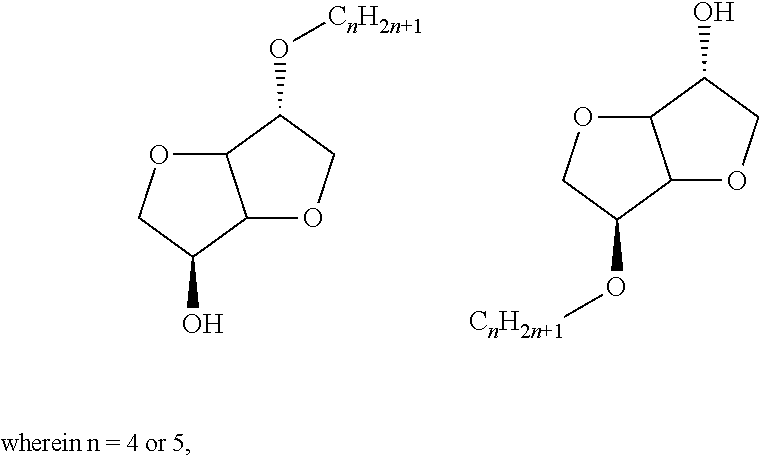
  • said solvo-surfactant being selected from an isosorbide compound obtained in the following 2 endo and exo forms:
  • alkyl is a linear or branched alkyl group comprising from 1 to 8 carbon atoms
  • R and R′ are each independently H or a linear or branched alkyl group comprising from 1 to 5 carbon atoms, preferably a methyl or ethyl group, with the proviso that R is different from R′,
  • the present invention therefore relates to a microemulsion of oil-in-water type comprising, preferably consisting of, by weight relative to the total weight of microemulsion:
  • said solvo-surfactant being selected from the mixtures of i) an isosorbide compound obtained in the following 2 endo and exo forms:
  • alkyl is a linear or branched alkyl group comprising from 1 to 8 carbon atoms
  • R and R′ are each independently H or a linear or branched alkyl group comprising from 1 to 5 carbon atoms, preferably a methyl or ethyl group, with the proviso that R is different from R′.
  • microemulsion according to the invention optionally comprises from 0.01% to 2% by weight of at least one preservative.
  • the microemulsion according to the invention is preferably substantially free of ethanol, i.e. it comprises less than 3% by weight of ethanol, preferably less than 2% by weight of ethanol, preferably less than 1% by weight of ethanol. More preferentially, it is devoid of ethanol, i.e. it contains 0% by weight of ethanol.
  • the monoalkylated glycerol derivatives are preferably the derivatives of following formula (I):
  • alkyl is a linear or branched alkyl group comprising from 1 to 6 carbon atoms
  • R and R′ are each independently H or a linear or branched alkyl group comprising from 1 to 5 carbon atoms, preferably a methyl or ethyl group, with the proviso that R is different from R′.
  • the monoalkylated glycerol derivatives are preferably the derivatives of following formula (I):
  • alkyl is a linear or branched alkyl group comprising 3, 4 or 5 carbon atoms
  • R and R′ are each independently H or a linear or branched alkyl comprising from 1 to 5 carbon atoms, preferably a methyl or ethyl group, with the proviso that R is different from R′.
  • the monoalkylated glycerol derivatives are more preferentially the derivatives of following formula (I):
  • alkyl is a linear or branched alkyl group comprising 3, 4 or 5 carbon atoms, R is a methyl group and R′ is H.
  • “Microemulsion of oil-in-water type” denotes a liquid system in which an oily (or hydrophobic) phase is dispersed in a continuous aqueous (or hydrophilic) phase so as to form drops of a diameter of less than 100 nm.
  • the oil/water interface is stabilized by surfactant compounds.
  • the drops preferably have a diameter of between 2 and 100 nm.
  • microemulsions have drops which are invisible to the naked eye and to optical microscopes. They are transparent, or at the very least translucent, unlike emulsions, which is a desired property especially for fragrancing compositions.
  • Hydrophobic substance denotes a pure substance or a mixture that is water-insoluble or only very sparingly water-soluble by nature.
  • a possible method to determine the hydrophobicity of substances is to measure their solubility in different solvents, or the retention time on a chromatographic column (by high-performance liquid chromatography, HPLC) of said hydrophobic substance.
  • the hydrophobic substances according to the invention are fragrancing, i.e. they are odoriferous and may be used in perfumes.
  • “Odoriferous substance” is intended to mean a substance that can be olfactorily detected by a subject and/or by olfactometry, according to principles known to those skilled in the art. An example of a method making it possible to detect an odoriferous substance is described in document EP 0003088. Other techniques for detecting an odoriferous substance are applicable, such as gas chromatography techniques, mass spectroscopy techniques or else infrared absorption analysis techniques. Odoriferous substance is also intended to mean a substance which gives off an odor, preferably an odor that is pleasant for at least 20% of people, in particular a fragrance.
  • the hydrophobic fragrancing substance is preferably a natural or synthetic hydrophobic fragrancing substance, more preferentially natural. It is more preferentially selected from terpenes, essential oils and natural compounds having odoriferous properties (terpenoids), especially selected from aldehydes, esters, ketones, alcohols, phenols, alkenes and ethers.
  • terpenoids essential oils and natural compounds having odoriferous properties
  • Terpenes denotes hydrocarbons in which the base component is isoprene, their empirical formula comprising a number of carbons that is a multiple of 5, in particular terpenes containing especially 10 or 15 carbon atoms, used in perfumery.
  • Terpenoids denotes terpene derivatives, for example alcohols, phenols, ketones, aldehydes, esters or ethers.
  • essential oils denoting the concentrated liquid that is commonly odoriferous, volatile, and produced by plants.
  • Essential oils are most commonly extracted from plant organs by hydrodistillation especially, but the constituents of these oils are widely industrially synthesized.
  • terpenes pinenes, camphenes, limonene, cadinene, carene, caryophyllene,
  • alcohols linalool, geraniol, menthol, citronellol,
  • ketones menthone, carvone, beta-ionone, thujone, camphor, cyclopentadecanone,
  • aldehydes citral, citrannal, citronellal, cinnamic aldehyde, lilial,
  • esters linalyl acetate, menthyl acetate, geranyl acetate, geranyl succinate,
  • ethers anethole, eucalyptol, cineole, rose oxide,
  • alkenes limonene
  • the essential oils may be oils of ylang-ylang, bergamot, eucalyptus , lavender, lavandin, lemongrass, patchouli, peppermint, pine, rose, coriander, Shiu, sage, geranium, palmarosa, Litsea cubeba , lemon, citronnella, orange blossom, grapefruit, lime, mandarin, tangerine, orange, cajeput, camphor, rosemary, green anise, star anise, fennel, basil, tarragon, clove, chilli, thyme, sassafras , wormwood, mugwort, cedar, hyssop, tagetes , rue, elemi, galbanum , juniper berries, cabreuva, lignum vitae, sandalwood, vetiver, ambrette, angelica , iris rhizome, carrot, celery, cumin, lovage, parsley,
  • Solvo-surfactant denotes an amphiphilic compound that brings together some properties of surfactants, especially reduction of water/air surface tension and oil/water interfacial tension, the ability to self-associate in water, and some properties of solvents, especially the ability to evaporate without leaving residues.
  • the solvo-surfactant is preferably volatile and is an isosorbide compound obtained in the following 2 endo and exo forms:
  • the solvo-surfactant is volatile and is selected from monoalkylated glycerol derivatives of following formula (I):
  • alkyl is a linear or branched alkyl group comprising 1 to 8 carbon atoms
  • R and R′ are each independently H or a linear or branched alkyl group comprising from 1 to 5 carbon atoms, preferably a methyl or ethyl group, with the proviso that R is different from R′.
  • the solvo-surfactant is the monoalkylated glycerol derivative of formula (I), wherein the “alkyl” group is a linear alkyl group comprising 3, 4 or 5 carbon atoms, and R and R′ are each independently H or a methyl or ethyl group, with the proviso that R is different from R′.
  • the solvo-surfactant is the monoalkylated glycerol derivative of formula (I), wherein the “alkyl” group is a linear alkyl group comprising 3, 4 or 5 carbon atoms, R is a methyl or ethyl group, and R′ is H.
  • the amount of volatile solvo-surfactant(s) in the microemulsion according to the invention is between 5% and 20% by weight, preferably between 7% and 18% by weight.
  • microemulsions according to the invention have a fragrance quality that is stable over time, corresponding to the standard shelf life of a cosmetic product, and stable at temperatures from 5 to 45° C. or from 15 to 45° C., corresponding to the temperatures of exposure and use of a cosmetic product.
  • Hydrophilic agent is intended to mean an amphiphilic compound comprising hydrophilic functional groups, used to enable the solubilization of poorly soluble substances in an aqueous solution. They make it possible to lower the cloud point.
  • the hydrotropic agent is especially selected from arylsulfonic acids and alkyl glucosides.
  • alkyl glucosides that may be used, mention may be made of heptyl glucoside, octyl glucoside or decyl glucoside.
  • the hydrotropic agent is preferably heptyl glucoside.
  • “Surfactant” denotes a non-volatile compound of amphiphilic nature comprising a polar hydrophilic portion and an apolar hydrophobic portion.
  • a surfactant lowers the surface tension of aqueous solutions and decreases the interfacial tension between water and an immiscible organic liquid. It thus makes it possible to solubilize two immiscible phases, such as water and oil, by interacting with water via its polar portion and with oil via its apolar portion.
  • the surfactant according to the invention is selected from the four categories of surfactants:
  • the amount of surfactant(s) in the microemulsions according to the invention is between 1% and 10% by weight, preferably between 1% and 5% by weight relative to the total weight of microemulsion.
  • the microemulsion of the invention contains at least one anionic surfactant, preferably selected from:
  • M + represents Na + , K + , NH 4 + , (HOCH 2 CH 2 ) 3 NH + ,
  • M + represents Na + , K + , NH 4 + , (HOCH 2 CH 2 ) 3 NH + ,
  • w is an integer from 8 to 12
  • SDBS sodium isododecylbenzenesulfonate
  • n is from 4 to 8
  • the microemulsion of the invention contains at least one non-ionic surfactant selected from:
  • alkanolamide is not a polyol
  • the microemulsion of the invention contains at least one amphoteric surfactant selected from:
  • the microemulsion of the invention contains at least one cationic surfactant, preferably selected from:
  • X ⁇ represents an anion selected from Cl ⁇ , Br ⁇ , I ⁇ , CH 3 COO ⁇ or lactate,
  • n is the number of methylenes, from 6 to 12,
  • p is from 8 to 18,
  • the microemulsions of the invention are thermodynamically stable and have a transparent or translucent appearance and, even more advantageously, the microemulsions of the invention are thermodynamically stable and have a transparent or translucent appearance for at least one or two years.
  • microemulsion according to the invention preferably consists of:
  • the present invention also relates to the use of a microemulsion according to the invention, for the preparation of a fine fragrance composition, or of a cosmetic or body hygiene composition.
  • microemulsions may be used in cosmetics. They may then contain one or more compounds selected from silicones, paraffin oil, isooctane, isodecane, squalene, squalane, sebum and lanolin.
  • NAMES ABBREVIATIONS STRUCTURES SOLVO-SURFACTANTS (SS) Isosorbide derivatives Propylisosorbide Butylisosorbide Pentylisosorbide C 3 Iso C 4 Iso C 5 Iso Monomethylayed glycerol derivatives Monomethylated propylglycerol C301 C310 Monomethylated butylglycerol C401 C410 Monomethylated pentylglycerol C501 C510
  • the syntheses of 1-methoxy-3-propoxypropan-2-ol (C301) and 1-methoxy-3-pentoxypropan-2-ol (C501) are carried out in two steps.
  • the synthesis of 1-methoxy-3-butoxypropan-2-ol (C401) is carried out simply by opening the epoxide, insofar as the starting reagent, butylglycidol, is commercially available.
  • the product obtained is finally distilled under vacuum at 10-20 mbar between 75 and 80° C.
  • the methanol is evaporated on a rotary evaporator once the reaction has ended.
  • the product obtained is then washed with two aqueous solutions saturated with NaCl: one containing 3.4% HCl and the other containing 10% NaHCO 3 .
  • Isosorbide consists of two rings each having a hydroxyl function, the functions being non-equivalent at positions 2 and 5. They are referred to, respectively, as exo and endo positions.
  • the intramolecular hydrogen bond of the hydroxyl function at position 5 and the oxygen borne by the adjacent ring differentiates the reactivities of the two positions and also the properties of the derivatives obtained.
  • the reactivity of the hydroxyl groups is different. It is possible to adjust the reaction parameters (solvent, base, reagents) to obtain different ratios of isosorbide derivatives (endo monoether, exo monoether and diether).
  • the solvents and bases used to carry out the alkylation are, respectively, DMSO and KOH. This is because, with this combination, the expected endo/exo ratio will be 1/1. It is also possible to use LiOH, making it possible to predominantly obtain the exo form.
  • the reaction is a “one pot” reaction with 1 equivalent of base, of isosorbide and of C n Br bromoalkyl. First of all, the isosorbide is dissolved in the DMSO, then the mixture is heated to 90° C. KOH is then added. Once the latter dissolves entirely (1 h), the C n Br is added dropwise for 1 h at reflux at 90° C. The reaction is stopped after 24 h:
  • the mono- and diethers are separated using a silica column. This separation step makes it possible to obtain only the two monoethers and to eliminate the diether and the remaining isosorbide.
  • the eluent chosen is an ethyl acetate/petroleum ether (20/80) mixture.
  • the aim of which was to classify the solvo-surfactants according to their capacity to solubilize (or not) the fragrances the amount of fragrance was fixed at 5% by weight in milliQ water.
  • the solubilizations of the fragrance concentrates PF1, PF2 and PF3 and also linalool were evaluated.
  • CrodaSinic LS30 sodium lauroylsarcosinate
  • the above formulations must be temperature stable over a range from ° C. to 45° C. or preferentially from 15° C. to 45° C.
  • the formulations are therefore placed in a bath at 5° C. and at 45° C., or from 15° C. to 45° C., for 24 h.
  • the clear formulations are considered to be stable and the cloudy formulations are considered to be unstable.
  • Table 1 below gives the stable compositions (“OK”) and the compositions that led to destabilization (appearance of cloudiness) (“KO”).
  • C 3 Iso/SDS demonstrates stability over the whole temperature range for the 3 fragrance concentrates.
  • the formulations are not stable at all the temperatures.
  • C 3 Iso comprises endo and exo forms.
  • C401 and C501 have a cloud point, reflecting the temperature from which the solvo-surfactant is no longer water-soluble and aggregates to form a cloudy mist in the water. This cloud point may explain the instability at 45° C. of the formulations using C501 and C401.
  • the cloud point of C501 is approximately 10° C., however the formulations remain clear at room temperature.
  • formulations containing a mixture of 2 solvo-surfactants were prepared: one giving good temperature stability and the other good solubilization effectiveness, with the aim of ascertaining whether it is thus possible to increase the temperature stability range while increasing the solubilization effectiveness.
  • C501 was identified as having good effectiveness, and C 3 Iso makes it possible to obtain good temperature stability.
  • the 2 solvo-surfactants were mixed at different ratios and for each mixture, the optimum formulation of solubilization in the presence of SDS was determined. 10% of PF2 were solubilized for each formulation.
  • concentrations of SDS required to solubilize the fragrances in water are similar to those required when C501 is used alone ( ⁇ 5-6%). Good temperature stability from 5 to 45° C. is obtained for several C 3 Iso/C501 ratios.
  • compositions are prepared:
  • fragrance % (gamma- Trade undeca- water SA AM Surfactant (SA) name lactone) C501% % % Sodium lauroyl Crodasinic 4.92 10.38 78.30 6.40 sarcosinate LS 30 Sodium cocoyl Hostapon 4.96 10.57 78.37 6.10 isethionate SCI 85 Sodium lauroyl Hostapon 4.97 10.15 70.46 14.42 glutamate CLG Cocamidopropyl Genagen 5.13 10.83 74.76 9.28 betaine CAB 818 Cocamidopropyl Amonyl 4.99 10.24 69.96 14.80 hydroxysultaine 675 SB Heptyl glucoside Sepiclear 5.00 10.63 73.83 10.54 (hydrotrope) G7 Ammonium lauryl Texapon 4.92 10.08 81.37 3.63 sulfate ALSbenz Sodium cocosulfate Texapon 4.90 9.82 81.05 4.23 K30 UP Sodium sulfonate Hosta
  • compositions prepared are transparent and stable.
  • fragrances A, B and C are prepared:
  • compositions prepared are transparent and stable.
  • C401 and C410 are good solvo-surfactants for solubilizing P, in combination with sodium lauryl ether (laureth) sulfate (LES).
  • laureth sodium lauryl ether
  • C501 and C510 are therefore good solvo-surfactants for solubilizing P, in combination with IC5, sodium lauryl ether (laureth) sulfate (LES).

Landscapes

  • Health & Medical Sciences (AREA)
  • Life Sciences & Earth Sciences (AREA)
  • Animal Behavior & Ethology (AREA)
  • General Health & Medical Sciences (AREA)
  • Public Health (AREA)
  • Veterinary Medicine (AREA)
  • Birds (AREA)
  • Epidemiology (AREA)
  • Emergency Medicine (AREA)
  • Chemical & Material Sciences (AREA)
  • Dispersion Chemistry (AREA)
  • Oil, Petroleum & Natural Gas (AREA)
  • Cosmetics (AREA)

Abstract

Disclosed is a microemulsion of oil-in-water type including, preferably consisting of, by weight relative to the total weight of microemulsion: •70% to 94% of water, •1% to 15% of at least one hydrophobic fragrancing substance, •4% to 20% of at least one preferably volatile solvo-surfactant, and •0.1% to 15%, preferably 1% to 13%, of at least one hydrotropic agent or at least one surfactant selected from anionic surfactants, cationic surfactants, amphoteric surfactants and non-ionic surfactants. The solvo-surfactant is selected from monoalkylated glycerol derivatives of following formula (I):
Figure US11052025-20210706-C00001

wherein the “alkyl” group is a linear or branched alkyl group including from 1 to 8 carbon atoms, and R and R′ are each independently H or a linear or branched alkyl group including from 1 to 5 carbon atoms, with the proviso that R is different from R′, and mixtures thereof.

Description

The invention relates to aqueous volatile fragrancing microemulsions based on the use of solvo-surfactants.
Perfumes conventionally comprise alcohols such as ethanol or else isopropanol as solvents. However, the use of these solvents has a certain number of disadvantages: they are highly volatile and inflammable, leading to a certain amount of danger when producing them, and to a certain extent when using them. Their own odor may also interfere with that of the perfume. In addition, applied to the skin or the hair, these perfumes may lead to drying out, in particular in consumers with sensitive skin.
Therefore, there is currently an emergence of new compositions, especially for reasons of public health and/or ecology. The goal being pursued is that of decreasing or even eliminating volatile organic compounds (such as alcohols) contained in perfumes, by developing fragrancing compositions in the form of stable aqueous dispersions or solutions.
However, the majority of fragrancing molecules are hydrophobic and are therefore not water-soluble. In order to overcome this problem, use must be made of surfactants that make it possible to dissolve fragrancing molecules within micelles, forming microemulsions. It is desirable that the swollen micelles containing the fragrances are small so that the fragrancing composition has a transparent, or at the very least translucent, appearance. Thus, the production of microemulsions meeting this criterion of transparent appearance is of particular benefit.
Other constraints are linked to the thermodynamic stability of the microemulsion, to the non-tacky nature thereof, and to the absence of residue on the skin or on the clothes. It is therefore important to be able to prepare them using as little surfactant as possible.
There is therefore a need for a stable fragrancing composition containing a large amount of fragrance, which is transparent or at least translucent, and which contains as little surfactant as possible.
The aim of the present invention is to provide aqueous, transparent microemulsions that are substantially free of ethanol, containing at least one hydrophobic fragrancing substance (preferably at least 3% and preferentially approximately 10% of fragrance) and at least one volatile solvo-surfactant. Such odoriferous or fragrancing microemulsions are stable and comprises as little as possible of substances that cause undesirable effects, in particular to the skin and/or the environment.
According to the invention, a substance is “volatile” when its boiling point is less than 250° C. at atmospheric pressure. The “non-volatile” compounds have a boiling point of greater than 250° C. at atmospheric pressure.
The present invention therefore relates to a microemulsion of oil-in-water type comprising, preferably consisting of, by weight relative to the total weight of microemulsion:
    • 70% to 94% of water,
    • 1% to 15% of at least one hydrophobic fragrancing substance,
    • 4% to 20% of at least one preferably volatile solvo-surfactant, and
    • 0.1% to 15%, preferably 1% to 13%, of at least one hydrotropic agent or at least one surfactant selected from anionic surfactants, cationic surfactants, amphoteric surfactants and non-ionic surfactants,
said solvo-surfactant being selected from an isosorbide compound obtained in the following 2 endo and exo forms:
Figure US11052025-20210706-C00002
the monoalkylated glycerol derivatives of following formula (I):
Figure US11052025-20210706-C00003
wherein the “alkyl” group is a linear or branched alkyl group comprising from 1 to 8 carbon atoms, and R and R′ are each independently H or a linear or branched alkyl group comprising from 1 to 5 carbon atoms, preferably a methyl or ethyl group, with the proviso that R is different from R′,
and mixtures thereof.
The present invention therefore relates to a microemulsion of oil-in-water type comprising, preferably consisting of, by weight relative to the total weight of microemulsion:
    • 70% to 94% of water,
    • 1% to 15% of at least one hydrophobic fragrancing substance,
    • 4% to 20% of at least one preferably volatile solvo-surfactant, and
    • 0.1% to 15%, preferably 1% to 13%, of at least one hydrotropic agent or at least one surfactant selected from anionic surfactants, cationic surfactants, amphoteric surfactants and non-ionic surfactants,
said solvo-surfactant being selected from the mixtures of i) an isosorbide compound obtained in the following 2 endo and exo forms:
Figure US11052025-20210706-C00004
and ii) a monoalkylated glycerol derivative of following formula (I):
Figure US11052025-20210706-C00005
wherein the “alkyl” group is a linear or branched alkyl group comprising from 1 to 8 carbon atoms, and R and R′ are each independently H or a linear or branched alkyl group comprising from 1 to 5 carbon atoms, preferably a methyl or ethyl group, with the proviso that R is different from R′.
The microemulsion according to the invention optionally comprises from 0.01% to 2% by weight of at least one preservative.
The microemulsion according to the invention is preferably substantially free of ethanol, i.e. it comprises less than 3% by weight of ethanol, preferably less than 2% by weight of ethanol, preferably less than 1% by weight of ethanol. More preferentially, it is devoid of ethanol, i.e. it contains 0% by weight of ethanol.
The monoalkylated glycerol derivatives are preferably the derivatives of following formula (I):
Figure US11052025-20210706-C00006
wherein the “alkyl” group is a linear or branched alkyl group comprising from 1 to 6 carbon atoms, and R and R′ are each independently H or a linear or branched alkyl group comprising from 1 to 5 carbon atoms, preferably a methyl or ethyl group, with the proviso that R is different from R′.
The monoalkylated glycerol derivatives are preferably the derivatives of following formula (I):
Figure US11052025-20210706-C00007
wherein the “alkyl” group is a linear or branched alkyl group comprising 3, 4 or 5 carbon atoms, and R and R′ are each independently H or a linear or branched alkyl comprising from 1 to 5 carbon atoms, preferably a methyl or ethyl group, with the proviso that R is different from R′. The monoalkylated glycerol derivatives are more preferentially the derivatives of following formula (I):
Figure US11052025-20210706-C00008
wherein the “alkyl” group is a linear or branched alkyl group comprising 3, 4 or 5 carbon atoms, R is a methyl group and R′ is H.
“Microemulsion of oil-in-water type” denotes a liquid system in which an oily (or hydrophobic) phase is dispersed in a continuous aqueous (or hydrophilic) phase so as to form drops of a diameter of less than 100 nm. The oil/water interface is stabilized by surfactant compounds. The drops preferably have a diameter of between 2 and 100 nm.
These microemulsions have drops which are invisible to the naked eye and to optical microscopes. They are transparent, or at the very least translucent, unlike emulsions, which is a desired property especially for fragrancing compositions.
“Hydrophobic substance” denotes a pure substance or a mixture that is water-insoluble or only very sparingly water-soluble by nature. A possible method to determine the hydrophobicity of substances is to measure their solubility in different solvents, or the retention time on a chromatographic column (by high-performance liquid chromatography, HPLC) of said hydrophobic substance.
The hydrophobic substances according to the invention are fragrancing, i.e. they are odoriferous and may be used in perfumes. “Odoriferous substance” is intended to mean a substance that can be olfactorily detected by a subject and/or by olfactometry, according to principles known to those skilled in the art. An example of a method making it possible to detect an odoriferous substance is described in document EP 0003088. Other techniques for detecting an odoriferous substance are applicable, such as gas chromatography techniques, mass spectroscopy techniques or else infrared absorption analysis techniques. Odoriferous substance is also intended to mean a substance which gives off an odor, preferably an odor that is pleasant for at least 20% of people, in particular a fragrance.
The hydrophobic fragrancing substance is preferably a natural or synthetic hydrophobic fragrancing substance, more preferentially natural. It is more preferentially selected from terpenes, essential oils and natural compounds having odoriferous properties (terpenoids), especially selected from aldehydes, esters, ketones, alcohols, phenols, alkenes and ethers.
“Terpenes” denotes hydrocarbons in which the base component is isoprene, their empirical formula comprising a number of carbons that is a multiple of 5, in particular terpenes containing especially 10 or 15 carbon atoms, used in perfumery.
“Terpenoids” denotes terpene derivatives, for example alcohols, phenols, ketones, aldehydes, esters or ethers.
Terpenes and terpenoids are contained in “essential oils”, denoting the concentrated liquid that is commonly odoriferous, volatile, and produced by plants. Essential oils are most commonly extracted from plant organs by hydrodistillation especially, but the constituents of these oils are widely industrially synthesized.
Use may especially be made of the following natural hydrophobic fragrancing substances:
terpenes: pinenes, camphenes, limonene, cadinene, carene, caryophyllene,
alcohols: linalool, geraniol, menthol, citronellol,
ketones: menthone, carvone, beta-ionone, thujone, camphor, cyclopentadecanone,
aldehydes: citral, citrannal, citronellal, cinnamic aldehyde, lilial,
esters: linalyl acetate, menthyl acetate, geranyl acetate, geranyl succinate,
phenols: thymol, carvacrol, eugenol, isoeugenol,
ethers: anethole, eucalyptol, cineole, rose oxide,
alkenes: limonene.
The essential oils may be oils of ylang-ylang, bergamot, eucalyptus, lavender, lavandin, lemongrass, patchouli, peppermint, pine, rose, coriander, Shiu, sage, geranium, palmarosa, Litsea cubeba, lemon, citronnella, orange blossom, grapefruit, lime, mandarin, tangerine, orange, cajeput, camphor, rosemary, green anise, star anise, fennel, basil, tarragon, clove, chilli, thyme, sassafras, wormwood, mugwort, cedar, hyssop, tagetes, rue, elemi, galbanum, juniper berries, cabreuva, lignum vitae, sandalwood, vetiver, ambrette, angelica, iris rhizome, carrot, celery, cumin, lovage, parsley, cinnamon, cardamom, ginger, nutmeg, pepper, frankincense, myrrh, Peru balsam, styrax, buchu, chamomile or rock rose (Jean Garnero, “Huiles essentielles” [Essential oils], Techniques de l'ingénieur, Traité constantes physico-chimiques, K-345). The amount of hydrophobic fragrancing substances in the microemulsions according to the invention is between 1% and 15% by weight, preferably between 5% and 12% by weight relative to the total weight of microemulsion.
“Solvo-surfactant” denotes an amphiphilic compound that brings together some properties of surfactants, especially reduction of water/air surface tension and oil/water interfacial tension, the ability to self-associate in water, and some properties of solvents, especially the ability to evaporate without leaving residues.
The solvo-surfactant is preferably volatile and is an isosorbide compound obtained in the following 2 endo and exo forms:
Figure US11052025-20210706-C00009
These two compounds are derivatives of isosorbide, in endo and exo form. The 35:65 mixture of these compounds is referred to as “C3Iso” in the examples of the present application. Stereoselectivity leads to this ratio of the endo/exo mixture being obtained.
Preferably, alternatively, the solvo-surfactant is volatile and is selected from monoalkylated glycerol derivatives of following formula (I):
Figure US11052025-20210706-C00010
wherein the “alkyl” group is a linear or branched alkyl group comprising 1 to 8 carbon atoms, and R and R′ are each independently H or a linear or branched alkyl group comprising from 1 to 5 carbon atoms, preferably a methyl or ethyl group, with the proviso that R is different from R′.
More preferentially, the solvo-surfactant is the monoalkylated glycerol derivative of formula (I), wherein the “alkyl” group is a linear alkyl group comprising 3, 4 or 5 carbon atoms, and R and R′ are each independently H or a methyl or ethyl group, with the proviso that R is different from R′.
More preferentially, the solvo-surfactant is the monoalkylated glycerol derivative of formula (I), wherein the “alkyl” group is a linear alkyl group comprising 3, 4 or 5 carbon atoms, R is a methyl or ethyl group, and R′ is H.
The monoalkylated glycerol derivative of formula (I) wherein the “alkyl” group is a linear alkyl group comprising 3 carbon atoms (propyl group), R is H and R′ is methyl, is 1-methoxy-3-propoxypropan-2-ol. It is referred to as “C301” in the examples of the present application. The monoalkylated glycerol derivative of formula (I) wherein the “alkyl” group is a linear alkyl group comprising 3 carbon atoms (propyl group), R is methyl and R′ is H, is 2-methoxy-3-propoxypropan-1-ol. It is referred to as “C310” in the examples of the present application.
The monoalkylated glycerol derivative of formula (I) wherein the “alkyl” group is a linear alkyl group comprising 4 carbon atoms (butyl group), R is H and R′ is methyl, is 1-methoxy-3-butoxypropan-2-ol. It is referred to as “C401” in the examples of the present application. The monoalkylated glycerol derivative of formula (I) wherein the “alkyl” group is a linear alkyl group comprising 4 carbon atoms (butyl group), R is methyl and R′ is H, is 2-methoxy-3-butoxypropan-1-ol. It is referred to as “C410” in the examples of the present application.
The monoalkylated glycerol derivative of formula (I) wherein the “alkyl” group is a linear alkyl group comprising 5 carbon atoms (pentyl group), R is H and R′ is methyl, is 1-methoxy-3-pentoxypropan-2-ol. It is referred to as “C501” in the examples of the present application. The monoalkylated glycerol derivative of formula (I) wherein the “alkyl” group is a linear alkyl group comprising 5 carbon atoms (pentyl group), R is methyl and R′ is H, is 2-methoxy-3-pentoxypropan-1-ol. It is referred to as “C510” in the examples of the present application.
The amount of volatile solvo-surfactant(s) in the microemulsion according to the invention is between 5% and 20% by weight, preferably between 7% and 18% by weight.
The microemulsions according to the invention have a fragrance quality that is stable over time, corresponding to the standard shelf life of a cosmetic product, and stable at temperatures from 5 to 45° C. or from 15 to 45° C., corresponding to the temperatures of exposure and use of a cosmetic product.
The technical criteria of the quality of a fragrance, in the case of an aqueous fragrance, are:
    • the ability of a fragranced composition to maintain, after application, an olfactory perception threshold over time,
    • the ability of a composition, once applied, to maintain its olfactory form over time,
    • the ability of a composition to not undergo endogenous or exogenous alterations that could modify its olfactory form, and
    • harmlessness, which is the ability of a composition to not produce undesirable effects once it is applied to the skin of the user.
“Hydrotropic agent” is intended to mean an amphiphilic compound comprising hydrophilic functional groups, used to enable the solubilization of poorly soluble substances in an aqueous solution. They make it possible to lower the cloud point.
The hydrotropic agent is especially selected from arylsulfonic acids and alkyl glucosides. Among the alkyl glucosides that may be used, mention may be made of heptyl glucoside, octyl glucoside or decyl glucoside. The hydrotropic agent is preferably heptyl glucoside.
“Surfactant” denotes a non-volatile compound of amphiphilic nature comprising a polar hydrophilic portion and an apolar hydrophobic portion. A surfactant lowers the surface tension of aqueous solutions and decreases the interfacial tension between water and an immiscible organic liquid. It thus makes it possible to solubilize two immiscible phases, such as water and oil, by interacting with water via its polar portion and with oil via its apolar portion. The surfactant according to the invention is selected from the four categories of surfactants:
    • anionic: the hydrophilic portion is negatively charged,
    • non-ionic: the compound does not comprise any charge,
    • amphoteric or zwitterionic: the hydrophilic portion comprises a positive charge and a negative charge, the overall charge being zero. The zwitterionic surfactant is permanently charged, whereas the amphoteric surfactant ionizes as a function of the pH, and
    • cationic: the hydrophilic portion is positively charged.
The amount of surfactant(s) in the microemulsions according to the invention is between 1% and 10% by weight, preferably between 1% and 5% by weight relative to the total weight of microemulsion.
Advantageously, the microemulsion of the invention contains at least one anionic surfactant, preferably selected from:
    • alkyl sulfonates, especially dihexyl sulfosuccinate (DHS) of formula
Figure US11052025-20210706-C00011
wherein
M+ represents Na+, K+, NH4 +, (HOCH2CH2)3NH+,
or especially the 2-ethylhexyl sulfosuccinate (Aerosol OT® or AOT, from CYTEC) of formula
Figure US11052025-20210706-C00012
wherein
M+ represents Na+, K+, NH4 +, (HOCH2CH2)3NH+,
    • alkylaryl sulfonates of formula
Figure US11052025-20210706-C00013
wherein w is an integer from 8 to 12,
in particular isooctyl, isononyl and especially sodium isododecylbenzenesulfonate (SDBS) of formula
Figure US11052025-20210706-C00014
    • propoxysulfates, especially the Alfoterra® compounds of formula
Figure US11052025-20210706-C00015
wherein the number of propoxylate units n is from 4 to 8,
    • n possibly being especially equal to 4 (Alfoterra® 4S, Alf4S),
    • n possibly being especially equal to 8 (Alfoterra® 8S, Alf8S),
    • alkyl sulfates, especially salts of lauryl sulfate such as sodium dodecyl sulfate (SDS) and sodium alkylether sulfates such as sodium lauryl ether (laureth) sulfate (LES),
    • and salts of fatty acids of formula R—CO2 M+, wherein R represents a linear or branched, saturated or unsaturated carbon-based chain containing 8 to 18 carbon atoms, and M+ represents a cation selected from the ions Na+, K+, NH4 +, (HOCH2CH2)3NH+, especially the oleic acid salt of formula CH3(CH2)7CH═CH(CH2)7CO2 M+, wherein M+ has the above-defined meanings. The microemulsion of the invention preferably comprises at least one anionic surfactant selected from sodium dodecyl sulfate and sodium laureth sulfate.
In another advantageous manner, the microemulsion of the invention contains at least one non-ionic surfactant selected from:
    • alkanolamides, especially the monoethanolamide (cocamide, MEA) of formula
Figure US11052025-20210706-C00016
with the proviso that said alkanolamide is not a polyol,
    • alkylpolyglycosides (APGs),
    • polyglycerol ethers,
    • and polyglycerol esters.
In another advantageous manner, the microemulsion of the invention contains at least one amphoteric surfactant selected from:
    • betaines, especially cocamidopropyl betaine (CAPB) of formula
Figure US11052025-20210706-C00017
    • and amine oxides, especially lauryldimethylamine oxide of formula
Figure US11052025-20210706-C00018
Alternatively, the microemulsion of the invention contains at least one cationic surfactant, preferably selected from:
    • tetraalkylammonium salts, especially dialkyldimethylammonium salts of formula
Figure US11052025-20210706-C00019
wherein
X represents an anion selected from Cl, Br, I, CH3COO or lactate,
n is the number of methylenes, from 6 to 12,
preferably a didecyldimethylammonium salt of formula
Figure US11052025-20210706-C00020
wherein X has the meanings given above,
    • trialkylammonium salts, in particular trialkylammonium halides, especially dodecyltrimethylammonium bromide (DTAB) of formula H3C(CH2)11N+(CH3)3,
    • pyridinium salts, especially cetylpyridinium salt of formula
Figure US11052025-20210706-C00021
wherein
X has the meanings given above,
    • benzalkonium salts, especially salts of formula
Figure US11052025-20210706-C00022
wherein
X has the meanings given above,
p is from 8 to 18,
    • ammonium salts of triethanolamine of formula
(HO—CH2—CH2)3NH+X wherein X has the meanings given above.
Highly advantageously, the microemulsions of the invention are thermodynamically stable and have a transparent or translucent appearance and, even more advantageously, the microemulsions of the invention are thermodynamically stable and have a transparent or translucent appearance for at least one or two years.
The microemulsion according to the invention preferably consists of:
    • 70% to 90% of water,
    • 5% to 12% of at least one hydrophobic fragrancing substance,
    • 4% to 18% of at least one volatile solvo-surfactant, and
    • 0.1% to 10%, preferably 1% to 5%, of at least one hydrotropic agent or at least one surfactant selected from anionic surfactants, cationic surfactants, amphoteric surfactants and non-ionic surfactants.
The microemulsions of the invention are advantageously used for the preparation of compositions applied in:
    • fine fragrance, or
    • cosmetics and body hygiene products.
Thus, the present invention also relates to the use of a microemulsion according to the invention, for the preparation of a fine fragrance composition, or of a cosmetic or body hygiene composition.
The microemulsions may be used in cosmetics. They may then contain one or more compounds selected from silicones, paraffin oil, isooctane, isodecane, squalene, squalane, sebum and lanolin.
In the following examples, the structures and names are as follows:
NAMES ABBREVIATIONS STRUCTURES
SOLVO-SURFACTANTS (SS)
Isosorbide derivatives
Propylisosorbide Butylisosorbide Pentylisosorbide C3Iso C4Iso C5Iso
Figure US11052025-20210706-C00023
Monomethylayed glycerol derivatives
Monomethylated propylglycerol C301
Figure US11052025-20210706-C00024
C310
Figure US11052025-20210706-C00025
Monomethylated butylglycerol C401
Figure US11052025-20210706-C00026
C410
Figure US11052025-20210706-C00027
Monomethylated pentylglycerol C501
Figure US11052025-20210706-C00028
C510
Figure US11052025-20210706-C00029
EXAMPLE 1: SYNTHESIS OF THE SOLVO-SURFACTANTS ACCORDING TO THE INVENTION
The syntheses of 1-methoxy-3-propoxypropan-2-ol (C301) and 1-methoxy-3-pentoxypropan-2-ol (C501) are carried out in two steps. The synthesis of 1-methoxy-3-butoxypropan-2-ol (C401) is carried out simply by opening the epoxide, insofar as the starting reagent, butylglycidol, is commercially available.
I—Synthesis of the Monomethylated Glycerol Derivatives
a) Condensation of the Alcohol to Epichlorohydrin
The condensation of the alcohol (1 mol) to epichlorohydrin is carried out with a slight excess of epichlorohydrin (1.5 mol) in the presence of ZnCl2 as catalyst. The epichlorohydrin is added dropwise for 1 h at 100° C. The reaction medium is then kept at 115° C. for 5 h then cooled to 50° C. NaOH (2.3 moles) at 48% is then added dropwise for 1 h. All these synthesis steps are carried out with vigorous stirring. Once the reaction has ended, distilled water is added and the product is then washed twice with water to eliminate residual salts.
Figure US11052025-20210706-C00030
Synthesis of Cnglycidol, where n=3, 5
The product obtained is finally distilled under vacuum at 10-20 mbar between 75 and 80° C.
b) Opening of the Epoxide with Methanolate
The Cnglycidol (where n=3, 4, 5) is added dropwise to a solution of methanol containing sodium methanolate obtained beforehand by reaction between methanol and solid sodium. The addition is carried out at reflux at 80° C. for 30 min, then the temperature of 80° C. is maintained for 24 h until the Cnglycidol disappears entirely:
Figure US11052025-20210706-C00031
Opening of the Epoxide by Sodium Methanolate
Purification:
The methanol is evaporated on a rotary evaporator once the reaction has ended. The product obtained is then washed with two aqueous solutions saturated with NaCl: one containing 3.4% HCl and the other containing 10% NaHCO3.
II—Synthesis of C3Iso, and also C4Iso and C5Iso
Isosorbide consists of two rings each having a hydroxyl function, the functions being non-equivalent at positions 2 and 5. They are referred to, respectively, as exo and endo positions. The intramolecular hydrogen bond of the hydroxyl function at position 5 and the oxygen borne by the adjacent ring differentiates the reactivities of the two positions and also the properties of the derivatives obtained.
The reactivity of the hydroxyl groups is different. It is possible to adjust the reaction parameters (solvent, base, reagents) to obtain different ratios of isosorbide derivatives (endo monoether, exo monoether and diether). The solvents and bases used to carry out the alkylation are, respectively, DMSO and KOH. This is because, with this combination, the expected endo/exo ratio will be 1/1. It is also possible to use LiOH, making it possible to predominantly obtain the exo form. The reaction is a “one pot” reaction with 1 equivalent of base, of isosorbide and of CnBr bromoalkyl. First of all, the isosorbide is dissolved in the DMSO, then the mixture is heated to 90° C. KOH is then added. Once the latter dissolves entirely (1 h), the CnBr is added dropwise for 1 h at reflux at 90° C. The reaction is stopped after 24 h:
Figure US11052025-20210706-C00032
Synthesis of isosorbide monoalkyls Cn Iso, where n=3, 4 or 5
Three products are obtained: two monoethers (endo and exo) and the diether.
Purification:
Once the reaction has ended, it is necessary to rebalance the pH of the solution. NaHCO3 is added for this purpose. Next, in order to eliminate as much salt as possible, filtration over sintered glass is carried out with two washes with DMSO. The reaction mixture is subsequently distilled to eliminate the DMSO from the solution. The residue from the distillation is subsequently dissolved in ethyl acetate then washed twice with water saturated with NaCl. The ethyl acetate is subsequently evaporated on a rotary evaporator to recover the isosorbide derivatives present in the organic phase.
The mono- and diethers are separated using a silica column. This separation step makes it possible to obtain only the two monoethers and to eliminate the diether and the remaining isosorbide. The eluent chosen is an ethyl acetate/petroleum ether (20/80) mixture.
It is possible to separate the endo and exo isomers using separation by chromatography by solid deposition. This technique makes it possible to make the elution of the products more uniform and hence to more easily separate the two isomers. The product is firstly homogenized with the silica using dichloromethane. Once the solvent is evaporated on a rotary evaporator, the solid containing the product is placed at the top of a conventional chromatography column. The elution then proceeds conventionally with a petroleum ether/ethyl acetate (75/25) eluent. Once the first isomer has eluted, the polarity of the eluent is changed to more rapidly recover the second isomer. The eluent chosen is a 50/50 petroleum ether/ethyl acetate mixture. The two endo and exo isomers are thus obtained separately.
EXAMPLE 2: SOLUBILIZATION OF FRAGRANCE CONCENTRATES
Solubilization by Solvo-Surfactants Alone:
Solubilization of Three Fragrances and Linalool
For these reference tests, the aim of which was to classify the solvo-surfactants according to their capacity to solubilize (or not) the fragrances, the amount of fragrance was fixed at 5% by weight in milliQ water. The solubilizations of the fragrance concentrates PF1, PF2 and PF3 and also linalool were evaluated.
It appears that, in order to solubilize the fragrance concentrates or the linalool, it is necessary to have a concentration of solvo-surfactant (SS) of greater than 35%, regardless of the solvo-surfactant. From all the SSs studied, C4Iso and C301 appear to be the most effective for solubilizing the fragrances alone.
Solubilization by Surfactants Alone:
Secondly, the minimum amount necessary for each surfactant, used alone, to solubilize 10% of fragrance in milliQ water was determined.
The results show that CrodaSinic LS30 (sodium lauroylsarcosinate) has poor solubilizing power for the fragrance concentrates.
The best formulations for the 3 fragrance concentrates are:
    • 11.5% DTAB (cationic surfactant) for PF2 and PF3;
    • 18% SDS (anionic surfactant) for PF1.
In conclusion, over all the solubilization tests either with the solvo-surfactant alone or the surfactant alone, it is observed that it is necessary to have at least 35% of SS to solubilize 5% fragrance and 11-12% surfactant (SA) to solubilize 10% thereof.
Solubilization by Combining Solvo-Surfactants/Surfactants:
The combinations between the SSs, i.e. C3Iso/C4Iso/C301/C401/C501, and the SAs, i.e. SDS/LES/DTAB/DHS/CAPB, were evaluated for the solubilization of 10% of the fragrance concentrates PF1 to PF3.
Optimum Solubilization
The optimum amounts of SS and SA required to solubilize each concentrate were determined by successive additions of the two compounds until a clear phase was obtained. This gives the variation in the amount of surfactant to use in order to solubilize the three concentrates with an amount of SS fixed at 17%.
For the same concentration of SS, the amounts of SA required are significantly different depending on the fragrance concentrate to be solubilized and the SS. Generally speaking, it is observed that SDS, LES, DHS and DTAB are more effective at producing a clear formulation. The amphoteric SA CAPB gives poorer results. Moreover, for all the concentrates, the greater the number of carbons in the alkyl chain of the SS, the less SA needs to be used. This observation goes against the trend observed during the use of solvo-surfactants alone. This is due to the increase in the SS/SA interaction during solubilization.
It is thus possible to note that the amount of surfactant required for solubilization varies according to the concentrate being studied.
The optimum formulations for each concentrate are as follows:
Fragrance concentrate % concentrate % SS % SA
PF2 9.4 17.5 4.5
PF1 9.9 17.0 5.2
PF3 9.2 17 5.4
Each of the above formulations makes it possible to solubilize 10% of fragrances. The influence of the amount of fragrance to be solubilized on the amount of SDS required for the solubilization of the concentrate PF2 was studied in the presence of 17% C501. It is observed that the change in the % of SDS increases linearly with the amount of fragrance.
Optimization of the Solvo-Surfactant/Surfactant Ratio
Over the numerous tests carried out, it was observed that, depending on the fragrance, the amount of surfactant required depends on the amount of solvo-surfactant. We therefore conducted a slightly more systematic study so as to determine the trends and to refine this ratio which, moreover, will also depend on the stability of the formulation over a temperature range extending from 5 to 45° C. The systems studied are summarized in the following table:
Fragrance concentrate SS SA
PF2 C4Iso LES
PF2 C501 SDS
PF3 C4Iso LES
PF3 C501 SDS
The results obtained for each system show that the two concentrates have the same behavior depending on the solvo-surfactant—surfactant pair used. In both cases, a reduction in the amount of solvo-surfactant leads to an increase in the amount of surfactant required for solubilization. For the C4Iso/LES pair, a reduction in the amount of C4Iso induces an exponential increase in LES. For this pair, it is preferable to choose a formulation with a concentration of solvo-surfactant greater than 20% in order to avoid using too much surfactant. For the C501/SDS pair, a reduction in solvo-surfactant only induces a small increase in the amount of SDS. The formulations containing relatively little solvo-surfactant may thus be used to solubilize concentrates because the corresponding amounts of surfactant remain small. In conclusion, it is observed that there is no linear evolution in the ratio.
Temperature Stability of the Formulations
In order to be acceptable, the above formulations must be temperature stable over a range from ° C. to 45° C. or preferentially from 15° C. to 45° C. The formulations are therefore placed in a bath at 5° C. and at 45° C., or from 15° C. to 45° C., for 24 h. After observation, the clear formulations are considered to be stable and the cloudy formulations are considered to be unstable. Table 1 below gives the stable compositions (“OK”) and the compositions that led to destabilization (appearance of cloudiness) (“KO”).
TABLE 1
Stability of formulations containing 10% fragrance at 5°
C. (or 15° C.), 25° C. and 45° C.
5° C. 25° C. 45° C.
PF2:
C3Iso: 16.5-17.2% 8.5% SDS: OK 8.5% SDS: OK 8.5% SDS: OK
10% LES: OK 10% LES: OK
C4Iso: 16-17.5% 10% LES: OK 5.3% SDS: OK 5.3% SDS: OK
5.3% SDS: KO 3.1% LES: OK 3.1% LES: OK
3.1% LES: KO
PF1:
C3Iso: 16.5% 11.7% SDS: OK 11.7% SDS: OK 11.7% SDS: OK
12.6% LES: OK 12.6% LES: OK 12.6% LES: OK
C4Iso: 16.6% 8.2% SDS: OK 8.2% SDS: OK
8.2% SDS: KO 8.6% LES: OK 8.6% LES: KO
8.6% LES: KO
PF3:
C3Iso: 17% 9.2% SDS: OK 9.2% SDS: OK 9.2% SDS: OK
10% LES: KO 10% LES: OK 10% LES: OK
C4Iso: 17-18% 5.1% SDS: KO 5.1% SDS: OK 5.1% SDS: OK
4.3% LES: KO 4.3% LES: OK 4.3% LES: OK
15° C. 25° C. 45° C.
PF2:
C301: 16.5% 8.4% SDS: OK 8.4% SDS: OK 8.4% SDS: OK
C401: 17.5% 5.4% SDS: OK 5.4% SDS: OK 5.4% SDS: KO
C501: 17% 4.6% SDS: OK 4.6% SDS: OK 4.6% SDS: KO
PF1:
C301: 16.4% 11.2% SDS: OK 11.2% SDS: OK 11.2% SDS: OK
C401: 17% 7.2% SDS: OK 7.2% SDS: OK 7.2% SDS: OK
PF3:
C301: 16.5% 8.8% SDS: OK 8.8% SDS: OK 8.8% SDS: OK
C401: 17% 6.7% SDS: OK 6.7% SDS: OK 6.7% SDS: OK
C501: 13% 4.7% SDS: OK 4.7% SDS: OK 4.7% SDS: KO
OK = stable;
KO = not stable
Depending on the solvo-surfactant used, the stabilities at the different temperatures are not the same. The system C3Iso/SDS demonstrates stability over the whole temperature range for the 3 fragrance concentrates. For the other solvo-surfactants, the formulations are not stable at all the temperatures. It should be noted that, unlike C4Iso, C3Iso comprises endo and exo forms. Moreover, C401 and C501 have a cloud point, reflecting the temperature from which the solvo-surfactant is no longer water-soluble and aggregates to form a cloudy mist in the water. This cloud point may explain the instability at 45° C. of the formulations using C501 and C401. The cloud point of C501 is approximately 10° C., however the formulations remain clear at room temperature. This stability at a temperature higher than that of the cloud point of the solvo-surfactant is explained by the increase in the cloud point of C501 when SDS is added. The effect of urea, dipropylene glycol (DPG) and SDS on the cloud point of C401 and C501 was tested. The results show that it is possible to increase the cloud point of the two solvo-surfactants by adding urea and DPG. This increase nonetheless remains much smaller than that observed when SDS is added.
In light of these results, formulations containing a mixture of 2 solvo-surfactants were prepared: one giving good temperature stability and the other good solubilization effectiveness, with the aim of ascertaining whether it is thus possible to increase the temperature stability range while increasing the solubilization effectiveness. C501 was identified as having good effectiveness, and C3Iso makes it possible to obtain good temperature stability. The 2 solvo-surfactants were mixed at different ratios and for each mixture, the optimum formulation of solubilization in the presence of SDS was determined. 10% of PF2 were solubilized for each formulation.
TABLE 2
Ratio between the 2 solvo-surfactants for which
transparency of the formulations is obtained
PF2 5° C. 25° C. 45° C.
50/50 OK OK OK
60/40 OK OK OK
The concentrations of SDS required to solubilize the fragrances in water are similar to those required when C501 is used alone (≈5-6%). Good temperature stability from 5 to 45° C. is obtained for several C3Iso/C501 ratios.
The synergistic effect between the solvo-surfactants and the surfactants was then demonstrated by a substantial decrease in the amount of active material in the formulations based on the solvo-surfactant/surfactant systems compared to the formulations with surfactants or solvo-surfactants alone.
EXAMPLE 3: SOLUBILIZATION OF FRAGRANCE CONCENTRATES
1) Tests with C501 and C510:
The following compositions are prepared:
fragrance
% (gamma-
Trade undeca- water SA AM
Surfactant (SA) name lactone) C501% % %
Sodium lauroyl Crodasinic 4.92 10.38 78.30 6.40
sarcosinate LS 30
Sodium cocoyl Hostapon 4.96 10.57 78.37 6.10
isethionate SCI 85
Sodium lauroyl Hostapon 4.97 10.15 70.46 14.42
glutamate CLG
Cocamidopropyl Genagen 5.13 10.83 74.76 9.28
betaine CAB 818
Cocamidopropyl Amonyl 4.99 10.24 69.96 14.80
hydroxysultaine 675 SB
Heptyl glucoside Sepiclear 5.00 10.63 73.83 10.54
(hydrotrope) G7
Ammonium lauryl Texapon 4.92 10.08 81.37 3.63
sulfate ALSbenz
Sodium cocosulfate Texapon 4.90 9.82 81.05 4.23
K30 UP
Sodium sulfonate Hostapur 5.00 9.83 81.61 3.56
C14-C17 sec alkyl SAS 30
Sodium lauryl / 4.99 9.28 81.40 4.32
sulfate
Sodium lauryl / 5.00 9.13 81.56 4.31
sulfate
Sodium lauryl / 5.00 11.44 81.54 2.01
sulfate
AM = Active material
It is observed that all the compositions prepared are transparent and stable.
2) Tests with C510 and Different Fragrances:
The following fragrances A, B and C are prepared:
Fragrance A %
Gamma-undecalactone 20
Gamma-methyl ionone 20
Beta-ionone 20
Cis-3-hexenyl acetate 20
Iso gamma super 20
Fragrance B %
Helional 20
Triplal 20
Hexyl cinnamic aldehyde 20
Cis-3-hexenyl benzoate 20
Eugenol 20
Fragrance C %
Helional 20
Gamma-methyl ionone 20
Beta-ionone 20
Cis-3-hexenyl acetate 20
Iso gamma super 20
Then, the following compositions are prepared:
Name of fragrance % Fragrance C510 % Water % SDS AM %
PA 4.96 10.39 82.64 2.01
PB 4.95 10.03 79.21 5.81
PC 5.00 9.95 80.03 5.02
SDS AM: sodium dodecyl sulfate, active material
It is observed that all the compositions prepared are transparent and stable.
EXAMPLE 4: PERFUME FORMULATIONS
The following perfume extract (P) was prepared:
Name of fragrance % CAS #
GAMMA-UNDECALACTONE 0.5 104-67-6
CIS-3-HEXENYL ACETATE 1.0 3681-71-8
HEXYLCINNAMIC ALDEHYDE 12.0 101-86-0
HEXENYL CIS-3-BENZOATE 2.0 25152-85-6
EUGENOL 2.0 97-53-0
HELIONAL 5.0 1205-17-0
BETA-IONONE 3.0 14901-07-6
GAMMA-METHYLIONONE 5.0 127-51-5
BENZYL PROPIONATE 1.0 122-63-4
TRIPLAL 0.5 68039-49-6
BENZYL ACETATE 5.0 140-11-4
HEDIONE HC 30.0 24851-98-7
ISO GAMMA SUPER 26.0 68155-66-8
CIS-3-HEXENYL SALICYLATE 5.0 65405-77-8
VANILLIN 2.0 121-33-5
Then, the following formulations were prepared:
Nature of the Solvo- LES
solvo-surfactant Surfactant Fragrance surfactant Water
C410 14.5% 5% 5% 72.4%
C401 20% 5% 2.6% 78.5%
By way of comparison, 17.6% of LES alone is required to solubilize 2.9% of P.
Thus, it emerges that C401 and C410, but above all C410, are good solvo-surfactants for solubilizing P, in combination with sodium lauryl ether (laureth) sulfate (LES).
Nature of the Solvo- LES
solvo-surfactant Surfactant Fragrance surfactant Water
C510 14% 5% 2.5% 78.5%
C501 14.5% 5% 5% 75.5%
C501 and C510 are therefore good solvo-surfactants for solubilizing P, in combination with IC5, sodium lauryl ether (laureth) sulfate (LES).
Claims (13)

The invention claimed is:
1. A microemulsion of oil-in-water type comprising by weight relative to the total weight of microemulsion:
70% to 94% of water,
1% to 15% of at least one hydrophobic fragrancing substance,
4% to 20% of at least one volatile solvo-surfactant, and
0.1% to 15% of at least one hydrotropic agent or at least one surfactant selected from anionic surfactants, cationic surfactants, amphoteric surfactants and non-ionic surfactants, said solvo-surfactant being selected from monoalkylated glycerol derivatives of following formula (I):
Figure US11052025-20210706-C00033
wherein the “alkyl” group is a linear or branched alkyl group comprising from 1 to 8 carbon atoms, and R and R′ are each independently H or a linear or branched alkyl group comprising from 1 to 5 carbon atoms, with the proviso that R is different from R′, and mixtures thereof.
2. The microemulsion as claimed in claim 1, wherein the hydrophobic fragrancing substance is a natural hydrophobic fragrancing substance selected from terpenes, essential oils and natural compounds having odoriferous properties.
3. The microemulsion as claimed in claim 1, wherein, in the monoalkylated glycerol derivative of formula (I), the “alkyl” group is a linear alkyl group comprising 3, 4 or 5 carbon atoms, and R and R′ are each independently H or a methyl or ethyl group, with the proviso that R is different from R′.
4. The microemulsion as claimed in claim 1, wherein, in the monoalkylated glycerol derivative of formula (I), the “alkyl” group is a linear alkyl group comprising 3, 4 or 5 carbon atoms, and R is a methyl group, and R′ is H.
5. The microemulsion as claimed in claim 1, which is free of ethanol.
6. The microemulsion as claimed in claim 1, consisting of:
70% to 90% of water,
5% to 12% of at least one hydrophobic fragrancing substance,
4% to 18% of at least one volatile solvo-surfactant, and
0.1% to 10% of at least one hydrotropic agent or at least one surfactant selected from anionic surfactants, cationic surfactants, amphoteric surfactants and non-ionic surfactants.
7. The microemulsion as claimed in claim 1, wherein the surfactant is an anionic surfactant selected from:
alkyl sulfonates,
alkylaryl sulfonates of formula
Figure US11052025-20210706-C00034
wherein w is an integer from 8 to 12,
propoxy sulfates of formula
Figure US11052025-20210706-C00035
wherein the number of propoxylate units n is from 4 to 8,
alkyl sulfates,
and salts of fatty acids of formula R—CO2 M+, wherein R represents a linear or branched, saturated or unsaturated carbon-based chain containing 8 to 18 carbon atoms, and M+ represents a cation selected from the ions Na+, K+, NH4 +, (HOCH2CH2)3NH+.
8. The microemulsion as claimed in claim 1, wherein the surfactant is a non-ionic surfactant selected from:
alkanolamides, with the proviso that said alkanolamide is not a polyol,
alkylpolyglycosides,
polyglycerol ethers,
and polyglycerol esters,
the surfactant is an amphoteric surfactant selected from:
betaines,
and amine oxides, or
the surfactant is a cationic surfactant selected from:
tetraalkylammonium salts,
trialkylammonium salts,
pyridinium salts,
benzalkonium salts,
ammonium salts of triethanolamine of formula

(HO—CH2—CH2)3NH+X—
wherein
X represents an anion selected from Cl—, Br—, I—, CH3COO— or lactate.
9. The microemulsion as claimed in claim 1, wherein the hydrotropic agent is selected from arylsulfonic acids and alkyl glucosides.
10. A fine fragrance composition or a cosmetic or body hygiene composition, comprising the microemulsion of claim 1.
11. The microemulsion as claimed in claim 7, wherein the anionic surfactant is selected from:
dihexyl sulfosuccinate of formula:
Figure US11052025-20210706-C00036
wherein M+ represents Na+, K+, NH4 +, (HOCH2CH2)3NH+ or 2-ethylhexyl sulfosuccinate of formula:
Figure US11052025-20210706-C00037
wherein M+ represents Na+, K+, NH4 +, (HOCH2CH2)3NH+,
isododecylbenzenesulfonate of formula:
Figure US11052025-20210706-C00038
salts of lauryl sulfate chosen from sodium dodecyl sulfate and sodium alkylether sulfates,
the oleic acid salt of formula CH3(CH2)7CH═CH(CH2)7CO2 M+,
wherein M+ has the meaning as defined above.
12. The microemulsion as claimed in claim 8, wherein:
the surfactant is an non-ionic surfactant selected from
monoethanolamide of formula
Figure US11052025-20210706-C00039
the surfactant is an amphoteric surfactant selected from:
cocamidopropyl betaine of formula
Figure US11052025-20210706-C00040
lauryldimethylamine oxide of formula
Figure US11052025-20210706-C00041
the surfactant is a cationic surfactant selected from:
dialkyldimethylammonium salts of formula
Figure US11052025-20210706-C00042
wherein
X represents an anion selected from Cl, Br, I, CH3COO or lactate,
n is the number of methylenes, from 6 to 12,
trialkylammonium halides,
cetylpyridinium salt of formula
Figure US11052025-20210706-C00043
wherein X has the meanings given above,
benzalkonium salts of formula
Figure US11052025-20210706-C00044
wherein
X has the meanings given above,
p is from 8 to 18.
13. The microemulsion as claimed in claim 12, wherein:
dialkyldimethylammonim salts are a didecyldimethylammonium salt of formula:
Figure US11052025-20210706-C00045
wherein X represents an anion selected from Cl, Br, I, CH3COO or lactate,
trialkylammonium halides are dodecyltrimethylammonium bromide of formula H3C(CH2)11N+(CH3)3.
US16/304,773 2016-06-01 2017-06-01 Perfumes in the form of aqueous microemulsions Expired - Fee Related US11052025B2 (en)

Applications Claiming Priority (3)

Application Number Priority Date Filing Date Title
FR1654983 2016-06-01
FR1654983A FR3052058A1 (en) 2016-06-01 2016-06-01 PERFUMES IN THE FORM OF AQUEOUS MICROEMULSIONS
PCT/FR2017/051373 WO2017207935A1 (en) 2016-06-01 2017-06-01 Perfumes in the form of aqueous microemulsions

Publications (2)

Publication Number Publication Date
US20200323749A1 US20200323749A1 (en) 2020-10-15
US11052025B2 true US11052025B2 (en) 2021-07-06

Family

ID=56611416

Family Applications (1)

Application Number Title Priority Date Filing Date
US16/304,773 Expired - Fee Related US11052025B2 (en) 2016-06-01 2017-06-01 Perfumes in the form of aqueous microemulsions

Country Status (8)

Country Link
US (1) US11052025B2 (en)
EP (2) EP3463585B1 (en)
JP (1) JP2019517515A (en)
KR (1) KR102251872B1 (en)
CN (1) CN109843388A (en)
FR (2) FR3052058A1 (en)
RU (1) RU2018145861A (en)
WO (2) WO2017207936A1 (en)

Families Citing this family (4)

* Cited by examiner, † Cited by third party
Publication number Priority date Publication date Assignee Title
WO2022090214A1 (en) * 2020-10-27 2022-05-05 Basf Se Pesticide microemulsion compositions
CN112791015B (en) * 2021-01-25 2022-10-04 湖北煜韩环境科技有限公司 Essence solubilizer and preparation method thereof
JP2024507194A (en) * 2021-02-17 2024-02-16 エボニック オペレーションズ ゲーエムベーハー Aqueous composition containing 6-undecanol ester
EP4426262A1 (en) * 2021-11-04 2024-09-11 Coty Inc. Ethanol-free fragrance chassis

Citations (3)

* Cited by examiner, † Cited by third party
Publication number Priority date Publication date Assignee Title
US20090130029A1 (en) 2007-11-21 2009-05-21 Foamix Ltd. Glycerol ethers vehicle and pharmaceutical compositions thereof
US20120097754A1 (en) * 2010-10-22 2012-04-26 Florin-Joseph Vlad Water-based air freshener compositions, systems, and methods of use thereof
FR2998476A1 (en) 2012-11-26 2014-05-30 Univ Lille 1 Sciences & Technologies AQUEOUS VOLATILE MICROEMULSIONS OF PERFUMES AND ESSENTIAL OILS BASED ON THE USE OF SOLVO-SURFACTANTS

Family Cites Families (11)

* Cited by examiner, † Cited by third party
Publication number Priority date Publication date Assignee Title
FR2414201A2 (en) 1978-01-10 1979-08-03 Commissariat Energie Atomique DIFFERENTIAL OLFACTOMETER
EP0571677A1 (en) * 1992-05-29 1993-12-01 Unilever Plc Aqueous parfume oil microemulsions
EP0572080B1 (en) * 1992-05-29 1995-11-15 Quest International B.V. Aqueous perfume oil microemulsions
FR2795960B1 (en) * 1999-07-05 2001-10-19 Sanofi Elf STABLE MICROEMULSIONS FOR THE DELIVERY OF FATTY ACIDS TO HUMANS OR ANIMALS, AND USE OF SUCH MICROEMULSIONS
US20040209795A1 (en) * 2003-04-21 2004-10-21 Vlad Florin Joseph VOC-free microemulsions
CN100393859C (en) * 2004-04-05 2008-06-11 新疆芳香植物科技开发股份有限公司 Microcapsules of aromatic plant essential oils and preparation method thereof
WO2006074177A2 (en) * 2005-01-06 2006-07-13 Mary Kay Inc. Alcohol-free microemulsion composition
JP6130359B2 (en) * 2011-06-02 2017-05-17 エコラボ ユーエスエー インコーポレイティド Use of glycerin short chain aliphatic ether compounds
EP2793799A2 (en) * 2011-12-22 2014-10-29 Dow Global Technologies LLC Transparent aqueous fragrance microemulsions
WO2014090959A1 (en) * 2012-12-13 2014-06-19 Firmenich Sa Ethanol-free microemulsion perfuming compositions
CN105038985A (en) * 2015-07-13 2015-11-11 江南大学 Natural rose essential oil micro-emulsion and preparation method thereof

Patent Citations (4)

* Cited by examiner, † Cited by third party
Publication number Priority date Publication date Assignee Title
US20090130029A1 (en) 2007-11-21 2009-05-21 Foamix Ltd. Glycerol ethers vehicle and pharmaceutical compositions thereof
US20120097754A1 (en) * 2010-10-22 2012-04-26 Florin-Joseph Vlad Water-based air freshener compositions, systems, and methods of use thereof
FR2998476A1 (en) 2012-11-26 2014-05-30 Univ Lille 1 Sciences & Technologies AQUEOUS VOLATILE MICROEMULSIONS OF PERFUMES AND ESSENTIAL OILS BASED ON THE USE OF SOLVO-SURFACTANTS
WO2014080150A1 (en) * 2012-11-26 2014-05-30 Universite De Lille 1 Sciences Et Technologies Volatile aqueous microemulsions of perfumes and essential oils based on the use of solvo-surfactants

Non-Patent Citations (3)

* Cited by examiner, † Cited by third party
Title
García, José I., et al. "Green solvents from glycerol. Synthesis and physico-chemical properties of alkyl glycerol ethers." Green Chemistry 12.3 (2010): 426-434.
International Search Report, dated Sep. 8, 2017, from corresponding PCT application No. PCT/FR2017/051373.
STIC Search Report dated Dec. 31, 2020. *

Also Published As

Publication number Publication date
KR102251872B1 (en) 2021-05-12
FR3052058A1 (en) 2017-12-08
KR20190039670A (en) 2019-04-15
WO2017207936A1 (en) 2017-12-07
RU2018145861A3 (en) 2020-07-09
EP3463585B1 (en) 2020-07-08
EP3463586A1 (en) 2019-04-10
RU2018145861A (en) 2020-07-09
WO2017207935A1 (en) 2017-12-07
CN109843388A (en) 2019-06-04
US20200323749A1 (en) 2020-10-15
FR3052059A1 (en) 2017-12-08
JP2019517515A (en) 2019-06-24
EP3463585A1 (en) 2019-04-10

Similar Documents

Publication Publication Date Title
US20200179247A1 (en) Perfumes in the form of aqueous microemulsions
US11052025B2 (en) Perfumes in the form of aqueous microemulsions
EP2922523B1 (en) Volatile aqueous microemulsions of perfumes and essential oils based on the use of solvo-surfactants
JP2011136995A (en) Fragrance microemulsion composition
BR112019003506B1 (en) FRAGRANCE COMPOSITION, CONSUMPTION PRODUCT, MULTIPURPOSE CLEANER AND METHOD OF APPLYING A PERFUMED PRODUCT TO A SUBSTRATE
BRPI0510864B1 (en) aqueous microemulsion composition and process for preparing an aqueous microemulsion composition
CN104379118A (en) Composition
US20210361547A1 (en) Fragrance compositions and uses thereof
US9834739B2 (en) Fragrance composition
EP3416612A1 (en) Fragrant mixtures containing esters and ketones
US9181514B2 (en) Octahydro-benzofurans and their uses in perfume compositions
EP3042891A1 (en) Fragrance composition
JP2023547328A (en) Anhydrous alcohol-free smooth fragrance formulation
US10077414B2 (en) Fragrance compositions containing isomeric alkoxynonenols
JP2011157286A (en) Melanogenesis inhibitor and bleaching cosmetic containing the same
US7384897B1 (en) Cyclopropanecarbonitrile analogues and their use in perfume compositions
US12195698B2 (en) Fragrance compound providing lily of the valley fragrance characteristics, and fragranced compositions comprising the same
US11426339B2 (en) Organic compounds
US10899996B2 (en) Organic compounds
WO2015144485A1 (en) Olfactory boosters

Legal Events

Date Code Title Description
FEPP Fee payment procedure

Free format text: ENTITY STATUS SET TO UNDISCOUNTED (ORIGINAL EVENT CODE: BIG.); ENTITY STATUS OF PATENT OWNER: LARGE ENTITY

AS Assignment

Owner name: UNIVERSITE DE LILLE, FRANCE

Free format text: MERGER;ASSIGNOR:UNIVERSITE SCIENCES TECHNOLOGIES LILLE;REEL/FRAME:048470/0204

Effective date: 20170911

AS Assignment

Owner name: CHANEL PARFUMS BEAUTE, FRANCE

Free format text: ASSIGNMENT OF ASSIGNORS INTEREST;ASSIGNORS:BOUCENNA VERDIER, ORIANA;MAHE, CHRISTIAN;RATAJ-NARDELLO, VERONIQUE;AND OTHERS;SIGNING DATES FROM 20190214 TO 20190722;REEL/FRAME:050488/0661

Owner name: UNIVERSITE DE LILLE, FRANCE

Free format text: ASSIGNMENT OF ASSIGNORS INTEREST;ASSIGNORS:BOUCENNA VERDIER, ORIANA;MAHE, CHRISTIAN;RATAJ-NARDELLO, VERONIQUE;AND OTHERS;SIGNING DATES FROM 20190214 TO 20190722;REEL/FRAME:050488/0661

STPP Information on status: patent application and granting procedure in general

Free format text: DOCKETED NEW CASE - READY FOR EXAMINATION

STPP Information on status: patent application and granting procedure in general

Free format text: NON FINAL ACTION MAILED

STPP Information on status: patent application and granting procedure in general

Free format text: RESPONSE TO NON-FINAL OFFICE ACTION ENTERED AND FORWARDED TO EXAMINER

STPP Information on status: patent application and granting procedure in general

Free format text: NOTICE OF ALLOWANCE MAILED -- APPLICATION RECEIVED IN OFFICE OF PUBLICATIONS

STPP Information on status: patent application and granting procedure in general

Free format text: PUBLICATIONS -- ISSUE FEE PAYMENT RECEIVED

STPP Information on status: patent application and granting procedure in general

Free format text: PUBLICATIONS -- ISSUE FEE PAYMENT VERIFIED

STCF Information on status: patent grant

Free format text: PATENTED CASE

FEPP Fee payment procedure

Free format text: MAINTENANCE FEE REMINDER MAILED (ORIGINAL EVENT CODE: REM.); ENTITY STATUS OF PATENT OWNER: LARGE ENTITY

LAPS Lapse for failure to pay maintenance fees

Free format text: PATENT EXPIRED FOR FAILURE TO PAY MAINTENANCE FEES (ORIGINAL EVENT CODE: EXP.); ENTITY STATUS OF PATENT OWNER: LARGE ENTITY

STCH Information on status: patent discontinuation

Free format text: PATENT EXPIRED DUE TO NONPAYMENT OF MAINTENANCE FEES UNDER 37 CFR 1.362

FP Lapsed due to failure to pay maintenance fee

Effective date: 20250706