US11031360B2 - Techniques for an inductor at a second level interface - Google Patents

Techniques for an inductor at a second level interface Download PDF

Info

Publication number
US11031360B2
US11031360B2 US16/990,782 US202016990782A US11031360B2 US 11031360 B2 US11031360 B2 US 11031360B2 US 202016990782 A US202016990782 A US 202016990782A US 11031360 B2 US11031360 B2 US 11031360B2
Authority
US
United States
Prior art keywords
substrate
inductor coil
trace
inductor
electrically
Prior art date
Legal status (The legal status is an assumption and is not a legal conclusion. Google has not performed a legal analysis and makes no representation as to the accuracy of the status listed.)
Active
Application number
US16/990,782
Other versions
US20200373257A1 (en
Inventor
Cheng Xu
Yikang Deng
Kyu Oh Lee
Ji Yong Park
Srinivas PIETAMBARAM
Ying Wang
Chong Zhang
Rui Zhang
Junnan Zhao
Current Assignee (The listed assignees may be inaccurate. Google has not performed a legal analysis and makes no representation or warranty as to the accuracy of the list.)
Intel Corp
Original Assignee
Intel Corp
Priority date (The priority date is an assumption and is not a legal conclusion. Google has not performed a legal analysis and makes no representation as to the accuracy of the date listed.)
Filing date
Publication date
Application filed by Intel Corp filed Critical Intel Corp
Priority to US16/990,782 priority Critical patent/US11031360B2/en
Publication of US20200373257A1 publication Critical patent/US20200373257A1/en
Application granted granted Critical
Publication of US11031360B2 publication Critical patent/US11031360B2/en
Active legal-status Critical Current
Anticipated expiration legal-status Critical

Links

Images

Classifications

    • HELECTRICITY
    • H01ELECTRIC ELEMENTS
    • H01LSEMICONDUCTOR DEVICES NOT COVERED BY CLASS H10
    • H01L23/00Details of semiconductor or other solid state devices
    • H01L23/58Structural electrical arrangements for semiconductor devices not otherwise provided for, e.g. in combination with batteries
    • H01L23/64Impedance arrangements
    • H01L23/645Inductive arrangements
    • H10W72/20
    • HELECTRICITY
    • H01ELECTRIC ELEMENTS
    • H01FMAGNETS; INDUCTANCES; TRANSFORMERS; SELECTION OF MATERIALS FOR THEIR MAGNETIC PROPERTIES
    • H01F17/00Fixed inductances of the signal type
    • H01F17/0006Printed inductances
    • H01F17/0013Printed inductances with stacked layers
    • HELECTRICITY
    • H01ELECTRIC ELEMENTS
    • H01FMAGNETS; INDUCTANCES; TRANSFORMERS; SELECTION OF MATERIALS FOR THEIR MAGNETIC PROPERTIES
    • H01F27/00Details of transformers or inductances, in general
    • H01F27/24Magnetic cores
    • HELECTRICITY
    • H01ELECTRIC ELEMENTS
    • H01FMAGNETS; INDUCTANCES; TRANSFORMERS; SELECTION OF MATERIALS FOR THEIR MAGNETIC PROPERTIES
    • H01F27/00Details of transformers or inductances, in general
    • H01F27/28Coils; Windings; Conductive connections
    • H01F27/2804Printed windings
    • H01L21/822
    • HELECTRICITY
    • H01ELECTRIC ELEMENTS
    • H01LSEMICONDUCTOR DEVICES NOT COVERED BY CLASS H10
    • H01L23/00Details of semiconductor or other solid state devices
    • H01L23/52Arrangements for conducting electric current within the device in operation from one component to another, i.e. interconnections, e.g. wires, lead frames
    • H01L23/522Arrangements for conducting electric current within the device in operation from one component to another, i.e. interconnections, e.g. wires, lead frames including external interconnections consisting of a multilayer structure of conductive and insulating layers inseparably formed on the semiconductor body
    • H01L23/5227Inductive arrangements or effects of, or between, wiring layers
    • HELECTRICITY
    • H01ELECTRIC ELEMENTS
    • H01LSEMICONDUCTOR DEVICES NOT COVERED BY CLASS H10
    • H01L23/00Details of semiconductor or other solid state devices
    • H01L23/52Arrangements for conducting electric current within the device in operation from one component to another, i.e. interconnections, e.g. wires, lead frames
    • H01L23/522Arrangements for conducting electric current within the device in operation from one component to another, i.e. interconnections, e.g. wires, lead frames including external interconnections consisting of a multilayer structure of conductive and insulating layers inseparably formed on the semiconductor body
    • H01L23/528Layout of the interconnection structure
    • H01L27/04
    • HELECTRICITY
    • H05ELECTRIC TECHNIQUES NOT OTHERWISE PROVIDED FOR
    • H05KPRINTED CIRCUITS; CASINGS OR CONSTRUCTIONAL DETAILS OF ELECTRIC APPARATUS; MANUFACTURE OF ASSEMBLAGES OF ELECTRICAL COMPONENTS
    • H05K1/00Printed circuits
    • H05K1/16Printed circuits incorporating printed electric components, e.g. printed resistor, capacitor, inductor
    • H05K1/165Printed circuits incorporating printed electric components, e.g. printed resistor, capacitor, inductor incorporating printed inductors
    • HELECTRICITY
    • H10SEMICONDUCTOR DEVICES; ELECTRIC SOLID-STATE DEVICES NOT OTHERWISE PROVIDED FOR
    • H10DINORGANIC ELECTRIC SEMICONDUCTOR DEVICES
    • H10D84/00Integrated devices formed in or on semiconductor substrates that comprise only semiconducting layers, e.g. on Si wafers or on GaAs-on-Si wafers
    • HELECTRICITY
    • H10SEMICONDUCTOR DEVICES; ELECTRIC SOLID-STATE DEVICES NOT OTHERWISE PROVIDED FOR
    • H10DINORGANIC ELECTRIC SEMICONDUCTOR DEVICES
    • H10D84/00Integrated devices formed in or on semiconductor substrates that comprise only semiconducting layers, e.g. on Si wafers or on GaAs-on-Si wafers
    • H10D84/01Manufacture or treatment
    • H10D84/02Manufacture or treatment characterised by using material-based technologies
    • H10D84/03Manufacture or treatment characterised by using material-based technologies using Group IV technology, e.g. silicon technology or silicon-carbide [SiC] technology
    • H10D84/038Manufacture or treatment characterised by using material-based technologies using Group IV technology, e.g. silicon technology or silicon-carbide [SiC] technology using silicon technology, e.g. SiGe
    • H10W20/43
    • H10W20/497
    • H10W44/501
    • H10W90/293
    • HELECTRICITY
    • H01ELECTRIC ELEMENTS
    • H01FMAGNETS; INDUCTANCES; TRANSFORMERS; SELECTION OF MATERIALS FOR THEIR MAGNETIC PROPERTIES
    • H01F17/00Fixed inductances of the signal type
    • H01F17/0006Printed inductances
    • H01F2017/0066Printed inductances with a magnetic layer
    • H10W72/252
    • H10W90/00
    • H10W90/722
    • H10W90/724

Definitions

  • This document pertains generally, but not by way of limitation, to inductors, and more particularly, to an inductor formed at a second level interface of an electronic circuit package.
  • FIGS. 1A-1C illustrate generally a perspective view of circuit package including an inductor formed at a second level interface according to various examples of the present subject matter.
  • FIG. 2A illustrates generally top or bottom view of a first circuit configured to form an inductor at a second level interface.
  • FIG. 2B illustrates generally top or bottom view of a second circuit or circuit board configured to form an inductor at a second level interface when electrically and mechanically coupled with the first circuit of FIG. 2A .
  • FIG. 3 illustrates generally a flowchart of an example method for manufacturing an inductor at a second level interface that does not increase the z-height of the circuit package.
  • FIG. 4 illustrates a block diagram of an example machine upon which any one or more of the techniques (e.g., methodologies) discussed herein may perform.
  • the machine may operate as a standalone device or may be connected (e.g., networked) to other machines.
  • FIG. 5 illustrates a system level diagram, depicting an example of an electronic device (e.g., system) that can employ serial communication improvements as described in the present disclosure.
  • a second level interface is an electrical and mechanical connection between a first circuit substrate and a second non-semiconductor substrate such as a printed circuit board. It is anticipated that future electronic devices may require significant power delivery improvements without increasing in size, especially in vertical height which may be referred to as a z-axis dimension or z-height. Magnetic inductor arrays can provide some improvement, but also require an external device that, in most cases, add to or will not satisfy future z-height requirements.
  • Enabling magnetic materials on a coreless substrate may satisfy both future z-height requirements and performance, however, processes used to embed the magnetic components interact with wet chemistry processes such as, but not limited to, desmear, eless Cu, flash etch, soft etch, or surface finish.
  • Magnetic materials can be exposed to the chemistry baths during processing and can result in premature corrosion, as well as, leaching of the magnetic materials into the baths. Such leaching can corrupt the bath resulting in shorter bath life and diminished chemistry performance, thus, adding additional costs to processing.
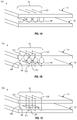
  • FIGS. 1A-1C illustrate generally a perspective view of electronic package 100 including an inductor 101 formed at a second level interface according to various examples of the present subject matter.
  • the electronic package 100 can include a first substrate 111 , a second substrate 112 , and interconnects 102 of the second level interface for electrically and mechanically connecting the first substrate 111 with the second substrate 112 .
  • the first substrate can be a die, a substrate of integrated circuit package that includes external connections of the integrated circuit package, or other substrate.
  • the second substrate can be a non-semiconductor substrate, such as a printed circuit board, a non-semiconductor, or organic, interposer package, a portion of a package-to-package interface of a package-on-package (POP) device, or combinations thereof.
  • Each of the first substrate 111 and the second substrate 112 can include traces 103 embedded within or located on a surface of the respective substrate 111 , 112 .
  • Each trace 103 can form a portion of an inductor coil.
  • the respective traces 103 can form one or more coil loops of the inductor 101 .
  • the inductor 101 does not include a magnetic core.
  • FIG. 1A illustrates generally a perspective view of an example inductor 101 formed at a second level interface.
  • FIG. 1B illustrates generally the example of FIG. 1A with dashed lines to show hidden features of the assembled first and second substrates 111 , 112 .
  • FIG. 1C illustrates generally the examples of FIGS. 1A and 1B with the solder ball interconnects 104 drawn as lines.
  • FIG. 1C more clearly illustrates the multiple coils formed when the first substrate 111 and the second substrate 112 are electrically connected.
  • Each of the first substrate 111 and the second substrate 112 can include traces 103 that form the inductor 101 when the substrates 111 , 112 are electrically connected together.
  • the example of FIGS. 1A-1C show the traces 103 on or at a surface of each respective substrate 111 , 112 that faces away from the center of the inductor 103 .
  • Conductive through-silicon-vias (TSVs), or conductive vias 105 extending through the particular substrate 111 , 112 can couple a trace 103 to a respective interconnect 104 or to an interconnect pad 106 used to electrically couple the first and second substrates 111 , 112 together.
  • TSVs through-silicon-vias
  • the traces 103 of each substrate can optionally be at or near the opposite surface of the respective substrate 111 , 112 , for example, the surface of the substrate facing toward the center of the inductor 101 and including the termination for the corresponding interconnect 104 .
  • the interconnects 104 between the first substrate 111 and the second substrate 112 can include solder balls. It is understood that other interconnects besides solder balls or bumps can be used without departing from the present subject matter, including, but not limited to, connection pins, microballs ( ⁇ balls), alloy paste, Cu/Sn bumps, or other suitable interconnect structure for a second level interface.
  • FIG. 2A illustrates generally top or bottom view of a first substrate 211 configured to form an inductor at a second level interface.
  • the first substrate 211 can include an integrated circuit, and one or more traces 203 configured to form a portion of each coil of the inductor.
  • the traces 203 can be form on a surface of the first substrate 211 .
  • the traces 203 can be integrated with the first substrate 211 .
  • the first substrate 211 can optionally include vias 205 to connect a trace embedded within the substrate 211 , or on a first surface of the first substrate 211 , with a termination on a second surface of the first substrate 211 .
  • two or more external terminations of the first substrate 211 can connect with external terminations of a second substrate 212 .
  • the first substrate 211 can optionally include one or more terminations or one or more traces that couple the inductor to circuitry on the first substrate 211 .
  • FIG. 2B illustrates generally top or bottom view of a second substrate 212 configured to form an inductor at a second level interface when electrically and mechanically coupled with the first substrate 211 of FIG. 2A .
  • the second substrate 212 can include a non-semiconductor substrate, such as a printed circuit board, and one or more traces 203 configured to form a portion of each coil of the inductor.
  • the traces 203 can be located on a surface of the second substrate 212 .
  • the traces 203 can be integrated with the second substrate 212 .
  • the second substrate 212 can include vias 205 to connect a trace embedded within the substrate 212 , or on a first surface of the second substrate 212 , with a termination on a second surface of the second substrate 212 .
  • two or more external terminations of the second substrate 212 can connect with external terminations of the first substrate 211 to form one or more coils of the inductor.
  • the second substrate 212 can optionally include one or more terminations 215 or one or more traces that couple the inductor to circuitry of, or connected to, the second substrate 212 .
  • the surface of one of the substrates that faces the inside of the inductor coils can include a magnetic material such that the inductor includes a magnetic core.
  • the magnetic material can be assembled to the surface the substrate after most, if not all, of the chemical processing of any semiconductor substrate has been completed. As such, the magnetic material is not exposed to processing materials that can accelerate corrosion, and chemical baths used to process a semiconductor substrate are not exposed to contamination from the magnetic material.
  • FIG. 3 illustrates generally a flowchart of an example method 300 for manufacturing an inductor at a second level interface that does not increase the z-height of a stacked electronic package.
  • a first portion of an inductor coil can be fabricated at or on a first substrate.
  • the first portion can include a conductive trace deposited on, grown on, or embedded within the first substrate.
  • the first portion can include conductive vias to extend the trace to an external or internal termination of the first substrate.
  • a second portion of the inductor coil can be fabricated at or on a second non-semiconductor substrate.
  • the second portion can include a conductive trace deposited on, grown on, or embedded within the second substrate.
  • the second portion can include conductive vias to extend the trace to an external or internal termination of the second substrate.
  • the first substrate can be electrically and mechanically coupled with the second substrate and can include electrically and mechanically coupling the first portion of the inductor coil with the second portion of the inductor coil to provide an inductor having at least one conductive coil or turn.
  • the first portion of inductor coil can be electrically connected with the second portion of the inductor coil using interconnects such as solder balls or pins. In such cases, the interconnects can become part of the inductor and can form a portion of an inductor coil.
  • a core material of the inductor can be fabricated on at least one of the first substrate or the second substrate such that the core material traverses through a coil of the inductor formed by the first portion, the second portion and the interconnects.
  • the core material can include a magnetic material, such as, but not limited to, a ferrous material, organic magnetic materials, inorganic magnetic materials, composite magnetic materials, or combination thereof.
  • the core material can be applied using sputtering, spin coating, lamination, paste printing, or combinations thereof.
  • the magnetic material can be applied by, but not limited to, chemical vapor deposition or sputtering.
  • Such processes can allow use of insulating magnetic materials with higher permeability (1400-2400) including, but not limited to, FeXN, where Fe is iron, N is nitrogen and X can be Titanium (Ti), Aluminum (Al), Hafnium (Hf), Cobalt-Halfnium (CoHf), Chromium-Halfnium (CrHf).
  • FIG. 4 illustrates a block diagram of an example machine 400 upon which any one or more of the techniques (e.g., methodologies) discussed herein may perform.
  • the machine 400 may operate as a standalone device or may be connected (e.g., networked) to other machines. In a networked deployment, the machine 400 may operate in the capacity of a server machine, a client machine, or both in server-client network environments.
  • the machine 400 may act as a peer machine in peer-to-peer (or other distributed) network environment.
  • peer-to-peer refers to a data link directly between two devices (e.g., it is not a hub- and spoke topology).
  • peer-to-peer networking is networking to a set of machines using peer-to-peer data links.
  • the machine 400 may be a single-board computer, an integrated circuit package, a system-on-a-chip (SOC), a personal computer (PC), a tablet PC, a set-top box (STB), a personal digital assistant (PDA), a mobile telephone, a web appliance, a network router, or other machine capable of executing instructions (sequential or otherwise) that specify actions to be taken by that machine.
  • SOC system-on-a-chip
  • PC personal computer
  • PDA personal digital assistant
  • STB set-top box
  • mobile telephone a web appliance
  • network router or other machine capable of executing instructions (sequential or otherwise) that specify actions to be taken by that machine.
  • machine shall also be taken to include any collection of machines that individually or jointly execute a set (or multiple sets) of instructions to perform any one or more of the methodologies discussed herein, such as cloud computing, software as a service (SaaS), other computer cluster configurations.
  • cloud computing software as a service
  • SaaS software as a service
  • Circuitry is a collection of circuits implemented in tangible entities that include hardware (e.g., simple circuits, gates, logic, etc.). Circuitry membership may be flexible over time and underlying hardware variability. Circuitries include members that may, alone or in combination, perform specified operations when operating. In an example, hardware of the circuitry may be immutably designed to carry out a specific operation (e.g., hardwired).
  • the hardware of the circuitry may include variably connected physical components (e.g., execution units, transistors, simple circuits, etc.) including a computer readable medium physically modified (e.g., magnetically, electrically, moveable placement of invariant massed particles, etc.) to encode instructions of the specific operation.
  • a computer readable medium physically modified (e.g., magnetically, electrically, moveable placement of invariant massed particles, etc.) to encode instructions of the specific operation.
  • the instructions enable embedded hardware (e.g., the execution units or a loading mechanism) to create members of the circuitry in hardware via the variable connections to carry out portions of the specific operation when in operation.
  • the computer readable medium is communicatively coupled to the other components of the circuitry when the device is operating.
  • any of the physical components may be used in more than one member of more than one circuitry.
  • execution units may be used in a first circuit of a first circuitry at one point in time and reused by a second circuit in the first circuitry, or by a third circuit in a second circuitry at a different time.
  • Machine 400 may include a hardware processor 402 (e.g., a central processing unit (CPU), a graphics processing unit (GPU), a hardware processor core, or any combination thereof), a main memory 404 and a static memory 406 , some or all of which may communicate with each other via an interlink (e.g., bus) 408 .
  • the machine 400 may further include a display unit 410 , an alphanumeric input device 412 (e.g., a keyboard), and a user interface (UI) navigation device 414 (e.g., a mouse).
  • the display unit 410 , input device 412 and UI navigation device 414 may be a touch screen display.
  • the machine 400 may additionally include a storage device (e.g., drive unit) 416 , a signal generation device 418 (e.g., a speaker), a network interface device 420 , and one or more sensors 421 , such as a global positioning system (GPS) sensor, compass, accelerometer, or other sensor.
  • the machine 400 may include an output controller 428 , such as a serial (e.g., universal serial bus (USB), parallel, or other wired or wireless (e.g., infrared (IR), near field communication (NFC), etc.) connection to communicate or control one or more peripheral devices (e.g., a printer, card reader, etc.).
  • a serial e.g., universal serial bus (USB), parallel, or other wired or wireless (e.g., infrared (IR), near field communication (NFC), etc.) connection to communicate or control one or more peripheral devices (e.g., a printer, card reader, etc.).
  • the storage device 416 may include a machine readable medium 422 on which is stored one or more sets of data structures or instructions 424 (e.g., software) embodying or utilized by any one or more of the techniques or functions described herein.
  • the instructions 424 may also reside, completely or at least partially, within the main memory 404 , within static memory 406 , or within the hardware processor 402 during execution thereof by the machine 400 .
  • one or any combination of the hardware processor 402 , the main memory 404 , the static memory 406 , or the storage device 416 may constitute machine readable media.
  • machine readable medium 422 is illustrated as a single medium, the term “machine readable medium” may include a single medium or multiple media (e.g., a centralized or distributed database, and/or associated caches and servers) configured to store the one or more instructions 424 .
  • machine readable medium may include a single medium or multiple media (e.g., a centralized or distributed database, and/or associated caches and servers) configured to store the one or more instructions 424 .
  • machine readable medium may include any medium that is capable of storing, encoding, or carrying instructions for execution by the machine 400 and that cause the machine 400 to perform any one or more of the techniques of the present disclosure, or that is capable of storing, encoding or carrying data structures used by or associated with such instructions.
  • Non-limiting machine readable medium examples may include solid-state memories, and optical and magnetic media.
  • a massed machine readable medium comprises a machine readable medium with a plurality of particles having invariant (e.g., rest) mass. Accordingly, massed machine-readable media are not transitory propagating signals.
  • massed machine readable media may include: non-volatile memory, such as semiconductor memory devices (e.g., Electrically Programmable Read-Only Memory (EPROM), Electrically Erasable Programmable Read-Only Memory (EEPROM)) and flash memory devices; magnetic disks, such as internal hard disks and removable disks; magneto-optical disks; and CD-ROM and DVD-ROM disks.
  • non-volatile memory such as semiconductor memory devices (e.g., Electrically Programmable Read-Only Memory (EPROM), Electrically Erasable Programmable Read-Only Memory (EEPROM)) and flash memory devices
  • EPROM Electrically Programmable Read-Only Memory
  • EEPROM Electrically Erasable Programmable Read-Only Memory
  • flash memory devices e.g., electrically Erasable Programmable Read-Only Memory (EEPROM)
  • EPROM Electrically Programmable Read-Only Memory
  • EEPROM Electrically Erasable Programmable Read-Only Memory
  • flash memory devices e.g., electrical
  • the instructions 424 may further be transmitted or received over a communications network 426 using a transmission medium via the network interface device 420 utilizing any one of a number of transfer protocols (e.g., frame relay, internet protocol (IP), transmission control protocol (TCP), user datagram protocol (UDP), hypertext transfer protocol (HTTP), etc.).
  • transfer protocols e.g., frame relay, internet protocol (IP), transmission control protocol (TCP), user datagram protocol (UDP), hypertext transfer protocol (HTTP), etc.
  • Example communication networks may include a local area network (LAN), a wide area network (WAN), a packet data network (e.g., the Internet), mobile telephone networks (e.g., cellular networks), Plain Old Telephone (POTS) networks, and wireless data networks (e.g., Institute of Electrical and Electronics Engineers (IEEE) 802.11 family of standards known as Wi-Fi®, IEEE 802.16 family of standards known as WiMax®), IEEE 802.15.4 family of standards, peer-to-peer (P2P) networks, among others.
  • the network interface device 420 may include one or more physical jacks (e.g., Ethernet, coaxial, or phone jacks) or one or more antennas to connect to the communications network 426 .
  • the network interface device 420 may include a plurality of antennas to wirelessly communicate using at least one of single-input multiple-output (SIMO), multiple-input multiple-output (MIMO), or multiple-input single-output (MISO) techniques.
  • SIMO single-input multiple-output
  • MIMO multiple-input multiple-output
  • MISO multiple-input single-output
  • transmission medium shall be taken to include any intangible medium that is capable of storing, encoding or carrying instructions for execution by the machine 400 , and includes digital or analog communications signals or other intangible medium to facilitate communication of such software.
  • FIG. 5 illustrates a system level diagram, depicting an example of an electronic device (e.g., system) that can include an inductor formed at a second level interface.
  • FIG. 5 is included to show an example of a higher level device application that can use serial interfaces, such as those discussed above, exchange data between the illustrated components.
  • system 500 includes, but is not limited to, a desktop computer, a laptop computer, a netbook, a tablet, a notebook computer, a personal digital assistant (PDA), a server, a workstation, a cellular telephone, a mobile computing device, a smart phone, an Internet appliance or any other type of computing device.
  • system 500 is a system on a chip (SOC) system.
  • SOC system on a chip
  • processor 510 has one or more processor cores 512 and 512 N, where 512 N represents the Nth processor core inside processor 510 where N is a positive integer.
  • system 500 includes multiple processors including 510 and 505 , where processor 505 has logic similar or identical to the logic of processor 510 .
  • processing core 512 includes, but is not limited to, pre-fetch logic to fetch instructions, decode logic to decode the instructions, execution logic to execute instructions and the like.
  • processor 510 has a cache memory 516 to cache instructions and/or data for system 500 . Cache memory 516 may be organized into a hierarchal structure including one or more levels of cache memory.
  • processor 510 includes a memory controller 514 , which is operable to perform functions that enable the processor 510 to access and communicate with memory 530 that includes a volatile memory 532 and/or a non-volatile memory 534 .
  • processor 510 is coupled with memory 530 and chipset 520 .
  • Processor 510 may also be coupled to a wireless antenna 578 to communicate with any device configured to transmit and/or receive wireless signals.
  • an interface for wireless antenna 578 operates in accordance with, but is not limited to, the IEEE 802.11 standard and its related family, Home Plug AV (HPAV), Ultra Wide Band (UWB), Bluetooth, WiMax, or any form of wireless communication protocol.
  • volatile memory 532 includes, but is not limited to, Synchronous Dynamic Random Access Memory (SDRAM), Dynamic Random Access Memory (DRAM), RAMBUS Dynamic Random Access Memory (RDRAM), and/or any other type of random access memory device.
  • Non-volatile memory 534 includes, but is not limited to, flash memory, phase change memory (PCM), read-only memory (ROM), electrically erasable programmable read-only memory (EEPROM), or any other type of non-volatile memory device.
  • Memory 530 stores information and instructions to be executed by processor 510 .
  • memory 530 may also store temporary variables or other intermediate information while processor 510 is executing instructions.
  • chipset 520 connects with processor 510 via Point-to-Point (PtP or P-P) interfaces 517 and 522 .
  • Chipset 520 enables processor 510 to connect to other elements in system 500 .
  • interfaces 517 and 522 operate in accordance with a PtP communication protocol such as the Intel® QuickPath Interconnect (QPI) or the like. In other embodiments, a different interconnect may be used.
  • PtP Point-to-Point
  • QPI QuickPath Interconnect
  • chipset 520 is operable to communicate with processor 510 , 505 N, display device 540 , and other devices, including a bus bridge 572 , a smart TV 576 , I/O devices 574 , nonvolatile memory 560 , a storage medium (such as one or more mass storage devices) 562 , a keyboard/mouse 564 , a network interface 566 , and various forms of consumer electronics 577 (such as a PDA, smart phone, tablet etc.), etc.
  • chipset 520 couples with these devices through an interface 524 .
  • Chipset 520 may also be coupled to a wireless antenna 578 to communicate with any device configured to transmit and/or receive wireless signals.
  • Chipset 520 connects to display device 540 via interface 526 .
  • Display 540 may be, for example, a liquid crystal display (LCD), a plasma display, cathode ray tube (CRT) display, or any other form of visual display device.
  • processor 510 and chipset 520 are merged into a single SOC.
  • chipset 520 connects to one or more buses 550 and 555 that interconnect various system elements, such as I/O devices 574 , nonvolatile memory 560 , storage medium 562 , a keyboard/mouse 564 , and network interface 566 .
  • Buses 550 and 555 may be interconnected together via a bus bridge 572 .
  • mass storage device 562 includes, but is not limited to, a solid-state drive, a hard disk drive, a universal serial bus flash memory drive, or any other form of computer data storage medium.
  • network interface 566 is implemented by any type of well-known network interface standard including, but not limited to, an Ethernet interface, a universal serial bus (USB) interface, a Peripheral Component Interconnect (PCI) Express interface, a wireless interface and/or any other suitable type of interface.
  • the wireless interface operates in accordance with, but is not limited to, the IEEE 802.11 standard and its related family, Home Plug AV (HPAV), Ultra-Wide Band (UWB), Bluetooth, WiMax, or any form of wireless communication protocol.
  • modules shown in FIG. 5 are depicted as separate blocks within the system 500 , the functions performed by some of these blocks may be integrated within a single semiconductor circuit or may be implemented using two or more separate integrated circuits.
  • cache memory 516 is depicted as a separate block within processor 510 , cache memory 516 (or selected aspects of 516 ) can be incorporated into processor core 512 .
  • the terms “a” or “an” are used, as is common in patent documents, to include one or more than one, independent of any other instances or usages of “at least one” or “one or more.”
  • the term “or” is used to refer to a nonexclusive or, such that “A or B” includes “A but not B,” “B but not A,” and “A and B,” unless otherwise indicated.

Landscapes

  • Engineering & Computer Science (AREA)
  • Power Engineering (AREA)
  • Microelectronics & Electronic Packaging (AREA)
  • Physics & Mathematics (AREA)
  • Condensed Matter Physics & Semiconductors (AREA)
  • General Physics & Mathematics (AREA)
  • Computer Hardware Design (AREA)
  • Geometry (AREA)
  • Coils Or Transformers For Communication (AREA)
  • Semiconductor Integrated Circuits (AREA)

Abstract

Techniques are provided for an inductor at a second level interface between a first substrate and a second substrate. In an example, the inductor can include a winding and a core disposed inside the winding. The winding can include first conductive traces of a first substrate, second conductive traces of a second non-semiconductor substrate, and a plurality of connectors configured to connect the first substrate with the second substrate. Each connector of the plurality of connectors can be located between a trace of the first conductive traces and a corresponding trace of the second conductive traces.

Description

PRIORITY AND RELATED APPLICATIONS
This application claims priority to and is a divisional application of Xu et al., U.S. patent application Ser. No. 16/012,371, filed on Jun. 19, 2018, titled, “TECHNIQUES FOR AN INDUCTOR AT A SECOND LEVEL INTERFACE”, which hereby is incorporated by reference herein in its entirety.
TECHNICAL FIELD
This document pertains generally, but not by way of limitation, to inductors, and more particularly, to an inductor formed at a second level interface of an electronic circuit package.
BACKGROUND
Electronic circuit evolution continues to provide ever increasing functionality and speed from ever smaller systems. Such miniaturization pressures circuit designers to use less components, in smaller sizes, yet deliver the same or improved performance. Inductors have also been relegated to the same design constraints. However, in certain terms, better inductor characteristics typically require increase size in at least one dimension.
BRIEF DESCRIPTION OF THE DRAWINGS
In the drawings, which are not necessarily drawn to scale, like numerals may describe similar components in different views. Like numerals having different letter suffixes may represent different instances of similar components. Some embodiments are illustrated by way of example, and not limitation, in the figures of the accompanying drawings in which:
FIGS. 1A-1C illustrate generally a perspective view of circuit package including an inductor formed at a second level interface according to various examples of the present subject matter.
FIG. 2A illustrates generally top or bottom view of a first circuit configured to form an inductor at a second level interface.
FIG. 2B illustrates generally top or bottom view of a second circuit or circuit board configured to form an inductor at a second level interface when electrically and mechanically coupled with the first circuit of FIG. 2A.
FIG. 3 illustrates generally a flowchart of an example method for manufacturing an inductor at a second level interface that does not increase the z-height of the circuit package.
FIG. 4 illustrates a block diagram of an example machine upon which any one or more of the techniques (e.g., methodologies) discussed herein may perform. In alternative embodiments, the machine may operate as a standalone device or may be connected (e.g., networked) to other machines.
FIG. 5 illustrates a system level diagram, depicting an example of an electronic device (e.g., system) that can employ serial communication improvements as described in the present disclosure.
DETAILED DESCRIPTION
The following description and the drawings sufficiently illustrate specific embodiments to enable those skilled in the art to practice them. Other embodiments may incorporate structural, logical, electrical, process, and other changes. Portions and features of some embodiments may be included in, or substituted for, those of other embodiments. Embodiments set forth in the claims encompass all available equivalents of those claims.
The present inventors have recognized alternative techniques that can provide an inductor with increased z-axis form factor yet not increase the form factor of stacked circuits connected at a second level interface. As used herein, a second level interface is an electrical and mechanical connection between a first circuit substrate and a second non-semiconductor substrate such as a printed circuit board. It is anticipated that future electronic devices may require significant power delivery improvements without increasing in size, especially in vertical height which may be referred to as a z-axis dimension or z-height. Magnetic inductor arrays can provide some improvement, but also require an external device that, in most cases, add to or will not satisfy future z-height requirements. Enabling magnetic materials on a coreless substrate may satisfy both future z-height requirements and performance, however, processes used to embed the magnetic components interact with wet chemistry processes such as, but not limited to, desmear, eless Cu, flash etch, soft etch, or surface finish. Magnetic materials can be exposed to the chemistry baths during processing and can result in premature corrosion, as well as, leaching of the magnetic materials into the baths. Such leaching can corrupt the bath resulting in shorter bath life and diminished chemistry performance, thus, adding additional costs to processing.
FIGS. 1A-1C illustrate generally a perspective view of electronic package 100 including an inductor 101 formed at a second level interface according to various examples of the present subject matter. The electronic package 100 can include a first substrate 111, a second substrate 112, and interconnects 102 of the second level interface for electrically and mechanically connecting the first substrate 111 with the second substrate 112. In certain examples, the first substrate can be a die, a substrate of integrated circuit package that includes external connections of the integrated circuit package, or other substrate. In certain examples, the second substrate can be a non-semiconductor substrate, such as a printed circuit board, a non-semiconductor, or organic, interposer package, a portion of a package-to-package interface of a package-on-package (POP) device, or combinations thereof. Each of the first substrate 111 and the second substrate 112 can include traces 103 embedded within or located on a surface of the respective substrate 111, 112. Each trace 103 can form a portion of an inductor coil. Upon connection of the first substrate 111 with the second substrate 112, the respective traces 103 can form one or more coil loops of the inductor 101. In certain examples, the inductor 101 does not include a magnetic core. In other examples, a magnetic material 107 can be applied to an external side of either the first substrate 111, the second substrate 112, or a combination of the first substrate 111 and the second substrate 112 to provide a magnetic core inductor. FIG. 1A illustrates generally a perspective view of an example inductor 101 formed at a second level interface. FIG. 1B illustrates generally the example of FIG. 1A with dashed lines to show hidden features of the assembled first and second substrates 111, 112. FIG. 1C illustrates generally the examples of FIGS. 1A and 1B with the solder ball interconnects 104 drawn as lines. FIG. 1C more clearly illustrates the multiple coils formed when the first substrate 111 and the second substrate 112 are electrically connected.
Each of the first substrate 111 and the second substrate 112 can include traces 103 that form the inductor 101 when the substrates 111, 112 are electrically connected together. The example of FIGS. 1A-1C show the traces 103 on or at a surface of each respective substrate 111, 112 that faces away from the center of the inductor 103. Conductive through-silicon-vias (TSVs), or conductive vias 105 extending through the particular substrate 111, 112, can couple a trace 103 to a respective interconnect 104 or to an interconnect pad 106 used to electrically couple the first and second substrates 111, 112 together. In other examples, the traces 103 of each substrate can optionally be at or near the opposite surface of the respective substrate 111, 112, for example, the surface of the substrate facing toward the center of the inductor 101 and including the termination for the corresponding interconnect 104. In certain examples, such as that shown in FIGS. 1A and 1B, the interconnects 104 between the first substrate 111 and the second substrate 112 can include solder balls. It is understood that other interconnects besides solder balls or bumps can be used without departing from the present subject matter, including, but not limited to, connection pins, microballs (μballs), alloy paste, Cu/Sn bumps, or other suitable interconnect structure for a second level interface.
FIG. 2A illustrates generally top or bottom view of a first substrate 211 configured to form an inductor at a second level interface. The first substrate 211 can include an integrated circuit, and one or more traces 203 configured to form a portion of each coil of the inductor. In some examples, the traces 203 can be form on a surface of the first substrate 211. In some examples, the traces 203 can be integrated with the first substrate 211. In certain examples, the first substrate 211 can optionally include vias 205 to connect a trace embedded within the substrate 211, or on a first surface of the first substrate 211, with a termination on a second surface of the first substrate 211. In certain examples, two or more external terminations of the first substrate 211 can connect with external terminations of a second substrate 212. In certain examples, the first substrate 211 can optionally include one or more terminations or one or more traces that couple the inductor to circuitry on the first substrate 211.
FIG. 2B illustrates generally top or bottom view of a second substrate 212 configured to form an inductor at a second level interface when electrically and mechanically coupled with the first substrate 211 of FIG. 2A. The second substrate 212 can include a non-semiconductor substrate, such as a printed circuit board, and one or more traces 203 configured to form a portion of each coil of the inductor. In some examples, the traces 203 can be located on a surface of the second substrate 212. In some examples, the traces 203 can be integrated with the second substrate 212. In certain examples, the second substrate 212 can include vias 205 to connect a trace embedded within the substrate 212, or on a first surface of the second substrate 212, with a termination on a second surface of the second substrate 212. In certain examples, two or more external terminations of the second substrate 212 can connect with external terminations of the first substrate 211 to form one or more coils of the inductor. In certain examples, the second substrate 212 can optionally include one or more terminations 215 or one or more traces that couple the inductor to circuitry of, or connected to, the second substrate 212.
In certain examples, the surface of one of the substrates that faces the inside of the inductor coils can include a magnetic material such that the inductor includes a magnetic core. The magnetic material can be assembled to the surface the substrate after most, if not all, of the chemical processing of any semiconductor substrate has been completed. As such, the magnetic material is not exposed to processing materials that can accelerate corrosion, and chemical baths used to process a semiconductor substrate are not exposed to contamination from the magnetic material.
FIG. 3 illustrates generally a flowchart of an example method 300 for manufacturing an inductor at a second level interface that does not increase the z-height of a stacked electronic package. At 301, a first portion of an inductor coil can be fabricated at or on a first substrate. In certain examples, the first portion can include a conductive trace deposited on, grown on, or embedded within the first substrate. In some examples, the first portion can include conductive vias to extend the trace to an external or internal termination of the first substrate.
At 303, a second portion of the inductor coil can be fabricated at or on a second non-semiconductor substrate. In certain examples, the second portion can include a conductive trace deposited on, grown on, or embedded within the second substrate. In some examples, the second portion can include conductive vias to extend the trace to an external or internal termination of the second substrate.
At 305, the first substrate can be electrically and mechanically coupled with the second substrate and can include electrically and mechanically coupling the first portion of the inductor coil with the second portion of the inductor coil to provide an inductor having at least one conductive coil or turn. In certain examples, the first portion of inductor coil can be electrically connected with the second portion of the inductor coil using interconnects such as solder balls or pins. In such cases, the interconnects can become part of the inductor and can form a portion of an inductor coil.
In some examples, a core material of the inductor can be fabricated on at least one of the first substrate or the second substrate such that the core material traverses through a coil of the inductor formed by the first portion, the second portion and the interconnects. In some examples, the core material can include a magnetic material, such as, but not limited to, a ferrous material, organic magnetic materials, inorganic magnetic materials, composite magnetic materials, or combination thereof. In certain examples, the core material can be applied using sputtering, spin coating, lamination, paste printing, or combinations thereof. In certain examples, the magnetic material can be applied by, but not limited to, chemical vapor deposition or sputtering. Such processes can allow use of insulating magnetic materials with higher permeability (1400-2400) including, but not limited to, FeXN, where Fe is iron, N is nitrogen and X can be Titanium (Ti), Aluminum (Al), Hafnium (Hf), Cobalt-Halfnium (CoHf), Chromium-Halfnium (CrHf).
FIG. 4 illustrates a block diagram of an example machine 400 upon which any one or more of the techniques (e.g., methodologies) discussed herein may perform. In alternative embodiments, the machine 400 may operate as a standalone device or may be connected (e.g., networked) to other machines. In a networked deployment, the machine 400 may operate in the capacity of a server machine, a client machine, or both in server-client network environments. In an example, the machine 400 may act as a peer machine in peer-to-peer (or other distributed) network environment. As used herein, peer-to-peer refers to a data link directly between two devices (e.g., it is not a hub- and spoke topology). Accordingly, peer-to-peer networking is networking to a set of machines using peer-to-peer data links. The machine 400 may be a single-board computer, an integrated circuit package, a system-on-a-chip (SOC), a personal computer (PC), a tablet PC, a set-top box (STB), a personal digital assistant (PDA), a mobile telephone, a web appliance, a network router, or other machine capable of executing instructions (sequential or otherwise) that specify actions to be taken by that machine. Further, while only a single machine is illustrated, the term “machine” shall also be taken to include any collection of machines that individually or jointly execute a set (or multiple sets) of instructions to perform any one or more of the methodologies discussed herein, such as cloud computing, software as a service (SaaS), other computer cluster configurations.
Examples, as described herein, may include, or may operate by, logic or a number of components, or mechanisms. Circuitry is a collection of circuits implemented in tangible entities that include hardware (e.g., simple circuits, gates, logic, etc.). Circuitry membership may be flexible over time and underlying hardware variability. Circuitries include members that may, alone or in combination, perform specified operations when operating. In an example, hardware of the circuitry may be immutably designed to carry out a specific operation (e.g., hardwired). In an example, the hardware of the circuitry may include variably connected physical components (e.g., execution units, transistors, simple circuits, etc.) including a computer readable medium physically modified (e.g., magnetically, electrically, moveable placement of invariant massed particles, etc.) to encode instructions of the specific operation. In connecting the physical components, the underlying electrical properties of a hardware constituent are changed, for example, from an insulator to a conductor or vice versa. The instructions enable embedded hardware (e.g., the execution units or a loading mechanism) to create members of the circuitry in hardware via the variable connections to carry out portions of the specific operation when in operation. Accordingly, the computer readable medium is communicatively coupled to the other components of the circuitry when the device is operating. In an example, any of the physical components may be used in more than one member of more than one circuitry. For example, under operation, execution units may be used in a first circuit of a first circuitry at one point in time and reused by a second circuit in the first circuitry, or by a third circuit in a second circuitry at a different time.
Machine (e.g., computer system) 400 may include a hardware processor 402 (e.g., a central processing unit (CPU), a graphics processing unit (GPU), a hardware processor core, or any combination thereof), a main memory 404 and a static memory 406, some or all of which may communicate with each other via an interlink (e.g., bus) 408. The machine 400 may further include a display unit 410, an alphanumeric input device 412 (e.g., a keyboard), and a user interface (UI) navigation device 414 (e.g., a mouse). In an example, the display unit 410, input device 412 and UI navigation device 414 may be a touch screen display. The machine 400 may additionally include a storage device (e.g., drive unit) 416, a signal generation device 418 (e.g., a speaker), a network interface device 420, and one or more sensors 421, such as a global positioning system (GPS) sensor, compass, accelerometer, or other sensor. The machine 400 may include an output controller 428, such as a serial (e.g., universal serial bus (USB), parallel, or other wired or wireless (e.g., infrared (IR), near field communication (NFC), etc.) connection to communicate or control one or more peripheral devices (e.g., a printer, card reader, etc.). In certain examples, any one or more of the display unit 410, storage device 416, network interface device or combination thereof can include a multiple device PCIe card.
The storage device 416 may include a machine readable medium 422 on which is stored one or more sets of data structures or instructions 424 (e.g., software) embodying or utilized by any one or more of the techniques or functions described herein. The instructions 424 may also reside, completely or at least partially, within the main memory 404, within static memory 406, or within the hardware processor 402 during execution thereof by the machine 400. In an example, one or any combination of the hardware processor 402, the main memory 404, the static memory 406, or the storage device 416 may constitute machine readable media.
While the machine readable medium 422 is illustrated as a single medium, the term “machine readable medium” may include a single medium or multiple media (e.g., a centralized or distributed database, and/or associated caches and servers) configured to store the one or more instructions 424.
The term “machine readable medium” may include any medium that is capable of storing, encoding, or carrying instructions for execution by the machine 400 and that cause the machine 400 to perform any one or more of the techniques of the present disclosure, or that is capable of storing, encoding or carrying data structures used by or associated with such instructions. Non-limiting machine readable medium examples may include solid-state memories, and optical and magnetic media. In an example, a massed machine readable medium comprises a machine readable medium with a plurality of particles having invariant (e.g., rest) mass. Accordingly, massed machine-readable media are not transitory propagating signals. Specific examples of massed machine readable media may include: non-volatile memory, such as semiconductor memory devices (e.g., Electrically Programmable Read-Only Memory (EPROM), Electrically Erasable Programmable Read-Only Memory (EEPROM)) and flash memory devices; magnetic disks, such as internal hard disks and removable disks; magneto-optical disks; and CD-ROM and DVD-ROM disks.
The instructions 424 may further be transmitted or received over a communications network 426 using a transmission medium via the network interface device 420 utilizing any one of a number of transfer protocols (e.g., frame relay, internet protocol (IP), transmission control protocol (TCP), user datagram protocol (UDP), hypertext transfer protocol (HTTP), etc.). Example communication networks may include a local area network (LAN), a wide area network (WAN), a packet data network (e.g., the Internet), mobile telephone networks (e.g., cellular networks), Plain Old Telephone (POTS) networks, and wireless data networks (e.g., Institute of Electrical and Electronics Engineers (IEEE) 802.11 family of standards known as Wi-Fi®, IEEE 802.16 family of standards known as WiMax®), IEEE 802.15.4 family of standards, peer-to-peer (P2P) networks, among others. In an example, the network interface device 420 may include one or more physical jacks (e.g., Ethernet, coaxial, or phone jacks) or one or more antennas to connect to the communications network 426. In an example, the network interface device 420 may include a plurality of antennas to wirelessly communicate using at least one of single-input multiple-output (SIMO), multiple-input multiple-output (MIMO), or multiple-input single-output (MISO) techniques. The term “transmission medium” shall be taken to include any intangible medium that is capable of storing, encoding or carrying instructions for execution by the machine 400, and includes digital or analog communications signals or other intangible medium to facilitate communication of such software.
FIG. 5 illustrates a system level diagram, depicting an example of an electronic device (e.g., system) that can include an inductor formed at a second level interface. FIG. 5 is included to show an example of a higher level device application that can use serial interfaces, such as those discussed above, exchange data between the illustrated components. In one embodiment, system 500 includes, but is not limited to, a desktop computer, a laptop computer, a netbook, a tablet, a notebook computer, a personal digital assistant (PDA), a server, a workstation, a cellular telephone, a mobile computing device, a smart phone, an Internet appliance or any other type of computing device. In some embodiments, system 500 is a system on a chip (SOC) system.
In one embodiment, processor 510 has one or more processor cores 512 and 512N, where 512N represents the Nth processor core inside processor 510 where N is a positive integer. In one embodiment, system 500 includes multiple processors including 510 and 505, where processor 505 has logic similar or identical to the logic of processor 510. In some embodiments, processing core 512 includes, but is not limited to, pre-fetch logic to fetch instructions, decode logic to decode the instructions, execution logic to execute instructions and the like. In some embodiments, processor 510 has a cache memory 516 to cache instructions and/or data for system 500. Cache memory 516 may be organized into a hierarchal structure including one or more levels of cache memory.
In some embodiments, processor 510 includes a memory controller 514, which is operable to perform functions that enable the processor 510 to access and communicate with memory 530 that includes a volatile memory 532 and/or a non-volatile memory 534. In some embodiments, processor 510 is coupled with memory 530 and chipset 520. Processor 510 may also be coupled to a wireless antenna 578 to communicate with any device configured to transmit and/or receive wireless signals. In one embodiment, an interface for wireless antenna 578 operates in accordance with, but is not limited to, the IEEE 802.11 standard and its related family, Home Plug AV (HPAV), Ultra Wide Band (UWB), Bluetooth, WiMax, or any form of wireless communication protocol.
In some embodiments, volatile memory 532 includes, but is not limited to, Synchronous Dynamic Random Access Memory (SDRAM), Dynamic Random Access Memory (DRAM), RAMBUS Dynamic Random Access Memory (RDRAM), and/or any other type of random access memory device. Non-volatile memory 534 includes, but is not limited to, flash memory, phase change memory (PCM), read-only memory (ROM), electrically erasable programmable read-only memory (EEPROM), or any other type of non-volatile memory device.
Memory 530 stores information and instructions to be executed by processor 510. In one embodiment, memory 530 may also store temporary variables or other intermediate information while processor 510 is executing instructions. In the illustrated embodiment, chipset 520 connects with processor 510 via Point-to-Point (PtP or P-P) interfaces 517 and 522. Chipset 520 enables processor 510 to connect to other elements in system 500. In some embodiments of the example system, interfaces 517 and 522 operate in accordance with a PtP communication protocol such as the Intel® QuickPath Interconnect (QPI) or the like. In other embodiments, a different interconnect may be used.
In some embodiments, chipset 520 is operable to communicate with processor 510, 505N, display device 540, and other devices, including a bus bridge 572, a smart TV 576, I/O devices 574, nonvolatile memory 560, a storage medium (such as one or more mass storage devices) 562, a keyboard/mouse 564, a network interface 566, and various forms of consumer electronics 577 (such as a PDA, smart phone, tablet etc.), etc. In one embodiment, chipset 520 couples with these devices through an interface 524. Chipset 520 may also be coupled to a wireless antenna 578 to communicate with any device configured to transmit and/or receive wireless signals.
Chipset 520 connects to display device 540 via interface 526. Display 540 may be, for example, a liquid crystal display (LCD), a plasma display, cathode ray tube (CRT) display, or any other form of visual display device. In some embodiments of the example system, processor 510 and chipset 520 are merged into a single SOC. In addition, chipset 520 connects to one or more buses 550 and 555 that interconnect various system elements, such as I/O devices 574, nonvolatile memory 560, storage medium 562, a keyboard/mouse 564, and network interface 566. Buses 550 and 555 may be interconnected together via a bus bridge 572.
In one embodiment, mass storage device 562 includes, but is not limited to, a solid-state drive, a hard disk drive, a universal serial bus flash memory drive, or any other form of computer data storage medium. In one embodiment, network interface 566 is implemented by any type of well-known network interface standard including, but not limited to, an Ethernet interface, a universal serial bus (USB) interface, a Peripheral Component Interconnect (PCI) Express interface, a wireless interface and/or any other suitable type of interface. In one embodiment, the wireless interface operates in accordance with, but is not limited to, the IEEE 802.11 standard and its related family, Home Plug AV (HPAV), Ultra-Wide Band (UWB), Bluetooth, WiMax, or any form of wireless communication protocol.
While the modules shown in FIG. 5 are depicted as separate blocks within the system 500, the functions performed by some of these blocks may be integrated within a single semiconductor circuit or may be implemented using two or more separate integrated circuits. For example, although cache memory 516 is depicted as a separate block within processor 510, cache memory 516 (or selected aspects of 516) can be incorporated into processor core 512.
ADDITIONAL NOTES
The above detailed description includes references to the accompanying drawings, which form a part of the detailed description. The drawings show, by way of illustration, specific embodiments in which the invention can be practiced. These embodiments are also referred to herein as “examples.” Such examples can include elements in addition to those shown or described. However, the present inventors also contemplate examples in which only those elements shown or described are provided. Moreover, the present inventors also contemplate examples using any combination or permutation of those elements shown or described (or one or more aspects thereof), either with respect to a particular example (or one or more aspects thereof), or with respect to other examples (or one or more aspects thereof) shown or described herein.
In this document, the terms “a” or “an” are used, as is common in patent documents, to include one or more than one, independent of any other instances or usages of “at least one” or “one or more.” In this document, the term “or” is used to refer to a nonexclusive or, such that “A or B” includes “A but not B,” “B but not A,” and “A and B,” unless otherwise indicated. In this document, the terms “including” and “in which” are used as the plain-English equivalents of the respective terms “comprising” and “wherein.” Also, in the following claims, the terms “including” and “comprising” are open-ended, that is, a system, device, article, composition, formulation, or process that includes elements in addition to those listed after such a term in a claim are still deemed to fall within the scope of that claim. Moreover, in the following claims, the terms “first,” “second,” and “third,” etc. are used merely as labels, and are not intended to impose numerical requirements on their objects.
The above description is intended to be illustrative, and not restrictive. For example, the above-described examples (or one or more aspects thereof) may be used in combination with each other. Other embodiments can be used, such as by one of ordinary skill in the art upon reviewing the above description. The Abstract is provided to comply with 37 C.F.R. § 1.72(b), to allow the reader to quickly ascertain the nature of the technical disclosure. It is submitted with the understanding that it will not be used to interpret or limit the scope or meaning of the claims. Also, in the above Detailed Description, various features may be grouped together to streamline the disclosure. This should not be interpreted as intending that an unclaimed disclosed feature is essential to any claim. Rather, inventive subject matter may lie in less than all features of a particular disclosed embodiment. Thus, the following claims are hereby incorporated into the Detailed Description, with each claim standing on its own as a separate embodiment, and it is contemplated that such embodiments can be combined with each other in various combinations or permutations. The scope of the invention should be determined with reference to the appended claims, along with the full scope of equivalents to which such claims are legally entitled.

Claims (13)

What is claimed is:
1. A method comprising:
fabricating a first portion of an inductor coil at a first substrate of an integrated circuit package;
fabricating a second portion of the inductor coil in a second substrate, wherein the second substrate is a non-semiconductor substrate, and wherein the second substrate is a printed circuit board; and
electrically and mechanically coupling the integrated circuit package and the first portion of the inductor coil with the second substrate and the second portion of inductor coil.
2. The method of claim 1, wherein the second substrate is an interposer.
3. The method of claim 1, wherein the second substrate is an interface.
4. The method of claim 3, wherein the interface is a package-to-package interface of a package-on-package device.
5. The method of claim 1, wherein fabricating the first portion of the inductor coil includes coupling a trace at the first substrate forming a first portion of a first winding coil to first and second external terminations of the second substrate, the trace configured to form a first portion of a first complete winding of the inductor coil.
6. The method of claim 5, including depositing a magnetic material to the first substrate between the first and second external terminations of the second substrate.
7. The method of claim 1, wherein fabricating the second portion of the inductor coil includes coupling a trace of the second substrate to first and second external terminations of the second substrate.
8. The method of claim 7, including depositing a magnetic material to a surface of the second substrate between the first and second external terminations of the second substrate.
9. The method of claim 1, wherein electrically and mechanically coupling the integrated circuit package and first portion of inductor coil with the second substrate and second portion of inductor coil includes mechanically and electrically coupling a trace of the first portion of the inductor coil with a trace of the second portion of the inductor coil using a solder ball connector.
10. The method of claim 1, wherein electrically and mechanically coupling the integrated circuit package and first portion of inductor coil with the second substrate and second portion of inductor coil includes mechanically and electrically coupling a trace of the first portion of the inductor coil with a trace of the second portion of the inductor coil using a connection pin connector.
11. The method of claim 1, wherein electrically and mechanically coupling the integrated circuit package and first portion of inductor coil with the second substrate and second portion of inductor coil includes mechanically and electrically coupling a trace of the first portion of the inductor coil with a trace of the second portion of the inductor coil using a microball (μball) connector.
12. The method of claim 1, wherein electrically and mechanically coupling the integrated circuit package and first portion of inductor coil with the second substrate and second portion of inductor coil includes mechanically and electrically coupling a trace of the first portion of the inductor coil with a trace of the second portion of the inductor coil using an alloy paste.
13. The method of claim 1, wherein electrically and mechanically coupling the integrated circuit package and first portion of inductor coil with the second substrate and second portion of inductor coil includes mechanically and electrically coupling a trace of the first portion of the inductor coil with a trace of the second portion of the inductor coil using copper/tin (Cu/Sn) solder humps.
US16/990,782 2018-06-19 2020-08-11 Techniques for an inductor at a second level interface Active US11031360B2 (en)

Priority Applications (1)

Application Number Priority Date Filing Date Title
US16/990,782 US11031360B2 (en) 2018-06-19 2020-08-11 Techniques for an inductor at a second level interface

Applications Claiming Priority (2)

Application Number Priority Date Filing Date Title
US16/012,371 US10777514B2 (en) 2018-06-19 2018-06-19 Techniques for an inductor at a second level interface
US16/990,782 US11031360B2 (en) 2018-06-19 2020-08-11 Techniques for an inductor at a second level interface

Related Parent Applications (1)

Application Number Title Priority Date Filing Date
US16/012,371 Division US10777514B2 (en) 2018-06-19 2018-06-19 Techniques for an inductor at a second level interface

Publications (2)

Publication Number Publication Date
US20200373257A1 US20200373257A1 (en) 2020-11-26
US11031360B2 true US11031360B2 (en) 2021-06-08

Family

ID=68839502

Family Applications (2)

Application Number Title Priority Date Filing Date
US16/012,371 Active 2038-06-29 US10777514B2 (en) 2018-06-19 2018-06-19 Techniques for an inductor at a second level interface
US16/990,782 Active US11031360B2 (en) 2018-06-19 2020-08-11 Techniques for an inductor at a second level interface

Family Applications Before (1)

Application Number Title Priority Date Filing Date
US16/012,371 Active 2038-06-29 US10777514B2 (en) 2018-06-19 2018-06-19 Techniques for an inductor at a second level interface

Country Status (1)

Country Link
US (2) US10777514B2 (en)

Families Citing this family (5)

* Cited by examiner, † Cited by third party
Publication number Priority date Publication date Assignee Title
US10777514B2 (en) 2018-06-19 2020-09-15 Intel Corporation Techniques for an inductor at a second level interface
US11320847B2 (en) 2020-02-28 2022-05-03 Qualcomm Incorporated Voltage regulation integrated circuit (IC) with circuit components in an integrated three-dimensional (3D) inductor core and related methods of fabrication
US12309928B2 (en) * 2022-09-26 2025-05-20 Infineon Technologies Austria Ag Interlocked circuit board elements and assemblies
TWI842521B (en) * 2023-05-10 2024-05-11 欣興電子股份有限公司 Wiring board structure and manufacturing method thereof
US20240387092A1 (en) * 2023-05-15 2024-11-21 Qualcomm Incorporated Inductive device

Citations (18)

* Cited by examiner, † Cited by third party
Publication number Priority date Publication date Assignee Title
US20120212919A1 (en) 2011-02-18 2012-08-23 Ibiden Co., Ltd. Inductor component and printed wiring board incorporating inductor component and method for manufacturing inductor component
US20140011315A1 (en) * 2008-03-07 2014-01-09 Stats Chippac, Ltd. Optical Semiconductor Device Having Pre-Molded Leadframe with Window and Method Therefor
US20140034373A1 (en) 2012-07-31 2014-02-06 Ibiden Co., Ltd. Inductor element, method for manufacturing inductor element, and wiring board
US20140111242A1 (en) * 2012-10-24 2014-04-24 Nvidia Corporation Method and apparatus for testing interconnection reliability of a ball grid array on a testing printed circuit board
US20140264791A1 (en) * 2013-03-14 2014-09-18 Mathew J. Manusharow Direct external interconnect for embedded interconnect bridge package
US20150115405A1 (en) 2013-10-31 2015-04-30 Qualcomm Incorporated Wireless interconnects in an interposer
US20160013160A1 (en) 2014-07-11 2016-01-14 Samsung Electronics Co., Ltd. Wafer-to-wafer bonding structure
US20170062120A1 (en) 2015-08-31 2017-03-02 Qualcomm Incorporated Substrate comprising an embedded inductor and a thin film magnetic core
US20170140862A1 (en) 2015-11-13 2017-05-18 Qualcomm Incorporated Thin film magnet inductor structure for high quality (q)-factor radio frequency (rf) applications
US20170271260A1 (en) 2016-03-18 2017-09-21 Infineon Technologies Ag Semiconductor device including a passive component formed in a redistribution layer
US20190206780A1 (en) 2017-12-28 2019-07-04 Intel Corporation Magnetic inductor structures for package devices
US20190272936A1 (en) 2018-03-05 2019-09-05 Intel Corporation Fully embedded magnetic-core in core layer for custom inductor in ic substrate
US20190274217A1 (en) 2018-03-02 2019-09-05 Intel Corporation Core layer with fully encapsulated co-axial magnetic material around pth in ic package substrate
US20190279806A1 (en) 2018-03-12 2019-09-12 Intel Corporation Thin film barrier seed matallization in magnetic-plugged through hole inductor
US20190348389A1 (en) 2017-03-30 2019-11-14 Intel Corporation Apparatus with multi-wafer based device comprising embedded active and/or passive devices and method for forming such
US20190385780A1 (en) 2018-06-19 2019-12-19 Intel Corporation Techniques for an inductor at a first level interface
US20190385959A1 (en) 2018-06-19 2019-12-19 Intel Corporation Techniques for an inductor at a second level interface
US20200006239A1 (en) 2018-06-29 2020-01-02 Intel Corporation Fully integrated voltage regulator circuitry within a substrate

Patent Citations (19)

* Cited by examiner, † Cited by third party
Publication number Priority date Publication date Assignee Title
US20140011315A1 (en) * 2008-03-07 2014-01-09 Stats Chippac, Ltd. Optical Semiconductor Device Having Pre-Molded Leadframe with Window and Method Therefor
US20120212919A1 (en) 2011-02-18 2012-08-23 Ibiden Co., Ltd. Inductor component and printed wiring board incorporating inductor component and method for manufacturing inductor component
US20140034373A1 (en) 2012-07-31 2014-02-06 Ibiden Co., Ltd. Inductor element, method for manufacturing inductor element, and wiring board
US20140111242A1 (en) * 2012-10-24 2014-04-24 Nvidia Corporation Method and apparatus for testing interconnection reliability of a ball grid array on a testing printed circuit board
US20140264791A1 (en) * 2013-03-14 2014-09-18 Mathew J. Manusharow Direct external interconnect for embedded interconnect bridge package
US20150115405A1 (en) 2013-10-31 2015-04-30 Qualcomm Incorporated Wireless interconnects in an interposer
US20160013160A1 (en) 2014-07-11 2016-01-14 Samsung Electronics Co., Ltd. Wafer-to-wafer bonding structure
US20170062120A1 (en) 2015-08-31 2017-03-02 Qualcomm Incorporated Substrate comprising an embedded inductor and a thin film magnetic core
US20170140862A1 (en) 2015-11-13 2017-05-18 Qualcomm Incorporated Thin film magnet inductor structure for high quality (q)-factor radio frequency (rf) applications
US20170271260A1 (en) 2016-03-18 2017-09-21 Infineon Technologies Ag Semiconductor device including a passive component formed in a redistribution layer
US20190348389A1 (en) 2017-03-30 2019-11-14 Intel Corporation Apparatus with multi-wafer based device comprising embedded active and/or passive devices and method for forming such
US20190206780A1 (en) 2017-12-28 2019-07-04 Intel Corporation Magnetic inductor structures for package devices
US20190274217A1 (en) 2018-03-02 2019-09-05 Intel Corporation Core layer with fully encapsulated co-axial magnetic material around pth in ic package substrate
US20190272936A1 (en) 2018-03-05 2019-09-05 Intel Corporation Fully embedded magnetic-core in core layer for custom inductor in ic substrate
US20190279806A1 (en) 2018-03-12 2019-09-12 Intel Corporation Thin film barrier seed matallization in magnetic-plugged through hole inductor
US20190385780A1 (en) 2018-06-19 2019-12-19 Intel Corporation Techniques for an inductor at a first level interface
US20190385959A1 (en) 2018-06-19 2019-12-19 Intel Corporation Techniques for an inductor at a second level interface
US10777514B2 (en) 2018-06-19 2020-09-15 Intel Corporation Techniques for an inductor at a second level interface
US20200006239A1 (en) 2018-06-29 2020-01-02 Intel Corporation Fully integrated voltage regulator circuitry within a substrate

Non-Patent Citations (7)

* Cited by examiner, † Cited by third party
Title
"U.S. Appl. No. 16/012,371, Corrected Notice of Allowability dated Jul. 23, 2020", 5 pgs.
"U.S. Appl. No. 16/012,371, Non Final Office Action dated Jan. 24, 2020", 13 pgs.
"U.S. Appl. No. 16/012,371, Notice of Allowance dated May 14, 2020", 9 pgs.
"U.S. Appl. No. 16/012,371, Response filed Apr. 23, 2020 to Non Final Office Action dated Jan. 24, 2020", 9 pgs.
"U.S. Appl. No. 16/012,371, Response filed Oct. 29, 2019 to Restriction Requirement dated Aug. 29, 2019", 6 pgs.
"U.S. Appl. No. 16/012,371, Restriction Requirement dated Aug. 29, 2019", 7 pgs.
U.S. Appl. No. 16/012,371, filed Jun. 19, 2018, Techniques for an Inductor at a Second Level Interface.

Also Published As

Publication number Publication date
US20190385959A1 (en) 2019-12-19
US20200373257A1 (en) 2020-11-26
US10777514B2 (en) 2020-09-15

Similar Documents

Publication Publication Date Title
US20220230800A1 (en) Techniques for an inductor at a first level interface
US11031360B2 (en) Techniques for an inductor at a second level interface
US20220238506A1 (en) Techniques for die tiling
US8227706B2 (en) Coaxial plated through holes (PTH) for robust electrical performance
US12218064B2 (en) Molded silicon interconnects in bridges for integrated-circuit packages
US10504854B2 (en) Through-stiffener inerconnects for package-on-package apparatus and methods of assembling same
US10085342B2 (en) Microelectronic device having an air core inductor
US20200168538A1 (en) Multiple-surface connected embedded interconnect bridge for semiconductor package substrates
US11011461B2 (en) Perpendicular inductors integrated in a substrate
US20190311978A1 (en) Composite stacked interconnects for high-speed applications and methods of assembling same
US11676910B2 (en) Embedded reference layers for semiconductor package substrates
US20210098350A1 (en) Recess by-pass interconnects
US11476198B2 (en) Multi-level components for integrated-circuit packages
US10083922B2 (en) Inductor interconnect
US10734318B2 (en) Folded semiconductor package architectures and methods of assembling same
EP3479399A1 (en) High density interconnect structures configured for manufacturing and performance
US10903155B2 (en) Vertical modular stiffeners for stacked multi-device packages
US20200006210A1 (en) Chip package and method of manufacturing

Legal Events

Date Code Title Description
FEPP Fee payment procedure

Free format text: ENTITY STATUS SET TO UNDISCOUNTED (ORIGINAL EVENT CODE: BIG.); ENTITY STATUS OF PATENT OWNER: LARGE ENTITY

STPP Information on status: patent application and granting procedure in general

Free format text: NOTICE OF ALLOWANCE MAILED -- APPLICATION RECEIVED IN OFFICE OF PUBLICATIONS

STPP Information on status: patent application and granting procedure in general

Free format text: PUBLICATIONS -- ISSUE FEE PAYMENT RECEIVED

STPP Information on status: patent application and granting procedure in general

Free format text: PUBLICATIONS -- ISSUE FEE PAYMENT VERIFIED

STCF Information on status: patent grant

Free format text: PATENTED CASE

MAFP Maintenance fee payment

Free format text: PAYMENT OF MAINTENANCE FEE, 4TH YEAR, LARGE ENTITY (ORIGINAL EVENT CODE: M1551); ENTITY STATUS OF PATENT OWNER: LARGE ENTITY

Year of fee payment: 4