US11028107B2 - Stable silylating reagents - Google Patents
Stable silylating reagents Download PDFInfo
- Publication number
- US11028107B2 US11028107B2 US15/438,929 US201715438929A US11028107B2 US 11028107 B2 US11028107 B2 US 11028107B2 US 201715438929 A US201715438929 A US 201715438929A US 11028107 B2 US11028107 B2 US 11028107B2
- Authority
- US
- United States
- Prior art keywords
- solution composition
- optionally substituted
- potassium
- preconditioning
- alkyl
- Prior art date
- Legal status (The legal status is an assumption and is not a legal conclusion. Google has not performed a legal analysis and makes no representation as to the accuracy of the status listed.)
- Active, expires
Links
- 239000003153 chemical reaction reagent Substances 0.000 title description 10
- 239000000203 mixture Substances 0.000 claims abstract description 173
- 239000000758 substrate Substances 0.000 claims abstract description 113
- 125000001072 heteroaryl group Chemical group 0.000 claims abstract description 53
- 150000004703 alkoxides Chemical class 0.000 claims abstract description 33
- BLRPTPMANUNPDV-UHFFFAOYSA-N Silane Chemical compound [SiH4] BLRPTPMANUNPDV-UHFFFAOYSA-N 0.000 claims abstract description 17
- -1 potassium alkoxide Chemical class 0.000 claims description 115
- WYURNTSHIVDZCO-UHFFFAOYSA-N Tetrahydrofuran Chemical class C1CCOC1 WYURNTSHIVDZCO-UHFFFAOYSA-N 0.000 claims description 97
- KWYUFKZDYYNOTN-UHFFFAOYSA-M Potassium hydroxide Chemical compound [OH-].[K+] KWYUFKZDYYNOTN-UHFFFAOYSA-M 0.000 claims description 72
- 125000003118 aryl group Chemical group 0.000 claims description 62
- 238000006884 silylation reaction Methods 0.000 claims description 58
- 125000000217 alkyl group Chemical group 0.000 claims description 55
- CPRMKOQKXYSDML-UHFFFAOYSA-M rubidium hydroxide Chemical compound [OH-].[Rb+] CPRMKOQKXYSDML-UHFFFAOYSA-M 0.000 claims description 50
- 239000002243 precursor Substances 0.000 claims description 47
- 230000006698 induction Effects 0.000 claims description 36
- 125000003342 alkenyl group Chemical group 0.000 claims description 34
- HUCVOHYBFXVBRW-UHFFFAOYSA-M caesium hydroxide Inorganic materials [OH-].[Cs+] HUCVOHYBFXVBRW-UHFFFAOYSA-M 0.000 claims description 33
- LPNYRYFBWFDTMA-UHFFFAOYSA-N potassium tert-butoxide Chemical compound [K+].CC(C)(C)[O-] LPNYRYFBWFDTMA-UHFFFAOYSA-N 0.000 claims description 32
- 239000002904 solvent Substances 0.000 claims description 32
- 239000003054 catalyst Substances 0.000 claims description 30
- 125000001424 substituent group Chemical group 0.000 claims description 30
- 125000000304 alkynyl group Chemical group 0.000 claims description 29
- 238000002329 infrared spectrum Methods 0.000 claims description 28
- 229910052700 potassium Inorganic materials 0.000 claims description 28
- 239000011591 potassium Substances 0.000 claims description 28
- BLRHMMGNCXNXJL-UHFFFAOYSA-N 1-methylindole Chemical compound C1=CC=C2N(C)C=CC2=C1 BLRHMMGNCXNXJL-UHFFFAOYSA-N 0.000 claims description 23
- 238000010521 absorption reaction Methods 0.000 claims description 21
- 125000003710 aryl alkyl group Chemical group 0.000 claims description 20
- 229910052701 rubidium Inorganic materials 0.000 claims description 19
- MFGOFGRYDNHJTA-UHFFFAOYSA-N 2-amino-1-(2-fluorophenyl)ethanol Chemical compound NCC(O)C1=CC=CC=C1F MFGOFGRYDNHJTA-UHFFFAOYSA-N 0.000 claims description 18
- 229910052792 caesium Inorganic materials 0.000 claims description 18
- 229910052723 transition metal Inorganic materials 0.000 claims description 15
- 150000003624 transition metals Chemical class 0.000 claims description 15
- 125000002877 alkyl aryl group Chemical group 0.000 claims description 13
- ZLMJMSJWJFRBEC-UHFFFAOYSA-N Potassium Chemical compound [K] ZLMJMSJWJFRBEC-UHFFFAOYSA-N 0.000 claims description 12
- 229910008045 Si-Si Inorganic materials 0.000 claims description 12
- 229910006411 Si—Si Inorganic materials 0.000 claims description 12
- 150000001768 cations Chemical class 0.000 claims description 12
- JWUJQDFVADABEY-UHFFFAOYSA-N 2-methyltetrahydrofuran Chemical compound CC1CCCO1 JWUJQDFVADABEY-UHFFFAOYSA-N 0.000 claims description 11
- OUKMJYHQZXBWNQ-UHFFFAOYSA-N cesium oxidosilane Chemical compound [Cs+].[SiH3][O-] OUKMJYHQZXBWNQ-UHFFFAOYSA-N 0.000 claims description 10
- 125000004475 heteroaralkyl group Chemical group 0.000 claims description 10
- ITMJUULNSKIGHA-UHFFFAOYSA-N oxidosilane rubidium(1+) Chemical compound [Rb+].[SiH3][O-] ITMJUULNSKIGHA-UHFFFAOYSA-N 0.000 claims description 10
- IALUUOKJPBOFJL-UHFFFAOYSA-N potassium oxidosilane Chemical compound [K+].[SiH3][O-] IALUUOKJPBOFJL-UHFFFAOYSA-N 0.000 claims description 10
- 125000004169 (C1-C6) alkyl group Chemical group 0.000 claims description 9
- 125000001997 phenyl group Chemical group [H]C1=C([H])C([H])=C(*)C([H])=C1[H] 0.000 claims description 9
- ZFFBIQMNKOJDJE-UHFFFAOYSA-N 2-bromo-1,2-diphenylethanone Chemical compound C=1C=CC=CC=1C(Br)C(=O)C1=CC=CC=C1 ZFFBIQMNKOJDJE-UHFFFAOYSA-N 0.000 claims description 8
- XLYOFNOQVPJJNP-UHFFFAOYSA-M hydroxide Chemical group [OH-] XLYOFNOQVPJJNP-UHFFFAOYSA-M 0.000 claims description 8
- 230000000977 initiatory effect Effects 0.000 claims description 7
- 125000004076 pyridyl group Chemical group 0.000 claims description 7
- 229910052736 halogen Inorganic materials 0.000 claims description 6
- IGLNJRXAVVLDKE-UHFFFAOYSA-N rubidium atom Chemical compound [Rb] IGLNJRXAVVLDKE-UHFFFAOYSA-N 0.000 claims description 6
- 125000006654 (C3-C12) heteroaryl group Chemical group 0.000 claims description 5
- LFQSCWFLJHTTHZ-UHFFFAOYSA-N Ethanol Chemical compound CCO LFQSCWFLJHTTHZ-UHFFFAOYSA-N 0.000 claims description 5
- TVFDJXOCXUVLDH-UHFFFAOYSA-N caesium atom Chemical compound [Cs] TVFDJXOCXUVLDH-UHFFFAOYSA-N 0.000 claims description 5
- 150000002367 halogens Chemical class 0.000 claims description 4
- 125000000449 nitro group Chemical group [O-][N+](*)=O 0.000 claims description 4
- 125000003944 tolyl group Chemical group 0.000 claims description 4
- 125000003860 C1-C20 alkoxy group Chemical group 0.000 claims description 3
- 230000001143 conditioned effect Effects 0.000 claims 1
- 230000015572 biosynthetic process Effects 0.000 abstract description 21
- 229910052751 metal Inorganic materials 0.000 abstract description 9
- 239000002184 metal Substances 0.000 abstract description 9
- 229910052990 silicon hydride Inorganic materials 0.000 abstract description 2
- 229910000000 metal hydroxide Inorganic materials 0.000 abstract 1
- 150000004692 metal hydroxides Chemical class 0.000 abstract 1
- 238000006243 chemical reaction Methods 0.000 description 73
- 239000002585 base Substances 0.000 description 68
- 238000000034 method Methods 0.000 description 56
- YLQBMQCUIZJEEH-UHFFFAOYSA-N tetrahydrofuran Natural products C=1C=COC=1 YLQBMQCUIZJEEH-UHFFFAOYSA-N 0.000 description 48
- 239000000047 product Substances 0.000 description 42
- 125000004432 carbon atom Chemical group C* 0.000 description 29
- 150000001875 compounds Chemical class 0.000 description 26
- IJGRMHOSHXDMSA-UHFFFAOYSA-N Atomic nitrogen Chemical compound N#N IJGRMHOSHXDMSA-UHFFFAOYSA-N 0.000 description 24
- 125000005842 heteroatom Chemical group 0.000 description 23
- 125000001183 hydrocarbyl group Chemical group 0.000 description 23
- RTZKZFJDLAIYFH-UHFFFAOYSA-N Diethyl ether Chemical compound CCOCC RTZKZFJDLAIYFH-UHFFFAOYSA-N 0.000 description 18
- QVGXLLKOCUKJST-UHFFFAOYSA-N atomic oxygen Chemical compound [O] QVGXLLKOCUKJST-UHFFFAOYSA-N 0.000 description 18
- 239000001301 oxygen Substances 0.000 description 18
- 229910052760 oxygen Inorganic materials 0.000 description 18
- 239000000243 solution Substances 0.000 description 18
- OKTJSMMVPCPJKN-UHFFFAOYSA-N Carbon Chemical compound [C] OKTJSMMVPCPJKN-UHFFFAOYSA-N 0.000 description 15
- 230000009102 absorption Effects 0.000 description 15
- 150000004679 hydroxides Chemical class 0.000 description 15
- 150000001336 alkenes Chemical group 0.000 description 14
- 125000003545 alkoxy group Chemical group 0.000 description 14
- 239000003039 volatile agent Substances 0.000 description 14
- XLYOFNOQVPJJNP-UHFFFAOYSA-N water Substances O XLYOFNOQVPJJNP-UHFFFAOYSA-N 0.000 description 14
- 125000004104 aryloxy group Chemical group 0.000 description 13
- 229910052799 carbon Inorganic materials 0.000 description 13
- 150000002390 heteroarenes Chemical class 0.000 description 13
- LBKJNHPKYFYCLL-UHFFFAOYSA-N potassium;trimethyl(oxido)silane Chemical compound [K+].C[Si](C)(C)[O-] LBKJNHPKYFYCLL-UHFFFAOYSA-N 0.000 description 13
- SIKJAQJRHWYJAI-UHFFFAOYSA-N Indole Chemical compound C1=CC=C2NC=CC2=C1 SIKJAQJRHWYJAI-UHFFFAOYSA-N 0.000 description 12
- 125000002947 alkylene group Chemical group 0.000 description 12
- 229910052757 nitrogen Inorganic materials 0.000 description 12
- JRZJOMJEPLMPRA-UHFFFAOYSA-N olefin Natural products CCCCCCCC=C JRZJOMJEPLMPRA-UHFFFAOYSA-N 0.000 description 11
- 125000003917 carbamoyl group Chemical group [H]N([H])C(*)=O 0.000 description 10
- 239000000463 material Substances 0.000 description 10
- 229910000077 silane Inorganic materials 0.000 description 10
- AQRLNPVMDITEJU-UHFFFAOYSA-N triethylsilane Chemical compound CC[SiH](CC)CC AQRLNPVMDITEJU-UHFFFAOYSA-N 0.000 description 10
- 0 *OB[SiH]([H])(*S)(*S)*S.[CH3+] Chemical compound *OB[SiH]([H])(*S)(*S)*S.[CH3+] 0.000 description 9
- VYPSYNLAJGMNEJ-UHFFFAOYSA-N Silicium dioxide Chemical compound O=[Si]=O VYPSYNLAJGMNEJ-UHFFFAOYSA-N 0.000 description 9
- 125000000524 functional group Chemical group 0.000 description 9
- 125000004404 heteroalkyl group Chemical group 0.000 description 9
- 125000000743 hydrocarbylene group Chemical group 0.000 description 9
- 230000009257 reactivity Effects 0.000 description 9
- XUIMIQQOPSSXEZ-UHFFFAOYSA-N Silicon Chemical compound [Si] XUIMIQQOPSSXEZ-UHFFFAOYSA-N 0.000 description 8
- 125000001797 benzyl group Chemical group [H]C1=C([H])C([H])=C(C([H])=C1[H])C([H])([H])* 0.000 description 8
- 229910021419 crystalline silicon Inorganic materials 0.000 description 8
- 125000004122 cyclic group Chemical group 0.000 description 8
- 238000004817 gas chromatography Methods 0.000 description 8
- 229910052739 hydrogen Inorganic materials 0.000 description 8
- 239000001257 hydrogen Substances 0.000 description 8
- RPDAUEIUDPHABB-UHFFFAOYSA-N potassium ethoxide Chemical compound [K+].CC[O-] RPDAUEIUDPHABB-UHFFFAOYSA-N 0.000 description 8
- 229910052710 silicon Inorganic materials 0.000 description 8
- 239000010703 silicon Substances 0.000 description 8
- 238000005160 1H NMR spectroscopy Methods 0.000 description 7
- XKRFYHLGVUSROY-UHFFFAOYSA-N Argon Chemical compound [Ar] XKRFYHLGVUSROY-UHFFFAOYSA-N 0.000 description 7
- XTHFKEDIFFGKHM-UHFFFAOYSA-N Dimethoxyethane Chemical compound COCCOC XTHFKEDIFFGKHM-UHFFFAOYSA-N 0.000 description 7
- 238000007792 addition Methods 0.000 description 7
- 150000001345 alkine derivatives Chemical class 0.000 description 7
- 125000004435 hydrogen atom Chemical class [H]* 0.000 description 7
- 239000004615 ingredient Substances 0.000 description 7
- 239000000543 intermediate Substances 0.000 description 7
- 150000001282 organosilanes Chemical class 0.000 description 7
- IUBQJLUDMLPAGT-UHFFFAOYSA-N potassium bis(trimethylsilyl)amide Chemical compound C[Si](C)(C)N([K])[Si](C)(C)C IUBQJLUDMLPAGT-UHFFFAOYSA-N 0.000 description 7
- 125000002924 primary amino group Chemical group [H]N([H])* 0.000 description 7
- MFRIHAYPQRLWNB-UHFFFAOYSA-N sodium tert-butoxide Chemical compound [Na+].CC(C)(C)[O-] MFRIHAYPQRLWNB-UHFFFAOYSA-N 0.000 description 7
- 125000006686 (C1-C24) alkyl group Chemical group 0.000 description 6
- WVDDGKGOMKODPV-UHFFFAOYSA-N Benzyl alcohol Chemical compound OCC1=CC=CC=C1 WVDDGKGOMKODPV-UHFFFAOYSA-N 0.000 description 6
- 238000002835 absorbance Methods 0.000 description 6
- 150000001298 alcohols Chemical class 0.000 description 6
- 150000001721 carbon Chemical group 0.000 description 6
- ZUOUZKKEUPVFJK-UHFFFAOYSA-N diphenyl Chemical compound C1=CC=CC=C1C1=CC=CC=C1 ZUOUZKKEUPVFJK-UHFFFAOYSA-N 0.000 description 6
- 230000000694 effects Effects 0.000 description 6
- RAXXELZNTBOGNW-UHFFFAOYSA-N imidazole Chemical class C1=CNC=N1 RAXXELZNTBOGNW-UHFFFAOYSA-N 0.000 description 6
- DIQDUFVJZPNLJQ-UHFFFAOYSA-N indol-1-yl(phenyl)methanone Chemical compound C1=CC2=CC=CC=C2N1C(=O)C1=CC=CC=C1 DIQDUFVJZPNLJQ-UHFFFAOYSA-N 0.000 description 6
- PZOUSPYUWWUPPK-UHFFFAOYSA-N indole Natural products CC1=CC=CC2=C1C=CN2 PZOUSPYUWWUPPK-UHFFFAOYSA-N 0.000 description 6
- RKJUIXBNRJVNHR-UHFFFAOYSA-N indolenine Natural products C1=CC=C2CC=NC2=C1 RKJUIXBNRJVNHR-UHFFFAOYSA-N 0.000 description 6
- 238000001228 spectrum Methods 0.000 description 6
- RCGHUDHVKYOJPV-UHFFFAOYSA-N CN1C=CC2=CC=CC=C12.CN1C=CC2=CC=CC=C12 Chemical compound CN1C=CC2=CC=CC=C12.CN1C=CC2=CC=CC=C12 RCGHUDHVKYOJPV-UHFFFAOYSA-N 0.000 description 5
- 238000005033 Fourier transform infrared spectroscopy Methods 0.000 description 5
- 229910003849 O-Si Inorganic materials 0.000 description 5
- 229910003872 O—Si Inorganic materials 0.000 description 5
- 150000001450 anions Chemical class 0.000 description 5
- IJKVHSBPTUYDLN-UHFFFAOYSA-N dihydroxy(oxo)silane Chemical compound O[Si](O)=O IJKVHSBPTUYDLN-UHFFFAOYSA-N 0.000 description 5
- 238000002474 experimental method Methods 0.000 description 5
- 238000000769 gas chromatography-flame ionisation detection Methods 0.000 description 5
- 239000011521 glass Substances 0.000 description 5
- 125000005843 halogen group Chemical group 0.000 description 5
- 238000011065 in-situ storage Methods 0.000 description 5
- 230000007246 mechanism Effects 0.000 description 5
- 125000002496 methyl group Chemical group [H]C([H])([H])* 0.000 description 5
- 238000012544 monitoring process Methods 0.000 description 5
- BDAWXSQJJCIFIK-UHFFFAOYSA-N potassium methoxide Chemical compound [K+].[O-]C BDAWXSQJJCIFIK-UHFFFAOYSA-N 0.000 description 5
- FCEHBMOGCRZNNI-UHFFFAOYSA-N 1-benzothiophene Chemical compound C1=CC=C2SC=CC2=C1 FCEHBMOGCRZNNI-UHFFFAOYSA-N 0.000 description 4
- BAXOFTOLAUCFNW-UHFFFAOYSA-N 1H-indazole Chemical compound C1=CC=C2C=NNC2=C1 BAXOFTOLAUCFNW-UHFFFAOYSA-N 0.000 description 4
- HBEDSQVIWPRPAY-UHFFFAOYSA-N 2,3-dihydrobenzofuran Chemical compound C1=CC=C2OCCC2=C1 HBEDSQVIWPRPAY-UHFFFAOYSA-N 0.000 description 4
- GWQOOADXMVQEFT-UHFFFAOYSA-N 2,5-Dimethylthiophene Chemical compound CC1=CC=C(C)S1 GWQOOADXMVQEFT-UHFFFAOYSA-N 0.000 description 4
- HEDRZPFGACZZDS-UHFFFAOYSA-N Chloroform Chemical compound ClC(Cl)Cl HEDRZPFGACZZDS-UHFFFAOYSA-N 0.000 description 4
- LCGLNKUTAGEVQW-UHFFFAOYSA-N Dimethyl ether Chemical compound COC LCGLNKUTAGEVQW-UHFFFAOYSA-N 0.000 description 4
- UFHFLCQGNIYNRP-UHFFFAOYSA-N Hydrogen Chemical compound [H][H] UFHFLCQGNIYNRP-UHFFFAOYSA-N 0.000 description 4
- 238000005481 NMR spectroscopy Methods 0.000 description 4
- KYQCOXFCLRTKLS-UHFFFAOYSA-N Pyrazine Chemical class C1=CN=CC=N1 KYQCOXFCLRTKLS-UHFFFAOYSA-N 0.000 description 4
- JUJWROOIHBZHMG-UHFFFAOYSA-N Pyridine Chemical class C1=CC=NC=C1 JUJWROOIHBZHMG-UHFFFAOYSA-N 0.000 description 4
- KAESVJOAVNADME-UHFFFAOYSA-N Pyrrole Chemical class C=1C=CNC=1 KAESVJOAVNADME-UHFFFAOYSA-N 0.000 description 4
- SMWDFEZZVXVKRB-UHFFFAOYSA-N Quinoline Chemical compound N1=CC=CC2=CC=CC=C21 SMWDFEZZVXVKRB-UHFFFAOYSA-N 0.000 description 4
- YTPLMLYBLZKORZ-UHFFFAOYSA-N Thiophene Chemical class C=1C=CSC=1 YTPLMLYBLZKORZ-UHFFFAOYSA-N 0.000 description 4
- 239000000654 additive Substances 0.000 description 4
- 125000004450 alkenylene group Chemical group 0.000 description 4
- PNEYBMLMFCGWSK-UHFFFAOYSA-N aluminium oxide Inorganic materials [O-2].[O-2].[O-2].[Al+3].[Al+3] PNEYBMLMFCGWSK-UHFFFAOYSA-N 0.000 description 4
- 150000001412 amines Chemical class 0.000 description 4
- 229910052786 argon Inorganic materials 0.000 description 4
- 125000004429 atom Chemical group 0.000 description 4
- 238000005102 attenuated total reflection Methods 0.000 description 4
- 125000002915 carbonyl group Chemical group [*:2]C([*:1])=O 0.000 description 4
- 125000003178 carboxy group Chemical group [H]OC(*)=O 0.000 description 4
- 230000003197 catalytic effect Effects 0.000 description 4
- AQRLNPVMDITEJU-WHRKIXHSSA-N deuterio(triethyl)silane Chemical compound CC[Si]([2H])(CC)CC AQRLNPVMDITEJU-WHRKIXHSSA-N 0.000 description 4
- TXCDCPKCNAJMEE-UHFFFAOYSA-N dibenzofuran Chemical compound C1=CC=C2C3=CC=CC=C3OC2=C1 TXCDCPKCNAJMEE-UHFFFAOYSA-N 0.000 description 4
- PZPGRFITIJYNEJ-UHFFFAOYSA-N disilane Chemical compound [SiH3][SiH3] PZPGRFITIJYNEJ-UHFFFAOYSA-N 0.000 description 4
- 125000001033 ether group Chemical group 0.000 description 4
- 125000002534 ethynyl group Chemical group [H]C#C* 0.000 description 4
- 229910052731 fluorine Inorganic materials 0.000 description 4
- 125000005553 heteroaryloxy group Chemical group 0.000 description 4
- NEXSMEBSBIABKL-UHFFFAOYSA-N hexamethyldisilane Chemical group C[Si](C)(C)[Si](C)(C)C NEXSMEBSBIABKL-UHFFFAOYSA-N 0.000 description 4
- 125000002887 hydroxy group Chemical group [H]O* 0.000 description 4
- 125000001841 imino group Chemical group [H]N=* 0.000 description 4
- AWJUIBRHMBBTKR-UHFFFAOYSA-N isoquinoline Chemical compound C1=NC=CC2=CC=CC=C21 AWJUIBRHMBBTKR-UHFFFAOYSA-N 0.000 description 4
- 230000000670 limiting effect Effects 0.000 description 4
- 238000003760 magnetic stirring Methods 0.000 description 4
- 229910052752 metalloid Inorganic materials 0.000 description 4
- 150000002738 metalloids Chemical class 0.000 description 4
- 125000001436 propyl group Chemical group [H]C([*])([H])C([H])([H])C([H])([H])[H] 0.000 description 4
- 150000004760 silicates Chemical class 0.000 description 4
- 239000000377 silicon dioxide Substances 0.000 description 4
- 239000007787 solid Substances 0.000 description 4
- 125000000547 substituted alkyl group Chemical group 0.000 description 4
- 125000003107 substituted aryl group Chemical group 0.000 description 4
- 150000003623 transition metal compounds Chemical class 0.000 description 4
- 125000006273 (C1-C3) alkyl group Chemical group 0.000 description 3
- 238000004483 ATR-FTIR spectroscopy Methods 0.000 description 3
- UHOVQNZJYSORNB-UHFFFAOYSA-N Benzene Chemical compound C1=CC=CC=C1 UHOVQNZJYSORNB-UHFFFAOYSA-N 0.000 description 3
- XEEYBQQBJWHFJM-UHFFFAOYSA-N Iron Chemical compound [Fe] XEEYBQQBJWHFJM-UHFFFAOYSA-N 0.000 description 3
- HEMHJVSKTPXQMS-UHFFFAOYSA-M Sodium hydroxide Chemical compound [OH-].[Na+] HEMHJVSKTPXQMS-UHFFFAOYSA-M 0.000 description 3
- 239000004809 Teflon Substances 0.000 description 3
- 229920006362 Teflon® Polymers 0.000 description 3
- YXFVVABEGXRONW-UHFFFAOYSA-N Toluene Chemical compound CC1=CC=CC=C1 YXFVVABEGXRONW-UHFFFAOYSA-N 0.000 description 3
- 125000002777 acetyl group Chemical group [H]C([H])([H])C(*)=O 0.000 description 3
- 230000009471 action Effects 0.000 description 3
- 125000002252 acyl group Chemical group 0.000 description 3
- 125000002723 alicyclic group Chemical group 0.000 description 3
- 125000005248 alkyl aryloxy group Chemical group 0.000 description 3
- 125000003368 amide group Chemical group 0.000 description 3
- 238000004458 analytical method Methods 0.000 description 3
- 125000002102 aryl alkyloxo group Chemical group 0.000 description 3
- 230000008901 benefit Effects 0.000 description 3
- 125000003236 benzoyl group Chemical group [H]C1=C([H])C([H])=C(C([H])=C1[H])C(*)=O 0.000 description 3
- 125000002619 bicyclic group Chemical group 0.000 description 3
- 235000010290 biphenyl Nutrition 0.000 description 3
- 239000004305 biphenyl Substances 0.000 description 3
- 125000005621 boronate group Chemical group 0.000 description 3
- 125000000707 boryl group Chemical group B* 0.000 description 3
- 125000000753 cycloalkyl group Chemical group 0.000 description 3
- 125000001495 ethyl group Chemical group [H]C([H])([H])C([H])([H])* 0.000 description 3
- 239000007789 gas Substances 0.000 description 3
- 229910002804 graphite Inorganic materials 0.000 description 3
- 239000010439 graphite Substances 0.000 description 3
- 125000000623 heterocyclic group Chemical group 0.000 description 3
- GNOIPBMMFNIUFM-UHFFFAOYSA-N hexamethylphosphoric triamide Chemical compound CN(C)P(=O)(N(C)C)N(C)C GNOIPBMMFNIUFM-UHFFFAOYSA-N 0.000 description 3
- 150000004678 hydrides Chemical class 0.000 description 3
- 229930195733 hydrocarbon Natural products 0.000 description 3
- 150000002430 hydrocarbons Chemical class 0.000 description 3
- 238000005259 measurement Methods 0.000 description 3
- 125000002950 monocyclic group Chemical group 0.000 description 3
- 125000001181 organosilyl group Chemical group [SiH3]* 0.000 description 3
- 125000003367 polycyclic group Chemical group 0.000 description 3
- 239000000523 sample Substances 0.000 description 3
- 230000007017 scission Effects 0.000 description 3
- 150000004756 silanes Chemical class 0.000 description 3
- 239000007858 starting material Substances 0.000 description 3
- 238000003860 storage Methods 0.000 description 3
- 239000000126 substance Substances 0.000 description 3
- 125000005415 substituted alkoxy group Chemical group 0.000 description 3
- 238000004809 thin layer chromatography Methods 0.000 description 3
- 230000009466 transformation Effects 0.000 description 3
- 238000000844 transformation Methods 0.000 description 3
- 125000006274 (C1-C3)alkoxy group Chemical group 0.000 description 2
- AGIQIOSHSMJYJP-UHFFFAOYSA-N 1,2,4-Trimethoxybenzene Chemical compound COC1=CC=C(OC)C(OC)=C1 AGIQIOSHSMJYJP-UHFFFAOYSA-N 0.000 description 2
- KTZQTRPPVKQPFO-UHFFFAOYSA-N 1,2-benzoxazole Chemical compound C1=CC=C2C=NOC2=C1 KTZQTRPPVKQPFO-UHFFFAOYSA-N 0.000 description 2
- 150000000180 1,2-diols Chemical class 0.000 description 2
- BCMCBBGGLRIHSE-UHFFFAOYSA-N 1,3-benzoxazole Chemical compound C1=CC=C2OC=NC2=C1 BCMCBBGGLRIHSE-UHFFFAOYSA-N 0.000 description 2
- 150000000185 1,3-diols Chemical class 0.000 description 2
- RYHBNJHYFVUHQT-UHFFFAOYSA-N 1,4-Dioxane Chemical compound C1COCCO1 RYHBNJHYFVUHQT-UHFFFAOYSA-N 0.000 description 2
- 150000000190 1,4-diols Chemical class 0.000 description 2
- FLBAYUMRQUHISI-UHFFFAOYSA-N 1,8-naphthyridine Chemical compound N1=CC=CC2=CC=CN=C21 FLBAYUMRQUHISI-UHFFFAOYSA-N 0.000 description 2
- PFHLGQKVKALLMD-UHFFFAOYSA-N 2,2-dimethylhexan-3-ol Chemical compound CCCC(O)C(C)(C)C PFHLGQKVKALLMD-UHFFFAOYSA-N 0.000 description 2
- YJUFGFXVASPYFQ-UHFFFAOYSA-N 2,3-dihydro-1-benzothiophene Chemical compound C1=CC=C2SCCC2=C1 YJUFGFXVASPYFQ-UHFFFAOYSA-N 0.000 description 2
- NXXYKOUNUYWIHA-UHFFFAOYSA-N 2,6-Dimethylphenol Chemical compound CC1=CC=CC(C)=C1O NXXYKOUNUYWIHA-UHFFFAOYSA-N 0.000 description 2
- UXGVMFHEKMGWMA-UHFFFAOYSA-N 2-benzofuran Chemical compound C1=CC=CC2=COC=C21 UXGVMFHEKMGWMA-UHFFFAOYSA-N 0.000 description 2
- LYTMVABTDYMBQK-UHFFFAOYSA-N 2-benzothiophene Chemical compound C1=CC=CC2=CSC=C21 LYTMVABTDYMBQK-UHFFFAOYSA-N 0.000 description 2
- VHMICKWLTGFITH-UHFFFAOYSA-N 2H-isoindole Chemical compound C1=CC=CC2=CNC=C21 VHMICKWLTGFITH-UHFFFAOYSA-N 0.000 description 2
- 125000004172 4-methoxyphenyl group Chemical group [H]C1=C([H])C(OC([H])([H])[H])=C([H])C([H])=C1* 0.000 description 2
- GJCOSYZMQJWQCA-UHFFFAOYSA-N 9H-xanthene Chemical compound C1=CC=C2CC3=CC=CC=C3OC2=C1 GJCOSYZMQJWQCA-UHFFFAOYSA-N 0.000 description 2
- 239000004215 Carbon black (E152) Substances 0.000 description 2
- 238000004435 EPR spectroscopy Methods 0.000 description 2
- 239000004593 Epoxy Substances 0.000 description 2
- VGGSQFUCUMXWEO-UHFFFAOYSA-N Ethene Chemical group C=C VGGSQFUCUMXWEO-UHFFFAOYSA-N 0.000 description 2
- 239000005977 Ethylene Chemical group 0.000 description 2
- WMFOQBRAJBCJND-UHFFFAOYSA-M Lithium hydroxide Chemical compound [Li+].[OH-] WMFOQBRAJBCJND-UHFFFAOYSA-M 0.000 description 2
- CSNNHWWHGAXBCP-UHFFFAOYSA-L Magnesium sulfate Chemical compound [Mg+2].[O-][S+2]([O-])([O-])[O-] CSNNHWWHGAXBCP-UHFFFAOYSA-L 0.000 description 2
- BZLVMXJERCGZMT-UHFFFAOYSA-N Methyl tert-butyl ether Chemical compound COC(C)(C)C BZLVMXJERCGZMT-UHFFFAOYSA-N 0.000 description 2
- ZCQWOFVYLHDMMC-UHFFFAOYSA-N Oxazole Chemical class C1=COC=N1 ZCQWOFVYLHDMMC-UHFFFAOYSA-N 0.000 description 2
- PCNDJXKNXGMECE-UHFFFAOYSA-N Phenazine Chemical class C1=CC=CC2=NC3=CC=CC=C3N=C21 PCNDJXKNXGMECE-UHFFFAOYSA-N 0.000 description 2
- XYFCBTPGUUZFHI-UHFFFAOYSA-N Phosphine Chemical compound P XYFCBTPGUUZFHI-UHFFFAOYSA-N 0.000 description 2
- WCUXLLCKKVVCTQ-UHFFFAOYSA-M Potassium chloride Chemical compound [Cl-].[K+] WCUXLLCKKVVCTQ-UHFFFAOYSA-M 0.000 description 2
- NPYPAHLBTDXSSS-UHFFFAOYSA-N Potassium ion Chemical compound [K+] NPYPAHLBTDXSSS-UHFFFAOYSA-N 0.000 description 2
- WTKZEGDFNFYCGP-UHFFFAOYSA-N Pyrazole Chemical class C=1C=NNC=1 WTKZEGDFNFYCGP-UHFFFAOYSA-N 0.000 description 2
- CZPWVGJYEJSRLH-UHFFFAOYSA-N Pyrimidine Chemical class C1=CN=CN=C1 CZPWVGJYEJSRLH-UHFFFAOYSA-N 0.000 description 2
- FAPWRFPIFSIZLT-UHFFFAOYSA-M Sodium chloride Chemical compound [Na+].[Cl-] FAPWRFPIFSIZLT-UHFFFAOYSA-M 0.000 description 2
- NINIDFKCEFEMDL-UHFFFAOYSA-N Sulfur Chemical compound [S] NINIDFKCEFEMDL-UHFFFAOYSA-N 0.000 description 2
- FZWLAAWBMGSTSO-UHFFFAOYSA-N Thiazole Chemical class C1=CSC=N1 FZWLAAWBMGSTSO-UHFFFAOYSA-N 0.000 description 2
- HMDDXIMCDZRSNE-UHFFFAOYSA-N [C].[Si] Chemical compound [C].[Si] HMDDXIMCDZRSNE-UHFFFAOYSA-N 0.000 description 2
- OBNDGIHQAIXEAO-UHFFFAOYSA-N [O].[Si] Chemical compound [O].[Si] OBNDGIHQAIXEAO-UHFFFAOYSA-N 0.000 description 2
- HRYRBSWJGRISSR-UHFFFAOYSA-N [dicyano(isocyanato)-lambda4-sulfanyl] cyanate Chemical compound O=C=NS(C#N)(C#N)OC#N HRYRBSWJGRISSR-UHFFFAOYSA-N 0.000 description 2
- 125000004423 acyloxy group Chemical group 0.000 description 2
- 125000003158 alcohol group Chemical group 0.000 description 2
- 230000001476 alcoholic effect Effects 0.000 description 2
- 229910052783 alkali metal Inorganic materials 0.000 description 2
- 150000001340 alkali metals Chemical class 0.000 description 2
- 229910052784 alkaline earth metal Inorganic materials 0.000 description 2
- 125000003302 alkenyloxy group Chemical group 0.000 description 2
- 125000005133 alkynyloxy group Chemical group 0.000 description 2
- 229910052782 aluminium Inorganic materials 0.000 description 2
- 125000005135 aryl sulfinyl group Chemical group 0.000 description 2
- 125000000732 arylene group Chemical group 0.000 description 2
- RFRXIWQYSOIBDI-UHFFFAOYSA-N benzarone Chemical compound CCC=1OC2=CC=CC=C2C=1C(=O)C1=CC=C(O)C=C1 RFRXIWQYSOIBDI-UHFFFAOYSA-N 0.000 description 2
- 235000019445 benzyl alcohol Nutrition 0.000 description 2
- 125000001584 benzyloxycarbonyl group Chemical group C(=O)(OCC1=CC=CC=C1)* 0.000 description 2
- 125000000484 butyl group Chemical group [H]C([*])([H])C([H])([H])C([H])([H])C([H])([H])[H] 0.000 description 2
- 239000006227 byproduct Substances 0.000 description 2
- 150000007942 carboxylates Chemical group 0.000 description 2
- 150000001732 carboxylic acid derivatives Chemical class 0.000 description 2
- YCIMNLLNPGFGHC-UHFFFAOYSA-N catechol Chemical group OC1=CC=CC=C1O YCIMNLLNPGFGHC-UHFFFAOYSA-N 0.000 description 2
- 239000003795 chemical substances by application Substances 0.000 description 2
- 229910052801 chlorine Inorganic materials 0.000 description 2
- WCZVZNOTHYJIEI-UHFFFAOYSA-N cinnoline Chemical compound N1=NC=CC2=CC=CC=C21 WCZVZNOTHYJIEI-UHFFFAOYSA-N 0.000 description 2
- 238000003776 cleavage reaction Methods 0.000 description 2
- 150000003983 crown ethers Chemical class 0.000 description 2
- 125000004093 cyano group Chemical group *C#N 0.000 description 2
- 125000006165 cyclic alkyl group Chemical group 0.000 description 2
- 238000010511 deprotection reaction Methods 0.000 description 2
- IYYZUPMFVPLQIF-ALWQSETLSA-N dibenzothiophene Chemical group C1=CC=CC=2[34S]C3=C(C=21)C=CC=C3 IYYZUPMFVPLQIF-ALWQSETLSA-N 0.000 description 2
- 125000004177 diethyl group Chemical group [H]C([H])([H])C([H])([H])* 0.000 description 2
- USIUVYZYUHIAEV-UHFFFAOYSA-N diphenyl ether Chemical compound C=1C=CC=CC=1OC1=CC=CC=C1 USIUVYZYUHIAEV-UHFFFAOYSA-N 0.000 description 2
- DMBHHRLKUKUOEG-UHFFFAOYSA-N diphenylamine Chemical compound C=1C=CC=CC=1NC1=CC=CC=C1 DMBHHRLKUKUOEG-UHFFFAOYSA-N 0.000 description 2
- 150000002148 esters Chemical class 0.000 description 2
- 150000002170 ethers Chemical class 0.000 description 2
- HHFAWKCIHAUFRX-UHFFFAOYSA-N ethoxide Chemical compound CC[O-] HHFAWKCIHAUFRX-UHFFFAOYSA-N 0.000 description 2
- 238000007306 functionalization reaction Methods 0.000 description 2
- 150000002240 furans Chemical class 0.000 description 2
- 229910052732 germanium Inorganic materials 0.000 description 2
- 150000002334 glycols Chemical class 0.000 description 2
- 229910021389 graphene Inorganic materials 0.000 description 2
- 125000004474 heteroalkylene group Chemical group 0.000 description 2
- 125000004446 heteroarylalkyl group Chemical group 0.000 description 2
- 125000005549 heteroarylene group Chemical group 0.000 description 2
- 238000006459 hydrosilylation reaction Methods 0.000 description 2
- 230000006872 improvement Effects 0.000 description 2
- LPAGFVYQRIESJQ-UHFFFAOYSA-N indoline Chemical compound C1=CC=C2NCCC2=C1 LPAGFVYQRIESJQ-UHFFFAOYSA-N 0.000 description 2
- HOBCFUWDNJPFHB-UHFFFAOYSA-N indolizine Chemical compound C1=CC=CN2C=CC=C21 HOBCFUWDNJPFHB-UHFFFAOYSA-N 0.000 description 2
- 238000001095 inductively coupled plasma mass spectrometry Methods 0.000 description 2
- 229940030980 inova Drugs 0.000 description 2
- 230000010354 integration Effects 0.000 description 2
- 238000011835 investigation Methods 0.000 description 2
- 229910052742 iron Inorganic materials 0.000 description 2
- NONOKGVFTBWRLD-UHFFFAOYSA-N isocyanatosulfanylimino(oxo)methane Chemical compound O=C=NSN=C=O NONOKGVFTBWRLD-UHFFFAOYSA-N 0.000 description 2
- ZLTPDFXIESTBQG-UHFFFAOYSA-N isothiazole Chemical class C=1C=NSC=1 ZLTPDFXIESTBQG-UHFFFAOYSA-N 0.000 description 2
- CTAPFRYPJLPFDF-UHFFFAOYSA-N isoxazole Chemical class C=1C=NOC=1 CTAPFRYPJLPFDF-UHFFFAOYSA-N 0.000 description 2
- QDLAGTHXVHQKRE-UHFFFAOYSA-N lichenxanthone Natural products COC1=CC(O)=C2C(=O)C3=C(C)C=C(OC)C=C3OC2=C1 QDLAGTHXVHQKRE-UHFFFAOYSA-N 0.000 description 2
- 150000002739 metals Chemical class 0.000 description 2
- NBTOZLQBSIZIKS-UHFFFAOYSA-N methoxide Chemical compound [O-]C NBTOZLQBSIZIKS-UHFFFAOYSA-N 0.000 description 2
- NSPJNIDYTSSIIY-UHFFFAOYSA-N methoxy(methoxymethoxy)methane Chemical compound COCOCOC NSPJNIDYTSSIIY-UHFFFAOYSA-N 0.000 description 2
- 238000002156 mixing Methods 0.000 description 2
- 125000004108 n-butyl group Chemical group [H]C([H])([H])C([H])([H])C([H])([H])C([H])([H])* 0.000 description 2
- 125000000018 nitroso group Chemical group N(=O)* 0.000 description 2
- 230000000269 nucleophilic effect Effects 0.000 description 2
- 125000002524 organometallic group Chemical group 0.000 description 2
- WCPAKWJPBJAGKN-UHFFFAOYSA-N oxadiazole Chemical class C1=CON=N1 WCPAKWJPBJAGKN-UHFFFAOYSA-N 0.000 description 2
- ZRSNZINYAWTAHE-UHFFFAOYSA-N p-methoxybenzaldehyde Chemical compound COC1=CC=C(C=O)C=C1 ZRSNZINYAWTAHE-UHFFFAOYSA-N 0.000 description 2
- 230000036961 partial effect Effects 0.000 description 2
- FVZVCSNXTFCBQU-UHFFFAOYSA-N phosphanyl Chemical group [PH2] FVZVCSNXTFCBQU-UHFFFAOYSA-N 0.000 description 2
- 229960005235 piperonyl butoxide Drugs 0.000 description 2
- 239000003880 polar aprotic solvent Substances 0.000 description 2
- 229920000642 polymer Polymers 0.000 description 2
- SCVFZCLFOSHCOH-UHFFFAOYSA-M potassium acetate Chemical compound [K+].CC([O-])=O SCVFZCLFOSHCOH-UHFFFAOYSA-M 0.000 description 2
- 239000010970 precious metal Substances 0.000 description 2
- 239000002244 precipitate Substances 0.000 description 2
- 238000002360 preparation method Methods 0.000 description 2
- 238000000425 proton nuclear magnetic resonance spectrum Methods 0.000 description 2
- PBMFSQRYOILNGV-UHFFFAOYSA-N pyridazine Chemical class C1=CC=NN=C1 PBMFSQRYOILNGV-UHFFFAOYSA-N 0.000 description 2
- UMJSCPRVCHMLSP-UHFFFAOYSA-N pyridine Chemical class COC1=CC=CN=C1 UMJSCPRVCHMLSP-UHFFFAOYSA-N 0.000 description 2
- JWVCLYRUEFBMGU-UHFFFAOYSA-N quinazoline Chemical compound N1=CN=CC2=CC=CC=C21 JWVCLYRUEFBMGU-UHFFFAOYSA-N 0.000 description 2
- 150000003254 radicals Chemical class 0.000 description 2
- 230000035484 reaction time Effects 0.000 description 2
- 230000002829 reductive effect Effects 0.000 description 2
- NCCSSGKUIKYAJD-UHFFFAOYSA-N rubidium(1+) Chemical compound [Rb+] NCCSSGKUIKYAJD-UHFFFAOYSA-N 0.000 description 2
- 229920006395 saturated elastomer Polymers 0.000 description 2
- 125000003808 silyl group Chemical group [H][Si]([H])([H])[*] 0.000 description 2
- 229910052708 sodium Inorganic materials 0.000 description 2
- 239000011734 sodium Substances 0.000 description 2
- 238000003756 stirring Methods 0.000 description 2
- 239000011550 stock solution Substances 0.000 description 2
- 125000003011 styrenyl group Chemical group [H]\C(*)=C(/[H])C1=C([H])C([H])=C([H])C([H])=C1[H] 0.000 description 2
- 125000005420 sulfonamido group Chemical group S(=O)(=O)(N*)* 0.000 description 2
- 125000001273 sulfonato group Chemical group [O-]S(*)(=O)=O 0.000 description 2
- 229910052717 sulfur Inorganic materials 0.000 description 2
- 239000011593 sulfur Substances 0.000 description 2
- 230000002123 temporal effect Effects 0.000 description 2
- 125000001412 tetrahydropyranyl group Chemical group 0.000 description 2
- 229930192474 thiophene Chemical class 0.000 description 2
- 230000036962 time dependent Effects 0.000 description 2
- 229910052718 tin Inorganic materials 0.000 description 2
- 150000003852 triazoles Chemical class 0.000 description 2
- 125000000025 triisopropylsilyl group Chemical group C(C)(C)[Si](C(C)C)(C(C)C)* 0.000 description 2
- VSSWXKUZPSKINO-UHFFFAOYSA-N trimethyl-(1-methylindol-2-yl)silane Chemical compound C1=CC=C2N(C)C([Si](C)(C)C)=CC2=C1 VSSWXKUZPSKINO-UHFFFAOYSA-N 0.000 description 2
- PQDJYEQOELDLCP-UHFFFAOYSA-N trimethylsilane Chemical compound C[SiH](C)C PQDJYEQOELDLCP-UHFFFAOYSA-N 0.000 description 2
- 125000002221 trityl group Chemical group [H]C1=C([H])C([H])=C([H])C([H])=C1C([*])(C1=C(C(=C(C(=C1[H])[H])[H])[H])[H])C1=C([H])C([H])=C([H])C([H])=C1[H] 0.000 description 2
- 229920002554 vinyl polymer Polymers 0.000 description 2
- 229910009112 xH2O Inorganic materials 0.000 description 2
- 125000004400 (C1-C12) alkyl group Chemical group 0.000 description 1
- 125000003837 (C1-C20) alkyl group Chemical group 0.000 description 1
- 125000006710 (C2-C12) alkenyl group Chemical group 0.000 description 1
- 125000006711 (C2-C12) alkynyl group Chemical group 0.000 description 1
- 125000001376 1,2,4-triazolyl group Chemical group N1N=C(N=C1)* 0.000 description 1
- BJMUOUXGBFNLSN-UHFFFAOYSA-N 1,2-dimethylindole Chemical compound C1=CC=C2N(C)C(C)=CC2=C1 BJMUOUXGBFNLSN-UHFFFAOYSA-N 0.000 description 1
- RRQYJINTUHWNHW-UHFFFAOYSA-N 1-ethoxy-2-(2-ethoxyethoxy)ethane Chemical class CCOCCOCCOCC RRQYJINTUHWNHW-UHFFFAOYSA-N 0.000 description 1
- GPAAEZIXSQCCES-UHFFFAOYSA-N 1-methoxy-2-(2-methoxyethoxymethoxymethoxy)ethane Chemical compound COCCOCOCOCCOC GPAAEZIXSQCCES-UHFFFAOYSA-N 0.000 description 1
- SDTORDSXCYSNTD-UHFFFAOYSA-N 1-methoxy-4-[(4-methoxyphenyl)methoxymethyl]benzene Chemical compound C1=CC(OC)=CC=C1COCC1=CC=C(OC)C=C1 SDTORDSXCYSNTD-UHFFFAOYSA-N 0.000 description 1
- 238000001644 13C nuclear magnetic resonance spectroscopy Methods 0.000 description 1
- YQTCQNIPQMJNTI-UHFFFAOYSA-N 2,2-dimethylpropan-1-one Chemical group CC(C)(C)[C]=O YQTCQNIPQMJNTI-UHFFFAOYSA-N 0.000 description 1
- DKCPKDPYUFEZCP-UHFFFAOYSA-N 2,6-di-tert-butylphenol Chemical compound CC(C)(C)C1=CC=CC(C(C)(C)C)=C1O DKCPKDPYUFEZCP-UHFFFAOYSA-N 0.000 description 1
- IMSODMZESSGVBE-UHFFFAOYSA-N 2-Oxazoline Chemical compound C1CN=CO1 IMSODMZESSGVBE-UHFFFAOYSA-N 0.000 description 1
- VRPJIFMKZZEXLR-UHFFFAOYSA-N 2-[(2-methylpropan-2-yl)oxycarbonylamino]acetic acid Chemical compound CC(C)(C)OC(=O)NCC(O)=O VRPJIFMKZZEXLR-UHFFFAOYSA-N 0.000 description 1
- SDTMFDGELKWGFT-UHFFFAOYSA-N 2-methylpropan-2-olate Chemical compound CC(C)(C)[O-] SDTMFDGELKWGFT-UHFFFAOYSA-N 0.000 description 1
- 125000000094 2-phenylethyl group Chemical group [H]C1=C([H])C([H])=C(C([H])=C1[H])C([H])([H])C([H])([H])* 0.000 description 1
- 125000002774 3,4-dimethoxybenzyl group Chemical group [H]C1=C([H])C(=C([H])C(OC([H])([H])[H])=C1OC([H])([H])[H])C([H])([H])* 0.000 description 1
- 125000006201 3-phenylpropyl group Chemical group [H]C1=C([H])C([H])=C(C([H])=C1[H])C([H])([H])C([H])([H])C([H])([H])* 0.000 description 1
- 125000000590 4-methylphenyl group Chemical group [H]C1=C([H])C(=C([H])C([H])=C1*)C([H])([H])[H] 0.000 description 1
- CLRIMWMVEVYXAK-UHFFFAOYSA-N 5-ethylcyclopenta-1,3-diene Chemical compound CCC1C=CC=C1 CLRIMWMVEVYXAK-UHFFFAOYSA-N 0.000 description 1
- FIPWRIJSWJWJAI-UHFFFAOYSA-N Butyl carbitol 6-propylpiperonyl ether Chemical compound C1=C(CCC)C(COCCOCCOCCCC)=CC2=C1OCO2 FIPWRIJSWJWJAI-UHFFFAOYSA-N 0.000 description 1
- IBGIYSKHLLDUQL-UHFFFAOYSA-N C(C1=CC=CC=C1)OCC[Si](CC)(CC)O[Si](CC)(CC)CCOCC1=CC=CC=C1 Chemical compound C(C1=CC=CC=C1)OCC[Si](CC)(CC)O[Si](CC)(CC)CCOCC1=CC=CC=C1 IBGIYSKHLLDUQL-UHFFFAOYSA-N 0.000 description 1
- 125000000882 C2-C6 alkenyl group Chemical group 0.000 description 1
- 125000003601 C2-C6 alkynyl group Chemical group 0.000 description 1
- UPTYCNFWDMUTOK-UHFFFAOYSA-N CC[Si](CC)(CC)C1=CC2=CC=CC=C2N1C.CC[Si](CC)(CC)C1=CN(C)C2=CC=CC=C21 Chemical compound CC[Si](CC)(CC)C1=CC2=CC=CC=C2N1C.CC[Si](CC)(CC)C1=CN(C)C2=CC=CC=C21 UPTYCNFWDMUTOK-UHFFFAOYSA-N 0.000 description 1
- DCERHCFNWRGHLK-UHFFFAOYSA-N C[Si](C)C Chemical compound C[Si](C)C DCERHCFNWRGHLK-UHFFFAOYSA-N 0.000 description 1
- KXDHJXZQYSOELW-UHFFFAOYSA-M Carbamate Chemical compound NC([O-])=O KXDHJXZQYSOELW-UHFFFAOYSA-M 0.000 description 1
- 238000010499 C–H functionalization reaction Methods 0.000 description 1
- KRHYYFGTRYWZRS-UHFFFAOYSA-M Fluoride anion Chemical compound [F-] KRHYYFGTRYWZRS-UHFFFAOYSA-M 0.000 description 1
- 238000001157 Fourier transform infrared spectrum Methods 0.000 description 1
- 229910003946 H3Si Inorganic materials 0.000 description 1
- 238000004566 IR spectroscopy Methods 0.000 description 1
- DGAQECJNVWCQMB-PUAWFVPOSA-M Ilexoside XXIX Chemical compound C[C@@H]1CC[C@@]2(CC[C@@]3(C(=CC[C@H]4[C@]3(CC[C@@H]5[C@@]4(CC[C@@H](C5(C)C)OS(=O)(=O)[O-])C)C)[C@@H]2[C@]1(C)O)C)C(=O)O[C@H]6[C@@H]([C@H]([C@@H]([C@H](O6)CO)O)O)O.[Na+] DGAQECJNVWCQMB-PUAWFVPOSA-M 0.000 description 1
- 239000002879 Lewis base Substances 0.000 description 1
- 229920001730 Moisture cure polyurethane Polymers 0.000 description 1
- 229910014299 N-Si Inorganic materials 0.000 description 1
- NHNBFGGVMKEFGY-UHFFFAOYSA-N Nitrate Chemical compound [O-][N+]([O-])=O NHNBFGGVMKEFGY-UHFFFAOYSA-N 0.000 description 1
- JCXJVPUVTGWSNB-UHFFFAOYSA-N Nitrogen dioxide Chemical compound O=[N]=O JCXJVPUVTGWSNB-UHFFFAOYSA-N 0.000 description 1
- OAICVXFJPJFONN-UHFFFAOYSA-N Phosphorus Chemical compound [P] OAICVXFJPJFONN-UHFFFAOYSA-N 0.000 description 1
- QAOWNCQODCNURD-UHFFFAOYSA-L Sulfate Chemical compound [O-]S([O-])(=O)=O QAOWNCQODCNURD-UHFFFAOYSA-L 0.000 description 1
- 238000002441 X-ray diffraction Methods 0.000 description 1
- IIOOIYHUTINYQO-UHFFFAOYSA-N [dimethyl(phenyl)silyl]-dimethyl-phenylsilane Chemical compound C=1C=CC=CC=1[Si](C)(C)[Si](C)(C)C1=CC=CC=C1 IIOOIYHUTINYQO-UHFFFAOYSA-N 0.000 description 1
- DHKHKXVYLBGOIT-UHFFFAOYSA-N acetaldehyde Diethyl Acetal Natural products CCOC(C)OCC DHKHKXVYLBGOIT-UHFFFAOYSA-N 0.000 description 1
- 150000001241 acetals Chemical class 0.000 description 1
- 230000004913 activation Effects 0.000 description 1
- 239000004480 active ingredient Substances 0.000 description 1
- 125000002015 acyclic group Chemical group 0.000 description 1
- 150000008063 acylals Chemical class 0.000 description 1
- 230000000996 additive effect Effects 0.000 description 1
- 238000004635 air free technique Methods 0.000 description 1
- 150000001299 aldehydes Chemical class 0.000 description 1
- 239000003513 alkali Substances 0.000 description 1
- 150000008044 alkali metal hydroxides Chemical class 0.000 description 1
- 229910001860 alkaline earth metal hydroxide Inorganic materials 0.000 description 1
- 125000004171 alkoxy aryl group Chemical group 0.000 description 1
- 125000004414 alkyl thio group Chemical group 0.000 description 1
- 125000004419 alkynylene group Chemical group 0.000 description 1
- 125000000746 allylic group Chemical group 0.000 description 1
- HSFWRNGVRCDJHI-UHFFFAOYSA-N alpha-acetylene Natural products C#C HSFWRNGVRCDJHI-UHFFFAOYSA-N 0.000 description 1
- XAGFODPZIPBFFR-UHFFFAOYSA-N aluminium Chemical compound [Al] XAGFODPZIPBFFR-UHFFFAOYSA-N 0.000 description 1
- 125000004103 aminoalkyl group Chemical group 0.000 description 1
- 125000000129 anionic group Chemical group 0.000 description 1
- 239000012300 argon atmosphere Substances 0.000 description 1
- 150000004945 aromatic hydrocarbons Chemical class 0.000 description 1
- 125000004467 aryl imino group Chemical group 0.000 description 1
- 125000005110 aryl thio group Chemical group 0.000 description 1
- 239000012298 atmosphere Substances 0.000 description 1
- 238000000065 atmospheric pressure chemical ionisation Methods 0.000 description 1
- RWCCWEUUXYIKHB-UHFFFAOYSA-N benzophenone Chemical compound C=1C=CC=CC=1C(=O)C1=CC=CC=C1 RWCCWEUUXYIKHB-UHFFFAOYSA-N 0.000 description 1
- 239000012965 benzophenone Substances 0.000 description 1
- 125000001743 benzylic group Chemical group 0.000 description 1
- 238000010504 bond cleavage reaction Methods 0.000 description 1
- 125000001626 borono group Chemical group [H]OB([*])O[H] 0.000 description 1
- 229910052794 bromium Inorganic materials 0.000 description 1
- 125000001246 bromo group Chemical group Br* 0.000 description 1
- WRMFBHHNOHZECA-UHFFFAOYSA-N butan-2-olate Chemical compound CCC(C)[O-] WRMFBHHNOHZECA-UHFFFAOYSA-N 0.000 description 1
- 125000002837 carbocyclic group Chemical group 0.000 description 1
- 238000001460 carbon-13 nuclear magnetic resonance spectrum Methods 0.000 description 1
- 125000002579 carboxylato group Chemical group [O-]C(*)=O 0.000 description 1
- 150000001735 carboxylic acids Chemical class 0.000 description 1
- 230000008859 change Effects 0.000 description 1
- 238000012512 characterization method Methods 0.000 description 1
- 239000003610 charcoal Substances 0.000 description 1
- PBAYDYUZOSNJGU-UHFFFAOYSA-N chelidonic acid Natural products OC(=O)C1=CC(=O)C=C(C(O)=O)O1 PBAYDYUZOSNJGU-UHFFFAOYSA-N 0.000 description 1
- 239000007810 chemical reaction solvent Substances 0.000 description 1
- 239000003638 chemical reducing agent Substances 0.000 description 1
- 125000001309 chloro group Chemical group Cl* 0.000 description 1
- 229910052804 chromium Inorganic materials 0.000 description 1
- 229910017052 cobalt Inorganic materials 0.000 description 1
- 239000010941 cobalt Substances 0.000 description 1
- GUTLYIVDDKVIGB-UHFFFAOYSA-N cobalt atom Chemical compound [Co] GUTLYIVDDKVIGB-UHFFFAOYSA-N 0.000 description 1
- 238000004440 column chromatography Methods 0.000 description 1
- 230000000295 complement effect Effects 0.000 description 1
- 229910052802 copper Inorganic materials 0.000 description 1
- 230000008878 coupling Effects 0.000 description 1
- 238000010168 coupling process Methods 0.000 description 1
- 238000005859 coupling reaction Methods 0.000 description 1
- 239000013078 crystal Substances 0.000 description 1
- 125000001651 cyanato group Chemical group [*]OC#N 0.000 description 1
- 125000000392 cycloalkenyl group Chemical group 0.000 description 1
- 125000000113 cyclohexyl group Chemical group [H]C1([H])C([H])([H])C([H])([H])C([H])(*)C([H])([H])C1([H])[H] 0.000 description 1
- 125000001511 cyclopentyl group Chemical group [H]C1([H])C([H])([H])C([H])([H])C([H])(*)C1([H])[H] 0.000 description 1
- 125000003493 decenyl group Chemical group [H]C([*])=C([H])C([H])([H])C([H])([H])C([H])([H])C([H])([H])C([H])([H])C([H])([H])C([H])([H])C([H])([H])[H] 0.000 description 1
- 230000003247 decreasing effect Effects 0.000 description 1
- 125000002704 decyl group Chemical group [H]C([H])([H])C([H])([H])C([H])([H])C([H])([H])C([H])([H])C([H])([H])C([H])([H])C([H])([H])C([H])([H])C([H])([H])* 0.000 description 1
- 238000011161 development Methods 0.000 description 1
- UCXUKTLCVSGCNR-UHFFFAOYSA-N diethylsilane Chemical compound CC[SiH2]CC UCXUKTLCVSGCNR-UHFFFAOYSA-N 0.000 description 1
- 238000007865 diluting Methods 0.000 description 1
- 238000010790 dilution Methods 0.000 description 1
- 239000012895 dilution Substances 0.000 description 1
- 239000004205 dimethyl polysiloxane Substances 0.000 description 1
- 235000013870 dimethyl polysiloxane Nutrition 0.000 description 1
- 125000005982 diphenylmethyl group Chemical group [H]C1=C([H])C([H])=C(C([H])=C1[H])C([H])(*)C1=C([H])C([H])=C([H])C([H])=C1[H] 0.000 description 1
- KPUWHANPEXNPJT-UHFFFAOYSA-N disiloxane Chemical compound [SiH3]O[SiH3] KPUWHANPEXNPJT-UHFFFAOYSA-N 0.000 description 1
- 238000001362 electron spin resonance spectrum Methods 0.000 description 1
- 239000012776 electronic material Substances 0.000 description 1
- 238000000132 electrospray ionisation Methods 0.000 description 1
- 150000002118 epoxides Chemical class 0.000 description 1
- 239000004210 ether based solvent Substances 0.000 description 1
- 238000011156 evaluation Methods 0.000 description 1
- 230000001747 exhibiting effect Effects 0.000 description 1
- 238000003818 flash chromatography Methods 0.000 description 1
- 125000001153 fluoro group Chemical group F* 0.000 description 1
- 125000002485 formyl group Chemical group [H]C(*)=O 0.000 description 1
- 239000012634 fragment Substances 0.000 description 1
- 229940083124 ganglion-blocking antiadrenergic secondary and tertiary amines Drugs 0.000 description 1
- 238000002290 gas chromatography-mass spectrometry Methods 0.000 description 1
- 238000007429 general method Methods 0.000 description 1
- 229910052737 gold Inorganic materials 0.000 description 1
- 150000004820 halides Chemical class 0.000 description 1
- 125000004997 halocarbonyl group Chemical group 0.000 description 1
- 125000002883 imidazolyl group Chemical group 0.000 description 1
- 125000001041 indolyl group Chemical group 0.000 description 1
- 238000002347 injection Methods 0.000 description 1
- 239000007924 injection Substances 0.000 description 1
- 230000003993 interaction Effects 0.000 description 1
- 229910052740 iodine Inorganic materials 0.000 description 1
- 125000002346 iodo group Chemical group I* 0.000 description 1
- 150000002500 ions Chemical class 0.000 description 1
- 229910052741 iridium Inorganic materials 0.000 description 1
- 125000000959 isobutyl group Chemical group [H]C([H])([H])C([H])(C([H])([H])[H])C([H])([H])* 0.000 description 1
- 125000000555 isopropenyl group Chemical group [H]\C([H])=C(\*)C([H])([H])[H] 0.000 description 1
- 125000001449 isopropyl group Chemical group [H]C([H])([H])C([H])(*)C([H])([H])[H] 0.000 description 1
- 150000002576 ketones Chemical class 0.000 description 1
- 238000002372 labelling Methods 0.000 description 1
- 150000007527 lewis bases Chemical class 0.000 description 1
- 239000003446 ligand Substances 0.000 description 1
- 239000007788 liquid Substances 0.000 description 1
- 229910052744 lithium Inorganic materials 0.000 description 1
- 238000011068 loading method Methods 0.000 description 1
- 229910052943 magnesium sulfate Inorganic materials 0.000 description 1
- 238000004519 manufacturing process Methods 0.000 description 1
- 238000004949 mass spectrometry Methods 0.000 description 1
- 238000001819 mass spectrum Methods 0.000 description 1
- RIFHJAODNHLCBH-UHFFFAOYSA-N methanethione Chemical group S=[CH] RIFHJAODNHLCBH-UHFFFAOYSA-N 0.000 description 1
- 125000000956 methoxy group Chemical group [H]C([H])([H])O* 0.000 description 1
- GPKUICFDWYEPTK-UHFFFAOYSA-N methoxycyclohexatriene Chemical compound COC1=CC=C=C[CH]1 GPKUICFDWYEPTK-UHFFFAOYSA-N 0.000 description 1
- 150000004702 methyl esters Chemical class 0.000 description 1
- 125000000325 methylidene group Chemical group [H]C([H])=* 0.000 description 1
- CPZBTYRIGVOOMI-UHFFFAOYSA-N methylsulfanyl(methylsulfanylmethoxy)methane Chemical compound CSCOCSC CPZBTYRIGVOOMI-UHFFFAOYSA-N 0.000 description 1
- 238000012986 modification Methods 0.000 description 1
- 230000004048 modification Effects 0.000 description 1
- RGEFTXCPWAQQLU-UHFFFAOYSA-N n,n-dimethyl-3-silylpropan-1-amine Chemical compound CN(C)CCC[SiH3] RGEFTXCPWAQQLU-UHFFFAOYSA-N 0.000 description 1
- 125000004370 n-butenyl group Chemical group [H]\C([H])=C(/[H])C([H])([H])C([H])([H])* 0.000 description 1
- 125000004123 n-propyl group Chemical group [H]C([H])([H])C([H])([H])C([H])([H])* 0.000 description 1
- 125000001624 naphthyl group Chemical group 0.000 description 1
- 229910052759 nickel Inorganic materials 0.000 description 1
- 239000012299 nitrogen atmosphere Substances 0.000 description 1
- 125000001736 nosyl group Chemical group S(=O)(=O)(C1=CC=C([N+](=O)[O-])C=C1)* 0.000 description 1
- 238000000655 nuclear magnetic resonance spectrum Methods 0.000 description 1
- 239000012038 nucleophile Substances 0.000 description 1
- 125000004365 octenyl group Chemical group C(=CCCCCCC)* 0.000 description 1
- 125000002347 octyl group Chemical group [H]C([*])([H])C([H])([H])C([H])([H])C([H])([H])C([H])([H])C([H])([H])C([H])([H])C([H])([H])[H] 0.000 description 1
- 150000002894 organic compounds Chemical class 0.000 description 1
- 239000003960 organic solvent Substances 0.000 description 1
- 125000005375 organosiloxane group Chemical group 0.000 description 1
- 150000002905 orthoesters Chemical class 0.000 description 1
- 230000001590 oxidative effect Effects 0.000 description 1
- 229910052763 palladium Inorganic materials 0.000 description 1
- 239000002245 particle Substances 0.000 description 1
- 230000037361 pathway Effects 0.000 description 1
- 230000002085 persistent effect Effects 0.000 description 1
- 125000000951 phenoxy group Chemical group [H]C1=C([H])C([H])=C(O*)C([H])=C1[H] 0.000 description 1
- 125000000061 phosphanyl group Chemical group [H]P([H])* 0.000 description 1
- 150000003003 phosphines Chemical class 0.000 description 1
- 125000000394 phosphonato group Chemical group [O-]P([O-])(*)=O 0.000 description 1
- 125000001476 phosphono group Chemical group [H]OP(*)(=O)O[H] 0.000 description 1
- 125000005499 phosphonyl group Chemical group 0.000 description 1
- 229910052698 phosphorus Inorganic materials 0.000 description 1
- 239000011574 phosphorus Substances 0.000 description 1
- 229910000073 phosphorus hydride Inorganic materials 0.000 description 1
- 229910052697 platinum Inorganic materials 0.000 description 1
- 229920000435 poly(dimethylsiloxane) Polymers 0.000 description 1
- 230000000379 polymerizing effect Effects 0.000 description 1
- 229920001343 polytetrafluoroethylene Polymers 0.000 description 1
- 239000004810 polytetrafluoroethylene Substances 0.000 description 1
- XAEFZNCEHLXOMS-UHFFFAOYSA-M potassium benzoate Chemical compound [K+].[O-]C(=O)C1=CC=CC=C1 XAEFZNCEHLXOMS-UHFFFAOYSA-M 0.000 description 1
- 239000001103 potassium chloride Substances 0.000 description 1
- 235000011164 potassium chloride Nutrition 0.000 description 1
- 229910001414 potassium ion Inorganic materials 0.000 description 1
- 235000010333 potassium nitrate Nutrition 0.000 description 1
- FGIUAXJPYTZDNR-UHFFFAOYSA-N potassium nitrate Inorganic materials [K+].[O-][N+]([O-])=O FGIUAXJPYTZDNR-UHFFFAOYSA-N 0.000 description 1
- 239000012286 potassium permanganate Substances 0.000 description 1
- 159000000001 potassium salts Chemical class 0.000 description 1
- 229910052939 potassium sulfate Inorganic materials 0.000 description 1
- 235000011151 potassium sulphates Nutrition 0.000 description 1
- 150000003141 primary amines Chemical class 0.000 description 1
- 230000008569 process Effects 0.000 description 1
- BDERNNFJNOPAEC-UHFFFAOYSA-N propan-1-ol Chemical compound CCCO BDERNNFJNOPAEC-UHFFFAOYSA-N 0.000 description 1
- IKNCGYCHMGNBCP-UHFFFAOYSA-N propan-1-olate Chemical compound CCC[O-] IKNCGYCHMGNBCP-UHFFFAOYSA-N 0.000 description 1
- OGHBATFHNDZKSO-UHFFFAOYSA-N propan-2-olate Chemical compound CC(C)[O-] OGHBATFHNDZKSO-UHFFFAOYSA-N 0.000 description 1
- OLBCVFGFOZPWHH-UHFFFAOYSA-N propofol Chemical compound CC(C)C1=CC=CC(C(C)C)=C1O OLBCVFGFOZPWHH-UHFFFAOYSA-N 0.000 description 1
- 238000000746 purification Methods 0.000 description 1
- 150000003222 pyridines Chemical class 0.000 description 1
- 125000000714 pyrimidinyl group Chemical group 0.000 description 1
- 125000000719 pyrrolidinyl group Chemical group 0.000 description 1
- 125000000168 pyrrolyl group Chemical group 0.000 description 1
- 238000010791 quenching Methods 0.000 description 1
- 230000000171 quenching effect Effects 0.000 description 1
- 125000002943 quinolinyl group Chemical group N1=C(C=CC2=CC=CC=C12)* 0.000 description 1
- 230000005855 radiation Effects 0.000 description 1
- 239000000376 reactant Substances 0.000 description 1
- 239000011541 reaction mixture Substances 0.000 description 1
- 229910052703 rhodium Inorganic materials 0.000 description 1
- 229910052707 ruthenium Inorganic materials 0.000 description 1
- 229930195734 saturated hydrocarbon Natural products 0.000 description 1
- 238000012216 screening Methods 0.000 description 1
- 125000002914 sec-butyl group Chemical group [H]C([H])([H])C([H])([H])C([H])(*)C([H])([H])[H] 0.000 description 1
- 239000003352 sequestering agent Substances 0.000 description 1
- 238000004904 shortening Methods 0.000 description 1
- 239000000741 silica gel Substances 0.000 description 1
- 229910002027 silica gel Inorganic materials 0.000 description 1
- 229910052709 silver Inorganic materials 0.000 description 1
- 150000003384 small molecules Chemical class 0.000 description 1
- 239000011780 sodium chloride Substances 0.000 description 1
- 239000008247 solid mixture Substances 0.000 description 1
- 230000006641 stabilisation Effects 0.000 description 1
- 238000011105 stabilization Methods 0.000 description 1
- 238000010186 staining Methods 0.000 description 1
- 125000005017 substituted alkenyl group Chemical group 0.000 description 1
- 125000000020 sulfo group Chemical group O=S(=O)([*])O[H] 0.000 description 1
- 229940124530 sulfonamide Drugs 0.000 description 1
- 150000003456 sulfonamides Chemical class 0.000 description 1
- BDHFUVZGWQCTTF-UHFFFAOYSA-M sulfonate Chemical compound [O-]S(=O)=O BDHFUVZGWQCTTF-UHFFFAOYSA-M 0.000 description 1
- 230000002459 sustained effect Effects 0.000 description 1
- 238000003786 synthesis reaction Methods 0.000 description 1
- 125000000999 tert-butyl group Chemical group [H]C([H])([H])C(*)(C([H])([H])[H])C([H])([H])[H] 0.000 description 1
- ILMRJRBKQSSXGY-UHFFFAOYSA-N tert-butyl(dimethyl)silicon Chemical compound C[Si](C)C(C)(C)C ILMRJRBKQSSXGY-UHFFFAOYSA-N 0.000 description 1
- 125000001981 tert-butyldimethylsilyl group Chemical group [H]C([H])([H])[Si]([H])(C([H])([H])[H])[*]C(C([H])([H])[H])(C([H])([H])[H])C([H])([H])[H] 0.000 description 1
- 125000005931 tert-butyloxycarbonyl group Chemical group [H]C([H])([H])C(OC(*)=O)(C([H])([H])[H])C([H])([H])[H] 0.000 description 1
- 125000005063 tetradecenyl group Chemical group C(=CCCCCCCCCCCCC)* 0.000 description 1
- 125000003831 tetrazolyl group Chemical group 0.000 description 1
- 239000010409 thin film Substances 0.000 description 1
- 125000000858 thiocyanato group Chemical group *SC#N 0.000 description 1
- 125000003396 thiol group Chemical group [H]S* 0.000 description 1
- 125000002088 tosyl group Chemical group [H]C1=C([H])C(=C([H])C([H])=C1C([H])([H])[H])S(*)(=O)=O 0.000 description 1
- YDJXDYKQMRNUSA-UHFFFAOYSA-N tri(propan-2-yl)silane Chemical compound CC(C)[SiH](C(C)C)C(C)C YDJXDYKQMRNUSA-UHFFFAOYSA-N 0.000 description 1
- LGQXXHMEBUOXRP-UHFFFAOYSA-N tributyl borate Chemical compound CCCCOB(OCCCC)OCCCC LGQXXHMEBUOXRP-UHFFFAOYSA-N 0.000 description 1
- HIAZFYQNGXRLTF-UHFFFAOYSA-N tributylsilane Chemical compound CCCC[SiH](CCCC)CCCC HIAZFYQNGXRLTF-UHFFFAOYSA-N 0.000 description 1
- AKYUXYJGXHZKLL-UHFFFAOYSA-N triethoxy(triethoxysilyl)silane Chemical compound CCO[Si](OCC)(OCC)[Si](OCC)(OCC)OCC AKYUXYJGXHZKLL-UHFFFAOYSA-N 0.000 description 1
- LMQGXNPPTQOGDG-UHFFFAOYSA-N trimethoxy(trimethoxysilyl)silane Chemical compound CO[Si](OC)(OC)[Si](OC)(OC)OC LMQGXNPPTQOGDG-UHFFFAOYSA-N 0.000 description 1
- 125000000026 trimethylsilyl group Chemical group [H]C([H])([H])[Si]([*])(C([H])([H])[H])C([H])([H])[H] 0.000 description 1
- 230000007306 turnover Effects 0.000 description 1
- 125000000391 vinyl group Chemical group [H]C([*])=C([H])[H] 0.000 description 1
- UKRDPEFKFJNXQM-UHFFFAOYSA-N vinylsilane Chemical class [SiH3]C=C UKRDPEFKFJNXQM-UHFFFAOYSA-N 0.000 description 1
- 229910052725 zinc Inorganic materials 0.000 description 1
Images


Classifications
-
- C—CHEMISTRY; METALLURGY
- C07—ORGANIC CHEMISTRY
- C07F—ACYCLIC, CARBOCYCLIC OR HETEROCYCLIC COMPOUNDS CONTAINING ELEMENTS OTHER THAN CARBON, HYDROGEN, HALOGEN, OXYGEN, NITROGEN, SULFUR, SELENIUM OR TELLURIUM
- C07F7/00—Compounds containing elements of Groups 4 or 14 of the Periodic Table
- C07F7/02—Silicon compounds
- C07F7/08—Compounds having one or more C—Si linkages
- C07F7/0803—Compounds with Si-C or Si-Si linkages
- C07F7/0805—Compounds with Si-C or Si-Si linkages comprising only Si, C or H atoms
-
- C—CHEMISTRY; METALLURGY
- C07—ORGANIC CHEMISTRY
- C07F—ACYCLIC, CARBOCYCLIC OR HETEROCYCLIC COMPOUNDS CONTAINING ELEMENTS OTHER THAN CARBON, HYDROGEN, HALOGEN, OXYGEN, NITROGEN, SULFUR, SELENIUM OR TELLURIUM
- C07F7/00—Compounds containing elements of Groups 4 or 14 of the Periodic Table
- C07F7/02—Silicon compounds
- C07F7/08—Compounds having one or more C—Si linkages
- C07F7/0896—Compounds with a Si-H linkage
-
- C—CHEMISTRY; METALLURGY
- C07—ORGANIC CHEMISTRY
- C07F—ACYCLIC, CARBOCYCLIC OR HETEROCYCLIC COMPOUNDS CONTAINING ELEMENTS OTHER THAN CARBON, HYDROGEN, HALOGEN, OXYGEN, NITROGEN, SULFUR, SELENIUM OR TELLURIUM
- C07F7/00—Compounds containing elements of Groups 4 or 14 of the Periodic Table
- C07F7/02—Silicon compounds
- C07F7/08—Compounds having one or more C—Si linkages
- C07F7/0803—Compounds with Si-C or Si-Si linkages
- C07F7/081—Compounds with Si-C or Si-Si linkages comprising at least one atom selected from the elements N, O, halogen, S, Se or Te
- C07F7/0812—Compounds with Si-C or Si-Si linkages comprising at least one atom selected from the elements N, O, halogen, S, Se or Te comprising a heterocyclic ring
- C07F7/0814—Compounds with Si-C or Si-Si linkages comprising at least one atom selected from the elements N, O, halogen, S, Se or Te comprising a heterocyclic ring said ring is substituted at a C ring atom by Si
-
- C—CHEMISTRY; METALLURGY
- C07—ORGANIC CHEMISTRY
- C07F—ACYCLIC, CARBOCYCLIC OR HETEROCYCLIC COMPOUNDS CONTAINING ELEMENTS OTHER THAN CARBON, HYDROGEN, HALOGEN, OXYGEN, NITROGEN, SULFUR, SELENIUM OR TELLURIUM
- C07F7/00—Compounds containing elements of Groups 4 or 14 of the Periodic Table
- C07F7/02—Silicon compounds
- C07F7/08—Compounds having one or more C—Si linkages
- C07F7/18—Compounds having one or more C—Si linkages as well as one or more C—O—Si linkages
- C07F7/1804—Compounds having Si-O-C linkages
Definitions
- This invention is directed to reagents for silylating organic substrates.
- the present invention takes advantage of the discoveries cited herein to avoid at least some of the problems associated with previously known methods.
- compositions and methods employing these compositions which eliminate the previously unreported induction times.
- These compositions which are stable/storable for up to 6 months or longer at low temperatures, are prepared by the preconditioning of mixtures comprising hydrosilanes / organodisilanes and various alkali metal hydroxides and alkoxides and other bases. Reaction of organic substrates, previously shown to be susceptible to silylation with these compositions, results in their immediate silylation, i.e., absent any induction periods.
- At least one of the many advantage of these compositions is the ability to prepare and store these silylating agents, without the need to mix and combine all of the ingredients in small batches, each time they are needed.
- the catalytic cross-dehydrogenative method avoids the limitations of previous strategies and successfully couples the appropriate substrates and hydrosilanes.
- a base comprising or consisting essentially of potassium hydroxide, a potassium alkoxide, a potassium silanolate (e.g., KOTMS), rubidium hydroxide, a rubidium alkoxide, a rubidium silanolate, cesium hydroxide, a cesium alkoxide, a cesium silanolate, a potassium amide (e.g., potassium bis(trimethylsilyl) amide), a graphitic potassium (e.g., KC 8 ), or a combination thereof;
- a base comprising or consisting essentially of potassium hydroxide, a potassium alkoxide, a potassium silanolate (e.g., KOTMS), rubidium hydroxide, a rubidium alkoxide, a rubidium silanolate, cesium hydroxide, a cesium alkoxide, a cesium silanolate, a potassium amide (e.g., potassium bis(trimethylsilyl) amide
- the preconditioning comprising holding the mixture of the combined hydrosilane or organodisilane and the base for a time and temperature sufficient to produce the composition capable of initiating measurable silylation of 1-methyl indole (N-methylindole) at a temperature of 45° C. (or less) with an induction period of less than 30, 25, 20, 15, 10, 5, or 1 minutes.
- the presence or absence of an induction period may be determined using any of the methods described herein for this purpose, for example time-dependent gas chromatography (GC).
- One exemplary temperature range to produce such compositions include from about 25° C. to about 125° C. Higher or lower temperatures may also be employed.
- One exemplary temporal range to produce such compositions include from about 30 minutes to about 48 hours. Greater or less times may also be employed, and may be affected by the presence of trace amounts of oxygen or water. That is, while exemplary ranges, it should be appreciated that times and temperatures outside these exemplary ranges may also result in the formation of these compositions.
- compositions are described in terms of their reactivity with respect to 1-methyl indole (N-methylindole) (also known as N-methyl indole or 1-methyl-1H-indole), the compositions are useful for silylating a range of other C—H bonds and —OH bonds.
- 1-methyl indole N-methylindole
- N-methylindole is used simply as one standard gauge against which activity is to be measured. It is not meant to be seen as limiting the composition to applications of this substrate.
- compositions are stable once prepared and may be stored for up to weeks or months without loss of activity.
- Exhaustive studies have been conducted to elucidate the specific nature of the stable ingredients of the preconditioned compositions and the mechanisms of their action.
- IR data support the existence of such a hypercoordinated silicon species formed, at least, by the hydrosilane and alkoxide, hydroxide or silanolate, and the postulated mechanisms involving such hypercoordinated silicon hydride anions explain all known observations made with respect to these silylating systems.
- compositions comprising Si—H-based species derivable from a preconditioning reaction between:
- a base comprising or consisting essentially of potassium hydroxide, a potassium alkoxide, a potassium silanolate (e.g., KOTMS), rubidium hydroxide, a rubidium alkoxide, a rubidium silanolate, cesium hydroxide, a cesium alkoxide, a cesium silanolate, a potassium amide (e.g., potassium bis(trimethylsilyl) amide, or a combination thereof; again in the substantial absence of a heteroaromatic, olefinic, or acetylenic substrate capable of C—H silylation; and
- the precursor hydrosilane exhibits an absorption peak in the Si—H stretching region of infrared spectrum and the Si—H-based species exhibits an absorption peak in the Si—H stretching region of an infrared spectrum that is of lower energy than the absorption peak of the precursor hydrosilane, when evaluated under comparable conditions.
- Si—H-based species is present in sufficient amounts in the compositions to be characterized by the IR absorbance attributable to a Si—H stretching frequency, either in solution—e.g., using ReactIR—or as an isolable/isolated solid. While the relative intensities of these absorption peak attributable to the Si—H stretching depend on concentration of these Si—H-based species, and the various embodiments may be defined in terms of the concentrations of these species (including detectable vs. non-detectable). That is, in some embodiments, the Si—H-based species are present in the compositions at concentrations sufficient for the IR absorbance attributable to a Si—H stretching frequency to be present or observed using ReactIR methods.
- compositions are isolable or isolated solids.
- the compositions consist of the precursor hydrosilane (or organodisilane) and an appropriate base (i.e., neat, or without extraneous solvent).
- the compositions are solutions comprising an added solvent—e.g., the reaction solvent used in the preconditioning.
- the solvent is not measurably reactive with the Si—H-based species or to the silylation reaction over times corresponding to storage of use.
- solvents may be hydrocarbon- or ether-based, preferably an oxygen donor containing solvent, preferably an ether-type solvent.
- Ether solvents such as tetrahydrofurans (including 2-methyl-tetrahydrofuran), diethyl and dimethyl ether, methyl-t-butyl ether, dioxane, and alkyl terminated glycols, such as 1,2-dimethoxyethane, have been shown to work well.
- Polar aprotic solvents including HMPA are also believed to be acceptable.
- Optionally substituted tetrahydrofuran, for example THF or 2 Me-THF (2-methyl tetrahydrofuran) are especially preferred for this purpose.
- compositions and methods can be derived from precursor hydrosilanes of the Formula (I) or Formula (II) or organosilanes of Formula (III): (R) 3 ⁇ m Si(H) m+1 (I) (R) 3 ⁇ m (H) m Si—Si(R) 2 ⁇ m (H) m ⁇ 1 (II), (R′) 3 Si—Si(R′) 3 (III) where m is independently 0, 1, or 2; and each R and R′ are independently an optionally substituted alkyl, alkenyl, alkynyl, aryl, and/or heteroaryl moiety, the specifics of which are further described elsewhere.
- R′ may also independently comprise optionally substituted alkoxy, aryloxy, or trimethylsiloxy moieties.
- the at least one hydrosilane is (R) 3 SiH or (R) 2 SiH 2 , where R is independently at each occurrence C 1-6 alkyl, phenyl, tolyl, or pyridinyl.
- the organodisilane is hexamethyldisilane.
- the base comprises a potassium cation and a hydroxide or a C 1-6 alkoxide.
- Compositions comprising potassium tert-butoxide are especially preferred.
- Some embodiments include a compound, or compositions, comprising the compound, having an optionally solvated silicon hydride structure of Formula (IV):
- M + is or comprises a cation comprising potassium, rubidium, cesium, or a combination thereof;
- OR B is or comprises hydroxide, an alkoxide, an alkyl silanolate; or a combination thereof;
- R S is or comprises H, —R, or —Si(R) 3 ⁇ m H m , or a combination thereof
- compositions in silylating an organic substrate having an C—H bond or —OH bond, the method comprising contacting the organic substrate with a preconditioned mixture described elsewhere herein wherein the contacting results in the formation of a C—Si bond or O—Si bond in the position previously occupied by the C—H bond or —OH bond, respectively;
- preconditioned mixture is able to initiate [measurable] silylation of 1-methyl indole at a temperature of 45° C. (or less) with an induction period of less than 30, 25, 20, 15, 10, 5, or 1 minutes (each induction period representing an independent embodiment).
- Still other embodiments include methods comprising silylating at least one organic substrate containing a C—H bond or —OH bond, the method comprising contacting the organic substrate with:
- a base comprising or consisting essentially of cesium hydroxide, rubidium hydroxide, KC 8 , or a combination thereof;
- the precursor hydrosilane and the base comprising or consisting essentially of cesium hydroxide, rubidium hydroxide, KC 8 , or a combination thereof are preconditioned, as described above, before contacting with the organic substrate.
- FIG. 1 illustrates a representative time course of the silylation of 1-methylindole (1), monitored by in situ 1 H NMR.
- FIG. 2 illustrates the induction period when ingredients mixed simultaneously and the stability of the preconditioned mixtures for the silylation of 1-methylindole when applied 2 hours, 24 hours, and 6 weeks after formation of the preconditioned mixtures
- FIG. 3 shows an EPR spectrum taken in THF at 77K at 9.377 GHz, 2.036 mW power.
- FIG. 4 provides a comparison of the kinetic profiles of multiple base catalysts. Data was acquired via GC analysis of aliquots of crude reaction mixture.
- FIG. 5 shows a ReactIR plot of KOt-Bu and Et 3 SiH in THF. New peak adjacent to Si—H signal of Et 3 SiH clearly visible.
- FIG. 6 is a representative ReactIR spectrum showing the growth of the new Si—H peak assigned to the hypercoordinated species, followed by injection of substrate and immediate product formation.
- FIG. 7A illustrate the FTIR spectra of Si—H stretching region of select metal alkoxides with hydrosilane. Spectra were acquired under an atmosphere of N 2 and are normalized and stacked for clarity.
- FIG. 7(B) is an IR spectrum of pure Et 3 SiH.
- FIG. 7(C) is an IR spectrum of pure KOt-Bu.
- FIG. 7(D) is an IR spectrum of the product of the reaction of KOt-Bu with Et 3 SiH (5 equiv) in THF at 45° C. for 2 hours, followed by removal of volatiles (including Et 3 SiH and THF).
- FIG. 7(E) is an IR spectrum of the product of the reaction of KOEt with Et 3 SiH (5 equiv) in THF at 45° C. for 2 hours, followed by removal of volatiles (including Et 3 SiH and THF).
- FIG. 7(F) is an IR is an IR spectrum of the product of the reaction of KOMe with Et 3 SiH (5 equiv) in THF at 45° C. for 2 hours, followed by removal of volatiles (including Et 3 SiH and THF).
- FIG. 7(G) is an IR spectrum of the product of the reaction of KOTMS with Et 3 SiH (5 equiv) in THF at 45° C. for 2 hours, followed by removal of volatiles (including Et 3 SiH and THF).
- FIG. 7(H) is an IR spectrum of the product of the reaction of KOH with Et 3 SiH (5 equiv) in THF at 45° C. for 2 hours, followed by removal of volatiles (including Et 3 SiH and THF).
- FIG. 7(I) is an IR spectrum of the product of the reaction of RbOH ⁇ xH 2 O with Et 3 SiH (5 equiv) in THF at 45° C. for 2 hours, followed by removal of volatiles (including Et 3 SiH and THF).
- FIG. 7(J) is an IR spectrum of the product of the reaction of CsOH ⁇ xH 2 O with Et 3 SiH (5 equiv) in THF at 45° C. for 2 hours, followed by removal of volatiles (including Et 3 SiH and THF).
- FIG. 7(K) is an IR spectrum of the product of the reaction of KOt-Bu with Et 3 SiD (5 equiv) in THF-D 8 at 45° C. for 2 hours, followed by removal of volatiles (including Et 3 SiH and THF).
- FIG. 7(L) is an IR spectrum of the product of the reaction of KOt-Bu with Et 3 SiD (2.5 equiv) and Et 3 SiH (2.5 equiv) in THF-D 8 at 45° C. for 2 hours, followed by removal of volatiles (including Et 3 SiH and THF).
- FIG. 7(M) is an IR spectrum of the product of the reaction of LiOt-Bu with Et 3 SiH (5 equiv) in THF at 45° C. for 2 hours, followed by removal of volatiles (including Et 3 SiH and THF).
- FIG. 7(N) is an IR spectrum of the product of the reaction of NaOt-Bu with Et 3 SiH (5 equiv) in THF at 45° C. for 2 hours, followed by removal of volatiles (including Et 3 SiH and THF).
- FIG. 7(O) is an IR spectrum of the product of the reaction of Mg(Ot-Bu) 2 with Et 3 SiH (5 equiv) in THF at 45° C. for 2 hours, followed by removal of volatiles (including Et 3 SiH and THF).
- the present invention is directed to stable silylation compositions and methods of using the same.
- the compositions do not require the presence of transition metal catalysts, and their ability to silylate heteroaryl and other unsaturated substrates does not require their presence or the presence of UV radiation or electrical (including plasma) discharges.
- compositions may also incorporate highly volatile liquid or even gaseous hydrosilanes or organodisilanes into less volatile solvents, again simplifying handling of these silane reagents.
- the use of these preconditioned solutions also provides a reactivity that avoids the previously observed induction periods associated with the silylation reactions.
- compositions and methods of making and using refer to both the compositions and methods of making and using said compositions. That is, where the disclosure describes or claims a feature or embodiment associated with a composition or a method of making or using a composition, it is appreciated that such a description or claim is intended to extend these features or embodiment to embodiments in each of these contexts (i.e., compositions, methods of making, and methods of using).
- a potassium amide e.g., potassium bis
- the preconditioning may also comprise holding the mixture of combined hydrosilane and the base under conditions sufficient to silylate 1-methyl indole at a temperature of 45° C. (or less) with an induction period of less than 30, 25, 20, 15, 10, 5, or 1 minutes.
- the presence or absence of an induction period may be determined using any of the methods described herein for this purpose, for example time-dependent gas chromatography (GC).
- GC time-dependent gas chromatography
- One exemplary temperature range to produce such compositions include from about 25° C. to about 125° C.
- One exemplary temporal range to produce such compositions include from about 30 minutes to about 24 hours. While exemplary ranges, it should be appreciated that times and temperatures outside these exemplary ranges may also result in the formation of these compositions.
- compositions are described in terms of their reactivity with respect to 1-methyl indole (N-methyl indole), the compositions are useful for silylating a range of other C—H or —OH bond.
- 1-methyl indole N-methyl indole
- the use of 1-methyl indole (N-methyl indole) is used simply as one standard gauge against which activity is to be measured. It is not meant to be seen as limiting the composition to applications of this substrate.
- this preconditioning reaction may or may not result in the observable presence of a Si—H-based species.
- another measure of the presence of a persistent, stable silylation reaction is the ability of the material to silylate suitable substrates (i.e., previously shown to be susceptible to silylation when mixed simultaneously with the hydrosilane/base combinations, such as previously reported and described elsewhere herein), even after cold storage of the Si—H-based species in solution for periods of time in excess of 1 hour, 6 hours, 12 hours, 24 hours, a week, two weeks, a month, six months, up to a year or more. See FIGS. 1 and 2 .
- stable may be also refer to “storable.” Even more interesting, these preconditioned compositions are capable of silylating suitable organic substrates, including heteroaromatic substrates, on immediate or practically immediate contact with these substrates, or shortly thereafter.
- the preconditioned compositions may be characterized or described in terms of Si—H-based species, as described herein. That is, certain other embodiments of the present invention include those compositions comprising a Si—H-based species derivable from the preconditioning reaction between: (a) a precursor hydrosilane; and (b) a base comprising or consisting essentially of potassium hydroxide, a potassium alkoxide, a potassium silanolate (e.g., KOTMS), rubidium hydroxide, a rubidium alkoxide, a rubidium silanolate, cesium hydroxide, a cesium alkoxide, a cesium silanolate, a potassium amide (e.g., potassium bis(trimethylsilyl) amide), or a combination thereof.
- a precursor hydrosilane and (b) a base comprising or consisting essentially of potassium hydroxide, a potassium alkoxide, a potassium silanolate (e.g., KOTMS), rubi
- the Si—H-based species derived or derivable from the preconditioning reaction may be identified by a characteristic shift of its infrared Si—H stretching frequency. That is, the precursor hydrosilane exhibits an absorption peak in the Si—H stretching region of infrared spectrum which depends on the nature of the precursor hydrosilane, and the Si—H-based species exhibits an absorption peak in the Si—H stretching region of an infrared spectrum that is of lower energy (lower wavenumbers) than the absorption peak of the precursor hydrosilane, when evaluated under comparable conditions.
- Such Si—H-based species can be present and detected in solution, or as solid compositions (see Examples).
- FTIR in situ Fourier Transform Infrared
- Mettler Toledo makes ReactIR equipment for just such analyses.
- ReactIR provides real-time monitoring of key reaction species, and how these species change during the course of the reaction.
- ReactIR Attenuated Total Reflection (ATR) provides specific information about reaction initiation, conversion, intermediates and endpoint.
- reactions of the exemplar silane Et 3 SiH has been shown to react with the alkoxides and hydroxides cited herein to provide spectroscopically structures consistent with hypercoordinated silicon hydrides.
- Si—H-based species resulting from the preconditioning exhibit IR absorption shifts, depending on both the hydrosilanes and especially with the nature of the alkoxide or hydroxide bases, consistent with the relative reactivities of these hydrosilane/base pairs with organic substrates.
- these preconditioned compositions may be described or characterized as exhibiting an infrared absorbance peak in a range consistent with, but not necessarily attributable to, a Si—H stretching frequency; e.g., in a range of from about 2000 to 2100 cm ⁇ 1 .
- these absorbances are of lower energy (at lower wavenumbers) than the precursor silane.
- the absorbance peaks may be shifted to lower wavenumbers in a range of from 10 to 100 cm-1, or as shown in FIG. 7A . It should be apparent to the skilled artisan, that compositions preconditioned with deuterosilanes do not exhibit absorbances in this range, but do exhibit the reactivities described above.
- the Si—H-based species are present in the preconditioned composition in amounts sufficient to detect this absorption peak attributed to the Si—H stretching region of an infrared spectrum.
- these preconditioned compositions exist as solutions. In other embodiments, they are present solvent-free or as isolated solids or semi-solids. In the former case, then, these preconditioned compositions may be described as comprising a solvent, typically an organic solvent, preferably an anhydrous solvent. Preferably such compositions are substantially free of other oxidizing species, including air, oxygen, or transition metal compounds or species. Also, the solvent is preferably not measurably reactive with the preconditioned compositions, including the Si—H-based species, or to the silylation reaction. Suitable solvents include hydrocarbons, such as aromatic hydrocarbons, for example benzene or toluene, Other suitable and preferred solvents include those comprising so-called oxygen donor solvents, preferably ether-type solvents.
- Tetrahydrofurans including 2-methyl-tetrahydrofuran
- diethyl and dimethyl ether diethyl and dimethyl ether
- methyl-t-butyl ether dioxane
- alkyl terminated glycols such as 1,2-dimethoxyethane
- Other polar aprotic solvents including hexamethylphosphoramide (HMPA) are also believed to be acceptable.
- Tetrahydrofurans, including 2-methyl-tetrahydrofuran are preferred.
- the base used in the precondition reaction comprises potassium hydroxide, rubidium hydroxide, cesium hydroxide, potassium alkoxide, a rubidium alkoxide, or a cesium alkoxide, or a mixture thereof.
- Other bases such as those described elsewhere herein may also be used.
- Suitable alkoxides include C 1-6 alkoxides, such as methoxide, ethoxide, n-propoxide, isopropoxide, n-butoxide, sec-butoxide, tert-butoxide, n-pentoxide, 2-pentoxide 3-pentoxide, or iso-pentoxide, preferably tert-butyl butoxide.
- potassium alkoxide, and especially potassium tent-butoxide is preferred.
- Suitable silanolates include those structures of formulae (C 1-6 alkyl) 3 Si—O—, where the C 1-6 alkyls are independently placed.
- KOTMS potassium trimethylsilanolate , is an attractive silanolate in this application.
- the precursor hydrosilane used in the preconditioned composition is of the Formula (I) or Formula (II): (R) 3 ⁇ m Si(H) m+1 (I) (R) 3 ⁇ m (H) m Si—Si(R) 2-m (H) m+1 (II) where: m is independently 0, 1, or 2; and each R is independently optionally substituted C 1-24 alkyl or heteroalkyl, optionally substituted C 2-24 alkenyl, optionally substituted C 2-24 alkynyl, optionally substituted C 6-12 aryl, C 3-12 heteroaryl, optionally substituted C 7-13 alkaryl, optionally substituted C 4-12 heteroalkaryl, optionally substituted C 7-13 aralkyl, or optionally substituted C 4-12 heteroaralkyl, and, if substituted, the substituents may be phosphonato, phosphoryl, phosphonyl, phosphino, sulfonato, C 1 -C 20 alkyls
- the precursor hydrosilane used in the preconditioned composition is or comprises a compound of formula (R) 3 SiH or (R) 2 SiH 2 , where R is independently at each occurrence C 1-6 alkyl, phenyl, tolyl, or pyridinyl.
- R is independently at each occurrence C 1-6 alkyl, phenyl, tolyl, or pyridinyl.
- Exemplary precursor hydrosilane include those were R is independently at each occurrence methyl, ethyl, propyl, butyl, propyl, phenyl, biphenyl, benzyl, or pyridinyl, or substituted derivatives thereof.
- the precursor organodisilane used in the preconditioned composition is of the Formula (III): (R′) 3 Si—Si(R′) 3 (III), where R′ is described above.
- R′ may additionally independently comprise an optionally substituted C 1-24 alkoxy, an optionally substituted C 6-12 aryloxy, optionally substituted C 3-12 heteroaryloxy, optionally substituted C 7-13 alkaryloxy, optionally substituted C 4-12 heteroalkaryloxy, optionally substituted C 6-12 aralkoxy, C 4-12 heteroaralkoxy or a trimethylsiloxy moiety.
- R′ is independently C 1-3 alkyl or aryl; in other preferred embodiments, the organodisilane is hexamethyldisilane, tetramethyldiphenyldisilane, hexaethoxydisilane, or hexamethoxydisilane.
- certain embodiments of the present invention include a compound having an optionally solvated silicon hydride structure of Formula (IV):
- M + is or comprises a cation comprising potassium, rubidium, cesium, or a combination thereof;
- —OR B is or comprises hydroxide, an alkoxide, an alkyl silanolate; or a combination thereof; and —R S is or comprises H, —R, or —Si(R) 3 ⁇ m H m , or a combination thereof
- this compound may be described or characterized as the addition product of (a) potassium hydroxide, a potassium alkoxide, a potassium silanolate, rubidium hydroxide, a rubidium alkoxide, a rubidium silanolate, cesium hydroxide, a cesium alkoxide, a cesium silanolate, or a combination thereof with (b) a precursor hydrosilane of Formula (I) or (II), or any of the individual precursor hydrosilanes as described elsewhere herein.
- the structure of Formula (IV) is analogous to structures previously observed in other systems, though the present structures exhibit dramatically different and totally unexpected activity.
- strong silicophilic Lewis bases e.g. fluoride, alkoxide
- strongly reducing hypercoordinate silicate complexes are formed by coordination of nucleophilic anions during such processes, which typically weakens the Si—H bond and increases the hydridic character of this bond.
- the compounds having an optionally solvated structure of Formula (IV) have been characterized spectroscopically and by their reactivity (in terms of substrate and regioselectivity) and kinetic profiles.
- the Si—H bond of the compound having an optionally solvated structure of Formula (IV) appears exhibit Bronsted-Lowry basicity. Silicon is less electronegative than hydrogen, and the Si—H bond in (IV) possesses some hydridic character. Upon nucleophilic (tBuO—) attack, the Si—H bond in the hypercoordinated silicon intermediate (IV) can, in some circumstances, serve as a hydride donor.
- silane hydrogen in (IV) is expected to be sufficiently basic to abstract a proton from heteroaromatic substrates leading to formation of H 2 .
- This proposition is further supported by an isotope labelling experiment: when C2-deuterated 1-methyl indole substrate was used as a substrate, the evolution of HD gas was observed.
- the silylations at least of heteroarenes, fail to operate with sodium or lithium cations by themselves or when the added potassium ions are sequestered (for example, by crown ethers), but operate with facility when potassium, rubidium, or cesium are used.
- the silylation of alkynes or alcohols operate when the bases comprise sodium cations, and, while hydrides comprising these cations have not been observed, the stable preconditioned mixtures may be derived from such bases.
- the cations play a non-innocent role in the activity of these reagents.
- the bases are characterized herein as comprising potassium, rubidium, or cesium hydroxides, alkoxides, or silanolates are to be used in the absence of crown ethers or other cation sequestering agents.
- these bases can also be described as including sources of these unsequestered cations (K + , Cs + , Rb + ) with sources the operative hydroxide, alkoxide, or silanolate anions.
- LiOH, NaOH, or alkaline earth metal hydroxides in the presence of added potassium salts, such as potassium chloride, nitrate, sulfate, or of a potassium salt comprising another similar non-reactive anion, may be considered a functional equivalent to KOH itself.
- potassium salts such as potassium chloride, nitrate, sulfate, or of a potassium salt comprising another similar non-reactive anion
- the preconditioned compositions exhibit character consistent with the homolytic scission of the Si—H bond, and the corresponding formation of a radical species. This may suggest the potential utility of these compounds or compositions as one-electron reductants, for example of transition metal complexes such as those comprising iron or cobalt.
- compositions are also useful in silylation methods, and certain embodiments are directed toward their use in this capacity.
- Some embodiments of the present invention include those where the preconditioned compositions, and/or the compositions of Formula (IV) are contacted with an organic substrate having an appropriate C—H bond or an O—H bond to silylate that carbon or oxygen.
- some embodiments include method comprising contacting the organic substrate with any of the preconditioned mixtures described herein, wherein the contacting results in the formation of a C—Si bond in the position previously occupied by the C—H bond or in the formation of a O—Si bond in the position previously occupied by the O—H bond;
- each of the permutations of preconditioning conditions, bases, hydrosilanes, and substrates is deemed an independent embodiment of this disclosure as if each had been individually cited.
- the preconditioned mixtures and organic substrates are placed into contact for times of at least 30 minutes, 1 hour, 4 hours, 8 hours, 12 hours, 24 hours, 2 days, 4 days, 7 days, 14 days, or 28 days after the preconditioning reaction is done.
- the preconditioned mixtures are refrigerated to favor the stability.
- Contacting the preconditioning conditions, bases, hydrosilanes, and substrates generally includes holding the resulting mixtures at one or more temperatures in a range of from about 25° C. to about 75° C. for a time in a range of from about 1 hour to about 48 hours, or as described in the various applications cited herein with respect to the specific organic substrates.
- a base comprising or consisting essentially of cesium hydroxide, rubidium hydroxide, KC 8 , or a combination thereof;
- Still further embodiments include those methods wherein the precursor hydrosilane and the base are preconditioned before contacting with the organic substrate, the preconditioning comprising holding a mixture comprising the precursor hydrosilane and the base under conditions sufficient to produce the composition capable of initiating measurable silylation of a suitable substrate on contacting the mixture and the substrate after at least 30 minutes of preconditioning the mixture.
- the preconditioning may also comprise holding the mixture of combined hydrosilane and the base under conditions sufficient to initiate measurable silylation of 1-methyl indole at a temperature of 45° C. (or less) with an induction period of less than 30, 25, 20, 15, 10, 5, or 1 minutes.
- a heteroaromatic moiety for example comprising an optionally substituted furan, pyrrole, thiophene, pyrazole, imidazole, triazole, isoxazole, oxazole, thiazole, isothiazole, oxadiazole, pyridine, pyridazine, pyrimidine, pyrazine, triazone, benzofuran, benzothiophene, isobenzofuran, isobenzothiophene, indole, isoindole, indolizine, indazole, azaindole, benzisoxazole, benzoxazole, quinoline, isoquinoline, cinnoline, quinazoline, naphthyridine, 2,3-dihydrobenzofuran, 2,3-dihydrobenzopyrrole, 2,3-dihydrobenzothiophene, dibenzofuran, xanthene,
- a substrate comprising an alkyl, alkoxy, or alkylene moiety positioned alpha to an aryl or heteroaryl moiety, for example a benzylic C—H bond or a C—H bond which exists alpha to a heteroaryl group, such as 1,2 dimethylindole or 2,5-dimethylthiophene, or an exocyclic methoxy group. More specific example of these substrates are described in U.S. patent application Ser. No. 14/043,929, filed Oct. 2, 2013 (heteroaromatics with alkoxides), now U.S. Pat. No. 9,000,167 or Ser. No. 14/818,417, filed Aug. 5, 2015 (heteroaromatics with hydroxides).
- R 3 comprises an optionally substituted C 1-18 alkyl, optionally substituted C 2-18 alkenyl, optionally substituted C 2-18 alkynyl, optionally substituted C 6-18 aryl, optionally substituted C 6-18 aryloxy, optionally substituted C 7-18 aralkyl, optionally substituted C 7-18 aralkyloxy, optionally substituted C 3-18 heteroaryl, optionally substituted C 3-18 heteroaryloxy, optionally substituted C 4-18 heteroarylalkyl, optionally substituted C 4-18 heteroaralkyloxy,or optionally substituted metallocene. More specific example of these substrates are described in U.S. patent application Ser. No. 14/841,964 filed Sep. 1, 2015 (alkynes), now U.S. Pat. No. 9,556,206, which is incorporated by reference herein at least for these teachings.
- R 1 and R 2 independently comprises H, an optionally substituted C 1-18 alkyl, optionally substituted C 2-18 alkenyl, optionally substituted C 2-18 alkynyl, optionally substituted C 6-18 aryl, optionally substituted C 1-18 heteroalkyl, optionally substituted 5-6 ring membered heteroaryl, optionally substituted 5-6 ring membered aralkyl, optionally substituted 5-6 ring membered heteroaralkyl, or optionally substituted metallocene, provided that R 1 and R 2 are not both H. More specific example of these substrates are described in U.S. patent application Ser. No. 15/166,405 (terminal olefins), filed May 27, 2016, which is incorporated by reference herein at least for these teachings.
- an organic alcohol having a structure of Formula (VIA) or (VIB).
- R 4 comprises an optionally substituted C 1-24 alkyl, optionally substituted C 2-24 alkenyl, optionally substituted C 2-24 alkynyl, optionally substituted C 6-24 aryl, optionally substituted C 1-24 heteroalkyl, optionally substituted 5-or 6-ring membered heteroaryl, optionally substituted C 7-24 aralkyl, optionally substituted heteroaralkyl, or optionally substituted metallocene
- R 5 comprises an optionally substituted C 2-12 alkylene, optionally substituted C 2-12 alkenylene, optionally substituted C 6-24 arylene, optionally substituted C 1-12 heteroalkylene, or an optionally substituted 5- or 6-ring membered heteroarylene.
- the organic substrate having at least one organic alcohol moiety is or comprises an optionally substituted catechol
- n is from 0 to 6, preferably 0 or 1;
- R M and R N are independently H or methyl
- R D , R E , R F , and R G are independently H, C 1-6 alkyl, C 1-6 alkenyl, optionally substituted phenyl, optionally substituted benzyl, or an optionally substituted 5-or 6-ring membered heteroaryl, wherein the optional substituents are C 1-3 alkyl, C 1-3 alkoxy, or halo.
- the organic substrate includes substituted 1,2-diols, 1,3-diols, 1,4-diols, these being substituted with one or more alkyl and/or optionally substituted aryl or heteroaryl substituents.
- the organic substrate is any one having a terminal olefin as described in U.S. patent application Ser. No. 15/219,710 (alcohols), filed Jul. 26, 2016, which is incorporated by reference herein at least for these teachings.
- the present compositions / compounds also appear to be suitable reagents for the deprotection / cleavage of amide groups or other acyl protected functional groups (e.g., esters). While Example 2.7 shows the exemplary deprotection of N-benzoylindole, other carbonyl protected amines or alcohols, for example by acetyl (Ac) as well as benzoyl (Bz) functional groups may be expected to react similarly.
- transitional terms “comprising,” “consisting essentially of,” and “consisting” are intended to connote their generally in accepted meanings in the patent vernacular; that is, (i) “comprising,” which is synonymous with “including,” “containing,” or “characterized by,” is inclusive or open-ended and does not exclude additional, unrecited elements or method steps; (ii) “consisting of” excludes any element, step, or ingredient not specified in the claim; and (iii) “consisting essentially of” limits the scope of a claim to the specified materials or steps and those that do not materially affect the basic and novel characteristic(s) of the claimed invention.
- Embodiments described in terms of the phrase “comprising” also provide, as embodiments, those which are independently described in terms of “consisting of” and “consisting essentially of”
- the basic and novel characteristic(s) is the facile operability of the methods to provide silylated products at meaningful yields (or the ability of the systems used in such methods to provide the product compositions at meaningful yields or the compositions derived therefrom) using only those active ingredients listed.
- compositions consisting essentially of hydrosilane or organodisilane and strong base
- the term refers to the fact that this composition is present in the absence of silylatable aromatic, olefinic, or acetylenic substrates.
- a list of embodiments presented as “A, B, or C” is to be interpreted as including the embodiments, “A,” “B,” “C,” “A or B,” “A or C,” “B or C,” or “A, B, or C.”
- a designation such as C 1-3 includes not only C 1-3 , but also C 1 , C 2 , C 3 , C 1-2 , C 2-3 , and C 1,3 , as separate embodiments.
- alkyl refers to a linear, branched, or cyclic saturated hydrocarbon group typically although not necessarily containing 1 to about 24 carbon atoms, preferably 1 to about 12 carbon atoms, such as methyl, ethyl, n-propyl, isopropyl, n-butyl, sec-butyl, isobutyl, tent-butyl, octyl, decyl, and the like, as well as cycloalkyl groups such as cyclopentyl, cyclohexyl and the like. Generally, although again not necessarily, alkyl groups herein contain 1 to about 12 carbon atoms.
- lower alkyl refers to an alkyl group of 1 to 6 carbon atoms
- cycloalkyl intends a cyclic alkyl group, typically having 4 to 8, preferably 5 to 7, carbon atoms.
- substituted alkyl refers to alkyl groups substituted with one or more substituent groups
- heteroatom-containing alkyl and “heteroalkyl” refer to alkyl groups in which at least one carbon atom is replaced with a heteroatom. If not otherwise indicated, the terms “alkyl” and “lower alkyl” include linear, branched, cyclic, unsubstituted, substituted, and/or heteroatom-containing alkyl and lower alkyl groups, respectively.
- alkylene refers to a difunctional linear, branched, or cyclic alkyl group, where “alkyl” is as defined above.
- alkenyl refers to a linear, branched, or cyclic hydrocarbon group of 2 to about 24 carbon atoms containing at least one double bond, such as ethenyl, n-propenyl, isopropenyl, n-butenyl, isobutenyl, octenyl, decenyl, tetradecenyl, hexadecenyl, eicosenyl, tetracosenyl, and the like.
- Preferred alkenyl groups herein contain 2 to about 12 carbon atoms.
- lower alkenyl refers to an alkenyl group of 2 to 6 carbon atoms
- cycloalkenyl intends a cyclic alkenyl group, preferably having 5 to 8 carbon atoms.
- substituted alkenyl refers to alkenyl groups substituted with one or more substituent groups
- heteroatom-containing alkenyl and “heteroalkenyl” refer to alkenyl groups in which at least one carbon atom is replaced with a heteroatom.
- alkenyl and lower alkenyl include linear, branched, cyclic, unsubstituted, substituted, and/or heteroatom-containing alkenyl and lower alkenyl groups, respectively.
- alkenylene refers to a difunctional linear, branched, or cyclic alkenyl group, where “alkenyl” is as defined above.
- alkynyl refers to a linear or branched hydrocarbon group of 2 to about 24 carbon atoms containing at least one triple bond, such as ethynyl, n-propynyl, and the like. Preferred alkynyl groups herein contain 2 to about 12 carbon atoms. The term “lower alkynyl” intends an alkynyl group of 2 to 6 carbon atoms.
- alkynyl refers to an alkynyl group substituted with one or more substituent groups
- heteroatom-containing alkynyl and “heteroalkynyl” refer to alkynyl in which at least one carbon atom is replaced with a heteroatom.
- alkynyl and lower alkynyl include a linear, branched, unsubstituted, substituted, and/or heteroatom-containing alkynyl and lower alkynyl group, respectively.
- alkoxy intends an alkyl group bound through a single, terminal ether linkage; that is, an “alkoxy” group may be represented as —O-alkyl where alkyl is as defined above.
- the term also includes “lower alkoxy” as separate embodiments, which refers to an alkoxy group containing 1 to 6 carbon atoms.
- alkenyloxy and lower alkenyloxy respectively refer to an alkenyl and lower alkenyl group bound through a single, terminal ether linkage
- alkynyloxy and “lower alkynyloxy” respectively refer to an alkynyl and lower alkynyl group bound through a single, terminal ether linkage.
- aromatic refers to the ring moieties which satisfy the Hückel 4n+2 rule for aromaticity, and includes both aryl (i.e., carbocyclic) and heteroaryl (also called heteroaromatic) structures, including aryl, aralkyl, alkaryl, heteroaryl, heteroaralkyl, or alk-heteroaryl moieties, or pre-polymeric (e.g., monomeric, dimeric), oligomeric or polymeric analogs thereof.
- aryl refers to a carbocyclic aromatic substituent or structure containing a single aromatic ring or multiple aromatic rings that are fused together, directly linked, or indirectly linked (such that the different aromatic rings are bound to a common group such as a methylene or ethylene moiety).
- Preferred aryl groups contain 6 to 24 carbon atoms, and particularly preferred aryl groups contain 6 to 14 carbon atoms.
- Exemplary aryl groups contain one aromatic ring or two fused or linked aromatic rings, e.g., phenyl, naphthyl, biphenyl, diphenylether, diphenylamine, benzophenone, and the like.
- Substituted aryl refers to an aryl moiety substituted with one or more substituent groups
- heteroatom-containing aryl and “heteroaryl” refer to aryl substituents in which at least one carbon atom is replaced with a heteroatom, as will be described in further detail infra.
- C—H bond refers to an acetylenic or alkynyl C—H bond, a terminal olefinic C—H bond, an aromatic (aryl or heteroaryl) C—H bond, or C—H bond of an alkyl, alkoxy, or alkylene group positioned alpha to an aromatic / heteroaromatic ring system (e.g., benzylic, or 2, 5-dimethylthiophene substrates), such as previously described in any of the references cited herein showing the propensity to be silylated using simultaneous mixing of the precursor substrate, hydrosilane/organosilane, and strong bases, including hydroxides.
- aryloxy refers to an aryl group bound through a single, terminal ether linkage, wherein “aryl” is as defined above.
- An “aryloxy” group may be represented as —O-aryl where aryl is as defined above.
- Preferred aryloxy groups contain 6 to 24 carbon atoms, and particularly preferred aryloxy groups contain 6 to 14 carbon atoms.
- aryloxy groups include, without limitation, phenoxy, o-halo-phenoxy, m-halo-phenoxy, p-halo-phenoxy, o-methoxy-phenoxy, m-methoxy-phenoxy, p-methoxy-phenoxy, 2,4-dimethoxy-phenoxy, 3,4,5-trimethoxy-phenoxy, and the like.
- alkaryl refers to an aryl group with an alkyl substituent
- aralkyl refers to an alkyl group with an aryl substituent, wherein “aryl” and “alkyl” are as defined above.
- Preferred alkaryl and aralkyl groups contain 7 to 24 carbon atoms, and particularly preferred alkaryl and aralkyl groups contain 7 to 16 carbon atoms.
- Alkaryl groups include, for example, p-methylphenyl, 2,4-dimethylphenyl, p-cyclohexylphenyl, 2, 7-dimethylnaphthyl, 7-cyclooctylnaphthyl, 3-ethyl-cyclopenta-1,4-diene, and the like.
- aralkyl groups include, without limitation, benzyl, 2-phenyl-ethyl, 3-phenyl-propyl, 4-phenyl-butyl, 5-phenyl-pentyl, 4-phenylcyclohexyl, 4-benzylcyclohexyl, 4-phenylcyclohexylmethyl, 4-benzylcyclohexylmethyl, and the like.
- alkaryloxy and aralkyloxy refer to substituents of the formula —OR wherein R is alkaryl or aralkyl, respectively, as just defined.
- acyl refers to substituents having the formula —(CO)-alkyl, —(CO)-aryl, or —(CO)-aralkyl
- acyloxy refers to substituents having the formula —O(CO)-alkyl, —O(CO)-aryl, or —O(CO)-aralkyl, wherein “alkyl,” “aryl, and “aralkyl” are as defined above.
- cyclic and ring refer to alicyclic or aromatic groups that may or may not be substituted and/or heteroatom-containing, and that may be monocyclic, bicyclic, or polycyclic.
- alicyclic is used in the conventional sense to refer to an aliphatic cyclic moiety, as opposed to an aromatic cyclic moiety, and may be monocyclic, bicyclic, or polycyclic.
- acyclic refers to a structure in which the double bond is not contained within a ring structure.
- halo halide
- halogen halogen
- Hydrocarbyl refers to univalent hydrocarbyl radicals containing 1 to about 30 carbon atoms, preferably 1 to about 24 carbon atoms, most preferably 1 to about 12 carbon atoms, including linear, branched, cyclic, saturated, and unsaturated species, such as alkyl groups, alkenyl groups, aryl groups, and the like.
- lower hydrocarbyl intends a hydrocarbyl group of 1 to 6 carbon atoms, preferably 1 to 4 carbon atoms
- hydrocarbylene intends a divalent hydrocarbyl moiety containing 1 to about 30 carbon atoms, preferably 1 to about 24 carbon atoms, most preferably 1 to about 12 carbon atoms, including linear, branched, cyclic, saturated and unsaturated species.
- lower hydrocarbylene intends a hydrocarbylene group of 1 to 6 carbon atoms.
- Substituted hydrocarbyl refers to hydrocarbyl substituted with one or more substituent groups
- heteroatom-containing hydrocarbyl and heterohydrocarbyl refer to hydrocarbyl in which at least one carbon atom is replaced with a heteroatom
- substituted hydrocarbylene refers to hydrocarbylene substituted with one or more substituent groups
- heteroatom-containing hydrocarbylene and heterohydrocarbylene refer to hydrocarbylene in which at least one carbon atom is replaced with a heteroatom.
- hydrocarbyl and hydrocarbylene are to be interpreted as including substituted and/or heteroatom-containing hydrocarbyl and hydrocarbylene moieties, respectively.
- heteroatom-containing refers to a hydrocarbon molecule or a hydrocarbyl molecular fragment in which one or more carbon atoms is replaced with an atom other than carbon, e.g., nitrogen, oxygen, sulfur, phosphorus or silicon, typically nitrogen, oxygen or sulfur.
- heteroalkyl refers to an alkyl substituent that is heteroatom-containing
- heterocyclic refers to a cyclic substituent that is heteroatom-containing
- heteroaryl and heteroaromatic respectively refer to “aryl” and “aromatic” substituents that are heteroatom-containing, and the like.
- heterocyclic group or compound may or may not be aromatic, and further that “heterocycles” may be monocyclic, bicyclic, or polycyclic as described above with respect to the term “aryl.”
- heteroalkyl groups include alkoxyaryl, alkylsulfanyl-substituted alkyl, N-alkylated amino alkyl, and the like.
- heteroaryl substituents include pyrrolyl, pyrrolidinyl, pyridinyl, quinolinyl, indolyl, pyrimidinyl, imidazolyl, 1,2,4-triazolyl, tetrazolyl, etc., and examples of heteroatom-containing alicyclic groups are pyrrolidino, morpholino, piperazino, piperidino, etc.
- the terms “substrate” or “organic substrate” are intended to connote both discrete small molecules (sometimes described as “organic compounds”) and oligomers and polymers containing a C—H group capable of silylation under the described reaction conditions.
- aromatic moieties is intended to refer to those portions of the compounds, pre-polymers (i.e., monomeric compounds capable of polymerizing), oligomers, or polymers having at least one of the indicated aromatic structures. Where shown as structures, the moieties contain at least that which is shown, as well as containing further functionalization, substituents, or both, including but not limited to the functionalization described as “Fn” herein.
- substituted as in “substituted hydrocarbyl,” “substituted alkyl,” “substituted aryl,” and the like, as alluded to in some of the aforementioned definitions, is meant that in the hydrocarbyl, alkyl, aryl, heteroaryl, or other moiety, at least one hydrogen atom bound to a carbon (or other) atom is replaced with one or more non-hydrogen substituents.
- substituents include, without limitation: functional groups referred to herein as “Fn,” such as halo (e.g., F, Cl, Br, I), hydroxyl, sulfhydryl, C 1 -C 24 alkoxy, C 2 -C 24 alkenyloxy, C 2 -C 24 alkynyloxy, C 5 -C 24 aryloxy, C 6 -C 24 aralkyloxy, C 6 -C 24 alkaryloxy, acyl (including C 1 -C 24 alkylcarbonyl (—CO-alkyl) and C 6 -C 24 arylcarbonyl (—CO-aryl)), acyloxy (—O-acyl, including C 2 -C 24 alkylcarbonyloxy (—O-CO-alkyl) and C 6 -C 24 arylcarbonyloxy (—O—CO-aryl)), C 2 -C 24 alkoxycarbonyl ((CO)—O-alkyl), C 6 -C
- alkyl may be optionally fluorinated or perfluorinated.
- reference to alcohols, aldehydes, amines, carboxylic acids, ketones, or other similarly reactive functional groups also includes their protected analogs.
- reference to hydroxy or alcohol also includes those substituents wherein the hydroxy is protected by acetyl (Ac), benzoyl (Bz), benzyl (Bn), ⁇ -Methoxyethoxymethyl ether (MEM), dimethoxytrityl, [bis-(4-methoxyphenyl)phenylmethyl] (DMT), methoxymethyl ether (MOM), methoxytrityl [(4-methoxyphenyl)diphenylmethyl, p-methoxybenzyl ether (PMB), methylthiomethyl ether, pivaloyl (Piv), tetrahydropyranyl (THP), tetrahydrofuran (THF), trityl (triphenylmethyl, Tr), silyl ether (most popular ones include trimethylsilyl (TMS), tert-butyldimethylsilyl (TBDMS), tri-iso-propylsilyloxymethyl (TOM),
- Reference to amines also includes those substituents wherein the amine is protected by a BOC glycine, carbobenzyloxy (Cbz), p-methoxybenzyl carbonyl (Moz or MeOZ), tert-butyloxycarbonyl (BOC), 9-fluorenylmethyloxycarbonyl (FMOC), acetyl (Ac), benzoyl (Bz), benzyl (Bn), carbamate, p-methoxybenzyl (PMB), 3,4-dimethoxybenzyl (DMPM), p-methoxyphenyl (PMP), tosyl (Ts) group, or sulfonamide (Nosyl & Nps) group.
- BOC BOC glycine
- carbobenzyloxy Cbz
- p-methoxybenzyl carbonyl Moz or MeOZ
- BOC tert-butyloxycarbonyl
- FMOC 9-fluor
- substituent containing a carbonyl group also includes those substituents wherein the carbonyl is protected by an acetal or ketal, acylal, or diathane group.
- substituent containing a carboxylic acid or carboxylate group also includes those substituents wherein the carboxylic acid or carboxylate group is protected by its methyl ester, benzyl ester, tert-butyl ester, an ester of 2,6-disubstituted phenol (e.g. 2,6-dimethylphenol, 2,6-diisopropylphenol, 2,6-di-tert-butylphenol), a silyl ester, an orthoester, or an oxazoline.
- 2,6-disubstituted phenol e.g. 2,6-dimethylphenol, 2,6-diisopropylphenol, 2,6-di-tert-butylphenol
- silyl ester e.g. 2,6-dimethylphenol
- Preferred substituents are those identified herein as not or less affecting the silylation chemistries, for example, including those substituents comprising alkyls; alkoxides, aryloxides, aralkylalkoxides, protected carbonyl groups; aryls optionally substituted with F, Cl, —CF 3 ; epoxides; N-alkyl aziridines; cis- and trans-olefins; acetylenes; pyridines, primary, secondary and tertiary amines; phosphines; and hydroxides.
- “functionalized” as in “functionalized hydrocarbyl,” “functionalized alkyl,” “functionalized olefin,” “functionalized cyclic olefin,” and the like, is meant that in the hydrocarbyl, alkyl, aryl, heteroaryl, olefin, cyclic olefin, or other moiety, at least one hydrogen atom bound to a carbon (or other) atom is replaced with one or more functional groups such as those described herein and above.
- the term “functional group” is meant to include any of the substituents described herein with the ambit of “Fn.”.
- the aforementioned functional groups may, if a particular group permits, be further substituted with one or more additional functional groups or with one or more hydrocarbyl moieties such as those specifically enumerated above.
- the above-mentioned hydrocarbyl moieties may be further substituted with one or more functional groups or additional hydrocarbyl moieties such as those specifically enumerated.
- Optional or “optionally” means that the subsequently described circumstance may or may not occur, so that the description includes instances where the circumstance occurs and instances where it does not.
- the phrase “optionally substituted” means that a non-hydrogen substituent may or may not be present on a given atom or organic moiety, and, thus, the description includes structures wherein a non-hydrogen substituent is present and structures wherein a non-hydrogen substituent is not present.
- organosilane or “hydrosilane” may be used interchangeably and refer to a compound or reagent having at least one silicon-hydrogen (Si—H) bond and preferably at least one carbon-containing moiety.
- the hydrosilane may further contain a silicon-carbon, a silicon-oxygen (i.e., encompassing the term “organosiloxane”), a silicon-nitrogen bond, or a combination thereof, and may be monomeric, or contained within an oligomeric or polymeric framework, including being tethered to a heterogeneous or homogeneous support structure.
- the term “hydrosilane” also include deuterosilanes, in which the corresponding S—H bond is enriched in Si-D cogeners.
- organodisilane and “disilane” are used interchangeably and refer to a compound or reagent having at least one Si—Si bond. These terms include those embodiments where the disilane contains at least one Si—H bond and those embodiments wherein the disilane no silicon-hydrogen (Si—H) bonds. While the present disclosure refers to the reaction of compounds having Si-Si bonds, the optional presence of Si—H bonds may allow the reaction to proceed through reaction manifolds also described for silylations using organosilane reagents.
- the organodisilane may further contain a silicon-carbon, a silicon-oxygen, a silicon-nitrogen bond, or a combination thereof, and may be monomeric, or contained within an oligomeric or polymeric framework, including being tethered to a heterogeneous or homogeneous support structure.
- the organosilanes or organodisilanes are intended to refer to materials that contain no Si-halogen bonds. However, in some embodiments, the organosilanes or organodisilanes may contain a Si-halogen bond.
- silylating refers to the forming of carbon-silicon bonds, in a position previously occupied by a carbon-hydrogen bond. Silylating may be seen as dehydrogenative coupling of a C—H and Si—H bond or a C—H and Si-Si bond to form a C—Si bond.
- the term “substantially free of a transition-metal compound” is intended to reflect that the system is stable (in the context of the preconditioned compositions) and effective for its intended purpose of silylating the C—H bonds under the relatively mild conditions described herein(in the case of the methods), even in the absence of any exogenous (i.e., deliberately added or otherwise) transition-metal catalyst(s). While certain embodiments provide that transition metals, including those capable of catalyzing silylation reactions, may be present within the systems or methods described herein at levels normally associated with such catalytic activity (for example, in the case where the substrates comprise metallocenes), the presence of such metals (either as catalysts or spectator compounds) is not required and in many cases is not desirable.
- the system and methods are “substantially free of transition-metal compounds.”
- the term “substantially free of a transition-metal compound” is defined to reflect that the total level of transition metal within the silylating system, independently or in the presence of organic substrate, is less than about 5 ppm, as measured by ICP-MS.
- additional embodiments also provide that the concentration of transition metals is less than about 10 wt %, 5 wt %, 1 wt %, 100 ppm, 50 ppm, 30 ppm, 25 ppm, 20 ppm, 15 ppm, 10 ppm, or 5 ppm to about 1 ppm or 0 ppm.
- the term “transition metal” is defined to include d-block elements, for example Ag, Au, Co, Cr, Rh, Ir, Fe, Ru, Os, Ni, Pd, Pt, Cu, Zn, or combinations thereof.
- the concentration of Ni, as measured by ICP-MS is less than 25 ppm, less than 10 ppm, less than 5 ppm, or less than 1 ppm.
- the term “substantial absence of a heteroaromatic, olefinic, or acetylenic substrate capable of C—H silylation” is intended to reflect that the compounds or preconditioned compositions contain substoichiometric amounts of these materials relative to the amount of precursor hydrosilane, or the absence of added substrate materials, and preferably no added substrates capable of being otherwise silylated at a C—H position, under the stated conditions.
- Such unsaturated organic substrate especially refer to the heteraromatic substrate, but also the terminal olefinic or acetylylinic substrates described in the patent applications cited elsewhere herein.
- the chemical systems and the methods are substantially free of water, oxygen, or both water and oxygen.
- air and/or water are present.
- substantially free of water refers to levels of water less than about 500 ppm and “substantially free of oxygen” refers to oxygen levels corresponding to partial pressures less than 1 torr.
- additional independent embodiments may provide that “substantially free of water” refers to levels of water less than 1.5 wt %, 1 wt %, 0.5 wt %, 1000 ppm, 500 ppm, 250 ppm, 100 ppm, 50 ppm, 10 ppm, or 1 ppm and “substantially free of oxygen” refers to oxygen levels corresponding to partial pressures less than 50 torr, 10 torr, 5 torr, 1 torr, 500 millitorr, 250 millitorr, 100 millitorr, 50 millitorr, or 10 millitorr.
- deliberate efforts were made to exclude both water and oxygen, unless otherwise specified.
- terminal silylated olefinic product refers to an olefinic product of the reactions as described herein, and includes terminally substituted vinyl silanes or allylic silanes.
- terminally silylated olefinic moiety refers to the silyl moiety of the terminally silylated olefinic product, whether the product is an allylic or vinyl silyl compound.
- terminal hydrosilylated product refers to a product in wherein the silyl group is positioned at a terminal position of an ethylene linkage, typically the result of an anti-Markovnikov hydrosilylation addition to a vinyl aromatic substrate.
- composition prepared by preconditioning a mixture of:
- a base comprising or consisting essentially of potassium hydroxide, a potassium alkoxide, a potassium silanolate (e.g., KOTMS), rubidium hydroxide, a rubidium alkoxide, a rubidium silanolate, cesium hydroxide, a cesium alkoxide, a cesium silanolate, a potassium amide (e.g., potassium bis(trimethylsilyl) amide), a potassium graphite (e.g., KC 8 ),or a combination thereof; the preconditioning comprising or consisting essentially of holding the mixture of combined hydrosilane and the base at conditions sufficient to produce the composition capable of initiating measurable silylation of 1-methyl indole at a temperature of 45° C. (or less) with an induction period of less than 30, 25, 20, 15, 10, 5, or 1 minutes.
- the composition is free of added heteroaromatic, olefinic, or acetylenic
- a composition comprising a Si—H-based species derived or derivable from the preconditioning reaction as described in Embodiment 1 between:
- a base comprising or consisting essentially of potassium hydroxide, a potassium alkoxide, a potassium silanolate (e.g., KOTMS), rubidium hydroxide, a rubidium alkoxide, a rubidium silanolate, cesium hydroxide, a cesium alkoxide, a cesium silanolate, a potassium amide (e.g., potassium bis(trimethylsilyl) amide), or a combination thereof; and wherein the precursor hydrosilane exhibits an absorption peak in the Si—H stretching region of infrared spectrum and the Si—H-based species exhibits an absorption peak in the Si—H stretching region of an infrared spectrum that is of lower energy than the absorption peak of the precursor hydrosilane, when evaluated under comparable conditions.
- a base comprising or consisting essentially of potassium hydroxide, a potassium alkoxide, a potassium silanolate (e.g., KOTMS), rubidium hydroxide, a rub
- the Si—H-based species is or comprises an hypercoordinated silicon species containing a Si—H bond.
- the composition is free of added heteroaromatic, olefinic, or acetylenic substrates.
- the term “derivable” connotes that the composition may be derived, but is not necessarily derived, from the reaction between the precursor hydrosilane and the base.
- composition of Embodiment 1 or 2 wherein the composition further comprises a solvent.
- the composition is solvent-free (i.e., the hydrosilane or organodisilane and the base are present as a neat mixture).
- the composition is a solution comprising a hydrocarbon solvent.
- the composition is a solution comprising an oxygen donor-containing solvent, such as described elsewhere herein, preferably an ether-type solvent, more preferably an optionally substituted tetrahydrofuran, for example 2-methyl tetrahydrofuran.
- composition of any one of Embodiment 1 to 3, wherein the base comprises potassium hydroxide, rubidium hydroxide, or cesium hydroxide.
- the alkoxide comprises a C 1-6 alkoxide, such as methoxide, ethoxide, propoxide, or butoxide, preferably tert-butyl butoxide.
- the precursor organodisilane is of the Formula (III) (R′) 3 Si—Si(R′) 3 (III) where R′ is R, as defined above, or may additionally comprise optionally substituted alkoxy or aryloxy moieties or trimethylsiloxy.
- R or R′ is independently an optionally substituted alkyl, alkenyl, alkynyl, aryl, and/or heteroaryl moiety, the specifics of which are further described elsewhere.
- R′ may also independently comprise optionally substituted alkoxy or aryloxy moieties or trimethylsiloxy.
- R is independently at each occurrence methyl, ethyl, propyl, butyl, propyl, phenyl, biphenyl, benzyl, or pyridinyl, for example EtMe 2 SiH, PhMe 2 SiH, BnMe 2 SiH, (n-Bu) 3 SiH, Et 2 SiH 2 , Me 3 SiH, Et 3 SiH, n-Pr 3 SiH, i-Pr 3 SiH, n-Bu 3 SiH, sec-Bu 3 SiH, tert-Bu 3 SiH, Me 2 (pyridinyl)SiH, or Me 3 Si—SiMe 2 H.
- these substituents are optionally substituted.
- composition of Embodiment 10 that is a solution, wherein the base comprises potassium tert-butoxide.
- composition of any one of Embodiments 1 to 11, wherein the composition contains no added transition metal or transition metal species is present at less than 1%, 1000 ppm, 100 ppm, 50 ppm, or 10 ppm, based on the total weight of the composition.
- EPR electron paramagnetic resonance
- M + is or comprises a cation comprising potassium, rubidium, cesium, or a combination thereof;
- OR B is or comprises hydroxide, an alkoxide, an alkyl silanolate; or a combination thereof;
- R S is or comprises H, —R, or —Si(R) 3 ⁇ m H m , or a combination thereof
- a compound or composition of any one of Embodiments 1 to 16 that is free of added heteroaromatic, olefinic, or acetylenic substrates is free of added heteroaromatic, olefinic, or acetylenic substrates.
- the term “free” connotes free of added substrates.
- a method comprising silylating an organic substrate having a C—H bond or an alcoholic O—H bond, the method comprising contacting the organic substrate with a composition or compound of any one of Embodiments 1 to 17;
- the precursor hydrosilane is a compound of Formula (I) or (II), or any individual hydrosilane as described herein.
- a method comprising silylating at least one organic substrate containing a C—H bond or —OH bond, the method comprising contacting the organic substrate with
- a base comprising or consisting essentially of cesium hydroxide, rubidium hydroxide, KC 8 , or a combination thereof; wherein the C—H bond is:
- the precursor hydrosilane is a compound of Formula (I) or (II), or any individual hydrosilane as described herein.
- the precursor organodisilane is a compound of Formula (III), or any individual hydrosilane as described herein
- Embodiment 19 wherein the precursor hydrosilane or organodisilane and the base are preconditioned before contacting with the organic substrate, the preconditioning comprising holding a mixture comprising the precursor hydrosilane and the base at one or more temperatures in a range of from about 25° C. to about 125° C. for a time in a range of from about 30 minutes to about 24 hours, the combination of time and temperature being sufficient to produce the composition capable of initiating measurable silylation of 1-methyl indole at a temperature of 45° C. (or less) with an induction period of less than 30, 25, 20, 15, 10, 5, or 1 minutes.
- the organic substrate is a heteroaromatic moiety, for example comprising an optionally substituted furan, pyrrole, thiophene, pyrazole, imidazole, triazole, isoxazole, oxazole, thiazole, isothiazole, oxadiazole, pyridine, pyridazine, pyrimidine, pyrazine, triazone, benzofuran, benzothiophene, isobenzofuran, isobenzothiophene, indole, isoindole, indolizine, indazole, azaindole, benzisoxazole, benzoxazole, quinoline, isoquinoline, cinnoline, quinazoline, naphthyridine, 2,3-dihydrobenzofuran, 2,3-dihydrobenzopyrrole, 2,3-dihydrobenz
- the organic substrate is a heteroaryl substrate as described in U.S. patent application Ser. No. 14/043,929, filed Oct. 2, 2013 (heteroaromatics with alkoxides), now U.S. Pat. No. 9,000,167 or Ser. No. 14/818,417, filed Aug. 5, 2015 (heteroaromatics with hydroxides), each of which is incorporated by reference herein at least for these teachings.
- R 3 comprises an optionally substituted C 1-18 alkyl, optionally substituted C 2-18 alkenyl, optionally substituted C 2-18 alkynyl, optionally substituted C 6-18 aryl, optionally substituted C 6-18 ary
- the organic substrate is an alkyne as described in U.S. patent application Ser. No. 14/841,964 filed Sep. 1, 2015 (alkynes), now U.S. Pat. No. 9,556,206, which is incorporated by reference herein at least for these teachings.
- R 1 and R 2 independently comprises H, an optionally substituted C 1-18 alkyl, optionally substituted C 2-18 alkenyl, optionally substituted C 2-18 alkynyl, optionally substituted C 6-18 aryl, optionally substituted C 1-18 heteroalkyl, optionally substituted 5-6 ring membered heteroaryl, optionally substituted 5-6 ring membered aralkyl, optionally substituted 5-6 ring membered heteroaralkyl, or optionally substituted metallocene, provided that le and R 2 are not both H.
- the organic substrate is any one having a terminal olefin as described in U.S. patent application Ser. No. 15/166,405 (terminal olefins), filed May 27, 2016, which is incorporated by reference herein at least for these teachings.
- n is from 0 to 6, preferably 0 or 1;
- R M and R N are independently H or methyl
- R D , R E , R F , and R G are independently H, C 1-6 alkyl, C 1-6 alkenyl, optionally substituted phenyl, optionally substituted benzyl, or an optionally substituted 5-or 6-ring membered heteroaryl, wherein the optional substituents are C 1-3 alkyl, C 1-3 alkoxy, or halo.
- the organic substrate includes substituted 1,2-diols, 1,3-diols, 1,4-diols, these being substituted with one or more alkyl and/or optionally substituted aryl or heteroaryl substituents.
- the organic substrate is any one having a terminal olefin as described in U.S. patent application Ser. No. 15/219,710 (alcohols with hydroxides), filed Jul. 26, 2016, which is incorporated by reference herein for all purposes, or at least for these teachings.
- reaction progress was monitored by thin-layer chromatography (TLC), GC or Agilent 1290 UHPLC-MS. TLC was performed using E. Merck silica gel 60 F254 precoated glass plates (0.25 mm) and visualized by UV fluorescence quenching, p-anisaldehyde, or KMnO 4 staining. Silicycle SiliaFlash® P60 Academic Silica gel (particle size 40-63 nm) was used for flash chromatography.
- IR spectra were obtained by use of a Perkin Elmer Spectrum BXII spectrometer or Nicolet 6700 FTIR spectrometer using thin films deposited on NaCl plates and reported in frequency of absorption (cm ⁇ 1 ).
- GC-FID analyses were obtained on an Agilent 6850N gas chromatograph equipped with a HP-1 100% dimethylpolysiloxane capillary column (Agilent).
- GC-MS analyses were obtained on an Agilent 6850 gas chromatograph equipped with a HP-5 (5%-phenyl)-methylpolysiloxane capillary column (Agilent).
- High resolution mass spectra were obtained from Agilent 6200 Series TOF with an Agilent G1978A Multimode source in electrospray ionization (ESI+), atmospheric pressure chemical ionization (APCI+), or mixed ionization mode (MM: ESI ⁇ APCI+), or obtained from Caltech mass spectrometry laboratory.
- FT-ATR IR measurements were carried out on a Thermo Scientific Nicolet iS 5 FT-IR spectrometer equipped with an iD5 ATR accessory.
- ReactIR measurements were carried out on a Mettler-Toledo ReactJR ic10 using a K4 conduit with a Sentinel high-pressure probe and SIComp window.
- Electron paramagnetic resonance (EPR) spectra were acquired on a X-band Bruker EMX spectrometer. An Omnical SuperCRC or Insight CPR 220 reaction calorimeter were used to monitor heat flow.
- Triethyl silane (99%, Sure/SealTM) and KOt-Bu (sublimed grade, 99.99% trace metals basis) were purchased from Aldrich and used directly. KOH was pulverized and dried in a desiccator over P 2 O 5 under vacuum for 24 h prior to use. Other reagents were purchased from Sigma-Aldrich, Acros Organics, Strem, or Alfa Aesar and used as received unless otherwise stated.
- a stock solution containing KOt-Bu (60.5 mg, 0.539 mmol) and 1,2,5-trimethoxybenzene (if used, 45.4 mg, 0.267 mmol) is prepared in THF-D 8 (2.7 ml).
- a J-Young gas-tight NMR tube is then charged with 1-methylindole (32.8 mg, 0.25 mmol, 1 equiv), Et 3 SiH (0.75 mmol, 3 equiv), and 0.25 mL of stock solution.
- the tube is tightly capped with the corresponding Teflon plug, removed from the glove box, placed in the bore of the NMR, and heated to 45° C.
- the glass reaction vessel for use with the ReactIR Sentinel high-pressure probe and a magnetic stirring bar were oven dried, fitted with the PTFE adapter, and brought into a nitrogen-filled glove box, or cooled under a flow of argon and standard air-free technique is used for all additions.
- KOt-Bu 0.8 mmol, 20 mol %)
- 1-methylindole (1.05 g, 8 mmol, 1 equiv)
- triethylsilane 13.89 mL, 24 mmol, 3 equiv
- additive and THF (8 mL, 1M) were added to reaction vessel, which was fitted to the ReactIR probe and heated to 45° C. while stirring under argon.
- the spectrum was recorded over the course of the reaction and data was analyzed using the ReactIR software. See FIGS. 5 and 6 .
- Trimethylsilane In a related experiment, directed to investigating the use of gaseous hydrosilanes, trimethylsilane (Me 3 SiH, 15 mmol), KO-tBu (0.076 mmol), and THF (0.38 mL) were added to a Schlenk flask, sealed with a Teflon stopper, and allowed to sit at RT ( ⁇ 23° C.) for approximately 3 weeks. In a N 2 filled glovebox, 1-methyl-indole (0.38 mmol) was added and the reaction is heated to 45° C. for 48 hours. 1 H-NMR indicated a conversion to 1-methyl-2-trimethylsilyl indole of approximately 73%.
- Hexamethyldisilane In another related experiment, directed to investigating the use of organodisilanes, hexamethyldisilane (2 mmol), KO-tBu (0.2 mmol), and THF (1 mL) were combined in a sealed vial in a nitrogen-filled glovebox and heated to 45° C. for 24 hours. The solution was then allowed to cool and 241 mg of this mixture is added to a vial containing 1-methyl-indole (0.2 mmol). This vial is sealed and heated to 45° C. for 24 hours. 1 H-NMR indicated a conversion to 1-methyl-2-trimethylsilyl indole of approximately 76%.
- Benzyl alcohol In a N 2 filled glove box, benzyl alcohol (0.2 mmol, 21.6 mg, dried by MgSO 4 and 3 ⁇ MS) was added to a vial. Premixed silylation solution (251 mg, containing 0.04 mmol KOtBu, 0.6 mmol Et 3 SiH, and 0.2 mL THF) was added and the solution was heated to 45° C. After 48 h the reaction was removed from heat and a white precipitate was observed. The mixture was quenched with Et2O when the precipitate went into solution, transferred to a vial, and concentrated in vacuo. The 1 E1 NMR spectrum showed full conversion to the product benzyloxytriethylsilylether (along with residual silane and a small amount of an unidentified product ⁇ 0.1 by integration).
- N-benzoylindole In a glovebox, a solution was previously prepared which contained 3 mmol triethylsilane and 0.2 mmol KOtBu per 1 mL THF. This sol was heated to 45° C. for 24 hours then allowed to cool and stored in a glovebox. To 0.2 mmol N-benzoylindole was added 251 mg of the premix sol (containing 0.6 mmol silane, 0.04 mmol KOtBu, and 0.2 mL THF) The vial was sealed and heated to 45° C. for 24 hours. After dilution with Et 2 O, a crude NMR was taken which appeared to show a 1:1 of starting material : de-protected indole (i.e., free indole)
- KOt-Bu was proven to be the ideal catalyst, affording the highest overall yield.
- no product was detected when KOAc or KH was employed as the catalyst (entries 5 and 7).
- potassium on graphite (KC8) afforded the desired product in good yield (entry 8).
- Alkali metal bases with small cations e.g. LiOt-Bu and NaOt-Bu
- Alkoxides of alkali earth metals or aluminum were also investigated as catalysts and failed to afford any product (entries 13-16).
- the kinetic behavior of the silylation reaction with KOt-Bu catalyst was studied using in situ 1 H NMR spectroscopy. While not previously reported, as depicted in FIGS. 1 and 2 , the silylation reaction was found to take place in three stages: an induction period ( FIG. 1 ), an active period (“burst”) with rapid formation of product, and a final period with significantly reduced reaction rate.
- the timeframes of these three stages varied with reaction conditions and reaction components (including hydrosilanes, bases, additives, oxygen, moisture, and solvent), but the induction period was always observed when these ingredients were added simultaneously, or near simultaneously.
- the observed redshift was rationalized to occur because of an N—Si interaction to form a hypercoordinate complex as confirmed by X-ray analysis.
- a correlation between the newly formed IR peak ( FIG. 5 ) and the onset of product formation (i.e. the induction period ending) was observed.
- the new IR peak reached a steady state, the consumption of 1-methylindole 1 and formation of silylation product occurred immediately.
- the new IR peak was visible throughout the reaction. This is consistent with the observation that premixing Et 3 SiH and KOt-Bu in THF for 2 h at 45° C. followed by the addition of 1-methylindole 1 eliminated the induction period. This is also consistent with the fact that the formation of hypercoordinated silicate is responsible for the observed induction period.
- any alkoxide base which was a competent silylation catalyst developed a lower energy Si—H feature (from 2016-2051 cm ⁇ 1 , corresponding to the Si—H bond of a hypercoordinated silicon species.
- unreactive catalysts i.e., LiOt-Bu, NaOt-Bu ( FIGS.
Landscapes
- Chemical & Material Sciences (AREA)
- Organic Chemistry (AREA)
- Low-Molecular Organic Synthesis Reactions Using Catalysts (AREA)
Abstract
Description
(R)3−mSi(H)m+1 (I)
(R)3−m(H)mSi—Si(R)2−m(H)m−1 (II),
(R′)3Si—Si(R′)3 (III)
where m is independently 0, 1, or 2; and each R and R′ are independently an optionally substituted alkyl, alkenyl, alkynyl, aryl, and/or heteroaryl moiety, the specifics of which are further described elsewhere. R′ may also independently comprise optionally substituted alkoxy, aryloxy, or trimethylsiloxy moieties. In preferred embodiments, the at least one hydrosilane is (R)3SiH or (R)2SiH2, where R is independently at each occurrence C1-6 alkyl, phenyl, tolyl, or pyridinyl. In some preferred embodiments, the organodisilane is hexamethyldisilane.

(R)3−mSi(H)m+1 (I)
(R)3−m(H)mSi—Si(R)2-m(H)m+1 (II)
where: m is independently 0, 1, or 2; and each R is independently optionally substituted C1-24 alkyl or heteroalkyl, optionally substituted C2-24 alkenyl, optionally substituted C2-24 alkynyl, optionally substituted C6-12 aryl, C3-12 heteroaryl, optionally substituted C7-13 alkaryl, optionally substituted C4-12 heteroalkaryl, optionally substituted C7-13 aralkyl, or optionally substituted C4-12 heteroaralkyl, and, if substituted, the substituents may be phosphonato, phosphoryl, phosphonyl, phosphino, sulfonato, C1-C20 alkylsulfanyl, C5-C20 arylsulfanyl , C1-C20 alkylsulfonyl, C5-C20 arylsulfonyl, C20 alkylsulfinyl, 5 to 12 ring-membered arylsulfinyl, sulfonamido, amino, amido, imino, nitro, nitroso, hydroxyl, C1-C20 alkoxy, C5-C20 aryloxy, C2-C20 alkoxycarbonyl, C5-C20 aryloxycarbonyl, carboxyl, carboxylato, mercapto, formyl, C1-C20 thioester, cyano, cyanato, thiocyanato, isocyanate, thioisocyanate, carbamoyl, epoxy, styrenyl, silyl, silyloxy, silanyl, siloxazanyl, boronato, boryl, or halogen, or a metal-containing or metalloid-containing group, where the metalloid is Sn or Ge, where the substituents may optionally provide a tether to an insoluble or sparingly soluble support media comprising alumina, silica, or carbon.
(R′)3Si—Si(R′)3 (III),
where R′ is described above. R′ may additionally independently comprise an optionally substituted C1-24 alkoxy, an optionally substituted C6-12 aryloxy, optionally substituted C3-12 heteroaryloxy, optionally substituted C7-13 alkaryloxy, optionally substituted C4-12 heteroalkaryloxy, optionally substituted C6-12 aralkoxy, C4-12 heteroaralkoxy or a trimethylsiloxy moiety. In preferred embodiments, R′ is independently C1-3 alkyl or aryl; in other preferred embodiments, the organodisilane is hexamethyldisilane, tetramethyldiphenyldisilane, hexaethoxydisilane, or hexamethoxydisilane.
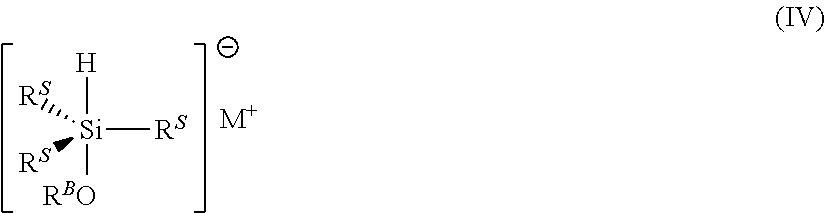
R3—C≡C—H,
where R3 comprises an optionally substituted C1-18 alkyl, optionally substituted C2-18 alkenyl, optionally substituted C2-18 alkynyl, optionally substituted C6-18 aryl, optionally substituted C6-18 aryloxy, optionally substituted C7-18 aralkyl, optionally substituted C7-18 aralkyloxy, optionally substituted C3-18 heteroaryl, optionally substituted C3-18 heteroaryloxy, optionally substituted C4-18 heteroarylalkyl, optionally substituted C4-18 heteroaralkyloxy,or optionally substituted metallocene. More specific example of these substrates are described in U.S. patent application Ser. No. 14/841,964 filed Sep. 1, 2015 (alkynes), now U.S. Pat. No. 9,556,206, which is incorporated by reference herein at least for these teachings.

R4—OH (VIA)
HO—R5—OH (VIB),
where R4 comprises an optionally substituted C1-24 alkyl, optionally substituted C2-24 alkenyl, optionally substituted C2-24 alkynyl, optionally substituted C6-24 aryl, optionally substituted C1-24 heteroalkyl, optionally substituted 5-or 6-ring membered heteroaryl, optionally substituted C7-24 aralkyl, optionally substituted heteroaralkyl, or optionally substituted metallocene; and where R5 comprises an optionally substituted C2-12 alkylene, optionally substituted C2-12 alkenylene, optionally substituted C6-24 arylene, optionally substituted C1-12 heteroalkylene, or an optionally substituted 5- or 6-ring membered heteroarylene. In some Aspect of this Embodiments, the organic substrate having at least one organic alcohol moiety is or comprises an optionally substituted catechol moiety or has a Formula (IV):

(R)3−mSi(H)m+1 (I)
(R)3−m(H)mSi—Si(R)2−m(H)m+1 (II)
where: m is independently 0, 1, or 2; and each R is independently optionally substituted C1-24 alkyl or heteroalkyl, optionally substituted C2-24 alkenyl, optionally substituted C2-24 alkynyl, optionally substituted C6-12 aryl, C3-12 heteroaryl, optionally substituted C7-13 alkaryl, optionally substituted C4-12 heteroalkaryl, optionally substituted C7-13 aralkyl, optionally substituted C4-12 heteroaralkyl, optionally substituted —O—C1-24 alkyl, optionally substituted C6-12 aryloxy, optionally substituted C3-12 heteroaryloxy, optionally substituted C7-13 alkaryloxy, optionally substituted C4-12 heteroalkaryloxy, optionally substituted C6-12 aralkoxy, or C4-12 heteroaralkoxy, and, if substituted, the substituents may be phosphonato, phosphoryl, phosphanyl, phosphino, sulfonato, C1-C20 alkylsulfanyl, C5-C20 arylsulfanyl , C1-C20 alkylsulfonyl, C5-C20 arylsulfonyl, C1-C20 alkylsulfinyl, 5 to 12 ring-membered arylsulfinyl, sulfonamido, amino, amido, imino, nitro, nitroso, hydroxyl, C1-C20 alkoxy, C5-C20 aryloxy, C2-C20 alkoxycarbonyl, C5-C20 aryloxycarbonyl, carboxyl, carboxylato, mercapto, formyl, C1-C20 thioester, cyano, cyanato, thiocyanato, isocyanate, thioisocyanate, carbamoyl, epoxy, styrenyl, silyl, silyloxy, silanyl, siloxazanyl, boronato, boryl, or halogen, or a metal-containing or metalloid-containing group, where the metalloid is Sn or Ge, where the substituents may optionally provide a tether to an insoluble or sparingly soluble support media comprising alumina, silica, or carbon. In certain Aspects of this Embodiment, the precursor organodisilane is of the Formula (III)
(R′)3Si—Si(R′)3 (III)
where R′ is R, as defined above, or may additionally comprise optionally substituted alkoxy or aryloxy moieties or trimethylsiloxy. In other Aspects of this Embodiment, R or R′ is independently an optionally substituted alkyl, alkenyl, alkynyl, aryl, and/or heteroaryl moiety, the specifics of which are further described elsewhere. R′ may also independently comprise optionally substituted alkoxy or aryloxy moieties or trimethylsiloxy.

R3—C≡C—H,
where R3 comprises an optionally substituted C1-18 alkyl, optionally substituted C2-18 alkenyl, optionally substituted C2-18 alkynyl, optionally substituted C6-18 aryl, optionally substituted C6-18 aryloxy, optionally substituted C7-18 aralkyl, optionally substituted C7-18 aralkyloxy, optionally substituted C3-18 heteroaryl, optionally substituted C3-18 heteroaryloxy, optionally substituted C4-18 heteroarylalkyl, optionally substituted C4-18 heteroaralkyloxy,or optionally substituted metallocene. In certain Aspects of this Embodiment, the organic substrate is an alkyne as described in U.S. patent application Ser. No. 14/841,964 filed Sep. 1, 2015 (alkynes), now U.S. Pat. No. 9,556,206, which is incorporated by reference herein at least for these teachings.

R4—OH (VIA)
HO—R5—OH (VIB),
where R4 comprises an optionally substituted C1-24 alkyl, optionally substituted C2-24 alkenyl, optionally substituted C2-24 alkynyl, optionally substituted C6-24 aryl, optionally substituted C1-24 heteroalkyl, optionally substituted 5-or 6-ring membered heteroaryl, optionally substituted C7-24 aralkyl, optionally substituted heteroaralkyl,or optionally substituted metallocene; and where R5 comprises an optionally substituted C2-12 alkylene, optionally substituted C2-12 alkenylene, optionally substituted C6-24 arylene, optionally substituted C1-12 heteroalkylene, or an optionally substituted 5- or 6-ring membered heteroarylene. In some Aspect of this Embodiments, the organic substrate having at least one organic alcohol moiety is or comprises an optionally substituted catechol moiety or has a Formula (IV):

| TABLE 1 |
| Results of Evaluating Base Catalysts |
 |
 |
| entry | catalyst | time (h) | conv (%) | 2:3 |
| 1 | KOt- |
10 | 88 | 11:1 |
| 2 | KOEt | 10 | 55 | 9:1 |
| 3 | KOMe | 20 | 35 | 9:1 |
| 4 | |
20 | 53 | 12:1 |
| 5 | KOAc | 60 | 0 | — |
| 6 | |
20 | 52 | 11:1 |
| 7 | KH | 36 | 0 | — |
| 8 | |
10 | 73 | 8:1 |
| 9 | CsOH•H2O | 10 | 64 | 8:1 |
| 10 | RbOH•×H2O | 10 | 38 | 10:1 |
| 11 | LiOt-Bu | 36 | 0 | — |
| 12 | NaOt-Bu | 36 | 0 | — |
| 13 | Mg(Ot-Bu)2 | 36 | 0 | — |
| 14 | Ca(Oi-Pr)2 | 36 | 0 | — |
| 15 | Ba(Ot-Bu)2 | 36 | 0 | — |
| 16 | Al(Ot-Bu)3 | 36 | 0 | — |
| TABLE 2 | |||||
| Base | Time (h) | Conversion | C2:C3 ratio (x:1) | ||
| KOt-Bu | 1.0 | 0.0 | — | ||
| 2.0 | 0.0 | — | |||
| 3.0 | 25.8 | 27.3 | |||
| 4.0 | 44.2 | 24.1 | |||
| 5.0 | 57.4 | 23.2 | |||
| 6.0 | 66.5 | 12.8 | |||
| 8.0 | 81.4 | 16.9 | |||
| 10.0 | 88.0 | 15.0 | |||
| 20.0 | 89.2 | 15.0 | |||
| 36.0 | 91.0 | 9.3 | |||
| KOTMS | 1.0 | 0.0 | — | ||
| 2.0 | 0.0 | — | |||
| 3.0 | 0.0 | — | |||
| 4.0 | 3.9 | 7.1 | |||
| 5.0 | 10.2 | 9.9 | |||
| 6.0 | 17.7 | 9.0 | |||
| 8.0 | 26.2 | 19.9 | |||
| 10.0 | 33.0 | 14.1 | |||
| 20.0 | 50.4 | 11.6 | |||
| 36.0 | 59.9 | 9.0 | |||
| KHMDS | 1.0 | 0.0 | — | ||
| 2.0 | 0.0 | — | |||
| 3.0 | 0.0 | — | |||
| 4.0 | 1.2 | >20 | |||
| 5.0 | 2.5 | >20 | |||
| 6.0 | 4.7 | 9.7 | |||
| 8.0 | 8.3 | 15.0 | |||
| 10.0 | 10.3 | 11.0 | |||
| 20.0 | 21.6 | 21.5 | |||
| 36.0 | 34.9 | 7.3 | |||
| KOEt | 1.0 | 19.7 | — | ||
| 2.0 | 24.8 | 26.8 | |||
| 3.0 | 30.6 | 22.3 | |||
| 4.0 | 35.7 | 19.4 | |||
| 5.0 | 38.5 | 19.2 | |||
| 6.0 | 40.9 | 11.4 | |||
| 8.0 | 51.1 | 14.0 | |||
| 10.0 | 54.9 | 12.5 | |||
| 20.0 | 67.1 | 8.2 | |||
| 36.0 | 75.6 | 6.2 | |||
| KOMe | 1.0 | 0.0 | — | ||
| 2.0 | 0.0 | — | |||
| 3.0 | 0.0 | — | |||
| 4.0 | 1.2 | >20 | |||
| 5.0 | 2.5 | >20 | |||
| 6.0 | 5.6 | 7.0 | |||
| 8.0 | 15.7 | 15.4 | |||
| 10.0 | 24.2 | 12.3 | |||
| 20.0 | 35.2 | 14.9 | |||
| 36.0 | 51.5 | 7.2 | |||
| KOH | 1.0 | 0.0 | — | ||
| 2.0 | 0.0 | — | |||
| 3.0 | 0.0 | — | |||
| 4.0 | 0.0 | — | |||
| 5.0 | 0.0 | — | |||
| 6.0 | 0.0 | — | |||
| 8.0 | 17.8 | >20 | |||
| 10.0 | 34.3 | 18.4 | |||
| 20.0 | 49.9 | 11.3 | |||
| 36.0 | 63.2 | 7.0 | |||
| CsOH | 1.0 | 2.2 | >20 | ||
| 2.0 | 14.9 | 21.4 | |||
| 3.0 | 27.6 | 23.0 | |||
| 4.0 | 35.6 | 20.5 | |||
| 5.0 | 42.8 | 19.5 | |||
| 6.0 | 51.2 | 12.1 | |||
| 8.0 | 57.7 | 15.2 | |||
| 10.0 | 64.0 | 11.6 | |||
| 20.0 | 73.2 | 7.7 | |||
| 36.0 | 74.0 | 5.8 | |||
| RbOH | 1.0 | 0.0 | — | ||
| 2.0 | 0.0 | — | |||
| 3.0 | 5.8 | 5.3 | |||
| 4.0 | 12.1 | 10.5 | |||
| 5.0 | 17.8 | 18.9 | |||
| 6.0 | 23.9 | 19.9 | |||
| 8.0 | 30.8 | 14.1 | |||
| 10.0 | 37.5 | 11.0 | |||
| 20.0 | 48.2 | 9.5 | |||
| 36.0 | 59.4 | 7.9 | |||
| KC8 | 1.0 | 22.4 | >20 | ||
| 2.0 | 28.0 | 33.1 | |||
| 3.0 | 30.6 | 23.1 | |||
| 4.0 | 41.4 | 21.2 | |||
| 5.0 | 43.7 | 22.8 | |||
| 6.0 | 52.5 | 14.6 | |||
| 8.0 | 63.0 | 14.9 | |||
| 10.0 | 72.6 | 8.5 | |||
| 20.0 | 82.2 | 7.7 | |||
| 36.0 | 84.7 | 5.0 | |||
| TABLE 3 |
| Spectroscopic characterization of the reaction of Et3Si—H with the bases evaluation in |
| this study |
 |
| entry | Base | [Si]—X | t (h)a | ν[Si—H](cm−1)b | Δν(cm−1)c |
| 1 | — | Et3SiH | — | 2099 | — |
| 2 | KOt-Bu | Et3SiH | 2 | 2028 | 71 |
| 3 | KOEt | Et3SiH | 2 | 2016 | 83 |
| 4 | KOMe | Et3SiH | 7 | 2054 | 45 |
| 5 | KOTMS | Et3SiH | 7 | 2047 | 52 |
| 6 | KOH | Et3SiH | 20 | 2045 | 54 |
| 7 | RbOH•×H2O | Et3SiH | 7 | 2052 | 47 |
| 8 | CsOH•H2O | Et3SiH | 7 | 2051 | 48 |
| 9 | NaOt-Bu | Et3SiH | 36 | — | — |
| 10 | KOt-Bu | Et3SiD | 12 | — | — |
| 11 | KOt-Bu | Et3SiH (2.5 equiv) + | 12 | 2029 | 70 |
| Et3SiD (2.5 equiv) | |||||
| 12 | Mg(Ot-Bu)2 | Et3SiH | 36 | — | — |
| 13 | LiOt-Bu | Et3SiH | 36 | — | — |
| aThe mixture was stirred for the indicated time before IR spectrum was measured. | |||||
| bFrequency of Si—H bond stretching. | |||||
| cFrequency shift of observed hypercoordinated silicon species from Et3Si—H. | |||||
Claims (17)
(R)3−mSi(H)m+1 (I)
(R)3−m(H)mSi—Si(R)2−m(H)m+1 (II)
(R)3−mSi(H)m+1 (I)
(R)3−m(H)mSi—Si(R)2−m(H)m+1 (II)

Priority Applications (2)
| Application Number | Priority Date | Filing Date | Title |
|---|---|---|---|
| US15/438,929 US11028107B2 (en) | 2016-02-22 | 2017-02-22 | Stable silylating reagents |
| US17/332,394 US20210323983A1 (en) | 2016-02-22 | 2021-05-27 | Stable silylating reagents |
Applications Claiming Priority (3)
| Application Number | Priority Date | Filing Date | Title |
|---|---|---|---|
| US201662298337P | 2016-02-22 | 2016-02-22 | |
| US201662361929P | 2016-07-13 | 2016-07-13 | |
| US15/438,929 US11028107B2 (en) | 2016-02-22 | 2017-02-22 | Stable silylating reagents |
Related Child Applications (1)
| Application Number | Title | Priority Date | Filing Date |
|---|---|---|---|
| US17/332,394 Division US20210323983A1 (en) | 2016-02-22 | 2021-05-27 | Stable silylating reagents |
Publications (2)
| Publication Number | Publication Date |
|---|---|
| US20170240571A1 US20170240571A1 (en) | 2017-08-24 |
| US11028107B2 true US11028107B2 (en) | 2021-06-08 |
Family
ID=59630528
Family Applications (2)
| Application Number | Title | Priority Date | Filing Date |
|---|---|---|---|
| US15/438,929 Active 2037-03-13 US11028107B2 (en) | 2016-02-22 | 2017-02-22 | Stable silylating reagents |
| US17/332,394 Abandoned US20210323983A1 (en) | 2016-02-22 | 2021-05-27 | Stable silylating reagents |
Family Applications After (1)
| Application Number | Title | Priority Date | Filing Date |
|---|---|---|---|
| US17/332,394 Abandoned US20210323983A1 (en) | 2016-02-22 | 2021-05-27 | Stable silylating reagents |
Country Status (6)
| Country | Link |
|---|---|
| US (2) | US11028107B2 (en) |
| EP (1) | EP3419982B1 (en) |
| JP (2) | JP6938511B2 (en) |
| CN (2) | CN113666955A (en) |
| CA (1) | CA3010522C (en) |
| WO (1) | WO2017147110A1 (en) |
Citations (8)
| Publication number | Priority date | Publication date | Assignee | Title |
|---|---|---|---|---|
| US5523384A (en) | 1995-03-28 | 1996-06-04 | E. I. Du Pont De Nemours And Company | Process for preparing polyether ketones |
| US20140091256A1 (en) * | 2012-10-02 | 2014-04-03 | California Institute Of Technology | Transition-metal free reductive cleavage of aromatic c-o, c-n, and c-s bonds by activated silanes |
| WO2014055587A1 (en) | 2012-10-02 | 2014-04-10 | California Institute Of Techonolgy | Transition-metal-free silylation of aromatic compounds |
| US20160046653A1 (en) | 2014-08-06 | 2016-02-18 | California Institute Of Technology | Silylation of aromatic heterocycles by earth abundant transition-metal-free catalysts |
| US20160347776A1 (en) | 2015-05-29 | 2016-12-01 | California Institute Of Technology | Base-catalyzed silylation of terminal olefinic c-h bonds |
| US9556206B2 (en) | 2014-09-02 | 2017-01-31 | California Institute Of Technology | Base-catalyzed silylation of terminal alkyne C—H bonds |
| US9556080B2 (en) | 2014-12-19 | 2017-01-31 | California Institute Of Technology | Silylation of aromatic heterocycles by disilanes using potassium alkoxide catalysts |
| US20170029447A1 (en) | 2015-07-29 | 2017-02-02 | California Institute Of Technology | Hydroxide-catalyzed formation of silicon-oxygen bonds by dehydrogenative coupling of hydrosilanes and alcohols |
Family Cites Families (2)
| Publication number | Priority date | Publication date | Assignee | Title |
|---|---|---|---|---|
| JPH0723384B2 (en) * | 1986-12-29 | 1995-03-15 | 三菱化学株式会社 | Method for producing tetraalkoxysilane |
| CA2738358A1 (en) * | 2008-09-29 | 2010-04-01 | Richard T. Zvosec | Process for accelerated capture of carbon dioxide |
-
2017
- 2017-02-22 US US15/438,929 patent/US11028107B2/en active Active
- 2017-02-22 WO PCT/US2017/018803 patent/WO2017147110A1/en not_active Ceased
- 2017-02-22 CN CN202110926737.6A patent/CN113666955A/en active Pending
- 2017-02-22 CN CN201780012256.6A patent/CN108699089B/en active Active
- 2017-02-22 JP JP2018533897A patent/JP6938511B2/en active Active
- 2017-02-22 EP EP17757095.9A patent/EP3419982B1/en active Active
- 2017-02-22 CA CA3010522A patent/CA3010522C/en active Active
-
2021
- 2021-05-27 US US17/332,394 patent/US20210323983A1/en not_active Abandoned
- 2021-09-01 JP JP2021142703A patent/JP7275213B2/en active Active
Patent Citations (11)
| Publication number | Priority date | Publication date | Assignee | Title |
|---|---|---|---|---|
| US5523384A (en) | 1995-03-28 | 1996-06-04 | E. I. Du Pont De Nemours And Company | Process for preparing polyether ketones |
| US20140091256A1 (en) * | 2012-10-02 | 2014-04-03 | California Institute Of Technology | Transition-metal free reductive cleavage of aromatic c-o, c-n, and c-s bonds by activated silanes |
| WO2014055587A1 (en) | 2012-10-02 | 2014-04-10 | California Institute Of Techonolgy | Transition-metal-free silylation of aromatic compounds |
| US9000167B2 (en) * | 2012-10-02 | 2015-04-07 | California Institute Of Technology | Transition-metal-free silylation of aromatic compounds |
| US20150166579A1 (en) * | 2012-10-02 | 2015-06-18 | California Institute Of Technology | Transition-metal-free silylation of aromatic compounds |
| US9908840B2 (en) * | 2012-10-02 | 2018-03-06 | California Institute Of Technology | Reactions of aromatic substrates with base-activated hydrosilanes-silylations and reductive cleavage |
| US20160046653A1 (en) | 2014-08-06 | 2016-02-18 | California Institute Of Technology | Silylation of aromatic heterocycles by earth abundant transition-metal-free catalysts |
| US9556206B2 (en) | 2014-09-02 | 2017-01-31 | California Institute Of Technology | Base-catalyzed silylation of terminal alkyne C—H bonds |
| US9556080B2 (en) | 2014-12-19 | 2017-01-31 | California Institute Of Technology | Silylation of aromatic heterocycles by disilanes using potassium alkoxide catalysts |
| US20160347776A1 (en) | 2015-05-29 | 2016-12-01 | California Institute Of Technology | Base-catalyzed silylation of terminal olefinic c-h bonds |
| US20170029447A1 (en) | 2015-07-29 | 2017-02-02 | California Institute Of Technology | Hydroxide-catalyzed formation of silicon-oxygen bonds by dehydrogenative coupling of hydrosilanes and alcohols |
Non-Patent Citations (20)
Also Published As
| Publication number | Publication date |
|---|---|
| EP3419982A4 (en) | 2019-08-28 |
| EP3419982B1 (en) | 2023-11-15 |
| JP7275213B2 (en) | 2023-05-17 |
| CN108699089A (en) | 2018-10-23 |
| CA3010522C (en) | 2024-02-13 |
| CA3010522A1 (en) | 2017-08-31 |
| US20170240571A1 (en) | 2017-08-24 |
| WO2017147110A1 (en) | 2017-08-31 |
| JP2019508373A (en) | 2019-03-28 |
| CN108699089B (en) | 2021-08-03 |
| JP2021193104A (en) | 2021-12-23 |
| CN113666955A (en) | 2021-11-19 |
| US20210323983A1 (en) | 2021-10-21 |
| JP6938511B2 (en) | 2021-09-22 |
| EP3419982A1 (en) | 2019-01-02 |
Similar Documents
| Publication | Publication Date | Title |
|---|---|---|
| US11230520B2 (en) | Silylations of aromatic substrates with base-activated organosilanes | |
| US10072030B2 (en) | Base-catalyzed silylation of terminal alkyne C—H bonds | |
| US10927065B2 (en) | Silylations of aromatic substrates with base-activated organosilanes | |
| WO2016022624A1 (en) | Silylation of aromatic heterocycles by earth abundant transition-metal-free catalysts | |
| WO2016100606A1 (en) | Silylation of aromatic heterocycles by disilanes using potassium alkoxide catalysts | |
| US20210323983A1 (en) | Stable silylating reagents | |
| US10059726B2 (en) | Base-catalyzed silylation of terminal olefinic C—H bonds | |
| US11773116B2 (en) | Hydrosilylamines and fluorosilylamines and methods of making the same |
Legal Events
| Date | Code | Title | Description |
|---|---|---|---|
| AS | Assignment |
Owner name: CALIFORNIA INSTITUTE OF TECHNOLOGY, CALIFORNIA Free format text: ASSIGNMENT OF ASSIGNORS INTEREST;ASSIGNORS:TOUTOV, ANTON;LIU, WENBO;SCHUMAN, DAVID P.;AND OTHERS;SIGNING DATES FROM 20170313 TO 20170320;REEL/FRAME:041680/0030 |
|
| STPP | Information on status: patent application and granting procedure in general |
Free format text: FINAL REJECTION MAILED |
|
| STPP | Information on status: patent application and granting procedure in general |
Free format text: DOCKETED NEW CASE - READY FOR EXAMINATION |
|
| STPP | Information on status: patent application and granting procedure in general |
Free format text: NON FINAL ACTION MAILED |
|
| STPP | Information on status: patent application and granting procedure in general |
Free format text: RESPONSE TO NON-FINAL OFFICE ACTION ENTERED AND FORWARDED TO EXAMINER |
|
| STPP | Information on status: patent application and granting procedure in general |
Free format text: FINAL REJECTION MAILED |
|
| STPP | Information on status: patent application and granting procedure in general |
Free format text: DOCKETED NEW CASE - READY FOR EXAMINATION |
|
| STPP | Information on status: patent application and granting procedure in general |
Free format text: NON FINAL ACTION MAILED |
|
| STPP | Information on status: patent application and granting procedure in general |
Free format text: RESPONSE TO NON-FINAL OFFICE ACTION ENTERED AND FORWARDED TO EXAMINER |
|
| STPP | Information on status: patent application and granting procedure in general |
Free format text: NOTICE OF ALLOWANCE MAILED -- APPLICATION RECEIVED IN OFFICE OF PUBLICATIONS |
|
| STPP | Information on status: patent application and granting procedure in general |
Free format text: PUBLICATIONS -- ISSUE FEE PAYMENT RECEIVED |
|
| STPP | Information on status: patent application and granting procedure in general |
Free format text: PUBLICATIONS -- ISSUE FEE PAYMENT VERIFIED |
|
| STCF | Information on status: patent grant |
Free format text: PATENTED CASE |
|
| MAFP | Maintenance fee payment |
Free format text: PAYMENT OF MAINTENANCE FEE, 4TH YR, SMALL ENTITY (ORIGINAL EVENT CODE: M2551); ENTITY STATUS OF PATENT OWNER: SMALL ENTITY Year of fee payment: 4 |