US11022874B2 - Chromeless phase shift mask structure and process - Google Patents
Chromeless phase shift mask structure and process Download PDFInfo
- Publication number
- US11022874B2 US11022874B2 US16/548,273 US201916548273A US11022874B2 US 11022874 B2 US11022874 B2 US 11022874B2 US 201916548273 A US201916548273 A US 201916548273A US 11022874 B2 US11022874 B2 US 11022874B2
- Authority
- US
- United States
- Prior art keywords
- mask
- etch stop
- material layer
- stop layer
- substrate
- Prior art date
- Legal status (The legal status is an assumption and is not a legal conclusion. Google has not performed a legal analysis and makes no representation as to the accuracy of the status listed.)
- Active
Links
Images




Classifications
-
- G—PHYSICS
- G03—PHOTOGRAPHY; CINEMATOGRAPHY; ANALOGOUS TECHNIQUES USING WAVES OTHER THAN OPTICAL WAVES; ELECTROGRAPHY; HOLOGRAPHY
- G03F—PHOTOMECHANICAL PRODUCTION OF TEXTURED OR PATTERNED SURFACES, e.g. FOR PRINTING, FOR PROCESSING OF SEMICONDUCTOR DEVICES; MATERIALS THEREFOR; ORIGINALS THEREFOR; APPARATUS SPECIALLY ADAPTED THEREFOR
- G03F1/00—Originals for photomechanical production of textured or patterned surfaces, e.g., masks, photo-masks, reticles; Mask blanks or pellicles therefor; Containers specially adapted therefor; Preparation thereof
- G03F1/26—Phase shift masks [PSM]; PSM blanks; Preparation thereof
-
- G—PHYSICS
- G03—PHOTOGRAPHY; CINEMATOGRAPHY; ANALOGOUS TECHNIQUES USING WAVES OTHER THAN OPTICAL WAVES; ELECTROGRAPHY; HOLOGRAPHY
- G03F—PHOTOMECHANICAL PRODUCTION OF TEXTURED OR PATTERNED SURFACES, e.g. FOR PRINTING, FOR PROCESSING OF SEMICONDUCTOR DEVICES; MATERIALS THEREFOR; ORIGINALS THEREFOR; APPARATUS SPECIALLY ADAPTED THEREFOR
- G03F1/00—Originals for photomechanical production of textured or patterned surfaces, e.g., masks, photo-masks, reticles; Mask blanks or pellicles therefor; Containers specially adapted therefor; Preparation thereof
- G03F1/26—Phase shift masks [PSM]; PSM blanks; Preparation thereof
- G03F1/34—Phase-edge PSM, e.g. chromeless PSM; Preparation thereof
-
- G—PHYSICS
- G03—PHOTOGRAPHY; CINEMATOGRAPHY; ANALOGOUS TECHNIQUES USING WAVES OTHER THAN OPTICAL WAVES; ELECTROGRAPHY; HOLOGRAPHY
- G03F—PHOTOMECHANICAL PRODUCTION OF TEXTURED OR PATTERNED SURFACES, e.g. FOR PRINTING, FOR PROCESSING OF SEMICONDUCTOR DEVICES; MATERIALS THEREFOR; ORIGINALS THEREFOR; APPARATUS SPECIALLY ADAPTED THEREFOR
- G03F1/00—Originals for photomechanical production of textured or patterned surfaces, e.g., masks, photo-masks, reticles; Mask blanks or pellicles therefor; Containers specially adapted therefor; Preparation thereof
- G03F1/38—Masks having auxiliary features, e.g. special coatings or marks for alignment or testing; Preparation thereof
-
- G—PHYSICS
- G03—PHOTOGRAPHY; CINEMATOGRAPHY; ANALOGOUS TECHNIQUES USING WAVES OTHER THAN OPTICAL WAVES; ELECTROGRAPHY; HOLOGRAPHY
- G03F—PHOTOMECHANICAL PRODUCTION OF TEXTURED OR PATTERNED SURFACES, e.g. FOR PRINTING, FOR PROCESSING OF SEMICONDUCTOR DEVICES; MATERIALS THEREFOR; ORIGINALS THEREFOR; APPARATUS SPECIALLY ADAPTED THEREFOR
- G03F1/00—Originals for photomechanical production of textured or patterned surfaces, e.g., masks, photo-masks, reticles; Mask blanks or pellicles therefor; Containers specially adapted therefor; Preparation thereof
- G03F1/68—Preparation processes not covered by groups G03F1/20 - G03F1/50
- G03F1/80—Etching
-
- H01L21/266—
-
- H—ELECTRICITY
- H10—SEMICONDUCTOR DEVICES; ELECTRIC SOLID-STATE DEVICES NOT OTHERWISE PROVIDED FOR
- H10P—GENERIC PROCESSES OR APPARATUS FOR THE MANUFACTURE OR TREATMENT OF DEVICES COVERED BY CLASS H10
- H10P30/00—Ion implantation into wafers, substrates or parts of devices
- H10P30/20—Ion implantation into wafers, substrates or parts of devices into semiconductor materials, e.g. for doping
- H10P30/22—Ion implantation into wafers, substrates or parts of devices into semiconductor materials, e.g. for doping using masks
Definitions
- CMOS complementary metal-oxide-semiconductor
- MEF mask error factor
- a phase shift mask chromeless phase shift mask
- a circuit feature is defined in a transparent mask with phase shift between adjacent transparent regions such that destructive interference generates a dark feature when imaged to a semiconductor substrate.
- a conventional chromeless phase shift mask provides limited freedom to improve imaging quality and other issues, such as etch processing window relative to an expected phase shift.
- the conventional chromeless phase shift mask has limited protection to the transparent substrate from damage during a process making or using the mask. Therefore, what are needed are a chromeless phase shift mask structure and a method making and using the same to address the above issues.
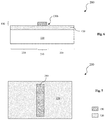
- FIGS. 1, 2, 3 and 4 are sectional views of a photomask at various fabrication stages, constructed in accordance with some embodiments.
- FIG. 5 is a top view of the photomask in FIG. 4 , constructed in accordance with some embodiments.
- FIG. 6 is a sectional view of a photomask, constructed in accordance with some embodiments.
- FIG. 7 is a top view of the photomask in FIG. 6 , constructed in accordance with some embodiments.
- FIG. 8 is a flowchart of a method making a photomask, constructed in accordance with some embodiments.
- FIG. 9 is a sectional view of a photomask, constructed in accordance with some embodiments.
- FIG. 10 is a schematic view of a lithography system, constructed in accordance with some embodiments.
- FIG. 11 is a flowchart of a method utilizing a photomask in the lithography system of FIG. 10 , constructed in accordance with some embodiments.
- FIG. 12 represents characteristic data of the photomask utilized in the lithography system of FIG. 10 , constructed in accordance with some embodiments.
- FIGS. 1 through 4 are sectional views of a photomask (mask, or reticle, collectively referred to as mask) 100 constructed according to aspects of the present disclosure in some embodiments.
- FIG. 5 is a top view of the mask 100 in FIG. 4 in accordance with some embodiments. Referring to FIGS. 1 through 5 , the mask 100 and a method making the same are described.
- the mask 100 defines a circuit pattern thereon and is used to transfer the circuit pattern to a semiconductor substrate in a lithography process using a radiation beam, such as light radiation.
- the radiation beam may be ultraviolet and/or can be extended to include other radiation beams such as ion beam, x-ray, extreme ultraviolet (EUV), deep ultraviolet (DUV), and other proper radiation energy.
- EUV extreme ultraviolet
- DUV deep ultraviolet
- the mask 100 is a phase shift mask, particularly a chromeless phase shift mask (CLPSM).
- CLPSM chromeless phase shift mask
- Various features on a CLPSM are transparent to the light radiation and are imaged to dark and bright features on the semiconductor substrate through 180° phase shift and corresponding destructive interference.
- the mask 100 is a CLPSM that defines a feature through phase shift instead of absorption.
- the mask 100 includes different regions with respective optical phase. The light radiation through different regions of the mask 100 leads to destructive interference and form dark features on the semiconductor substrate.
- the disclosed mask 100 utilizes limited absorption through a phase shift layer or additional attenuating layer to enhance the image quality including resolution and contrast.
- the mask 100 may be a portion of a mask utilized in manufacturing a semiconductor wafer.
- the mask 100 includes a transparent substrate 110 (that is transparent to the light radiation), such as fused quartz or fused silica (SiO 2 ) relatively free of defects, calcium fluoride, or other suitable material.
- the mask 100 includes an etch stop layer 120 disposed on the transparent substrate 110 .
- the etch stop layer 120 is designed to protect the transparent substrate 110 from damage during a process making or using the mask 100 .
- the etch stop layer 120 is designed with a composition and a thickness to effectively resist an etching or cleaning process applied to the mask 100 .
- the etch stop layer 120 is disposed on the transparent substrate 110 and is not patterned so that it continuously covers a top surface of the transparent substrate 110 , as illustrated in FIG. 1 .
- the etch stop layer 120 is a ruthenium (Ru) film. In another embodiment, the etch stop layer 120 is a chromium oxynitride film. In some other embodiments, the etch stop layer 120 includes ruthenium, chromium, aluminum, tungsten, silicon, titanium, an oxide thereof, a nitride thereof, an oxynitride thereof, or a combination thereof.
- the formation of the etch stop layer 120 may include chemical vapor deposition (CVD), physical vapor deposition (PVD), atomic layer deposition (ALD), spin coating, other suitable processes, or a combination thereof.
- the etch stop layer 120 has a thickness ranging from 0.1 nm to 100 nm in accordance with some embodiments. In some examples, the etch stop layer 120 may have a thickness ranging from 1 nm to 20 nm.
- the etch stop layer 120 is designed to provide a limited attenuation to the light radiation. The attenuation of the etch stop layer 120 is tuned to enhance the imaging of the mask 100 during a lithography exposure process.
- the etch stop layer 120 is designed with a composition and a thickness to have a transmittance greater than 98% to the radiation beam.
- the etch stop layer 120 is doped with a proper doping species to tune its transmittance and etching resistance.
- the etch stop layer 120 is further doped with a doping species, such as boron (B), phosphorous (P), calcium (Ca), sodium (Na), aluminum (Al), or a combination thereof.
- the etch stop layer 120 having ruthenium oxide as the main composition is further doped with calcium.
- the etch stop layer 120 having tungsten nitride is doped with sodium.
- the etch stop layer 120 having titanium nitride is doped with boron.
- the doping process may include ion implantation or in-situ doping, such as a CVD process with the precursor that includes a chemical having the doping species.
- the main composition in the etch stop layer 120 has an atomic percentage ranging from 80% to 100%. Accordingly, the doping species in the etch stop layer 120 has an atomic percentage ranging from 0 to 20%.
- the mask 100 includes a transparent material layer 130 disposed on the etch stop layer 120 and is to be patterned according to a circuit design layout.
- the transparent material layer 130 is designed with a composition and a thickness to provide an 180° phase shift to the radiation beam. More specifically, the transparent material layer 130 may have a thickness about ⁇ /[2(n ⁇ 1)], wherein ⁇ is the wavelength of the radiation beam projected on the mask 100 during the photolithography process, and n is refractive index of the transparent material layer 130 relative to the radiation beam. Alternatively, the transparent material layer 130 may have a thickness about m ⁇ /[2(n ⁇ 1)], wherein m is an odd integer. In practice, the phase shift is substantially 180° or, in other words, around 180° in a certain range, such as 170° to 190°.
- the transparent material layer 130 is substantially transparent to the radiation beam and has a limited absorption to the radiation beam.
- the limited absorption of the transparent material layer 130 is tunable through its composition in a way to enhance the imaging resolution during a lithography exposure process utilizing the mask 100 . Therefore, it is also referred to as tunable transparent material layer 130 .
- the tunable transparent material layer 130 has a transmittance greater than 90% to the radiation beam. In furtherance of the embodiment, the transmittance is tuned in a range from 90% to 99%.
- the tunable transparent material layer 130 includes silicon oxide doped with carbon or other dopant.
- the concentration of carbon (or other dopant) can be varied to adjust the transmittance of the tunable transparent material layer 130 .
- both the silicon concentration and the carbon concentration can be varied to adjust the transmittance.
- the tunable transparent material layer 130 includes silicon with an atomic percentage ranging from 30% to 60%; oxygen with an atomic percentage ranging from 30% to 60%; and carbon with an atomic percentage ranging from 0 to 10%.
- the tunable transparent material layer 130 may further include an additive, such as nitrogen (N), phosphorous (P), boron (B), or a combination thereof, incorporated therein by ion implantation, in-situ doping or other suitable technique.
- the tunable transparent material layer 130 includes silicon with an atomic percentage ranging from 30% to 60%; oxygen with an atomic percentage ranging from 30% to 60%; carbon with an atomic percentage ranging from 0 to 10%; nitrogen with an atomic percentage ranging from 0 to 5%; phosphorous with an atomic percentage ranging from 0 to 5%; and boron with an atomic percentage ranging from 0 to 5% tuned to have proper transmittance, and accordingly the desired imaging resolution.
- the tunable transparent material layer 130 as described as above, may be formed by spin-on glass, CVD or sputtering.
- the tunable transparent material layer 130 includes silicate glass dispersed with chromophore.
- concentration of chromophore can be varied to adjust the transmittance of the tunable transparent material layer 130 .
- the tunable transparent material layer 130 is formed by spin-on coating and then an annealing process (with an annealing temperature, such as between 130° C. and 150° C.) to cure.
- the tunable transparent material layer 130 is formed by CVD using tetraethylorthosilicate (TEOS) with the formula Si(OC 2 H 5 ) 4 or other suitable technique.
- TEOS tetraethylorthosilicate
- the tunable transparent material layer 130 includes a sol-gel silicate film, formed by a sol-gel process.
- the tunable transparent material layer 130 includes silica gels by a sol-gel polymerization of a proper precursor, such as TEOS, or other suitable chemical.
- a proper precursor such as TEOS, or other suitable chemical.
- an acid or base catalyst may be used.
- the formation of the sol-gel silicate film may include polymerization of TEOS in solution, and sol-gel transition with a catalyst.
- the formation of the sol-gel silicate film may include polymerization, hydrolysis and condensation.
- the sol-gel silicate film is tunable through various parameters to adjust the corresponding transmittance.
- Various steps and parameters in the process to form the sol-gel silicate film may be varied to adjust the transmittance of the corresponding tunable transparent material layer.
- the polymerization time may be used to tune the transmittance.
- the tunable transparent material layer 130 is patterned according to a circuit design layout.
- the patterning of the tunable transparent material layer includes lithography process and etching.
- the lithography process includes coating (such as by spin-on coating) a resist layer 140 on the tunable transparent material layer 130 , as illustrated in FIG. 1 .
- the resist layer 140 may have a tri-layer structure, such as an under layer, a middle layer on the under layer and a photo sensitive layer on the middle layer.
- the resist layer 140 may be chemical amplification resist material that includes photo-acid generator.
- the resist layer 140 may be positive-tone (wherein the exposed portions will be removed by a developer) or alternatively negative-tone (wherein the unexposed portions will be removed by a developer).
- the lithography process further includes exposure and developing, thereby forming a patterned resist layer 140 , as illustrated in FIG. 2 .
- the patterned resist layer 140 includes one or more opening 140 a such that the tunable transparent material layer 130 is exposed within the opening.
- the lithography process may further include other steps, such as post-exposure-baking.
- An etching process is further applied to the tunable transparent material layer 130 through the opening 140 a of the patterned resist layer 140 , using the patterned resist layer as an etch mask.
- the tunable transparent material layer 130 is patterned.
- the pattern defined in the resist layer 140 is transferred to the tunable transparent material layer 130 , as illustrated in FIG. 3 .
- an opening 130 a is formed in the tunable transparent material layer 130 after the etching process.
- the etching process applied to the tunable transparent material layer 130 may include dry etching, wet etching or a combination thereof.
- the etching process may include a wet etching process using hydroflouric acid as an etchant.
- the etching process may include a dry etching process using fluorine-containing plasma as an etchant.
- the patterned resist layer 140 is removed by wet stripping or plasma ashing, as illustrated in FIG. 4 .
- a hard mask may be used such that pattern is transferred from the patterned resist layer to the hard mask by a first etch and then transferred to the tunable transparent material layer by a second etch. Since the transparent substrate 110 is protected by the etch stop layer 120 , the above etching process and wet stripping (or plasma ashing) will not damage the transparent substrate 110 . Otherwise, the damaged substrate may introduce unexpected phase shift, which will degrade the mask 100 and the imaging quality of the lithography exposure process using the mask 100 .
- a circuit feature is defined through phase shift.
- a circuit feature in a first region and a second region surrounding the circuit feature on the mask have different transmittances.
- One of the first and second regions is transparent, and another one of the two regions is opaque.
- a circuit feature is similarly defined through substantial transmittance difference (opaque and transparency) while phase shift increase the contrast and improves the imaging quality.
- both the first and second regions are transparent.
- the first and second regions are transparent or substantially transparent (transmittance greater than 90%). As illustrated in FIG.
- the mask 100 includes a first region 150 and a second region 160 .
- the first region 150 is defined in the opening 130 a of the tunable transparent material layer 130 and is free of the tunable transparent material.
- the second region 160 is the region having the tunable transparent material.
- the first and second light beams transmitted, respectively, through the first and second regions have a phase shift (substantially 180°). The destructive interference between the first and second light beams generates a dark region corresponding to the opening 130 a.
- a circuit feature is defined by the first region 150 .
- the tunable transparent material layer 130 has a tunable transmittance that is utilized to enhance the resolution of the lithography exposure process.
- the transmittance tuning is further described in details.
- the second light beam B2 transmitted through the second region 160 and a portion B2′ of the transmitted second light beam is diffracted to the first region 150 . If B1 and B2′ are same in intensity, the destructive interference will cancel each other, lead to dark image (zero intensity) of the opening 130 a . However, B1 and B2′ may not be equal in intensity due to various factors, such as the dimension W of the opening 130 a .
- tuning the transmittance of the tunable transparent material layer 130 in a way such that B1 and B2′ are matched in intensity. Accordingly, the destructive interference between B1 and B2′ generates a dark feature corresponding to the opening 130 a with enhanced contrast and resolution.
- Tuning the transmittance may be implemented, prior to depositing the transparent material layer 130 , according to the circuit design layout, such as average feature size of the circuit design layout.
- the etch stop layer 120 is interposed between the transparent substrate 110 and the tunable transparent material layer 130 .
- the etch stop layer 120 covers both the first region 150 and the second region 160 , and continuously extends from the first region 150 to the second region 160 .
- the circuit feature is defined in an opening 130 a of the tunable transparent material layer 130 .
- the circuit feature may be a metal line, a gate, or a fin-like active region.
- a circuit feature may be alternatively defined by an island of the tunable transparent material layer, such as one illustrated in FIGS. 6 and 7 .
- FIG. 6 is a sectional view of a mask 200 and FIG. 7 is a top view of the mask 200 , constructed in accordance with some embodiments.
- a method to form the mask 200 is similar to the corresponding method to form the mask 100 .
- the method includes forming an etch stop layer 120 on a transparent substrate 110 ; forming a tunable transparent material layer 130 ; and patterning the tunable transparent material layer 130 according to a circuit design layout.
- the etch stop layer 120 and the tunable transparent material layer 130 are similar to those of the mask 100 in terms of formation, composition and phase shift.
- the tunable transparent material layer 130 is patterned such that a circuit feature of the circuit design layout is defined by an island 130 b of the tunable transparent material layer 130 .
- the mask 200 includes a first region 210 and a second region 220 .
- the first region 210 is defined in the island 130 b of the tunable transparent material layer 130 .
- the second region 220 is free of the tunable transparent material.
- the radiation beams transmitted respectively through the first and second regions have a phase shift.
- a circuit feature is defined in the first region 210 .
- the etch stop layer 120 is interposed between the substrate 110 and the tunable transparent material layer 130 .
- the etch stop layer 120 covers both the first region 210 and the second region 220 , and continuously extends from the first region 210 to the second region 220 .
- the circuit feature may be a metal line, a gate, or a fin-like active region.
- the thickness of the tunable transparent material layer 130 may be tuned for enhanced imaging effect of the circuit feature, which is defined by the island 130 b of the tunable transparent material layer 130 .
- FIG. 8 is a flowchart of a method 800 for making a chromeless phase shift mask (such as the mask 100 or the mask 200 ), constructed in accordance with some embodiments.
- the method 800 may begin at block 802 by receiving a transparent substrate 110 , such as fused quartz or other suitable transparent substrate.
- the method 800 includes an operation 804 by forming an etch stop layer 120 on the transparent substrate 110 .
- the etch stop layer 120 includes ruthenium or chromium oxynitride.
- the etch stop layer 120 includes ruthenium, tungsten, aluminum, silicon, titanium, oxide thereof, nitride thereof, oxynitride thereof, or a combination thereof.
- the etch stop layer 120 may be formed by PVD, CVD, ALD or other suitable technique.
- the method 800 includes an operation 806 by forming a tunable transparent material layer 130 on the etch stop layer 120 .
- the tunable transparent material layer 130 includes silicon oxide doped with carbon. The concentration of carbon or additionally the concentration of silicon can be varied to adjust the transmittance of the tunable transparent material layer 130 .
- the tunable transparent material layer 130 includes silicate glass dispersed with chromophore. The concentration of chromophore can be varied to adjust the transmittance of the tunable transparent material layer 130 .
- the tunable transparent material layer 130 can be formed by spin-on coating, CVD, or other suitable technique.
- the tunable transparent material layer 130 is a sol-gel silicate film, formed by a sol-gel process.
- the tunable transparent material layer 130 includes silica gels by a sol-gel polymerization of a proper precursor, such as tetraethylorthosilicate (TEOS) with the formula Si(OC 2 H 5 ) 4 , or other suitable chemical.
- TEOS tetraethylorthosilicate
- the transmittance is tuned in a way so to enhance the imaging contrast and resolution of the mask during a lithography exposure process.
- the method 800 further includes an operation 808 to collectively determine the composition and thickness of the tunable transparent material layer 130 according to the desired phase shift and transmittance, prior to the operation 806 for forming of the tunable transparent material layer 130 .
- the attenuation coefficient ⁇ may be first determined according to the average feature size of the circuit design layout or according to the engineer experience or manufacturing data.
- the composition and the thickness are collectively determined based on the above formulas.
- the tunable transparent material layer 130 with the determined composition is deposited on the etch stop layer 120 to have the determined thickness.
- the method 800 also includes an operation 810 by patterning the tunable transparent material layer 130 according to the circuit design layout.
- the patterning process includes lithography process and etching.
- a chromeless phase shift mask may have a hybrid structure with a combination of the mask 100 and the mask 200 .
- some circuit features are defined by openings of the tunable transparent material layer 130 and some other circuit features are defined by islands of the tunable transparent material layer 130 .
- An exemplary circuit feature is provided above in the mask 100 or 200 .
- Other features may present or additionally added.
- one or more dummy features may be added to improve imaging quality of the mask or enhance wafer fabrication.
- OPC optical proximity correction
- One example is described below.
- FIG. 9 is a sectional view of a chromeless phase shift mask 900 , constructed in accordance with some embodiments.
- the tunable transparent material layer 130 is patterned to form various circuit features 910 and 920 .
- the circuit features 910 and 920 are defined in islands of the tunable transparent material layer 130 .
- an OPC feature 130 b is added to the mask 900 .
- the OPC feature 130 b is formed in the circuit feature 910 .
- the OPC feature 130 b is a sub-resolution feature with a dimension under the resolution of the lithography exposure process. Therefore, the OPC feature 130 b will not be imaged during the lithography exposure process utilizing the mask 900 but the radiation intensity is changed by the OPC feature.
- the pattern of the first circuit feature 910 will be image to one dark feature during the lithography exposure process.
- the circuit feature 920 also includes a sub-resolution feature 130 c with same mechanism for resolution enhancement.
- FIG. 10 is a schematic view of a lithography system 1000 constructed in accordance with some embodiments.
- the lithography system 1000 and the disclosed chromeless phase shift mask are used to perform a lithography exposure process to a semiconductor wafer.
- the lithography system 1000 includes a radiation source 1010 to provide radiation beam.
- the radiation source 1010 may be any suitable light source.
- the radiation source may include ultraviolet (UV) source, deep UV (DUV) source, or other suitable radiation source.
- the radiation source 1010 may be a mercury lamp having a wavelength of 436 nm (G-line) or 365 nm (I-line); or a Krypton Fluoride (KrF) excimer laser with wavelength of 248 nm; an Argon Fluoride (ArF) excimer laser with a wavelength of 193 nm; a Fluoride (F 2 ) excimer laser with a wavelength of 157 nm; or other light sources having a desired wavelength, such as 13.5 nm.
- KrF Krypton Fluoride
- ArF Argon Fluoride
- F 2 Fluoride
- the lithography system 1000 also includes an optical subsystem that receives the radiation beam from the radiation source 1010 , modulates the radiation beam by a mask 1020 and directs the radiation energy to a photoresist layer coated on a semiconductor substrate 1030 .
- the optical subsystem is designed to have a refractive mechanism. In this situation, the optical subsystem includes various refractive components, such as lenses.
- the lithography system 1000 includes an illumination module (e.g., a condenser) 1040 .
- the illumination module 1040 includes a single lens or a lens module having multiple lenses and/or other lens components.
- the illumination module 1040 may include microlens arrays, shadow masks, and/or other structures designed to aid in directing radiation beam from the radiation source 1010 onto the mask 1020 .
- the mask 1020 is a chromeless phase shift mask made by the method 800 , such as the mask 100 , the mask 200 , or the mask 900 .
- the mask 1030 is loaded in the lithography system 1000 and secured on a mask stage 1050 of the lithography system 1000 .
- the mask stage 1050 may be designed and configured to be operable for translational and rotational motions.
- the lithography system 1000 includes a projection module 1060 .
- the projection module 1060 includes a single lens element or a plurality of lens elements configured to provide proper illumination to the photoresist layer coated on the semiconductor substrate 1030 .
- the illumination module 1040 and the projection module 1060 are collectively referred to as an imaging module (or imaging optics).
- the imaging lens may further include additional components such as an entrance pupil and an exit pupil configured to image the mask 1020 onto the semiconductor substrate 1030 .
- the lithography system 1000 may further include a substrate stage 1070 that is capable of securing and moving the semiconductor substrate 1030 in translational and rotational modes so that the semiconductor substrate 1030 can be aligned and scanned during a lithography exposure process.
- the semiconductor substrate 1030 is secured by the substrate stage 1070 in the lithography system 1000 .
- a photoresist layer or other radiation-sensitive layer is coated on the semiconductor substrate 1030 .
- the semiconductor substrate 1030 includes a semiconductor wafer having an elementary semiconductor such as crystal silicon, polycrystalline silicon, amorphous silicon, germanium, and diamond, a compound semiconductor such as silicon carbide and gallium arsenic, an alloy semiconductor such as SiGe, GaAsP, AlInAs, AlGaAs, and GaInP, or a combination thereof.
- the lithography system 1000 may be designed differently according to different characteristics of the radiation source and other factors.
- the optical subsystem is designed to have a reflective mechanism.
- the optical subsystem includes various reflective components, such as mirrors.
- the radiation source 1010 includes a EUV source having a wavelength around 13.5 nm.
- the mask 1020 is designed as a reflective mask.
- the mask substrate 110 includes a reflective multilayer.
- a lithography exposure process is applied to the semiconductor substrate 1030 in the lithography system 1000 utilizing the mask 1020 .
- the mask 1020 is a chromeless phase shift mask having the tunable transparent material layer tuned for resolution enhancement, the photoresist layer coated on the semiconductor substrate 1030 is exposed with improved imaging quality. Furthermore, since the mask 1020 is protected by the etch stop layer 120 when making and using the mask, the damages to the mask 1020 are eliminated or substantially reduced.
- FIG. 11 is a flowchart of a method 1100 using a chromeless phase shift mask 1020 , constructed in accordance with some embodiments.
- the method 1100 is described with reference to FIGS. 10 and 11 .
- the method 1100 may begin at block 1102 by receiving the chromeless phase shift mask 1020 and securing the chromesless phase shift mask 1120 on a mask stage 1050 of the lithography system 1000 .
- the method 1100 includes a block 1104 by receiving a semiconductor substrate 1030 and securing the semiconductor substrate 1030 on a substrate stage 1070 .
- the method 1100 also includes an operation 1106 to perform a lithography exposure process to the semiconductor substrate 1030 by the lithography system 1000 .
- the photoresist layer coated on the semiconductor substrate 1030 is exposed by the radiation beam, which is modulated by the chromeless phase shift mask 1020 .
- the method 1100 may further include other operations.
- the method 1100 includes an operation 1108 to develop the exposed photoresist layer, thereby forming a patterned photoresist layer.
- the method 1100 may further include other steps, such as post exposure baking prior to the operation 1108 .
- the method 1100 may also include an operation 1110 to perform an etching process to the semiconductor substrate 1030 using the patterned resist layer as an etch mask.
- the operation 1110 may alternatively include an ion implantation process applied to the semiconductor substrate 1030 using the patterned resist layer as an implantation mask.
- the present disclosure provides a chromeless phase shift mask, the method making the same, and the method utilizing the same.
- the chromeless phase shift mask includes an etch stop layer on a transparent substrate and a tunable transparent material layer on the etch stop layer.
- the tunable transparent material layer is patterned according to a circuit design layout. Furthermore, the tunable transparent material layer is designed to have a tunable transmittance with a composition, such as silicon oxide doped with carbon, silicate glass dispersed with chromophore, or sol-gel silicate.
- the tunable transparent material layer is designed to provide freedom for transmittance tuning in a proper range, such as a range from 90% to 99%.
- the etch stop layer includes ruthenium, chromium oxynitride, or other suitable material.
- the tunable transparent material layer is designed to provide freedom for tuning the transmittance and enhancing the resolution.
- the etch stop layer protects the mask from damage during a process making or using the mask.
- One or more imaging parameter is improved using the disclosed chromeless phase shift mask, such as illustrated in FIG. 12 .
- the horizontal axis represents pitch (nm) of a pattern defined on a chromeless phase shift mask and the vertical axis represents best focus ( ⁇ m) of the mask pattern when being imaged during a lithography process using the chromeless phase shift mask.
- the data 1210 are from one example of the disclosed chromeless phase shift mask 1020 and the data 1212 are from another example of the disclosed chromeless phase shift mask 1020 .
- the masks respectively associated with the data 1210 and the data 1212 are similar with only different structural parameters, such as different film thicknesses of the etch stop layer 120 .
- Other two sets of data 1214 and 1216 are from various examples of the existing chromeless phase shift mask, which has no any etch stop layer.
- the data show that, for the disclosed chromeless phase shift mask 1020 , the best focus variation over pitch is reduced relative to the existing mask.
- the best focus variation is defined as the difference between best focus maximum and minimum for the given mask in the given pitch range. For example, as illustrated in FIG.
- the data 1210 shows that the disclosed exemplary chromeless phase shift mask 1020 has a best focus variation D BF1 and the data 1216 shows that the existing exemplary chromeless phase shift mask has a best focus variation D BF2 , which is greater than D BF1 .
- the disclosed mask has better performance that the existing mask in term of the best focus variation. Accordingly, the lithography patterning performance is enhanced by utilizing the disclosed chromeless phase shift mask 1020 .
- the present disclosure provides a phase shift mask in accordance with some embodiments.
- the phase shift mask includes a transparent substrate; an etch stop layer disposed on the substrate; and a tunable transparent material layer disposed on the etch stop layer and patterned to have an opening, wherein the tunable transparent material layer is designed to provide phase shift and has a transmittance greater than 90%.
- the present disclosure provides a chromeless phase shift mask (CLPSM), in accordance with some embodiments.
- the CLPSM includes a transparent substrate having a first region and a second region being adjacent the first region; a tunable transparent material layer disposed over the transparent substrate and patterned to form a transparent feature within the first region and an opening within the second region; and an etch stop layer interposed between the tunable transparent material layer and the transparent substrate, wherein the etch stop layer completely covers the first region and the second region, and continuously extends from the first region to the second region.
- the present disclosure also provides a method for integrated circuit fabrication in accordance with some embodiments.
- the method includes providing a semiconductor substrate; and providing a mask that includes a transparent substrate; an etch stop layer disposed on the substrate; and a tunable transparent material layer disposed on the etch stop layer and patterned according to an integrated circuit pattern, wherein the tunable transparent material layer is designed to provide phase shift and has a transmittance greater than 90%.
- the method further includes forming the integrated circuit pattern on the semiconductor substrate by utilizing the mask in a lithography process.
Landscapes
- Physics & Mathematics (AREA)
- General Physics & Mathematics (AREA)
- Preparing Plates And Mask In Photomechanical Process (AREA)
- Exposure And Positioning Against Photoresist Photosensitive Materials (AREA)
Abstract
Description
Claims (20)
Priority Applications (1)
| Application Number | Priority Date | Filing Date | Title |
|---|---|---|---|
| US16/548,273 US11022874B2 (en) | 2016-08-25 | 2019-08-22 | Chromeless phase shift mask structure and process |
Applications Claiming Priority (3)
| Application Number | Priority Date | Filing Date | Title |
|---|---|---|---|
| US201662379547P | 2016-08-25 | 2016-08-25 | |
| US15/597,992 US10394114B2 (en) | 2016-08-25 | 2017-05-17 | Chromeless phase shift mask structure and process |
| US16/548,273 US11022874B2 (en) | 2016-08-25 | 2019-08-22 | Chromeless phase shift mask structure and process |
Related Parent Applications (1)
| Application Number | Title | Priority Date | Filing Date |
|---|---|---|---|
| US15/597,992 Continuation US10394114B2 (en) | 2016-08-25 | 2017-05-17 | Chromeless phase shift mask structure and process |
Publications (2)
| Publication Number | Publication Date |
|---|---|
| US20190377255A1 US20190377255A1 (en) | 2019-12-12 |
| US11022874B2 true US11022874B2 (en) | 2021-06-01 |
Family
ID=61242224
Family Applications (2)
| Application Number | Title | Priority Date | Filing Date |
|---|---|---|---|
| US15/597,992 Active 2037-07-06 US10394114B2 (en) | 2016-08-25 | 2017-05-17 | Chromeless phase shift mask structure and process |
| US16/548,273 Active US11022874B2 (en) | 2016-08-25 | 2019-08-22 | Chromeless phase shift mask structure and process |
Family Applications Before (1)
| Application Number | Title | Priority Date | Filing Date |
|---|---|---|---|
| US15/597,992 Active 2037-07-06 US10394114B2 (en) | 2016-08-25 | 2017-05-17 | Chromeless phase shift mask structure and process |
Country Status (3)
| Country | Link |
|---|---|
| US (2) | US10394114B2 (en) |
| CN (1) | CN107783367B (en) |
| TW (1) | TWI695220B (en) |
Families Citing this family (5)
| Publication number | Priority date | Publication date | Assignee | Title |
|---|---|---|---|---|
| US10394114B2 (en) * | 2016-08-25 | 2019-08-27 | Taiwan Semiconductor Manufacturing Co., Ltd. | Chromeless phase shift mask structure and process |
| TWI787548B (en) * | 2018-10-22 | 2022-12-21 | 日商Hoya股份有限公司 | Photomask, method of manufacturing a photomask, and method of manufacturing an electronic device |
| US11613802B2 (en) | 2020-04-17 | 2023-03-28 | Rockwell Collins, Inc. | Additively manufactured shadow masks for material deposition control |
| CN115343910B (en) * | 2021-05-12 | 2026-02-03 | 上海传芯半导体有限公司 | Phase-shifting mask and manufacturing method thereof |
| US12366798B2 (en) * | 2021-06-07 | 2025-07-22 | Taiwan Semiconductor Manufacturing Co., Ltd. | Lithography mask and methods |
Citations (45)
| Publication number | Priority date | Publication date | Assignee | Title |
|---|---|---|---|---|
| JPS5655947A (en) * | 1979-10-12 | 1981-05-16 | Fujitsu Ltd | Photomask for far ultraviolet rays |
| JPH05289305A (en) | 1992-04-08 | 1993-11-05 | Dainippon Printing Co Ltd | Phase shift photomask |
| JPH06266090A (en) | 1993-03-10 | 1994-09-22 | Dainippon Printing Co Ltd | Phase shift photomask blank and phase shift photomask |
| JPH0798493A (en) | 1993-09-28 | 1995-04-11 | Toppan Printing Co Ltd | Phase shift mask and manufacturing method thereof |
| JPH07325383A (en) | 1994-05-31 | 1995-12-12 | Sony Corp | Halftone type phase shift mask, semitransparent part forming material used for producing halftone type phase shift mask, and method for producing halftone type phase shift mask |
| US5533634A (en) | 1994-09-01 | 1996-07-09 | United Microelectronics Corporation | Quantum chromeless lithography |
| US5576124A (en) * | 1994-03-21 | 1996-11-19 | Hyundai Electronics Industries Co., Ltd. | Phase shift mask and method for fabricating the same |
| US5582939A (en) | 1995-07-10 | 1996-12-10 | Micron Technology, Inc. | Method for fabricating and using defect-free phase shifting masks |
| JPH1010700A (en) | 1996-06-27 | 1998-01-16 | Nec Corp | Photomask and its production |
| US5750290A (en) * | 1995-04-20 | 1998-05-12 | Nec Corporation | Photo mask and fabrication process therefor |
| US6140755A (en) | 1996-06-12 | 2000-10-31 | American International Technologies, Inc. | Actinic radiation source and uses thereofor |
| US20010051302A1 (en) | 1994-02-22 | 2001-12-13 | Derek Brian Dove | Thin film materials for the preparation of attenuating phase shift masks |
| US20030031937A1 (en) | 2001-08-09 | 2003-02-13 | Pei-Yang Yan | Absorberless phase-shifting mask for EUV |
| US6524755B2 (en) | 2000-09-07 | 2003-02-25 | Gray Scale Technologies, Inc. | Phase-shift masks and methods of fabrication |
| US20040086788A1 (en) | 2002-04-26 | 2004-05-06 | Hoya Corporation | Halftone-type phase-shift mask blank, and halftone-type phase-shift mask |
| US20040175629A1 (en) | 2003-03-03 | 2004-09-09 | Wasson James R. | Method of patterning photoresist on a wafer using an attenuated phase shift mask |
| US20040229131A1 (en) * | 2003-05-14 | 2004-11-18 | Chin-Lung Lin | Photomask pattern |
| JP2006084507A (en) | 2004-09-14 | 2006-03-30 | Matsushita Electric Ind Co Ltd | Phase shift mask and method of manufacturing phase shift mask |
| US20060099517A1 (en) | 2002-07-02 | 2006-05-11 | Sony Corporation | Phase shift mask fabrication method thereof and fabrication method of semiconductor apparatus |
| JP2007017998A (en) | 2000-12-26 | 2007-01-25 | Hoya Corp | Halftone type phase shift mask and mask blank |
| JP2008090254A (en) * | 2006-09-04 | 2008-04-17 | Geomatec Co Ltd | Photomask substrate, photomask, and method of manufacturing the same |
| US20100040961A1 (en) * | 2002-02-22 | 2010-02-18 | Hoya Corporation | Halftone type phase shift mask blank and phase shift mask thereof |
| US20110195349A1 (en) | 2010-02-09 | 2011-08-11 | International Business Machines Corporation | Chromeless phase-shifting photomask with undercut rim-shifting element |
| US8120114B2 (en) | 2006-12-27 | 2012-02-21 | Intel Corporation | Transistor having an etch stop layer including a metal compound that is selectively formed over a metal gate |
| US20120202139A1 (en) * | 2011-02-07 | 2012-08-09 | International Business Machines Corporation | Boundary Layer Formation and Resultant Structures |
| US20130193565A1 (en) | 2012-01-31 | 2013-08-01 | Taiwan Semiconductor Manufacturing Company, Ltd. | Semiconductor mask blanks with a compatible stop layer |
| US20130202992A1 (en) | 2012-02-08 | 2013-08-08 | Taiwan Semiconductor Manufacturing Company, Ltd. | Mask and method for forming the mask |
| US8628897B1 (en) | 2012-07-05 | 2014-01-14 | Taiwan Semiconductor Manufacturing Company, Ltd. | Extreme ultraviolet lithography process and mask |
| US8679707B2 (en) | 2012-08-01 | 2014-03-25 | Taiwan Semiconductor Manufacturing Company, Ltd. | Method of fabricating a lithography mask |
| US8691476B2 (en) | 2011-12-16 | 2014-04-08 | Taiwan Semiconductor Manufacturing Company, Ltd. | EUV mask and method for forming the same |
| US8722286B2 (en) | 2012-05-31 | 2014-05-13 | Taiwan Semiconductor Manufacturing Company, Ltd. | Devices and methods for improved reflective electron beam lithography |
| US8753788B1 (en) | 2013-01-02 | 2014-06-17 | Taiwan Semiconductor Manufacturing Company, Ltd. | Apparatus of repairing a mask and a method for the same |
| US8764995B2 (en) | 2010-08-17 | 2014-07-01 | Taiwan Semiconductor Manufacturing Company, Ltd. | Extreme ultraviolet light (EUV) photomasks, and fabrication methods thereof |
| US8765330B2 (en) | 2012-08-01 | 2014-07-01 | Taiwan Semiconductor Manufacturing Company, Ltd. | Phase shift mask for extreme ultraviolet lithography and method of fabricating same |
| US8765582B2 (en) | 2012-09-04 | 2014-07-01 | Taiwan Semiconductor Manufacturing Company, Ltd. | Method for extreme ultraviolet electrostatic chuck with reduced clamp effect |
| US8785084B2 (en) | 2012-09-04 | 2014-07-22 | Taiwan Semiconductor Manufacturing Company, Ltd. | Method for mask fabrication and repair |
| US8828625B2 (en) | 2012-08-06 | 2014-09-09 | Taiwan Semiconductor Manufacturing Company, Ltd. | Extreme ultraviolet lithography mask and multilayer deposition method for fabricating same |
| US8841047B2 (en) | 2012-04-02 | 2014-09-23 | Taiwan Semiconductor Manufacturing Company, Ltd. | Extreme ultraviolet lithography process and mask |
| US8877409B2 (en) | 2012-04-20 | 2014-11-04 | Taiwan Semiconductor Manufacturing Company, Ltd. | Reflective mask and method of making same |
| US20150286146A1 (en) | 2014-04-03 | 2015-10-08 | Taiwan Semiconductor Manufacturing Company, Ltd. | Systems and Methods for Improving Pattern Transfer |
| US20150309405A1 (en) | 2014-04-23 | 2015-10-29 | Taiwan Semiconductor Manufacturing Co., Ltd. | Method of making an extreme ultraviolet pellicle |
| US20150311075A1 (en) | 2014-04-25 | 2015-10-29 | Taiwan Semiconductor Manufacturing Company, Ltd. | Method for Integrated Circuit Patterning |
| US9530728B2 (en) | 2013-03-14 | 2016-12-27 | Taiwan Semiconductor Manufacturing Company, Ltd. | Semiconductor devices and methods of manufacture thereof |
| US20170153539A1 (en) * | 2015-11-30 | 2017-06-01 | Taiwan Semiconductor Manufacturing Company Ltd. | Mask blank and mask and fabrication method thereof |
| US10394114B2 (en) * | 2016-08-25 | 2019-08-27 | Taiwan Semiconductor Manufacturing Co., Ltd. | Chromeless phase shift mask structure and process |
Family Cites Families (5)
| Publication number | Priority date | Publication date | Assignee | Title |
|---|---|---|---|---|
| AU2002236520A1 (en) * | 2000-12-01 | 2002-06-11 | Unaxis Usa Inc. | Embedded attenuated phase shift mask and method of making embedded attenuated phase shift mask |
| US20050026053A1 (en) * | 2002-08-27 | 2005-02-03 | Martin Patrick M. | Photomask having an internal substantially transparent etch stop layer |
| US7022436B2 (en) * | 2003-01-14 | 2006-04-04 | Asml Netherlands B.V. | Embedded etch stop for phase shift masks and planar phase shift masks to reduce topography induced and wave guide effects |
| US6998204B2 (en) * | 2003-11-13 | 2006-02-14 | International Business Machines Corporation | Alternating phase mask built by additive film deposition |
| JP2008185409A (en) * | 2007-01-29 | 2008-08-14 | Alpine Electronics Inc | Navigation apparatus |
-
2017
- 2017-05-17 US US15/597,992 patent/US10394114B2/en active Active
- 2017-06-28 CN CN201710508663.8A patent/CN107783367B/en active Active
- 2017-08-07 TW TW106126525A patent/TWI695220B/en active
-
2019
- 2019-08-22 US US16/548,273 patent/US11022874B2/en active Active
Patent Citations (47)
| Publication number | Priority date | Publication date | Assignee | Title |
|---|---|---|---|---|
| JPS5655947A (en) * | 1979-10-12 | 1981-05-16 | Fujitsu Ltd | Photomask for far ultraviolet rays |
| JPH05289305A (en) | 1992-04-08 | 1993-11-05 | Dainippon Printing Co Ltd | Phase shift photomask |
| JPH06266090A (en) | 1993-03-10 | 1994-09-22 | Dainippon Printing Co Ltd | Phase shift photomask blank and phase shift photomask |
| JPH0798493A (en) | 1993-09-28 | 1995-04-11 | Toppan Printing Co Ltd | Phase shift mask and manufacturing method thereof |
| US20010051302A1 (en) | 1994-02-22 | 2001-12-13 | Derek Brian Dove | Thin film materials for the preparation of attenuating phase shift masks |
| US5576124A (en) * | 1994-03-21 | 1996-11-19 | Hyundai Electronics Industries Co., Ltd. | Phase shift mask and method for fabricating the same |
| JPH07325383A (en) | 1994-05-31 | 1995-12-12 | Sony Corp | Halftone type phase shift mask, semitransparent part forming material used for producing halftone type phase shift mask, and method for producing halftone type phase shift mask |
| US5533634A (en) | 1994-09-01 | 1996-07-09 | United Microelectronics Corporation | Quantum chromeless lithography |
| US5750290A (en) * | 1995-04-20 | 1998-05-12 | Nec Corporation | Photo mask and fabrication process therefor |
| US5582939A (en) | 1995-07-10 | 1996-12-10 | Micron Technology, Inc. | Method for fabricating and using defect-free phase shifting masks |
| US6140755A (en) | 1996-06-12 | 2000-10-31 | American International Technologies, Inc. | Actinic radiation source and uses thereofor |
| JPH1010700A (en) | 1996-06-27 | 1998-01-16 | Nec Corp | Photomask and its production |
| US6524755B2 (en) | 2000-09-07 | 2003-02-25 | Gray Scale Technologies, Inc. | Phase-shift masks and methods of fabrication |
| JP2007017998A (en) | 2000-12-26 | 2007-01-25 | Hoya Corp | Halftone type phase shift mask and mask blank |
| US20030031937A1 (en) | 2001-08-09 | 2003-02-13 | Pei-Yang Yan | Absorberless phase-shifting mask for EUV |
| US20100040961A1 (en) * | 2002-02-22 | 2010-02-18 | Hoya Corporation | Halftone type phase shift mask blank and phase shift mask thereof |
| US20040086788A1 (en) | 2002-04-26 | 2004-05-06 | Hoya Corporation | Halftone-type phase-shift mask blank, and halftone-type phase-shift mask |
| US20060099517A1 (en) | 2002-07-02 | 2006-05-11 | Sony Corporation | Phase shift mask fabrication method thereof and fabrication method of semiconductor apparatus |
| US20040175629A1 (en) | 2003-03-03 | 2004-09-09 | Wasson James R. | Method of patterning photoresist on a wafer using an attenuated phase shift mask |
| US20040229131A1 (en) * | 2003-05-14 | 2004-11-18 | Chin-Lung Lin | Photomask pattern |
| JP2006084507A (en) | 2004-09-14 | 2006-03-30 | Matsushita Electric Ind Co Ltd | Phase shift mask and method of manufacturing phase shift mask |
| JP2008090254A (en) * | 2006-09-04 | 2008-04-17 | Geomatec Co Ltd | Photomask substrate, photomask, and method of manufacturing the same |
| US8120114B2 (en) | 2006-12-27 | 2012-02-21 | Intel Corporation | Transistor having an etch stop layer including a metal compound that is selectively formed over a metal gate |
| US20110195349A1 (en) | 2010-02-09 | 2011-08-11 | International Business Machines Corporation | Chromeless phase-shifting photomask with undercut rim-shifting element |
| US8764995B2 (en) | 2010-08-17 | 2014-07-01 | Taiwan Semiconductor Manufacturing Company, Ltd. | Extreme ultraviolet light (EUV) photomasks, and fabrication methods thereof |
| US20120202139A1 (en) * | 2011-02-07 | 2012-08-09 | International Business Machines Corporation | Boundary Layer Formation and Resultant Structures |
| US8691476B2 (en) | 2011-12-16 | 2014-04-08 | Taiwan Semiconductor Manufacturing Company, Ltd. | EUV mask and method for forming the same |
| US8715890B2 (en) | 2012-01-31 | 2014-05-06 | Taiwan Semiconductor Manufacturing Company, Ltd. | Semiconductor mask blanks with a compatible stop layer |
| US20130193565A1 (en) | 2012-01-31 | 2013-08-01 | Taiwan Semiconductor Manufacturing Company, Ltd. | Semiconductor mask blanks with a compatible stop layer |
| US20130202992A1 (en) | 2012-02-08 | 2013-08-08 | Taiwan Semiconductor Manufacturing Company, Ltd. | Mask and method for forming the mask |
| US8709682B2 (en) | 2012-02-08 | 2014-04-29 | Taiwan Semiconductor Manufacturing Company, Ltd. | Mask and method for forming the mask |
| US8841047B2 (en) | 2012-04-02 | 2014-09-23 | Taiwan Semiconductor Manufacturing Company, Ltd. | Extreme ultraviolet lithography process and mask |
| US8877409B2 (en) | 2012-04-20 | 2014-11-04 | Taiwan Semiconductor Manufacturing Company, Ltd. | Reflective mask and method of making same |
| US8722286B2 (en) | 2012-05-31 | 2014-05-13 | Taiwan Semiconductor Manufacturing Company, Ltd. | Devices and methods for improved reflective electron beam lithography |
| US8628897B1 (en) | 2012-07-05 | 2014-01-14 | Taiwan Semiconductor Manufacturing Company, Ltd. | Extreme ultraviolet lithography process and mask |
| US8679707B2 (en) | 2012-08-01 | 2014-03-25 | Taiwan Semiconductor Manufacturing Company, Ltd. | Method of fabricating a lithography mask |
| US8765330B2 (en) | 2012-08-01 | 2014-07-01 | Taiwan Semiconductor Manufacturing Company, Ltd. | Phase shift mask for extreme ultraviolet lithography and method of fabricating same |
| US8828625B2 (en) | 2012-08-06 | 2014-09-09 | Taiwan Semiconductor Manufacturing Company, Ltd. | Extreme ultraviolet lithography mask and multilayer deposition method for fabricating same |
| US8785084B2 (en) | 2012-09-04 | 2014-07-22 | Taiwan Semiconductor Manufacturing Company, Ltd. | Method for mask fabrication and repair |
| US8765582B2 (en) | 2012-09-04 | 2014-07-01 | Taiwan Semiconductor Manufacturing Company, Ltd. | Method for extreme ultraviolet electrostatic chuck with reduced clamp effect |
| US8753788B1 (en) | 2013-01-02 | 2014-06-17 | Taiwan Semiconductor Manufacturing Company, Ltd. | Apparatus of repairing a mask and a method for the same |
| US9530728B2 (en) | 2013-03-14 | 2016-12-27 | Taiwan Semiconductor Manufacturing Company, Ltd. | Semiconductor devices and methods of manufacture thereof |
| US20150286146A1 (en) | 2014-04-03 | 2015-10-08 | Taiwan Semiconductor Manufacturing Company, Ltd. | Systems and Methods for Improving Pattern Transfer |
| US20150309405A1 (en) | 2014-04-23 | 2015-10-29 | Taiwan Semiconductor Manufacturing Co., Ltd. | Method of making an extreme ultraviolet pellicle |
| US20150311075A1 (en) | 2014-04-25 | 2015-10-29 | Taiwan Semiconductor Manufacturing Company, Ltd. | Method for Integrated Circuit Patterning |
| US20170153539A1 (en) * | 2015-11-30 | 2017-06-01 | Taiwan Semiconductor Manufacturing Company Ltd. | Mask blank and mask and fabrication method thereof |
| US10394114B2 (en) * | 2016-08-25 | 2019-08-27 | Taiwan Semiconductor Manufacturing Co., Ltd. | Chromeless phase shift mask structure and process |
Non-Patent Citations (2)
| Title |
|---|
| Machine translation of JP 2008-090254 (Apr. 2008). * |
| Machine translation of JP 56-055947 (May 1981). * |
Also Published As
| Publication number | Publication date |
|---|---|
| CN107783367A (en) | 2018-03-09 |
| US20190377255A1 (en) | 2019-12-12 |
| US20180059531A1 (en) | 2018-03-01 |
| US10394114B2 (en) | 2019-08-27 |
| TW201820024A (en) | 2018-06-01 |
| CN107783367B (en) | 2022-10-28 |
| TWI695220B (en) | 2020-06-01 |
Similar Documents
| Publication | Publication Date | Title |
|---|---|---|
| US11022874B2 (en) | Chromeless phase shift mask structure and process | |
| US11086227B2 (en) | Method to mitigate defect printability for ID pattern | |
| US11372323B2 (en) | Phase-shift mask for extreme ultraviolet lithography | |
| JP2005513520A (en) | Multi-tone photomask and method of manufacturing the same | |
| US8563227B2 (en) | Method and system for exposure of a phase shift mask | |
| US20180174839A1 (en) | Lithography Patterning with Sub-Resolution Assistant Patterns and Off-Axis Illumination | |
| US20050031967A1 (en) | Photomask, method for fabricating a pattern and method for manufacturing a semiconductor device | |
| US8323859B2 (en) | Optical compensation devices, systems, and methods | |
| US8007959B2 (en) | Photomask and pattern formation method using the same | |
| KR20210155863A (en) | Phase shift mask for extreme ultraviolet lithography and method of forming a semiconductor device using the same | |
| US12087579B2 (en) | Method for forming semiconductor device | |
| US20110212403A1 (en) | Method and apparatus for enhanced dipole lithography | |
| TWI824196B (en) | Phase shift masks for extreme ultraviolet lithography | |
| CN115981094B (en) | Photomask, method for manufacturing photomask, and pattern forming method using photomask | |
| KR100846678B1 (en) | A system and method for photolithography in semiconductor manufacturing | |
| KR101179518B1 (en) | Mask for euv exposure process and method for fabricating the same | |
| JP2004279484A (en) | Phase shift mask | |
| TW202434988A (en) | Method of manufacturing photo masks | |
| CN120539995A (en) | A method for preparing a mask, a mask and a method for transferring a pattern | |
| JP2013221986A (en) | Halftone type phase shift mask and method of manufacturing the same, and method of manufacturing semiconductor device using the same | |
| KR20090078148A (en) | Pattern formation method of photo mask |
Legal Events
| Date | Code | Title | Description |
|---|---|---|---|
| AS | Assignment |
Owner name: TAIWAN SEMICONDUCTOR MANUFACTURING CO., LTD., TAIW Free format text: ASSIGNMENT OF ASSIGNORS INTEREST;ASSIGNORS:LIN, YUN-YUE;LEE, HSIN-CHANG;REEL/FRAME:050136/0869 Effective date: 20170328 Owner name: TAIWAN SEMICONDUCTOR MANUFACTURING CO., LTD., TAIWAN Free format text: ASSIGNMENT OF ASSIGNORS INTEREST;ASSIGNORS:LIN, YUN-YUE;LEE, HSIN-CHANG;REEL/FRAME:050136/0869 Effective date: 20170328 |
|
| FEPP | Fee payment procedure |
Free format text: ENTITY STATUS SET TO UNDISCOUNTED (ORIGINAL EVENT CODE: BIG.); ENTITY STATUS OF PATENT OWNER: LARGE ENTITY |
|
| STPP | Information on status: patent application and granting procedure in general |
Free format text: DOCKETED NEW CASE - READY FOR EXAMINATION |
|
| STPP | Information on status: patent application and granting procedure in general |
Free format text: NON FINAL ACTION MAILED |
|
| STPP | Information on status: patent application and granting procedure in general |
Free format text: NOTICE OF ALLOWANCE MAILED -- APPLICATION RECEIVED IN OFFICE OF PUBLICATIONS |
|
| STPP | Information on status: patent application and granting procedure in general |
Free format text: PUBLICATIONS -- ISSUE FEE PAYMENT RECEIVED |
|
| STPP | Information on status: patent application and granting procedure in general |
Free format text: PUBLICATIONS -- ISSUE FEE PAYMENT VERIFIED |
|
| STCF | Information on status: patent grant |
Free format text: PATENTED CASE |
|
| MAFP | Maintenance fee payment |
Free format text: PAYMENT OF MAINTENANCE FEE, 4TH YEAR, LARGE ENTITY (ORIGINAL EVENT CODE: M1551); ENTITY STATUS OF PATENT OWNER: LARGE ENTITY Year of fee payment: 4 |