US11021454B2 - Type of aryl benzofuran amidated derivative and medical use thereof - Google Patents
Type of aryl benzofuran amidated derivative and medical use thereof Download PDFInfo
- Publication number
- US11021454B2 US11021454B2 US16/075,370 US201716075370A US11021454B2 US 11021454 B2 US11021454 B2 US 11021454B2 US 201716075370 A US201716075370 A US 201716075370A US 11021454 B2 US11021454 B2 US 11021454B2
- Authority
- US
- United States
- Prior art keywords
- group
- solvent
- halogen
- hydroxy
- substituted
- Prior art date
- Legal status (The legal status is an assumption and is not a legal conclusion. Google has not performed a legal analysis and makes no representation as to the accuracy of the status listed.)
- Expired - Fee Related, expires
Links
- 0 [1*]C1=C(C2=CC3=C(O2)C([6*])=C([7*])C([8*])=C3ccC(=O)CC([9*])[10*])C([5*])=C([4*])C([3*])=C1[2*] Chemical compound [1*]C1=C(C2=CC3=C(O2)C([6*])=C([7*])C([8*])=C3ccC(=O)CC([9*])[10*])C([5*])=C([4*])C([3*])=C1[2*] 0.000 description 25
- LACUVDBUYJIRHN-HNSSHINMSA-N COC(=O)[C@@H](CC(=O)/C=C/C1=CC=C(O)C2=C1C=C(C1=CC=C(O)C(O)=C1)O2)CC1=CC(O)=C(O)C=C1 Chemical compound COC(=O)[C@@H](CC(=O)/C=C/C1=CC=C(O)C2=C1C=C(C1=CC=C(O)C(O)=C1)O2)CC1=CC(O)=C(O)C=C1 LACUVDBUYJIRHN-HNSSHINMSA-N 0.000 description 2
- VXAGQQRGBLDCAT-ROSSNEFBSA-N COC(=O)[C@@H](CC(=O)/C=C/C1=CC=C(O)C2=C1C=C(C1=CC=C(O)C(O)=C1)O2)CC1=CC=C(O)C=C1 Chemical compound COC(=O)[C@@H](CC(=O)/C=C/C1=CC=C(O)C2=C1C=C(C1=CC=C(O)C(O)=C1)O2)CC1=CC=C(O)C=C1 VXAGQQRGBLDCAT-ROSSNEFBSA-N 0.000 description 2
- ORGYTIRXFPSXHW-JRMCHAMMSA-N COC(=O)[C@@H](CC(=O)/C=C/C1=CC=C(O)C2=C1C=C(C1=CC=C(O)C(O)=C1)O2)CC1=CC=CC=C1 Chemical compound COC(=O)[C@@H](CC(=O)/C=C/C1=CC=C(O)C2=C1C=C(C1=CC=C(O)C(O)=C1)O2)CC1=CC=CC=C1 ORGYTIRXFPSXHW-JRMCHAMMSA-N 0.000 description 2
- GOUZDMSVFJRJAN-YIEPXFBBSA-N COC(=O)[C@@H](CC(=O)/C=C/C1=CC=C(OC)C2=C1C=C(C1=CC=C(C)C(C)=C1)O2)CC1=CC(O)=C(O)C=C1 Chemical compound COC(=O)[C@@H](CC(=O)/C=C/C1=CC=C(OC)C2=C1C=C(C1=CC=C(C)C(C)=C1)O2)CC1=CC(O)=C(O)C=C1 GOUZDMSVFJRJAN-YIEPXFBBSA-N 0.000 description 2
- JQEZFFJJYTZRNQ-MJRJWQSSSA-N COC(=O)[C@H](C)CC(=O)/C=C/C1=CC=C(O)C2=C1C=C(C1=CC=C(O)C(O)=C1)O2 Chemical compound COC(=O)[C@H](C)CC(=O)/C=C/C1=CC=C(O)C2=C1C=C(C1=CC=C(O)C(O)=C1)O2 JQEZFFJJYTZRNQ-MJRJWQSSSA-N 0.000 description 2
- LACUVDBUYJIRHN-PXPSOEEZSA-N COC(=O)[C@H](CC(=O)/C=C/C1=CC=C(O)C2=C1C=C(C1=CC=C(O)C(O)=C1)O2)CC1=CC(O)=C(O)C=C1 Chemical compound COC(=O)[C@H](CC(=O)/C=C/C1=CC=C(O)C2=C1C=C(C1=CC=C(O)C(O)=C1)O2)CC1=CC(O)=C(O)C=C1 LACUVDBUYJIRHN-PXPSOEEZSA-N 0.000 description 2
- UDRIFJCBHHGITL-AIADIJKESA-N COC(=O)[C@H](CC(=O)/C=C/C1=CC=C(O)C2=C1C=C(C1=CC=C(O)C(O)=C1)O2)CC1=CNC2=C1C=CC=C2 Chemical compound COC(=O)[C@H](CC(=O)/C=C/C1=CC=C(O)C2=C1C=C(C1=CC=C(O)C(O)=C1)O2)CC1=CNC2=C1C=CC=C2 UDRIFJCBHHGITL-AIADIJKESA-N 0.000 description 2
- GRPJYQZAQWEMJQ-FGBWHXJSSA-N COC1=CC=C(/C=C/C(=O)C[C@@H](CC2=CC(O)=C(O)C=C2)C(=O)O)C2=C1OC(C1=CC=C(C)C(C)=C1)=C2 Chemical compound COC1=CC=C(/C=C/C(=O)C[C@@H](CC2=CC(O)=C(O)C=C2)C(=O)O)C2=C1OC(C1=CC=C(C)C(C)=C1)=C2 GRPJYQZAQWEMJQ-FGBWHXJSSA-N 0.000 description 2
- BRCMBHHMIAYMRW-XGQHYKRYSA-N C[C@H](CC(=O)/C=C/C1=CC=C(O)C2=C1C=C(C1=CC=C(O)C(O)=C1)O2)C(=O)O Chemical compound C[C@H](CC(=O)/C=C/C1=CC=C(O)C2=C1C=C(C1=CC=C(O)C(O)=C1)O2)C(=O)O BRCMBHHMIAYMRW-XGQHYKRYSA-N 0.000 description 2
- SWTMJQJFUNTQKY-WAUBUAMCSA-N O=C(/C=C/C1=CC=C(O)C2=C1C=C(C1=CC=C(O)C(O)=C1)O2)C[C@@H](CC1=CC(O)=C(O)C=C1)C(=O)O Chemical compound O=C(/C=C/C1=CC=C(O)C2=C1C=C(C1=CC=C(O)C(O)=C1)O2)C[C@@H](CC1=CC(O)=C(O)C=C1)C(=O)O SWTMJQJFUNTQKY-WAUBUAMCSA-N 0.000 description 2
- XIHNDADIQCDAJL-BYVAAYKLSA-N O=C(/C=C/C1=CC=C(O)C2=C1C=C(C1=CC=C(O)C(O)=C1)O2)C[C@@H](CC1=CC=C(O)C=C1)C(=O)O Chemical compound O=C(/C=C/C1=CC=C(O)C2=C1C=C(C1=CC=C(O)C(O)=C1)O2)C[C@@H](CC1=CC=C(O)C=C1)C(=O)O XIHNDADIQCDAJL-BYVAAYKLSA-N 0.000 description 2
- ANCCJPPVELLXAI-MBNRZODZSA-N O=C(/C=C/C1=CC=C(O)C2=C1C=C(C1=CC=C(O)C(O)=C1)O2)C[C@@H](CC1=CC=CC=C1)C(=O)O Chemical compound O=C(/C=C/C1=CC=C(O)C2=C1C=C(C1=CC=C(O)C(O)=C1)O2)C[C@@H](CC1=CC=CC=C1)C(=O)O ANCCJPPVELLXAI-MBNRZODZSA-N 0.000 description 2
- SWTMJQJFUNTQKY-RTZWDOBSSA-N O=C(/C=C/C1=CC=C(O)C2=C1C=C(C1=CC=C(O)C(O)=C1)O2)C[C@H](CC1=CC(O)=C(O)C=C1)C(=O)O Chemical compound O=C(/C=C/C1=CC=C(O)C2=C1C=C(C1=CC=C(O)C(O)=C1)O2)C[C@H](CC1=CC(O)=C(O)C=C1)C(=O)O SWTMJQJFUNTQKY-RTZWDOBSSA-N 0.000 description 2
- PUXGVQJYEWHCKV-MOTZXUDYSA-N O=C(/C=C/C1=CC=C(O)C2=C1C=C(C1=CC=C(O)C(O)=C1)O2)C[C@H](CC1=CNC2=C1C=CC=C2)C(=O)O Chemical compound O=C(/C=C/C1=CC=C(O)C2=C1C=C(C1=CC=C(O)C(O)=C1)O2)C[C@H](CC1=CNC2=C1C=CC=C2)C(=O)O PUXGVQJYEWHCKV-MOTZXUDYSA-N 0.000 description 2
- FDSQCVHNEXHEDE-RDXBASAXSA-N CC(=O)[C@H](C)CC(=O)/C=C/C1=CC=C(O)C2=C1C=C(C1=CC=C(O)C(O)=C1)O2.COC(=O)[C@@H](CC(=O)/C=C/C1=CC=C(O)C2=C1C=C(C1=CC=C(O)C(O)=C1)O2)CC1=CC=CC=C1.COC(=O)[C@H](C)CC(=O)/C=C/C1=CC=C(O)C2=C1C=C(C1=CC=C(O)C(O)=C1)O2.O=C(/C=C/C1=CC=C(O)C2=C1C=C(C1=CC=C(O)C(O)=C1)O2)C[C@@H](CC1=CC=CC=C1)C(=O)O Chemical compound CC(=O)[C@H](C)CC(=O)/C=C/C1=CC=C(O)C2=C1C=C(C1=CC=C(O)C(O)=C1)O2.COC(=O)[C@@H](CC(=O)/C=C/C1=CC=C(O)C2=C1C=C(C1=CC=C(O)C(O)=C1)O2)CC1=CC=CC=C1.COC(=O)[C@H](C)CC(=O)/C=C/C1=CC=C(O)C2=C1C=C(C1=CC=C(O)C(O)=C1)O2.O=C(/C=C/C1=CC=C(O)C2=C1C=C(C1=CC=C(O)C(O)=C1)O2)C[C@@H](CC1=CC=CC=C1)C(=O)O FDSQCVHNEXHEDE-RDXBASAXSA-N 0.000 description 1
- QSVXDEZRFWDMRV-QMMMGPOBSA-N CC(=O)[C@H](CC1=CC(O)=C(O)C=C1)NCl Chemical compound CC(=O)[C@H](CC1=CC(O)=C(O)C=C1)NCl QSVXDEZRFWDMRV-QMMMGPOBSA-N 0.000 description 1
- ZCJPLPKJDLISFQ-BALJCJJTSA-N CC1=C(O)C=C(C[C@@H](CC(=O)/C=C/C2=CC=C(O)C3=C2C=C(C2=CC=C(O)C(O)=C2)O3)C(=O)O)C=C1.CC1=C(O)C=C(C[C@H](CC(=O)/C=C/C2=CC=C(O)C3=C2C=C(C2=CC=C(O)C(O)=C2)O3)C(=O)O)C=C1.COC(=O)[C@@H](CC(=O)/C=C/C1=CC=C(O)C2=C1C=C(C1=CC=C(O)C(O)=C1)O2)CC1=CC(O)=C(C)C=C1.COC(=O)[C@H](CC(=O)/C=C/C1=CC=C(O)C2=C1C=C(C1=CC=C(O)C(O)=C1)O2)CC1=CC(O)=C(C)C=C1 Chemical compound CC1=C(O)C=C(C[C@@H](CC(=O)/C=C/C2=CC=C(O)C3=C2C=C(C2=CC=C(O)C(O)=C2)O3)C(=O)O)C=C1.CC1=C(O)C=C(C[C@H](CC(=O)/C=C/C2=CC=C(O)C3=C2C=C(C2=CC=C(O)C(O)=C2)O3)C(=O)O)C=C1.COC(=O)[C@@H](CC(=O)/C=C/C1=CC=C(O)C2=C1C=C(C1=CC=C(O)C(O)=C1)O2)CC1=CC(O)=C(C)C=C1.COC(=O)[C@H](CC(=O)/C=C/C1=CC=C(O)C2=C1C=C(C1=CC=C(O)C(O)=C1)O2)CC1=CC(O)=C(C)C=C1 ZCJPLPKJDLISFQ-BALJCJJTSA-N 0.000 description 1
- PJVHPOBOBCDTEY-VPKVVXMASA-N CC1=CC=C(C[C@H](CC(=O)/C=C/C2=CC=C(O)C3=C2C=C(C2=CC=C(O)C(O)=C2)O3)C(=O)O)C=C1.COC(=O)[C@@H](CC(=O)/C=C/C1=CC=C(O)C2=C1C=C(C1=CC=C(O)C(O)=C1)O2)CC1=CC=C(C)C=C1.COC(=O)[C@H](CC(=O)/C=C/C1=CC=C(O)C2=C1C=C(C1=CC=C(O)C(O)=C1)O2)CC1=CNC2=C1C=CC=C2.O=C(/C=C/C1=CC=C(O)C2=C1C=C(C1=CC=C(O)C(O)=C1)O2)C[C@H](CC1=CNC2=C1C=CC=C2)C(=O)O Chemical compound CC1=CC=C(C[C@H](CC(=O)/C=C/C2=CC=C(O)C3=C2C=C(C2=CC=C(O)C(O)=C2)O3)C(=O)O)C=C1.COC(=O)[C@@H](CC(=O)/C=C/C1=CC=C(O)C2=C1C=C(C1=CC=C(O)C(O)=C1)O2)CC1=CC=C(C)C=C1.COC(=O)[C@H](CC(=O)/C=C/C1=CC=C(O)C2=C1C=C(C1=CC=C(O)C(O)=C1)O2)CC1=CNC2=C1C=CC=C2.O=C(/C=C/C1=CC=C(O)C2=C1C=C(C1=CC=C(O)C(O)=C1)O2)C[C@H](CC1=CNC2=C1C=CC=C2)C(=O)O PJVHPOBOBCDTEY-VPKVVXMASA-N 0.000 description 1
- VAMCUNSJBIQOJE-UXHQTJHPSA-N COC(=O)[C@@H](CC(=O)/C=C/C1=CC=C(OC)C2=C1C=C(C1=CC=C(C)C(C)=C1)O2)CC1=CC(O)=C(C)C=C1.COC(=O)[C@H](CC(=O)/C=C/C1=CC=C(OC)C2=C1C=C(C1=CC=C(C)C(C)=C1)O2)CC1=CC(O)=C(C)C=C1.COC1=CC=C(/C=C/C(=O)C[C@@H](CC2=CC(O)=C(C)C=C2)C(=O)O)C2=C1OC(C1=CC=C(C)C(C)=C1)=C2 Chemical compound COC(=O)[C@@H](CC(=O)/C=C/C1=CC=C(OC)C2=C1C=C(C1=CC=C(C)C(C)=C1)O2)CC1=CC(O)=C(C)C=C1.COC(=O)[C@H](CC(=O)/C=C/C1=CC=C(OC)C2=C1C=C(C1=CC=C(C)C(C)=C1)O2)CC1=CC(O)=C(C)C=C1.COC1=CC=C(/C=C/C(=O)C[C@@H](CC2=CC(O)=C(C)C=C2)C(=O)O)C2=C1OC(C1=CC=C(C)C(C)=C1)=C2 VAMCUNSJBIQOJE-UXHQTJHPSA-N 0.000 description 1
- ITYXAUAJWLSASO-OZNATWPXSA-N COC(=O)[C@@H](CC1=CC(OC)=C(OC)C=C1)OC(=O)/C=C/C1=CC=C(OC)C2=C1C=C(C1=CC=C(C)C(C)=C1)O2 Chemical compound COC(=O)[C@@H](CC1=CC(OC)=C(OC)C=C1)OC(=O)/C=C/C1=CC=C(OC)C2=C1C=C(C1=CC=C(C)C(C)=C1)O2 ITYXAUAJWLSASO-OZNATWPXSA-N 0.000 description 1
- GOUZDMSVFJRJAN-LBQODKDLSA-N COC(=O)[C@H](CC(=O)/C=C/C1=CC=C(OC)C2=C1C=C(C1=CC=C(C)C(C)=C1)O2)CC1=CC(O)=C(O)C=C1 Chemical compound COC(=O)[C@H](CC(=O)/C=C/C1=CC=C(OC)C2=C1C=C(C1=CC=C(C)C(C)=C1)O2)CC1=CC(O)=C(O)C=C1 GOUZDMSVFJRJAN-LBQODKDLSA-N 0.000 description 1
- JIAPJDTZSRXJSZ-DWOOMVRVSA-N COC(=O)[C@H](CC(=O)/C=C/C1=CC=C(OC)C2=C1C=C(C1=CC=C(C)C(C)=C1)O2)CC1=CC(OC)=C(OC)C=C1 Chemical compound COC(=O)[C@H](CC(=O)/C=C/C1=CC=C(OC)C2=C1C=C(C1=CC=C(C)C(C)=C1)O2)CC1=CC(OC)=C(OC)C=C1 JIAPJDTZSRXJSZ-DWOOMVRVSA-N 0.000 description 1
- NXUMQFUSXGFVLH-ZETCQYMHSA-N COC(=O)[C@H](CC1=CC(O)=C(O)C=C1)NCl Chemical compound COC(=O)[C@H](CC1=CC(O)=C(O)C=C1)NCl NXUMQFUSXGFVLH-ZETCQYMHSA-N 0.000 description 1
- YNVSTZBKEPBGBH-QKYXPGDISA-N COC([C@@H](Cc(cc1)cc(O)c1O)NC(/C=C/c(c1c2[o]c(-c(cc3)cc(O)c3O)c1)ccc2O)=O)=O Chemical compound COC([C@@H](Cc(cc1)cc(O)c1O)NC(/C=C/c(c1c2[o]c(-c(cc3)cc(O)c3O)c1)ccc2O)=O)=O YNVSTZBKEPBGBH-QKYXPGDISA-N 0.000 description 1
- UODHPPVLLSIZRU-JTPHSUOKSA-N COC([C@H](Cc1ccccc1)NC(/C=C/c(cc1)c(cc(-c(cc2)cc(O)c2O)[o]2)c2c1O)=O)=O Chemical compound COC([C@H](Cc1ccccc1)NC(/C=C/c(cc1)c(cc(-c(cc2)cc(O)c2O)[o]2)c2c1O)=O)=O UODHPPVLLSIZRU-JTPHSUOKSA-N 0.000 description 1
- NAJGEPODHAEWNQ-ODLDFTSZSA-N COC1=CC(CC(OC(=O)/C=C/C2=CC=C(CO)C3=C2C=C(C2=CC(O)=C(O)C=C2)O3)C(=O)ON[C@H](C=O)CCC(=O)O)=CC=C1O.COC1=CC(CC(OC(=O)/C=C/C2=CC=C(O)C3=C2C=C(C2=CC(O)=C(O)C=C2)O3)C(=O)ON[C@H](C=O)CCC(=O)O)=CC=C1O.COC1=CC(CC(OC(=O)/C=C/C2=CC=C(O)C3=C2C=C(C2=CC(OC)=C(O)C=C2)O3)C(=O)ON[C@H](C=O)CCC(=O)O)=CC=C1O.COC1=CC(CC(OC=O)OC(=O)/C=C/C2=CC=C(CO)C3=C2C=C(C2=CC(O)=C(O)C=C2)O3)=CC=C1O.COC1=CC(CC(OC=O)OC(=O)/C=C/C2=CC=C(O)C3=C2C=C(C2=CC(OC)=C(O)C=C2)O3)=CC=C1O.O=C(O)/C=C/C1=CC(O)=C(O)C=C1.O=COC(CC1=CC=C(O)C(O)=C1)OC(=O)/C=C/C1=CC=C(O)C2=C1C=C(C1=CC(O)=C(O)C=C1)O2 Chemical compound COC1=CC(CC(OC(=O)/C=C/C2=CC=C(CO)C3=C2C=C(C2=CC(O)=C(O)C=C2)O3)C(=O)ON[C@H](C=O)CCC(=O)O)=CC=C1O.COC1=CC(CC(OC(=O)/C=C/C2=CC=C(O)C3=C2C=C(C2=CC(O)=C(O)C=C2)O3)C(=O)ON[C@H](C=O)CCC(=O)O)=CC=C1O.COC1=CC(CC(OC(=O)/C=C/C2=CC=C(O)C3=C2C=C(C2=CC(OC)=C(O)C=C2)O3)C(=O)ON[C@H](C=O)CCC(=O)O)=CC=C1O.COC1=CC(CC(OC=O)OC(=O)/C=C/C2=CC=C(CO)C3=C2C=C(C2=CC(O)=C(O)C=C2)O3)=CC=C1O.COC1=CC(CC(OC=O)OC(=O)/C=C/C2=CC=C(O)C3=C2C=C(C2=CC(OC)=C(O)C=C2)O3)=CC=C1O.O=C(O)/C=C/C1=CC(O)=C(O)C=C1.O=COC(CC1=CC=C(O)C(O)=C1)OC(=O)/C=C/C1=CC=C(O)C2=C1C=C(C1=CC(O)=C(O)C=C1)O2 NAJGEPODHAEWNQ-ODLDFTSZSA-N 0.000 description 1
- XJTXWFDHIOZTTB-BWNDKRECSA-N C[C@@H](C(OC)=O)NC(/C=C/c(cc1)c(cc(-c(cc2)cc(O)c2O)[o]2)c2c1O)=O Chemical compound C[C@@H](C(OC)=O)NC(/C=C/c(cc1)c(cc(-c(cc2)cc(O)c2O)[o]2)c2c1O)=O XJTXWFDHIOZTTB-BWNDKRECSA-N 0.000 description 1
- OTLRKVHQDPYOGP-OCJSQWDSSA-N O=C(/C=C/C1=CC(O)=C(O)C=C1)OC(CC1=CC(O)=C(O)C=C1)C(=O)O.O=C(/C=C/C1=CC=C(O)C(O)=C1/C=C/C1=CC=C(O)C(O)=C1)O[C@H](CC1=CC(O)=C(O)C=C1)C(=O)O.O=C(/C=C/C1=CC=C(O)C2=C1/C=C(/C1=CC=C(O)C(O)=C1)O2)O[C@H](CC1=CC(O)=C(O)C=C1)C(=O)O.O=C(/C=C/C1=CC=C(O)C2=C1C(C(=O)OC(CC1=CC=C(O)C(O)=C1)C(=O)O)C(C1=CC=C(O)C(O)=C1)O2)OC(CC1=CC(O)=C(O)C=C1)C(=O)O.O=C(O)[C@H](O)CC1=CC(O)=C(O)C=C1 Chemical compound O=C(/C=C/C1=CC(O)=C(O)C=C1)OC(CC1=CC(O)=C(O)C=C1)C(=O)O.O=C(/C=C/C1=CC=C(O)C(O)=C1/C=C/C1=CC=C(O)C(O)=C1)O[C@H](CC1=CC(O)=C(O)C=C1)C(=O)O.O=C(/C=C/C1=CC=C(O)C2=C1/C=C(/C1=CC=C(O)C(O)=C1)O2)O[C@H](CC1=CC(O)=C(O)C=C1)C(=O)O.O=C(/C=C/C1=CC=C(O)C2=C1C(C(=O)OC(CC1=CC=C(O)C(O)=C1)C(=O)O)C(C1=CC=C(O)C(O)=C1)O2)OC(CC1=CC(O)=C(O)C=C1)C(=O)O.O=C(O)[C@H](O)CC1=CC(O)=C(O)C=C1 OTLRKVHQDPYOGP-OCJSQWDSSA-N 0.000 description 1
- UJZQBMQZMKFSRV-RGKBJLTCSA-N O=C(/C=C/C1=CC=C(O)C2=C1[C@H](C(=O)O)[C@@H](C1=CC=C(O)C(O)=C1)O2)O[C@H](CC1=CC(O)=C(O)C=C1)C(=O)O Chemical compound O=C(/C=C/C1=CC=C(O)C2=C1[C@H](C(=O)O)[C@@H](C1=CC=C(O)C(O)=C1)O2)O[C@H](CC1=CC(O)=C(O)C=C1)C(=O)O UJZQBMQZMKFSRV-RGKBJLTCSA-N 0.000 description 1
- KSKIGSUQYGWNAK-ZZXKWVIFSA-N O=C(O)/C=C/C1=CC=C(O)C2=C1C=C(C1=CC=C(O)C(O)=C1)O2 Chemical compound O=C(O)/C=C/C1=CC=C(O)C2=C1C=C(C1=CC=C(O)C(O)=C1)O2 KSKIGSUQYGWNAK-ZZXKWVIFSA-N 0.000 description 1
- UJUXUYKMKVZWST-UHFFFAOYSA-N OC(CCc(c1c2[o]c(-c(cc3)cc(O)c3O)c1)ccc2O)=O Chemical compound OC(CCc(c1c2[o]c(-c(cc3)cc(O)c3O)c1)ccc2O)=O UJUXUYKMKVZWST-UHFFFAOYSA-N 0.000 description 1
- XPOIVNVEXHJMNH-IOMDMTNGSA-N OC([C@@H](Cc(cc1)cc(O)c1O)NC(/C=C/c(c1c2[o]c(-c(cc3)cc(O)c3O)c1)ccc2O)=O)=O Chemical compound OC([C@@H](Cc(cc1)cc(O)c1O)NC(/C=C/c(c1c2[o]c(-c(cc3)cc(O)c3O)c1)ccc2O)=O)=O XPOIVNVEXHJMNH-IOMDMTNGSA-N 0.000 description 1
- GLHGNYCDYVAOMD-BLRBJFNZSA-N OC([C@H](Cc1ccccc1)NC(/C=C/c(cc1)c(cc(-c(cc2)cc(O)c2O)[o]2)c2c1O)=O)=O Chemical compound OC([C@H](Cc1ccccc1)NC(/C=C/c(cc1)c(cc(-c(cc2)cc(O)c2O)[o]2)c2c1O)=O)=O GLHGNYCDYVAOMD-BLRBJFNZSA-N 0.000 description 1
Images


Classifications
-
- C—CHEMISTRY; METALLURGY
- C07—ORGANIC CHEMISTRY
- C07D—HETEROCYCLIC COMPOUNDS
- C07D307/00—Heterocyclic compounds containing five-membered rings having one oxygen atom as the only ring hetero atom
- C07D307/77—Heterocyclic compounds containing five-membered rings having one oxygen atom as the only ring hetero atom ortho- or peri-condensed with carbocyclic rings or ring systems
- C07D307/78—Benzo [b] furans; Hydrogenated benzo [b] furans
- C07D307/79—Benzo [b] furans; Hydrogenated benzo [b] furans with only hydrogen atoms, hydrocarbon or substituted hydrocarbon radicals, directly attached to carbon atoms of the hetero ring
- C07D307/80—Radicals substituted by oxygen atoms
-
- C—CHEMISTRY; METALLURGY
- C07—ORGANIC CHEMISTRY
- C07D—HETEROCYCLIC COMPOUNDS
- C07D405/00—Heterocyclic compounds containing both one or more hetero rings having oxygen atoms as the only ring hetero atoms, and one or more rings having nitrogen as the only ring hetero atom
- C07D405/02—Heterocyclic compounds containing both one or more hetero rings having oxygen atoms as the only ring hetero atoms, and one or more rings having nitrogen as the only ring hetero atom containing two hetero rings
- C07D405/12—Heterocyclic compounds containing both one or more hetero rings having oxygen atoms as the only ring hetero atoms, and one or more rings having nitrogen as the only ring hetero atom containing two hetero rings linked by a chain containing hetero atoms as chain links
-
- A—HUMAN NECESSITIES
- A61—MEDICAL OR VETERINARY SCIENCE; HYGIENE
- A61P—SPECIFIC THERAPEUTIC ACTIVITY OF CHEMICAL COMPOUNDS OR MEDICINAL PREPARATIONS
- A61P19/00—Drugs for skeletal disorders
- A61P19/06—Antigout agents, e.g. antihyperuricemic or uricosuric agents
-
- C—CHEMISTRY; METALLURGY
- C07—ORGANIC CHEMISTRY
- C07D—HETEROCYCLIC COMPOUNDS
- C07D307/00—Heterocyclic compounds containing five-membered rings having one oxygen atom as the only ring hetero atom
- C07D307/77—Heterocyclic compounds containing five-membered rings having one oxygen atom as the only ring hetero atom ortho- or peri-condensed with carbocyclic rings or ring systems
- C07D307/78—Benzo [b] furans; Hydrogenated benzo [b] furans
- C07D307/86—Benzo [b] furans; Hydrogenated benzo [b] furans with an oxygen atom directly attached in position 7
-
- B—PERFORMING OPERATIONS; TRANSPORTING
- B01—PHYSICAL OR CHEMICAL PROCESSES OR APPARATUS IN GENERAL
- B01D—SEPARATION
- B01D15/00—Separating processes involving the treatment of liquids with solid sorbents; Apparatus therefor
- B01D15/08—Selective adsorption, e.g. chromatography
- B01D15/26—Selective adsorption, e.g. chromatography characterised by the separation mechanism
Definitions
- the present invention belongs to the field of medicinal chemistry, and in particular, it relates to an aryl benzofuran amidated derivative and its preparation method, said derivative has antioxidation activity, said derivative has xanthine oxidase inhibitory activity, and said derivative can be used for preparing compositions, drugs and health products for preventing and treating gout and hyperuricemia.
- Gout is a kind of crystalline arthritis caused by the disorder of sputum metabolism and/or reduced uric acid excretion in biological organisms, and is mainly characterized clinically by hyperuricemia and characteristic acute arthritis, tophi, and chronic gouty arthritis caused by urate crystal deposition, and can lead to urate kidney disease, urinary acid urinary tract stones and other diseases (Wang Yu, China Pharmacy, 2009, 20 (22): 1748-1750).
- Hyperuricemia is an important physiological and biochemical basis for inducing gout, and its main manifestation is that the serum uric acid concentration is too high, which is caused by two main reasons: one is excessive production of uric acid, and the other is reduced uric acid excretion. Persistent hyperuricemia is a precursor and a potential cause of gout. Therefore, treating hyperuricemia in patients with gout plays a pivotal role in the treatment of gout (Wu Xinrong, Chinese Journal of Pharmacology, 2010, 26(11): 1414-1417). However, xanthine Oxidase (XOD) is a key enzyme in the synthesis of uric acid and is one of the important drug targets for the treatment of hyperuricemia.
- XOD xanthine Oxidase
- XOD is a complex flavinase, composed of two identical subunits, present in a variety of organisms and is an essential enzyme in the metabolism of nucleic acids in the body. It is widely distributed in the cytoplasm of human heart, liver, lung and other tissues, can catalyze the formation of xanthine in hypoxanthine, and further catalyze the oxidation of xanthine to produce uric acid and superoxide anion (Zhou Da, Food Science and Technology, 2009, 34(6):174-178). Before Febuxostat was put on the market, Allopurinol was the only drug that could be used clinically to inhibit the production of uric acid, but it had toxic side effects such as liver and kidney function damage.
- Febuxostat is a new anti-gout drug approved by the US FDA for long-term control of hyperuricemia in patients with gout. It is a highly selective xanthine oxidase inhibitor that neither acts on other related enzymes in the purine and pyrimidine metabolic pathways, nor affects the normal metabolism of purines and pyrimidines in the body, however, it is also associated with adverse reactions such as abnormal liver function, joint pain, etc., which affects its clinical application to some extent (Zhang Jing, Chinese Journal of Pharmaceutical Sciences, 2010, 45(15): 1197-1198). Therefore, the discovery and search for new safe and effective xanthine oxidase inhibitors are of great significance for the treatment of hyperuricemia and gout and other related diseases and for human metabolism research.
- Natural products have always been an important source of drugs for the treatment of various diseases, such as cardiovascular drugs like ligustrazine, sodium ferulate and vinpocetine, etc., and anti-tumor drugs like podophyllotoxin, paclitaxel, etc., which are derived from natural products.
- cardiovascular drugs like ligustrazine, sodium ferulate and vinpocetine, etc.
- anti-tumor drugs like podophyllotoxin, paclitaxel, etc.
- Some natural products have poor water solubility, severe toxic and side effects, rapid metabolism in the body, and short biological half-life, etc., but after structural optimization, they have become first-line drugs for clinical use, such as Tanshinone IIA sulfonate, Etoposide, Docetaxel, etc. Therefore, proper structural modification of the active ingredients in natural products is an important way to develop new drugs.
- Salvia miltiorrhiza is the dry root and rhizome of Salvia miltiorrhiza Bge., which is distributed in most parts of the country.
- Salvia miltiorrhiza has many functions such as promoting blood circulation, regulating menstruation and relieving pain, clearing heat and soothing the nerves, and is a blood-activating and stasis-relieving medicine commonly used by traditional Chinese medicine. It is used for chest pain, heartache, abdominal pain, sputum accumulation, sputum pain, restlessness, sleeplessness, irregular menstruation, dysmenorrhea, sores ulceration ( People's Republic of China Pharmacopoeia (2010 edition)).
- Salvia miltiorrhiza preparation has significant curative effect on many diseases and is widely used in the treatment of coronary heart disease, hypercholesterolemia, hypertension, arrhythmia, hepatitis, peripheral vascular disease, pulmonary vascular disease, cirrhosis and other diseases (Wu Hao, Journal of Shenyang Pharmaceutical University, 2006, 23(1): 60-64). According to the nature of the chemical constituents of Salvia miltiorrhiza , it can be divided into two main categories: water-soluble components and fat-soluble components.
- the fat-soluble components are mainly concentrated in diterpenoids represented by tanshinone, while the water-soluble components have a phenolic acid structure, which is one of the main material foundations for Salvia miltiorrhiza to exert good pharmacological effects, and has been extensively studied in terms of its chemical composition, pharmacokinetics and pharmacology (Zhang Weiwei, Chinese Journal of Traditional Chinese Medicine, 2010, 35(3): 389-392).
- salvianolic acid components exert pharmacological effects through various mechanisms of action, such as inhibiting platelet aggregation, antithrombotic formation, preventing atherosclerotic plaque formation, inhibiting endogenous cholesterol synthesis, scavenging free radicals, and protecting the body by reducing the damage of free radicals to the body (Du Guanhua, Basic Medicine and Clinical Medicine, 2000, 20(5): 10-14).
- the water-soluble component originally isolated from danshensu ( ⁇ -3,4-dihydroxyphenyllactic acid) is the basic chemical structure of various salvianolic acids (Du Guanhua, Basic Medicine and Clinical Medicine, 2000, 20(5): 10-14), such as salvianolic acid A is formed by the condensation of one molecule of Danshensu with two molecules of caffeic acid, and salvianolic acid B is a combination of three molecules of Danshensu and one molecule of caffeic acid, while salvianolic acid C is formed by the condensation of two molecules of Danshensu.
- salvianolic acid A is formed by the condensation of one molecule of Danshensu with two molecules of caffeic acid
- salvianolic acid B is a combination of three molecules of Danshensu and one molecule of caffeic acid
- salvianolic acid C is formed by the condensation of two molecules of Danshensu.
- phenolic compounds in Salvia miltiorrhiza also include salvianolic acid D, salvianolic acid E, salvianolic acid F, salvianolic acid G, salvianolic acid H, salvianolic acid I, rosmarinic acid, lithosperic acid and the like.
- salvianolic acid B, lithospermic acid, rosmarinic acid and danshensu in Salvia miltiorrhiza have the inhibitory effect of xanthine oxidase and can reduce the serum uric acid level in mice with hyperuricemia (CN). 200410084620.4).
- Salvianolic acid C has strong xanthine oxidase inhibitory activity and its inhibitory effect is superior to salvianolic acid A (Yan Yuting, Journal of China Pharmaceutical University, 2013, 44(5): 442-446). Salvianolic acid C can be used as a xanthine oxidase inhibitor for the prevention and treatment of gout and hyperuricemia and its complications (CN 201210000772.6).
- salvianolic acid C also has a structural skeleton of an aryl benzofuran.
- Aryl benzofurans have long been a hot spot for researchers. It is a class of compounds with a new lignin skeleton type, distributed in a variety of higher plants in nature, and has a wide range of biological activities, such as antiviral, antitumor, antifungal, antioxidant, immunomodulatory and cardiovascular diseases, etc.
- salvianolic acid C is highly water-soluble, sensitive to air, strong acidity, strong alkalinity, etc., with poor physical and chemical stability, and the process in the body is easily metabolized, with a short biological half-life, which limits its clinical application. Therefore, we have designed and synthesized a series of aryl benzofuran derivatives with the core structure of 2-aryl benzofuran ring contained in the structure of salvianolic acid C, and performed in-depth discussion on its related biological activities, which provides certain research value.
- the present invention discloses an aryl benzofuran amidated derivative.
- the present invention discloses the antioxidant activity of an aryl benzofuran amidated derivative.
- the present invention discloses an aryl benzofuran amidated derivative having the activity of scavenging free radicals.
- the present invention discloses an aryl benzofuran amidated derivative having the inhibitory activity of xanthine oxidase.
- the present invention discloses an aryl benzofuran amidated derivative having an activity of reducing uric acid.
- the present invention discloses an aryl benzofuran amidated derivative having activity for treating or preventing gout.
- the present invention discloses an aryl benzofuran amidated derivative for use in the preparation of compositions, medicaments, health care products for treating or preventing gout, and, or, hyperuricemia.
- the present invention discloses an aryl benzofuran amidated derivative for use in the preparation of compositions, medicaments and health care products for treating or preventing gout and hyperuricemia.
- the present invention discloses a preparation method of an aryl benzofuran amidated derivative.
- the present invention discloses an aryl benzofuran amidated derivative.
- the invention discloses an aryl benzofuran amidated derivative, the structural formula of which is as shown in Formula I:
- R 1 , R 2 , R 3 , R 4 , R 5 , R 6 , R 7 , R 8 are each independently hydrogen, hydroxy, halogen, nitro, benzyl, C 1-4 alkyl unsubstituted or substituted with 1 to 3 substituents selected from halogen, hydroxy, nitro and C 1-2 alkoxy, C 1-3 alkoxy unsubstituted or substituted by 1 to 2 substituents selected from halogen, hydroxy, nitro and C 1-2 alkoxy;
- R 10 is hydrogen, —COOH, —COOCH 3 , —COOCH 2 CH 3 , —COOCH(CH 3 ) 2 , —COO(CH 2 ) 2 CH 3 or C 1-4 alkyl that is substituted by 1 ⁇ 3 substituents selected from halogen, hydroxy, C 1-3 alkyl, and C 1-2 alkoxy.
- R 3 or, and, R 4 are substituents other than hydroxy
- R 9 or, and, R 10 are substituents other than hydrogen
- the invention discloses a type of aryl benzofuran amidated derivative, the structural formula of which is as shown in Formula II:
- the invention discloses a type of aryl benzofuran amidated derivative, the structural formula of which is as shown in Formula III:
- the invention discloses an aryl benzofuran amidated derivative, the structural formula of which is as shown in Formula IV:
- the invention discloses a type of aryl benzofuran amidated derivative, the structural formula of which is as shown in Formula V:
- the invention discloses a type of aryl benzofuran amidated derivative, the structural formula of which is as shown in Formula VI:
- the invention discloses a type of aryl benzofuran amidated derivative, the structural formula of which is as shown in Formula VII:
- the invention discloses a type of aryl benzofuran amidated derivative, the structural formula of which is as shown in Formula VIII:
- the invention discloses an aryl benzofuran amidated derivative, the structural formula of which is as shown in Formula IX:
- the invention discloses a type of aryl benzofuran amidated derivative, the structural formula of which is as shown in Formula X:
- the invention discloses a type of aryl benzofuran amidated derivative, the structural formula of which is as shown in Formula XI:
- the invention discloses a type of aryl benzofuran amidated derivative, the structural formula of which is as shown in Formula XII:
- the invention discloses a type of aryl benzofuran amidated derivative, the structural formula of which is as shown in Formula XIII:
- the present invention discloses an aryl benzofuran amidated derivative, the structural formula of which is as shown in Formula 1;
- R 1 , R 2 , R 3 are each independently C 1-4 alkyl unsubstituted or substituted by halogen and hydroxy, C 1-3 alkoxy unsubstituted or substituted by halogen and hydroxy, halogen, nitro, benzyl;
- R 4 is hydrogen, C 1-4 alkyl unsubstituted or substituted by halogen, hydroxy and thiol, 3-ethyl-1H-indole, phenyl unsubstituted or substituted by halogen and hydroxy, benzyl unsubstituted or substituted by halogen and hydroxy, other aryls unsubstituted or substituted by halogen and hydroxy (wherein halogen X ⁇ F, Cl, Br), such as 3, 4-dihydroxybenzyl, 3, 4-dimethoxybenzyl, 4-hydroxybenzyl, 4-methoxybenzyl, etc.;
- R 5 is hydrogen, —COOH, —COOCH 3 , —COOCH 2 CH 3 , —COOCH(CH 3 ) 2 , —COO(CH 2 ) 2 CH 3 or hydrogen, C 1-4 alkyl;
- the present invention discloses an aryl benzofuran amidated derivative as shown in Formula 1 that is characterized by that:
- R 1 , R 2 , R 3 are each independently hydrogen, hydroxy; R 4 is hydrogen; R 5 is hydrogen;
- the present invention discloses an aryl benzofuran amidated derivative as shown in Formula 1 that is characterized by that:
- R 1 , R 2 , R 3 are each independently C 1-4 alkyl unsubstituted or substituted by halogen and hydroxy, C 1-3 alkoxy unsubstituted or substituted by halogen and hydroxy, halogen, nitro, benzyl;
- R 4 is C 1-4 alkyl which is unsubstituted or substituted with 1 to 3 substituents selected from halogen, hydroxy and decyl, 3-ethyl-1H-indole which is unsubstituted or substituted by halogen and hydroxy, phenyl which is unsubstituted or substituted by halogen and hydroxy, benzyl which is unsubstituted or substituted by halogen and hydroxy, other aryls which are unsubstituted or substituted by halogen and hydroxy (wherein said halogen X ⁇ F, Cl, Br), such as 3, 4-dihydroxybenzyl, 3, 4-dimethoxybenzyl, 4-hydroxybenzyl, 4-methoxybenzyl, etc.;
- R 5 is —COOH, —COOCH 3 , —COOCH 2 CH 3 , —COOCH(CH 3 ) 2 , —COO(CH 2 ) 2 CH 3 or hydrogen, C 1-4 alkyl;
- the present invention discloses a type of aryl benzofuran amidated derivative, the structural formula of which is as shown in Formula 5a:
- the present invention discloses a type of aryl benzofuran amidated derivative, the structural formula of which is as shown in Formula 6a:
- the present invention discloses a type of aryl benzofuran amidated derivative, the structural formula of which is as shown in Formula 5b:
- the present invention discloses a type of aryl benzofuran amidated derivative, the structural formula of which is as shown in Formula 6b:
- the present invention discloses a type of aryl benzofuran amidated derivative, the structural formula of which is as shown in Formula 5c:
- the present invention discloses a type of aryl benzofuran amidated derivative, the structural formula of which is as shown in Formula 6c:
- the present invention discloses a type of aryl benzofuran amidated derivative, the structural formula of which is as shown in Formula 5d:
- the present invention discloses a type of aryl benzofuran amidated derivative, the structural formula of which is as shown in Formula 6d:
- the present invention discloses a type of aryl benzofuran amidated derivative, the structural formula of which is as shown in Formula 5e:
- the present invention discloses a type of aryl benzofuran amidated derivative, the structural formula of which is as shown in Formula 6e:
- the present invention discloses a type of aryl benzofuran amidated derivative, the structural formula of which is as shown in Formula 5f:
- the present invention discloses a type of aryl benzofuran amidated derivative, the structural formula of which is as shown in Formula 6f:
- the present invention discloses a type of aryl benzofuran amidated derivative, the structural formula of which is as shown in Formula 7:
- the present invention discloses a type of aryl benzofuran amidated derivative, the structural formula of which is as shown in Formula 9a:
- the invention discloses a type of aryl benzofuran amidated derivative, the structural formula of which is as shown in Formula 10a:
- the inorganic alkali hydrolysis in the first step may be LiOH, NaOH, KOH or the like, and the organic solvent is THF, MeOH, H2O or a mixed solvent thereof, preferably a mixed solvent of MeOH/H 2 O, and the solvent volume ratio is preferably 3:1 ⁇ 5:1, the reaction time is preferably 8 ⁇ 12 h;
- the separation and purification method in the first step is specifically: silica gel column chromatography, isocratic eluting with chloroform/methanol/formic acid (10:1:0.1, v/v/v) to obtain the intermediate Tournefolic acid A (2);
- the amino compound in the second step is an amino acid of various D/L configurations and other chiral amino derivatives
- the organic solvent is a reagent such as methanol, ethanol or isopropanol, and the reaction time is preferably 18-24 h;
- the separation and purification method in the second step is specifically: wash the sample by methanol and diethyl ether alternatively for multiple times, followed by concentrating and evaporating;
- the condensing agent in the third step may be DCC/HoBt, EDCI/HoBt, HATU, HBTU, PyBOP, preferably EDCI/HoBt, and the organic solvent is preferably a mixed solvent DMF/CH 2 Cl 2 (3:1 ⁇ 5:1 v/v), the reaction time is preferably 8 ⁇ 12 h;
- the separation and purification method in the third step is specifically: silica gel column chromatography, gradient eluting with chloroform/methanol to obtain the target derivative;
- the inorganic base in the fourth step may be LiOH, NaOH, KOH, preferably NaOH, and the organic solvent is THF, MeOH, H 2 O or a mixed solvent thereof, preferably MeOH/H 2 O (3:1 ⁇ 5:1 v/v), the reaction time is preferably 8 to 12 h.
- the specific separation and purification method for part of the aryl benzofuran amidated derivative in the fourth step is as follows: separation and purification by silica gel column chromatography, mobile phase gradient elution with chloroform/methanol/formic acid; or separation and purification of sample mixture with preparative liquid chromatography column, wherein the column is (Agilent, Zorbax-C 18 , 5 ⁇ m, 9.4 ⁇ 250 mm), and the chromatographic conditions are preferably: flow rate: 8 mL/min, detection wavelength: 281 nm, column temperature: 30° C., mobile phase: acetonitrile-0.1% formic acid-water.
- the compounds obtained in the preparation method herein are all characterized by mass spectrometry and spectroscopy such as nuclear magnetic resonance, with purity detected by HPLC.
- the aryl benzofuran amidated derivative of the present invention and a pharmaceutically acceptable salified product thereof can be combined with common medicinal excipient(s) and carrier(s) to prepare compositions for gout and hyperuricemia drugs, thereby preventing or treating these conditions.
- the above drugs can be made in different forms according to actual needs, such as tablets, injections, suppositories, aerosols, Nano-preparations and the like.
- the present invention has the following beneficial effects:
- the present invention obtains a series of aryl benzofuran derivatives by chemically modifying the salvianolic acid C as a substrate.
- the in vitro bioactive screening and cell viability assay have shown that, in general, the aryl benzofuran amidated derivatives of the present invention exhibit strong xanthine oxidase inhibitory activity and antioxidant activity, providing a material basis for the prevention and treatment of gout and hyperuricemia and their complications.
- the aryl benzofuran amidated derivatives in present the invention have a novel structure with inhibitory activity against xanthine oxidase. Compared with salvianolic acid C, their water solubility is improved to some extent, and their physicochemical stability is increased to some extent as well, with low toxic and side effects, which provides it certain development and application value.
- FIG. 1 Scavenging effects of aryl benzofuran amidated derivatives 5a, 5b, 5c, 6b, 6c, 6d, 6e and Salvianolic acid C (1) and Ve on superoxide anion in LPS-stimulated macrophage RAW 264.7
- FIG. 2 Inhibitory effect of derivatives 5b and 6e and Salvianolic acid C (1) on uric acid in cells
- FIG. 3 Results of docking experiments between active compound and xanthine oxidase
- FIG. 3 is a combination of Part A, Part B, Part C, Part D, Part E, and Part F, showing the results of docking experiments between different compounds and xanthine oxidase molecules, (A) Febuxostat (B) Allopurinol (C) 6b (D) 6e (E) Salvianolic acid C (1) (F) 5b, respectively.
- the reagents are what was purchased from Sigma-Aldrich or Aladdin, and the reagents are of analytical grade or chemical purity, and the deuterated reagents are what was purchased from CIL Reagent, Cambridge, USA.
- Salvianolic acid C (1) (245 mg, 0.498 mmol) into a two-neck round bottomed flask, add 20 mL of MeOH/H 2 O (5:1 v/v), perform ultrasonic until the sample is completely dissolved, and add the inorganic base (NaOH or KOH) that is accurately weigh in the appropriate amount and continuously monitor the reaction by TLC (chloroform/methanol/formic acid 8:1:1 v/v/v) under heating until the material disappears completely.
- MeOH/H 2 O 5:1 v/v
- TLC chloroform/methanol/formic acid 8:1:1 v/v/v
- reaction product obtained from experimental procedure (1) was analyzed.
- reaction product obtained from experimental procedure (2) was analyzed.
- Thorneefolic acid A (36 mg, 0.115 mmol) into a round bottomed flask, add 4 mL of DMF/CH 2 Cl 2 (4:1 v/v), perform ultrasonic dissolution and cooling in an ice bath, and then add accurately weighed EDCI (33.1 mg), 0.173 mmol) and HoBt (23.3 mg, 0.173 mmol); cool it in ice-bath for 10 min and keep stirring.
- reaction mixture is cooled in an ice bath, and 10% aqueous HCl solution is added by drops and stirred continuously until pH is 3 to 4, and the mixture is then evaporated to dryness, and then, 10 mL of distilled water before it is extracted with ethyl acetate (10 mL ⁇ 4); combine the organic layers, concentrate it under reduced pressure and wash with brine and dry it with MgSO 4 .
- the sample mixture is then separated by preparative liquid chromatography (Agilent zorbax-C 18 , 5 ⁇ m, 20 ⁇ 250 mm) at a flow rate of 8 mL/min, a detection wavelength of 281 nm, and a mobile phase: acetonitrile-0.1% formic acid-water to obtain the target product 6a (11.6 mg, yield 66%).
- preparative liquid chromatography Alignment zorbax-C 18 , 5 ⁇ m, 20 ⁇ 250 mm
- reaction product obtained from experimental procedure (1) was analyzed.
- (1)-(2) are the same as the method for preparing an intermediate in the same manner as in Embodiment 1.
- reaction product obtained from experimental procedure (1) was analyzed.
- reaction product obtained from experimental procedure (1) was analyzed.
- (1)-(2) are the same as the method for preparing an intermediate in the same manner as in Embodiment 1.
- Thorneefolic acid A 35 mg, 0.112 mmol
- EDCI 32.3 mg, 0.168 mmol
- HoBt 22.6 mg, 0.168 mmol
- reaction product obtained from experimental procedure (1) was analyzed.
- (1)-(2) are the same as the method for preparing an intermediate in the same manner as in Embodiment 1.
- Thorneefolic acid A 35 mg, 0.112 mmol
- EDCI 30.2 mg, 0.157 mmol
- HoBt 21.2 mg, 0.157 mmol
- reaction product obtained from experimental procedure (1) was analyzed.
- reaction product obtained from experimental procedure (1) was analyzed.
- (1)-(2) are the same as the method for preparing an intermediate in the same manner as in Embodiment 1.
- Thorneefolic acid A (33 mg, 0.106 mmol) into a round bottomed flask, add 4 mL of DMF/CH 2 C 2 (3:1 v/v), perform ultrasonic dissolution of the sample and cooling in an ice bath; and add EDCI (30.4 mg, 0.158 mmol) and HoBt (21.5 mg, 0.159 mmol); cool it in ice-bath for 10 min and keep stirring.
- reaction mixture is cooled in an ice bath, and 10% aqueous HCl solution is added by drops and stirred continuously until pH is 3 to 4, and the mixture is then evaporated to dryness, and then, 10 mL of distilled water before it is extracted with ethyl acetate (10 mL ⁇ 4); combine the organic layers, concentrate it under reduced pressure and wash with brine and dry it with MgSO 4 .
- the sample mixture is then separated by preparative liquid chromatography (Agilent zorbax, SB-C 18 , 5 ⁇ m, 20 ⁇ 250 mm) at a flow rate of 8 mL/min, a detection wavelength of 281 nm, and a mobile phase: acetonitrile-0.1% formic acid-water to obtain the reaction product 6e (11.8 mg, yield 62%).
- reaction product obtained from experimental procedure (1) was analyzed.
- (1)-(2) are the same as the method for preparing an intermediate in the same manner as in Embodiment 1.
- Thorneefolic acid A (41 mg, 0.131 mmol) into a round bottomed flask, add 5 mL of DMF/CH 2 Cl 2 (5:1 v/v), perform ultrasonic dissolution of the sample and cooling in an ice bath to 0° C.; and add accurately weighed EDCI (37.8 mg, 0.197 mmol) and HoBt (26.5 mg, 0.196 mmol); cool it in ice-bath for 10 min and keep stirring.
- DMF/CH 2 Cl 2 5:1 v/v
- reaction mixture is cooled in an ice bath, and 10% HCl solution is added by drops and stirred continuously until pH is 3 to 4, and the mixture is then evaporated to dryness, and then, 10 mL of distilled water before it is extracted with ethyl acetate (10 mL ⁇ 4); combine the organic layers, concentrate it and wash with brine and dry it with MgSO 4 .
- the sample mixture is then separated by preparative liquid chromatography (Agilent zorbax-C 18 , 5 ⁇ m, 20 ⁇ 250 mm) at a flow rate of 8 mL/min, a detection wavelength of 281 nm, and a mobile phase: acetonitrile-0.1% formic acid-water to obtain the reaction product 6f (10.7 mg, yield 55%).
- preparative liquid chromatography Alignment zorbax-C 18 , 5 ⁇ m, 20 ⁇ 250 mm
- reaction product obtained from experimental procedure (1) was analyzed.
- Salvianolic acid C (206 mg, 0.419 mmol) into a round bottomed two-necked flask, add 15 mL of Me 2 CO to dissolve it ultrasonically, accurately weigh (measure) K 2 CO 3 (1.16 g, 8.374 mmol), Me 2 SO 4 (714.5 mL, 7.542 mmol) and add them into the salvianolic acid C sample solution, perform refluxed reaction, and monitor it by TLC (cyclohexane/ethyl acetate 1:1) until the starting material is disappeared.
- Me 2 CO 3 (1.16 g, 8.374 mmol
- Me 2 SO 4 714.5 mL, 7.542 mmol
- reaction product obtained from experimental procedure (1) was analyzed.
- reaction intermediate into a round bottomed flask, add 5 mL of DMF/CH 2 Cl 2 (v/v 2:5), perform ultrasonic dissolution of the sample and cooling in an ice bath to 0° C.; and add EDCI (27.4 mg, 0.143 mmol) and HoBt (19.3 mg, 0.143 mmol); cool it in ice-bath for 10 min and keep stirring.
- reaction product obtained from experimental procedure (1) was analyzed.
- reaction mixture is cooled in an ice bath, and 10% HCl solution is added by drops and stirred continuously until pH is 3 to 4, and the mixture is then evaporated to dryness, and then, 10 mL of distilled water before it is extracted with ethyl acetate (10 mL ⁇ 4); combine the organic layers, concentrate it and wash with brine and dry it with MgSO 4 .
- the sample mixture is then separated by preparative liquid chromatography (Agilent zorbax-C 18 , 5 ⁇ m, 20 ⁇ 250 mm) at a flow rate of 8 mL/min, a detection wavelength of 281 nm, and a mobile phase: acetonitrile-0.1% formic acid-water to obtain the reaction product 10a (10.7 mg, yield 55%).
- preparative liquid chromatography Alignment zorbax-C 18 , 5 ⁇ m, 20 ⁇ 250 mm
- reaction product obtained from experimental procedure (1) was analyzed.
- reaction intermediate into a round bottomed flask, add 5 mL of DMF/CH 2 Cl 2 (v/v 2:5), perform ultrasonic dissolution of the sample and cooling in an ice bath to 0° C.; and add EDCI (31.4 mg, 0.152 mmol) and HoBt (26.3 mg, 0.167 mmol); cool it in ice-bath for 10 min and keep stirring.
- reaction product obtained from experimental procedure (1) was analyzed.
- (2) XOD solution Take 25 U/2.6 mL of XOD, dilute to 0.08 U/mL of XOD working solution with 75 mM PB solution, mix well with a pipette, store on ice for future use;
- Substrate preparation accurately weigh the appropriate amount of xanthine (XA) into 5 mL of 0.1 N NaOH solution, dissolve it ultrasonically, and add 95 mL of 75 mM PB solution to prepare a substrate mother liquor with a final concentration of 0.48 mM, perform vortex mixing for 1 min; it is to be freshly prepared before each experiment;
- XA xanthine
- test drug accurately weigh the appropriate amount of the test drug, dissolve it in DMSO to prepare a 10 mM stock solution, and store at ⁇ 20° C. in the dark. Use DB to dilute to different concentrations (0-100 mM) before the experiment, and the DMSO content is less than 0.1%.
- the antioxidant activity of the synthesized benzofuran amidated derivative is evaluated by DPPH free radical scavenging experiment.
- test drug accurately weigh the appropriate amount of the test drug, dissolve it in MeOH to prepare a 10 m stock solution, and store at ⁇ 20° C. in the dark. Use MeOH to dilute to different concentrations (0-100 mM) before the experiment.
- the antioxidant activity (the ability to scavenge superoxide anion) of the synthesized benzofuran amidated derivative is evaluated by a cell model.
- senescent denatured cells, immune complexes or oxidized low-density lipoproteins, mammalian macrophages cells enter a functional activation state, with enhanced intracellular lysosomal function and increased ROS levels, and they secrete and synthesize inflammatory cytokines.
- Lipopolysaccharide is the main component of the cell wall of Gram-negative bacteria and is the main material basis for its pathogenesis; it can stimulate the production of monocytes/macrophages and release a large amount of reactive oxygen species (mainly including O 2 ⁇ and H 2 O 2 ), inflammatory factors such as nitric oxide (NO), IL-1 ⁇ and Tumor necrosis factor- ⁇ (TNF- ⁇ ) that are involved in the acute phase response of the body, causing inflammatory damage to the body.
- the present invention utilizes the LPS-stimulated macrophage model to evaluate the antioxidant activity of benzofuran amidated derivatives to scavenge superoxide anion at the cellular level.
- test drug accurately weigh the appropriate amount of the test drug, dissolve it in DMSO to prepare a 10 mM stock solution, and store at ⁇ 20° C. in the dark.
- LPS accurately weigh the appropriate amount of LPS, and prepare a sample stock solution of 0.1 g/ml, with DMEM and store at ⁇ 20° C. for later use.
- Probe Stabilizer DTPA Weigh accurately the amount of DTPA, prepare a 20 mM sample stock solution with DMSO, dilute to 100 M with PB, and store at 4° C. for use.
- RAW 264.7 cells are cultured in Petri dishes (60 mm), 4 mL per dish, and incubated in a 5% CO 2 incubator with saturated humidity at 37° C.
- the experiment is divided into blank group, model group and drug-administered group.
- the model group and the drug-administered group are respectively added with the modeling agent LPS (prepared with DMEM) and the optimal LPS concentration is 0.1 ⁇ g/mL, while the modeling time is 24 h; take vitamin E as a positive control.
- test drug with a final concentration of 10 ⁇ M containing 0.1 ⁇ g/mL LPS medium is added, and two parallel holes are provided for each sample to be tested.
- the cells are then washed twice with ice-cold PBS/(100 ⁇ M) DTPA, then added 1 mL PBS/(100 ⁇ M) DTPA, before the cells are divided into two with a spatula (700 ⁇ L and 300 ⁇ L) and collected into EP tubes; then they are centrifuged at 13,000 rpm for 10 min at 4° C., the supernatant is removed, and the cell pellet are stored at ⁇ 80° C. for future use.
- the first one contains 700 ⁇ L cell solution for the determination of LC-MS content of the test substance 2-OH-E +
- the second one contains 300 ⁇ L cell solution for the determination of cell protein concentration.
- LC-MS chromatographic conditions instrument: Agilent 1100 series LC-QMS; column: Agilent Zorbax SB-Aq (4.6 ⁇ 50 mm, 1.8 ⁇ m); mobile phase: 0.1% formic acid-water (phase A); 0.1% formic acid-acetonitrile (B); gradient conditions: 0 ⁇ 2 min, 5% ⁇ 30% B; 2 ⁇ 5 min, 30% B; 5 ⁇ 7 min, 30% ⁇ 100% B; 7 ⁇ 10 min, 100% B; flow rate: 1 mL/min; MS condition: positive ion mode, SIM (SIM1: 1.2 ⁇ 3 min [M+H] + 288 (galantamine); 3 ⁇ 10 min [M] + 330 (2-OH-E + )); cracking voltage: 120 V; nitrogen flow rate: 10.0 L/min;
- test drug accurately weigh the appropriate amount of the test drug, and use DMSO to prepare a 10 mM stock solution, and store at 4° C.
- Pre-treatment of mass spectrometry take 100 ⁇ L of the medium collected, add MeOH 400 ⁇ L, CHCl 3 100 ⁇ L and H 2 O 300 ⁇ L, perform vortex mixing, and centrifuging at 20000 g for 10 min, then take the upper layer for concentration and dry. Reconstitute H 2 O 100 ⁇ L, and add 10 ⁇ L of internal standard substance galantamine (1.25 ⁇ M) (final concentration 0.125 ⁇ M), centrifuge at 13,000 rpm for 10 min, and take the upper layer for LC-MS analysis.
- Test animals Kunming mice are provided by the Test Animals Center of Yangzhou University. Fasting is given 12 h before the drug administration and during the test period, and drinking water is not restricted during the experiment.
- test drug accurately weigh the appropriate amount of the test drug, dissolve it with the corresponding volume of physiological saline until the solution is clear, prepare it as a stock solution, and store it at 4° C. for use.
- mice are randomly divided into 9 groups, 10 in each group: (1) normal control group, (2) model group, (3) derivative 5b low dose group: 20 mg/kg, (4) derivative 5b medium dose group: 40 mg/kg, (5) derivative 5b high dose group: 80 mg/kg, (6) derivative 6e low dose group: 20 mg/kg, (7) derivative 6e medium dose group: 40 mg/kg, (8) derivative 6e high dose group: 80 mg/kg, (9) positive control group: allopurinol 20 mg/kg.
- the test drug is prepared with 0.5% sodium carboxymethylcellulose (CMC-Na) at a suitable concentration; the normal control group of mice are intraperitoneally injected with 0.5% sodium carboxymethylcellulose, and the other groups are injected intraperitoneally with potassium oxonate 300 mg/kg. 1 h later, the mice in the normal control group and the model group are intraperitoneally injected with 0.5% sodium carboxymethylcellulose, and the other groups are intraperitoneally injected with 10 mL/kg of the test drug. 2 hours after the drug administration, 500 ⁇ L of blood is taken from the eyeball, placed at room temperature for 1 h, centrifuged at 3000 rpm for 5 min, and the upper serum is stored at ⁇ 4° C.
- CMC-Na sodium carboxymethylcellulose
- the uric acid level in the serum of the mice is determined according to the method as specified the uric acid detection kit.
- the livers of the mice are taken out, rinsed with physiological saline; take 100 mg of the livers, add 900 ⁇ L of pre-cooled physiological saline to make homogenate, and then centrifuge the mixture, and take the supernatant to determine the activity of xanthine oxidase in the liver homogenate according to the method specified in the kit.
- Xanthine oxidase (PDB code: 1F1Q) consists of three subunits A, B, and C, which contain three active domains, which are the Fe/S central domain in the A chain, and the FAD domain in the B chain and Molybdenum pterin domain in the C chain.
- compounds 1, 6e, 6b and Febuxostat interact with multiple identical amino acid residues, such as Lys249, Lys256, Leu257, Val259, Ile264, Ile353, Arg394 and Leu404, indicating compounds 1, 6e and 6b may be similar to the positive drug Febuxostat, which binds to the same domain of xanthine oxidase to exert its activity of inhibiting the enzyme. It can also be seen from FIG.
- the derivative 5b interacts with the amino acid residues Pro1076, Phe1009, Thr1010, Arg880, Val1011, Leu1014, Glu802, Ser876, Glu879, and forms three hydrogen bonds with the residues Phe1009, Thr1010 and Glu879, which is similar to the positive drug Allopurinol, which may act on the common domain of xanthine oxidase to play the enzyme inhibitory role. It has also been observed that the formation of hydrogen bond and hydrophobic interaction play an important role in stabilizing the conformation of the receptor protein-ligand.
- Preparation process pass the derivative 5b of the present invention through a 100-mesh sieve, add starch and magnesium stearate to mix uniformly, make the mixture into granules, dry and compress it into tablets.
- Preparation process pass the derivative 5b of the present invention through a 100-mesh sieve, add starch and magnesium stearate to mix uniformly, make the mixture into granules, dry and capsule it.
- Preparation process take the derivative 5b of the present invention, add soybean soft phospholipid, mill and mix it well, vacuum and press the mixture to receive soft capsules.
- Preparation process Take the derivative 5b of the present invention and disperse it in ethanol, dissolve sodium sulfite in water, and gradually add sodium sulfate solution under ultrasonic or stirring to make a clear and transparent solution; make up to a sufficient amount with water; filter through 0.22 ⁇ m microporous membrane and lyophilize it to obtain the preparation.
- Preparation process pass the derivative 6e of the present invention through a 100 mesh sieve, add starch and magnesium stearate to mix uniformly, make the mixture into granules, dry and compress it into tablets.
- Preparation process pass the derivative 6e of the present invention through a 100 mesh sieve, add starch and magnesium stearate to mix uniformly, make the mixture into granules, dry and capsule it.
- Preparation process take the derivative 6e of the present invention, add soybean soft phospholipid, mill and mix it well, vacuum and press the mixture to receive soft capsules.
- Preparation process Take the derivative 6e of the present invention and disperse it in ethanol, dissolve sodium sulfite in water, and gradually add sodium sulfate solution under ultrasonic or stirring to make a clear and transparent solution; make up to a sufficient amount with water; filter through 0.22 ⁇ m microporous membrane and lyophilize it to obtain the preparation.
Landscapes
- Chemical & Material Sciences (AREA)
- Organic Chemistry (AREA)
- Health & Medical Sciences (AREA)
- Pain & Pain Management (AREA)
- Rheumatology (AREA)
- Engineering & Computer Science (AREA)
- Bioinformatics & Cheminformatics (AREA)
- Physical Education & Sports Medicine (AREA)
- Chemical Kinetics & Catalysis (AREA)
- General Chemical & Material Sciences (AREA)
- Medicinal Chemistry (AREA)
- Nuclear Medicine, Radiotherapy & Molecular Imaging (AREA)
- Pharmacology & Pharmacy (AREA)
- Life Sciences & Earth Sciences (AREA)
- Animal Behavior & Ethology (AREA)
- General Health & Medical Sciences (AREA)
- Public Health (AREA)
- Veterinary Medicine (AREA)
- Pharmaceuticals Containing Other Organic And Inorganic Compounds (AREA)
Abstract
Description


Yan Yuting et al. studied the metabolism of salvianolic acid C in rats, used HPLC-QTOF-MS/MS method to detect five metabolites from rat blood and urine, and preliminarily estimated the drug metabolism pathway of salvianolic acid C in rats according to the law of compound cleavage (Yan Yuting, Journal of China Pharmaceutical University, 2013, 44(5): 442-446).
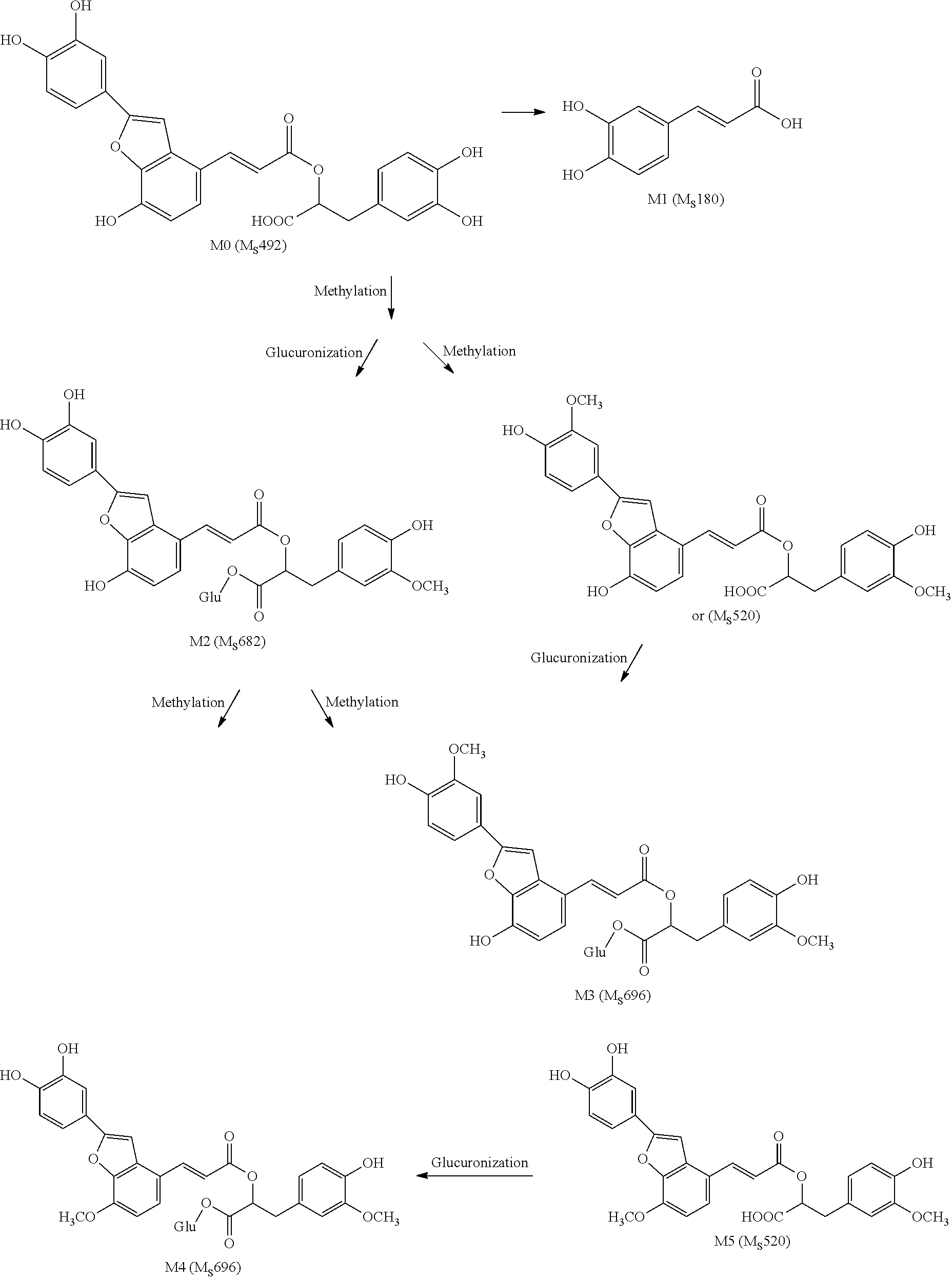
Possible In Vivo Metabolic Pathways of Salvianolic Acid C


| TABLE 1 |
| Inhibitory activity of benzofuran |
| amidated derivatives on xanthine oxidase |
| Compound | IC50 (μM) a | Compound | IC50 (μM) | ||
| Allopurinolb | 2.31 | Salvianolic acid C | 8.26 | ||
| 5a | 9.88 | 6a | 4.81 | ||
| 5b | 3.99 | 6b | 12.12 | ||
| 5c | 10.8 | 6c | 6.36 | ||
| 5d | 14.91 | 6d | 6.04 | ||
| 5e | 13.48 | 6e | 4.51 | ||
| 5f | 31.72 | 6f | 4.98 | ||
| 7 | >60 | 9a | >60 | ||
| 9b | >60 | 10a | >60 | ||
| L-dopa | >60 | D-dopa | >60 | ||
| L-phe | >60 | L-ala | >60 | ||
| L-trp | >60 | L-tyr | >60 | ||
| L-cys | >60 | L-met | >60 | ||
| a IC50 value is the average of four parallel experiments; | |||||
| bReported in the literature: IC50 = 2.55 μM; | |||||
| TABLE 2 |
| Antioxidant activity of benzofuran amidated derivatives |
| Compound | IC50 (μM)a | Compound | IC50 (μM) a | ||
| Quercetinb | 6.0 | Salvianolic acid C | 6.87 | ||
| 5a | 8.79 | 6a | 4.52 | ||
| 5b | 3.9 | 6b | 5.61 | ||
| 5c | 11.95 | 6c | 3.27 | ||
| 5d | 8.66 | 6d | 4.2 | ||
| 5e | 47.25 | 6e | 6.47 | ||
| 5f | 12.37 | 6f | 3.86 | ||
| 7 | >100 | 9a | 14.52 | ||
| 9b | 19.04 | 10a | 17.19 | ||
| a IC50 value is the average of three parallel experiments; | |||||
| bReported in the literature: IC50 = 9.1 μM; | |||||
| TABLE 3 |
| Evaluation of scavenging activity of aryl benzofuran |
| amidated derivatives on superoxide anion in RAW 264.7 |
| Compounds | Decrease of 2-OH-E+ (%) | ||
| Ve | 53.18 | ||
| Salvianolic acid C | 37.82 | ||
| 5a | 78.59 | ||
| 5b | 74.16 | ||
| 5c | 60.54 | ||
| 6b | 80.81 | ||
| 6c | 41.65 | ||
| 6d | 81.27 | ||
| 6e | 83.41 | ||
| TABLE 4 |
| Inhibition of uric acid in cell model |
| by benzofuran arnidated derivatives 5b, 6e |
| Concentration | Inhibition | |
| Compound | (μM) | rate (%) |
| Febuxostat | 5 | 78.7 |
| Satviatiolic acid C (1) | 10 | 15.2 |
| 30 | 24.7 | |
| 50 | 31.4 | |
| 5b | 10 | 28.6 |
| 30 | 46.1 | |
| 50 | 62.6 | |
| 6e | 10 | 31.5 |
| 30 | 41.6 | |
| 50 | 57.2 | |
| TABLE 5 |
| Effect of derivatives 5b and 6e on hyperuricemia model |
| induced by potassium oxonate in mice |
| Oxidation | ||
| of xanthine | ||
| in the liver | ||
| Serum uric | Enzyme | |
| acid value | activity | |
| Group | (mg/dl) | (U/g protein) |
| Normal control group | 3.16 ± 0.54 | 15.8 ± 1.9 |
| Model group | 4.81 ± 0.66 | 16.1 ± 2.4 |
| Derivative 5b low dose group | 3.87 ± 0.31*a | 14.1 ± 2.8** |
| Derivative 5b medium dose group | 3.61 ± 0.25** | 13.7 ± 1.6* |
| Derivative 5b high dose group | 3.30 ± 0.46** | 11.6 ± 1.7** |
| Derivative 6e low dose group | 3.82 ± 0.62** | 14.7 ± 2.2* |
| Derivative 6e medium dose group | 3.54 ± 0.26* | 13.2 ± 2.9* |
| Derivative 6e high dose group | 3.26 ± 0.44** | 11.3 ± 1.6** |
| Positive control group | 3.18 ± 0.50** | 10.2 ± 1.4** |
| aComparison between the drug-administered group and the model group: | ||
| *P < 0.05, | ||
| **P < 0.01. | ||
Claims (8)


Applications Claiming Priority (3)
| Application Number | Priority Date | Filing Date | Title |
|---|---|---|---|
| CN201610076098.8A CN105859667A (en) | 2016-02-03 | 2016-02-03 | Aryl benzofuran amidated derivatives and pharmaceutical use thereof |
| CN201610076098.8 | 2016-02-03 | ||
| PCT/CN2017/071614 WO2017133464A1 (en) | 2016-02-03 | 2017-01-19 | Amidated arylbenzofuran derivatives and pharmaceutical use thereof |
Publications (2)
| Publication Number | Publication Date |
|---|---|
| US20190040029A1 US20190040029A1 (en) | 2019-02-07 |
| US11021454B2 true US11021454B2 (en) | 2021-06-01 |
Family
ID=56624196
Family Applications (1)
| Application Number | Title | Priority Date | Filing Date |
|---|---|---|---|
| US16/075,370 Expired - Fee Related US11021454B2 (en) | 2016-02-03 | 2017-01-19 | Type of aryl benzofuran amidated derivative and medical use thereof |
Country Status (3)
| Country | Link |
|---|---|
| US (1) | US11021454B2 (en) |
| CN (1) | CN105859667A (en) |
| WO (1) | WO2017133464A1 (en) |
Families Citing this family (8)
| Publication number | Priority date | Publication date | Assignee | Title |
|---|---|---|---|---|
| CN105859667A (en) | 2016-02-03 | 2016-08-17 | 中国药科大学 | Aryl benzofuran amidated derivatives and pharmaceutical use thereof |
| CN106928173B (en) * | 2017-03-07 | 2019-04-16 | 中国科学院新疆理化技术研究所 | Phenolic acid compounds in lavender and preparation method and use thereof |
| CN108997282B (en) * | 2018-07-25 | 2022-04-29 | 安徽工程大学 | Arylbenzofuran derivatives having alpha-glucosidase inhibitory activity |
| CN112305114A (en) * | 2020-10-29 | 2021-02-02 | 诺峰药业(成都)有限公司 | High performance liquid chromatography method for determining sorbic acid content in difluprednate eye emulsion |
| CN115403544B (en) * | 2022-09-16 | 2024-05-31 | 台州永健医药科技有限公司 | Preparation method of salvianolic acid C |
| CN116183799A (en) * | 2022-12-30 | 2023-05-30 | 山东京博生物科技有限公司 | Method for analyzing content of thionyl chloride in phosphorus oxychloride and application thereof |
| CN116283855B (en) * | 2023-02-10 | 2025-09-23 | 上海仲时药业有限公司 | Salvianolic acid C derivatives, preparation methods and medical uses thereof |
| CN117069630B (en) * | 2023-08-01 | 2025-08-29 | 上海仲时药业有限公司 | A ROS-responsive prodrug and step-by-step targeted nanodrug delivery system and its preparation method and application |
Citations (3)
| Publication number | Priority date | Publication date | Assignee | Title |
|---|---|---|---|---|
| CN1778292A (en) | 2004-11-26 | 2006-05-31 | 中国科学院上海药物研究所 | Medical use of salvianolic acid |
| CN102423310A (en) | 2012-01-04 | 2012-04-25 | 中国药科大学 | Application of salvianolic acid C in preparation of drugs for prevention and treatment of hyperuricemia |
| CN105859667A (en) | 2016-02-03 | 2016-08-17 | 中国药科大学 | Aryl benzofuran amidated derivatives and pharmaceutical use thereof |
-
2016
- 2016-02-03 CN CN201610076098.8A patent/CN105859667A/en active Pending
-
2017
- 2017-01-19 US US16/075,370 patent/US11021454B2/en not_active Expired - Fee Related
- 2017-01-19 WO PCT/CN2017/071614 patent/WO2017133464A1/en not_active Ceased
Patent Citations (3)
| Publication number | Priority date | Publication date | Assignee | Title |
|---|---|---|---|---|
| CN1778292A (en) | 2004-11-26 | 2006-05-31 | 中国科学院上海药物研究所 | Medical use of salvianolic acid |
| CN102423310A (en) | 2012-01-04 | 2012-04-25 | 中国药科大学 | Application of salvianolic acid C in preparation of drugs for prevention and treatment of hyperuricemia |
| CN105859667A (en) | 2016-02-03 | 2016-08-17 | 中国药科大学 | Aryl benzofuran amidated derivatives and pharmaceutical use thereof |
Non-Patent Citations (11)
| Title |
|---|
| Da Zhou, et al; Research progress on flavonoids as enzymatic inhibitors; Food Science and Technology; 2009, p. 174-178, vol. 34, issue 6. |
| Guanhua Du; Research progress on salvianolic acid, a water-soluble active ingredient of Salvia miltiorrhiza; Basic Medical Sciences and Clinics; 2000, p. 10-14, vol. 20, issue 5. |
| Hao Wu; Survey on synthesis of salvianolic acids and their analogues; Journal of Shenyang Pharmaceutical University,2006, p. 60-64, vol. 23, issue 1. |
| Hongjin Tang, et al; Synthesis and evaluation of xanthine oxidase inhibitory and antioxidant activities of 2-arylbenzo [b]furan derivatives based on salvianolic acid C; European Journal of Medicinal Chemistry; Aug. 2016, ISSN: 0223-5234, p. 637-648, vol. 124. |
| Jianming Zhang, et al; Study on hyperuricemia in the physical examination population in Zhengzhou area; Journal of Zhengzhou University (Medical Sciences); 2009, p. 174, vol. 44, issue 1. |
| Jing Zhang; Anti-gout new drug—Febuxostat; Chin Pharm J, 2010, p. 1197-1198, vol. 45, issue 15. |
| Weiwei Zhang; Advances in studies on antitum or activities of compounds in Salvia miltiorrhiza; China Journal of Chinese Materia Medica; 2010, p. 389-392, vol. 35, issue 3. |
| Wenchen Pu; Bioactivities and Synthetic Methods of 2—Arylbenzo[b]furans; Chinese Journal of Organic Chemistry; 2011, p. 155-165, vol. 31. |
| Xinrong Wu, et al; Research advances on drug therapy targets in hyperuricemia; Chinese Pharmacological Bulletin; 2010, p. 1414-1417, vol. 26, issue 11. |
| Yu Wang,et al; A new drug for the treatment of gout and hyperuricemia—Febuxostat; China Pharmacy; 2009, p. 1748-1750, vol. 20, issue 22. |
| Yuting Yan; Metabolites of salvianolic acid C in rats in vivo; Journal of China Pharmaceutical University; 2013, p. 442-446, vol. 44, issue 5. |
Also Published As
| Publication number | Publication date |
|---|---|
| US20190040029A1 (en) | 2019-02-07 |
| WO2017133464A1 (en) | 2017-08-10 |
| CN105859667A (en) | 2016-08-17 |
Similar Documents
| Publication | Publication Date | Title |
|---|---|---|
| US20190040029A1 (en) | A type of aryl benzofuran amidated derivative and medical use thereof | |
| CN106432229B (en) | One kind is used for the compound for treating or preventing hyperuricemia or gout | |
| JP2003525217A (en) | Obesity treatment drugs | |
| EP4244221B1 (en) | Prodrug of pyrrolidone derivatives as glucokinase activator | |
| EP3838887A1 (en) | 2-(1-acyloxypentyl) benzoic acid salt formed by basic amino acid or aminoguanidine, preparation method therefor and uses thereof | |
| CN111393372B (en) | Benzimidazole derivative and preparation method and application thereof | |
| AU2002218502B2 (en) | Lactam compounds and medicinal use thereof | |
| CN112457365B (en) | A class of functional molecules targeting proteolysis pathway and its preparation and application | |
| CN108997282B (en) | Arylbenzofuran derivatives having alpha-glucosidase inhibitory activity | |
| CN103012088A (en) | Alpha-(3,5-dimethoxy benzylidene)-alpha'-alkylmethylenecycloketone and preparation method thereof | |
| US20190062290A1 (en) | 2,3-Epoxy Succinyl Derivative, Preparation Method and Use Thereof | |
| JP2019518060A (en) | Halogen compounds and their axial chirality isomers | |
| CN114364659B (en) | Pyrimidine-5-carboxamide compounds | |
| CN107586284B (en) | Use of a 2-arylbenzofuran derivative in the preparation of gout medicine | |
| CN113072484A (en) | Succinate-containing sulfanilamide benzamide compound and preparation method and application thereof | |
| CN117567392B (en) | A pterostilbene paeonol acetic acid compound, its preparation method and medical use | |
| JP4789618B2 (en) | Novel transcription factor, its production and use | |
| JP6576445B2 (en) | Aromatic compounds of farnesyl and their applications | |
| WO2007051408A1 (en) | Compounds for preventing or treating the h.pylori infection, preparation methods and use therrof | |
| UA104742C2 (en) | Arylcyclopropylacetamide derivatives useful as glucokinase activators | |
| CN102503894B (en) | 5-substituted methylene imidazolidine-2, 4-diketone derivative as well as pharmaceutical composition and application thereof | |
| WO2026086755A1 (en) | Polymorphs of macrocyclic fxia inhibitor compounds, preparation method therefor, and medical use thereof | |
| US20230346765A1 (en) | Methods of treating xanthine oxidase-related diseases with niflumic acid and derivatives thereof | |
| CN119219619A (en) | A non-classical ferroptosis inhibitor and its preparation method and use | |
| JP4749652B2 (en) | Novel FT-0554A substance and production method thereof |
Legal Events
| Date | Code | Title | Description |
|---|---|---|---|
| FEPP | Fee payment procedure |
Free format text: ENTITY STATUS SET TO UNDISCOUNTED (ORIGINAL EVENT CODE: BIG.); ENTITY STATUS OF PATENT OWNER: SMALL ENTITY |
|
| FEPP | Fee payment procedure |
Free format text: ENTITY STATUS SET TO SMALL (ORIGINAL EVENT CODE: SMAL); ENTITY STATUS OF PATENT OWNER: SMALL ENTITY |
|
| AS | Assignment |
Owner name: CHINA PHARMACEUTICAL UNIVERSITY, CHINA Free format text: ASSIGNMENT OF ASSIGNORS INTEREST;ASSIGNOR:CHEN, JUN;REEL/FRAME:047294/0864 Effective date: 20180730 |
|
| STPP | Information on status: patent application and granting procedure in general |
Free format text: DOCKETED NEW CASE - READY FOR EXAMINATION |
|
| STPP | Information on status: patent application and granting procedure in general |
Free format text: NON FINAL ACTION MAILED |
|
| STPP | Information on status: patent application and granting procedure in general |
Free format text: RESPONSE TO NON-FINAL OFFICE ACTION ENTERED AND FORWARDED TO EXAMINER |
|
| STPP | Information on status: patent application and granting procedure in general |
Free format text: NON FINAL ACTION MAILED |
|
| STPP | Information on status: patent application and granting procedure in general |
Free format text: RESPONSE TO NON-FINAL OFFICE ACTION ENTERED AND FORWARDED TO EXAMINER |
|
| STPP | Information on status: patent application and granting procedure in general |
Free format text: NON FINAL ACTION MAILED |
|
| STPP | Information on status: patent application and granting procedure in general |
Free format text: RESPONSE TO NON-FINAL OFFICE ACTION ENTERED AND FORWARDED TO EXAMINER |
|
| STPP | Information on status: patent application and granting procedure in general |
Free format text: NOTICE OF ALLOWANCE MAILED -- APPLICATION RECEIVED IN OFFICE OF PUBLICATIONS |
|
| STPP | Information on status: patent application and granting procedure in general |
Free format text: AWAITING TC RESP, ISSUE FEE PAYMENT RECEIVED |
|
| STPP | Information on status: patent application and granting procedure in general |
Free format text: PUBLICATIONS -- ISSUE FEE PAYMENT VERIFIED |
|
| STPP | Information on status: patent application and granting procedure in general |
Free format text: AWAITING TC RESP, ISSUE FEE PAYMENT VERIFIED |
|
| STPP | Information on status: patent application and granting procedure in general |
Free format text: PUBLICATIONS -- ISSUE FEE PAYMENT VERIFIED |
|
| STPP | Information on status: patent application and granting procedure in general |
Free format text: AWAITING TC RESP, ISSUE FEE PAYMENT VERIFIED |
|
| STPP | Information on status: patent application and granting procedure in general |
Free format text: PUBLICATIONS -- ISSUE FEE PAYMENT VERIFIED |
|
| STCF | Information on status: patent grant |
Free format text: PATENTED CASE |
|
| FEPP | Fee payment procedure |
Free format text: MAINTENANCE FEE REMINDER MAILED (ORIGINAL EVENT CODE: REM.); ENTITY STATUS OF PATENT OWNER: SMALL ENTITY |
|
| LAPS | Lapse for failure to pay maintenance fees |
Free format text: PATENT EXPIRED FOR FAILURE TO PAY MAINTENANCE FEES (ORIGINAL EVENT CODE: EXP.); ENTITY STATUS OF PATENT OWNER: SMALL ENTITY |
|
| STCH | Information on status: patent discontinuation |
Free format text: PATENT EXPIRED DUE TO NONPAYMENT OF MAINTENANCE FEES UNDER 37 CFR 1.362 |
|
| FP | Lapsed due to failure to pay maintenance fee |
Effective date: 20250601 |