US11011708B2 - Electron transport layer stack for an organic light-emitting diode - Google Patents
Electron transport layer stack for an organic light-emitting diode Download PDFInfo
- Publication number
- US11011708B2 US11011708B2 US15/788,431 US201715788431A US11011708B2 US 11011708 B2 US11011708 B2 US 11011708B2 US 201715788431 A US201715788431 A US 201715788431A US 11011708 B2 US11011708 B2 US 11011708B2
- Authority
- US
- United States
- Prior art keywords
- group
- substituted
- unsubstituted
- electron transport
- transport layer
- Prior art date
- Legal status (The legal status is an assumption and is not a legal conclusion. Google has not performed a legal analysis and makes no representation as to the accuracy of the status listed.)
- Active, expires
Links
- 0 *C1=CC([4*])=CC2=C1C=CC1=C2N=C2C3=CC([1*])=CC([2*])=C3C=CC2=C1C.[1*]C1=CC([2*])=C2/C=C\C3=C([Ar][5*])C4=C(N=C3C2=C1)C1=C(C=C4)C([3*])=CC([4*])=C1 Chemical compound *C1=CC([4*])=CC2=C1C=CC1=C2N=C2C3=CC([1*])=CC([2*])=C3C=CC2=C1C.[1*]C1=CC([2*])=C2/C=C\C3=C([Ar][5*])C4=C(N=C3C2=C1)C1=C(C=C4)C([3*])=CC([4*])=C1 0.000 description 11
- LGXGTIRHVBUFSB-UHFFFAOYSA-N CC(C)(C)C1=C2C=CC3=C(C=CC=C3)C2=NC2=C1C=CC1=C2C=CC=C1.CC(C)(C)C1=C2C=CC3=C(C=CC=C3)C2=NC2=C1C=CC=C2 Chemical compound CC(C)(C)C1=C2C=CC3=C(C=CC=C3)C2=NC2=C1C=CC1=C2C=CC=C1.CC(C)(C)C1=C2C=CC3=C(C=CC=C3)C2=NC2=C1C=CC=C2 LGXGTIRHVBUFSB-UHFFFAOYSA-N 0.000 description 4
- UHOVQNZJYSORNB-UHFFFAOYSA-N c1ccccc1 Chemical compound c1ccccc1 UHOVQNZJYSORNB-UHFFFAOYSA-N 0.000 description 3
- DBUANJDTLMOBRL-UHFFFAOYSA-N C1=CC=C(C2=C(C3=CC=CC=C3)C(C3=CC=CC=C3)=C(C3=CC=CC=C3)C(C3=CC=CC(C4=C5C=CC6=C(C=CC=C6)C5=NC5=C4C=CC4=C5C=CC=C4)=C3)=C2)C=C1 Chemical compound C1=CC=C(C2=C(C3=CC=CC=C3)C(C3=CC=CC=C3)=C(C3=CC=CC=C3)C(C3=CC=CC(C4=C5C=CC6=C(C=CC=C6)C5=NC5=C4C=CC4=C5C=CC=C4)=C3)=C2)C=C1 DBUANJDTLMOBRL-UHFFFAOYSA-N 0.000 description 2
- KHEMOQIDOQQGQJ-UHFFFAOYSA-N C1=CC=CC=C1.CC.CC.CC.CC.CC.CCCCCC Chemical compound C1=CC=CC=C1.CC.CC.CC.CC.CC.CCCCCC KHEMOQIDOQQGQJ-UHFFFAOYSA-N 0.000 description 2
- MXQIFVLDMQAESV-GVAZECLKSA-L C/C=C\C1=C2N[Li]OC2=CC=C1.C1=CC2=C(C=C1)C1=N(CO2)C2=C(C=CC=C2)S1.[Li]1OC2=C3C(=CC=C2)/C=C\C=[N+]\13 Chemical compound C/C=C\C1=C2N[Li]OC2=CC=C1.C1=CC2=C(C=C1)C1=N(CO2)C2=C(C=CC=C2)S1.[Li]1OC2=C3C(=CC=C2)/C=C\C=[N+]\13 MXQIFVLDMQAESV-GVAZECLKSA-L 0.000 description 1
- NQADDATZQHLGFH-UHFFFAOYSA-N C1=CC(C2=C3/C=C\C4=C5C(=CC=C4)C=CC(=C35)C=C2)=CC(C2=C3C=CC4=C(C=CC=C4)C3=NC3=C2C=CC2=C3C=CC=C2)=C1 Chemical compound C1=CC(C2=C3/C=C\C4=C5C(=CC=C4)C=CC(=C35)C=C2)=CC(C2=C3C=CC4=C(C=CC=C4)C3=NC3=C2C=CC2=C3C=CC=C2)=C1 NQADDATZQHLGFH-UHFFFAOYSA-N 0.000 description 1
- AIOOVXMIMFINJN-UHFFFAOYSA-N C1=CC(C2=C3C=CC4=C(C=CC=C4)C3=NC3=C2C=CC2=C3C=CC=C2)=CC(C2=C3C=CC=CC3=NC3=C2C=CC2=C3C=CC=C2)=C1 Chemical compound C1=CC(C2=C3C=CC4=C(C=CC=C4)C3=NC3=C2C=CC2=C3C=CC=C2)=CC(C2=C3C=CC=CC3=NC3=C2C=CC2=C3C=CC=C2)=C1 AIOOVXMIMFINJN-UHFFFAOYSA-N 0.000 description 1
- QIMDMDAEHZDCSW-UHFFFAOYSA-N C1=CC(C2=C3C=CC4=C(C=CC=C4)C3=NC3=C2C=CC2=C3C=CC=C2)=CC(C2=CC(C3=CC4=C(C=CC=C4)C=C3)=CC(C3=CC4=C(C=CC=C4)C=C3)=C2)=C1 Chemical compound C1=CC(C2=C3C=CC4=C(C=CC=C4)C3=NC3=C2C=CC2=C3C=CC=C2)=CC(C2=CC(C3=CC4=C(C=CC=C4)C=C3)=CC(C3=CC4=C(C=CC=C4)C=C3)=C2)=C1 QIMDMDAEHZDCSW-UHFFFAOYSA-N 0.000 description 1
- CFXUNDZSNGLCSL-UHFFFAOYSA-N C1=CC(C2=C3C=CC4=C(C=CC=C4)C3=NC3=C2C=CC2=C3C=CC=C2)=CC(C2=CC(C3=CC4=C(C=CC=C4)C=C3)=CC(C3=CC4=C(C=CC=C4)C=C3)=C2)=C1.C1=CC=C(C2=CC(C3=CC(C4=CC(C5=C6C=CC7=C(C=CC=C7)C6=NC6=C5C=CC5=C6C=CC=C5)=CC=C4)=CC=C3)=CC(C3=CC=CC=C3)=N2)C=C1.C1=CC=C(C2=CC(C3=CC=CC(C4=C5C=CC6=C(C=CC=C6)C5=NC5=C4C=CC4=C5C=CC=C4)=C3)=CC(C3=CC=CC=C3)=N2)C=C1 Chemical compound C1=CC(C2=C3C=CC4=C(C=CC=C4)C3=NC3=C2C=CC2=C3C=CC=C2)=CC(C2=CC(C3=CC4=C(C=CC=C4)C=C3)=CC(C3=CC4=C(C=CC=C4)C=C3)=C2)=C1.C1=CC=C(C2=CC(C3=CC(C4=CC(C5=C6C=CC7=C(C=CC=C7)C6=NC6=C5C=CC5=C6C=CC=C5)=CC=C4)=CC=C3)=CC(C3=CC=CC=C3)=N2)C=C1.C1=CC=C(C2=CC(C3=CC=CC(C4=C5C=CC6=C(C=CC=C6)C5=NC5=C4C=CC4=C5C=CC=C4)=C3)=CC(C3=CC=CC=C3)=N2)C=C1 CFXUNDZSNGLCSL-UHFFFAOYSA-N 0.000 description 1
- RIXNWSQWZUGGTJ-UHFFFAOYSA-N C1=CC(C2=C3C=CC4=C(C=CC=C4)C3=NC3=C2C=CC2=C3C=CC=C2)=CC(C2=CC=CC(C3=C4C=CC5=C(C=CC=C5)C4=NC4=C3C=CC3=C4C=CC=C3)=C2)=C1 Chemical compound C1=CC(C2=C3C=CC4=C(C=CC=C4)C3=NC3=C2C=CC2=C3C=CC=C2)=CC(C2=CC=CC(C3=C4C=CC5=C(C=CC=C5)C4=NC4=C3C=CC3=C4C=CC=C3)=C2)=C1 RIXNWSQWZUGGTJ-UHFFFAOYSA-N 0.000 description 1
- NQPLQYXUWRSJMH-UHFFFAOYSA-N C1=CC(C2=C3C=CC4=C(C=CC=C4)C3=NC3=C2C=CC2=C3C=CC=C2)=CC(C2=CC=CC(C3=C4C=CC5=C(C=CC=C5)C4=NC4=C3C=CC3=C4C=CC=C3)=C2)=C1.C1=CC(C2=C3N=CC=CC3=CC=C2)=CC(C2=C3C=CC4=C(C=CC=C4)C3=NC3=C2C=CC2=C3/C=C\C=C/2)=C1.C1=CC(C2=CC=NC=C2)=CC(C2=C3C=CC4=C(C=CC=C4)C3=NC3=C2C=CC2=C3C=CC=C2)=C1 Chemical compound C1=CC(C2=C3C=CC4=C(C=CC=C4)C3=NC3=C2C=CC2=C3C=CC=C2)=CC(C2=CC=CC(C3=C4C=CC5=C(C=CC=C5)C4=NC4=C3C=CC3=C4C=CC=C3)=C2)=C1.C1=CC(C2=C3N=CC=CC3=CC=C2)=CC(C2=C3C=CC4=C(C=CC=C4)C3=NC3=C2C=CC2=C3/C=C\C=C/2)=C1.C1=CC(C2=CC=NC=C2)=CC(C2=C3C=CC4=C(C=CC=C4)C3=NC3=C2C=CC2=C3C=CC=C2)=C1 NQPLQYXUWRSJMH-UHFFFAOYSA-N 0.000 description 1
- FKUXRLOGQQXBSE-UHFFFAOYSA-N C1=CC(C2=C3C=CC4=C(C=CC=C4)C3=NC3=C2C=CC2=C3C=CC=C2)=CC(C2=CC=CC3=C2C=CC=C3)=C1.C1=CC=C(C2=CC(C3=CC=CC=C3)=C(C3=CC(C4=CC=CC(C5=C6C=CC7=C(C=CC=C7)C6=NC6=C5C=CC5=C6C=CC=C5)=C4)=CC=C3)C(C3=CC=CC=C3)=C2)C=C1.C1=CC=C(C2=CC(C3=CC=CC=C3)=C(C3=CC(C4=CC=CC(C5=C6C=CC7=C(C=CC=C7)C6=NC6=C5C=CC5=C6C=CC=C5)=C4)=CC=C3)C=C2)C=C1.C1=CN=C2C(=C1)C=CC=C2C1=CC=C(C2=CC(C3=C4C=CC5=C(C=CC=C5)C4=NC4=C3C=CC3=C4C=CC=C3)=CC=C2)C=C1 Chemical compound C1=CC(C2=C3C=CC4=C(C=CC=C4)C3=NC3=C2C=CC2=C3C=CC=C2)=CC(C2=CC=CC3=C2C=CC=C3)=C1.C1=CC=C(C2=CC(C3=CC=CC=C3)=C(C3=CC(C4=CC=CC(C5=C6C=CC7=C(C=CC=C7)C6=NC6=C5C=CC5=C6C=CC=C5)=C4)=CC=C3)C(C3=CC=CC=C3)=C2)C=C1.C1=CC=C(C2=CC(C3=CC=CC=C3)=C(C3=CC(C4=CC=CC(C5=C6C=CC7=C(C=CC=C7)C6=NC6=C5C=CC5=C6C=CC=C5)=C4)=CC=C3)C=C2)C=C1.C1=CN=C2C(=C1)C=CC=C2C1=CC=C(C2=CC(C3=C4C=CC5=C(C=CC=C5)C4=NC4=C3C=CC3=C4C=CC=C3)=CC=C2)C=C1 FKUXRLOGQQXBSE-UHFFFAOYSA-N 0.000 description 1
- AHLYFXZINZZHGB-UHFFFAOYSA-N C1=CC(C2=C3C=CC=CC3=C3C=CC=CC3=C2)=CC(C2=C3C=CC4=C(C=CC=C4)C3=NC3=C2C=CC2=C3C=CC=C2)=C1 Chemical compound C1=CC(C2=C3C=CC=CC3=C3C=CC=CC3=C2)=CC(C2=C3C=CC4=C(C=CC=C4)C3=NC3=C2C=CC2=C3C=CC=C2)=C1 AHLYFXZINZZHGB-UHFFFAOYSA-N 0.000 description 1
- MCJDUWCRCHCLBP-UHFFFAOYSA-N C1=CC(C2=C3C=CC=CC3=C3C=CC=CC3=C2)=CC(C2=C3C=CC4=C(C=CC=C4)C3=NC3=C2C=CC2=C3C=CC=C2)=C1.C1=CC2=CC3=C(C=CC=C3)C(C3=CC(C4=C5C=CC6=C(C=CC=C6)C5=NC5=C4/C=C\C4=C5C=CC=C4)=CC=C3)=C2C=C1.C1=CC=C(C2=CC(C3=C4C=CC=CC4=CC4=C3C=CC=C4)=CC(C3=CC(C4=C5C=CC6=C(C=CC=C6)C5=NC5=C4C=CC4=C5C=CC=C4)=CC=C3)=C2)C=C1.C1=CC=C(C2=CC=C(C3=NC(C4=CC=CC=C4)=NC(C4=CC=CC(C5=CC(C6=C7C=CC8=C(C=CC=C8)C7=NC7=C6C=CC6=C7C=CC=C6)=CC=C5)=C4)=N3)C=C2)C=C1 Chemical compound C1=CC(C2=C3C=CC=CC3=C3C=CC=CC3=C2)=CC(C2=C3C=CC4=C(C=CC=C4)C3=NC3=C2C=CC2=C3C=CC=C2)=C1.C1=CC2=CC3=C(C=CC=C3)C(C3=CC(C4=C5C=CC6=C(C=CC=C6)C5=NC5=C4/C=C\C4=C5C=CC=C4)=CC=C3)=C2C=C1.C1=CC=C(C2=CC(C3=C4C=CC=CC4=CC4=C3C=CC=C4)=CC(C3=CC(C4=C5C=CC6=C(C=CC=C6)C5=NC5=C4C=CC4=C5C=CC=C4)=CC=C3)=C2)C=C1.C1=CC=C(C2=CC=C(C3=NC(C4=CC=CC=C4)=NC(C4=CC=CC(C5=CC(C6=C7C=CC8=C(C=CC=C8)C7=NC7=C6C=CC6=C7C=CC=C6)=CC=C5)=C4)=N3)C=C2)C=C1 MCJDUWCRCHCLBP-UHFFFAOYSA-N 0.000 description 1
- UACLUDGYTOEAFN-UHFFFAOYSA-N C1=CC(C2=C3N=CC=CC3=CC=C2)=CC(C2=CC=CC(C3=C4C=CC5=C(C=CC=C5)C4=NC4=C3C=CC3=C4/C=C\C=C/3)=C2)=C1.C1=CC2=C(C=C1)C1=NC3=C(/C=C\C4=C3C=CC=C4)C(C3=CC=C(C4=CC5=C(C=CC=C5)C5=C4C=CC=C5)C=C3)=C1C=C2.C1=CC=C(C2=CC(C3=CC=CC=C3)=CC(C3=CC=C(C4=CC(C5=C6C=CC7=C(C=CC=C7)C6=NC6=C5C=CC5=C6C=CC=C5)=CC=C4)C=C3)=C2)C=C1 Chemical compound C1=CC(C2=C3N=CC=CC3=CC=C2)=CC(C2=CC=CC(C3=C4C=CC5=C(C=CC=C5)C4=NC4=C3C=CC3=C4/C=C\C=C/3)=C2)=C1.C1=CC2=C(C=C1)C1=NC3=C(/C=C\C4=C3C=CC=C4)C(C3=CC=C(C4=CC5=C(C=CC=C5)C5=C4C=CC=C5)C=C3)=C1C=C2.C1=CC=C(C2=CC(C3=CC=CC=C3)=CC(C3=CC=C(C4=CC(C5=C6C=CC7=C(C=CC=C7)C6=NC6=C5C=CC5=C6C=CC=C5)=CC=C4)C=C3)=C2)C=C1 UACLUDGYTOEAFN-UHFFFAOYSA-N 0.000 description 1
- FJJQYGSOJDGMNX-UHFFFAOYSA-N C1=CC(C2=CC(C3=C4C=CC5=C(C=CC=C5)C4=NC4=C3C=CC3=C4C=CC=C3)=CC=C2)=CN=C1.C1=CC=C(C2=NC3=C(C=CC=C3)N2C2=CC=C(C3=CC=CC(C4=C5C=CC6=C(C=CC=C6)C5=NC5=C4C=CC4=C5C=CC=C4)=C3)C=C2)N=C1.C1=CN=C(C2=CC(C3=C4C=CC5=C(C=CC=C5)C4=NC4=C3C=CC3=C4C=CC=C3)=CC=C2)C=C1.C1=CN=CC(C2=CC(C3=CC4=C(C=CC=C4)C4=C3C=CC=C4)=CC(C3=C4C=CC5=C(C=CC=C5)C4=NC4=C5C=CC=CC5=CC=C43)=C2)=C1 Chemical compound C1=CC(C2=CC(C3=C4C=CC5=C(C=CC=C5)C4=NC4=C3C=CC3=C4C=CC=C3)=CC=C2)=CN=C1.C1=CC=C(C2=NC3=C(C=CC=C3)N2C2=CC=C(C3=CC=CC(C4=C5C=CC6=C(C=CC=C6)C5=NC5=C4C=CC4=C5C=CC=C4)=C3)C=C2)N=C1.C1=CN=C(C2=CC(C3=C4C=CC5=C(C=CC=C5)C4=NC4=C3C=CC3=C4C=CC=C3)=CC=C2)C=C1.C1=CN=CC(C2=CC(C3=CC4=C(C=CC=C4)C4=C3C=CC=C4)=CC(C3=C4C=CC5=C(C=CC=C5)C4=NC4=C5C=CC=CC5=CC=C43)=C2)=C1 FJJQYGSOJDGMNX-UHFFFAOYSA-N 0.000 description 1
- XQQKCSNLLGHJQH-UHFFFAOYSA-N C1=CC(C2=CC(C3=CC=CC(C4=C5C=CC6=C(C=CC=C6)C5=NC5=C4C=CC4=C5C=CC=C4)=C3)=CC(C3=CN=CC=C3)=C2)=CN=C1 Chemical compound C1=CC(C2=CC(C3=CC=CC(C4=C5C=CC6=C(C=CC=C6)C5=NC5=C4C=CC4=C5C=CC=C4)=C3)=CC(C3=CN=CC=C3)=C2)=CN=C1 XQQKCSNLLGHJQH-UHFFFAOYSA-N 0.000 description 1
- QDTSKVBMVXNWEK-UHFFFAOYSA-N C1=CC(C2=CC(C3=CC=CC(C4=C5C=CC6=C(C=CC=C6)C5=NC5=C4C=CC4=C5C=CC=C4)=C3)=CC(C3=CN=CC=C3)=C2)=CN=C1.C1=CC=C(C2=CC(C3=CC=CC=C3)=CC(C3=CC(C4=C5C=CC6=C(C=CC=C6)C5=NC5=C4C=CC4=C5C=CC=C4)=CC=C3)=C2)C=C1.C1=CC=C(C2=CC(C3=CC=CC=C3)=CC(C3=CC(C4=CC=CC(C5=C6C=CC7=C(C=CC=C7)C6=NC6=C5C=CC5=C6C=CC=C5)=C4)=CC=C3)=C2)C=C1 Chemical compound C1=CC(C2=CC(C3=CC=CC(C4=C5C=CC6=C(C=CC=C6)C5=NC5=C4C=CC4=C5C=CC=C4)=C3)=CC(C3=CN=CC=C3)=C2)=CN=C1.C1=CC=C(C2=CC(C3=CC=CC=C3)=CC(C3=CC(C4=C5C=CC6=C(C=CC=C6)C5=NC5=C4C=CC4=C5C=CC=C4)=CC=C3)=C2)C=C1.C1=CC=C(C2=CC(C3=CC=CC=C3)=CC(C3=CC(C4=CC=CC(C5=C6C=CC7=C(C=CC=C7)C6=NC6=C5C=CC5=C6C=CC=C5)=C4)=CC=C3)=C2)C=C1 QDTSKVBMVXNWEK-UHFFFAOYSA-N 0.000 description 1
- YZGXMDIGNSVSTQ-UHFFFAOYSA-N C1=CC(C2=CC=CC3=C2C2=C(C=CC=N2)C=C3)=CC(C2=C3C=CC4=C(C=CC=C4)C3=NC3=C2C=CC2=C3C=CC=C2)=C1.C1=CC2=CC=C(C3=CC=C(C4=CC=CC(C5=C6C=CC7=C(C=CC=C7)C6=NC6=C5C=CC5=C6/C=C\C=C/5)=C4)C=C3)N=C2C=C1.C1=CC=C(C2=C(C3=CC=CC=C3)C(C3=CC=CC=C3)=C(C3=CC=CC=C3)C(C3=CC=C(C4=CC(C5=C6C=CC7=C(C=CC=C7)C6=NC6=C5C=CC5=C6C=CC=C5)=CC=C4)C=C3)=C2)C=C1 Chemical compound C1=CC(C2=CC=CC3=C2C2=C(C=CC=N2)C=C3)=CC(C2=C3C=CC4=C(C=CC=C4)C3=NC3=C2C=CC2=C3C=CC=C2)=C1.C1=CC2=CC=C(C3=CC=C(C4=CC=CC(C5=C6C=CC7=C(C=CC=C7)C6=NC6=C5C=CC5=C6/C=C\C=C/5)=C4)C=C3)N=C2C=C1.C1=CC=C(C2=C(C3=CC=CC=C3)C(C3=CC=CC=C3)=C(C3=CC=CC=C3)C(C3=CC=C(C4=CC(C5=C6C=CC7=C(C=CC=C7)C6=NC6=C5C=CC5=C6C=CC=C5)=CC=C4)C=C3)=C2)C=C1 YZGXMDIGNSVSTQ-UHFFFAOYSA-N 0.000 description 1
- KRGZCOASGYWGOT-UHFFFAOYSA-N C1=CC(C2=CC=NC=C2)=CC(C2=C3C=CC4=C(C=CC=C4)C3=NC3=C2C=CC2=C3C=CC=C2)=C1 Chemical compound C1=CC(C2=CC=NC=C2)=CC(C2=C3C=CC4=C(C=CC=C4)C3=NC3=C2C=CC2=C3C=CC=C2)=C1 KRGZCOASGYWGOT-UHFFFAOYSA-N 0.000 description 1
- CTOKGMSKKXULNW-UHFFFAOYSA-N C1=CC(N2C3=C(C=CC=C3)C3=C2C=CC=C3)=CC(C2=C3C=CC4=C(C=CC=C4)C3=NC3=C2C=CC2=C3C=CC=C2)=C1.C1=CC=C(C2=C(C3=CC(C4=CC=CC(C5=C6C=CC7=C(C=CC=C7)C6=NC6=C5C=CC5=C6C=CC=C5)=C4)=CC=C3)C=CC=C2)C=C1.CC1=CC(C)=C(C2=CC(C3=CC=CC(C4=C5C=CC6=C(C=CC=C6)C5=NC5=C4C=CC4=C5C=CC=C4)=C3)=CC=C2)C(C)=C1.CC1=CC(C)=C(C2=CC=CC(C3=C4C=CC5=C(C=CC=C5)C4=NC4=C3C=CC3=C4C=CC=C3)=C2)C(C)=C1.CC1=CC(C)=CC(C2=CC=CC(C3=C4C=CC5=C(C=CC=C5)C4=NC4=C3C=CC3=C4C=CC=C3)=C2)=C1 Chemical compound C1=CC(N2C3=C(C=CC=C3)C3=C2C=CC=C3)=CC(C2=C3C=CC4=C(C=CC=C4)C3=NC3=C2C=CC2=C3C=CC=C2)=C1.C1=CC=C(C2=C(C3=CC(C4=CC=CC(C5=C6C=CC7=C(C=CC=C7)C6=NC6=C5C=CC5=C6C=CC=C5)=C4)=CC=C3)C=CC=C2)C=C1.CC1=CC(C)=C(C2=CC(C3=CC=CC(C4=C5C=CC6=C(C=CC=C6)C5=NC5=C4C=CC4=C5C=CC=C4)=C3)=CC=C2)C(C)=C1.CC1=CC(C)=C(C2=CC=CC(C3=C4C=CC5=C(C=CC=C5)C4=NC4=C3C=CC3=C4C=CC=C3)=C2)C(C)=C1.CC1=CC(C)=CC(C2=CC=CC(C3=C4C=CC5=C(C=CC=C5)C4=NC4=C3C=CC3=C4C=CC=C3)=C2)=C1 CTOKGMSKKXULNW-UHFFFAOYSA-N 0.000 description 1
- OYWHCFYLOMGLRK-UHFFFAOYSA-N C1=CC2=C(C=C1)C1=NC3=C(C=CC4=C3C=CC=C4)C(C3=CC=C(C4=CC5=C(C=CC=C5)C5=C4C=CC=C5)C=C3)=C1C=C2 Chemical compound C1=CC2=C(C=C1)C1=NC3=C(C=CC4=C3C=CC=C4)C(C3=CC=C(C4=CC5=C(C=CC=C5)C5=C4C=CC=C5)C=C3)=C1C=C2 OYWHCFYLOMGLRK-UHFFFAOYSA-N 0.000 description 1
- YWBLTJDGQCRSNY-UHFFFAOYSA-N C1=CC2=CC3=C(C=CC=C3)C(C3=CC(C4=C5C=CC6=C(C=CC=C6)C5=NC5=C4C=CC4=C5C=CC=C4)=CC=C3)=C2C=C1 Chemical compound C1=CC2=CC3=C(C=CC=C3)C(C3=CC(C4=C5C=CC6=C(C=CC=C6)C5=NC5=C4C=CC4=C5C=CC=C4)=CC=C3)=C2C=C1 YWBLTJDGQCRSNY-UHFFFAOYSA-N 0.000 description 1
- KWGILPBTMHRELB-UHFFFAOYSA-N C1=CC2=CC=CC(C3=CC(C4=CC=CC5=C4C=CC=C5)=CC(C4=CC=CC(C5=C6C=CC7=C(C=CC=C7)C6=NC6=C5C=CC5=C6C=CC=C5)=C4)=C3)=C2C=C1 Chemical compound C1=CC2=CC=CC(C3=CC(C4=CC=CC5=C4C=CC=C5)=CC(C4=CC=CC(C5=C6C=CC7=C(C=CC=C7)C6=NC6=C5C=CC5=C6C=CC=C5)=C4)=C3)=C2C=C1 KWGILPBTMHRELB-UHFFFAOYSA-N 0.000 description 1
- VPGJKYWMMYRXCQ-UHFFFAOYSA-N C1=CC2=CC=CC(C3=CC(C4=CC=CC5=C4C=CC=C5)=CC(C4=CC=CC(C5=C6C=CC7=C(C=CC=C7)C6=NC6=C5C=CC5=C6C=CC=C5)=C4)=C3)=C2C=C1.C1=CC=C(C2=C(C3=CC=CC=C3)C(C3=CC=CC=C3)=C(C3=CC=CC=C3)C(C3=CC=CC(C4=C5C=CC6=C(C=CC=C6)C5=NC5=C4C=CC4=C5C=CC=C4)=C3)=C2)C=C1.C1=CC=C(C2=C3C=CC=CC3=C(C3=CC=CC(C4=C5C=CC6=C(C=CC=C6)C5=NC5=C4C=CC4=C5C=CC=C4)=C3)C3=CC=CC=C32)C=C1 Chemical compound C1=CC2=CC=CC(C3=CC(C4=CC=CC5=C4C=CC=C5)=CC(C4=CC=CC(C5=C6C=CC7=C(C=CC=C7)C6=NC6=C5C=CC5=C6C=CC=C5)=C4)=C3)=C2C=C1.C1=CC=C(C2=C(C3=CC=CC=C3)C(C3=CC=CC=C3)=C(C3=CC=CC=C3)C(C3=CC=CC(C4=C5C=CC6=C(C=CC=C6)C5=NC5=C4C=CC4=C5C=CC=C4)=C3)=C2)C=C1.C1=CC=C(C2=C3C=CC=CC3=C(C3=CC=CC(C4=C5C=CC6=C(C=CC=C6)C5=NC5=C4C=CC4=C5C=CC=C4)=C3)C3=CC=CC=C32)C=C1 VPGJKYWMMYRXCQ-UHFFFAOYSA-N 0.000 description 1
- CFOURTXBUQDVLB-UHFFFAOYSA-N C1=CC=C(C2=C(C3=CC(C4=CC=CC(C5=C6C=CC7=C(C=CC=C7)C6=NC6=C5C=CC5=C6C=CC=C5)=C4)=CC=C3)C=CC=C2)C=C1 Chemical compound C1=CC=C(C2=C(C3=CC(C4=CC=CC(C5=C6C=CC7=C(C=CC=C7)C6=NC6=C5C=CC5=C6C=CC=C5)=C4)=CC=C3)C=CC=C2)C=C1 CFOURTXBUQDVLB-UHFFFAOYSA-N 0.000 description 1
- PLIMCDLEDQBVKD-UHFFFAOYSA-N C1=CC=C(C2=C(C3=CC=CC=C3)C(C3=CC=CC=C3)=C(C3=CC=C(C4=C5C=CC6=C(C=CC=C6)C5=NC5=C4C=CC4=C5C=CC=C4)C=C3)C(C3=CC=CC=C3)=C2C2=CC=CC=C2)C=C1 Chemical compound C1=CC=C(C2=C(C3=CC=CC=C3)C(C3=CC=CC=C3)=C(C3=CC=C(C4=C5C=CC6=C(C=CC=C6)C5=NC5=C4C=CC4=C5C=CC=C4)C=C3)C(C3=CC=CC=C3)=C2C2=CC=CC=C2)C=C1 PLIMCDLEDQBVKD-UHFFFAOYSA-N 0.000 description 1
- OXLSWIRPMFGOMR-UHFFFAOYSA-N C1=CC=C(C2=C(C3=CC=CC=C3)C(C3=CC=CC=C3)=C(C3=CC=C(C4=C5C=CC6=C(C=CC=C6)C5=NC5=C4C=CC4=C5C=CC=C4)C=C3)C(C3=CC=CC=C3)=C2C2=CC=CC=C2)C=C1.C1=CC=C(C2=CC(C3=CC=CC=C3)=C(C3=CC=CC(C4=C5C=CC6=C(C=CC=C6)C5=NC5=C4C=CC4=C5C=CC=C4)=C3)C=C2)C=C1.CC1=CC=CC=C1C1=CC(C2=CC=C(C3=C4C=CC5=C(C=CC=C5)C4=NC4=C3C=CC3=C4C=CC=C3)C=C2)=CC(C2=CC=CC=C2C)=C1 Chemical compound C1=CC=C(C2=C(C3=CC=CC=C3)C(C3=CC=CC=C3)=C(C3=CC=C(C4=C5C=CC6=C(C=CC=C6)C5=NC5=C4C=CC4=C5C=CC=C4)C=C3)C(C3=CC=CC=C3)=C2C2=CC=CC=C2)C=C1.C1=CC=C(C2=CC(C3=CC=CC=C3)=C(C3=CC=CC(C4=C5C=CC6=C(C=CC=C6)C5=NC5=C4C=CC4=C5C=CC=C4)=C3)C=C2)C=C1.CC1=CC=CC=C1C1=CC(C2=CC=C(C3=C4C=CC5=C(C=CC=C5)C4=NC4=C3C=CC3=C4C=CC=C3)C=C2)=CC(C2=CC=CC=C2C)=C1 OXLSWIRPMFGOMR-UHFFFAOYSA-N 0.000 description 1
- DYIAFRHAOOPWIK-UHFFFAOYSA-N C1=CC=C(C2=C(C3=CC=CC=C3)C(C3=CC=CC=C3)=C(C3=CC=C(C4=C5C=CC=CC5=NC5=C4C=CC4=C5C=CC=C4)C=C3)C(C3=CC=CC=C3)=C2C2=CC=CC=C2)C=C1 Chemical compound C1=CC=C(C2=C(C3=CC=CC=C3)C(C3=CC=CC=C3)=C(C3=CC=C(C4=C5C=CC=CC5=NC5=C4C=CC4=C5C=CC=C4)C=C3)C(C3=CC=CC=C3)=C2C2=CC=CC=C2)C=C1 DYIAFRHAOOPWIK-UHFFFAOYSA-N 0.000 description 1
- NGEVOCACFRIRMH-UHFFFAOYSA-N C1=CC=C(C2=C(C3=CC=CC=C3)C(C3=CC=CC=C3)=C(C3=CC=CC=C3)C(C3=CC(C4=CC(C5=C6C=CC7=C(/C=C\C=C/7)C6=NC6=C5C=CC5=C6C=CC=C5)=CC=C4)=CC=C3)=C2)C=C1.C1=CC=C(C2=C(C3=CC=CC=C3)C(C3=CC=CC=C3)=C(C3=CC=CC=C3)C(C3=CC(C4=CC=C(C5=C6C=CC7=C(C=CC=C7)C6=NC6=C5C=CC5=C6C=CC=C5)C=C4)=CC=C3)=C2)C=C1.C1=CC=C(C2=CC(C3=CC=CC=C3)=CC(C3=CC=C(C4=C5C=CC6=C(/C=C\C=C/6)C5=NC5=C4C=CC4=C5C=CC=C4)C=C3)=C2)C=C1 Chemical compound C1=CC=C(C2=C(C3=CC=CC=C3)C(C3=CC=CC=C3)=C(C3=CC=CC=C3)C(C3=CC(C4=CC(C5=C6C=CC7=C(/C=C\C=C/7)C6=NC6=C5C=CC5=C6C=CC=C5)=CC=C4)=CC=C3)=C2)C=C1.C1=CC=C(C2=C(C3=CC=CC=C3)C(C3=CC=CC=C3)=C(C3=CC=CC=C3)C(C3=CC(C4=CC=C(C5=C6C=CC7=C(C=CC=C7)C6=NC6=C5C=CC5=C6C=CC=C5)C=C4)=CC=C3)=C2)C=C1.C1=CC=C(C2=CC(C3=CC=CC=C3)=CC(C3=CC=C(C4=C5C=CC6=C(/C=C\C=C/6)C5=NC5=C4C=CC4=C5C=CC=C4)C=C3)=C2)C=C1 NGEVOCACFRIRMH-UHFFFAOYSA-N 0.000 description 1
- ULOIFYUPNQCWQD-UHFFFAOYSA-N C1=CC=C(C2=C(C3=CC=CC=C3)C(C3=CC=CC=C3)=C(C3=CC=CC=C3)C(C3=CC(C4=CC(C5=C6C=CC7=C(C=CC=C7)C6=NC6=C5C=CC5=C6C=CC=C5)=CC=C4)=CC=C3)=C2)C=C1 Chemical compound C1=CC=C(C2=C(C3=CC=CC=C3)C(C3=CC=CC=C3)=C(C3=CC=CC=C3)C(C3=CC(C4=CC(C5=C6C=CC7=C(C=CC=C7)C6=NC6=C5C=CC5=C6C=CC=C5)=CC=C4)=CC=C3)=C2)C=C1 ULOIFYUPNQCWQD-UHFFFAOYSA-N 0.000 description 1
- HZECLCWPWCXDBY-UHFFFAOYSA-N C1=CC=C(C2=C(C3=CC=CC=C3)C(C3=CC=CC=C3)=C(C3=CC=CC=C3)C(C3=CC(C4=CC=C(C5=C6C=CC7=C(C=CC=C7)C6=NC6=C5C=CC5=C6C=CC=C5)C=C4)=CC=C3)=C2)C=C1 Chemical compound C1=CC=C(C2=C(C3=CC=CC=C3)C(C3=CC=CC=C3)=C(C3=CC=CC=C3)C(C3=CC(C4=CC=C(C5=C6C=CC7=C(C=CC=C7)C6=NC6=C5C=CC5=C6C=CC=C5)C=C4)=CC=C3)=C2)C=C1 HZECLCWPWCXDBY-UHFFFAOYSA-N 0.000 description 1
- GCXFTBMXCVUOGH-UHFFFAOYSA-N C1=CC=C(C2=C(C3=CC=CC=C3)C(C3=CC=CC=C3)=C(C3=CC=CC=C3)C(C3=CC=C(C4=CC(C5=C6C=CC7=C(C=CC=C7)C6=NC6=C5C=CC5=C6C=CC=C5)=CC=C4)C=C3)=C2)C=C1 Chemical compound C1=CC=C(C2=C(C3=CC=CC=C3)C(C3=CC=CC=C3)=C(C3=CC=CC=C3)C(C3=CC=C(C4=CC(C5=C6C=CC7=C(C=CC=C7)C6=NC6=C5C=CC5=C6C=CC=C5)=CC=C4)C=C3)=C2)C=C1 GCXFTBMXCVUOGH-UHFFFAOYSA-N 0.000 description 1
- VAANVRREAJNIJF-UHFFFAOYSA-N C1=CC=C(C2=CC(C3=C4C=CC=CC4=CC4=C3C=CC=C4)=CC(C3=CC(C4=C5C=CC6=C(C=CC=C6)C5=NC5=C4C=CC4=C5C=CC=C4)=CC=C3)=C2)C=C1 Chemical compound C1=CC=C(C2=CC(C3=C4C=CC=CC4=CC4=C3C=CC=C4)=CC(C3=CC(C4=C5C=CC6=C(C=CC=C6)C5=NC5=C4C=CC4=C5C=CC=C4)=CC=C3)=C2)C=C1 VAANVRREAJNIJF-UHFFFAOYSA-N 0.000 description 1
- KWDQEOLLMZTXDR-UHFFFAOYSA-N C1=CC=C(C2=CC(C3=CC(C4=CC(C5=C6C=CC7=C(C=CC=C7)C6=NC6=C5C=CC5=C6C=CC=C5)=CC=C4)=CC=C3)=CC(C3=CC=CC=C3)=N2)C=C1 Chemical compound C1=CC=C(C2=CC(C3=CC(C4=CC(C5=C6C=CC7=C(C=CC=C7)C6=NC6=C5C=CC5=C6C=CC=C5)=CC=C4)=CC=C3)=CC(C3=CC=CC=C3)=N2)C=C1 KWDQEOLLMZTXDR-UHFFFAOYSA-N 0.000 description 1
- FUIBAOBRNXQMPV-UHFFFAOYSA-N C1=CC=C(C2=CC(C3=CC(C4=CC(C5=CC=CC(C6=NC(C7=CC=CC=C7)=NC(C7=CC=CC=C7)=N6)=C5)=CC=C4)=CC=C3)=C(C3=CC=CC=C3)C(C3=CC=CC=C3)=C2C2=CC=CC=C2)C=C1 Chemical compound C1=CC=C(C2=CC(C3=CC(C4=CC(C5=CC=CC(C6=NC(C7=CC=CC=C7)=NC(C7=CC=CC=C7)=N6)=C5)=CC=C4)=CC=C3)=C(C3=CC=CC=C3)C(C3=CC=CC=C3)=C2C2=CC=CC=C2)C=C1 FUIBAOBRNXQMPV-UHFFFAOYSA-N 0.000 description 1
- GSQFMGONMKKCPT-UHFFFAOYSA-N C1=CC=C(C2=CC(C3=CC(C4=CC(C5=CC=CC(C6=NC(C7=CC=CC=C7)=NC(C7=CC=CC=C7)=N6)=C5)=CC=C4)=CC=C3)=C(C3=CC=CC=C3)C(C3=CC=CC=C3)=C2C2=CC=CC=C2)C=C1.C1=CC=C(C2=CC(C3=CC(C4=CC(C5=NC(C6=CC=CC=C6)=NC(C6=CC=CC=C6)=N5)=CC=C4)=CC=C3)=C(C3=CC=CC=C3)C(C3=CC=CC=C3)=C2C2=CC=CC=C2)C=C1.C1=CC=C(C2=CC(C3=CC=C(C4=CC=CC(C5=NC(C6=CC=CC=C6)=NC(C6=CC=CC=C6)=N5)=C4)C=C3)=C(C3=CC=CC=C3)C(C3=CC=CC=C3)=C2C2=CC=CC=C2)C=C1.C1=CC=C(C2=CC(C3=NC(C4=CC=CC=C4)=NC(C4=CC=CC(C5=C(C6=CC=CC=C6)C(C6=CC=CC=C6)=C(C6=CC=CC=C6)C(C6=CC=CC=C6)=C5)=C4)=N3)=CC=C2)C=C1.C1=CC=C(C2=CC=C(C3=NC(C4=CC(C5=CC=CC(C6=CC=CC(C7=C(C8=CC=CC=C8)C(C8=CC=CC=C8)=C(C8=CC=CC=C8)C(C8=CC=CC=C8)=C7)=C6)=C5)=CC=C4)=NC(C4=CC=CC=C4)=N3)C=C2)C=C1.C1=CC=C(C2=CC=C(C3=NC(C4=CC=CC(C5=CC=CC(C6=C(C7=CC=CC=C7)C(C7=CC=CC=C7)=C(C7=CC=CC=C7)C(C7=CC=CC=C7)=C6)=C5)=C4)=NC(C4=CC=CC=C4)=N3)C=C2)C=C1 Chemical compound C1=CC=C(C2=CC(C3=CC(C4=CC(C5=CC=CC(C6=NC(C7=CC=CC=C7)=NC(C7=CC=CC=C7)=N6)=C5)=CC=C4)=CC=C3)=C(C3=CC=CC=C3)C(C3=CC=CC=C3)=C2C2=CC=CC=C2)C=C1.C1=CC=C(C2=CC(C3=CC(C4=CC(C5=NC(C6=CC=CC=C6)=NC(C6=CC=CC=C6)=N5)=CC=C4)=CC=C3)=C(C3=CC=CC=C3)C(C3=CC=CC=C3)=C2C2=CC=CC=C2)C=C1.C1=CC=C(C2=CC(C3=CC=C(C4=CC=CC(C5=NC(C6=CC=CC=C6)=NC(C6=CC=CC=C6)=N5)=C4)C=C3)=C(C3=CC=CC=C3)C(C3=CC=CC=C3)=C2C2=CC=CC=C2)C=C1.C1=CC=C(C2=CC(C3=NC(C4=CC=CC=C4)=NC(C4=CC=CC(C5=C(C6=CC=CC=C6)C(C6=CC=CC=C6)=C(C6=CC=CC=C6)C(C6=CC=CC=C6)=C5)=C4)=N3)=CC=C2)C=C1.C1=CC=C(C2=CC=C(C3=NC(C4=CC(C5=CC=CC(C6=CC=CC(C7=C(C8=CC=CC=C8)C(C8=CC=CC=C8)=C(C8=CC=CC=C8)C(C8=CC=CC=C8)=C7)=C6)=C5)=CC=C4)=NC(C4=CC=CC=C4)=N3)C=C2)C=C1.C1=CC=C(C2=CC=C(C3=NC(C4=CC=CC(C5=CC=CC(C6=C(C7=CC=CC=C7)C(C7=CC=CC=C7)=C(C7=CC=CC=C7)C(C7=CC=CC=C7)=C6)=C5)=C4)=NC(C4=CC=CC=C4)=N3)C=C2)C=C1 GSQFMGONMKKCPT-UHFFFAOYSA-N 0.000 description 1
- DKZWSXGHNJYWRA-UHFFFAOYSA-N C1=CC=C(C2=CC(C3=CC(C4=CC(C5=NC(C6=CC=CC=C6)=NC(C6=CC=CC=C6)=N5)=CC=C4)=CC=C3)=C(C3=CC=CC=C3)C(C3=CC=CC=C3)=C2C2=CC=CC=C2)C=C1 Chemical compound C1=CC=C(C2=CC(C3=CC(C4=CC(C5=NC(C6=CC=CC=C6)=NC(C6=CC=CC=C6)=N5)=CC=C4)=CC=C3)=C(C3=CC=CC=C3)C(C3=CC=CC=C3)=C2C2=CC=CC=C2)C=C1 DKZWSXGHNJYWRA-UHFFFAOYSA-N 0.000 description 1
- PLYKAAJQOXFLNO-UHFFFAOYSA-N C1=CC=C(C2=CC(C3=CC(C4=NC(C5=CC=CC=C5)=NC(C5=CC=CC=C5)=N4)=CC=C3)=C(C3=CC=CC=C3)C(C3=CC=CC=C3)=C2C2=CC=CC=C2)C=C1 Chemical compound C1=CC=C(C2=CC(C3=CC(C4=NC(C5=CC=CC=C5)=NC(C5=CC=CC=C5)=N4)=CC=C3)=C(C3=CC=CC=C3)C(C3=CC=CC=C3)=C2C2=CC=CC=C2)C=C1 PLYKAAJQOXFLNO-UHFFFAOYSA-N 0.000 description 1
- CSXWIACRPOVAPA-UHFFFAOYSA-N C1=CC=C(C2=CC(C3=CC(C4=NC(C5=CC=CC=C5)=NC(C5=CC=CC=C5)=N4)=CC=C3)=C(C3=CC=CC=C3)C(C3=CC=CC=C3)=C2C2=CC=CC=C2)C=C1.C1=CC=C(C2=CC=C(C3=NC(C4=CC=CC(C5=C(C6=CC=CC=C6)C(C6=CC=CC=C6)=C(C6=CC=CC=C6)C(C6=CC=CC=C6)=C5)=C4)=NC(C4=CC=CC=C4)=N3)C=C2)C=C1.C1=CC=C(C2=CC=CC(C3=NC(C4=CC(C5=CC=CC(C6=CC=CC(C7=C(C8=CC=CC=C8)C(C8=CC=CC=C8)=C(C8=CC=CC=C8)C(C8=CC=CC=C8)=C7)=C6)=C5)=CC=C4)=NC(C4=CC=CC=C4)=N3)=C2)C=C1.C1=CC=C(C2=CC=CC(C3=NC(C4=CC=CC(C5=CC=CC(C6=C(C7=CC=CC=C7)C(C7=CC=CC=C7)=C(C7=CC=CC=C7)C(C7=CC=CC=C7)=C6)=C5)=C4)=NC(C4=CC=CC=C4)=N3)=C2)C=C1.C1=CC=C(C2=NC(C3=CC=CC(C4=CC=CC(C5=CC(C6=CC=CC=C6)=C(C6=CC=CC=C6)C(C6=CC=CC=C6)=C5C5=CC=CC=C5)=C4)=C3)=C3SC4=C(C=CC=C4)C3=N2)C=C1 Chemical compound C1=CC=C(C2=CC(C3=CC(C4=NC(C5=CC=CC=C5)=NC(C5=CC=CC=C5)=N4)=CC=C3)=C(C3=CC=CC=C3)C(C3=CC=CC=C3)=C2C2=CC=CC=C2)C=C1.C1=CC=C(C2=CC=C(C3=NC(C4=CC=CC(C5=C(C6=CC=CC=C6)C(C6=CC=CC=C6)=C(C6=CC=CC=C6)C(C6=CC=CC=C6)=C5)=C4)=NC(C4=CC=CC=C4)=N3)C=C2)C=C1.C1=CC=C(C2=CC=CC(C3=NC(C4=CC(C5=CC=CC(C6=CC=CC(C7=C(C8=CC=CC=C8)C(C8=CC=CC=C8)=C(C8=CC=CC=C8)C(C8=CC=CC=C8)=C7)=C6)=C5)=CC=C4)=NC(C4=CC=CC=C4)=N3)=C2)C=C1.C1=CC=C(C2=CC=CC(C3=NC(C4=CC=CC(C5=CC=CC(C6=C(C7=CC=CC=C7)C(C7=CC=CC=C7)=C(C7=CC=CC=C7)C(C7=CC=CC=C7)=C6)=C5)=C4)=NC(C4=CC=CC=C4)=N3)=C2)C=C1.C1=CC=C(C2=NC(C3=CC=CC(C4=CC=CC(C5=CC(C6=CC=CC=C6)=C(C6=CC=CC=C6)C(C6=CC=CC=C6)=C5C5=CC=CC=C5)=C4)=C3)=C3SC4=C(C=CC=C4)C3=N2)C=C1 CSXWIACRPOVAPA-UHFFFAOYSA-N 0.000 description 1
- RKOMBTHCQYRGHT-UHFFFAOYSA-N C1=CC=C(C2=CC(C3=CC=CC=C3)=C(C3=CC(C4=CC=CC(C5=C6C=CC7=C(C=CC=C7)C6=NC6=C5C=CC5=C6C=CC=C5)=C4)=CC=C3)C(C3=CC=CC=C3)=C2)C=C1 Chemical compound C1=CC=C(C2=CC(C3=CC=CC=C3)=C(C3=CC(C4=CC=CC(C5=C6C=CC7=C(C=CC=C7)C6=NC6=C5C=CC5=C6C=CC=C5)=C4)=CC=C3)C(C3=CC=CC=C3)=C2)C=C1 RKOMBTHCQYRGHT-UHFFFAOYSA-N 0.000 description 1
- WDIIDNCFUGCXOE-UHFFFAOYSA-N C1=CC=C(C2=CC(C3=CC=CC=C3)=C(C3=CC=CC(C4=C5C=CC6=C(C=CC=C6)C5=NC5=C4C=CC4=C5C=CC=C4)=C3)C(C3=CC=CC=C3)=C2)C=C1 Chemical compound C1=CC=C(C2=CC(C3=CC=CC=C3)=C(C3=CC=CC(C4=C5C=CC6=C(C=CC=C6)C5=NC5=C4C=CC4=C5C=CC=C4)=C3)C(C3=CC=CC=C3)=C2)C=C1 WDIIDNCFUGCXOE-UHFFFAOYSA-N 0.000 description 1
- YIQNHGSKQLKZHN-UHFFFAOYSA-N C1=CC=C(C2=CC(C3=CC=CC=C3)=C(C3=CC=CC(C4=C5C=CC6=C(C=CC=C6)C5=NC5=C4C=CC4=C5C=CC=C4)=C3)C(C3=CC=CC=C3)=C2)C=C1.C1=CC=C(C2=CC(C3=CC=CC=C3)=CC(C3=CC=C(C4=CC=C(C5=C6C=CC7=C(C=CC=C7)C6=NC6=C5C=CC5=C6C=CC=C5)C=C4)C=C3)=C2)C=C1.CC1=CC=CC=C1C1=CC(C2=CC=CC(C3=C4C=CC5=C(C=CC=C5)C4=NC4=C3C=CC3=C4C=CC=C3)=C2)=CC(C2=CC=CC=C2C)=C1 Chemical compound C1=CC=C(C2=CC(C3=CC=CC=C3)=C(C3=CC=CC(C4=C5C=CC6=C(C=CC=C6)C5=NC5=C4C=CC4=C5C=CC=C4)=C3)C(C3=CC=CC=C3)=C2)C=C1.C1=CC=C(C2=CC(C3=CC=CC=C3)=CC(C3=CC=C(C4=CC=C(C5=C6C=CC7=C(C=CC=C7)C6=NC6=C5C=CC5=C6C=CC=C5)C=C4)C=C3)=C2)C=C1.CC1=CC=CC=C1C1=CC(C2=CC=CC(C3=C4C=CC5=C(C=CC=C5)C4=NC4=C3C=CC3=C4C=CC=C3)=C2)=CC(C2=CC=CC=C2C)=C1 YIQNHGSKQLKZHN-UHFFFAOYSA-N 0.000 description 1
- IAICDVJTOFXVBG-UHFFFAOYSA-N C1=CC=C(C2=CC(C3=CC=CC=C3)=CC(C3=CC(C4=C5C=CC6=C(C=CC=C6)C5=NC5=C4C=CC4=C5C=CC=C4)=CC=C3)=C2)C=C1 Chemical compound C1=CC=C(C2=CC(C3=CC=CC=C3)=CC(C3=CC(C4=C5C=CC6=C(C=CC=C6)C5=NC5=C4C=CC4=C5C=CC=C4)=CC=C3)=C2)C=C1 IAICDVJTOFXVBG-UHFFFAOYSA-N 0.000 description 1
- JMMZIABEYHPOSE-UHFFFAOYSA-N C1=CC=C(C2=CC(C3=CC=CC=C3)=CC(C3=CC(C4=CC(C5=CC=CC=C5)=CC(C5=CC=CC=C5)=C4)=CC(C4=CC(C5=C6C=CC7=C(C=CC=C7)C6=NC6=C5C=CC5=C6C=CC=C5)=CC=C4)=C3)=C2)C=C1 Chemical compound C1=CC=C(C2=CC(C3=CC=CC=C3)=CC(C3=CC(C4=CC(C5=CC=CC=C5)=CC(C5=CC=CC=C5)=C4)=CC(C4=CC(C5=C6C=CC7=C(C=CC=C7)C6=NC6=C5C=CC5=C6C=CC=C5)=CC=C4)=C3)=C2)C=C1 JMMZIABEYHPOSE-UHFFFAOYSA-N 0.000 description 1
- BRFXOKGCVLGPMO-UHFFFAOYSA-N C1=CC=C(C2=CC(C3=CC=CC=C3)=CC(C3=CC(C4=CC=CC(C5=C6C=CC7=C(C=CC=C7)C6=NC6=C5C=CC5=C6C=CC=C5)=C4)=CC=C3)=C2)C=C1 Chemical compound C1=CC=C(C2=CC(C3=CC=CC=C3)=CC(C3=CC(C4=CC=CC(C5=C6C=CC7=C(C=CC=C7)C6=NC6=C5C=CC5=C6C=CC=C5)=C4)=CC=C3)=C2)C=C1 BRFXOKGCVLGPMO-UHFFFAOYSA-N 0.000 description 1
- JZIGUZUAJVYVBF-UHFFFAOYSA-N C1=CC=C(C2=CC(C3=CC=CC=C3)=CC(C3=CC=C(C4=C5C=CC6=C(C=CC=C6)C5=NC5=C4C=CC4=C5C=CC=C4)C=C3)=C2)C=C1 Chemical compound C1=CC=C(C2=CC(C3=CC=CC=C3)=CC(C3=CC=C(C4=C5C=CC6=C(C=CC=C6)C5=NC5=C4C=CC4=C5C=CC=C4)C=C3)=C2)C=C1 JZIGUZUAJVYVBF-UHFFFAOYSA-N 0.000 description 1
- URZORTQKONDDRW-UHFFFAOYSA-N C1=CC=C(C2=CC(C3=NC(C4=CC=CC=C4)=NC(C4=CC=CC(C5=C(C6=CC=CC=C6)C(C6=CC=CC=C6)=C(C6=CC=CC=C6)C(C6=CC=CC=C6)=C5)=C4)=N3)=CC=C2)C=C1 Chemical compound C1=CC=C(C2=CC(C3=NC(C4=CC=CC=C4)=NC(C4=CC=CC(C5=C(C6=CC=CC=C6)C(C6=CC=CC=C6)=C(C6=CC=CC=C6)C(C6=CC=CC=C6)=C5)=C4)=N3)=CC=C2)C=C1 URZORTQKONDDRW-UHFFFAOYSA-N 0.000 description 1
- HVEFOKRLUIWEPT-UHFFFAOYSA-N C1=CC=C(C2=CC=C(C3=CC(C4=CC=CC(C5=C6C=CC7=C(C=CC=C7)C6=NC6=C5C=CC5=C6C=CC=C5)=C4)=CC=C3)C(C3=CC=CC=C3)=C2)C=C1 Chemical compound C1=CC=C(C2=CC=C(C3=CC(C4=CC=CC(C5=C6C=CC7=C(C=CC=C7)C6=NC6=C5C=CC5=C6C=CC=C5)=C4)=CC=C3)C(C3=CC=CC=C3)=C2)C=C1 HVEFOKRLUIWEPT-UHFFFAOYSA-N 0.000 description 1
- KJAWJQOKLLDOBM-UHFFFAOYSA-N C1=CC=C(C2=CC=C(C3=NC(C4=CC(C5=CC=CC(C6=CC=CC(C7=C(C8=CC=CC=C8)C(C8=CC=CC=C8)=C(C8=CC=CC=C8)C(C8=CC=CC=C8)=C7)=C6)=C5)=CC=C4)=NC(C4=CC=CC=C4)=N3)C=C2)C=C1 Chemical compound C1=CC=C(C2=CC=C(C3=NC(C4=CC(C5=CC=CC(C6=CC=CC(C7=C(C8=CC=CC=C8)C(C8=CC=CC=C8)=C(C8=CC=CC=C8)C(C8=CC=CC=C8)=C7)=C6)=C5)=CC=C4)=NC(C4=CC=CC=C4)=N3)C=C2)C=C1 KJAWJQOKLLDOBM-UHFFFAOYSA-N 0.000 description 1
- TUXAQRXOGBTKDJ-UHFFFAOYSA-N C1=CC=C(C2=CC=C(C3=NC(C4=CC=CC(C5=C(C6=CC=CC=C6)C(C6=CC=CC=C6)=C(C6=CC=CC=C6)C(C6=CC=CC=C6)=C5)=C4)=NC(C4=CC=CC=C4)=N3)C=C2)C=C1 Chemical compound C1=CC=C(C2=CC=C(C3=NC(C4=CC=CC(C5=C(C6=CC=CC=C6)C(C6=CC=CC=C6)=C(C6=CC=CC=C6)C(C6=CC=CC=C6)=C5)=C4)=NC(C4=CC=CC=C4)=N3)C=C2)C=C1 TUXAQRXOGBTKDJ-UHFFFAOYSA-N 0.000 description 1
- VOXSHOUIDDEFJB-UHFFFAOYSA-N C1=CC=C(C2=CC=C(C3=NC(C4=CC=CC=C4)=NC(C4=CC=C(C5=C6C=CC7=C(C=CC=C7)C6=NC6=C5C=CC5=C6C=CC=C5)C=C4)=N3)C=C2)C=C1.C1=CC=C(C2=CC=CC(C3=NC(C4=CC=CC=C4)=NC(C4=CC=C(C5=C6C=CC7=C(C=CC=C7)C6=NC6=C5C=CC5=C6C=CC=C5)C=C4)=N3)=C2)C=C1.C1=CC=C(C2=NC(C3=CC=CC=C3)=NC(C3=CC=C(C4=C5C=CC6=C(C=CC=C6)C5=NC5=C4C=CC4=C5C=CC=C4)C=C3)=N2)C=C1 Chemical compound C1=CC=C(C2=CC=C(C3=NC(C4=CC=CC=C4)=NC(C4=CC=C(C5=C6C=CC7=C(C=CC=C7)C6=NC6=C5C=CC5=C6C=CC=C5)C=C4)=N3)C=C2)C=C1.C1=CC=C(C2=CC=CC(C3=NC(C4=CC=CC=C4)=NC(C4=CC=C(C5=C6C=CC7=C(C=CC=C7)C6=NC6=C5C=CC5=C6C=CC=C5)C=C4)=N3)=C2)C=C1.C1=CC=C(C2=NC(C3=CC=CC=C3)=NC(C3=CC=C(C4=C5C=CC6=C(C=CC=C6)C5=NC5=C4C=CC4=C5C=CC=C4)C=C3)=N2)C=C1 VOXSHOUIDDEFJB-UHFFFAOYSA-N 0.000 description 1
- VBPXUNXQSJDFKZ-UHFFFAOYSA-N C1=CC=C(C2=CC=C(C3=NC(C4=CC=CC=C4)=NC(C4=CC=CC(C5=C6C=CC7=C(C=CC=C7)C6=NC6=C5C=CC5=C6C=CC=C5)=C4)=N3)C=C2)C=C1.C1=CC=C(C2=CC=CC(C3=NC(C4=CC=CC=C4)=NC(C4=CC=CC(C5=C6C=CC7=C(C=CC=C7)C6=NC6=C5C=CC5=C6C=CC=C5)=C4)=N3)=C2)C=C1.C1=CC=C(C2=CC=CC(C3=NC(C4=CC=CC=C4)=NC(C4=CC=CC(C5=CC(C6=C7C=CC8=C(C=CC=C8)C7=NC7=C6C=CC6=C7C=CC=C6)=CC=C5)=C4)=N3)=C2)C=C1.C1=CC=C(C2=NC(C3=CC=CC=C3)=NC(C3=CC(C4=C5C=CC6=C(C=CC=C6)C5=NC5=C4C=CC4=C5C=CC=C4)=CC=C3)=N2)C=C1 Chemical compound C1=CC=C(C2=CC=C(C3=NC(C4=CC=CC=C4)=NC(C4=CC=CC(C5=C6C=CC7=C(C=CC=C7)C6=NC6=C5C=CC5=C6C=CC=C5)=C4)=N3)C=C2)C=C1.C1=CC=C(C2=CC=CC(C3=NC(C4=CC=CC=C4)=NC(C4=CC=CC(C5=C6C=CC7=C(C=CC=C7)C6=NC6=C5C=CC5=C6C=CC=C5)=C4)=N3)=C2)C=C1.C1=CC=C(C2=CC=CC(C3=NC(C4=CC=CC=C4)=NC(C4=CC=CC(C5=CC(C6=C7C=CC8=C(C=CC=C8)C7=NC7=C6C=CC6=C7C=CC=C6)=CC=C5)=C4)=N3)=C2)C=C1.C1=CC=C(C2=NC(C3=CC=CC=C3)=NC(C3=CC(C4=C5C=CC6=C(C=CC=C6)C5=NC5=C4C=CC4=C5C=CC=C4)=CC=C3)=N2)C=C1 VBPXUNXQSJDFKZ-UHFFFAOYSA-N 0.000 description 1
- SUMTVQVQPUXOEV-UHFFFAOYSA-N C1=CC=C(C2=CC=C(C3=NC(C4=CC=CC=C4)=NC(C4=CC=CC(C5=CC=CC(C6=C(C7=CC=CC=C7)C(C7=CC=CC=C7)=C(C7=CC=CC=C7)C(C7=CC=CC=C7)=C6)=C5)=C4)=N3)C=C2)C=C1 Chemical compound C1=CC=C(C2=CC=C(C3=NC(C4=CC=CC=C4)=NC(C4=CC=CC(C5=CC=CC(C6=C(C7=CC=CC=C7)C(C7=CC=CC=C7)=C(C7=CC=CC=C7)C(C7=CC=CC=C7)=C6)=C5)=C4)=N3)C=C2)C=C1 SUMTVQVQPUXOEV-UHFFFAOYSA-N 0.000 description 1
- XWFKASAOYJHROI-UHFFFAOYSA-N C1=CC=C(C2=CC=CC(C3=C4C=CC5=C(C=CC=C5)C4=NC4=C3C=CC3=C4C=CC=C3)=C2)C=C1.C1=CC=C(C2=CC=CC3=CC=CN=C32)C(C2=CC(C3=C4C=CC5=C(C=CC=C5)C4=NC4=C3C=CC3=C4C=CC=C3)=CC=C2)=C1.C1=CC=C(C2=CC=CC=C2C2=CC(C3=CC=CC(C4=C5C=CC6=C(C=CC=C6)C5=NC5=C4C=CC4=C5C=CC=C4)=C3)=CC(C3=C(C4=CC=CC=C4)C=CC=C3)=C2)C=C1.CC(C)(C)C1=CC(C2=CC=CC(C3=C4C=CC5=C(C=CC=C5)C4=NC4=C3C=CC3=C4C=CC=C3)=C2)=CC(C(C)(C)C)=C1 Chemical compound C1=CC=C(C2=CC=CC(C3=C4C=CC5=C(C=CC=C5)C4=NC4=C3C=CC3=C4C=CC=C3)=C2)C=C1.C1=CC=C(C2=CC=CC3=CC=CN=C32)C(C2=CC(C3=C4C=CC5=C(C=CC=C5)C4=NC4=C3C=CC3=C4C=CC=C3)=CC=C2)=C1.C1=CC=C(C2=CC=CC=C2C2=CC(C3=CC=CC(C4=C5C=CC6=C(C=CC=C6)C5=NC5=C4C=CC4=C5C=CC=C4)=C3)=CC(C3=C(C4=CC=CC=C4)C=CC=C3)=C2)C=C1.CC(C)(C)C1=CC(C2=CC=CC(C3=C4C=CC5=C(C=CC=C5)C4=NC4=C3C=CC3=C4C=CC=C3)=C2)=CC(C(C)(C)C)=C1 XWFKASAOYJHROI-UHFFFAOYSA-N 0.000 description 1
- ULRNBSJPTQJHHE-UHFFFAOYSA-N C1=CC=C(C2=CC=CC(C3=CC=CC=C3)=C2C2=CC(C3=CC=CC(C4=C5C=CC6=C(C=CC=C6)C5=NC5=C4C=CC4=C5C=CC=C4)=C3)=CC=C2)C=C1 Chemical compound C1=CC=C(C2=CC=CC(C3=CC=CC=C3)=C2C2=CC(C3=CC=CC(C4=C5C=CC6=C(C=CC=C6)C5=NC5=C4C=CC4=C5C=CC=C4)=C3)=CC=C2)C=C1 ULRNBSJPTQJHHE-UHFFFAOYSA-N 0.000 description 1
- DQNQZUIDCDAGHV-UHFFFAOYSA-N C1=CC=C(C2=CC=CC(C3=NC(C4=CC=CC(C5=CC=CC(C6=C(C7=CC=CC=C7)C(C7=CC=CC=C7)=C(C7=CC=CC=C7)C(C7=CC=CC=C7)=C6)=C5)=C4)=NC(C4=CC=CC=C4)=N3)=C2)C=C1 Chemical compound C1=CC=C(C2=CC=CC(C3=NC(C4=CC=CC(C5=CC=CC(C6=C(C7=CC=CC=C7)C(C7=CC=CC=C7)=C(C7=CC=CC=C7)C(C7=CC=CC=C7)=C6)=C5)=C4)=NC(C4=CC=CC=C4)=N3)=C2)C=C1 DQNQZUIDCDAGHV-UHFFFAOYSA-N 0.000 description 1
- IEZPPGNYEABHIX-UHFFFAOYSA-N C1=CC=C(C2=CC=CC3=CC=CN=C32)C(C2=CC(C3=C4C=CC5=C(C=CC=C5)C4=NC4=C3C=CC3=C4C=CC=C3)=CC=C2)=C1 Chemical compound C1=CC=C(C2=CC=CC3=CC=CN=C32)C(C2=CC(C3=C4C=CC5=C(C=CC=C5)C4=NC4=C3C=CC3=C4C=CC=C3)=CC=C2)=C1 IEZPPGNYEABHIX-UHFFFAOYSA-N 0.000 description 1
- NFOZMTFFPZNGHW-UHFFFAOYSA-N C1=CC=C(C2=CC=CC=C2C2=CC(C3=CC=CC(C4=C5C=CC6=C(C=CC=C6)C5=NC5=C4C=CC4=C5C=CC=C4)=C3)=CC(C3=C(C4=CC=CC=C4)C=CC=C3)=C2)C=C1 Chemical compound C1=CC=C(C2=CC=CC=C2C2=CC(C3=CC=CC(C4=C5C=CC6=C(C=CC=C6)C5=NC5=C4C=CC4=C5C=CC=C4)=C3)=CC(C3=C(C4=CC=CC=C4)C=CC=C3)=C2)C=C1 NFOZMTFFPZNGHW-UHFFFAOYSA-N 0.000 description 1
- ACGWPXFBHMAXMK-UHFFFAOYSA-N C1=CC=C(C2=NC(C3=CC=CC(C4=CC=CC(C5=CC(C6=CC=CC=C6)=C(C6=CC=CC=C6)C(C6=CC=CC=C6)=C5C5=CC=CC=C5)=C4)=C3)=C3SC4=C(C=CC=C4)C3=N2)C=C1 Chemical compound C1=CC=C(C2=NC(C3=CC=CC(C4=CC=CC(C5=CC(C6=CC=CC=C6)=C(C6=CC=CC=C6)C(C6=CC=CC=C6)=C5C5=CC=CC=C5)=C4)=C3)=C3SC4=C(C=CC=C4)C3=N2)C=C1 ACGWPXFBHMAXMK-UHFFFAOYSA-N 0.000 description 1
- RFFWZKYFFDBDFL-UHFFFAOYSA-N C1=CN(B(N2C=CC=N2)(N2C=CC=N2)N2CCCN2)N=C1.CCC.[Li+] Chemical compound C1=CN(B(N2C=CC=N2)(N2C=CC=N2)N2CCCN2)N=C1.CCC.[Li+] RFFWZKYFFDBDFL-UHFFFAOYSA-N 0.000 description 1
- AVWGLGAYAVILJB-UHFFFAOYSA-N C1=CN=C(C2=CC(C3=C4C=CC5=C(C=CC=C5)C4=NC4=C3C=CC3=C4C=CC=C3)=CC=C2)C=C1 Chemical compound C1=CN=C(C2=CC(C3=C4C=CC5=C(C=CC=C5)C4=NC4=C3C=CC3=C4C=CC=C3)=CC=C2)C=C1 AVWGLGAYAVILJB-UHFFFAOYSA-N 0.000 description 1
- IURDEANYHIYNCU-UHFFFAOYSA-N CC(C)(C)C1=CC(C2=C(C3=C4N=CC=CC4=CC=C3)C=CC=C2)=CC=C1.CC(C)(C)C1=CC(C2=CC(C3=C(C4=CC=CC=C4)C=CC=C3)=CC=C2)=CC=C1.CC(C)(C)C1=CC(C2=CC(C3=C4C=CC5=C(C=CC=C5)C4=NC4=C3C=CC3=C4C=CC=C3)=CC=C2)=CC=C1.CC(C)(C)C1=CC(C2=CC=CC(C3=CC=C(C4=CC=CC=C4)C=C3C3=CC=CC=C3)=C2)=CC=C1.CC1=CC(C)=C(C2=CC=CC(C(C)(C)C)=C2)C(C)=C1.CC1=CC(C)=C(C2=CC=CC(C3=CC=CC(C(C)(C)C)=C3)=C2)C(C)=C1 Chemical compound CC(C)(C)C1=CC(C2=C(C3=C4N=CC=CC4=CC=C3)C=CC=C2)=CC=C1.CC(C)(C)C1=CC(C2=CC(C3=C(C4=CC=CC=C4)C=CC=C3)=CC=C2)=CC=C1.CC(C)(C)C1=CC(C2=CC(C3=C4C=CC5=C(C=CC=C5)C4=NC4=C3C=CC3=C4C=CC=C3)=CC=C2)=CC=C1.CC(C)(C)C1=CC(C2=CC=CC(C3=CC=C(C4=CC=CC=C4)C=C3C3=CC=CC=C3)=C2)=CC=C1.CC1=CC(C)=C(C2=CC=CC(C(C)(C)C)=C2)C(C)=C1.CC1=CC(C)=C(C2=CC=CC(C3=CC=CC(C(C)(C)C)=C3)=C2)C(C)=C1 IURDEANYHIYNCU-UHFFFAOYSA-N 0.000 description 1
- XXDJYKRIHLSKIJ-UHFFFAOYSA-N CC(C)(C)C1=CC(C2=C(C3=CC=CC=C3)C=C(C3=CC=CC=C3)C=C2)=CC=C1.CC(C)(C)C1=CC(C2=C(C3=CC=CC=C3)C=C(C3=CC=CC=C3)C=C2C2=CC=CC=C2)=CC=C1.CC(C)(C)C1=CC(C2=CC(C3=C4C=CC=CC4=CC=C3)=CC(C3=CC=CC4=C3C=CC=C4)=C2)=CC=C1.CC(C)(C)C1=CC=C(C2=C(C3=CC=CC=C3)C(C3=CC=CC=C3)=C(C3=CC=CC=C3)C(C3=CC=CC=C3)=C2C2=CC=CC=C2)C=C1 Chemical compound CC(C)(C)C1=CC(C2=C(C3=CC=CC=C3)C=C(C3=CC=CC=C3)C=C2)=CC=C1.CC(C)(C)C1=CC(C2=C(C3=CC=CC=C3)C=C(C3=CC=CC=C3)C=C2C2=CC=CC=C2)=CC=C1.CC(C)(C)C1=CC(C2=CC(C3=C4C=CC=CC4=CC=C3)=CC(C3=CC=CC4=C3C=CC=C4)=C2)=CC=C1.CC(C)(C)C1=CC=C(C2=C(C3=CC=CC=C3)C(C3=CC=CC=C3)=C(C3=CC=CC=C3)C(C3=CC=CC=C3)=C2C2=CC=CC=C2)C=C1 XXDJYKRIHLSKIJ-UHFFFAOYSA-N 0.000 description 1
- FTBWQNOGXLOKPZ-UHFFFAOYSA-N CC(C)(C)C1=CC(C2=C(C3=CC=CC=C3)C=C(C3=CC=CC=C3)C=C2C2=CC=CC=C2)=CC=C1.CC(C)(C)C1=CC(C2=CC(C3=CC=CC=C3)=C(C3=CC=CC=C3)C(C3=CC=CC=C3)=C2C2=CC=CC=C2)=CC=C1.CC(C)(C)C1=CC=C(C2=CC=C(C3=CC(C4=CC=CC=C4)=CC(C4=CC=CC=C4)=C3)C=C2)C=C1.CC1=CC=CC=C1C1=CC(C2=CC=CC(C(C)(C)C)=C2)=CC(C2=CC=CC=C2C)=C1 Chemical compound CC(C)(C)C1=CC(C2=C(C3=CC=CC=C3)C=C(C3=CC=CC=C3)C=C2C2=CC=CC=C2)=CC=C1.CC(C)(C)C1=CC(C2=CC(C3=CC=CC=C3)=C(C3=CC=CC=C3)C(C3=CC=CC=C3)=C2C2=CC=CC=C2)=CC=C1.CC(C)(C)C1=CC=C(C2=CC=C(C3=CC(C4=CC=CC=C4)=CC(C4=CC=CC=C4)=C3)C=C2)C=C1.CC1=CC=CC=C1C1=CC(C2=CC=CC(C(C)(C)C)=C2)=CC(C2=CC=CC=C2C)=C1 FTBWQNOGXLOKPZ-UHFFFAOYSA-N 0.000 description 1
- NJBGTURGPZVAJB-UHFFFAOYSA-N CC(C)(C)C1=CC(C2=C3C=CC=CC3=CC=C2)=CC=C1.CC(C)(C)C1=CC(C2=CC=C(C3=CC=CC4=C3N=CC=C4)C=C2)=CC=C1.CC(C)(C)C1=CC(C2=CC=CC(C3=C(C4=CC=CC=C4)C=C(C4=CC=CC=C4)C=C3C3=CC=CC=C3)=C2)=CC=C1.CC1=CC=CC=C1C1=CC(C2=CC=C(C(C)(C)C)C=C2)=CC(C2=CC=CC=C2C)=C1 Chemical compound CC(C)(C)C1=CC(C2=C3C=CC=CC3=CC=C2)=CC=C1.CC(C)(C)C1=CC(C2=CC=C(C3=CC=CC4=C3N=CC=C4)C=C2)=CC=C1.CC(C)(C)C1=CC(C2=CC=CC(C3=C(C4=CC=CC=C4)C=C(C4=CC=CC=C4)C=C3C3=CC=CC=C3)=C2)=CC=C1.CC1=CC=CC=C1C1=CC(C2=CC=C(C(C)(C)C)C=C2)=CC(C2=CC=CC=C2C)=C1 NJBGTURGPZVAJB-UHFFFAOYSA-N 0.000 description 1
- ZJBVNSZCOLXLDC-UHFFFAOYSA-N CC(C)(C)C1=CC(C2=CC(C3=C(C4=CC=CC=C4)C=CC=C3)=CC(C3=CC=CC=C3C3=CC=CC=C3)=C2)=CC=C1.CC(C)(C)C1=CC(C2=CC=C(C3=NC4=CC=CC=C4C=C3)C=C2)=CC=C1.CC(C)(C)C1=CC(C2=CC=CC=C2)=CC=C1.CC(C)(C)C1=CC=CC(C2=CC(C(C)(C)C)=CC(C(C)(C)C)=C2)=C1.CC(C)(C)C1=CC=CC(C2=CC=C(C3=CC(C4=CC=CC=C4)=C(C4=CC=CC=C4)C(C4=CC=CC=C4)=C3C3=CC=CC=C3)C=C2)=C1 Chemical compound CC(C)(C)C1=CC(C2=CC(C3=C(C4=CC=CC=C4)C=CC=C3)=CC(C3=CC=CC=C3C3=CC=CC=C3)=C2)=CC=C1.CC(C)(C)C1=CC(C2=CC=C(C3=NC4=CC=CC=C4C=C3)C=C2)=CC=C1.CC(C)(C)C1=CC(C2=CC=CC=C2)=CC=C1.CC(C)(C)C1=CC=CC(C2=CC(C(C)(C)C)=CC(C(C)(C)C)=C2)=C1.CC(C)(C)C1=CC=CC(C2=CC=C(C3=CC(C4=CC=CC=C4)=C(C4=CC=CC=C4)C(C4=CC=CC=C4)=C3C3=CC=CC=C3)C=C2)=C1 ZJBVNSZCOLXLDC-UHFFFAOYSA-N 0.000 description 1
- HIGOYGRBENMBKI-UHFFFAOYSA-N CC(C)(C)C1=CC(C2=CC(C3=CC4=C(C=CC=C4)C=C3)=CC(C3=CC4=C(C=CC=C4)C=C3)=C2)=CC=C1.CC(C)(C)C1=CC(C2=CC(C3=CC=CC=C3)=NC(C3=CC=CC=C3)=C2)=CC=C1.CC(C)(C)C1=CC(C2=CC(C3=CN=CC=C3)=CC(C3=CN=CC=C3)=C2)=CC=C1.CC(C)(C)C1=CC=CC(C2=CC=CC(C3=CC(C4=CC=CC=C4)=NC(C4=CC=CC=C4)=C3)=C2)=C1 Chemical compound CC(C)(C)C1=CC(C2=CC(C3=CC4=C(C=CC=C4)C=C3)=CC(C3=CC4=C(C=CC=C4)C=C3)=C2)=CC=C1.CC(C)(C)C1=CC(C2=CC(C3=CC=CC=C3)=NC(C3=CC=CC=C3)=C2)=CC=C1.CC(C)(C)C1=CC(C2=CC(C3=CN=CC=C3)=CC(C3=CN=CC=C3)=C2)=CC=C1.CC(C)(C)C1=CC=CC(C2=CC=CC(C3=CC(C4=CC=CC=C4)=NC(C4=CC=CC=C4)=C3)=C2)=C1 HIGOYGRBENMBKI-UHFFFAOYSA-N 0.000 description 1
- ABPGMXPQHMNMGS-UHFFFAOYSA-N CC(C)(C)C1=CC(C2=CC(C3=CC=CC4=C3N=CC=C4)=CC=C2)=CC=C1.CC(C)(C)C1=CC=C(C2=CC(C3=CC=CC=C3)=CC(C3=CC=CC=C3)=C2)C=C1.CC(C)(C)C1=CC=C(C2=CC3=C(C=CC=C3)C3=C2C=CC=C3)C=C1.CC(C)(C)C1=CC=CC(C2=CC=CC(C3=CC(C4=CC=CC=C4)=C(C4=CC=CC=C4)C(C4=CC=CC=C4)=C3C3=CC=CC=C3)=C2)=C1 Chemical compound CC(C)(C)C1=CC(C2=CC(C3=CC=CC4=C3N=CC=C4)=CC=C2)=CC=C1.CC(C)(C)C1=CC=C(C2=CC(C3=CC=CC=C3)=CC(C3=CC=CC=C3)=C2)C=C1.CC(C)(C)C1=CC=C(C2=CC3=C(C=CC=C3)C3=C2C=CC=C3)C=C1.CC(C)(C)C1=CC=CC(C2=CC=CC(C3=CC(C4=CC=CC=C4)=C(C4=CC=CC=C4)C(C4=CC=CC=C4)=C3C3=CC=CC=C3)=C2)=C1 ABPGMXPQHMNMGS-UHFFFAOYSA-N 0.000 description 1
- YSVWAUSJUKGDJM-UHFFFAOYSA-N CC(C)(C)C1=CC(C2=CC=C(N3C(C4=CC=CC=N4)=NC4=C3C=CC=C4)C=C2)=CC=C1.CC(C)(C)C1=CC(C2=CC=CN=C2)=CC(C2=CC3=C(C=CC=C3)C3=C2C=CC=C3)=C1.CC(C)(C)C1=CC(C2=CN=CC=C2)=CC=C1.CC(C)(C)C1=CC(C2=NC=CC=C2)=CC=C1.CC(C)(C)C1=CC=CC(C2=C3N=CC=CC3=CC=C2)=C1 Chemical compound CC(C)(C)C1=CC(C2=CC=C(N3C(C4=CC=CC=N4)=NC4=C3C=CC=C4)C=C2)=CC=C1.CC(C)(C)C1=CC(C2=CC=CN=C2)=CC(C2=CC3=C(C=CC=C3)C3=C2C=CC=C3)=C1.CC(C)(C)C1=CC(C2=CN=CC=C2)=CC=C1.CC(C)(C)C1=CC(C2=NC=CC=C2)=CC=C1.CC(C)(C)C1=CC=CC(C2=C3N=CC=CC3=CC=C2)=C1 YSVWAUSJUKGDJM-UHFFFAOYSA-N 0.000 description 1
- FULMATLIJHFEJR-UHFFFAOYSA-N CC(C)(C)C1=CC(C2=CC=CC(C3=C(C4=CC=CC=C4)C=CC=C3C3=CC=CC=C3)=C2)=CC=C1.CC(C)(C)C1=CC(C2=CC=CC3=C2C2=NC=CC=C2C=C3)=CC=C1 Chemical compound CC(C)(C)C1=CC(C2=CC=CC(C3=C(C4=CC=CC=C4)C=CC=C3C3=CC=CC=C3)=C2)=CC=C1.CC(C)(C)C1=CC(C2=CC=CC3=C2C2=NC=CC=C2C=C3)=CC=C1 FULMATLIJHFEJR-UHFFFAOYSA-N 0.000 description 1
- OWLMOAKVQXIQAD-UHFFFAOYSA-N CC(C)(C)C1=CC(C2=CC=CC(C3=C4C=CC5=C(C=CC=C5)C4=NC4=C3C=CC3=C4C=CC=C3)=C2)=CC(C(C)(C)C)=C1 Chemical compound CC(C)(C)C1=CC(C2=CC=CC(C3=C4C=CC5=C(C=CC=C5)C4=NC4=C3C=CC3=C4C=CC=C3)=C2)=CC(C(C)(C)C)=C1 OWLMOAKVQXIQAD-UHFFFAOYSA-N 0.000 description 1
- RPDQEXZOOCTRLC-UHFFFAOYSA-N CC(C)(C)C1=CC(C2=CC=CC(C3=C4C=CC5=C(C=CC=C5)C4=NC4=C3C=CC3=C4C=CC=C3)=C2)=CC=C1.CC(C)(C)C1=CC(C2=CC=CC(C3=CC(C4=CC=CC=C4)=CC(C4=CC=CC=C4)=C3)=C2)=CC=C1.CC(C)(C)C1=CC(C2=CC=NC=C2)=CC=C1.CC(C)(C)C1=CC=CC(C2=CC(C3=CC=CC=C3)=CC(C3=CC=CC=C3)=C2)=C1 Chemical compound CC(C)(C)C1=CC(C2=CC=CC(C3=C4C=CC5=C(C=CC=C5)C4=NC4=C3C=CC3=C4C=CC=C3)=C2)=CC=C1.CC(C)(C)C1=CC(C2=CC=CC(C3=CC(C4=CC=CC=C4)=CC(C4=CC=CC=C4)=C3)=C2)=CC=C1.CC(C)(C)C1=CC(C2=CC=NC=C2)=CC=C1.CC(C)(C)C1=CC=CC(C2=CC(C3=CC=CC=C3)=CC(C3=CC=CC=C3)=C2)=C1 RPDQEXZOOCTRLC-UHFFFAOYSA-N 0.000 description 1
- VURFEUDQUBRYNR-UHFFFAOYSA-N CC(C)(C)C1=CC(C2=NC(C3=CC(C4=CC=CC=C4)=CC=C3)=NC(C3=CC=CC=C3)=N2)=CC=C1.CC(C)(C)C1=CC(C2=NC(C3=CC=C(C4=CC=CC=C4)C=C3)=NC(C3=CC=CC=C3)=N2)=CC=C1.CC(C)(C)C1=CC=CC(C2=CC=C(C3=CC(C4=CC=CC=C4)=CC(C4=CC=CC=C4)=C3)C=C2)=C1.CC(C)(C)C1=CC=CC(C2=NC(C3=CC=CC=C3)=NC(C3=CC=CC=C3)=N2)=C1 Chemical compound CC(C)(C)C1=CC(C2=NC(C3=CC(C4=CC=CC=C4)=CC=C3)=NC(C3=CC=CC=C3)=N2)=CC=C1.CC(C)(C)C1=CC(C2=NC(C3=CC=C(C4=CC=CC=C4)C=C3)=NC(C3=CC=CC=C3)=N2)=CC=C1.CC(C)(C)C1=CC=CC(C2=CC=C(C3=CC(C4=CC=CC=C4)=CC(C4=CC=CC=C4)=C3)C=C2)=C1.CC(C)(C)C1=CC=CC(C2=NC(C3=CC=CC=C3)=NC(C3=CC=CC=C3)=N2)=C1 VURFEUDQUBRYNR-UHFFFAOYSA-N 0.000 description 1
- RKYIGCJGVLAKNO-UHFFFAOYSA-N CC(C)(C)C1=CC=C(C2=C3C=CC4=C(C=CC=C4)C3=NC3=C2C=CC2=C3C=CC=C2)C=C1.CC(C)(C)C1=CC=C(C2=CC=CC(C3=CC(C4=CC=CC=C4)=C(C4=CC=CC=C4)C(C4=CC=CC=C4)=C3C3=CC=CC=C3)=C2)C=C1.CC(C)(C)C1=CC=C(C2=NC(C3=CC(C4=CC=CC=C4)=CC=C3)=NC(C3=CC=CC=C3)=N2)C=C1.CC(C)(C)C1=CC=C(C2=NC(C3=CC=C(C4=CC=CC=C4)C=C3)=NC(C3=CC=CC=C3)=N2)C=C1 Chemical compound CC(C)(C)C1=CC=C(C2=C3C=CC4=C(C=CC=C4)C3=NC3=C2C=CC2=C3C=CC=C2)C=C1.CC(C)(C)C1=CC=C(C2=CC=CC(C3=CC(C4=CC=CC=C4)=C(C4=CC=CC=C4)C(C4=CC=CC=C4)=C3C3=CC=CC=C3)=C2)C=C1.CC(C)(C)C1=CC=C(C2=NC(C3=CC(C4=CC=CC=C4)=CC=C3)=NC(C3=CC=CC=C3)=N2)C=C1.CC(C)(C)C1=CC=C(C2=NC(C3=CC=C(C4=CC=CC=C4)C=C3)=NC(C3=CC=CC=C3)=N2)C=C1 RKYIGCJGVLAKNO-UHFFFAOYSA-N 0.000 description 1
- FRRFDSUBESAESC-UHFFFAOYSA-N CC(C)(C)C1=CC=CC(C2=C3C=CC=CC3=CC3=C2C=CC=C3)=C1.CC(C)(C)C1=CC=CC(C2=CC(C3=CC=CC=C3)=CC(C3=C4C=CC=CC4=CC4=C3C=CC=C4)=C2)=C1.CC(C)(C)C1=CC=CC(C2=CC(C3=NC(C4=CC(C5=CC=CC=C5)=CC=C4)=NC(C4=CC=CC=C4)=N3)=CC=C2)=C1.CC(C)(C)C1=CC=CC(C2=CC(C3=NC(C4=CC=C(C5=CC=CC=C5)C=C4)=NC(C4=CC=CC=C4)=N3)=CC=C2)=C1.CC(C)(C)C1=CC=CC(C2=CC3=C(C=CC=C3)C3=C2C=CC=C3)=C1 Chemical compound CC(C)(C)C1=CC=CC(C2=C3C=CC=CC3=CC3=C2C=CC=C3)=C1.CC(C)(C)C1=CC=CC(C2=CC(C3=CC=CC=C3)=CC(C3=C4C=CC=CC4=CC4=C3C=CC=C4)=C2)=C1.CC(C)(C)C1=CC=CC(C2=CC(C3=NC(C4=CC(C5=CC=CC=C5)=CC=C4)=NC(C4=CC=CC=C4)=N3)=CC=C2)=C1.CC(C)(C)C1=CC=CC(C2=CC(C3=NC(C4=CC=C(C5=CC=CC=C5)C=C4)=NC(C4=CC=CC=C4)=N3)=CC=C2)=C1.CC(C)(C)C1=CC=CC(C2=CC3=C(C=CC=C3)C3=C2C=CC=C3)=C1 FRRFDSUBESAESC-UHFFFAOYSA-N 0.000 description 1
- OLJCDURNYPGZKP-UHFFFAOYSA-N CC.CC.CC1=NC(C)=C2SC3=C(C=CC=C3)C2=N1.CC1=NC(C)=NC(C)=N1 Chemical compound CC.CC.CC1=NC(C)=C2SC3=C(C=CC=C3)C2=N1.CC1=NC(C)=NC(C)=N1 OLJCDURNYPGZKP-UHFFFAOYSA-N 0.000 description 1
- YZASHKLZTQCFLQ-UHFFFAOYSA-N CC.CC.CCC1=C2C=CC=CC2=C(C[Ar])C2=C1C=CC=C2.[Ar].[Ar].[Ar].[Ar].[Ar].[Ar].[Ar].[Ar].[Ar].[Ar].[Ar].[Ar].[Ar].[Ar].[Ar].[Ar].[Ar].[Ar].[Ar].[Ar].[Ar].[Ar].[Ar].[Ar].[Ar].[Ar].[Ar].[Ar].[Ar].[Ar].[Ar].[Ar].[Ar].[Ar].[Ar].[Ar].[Ar].[Ar].[Ar].[Ar].[Ar].[Ar].[Ar].[Ar].[Ar].[Ar].[Ar].[Ar].[Ar].[Ar].[Ar].[Ar].[Ar].[Ar].[Ar].[Ar].[Ar].[Ar].[Ar].[Ar].[Ar].[Ar].[Ar].[Ar].[Ar].[Ar].[Ar].[Ar].[Ar].[Ar].[Ar].[Ar].[Ar].[Ar].[Ar].[Ar].[Ar].[Ar].[Ar].[Ar].[Ar].[Ar].[Ar].[Ar].[Ar].[Ar].[Ar].[Ar].[Ar].[Ar].[Ar].[Ar].[Ar].[Ar].[Ar].[Ar].[Ar].[Ar].[Ar].[Ar].[Ar].[Ar].[Ar].[Ar].[Ar].[Ar].[Ar].[Ar].[Ar].[Ar].[Ar].[Ar] Chemical compound CC.CC.CCC1=C2C=CC=CC2=C(C[Ar])C2=C1C=CC=C2.[Ar].[Ar].[Ar].[Ar].[Ar].[Ar].[Ar].[Ar].[Ar].[Ar].[Ar].[Ar].[Ar].[Ar].[Ar].[Ar].[Ar].[Ar].[Ar].[Ar].[Ar].[Ar].[Ar].[Ar].[Ar].[Ar].[Ar].[Ar].[Ar].[Ar].[Ar].[Ar].[Ar].[Ar].[Ar].[Ar].[Ar].[Ar].[Ar].[Ar].[Ar].[Ar].[Ar].[Ar].[Ar].[Ar].[Ar].[Ar].[Ar].[Ar].[Ar].[Ar].[Ar].[Ar].[Ar].[Ar].[Ar].[Ar].[Ar].[Ar].[Ar].[Ar].[Ar].[Ar].[Ar].[Ar].[Ar].[Ar].[Ar].[Ar].[Ar].[Ar].[Ar].[Ar].[Ar].[Ar].[Ar].[Ar].[Ar].[Ar].[Ar].[Ar].[Ar].[Ar].[Ar].[Ar].[Ar].[Ar].[Ar].[Ar].[Ar].[Ar].[Ar].[Ar].[Ar].[Ar].[Ar].[Ar].[Ar].[Ar].[Ar].[Ar].[Ar].[Ar].[Ar].[Ar].[Ar].[Ar].[Ar].[Ar].[Ar].[Ar] YZASHKLZTQCFLQ-UHFFFAOYSA-N 0.000 description 1
- JPDNVDRKZFRXRD-WCWDXBQESA-N CC1(C)C2=CC(/C=C/C3=CC=C(N(C4=CC=CC=C4)C4=CC=CC=C4)C=C3)=CC=C2C2=CC=C(N(C3=CC=CC=C3)C3=CC=CC=C3)C=C21 Chemical compound CC1(C)C2=CC(/C=C/C3=CC=C(N(C4=CC=CC=C4)C4=CC=CC=C4)C=C3)=CC=C2C2=CC=C(N(C3=CC=CC=C3)C3=CC=CC=C3)C=C21 JPDNVDRKZFRXRD-WCWDXBQESA-N 0.000 description 1
- OZYNEPSQLXWJDK-XEUZHTSXSA-J CC1=CC(/[N+]2=C/C3=CC=CC=C3O[Li-]2)=CC=C1.CC1=CC=C(/[N+]2=C/C3=CC=CC=C3O[Li-]2)C=C1.CC1=CC=CC=C1/[N+]1=C/C2=CC=CC=C2O[Li-]1.[Li-]1OC2=CC=CC=C2/C=[N+]\1C1=CC=CC=C1 Chemical compound CC1=CC(/[N+]2=C/C3=CC=CC=C3O[Li-]2)=CC=C1.CC1=CC=C(/[N+]2=C/C3=CC=CC=C3O[Li-]2)C=C1.CC1=CC=CC=C1/[N+]1=C/C2=CC=CC=C2O[Li-]1.[Li-]1OC2=CC=CC=C2/C=[N+]\1C1=CC=CC=C1 OZYNEPSQLXWJDK-XEUZHTSXSA-J 0.000 description 1
- YRKOOTZJWJKGEV-UHFFFAOYSA-N CC1=CC(C)=C(C2=CC=CC(C3=C4C=CC5=C(C=CC=C5)C4=NC4=C3C=CC3=C4C=CC=C3)=C2)C(C)=C1 Chemical compound CC1=CC(C)=C(C2=CC=CC(C3=C4C=CC5=C(C=CC=C5)C4=NC4=C3C=CC3=C4C=CC=C3)=C2)C(C)=C1 YRKOOTZJWJKGEV-UHFFFAOYSA-N 0.000 description 1
- WZXGPZVVLCGULS-UHFFFAOYSA-N CC1=CC(C)=CC(C2=CC=CC(C3=C4C=CC5=C(C=CC=C5)C4=NC4=C3C=CC3=C4C=CC=C3)=C2)=C1 Chemical compound CC1=CC(C)=CC(C2=CC=CC(C3=C4C=CC5=C(C=CC=C5)C4=NC4=C3C=CC3=C4C=CC=C3)=C2)=C1 WZXGPZVVLCGULS-UHFFFAOYSA-N 0.000 description 1
- JIDVAUGDSGFBPO-UHFFFAOYSA-N CC1=NC(C(C)(C)C)=C2SC3=C(C=CC=C3)C2=N1.CC1=NC(C)=NC(C(C)(C)C)=N1 Chemical compound CC1=NC(C(C)(C)C)=C2SC3=C(C=CC=C3)C2=N1.CC1=NC(C)=NC(C(C)(C)C)=N1 JIDVAUGDSGFBPO-UHFFFAOYSA-N 0.000 description 1
- PXXNWOVSHQUUHQ-UHFFFAOYSA-N C[IH]c1ccccc1 Chemical compound C[IH]c1ccccc1 PXXNWOVSHQUUHQ-UHFFFAOYSA-N 0.000 description 1
- QDIJTWDPTIEOFW-UHFFFAOYSA-N N#CC(C#N)=C1C(F)=C(F)C(=C(C#N)C#N)C(F)=C1F.[C-]#[N+]C1=NC2=C(N=C1C#N)C1=C(N=C(C#N)C(C#N)=N1)C1N=C(C#N)C([N+]#[C-])=NC21 Chemical compound N#CC(C#N)=C1C(F)=C(F)C(=C(C#N)C#N)C(F)=C1F.[C-]#[N+]C1=NC2=C(N=C1C#N)C1=C(N=C(C#N)C(C#N)=N1)C1N=C(C#N)C([N+]#[C-])=NC21 QDIJTWDPTIEOFW-UHFFFAOYSA-N 0.000 description 1
- XVQAOJKMGRCABO-UHFFFAOYSA-M [Li]OC1=C(/C2=N/C3=C(C=CC=C3)N2C2=CC=CC=C2)C=CC=C1 Chemical compound [Li]OC1=C(/C2=N/C3=C(C=CC=C3)N2C2=CC=CC=C2)C=CC=C1 XVQAOJKMGRCABO-UHFFFAOYSA-M 0.000 description 1
- JYYNHLRZFVWBCW-UHFFFAOYSA-M [Li]OC1=C(C2=NC3=CC=CC=C3O2)C=CC=C1 Chemical compound [Li]OC1=C(C2=NC3=CC=CC=C3O2)C=CC=C1 JYYNHLRZFVWBCW-UHFFFAOYSA-M 0.000 description 1
- XUNBUXKUUQTNHM-UHFFFAOYSA-M [Li]OC1=C(P(=O)(C2=CC=CC=C2)C2=CC=CC=C2)N=CC=C1 Chemical compound [Li]OC1=C(P(=O)(C2=CC=CC=C2)C2=CC=CC=C2)N=CC=C1 XUNBUXKUUQTNHM-UHFFFAOYSA-M 0.000 description 1
- PSAFWEIHLJUJOI-UHFFFAOYSA-M [Li]OC1=CC=CC=C1C1=NC=CC=C1 Chemical compound [Li]OC1=CC=CC=C1C1=NC=CC=C1 PSAFWEIHLJUJOI-UHFFFAOYSA-M 0.000 description 1
- PWFLNWVNVSGEIS-UHFFFAOYSA-M [Li]OC1=CC=CC=C1P(=O)(C1=CC=CC=C1)C1=CC=CC=C1 Chemical compound [Li]OC1=CC=CC=C1P(=O)(C1=CC=CC=C1)C1=CC=CC=C1 PWFLNWVNVSGEIS-UHFFFAOYSA-M 0.000 description 1
Images


Classifications
-
- C—CHEMISTRY; METALLURGY
- C07—ORGANIC CHEMISTRY
- C07D—HETEROCYCLIC COMPOUNDS
- C07D221/00—Heterocyclic compounds containing six-membered rings having one nitrogen atom as the only ring hetero atom, not provided for by groups C07D211/00 - C07D219/00
- C07D221/02—Heterocyclic compounds containing six-membered rings having one nitrogen atom as the only ring hetero atom, not provided for by groups C07D211/00 - C07D219/00 condensed with carbocyclic rings or ring systems
- C07D221/04—Ortho- or peri-condensed ring systems
- C07D221/18—Ring systems of four or more rings
-
- H01L51/0067—
-
- C—CHEMISTRY; METALLURGY
- C07—ORGANIC CHEMISTRY
- C07D—HETEROCYCLIC COMPOUNDS
- C07D251/00—Heterocyclic compounds containing 1,3,5-triazine rings
- C07D251/02—Heterocyclic compounds containing 1,3,5-triazine rings not condensed with other rings
- C07D251/12—Heterocyclic compounds containing 1,3,5-triazine rings not condensed with other rings having three double bonds between ring members or between ring members and non-ring members
- C07D251/14—Heterocyclic compounds containing 1,3,5-triazine rings not condensed with other rings having three double bonds between ring members or between ring members and non-ring members with hydrogen or carbon atoms directly attached to at least one ring carbon atom
- C07D251/24—Heterocyclic compounds containing 1,3,5-triazine rings not condensed with other rings having three double bonds between ring members or between ring members and non-ring members with hydrogen or carbon atoms directly attached to at least one ring carbon atom to three ring carbon atoms
-
- C—CHEMISTRY; METALLURGY
- C07—ORGANIC CHEMISTRY
- C07D—HETEROCYCLIC COMPOUNDS
- C07D401/00—Heterocyclic compounds containing two or more hetero rings, having nitrogen atoms as the only ring hetero atoms, at least one ring being a six-membered ring with only one nitrogen atom
- C07D401/02—Heterocyclic compounds containing two or more hetero rings, having nitrogen atoms as the only ring hetero atoms, at least one ring being a six-membered ring with only one nitrogen atom containing two hetero rings
- C07D401/10—Heterocyclic compounds containing two or more hetero rings, having nitrogen atoms as the only ring hetero atoms, at least one ring being a six-membered ring with only one nitrogen atom containing two hetero rings linked by a carbon chain containing aromatic rings
-
- C—CHEMISTRY; METALLURGY
- C07—ORGANIC CHEMISTRY
- C07D—HETEROCYCLIC COMPOUNDS
- C07D495/00—Heterocyclic compounds containing in the condensed system at least one hetero ring having sulfur atoms as the only ring hetero atoms
- C07D495/02—Heterocyclic compounds containing in the condensed system at least one hetero ring having sulfur atoms as the only ring hetero atoms in which the condensed system contains two hetero rings
- C07D495/04—Ortho-condensed systems
-
- H01L51/0052—
-
- H01L51/0054—
-
- H01L51/0071—
-
- H01L51/0072—
-
- H01L51/508—
-
- H—ELECTRICITY
- H10—SEMICONDUCTOR DEVICES; ELECTRIC SOLID-STATE DEVICES NOT OTHERWISE PROVIDED FOR
- H10K—ORGANIC ELECTRIC SOLID-STATE DEVICES
- H10K50/00—Organic light-emitting devices
- H10K50/10—OLEDs or polymer light-emitting diodes [PLED]
- H10K50/11—OLEDs or polymer light-emitting diodes [PLED] characterised by the electroluminescent [EL] layers
- H10K50/12—OLEDs or polymer light-emitting diodes [PLED] characterised by the electroluminescent [EL] layers comprising dopants
-
- H—ELECTRICITY
- H10—SEMICONDUCTOR DEVICES; ELECTRIC SOLID-STATE DEVICES NOT OTHERWISE PROVIDED FOR
- H10K—ORGANIC ELECTRIC SOLID-STATE DEVICES
- H10K50/00—Organic light-emitting devices
- H10K50/10—OLEDs or polymer light-emitting diodes [PLED]
- H10K50/14—Carrier transporting layers
- H10K50/15—Hole transporting layers
-
- H—ELECTRICITY
- H10—SEMICONDUCTOR DEVICES; ELECTRIC SOLID-STATE DEVICES NOT OTHERWISE PROVIDED FOR
- H10K—ORGANIC ELECTRIC SOLID-STATE DEVICES
- H10K50/00—Organic light-emitting devices
- H10K50/10—OLEDs or polymer light-emitting diodes [PLED]
- H10K50/14—Carrier transporting layers
- H10K50/16—Electron transporting layers
- H10K50/166—Electron transporting layers comprising a multilayered structure
-
- H—ELECTRICITY
- H10—SEMICONDUCTOR DEVICES; ELECTRIC SOLID-STATE DEVICES NOT OTHERWISE PROVIDED FOR
- H10K—ORGANIC ELECTRIC SOLID-STATE DEVICES
- H10K50/00—Organic light-emitting devices
- H10K50/10—OLEDs or polymer light-emitting diodes [PLED]
- H10K50/17—Carrier injection layers
-
- H—ELECTRICITY
- H10—SEMICONDUCTOR DEVICES; ELECTRIC SOLID-STATE DEVICES NOT OTHERWISE PROVIDED FOR
- H10K—ORGANIC ELECTRIC SOLID-STATE DEVICES
- H10K50/00—Organic light-emitting devices
- H10K50/10—OLEDs or polymer light-emitting diodes [PLED]
- H10K50/18—Carrier blocking layers
-
- H—ELECTRICITY
- H10—SEMICONDUCTOR DEVICES; ELECTRIC SOLID-STATE DEVICES NOT OTHERWISE PROVIDED FOR
- H10K—ORGANIC ELECTRIC SOLID-STATE DEVICES
- H10K59/00—Integrated devices, or assemblies of multiple devices, comprising at least one organic light-emitting element covered by group H10K50/00
-
- H—ELECTRICITY
- H10—SEMICONDUCTOR DEVICES; ELECTRIC SOLID-STATE DEVICES NOT OTHERWISE PROVIDED FOR
- H10K—ORGANIC ELECTRIC SOLID-STATE DEVICES
- H10K85/00—Organic materials used in the body or electrodes of devices covered by this subclass
- H10K85/60—Organic compounds having low molecular weight
- H10K85/615—Polycyclic condensed aromatic hydrocarbons, e.g. anthracene
-
- H—ELECTRICITY
- H10—SEMICONDUCTOR DEVICES; ELECTRIC SOLID-STATE DEVICES NOT OTHERWISE PROVIDED FOR
- H10K—ORGANIC ELECTRIC SOLID-STATE DEVICES
- H10K85/00—Organic materials used in the body or electrodes of devices covered by this subclass
- H10K85/60—Organic compounds having low molecular weight
- H10K85/615—Polycyclic condensed aromatic hydrocarbons, e.g. anthracene
- H10K85/622—Polycyclic condensed aromatic hydrocarbons, e.g. anthracene containing four rings, e.g. pyrene
-
- H—ELECTRICITY
- H10—SEMICONDUCTOR DEVICES; ELECTRIC SOLID-STATE DEVICES NOT OTHERWISE PROVIDED FOR
- H10K—ORGANIC ELECTRIC SOLID-STATE DEVICES
- H10K85/00—Organic materials used in the body or electrodes of devices covered by this subclass
- H10K85/60—Organic compounds having low molecular weight
- H10K85/649—Aromatic compounds comprising a hetero atom
-
- H—ELECTRICITY
- H10—SEMICONDUCTOR DEVICES; ELECTRIC SOLID-STATE DEVICES NOT OTHERWISE PROVIDED FOR
- H10K—ORGANIC ELECTRIC SOLID-STATE DEVICES
- H10K85/00—Organic materials used in the body or electrodes of devices covered by this subclass
- H10K85/60—Organic compounds having low molecular weight
- H10K85/649—Aromatic compounds comprising a hetero atom
- H10K85/654—Aromatic compounds comprising a hetero atom comprising only nitrogen as heteroatom
-
- H—ELECTRICITY
- H10—SEMICONDUCTOR DEVICES; ELECTRIC SOLID-STATE DEVICES NOT OTHERWISE PROVIDED FOR
- H10K—ORGANIC ELECTRIC SOLID-STATE DEVICES
- H10K85/00—Organic materials used in the body or electrodes of devices covered by this subclass
- H10K85/60—Organic compounds having low molecular weight
- H10K85/649—Aromatic compounds comprising a hetero atom
- H10K85/657—Polycyclic condensed heteroaromatic hydrocarbons
-
- H—ELECTRICITY
- H10—SEMICONDUCTOR DEVICES; ELECTRIC SOLID-STATE DEVICES NOT OTHERWISE PROVIDED FOR
- H10K—ORGANIC ELECTRIC SOLID-STATE DEVICES
- H10K85/00—Organic materials used in the body or electrodes of devices covered by this subclass
- H10K85/60—Organic compounds having low molecular weight
- H10K85/649—Aromatic compounds comprising a hetero atom
- H10K85/657—Polycyclic condensed heteroaromatic hydrocarbons
- H10K85/6572—Polycyclic condensed heteroaromatic hydrocarbons comprising only nitrogen in the heteroaromatic polycondensed ring system, e.g. phenanthroline or carbazole
-
- H01L51/0077—
-
- H01L51/5012—
-
- H01L51/5016—
-
- H01L51/5076—
-
- H01L51/56—
-
- H—ELECTRICITY
- H10—SEMICONDUCTOR DEVICES; ELECTRIC SOLID-STATE DEVICES NOT OTHERWISE PROVIDED FOR
- H10K—ORGANIC ELECTRIC SOLID-STATE DEVICES
- H10K2101/00—Properties of the organic materials covered by group H10K85/00
- H10K2101/10—Triplet emission
-
- H—ELECTRICITY
- H10—SEMICONDUCTOR DEVICES; ELECTRIC SOLID-STATE DEVICES NOT OTHERWISE PROVIDED FOR
- H10K—ORGANIC ELECTRIC SOLID-STATE DEVICES
- H10K50/00—Organic light-emitting devices
- H10K50/10—OLEDs or polymer light-emitting diodes [PLED]
- H10K50/11—OLEDs or polymer light-emitting diodes [PLED] characterised by the electroluminescent [EL] layers
-
- H—ELECTRICITY
- H10—SEMICONDUCTOR DEVICES; ELECTRIC SOLID-STATE DEVICES NOT OTHERWISE PROVIDED FOR
- H10K—ORGANIC ELECTRIC SOLID-STATE DEVICES
- H10K50/00—Organic light-emitting devices
- H10K50/10—OLEDs or polymer light-emitting diodes [PLED]
- H10K50/14—Carrier transporting layers
- H10K50/16—Electron transporting layers
- H10K50/165—Electron transporting layers comprising dopants
-
- H—ELECTRICITY
- H10—SEMICONDUCTOR DEVICES; ELECTRIC SOLID-STATE DEVICES NOT OTHERWISE PROVIDED FOR
- H10K—ORGANIC ELECTRIC SOLID-STATE DEVICES
- H10K59/00—Integrated devices, or assemblies of multiple devices, comprising at least one organic light-emitting element covered by group H10K50/00
- H10K59/10—OLED displays
-
- H—ELECTRICITY
- H10—SEMICONDUCTOR DEVICES; ELECTRIC SOLID-STATE DEVICES NOT OTHERWISE PROVIDED FOR
- H10K—ORGANIC ELECTRIC SOLID-STATE DEVICES
- H10K71/00—Manufacture or treatment specially adapted for the organic devices covered by this subclass
-
- H—ELECTRICITY
- H10—SEMICONDUCTOR DEVICES; ELECTRIC SOLID-STATE DEVICES NOT OTHERWISE PROVIDED FOR
- H10K—ORGANIC ELECTRIC SOLID-STATE DEVICES
- H10K71/00—Manufacture or treatment specially adapted for the organic devices covered by this subclass
- H10K71/40—Thermal treatment, e.g. annealing in the presence of a solvent vapour
-
- H—ELECTRICITY
- H10—SEMICONDUCTOR DEVICES; ELECTRIC SOLID-STATE DEVICES NOT OTHERWISE PROVIDED FOR
- H10K—ORGANIC ELECTRIC SOLID-STATE DEVICES
- H10K85/00—Organic materials used in the body or electrodes of devices covered by this subclass
- H10K85/30—Coordination compounds
Definitions
- the present invention relates to an organic light-emitting diode (OLED) including an ETL stack of at least two electron transport layers, wherein the first electron transport layer comprises a charge transporting compound and the second electron transport layer comprises an acridine compound and an alkali metal salt and/or alkali metal organic complex, a method of manufacturing the same and a device comprising the OLED.
- OLED organic light-emitting diode
- OLEDs Organic light-emitting diodes
- a typical OLED includes an anode, a hole transport layer HTL, an emission layer EML, an electron transport layer ETL, and a cathode, which are sequentially stacked on a substrate.
- the HTL, the EML, and the ETL are thin films formed from organic compounds.
- US 2006/057427 A1 refers to an organic electroluminescent element that includes a pair of electrodes and a plurality of organic compound layers being disposed between the pair of electrodes.
- the organic compound layers include a luminescent layer containing a blue phosphorescent luminescent material and a host material having the lowest excited triplet energy (T1) of 272 kJ/mol (65 kcal/mol) or more, and hole transport layers.
- T1 lowest excited triplet energy
- One of the hole transport layers is a layer adjacent to the luminescent layer, and when the ionization potentials of the luminescent layer, the hole transport layer adjacent to the luminescent layer, and another of the hole transport layers, respectively, designated to Ip1, Ip2 and Ip3, the relationship Ip1>Ip2>Ip3 is satisfied.
- US 2015/034915 A1 refers to an organic light-emitting device includes a first electrode, a second electrode, and an organic layer interposed between the first electrode and the second electrode, wherein the organic layer includes an emission layer.
- US 2004/209116 A1 refers to an organic light emitting devices (OLEDs), and more specifically to efficient OLEDs having an emissive layer having host material with a wide energy gap.
- OLEDs organic light emitting devices
- WO2011154131A1 relates to an electronic device comprising at least one organic semiconducting material according to the following formula (A): wherein R1-4 are independently selected from H, halogen, CN, substituted or unsubstituted C1-C20-alkyl or heteroalkyl, C6-C20-aryl or C5-C20-heteroaryl, C1-C20-alkoxy or C6-C20-aryloxy, Ar is selected from substituted or unsubstituted C6-C20-aryl or C5-C20-heteroaryl, and R5 is selected from substituted or unsubstituted C6-C20-aryl or C5-C20-heteroaryl, H, F or formula (B).
- R1-4 are independently selected from H, halogen, CN, substituted or unsubstituted C1-C20-alkyl or heteroalkyl, C6-C20-aryl or C5-C20-heteroaryl
- PCT-KR2015-012551 relates to a compound for an organic optoelectric device represented by Chemical Formula I, an organic optoelectric device, and a display device are provided.
- OLED organic light-emitting diode
- ETLs electron transport layers
- Another aspect of the present invention provides a method of manufacturing the OLED.
- Another aspect of the present invention provides an electronic device comprising at least one OLED.
- an electroluminescent device comprising an anode, a cathode, an emission layer arranged between the cathode and the anode, a first electron transport layer and a second electrode transport layer, wherein
- the substituents are selected from deuterium, C 1 to C 12 alkyl and C 1 to C 12 alkoxy;
- the alkali metal salt or alkali metal organic complex contained in the electron transport layers may not emit light under the operation condition of an electroluminescent device, for example an OLED.
- the first and second matrix compounds are organic compounds and are free of a metal.
- the matrix compounds contained in the electron transport layers may not emit light under the operation condition of an electroluminescent device, for example an OLED.
- the electroluminescent device can be an organic light emitting diode OLED.
- the compound represented by formula I and II, and a composition comprising the compound represented by formula I or II have strong electron transport characteristics to increase charge mobility and stability and thereby to improve luminance efficiency, voltage characteristics, and life-span characteristics.
- a 1 , A 2 , A 3 and A 4 is independently selected from single bond” means that if “A 1 , A 2 , A 3 and A 4 ” are selected to be a single bond, “A 1 , A 2 , A 3 and A 4 ” forms together one single bond.
- a 1 , A 2 , A 3 and A 4 is independently selected from single bond” means that if at least two directly connected members thereof, for example “A 1 , A 2 ”, are selected to be a single bond, these connected members forms together one single bond.
- a 1 , A 2 , A 3 and A 4 is independently selected from single bond” means that if at least three directly connected members thereof, for example “A 2 , A 3 , A 4 ”, are selected to be a single bond, these directly connected members forms together one single bond.
- the term “wherein in the substituted group, at least one hydrogen is replaced by” relates to A 1 , A 2 , A 3 , A 3 and A 5 ; to R 1 to R 5 ; to Ar 1 ; to L; and to ET; if not otherwise stated.
- substituted refers to one substituted with a deuterium, C 1 to C 12 alkyl and C 1 to C 12 alkoxy.
- an “alkyl group” may refer to an aliphatic hydrocarbon group.
- the alkyl group may refer to “a saturated alkyl group” without any double bond or triple bond.
- the alkyl group may be a C 1 to C 12 alkyl group. More specifically, the alkyl group may be a C 1 to C 10 alkyl group or a C 1 to C 6 alkyl group.
- a C 1 to C 4 alkyl group includes 1 to 4 carbons in alkyl chain, and may be selected from methyl, ethyl, propyl, iso-propyl, n-butyl, iso-butyl, sec-butyl, and t-butyl.
- alkyl group may be a methyl group, an ethyl group, a propyl group, an isopropyl group, a butyl group, an isobutyl group, a t-butyl group, a pentyl group, a hexyl group, a cyclopropyl group, a cyclobutyl group, a cyclopentyl group, a cyclohexyl group, and the like.
- cycloalkyl refers to saturated hydrocarbyl groups derived from a cycloalkane by formal abstraction of one hydrogen atom from a ring atom comprised in the corresponding cycloalkane.
- examples of the cycloalkyl group may be a cyclopropyl group, a cyclobutyl group, a cyclopentyl group, a cyclohexyl group, a methylcyclohexyl group, an adamantly group and the like.
- heterocycloalkyl it is understood a group derived by formal abstraction of one ring hydrogen from a saturated heterocyclic ring in a compound comprising at least one such ring.
- hetero is understood the way that at least one carbon atom, in a structure which may be formed by covalently bound carbon atoms, is replaced by another polyvalent atom.
- the heteroatoms are selected from B, Si, N, P, O, S; more preferably from N, P, O, S.
- aryl group may refers to a group including at least one hydrocarbon aromatic moiety
- all the elements of the hydrocarbon aromatic moiety may have p-orbitals which form conjugation, for example a phenyl group, a naphthyl group, and the like,
- two or more hydrocarbon aromatic moieties may be linked by a sigma bond and may be, for example a biphenyl group, a terphenyl group, a quarterphenyl group, and the like.
- the aryl group may include a monocyclic, polycyclic or fused ring polycyclic (i.e., rings sharing adjacent pairs of carbon atoms) functional group.
- heteroaryl refers to aryl groups in which at least one carbon atom is substituted by a heteroatom, preferably selected from N, O, S, B or Si.
- Heteroarylene refers to groups to which two further moieties are attached.
- C n in C n -heteroaryl merely refers to the number of carbon atoms excluding the number of heteroatoms.
- a C 5 heteroarylene group is an aromatic compound comprising five carbon atoms, such as pyridyl.
- the single bond may refer to a direct bond.
- contacting sandwiched refers to an arrangement of three layers whereby the layer in the middle is in direct contact with the two adjacent layers.
- hole characteristics refer to an ability to donate an electron to form a hole when an electric field is applied and that a hole formed in the anode may be easily injected into the emission layer and transported in the emission layer due to conductive characteristics according to a highest occupied molecular orbital (HOMO) level.
- HOMO highest occupied molecular orbital
- electron characteristics refer to an ability to accept an electron when an electric field is applied and that electron formed in the cathode may be easily injected into the emission layer and transported in the emission layer due to conductive characteristics according to a lowest unoccupied molecular orbital (LUMO) level.
- LUMO lowest unoccupied molecular orbital
- an ETL layer stack of the invention solves the problem underlying the present invention by being superior over the organic electroluminescent devices known in the art, in particular with respect cd/A efficiency.
- High cd/A efficiency is important for high efficiency and thereby increased battery life of a mobile device, for example a mobile display device.
- the inventors have surprisingly found that particular good performance can be achieved when using the organic electroluminescent device as a fluorescent blue device.
- organic electroluminescent device having high efficiency and/or long life-span may be realized.
- ETL layer stack comprising a first and second electron transport layer according to an embodiment are described.
- the first electron transport layer may comprise or consist of a first matrix compound of formula (I):
- the first electron transport layer comprises a first electron matrix compound according to formula (Ia):
- Ar 1 is phenyl or biphenyl and L is a single bond.
- a first electron transport layer comprises a first electron matrix compound according to formula (Ib)
- R a is independently selected from hydrogen, deuterium, a C 1 to C 30 alkyl group, a C 3 to C 30 cycloalkyl group, a C 6 to C 30 aryl group, or a C 1 to C 30 alkoxy group.
- a first electron transport layer comprises a first electron matrix compound according to formula (Ic)
- a first electron transport layer comprises a first electron matrix compound according to formula (Ic)
- R 1 to R 5 are independently selected from are independently a substituted or unsubstituted C 6 to C 18 aryl group or C 5 to C 18 heteroaryl group, more preferred from a substituted or unsubstituted C 6 to C 18 aryl group.
- R 1 to R 5 are unsubstituted.
- One or more substituents may be selected from C 4 to C 12 alkyl or C 4 to C 12 alkoxy. Particularly good properties in solution processed layers may be obtained, when the compound of formula I is selected in this range.
- L is selected from a single bond or unsubstituted phenyl.
- the ET group is a C 2 to C 30 heteroaryl group, preferably ET is selected from formula E1 or E2:
- ET is selected from formula E1.
- the compound of formula I is essentially non-emissive.
- the term “essentially non-emissive” means that the contribution of the compound or layer to the visible emission spectrum from the device is less than 10%, preferably less than 5% relative to the visible emission spectrum.
- the visible emission spectrum is an emission spectrum with a wavelength of about ⁇ 380 nm to about ⁇ 780 nm.
- the reduction potential of the first electron transport matrix compound if measured under the same conditions by cyclic voltammetry against Fc/Fc + in tetrahydrofuran, may have a value which is less negative than the value obtained for triphenylphosphine oxide and more negative than the value obtained for tetrakis(quinoxalin-5-yloxy)zirconium.
- triphenylphosphine oxide is about ⁇ 3.06 V and the reduction potential of tetrakis(quinoxalin-5-yloxy)zirconium is about ⁇ 1.78 V.
- the reduction potential of the first electron transport matrix compound may has a value which is less negative than the respective value obtained for triphenylphosphine oxide, preferably less negative than the respective value for bis(4-(9H-carbazol-9-yl)phenyl)- (phenyl)phosphine oxide, more preferably less negative than the respective value for 3-([1,1′-biphenyl]-4-yl)-5-(4-(tert-butyl)phenyl)-4-phenyl-4H-1,2,4-triazole, even more preferably less negative than the respective value for pyrene, most preferably less negative than the respective value for 2,7-di-pyrenyl-9,9-spirobifluorene, also preferably less negative than the respective value for 4,7-diphenyl-1,10-phenanthroline, also
- the reduction potential of the first electron transport matrix compound if measured under the same conditions by cyclic voltammetry against Fc/Fc + in tetrahydrofuran, may has the value which is more negative than the respective value obtained for tetrakis(quinoxalin-5-yloxy)zirconium, preferably more negative than the respective value for 4,4′-bis(4,6-diphenyl-1,3,5-triazin-2-yl)-1,1′-biphenyl, most preferably more negative than the respective value for 2,4,6-tri(biphenyl-4-yl)-1,3,5-triazine.
- the reduction potential of the first electron matrix compound may be selected less negative than ⁇ 2.35 V and more negative than ⁇ 2.14 V, preferably less negative than ⁇ 2.3 V and more negative than ⁇ 2.16 V, more preferably less negative than ⁇ 2.25 V and more negative than ⁇ 2.16 V, when measured against Fc/Fc + in tetrahydrofuran.
- the reduction potential can be determined by cyclic voltammetry with potenioststic device Metrohm PGSTAT30 and software Metrohm Autolab GPES at room temperature.
- the reduction potentials given at particular compounds were measured in an argon de-aerated, dry 0.1M THF solution of the tested substance, under argon atmosphere, with 0.1M tetrabutylammonium hexafluorophosphate supporting electrolyte, between platinum working electrodes and with an Ag/AgCl pseudo-standard electrode (Metrohm Silver rod electrode), consisting of a silver wire covered by silver chloride and immersed directly in the measured solution, with the scan rate 100 mV/s.
- the first run was done in the broadest range of the potential set on the working electrodes, and the range was then adjusted within subsequent runs appropriately.
- the final three runs were done with the addition of ferrocene (in 0.1M concentration) as the standard.
- the dipole moment of the compound of formula I may be selected ⁇ 0 and ⁇ 2.3 Debye, preferably ⁇ 0.3 and ⁇ 2 Debye, also preferred ⁇ 0.4 and ⁇ 2 Debye, also preferred ⁇ 0.4 and ⁇ 0.8 Debye. Particularly good performance is obtained when the compound of formula I is selected in this range.
- q i and ⁇ right arrow over (r ⁇ ) ⁇ are the partial charge and position of atom i in the molecule.
- the dipole moment is determined by a semi-empirical molecular orbital method.
- the partial charges and atomic positions may be obtained using either the DFT functional of Becke and Perdew BP with a def-SV(P) basis or the hybrid functional B3LYP with a def2-TZVP basis set as implemented in the program package TURBOMOLE V6.5. If more than one conformation is viable, the conformation with the lowest total energy is selected to determine the dipole moment.
- the compound of formula I may have a glass transition temperature (Tg) selected between ⁇ 125° C. and ⁇ 200° C., preferably ⁇ 130 ° C. and ⁇ 180° C.
- Tg glass transition temperature
- the glass transition temperature can be measured under nitrogen and using a heating rate of 10 K per min in a Mettler Toledo DSC 822e differential scanning calorimeter as described in DIN EN ISO 11357, published in March 2010.
- A can be selected from formula (IIIa).
- W can be a substituted or unsubstituted C 10 to C 33 heteroaryl group comprising at least one organic ring of a diazole, a triazole, an azine, a diazine or a triazine.
- W can be independently selected from the group of formula IV: -L-Ar 2 (IV); wherein
- W may be selected from the group of B1 to B55:
- the acridine derivative of Formula II may be selected from the group of matrix compounds (D1) to (D64):
- the compound of formula II may include at least 4 to about 15, preferably at least 5 to about 8, substituted or unsubstituted C 6 to C 18 aryl groups. Particularly good performance characteristics are obtained when the compound of formula II is selected in this range.
- the compound of formula II may have a molecular weight (Mw) of ⁇ 400 to ⁇ 850 g/mol, preferably ⁇ 450 to ⁇ 830 g / mol. If the molecular weight is selected in this range, particularly reproducible evaporation and deposition can be achieved in vacuum at temperatures where good long-term stability is observed.
- Mw molecular weight
- the compound of formula II may be essentially non-emissive.
- the dipole moment of the compound of formula II may be selected ⁇ 0 and ⁇ 2.3 Debye, preferably ⁇ 0.8 and ⁇ 2.2 Debye, also preferred ⁇ 1 and ⁇ 2.2 Debye, also preferred ⁇ 1.5 and ⁇ 2.2 Debye. Particularly good performance is obtained when the compound of formula II is selected in this range.
- the first and/or the second electron transport matrix compound may have a dipole moment >0 and ⁇ 2.3 Debye, preferably >0.2 and ⁇ 2.2 Debye.
- the reduction potential of the compound of formula II may be selected more negative than ⁇ 2.2 V and less negative than ⁇ 2.35 V against Fc/Fc + in tetrahydrofuran, preferably more negative than ⁇ 2.25 V and less negative than ⁇ 2.3 V.
- lithium organic complexes which may be used in the present invention are summarized in the following Table 1.
- Lithium organic complex that can be suitable used Compound Name Structure Disclosed in: LiQ lithium 8-hydroxyquinolate WO 2013079217 A1 Li-1 lithium tetra(1H-pyrazol-1- yl)borate WO 2013079676 A1 Li-2 lithium 2-(diphenyl- phosphoryl)phenolate WO 2013079678A1 Li-3 lithium 2-(pyridin-2- yl)phenolate JP2 008195623 Li-4 lithium 2-(1-phenyl-1H- benzo[d]imidazol-2- yl)phenolate JP 2001291593 Li-5 lithium 2-(benzo[d]oxazol-2- yl)phenolate US 20030165711 Li-6 lithium 2-(diphenyl- phosphoryl)pyridin-3-olate EP 2724388
- the alkali metal salt and alkali metal organic complex may be essentially non-emissive.
- the first and the second matrix compound may be selected different, and wherein
- the second electron transport layer is free of metals, transition metal organic complexes and organic n-dopants.
- the first and second electron transport layer may be essentially non-emissive.
- the first electron transport layer can be in direct contact with the emission layer.
- the first electron transport layer can be in direct contact with the second electron transport layer.
- the first electron transport layer can be contacting sandwiched between the emission layer and the second electron transport layer.
- the second electron transport layer can be in direct contact with the electron injection layer.
- the second electron transport layer can be contacting sandwiched between the first electron transport layer and the electron injection layer.
- the second electron transport layer can be in direct contact with the cathode electrode.
- the second electron transport layer can be contacting sandwiched between the first electron transport layer and the cathode layer.
- the first electron transport layer can be contacting sandwiched between the emission layer and the second electron transport layer, and the second electron transport layer can be contacting sandwiched between the first electron transport layer and the electron injection layer.
- the electronic device comprising at least one organic light emitting diode, preferably the electronic device is a display device.
- the organic electroluminescent device (300 or 400) can be an OLED.
- the organic electroluminescent device may realize a low driving voltage, high efficiency, high luminance and long life-span by including a first and a second electron transport layer according to claim 1 in the organic electroluminescent device.
- FIG. 1 is a cross-sectional view showing an organic light emitting diode according to an embodiment.
- FIG. 2 is a cross-sectional view specifically showing an organic layer of an organic light emitting diode according to an embodiment.
- FIGS. 3 and 4 are cross-sectional views specifically showing a part of an organic layer of an organic light emitting diode according to an embodiment.
- FIGS. 1 to 4 are schematic cross-sectional views of organic light emitting diodes 100 , 200 , 300 , and 400 according to an embodiment of the present invention.
- a structure of an organic light emitting diode according to an embodiment of the present invention and a method of manufacturing the same are as follows.
- the organic light emitting diode 100 has a structure where a cathode 110 , an organic layer 105 including an optional hole transport region; an emission layer 130 ; and an anode 150 that are sequentially stacked.
- a substrate may be further disposed under the cathode 110 or on the anode 150 .
- the substrate may be a substrate that used in a general organic light emitting diode and may be a glass substrate or a transparent plastic substrate with strong mechanical strength, thermal stability, transparency, surface smoothness, ease of handling, and water resistance.
- the anode 150 may be formed by depositing or sputtering an anode material on a substrate.
- the anode material may be selected from materials having a high work function that makes hole injection easy.
- the anode 150 may be a reflective electrode, a transflective electrode, or a transmissive electrode.
- the anode material may use indium tin oxide (ITO), indium zinc oxide (IZO), tin oxide (SnO 2 ), zinc oxide (ZnO), and the like. Or, it may be a metal such as magnesium (Mg), aluminum (Al), aluminum-lithium (Al—Li), calcium (Ca), magnesium-indium (Mg—In), or magnesium-silver (Mg—Ag).
- the anode 150 may have a monolayer or a multi-layer structure of two or more layers.
- the organic light emitting diodes 100 , 200 , 300 , and 400 may include a hole transport region; an emission layer 120 ; and an first electron transport layer 135 comprising a compound according to formula I.
- the organic light emitting diodes 100 , 200 , 300 , and 400 according to an embodiment of the present invention may include further a hole auxiliary layer 140 between the anode 120 and the emission layer 130 .
- the hole transport region 105 may include at least two layered hole auxiliary layer, and in this case, a hole auxiliary layer contacting the emission layer is defined as a electron blocking layer 33 and a hole auxiliary layer contacting an anode is defined as a hole transport layer 31 as well as two electron transport layers, namely first electron transport layer 35 and the second electron transport layer 34 .
- the hole transport region may include at least one of a hole injection layer, a hole transport layer, an electron blocking layer, and a buffer layer.
- the hole transport region may include only hole injection layer or only hole transport layer. Or, the hole transport region may have a structure where a hole injection layer 37 /hole transport layer 31 or hole injection layer 37 /hole transport layer 31 /electron blocking layer is sequentially stacked from the anode 120 .
- the hole injection layer 37 and the electron injection layer 36 are additionally included and as shown in FIG. 4 , anode 120 /hole injection layer 37 /hole transport layer 31 /electron blocking layer 33 /emission layer 130 /first electron transport layer 135 / second electron transport layer 34 /electron injection layer 37 /anode 110 are sequentially stacked.
- the organic electroluminescent device ( 400 ) comprises an anode ( 150 ), a hole injection layer ( 37 ), a hole transport layer ( 31 ), optional an electron blocking layer ( 33 ), an emission layer ( 130 ), first electron transport layer ( 135 ), second electron transport layer ( 34 ), an optional electron injection layer ( 34 ), a cathode ( 110 ) wherein the layers are arranged in that order.
- the hole injection layer 37 may improve interface properties between ITO as an anode and an organic material used for the hole transport layer 31 , and is applied on a non-planarized ITO and thus planarizes the surface of the ITO.
- the hole injection layer 37 may include a material having a median value, particularly desirable conductivity between a work function of ITO and HOMO of the hole transport layer 31 , in order to adjust a difference a work function of ITO as an anode and HOMO of the hole transport layer 31 .
- the hole injection layer may be formed on the anode 150 by any of a variety of methods, for example, vacuum deposition, spin coating, casting, Langmuir-Blodgett (LB) method, or the like.
- vacuum deposition conditions may vary depending on the material that is used to form the hole injection layer, and the desired structure and thermal properties of the hole injection layer to be formed and for example, vacuum deposition may be performed at a temperature of about 100° C. to about 500° C., a pressure of about 10 ⁇ 8 torr to about 10 ⁇ 3 torr, and a deposition rate of about 0.01 to about 100 ⁇ /sec, but the deposition conditions are not limited thereto.
- the coating conditions may vary depending on the material that is used to form the hole injection layer, and the desired structure and thermal properties of the hole injection layer to be formed.
- the coating rate may be in the range of about 2000 rpm to about 5000 rpm
- a temperature at which heat treatment is performed to remove a solvent after coating may be in a range of about 80° C. to about 200° C., but the coating conditions are not limited thereto.
- Conditions for forming the hole transport layer and the electron blocking layer may be defined based on the above-described formation conditions for the hole injection layer.
- a thickness of the hole transport region may be from about 100 ⁇ to about 10000 ⁇ , for example, about 100 ⁇ to about 1000 ⁇ .
- a thickness of the hole injection layer may be from about 100 ⁇ to about 10,000 ⁇ , for example about 100 ⁇ to about 1000 ⁇ and a thickness of the hole transport layer may be from about 50 ⁇ to about 2,000 ⁇ , for example about 100 ⁇ to about 1500 ⁇ .
- the thicknesses of the hole transport region, the HIL, and the HTL are within these ranges, satisfactory hole transport characteristics may be obtained without a substantial increase in driving voltage.
- the hole transport region may further include a charge-generating material to improve conductivity, in addition to the materials as described above.
- the charge-generating material may be homogeneously or non-homogeneously dispersed in the hole transport region.
- the charge-generating material may be, for example, a p-dopant.
- the p-dopant may be one of a quinine derivative, a metal oxide, and a cyano group-containing compound, but is not limited thereto.
- Non-limiting examples of the p-dopant are quinone derivatives such as tetracyanoquinonedimethane (TCNQ), 2,3,5,6-tetrafluoro-tetracyano-1,4-benzoquinonedimethane (F4-TCNQ), and the like; metal oxides such as tungsten oxide, molybdenum oxide, and the like; and cyano-containing compounds such as compound HT-D1 below.
- quinone derivatives such as tetracyanoquinonedimethane (TCNQ), 2,3,5,6-tetrafluoro-tetracyano-1,4-benzoquinonedimethane (F4-TCNQ), and the like
- metal oxides such as tungsten oxide, molybdenum oxide, and the like
- cyano-containing compounds such as compound HT-D1 below.
- the hole transport region may further include a buffer layer.
- the buffer layer may compensate for an optical resonance distance of light according to a wavelength of the light emitted from the EML, and thus may increase efficiency.
- the emission layer may be formed on the hole transport region by using vacuum deposition, spin coating, casting, LB method, or the like.
- the conditions for deposition and coating may be similar to those for the formation of the hole injection layer, though the conditions for the deposition and coating may vary depending on the material that is used to form the emission layer.
- the emission layer may include an emitter host (EML host) and a dopant.
- the dopant may be a red, green, or blue dopant.
- the emitter host is an anthracene matrix compound represented by Formula 400 below:
- Ar 111 and Ar 112 may be each independently a substituted or unsubstituted C 6 -C 60 arylene group;
- Ar 113 to Ar 116 may be each independently a substituted or unsubstituted C 1 -C 10 alkyl group or a substituted or unsubstituted C 6 -C 60 aryl group;
- g, h, i, and j may be each independently an integer from 0 to 4.
- Ar 111 and Ar 112 in Formula 400 may be each independently one of a phenylene group, a naphthylene group, a phenanthrenylene group, or a pyrenylene group; or a phenylene group, a naphthylene group, a phenanthrenylene group, a fluorenyl group, or a pyrenylene group, each substituted with at least one of a phenyl group, a naphthyl group, or an anthryl group.
- g, h, i, and j may be each independently an integer of 0, 1, or 2.
- Ar 113 to Ar 116 may be each independently one of
- X is selected form an oxygen atom and a sulfur atom, but embodiments of the invention are not limited thereto.
- any one of R 11 to R 14 is used for bonding to Ar 111 .
- R 11 to R 14 that are not used for bonding to Ar 111 and R 15 to R 20 are the same as R 1 to R 8 .
- any one of R 21 to R 24 is used for bonding to Ar 111 .
- R 21 to R 24 that are not used for bonding to A 111 and R 25 to R 30 are the same as R 1 to R 8 .
- the EML host comprises between one and three heteroatoms selected from the group consisting of N, O or S. More preferred the EML host comprises one heteroatom selected from S or O.
- the dipole moment of the EML host can be selected ⁇ 0.2 Debye and ⁇ 1.45 Debye, preferably ⁇ 0.4 Debye and ⁇ 1.2 Debye, also preferred ⁇ 0.6 Debye and ⁇ 1.1 Debye.
- the dipole moment is calculated using the optimized using the hybrid functional B3LYP with the 6-31G* basis set as implemented in the program package TURBOMOLE V6.5. If more than one conformation is viable, the conformation with the lowest total energy is selected to determine the dipole moment of the molecules.
- 2-(10-phenyl-9-anthracenyl)-benzo[b]naphtho[2,3-d]furan has a dipole moment of 0.88 Debye, 2-(6-(10-phenylanthracen-9-yl) naphthalen-2-yl)dibenzo[b,d]thiophene (CAS 1838604-62-8) of 0.89 Debye, 2-(6-(10-phenylanthracen-9-yl)naphthalen-2-yl)dibenzo[b,d]furan (CAS 1842354-89-5) of 0.69 Debye, 2-(7-(phenanthren-9-yl)tetraphen-12-yl)dibenzo[b,d]furan (CAS 1965338-95-7) of 0.64 Debye, 4-(4-(7-(naphthalen-1-yl)tetraphen-12-yl)phenyl)dibenz
- the emitter host respectively has a reduction potential which, if measured under the same conditions by cyclic voltammetry against Fc/Fc + in tetrahydrofuran, has a value more negative than the respective value obtained for 7-([1,1′-biphenyl]-4-yl)dibenzo[c,h]acridine, preferably more negative than the respective value for 9,9′,10,10′-tetraphenyl-2,2′-bianthracene, more preferably more negative than the respective value for 2,9-di([1,1′-biphenyl]-4-yl)-4,7-diphenyl-1,10-phenanthroline, even more preferably more negative than the respective value for 2,4,7,9-tetraphenyl-1,10-phenanthroline, even more preferably more negative than the respective value for 9,10-di(naphthalen-2-yl)-2-phenylanthracene, even more preferably
- the dopant is mixed in a small amount to cause light emission, and may be generally a material such as a metal complex that emits light by multiple excitation into a triplet or more.
- the dopant may be, for example an inorganic, organic, or organic/inorganic compound, and one or more kinds thereof may be used.
- the dopant may be a fluorescent dopant, for example ter-fluorene, the structures are shown below.
- a fluorescent dopant for example ter-fluorene
- DPAVBi 4.4′-bis(4-diphenyl amiostyryl)biphenyl
- TBPe 2,5,8,11-tetra-tert-butyl perylene
- Compound 4 are examples of fluorescent blue dopants.
- the organic semiconductor layer comprising a compound of formula II is arranged between a fluorescent blue emission layer and the cathode electrode.
- the dopant may be a phosphorescent dopant, and examples of the phosphorescent dopant may be an organic metal compound including Ir, Pt, Os, Ti, Zr, Hf, Eu, Tb, Tm, Fe, Co, Ni, Ru, Rh, Pd, or a combination thereof.
- the phosphorescent dopant may be, for example a compound represented by Chemical Formula Z, but is not limited thereto: L 2 MX (Z).
- M is a metal
- L and X are the same or different, and are a ligand to form a complex compound with M.
- the M may be, for example Ir, Pt, Os, Ti, Zr, Hf, Eu, Tb, Tm, Fe, Co, Ni, Ru, Rh, Pd or a combination thereof, and the L and X may be, for example a bidendate ligand.
- a thickness of the emission layer may be about 100 ⁇ to about 1000 ⁇ , for example about 200 ⁇ to about 600 ⁇ . When the thickness of the emission layer is within these ranges, the emission layer may have improved emission characteristics without a substantial increase in a driving voltage.
- an electron transport region is disposed on the emission layer.
- the electron transport region may include at least one of a first electron transport layer, an electron transport layer, and an electron injection layer.
- the electron transport region may have a structure of a first electron transport layer/electron transport layer/electron injection layer or electron transport layer/electron injection layer, but is not limited thereto.
- an organic light emitting diode according to an embodiment of the present invention includes at least two electron transport layers in the electron transport region, and in this case, an electron transport layer contacting the emission layer is defined as a first electron transport layer 135 .
- the electron transport layer may have a monolayer or multi-layer structure including two or more different materials.
- the formation conditions of the first electron transport layer 135 , second electron transport layer 34 , and electron injection layer 36 of the electron transport region refers to the formation condition of the hole injection layer.
- the thickness of the first electron transport layer may be from about 20 ⁇ to about 1000 ⁇ , for example about 30 ⁇ to about 300 ⁇ . When the thickness of the first electron transport layer is within these ranges, the first electron transport layer may have improved electron transport auxiliary ability without a substantial increase in driving voltage.
- a thickness of the second electron transport layer may be about 100 ⁇ to about 1000 ⁇ , for example about 150 ⁇ to about 500 ⁇ . When the thickness of the electron transport layer is within these ranges, the electron transport layer may have satisfactory electron transporting ability without a substantial increase in driving voltage.
- the organic electroluminescent device further comprises an electron injection layer between the second electron transport layer and the cathode.
- the electron injection layer (EIL) 36 may facilitate injection of electrons from the anode 110 .
- the electron injection layer 36 comprises:
- the electron injection layer may include at least one selected from LiF, NaCl, CsF, Li 2 O, and BaO.
- the alkali metal salt or alkali metal organic complex in the second electron transport layer and the electron injection layer is selected the same.
- a thickness of the EIL may be from about 1 ⁇ to about 100 ⁇ , or about 3 ⁇ to about 90 ⁇ . When the thickness of the electron injection layer is within these ranges, the electron injection layer may have satisfactory electron injection ability without a substantial increase in driving voltage.
- a material for the anode 150 may be a metal, an alloy, or an electrically conductive compound that have a low work function, or a combination thereof.
- Specific examples of the material for the anode 150 may be lithium (Li), magnesium (Mg), aluminum (Al), aluminum-lithium (Al—Li), calcium (Ca), magnesium-indium (Mg—In), magnesium-silver (Mg—Ag), etc.
- the anode 150 may be formed as a transmissive electrode from, for example, indium tin oxide (ITO) or indium zinc oxide (IZO).
- Examples 1 to 15 and comparative examples 1 in Table 4 a glass substrate was cut to a size of 50 mm ⁇ 50 mm ⁇ 0.7 mm, ultrasonically cleaned with isopropyl alcohol for 5 minutes and then with pure water for 5 minutes, and cleaned again with UV ozone for 30 minutes, to prepare a first electrode. 100 nm Ag were deposited as anode at a pressure of 10 ⁇ 5 to 10 ⁇ 7 mbar.
- Biphenyl-4-yl(9,9-diphenyl-9H-fluoren-2-yl)-[4-(9-phenyl-9H-carbazol-3-yl)phenyl]-amine was vacuum deposited on the HIL, to form a HTL having a thickness of 122 nm.
- N,N-bis(4-(dibenzo[b,d]furan-4-yl)phenyl)-[1,1′:4′,1′′-terphenyl]-4-amine (CAS 1198399-61-9) was vacuum deposited on the HTL, to form an electron blocking layer (EBL) having a thickness of 5 nm.
- EBL electron blocking layer
- the first electron transport layer 135 is formed with a thickness of 5 nm by depositing 2,4-diphenyl-6-(4′,5′,6′-triphenyl-[1,1′:2′,1′′:3′′,1′′′:3′′′,1′′′′-quinquephenyl]-3′′′′-yl)-1,3,5-triazine on the emission layer according to Example 1 to 15 (Table 4).
- the electron transport layer 34 is formed either directly on the emission layer according to comparative example 1 (Table 4), or on the first electron transport layer according to Examples 1 to 15. If the electron transport layer is in direct contact with the emission layer, the thickness is 36 nm. If the electron transport layer is deposited on top of the first electron transport layer, the thickness is 31 nm.
- the electron transport layer comprises 50 wt.-% matrix compound and 50 wt.-% of LiQ.
- composition is shown in Table 4.
- the electron injection layer 36 is formed on the electron transport layer 34 by deposing LiQ with a thickness of 1.5 nm or Yb with a thickness of 2 nm, see Tables 4.
- the cathode was evaporated at ultra-high vacuum of 10 ⁇ 7 mbar. Therefore, a thermal single co-evaporation of one or several metals was performed with a rate of 0, 1 to 10 nm/s (0.01 to 1 ⁇ /s) in order to generate a homogeneous cathode with a thickness of 5 to 1000 nm.
- the cathode was formed from 13 nm magnesium silver alloy (90:10 vol.-%) or from 11 nm Ag, see Tables 4.
- a cap layer of Biphenyl-4-yl(9,9-diphenyl-9H-fluoren-2-yl)-[4-(9-phenyl-9H-carbazol-3-yl)phenyl]-amine was formed on the cathode with a thickness of 60 nm in case of MgAg cathode and 75 nm in case of Ag cathode.
- the OLED stack is protected from ambient conditions by encapsulation of the device with a glass slide. Thereby, a cavity is formed, which includes a getter material for further protection.
- the current efficiency is measured under ambient conditions (20° C.). Current voltage measurements are performed using a Keithley 2400 sourcemeter, and recorded in V. At 10 mA/cm 2 for top emission devices, a calibrated spectrometer CAS140 from Instrument Systems is used for measurement of CIE coordinates and brightness in Candela. Lifetime LT of the device is measured at ambient conditions (20° C.) and 10 mA/cm 2 , using a Keithley 2400 sourcemeter, and recorded in hours. The brightness of the device is measured using a calibrated photo diode. The lifetime LT is defined as the time till the brightness of the device is reduced to 97% of its initial value.
- the light output in external efficiency EQE and power efficiency (1 m/W efficiency) are dertermined at 10 mA/cm 2 for top emission devices.
- the light output of the device is measured using a calibrated photodiode.
- the emission is predominately Lambertian and quantified in percent external quantum efficiency (EQE) and power efficiency in 1 m/W.
- EQE percent external quantum efficiency
- the organic light emitting diodes according to Examples 1 to 15 exhibited improved luminance efficiency and/or life-span characteristics simultaneously compared with the organic light emitting diode according to Comparative Example 1.
- a first electron transport layer comprising a first matrix compound is not present.
- the electron transport layer comprising a second matrix compound of formula II and alkali metal organic complex LiQ is in direct contact with the emission layer.
- the operating voltage is 3.51 V, the efficiency is 6.6 cd/A and the lifetime is 52 hours.
- a first electron transport layer is arranged between the emission layer and the second electron transport layer.
- the first electron transport layer consists of ETM1-2.
- ETM1-2 has a glass transition temperature of 139° C., a reduction potential of ⁇ 2.18 V, and a dipole moment of 0.3 Debye.
- the second electron transport layer has the same composition as in the comparative example.
- the operating voltage is reduced to 3.27 V, the efficiency is improved significantly to 7.8 cd/A and the lifetime is 40 hours.
Landscapes
- Chemical & Material Sciences (AREA)
- Organic Chemistry (AREA)
- Physics & Mathematics (AREA)
- Engineering & Computer Science (AREA)
- Spectroscopy & Molecular Physics (AREA)
- Materials Engineering (AREA)
- Optics & Photonics (AREA)
- Manufacturing & Machinery (AREA)
- Electroluminescent Light Sources (AREA)
- Devices For Indicating Variable Information By Combining Individual Elements (AREA)
Abstract
Description


- the first electron transport layer and the second electron transport layer are arranged between the emission layer and the cathode,
- the first electron transport layer is arranged closer to the emission layer than the second electron transport layer and the second electron transport layer is arranged closer to the cathode than the first electron transport layer; wherein
- a) the first electron transport layer comprises a first matrix compound of formula (I):

wherein
- A1, A2, A3 and A4 is independently selected from single bond, an unsubstituted or substituted C6 to C30 arylene and an unsubstituted or substituted C1 to C30 heteroarylene;
- A5 is selected from an unsubstituted or substituted C6 to C40 aryl group and/or from an unsubstituted or substituted C2 to C40 heteroaryl group,
- R1 to R5 are independently a substituted or unsubstituted C6 to C30 aryl group, a substituted or unsubstituted C2 to C30 heteroaryl group;
wherein in the substituted group, at least one hydrogen is replaced by - (i) deuterium,
- (ii) a halogen,
- (iii) a C2 to C60 tertiary amino group, wherein the nitrogen atom of the tertiary amino group is substituted with two independently selected C1 to C30 hydrocarbyl groups or the nitrogen atom of the C2 to C60 tertiary amino group forms a C1 to C30 heterocyclic group,
- (iv) a C1 to C22 silyl group,
- (v) a C1 to C30 alkyl group,
- (vi) a C1 to C10 alkylsilyl group,
- (vii) a C6 to C22 arylsilyl group,
- (viii) a C3 to C30 cycloalkyl group,
- (ix) a C2 to C30 heterocycloalkyl group,
- (x) a C6 to C30 aryl group,
- (xi) a C2 to C30 heteroaryl group,
- (xii) a C1 to C20 alkoxy group,
- (xiii) a C1 to C30 perfluoro-hydrocarbyl group,
- (xiv) a C1 to C10 trifluoroalkyl group, or
- (xv) a cyano group;
- a to e are independently an integer of 0 or 1 and 4≤a+b+c+d+e≤5; and
- b) the second electron transport layer comprises an alkali metal salt or an alkali metal organic complex and a second matrix compound according to formula (II):
A-Wf (II), wherein - A is an acridine derivative of an unsubstituted or substituted benzoacridine or an unsubstituted or substituted dibenzoacridine;
- W is independently selected from a substituted or unsubstituted C16 to C48 aryl group comprising 2 to 8 aromatic rings, and/or a substituted or unsubstituted C10 to C33 heteroaryl group comprising at least 2 to 8 aromatic rings; wherein
- f is 1 or 2, preferably f is 1.

wherein
- A1, A2, A3 and A4 is independently selected from single bond, an unsubstituted or substituted C6 to C30 arylene and an unsubstituted or substituted C1 to C30 heteroarylene;
- A5 is selected from an unsubstituted or substituted C6 to C40 aryl group and/or from an unsubstituted or substituted C2 to C40 heteroaryl group;
- R1 to R5 are independently a substituted or unsubstituted C6 to C30 aryl group, a substituted or unsubstituted C2 to C30 heteroaryl group;
wherein in the substituted group,- at least one hydrogen is replaced by
- (i) deuterium,
- (ii) a halogen,
- (iii) a C2 to C60 tertiary amino group, wherein the nitrogen atom of the tertiary amino group is substituted with two independently selected C1 to C30 hydrocarbyl groups or the nitrogen atom of the C2 to C60 tertiary amino group forms a C1 to C30 heterocyclic group,
- (iv) a C1 to C22 silyl group,
- (v) a C1 to C30 alkyl group,
- (vi) a C1 to C10 alkylsilyl group,
- (vii) a C6 to C22 arylsilyl group,
- (viii) a C3 to C30 cycloalkyl group,
- (ix) a C2 to C30 heterocycloalkyl group,
- (x) a C6 to C30 aryl group,
- (xi) a C2 to C30 heteroaryl group,
- (xii) a C1 to C20 alkoxy group,
- (xiii) a C1 to C30 perfluoro-hydrocarbyl group,
- (xiv) a C1 to C10 trifluoroalkyl group, or
- (xv) a cyano group; and
- a to e are independently an integer of 0 or 1 and 4≤a+b+c+d+e≤5.

wherein, in formula Ia,
- A2 is selected from C6 to C12 aryl and C1 to C11 heteroaryl;
- A3 and A4 are a single bond; and
- R1 to R5 are independently a substituted or unsubstituted C6 to C30 aryl group, a substituted or unsubstituted C2 to C30 heteroaryl group;
- a to e are independently an integer of 0 or 1 and 4≤a+b+c+d+e≤5;
- L is a single bond, a substituted or unsubstituted C6 to C30 arylene group, or a substituted or unsubstituted C2 to C30 heteroarylene group;
- ET is a unsubstituted C6 to C40 aryl or a unsubstituted C5 to C40 heteroaryl group or a substituted C6 to C40 aryl or a substituted C5 to C40 heteroaryl group;
wherein in the substituted group, at least one hydrogen is replaced by - (i) deuterium,
- (ii) a halogen,
- (iii) a C2 to C60 tertiary amino group, wherein the nitrogen atom of the C2 to C60 tertiary amino group is substituted with two independently selected C1 to C30 hydrocarbyl groups or forms a C1 to C30 heterocyclic group,
- (iv) a C1 to C22 silyl group,
- (v) a C1 to C30 alkyl group,
- (vi) a C1 to C10 alkylsilyl group,
- (vii) a C6 to C22 arylsilyl group,
- (viii) a C3 to C30 cycloalkyl group,
- (ix) a C2 to C30 heterocycloalkyl group,
- (x) a C6 to C30 aryl group,
- (xi) a C2 to C30 heteroaryl group,
- (xii) a C1 to C20 alkoxy group,
- (xiii) a C1 to C30 perfluoro-hydrocarbyl group,
- (xiv) a C1 to C10 trifluoroalkyl group, or
- (xv) a cyano group.
- R1 to R5 are independently a substituted or unsubstituted C6 to C12 aryl group, a substituted or unsubstituted C5 to C9 heteroaryl group;
- a to e are independently an integer of 0 or 1 and 4≤a+b+c+d+e≤5;
- L is a single bond, a substituted or unsubstituted C6 to C12 arylene group, or a substituted or unsubstituted C5 to C9 heteroarylene group;
- ET is a unsubstituted C6 to C18 aryl or a unsubstituted C5 to C20 heteroaryl group or a substituted C6 to C18 aryl or a substituted C5 to C20 heteroaryl group; and
wherein in the substituted group, at least one hydrogen is replaced by - (xvi) deuterium,
- (xvii) a C1 to C12 alkyl group,
- (xviii) a C6 to C12 aryl group,
- (xix) a C5 to C9 heteroaryl group,
- (xx) a C1 to C12 alkoxy group.

wherein in formula Ib:
- X1 to X11 are independently, N, C, or CRa;
- Ra is independently, hydrogen, deuterium, a C1 to C30 alkyl group, a C3 to C30 cycloalkyl group, a C6 to C30 aryl group, a C6 to C30 diarylamine group, a C1 to C30 alkoxy group, a C3 to C21 silyl group, a C3 to C21 silyloxy group, a C1 to C30 alkylthiol group, a C6 to C30 arylthiol group, a halogen, a C1 to C30 halogenated hydrocarbyl group, a cyano group;
- R1 to R5 are independently a substituted or unsubstituted C6 to C30 aryl group, a substituted or unsubstituted C2 to C30 heteroaryl group;
- a to e are independently an integer of 0 or 1 and 4≤a+b+c+d+e≤5,
- L is a single bond, a substituted or unsubstituted C6 to C30 arylene group, a substituted or unsubstituted C2 to C30 heteroarylene group, and
- ET is a unsubstituted C6 to C40 aryl or a unsubstituted C2 to C40 heteroaryl group, or a substituted C6 to C40 aryl or a substituted C2 to C40 heteroaryl group; and
wherein in the substituted group, at least one hydrogen is replaced by - (i) deuterium,
- (ii) a halogen,
- (iii) a C1 to C60 tertiary amino group, wherein the nitrogen atom of the C2 to C60 tertiary amino group is substituted with two independently selected C1 to C30 hydrocarbyl groups or forms a C1 to C30 heterocyclic group,
- (iv) a C1 to C22 silyl group,
- (v) a C1 to C30 alkyl group,
- (vi) a C1 to C10 alkylsilyl group,
- (vii) a C6 to C22 arylsilyl group,
- (viii) a C3 to C30 cycloalkyl group,
- (ix) a C2 to C30 heterocycloalkyl group,
- (x) a C6 to C30 aryl group,
- (xi) a C2 to C30 heteroaryl group,
- (xii) a C1 to C20 alkoxy group,
- (xiii) a C1 to C30 perfluoro-hydrocarbyl group,
- (xiv) a C1 to C10 trifluoroalkyl group, or
- (xv) a cyano group.

wherein in formula Ic:
- R1 to R5 are independently a substituted or unsubstituted C6 to C30 aryl group, a substituted or unsubstituted C2 to C30 heteroaryl group;
- a to e are independently an integer of 0 or 1 and 4≤a+b+c+d+e≤5,
- L is a single bond, a substituted or unsubstituted C6 to C30 arylene group, a substituted or unsubstituted C2 to C30 heteroarylene group, and
- ET is a unsubstituted C6 to C40 aryl or a unsubstituted C2 to C40 heteroaryl group, or a substituted C6 to C40 aryl or a substituted C2 to C40 heteroaryl group;
wherein in the substituted group, at least one hydrogen is replaced by - (i) deuterium,
- (ii) a halogen,
- (iii) a C1 to C60 tertiary amino group, wherein the nitrogen atom of the C2 to C60 tertiary amino group is substituted with two independently selected C1 to C30 hydrocarbyl groups or forms a C1 to C30 heterocyclic group,
- (iv) a C1 to C22 silyl group,
- (v) a C1 to C30 alkyl group,
- (vi) a C1 to C10 alkylsilyl group,
- (vii) a C6 to C22 arylsilyl group,
- (viii) a C3 to C30 cycloalkyl group,
- (ix) a C2 to C30 heterocycloalkyl group,
- (x) a C6 to C30 aryl group,
- (xi) a C2 to C30 heteroaryl group,
- (xii) a C1 to C20 alkoxy group,
- (xiii) a C1 to C30 perfluoro-hydrocarbyl group,
- (xiv) a C1 to C10 trifluoroalkyl group, or
- (xv) a cyano group.

wherein in formula Ic:
- R1 to R5 are independently a substituted or unsubstituted C6 to C30 aryl group, a substituted or unsubstituted C2 to C30 heteroaryl group;
- a to d are 1;
- e is 0; and
- L is a single bond, a substituted or unsubstituted C6 to C30 arylene group, a substituted or unsubstituted C2 to C30 heteroarylene group, and
- ET is a unsubstituted C6 to C40 aryl or a unsubstituted C2 to C40 heteroaryl group, or a substituted C6 to C40 aryl or a substituted C2 to C40 heteroaryl group;
wherein in the substituted group, at least one hydrogen is replaced by - (i) deuterium,
- (ii) a halogen,
- (iii) a C1 to C60 tertiary amino group, wherein the nitrogen atom of the C2 to C60 tertiary amino group is substituted with two independently selected C1 to C30 hydrocarbyl groups or forms a C1 to C30 heterocyclic group,
- (iv) a C1 to C22 silyl group,
- (v) a C1 to C30 alkyl group,
- (vi) a C1 to C10 alkylsilyl group,
- (vii) a C6 to C22 arylsilyl group,
- (viii) a C3 to C30 cycloalkyl group,
- (ix) a C2 to C30 heterocycloalkyl group,
- (x) a C6 to C30 aryl group,
- (xi) a C2 to C30 heteroaryl group,
- (xii) a C1 to C20 alkoxy group,
- (xiii) a C1 to C30 perfluoro-hydrocarbyl group,
- (xiv) a C1 to C10 trifluoroalkyl group, or
- (xv) a cyano group.
- (i) deuterium,
- (ii) a halogen,
- (iii) a C1 to C60 tertiary amino group, wherein the nitrogen atom of the C2 to C60 tertiary amino group is substituted with two independently selected C1 to C30 hydrocarbyl groups or forms a C1 to C30 heterocyclic group,
- (iv) a C1 to C22 silyl group,
- (v) a C1 to C30 alkyl group,
- (vi) a C1 to C10 alkylsilyl group,
- (vii) a C6 to C22 arylsilyl group,
- (viii) a C3 to C30 cycloalkyl group,
- (ix) a C2 to C30 heterocycloalkyl group,
- (x) a C6 to C30 aryl group,
- (xi) a C2 to C30 heteroaryl group,
- (xii) a C1 to C20 alkoxy group,
- (xiii) a C1 to C30 perfluoro-hydrocarbyl group,
- (xiv) a C1 to C10 trifluoroalkyl group, or
- (xv) a cyano group.

wherein
- Ar′ and Ar″ are independently selected from C6 to C18 aryl, preferably from C6 to C12 aryl.
where qi and {right arrow over (rι)} are the partial charge and position of atom i in the molecule.


Second Electron Matrix Compound
A-Wf (II), wherein
- A can be selected from the group of formula (IIIa) or (IIIb):

and
- W can be independently selected from a substituted or unsubstituted C16 to C48 aryl group comprising 2 to 8 aromatic rings, and/or a substituted or unsubstituted C10 to C33 heteroaryl group comprising at least 2 to 8 aromatic rings; and
- the substituents are selected from deuterium, C1 to C12 alkyl and C1 to C12 alkoxy;
- f can be 1 or 2, preferably f is 1.
- can be a substituted or unsubstituted C16 to C42 aryl group comprising 2 to 7 aromatic rings, or a substituted or unsubstituted C10 to C33 heteroaryl group comprising 2 to 7 aromatic rings; and preferably an unsubstituted C12 to C42 aryl group comprising 2 to 8 aromatic rings or 2 to 7 aromatic rings or 3 to 7 aromatic rings; or
- can be a substituted or unsubstituted C12 to C33 heteroaryl group comprising 2 to 8 aromatic rings; or an unsubstituted C12 to C33 heteroaryl group comprising 2 to 7 aromatic rings and 1 to 3 hetero atoms are N; or an unsubstituted C18 to C33 heteroaryl group comprising 3 to 7 aromatic rings and at least 1 to 3 hetero atoms are N.
A-Wf (II), wherein
- A can be selected from the group of formula (IIIa) or (IIIb):

and
W can be independently selected from the group of formula IV:
-L-Ar2 (IV); wherein
- L is selected from phenylene, naphthylene and biphenylene; and
- Ar2 is selected from substituted or unsubstituted naphtyl, anthranyl, chrysenyl, pyrenyl, benzimidazolyl, pyridinyl, acridinyl, quinolinyl, triazinyl; and the substituents are selected from deuterium, C1 to C12 alkyl and C1 to C12 alkoxy;
- f can be 1 or 2, preferably 1.
A-Wf (II), wherein
- A is selected from the group of formula (IIIa) or (IIIb):

and
- W is independently selected from the group of formula IV:
-L-Ar2 (IV);
wherein - L is selected from phenylene and biphenylene; and
- Ar2 is selected from substituted or unsubstituted naphtyl, anthranyl, chrysenyl, pyrenyl, pyridinyl, acridinyl, quinolinyl; and the substituents are selected from deuterium, C1 to C12 alkyl and C1 to C12 alkoxy.


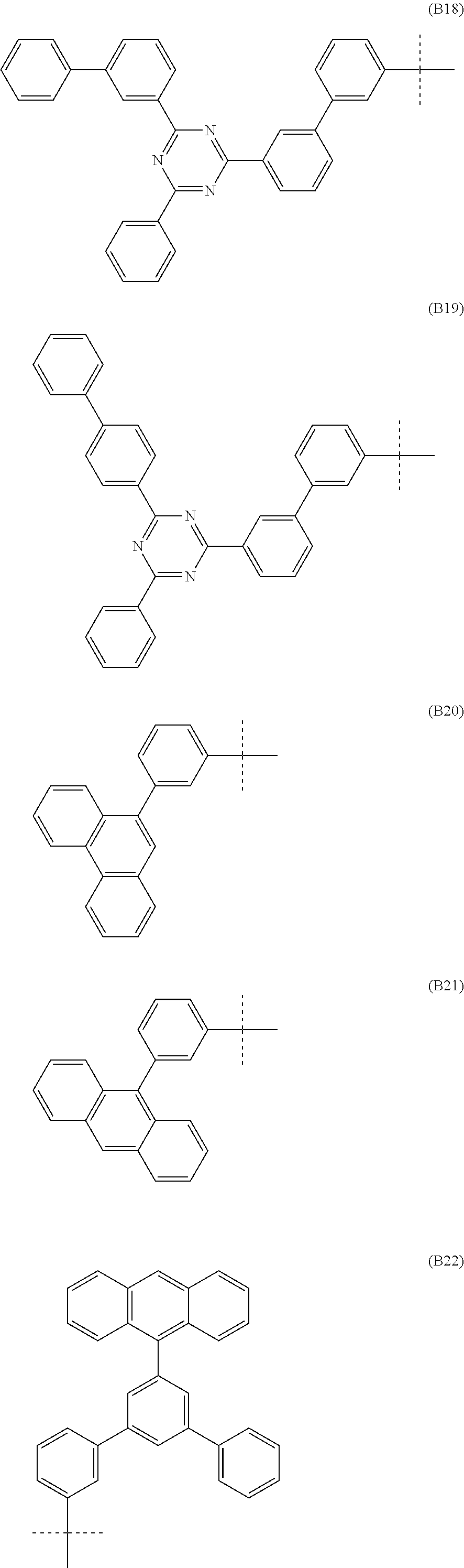


- the alkali metal salt is selected from the group comprising LiF, LiCl, LiBr or LiJ, and preferably LiF;
- the alkali metal organic complex is selected from the group comprising a lithium quinolinolate, lithium borate, lithium phenolate, lithium pyridinolate or comprises a lithium with a Schiff base ligand;
- preferably the lithium quinolinolate complex has the formula IV, V or VI:

wherein
- A1 to A6 are same or independently selected from CH, CR, N, O;
- R is same or independently selected from hydrogen, halogen, alkyl or aryl or heteroaryl with 1 to 20 carbon atoms; and more preferred A1 to A6 are CH;
- preferably the borate based organic ligand is a tetra(1H-pyrazol-1-yl)borate;
- preferably the phenolate is a 2-(pyridin-2-yl)phenolate, a 2-(diphenylphosphoryl)phenolate, an imidazol phenolates, or 2-(pyridin-2-yl)phenolate and more preferred 2-(1-phenyl-1H-benzo[d]imidazol-2-yl)phenolate;
- preferably the pyridinolate is a 2-(diphenylphosphoryl)pyridin-3-olate,
- preferably the lithium Schiff base has the structure 100, 101, 102 or 103:

| TABLE 1 |
| Lithium organic complex that can be suitable used |
| Compound | Name | Structure | Disclosed in: |
| LiQ | lithium 8-hydroxyquinolate |
 |
WO 2013079217 A1 |
| Li-1 | lithium tetra(1H-pyrazol-1- yl)borate |
 |
WO 2013079676 A1 |
| Li-2 | lithium 2-(diphenyl- phosphoryl)phenolate |
 |
WO 2013079678A1 |
| Li-3 | lithium 2-(pyridin-2- yl)phenolate |
 |
JP2 008195623 |
| Li-4 | lithium 2-(1-phenyl-1H- benzo[d]imidazol-2- yl)phenolate |
 |
JP 2001291593 |
| Li-5 | lithium 2-(benzo[d]oxazol-2- yl)phenolate |
 |
US 20030165711 |
| Li-6 | lithium 2-(diphenyl- phosphoryl)pyridin-3-olate |
 |
EP 2724388 |
- the first electron transport layer consist of a first matrix compound of Chemical Formula (I); and
- the second electron transport layer consist of a second matrix compound of Chemical Formula (II), and an alkali metal salt or an alkali metal organic complex.


- a C1-C10 alkyl group substituted with at least one of a phenyl group, a naphthyl group, or an anthryl group;
- a phenyl group, a naphthyl group, an anthryl group, a pyrenyl group, a phenanthrenyl group, or a fluorenyl group;
- a phenyl group, a naphthyl group, an anthryl group, a pyrenyl group, a phenanthrenyl group, or
- a fluorenyl group, each substituted with at least one of a deuterium atom, a halogen atom, a hydroxyl group, a cyano group, a nitro group, an amino group, an amidino group, a hydrazine group, a hydrazone group, a carboxyl group or a salt thereof,
- a sulfonic acid group or a salt thereof,
- a phosphoric acid group or a salt thereof,
- a C1-C60 alkyl group, a C2-C60 alkenyl group, a C2-C60 alkynyl group, a C1-C60 alkoxy group, a phenyl group, a naphthyl group, an anthryl group, a pyrenyl group, a phenanthrenyl group, or
- a fluorenyl group; or

or formulas (Y2) or (Y3)


L2MX (Z).
- (i) an electropositive metal selected from alkali metals, alkaline earth metals and rare earth metals in substantially elemental form, preferably selected from Li, Na, K, Rb, Cs, Mg, Ca, Sr, Ba, Eu and Yb, more preferably from Li, Na, Mg, Ca, Sr and Yb, even more preferably from Li and Yb, most preferably Yb; and/or
- (ii) an alkali metal complex and/or alkali metal salt, preferably the Li complex and/or salt, more preferably a Li quinolinolate, even more preferably a lithium 8-hydroxyquinolinolate, most preferably the alkali metal salt and/or complex of the second electron transport layer is idencial with the alkali metal salt and/or complex of the injection layer.
- on an anode a hole injection layer (37), hole transport layer (31), optional a hole transport auxiliary layer (33), an emission layer (130), first electron transport layer (135), second electron transport layer (34), electron injection layer (36), and a cathode (110), are deposited in that order; or
- the layers are deposited the other way around, starting with the cathode (110).
| TABLE 2 |
| Compounds of formula I |
| Reduction | ||||
| potential | Dipole | |||
| Referred | against | moment | ||
| to as: | Compound of formula I | Tg [°C.] | Fc/Fc+[V] | [Debye] |
| ETM1-1 |
 |
140 | −2.22 | 0.66 |
| ETM1-2 |
 |
139 | −2.18 | 0.3 |
| ETM1-3 |
 |
— | −2.23 | 1.88 |
| ETM1-4 |
 |
135 | −2.20 | 0.65 |
| ETM1-5 |
 |
147 | −2.15 | — |
| ETM1-6 |
 |
149 | −2.14 | — |
| ETM1-7 |
 |
— | −2.18 | — |
| ETM1-8 |
 |
147 | −2.18 | 0.68 |
| ETM1-9 |
 |
138 | −2.20 | 0.55 |
| TABLE 3 |
| Compounds of formula II |
| Referred to | Reduction potential | Dipole moment | ||
| as: | Compound of formula II | Tg [°C.] | against Fc/Fc+ [V] | [Debye] |
| ETM2-1 |
 |
128° C. | −2.26 | 1.98 |
| ETM2-2 |
 |
92° C. | −2.29 | — |
| ETM2-3 |
 |
98° C. | −2.27 | — |
| ETM2-4 |
 |
181° C. | −2.25 | 2.02 |
| ETM2-5 |
 |
142° C. | −2.17 | 2.17 |
| ETM2-6 |
 |
123° C. | −2.26 | 1.97 |
| ETM2-7 |
 |
121° C. | −2.26 | 2.01 |
| ETM2-8 |
 |
130° C. | −2.26 | 1.99 |
| ETM2-9 |
 |
90° C. | — | — |
| ETM2-10 |
 |
85° C. | — | — |
| ETM2-11 |
 |
116° C. | −2.28 | — |
| ETM2-12 |
 |
104° C. | −2.27 | — |
| ETM2-13 |
 |
113° C. | −2.27 | — |
| ETM2-14 |
 |
Not obs. | −2.25 | — |
| ETM2-15 |
 |
−2.27 | 1.96 | |
| ETM2-16 |
 |
134° C. | −2.26 | 2.04 |
| ETM2-17 |
 |
167° C. | −2.30 | — |
| ETM2-18 |
 |
132° C. | −2.26 | — |
| ETM2-19 |
 |
136° C. | −2.27 | — |
| ETM2-20 |
 |
165° C. | −2.29 | 2.74 |
| ETM2-21 |
 |
127° C. | −2.26 | — |
| ETM2-22 |
 |
175° C. | −2.25 | — |
| ETM2-23 |
 |
130° C. | −2.25 | — |
| ETM2-24 |
 |
— | −2.31 | — |
| ETM2-25 |
 |
162° C. | — | — |
| ETM2-26 |
 |
159° C. | −2.29 | 1.92 |
| ETM2-27 |
 |
148° C. | — | — |
| ETM2-28 |
 |
130° C. | −2.31 | — |
| ETM2-29 |
 |
125° C. | −2.28 | 1.96 |
| ETM2-30 |
 |
151° C. | −2.28 | 1.88 |
| ETM2-31 |
 |
175° C. | — | — |
| ETM2-32 |
 |
130° C. | — | — |
| TABLE 4 |
| Performance at 10 mA/cm2 of top emission devices comprising a first ETL |
| (135), a second ETL (34) and a lithium organic complex, and an EIL (36) |
| Voltage | Efficiency | LT97 | ||||||
| First ETL | Second ETL | EIL | Cathode | (V) | (cd/A) | (h) | ||
| Comparative | none | ETM2-5:LiQ | LiQ | Mg:Ag | 3.51 | 6.6 | 52 |
| example 1 | |||||||
| Example 1 | ETM1-2 | ETM2-5:LiQ | LiQ | Mg:Ag | 3.27 | 7.8 | 40 |
| Example 2 | ETM1-2 | ETM2-6:LiQ | LiQ | Mg:Ag | 3.54 | 7.9 | 43 |
| Example 3 | ETM1-2 | ETM2-6:LiQ | LiQ | Mg:Ag | 3.55 | 8.1 | 50 |
| Example 4 | ETM1-2 | ETM2-6:LiQ | LiQ | Mg:Ag | 3.51 | 7.6 | 42 |
| Example 5 | ETM1-2 | ETM2-7:LiQ | LiQ | Mg:Ag | 3.43 | 8.1 | 40 |
| Example 6 | ETM1-2 | ETM2-8:LiQ | LiQ | Mg:Ag | 3.39 | 8.1 | 44 |
| Example 7 | ETM1-2 | ETM2-15:LiQ | LiQ | Mg:Ag | 3.66 | 8.7 | 39 |
| Example 8 | ETM1-2 | ETM2-16:LiQ | LiQ | Mg:Ag | 3.44 | 8.1 | 44 |
| Example 9 | ETM1-2 | ETM2-17:LiQ | LiQ | Mg:Ag | 3.57 | 8.2 | 45 |
| Example 10 | ETM1-2 | ETM2-19:LiQ | Yb | Ag | 3.56 | 8.7 | 19 |
| Example 11 | ETM1-2 | ETM2-21:LiQ | Yb | Ag | 3.54 | 8.9 | 45.5 |
| Example 12 | ETM1-2 | ETM2-23:LiQ | Yb | Ag | 3.33 | 8.7 | 22 |
| Example 13 | ETM1-2 | ETM2-24:LiQ | Yb | Ag | 3.77 | 9.2 | 5 |
| Example 14 | ETM1-2 | ETM2-26:LiQ | Yb | Ag | 3.78 | 9.1 | 13.5 |
| Example 15 | ETM1-2 | ETM2-14:LiQ | LiQ | Mg:Ag | 3.82 | 8.8 | 28 |
Claims (14)

A-Wf(II), wherein


A-Wf (II);

Applications Claiming Priority (3)
| Application Number | Priority Date | Filing Date | Title |
|---|---|---|---|
| EP16195344 | 2016-10-24 | ||
| EP16195344.3 | 2016-10-24 | ||
| EP16195344.3A EP3312899B1 (en) | 2016-10-24 | 2016-10-24 | Electron transport layer stack for an organic light-emitting diode |
Publications (2)
| Publication Number | Publication Date |
|---|---|
| US20180114920A1 US20180114920A1 (en) | 2018-04-26 |
| US11011708B2 true US11011708B2 (en) | 2021-05-18 |
Family
ID=57208124
Family Applications (1)
| Application Number | Title | Priority Date | Filing Date |
|---|---|---|---|
| US15/788,431 Active 2038-09-05 US11011708B2 (en) | 2016-10-24 | 2017-10-19 | Electron transport layer stack for an organic light-emitting diode |
Country Status (5)
| Country | Link |
|---|---|
| US (1) | US11011708B2 (en) |
| EP (1) | EP3312899B1 (en) |
| JP (1) | JP6985883B2 (en) |
| KR (1) | KR102435687B1 (en) |
| CN (1) | CN107978684B (en) |
Cited By (2)
| Publication number | Priority date | Publication date | Assignee | Title |
|---|---|---|---|---|
| WO2010051411A1 (en) | 2008-10-31 | 2010-05-06 | Medtronic, Inc. | Implantable medical device crosstalk evaluation and mitigation |
| US11539001B2 (en) * | 2018-11-16 | 2022-12-27 | Novaled Gmbh | Compound, organic electronic device comprising the same, and display device and lighting device comprising the same |
Families Citing this family (15)
| Publication number | Priority date | Publication date | Assignee | Title |
|---|---|---|---|---|
| CN106716665B9 (en) * | 2014-10-27 | 2018-12-07 | 株式会社Lg化学 | Organic Electroluminescent Devices |
| EP3312171B1 (en) * | 2016-10-24 | 2019-07-31 | Novaled GmbH | Compound for electronic device and electronic device and display device |
| EP3556753B1 (en) * | 2018-04-18 | 2023-10-11 | Novaled GmbH | Compound and organic semiconducting layer, organic electronic device, display device and lighting device comprising the same |
| WO2020159128A1 (en) * | 2019-01-28 | 2020-08-06 | 주식회사 엘지화학 | Organic light-emitting device |
| KR102778223B1 (en) * | 2019-01-28 | 2025-03-10 | 주식회사 엘지화학 | Organic light emitting device |
| EP3694012B1 (en) * | 2019-02-06 | 2026-02-11 | Novaled GmbH | Method for preparing an organic semiconducting layer |
| EP3693352A1 (en) * | 2019-02-06 | 2020-08-12 | Novaled GmbH | Compound and an organic semiconducting layer, an organic electronic device and a display or lighting device comprising the same |
| US20220216428A1 (en) * | 2019-04-15 | 2022-07-07 | Novaled Gmbh | See addendum |
| EP3730482A1 (en) | 2019-04-24 | 2020-10-28 | Novaled GmbH | Compound and an organic semiconducting layer, an organic electronic device and a display or lighting device comprising the same |
| EP3742513A1 (en) | 2019-05-21 | 2020-11-25 | Novaled GmbH | Organic light emitting diode |
| CN110183381A (en) * | 2019-06-28 | 2019-08-30 | 上海天马有机发光显示技术有限公司 | A kind of compound, OLED display panel and electronic equipment |
| EP3835295A1 (en) * | 2019-12-10 | 2021-06-16 | Novaled GmbH | Acridine compound and organic semiconducting layer, organic electronic device and display device comprising the same |
| EP3920249A1 (en) | 2020-06-03 | 2021-12-08 | Novaled GmbH | Compound, intermediate of the compound, process for preparing the compound, organic semiconducting material comprising the compound, organic electronic device comprising the same, and display device and lighting device comprising the same |
| EP3923363B1 (en) * | 2020-06-12 | 2026-02-11 | Novaled GmbH | Organic light emitting diode and device comprising the same |
| EP3923364B1 (en) * | 2020-06-12 | 2025-09-17 | Novaled GmbH | Organic light emitting diode and device comprising the same |
Citations (17)
| Publication number | Priority date | Publication date | Assignee | Title |
|---|---|---|---|---|
| JP2001291593A (en) | 2000-04-10 | 2001-10-19 | Mitsubishi Chemicals Corp | Organic electroluminescent device |
| WO2003007658A2 (en) * | 2001-07-11 | 2003-01-23 | Fuji Photo Film Co., Ltd. | Light-emitting device and aromatic compound |
| US20030165711A1 (en) | 1998-06-23 | 2003-09-04 | Youngkyoo Kim | Novel organometallic luminescent materials and organic electroluminescent device containing same |
| WO2007107356A1 (en) | 2006-03-21 | 2007-09-27 | Novaled Ag | Method for preparing doped organic semiconductor materials and formulation utilized therein |
| JP2008195623A (en) | 2007-02-08 | 2008-08-28 | Chemiprokasei Kaisha Ltd | Novel heterocycle-containing hydroxyphenyl metal derivative and electron injection material, electron transport material and organic electroluminescence device using the same |
| WO2011154131A1 (en) | 2010-06-10 | 2011-12-15 | Novaled Ag | Electronic device comprising an organic semiconducting material |
| US8431046B2 (en) | 2006-03-22 | 2013-04-30 | Novaled Ag | Use of heterocyclic radicals for doping organic semiconductors |
| WO2013079678A1 (en) | 2011-11-30 | 2013-06-06 | Novaled Ag | Organic electronic device |
| WO2013079217A1 (en) | 2011-11-30 | 2013-06-06 | Novaled Ag | Display |
| WO2013079676A1 (en) | 2011-11-30 | 2013-06-06 | Novaled Ag | Organic electronic device |
| WO2014141725A1 (en) * | 2013-03-15 | 2014-09-18 | 出光興産株式会社 | Anthracene derivative and organic electroluminescence element using same |
| EP2826781A1 (en) * | 2013-07-16 | 2015-01-21 | Universal Display Corporation | Bicarbazole containing compounds for OLED |
| US20150034915A1 (en) * | 2013-07-30 | 2015-02-05 | Samsung Display Co., Ltd. | Organic light-emitting device |
| US9118019B2 (en) | 2006-03-21 | 2015-08-25 | Novaled Ag | Heterocyclic radical or diradical, the dimers, oligomers, polymers, dispiro compounds and polycycles thereof, the use thereof, organic semiconductive material and electronic or optoelectronic component |
| US9502660B2 (en) | 2011-06-22 | 2016-11-22 | Novaled Gmbh | Electronic device and compound |
| EP3182478A1 (en) * | 2015-12-18 | 2017-06-21 | Novaled GmbH | Electron injection layer for an organic light-emitting diode (oled) |
| US20170309830A1 (en) * | 2015-04-24 | 2017-10-26 | Samsung Sdi Co., Ltd. | Compound for organic optoelectronic element, organic optoelectronic element, and display device |
Family Cites Families (7)
| Publication number | Priority date | Publication date | Assignee | Title |
|---|---|---|---|---|
| JP4003824B2 (en) * | 2001-07-11 | 2007-11-07 | 富士フイルム株式会社 | Light emitting element |
| US20040209116A1 (en) * | 2003-04-21 | 2004-10-21 | Xiaofan Ren | Organic light emitting devices with wide gap host materials |
| JP2006279014A (en) * | 2004-09-15 | 2006-10-12 | Fuji Photo Film Co Ltd | Organic electroluminescence device |
| US8049407B2 (en) * | 2004-09-15 | 2011-11-01 | Fujifilm Corporation | Organic electroluminescent element including blue phosphorescent luminescent material |
| JP5402639B2 (en) * | 2007-10-26 | 2014-01-29 | コニカミノルタ株式会社 | Organic electroluminescence element, display device and lighting device |
| KR20150096020A (en) * | 2014-02-13 | 2015-08-24 | 삼성디스플레이 주식회사 | Organic light emitting device |
| EP3035400B1 (en) * | 2014-12-17 | 2019-10-23 | Novaled GmbH | Organic light-emitting diode comprising electron transport layers with different matrix compounds |
-
2016
- 2016-10-24 EP EP16195344.3A patent/EP3312899B1/en active Active
-
2017
- 2017-10-19 US US15/788,431 patent/US11011708B2/en active Active
- 2017-10-19 JP JP2017202421A patent/JP6985883B2/en active Active
- 2017-10-23 KR KR1020170137278A patent/KR102435687B1/en active Active
- 2017-10-24 CN CN201711005583.7A patent/CN107978684B/en active Active
Patent Citations (19)
| Publication number | Priority date | Publication date | Assignee | Title |
|---|---|---|---|---|
| US20030165711A1 (en) | 1998-06-23 | 2003-09-04 | Youngkyoo Kim | Novel organometallic luminescent materials and organic electroluminescent device containing same |
| JP2001291593A (en) | 2000-04-10 | 2001-10-19 | Mitsubishi Chemicals Corp | Organic electroluminescent device |
| WO2003007658A2 (en) * | 2001-07-11 | 2003-01-23 | Fuji Photo Film Co., Ltd. | Light-emitting device and aromatic compound |
| WO2003007658A8 (en) * | 2001-07-11 | 2004-02-19 | Fuji Photo Film Co Ltd | Light-emitting device and aromatic compound |
| US9118019B2 (en) | 2006-03-21 | 2015-08-25 | Novaled Ag | Heterocyclic radical or diradical, the dimers, oligomers, polymers, dispiro compounds and polycycles thereof, the use thereof, organic semiconductive material and electronic or optoelectronic component |
| WO2007107356A1 (en) | 2006-03-21 | 2007-09-27 | Novaled Ag | Method for preparing doped organic semiconductor materials and formulation utilized therein |
| US8431046B2 (en) | 2006-03-22 | 2013-04-30 | Novaled Ag | Use of heterocyclic radicals for doping organic semiconductors |
| JP2008195623A (en) | 2007-02-08 | 2008-08-28 | Chemiprokasei Kaisha Ltd | Novel heterocycle-containing hydroxyphenyl metal derivative and electron injection material, electron transport material and organic electroluminescence device using the same |
| WO2011154131A1 (en) | 2010-06-10 | 2011-12-15 | Novaled Ag | Electronic device comprising an organic semiconducting material |
| US9502660B2 (en) | 2011-06-22 | 2016-11-22 | Novaled Gmbh | Electronic device and compound |
| WO2013079678A1 (en) | 2011-11-30 | 2013-06-06 | Novaled Ag | Organic electronic device |
| WO2013079676A1 (en) | 2011-11-30 | 2013-06-06 | Novaled Ag | Organic electronic device |
| WO2013079217A1 (en) | 2011-11-30 | 2013-06-06 | Novaled Ag | Display |
| WO2014141725A1 (en) * | 2013-03-15 | 2014-09-18 | 出光興産株式会社 | Anthracene derivative and organic electroluminescence element using same |
| US20150325800A1 (en) * | 2013-03-15 | 2015-11-12 | Idemitsu Kosan Co., Ltd. | Anthracene derivative and organic electroluminescence element using same |
| EP2826781A1 (en) * | 2013-07-16 | 2015-01-21 | Universal Display Corporation | Bicarbazole containing compounds for OLED |
| US20150034915A1 (en) * | 2013-07-30 | 2015-02-05 | Samsung Display Co., Ltd. | Organic light-emitting device |
| US20170309830A1 (en) * | 2015-04-24 | 2017-10-26 | Samsung Sdi Co., Ltd. | Compound for organic optoelectronic element, organic optoelectronic element, and display device |
| EP3182478A1 (en) * | 2015-12-18 | 2017-06-21 | Novaled GmbH | Electron injection layer for an organic light-emitting diode (oled) |
Cited By (2)
| Publication number | Priority date | Publication date | Assignee | Title |
|---|---|---|---|---|
| WO2010051411A1 (en) | 2008-10-31 | 2010-05-06 | Medtronic, Inc. | Implantable medical device crosstalk evaluation and mitigation |
| US11539001B2 (en) * | 2018-11-16 | 2022-12-27 | Novaled Gmbh | Compound, organic electronic device comprising the same, and display device and lighting device comprising the same |
Also Published As
| Publication number | Publication date |
|---|---|
| CN107978684B (en) | 2022-08-23 |
| JP6985883B2 (en) | 2021-12-22 |
| JP2018117112A (en) | 2018-07-26 |
| KR20180044821A (en) | 2018-05-03 |
| CN107978684A (en) | 2018-05-01 |
| EP3312899A1 (en) | 2018-04-25 |
| KR102435687B1 (en) | 2022-08-23 |
| EP3312899B1 (en) | 2021-04-07 |
| US20180114920A1 (en) | 2018-04-26 |
Similar Documents
| Publication | Publication Date | Title |
|---|---|---|
| US11011708B2 (en) | Electron transport layer stack for an organic light-emitting diode | |
| US11795186B2 (en) | Organic electronic device comprising an organic semiconductor layer and a device | |
| US11011723B2 (en) | Organic electroluminescent device comprising a hole injection layer and electron injection layer with zero-valent metal | |
| US12108664B2 (en) | Compound and organic semiconducting layer, organic electronic device, display device and lighting device comprising the same | |
| US20220102647A1 (en) | Composition, Organic Semiconductor Layer and Electronic Device | |
| US20180114921A1 (en) | Organic Semiconducting Material Comprising an Electrical n-Dopant and an Electron Transport Matrix and Electronic Device Comprising the Semiconducting Material | |
| US11530201B2 (en) | Triazine compounds substituted with bulky groups | |
| US11524952B2 (en) | Compound and organic semiconducting layer, organic electronic device, display device and lighting device comprising the same | |
| US11145826B2 (en) | Compound for electronic device and electronic device and display device | |
| KR20210108976A (en) | Compound and organic semiconducting layer, organic electronic device and display device comprising same | |
| US20230240132A1 (en) | Organic Electronic Device Comprising a Compound of Formula (1), Display Device Comprising the Organic Electronic Device as Well as Compounds of Formula (1) for Use in Organic Electronic Devices | |
| US11407716B2 (en) | Acridine compound for use in an electronic device and display device | |
| US10741770B2 (en) | Compounds comprising triazine group, fluorene-group and hetero-fluorene group | |
| US20250393391A1 (en) | Organic Electroluminescent Device Comprising a Compound of Formula (I) and a Compound of Formula (II), and Display Device Comprising the Organic Electroluminescent Device | |
| US10985326B2 (en) | Compounds comprising triazine group, fluorene-group and aryl group | |
| US20240237509A1 (en) | Organic electroluminescent device and a display device comprising the organic electroluminescent device | |
| US12577212B2 (en) | Compound and an organic semiconducting layer, an organic electronic device and a display or lighting device comprising the same | |
| US11566033B2 (en) | Compound and an organic semiconducting layer comprising the same |
Legal Events
| Date | Code | Title | Description |
|---|---|---|---|
| FEPP | Fee payment procedure |
Free format text: ENTITY STATUS SET TO UNDISCOUNTED (ORIGINAL EVENT CODE: BIG.); ENTITY STATUS OF PATENT OWNER: LARGE ENTITY |
|
| STPP | Information on status: patent application and granting procedure in general |
Free format text: DOCKETED NEW CASE - READY FOR EXAMINATION |
|
| AS | Assignment |
Owner name: NOVALED GMBH, GERMANY Free format text: ASSIGNMENT OF ASSIGNORS INTEREST;ASSIGNORS:FREY, JULIEN;PAVICIC, DOMAGOJ;ROTHE, CARSTEN;AND OTHERS;SIGNING DATES FROM 20171208 TO 20171218;REEL/FRAME:044581/0267 Owner name: SAMSUNG SDI CO. LTD., KOREA, REPUBLIC OF Free format text: ASSIGNMENT OF ASSIGNORS INTEREST;ASSIGNORS:KIM, HYUNGSUN;KIM, BYUNGKU;SIGNING DATES FROM 20171211 TO 20171217;REEL/FRAME:044581/0315 |
|
| STPP | Information on status: patent application and granting procedure in general |
Free format text: NON FINAL ACTION MAILED |
|
| STPP | Information on status: patent application and granting procedure in general |
Free format text: RESPONSE TO NON-FINAL OFFICE ACTION ENTERED AND FORWARDED TO EXAMINER |
|
| STPP | Information on status: patent application and granting procedure in general |
Free format text: FINAL REJECTION MAILED |
|
| STPP | Information on status: patent application and granting procedure in general |
Free format text: ADVISORY ACTION MAILED |
|
| STPP | Information on status: patent application and granting procedure in general |
Free format text: NOTICE OF ALLOWANCE MAILED -- APPLICATION RECEIVED IN OFFICE OF PUBLICATIONS |
|
| STPP | Information on status: patent application and granting procedure in general |
Free format text: PUBLICATIONS -- ISSUE FEE PAYMENT RECEIVED |
|
| STPP | Information on status: patent application and granting procedure in general |
Free format text: PUBLICATIONS -- ISSUE FEE PAYMENT VERIFIED |
|
| STCF | Information on status: patent grant |
Free format text: PATENTED CASE |
|
| MAFP | Maintenance fee payment |
Free format text: PAYMENT OF MAINTENANCE FEE, 4TH YEAR, LARGE ENTITY (ORIGINAL EVENT CODE: M1551); ENTITY STATUS OF PATENT OWNER: LARGE ENTITY Year of fee payment: 4 |