US11009217B2 - Light source assembly with multiple, disparate light sources - Google Patents
Light source assembly with multiple, disparate light sources Download PDFInfo
- Publication number
- US11009217B2 US11009217B2 US16/276,216 US201916276216A US11009217B2 US 11009217 B2 US11009217 B2 US 11009217B2 US 201916276216 A US201916276216 A US 201916276216A US 11009217 B2 US11009217 B2 US 11009217B2
- Authority
- US
- United States
- Prior art keywords
- light source
- assembly
- output beam
- moving
- light sources
- Prior art date
- Legal status (The legal status is an assumption and is not a legal conclusion. Google has not performed a legal analysis and makes no representation as to the accuracy of the status listed.)
- Active, expires
Links
Images




Classifications
-
- G—PHYSICS
- G08—SIGNALLING
- G08B—SIGNALLING SYSTEMS, e.g. PERSONAL CALLING SYSTEMS; ORDER TELEGRAPHS; ALARM SYSTEMS
- G08B5/00—Visible signalling systems, e.g. visible personal calling systems or remote indication of seats occupied
- G08B5/002—Distress signalling devices, e.g. rescue balloons
-
- F—MECHANICAL ENGINEERING; LIGHTING; HEATING; WEAPONS; BLASTING
- F21—LIGHTING
- F21V—FUNCTIONAL FEATURES OR DETAILS OF LIGHTING DEVICES OR SYSTEMS THEREOF; STRUCTURAL COMBINATIONS OF LIGHTING DEVICES WITH OTHER ARTICLES, NOT OTHERWISE PROVIDED FOR
- F21V14/00—Controlling the distribution of the light emitted by adjustment of elements
- F21V14/02—Controlling the distribution of the light emitted by adjustment of elements by movement of light sources
- F21V14/025—Controlling the distribution of the light emitted by adjustment of elements by movement of light sources in portable lighting devices
-
- B—PERFORMING OPERATIONS; TRANSPORTING
- B63—SHIPS OR OTHER WATERBORNE VESSELS; RELATED EQUIPMENT
- B63B—SHIPS OR OTHER WATERBORNE VESSELS; EQUIPMENT FOR SHIPPING
- B63B45/00—Arrangements or adaptations of signalling or lighting devices
-
- F—MECHANICAL ENGINEERING; LIGHTING; HEATING; WEAPONS; BLASTING
- F21—LIGHTING
- F21V—FUNCTIONAL FEATURES OR DETAILS OF LIGHTING DEVICES OR SYSTEMS THEREOF; STRUCTURAL COMBINATIONS OF LIGHTING DEVICES WITH OTHER ARTICLES, NOT OTHERWISE PROVIDED FOR
- F21V14/00—Controlling the distribution of the light emitted by adjustment of elements
- F21V14/006—Controlling the distribution of the light emitted by adjustment of elements by means of optical elements, e.g. films, filters or screens, being rolled up around a roller
-
- G—PHYSICS
- G01—MEASURING; TESTING
- G01S—RADIO DIRECTION-FINDING; RADIO NAVIGATION; DETERMINING DISTANCE OR VELOCITY BY USE OF RADIO WAVES; LOCATING OR PRESENCE-DETECTING BY USE OF THE REFLECTION OR RERADIATION OF RADIO WAVES; ANALOGOUS ARRANGEMENTS USING OTHER WAVES
- G01S5/00—Position-fixing by co-ordinating two or more direction or position line determinations; Position-fixing by co-ordinating two or more distance determinations
- G01S5/16—Position-fixing by co-ordinating two or more direction or position line determinations; Position-fixing by co-ordinating two or more distance determinations using electromagnetic waves other than radio waves
-
- F—MECHANICAL ENGINEERING; LIGHTING; HEATING; WEAPONS; BLASTING
- F21—LIGHTING
- F21W—INDEXING SCHEME ASSOCIATED WITH SUBCLASSES F21K, F21L, F21S and F21V, RELATING TO USES OR APPLICATIONS OF LIGHTING DEVICES OR SYSTEMS
- F21W2111/00—Use or application of lighting devices or systems for signalling, marking or indicating, not provided for in codes F21W2102/00 – F21W2107/00
- F21W2111/10—Use or application of lighting devices or systems for signalling, marking or indicating, not provided for in codes F21W2102/00 – F21W2107/00 for personal use, e.g. hand-held
Definitions
- a signal beacon or flashlight can be utilized in conjunction with a detector assembly for various purposes in a military environment and in a civilian environment, and on land or in a maritime environment.
- a signal beacon or flashlight can be utilized in conjunction with a detector assembly for purposes of search and rescue, identification (e.g., of friend or foe), surveillance, targeting, and/or navigation, both on land and/or in a maritime environment.
- identification e.g., of friend or foe
- surveillance e.g., of friend or foe
- navigation both on land and/or in a maritime environment.
- the present invention is directed toward a light source assembly for use by a user.
- the light source assembly includes a housing assembly and a moving beam light source.
- the moving beam light source is positioned substantially within the housing assembly.
- the moving beam light source generates a source output beam that is directed away from the housing assembly at an angle relative to a rotation axis as a moving output beam while being rotated about the rotation axis.
- the moving beam light source is a non-visible light source that generates the source output beam having a center wavelength that is outside a visible light spectrum.
- the housing assembly includes a housing axis.
- the rotation axis can be substantially coaxial with and/or substantially parallel to the housing axis.
- the moving beam light source is an infrared light source that generates the source output beam so that the center wavelength of the source output beam is within an infrared light spectrum. More particularly, in one such embodiment, the moving beam light source is mid-infrared wavelength light source that generates the source output beam so that the center wavelength of the source output beam is within a mid-infrared wavelength range of between approximately three micrometers and eight micrometers.
- the light source assembly further includes a moving beam optical assembly including a movable optical element that is moved by a mover to rotate about the rotation axis.
- the source output beam impinges on the movable optical element so that the moving output beam is directed away from the housing assembly at an angle relative to the rotation axis while being rotated about the rotation axis.
- the mover can include a mover shaft that defines a shaft cavity therein. In such embodiment, the source output beam is directed from the moving beam light source through the shaft cavity before the source output beam impinges on the movable optical element.
- the light source assembly further includes a plurality of fixed beam light sources that each generate a fixed output beam that is directed away from the housing assembly in a different axial direction.
- each fixed output beam is angularly spaced apart from adjacent fixed output beams by at least approximately sixty degrees.
- each of the plurality of fixed beam light sources can be a non-visible light source that generates the fixed output beam having a center wavelength that is outside a visible light spectrum of between approximately three hundred eighty and seven hundred nanometers. More particularly, in some embodiments, at least one of the plurality of fixed beam light sources is an infrared light source that generates the fixed output beam so that the center wavelength of the moving output beam is within an infrared light spectrum.
- At least one of the plurality of fixed beam light sources can be near-infrared wavelength light source that generates the fixed output beam so that the center wavelength of the fixed output beam is within a near-infrared wavelength range of between approximately seven hundred nanometers and one point four micrometers.
- the light source assembly further includes a temperature control assembly that is coupled to the housing assembly, the temperature control assembly being configured to dissipate heat that is generated during use of the light source assembly.
- the present invention is also directed toward a light source assembly for use by a user, the light source assembly including (i) a housing assembly; (ii) a moving beam light source that is positioned substantially within the housing assembly, the moving beam light source generating a source output beam that is directed away from the housing assembly at an angle relative to a rotation axis as a moving output beam while being rotated about the rotation axis; (iii) a moving beam optical assembly including a movable optical element that is configured to rotate about the rotation axis, the source output beam impinging on the movable optical element so that the moving output beam is directed away from the housing assembly at an angle relative to the rotation axis while being rotated about the rotation axis; and (iv) a mover that rotates the movable optical element about the rotation axis, the mover including a mover shaft that defines a shaft cavity therein; and wherein the source output beam is directed from the moving beam light source through the shaft cavity before the source output beam imping
- the present invention is directed toward a light source assembly for use by a user, the light source assembly including (i) a housing assembly; (ii) a first set of disparate light sources that is coupled to the housing assembly; and (iii) a second set of disparate light sources that is coupled to the housing assembly; wherein each of the sets of disparate light sources includes a first light source that is configured to generate a first light beam having a first center wavelength and a second light source that is configured to generate a second light beam having a second center wavelength that is different than the first center wavelength; wherein the first set of disparate light sources generates at least one first output beam that is directed away from the housing assembly along and about a first central beam axis; and wherein the second set of disparate light sources generates at least one second output beam that is directed away from the housing assembly along and about a second central beam axis; wherein the first central beam axis is angularly spaced apart from the second central beam axis.
- FIG. 1A is a simplified front perspective view of an embodiment of a light source assembly having features of the present invention
- FIG. 1B is a simplified rear perspective view of the light source assembly of FIG. 1A ;
- FIG. 1C is a simplified top perspective view of the light source assembly of FIG. 1A ;
- FIG. 1D is a simplified rear perspective view of a portion of the light source assembly of FIG. 1A ;
- FIG. 1E is a simplified front perspective view of a portion of the light source assembly of FIG. 1A ;
- FIG. 1F is a simplified front perspective view of a portion of the light source assembly of FIG. 1A ;
- FIG. 1G is a simplified side perspective view of a portion of the light source assembly of FIG. 1A ;
- FIG. 1H is a simplified side perspective view of a portion of the light source assembly of FIG. 1A ;
- FIG. 2A is a simplified front perspective view of another embodiment of a light source assembly having features of the present invention.
- FIG. 2B is a simplified side perspective view of the light source assembly of FIG. 2A ;
- FIG. 2C is a front perspective view of a portion of the light source assembly of FIG. 2A ;
- FIG. 3 is a simplified schematic front perspective view of a portion of still another embodiment of a light source assembly having features of the present invention
- FIGS. 4A-4F are simplified graphical illustrations of current and output for various selector settings of the light source assembly of FIG. 1A ;
- FIG. 5 is a simplified schematic perspective view illustration of another embodiment of the light source assembly
- FIG. 6A is a simplified schematic perspective view illustration of a portion of the light source assembly illustrated in FIG. 5 ;
- FIG. 6B is another simplified schematic perspective view illustration of the portion of the light source assembly illustrated in FIG. 6A ;
- FIG. 6C is an exploded view illustration of the portion of the light source assembly illustrated in FIG. 6A ;
- FIG. 6D is a cutaway view of the portion of the light source assembly taken on line D-D in FIG. 6A ;
- FIG. 6E is a simplified schematic perspective view illustration of another portion of the light source assembly illustrated in FIG. 5 ;
- FIG. 7A is a simplified schematic perspective view illustration of a portion of another embodiment of the light source assembly.
- FIG. 7B is another simplified schematic perspective view illustration of the portion of the light source assembly illustrated in FIG. 7A ;
- FIG. 8 is a simplified schematic illustration of a maritime vehicle with the light source assembly mounted thereon;
- FIG. 9A is a simplified schematic perspective view illustration of a portion of still yet another embodiment of the light source assembly.
- FIG. 9B is another simplified schematic perspective view illustration of the portion of the light source assembly illustrated in FIG. 9A ;
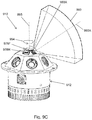
- FIG. 9C is still another simplified schematic perspective view illustration of the portion of the light source assembly illustrated in FIG. 9A ;
- FIG. 9D is a simplified schematic top view illustration of the portion of the light source assembly illustrated in FIG. 9A ;
- FIG. 9E is a cutaway view of the portion of the light source assembly taken on line E-E in FIG. 9D .
- Embodiments of the present invention are described herein in the context of a light source assembly with multiple, disparate light sources. More particularly, in various embodiments, the light source assembly can be utilized in conjunction with a detector assembly for various purposes and in various environments, e.g., in military or civilian environments, and on land or in maritime environments. Additionally, in certain applications, the light source assembly can be utilized in conjunction with the detector assembly regardless of the position of the detector assembly relative to the light source assembly.
- FIG. 1A is a simplified front perspective view of an embodiment of a light source assembly 10 having features of the present invention.
- the design of the light source assembly 10 can be varied to suit the specific requirements and intended uses of the light source assembly 10 .
- the light source assembly 10 includes a housing assembly 12 , a plurality of disparate light sources 14 , an optical assembly 16 , a controller 18 or circuit board (illustrated in FIG. 1D ), a power source 20 (illustrated in FIG. 1E ), and a selector assembly 22 , e.g., a switch or dial.
- the light source assembly 10 can be designed with more or fewer components than those specifically illustrated and described in this embodiment.
- the light source assembly 10 can be designed without the optical assembly 16 .
- the present invention is directed to a light source assembly 10 that can be used as a beacon or flashlight for various purposes, in conjunction with a detector assembly 23 (illustrated as a box).
- the light source assembly 10 can be used with the detector assembly 23 for purposes of identification, surveillance, search and rescue, targeting, navigation and/or communication.
- the detector assembly 23 can be a camera that is adapted to selectively detect one or more of the plurality of disparate light sources 14 .
- the selector assembly 22 can be manually operated by a user so as to allow the user to select from various possible selector settings, and thus various possible modes of operation, based on the needs of the user at any given time.
- the combination of the light source assembly 10 and the detector assembly 23 can be referred to generally as an “operational assembly”.
- the operational assembly 25 the light source assembly 10 is utilized such that any and all of the plurality of disparate light sources 14 can be selectively activated, and the detector assembly 23 is utilized to selectively detect output beams from each of the plurality of disparate light sources 14 .
- the individuals or groups e.g., soldiers
- vehicles and/or devices could have light source assemblies 10 that can utilize the disparate light sources 14 alternatively and/or at specifically designated pulse rates (i.e. the light source assembly 10 is fully programmable such that the disparate light sources 14 can be coded in any suitable or desired manner) to identify the owner as friendly.
- the light source assembly 10 can be handheld, uniform-mounted, helmet-mounted, and/or mounted on a portion of the vehicle or device.
- the light source assembly 10 can be pointed (similar to a flashlight) to identify something.
- each person or each piece of military equipment can include a light source assembly 10 that is controlled to selectively activate disparate light sources 14 and/or pulse the light sources 14 at a different rate (coded in any suitable or desired manner).
- the different light sources 14 and/or different pulse rates can be recognized to locate and individually identify the location of multiple assets based on the sequence of the pulsing of the beams of the light sources using a detector assembly 23 that captures images of the battlefield.
- one or more light source assemblies 10 could be used to define a search area for the detector assembly 23 .
- something moving in front of the light source assembly 10 would result in a disappearance of signal that could be used to trigger an event, much like near-infrared diodes are used in applications such as making sure that the path is clear before closing a garage door.
- life rafts, life vests, or soldiers' kits could all include one or more light source assemblies 10 that could be activated in an emergency.
- the emitted signal from the light source assembly 10 would allow easier, faster and more accurate spotting with the detector assembly 23 , and could also be invisible to hostile forces if the emitted and detected light sources 14 are not widely used.
- the light sources 14 can be viewed day and night, and in inclement conditions for search and rescue operations.
- a light source assembly 10 could be placed on a target of interest surreptitiously, and left operating for later targeting with a detector assembly 23 .
- one or more light source assemblies 10 can be used to help navigate in conditions such as dust and fog, and/or when normal visibility may be otherwise impaired.
- multiple light source assemblies 10 could be used to define roads or runways.
- one or more light source assemblies 10 can be mounted on any size boat or ship (or other suitable maritime vehicle) for use in any of the above-noted applications.
- the one or more light sources can be used for identification purposes, asset command and control, surveillance, search and rescue operations, targeting and/or navigation.
- the light source assembly 10 can be utilized on or in conjunction with any suitable type of vehicle.
- the light source assembly 10 can also be used on or in conjunction with a ground vehicle (e.g., car, truck, bus, tank, etc.), an air vehicle (e.g., helicopter, fixed-wing aircraft, etc.), or another suitable type of vehicle.
- a ground vehicle e.g., car, truck, bus, tank, etc.
- an air vehicle e.g., helicopter, fixed-wing aircraft, etc.
- another suitable type of vehicle e.g., helicopter, fixed-wing aircraft, etc.
- any information can be coded in the beacon signal emitted by the light source assembly 10 by adjusting the specific light sources 14 that are activated at any given time and/or the pulse rate of the light sources 14 of the light source assembly 10 .
- the light source assembly 10 can be fully programmable to selectively activate any and all of the light sources 14 in any desired manner.
- the pulse rate of the light sources 14 can be adjusted to provide a message in Morse code.
- the length and timing of each pulse can be long enough to be effectively captured by the detector assembly 23 . For example, each pulse can be longer than the exposure time of the detector assembly 23 to make sure the pulse is captured by the detector assembly 23 .
- the pulse rate of the light source assembly 10 can be synchronized with the capture rate of the detector assembly 23 .
- the light source assembly 10 can be controlled to generate the desired light beam(s) while the detector assembly 23 is capturing such light.
- the detector assembly 23 can emit a signal (e.g., a RF signal) that is received by the light source assembly 10 to synchronize them.
- the detector assembly 23 and one or more of the light source assemblies 10 can be synchronized prior to the beginning of the operation.
- the detector assembly 23 and the light source assemblies 10 can receive a signal from a GPS that can be used to synchronize the devices.
- pulses pulse width, pulse rate, pulse repetition, Morse, etc.
- the light source assembly 10 is designed to be small, portable, lightweight, stable, rugged, easy to manufacture, reliable, efficient for longer use of the power source 20 , and relatively inexpensive to manufacture. Further, the light source assembly 10 is further designed to be usable at sufficient distances that the signals can be detected from outside a danger zone, e.g., in certain applications, the light source assembly 10 can have a range of greater than three kilometers. As a result thereof, the light source assembly 10 can be used in many applications, such as those specifically noted above, as a signal beacon or flashlight.
- the housing assembly 12 retains various components of the light source assembly 10 .
- the plurality of disparate light sources 14 , the optical assembly 16 , the controller 18 , the power source 20 and the selector assembly 22 can all be coupled to, secured to, and/or retained substantially within the housing assembly 12 .
- one or more of the controller 18 , the power source 20 and the selector assembly 22 can be maintained outside the housing assembly 12 .
- the housing assembly 12 can be varied.
- the housing assembly 12 includes a housing front 12 A, a housing rear 12 B, a power compartment cover 12 C, and a plurality of heat spreaders 12 D, e.g., fins.
- the housing assembly 12 can include more or fewer components than specifically illustrated in this embodiment.
- the housing front 12 A can include a plurality of housing apertures 24 , with each housing aperture 24 being aligned to allow for the emitting and directing of the plurality of disparate light sources 14 out of and/or away from the housing assembly 12 and away from the light source assembly 10 , such that the light sources 14 can be quickly, easily and accurately detected by the detector assembly 23 .
- the housing front 12 A includes five housing apertures 24 to allow for the selective and/or alternative emitting and directing of five disparate light sources 14 from the light source assembly 10 .
- the housing front 12 A can include greater than five or fewer than five housing apertures 24 .
- more than one light source 14 can be directed away from the housing assembly 12 through a common housing aperture 24 , thus requiring fewer housing apertures 24 than light sources 14 in such embodiments.
- the housing apertures 24 can be located in a different portion of the housing assembly 12 .
- the housing rear 12 B provides the necessary housing for the various components of the housing assembly 10 that are positioned at or near the rear of the light source assembly 10 .
- FIG. 1B is a simplified rear perspective view of the light source assembly 10 of FIG. 1A . More particularly, FIG. 1B more clearly illustrates one non-exclusive alternative design for the housing rear 12 B of the housing assembly 12 .
- the power compartment cover 12 C protects and/or covers the power source 20 as the power source 20 is coupled to, secured to, and/or positioned within the housing assembly 12 .
- the power compartment cover 12 C can be selectively and independently removed and/or opened to allow for any changes or modifications to the power source 20 .
- the heat spreaders 12 D help to spread and/or transfer heat from the light source assembly 10 , i.e. to effectively move heat away from the light sources 14 .
- the heat spreaders 12 D can comprise a plurality of fins that provide greater surface area for the housing assembly 12 as a means to more effectively transfer heat away from the light sources 14 and/or other components of the light source assembly 10 and into the surrounding environment.
- the heat spreaders 12 D can have a different design than that shown in the Figures.
- the housing assembly 12 can be designed without the heat spreaders 12 D.
- the light source assembly 10 is designed to provide natural convection cooling for the light sources 14 and the other components of the light source assembly 10 .
- the housing assembly 12 can be designed without the heat spreaders 12 D; although the heat spreaders 12 D, as described, can further enhance the ability of the light source assembly 10 to effectively move heat away from the light sources 14 and the other components of the light source assembly 10 .
- the housing assembly 12 can be substantially rectangular box-shaped and can have a length of between approximately two inches and four inches, a width of between approximately two inches and three inches, and a thickness of between approximately 0.5-1.25 inches.
- the housing assembly 12 is substantially rectangular box shaped, and has a length of 3.75 inches, a width of 2.5 inches, and a thickness of one inch.
- the housing assembly 12 can be other that substantially rectangular box-shaped, and/or the housing assembly 12 can have a length, width and thickness that are greater than or less than the specific dimensions discussed herein above.
- the housing assembly 12 can be substantially square box-shaped, cylindrical disk-shaped, hexagonal disk-shaped, octagonal disk-shaped, or another suitable shape.
- the housing assembly 12 has a cylindrical shape with a diameter of between approximately one inch and four inches and a thickness of between approximately 0.5-3 inches.
- the number, type, design, positioning and orientation of the disparate light sources 14 can be varied depending on the specific requirements of the light source assembly 10 .
- the light source assembly 10 includes five disparate light sources 14 , i.e. a first light source 14 A, a second light source 14 B, a third light source 14 C, a fourth light source 14 D and a fifth light source 14 E that are each coupled to, secured to, and/or positioned substantially within the housing assembly 12 .
- the light source assembly 10 can include greater than five or fewer than five disparate light sources 14 .
- the plurality of light sources 14 can be grouped together in any suitable manner. Stated in another fashion, the plurality of light sources 14 can be arranged with one or more disparate light sources 14 positioned in one or more different general locations within the housing assembly 12 .
- each of the light sources 14 can be designed and/or individually tuned to provide an output beam having a specific wavelength.
- the first light source 14 A can be a long-wavelength infrared light source that generates and/or emits a first output beam 26 A having a center wavelength that is in a long-wavelength infrared range of between approximately eight micrometers and fifteen micrometers;
- the second light source 14 B can be a mid-wavelength infrared light source that generates and/or emits a second output beam 26 B having a center wavelength that is in a mid-wavelength infrared range of between approximately three micrometers and eight micrometers;
- the third light source 14 C can be a short-wavelength infrared light source that generates and/or emits a third output beam 26 C having a center wavelength that is in a short-wavelength infrared range of between approximately one point four (1.4) micrometers and three micrometers
- the fifth light source 14 E can be a visible light source that generates and/or emits a fifth output beam 26 E having a center wavelength that is in a visible wavelength range of between approximately three hundred eighty and seven hundred nanometers.
- the light sources 14 A- 14 E can be different than those specifically identified herein above (e.g., the light sources 14 A- 14 E can have different wavelengths such as those for a far-infrared light source, an ultraviolet light source, an X-ray light source, or another appropriate light source), and/or the light sources 14 A- 14 E can be positioned and/or oriented relative to one another in a different manner than is shown in FIG. 1A .
- each of the light sources 14 A- 14 E generates and/or emits an independent output beam.
- the first light source 14 A generates and/or emits the first output beam 26 A (illustrated with a dashed line), e.g., a long-wavelength infrared output beam, along a first beam axis 27 A;
- the second light source 14 B generates and/or emits the second output beam 26 B (illustrated with a dashed line), e.g., a mid-wavelength infrared output beam, along a second beam axis 27 B;
- the third light source 14 C generates and/or emits the third output beam 26 C (illustrated with a dashed line), e.g., a short-wavelength infrared output beam, along a third beam axis 27 C;
- the fourth light source 14 D generates and/or emits the fourth output beam 26 D (
- each of the output beams 26 A- 26 E can be spaced apart from and substantially parallel to each of the other output beams 26 A- 26 E.
- each of the beam axes 27 A- 27 E can be spaced apart from and substantially parallel to each of the other beam axes 27 A- 27 E.
- one or more of the output beams 26 A- 26 E can be directed away from the housing assembly 12 at an angle relative to any of the other output beams 26 A- 26 E, such that the output beams 26 A- 26 E, and thus the beam axes 27 A- 27 E, are not parallel to one another.
- one or more of the output beams 26 A- 26 E can be directed away from the housing assembly 12 through a different face of the housing assembly 12 , e.g., the first output beam 26 A and the second output beam 26 B can be directed away from a front surface 344 A (illustrated in FIG.
- each of the output beams 26 A- 26 E can be directed away from the housing assembly 12 in any desired direction(s), away from any surface(s) of the housing assembly 12 , and/or through any housing aperture(s) 24 .
- each of the output beams 26 A- 26 E can be viewable with the detector assembly 23 .
- the detector assembly 23 can selectively detect each of the output beams 26 A- 26 E that are generated and/or emitted by the light sources 14 A- 14 E.
- the output beams 26 A- 26 E can have high peak (maximum) pulsed (or continuous wave) intensities, e.g., greater than one watt, greater than two watts, etc., that enable viewing of the output beams 26 A- 26 E over large distances.
- one or more of the output beams 26 A- 26 E can be viewable day and night, and through inclement weather conditions (e.g., fog, rain, snow, smoke, clouds, or dust in the atmosphere).
- first light source second light source
- third light source third light source
- fourth light source fourth light source
- fifth light source any of the light sources 14 A- 14 E can be equally referred to as the “first light source”, the “second light source”, the “third light source”, the “fourth light source”, and/or the “fifth light source”.
- first output beam is merely for purposes of convenience and ease of illustration, and any of the output beams 26 A- 26 E can be equally referred to as the “first output beam”, the “second output beam”, the “third output beam”, the “fourth output beam”, and/or the “fifth output beam”.
- first beam axis second beam axis
- third beam axis fourth beam axis
- fourth beam axis fourth beam axis
- fifth beam axis any of the beam axes 27 A- 27 E can be equally referred to as the “first beam axis”, the “second beam axis”, the “third beam axis”, the “fourth beam axis”, and/or the “fifth beam axis”.
- the optical assembly 16 can be provided to enable any desired focusing, shaping and directing of the output beams 26 A- 26 E from each of the plurality of disparate light sources 14 A- 14 E.
- the optical assembly 16 can include one or more lenses, mirrors, diffractive optical elements (DOE) and/or other optical elements to enable any desired focusing, shaping and directing of the output beams 26 A- 26 E from each of the plurality of disparate light sources 14 A- 14 E.
- DOE diffractive optical elements
- the optical assembly 16 can include a window designed such that the output beams 26 A- 26 E are not collimated, i.e. are uncollimated.
- one or more of the output beams 26 A- 26 E can be directed away from the housing assembly 12 of the light source assembly 10 without the need for any optical elements. In such embodiments, each of the output beams 26 A- 26 E will again be uncollimated.
- the controller 18 (illustrated in FIG. 1D ) is coupled to, secured to, and/or positioned substantially within the housing assembly 12 .
- the controller 18 enables the necessary and desired control of the operation of the light source assembly 10 , i.e. the selective operation of one or more of the plurality of disparate light sources 14 , by selectively controlling the electrical power that is provided by the power source 20 to the light sources 14 A- 14 E.
- the controller 18 selectively directs current from the power source 20 to one of the light sources 14 such that only one light source 14 is activated at a time.
- the controller 18 can selectively direct current from the power source 20 to one of the light sources 14 , e.g., the first light source 14 A, in a first duty cycle, and direct current from the power source 20 to another of the light sources 14 , e.g., the second light source 14 B, in a second duty cycle that is different from the first duty cycle.
- the controller 18 can selectively activate multiple light sources 14 such that any two of the output beams 26 A- 26 E can be generated in an alternating (or random) pattern.
- the controller 18 can selectively direct current from the power source 20 to multiple light sources 14 so as to enable multiple light sources 14 to be activated at any given time.
- One non-exclusive embodiment of an exemplary controller 18 that can be used with the present invention is illustrated in and will be described in greater detail in relation to FIG. 1D .
- the power source 20 is coupled to, secured to, and/or positioned substantially within the housing assembly 12 .
- the power source 20 provides the necessary and desired electrical power to effectively and efficiently operate the light source assembly 10 , i.e. to selectively activate and control one or more of the plurality of disparate light sources 14 .
- the selector assembly 22 is electrically connected to the controller 18 .
- the selector assembly 22 enables the user to selectively choose between a variety of potential modes of operation via a plurality of selector settings 29 .
- the potential modes of operation and/or the specific selector settings 29 can be varied to suit the specific design requirements of the light source assembly 10 .
- FIG. 1C is a simplified top perspective view of the light source assembly 10 of FIG. 1A , which provides a clear illustration of some of the selector settings 29 available in this embodiment via the selector assembly 22 .
- the selector assembly 22 shows that the user can select between the following modes of operation and/or selector settings 29 : (i) on, with the long-wavelength infrared light source 14 A (illustrated in FIG.
- the mid-wavelength infrared light source 14 B (illustrated in FIG. 1A ) operating in an alternating manner; (ii) on, using the mid-wavelength infrared light source 14 B; (iii) on, using the long-wavelength infrared light source 14 A; (iv) on, using the short-wavelength infrared light source 14 C (illustrated in FIG. 1A ); (v) on, using the near-infrared light source 14 D (illustrated in FIG. 1A ); (vi) on, using the visible light source 14 E (illustrated in FIG. 1A ); and (vii) off.
- potential modes of operation and/or selector settings 29 can be expanded to include a combined and/or alternating use of any combination of the plurality of light sources 14 A- 14 E illustrated specifically herein. Additionally, it should further be appreciated that the potential modes of operation and/or selector settings 29 can be expanded to include individual and/or combined (e.g., alternating) use of any other light sources that may potentially be included within the light source assembly 10 .
- the selector assembly 22 can further be adjusted by the user to enable the selective adjustment of a pulse rate and/or duty cycle of the emission of the output beams 26 A- 26 E (illustrated in FIG. 1A ) when the output beams 26 A- 26 E are generated and/or emitted in a pulsed mode of operation, and/or to enable one or more of the output beams 26 A- 26 E to be generated and/or emitted in a continuous wave mode of operation.
- the user can make a selection via the selector assembly 22 such that the controller 18 (illustrated in FIG.
- the duty cycle can be approximately fifty percent, e.g. the power can be directed to the light source 14 for a predetermined period of time and alternately the power is not directed to the light source 14 for the same predetermined period of time.
- the duty cycle can be greater than or less than fifty percent, i.e. the power can be directed to the light source for a longer or shorter period of time than the power is not being directed to the light source 14 .
- the user can make a selection via the selector assembly 22 such that the controller 18 continuously directs power, i.e. current, from the power source 20 to the light source 14 .
- utilizing a pulsed mode of operation can assist the light source assembly 10 in achieving more efficient and/or lower overall power usage by the power source 20 , and can further inhibit the undesired generation of heat within the light source assembly 10 .
- utilizing a pulsed mode of operation regardless of whether the light source assembly 10 is utilizing multiple light sources 14 A- 14 E in an alternating manner, or whether the light source assembly 10 is utilizing only a single given light source 14 A- 14 E at any given time.
- FIG. 1D is a simplified rear perspective view of a portion of the light source assembly 10 of FIG. 1A .
- FIG. 1D is a simplified rear perspective view of the light source assembly 10 with the housing rear 12 B having been removed so that certain elements, e.g., the controller 18 , can be more clearly illustrated.
- the controller 18 controls the operation of the light source assembly 10 including the electrical power that is directed from the power source 20 (illustrated in FIG. 1E ) to each of the plurality of disparate light sources 14 (illustrated in FIG. 1A ) that are included as part of the light source assembly 10 .
- the design of the controller 18 can be varied.
- the controller 18 can include one or more processors and circuits that are electrically connected to the selector assembly 22 . With this design, the processors control the selective operation of each of the plurality of disparate light sources 14 .
- the controller 18 can direct power to one or more of the light sources 14 in a pulsed fashion to minimize heat generation in, and power consumption by the light sources 14 , while still achieving the desired average optical power of the output beams 26 A- 26 E (illustrated in FIG. 1A ).
- This enables more efficient use of the power source 20 such that the power source 20 , e.g., one or more batteries, can be used for a longer period of time as compared to when used in a continuous wave mode of operation.
- Such low battery drain can be crucial for long life of the light source assembly 10 when being used in the field. Additionally, this helps to minimize the heat generated. As a result thereof, this increases the number of operational environments in which the assembly can be used. For example, this allows the assembly to be used in a high temperature desert.
- active cooling e.g. with a fan or TEC
- the assembly can be actively cooled.
- the controller 18 can include a boost converter (e.g., a DC-to-DC power converter), a capacitor assembly, a reduction DC-to-DC power converter, a switch assembly, and a processor that can be utilized in conjunction with one another to enable the controller 18 to effectively and efficiently utilize power from the power source 20 to selectively operate each of the plurality of disparate light sources 14 .
- a boost converter e.g., a DC-to-DC power converter
- a capacitor assembly e.g., a DC-to-DC power converter
- a reduction DC-to-DC power converter e.g., a reduction DC-to-DC power converter
- switch assembly e.g., a processor that can be utilized in conjunction with one another to enable the controller 18 to effectively and efficiently utilize power from the power source 20 to selectively operate each of the plurality of disparate light sources 14 .
- FIG. 1E is a simplified front perspective view of a portion of the light source assembly 10 of FIG. 1A .
- FIG. 1E is a simplified front perspective view of the light source assembly 10 with the power compartment cover 12 C having been removed so that certain elements, e.g., the power source 20 , can be more clearly illustrated.
- the power source 20 provides electrical power for the light sources 14 (illustrated in FIG. 1A ) and the controller 18 (illustrated in FIG. 1D ).
- the power source 20 can include a plurality of batteries 20 A that are positioned within a battery compartment 20 B.
- the batteries 20 A provide the necessary power for full operation of the light source assembly 10 .
- the power source 20 can include three batteries 20 A.
- the power source 20 can be designed to include greater than three or fewer than three batteries 20 A.
- the power source 20 can be designed in another manner, i.e. without the use of batteries 20 A.
- the power source 20 can be a generator or other type of external power source that is positioned outside the housing assembly 12 , and the power source 20 can be electrically connected to the light source assembly 10 via one or more wires. Yet alternatively, such an external power source 20 can also be wirelessly, electrically connected to the light source assembly 10 .
- FIG. 1F is a simplified front perspective view of a portion of the light source assembly 10 of FIG. 1A .
- FIG. 1F is a simplified front perspective view of the light source assembly 10 with the housing assembly 12 having been removed for purposes of more clearly illustrating certain features and aspects of the present invention.
- FIG. 1F illustrates certain features and aspects of the light sources 14 A- 14 E, and the optical assembly 16 that can be provided to enable any desired focusing, shaping and directing of the output beams 26 A- 26 E (illustrated in FIG. 1A ) from each of the plurality of disparate light sources 14 A- 14 E.
- each of the light sources 14 A- 14 E can be varied to suit the specific design requirements of the light source assembly 10 .
- the first light source 14 A can comprise a quantum cascade laser source (as shown in greater detail in FIG. 1G )
- the second light source 14 B can also comprise a quantum cascade laser source (as shown in greater detail in FIG. 1H )
- each of the third light source 14 C, the fourth light source 14 D and the fifth light source 14 E can comprise LED light sources, laser diode and/or photonic crystal light sources.
- one or more of the light sources 14 A- 14 E can have a different design.
- the first light source 14 A can be mounted on a first mounting board 28 A
- the second light source 14 B can be mounted on a second mounting board 28 B
- the third light source 14 C, the fourth light source 14 D and the fifth light source 14 E can be mounted together on a common third mounting board 28 C.
- each of the mounting boards 28 A- 28 C are independent of the other mounting boards 28 A- 28 C.
- the light sources 14 A- 14 E can be mounted in a different manner than specifically shown in FIG. 1F .
- each of the light sources 14 A- 14 E can be mounted on a single, common mounting board, and/or each of the light sources 14 A- 14 E can be mounted on a separate, independent mounting board.
- FIG. 1F further illustrates certain variable aspects for the selector settings 29 that can be chosen by the user via the selector assembly 22 .
- FIG. 1F also illustrates that the light source assembly 10 can include an alert system 30 .
- the alert system 30 can be programmable so as to alert the user when and if one or more features of the light source assembly 10 have been activated.
- the alert system 30 can have any suitable design.
- the alert system 30 can include a vibrator that vibrates when and if one or more features of the light source assembly 10 have been activated. More specifically, the alert system 30 can be used to alert the user that one or more of the output beams are being generated.
- the alert system 30 can also be coded such that a different alert signal is provided depending on the specific settings (e.g. specific output beams) that have been activated within the light source assembly 10 .
- FIG. 1G is a simplified side perspective view of a portion of the light source assembly 10 of FIG. 1A .
- FIG. 1G illustrates additional features of one or more of the plurality of disparate light sources 14 .
- FIG. 1G illustrates certain features that can be included as part of the first light source 14 A.
- the first light source 14 A can be a quantum cascade laser (QCL) that generates and/or emits a coherent, first output beam 26 A (illustrated in FIG. 1A ). More particularly, in one embodiment, the first light source 14 A can include a Quantum Cascade (QC) gain medium 32 that directly emits a light beam, i.e. the first output beam 26 A, that is in the long-wavelength infrared range. With this design, electrons transmitted through the QC gain medium 32 emit one photon at each of the energy steps.
- QCL quantum cascade laser
- the QC gain medium 32 can use two different semiconductor materials such as InGaAs and AlInAs (grown on an InP or GaSb substrate, for example) to form a series of potential wells and barriers for electron transitions. The thickness of these wells/barriers determines the wavelength characteristic of the QC gain medium 32 .
- the semiconductor QCL laser chip is mounted epitaxial growth side down.
- the first light source 14 A can include an interband-cascade (IC) laser, a diode laser, and/or any other laser capable of generating radiation in the appropriate long-wavelength infrared spectral region.
- IC interband-cascade
- FIG. 1G further illustrates certain aspects of one non-exclusive embodiment of the optical assembly 16 .
- the optical assembly 16 can be positioned substantially adjacent to the QC gain medium 32 in line with the lasing axis.
- the optical assembly 16 can include one lens or more than one lens that collimate and focus the light or can spread the light to provide other beam shapes such as top hat, doughnut, spherical configurations after the beam exits the facet of the QC gain medium 32 .
- the optical assembly 16 can include an aspherical lens having an optical axis that is aligned with the lasing axis.
- the optical assembly 16 can have a different design relative to the first light source 14 A.
- the first light source 14 A can be provided without the optical assembly 16 , and/or with the optical assembly 16 simply including a window, such that the first output beam 26 A is uncollimated.
- FIG. 1H is a simplified side perspective view of a portion of the light source assembly 10 of FIG. 1A .
- FIG. 1H illustrates additional features of one or more of the plurality of disparate light sources 14 .
- FIG. 1H illustrates certain features that can be included as part of the second light source 14 B.
- the design of the second light source 14 B can be somewhat similar to that of the first light source 14 A.
- the second light source 14 B can be a quantum cascade laser (QCL) that generates and/or emits a coherent, second output beam 26 B (illustrated in FIG. 1A ).
- the second light source 14 B can include a Quantum Cascade (QC) gain medium 34 that directly emits a light beam, i.e. the second output beam 26 A, that is in the mid-wavelength infrared range.
- QC Quantum Cascade
- the QC gain medium 34 can use two different semiconductor materials such as InGaAs and AlInAs (grown on an InP or GaSb substrate, for example) to form a series of potential wells and barriers for electron transitions. The thickness of these wells/barriers determines the wavelength characteristic of the QC gain medium 34 .
- the semiconductor QCL laser chip is mounted epitaxial growth side down.
- the second light source 14 B can include an interband-cascade (IC) laser, a diode laser, and/or any other laser capable of generating radiation in the appropriate mid-wavelength infrared spectral region.
- IC interband-cascade
- FIG. 1H further illustrates certain aspects of one non-exclusive embodiment of the optical assembly 16 .
- the optical assembly 16 can be positioned substantially adjacent to the QC gain medium 34 in line with the lasing axis.
- the optical assembly 16 can include one lens or more than one lens that collimate and focus the light or can spread the light to provide other beam shapes such as top hat, doughnut, spherical configurations after the beam exits the facet of the QC gain medium 34 .
- the optical assembly 16 can include an aspherical lens having an optical axis that is aligned with the lasing axis.
- the optical assembly 16 can have a different design relative to the second light source 14 B.
- the second light source 14 B can be provided without the optical assembly 16 , and/or with the optical assembly 16 simply including a window, such that the second output beam 26 B is uncollimated.
- the light sources 14 A- 14 E and/or the optical assembly 16 can be positioned such that the light source assembly 10 can provide as much as a fully spherical optical output.
- FIG. 2A is a simplified front perspective view of another embodiment of a light source assembly 210 having features of the present invention.
- the light source assembly 210 illustrated in FIG. 2A is substantially similar to the light source assembly 10 illustrated and described herein in relation to FIGS. 1A-1H .
- the light source assembly 210 can include a housing assembly 212 , a plurality of disparate light sources 214 , an optical assembly 216 , a controller (not illustrated), a power source (not illustrated), and a selector assembly 222 that are substantially similar to the housing assembly 12 , the plurality of disparate light sources 14 , the optical assembly 16 , the controller 18 , the power source 20 , and the selector assembly 22 illustrated and described herein in relation to FIGS. 1A-1H .
- the light source assembly 210 further includes a thermal shield 236 , e.g., a solar shield, that can be positioned substantially adjacent to the housing assembly 212 , e.g., substantially adjacent to the housing front (not shown) and the power compartment cover (not shown).
- the thermal shield 236 can include a shield body 238 that is coupled to the housing assembly 212 , e.g., with a plurality of shield fasteners 240 , such that the shield body 238 can be positioned spaced apart from the housing assembly 212 .
- the thermal shield 236 functions to inhibit energy, e.g., heat, from contacting the housing assembly 212 and/or being conducted into the other components of the light source assembly 210 .
- the thermal shield 236 is designed to shield the remainder of the light source assembly 210 from absorbing excessive energy from an external energy source 242 (illustrated as a circle), e.g., the sun, by either dissipating, reflecting or simply absorbing the energy.
- the design of the thermal shield 236 can be varied depending on the specific requirements of the light source assembly 210 .
- the shield body 238 can have a lattice-type design that effectively inhibits and/or blocks at least a majority of the energy, e.g., the solar rays, from hitting a percentage of the housing assembly 212 .
- the holes that are provided in the lattice-type design allow for natural convection cooling of the top surface of the housing assembly 212 .
- the thermal shield 236 i.e. the shield body 238 , can have a different design than that illustrated in FIG. 2A .
- FIG. 2B is a simplified side perspective view of the light source assembly 210 of FIG. 2A .
- this side perspective view better illustrates how the shield body 238 of the thermal shield 236 can be coupled to and spaced apart from the housing assembly 212 of the light source assembly 210 .
- each of the shield fasteners 240 e.g., screws, can extend within and/or through a fastener housing 240 H that is positioned, at least in part, between the housing assembly 212 and the shield body 238 .
- the fastener housing 240 H enables the shield body 238 to be maintained spaced apart from the housing assembly 212 , while still enabling the fasteners to effectively couple the shield body 238 to the housing assembly 212 .
- FIG. 2C is a front perspective view of a portion of the light source assembly 210 of FIG. 2A .
- FIG. 2C illustrates a potential design for the shield body 238 that can be utilized to effectively inhibit and/or block a majority of the energy, e.g., the solar rays, from hitting the housing assembly 212 (illustrated in FIG. 2A ), while still allowing for natural convection cooling of the top surface of the housing assembly 212 .
- the shield body 238 can have a lattice-type design that enables such desirable features to be effectively accomplished.
- the shield body 238 can include a plurality of cooling apertures 243 C that can be sized and positioned to most effectively enable natural convection cooling of the full housing assembly 212 .
- the cooling apertures 243 C can be substantially similar in size, can be evenly spaced apart from one another and can be sized to be positioned within between twenty percent and forty-five percent of the shield body 238 .
- the shield body 238 can include seven rows of cooling apertures 243 C that each include seven individual cooling apertures 243 C.
- the shield body 238 can include greater of fewer cooling apertures 243 C than what is illustrated in FIG. 2C and/or the cooling apertures 243 C can be positioned within greater than forty-five percent or less than twenty percent of the shield body 238 .
- the shield body 238 can further include a beam aperture 243 B that is positioned and sized to allow each of the output beams 26 A- 26 E (illustrated in FIG. 1A ) from each of the light sources 14 A- 14 E (illustrated in FIG. 1A ) to be directed away from the housing assembly 212 and through the beam aperture 243 B.
- the beam aperture 243 B can be substantially rectangle-shaped.
- the beam aperture 243 B can be another suitable shape.
- FIG. 3 is a simplified schematic front perspective view of a portion of still another embodiment of a light source assembly 310 having features of the present invention.
- FIG. 3 provides a simplified front perspective view of another embodiment of the housing assembly 312 , with the additional features of the light source assembly 310 having been omitted for purposes of clarity.
- the light source assembly 310 can be designed such that one or more of the output beams 26 A- 26 E (illustrated in FIG. 1A ) can be directed away from the housing assembly 312 at an angle relative to any of the other output beams 26 A- 26 E, such that the output beams 26 A- 26 E, and thus the beam axes 27 A- 27 E (illustrated in FIG. 1A ), are not parallel to one another.
- the housing assembly 312 can include a plurality of housing apertures 324 , with one or more of the housing apertures 324 being potentially positioned along a front surface 344 A, a first side surface 344 B, a rear surface 344 C and a second side surface 344 D of the housing assembly 312 .
- one or more of the output beams 26 A- 26 E can be directed away from the housing assembly 312 through a different face of the housing assembly 312 .
- the first output beam 26 A and the second output beam 26 B can be directed away from the front surface 344 A of the housing assembly 312
- the third output beam 26 C can be directed away from the first side surface 344 B of the housing assembly 312
- the fourth output beam 26 D can be directed away from the rear surface 344 C of the housing assembly 312
- the fifth output beam 26 E can be directed away from the second side surface 344 D of the housing assembly 312 .
- the output beams 26 A- 26 E can be directed away from the housing assembly 312 in a different manner.
- each of the output beams 26 A- 26 E can be directed away from the housing assembly 312 in any desired direction(s), away from any surface(s) 344 A- 344 D of the housing assembly 12 , and/or through any housing aperture(s) 324 .
- FIGS. 4A-4F are simplified graphical illustrations of current and output for various potential selector settings of the light source assembly of FIG. 1A .
- FIG. 4A is a simplified graphical illustration of current (illustrated with a solid line) and output (illustrated with a dashed line) for a first selector setting 429 A wherein a first output beam 26 A (illustrated in FIG. 1A ) from a long-wavelength infrared light source 14 A (illustrated in FIG. 1A ) and a second output beam 26 B (illustrated in FIG. 1A ) from a mid-wavelength infrared light source 14 B (illustrated in FIG. 1A ) are generated in a pulsed and alternating manner; FIG.
- FIG. 4B is a simplified graphical illustration of current (illustrated with a solid line) and output (illustrated with a dashed line) for a second selector setting 429 B wherein a first output beam 26 A from a long-wavelength infrared light source 14 A is generated in a pulsed manner
- FIG. 4C is a simplified graphical illustration of current (illustrated with a solid line) and output (illustrated with a dashed line) for a third selector setting 429 C wherein a second output beam 26 B from a mid-wavelength infrared light source 14 B is generated in a pulsed manner
- FIG. 4B is a simplified graphical illustration of current (illustrated with a solid line) and output (illustrated with a dashed line) for a second selector setting 429 B wherein a first output beam 26 A from a long-wavelength infrared light source 14 A is generated in a pulsed manner
- FIG. 4C is a simplified graphical illustration
- FIG. 4D is a simplified graphical illustration of current (illustrated with a solid line) and output (illustrated with a dashed line) for a fourth selector setting 429 D wherein a third output beam 26 C (illustrated in FIG. 1A ) from a short-wavelength infrared light source 14 C is generated in a pulsed manner;
- FIG. 4E is a simplified graphical illustration of current (illustrated with a solid line) and output (illustrated with a dashed line) for a fifth selector setting 429 E wherein a fourth output beam 26 D (illustrated in FIG. 1A ) from a near-infrared light source 14 D (illustrated in FIG. 1A ) is generated in a pulsed manner; and FIG.
- 4F is a simplified graphical illustration of current (illustrated with a solid line) and output (illustrated with a dashed line) for a sixth selector setting 429 F wherein a fifth output beam 26 E (illustrated in FIG. 1A ) from a visible light source 14 E (illustrated in FIG. 1A ) is generated in a pulsed manner.
- the controller 18 can selectively direct current from the power source 20 (illustrated in FIG. 1E ) to the first light source 14 A (illustrated in FIG. 1A ) in a first duty cycle 450 to generate the first output beam 426 A, and direct current from the power source 20 to the second light source 14 B (illustrated in FIG. 1A ) in a second duty cycle 452 that is different from the first duty cycle to generate the second output beam 426 B.
- the first duty cycle 450 consists of current being directed to the first light source 14 A for a first predetermined period of time and current not being directed to the first light source 14 A for a second predetermined period of time, wherein the first predetermined period of time is approximately equal in length to the second predetermined period of time.
- the second duty cycle 452 consists of current not being directed to the second light source 14 B for the first predetermined period of time and current being directed to the second light source 14 B for the second predetermined period of time.
- each of the first duty cycle 450 and the second duty cycle 452 is approximately fifty percent, e.g., with current being directed and not directed to the given light source 14 A, 14 B for a substantially equal period of time.
- the first output beam 426 A and the second output beam 426 B can be generated and/or emitted from the light source assembly 10 in an alternating manner.
- each of the first duty cycle 450 and the second duty cycle 452 can be greater than or less than approximately fifty percent.
- the first selector setting 429 A (i) the first light source 14 A and the second light source 14 B are on at different times (pulsed non-simultaneously); and (ii) the first output beam 426 A and the second output beam 426 B are non-simultaneous. Further, for the first selector setting 429 A illustrated in FIG. 4A , the first light source 14 A and the second light source 14 B are pulsed in one for one alternating fashion, with a single pulse of the first output beam 426 A being generated between two pulses of the second output beam 426 B.
- the duty cycles can be designed so that during certain periods of time, (i) multiple pulses of the first output beam 426 A are being generated between two pulses of the second output beam 426 B; and/or (ii) multiple pulses of the second output beam 426 B are being generated between two pulses of the first output beam 426 A. This feature allows for the generation of messages using the pulses of the output beams 426 A, 426 B.
- the controller 18 can selectively direct current from the power source 20 (illustrated in FIG. 1E ) to the first light source 14 A (illustrated in FIG. 1A ) in the first duty cycle 450 A to generate the first output beam 26 A.
- the first duty cycle 450 A is approximately fifty percent, e.g. the current is directed to the first light source 14 A for a predetermined period of time and alternately the current is not directed to the first light source 14 A for the same predetermined period of time.
- the first duty cycle 450 A can be greater than or less than fifty percent.
- the controller 18 can selectively direct current from the power source 20 (illustrated in FIG. 1E ) to the second light source 14 B (illustrated in FIG. 1A ) in a second duty cycle 450 B to generate the second output beam 426 B.
- the second duty cycle 450 B is approximately fifty percent, e.g. the current is directed to the second light source 14 B for a predetermined period of time and alternately the current is not directed to the second light source 14 B for the same predetermined period of time.
- the second duty cycle 450 B can be greater than or less than fifty percent.
- the controller 18 can selectively direct current from the power source 20 (illustrated in FIG. 1E ) to the third light source 14 C (illustrated in FIG. 1A ) in a third duty cycle 450 C to generate the third output beam 426 C.
- the third duty cycle 450 C is approximately fifty percent, e.g. the current is directed to the third light source 14 C for a predetermined period of time and alternately the current is not directed to the third light source 14 C for the same predetermined period of time.
- the third duty cycle 450 C can be greater than or less than fifty percent.
- the controller 18 can selectively direct current from the power source 20 (illustrated in FIG. 1E ) to the fourth light source 14 D (illustrated in FIG. 1A ) in a fourth duty cycle 450 D to generate the fourth output beam 426 D.
- the fourth duty cycle 450 D is approximately fifty percent, e.g. the current is directed to the fourth light source 14 D for a predetermined period of time and alternately the current is not directed to the fourth light source 14 D for the same predetermined period of time.
- the fourth duty cycle 450 D can be greater than or less than fifty percent.
- the controller 18 can selectively direct current from the power source 20 (illustrated in FIG. 1E ) to the fifth light source 14 E (illustrated in FIG. 1A ) in a fifth duty cycle 450 E to generate the fifth output beam 426 E.
- the fifth duty cycle 450 E is approximately fifty percent, e.g. the current is directed to the fifth light source 14 E for a predetermined period of time and alternately the current is not directed to the fifth light source 14 E for the same predetermined period of time.
- the fifth duty cycle 450 E can be greater than or less than fifty percent.
- FIG. 5 is a simplified schematic illustration of another embodiment of the light source assembly 510 .
- the light source assembly 510 shown in FIG. 5 is somewhat similar to, i.e. has many components in common with, the embodiments of the light source assembly illustrated and described in detail herein above.
- the light source assembly 510 has a slightly different overall design and includes certain additional components than what was specifically shown in the previous embodiments.
- the light source assembly 510 includes a housing assembly 512 , and at least two sets of disparate light sources 560 , at least two optical assemblies 562 and a temperature control assembly 564 that are coupled to, secured to and/or retained substantially within the housing assembly 512 .
- the light source assembly 510 includes a control system 566 that is electrically connected to, e.g., with one or more wires 568 , but is spaced apart from and positioned remotely from, the housing assembly 512 and the at least two sets of disparate light sources 560 , the at least two optical assemblies 562 and the temperature control assembly 564 that are coupled to, secured to and/or retained substantially therein.
- the control system 566 includes a controller 518 (illustrated in phantom), a power source 520 and a selector assembly 522 that are coupled to, secured to and/or retained substantially within a power/control housing 570 .
- the controller 518 , the power source 520 and the selector assembly 522 are coupled to, secured to and/or retained substantially within the separate power/control housing 570 , and are electrically connected to, but are spaced apart from and positioned remotely from, the housing assembly 512 , and thus the at least two sets of disparate light sources 560 , the at least two optical assemblies 562 and the temperature control assembly 564 .
- the light source assembly 510 can include any suitable number of sets of disparate light sources 560 that are each configured to generate output (light) beams 671 (illustrated in FIG. 6B ) that are directed in a different general axial direction, i.e. along and about a different central beam axis 673 (illustrated in FIG. 6B ).
- the light source assembly 510 can be configured to include four sets of disparate light sources 560 , i.e. a first plurality of disparate light sources 560 A, a second plurality of disparate light sources 560 B, a third plurality of disparate light sources 560 C (illustrated in FIG.
- the first plurality of disparate light sources 560 A is configured to generate first output (light) beams 671 A (illustrated in FIG. 6B ) that are directed in a first general axial direction along and about a first central beam axis 673 A (illustrated in FIG. 6B );
- the second plurality of disparate light sources 560 B is configured to generate second output (light) beams 671 B (illustrated in FIG.
- the third plurality of disparate light sources 560 C is configured to generate third output (light) beams 671 C (illustrated in FIG. 6B ) that are directed in a third general axial direction along and about a third central beam axis 673 C (illustrated in FIG. 6B ) that is different than the first general axial direction and the second general axial direction; and the fourth plurality of disparate light sources 560 D is configured to generate fourth output (light) beams 671 D (illustrated in FIG. 6B ) that are directed in a fourth general axial direction along and about a fourth central beam axis 673 D that is different than the first general axial direction, the second general axial direction and the third general axial direction.
- the light source assembly 510 can generate output (light) beams 671 A- 671 D that provide substantially 360-degree azimuthal coverage about and/or relative to the housing assembly 512 .
- the output beams 671 can be detectable in any and all azimuthal directions relative to the housing assembly 512 .
- the light source assembly 510 can be configured to include greater than four or less than four sets of disparate light sources 560 .
- the light source assembly 510 can generate output beams 671 that provide less than 360-degree azimuthal coverage about and/or relative to the housing assembly 512 .
- the light source assembly 510 can be configured such that only a single output light beam from a single light source is directed in any given direction away from the housing assembly 512 .
- the housing assembly 512 can be any suitable size and shape for purposes of providing a housing for the sets of disparate light sources 560 , the optical assemblies 562 and the temperature control assembly 564 .
- the housing assembly 512 can be substantially octagonal disk-shaped.
- the housing assembly 512 can be substantially rectangular box-shaped, square box-shaped, cylindrical disk-shaped, hexagonal disk-shaped, pyramid-shaped, or another suitable shape.
- the housing assembly 512 can include a plurality of housing apertures 572 that are spaced apart from one another about a perimeter of the housing assembly 512 .
- a housing aperture 572 can extend through every other side of the substantially octagonal disk-shaped housing assembly 512 .
- the housing apertures 572 provide a means through which the output beams 671 that are generated by the sets of disparate light sources 560 can be directed out of and away from the housing assembly 512 .
- the housing assembly 512 includes a single housing aperture 572 for each plurality of disparate light sources 560 . More particularly, in this embodiment, the housing assembly 512 includes four housing apertures 572 , with one housing aperture 572 being positioned substantially adjacent to each of the sets of disparate light sources 560 , i.e. a first housing aperture 572 is positioned substantially adjacent to the first plurality of disparate light sources 560 A, a second housing aperture 572 is positioned substantially adjacent to the second plurality of disparate light sources 560 B, a third housing aperture 572 is positioned substantially adjacent to the third plurality of disparate light sources 560 C, and a fourth housing aperture 572 is positioned substantially adjacent to the fourth plurality of disparate light sources 560 D.
- a first housing aperture 572 is positioned substantially adjacent to the first plurality of disparate light sources 560 A
- a second housing aperture 572 is positioned substantially adjacent to the second plurality of disparate light sources 560 B
- a third housing aperture 572 is positioned substantially adjacent to the third pluralit
- each housing aperture 572 can be aligned to allow for the emitting and directing of the corresponding plurality of disparate light sources 560 out of and/or away from the housing assembly 512 and away from the light source assembly 510 , such that the individual light sources can be quickly, easily and accurately detected by the detector assembly 23 (illustrated in FIG. 1A ).
- the general axial direction that the output beams 671 are directed for each of the sets of disparate light sources 560 can be substantially evenly spaced apart about the housing assembly 512 .
- the central beam axes 673 A- 673 D can be substantially evenly spaced apart from one another.
- the general axial direction that the output beams 671 are directed for each of the sets of disparate light sources 560 can be approximately ninety degrees from the general axial direction of the output beams 671 of adjacent sets of disparate light sources 560 .
- the general axial direction that the output beams 671 are directed for each of the sets of disparate light sources 560 can be approximately sixty degrees from the general axial direction of the output beams 671 of adjacent sets of disparate light sources 560 .
- the general axial direction that the output beams 671 are directed for each of the sets of disparate light sources 560 can be approximately one hundred twenty degrees from the general axial direction of the output beams 671 of adjacent sets of disparate light sources 560 .
- the sets of disparate light sources 560 need not be evenly spaced apart from one another, not each of the sets of disparate light sources 560 need to be activated or operational at any given time, and the sets of disparate light sources 560 need not provide approximately 360-degree azimuthal coverage about and/or relative to the housing assembly 512 .
- one or more of the sets of disparate light sources 560 can be activated or operated at any given time so as to provide at least approximately 180-degree, 210-degree, 240-degree, 270-degree, 300-degree, 330-degree or 360-degree azimuthal coverage about and/or relative to the housing assembly 512 .
- the central beam axes 673 A- 673 D can be oriented and/or spaced apart at least approximately forty-five degrees, sixty degrees, seventy-five degrees, ninety degrees, one hundred five degrees, or one hundred twenty degrees from any adjacent central beam axes 673 A- 673 D.
- each of the individual light sources within each plurality of disparate light sources 560 can be designed and/or individually tuned to provide an output beam 671 having a specific wavelength. Further, similar to above-described embodiments, each of the individual light sources can generate and/or emit an independent output beam.
- FIG. 6E is a simplified schematic perspective view illustration of a portion of the light source assembly 510 illustrated in FIG. 5 .
- FIG. 6E shows the housing assembly 512 and the at least two sets of disparate light sources 560 , the at least two optical assemblies 562 and the temperature control assembly 564 that are coupled to, secured to and/or retained substantially therein, but with certain portions of the housing assembly 512 having been removed for purposes of clarity.
- FIG. 6E illustrates certain additional features and aspects of the sets of disparate light sources 560 .
- each of the sets of disparate light sources 560 can include the same number of disparate light sources 674 .
- each of the sets of disparate light sources 560 can include four disparate light sources 674 , i.e. a first light source 674 A, a second light source 674 B, a third light source 674 C, and a fourth light source 674 D.
- each of the sets of disparate light sources 560 can include greater than four or fewer than four disparate light sources 674 .
- each of the sets of disparate light sources 560 can include a different number of disparate light sources 674 .
- each of the disparate light sources 674 can be designed and/or individually tuned to provide an output beam 671 (illustrated in FIG. 6B ) having a specific wavelength.
- each of the sets of disparate light sources 560 can include individual disparate light sources 674 that are designed and/or individually tuned to provide an output beam 671 having the same specific wavelength.
- each of the sets of disparate light sources 560 can include (i) the first light source 674 A that generates and/or emits a first output beam 671 having a first center wavelength; (ii) the second light source 674 B that generates and/or emits a second output beam 671 having a second center wavelength that is different than the first center wavelength; (iii) the third light source 674 C that generates and/or emits a third output beam 671 having a third center wavelength that is different than the first center wavelength and the second center wavelength; and (iv) the fourth light source 674 D that generates and/or emits a fourth output beam 671 having a fourth center wavelength that is different than the first center wavelength, the second center wavelength and the third center wavelength.
- each of the output beams 671 within each of the sets of disparate light sources 560 can be spaced apart from and substantially parallel to each of the other output beams 671 within that plurality of disparate light sources 560 .
- one or more of the output beams 671 within each of the sets of disparate light sources 560 can be directed away from the housing assembly 512 at an angle relative to any of the other output beams 671 within that plurality of disparate light sources 560 , such that the output beams 671 are not parallel to one another.
- each of the output beams 671 can be viewable with the detector assembly 23 (illustrated in FIG. 1A ). Stated in another manner, during use, the detector assembly 23 can selectively detect each of the output beams 671 that are generated and/or emitted by each of the light sources 674 A- 674 D within each of the sets of disparate light sources 560 .
- the light source assembly 510 can include a separate optical assembly 562 that corresponds with each of the sets of disparate light sources 560 .
- the optical assemblies 562 can be provided to enable any desired focusing, shaping and directing of the output beams 671 from each individual light source 674 A- 674 D (illustrated in FIG. 6E ) within each of the sets of disparate light sources 560 .
- each optical assembly 562 can include one or more optical elements 662 A (illustrated in FIG.
- one or more optical elements 662 A of each optical assembly 562 can include a window designed such that the output beams 671 are not collimated, i.e. are uncollimated. Still alternatively, one or more of the output beams 671 can be directed away from the housing assembly 512 without the need for any optical elements.
- the optical assembly 562 that corresponds to each of the sets of disparate light sources 560 can include a single optical element 662 A, e.g., a single lens, mirror, diffractive optical element, window and/or other optical element, to enable any desired focusing, shaping and directing of the output beams 671 from each of the sets of disparate light sources 560 .
- each of the individual light sources 674 A- 674 D within each of the sets of disparate light sources 560 can generate output beams 671 that are directed toward and/or through a single lens, mirror, diffractive optical element, window and/or other optical element.
- the optical assembly 562 that corresponds to each of the sets of disparate light sources 560 can include more than one lens, mirror, diffractive optical element, window and/or other optical element to enable any desired focusing, shaping and directing of the output beams 671 from each of the sets of disparate light sources 560 .
- the optical assembly 562 that corresponds to each of the sets of disparate light sources 560 can include one or more lenses, mirrors, diffractive optical elements, windows and/or other optical elements for each individual light source 674 A- 674 D within the respective plurality of disparate light sources 560 .
- the temperature control assembly 564 is configured to control the heat that can be generated through the use of the light source assembly 510 . More specifically, in various embodiments, the temperature control assembly 564 is configured to help dissipate any heat generated during use of the light source assembly 510 , and/or to inhibit any such heat generated during use of the light source assembly 510 from adversely impacting any operations of the light source assembly 510 . Particular features and aspects that may be included within the temperature control assembly 564 will be described in greater detail herein below.
- the control system 566 enables the necessary and desired control of the operation of the light source assembly 510 . More specifically, in various embodiments, the controller 518 enables the necessary and desired control of the operation of the light source assembly 510 , i.e. the selective operation of one or more of the individual light sources 674 A- 674 D of each of the sets of disparate light sources 560 , by selectively controlling the electrical power that is provided by the power source 520 to the light sources 674 A- 674 D. In certain applications, the controller 518 selectively directs current from the power source 520 to one or more of the light sources 674 A- 674 D based on the particular selections made by the operator via the selector assembly 522 . Additionally, as above, each of the individual light sources 674 A- 674 D of each of the sets of disparate light sources 560 can be operated in a pulsed mode of operation (and with any desired duty cycle) or in a continuous wave mode of operation.
- the design of the controller 518 can be varied.
- the controller 518 can include one or more processors and circuits that are electrically connected to the selector assembly 522 .
- the processors control the selective operation of each of the individual light sources 674 A- 674 D in each of the sets of disparate light sources 560 based on selections made by the operator via the selector assembly 522 .
- the controller 18 can direct power to one or more of the light sources 674 A- 674 D in a pulsed fashion to minimize heat generation in, and power consumption by the light sources 674 A- 674 D, while still achieving the desired average optical power of the output beams. This enables more efficient use of the power source 520 as well as helping to minimize the heat generated. As a result thereof, this increases the number of operational environments in which the light source assembly 510 can be used.
- the power source 520 is coupled to, secured to, and/or positioned substantially within the power/control housing 570 . Additionally, the power source 520 is electrically connected to the controller 518 , the selector assembly 522 , the individual light sources 674 A- 674 D of each of the sets of disparate light sources 560 , and the temperature control assembly 564 . In various embodiments, the power source 520 provides the necessary and desired electrical power to effectively and efficiently operate the light source assembly 510 , e.g., to selectively activate and control one or more of the individual light sources 674 A- 674 D of each of the sets of disparate light sources 560 .
- the power source 520 can include a generator that is external to the power/control housing 570 , but is electrically coupled to the power/control housing 570 and the components coupled to, secured to, and/or positioned substantially therein. It is understood that any generator that may be used as part of the power source 520 can be of any suitable size. For example, the generator can be used solely as part of the light source assembly 510 or the generator can be used to operate one or more other systems and devices in addition to its use with the light source assembly 510 . For example, when the light source assembly 510 is utilized with or on a vehicle, the generator can be utilized to power various systems and devices within the vehicle.
- the power source 520 can include one or more batteries that can be, but need not be, retained substantially within the power/control housing 570 . Still alternatively, in still another non-exclusive embodiment, the power source 520 can include a generator that is internal to the power/control housing 570 . Additionally, as shown, in any embodiments of the power source 520 , the power source 520 can be selectively activated and/or regulated through use of a power switch 520 A.
- the selector assembly 522 is electrically connected to the controller 518 .
- the selector assembly 522 can include one or more switches and/or one or more dials that are each electrically connected to the controller 518 .
- the selector assembly 522 enables the user to selectively choose between a variety of potential modes of operation via a plurality of selector settings 529 .
- the potential modes of operation and/or the specific selector settings 529 can be varied to suit the specific design requirements of the light source assembly 510 .
- the potential modes of operation and/or selector settings 529 can include a combined and/or alternating use of any single or any combination of the individual light sources 674 A- 674 D of each of the sets of disparate light sources 560 .
- the selector assembly 522 can include a separate switch 522 A for each of the individual light sources 674 A- 674 D (i.e. each band) of each of the sets of disparate light sources 560 .
- the selector assembly 522 can be adjusted by the user to enable the selective adjustment of a pulse rate and/or duty cycle of the emission of the output beams 671 when the output beams 671 are generated and/or emitted in a pulsed mode of operation, and/or to enable one or more of the output beams 671 to be generated and/or emitted in a continuous wave mode of operation. Additionally, as noted above, it should be appreciated that utilizing a pulsed mode of operation can assist the light source assembly 510 in achieving more efficient and/or lower overall power usage by the power source 520 , and can further inhibit the undesired generation of heat within the light source assembly 510 .
- FIG. 6A is a simplified schematic perspective view illustration of a portion of the light source assembly 510 illustrated in FIG. 5 . More particularly, FIG. 6A is a simplified schematic perspective view illustration of the housing assembly 512 and the at least two sets of disparate light sources 560 , the at least two optical assemblies 562 , and the temperature control assembly 564 that are coupled to, secured to and/or retained substantially therein.
- FIG. 6B is another simplified schematic perspective view illustration of the portion of the light source assembly 510 illustrated in FIG. 6A .
- FIG. 6B is a simplified schematic perspective view illustration that shows output beams 671 that have been emitted within each of the sets of disparate light sources 560 (illustrated in FIG. 5 ) and that are being directed away from the housing assembly 512 through one of the housing apertures 572 (illustrated more clearly in FIG. 5 ). More specifically, FIG. 6B illustrates (i) first output beams 671 A that have been emitted from the first plurality of disparate light sources 560 A (illustrated in FIG.
- the output beams 671 A- 671 D from each of the sets of disparate light sources 560 can at least slightly overlap one another such that the light source assembly 510 is able to provide substantially 360-degree azimuthal coverage about and/or relative to the housing assembly 512 .
- the detector assembly 23 (illustrated in FIG. 1A ) is able to effectively capture and/or detect the signal from the light source assembly 510 regardless of the orientation of the light source assembly 510 , i.e. of the housing assembly 512 , relative to the detector assembly 23 , provided that the detector assembly 23 is close enough and is pointing generally toward the light source assembly 510 .
- the output beams 671 A- 671 D from each of the sets of disparate light sources 560 can be configured to provide less than approximately 360-degree azimuthal coverage about and/or relative to the housing assembly 512 .
- the output beams 671 A- 671 D that are generated and/or emitted from each of the sets of disparate light sources 560 can include any single individual light source 674 A- 674 D or any combination of the individual light sources 674 A- 674 B from each of the sets of disparate light sources 560 . Additionally, as noted above, it is also appreciated that the output beams 671 A- 671 D can be generated and/or emitted from each of the sets of disparate light sources 560 in a pulsed mode of operation and/or in a continuous wave mode of operation.
- FIG. 6C is an exploded view illustration of the portion of the light source assembly 510 illustrated in FIG. 6A . As shown, FIG. 6C illustrates certain specific features and aspects of the housing assembly 512 and the temperature control assembly 564 . Additionally, FIG. 6C also illustrates a seal housing assembly 676 that can be included as part of the light source assembly 510 .
- the housing assembly 512 can include a housing base 678 A and a housing cover 678 B that is secured to the housing base 678 A with a plurality of housing attachers 678 C. Additionally, the housing base 678 A and the housing cover 678 B can cooperate to create a housing cavity 678 D within which are positioned the sets of disparate light sources 560 , the optical assemblies 562 , the seal housing assembly 676 , and at least a portion of the temperature control assembly 564 .
- the housing base 678 A can be substantially flat, octagonal plate-shaped. Additionally, the housing base 678 A can include a plurality of base apertures 678 E that are sized and shaped for receiving the plurality of housing attachers 678 C. In one such embodiment, one base aperture 678 E can be positioned near each corner of the housing base 678 A. Alternatively, the housing base 678 A can have another suitable shape.
- the housing cover 678 B is provided in the form of an octagonal-shaped box top, with a size and shape that corresponds with the overall size and shape of the housing base 678 A.
- the housing cover 678 B can include a plurality of cover apertures 678 F that are sized and shaped for receiving the plurality of housing attachers 678 C.
- one cover aperture 678 F can be positioned near each corner of the housing cover 678 B.
- the housing cover 678 B can have another suitable design, e.g., can have another suitable shape.
- the plurality of housing attachers 678 C can have any suitable design for purposes of securing the housing cover 678 B to the housing base 678 A.
- the plurality of housing attachers 678 C can be provided in the form of screws or pins that extend into and/or through the plurality of base apertures 678 E and the plurality of cover apertures 678 F. More specifically, each of the plurality of base attachers 678 C can extend into and/or through one of the base apertures 678 E and one of the cover apertures 678 F.
- the housing base 678 A and the housing cover 678 B can be secured to one another in another suitable manner.
- the temperature control assembly 564 is configured to help dissipate any heat generated during use of the light source assembly 510 , and/or to inhibit any such heat generated during use of the light source assembly 510 from adversely impacting any operations of the light source assembly 510 .
- the temperature control assembly 564 can have any suitable design and can include any suitable components.
- the temperature control assembly 564 can include a fan 664 A, heat spreaders 664 B (or heat sink), and one or more vents 664 C.
- the temperature control assembly 564 can have a different design, i.e. can have more components, fewer components or simply different components than what is shown in FIG. 6C .
- the fan 664 A can be positioned at least substantially within the housing assembly 512 .
- the fan 664 A can be selectively operated to help move heat away from the sets of disparate light sources 560 and/or to provide cooling air to the sets of disparate light sources 560 .
- the operator of the light source assembly 510 can choose when to activate the fan 664 A.
- the light source assembly 510 can be designed such that the fan 664 A is automatically activated whenever the light source assembly 510 is in use or when the temperature inside the housing assembly 512 reaches a certain threshold value.
- the heat spreaders 664 B help to spread and/or transfer heat from the light source assembly 510 , i.e. to effectively move heat away from the sets of disparate light sources 560 .
- the heat spreaders 664 B can comprise a plurality of fins that provide greater surface area for the housing assembly 512 as a means to more effectively transfer heat away from the sets of disparate light sources 560 and/or other components of the light source assembly 510 and into the surrounding environment.
- the heat spreaders 664 B can be integrally formed with the housing assembly 512 . More specifically, in such embodiment, the heat spreaders 664 B can be integrally formed as part of the housing base 678 A. Alternatively, the heat spreaders 664 B can be formed independently of the housing assembly 512 and can be subsequently coupled to the housing assembly 512 . Still alternatively, the heat spreaders 664 B can have a different design than that shown in FIG. 6C .
- the one or more vents 664 C can provide a passive means to allow heat to escape from within the housing cavity 678 D.
- the one or more vents 664 C can be provided in the form of a plurality of holes that are formed in the housing cover 678 B. As heat is generated during the use of the light source assembly 510 , the heat will tend to rise and flow through the plurality of holes, i.e. the vent 664 C, formed in the housing cover 678 B.
- the one or more vents 664 C can have another suitable design and/or can be formed in a different part of the housing assembly 512 .
- the seal housing assembly 676 is configured to provide a sealed environment about the individual light sources 674 A- 674 D and each of the sets of disparate light sources 560 .
- the seal housing assembly 676 can be substantially annular-shaped and can be positioned to substantially encircle the individual light sources 674 A- 674 D and each of the sets of disparate light sources 560 . With such design, the light sources 674 A- 674 D and the sets of disparate light sources 560 can be better protected from environmental conditions, e.g., conditions found in a maritime environment.
- the seal housing assembly 676 can inhibit corrosion of the individual light sources 674 A- 674 D and each of the sets of disparate light sources 560 , which may otherwise adversely impact the operation of the light source assembly 510 in some environments, e.g., in maritime environments.
- FIG. 6D is a cutaway view of the portion of the light source assembly 510 taken on line D-D in FIG. 6A . More specifically, FIG. 6D illustrates more details about the design of the housing assembly 512 , and the design and positioning of the at least two sets of disparate light sources 560 and the temperature control assembly 564 that are coupled to, secured to and/or retained substantially within the housing assembly 512 .
- FIG. 6E is a simplified schematic perspective view illustration of another portion of the light source assembly 510 illustrated in FIG. 5 .
- FIG. 6E again shows the housing assembly 512 and the at least two sets of disparate light sources 560 , the at least two optical assemblies 562 and the temperature control assembly 564 that are coupled to, secured to and/or retained substantially therein, but with certain portions of the housing assembly 512 , i.e. the housing cover 678 B, having been removed for purposes of clarity.
- FIG. 6E also illustrates an embodiment of the individual light sources 674 A- 674 D that can be included as part of each of the sets of disparate light sources 560 .
- FIG. 7A is a simplified schematic perspective view illustration of a portion of another embodiment of the light source assembly 710 .
- the light source assembly 710 is substantially similar to the light source assembly 510 illustrated and described above in relation to FIGS. 5 and 6A-6E .
- the light source assembly 710 again includes a housing assembly 712 , and at least two sets of disparate light source 760 , at least two optical assemblies 762 and a temperature control assembly 764 that are somewhat similar to what was illustrated and described in relation to FIGS. 5 and 6A-6E .
- the housing assembly 712 and each of the optical assemblies 762 are slightly different than in the preceding embodiment. More particularly, in this embodiment, the housing assembly 712 includes a separate housing aperture 772 for the output beams 771 (illustrated in FIG. 7B ) generated and/or emitted from each of the individual light sources 674 (illustrated in FIG. 6E ) for each of the sets of disparate light sources 760 . Additionally, each individual light source 674 of each of the sets of disparate light sources 760 includes an individual optical assembly 762 . Stated in another manner, each individual light source 674 of each of the sets of disparate light sources 760 includes one or more lenses, mirrors, diffractive optical elements, windows, etc. for any desired focusing, shaping and directing of the output beams 771 from each of the sets of disparate light sources 760 .
- FIG. 7B is another simplified schematic perspective view illustration of the portion of the light source assembly 710 illustrated in FIG. 7A .
- FIG. 7B is a simplified schematic perspective view illustration that shows output beams 771 that have been emitted within each of the sets of disparate light sources 760 (illustrated in FIG. 7A ) and that are being directed away from the housing assembly 712 through the housing apertures 772 (illustrated in FIG. 7A ). More specifically, FIG.
- FIG. 7B illustrates (i) first output beams 771 A that have been emitted from the first plurality of disparate light sources 760 ; (ii) second output beams 771 B that have been emitted from the second plurality of disparate light sources 760 ; (iii) third output beams 771 C that have been emitted from the third plurality of disparate light sources 760 ; and (iv) fourth output beams 771 D that have been emitted from the fourth plurality of disparate light sources 760 .
- the output beams 771 A- 771 B can be positioned and oriented to provide at least nearly 360-degree coverage about and/or relative to the housing assembly 712 . With such design, the detector assembly 23 (illustrated in FIG.
- the output beams 771 A- 771 D from each of the sets of disparate light sources 760 can be configured to provide less than approximately 360-degree azimuthal coverage about and/or relative to the housing assembly 712 .
- FIG. 8 is a simplified schematic illustration of a maritime vehicle 880 with a light source assembly 810 , e.g., the light source assembly 510 illustrated in FIG. 5 or the light source assembly 710 illustrated in FIG. 7A , mounted thereon.
- FIG. 8 illustrates the control system 866 (illustrated in phantom) being positioned inside the maritime vehicle 880 , and the remainder of the light source assembly 810 , i.e. the housing assembly 812 and all of the components retained substantially therein, mounted to an elevated external portion of the maritime vehicle 880 .
- the output beams 881 from the light source assembly 810 can be easily detected by a detector assembly 23 (illustrated in FIG. 1A ) regardless of the orientation of the light source assembly 810 , i.e. of the housing assembly 812 , relative to the detector assembly 23 , provided that the detector assembly 23 is close enough and is pointing generally toward the light source assembly 810 .
- FIG. 9A is a simplified schematic perspective view illustration of a portion of still yet another embodiment of the light source assembly 910 .
- the light source assembly 910 is somewhat similar to the light source assembly 510 illustrated and described above in relation to FIGS. 5 and 6A-6E . Accordingly, not all of the components of the light source assembly 910 will be described in full detail herein below.
- the light source assembly 910 includes a housing assembly 912 , a plurality of fixed beam light sources 982 , a plurality of fixed beam optical assemblies 984 , a moving beam light source 986 (illustrated in FIG. 9E ), a moving beam optical assembly 988 , and a temperature control assembly 964 .
- the plurality of fixed beam light sources 982 , the plurality of fixed beam optical assemblies 984 , the moving beam light source 986 , the moving beam optical assembly 988 , and the temperature control assembly 964 can be coupled to, secured to and/or retained substantially within the housing assembly 912 .
- the light source assembly 910 can be used for any suitable applications.
- the light source assembly 910 can be utilized in conjunction with a detector assembly 23 (illustrated in FIG. 1A ) for various purposes such as search and rescue, identification (e.g., of friend or foe), surveillance, targeting, and/or navigation, both on land and/or in a maritime environment.
- the light source assembly 910 can be coupled to, secured to and/or mounted on a maritime vehicle 880 (illustrated in FIG. 8 ).
- the light source assembly 910 can be coupled to, secured to and/or mounted on another type of vehicle.
- the light source assembly 910 can be used for other suitable applications.
- the light source assembly 910 can further include a control system, e.g., such as the control system 566 (illustrated in FIG. 5 ).
- the control system can include components such as the controller 518 (illustrated in FIG. 5 ), the power source 520 (illustrated in FIG. 5 ) and the selector assembly 522 (illustrated in FIG. 5 ), such as described in detail above.
- the light source assembly 910 can include a control system that is electrically connected to, but is spaced apart from and positioned remotely from the housing assembly 912 , and the plurality of fixed beam light sources 982 , the plurality of fixed beam optical assemblies 984 , the moving beam light source 986 , the moving beam optical assembly 988 , and the temperature control assembly 964 that are coupled to, secured to and/or retained substantially therein. Additionally, or in the alternative, in some embodiments, at least a portion of the control system can be maintained within the housing assembly 912 .
- the control system 566 enables the necessary and desired control of the operation of the light source assembly 910 . More specifically, in various embodiments, the controller 518 enables the selective operation of one or more of the fixed beam light sources 982 and/or the moving beam light source 986 , by selectively controlling the electrical power that is provided by the power source 520 to the light sources 982 , 986 .
- the controller 518 can include one or more processors and circuits that are electrically connected to the selector assembly 522 , and can selectively direct current from the power source 520 to one or more of the fixed beam light sources 982 and/or the moving beam light source 986 based on the particular selections made by the operator via the selector assembly 522 .
- each of the fixed beam light sources 982 and/or the moving beam light source 986 can be operated in a pulsed mode of operation (and with any desired duty cycle) to minimize heat generation in, and power consumption by the fixed beam light sources 982 and/or the moving beam light source 986 .
- one or more of the fixed beam light sources 982 and/or the moving beam light source 986 can be operated in a continuous wave mode of operation.
- the control system 566 can control the rotation rate of the moving beam light source 986 .
- the design of the power source 520 can be varied.
- the power source 520 provides the necessary and desired electrical power to effectively and efficiently operate the light source assembly 910 , e.g., to selectively activate and control one or more of the fixed beam light sources 982 and/or the moving beam light source 986 .
- the power source 520 can include an external generator, an internal generator and/or one or more batteries.
- the light source assembly 910 can include an electrical connector 990 for purposes of connecting to the power source 520 .
- the selector assembly 522 can include one or more switches and/or one or more dials that are each electrically connected to the controller 518 to enable the user to selectively choose between a variety of potential modes of operation for the light source assembly 910 via the plurality of selector settings 529 .
- the housing assembly 912 can be any suitable size and shape for purposes of providing a housing for the plurality of fixed beam light sources 982 , the plurality of fixed beam fixed beam optical assemblies 984 , the moving beam light source 986 , the moving beam optical assembly 988 , and the temperature control assembly 964 .
- the housing assembly 912 can include a housing body 978 A and a housing cover 978 B that is sealingly secured to the housing body 978 A with a plurality of housing attachers 978 C, e.g., screws or other suitable attachers. Additionally, the housing body 978 A and the housing cover 978 B can cooperate to create a sealed housing cavity 978 D (illustrated in FIG.
- the sealed housing cavity 978 D can inhibit corrosion of the fixed beam light sources 982 and the moving beam light source 986 , which may otherwise adversely impact the operation of the light source assembly 910 in some environments, e.g., in maritime environments.
- the housing body 978 A can be substantially cylinder-shaped.
- the housing cover 978 B is provided in the general form of a six-sided dome, with a flange 978 E that is configured to be coupled to the housing body 978 A, i.e. with the plurality of housing attachers 978 C.
- the housing cover 978 B can further include a cover cap 978 F that extends upwardly from and is sealingly coupled to a substantially flat upper surface 978 G of the housing cover 978 B.
- the cover cap 978 F can include an angled window 978 H that extends generally upwardly at an angle from the upper surface 978 G for a full three hundred sixth degrees, which is then covered at a top side with an upper cap member 9781 .
- the housing body 978 A and/or the housing cover 978 B can have other suitable designs, e.g., can have other suitable shapes.
- the housing cover 978 B can be generally dome-shaped having more than six or fewer than six sides, and/or the cover cap 978 F can include a substantially dome-shaped window.
- FIG. 9B is another simplified schematic perspective view illustration of the portion of the light source assembly 910 illustrated in FIG. 9A .
- the light source assembly 910 can include any suitable number of fixed beam light sources 982 that are each configured to generate a fixed beam output (light) beam 991 (sometimes referred to as a “fixed output beam”) that is directed in a different general axial direction, i.e. along and about a different central beam axis 992 away from the housing assembly 912 .
- the light source assembly 910 can be configured to include six fixed beam light sources 982 that are each configured to generate a fixed output beam 991 that is directed in a different general axial direction.
- the light source assembly 910 can be configured to include three, four, five, seven, eight, or another suitable number of fixed beam light sources 982 .
- the general axial direction that the fixed output beams 991 are directed for each of the fixed beam light sources 982 can be substantially evenly radially and/or angularly spaced apart about the housing assembly 912 .
- the central beam axes 992 can be substantially evenly radially and/or angularly spaced apart from one another. More particularly, in this embodiment that includes six fixed beam light sources 982 , the general axial direction that the fixed output beam 991 is directed for each of the fixed beam light sources 982 can be approximately sixty degrees from the general axial direction of the fixed output beam 991 of adjacent fixed beam light sources 982 .
- each of the central beam axes 992 for each of the fixed output beams 991 can be spaced approximately sixty degrees from each adjacent central beam axis 992 .
- the central beam axes 992 can be oriented and/or spaced apart at least approximately forty-five degrees, seventy-two degrees, ninety degrees, or one hundred twenty degrees from any adjacent central beam axes 992 . More particularly, it is appreciated that the axial spacing between the central beam axes 992 for each of the fixed beam light sources 982 will vary depending on the total number of fixed beam light sources 982 . Additionally, it is further appreciated that in different embodiments and applications, the fixed beam light sources 982 , and the fixed output beams 991 generated therefrom, need not be evenly spaced apart from one another.
- the light source assembly 910 can generate fixed output beams 991 that overlap adjacent fixed output beams 991 to provide substantially 360-degree azimuthal coverage about and/or relative to the housing assembly 912 .
- the fixed output beams 991 can be detectable, i.e. by a suitable detector assembly 23 (illustrated in FIG. 1A ), in any and all azimuthal directions relative to the housing assembly 912 provided that the detector assembly 23 is close enough and is pointing generally toward the light source assembly 910 .
- the light source assembly 910 can generate fixed output beams 991 that provide less than 360-degree azimuthal coverage about and/or relative to the housing assembly 912 .
- each of the plurality of fixed beam light sources 982 need to be activated or operational at any given time, and the plurality of fixed beam light sources 982 need not provide approximately 360-degree azimuthal coverage about and/or relative to the housing assembly 912 .
- one or more of the plurality of fixed beam light sources 982 can be activated or operated at any given time so as to provide at least approximately 180-degree, 210-degree, 240-degree, 270-degree, 300-degree, 330-degree or 360-degree azimuthal coverage about and/or relative to the housing assembly 912 .
- each of the fixed beam light sources 982 can be configured to generate a fixed output beam 991 having a ninety degree divergent cone of light.
- the fixed output beam 991 can be directed to cover approximately negative ten degrees to eighty degrees elevation as it is directed away from the housing assembly 912 .
- each of the fixed beam light sources 982 can generate a different size fixed output beam 991 and/or cover a different elevation range as it is directed away from the housing assembly 912 .
- each of the fixed beam light sources 982 can be an LED light source.
- one or more of the fixed beam light sources 982 can have a different design.
- one or more of the fixed beam light sources 982 can be a laser light source, or another suitable type of light source.
- each of the fixed beam light sources 982 can be designed and/or individually tuned to provide a fixed output beam 991 having a specific wavelength.
- each of the fixed beam light sources 982 can be configured to generate fixed output beams 991 having a center wavelength that is outside of the visible light spectrum of between approximately three hundred eighty and seven hundred nanometers, e.g., the fixed output beams 991 can have a center wavelength that is in the infrared light spectrum or the ultraviolet light spectrum.
- the fixed beam light sources 982 may be referred to as “non-visible light sources”.
- each of the fixed beam light sources 982 can be a near-infrared light source that generates and/or emits a fixed output beam 991 having a center wavelength that is in a near-infrared wavelength range of between approximately seven hundred nanometers (i.e. 0.70 micrometers) and one point four (1.4) micrometers.
- one or more of the fixed beam light sources 982 can be (i) a long-wavelength infrared light source that generates and/or emits a fixed output beam 991 having a center wavelength that is in a long-wavelength infrared range of between approximately eight micrometers and fifteen micrometers; (ii) a mid-wavelength infrared light source that generates and/or emits a fixed output beam 991 having a center wavelength that is in a mid-wavelength infrared range of between approximately three micrometers and eight micrometers; and/or (iii) a short-wavelength infrared light source that generates and/or emits a fixed output beam 991 having a center wavelength that is in a short-wavelength infrared range of between approximately one point four (1.4) micrometers and three micrometers.
- one or more of the fixed beam light sources 982 can be different than those specifically identified herein above (e.g., the fixed beam light sources 982 can have different wavelengths such as those for a far-infrared light source, an ultraviolet light source, an X-ray light source, a visible light source, or another appropriate light source).
- the housing assembly 912 can include a plurality of housing apertures 972 that are spaced apart from one another about a perimeter of the housing assembly 912 .
- a housing aperture 972 can extend through every side of the six-sided dome housing cover 978 B of the housing assembly 912 .
- the housing assembly 912 includes six housing apertures 972 , with one housing aperture 972 being positioned substantially adjacent to each of the plurality of fixed beam light sources 982 .
- the housing apertures 972 provide a means through which the fixed output beams 991 that are generated by the fixed beam light sources 982 can be directed out of and away from the housing assembly 912 .
- each of the plurality of fixed beam light sources 982 has a corresponding fixed beam optical assembly 984 .
- the fixed beam optical assemblies 984 can be provided to enable any desired focusing, shaping and directing of the fixed output beams 991 (illustrated in FIG. 9B ) from each fixed beam light source 982 .
- each fixed beam optical assembly 984 can include one or more optical elements 984 A, e.g., one or more lenses, mirrors, diffractive optical elements and/or other optical elements, to enable any desired focusing, shaping and directing of the fixed output beams 991 from each fixed beam light source 982 .
- each fixed beam optical assembly 984 can include a window designed such that the fixed output beams 991 are not collimated, i.e. are uncollimated. Still alternatively, one or more of the output beams 991 can be directed away from the housing assembly 912 without the need for any optical elements.
- FIG. 9C is still another simplified schematic perspective view illustration of the portion of the light source assembly 910 illustrated in FIG. 9A .
- the moving beam light source 986 (illustrated in FIG. 9E ) is configured to generate a moving beam output (light) beam 993 (sometimes referred to as a “moving output beam”) that is directed away from the housing assembly 912 , e.g., through the angled window 978 H of the cover cap 978 F.
- a moving beam output (light) beam 993 sometimes referred to as a “moving output beam”
- the moving output beam 993 from the moving beam light source 986 is configured to move, e.g., rotate as shown by arrow 994 , about a rotation axis 995 as it is directed away from the housing assembly 912 at an angle relative to the rotation axis 995 .
- the rotation axis 995 can be substantially coaxial with and/or substantially parallel to a housing axis 912 X of the housing assembly 912 .
- the housing axis 912 X can be defined as the axis that is directed substantially vertically through a center of the substantially symmetrical housing assembly 912 .
- the rotation axis 995 need not be substantially coaxial with and/or substantially parallel to the housing axis 912 X.
- the moving output beam 993 can be directed to cover approximately negative ten degrees to seventy degrees elevation as it is directed away from the housing assembly 912 . Stated in another manner, the moving output beam 993 is directed away from the housing assembly 912 to cover an angle of between approximately twenty degrees and one hundred degrees relative to the rotation axis 995 . Additionally, in such embodiment, a central beam axis 993 X of the moving output beam 993 can be directed away from the housing assembly 912 through the angled window 978 H at a beam angle 993 A of between approximately forty degrees and sixty degrees relative to the rotation axis 995 .
- the central beam axis 993 X of the moving output beam 993 is directed away from the housing assembly 912 through the angled window 978 H at a beam angle 993 A of approximately fifty degrees relative to the rotation axis 995 .
- the moving output beam 993 can cover a different elevation range as it is directed away from the housing assembly 912 and/or the central beam axis 993 X of the moving output beam 993 can be directed away from the housing assembly 912 through the angled window 978 H at a different beam angle 993 A relative to the rotation axis 995 .
- FIG. 9E is a cutaway view of the portion of the light source assembly taken on line E-E in FIG. 9D . More specifically, FIG. 9E illustrates more details about the design of the housing assembly 912 , and the design and positioning of the plurality of fixed beam light sources 982 , the moving beam light source 986 and the temperature control assembly 964 that are coupled to, secured to and/or retained substantially within the housing assembly 912 .
- the moving beam light source 986 can have any suitable design.
- the moving beam light source 986 can be a laser light source, e.g., a QC laser light source such as is described in greater detail herein above.
- the moving beam light source 986 can have a different design.
- the moving beam light source 986 can be an LED light source, or another suitable type of light source.
- the moving beam light source 986 can be designed and/or tuned to provide a moving output beam 993 (illustrated in FIG. 9C ) having a specific wavelength.
- the moving beam light source 986 can be configured to generate a moving output beam 993 having a center wavelength that is outside of the visible light spectrum of between approximately three hundred eighty and seven hundred nanometers, e.g., the moving output beam 993 can have a center wavelength that is in the infrared light spectrum or the ultraviolet light spectrum.
- the moving beam light source 986 may be referred to as “non-visible light source”.
- the moving beam light source 986 can be a mid-wavelength infrared light source that generates and/or emits a moving output beam 993 having a center wavelength that is in a mid-wavelength infrared range of between approximately three micrometers and eight micrometers.
- the moving beam light source 986 can be (i) a long-wavelength infrared light source that generates and/or emits a moving output beam 993 having a center wavelength that is in a long-wavelength infrared range of between approximately eight micrometers and fifteen micrometers; (ii) a short-wavelength infrared light source that generates and/or emits a moving output beam 993 having a center wavelength that is in a short-wavelength infrared range of between approximately one point four (1.4) micrometers and three micrometers; and/or (iii) a near-infrared light source that generates and/or emits a moving output beam 993 having a center wavelength that is in a near-infrared wavelength range of between approximately seven hundred nanometers (i.e.
- the moving beam light source 986 can be different than those specifically identified herein above (e.g., the moving beam light source 986 can have a different wavelength such as that for a far-infrared light source, an ultraviolet light source, an X-ray light source, a visible light source, or another appropriate light source).
- the moving beam optical assembly 988 can be provided to enable any desired focusing, shaping and directing of the moving output beam 993 from the moving beam light source 986 .
- the moving beam optical assembly 988 can include one or more optical elements 988 A, e.g., one or more lenses, mirrors, diffractive optical elements and/or other optical elements, to enable any desired focusing, shaping and directing of the moving output beam 993 from the moving beam light source 986 .
- the one or more optical elements 988 A of the moving beam optical assembly 988 can include a window, e.g., the angled window 978 H, designed such that the moving output beams 993 is not collimated, i.e. is uncollimated.
- the moving beam optical assembly 988 also includes a movable, e.g., rotatable, optical element 988 B, that enables the moving output beam 993 to rotate about the rotation axis 995 .
- the movable optical element 988 B can be a reflective surface that is angled relative to the rotation axis 995 and that is moved, e.g., rotated, by a mover 996 about the rotation axis 995 .
- the movable optical element 988 B can be a mirror that is angled at between approximately twenty degrees and thirty degrees relative to the rotation axis 995 and that is rotated with the mover 996 .
- the movable optical element 988 B can have another suitable design.
- the mover 996 includes a mover shaft 997 that is oriented substantially along and/or parallel to the rotation axis 995 .
- the mover shaft 997 can be a hollow shaft that defines a shaft cavity 998 .
- the moving beam light source 986 initially directs a source output beam 999 generally along and/or parallel to the rotation axis 995 , which, as noted, can be substantially coaxial with and/or substantially parallel to the housing axis 912 X, such that the source output beam 999 is directed through the shaft cavity 998 .
- the source output beam 999 After going through the shaft cavity 998 , the source output beam 999 impinges on the movable optical element 988 A, which redirects the source output beam 999 as the moving output beam 993 outwardly at an angle away from the housing assembly 912 .
- the mover 996 rotates about the mover shaft 997 , the mover 996 rotates the movable optical element 988 A so that the direction of the moving output beam 993 away from the housing assembly 912 changes.
- the moving output beam 993 can be rotated a full 360-degrees about the rotation axis 995 as the moving output beam 993 is directed away from the housing assembly 912 .
- the one or more optical elements 988 A of the moving beam optical assembly 988 can include (i) an optical element that is positioned in the beam path of the source output beam 999 prior to the source output beam 999 impinging on the movable optical element 988 B, and (ii) an optical element that is positioned in the beam path of the moving output beam 993 between the movable optical element 988 B and the angled window 978 H through which the moving output beam 993 is directed away from the housing assembly 912 .
- the one or more optical elements 988 A can include a negative lens and/or a diffractive optical element for purposes of shaping the moving output beam 993 , e.g., converting a Gaussian beam to a flat top, as the moving output beam 993 is directed away from the housing assembly 912 , e.g., through the angled window 978 H.
- the light source assembly 910 can have a much more compact design.
- the temperature control assembly 964 is configured to control the heat that can be generated through the use of the light source assembly 910 . More specifically, in various embodiments, the temperature control assembly 964 is configured to help dissipate any heat generated during use of the light source assembly 910 , and/or to inhibit any such heat generated during use of the light source assembly 910 from adversely impacting any operations of the light source assembly 910 .
- the temperature control assembly 964 can have any suitable design and can include any suitable components.
- the temperature control assembly 964 can include a fan 964 A (illustrated in FIG. 9E ), heat spreaders 964 B (or heat sink), and one or more vents 964 C.
- the temperature control assembly 964 can have a different design, i.e. can have more components, fewer components or simply different components than what is shown in the Figures.
- the fan 964 A can be positioned at least substantially within the housing assembly 912 .
- the fan 964 A can be selectively operated to help move heat away from the fixed beam light sources 982 and/or the moving beam light source 986 , and/or to provide cooling air to the fixed beam light sources 982 and/or the moving beam light source 986 .
- the operator of the light source assembly 910 can choose when to activate the fan 964 A.
- the light source assembly 910 can be designed such that the fan 964 A is automatically activated whenever the light source assembly 910 is in use or when the temperature inside the housing assembly 912 reaches a certain threshold value.
- the heat spreaders 964 B help to spread and/or transfer heat from the light source assembly 910 , i.e. to effectively move heat away from the fixed beam light sources 982 and/or the moving beam light source 986 .
- the heat spreaders 964 B can comprise a plurality of fins that provide greater surface area for the housing assembly 912 as a means to more effectively transfer heat away from the fixed beam light sources 982 and/or the moving beam light source 986 , and/or other components of the light source assembly 910 and into the surrounding environment.
- the heat spreaders 964 B can be integrally formed with the housing assembly 912 .
- the heat spreaders 964 B can be integrally formed as part of the housing body 978 A.
- the heat spreaders 964 B can be formed independently of the housing assembly 912 and can be subsequently coupled to the housing assembly 912 .
- the heat spreaders 964 B can have a different design than that shown in FIG. 9A .
- the one or more vents 964 C can provide a passive means to allow heat to escape from within the housing cavity 978 D.
- the one or more vents 964 C can be provided in the form of a plurality of holes that are formed in the housing body 978 A. As heat is generated during the use of the light source assembly 910 , the heat will tend to flow through the plurality of holes, i.e. the vent 964 C, formed in the housing body 978 A.
- the one or more vents 964 C can have another suitable design and/or can be formed in a different part of the housing assembly 912 .
- FIG. 9D is a simplified schematic top view illustration of the portion of the light source assembly 910 illustrated in FIG. 9A .
Landscapes
- Engineering & Computer Science (AREA)
- General Engineering & Computer Science (AREA)
- Physics & Mathematics (AREA)
- General Physics & Mathematics (AREA)
- Chemical & Material Sciences (AREA)
- Combustion & Propulsion (AREA)
- Mechanical Engineering (AREA)
- Ocean & Marine Engineering (AREA)
- Electromagnetism (AREA)
- Radar, Positioning & Navigation (AREA)
- Remote Sensing (AREA)
- Arrangement Of Elements, Cooling, Sealing, Or The Like Of Lighting Devices (AREA)
Abstract
Description
Claims (24)
Priority Applications (1)
| Application Number | Priority Date | Filing Date | Title |
|---|---|---|---|
| US16/276,216 US11009217B2 (en) | 2013-10-23 | 2019-02-14 | Light source assembly with multiple, disparate light sources |
Applications Claiming Priority (4)
| Application Number | Priority Date | Filing Date | Title |
|---|---|---|---|
| US201361894812P | 2013-10-23 | 2013-10-23 | |
| US14/522,290 US9791113B2 (en) | 2013-10-23 | 2014-10-23 | Light source assembly with multiple, disparate light sources |
| US15/783,928 US10208902B2 (en) | 2013-10-23 | 2017-10-13 | Light source assembly with multiple, disparate light sources |
| US16/276,216 US11009217B2 (en) | 2013-10-23 | 2019-02-14 | Light source assembly with multiple, disparate light sources |
Related Parent Applications (1)
| Application Number | Title | Priority Date | Filing Date |
|---|---|---|---|
| US15/783,928 Continuation-In-Part US10208902B2 (en) | 2013-10-23 | 2017-10-13 | Light source assembly with multiple, disparate light sources |
Publications (2)
| Publication Number | Publication Date |
|---|---|
| US20200025355A1 US20200025355A1 (en) | 2020-01-23 |
| US11009217B2 true US11009217B2 (en) | 2021-05-18 |
Family
ID=69160995
Family Applications (1)
| Application Number | Title | Priority Date | Filing Date |
|---|---|---|---|
| US16/276,216 Active 2035-01-04 US11009217B2 (en) | 2013-10-23 | 2019-02-14 | Light source assembly with multiple, disparate light sources |
Country Status (1)
| Country | Link |
|---|---|
| US (1) | US11009217B2 (en) |
Families Citing this family (1)
| Publication number | Priority date | Publication date | Assignee | Title |
|---|---|---|---|---|
| US20210043277A1 (en) * | 2019-08-11 | 2021-02-11 | Credo Diagnostics Biomedical Pte. Ltd. | Analytical System and Analytical Method Thereof |
Citations (21)
| Publication number | Priority date | Publication date | Assignee | Title |
|---|---|---|---|---|
| US6134257A (en) | 1998-04-21 | 2000-10-17 | Lucent Technologies Inc. | Solid state laser for operation in librational modes |
| US6400744B1 (en) | 2000-02-25 | 2002-06-04 | Lucent Technologies, Inc. | Apparatus comprising a quantum cascade laser having improved distributed feedback for single-mode operation |
| US7424042B2 (en) | 2006-09-22 | 2008-09-09 | Daylight Solutions, Inc. | Extended tuning in external cavity quantum cascade lasers |
| US7466734B1 (en) | 2005-06-15 | 2008-12-16 | Daylight Solutions, Inc. | Compact external cavity mid-IR optical lasers |
| US7492806B2 (en) | 2005-06-15 | 2009-02-17 | Daylight Solutions, Inc. | Compact mid-IR laser |
| US7535936B2 (en) | 2005-08-05 | 2009-05-19 | Daylight Solutions, Inc. | External cavity tunable compact Mid-IR laser |
| US7535656B2 (en) | 2005-06-15 | 2009-05-19 | Daylight Solutions, Inc. | Lenses, optical sources, and their couplings |
| US7733925B2 (en) | 2008-07-07 | 2010-06-08 | Daylight Solutions, Inc. | Continuous wavelength tunable laser source with optimum positioning of pivot axis for grating |
| US20100283404A1 (en) | 2007-06-21 | 2010-11-11 | Thoren Sr Glenn R | Illumination Device with Solid State "Array" Emitters |
| US7848382B2 (en) | 2008-01-17 | 2010-12-07 | Daylight Solutions, Inc. | Laser source that generates a plurality of alternative wavelength output beams |
| US7920608B2 (en) | 2007-03-12 | 2011-04-05 | Daylight Solutions, Inc. | Quantum cascade laser suitable for portable applications |
| US20110222566A1 (en) | 2010-03-15 | 2011-09-15 | Weida Miles J | Laser source that generates a rapidly changing output beam |
| US8306077B2 (en) | 2008-04-29 | 2012-11-06 | Daylight Solutions, Inc. | High output, mid infrared laser source assembly |
| US8335413B2 (en) | 2010-05-14 | 2012-12-18 | Daylight Solutions, Inc. | Optical switch |
| US8467430B2 (en) | 2010-09-23 | 2013-06-18 | Daylight Solutions, Inc. | Continuous wavelength tunable laser source with optimum orientation of grating and gain medium |
| US8565275B2 (en) | 2008-04-29 | 2013-10-22 | Daylight Solutions, Inc. | Multi-wavelength high output laser source assembly with precision output beam |
| US8774244B2 (en) | 2009-04-21 | 2014-07-08 | Daylight Solutions, Inc. | Thermal pointer |
| US20160010831A1 (en) * | 2014-07-14 | 2016-01-14 | Kaper Industrial Limited | Portable light with light directing mechanism for providing different light modes |
| US20170146640A1 (en) * | 2015-11-25 | 2017-05-25 | Velodyne Lidar, Inc. | Three Dimensional LIDAR System With Targeted Field of View |
| US9791113B2 (en) | 2013-10-23 | 2017-10-17 | Daylight Solutions, Inc. | Light source assembly with multiple, disparate light sources |
| US10208902B2 (en) | 2013-10-23 | 2019-02-19 | Daylight Solutions, Inc. | Light source assembly with multiple, disparate light sources |
-
2019
- 2019-02-14 US US16/276,216 patent/US11009217B2/en active Active
Patent Citations (30)
| Publication number | Priority date | Publication date | Assignee | Title |
|---|---|---|---|---|
| US6134257A (en) | 1998-04-21 | 2000-10-17 | Lucent Technologies Inc. | Solid state laser for operation in librational modes |
| US6400744B1 (en) | 2000-02-25 | 2002-06-04 | Lucent Technologies, Inc. | Apparatus comprising a quantum cascade laser having improved distributed feedback for single-mode operation |
| US7873094B2 (en) | 2005-06-15 | 2011-01-18 | Daylight Solutions, Inc. | Compact Mid-IR laser |
| US8050307B2 (en) | 2005-06-15 | 2011-11-01 | Daylight Solutions, Inc. | Compact mid-IR laser |
| US7466734B1 (en) | 2005-06-15 | 2008-12-16 | Daylight Solutions, Inc. | Compact external cavity mid-IR optical lasers |
| US7492806B2 (en) | 2005-06-15 | 2009-02-17 | Daylight Solutions, Inc. | Compact mid-IR laser |
| US8027094B2 (en) | 2005-06-15 | 2011-09-27 | Daylight Solutions, Inc. | Lenses, optical sources, and their couplings |
| US7535656B2 (en) | 2005-06-15 | 2009-05-19 | Daylight Solutions, Inc. | Lenses, optical sources, and their couplings |
| US7796341B2 (en) | 2005-06-15 | 2010-09-14 | Daylight Solutions, Inc. | Lenses, optical sources, and their couplings |
| US7535936B2 (en) | 2005-08-05 | 2009-05-19 | Daylight Solutions, Inc. | External cavity tunable compact Mid-IR laser |
| US7826503B2 (en) | 2006-09-22 | 2010-11-02 | Daylight Solutions, Inc. | Extended tuning in external cavity quantum cascade lasers |
| US7424042B2 (en) | 2006-09-22 | 2008-09-09 | Daylight Solutions, Inc. | Extended tuning in external cavity quantum cascade lasers |
| US7920608B2 (en) | 2007-03-12 | 2011-04-05 | Daylight Solutions, Inc. | Quantum cascade laser suitable for portable applications |
| US8442081B2 (en) | 2007-03-12 | 2013-05-14 | Daylight Solutions, Inc. | Quantum cascade laser suitable for portable applications |
| US8189630B2 (en) | 2007-03-12 | 2012-05-29 | Daylight Solutions, Inc. | Quantum cascade laser suitable for portable applications |
| US20100283404A1 (en) | 2007-06-21 | 2010-11-11 | Thoren Sr Glenn R | Illumination Device with Solid State "Array" Emitters |
| US7848382B2 (en) | 2008-01-17 | 2010-12-07 | Daylight Solutions, Inc. | Laser source that generates a plurality of alternative wavelength output beams |
| US8068521B2 (en) | 2008-01-17 | 2011-11-29 | Daylight Solutions, Inc. | Laser source that generates a plurality of alternative wavelength output beams |
| US8565275B2 (en) | 2008-04-29 | 2013-10-22 | Daylight Solutions, Inc. | Multi-wavelength high output laser source assembly with precision output beam |
| US8306077B2 (en) | 2008-04-29 | 2012-11-06 | Daylight Solutions, Inc. | High output, mid infrared laser source assembly |
| US7733925B2 (en) | 2008-07-07 | 2010-06-08 | Daylight Solutions, Inc. | Continuous wavelength tunable laser source with optimum positioning of pivot axis for grating |
| US8774244B2 (en) | 2009-04-21 | 2014-07-08 | Daylight Solutions, Inc. | Thermal pointer |
| US20110222566A1 (en) | 2010-03-15 | 2011-09-15 | Weida Miles J | Laser source that generates a rapidly changing output beam |
| US8718105B2 (en) | 2010-03-15 | 2014-05-06 | Daylight Solutions, Inc. | Laser source that generates a rapidly changing output beam |
| US8335413B2 (en) | 2010-05-14 | 2012-12-18 | Daylight Solutions, Inc. | Optical switch |
| US8467430B2 (en) | 2010-09-23 | 2013-06-18 | Daylight Solutions, Inc. | Continuous wavelength tunable laser source with optimum orientation of grating and gain medium |
| US9791113B2 (en) | 2013-10-23 | 2017-10-17 | Daylight Solutions, Inc. | Light source assembly with multiple, disparate light sources |
| US10208902B2 (en) | 2013-10-23 | 2019-02-19 | Daylight Solutions, Inc. | Light source assembly with multiple, disparate light sources |
| US20160010831A1 (en) * | 2014-07-14 | 2016-01-14 | Kaper Industrial Limited | Portable light with light directing mechanism for providing different light modes |
| US20170146640A1 (en) * | 2015-11-25 | 2017-05-25 | Velodyne Lidar, Inc. | Three Dimensional LIDAR System With Targeted Field of View |
Also Published As
| Publication number | Publication date |
|---|---|
| US20200025355A1 (en) | 2020-01-23 |
Similar Documents
| Publication | Publication Date | Title |
|---|---|---|
| US9791113B2 (en) | Light source assembly with multiple, disparate light sources | |
| JP3240266U (en) | A special mobile device composed of a laser light source containing gallium and nitrogen | |
| ES3033882T3 (en) | Device, system, and method of aircraft protection and countermeasures against missiles | |
| US11018476B2 (en) | Laser module and system | |
| US11460275B2 (en) | Device, system, and method of aircraft protection and countermeasures against threats | |
| US11335724B2 (en) | Marking system and method | |
| US10677877B2 (en) | System and method for friend or foe identification | |
| EP2628019B1 (en) | Search and rescue using ultraviolet radiation | |
| CN101326553A (en) | Optical Signaling Device with Precise Beam Steering | |
| US20220376794A1 (en) | Beacon system | |
| CA2706979C (en) | Identification system and method using highly collimated source of electromagnetic radiation | |
| US20110233409A1 (en) | Quantum cascade laser that generates widely viewable mid-infrared light | |
| US20200182986A1 (en) | Systems and methods for interaction with thermal detectors | |
| US11009217B2 (en) | Light source assembly with multiple, disparate light sources | |
| US10208902B2 (en) | Light source assembly with multiple, disparate light sources | |
| JP3241220U (en) | Infrared illumination device using laser light source containing gallium and nitrogen | |
| RU69222U1 (en) | MEANS OF INDIVIDUAL PROTECTION OF THE AIRCRAFT AGAINST CONTROLLED MISSILES WITH OPTICAL Homing heads | |
| US11513180B1 (en) | Tracking beacon system | |
| JP3176015U (en) | Surface emitting laser module |
Legal Events
| Date | Code | Title | Description |
|---|---|---|---|
| FEPP | Fee payment procedure |
Free format text: ENTITY STATUS SET TO UNDISCOUNTED (ORIGINAL EVENT CODE: BIG.); ENTITY STATUS OF PATENT OWNER: LARGE ENTITY |
|
| AS | Assignment |
Owner name: DAYLIGHT SOLUTIONS, INC., CALIFORNIA Free format text: ASSIGNMENT OF ASSIGNORS INTEREST;ASSIGNORS:WHITMORE, ALEXANDER JASON;ARP, RONALD KEVIN;CECCHETTI, KRISTEN DIANE;AND OTHERS;SIGNING DATES FROM 20190205 TO 20190212;REEL/FRAME:048342/0541 |
|
| STPP | Information on status: patent application and granting procedure in general |
Free format text: APPLICATION DISPATCHED FROM PREEXAM, NOT YET DOCKETED |
|
| STPP | Information on status: patent application and granting procedure in general |
Free format text: DOCKETED NEW CASE - READY FOR EXAMINATION |
|
| STPP | Information on status: patent application and granting procedure in general |
Free format text: NON FINAL ACTION MAILED |
|
| STPP | Information on status: patent application and granting procedure in general |
Free format text: RESPONSE TO NON-FINAL OFFICE ACTION ENTERED AND FORWARDED TO EXAMINER |
|
| STPP | Information on status: patent application and granting procedure in general |
Free format text: NOTICE OF ALLOWANCE MAILED -- APPLICATION RECEIVED IN OFFICE OF PUBLICATIONS |
|
| STPP | Information on status: patent application and granting procedure in general |
Free format text: PUBLICATIONS -- ISSUE FEE PAYMENT VERIFIED |
|
| STCF | Information on status: patent grant |
Free format text: PATENTED CASE |
|
| MAFP | Maintenance fee payment |
Free format text: PAYMENT OF MAINTENANCE FEE, 4TH YEAR, LARGE ENTITY (ORIGINAL EVENT CODE: M1551); ENTITY STATUS OF PATENT OWNER: LARGE ENTITY Year of fee payment: 4 |