US11008313B2 - Substituted 1-methyl-1,2,3,4-tetrahydroisoquinoline molecules as PCSK9 allosteric binders - Google Patents
Substituted 1-methyl-1,2,3,4-tetrahydroisoquinoline molecules as PCSK9 allosteric binders Download PDFInfo
- Publication number
- US11008313B2 US11008313B2 US16/334,605 US201716334605A US11008313B2 US 11008313 B2 US11008313 B2 US 11008313B2 US 201716334605 A US201716334605 A US 201716334605A US 11008313 B2 US11008313 B2 US 11008313B2
- Authority
- US
- United States
- Prior art keywords
- alkyl
- group
- pharmaceutically acceptable
- compound
- methyl
- Prior art date
- Legal status (The legal status is an assumption and is not a legal conclusion. Google has not performed a legal analysis and makes no representation as to the accuracy of the status listed.)
- Active, expires
Links
- 0 **OC1=C([Y]C2=CC=CC=C2)C=C2C(=C1)CCN[C@]2(C)CC(=O)N*B.CC.[1*]C Chemical compound **OC1=C([Y]C2=CC=CC=C2)C=C2C(=C1)CCN[C@]2(C)CC(=O)N*B.CC.[1*]C 0.000 description 27
- DQYWKGSVHMATGE-CGAFXPRPSA-N C[C@]1(CC(=O)NC2=NC=CS2)NCCC2=C1C=C(OC1=CC=C(C3=CC=C(C(=O)O)C=C3)C(F)=C1)C(OCCOCCOCCOCCNC(=O)CC13CC4CC(CC(C4)C1)C3)=C2.C[C@]1(CC(=O)NC2=NC=CS2)NCCC2=C1C=C(OC1=CC=C(C3=CC=C(C(=O)O)C=C3)C(F)=C1)C(OCCOCCOCCOCCNC(=O)CC13CC4CC(CC(C4)C1)C3)=C2 Chemical compound C[C@]1(CC(=O)NC2=NC=CS2)NCCC2=C1C=C(OC1=CC=C(C3=CC=C(C(=O)O)C=C3)C(F)=C1)C(OCCOCCOCCOCCNC(=O)CC13CC4CC(CC(C4)C1)C3)=C2.C[C@]1(CC(=O)NC2=NC=CS2)NCCC2=C1C=C(OC1=CC=C(C3=CC=C(C(=O)O)C=C3)C(F)=C1)C(OCCOCCOCCOCCNC(=O)CC13CC4CC(CC(C4)C1)C3)=C2 DQYWKGSVHMATGE-CGAFXPRPSA-N 0.000 description 7
- FLYJLPQLYRBOFY-MASIOMKISA-N C[C@]1(CC(=O)NC2=NC=CS2)NCCC2=C1C=C(OC1=CC=C(C3=CC=C(C(=O)O)C=C3)C(F)=C1)C(OCCOCCOCCOCCNC(=O)CC13CC4CC(CC(C4)C1)C3)=C2 Chemical compound C[C@]1(CC(=O)NC2=NC=CS2)NCCC2=C1C=C(OC1=CC=C(C3=CC=C(C(=O)O)C=C3)C(F)=C1)C(OCCOCCOCCOCCNC(=O)CC13CC4CC(CC(C4)C1)C3)=C2 FLYJLPQLYRBOFY-MASIOMKISA-N 0.000 description 4
- BBGVQKADTVWCHU-JUBLXJDRSA-N CC(C)(C)[C@@H](C(N(C[C@@H](C1)O)[C@@H]1C(NCc(cc1)ccc1-c1c(C)nc[s]1)=O)=O)NC(COCC(NCCOCCOc(cc(CCN[C@]1(C)CC(Nc2ncc[s]2)=O)c1c1)c1Oc(cc1)cc(F)c1-c(cc1)ccc1C(OC)=O)=O)=O Chemical compound CC(C)(C)[C@@H](C(N(C[C@@H](C1)O)[C@@H]1C(NCc(cc1)ccc1-c1c(C)nc[s]1)=O)=O)NC(COCC(NCCOCCOc(cc(CCN[C@]1(C)CC(Nc2ncc[s]2)=O)c1c1)c1Oc(cc1)cc(F)c1-c(cc1)ccc1C(OC)=O)=O)=O BBGVQKADTVWCHU-JUBLXJDRSA-N 0.000 description 3
- PIHALWZKFOHBCB-UHFFFAOYSA-N CC1=CC(C)=C2C=C3C=CC=[N+]3[B-](F)(F)N12 Chemical compound CC1=CC(C)=C2C=C3C=CC=[N+]3[B-](F)(F)N12 PIHALWZKFOHBCB-UHFFFAOYSA-N 0.000 description 3
- OKEKGWCVLUDVOV-XMMPIXPASA-N C[C@@](CC(Nc1ncc[s]1)=O)(c1c2)NCCc1cc(OC)c2-c(cc1)cc(C(OC)=O)c1F Chemical compound C[C@@](CC(Nc1ncc[s]1)=O)(c1c2)NCCc1cc(OC)c2-c(cc1)cc(C(OC)=O)c1F OKEKGWCVLUDVOV-XMMPIXPASA-N 0.000 description 3
- OFOXSLVZFWLMBK-GRPHPISSSA-N C[C@]1(CC(=O)NC2=NC=CS2)NCCC2=C1C=C(OC1=CC(F)=C(C(=O)NC3=NNC4=C3C=CC=N4)C=C1)C(OCC1CCCCO1)=C2 Chemical compound C[C@]1(CC(=O)NC2=NC=CS2)NCCC2=C1C=C(OC1=CC(F)=C(C(=O)NC3=NNC4=C3C=CC=N4)C=C1)C(OCC1CCCCO1)=C2 OFOXSLVZFWLMBK-GRPHPISSSA-N 0.000 description 3
- VYXFBZAJVWTJQP-FYJJZCTHSA-N C[C@]1(CC(=O)NC2=NC=CS2)NCCC2=C1C=C(OC1=CC=C(C(=O)O)C(F)=C1)C(OCC1CCCCO1)=C2 Chemical compound C[C@]1(CC(=O)NC2=NC=CS2)NCCC2=C1C=C(OC1=CC=C(C(=O)O)C(F)=C1)C(OCC1CCCCO1)=C2 VYXFBZAJVWTJQP-FYJJZCTHSA-N 0.000 description 3
- GITWHDXLLNIXLG-MHZTUYHFSA-N C[C@]1(CC(=O)NC2=NC=CS2)NCCC2=C1C=C(OC1=CC=C(C3=CC=C(C(=O)O)C=C3)C(F)=C1)C(OCCOCCOCCNC(=O)CC13CC4CC(CC(C4)C1)C3)=C2.C[C@]1(CC(=O)NC2=NC=CS2)NCCC2=C1C=C(OC1=CC=C(C3=CC=C(C(=O)O)C=C3)C(F)=C1)C(OCCOCCOCCOCCNC(=O)CC13CC4CC(CC(C4)C1)C3)=C2 Chemical compound C[C@]1(CC(=O)NC2=NC=CS2)NCCC2=C1C=C(OC1=CC=C(C3=CC=C(C(=O)O)C=C3)C(F)=C1)C(OCCOCCOCCNC(=O)CC13CC4CC(CC(C4)C1)C3)=C2.C[C@]1(CC(=O)NC2=NC=CS2)NCCC2=C1C=C(OC1=CC=C(C3=CC=C(C(=O)O)C=C3)C(F)=C1)C(OCCOCCOCCOCCNC(=O)CC13CC4CC(CC(C4)C1)C3)=C2 GITWHDXLLNIXLG-MHZTUYHFSA-N 0.000 description 3
- KTRJCVXWVQQNPB-IAIRZMIISA-N C[C@]1(CC(=O)NC2=NC=CS2)NCCC2=C1C=C(OC1=CC=CC(F)=C1)C(OCC1CCCCO1)=C2 Chemical compound C[C@]1(CC(=O)NC2=NC=CS2)NCCC2=C1C=C(OC1=CC=CC(F)=C1)C(OCC1CCCCO1)=C2 KTRJCVXWVQQNPB-IAIRZMIISA-N 0.000 description 3
- MCFHXSDGEZLABJ-OHKZSKCJSA-N CC(C)CC12CC3CC(CC(C3)C1)C2.CC(C)CC1=CC=C([C@H](C)C(C)C)C=C1.CC(C)C[C@@H](NC(=O)[C@H](O)[C@@H](N)CC1=CC=CC=C1)C(C)C.CC(C)C[C@H](NC(=O)[C@@H](O)[C@H](N)CC1=CC=CC=C1)C(C)C.CC(C)[C@H](CCCN/C(=N/C(=O)OC(C)(C)C)NC(=O)OC(C)(C)C)NC(=O)OC(C)(C)C.CC1=C(C2=CC=C(CCC(=O)[C@@H]3C[C@@H](C)CN3C(=O)[C@@H](NC(=O)COCCOCC(C)C)C(C)(C)C)C=C2)SC=N1 Chemical compound CC(C)CC12CC3CC(CC(C3)C1)C2.CC(C)CC1=CC=C([C@H](C)C(C)C)C=C1.CC(C)C[C@@H](NC(=O)[C@H](O)[C@@H](N)CC1=CC=CC=C1)C(C)C.CC(C)C[C@H](NC(=O)[C@@H](O)[C@H](N)CC1=CC=CC=C1)C(C)C.CC(C)[C@H](CCCN/C(=N/C(=O)OC(C)(C)C)NC(=O)OC(C)(C)C)NC(=O)OC(C)(C)C.CC1=C(C2=CC=C(CCC(=O)[C@@H]3C[C@@H](C)CN3C(=O)[C@@H](NC(=O)COCCOCC(C)C)C(C)(C)C)C=C2)SC=N1 MCFHXSDGEZLABJ-OHKZSKCJSA-N 0.000 description 2
- CAXWCEXKIZLOJR-NTFGKWROSA-N CC(C)CC1=CC=C([C@H](C)C(C)C)C=C1.CC1=C(C2=CC=C(CNC(=O)[C@@H]3C[C@@H](O)CN3C(=O)[C@@H](NC(=O)COCC(C)C)C(C)(C)C)C=C2)SC=N1.CC1=C(C2=CC=C(CNC(=O)[C@@H]3C[C@@H](O)CN3C(=O)[C@@H](NC(=O)COCCOCCOCC(C)(C)C)C(C)(C)C)C=C2)SC=N1 Chemical compound CC(C)CC1=CC=C([C@H](C)C(C)C)C=C1.CC1=C(C2=CC=C(CNC(=O)[C@@H]3C[C@@H](O)CN3C(=O)[C@@H](NC(=O)COCC(C)C)C(C)(C)C)C=C2)SC=N1.CC1=C(C2=CC=C(CNC(=O)[C@@H]3C[C@@H](O)CN3C(=O)[C@@H](NC(=O)COCCOCCOCC(C)(C)C)C(C)(C)C)C=C2)SC=N1 CAXWCEXKIZLOJR-NTFGKWROSA-N 0.000 description 2
- OAPLOKXKAGCEKC-UHFFFAOYSA-N CC1=CC(C)=C2C=C3C=CC(CCC(C)C)=[N+]3[B-](F)(F)N12 Chemical compound CC1=CC(C)=C2C=C3C=CC(CCC(C)C)=[N+]3[B-](F)(F)N12 OAPLOKXKAGCEKC-UHFFFAOYSA-N 0.000 description 2
- YNEKBTMJSMXDJH-NBYNRQHVSA-N CC1=CC=C(C2C(C(=O)O)C3=C(C=CC=C3)C(=O)N2C2=CC=CC(C3=CN(CCOC4=CC5=C(C=C4OC4=CC=C(C(=O)O)C(F)=C4)[C@@](C)(CC(=O)NC4=NC=CS4)NCC5)N=N3)=C2)C=C1 Chemical compound CC1=CC=C(C2C(C(=O)O)C3=C(C=CC=C3)C(=O)N2C2=CC=CC(C3=CN(CCOC4=CC5=C(C=C4OC4=CC=C(C(=O)O)C(F)=C4)[C@@](C)(CC(=O)NC4=NC=CS4)NCC5)N=N3)=C2)C=C1 YNEKBTMJSMXDJH-NBYNRQHVSA-N 0.000 description 2
- JFRFRAAGNFMAJB-PXTZCOGTSA-N CN1N=CC=C1NC(=O)C1=CC=C(OC2=C(OCC3CCCCO3)C=C3CCN[C@](C)(CC(=O)NC4=NC=CS4)C3=C2)C=C1F Chemical compound CN1N=CC=C1NC(=O)C1=CC=C(OC2=C(OCC3CCCCO3)C=C3CCN[C@](C)(CC(=O)NC4=NC=CS4)C3=C2)C=C1F JFRFRAAGNFMAJB-PXTZCOGTSA-N 0.000 description 2
- BXVUHDJSJSKXMZ-HSZRJFAPSA-N COC1=C(C2=CC(C(=O)O)=C(F)C=C2)C=C2C(=C1)CCN[C@]2(C)CC(=O)NC1=NC=CS1 Chemical compound COC1=C(C2=CC(C(=O)O)=C(F)C=C2)C=C2C(=C1)CCN[C@]2(C)CC(=O)NC1=NC=CS1 BXVUHDJSJSKXMZ-HSZRJFAPSA-N 0.000 description 2
- WCONVOKIGHHCHO-GDLZYMKVSA-N COC1=C(OC2=CC=C(C3=CC=C(C(=O)O)C=C3)C=C2)C=C2C(=C1)CCN[C@]2(C)CC(=O)NC1=NC=CS1 Chemical compound COC1=C(OC2=CC=C(C3=CC=C(C(=O)O)C=C3)C=C2)C=C2C(=C1)CCN[C@]2(C)CC(=O)NC1=NC=CS1 WCONVOKIGHHCHO-GDLZYMKVSA-N 0.000 description 2
- ASRVTPLOCNFJDT-DQOMQLASSA-N COC1=CC(NC(=O)C[C@@]2(C)NCCC3=CC(OCC4CCCCO4)=C(OC4=CC=C(C5=CC=C(C(=O)O)C=C5)C(F)=C4)C=C32)=CC=C1 Chemical compound COC1=CC(NC(=O)C[C@@]2(C)NCCC3=CC(OCC4CCCCO4)=C(OC4=CC=C(C5=CC=C(C(=O)O)C=C5)C(F)=C4)C=C32)=CC=C1 ASRVTPLOCNFJDT-DQOMQLASSA-N 0.000 description 2
- GBJLCNJJVVMUSM-RUZDIDTESA-N COC1=CC2=C(C=C1OC1=CC=C3C=NC=CC3=C1)[C@@](C)(CC(=O)NC1=NC=CS1)NCC2 Chemical compound COC1=CC2=C(C=C1OC1=CC=C3C=NC=CC3=C1)[C@@](C)(CC(=O)NC1=NC=CS1)NCC2 GBJLCNJJVVMUSM-RUZDIDTESA-N 0.000 description 2
- KZCKRJUFZXHTJK-MGBGTMOVSA-N C[C@]1(CC(=O)NC2=NC=CS2)NCCC2=C1C=C(OC1=CC=C(C3=CC=C(C(=O)O)C=C3)C(F)=C1)C(OCC1=NC=CC=N1)=C2 Chemical compound C[C@]1(CC(=O)NC2=NC=CS2)NCCC2=C1C=C(OC1=CC=C(C3=CC=C(C(=O)O)C=C3)C(F)=C1)C(OCC1=NC=CC=N1)=C2 KZCKRJUFZXHTJK-MGBGTMOVSA-N 0.000 description 2
- XEKQJFXQDZYLHZ-KVHPRDMGSA-N C[C@]1(CC(=O)NC2=NC=CS2)NCCC2=C1C=C(OC1=CC=C(C3=CC=C(C(=O)O)C=C3)C(F)=C1)C(OCCOCCNC(=O)CC13CC4CC(CC(C4)C1)C3)=C2 Chemical compound C[C@]1(CC(=O)NC2=NC=CS2)NCCC2=C1C=C(OC1=CC=C(C3=CC=C(C(=O)O)C=C3)C(F)=C1)C(OCCOCCNC(=O)CC13CC4CC(CC(C4)C1)C3)=C2 XEKQJFXQDZYLHZ-KVHPRDMGSA-N 0.000 description 2
- ZBFFCRJICUDTMA-HHHXNRCGSA-N C[C@]1(CC(=O)NC2=NC=CS2)NCCC2=C1C=C(OC1=CC=CC(F)=C1)C(OCC1=NC=CC=C1)=C2 Chemical compound C[C@]1(CC(=O)NC2=NC=CS2)NCCC2=C1C=C(OC1=CC=CC(F)=C1)C(OCC1=NC=CC=C1)=C2 ZBFFCRJICUDTMA-HHHXNRCGSA-N 0.000 description 2
- WPZBWBFULJNVRA-INPJUBOESA-M B.C.C.C.C.C1CCOC1.CC(C)(C)OC(=O)OC(=O)OC(C)(C)C.CC/C=C(\C)CCCC1=CC(OC)=C(O)C=C1.CC=CC1=CC(OC)=C(O)C=C1.CCO.CCOC(=O)CC(C)=O.COC1=C(O)C=C2C(=C1)CCCC2(C)CC(=O)O.COC1=C(O)C=C2C(=C1)CCCC2(C)CC(C)=O.COC1=C(O)C=C2C(=C1)CCC[C@]2(C)CC(=O)O.COC1=C(O)C=C2C(=C1)CCNC2(C)CC(C)=O.COC1=C(O)C=CC(C=O)=C1.COC1=C(O)C=CC(CCN)=C1.COC1=C(O)C=CC(CC[N+](=O)[O-])=C1.CSF.C[N+](=O)[O-].C[Si](C)(C)C.I.O=C=O.O=P(=O)OO.[HH].[Li]O.[NaH] Chemical compound B.C.C.C.C.C1CCOC1.CC(C)(C)OC(=O)OC(=O)OC(C)(C)C.CC/C=C(\C)CCCC1=CC(OC)=C(O)C=C1.CC=CC1=CC(OC)=C(O)C=C1.CCO.CCOC(=O)CC(C)=O.COC1=C(O)C=C2C(=C1)CCCC2(C)CC(=O)O.COC1=C(O)C=C2C(=C1)CCCC2(C)CC(C)=O.COC1=C(O)C=C2C(=C1)CCC[C@]2(C)CC(=O)O.COC1=C(O)C=C2C(=C1)CCNC2(C)CC(C)=O.COC1=C(O)C=CC(C=O)=C1.COC1=C(O)C=CC(CCN)=C1.COC1=C(O)C=CC(CC[N+](=O)[O-])=C1.CSF.C[N+](=O)[O-].C[Si](C)(C)C.I.O=C=O.O=P(=O)OO.[HH].[Li]O.[NaH] WPZBWBFULJNVRA-INPJUBOESA-M 0.000 description 1
- WDNNFRDYQRSHDC-UHFFFAOYSA-N B=NS.BrB(Br)Br.CC#N.CC(=O)CC1(C)C2=CC(Br)=C(CO)C=C2CCN1C(=O)OC(C)(C)C.CC(=O)CC1(C)C2=CC(Br)=C(O)C=C2CCN1C(=O)OC(C)(C)C.CC(=O)CC1(C)C2=CC(Br)=C(OCC3CCCCO3)C=C2CCN1C(=O)OC(C)(C)C.CC(=O)CC1(C)C2=CC=C(CO)C(Br)=C2CCN1C(=O)OC(C)(C)C.CC(C)(C)OC(=O)OC(=O)OC(C)(C)C.CCC1CCCCO1.CCN(CC)CC.CCOC(=O)CC1(C)C2=CC=C(CO)C=C2CCN1C(=O)OC(C)(C)C.CCOC(=O)CC1(C)NCCC2=CC(CO)=CC=C21.NC1=NC=CS1 Chemical compound B=NS.BrB(Br)Br.CC#N.CC(=O)CC1(C)C2=CC(Br)=C(CO)C=C2CCN1C(=O)OC(C)(C)C.CC(=O)CC1(C)C2=CC(Br)=C(O)C=C2CCN1C(=O)OC(C)(C)C.CC(=O)CC1(C)C2=CC(Br)=C(OCC3CCCCO3)C=C2CCN1C(=O)OC(C)(C)C.CC(=O)CC1(C)C2=CC=C(CO)C(Br)=C2CCN1C(=O)OC(C)(C)C.CC(C)(C)OC(=O)OC(=O)OC(C)(C)C.CCC1CCCCO1.CCN(CC)CC.CCOC(=O)CC1(C)C2=CC=C(CO)C=C2CCN1C(=O)OC(C)(C)C.CCOC(=O)CC1(C)NCCC2=CC(CO)=CC=C21.NC1=NC=CS1 WDNNFRDYQRSHDC-UHFFFAOYSA-N 0.000 description 1
- IYPRFNWKEVYDJC-UHFFFAOYSA-N B=NS.CC#N.CC(=O)CC1(C)C2=CC(Br)=C(CO)C=C2CCN1C(=O)OC(C)(C)C.CCOC(=O)CC1(C)C2=CC=C(CO)C=C2CCN1C(=O)OC(C)(C)C Chemical compound B=NS.CC#N.CC(=O)CC1(C)C2=CC(Br)=C(CO)C=C2CCN1C(=O)OC(C)(C)C.CCOC(=O)CC1(C)C2=CC=C(CO)C=C2CCN1C(=O)OC(C)(C)C IYPRFNWKEVYDJC-UHFFFAOYSA-N 0.000 description 1
- XUEZDYIQGKOPJW-UHFFFAOYSA-N BrB(Br)Br.CC(=O)CC1(C)C2=CC(Br)=C(CO)C=C2CCN1C(=O)OC(C)(C)C.CC(=O)CC1(C)C2=CC(Br)=C(O)C=C2CCN1C(=O)OC(C)(C)C Chemical compound BrB(Br)Br.CC(=O)CC1(C)C2=CC(Br)=C(CO)C=C2CCN1C(=O)OC(C)(C)C.CC(=O)CC1(C)C2=CC(Br)=C(O)C=C2CCN1C(=O)OC(C)(C)C XUEZDYIQGKOPJW-UHFFFAOYSA-N 0.000 description 1
- DMWUACYAVAKOPZ-RYCPWJPFSA-N BrB(Br)Br.CO.COC1=CC2=C(C=C1OC1=CC=C(C(=O)CO)C(F)=C1)[C@@](C)(CC(=O)NC1=NC=CS1)CCC2.C[C@]1(CC(=O)NC2=NC=CS2)NCCC2=C1C=C(OC1=CC=C(C(=O)CO)C(F)=C1)C(O)=C2.I[IH]I Chemical compound BrB(Br)Br.CO.COC1=CC2=C(C=C1OC1=CC=C(C(=O)CO)C(F)=C1)[C@@](C)(CC(=O)NC1=NC=CS1)CCC2.C[C@]1(CC(=O)NC2=NC=CS2)NCCC2=C1C=C(OC1=CC=C(C(=O)CO)C(F)=C1)C(O)=C2.I[IH]I DMWUACYAVAKOPZ-RYCPWJPFSA-N 0.000 description 1
- GZLUAPTZZYODOL-ZYOBXAMZSA-N BrB(Br)Br.COC(=O)C1=CC=C(C2=CC=C(OC3=C(O)C=C4CCN[C@](C)(CC(=O)NC5=NC=CS5)C4=C3)C=C2F)C=C1.COC(=O)C1=CC=C(C2=CC=C(OC3=C(OC)C=C4CCN(C(=O)OC(C)(C)C)[C@](C)(CC(=O)NC5=NC=CS5)C4=C3)C=C2F)C=C1 Chemical compound BrB(Br)Br.COC(=O)C1=CC=C(C2=CC=C(OC3=C(O)C=C4CCN[C@](C)(CC(=O)NC5=NC=CS5)C4=C3)C=C2F)C=C1.COC(=O)C1=CC=C(C2=CC=C(OC3=C(OC)C=C4CCN(C(=O)OC(C)(C)C)[C@](C)(CC(=O)NC5=NC=CS5)C4=C3)C=C2F)C=C1 GZLUAPTZZYODOL-ZYOBXAMZSA-N 0.000 description 1
- FDSJFCBCIVQHBD-IHWKHNSLSA-N C#CC(N)CO.C[C@]1(CC(=O)NC2=NC=CS2)NCCC2=CC(OCCN3C=C(C(N)CO)N=N3)=C(OC3=CC=C(C(=O)O)C(F)=C3)C=C21.C[C@]1(CC(=O)NC2=NC=CS2)NCCC2=CC(OCCN=[N+]=[N-])=C(OC3=CC=C(C(=O)O)C(F)=C3)C=C21 Chemical compound C#CC(N)CO.C[C@]1(CC(=O)NC2=NC=CS2)NCCC2=CC(OCCN3C=C(C(N)CO)N=N3)=C(OC3=CC=C(C(=O)O)C(F)=C3)C=C21.C[C@]1(CC(=O)NC2=NC=CS2)NCCC2=CC(OCCN=[N+]=[N-])=C(OC3=CC=C(C(=O)O)C(F)=C3)C=C21 FDSJFCBCIVQHBD-IHWKHNSLSA-N 0.000 description 1
- PWBANDJCVFWRRY-DTEINREKSA-N C.CC(C)(C)OC(=O)OC(=O)OC(C)(C)C.C[C@]1(CC(=O)NC2=NC=CS2)CCCC2=C1C=C(OC1=CC=C(C(=O)CO)C(F)=C1)C(O)=C2.C[C@]1(CC(=O)NC2=NC=CS2)NCCC2=C1C=C(OC1=CC=C(C(=O)CO)C(F)=C1)C(O)=C2 Chemical compound C.CC(C)(C)OC(=O)OC(=O)OC(C)(C)C.C[C@]1(CC(=O)NC2=NC=CS2)CCCC2=C1C=C(OC1=CC=C(C(=O)CO)C(F)=C1)C(O)=C2.C[C@]1(CC(=O)NC2=NC=CS2)NCCC2=C1C=C(OC1=CC=C(C(=O)CO)C(F)=C1)C(O)=C2 PWBANDJCVFWRRY-DTEINREKSA-N 0.000 description 1
- HKJFDKSOZVMGOV-UHFFFAOYSA-N C.CCO.COC1=C(O)C=CC(CCN)=C1.COC1=C(O)C=CC(CC[N+](=O)[O-])=C1 Chemical compound C.CCO.COC1=C(O)C=CC(CCN)=C1.COC1=C(O)C=CC(CC[N+](=O)[O-])=C1 HKJFDKSOZVMGOV-UHFFFAOYSA-N 0.000 description 1
- DXFIIVDCYWCFRC-UHFFFAOYSA-N C.COC1=C(O)C=CC(C=C[N+](=O)[O-])=C1.COC1=C(O)C=CC(C=O)=C1.C[N+](=O)[O-] Chemical compound C.COC1=C(O)C=CC(C=C[N+](=O)[O-])=C1.COC1=C(O)C=CC(C=O)=C1.C[N+](=O)[O-] DXFIIVDCYWCFRC-UHFFFAOYSA-N 0.000 description 1
- UILYTOMVGLAWKS-QMVRSRQZSA-N C.COC1=C2C=C3C(=C1)CCC[C@]3(C)CC(=O)NC1=NC(=CS1)CC/C=C/CCOC1=CC(=CC=C1C(=O)O)O2.COC1=C2C=C3C(=C1)CCN[C@]3(C)CC(=O)NC1=NC(=CS1)CCCCCCOC1=CC(=CC=C1C(=O)O)O2 Chemical compound C.COC1=C2C=C3C(=C1)CCC[C@]3(C)CC(=O)NC1=NC(=CS1)CC/C=C/CCOC1=CC(=CC=C1C(=O)O)O2.COC1=C2C=C3C(=C1)CCN[C@]3(C)CC(=O)NC1=NC(=CS1)CCCCCCOC1=CC(=CC=C1C(=O)O)O2 UILYTOMVGLAWKS-QMVRSRQZSA-N 0.000 description 1
- VNYPOMPSGADUDA-NXDVUDRJSA-N C/C1=C/C(C)=C2/C=C3C=CC(CCC(=O)ON4C(=O)CCC4=O)=N3B(F)(F)N12.CC1=CC(C)=C2C=C3C=CC(CCC(=O)NCCOCCOC4=C(OC5=CC(F)=C(C(=O)O)C=C5)C=C5C(=C4)CCN[C@]5(C)CC(=O)NC4=NC=CS4)=N3B(F)(F)N12.CCN(CC)CC.C[C@]1(CC(=O)NC2=NC=CS2)NCCC2=CC(OCCOCCN)=C(OC3=CC(F)=C(C(=O)O)C=C3)C=C21 Chemical compound C/C1=C/C(C)=C2/C=C3C=CC(CCC(=O)ON4C(=O)CCC4=O)=N3B(F)(F)N12.CC1=CC(C)=C2C=C3C=CC(CCC(=O)NCCOCCOC4=C(OC5=CC(F)=C(C(=O)O)C=C5)C=C5C(=C4)CCN[C@]5(C)CC(=O)NC4=NC=CS4)=N3B(F)(F)N12.CCN(CC)CC.C[C@]1(CC(=O)NC2=NC=CS2)NCCC2=CC(OCCOCCN)=C(OC3=CC(F)=C(C(=O)O)C=C3)C=C21 VNYPOMPSGADUDA-NXDVUDRJSA-N 0.000 description 1
- MEBQFTIAKXBCMT-UHFFFAOYSA-M C1CCOC1.CCCC1(C)NCCC2=CC(OC)=C(O)C=C21.O=C=O.O=C=O.[H]CC1(C)NCCC2=CC(OC)=C(O)C=C21.[Li]O Chemical compound C1CCOC1.CCCC1(C)NCCC2=CC(OC)=C(O)C=C21.O=C=O.O=C=O.[H]CC1(C)NCCC2=CC(OC)=C(O)C=C21.[Li]O MEBQFTIAKXBCMT-UHFFFAOYSA-M 0.000 description 1
- UMDPUFAESCXPIQ-IONUOUOHSA-N C=CCCC1=CSC(NC(=O)C[C@@]2(C)CCCC3=CC(OC)=C(O)C=C32)=N1.C=CCCOC1=CC(B(O)O)=CC=C1COC=O.C=CCCOC1=CC(OC2=C(OC)C=C3CCC[C@](C)(CC(=O)NC4=NC(CCC=C)=CS4)C3=C2)=CC=C1C(=O)OC Chemical compound C=CCCC1=CSC(NC(=O)C[C@@]2(C)CCCC3=CC(OC)=C(O)C=C32)=N1.C=CCCOC1=CC(B(O)O)=CC=C1COC=O.C=CCCOC1=CC(OC2=C(OC)C=C3CCC[C@](C)(CC(=O)NC4=NC(CCC=C)=CS4)C3=C2)=CC=C1C(=O)OC UMDPUFAESCXPIQ-IONUOUOHSA-N 0.000 description 1
- FEQCTDNTMCLHGZ-UHFFFAOYSA-N C=CCCc1c[s]c(N)n1 Chemical compound C=CCCc1c[s]c(N)n1 FEQCTDNTMCLHGZ-UHFFFAOYSA-N 0.000 description 1
- WEQPSMIDWQOFOJ-VTBJPQAGSA-N CC#CC1=CC=C(B(O)O)C=C1.COC(=O)C1=CC=C(C2=CC=C(OC3=C(OC)C=C4CCN(C(=O)OC(C)(C)C)[C@](C)(CC(=O)NC5=NC=CS5)C4=C3)C=C2F)C=C1.COC1=C(OC2=CC=C(Br)C(F)=C2)C=C2C(=C1)CCC[C@]2(C)CC(=O)NC1=NC=CS1 Chemical compound CC#CC1=CC=C(B(O)O)C=C1.COC(=O)C1=CC=C(C2=CC=C(OC3=C(OC)C=C4CCN(C(=O)OC(C)(C)C)[C@](C)(CC(=O)NC5=NC=CS5)C4=C3)C=C2F)C=C1.COC1=C(OC2=CC=C(Br)C(F)=C2)C=C2C(=C1)CCC[C@]2(C)CC(=O)NC1=NC=CS1 WEQPSMIDWQOFOJ-VTBJPQAGSA-N 0.000 description 1
- KQECYVWFHKFSLC-OOQPXJNPSA-N CC(=O)CC(=O)CC1=NC=CS1.CCN(CC)CC.COC1=C(Br)C=CC(CCN)=C1.COC1=C(Br)C=CC(CCN/C(C)=C/C(=O)NC2=NC=CS2)=C1 Chemical compound CC(=O)CC(=O)CC1=NC=CS1.CCN(CC)CC.COC1=C(Br)C=CC(CCN)=C1.COC1=C(Br)C=CC(CCN/C(C)=C/C(=O)NC2=NC=CS2)=C1 KQECYVWFHKFSLC-OOQPXJNPSA-N 0.000 description 1
- KZYUJNOFSUHAEA-DWBJENIQSA-I CC(=O)CC(C)=O.CC(=O)CC1(C)NCCC2=CC(CO)=C([W])C=C21.CC(=O)CC1(C)NCCC2=CC(CO)=C([W])C=C21.CCN(CC)CC.COC(=O)C1=C(F)C=CC(B(O)O)=C1.COC(=O)C1=C(F)C=CC(C2=C(OC)C=C3CCN[C@](C)(CC(=O)NC4=NC=CS4)C3=C2)=C1.COC1=C(Br)C=C2C(=C1)CCN[C@]2(C)CC(=O)NC1=NC=CS1.COC1=C([W])C=CC(CCN)=C1.COC1=C([W])C=CC(CCN/C(C)=C/C(C)=O)=C1.I[V](I)I.I[V]I.NC1=NC=CS1.NC1=NC=CS1.O=P(=O)OO.[HH] Chemical compound CC(=O)CC(C)=O.CC(=O)CC1(C)NCCC2=CC(CO)=C([W])C=C21.CC(=O)CC1(C)NCCC2=CC(CO)=C([W])C=C21.CCN(CC)CC.COC(=O)C1=C(F)C=CC(B(O)O)=C1.COC(=O)C1=C(F)C=CC(C2=C(OC)C=C3CCN[C@](C)(CC(=O)NC4=NC=CS4)C3=C2)=C1.COC1=C(Br)C=C2C(=C1)CCN[C@]2(C)CC(=O)NC1=NC=CS1.COC1=C([W])C=CC(CCN)=C1.COC1=C([W])C=CC(CCN/C(C)=C/C(C)=O)=C1.I[V](I)I.I[V]I.NC1=NC=CS1.NC1=NC=CS1.O=P(=O)OO.[HH] KZYUJNOFSUHAEA-DWBJENIQSA-I 0.000 description 1
- RENIAMBWZAFQPA-UHFFFAOYSA-N CC(=O)CC1(C)C2=CC(Br)=C(O)C=C2CCN1C(=O)OC(C)(C)C.CC(=O)CC1(C)C2=CC(Br)=C(OCC3CCCCO3)C=C2CCN1C(=O)OC(C)(C)C.CCC1CCCCO1 Chemical compound CC(=O)CC1(C)C2=CC(Br)=C(O)C=C2CCN1C(=O)OC(C)(C)C.CC(=O)CC1(C)C2=CC(Br)=C(OCC3CCCCO3)C=C2CCN1C(=O)OC(C)(C)C.CCC1CCCCO1 RENIAMBWZAFQPA-UHFFFAOYSA-N 0.000 description 1
- OCPSJHDMYURAOF-UHFFFAOYSA-M CC(=O)CC1(C)C2=CC(Br)=C(OCC3CCCCO3)C=C2CCN1C(=O)OC(C)(C)C.CC(C)(C)OC(=O)N1CCC2=CC(OCC3CCCCO3)=C(Br)C=C2C1(C)CC(=O)O.[Li]O Chemical compound CC(=O)CC1(C)C2=CC(Br)=C(OCC3CCCCO3)C=C2CCN1C(=O)OC(C)(C)C.CC(C)(C)OC(=O)N1CCC2=CC(OCC3CCCCO3)=C(Br)C=C2C1(C)CC(=O)O.[Li]O OCPSJHDMYURAOF-UHFFFAOYSA-M 0.000 description 1
- UAPIJDQIJCBEOH-UHFFFAOYSA-N CC(=O)CC1(C)C2=CC=C(CO)C=C2CCN1C(=O)OC(C)(C)C.CC(C)(C)OC(=O)OC(=O)OC(C)(C)C.CCN(CC)CC.CCOC(=O)CC1(C)NCCC2=CC(CO)=CC=C21 Chemical compound CC(=O)CC1(C)C2=CC=C(CO)C=C2CCN1C(=O)OC(C)(C)C.CC(C)(C)OC(=O)OC(=O)OC(C)(C)C.CCN(CC)CC.CCOC(=O)CC1(C)NCCC2=CC(CO)=CC=C21 UAPIJDQIJCBEOH-UHFFFAOYSA-N 0.000 description 1
- VNRZHVZCAUMCRG-GDLZYMKVSA-N CC(=O)NCC1=CN(CCOC2=CC3=C(C=C2OC2=CC=C(C(=O)O)C(F)=C2)[C@@](C)(CC(=O)NC2=NC=CS2)NCC3)N=N1 Chemical compound CC(=O)NCC1=CN(CCOC2=CC3=C(C=C2OC2=CC=C(C(=O)O)C(F)=C2)[C@@](C)(CC(=O)NC2=NC=CS2)NCC3)N=N1 VNRZHVZCAUMCRG-GDLZYMKVSA-N 0.000 description 1
- WWIVJYTXNIBMJX-CTQCOSHCSA-N CC(=O)NCC1=CN(CCOC2=CC3=C(C=C2OC2=CC=C(C(=O)O)C(F)=C2)[C@@](C)(CC(=O)NC2=NC=CS2)NCC3)N=N1.CC1=NC=C(C2=CN(CCOC3=CC4=C(C=C3OC3=CC=C(C(=O)O)C(F)=C3)[C@@](C)(CC(=O)NC3=NC=CS3)NCC4)N=N2)C=C1.C[C@]1(CC(=O)NC2=NC=CS2)NCCC2=C1C=C(OC1=CC=C(C(=O)O)C(F)=C1)C(OCCN1C=C(CCCCCCCCC(=O)O)N=N1)=C2.C[C@]1(CC(=O)NC2=NC=CS2)NCCC2=C1C=C(OC1=CC=C(C(=O)O)C(F)=C1)C(OCCN1C=C(COC3=CC=CC=C3)N=N1)=C2 Chemical compound CC(=O)NCC1=CN(CCOC2=CC3=C(C=C2OC2=CC=C(C(=O)O)C(F)=C2)[C@@](C)(CC(=O)NC2=NC=CS2)NCC3)N=N1.CC1=NC=C(C2=CN(CCOC3=CC4=C(C=C3OC3=CC=C(C(=O)O)C(F)=C3)[C@@](C)(CC(=O)NC3=NC=CS3)NCC4)N=N2)C=C1.C[C@]1(CC(=O)NC2=NC=CS2)NCCC2=C1C=C(OC1=CC=C(C(=O)O)C(F)=C1)C(OCCN1C=C(CCCCCCCCC(=O)O)N=N1)=C2.C[C@]1(CC(=O)NC2=NC=CS2)NCCC2=C1C=C(OC1=CC=C(C(=O)O)C(F)=C1)C(OCCN1C=C(COC3=CC=CC=C3)N=N1)=C2 WWIVJYTXNIBMJX-CTQCOSHCSA-N 0.000 description 1
- FGBKEXBKQWSQDV-AVZNTRJASA-N CC(C)(C)C1=NNC(NC(=O)C2=C(F)C=C(OC3=CC4=C(C=C3OCC3CCCCO3)CCN[C@]4(C)CC(=O)NC3=NC=CS3)C=C2)=C1 Chemical compound CC(C)(C)C1=NNC(NC(=O)C2=C(F)C=C(OC3=CC4=C(C=C3OCC3CCCCO3)CCN[C@]4(C)CC(=O)NC3=NC=CS3)C=C2)=C1 FGBKEXBKQWSQDV-AVZNTRJASA-N 0.000 description 1
- ZHABCPSYOXRWSE-MOMYXDKDSA-N CC(C)(C)C1=NNC(NC(=O)C2=C(F)C=C(OC3=CC4=C(C=C3OCC3CCCCO3)CCN[C@]4(C)CC(=O)NC3=NC=CS3)C=C2)=C1.CN1N=CC=C1NC(=O)C1=C(F)C=C(OC2=CC3=C(C=C2OCC2CCCCO2)CCN[C@]3(C)CC(=O)NC2=NC=CS2)C=C1.CN1N=CC=C1NC(=O)C1=CC=C(OC2=C(OCC3CCCCO3)C=C3CCN[C@](C)(CC(=O)NC4=NC=CS4)C3=C2)C=C1F.COC(=O)C1=CC=C(OC2=CC3=C(C=C2OCC2CCCCO2)CCN[C@]3(C)CC(=O)NC2=NC=CS2)C=C1F.C[C@]1(CC(=O)NC2=NC=CS2)NCCC2=C1C=C(OC1=CC(F)=C(C(=O)NC3=NNC4=C3C=CC=N4)C=C1)C(OCC1CCCCO1)=C2.C[C@]1(CC(=O)NC2=NC=CS2)NCCC2=C1C=C(OC1=CC(F)=C(C(=O)NC3=NNC4=C3C=CC=N4)C=C1)C(OCC1CCCCO1)=C2 Chemical compound CC(C)(C)C1=NNC(NC(=O)C2=C(F)C=C(OC3=CC4=C(C=C3OCC3CCCCO3)CCN[C@]4(C)CC(=O)NC3=NC=CS3)C=C2)=C1.CN1N=CC=C1NC(=O)C1=C(F)C=C(OC2=CC3=C(C=C2OCC2CCCCO2)CCN[C@]3(C)CC(=O)NC2=NC=CS2)C=C1.CN1N=CC=C1NC(=O)C1=CC=C(OC2=C(OCC3CCCCO3)C=C3CCN[C@](C)(CC(=O)NC4=NC=CS4)C3=C2)C=C1F.COC(=O)C1=CC=C(OC2=CC3=C(C=C2OCC2CCCCO2)CCN[C@]3(C)CC(=O)NC2=NC=CS2)C=C1F.C[C@]1(CC(=O)NC2=NC=CS2)NCCC2=C1C=C(OC1=CC(F)=C(C(=O)NC3=NNC4=C3C=CC=N4)C=C1)C(OCC1CCCCO1)=C2.C[C@]1(CC(=O)NC2=NC=CS2)NCCC2=C1C=C(OC1=CC(F)=C(C(=O)NC3=NNC4=C3C=CC=N4)C=C1)C(OCC1CCCCO1)=C2 ZHABCPSYOXRWSE-MOMYXDKDSA-N 0.000 description 1
- KGZCUOWCUJYWNY-KMMTXHMTSA-N CC(C)(C)OC(=O)/N=C(/CCCC[C@H](NC(=O)OC(C)(C)C)C(=O)CCCOCCOCCOCCOC1=CC2=C(C=C1OC1=CC=C(C3=CC=C(C(=O)O)C=C3)C(F)=C1)[C@@](C)(CC(=O)CC1=NC=CS1)NCC2)NC(=O)OC(C)(C)C.CC(C)CC1=CC=C([C@H](C)C(=O)CCCOCCOCCOCCOC2=CC3=C(C=C2OC2=CC=C(C4=CC=C(C(=O)O)C=C4)C(F)=C2)[C@@](C)(CC(=O)NC2=NC=CS2)NCC3)C=C1.CC(C)C[C@@H](CC(=O)[C@H](O)[C@@H](N)CC1=CC=CC=C1)C(=O)NCCOCCOC1=CC2=C(C=C1OC1=CC=C(C3=CC=C(C(=O)O)C=C3)C(F)=C1)[C@@](C)(CC(=O)NC1=NC=CS1)NCC2 Chemical compound CC(C)(C)OC(=O)/N=C(/CCCC[C@H](NC(=O)OC(C)(C)C)C(=O)CCCOCCOCCOCCOC1=CC2=C(C=C1OC1=CC=C(C3=CC=C(C(=O)O)C=C3)C(F)=C1)[C@@](C)(CC(=O)CC1=NC=CS1)NCC2)NC(=O)OC(C)(C)C.CC(C)CC1=CC=C([C@H](C)C(=O)CCCOCCOCCOCCOC2=CC3=C(C=C2OC2=CC=C(C4=CC=C(C(=O)O)C=C4)C(F)=C2)[C@@](C)(CC(=O)NC2=NC=CS2)NCC3)C=C1.CC(C)C[C@@H](CC(=O)[C@H](O)[C@@H](N)CC1=CC=CC=C1)C(=O)NCCOCCOC1=CC2=C(C=C1OC1=CC=C(C3=CC=C(C(=O)O)C=C3)C(F)=C1)[C@@](C)(CC(=O)NC1=NC=CS1)NCC2 KGZCUOWCUJYWNY-KMMTXHMTSA-N 0.000 description 1
- GNXXTBPSNMZSGQ-HOWQFZFHSA-N CC(C)(C)OC(=O)/N=C(/NCCC[C@H](NC(=O)OC(C)(C)C)C(=O)NCCOCCOCCOCCOC1=CC2=C(C=C1OC1=CC=C(C3=CC=C(C(=O)O)C=C3)C(F)=C1)[C@@](C)(CC(=O)NC1=NC=CS1)NCC2)NC(=O)OC(C)(C)C Chemical compound CC(C)(C)OC(=O)/N=C(/NCCC[C@H](NC(=O)OC(C)(C)C)C(=O)NCCOCCOCCOCCOC1=CC2=C(C=C1OC1=CC=C(C3=CC=C(C(=O)O)C=C3)C(F)=C1)[C@@](C)(CC(=O)NC1=NC=CS1)NCC2)NC(=O)OC(C)(C)C GNXXTBPSNMZSGQ-HOWQFZFHSA-N 0.000 description 1
- AVOAOTKDMAIMIE-LHAOELTPSA-N CC(C)(C)OC(=O)C/C(=N\C(=O)OC(C)(C)C)NCCC[C@@H](NC(=O)OC(C)(C)C)C(=O)NCCOCCOC1=CC2=C(C=C1OC1=CC=C(C3=CC=C(C(=O)O)C=C3)C(F)=C1)[C@@](C)(CC(=O)NC1=NC=CS1)NCC2 Chemical compound CC(C)(C)OC(=O)C/C(=N\C(=O)OC(C)(C)C)NCCC[C@@H](NC(=O)OC(C)(C)C)C(=O)NCCOCCOC1=CC2=C(C=C1OC1=CC=C(C3=CC=C(C(=O)O)C=C3)C(F)=C1)[C@@](C)(CC(=O)NC1=NC=CS1)NCC2 AVOAOTKDMAIMIE-LHAOELTPSA-N 0.000 description 1
- RHAMZMBSOZJOHZ-OSCLYXPGSA-N CC(C)(C)OC(=O)C/C(=N\C(=O)OC(C)(C)C)NCCC[C@@H](NC(=O)OC(C)(C)C)C(=O)NCCOCCOC1=CC2=C(C=C1OC1=CC=C(C3=CC=C(C(=O)O)C=C3)C(F)=C1)[C@@](C)(CC(=O)NC1=NC=CS1)NCC2.COC(=O)C1=CC=C(C2=CC=C(OC3=C(OCCOCCNC(=O)COCC(=O)N[C@H](C(=O)N4C[C@H](O)C[C@H]4C(=O)NCC4=CC=C(C5=C(C)N=CS5)C=C4)C(C)(C)C)C=C4CCN[C@](C)(CC(=O)NC5=NC=CS5)C4=C3)C=C2F)C=C1 Chemical compound CC(C)(C)OC(=O)C/C(=N\C(=O)OC(C)(C)C)NCCC[C@@H](NC(=O)OC(C)(C)C)C(=O)NCCOCCOC1=CC2=C(C=C1OC1=CC=C(C3=CC=C(C(=O)O)C=C3)C(F)=C1)[C@@](C)(CC(=O)NC1=NC=CS1)NCC2.COC(=O)C1=CC=C(C2=CC=C(OC3=C(OCCOCCNC(=O)COCC(=O)N[C@H](C(=O)N4C[C@H](O)C[C@H]4C(=O)NCC4=CC=C(C5=C(C)N=CS5)C=C4)C(C)(C)C)C=C4CCN[C@](C)(CC(=O)NC5=NC=CS5)C4=C3)C=C2F)C=C1 RHAMZMBSOZJOHZ-OSCLYXPGSA-N 0.000 description 1
- WVJFAFIGXPHRGN-UHFFFAOYSA-M CC(C)(C)OC(=O)NCCOCCI.CC1=CC=C(S(=O)(=O)OCCOCCNC(=O)OC(C)(C)C)C=C1.[Na]I Chemical compound CC(C)(C)OC(=O)NCCOCCI.CC1=CC=C(S(=O)(=O)OCCOCCNC(=O)OC(C)(C)C)C=C1.[Na]I WVJFAFIGXPHRGN-UHFFFAOYSA-M 0.000 description 1
- PDQKLWFOWOIMMQ-RUOQFLNCSA-M CC(C)(C)OC(=O)NCCOCCI.COC(=O)C1=C(F)C=C(OC2=C(O)C=C3CCC[C@](C)(CC(=O)NC4=NC=CS4)C3=C2)C=C1.COC(=O)C1=C(F)C=C(OC2=C(OCCOCCNC(=O)OC(C)(C)C)C=C3CCC[C@](C)(CC(=O)NC4=NC=CS4)C3=C2)C=C1.O=COO[K].[KH] Chemical compound CC(C)(C)OC(=O)NCCOCCI.COC(=O)C1=C(F)C=C(OC2=C(O)C=C3CCC[C@](C)(CC(=O)NC4=NC=CS4)C3=C2)C=C1.COC(=O)C1=C(F)C=C(OC2=C(OCCOCCNC(=O)OC(C)(C)C)C=C3CCC[C@](C)(CC(=O)NC4=NC=CS4)C3=C2)C=C1.O=COO[K].[KH] PDQKLWFOWOIMMQ-RUOQFLNCSA-M 0.000 description 1
- WQLWPEYJOSOOND-UHFFFAOYSA-N CC(C)(C)OC(=O)NCCOCCO.CC1=CC=C(S(=O)(=O)OCCOCCNC(=O)OC(C)(C)C)C=C1.CCN(CC)CC Chemical compound CC(C)(C)OC(=O)NCCOCCO.CC1=CC=C(S(=O)(=O)OCCOCCNC(=O)OC(C)(C)C)C=C1.CCN(CC)CC WQLWPEYJOSOOND-UHFFFAOYSA-N 0.000 description 1
- HTIUSLIEYRRVGY-UHFFFAOYSA-M CC(C)(C)OC(=O)NCCOCCOCCI.CC1=CC=C(S(=O)(=O)OCCOCCOCCNC(=O)OC(C)(C)C)C=C1.[K]I Chemical compound CC(C)(C)OC(=O)NCCOCCOCCI.CC1=CC=C(S(=O)(=O)OCCOCCOCCNC(=O)OC(C)(C)C)C=C1.[K]I HTIUSLIEYRRVGY-UHFFFAOYSA-M 0.000 description 1
- RVNMVUDPXDTQSQ-BZIJNVCQSA-M CC(C)(C)OC(=O)NCCOCCOCCI.COC(=O)C1=CC=C(C2=CC=C(OC3=CC4=C(C=C3O)CCC[C@]4(C)CC(=O)NC3=NC=CS3)C=C2F)C=C1.COC(=O)C1=CC=C(C2=CC=C(OC3=CC4=C(C=C3OCCOCCOCCNC(=O)OC(C)(C)C)CCC[C@]4(C)CC(=O)NC3=NC=CS3)C=C2F)C=C1.O=COO[Cs].[CsH] Chemical compound CC(C)(C)OC(=O)NCCOCCOCCI.COC(=O)C1=CC=C(C2=CC=C(OC3=CC4=C(C=C3O)CCC[C@]4(C)CC(=O)NC3=NC=CS3)C=C2F)C=C1.COC(=O)C1=CC=C(C2=CC=C(OC3=CC4=C(C=C3OCCOCCOCCNC(=O)OC(C)(C)C)CCC[C@]4(C)CC(=O)NC3=NC=CS3)C=C2F)C=C1.O=COO[Cs].[CsH] RVNMVUDPXDTQSQ-BZIJNVCQSA-M 0.000 description 1
- RPIMUYBSGUXTIQ-UHFFFAOYSA-N CC(C)(C)OC(=O)NCCOCCOCCO.CC1=CC=C(S(=O)(=O)OCCOCCOCCNC(=O)OC(C)(C)C)C=C1 Chemical compound CC(C)(C)OC(=O)NCCOCCOCCO.CC1=CC=C(S(=O)(=O)OCCOCCOCCNC(=O)OC(C)(C)C)C=C1 RPIMUYBSGUXTIQ-UHFFFAOYSA-N 0.000 description 1
- MDVKCBYPWMOQAG-UHFFFAOYSA-N CC(C)(C)OC(=O)OC(=O)OC(C)(C)C.CCCC1(C)NCCC2=CC(OC)=C(O)C=C21.CCCC1(C)NCCC2=CC(OC)=C(O)C=C21.O=C=O.O=C=O Chemical compound CC(C)(C)OC(=O)OC(=O)OC(C)(C)C.CCCC1(C)NCCC2=CC(OC)=C(O)C=C21.CCCC1(C)NCCC2=CC(OC)=C(O)C=C21.O=C=O.O=C=O MDVKCBYPWMOQAG-UHFFFAOYSA-N 0.000 description 1
- YIUGOYVYIMIAAE-UHFFFAOYSA-N CC(C)(C)OC(C(CCOCCOS(c1ccc(C)cc1)(=O)=O)=C)=O Chemical compound CC(C)(C)OC(C(CCOCCOS(c1ccc(C)cc1)(=O)=O)=C)=O YIUGOYVYIMIAAE-UHFFFAOYSA-N 0.000 description 1
- XHKMCZYRNKWQTH-UHFFFAOYSA-N CC(C)(C)OC(N(CCc1c2)C(C)(CC(O)=O)c1cc(Br)c2OCC1OCCCC1)=O Chemical compound CC(C)(C)OC(N(CCc1c2)C(C)(CC(O)=O)c1cc(Br)c2OCC1OCCCC1)=O XHKMCZYRNKWQTH-UHFFFAOYSA-N 0.000 description 1
- BOAJXEFAPWTSFX-ROXLDNMXSA-N CC(C)(C)OC(N[C@H](CCCN/C(/NC(OC(C)(C)C)=O)=N/C(OC(C)(C)C)=O)C(NCCOCCOc1cc(CCN[C@]2(C)CC(Nc3ncc[s]3)=O)c2cc1Oc1ccc(-c(cc2)ccc2C(O)=O)c(F)c1)=O)=O Chemical compound CC(C)(C)OC(N[C@H](CCCN/C(/NC(OC(C)(C)C)=O)=N/C(OC(C)(C)C)=O)C(NCCOCCOc1cc(CCN[C@]2(C)CC(Nc3ncc[s]3)=O)c2cc1Oc1ccc(-c(cc2)ccc2C(O)=O)c(F)c1)=O)=O BOAJXEFAPWTSFX-ROXLDNMXSA-N 0.000 description 1
- ZEUFZBVDIDYABO-CALINYFMSA-N CC(C)CC12CC3CC(CC(C3)C1)C2.CC(C)CC1=CC=C([C@H](C)C(C)C)C=C1.CC(C)C[C@@H](NC(=O)[C@H](O)[C@@H](N)CC1=CC=CC=C1)C(C)C.CC(C)C[C@H](NC(=O)[C@@H](O)[C@H](N)CC1=CC=CC=C1)C(C)C.CC(C)[C@H](CCCN/C(=N/C(=O)OC(C)(C)C)NC(=O)OC(C)(C)C)NC(=O)OC(C)(C)C Chemical compound CC(C)CC12CC3CC(CC(C3)C1)C2.CC(C)CC1=CC=C([C@H](C)C(C)C)C=C1.CC(C)C[C@@H](NC(=O)[C@H](O)[C@@H](N)CC1=CC=CC=C1)C(C)C.CC(C)C[C@H](NC(=O)[C@@H](O)[C@H](N)CC1=CC=CC=C1)C(C)C.CC(C)[C@H](CCCN/C(=N/C(=O)OC(C)(C)C)NC(=O)OC(C)(C)C)NC(=O)OC(C)(C)C ZEUFZBVDIDYABO-CALINYFMSA-N 0.000 description 1
- GGTHZMVHFBOUSO-WJRYDRHVSA-N CC(C)CC1=CC=C([C@H](C)C(=O)NCCOCCOC2=C(OC3=CC=C(C4=CC=C(C(=O)O)C=C4)C(F)=C3)C=C3C(=C2)CCN[C@]3(C)CC(=O)CC2=NC=CS2)C=C1 Chemical compound CC(C)CC1=CC=C([C@H](C)C(=O)NCCOCCOC2=C(OC3=CC=C(C4=CC=C(C(=O)O)C=C4)C(F)=C3)C=C3C(=C2)CCN[C@]3(C)CC(=O)CC2=NC=CS2)C=C1 GGTHZMVHFBOUSO-WJRYDRHVSA-N 0.000 description 1
- HADFLKQHWLBDQG-PALAAAGMSA-N CC(C)CC1=CC=C([C@H](C)C(=O)NCCOCCOCCOC2=CC3=C(C=C2OC2=CC=C(C4=CC=C(C(=O)O)C=C4)C(F)=C2)[C@@](C)(CC(=O)NC2=NC=CS2)NCC3)C=C1 Chemical compound CC(C)CC1=CC=C([C@H](C)C(=O)NCCOCCOCCOC2=CC3=C(C=C2OC2=CC=C(C4=CC=C(C(=O)O)C=C4)C(F)=C2)[C@@](C)(CC(=O)NC2=NC=CS2)NCC3)C=C1 HADFLKQHWLBDQG-PALAAAGMSA-N 0.000 description 1
- NGGSWVVGEJDCBY-MTUDTOJSSA-M CC(C)CC1=CC=C([C@H](C)C(=O)NCCOCCOCCOC2=CC3=C(C=C2OC2=CC=C(C4=CC=C(C(=O)O)C=C4)C(F)=C2)[C@@](C)(CC(=O)NC2=NC=CS2)NCC3)C=C1.COC(=O)C1=CC=C(C2=CC=C(OC3=CC4=C(C=C3OCCOCCOCCNC(=O)[C@@H](C)C3=CC=C(CC(C)C)C=C3)CCN[C@]4(C)CC(=O)NC3=NC=CS3)C=C2F)C=C1.[Li]O Chemical compound CC(C)CC1=CC=C([C@H](C)C(=O)NCCOCCOCCOC2=CC3=C(C=C2OC2=CC=C(C4=CC=C(C(=O)O)C=C4)C(F)=C2)[C@@](C)(CC(=O)NC2=NC=CS2)NCC3)C=C1.COC(=O)C1=CC=C(C2=CC=C(OC3=CC4=C(C=C3OCCOCCOCCNC(=O)[C@@H](C)C3=CC=C(CC(C)C)C=C3)CCN[C@]4(C)CC(=O)NC3=NC=CS3)C=C2F)C=C1.[Li]O NGGSWVVGEJDCBY-MTUDTOJSSA-M 0.000 description 1
- NNXMIGZWRVGAJB-VGLMLBFDSA-N CC(C)CC1=CC=C([C@H](C)C(=O)NCCOCCOCCOC2=CC3=C(C=C2OC2=CC=C(C4=CC=C(C(=O)O)C=C4)C(F)=C2)[C@@](C)(CC(=O)NC2=NC=CS2)NCC3)C=C1.C[C@]1(CC(=O)NC2=C3C=CNC3=CC=C2)NCCC2=C1C=C(OC1=CC(F)=C(C3=CC=C(C(=O)O)C=C3)C=C1)C(OCC1CCCCO1)=C2.C[C@]1(CC(=O)NC2=NC=CS2)NCCC2=C1C=C(OC1=CC=C(C3=CC=C(C(=O)O)C=C3)C(F)=C1)C(OCCOCCOCCNC(=O)CC13CC4CC(CC(C4)C1)C3)=C2 Chemical compound CC(C)CC1=CC=C([C@H](C)C(=O)NCCOCCOCCOC2=CC3=C(C=C2OC2=CC=C(C4=CC=C(C(=O)O)C=C4)C(F)=C2)[C@@](C)(CC(=O)NC2=NC=CS2)NCC3)C=C1.C[C@]1(CC(=O)NC2=C3C=CNC3=CC=C2)NCCC2=C1C=C(OC1=CC(F)=C(C3=CC=C(C(=O)O)C=C3)C=C1)C(OCC1CCCCO1)=C2.C[C@]1(CC(=O)NC2=NC=CS2)NCCC2=C1C=C(OC1=CC=C(C3=CC=C(C(=O)O)C=C3)C(F)=C1)C(OCCOCCOCCNC(=O)CC13CC4CC(CC(C4)C1)C3)=C2 NNXMIGZWRVGAJB-VGLMLBFDSA-N 0.000 description 1
- ASNNMIMSTHQXML-RSWWOLOTSA-N CC(C)CC1=CC=C([C@H](C)C(=O)NCCOCCOCCOCCOC2=CC3=C(C=C2OC2=CC=C(C4=CC=C(C(=O)O)C=C4)C(F)=C2)[C@@](C)(CC(=O)NC2=NC=CS2)NCC3)C=C1 Chemical compound CC(C)CC1=CC=C([C@H](C)C(=O)NCCOCCOCCOCCOC2=CC3=C(C=C2OC2=CC=C(C4=CC=C(C(=O)O)C=C4)C(F)=C2)[C@@](C)(CC(=O)NC2=NC=CS2)NCC3)C=C1 ASNNMIMSTHQXML-RSWWOLOTSA-N 0.000 description 1
- OOJWSSFVEOMALD-IRRRIECCSA-N CC(C)CC1=CC=C([C@H](C)C(=O)O)C=C1.COC(=O)C1=CC=C(C2=CC=C(OC3=CC4=C(C=C3OCCOCCOCCN)CCN[C@]4(C)CC(=O)NC3=NC=CS3)C=C2F)C=C1.COC(=O)C1=CC=C(C2=CC=C(OC3=CC4=C(C=C3OCCOCCOCCNC(=O)[C@@H](C)C3=CC=C(CC(C)C)C=C3)CCN[C@]4(C)CC(=O)NC3=NC=CS3)C=C2F)C=C1 Chemical compound CC(C)CC1=CC=C([C@H](C)C(=O)O)C=C1.COC(=O)C1=CC=C(C2=CC=C(OC3=CC4=C(C=C3OCCOCCOCCN)CCN[C@]4(C)CC(=O)NC3=NC=CS3)C=C2F)C=C1.COC(=O)C1=CC=C(C2=CC=C(OC3=CC4=C(C=C3OCCOCCOCCNC(=O)[C@@H](C)C3=CC=C(CC(C)C)C=C3)CCN[C@]4(C)CC(=O)NC3=NC=CS3)C=C2F)C=C1 OOJWSSFVEOMALD-IRRRIECCSA-N 0.000 description 1
- QXZFQOYMRUDEIF-ZGUICOGDSA-N CC(C)CC1=CC=C([C@H](C)C(C)C)C=C1.CC1=C(C2=CC=C(CCC(=O)[C@@H]3C[C@@H](C)CN3C(=O)[C@@H](NC(=O)COCCOCC(C)C)C(C)(C)C)C=C2)SC=N1.CC1=C(C2=CC=C(CNC(=O)[C@@H]3C[C@@H](O)CN3C(=O)[C@@H](NC(=O)COCCOCCOCC(C)(C)C)C(C)(C)C)C=C2)SC=N1 Chemical compound CC(C)CC1=CC=C([C@H](C)C(C)C)C=C1.CC1=C(C2=CC=C(CCC(=O)[C@@H]3C[C@@H](C)CN3C(=O)[C@@H](NC(=O)COCCOCC(C)C)C(C)(C)C)C=C2)SC=N1.CC1=C(C2=CC=C(CNC(=O)[C@@H]3C[C@@H](O)CN3C(=O)[C@@H](NC(=O)COCCOCCOCC(C)(C)C)C(C)(C)C)C=C2)SC=N1 QXZFQOYMRUDEIF-ZGUICOGDSA-N 0.000 description 1
- ZTGDKHWNFLJOSR-BKNGWRSSSA-N CC(C)C[C@@H](NC(=O)[C@H](O)[C@@H](N)CC1=CC=CC=C1)C(=O)NCCOCCOC1=CC2=C(C=C1OC1=CC=C(C3=CC=C(C(=O)O)C=C3)C(F)=C1)[C@@](C)(CC(=O)NC1=NC=CS1)NCC2 Chemical compound CC(C)C[C@@H](NC(=O)[C@H](O)[C@@H](N)CC1=CC=CC=C1)C(=O)NCCOCCOC1=CC2=C(C=C1OC1=CC=C(C3=CC=C(C(=O)O)C=C3)C(F)=C1)[C@@](C)(CC(=O)NC1=NC=CS1)NCC2 ZTGDKHWNFLJOSR-BKNGWRSSSA-N 0.000 description 1
- VQNZLBMHNRWPCX-UZPRVODVSA-N CC(C)C[C@H](CC(=O)[C@@H](O)[C@H](N)CC1=CC=CC=C1)C(=O)NCCOCCOCCOC1=CC2=C(C=C1OC1=CC=C(C3=CC=C(C(=O)O)C=C3)C(F)=C1)[C@@](C)(CC(=O)NC1=NC=CS1)NCC2 Chemical compound CC(C)C[C@H](CC(=O)[C@@H](O)[C@H](N)CC1=CC=CC=C1)C(=O)NCCOCCOCCOC1=CC2=C(C=C1OC1=CC=C(C3=CC=C(C(=O)O)C=C3)C(F)=C1)[C@@](C)(CC(=O)NC1=NC=CS1)NCC2 VQNZLBMHNRWPCX-UZPRVODVSA-N 0.000 description 1
- YXXFLPXTXLIDJT-RFIPCCAOSA-N CC(C)C[C@H](CC(=O)[C@@H](O)[C@H](N)CC1=CC=CC=C1)C(=O)NCCOCCOCCOC1=CC2=C(C=C1OC1=CC=C(C3=CC=C(C(=O)O)C=C3)C(F)=C1)[C@@](C)(CC(=O)NC1=NC=CS1)NCC2.CC(C)C[C@H](CC(=O)[C@@H](O)[C@H](N)CC1=CC=CC=C1)C(=O)NCCOCCOCCOCCOC1=CC2=C(C=C1OC1=CC=C(C3=CC=C(C(=O)O)C=C3)C(F)=C1)[C@@](C)(CC(=O)NC1=NC=CS1)NCC2.C[C@]1(CC(=O)NC2=NC=CS2)NCCC2=C1C=C(OC1=CC=C(C3=CC=C(C(=O)O)C=C3)C(F)=C1)C(OCCOCCOCCOCCCC(=O)CC13CC4CC(CC(C4)C1)C3)=C2 Chemical compound CC(C)C[C@H](CC(=O)[C@@H](O)[C@H](N)CC1=CC=CC=C1)C(=O)NCCOCCOCCOC1=CC2=C(C=C1OC1=CC=C(C3=CC=C(C(=O)O)C=C3)C(F)=C1)[C@@](C)(CC(=O)NC1=NC=CS1)NCC2.CC(C)C[C@H](CC(=O)[C@@H](O)[C@H](N)CC1=CC=CC=C1)C(=O)NCCOCCOCCOCCOC1=CC2=C(C=C1OC1=CC=C(C3=CC=C(C(=O)O)C=C3)C(F)=C1)[C@@](C)(CC(=O)NC1=NC=CS1)NCC2.C[C@]1(CC(=O)NC2=NC=CS2)NCCC2=C1C=C(OC1=CC=C(C3=CC=C(C(=O)O)C=C3)C(F)=C1)C(OCCOCCOCCOCCCC(=O)CC13CC4CC(CC(C4)C1)C3)=C2 YXXFLPXTXLIDJT-RFIPCCAOSA-N 0.000 description 1
- WJUHRRKZESZDJN-PKFRFMGSSA-N CC(C)C[C@H](NC(=O)[C@@H](O)[C@H](N)CC1=CC=CC=C1)C(=O)NCCOCCOCCOCCOC1=CC2=C(C=C1OC1=CC=C(C3=CC=C(C(=O)O)C=C3)C(F)=C1)[C@@](C)(CC(=O)NC1=NC=CS1)NCC2 Chemical compound CC(C)C[C@H](NC(=O)[C@@H](O)[C@H](N)CC1=CC=CC=C1)C(=O)NCCOCCOCCOCCOC1=CC2=C(C=C1OC1=CC=C(C3=CC=C(C(=O)O)C=C3)C(F)=C1)[C@@](C)(CC(=O)NC1=NC=CS1)NCC2 WJUHRRKZESZDJN-PKFRFMGSSA-N 0.000 description 1
- XMYYIOPFKIDFTH-HYJOKRICSA-N CC(C)Cc1ccc([C@H](C)C(NCCOCCOc(cc(CCN[C@]2(C)CC(NC)=O)c2c2)c2Oc(cc2)cc(F)c2-c(cc2)ccc2C(O)=O)=O)cc1 Chemical compound CC(C)Cc1ccc([C@H](C)C(NCCOCCOc(cc(CCN[C@]2(C)CC(NC)=O)c2c2)c2Oc(cc2)cc(F)c2-c(cc2)ccc2C(O)=O)=O)cc1 XMYYIOPFKIDFTH-HYJOKRICSA-N 0.000 description 1
- VHULTNBAKHSUEE-UHFFFAOYSA-N CC(CC(Nc1ncc[s]1)=O)(c1c2)NCCc1cc(OC)c2Br Chemical compound CC(CC(Nc1ncc[s]1)=O)(c1c2)NCCc1cc(OC)c2Br VHULTNBAKHSUEE-UHFFFAOYSA-N 0.000 description 1
- TVFBBEYRIBBRRI-NLIBRCFJSA-N CC1(C2=CN(CCOC3=CC4=C(C=C3OC3=CC=C(C(=O)O)C(F)=C3)[C@@](C)(CC(=O)NC3=NC=CS3)NCC4)N=N2)CCOC1 Chemical compound CC1(C2=CN(CCOC3=CC4=C(C=C3OC3=CC=C(C(=O)O)C(F)=C3)[C@@](C)(CC(=O)NC3=NC=CS3)NCC4)N=N2)CCOC1 TVFBBEYRIBBRRI-NLIBRCFJSA-N 0.000 description 1
- PHPLQRXPBXSGRM-SVYLODOLSA-N CC1(C2=CN(CCOC3=CC4=C(C=C3OC3=CC=C(C(=O)O)C(F)=C3)[C@@](C)(CC(=O)NC3=NC=CS3)NCC4)N=N2)CCOC1.COC1=C(OC2=CC=C(C3=CC=C(C(=O)O)C=C3)C=C2)C=C2C(=C1)CCN[C@]2(C)CC(=O)NC1=NC=CS1.COC1=C(OC2=CC=C(C3=CC=C(CC(=O)O)C=C3)C=C2)C=C2C(=C1)CCN[C@]2(C)CC(=O)NC1=NC=CS1.COC1=CC2=C(C=C1OC1=CC=C(C3=CC=C(C(=O)O)C=C3)N=C1)[C@@](C)(CC(=O)NC1=NC=CS1)NCC2.COC1=CC2=C(C=C1OC1=CC=C(C3=CC=C(C(=O)O)C=C3F)N=C1)[C@@](C)(CC(=O)NC1=NC=CS1)NCC2.C[C@]1(CC(=O)NC2=NC=CS2)NCCC2=CC(OCCN3C=C(C(N)CO)N=N3)=C(OC3=CC=C(C(=O)O)C(F)=C3)C=C21 Chemical compound CC1(C2=CN(CCOC3=CC4=C(C=C3OC3=CC=C(C(=O)O)C(F)=C3)[C@@](C)(CC(=O)NC3=NC=CS3)NCC4)N=N2)CCOC1.COC1=C(OC2=CC=C(C3=CC=C(C(=O)O)C=C3)C=C2)C=C2C(=C1)CCN[C@]2(C)CC(=O)NC1=NC=CS1.COC1=C(OC2=CC=C(C3=CC=C(CC(=O)O)C=C3)C=C2)C=C2C(=C1)CCN[C@]2(C)CC(=O)NC1=NC=CS1.COC1=CC2=C(C=C1OC1=CC=C(C3=CC=C(C(=O)O)C=C3)N=C1)[C@@](C)(CC(=O)NC1=NC=CS1)NCC2.COC1=CC2=C(C=C1OC1=CC=C(C3=CC=C(C(=O)O)C=C3F)N=C1)[C@@](C)(CC(=O)NC1=NC=CS1)NCC2.C[C@]1(CC(=O)NC2=NC=CS2)NCCC2=CC(OCCN3C=C(C(N)CO)N=N3)=C(OC3=CC=C(C(=O)O)C(F)=C3)C=C21 PHPLQRXPBXSGRM-SVYLODOLSA-N 0.000 description 1
- ULCFLJHFDZRLQA-UHFFFAOYSA-N CC1(CC(=O)NC2=NC=CS2)CCCC2=CC(OCC3CCCCO3)=C(Br)C=C21.CC1(CC(=O)NC2=NC=CS2)NCCC2=CC(OCC3CCCCO3)=C(C3=CC(C(=O)O)=C(F)C=C3)C=C21.COC(=O)C1=C(F)C=CC(C2=C(OCC3CCCCO3)C=C3CCCC(C)(CC(=O)NC4=NC=CS4)C3=C2)=C1.O=COCC1=C(F)C=CC(B(O)O)=C1 Chemical compound CC1(CC(=O)NC2=NC=CS2)CCCC2=CC(OCC3CCCCO3)=C(Br)C=C21.CC1(CC(=O)NC2=NC=CS2)NCCC2=CC(OCC3CCCCO3)=C(C3=CC(C(=O)O)=C(F)C=C3)C=C21.COC(=O)C1=C(F)C=CC(C2=C(OCC3CCCCO3)C=C3CCCC(C)(CC(=O)NC4=NC=CS4)C3=C2)=C1.O=COCC1=C(F)C=CC(B(O)O)=C1 ULCFLJHFDZRLQA-UHFFFAOYSA-N 0.000 description 1
- XCEQKPUAMXHIPB-UHFFFAOYSA-N CC1(CC(=O)NC2=NC=CS2)CCCC2=CC(OCC3CCCCO3)=C(Br)C=C21.COC(=O)C1=C(F)C=CC(B(O)O)=C1.COC(=O)C1=C(F)C=CC(C2=C(OCC3CCCCO3)C=C3CCCC(C)(CC(=O)NC4=NC=CS4)C3=C2)=C1 Chemical compound CC1(CC(=O)NC2=NC=CS2)CCCC2=CC(OCC3CCCCO3)=C(Br)C=C21.COC(=O)C1=C(F)C=CC(B(O)O)=C1.COC(=O)C1=C(F)C=CC(C2=C(OCC3CCCCO3)C=C3CCCC(C)(CC(=O)NC4=NC=CS4)C3=C2)=C1 XCEQKPUAMXHIPB-UHFFFAOYSA-N 0.000 description 1
- DIOUTADARFTNHL-UHFFFAOYSA-N CC1(CC(=O)NC2=NC=CS2)NCCC2=CC(OCC3CCCCO3)=C(C3=CC(C(=O)O)=C(F)C=C3)C=C21 Chemical compound CC1(CC(=O)NC2=NC=CS2)NCCC2=CC(OCC3CCCCO3)=C(C3=CC(C(=O)O)=C(F)C=C3)C=C21 DIOUTADARFTNHL-UHFFFAOYSA-N 0.000 description 1
- PGTNFCHVDKDVCK-XEEHYBCLSA-N CC1(CC(=O)NC2=NC=CS2)NCCC2=CC(OCC3CCCCO3)=C(C3=CC(C(=O)O)=C(F)C=C3)C=C21.CNC(=O)C[C@@]1(C)NCCC2=CC(OCCOCCNC(=O)[C@@H](C)C3=CC=C(CC(C)C)C=C3)=C(OC3=CC=C(C4=CC=C(C(=O)O)C=C4)C(F)=C3)C=C21.COC(=O)C1=C(F)C=CC(C2=C(OC)C=C3CCN[C@](C)(CC(=O)NC4=NC=CS4)C3=C2)=C1.COC(=O)C1=C(F)C=CC(C2=C(OCC3CCCCO3)C=C3CCNC(C)(CC(=O)NC4=NC=CS4)C3=C2)=C1.COC1=C(C2=CC(C(=O)O)=C(F)C=C2)C=C2C(=C1)CCN[C@]2(C)CC(=O)NC1=NC=CS1 Chemical compound CC1(CC(=O)NC2=NC=CS2)NCCC2=CC(OCC3CCCCO3)=C(C3=CC(C(=O)O)=C(F)C=C3)C=C21.CNC(=O)C[C@@]1(C)NCCC2=CC(OCCOCCNC(=O)[C@@H](C)C3=CC=C(CC(C)C)C=C3)=C(OC3=CC=C(C4=CC=C(C(=O)O)C=C4)C(F)=C3)C=C21.COC(=O)C1=C(F)C=CC(C2=C(OC)C=C3CCN[C@](C)(CC(=O)NC4=NC=CS4)C3=C2)=C1.COC(=O)C1=C(F)C=CC(C2=C(OCC3CCCCO3)C=C3CCNC(C)(CC(=O)NC4=NC=CS4)C3=C2)=C1.COC1=C(C2=CC(C(=O)O)=C(F)C=C2)C=C2C(=C1)CCN[C@]2(C)CC(=O)NC1=NC=CS1 PGTNFCHVDKDVCK-XEEHYBCLSA-N 0.000 description 1
- KJAZAQLMUZUMJR-UHFFFAOYSA-N CC1(CC(=O)NC2=NC=CS2)NCCC2=CC(OCC3CCCCO3)=C(C3=CC(C(=O)O)=C(F)C=C3)C=C21.COC(=O)C1=C(F)C=CC(C2=C(OCC3CCCCO3)C=C3CCCC(C)(CC(=O)NC4=NC=CS4)C3=C2)=C1 Chemical compound CC1(CC(=O)NC2=NC=CS2)NCCC2=CC(OCC3CCCCO3)=C(C3=CC(C(=O)O)=C(F)C=C3)C=C21.COC(=O)C1=C(F)C=CC(C2=C(OCC3CCCCO3)C=C3CCCC(C)(CC(=O)NC4=NC=CS4)C3=C2)=C1 KJAZAQLMUZUMJR-UHFFFAOYSA-N 0.000 description 1
- MSMJPKNUJONYBN-UHFFFAOYSA-N CC12CC(=O)NC3=NC(=CS3)CCCCCCOC3=CC(=CC=C3C(=O)O)OC3=C(CO)C=C(CCN1)C2=C3 Chemical compound CC12CC(=O)NC3=NC(=CS3)CCCCCCOC3=CC(=CC=C3C(=O)O)OC3=C(CO)C=C(CCN1)C2=C3 MSMJPKNUJONYBN-UHFFFAOYSA-N 0.000 description 1
- WWCXJBUIZXCVFE-DABDUFJGSA-N CC1=C(C2=CC=C(CNC(=O)[C@@H]3C[C@@H](O)CN3C(=O)[C@@H](NC(=O)COCC(=O)NCCOCCOC3=C(OC4=CC=C(C5=CC=C(C(=O)O)C=C5)C(F)=C4)C=C4C(=C3)CCN[C@]4(C)CC(=O)NC3=NC=CS3)C(C)(C)C)C=C2)SC=N1 Chemical compound CC1=C(C2=CC=C(CNC(=O)[C@@H]3C[C@@H](O)CN3C(=O)[C@@H](NC(=O)COCC(=O)NCCOCCOC3=C(OC4=CC=C(C5=CC=C(C(=O)O)C=C5)C(F)=C4)C=C4C(=C3)CCN[C@]4(C)CC(=O)NC3=NC=CS3)C(C)(C)C)C=C2)SC=N1 WWCXJBUIZXCVFE-DABDUFJGSA-N 0.000 description 1
- KGFYKEKAQNEJMD-OTNCWRBYSA-N CC1=C(C2=CC=C(CNC(=O)[C@@H]3C[C@@H](O)CN3C(=O)[C@@H](NC(=O)COCC(C)C)C(C)(C)C)C=C2)SC=N1 Chemical compound CC1=C(C2=CC=C(CNC(=O)[C@@H]3C[C@@H](O)CN3C(=O)[C@@H](NC(=O)COCC(C)C)C(C)(C)C)C=C2)SC=N1 KGFYKEKAQNEJMD-OTNCWRBYSA-N 0.000 description 1
- QXEUUQCGFNRCPJ-ADVKQASJSA-N CC1=C(C2=CC=C(CNC(=O)[C@@H]3C[C@@H](O)CN3C(=O)[C@@H](NC(=O)COCCOCC(=O)NCCOCCOC3=C(OC4=CC=C(C5=CC=C(C(=O)O)C=C5)C(F)=C4)C=C4C(=C3)CCN[C@]4(C)CC(=O)NC3=NC=CS3)C(C)(C)C)C=C2)SC=N1 Chemical compound CC1=C(C2=CC=C(CNC(=O)[C@@H]3C[C@@H](O)CN3C(=O)[C@@H](NC(=O)COCCOCC(=O)NCCOCCOC3=C(OC4=CC=C(C5=CC=C(C(=O)O)C=C5)C(F)=C4)C=C4C(=C3)CCN[C@]4(C)CC(=O)NC3=NC=CS3)C(C)(C)C)C=C2)SC=N1 QXEUUQCGFNRCPJ-ADVKQASJSA-N 0.000 description 1
- DRDOMBRFQMMWCN-IZQLIVKASA-N CC1=C(C2=CC=C(CNC(=O)[C@@H]3C[C@@H](O)CN3C(=O)[C@@H](NC(=O)COCCOCC(=O)NCCOCCOC3=C(OC4=CC=C(C5=CC=C(C(=O)O)C=C5)C(F)=C4)C=C4C(=C3)CCN[C@]4(C)CC(=O)NC3=NC=CS3)C(C)(C)C)C=C2)SC=N1.CC1=C(C2=CC=C(CNC(=O)[C@@H]3C[C@@H](O)CN3C(=O)[C@@H](NC(=O)COCCOCCOCC(=O)NCCOCCOC3=C(OC4=CC=C(C5=CC=C(C(=O)O)C=C5)C(F)=C4)C=C4C(=C3)CCN[C@]4(C)CC(=O)NC3=NC=CS3)C(C)(C)C)C=C2)SC=N1.COCCOC1=C(OC2=CC=C(C3=CC=C(C(=O)O)C=C3)C(F)=C2)C=C2C(=C1)CCN[C@]2(C)CC(=O)NC1=NC=CS1 Chemical compound CC1=C(C2=CC=C(CNC(=O)[C@@H]3C[C@@H](O)CN3C(=O)[C@@H](NC(=O)COCCOCC(=O)NCCOCCOC3=C(OC4=CC=C(C5=CC=C(C(=O)O)C=C5)C(F)=C4)C=C4C(=C3)CCN[C@]4(C)CC(=O)NC3=NC=CS3)C(C)(C)C)C=C2)SC=N1.CC1=C(C2=CC=C(CNC(=O)[C@@H]3C[C@@H](O)CN3C(=O)[C@@H](NC(=O)COCCOCCOCC(=O)NCCOCCOC3=C(OC4=CC=C(C5=CC=C(C(=O)O)C=C5)C(F)=C4)C=C4C(=C3)CCN[C@]4(C)CC(=O)NC3=NC=CS3)C(C)(C)C)C=C2)SC=N1.COCCOC1=C(OC2=CC=C(C3=CC=C(C(=O)O)C=C3)C(F)=C2)C=C2C(=C1)CCN[C@]2(C)CC(=O)NC1=NC=CS1 DRDOMBRFQMMWCN-IZQLIVKASA-N 0.000 description 1
- GJEBCKOOFILNMM-KEEPUHTDSA-N CC1=C(C2=CC=C(CNC(=O)[C@@H]3C[C@@H](O)CN3C(=O)[C@@H](NC(=O)COCCOCCOCC(=O)NCCOCCOC3=C(OC4=CC=C(C5=CC=C(C(=O)O)C=C5)C(F)=C4)C=C4C(=C3)CCN[C@]4(C)CC(=O)NC3=NC=CS3)C(C)(C)C)C=C2)SC=N1 Chemical compound CC1=C(C2=CC=C(CNC(=O)[C@@H]3C[C@@H](O)CN3C(=O)[C@@H](NC(=O)COCCOCCOCC(=O)NCCOCCOC3=C(OC4=CC=C(C5=CC=C(C(=O)O)C=C5)C(F)=C4)C=C4C(=C3)CCN[C@]4(C)CC(=O)NC3=NC=CS3)C(C)(C)C)C=C2)SC=N1 GJEBCKOOFILNMM-KEEPUHTDSA-N 0.000 description 1
- PITDCFWPFTYGIV-RRHRGVEJSA-N CC1=CC(C)=C2C=C3C=CC(CCC(=O)NCCOCCOC4=C(OC5=CC(F)=C(C(=O)O)C=C5)C=C5C(=C4)CCN[C@]5(C)CC(=O)NC4=NC=CS4)=N3B(F)(F)N12 Chemical compound CC1=CC(C)=C2C=C3C=CC(CCC(=O)NCCOCCOC4=C(OC5=CC(F)=C(C(=O)O)C=C5)C=C5C(=C4)CCN[C@]5(C)CC(=O)NC4=NC=CS4)=N3B(F)(F)N12 PITDCFWPFTYGIV-RRHRGVEJSA-N 0.000 description 1
- RDUJVMRZGWFWTF-MBBKJUEOSA-O CC1=CC(C)=C2C=C3C=CC(CCC(=O)NCCOCCOC4=C(OC5=CC(F)=C(C(=O)O)C=C5)C=C5C(=C4)CCN[C@]5(C)CC(=O)NC4=NC=CS4)=N3B(F)(F)N12.CC1=CC(C)=C2C=C3C=CC(CCC(=O)NCCOCCOC4=C(OC5=CC=C(C(=O)O)C=C5)C=C5C(=C4)CCN[C@]5(C)CC(=O)NC4=NC=CS4)=[N+]3[B-](F)(F)N12.C[C@]1(CC(=O)NC2=NC=CS2)NCCC2=CC(OCCN=[NH2+])=C(OC3=CC=C(C(=O)O)C(F)=C3)C=C21.[H][C@]12NC(=O)C[C@@]1([H])CS[C@H]2CCCCC(=O)NCCOCCOCCOC1=C(OC2=CC=C(C(=O)O)C=C2)C=C2C(=C1)CCN[C@]2(C)CC(=O)NC1=NC=CS1.[H][C@]12NC(=O)N[C@@]1([H])CS[C@H]2CCCCC(=O)CCCOCCOC1=CC2=C(C=C1OC1=CC=C(C(=O)O)C=C1)[C@@](C)(CC(=O)NC1=NC=CS1)NCC2.[NH2-] Chemical compound CC1=CC(C)=C2C=C3C=CC(CCC(=O)NCCOCCOC4=C(OC5=CC(F)=C(C(=O)O)C=C5)C=C5C(=C4)CCN[C@]5(C)CC(=O)NC4=NC=CS4)=N3B(F)(F)N12.CC1=CC(C)=C2C=C3C=CC(CCC(=O)NCCOCCOC4=C(OC5=CC=C(C(=O)O)C=C5)C=C5C(=C4)CCN[C@]5(C)CC(=O)NC4=NC=CS4)=[N+]3[B-](F)(F)N12.C[C@]1(CC(=O)NC2=NC=CS2)NCCC2=CC(OCCN=[NH2+])=C(OC3=CC=C(C(=O)O)C(F)=C3)C=C21.[H][C@]12NC(=O)C[C@@]1([H])CS[C@H]2CCCCC(=O)NCCOCCOCCOC1=C(OC2=CC=C(C(=O)O)C=C2)C=C2C(=C1)CCN[C@]2(C)CC(=O)NC1=NC=CS1.[H][C@]12NC(=O)N[C@@]1([H])CS[C@H]2CCCCC(=O)CCCOCCOC1=CC2=C(C=C1OC1=CC=C(C(=O)O)C=C1)[C@@](C)(CC(=O)NC1=NC=CS1)NCC2.[NH2-] RDUJVMRZGWFWTF-MBBKJUEOSA-O 0.000 description 1
- QBKNKHILIGQGQA-RRHRGVEJSA-N CC1=CC(C)=C2C=C3C=CC(CCC(=O)NCCOCCOC4=C(OC5=CC=C(C(=O)O)C=C5)C=C5C(=C4)CCN[C@]5(C)CC(=O)NC4=NC=CS4)=[N+]3[B-](F)(F)N12 Chemical compound CC1=CC(C)=C2C=C3C=CC(CCC(=O)NCCOCCOC4=C(OC5=CC=C(C(=O)O)C=C5)C=C5C(=C4)CCN[C@]5(C)CC(=O)NC4=NC=CS4)=[N+]3[B-](F)(F)N12 QBKNKHILIGQGQA-RRHRGVEJSA-N 0.000 description 1
- POTSCOBCMWOLKZ-SJVZSEDGSA-N CC1=CC=C(C2C(C(=O)O)C3=C(C=CC=C3)C(=O)N2C2=CC=CC(C3=CN(CCOC4=CC5=C(C=C4OC4=CC=C(C(=O)O)C(F)=C4)C(C)(CC(=O)NC4=NC=CS4)NCC5)N=N3)=C2)C=C1.C[C@]1(CC(=O)NC2=NC=CS2)NCCC2=C1C=C(OC1=CC=C(C(=O)O)C(F)=C1)C(OCCN1C=C(C3(C(=O)O)CC3)N=N1)=C2.C[C@]1(CC(=O)NC2=NC=CS2)NCCC2=C1C=C(OC1=CC=C(C(=O)O)C(F)=C1)C(OCCN1C=C(C3=NC=CN=C3)N=N1)=C2.C[C@]1(CC(=O)NC2=NC=CS2)NCCC2=C1C=C(OC1=CC=C(C(=O)O)C(F)=C1)C(OCCN1C=C(CNS(C)(=O)=O)N=N1)=C2 Chemical compound CC1=CC=C(C2C(C(=O)O)C3=C(C=CC=C3)C(=O)N2C2=CC=CC(C3=CN(CCOC4=CC5=C(C=C4OC4=CC=C(C(=O)O)C(F)=C4)C(C)(CC(=O)NC4=NC=CS4)NCC5)N=N3)=C2)C=C1.C[C@]1(CC(=O)NC2=NC=CS2)NCCC2=C1C=C(OC1=CC=C(C(=O)O)C(F)=C1)C(OCCN1C=C(C3(C(=O)O)CC3)N=N1)=C2.C[C@]1(CC(=O)NC2=NC=CS2)NCCC2=C1C=C(OC1=CC=C(C(=O)O)C(F)=C1)C(OCCN1C=C(C3=NC=CN=C3)N=N1)=C2.C[C@]1(CC(=O)NC2=NC=CS2)NCCC2=C1C=C(OC1=CC=C(C(=O)O)C(F)=C1)C(OCCN1C=C(CNS(C)(=O)=O)N=N1)=C2 POTSCOBCMWOLKZ-SJVZSEDGSA-N 0.000 description 1
- DFWSDQIKCKIFAW-BVJSPOHOSA-N CC1=CC=C(C2C(C(=O)O)C3=C(C=CC=C3)C(=O)N2C2=CC=CC(C3=CN(CCOC4=CC5=C(C=C4OC4=CC=C(C(=O)O)C(F)=C4)[C@@](C)(CC(=O)NC4=NC=CS4)NCC5)N=N3)=C2)C=C1.COC1=CC=CC=C1C(=O)NC1=C(N2C=C(C(=O)NCC3=CN(CCOC4=CC5=C(C=C4OC4=CC=C(C(=O)O)C(F)=C4)[C@@](C)(CC(=O)NC4=NC=CS4)NCC5)N=N3)N=C2C)C=CC=C1.C[C@]1(CC(=O)NC2=NC=CS2)NCCC2=C1C=C(OC1=CC=C(C(=O)O)C(F)=C1)C(OCCN1C=C(C(O)C(N)C(=O)O)N=N1)=C2.C[C@]1(CC(=O)NC2=NC=CS2)NCCC2=C1C=C(OC1=CC=C(C(=O)O)C(F)=C1)C(OCCN1C=C(C(O)CN)N=N1)=C2 Chemical compound CC1=CC=C(C2C(C(=O)O)C3=C(C=CC=C3)C(=O)N2C2=CC=CC(C3=CN(CCOC4=CC5=C(C=C4OC4=CC=C(C(=O)O)C(F)=C4)[C@@](C)(CC(=O)NC4=NC=CS4)NCC5)N=N3)=C2)C=C1.COC1=CC=CC=C1C(=O)NC1=C(N2C=C(C(=O)NCC3=CN(CCOC4=CC5=C(C=C4OC4=CC=C(C(=O)O)C(F)=C4)[C@@](C)(CC(=O)NC4=NC=CS4)NCC5)N=N3)N=C2C)C=CC=C1.C[C@]1(CC(=O)NC2=NC=CS2)NCCC2=C1C=C(OC1=CC=C(C(=O)O)C(F)=C1)C(OCCN1C=C(C(O)C(N)C(=O)O)N=N1)=C2.C[C@]1(CC(=O)NC2=NC=CS2)NCCC2=C1C=C(OC1=CC=C(C(=O)O)C(F)=C1)C(OCCN1C=C(C(O)CN)N=N1)=C2 DFWSDQIKCKIFAW-BVJSPOHOSA-N 0.000 description 1
- GTERIUNVBODMMS-DIPNUNPCSA-N CC1=CN(C2=CC=C(C3=CN(CCOC4=CC5=C(C=C4OC4=CC=C(C(=O)O)C(F)=C4)[C@@](C)(CC(=O)NC4=NC=CS4)NCC5)N=N3)C=C2C)C=N1 Chemical compound CC1=CN(C2=CC=C(C3=CN(CCOC4=CC5=C(C=C4OC4=CC=C(C(=O)O)C(F)=C4)[C@@](C)(CC(=O)NC4=NC=CS4)NCC5)N=N3)C=C2C)C=N1 GTERIUNVBODMMS-DIPNUNPCSA-N 0.000 description 1
- LMRNQIZRZDNWBV-JGCGQSQUSA-N CC1=NC=C(C2=CN(CCOC3=CC4=C(C=C3OC3=CC=C(C(=O)O)C(F)=C3)[C@@](C)(CC(=O)NC3=NC=CS3)NCC4)N=N2)C=C1 Chemical compound CC1=NC=C(C2=CN(CCOC3=CC4=C(C=C3OC3=CC=C(C(=O)O)C(F)=C3)[C@@](C)(CC(=O)NC3=NC=CS3)NCC4)N=N2)C=C1 LMRNQIZRZDNWBV-JGCGQSQUSA-N 0.000 description 1
- NBSHNANNASASKC-GDLZYMKVSA-N CC1=NN=C(C2=CN(CCOC3=CC4=C(C=C3OC3=CC=C(C(=O)O)C(F)=C3)[C@@](C)(CC(=O)NC3=NC=CS3)NCC4)N=N2)O1 Chemical compound CC1=NN=C(C2=CN(CCOC3=CC4=C(C=C3OC3=CC=C(C(=O)O)C(F)=C3)[C@@](C)(CC(=O)NC3=NC=CS3)NCC4)N=N2)O1 NBSHNANNASASKC-GDLZYMKVSA-N 0.000 description 1
- IUCSJUCFEZGMSM-JHKFGQFNSA-N CC1=NN=C(C2=CN(CCOC3=CC4=C(C=C3OC3=CC=C(C(=O)O)C(F)=C3)[C@@](C)(CC(=O)NC3=NC=CS3)NCC4)N=N2)O1.COC1=CC=C(N2N=C(C3=CN(CCOC4=CC5=C(C=C4OC4=CC=C(C(=O)O)C(F)=C4)[C@@](C)(CC(=O)NC4=NC=CS4)NCC5)N=N3)C=C(C)C2=O)C=C1.COCCOCC1=CN(CCOC2=CC3=C(C=C2OC2=CC=C(C(=O)O)C(F)=C2)[C@@](C)(CC(=O)NC2=NC=CS2)NCC3)N=N1.C[C@]1(CC(=O)NC2=NC=CS2)NCCC2=C1C=C(OC1=CC=C(C(=O)O)C(F)=C1)C(OCCN1C=C(CN3CCCC3=O)N=N1)=C2 Chemical compound CC1=NN=C(C2=CN(CCOC3=CC4=C(C=C3OC3=CC=C(C(=O)O)C(F)=C3)[C@@](C)(CC(=O)NC3=NC=CS3)NCC4)N=N2)O1.COC1=CC=C(N2N=C(C3=CN(CCOC4=CC5=C(C=C4OC4=CC=C(C(=O)O)C(F)=C4)[C@@](C)(CC(=O)NC4=NC=CS4)NCC5)N=N3)C=C(C)C2=O)C=C1.COCCOCC1=CN(CCOC2=CC3=C(C=C2OC2=CC=C(C(=O)O)C(F)=C2)[C@@](C)(CC(=O)NC2=NC=CS2)NCC3)N=N1.C[C@]1(CC(=O)NC2=NC=CS2)NCCC2=C1C=C(OC1=CC=C(C(=O)O)C(F)=C1)C(OCCN1C=C(CN3CCCC3=O)N=N1)=C2 IUCSJUCFEZGMSM-JHKFGQFNSA-N 0.000 description 1
- LJSZLJJJSQHDSH-JGCGQSQUSA-N CC1=NOC(COC2=CC3=C(C=C2OC2=CC(F)=C(C4=CC=C(C(=O)O)C=C4)C=C2)[C@@](C)(CC(=O)NC2=NC=CS2)NCC3)=N1 Chemical compound CC1=NOC(COC2=CC3=C(C=C2OC2=CC(F)=C(C4=CC=C(C(=O)O)C=C4)C=C2)[C@@](C)(CC(=O)NC2=NC=CS2)NCC3)=N1 LJSZLJJJSQHDSH-JGCGQSQUSA-N 0.000 description 1
- SZNLHMMEXGYYOU-DNVDXAMKSA-N CC1=NOC(COC2=CC3=C(C=C2OC2=CC(F)=C(C4=CC=C(C(=O)O)C=C4)C=C2)[C@@](C)(CC(=O)NC2=NC=CS2)NCC3)=N1.COC1=C(OC2=CC=C(C3=CC=C(C(=O)O)C=C3)C(F)=C2)C=C2C(=C1)CCN[C@]2(C)CC(=O)NC1=NC=CS1.COC1=C(OC2=CC=C(C3=CC=C(C(=O)O)C=C3)C=C2)C=C2C(=C1)CCN[C@]2(C)CC(=O)NC1=NC=CS1.COC1=C(OC2=CC=C(C3=CC=C(C(=O)O)C=C3F)C(F)=C2)C=C2C(=C1)CCN[C@]2(C)CC(=O)NC1=NC=CS1.COC1=CC2=C(C=C1OC1=CC=C(C3=CNC4=C(C(=O)O)C=CC=C34)C(F)=C1)[C@@](C)(CC(=O)NC1=NC=CS1)NCC2.C[C@]1(CC(=O)NC2=NC=CS2)NCCC2=CC(OCC3CCCCO3)=C(OC3=CC=C(C4=CC=C(C(=O)O)C=C4)C(F)=C3)C=C21 Chemical compound CC1=NOC(COC2=CC3=C(C=C2OC2=CC(F)=C(C4=CC=C(C(=O)O)C=C4)C=C2)[C@@](C)(CC(=O)NC2=NC=CS2)NCC3)=N1.COC1=C(OC2=CC=C(C3=CC=C(C(=O)O)C=C3)C(F)=C2)C=C2C(=C1)CCN[C@]2(C)CC(=O)NC1=NC=CS1.COC1=C(OC2=CC=C(C3=CC=C(C(=O)O)C=C3)C=C2)C=C2C(=C1)CCN[C@]2(C)CC(=O)NC1=NC=CS1.COC1=C(OC2=CC=C(C3=CC=C(C(=O)O)C=C3F)C(F)=C2)C=C2C(=C1)CCN[C@]2(C)CC(=O)NC1=NC=CS1.COC1=CC2=C(C=C1OC1=CC=C(C3=CNC4=C(C(=O)O)C=CC=C34)C(F)=C1)[C@@](C)(CC(=O)NC1=NC=CS1)NCC2.C[C@]1(CC(=O)NC2=NC=CS2)NCCC2=CC(OCC3CCCCO3)=C(OC3=CC=C(C4=CC=C(C(=O)O)C=C4)C(F)=C3)C=C21 SZNLHMMEXGYYOU-DNVDXAMKSA-N 0.000 description 1
- UKYQUOCAPNIIOD-CXNMQAEISA-N CC1N=C[SH]=C1C1=CC=C(CNC(=O)[C@@H]2C[C@@H](O)CN2C(=O)[C@@H](NC(=O)COCC(=O)NCCOCCOC2=C(OC3=CC=C(C4=CC=C(C(=O)O)C=C4)C(F)=C3)C=C3C(=C2)CCN[C@]3(C)CC(=O)NC2=NC=CS2)C(C)(C)C)C=C1 Chemical compound CC1N=C[SH]=C1C1=CC=C(CNC(=O)[C@@H]2C[C@@H](O)CN2C(=O)[C@@H](NC(=O)COCC(=O)NCCOCCOC2=C(OC3=CC=C(C4=CC=C(C(=O)O)C=C4)C(F)=C3)C=C3C(=C2)CCN[C@]3(C)CC(=O)NC2=NC=CS2)C(C)(C)C)C=C1 UKYQUOCAPNIIOD-CXNMQAEISA-N 0.000 description 1
- AHDYHKXXMFFWJE-UHFFFAOYSA-N CCC1CCCCO1.O=S(=O)(OS(=O)(=O)C(F)(F)F)C(F)(F)F.OCC1CCCCO1 Chemical compound CCC1CCCCO1.O=S(=O)(OS(=O)(=O)C(F)(F)F)C(F)(F)F.OCC1CCCCO1 AHDYHKXXMFFWJE-UHFFFAOYSA-N 0.000 description 1
- VYZWHVLJADBVHV-UGSBBJTBSA-N CCCC1(C)NCCC2=CC(OC)=C(O)C=C21.CCOC(=O)/C=C(\C)CCCC1=CC(OC)=C(O)C=C1.O=C=O.O=P(=O)O.[HH] Chemical compound CCCC1(C)NCCC2=CC(OC)=C(O)C=C21.CCOC(=O)/C=C(\C)CCCC1=CC(OC)=C(O)C=C1.O=C=O.O=P(=O)O.[HH] VYZWHVLJADBVHV-UGSBBJTBSA-N 0.000 description 1
- HCMKBIQBAXBRIQ-PFNYCKIMSA-N CCOC(=O)/C=C(\C)CCCC1=CC(OC)=C(O)C=C1.CCOC(=O)CC(C)=O.COC1=C(O)C=CC(CCN)=C1 Chemical compound CCOC(=O)/C=C(\C)CCCC1=CC(OC)=C(O)C=C1.CCOC(=O)CC(C)=O.COC1=C(O)C=CC(CCN)=C1 HCMKBIQBAXBRIQ-PFNYCKIMSA-N 0.000 description 1
- GDPIQIRYRZZLJU-RUZDIDTESA-N CCOC(=O)C1=CC=C(OC2=C(O)C=C3CCC[C@](C)(CC(=O)NC4=NC=CS4)C3=C2)C=C1F Chemical compound CCOC(=O)C1=CC=C(OC2=C(O)C=C3CCC[C@](C)(CC(=O)NC4=NC=CS4)C3=C2)C=C1F GDPIQIRYRZZLJU-RUZDIDTESA-N 0.000 description 1
- FXYIEEYWYBCGAI-DYCKRDPPSA-M CCOC(=O)C1=CC=C(OC2=C(O)C=C3CCC[C@](C)(CC(=O)NC4=NC=CS4)C3=C2)C=C1F.CCOC(=O)C1=CC=C(OC2=C(OCCO)C=C3CCC[C@](C)(CC(=O)NC4=NC=CS4)C3=C2)C=C1F.O=COO[K].OCCI.[KH] Chemical compound CCOC(=O)C1=CC=C(OC2=C(O)C=C3CCC[C@](C)(CC(=O)NC4=NC=CS4)C3=C2)C=C1F.CCOC(=O)C1=CC=C(OC2=C(OCCO)C=C3CCC[C@](C)(CC(=O)NC4=NC=CS4)C3=C2)C=C1F.O=COO[K].OCCI.[KH] FXYIEEYWYBCGAI-DYCKRDPPSA-M 0.000 description 1
- CTZWPANNFCIAHZ-FQNQXDFGSA-N CCOC(=O)C1=CC=C(OC2=C(OCCN=[N+]=[N-])C=C3CCC[C@](C)(CC(=O)NC4=NC=CS4)C3=C2)C=C1F.CCOC(=O)C1=CC=C(OC2=C(OCCN=[N+]=[N-])C=C3CCN[C@](C)(CC(=O)NC4=NC=CS4)C3=C2)C=C1F Chemical compound CCOC(=O)C1=CC=C(OC2=C(OCCN=[N+]=[N-])C=C3CCC[C@](C)(CC(=O)NC4=NC=CS4)C3=C2)C=C1F.CCOC(=O)C1=CC=C(OC2=C(OCCN=[N+]=[N-])C=C3CCN[C@](C)(CC(=O)NC4=NC=CS4)C3=C2)C=C1F CTZWPANNFCIAHZ-FQNQXDFGSA-N 0.000 description 1
- AMAYCEZKYUZZED-OFEQCWHFSA-N CCOC(=O)C1=CC=C(OC2=C(OCCN=[N+]=[N-])C=C3CCC[C@](C)(CC(=O)NC4=NC=CS4)C3=C2)C=C1F.CCOC(=O)C1=CC=C(OC2=C(OCCO)C=C3CCC[C@](C)(CC(=O)NC4=NC=CS4)C3=C2)C=C1F.[N-]=[N+]=NP(=O)(C1=CC=CC=C1)C1=CC=CC=C1 Chemical compound CCOC(=O)C1=CC=C(OC2=C(OCCN=[N+]=[N-])C=C3CCC[C@](C)(CC(=O)NC4=NC=CS4)C3=C2)C=C1F.CCOC(=O)C1=CC=C(OC2=C(OCCO)C=C3CCC[C@](C)(CC(=O)NC4=NC=CS4)C3=C2)C=C1F.[N-]=[N+]=NP(=O)(C1=CC=CC=C1)C1=CC=CC=C1 AMAYCEZKYUZZED-OFEQCWHFSA-N 0.000 description 1
- SOLWHSOMXQMBLI-MSAKRABTSA-M CCOC(=O)C1=CC=C(OC2=C(OCCN=[N+]=[N-])C=C3CCN[C@](C)(CC(=O)NC4=NC=CS4)C3=C2)C=C1F.C[C@]1(CC(=O)NC2=NC=CS2)NCCC2=CC(OCCN=[N+]=[N-])=C(OC3=CC=C(C(=O)O)C(F)=C3)C=C21.O[Na] Chemical compound CCOC(=O)C1=CC=C(OC2=C(OCCN=[N+]=[N-])C=C3CCN[C@](C)(CC(=O)NC4=NC=CS4)C3=C2)C=C1F.C[C@]1(CC(=O)NC2=NC=CS2)NCCC2=CC(OCCN=[N+]=[N-])=C(OC3=CC=C(C(=O)O)C(F)=C3)C=C21.O[Na] SOLWHSOMXQMBLI-MSAKRABTSA-M 0.000 description 1
- NCXKDFHKMPVZEI-UHFFFAOYSA-N CCOC(=O)CC1(C)NCCC2=CC(CO)=CC=C21 Chemical compound CCOC(=O)CC1(C)NCCC2=CC(CO)=CC=C21 NCXKDFHKMPVZEI-UHFFFAOYSA-N 0.000 description 1
- FRLVSGALHBWHFZ-GHLCSNJRSA-N CN1N=CC=C1N.CN1N=CC=C1NC(=O)C1=CC=C(OC2=C(OCC3CCCCO3)C=C3CCN[C@](C)(CC(=O)NC4=NC=CS4)C3=C2)C=C1F.C[C@]1(CC(=O)NC2=NC=CS2)CCCC2=CC(OCC3CCCCO3)=C(OC3=CC=C(C(=O)O)C(F)=C3)C=C21 Chemical compound CN1N=CC=C1N.CN1N=CC=C1NC(=O)C1=CC=C(OC2=C(OCC3CCCCO3)C=C3CCN[C@](C)(CC(=O)NC4=NC=CS4)C3=C2)C=C1F.C[C@]1(CC(=O)NC2=NC=CS2)CCCC2=CC(OCC3CCCCO3)=C(OC3=CC=C(C(=O)O)C(F)=C3)C=C21 FRLVSGALHBWHFZ-GHLCSNJRSA-N 0.000 description 1
- GXAWPWPFIAAZQC-WJOKGBTCSA-N COC(=O)C1(C2=CC=C(C3=CC=C(OC4=CC5=C(C=C4OC)CCN[C@]5(C)CC(=O)NC4=NC=CS4)C=N3)C=C2)CC1 Chemical compound COC(=O)C1(C2=CC=C(C3=CC=C(OC4=CC5=C(C=C4OC)CCN[C@]5(C)CC(=O)NC4=NC=CS4)C=N3)C=C2)CC1 GXAWPWPFIAAZQC-WJOKGBTCSA-N 0.000 description 1
- PMAJAWVBKCWBTL-LSYNFPGJSA-N COC(=O)C1(C2=CC=C(C3=CC=C(OC4=CC5=C(C=C4OC)CCN[C@]5(C)CC(=O)NC4=NC=CS4)C=N3)C=C2)CC1.COC(=O)C1=CC(C2=CC=C(OC3=CC4=C(C=C3OC)CCN[C@]4(C)CC(=O)NC3=NC=CS3)C=N2)=CN1.COC(=O)CCC1=CC=C(C2=CC=C(OC3=CC4=C(C=C3OC)CCN[C@]4(C)CC(=O)NC3=NC=CS3)C=N2)C=C1.C[C@]1(CC(=O)NC2=NC=CS2)NCCC2=C1C=C(OC1=CC=C(C3=CC=C(C(=O)O)C=C3)C(F)=C1)C(OCC1=NC=CC=C1)=C2.C[C@]1(CC(=O)NC2=NC=CS2)NCCC2=C1C=C(OC1=CC=C(C3=CC=C(C(=O)O)C=C3)C(F)=C1)C(OCC1=NC=CC=N1)=C2.C[C@]1(CC(=O)NC2=NC=CS2)NCCC2=C1C=C(OC1=CC=C(C3=CNC4=C3C=CC=C4C(=O)O)C(F)=C1)C(OCC1CCCO1)=C2 Chemical compound COC(=O)C1(C2=CC=C(C3=CC=C(OC4=CC5=C(C=C4OC)CCN[C@]5(C)CC(=O)NC4=NC=CS4)C=N3)C=C2)CC1.COC(=O)C1=CC(C2=CC=C(OC3=CC4=C(C=C3OC)CCN[C@]4(C)CC(=O)NC3=NC=CS3)C=N2)=CN1.COC(=O)CCC1=CC=C(C2=CC=C(OC3=CC4=C(C=C3OC)CCN[C@]4(C)CC(=O)NC3=NC=CS3)C=N2)C=C1.C[C@]1(CC(=O)NC2=NC=CS2)NCCC2=C1C=C(OC1=CC=C(C3=CC=C(C(=O)O)C=C3)C(F)=C1)C(OCC1=NC=CC=C1)=C2.C[C@]1(CC(=O)NC2=NC=CS2)NCCC2=C1C=C(OC1=CC=C(C3=CC=C(C(=O)O)C=C3)C(F)=C1)C(OCC1=NC=CC=N1)=C2.C[C@]1(CC(=O)NC2=NC=CS2)NCCC2=C1C=C(OC1=CC=C(C3=CNC4=C3C=CC=C4C(=O)O)C(F)=C1)C(OCC1CCCO1)=C2 PMAJAWVBKCWBTL-LSYNFPGJSA-N 0.000 description 1
- KVXCXPOJMOZZBE-OQCKQXCBSA-N COC(=O)C1=C(F)C=C(OC2=C(OCCOCCN)C=C3CCN[C@](C)(CC(=O)NC4=NC=CS4)C3=C2)C=C1.COC(=O)C1=C(F)C=C(OC2=C(OCCOCCNC(=O)OC(C)(C)C)C=C3CCC[C@](C)(CC(=O)NC4=NC=CS4)C3=C2)C=C1.Cl Chemical compound COC(=O)C1=C(F)C=C(OC2=C(OCCOCCN)C=C3CCN[C@](C)(CC(=O)NC4=NC=CS4)C3=C2)C=C1.COC(=O)C1=C(F)C=C(OC2=C(OCCOCCNC(=O)OC(C)(C)C)C=C3CCC[C@](C)(CC(=O)NC4=NC=CS4)C3=C2)C=C1.Cl KVXCXPOJMOZZBE-OQCKQXCBSA-N 0.000 description 1
- IWSCAADTWGJHOW-MEGISBAYSA-M COC(=O)C1=C(F)C=C(OC2=C(OCCOCCN)C=C3CCN[C@](C)(CC(=O)NC4=NC=CS4)C3=C2)C=C1.C[C@]1(CC(=O)NC2=NC=CS2)NCCC2=CC(OCCOCCN)=C(OC3=CC(F)=C(C(=O)O)C=C3)C=C21.O[Na] Chemical compound COC(=O)C1=C(F)C=C(OC2=C(OCCOCCN)C=C3CCN[C@](C)(CC(=O)NC4=NC=CS4)C3=C2)C=C1.C[C@]1(CC(=O)NC2=NC=CS2)NCCC2=CC(OCCOCCN)=C(OC3=CC(F)=C(C(=O)O)C=C3)C=C21.O[Na] IWSCAADTWGJHOW-MEGISBAYSA-M 0.000 description 1
- HWEBNQNTDRLMPI-VQJSHJPSSA-N COC(=O)C1=C(F)C=C(OC2=C(OCCOCCNC(=O)CCC3=[N+]4C(=CC5=C(C)C=C(C)N5[B-]4(F)F)C=C3)C=C3CCN[C@](C)(CC(=O)NC4=NC=CS4)C3=C2)C=C1 Chemical compound COC(=O)C1=C(F)C=C(OC2=C(OCCOCCNC(=O)CCC3=[N+]4C(=CC5=C(C)C=C(C)N5[B-]4(F)F)C=C3)C=C3CCN[C@](C)(CC(=O)NC4=NC=CS4)C3=C2)C=C1 HWEBNQNTDRLMPI-VQJSHJPSSA-N 0.000 description 1
- YVVWOYYXJNVUHB-YUCDPBRTSA-N COC(=O)C1=C(F)C=C(OC2=C(OCCOCCNC(=O)CCC3=[N+]4C(=CC5=C(C)C=C(C)N5[B-]4(F)F)C=C3)C=C3CCN[C@](C)(CC(=O)NC4=NC=CS4)C3=C2)C=C1.C[C@]1(CC(=O)NC2=NC=CS2)NCCC2=C1C=C(OC1=CC(F)=C(C(=O)O)C=C1)C(OCC(=O)O)=C2.C[C@]1(CC(=O)NC2=NC=CS2)NCCC2=C1C=C(OC1=CC=C(C(=O)O)C(F)=C1)C(OCC1=CC=CC=N1)=C2.C[C@]1(CC(=O)NC2=NC=CS2)NCCC2=C1C=C(OC1=CC=C(C(=O)O)C(F)=C1)C(OCC1CCCCO1)=C2.C[C@]1(CC(=O)NC2=NC=CS2)NCCC2=C1C=C(OC1=CC=C(C(=O)O)C(F)=C1)C(OCC1CCCOC1)=C2 Chemical compound COC(=O)C1=C(F)C=C(OC2=C(OCCOCCNC(=O)CCC3=[N+]4C(=CC5=C(C)C=C(C)N5[B-]4(F)F)C=C3)C=C3CCN[C@](C)(CC(=O)NC4=NC=CS4)C3=C2)C=C1.C[C@]1(CC(=O)NC2=NC=CS2)NCCC2=C1C=C(OC1=CC(F)=C(C(=O)O)C=C1)C(OCC(=O)O)=C2.C[C@]1(CC(=O)NC2=NC=CS2)NCCC2=C1C=C(OC1=CC=C(C(=O)O)C(F)=C1)C(OCC1=CC=CC=N1)=C2.C[C@]1(CC(=O)NC2=NC=CS2)NCCC2=C1C=C(OC1=CC=C(C(=O)O)C(F)=C1)C(OCC1CCCCO1)=C2.C[C@]1(CC(=O)NC2=NC=CS2)NCCC2=C1C=C(OC1=CC=C(C(=O)O)C(F)=C1)C(OCC1CCCOC1)=C2 YVVWOYYXJNVUHB-YUCDPBRTSA-N 0.000 description 1
- MNQPIXHIDXNQML-XYRGLIDDSA-K COC(=O)C1=C(F)C=CC(B(O)O)=C1.COC(=O)C1=C(F)C=CC(C2=C(OC)C=C3CCN[C@](C)(CC(=O)NC4=NC=CS4)C3=C2)=C1.COC1=C(Br)C=C2C(=C1)CCN[C@]2(C)CC(=O)NC1=NC=CS1.I[V](I)I Chemical compound COC(=O)C1=C(F)C=CC(B(O)O)=C1.COC(=O)C1=C(F)C=CC(C2=C(OC)C=C3CCN[C@](C)(CC(=O)NC4=NC=CS4)C3=C2)=C1.COC1=C(Br)C=C2C(=C1)CCN[C@]2(C)CC(=O)NC1=NC=CS1.I[V](I)I MNQPIXHIDXNQML-XYRGLIDDSA-K 0.000 description 1
- UALSFFRGQVYVHM-UEYQGGEVSA-J COC(=O)C1=C(F)C=CC(C2=C(OC)C=C3CCN[C@](C)(CC(=O)NC4=NC=CS4)C3=C2)=C1.COC1=C(C2=CC(C(=O)O)=C(F)C=C2)C=C2C(=C1)CCN[C@]2(C)CC(=O)NC1=NC=CS1.I[V](I)I.[Li]O Chemical compound COC(=O)C1=C(F)C=CC(C2=C(OC)C=C3CCN[C@](C)(CC(=O)NC4=NC=CS4)C3=C2)=C1.COC1=C(C2=CC(C(=O)O)=C(F)C=C2)C=C2C(=C1)CCN[C@]2(C)CC(=O)NC1=NC=CS1.I[V](I)I.[Li]O UALSFFRGQVYVHM-UEYQGGEVSA-J 0.000 description 1
- WWLIMXRXYOXORV-DTEINREKSA-M COC(=O)C1=C(F)C=CC(C2=C(OC)C=C3CCN[C@](C)(CC(=O)NC4=NC=CS4)C3=C2)=C1.COC1=C(C2=CC(C(=O)O)=C(F)C=C2)C=C2C(=C1)CCN[C@]2(C)CC(=O)NC1=NC=CS1.[Li]O Chemical compound COC(=O)C1=C(F)C=CC(C2=C(OC)C=C3CCN[C@](C)(CC(=O)NC4=NC=CS4)C3=C2)=C1.COC1=C(C2=CC(C(=O)O)=C(F)C=C2)C=C2C(=C1)CCN[C@]2(C)CC(=O)NC1=NC=CS1.[Li]O WWLIMXRXYOXORV-DTEINREKSA-M 0.000 description 1
- RMHJKABSTLIQMD-UHFFFAOYSA-N COC(=O)C1=C(F)C=CC(C2=C(OCC3CCCCO3)C=C3CCNC(C)(CC(=O)NC4=NC=CS4)C3=C2)=C1 Chemical compound COC(=O)C1=C(F)C=CC(C2=C(OCC3CCCCO3)C=C3CCNC(C)(CC(=O)NC4=NC=CS4)C3=C2)=C1 RMHJKABSTLIQMD-UHFFFAOYSA-N 0.000 description 1
- DRCWBPXOBKJJBD-HHHXNRCGSA-N COC(=O)C1=CC(C2=CC=C(OC3=CC4=C(C=C3OC)CCN[C@]4(C)CC(=O)NC3=NC=CS3)C=N2)=CN1 Chemical compound COC(=O)C1=CC(C2=CC=C(OC3=CC4=C(C=C3OC)CCN[C@]4(C)CC(=O)NC3=NC=CS3)C=N2)=CN1 DRCWBPXOBKJJBD-HHHXNRCGSA-N 0.000 description 1
- YKNFEEMHAXZDSL-PBJDAHBUSA-N COC(=O)C1=CC=C(B(O)O)C=C1.COC(=O)C1=CC=C(C2=CC=C(OC3=C(OCC4CCCCO4)C=C4CCC[C@](C)(CC(=O)NC5=CC=CC(OC)=C5)C4=C3)C=C2F)C=C1.COC1=CC(NC(=O)C[C@@]2(C)CCCC3=CC(OCC4CCCCO4)=C(OC4=CC=C(Br)C(F)=C4)C=C32)=CC=C1 Chemical compound COC(=O)C1=CC=C(B(O)O)C=C1.COC(=O)C1=CC=C(C2=CC=C(OC3=C(OCC4CCCCO4)C=C4CCC[C@](C)(CC(=O)NC5=CC=CC(OC)=C5)C4=C3)C=C2F)C=C1.COC1=CC(NC(=O)C[C@@]2(C)CCCC3=CC(OCC4CCCCO4)=C(OC4=CC=C(Br)C(F)=C4)C=C32)=CC=C1 YKNFEEMHAXZDSL-PBJDAHBUSA-N 0.000 description 1
- RUOPALYWGUNMDB-SPHMRXAWSA-N COC(=O)C1=CC=C(C2=C(F)C=C(OC3=CC4=C(C=C3OCC3CCCCO3)CCN[C@]4(C)CC(=O)NC3=CC(OC)=CC=C3)C=C2)C=C1 Chemical compound COC(=O)C1=CC=C(C2=C(F)C=C(OC3=CC4=C(C=C3OCC3CCCCO3)CCN[C@]4(C)CC(=O)NC3=CC(OC)=CC=C3)C=C2)C=C1 RUOPALYWGUNMDB-SPHMRXAWSA-N 0.000 description 1
- TYYYGRJPMFWIKV-ZFRAOXEGSA-N COC(=O)C1=CC=C(C2=C(F)C=C(OC3=CC4=C(C=C3OCC3CCCCO3)CCN[C@]4(C)CC(=O)NC3=CC(OC)=CC=C3)C=C2)C=C1.COC1=CC=CC(NC(=O)C[C@@]2(C)NCCC3=C2C=C(OC2=CC(F)=C(Br)C=C2)C(OCC2CCCCO2)=C3)=C1.COC1=CC=CC(NC(=O)C[C@@]2(C)NCCC3=C2C=C(OC2=CC(F)=C(Br)C=C2)C(OCC2CCCCO2)=C3)=N1.COC1=CC=CC(NC(=O)C[C@@]2(C)NCCC3=C2C=C(OC2=CC(F)=C(C4=CC=C(C(=O)O)C=C4)C=C2)C(OCC2CCCCO2)=C3)=N1.C[C@]1(CC(=O)NC2=NN=CC=C2)NCCC2=C1C=C(OC1=CC(F)=C(Br)C=C1)C(OCC1CCCCO1)=C2.C[C@]1(CC(=O)NC2=NN=CC=C2)NCCC2=C1C=C(OC1=CC(F)=C(C3=CC=C(C(=O)O)C=C3)C=C1)C(OCC1CCCCO1)=C2 Chemical compound COC(=O)C1=CC=C(C2=C(F)C=C(OC3=CC4=C(C=C3OCC3CCCCO3)CCN[C@]4(C)CC(=O)NC3=CC(OC)=CC=C3)C=C2)C=C1.COC1=CC=CC(NC(=O)C[C@@]2(C)NCCC3=C2C=C(OC2=CC(F)=C(Br)C=C2)C(OCC2CCCCO2)=C3)=C1.COC1=CC=CC(NC(=O)C[C@@]2(C)NCCC3=C2C=C(OC2=CC(F)=C(Br)C=C2)C(OCC2CCCCO2)=C3)=N1.COC1=CC=CC(NC(=O)C[C@@]2(C)NCCC3=C2C=C(OC2=CC(F)=C(C4=CC=C(C(=O)O)C=C4)C=C2)C(OCC2CCCCO2)=C3)=N1.C[C@]1(CC(=O)NC2=NN=CC=C2)NCCC2=C1C=C(OC1=CC(F)=C(Br)C=C1)C(OCC1CCCCO1)=C2.C[C@]1(CC(=O)NC2=NN=CC=C2)NCCC2=C1C=C(OC1=CC(F)=C(C3=CC=C(C(=O)O)C=C3)C=C1)C(OCC1CCCCO1)=C2 TYYYGRJPMFWIKV-ZFRAOXEGSA-N 0.000 description 1
- IWWPXZUYBHLJGE-QEVSESQPSA-M COC(=O)C1=CC=C(C2=CC=C(OC3=C(O)C=C4CCC[C@](C)(CC(=O)NC5=NC=CS5)C4=C3)C=C2F)C=C1.COC(=O)C1=CC=C(C2=CC=C(OC3=C(O)C=C4CCN[C@](C)(CC(=O)NC5=NC=CS5)C4=C3)C=C2F)C=C1.[V]I Chemical compound COC(=O)C1=CC=C(C2=CC=C(OC3=C(O)C=C4CCC[C@](C)(CC(=O)NC5=NC=CS5)C4=C3)C=C2F)C=C1.COC(=O)C1=CC=C(C2=CC=C(OC3=C(O)C=C4CCN[C@](C)(CC(=O)NC5=NC=CS5)C4=C3)C=C2F)C=C1.[V]I IWWPXZUYBHLJGE-QEVSESQPSA-M 0.000 description 1
- FSQQGMFUUYQNMG-MEUULHPVSA-N COC(=O)C1=CC=C(C2=CC=C(OC3=C(OCC4CCCCO4)C=C4CCC[C@](C)(CC(=O)NC5=CC=CC(OC)=C5)C4=C3)C=C2F)C=C1.COC(=O)C1=CC=C(C2=CC=C(OC3=C(OCC4CCCCO4)C=C4CCN[C@](C)(CC(=O)NC5=CC=CC(OC)=C5)C4=C3)C=C2F)C=C1 Chemical compound COC(=O)C1=CC=C(C2=CC=C(OC3=C(OCC4CCCCO4)C=C4CCC[C@](C)(CC(=O)NC5=CC=CC(OC)=C5)C4=C3)C=C2F)C=C1.COC(=O)C1=CC=C(C2=CC=C(OC3=C(OCC4CCCCO4)C=C4CCN[C@](C)(CC(=O)NC5=CC=CC(OC)=C5)C4=C3)C=C2F)C=C1 FSQQGMFUUYQNMG-MEUULHPVSA-N 0.000 description 1
- KPCXTGLEQLVYMN-BOEUVYTFSA-M COC(=O)C1=CC=C(C2=CC=C(OC3=C(OCC4CCCCO4)C=C4CCN[C@](C)(CC(=O)NC5=CC=CC(OC)=C5)C4=C3)C=C2F)C=C1.COC1=CC(NC(=O)C[C@@]2(C)NCCC3=CC(OCC4CCCCO4)=C(OC4=CC=C(C5=CC=C(C(=O)O)C=C5)C(F)=C4)C=C32)=CC=C1.[Li]O Chemical compound COC(=O)C1=CC=C(C2=CC=C(OC3=C(OCC4CCCCO4)C=C4CCN[C@](C)(CC(=O)NC5=CC=CC(OC)=C5)C4=C3)C=C2F)C=C1.COC1=CC(NC(=O)C[C@@]2(C)NCCC3=CC(OCC4CCCCO4)=C(OC4=CC=C(C5=CC=C(C(=O)O)C=C5)C(F)=C4)C=C32)=CC=C1.[Li]O KPCXTGLEQLVYMN-BOEUVYTFSA-M 0.000 description 1
- SSYSUDMLXGZVKN-INMMOAJCSA-N COC(=O)C1=CC=C(C2=CC=C(OC3=C(OCC4CCCO4)C=C4CCC[C@](C)(CC(=O)NC5=NC=CS5)C4=C3)C=C2F)C=C1.COC(=O)C1=CC=C(C2=CC=C(OC3=C(OCC4CCCO4)C=C4CCN[C@](C)(CC(=O)NC5=NC=CS5)C4=C3)C=C2F)C=C1 Chemical compound COC(=O)C1=CC=C(C2=CC=C(OC3=C(OCC4CCCO4)C=C4CCC[C@](C)(CC(=O)NC5=NC=CS5)C4=C3)C=C2F)C=C1.COC(=O)C1=CC=C(C2=CC=C(OC3=C(OCC4CCCO4)C=C4CCN[C@](C)(CC(=O)NC5=NC=CS5)C4=C3)C=C2F)C=C1 SSYSUDMLXGZVKN-INMMOAJCSA-N 0.000 description 1
- RAFFPXGLDPBHBJ-GCKFXEFESA-M COC(=O)C1=CC=C(C2=CC=C(OC3=C(OCC4CCCO4)C=C4CCN[C@](C)(CC(=O)NC5=NC=CS5)C4=C3)C=C2F)C=C1.C[C@]1(CC(=O)NC2=NC=CS2)NCCC2=CC(OCC3CCCO3)=C(OC3=CC=C(C4=CC=C(C(=O)O)C=C4)C(F)=C3)C=C21.O[Na] Chemical compound COC(=O)C1=CC=C(C2=CC=C(OC3=C(OCC4CCCO4)C=C4CCN[C@](C)(CC(=O)NC5=NC=CS5)C4=C3)C=C2F)C=C1.C[C@]1(CC(=O)NC2=NC=CS2)NCCC2=CC(OCC3CCCO3)=C(OC3=CC=C(C4=CC=C(C(=O)O)C=C4)C(F)=C3)C=C21.O[Na] RAFFPXGLDPBHBJ-GCKFXEFESA-M 0.000 description 1
- AOSWELUQTGGYMJ-UKEBWWNKSA-N COC(=O)C1=CC=C(C2=CC=C(OC3=CC4=C(C=C3OCCOCCOCCN)CCN[C@]4(C)CC(=O)NC3=NC=CS3)C=C2F)C=C1.COC(=O)C1=CC=C(C2=CC=C(OC3=CC4=C(C=C3OCCOCCOCCNC(=O)OC(C)(C)C)CCC[C@]4(C)CC(=O)NC3=NC=CS3)C=C2F)C=C1 Chemical compound COC(=O)C1=CC=C(C2=CC=C(OC3=CC4=C(C=C3OCCOCCOCCN)CCN[C@]4(C)CC(=O)NC3=NC=CS3)C=C2F)C=C1.COC(=O)C1=CC=C(C2=CC=C(OC3=CC4=C(C=C3OCCOCCOCCNC(=O)OC(C)(C)C)CCC[C@]4(C)CC(=O)NC3=NC=CS3)C=C2F)C=C1 AOSWELUQTGGYMJ-UKEBWWNKSA-N 0.000 description 1
- AVXKZWXJOASFQA-MZOIGEHYSA-N COC(=O)C1=CC=C(OBO)C=C1F.COC(=O)C1=CC=C(OC2=CC3=C(C=C2OC)CCC[C@]3(C)CC(=O)NC2=NC=CS2)C=C1F.COC1=CC2=C(C=C1O)[C@@](C)(CC(=O)NC1=NC=CS1)CCC2 Chemical compound COC(=O)C1=CC=C(OBO)C=C1F.COC(=O)C1=CC=C(OC2=CC3=C(C=C2OC)CCC[C@]3(C)CC(=O)NC2=NC=CS2)C=C1F.COC1=CC2=C(C=C1O)[C@@](C)(CC(=O)NC1=NC=CS1)CCC2 AVXKZWXJOASFQA-MZOIGEHYSA-N 0.000 description 1
- PVKGCJPMQFQXHA-PRLQNQDSSA-N COC(=O)C1=CC=C(OC2=C(OCC3CCCCO3)C=C3CCC[C@](C)(CC(=O)NC4=NC=CS4)C3=C2)C=C1F.C[C@]1(CC(=O)NC2=NC=CS2)CCCC2=CC(OCC3CCCCO3)=C(OC3=CC=C(C(=O)O)C(F)=C3)C=C21.C[Si](C)(C)O[K] Chemical compound COC(=O)C1=CC=C(OC2=C(OCC3CCCCO3)C=C3CCC[C@](C)(CC(=O)NC4=NC=CS4)C3=C2)C=C1F.C[C@]1(CC(=O)NC2=NC=CS2)CCCC2=CC(OCC3CCCCO3)=C(OC3=CC=C(C(=O)O)C(F)=C3)C=C21.C[Si](C)(C)O[K] PVKGCJPMQFQXHA-PRLQNQDSSA-N 0.000 description 1
- RANXIUDOMJMVTQ-MUUNZHRXSA-N COC(=O)C1=CC=C(OC2=CC3=C(C=C2OCC2=NC=CC=N2)CCN[C@]3(C)CC(=O)NC2=NC=CS2)C=C1F Chemical compound COC(=O)C1=CC=C(OC2=CC3=C(C=C2OCC2=NC=CC=N2)CCN[C@]3(C)CC(=O)NC2=NC=CS2)C=C1F RANXIUDOMJMVTQ-MUUNZHRXSA-N 0.000 description 1
- VHURUECZTROMLI-POPMHIFOSA-N COC(=O)C1=CC=C(OC2=CC3=C(C=C2OCC2=NC=CC=N2)CCN[C@]3(C)CC(=O)NC2=NC=CS2)C=C1F.COCCOC1=CC2=C(C=C1OC1=CC=C(C(=O)O)C=C1)[C@@](C)(CC(=O)NC1=NC=CS1)NCC2.C[C@]1(CC(=O)NC2=NC=CS2)NCCC2=C1C=C(OC1=CC(F)=C(C(=O)O)C=C1)C(OCC1CCCCO1)=C2.C[C@]1(CC(=O)NC2=NC=CS2)NCCC2=C1C=C(OC1=CC=C(C(=O)O)C(F)=C1)C(OCC1=NC=CC=N1)=C2.C[C@]1(CC(=O)NC2=NC=CS2)NCCC2=C1C=C(OC1=CC=C(C(=O)O)C(F)=C1)C(OCC1CCCCO1)=C2.C[C@]1(CC(=O)NC2=NC=CS2)NCCC2=C1C=C(OC1=CC=C(C(=O)O)C=C1)C(OCC1CCCO1)=C2 Chemical compound COC(=O)C1=CC=C(OC2=CC3=C(C=C2OCC2=NC=CC=N2)CCN[C@]3(C)CC(=O)NC2=NC=CS2)C=C1F.COCCOC1=CC2=C(C=C1OC1=CC=C(C(=O)O)C=C1)[C@@](C)(CC(=O)NC1=NC=CS1)NCC2.C[C@]1(CC(=O)NC2=NC=CS2)NCCC2=C1C=C(OC1=CC(F)=C(C(=O)O)C=C1)C(OCC1CCCCO1)=C2.C[C@]1(CC(=O)NC2=NC=CS2)NCCC2=C1C=C(OC1=CC=C(C(=O)O)C(F)=C1)C(OCC1=NC=CC=N1)=C2.C[C@]1(CC(=O)NC2=NC=CS2)NCCC2=C1C=C(OC1=CC=C(C(=O)O)C(F)=C1)C(OCC1CCCCO1)=C2.C[C@]1(CC(=O)NC2=NC=CS2)NCCC2=C1C=C(OC1=CC=C(C(=O)O)C=C1)C(OCC1CCCO1)=C2 VHURUECZTROMLI-POPMHIFOSA-N 0.000 description 1
- RSGPNQQZMCJARD-AFBXWJFXSA-N COC(=O)C1=CC=C(OC2=CC3=C(C=C2OCC2CCCCO2)CCC[C@]3(C)CC(=O)NC2=NC=CS2)C=C1F.COC(=O)C1=CC=C(OC2=CC3=C(C=C2OCC2CCCCO2)CCN[C@]3(C)CC(=O)NC2=NC=CS2)C=C1F Chemical compound COC(=O)C1=CC=C(OC2=CC3=C(C=C2OCC2CCCCO2)CCC[C@]3(C)CC(=O)NC2=NC=CS2)C=C1F.COC(=O)C1=CC=C(OC2=CC3=C(C=C2OCC2CCCCO2)CCN[C@]3(C)CC(=O)NC2=NC=CS2)C=C1F RSGPNQQZMCJARD-AFBXWJFXSA-N 0.000 description 1
- ZFZOZVZLSPGDKJ-HRDXETABSA-M COC(=O)C1=CC=C(OC2=CC3=C(C=C2OCC2CCCCO2)CCC[C@]3(C)CC(=O)NC2=NC=CS2)C=C1F.C[C@]1(CC(=O)NC2=NC=CS2)CCCC2=C1C=C(OC1=CC=C(C(=O)CO)C(F)=C1)C(O)=C2.O=COO[K].O=S(=O)(OCC1CCCCO1)C(F)(F)F.[KH] Chemical compound COC(=O)C1=CC=C(OC2=CC3=C(C=C2OCC2CCCCO2)CCC[C@]3(C)CC(=O)NC2=NC=CS2)C=C1F.C[C@]1(CC(=O)NC2=NC=CS2)CCCC2=C1C=C(OC1=CC=C(C(=O)CO)C(F)=C1)C(O)=C2.O=COO[K].O=S(=O)(OCC1CCCCO1)C(F)(F)F.[KH] ZFZOZVZLSPGDKJ-HRDXETABSA-M 0.000 description 1
- XPGFGKSIVRVNMC-NORZDRCHSA-N COC(=O)C1=CC=C(OC2=CC3=C(C=C2OCC2CCCCO2)CCN[C@]3(C)CC(=O)NC2=NC=CS2)C=C1F Chemical compound COC(=O)C1=CC=C(OC2=CC3=C(C=C2OCC2CCCCO2)CCN[C@]3(C)CC(=O)NC2=NC=CS2)C=C1F XPGFGKSIVRVNMC-NORZDRCHSA-N 0.000 description 1
- GEDISHZPDCDCBK-MXNYCJGOSA-M COC(=O)C1=CC=C(OC2=CC3=C(C=C2OCC2CCCCO2)CCN[C@]3(C)CC(=O)NC2=NC=CS2)C=C1F.C[C@]1(CC(=O)NC2=NC=CS2)NCCC2=C1C=C(OC1=CC=C(C(=O)O)C(F)=C1)C(OCC1CCCCO1)=C2.O[Na] Chemical compound COC(=O)C1=CC=C(OC2=CC3=C(C=C2OCC2CCCCO2)CCN[C@]3(C)CC(=O)NC2=NC=CS2)C=C1F.C[C@]1(CC(=O)NC2=NC=CS2)NCCC2=C1C=C(OC1=CC=C(C(=O)O)C(F)=C1)C(OCC1CCCCO1)=C2.O[Na] GEDISHZPDCDCBK-MXNYCJGOSA-M 0.000 description 1
- GUJQXSAMIBJSDS-GDLZYMKVSA-N COC(=O)C1=CC=C2C=C1OCCCCCC1=CSC(=N1)NC(=O)C[C@@]1(C)NCCC3=CC(OC)=C(C=C31)O2 Chemical compound COC(=O)C1=CC=C2C=C1OCCCCCC1=CSC(=N1)NC(=O)C[C@@]1(C)NCCC3=CC(OC)=C(C=C31)O2 GUJQXSAMIBJSDS-GDLZYMKVSA-N 0.000 description 1
- VUKUMDUKPBNVHI-SWAXYGFESA-N COC(=O)C1=CC=C2C=C1OCCCCCC1=CSC(=N1)NC(=O)C[C@@]1(C)NCCC3=CC(OC)=C(C=C31)O2.COC1=C2C=C3C(=C1)CCN[C@]3(C)CC(=O)NC1=NC(=CS1)CCCCCCOC1=CC(=CC=C1C(=O)O)O2.COC1=CC2=C(C=C1OC1=CC(F)=C(C(=O)O)C(F)=C1)[C@@](C)(CC(=O)NC1=NC=CS1)NCC2.COC1=CC2=C(C=C1OC1=CC=C(C(=O)O)C(F)=C1)[C@@](C)(CC(=O)NC1=NC=CS1)NCC2.COC1=CC2=C(C=C1OC1=CC=C3C=NC=CC3=C1)[C@@](C)(CC(=O)NC1=NC=CS1)NCC2.COC1=CC2=C(C=C1OC1=CC=NC(F)=C1)[C@@](C)(CC(=O)NC1=NC=CS1)NCC2.COC1=CC2=C(C=C1OC1=CN=CC(F)=C1)[C@@](C)(CC(=O)NC1=NC=CS1)NCC2.COC1=CC2=C3C=C1OC1=CC=C(C(=O)O)C(=C1)OC/C=C\CCC1=CSC(=N1)NC(=O)C[C@@]3(C)NCC2 Chemical compound COC(=O)C1=CC=C2C=C1OCCCCCC1=CSC(=N1)NC(=O)C[C@@]1(C)NCCC3=CC(OC)=C(C=C31)O2.COC1=C2C=C3C(=C1)CCN[C@]3(C)CC(=O)NC1=NC(=CS1)CCCCCCOC1=CC(=CC=C1C(=O)O)O2.COC1=CC2=C(C=C1OC1=CC(F)=C(C(=O)O)C(F)=C1)[C@@](C)(CC(=O)NC1=NC=CS1)NCC2.COC1=CC2=C(C=C1OC1=CC=C(C(=O)O)C(F)=C1)[C@@](C)(CC(=O)NC1=NC=CS1)NCC2.COC1=CC2=C(C=C1OC1=CC=C3C=NC=CC3=C1)[C@@](C)(CC(=O)NC1=NC=CS1)NCC2.COC1=CC2=C(C=C1OC1=CC=NC(F)=C1)[C@@](C)(CC(=O)NC1=NC=CS1)NCC2.COC1=CC2=C(C=C1OC1=CN=CC(F)=C1)[C@@](C)(CC(=O)NC1=NC=CS1)NCC2.COC1=CC2=C3C=C1OC1=CC=C(C(=O)O)C(=C1)OC/C=C\CCC1=CSC(=N1)NC(=O)C[C@@]3(C)NCC2 VUKUMDUKPBNVHI-SWAXYGFESA-N 0.000 description 1
- VORAAINXTNFHFW-WJOKGBTCSA-N COC(=O)CCC1=CC=C(C2=CC=C(OC3=CC4=C(C=C3OC)CCN[C@]4(C)CC(=O)NC3=NC=CS3)C=N2)C=C1 Chemical compound COC(=O)CCC1=CC=C(C2=CC=C(OC3=CC4=C(C=C3OC)CCN[C@]4(C)CC(=O)NC3=NC=CS3)C=N2)C=C1 VORAAINXTNFHFW-WJOKGBTCSA-N 0.000 description 1
- CRWFSHYMNCRQAC-OAQYLSRUSA-N COC(=O)C[C@@]1(C)CCCC2=CC(OC)=C(OC3=CC=CC(F)=C3)C=C21 Chemical compound COC(=O)C[C@@]1(C)CCCC2=CC(OC)=C(OC3=CC=CC(F)=C3)C=C21 CRWFSHYMNCRQAC-OAQYLSRUSA-N 0.000 description 1
- XILKMHSYSVELIO-ZGIQPBLBSA-M COC(=O)C[C@@]1(C)CCCC2=CC(OC)=C(OC3=CC=CC(F)=C3)C=C21.COC1=C(OC2=CC=CC(F)=C2)C=C2C(=C1)CCC[C@]2(C)CC(=O)O.O[K] Chemical compound COC(=O)C[C@@]1(C)CCCC2=CC(OC)=C(OC3=CC=CC(F)=C3)C=C21.COC1=C(OC2=CC=CC(F)=C2)C=C2C(=C1)CCC[C@]2(C)CC(=O)O.O[K] XILKMHSYSVELIO-ZGIQPBLBSA-M 0.000 description 1
- JGGFLYWZWNUWDJ-COTLDPOVSA-N COC(=O)C[C@@]1(C)CCCC2=CC(OCC3CCCCO3)=C(OC3=CC=C(Br)C(F)=C3)C=C21 Chemical compound COC(=O)C[C@@]1(C)CCCC2=CC(OCC3CCCCO3)=C(OC3=CC=C(Br)C(F)=C3)C=C21 JGGFLYWZWNUWDJ-COTLDPOVSA-N 0.000 description 1
- XUUFGLBQKKCHNJ-LMJNPFGYSA-M COC(=O)C[C@@]1(C)CCCC2=CC(OCC3CCCCO3)=C(OC3=CC=C(Br)C(F)=C3)C=C21.C[C@]1(CC(=O)O)CCCC2=CC(OCC3CCCCO3)=C(OC3=CC=C(Br)C(F)=C3)C=C21.O[K] Chemical compound COC(=O)C[C@@]1(C)CCCC2=CC(OCC3CCCCO3)=C(OC3=CC=C(Br)C(F)=C3)C=C21.C[C@]1(CC(=O)O)CCCC2=CC(OCC3CCCCO3)=C(OC3=CC=C(Br)C(F)=C3)C=C21.O[K] XUUFGLBQKKCHNJ-LMJNPFGYSA-M 0.000 description 1
- QTAPJKCAMVJJLW-PKLMIRHRSA-N COC1=C(Br)C=C2C(=C1)CCNC2(C)CC(=O)NC1=NC=CS1.COC1=C(Br)C=C2C(=C1)CCN[C@]2(C)CC(=O)NC1=NC=CS1 Chemical compound COC1=C(Br)C=C2C(=C1)CCNC2(C)CC(=O)NC1=NC=CS1.COC1=C(Br)C=C2C(=C1)CCN[C@]2(C)CC(=O)NC1=NC=CS1 QTAPJKCAMVJJLW-PKLMIRHRSA-N 0.000 description 1
- HPJKRVMRIGSHGJ-JXOTWPNLSA-N COC1=C(Br)C=C2C(=C1)CCNC2(C)CC(=O)NC1=NC=CS1.COC1=C(Br)C=CC(CCN/C(C)=C/C(=O)NC2=NC=CS2)=C1.O=P(=O)OO.[HH] Chemical compound COC1=C(Br)C=C2C(=C1)CCNC2(C)CC(=O)NC1=NC=CS1.COC1=C(Br)C=CC(CCN/C(C)=C/C(=O)NC2=NC=CS2)=C1.O=P(=O)OO.[HH] HPJKRVMRIGSHGJ-JXOTWPNLSA-N 0.000 description 1
- AFKMHCGAUSCJCR-CQSZACIVSA-N COC1=C(O)C=C2C(=C1)CCC[C@]2(C)CC(=O)O Chemical compound COC1=C(O)C=C2C(=C1)CCC[C@]2(C)CC(=O)O AFKMHCGAUSCJCR-CQSZACIVSA-N 0.000 description 1
- GMAGJAPNABDBJE-HSZRJFAPSA-N COC1=C(OC2=CC=C(Br)C(F)=C2)C=C2C(=C1)CCC[C@]2(C)CC(=O)NC1=NC=CS1 Chemical compound COC1=C(OC2=CC=C(Br)C(F)=C2)C=C2C(=C1)CCC[C@]2(C)CC(=O)NC1=NC=CS1 GMAGJAPNABDBJE-HSZRJFAPSA-N 0.000 description 1
- MNXCQOMNORCDBU-YBMCKPJVSA-N COC1=C(OC2=CC=C(C3=CC=C(/C=C/C(=O)O)C=C3)C(F)=C2)C=C2C(=C1)CCN[C@]2(C)CC(=O)NC1=NC=CS1 Chemical compound COC1=C(OC2=CC=C(C3=CC=C(/C=C/C(=O)O)C=C3)C(F)=C2)C=C2C(=C1)CCN[C@]2(C)CC(=O)NC1=NC=CS1 MNXCQOMNORCDBU-YBMCKPJVSA-N 0.000 description 1
- BXULRFWASCNORW-NEEJKRARSA-N COC1=C(OC2=CC=C(C3=CC=C(/C=C/C(=O)O)C=C3)C(F)=C2)C=C2C(=C1)CCN[C@]2(C)CC(=O)NC1=NC=CS1.COC1=C(OC2=CC=C(C3=CC=C(C(=O)O)C(F)=C3)C(F)=C2)C=C2C(=C1)CCN[C@]2(C)CC(=O)NC1=NC=CS1.COC1=C(OC2=CC=C(C3=CC=C(C(=O)O)C=C3F)C=C2)C=C2C(=C1)CCN[C@]2(C)CC(=O)NC1=NC=CS1.COC1=C(OC2=CC=C(C3=CC=C(CC(=O)O)C=C3)C(F)=C2)C=C2C(=C1)CCN[C@]2(C)CC(=O)NC1=NC=CS1.COC1=C(OC2=CC=C(C3=CC=C(CCC(=O)O)C=C3)C(F)=C2)C=C2C(=C1)CCN[C@]2(C)CC(=O)NC1=NC=CS1.COC1=C(OC2=CC=C(C3=CC=C(CCC(=O)O)C=C3)C=C2)C=C2C(=C1)CCN[C@]2(C)CC(=O)NC1=NC=CS1 Chemical compound COC1=C(OC2=CC=C(C3=CC=C(/C=C/C(=O)O)C=C3)C(F)=C2)C=C2C(=C1)CCN[C@]2(C)CC(=O)NC1=NC=CS1.COC1=C(OC2=CC=C(C3=CC=C(C(=O)O)C(F)=C3)C(F)=C2)C=C2C(=C1)CCN[C@]2(C)CC(=O)NC1=NC=CS1.COC1=C(OC2=CC=C(C3=CC=C(C(=O)O)C=C3F)C=C2)C=C2C(=C1)CCN[C@]2(C)CC(=O)NC1=NC=CS1.COC1=C(OC2=CC=C(C3=CC=C(CC(=O)O)C=C3)C(F)=C2)C=C2C(=C1)CCN[C@]2(C)CC(=O)NC1=NC=CS1.COC1=C(OC2=CC=C(C3=CC=C(CCC(=O)O)C=C3)C(F)=C2)C=C2C(=C1)CCN[C@]2(C)CC(=O)NC1=NC=CS1.COC1=C(OC2=CC=C(C3=CC=C(CCC(=O)O)C=C3)C=C2)C=C2C(=C1)CCN[C@]2(C)CC(=O)NC1=NC=CS1 BXULRFWASCNORW-NEEJKRARSA-N 0.000 description 1
- AYGYZFGTHCYKHQ-GDLZYMKVSA-N COC1=C(OC2=CC=C(C3=CC=C(C(=O)O)C(F)=C3)C(F)=C2)C=C2C(=C1)CCN[C@]2(C)CC(=O)NC1=NC=CS1 Chemical compound COC1=C(OC2=CC=C(C3=CC=C(C(=O)O)C(F)=C3)C(F)=C2)C=C2C(=C1)CCN[C@]2(C)CC(=O)NC1=NC=CS1 AYGYZFGTHCYKHQ-GDLZYMKVSA-N 0.000 description 1
- NWBUNNZMKVYPKL-GDLZYMKVSA-N COC1=C(OC2=CC=C(C3=CC=C(C(=O)O)C=C3)C(F)=C2)C=C2C(=C1)CCN[C@]2(C)CC(=O)NC1=NC=CS1 Chemical compound COC1=C(OC2=CC=C(C3=CC=C(C(=O)O)C=C3)C(F)=C2)C=C2C(=C1)CCN[C@]2(C)CC(=O)NC1=NC=CS1 NWBUNNZMKVYPKL-GDLZYMKVSA-N 0.000 description 1
- DNQLGLBFUKHRFA-GDLZYMKVSA-N COC1=C(OC2=CC=C(C3=CC=C(C(=O)O)C=C3F)C(F)=C2)C=C2C(=C1)CCN[C@]2(C)CC(=O)NC1=NC=CS1 Chemical compound COC1=C(OC2=CC=C(C3=CC=C(C(=O)O)C=C3F)C(F)=C2)C=C2C(=C1)CCN[C@]2(C)CC(=O)NC1=NC=CS1 DNQLGLBFUKHRFA-GDLZYMKVSA-N 0.000 description 1
- SSNKCOLHPRPCSG-GDLZYMKVSA-N COC1=C(OC2=CC=C(C3=CC=C(C(=O)O)C=C3F)C=C2)C=C2C(=C1)CCN[C@]2(C)CC(=O)NC1=NC=CS1 Chemical compound COC1=C(OC2=CC=C(C3=CC=C(C(=O)O)C=C3F)C=C2)C=C2C(=C1)CCN[C@]2(C)CC(=O)NC1=NC=CS1 SSNKCOLHPRPCSG-GDLZYMKVSA-N 0.000 description 1
- LSOKRLVPPZNQNJ-SSEXGKCCSA-N COC1=C(OC2=CC=C(C3=CC=C(CC(=O)O)C=C3)C(F)=C2)C=C2C(=C1)CCN[C@]2(C)CC(=O)NC1=NC=CS1 Chemical compound COC1=C(OC2=CC=C(C3=CC=C(CC(=O)O)C=C3)C(F)=C2)C=C2C(=C1)CCN[C@]2(C)CC(=O)NC1=NC=CS1 LSOKRLVPPZNQNJ-SSEXGKCCSA-N 0.000 description 1
- SSNMDIDKMOEVET-SSEXGKCCSA-N COC1=C(OC2=CC=C(C3=CC=C(CC(=O)O)C=C3)C=C2)C=C2C(=C1)CCN[C@]2(C)CC(=O)NC1=NC=CS1 Chemical compound COC1=C(OC2=CC=C(C3=CC=C(CC(=O)O)C=C3)C=C2)C=C2C(=C1)CCN[C@]2(C)CC(=O)NC1=NC=CS1 SSNMDIDKMOEVET-SSEXGKCCSA-N 0.000 description 1
- BSLOBCRWONEIDN-WJOKGBTCSA-N COC1=C(OC2=CC=C(C3=CC=C(CCC(=O)O)C=C3)C(F)=C2)C=C2C(=C1)CCN[C@]2(C)CC(=O)NC1=NC=CS1 Chemical compound COC1=C(OC2=CC=C(C3=CC=C(CCC(=O)O)C=C3)C(F)=C2)C=C2C(=C1)CCN[C@]2(C)CC(=O)NC1=NC=CS1 BSLOBCRWONEIDN-WJOKGBTCSA-N 0.000 description 1
- HQQGVFKQWHCWHL-WJOKGBTCSA-N COC1=C(OC2=CC=C(C3=CC=C(CCC(=O)O)C=C3)C=C2)C=C2C(=C1)CCN[C@]2(C)CC(=O)NC1=NC=CS1 Chemical compound COC1=C(OC2=CC=C(C3=CC=C(CCC(=O)O)C=C3)C=C2)C=C2C(=C1)CCN[C@]2(C)CC(=O)NC1=NC=CS1 HQQGVFKQWHCWHL-WJOKGBTCSA-N 0.000 description 1
- UNWRQJFKTJZRDB-MYJINXTISA-N COC1=C(OC2=CC=CC(F)=C2)C=C2C(=C1)CCN(C(=O)OC(C)(C)C)[C@]2(C)CC(=O)O.COC1=CC(NC(=O)C[C@]2(C)C3=CC(OC4=CC=CC(F)=C4)=C(OC)C=C3CCN2C(=O)OC(C)(C)C)=CC=C1 Chemical compound COC1=C(OC2=CC=CC(F)=C2)C=C2C(=C1)CCN(C(=O)OC(C)(C)C)[C@]2(C)CC(=O)O.COC1=CC(NC(=O)C[C@]2(C)C3=CC(OC4=CC=CC(F)=C4)=C(OC)C=C3CCN2C(=O)OC(C)(C)C)=CC=C1 UNWRQJFKTJZRDB-MYJINXTISA-N 0.000 description 1
- LLXYYVSBMQKFOH-HUQLNFKHSA-N COC1=CC(N)=CC=C1.COC1=CC(NC(=O)C[C@@]2(C)CCCC3=CC(OCC4CCCCO4)=C(OC4=CC=C(Br)C(F)=C4)C=C32)=CC=C1.C[C@]1(CC(=O)O)CCCC2=CC(OCC3CCCCO3)=C(OC3=CC=C(Br)C(F)=C3)C=C21 Chemical compound COC1=CC(N)=CC=C1.COC1=CC(NC(=O)C[C@@]2(C)CCCC3=CC(OCC4CCCCO4)=C(OC4=CC=C(Br)C(F)=C4)C=C32)=CC=C1.C[C@]1(CC(=O)O)CCCC2=CC(OCC3CCCCO3)=C(OC3=CC=C(Br)C(F)=C3)C=C21 LLXYYVSBMQKFOH-HUQLNFKHSA-N 0.000 description 1
- AHRTZACIUUMIIG-AREMUKBSSA-N COC1=CC(NC(=O)C[C@@]2(C)NCCC3=CC(OC)=C(OC4=CC=CC(F)=C4)C=C32)=CC=C1 Chemical compound COC1=CC(NC(=O)C[C@@]2(C)NCCC3=CC(OC)=C(OC4=CC=CC(F)=C4)C=C32)=CC=C1 AHRTZACIUUMIIG-AREMUKBSSA-N 0.000 description 1
- VVDRMCBVFSJPMA-WXBJTJNVSA-N COC1=CC(NC(=O)C[C@@]2(C)NCCC3=CC(OC)=C(OC4=CC=CC(F)=C4)C=C32)=CC=C1.COC1=CC(NC(=O)C[C@]2(C)C3=CC(OC4=CC=CC(F)=C4)=C(OC)C=C3CCN2C(=O)OC(C)(C)C)=CC=C1 Chemical compound COC1=CC(NC(=O)C[C@@]2(C)NCCC3=CC(OC)=C(OC4=CC=CC(F)=C4)C=C32)=CC=C1.COC1=CC(NC(=O)C[C@]2(C)C3=CC(OC4=CC=CC(F)=C4)=C(OC)C=C3CCN2C(=O)OC(C)(C)C)=CC=C1 VVDRMCBVFSJPMA-WXBJTJNVSA-N 0.000 description 1
- DHHILYSYJFNCAK-PEPIVLNISA-N COC1=CC(NC(=O)C[C@@]2(C)NCCC3=CC(OC)=C(OC4=CC=CC(F)=C4)C=C32)=CC=C1.COC1=CC2=C(C=C1OC1=CC(F)=CC=C1)[C@@](C)(CC(=O)NC1=CC=CC3=C1C=CN3)NCC2.COC1=CC2=C(C=C1OC1=CC(F)=CC=C1)[C@@](C)(CC(=O)NC1=NC=CS1)NCC2.COC1=CC2=C(C=C1OC1=CC=C(C3=CNC(C(=O)O)=C3)C(F)=C1)[C@@](C)(CC(=O)NC1=NC=CS1)NCC2.COC1=CC=C(OC2=CC3=C(C=C2OC)CCN[C@]3(C)CC(=O)NC2=NC=CS2)C=C1F.C[C@]1(CC(=O)NC2=NC=CS2)NCCC2=CC(OCC3CCCO3)=C(OC3=CC=C(C4=CC=C(C(=O)O)C=C4)C(F)=C3)C=C21 Chemical compound COC1=CC(NC(=O)C[C@@]2(C)NCCC3=CC(OC)=C(OC4=CC=CC(F)=C4)C=C32)=CC=C1.COC1=CC2=C(C=C1OC1=CC(F)=CC=C1)[C@@](C)(CC(=O)NC1=CC=CC3=C1C=CN3)NCC2.COC1=CC2=C(C=C1OC1=CC(F)=CC=C1)[C@@](C)(CC(=O)NC1=NC=CS1)NCC2.COC1=CC2=C(C=C1OC1=CC=C(C3=CNC(C(=O)O)=C3)C(F)=C1)[C@@](C)(CC(=O)NC1=NC=CS1)NCC2.COC1=CC=C(OC2=CC3=C(C=C2OC)CCN[C@]3(C)CC(=O)NC2=NC=CS2)C=C1F.C[C@]1(CC(=O)NC2=NC=CS2)NCCC2=CC(OCC3CCCO3)=C(OC3=CC=C(C4=CC=C(C(=O)O)C=C4)C(F)=C3)C=C21 DHHILYSYJFNCAK-PEPIVLNISA-N 0.000 description 1
- DPXAOIBCZQWVOM-QGELHTNLSA-N COC1=CC(NC(=O)C[C@@]2(C)NCCC3=CC(OCC4CCCCO4)=C(OC4=CC=C(C5=CC=C(C(=O)O)C=C5)C(F)=C4)C=C32)=CC=C1.C[C@]1(CC(=O)NC2=NC=CS2)NCCC2=C1C=C(OC1=CC(F)=C(C(=O)NC3=NNC4=C3C=CC=N4)C=C1)C(OCC1CCCCO1)=C2.C[C@]1(CC(=O)NC2=NC=CS2)NCCC2=C1C=C(OC1=CC(F)=CC=C1)C(OCC1CCCO1)=C2.C[C@]1(CC(=O)NC2=NC=CS2)NCCC2=C1C=C(OC1=CC=CC(F)=C1)C(OCC1=NC=CC=C1)=C2.C[C@]1(CC(=O)NC2=NC=CS2)NCCC2=C1C=C(OC1=CC=CC(F)=C1)C(OCC1=NC=CC=C1F)=C2.C[C@]1(CC(=O)NC2=NC=CS2)NCCC2=C1C=C(OC1=CC=CC(F)=C1)C(OCC1CCCCO1)=C2.C[C@]1(CC(=O)NC2=NC=CS2)NCCC2=C1C=C(OC1=CC=CC(F)=C1)C(OCC1CCCCO1)=C2.C[C@]1(CC(=O)NC2=NC=CS2)NCCC2=C1C=C(OC1=CC=CC(F)=C1)C(OCC1CCCCO1)=C2 Chemical compound COC1=CC(NC(=O)C[C@@]2(C)NCCC3=CC(OCC4CCCCO4)=C(OC4=CC=C(C5=CC=C(C(=O)O)C=C5)C(F)=C4)C=C32)=CC=C1.C[C@]1(CC(=O)NC2=NC=CS2)NCCC2=C1C=C(OC1=CC(F)=C(C(=O)NC3=NNC4=C3C=CC=N4)C=C1)C(OCC1CCCCO1)=C2.C[C@]1(CC(=O)NC2=NC=CS2)NCCC2=C1C=C(OC1=CC(F)=CC=C1)C(OCC1CCCO1)=C2.C[C@]1(CC(=O)NC2=NC=CS2)NCCC2=C1C=C(OC1=CC=CC(F)=C1)C(OCC1=NC=CC=C1)=C2.C[C@]1(CC(=O)NC2=NC=CS2)NCCC2=C1C=C(OC1=CC=CC(F)=C1)C(OCC1=NC=CC=C1F)=C2.C[C@]1(CC(=O)NC2=NC=CS2)NCCC2=C1C=C(OC1=CC=CC(F)=C1)C(OCC1CCCCO1)=C2.C[C@]1(CC(=O)NC2=NC=CS2)NCCC2=C1C=C(OC1=CC=CC(F)=C1)C(OCC1CCCCO1)=C2.C[C@]1(CC(=O)NC2=NC=CS2)NCCC2=C1C=C(OC1=CC=CC(F)=C1)C(OCC1CCCCO1)=C2 DPXAOIBCZQWVOM-QGELHTNLSA-N 0.000 description 1
- CEESEAGAHZSWPY-HSZRJFAPSA-N COC1=CC2=C(C=C1OC1=CC(F)=C(C(=O)O)C(F)=C1)[C@@](C)(CC(=O)NC1=NC=CS1)NCC2 Chemical compound COC1=CC2=C(C=C1OC1=CC(F)=C(C(=O)O)C(F)=C1)[C@@](C)(CC(=O)NC1=NC=CS1)NCC2 CEESEAGAHZSWPY-HSZRJFAPSA-N 0.000 description 1
- GPDZIKGMDHBUCV-HHHXNRCGSA-N COC1=CC2=C(C=C1OC1=CC(F)=CC=C1)[C@@](C)(CC(=O)NC1=CC=CC3=C1C=CN3)NCC2 Chemical compound COC1=CC2=C(C=C1OC1=CC(F)=CC=C1)[C@@](C)(CC(=O)NC1=CC=CC3=C1C=CN3)NCC2 GPDZIKGMDHBUCV-HHHXNRCGSA-N 0.000 description 1
- IUCMXJGMCBZPJF-JOCHJYFZSA-N COC1=CC2=C(C=C1OC1=CC(F)=CC=C1)[C@@](C)(CC(=O)NC1=NC=CS1)NCC2 Chemical compound COC1=CC2=C(C=C1OC1=CC(F)=CC=C1)[C@@](C)(CC(=O)NC1=NC=CS1)NCC2 IUCMXJGMCBZPJF-JOCHJYFZSA-N 0.000 description 1
- PZYUALDJGJBZEM-HSZRJFAPSA-N COC1=CC2=C(C=C1OC1=CC=C(C(=O)O)C(F)=C1)[C@@](C)(CC(=O)NC1=NC=CS1)NCC2 Chemical compound COC1=CC2=C(C=C1OC1=CC=C(C(=O)O)C(F)=C1)[C@@](C)(CC(=O)NC1=NC=CS1)NCC2 PZYUALDJGJBZEM-HSZRJFAPSA-N 0.000 description 1
- DXNBOLWNFGCHMU-MUUNZHRXSA-N COC1=CC2=C(C=C1OC1=CC=C(C3=CC=C(C(=O)O)C=C3)N=C1)[C@@](C)(CC(=O)NC1=NC=CS1)NCC2 Chemical compound COC1=CC2=C(C=C1OC1=CC=C(C3=CC=C(C(=O)O)C=C3)N=C1)[C@@](C)(CC(=O)NC1=NC=CS1)NCC2 DXNBOLWNFGCHMU-MUUNZHRXSA-N 0.000 description 1
- RWQPSWCYOISLRX-MUUNZHRXSA-N COC1=CC2=C(C=C1OC1=CC=C(C3=CC=C(C(=O)O)C=C3F)N=C1)[C@@](C)(CC(=O)NC1=NC=CS1)NCC2 Chemical compound COC1=CC2=C(C=C1OC1=CC=C(C3=CC=C(C(=O)O)C=C3F)N=C1)[C@@](C)(CC(=O)NC1=NC=CS1)NCC2 RWQPSWCYOISLRX-MUUNZHRXSA-N 0.000 description 1
- VPDAJYXAKOZXED-HHHXNRCGSA-N COC1=CC2=C(C=C1OC1=CC=C(C3=CNC(C(=O)O)=C3)C(F)=C1)[C@@](C)(CC(=O)NC1=NC=CS1)NCC2 Chemical compound COC1=CC2=C(C=C1OC1=CC=C(C3=CNC(C(=O)O)=C3)C(F)=C1)[C@@](C)(CC(=O)NC1=NC=CS1)NCC2 VPDAJYXAKOZXED-HHHXNRCGSA-N 0.000 description 1
- VXVNPDCHAAHPAW-WJOKGBTCSA-N COC1=CC2=C(C=C1OC1=CC=C(C3=CNC4=C(C(=O)O)C=CC=C34)C(F)=C1)[C@@](C)(CC(=O)NC1=NC=CS1)NCC2 Chemical compound COC1=CC2=C(C=C1OC1=CC=C(C3=CNC4=C(C(=O)O)C=CC=C34)C(F)=C1)[C@@](C)(CC(=O)NC1=NC=CS1)NCC2 VXVNPDCHAAHPAW-WJOKGBTCSA-N 0.000 description 1
- PXNVMZOEFFHJFL-OAQYLSRUSA-N COC1=CC2=C(C=C1OC1=CC=NC(F)=C1)[C@@](C)(CC(=O)NC1=NC=CS1)NCC2 Chemical compound COC1=CC2=C(C=C1OC1=CC=NC(F)=C1)[C@@](C)(CC(=O)NC1=NC=CS1)NCC2 PXNVMZOEFFHJFL-OAQYLSRUSA-N 0.000 description 1
- VZEYIVDRNNAQGM-OAQYLSRUSA-N COC1=CC2=C(C=C1OC1=CN=CC(F)=C1)[C@@](C)(CC(=O)NC1=NC=CS1)NCC2 Chemical compound COC1=CC2=C(C=C1OC1=CN=CC(F)=C1)[C@@](C)(CC(=O)NC1=NC=CS1)NCC2 VZEYIVDRNNAQGM-OAQYLSRUSA-N 0.000 description 1
- OLTWCZKSBQSHAU-WHQCRVIKSA-N COC1=CC2=C3C=C1OC1=CC=C(C(=O)O)C(=C1)OC/C=C\CCC1=CSC(=N1)NC(=O)C[C@@]3(C)NCC2 Chemical compound COC1=CC2=C3C=C1OC1=CC=C(C(=O)O)C(=C1)OC/C=C\CCC1=CSC(=N1)NC(=O)C[C@@]3(C)NCC2 OLTWCZKSBQSHAU-WHQCRVIKSA-N 0.000 description 1
- CKGQJOFAVYEVFG-KXQOOQHDSA-N COC1=CC=C(N2N=C(C3=CN(CCOC4=CC5=C(C=C4OC4=CC=C(C(=O)O)C(F)=C4)[C@@](C)(CC(=O)NC4=NC=CS4)NCC5)N=N3)C=C(C)C2=O)C=C1 Chemical compound COC1=CC=C(N2N=C(C3=CN(CCOC4=CC5=C(C=C4OC4=CC=C(C(=O)O)C(F)=C4)[C@@](C)(CC(=O)NC4=NC=CS4)NCC5)N=N3)C=C(C)C2=O)C=C1 CKGQJOFAVYEVFG-KXQOOQHDSA-N 0.000 description 1
- SIYZMJMYFWNQPL-HSZRJFAPSA-N COC1=CC=C(OC2=CC3=C(C=C2OC)CCN[C@]3(C)CC(=O)NC2=NC=CS2)C=C1F Chemical compound COC1=CC=C(OC2=CC3=C(C=C2OC)CCN[C@]3(C)CC(=O)NC2=NC=CS2)C=C1F SIYZMJMYFWNQPL-HSZRJFAPSA-N 0.000 description 1
- LGYIJKGZGMHQOK-BMXGUMNWSA-N COC1=CC=CC(NC(=O)C[C@@]2(C)NCCC3=C2C=C(OC2=CC(F)=C(Br)C=C2)C(OCC2CCCCO2)=C3)=C1 Chemical compound COC1=CC=CC(NC(=O)C[C@@]2(C)NCCC3=C2C=C(OC2=CC(F)=C(Br)C=C2)C(OCC2CCCCO2)=C3)=C1 LGYIJKGZGMHQOK-BMXGUMNWSA-N 0.000 description 1
- ZZHRCRZYTINWRV-OOWVFKJZSA-N COC1=CC=CC(NC(=O)C[C@@]2(C)NCCC3=C2C=C(OC2=CC(F)=C(Br)C=C2)C(OCC2CCCCO2)=C3)=N1 Chemical compound COC1=CC=CC(NC(=O)C[C@@]2(C)NCCC3=C2C=C(OC2=CC(F)=C(Br)C=C2)C(OCC2CCCCO2)=C3)=N1 ZZHRCRZYTINWRV-OOWVFKJZSA-N 0.000 description 1
- AKGDMNACMKWZLK-XAPWFUBHSA-N COC1=CC=CC(NC(=O)C[C@@]2(C)NCCC3=C2C=C(OC2=CC(F)=C(C4=CC=C(C(=O)O)C=C4)C=C2)C(OCC2CCCCO2)=C3)=N1 Chemical compound COC1=CC=CC(NC(=O)C[C@@]2(C)NCCC3=C2C=C(OC2=CC(F)=C(C4=CC=C(C(=O)O)C=C4)C=C2)C(OCC2CCCCO2)=C3)=N1 AKGDMNACMKWZLK-XAPWFUBHSA-N 0.000 description 1
- HDANPDCRDIECJF-YACUFSJGSA-N COC1=CC=CC=C1C(=O)NC1=C(N2C=C(C(=O)NCC3=CN(CCOC4=CC5=C(C=C4OC4=CC=C(C(=O)O)C(F)=C4)[C@@](C)(CC(=O)NC4=NC=CS4)NCC5)N=N3)N=C2C)C=CC=C1 Chemical compound COC1=CC=CC=C1C(=O)NC1=C(N2C=C(C(=O)NCC3=CN(CCOC4=CC5=C(C=C4OC4=CC=C(C(=O)O)C(F)=C4)[C@@](C)(CC(=O)NC4=NC=CS4)NCC5)N=N3)N=C2C)C=CC=C1 HDANPDCRDIECJF-YACUFSJGSA-N 0.000 description 1
- FGYLAYBZPJROJU-WJOKGBTCSA-N COCCOC1=C(OC2=CC=C(C3=CC=C(C(=O)O)C=C3)C(F)=C2)C=C2C(=C1)CCN[C@]2(C)CC(=O)NC1=NC=CS1 Chemical compound COCCOC1=C(OC2=CC=C(C3=CC=C(C(=O)O)C=C3)C(F)=C2)C=C2C(=C1)CCN[C@]2(C)CC(=O)NC1=NC=CS1 FGYLAYBZPJROJU-WJOKGBTCSA-N 0.000 description 1
- IPTUNOUTOPVBLP-RUZDIDTESA-N COCCOC1=CC2=C(C=C1OC1=CC=C(C(=O)O)C=C1)[C@@](C)(CC(=O)NC1=NC=CS1)NCC2 Chemical compound COCCOC1=CC2=C(C=C1OC1=CC=C(C(=O)O)C=C1)[C@@](C)(CC(=O)NC1=NC=CS1)NCC2 IPTUNOUTOPVBLP-RUZDIDTESA-N 0.000 description 1
- DWGHMMYVPQAQNW-SSEXGKCCSA-N COCCOCC1=CN(CCOC2=CC3=C(C=C2OC2=CC=C(C(=O)O)C(F)=C2)[C@@](C)(CC(=O)NC2=NC=CS2)NCC3)N=N1 Chemical compound COCCOCC1=CN(CCOC2=CC3=C(C=C2OC2=CC=C(C(=O)O)C(F)=C2)[C@@](C)(CC(=O)NC2=NC=CS2)NCC3)N=N1 DWGHMMYVPQAQNW-SSEXGKCCSA-N 0.000 description 1
- XVXCSPJSXIUNQJ-PLNGDYQASA-N COc(cc(/C=C\[N+]([O-])=O)cc1)c1O Chemical compound COc(cc(/C=C\[N+]([O-])=O)cc1)c1O XVXCSPJSXIUNQJ-PLNGDYQASA-N 0.000 description 1
- MWOOGOJBHIARFG-UHFFFAOYSA-N COc(cc(C=O)cc1)c1O Chemical compound COc(cc(C=O)cc1)c1O MWOOGOJBHIARFG-UHFFFAOYSA-N 0.000 description 1
- VHULTNBAKHSUEE-MRXNPFEDSA-N C[C@@](CC(Nc1ncc[s]1)=O)(c1c2)NCCc1cc(OC)c2Br Chemical compound C[C@@](CC(Nc1ncc[s]1)=O)(c1c2)NCCc1cc(OC)c2Br VHULTNBAKHSUEE-MRXNPFEDSA-N 0.000 description 1
- KVBMGMODIWNJFE-SSEXGKCCSA-N C[C@@](CC(Nc1ncc[s]1)=O)(c1c2)NCCc1cc(OCC[n]1nnc(CN(CCN3)C3=O)c1)c2Oc(cc1)cc(F)c1C(O)=O Chemical compound C[C@@](CC(Nc1ncc[s]1)=O)(c1c2)NCCc1cc(OCC[n]1nnc(CN(CCN3)C3=O)c1)c2Oc(cc1)cc(F)c1C(O)=O KVBMGMODIWNJFE-SSEXGKCCSA-N 0.000 description 1
- VRNUZVAMXQLMBV-RXBXRKEMSA-N C[C@@](CCC(Nc1nc(CC/C=C\CO2)c[s]1)=O)(c1c3)NCCc1cc(OC)c3Oc(cc1)cc2c1C(O)=O Chemical compound C[C@@](CCC(Nc1nc(CC/C=C\CO2)c[s]1)=O)(c1c3)NCCc1cc(OC)c3Oc(cc1)cc2c1C(O)=O VRNUZVAMXQLMBV-RXBXRKEMSA-N 0.000 description 1
- FSNMSWZNLYFDHQ-NKXIFASBSA-N C[C@]1(CC(=O)CC2=NC=CS2)NCCC2=C1C=C(OC1=CC=C(C3=CC=C(C(=O)O)C=C3)C(F)=C1)C(OCCOCCOCCNC(=O)CC13CC4CC(CC(C4)C1)C3)=C2.C[C@]1(CC(=O)NC2=NC=CS2)NCCC2=C1C=C(OC1=CC=C(C3=CC=C(C(=O)O)C=C3)C(F)=C1)C(OCCOCCOCCOCCNC(=O)CC13CC4CC(CC(C4)C1)C3)=C2 Chemical compound C[C@]1(CC(=O)CC2=NC=CS2)NCCC2=C1C=C(OC1=CC=C(C3=CC=C(C(=O)O)C=C3)C(F)=C1)C(OCCOCCOCCNC(=O)CC13CC4CC(CC(C4)C1)C3)=C2.C[C@]1(CC(=O)NC2=NC=CS2)NCCC2=C1C=C(OC1=CC=C(C3=CC=C(C(=O)O)C=C3)C(F)=C1)C(OCCOCCOCCOCCNC(=O)CC13CC4CC(CC(C4)C1)C3)=C2 FSNMSWZNLYFDHQ-NKXIFASBSA-N 0.000 description 1
- XRQHOJZFIQKEKZ-ZUNPVRPHSA-N C[C@]1(CC(=O)NC2=C3C=CNC3=CC=C2)NCCC2=C1C=C(OC1=CC(F)=C(C3=CC=C(C(=O)O)C=C3)C=C1)C(OCC1CCCCO1)=C2 Chemical compound C[C@]1(CC(=O)NC2=C3C=CNC3=CC=C2)NCCC2=C1C=C(OC1=CC(F)=C(C3=CC=C(C(=O)O)C=C3)C=C1)C(OCC1CCCCO1)=C2 XRQHOJZFIQKEKZ-ZUNPVRPHSA-N 0.000 description 1
- NGVKGUJJKQBDQD-AALRHGRASA-N C[C@]1(CC(=O)NC2=NC=CS2)CCCC2=C1C=C(OC1=CC=CC(F)=C1)C(OCC1CCCCO1)=C2 Chemical compound C[C@]1(CC(=O)NC2=NC=CS2)CCCC2=C1C=C(OC1=CC=CC(F)=C1)C(OCC1CCCCO1)=C2 NGVKGUJJKQBDQD-AALRHGRASA-N 0.000 description 1
- OIKXWUKKGYRPJC-QQLUYAEYSA-N C[C@]1(CC(=O)NC2=NC=CS2)CCCC2=C1C=C(OC1=CC=CC(F)=C1)C(OCC1CCCCO1)=C2.C[C@]1(CC(=O)NC2=NC=CS2)NCCC2=C1C=C(OC1=CC=CC(F)=C1)C(OCC1CCCCO1)=C2 Chemical compound C[C@]1(CC(=O)NC2=NC=CS2)CCCC2=C1C=C(OC1=CC=CC(F)=C1)C(OCC1CCCCO1)=C2.C[C@]1(CC(=O)NC2=NC=CS2)NCCC2=C1C=C(OC1=CC=CC(F)=C1)C(OCC1CCCCO1)=C2 OIKXWUKKGYRPJC-QQLUYAEYSA-N 0.000 description 1
- FRPYPOOUWZFKIT-XMMPIXPASA-N C[C@]1(CC(=O)NC2=NC=CS2)NCCC2=C1C=C(OC1=CC(F)=C(C(=O)O)C=C1)C(OCC(=O)O)=C2 Chemical compound C[C@]1(CC(=O)NC2=NC=CS2)NCCC2=C1C=C(OC1=CC(F)=C(C(=O)O)C=C1)C(OCC(=O)O)=C2 FRPYPOOUWZFKIT-XMMPIXPASA-N 0.000 description 1
- KEPWSZIKARRXLY-NBXNUCLWSA-N C[C@]1(CC(=O)NC2=NC=CS2)NCCC2=C1C=C(OC1=CC(F)=CC=C1)C(OCC1CCCO1)=C2 Chemical compound C[C@]1(CC(=O)NC2=NC=CS2)NCCC2=C1C=C(OC1=CC(F)=CC=C1)C(OCC1CCCO1)=C2 KEPWSZIKARRXLY-NBXNUCLWSA-N 0.000 description 1
- KLIPDPFKDNBULX-MUUNZHRXSA-N C[C@]1(CC(=O)NC2=NC=CS2)NCCC2=C1C=C(OC1=CC=C(C(=O)O)C(F)=C1)C(OCC1=CC=CC=N1)=C2 Chemical compound C[C@]1(CC(=O)NC2=NC=CS2)NCCC2=C1C=C(OC1=CC=C(C(=O)O)C(F)=C1)C(OCC1=CC=CC=N1)=C2 KLIPDPFKDNBULX-MUUNZHRXSA-N 0.000 description 1
- RDNFQAIXGJLVTC-HHHXNRCGSA-N C[C@]1(CC(=O)NC2=NC=CS2)NCCC2=C1C=C(OC1=CC=C(C(=O)O)C(F)=C1)C(OCC1=NC=CC=N1)=C2 Chemical compound C[C@]1(CC(=O)NC2=NC=CS2)NCCC2=C1C=C(OC1=CC=C(C(=O)O)C(F)=C1)C(OCC1=NC=CC=N1)=C2 RDNFQAIXGJLVTC-HHHXNRCGSA-N 0.000 description 1
- HCMYWFJSKJWUIV-BBAYJXMYSA-N C[C@]1(CC(=O)NC2=NC=CS2)NCCC2=C1C=C(OC1=CC=C(C(=O)O)C(F)=C1)C(OCC1CCCOC1)=C2 Chemical compound C[C@]1(CC(=O)NC2=NC=CS2)NCCC2=C1C=C(OC1=CC=C(C(=O)O)C(F)=C1)C(OCC1CCCOC1)=C2 HCMYWFJSKJWUIV-BBAYJXMYSA-N 0.000 description 1
- SWEQFOJUGGNFRQ-KZNPQIALSA-N C[C@]1(CC(=O)NC2=NC=CS2)NCCC2=C1C=C(OC1=CC=C(C(=O)O)C(F)=C1)C(OCCN1C=C(C(O)C(N)C(=O)O)N=N1)=C2 Chemical compound C[C@]1(CC(=O)NC2=NC=CS2)NCCC2=C1C=C(OC1=CC=C(C(=O)O)C(F)=C1)C(OCCN1C=C(C(O)C(N)C(=O)O)N=N1)=C2 SWEQFOJUGGNFRQ-KZNPQIALSA-N 0.000 description 1
- MGJUWFWIMLMXEE-AALRHGRASA-N C[C@]1(CC(=O)NC2=NC=CS2)NCCC2=C1C=C(OC1=CC=C(C(=O)O)C(F)=C1)C(OCCN1C=C(C(O)CN)N=N1)=C2 Chemical compound C[C@]1(CC(=O)NC2=NC=CS2)NCCC2=C1C=C(OC1=CC=C(C(=O)O)C(F)=C1)C(OCCN1C=C(C(O)CN)N=N1)=C2 MGJUWFWIMLMXEE-AALRHGRASA-N 0.000 description 1
- XJWYMOTWXFEQTH-GDLZYMKVSA-N C[C@]1(CC(=O)NC2=NC=CS2)NCCC2=C1C=C(OC1=CC=C(C(=O)O)C(F)=C1)C(OCCN1C=C(C3(C(=O)O)CC3)N=N1)=C2 Chemical compound C[C@]1(CC(=O)NC2=NC=CS2)NCCC2=C1C=C(OC1=CC=C(C(=O)O)C(F)=C1)C(OCCN1C=C(C3(C(=O)O)CC3)N=N1)=C2 XJWYMOTWXFEQTH-GDLZYMKVSA-N 0.000 description 1
- YYHHSCFXIPKQLP-SSEXGKCCSA-N C[C@]1(CC(=O)NC2=NC=CS2)NCCC2=C1C=C(OC1=CC=C(C(=O)O)C(F)=C1)C(OCCN1C=C(C3=NC=CN=C3)N=N1)=C2 Chemical compound C[C@]1(CC(=O)NC2=NC=CS2)NCCC2=C1C=C(OC1=CC=C(C(=O)O)C(F)=C1)C(OCCN1C=C(C3=NC=CN=C3)N=N1)=C2 YYHHSCFXIPKQLP-SSEXGKCCSA-N 0.000 description 1
- MMTRFBUQJFSOTO-PGUFJCEWSA-N C[C@]1(CC(=O)NC2=NC=CS2)NCCC2=C1C=C(OC1=CC=C(C(=O)O)C(F)=C1)C(OCCN1C=C(CCCCCCCCC(=O)O)N=N1)=C2 Chemical compound C[C@]1(CC(=O)NC2=NC=CS2)NCCC2=C1C=C(OC1=CC=C(C(=O)O)C(F)=C1)C(OCCN1C=C(CCCCCCCCC(=O)O)N=N1)=C2 MMTRFBUQJFSOTO-PGUFJCEWSA-N 0.000 description 1
- OSYPFUQHIAIRFD-WJOKGBTCSA-N C[C@]1(CC(=O)NC2=NC=CS2)NCCC2=C1C=C(OC1=CC=C(C(=O)O)C(F)=C1)C(OCCN1C=C(CN3CCCC3=O)N=N1)=C2 Chemical compound C[C@]1(CC(=O)NC2=NC=CS2)NCCC2=C1C=C(OC1=CC=C(C(=O)O)C(F)=C1)C(OCCN1C=C(CN3CCCC3=O)N=N1)=C2 OSYPFUQHIAIRFD-WJOKGBTCSA-N 0.000 description 1
- HSZUIQDBDIOFQD-MUUNZHRXSA-N C[C@]1(CC(=O)NC2=NC=CS2)NCCC2=C1C=C(OC1=CC=C(C(=O)O)C(F)=C1)C(OCCN1C=C(CNS(C)(=O)=O)N=N1)=C2 Chemical compound C[C@]1(CC(=O)NC2=NC=CS2)NCCC2=C1C=C(OC1=CC=C(C(=O)O)C(F)=C1)C(OCCN1C=C(CNS(C)(=O)=O)N=N1)=C2 HSZUIQDBDIOFQD-MUUNZHRXSA-N 0.000 description 1
- ZDBOTTRGWIEKBX-MGBGTMOVSA-N C[C@]1(CC(=O)NC2=NC=CS2)NCCC2=C1C=C(OC1=CC=C(C(=O)O)C(F)=C1)C(OCCN1C=C(COC3=CC=CC=C3)N=N1)=C2 Chemical compound C[C@]1(CC(=O)NC2=NC=CS2)NCCC2=C1C=C(OC1=CC=C(C(=O)O)C(F)=C1)C(OCCN1C=C(COC3=CC=CC=C3)N=N1)=C2 ZDBOTTRGWIEKBX-MGBGTMOVSA-N 0.000 description 1
- XXXKCJRFVJFDOL-MQBBKVSDSA-N C[C@]1(CC(=O)NC2=NC=CS2)NCCC2=C1C=C(OC1=CC=C(C(=O)O)C=C1)C(OCC1CCCO1)=C2 Chemical compound C[C@]1(CC(=O)NC2=NC=CS2)NCCC2=C1C=C(OC1=CC=C(C(=O)O)C=C1)C(OCC1CCCO1)=C2 XXXKCJRFVJFDOL-MQBBKVSDSA-N 0.000 description 1
- WOUSXLVAMXCVFR-UUWRZZSWSA-N C[C@]1(CC(=O)NC2=NC=CS2)NCCC2=C1C=C(OC1=CC=C(C3=CC=C(C(=O)O)C=C3)C(F)=C1)C(OCC1=NC=CC=C1)=C2 Chemical compound C[C@]1(CC(=O)NC2=NC=CS2)NCCC2=C1C=C(OC1=CC=C(C3=CC=C(C(=O)O)C=C3)C(F)=C1)C(OCC1=NC=CC=C1)=C2 WOUSXLVAMXCVFR-UUWRZZSWSA-N 0.000 description 1
- IUZDIERPWMKYNI-VXUVNPGQSA-N C[C@]1(CC(=O)NC2=NC=CS2)NCCC2=C1C=C(OC1=CC=C(C3=CC=C(C(=O)O)C=C3)C(F)=C1)C(OCCOCCOCCNC(=O)CC13CC4CC(CC(C4)C1)C3)=C2 Chemical compound C[C@]1(CC(=O)NC2=NC=CS2)NCCC2=C1C=C(OC1=CC=C(C3=CC=C(C(=O)O)C=C3)C(F)=C1)C(OCCOCCOCCNC(=O)CC13CC4CC(CC(C4)C1)C3)=C2 IUZDIERPWMKYNI-VXUVNPGQSA-N 0.000 description 1
- GFCRKKOUFUHNDE-BPFCZAMZSA-N C[C@]1(CC(=O)NC2=NC=CS2)NCCC2=C1C=C(OC1=CC=C(C3=CNC4=C3C=CC=C4C(=O)O)C(F)=C1)C(OCC1CCCO1)=C2 Chemical compound C[C@]1(CC(=O)NC2=NC=CS2)NCCC2=C1C=C(OC1=CC=C(C3=CNC4=C3C=CC=C4C(=O)O)C(F)=C1)C(OCC1CCCO1)=C2 GFCRKKOUFUHNDE-BPFCZAMZSA-N 0.000 description 1
- WIRCGUPYZKMUHY-HHHXNRCGSA-N C[C@]1(CC(=O)NC2=NC=CS2)NCCC2=C1C=C(OC1=CC=CC(F)=C1)C(OCC1=NC=CC=C1F)=C2 Chemical compound C[C@]1(CC(=O)NC2=NC=CS2)NCCC2=C1C=C(OC1=CC=CC(F)=C1)C(OCC1=NC=CC=C1F)=C2 WIRCGUPYZKMUHY-HHHXNRCGSA-N 0.000 description 1
- QSQMEZHJQDPPNQ-GWDUEUPMSA-N C[C@]1(CC(=O)NC2=NC=CS2)NCCC2=CC(OCC3CCCCO3)=C(OC3=CC=C(C4=CC=C(C(=O)O)C=C4)C(F)=C3)C=C21 Chemical compound C[C@]1(CC(=O)NC2=NC=CS2)NCCC2=CC(OCC3CCCCO3)=C(OC3=CC=C(C4=CC=C(C(=O)O)C=C4)C(F)=C3)C=C21 QSQMEZHJQDPPNQ-GWDUEUPMSA-N 0.000 description 1
- WBFBLQXHVPJBAU-JSYCSMLOSA-N C[C@]1(CC(=O)NC2=NC=CS2)NCCC2=CC(OCC3CCCO3)=C(OC3=CC=C(C4=CC=C(C(=O)O)C=C4)C(F)=C3)C=C21 Chemical compound C[C@]1(CC(=O)NC2=NC=CS2)NCCC2=CC(OCC3CCCO3)=C(OC3=CC=C(C4=CC=C(C(=O)O)C=C4)C(F)=C3)C=C21 WBFBLQXHVPJBAU-JSYCSMLOSA-N 0.000 description 1
- ZUUXSYIMXHVCGQ-ZSTWXAJCSA-N C[C@]1(CC(=O)NC2=NC=CS2)NCCC2=CC(OCCN3C=C(C(N)CO)N=N3)=C(OC3=CC=C(C(=O)O)C(F)=C3)C=C21 Chemical compound C[C@]1(CC(=O)NC2=NC=CS2)NCCC2=CC(OCCN3C=C(C(N)CO)N=N3)=C(OC3=CC=C(C(=O)O)C(F)=C3)C=C21 ZUUXSYIMXHVCGQ-ZSTWXAJCSA-N 0.000 description 1
- UHRHPFWFQGHPGT-XMMPIXPASA-O C[C@]1(CC(=O)NC2=NC=CS2)NCCC2=CC(OCCN=[NH2+])=C(OC3=CC=C(C(=O)O)C(F)=C3)C=C21.[NH2-] Chemical compound C[C@]1(CC(=O)NC2=NC=CS2)NCCC2=CC(OCCN=[NH2+])=C(OC3=CC=C(C(=O)O)C(F)=C3)C=C21.[NH2-] UHRHPFWFQGHPGT-XMMPIXPASA-O 0.000 description 1
- GKYCZQUFFPXDBH-VLEDXSGQSA-N C[C@]1(CC(=O)NC2=NN=CC=C2)NCCC2=C1C=C(OC1=CC(F)=C(Br)C=C1)C(OCC1CCCCO1)=C2 Chemical compound C[C@]1(CC(=O)NC2=NN=CC=C2)NCCC2=C1C=C(OC1=CC(F)=C(Br)C=C1)C(OCC1CCCCO1)=C2 GKYCZQUFFPXDBH-VLEDXSGQSA-N 0.000 description 1
- HHUMLRFFYIAXPI-YVDQWUPKSA-N C[C@]1(CC(=O)NC2=NN=CC=C2)NCCC2=C1C=C(OC1=CC(F)=C(C3=CC=C(C(=O)O)C=C3)C=C1)C(OCC1CCCCO1)=C2 Chemical compound C[C@]1(CC(=O)NC2=NN=CC=C2)NCCC2=C1C=C(OC1=CC(F)=C(C3=CC=C(C(=O)O)C=C3)C=C1)C(OCC1CCCCO1)=C2 HHUMLRFFYIAXPI-YVDQWUPKSA-N 0.000 description 1
- RAIPHJJURHTUIC-UHFFFAOYSA-N Nc1ncc[s]1 Chemical compound Nc1ncc[s]1 RAIPHJJURHTUIC-UHFFFAOYSA-N 0.000 description 1
- XLJMLLQNJDRNEK-UHFFFAOYSA-N O=S(=O)(OCC1CCCCO1)C(F)(F)F.O=S(=O)(OO)C(F)(F)F.OCC1CCCCO1 Chemical compound O=S(=O)(OCC1CCCCO1)C(F)(F)F.O=S(=O)(OO)C(F)(F)F.OCC1CCCCO1 XLJMLLQNJDRNEK-UHFFFAOYSA-N 0.000 description 1
- FKJDYKKQIRGDBI-DEEAPLOHSA-N [H][C@]12NC(=O)N[C@@]1([H])CS[C@H]2CCCCC(=O)CCCOCCOC1=CC2=C(C=C1OC1=CC=C(C(=O)O)C=C1)[C@@](C)(CC(=O)NC1=NC=CS1)NCC2 Chemical compound [H][C@]12NC(=O)N[C@@]1([H])CS[C@H]2CCCCC(=O)CCCOCCOC1=CC2=C(C=C1OC1=CC=C(C(=O)O)C=C1)[C@@](C)(CC(=O)NC1=NC=CS1)NCC2 FKJDYKKQIRGDBI-DEEAPLOHSA-N 0.000 description 1
- MYWLGSWFDPKVOT-RUUYHASTSA-N [H][C@]12NC(=O)N[C@@]1([H])CS[C@H]2CCCCC(=O)NCCOCCOCCOC1=C(OC2=CC=C(C(=O)O)C=C2)C=C2C(=C1)CCN[C@]2(C)CC(=O)NC1=NC=CS1 Chemical compound [H][C@]12NC(=O)N[C@@]1([H])CS[C@H]2CCCCC(=O)NCCOCCOCCOC1=C(OC2=CC=C(C(=O)O)C=C2)C=C2C(=C1)CCN[C@]2(C)CC(=O)NC1=NC=CS1 MYWLGSWFDPKVOT-RUUYHASTSA-N 0.000 description 1
Classifications
-
- C—CHEMISTRY; METALLURGY
- C07—ORGANIC CHEMISTRY
- C07D—HETEROCYCLIC COMPOUNDS
- C07D417/00—Heterocyclic compounds containing two or more hetero rings, at least one ring having nitrogen and sulfur atoms as the only ring hetero atoms, not provided for by group C07D415/00
- C07D417/02—Heterocyclic compounds containing two or more hetero rings, at least one ring having nitrogen and sulfur atoms as the only ring hetero atoms, not provided for by group C07D415/00 containing two hetero rings
- C07D417/12—Heterocyclic compounds containing two or more hetero rings, at least one ring having nitrogen and sulfur atoms as the only ring hetero atoms, not provided for by group C07D415/00 containing two hetero rings linked by a chain containing hetero atoms as chain links
-
- A—HUMAN NECESSITIES
- A61—MEDICAL OR VETERINARY SCIENCE; HYGIENE
- A61K—PREPARATIONS FOR MEDICAL, DENTAL OR TOILETRY PURPOSES
- A61K45/00—Medicinal preparations containing active ingredients not provided for in groups A61K31/00 - A61K41/00
- A61K45/06—Mixtures of active ingredients without chemical characterisation, e.g. antiphlogistics and cardiaca
-
- A—HUMAN NECESSITIES
- A61—MEDICAL OR VETERINARY SCIENCE; HYGIENE
- A61P—SPECIFIC THERAPEUTIC ACTIVITY OF CHEMICAL COMPOUNDS OR MEDICINAL PREPARATIONS
- A61P3/00—Drugs for disorders of the metabolism
-
- A—HUMAN NECESSITIES
- A61—MEDICAL OR VETERINARY SCIENCE; HYGIENE
- A61P—SPECIFIC THERAPEUTIC ACTIVITY OF CHEMICAL COMPOUNDS OR MEDICINAL PREPARATIONS
- A61P9/00—Drugs for disorders of the cardiovascular system
-
- C—CHEMISTRY; METALLURGY
- C07—ORGANIC CHEMISTRY
- C07D—HETEROCYCLIC COMPOUNDS
- C07D217/00—Heterocyclic compounds containing isoquinoline or hydrogenated isoquinoline ring systems
- C07D217/12—Heterocyclic compounds containing isoquinoline or hydrogenated isoquinoline ring systems with radicals, substituted by hetero atoms, attached to carbon atoms of the nitrogen-containing ring
- C07D217/14—Heterocyclic compounds containing isoquinoline or hydrogenated isoquinoline ring systems with radicals, substituted by hetero atoms, attached to carbon atoms of the nitrogen-containing ring other than aralkyl radicals
-
- C—CHEMISTRY; METALLURGY
- C07—ORGANIC CHEMISTRY
- C07D—HETEROCYCLIC COMPOUNDS
- C07D401/00—Heterocyclic compounds containing two or more hetero rings, having nitrogen atoms as the only ring hetero atoms, at least one ring being a six-membered ring with only one nitrogen atom
- C07D401/02—Heterocyclic compounds containing two or more hetero rings, having nitrogen atoms as the only ring hetero atoms, at least one ring being a six-membered ring with only one nitrogen atom containing two hetero rings
- C07D401/12—Heterocyclic compounds containing two or more hetero rings, having nitrogen atoms as the only ring hetero atoms, at least one ring being a six-membered ring with only one nitrogen atom containing two hetero rings linked by a chain containing hetero atoms as chain links
-
- C—CHEMISTRY; METALLURGY
- C07—ORGANIC CHEMISTRY
- C07D—HETEROCYCLIC COMPOUNDS
- C07D405/00—Heterocyclic compounds containing both one or more hetero rings having oxygen atoms as the only ring hetero atoms, and one or more rings having nitrogen as the only ring hetero atom
- C07D405/02—Heterocyclic compounds containing both one or more hetero rings having oxygen atoms as the only ring hetero atoms, and one or more rings having nitrogen as the only ring hetero atom containing two hetero rings
- C07D405/12—Heterocyclic compounds containing both one or more hetero rings having oxygen atoms as the only ring hetero atoms, and one or more rings having nitrogen as the only ring hetero atom containing two hetero rings linked by a chain containing hetero atoms as chain links
-
- C—CHEMISTRY; METALLURGY
- C07—ORGANIC CHEMISTRY
- C07D—HETEROCYCLIC COMPOUNDS
- C07D405/00—Heterocyclic compounds containing both one or more hetero rings having oxygen atoms as the only ring hetero atoms, and one or more rings having nitrogen as the only ring hetero atom
- C07D405/14—Heterocyclic compounds containing both one or more hetero rings having oxygen atoms as the only ring hetero atoms, and one or more rings having nitrogen as the only ring hetero atom containing three or more hetero rings
-
- C—CHEMISTRY; METALLURGY
- C07—ORGANIC CHEMISTRY
- C07D—HETEROCYCLIC COMPOUNDS
- C07D417/00—Heterocyclic compounds containing two or more hetero rings, at least one ring having nitrogen and sulfur atoms as the only ring hetero atoms, not provided for by group C07D415/00
- C07D417/14—Heterocyclic compounds containing two or more hetero rings, at least one ring having nitrogen and sulfur atoms as the only ring hetero atoms, not provided for by group C07D415/00 containing three or more hetero rings
-
- C—CHEMISTRY; METALLURGY
- C07—ORGANIC CHEMISTRY
- C07D—HETEROCYCLIC COMPOUNDS
- C07D471/00—Heterocyclic compounds containing nitrogen atoms as the only ring hetero atoms in the condensed system, at least one ring being a six-membered ring with one nitrogen atom, not provided for by groups C07D451/00 - C07D463/00
- C07D471/02—Heterocyclic compounds containing nitrogen atoms as the only ring hetero atoms in the condensed system, at least one ring being a six-membered ring with one nitrogen atom, not provided for by groups C07D451/00 - C07D463/00 in which the condensed system contains two hetero rings
- C07D471/04—Ortho-condensed systems
-
- C—CHEMISTRY; METALLURGY
- C07—ORGANIC CHEMISTRY
- C07D—HETEROCYCLIC COMPOUNDS
- C07D495/00—Heterocyclic compounds containing in the condensed system at least one hetero ring having sulfur atoms as the only ring hetero atoms
- C07D495/02—Heterocyclic compounds containing in the condensed system at least one hetero ring having sulfur atoms as the only ring hetero atoms in which the condensed system contains two hetero rings
- C07D495/04—Ortho-condensed systems
-
- C—CHEMISTRY; METALLURGY
- C07—ORGANIC CHEMISTRY
- C07D—HETEROCYCLIC COMPOUNDS
- C07D513/00—Heterocyclic compounds containing in the condensed system at least one hetero ring having nitrogen and sulfur atoms as the only ring hetero atoms, not provided for in groups C07D463/00, C07D477/00 or C07D499/00 - C07D507/00
- C07D513/12—Heterocyclic compounds containing in the condensed system at least one hetero ring having nitrogen and sulfur atoms as the only ring hetero atoms, not provided for in groups C07D463/00, C07D477/00 or C07D499/00 - C07D507/00 in which the condensed system contains three hetero rings
- C07D513/18—Bridged systems
-
- C—CHEMISTRY; METALLURGY
- C07—ORGANIC CHEMISTRY
- C07F—ACYCLIC, CARBOCYCLIC OR HETEROCYCLIC COMPOUNDS CONTAINING ELEMENTS OTHER THAN CARBON, HYDROGEN, HALOGEN, OXYGEN, NITROGEN, SULFUR, SELENIUM OR TELLURIUM
- C07F5/00—Compounds containing elements of Groups 3 or 13 of the Periodic Table
- C07F5/02—Boron compounds
- C07F5/022—Boron compounds without C-boron linkages
-
- G—PHYSICS
- G01—MEASURING; TESTING
- G01N—INVESTIGATING OR ANALYSING MATERIALS BY DETERMINING THEIR CHEMICAL OR PHYSICAL PROPERTIES
- G01N33/00—Investigating or analysing materials by specific methods not covered by groups G01N1/00 - G01N31/00
- G01N33/48—Biological material, e.g. blood, urine; Haemocytometers
- G01N33/50—Chemical analysis of biological material, e.g. blood, urine; Testing involving biospecific ligand binding methods; Immunological testing
- G01N33/53—Immunoassay; Biospecific binding assay; Materials therefor
- G01N33/573—Immunoassay; Biospecific binding assay; Materials therefor for enzymes or isoenzymes
-
- G—PHYSICS
- G01—MEASURING; TESTING
- G01N—INVESTIGATING OR ANALYSING MATERIALS BY DETERMINING THEIR CHEMICAL OR PHYSICAL PROPERTIES
- G01N33/00—Investigating or analysing materials by specific methods not covered by groups G01N1/00 - G01N31/00
- G01N33/48—Biological material, e.g. blood, urine; Haemocytometers
- G01N33/50—Chemical analysis of biological material, e.g. blood, urine; Testing involving biospecific ligand binding methods; Immunological testing
- G01N33/58—Chemical analysis of biological material, e.g. blood, urine; Testing involving biospecific ligand binding methods; Immunological testing involving labelled substances
- G01N33/582—Chemical analysis of biological material, e.g. blood, urine; Testing involving biospecific ligand binding methods; Immunological testing involving labelled substances with fluorescent label
-
- G—PHYSICS
- G01—MEASURING; TESTING
- G01N—INVESTIGATING OR ANALYSING MATERIALS BY DETERMINING THEIR CHEMICAL OR PHYSICAL PROPERTIES
- G01N2333/00—Assays involving biological materials from specific organisms or of a specific nature
- G01N2333/90—Enzymes; Proenzymes
- G01N2333/914—Hydrolases (3)
- G01N2333/948—Hydrolases (3) acting on peptide bonds (3.4)
- G01N2333/95—Proteinases, i.e. endopeptidases (3.4.21-3.4.99)
- G01N2333/964—Proteinases, i.e. endopeptidases (3.4.21-3.4.99) derived from animal tissue
- G01N2333/96425—Proteinases, i.e. endopeptidases (3.4.21-3.4.99) derived from animal tissue from mammals
- G01N2333/96427—Proteinases, i.e. endopeptidases (3.4.21-3.4.99) derived from animal tissue from mammals in general
- G01N2333/9643—Proteinases, i.e. endopeptidases (3.4.21-3.4.99) derived from animal tissue from mammals in general with EC number
- G01N2333/96433—Serine endopeptidases (3.4.21)
Definitions
- This invention relates to novel PCSK9 allosteric binding molecules having high affinity for PCSK9 at a unique site that does not interfere with the binding of PCSK9 to the low-density lipoprotein (LDL) receptor.
- the PCSK9 binding molecules can be used, inter alia, in the detection, quantitation, imaging, and/or degradation of PCSK9.
- Select molecules disclosed herein may further be of import in the treatment of conditions associated with or impacted by PCSK9 function, including, but not limited to atherosclerosis, hypercholesterolemia, coronary heart disease, metabolic syndrome, acute coronary syndrome, and related cardiovascular disease and cardiometabolic conditions.
- PCSK9 Proprotein convertase subtilisin-like/kexin type 9
- LDL plasma low-density lipoprotein
- LDL-C plasma low-density lipoprotein cholesterol
- PCSK9 binds to the LDL receptor (LDLR) on the cell surface of hepatocytes and directs the receptor to intracellular lysosomes for degradation.
- LDLR LDL receptor
- RNA interference RNA interference
- PCSK9 belongs to the mammalian proprotein convertase family of serine proteases and contains an N-terminal signal sequence, prodomain, catalytic domain, and C-terminal domain; see Seidah et al., 2012 Nat. Rev. Drug Discov. 11:367-383. While in the endoplasmic reticulum, PCSK9 performs its only catalytic activity, an autocleavage between residues Gln-152 and Ser-153; see Naureckiene et al., 2003 Arch. Biochem. Biophys. 420:55-67; Seidah et al., 2003 Proc. Natl. Acad. Sci. U.S.A. 100:928-933.
- the prodomain remains tightly associated with the catalytic domain during subsequent trafficking through the trans-Golgi network.
- the maturation via autocleavage has been demonstrated to be critical for PCSK9 secretion and subsequent extracellular function (see Benjannet et al., 2012 J. Biol. Chem. 287:33745-33755).
- PCSK9 binding molecules can be used, inter alia, in the detection, quantitation, promoting or inhibiting intracellular transport imaging, and/or degradation of PCSK9; see, e.g., Ehrhardt et al., 2012 Current Chemical Genomics 6:38-47; and WO2016085820A1.
- Agents capable of decreasing PCSK9 levels may increase the cell surface expression of the low density lipoprotein (LDL) receptor and accordingly reduce LDL cholesterol. Such agents may prove useful for the treatment and correction of the various dyslipidemias observed to be associated with the development and incidence of atherosclerosis and cardiovascular disease.
- LDL low density lipoprotein
- the present invention is directed to substituted 1-methyl-1,2,3,4-tetrahydroisoquinoline PCSK9 allosteric binding molecules having high affinity for PCSK9 at a unique site that does not interfere with the binding of PCSK9 to the low-density lipoprotein (LDL) receptor.
- the compounds, and their pharmaceutically acceptable salts are useful, for example, in the detection, quantitation, imaging, and/or degradation of PCSK9. More particularly, the present invention includes compounds of Formula I:
- R A is —C 1 -C 6 alkyl, —[OCH 2 CH 2 ] m NR a C(O)R C , —(CH 2 ) n -AryA1, —(CH 2 ) n -HetA1 or —C 1 -C 3 alkylN 3 ; wherein the —C 1 -C 6 alkyl or —C 1 -C 3 alkylN 3 is optionally substituted with 1, 2, or 3 substituents independently selected from the group consisting of halogen, —C 1 -C 6 alkoxy, —C 1 -C 6 haloalkoxy, —C(O)OR a , —NR a R b and —OH;
- AryA1 is a 5-6 membered aromatic monocyclic ring with 0, 1, 2 or 3 heteroatom ring atoms independently selected from the group consisting of N and O, optionally substituted with 1, 2, or 3 substituent
- Compounds of Formula I and their pharmaceutically acceptable salts are allosteric binders of PCSK9 with the potential to affect the activity of PCSK9.
- the compounds and their respective salts are characterized by high nanomolar affinity for PCSK9 and offer unique functionality in that the site of interaction does not interfere with PCSK9's binding to the LDL receptor.
- the compounds of Formula I have utility in the detection, quantitation and imaging of PCSK9 whether or not the protein is bound to the LDL receptor.
- compounds of Formula I may be used for the in vitro labeling, detection and/or quantification of PCSK9 in a sample.
- a detectable marker e.g., a fluorescence probe
- compounds of Formula I offer utility in the degradation of PCSK9 by, for example, the ubiquitin-proteosome pathway (J Am Chem Soc. 2004 Mar. 31; 126(12):3748-54).
- Compounds disclosed herein when administered to cells expressing PCSK9 exhibited reduced cellular levels of PCSK9 both pro-protein and mature.
- Such molecules are, therefore, of import in the treatment of conditions associated with or impacted by PCSK9 function, including, but not limited to atherosclerosis, hypercholesterolemia, coronary heart disease, metabolic syndrome, acute coronary syndrome, and related cardiovascular disease and cardiometabolic conditions.
- the invention further includes compositions comprising a compound of Formula I or a pharmaceutically acceptable salt thereof, and a pharmaceutically acceptable carrier.
- the invention also provides methods for treating atherosclerosis, hypercholesterolemia, coronary heart disease, metabolic syndrome, acute coronary syndrome, or related cardiovascular disease and cardiometabolic conditions by administration of select compounds of Formula I, or a pharmaceutically acceptable salt thereof, to a subject in need thereof, or by administration of a pharmaceutical composition comprising a compound of Formula I or its salt and a pharmaceutically acceptable carrier.
- the present invention includes compounds of Formula I wherein the compounds are PCSK9 allosteric binding molecules.
- the invention is based in part on the high nanomolar affinity for PCSK9 exhibited by compounds of Formula I and pharmaceutically acceptable salts thereof and the unique functionality such compounds offer in that the site of interaction does not interfere with PCSK9's interaction with the LDL receptor.
- each variable of Formula I and the various embodiments thereof are selected independently of the other variables unless otherwise indicated.
- the present invention encompasses for each of the various embodiments of the compounds of the invention described herein, including those of Formula I and the various embodiments thereof and the compounds of the examples, all forms of the compounds such as, for example, any solvates, hydrates, stereoisomers, and tautomers of said compounds and of any pharmaceutically acceptable salts thereof, unless otherwise indicated. Additionally, in the examples described herein, the compounds of the invention may be depicted in the salt form. In such cases, it is to be understood that the compounds of the invention include the free acid or free base forms of such salts, and any pharmaceutically acceptable salt of said free acid or free base forms.
- the present invention includes compounds of Formula I:
- a first embodiment of the invention is a compound of Formula I, or a pharmaceutically acceptable salt thereof, wherein X 1 , X 2 , Y, R 1 , R 2 , R A , R B and n are as defined in Formula (I) in the Summary of the Invention.
- a second embodiment is a compound of Formula I, or a pharmaceutically acceptable salt thereof, wherein X 1 is N, and all other variables are as defined in Embodiment E1.
- a third embodiment is a compound of Formula I, or a pharmaceutically acceptable salt thereof, wherein X 1 is CH, and all other variables are as defined in Embodiment E1.
- a fourth embodiment is a compound of Formula I, or a pharmaceutically acceptable salt thereof wherein X 1 is defined in Embodiment E2 or E3, X 2 is N, and all other variables are as defined in Embodiment E1.
- a fifth embodiment is a compound of Formula I, or a pharmaceutically acceptable salt thereof, wherein X 1 is defined in Embodiment E2 or E3. X 2 is CH, and all other variables are as defined in Embodiment E1.
- a sixth embodiment is a compound of Formula I, or a pharmaceutically acceptable salt thereof, wherein X 1 and X 2 together with the ring atoms to which they are attached form a 5-6 membered aromatic monocyclic ring with 0, 1 or 2 heteroatom ring atoms independently selected from the group consisting of N and O, wherein said monocyclic ring is fused to the ring having X 1 and X 2 further wherein said monocyclic ring is optionally substituted with 1, 2, or 3 substituents independently selected from the group consisting of halogen, —C 1 -C 6 alkyl and —C 1 -C 6 haloalkyl, and all other variables are as defined in Embodiment E1;
- the monocyclic ring has 0 heteroatom ring atoms. In another sub-embodiment of Embodiment E6, the monocyclic ring has 1 heteroatom ring atom. In particular instances of this sub-embodiment, the heteroatom ring atom is N. In another sub-embodiment of Embodiment E6, the monocyclic ring has 2 heteroatom ring atoms.
- a seventh embodiment is a compound of Formula I, or a pharmaceutically acceptable salt thereof wherein X 1 is defined in any of Embodiments E2, E3 and E6, X 2 is defined in any of Embodiments E4-E6, Y is O and all other variables are as defined in Embodiment E1.
- An eighth embodiment is a compound of Formula I, or a pharmaceutically acceptable salt thereof, wherein X 1 is defined in any of Embodiments E2, E3 and E6, X 2 is defined in any of Embodiments E4-E6, Y is a bond and all other variables are as defined in Embodiment E1.
- a ninth embodiment is a compound of Formula I, or a pharmaceutically acceptable salt thereof, wherein X 1 is defined in any of Embodiments E2, E3 and E6, X 2 is defined in any of Embodiments E4-E6, Y is defined in Embodiment E7 or E8, R 1 is hydrogen and all other variables are as defined in Embodiment E1.
- a tenth embodiment is a compound of Formula I, or a pharmaceutically acceptable salt thereof, wherein X 1 is defined in any of Embodiments E2, E3 and E6, X 2 is defined in any of Embodiments E4-E6, Y is defined in Embodiment E7 or E8, R 1 is halogen and all other variables are as defined in Embodiment E1. In specific instances of this embodiment, halogen is selected from F or Br.
- An eleventh embodiment is a compound of Formula I, or a pharmaceutically acceptable salt thereof, wherein X 1 is defined in any of Embodiments E2, E3 and E6, X 2 is defined in any of Embodiments E4-E6, Y is defined in Embodiment E7 or E8, R 1 is —C 1 -C 6 alkyl and all other variables areas defined in Embodiment E1. In specific instances of this embodiment, —C 1 -C 6 alkyl is —CH 3 .
- a twelfth embodiment is a compound of Formula I. or a pharmaceutically acceptable salt thereof, wherein X 1 is defined in any of Embodiments E2, E3 and E6, X 2 is defined in any of Embodiments E4-E6, Y is defined in Embodiment E7 or E8, R 1 is —C 1 -C 6 haloalkyl and all other variables are as defined in Embodiment E1.
- a thirteenth embodiment is a compound of Formula I, or a pharmaceutically acceptable salt thereof, wherein X 1 is defined in any of Embodiments E2, E3 and E6, X 2 is defined in any of Embodiments E4-E6, Y is defined in Embodiment E7 or E8, R 1 is —C 1 -C 6 alkoxy and all other variables areas defined in Embodiment E1. In specific instances of this embodiment, —C 1 -C 6 alkoxy is —OCH 3 .
- a fourteenth embodiment is a compound of Formula I, or a pharmaceutically acceptable salt thereof, wherein X 1 is defined in any of Embodiments E2, E3 and E6, X 2 is defined in any of Embodiments E4-E6, Y is defined in Embodiment E7 or E8, R 1 is —C 1 -C 6 haloalkoxy and all other variables are as defined in Embodiment E1.
- a fifteenth embodiment is a compound of Formula I, or a pharmaceutically acceptable salt thereof, wherein X 1 is defined in any of Embodiments E2, E3 and E6, X 2 is defined in any of Embodiments E4-E6, Y is defined in Embodiment E7 or E8, R 1 is —C(O)OR a and all other variables are as defined in Embodiment E1.
- a sixteenth embodiment is a compound of Formula I, or a pharmaceutically acceptable salt thereof, wherein X 1 is defined in any of Embodiments E2, E3 and E6, X 2 is defined in any of Embodiments E4-E6, Y is defined in Embodiment E7 or E8, R 1 is —C(O)NR a R b and all other variables are as defined in Embodiment E1.
- a seventeenth embodiment is a compound of Formula I, or a pharmaceutically acceptable salt thereof, wherein X 1 is defined in any of Embodiments E2, E3 and E6, X 2 is defined in any of Embodiments E4-E6, Y is defined in Embodiment E7 or E8, R 1 is —CN and all other variables are as defined in Embodiment E1.
- An eighteenth embodiment is a compound of Formula I, or a pharmaceutically acceptable salt thereof, wherein X 1 is defined in any of Embodiments E2, E3 and E6. X 2 is defined in any of Embodiments E4-E6, Y is defined in Embodiment E7 or E8, R 1 is —CH 2 OH and all other variables are as defined in Embodiment E1.
- a nineteenth embodiment is a compound of Formula I, or a pharmaceutically acceptable salt thereof, wherein X 1 is defined in any of Embodiments E2, E3 and E6, X 2 is defined in any of Embodiments E4-E6, Y is defined in Embodiment E7 or E8, R 1 is —SC 1 -C 6 alkyl and all other variables are as defined in Embodiment E1.
- a twentieth embodiment is a compound of Formula I, or a pharmaceutically acceptable salt thereof, wherein X 1 is defined in any of Embodiments E2, E3 and E6, X 2 is defined in any of Embodiments E4-E6, Y is defined in Embodiment E7 or E8, R 1 is —SO 2 R a and all other variables are as defined in Embodiment E1.
- a twenty-first embodiment is a compound of Formula I, or a pharmaceutically acceptable salt thereof, wherein X 1 is defined in any of Embodiments E2, E3 and E6. X 2 is defined in any of Embodiments E4-E6, Y is defined in Embodiment E7 or E8, R 1 is —SO 2 NR a R b and all other variables are as defined in Embodiment E1.
- a twenty-second embodiment is a compound of Formula I, or a pharmaceutically acceptable salt thereof, wherein X 1 is defined in any of Embodiments E2, E3 and E6, X 2 is defined in any of Embodiments E4-E6, Y is defined in Embodiment E7 or E8, R 1 is —OR a and all other variables are as defined in Embodiment E1.
- a twenty-third embodiment is a compound of Formula I, or a pharmaceutically acceptable salt thereof, wherein X 1 is defined in any of Embodiments E2, E3 and E6, X 2 is defined in any of Embodiments E4-E6, Y is defined in Embodiment E7 or E8, R 1 is —NR a R b and all other variables are as defined in Embodiment E1.
- a twenty-fourth embodiment is a compound of Formula I, or a pharmaceutically acceptable salt thereof, wherein X 1 is defined in any of Embodiments E2, E3 and E6, X 2 is defined in any of Embodiments E4-E6, Y is defined in Embodiment E7 or E8, R 1 is —C(O)NR a AryA3 and all other variables are as defined in Embodiment E1.
- AryA3 is pyrazolyl, imidazolyl, pyrrolyl, phenyl, pyrazolo[5,4-b]pyridinyl, 3,4-dihydro-H-isoquinolinyl, or indolyl, optionally substituted with 1, 2 or 3 substituents independently selected from the group consisting of halogen, —C 1 -C 6 alkyl, —C 1 -C 6 alkenyl, —C 1 -C 6 haloalkyl, —C 1 -C 6 alkoxy, —C 1 -C 6 haloalkoxy, —CN, —CH 2 OH, —SC 1 -C 6 alkyl, —SO 2 R a , —SO 2 NR a R b , —OR a , —C(O)OR a , —C(O)NR a R b , —C(O)NR a A
- AryA4 in specific instances of the foregoing is pyridyl or pyrazolyl, optionally substituted with 1, 2, or 3 substituents independently selected from the group consisting of halogen, —C 1 -C 6 alkyl, —C 1 -C 6 haloalkyl, —C 1 -C 6 alkoxy, —C 1 -C 6 haloalkoxy, —CN, —CH 2 OH, —C(O)NR a R b , —SC 1 -C 6 alkyl, —SO 2 R a , —SO 2 NR a R b , —OR a and —NR a R b .
- a twenty-fifth embodiment is a compound of Formula I, or a pharmaceutically acceptable salt thereof, wherein X 1 is defined in any of Embodiments E2, E3 and E6, X 2 is defined in any of Embodiments E4-E6, Y is defined in Embodiment E7 or E8, R 1 is -AryA3 and all other variables areas defined in Embodiment E1.
- AryA3 is pyrazolyl, imidazolyl, pyrrolyl, phenyl, pyrazolo[5,4-b]pyridinyl, 3,4-dihydro-1H-isoquinolinyl, or indolyl, optionally substituted with 1, 2 or 3 substituents independently selected from the group consisting of halogen, —C 1 -C 6 alkyl, —C 1 -C 6 alkenyl, —C 1 -C 6 haloalkyl, —C 1 -C 6 alkoxy, —C 1 -C 6 haloalkoxy, —CN, —CH 2 OH, —SC 1 -C 6 alkyl, —SO 2 R a , —SO 2 NR a R b , —OR a , —C(O)OR a , —C(O)NR a R b , —C(O)NR a A
- AryA4 in specific instances of the foregoing is pyridyl or pyrazolyl, optionally substituted with 1, 2, or 3 substituents independently selected from the group consisting of halogen, —C 1 -C 6 alkyl, —C 1 -C 6 haloalkyl, —C 1 -C 6 alkoxy, —C 1 -C 6 haloalkoxy, —CN, —CH 2 OH, —C(O)NR a R b , —SC 1 -C 6 alkyl, —SO 2 R a , —SO 2 NR a R b , —OR a and —NR a R b .
- a twenty-sixth embodiment is a compound of Formula I, or a pharmaceutically acceptable salt thereof, wherein X 1 is defined in any of Embodiments E2, E3 and E6, X 2 is defined in any of Embodiments E4-E6, Y is defined in Embodiment E7 or E8, R 1 is defined in any of Embodiments E9-E25, each R 2 is independently halogen, —C 1 -C 6 alkyl, —C 1 -C 6 haloalkyl, —C 1 -C 6 alkoxy, —C 1 -C 6 haloalkoxy, —CN, —CH 2 OH, —C(O)NR a R b , —SC 1 -C 6 alkyl, —SO 2 R a , —SO 2 NR a R b , —OR a or —NR a R b and all other variables are as defined in Embodiment E1.
- X 1 is defined in any of Em
- a twenty-seventh embodiment is a compound of Formula I, or a pharmaceutically acceptable salt thereof, wherein X 1 is defined in any of Embodiments E2, E3 and E6, X 2 is defined in any of Embodiments E4-E6, Y is defined in Embodiment E7 or E8, R 1 is defined in any of Embodiments E9-E25, R 2 is defined in Embodiment E26, R A is-C 1 -C 6 alkyl wherein the —C 1 -C 6 alkyl is optionally substituted with 1, 2, or 3 substituents independently selected from the group consisting of halogen, —C 1 -C 6 alkoxy, —C 1 -C 6 haloalkoxy, —C(O)OR a , —NR a R b and —OH, and all other variables are as defined in Embodiment E1.
- —C 1 -C 6 alkyl is unsubstituted. In other instances of this embodiment, —C 1 -C 6 alkyl is substituted with —C 1 -C 6 alkoxy. In other instances of this embodiment, —C 1 -C 6 alkyl is substituted with —C(O)OR a .
- a twenty-eighth embodiment is a compound of Formula I, or a pharmaceutically acceptable salt thereof, wherein X 1 is defined in any of Embodiments E2, E3 and E6, X 2 is defined in any of Embodiments E4-E6, Y is defined in Embodiment E7 or E8, R 1 is defined in any of Embodiments E9-E25, R 2 is defined in Embodiment E26, R A is —[OCH 2 CH 2 ] m NR a C(O)R C and all other variables areas defined in Embodiment E1. In specific instances of this embodiment, R C is —(CH 2 ) p -adamantane. In other instances of this embodiment.
- R C is (CH 2 ) m -5,5-difluoro-1,3-dimethyl-5H-5 ⁇ 4 ,6 ⁇ 4 -dipyrrolo[1,2-c:2′,1′-f][1,3,2]diazaborinine.
- R C is —(CH 2 ) m -(3aR,6aS)-tetrahydro-1H-thieno[3,4-d]imidazol-2(3H)-one.
- R C is —C 1 -C 6 alkyl, wherein the —C 1 -C 6 alkyl is optionally substituted with 1 or 2 substituents independently selected from the group consisting of —NR a C(O)C 1 -C 6 alkyl —NR a C(O)OC 1 -C 6 alkyl, —NR a C( ⁇ NC(O)OR b )(NR a C(O)OR b ), —[OC 1 -C 6 alkylene] o C(O)NR a C 1 -C 6 alkyl and AryB1, wherein the —NR a C(O)C 1 -C 6 alkyl is optionally substituted with 1, 2 or 3 substituents independently selected from the group consisting of —OR a , —NR a R b and AryB1.
- AryB1 in specific instances of the foregoing, is phenyl, optionally substituted with 1, 2, or 3 substituents independently selected from the group consisting of AryB2, halogen, —C 1 -C 6 alkyl, —C 1 -C 6 haloalkyl, —C 1 -C 6 alkoxy, —C 1 -C 6 haloalkoxy, —C(O)OR a , —NR a R b and —OH.
- AryB2 in specific instances of the foregoing, is thiazolyl, optionally substituted with 1, 2, or 3 substituents independently selected from the group consisting of halogen, —C 1 -C 6 alkyl, —C 1 -C 6 haloalkyl, —C 1 -C 6 alkoxy, —C 1 -C 6 haloalkoxy, and —OR a . In other instances of this embodiment.
- R C is —C 1 -C 2 alkylene[OC 1 -C 2 alkylene] o C(O)NR a C 1 -C 6 alkyl, wherein the —C 1 -C 2 alkylene[OC 1 -C 2 alkylene] o C(O)NR a C 1 -C 6 alkyl is optionally substituted with -HetB1 or —C(O)HetB1.
- HetB1 in specific instances of the foregoing, is pyrrolidinyl, optionally substituted with 1 or 2 substituents independently selected from the group consisting of —C(O)NR a (CH 2 ) n -AryB1 and —OR a .
- AryB1 in specific instances of the foregoing, is phenyl, optionally substituted with 1, 2, or 3 substituents independently selected from the group consisting of AryB2, halogen, —C 1 -C 6 alkyl, —C 1 -C 6 haloalkyl, —C 1 -C 6 alkoxy, —C 1 -C 6 haloalkoxy, —C(O)OR a , —NR a R b and —OH.
- AryB2 in specific instances of the foregoing, is thiazolyl, optionally substituted with 1, 2, or 3 substituents independently selected from the group consisting of halogen, —C 1 -C 6 alkyl, —C 1 -C 6 haloalkyl, —C 1 -C 6 alkoxy, —C 1 -C 6 haloalkoxy, and —OR a .
- Embodiment E28 is a compound of Formula I wherein R A is —[OCH 2 CH 2 ] m NR a C(O)R C ; each m is 2, 3 or 4, and R C is selected from the group consisting of:
- the compound is selected from the group consisting of:
- Embodiment E28 is a compound of Formula I wherein R A is —[OCH 2 CH 2 ] m NR a C(O)R C ; each m is 2, 3 or 4, and R C is selected from the group consisting of biotin, fluorescein, AlexaFluor® dyes, BODIPY®, Cascade Blue®, coumarins, Oregon Green®, Pacific BlueTM, Pacific GreenTM, Pacific OrangeTM, Rhodamine GreenTM, Rhodamine RedTM, and Texas Red® or a pharmaceutically acceptable salt thereof and all other variables are as defined in Embodiment E1.
- Embodiment E28 is a compound of Formula I wherein R A is —[OCH 2 CH 2 ] m NR a C(O)R C : each m is 2, 3 or 4, and R C is a BODIPY group which is:
- a twenty-ninth embodiment is a compound of Formula I, or a pharmaceutically acceptable salt thereof, wherein X 1 is defined in any of Embodiments E2, E3 and E6, X 2 is defined in any of Embodiments E4-E6, Y is defined in Embodiment E7 or E8, R 1 is defined in any of Embodiments E9-E25, R 2 is defined in Embodiment E26, R A is —(CH 2 ) n -AryA1. In specific instances of this embodiment.
- AryA1 is pyridyl, pyrimidinyl, oxadiazolyl or triazolyl, optionally substituted with 1, 2, or 3 substituents independently selected from the group consisting of halogen, —C 1 -C 6 alkyl, —C 1 -C 6 haloalkyl, —C 1 -C 6 alkoxy, —C 1 -C 6 haloalkoxy, —CN, —CH 2 OH, —C(O)NR a R b , —SC 1 -C 6 alkyl, —SO 2 R a , —SO 2 NR a R b , —C(O)OR a , —CH(OH)C(NH 2 )C(O)OR a , —CH 2 OCH 2 CH 2 OCH 3 , AryA2, —(CH 2 ) n -HetA1, —NR a R b and —OH; wherein the —C 1
- AryA3 in specific instances of the foregoing, is pyrazolyl, imidazolyl, pyrrolyl, phenyl, pyrazolo[5,4-b]pyridinyl, 3,4-dihydro-1H-isoquinolinyl, or indolyl, optionally substituted with 1, 2 or 3 substituents independently selected from the group consisting of halogen, —C 1 -C 6 alkyl. —C 1 -C 6 alkenyl, —C 1 -C 6 haloalkyl.
- HetA1 in specific instances of the foregoing, is tetrahydrofuranyl, tetrahydropyranyl, or imidazolidinyl, optionally substituted with 1 or 2 substituents independently selected from the group consisting of —C 1 -C 6 alkyl, —CH 2 OH, —C(O)NR a R b , —SC 1 -C 6 alkyl, —SO 2 R a , —SO 2 NR a R b , —OR a , —NR a R b , —CN and oxo.
- a thirtieth embodiment is a compound of Formula I, or a pharmaceutically acceptable salt thereof, wherein X 1 is defined in any of Embodiments E2, E3 and E6, X 2 is defined in any of Embodiments E4-E6, Y is defined in Embodiment E7 or E8, R 1 is defined in any of Embodiments E9-E25, R 2 is defined in Embodiment E26, R A is —(CH 2 ) n -HetA1.
- HetA1 is tetrahydrofuranyl, tetrahydropyranyl, or imidazolidinyl, optionally substituted with 1 or 2 substituents independently selected from the group consisting of —C 1 -C 6 alkyl, —CH 2 OH, —C(O)NR a R b , —SC 1 -C 6 alkyl, —SO 2 R a , —SO 2 NR a R b , —OR a , —NR a R b , —CN and oxo.
- a thirty-first embodiment is a compound of Formula I, or a pharmaceutically acceptable salt thereof, wherein X 1 is defined in any of Embodiments E2, E3 and E6, X 2 is defined in any of Embodiments E4-E6, Y is defined in Embodiment E7 or E8, R 1 is defined in any of Embodiments E9-E25, R 2 is defined in Embodiment E26, R A is —C 1 -C 3 alkylN 3 wherein the —C 1 -C 3 alkylN 3 is optionally substituted with 1, 2, or 3 substituents independently selected from the group consisting of halogen, —C 1 -C 6 alkoxy, —C 1 -C 6 haloalkoxy, —C(O)OR a , —NR a R b and —OH, and all other variables are as defined in Embodiment E1. In particular instances of this embodiment. —C 1 -C 3 alkylN 3 is
- a thirty-second embodiment is a compound of Formula I, or a pharmaceutically acceptable salt thereof, wherein X 1 is defined in any of Embodiments E2, E3 and E6.
- X 2 is defined in any of Embodiments E4-E6, Y is defined in Embodiment E7 or E8, R 1 is defined in any of Embodiments E9-E25, R 2 is defined in Embodiment E26, R A is defined in any of Embodiments E27-E31, R B is -AryA5 and all other variables are as defined in Embodiment E1.
- AryA5 is thiazolyl, phenyl, pyridyl, pyridazinyl or indolyl, optionally substituted with 1, 2 or 3 substituents independently selected from the group consisting of halogen, —C 1 -C 6 alkyl, —C 1 -C 6 haloalkoxy, —C 1 -C 6 haloalkoxy, —NR a R b , —CN, —CH 2 OH, —C(O)NR a R b , —SC 1 -C 6 alkyl, —SO 2 R a , —SO 2 NR a R b , and —OR a .
- a thirty-third embodiment is a compound of Formula I, or a pharmaceutically acceptable salt thereof, wherein X 1 is defined in Embodiment E3, X 2 is defined in Embodiment E4 or E5, Y is defined in Embodiment E7 or E8, R 1 is defined in any of Embodiments E9-E25, R 2 is defined in Embodiment E26, R A is defined in any of Embodiments E27-E31, R B is -AryA5 linked to X 1 through an —OC 1 -C 6 alkylene or an —OC 6 -C 7 alkenylene, wherein the O of the —OC 6 -C 7 alkylene or —OC 6 -C 7 alkenylene is bound at the X 1 position and all other variables are as defined in Embodiment E1.
- AryA5 is thiazolyl.
- a thirty-fourth embodiment is a compound of Formula I, or a pharmaceutically acceptable salt thereof, wherein X 1 is defined in any of Embodiments E2, E3 and E6, X 2 is defined in any of Embodiments E4, E5 and E6, Y is defined in Embodiment E7 or E8, R 1 is defined in any of Embodiments E9-E25, R 2 is defined in Embodiment E26, R A is defined in any of Embodiments E27-E31, R B is defined in Embodiment E32 or E33, each R a and R b is selected from the group consisting of H and —C 1 -C 6 alkyl and all other variables are as defined in Embodiment E1.
- a thirty-fifth embodiment is a compound of Formula I, or a pharmaceutically acceptable salt thereof, wherein X 1 is defined in any of Embodiments E2, E3 and E6, X 2 is defined in any of Embodiments E4, E5 and E6, Y is defined in Embodiment E7 or E8, R 1 is defined in any of Embodiments E9-E25, R 2 is defined in Embodiment E26, R A is defined in any of Embodiments E27-E31, R B is defined in Embodiment E32 or E33, each R a and R b is defined in Embodiment E1 or E34, each n is 0, 1 or 2 and all other variables are as defined in Embodiment E1. In particular instances of this Embodiment, each n is 0 or 1.
- a thirty-sixth embodiment is a compound of Formula I, or a pharmaceutically acceptable salt thereof, wherein X 1 is defined in any of Embodiments E2, E3 and E6, X 2 is defined in any of Embodiments E4, E5 and E6, Y is defined in Embodiment E7 or E8, R 1 is defined in any of Embodiments E9-E25, R 2 is defined in Embodiment E26, R A is defined in any of Embodiments E27-E31, R B is defined in Embodiment E32 or E33, each R a and R b is defined in Embodiment E1 or E34, each n is defined in Embodiment E35, each m is 1, 2, 3, or 4 and all other variables are as defined in Embodiment E1. In particular instances of this Embodiment, each m is 2, 3, or 4.
- a thirty-seventh embodiment is a compound of Formula I, or a pharmaceutically acceptable salt thereof, wherein X 1 is defined in any of Embodiments E2, E3 and E6, X 2 is defined in any of Embodiments E4, E5 and E6, Y is defined in Embodiment E7 or E8, R 1 is defined in any of Embodiments E9-E25, R 2 is defined in Embodiment E26, R A is defined in any of Embodiments E27-E31, R B is defined in Embodiment E32 or E33, each R a and R b is defined in Embodiment E1 or E34, each n is defined in Embodiment E35, each m is defined in Embodiment E36, each o is 1, 2 or 3 and all other variables are as defined in Embodiment E1. In particular instances of this Embodiment, each o is 3.
- a thirty-eighth embodiment is a compound of Formula I, or a pharmaceutically acceptable salt thereof, wherein X 1 is defined in any of Embodiments E2, E3 and E6, X 2 is defined in any of Embodiments E4, E5 and E6, Y is defined in Embodiment E7 or E8, R 1 is defined in any of Embodiments E9-E25, R 2 is defined in Embodiment E26, R A is defined in any of Embodiments E27-E31, R B is defined in Embodiment E32 or E33, each R a and R b is defined in Embodiment E34, each n is defined in Embodiment E35, each m is defined in Embodiment E36, each o is defined in Embodiment E37, each p is 1, 2, 3 or 4 and all other variables are as defined in Embodiment E1. In particular instances of this Embodiment, each p is 1 or 2.
- a thirty-ninth embodiment of the invention is: (1) a compound having a structure of any of the compounds numbered 1-112 in the Examples herein, (2) the free acid or free base base form of any compound numbered 1-112 herein that is depicted as a salt. (3) the zwitterionic form of any of compounds 1-112, or (4) a pharmaceutically acceptable salt of the compounds described in (1), (2), and/or (3).
- a fortieth embodiment of the invention is a compound having a structure selected from the group consisting of:
- composition comprising an effective amount of a compound of Formula I as defined above, or a pharmaceutically acceptable salt thereof, and a pharmaceutically acceptable carrier.
- a pharmaceutical composition comprising an effective amount of a compound of Formula I wherein R A is —[OCH 2 CH 2 ] m NR a C(O)R C , each m is 2, 3 or 4, and R C is selected from the group consisting of:
- Embodiment E1 or a pharmaceutically acceptable salt thereof, and a pharmaceutically acceptable carrier.
- composition comprising an effective amount of a compound selected from the group consisting of:
- a method for treating atherosclerosis, hypercholesterolemia, coronary heart disease, metabolic syndrome, acute coronary syndrome, or related cardiovascular disease and cardiometabolic conditions which comprises administering to a subject in need of such treatment a therapeutically effective amount of a compound of Formula I (wherein such compound comprises or is conjugated to a signal marking it for destruction, e.g., by the ubiquitin-proteosome pathway (J Am Chem Soc. 2004 Mar. 31; 126(12):3748-54), the pharmaceutical composition of (b), or the pharmaceutical composition of (c).
- a method for the in vitro labeling, detection and/or quantification of PCSK9 in a biological sample which comprises the steps of: (i) incubating the sample with a compound of Formula I or pharmaceutically acceptable salt thereof where the compound or salt comprises a detectable marker which confers a detectable signal, for a time sufficient for the compound or salt to bind to PCSK9 present in the sample, (ii) activating or irradiating the detectable marker of step (i), and (iii) visualizing the detectable signal of step (i).
- the present invention also includes a compound of Formula I or a pharmaceutically acceptable salt thereof, (i) for use in, (ii) for use as a medicament for, or (iii) for use in the preparation (or manufacture) of a medicament for, inducing the degradation of PCSK9 or treating atherosclerosis, hypercholesterolemia, coronary heart disease, metabolic syndrome, acute coronary syndrome, or related cardiovascular disease and cardiometabolic conditions.
- the compounds of the present invention can optionally be employed in combination with one or more an additional pharmacologically active agents.
- Additional embodiments of the invention include the pharmaceutical compositions, combinations and methods set forth in (a)-(g) above and the uses set forth in the preceding paragraph, wherein the compound of the present invention employed therein is a compound of one of the embodiments, sub-embodiments, classes or sub-classes described above.
- the compound may optionally be used in the form of a pharmaceutically acceptable salt in these embodiments.
- the compound may optionally be used in the form of a prodrug that releases the active parent compound after dosing by intravenous or oral administration.
- each embodiment may be combined with one or more other embodiments, to the extent that such a combination provides a stable compound or salt and is consistent with the description of the embodiments. It is further to be understood that the embodiments of compositions and methods provided as (a) through (g) above are understood to include all embodiments of the compounds and/or salts, including such embodiments as result from combinations of embodiments.
- Additional embodiments of the present invention include each of the pharmaceutical compositions, combinations, methods and uses set forth in the preceding paragraphs, wherein the compound of the present invention or its salt employed therein is substantially pure.
- the term “about”, when modifying the quantity (e.g., kg, L, or equivalents) of a substance or composition, or the value of a physical property, or the value of a parameter characterizing a process step (e.g., the temperature at which a process step is conducted), or the like refers to variation in the numerical quantity that can occur, for example, through typical measuring, handling and sampling procedures involved in the preparation, characterization and/or use of the substance or composition; through inadvertent error in these procedures; through differences in the manufacture, source, or purity of the ingredients employed to make or use the compositions or carry out the procedures; and the like.
- “about” can mean a variation of ⁇ 0.1, 0.2, 0.3, 0.4, 0.5, 1.0, 2.0, 3.0, 4.0, or 5.0 of the appropriate unit. In certain embodiments. “about” can mean a variation of ⁇ 1%, 2%, 3%, 4%, 5%, 10%, or 20%.
- Another embodiment of the present invention is a compound of Formula I, or a pharmaceutically acceptable salt thereof, as originally defined or as defined in any of the foregoing embodiments, sub-embodiments, aspects, classes or sub-classes, wherein the compound or its salt is in a substantially pure form.
- substantially pure means suitably at least about 60 wt. %, typically at least about 70 wt. %, preferably at least about 80 wt. %, more preferably at least about 90 wt. % (e.g., from about 90 wt. % to about 99 wt. %), even more preferably at least about 95 wt. % (e.g., from about 95 wt.
- a product containing a compound of Formula I or its salt e.g., the product isolated from a reaction mixture affording the compound or salt
- the level of purity of the compounds and salts can be determined using a standard method of analysis such as thin layer chromatography, gel electrophoresis, high performance liquid chromatography, and/or mass spectrometry. If more than one method of analysis is employed and the methods provide experimentally significant differences in the level of purity determined, then the method providing the highest level of purity governs.
- a compound or salt of 100% purity is one which is free of detectable impurities as determined by a standard method of analysis.
- a substantially pure compound can be either a substantially pure mixture of the stereoisomers or a substantially pure individual diastereomer or enantiomer unless expressly depicted otherwise.
- the present invention encompasses all stereoisomeric forms of the compounds of Formula I. Unless a specific stereochemistry is indicated, the present invention is meant to comprehend all such isomeric forms of these compounds. Centers of asymmetry that are present in the compounds of Formula I can all independently of one another have (R) configuration or (S) configuration.
- the invention includes all possible enantiomers and diastereomers and mixtures of two or more stereoisomers, for example mixtures of enantiomers and/or diastereomers, in all ratios.
- enantiomers are a subject of the invention in enantiomerically pure form, both as levorotatory and as dextrorotatory antipodes, in the form of racemates and in the form of mixtures of the two enantiomers in all ratios.
- the invention includes both the cis form and the trans form as well as mixtures of these forms in all ratios.
- the preparation of individual stereoisomers can be carried out, if desired, by separation of a mixture by customary methods, for example by chromatography or crystallization, by the use of stereochemically uniform starting materials for the synthesis or by stereoselective synthesis.
- a derivatization can be carried out before a separation of stereoisomers.
- the separation of a mixture of stereoisomers can be carried out at an intermediate step during the synthesis of a compound of Formula I or it can be done on a final racemic product.
- Absolute stereochemistry may be determined by X-ray crystallography of crystalline products or crystalline intermediates which are derivatized, if necessary, with a reagent containing a stereogenic center of known configuration.
- the present invention includes all such isomers, as well as salts, solvates (including hydrates) and solvated salts of such racemates, enantiomers, diastereomers and mixtures thereof.
- Alkyl means saturated carbon chains which may be linear or branched or combinations thereof, unless the carbon chain is defined otherwise.
- alkyl groups include methyl, ethyl, propyl, isopropyl, butyl, sec- and tert-butyl, pentyl, hexyl, heptyl, octyl, nonyl, and the like.
- Aminoalkyl means saturated carbon chains which may be linear or branched or combinations thereof which are substituted with one amino group which may be terminal (—NH 2 ) or internal (—NH—).
- Alkenyl means carbon chains which contain at least one carbon-carbon double bond, and which may be linear or branched, or combinations thereof, unless otherwise defined. Examples of alkenyl include vinyl, allyl, isopropenyl, pentenyl, hexenyl, heptenyl, 1-propenyl, 2-butenyl, 2-methyl-2-butenyl, and the like.
- Reference to an “aromatic” ring means a monocyclic, bicyclic or tricyclic aromatic ring or ring system containing 5-14 ring atoms, wherein at least one of the rings is aromatic.
- the term may be used to describe a carbocyclic ring fused to an aryl group.
- a 5-7-membered cycloalkyl can be fused through two adjacent ring atoms to a 5-6-membered heteroaryl containing 1, 2, or 3 heteroatom ring atoms selected from N, O, and S.
- a heteromonocyclic ring is fused through two ring atoms to a phenyl or 5-6-membered heteroaryl containing 1, 2, or 3 heteroatoms selected from N.
- N can be in the form of quarternary amine.
- a N ring atom can be in the form of an N-oxide.
- Aryl means a monocyclic, bicyclic or tricyclic carbocyclic aromatic ring or ring system containing 5-14 carbon atoms, wherein at least one of the rings is aromatic.
- aryl include phenyl and naphthyl. In one embodiment of the present invention, aryl is phenyl.
- Cycloalkyl means a saturated monocyclic, bicyclic or bridged carbocyclic ring, having a specified number of carbon atoms.
- Examples of cycloalkyl include cyclopropyl, cyclobutyl, cyclopentyl, cyclohexyl, cycloheptyl, indanyl, 1,2,3,4-tetrahydronaphthyl and the like.
- cycloalkyl is selected from: cyclopropane, cyclobutane, cyclopentane and cyclohexane.
- Heteroaryl means monocyclic, bicyclic or tricyclic ring or ring system containing 5-14 carbon atoms and containing at least one ring heteroatom selected from N, S (including SO and SO 2 ) and O, wherein at least one of the heteroatom containing rings is aromatic.
- N can be in the form of quarternary amine.
- heteroaryl examples include pyrrolyl, isoxazolyl, isothiazolyl, pyrazolyl, pyridyl, oxazolyl, oxadiazolyl, thiadiazolyl, thiazolyl, imidazolyl, triazolyl, tetrazolyl, furanyl, triazinyl, thienyl, pyrimidyl, pyridazinyl, pyrazinyl, benzisoxazolyl, benzoxazolyl, benzothiazolyl, benzimidazolyl, benzopyrazolyl, benzofuranyl, benzothiophenyl (including S-oxide and dioxide), benzotriazolyl, furo(2,3-b)pyridyl, quinolyl, indolyl, isoquinolyl, quinazolinyl, dibenzofuranyl, and the like.
- Halogen includes fluorine, chlorine, bromine and iodine.
- Oxo means an oxygen atom connected to another atom by a double bond and is can be represented “ ⁇ O”.
- the N atom may be optionally in the form of a quaternary amine having one or more appropriate additional substitutions, as further described herein.
- any ring atom is specified as being optionally substituted with, or in a specified form, for example, S substituted with oxo groups, or N in the form of a N-oxide, this does not preclude the substitution of any ring atom with the other listed optional substituents when not substituted with oxo groups or in the form of a N-oxide.
- any variable e.g., n, R a , R b , etc.
- its definition on each occurrence is independent of its definition at every other occurrence. Also, combinations of substituents and/or variables are permissible only if such combinations result in stable compounds.
- a wavy line indicates a point of attachment to the rest of
- Lines drawn into a ring system indicate that the bond may be attached to any of the substitutable ring atoms.
- substituted shall be deemed to include multiple degrees of substitution by a named substitutent. Where multiple substituent moieties are disclosed or claimed, the substituted compound can be independently substituted by one or more of the disclosed or claimed substituent moieties, singly or plurally. By independently substituted, it is meant that the (two or more) substituents can be the same or different.
- Isotopically-enriched compounds within Formula I can be prepared without undue experimentation by conventional techniques well known to those skilled in the art or by processes analogous to those described in the Schemes and Examples herein using appropriate isotopically-enriched reagents and/or intermediates.
- a heteroaromatic ring described as containing from 1 to 4 or 1-4 heteroatoms means the ring can contain 1, 2, 3 or 4 heteroatoms. It is also to be understood that any range cited herein includes within its scope all of the sub-ranges within that range.
- a heterocyclic ring described as containing from 1 to 4 heteroatoms is intended to include as aspects thereof, heterocyclic rings containing 2 to 4 heteroatoms, 3 or 4 heteroatoms, 1 to 3 heteroatoms, 2 or 3 heteroatoms, 1 or 2 heteroatoms, 1 heteroatom, 2 heteroatoms, 3 heteroatoms, and 4 heteroatoms.
- C 1 -C 6 when used with a chain, for example an alkyl chain, means that the chain can contain 1, 2, 3, 4, 5 or 6 carbon atoms. It also includes all ranges contained therein including C 1 -C 5 , C 1 -C 4 , C 1 -C 3 , C 1 -C 2 , C 2 -C 6 , C 3 -C 6 , C 4 -C 6 , C 5 -C 6 , and all other possible combinations within its scope and as express embodiments thereof.
- compound refers to the compound and, in certain embodiments, to the extent they are stable, any hydrate or solvate thereof.
- a hydrate is the compound complexed with water
- a solvate is the compound complexed with an organic solvent.
- the compounds of the present invention can be employed in the form of pharmaceutically acceptable salts.
- pharmaceutically acceptable salt refers to a salt (including an inner salt such as a zwitterion) which possesses effectiveness similar to the parent compound and which is not biologically or otherwise undesirable (e.g., is neither toxic nor otherwise deleterious to the recipient thereof).
- an embodiment of the invention provides pharmaceutically acceptable salts of the compounds of the invention.
- salt(s) denotes any of the following: acidic salts formed with inorganic and/or organic acids, as well as basic salts formed with inorganic and/or organic bases.
- Salts of compounds of the invention may be formed by methods known to those of ordinary skill in the art, for example, by reacting a compound of the invention with an amount of acid or base, such as an equivalent amount, in a medium such as one in which the salt precipitates or in aqueous medium followed by lyophilization.
- Exemplary acid addition salts include acetates, ascorbates, benzoates, benzenesulfonates, bisulfates, borates, butyrates, citrates, camphorates, camphorsulfonates, fumarates, hydrochlorides, hydrobromides, hydroiodides, lactates, maleates, methanesulfonates (“mesylates”), naphthalenesulfonates, nitrates, oxalates, phosphates, propionates, salicylates, succinates, sulfates, tartarates, thiocyanates, toluenesulfonates (also known as tosylates) and the like.
- Exemplary basic salts include ammonium salts, alkali metal salts such as sodium, lithium, and potassium salts, alkaline earth metal salts such as calcium and magnesium salts, salts with organic bases (for example, organic amines) such as dicyclohexylamine, t-butyl amine, choline, and salts with amino acids such as arginine, lysine and the like.
- alkali metal salts such as sodium, lithium, and potassium salts
- alkaline earth metal salts such as calcium and magnesium salts
- salts with organic bases for example, organic amines
- organic bases for example, organic amines
- amino acids such as arginine, lysine and the like.
- Basic nitrogen-containing groups may be quarternized with agents such as lower alkyl halides (e.g., methyl, ethyl, and butyl chlorides, bromides and iodides), dialkyl sulfates (e.g., dimethyl, diethyl, and dibutyl sulfates), long chain halides (e.g., decyl, lauryl, and stearyl chlorides, bromides and iodides), aralkyl halides (e.g., benzyl and phenethyl bromides), and others.
- lower alkyl halides e.g., methyl, ethyl, and butyl chlorides, bromides and iodides
- dialkyl sulfates e.g., dimethyl, diethyl, and dibutyl sulfates
- long chain halides e.g., decyl, lauryl, and
- zwitterions when a compound of the invention contains both a basic moiety, such as, but not limited to an aliphatic primary, secondary, tertiary or cyclic amine, an aromatic or heteroaryl amine, pyridine or imidazole, and an acidic moiety, such as, but not limited to tetrazole or carboxylic acid, zwitterions (“inner salts”) may be formed and are included within the terms “salt(s)” as used herein. It is understood that certain compounds of the invention may exist in zwitterionic form, having both anionic and cationic centers within the same compound and a net neutral charge. Such zwitterions are included within the invention.
- the present invention includes pharmaceutical compositions comprising a compound of Formula I of the present invention, and a pharmaceutically acceptable carrier.
- the characteristics of the carrier will depend on the route of administration.
- pharmaceutically acceptable is meant that the ingredients of the pharmaceutical composition must be compatible with each other, do not interfere with the effectiveness of the active ingredient(s), and are not deleterious (e.g., toxic) to the recipient thereof.
- compositions according to the invention may, in addition to the inhibitor, contain diluents, fillers, salts, buffers, stabilizers, solubilizers, and other materials well known in the art.
- the present invention includes a method for treating atherosclerosis, hypercholesterolemia, coronary heart disease, metabolic syndrome, acute coronary syndrome, or related cardiovascular disease and cardiometabolic conditions which comprises administering to a subject in need of such treatment a therapeutically effective amount of a compound of Formula I or a pharmaceutically acceptable salt thereof.
- subject refers to an animal, preferably a mammal, and in particular a human or a non-human animal including livestock animals and domestic animals including, but not limited to, cattle, horses, sheep, swine, goats, rabbits, cats, dogs, and other mammals in need of treatment.
- the subject is a human.
- the subject has been the object of treatment, observation or experiment.
- the subject may be in need of, or desire, treatment for an existing disease or medical condition.
- the subject “in need” of treatment of an existing condition encompasses both a determination of need by a medical professional as well as the desire of the subject for such treatment.
- “administration” and its variants are each understood to include provision of the compound or its salt and the other agents at the same time or at different times.
- a “combination” of active agents can be a single composition containing all of the active agents or multiple compositions each containing one or more of the active agents.
- two active agents a combination can be either a single composition comprising both agents or two separate compositions each comprising one of the agents; in the case of three active agents a combination can be either a single composition comprising all three agents, three separate compositions each comprising one of the agents, or two compositions one of which comprises two of the agents and the other comprises the third agent; and so forth.
- compositions and combinations of the present invention are suitably administered in effective amounts.
- effective amount means the amount of active compound sufficient to induce the degradation of PCSK9 and thereby elicit the response being sought (i.e., degradation of PCSK9 in a cell, tissue or sample of interest, or the treatment of conditions associated with or impacted by PCSK9 function, including, but not limited to atherosclerosis, hypercholesterolemia, coronary heart disease, metabolic syndrome, acute coronary syndrome, and related cardiovascular disease and cardiometabolic conditions in an animal or human).
- the effective amount is a “therapeutically effective amount” for the alleviation of the symptoms of the disease or condition being treated (e.g., the amelioration of symptoms associated with associated with PCSK9 function, including, but not limited to atherosclerosis, hypercholesterolemia, coronary heart disease, metabolic syndrome, acute coronary syndrome, and related cardiovascular disease and cardiometabolic conditions).
- the active compound i.e., active ingredient
- references to the amount of active ingredient are to the free acid or free base form of the compound.
- Compounds of Formula I or pharmaceutically acceptable salts thereof and pharmaceutical compositions comprising the compounds or salts can be administered orally, for example in the form of pills, tablets, lacquered tablets, sugar-coated tablets, granules, hard and soft gelatin capsules, aqueous, alcoholic or oily solutions, syrups, emulsions or suspensions, or rectally, for example in the form of suppositories. Administration can also be carried out parenterally, for example subcutaneously, intramuscularly or intravenously in the form of solutions for injection or infusion.
- Suitable administration forms are, for example, percutaneous or topical administration, for example in the form of ointments, tinctures, sprays or transdermal therapeutic systems, or the inhalative administration in the form of nasal sprays or aerosol mixtures, or, for example, microcapsules, implants or rods.
- the preferred administration form depends, for example, on the disease to be treated and on its severity.
- Carriers for soft gelatin capsules and suppositories are, for example, fats, waxes, semisolid and liquid polyols, natural or hardened oils, etc.
- Suitable carriers for the preparation of solutions, for example of solutions for injection, or of emulsions or syrups are, for example, water, physiologically sodium chloride solution, alcohols such as ethanol, glycerol, polyols, sucrose, invert sugar, glucose, mannitol, vegetable oils, etc.
- Suitable carriers for microcapsules, implants or rods are, for example, copolymers of glycolic acid and lactic acid.
- the pharmaceutical preparations can also contain customary additives, for example fillers, disintegrants, binders, lubricants, wetting agents, stabilizers, emulsifiers, dispersants, preservatives, sweeteners, colorants, flavorings, aromatizers, thickeners, diluents, buffer substances, solvents, solubilizers, agents for achieving a depot effect, salts for altering the osmotic pressure, coating agents or antioxidants.
- customary additives for example fillers, disintegrants, binders, lubricants, wetting agents, stabilizers, emulsifiers, dispersants, preservatives, sweeteners, colorants, flavorings, aromatizers, thickeners, diluents, buffer substances, solvents, solubilizers, agents for achieving a depot effect, salts for altering the osmotic pressure, coating agents or antioxidants.
- the dosage of the active compound of Formula I and/or of a pharmaceutically acceptable salt thereof to be administered depends on the individual case and is, as is customary, to be adapted to the individual circumstances to achieve an optimum effect. Thus, it depends on the nature and the severity of the disorder to be treated, and also on the sex, age, weight and individual responsiveness of the human or animal to be treated, on the efficacy and duration of action of the compounds used, on whether the therapy is acute or chronic or prophylactic, or on whether other active compounds are administered in addition to compounds of Formula I or pharmaceutically acceptable salts thereof.
- the daily dose range lies within the range of from about 0.001 mg to about 7 g per kg body weight, preferably about 0.01 mg to about 3.5 g per kg, and more preferably 0.1 to 10 mg per kg, in single or divided doses. It may be necessary to use dosages outside of these limits in some cases.
- Representative dosages of compounds disclosed herein, as well as the pharmaceutically acceptable salts and solvates thereof, for adults range from about 0.1 mg to about 1.0 g per day, preferably about 1 mg to about 500 mg, in single or divided doses.
- suitable dosages include 0.1 mg, 1 mg, 2 mg, 5 mg, 10 mg, 20 mg, 40 mg, 50 mg, 75 mg, 100 mg, 150 mg, 200 mg, 250 mg, 500 mg, 1000 mg and similar such doses.
- Representative dosages of compounds used in combination with the compounds disclosed herein are known, or the determination thereof is within the level of skill in the art, taking into account the description provided herein.
- One or more additional pharmacologically active agents may be administered in combination with a compound of Formula I.
- An additional active agent is intended to mean a pharmaceutically active agent (or agents) that is active in the body, including pro-drugs that convert to pharmaceutically active form after administration, which are different from the compound of Formula I, and also includes free-acid, free-base and pharmaceutically acceptable salts of said additional active agents.
- any suitable additional active agent or agents including but not limited to anti-hypertensive agents, anti-atherosclerotic agents such as a lipid modifying compound, anti-diabetic agents and/or anti-obesity agents may be used in any combination with the compound of Formula I in a single dosage formulation (a fixed dose drug combination), or may be administered to the subject in one or more separate dosage formulations which allows for concurrent or sequential administration of the active agents (co-administration of the separate active agents).
- angiotensin converting enzyme inhibitors e.g., alacepril, benazepril, captopril, ceronapril, cilazapril, delapril, enalapril, enalaprilat, fosinopril, imidapril, lisinopril, moveltipril, perindopril, quinapril, ramipril, spirapril, temocapril, or trandolapril), angiotensin II receptor antagonists (e.g., losartan i.e., COZAAR®, valsartan, candesartan, olmesartan, telmesartan and any of these drugs used in combination with hydrochlorothiazide such as HYZAAR®); neutral endopeptidase inhibitors (e.g., thiorphan and phosphoramidon), al
- angiotensin converting enzyme inhibitors e
- sildenafil, tadalfil and vardenafil vasodilators
- calcium channel blockers e.g., amlodipine, nifedipine, verastrial, diltiazem, gallopamil, niludipine, nimodipins, nicardipine
- potassium channel activators e.g., nicorandil, pinacidil, cromakalim, minoxidil, aprilkalim, loprazolam
- diuretics e.g., hydrochlorothiazide
- sympatholitics e.g., beta-adrenergic blocking drugs (e.g., propranolol, atenolol, bisoprolol, carvedilol, metoprolol, or metoprolol tartate), alpha adrenergic blocking drugs (e.g., doxazocin, prazocin or alpha methyldo
- lipid lowering agents e.g., HMG-CoA reductase inhibitors such as simvastatin and lovastatin which are marketed as ZOCOR® and MEVACOR® in lactone pro-drug form and function as inhibitors after administration, and pharmaceutically acceptable salts of dihydroxy open ring acid HMG-CoA reductase inhibitors such as atorvastatin (particularly the calcium salt sold in LIPITOR®), rosuvastatin (particularly the calcium salt sold in CRESTOR®), pravastatin (particularly the sodium salt sold in PRAVACHOL®), fluvastatin (particularly the sodium salt sold in LESCOL®), crivastatin, and pitavastatin; a cholesterol absorption inhibitor such as ezetimibe (ZETIA®) and ezetimibe in combination with any other lipid lowering agents such as the HMG-CoA reductase inhibitors noted above and particularly with simvastatin (VYTORIN@) or with atorvastatin
- PPAR ⁇ / ⁇ dual agonists e.g., ZYH2, ZYH, GFT505, chiglitazar, muraglitazar, aleglitazar, sodelglitazar, and naveglitazar
- PPAR ⁇ agonists such as fenofibric acid derivatives (e.g., gemfibrozil, clofibrate, ciprofibrate, fenofibrate, bezafibrate)
- SPPAR ⁇ M's selective PPAR ⁇ modulators
- CETP inhibitors e.g., anacetrapib, torcetrapib, and evacetrapib
- inhibitors of fructose 1,6-bisphosphatase e.g., such as those disclosed in U.S. Pat. Nos.
- a method for the in vitro labeling, detection and/or quantification of PCSK9 in a biological sample comprises the steps of: (i) incubating the sample with a compound of Formula I or pharmaceutically acceptable salt thereof where the compound or salt comprises a detectable marker which confers a detectable signal for a time sufficient for the compound or salt to bind to PCSK9 present in the sample, (ii) activating or irradiating the detectable marker of step (i), and (iii) visualizing the detectable signal of step (i).
- the detectable marker conferring a detectable signal may comprise, without limitation, a dye, (chromophore or fluorophore), a fluorescent protein, a phosphorescent dye, a tandem dye (energy transfer pair), a microparticle, a hapten, an enzyme and a radioisotope.
- the detectable signal is a dye (e.g., chromophores and fluorophores), fluorescent protein, hapten, or enzyme.
- the compounds of Formula I or pharmaceutically acceptable salt thereof have a fluorescence detectable marker including but not limited to a BODIPY group such as:
- Visualization of the detectable signal is either direct or indirect. This may be carried out via any method available to the skilled artisan including the fluoresence polarization assay described herein; see, e.g. Lea & Simeonov, 2011 Expert Opin Drug Discov. 6(1): 17-32; Rossi & Taylor, 2011 Nat Protoc. 6(3): 365-387. Visualization of the detectable signal is typically through noting a change in fluorescence, such as a change in the intensity, excitation or emission wavelength, distribution of fluorescence, fluorescence lifetime, fluorescence polarization, or a combination thereof.
- the biological sample can be any of the following, cells expressing native and recombinant PCSK9, blood, blood plasma, serum and tissues or sections thereof.
- ether petroleum ether
- Ph phenyl
- prep preparative
- prep-HPLC preparative HPLC
- RCM ring closing metathesis
- RPLC reverse phase liquid chromatography
- SFC supercritical fluid chromatography
- TFA trifluoroacetic acid
- THF tetrahydrofuran
- TLC thin layer chromatography
- the compounds of the present invention can be readily prepared according to the following reaction schemes and examples, or modifications thereof, using readily available starting materials, reagents and conventional synthesis procedures. In these reactions, it is also possible to make use of known variants. Other methods for preparing compounds of the invention will be readily apparent to the person of ordinary skill in the art in light of the following reaction schemes and examples.
- Step D Preparation of ethyl (E)-3-((4-hydroxy-3-methoxyphenethyl)amino)but-2-enoate
- Step E Preparation of ethyl 2-(7-hydroxy-6-methoxy-1-methyl-1,2,3,4-tetrahydroisoquinolin-1-yl)acetate
- Step F Preparation of tert-butyl 1-(2-ethoxy-2-oxoethyl)-7-hydroxy-6-methoxy-1-methyl-3,4-dihydroisoquinoline-2(1H)-carboxylate
- Step G Preparation of 2-(2-(tert-butoxycarbonyl)-7-hydroxy-6-methoxy-1-methyl-1,2,3,4-tetrahydroisoquinolin-1-yl)acetic acid
- Step H Preparation of Intermediate I, Exemplified by (R)-2-(2-(tert-butoxycarbonyl)-7-hydroxy-6-methoxy-1-methyl-1,2,3,4-tetrahydroisoquinolin-1-yl)acetic acid
- step G The racemic mixture from scheme 1, step G was resolved using supercritical fluid chromatography using a chiral OJ column eluting with 15% ethanol:CO 2 .
- Isomer A eluted at 1.24 minutes, Isomer B at 1.79 minutes.
- Enantiomer A (shown) was found to be the (R)-enantiomer and was used in subsequent steps.
- Step I Preparation of tert-butyl (R)-7-hydroxy-6-methoxy-1-methyl-1-(2-oxo-2-(thiazol-2-ylamino)ethyl)-3,4-dihydroisoquinoline-2(1H)-carboxylate
- Step J Preparation of Intermediate IIa, tert-butyl (K)-7-(3-fluoro-4-(methoxycarbonyl)phenoxy)-6-methoxy-1-methyl-1-(2-oxo-2-(thiazol-2-ylamino)ethyl)-3,4-dihydroisoquinoline-2(1H)-carboxylate
- step I 200 mg, 0.461 mmol in dichloromethane (9.23 was added (3-fluoro-4-(methoxycarbonyl)phenyl)boronic acid (274 mg, 1.38 mmol), copper (11) acetate (168 mg, 0.923 mmol) and triethylamine (193 ⁇ L, 1.384 mmol).
- 3 ⁇ MS 3-fluoro-4-(methoxycarbonyl)phenyl)boronic acid
- copper (11) acetate 168 mg, 0.923 mmol
- triethylamine (193 ⁇ L, 1.384 mmol).
- 3 ⁇ MS 3 ⁇ MS and the reaction was left to stir at room temperature for 72 h.
- the mixture was filtered, washing with ethyl acetate and the solution was removed in vacuo.
- Step K Preparation of Intermediate III, Exemplified by tert-butyl (R)-7-(3-fluoro-4-(methoxycarbonyl)phenoxy)-6-hydroxy-1-methyl-1-(2-oxo-2-(thiazol-2-ylamino)ethyl)-3,4-dihydroisoquinoline-2(1H)-carboxylate
- Step L Preparation of Intermediate IVa, Exemplified by tert-butyl (R)-7-(3-fluoro-4-(methoxycarbonyl)phenoxy)-6-hydroxy-1-methy-1-(2-oxo-2-(thiazol-2-ylamino)ethyl-3,4-dihydroquinoline-2(1H)-carboxylate
- Step N Preparation of Intermediate Va. Exemplified by tert-butyl (1R)-7-(3-fluoro-4-(methoxycarbonyl)phenoxy)-1-methyl-1-(2-oxo-2-(thiazol-2-ylamino)ethyl)-6-((tetrahydro-2H-pyran-2-yl)methoxy)-3,4-dihydroisoquinoline-2(1H)-carboxylate
- Example 1 was made according to general Scheme 2 below.
- Step A tert-butyl (R)-1-(2-((4-(but-3-en-1-yl)thiazol-2-yl)amino)-2-oxoethyl)-7-hydroxy-6-methoxy-1-methyl-3,4-dihydroisoquinoline-2(1H)-carboxylate
- Step B tert-butyl (R)-1-(2-((4-(but-3-en-1-yl)thiazol-2-yl)amino)-2-oxoethyl)-7-(3-(but-3-en-1-yloxy)-4-(methoxycarbonyl)phenoxy-6-methoxy-1-methyl-3,4-dihydroisoquinoline-2(1H)-carboxylate
- step A 100 mg, 0.205 mmol
- triethylamine 0.086 mL, 0.615 mmol
- copper (II) acetate 37.2 mg, 0.205 mmol
- (3-(but-3-en-1-yloxy)-4-(methoxycarbonyl)phenyl)boronic acid 154 mg, 0.615 mmol
- the reaction was washed with brine and the organics were dried with sodium sulfate then concentrated.
- Step C 32-(tert-butyl) 14-methyl (R,72Z,10E)-36-methoxy-31-methyl-5-oxo-31,32,33,34-tetrahydro-2,14-dioxa-6-aza-7(2,4)-thiazola-3(7,1)-isoquinolina-1(1,3)-benzenacyclotetradecaphan-10-ene-14,32-dicarboxylate
- step B (0.205 mmol) was added Hoveyda-Grubbs catalyst 2nd generation (6.43 mg, 10.3 ⁇ mol) and toluene (5.00 mL). The solution was degassed and heated to 60° C. After 1 hour the reaction was cooled to room temperature and concentrated to afford the title compound: LCMS m/z 664.69 [M+H] + .
- Step D (R,Z)-36-methoxy-31-methyl-5-oxo-31,32,33,34-tetrahydro-2,14-dioxa-6-aza-7(2,4)-thiazola-3(7,1)-isoquinolina-1(1,3)-benzenacyclotetradecaphane-14-carboxylic acid
- step C To a solution of the title compound from scheme 2, step C (62.0 mg, 0.093 mmol) in methanol (5.00 mL) was added Pd/C (9.94 mg, 0.093 mmol) and charged with a balloon of hydrogen. The reaction stirred at room temperature overnight. The reaction was filtered and concentrated and without further purification taken up into 1:1 solution of dioxane (5.00 mL):methanol (5.00 mL) before being treated with sodium hydroxide (1M aqueous solution, 0.280 mL, 0.280 mmol). The reaction was stirred overnight, concentrated, taken up in methanol and purified by preparative HPLC with a C18 reverse-phase column eluting with 30-100% water/acetonitrile (+0.05% TFA).
- Example 4 was made according to general Scheme 3 below.
- Step A methyl (R)-2-fluoro-4-((6-methoxy-1-methyl-1-(2-oxo-2-(thiazol-2-ylamino)ethyl)-1,2,3,4-tetrahydroisoquinolin-7-yl)oxy)benzoate
- Step B (R)-2-fluoro-4-((6-methoxy-1-methyl-1-(2-oxo-2-(thiazol-2-ylamino)ethyl)-1,2,3,4-tetrahydroisoquinolin-7-yl)oxy)benzoic acid
- step A To a solution of the title compound from scheme 3, step A in methanol was added a 4N aqueous solution of sodium hydroxide (1.0 mL, 4.0 mmol) at room temperature. After an hour the ester was completely hydrolyzed to the acid. It was neutralized with acetic acid (0.5 mL), then purified by preparative HPLC on a C18 reverse-phase column eluting with acetonitrile/water+0.1% trifluoroacetic acid, to give the title compound. LCMS m/z 471.52 [M+H] + .
- Example 11 was made according to general Scheme 4 below.
- Step A Preparation of (R)-2-(2-(tert-butoxycarbonyl)-7-(3-fluorophenoxy)-6-methoxy-1-methyl-1,2,3,4-tetrahydroisoquinolin-1-yl)acetic acid
- Step B Preparation of tert-butyl (R)-7-(3-fluorophenoxy)-6-methoxy-1-(2-((3-methoxyphenyl)amino)-2-oxoethyl)-1-methyl-3,4-dihydroisoquinoline-2(1H)-carboxylate
- step A (30 mg, 0.067 mmol) and 1-[Bis(dimethylamino)methylene]-1H-1,2,3-triazolo[4,5-b]pyridinium 3-oxid hexafluorophosphate (33.3 mg, 0.088 mmol) in acetonitrile (1.0 mL) was added N-methylmorpholine (0.022 mL, 0.202 mmol) at room temperature. After one hour p-anisidine (49.8 mg, 0.404 mmol) was added and the reaction mixture was heated to 45° C. for 18 hours.
- reaction mixture was filtered and purified by preparative HPLC on a C18 reverse-phase column, eluting with 15-100% acetonitrile/water (with 0.05% v/v trifluoroacetic acid) to give the title compound: LCMS m/z 551.21 [M+H] + .
- Step C Preparation of (R)-2-(7-(3-fluorophenoxy)-6-methoxy-1-methyl-1,2,3,4-tetrahydroisoquinolin-1-yl)-N-(3-methoxyphenyl)acetamide
- step B To a solution of the title compound from scheme 4, step B (37 mg, 0.067 mmol) in dichloromethane (1.0 mL) was added trifluoroacetic acid (0.05 mL, 0.67 mmol). The reaction mixture was stirred for 30 minutes at room temperature and was then concentrated to give the title compound: LCMS m/z 451.19 [M+H] + .
- EXAMPLE 12 in the table below was prepared in an analogous fashion as described for EXAMPLE 11 and generally shown in Scheme 4, substituting the appropriate reactants and reagents that are prepared as described herein or that are commercially available.
- Example 13 2′-fluoro-4′-(((1R)-1-methyl-1-(2-oxo-2-(thiazol-2-ylamino)ethyl)-6-((tetrahydrofuran-2-ylmethoxy)-1,2,3,4-tetrahydroisoquinolin-7-yl)oxy)-[1,1′-biphenyl]-4-carboxylic acid
- Example 13 was made according to general Scheme 5 below.
- Step A tert-butyl (R)-7-((2-fluoro-4′-(methoxycarbonyl)-[1,1′-biphenyl]-4-yl)oxy)-6-methoxy-1-methyl-1-(2-oxo-2-(thiazol-2-ylamino)ethyl)-3,4-dihydroisoquinoline-2(1H)-carboxylate
- Step B methyl (R)-2′-fluoro-4′-((6-hydroxy-1-methyl-1-(2-oxo-2-(thiazol-2-ylamino)ethyl)-1,2,3,4-tetrahydroisoquinolin-7-yl)oxy)-[1,1′-biphenyl]-4-carboxylate
- step A (218 mg, 0.329 mmol) in dichloromethane (3.3 mL) at 0° C. was added boron tribromide (1M solution in dichloromethane, 3.29 ml, 3.29 mmol) and the reaction was allowed to slowly warm to room temperature. After stirring at room temperature overnight the reaction mixture was quenched with methanol (10 mL) at 0° C. The solution warmed to room temperature and was concentrated under reduced pressure and used without purification.
- Step C Preparation of Intermediate VI, tert-butyl (R)-74(2-fluoro-4′-(methoxycarbonyl)-[1,1′-biphenyl]-4-yl)oxy)-6-hydroxy-1-methyl-1-(2-oxo-2-(thiazol-2-ylamino)ethyl)-3,4-dihydroisoquinoline-2(1H)-carboxylate
- step B in dioxane (10 mL) was added triethylamine (0.046 ml, 0.329 mmol) and di-tert-butyl dicarbonate (0.076 ml, 0.329 mmol). The reaction mixture was heated to 90° C. for 4 h. The residue was concentrated and then purified by column chromatography on silica gel, eluting with EtOAc/isohexane 7:3 to give the title compound: LCMS m/z 662.4 [M+H] + .
- Step D tert-butyl (1R)-7-((2-fluoro-4′-(methoxycarbonyl)-[1,1′-biphenyl]-4-yl)oxy)-1-methyl-1-(2-oxo-2-(thiazol-2-ylamino)ethyl)-6-((tetrahydrofuran-2-yl)methoxy)-3,4-dihydroisoquinoline-2(1H)-carboxylate
- step C 89.1 mg, 0.135 mmol
- triphenylphosphine 45.9 mg, 0.175 mmol
- tetrahydrofuran-2-yl tetrahydrofuran-2-yl
- dichloromethane 1.35 mL
- diethyl azodicarboxylate 29.8 ⁇ l, 0.189 mmol
- Step E methyl 2′-fluoro-4′-((1R)-1-methyl-1-(2-oxo-2-(thiazol-2-ylamino)ethyl)-6-((tetrahydrofuran-2-yl)methoxy)-1,2,3,4-tetrahydroisoquinolin-7-yl)oxy)-[1,1′-biphenyl]-4-carboxylate
- step D To a solution of the title compound from scheme 5, step D (27.1 mg, 0.036 mmol) in dichloromethane (727 ⁇ L) was added trifluoroacetic acid (560 ⁇ l, 7.27 mmol) at room temperature. After an hour the solvent was removed under reduced pressure. The residue was purified by preparative HPLC on a C18 reverse-phase column, eluting with acetonitrile/water+0.1% trifluoroacetic acid, to give the title compound: LCMS m/z 646.4 [M+H] + .
- Step F 2′-fluoro-4′-(((1R)-1-methyl-1-(2-oxo-2-(thiazol-2-ylamino)ethyl-6-((tetrahydrofuran-2-yl)methoxy)-1,2,3,4-tetrahydroisoquinolin-7-yl)oxy)-[1,1′-biphenyl]-4-carboxylic acid
- step E (10.0 mg, 0.013 mmol) in ethanol (1.30 mL) was added a solution of sodium hydroxide (5.26 mg, 0.132 mmol) in water (1.30 mL) at room temperature. The reaction mixture was stirred at room temperature overnight. The pH of the reaction mixture was adjusted to a pH of 4 to 5 with aq. HCl solution. The resulting solution was purified by preparative HPLC on a C-18 reverse-phase column, eluting with acetonitrile/water+0.1% trifluoroacetic acid, to give the title compound: LCMS m/z 618.4 [M+H] + .
- EXAMPLES 14-36 in the table below were prepared in an analogous fashion as described for EXAMPLE 13 and generally shown in Scheme 5, substituting the appropriate reactants and reagents that are reed as described herein or that are commercially available.
- Example 37 4-(((1R)-6-(2-(4-(1-amino-2-hydroxyethyl)-1H-1,2,3-triazol-1-yl)ethoxy)-1-methyl-1-(2-oxo-2-(thiazol-2-ylamino)ethyl)-1,2,3,4-tetrahydroisoquinolin-7-yl)oxy)-2-fluorobenzoic acid
- Example 37 was made according to general Scheme 6 below.
- Step A tert-butyl (R)-7-(4-(ethoxycarbonyl)-3-fluorophenoxy)-6-(2-hydroxyethoxy)-1-methyl-1-(2-oxo-2-(thiazol-2-ylamino)ethyl)-3,4-dihydroisoquinoline-2(1H)-carboxylate
- Step B tert-butyl (R)-6-(2-azidoethoxy)-7-(4-(ethoxycarbonyl)-3-fluorophenoxy)-1-methyl-1-(2-oxo-2-(thiazol-2-ylamino)ethyl)-3,4-dihydroisoquinoline-2(1H)-carboxylate
- step A To a solution of the title compound from scheme 6, step A (60.0 mg, 0.095 mmol) in dichloromethane (2.38 mL) and tetrahydrofuran (2.32 mL) was added diphenylphosphinyl azide (92.0 ⁇ l, 0.476 mmol) followed by triphenylphosphine (125 mg, 0.476 mmol).
- a 40% solution of diethyl azodicarboxylate solution in toluene 75 ⁇ l, 0.476 mmol
- Step C ethyl (R)-4-((6-(2-azidoethoxy)-1-methyl-1-(2-oxo-2-(thiazol-2-ylamino)ethyl)-1,2,3,4-tetrahydroisoquinolin-7-yl)oxy)-2-fluorobenzoate
- step B To a solution of the title compound in scheme 6, step B (60.0 mg, 0.092 mmol) in dichloromethane (458 ⁇ L) was added trifluoroacetic acid (500 ⁇ L, 6.49 mmol) dropwise at room temperature. After two hours the reaction was concentrated to afford the title compound which was used without purification: LCMS m/z 555.2 [M+H] + .
- Step D (R)-4-((6-(2-azidoethoxy)-1-methyl-1-(2-oxo-2-(thiazol-2-ylamino)ethyl)-1,2,3,4-tetrahydroisoquinolin-7-yl)oxy)-2-fluorobenzoic acid
- step C To a solution of the title compound from scheme 6, step C (40.0 mg, 0.072 mmol) in ethanol (361 ⁇ L) and water (361 ⁇ L) was added sodium hydroxide (57.7 mg, 1.44 mmol) at room temperature. After stirring at room temperature for 2 h the solvent was evaporated under reduced pressure. The residue was purified by preparative HPLC on a C18 reverse-phase column, eluting with acetonitrile/water+0.1% trifluoroacetic acid, to give the title compound: LCMS m/z 527.1 [M+H] + .
- Step E 4-(((1R)-6-(2-(4-(1-amino-2-hydroxyethyl)-1H-1,2,3-triazol-1-yl)ethoxy)-1-methyl-1-(2-oxo-2-(thiazol-2-ylamino)ethyl)-1,2,3,4-tetrahydroisoquinolin-7-yl)oxy)-2-fluorobenzoic acid
- step D To a solution of the title compound from scheme 6, step D (20.0 mg, 0.038 mmol), 2-aminobut-3-yn-1-ol (6.93 mg, 0.057 mmol), and copper(I) iodide (0.723 mg, 3.80 ⁇ mol) in acetonitrile (0.500 mL) and water (1.00 mL) was added triethylamine (10.6 ⁇ L, 0.076 mmol) at room temperature. After stirring for an hour the mixture was filtered and the solvent was evaporated under reduced pressure.
- Example 57 was made according to general Scheme 7 below.
- Step A 2-(2 tert-butoxycarbonyl)amino)ethoxy)ethyl 4-methylbenzenesulfonate
- Step B tert-butyl (2-(2-iodoethoxy)ethyl)carbamate
- step A To a solution of the title compound from scheme 7, step A (525 mg, 1.461 mmol) in acetone (3.00 mL) was added sodium iodide (547 mg, 3.65 mmol). The reaction was heated to 65° C. The reaction was cooled to room temperature, filtered and then concentrated under reduced pressure. It was taken up in ethyl acetate then washed with 1% aqueous sodium thiosulfate and brine. The organics were dried over sodium sulfate, filtered and concentrated.
- Step C tert-butyl (R)-6-(2-(2-((tert-butoxycarbonyl)amino)ethoxy)ethoxy)-7-(3-fluoro-4-(methoxycarbonyl)phenoxy)-1-methyl-1-(2-oxo-2-(thiazol-2-ylamino)ethyl)-3,4-dihydroisoquinoline-2(1H)-carboxylate
- step L To a solution of Intermediate IVa, scheme 1, step L (85.0 mg, 0.149 mmol), the title compound from scheme 7, step B (46.9 mg, 0.149 mmol) and 18 crown 6 (98.0 mg, 0.372 mmol) in acetone (372 ⁇ L) was added potassium carbonate (25.7 mg, 0.186 mmol). The solution was heated to 65° C. for 18 hours overnight. It was then cooled to room temperature and concentrated. The crude material was purified by column chromatography on silica gel, eluting with 10-100% ethyl acetate in hexanes to afford the title compound: LCMS m/z 759.7 [M+H] + .
- Step D methyl (R)-4-((6-(2-(2-aminoethoxy)ethoxy)-1-methyl-1-(2-oxo-2-(thiazol-2-ylamino)ethyl)-1,2,3,4-tetrahydroisoquinolin-7-yl)oxy)-2-fluorobenzoate
- step C To solution of the title compound from scheme 7, step C (32.5 mg, 0.043 mmol) in dichloromethane (1.00 mL) was added trifluoroacetic acid (200 ⁇ L, 2.60 mmol). The solution was stirred at room temperature for an hour or until the Boc was completely removed. The solution was then concentrated and purified by preparative HPLC on a C18 reverse-phase column, eluting with 10-100% acetonitrile/water+0.05% trifluoroacetic acid. The fractions containing product were combined and lyophilized to give the title compound: LCMS m/z 558.96 [M+H] + .
- Step E (R)-4-((6-(2-(2-aminoethoxy)ethoxy)-1-methyl-1-(2-oxo-2-(thiazol-2-ylamino)ethyl)-1,2,3,4-tetrahydroisoquinolin-7-yl)oxy)-2-fluorobenzoic acid
- Step F (R)-4-((6-(2-(2-(3-(5,5-difluoro-7,9-dimethyl-5H-4l4,5l4-dipyrrolo[1,2-c:2′,1′-f][1,3,2]diazaborinin-3-yl)propanamido)ethoxy)ethoxy)-1-methyl-1-(2-oxo-2-(thiazol-2-ylamino)ethyl)-1,2,3,4-tetrahydroisoquinolin-7-yl)oxy)-2-fluorobenzoic acid
- step E A solution of the title compound from scheme 7, step E (7.50 mg, 0.014 mmol) in N,N-dimethylformamide (128 ⁇ L) was added to a vial containing 4,4-difluoro-5,7-dimethyl-4-bora-3a,4a-diaza-s-indacene-3-propionic acid, succinimidyl ester (BODIPY FL SE, 5.00 mg, 0.013 mmol). To this was added N,N-diisopropylethylamine (5.61 ⁇ L, 0.032 mmol) and the resulting reaction stirred at room temperature for 16 hours overnight. It was then neutralized using water containing 0.1% trifluoroacetic acid.
- EXAMPLES 58-61 in the table below were prepared in an analogous fashion as described for EXAMPLE 57 and generally shown in Scheme 7, substituting the appropriate reactants and reagents that are prepared as described herein or that are commercially available.
- Example 62 2-fluoro-4-(((1R)-1-methyl-1-(2-oxo-2-(thiazol-2-ylamino)ethyl)-6-((tetrahydro-2H-pyran-2-yl)methoxy)-1,2,3,4-tetrahydroisoquinolin-7-yl)oxy)benzoic acid
- Example 62 was made according to general Scheme 8 below.
- Step A methyl 2-fluoro-4-(((1R)-1-methyl-1-(2-oxo-2-(thiazol-2-ylamino)ethyl)-6-((tetrahydro-2H-pyran-2-yl)methoxy)-1,2,3,4-tetrahydroisoquinolin-7-yl)oxy)benzoate
- Step B 2-fluoro-4-(((1R)-1-methyl-1-(2-oxo-2-(thiazol-2-ylamino)ethyl)-6-((tetrahydro-2H-pyran-2-yl)methoxy)-1,2,3,4-tetrahydroisoquinolin-7-yl)oxy)benzoic acid
- step A A solution of the title compound from scheme 8, step A (8.54 mg, 0.015 mmol) in sodium hydroxide, 1N aqueous solution (1.0 ml, 1.0 mmol) was stirred at room temperature for three hours. It was then acidified with 1N aqueous HCl until pH ⁇ 4. The acidic solution was passed through a syringe filter. The residue was purified by HPLC on a reverse-phase column, eluting with 10-100% acetonitrile/water+0.05% TFA. The fractions containing product were combined and concentrated to afford the title compound: LCMS m/z 556.28 [M+H] + .
- EXAMPLES 63-72 in the table below were prepared in an analogous fashion as described for EXAMPLE 62 and generally shown in Scheme 8, substituting the appropriate reactants and reagents that are prepared as described herein or that are commercially available.
- Example 73 2-fluoro-4-(((1R)-1-methyl-1-(2-oxo-2-(thiazol-2-ylamino)ethyl)-6-((tetrahydro-2H-pyran-2-yl)methoxy)-1,2,3,4-tetrahydroisoquinolin-7-yl)oxy)-N-(1-methyl-1H-pyrazol-5-yl)benzamide
- Example 73 was made according to general Scheme 9 below.
- Step A 4-(((1R)-2-(tert-butoxycarbonyl)-1-methyl-1-(2-oxo-2-(thiazol-2-ylamino)ethyl)-6-((tetrahydro-2H-pyran-2-yl)methoxy)-1,2,3,4-tetrahydroisoquinolin-7-yl)oxy)-2-fluorobenzoic acid
- Step B 2-fluoro-4-(((1R)-1-methyl-1-(2-oxo-2-(thiazol-2-ylamino)ethyl)-6-((tetrahydro-2H-pyran-2-yl)methoxy)-1,2,3,4-tetrahydroisoquinolin-7-yl)oxy)-N-(1-methyl-H-pyrazol-5-yl)benzamide
- step A (25.0 mg, 0.038 mmol) in pyridine (2.00 mL) was added N-(3-dimethylaminopropyl)-N′-ethylcarbodiimide hydrochloride (21.9 mg, 0.114 mmol), followed by 1-methyl-1H-pyrazol-5-amine (11.1 mg, 0.114 mmol).
- the resulting mixture was stirred overnight at room temperature.
- the solvent was removed in vacuo at 35° C. and the residue was purified by preparative HPLC on a C18 reverse-phase column eluting with 10-100% acetonitrile/water.
- the BOC group was removed by treating with 6 mL TFA/DCM (1:1) for 3 hr.
- the solution was concentrated to afford the title compound: LCMS m/z 635.35 [M+H] + .
- EXAMPLES 74-78 in the table below were prepared in an analogous fashion as described for EXAMPLE 73 and generally shown in Scheme 9, substituting the appropriate reactants and reagents that are prepared as described herein or that are commercially available.
- Example 79 was made according to general Scheme 10 below.
- Step A 2-((1R)-7-(3-fluorophenoxy)-1-methyl-6-((tetrahydro-2H-pyran-2-yl)methoxy)-1,2,3,4-tetrahydroisoquinolin-1-yl)-N-(thiazol-2-yl)acetamide
- EXAMPLES 80-84 in the table below were prepared in an analogous fashion as described for EXAMPLE 79 and generally shown in Scheme 10, substituting the appropriate reactants and reagents that are prepared as described herein or that are commercially available.
- Example 85 2′-fluoro-4′-(((1R)-1-(2-((3-methoxyphenyl)amino-2-oxoethyl)-1-methyl-6-((tetrahydro-2H-pyran-2-yl)methoxy-1,2,3,4-tetrahydroisoquinolin-7-yl)oxy-[1,1′-biphenyl]-4-carboxylic acid
- Example 85 was made according to general Scheme 11 below.
- Step A 2-((1R)-7-(4-bromo-3-fluorophenoxy)-2-tert-butoxycarbonyl)-1-methyl-6-((tetrahydro-2H-pyran-2-yl)methoxy)-1,2,3,4-tetrahydroisoquinolin-1-yl)acetic acid
- Step B tert-butyl (1R)-7-(4-bromo-3-fluorophenoxy)-1-(2-((3-methoxyphenyl)amino)-2-oxoethyl)-1-methyl-6-((tetrahydro-2H-pyran-2-yl)methoxy)-3,4-dihydroisoquinoline-2(1H)-carboxylate
- step A The title compound from scheme 11, step A (30 mg, 0.05 mmol) was stirred in pyridine (0.50 mL) and then N-(3-Dimethylaminopropyl)-N-ethylcarbodiimide hydrochloride (19 mg, 0.10 mmol) and 3-methoxyaniline (30 mg, 0.25 mmol) were added to the reaction mixture which was stirred for 72 hours at room temperature.
- the reaction mixture was diluted up in methanol and purified by preparative HPLC on a C18 reverse-phase column eluting with 20-100% acetonitrile/water with 0.05% trifluoroacetic acid to give the title compound: LCMS m/z 715.19 [M+H] + .
- Step C tert-butyl (1R)-7-((2-fluoro-4′-(methoxycarbonyl)-[1,1′-biphenyl]-4-yl)oxy)-1-(2-((3-methoxyphenyl)amino)-2-oxoethyl)-1-methyl-6-((tetrahydro-2H-pyran-2-yl)methoxy-3,4-dihydroisoquinoline-2(1H)-carboxylate
- step B The title compound from scheme 11, step B (30 mg, 0.04 mmol) was dissolved in acetonitrile (1.5 mL) in a microwave vial and then 4-methoxycarbonylphenylboronic acid (11 mg, 0.06 mmol), potassium carbonate (12 mg, 0.08 mmol), PdCl 2 (dppf) (3.1 mg, 4.2 ⁇ mol) and water (0.50 mL) were added to the reaction mixture. The mixture was heated in the microwave for 30 minutes at 100° C.
- Step D methyl 2′-fluoro-4′-(((1R)-1-(2-((3-methoxyphenyl)amino)-2-oxoethyl)-1-methyl-6-((tetrahydro-2H-pyran-2-yl)methoxy)-1,2,3,4-tetrahydroisoquinolin-7-yl)oxy)-[1,1′-biphenyl]-4-carboxylate
- step C The title compound from scheme 11, step C (27.0 mg, 0.035 mmol) was dissolved in dichloromethane (1.00 mL) and then trifluoroacetic acid (2.7 ⁇ l, 0.04 mmol) was added at room temperature. After stirring for 1 hour at room temperature the solution was concentrated under reduced pressure to give the title compound: LCMS m/z 669.27 [M+H] + .
- Step E 2′-fluoro-4′-(((1R)-1-(2-((3-methoxyphenyl)amino)-2-oxoethyl)-1-methyl-6-((tetrahydro-2H-pyran-2-yl)methoxy)-1,2,3,4-tetrahydroisoquinolin-7-yl)oxy)-[1,1′-biphenyl]-4-carboxylic acid
- step D The title compound from scheme 11, step D (5.0 mg, 6.0 ⁇ mol) was stirred in methanol (0.50 mL) and water (0.50 mL) before sodium hydroxide (0.26 mg, 6.4 ⁇ mol) was added at room temperature. The reaction mixture was stirred for 2 hours at room temperature and was then acidified with TFA and purified by preparative HPLC on a C18 reverse-phase column eluting with 10-100% acetonitrile/water with 0.05% TFA as an additive to give the title compound: LCMS m/z 655.35 [M+H] + .
- EXAMPLES 86-92 in the table below were prepared in an analogous fashion as described for EXAMPLE 85 and generally shown in Scheme 11, substituting the appropriate reactants and reagents that are prepared as described herein or that are commercially available.
- Example 93 2′-fluoro-4′-(((R)-6-(2-(2-(2-((S)-2-(4-isobutyl)phenyl)propanamido)ethoxy)ethoxy)ethoxy)-1-methyl-1-(2-oxo-2-(thiazol-2-ylamino)ethyl)-1,2,3,4-tetrahydroisoquinolin-7-yl)oxy)-[1,1′-biphenyl]-4-carboxylic acid
- Example 93 was made according to general Scheme 12 below.
- Step A 2,2-dimethyl-4-oxo-3,8,11-trioxa-5-azatridecan-13-yl 4-methylbenzenesulfonate
- Step B tert-butyl (2-(2-(2-iodoethoxy)ethoxy)ethyl)carbamate
- step A (1.69 g, 4.19 mmol) in acetone (25 mL) was added potassium iodide (1.39 g, 8.38 mmol). The reaction was heated to 65° C. for 18 h. The solution was concentrated and then ethyl acetate (20 mL) and water (5 mL) were added.
- Step C tert-butyl (R)-6-((2,2-dimethyl-4-oxo-3,8,11-trioxa-5-azatridecan-13-yl)oxy)-7-((2-fluoro-4′-(methoxycarbonyl)-[1,1′-biphenyl]-4-yl)oxy)-1-methyl-1-(2-oxo-2-(thiazol-2-ylamino)ethyl)-3,4-dihydroisoquinoline-2(1H)-carboxylate
- Step D methyl (R)-4′-((6-(2-(2-(2-aminoethoxy)ethoxy)ethoxy)-1-methyl-1-(2-oxo-2-(thiazol-2-ylamino)ethyl)-1,2,3,4-tetrahydroisoquinolin-7-yl)oxy)-2′-fluoro-[1,1′-biphenyl]-4-carboxylate
- step C (69.0 mg, 0.078 mmol) in dichloromethane (1.00 mL) was added a solution of trifluoroacetic acid (0.121 mL, 1.57 mmol) in dichloromethane (200 ⁇ L) dropwise. After 3 h at room temperature, LCMS showed the completion of the reaction. It was concentrated and purified by reverse phase chromatography (C18 column, eluting with 0 to 60% acetonitrile/water both with 0.05% v/v trifluoroacetic acid) to give the title compound: LCMS m/z 679.5 [M+H] + .
- Step E methyl 2′-fluoro-4′-(((R)-6-(2-(2-(2-((S)-2-(4-isobutylphenyl)propanamido)ethoxy)ethoxy)-1-methyl-1-(2-oxo-2-(thiazol-2-ylamino)ethyl)-1,2,3,4-tetrahydroisoquinolin-7-yl)oxy)-[1,1′-biphenyl]-4-carboxylate
- step D (9.00 mg, 0.013 mmol) and 1-[Bis(dimethylamino)methylene]-1H-1,2,3-triazolo[4,5-b]pyridinium 3-oxid hexafluorophosphate (5.04 mg, 0.013 mmol) in dichloromethane (1.50 mL) at rt was added triethylamine (1.85 ⁇ L, 0.013 mmol). After stirring for thirty minutes the reaction mixture was added to a solution of (S)-2-(4-isobutylphenyl)propanoic acid (2.74 mg, 0.013 mmol) in dichloromethane (1.5 mL) at 0° C.
- Step F 2′-fluoro-4′-(((R)-6-(2-(2-(2-((S)-2-(4-isobutylphenyl)propanamido)ethoxy)ethoxy)-1-methyl-1-(2-oxo-2-(thiazol-2-ylamino)ethyl)-1,2,3,4-tetrahydroisoquinolin-7-yl)oxy)-[1,1′-biphenyl]-4-carboxylic acid
- step E To a solution of the title compound from scheme 12, step E (6.90 mg, 7.96 ⁇ mol) in tetrahydrofuran (1 mL) was added lithium hydroxide (1M aqueous solution, 0.10 mL, 0.10 mmol). The reaction was heated to 45° C. for 20 hours. It was concentrated and purified by preparative HPLC (C18 column, 10 to 60% acetonitrile/water both 0.05%/0/v trifluoroacetic acid) to afford the title compound: LCMS m/z 853.6 [M+H] + .
- EXAMPLES 94-108 in the table below were prepared in an analogous fashion as described for EXAMPLE 93 and generally shown in Scheme 12, substituting the appropriate reactants and reagents that are prepared as described herein or that are commercially available.
- Example 109 was made according to general Scheme 13 below.
- Step A methyl 2′-fluoro-4′-(((R)-6-(2-(2-(2-((S)-2-(4-isobutylphenyl)propanamido)ethoxy)ethoxy)-1-methyl-1-(2-oxo-2-(thiazol-2-ylamino)ethyl)-1,2,3,4-tetrahydroisoquinolin-7-yl)oxy)-[1,1′-biphenyl]-4-carboxylate
- Step B Preparation of Intermediate ⁇ ′Ha, Exemplified by 2-(7-bromo-6-methoxy-1-methyl-1,2,3,4-tetrahydroisoquinolin-1-yl)-N-(thiazol-2-yl)acetamide
- step A (1.49 g, 3.77 mmol) and solid phosphoric acid (6.58 ml, 113 mmol) were placed in a vial.
- the reaction mixture was heated to 100° C. After heating; for 3 hours the reaction was cooled in an ice bath and then added to 10 mL of ice water with stirring.
- the acidic mixture was extracted with dichloromethane (3 ⁇ 5 mL).
- the aqueous layer was cooled in an ice bath and NH 4 OH (aq) was added, with stirring, until a pH of 10 was obtained.
- the basic mixture was extracted with dichloromethane (3 ⁇ 10 mL).
- the organic layer was dried, filtered and concentrated.
- Step C (R)-2-(7-bromo-6-methoxy-1-methyl-1,2,3,4-tetrahydroisoquinolin-1-yl)-N-(thiazol-2-yl)acetamide
- the racemic title compound was resolved by supercritical fluid chromatography on a chiral AD column, eluting with 40% ethanol:CO 2 (with 0.2% N,N-diisopropylethylamine).
- the fast eluting enantiomer A eluted at 3.7 minutes; the slow eluting enantiomer B eluted at 5.2 minutes.
- Data for the fast-eluting (R)-enantiomer LCMS m/z 395.97 [M+H] + .
- Data for the slower-eluting (S)-enantiomer LCMS m/z 396.0 [M+H] + .
- Enantiomer A was carried forward as the (R)-enantiomer.
- Step D Preparation of Intermediate VIII, Exemplified by Compound X (L-005028836-001K) methyl (R)-2-fluoro-5-(6-methoxy-1-methyl-1-(2-oxo-2-(thiazol-2-ylamino)ethyl)-1,2,3,4-tetrahydroisoquinolin-7-yl)benzoate
- Example 110 2-fluoro-5-(1-methyl-1-(2-oxo-2-(thiazol-2-ylamino)ethyl)-6-((tetrahydro-2H-pyran-2-yl)methoxy)-1,2,3,4-tetrahydroisoquinolin-7-yl)benzoic acid
- Example 110 was made according to general Scheme 14 below.
- Step A tert-butyl 7-bromo-1-(2-ethoxy-2-oxoethyl)-6-methoxy-1-methyl-3,4-dihydroisoquinoline-2(1H)-carboxylate
- Step B tert-butyl 7-bromo-1-(2-ethoxy-2-oxoethyl)-6-methoxy-1-methyl-3,4-dihydroisoquinoline-2(1H)-carboxylate
- step A (7.5 g, 21 mmol) in acetonitrile (30 mL) was added a solution of NBS (4.77 g, 26.8 mmol) in acetonitrile (20 mL) dropwise via an additional funnel over 20 min. The mixture was stirred at rt for 1 h. The solvent was concentrated and the residue was purified by column chromatography on silica gel, eluting with 0-25% ethyl acetate/hexan. A mixture of about 1:1 monobrominated product was isolated. 7-bromo product is slightly more than 5-bromo product. It was carried forward as a mixture: LCMS m/z 344.0 [M+H] + .
- Step C tert-butyl 7-bromo-1-(2-ethoxy-2-oxoethyl)-6-hydroxy-1-methyl-3,4-dihydroisoquinoline-2(1H)-carboxylate
- the reaction was concentrated to dryness and poured slowly to a saturated aqueous sodium bicarbonate solution. It was extracted with ethyl acetate (3 ⁇ ), dried over sodium sulfate, filtered and concentrated to dryness.
- the above intermediate was taken up in dioxane, and di-tert-butyldicarbonate (8.88 g, 40.7 mmol) was added, followed by triethylamine (6.81 ml, 48.8 mmol).
- the reaction mixture was heated at 80° C. for 3 h. The solvent was removed and the residue was purified by column chromatography on silica gel eluting with 0-30% EtOAc/Hexane.
- the di-Boc intermediate was taken up in methanol (100 mL), potassium carbonate (2.250 g, 16.28 mmol) was added and the reaction was heated to 50° C. for 1 h. The mixture was cooled to rt, slowly poured into 1N aqueous HCl and extracted with ethyl acetate (3 ⁇ ). The organics were dried over sodium sulfate, filtered and concentrated to dryness to afford the title compound (which was a mixture of bromo regioisomers): LCMS m/z 430.08 [M+H] + .
- Tetrahydropyran-2-methanol (0.946 mL, 8.61 mmol) was taken up in dry dichloromethane (34.4 mL), under an inert atmosphere. The mixture was cooled to ⁇ 5° C. before pyridine (1.18 mL, 14.64 mmol) was added to the reaction mixture, followed by the addition of trifluoromethanesulfonic anhydride (2.03 mL, 12.05 mmol). The reaction was allowed to stir at ⁇ 5° C. for 20 minutes. The mixture was then passed through a silica plug. The fractions containing product were concentrated to afford the title compound.
- Step E tert-butyl 7-bromo-1-(2-ethoxy-2-oxoethyl)-1-methyl-6-((tetrahydro-2H-pyran-2-yl)methoxy)-3,4-dihydroisoquinoline-2(1H)-carboxylate
- step C (1.01 g, 2.36 mmol) and the title compound from scheme 14, step D (1.46 g, 5.90 mmol) were taken up in acetone (23.6 mL).
- Potassium carbonate (0.815 g, 5.90 mmol) was added and the mixture was stirred overnight at room temperature.
- the mixture was filtered, to remove the potassium carbonate, and concentrated to dryness.
- the residue was purified by column chromatography on silica gel eluting with EtOAc/isohexane, 0-50-100%.
- Step F 2-(7-bromo-2-(tert-butoxycarbonyl)-1-methyl-6-((tetrahydro-2H-pyran-2-yl)methoxy)-1,2,3,4-tetrahydroisoquinolin-1-ylacetic acid
- Step G tert-butyl 7-bromo-1-methyl-1-(2-oxo-2-(thiazol-2-ylamino)ethyl)-6-((tetrahydro-2H-pyran-2-yl)methoxy)-3,4-dihydroisoquinoline-2(1H)-carboxylate
- Step H tert-butyl 7-(4-fluoro-3-(methoxycarbonyl)phenyl)-1-methyl-1-(2-oxo-2-(thiazol-2-ylaminHo)ethyl)-6-((tetrahydro-2H-pyran-2-yl)methoxy)-3,4-dihydroisoquinoline-2(1H)-carboxylate
- step G The title compound from scheme 14, step G (30 mg, 0.05 mmol), (4-fluoro-3-methoxycarbonylphenyl)boronic acid (15 mg, 0.08 mmol), PdCl2(dppf) (5.7 mg, 10 ⁇ mol) and potassium carbonate (29 mg, 0.21 mmol) were placed in a microwave tube and taken up in dioxane (3.0 mL) and water (0.30 mL). The reaction was purged with nitrogen before being sealed in a microwave vial and heated at 100° C. for 1 h. The organic layer was separated from the aqueous layer, and EtOAc was used as a wash solvent for the microwave tube in order to assure complete transfer of the product. The organics were concentrated to dryness.
- Step I 2-fluoro-5-(1-methyl-1-(2-oxo-2-(thiazol-2-ylamino)ethyl)-6-((tetrahydro-2H-pyran-2-yl)methoxy)-1,2,3,4-tetrahydroisoquinolin-7-yl)benzoic acid
- step H The title compound from scheme 14, step H (30.0 mg, 0.046 mmol) was taken up in tetrahydrofuran (2.00 mL) and methanol (2.00 mL). Lithium hydroxide (3M aqueous solution, 2.00 mL, 6.00 mmol) was added and the reaction was stirred overnight at room temperature. The reaction mixture was neutralized and acidified with trifluoroacetic acid. The solution was concentrated to dryness. The residue was taken up in 10 mL of water and 10 mL of ethyl acetate. It was then extracted with ethyl acetate (3 ⁇ 15 mL). The combined organics were dried over sodium sulfate, filtered and concentrated to dryness.
- Lithium hydroxide 3M aqueous solution, 2.00 mL, 6.00 mmol
- EXAMPLE 111 in the table below was prepared in an analogous fashion as described for EXAMPLE 110 and generally shown in Scheme 14, substituting the appropriate reactants and reagents that are prepared as described herein or that are commercially available.
- Example 112 was made according to general Scheme 15 below.
- Step A (R)-2-fluoro-5-(6-methoxy-1-methyl-1-(2-oxo-2-(thiazol-2-ylamino)ethyl)-1,2,3,4-tetrahydroisoquinolin-7-yl)benzoic acid
- DSC Differential scanning calorimetry
- ⁇ T>1° C. indicated compound-induced stabilization of PCSK9 assumed to result from productive binding, while ⁇ T ⁇ 1° C. indicated that the compound either failed to bind PCSK9 or reduced protein thermostability through nonproductive binding.
- Representative compounds of the present invention exhibit direct binding to PCSK9 in this assay.
- the compounds of Examples 1-92 and 109-112 were tested in this assay and the majority of the compounds were found to have the ⁇ T values>1° C. as shown in Assay Table 1. The higher the temperature shift generally, the higher the affinity.
- Agents capable of stabilizing PCSK9 may stabilize PCSK9 in an inactive conformation, a conformation that inhibits PCSK9's ability to bind to the low density liproprotein (LDL) receptor. Inhibiting this function of PCSK9 could increase the cell surface function of the low density lipoprotein (LDL) receptor and accordingly reduce LDL cholesterol. Such agents may prove useful for the treatment and correction of the various dyslipidemias observed to be associated with the development and incidence of atherosclerosis and cardiovascular disease.
- LDL low density liproprotein
- Relative compound affinities were determined using a competition binding assay with a fluorescence polarization format.
- Solution 49 ⁇ L containing 2 ⁇ M PCSK9 and 50 nM compound of Example 57 in 20 mM HEPES (pH 7.5)/150 mM NaCl/1 mM CaCl2/0.005% P-20 was dispensed to wells of a 384-well black non-binding microplate before the addition of 1 ⁇ L of test compound or DMSO. After mixing, the plate was centrifuged and sealed for overnight incubation in the dark. The anisotropy signal was read using a fluorescence polarization protocol on a Perkin-Elmer Envision plate reader. The % inhibition was determined relative to the window defined by the DMSO control wells and wells containing 50 nM probe in the absence of PCSK9.
- Representative compounds of the present invention exhibit the ability to bind PCSK9 with high affinity.
- the compounds of Examples 1-56, 62-111 were tested in this assay and the majority of the compounds were found to be high affinity binders to PCSK9 as shown in Assay Table 2.
- Agents capable of binding to PCSK9 with high affinity may bind to PCSK9 in an inactive conformation, a conformation that inhibits PCSK9's ability to bind to the low density liproprotein (LDL) receptor. Inhibiting this function of PCSK9 could increase the cell surface function of the low density lipoprotein (LDL) receptor and accordingly reduce LDL cholesterol. Such agents may prove useful for the treatment and correction of the various dyslipidemias observed to be associated with the development and incidence of atherosclerosis and cardiovascular disease.
- LDL low density liproprotein
- Select compounds of the present invention exhibit the ability to lower steady state concentrations of both the pro and mature forms of PCSK9.
- the compounds of Examples 93-104 and 106-108 were tested in this assay and a number of the compounds were found to degrade PCSK9 levels, with DC 50 values in the low micromolar range as shown in Assay Table 3.
- Agents capable of decreasing PCSK9 levels may increase the cell surface expression of the low density lipoprotein (LDL) receptor and accordingly reduce LDL cholesterol; see. e.g., E. M.
- LDL low density lipoprotein
Landscapes
- Chemical & Material Sciences (AREA)
- Organic Chemistry (AREA)
- Health & Medical Sciences (AREA)
- Life Sciences & Earth Sciences (AREA)
- Engineering & Computer Science (AREA)
- Hematology (AREA)
- Immunology (AREA)
- Urology & Nephrology (AREA)
- Biomedical Technology (AREA)
- Molecular Biology (AREA)
- General Health & Medical Sciences (AREA)
- Medicinal Chemistry (AREA)
- Analytical Chemistry (AREA)
- Food Science & Technology (AREA)
- Microbiology (AREA)
- Physics & Mathematics (AREA)
- Cell Biology (AREA)
- Biochemistry (AREA)
- Biotechnology (AREA)
- General Physics & Mathematics (AREA)
- Pathology (AREA)
- Animal Behavior & Ethology (AREA)
- Pharmacology & Pharmacy (AREA)
- Veterinary Medicine (AREA)
- Public Health (AREA)
- Bioinformatics & Cheminformatics (AREA)
- Nuclear Medicine, Radiotherapy & Molecular Imaging (AREA)
- General Chemical & Material Sciences (AREA)
- Chemical Kinetics & Catalysis (AREA)
- Cardiology (AREA)
- Heart & Thoracic Surgery (AREA)
- Epidemiology (AREA)
- Diabetes (AREA)
- Obesity (AREA)
- Pharmaceuticals Containing Other Organic And Inorganic Compounds (AREA)
Abstract

Description

or a pharmaceutically acceptable salt thereof,
wherein:
RA is —C1-C6alkyl, —[OCH2CH2]mNRaC(O)RC, —(CH2)n-AryA1, —(CH2)n-HetA1 or —C1-C3alkylN3;
wherein the —C1-C6alkyl or —C1-C3alkylN3 is optionally substituted with 1, 2, or 3 substituents independently selected from the group consisting of halogen, —C1-C6alkoxy, —C1-C6haloalkoxy, —C(O)ORa, —NRaRb and —OH;
AryA1 is a 5-6 membered aromatic monocyclic ring with 0, 1, 2 or 3 heteroatom ring atoms independently selected from the group consisting of N and O, optionally substituted with 1, 2, or 3 substituents independently selected from the group consisting of halogen, —C1-C6alkyl, —C1-C6haloalkyl, —C1-C6alkoxy, —C1-C6haloalkoxy, —CN, —CH2OH, —C(O)NRaRb, —SC1-C6alkyl, —SO2Ra, —SO2NRaRb, —C(O)ORa, —CH(OH)C(NH2)C(O)ORa, —CH2OCH2CH2CH, AryA2, —(CH2)n-HetA1, —NRa and —OH; wherein the —C1-C6alkyl is optionally substituted with 1 or 2 substituents independently selected from the group consisting of —ORa, —NRaRb, —COORa, —C3-C6cycloalkyl, —C1-C4alkylCOORa, —NRaC(O)Rb, —NRaS(O)2Rb, —(CH2)n-AryA2, —OAryA2 and —NRaC(O)-AryA2,
each occurrence of AryA2 is individually a 5-6 membered aromatic monocyclic ring with 0, 1, 2 or 3 heteroatom ring atoms independently selected from the group consisting of N and O, optionally substituted with 1, 2, or 3 substituents independently selected from the group consisting of halogen, —C1-C6alkyl, —C1-C6haloalkyl-C1-C6alkoxy, —C1-C6haloalkoxy, —COORa, —CN, —CH2OH, —C(O)NRaRb, —SC1-C6alkyl, —SO2Ra, —SO2NRaRb, —ORa, —NRaRb, AryA3 and oxo;
HetA1 is a 5-6-membered saturated monocyclic ring with 1 or 2 heteroatom ring atoms independently selected from the group consisting of N and O, wherein the ring is optionally substituted with 1 or 2 substituents independently selected from the group consisting of —C1-C6alkyl, —CH2OH, —C(O)NRaRb, —SC1-C6alkyl, —SO2Ra, —SO2NRaRb, —ORa, —NRaRb, —CN and oxo;
X1 and X2 are independently selected from the group consisting of N and CH;
wherein if X1 is CH, X1 is optionally linked to RB through an —OC6-C7alkylene or an —OC6-C7alkenylene, wherein the O of the —OC6-C7alkylene or —OC6-C7alkenylene is bound at the X1 position;
or alternatively X1 and X2 together with the ring atoms to which they are attached form a 5-6 membered aromatic monocyclic ring with 0, 1 or 2 heteroatom ring atoms independently selected from the group consisting of N and O, wherein said monocyclic ring is fused to the ring having X1 and X2, further wherein said monocyclic ring is optionally substituted with 1, 2, or 3 substituents independently selected from the group consisting of halogen, —C1-C6alkyl and —C1-C6haloalkyl;
Y is O or a bond;
R1 is:
-
- 1) hydrogen,
- 2) halogen,
- 3) —C1-C6alkyl,
- 4) —C1-C6haloalkyl,
- 5) —C1-C6alkoxy,
- 6) —C1-C6haloalkoxy,
- 7) —C(O)ORa,
- 8) —C(O)NRaRb,
- 9) —CN,
- 10) —CH2OH,
- 11) —SC1-C6alkyl.
- 12) —SO2Ra,
- 13) —SO2NRaRb,
- 14) —ORa,
- 15) —NRaRb,
- 16) —C(O)NRaAryA3, or
- 17) -AryA3;
AryA3 is an aromatic 5-6 membered monocyclic ring or an 8-10 membered bicyclic ring with 0, 1, 2, or 3 heteroatom ring atoms independently selected from the group consisting of N and O, wherein the 5-6 membered monocyclic ring or the 8-10 membered bicyclic ring are optionally substituted with 1, 2 or 3 substituents independently selected from the group consisting of halogen, —C1-C6alkyl, —C1-C6alkenyl, —C1-C6haloalkyl, —C1-C6alkoxy, —C1-C6haloalkoxy, —CN, —CH2OH, —SC1-C6alkyl, —SO2Ra, —SO2NRaRb, —ORa, —C(O)ORa, —C(O)NRaRb, —C(O)NRaAryA4, —NRaC(O)AryA4, AryA4, —NRaRb, oxo and —OH wherein the —C1-C6alkyl or the —C1-C6alkenyl are optionally substituted with 1 or 2 substituents independently selected from the group consisting of —C1-C6cycloalkyl, —C(O)ORa and —C(O)NRaRb;
AryA4 is a 5-6 membered aromatic monocyclic ring with 0, 1, 2 or 3 heteroatom ring atoms independently selected from the group consisting of N and O, optionally substituted with 1, 2, or 3 substituents independently selected from the group consisting of halogen, —C1-C6alkyl, —C1-C6haloalkyl, —C1-C6alkoxy, —C1-C6haloalkoxy, —CN, —CH2OH, —C(O)NRaRb, —SC1-C6alkyl, —SO2Ra, —SO2NRaRb, —ORa and —NRaRb;
each R2 is independently halogen. —C1-C6alkyl, —C1-C6haloalkyl, —C1-C6alkoxy, —C1-C6haloalkoxy, —CN, —CH2OH, —C(O)NRaRb, —SC1-C6alkyl, —SO2Ra, —SO2NRaRb, —ORa or —NRaRb;
RB is -AryA5; wherein if X1 is CH, RB is optionally linked to X1 through an —OC6-C7alkylene or an —OC6-C7alkenylene, wherein the O of the —OC6-C7alkylene or —OC6-C7alkenylene is bound at the X1 position;
AryA5 is an aromatic 5-6 membered monocyclic ring or an 8-10 membered bicyclic ring with 0, 1, 2, or 3 heteroatom ring atoms independently selected from the group consisting of N, O and S, optionally substituted with 1, 2 or 3 substituents independently selected from the group consisting of halogen, —C1-C6alkyl, —C1-C6haloalkyl, —C1-C6alkoxy, —C1-C6haloalkoxy, —NRaRb, —CN, —CH2OH, —C(O)NRaRb, —SC1-C6alkyl, —SO2Ra, —SO2NRaRb, and —ORa;
RC is —(CH2)p-adamantane, —(CH2)m-5,5-difluoro-1,3-dimethyl-5H-5λ4,6λ4-dipyrrolo[1,2-c:2′,1′-f][1,3,2]diazaborinine, —(CH2)m-(3aR,6aS)-tetrahydro-1H-thieno[3,4-d]imidazol-2(3H)-one, —C1-C6alkyl and —C1-C2alkylene[OC1-C2alkylene]oC(O)NRaC1-C6alkyl;
wherein the —C1-C6alkyl is optionally substituted with 1 or 2 substituents independently selected from the group consisting of —NRaC(O)C1-C6alkyl, —NRaC(O)OC1-C6alkyl, —NRaC(═NC(O)ORb)(NRaC(O)ORb), —[OC1-C2alkylene]oC(O)NRaC1-C6alkyl and AryB1;
wherein the —NRaC(O)C1-C6alkyl is optionally substituted with 1, 2 or 3 substituents independently selected from the group consisting of —ORa, —NRaRb and AryB1;
wherein the —C1-C2alkylene[OC1-C2alkylene]oC(O)NRaC1-C6alkyl is optionally substituted with a substituent selected from the group consisting of -HetB1 and —C(O)HetB1;
HetB1 is a 5-membered saturated monocyclic ring with 1 N atom, optionally substituted with 1 or 2 substituents independently selected from the group consisting of —C(O)NRa(CH2)n-AryB1 and —ORa;
AryB1 is a 5-6 membered aromatic monocyclic ring with 0 or 1 N ring atoms, optionally substituted with 1, 2, or 3 substituents independently selected from the group consisting of AryB2, halogen, —C1-C6alkyl, —C1-C6haloalkyl, —C1-C6alkoxy, —C1-C6haloalkoxy, —C(O)ORa, —NRaRb and —OH;
AryB2 is a 5-6 membered aromatic monocyclic ring with 0, 1, 2 or 3 heteroatom ring atoms independently selected from the group consisting of N, O and S, optionally substituted with 1, 2, or 3 substituents independently selected from the group consisting of halogen, —C1-C6alkyl, —C1-C6haloalkyl, —C1-C6alkoxy, —C1-C6haloalkoxy, and —ORa;
Ra and Rb are independently H or C1-C6 alkyl;
or alternatively Ra and Rb, if bound to the same atom, can together with the atom to which they are both attached form a —C1-C6cycloalkyl;
each n is independently 0, 1 or 2;
each m is independently 1, 2, 3 or 4;
each o is independently 1, 2 or 3; and
each p is independently 1, 2, 3 or 4.

or a pharmaceutically acceptable salt thereof, wherein X1, X2, Y, R1, R2, RA, RB and n, are as defined herein for the Compounds of Formula (I) (i.e. as defined in the Summary of the Invention).


or a pharmaceutically acceptable salt thereof and all other variables are as defined in Embodiment E1. In particular instances of this sub-Embodiment, the compound is selected from the group consisting of:


or a pharmaceutically acceptable salt thereof.

or a pharmaceutically acceptable salt thereof and all other variables are as defined in Embodiment E1.


or a pharmaceutically acceptable salt thereof.


and all other variables are as defined in Embodiment E1 or a pharmaceutically acceptable salt thereof, and a pharmaceutically acceptable carrier.


or a pharmaceutically acceptable salt thereof, and a pharmaceutically acceptable carrier.

for a time sufficient for the compound or salt to bind to PCSK9 present in the sample, (ii) irradiating the BODIPY group of step (i), and (iii) visualizing a fluorescent signal conferred by the BODIPY group of step (i).


the compound. Lines drawn into a ring system, for example, indicate that the bond may be attached to any of the substitutable ring atoms.


for a time sufficient for the compound or salt to bind to PCSK9 present in the sample, (ii) irradiating the BODIPY group of step (i), and (iii) visualizing a fluorescent signal conferred by the BODIPY group of step (i). Visualization of the fluorescent signal may be carried out via any method available to the skilled artisan including the fluoresence polarization assay described herein; see, e.g. Lea & Simeonov, 2011 Expert Opin Drug Discov. 6(1): 17-32; Rossi & Taylor, 2011 Nat Protoc. 6(3): 365-387.


To a solution of 4-hydroxy-3-methoxybenzaldehyde (169 g, 1.11 mol) in nitromethane (1.50 L) was added ammonium acetate (23.1 g, 300 mmol) at 28° C. The reaction mixture was stirred at 118° C. for 16 hours. The starting material was completely consumed by TLC (petroleum ether/ethyl acetate=3:1). The reaction was cooled to room temperature and filtered. The product was washed with methanol (400 mL) and methyl tert-butyl ether (100 mL). Then the filtrate was concentrated. The product was washed with methanol (400 mL) and methyl tert-butyl ether (100 mL) to give the second batch of product. The batches were combined to give the title compound.

To a mixture of sodium borohydride (35.7 g, 943 mmol) in tetrahydofuran (600 mL) and ethanol (210 mL) a solution of 2-methoxy-4-(2-nitrovinyl)phenol (80.0 g, 410 mmol) in tetrahydrofuran (600 mL) was added drop wise at 0° C. After warming to room temperature over 45 min ice water (820 mL) was added to the reaction mixture. The resulting slurry was neutralized by addition of 1.0 N aqueous hydrochloric acid solution (1.0 N, 415 mL) and then concentrated. This mixture was extracted with dichloromethane, washed with brine, dried over Na2SO4 and evaporated to afford the title compound.

To a solution of 2-methoxy-4-(2-nitroethyl)phenol (100 g, 507 mmol) in ethanol (1.00 L) was added Pd—C(10%, 20 g) under N2. The suspension was degassed under vacuum and purged with H2 several times. The mixture was stirred under H2 (45 psi) at 50° C. for 16 hours. TLC (petroleum ether/ethyl acetate=3:1) showed the starting material was consumed completely. The reaction mixture was filtered and the filter was concentrated to give the title compound.

To a mixture of 4-(2-aminoethyl)-2-methoxyphenol (92.0 g, 550 mmol) and ethyl 3-oxobutanoate (68.0 g, 522 mmol) in tetrahydrofuran (1.20 L), was added 4 Å MS (37.0 g, 726 mmol) at 25° C. The reaction was stirred for 16 hours. The mixture was filtered and concentrated. The residue was purified by silica gel chromatography (petroleum ether/ethyl acetate=25/1, 5/1) to afford the title compound.

To a mixture of P2O5 (239 g, 1.68 mol) in H3PO4 (550 g, 2.99 mol), was added ethyl (E)-3-((4-hydroxy-3-methoxyphenethyl)amino)but-2-enoate (52 g, 186 mmol) at 30° C. The mixture was heated to 120° C. where it was stirred for 1 hour. TLC (petroleum ether:ethyl acetate=3:1) showed the reaction was completed. The mixture was cooled to 30° C. and ice water was added. The residue was adjusted to PH=9-10 with 25% NH4OH and extracted with dichloromethane. The combined organic phase was washed with saturated brine, dried with anhydrous Na2SO4, filtered and concentrated to afford the title compound.

To a mixture of ethyl 2-(7-hydroxy-6-methoxy-1-methyl-1,2,3,4-tetrahydroisoquinolin-1-yl)acetate (26.0 g, 93.1 mmol) and di-tert-butyl dicarbonate (24.4 g, 112 mmol) in dichloromethane (400 mL), was added N,N-diisopropylethylamine (19.5 mL g, 112 mmol) at 30° C. The mixture was stirred at 30° C. for 16 hour, then additional di-tert-butyl dicarbonate (20.3 g, 93.1 mmol) and N,N-diisopropylethylamine (16.2 mL g, 93.0 mmol) were added. After stirring for 48 hours at 30° C. the reaction was complete by TLC (petroleum ether:ethyl acetate=3:1). The mixture was concentrated and then purified by silica gel chromatography (petroleum ether/ethyl acetate=20/1 to 8/1) to afford the title compound.

To a mixture of tert-butyl 1-(2-ethoxy-2-oxoethyl)-7-hydroxy-6-methoxy-1-methyl-3,4-dihydroisoquinoline-2(1H)-carboxylate (48 g, 127 mmol) in tetrahydrofuran (400 mL), was added a 1N aqueous lithium hydroxide solution (320 mL, 1N) at 30° C. After heating at 90° C. for 16 hours the reaction was complete by TLC (petroleum ether:ethyl acetate=3:1). The solvent was removed in vacuum and extracted with methyl tert-butyl ether. The aqueous layer was acidified to pH=5 with 1N aqueous hydrochloric acid solution and extracted with ethyl acetate. The organic layer was concentrated to afford the title compound.

The racemic mixture from scheme 1, step G was resolved using supercritical fluid chromatography using a chiral OJ column eluting with 15% ethanol:CO2. Isomer A eluted at 1.24 minutes, Isomer B at 1.79 minutes. Data for enantiomer A: LCMS m/z 352.1 [M+H]+. Data for enantiomer B: LCMS m/z 352.3 [M+H]+. Enantiomer A (shown) was found to be the (R)-enantiomer and was used in subsequent steps.

To the solution of enantiomer A, the title compound from scheme 1, step H (2.58 g, 7.34 mmol) and 1-[bis(dimethylamino)methylene]-1H-1,2,3-triazolo[4,5-b]pyridinium 3-oxid hexafluorophosphate (5.58 g, 14.7 mmol) in N-methyl-2-pyrrolidinone (24.5 mL) was added N,N-diisopropylethylamine (3.80 g, 29.4 mmol) at room temperature. After stirring for 1 hour 2-aminothiazole (2.94 g, 29.4 mmol) was added and the reaction was heated to 80° C. After stirring overnight the reaction was cooled to room temperature and the solution was washed with saturated aqueous ammonium chloride (4×10 mL). The organic layer was dried over sodium sulfate, filtered and the solvent was evaporated under reduced pressure. The residue was purified by column chromatography on silica gel, eluting with ethyl acetate/isohexane 70:30 to give the title compound: LCMS m/z 434.2 [M+H]+.

To the solution of the title compound from scheme 1, step I (200 mg, 0.461 mmol) in dichloromethane (9.23 was added (3-fluoro-4-(methoxycarbonyl)phenyl)boronic acid (274 mg, 1.38 mmol), copper (11) acetate (168 mg, 0.923 mmol) and triethylamine (193 μL, 1.384 mmol). To the solution was added 3 Å MS and the reaction was left to stir at room temperature for 72 h. The mixture was filtered, washing with ethyl acetate and the solution was removed in vacuo. The residue was purified by preparative HPLC on a C18 reverse-phase column, eluting with acetonitrile/water+0.1% trifluoroacetic acid, to give the title compound: LCMS m/z 586.19 [M+H]+.
| LC/MS | |||
| No. | Structure | Name | [M + H]+ |
| IIb |
 |
tert-butyl (R)-7-(3- fluorophenoxy)-6-methoxy- 1-(2-methoxy-2-oxoethyl)-1- methyl-3,4- dihydroisoquinoline-2(1H)- carboxylate | 482.14 [M + Na]+ |
| IIc |
 |
tert-butyl (R)-7-(4-bromo-3- fluorophenoxy)-6-methoxy- 1-methyl-1-(2-oxo-2- thiazol-2-ylamino)ethyl)- 3,4-dihydroisoquinoline- 2(1H)-earboxylate | 608.16 [M + 3H (Br)]+ |

To a solution of tert-butyl (R)-7-(3-fluoro-4-(methoxycarbonyl)phenoxy)-6-methoxy-1-methyl-1-(2-oxo-2-(thiazol-2-ylamino)ethyl)-3,4-dihydroisoquinoline-2(1H)-carboxylate (Intermediate IIa, scheme 1, step J, 426 mg, 0.727 mmol) in dichloromethane (9.09 mL) at −78° C. was added boron tribromide, 1M solution in dichloromethane (2.91 mL, 2.91 mmol). The reaction was slowly warmed to room temperature where it stirred overnight. It was cooled back down to −78° C., methanol (9 mL) was added and the resulting solution was warmed to room temperature where it stirred until the methyl ester was regenerated. The reaction was quenched carefully with saturated aqueous sodium bicarbonate solution. The resulting mixture was concentrated to remove the methanol and then extracted three times with dichloromethane. The combined organics were dried over sodium sulfate, filtered and concentrated to afford the title compound: LCMS m/z 471.95 [M+H]+.

To a solution of tert-butyl (R)-7-(3-fluoro-4-(methoxycarbonyl)phenoxy)-6-hydroxy-1-methyl-1-(2-oxo-2-(thiazol-2-ylamino)ethyl)-3,4-dihydroisoquinoline-2(1H)-carboxylate (Intermediate III, scheme 1, step K, 480 mg, 1.02 mmol) and di-tert-butyl dicarbonate (0.945 mL, 4.07 mmol) in 1,4-dioxane (10.2 mL) was added triethylamine (0.570 mL, 4.07 mmol). The reaction was stirred at 85° C. for 16 hours overnight. The solution was cooled to room temperature, and saturated aqueous ammonium chloride solution was added followed by ethyl acetate. The layers were separated and the aqeuous was extracted twice more with ethyl acetate. The combined organics were dried over sodium sulfate, filtered and concentrated. The crude material was taken up in methanol (10.2 mL) and then potassium carbonate (141 mg, 1.018 mmol) was added. The resulting mixture was heated to 55° C. for 3 hours. The solution was cooled to room temperature and then concentrated. It was extracted with ethyl acetate, washed with brine, dried over sodium sulfate and concentrated. It was purified by column chromatography on silica gel (eluting with 10-70% ethyl acetate in hexanes) to afford the title compound: LCMS m/z 572.42 [M+H]+.
| LC/MS | |||
| No. | Structure | Name | [M + H]+ |
| IVb |
 |
tert-butyl (R)-7-(4- (ethoxycarbonyl)-3- fluorophenoxy)-6-hydroxy- 1-methyl-1-(2-oxo-2- thiazol-2-ylamino)ethyl)- 3,4-dihydroisoquinoline- 2(1H)-carboxylate | 586.22 [M + H]+ |

To a solution of (tetrahydro-2H-pyran-2-yl)methanol (0.20 g, 1.72 mmol) in dichloromethane (6.38 mL) at −5° C. was added pyridine (0.237 mL, 2.93 mmol) followed by trifluoromethanesulfonic anhydride (0.407 ml, 2.41 mmol). The reaction was stirred for 20 minutes at −5° C. and was then passed through a silica plug flushing with dichloromethane and then ethyl acetate. The solution was concentrated to afford the title compound.

To a vial with tert-butyl (R)-7-(3-fluoro-4-(methoxycarbonyl)phenoxy)-6-hydroxy-1-methyl-1-(2-oxo-2-(thiazol-2-ylamino)ethyl)-3,4-dihydroisoquinoline-2(1H)-carboxylate (Intermediate IVa, scheme 1, step L, 30.0 mg, 0.052 mmol) and the title compound from scheme 1, step M (14.0 mg, 0.055 mmol) in acetone (500 μL) was added potassium carbonate (8.70 mg, 0.063 mmol), The reaction was stirred at room temperature for 16 hours overnight. It was concentrated and then taken up in a solution of 1:1 acetonitrile:water. The solution was acidified with TFA and then passed through a syringe filter before being purified by HPLC on a C18 reverse-phase column eluting with 10-100% acetonitrile in water with 0.1% TFA. The fractions containing product were combined and concentrated to afford the title compound: LCMS m/z 670.33[M+H]+.
| LC/MS | |||
| No. | Structure | Name | [M + H]+ |
| Vb |
 |
tert-butyl (1R)-7-(3- fluorophenoxy)-1-methyl-1- (2-oxo-2-(thiazol-2- ylamino)ethyl)-6- ((tetrahydro-2H-pyran-2- yl)methoxy)-3,4- dihydroisoquinoline-2(1H)- carboxylate | 612.24 [M + H]+ |
| Vc |
 |
tert-butyl (1R)-7-(4-bromo- 3-fluorophenoxy)-1-(2- methoxy-2-oxoethyl)-1- methyl-6-((tetrahydro-2H- pyran-2-yl)methoxy)-3,4- dihydroisoquinoline-2(1H)- carboxylate | 624.09 [M + 3H (Br)]+ |

Example 1 was made according to general Scheme 2 below.


2-(2-(tert-butoxycarbonyl)-7-hydroxy-6-methoxy-1-methyl-1,2,3,4-tetrahydroisoquinolin-1-yl)acetic acid (Int. 1, enantiomer A, 1.00 g, 2.85 mmol), 1-[Bis(dimethylamino)methylene]-1H-1,2,3-triazolo[4,5-b]pyridinium 3-oxid hexafluorophosphate (2.16 g, 5.69 mmol), and N,N-diisopropylethylamine (1.99 mL, 11.4 mmol) were mixed and stirred for 2 hr at room temperature. 4-(but-3-en-1-yl)thiazol-2-amine (0.878 g, 5.69 mmol) was added and the reaction was heated to 80° C. for 24 hrs. The reaction was cooled to room temperature, washed with 1M aq. HCl and brine. The organic was dried over sodium sulfate and purified by column chromatography on silica gel eluting with 0 to 100% ethyl acetate in hexanes to afford the title compound: LCMS m/z 488.09 [M+H]+.

The title compound from scheme 2, step A (100 mg, 0.205 mmol), triethylamine (0.086 mL, 0.615 mmol), copper (II) acetate (37.2 mg, 0.205 mmol), and (3-(but-3-en-1-yloxy)-4-(methoxycarbonyl)phenyl)boronic acid (154 mg, 0.615 mmol) were stirred in dichloromethane (10.0 mL) in an atmosphere of oxygen for 48 hours. The reaction was washed with brine and the organics were dried with sodium sulfate then concentrated. The residue was purified by preparative HPLC on a C18 reverse-phase column eluting with 30-100% acetonitrile in water (with 0.05% trifluoroacetic acid) to afford the title compound: LCMS m/z 692.33 [M+H]+.

To the title compound from scheme 2, step B (0.205 mmol) was added Hoveyda-Grubbs catalyst 2nd generation (6.43 mg, 10.3 μmol) and toluene (5.00 mL). The solution was degassed and heated to 60° C. After 1 hour the reaction was cooled to room temperature and concentrated to afford the title compound: LCMS m/z 664.69 [M+H]+.

To a solution of the title compound from scheme 2, step C (62.0 mg, 0.093 mmol) in methanol (5.00 mL) was added Pd/C (9.94 mg, 0.093 mmol) and charged with a balloon of hydrogen. The reaction stirred at room temperature overnight. The reaction was filtered and concentrated and without further purification taken up into 1:1 solution of dioxane (5.00 mL):methanol (5.00 mL) before being treated with sodium hydroxide (1M aqueous solution, 0.280 mL, 0.280 mmol). The reaction was stirred overnight, concentrated, taken up in methanol and purified by preparative HPLC with a C18 reverse-phase column eluting with 30-100% water/acetonitrile (+0.05% TFA). The fractions were concentrated to dryness. To the solid was added dichloromethane (5.00 mL) and TFA (1.08 mL, 14.0 mmol). The reaction was stirred for 2 hr and then concentrated and lyophilized to afford the title compound: LCMS m/z 551.9 [M+H]+.
| EX. | LC/MS | ||
| No. | Structure | Name | [M + H]+ |
| 2 |
 |
(R,72Z)-36-methoxy-31-methyl-5- oxo-31,32,33,34-tetrahydro-2,13- dioxa-6-aza-7(2,4)-thiazola-3(7,1)- isoquinolina-1(1,3)- benzenacyclotridecaphan-10-ene-14- carboxylic acid | 536.14 |
| 3 |
 |
methyl (R,Z)-36-methoxy-31- methyl-5-oxo-31,32,33,34- tetrahydro-2,13-dioxa-6-aza-7(2,4)- thiazola-3(7,1)-isoquinolina-1(1,3)- benzenacyclotridecaphane-14- carboxylate | 552.18 |

Example 4 was made according to general Scheme 3 below.


To a solution of tert-butyl (R)-7-(3-fluoro-4-(methoxycarbonyl)phenoxy)-6-methoxy-1-methyl-1-(2-oxo-2-(thiazol-2-ylamino)ethyl)-3,4-dihydroisoquinoline-2(1H)-carboxylate (Int. IIa, 15.0 mg, 0.03 mmol) in dichloromethane was added trifluoroacetic acid (0.50 mL, 6.5 mmol). After stirring at room temperature for 40 minutes the reaction was complete. The solvent was removed and the residue was used without further purification in scheme 3, step B.

To a solution of the title compound from scheme 3, step A in methanol was added a 4N aqueous solution of sodium hydroxide (1.0 mL, 4.0 mmol) at room temperature. After an hour the ester was completely hydrolyzed to the acid. It was neutralized with acetic acid (0.5 mL), then purified by preparative HPLC on a C18 reverse-phase column eluting with acetonitrile/water+0.1% trifluoroacetic acid, to give the title compound. LCMS m/z 471.52 [M+H]+.
| EX. | LC/MS | ||
| No. | Structure | Name | [M + H]+ |
| 5 |
 |
(R)-2,6-difluoro-4-((6-methoxy-1- methyl-1-(2-oxo-2-(thiazol-2- ylamino)ethyl)-1,2,3,4- tetrahydroisoquinolin-7- yl)oxy)benzoic acid | 490.13 |
| 6 |
 |
(R)-2-(7-(isoquinolin-6-yloxy)-6- methoxy-1-methyl-1,2,3,4- tetrahydroisoquinolin-1-yl)-N- (thiazol-2-yl)acetamide | 461.31 |
| 7 |
 |
(R)-2-(7-((2-fluoropyridin-4- yl)oxy)-6-methoxy-1-methyl- 1,2,3,4-tetrahydroisoquinolin-1-yl)- N-(thiazol-2-yl)acetamide | 429.12 |
| 8 |
 |
(R)-2-(7-((5-fluoropyridin-3- yl)oxy)-6-methoxy-1-methyl- 1,2,3,4-tetrahydroisoquinolin-1-yl)- N-(thiazol-2-yl)acetamide | 429.25 |
| 9 |
 |
(R)-2-(7-(3-fluorophenoxy)-6- methoxy-1-methyl-1,2,3,4- tetrahydroisoquinolin-1-yl)-N- (thiazol-2-yl)acetamide | 428 |
| 10 |
 |
(R)-2-(7-(3-fluoro-4- methoxyphenoxy)-6-methoxy-1- methyl-1,2,3,4- tetrahydroisoquinolin-1-yl)-N- (thiazol-2-yl)acetamide | 458.73 |

Example 11 was made according to general Scheme 4 below.


To a solution of tert-butyl (R)-7-(3-fluorophenoxy)-6-methoxy-1-(2-methoxy-2-oxoethyl)-1-methyl-3,4-dihydroisoquinoline-2(1H)-carboxylate (Int. IIb, 500 mg, 1.09 mmol) in methanol (5.00 mL), water (2.00 mL) was added. Solid potassium hydroxide (1.10 g, 19.6 mmol) was added to the reaction mixture, followed by tetrahydrofuran (2.00 mL). The reaction mixture was heated to 80° C. for 1 hour. The mixture was acidified with 5N aqueous HCl and then ethyl acetate was added. The organic layer was separated and the aqueous layer was washed twice more with ethyl acetate. The combined organic layers were washed with a saturated solution of NaCl, dried over anhydrous sodium sulfate, filtered and concentrated to give the title compound: LCMS m/z 446.15 [M+H]+.

To a solution of the title compound from scheme 4, step A (30 mg, 0.067 mmol) and 1-[Bis(dimethylamino)methylene]-1H-1,2,3-triazolo[4,5-b]pyridinium 3-oxid hexafluorophosphate (33.3 mg, 0.088 mmol) in acetonitrile (1.0 mL) was added N-methylmorpholine (0.022 mL, 0.202 mmol) at room temperature. After one hour p-anisidine (49.8 mg, 0.404 mmol) was added and the reaction mixture was heated to 45° C. for 18 hours. The reaction mixture was filtered and purified by preparative HPLC on a C18 reverse-phase column, eluting with 15-100% acetonitrile/water (with 0.05% v/v trifluoroacetic acid) to give the title compound: LCMS m/z 551.21 [M+H]+.

To a solution of the title compound from scheme 4, step B (37 mg, 0.067 mmol) in dichloromethane (1.0 mL) was added trifluoroacetic acid (0.05 mL, 0.67 mmol). The reaction mixture was stirred for 30 minutes at room temperature and was then concentrated to give the title compound: LCMS m/z 451.19 [M+H]+.
| EX. | LC/MS | ||
| No. | Structure | Name | [M + H]+ |
| 12 |
 |
(R)-2-(7-(3-fluorophenoxy)-6- methoxy-1-methyl-1,2,3,4- tetrahydroisoquinolin-1-yl)-N-(1H- indol-4-yl)acetamide | 459.99 |

Example 13 was made according to general Scheme 5 below.


To a solution of the title compound from tert-butyl (R)-7-(4-bromo-3-fluorophenoxy)-6-methoxy-1-methyl-1-(2-oxo-2-(thiazol-2-ylamino)ethyl)-3,4-dihydroisoquinoline-2(1H)-carboxylate (Int. IIc, 212 mg, 0.350 mmol) in dioxane (3495 μl) was added (4-(methoxycarbonyl)phenyl)boronic acid (94 mg, 0.524 mmol), [1,1′-Bis(diphenylphosphino)ferrocene]dichloropalladium(i) complex with dichloromethane (28.5 mg, 0.035 mmol) and cesium carbonate (1.00 M aqueous solution, 699 μl, 0.699 mmol) at room temperature under nitrogen. The reaction mixture was heated in a microwave oven to 90° C. for 45 min. The mixture was filtered through Na2SO4 and the solvent was removed by reduced pressure. The residue was purified by column chromatography on silica gel, eluting with EtOAc/isohexane 7:3 to give the title compound: LCMS m/z 662.4 [M+H]+.

To a solution of the title compound from scheme 5, step A (218 mg, 0.329 mmol) in dichloromethane (3.3 mL) at 0° C. was added boron tribromide (1M solution in dichloromethane, 3.29 ml, 3.29 mmol) and the reaction was allowed to slowly warm to room temperature. After stirring at room temperature overnight the reaction mixture was quenched with methanol (10 mL) at 0° C. The solution warmed to room temperature and was concentrated under reduced pressure and used without purification.

To a solution of the title compound in scheme 5, step B in dioxane (10 mL) was added triethylamine (0.046 ml, 0.329 mmol) and di-tert-butyl dicarbonate (0.076 ml, 0.329 mmol). The reaction mixture was heated to 90° C. for 4 h. The residue was concentrated and then purified by column chromatography on silica gel, eluting with EtOAc/isohexane 7:3 to give the title compound: LCMS m/z 662.4 [M+H]+.

To a solution of the title compound from scheme 5, step C (89.1 mg, 0.135 mmol), triphenylphosphine (45.9 mg, 0.175 mmol) and tetrahydrofuran-2-yl)methanol (15.7 μL, 0.162 mmol) in dichloromethane (1.35 mL) at 0° C. was added diethyl azodicarboxylate (29.8 μl, 0.189 mmol) in dichloromethane 500 μL. The reaction mixture was slowly warmed to room temperature where it was stirred for 3 h. The reaction mixture was diluted with ethyl actetate (100 mL) and washed with aqueous ammonium chloride (3×50 mL). The organic phase was filtered over sodium sulfate and the solvents was removed by reduced pressure. The residue was purified by column chromatography on silica gel, eluting with EtOAc/isohexane 7:3 to give the title compound: LCMS m/z 746.5 [M+H]+.

To a solution of the title compound from scheme 5, step D (27.1 mg, 0.036 mmol) in dichloromethane (727 μL) was added trifluoroacetic acid (560 μl, 7.27 mmol) at room temperature. After an hour the solvent was removed under reduced pressure. The residue was purified by preparative HPLC on a C18 reverse-phase column, eluting with acetonitrile/water+0.1% trifluoroacetic acid, to give the title compound: LCMS m/z 646.4 [M+H]+.

To a solution of the title compound from scheme 5, step E (10.0 mg, 0.013 mmol) in ethanol (1.30 mL) was added a solution of sodium hydroxide (5.26 mg, 0.132 mmol) in water (1.30 mL) at room temperature. The reaction mixture was stirred at room temperature overnight. The pH of the reaction mixture was adjusted to a pH of 4 to 5 with aq. HCl solution. The resulting solution was purified by preparative HPLC on a C-18 reverse-phase column, eluting with acetonitrile/water+0.1% trifluoroacetic acid, to give the title compound: LCMS m/z 618.4 [M+H]+.
| EX. | LC/MS | ||
| No. | Structure | Name | [M + H]+ |
| 14 |
 |
(R)-4-(2-fluoro-4-((6-methoxy-1- methyl-1-(2-oxo-2-(thiazol-2- ylamino)ethyl)-1,2,3,4- tetrahydroisoquinolin-7- yl)oxy)phenyl)-1H-pyrrole-2- carboxylic acid | 537.29 |
| 15 |
 |
methyl (R)-1-(4-(5-((6-methoxy-1- methyl-1-(2-oxo-2-(thiazol-2- ylamino)ethyl)-1,2,3,4- tetrahydroisoquinolin-7- yl)oxy)pyridin-2- yl)phenyl)cyclopropane-1- carboxylate | 585.36 |
| 16 |
 |
methyl (R)-3-(4-(5-((6-methoxy-1- methyl-1-(2-oxo-2-(thiazol-2- ylamino)ethyl)-1,2,3,4- tetrahydroisoquinolin-7- yl)oxy)pyridin-2- yl)phenyl)propanoate | 573.36 |
| 17 |
 |
methyl (R)-4-(5-((6-methoxy-1- methyl-1-(2-oxo-2-(thiazol-2- ylamino)ethyl)-1,2,3,4- tetrahydroisoquinolin-7- yl)oxy)pyridin-2-yl)-1H-pyrrole-2- carboxylate | 534.3 |
| 18 |
 |
(R)-2′-fluoro-4′-((1-methyl-1-(2- oxo-2-(thiazol-2-ylamino)ethyl)-6- (pyridin-2-ylmethoxy)-1,2,3,4- tetrahydroisoquinolin-7-yl)oxy)- [1,1′-biphenyl]-4-carboxylic acid | 625.11 |
| 19 |
 |
(R)-2′-fluoro-4′-((1-methyl-1-(2- oxo-2-(thiazol-2-ylamino)ethyl)-6- (pyrimidin-2-ylmethoxy)-1,2,3,4- tetrahydroisoquinolin-7-yl)oxy)- [1,1′-biphenyl]-4-carboxylic acid | 626.22 |
| 20 |
 |
3-(2-fluoro-4-(((1R)-1-methyl-1-(2- oxo-2-(thiazol-2-ylamino)ethyl)-6- ((tetrahydrofuran-2-yl)methoxy)- 1,2,3,4-tetrahydroisoquinolin-7- yl)oxy)phenyl)-1H-indole-7- carboxylic acid | 657.47 |
| 21 |
 |
(R)-3-(2-fluoro-4-((6-methoxy-1- methyl-1-(2-oxo-2-(thiazol-2- ylamino)ethyl)-1,2,3,4- tetrahydroisoquinolin-7- yl)oxy)phenyl)-1H-indole-7- carboxylic acid | 587.41 |
| 22 |
 |
(R)-2′-fluoro-4′-((6-methoxy-1- methyl-1-(2-oxo-2-(thiazol-2- ylamino)ethyl)-1,2,3,4- tetrahydroisoquinolin-7-yl)oxy)- [1,1′-biphenyl]-4-carboxylic acid | 548.28 |
| 23 |
 |
2′-fluoro-4′-(((1R)-1-methyl-1-(2- oxo-2-(thiazol-2-ylamino)ethyl)-6- ((tetrahydro-2H-pyran-2- yl)methoxy)-1,2,3,4- tetrahydroisoquinolin-7-yl)oxy)- [1,1′-biphenyl]-4-carboxylic acid | 632.45 |
| 24 |
 |
(R)-2′-fluoro-4′-((1-methyl-6-((3- methyl-1,2,4-oxadiazol-5- yl)methoxy)-1-(2-oxo-2-(thiazol-2- ylamino)ethyl)-1,2,3,4- tetrahydroisoquinolin-7-yl)oxy)- [1,1′-biphenyl]-4-carboxylic acid | 630.09 |
| 25 |
 |
(R)-2,2′-difluoro-4′-((6-methoxy-1- methyl-1-(2-oxo-2-(thiazol-2- ylamino)ethyl)-1,2,3,4- tetrahydroisoquinolin-7-yl)oxy)- [1,1′-biphenyl]-4-carboxylic acid | 566.25 |
| 26 |
 |
(R)-4′-((6-methoxy-1-methyl-1-(2- oxo-2-(thiazol-2-ylamino)ethyl)- 1,2,3,4-tetrahydroisoquinolin-7- yl)oxy)-[1,1′-biphenyl]-4-carboxylic acid | 530.27 |
| 27 |
 |
(R)-2′,3-difluoro-4′-((6-methoxy-1- methyl-1-(2-oxo-2-(thiazol-2- ylamino)ethyl)-1,2,3,4- tetrahydroisoquinolin-7-yl)oxy)- [1,1′-biphenyl]-4-carboxylic acid | 566.24 |
| 28 |
 |
(RE)-3-(2′-fluoro-4′-((6-methoxy-1- methyl-1-(2-oxo-2-(thiazol-2- ylamino)ethyl)-1,2,3,4- tetrahydroisoquinolin-7-yl)oxy)- [1,1′-biphenyl]-4-yl)acrylic acid | 574.45 |
| 29 |
 |
(R)-2-fluoro-4′-((6-methoxy-1- methyl-1-(2-oxo-2-(thiazol-2- ylamino)ethyl)-1,2,3,4- tetrahydroisoquinolin-7-yl)oxy)- [1,1′-biphenyl]-4-carboxylic acid | 548.3 |
| 30 |
 |
(R)-3-(4′-((6-methoxy-1-methyl-1- (2-oxo-2-(thiazol-2-ylamino)ethyl)- 1,2,3,4-tetrahydroisoquinolin-7- yl)oxy)-[1,1′-biphenyl]-4- yl)propanoic acid | 558.29 |
| 31 |
 |
(R)-2-(2′-fluoro-4′-((6-methoxy-1- methyl-1-(2-oxo-2-(thiazol-2- ylamino)ethyl)-1,2,3,4- tetrahydroisoquinolin-7-yl)oxy)- [1,1′-biphenyl]-4-yl)acetic acid | 562.32 |
| 32 |
 |
(R)-3-(2′-fluoro-4′-((6-methoxy-1- methyl-1-(2-oxo-2-(thiazol-2- ylamino)ethyl)-1,2,3,4- tetrahydroisoquinolin-7-yl)oxy)- [1,1′-biphenyl]-4-yl)propanoic acid | 576.25 |
| 33 |
 |
(R)-3-fluoro-4-(5-((6-methoxy-1- methyl-1-(2-oxo-2-(thiazol-2- ylamino)ethyl)-1,2,3,4- tetrahydroisoquinolin-7- yl)oxy)pyridin-2-yl)benzoic acid | 549.27 |
| 34 |
 |
(R)-4′-((6-methoxy-1-methyl-1-(2- oxo-2-(thiazol-2-ylamino)ethyl)- l,2,3,4-tetrahydroisoquinolin-7- yl)oxy)-[1,1′-biphenyl]-4-carboxylic acid | 530.19 |
| 35 |
 |
(R)-4-(5-((6-methoxy-1-methyl-1- (2-oxo-2-(thiazol-2-ylamino)ethyl)- 1,2,3,4-tetrahydroisoquinolin-7- yl)oxy)pyridin-2-yl)benzoic acid | 531.21 |
| 36 |
 |
(R)-2-(4′-((6-methoxy-1-methyl-1- (2-oxo-2-(thiazol-2-ylamino)ethyl)- 1,2,3,4-tetrahydroisoquinolin-7- yl)oxy)-[1,1′-biphenyl]-4-yl)acetic acid | 544.28 |

Example 37 was made according to general Scheme 6 below.

For amide-containing compounds, standard coupling reaction procedures such as Click Chemistry were utilized.

To a solution of tert-butyl (R)-7-(4-(ethoxycarbonyl)-3-fluorophenoxy)-6-hydroxy-1-methyl-1-(2-oxo-2-(thiazol-2-ylamino)ethyl)-3,4-dihydroisoquinoline-2(1H)-carboxylate (Int. IVb, 146 mg, 0.249 mmol) in acetone (997 μL) was added 2-iodomethanol (39.3 μl, 0.499 mmol) and potassium carbonate (138 mg, 0.997 mmol) at 0° C. The reaction mixture was heated to 40° C. After heating overnight the solvent was removed. The residue was purified by column chromatography on silica gel, eluting with EtOAc/isohexane to give the title compound: LCMS m/z 630.24 [M+H]+.

To a solution of the title compound from scheme 6, step A (60.0 mg, 0.095 mmol) in dichloromethane (2.38 mL) and tetrahydrofuran (2.32 mL) was added diphenylphosphinyl azide (92.0 μl, 0.476 mmol) followed by triphenylphosphine (125 mg, 0.476 mmol). A 40% solution of diethyl azodicarboxylate solution in toluene (75 μl, 0.476 mmol) was added dropwise at 0° C. and the reaction mixture was stirred at room temperature. After two hours the solvent was evaporated under reduced pressure. The residue was purified by column chromatography on silica gel, eluting with EtOAc/isohexane to give the title compound: LCMS m/z 655.3 [M+H]+.


To a solution of the title compound from scheme 6, step C (40.0 mg, 0.072 mmol) in ethanol (361 μL) and water (361 μL) was added sodium hydroxide (57.7 mg, 1.44 mmol) at room temperature. After stirring at room temperature for 2 h the solvent was evaporated under reduced pressure. The residue was purified by preparative HPLC on a C18 reverse-phase column, eluting with acetonitrile/water+0.1% trifluoroacetic acid, to give the title compound: LCMS m/z 527.1 [M+H]+.

To a solution of the title compound from scheme 6, step D (20.0 mg, 0.038 mmol), 2-aminobut-3-yn-1-ol (6.93 mg, 0.057 mmol), and copper(I) iodide (0.723 mg, 3.80 μmol) in acetonitrile (0.500 mL) and water (1.00 mL) was added triethylamine (10.6 μL, 0.076 mmol) at room temperature. After stirring for an hour the mixture was filtered and the solvent was evaporated under reduced pressure. The residue was purified by preparative HPLC on a C18 reverse-phase column, eluting with acetonitrile:water+0.1% trifluoroacetic acid, to give the title compound: LCMS m/z 612.4 [M+H]+
| EX. | LC/MS | ||
| No. | Structure | Name | [M + H]+ |
| 38 |
 |
2-fluoro-4-(((1R)-1-methyl-6-(2-(4- (3-methyltetrahydrofuran-3-yl)-1H- 1,2,3-triazol-1-yl)ethoxy)-1-(2-oxo- 2-(thiazol-2-ylamino)ethyl)-1,2,3,4- tetrahydroisoquinolin-7- yl)oxy)benzoic acid | 637.52 |
| 39 |
 |
(R)-2-fluoro-4-((1-methyl-6-(2-(4- (5-methyl-1,3,4-oxadiazol-2-yl)-1H- 1,2,3-triazol-1-yl)ethoxy)-1-(2-oxo- 2-(thiazol-2-ylamino)ethyl)-1,2,3,4- tetrahydroisoquinolin-7- yl)oxy)benzoic acid | 635.5 |
| 40 |
 |
(R)-2-fluoro-4-((1-methyl-6-(2-(4- (3-methyl-4-(4-methyl-1H-imidazol- 1-yl)phenyl)-1H-1,2,3-triazol-1- yl)ethoxy)-1-(2-oxo-2-(thiazol-2- ylamino)ethyl)-1,2,3,4- tetrahydroisoquinolin-7- yl)oxy)benzoic acid | 723.51 |
| 41 |
 |
(R)-2-fluoro-4-((6-(2-(4-((2- methoxyethoxy)methyl)-1H-1,2,3- triazol-1-yl)ethoxy)-1-methyl-1-(2- oxo-2-(thiazol-2-ylamino)ethyl)- 1,2,3,4-tetrahydroisoquinolin-7- yl)oxy)benzoic acid | 641.51 |
| 42 |
 |
(R)-2-fluoro-4-((1-methyl-1-(2-oxo- 2-(thiazol-2-ylamino)ethyl)-6-(2-(4- ((2-oxoimidazolidin-1-yl)methyl)- 1H-1,2,3-triazol-1-yl)ethoxy)- 1,2,3,4-tetrahydroisoquinolin-7- yl)oxy)benzoic acid | 651.48 |
| 43 |
 |
(R)-2-fluoro-4-((6-(2-(4-(1-(4- methoxyphenyl)-5-methyl-6-oxo- 1,6-dihydropyridazin-3-yl)-1H- 1,2,3-triazol-1-yl)ethoxy)-1-methyl- 1-(2-oxo-2-(thiazol-2- ylamino)ethyl)-1,2,3,4- tetrahydroisoquinolin-7- yl)oxy)benzoic acid | 767.55 |
| 44 |
 |
(R)-4-((6-(2-(4-(8-carboxyoctyl)- 1H-1,2,3-triazol-1-yl)ethoxy)-1- methyl-1-(2-oxo-2-(thiazol-2- ylamino)ethyl)-1,2,3,4- tetrahydroisoquinolin-7-yl)oxy)-2- fluorobenzoic acid | 709.59 |
| 45 |
 |
(R)-2-fluoro-4-((1-methyl-6-(2-(4- (6-methylpyridin-3-yl)-1H-1,2,3- triazol-1-yl)ethoxy)-1-(2-oxo-2- (thiazol-2-ylamino)ethyl)-1,2,3,4- tetrahydroisoquinolin-7- yl)oxy)benzoic acid | 644.46 |
| 46 |
 |
(R)-4-((6-(2-(4-(acetamidoethyl)- 1H-1,2,3-triazol-1-yl)ethoxy)-1- methyl-1-(2-oxo-2-(thiazol-2- ylamino)ethyl)-1,2,3,4- tetrahydroisoquinolin-7-yl)oxy)-2- fluorobenzoic acid | 624.46 |
| 47 |
 |
(R)-2-fluoro-4-((1-methyl-1-(2-oxo- 2-(thiazol-2-ylamino)ethyl)-6-(2-(4- (phenoxymethyl)-1H-1,2,3-triazol-1- yl)ethoxy)-1,2,3,4- tetrahydroisoquinolin-7- yl)oxy)benzoic acid | 659.47 |
| 48 |
 |
(R)-4-((6-(2-(4-(1- carboxycyclopropyl)-1H-1,2,3- triazol-1-yl)ethoxy)-1-methyl-1-(2- oxo-2-(thiazol-2-ylamino)ethyl)- 1,2,3,4-tetrahydroisoquinolin-7- yl)oxy)-2-fluorobenzoic acid | 637.46 |
| 49 |
 |
(R)-2-fluoro-4-((1-methyl-1-(2-oxo- 2-(thiazol-2-ylamino)ethyl)-6-(2-(4- (pyrazin-2-yl)-1H-1,2,3-triazol-1- yl)ethoxy)-1,2,3,4- tetrahydroisoquinolin-7- yl)oxy)benzoic acid | 631.4 |
| 50 |
 |
(R)-2-fluoro-4-((1-methyl-6-(2-(4- (methylsulfonamidomethyl)-1H- 1,2,3-triazol-1-yl)ethoxy)-1-(2-oxo- 2-(thiazol-2-ylamino)ethyl)-1,2,3,4- tetrahydroisoquinolin-7- yl)oxy)benzoic acid | 660.46 |
| 51 |
 |
2-(3-(1-(2-(((R)-7-(4-carboxy-3- fluorophenoxy)-1-methyl-1-(2-oxo- 2-(thiazol-2-ylamino)ethyl)-1,2,3,4- tetrahydroisoquinolin-6- yl)oxy)ethyl)-1H-1,2,3-triazol-4- yl)phenyl)-1-oxo-3-(p-tolyl)-1,2,3,4- tetrahydroisoquinoline-4-carboxylic acid | 908.72 |
| 52 |
 |
(R)-2-fluoro-4-((6-(2-(4-((1-(2-(2- methoxybenzamido)phenyl)-2- methyl-1H-imidazole-4- carboxamido)methyl)-1H-1,2,3- triazol-1-yl)ethoxy)-1-methyl-1-(2- oxo-2-(thiazol-2-ylamino)ethyl)- 1,2,3,4-tetrahydroisoquinolin-7- yl)oxy)benzoic acid | 915.81 |
| 53 |
 |
4-(((1R)-6-(2-(4-(2-amino-2- carboxy-1-hydroxyethyl)-1H-1,2,3- triazol-1-yl)ethoxy)-1-methyl-1-(2- oxo-2-(thiazol-2-ylamino)ethyl)- 1,2,3,4-tetrahydroisoquinolin-7- yl)oxy)-2-fluorobenzoic acid | 656.47 |
| 54 |
 |
2-(3-(1-(2-(((R)-7-(4-carboxy-3- fluorophenoxy)-1-methyl-1-(2-oxo- 2-(thiazol-2-ylamino)ethyl)-1,2,3,4- tetrahydroisoquinolin-6- yl)oxy)ethyl)-1H-1,2,3-triazol-4- yl)phenyl)-1-oxo-3-(p-tolyl)-1,2,3,4- tetrahydroisoquinoline-4-carboxylic acid | 908.74 |
| 55 |
 |
4-(((1R)-6-(2-(4-(2-amino-1- hydroxyethyl)-1H-1,2,3-triazol-1- yl)ethoxy)-1-methyl-1-(2-oxo-2- (thiazol-2-ylamino)ethyl)-1,2,3,4- tetrahydroisoquinolin-7-yl)oxy)-2- fluorobenzoic acid | 612.41 |
| 56 |
 |
(R)-2-(4′-((6-methoxy-1-methyl-1- (2-oxo-2-(thiazol-2-ylamino)ethyl)- 1,2,3,4-tetrahydroisoquinolin-7- yl)oxy)-[1,1′-biphenyl]-4-yl)acetic acid | 527.1 |

Example 57 was made according to general Scheme 7 below.


To a solution of tert-butyl (2-(2-hydroxyethoxy)ethyl)carbamate (300 mg, 1.462 mmol) in dichloromethane (14.6 mL) at 0° C. was added p-toluenesulfonyl chloride (697 mg, 3.65 mmol) followed by triethylamine (509 μl, 3.65 mmol). The reaction was warmed to room temperature where it was stirred for 16 hours overnight. The material was then concentrated to afford the title compound which was used without purification: LCMS m/z 360.7 [M+H]+.

To a solution of the title compound from scheme 7, step A (525 mg, 1.461 mmol) in acetone (3.00 mL) was added sodium iodide (547 mg, 3.65 mmol). The reaction was heated to 65° C. The reaction was cooled to room temperature, filtered and then concentrated under reduced pressure. It was taken up in ethyl acetate then washed with 1% aqueous sodium thiosulfate and brine. The organics were dried over sodium sulfate, filtered and concentrated. The crude material was purified by column chromatography on silican gel, eluting with 0-60% ethyl acetate in hexanes to afford the title compound: LCMS m/z 315.8 [M+H]+.

To a solution of Intermediate IVa, scheme 1, step L (85.0 mg, 0.149 mmol), the title compound from scheme 7, step B (46.9 mg, 0.149 mmol) and 18 crown 6 (98.0 mg, 0.372 mmol) in acetone (372 μL) was added potassium carbonate (25.7 mg, 0.186 mmol). The solution was heated to 65° C. for 18 hours overnight. It was then cooled to room temperature and concentrated. The crude material was purified by column chromatography on silica gel, eluting with 10-100% ethyl acetate in hexanes to afford the title compound: LCMS m/z 759.7 [M+H]+.

To solution of the title compound from scheme 7, step C (32.5 mg, 0.043 mmol) in dichloromethane (1.00 mL) was added trifluoroacetic acid (200 μL, 2.60 mmol). The solution was stirred at room temperature for an hour or until the Boc was completely removed. The solution was then concentrated and purified by preparative HPLC on a C18 reverse-phase column, eluting with 10-100% acetonitrile/water+0.05% trifluoroacetic acid. The fractions containing product were combined and lyophilized to give the title compound: LCMS m/z 558.96 [M+H]+.

A solution of the title compound from scheme 7, step D (18.1 mg, 0.023 mmol) in sodium hydroxide, 1M aqueous solution (500 μL, 0.500 mmol) was stirred at room temperature for about 3 hours or until complete conversion to the carboxylic acid. The solution was then acidified with a few drops of trifluoroacetic acid and passed through a syringe filter before being purified by preparative HPLC on a C18 reverse-phase column, eluting with 10-100% acetonitrile/water with 0.05% trifluoroacetic acid. The fractions containing product were combined and concentrated to afford the title compound: LCMS m/z 558.96 [M+H]+.

| EX. | LC/MS | ||
| No. | Structure | Name | [M + H]+ |
| 58 |
 |
4-(((R)-1-methyl-1-(2-oxo-2- (thiazol-2-ylamino)ethyl)-6-(2- (2-(2-(5-((3aS,4S,6aR)-2- oxohexahydro-1H-thieno[3,4- d]imidazol-4- yl)pentanamido)ethoxy)ethoxy) ethoxy)-1,2,3,4- tetrahydroisoquinolin-7- yl)oxy)benzoic acid | 797.74 |
| 59 |
 |
(R)-4-((6-(2-(2-(3-(5,5-difluoro- 7,9-dimethyl-5H-4l4,5l4- dipyrrolo[1,2-c:2′,1′- f][1,3,2]diazaborinin-3- yl)propanamido)ethoxy)ethoxy)- 1-methyl-1-(2-oxo-2-(thiazol- 2-ylamino)ethyl)-1,2,3,4- tetrahydroisoquinolin-7- yl)oxy)benzoic acid | 801.48 |
| 60 |
 |
4-(((R)-1-methyl-1-(2-oxo-2- (thiazol-2-ylamino)ethyl)-6-(2- (2-(5-((3aS,4S,6aR)-2- oxohexahydro-1H-thieno[3,4- d]imidazol-4- yl)pentanamido)ethoxy)ethoxy)- 1,2,3,4-tetrahydroisoquinolin- 7-yl)oxy)benzoic acid | 753.35 |
| 61 |
 |
methyl (R)-4-((6-(2-(2-(3-(5,5- difluoro-7,9-dimethyl-5H- 4l4,5l4-dipyrrolo[1,2-c:2′,1′- f][1,3,2]diazaborinin-3- yl)propanamido)ethoxy)ethoxy)- 1-methyl-1-(2-oxo-2-(thiazol- 2-ylamino)ethyl)-1,2,3,4- tetrahydroisoquinolin-7- yl)oxy)-2-fluorobenzoate | 833.11 |

Example 62 was made according to general Scheme 8 below.


| EX. | LC/MS | ||
| No. | Structure | Name | [M + H]+ |
| 63 |
 |
2-fluoro-4-(((1R)-1-methyl-1-(2- oxo-2-(thiazol-2-ylamino)ethyl)-6- (((R or S)-tetrahydro-2H-pyran-2- yl)methoxy)-1,2,3,4- tetrahydroisoquinolin-7- yl)oxy)benzoic acid | 556.13 |
| 64 |
 |
(R)-4-((6-(carboxymethoxy)-1- methyl-1-(2-oxo-2-(thiazol-2- ylamino)ethyl)-1,2,3,4- tetrahydroisoquinolin-7-yl)oxy)-2- fluorobenzoic acid | 516.21 |
| 65 |
 |
(R)-2-fluoro-4-((1-methyl-1-(2-oxo- 2-(thiazol-2-ylamino)ethyl)-6- (pyridin-2-ylmethoxy)-1,2,3,4- tetrahydroisoquinolin-7- yl)oxy)benzoic acid | 549.09 |
| 66 |
 |
2-fluoro-4-(((1R)-1-methyl-1-(2- oxo-2-(thiazol-2-ylamino)ethyl)-6- ((tetrahydro-2H-pyran-2- yl)methoxy)-1,2,3,4- tetrahydroisoquinolin-7- yl)oxy)benzoic acid | 556.28 |
| 67 |
 |
4-(((1R)-1-methyl-1-(2-oxo-2- (thiazol-2-ylamino)ethyl)-6- ((tetrahydrofuran-2-yl)methoxy)- 1,2,3,4-tetrahydroisoquinolin-7- yl)oxy)benzoic acid | 524.23 |
| 68 |
 |
(R)-2-fluoro-4-((1-methyl-1-(2-oxo- 2-{thiazol-2-ylamino)ethyl)-6- (pyrimidin-2-ylmethoxy)-1,2,3,4- tetrahydroisoquinolin-7- yl)oxy)benzoic acid | 550.05 |
| 69 |
 |
(R)-4-((6-(2-methoxyethoxy)-1- methyl-1-(2-oxo-2-(thiazol-2- ylamino)ethyl)-1,2,3,4- tetrahydroisoquinolin-7- yl)oxy)benzoic acid | 498.01 |
| 70 |
 |
2-fluoro-4-(((1R)-1-methyl-1-(2- oxo-2-(thiazol-2-ylamino)ethyl)-6- (((R or S)-tetrahydro-2H-pyran-2- yl)methoxy)-1,2,3,4- tetrahydroisoquinolin-7- yl)oxy)benzoic acid | 556.11 |
| 71 |
 |
methyl (R)-2-fluoro-4-((1-methyl-1- (2-oxo-2-(thiazol-2-ylamino)ethyl)- 6-(pyrimidin-2-ylmethoxy)-1,2,3,4- tetrahydroisoquinolin-7- yl)oxy)benzoate | 564.12 |
| 72 |
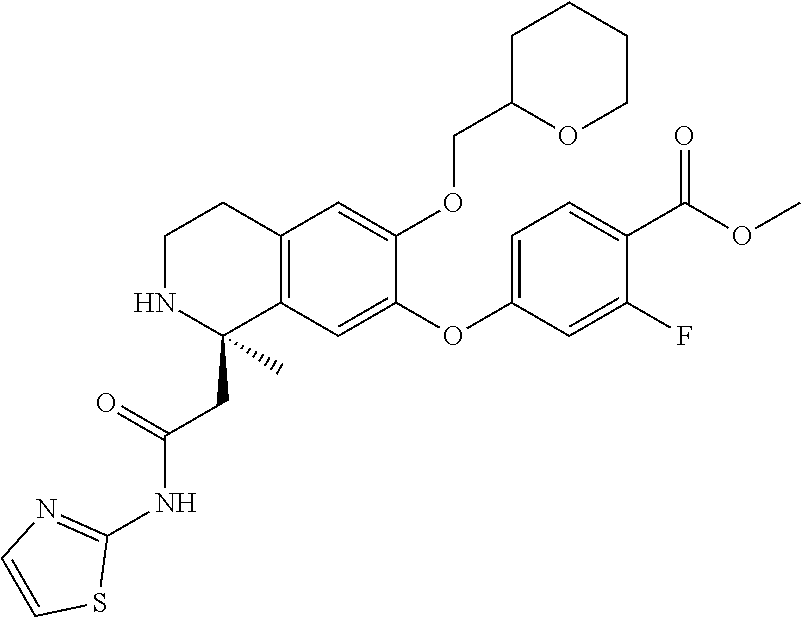 |
methyl 2-fluoro-4-(((1R)-1-methyl- 1-(2-oxo-2-(thiazol-2- ylamino)ethyl)-6-((tetrahydro-2H- pyran-2-yl)methoxy)-1,2,3,4- tetrahydroisoquinolin-7- yl)oxy)benzoate | 570.3 |

Example 73 was made according to general Scheme 9 below.


| EX. | LC/MS | ||
| No. | Structure | Name | [M + H]+ |
| 74 |
 |
2-fluoro-4-(((1R)-1-methyl-1-(2- oxo-2-(thiazol-2-ylamino)ethyl)-6- ((tetrahydro-2H-pyran-2- yl)methoxy)-1,2,3,4- tetrahydroisoquinolin-7-yl)oxy)-N- (1H-pyrazolo[3,4-b]pyridin-3- yl)benzamide | 672.21 |
| 75 |
 |
2-fluoro-4-(((R)-1-methyl-1-(2-oxo- 2-(thiazol-2-ylamino)ethyl)-6-(((R or S)-tetrahydro-2H-pyran-2- yl)methoxy)-1,2,3,4- tetrahydroisoquinolin-7-yl)oxy)-N- (1H-pyrazolo[3,4-b]pyridin-3- yl)benzamide | 672.26 |
| 76 |
 |
N-(3-(tert-butyl)-1H-pyrazol-5-yl)- 2-fluoro-4-(((1R)-1-methyl-1-(2- oxo-2-(thiazol-2-ylamino)ethyl)-6- ((tetrahydro-2H-pyran-2- yl)methoxy)-1,2,3,4- tetrahydroisoquinolin-7- yl)oxy)benzamide | 677.27 |
| 77 |
 |
2-fluoro-4-(((R)-1-methyl-1-(2-oxo- 2-(thiazol-2-ylamino)ethyl)-6-(((R or S)-tetrahydro-2H-pyran-2- yl)methoxy)-1,2,3,4- tetrahydroisoquinolin-7-yl)oxy)-N- (1-methyl-1H-pyrazol-5- yl)benzamide | 635.15 |
| 78 |
 |
2-fluoro-4-(((1R)-1-methyl-1-(2- oxo-2-(thiazol-2-ylamino)ethyl)-6- ((tetrahydro-2H-pyran-2- yl)methoxy)-1,2,3,4- tetrahydroisoquinolin-7-yl)oxy)-N- (1H-pyrazolo[3,4-b]pyridin-3- yl)benzamide | 672.37 |

Example 79 was made according to general Scheme 10 below.


| EX. | LC/MS | ||
| No. | Structure | Name | [M + H]+ |
| 80 |
 |
2-((1R)-7-(3-fluorophenoxy)-1- methyl-6-(((R or S)-tetrahydro-2H- pyran-2-yl)methoxy)-1,2,3,4- tetrahydroisoquinolin-1-yl)-N- (thiazol-2-yl)acetamide | 512.05 |
| 81 |
 |
2-((1R)-7-(3-fluorophenoxy)-1- methyl-6-(((S or R)-tetrahydro-2H- pyran-2-yl)methoxy)-1,2,3,4- tetrahydroisoquinolin-1-yl)-N- (thiazol-2-yl)acetamide | 512.1 |
| 82 |
 |
2-((1R)-7-(3-fluorophenoxy)-1- methyl-6-((tetrahydrofuran-2- yl)methoxy)-1,2,3,4- tetrahydroisoquinolin-1-yl)-N- (thiazol-2-yl)acetamide | |
| 83 |
 |
(R)-2-(7-(3-fluorophenoxy)-1- methyl-6-(pyridin-2-ylmethoxy)- 1,2,3,4-tetrahydroisoquinolin-1-yl)- N-(thiazol-2-yl)acetamide | 505.16 |
| 84 |
 |
(R)-2-(7-(3-fluorophenoxy)-6-((3- fluoropyridin-2-yl)methoxy)-1- methyl-1,2,3,4- tetrahydroisoquinolin-1-yl)-N- (thiazol-2-yl)acetamide | 523.22 |

Example 85 was made according to general Scheme 11 below.


The title compound from scheme 11, step D (5.0 mg, 6.0 μmol) was stirred in methanol (0.50 mL) and water (0.50 mL) before sodium hydroxide (0.26 mg, 6.4 μmol) was added at room temperature. The reaction mixture was stirred for 2 hours at room temperature and was then acidified with TFA and purified by preparative HPLC on a C18 reverse-phase column eluting with 10-100% acetonitrile/water with 0.05% TFA as an additive to give the title compound: LCMS m/z 655.35 [M+H]+.
| EX. | LC/MS | ||
| No. | Structure | Name | [M + H]+ |
| 86 |
 |
2-((1R)-7-(4-bromo-3- fluorophenoxy)-1-methyl-6- ((tetrahydro-2H-pyran-2- yl)methoxy)-1,2,3,4- tetrahydroisoquinolin-1-yl)-N-(3- methoxyphenyl)acetamide | 615.08 |
| 87 |
 |
2-((1R)-7-(4-bromo-3- fluorophenoxy)-1-methyl-6- ((tetrahydro-2H-pyran-2- yl)methoxy)-1,2,3,4- tetrahydroisoquinolin-1-yl)-N-(6- methoxypyridin-2-yl)acetamide | 449.87 |
| 88 |
 |
2-((1R)-7-(4-bromo-3- fluorophenoxy)-1-methyl-6- ((tetrahydro-2H-pyran-2- yl)methoxy)-1,2,3,4- tetrahydroisoquinolin-1-yl)-N- (pyridazin-3-yl)acetamide | 586.93 |
| 89 |
 |
methyl 2′-fluoro-4′-(((1R)-1-(2-((3- methoxyphenyl)amino)-2-oxoethyl)- 1-methyl-6-((tetrahydro-2H-pyran- 2-yl)methoxy)-1,2,3,4- tetrahydroisoquinolin-7-yl)oxy)- [1,1′-biphenyl]-4-carboxylate | 669.27 |
| 90 |
 |
2′-fluoro-4′-(((1R)-1-(2-((6- methoxypyridin-2-yl)amino)-2- oxoethyl)-1-methyl-6-((tetrahydro- 2H-pyran-2-yl)methoxy)-1,2,3,4- tetrahydroisoquinolin-7-yl)oxy)- [1,1′-biphenyl]-4-carboxylic acid | |
| 91 |
 |
2′-fluoro-4′-(((1R)-1-methyl-1-(2- oxo-2-(pyridazin-3-ylamino)ethyl)- 6-((tetrahydro-2H-pyran-2- yl)methoxy)-1,2,3,4- tetrahydroisoquinolin-7-yl)oxy)- [1,1′-biphenyl]-4-carboxylic acid | 627.21 |
| 92 |
 |
4′-(((1R)-1-(2-((1H-indol-4- yl)amino)-2-oxoethyl)-1-methyl-6- ((tetrahydro-2H-pyran-2- yl)methoxy)-1,2,3,4- tetrahydroisoquinolin-7-yl)oxy)-2′- fluoro-[1,1′-biphenyl]-4-carboxylic acid | 664.26 |

Example 93 was made according to general Scheme 12 below.


To a solution of tert-butyl (2-(2-(2-hydroxyethoxy)ethoxy)ethyl)carbamate (1.10 g, 4.41 mmol) in dichloromethane (15.0 mL) was added p-toluenesulfonyl chloride (1.26 g, 6.62 mmol) and triethylamine (1.23 mL, 8.82 mmol). The reaction was stirred for 24 h at room temperature. The solution was concentrated and then dichloromethane (3.00 mL) and hexane (3.00 mL) were added. The solid was filtered off and the filtrate was purified by column chromatography on silica gel eluting with 0 to 75% ethyl acetate/hexane to give the title compound: LCMS m/z 426.3 [M+Na]+.

To a solution of the title compound from scheme 12, step A (1.69 g, 4.19 mmol) in acetone (25 mL) was added potassium iodide (1.39 g, 8.38 mmol). The reaction was heated to 65° C. for 18 h. The solution was concentrated and then ethyl acetate (20 mL) and water (5 mL) were added. The layers were separated and the organic layer was washed with sat aq Na2S2O3 solution (3 mL) and brine (3 mL), dried (MgSO4), and purified by column chromatography on silica gel eluting with 0 to 70% ethyl acetate/hexane to give the title compound: LCMS m/z 360.2 [M+H]+.

To a solution of Intermediate VI (scheme 5, step C, 125 mg, 0.193 mmol) in N,N-dimethylformamide (2.2 mL) at −10° C. was added cesium carbonate (82.0 mg, 0.251 mmol) and the title compound from Scheme 11, step B (97.0 mg, 0.270 mmol). It was slowly warmed to rt over 18 h. To the reaction was added saturated aqueous ammonium chloride solution (0.5 mL) and water (1 mL). The layers were separated and organic layer was washed with water (1 mL), brine (1 mL), dried over magnesium sulfate and concentrated. The resultant product was purified by column chromatography on silica gel eluting with 0 to 35 to 55% ethyl acetate/hexane to give the title compound: LCMS m/z 879.6 [M+H]+.

To a solution of the title compound from scheme 12, step C (69.0 mg, 0.078 mmol) in dichloromethane (1.00 mL) was added a solution of trifluoroacetic acid (0.121 mL, 1.57 mmol) in dichloromethane (200 μL) dropwise. After 3 h at room temperature, LCMS showed the completion of the reaction. It was concentrated and purified by reverse phase chromatography (C18 column, eluting with 0 to 60% acetonitrile/water both with 0.05% v/v trifluoroacetic acid) to give the title compound: LCMS m/z 679.5 [M+H]+.

To a solution of the title compound in scheme 12, step D (9.00 mg, 0.013 mmol) and 1-[Bis(dimethylamino)methylene]-1H-1,2,3-triazolo[4,5-b]pyridinium 3-oxid hexafluorophosphate (5.04 mg, 0.013 mmol) in dichloromethane (1.50 mL) at rt was added triethylamine (1.85 μL, 0.013 mmol). After stirring for thirty minutes the reaction mixture was added to a solution of (S)-2-(4-isobutylphenyl)propanoic acid (2.74 mg, 0.013 mmol) in dichloromethane (1.5 mL) at 0° C. The activated ester solution was added dropwise. After 1 hr, LCMS showed completion of the reaction. Water (0.1 mL) was added and the mixture was stirred for half an hour. The organic layer was separated, concentrated and purified by column chromatography on silica gel (0 to 10% methanol in dichloromethane) to give the title compound: LCMS m/z 867.6 [M+H]+.

To a solution of the title compound from scheme 12, step E (6.90 mg, 7.96 μmol) in tetrahydrofuran (1 mL) was added lithium hydroxide (1M aqueous solution, 0.10 mL, 0.10 mmol). The reaction was heated to 45° C. for 20 hours. It was concentrated and purified by preparative HPLC (C18 column, 10 to 60% acetonitrile/water both 0.05%/0/v trifluoroacetic acid) to afford the title compound: LCMS m/z 853.6 [M+H]+.
| EX. | LC/MS | ||
| No. | Structure | Name | [M + H]+ |
| 94 |
 |
4-(((R)-6-(2-(2-(2-(2- ((3r,5r,7r)-adamantan-1- yl)acetamido)ethoxy)ethoxy) ethoxy)-1-methyl-1-(2- oxo-2-(thiazol-2- ylamino)ethyl)-1,2,3,4- tetrahydroisoquinolin-7- yl)oxy)-2′-fluoro-[1,1′- biphenyl]-4-carboxylic acid | 841.5 |
| 95 |
 |
4′-(((R)-6-(((11S,14S,15R)- 15-amino-14-hydroxy-11- isobutyl-10,13-dioxo-16- phenyl-3,6-dioxa-9,12- diazahexadecyl)oxy)-1- methyl-1-(2-oxo-2-(thiazol- 2-ylamino)ethyl)-1,2,3,4- tetrahydroisoquinolin-7- yl)oxy)-2′-fluoro-[1,1′- biphenyl]-4-carboxylic acid | 955.7 |
| 96 |
 |
4′-(((1R)-6-((1-(1s,3s)- adamantan-1-yl)-2-oxo- 6,9,12-trioxa-3- azatetradecan-14-yl)oxy)-1- methyl-1-(2-oxo-2-(thiazol- 2-ylamino)ethyl)-1,2,3,4- tetrahydroisoquinolin-7- yl)oxy)-2′-fluoro-[1,1′- biphenyl]-4-carboxylic acid | 885.9 |
| 97 |
 |
4′-(((R)-6-(((14S,17S,18R)- 18-amino-17-hydroxy-14- isobutyl-13,16-dioxo-19- phenyl-3,6,9-trioxa-12,15- diazanonadecyl)oxy)-1- methyl-1-(2-oxo-2-(thiazol- 2-ylamino)ethyl)-1,2,3,4- tetrahydroisoquinolin-7- yl)oxy)-2′-fluoro-[1,1′- biphenyl]-4-carboxylic acid | 999.7 |
| 98 |
 |
2′-fluoro-4′-(((R)-6-(((S)- 14-(4-isobutylphenyl)-13- oxo-3,6,9-trioxa-12- azapentadecyl)oxy)-1- methyl-1-(2-oxo-2-(thiazol- 2-ylamino)ethyl)-1,2,3,4- tetrahydroisoquinolin-7- yl)oxy)-[1,1′-biphenyl]-4- carboxylic acid | 898.0 |
| 99 |
 |
4′-(((R)-6-(((S,Z)-6,11- bis((tert- butoxycarbonyl)amino)-2,2- dimethyl-4,12-dioxo- 3,16,19,22-tetraoxa-5,7,13- triazatetracos-5-en-24- yl)oxy)-1-methyl-1-(2-oxo- 2-(thiazol-2-ylamino)ethyl)- 1,2,3,4- tetrahydroisoquinolin-7- yl)oxy)-2′-fluoro-[1,1′- biphenyl]-4-carboxylic acid | 1165 |
| 100 |
 |
4′-(((R)-6-(2-(2-((R)-2- ((2R,3S)-3-amino-2- hydroxy-4- phenylbutanamido)-4- methylpentanamido)ethoxy) ethoxy)-1-methyl-1-(2-oxo- 2-(thiazol-2-ylamino)ethyl)- 1,2,3,4- tetrahydroisoquinolin-7- yl)oxy)-2′-fluoro-[1,1′- biphenyl]-4-carboxylic acid | 911.6 |
| 101 |
 |
(R)-2′-fluoro-4′-((6-(2- methoxyethoxy)-1-methyl- 1-(2-oxo-2-(thiazol-2- ylamino)ethyl)-1,2,3,4- tetrahydroisoquinolin-7- yl)oxy)-[1,1′-biphenyl]-4- carboxylic acid | 592.3 |
| 102 |
 |
2′-fluoro-4′-(((R)-6-(((S)- 16-((2S,4R)-4-hydroxy-2- ((4-(4-methylthiazol-5- yl)benzyl)carbamoyl) pyrrolidine-1- carbonyl)-17,17- dimethyl-7,14-dioxo-3,9,12- trioxa-6,15- diazaoctadecyl)oxy)-1- methyl-1-(2-oxo-2-(thiazol- 2-ylamino)ethyl)-1,2,3,4- tetrahydroisoquinolin-7- yl)oxy)-[1,1′-biphenyl]-4- carboxylic acid | 1193.7 |
| 103 |
 |
2′-fluoro-4′-(((R)-6-(((S)- 19-((2S,4R)-4-hydroxy-2- ((4-(4-methylthiazol-5- yl)benzyl)carbamoyl) pyrrolidine-1- carbonyl)-20,20- dimethyl-7,17-dioxo- 3,9,12,15-tetraoxa-6,18- diazahenicosyl)oxy)-1- methyl-1-(2-oxo-2-(thiazol- 2-ylamino)ethyl)-1,2,3,4- tetrahydroisoquinolin-7- yl)oxy)-[1,1′-biphenyl]-4- carboxylic acid | 1238.7 |
| 104 |
 |
4′-(((R)-6-(2-(2-(2- ((3r,5r,7r)-adamantan-1- yl)acetamido)ethoxy)ethoxy)- 1-methyl-1-(2-oxo-2- (thiazol-2-ylamino)ethyl)- 1,2,3,4- tetrahydroisoquinolin-7- yl)oxy)-2′-fluoro-[1,1′- biphenyl]-4-carboxylic acid | 797.4 |
| 105 |
 |
2′-fluoro-4′-(((R)-6-(((S)- 13-((2S,4R)-4-hydroxy-2- ((4-(4-methylthiazol-5- yl)benzyl)carbamoyl) pyrrolidine-1- carbonyl)-14,14- dimethyl-7,11-dioxo-3,9- dioxa-6,12- diazapentadecyl)oxy)-1- methyl-1-(2-oxo-2-(thiazol- 2-ylamino)ethyl)-1,2,3,4- tetrahydroisoquinolin-7- yl)oxy)-[1,1′-biphenyl]-4- carboxylic acid | 1150.4 |
| 106 |
 |
4′-(((R)-6-(((R,Z)-6,11- bis((tert- butoxycarbonyl)amino)-2,2- dimethyl-4,12-dioxo-3,16- dioxa-5,7,13-triazaoctadec- 5-en-18-yl)oxy)-1-methyl- 1-(2-oxo-2-(thiazol-2- ylamino)ethyl)-1,2,3,4- tetrahydroisoquinolin-7- yl)oxy)-2′-fluoro-[1,1′- biphenyl]-4-carboxylic acid | 1077.38 |
| 107 |
 |
methyl 2′-fluoro-4′-(((R)-6- (((S)-13-((2S,4R)-4- hydroxy-2-((4-(4- methylthiazol-5- yl)benzyl)carbamoyl) pyrrolidine-1- carbonyl)-14,14- dimethyl-7,11-dioxo-3,9- dioxa-6,12- diazapentadecyl)oxy)-1- methyl-1-(2-oxo-2-(thiazol- 2-ylamino)ethyl)-1,2,3,4- tetrahydroisoquinolin-7- yl)oxy)-[1,1′-biphenyl]-4- carboxylate | 1164.5 |
| 108 |
 |
2′-fluoro-4′-(((R)-6-(2-(2- isobutylphenyl)propanamido) ethoxy)ethoxy)-1-methyl- 1-(2-oxo-2-(thiazol-2- ylamino)ethyl)-1,2,3,4- tetrahydroisoquinolin-7- yl)oxy)-[1,1′-biphenyl]-4- carboxylic acid | 809.6 |

Example 109 was made according to general Scheme 13 below.


| EX. | LC/MS | ||
| No. | Structure | Name | [M + H]+ |
| VIIb |
 |
ethyl 2-(6-methoxy-1- methyl-1,2,3,4- tetrahydroisoquinolin-1- yl)acetate | 264.23 [M + H]+ |


Example 110 was made according to general Scheme 14 below.


To a solution of ethyl 2-(6-methoxy-1-methyl-1,2,3,4-tetrahydroisoquinolin-1-yl)acetate (Intermediate VIIb) (24 g, 91 mmol) in 1,4-dioxane (50 mL) was added di-tert-butyl dicarbonate (29.8 g, 137 mmol) followed by triethylamine (31.8 mL, 228 mmol). The reaction mixture was heated to 80° C. for 2 h. The reaction was cooled to rt and poured into water and was then extracted with dichloromethane (2×). The organic layer was dried over sodium sulfate. The residue was purified by column chromatography on silica gel, eluting with 0-100% ethyl acetate/hexane to give the title compound: LCMS m/z 386.19 [M+H]+.

To a solution of the title compound from scheme 14, step A (7.5 g, 21 mmol) in acetonitrile (30 mL) was added a solution of NBS (4.77 g, 26.8 mmol) in acetonitrile (20 mL) dropwise via an additional funnel over 20 min. The mixture was stirred at rt for 1 h. The solvent was concentrated and the residue was purified by column chromatography on silica gel, eluting with 0-25% ethyl acetate/hexan. A mixture of about 1:1 monobrominated product was isolated. 7-bromo product is slightly more than 5-bromo product. It was carried forward as a mixture: LCMS m/z 344.0 [M+H]+.

The mixture of bromo isomers from scheme 14, step B (7.20 g, 16.3 mmol) was dissolved in dichloromethane (50 mL) and cooled to −78° C. A solution of boron tribromide (1M in dichloromethane, 65.1 mL, 65.1 mmol) was added dropwise via an additional funnel. The mixture was allowed to warm up slowly to rt and stirred at rt for overnight. The reaction mixture was cooled back to −78° C. and anhydrous ethanol (50 mL) was added. The ice bath was removed and the reaction was stirred at rt for 30 min. It was then heated at 80° C. for 3 h with the top open. The reaction was concentrated to dryness and poured slowly to a saturated aqueous sodium bicarbonate solution. It was extracted with ethyl acetate (3×), dried over sodium sulfate, filtered and concentrated to dryness. The above intermediate was taken up in dioxane, and di-tert-butyldicarbonate (8.88 g, 40.7 mmol) was added, followed by triethylamine (6.81 ml, 48.8 mmol). The reaction mixture was heated at 80° C. for 3 h. The solvent was removed and the residue was purified by column chromatography on silica gel eluting with 0-30% EtOAc/Hexane. The di-Boc intermediate was taken up in methanol (100 mL), potassium carbonate (2.250 g, 16.28 mmol) was added and the reaction was heated to 50° C. for 1 h. The mixture was cooled to rt, slowly poured into 1N aqueous HCl and extracted with ethyl acetate (3×). The organics were dried over sodium sulfate, filtered and concentrated to dryness to afford the title compound (which was a mixture of bromo regioisomers): LCMS m/z 430.08 [M+H]+.

Tetrahydropyran-2-methanol (0.946 mL, 8.61 mmol) was taken up in dry dichloromethane (34.4 mL), under an inert atmosphere. The mixture was cooled to −5° C. before pyridine (1.18 mL, 14.64 mmol) was added to the reaction mixture, followed by the addition of trifluoromethanesulfonic anhydride (2.03 mL, 12.05 mmol). The reaction was allowed to stir at −5° C. for 20 minutes. The mixture was then passed through a silica plug. The fractions containing product were concentrated to afford the title compound.

To a solution of the title compound from scheme 14, step C (1.01 g, 2.36 mmol) and the title compound from scheme 14, step D (1.46 g, 5.90 mmol) were taken up in acetone (23.6 mL). Potassium carbonate (0.815 g, 5.90 mmol) was added and the mixture was stirred overnight at room temperature. The mixture was filtered, to remove the potassium carbonate, and concentrated to dryness. The residue was purified by column chromatography on silica gel eluting with EtOAc/isohexane, 0-50-100%. The fractions containing product were concentrated to afford the title compound (which was still a mixture of two bromo regioisomers): LCMS m/z 526 [M+H, 79Br]+, 528 [M+H, 81Br]+.


The title compound from scheme 14, step H (30.0 mg, 0.046 mmol) was taken up in tetrahydrofuran (2.00 mL) and methanol (2.00 mL). Lithium hydroxide (3M aqueous solution, 2.00 mL, 6.00 mmol) was added and the reaction was stirred overnight at room temperature. The reaction mixture was neutralized and acidified with trifluoroacetic acid. The solution was concentrated to dryness. The residue was taken up in 10 mL of water and 10 mL of ethyl acetate. It was then extracted with ethyl acetate (3×15 mL). The combined organics were dried over sodium sulfate, filtered and concentrated to dryness. The residue was purified by preparative HPLC using a reverse phase (C-18) column, eluting with 5-95% acetonitrile/water+0.05% trifluoroacetic acid. The fractions containing product were combined and concentrated to afford the title compound: LCMS m/z 540.07 [M+H]+.
| EX. | LC/MS | ||
| No. | Structure | Name | [M + H]+ |
| 111 |
 |
methyl 2-fluoro-5-(1-methyl-1- (2-oxo-2-(thiazol-2- ylamino)ethyl)-6-((tetrahydro- 2H-pyran-2-yl)methoxy)- 1,2,3,4-tetrahydroisoquinolin-7- yl)benzoate | 554.32 |

Example 112 was made according to general Scheme 15 below.


To a solution of Intermediate VIII (scheme 13, step D, 56.5 mg, 0.120 mmol) in a 1:1 solution of tetrahydrofuran (1.00 mL) and methanol (1.00 mL) was added lithium hydroxide (1.5M aqueous solution, 1.00 mL, 1.500 mmol). The reaction was stirred overnight at room temperature, neutralized with trifluoroacetic acid, and concentrated to dryness. The residue was purified via preparative HPLC to afford the title compound: LCMS m/z 456.25 [M+H]+.
| ASSAY TABLE 1 |
| Stabilization of PCSK9 resulting from the binding of |
| Examples 1-92 and 109-112 to PCSK9. |
| Example | DSC | ||
| No. | ΔTm | ||
| 1 | 4.29 | ||
| 2 | 6.21 | ||
| 3 | 4.915 | ||
| 4 | 7.056 | ||
| 5 | 6.99 | ||
| 6 | 5.78 | ||
| 7 | 5.59 | ||
| 8 | 5.44 | ||
| 9 | 5.92 | ||
| 10 | 5.55 | ||
| 11 | 5.69 | ||
| 12 | −0.225 | ||
| 13 | 8.4 | ||
| 14 | 5.89 | ||
| 15 | 3.31 | ||
| 16 | 3.57 | ||
| 17 | 2.62 | ||
| 18 | 7.62 | ||
| 19 | 9.053 | ||
| 20 | 8.56 | ||
| 21 | 6.58 | ||
| 22 | 7.52 | ||
| 23 | 8.71 | ||
| 24 | 7.203 | ||
| 25 | 6.6 | ||
| 26 | 5.75 | ||
| 27 | 7.11 | ||
| 28 | 6.91 | ||
| 29 | 5.37 | ||
| 30 | 5.48 | ||
| 31 | 5.84 | ||
| 32 | 6.18 | ||
| 33 | 5.2 | ||
| 34 | 5.5 | ||
| 35 | 5.293 | ||
| 36 | 5.56 | ||
| 37 | 5.63 | ||
| 38 | 7 | ||
| 39 | 5.98 | ||
| 40 | 6.75 | ||
| 41 | 7.18 | ||
| 42 | 5.97 | ||
| 43 | 5.45 | ||
| 44 | 6.89 | ||
| 45 | 6.96 | ||
| 46 | 6.48 | ||
| 47 | 6.27 | ||
| 48 | 6.02 | ||
| 49 | 6.293 | ||
| 50 | 6.74 | ||
| 51 | 6.87 | ||
| 52 | 5.583 | ||
| 53 | 6.96 | ||
| 54 | 5.98 | ||
| 55 | 5.823 | ||
| 56 | 5.723 | ||
| 57 | 6.15 | ||
| 58 | 5.88 | ||
| 59 | 5.153 | ||
| 60 | 6.423 | ||
| 61 | 2.87 | ||
| 62 | 6.03 | ||
| 63 | 8.383 | ||
| 64 | 7.83 | ||
| 65 | 7.313 | ||
| 66 | 9.14 | ||
| 67 | 7.307 | ||
| 68 | 7.563 | ||
| 69 | 7.65 | ||
| 70 | 7.983 | ||
| 71 | 6.363 | ||
| 72 | 6.15 | ||
| 73 | 6.66 | ||
| 74 | 7.08 | ||
| 75 | 6.18 | ||
| 76 | 7.92 | ||
| 77 | 6.665 | ||
| 78 | 6.67 | ||
| 79 | 6.76 | ||
| 80 | 6.095 | ||
| 81 | 6.585 | ||
| 82 | 7.47 | ||
| 83 | 5.2 | ||
| 84 | 6.32 | ||
| 85 | 9.623 | ||
| 86 | 6.18 | ||
| 87 | 6.57 | ||
| 88 | 5.51 | ||
| 89 | 5.98 | ||
| 90 | 8.593 | ||
| 91 | 7.193 | ||
| 92 | 7.283 | ||
| 109 | 6.02 | ||
| 110 | 6.7 | ||
| 111 | 6.27 | ||
| 112 | 6.805 | ||
Fluoresence Polarization Assay
| ASSAY TABLE 2 |
| Affinity measurements based on fluorescence polarization |
| Example | FP IC | ||
| No. | (μM) | ||
| 1 | 3.666 | ||
| 2 | 1.239 | ||
| 3 | 1.247 | ||
| 4 | 0.4874 | ||
| 5 | 0.5607 | ||
| 6 | 0.6482 | ||
| 7 | 0.6516 | ||
| 8 | 0.7527 | ||
| 9 | 0.8473 | ||
| 10 | 0.9018 | ||
| 11 | 0.756 | ||
| 12 | 0.7533 | ||
| 13 | 0.09931 | ||
| 14 | 2.37E−04 | ||
| 15 | 0.00376 | ||
| 16 | 0.004148 | ||
| 17 | 0.01147 | ||
| 18 | 0.09434 | ||
| 19 | 0.1618 | ||
| 20 | 0.1884 | ||
| 21 | 0.2003 | ||
| 22 | 0.2109 | ||
| 23 | 0.2284 | ||
| 24 | 0.2611 | ||
| 25 | 0.3016 | ||
| 26 | 0.386 | ||
| 27 | 0.3864 | ||
| 28 | 0.4073 | ||
| 29 | 0.4156 | ||
| 30 | 0.4504 | ||
| 31 | 0.5223 | ||
| 32 | 0.5318 | ||
| 33 | 0.5602 | ||
| 34 | 0.667 | ||
| 35 | 0.6808 | ||
| 36 | 0.7665 | ||
| 37 | 0.6152 | ||
| 38 | 0.2671 | ||
| 39 | 0.2917 | ||
| 40 | 0.302 | ||
| 41 | 0.3536 | ||
| 42 | 0.3886 | ||
| 43 | 0.4176 | ||
| 44 | 0.4259 | ||
| 45 | 0.5301 | ||
| 46 | 0.6023 | ||
| 47 | 0.6455 | ||
| 48 | 0.6781 | ||
| 49 | 0.6821 | ||
| 50 | 0.6828 | ||
| 51 | 0.705 | ||
| 52 | 0.7779 | ||
| 53 | 0.8233 | ||
| 54 | 0.8369 | ||
| 55 | 0.8775 | ||
| 56 | 0.9656 | ||
| 62 | 0.5289 | ||
| 63 | 0.1762 | ||
| 64 | 0.2941 | ||
| 65 | 0.2993 | ||
| 66 | 0.3949 | ||
| 67 | 0.4198 | ||
| 68 | 0.4771 | ||
| 69 | 0.5411 | ||
| 70 | 0.5505 | ||
| 71 | 0.6452 | ||
| 72 | 0.6803 | ||
| 73 | 0.6323 | ||
| 74 | 0.7901 | ||
| 75 | 0.41 | ||
| 76 | 0.5346 | ||
| 77 | 0.5912 | ||
| 78 | 0.6043 | ||
| 79 | 0.8229 | ||
| 80 | 0.5499 | ||
| 81 | 0.5504 | ||
| 82 | 0.721 | ||
| 83 | 0.8518 | ||
| 84 | 0.9428 | ||
| 85 | 0.1705 | ||
| 86 | 0.001169 | ||
| 87 | 0.001399 | ||
| 88 | 0.001596 | ||
| 89 | 0.002756 | ||
| 90 | 0.1086 | ||
| 91 | 0.86 | ||
| 92 | 0.9576 | ||
| 93 | 0.188 | ||
| 93 | 0.5782 | ||
| 94 | 0.0769 | ||
| 95 | 0.1071 | ||
| 96 | 0.1097 | ||
| 97 | 0.13 | ||
| 98 | 0.2603 | ||
| 99 | 0.7177 | ||
| 100 | 0.09637 | ||
| 101 | 0.1296 | ||
| 102 | 0.1617 | ||
| 103 | 0.162 | ||
| 104 | 0.2221 | ||
| 105 | 0.2251 | ||
| 106 | 0.6554 | ||
| 107 | 0.8306 | ||
| 108 | 0.578 | ||
| 109 | 0.6644 | ||
| 110 | 9.80E−04 | ||
| 111 | 0.001547 | ||
Protein Degradation Assay (Western Blot/Sally Sue Assay)
| ASSAY TABLE 3 |
| Effective concentration of compound to lower PCSK9 protein |
| levels pro and mature by 50%. |
| Example | PCSK9 DC50 | PCSK9 DC50 | ||
| No. | (Pro) μM | (Mature) μM | ||
| 93 | 6.18 | 4.24 | ||
| 94 | 1.36 | 8.52 | ||
| 95 | Inactive | inactive | ||
| 96 | 6.55 | 1.05 | ||
| 97 | Inactive | inactive | ||
| 98 | 6.08 | 5.07 | ||
| 99 | 1.37 | 9.00 | ||
| 100 | Inactive | inactive | ||
| 101 | Inactive | inactive | ||
| 102 | Inactive | inactive | ||
| 103 | Inactive | inactive | ||
| 104 | 1.53 | 7.52 | ||
| 106 | 4.82 | 3.42 | ||
| 107 | Inactive | inactive | ||
| 108 | Inactive | inactive | ||
Claims (14)


Priority Applications (1)
| Application Number | Priority Date | Filing Date | Title |
|---|---|---|---|
| US16/334,605 US11008313B2 (en) | 2016-09-20 | 2017-09-15 | Substituted 1-methyl-1,2,3,4-tetrahydroisoquinoline molecules as PCSK9 allosteric binders |
Applications Claiming Priority (3)
| Application Number | Priority Date | Filing Date | Title |
|---|---|---|---|
| US201662397116P | 2016-09-20 | 2016-09-20 | |
| PCT/US2017/051690 WO2018057409A1 (en) | 2016-09-20 | 2017-09-15 | Substituted 1-methyl-1,2,3,4-tetrahydroisoquinoline molecules as pcsk9 allosteric binders |
| US16/334,605 US11008313B2 (en) | 2016-09-20 | 2017-09-15 | Substituted 1-methyl-1,2,3,4-tetrahydroisoquinoline molecules as PCSK9 allosteric binders |
Publications (2)
| Publication Number | Publication Date |
|---|---|
| US20200369657A1 US20200369657A1 (en) | 2020-11-26 |
| US11008313B2 true US11008313B2 (en) | 2021-05-18 |
Family
ID=61689722
Family Applications (1)
| Application Number | Title | Priority Date | Filing Date |
|---|---|---|---|
| US16/334,605 Active 2038-05-12 US11008313B2 (en) | 2016-09-20 | 2017-09-15 | Substituted 1-methyl-1,2,3,4-tetrahydroisoquinoline molecules as PCSK9 allosteric binders |
Country Status (3)
| Country | Link |
|---|---|
| US (1) | US11008313B2 (en) |
| EP (1) | EP3515891B1 (en) |
| WO (1) | WO2018057409A1 (en) |
Families Citing this family (2)
| Publication number | Priority date | Publication date | Assignee | Title |
|---|---|---|---|---|
| CN116731005B (en) * | 2022-03-02 | 2024-04-16 | 复旦大学 | PCSK9 small molecular protein degradation agent and preparation method and application thereof |
| CN121517408A (en) * | 2024-08-12 | 2026-02-13 | 复旦大学 | A PCSK9 small molecule autophagy degrader, its preparation method and application |
Citations (3)
| Publication number | Priority date | Publication date | Assignee | Title |
|---|---|---|---|---|
| WO2016036636A1 (en) | 2014-09-05 | 2016-03-10 | Merck Sharp & Dohme Corp. | Tetrahydroisoquinoline derivatives useful as inhibitors of diacylglyceride o-acyltransferase 2 |
| WO2016036633A1 (en) | 2014-09-05 | 2016-03-10 | Merck Sharp & Dohme Corp. | Tetrahydroisoquinoline derivatives useful as inhibitors of diacylglyceride o-acyltransferase 2 |
| CN105777633A (en) | 2015-01-09 | 2016-07-20 | 成都贝斯凯瑞生物科技有限公司 | Tetrahydroisoquinoline derivative and application thereof |
Family Cites Families (18)
| Publication number | Priority date | Publication date | Assignee | Title |
|---|---|---|---|---|
| DE3841520A1 (en) | 1988-12-09 | 1990-06-13 | Hoechst Ag | ENZYME-INFRINGING DERIVATIVES OF DIPEPTIDES, METHOD FOR THE PRODUCTION THEREOF, METHODS CONTAINING THEM AND THEIR USE |
| US5104869A (en) | 1989-10-11 | 1992-04-14 | American Cyanamid Company | Renin inhibitors |
| US5114937A (en) | 1989-11-28 | 1992-05-19 | Warner-Lambert Company | Renin inhibiting nonpeptides |
| US5095119A (en) | 1990-03-08 | 1992-03-10 | American Home Products Corporation | Renin inhibitors |
| US6284748B1 (en) | 1997-03-07 | 2001-09-04 | Metabasis Therapeutics, Inc. | Purine inhibitors of fructose 1,6-bisphosphatase |
| US6054587A (en) | 1997-03-07 | 2000-04-25 | Metabasis Therapeutics, Inc. | Indole and azaindole inhibitors of fructose-1,6-bisphosphatase |
| DE69819311T2 (en) | 1997-03-07 | 2004-07-29 | Metabasis Therapeutics Inc., San Diego | NEW BENZIMIDAZOL INHIBITORS OF FRUCTOSE-1,6-BISPHOSPHATASE |
| KR100818845B1 (en) | 1998-09-09 | 2008-04-01 | 메타베이시스 테라퓨틱스, 인크. | Heteroaromatic Inhibitors of Novel Fructose 1,6-bisphosphatase |
| AU7705601A (en) | 2000-07-25 | 2002-02-05 | Merck & Co Inc | N-substituted indoles useful in the treatment of diabetes |
| EP1357908A4 (en) | 2001-01-30 | 2009-07-15 | Merck & Co Inc | ACYL-SULFAMIDES FOR THE TREATMENT OF OBESITY, DIABETES AND LIPID DISORDERS |
| AR040241A1 (en) | 2002-06-10 | 2005-03-23 | Merck & Co Inc | INHIBITORS OF 11-BETA-HYDROXIESTEROID DEHYDROGRENASE 1 FOR THE TREATMENT OF DIABETES OBESITY AND DISLIPIDEMIA |
| EP1546142A4 (en) | 2002-08-29 | 2007-10-17 | Merck & Co Inc | Indoles having anti-diabetic activity |
| CN100457730C (en) | 2002-08-29 | 2009-02-04 | 默克公司 | indole compounds having anti-diabetic activity |
| AU2004207444B2 (en) | 2003-01-17 | 2008-07-31 | Merck & Co., Inc. | N-cyclohexylaminocarbonyl benzenesulfonamide derivatives |
| CN101743616B (en) | 2007-06-28 | 2012-02-22 | 株式会社半导体能源研究所 | Method for manufacturing semiconductor device |
| CA2691010A1 (en) | 2007-06-28 | 2008-12-31 | Merck Frosst Canada Ltd. | Substituted fused pyrimidines as antagonists of gpr105 activity |
| US20110301079A1 (en) | 2007-09-21 | 2011-12-08 | Instituto Di Ricerche Di Biologia Molecolare P. Angeletti S.P.A. | Neuromedin u receptor agonists and uses thereof |
| MA41022A (en) | 2014-11-24 | 2017-10-03 | Shire Human Genetic Therapies | LYSOSOMIAL TARGETING AND CORRESPONDING USES |
-
2017
- 2017-09-15 US US16/334,605 patent/US11008313B2/en active Active
- 2017-09-15 WO PCT/US2017/051690 patent/WO2018057409A1/en not_active Ceased
- 2017-09-15 EP EP17853698.3A patent/EP3515891B1/en active Active
Patent Citations (3)
| Publication number | Priority date | Publication date | Assignee | Title |
|---|---|---|---|---|
| WO2016036636A1 (en) | 2014-09-05 | 2016-03-10 | Merck Sharp & Dohme Corp. | Tetrahydroisoquinoline derivatives useful as inhibitors of diacylglyceride o-acyltransferase 2 |
| WO2016036633A1 (en) | 2014-09-05 | 2016-03-10 | Merck Sharp & Dohme Corp. | Tetrahydroisoquinoline derivatives useful as inhibitors of diacylglyceride o-acyltransferase 2 |
| CN105777633A (en) | 2015-01-09 | 2016-07-20 | 成都贝斯凯瑞生物科技有限公司 | Tetrahydroisoquinoline derivative and application thereof |
Non-Patent Citations (11)
| Title |
|---|
| "Substance Record for SID 75920391" to PubChem, Deposit Date Jun. 11, 2009. Retrieved from the Internet [retrieved on Oct. 20, 2017] URL:HTTPS://pubchem.ncbi.nlm.nih.gov/substance/75920391#section=Top entire document. |
| Schneekloth, John S., Chemical Genetic Control of Protein Levels; Selective in Vivo Targeted Degradation, J. Am Chem Soc, 2004, 3748-3754, 126. |
| Schreiber, S., A chemical biology view of bioactive small molecules and a binder-based approach to connect biology to precision medicines, BioRxiv, 2018, 386904, 1, US. |
| Scott, D. E., Small Molecules, Big Targets: drug discovery faces the protein-protein interaction challenge, Nat. Rev. Drug Discov, 2016, 533-550, 15, US. |
| Seidah, N.G., PCSK9: A Key Modulator of cardiovascular health, Circ Res, 2014, 1022-1036, 114, US. |
| Shi, Y., Boc3Arg-Linked Ligands induce Degradation by Localizing Target Proteins . . . , ACS Chem Biol, 2016, 3328-3337, 11, US. |
| Thirumurugan, P., Click chemistry for drug development and diverse chemical-biology applications, Chem Rev, 2013, 4905-4979, 113, US. |
| Unver, M.Y., Druggability Assessment of Target Used in Kinetic Target-Guided Synthesis, J. Med Chem, 2018, 9395-9409, 61, US. |
| Watkins, A.M., Antaomy of β-strands at protein-protein interfaces, ACS Chemical Biology, 2014, 1747-1754, 9, US. |
| Xiong, Yusheng, Exploration of a PCSK9 allosteric binding site for cholesterol reduction, 14th Annual Discovery on Target, Sep. 19-22, 2016. |
| Xu, W., c-IAP1 binds and processes PCSK9 protein: linking the c-IAP1 in a TNF-alpha pathway to PCSK9-mediated LDLR degradation pathway, Molecules, 2012, 12086-12101, 17, US. |
Also Published As
| Publication number | Publication date |
|---|---|
| EP3515891B1 (en) | 2023-03-08 |
| US20200369657A1 (en) | 2020-11-26 |
| EP3515891A1 (en) | 2019-07-31 |
| EP3515891A4 (en) | 2020-04-15 |
| WO2018057409A1 (en) | 2018-03-29 |
Similar Documents
| Publication | Publication Date | Title |
|---|---|---|
| US12209145B2 (en) | PCSK9 antagonist compounds | |
| US12178842B2 (en) | PCSK9 antagonist compounds | |
| US11306125B2 (en) | PCSK9 antagonists bicyclo-compounds | |
| US12577259B2 (en) | PCSK9 antagonist compounds | |
| US9877957B2 (en) | Tetrahydroisoquinoline derivatives useful as inhibitors of diacylglyceride O-acyltransferase 2 | |
| US9073882B2 (en) | Inhibitors of the renal outer medullary potassium channel | |
| US10947222B2 (en) | Indole derivatives useful as inhibitors of diacylglyceride O-acyltransferase 2 | |
| US11008313B2 (en) | Substituted 1-methyl-1,2,3,4-tetrahydroisoquinoline molecules as PCSK9 allosteric binders | |
| WO2025231011A1 (en) | Heteroarylindole inhibitors of apol-1 |
Legal Events
| Date | Code | Title | Description |
|---|---|---|---|
| AS | Assignment |
Owner name: MERCK SHARP & DOHME CORP., NEW JERSEY Free format text: ASSIGNMENT OF ASSIGNORS INTEREST;ASSIGNORS:IMBRIGLIO, JASON EUGENE;PETRILLI, WHITNEY LANE;FENG, ZHE;AND OTHERS;SIGNING DATES FROM 20170425 TO 20170920;REEL/FRAME:048639/0233 |
|
| FEPP | Fee payment procedure |
Free format text: ENTITY STATUS SET TO UNDISCOUNTED (ORIGINAL EVENT CODE: BIG.); ENTITY STATUS OF PATENT OWNER: LARGE ENTITY |
|
| STPP | Information on status: patent application and granting procedure in general |
Free format text: NOTICE OF ALLOWANCE MAILED -- APPLICATION RECEIVED IN OFFICE OF PUBLICATIONS |
|
| STPP | Information on status: patent application and granting procedure in general |
Free format text: PUBLICATIONS -- ISSUE FEE PAYMENT VERIFIED |
|
| STCF | Information on status: patent grant |
Free format text: PATENTED CASE |
|
| AS | Assignment |
Owner name: MERCK SHARP & DOHME LLC, NEW JERSEY Free format text: MERGER;ASSIGNOR:MERCK SHARP & DOHME CORP.;REEL/FRAME:061102/0145 Effective date: 20220407 |
|
| MAFP | Maintenance fee payment |
Free format text: PAYMENT OF MAINTENANCE FEE, 4TH YEAR, LARGE ENTITY (ORIGINAL EVENT CODE: M1551); ENTITY STATUS OF PATENT OWNER: LARGE ENTITY Year of fee payment: 4 |