US11007278B2 - Electroactive supramolecular polymeric assemblies, methods of making electroactive supramolecular polymeric assemblies, and methods of using electroactive supramolecular assemblies - Google Patents
Electroactive supramolecular polymeric assemblies, methods of making electroactive supramolecular polymeric assemblies, and methods of using electroactive supramolecular assemblies Download PDFInfo
- Publication number
- US11007278B2 US11007278B2 US16/844,222 US202016844222A US11007278B2 US 11007278 B2 US11007278 B2 US 11007278B2 US 202016844222 A US202016844222 A US 202016844222A US 11007278 B2 US11007278 B2 US 11007278B2
- Authority
- US
- United States
- Prior art keywords
- electroactive
- agent
- supramolecular
- assemblies
- electrical stimulus
- Prior art date
- Legal status (The legal status is an assumption and is not a legal conclusion. Google has not performed a legal analysis and makes no representation as to the accuracy of the status listed.)
- Active
Links
- 238000000034 method Methods 0.000 title claims abstract description 43
- 238000000429 assembly Methods 0.000 title abstract description 18
- 230000000712 assembly Effects 0.000 title abstract description 18
- 239000003795 chemical substances by application Substances 0.000 claims description 53
- 239000003814 drug Substances 0.000 claims description 28
- 229920001746 electroactive polymer Polymers 0.000 claims description 25
- 229920001400 block copolymer Polymers 0.000 claims description 23
- 229940079593 drug Drugs 0.000 claims description 22
- 208000037265 diseases, disorders, signs and symptoms Diseases 0.000 claims description 12
- 201000010099 disease Diseases 0.000 claims description 9
- 239000003124 biologic agent Substances 0.000 claims description 6
- 208000015181 infectious disease Diseases 0.000 claims description 5
- 229940126586 small molecule drug Drugs 0.000 claims description 5
- 229940124597 therapeutic agent Drugs 0.000 claims description 5
- 208000027418 Wounds and injury Diseases 0.000 claims description 4
- 230000006378 damage Effects 0.000 claims description 4
- 208000014674 injury Diseases 0.000 claims description 4
- 208000011580 syndromic disease Diseases 0.000 claims description 3
- 101100106544 Arabidopsis thaliana YMF16 gene Proteins 0.000 description 29
- 210000004027 cell Anatomy 0.000 description 26
- PAYRUJLWNCNPSJ-UHFFFAOYSA-N Aniline Chemical compound NC1=CC=CC=C1 PAYRUJLWNCNPSJ-UHFFFAOYSA-N 0.000 description 24
- MIOPJNTWMNEORI-GMSGAONNSA-N (S)-camphorsulfonic acid Chemical compound C1C[C@@]2(CS(O)(=O)=O)C(=O)C[C@@H]1C2(C)C MIOPJNTWMNEORI-GMSGAONNSA-N 0.000 description 21
- 229960004833 dexamethasone phosphate Drugs 0.000 description 21
- VQODGRNSFPNSQE-CXSFZGCWSA-N dexamethasone phosphate Chemical compound C1CC2=CC(=O)C=C[C@]2(C)[C@]2(F)[C@@H]1[C@@H]1C[C@@H](C)[C@@](C(=O)COP(O)(O)=O)(O)[C@@]1(C)C[C@@H]2O VQODGRNSFPNSQE-CXSFZGCWSA-N 0.000 description 21
- 150000001408 amides Chemical class 0.000 description 20
- BYEAHWXPCBROCE-UHFFFAOYSA-N 1,1,1,3,3,3-hexafluoropropan-2-ol Chemical compound FC(F)(F)C(O)C(F)(F)F BYEAHWXPCBROCE-UHFFFAOYSA-N 0.000 description 18
- 229920000642 polymer Polymers 0.000 description 16
- RTZKZFJDLAIYFH-UHFFFAOYSA-N Diethyl ether Chemical compound CCOCC RTZKZFJDLAIYFH-UHFFFAOYSA-N 0.000 description 15
- 230000003993 interaction Effects 0.000 description 15
- 210000001519 tissue Anatomy 0.000 description 15
- 230000015572 biosynthetic process Effects 0.000 description 14
- 108090000765 processed proteins & peptides Proteins 0.000 description 14
- 238000003786 synthesis reaction Methods 0.000 description 14
- 239000007787 solid Substances 0.000 description 13
- 239000000463 material Substances 0.000 description 11
- 239000000523 sample Substances 0.000 description 10
- DTETYCNJKAUROO-UHFFFAOYSA-N 4-methyl-1,3-oxazolidine-2,5-dione Chemical compound CC1NC(=O)OC1=O DTETYCNJKAUROO-UHFFFAOYSA-N 0.000 description 9
- 238000002474 experimental method Methods 0.000 description 9
- 239000002609 medium Substances 0.000 description 9
- 230000000638 stimulation Effects 0.000 description 9
- 238000002441 X-ray diffraction Methods 0.000 description 8
- LOKCTEFSRHRXRJ-UHFFFAOYSA-I dipotassium trisodium dihydrogen phosphate hydrogen phosphate dichloride Chemical compound P(=O)(O)(O)[O-].[K+].P(=O)(O)([O-])[O-].[Na+].[Na+].[Cl-].[K+].[Cl-].[Na+] LOKCTEFSRHRXRJ-UHFFFAOYSA-I 0.000 description 8
- 239000002953 phosphate buffered saline Substances 0.000 description 8
- PLXBWHJQWKZRKG-UHFFFAOYSA-N Resazurin Chemical compound C1=CC(=O)C=C2OC3=CC(O)=CC=C3[N+]([O-])=C21 PLXBWHJQWKZRKG-UHFFFAOYSA-N 0.000 description 7
- 239000012620 biological material Substances 0.000 description 7
- 238000012377 drug delivery Methods 0.000 description 7
- 230000000694 effects Effects 0.000 description 7
- 239000000203 mixture Substances 0.000 description 7
- 239000008194 pharmaceutical composition Substances 0.000 description 7
- 239000000243 solution Substances 0.000 description 7
- 239000000758 substrate Substances 0.000 description 7
- VCDRAONLIPOEFL-UHFFFAOYSA-N 4-n-[4-(4-anilinoanilino)phenyl]benzene-1,4-diamine Chemical compound C1=CC(N)=CC=C1NC(C=C1)=CC=C1NC(C=C1)=CC=C1NC1=CC=CC=C1 VCDRAONLIPOEFL-UHFFFAOYSA-N 0.000 description 6
- XKRFYHLGVUSROY-UHFFFAOYSA-N Argon Chemical compound [Ar] XKRFYHLGVUSROY-UHFFFAOYSA-N 0.000 description 6
- 229940024606 amino acid Drugs 0.000 description 6
- 235000001014 amino acid Nutrition 0.000 description 6
- 150000001413 amino acids Chemical class 0.000 description 6
- 210000004369 blood Anatomy 0.000 description 6
- 239000008280 blood Substances 0.000 description 6
- 230000021164 cell adhesion Effects 0.000 description 6
- 210000002950 fibroblast Anatomy 0.000 description 6
- 238000002360 preparation method Methods 0.000 description 6
- 230000035899 viability Effects 0.000 description 6
- 241000124008 Mammalia Species 0.000 description 5
- 238000005102 attenuated total reflection Methods 0.000 description 5
- 230000004956 cell adhesive effect Effects 0.000 description 5
- 239000003153 chemical reaction reagent Substances 0.000 description 5
- 229920006254 polymer film Polymers 0.000 description 5
- 102000004196 processed proteins & peptides Human genes 0.000 description 5
- 235000018102 proteins Nutrition 0.000 description 5
- 102000004169 proteins and genes Human genes 0.000 description 5
- 108090000623 proteins and genes Proteins 0.000 description 5
- 208000024891 symptom Diseases 0.000 description 5
- 241001589086 Bellapiscis medius Species 0.000 description 4
- QTANTQQOYSUMLC-UHFFFAOYSA-O Ethidium cation Chemical compound C12=CC(N)=CC=C2C2=CC=C(N)C=C2[N+](CC)=C1C1=CC=CC=C1 QTANTQQOYSUMLC-UHFFFAOYSA-O 0.000 description 4
- 208000002193 Pain Diseases 0.000 description 4
- 229910052799 carbon Inorganic materials 0.000 description 4
- 238000005266 casting Methods 0.000 description 4
- 230000003013 cytotoxicity Effects 0.000 description 4
- 231100000135 cytotoxicity Toxicity 0.000 description 4
- 230000002500 effect on skin Effects 0.000 description 4
- 238000001914 filtration Methods 0.000 description 4
- 239000011521 glass Substances 0.000 description 4
- 229910021397 glassy carbon Inorganic materials 0.000 description 4
- 238000000338 in vitro Methods 0.000 description 4
- 238000001314 profilometry Methods 0.000 description 4
- 239000000126 substance Substances 0.000 description 4
- 229920002677 supramolecular polymer Polymers 0.000 description 4
- 230000001960 triggered effect Effects 0.000 description 4
- 238000005160 1H NMR spectroscopy Methods 0.000 description 3
- 208000035473 Communicable disease Diseases 0.000 description 3
- RYGMFSIKBFXOCR-UHFFFAOYSA-N Copper Chemical compound [Cu] RYGMFSIKBFXOCR-UHFFFAOYSA-N 0.000 description 3
- 241001465754 Metazoa Species 0.000 description 3
- 241000288906 Primates Species 0.000 description 3
- 229910021607 Silver chloride Inorganic materials 0.000 description 3
- VSCDQGYHSQTQCS-UHFFFAOYSA-N [H]CC(C)C(=O)CC1=CC=C(CC(=O)C(C)CC)C=C1 Chemical compound [H]CC(C)C(=O)CC1=CC=C(CC(=O)C(C)CC)C=C1 VSCDQGYHSQTQCS-UHFFFAOYSA-N 0.000 description 3
- 238000002835 absorbance Methods 0.000 description 3
- 235000004279 alanine Nutrition 0.000 description 3
- -1 and silk) Polymers 0.000 description 3
- 229910052786 argon Inorganic materials 0.000 description 3
- 238000003556 assay Methods 0.000 description 3
- 239000012298 atmosphere Substances 0.000 description 3
- 230000008901 benefit Effects 0.000 description 3
- DEGAKNSWVGKMLS-UHFFFAOYSA-N calcein Chemical compound O1C(=O)C2=CC=CC=C2C21C1=CC(CN(CC(O)=O)CC(O)=O)=C(O)C=C1OC1=C2C=C(CN(CC(O)=O)CC(=O)O)C(O)=C1 DEGAKNSWVGKMLS-UHFFFAOYSA-N 0.000 description 3
- 230000003833 cell viability Effects 0.000 description 3
- 229910052802 copper Inorganic materials 0.000 description 3
- 239000010949 copper Substances 0.000 description 3
- 229920000775 emeraldine polymer Polymers 0.000 description 3
- 239000012530 fluid Substances 0.000 description 3
- 229910052739 hydrogen Inorganic materials 0.000 description 3
- 239000001257 hydrogen Substances 0.000 description 3
- 238000005259 measurement Methods 0.000 description 3
- 238000012986 modification Methods 0.000 description 3
- 230000004048 modification Effects 0.000 description 3
- 239000000178 monomer Substances 0.000 description 3
- 238000010899 nucleation Methods 0.000 description 3
- 229960002378 oftasceine Drugs 0.000 description 3
- HKZLPVFGJNLROG-UHFFFAOYSA-M silver monochloride Chemical compound [Cl-].[Ag+] HKZLPVFGJNLROG-UHFFFAOYSA-M 0.000 description 3
- 239000002904 solvent Substances 0.000 description 3
- 238000001228 spectrum Methods 0.000 description 3
- 230000001225 therapeutic effect Effects 0.000 description 3
- 238000000870 ultraviolet spectroscopy Methods 0.000 description 3
- 210000002700 urine Anatomy 0.000 description 3
- 238000001075 voltammogram Methods 0.000 description 3
- MWOGMBZGFFZBMK-LJZWMIMPSA-N (2s)-2-[[(2s)-2-[[2-[[(2s,3s)-2-[[(2s)-2-amino-3-(4-hydroxyphenyl)propanoyl]amino]-3-methylpentanoyl]amino]acetyl]amino]-3-hydroxypropanoyl]amino]-5-(diaminomethylideneamino)pentanoic acid Chemical compound NC(N)=NCCC[C@@H](C(O)=O)NC(=O)[C@H](CO)NC(=O)CNC(=O)[C@H]([C@@H](C)CC)NC(=O)[C@@H](N)CC1=CC=C(O)C=C1 MWOGMBZGFFZBMK-LJZWMIMPSA-N 0.000 description 2
- UUFQTNFCRMXOAE-UHFFFAOYSA-N 1-methylmethylene Chemical compound C[CH] UUFQTNFCRMXOAE-UHFFFAOYSA-N 0.000 description 2
- 241000272517 Anseriformes Species 0.000 description 2
- 241000283690 Bos taurus Species 0.000 description 2
- 241000282472 Canis lupus familiaris Species 0.000 description 2
- OKTJSMMVPCPJKN-UHFFFAOYSA-N Carbon Chemical compound [C] OKTJSMMVPCPJKN-UHFFFAOYSA-N 0.000 description 2
- 239000006144 Dulbecco’s modified Eagle's medium Substances 0.000 description 2
- LFQSCWFLJHTTHZ-UHFFFAOYSA-N Ethanol Chemical compound CCO LFQSCWFLJHTTHZ-UHFFFAOYSA-N 0.000 description 2
- LYCAIKOWRPUZTN-UHFFFAOYSA-N Ethylene glycol Chemical compound OCCO LYCAIKOWRPUZTN-UHFFFAOYSA-N 0.000 description 2
- 241000282326 Felis catus Species 0.000 description 2
- YLQBMQCUIZJEEH-UHFFFAOYSA-N Furan Chemical compound C=1C=COC=1 YLQBMQCUIZJEEH-UHFFFAOYSA-N 0.000 description 2
- 241000282412 Homo Species 0.000 description 2
- 238000004566 IR spectroscopy Methods 0.000 description 2
- QNAYBMKLOCPYGJ-REOHCLBHSA-N L-alanine Chemical compound C[C@H](N)C(O)=O QNAYBMKLOCPYGJ-REOHCLBHSA-N 0.000 description 2
- 238000005481 NMR spectroscopy Methods 0.000 description 2
- 102000016387 Pancreatic elastase Human genes 0.000 description 2
- 108010067372 Pancreatic elastase Proteins 0.000 description 2
- KAESVJOAVNADME-UHFFFAOYSA-N Pyrrole Chemical compound C=1C=CNC=1 KAESVJOAVNADME-UHFFFAOYSA-N 0.000 description 2
- 241000282898 Sus scrofa Species 0.000 description 2
- YTPLMLYBLZKORZ-UHFFFAOYSA-N Thiophene Chemical compound C=1C=CSC=1 YTPLMLYBLZKORZ-UHFFFAOYSA-N 0.000 description 2
- 230000009102 absorption Effects 0.000 description 2
- 238000010521 absorption reaction Methods 0.000 description 2
- 229960003767 alanine Drugs 0.000 description 2
- 125000003295 alanine group Chemical group N[C@@H](C)C(=O)* 0.000 description 2
- 230000003288 anthiarrhythmic effect Effects 0.000 description 2
- 230000000844 anti-bacterial effect Effects 0.000 description 2
- 239000002260 anti-inflammatory agent Substances 0.000 description 2
- 229940124599 anti-inflammatory drug Drugs 0.000 description 2
- 239000003416 antiarrhythmic agent Substances 0.000 description 2
- 229940088710 antibiotic agent Drugs 0.000 description 2
- BQRGNLJZBFXNCZ-UHFFFAOYSA-N calcein am Chemical compound O1C(=O)C2=CC=CC=C2C21C1=CC(CN(CC(=O)OCOC(C)=O)CC(=O)OCOC(C)=O)=C(OC(C)=O)C=C1OC1=C2C=C(CN(CC(=O)OCOC(C)=O)CC(=O)OCOC(=O)C)C(OC(C)=O)=C1 BQRGNLJZBFXNCZ-UHFFFAOYSA-N 0.000 description 2
- 238000001460 carbon-13 nuclear magnetic resonance spectrum Methods 0.000 description 2
- 125000002091 cationic group Chemical group 0.000 description 2
- 238000004113 cell culture Methods 0.000 description 2
- 238000012512 characterization method Methods 0.000 description 2
- 230000021615 conjugation Effects 0.000 description 2
- 238000011161 development Methods 0.000 description 2
- VYFYYTLLBUKUHU-UHFFFAOYSA-N dopamine Chemical compound NCCC1=CC=C(O)C(O)=C1 VYFYYTLLBUKUHU-UHFFFAOYSA-N 0.000 description 2
- 239000002552 dosage form Substances 0.000 description 2
- 238000001035 drying Methods 0.000 description 2
- 238000005516 engineering process Methods 0.000 description 2
- 238000001704 evaporation Methods 0.000 description 2
- 230000008020 evaporation Effects 0.000 description 2
- 239000012737 fresh medium Substances 0.000 description 2
- 239000003517 fume Substances 0.000 description 2
- 150000004676 glycans Chemical class 0.000 description 2
- 238000001727 in vivo Methods 0.000 description 2
- 238000002329 infrared spectrum Methods 0.000 description 2
- 238000001990 intravenous administration Methods 0.000 description 2
- 108010039221 lysyl-glutaminyl-alanyl-glycyl-aspartyl-valine Proteins 0.000 description 2
- 238000012423 maintenance Methods 0.000 description 2
- 210000003205 muscle Anatomy 0.000 description 2
- 230000000144 pharmacologic effect Effects 0.000 description 2
- 229920000128 polypyrrole Polymers 0.000 description 2
- 229920001282 polysaccharide Polymers 0.000 description 2
- 239000005017 polysaccharide Substances 0.000 description 2
- 230000008569 process Effects 0.000 description 2
- 238000000425 proton nuclear magnetic resonance spectrum Methods 0.000 description 2
- 238000000746 purification Methods 0.000 description 2
- 230000002829 reductive effect Effects 0.000 description 2
- 238000011160 research Methods 0.000 description 2
- 238000012552 review Methods 0.000 description 2
- UCSJYZPVAKXKNQ-HZYVHMACSA-N streptomycin Chemical compound CN[C@H]1[C@H](O)[C@@H](O)[C@H](CO)O[C@H]1O[C@@H]1[C@](C=O)(O)[C@H](C)O[C@H]1O[C@@H]1[C@@H](NC(N)=N)[C@H](O)[C@@H](NC(N)=N)[C@H](O)[C@H]1O UCSJYZPVAKXKNQ-HZYVHMACSA-N 0.000 description 2
- 238000007920 subcutaneous administration Methods 0.000 description 2
- 239000000725 suspension Substances 0.000 description 2
- 239000002407 tissue scaffold Substances 0.000 description 2
- 238000012546 transfer Methods 0.000 description 2
- 230000007704 transition Effects 0.000 description 2
- 108010052768 tyrosyl-isoleucyl-glycyl-seryl-arginine Proteins 0.000 description 2
- XLYOFNOQVPJJNP-UHFFFAOYSA-N water Substances O XLYOFNOQVPJJNP-UHFFFAOYSA-N 0.000 description 2
- QXBUYALKJGBACG-UHFFFAOYSA-N 10-methylphenothiazine Chemical compound C1=CC=C2N(C)C3=CC=CC=C3SC2=C1 QXBUYALKJGBACG-UHFFFAOYSA-N 0.000 description 1
- DWJXWSIJKSXJJA-UHFFFAOYSA-N 4-n-[4-(4-aminoanilino)phenyl]benzene-1,4-diamine Chemical compound C1=CC(N)=CC=C1NC(C=C1)=CC=C1NC1=CC=C(N)C=C1 DWJXWSIJKSXJJA-UHFFFAOYSA-N 0.000 description 1
- ZKHQWZAMYRWXGA-KQYNXXCUSA-J ATP(4-) Chemical compound C1=NC=2C(N)=NC=NC=2N1[C@@H]1O[C@H](COP([O-])(=O)OP([O-])(=O)OP([O-])([O-])=O)[C@@H](O)[C@H]1O ZKHQWZAMYRWXGA-KQYNXXCUSA-J 0.000 description 1
- ZKHQWZAMYRWXGA-UHFFFAOYSA-N Adenosine triphosphate Natural products C1=NC=2C(N)=NC=NC=2N1C1OC(COP(O)(=O)OP(O)(=O)OP(O)(O)=O)C(O)C1O ZKHQWZAMYRWXGA-UHFFFAOYSA-N 0.000 description 1
- 241000270728 Alligator Species 0.000 description 1
- 229930183010 Amphotericin Natural products 0.000 description 1
- QGGFZZLFKABGNL-UHFFFAOYSA-N Amphotericin A Natural products OC1C(N)C(O)C(C)OC1OC1C=CC=CC=CC=CCCC=CC=CC(C)C(O)C(C)C(C)OC(=O)CC(O)CC(O)CCC(O)C(O)CC(O)CC(O)(CC(O)C2C(O)=O)OC2C1 QGGFZZLFKABGNL-UHFFFAOYSA-N 0.000 description 1
- 108091023037 Aptamer Proteins 0.000 description 1
- 241000239290 Araneae Species 0.000 description 1
- 206010003445 Ascites Diseases 0.000 description 1
- 241000271566 Aves Species 0.000 description 1
- 108091003079 Bovine Serum Albumin Proteins 0.000 description 1
- OIZDDDSQEMHZSB-UHFFFAOYSA-N CC(N)C(=O)O.CC1NC(=O)OC1=O.COC(=O)OC(Cl)(Cl)Cl Chemical compound CC(N)C(=O)O.CC1NC(=O)OC1=O.COC(=O)OC(Cl)(Cl)Cl OIZDDDSQEMHZSB-UHFFFAOYSA-N 0.000 description 1
- SWJCIGLGLQCTOF-UHFFFAOYSA-N CC1NC(=O)OC1=O.NC1=CC=C(N)C=C1.[H]CC(C)C(=O)CC1=CC=C(CC(=O)C(C)C[H])C=C1 Chemical compound CC1NC(=O)OC1=O.NC1=CC=C(N)C=C1.[H]CC(C)C(=O)CC1=CC=C(CC(=O)C(C)C[H])C=C1 SWJCIGLGLQCTOF-UHFFFAOYSA-N 0.000 description 1
- 101100167062 Caenorhabditis elegans chch-3 gene Proteins 0.000 description 1
- 241000283707 Capra Species 0.000 description 1
- 229920002101 Chitin Polymers 0.000 description 1
- 229920001661 Chitosan Polymers 0.000 description 1
- 102000008186 Collagen Human genes 0.000 description 1
- 108010035532 Collagen Proteins 0.000 description 1
- 241000699800 Cricetinae Species 0.000 description 1
- 108090000790 Enzymes Proteins 0.000 description 1
- 102000004190 Enzymes Human genes 0.000 description 1
- 241000283086 Equidae Species 0.000 description 1
- 108090000371 Esterases Proteins 0.000 description 1
- 102000003974 Fibroblast growth factor 2 Human genes 0.000 description 1
- 108090000379 Fibroblast growth factor 2 Proteins 0.000 description 1
- 238000005033 Fourier transform infrared spectroscopy Methods 0.000 description 1
- 238000001157 Fourier transform infrared spectrum Methods 0.000 description 1
- 241000287828 Gallus gallus Species 0.000 description 1
- JVTAAEKCZFNVCJ-REOHCLBHSA-N L-lactic acid Chemical compound C[C@H](O)C(O)=O JVTAAEKCZFNVCJ-REOHCLBHSA-N 0.000 description 1
- 241000699670 Mus sp. Species 0.000 description 1
- DLXSAVFVTZOIDC-UHFFFAOYSA-N NC1=CC=C(CC2=CC=C(CC3=CC=C(CC4=CC=C(CC5=CC=C(CC6=CC=C(N)C=C6)C=C5)C=C4)C=C3)C=C2)C=C1.NC1=CC=C(CC2=CC=C(CC3=CC=C(CC4=CC=C(N)C=C4)C=C3)C=C2)C=C1.NC1=CC=C(CC2=CC=C(N)C=C2)C=C1.O=[N+]([O-])C1=CC=C(CC2=CC=C(CC3=CC=C(CC4=CC=C(CC5=CC=C(CC6=CC=C([N+](=O)[O-])C=C6)C=C5)C=C4)C=C3)C=C2)C=C1.O=[N+]([O-])C1=CC=C(CC2=CC=C(CC3=CC=C(CC4=CC=C([N+](=O)[O-])C=C4)C=C3)C=C2)C=C1.O=[N+]([O-])C1=CC=C(F)C=C1.O=[N+]([O-])C1=CC=C(F)C=C1 Chemical compound NC1=CC=C(CC2=CC=C(CC3=CC=C(CC4=CC=C(CC5=CC=C(CC6=CC=C(N)C=C6)C=C5)C=C4)C=C3)C=C2)C=C1.NC1=CC=C(CC2=CC=C(CC3=CC=C(CC4=CC=C(N)C=C4)C=C3)C=C2)C=C1.NC1=CC=C(CC2=CC=C(N)C=C2)C=C1.O=[N+]([O-])C1=CC=C(CC2=CC=C(CC3=CC=C(CC4=CC=C(CC5=CC=C(CC6=CC=C([N+](=O)[O-])C=C6)C=C5)C=C4)C=C3)C=C2)C=C1.O=[N+]([O-])C1=CC=C(CC2=CC=C(CC3=CC=C(CC4=CC=C([N+](=O)[O-])C=C4)C=C3)C=C2)C=C1.O=[N+]([O-])C1=CC=C(F)C=C1.O=[N+]([O-])C1=CC=C(F)C=C1 DLXSAVFVTZOIDC-UHFFFAOYSA-N 0.000 description 1
- 206010028980 Neoplasm Diseases 0.000 description 1
- 108010025020 Nerve Growth Factor Proteins 0.000 description 1
- 102000015336 Nerve Growth Factor Human genes 0.000 description 1
- 241000283973 Oryctolagus cuniculus Species 0.000 description 1
- 241001494479 Pecora Species 0.000 description 1
- 229930182555 Penicillin Natural products 0.000 description 1
- JGSARLDLIJGVTE-MBNYWOFBSA-N Penicillin G Chemical compound N([C@H]1[C@H]2SC([C@@H](N2C1=O)C(O)=O)(C)C)C(=O)CC1=CC=CC=C1 JGSARLDLIJGVTE-MBNYWOFBSA-N 0.000 description 1
- 241000286209 Phasianidae Species 0.000 description 1
- 239000004952 Polyamide Substances 0.000 description 1
- 241000700159 Rattus Species 0.000 description 1
- 241000283984 Rodentia Species 0.000 description 1
- 241000282887 Suidae Species 0.000 description 1
- GLNADSQYFUSGOU-GPTZEZBUSA-J Trypan blue Chemical compound [Na+].[Na+].[Na+].[Na+].C1=C(S([O-])(=O)=O)C=C2C=C(S([O-])(=O)=O)C(/N=N/C3=CC=C(C=C3C)C=3C=C(C(=CC=3)\N=N\C=3C(=CC4=CC(=CC(N)=C4C=3O)S([O-])(=O)=O)S([O-])(=O)=O)C)=C(O)C2=C1N GLNADSQYFUSGOU-GPTZEZBUSA-J 0.000 description 1
- 230000002411 adverse Effects 0.000 description 1
- 150000001295 alanines Chemical class 0.000 description 1
- 150000001370 alpha-amino acid derivatives Chemical class 0.000 description 1
- 235000008206 alpha-amino acids Nutrition 0.000 description 1
- 150000001412 amines Chemical class 0.000 description 1
- 229940009444 amphotericin Drugs 0.000 description 1
- APKFDSVGJQXUKY-INPOYWNPSA-N amphotericin B Chemical compound O[C@H]1[C@@H](N)[C@H](O)[C@@H](C)O[C@H]1O[C@H]1/C=C/C=C/C=C/C=C/C=C/C=C/C=C/[C@H](C)[C@@H](O)[C@@H](C)[C@H](C)OC(=O)C[C@H](O)C[C@H](O)CC[C@@H](O)[C@H](O)C[C@H](O)C[C@](O)(C[C@H](O)[C@H]2C(O)=O)O[C@H]2C1 APKFDSVGJQXUKY-INPOYWNPSA-N 0.000 description 1
- 238000004458 analytical method Methods 0.000 description 1
- 239000000427 antigen Substances 0.000 description 1
- 108091007433 antigens Proteins 0.000 description 1
- 102000036639 antigens Human genes 0.000 description 1
- 238000000149 argon plasma sintering Methods 0.000 description 1
- 238000003705 background correction Methods 0.000 description 1
- 230000009286 beneficial effect Effects 0.000 description 1
- 210000001124 body fluid Anatomy 0.000 description 1
- 239000010839 body fluid Substances 0.000 description 1
- 230000037396 body weight Effects 0.000 description 1
- 238000011088 calibration curve Methods 0.000 description 1
- 230000015556 catabolic process Effects 0.000 description 1
- 210000000170 cell membrane Anatomy 0.000 description 1
- 239000001913 cellulose Substances 0.000 description 1
- 229920002678 cellulose Polymers 0.000 description 1
- 210000001175 cerebrospinal fluid Anatomy 0.000 description 1
- 239000013043 chemical agent Substances 0.000 description 1
- 235000013330 chicken meat Nutrition 0.000 description 1
- 238000000970 chrono-amperometry Methods 0.000 description 1
- 238000000576 coating method Methods 0.000 description 1
- 229920001436 collagen Polymers 0.000 description 1
- 239000000356 contaminant Substances 0.000 description 1
- 229920001577 copolymer Polymers 0.000 description 1
- 230000001186 cumulative effect Effects 0.000 description 1
- 238000002484 cyclic voltammetry Methods 0.000 description 1
- 230000001351 cycling effect Effects 0.000 description 1
- 230000001086 cytosolic effect Effects 0.000 description 1
- 238000007405 data analysis Methods 0.000 description 1
- 238000006731 degradation reaction Methods 0.000 description 1
- 230000008021 deposition Effects 0.000 description 1
- 229910003460 diamond Inorganic materials 0.000 description 1
- 239000010432 diamond Substances 0.000 description 1
- 235000005911 diet Nutrition 0.000 description 1
- 230000037213 diet Effects 0.000 description 1
- 235000014113 dietary fatty acids Nutrition 0.000 description 1
- 239000003085 diluting agent Substances 0.000 description 1
- 208000035475 disorder Diseases 0.000 description 1
- 238000009826 distribution Methods 0.000 description 1
- 229960003638 dopamine Drugs 0.000 description 1
- 238000002848 electrochemical method Methods 0.000 description 1
- 230000009881 electrostatic interaction Effects 0.000 description 1
- 230000002357 endometrial effect Effects 0.000 description 1
- 239000003797 essential amino acid Substances 0.000 description 1
- 235000020776 essential amino acid Nutrition 0.000 description 1
- 230000007717 exclusion Effects 0.000 description 1
- 230000029142 excretion Effects 0.000 description 1
- 239000000194 fatty acid Substances 0.000 description 1
- 229930195729 fatty acid Natural products 0.000 description 1
- 150000004665 fatty acids Chemical class 0.000 description 1
- KTWOOEGAPBSYNW-UHFFFAOYSA-N ferrocene Chemical compound [Fe+2].C=1C=C[CH-]C=1.C=1C=C[CH-]C=1 KTWOOEGAPBSYNW-UHFFFAOYSA-N 0.000 description 1
- 239000012091 fetal bovine serum Substances 0.000 description 1
- 238000002073 fluorescence micrograph Methods 0.000 description 1
- 229910002804 graphite Inorganic materials 0.000 description 1
- 239000010439 graphite Substances 0.000 description 1
- 230000036541 health Effects 0.000 description 1
- 230000002209 hydrophobic effect Effects 0.000 description 1
- WGCNASOHLSPBMP-UHFFFAOYSA-N hydroxyacetaldehyde Natural products OCC=O WGCNASOHLSPBMP-UHFFFAOYSA-N 0.000 description 1
- 238000011534 incubation Methods 0.000 description 1
- 230000000977 initiatory effect Effects 0.000 description 1
- 230000010354 integration Effects 0.000 description 1
- 238000001361 intraarterial administration Methods 0.000 description 1
- 238000007918 intramuscular administration Methods 0.000 description 1
- 238000007912 intraperitoneal administration Methods 0.000 description 1
- 230000037427 ion transport Effects 0.000 description 1
- 210000002510 keratinocyte Anatomy 0.000 description 1
- 229920000763 leucoemeraldine polymer Polymers 0.000 description 1
- 239000003446 ligand Substances 0.000 description 1
- 230000000670 limiting effect Effects 0.000 description 1
- 210000004185 liver Anatomy 0.000 description 1
- 244000144972 livestock Species 0.000 description 1
- 238000011068 loading method Methods 0.000 description 1
- 210000004962 mammalian cell Anatomy 0.000 description 1
- 238000004519 manufacturing process Methods 0.000 description 1
- 238000001840 matrix-assisted laser desorption--ionisation time-of-flight mass spectrometry Methods 0.000 description 1
- 239000012528 membrane Substances 0.000 description 1
- VNWKTOKETHGBQD-UHFFFAOYSA-N methane Chemical compound C VNWKTOKETHGBQD-UHFFFAOYSA-N 0.000 description 1
- 239000003068 molecular probe Substances 0.000 description 1
- 229940053128 nerve growth factor Drugs 0.000 description 1
- 108020004707 nucleic acids Proteins 0.000 description 1
- 102000039446 nucleic acids Human genes 0.000 description 1
- 150000007523 nucleic acids Chemical class 0.000 description 1
- 230000003287 optical effect Effects 0.000 description 1
- 210000000056 organ Anatomy 0.000 description 1
- 210000000963 osteoblast Anatomy 0.000 description 1
- 230000003647 oxidation Effects 0.000 description 1
- 238000007254 oxidation reaction Methods 0.000 description 1
- 238000004806 packaging method and process Methods 0.000 description 1
- 230000036961 partial effect Effects 0.000 description 1
- 229940049954 penicillin Drugs 0.000 description 1
- 230000003285 pharmacodynamic effect Effects 0.000 description 1
- 210000004910 pleural fluid Anatomy 0.000 description 1
- 229920001432 poly(L-lactide) Polymers 0.000 description 1
- 108010054442 polyalanine Proteins 0.000 description 1
- 229920002647 polyamide Polymers 0.000 description 1
- 229920000767 polyaniline Polymers 0.000 description 1
- 229920001610 polycaprolactone Polymers 0.000 description 1
- 239000004632 polycaprolactone Substances 0.000 description 1
- 229920000728 polyester Polymers 0.000 description 1
- 238000006116 polymerization reaction Methods 0.000 description 1
- 229920001184 polypeptide Polymers 0.000 description 1
- 229920000123 polythiophene Polymers 0.000 description 1
- 150000004032 porphyrins Chemical class 0.000 description 1
- 244000144977 poultry Species 0.000 description 1
- 235000013594 poultry meat Nutrition 0.000 description 1
- 150000003212 purines Chemical class 0.000 description 1
- 150000003230 pyrimidines Chemical class 0.000 description 1
- 238000011002 quantification Methods 0.000 description 1
- 230000005855 radiation Effects 0.000 description 1
- 230000009467 reduction Effects 0.000 description 1
- 239000013557 residual solvent Substances 0.000 description 1
- 230000004044 response Effects 0.000 description 1
- 238000007151 ring opening polymerisation reaction Methods 0.000 description 1
- 210000003296 saliva Anatomy 0.000 description 1
- 210000004116 schwann cell Anatomy 0.000 description 1
- 238000001338 self-assembly Methods 0.000 description 1
- 210000000582 semen Anatomy 0.000 description 1
- 210000003491 skin Anatomy 0.000 description 1
- 230000003595 spectral effect Effects 0.000 description 1
- 230000002269 spontaneous effect Effects 0.000 description 1
- 238000010561 standard procedure Methods 0.000 description 1
- 239000007858 starting material Substances 0.000 description 1
- 230000001954 sterilising effect Effects 0.000 description 1
- 238000004659 sterilization and disinfection Methods 0.000 description 1
- 150000003431 steroids Chemical class 0.000 description 1
- 229960005322 streptomycin Drugs 0.000 description 1
- 235000000346 sugar Nutrition 0.000 description 1
- 150000008163 sugars Chemical class 0.000 description 1
- 230000003746 surface roughness Effects 0.000 description 1
- 238000010189 synthetic method Methods 0.000 description 1
- 238000012360 testing method Methods 0.000 description 1
- 229930192474 thiophene Natural products 0.000 description 1
- 230000000699 topical effect Effects 0.000 description 1
- 210000001835 viscera Anatomy 0.000 description 1
- 238000004832 voltammetry Methods 0.000 description 1
Images




Classifications
-
- A—HUMAN NECESSITIES
- A61—MEDICAL OR VETERINARY SCIENCE; HYGIENE
- A61K—PREPARATIONS FOR MEDICAL, DENTAL OR TOILETRY PURPOSES
- A61K47/00—Medicinal preparations characterised by the non-active ingredients used, e.g. carriers or inert additives; Targeting or modifying agents chemically bound to the active ingredient
- A61K47/50—Medicinal preparations characterised by the non-active ingredients used, e.g. carriers or inert additives; Targeting or modifying agents chemically bound to the active ingredient the non-active ingredient being chemically bound to the active ingredient, e.g. polymer-drug conjugates
- A61K47/69—Medicinal preparations characterised by the non-active ingredients used, e.g. carriers or inert additives; Targeting or modifying agents chemically bound to the active ingredient the non-active ingredient being chemically bound to the active ingredient, e.g. polymer-drug conjugates the conjugate being characterised by physical or galenical forms, e.g. emulsion, particle, inclusion complex, stent or kit
- A61K47/6921—Medicinal preparations characterised by the non-active ingredients used, e.g. carriers or inert additives; Targeting or modifying agents chemically bound to the active ingredient the non-active ingredient being chemically bound to the active ingredient, e.g. polymer-drug conjugates the conjugate being characterised by physical or galenical forms, e.g. emulsion, particle, inclusion complex, stent or kit the form being a particulate, a powder, an adsorbate, a bead or a sphere
- A61K47/6927—Medicinal preparations characterised by the non-active ingredients used, e.g. carriers or inert additives; Targeting or modifying agents chemically bound to the active ingredient the non-active ingredient being chemically bound to the active ingredient, e.g. polymer-drug conjugates the conjugate being characterised by physical or galenical forms, e.g. emulsion, particle, inclusion complex, stent or kit the form being a particulate, a powder, an adsorbate, a bead or a sphere the form being a solid microparticle having no hollow or gas-filled cores
- A61K47/6929—Medicinal preparations characterised by the non-active ingredients used, e.g. carriers or inert additives; Targeting or modifying agents chemically bound to the active ingredient the non-active ingredient being chemically bound to the active ingredient, e.g. polymer-drug conjugates the conjugate being characterised by physical or galenical forms, e.g. emulsion, particle, inclusion complex, stent or kit the form being a particulate, a powder, an adsorbate, a bead or a sphere the form being a solid microparticle having no hollow or gas-filled cores the form being a nanoparticle, e.g. an immuno-nanoparticle
- A61K47/6931—Medicinal preparations characterised by the non-active ingredients used, e.g. carriers or inert additives; Targeting or modifying agents chemically bound to the active ingredient the non-active ingredient being chemically bound to the active ingredient, e.g. polymer-drug conjugates the conjugate being characterised by physical or galenical forms, e.g. emulsion, particle, inclusion complex, stent or kit the form being a particulate, a powder, an adsorbate, a bead or a sphere the form being a solid microparticle having no hollow or gas-filled cores the form being a nanoparticle, e.g. an immuno-nanoparticle the material constituting the nanoparticle being a polymer
- A61K47/6935—Medicinal preparations characterised by the non-active ingredients used, e.g. carriers or inert additives; Targeting or modifying agents chemically bound to the active ingredient the non-active ingredient being chemically bound to the active ingredient, e.g. polymer-drug conjugates the conjugate being characterised by physical or galenical forms, e.g. emulsion, particle, inclusion complex, stent or kit the form being a particulate, a powder, an adsorbate, a bead or a sphere the form being a solid microparticle having no hollow or gas-filled cores the form being a nanoparticle, e.g. an immuno-nanoparticle the material constituting the nanoparticle being a polymer the polymer being obtained otherwise than by reactions involving carbon to carbon unsaturated bonds, e.g. polyesters, polyamides or polyglycerol
-
- A—HUMAN NECESSITIES
- A61—MEDICAL OR VETERINARY SCIENCE; HYGIENE
- A61N—ELECTROTHERAPY; MAGNETOTHERAPY; RADIATION THERAPY; ULTRASOUND THERAPY
- A61N1/00—Electrotherapy; Circuits therefor
- A61N1/18—Applying electric currents by contact electrodes
- A61N1/20—Applying electric currents by contact electrodes continuous direct currents
- A61N1/30—Apparatus for iontophoresis, i.e. transfer of media in ionic state by an electromotoric force into the body, or cataphoresis
-
- C—CHEMISTRY; METALLURGY
- C08—ORGANIC MACROMOLECULAR COMPOUNDS; THEIR PREPARATION OR CHEMICAL WORKING-UP; COMPOSITIONS BASED THEREON
- C08G—MACROMOLECULAR COMPOUNDS OBTAINED OTHERWISE THAN BY REACTIONS ONLY INVOLVING UNSATURATED CARBON-TO-CARBON BONDS
- C08G73/00—Macromolecular compounds obtained by reactions forming a linkage containing nitrogen with or without oxygen or carbon in the main chain of the macromolecule, not provided for in groups C08G12/00 - C08G71/00
- C08G73/02—Polyamines
- C08G73/028—Polyamidoamines
-
- A—HUMAN NECESSITIES
- A61—MEDICAL OR VETERINARY SCIENCE; HYGIENE
- A61N—ELECTROTHERAPY; MAGNETOTHERAPY; RADIATION THERAPY; ULTRASOUND THERAPY
- A61N1/00—Electrotherapy; Circuits therefor
- A61N1/18—Applying electric currents by contact electrodes
- A61N1/32—Applying electric currents by contact electrodes alternating or intermittent currents
- A61N1/325—Applying electric currents by contact electrodes alternating or intermittent currents for iontophoresis, i.e. transfer of media in ionic state by an electromotoric force into the body
-
- C—CHEMISTRY; METALLURGY
- C08—ORGANIC MACROMOLECULAR COMPOUNDS; THEIR PREPARATION OR CHEMICAL WORKING-UP; COMPOSITIONS BASED THEREON
- C08G—MACROMOLECULAR COMPOUNDS OBTAINED OTHERWISE THAN BY REACTIONS ONLY INVOLVING UNSATURATED CARBON-TO-CARBON BONDS
- C08G69/00—Macromolecular compounds obtained by reactions forming a carboxylic amide link in the main chain of the macromolecule
- C08G69/02—Polyamides derived from amino-carboxylic acids or from polyamines and polycarboxylic acids
- C08G69/08—Polyamides derived from amino-carboxylic acids or from polyamines and polycarboxylic acids derived from amino-carboxylic acids
- C08G69/10—Alpha-amino-carboxylic acids
-
- C—CHEMISTRY; METALLURGY
- C08—ORGANIC MACROMOLECULAR COMPOUNDS; THEIR PREPARATION OR CHEMICAL WORKING-UP; COMPOSITIONS BASED THEREON
- C08G—MACROMOLECULAR COMPOUNDS OBTAINED OTHERWISE THAN BY REACTIONS ONLY INVOLVING UNSATURATED CARBON-TO-CARBON BONDS
- C08G73/00—Macromolecular compounds obtained by reactions forming a linkage containing nitrogen with or without oxygen or carbon in the main chain of the macromolecule, not provided for in groups C08G12/00 - C08G71/00
- C08G73/02—Polyamines
- C08G73/026—Wholly aromatic polyamines
- C08G73/0266—Polyanilines or derivatives thereof
Definitions
- Embodiments of the present disclosure provide for electroactive supramolecular polymeric assemblies, methods of making electroactive supramolecular polymeric assemblies, methods of using electroactive supramolecular polymeric assemblies, and the like.
- An embodiment of the present disclosure includes an electroactive supramolecular polymeric assembly, among others, that includes: an electroactive ABA block copolymer, where A is a non-electroactive polymer and B is an electroactive polymer.
- An embodiment of the present disclosure includes an electroactive supramolecular polymeric assembly, among others, that includes: an electroactive ABA block copolymer and an agent, where A is a non-electroactive polymer and B is an electroactive polymer, wherein A is a non-electroactive oligoalanine and B is an electroactive oligoaniline, wherein the agent is selected from the group consisting of: a drug, a therapeutic agent, a radiological agent, a chemological agent, a small molecule drug, a biological agent, and combinations thereof.
- An embodiment of the present disclosure includes a method of delivering an agent, among others, that includes: providing an electroactive ABA block copolymer including an agent to a subject; providing an electrical stimulus to the electroactive ABA block copolymer; and releasing the agent, wherein application of the electrical stimulus causes the agent to be released from the electroactive ABA block copolymer.
- FIG. 1 illustrates camphorsulfonic acid (CSA) and dexamethasone phosphate (DMP).
- CSA camphorsulfonic acid
- DMP dexamethasone phosphate
- FIG. 2 shows DMP release from films of MTT1 and MTT2 in the absence and presence of electrical stimulation as determined by UV spectroscopy.
- MTT1 without electrical stimulation is illustrated with checked grey bars; MTT1 with electrical stimulation solid grey bars; MTT2 without electrical is illustrated with stimulation checked black bars; MTT2 with electrical stimulation is illustrated with solid black bars.
- FIG. 3A is a graph of assessment of the cell viability of human dermal fibroblasts on various surfaces after 2 days in culture as determined using a LIVE/DEAD® Viability/Cytotoxicity Kit.
- FIG. 3B is a graph of assessment of cell adhesion on various surfaces after 2 days as determined by the AlamarBlue® assay.
- FIGS. 4A-D shows adhesion of human dermal fibroblasts on various surfaces after 4 days in culture: FIG. 4A ) Undoped MTT1, FIG. 4B ) CSA-doped MTT1, FIG. 4C ) Undoped MTT2, and FIG. 4D ) CSA-doped MTT2.
- Live cells were stained green by calcein and dead cells were stained red by ethidium using a LIVE/DEAD® Viability/Cytotoxicity Kit. Scale bars represent 100 ⁇ m.
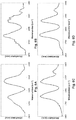
- FIGS. 5A-D are FTIR spectra of the electroactive molecular tongue twisters: FIG. 5A ) MTT1 undoped, FIG. 5B ) MTT1 doped with CSA, FIG. 5C ) MTT2 undoped, and FIG. 5D ) MTT2 doped with CSA.
- FIGS. 6A-D are XRD spectra of the electroactive molecular tongue twisters: FIG. 6A ) MTT1 undoped, FIG. 6B ) MTT1 doped with CSA, FIG. 6C ) MTT2 undoped, and FIG. 6D ) MTT2 doped with CSA.
- FIG. 7 is a schematic of an experimental setup for electrochemically-triggered drug delivery.
- CE Pt mesh counter electrode
- RE Ag/AgCl reference electrode
- WE DMP-doped polymer film coated on a glass carbon working electrode
- FIG. 9 shows HDF adhesion on the surface of Corning Costar® Tissue Culture Plates (TCP control). Live cells were stained green by calcein and dead cells were stained red by ethidium using a LIVE/DEAD® Viability/Cytotoxicity Kit. The scale bar represents 100 ⁇ m.
- Embodiments of the present disclosure will employ, unless otherwise indicated, techniques of organic chemistry, biochemistry, microbiology, molecular biology, pharmacology, medicine, and the like, which are within the skill of the art. Such techniques are explained fully in the literature.
- administration is meant introducing an electroactive supramolecular polymeric assembly of the present disclosure into a subject.
- the route of administration can include any route of administration, such as intravenous oral, topical, subcutaneous, peritoneal, intraarterial, inhalation, vaginal, rectal, nasal, introduction into the cerebrospinal fluid, or instillation into body compartments can be used.
- terapéuticaally effective amount and “an effective amount” are used interchangeably herein and refer to that amount of an agent being administered that is sufficient to effect the intended application including, but not limited to, condition treatment.
- an effective amount of the agent will relieve to some extent one or more of the symptoms of the condition being treated, and/or that amount that will prevent, to some extent, one or more of the symptoms of the disease that the host being treated has or is at risk of developing.
- the therapeutically effective amount may vary depending upon the intended application (in vitro or in vivo), or the subject and disease condition being treated, e.g., the weight and age of the subject, the severity of the disease condition, the manner of administration and the like, which can readily be determined by one of ordinary skill in the art.
- the specific dose will vary depending on the particular agent chosen, the dosing regimen to be followed, whether it is administered in combination with other agents, timing of administration, the tissue to which it is administered, and the physical delivery system in which it is carried.
- unit dosage form refers to physically discrete units suitable as unitary dosages for human and/or animal subjects, each unit containing a predetermined quantity of the agent calculated in an amount sufficient to produce the desired effect in association with a pharmaceutically acceptable diluent, carrier or vehicle.
- the specifications for unit dosage forms depend on the particular agent employed, the route and frequency of administration, and the effect to be achieved, and the pharmacodynamics associated with each agent in the subject.
- a “pharmaceutical composition” and a “pharmaceutical formulation” are meant to encompass embodiments of the present disclosure or agent suitable for administration to a subject, such as a mammal, especially a human.
- a “pharmaceutical composition” or “pharmaceutical formulation” is sterile, and preferably free of contaminants that are capable of eliciting an undesirable response within the subject (e.g., the agent or the polymer assembly in the pharmaceutical composition is pharmaceutical grade).
- Pharmaceutical compositions can be designed for administration to subjects or patients in need thereof via a number of different routes of administration including oral, intravenous, buccal, rectal, parenteral, intraperitoneal, intradermal, intracheal, intramuscular, subcutaneous, inhalational and the like.
- treatment covers any treatment of a condition in a subject (e.g., a mammal, typically a human or non-human animal of veterinary interest), and includes: (a) reducing the risk of occurrence of the condition in a subject determined to be predisposed to the condition but not yet diagnosed with the condition (b) impeding the development of the condition, and (c) relieving the condition, i.e., causing regression of the condition and/or relieving one or more condition symptoms.
- a condition in a subject e.g., a mammal, typically a human or non-human animal of veterinary interest
- relieving the condition i.e., causing regression of the condition and/or relieving one or more condition symptoms.
- Treatment is also meant to encompass delivery of agent or polymer assembly to provide a pharmacologic effect, even in the absence of a condition.
- treatment encompasses delivery of an agent or polymer assembly that provides for enhanced or desirable effects in the subject.
- prophylactically treat and “prophylactically treating” refer completely or partially preventing a condition or symptom thereof and/or may be therapeutic in terms of a partial or complete cure for a condition and/or adverse effect attributable to the condition.
- the term “subject” includes humans, mammals (e.g., cats, dogs, horses, etc.), birds, and the like. Typical subjects to which embodiments of the present disclosure may be administered will be mammals, particularly primates, especially humans. For veterinary applications, a wide variety of subjects will be suitable, e.g., livestock such as cattle, sheep, goats, cows, swine, and the like; poultry such as chickens, ducks, geese, turkeys, and the like; and domesticated animals particularly pets such as dogs and cats.
- livestock such as cattle, sheep, goats, cows, swine, and the like
- poultry such as chickens, ducks, geese, turkeys, and the like
- domesticated animals particularly pets such as dogs and cats.
- a wide variety of mammals will be suitable subjects, including rodents (e.g., mice, rats, hamsters), rabbits, primates, and swine such as inbred pigs and the like.
- rodents e.g., mice, rats, hamsters
- rabbits primates
- swine such as inbred pigs and the like.
- body fluids and cell samples of the above subjects will be suitable for use, such as mammalian (particularly primate such as human) blood, urine, or tissue samples, or blood, urine, or tissue samples of the animals mentioned for veterinary applications.
- a system includes a sample and a host.
- living subject refers to the entire subject or organism and not just a part excised (e.g., a liver or other organ) from the living subject.
- sample can refer to a tissue sample, cell sample, a fluid sample, and the like.
- the sample may be taken from a host.
- the tissue sample can include hair (including roots), buccal swabs, blood, saliva, semen, muscle, or from any internal organs.
- the fluid may be, but is not limited to, urine, blood, ascites, pleural fluid, spinal fluid, and the like.
- the body tissue can include, but is not limited to, skin, muscle, endometrial, uterine, and cervical tissue. In the present disclosure, the source of the sample is not critical.
- Supramolecular polymer assemblies are a class of polymers in which the “monomers” of the polymers are held together by non-covalent interactions (e.g., hydrogen bonds, ⁇ - ⁇ stacking, solvophobic interactions, and combinations thereof).
- Embodiments of the present disclosure provide for electroactive supramolecular polymeric assemblies, methods of making electroactive supramolecular polymeric assemblies, methods of using electroactive supramolecular polymeric assemblies, and the like.
- An embodiment of the electroactive supramolecular polymeric assembly can include electroactive ABA block copolymers that are conductive upon the application of an electrical stimulus.
- an agent such as a drug can be associated with (e.g., bonded or bound by) the electroactive supramolecular polymeric assembly.
- embodiments of the present disclosure can be used to deliver an agent such as a drug with clinically relevant chronopharmacologies by applying an electrical stimulus at a particular time and/or location, which can facilitate the treatment of conditions with specific chronobiologies (e.g., infectious diseases, pain) as well as other conditions.
- embodiments of the electroactive supramolecular polymeric assemblies can be designed to control the release profiles and cell-biomaterial interactions.
- Embodiments of the electroactive supramolecular polymeric assembly can include electroactive ABA block copolymers.
- the electroactive ABA block copolymer can include a non-electroactive polymer (e.g., oligomers such as oligoalanines) as block A and an electroactive polymer (e.g., oligomers such as oligoanilines) as block B.
- the ratio of non-electroactive oligomers to electroactive oligomers in the block copolymer can be about 1:2 to 2:1.
- An electroactive polymer responds to an electrical stimulus (e.g., a stimulus that actuates, conducts, facilitates ion transport, and/or alters the oxidation state of the electroactive polymer).
- the electroactive polymer can include aniline, furan, pyrrole, thiophene, porphyrin, ferrocene, or other units that yield an electroactive product.
- the oligoaniline can include 1 to 10,000 aniline monomers.
- An electrical stimulus can include: contact (which includes contact in close proximity so that the assembly receives the electrical stimulus as well as direct contact to the electroactive polymer) of the material with a power source via a wire; wireless energy transfer, magnetic force, mechanical force, light, and/or a chemical that alters the redox state of the material.
- the electrical stimulus is in direct contact with the material with the power source.
- the electrical stimulus is in contact with the material with the power source so that the assembly receives the electrical stimulus where the direct contact may be a short distance away from the assembly.
- wireless energy transfer is indirect contact of the power source with the electroactive polymer.
- the non-electroactive polymer does not respond to the electrical stimulus in the same manner as the electroactive polymer responds.
- the non-electroactive polymer can be non-degradable or degradable, and can include polyamides/proteins (e.g., polyalanine, oligoalanine, collagen, and silk), polyesters (e.g. polycaprolactone and PLLA), polysaccharides (cellulose, chitin, chitosan), DNA, RNA, polymers (e.g., polyethylyne glycol) or other units that yield a non-electroactive product.
- the oligoalanine can include 1 to 2000 alanine monomers.
- the ABA block copolymer can have the following structure:
- n is 2 to 10,000 and m+p is 2 to 20,000.
- n is 4 and m+p is 10 or n is 6 and m+p is 26.
- the electroactive supramolecular polymeric assembly can include one or more agents (e.g., a chemical or biological agent), where the agent can be disposed indirectly or directly (e.g., bound or independently suspended) on the electroactive supramolecular polymeric assembly.
- agents e.g., a chemical or biological agent
- the agent can include, but is not limited to, a drug, a therapeutic agent, a radiological agent, a chemological agent, a small molecule drug, a biological agent (e.g., polypeptides (e.g., proteins such as, but not limited to, antibodies (monoclonal or polyclonal)), antigens, nucleic acids (both monomeric and oligomeric), polysaccharides, haptens, sugars, fatty acids, steroids, purines, pyrimidines, ligands, aptamers, and cells) and combinations thereof, that can be used to image, detect, study, monitor, evaluate, treat, and/or screen a condition (e.g., a disease, an infection, an injury, or a related biological event) of the subject.
- a biological agent e.g., polypeptides (e.g., proteins such as, but not limited to, antibodies (monoclonal or polyclonal)
- antigens e.g., proteins
- the agent is included in an effective amount to accomplish its purpose (e.g., therapeutically effective amount), can depend upon a variety of factors, including for example, the age, body weight, general health, sex, and diet of the subject; the time of administration; the route of administration; the rate of excretion of the agent employed; the duration of the treatment; the existence of other drugs used in combination or coincidental with the specific composition employed; and like factors well known in the medical arts.
- the agent can be bound to the electroactive supramolecular polymeric assembly by a physical, biological, biochemical, mechanical, and/or chemical association directly or indirectly by a suitable means.
- bound can include, but is not limited to, chemically bonded (e.g., covalently or ionically), biologically bonded, biochemically bonded, and/or otherwise associated with the electroactive supramolecular polymeric assembly.
- being bound can include, but is not limited to, a covalent bond, a non-covalent bond, an ionic bond, a chelated bond, as well as being bound through interactions such as, but not limited to, hydrophobic interactions, hydrophilic interactions, charge-charge interactions, ⁇ - ⁇ stacking interactions, combinations thereof, and like interactions.
- cell-biomaterial interactions could be controlled through the inclusion of cell-adhesive peptides (e.g., RGD, YIGSR, KQAGDV, KHIFSDDSSE, KRSR), and protease-labile domains (e.g., APGL, VRN, or indeed oligoalanines such as those in the backbone of MTT1 and MTT2 that are degraded by elastase).
- cell-adhesive peptides e.g., RGD, YIGSR, KQAGDV, KHIFSDDSSE, KRSR
- protease-labile domains e.g., APGL, VRN, or indeed oligoalanines such as those in the backbone of MTT1 and MTT2 that are degraded by elastase.
- the electroactive supramolecular polymeric assembly can be disposed onto a surface to form a film or layer on the surface.
- the electroactive supramolecular polymeric assembly can be included in a pharmaceutical formulation.
- the electroactive supramolecular polymeric assembly can be administered to the subject in need (e.g., a human patient) in an amount so as to provide a therapeutically effective amount of the agent.
- the electroactive supramolecular polymeric assemblies can be designed to control the release profiles and/or cell-biomaterial interactions by tuning the length of the electroactive oligoaniline, the ratio of electroactive to non-electroactive peptide blocks, the identity of the non-electroactive peptide (i.e., composition and sequence of amino acids), and the like.
- increasing the length of the oligoalanine segments can render the electroactive supramolecular polymeric assembly more conductive and electrochemically stable (i.e., less likely to be spontaneously de-doped in biological milieu).
- electroactive supramolecular polymeric assemblies having a higher ratio of electroactive to non-electroactive peptide blocks can be more conductive.
- an embodiment in which a charged amino acid(s) is present in the electroactive supramolecular polymeric assembly can facilitate the inclusion of cationic drugs (e.g., antibacterials and antiarrhythmics).
- an embodiment of the method includes providing an electroactive supramolecular polymeric assembly (e.g., an electroactive ABA block copolymer) including the agent to a subject having a condition (e.g., a disease, an infection, an injury, a syndrome, a disability, a disorder, and a combination thereof).
- the electroactive supramolecular polymeric assembly can be administered in one or more ways as is best suited for the particular situation.
- an electrical stimulus can be used to activate electroactive supramolecular polymeric assembly.
- the electronic stimulus can be directed to an area where the agent is needed.
- the electronic stimulus can be directed to that area.
- the electrical stimulus causes the agent to be released from the electroactive supramolecular polymeric assembly at or near the location (e.g., specific area of the patient) of the condition.
- the electrical stimulus can be periodically pulsed.
- the electrical stimulus can be given at certain times of the day.
- This Example discusses the preparation and characterization of films of electroactive supramolecular polymers based on non-electroactive oligoalanines and electroactive oligoanilines. Fibroblasts adhered to and proliferated on the films, and the delivery of the clinically relevant anti-inflammatory drug dexamethasone phosphate could be enhanced upon the application of an electrical stimulus.
- EAPs have interesting electronic and optical properties and are currently investigated for use in electronic 4 and biomedical 5-8 industries.
- Polyaniline, polypyrrole and polythiophene derivatives are the EAPs most commonly investigated for biomedical applications.
- 9,10 In recent years block copolymers incorporating electroactive blocks (frequently oligoaniline-based polymers doped with camphorsulfonic acid, CSA, FIG. 1 ) have been investigated for use as electroactive tissue scaffolds capable of the electrical stimulation of the cells inhabiting them, 11 and as materials for electrochemically-triggered drug delivery. 12
- Polyaniline- and polypyrrole-based systems have been used to deliver a variety of drugs, including; adenosine triphosphate, dexamethasone phosphate (DMP, FIG. 1 ), DNA, dopamine, nerve growth factor and N-methylphenothiazine, as discussed in greater depth in reviews by Garg and co-workers 13 and Ndesendo and co-workers. 14
- electroactive molecular tongue-twisters MTTs
- electroactive oligoanilines and non-electroactive oligoalanines i.e., oligoalanine-oligoaniline-oligoalanine
- the MTTs are solution processable and assemble into hierarchically structured supramolecular polymers 15-21 because of hydrogen bonding interactions between the oligoalanines in the solid state.
- Such supramolecular polymers have prospects for the preparation of conformal electroactive coatings for implantable biomaterials.
- oligoaniline The electrochemically responsive blocks of oligoaniline were terminated with amines which enabled the initiation of ring-opening polymerization of ⁇ -amino acid N-carboxyanhydrides, 22 in this case alanine N-carboxyanhydride (Ala-NCA).
- the oligoanilines (tetraaniline and hexaaniline) were prepared using the methodology described in the literature (Scheme 2), 23,24 as was Ala-NCA (Scheme 3), 25 and they were polymerized at room temperature in anhydrous DMF, precipitated in diethyl ether and dried under vacuum (Scheme 1).
- hexafluoroisopropanol (HFIP)-soluble fraction was extracted and dried under vacuum, yielding off-white solids that were used without further purification; tetraaniline-based molecular tongue-twister 1 (MTT1, oligoalanine-tetraaniline-oligoalanine) and hexaaniline-based molecular tongue-twister 2 (MTT2, oligoalanine-hexaaaniline-oligoalanine), that are depicted in Scheme 1.
- MTT1 oligoalanine-tetraaniline-oligoalanine
- MTT2 hexaaniline-based molecular tongue-twister 2
- IR spectra of the films recorded in attenuated total reflectance (ATR) mode revealed subtle differences in the hierarchical supramolecular assembly of the polymers, with evidence of both ⁇ -helices and ⁇ -sheets in all spectra ( FIGS. 5A-D ), 27-29 with the ⁇ -helices induced by HFIP and the intermolecular ⁇ -sheets being partially responsible for the insolubility of the polymers in water (also observed in oligoalanine-rich proteins).
- the oligoalanine blocks in undoped films of MTT2 were predominantly amorphous (amide I, 1646 cm ⁇ 1 ; amide II, 1533 cm ⁇ 1 ) with some ⁇ -sheets (amide I, 1629 cm ⁇ 1 ; amide II, 1518 cm ⁇ 1 ).
- Doping MTT2 with CSA reduced the ⁇ -sheet content (weak amide I, 1690 cm ⁇ 1 ; weak amide II, 1530 and 1514 cm ⁇ 1 ), and the chains were predominantly amorphous (amide I, 1646 cm ⁇ 1 ; amide II, 1535 cm ⁇ 1 ).
- Analogous electroactive block copolymers incorporating CSA-doped oligoalanines have been shown to support the adhesion of a variety of cells including fibroblasts, keratinocytes, osteoblasts, PC12 cells and Schwann cells. 11
- cell viability for the HDFs cultured on the films of MTTs was comparable, and indeed somewhat better than TCP controls ( FIG. 3A ).
- the adhesion of human dermal fibroblasts (HDFs) to films of undoped or CSA-doped MTT1 was poor by comparison with commercially available Corning Costar® tissue culture plate (TCP) controls as determined using the AlamarBlue® assay ( FIG.
- FIGS. 4A and 4B were relatively rounded morphologies indicative of poor cell adhesion ( FIGS. 4A and 4B ), particularly by comparison with TCP controls ( FIG. 9 ).
- HDF adhesion to films of undoped or CSA-doped MTT2 was moderately better, with cells more likely to adopt a spread morphology ( FIGS. 4C and 4D ).
- non cell-adhesive biomaterials are interesting candidates, such as for the manufacture of anti-adhesion membranes; 38 however, for other applications (e.g. tissue scaffolds) cell adhesion is beneficial.
- cell adhesion could be improved by incorporating cell adhesive peptides (e.g., the ubiquitous RGD) 10,16,39-41 in the backbone of such EAPs.
- MTT1 was synthesised by adaption of the literature methodology. 22,25 1 molar eq. of amine-terminated aniline tetramer (H 2 N—A N4 —NH 2 ) and 10 molar eq. L-alanine N-carboxyanhydride (ALA-NCA) were stirred in anhydrous DMF (solids at 100 mgmL ⁇ 1 ) at room temperature under an inert atmosphere of argon for 4 days. The product was precipitated in diethyl ether, the solids isolated by filtration, washed with diethyl ether and dried under high vacuum for 48 hours.
- amine-terminated aniline tetramer H 2 N—A N4 —NH 2
- ALA-NCA L-alanine N-carboxyanhydride
- HFIP hexafluoroisopropanol
- MTT2 was synthesised by adaption of the literature methodology. 22,25 1 molar eq. of amine-terminated aniline hexamer (H 2 N—A N6 —NH 2 ) and 10 molar eq. L-alanine N-carboxyanhydride (ALA-NCA) were stirred in anhydrous DMF (solids at 100 mgmL ⁇ 1 ) at room temperature under an inert atmosphere of argon for 4 days. The product was precipitated in diethyl ether, the solids isolated by filtration, washed with diethyl ether and dried under high vacuum for 48 hours.
- amine-terminated aniline hexamer H 2 N—A N6 —NH 2
- ALA-NCA L-alanine N-carboxyanhydride
- HFIP hexafluoroisopropanol
- HFIP hexafluoroisopropanol
- substrates e.g., microscope slides with dimensions of 2.5 cm ⁇ 5 cm or glassy carbon electrodes with surface areas of 0.0314 cm 2 .
- the solvent was allowed to evaporate in a fume hood, and the films were subsequently dried under vacuum for 48 hours at room temperature.
- the polymers were doped with camphorsulfonic acid (CSA) by the addition of CSA to the HFIP solution prior to casting on microscope slides. Unless otherwise stated CSA doping was at a mass ratio of 1:10 CSA: MTT.
- CSA camphorsulfonic acid
- Profilometry was carried out using a Veeco Dektak 150 Stylus Profilometer (Veeco Instruments Inc., N.Y.) fitted with a diamond stylus tip.
- the profilometer was isolated on an air table to reduce ambient vibrations.
- the profilometer was operated at 10 mg of stylus force, and used to record profiles of distances of ca. 1 cm, recording data points every 555 nm.
- Data analysis was carried out with the software provided by the manufacturer, which allowed the determination of the thickness and roughness of the films.
- the surface roughness parameters are analyzed and reported in accordance with the ISO 25178 series.
- the average roughness (Ra) is the arithmetic average of the deviation from the mean line, and is the most used international parameter of roughness, and the root-mean-square roughness (Rq) is based upon this.
- the working and counter electrodes were clipped on the strips of copper tape, and the current measured for 50 seconds during a potential step experiment at 10 V. The electrodes were moved to different positions after each measurement, and the current passed was recorded in at least five different positions.
- the instrument was controlled using Rapid/XRD diffractometer control software (Rapid/XRD Version 2.3.8., Rigaku Americas Corporation, The Woodlands, Tex.).
- the integration of the two dimensional data into a one dimensional pattern was accomplished using 2DP (2DP Version 1.0., Rigaku Americas Corporation, The Woodlands, Tex.). Percentage crystallinities were determined by taking the ratio of the crystalline area to the amorphous area in the XRD spectrum.
- Films of ca. 3-4 mg were prepared by casting solutions of the polymers and DMP (at a mass ratio of 10:1 polymer:DMP) in hexafluoroisopropanol (typically 0.05 g/mL) onto a glassy carbon electrode (0.0314 cm 2 , CH Instruments, Inc.). The solvent was allowed to evaporate in a fume hood, and the films were subsequently dried under vacuum for 48 hours at room temperature.
- DMP release was quantified by UV spectroscopy using a BioTek Epoch® plate reader (BioTek US, Winooski, Vt.) equipped with a Take3 Micro-volume Plate and Gen5 v2.04 Software supplied with the plate reader. Two samples of 2 ⁇ L were removed from the release medium at specific time points and absorbance readings were carried out at 242 nm (the characteristic absorbance band of DMP). Absorptions were corrected by subtracting the reading of PBS alone from each sample. A standard calibration curve for DMP was plotted to define the quantitative relationship between the observed absorbance and the concentration of DMP. Prior to the experiment, the mass of the drug-doped polymer film on the substrate was determined by subtracting the mass of the substrate from the mass of the polymer-coated substrate. Data are plotted as % DMP release relative to the quantity of DMP theoretically in the film at the beginning of the experiment, and all data are the average of at least three samples.
- DMEM Dulbecco's Modified Eagle Medium
- fetal bovine serum 100 U ml ⁇ 1 penicillin, 100 ⁇ g ml ⁇ 1 streptomycin, 0.25 ⁇ g ml ⁇ 1 amphotericin, 0.1 mM non-essential amino acids, and 1 ng ml ⁇ 1 basic fibroblast growth factor.
- Medium was aspirated and replaced prior to HDF seeding.
- Cell viability before starting the experiment was determined by the Trypan Blue (Sigma, USA) exclusion method, and the measured viability exceeded 95% in all cases.
- Cells were seeded on tissue-culture treated Corning® Costar® tissue culture plates at 10,000 cells per cm2, and all other substrates (i.e. MTT-based films) at 2,500 cells per cm 2 , under 3 mm of medium, and incubated at 37° C., 95% humidity, and a CO 2 content of 5%.
- the cell adhesion and quantification studies were carried out using the AlamarBlue® assay in accordance with the manufacturers instructions. After 2 days the medium was aspirated and the films were washed gently with PBS, followed by the addition of fresh medium containing 10% v/v AlamarBlue® reagent.
- the medium was aspirated and replaced with fresh medium, and 100 ⁇ L of the aspirated medium containing the AlamarBlue® reagent was placed in a 96 well plate, and the fluorescence was measured with a fluorimeter (Synergy HT Multi-Mode Microplate Reader, Biotek US, Winooski, Vt.). Two controls were considered during the measurement of the fluorescence: the first was wells containing the medium alone (i.e. no cells of AlamarBlue® reagent), which was not fluorescent; and the second was wells that contained the AlamarBlue® reagent but no cells (used for background correction).
- Live cells were stained green because of the cytoplasmic esterase activity, which results in reduction of calcein AM into fluorescent calcein, and dead cells were stained red by ethidium, which enters into cells via damaged cell membranes and becomes integrated into the DNA strands. Fluorescence images of cells were captured using an Olympus DP80 camera (Olympus America Inc., Miami, Fla., USA) attached to a fluorescence microscope (IX-70; Olympus America Inc.) running CellSens 1.12 software (Olympus America Inc.). Cells were counted with ImageJ.
- electroactive molecular tongue-twisters i.e., oligoalanine-oligoaniline-oligoalanine.
- the electroactive ABA block copolymers based on A) non-electroactive oligoalanines, and B) electroactive blocks of oligoanilines, represents a novel platform for drug delivery.
- the physicochemical properties of the films were characterized by various techniques, and we found that hexaaniline-based MTT2 was more conductive and appeared to be more electrochemically stable towards de-doping than tetraaniline-based MTT1.
- oligoalanine segments should render them more conductive and electrochemically stable (i.e. less likely to be spontaneously de-doped in biological milieu).
- the composition and sequence of amino acids in the non-electroactive peptide dictate the charge and hydrophobicity of the materials, which play roles in the self-assembly of the peptides (i.e., hydrogen bonding interactions, electrostatic interactions) and protein deposition on their surfaces which may be important for cell adhesion.
- Cell-biomaterial interactions could be controlled through the inclusion of cell-adhesive peptides (e.g., RGD, YIGSR, KQAGDV, KHIFSDDSSE, KRSR), 39-41 and protease-labile domains (APGL, VRN, or indeed oligoalanines such as those in the backbone of MTT1 and MTT2 that are degraded by elastase), 40 potentially facilitate their degradation in vivo.
- cell-adhesive peptides e.g., RGD, YIGSR, KQAGDV, KHIFSDDSSE, KRSR
- APGL, VRN protease-labile domains
- oligoalanines such as those in the backbone of MTT1 and MTT2 that are degraded by elastase
- molecules with higher ratios of electroactive to non-electroactive peptide blocks should be more conductive, and the inclusion of charged amino acids may facilitate the inclusion of
- ratios, concentrations, amounts, and other numerical data may be expressed herein in a range format. It is to be understood that such a range format is used for convenience and brevity, and thus, should be interpreted in a flexible manner to include not only the numerical values explicitly recited as the limits of the range, but also to include all the individual numerical values or sub-ranges encompassed within that range as if each numerical value and sub-range is explicitly recited.
- a concentration range of “about 0.1% to about 5%” should be interpreted to include not only the explicitly recited concentration of about 0.1 wt % to about 5 wt %, but also include individual concentrations (e.g., 1%, 2%, 3%, and 4%) and the sub-ranges (e.g., 0.5%, 1.1%, 2.2%, 3.3%, and 4.4%) within the indicated range.
- the term “about” can include traditional rounding according to significant figures of the numerical value.
- the phrase “about ‘x’ to ‘y’” includes “about ‘x’ to about ‘y’”.
Landscapes
- Health & Medical Sciences (AREA)
- Chemical & Material Sciences (AREA)
- Engineering & Computer Science (AREA)
- Medicinal Chemistry (AREA)
- Life Sciences & Earth Sciences (AREA)
- Animal Behavior & Ethology (AREA)
- General Health & Medical Sciences (AREA)
- Public Health (AREA)
- Veterinary Medicine (AREA)
- Nanotechnology (AREA)
- Chemical Kinetics & Catalysis (AREA)
- Polymers & Plastics (AREA)
- Organic Chemistry (AREA)
- Nuclear Medicine, Radiotherapy & Molecular Imaging (AREA)
- Biomedical Technology (AREA)
- Radiology & Medical Imaging (AREA)
- Immunology (AREA)
- Bioinformatics & Cheminformatics (AREA)
- Pharmacology & Pharmacy (AREA)
- Epidemiology (AREA)
- Medicinal Preparation (AREA)
- Pharmaceuticals Containing Other Organic And Inorganic Compounds (AREA)
Abstract
Description

where n is 2 to 10,000 and m+p is 2 to 20,000. In particular embodiments, n is 4 and m+p is 10 or n is 6 and m+p is 26.


| TABLE 1 |
| Surface and physicochemical properties of the polymer films |
| Conductivity, | ||||
| Ra (μm) | Rq (μm) | Xc (%) | σ (S cm−1) | |
| Glass substrate | 0.730 ± 0.153 | 0.905 ± 0.182 | N/Aa,b | N/A |
| MTT1 undoped | 0.760 ± 0.299 | 3.272 ± 6.352 | 68.2a | 1.59 × 10⁻⁸ ± 28% |
| MTT1 doped | 0.760 ± 0.516 | 1.020 ± 0.637 | 30.1a | 2.49 × 10⁻⁸ ± 33% |
| with CSA | ||||
| MTT2 undoped | 0.700 ± 0.018 | 0.085 ± 0.024 | 0.0a | 7.32 × 10⁻⁸ ± 32% |
| MTT2 doped | 0.475 ± 0.009 | 0.060 ± 0.014 | 0.0a | 8.55 × 10⁻⁸ ± 32% |
| with CSA | ||||
| aAs determined by XRD. | ||||
| bNot applicable. | ||||
R=V/I (1)
The resistivity (Ω/cm) of the films was determined in accordance with equation 2:
ρ=Rwt/L (2)
In which: w corresponds to the width of the film in cm (2.5 cm); t corresponds to the thickness of the film in cm (as determined via profilometry); and L corresponds to the length of the film in cm (0.5 cm). The conductivity (S/cm) of the films was determined in accordance with equation 3:
σ=1/ρ (3)
Claims (13)


Priority Applications (1)
| Application Number | Priority Date | Filing Date | Title |
|---|---|---|---|
| US16/844,222 US11007278B2 (en) | 2015-06-04 | 2020-04-09 | Electroactive supramolecular polymeric assemblies, methods of making electroactive supramolecular polymeric assemblies, and methods of using electroactive supramolecular assemblies |
Applications Claiming Priority (4)
| Application Number | Priority Date | Filing Date | Title |
|---|---|---|---|
| US201562170742P | 2015-06-04 | 2015-06-04 | |
| PCT/US2016/035227 WO2016196604A1 (en) | 2015-06-04 | 2016-06-01 | Electroactive supramolecular polymeric assemblies, methods of making electroactive supramolecular polymeric assemblies, and methods of using electroactive supramolecular polymeric assemblies |
| US201715578292A | 2017-11-30 | 2017-11-30 | |
| US16/844,222 US11007278B2 (en) | 2015-06-04 | 2020-04-09 | Electroactive supramolecular polymeric assemblies, methods of making electroactive supramolecular polymeric assemblies, and methods of using electroactive supramolecular assemblies |
Related Parent Applications (2)
| Application Number | Title | Priority Date | Filing Date |
|---|---|---|---|
| US15/578,292 Division US10653798B2 (en) | 2015-06-04 | 2016-06-01 | Electroactive supramolecular polymeric assemblies, methods of making electroactive supramolecular polymeric assemblies, and method of using electroactive supramolecular polymeric assemblies |
| PCT/US2016/035227 Division WO2016196604A1 (en) | 2015-06-04 | 2016-06-01 | Electroactive supramolecular polymeric assemblies, methods of making electroactive supramolecular polymeric assemblies, and methods of using electroactive supramolecular polymeric assemblies |
Publications (2)
| Publication Number | Publication Date |
|---|---|
| US20200316220A1 US20200316220A1 (en) | 2020-10-08 |
| US11007278B2 true US11007278B2 (en) | 2021-05-18 |
Family
ID=57441599
Family Applications (2)
| Application Number | Title | Priority Date | Filing Date |
|---|---|---|---|
| US15/578,292 Active 2036-10-26 US10653798B2 (en) | 2015-06-04 | 2016-06-01 | Electroactive supramolecular polymeric assemblies, methods of making electroactive supramolecular polymeric assemblies, and method of using electroactive supramolecular polymeric assemblies |
| US16/844,222 Active US11007278B2 (en) | 2015-06-04 | 2020-04-09 | Electroactive supramolecular polymeric assemblies, methods of making electroactive supramolecular polymeric assemblies, and methods of using electroactive supramolecular assemblies |
Family Applications Before (1)
| Application Number | Title | Priority Date | Filing Date |
|---|---|---|---|
| US15/578,292 Active 2036-10-26 US10653798B2 (en) | 2015-06-04 | 2016-06-01 | Electroactive supramolecular polymeric assemblies, methods of making electroactive supramolecular polymeric assemblies, and method of using electroactive supramolecular polymeric assemblies |
Country Status (2)
| Country | Link |
|---|---|
| US (2) | US10653798B2 (en) |
| WO (1) | WO2016196604A1 (en) |
Citations (12)
| Publication number | Priority date | Publication date | Assignee | Title |
|---|---|---|---|---|
| WO1996004340A1 (en) | 1994-08-04 | 1996-02-15 | Gordon George Wallace | Conducting electroactive biomaterials |
| US5855900A (en) | 1994-09-24 | 1999-01-05 | Nobuhiko; Yui | Supramolecular-structured biodegradable polymeric assembly for drug delivery |
| US7265379B2 (en) | 2004-03-26 | 2007-09-04 | Thin Film Electronics Asa | Organic electronic device and methods for manufacturing a device of this kind |
| US20090087493A1 (en) | 2007-07-27 | 2009-04-02 | The Board Of Trustees Of The Leland Stanford Junior University | Supramolecular Functionalization of Graphitic Nanoparticles for Drug Delivery |
| US20100233226A1 (en) * | 2007-10-15 | 2010-09-16 | Université Catholique de Louvain | Drug-eluting nanowire array |
| US20110060280A1 (en) | 2009-09-04 | 2011-03-10 | Sean Caffey | Adhesive skin patch with pump for subcutaneous drug delivery |
| US8247524B2 (en) | 2003-11-04 | 2012-08-21 | Suprapolix B.V. | Preparation of supramolecular polymers containing quadruple hydrogen bonding units in the polymer backbone |
| US20120289887A1 (en) | 2007-06-29 | 2012-11-15 | Polyplus Battery Company | Electrotransport devices, methods and drug electrode assemblies |
| US8529539B2 (en) | 2010-05-07 | 2013-09-10 | Boston Scientific Scimed, Inc. | Medical devices employing electroactive polymers for delivery of particulate therapeutic agents |
| US20130338569A1 (en) | 2010-11-26 | 2013-12-19 | University Of Witwatersrand, Johannesburg | Polymeric hydrogel compositions which release active agents in response to electrical stimulus |
| US8622987B2 (en) | 2008-06-04 | 2014-01-07 | The University Of Chicago | Chemistrode, a plug-based microfluidic device and method for stimulation and sampling with high temporal, spatial, and chemical resolution |
| WO2014055846A1 (en) | 2012-10-04 | 2014-04-10 | University Of Pittsburgh - Of The Commonwealth System Of Higher Education | Conductive polymer graphene oxide composite materials |
Family Cites Families (2)
| Publication number | Priority date | Publication date | Assignee | Title |
|---|---|---|---|---|
| EP1465962B1 (en) * | 2001-11-21 | 2012-01-04 | University of Florida | Electrochromic polymers and polymer electrochromic devices |
| CN102659991B (en) | 2012-05-09 | 2014-11-26 | 中国科学院长春应用化学研究所 | Segmented copolymer and preparation method thereof |
-
2016
- 2016-06-01 WO PCT/US2016/035227 patent/WO2016196604A1/en not_active Ceased
- 2016-06-01 US US15/578,292 patent/US10653798B2/en active Active
-
2020
- 2020-04-09 US US16/844,222 patent/US11007278B2/en active Active
Patent Citations (12)
| Publication number | Priority date | Publication date | Assignee | Title |
|---|---|---|---|---|
| WO1996004340A1 (en) | 1994-08-04 | 1996-02-15 | Gordon George Wallace | Conducting electroactive biomaterials |
| US5855900A (en) | 1994-09-24 | 1999-01-05 | Nobuhiko; Yui | Supramolecular-structured biodegradable polymeric assembly for drug delivery |
| US8247524B2 (en) | 2003-11-04 | 2012-08-21 | Suprapolix B.V. | Preparation of supramolecular polymers containing quadruple hydrogen bonding units in the polymer backbone |
| US7265379B2 (en) | 2004-03-26 | 2007-09-04 | Thin Film Electronics Asa | Organic electronic device and methods for manufacturing a device of this kind |
| US20120289887A1 (en) | 2007-06-29 | 2012-11-15 | Polyplus Battery Company | Electrotransport devices, methods and drug electrode assemblies |
| US20090087493A1 (en) | 2007-07-27 | 2009-04-02 | The Board Of Trustees Of The Leland Stanford Junior University | Supramolecular Functionalization of Graphitic Nanoparticles for Drug Delivery |
| US20100233226A1 (en) * | 2007-10-15 | 2010-09-16 | Université Catholique de Louvain | Drug-eluting nanowire array |
| US8622987B2 (en) | 2008-06-04 | 2014-01-07 | The University Of Chicago | Chemistrode, a plug-based microfluidic device and method for stimulation and sampling with high temporal, spatial, and chemical resolution |
| US20110060280A1 (en) | 2009-09-04 | 2011-03-10 | Sean Caffey | Adhesive skin patch with pump for subcutaneous drug delivery |
| US8529539B2 (en) | 2010-05-07 | 2013-09-10 | Boston Scientific Scimed, Inc. | Medical devices employing electroactive polymers for delivery of particulate therapeutic agents |
| US20130338569A1 (en) | 2010-11-26 | 2013-12-19 | University Of Witwatersrand, Johannesburg | Polymeric hydrogel compositions which release active agents in response to electrical stimulus |
| WO2014055846A1 (en) | 2012-10-04 | 2014-04-10 | University Of Pittsburgh - Of The Commonwealth System Of Higher Education | Conductive polymer graphene oxide composite materials |
Non-Patent Citations (45)
| Title |
|---|
| 108 S. Gabriel, R. W. Lau and C. Gabriel, Phys. Med. Biol., 1996, 41, 2271. |
| A. D. Bendrea, L. Cianga and I. Cianga, Review paper: Progress in the Field of Conducting Polymers for Tissue Engineering Applications; J. Biomater. Appl., 2011, 26, 3. |
| A. Digennaro, H. Wennemers, G. Joshi, S. Schmid, E. Mena-Osteritz and Peter Bauerle, Chiral suprastructures of asymmetric oligothiophenehybrids induced by a single proline Chem. Commun., 2013, 49, 10929. |
| A. Guiseppi-Elie, Electroconductive hydrogels: Synthesis, characterization and biomedical applications; Biomaterials, 2010, 31, 2701. |
| A. R. Hirst, B. Escuder, J. F. Miravet and D. K. Smith, High-Tech Applications of Self-Assembling Supramolecular Nanostructured Gel-Phase Materials: From Regenerative Medicine to Electronic Devices Angew. Chem. Int. Ed., 2008, 47, 8002. |
| A. S. Mandal, N. Biswas, K. M. Karim, A. Guha, S. Chatterjee, M. Behera and K. Kuotsu, Drug delivery system based on chronobiology—A review J. Controlled Release, 2010, 147, 314. |
| B. Chertok, M. J. Webber, M. D. Succi and R. Langer, Drug Delivery Interfaces in the 21st Century: From Science Fiction Ideas to Viable Technologies; Mol. Pharm., 2013, 10, 3531. |
| B. L. Guo, L. Glavas and A. C. Albertsson, Biodegradable and electrically conducting polymers forbiomedical applications Prog. Polym. Sci., 2013, 38, 1263. |
| Balint, Caddity; Conductive polymers: Towards a smart biomaterial for tissue engineering Richard Balint a School of Materials, Faculty of Engineering and Physical Sciences, University of Manchester, Manchester M1 7HS, UK 13 pages. |
| Biomimetic conducting polymer-based tissue scaffolds John G Hardy1,4, Jae Y Lee2,4 and Christine E Schmid; Current Opinion in Biotechnology 2013, 24:847-854. |
| C. Gabriel, S. Gabriel and E. Corthout, The dielectric properties of biological tissues: I. Literature survey Phys. Med. Biol., 1996, 41, 2231. |
| C. Vallejo-Giraldo, A. Kelly, M. J. Biggs, Biofunctionalisation of electrically conducting polymers; Drug. Discov. Today, 2014, 19, 88. |
| D. Svirskis, J. Travas-Sejdic, A. Rodgers and S. Garg; Electrochemically controlled drug delivery based on intrinsically conducting polymers; J. Control. Release, 2010, 146, 6. |
| E. K. Schillinger, E. Mena-Osteritz, J. Hentschel, H. G. Börner and Peter Bäuerle, Oligothiophene Versus b-Sheet Peptide: Synthesis and Self-Assembly of an Organic Semiconductor-Peptide Hybrid Adv. Mater. 2009, 21, 1562. |
| Engineered Spider Silk Protein-Based Composites for Drug Delivery John G. Hardy, Aldo Leal-Egana, Thomas R. Scheibel; GmbH & Co. KGaA, Weinheim DOI: 10.1002/mabi.201300233 1431; Macromol. Biosci. 2013, 13, 1431-1437. |
| Evidenced by infrared spectroscopy of the presence of F. Paquet-Mercier, T. Lefevre, M. Auger and M. Pezolet, Soft Matter, 2013, 9, 208. |
| H. Shin, S. Jo and A. G. Mikos, Biomimetic materials for tissue engineering Biomaterials, 2003, 24, 4353. |
| Hardy, et al. Peptide-directed assembly of functional supramolecular polymers for biomedical applications: electroactive molecular tongue-twisters (oligoalanine—oligoaniline—oligoalanine) for electrochemically enhanced drug delivery. J. Mater. Chem. B, 2015, 3, 5005. |
| How Controlled and Versatile is N-carboxy anyydride polymerizaation.. G. J. M. Habraken, M. Peeters, C. H. J. T. Dietz, C. E. Koninga and A. Heise, Polym. Chem., 2010, 1, 514. |
| I. Rozalska, P. Kulyk and I. Kulszewicz-Bajer, Synthesis and spectroscopic properties of aniline tetramers. Comparative studies New. J. Chem., 2004, 28, 1235. |
| J. G. Hardy and T. R. Scheibel, Biochem. Soc. Trans. 2009, 37, 677. |
| J. G. Hardy and T. R. Scheibel, Production and Processing of Spider Silk Proteins; J. Polym. Sci. A: Polym. Chem. 2009, 47, 3957-3963. |
| J. G. Hardy, D. J. Mouser, N. Arroyo-Currás, S. Geissler, J. K. Chow, L. Nguy, J. M. Kim and C. E. Schmidt, Biodegradable electroactive polymers for electrochemically triggered drug delivery; J. Mater. Chem. B, 2014, 2, 6809. |
| J. G. Hardy, J. Y. Lee and C. E. Schmidt, Biomimetic conducting polymer-based tissue scaffolds; Current Opinion in Biotechnology., 2013, 24, 847-854. |
| K. G. Sreejalekshmi and P. D. Nair, J. Biomed. Mater. Res. Part A, 2011, 96A, 477. |
| K. I. Umehara, T Iwatsubo, K. Noguchi, T. Usui and H. Kamimura, Xenobiotica, 2008, 38, 1203. |
| Linear 1,4-coupled oligoanilines of defined length: preparation and spectroscopic properties Izabelal. Kulszewicz-Bajer, I. Rozalska and M. Kurtyek, New. J. Chem., 2004, 28, 669. |
| M. Berggren and A. Richter-Dahlfors, Organic Bioelectronics; Adv. Mater., 2007, 19, 3201. |
| M. E. Caldorera-Moore, W. B. Liechty and N. A. Peppas, Responsive Theranostic Systems: Integration of Diagnostic Imaging Agents and Responsive Controlled Release Drug Delivery Carriers; Acc. Chem. Res., 2011, 44, 1061. |
| M. Hasegawa and M. Iyoda, Conducting supramolecular nanofibers and nanorods; Chem. Soc. Rev., 2010, 39, 2420. |
| O. S. Rabotyagova, P. Cebe and D. L. Kaplan, Role of Polyalanine Domains in b-Sheet Formation in Spider Silk Block Copolymers; Macromol. Biosci. 2010, 10, 49. |
| P. H. Zeplin, N. C. Maksimovikj, M. C. Jordan, J. Nickel, G. Lang, A. H. Leimer, L. Römer and T. Scheibel, Adv. Funct. Mater., 2014, 24, 2658. |
| P. Leclere, M. Surin, P. Jonkheijm, O. Henze, A. P. H. J. Schenning, F. Biscarini, A. C. Grimsdale, W. J. Feast, E. W. Meijer, K. Mullen, J. L. Bredas and R. Lazzaroni, Organic semi-conducting architectures for supramolecular electronics; Eur. Polym. J., 2004, 40, 885. |
| R. Dong, Y. Zhou, X. Huang, X. Zhu X, Y. Lu and J. Shen.; Functional Supramolecular Polymers for Biomedical Applications; Advanced Materials, 2015, 27, 498. |
| Reactive Supramolecular assemblies of mucopolysaccharide, polypyrrole and protein as controllable biocomposites for a new generation of biomaterials. A. J. Hodgson, K. Gilmore, C. Small, G. G. Wallace, I. L. Mackenzie, T. Aoki and N. Ogata, Supramol. Sci., 1994, 1, 77. |
| S. Gabriel, R. W. Lau and C. Gabriel, The dielectric properties of biological tissues, Phys. Med. Biol., 1996, 41, 2251. |
| S. H. Kim and J. R. Parquette, A model for the controlled assembly of semiconductor peptides; Nanoscale, 2012, 4, 6940. |
| Structural Analysis of Spider Silk Films; U. Slotta, M. Tammer, F. Kremer, P. Koelsch and T. Scheibel, Supramol. Chem., 2006, 18, 1. |
| The Rise of Organic Bioelectronics; Jonathan Rivnay, Róisín M. Owens, and George G. Malliaras* Department of Bioelectronics, Ecole Nationale Superieure des Mines, CMP-EMSE, MOC, 880 route de Mimet, 13541 Gardanne; 7 pages. |
| V. Pillay, T. S. Tsai, Y. E. Choonara, L. C. du Toit, P. Kumar, G. Modi, D. Naidoo, L. K. Tomar, C. Tyagi and V. M. Ndesendo, A review of integrating electroactive polymers as responsive systems for specialized drug delivery applications; J. Biomed. Mater. Res., A, 2014, 102, 2039. |
| Y. Wang, H. D. Tran, L. Liao, X. Duan, and R. B. Kaner, Nanoscale Morphology, Dimentional Control. J. Am. Chem. Soc., 2010, 132, 10365. |
| Z. L. Yue, S. E. Moulton, M. Cook, S. O'Leary and G. G. Wallace, Controlled delivery for neuro-bionic devices; Adv. Drug Deliv. Rev., 2013, 65, 559. |
| Z. Pang, J. Fu, P. Lv, F. Huang and Q. Wei, Sensors, 2014, 14, 21453. |
| Z. Shao, Z. Yu, Jianchen Hu, S. Chandrasekaran, D. M. Lindsay, Z. Wei and C. F. J. Faul, Block-like electroactive oligo(aniline)s: anisotropic structures with anisotropic function J. Mater Chem., 2012, 22, 16230. |
| Z. Zhang, S. Wei and L. Han, Adv. Mater. Res., 2011, 284-286, 2110. |
Also Published As
| Publication number | Publication date |
|---|---|
| US10653798B2 (en) | 2020-05-19 |
| US20180140718A1 (en) | 2018-05-24 |
| US20200316220A1 (en) | 2020-10-08 |
| WO2016196604A1 (en) | 2016-12-08 |
Similar Documents
| Publication | Publication Date | Title |
|---|---|---|
| Zarrintaj et al. | A facile route to the synthesis of anilinic electroactive colloidal hydrogels for neural tissue engineering applications | |
| Li et al. | Long-term delivery of alendronate through an injectable tetra-PEG hydrogel to promote osteoporosis therapy | |
| Hardy et al. | Biodegradable electroactive polymers for electrochemically-triggered drug delivery | |
| US10272180B2 (en) | Functionalized zwitterionic and mixed charge polymers, related hydrogels, and methods for their use | |
| DE69918159T2 (en) | METHOD AND DEVICE FOR CONTROLLING TISSUE IMPLANT INTERACTIONS | |
| US8946405B2 (en) | Controlled release from solid supports | |
| KR100918524B1 (en) | Injectable Drug Delivery and Drug Delivery Method Using Temperature and Pitch Sensitive Block Copolymer Polymer Hydrogel | |
| US20240316249A1 (en) | Injection formulation composition for use as filler or drug carrier through click chemistry reaction | |
| EP2823830A1 (en) | Mucosa-elevating agent | |
| KR20210042416A (en) | Scalable three-dimensional elastic construct manufacturing | |
| Tang et al. | Intestine-settled electrospun short-fibers modulate epithelial transport proteins to reduce purine and glucose uptake | |
| Moosaipour et al. | Nanofibrous electroconductive nerve guide conduits based on polyaniline‐co‐polydopamine random copolymer for peripheral nerve regeneration | |
| Lee et al. | Nerve-mimetic adhesive hydrogel electroceuticals: tailoring in situ physically entangled domains in singular polymers | |
| Bi et al. | On-demand dissociable antibacterial self-healing hydrogel with rapid arginine-related biosynthesis capacity to promote full-thickness bacteria-infected wound healing | |
| US11007278B2 (en) | Electroactive supramolecular polymeric assemblies, methods of making electroactive supramolecular polymeric assemblies, and methods of using electroactive supramolecular assemblies | |
| US20230094837A1 (en) | Biodegradable and Multifunctional Neural Block Devices | |
| CN115806740B (en) | Conductive hydrogel integrating multi-mode response and preparation method and application thereof | |
| CN102458367B (en) | Poly(ester amides) based on polyamino acids | |
| EP3862016B1 (en) | Angiogenesis promoter for use in treating a peripheral artery disease | |
| WO2016112071A2 (en) | Magnetically triggerable electroactive composites, method of making the magnetically triggerable electroactive composites, and method of using the magnetically triggerable electroactive composites | |
| US7717363B2 (en) | Degradable polymers and methods of preparation thereof | |
| Noriega-Luna et al. | Corrigendum to “Applications of dendrimers in drug delivery agents, diagnosis, therapy, and detection” | |
| Guo et al. | Preparation and characterization of conductive poly-dl-lactic-acid/tetra-aniline conduit for peripheral nerve regeneration | |
| JP2010531674A (en) | Use of plasma-synthesized pyrrole-derived polymers for neuroprotection and recombination of the central nervous system | |
| CN113117096A (en) | NCAM mimic peptide modified pH sensitive gene bionic delivery system and application thereof |
Legal Events
| Date | Code | Title | Description |
|---|---|---|---|
| FEPP | Fee payment procedure |
Free format text: ENTITY STATUS SET TO UNDISCOUNTED (ORIGINAL EVENT CODE: BIG.); ENTITY STATUS OF PATENT OWNER: SMALL ENTITY |
|
| FEPP | Fee payment procedure |
Free format text: ENTITY STATUS SET TO SMALL (ORIGINAL EVENT CODE: SMAL); ENTITY STATUS OF PATENT OWNER: SMALL ENTITY |
|
| AS | Assignment |
Owner name: UNIVERSITY OF FLORIDA RESEARCH FOUNDATION, INC., FLORIDA Free format text: ASSIGNMENT OF ASSIGNORS INTEREST;ASSIGNORS:HARDY, JOHN;SCHMIDT, CHRISTINE E.;SIGNING DATES FROM 20171212 TO 20171214;REEL/FRAME:053098/0167 |
|
| STPP | Information on status: patent application and granting procedure in general |
Free format text: NOTICE OF ALLOWANCE MAILED -- APPLICATION RECEIVED IN OFFICE OF PUBLICATIONS |
|
| STPP | Information on status: patent application and granting procedure in general |
Free format text: PUBLICATIONS -- ISSUE FEE PAYMENT RECEIVED |
|
| STPP | Information on status: patent application and granting procedure in general |
Free format text: PUBLICATIONS -- ISSUE FEE PAYMENT VERIFIED |
|
| STCF | Information on status: patent grant |
Free format text: PATENTED CASE |
|
| MAFP | Maintenance fee payment |
Free format text: PAYMENT OF MAINTENANCE FEE, 4TH YR, SMALL ENTITY (ORIGINAL EVENT CODE: M2551); ENTITY STATUS OF PATENT OWNER: SMALL ENTITY Year of fee payment: 4 |