US11005406B2 - Hysteresis based DC offset corrector for current reconstruction when using discontinuous PWM - Google Patents

Hysteresis based DC offset corrector for current reconstruction when using discontinuous PWM Download PDF

Info

Publication number
US11005406B2
US11005406B2 US16/527,872 US201916527872A US11005406B2 US 11005406 B2 US11005406 B2 US 11005406B2 US 201916527872 A US201916527872 A US 201916527872A US 11005406 B2 US11005406 B2 US 11005406B2
Authority
US
United States
Prior art keywords
offset
voltage signal
inverter
current
signal
Prior art date
Legal status (The legal status is an assumption and is not a legal conclusion. Google has not performed a legal analysis and makes no representation as to the accuracy of the status listed.)
Active
Application number
US16/527,872
Other versions
US20210036647A1 (en
Inventor
Goutham Selvaraj
Yu Liu
Current Assignee (The listed assignees may be inaccurate. Google has not performed a legal analysis and makes no representation or warranty as to the accuracy of the list.)
Toshiba International Corp
Original Assignee
Toshiba International Corp
Priority date (The priority date is an assumption and is not a legal conclusion. Google has not performed a legal analysis and makes no representation as to the accuracy of the date listed.)
Filing date
Publication date
Application filed by Toshiba International Corp filed Critical Toshiba International Corp
Priority to US16/527,872 priority Critical patent/US11005406B2/en
Assigned to TOSHIBA INTERNATIONAL CORPORATION reassignment TOSHIBA INTERNATIONAL CORPORATION ASSIGNMENT OF ASSIGNORS INTEREST (SEE DOCUMENT FOR DETAILS). Assignors: LIU, YU, SELVARAJ, GOUTHAM
Priority to CA3087663A priority patent/CA3087663C/en
Priority to MX2020008014A priority patent/MX2020008014A/en
Publication of US20210036647A1 publication Critical patent/US20210036647A1/en
Application granted granted Critical
Publication of US11005406B2 publication Critical patent/US11005406B2/en
Active legal-status Critical Current
Anticipated expiration legal-status Critical

Links

Images

Classifications

    • HELECTRICITY
    • H02GENERATION; CONVERSION OR DISTRIBUTION OF ELECTRIC POWER
    • H02PCONTROL OR REGULATION OF ELECTRIC MOTORS, ELECTRIC GENERATORS OR DYNAMO-ELECTRIC CONVERTERS; CONTROLLING TRANSFORMERS, REACTORS OR CHOKE COILS
    • H02P27/00Arrangements or methods for the control of AC motors characterised by the kind of supply voltage
    • H02P27/04Arrangements or methods for the control of AC motors characterised by the kind of supply voltage using variable-frequency supply voltage, e.g. inverter or converter supply voltage
    • H02P27/06Arrangements or methods for the control of AC motors characterised by the kind of supply voltage using variable-frequency supply voltage, e.g. inverter or converter supply voltage using DC to AC converters or inverters
    • H02P27/08Arrangements or methods for the control of AC motors characterised by the kind of supply voltage using variable-frequency supply voltage, e.g. inverter or converter supply voltage using DC to AC converters or inverters with pulse width modulation
    • HELECTRICITY
    • H02GENERATION; CONVERSION OR DISTRIBUTION OF ELECTRIC POWER
    • H02MAPPARATUS FOR CONVERSION BETWEEN AC AND AC, BETWEEN AC AND DC, OR BETWEEN DC AND DC, AND FOR USE WITH MAINS OR SIMILAR POWER SUPPLY SYSTEMS; CONVERSION OF DC OR AC INPUT POWER INTO SURGE OUTPUT POWER; CONTROL OR REGULATION THEREOF
    • H02M7/00Conversion of AC power input into DC power output; Conversion of DC power input into AC power output
    • H02M7/42Conversion of DC power input into AC power output without possibility of reversal
    • H02M7/44Conversion of DC power input into AC power output without possibility of reversal by static converters
    • H02M7/48Conversion of DC power input into AC power output without possibility of reversal by static converters using discharge tubes with control electrode or semiconductor devices with control electrode
    • H02M7/53Conversion of DC power input into AC power output without possibility of reversal by static converters using discharge tubes with control electrode or semiconductor devices with control electrode using devices of a triode or transistor type requiring continuous application of a control signal
    • H02M7/537Conversion of DC power input into AC power output without possibility of reversal by static converters using discharge tubes with control electrode or semiconductor devices with control electrode using devices of a triode or transistor type requiring continuous application of a control signal using semiconductor devices only, e.g. single switched pulse inverters
    • H02M7/5387Conversion of DC power input into AC power output without possibility of reversal by static converters using discharge tubes with control electrode or semiconductor devices with control electrode using devices of a triode or transistor type requiring continuous application of a control signal using semiconductor devices only, e.g. single switched pulse inverters in a bridge configuration
    • H02M7/53871Conversion of DC power input into AC power output without possibility of reversal by static converters using discharge tubes with control electrode or semiconductor devices with control electrode using devices of a triode or transistor type requiring continuous application of a control signal using semiconductor devices only, e.g. single switched pulse inverters in a bridge configuration with automatic control of output voltage or current
    • H02M7/53873Conversion of DC power input into AC power output without possibility of reversal by static converters using discharge tubes with control electrode or semiconductor devices with control electrode using devices of a triode or transistor type requiring continuous application of a control signal using semiconductor devices only, e.g. single switched pulse inverters in a bridge configuration with automatic control of output voltage or current with digital control
    • HELECTRICITY
    • H02GENERATION; CONVERSION OR DISTRIBUTION OF ELECTRIC POWER
    • H02MAPPARATUS FOR CONVERSION BETWEEN AC AND AC, BETWEEN AC AND DC, OR BETWEEN DC AND DC, AND FOR USE WITH MAINS OR SIMILAR POWER SUPPLY SYSTEMS; CONVERSION OF DC OR AC INPUT POWER INTO SURGE OUTPUT POWER; CONTROL OR REGULATION THEREOF
    • H02M7/00Conversion of AC power input into DC power output; Conversion of DC power input into AC power output
    • H02M7/42Conversion of DC power input into AC power output without possibility of reversal
    • H02M7/44Conversion of DC power input into AC power output without possibility of reversal by static converters
    • H02M7/48Conversion of DC power input into AC power output without possibility of reversal by static converters using discharge tubes with control electrode or semiconductor devices with control electrode
    • H02M7/4803Conversion of DC power input into AC power output without possibility of reversal by static converters using discharge tubes with control electrode or semiconductor devices with control electrode with means for reducing DC component from AC output voltage
    • HELECTRICITY
    • H02GENERATION; CONVERSION OR DISTRIBUTION OF ELECTRIC POWER
    • H02MAPPARATUS FOR CONVERSION BETWEEN AC AND AC, BETWEEN AC AND DC, OR BETWEEN DC AND DC, AND FOR USE WITH MAINS OR SIMILAR POWER SUPPLY SYSTEMS; CONVERSION OF DC OR AC INPUT POWER INTO SURGE OUTPUT POWER; CONTROL OR REGULATION THEREOF
    • H02M1/00Details of apparatus for conversion
    • H02M1/0003Details of control, feedback or regulation circuits
    • H02M1/0009Devices or circuits for detecting current in a converter
    • HELECTRICITY
    • H02GENERATION; CONVERSION OR DISTRIBUTION OF ELECTRIC POWER
    • H02MAPPARATUS FOR CONVERSION BETWEEN AC AND AC, BETWEEN AC AND DC, OR BETWEEN DC AND DC, AND FOR USE WITH MAINS OR SIMILAR POWER SUPPLY SYSTEMS; CONVERSION OF DC OR AC INPUT POWER INTO SURGE OUTPUT POWER; CONTROL OR REGULATION THEREOF
    • H02M1/00Details of apparatus for conversion
    • H02M1/38Means for preventing simultaneous conduction of switches
    • H02M1/385Means for preventing simultaneous conduction of switches with means for correcting output voltage deviations introduced by the dead time
    • H02M2001/385
    • HELECTRICITY
    • H02GENERATION; CONVERSION OR DISTRIBUTION OF ELECTRIC POWER
    • H02PCONTROL OR REGULATION OF ELECTRIC MOTORS, ELECTRIC GENERATORS OR DYNAMO-ELECTRIC CONVERTERS; CONTROLLING TRANSFORMERS, REACTORS OR CHOKE COILS
    • H02P2205/00Indexing scheme relating to controlling arrangements characterised by the control loops
    • H02P2205/01Current loop, i.e. comparison of the motor current with a current reference

Definitions

  • Embodiments of the present disclosure relate to inverter output or motor current feedback measurements, more particularly, to a DC offset corrector for use in current reconstruction for discontinuous pulse width modulation.
  • Induction motors are well known as industrial drives.
  • a DC-link capacitor supplies power to the motor through an inverter.
  • the inverter can switch between individual output loads to power the motor.
  • Pulse width modulation (PWM) has been used to control the source supply to a load by controlling the frequency and duration of switching between connected and disconnected positions in the inverter.
  • PWM can be ideal to use as it provides a continuous signal, and the motor must run on a continuous signal. It is often desirable to accurately measure the motor phase current in a feedback loop implemented with the motor to improve upon the performance of the motor or to ensure that the motor is operating correctly.
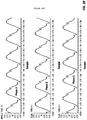
  • FIGS. 1A-1B illustrate a DC offset calculation using a low pass filter at different loads, in accordance with an embodiment of the present disclosure
  • FIGS. 2A-2B illustrate current reconstruction based on the calculations done in FIGS. 1A-1B , in accordance with an embodiment of the present disclosure
  • FIG. 3 illustrates a schematic block diagram of the DC offset corrector used with discontinuous pulse width modulation, in accordance with an embodiment of the present disclosure
  • FIGS. 4A-4C illustrate voltage signals derived from the known current and resistor values within the inverter, in accordance with an embodiment of the present disclosure
  • FIGS. 5A-5C illustrate voltage signals processed with an analog gain, in accordance with an embodiment of the present disclosure
  • FIGS. 6A-6C illustrate voltage signals added with an analog DC offset before going to ADC in the DSP, in accordance with an embodiment of the present disclosure
  • FIGS. 7A-7C illustrate voltage signals converted to a digital format by ADC in the DSP, in accordance with an embodiment of the present disclosure
  • FIG. 8 illustrates DPWM sector information in a PWM cycle, in accordance with an embodiment of the present disclosure
  • FIGS. 9A-9C illustrate voltage signals after removing the DC offset, in accordance with an embodiment of the present disclosure
  • FIGS. 10A-10C illustrate reconstructed current signals using the proposed DC offset corrector, in accordance with an embodiment of the present disclosure.
  • FIG. 11 illustrates an information handling system, in accordance with an embodiment of the present disclosure.
  • an information handling system may be utilized to control, manage or otherwise operate one or more operations, devices, components, networks, any other type of system or any combination thereof.
  • an information handling system may include any instrumentality or aggregate of instrumentalities that are configured to or are operable to compute, classify, process, transmit, receive, retrieve, originate, switch, store, display, manifest, detect, record, reproduce, handle, or utilize any form of information, intelligence, or data for any purpose, for example, for a maritime vessel or operation.
  • an information handling system may be a personal computer, a network storage device, or any other suitable device and may vary in size, shape, performance, functionality, and price.
  • the information handling system may include random access memory (RAM), one or more processing resources such as a central processing unit (CPU) or hardware or software control logic, ROM, and/or other types of nonvolatile memory. Additional components of the information handling system may include one or more disk drives, one or more network ports for communication with external devices as well as various input and output (I/O) devices, such as a keyboard, a mouse, and a video display. The information handling system may also include one or more buses operable to transmit communications between the various hardware components. The information handling system may also include one or more interface units capable of transmitting one or more signals to a controller, actuator, or like device.
  • RAM random access memory
  • processing resources such as a central processing unit (CPU) or hardware or software control logic, ROM, and/or other types of nonvolatile memory.
  • Additional components of the information handling system may include one or more disk drives, one or more network ports for communication with external devices as well as various input and output (I/O) devices, such as a keyboard, a mouse, and
  • Computer-readable media may include any instrumentality or aggregation of instrumentalities that may retain data, instructions or both for a period of time.
  • Computer-readable media may include, for example, without limitation, storage media such as a sequential access storage device (for example, a tape drive), direct access storage device (for example, a hard disk drive or floppy disk drive), compact disk (CD), CD read-only memory (ROM) or CD-ROM, DVD, RAM, ROM, electrically erasable programmable read-only memory (EEPROM), and/or flash memory, biological memory, molecular or deoxyribonucleic acid (DNA) memory as well as communications media such wires, optical fibers, microwaves, radio waves, and other electromagnetic and/or optical carriers; and/or any combination of the foregoing.
  • sequential access storage device for example, a tape drive
  • direct access storage device for example, a hard disk drive or floppy disk drive
  • CD CD read-only memory
  • ROM CD-ROM
  • DVD DVD
  • RAM random access memory
  • ROM
  • Disclosed embodiments are directed to a technique to remove DC offset from current measurement signals through shunt resistors in digital signal processing for current reconstruction when using discontinuous pulse width modulation (DPWM).
  • DPWM discontinuous pulse width modulation
  • Such measurements regarding current are pertinent to a feedback loop used for a system including a DC-link capacitor, inverter, and motor.
  • low pass filters have conventionally been used to remove DC offset in such systems. They have been efficient when the source signal is both continuous and periodic.
  • the system is using DPWM.
  • Implementing current reconstruction with such a source signal and low pass filters will result in a poor current waveform and measurement.
  • FIGS. 1A and 1B the amount of energy provided to a load alters the waveform of a designated phase. Both FIGS.
  • FIG. 1A and 1B depict DC offset removed from current signals using a low pass filtering method prior to current reconstruction.
  • a discontinuity when using DPWM.
  • the initial load measurement is able to be processed as the discontinuity is not greatly outlying from the other data, as illustrated in FIG. 2A .
  • FIG. 2B when the low pass filter is used for DC offset calculation, the reconstructed current signals have more distinct discontinuity when the DPWM method is used in an inverter.
  • FIG. 3 illustrates a schematic block diagram of the DC offset corrector as a part of the feedback control loop for a motor 300 , an inverter 305 , and a power supply 310 .
  • the power supply 310 may be any suitable device capable of supplying power to a system. Without limitations, the power supply 310 may be a DC-link capacitor. In embodiments, the power supply 310 may provide power to operate the motor 300 . In embodiments, the motor 300 may be an AC electric motor. The power supply 310 may be coupled to the motor 300 through the inverter 305 . Without limitations, the inverter 305 may be any suitable device capable of transforming direct current to alternating current. In embodiments, the inverter 305 is a three-phase inverter.
  • the feedback loop may comprise any suitable wiring and/or circuitry for processing and to communicatively couple the inverter 305 to the power supply 310 and the motor 300 .
  • the inverter 305 may comprise three single-phase switches 315 , 320 , 325 (collectively referred to as “switch(es) 315 ) each connected to one of the three load terminals.
  • switch(es) 315 each connected to one of the three load terminals.
  • the inverter 305 may selectively actuate any two switches from the three single-phase switches 315 , 320 , 325 in order to provide three-phase power to the motor 300 .
  • Control and feedback circuitry may be used to adjust the final output of the inverter 305 which will determine the speed of the motor 300 operating under its mechanical load. Motor speed control needs are numerous and include things like: industrial motor driven equipment, electric vehicles, rail transport systems, and power tools.
  • inverter output current protection in DSP or to implement a feedback control loop between the motor 300 , the inverter 305 , and the power supply 310 , it is necessary to measure the three-phase output currents of the inverter 305 which go to the motor 300 . The measured current signals are then sent to DSP with the help of ADC to use as feedback signals to implement the current protection for the inverter 305 or to be used for any other motor control methodologies for the system.
  • inverter phase leg shunt resistors are widely used to extract the inverter output current information.
  • output current of the inverter may be calculated by measuring the voltage drop across the shunt resistors when the inverter currents flow through the shunt resistors.
  • PWM pulse width modulation
  • each one of the switches 315 may be in series with one of the resistors 330 in order to obtain measurements regarding each phase switch 315 , as illustrated in FIGS. 4A-4C .
  • FIGS. 4A-4C depict the voltage signals across the resistors 330 , 335 , 340 (i.e., referring to FIG. 3 ).
  • FIG. 4A-4C depict the voltage signals across the resistors 330 , 335 , 340 (i.e., referring to FIG. 3 ).
  • FIG. 4A illustrates a graph depicting the voltage signal across the shunt resistor 330 which is associated with phase switch 315 (i.e., referring to FIG. 3 ).
  • FIG. 4B illustrates a graph depicting the voltage signal across the shunt resistor 335 which is associated with phase switch 320 (i.e., referring to FIG. 3 ).
  • FIG. 4C illustrates a graph depicting the voltage signal across the shunt resistor 335 which is associated with phase switch 325 (i.e., referring to FIG. 3 ).
  • These voltage values of the signal may be determined by applying equations relating voltage to the known current and resistance values.
  • the voltage signal may then be processed through an analog gain circuit 345 and a DC offset 350 may be added.
  • the analog gain circuit 345 may increase the signal by any suitable factor, and the DC offset 350 value may be any suitable voltage.
  • the analog gain circuit 345 may increase the signal by a desired gain to bring the voltage value available across each one of the resistors 330 to a readable voltage value, as illustrated in FIGS. 5A-5C .
  • the analog gain circuit 345 may increase the signal by a factor of 10.
  • the DC offset 350 value may be approximately 1.5 or 1.65 volts depending on an input voltage range of the unipoloar ADC which may be either a 0 to 3 volt or 0 to 3.3 volt range respectively, as illustrated in FIGS. 6A-6C .
  • Each set of FIGS. 5A-5C and 6A-6C correspond to a signal regarding a specific one of the phase switches 315 (i.e., referring to FIG. 3 ) similarly to FIGS. 4A-4C .
  • FIG. 4A depicts an original signal for a given phase switch 315
  • FIG. 5A depicts the original signal being processed
  • FIG. 6A depicts further processing of said signal.
  • FIGS. 5B-5C and 6B-6C has likewise relationships with FIGS. 4B-4C .
  • the signals may undergo digital signal processing while being in a range of 0 to 3.3 volts.
  • the signals may be processed by an analog-to-digital converter 355 , thereby converting the signals into a digital format.
  • the analog-to-digital converter 355 may be a 12-bit ADC, wherein the converted signals will be in 12-bit format (0 to 4096 combinations).
  • the signals may then go through a process at block 360 wherein the 12-bit converted signals will be converted to 0 to 3.3 volts.
  • the DC offset present in the converted signals may be removed from the signals, as shown in FIGS. 7A-7C , with a DC offset removal technique block 363 .
  • the DC offset removal technique block 363 may comprise of a DC offset corrector 365 and an approximate DC offset removal value 368 .
  • the DC offset corrector 365 may serve to provide additional adjustment required to determine the correct offset value which can then be used to remove the actual DC offset from the signals prior to current reconstruction.
  • the DC offset corrector 365 may have a plurality of inputs including, but not limited to, the DPWM sector information, an upper limit, a lower limit, and/or combinations thereof. Without limitations, the upper limit may be about 0.0001, and the lower limit may be about ⁇ 0.0001.
  • the value determined by the DC offset corrector 365 may be combined with the approximate DC offset removal value 368 .
  • this approximate DC offset removal value 368 may be any suitable value.
  • the approximate DC offset removal value 368 may be equivalent to that of the DC offset 350 value (i.e., 1.5 or 1.65 volts).
  • the combined values of the DC offset corrector 365 and the approximate DC offset removal value 368 may be used to remove the DC offset from the signals.
  • the approximate DC offset removal value 368 may always remove the designated value from the signals, but the DC offset corrector 365 may operate selectively in a closed-loop fashion based on particular DPWM sector information, and by using the voltage signals as its feedback signals, which are the signals produced after removing the DC offset.
  • the DC offset corrector 365 and approximate DC offset removal value 368 may remove DC offset from the voltage signals in order to reach an approximate value of zero. If the value of the voltage signals is outside the upper and lower limits, an adjustment may be made in the feedback loop to increase or decrease the value of the DC offset corrector 365 to keep the voltage signal values within the upper and lower limits.
  • the DPWM sector information may be defined herein as the different phase sector information in a PWM cycle. There may be six sectors in a PWM cycle and each sector has 60 degrees as shown in the FIG. 8 . In embodiments, the current may be zero in only one of the phase sectors of a PWM cycle. When in sector 2 , as shown in FIG. 8 , the DPWM may be clamped to a max value for 60 degrees (i.e., from 120 degrees to 180 degrees). In embodiments, during this duration, the phase switch 315 in the inverter 305 may connect the power supply 310 to the motor 300 through a top switch 370 of the phase switch 315 , which may inhibit the inverter 305 current from flowing through the resistor 330 . As shown, the current may be zero within sector 2 . This may occur similarly for other phase switches 320 and 325 .
  • the DC offset present in the voltage signals may need to be completely removed prior to current reconstruction so as to represent continuous current signals when the voltage signals undergo the current reconstruction 375 and a gain and calculation 380 .
  • the DC offset corrector 365 may ensure the complete removal of DC offset by forcing the voltage signals to zero within the phase sector where there is a discontinuity as the approximate DC offset removal value 368 will not remove all of the DC offset present in the signal. This method may be advantageous as the selectivity of the DC offset corrector 365 may reduce processing time when compared to a low pass filter-based DC offset removal method.
  • FIGS. 9A-9C illustrate the voltage signals after removing the DC offset value. These voltage signals may then undergo current reconstruction 375 .
  • an input to the current reconstruction 375 may be the DPWM sector information.
  • the discontinuity in each of the voltage signals (as seen in FIGS. 9A-9C ) may be reconstructed by using the other two phase voltage signals to create continuity.
  • the equation for the current reconstruction 375 is based on Kirchhoff's current rule for balanced star connected network.
  • the discontinuity in the voltage signal of phase A during a DPWM sector as shown in FIG. 9A , may be reconstructed with the other two voltage signals as shown in FIG. 9B and FIG. 9C to create continuity.
  • FIGS. 10A-10C illustrate the signals after undergoing the current reconstruction 375 and the gain and calculation at block 380 . As illustrated, each figure represents the current associated with a specific phase switch 315 , similar to the previous figures.
  • the disclosed system and method may be used in conjunction with an information handling system, which in some embodiments may be a computer system.
  • the computer may be equipped with a computer memory storage (and optionally a local processor) so that it can store (and also optionally at least partially process) the signals that it receives.
  • FIG. 11 is a diagram illustrating an example information handling system 1100 , for example, for use with or by the feedback control loop of FIG. 3 , according to one or more aspects of the present disclosure.
  • a processor or central processing unit (CPU) 1105 of the information handling system 1100 is communicatively coupled to a memory controller hub (MCH) or north bridge 1110 .
  • the processor 1105 may include, for example a microprocessor, microcontroller, digital signal processor (DSP), application specific integrated circuit (ASIC), or any other digital or analog circuitry configured to interpret and/or execute program instructions and/or process data.
  • DSP digital signal processor
  • ASIC application specific integrated circuit
  • Processor 1105 may be configured to interpret and/or execute program instructions or other data retrieved and stored in any memory such as memory 1115 or hard drive 1120 .
  • Program instructions or other data may constitute portions of a software or application, for example application 1125 or data 1130 , for carrying out one or more methods described herein.
  • Memory 1115 may include read-only memory (ROM), random access memory (RAM), solid state memory, or disk-based memory. Each memory module may include any system, device or apparatus configured to retain program instructions and/or data for a period of time (for example, non-transitory computer-readable media). For example, instructions from a software or application 1125 or data 1130 may be retrieved and stored in memory 1115 for execution or use by processor 1105 .
  • the memory 1115 or the hard drive 1120 may include or comprise one or more non-transitory executable instructions that, when executed by the processor 1105 , cause the processor 1105 to perform or initiate one or more operations or steps.
  • the information handling system 1100 may be preprogrammed or it may be programmed (and reprogrammed) by loading a program from another source (for example, from a CD-ROM, from another computer device through a data network, or in another manner).
  • the one or more applications 1125 may comprise one or more software applications, one or more scripts, one or more programs, one or more functions, one or more executables, or one or more other modules that are interpreted or executed by the processor 1105 .
  • the one or more applications 1125 may include machine-readable instructions for performing one or more of the operations related to any one or more embodiments of the present disclosure.
  • the one or more applications 1125 may generate output data and store the output data in the memory 1115 , hard drive 1120 , in another local medium, or in one or more remote devices (for example, by sending the output data via the communication link 1135 ).
  • FIG. 11 shows a particular configuration of components of information handling system 1100 .
  • components of information handling system 1100 may be implemented either as physical or logical components.
  • functionality associated with components of information handling system 1100 may be implemented in special purpose circuits or components.
  • functionality associated with components of information handling system 1100 may be implemented in configurable general-purpose circuit or components.
  • components of information handling system 1100 may be implemented by configured computer program instructions.
  • Memory controller hub 1110 may include a memory controller for directing information to or from various system memory components within the information handling system 1100 , such as memory 1115 , storage element 1140 , and hard drive 1120 .
  • the memory controller hub 1110 may be coupled to memory 1115 and a graphics processing unit (GPU) 1145 .
  • Memory controller hub 1110 may also be coupled to an I/O controller hub (ICH) or south bridge 1150 .
  • I/O controller hub 1150 is coupled to storage elements of the information handling system 1100 , including a storage element 1140 , which may comprise a flash ROM that includes a basic input/output system (BIOS) of the computer system.
  • I/O controller hub 1150 is also coupled to the hard drive 1120 of the information handling system 1100 .
  • I/O controller hub 1150 may also be coupled to an I/O chip or interface, for example, a Super I/O chip 1155 , which is itself coupled to several of the I/O ports of the computer system, including a keyboard 1160 , a mouse 1165 , a monitor 1170 and one or more communications link 1135 .
  • Any one or more input/output devices receive and transmit data in analog or digital form over one or more communication links 1135 such as a serial link, a wireless link (for example, infrared, radio frequency, or others), a parallel link, or another type of link.
  • the one or more communication links 1135 may comprise any type of communication channel, connector, data communication network, or other link.
  • the one or more communication links 1135 may comprise a wireless or a wired network, a Local Area Network (LAN), a Wide Area Network (WAN), a private network, a public network (such as the Internet), a WiFi network, a network that includes a satellite link, or another type of data communication network.
  • LAN Local Area Network
  • WAN Wide Area Network
  • private network such as the Internet
  • public network such as the Internet
  • WiFi Wireless Fidelity
  • a network that includes a satellite link or another type of data communication network.

Landscapes

  • Engineering & Computer Science (AREA)
  • Power Engineering (AREA)
  • Inverter Devices (AREA)

Abstract

Disclosed embodiments are directed to a technique to remove DC offset from current measurement signals through shunt resistors in digital signal processing for current reconstruction when using discontinuous pulse width modulation (DPWM). Such measurements regarding current are pertinent to a feedback loop used for a system including a DC-link capacitor, inverter, and motor. A method of removing DC offset comprises: determining a three-phase output current signal of an inverter, wherein the inverter is coupled to a motor and a power supply; producing a voltage signal based on the three-phase output current signal and the resistances of one or more shunt resistors disposed in the inverter; applying an analog gain circuit to the voltage signal; processing the voltage signal with an analog-to-digital converter (ADC); applying a DC offset corrector to the voltage signal; and performing current reconstruction on the voltage signal to produce a continuous current signal.

Description

TECHNICAL FIELD
Embodiments of the present disclosure relate to inverter output or motor current feedback measurements, more particularly, to a DC offset corrector for use in current reconstruction for discontinuous pulse width modulation.
BACKGROUND
Induction motors are well known as industrial drives. Typically, a DC-link capacitor supplies power to the motor through an inverter. The inverter can switch between individual output loads to power the motor. Pulse width modulation (PWM) has been used to control the source supply to a load by controlling the frequency and duration of switching between connected and disconnected positions in the inverter. PWM can be ideal to use as it provides a continuous signal, and the motor must run on a continuous signal. It is often desirable to accurately measure the motor phase current in a feedback loop implemented with the motor to improve upon the performance of the motor or to ensure that the motor is operating correctly.
Currently, low pass filters have been used during processing to calculate the amount of DC offset to remove, as there is typically a DC offset value added because most of the low cost and inbuilt analog-to-digital (ADC) converters in Digital Signal Processors (DSPs) are unipolar and cannot process negative values. This arrangement is only efficient in removing the DC offset if the source signal is continuous and periodic. Although this arrangement provides accurate results, there is a limit as to which frequencies may be analyzed, there is a phase lag due to the filter, and the shape of the reconstructed current curve is distorted as the load increases when used with a discontinuous PWM method because there is discontinuity in the current information obtained.
BRIEF DESCRIPTION OF THE DRAWINGS
For a more complete understanding of the present disclosure and its features and advantages, reference is now made to the following description, taken in conjunction with the accompanying drawings, in which:
FIGS. 1A-1B illustrate a DC offset calculation using a low pass filter at different loads, in accordance with an embodiment of the present disclosure;
FIGS. 2A-2B illustrate current reconstruction based on the calculations done in FIGS. 1A-1B, in accordance with an embodiment of the present disclosure;
FIG. 3 illustrates a schematic block diagram of the DC offset corrector used with discontinuous pulse width modulation, in accordance with an embodiment of the present disclosure;
FIGS. 4A-4C illustrate voltage signals derived from the known current and resistor values within the inverter, in accordance with an embodiment of the present disclosure;
FIGS. 5A-5C illustrate voltage signals processed with an analog gain, in accordance with an embodiment of the present disclosure;
FIGS. 6A-6C illustrate voltage signals added with an analog DC offset before going to ADC in the DSP, in accordance with an embodiment of the present disclosure;
FIGS. 7A-7C illustrate voltage signals converted to a digital format by ADC in the DSP, in accordance with an embodiment of the present disclosure;
FIG. 8 illustrates DPWM sector information in a PWM cycle, in accordance with an embodiment of the present disclosure;
FIGS. 9A-9C illustrate voltage signals after removing the DC offset, in accordance with an embodiment of the present disclosure;
FIGS. 10A-10C illustrate reconstructed current signals using the proposed DC offset corrector, in accordance with an embodiment of the present disclosure; and
FIG. 11 illustrates an information handling system, in accordance with an embodiment of the present disclosure.
DETAILED DESCRIPTION
Illustrative embodiments of the present disclosure are described in detail herein. In the interest of clarity, not all features of an actual implementation are described in this specification. It will of course be appreciated that in the development of any such actual embodiment, numerous implementation specific decisions must be made to achieve developers' specific goals, such as compliance with system related and business related constraints, which will vary from one implementation to another. Moreover, it will be appreciated that such a development effort might be complex and time consuming, but would nevertheless be a routine undertaking for those of ordinary skill in the art having the benefit of the present disclosure. Furthermore, in no way should the following examples be read to limit, or define, the scope of the disclosure.
In one or more embodiments of the present disclosure, an information handling system may be utilized to control, manage or otherwise operate one or more operations, devices, components, networks, any other type of system or any combination thereof. For purposes of this disclosure, an information handling system may include any instrumentality or aggregate of instrumentalities that are configured to or are operable to compute, classify, process, transmit, receive, retrieve, originate, switch, store, display, manifest, detect, record, reproduce, handle, or utilize any form of information, intelligence, or data for any purpose, for example, for a maritime vessel or operation. For example, an information handling system may be a personal computer, a network storage device, or any other suitable device and may vary in size, shape, performance, functionality, and price. The information handling system may include random access memory (RAM), one or more processing resources such as a central processing unit (CPU) or hardware or software control logic, ROM, and/or other types of nonvolatile memory. Additional components of the information handling system may include one or more disk drives, one or more network ports for communication with external devices as well as various input and output (I/O) devices, such as a keyboard, a mouse, and a video display. The information handling system may also include one or more buses operable to transmit communications between the various hardware components. The information handling system may also include one or more interface units capable of transmitting one or more signals to a controller, actuator, or like device.
For the purposes of this disclosure, computer-readable media may include any instrumentality or aggregation of instrumentalities that may retain data, instructions or both for a period of time. Computer-readable media may include, for example, without limitation, storage media such as a sequential access storage device (for example, a tape drive), direct access storage device (for example, a hard disk drive or floppy disk drive), compact disk (CD), CD read-only memory (ROM) or CD-ROM, DVD, RAM, ROM, electrically erasable programmable read-only memory (EEPROM), and/or flash memory, biological memory, molecular or deoxyribonucleic acid (DNA) memory as well as communications media such wires, optical fibers, microwaves, radio waves, and other electromagnetic and/or optical carriers; and/or any combination of the foregoing.
Disclosed embodiments are directed to a technique to remove DC offset from current measurement signals through shunt resistors in digital signal processing for current reconstruction when using discontinuous pulse width modulation (DPWM). Such measurements regarding current are pertinent to a feedback loop used for a system including a DC-link capacitor, inverter, and motor. It is well known that low pass filters have conventionally been used to remove DC offset in such systems. They have been efficient when the source signal is both continuous and periodic. With regards to the present disclosure, the system is using DPWM. Implementing current reconstruction with such a source signal and low pass filters will result in a poor current waveform and measurement. With reference to FIGS. 1A and 1B, the amount of energy provided to a load alters the waveform of a designated phase. Both FIGS. 1A and 1B depict DC offset removed from current signals using a low pass filtering method prior to current reconstruction. As illustrated, at an initial load, there is a discontinuity when using DPWM. As the amount of load increases, the discontinuity increases as well, thereby increasing the error in the signal. When low pass filters are used for current reconstruction with the discontinuous signal, the initial load measurement is able to be processed as the discontinuity is not greatly outlying from the other data, as illustrated in FIG. 2A. As shown in FIG. 2B, when the low pass filter is used for DC offset calculation, the reconstructed current signals have more distinct discontinuity when the DPWM method is used in an inverter. The motor of the system subsequently will not be able to operate properly as the motor control in the DSP requires a continuous current measurement in order to be able to control the motor properly. It is now recognized that a need exists for a current reconstruction circuit with a DC offset corrector capable of processing the discontinuities present in the measured current signals due to DPWM.
FIG. 3 illustrates a schematic block diagram of the DC offset corrector as a part of the feedback control loop for a motor 300, an inverter 305, and a power supply 310. The power supply 310 may be any suitable device capable of supplying power to a system. Without limitations, the power supply 310 may be a DC-link capacitor. In embodiments, the power supply 310 may provide power to operate the motor 300. In embodiments, the motor 300 may be an AC electric motor. The power supply 310 may be coupled to the motor 300 through the inverter 305. Without limitations, the inverter 305 may be any suitable device capable of transforming direct current to alternating current. In embodiments, the inverter 305 is a three-phase inverter. The feedback loop may comprise any suitable wiring and/or circuitry for processing and to communicatively couple the inverter 305 to the power supply 310 and the motor 300. As depicted, the inverter 305 may comprise three single- phase switches 315, 320, 325 (collectively referred to as “switch(es) 315) each connected to one of the three load terminals. During operations, the inverter 305 may selectively actuate any two switches from the three single- phase switches 315, 320, 325 in order to provide three-phase power to the motor 300. Control and feedback circuitry may be used to adjust the final output of the inverter 305 which will determine the speed of the motor 300 operating under its mechanical load. Motor speed control needs are numerous and include things like: industrial motor driven equipment, electric vehicles, rail transport systems, and power tools.
In order to implement the inverter output current protection in DSP or to implement a feedback control loop between the motor 300, the inverter 305, and the power supply 310, it is necessary to measure the three-phase output currents of the inverter 305 which go to the motor 300. The measured current signals are then sent to DSP with the help of ADC to use as feedback signals to implement the current protection for the inverter 305 or to be used for any other motor control methodologies for the system.
Typically, current measurement in inverters are done by using either two or three quantities of Hall Current Transducers (HCTs) at the output side of the inverter to directly measure the current signals, but for low cost applications and for small foot-print inverters or motor drive systems, inverter phase leg shunt resistors are widely used to extract the inverter output current information. When shunt resistors are used in the inverter phase legs, output current of the inverter may be calculated by measuring the voltage drop across the shunt resistors when the inverter currents flow through the shunt resistors. Moreover, due to the nature of pulse width modulation (PWM) methodology, reconstruction of the current signals may be needed to consistently provide the proper current signals.
For current measurement using shunt resistors, the voltage across each one of shunt resistors 330, 335, 340 may be measured when the inverter output current flows through each of shunt resistors 330, 335, 340 (collectively referred to as “resistor(s) 330). In embodiments, each one of the switches 315 may be in series with one of the resistors 330 in order to obtain measurements regarding each phase switch 315, as illustrated in FIGS. 4A-4C. As shown, FIGS. 4A-4C depict the voltage signals across the resistors 330, 335, 340 (i.e., referring to FIG. 3). FIG. 4A illustrates a graph depicting the voltage signal across the shunt resistor 330 which is associated with phase switch 315 (i.e., referring to FIG. 3). FIG. 4B illustrates a graph depicting the voltage signal across the shunt resistor 335 which is associated with phase switch 320 (i.e., referring to FIG. 3). FIG. 4C illustrates a graph depicting the voltage signal across the shunt resistor 335 which is associated with phase switch 325 (i.e., referring to FIG. 3). These voltage values of the signal may be determined by applying equations relating voltage to the known current and resistance values.
Wither reference back to FIG. 3, the voltage signal may then be processed through an analog gain circuit 345 and a DC offset 350 may be added. Without limitations, the analog gain circuit 345 may increase the signal by any suitable factor, and the DC offset 350 value may be any suitable voltage. In embodiments, the analog gain circuit 345 may increase the signal by a desired gain to bring the voltage value available across each one of the resistors 330 to a readable voltage value, as illustrated in FIGS. 5A-5C. Without limitations, the analog gain circuit 345 may increase the signal by a factor of 10. The DC offset 350 value may be approximately 1.5 or 1.65 volts depending on an input voltage range of the unipoloar ADC which may be either a 0 to 3 volt or 0 to 3.3 volt range respectively, as illustrated in FIGS. 6A-6C. Each set of FIGS. 5A-5C and 6A-6C correspond to a signal regarding a specific one of the phase switches 315 (i.e., referring to FIG. 3) similarly to FIGS. 4A-4C. In embodiments, FIG. 4A depicts an original signal for a given phase switch 315, FIG. 5A depicts the original signal being processed, and FIG. 6A depicts further processing of said signal. FIGS. 5B-5C and 6B-6C has likewise relationships with FIGS. 4B-4C.
Referring back to FIG. 3, after applying the gain and offset to the voltage signals, the signals may undergo digital signal processing while being in a range of 0 to 3.3 volts. In embodiments, the signals may be processed by an analog-to-digital converter 355, thereby converting the signals into a digital format. In embodiments, the analog-to-digital converter 355 may be a 12-bit ADC, wherein the converted signals will be in 12-bit format (0 to 4096 combinations). The signals may then go through a process at block 360 wherein the 12-bit converted signals will be converted to 0 to 3.3 volts.
After being processed at block 360, the DC offset present in the converted signals may be removed from the signals, as shown in FIGS. 7A-7C, with a DC offset removal technique block 363. The DC offset removal technique block 363 may comprise of a DC offset corrector 365 and an approximate DC offset removal value 368. The DC offset corrector 365 may serve to provide additional adjustment required to determine the correct offset value which can then be used to remove the actual DC offset from the signals prior to current reconstruction. The DC offset corrector 365 may have a plurality of inputs including, but not limited to, the DPWM sector information, an upper limit, a lower limit, and/or combinations thereof. Without limitations, the upper limit may be about 0.0001, and the lower limit may be about −0.0001. In embodiments, the value determined by the DC offset corrector 365 may be combined with the approximate DC offset removal value 368. Without limitations, this approximate DC offset removal value 368 may be any suitable value. In embodiments, the approximate DC offset removal value 368 may be equivalent to that of the DC offset 350 value (i.e., 1.5 or 1.65 volts). The combined values of the DC offset corrector 365 and the approximate DC offset removal value 368 may be used to remove the DC offset from the signals. The approximate DC offset removal value 368 may always remove the designated value from the signals, but the DC offset corrector 365 may operate selectively in a closed-loop fashion based on particular DPWM sector information, and by using the voltage signals as its feedback signals, which are the signals produced after removing the DC offset. In embodiments, the DC offset corrector 365 and approximate DC offset removal value 368 may remove DC offset from the voltage signals in order to reach an approximate value of zero. If the value of the voltage signals is outside the upper and lower limits, an adjustment may be made in the feedback loop to increase or decrease the value of the DC offset corrector 365 to keep the voltage signal values within the upper and lower limits.
The DPWM sector information may be defined herein as the different phase sector information in a PWM cycle. There may be six sectors in a PWM cycle and each sector has 60 degrees as shown in the FIG. 8. In embodiments, the current may be zero in only one of the phase sectors of a PWM cycle. When in sector 2, as shown in FIG. 8, the DPWM may be clamped to a max value for 60 degrees (i.e., from 120 degrees to 180 degrees). In embodiments, during this duration, the phase switch 315 in the inverter 305 may connect the power supply 310 to the motor 300 through a top switch 370 of the phase switch 315, which may inhibit the inverter 305 current from flowing through the resistor 330. As shown, the current may be zero within sector 2. This may occur similarly for other phase switches 320 and 325.
In order to apply a continuous current to the motor 300, the DC offset present in the voltage signals may need to be completely removed prior to current reconstruction so as to represent continuous current signals when the voltage signals undergo the current reconstruction 375 and a gain and calculation 380. The DC offset corrector 365 may ensure the complete removal of DC offset by forcing the voltage signals to zero within the phase sector where there is a discontinuity as the approximate DC offset removal value 368 will not remove all of the DC offset present in the signal. This method may be advantageous as the selectivity of the DC offset corrector 365 may reduce processing time when compared to a low pass filter-based DC offset removal method. FIGS. 9A-9C illustrate the voltage signals after removing the DC offset value. These voltage signals may then undergo current reconstruction 375.
In embodiments, an input to the current reconstruction 375 may be the DPWM sector information. In current reconstruction 375, the discontinuity in each of the voltage signals (as seen in FIGS. 9A-9C) may be reconstructed by using the other two phase voltage signals to create continuity. The equation for the current reconstruction 375 is based on Kirchhoff's current rule for balanced star connected network. In embodiments, the discontinuity in the voltage signal of phase A during a DPWM sector, as shown in FIG. 9A, may be reconstructed with the other two voltage signals as shown in FIG. 9B and FIG. 9C to create continuity. After the current reconstruction 375, a gain and calculation may be applied at block 380, wherein the output is the currents flowing from the inverter 305 to the motor 300. Without limitations, the gain may be equivalent to the value of the gain from analog gain circuit 345, and the calculation may be known relationships between voltage, current, and resistance. FIGS. 10A-10C illustrate the signals after undergoing the current reconstruction 375 and the gain and calculation at block 380. As illustrated, each figure represents the current associated with a specific phase switch 315, similar to the previous figures.
The disclosed system and method may be used in conjunction with an information handling system, which in some embodiments may be a computer system. As those of ordinary skill in the art will appreciate, the computer may be equipped with a computer memory storage (and optionally a local processor) so that it can store (and also optionally at least partially process) the signals that it receives.
FIG. 11 is a diagram illustrating an example information handling system 1100, for example, for use with or by the feedback control loop of FIG. 3, according to one or more aspects of the present disclosure. A processor or central processing unit (CPU) 1105 of the information handling system 1100 is communicatively coupled to a memory controller hub (MCH) or north bridge 1110. The processor 1105 may include, for example a microprocessor, microcontroller, digital signal processor (DSP), application specific integrated circuit (ASIC), or any other digital or analog circuitry configured to interpret and/or execute program instructions and/or process data. Processor 1105 may be configured to interpret and/or execute program instructions or other data retrieved and stored in any memory such as memory 1115 or hard drive 1120. Program instructions or other data may constitute portions of a software or application, for example application 1125 or data 1130, for carrying out one or more methods described herein. Memory 1115 may include read-only memory (ROM), random access memory (RAM), solid state memory, or disk-based memory. Each memory module may include any system, device or apparatus configured to retain program instructions and/or data for a period of time (for example, non-transitory computer-readable media). For example, instructions from a software or application 1125 or data 1130 may be retrieved and stored in memory 1115 for execution or use by processor 1105. In one or more embodiments, the memory 1115 or the hard drive 1120 may include or comprise one or more non-transitory executable instructions that, when executed by the processor 1105, cause the processor 1105 to perform or initiate one or more operations or steps. The information handling system 1100 may be preprogrammed or it may be programmed (and reprogrammed) by loading a program from another source (for example, from a CD-ROM, from another computer device through a data network, or in another manner).
The one or more applications 1125 may comprise one or more software applications, one or more scripts, one or more programs, one or more functions, one or more executables, or one or more other modules that are interpreted or executed by the processor 1105. The one or more applications 1125 may include machine-readable instructions for performing one or more of the operations related to any one or more embodiments of the present disclosure. The one or more applications 1125 may generate output data and store the output data in the memory 1115, hard drive 1120, in another local medium, or in one or more remote devices (for example, by sending the output data via the communication link 1135).
Modifications, additions, or omissions may be made to FIG. 11 without departing from the scope of the present disclosure. For example, FIG. 11 shows a particular configuration of components of information handling system 1100. However, any suitable configurations of components may be used. For example, components of information handling system 1100 may be implemented either as physical or logical components. Furthermore, in some embodiments, functionality associated with components of information handling system 1100 may be implemented in special purpose circuits or components. In other embodiments, functionality associated with components of information handling system 1100 may be implemented in configurable general-purpose circuit or components. For example, components of information handling system 1100 may be implemented by configured computer program instructions.
Memory controller hub 1110 may include a memory controller for directing information to or from various system memory components within the information handling system 1100, such as memory 1115, storage element 1140, and hard drive 1120. The memory controller hub 1110 may be coupled to memory 1115 and a graphics processing unit (GPU) 1145. Memory controller hub 1110 may also be coupled to an I/O controller hub (ICH) or south bridge 1150. I/O controller hub 1150 is coupled to storage elements of the information handling system 1100, including a storage element 1140, which may comprise a flash ROM that includes a basic input/output system (BIOS) of the computer system. I/O controller hub 1150 is also coupled to the hard drive 1120 of the information handling system 1100. I/O controller hub 1150 may also be coupled to an I/O chip or interface, for example, a Super I/O chip 1155, which is itself coupled to several of the I/O ports of the computer system, including a keyboard 1160, a mouse 1165, a monitor 1170 and one or more communications link 1135. Any one or more input/output devices receive and transmit data in analog or digital form over one or more communication links 1135 such as a serial link, a wireless link (for example, infrared, radio frequency, or others), a parallel link, or another type of link. The one or more communication links 1135 may comprise any type of communication channel, connector, data communication network, or other link. For example, the one or more communication links 1135 may comprise a wireless or a wired network, a Local Area Network (LAN), a Wide Area Network (WAN), a private network, a public network (such as the Internet), a WiFi network, a network that includes a satellite link, or another type of data communication network.
Although the disclosure and its advantages have been described in detail, it should be understood that various changes, substitutions and alterations can be made herein without departing from the spirit and scope of the disclosure as defined by the following claims.

Claims (20)

What is claimed is:
1. A method of removing DC offset from voltage signals, comprising:
determining a three-phase output current signal of an inverter, wherein the inverter is coupled to a motor and a power supply;
producing a voltage signal based on the three-phase output current signal and the resistances of one or more shunt resistors disposed in the inverter;
applying an analog gain circuit to the voltage signal;
processing the voltage signal with an analog-to-digital converter (ADC);
applying a DC offset corrector to the voltage signal, wherein the DC offset corrector is configured to operate in a closed feedback loop to remove DC offset from the voltage signal until the DC offset is within an upper limit and a lower limit; and
performing current reconstruction on the voltage signal to produce a continuous current signal.
2. The method of claim 1, wherein each of the one or more shunt resistors is coupled to a phase switch.
3. The method of claim 1, wherein the analog gain circuit increases the voltage signal by a factor of 10.
4. The method of claim 1, further comprising applying a DC offset value to the voltage signal, wherein the DC offset value increases the voltage signal by 1.5 volts or 1.65 volts.
5. The method of claim 1, wherein processing the voltage signal with the ADC converter comprises converting the voltage signal to a digital format.
6. The method of claim 5, wherein the ADC is a 12-bit ADC.
7. The method of claim 1, wherein the DC offset corrector comprises a plurality of inputs, wherein the plurality of inputs comprises discontinuous pulse width modulation (DPWM) sector information, the upper limit, and the lower limit.
8. The method of claim 7, wherein the DPWM sector information provides which phase sector of the voltage signal comprises current at a value of zero.
9. The method of claim 8, wherein the DC offset corrector is applied to the phase sector wherein the current is at the value of zero.
10. The method of claim 1, further comprising of applying an approximate DC offset removal value to the voltage signal.
11. A system, comprising:
a power supply;
an inverter, wherein the inverter is coupled to the power supply;
a motor, wherein the motor is coupled to the inverter; and
an information handling system comprising a memory and a processor, wherein the information handling system is configured to implement a feedback control loop regarding the power supply, the inverter, and the motor, wherein the feedback control loop comprises an approximate DC offset removal value and a DC offset corrector, wherein the DC offset corrector comprises a plurality of inputs, wherein the plurality of inputs comprises discontinuous pulse width modulation (DPWM) sector information, an upper limit, and a lower limit, wherein the DC offset corrector is configured to operate in a closed feedback loop to remove DC offset from a voltage signal until the DC offset is within the upper limit and the lower limit.
12. The system of claim 11, wherein the information handling system is configured to:
determine a three-phase output current signal of the inverter; and
produce the voltage signal based on the three-phase output current signal and the resistances of one or more shunt resistors disposed in the inverter.
13. The system of claim 11, wherein the information handling system is configured to:
apply an analog gain circuit to the voltage signal, wherein the analog gain circuit increases the voltage signal by a factor of 10.
14. The system of claim 11, wherein the information handling system is configured to:
process the voltage signal with an analog-to-digital converter (ADC) to convert the voltage signal to a digital format, wherein the ADC is a 12-bit ADC.
15. The system of claim 11, wherein the information handling system is configured to:
apply the DC offset corrector to the voltage signal; and
apply the approximate DC offset removal value to the voltage signal.
16. The system of claim 11, wherein the information handling system is configured to:
perform current reconstruction on the voltage signal to produce a continuous current signal.
17. A circuit to remove DC offset prior to current reconstruction when using discontinuous pulse width modulation (DPWM), comprising:
an analog gain circuit;
an analog DC offset;
an analog-to-digital converter;
an approximate DC offset removal value; and
a DC offset corrector, wherein the DC offset corrector comprises a plurality of inputs, wherein the plurality of inputs comprises DPWM sector information, an upper limit, and a lower limit, wherein the DC offset corrector is configured to operate in a closed feedback loop to remove DC offset from a voltage signal until the DC offset is within the upper limit and the lower limit.
18. The circuit of claim 17, wherein the circuit is configured to:
determine a three-phase output current signal of an inverter, wherein the inverter is coupled to a motor and a power supply; and
produce the voltage signal based on the three-phase output current signal and the resistances of one or more shunt resistors disposed in the inverter.
19. The circuit of claim 17, wherein the DPWM sector information provides which phase sector of the voltage signal comprises current at a value of zero, wherein the DC offset corrector is applied to the phase sector wherein the current is at the value of zero.
20. The circuit of claim 17, wherein the circuit is configured to:
perform current reconstruction on the voltage signal to produce a continuous current signal.
US16/527,872 2019-07-31 2019-07-31 Hysteresis based DC offset corrector for current reconstruction when using discontinuous PWM Active US11005406B2 (en)

Priority Applications (3)

Application Number Priority Date Filing Date Title
US16/527,872 US11005406B2 (en) 2019-07-31 2019-07-31 Hysteresis based DC offset corrector for current reconstruction when using discontinuous PWM
CA3087663A CA3087663C (en) 2019-07-31 2020-07-22 Hysteresis based dc offset corrector for current reconstruction when using discontinuous pwm
MX2020008014A MX2020008014A (en) 2019-07-31 2020-07-29 Hysteresis based dc offset corrector for current reconstruction when using discontinuous pwm.

Applications Claiming Priority (1)

Application Number Priority Date Filing Date Title
US16/527,872 US11005406B2 (en) 2019-07-31 2019-07-31 Hysteresis based DC offset corrector for current reconstruction when using discontinuous PWM

Publications (2)

Publication Number Publication Date
US20210036647A1 US20210036647A1 (en) 2021-02-04
US11005406B2 true US11005406B2 (en) 2021-05-11

Family

ID=74260422

Family Applications (1)

Application Number Title Priority Date Filing Date
US16/527,872 Active US11005406B2 (en) 2019-07-31 2019-07-31 Hysteresis based DC offset corrector for current reconstruction when using discontinuous PWM

Country Status (3)

Country Link
US (1) US11005406B2 (en)
CA (1) CA3087663C (en)
MX (1) MX2020008014A (en)

Citations (2)

* Cited by examiner, † Cited by third party
Publication number Priority date Publication date Assignee Title
JP2001078494A (en) * 1999-09-06 2001-03-23 Yaskawa Electric Corp DC offset correction method for AC motor drive device
US20140333241A1 (en) * 2013-05-12 2014-11-13 Infineon Technologies Ag Optimized control for synchronous motors

Patent Citations (2)

* Cited by examiner, † Cited by third party
Publication number Priority date Publication date Assignee Title
JP2001078494A (en) * 1999-09-06 2001-03-23 Yaskawa Electric Corp DC offset correction method for AC motor drive device
US20140333241A1 (en) * 2013-05-12 2014-11-13 Infineon Technologies Ag Optimized control for synchronous motors

Non-Patent Citations (1)

* Cited by examiner, † Cited by third party
Title
Chapman, Ken, Xilinx (2008) "Digitally Removing a DC Offset: DSP Without Mathematics", WP279 (v1.0), 16 pages.

Also Published As

Publication number Publication date
MX2020008014A (en) 2021-02-01
US20210036647A1 (en) 2021-02-04
CA3087663A1 (en) 2021-01-31
CA3087663C (en) 2023-02-14

Similar Documents

Publication Publication Date Title
Gulbudak et al. FPGA-based model predictive controller for direct matrix converter
US8278898B2 (en) Auto-tuning power supply
CN105393125B (en) For the apparatus and method for the impedance operator for determining electrical load
CN106160450B (en) Hysteretic Controller for Power Factor Correction in AC/DC Power Converters
US9755563B2 (en) Inverter control apparatus and inverter apparatus
US11290023B2 (en) Model predictive control for matrix converter operating in current control mode with load current estimation
CN105720883B (en) Method and apparatus for automatically tuning a current regulator of a motor
CN112953347B (en) Inverter and method for measuring phase current in an electric machine
JP2015525339A (en) Method and apparatus for inspecting an electrical energy storage system for a vehicle drive
JP5216415B2 (en) Motor controller test equipment using simulated motor
CN110426649B (en) Single-phase testing method and system for cascaded converter sub-modules
CN103155399A (en) Current control gain adjusting method for pm motor, current control method, and control device
US7646202B2 (en) Static measuring method of electrical references of three-phase permanent magnet synchronous motor
CA3087663C (en) Hysteresis based dc offset corrector for current reconstruction when using discontinuous pwm
JP2004201440A (en) Pulse width modulation method and apparatus, power conversion method and power converter
US11658597B1 (en) Single-shunt current measurement
Rojas et al. Prediction of the average value of state variables for modulated power converters considering the modulation and measuring method
US20160013721A1 (en) Device for controlling and balancing currents for dc/dc converters
US9581649B2 (en) Method and apparatus for load fault detection
CN103516180B (en) System and method for estimating component parameters
Trounce et al. Comparison by simulation of three-level induction motor torque control schemes for electric vehicle applications
CN204539022U (en) A kind of Stepping Motor Subdivision Driver
JP5131467B2 (en) Control device for power converter
Arafa et al. High-performance elevator traction using direct torque controlled induction motor drive
CN103780183A (en) Method and device for controlling a converter using dead time compensation

Legal Events

Date Code Title Description
AS Assignment

Owner name: TOSHIBA INTERNATIONAL CORPORATION, TEXAS

Free format text: ASSIGNMENT OF ASSIGNORS INTEREST;ASSIGNORS:SELVARAJ, GOUTHAM;LIU, YU;REEL/FRAME:049920/0409

Effective date: 20190729

FEPP Fee payment procedure

Free format text: ENTITY STATUS SET TO UNDISCOUNTED (ORIGINAL EVENT CODE: BIG.); ENTITY STATUS OF PATENT OWNER: LARGE ENTITY

STPP Information on status: patent application and granting procedure in general

Free format text: NOTICE OF ALLOWANCE MAILED -- APPLICATION RECEIVED IN OFFICE OF PUBLICATIONS

STPP Information on status: patent application and granting procedure in general

Free format text: PUBLICATIONS -- ISSUE FEE PAYMENT RECEIVED

STPP Information on status: patent application and granting procedure in general

Free format text: PUBLICATIONS -- ISSUE FEE PAYMENT VERIFIED

STCF Information on status: patent grant

Free format text: PATENTED CASE

MAFP Maintenance fee payment

Free format text: PAYMENT OF MAINTENANCE FEE, 4TH YEAR, LARGE ENTITY (ORIGINAL EVENT CODE: M1551); ENTITY STATUS OF PATENT OWNER: LARGE ENTITY

Year of fee payment: 4