US10996633B2 - Timepiece comprising an automaton which is able to reproduce beating of wings - Google Patents
Timepiece comprising an automaton which is able to reproduce beating of wings Download PDFInfo
- Publication number
- US10996633B2 US10996633B2 US15/920,749 US201815920749A US10996633B2 US 10996633 B2 US10996633 B2 US 10996633B2 US 201815920749 A US201815920749 A US 201815920749A US 10996633 B2 US10996633 B2 US 10996633B2
- Authority
- US
- United States
- Prior art keywords
- axis
- order
- pivot
- automaton
- lever
- Prior art date
- Legal status (The legal status is an assumption and is not a legal conclusion. Google has not performed a legal analysis and makes no representation as to the accuracy of the status listed.)
- Active, expires
Links
- 238000010009 beating Methods 0.000 title claims abstract description 26
- 230000007246 mechanism Effects 0.000 claims abstract description 40
- 230000033001 locomotion Effects 0.000 claims abstract description 37
- 230000000694 effects Effects 0.000 claims abstract description 6
- 230000014759 maintenance of location Effects 0.000 claims description 16
- 238000004026 adhesive bonding Methods 0.000 description 3
- 230000005540 biological transmission Effects 0.000 description 3
- 238000010276 construction Methods 0.000 description 3
- 230000010355 oscillation Effects 0.000 description 3
- 238000005476 soldering Methods 0.000 description 3
- 238000003466 welding Methods 0.000 description 3
- 230000000903 blocking effect Effects 0.000 description 2
- 239000000969 carrier Substances 0.000 description 2
- 230000001055 chewing effect Effects 0.000 description 2
- 244000241796 Christia obcordata Species 0.000 description 1
- 241000238631 Hexapoda Species 0.000 description 1
- 241001465754 Metazoa Species 0.000 description 1
- 230000001133 acceleration Effects 0.000 description 1
- 230000000295 complement effect Effects 0.000 description 1
- 238000006073 displacement reaction Methods 0.000 description 1
- 239000010437 gem Substances 0.000 description 1
- 229910001751 gemstone Inorganic materials 0.000 description 1
- 238000004519 manufacturing process Methods 0.000 description 1
- 238000000819 phase cycle Methods 0.000 description 1
- 238000003825 pressing Methods 0.000 description 1
- 230000002250 progressing effect Effects 0.000 description 1
- 230000001105 regulatory effect Effects 0.000 description 1
- 230000000007 visual effect Effects 0.000 description 1
- 230000002747 voluntary effect Effects 0.000 description 1
Images




Classifications
-
- G—PHYSICS
- G04—HOROLOGY
- G04B—MECHANICALLY-DRIVEN CLOCKS OR WATCHES; MECHANICAL PARTS OF CLOCKS OR WATCHES IN GENERAL; TIME PIECES USING THE POSITION OF THE SUN, MOON OR STARS
- G04B5/00—Automatic winding up
- G04B5/20—Automatic winding up by movements of other objects, e.g. by opening a hand-bag, by opening a case, by opening a door; Winding up by wind power
- G04B5/206—Automatic winding up by movements of other objects, e.g. by opening a hand-bag, by opening a case, by opening a door; Winding up by wind power by rotating axles, e.g. tachometers
-
- G—PHYSICS
- G04—HOROLOGY
- G04B—MECHANICALLY-DRIVEN CLOCKS OR WATCHES; MECHANICAL PARTS OF CLOCKS OR WATCHES IN GENERAL; TIME PIECES USING THE POSITION OF THE SUN, MOON OR STARS
- G04B45/00—Time pieces of which the indicating means or cases provoke special effects, e.g. aesthetic effects
- G04B45/0038—Figures or parts thereof moved by the clockwork
-
- G—PHYSICS
- G04—HOROLOGY
- G04B—MECHANICALLY-DRIVEN CLOCKS OR WATCHES; MECHANICAL PARTS OF CLOCKS OR WATCHES IN GENERAL; TIME PIECES USING THE POSITION OF THE SUN, MOON OR STARS
- G04B25/00—Indicating the time by other means or by combined means
- G04B25/06—Indicating the time by other means or by combined means by moving figures, e.g. cuckoo clocks, trumpet clocks
-
- G—PHYSICS
- G04—HOROLOGY
- G04B—MECHANICALLY-DRIVEN CLOCKS OR WATCHES; MECHANICAL PARTS OF CLOCKS OR WATCHES IN GENERAL; TIME PIECES USING THE POSITION OF THE SUN, MOON OR STARS
- G04B45/00—Time pieces of which the indicating means or cases provoke special effects, e.g. aesthetic effects
- G04B45/0038—Figures or parts thereof moved by the clockwork
- G04B45/0046—Figures or parts thereof moved by the clockwork with oscillating motion, in pocket- or wrist watches
-
- G—PHYSICS
- G04—HOROLOGY
- G04B—MECHANICALLY-DRIVEN CLOCKS OR WATCHES; MECHANICAL PARTS OF CLOCKS OR WATCHES IN GENERAL; TIME PIECES USING THE POSITION OF THE SUN, MOON OR STARS
- G04B47/00—Time-pieces combined with other articles which do not interfere with the running or the time-keeping of the time-piece
- G04B47/04—Time-pieces combined with other articles which do not interfere with the running or the time-keeping of the time-piece with attached ornaments or amusement apparatus
-
- G—PHYSICS
- G04—HOROLOGY
- G04B—MECHANICALLY-DRIVEN CLOCKS OR WATCHES; MECHANICAL PARTS OF CLOCKS OR WATCHES IN GENERAL; TIME PIECES USING THE POSITION OF THE SUN, MOON OR STARS
- G04B47/00—Time-pieces combined with other articles which do not interfere with the running or the time-keeping of the time-piece
- G04B47/04—Time-pieces combined with other articles which do not interfere with the running or the time-keeping of the time-piece with attached ornaments or amusement apparatus
- G04B47/044—Movable decorations and parts thereof
Definitions
- the invention relates to a timepiece comprising a dial, an automaton disposed above the dial, said automaton having at least one first and one second members, which are articulated in order to reproduce beating movements of said members, and a driving mechanism of said automaton.
- the automaton can represent a butterfly, said first and second members forming the wings on both sides of the body of the butterfly.
- the automaton in the form of a butterfly comprises two symmetrical wings which are articulated on each side along the same longitudinal axis forming the body of the butterfly.
- Each wing is actuated by its own mechanism, comprising a rod, provided in order to make each wing oscillate symmetrically relative to the body of the butterfly, between a high position and a low position relative to the dial.
- the wings are positioned such that, in low position, the wings are parallel to the dial and form, between them, an angle of 180°, in high position, the wings form respectively an angle of approx. 20° relative to the dial and therefore, between them, an angle of 140°.
- Positioning of the wings and also the driving mechanism thereof represents a high spatial requirement which makes it necessary to leave available a certain height above the dial.
- the timepiece must then have a certain thickness which can prove to be unaesthetic.
- the wings, in low position, are parallel to the dial, the butterfly does not appear distinctly if the timepiece is viewed in profile.
- the driving mechanism comprising the double rod system can prove to be complex to manufacture then to synchronise and to be of a fragile constitution, in particular because of relative wear and tear of the components.
- the object of the invention is in particular to remedy the various disadvantages of the known automaton mechanisms.
- one object of the invention is to provide a timepiece comprising an automaton which is able to reproduce the beating of two members, in order to simulate in particular beating of wings, which is compact and makes it possible to limit the thickness of said timepiece and also the surface occupied on the dial of the timepiece.
- the object of the invention is likewise to provide a timepiece comprising an automaton which is able to reproduce the beating of two members, in order to simulate in particular beating of wings, which makes it possible to obtain very good efficiency and to have an instantaneous achieved torque which is constant and low.
- the present invention relates to a timepiece comprising a dial defining an XY plane, an automaton disposed above the dial, said automaton having at least one first and one second member, which are articulated in order to reproduce beating movements of said members, and a driving mechanism of said automaton.
- the first member is provided in order to pivot about a first axis which is non-parallel to the XY plane and the second member is provided in order to pivot about a second axis which is different from the first axis
- the driving mechanism of the automaton comprises actuation means of the first and second members, provided in order to make said first and second members respectively pivot according to non-symmetrical pivoting movements and in order to coordinate said pivoting movements of said first and second members so that the combination thereof gives a beating effect of said first and second members.
- the automaton represents a butterfly comprising a lower wing, an upper wing and a body, the first member disposed nearest the dial representing the lower wing and the second member disposed furthest away from the dial representing the upper wing, said second member having a base which simulates articulation of the upper wing with the body of the butterfly.
- This mechanism makes it possible, advantageously, to position the members of the automaton, and in particular the wings of the butterfly in a reduced volume.
- the invention consequently makes it possible to obtain a particularly compact automaton, which makes it possible to optimise the space which it occupies on the dial of the timepiece and not to impair the display surface available on the dial.
- the positioning and also the different movements of the first and second members make it possible to obtain a livelier automaton, the beating being more realistic.
- FIG. 1 is a schematic view from above of a timepiece according to the invention, the automaton representing a butterfly, the upper wing of the butterfly being in low position;
- FIG. 2 is a view from above of the driving mechanism of the automaton according to the invention, when the upper wing of the butterfly is in low position;
- FIG. 3 is a sectional view of the mechanism at the level of the first axis when the upper wing of the butterfly is in low position;
- FIG. 4 is a sectional view of the mechanism at the level of the second driving stud when the upper wing of the butterfly is in low position;
- FIG. 5 is a schematic view from above of the timepiece, the upper wing of the butterfly being in an intermediate position;
- FIG. 6 is a view from above of the driving mechanism of the automaton according to the invention, when the upper wing of the butterfly is in an intermediate position;
- FIG. 7 is a sectional view of the mechanism at the level of the first axis when the upper wing of the butterfly is in an intermediate position
- FIG. 8 is a sectional view of the mechanism at the level of the second driving stud when the upper wing of the butterfly is in an intermediate position, more particularly and in a non-limiting manner, when the second driving stud is located in vertical position in the middle of its angular course;
- FIG. 9 is a schematic view from above of the timepiece, the upper wing of the butterfly being in its high position;
- FIG. 10 is a view from above of the driving mechanism of the automaton according to the invention, when the upper wing of the butterfly is in its high position;
- FIG. 11 is a sectional view of the mechanism at the level of the first axis when the upper wing of the butterfly is in its high position;
- FIG. 12 is a sectional view of the mechanism at the level of the second driving stud when the upper wing of the butterfly is in its high position;
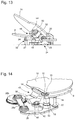
- FIG. 13 is a perspective view of the profile of the automaton when the upper wing of the butterfly is in its high position
- FIG. 14 is a perspective view of the automaton from the side of the lower wing
- FIG. 15 is a perspective view from below of the automaton
- FIG. 16 is a perspective view of the first member carrier carrying the first member
- FIG. 17 is a perspective view of the second member carrier with the second driving contact.
- FIG. 18 is a sectional view of the mechanism along the second axis when the upper wing of the butterfly is in its intermediate position, more particularly and in a non-limiting manner, when the second driving stud is located in vertical position in the middle of its angular course.
- the present invention relates to a timepiece 1 , for example a wristwatch, as represented in FIG. 1 , and comprising a dial 2 on which, in a standard manner, there are represented various signs, such as the hour, the minute, the second or any other suitable sign.
- the dial 2 defines an XY plane.
- the automaton 6 represents a butterfly comprising a lower wing, an upper wing and a body 12 , the first member 8 disposed nearest the dial 2 representing the lower wing and the second member 10 disposed furthest away from the dial 2 representing the upper wing, said second member 10 having a base 14 which extends substantially parallel to the longitudinal axis of the butterfly defined by the body 12 and simulates articulation of the upper wing with the body 12 of the butterfly.
- the butterfly is positioned on the dial as if it was “lying” on its lower wing.
- the first member 8 or lower wing is partially hidden by the second member 10 or upper wing so that the first member 8 has in fact substantially the form of a front wing of the butterfly, articulated at the level of its base 16 .
- the butterfly here does not comprise a lower rear wing in order not to make the construction unwieldy and to free the space for the remainder of the mechanism. It is very evident that it is however possible to represent entirely the first member suitably as a function of the arrangement of the other elements of the mechanism.
- the second member 10 or upper wing has a form reproducing the upper front wing and upper rear wing of the butterfly.
- the lower and upper wings are articulated in order to reproduce the beating of wings of a butterfly, whilst the body 12 of the butterfly is represented fixed on the dial 2 .
- automaton can represent a different animation, for example a different insect, a bird, etc., the wings of which are represented by the members 8 and 10 , an animal or any other person having two articulated members which produce beating movements.
- the first member 8 is provided in order to pivot about a first axis AA which is not parallel to the XY plane of the dial 2 and the second member 10 is provided in order to pivot about a second axis BB which is different from the first axis AA.
- the first axis AA is perpendicular to the XY plane of the dial 2 and the second axis BB is positioned in a plane parallel to the XY plane of the dial 2 , Furthermore, according to a particularly preferred embodiment as represented here, the first axis AA and the second axis BB are perpendicular and intersecting, disposed one relative to the other in such a way as to be able to position the first member 8 and the second member 10 in order to obtain an arrangement similar to that of the wings of a butterfly on both sides of the body 12 . It is very evident that the positioning of the axes AA and BB can be adapted as a function of the position of the articulated members of the chosen animation.
- the axis AA about which the first member 8 pivots is produced by a first shaft 18 with axis AA, integral with the first member 8 and mounted to pivot between a frame element 22 and an intermediate bridge 38 (cf. FIG. 3, 18 ) of the timepiece. Control of the axial movement of said first shaft 18 is achieved by a pipe 21 which is advantageously driven on said frame 22 .
- the axis BB about which the second member 10 pivots is the axis of a second shaft 20 , integral with the second member 10 , and mounted to pivot on a module 24 (cf. FIGS. 2, 13 and 18 ) fixed on the frame 22 of the timepiece.
- the module 24 is composed mainly of a module frame and a module bridge 25 , said second shaft 20 being assembled to pivot according to the axis BB between the module frame 23 and the module bridge 25 .
- Control of the axial movement of said second shaft 20 is achieved by a pipe 29 which is advantageously driven on said second shaft 20 , it being given that, for reasons of spatial requirement, neither the module frame 23 nor the module bridge 25 have control means such as a jewel bearing, pipe, or any other control means.
- the second shaft 20 with the second member 10 and the module 24 are advantageously assembled independently and are positioned so that the base 14 of the second member is coaxial (parallel) to the second axis BB so as to simulate an articulation.
- the driving mechanism of the automaton comprises actuation means of the first and second members 8 , 10 which are provided in order to make said first and second members 8 , 10 pivot respectively according to non-symmetrical pivoting movements and in order to coordinate said pivoting movements of said first and second members 8 , 10 so that the combination thereof gives a beating effect of said first and second members 8 , 10 .
- the actuation means of the first and second members 8 , 10 are provided in order to make the first member 8 pivot in a plane perpendicular to the first axis AA, and in order to make the second member 10 pivot about the second axis BB and to make it oscillate between a low position and a high position relative to the dial 2 .
- the second member 10 oscillates above the dial, which makes it possible to reduce the volume occupied by the members of the automaton in movement and to have compact automaton members.
- the second member 10 is provided in order to form, in its low position, an angle preferably less than 20°, and more preferably less than 10°, with the dial 2 , and so that its course is less than or equal to preferably 40°, and more preferably less than or equal to 30°, thus forming, in its high position, a maximum angle of 40° with the dial 2 .
- the first member 8 is provided so that its course is preferably less than 40°, more preferably less than 30°, so that its displacement likewise occupies a reduced volume.
- the actuation means of the first member 8 comprise a lever 26 which is provided in order to pivot about the axis AA, said lever being integral with the first member 8 in order to make the first member 8 pivot about the first axis AA during pivoting of the lever 26 .
- the lever 26 is integral with the first shaft 18 which is mounted to pivot about the first axis AA, the first member 8 being fixed on the first shaft 18 .
- the first member 8 is fixed on a first member carrier 32 which is integral with the lever 26 and more particularly with the first shaft 18 which is mounted to pivot about the first axis AA.
- the first member 8 is fixed to the first member carrier 32 by its base 16 by gluing, soldering, welding, screwing, etc.
- the first member carrier 32 comprises a pipe 33 which is mounted integrally and concentrically inside the first shaft 18 with axis AA, and fixed by means of a square-head screw 35 .
- Use of a square-head screw makes it possible to limit the risks of chewing with a square screwdriver bit during assembly of the first member, compared with a flat bit.
- the first member carrier 32 likewise comprises a first clip 34 which is integral with the pipe 33 , extending perpendicularly to the pipe 33 and on which the first member 8 rests.
- the surface of the first clip 34 in contact with the first member 8 is inclined in order to give the first member 8 the desired inclination.
- the first member 8 can be assembled for example by gluing, soldering, welding, screwing, etc. to this surface which is advantageously inclined in order to improve its retention.
- first retention stud 27 which is parallel to the first shaft 18 with axis AA, and integral, on the one hand, with the lever 26 and, on the other hand, with the first member 8 .
- the first retention stud 27 comprises, at its upper end, a shoulder 36 on which the ends of the first clip 34 rest so that the upper end projecting from the first retention stud 27 is caught by the ends of the first clip 34 .
- This assembly makes it possible to confer a certain flexibility to the first clip 34 , said clip 34 eliminating any possible play, and to be able to dismantle the assembly if necessary, without the restriction of the number of possible assembly/dismantling cycles.
- the lower end of the first retention stud 27 is fixed integrally to the lever 26 so as to pivot in one piece with the lever 26 , the first shaft 18 , the first member carrier 32 and the first member 8 about the first axis AA.
- the intermediate bridge 38 (cf. FIG.
- first shaft 18 parallel to the lever 26 and perpendicular to the axis AA, is passed through by the first shaft 18 and has an oblong opening or gap 40 in which the first retention stud 17 travels freely when it pivots with the lever 26 relative to the axis AA.
- the actuation means of the second member 10 comprise a second driving stud 42 , a first end of which is integral with the second member 10 , as will be described hereafter, and provided in order to make the second member 10 oscillate between its low position and its high position (relative to the dial 2 ) about the second axis BB.
- the second driving stud 42 comprises, at a second end, a sphere 44 which is provided to be mounted by a spherical linkage in a gap 46 provided on the free end 47 of the lever 26 , and on which the sphere 44 can roll so as to make the second member 10 oscillate about the second axis BB during pivoting of the lever 26 about the first axis AA.
- the second member 10 is fixed on a second member carrier 48 which is integral, on the one hand, with the second shaft 20 and, on the other hand, with the second driving stud 42 .
- the second member carrier 48 comprises a socket 49 in which the second shaft 20 is fixed, for example by driving, according to the axis BB, and in which there is likewise fixed the first end of the second driving stud 42 , perpendicularly to the second shaft 20 .
- Said second member carrier 48 likewise comprises a second clip 50 , integral with the socket 49 and on which the second member 10 is mounted.
- the second member 10 has, on its lower face, a fastening 52 of a shape which is complementary to the second clip 50 and provided in order to be able to slide in the second clip 50 and to be housed there.
- This assembly makes it possible to confer a certain flexibility to the second clip 50 and to be able to dismantle and reassemble, at wish, the assembly if necessary.
- the socket 49 has inclined faces so as to give the second member 10 the desired inclination.
- the second member 10 can be assembled for example by gluing, soldering, welding, screwing to this advantageously inclined surface in order to improve its retention.
- the second member 10 is mounted in the second clip 50 such that its edge 14 is parallel to the second shaft 20 .
- the fastener 52 is fixed to the second clip 50 by means of a square-head screw 54 .
- Use of a square-head screw makes it possible to limit the risks of chewing with a square tip screwdriver bit during assembly of the second member, compared with a flat tip.
- the second member carrier 48 carries a counterweight 56 .
- This counterweight 56 comprises a socket assembled under the socket 49 of the second member carrier 48 so that it is passed through by the second driving stud 42 .
- the object of the counterweight is to balance the second member carrier 48 and to avoid a very high imbalance during oscillations or changes in orientation of the wristwatch, inevitably subjected to these variations.
- the lever 26 is actuated by a connecting rod device 28 a , 28 b which is provided in order to transform a continuous circular movement of a mobile part 30 of the timepiece into an alternating circular movement.
- This connecting rod device is known to the person skilled in the art and requires no detailed description. It is very evident that any other mechanism which makes it possible to make the lever 26 pivot and oscillate about the first axis AA of the first shaft 18 can be used.
- the same lever 26 is used advantageously in order to make the two members 8 and 10 pivot. It is very evident that it is possible to provide two systems for pivotal driving of the first and second members 8 , 10 provided in order to allow said members 8 , 10 to pivot independently, and to obtain combined movements which are equivalent to the mechanism described in the present example.
- the automaton 6 and also the wheel 4 can be supplied with power by autonomous power accumulators, independent of the power accumulator of the movement.
- the wheel 4 is driven in as if it concerned a needle on the pinion of an idle wheel and can be driven by an independent spring barrel, its speed being regulated by a regulator.
- the automaton 6 and the wheel 4 can be set in motion and stopped by an actuation mechanism which is independent of the movement of the timepiece.
- the wheel 4 turns on itself simultaneously with the animation of the automaton 6 .
- the wheel 4 can be driven continuously with the base movement.
- this actuation mechanism comprises a push crown 58 provided with a push button STOP & GO which allows action (GO) and stoppage of the automaton (STOP) on demand by the user.
- the actuation mechanism of the automaton likewise comprises a wheel with columns, positioned at rest by an anti-return catch spring, cooperating, on the one hand, with a lever actuated by the push button and, on the other hand, with a blocking lever provided in order to block the connecting rod device.
- the actuation mechanism is provided so that the blocking lever locks the automaton as soon as it presses against a wheel with a specific profile, with a hard point, prioritising stoppage when the second member reaches the low position thereof.
- the current beating continues until the second member of the automaton is in low position.
- the operation of the automaton according to the invention is the following: upon stoppage, the elements of the automaton occupy the positions illustrated by FIGS. 1 to 4 .
- the lever 26 is positioned so that the first retention stud 27 is situated on the left side of the gap 40 (according to FIG. 2 ) and such that the second driving stud 42 is inclined as if it was moving away from the body of the butterfly such that the second member 10 or upper wing is in its low position, nearest the dial. In this “low” position, the wings of the butterfly seem closed, the first member 8 or lower wing appearing just behind the second member 10 or upper wing.
- the connecting rod device 28 a , 28 b When the push button is actuated, the connecting rod device 28 a , 28 b is freed so that the lever 26 pivots about the first axis AA, for example in clockwise direction according to the non-limiting example illustrated here, driving the first member 8 with its retention stud 27 and the second driving stud 42 into intermediate positions, as illustrated in FIGS. 5 to 8 . More precisely, the lever 26 pivots, here in clockwise direction, about the first axis AA, in one piece with the first shaft 18 , the first member carrier 32 carrying the member 8 or lower wing, and the first retention stud 27 which is displaced into the gap 40 .
- the first retention stud 27 by acting on the first clip 34 , makes it possible to secure the system, whilst avoiding unscrewing the first member carrier and absorbing any possible impacts and vibrations which will therefore not be transmitted to the thread.
- the first member 8 or lower wing pivots here in clockwise direction to appear advantageously behind the upper wing, as is shown in FIG. 5 .
- the free end 47 of the lever 26 is displaced driving the second driving stud 42 by its sphere 44 so that said second driving stud 42 pivots in the gap 46 .
- This pivoting of the second driving stud 42 integral with the socket 49 mounted on the module 24 , drives the pivoting of the second member carrier 48 and of its shaft 20 into the module 24 about the second axis BB such that, as is shown in FIG. 8 , the counterweight 56 integral with the socket 49 moves away from the body 12 , and the second member 10 or upper wing opens, its free end moving away here from the dial, into its intermediate position.
- the lever 26 continues to pivot about the first axis AA, here in clockwise direction, driving the first member 8 with its retention stud 27 and the second driving stud 42 in order to reach the “high” position, as illustrated in FIGS. 9 to 12 .
- the lever 26 continues to pivot in one piece about the first axis AA, and here in clockwise direction, with the first shaft 18 , the first member carrier 32 , the member 8 or lower wing, and the first retention stud 27 which continues to be displaced freely here in clockwise direction into the gap 40 in order to reach its right side, according to FIG. 10 .
- the first member 8 or lower wing always pivots here in clockwise direction in order to appear again advantageously behind the upper wing, as shown in FIG. 9 .
- the free end 47 of the lever 26 is again displaced driving the second driving stud 42 by its sphere 44 so that said second driving stud 42 continues to pivot into the gap 46 .
- This pivoting of the second driving stud 42 , integral with the socket 49 mounted on the module 24 again drives the pivoting of the second member carrier 48 and its shaft 20 into the module 24 about the second axis BB such that, as shown in FIG. 12 , the counterweight 56 which is integral with the socket 49 moves away more from the body 12 , the second member 10 or upper wing opening more, the free end thereof moving away even more from the dial 2 until reaching its “high” position.
- This first part of the cycle corresponds to the “opening phase” of the wings of the butterfly according to which the lower wing appears progressively behind the upper wing and the upper wing opens, the outer edge thereof moving away from the dial.
- the opening phase and closing phase cycles are linked continuously in order to create an impression of butterfly wings beating until voluntary stoppage of the automaton by pressing on the push button or until there is no longer sufficient power to drive the automaton.
- the connecting rod device is provided in order to give the first and second members a speed profile of a sinusoidal form during beating, which is adapted perfectly to the movement of the wings of a butterfly, the speeds progressing gradually.
- the automaton mechanism according to the invention which is able to reproduce the beating of two members, in order to simulate in particular the beating of wings, is particularly compact. This makes it possible to produce a more visual automaton without impairing the surface which remains available on the dial, which is particularly advantageous when the timepiece is a wristwatch.
- the construction according to the invention is likewise particularly advantageous in order to make it possible to use a dial with restricted opening in order to hide, as far as possible, the mechanism for actuating the automaton.
- the only elements which pass through the dial are the member carriers.
- the construction of the invention with a single screw makes it possible to block all the degrees of freedom of the wings once they are made integral with the member carriers.
- the automaton is produced by assembling firstly the lever 26 with the first shaft 18 between the frame 22 and the intermediate bridge 38 , then the rod 28 a between the connecting rod 28 b and the lever 26 .
- the second member carrier 48 without the upper wing 10 is assembled in the module 24 .
- the dial 2 is fixed on the frame 22 , the dial having adjacent openings of dimensions which correspond to the spatial requirement which the first member carrier 32 and the second member carrier 48 , including module 24 , represent.
- the first member carrier 32 with the lower wing 8 is fixed on the first shaft 18 provided on the lever 26 by means of a screw, preferably with a square head, in order not to risk spoiling the dial 2 and finally the upper wing 10 on the second member carrier 48 by means of a screw, preferably with a square head in order not to risk spoiling the dial.
- This assembly is necessary in the particular case of the example described here in which the upper wing covers the lower wing at least partially.
- the automaton mechanism according to the invention likewise makes it possible to obtain very good efficiency and to have an instantaneous achieved torque which is low and constant.
- the automaton mechanism according to the invention comprises no system oscillating by meshing. It has therefore no play and consequently no jolting.
- the second member is counterbalanced with a counterweight, which counterbalances imbalances.
- the components of the automaton are therefore not sensitive to spatial positions of the timepiece, in particular when a wristwatch is concerned.
- it is not necessary to use a return spring which makes it possible to reduce the torque necessary for transmission, and to have a more constant torque.
- the only torque which is necessary is due to acceleration of the components and to their inertia relative to their axis of rotation.
- the lever and the driving studs always operate with an angle composed preferably between 70° and 90° when the course of the second member 10 is 40°, and more preferably between 75° and 90°, when the course of the second member 10 is 30°, which is ideal for transmission.
- the geometric efficiencies in these limited angles fluctuate between 96 and 100%, the passive torques to be overcome being very low because of the absence of a return spring.
Landscapes
- Physics & Mathematics (AREA)
- General Physics & Mathematics (AREA)
- Life Sciences & Earth Sciences (AREA)
- Sustainable Development (AREA)
- Toys (AREA)
- Electric Clocks (AREA)
Abstract
Description
Claims (19)
Applications Claiming Priority (3)
| Application Number | Priority Date | Filing Date | Title |
|---|---|---|---|
| EP17161685 | 2017-03-17 | ||
| EP17161685.7 | 2017-03-17 | ||
| EP17161685.7A EP3376307B1 (en) | 2017-03-17 | 2017-03-17 | Timepiece comprising an automaton capable of reproducing wing beats |
Publications (2)
| Publication Number | Publication Date |
|---|---|
| US20180267477A1 US20180267477A1 (en) | 2018-09-20 |
| US10996633B2 true US10996633B2 (en) | 2021-05-04 |
Family
ID=58358507
Family Applications (1)
| Application Number | Title | Priority Date | Filing Date |
|---|---|---|---|
| US15/920,749 Active 2039-09-12 US10996633B2 (en) | 2017-03-17 | 2018-03-14 | Timepiece comprising an automaton which is able to reproduce beating of wings |
Country Status (6)
| Country | Link |
|---|---|
| US (1) | US10996633B2 (en) |
| EP (1) | EP3376307B1 (en) |
| JP (1) | JP6560780B2 (en) |
| CN (1) | CN108628141B (en) |
| CH (1) | CH713581B1 (en) |
| RU (1) | RU2760420C2 (en) |
Families Citing this family (2)
| Publication number | Priority date | Publication date | Assignee | Title |
|---|---|---|---|---|
| CH713581B1 (en) * | 2017-03-17 | 2024-08-15 | Montres Jaquet Droz Sa | Timepiece comprising an automaton capable of reproducing wing beats. |
| EP3712712B1 (en) * | 2019-03-18 | 2021-10-20 | Montres Jaquet Droz SA | Dial for a timepiece provided with a three-dimensional decoration |
Citations (13)
| Publication number | Priority date | Publication date | Assignee | Title |
|---|---|---|---|---|
| US1534901A (en) | 1924-06-27 | 1925-04-21 | Bonthoux Alphonse | Ornamental clock |
| US3148500A (en) * | 1963-01-29 | 1964-09-15 | Hayes Thomas | Animated clock |
| US4421421A (en) * | 1982-02-23 | 1983-12-20 | Bradt Gordon E | Kinetic clock sculpture |
| US6208592B1 (en) * | 1998-12-02 | 2001-03-27 | Russell S. Turner | Clock with novelty hands |
| JP2002243013A (en) | 2001-02-20 | 2002-08-28 | Rhythm Watch Co Ltd | Trick-action device and clock using this device |
| WO2006036660A2 (en) * | 2004-09-27 | 2006-04-06 | Roger Cook | Moving ornamental design element |
| US20080239884A1 (en) * | 2007-03-30 | 2008-10-02 | Seiko Clock Inc. | Timepiece having openable and closable dial plate |
| US7969824B2 (en) * | 2006-08-01 | 2011-06-28 | Agenhor Sa | Timepiece movement for driving a display element along a complex path and timepiece comprising such a movement |
| WO2013053906A1 (en) | 2011-10-15 | 2013-04-18 | Paul Hartzband | Timepiece |
| CH706771A2 (en) | 2012-07-31 | 2014-01-31 | Montres Jaquet Droz S A | Wristwatch equipped with an animation above the dial. |
| US20140313868A1 (en) * | 2013-04-23 | 2014-10-23 | Seiko Clock Inc. | Timepiece |
| US20170242400A1 (en) * | 2016-02-18 | 2017-08-24 | Blancpain Sa | Retrograde timepiece display with a retractable hand |
| US20180267477A1 (en) * | 2017-03-17 | 2018-09-20 | Montres Jaquet Droz Sa | Timepiece comprising an automaton which is able to reproduce beating of wings |
Family Cites Families (5)
| Publication number | Priority date | Publication date | Assignee | Title |
|---|---|---|---|---|
| SU1760529A1 (en) * | 1989-09-01 | 1992-09-07 | В.П. Родин | Alarm clock |
| TW369167U (en) * | 1998-12-11 | 1999-09-01 | Masateru Takahira | Magnetic couple clock that can swing to-and-fro and up-and-down |
| CN202975610U (en) | 2012-11-27 | 2013-06-05 | 森迪工业股份有限公司 | Clock with swing ornament |
| EP2977832B1 (en) * | 2014-07-23 | 2017-08-30 | The Swatch Group Research and Development Ltd. | Timepiece capable of indicating the sunrise or sunset at any point on the globe |
| EP3007012B1 (en) * | 2014-10-07 | 2017-08-16 | The Swatch Group Research and Development Ltd. | Timepiece capable of indicating the sunrise or sunset at any point on the globe |
-
2017
- 2017-03-17 CH CH000331/2017A patent/CH713581B1/en unknown
- 2017-03-17 EP EP17161685.7A patent/EP3376307B1/en active Active
-
2018
- 2018-03-08 JP JP2018041499A patent/JP6560780B2/en active Active
- 2018-03-14 US US15/920,749 patent/US10996633B2/en active Active
- 2018-03-15 RU RU2018109288A patent/RU2760420C2/en active
- 2018-03-16 CN CN201810217114.XA patent/CN108628141B/en active Active
Patent Citations (16)
| Publication number | Priority date | Publication date | Assignee | Title |
|---|---|---|---|---|
| US1534901A (en) | 1924-06-27 | 1925-04-21 | Bonthoux Alphonse | Ornamental clock |
| US3148500A (en) * | 1963-01-29 | 1964-09-15 | Hayes Thomas | Animated clock |
| US4421421A (en) * | 1982-02-23 | 1983-12-20 | Bradt Gordon E | Kinetic clock sculpture |
| US6208592B1 (en) * | 1998-12-02 | 2001-03-27 | Russell S. Turner | Clock with novelty hands |
| JP2002243013A (en) | 2001-02-20 | 2002-08-28 | Rhythm Watch Co Ltd | Trick-action device and clock using this device |
| WO2006036660A2 (en) * | 2004-09-27 | 2006-04-06 | Roger Cook | Moving ornamental design element |
| US7969824B2 (en) * | 2006-08-01 | 2011-06-28 | Agenhor Sa | Timepiece movement for driving a display element along a complex path and timepiece comprising such a movement |
| US20080239884A1 (en) * | 2007-03-30 | 2008-10-02 | Seiko Clock Inc. | Timepiece having openable and closable dial plate |
| WO2013053906A1 (en) | 2011-10-15 | 2013-04-18 | Paul Hartzband | Timepiece |
| US20140307532A1 (en) * | 2011-10-15 | 2014-10-16 | Paul Hartzband | Timepiece |
| US20160103422A1 (en) | 2011-10-15 | 2016-04-14 | Paul Hartzband | Jewellery item |
| CH706771A2 (en) | 2012-07-31 | 2014-01-31 | Montres Jaquet Droz S A | Wristwatch equipped with an animation above the dial. |
| US20150205264A1 (en) * | 2012-07-31 | 2015-07-23 | Montres Jaquet Droz Sa | Wristwatch fitted with an animation above the dial |
| US20140313868A1 (en) * | 2013-04-23 | 2014-10-23 | Seiko Clock Inc. | Timepiece |
| US20170242400A1 (en) * | 2016-02-18 | 2017-08-24 | Blancpain Sa | Retrograde timepiece display with a retractable hand |
| US20180267477A1 (en) * | 2017-03-17 | 2018-09-20 | Montres Jaquet Droz Sa | Timepiece comprising an automaton which is able to reproduce beating of wings |
Non-Patent Citations (1)
| Title |
|---|
| European Search Report dated Sep. 5, 2017, issued in European Application EP 17161685.7, filed Mar. 17, 2017 (with English Translation of Categories of Cited Documents). |
Also Published As
| Publication number | Publication date |
|---|---|
| US20180267477A1 (en) | 2018-09-20 |
| JP6560780B2 (en) | 2019-08-14 |
| RU2018109288A (en) | 2019-09-16 |
| CH713581A2 (en) | 2018-09-28 |
| EP3376307B1 (en) | 2021-06-23 |
| JP2018155743A (en) | 2018-10-04 |
| CN108628141A (en) | 2018-10-09 |
| RU2018109288A3 (en) | 2021-06-04 |
| RU2760420C2 (en) | 2021-11-24 |
| CN108628141B (en) | 2020-07-03 |
| CH713581B1 (en) | 2024-08-15 |
| EP3376307A1 (en) | 2018-09-19 |
Similar Documents
| Publication | Publication Date | Title |
|---|---|---|
| US7974156B2 (en) | Movement for timepiece with retrograde display | |
| RU2749944C2 (en) | Mechanical watchwork with a resonator having two degrees of freedom, and with a supporting mechanism using a runner moving along the track | |
| RU2703096C1 (en) | Adjusting clock mechanism with magnetically synchronized rotary levers | |
| JP2013524173A (en) | Gear fixing device | |
| CN107092180B (en) | Inverse jump watch indication mechanism with telescopic pointer | |
| US20180267477A1 (en) | Timepiece comprising an automaton which is able to reproduce beating of wings | |
| RU2749943C2 (en) | Resonator for mechanical watches | |
| CN107976890B (en) | The stem-winder of rotary harmonic device whens with insensitive equal in position | |
| US9921546B2 (en) | Timepiece mechanism comprising a pivoting member provided with magnetic return means | |
| JP2021189163A (en) | Horological display mechanism with elastic hand | |
| JP2017515119A (en) | Method for synchronizing two timer oscillators with one gear train | |
| JP7292591B2 (en) | Escapement mechanism with locking pallet and timepiece with such an escapement mechanism | |
| CN103907065A (en) | clock | |
| US11892806B2 (en) | Oscillating weight with variable geometry for a timepiece mechanism | |
| HK1260950A1 (en) | Timepiece comprising an automaton which is able to reproduce beating of wings | |
| HK1260950B (en) | Timepiece comprising an automaton which is able to reproduce beating of wings | |
| CN209417525U (en) | Intermittent reciprocating mechanism suitable for watch | |
| CN111258202B (en) | Intermittent reciprocating motion mechanism suitable for wrist-watch | |
| JP2020073908A (en) | Timepiece oscillator with flexible guide member with large angular stroke | |
| CN103064276B (en) | Double-eccentric mechanical watch | |
| CN203287689U (en) | Balance-wheel hairspring mechanism for mechanical watch, and mechanical watch having the same | |
| CN114080572B (en) | Oscillator for a watch movement and watch comprising such an oscillator | |
| JPS641669Y2 (en) | ||
| JP3771405B2 (en) | Pendulum mechanism | |
| JPH028236Y2 (en) |
Legal Events
| Date | Code | Title | Description |
|---|---|---|---|
| AS | Assignment |
Owner name: MONTRES JAQUET DROZ SA, SWITZERLAND Free format text: ASSIGNMENT OF ASSIGNORS INTEREST;ASSIGNORS:MONFERRER, BERNAT;CAPT, EDMOND;REEL/FRAME:045594/0542 Effective date: 20180212 |
|
| FEPP | Fee payment procedure |
Free format text: ENTITY STATUS SET TO UNDISCOUNTED (ORIGINAL EVENT CODE: BIG.); ENTITY STATUS OF PATENT OWNER: LARGE ENTITY |
|
| STPP | Information on status: patent application and granting procedure in general |
Free format text: DOCKETED NEW CASE - READY FOR EXAMINATION |
|
| STPP | Information on status: patent application and granting procedure in general |
Free format text: RESPONSE TO NON-FINAL OFFICE ACTION ENTERED AND FORWARDED TO EXAMINER |
|
| STPP | Information on status: patent application and granting procedure in general |
Free format text: NOTICE OF ALLOWANCE MAILED -- APPLICATION RECEIVED IN OFFICE OF PUBLICATIONS |
|
| STPP | Information on status: patent application and granting procedure in general |
Free format text: PUBLICATIONS -- ISSUE FEE PAYMENT RECEIVED |
|
| STPP | Information on status: patent application and granting procedure in general |
Free format text: PUBLICATIONS -- ISSUE FEE PAYMENT VERIFIED |
|
| STCF | Information on status: patent grant |
Free format text: PATENTED CASE |
|
| CC | Certificate of correction | ||
| MAFP | Maintenance fee payment |
Free format text: PAYMENT OF MAINTENANCE FEE, 4TH YEAR, LARGE ENTITY (ORIGINAL EVENT CODE: M1551); ENTITY STATUS OF PATENT OWNER: LARGE ENTITY Year of fee payment: 4 |