US10991695B2 - Method for manufacturing semiconductor device - Google Patents

Method for manufacturing semiconductor device Download PDF

Info

Publication number
US10991695B2
US10991695B2 US16/206,779 US201816206779A US10991695B2 US 10991695 B2 US10991695 B2 US 10991695B2 US 201816206779 A US201816206779 A US 201816206779A US 10991695 B2 US10991695 B2 US 10991695B2
Authority
US
United States
Prior art keywords
layer
gate dielectric
dielectric layer
channel
over
Prior art date
Legal status (The legal status is an assumption and is not a legal conclusion. Google has not performed a legal analysis and makes no representation as to the accuracy of the status listed.)
Active
Application number
US16/206,779
Other versions
US20190115348A1 (en
Inventor
Chia-Yuan Chang
Xiong-Fei Yu
Hui-Cheng Chang
Current Assignee (The listed assignees may be inaccurate. Google has not performed a legal analysis and makes no representation or warranty as to the accuracy of the list.)
Taiwan Semiconductor Manufacturing Co TSMC Ltd
Original Assignee
Taiwan Semiconductor Manufacturing Co TSMC Ltd
Priority date (The priority date is an assumption and is not a legal conclusion. Google has not performed a legal analysis and makes no representation as to the accuracy of the date listed.)
Filing date
Publication date
Application filed by Taiwan Semiconductor Manufacturing Co TSMC Ltd filed Critical Taiwan Semiconductor Manufacturing Co TSMC Ltd
Priority to US16/206,779 priority Critical patent/US10991695B2/en
Assigned to TAIWAN SEMICONDUCTOR MANUFACTURING CO., LTD. reassignment TAIWAN SEMICONDUCTOR MANUFACTURING CO., LTD. ASSIGNMENT OF ASSIGNORS INTEREST (SEE DOCUMENT FOR DETAILS). Assignors: YU, Xiong-fei, CHANG, CHIA-YUAN, CHANG, HUI-CHENG
Publication of US20190115348A1 publication Critical patent/US20190115348A1/en
Application granted granted Critical
Publication of US10991695B2 publication Critical patent/US10991695B2/en
Active legal-status Critical Current
Anticipated expiration legal-status Critical

Links

Images

Classifications

    • H01L27/0924
    • HELECTRICITY
    • H10SEMICONDUCTOR DEVICES; ELECTRIC SOLID-STATE DEVICES NOT OTHERWISE PROVIDED FOR
    • H10DINORGANIC ELECTRIC SEMICONDUCTOR DEVICES
    • H10D84/00Integrated devices formed in or on semiconductor substrates that comprise only semiconducting layers, e.g. on Si wafers or on GaAs-on-Si wafers
    • H10D84/80Integrated devices formed in or on semiconductor substrates that comprise only semiconducting layers, e.g. on Si wafers or on GaAs-on-Si wafers characterised by the integration of at least one component covered by groups H10D12/00 or H10D30/00, e.g. integration of IGFETs
    • H10D84/82Integrated devices formed in or on semiconductor substrates that comprise only semiconducting layers, e.g. on Si wafers or on GaAs-on-Si wafers characterised by the integration of at least one component covered by groups H10D12/00 or H10D30/00, e.g. integration of IGFETs of only field-effect components
    • H10D84/83Integrated devices formed in or on semiconductor substrates that comprise only semiconducting layers, e.g. on Si wafers or on GaAs-on-Si wafers characterised by the integration of at least one component covered by groups H10D12/00 or H10D30/00, e.g. integration of IGFETs of only field-effect components of only insulated-gate FETs [IGFET]
    • H10D84/85Complementary IGFETs, e.g. CMOS
    • H10D84/853Complementary IGFETs, e.g. CMOS comprising FinFETs
    • BPERFORMING OPERATIONS; TRANSPORTING
    • B82NANOTECHNOLOGY
    • B82YSPECIFIC USES OR APPLICATIONS OF NANOSTRUCTURES; MEASUREMENT OR ANALYSIS OF NANOSTRUCTURES; MANUFACTURE OR TREATMENT OF NANOSTRUCTURES
    • B82Y10/00Nanotechnology for information processing, storage or transmission, e.g. quantum computing or single electron logic
    • HELECTRICITY
    • H01ELECTRIC ELEMENTS
    • H01LSEMICONDUCTOR DEVICES NOT COVERED BY CLASS H10
    • H01L21/00Processes or apparatus adapted for the manufacture or treatment of semiconductor or solid state devices or of parts thereof
    • H01L21/02Manufacture or treatment of semiconductor devices or of parts thereof
    • H01L21/02104Forming layers
    • H01L21/02365Forming inorganic semiconducting materials on a substrate
    • H01L21/02518Deposited layers
    • H01L21/02521Materials
    • H01L21/02524Group 14 semiconducting materials
    • H01L21/02532Silicon, silicon germanium, germanium
    • HELECTRICITY
    • H01ELECTRIC ELEMENTS
    • H01LSEMICONDUCTOR DEVICES NOT COVERED BY CLASS H10
    • H01L21/00Processes or apparatus adapted for the manufacture or treatment of semiconductor or solid state devices or of parts thereof
    • H01L21/02Manufacture or treatment of semiconductor devices or of parts thereof
    • H01L21/02104Forming layers
    • H01L21/02365Forming inorganic semiconducting materials on a substrate
    • H01L21/02518Deposited layers
    • H01L21/02521Materials
    • H01L21/02538Group 13/15 materials
    • HELECTRICITY
    • H01ELECTRIC ELEMENTS
    • H01LSEMICONDUCTOR DEVICES NOT COVERED BY CLASS H10
    • H01L21/00Processes or apparatus adapted for the manufacture or treatment of semiconductor or solid state devices or of parts thereof
    • H01L21/02Manufacture or treatment of semiconductor devices or of parts thereof
    • H01L21/04Manufacture or treatment of semiconductor devices or of parts thereof the devices having potential barriers, e.g. a PN junction, depletion layer or carrier concentration layer
    • H01L21/18Manufacture or treatment of semiconductor devices or of parts thereof the devices having potential barriers, e.g. a PN junction, depletion layer or carrier concentration layer the devices having semiconductor bodies comprising elements of Group IV of the Periodic Table or AIIIBV compounds with or without impurities, e.g. doping materials
    • H01L21/30Treatment of semiconductor bodies using processes or apparatus not provided for in groups H01L21/20 - H01L21/26
    • H01L21/31Treatment of semiconductor bodies using processes or apparatus not provided for in groups H01L21/20 - H01L21/26 to form insulating layers thereon, e.g. for masking or by using photolithographic techniques; After treatment of these layers; Selection of materials for these layers
    • H01L21/3105After-treatment
    • H01L21/3115Doping the insulating layers
    • H01L21/823807
    • H01L21/8258
    • H01L29/0673
    • H01L29/068
    • H01L29/161
    • H01L29/42392
    • H01L29/4966
    • H01L29/511
    • H01L29/517
    • H01L29/66439
    • H01L29/66545
    • H01L29/775
    • H01L29/78696
    • HELECTRICITY
    • H10SEMICONDUCTOR DEVICES; ELECTRIC SOLID-STATE DEVICES NOT OTHERWISE PROVIDED FOR
    • H10DINORGANIC ELECTRIC SEMICONDUCTOR DEVICES
    • H10D30/00Field-effect transistors [FET]
    • H10D30/01Manufacture or treatment
    • H10D30/014Manufacture or treatment of FETs having zero-dimensional [0D] or one-dimensional [1D] channels, e.g. quantum wire FETs, single-electron transistors [SET] or Coulomb blockade transistors
    • HELECTRICITY
    • H10SEMICONDUCTOR DEVICES; ELECTRIC SOLID-STATE DEVICES NOT OTHERWISE PROVIDED FOR
    • H10DINORGANIC ELECTRIC SEMICONDUCTOR DEVICES
    • H10D30/00Field-effect transistors [FET]
    • H10D30/40FETs having zero-dimensional [0D], one-dimensional [1D] or two-dimensional [2D] charge carrier gas channels
    • H10D30/43FETs having zero-dimensional [0D], one-dimensional [1D] or two-dimensional [2D] charge carrier gas channels having 1D charge carrier gas channels, e.g. quantum wire FETs or transistors having 1D quantum-confined channels
    • HELECTRICITY
    • H10SEMICONDUCTOR DEVICES; ELECTRIC SOLID-STATE DEVICES NOT OTHERWISE PROVIDED FOR
    • H10DINORGANIC ELECTRIC SEMICONDUCTOR DEVICES
    • H10D30/00Field-effect transistors [FET]
    • H10D30/60Insulated-gate field-effect transistors [IGFET]
    • H10D30/67Thin-film transistors [TFT]
    • H10D30/6729Thin-film transistors [TFT] characterised by the electrodes
    • H10D30/673Thin-film transistors [TFT] characterised by the electrodes characterised by the shapes, relative sizes or dispositions of the gate electrodes
    • H10D30/6735Thin-film transistors [TFT] characterised by the electrodes characterised by the shapes, relative sizes or dispositions of the gate electrodes having gates fully surrounding the channels, e.g. gate-all-around
    • HELECTRICITY
    • H10SEMICONDUCTOR DEVICES; ELECTRIC SOLID-STATE DEVICES NOT OTHERWISE PROVIDED FOR
    • H10DINORGANIC ELECTRIC SEMICONDUCTOR DEVICES
    • H10D30/00Field-effect transistors [FET]
    • H10D30/60Insulated-gate field-effect transistors [IGFET]
    • H10D30/67Thin-film transistors [TFT]
    • H10D30/6757Thin-film transistors [TFT] characterised by the structure of the channel, e.g. transverse or longitudinal shape or doping profile
    • HELECTRICITY
    • H10SEMICONDUCTOR DEVICES; ELECTRIC SOLID-STATE DEVICES NOT OTHERWISE PROVIDED FOR
    • H10DINORGANIC ELECTRIC SEMICONDUCTOR DEVICES
    • H10D62/00Semiconductor bodies, or regions thereof, of devices having potential barriers
    • H10D62/10Shapes, relative sizes or dispositions of the regions of the semiconductor bodies; Shapes of the semiconductor bodies
    • H10D62/117Shapes of semiconductor bodies
    • H10D62/118Nanostructure semiconductor bodies
    • H10D62/119Nanowire, nanosheet or nanotube semiconductor bodies
    • H10D62/121Nanowire, nanosheet or nanotube semiconductor bodies oriented parallel to substrates
    • HELECTRICITY
    • H10SEMICONDUCTOR DEVICES; ELECTRIC SOLID-STATE DEVICES NOT OTHERWISE PROVIDED FOR
    • H10DINORGANIC ELECTRIC SEMICONDUCTOR DEVICES
    • H10D62/00Semiconductor bodies, or regions thereof, of devices having potential barriers
    • H10D62/10Shapes, relative sizes or dispositions of the regions of the semiconductor bodies; Shapes of the semiconductor bodies
    • H10D62/117Shapes of semiconductor bodies
    • H10D62/118Nanostructure semiconductor bodies
    • H10D62/119Nanowire, nanosheet or nanotube semiconductor bodies
    • H10D62/123Nanowire, nanosheet or nanotube semiconductor bodies comprising junctions
    • HELECTRICITY
    • H10SEMICONDUCTOR DEVICES; ELECTRIC SOLID-STATE DEVICES NOT OTHERWISE PROVIDED FOR
    • H10DINORGANIC ELECTRIC SEMICONDUCTOR DEVICES
    • H10D62/00Semiconductor bodies, or regions thereof, of devices having potential barriers
    • H10D62/80Semiconductor bodies, or regions thereof, of devices having potential barriers characterised by the materials
    • H10D62/83Semiconductor bodies, or regions thereof, of devices having potential barriers characterised by the materials being Group IV materials, e.g. B-doped Si or undoped Ge
    • H10D62/832Semiconductor bodies, or regions thereof, of devices having potential barriers characterised by the materials being Group IV materials, e.g. B-doped Si or undoped Ge being Group IV materials comprising two or more elements, e.g. SiGe
    • HELECTRICITY
    • H10SEMICONDUCTOR DEVICES; ELECTRIC SOLID-STATE DEVICES NOT OTHERWISE PROVIDED FOR
    • H10DINORGANIC ELECTRIC SEMICONDUCTOR DEVICES
    • H10D64/00Electrodes of devices having potential barriers
    • H10D64/01Manufacture or treatment
    • H10D64/017Manufacture or treatment using dummy gates in processes wherein at least parts of the final gates are self-aligned to the dummy gates, i.e. replacement gate processes
    • HELECTRICITY
    • H10SEMICONDUCTOR DEVICES; ELECTRIC SOLID-STATE DEVICES NOT OTHERWISE PROVIDED FOR
    • H10DINORGANIC ELECTRIC SEMICONDUCTOR DEVICES
    • H10D64/00Electrodes of devices having potential barriers
    • H10D64/60Electrodes characterised by their materials
    • H10D64/66Electrodes having a conductor capacitively coupled to a semiconductor by an insulator, e.g. MIS electrodes
    • H10D64/667Electrodes having a conductor capacitively coupled to a semiconductor by an insulator, e.g. MIS electrodes the conductor comprising a layer of alloy material, compound material or organic material contacting the insulator, e.g. TiN workfunction layers
    • HELECTRICITY
    • H10SEMICONDUCTOR DEVICES; ELECTRIC SOLID-STATE DEVICES NOT OTHERWISE PROVIDED FOR
    • H10DINORGANIC ELECTRIC SEMICONDUCTOR DEVICES
    • H10D64/00Electrodes of devices having potential barriers
    • H10D64/60Electrodes characterised by their materials
    • H10D64/66Electrodes having a conductor capacitively coupled to a semiconductor by an insulator, e.g. MIS electrodes
    • H10D64/68Electrodes having a conductor capacitively coupled to a semiconductor by an insulator, e.g. MIS electrodes characterised by the insulator, e.g. by the gate insulator
    • H10D64/681Electrodes having a conductor capacitively coupled to a semiconductor by an insulator, e.g. MIS electrodes characterised by the insulator, e.g. by the gate insulator having a compositional variation, e.g. multilayered
    • HELECTRICITY
    • H10SEMICONDUCTOR DEVICES; ELECTRIC SOLID-STATE DEVICES NOT OTHERWISE PROVIDED FOR
    • H10DINORGANIC ELECTRIC SEMICONDUCTOR DEVICES
    • H10D64/00Electrodes of devices having potential barriers
    • H10D64/60Electrodes characterised by their materials
    • H10D64/66Electrodes having a conductor capacitively coupled to a semiconductor by an insulator, e.g. MIS electrodes
    • H10D64/68Electrodes having a conductor capacitively coupled to a semiconductor by an insulator, e.g. MIS electrodes characterised by the insulator, e.g. by the gate insulator
    • H10D64/691Electrodes having a conductor capacitively coupled to a semiconductor by an insulator, e.g. MIS electrodes characterised by the insulator, e.g. by the gate insulator comprising metallic compounds, e.g. metal oxides or metal silicates 
    • HELECTRICITY
    • H10SEMICONDUCTOR DEVICES; ELECTRIC SOLID-STATE DEVICES NOT OTHERWISE PROVIDED FOR
    • H10DINORGANIC ELECTRIC SEMICONDUCTOR DEVICES
    • H10D84/00Integrated devices formed in or on semiconductor substrates that comprise only semiconducting layers, e.g. on Si wafers or on GaAs-on-Si wafers
    • H10D84/01Manufacture or treatment
    • H10D84/0123Integrating together multiple components covered by H10D12/00 or H10D30/00, e.g. integrating multiple IGBTs
    • H10D84/0126Integrating together multiple components covered by H10D12/00 or H10D30/00, e.g. integrating multiple IGBTs the components including insulated gates, e.g. IGFETs
    • H10D84/0165Integrating together multiple components covered by H10D12/00 or H10D30/00, e.g. integrating multiple IGBTs the components including insulated gates, e.g. IGFETs the components including complementary IGFETs, e.g. CMOS devices
    • H10D84/0167Manufacturing their channels
    • HELECTRICITY
    • H10SEMICONDUCTOR DEVICES; ELECTRIC SOLID-STATE DEVICES NOT OTHERWISE PROVIDED FOR
    • H10DINORGANIC ELECTRIC SEMICONDUCTOR DEVICES
    • H10D84/00Integrated devices formed in or on semiconductor substrates that comprise only semiconducting layers, e.g. on Si wafers or on GaAs-on-Si wafers
    • H10D84/01Manufacture or treatment
    • H10D84/02Manufacture or treatment characterised by using material-based technologies
    • H10D84/03Manufacture or treatment characterised by using material-based technologies using Group IV technology, e.g. silicon technology or silicon-carbide [SiC] technology
    • H10D84/038Manufacture or treatment characterised by using material-based technologies using Group IV technology, e.g. silicon technology or silicon-carbide [SiC] technology using silicon technology, e.g. SiGe
    • HELECTRICITY
    • H10SEMICONDUCTOR DEVICES; ELECTRIC SOLID-STATE DEVICES NOT OTHERWISE PROVIDED FOR
    • H10DINORGANIC ELECTRIC SEMICONDUCTOR DEVICES
    • H10D84/00Integrated devices formed in or on semiconductor substrates that comprise only semiconducting layers, e.g. on Si wafers or on GaAs-on-Si wafers
    • H10D84/01Manufacture or treatment
    • H10D84/02Manufacture or treatment characterised by using material-based technologies
    • H10D84/08Manufacture or treatment characterised by using material-based technologies using combinations of technologies, e.g. using both Si and SiC technologies or using both Si and Group III-V technologies
    • H10P14/3411
    • H10P14/3414
    • H10P32/20
    • H01L21/823821
    • H01L21/823828
    • H01L29/20
    • H01L29/66469
    • H01L29/7848
    • HELECTRICITY
    • H10SEMICONDUCTOR DEVICES; ELECTRIC SOLID-STATE DEVICES NOT OTHERWISE PROVIDED FOR
    • H10DINORGANIC ELECTRIC SEMICONDUCTOR DEVICES
    • H10D30/00Field-effect transistors [FET]
    • H10D30/60Insulated-gate field-effect transistors [IGFET]
    • H10D30/791Arrangements for exerting mechanical stress on the crystal lattice of the channel regions
    • H10D30/797Arrangements for exerting mechanical stress on the crystal lattice of the channel regions being in source or drain regions, e.g. SiGe source or drain
    • HELECTRICITY
    • H10SEMICONDUCTOR DEVICES; ELECTRIC SOLID-STATE DEVICES NOT OTHERWISE PROVIDED FOR
    • H10DINORGANIC ELECTRIC SEMICONDUCTOR DEVICES
    • H10D62/00Semiconductor bodies, or regions thereof, of devices having potential barriers
    • H10D62/80Semiconductor bodies, or regions thereof, of devices having potential barriers characterised by the materials
    • H10D62/85Semiconductor bodies, or regions thereof, of devices having potential barriers characterised by the materials being Group III-V materials, e.g. GaAs
    • HELECTRICITY
    • H10SEMICONDUCTOR DEVICES; ELECTRIC SOLID-STATE DEVICES NOT OTHERWISE PROVIDED FOR
    • H10DINORGANIC ELECTRIC SEMICONDUCTOR DEVICES
    • H10D84/00Integrated devices formed in or on semiconductor substrates that comprise only semiconducting layers, e.g. on Si wafers or on GaAs-on-Si wafers
    • H10D84/01Manufacture or treatment
    • H10D84/0123Integrating together multiple components covered by H10D12/00 or H10D30/00, e.g. integrating multiple IGBTs
    • H10D84/0126Integrating together multiple components covered by H10D12/00 or H10D30/00, e.g. integrating multiple IGBTs the components including insulated gates, e.g. IGFETs
    • H10D84/0165Integrating together multiple components covered by H10D12/00 or H10D30/00, e.g. integrating multiple IGBTs the components including insulated gates, e.g. IGFETs the components including complementary IGFETs, e.g. CMOS devices
    • H10D84/0172Manufacturing their gate conductors
    • HELECTRICITY
    • H10SEMICONDUCTOR DEVICES; ELECTRIC SOLID-STATE DEVICES NOT OTHERWISE PROVIDED FOR
    • H10DINORGANIC ELECTRIC SEMICONDUCTOR DEVICES
    • H10D84/00Integrated devices formed in or on semiconductor substrates that comprise only semiconducting layers, e.g. on Si wafers or on GaAs-on-Si wafers
    • H10D84/01Manufacture or treatment
    • H10D84/0123Integrating together multiple components covered by H10D12/00 or H10D30/00, e.g. integrating multiple IGBTs
    • H10D84/0126Integrating together multiple components covered by H10D12/00 or H10D30/00, e.g. integrating multiple IGBTs the components including insulated gates, e.g. IGFETs
    • H10D84/0165Integrating together multiple components covered by H10D12/00 or H10D30/00, e.g. integrating multiple IGBTs the components including insulated gates, e.g. IGFETs the components including complementary IGFETs, e.g. CMOS devices
    • H10D84/0193Integrating together multiple components covered by H10D12/00 or H10D30/00, e.g. integrating multiple IGBTs the components including insulated gates, e.g. IGFETs the components including complementary IGFETs, e.g. CMOS devices the components including FinFETs

Definitions

  • CMOS Complementary metal oxide semiconductor
  • FIG. 1 to FIG. 12 illustrate different steps of a method of forming a semiconductor device according to some embodiments of the disclosure.
  • FIG. 13 to FIG. 24 illustrate different steps of a method of forming a semiconductor device according to some embodiments of the disclosure.
  • FIG. 25 to FIG. 31 illustrate different steps of a method of forming a semiconductor device according to some embodiments of the disclosure.
  • first and second features are formed in direct contact
  • additional features may be formed between the first and second features, such that the first and second features may not be in direct contact
  • present disclosure may repeat reference numerals and/or letters in the various examples. This repetition is for the purpose of simplicity and clarity and does not in itself dictate a relationship between the some embodiments and/or configurations discussed.
  • spatially relative terms such as “beneath,” “below,” “lower,” “above,” “upper” and the like, may be used herein for ease of description to describe one element or feature's relationship to another element(s) or feature(s) as illustrated in the figures.
  • the spatially relative terms are intended to encompass different orientations of the device in use or operation in addition to the orientation depicted in the figures.
  • the apparatus may be otherwise oriented (rotated 90 degrees or at other orientations) and the spatially relative descriptors used herein may likewise be interpreted accordingly.
  • FIG. 1 to FIG. 12 illustrate different steps of a method of forming a semiconductor device according to some embodiments of the present disclosure.
  • a plurality of fins 102 a and 102 b are formed on a substrate 100 .
  • the substrate 100 includes a bulk silicon substrate.
  • the substrate 100 may be silicon in a crystalline structure.
  • the substrate 100 may include other elementary semiconductors, such as germanium, or include a compound semiconductor, such as silicon carbide, gallium arsenide, indium arsenide, or indium phosphide.
  • the substrate 100 includes a silicon-on-insulator (SOI) substrate.
  • SOI substrate may be fabricated using separation by implantation of oxygen, wafer bonding, and/or other suitable methods.
  • the fins 102 a and 102 b extend from the substrate 100 .
  • the fins 102 a and 102 b may be fabricated by using suitable processes, such as photolithography and etching. In some embodiments, the fins 102 a and 102 b may be etched from the substrate 100 by using dry etching or a plasma process. Thereafter, an isolation dielectric 104 is formed to fill lower portions of trenches between the fins 102 a and 102 b as shallow trench isolation (STI).
  • the isolation dielectric 104 may include any suitable dielectric material, such as silicon oxide.
  • the method of forming the isolation dielectric 104 may include depositing an isolation dielectric 104 on the substrate 100 to cover the fins 102 a and 102 b , optionally performing a planarization process to remove the excess isolation dielectric 104 outside of the trenches, and then performing an etching process on the isolation dielectric 104 until upper portions of the fins 102 a and 102 b are exposed.
  • the fin 102 b (shown in FIG. 1 ) is removed to form a recess R 1 on the substrate 100 .
  • the fin 102 a may be protected by a mask.
  • the removal of the fin 102 b may be performed by reactive ion etching (RIE) or by any other suitable removal process.
  • the removal of the fin 102 b may be performed under a pressure in a range from about 1 mTorr to about 1000 mTorr, a power in a range from about 50 W to about 1000 W, a bias voltage in a range from about 20 V to about 500 V, at a temperature in a range from about 40° C. to about 60° C., and/or using HBr and/or Cl 2 as etching gases.
  • an epitaxial fin 102 c having a material different from the fin 102 a may be formed in the recess R 1 .
  • a portion of the fin 102 a may serve as an n-channel 106 for an n-type fin-type field effect transistor (FinFET).
  • a portion of the epitaxial fin 102 c may serve as a p-channel 108 for a p-type FinFET. Since the fin 102 a and the epitaxial fin 102 c are made of different materials, the n-channel 106 and the p-channel 108 are made of different materials. In particular, the n-channel 106 may be made of silicon, while the p-channel 108 may be made of silicon germanium.
  • the germanium concentration (or the germanium atomic percentage) of the p-channel 108 may be controlled to tune the threshold voltage of the p-type FinFET.
  • the epitaxial fin 102 c having the p-channel 108 may be epi-grown by a low-pressure chemical vapor deposition (LPCVD) process.
  • the LPCVD process may be performed at a temperature in a range from about 400° C. to about 800° C., under a pressure in a range from about 1 to about 200 Torr, and using at least one silicon-containing gas, such as SiH 4 , and at least one germanium-containing gas, such as GeH 4 , as reaction gases.
  • Control of the germanium concentration may be implemented by the ratio of the flow rate of the germanium-containing gas to the flow rate of the silicon-containing gas during epitaxy growth of the p-channel 108 .
  • the fin 102 a may be removed to form a recess, and then an III-V compound semiconductor material may be formed on the recess through epitaxial growth, so as to form the n-channel 106 .
  • the III-V compound semiconductor material may include, but is not limited to, InAs, AlAs, GaAs, InP, GaN, InGaAs, InAlAs, GaSb, AlSb, AlP, GaP, or the like.
  • a dummy gate material layer 112 is formed on the fin 102 a and the epitaxial fin 102 c .
  • the dummy gate material layer 112 may include polysilicon.
  • the dummy gate material layer 112 can be formed by a deposition process, such as a chemical vapor deposition (CVD) process.
  • the dummy gate material layer 112 is patterned to form a structure crossing portions the fin 102 a and the epitaxial fin 102 c . Other portions of the fin 102 a and the expitaxial fin 102 c beside the dummy gate material layer 112 are exposed.
  • the patterning step includes performing photolithography and etching processes.
  • spacers 118 are formed on opposite sidewalls of the dummy gate material layer 112 .
  • the method of forming the spacers 118 includes forming a dielectric layer on the substrate 100 and then performing an etching process to remove a portion of the dielectric layer. First source/drain regions 117 a may be then formed on the fin 102 a .
  • the first source/drain regions 117 a may include source/drain stressors, and formation of the source/drain stressors includes forming source/drain recesses in the fin 102 a and adjacent to the spacers 118 , forming a seed layer in the source/drain recesses, forming a relaxed epitaxial layer on the seed layer and in the source/drain recesses, and forming an epitaxial layer on the relaxed epitaxial layer and in the source/drain recesses, so that the seed layer, the relaxed epitaxial layer and the epitaxial layer form the source/drain stressors.
  • Second source/drain regions 117 b may be formed on the epitaxial fin 102 c as well.
  • the second source/drain regions 117 b may include source/drain stressors, and formation of the source/drain stressors includes forming source/drain recesses in the epitaxial fin 102 c and adjacent to the spacers 118 , forming a seed layer in the source/drain recesses, forming a relaxed epitaxial layer on the seed layer and in the source/drain recesses, and forming an epitaxial layer on the relaxed epitaxial layer and in the source/drain recesses, so that the seed layer, the relaxed epitaxial layer and the epitaxial layer form the source/drain stressors.
  • the first source/drain regions 117 a may include stressors including, for example, SiP, SiC or SiCP, which is able to induce tensile strain to the n-type channel of the fin 102 a ; and the second source/drain region 117 b may include stressors including SiGe, which is able to induce compress strain to the p-type channel of the epitaxial fin 102 c .
  • the p-type channel of the epitaxial fin 102 c includes a germanium concentration lower than that of the second source/drain regions 117 b when the p-type channel of the epitaxial fin 102 c and the second source/drain region 117 b are made of SiGe.
  • An interlayer dielectric (ILD) layer 120 is formed on the substrate 100 to cover the dummy gate material layer 112 , the fin 102 a , the epitaxial fin 102 c , the first source/drain regions 117 a , and the second source/drain regions 117 b .
  • the ILD layer 120 may include silicon oxide, silicon nitride, silicon oxynitride, silicon carbide, a low-dielectric constant dielectric material, or combinations thereof.
  • the ILD layer 120 can be formed by a deposition process, such as a CVD process. Afterwards, a portion of the ILD layer 120 is removed to expose a top surface of the dummy gate material layer 112 .
  • the removing step may include performing a chemical-mechanical polishing (CMP) process.
  • CMP chemical-mechanical polishing
  • the dummy gate material layer 112 between the fin 102 a and the epitaxial fin 102 c is removed to form a recess 119 by using suitable processes, such as photolithography and etching. Formation of the recess 119 may be performed by reactive ion etching (RIE) or by any other suitable removal process. During the formation of the recess 119 , other portions of the dummy gate material layer 112 and the ILD layer 120 may be protected by a mask, such as a photoresist mask. After the formation of the recess 119 , the mask can be removed by ashing, stripping, or other suitable techniques.
  • RIE reactive ion etching
  • an isolation structure 121 is formed in the recess 119 .
  • the isolation structure 121 may include oxide, such as phospho-silicate glass (PSG), boro-silicate glass (BSG), boron-doped phospho-silicate glass (BPSG), tetraethyl orthosilicate (TEOS), or the like.
  • the isolation structure 121 may be formed by a deposition process and then removing the excess isolation structure 121 outside of the recess 119 by CMP.
  • the remaining dummy gate material layer 112 is removed by using suitable processes, such as wet etching. After removal of the remaining dummy gate material layer 112 , a first recess 124 a and a second recess 124 b are formed between the spacers 118 .
  • the isolation structure 121 is present between the first recess 124 a and the second recess 124 b .
  • the isolation structure 121 may be a plug which is surrounded by the spacers 118 , the first recess 124 a , and the second recess 124 b .
  • FIG. 10 is a cross-sectional view taken along line 10 of FIG. 9 . As shown in FIG.
  • the isolation structure 121 is present between the fin 102 a and the epitaxial fin 102 c , so as to define an insulation area between gate electrodes respectively formed on the fin 102 a and the epitxatial fin 102 c in a subsequent step.
  • an interfacial layer 110 is formed on the fin 102 a and epitaxial fin 102 c by using, for example, a thermal process.
  • the interfacial layer 110 may include silicon oxide.
  • a gate dielectric layer 126 is formed on the substrate 100 and covers the interfacial layer 110 , the fin 102 a , the epitaxial fin 102 c and the isolation structure 121 by using, for example, a deposition process, such as an atomic layer deposition (ALD) process, a CVD process, a physical vapor deposition process, or a sputter deposition process.
  • ALD atomic layer deposition
  • a cap layer 128 is formed on the gate dielectric layer 126 by using, for example, doping a dopant to the gate dielectric layer 126 to form an oxide layer thereon, which serves as the cap layer 128 .
  • a work function metal layer 132 is formed on the cap layer 128 by using, for example, a deposition process, such as an ALD process, a CVD process, a PVD process or a sputter deposition process.
  • a metal gate 134 is formed on the work function metal layer 132 by using, for example, a deposition process, such as an ALD process, a CVD process, a PVD process or a sputter deposition process.
  • the work function metal layer 132 and the metal gate 134 serve as the metal gate electrode 130 together.
  • portions of the gate dielectric layer 126 , the cap layer 128 , and the metal gate electrode 130 are removed to expose a top surface of the isolation structure 121 , so as to form first and second dielectric layers 126 a and 126 b separated from each other, first and second cap layers 128 a and 128 b separated from each other, and first and second metal gate electrodes 130 a and 130 b separated from each other.
  • the removing step may include performing a CMP process.
  • the first gate dielectric layer 126 a and a second gate dielectric layer 126 b are present in the first recess 124 a and the second recess 124 b respectively and are separated by the isolation structure 121 .
  • the first gate dielectric layer 126 a and the second gate dielectric layer 126 b are respectively present on the n-channel 106 of the fin 102 a and the p-channel 108 of the epitaxial fin 102 c .
  • the first gate dielectric layer 126 a and the second gate dielectric layer 126 b are respectively present on portions of the interfacial layer 110 respectively covering the fin 102 a and the epitaxial fin 102 c .
  • the first gate dielectric layer 126 a is present on at least opposite sidewalls 1062 and 1064 of the n-channel 106
  • the second gate dielectric layer 126 b is present on at least opposite sidewalls 1082 and 1084 of the p-channel 108 .
  • the n-channel 106 and the p-channel 108 are non-planar and are fin-shaped, and the first and second gate dielectric layers 126 a and 126 b respectively wrap the non-planar n-channel 106 and p-channel 108 .
  • At least one of the first and second gate dielectric layers 126 a and 126 b includes a high-k material with a high dielectric constant.
  • the high-k material may include hafnium oxide (HfO 2 ), hafnium silicon oxide (HfSiO 4 ), hafnium silicon oxynitride (HfSiON), or other suitable material.
  • the first gate dielectric layer 126 a and the second gate dielectric layer 126 b are made of substantially the same high-k dielectric material.
  • the first gate dielectric layer 126 a and the second gate dielectric layer 126 b may be made of hafnium oxide (HfO 2 ).
  • the first cap layer 128 a and the second cap layer 128 b are respectively present on the first and second gate dielectric layers 126 a and 126 b .
  • the first metal gate electrode 130 a and the second metal gate electrode 130 b are respectively present on the first and second cap layers 128 a and 128 b . More particularly, the first cap layer 128 a is present between the first gate dielectric layer 126 a and the first metal gate electrode 130 a , and the second cap layer 128 b is present between the second gate dielectric layer 126 b and the second metal gate electrode 130 b .
  • the first and second cap layers 128 a and 128 b are respectively in contact with the first and second metal gate electrodes 130 a and 130 b.
  • the first cap layer 128 a is made of a material that is able to decrease an effective work function of the first metal gate electrode 130 a , so that the threshold voltage of the n-type FinFET may be tuned by the first cap layer 128 a .
  • the first cap layer 128 a may include a rare earth compound, strontium, or combinations thereof.
  • the rare earth compound may be, for example, lanthanum (La), yttrium (Y), dysprosium (Dy), ytterbium (Yb), lutetium (Lu), scandium (Sc), cerium (Ce), praseodymium (Pr), neodymium (Nd), europium (Eu), gadolinium (Gd), terbium (Tb), or erbium (Er).
  • the first cap layer 128 a may be made of lanthanum oxide, yttrium oxide, strontium oxide or combinations thereof.
  • Formation of the first cap layer 128 a includes doping a dopant including a material, such as lanthanum, yttrium, strontium or combinations thereof, to the first gate dielectric layer 126 a , thereby forming a layer of lanthanum oxide, yttrium oxide, strontium oxide or combinations thereof on the first gate dielectric layer 126 a to serve as the first cap layer 128 a .
  • the dopant dose of lanthanum, yttrium, strontium or combinations thereof may affect the effective work function of the first metal gate electrode 130 a , and therefore, the threshold voltage of the n-type FinFET may be tuned by the dopant dose of lanthanum, yttrium, strontium or combinations thereof.
  • the second cap layer 128 b is made of a material that is able to decrease an effective work function of the second metal gate electrode 130 b formed thereon, so that the threshold voltage of the p-type FinFET may be tuned by the second cap layer 128 b .
  • the second cap layer 128 b may include a rare earth compound, strontium, or combinations thereof.
  • the rare earth compound may be, for example, lanthanum (La), yttrium (Y), dysprosium (Dy), ytterbium (Yb), lutetium (Lu), scandium (Sc), cerium (Ce), praseodymium (Pr), neodymium (Nd), europium (Eu), gadolinium (Gd), terbium (Tb), or erbium (Er).
  • the second cap layer 128 b may be made of lanthanum oxide, yttrium oxide, strontium oxide or combinations thereof.
  • Formation of the second cap layer 128 b includes doping a dopant including a material, such as lanthanum, yttrium, strontium or combinations thereof, to the second gate dielectric layer 126 b , thereby forming a layer of lanthanum oxide, yttrium oxide, strontium oxide or combinations thereof on the second gate dielectric layer 126 b to serve as the second cap layer 128 b .
  • the dopant dose of lanthanum, yttrium, strontium or combinations thereof may affect the effective work function of the second metal gate electrode 130 b , and therefore, the threshold voltage of the p-type FinFET may be tuned by the dopant dose of lanthanum, yttrium, strontium or combinations thereof.
  • the first gate dielectric layer 126 a and the second gate dielectric layer 126 b are doped with substantially the same dopant, so that the first cap layer 128 a and the second cap layer 128 b are made of substantially the same material that is able to decrease effective work functions of the first and second metal gate electrodes 130 a and 130 b .
  • the first cap layer 128 a and the second cap layer 128 b may include lanthanum, yttrium, strontium or combinations thereof.
  • the threshold voltage of the p-type FinFET can be increased by the dopant in the second cap layer 128 b
  • the threshold voltage of the p-type FinFET can be decreased by the germanium of the p-type channel 108 .
  • the dopant concentration in the second cap layer 128 b and the germanium concentration of the p-type channel 108 can be adjusted to tune the threshold voltage of the p-type FinFET.
  • Decrease of the effective work function of the first metal gate electrode 130 a caused by the dopant in the first cap layer 128 a , decreases the threshold voltage of the n-type FinFET.
  • the dopant in the first cap layer 128 a can be adjusted to tune the threshold voltage of the n-type FinFET.
  • the first metal gate electrode 130 a and the second metal gate electrode 130 b can be made of substantially the same material.
  • the first gate electrode 130 a and the second gate electrode 130 b can have substantially the same effective work function because the threshold voltages of the n-type and p-type FinFETs are tuned by the dopant concentration in the first and second cap layers 128 a , 128 b and the germanium concentration of the p-type channel 108 .
  • the first and second metal gate electrodes 130 a and 130 b respectively include a first work function metal layer 132 a and a second work function layer 132 b .
  • the first and second work function metal layers 132 a and 132 b are respectively present on the first and second gate dielectric layers 126 a and 126 b . More particularly, the first and second work function layers 132 a and 132 b are respectively present on the first and second cap layers 128 a and 128 b .
  • the first and second work function metal layers 132 a and 132 b may be made of substantial the same work function metal.
  • the first and second work function metal layers 132 a and 132 b may be p-work function layers.
  • the first metal gate electrode 130 a covering the n-channel 106 and the second metal gate electrode 130 b covering the p-channel 108 both include p-metal.
  • the n-channel 106 and the p-channel 108 can be wrapped by the p-work function metal layers.
  • the p-work function layer (or the p-metal) is made of a metal compound with a band edge effective work function larger than 4.9 eV, such as titanium nitride (TiN).
  • the first and second metal gate electrodes 130 a and 130 b further respectively include a first metal gate 134 a and a second metal gate 134 b respectively present on the first and second work function metal layers 132 a and 132 b .
  • At least one of the first and second metal gates 134 a and 134 b may be made of, for example, W, Co, Cu.
  • the first and second metal gates 134 a and 134 b may be made of substantial the same metal.
  • FIG. 13 to FIG. 24 illustrate different steps of a method of forming a semiconductor device according to some embodiments of the disclosure.
  • the method begins with a semiconductor-on-insulator (SOI) structure 20 .
  • the SOI structure 20 includes a semiconductor substrate 21 , a buried oxide (BOX) layer 22 and an SOI layer 23 .
  • the SOI layer 23 is formed from a semiconductor material, such as silicon.
  • the BOX layer 22 may include silicon oxide, silicon nitride or silicon oxynitride.
  • the BOX layer 22 is present between the semiconductor substrate 21 and the SOI layer 23 .
  • the BOX layer 22 may be present underlying the SOI layer 23 and atop the semiconductor substrate 21 , and the BOX layer 22 may be formed by implanting a high-energy dopant into the SOI structure 20 and then annealing the structure to form a buried oxide layer.
  • the BOX layer 22 may be deposited or grown prior to the formation of the SOI layer 23 .
  • the SOI structure 20 may be formed using wafer-bonding techniques, where a bonded wafer pair is formed utilizing glue, adhesive polymer, or direct bonding.
  • the SOI layer 23 is patterned to form pads 201 , 202 , 203 and 204 and connecting structures 211 and 212 .
  • the pads 201 , 202 , 203 and 204 and the connecting structures 211 and 212 may be fabricated by using suitable processes such as photolithography and etching.
  • the connecting structures 211 connect the pads 201 and 202 .
  • the connecting structures 212 connect the pads 203 and 204 .
  • at least one of the connecting structures 211 may have separate pads 201 and 202 on opposite sides thereof, and at least one of the connecting structures 212 may have separate pads 203 and 204 on the opposite sides thereof.
  • the connecting structures 211 and 212 are partially removed to form first nanowires 220 and second nanowires 230 .
  • lower portions of the connecting structures 211 and 212 and underlying portions of the BOX layer 22 are removed by an isotropic etching process, so that the first nanowires 220 are formed as suspended between the pads 201 and 202 , and the second nanowires 230 are formed as suspended between the pads 203 and 204 .
  • the isotropic etching is a form of etching that does not include a preferential direction.
  • One example of an isotropic etching is wet etching.
  • the isotropic etching process forms undercut regions that the first and second nanowires 220 and 230 are suspended over.
  • the isotropic etching may be performed using a diluted hydrofluoric acid (DHF).
  • DHF diluted hydrofluoric acid
  • the first and second nanowires 220 and 230 may be smoothed to form elliptical shaped (and in some cases, cylindrical shaped) structures.
  • the smoothing process may be performed by an annealing process.
  • Example annealing temperature may range from about 600° C. to about 1000° C.
  • the hydrogen pressure in the annealing process may range from about 7 ton to about 600 torr.
  • the second nanowires 230 may be further thinned.
  • the second nanowires 230 may be re-shaped (e.g., smoothed) to an elliptical (e.g., circular) cross-sectional shape earlier in the process.
  • the second nanowires 230 may be further thinned.
  • the second nanowires 230 may be further thinned at this step using a high-temperature (e.g., from about 700° C. to about 1,000° C.) oxidation of the second nanowires 230 followed by etching of the grown oxide.
  • a high-temperature e.g., from about 700° C. to about 1,000° C.
  • the oxidation and etching process may be repeated multiple times to achieve desired second nanowires 230 dimensions.
  • the first nanowires 220 and the pads 201 and 202 can be protected by a mask 231 .
  • the mask 231 may be a hard mask including, for example, silicon nitride (Si 3 N 4 ).
  • epitaxial sheathes 242 are then formed around the second nanowires 230 to form sheathed nanowires 240 .
  • the epitaxial sheath 242 has a material different from the first nanowires 220 .
  • the first nanowires 220 may be made of silicon
  • the epitaxial sheath 242 may be made of silicon germanium, which may be epi-grown by an LPCVD process.
  • the LPCVD process may be performed at a temperature in a range from about 400° C. to 800° C. and under a pressure in a range from about 1 to 200 Torr, using silicon-containing gases, such as SiH 4 , and germanium-containing gases, such as GeH 4 , as reaction gases.
  • the mask 231 can be removed.
  • An exemplary method of removing the mask 231 is wet etching which is able to selectively remove silicon nitride, and this wet etching utilizes hot (approximately 145° C.-180° C.) phosphoric acid (H 3 PO 4 ) solutions with water.
  • Portions of the first nanowires 220 may serve as n-channels 221 for an n-type nanowire FET. Portions of the epitaxial sheath 242 of the sheathed nanowires 240 may serve as p-channels 241 for a p-type nanowire FET. Since the first nanowires 220 and the epitaxial sheath 242 are made of different materials, the n-channels 221 and the p-channels 241 are made of different materials. In particular, the n-channels 221 may be made of silicon, while the p-channels 241 may be made of silicon germanium.
  • the germanium concentration (or the germanium atomic percentage) of the p-channels 241 may be controlled to tune the threshold voltage of the p-type nanowire FET. Control of the germanium concentration may be implemented by the ratio of the flow rate of the germanium-containing gases to the flow rate of the silicon-containing gases during epitaxy growth of the epitaxial sheath 242 .
  • the first nanowires 220 may be further thinned, and then, III-V compound semiconductor sheathes may be formed on the first nanowires 220 through epitaxial growth, so that portions of the III-V compound semiconductor sheathes serve as the n-channels.
  • the III-V compound semiconductor material may be, but is not limited to, InAs, AlAs, GaAs, InP, GaN, InGaAs, InAlAs, GaSb, AlSb, AlP, GaP, or the like.
  • dummy gate material layers 252 and 262 are formed on the BOX layer 22 and respectively cover the first nanowires 220 and the sheathed nanowires 240 .
  • the dummy gate material layers 252 and 262 may include polysilicon.
  • the dummy gate material layers 252 and 262 can be formed by a deposition process, such as a CVD process.
  • the dummy gate material layers 252 and 262 are patterned to form structures respectively crossing and covering portions of the first nanowires 220 and the sheather nanowires 240 .
  • the patterning step includes performing photolithography and etching processes.
  • spacers 271 are formed on opposite sidewalls of the dummy gate material layer 252
  • spacers 272 are formed on opposite sidewalls of the dummy gate material layer 262 .
  • the method of forming the spacers 271 and 272 includes forming a dielectric layer and then performing an etching process to remove a portion of the dielectric layer.
  • an n-type dopant may be introduced to the exposed portions of the first nanowires 220 that are adjacent to the spacers 271 , so as to form n-type source/drain extension regions.
  • a p-type dopant may be introduced to the exposed portions of the sheathed nanowires 240 that are adjacent to the spacers 272 , so as to form p-type source/drain extension regions.
  • An Example of the p-type dopant includes, but is not limited to, boron, aluminum, gallium and indium.
  • An example of the n-type dopant includes, but is not limited to, antimony, arsenic and phosphorous.
  • source/drain extension regions are formed in the first nanowires 220 and the sheathed nanowires 240 using an in-situ doped epitaxial growth process followed by an annealing process to drive the dopant from the in-situ doped epitaxial semiconductor material into the first nanowires 220 and the sheathed nanowires 240 to provide the extension regions.
  • the in-situ doped semiconductor material is formed using an epitaxial growth process. “In-situ doped” means that the dopant is incorporated into the in-situ doped semiconductor material during the epitaxial growth process that deposits the semiconductor containing material of the in-situ doped semiconductor material.
  • the depositing atoms arrive at the surface of the first and sheathed nanowires 220 and 240 and the pads 201 , 202 , 203 and 204 with sufficient energy to move around on the surface and orient themselves to the crystal arrangement of the atoms of the deposition surface.
  • the epitaxial growth thickens the pads 201 , 202 , 203 and 204 and portions of the first nanowires 220 and the sheathed nanowires 240 that are not covered by the dummy gate material layers 252 and 262 , and the spacers 271 and 272 .
  • ion implantation may be performed to the pads 201 , 202 , 203 and 204 to form deep source/drain regions.
  • the deep source/drain regions may be formed using ion implantation.
  • the portions of the device in which the implant is not desirable may be protected by a mask, such as a photoresist mask.
  • the deep source/drain regions in the pads 201 and 202 have the same conductivity dopant as the source/drain extension regions in the first nanowires 220 , such as the n-type dopant, but the deep source/drain regions in the pads 201 and 202 have a greater dopant concentration then the source/drain extension regions in the first nanowires 220 .
  • the deep source/drain regions in the pads 203 and 204 have the same conductivity dopant as the source/drain extension regions in the sheathed nanowires 240 , such as the p-type dopant, but the deep source/drain regions in the pads 203 and 204 have a greater dopant concentration then the source/drain extension regions in the sheathed nanowires 240 .
  • an interlayer dielectric (ILD) layer 280 is formed to cover the dummy gate material layers 252 and 262 , the first nanowires 220 and the sheathed nanowires 240 .
  • the ILD layer 280 may include silicon oxide, silicon nitride, silicon oxynitride, silicon carbide, a low-dielectric constant dielectric material, or combinations thereof.
  • the ILD layer 280 can be formed by a deposition process, such as a CVD process. Afterwards, a portion of the ILD layer 280 is removed to expose top surfaces of the dummy gate material layers 252 and 262 . The removing step may include performing a chemical-mechanical polishing (CMP) process.
  • CMP chemical-mechanical polishing
  • the dummy gate material layers 252 and 262 are removed by using suitable processes, such as wet etching. After removal of the dummy gate material layers 252 and 262 , a first recess 291 is formed between the spacers 271 , and a second recess 292 is formed between the spacers 272 , and the first and second recesses 291 and 292 are spatially isolated from each other by the spacers 271 , 272 and the ILD layer 280 .
  • Interfacial layers 251 and 261 are respectively conformally formed on the first nanowires 220 and the sheathed nanowires 240 by using, for example, a thermal process.
  • the interfacial layers 251 and 261 may include silicon oxide.
  • a first gate structure 310 and a second gate structure 320 are formed in the first and second recesses 291 and 292 to respectively cross and surround the first nanowires 220 and the sheathed nanowires 240 . Referring to FIGS.
  • formation of the first and second gate structures 310 and 320 includes forming a first gate dielectric layer 311 and a second gate dielectric layer 321 respectively on the n-channels 221 of the first nanowires 220 and the p-channel 241 of the sheathed nanowires 240 .
  • the first gate dielectric layer 311 and the second gate dielectric layer 321 may be formed in the same process.
  • formation of the first gate dielectric layer 311 and the second gate dielectric layer 321 includes forming a gate dielectric layer on the ILD layer 280 , the first nanowires 220 and the sheathed nanowires 240 by, for example, a deposition process, and then removing a portion of the gate dielectric layer outside the first and second recesses 291 and 292 , so that the remaining portions in the first and second recesses 291 and 292 respectively serve as the first and second gate dielectric layer 311 and 321 .
  • the first gate dielectric layer 311 and the second gate dielectric layer 321 respectively wrap the first nanowires 220 and sheathed nanowires 240 .
  • the first gate dielectric layer 311 is present on at least opposite sidewalls of the n-channel 221
  • the second gate dielectric layer 321 is present on at least opposite sidewalls of the p-channel 241 .
  • the n-channel 221 and p-channel 241 are non-planar and are cylindrical
  • the first and second gate dielectric layers 311 and 321 respectively surround the cylindrical n-channel 221 and p-channel 241 .
  • At least one of the first and second gate dielectric layers 311 and 321 includes a high-k material with high dielectric constant.
  • the high-k material may be hafnium oxide (HfO 2 ), hafnium silicon oxide (HfSiO 4 ), hafnium silicon oxynitride (HfSiON) or other suitable material.
  • the first gate dielectric layer 311 and the second gate dielectric layer 321 are made of substantially the same high-k dielectric material, which benefits manufacturing the first gate dielectric layer 311 and the second gate dielectric layer 321 .
  • the first gate dielectric layer 311 and the second gate dielectric layer 321 may be made of hafnium oxide (HfO 2 ).
  • first cap layer 312 and a second cap layer 322 are formed to cap and surround the first and second gate dielectric layers 311 and 321 respectively.
  • the first and second cap layers 312 and 322 may be formed in the same process.
  • formation of the first and second cap layers 312 and 322 includes forming a gate dielectric layer on the ILD layer 280 , the first nanowires 220 and the sheathed nanowires 240 , doping a dopant to the gate dielectric layer to form an oxide layer thereon, which serves as the cap layer, and then removing portions of the gate dielectric layer and the cap layer outside the first and second recesses 291 and 292 , so that the remaining portions of the cap layer in the first and second recesses 291 and 292 respectively serve as the first and second cap layers 312 and 322 .
  • a first metal gate electrode 313 and a second metal gate electrode 323 are formed, and respectively present on the first and second cap layers 312 and 322 . More particularly, the first cap layer 312 is present between the first gate dielectric layer 311 and the first metal gate electrode 313 , and the second cap layer 322 is present between the second gate dielectric layer 321 and the second metal gate electrode 323 . The first and second cap layers 312 and 322 are respectively in contact with the first and second metal gate electrodes 313 and 323 .
  • the first cap layer 312 is made of a material that is able to decrease an effective work function of the first metal gate electrode 313 , so that the threshold voltage of the n-type nanowire FET may be tuned by the first cap layer 312 .
  • the first cap layer 312 may include a rare earth compound, strontium or combinations thereof.
  • the rare earth compound may be, for example, lanthanum (La), yttrium (Y), dysprosium (Dy), ytterbium (Yb), lutetium (Lu), scandium (Sc), cerium (Ce), praseodymium (Pr), neodymium (Nd), europium (Eu), gadolinium (Gd), terbium (Tb), or erbium (Er).
  • the first cap layer 312 may be made of lanthanum oxide, yttrium oxide, strontium oxide or combinations thereof.
  • Formation of the first cap layer 312 includes doping a dopant including a material, such as lanthanum, yttrium, strontium or combinations thereof, to the first gate dielectric layer 311 , thereby forming a layer of lanthanum oxide, yttrium oxide, strontium oxide or combinations thereof on the first gate dielectric layer 311 to serve as the first cap layer 312 .
  • the dopant dose of lanthanum, yttrium, strontium or combinations thereof may affect the effective work function of the first metal gate electrode 313 , and therefore, the threshold voltage of the n-type nanowire FET may be tuned by the dopant dose of lanthanum, yttrium, strontium or combinations thereof.
  • the second cap layer 322 is made of a material that is able to decrease an effective work function of the second metal gate electrode 323 formed thereon, so that the threshold voltage of the p-type nanowire FET may be tuned by the second cap layer 322 .
  • the second cap layer 322 may include a rare earth compound, strontium or combinations thereof.
  • the rare earth compound may be, for example, lanthanum (La), yttrium (Y), dysprosium (Dy), ytterbium (Yb), lutetium (Lu), scandium (Sc), cerium (Ce), praseodymium (Pr), neodymium (Nd), europium (Eu), gadolinium (Gd), terbium (Tb), or erbium (Er).
  • the second cap layer 322 may be made of lanthanum oxide, yttrium oxide, strontium oxide or combinations thereof.
  • Formation of the second cap layer 322 includes doping a dopant including a material, such as lanthanum, yttrium, strontium or combinations thereof, to the second gate dielectric layer 321 , thereby forming a layer of lanthanum oxide, yttrium oxide, strontium oxide or combinations thereof on the second gate dielectric layer 321 to serve as the second cap layer 322 .
  • the dopant dose of lanthanum, yttrium, strontium or combinations thereof may affect the effective work function of the second metal gate electrode 323 , and therefore, the threshold voltage of the p-type nanowire FET may be tuned by the dopant dose of lanthanum, yttrium, strontium or combinations thereof.
  • the first gate dielectric layer 311 and the second gate dielectric layer 321 are doped with substantially the same dopant, so that the first cap layer 312 and the second cap layer 322 are made of substantially the same material that is able to decrease effective work functions of the first and second metal gate electrodes 313 and 323 , which benefits manufacturing the first cap layer 312 and the second cap layer 322 .
  • the first cap layer 312 and the second cap layer 322 may include lanthanum, yttrium, strontium or combinations thereof.
  • the threshold voltage of the p-type nanowire FET can be increased by the dopant in the second cap layer 322 , and it can be decreased by the germanium of the p-type channel 241 .
  • the dopant concentration in the second cap layer 322 , and the germanium concentration of the p-type channel 241 can be adjusted to tune the threshold voltage of the p-type nanowire FET.
  • the dopant in the first cap layer 312 can be adjusted to tune the threshold voltage of the n-type nanowire FET.
  • desired threshold voltages of the n-type and p-type nanowire FETs may be achieved.
  • the first metal gate electrode 313 and the second metal gate electrode 323 can be made of substantially the same material, which benefits manufacturing the first metal gate electrode 313 and the second metal gate electrode 323 .
  • the first gate electrode 313 and the second gate electrode 323 can have substantially the same effective work function because the threshold voltages of the n-type and p-type nanowire FETs are tuned by the dopant concentration in the first and second cap layers 312 , 322 and the germanium concentration of the p-type channel 241 .
  • formation of the first and second metal gate electrodes 313 and 323 includes forming a first work function metal layer 314 and a second work function metal layer 324 .
  • the first and second work function metal layers 314 and 324 are respectively present on the first and second gate dielectric layers 311 and 321 . More particularly, the first and second work function layers 314 and 324 respectively surround or wrap the first and second cap layers 312 and 322 .
  • the first and second work function metal layers 314 and 325 may be made of substantial the same work function metal and formed in the same process, and an exemplary formation method includes forming a work function metal layer on the ILD layer 280 and in the first and second recesses 291 and 292 by a deposition process, such as an ALD process, a CVD process, a PVD process or a sputter deposition process, and then removing an excess portion of the work function metal layer outside the first and second recesses 291 and 292 to form the first and second work function metal layers 314 and 324 isolated from each other.
  • a deposition process such as an ALD process, a CVD process, a PVD process or a sputter deposition process
  • the first and second work function metal layers 314 may be p-work function layers, which may benefit achieving the same effective work function of the first metal gate electrode 313 of the n-type nanowire FET and the second metal gate electrode 323 of the p-type nanowire FET.
  • the first metal gate electrode 313 covering the n-channel 221 and the second metal gate 323 covering the p-channel 241 include p-metal.
  • the n-channel 221 and the p-channel 241 can be surrounded by the p-work function metal layers.
  • at least one of the first and second work function metal layers 314 and 324 can be made of, for example, titanium nitride (TiN).
  • a first and second metal gates 315 and 325 are formed, and respectively surround the first and second work function metal layers 314 and 324 .
  • the first and second metal gates 315 and 325 may be made of substantial the same metal and formed in the same process, and an exemplary formation method includes forming a metal gate on the ILD layer 280 and in the first and second recesses 291 and 292 by a deposition process, such as an ALD process, a CVD process, a PVD process or a sputter deposition process, and then removing an excess portion of the metal gate outside the first and second recesses 291 and 292 to form the first and second metal gates 315 and 325 isolated from each other.
  • at least one of the first and second metal gates 315 and 325 may be made of, for example, W, Co, Cu.
  • FIG. 25 to FIG. 31 illustrate different steps of a method of forming a semiconductor device according to some embodiments of the disclosure.
  • the method begins with a semiconductor-on-insulator (SOI) structure 20 .
  • the SOI structure 20 includes a semiconductor substrate 21 , a buried oxide (BOX) layer 22 and an SOI layer 23 .
  • the SOI layer 23 is formed from a semiconducting material, such as silicon.
  • the BOX layer 22 may include silicon oxide, silicon nitride or silicon oxynitride.
  • the BOX layer 22 is present between the semiconductor substrate 21 and the SOI layer 23 . Formation of the SOI structure 20 is similar to which is described in the context relating to FIG. 13 , and it is thus not described repeatedly.
  • a portion of the SOI layer 23 is removed to form a recess R 2 .
  • a mask 41 such as a photoresist mask.
  • the removal of the portion of the SOI layer 23 may be performed by reactive ion etching (RIE) or by any other suitable removal process.
  • the removal of the portion of the SOI layer 23 may be performed under a pressure in a range from about 1 mTorr to about 1000 mTorr, a power in a range from about 50 W to about 1000 W, a bias voltage in a range from about 20 V to about 500 V, at a temperature in a range from about 40° C. to about 60° C., and/or using HBr and/or Cl 2 as etching gases.
  • an epitaxial structure 30 having a material different from the SOI layer 23 may be formed in the recess R 2 .
  • the SOI layer 23 may be made of silicon
  • the epitaxial structure 30 may be made of silicon germanium.
  • the epitaxial structure 30 may be epi-grown by a low-pressure chemical vapor deposition (LPCVD) process.
  • the LPCVD process may be performed at a temperature in a range from about 400° C. to about 800° C., under a pressure in a range from about 1 to about 200 Torr, and using at least one silicon-containing gas, such as SiH 4 , and at least one germanium-containing gas, such as GeH 4 , as reaction gases.
  • Control of the germanium concentration may be implemented by the ratio of the flow rate of the germanium-containing gas to the flow rate of the silicon-containing gas during epitaxy growth of the epitaxial structure 30 .
  • the mask 41 can be removed by ashing, stripping, or other suitable techniques.
  • the epitaxial structure 30 is covered by a mask 42 , while a portion of the SOI layer 23 is exposed by the mask 42 .
  • the exposed portion of the SOI layer 23 is patterned to form pads 201 and 202 and connecting structures 211 .
  • the pads 201 and 202 , and the connecting structures 211 and 212 may be fabricated by using suitable processes such as photolithography and etch.
  • the connecting structures 211 connect the pads 201 and 202 .
  • each connecting structure 211 may have separate pads 201 and 202 on opposite sides thereof.
  • the mask 42 may be a hard mask, such as silicon nitride (Si 3 N 4 ), which has relatively high etching resistivity compared to the SOI layer 23 .
  • each connecting structure 211 is partially removed to form the first nanowire 220 .
  • the lower portions of the connecting structures 211 and underlying portions of the BOX layer 22 are removed by an isotropic etching process, so that the first nanowires 220 are formed as suspended between the pads 201 and 202 .
  • the isotropic etching is a form of etching that does not include a preferential direction.
  • One example of an isotropic etching is wet etching.
  • the isotropic etching process forms undercut regions that the first nanowires 220 are suspended over.
  • the isotropic etching may be performed using a diluted hydrofluoric acid (DHF).
  • DHF diluted hydrofluoric acid
  • the first nanowires 220 may be smoothed to form elliptical shaped (and in some cases, cylindrical shaped) structures.
  • the smoothing process may be performed by an annealing process.
  • Example annealing temperature may range from about 600° C. to about 1000° C.
  • the hydrogen pressure in the annealing process may range from about 7 ton to about 600 torr.
  • the mask 42 can be removed to expose the epitaxial structure 30 .
  • An exemplary method of removing the mask 42 is wet etching which is able to selectively remove silicon nitride, and this wet etching utilizes hot (approximately 145° C.-180° C.) phosphoric acid (H 3 PO 4 ) solutions with water.
  • the pads 201 and 202 and the first nanowires 220 are covered by a mask 43 , while the epitaxial structure 30 is exposed by the mask 43 .
  • the epitaxial structure 30 and an underlying portion of the SOI layer 23 are patterned to form pads 203 ′ and 204 ′ and connecting structures 212 ′.
  • the pads 203 ′ and 204 ′, and the connecting structures 212 ′ may be fabricated by using suitable processes such as photolithography and etch.
  • the connecting structures 212 ′ connect the pads 203 ′ and 204 ′.
  • each connecting structure 212 ′ may have separate pads 203 ′ and 204 ′ on opposite sides thereof.
  • the mask 43 may be a hard mask, such as silicon nitride (Si 3 N 4 ), which has relatively high etching resistivity compared to the epitaxial structure 30 .
  • each connecting structure 212 ′ is partially removed to form the second nanowire 230 ′.
  • the lower portions of the connecting structures 212 ′ and underlying portions of the BOX layer 22 are removed by an isotropic etching process, so that the second nanowires 230 ′ are formed as suspended between the pads 203 ′ and 204 ′.
  • the isotropic etching is a form of etching that does not include a preferential direction.
  • One example of an isotropic etching is wet etching.
  • the isotropic etching process forms undercut regions that the second nanowires 230 ′ are suspended over.
  • the isotropic etching may be performed using a diluted hydrofluoric acid (DHF).
  • DHF diluted hydrofluoric acid
  • the second nanowires 230 ′ may be smoothed to form elliptical shaped (and in some cases, cylindrical shaped) structures.
  • the smoothing process may be performed by an annealing process.
  • Example annealing temperature may range from about 600° C. to about 1000° C.
  • the hydrogen pressure in the annealing process may range from about 7 ton to about 600 torr.
  • An exemplary method of removing the mask 43 is wet etching which is able to selectively remove silicon nitride, and this wet etching utilizes hot (approximately 145° C.-180° C.) phosphoric acid (H 3 PO 4 ) solutions with water.
  • Portions of the first nanowires 220 may serve as n-channels 221 for an n-type nanowire FET. Portions of the second nanowires 230 ′ may serve as p-channels 231 ′ for a p-type nanowire FET. Since the first nanowires 220 , formed from the SOI layer 23 , and the second nanowires 230 ′, formed from the epitaxial structure 30 , are made of different materials, the n-channels 221 and the p-channels 231 ′ are made of different materials. In particular, the n-channels 221 may be made of silicon, while the p-channels 231 ′ may be made of silicon germanium.
  • the germanium concentration (or the germanium atomic percentage) of the p-channels 231 ′ may be controlled to tune the threshold voltage of the p-type nanowire FET. Control of the germanium concentration may be implemented by the ratio of the flow rate of the germanium-containing gases to the flow rate of the silicon-containing gases during epitaxy growth of the expitaxial structure 30 .
  • the method continues with forming dummy gate material layers on the first and second nanowires 220 and 230 ′, patterning the dummy gate material layers, forming spacers on opposite sidewalls of the dummy gate material layers, forming source/drain extension regions in portions of first and second nanowires 220 and 230 ′ not covered by the spacers and the dummy gate material layers, forming deep source/drain regions in the pads 201 , 202 , 203 ′ and 204 ′, forming an ILD layer to cover the dummy gate material layers, and the first and second nanowires 220 and 230 ′, removing a portion of the ILD layer to expose top surface of the dummy gate material layers, removing the dummy gate material layers to form recesses, forming an interfacial layer in the recesses to cover the first and second nanowires 220 and 230 ′, forming a gate dielectric layer on the interfacial layer, forming a cap layer on the gate
  • the recess R 2 in FIG. 26 can be formed after the first nanowires 210 are formed, and then, the epitaxial structure 30 can be formed.
  • the first nanowires 210 can be protected by a mask, such as a hard mask, and a portion of the SOI layer 23 can be removed to form the recess R 2 .
  • the epitaxial structure 30 can be formed in the recess R 2 and can be sequentially processed to form pads 203 ′ and 204 ′ and the second nanowires 230 ′.
  • the hard mask protecting the first nanowires 210 can be removed by wet etching.
  • the FinFETs and nanowire FETs and formation methods thereof shown above are exemplary, not limiting the present disclosure.
  • the foregoing materials of the channels, the cap layers, and the metal gate electrodes, and the gate dielectric layers can be applied on other multigate semiconductor devices as well, such as the trigate FETs, the pi-gate or omega-gate FETs.
  • the desired threshold voltages of the n-type and p-type FETs can be achieved by adjusting the dopant concentration in the cap layers of the n-type and p-type FETs and the germanium concentration in the p-type channel.
  • the metal gate electrodes of the n-type and p-type FETs can be made of substantially the same material.
  • a method includes forming a p-channel over a semiconductor substrate.
  • a gate dielectric layer is formed over the p-channel.
  • the gate dielectric layer is doped with a dopant.
  • a first metal gate is formed over the gate dielectric layer.
  • a method includes forming an n-channel over a semiconductor substrate.
  • a gate dielectric layer is formed over the n-channel.
  • the gate dielectric layer is doped with a dopant.
  • a metal gate is formed over the gate dielectric layer.
  • a method includes forming an n-channel and a p-channel over a semiconductor substrate.
  • the n-channel and the p-channel are made of different materials.
  • a gate dielectric layer is formed over the n-channel and the p-channel.
  • a p-work function metal layer is deposited over the gate dielectric layer.
  • a metal gate layer is deposited over the p-work function metal layer.
  • the metal gate layer, the p-work function metal layer, and the gate dielectric layer are removed, such that the gate dielectric layer is separated into a first gate dielectric layer over the n-channel and a second gate dielectric layer over the p-channel, the p-work function metal layer is separated into a first p-work function metal layer over the first gate dielectric layer and a second p-work function metal layer over the second gate dielectric layer, and the metal gate layer is separated into a first metal gate over the first p-work function metal layer and a second metal gate over the second p-work function metal layer.

Landscapes

  • Engineering & Computer Science (AREA)
  • Chemical & Material Sciences (AREA)
  • Nanotechnology (AREA)
  • Physics & Mathematics (AREA)
  • Mathematical Physics (AREA)
  • Theoretical Computer Science (AREA)
  • Crystallography & Structural Chemistry (AREA)
  • Manufacturing & Machinery (AREA)
  • Condensed Matter Physics & Semiconductors (AREA)
  • General Physics & Mathematics (AREA)
  • Computer Hardware Design (AREA)
  • Microelectronics & Electronic Packaging (AREA)
  • Power Engineering (AREA)
  • Insulated Gate Type Field-Effect Transistor (AREA)
  • Metal-Oxide And Bipolar Metal-Oxide Semiconductor Integrated Circuits (AREA)
  • Composite Materials (AREA)
  • Materials Engineering (AREA)
  • Thin Film Transistor (AREA)

Abstract

Disclosed is a method for manufacturing a semiconductor device. The method for manufacturing the semiconductor device includes forming a p-channel over a semiconductor substrate. A gate dielectric layer is formed over the p-channel. The gate dielectric layer is doped with a dopant. A first metal gate is formed over the gate dielectric layer.

Description

CROSS-REFERENCE TO RELATED APPLICATION
This application is a divisional application of U.S. patent application Ser. No. 15/000,981, filed Jan. 19, 2016, which is incorporated herein by reference in its entirety.
BACKGROUND
Complementary metal oxide semiconductor (CMOS) technology, formed by establishing an n-type field effect transistor and a p-type field effect transistor on a semiconductor device, is used in the IC manufacture. Technological advances in IC materials and design have produced generations of ICs where each generation has smaller and more complex circuits than the previous generation. As a result, the n-type field effect transistor and the p-type field effect transistor on the semiconductor device are scaled down as well.
BRIEF DESCRIPTION OF THE DRAWINGS
Aspects of the present disclosure are best understood from the following detailed description when read with the accompanying figures. It is noted that, in accordance with the standard practice in the industry, various features are not drawn to scale. In fact, the dimensions of the various features may be arbitrarily increased or reduced for clarity of discussion.
FIG. 1 to FIG. 12 illustrate different steps of a method of forming a semiconductor device according to some embodiments of the disclosure.
FIG. 13 to FIG. 24 illustrate different steps of a method of forming a semiconductor device according to some embodiments of the disclosure.
FIG. 25 to FIG. 31 illustrate different steps of a method of forming a semiconductor device according to some embodiments of the disclosure.
DETAILED DESCRIPTION
The following disclosure provides many different embodiments, or examples, for implementing different features of the provided subject matter. Specific examples of components and arrangements are described below to simplify the present disclosure. These are, of course, merely examples and are not intended to be limiting. For example, the formation of a first feature over or on a second feature in the description that follows may include embodiments in which the first and second features are formed in direct contact, and may also include embodiments in which additional features may be formed between the first and second features, such that the first and second features may not be in direct contact. In addition, the present disclosure may repeat reference numerals and/or letters in the various examples. This repetition is for the purpose of simplicity and clarity and does not in itself dictate a relationship between the some embodiments and/or configurations discussed.
Further, spatially relative terms, such as “beneath,” “below,” “lower,” “above,” “upper” and the like, may be used herein for ease of description to describe one element or feature's relationship to another element(s) or feature(s) as illustrated in the figures. The spatially relative terms are intended to encompass different orientations of the device in use or operation in addition to the orientation depicted in the figures. The apparatus may be otherwise oriented (rotated 90 degrees or at other orientations) and the spatially relative descriptors used herein may likewise be interpreted accordingly.
FIG. 1 to FIG. 12 illustrate different steps of a method of forming a semiconductor device according to some embodiments of the present disclosure. As shown in FIG. 1, a plurality of fins 102 a and 102 b are formed on a substrate 100. In some embodiments, the substrate 100 includes a bulk silicon substrate. In some embodiments, the substrate 100 may be silicon in a crystalline structure. In some other embodiments, the substrate 100 may include other elementary semiconductors, such as germanium, or include a compound semiconductor, such as silicon carbide, gallium arsenide, indium arsenide, or indium phosphide. In yet some other embodiments, the substrate 100 includes a silicon-on-insulator (SOI) substrate. The SOI substrate may be fabricated using separation by implantation of oxygen, wafer bonding, and/or other suitable methods.
The fins 102 a and 102 b extend from the substrate 100. The fins 102 a and 102 b may be fabricated by using suitable processes, such as photolithography and etching. In some embodiments, the fins 102 a and 102 b may be etched from the substrate 100 by using dry etching or a plasma process. Thereafter, an isolation dielectric 104 is formed to fill lower portions of trenches between the fins 102 a and 102 b as shallow trench isolation (STI). The isolation dielectric 104 may include any suitable dielectric material, such as silicon oxide. The method of forming the isolation dielectric 104 may include depositing an isolation dielectric 104 on the substrate 100 to cover the fins 102 a and 102 b, optionally performing a planarization process to remove the excess isolation dielectric 104 outside of the trenches, and then performing an etching process on the isolation dielectric 104 until upper portions of the fins 102 a and 102 b are exposed.
As shown in FIG. 2, the fin 102 b (shown in FIG. 1) is removed to form a recess R1 on the substrate 100. During removal of the fin 102 b, the fin 102 a may be protected by a mask. The removal of the fin 102 b may be performed by reactive ion etching (RIE) or by any other suitable removal process. In some embodiments, the removal of the fin 102 b may be performed under a pressure in a range from about 1 mTorr to about 1000 mTorr, a power in a range from about 50 W to about 1000 W, a bias voltage in a range from about 20 V to about 500 V, at a temperature in a range from about 40° C. to about 60° C., and/or using HBr and/or Cl2 as etching gases.
As shown in FIG. 3, an epitaxial fin 102 c having a material different from the fin 102 a may be formed in the recess R1. A portion of the fin 102 a may serve as an n-channel 106 for an n-type fin-type field effect transistor (FinFET). A portion of the epitaxial fin 102 c may serve as a p-channel 108 for a p-type FinFET. Since the fin 102 a and the epitaxial fin 102 c are made of different materials, the n-channel 106 and the p-channel 108 are made of different materials. In particular, the n-channel 106 may be made of silicon, while the p-channel 108 may be made of silicon germanium. Since germanium shifts the valence band of the p-channel 108, the germanium concentration (or the germanium atomic percentage) of the p-channel 108 may be controlled to tune the threshold voltage of the p-type FinFET. In some embodiments, the epitaxial fin 102 c having the p-channel 108 may be epi-grown by a low-pressure chemical vapor deposition (LPCVD) process. The LPCVD process may be performed at a temperature in a range from about 400° C. to about 800° C., under a pressure in a range from about 1 to about 200 Torr, and using at least one silicon-containing gas, such as SiH4, and at least one germanium-containing gas, such as GeH4, as reaction gases. Control of the germanium concentration may be implemented by the ratio of the flow rate of the germanium-containing gas to the flow rate of the silicon-containing gas during epitaxy growth of the p-channel 108.
In some embodiments, the fin 102 a may be removed to form a recess, and then an III-V compound semiconductor material may be formed on the recess through epitaxial growth, so as to form the n-channel 106. The III-V compound semiconductor material may include, but is not limited to, InAs, AlAs, GaAs, InP, GaN, InGaAs, InAlAs, GaSb, AlSb, AlP, GaP, or the like.
As shown in FIG. 4, a dummy gate material layer 112 is formed on the fin 102 a and the epitaxial fin 102 c. The dummy gate material layer 112 may include polysilicon. The dummy gate material layer 112 can be formed by a deposition process, such as a chemical vapor deposition (CVD) process.
As shown in FIG. 5, the dummy gate material layer 112 is patterned to form a structure crossing portions the fin 102 a and the epitaxial fin 102 c. Other portions of the fin 102 a and the expitaxial fin 102 c beside the dummy gate material layer 112 are exposed. The patterning step includes performing photolithography and etching processes.
As shown in FIG. 6, spacers 118 are formed on opposite sidewalls of the dummy gate material layer 112. The method of forming the spacers 118 includes forming a dielectric layer on the substrate 100 and then performing an etching process to remove a portion of the dielectric layer. First source/drain regions 117 a may be then formed on the fin 102 a. For example, the first source/drain regions 117 a may include source/drain stressors, and formation of the source/drain stressors includes forming source/drain recesses in the fin 102 a and adjacent to the spacers 118, forming a seed layer in the source/drain recesses, forming a relaxed epitaxial layer on the seed layer and in the source/drain recesses, and forming an epitaxial layer on the relaxed epitaxial layer and in the source/drain recesses, so that the seed layer, the relaxed epitaxial layer and the epitaxial layer form the source/drain stressors. Second source/drain regions 117 b may be formed on the epitaxial fin 102 c as well. For example, the second source/drain regions 117 b may include source/drain stressors, and formation of the source/drain stressors includes forming source/drain recesses in the epitaxial fin 102 c and adjacent to the spacers 118, forming a seed layer in the source/drain recesses, forming a relaxed epitaxial layer on the seed layer and in the source/drain recesses, and forming an epitaxial layer on the relaxed epitaxial layer and in the source/drain recesses, so that the seed layer, the relaxed epitaxial layer and the epitaxial layer form the source/drain stressors. In some embodiments, the first source/drain regions 117 a may include stressors including, for example, SiP, SiC or SiCP, which is able to induce tensile strain to the n-type channel of the fin 102 a; and the second source/drain region 117 b may include stressors including SiGe, which is able to induce compress strain to the p-type channel of the epitaxial fin 102 c. In some embodiments, the p-type channel of the epitaxial fin 102 c includes a germanium concentration lower than that of the second source/drain regions 117 b when the p-type channel of the epitaxial fin 102 c and the second source/drain region 117 b are made of SiGe.
An interlayer dielectric (ILD) layer 120 is formed on the substrate 100 to cover the dummy gate material layer 112, the fin 102 a, the epitaxial fin 102 c, the first source/drain regions 117 a, and the second source/drain regions 117 b. The ILD layer 120 may include silicon oxide, silicon nitride, silicon oxynitride, silicon carbide, a low-dielectric constant dielectric material, or combinations thereof. The ILD layer 120 can be formed by a deposition process, such as a CVD process. Afterwards, a portion of the ILD layer 120 is removed to expose a top surface of the dummy gate material layer 112. The removing step may include performing a chemical-mechanical polishing (CMP) process.
As shown in FIG. 7, at least a portion of the dummy gate material layer 112 between the fin 102 a and the epitaxial fin 102 c is removed to form a recess 119 by using suitable processes, such as photolithography and etching. Formation of the recess 119 may be performed by reactive ion etching (RIE) or by any other suitable removal process. During the formation of the recess 119, other portions of the dummy gate material layer 112 and the ILD layer 120 may be protected by a mask, such as a photoresist mask. After the formation of the recess 119, the mask can be removed by ashing, stripping, or other suitable techniques.
As shown in FIG. 8, an isolation structure 121 is formed in the recess 119. The isolation structure 121 may include oxide, such as phospho-silicate glass (PSG), boro-silicate glass (BSG), boron-doped phospho-silicate glass (BPSG), tetraethyl orthosilicate (TEOS), or the like. The isolation structure 121 may be formed by a deposition process and then removing the excess isolation structure 121 outside of the recess 119 by CMP.
As shown in FIG. 9, the remaining dummy gate material layer 112 is removed by using suitable processes, such as wet etching. After removal of the remaining dummy gate material layer 112, a first recess 124 a and a second recess 124 b are formed between the spacers 118. The isolation structure 121 is present between the first recess 124 a and the second recess 124 b. The isolation structure 121 may be a plug which is surrounded by the spacers 118, the first recess 124 a, and the second recess 124 b. Reference is made to FIG. 10, which is a cross-sectional view taken along line 10 of FIG. 9. As shown in FIG. 10, the isolation structure 121 is present between the fin 102 a and the epitaxial fin 102 c, so as to define an insulation area between gate electrodes respectively formed on the fin 102 a and the epitxatial fin 102 c in a subsequent step.
As shown in FIG. 11, an interfacial layer 110 is formed on the fin 102 a and epitaxial fin 102 c by using, for example, a thermal process. The interfacial layer 110 may include silicon oxide. Then, a gate dielectric layer 126 is formed on the substrate 100 and covers the interfacial layer 110, the fin 102 a, the epitaxial fin 102 c and the isolation structure 121 by using, for example, a deposition process, such as an atomic layer deposition (ALD) process, a CVD process, a physical vapor deposition process, or a sputter deposition process. Thereafter, a cap layer 128 is formed on the gate dielectric layer 126 by using, for example, doping a dopant to the gate dielectric layer 126 to form an oxide layer thereon, which serves as the cap layer 128. Afterwards, a work function metal layer 132 is formed on the cap layer 128 by using, for example, a deposition process, such as an ALD process, a CVD process, a PVD process or a sputter deposition process. Then, a metal gate 134 is formed on the work function metal layer 132 by using, for example, a deposition process, such as an ALD process, a CVD process, a PVD process or a sputter deposition process. The work function metal layer 132 and the metal gate 134 serve as the metal gate electrode 130 together.
As shown in FIG. 12, portions of the gate dielectric layer 126, the cap layer 128, and the metal gate electrode 130 are removed to expose a top surface of the isolation structure 121, so as to form first and second dielectric layers 126 a and 126 b separated from each other, first and second cap layers 128 a and 128 b separated from each other, and first and second metal gate electrodes 130 a and 130 b separated from each other. The removing step may include performing a CMP process. In a greater detail, the first gate dielectric layer 126 a and a second gate dielectric layer 126 b are present in the first recess 124 a and the second recess 124 b respectively and are separated by the isolation structure 121. The first gate dielectric layer 126 a and the second gate dielectric layer 126 b are respectively present on the n-channel 106 of the fin 102 a and the p-channel 108 of the epitaxial fin 102 c. The first gate dielectric layer 126 a and the second gate dielectric layer 126 b are respectively present on portions of the interfacial layer 110 respectively covering the fin 102 a and the epitaxial fin 102 c. In a greater detail, the first gate dielectric layer 126 a is present on at least opposite sidewalls 1062 and 1064 of the n-channel 106, and the second gate dielectric layer 126 b is present on at least opposite sidewalls 1082 and 1084 of the p-channel 108. In some embodiments, the n-channel 106 and the p-channel 108 are non-planar and are fin-shaped, and the first and second gate dielectric layers 126 a and 126 b respectively wrap the non-planar n-channel 106 and p-channel 108. At least one of the first and second gate dielectric layers 126 a and 126 b includes a high-k material with a high dielectric constant. The high-k material may include hafnium oxide (HfO2), hafnium silicon oxide (HfSiO4), hafnium silicon oxynitride (HfSiON), or other suitable material. In some embodiments, the first gate dielectric layer 126 a and the second gate dielectric layer 126 b are made of substantially the same high-k dielectric material. For example, the first gate dielectric layer 126 a and the second gate dielectric layer 126 b may be made of hafnium oxide (HfO2).
The first cap layer 128 a and the second cap layer 128 b are respectively present on the first and second gate dielectric layers 126 a and 126 b. The first metal gate electrode 130 a and the second metal gate electrode 130 b are respectively present on the first and second cap layers 128 a and 128 b. More particularly, the first cap layer 128 a is present between the first gate dielectric layer 126 a and the first metal gate electrode 130 a, and the second cap layer 128 b is present between the second gate dielectric layer 126 b and the second metal gate electrode 130 b. The first and second cap layers 128 a and 128 b are respectively in contact with the first and second metal gate electrodes 130 a and 130 b.
In some embodiments, the first cap layer 128 a is made of a material that is able to decrease an effective work function of the first metal gate electrode 130 a, so that the threshold voltage of the n-type FinFET may be tuned by the first cap layer 128 a. In particular, the first cap layer 128 a may include a rare earth compound, strontium, or combinations thereof. The rare earth compound may be, for example, lanthanum (La), yttrium (Y), dysprosium (Dy), ytterbium (Yb), lutetium (Lu), scandium (Sc), cerium (Ce), praseodymium (Pr), neodymium (Nd), europium (Eu), gadolinium (Gd), terbium (Tb), or erbium (Er). For example, the first cap layer 128 a may be made of lanthanum oxide, yttrium oxide, strontium oxide or combinations thereof. Formation of the first cap layer 128 a includes doping a dopant including a material, such as lanthanum, yttrium, strontium or combinations thereof, to the first gate dielectric layer 126 a, thereby forming a layer of lanthanum oxide, yttrium oxide, strontium oxide or combinations thereof on the first gate dielectric layer 126 a to serve as the first cap layer 128 a. The dopant dose of lanthanum, yttrium, strontium or combinations thereof may affect the effective work function of the first metal gate electrode 130 a, and therefore, the threshold voltage of the n-type FinFET may be tuned by the dopant dose of lanthanum, yttrium, strontium or combinations thereof.
In some embodiments, the second cap layer 128 b is made of a material that is able to decrease an effective work function of the second metal gate electrode 130 b formed thereon, so that the threshold voltage of the p-type FinFET may be tuned by the second cap layer 128 b. In particular, the second cap layer 128 b may include a rare earth compound, strontium, or combinations thereof. The rare earth compound may be, for example, lanthanum (La), yttrium (Y), dysprosium (Dy), ytterbium (Yb), lutetium (Lu), scandium (Sc), cerium (Ce), praseodymium (Pr), neodymium (Nd), europium (Eu), gadolinium (Gd), terbium (Tb), or erbium (Er). For example, the second cap layer 128 b may be made of lanthanum oxide, yttrium oxide, strontium oxide or combinations thereof. Formation of the second cap layer 128 b includes doping a dopant including a material, such as lanthanum, yttrium, strontium or combinations thereof, to the second gate dielectric layer 126 b, thereby forming a layer of lanthanum oxide, yttrium oxide, strontium oxide or combinations thereof on the second gate dielectric layer 126 b to serve as the second cap layer 128 b. The dopant dose of lanthanum, yttrium, strontium or combinations thereof may affect the effective work function of the second metal gate electrode 130 b, and therefore, the threshold voltage of the p-type FinFET may be tuned by the dopant dose of lanthanum, yttrium, strontium or combinations thereof. In some embodiments, the first gate dielectric layer 126 a and the second gate dielectric layer 126 b are doped with substantially the same dopant, so that the first cap layer 128 a and the second cap layer 128 b are made of substantially the same material that is able to decrease effective work functions of the first and second metal gate electrodes 130 a and 130 b. For example, the first cap layer 128 a and the second cap layer 128 b may include lanthanum, yttrium, strontium or combinations thereof.
Decrease of the effective work function of the second metal gate electrode 130 b, caused by the dopant in the second cap layer 128 b, increases the threshold voltage of the p-type FinFET, while the germanium of the p-type channel 108 decreases the threshold voltage of the p-type FinFET. In other words, the threshold voltage of the p-type FinFET can be increased by the dopant in the second cap layer 128 b, and the threshold voltage of the p-type FinFET can be decreased by the germanium of the p-type channel 108. As a result, the dopant concentration in the second cap layer 128 b and the germanium concentration of the p-type channel 108 can be adjusted to tune the threshold voltage of the p-type FinFET. Decrease of the effective work function of the first metal gate electrode 130 a, caused by the dopant in the first cap layer 128 a, decreases the threshold voltage of the n-type FinFET. As a result, the dopant in the first cap layer 128 a can be adjusted to tune the threshold voltage of the n-type FinFET. By adjusting the dopant concentration in the first and second cap layers 128 a, 128 b and the germanium concentration of the p-type channel 108, desired threshold voltages of the n-type and p-type FinFETs may be achieved. In some embodiments, since the desired threshold voltages of the n-type and p-type FinFETs are achieved by adjusting the dopant concentration in the first and second cap layers 128 a, 128 b and the germanium concentration of the p-type channel 108, the first metal gate electrode 130 a and the second metal gate electrode 130 b can be made of substantially the same material. For example, the first gate electrode 130 a and the second gate electrode 130 b can have substantially the same effective work function because the threshold voltages of the n-type and p-type FinFETs are tuned by the dopant concentration in the first and second cap layers 128 a, 128 b and the germanium concentration of the p-type channel 108.
The first and second metal gate electrodes 130 a and 130 b respectively include a first work function metal layer 132 a and a second work function layer 132 b. The first and second work function metal layers 132 a and 132 b are respectively present on the first and second gate dielectric layers 126 a and 126 b. More particularly, the first and second work function layers 132 a and 132 b are respectively present on the first and second cap layers 128 a and 128 b. In some embodiments, the first and second work function metal layers 132 a and 132 b may be made of substantial the same work function metal. In some embodiments, the first and second work function metal layers 132 a and 132 b may be p-work function layers. In such a configuration, the first metal gate electrode 130 a covering the n-channel 106 and the second metal gate electrode 130 b covering the p-channel 108 both include p-metal. In other words, the n-channel 106 and the p-channel 108 can be wrapped by the p-work function metal layers. The p-work function layer (or the p-metal) is made of a metal compound with a band edge effective work function larger than 4.9 eV, such as titanium nitride (TiN).
The first and second metal gate electrodes 130 a and 130 b further respectively include a first metal gate 134 a and a second metal gate 134 b respectively present on the first and second work function metal layers 132 a and 132 b. At least one of the first and second metal gates 134 a and 134 b may be made of, for example, W, Co, Cu. In some embodiments, the first and second metal gates 134 a and 134 b may be made of substantial the same metal.
FIG. 13 to FIG. 24 illustrate different steps of a method of forming a semiconductor device according to some embodiments of the disclosure. As shown in FIG. 13, the method begins with a semiconductor-on-insulator (SOI) structure 20. The SOI structure 20 includes a semiconductor substrate 21, a buried oxide (BOX) layer 22 and an SOI layer 23. In some embodiments, the SOI layer 23 is formed from a semiconductor material, such as silicon. The BOX layer 22 may include silicon oxide, silicon nitride or silicon oxynitride. The BOX layer 22 is present between the semiconductor substrate 21 and the SOI layer 23. In a greater detail, the BOX layer 22 may be present underlying the SOI layer 23 and atop the semiconductor substrate 21, and the BOX layer 22 may be formed by implanting a high-energy dopant into the SOI structure 20 and then annealing the structure to form a buried oxide layer. In some other embodiments, the BOX layer 22 may be deposited or grown prior to the formation of the SOI layer 23. In yet some other embodiments, the SOI structure 20 may be formed using wafer-bonding techniques, where a bonded wafer pair is formed utilizing glue, adhesive polymer, or direct bonding.
As shown in FIG. 14, the SOI layer 23 is patterned to form pads 201, 202, 203 and 204 and connecting structures 211 and 212. For example, the pads 201, 202, 203 and 204 and the connecting structures 211 and 212 may be fabricated by using suitable processes such as photolithography and etching. The connecting structures 211 connect the pads 201 and 202. The connecting structures 212 connect the pads 203 and 204. In other words, at least one of the connecting structures 211 may have separate pads 201 and 202 on opposite sides thereof, and at least one of the connecting structures 212 may have separate pads 203 and 204 on the opposite sides thereof.
As shown in FIG. 15, the connecting structures 211 and 212 are partially removed to form first nanowires 220 and second nanowires 230. In some embodiments, lower portions of the connecting structures 211 and 212 and underlying portions of the BOX layer 22 are removed by an isotropic etching process, so that the first nanowires 220 are formed as suspended between the pads 201 and 202, and the second nanowires 230 are formed as suspended between the pads 203 and 204. The isotropic etching is a form of etching that does not include a preferential direction. One example of an isotropic etching is wet etching. The isotropic etching process forms undercut regions that the first and second nanowires 220 and 230 are suspended over. In some embodiments, the isotropic etching may be performed using a diluted hydrofluoric acid (DHF). After the isotropic etching process, the first and second nanowires 220 and 230 may be smoothed to form elliptical shaped (and in some cases, cylindrical shaped) structures. In some embodiments, the smoothing process may be performed by an annealing process. Example annealing temperature may range from about 600° C. to about 1000° C., and the hydrogen pressure in the annealing process may range from about 7 ton to about 600 torr.
As shown in FIG. 16, the second nanowires 230 may be further thinned. As described in conjunction with the description of FIG. 15, the second nanowires 230 may be re-shaped (e.g., smoothed) to an elliptical (e.g., circular) cross-sectional shape earlier in the process. Now, the second nanowires 230 may be further thinned. For example, the second nanowires 230 may be further thinned at this step using a high-temperature (e.g., from about 700° C. to about 1,000° C.) oxidation of the second nanowires 230 followed by etching of the grown oxide. The oxidation and etching process may be repeated multiple times to achieve desired second nanowires 230 dimensions. During the thinning process, the first nanowires 220 and the pads 201 and 202 can be protected by a mask 231. The mask 231 may be a hard mask including, for example, silicon nitride (Si3N4).
As shown in FIG. 17, epitaxial sheathes 242 are then formed around the second nanowires 230 to form sheathed nanowires 240. The epitaxial sheath 242 has a material different from the first nanowires 220. For example, the first nanowires 220 may be made of silicon, while the epitaxial sheath 242 may be made of silicon germanium, which may be epi-grown by an LPCVD process. The LPCVD process may be performed at a temperature in a range from about 400° C. to 800° C. and under a pressure in a range from about 1 to 200 Torr, using silicon-containing gases, such as SiH4, and germanium-containing gases, such as GeH4, as reaction gases. After formation of the sheathed nanowires 240, the mask 231 can be removed. An exemplary method of removing the mask 231 is wet etching which is able to selectively remove silicon nitride, and this wet etching utilizes hot (approximately 145° C.-180° C.) phosphoric acid (H3PO4) solutions with water.
Portions of the first nanowires 220 may serve as n-channels 221 for an n-type nanowire FET. Portions of the epitaxial sheath 242 of the sheathed nanowires 240 may serve as p-channels 241 for a p-type nanowire FET. Since the first nanowires 220 and the epitaxial sheath 242 are made of different materials, the n-channels 221 and the p-channels 241 are made of different materials. In particular, the n-channels 221 may be made of silicon, while the p-channels 241 may be made of silicon germanium. Because germanium shifts the valence band of the p-channels 241, the germanium concentration (or the germanium atomic percentage) of the p-channels 241 may be controlled to tune the threshold voltage of the p-type nanowire FET. Control of the germanium concentration may be implemented by the ratio of the flow rate of the germanium-containing gases to the flow rate of the silicon-containing gases during epitaxy growth of the epitaxial sheath 242.
In some embodiments, the first nanowires 220 may be further thinned, and then, III-V compound semiconductor sheathes may be formed on the first nanowires 220 through epitaxial growth, so that portions of the III-V compound semiconductor sheathes serve as the n-channels. The III-V compound semiconductor material may be, but is not limited to, InAs, AlAs, GaAs, InP, GaN, InGaAs, InAlAs, GaSb, AlSb, AlP, GaP, or the like.
As shown in FIG. 18, dummy gate material layers 252 and 262 are formed on the BOX layer 22 and respectively cover the first nanowires 220 and the sheathed nanowires 240. The dummy gate material layers 252 and 262 may include polysilicon. The dummy gate material layers 252 and 262 can be formed by a deposition process, such as a CVD process. The dummy gate material layers 252 and 262 are patterned to form structures respectively crossing and covering portions of the first nanowires 220 and the sheather nanowires 240. The patterning step includes performing photolithography and etching processes.
As shown in FIG. 19, spacers 271 are formed on opposite sidewalls of the dummy gate material layer 252, and spacers 272 are formed on opposite sidewalls of the dummy gate material layer 262. The method of forming the spacers 271 and 272 includes forming a dielectric layer and then performing an etching process to remove a portion of the dielectric layer.
Following the formation of the spacers 271 and 272, an n-type dopant may be introduced to the exposed portions of the first nanowires 220 that are adjacent to the spacers 271, so as to form n-type source/drain extension regions. Similarly, a p-type dopant may be introduced to the exposed portions of the sheathed nanowires 240 that are adjacent to the spacers 272, so as to form p-type source/drain extension regions. An Example of the p-type dopant includes, but is not limited to, boron, aluminum, gallium and indium. An example of the n-type dopant includes, but is not limited to, antimony, arsenic and phosphorous.
In some embodiments, source/drain extension regions are formed in the first nanowires 220 and the sheathed nanowires 240 using an in-situ doped epitaxial growth process followed by an annealing process to drive the dopant from the in-situ doped epitaxial semiconductor material into the first nanowires 220 and the sheathed nanowires 240 to provide the extension regions. In some embodiments, the in-situ doped semiconductor material is formed using an epitaxial growth process. “In-situ doped” means that the dopant is incorporated into the in-situ doped semiconductor material during the epitaxial growth process that deposits the semiconductor containing material of the in-situ doped semiconductor material. When the chemical reactants are controlled, the depositing atoms arrive at the surface of the first and sheathed nanowires 220 and 240 and the pads 201, 202, 203 and 204 with sufficient energy to move around on the surface and orient themselves to the crystal arrangement of the atoms of the deposition surface. The epitaxial growth thickens the pads 201, 202, 203 and 204 and portions of the first nanowires 220 and the sheathed nanowires 240 that are not covered by the dummy gate material layers 252 and 262, and the spacers 271 and 272.
Thereafter, ion implantation may be performed to the pads 201, 202, 203 and 204 to form deep source/drain regions. The deep source/drain regions may be formed using ion implantation. During the ion implant that provides the deep source/drain regions, the portions of the device in which the implant is not desirable may be protected by a mask, such as a photoresist mask. The deep source/drain regions in the pads 201 and 202 have the same conductivity dopant as the source/drain extension regions in the first nanowires 220, such as the n-type dopant, but the deep source/drain regions in the pads 201 and 202 have a greater dopant concentration then the source/drain extension regions in the first nanowires 220. Similarly, the deep source/drain regions in the pads 203 and 204 have the same conductivity dopant as the source/drain extension regions in the sheathed nanowires 240, such as the p-type dopant, but the deep source/drain regions in the pads 203 and 204 have a greater dopant concentration then the source/drain extension regions in the sheathed nanowires 240.
As shown in FIG. 20, an interlayer dielectric (ILD) layer 280 is formed to cover the dummy gate material layers 252 and 262, the first nanowires 220 and the sheathed nanowires 240. The ILD layer 280 may include silicon oxide, silicon nitride, silicon oxynitride, silicon carbide, a low-dielectric constant dielectric material, or combinations thereof. The ILD layer 280 can be formed by a deposition process, such as a CVD process. Afterwards, a portion of the ILD layer 280 is removed to expose top surfaces of the dummy gate material layers 252 and 262. The removing step may include performing a chemical-mechanical polishing (CMP) process.
As shown in FIG. 21, the dummy gate material layers 252 and 262 are removed by using suitable processes, such as wet etching. After removal of the dummy gate material layers 252 and 262, a first recess 291 is formed between the spacers 271, and a second recess 292 is formed between the spacers 272, and the first and second recesses 291 and 292 are spatially isolated from each other by the spacers 271, 272 and the ILD layer 280.
Reference is made to FIG. 22 to FIG. 24, in which FIG. 23 and FIG. 24 are respectively cross-sectional views taken along lines 23 and 24 in FIG. 22. Interfacial layers 251 and 261 are respectively conformally formed on the first nanowires 220 and the sheathed nanowires 240 by using, for example, a thermal process. The interfacial layers 251 and 261 may include silicon oxide. A first gate structure 310 and a second gate structure 320 are formed in the first and second recesses 291 and 292 to respectively cross and surround the first nanowires 220 and the sheathed nanowires 240. Referring to FIGS. 23 and 24, formation of the first and second gate structures 310 and 320 includes forming a first gate dielectric layer 311 and a second gate dielectric layer 321 respectively on the n-channels 221 of the first nanowires 220 and the p-channel 241 of the sheathed nanowires 240. The first gate dielectric layer 311 and the second gate dielectric layer 321 may be formed in the same process. For example, formation of the first gate dielectric layer 311 and the second gate dielectric layer 321 includes forming a gate dielectric layer on the ILD layer 280, the first nanowires 220 and the sheathed nanowires 240 by, for example, a deposition process, and then removing a portion of the gate dielectric layer outside the first and second recesses 291 and 292, so that the remaining portions in the first and second recesses 291 and 292 respectively serve as the first and second gate dielectric layer 311 and 321. The first gate dielectric layer 311 and the second gate dielectric layer 321 respectively wrap the first nanowires 220 and sheathed nanowires 240. The first gate dielectric layer 311 is present on at least opposite sidewalls of the n-channel 221, and the second gate dielectric layer 321 is present on at least opposite sidewalls of the p-channel 241. In some embodiments, the n-channel 221 and p-channel 241 are non-planar and are cylindrical, and the first and second gate dielectric layers 311 and 321 respectively surround the cylindrical n-channel 221 and p-channel 241. At least one of the first and second gate dielectric layers 311 and 321 includes a high-k material with high dielectric constant. The high-k material may be hafnium oxide (HfO2), hafnium silicon oxide (HfSiO4), hafnium silicon oxynitride (HfSiON) or other suitable material. In some embodiments, the first gate dielectric layer 311 and the second gate dielectric layer 321 are made of substantially the same high-k dielectric material, which benefits manufacturing the first gate dielectric layer 311 and the second gate dielectric layer 321. For example, the first gate dielectric layer 311 and the second gate dielectric layer 321 may be made of hafnium oxide (HfO2).
Thereafter, a first cap layer 312 and a second cap layer 322 are formed to cap and surround the first and second gate dielectric layers 311 and 321 respectively. The first and second cap layers 312 and 322 may be formed in the same process. For example, formation of the first and second cap layers 312 and 322 includes forming a gate dielectric layer on the ILD layer 280, the first nanowires 220 and the sheathed nanowires 240, doping a dopant to the gate dielectric layer to form an oxide layer thereon, which serves as the cap layer, and then removing portions of the gate dielectric layer and the cap layer outside the first and second recesses 291 and 292, so that the remaining portions of the cap layer in the first and second recesses 291 and 292 respectively serve as the first and second cap layers 312 and 322.
Thereafter, a first metal gate electrode 313 and a second metal gate electrode 323 are formed, and respectively present on the first and second cap layers 312 and 322. More particularly, the first cap layer 312 is present between the first gate dielectric layer 311 and the first metal gate electrode 313, and the second cap layer 322 is present between the second gate dielectric layer 321 and the second metal gate electrode 323. The first and second cap layers 312 and 322 are respectively in contact with the first and second metal gate electrodes 313 and 323.
In some embodiments, the first cap layer 312 is made of a material that is able to decrease an effective work function of the first metal gate electrode 313, so that the threshold voltage of the n-type nanowire FET may be tuned by the first cap layer 312. In particular, the first cap layer 312 may include a rare earth compound, strontium or combinations thereof. The rare earth compound may be, for example, lanthanum (La), yttrium (Y), dysprosium (Dy), ytterbium (Yb), lutetium (Lu), scandium (Sc), cerium (Ce), praseodymium (Pr), neodymium (Nd), europium (Eu), gadolinium (Gd), terbium (Tb), or erbium (Er). For example, the first cap layer 312 may be made of lanthanum oxide, yttrium oxide, strontium oxide or combinations thereof. Formation of the first cap layer 312 includes doping a dopant including a material, such as lanthanum, yttrium, strontium or combinations thereof, to the first gate dielectric layer 311, thereby forming a layer of lanthanum oxide, yttrium oxide, strontium oxide or combinations thereof on the first gate dielectric layer 311 to serve as the first cap layer 312. The dopant dose of lanthanum, yttrium, strontium or combinations thereof may affect the effective work function of the first metal gate electrode 313, and therefore, the threshold voltage of the n-type nanowire FET may be tuned by the dopant dose of lanthanum, yttrium, strontium or combinations thereof.
In some embodiments, the second cap layer 322 is made of a material that is able to decrease an effective work function of the second metal gate electrode 323 formed thereon, so that the threshold voltage of the p-type nanowire FET may be tuned by the second cap layer 322. In particular, the second cap layer 322 may include a rare earth compound, strontium or combinations thereof. The rare earth compound may be, for example, lanthanum (La), yttrium (Y), dysprosium (Dy), ytterbium (Yb), lutetium (Lu), scandium (Sc), cerium (Ce), praseodymium (Pr), neodymium (Nd), europium (Eu), gadolinium (Gd), terbium (Tb), or erbium (Er). For example, the second cap layer 322 may be made of lanthanum oxide, yttrium oxide, strontium oxide or combinations thereof. Formation of the second cap layer 322 includes doping a dopant including a material, such as lanthanum, yttrium, strontium or combinations thereof, to the second gate dielectric layer 321, thereby forming a layer of lanthanum oxide, yttrium oxide, strontium oxide or combinations thereof on the second gate dielectric layer 321 to serve as the second cap layer 322. The dopant dose of lanthanum, yttrium, strontium or combinations thereof may affect the effective work function of the second metal gate electrode 323, and therefore, the threshold voltage of the p-type nanowire FET may be tuned by the dopant dose of lanthanum, yttrium, strontium or combinations thereof. In some embodiments, the first gate dielectric layer 311 and the second gate dielectric layer 321 are doped with substantially the same dopant, so that the first cap layer 312 and the second cap layer 322 are made of substantially the same material that is able to decrease effective work functions of the first and second metal gate electrodes 313 and 323, which benefits manufacturing the first cap layer 312 and the second cap layer 322. For example, the first cap layer 312 and the second cap layer 322 may include lanthanum, yttrium, strontium or combinations thereof.
Decrease of the effective work function of the second metal gate electrode 323, caused by the dopant in the second cap layer 322, increases the threshold voltage of the p-type nanowore FET, while the germanium of the p-type channel 241 decreases the threshold voltage of the p-type nanowire FET. In other words, the threshold voltage of the p-type nanowire FET can be increased by the dopant in the second cap layer 322, and it can be decreased by the germanium of the p-type channel 241. As a result, the dopant concentration in the second cap layer 322, and the germanium concentration of the p-type channel 241 can be adjusted to tune the threshold voltage of the p-type nanowire FET. Decrease of the effective work function of the first metal gate electrode 313, caused by the dopant in the first cap layer 312, decreases the threshold voltage of the n-type nanowire FET. As a result, the dopant in the first cap layer 312 can be adjusted to tune the threshold voltage of the n-type nanowire FET. By adjusting the dopant concentration in the first and second cap layers 312, 322 and the germanium concentration of the p-type channel 241, desired threshold voltages of the n-type and p-type nanowire FETs may be achieved. In some embodiments, since the desired threshold voltages of the n-type and p-type nanowire FETs are achieved by adjusting the dopant concentration in the first and second cap layers 312, 322 and the germanium concentration of the p-type channel 241, the first metal gate electrode 313 and the second metal gate electrode 323 can be made of substantially the same material, which benefits manufacturing the first metal gate electrode 313 and the second metal gate electrode 323. For example, the first gate electrode 313 and the second gate electrode 323 can have substantially the same effective work function because the threshold voltages of the n-type and p-type nanowire FETs are tuned by the dopant concentration in the first and second cap layers 312, 322 and the germanium concentration of the p-type channel 241.
Referring to FIG. 23 and FIG. 24, formation of the first and second metal gate electrodes 313 and 323 includes forming a first work function metal layer 314 and a second work function metal layer 324. The first and second work function metal layers 314 and 324 are respectively present on the first and second gate dielectric layers 311 and 321. More particularly, the first and second work function layers 314 and 324 respectively surround or wrap the first and second cap layers 312 and 322. In some embodiments, the first and second work function metal layers 314 and 325 may be made of substantial the same work function metal and formed in the same process, and an exemplary formation method includes forming a work function metal layer on the ILD layer 280 and in the first and second recesses 291 and 292 by a deposition process, such as an ALD process, a CVD process, a PVD process or a sputter deposition process, and then removing an excess portion of the work function metal layer outside the first and second recesses 291 and 292 to form the first and second work function metal layers 314 and 324 isolated from each other. In some embodiments, the first and second work function metal layers 314 may be p-work function layers, which may benefit achieving the same effective work function of the first metal gate electrode 313 of the n-type nanowire FET and the second metal gate electrode 323 of the p-type nanowire FET. In such a configuration, the first metal gate electrode 313 covering the n-channel 221 and the second metal gate 323 covering the p-channel 241 include p-metal. In other words, the n-channel 221 and the p-channel 241 can be surrounded by the p-work function metal layers. In some embodiments, at least one of the first and second work function metal layers 314 and 324 can be made of, for example, titanium nitride (TiN).
Thereafter, a first and second metal gates 315 and 325 are formed, and respectively surround the first and second work function metal layers 314 and 324. In some embodiments, the first and second metal gates 315 and 325 may be made of substantial the same metal and formed in the same process, and an exemplary formation method includes forming a metal gate on the ILD layer 280 and in the first and second recesses 291 and 292 by a deposition process, such as an ALD process, a CVD process, a PVD process or a sputter deposition process, and then removing an excess portion of the metal gate outside the first and second recesses 291 and 292 to form the first and second metal gates 315 and 325 isolated from each other. In some embodiments, at least one of the first and second metal gates 315 and 325 may be made of, for example, W, Co, Cu.
FIG. 25 to FIG. 31 illustrate different steps of a method of forming a semiconductor device according to some embodiments of the disclosure. As shown in FIG. 25, the method begins with a semiconductor-on-insulator (SOI) structure 20. Similar to FIG. 13, the SOI structure 20 includes a semiconductor substrate 21, a buried oxide (BOX) layer 22 and an SOI layer 23. In some embodiments, the SOI layer 23 is formed from a semiconducting material, such as silicon. The BOX layer 22 may include silicon oxide, silicon nitride or silicon oxynitride. The BOX layer 22 is present between the semiconductor substrate 21 and the SOI layer 23. Formation of the SOI structure 20 is similar to which is described in the context relating to FIG. 13, and it is thus not described repeatedly.
As shown in FIG. 26, a portion of the SOI layer 23 is removed to form a recess R2. During removal of the portion of the SOI layer 23, other portion of the SOI layer 23 may be protected by a mask 41, such as a photoresist mask. The removal of the portion of the SOI layer 23 may be performed by reactive ion etching (RIE) or by any other suitable removal process. In some embodiments, the removal of the portion of the SOI layer 23 may be performed under a pressure in a range from about 1 mTorr to about 1000 mTorr, a power in a range from about 50 W to about 1000 W, a bias voltage in a range from about 20 V to about 500 V, at a temperature in a range from about 40° C. to about 60° C., and/or using HBr and/or Cl2 as etching gases.
As shown in FIG. 27, an epitaxial structure 30 having a material different from the SOI layer 23 may be formed in the recess R2. For example, the SOI layer 23 may be made of silicon, while the epitaxial structure 30 may be made of silicon germanium. In some embodiments, the epitaxial structure 30 may be epi-grown by a low-pressure chemical vapor deposition (LPCVD) process. The LPCVD process may be performed at a temperature in a range from about 400° C. to about 800° C., under a pressure in a range from about 1 to about 200 Torr, and using at least one silicon-containing gas, such as SiH4, and at least one germanium-containing gas, such as GeH4, as reaction gases. Control of the germanium concentration may be implemented by the ratio of the flow rate of the germanium-containing gas to the flow rate of the silicon-containing gas during epitaxy growth of the epitaxial structure 30. After the formation of the epitaxial structure 30, the mask 41 can be removed by ashing, stripping, or other suitable techniques.
As shown in FIG. 28, the epitaxial structure 30 is covered by a mask 42, while a portion of the SOI layer 23 is exposed by the mask 42. The exposed portion of the SOI layer 23 is patterned to form pads 201 and 202 and connecting structures 211. For example, the pads 201 and 202, and the connecting structures 211 and 212 may be fabricated by using suitable processes such as photolithography and etch. The connecting structures 211 connect the pads 201 and 202. In other words, each connecting structure 211 may have separate pads 201 and 202 on opposite sides thereof. The mask 42 may be a hard mask, such as silicon nitride (Si3N4), which has relatively high etching resistivity compared to the SOI layer 23.
As shown in FIG. 29, each connecting structure 211 is partially removed to form the first nanowire 220. In some embodiments, the lower portions of the connecting structures 211 and underlying portions of the BOX layer 22 are removed by an isotropic etching process, so that the first nanowires 220 are formed as suspended between the pads 201 and 202. The isotropic etching is a form of etching that does not include a preferential direction. One example of an isotropic etching is wet etching. The isotropic etching process forms undercut regions that the first nanowires 220 are suspended over. In some embodiments, the isotropic etching may be performed using a diluted hydrofluoric acid (DHF). After the isotropic etching process, the first nanowires 220 may be smoothed to form elliptical shaped (and in some cases, cylindrical shaped) structures. In some embodiments, the smoothing process may be performed by an annealing process. Example annealing temperature may range from about 600° C. to about 1000° C., and the hydrogen pressure in the annealing process may range from about 7 ton to about 600 torr. After formation of the first nanowires 220, the mask 42 can be removed to expose the epitaxial structure 30. An exemplary method of removing the mask 42 is wet etching which is able to selectively remove silicon nitride, and this wet etching utilizes hot (approximately 145° C.-180° C.) phosphoric acid (H3PO4) solutions with water.
As shown in FIG. 30, the pads 201 and 202 and the first nanowires 220 are covered by a mask 43, while the epitaxial structure 30 is exposed by the mask 43. The epitaxial structure 30 and an underlying portion of the SOI layer 23 are patterned to form pads 203′ and 204′ and connecting structures 212′. For example, the pads 203′ and 204′, and the connecting structures 212′ may be fabricated by using suitable processes such as photolithography and etch. The connecting structures 212′ connect the pads 203′ and 204′. In other words, each connecting structure 212′ may have separate pads 203′ and 204′ on opposite sides thereof. The mask 43 may be a hard mask, such as silicon nitride (Si3N4), which has relatively high etching resistivity compared to the epitaxial structure 30.
As shown in FIG. 31, each connecting structure 212′ is partially removed to form the second nanowire 230′. In some embodiments, the lower portions of the connecting structures 212′ and underlying portions of the BOX layer 22 are removed by an isotropic etching process, so that the second nanowires 230′ are formed as suspended between the pads 203′ and 204′. The isotropic etching is a form of etching that does not include a preferential direction. One example of an isotropic etching is wet etching. The isotropic etching process forms undercut regions that the second nanowires 230′ are suspended over. In some embodiments, the isotropic etching may be performed using a diluted hydrofluoric acid (DHF). After the isotropic etching process, the second nanowires 230′ may be smoothed to form elliptical shaped (and in some cases, cylindrical shaped) structures. In some embodiments, the smoothing process may be performed by an annealing process. Example annealing temperature may range from about 600° C. to about 1000° C., and the hydrogen pressure in the annealing process may range from about 7 ton to about 600 torr. After formation of the second nanowires 230′, the mask 43 can be removed. An exemplary method of removing the mask 43 is wet etching which is able to selectively remove silicon nitride, and this wet etching utilizes hot (approximately 145° C.-180° C.) phosphoric acid (H3PO4) solutions with water.
Portions of the first nanowires 220 may serve as n-channels 221 for an n-type nanowire FET. Portions of the second nanowires 230′ may serve as p-channels 231′ for a p-type nanowire FET. Since the first nanowires 220, formed from the SOI layer 23, and the second nanowires 230′, formed from the epitaxial structure 30, are made of different materials, the n-channels 221 and the p-channels 231′ are made of different materials. In particular, the n-channels 221 may be made of silicon, while the p-channels 231′ may be made of silicon germanium. Because germanium shifts the valence band of the p-channels 231′, the germanium concentration (or the germanium atomic percentage) of the p-channels 231′ may be controlled to tune the threshold voltage of the p-type nanowire FET. Control of the germanium concentration may be implemented by the ratio of the flow rate of the germanium-containing gases to the flow rate of the silicon-containing gases during epitaxy growth of the expitaxial structure 30.
Afterwards, the method continues with forming dummy gate material layers on the first and second nanowires 220 and 230′, patterning the dummy gate material layers, forming spacers on opposite sidewalls of the dummy gate material layers, forming source/drain extension regions in portions of first and second nanowires 220 and 230′ not covered by the spacers and the dummy gate material layers, forming deep source/drain regions in the pads 201, 202, 203′ and 204′, forming an ILD layer to cover the dummy gate material layers, and the first and second nanowires 220 and 230′, removing a portion of the ILD layer to expose top surface of the dummy gate material layers, removing the dummy gate material layers to form recesses, forming an interfacial layer in the recesses to cover the first and second nanowires 220 and 230′, forming a gate dielectric layer on the interfacial layer, forming a cap layer on the gate dielectric layer, forming a work function metal layer on the cap layer, forming a metal gate on the work function metal layer, and removing the excess metal gate and excess work function metal layer outside the recesses. These steps can be referred to FIG. 18 to FIG. 22.
In some embodiments, the recess R2 in FIG. 26 can be formed after the first nanowires 210 are formed, and then, the epitaxial structure 30 can be formed. In other words, during the processes of forming the first nanowires 210, such as steps performed in FIG. 28 and FIG. 29, no epitaxial structure is present on the SOI layer 23. After formation of the first nanowires 210, the first nanowires 210 can be protected by a mask, such as a hard mask, and a portion of the SOI layer 23 can be removed to form the recess R2. Afterwards, the epitaxial structure 30 can be formed in the recess R2 and can be sequentially processed to form pads 203′ and 204′ and the second nanowires 230′. After formation of the second nanowires 230′, the hard mask protecting the first nanowires 210 can be removed by wet etching.
The FinFETs and nanowire FETs and formation methods thereof shown above are exemplary, not limiting the present disclosure. The foregoing materials of the channels, the cap layers, and the metal gate electrodes, and the gate dielectric layers can be applied on other multigate semiconductor devices as well, such as the trigate FETs, the pi-gate or omega-gate FETs. In the foregoing embodiments, the desired threshold voltages of the n-type and p-type FETs can be achieved by adjusting the dopant concentration in the cap layers of the n-type and p-type FETs and the germanium concentration in the p-type channel. Moreover, since the desired threshold voltages of the n-type and p-type FETs are achieved by such dopant concentration and germanium concentration, the metal gate electrodes of the n-type and p-type FETs can be made of substantially the same material.
According to some embodiments of the present disclosure, a method includes forming a p-channel over a semiconductor substrate. A gate dielectric layer is formed over the p-channel. The gate dielectric layer is doped with a dopant. A first metal gate is formed over the gate dielectric layer.
According to some embodiments of the present disclosure, a method includes forming an n-channel over a semiconductor substrate. A gate dielectric layer is formed over the n-channel. The gate dielectric layer is doped with a dopant. A metal gate is formed over the gate dielectric layer.
According to some embodiments of the present disclosure, a method includes forming an n-channel and a p-channel over a semiconductor substrate. The n-channel and the p-channel are made of different materials. A gate dielectric layer is formed over the n-channel and the p-channel. A p-work function metal layer is deposited over the gate dielectric layer. A metal gate layer is deposited over the p-work function metal layer. Excess portions of the metal gate layer, the p-work function metal layer, and the gate dielectric layer are removed, such that the gate dielectric layer is separated into a first gate dielectric layer over the n-channel and a second gate dielectric layer over the p-channel, the p-work function metal layer is separated into a first p-work function metal layer over the first gate dielectric layer and a second p-work function metal layer over the second gate dielectric layer, and the metal gate layer is separated into a first metal gate over the first p-work function metal layer and a second metal gate over the second p-work function metal layer.
The foregoing outlines features of several embodiments so that those skilled in the art may better understand the aspects of the present disclosure. Those skilled in the art should appreciate that they may readily use the present disclosure as a basis for designing or modifying other processes and structures for carrying out the same purposes and/or achieving the same advantages of the embodiments introduced herein. Those skilled in the art should also realize that such equivalent constructions do not depart from the spirit and scope of the present disclosure, and that they may make various changes, substitutions, and alterations herein without departing from the spirit and scope of the present disclosure.
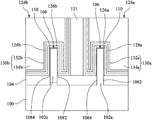
Claims (20)

What is claimed is:
1. A method, comprising:
forming a p-channel over a semiconductor substrate;
forming a gate dielectric layer over the p-channel;
doping the gate dielectric layer over the p-channel with a dopant to form an oxide cap layer in contact with a top surface of the gate dielectric layer; and
forming a first metal gate electrode over and in contact with the oxide cap layer.
2. The method of claim 1, wherein the dopant comprises lanthanum, yttrium, strontium, or combinations thereof.
3. The method of claim 1, wherein the oxide cap layer comprises a rare earth compound, strontium, or combinations thereof.
4. The method of claim 1, further comprising:
forming an n-channel over the semiconductor substrate,
wherein forming the gate dielectric layer is performed such that a portion of the gate dielectric layer is formed over the n-channel, and
wherein doping the gate dielectric layer is performed such that said portion of the gate dielectric layer over the n-channel is doped with the dopant.
5. The method of claim 4, further comprising:
forming a second metal gate electrode over said portion of the gate dielectric layer over the n-channel, wherein the first metal gate electrode and the second metal gate electrode are made of the same material.
6. The method of claim 1, wherein forming the gate dielectric layer is performed such that the gate dielectric layer is formed around the p-channel.
7. The method of claim 1, wherein the first metal gate electrode comprises:
a p-work function metal layer in contact with the oxide cap layer; and
a first metal gate over the p-work function metal layer.
8. The method of claim 1, wherein doping the gate dielectric layer is such that a dopant concentration of the oxide cap layer is higher than a dopant concentration of the gate dielectric layer.
9. A method, comprising:
forming an n-channel over a semiconductor substrate;
forming a gate dielectric layer over the n-channel;
doping the gate dielectric layer over the n-channel with a dopant to form an oxide cap layer in contact with a top surface of the gate dielectric layer;
forming a p-work function metal layer over the gate dielectric layer; and
forming a metal gate over and in contact with the p-work function metal layer.
10. The method of claim 9, wherein the p-work function metal layer is formed such that the p-work function metal layer is in contact with the oxide cap layer.
11. A method, comprising:
forming an n-channel and a p-channel over a semiconductor substrate, wherein the n-channel and the p-channel are made of different materials;
forming an isolation structure between the n-channel and the p-channel;
forming a gate dielectric layer over the isolation structure, the n-channel, and the p-channel;
depositing a p-work function metal layer over the gate dielectric layer;
depositing a metal gate layer over the p-work function metal layer; and
removing portions of the metal gate layer, the p-work function metal layer, and the gate dielectric layer over the isolation structure to expose a top surface of the isolation structure, such that the gate dielectric layer is separated into a first gate dielectric layer over the n-channel and a second gate dielectric layer over the p-channel, the p-work function metal layer is separated into a first p-work function metal layer over the first gate dielectric layer and a second p-work function metal layer over the second gate dielectric layer, and the metal gate layer is separated into a first metal gate over the first p-work function metal layer and a second metal gate over the second p-work function metal layer.
12. The method of claim 11, further comprising:
doping the gate dielectric layer with a dopant.
13. The method of claim 12, wherein the dopant comprises lanthanum, yttrium, strontium, or combinations thereof.
14. The method of claim 12, wherein doping the gate dielectric layer is performed such that a cap layer is formed in the gate dielectric layer.
15. The method of claim 14, wherein the cap layer comprises a rare earth compound, strontium, or combinations thereof.
16. The method of claim 14, wherein removing the portions of the metal gate layer, the p-work function metal layer, and the gate dielectric layer comprises removing a portion of the cap layer, such that the cap layer is separated into a first cap layer in the first gate dielectric layer and a second cap layer in the second gate dielectric layer.
17. The method of claim 11, wherein the p-channel comprises germanium.
18. The method of claim 11, wherein the gate dielectric layer comprises a high-k dielectric material.
19. The method of claim 11, wherein forming the gate dielectric layer is performed such that the gate dielectric layer is formed over sidewalls and a top surface of the n-channel.
20. The method of claim 11, wherein forming the gate dielectric layer is performed such that the gate dielectric layer is formed over sidewalls and a top surface of the p-channel.
US16/206,779 2016-01-19 2018-11-30 Method for manufacturing semiconductor device Active US10991695B2 (en)

Priority Applications (1)

Application Number Priority Date Filing Date Title
US16/206,779 US10991695B2 (en) 2016-01-19 2018-11-30 Method for manufacturing semiconductor device

Applications Claiming Priority (2)

Application Number Priority Date Filing Date Title
US15/000,981 US10622356B2 (en) 2016-01-19 2016-01-19 Semiconductor device and method of manufacturing the same
US16/206,779 US10991695B2 (en) 2016-01-19 2018-11-30 Method for manufacturing semiconductor device

Related Parent Applications (1)

Application Number Title Priority Date Filing Date
US15/000,981 Division US10622356B2 (en) 2016-01-19 2016-01-19 Semiconductor device and method of manufacturing the same

Publications (2)

Publication Number Publication Date
US20190115348A1 US20190115348A1 (en) 2019-04-18
US10991695B2 true US10991695B2 (en) 2021-04-27

Family

ID=59314752

Family Applications (5)

Application Number Title Priority Date Filing Date
US15/000,981 Active US10622356B2 (en) 2016-01-19 2016-01-19 Semiconductor device and method of manufacturing the same
US16/206,779 Active US10991695B2 (en) 2016-01-19 2018-11-30 Method for manufacturing semiconductor device
US16/845,012 Active 2036-02-03 US11257819B2 (en) 2016-01-19 2020-04-09 Semiconductor device
US17/675,846 Active 2036-03-03 US12471361B2 (en) 2016-01-19 2022-02-18 Semiconductor device
US19/293,408 Pending US20250366188A1 (en) 2016-01-19 2025-08-07 Semiconductor device

Family Applications Before (1)

Application Number Title Priority Date Filing Date
US15/000,981 Active US10622356B2 (en) 2016-01-19 2016-01-19 Semiconductor device and method of manufacturing the same

Family Applications After (3)

Application Number Title Priority Date Filing Date
US16/845,012 Active 2036-02-03 US11257819B2 (en) 2016-01-19 2020-04-09 Semiconductor device
US17/675,846 Active 2036-03-03 US12471361B2 (en) 2016-01-19 2022-02-18 Semiconductor device
US19/293,408 Pending US20250366188A1 (en) 2016-01-19 2025-08-07 Semiconductor device

Country Status (3)

Country Link
US (5) US10622356B2 (en)
CN (1) CN106981488B (en)
TW (1) TWI634663B (en)

Cited By (2)

* Cited by examiner, † Cited by third party
Publication number Priority date Publication date Assignee Title
US12262558B2 (en) 2021-07-14 2025-03-25 Samsung Electronics Co., Ltd. Semiconductor device and method of manufacturing the same
US12376361B2 (en) 2018-09-28 2025-07-29 Taiwan Semiconductor Manufacturing Company, Ltd. Capping layers in metal gates of transistors

Families Citing this family (17)

* Cited by examiner, † Cited by third party
Publication number Priority date Publication date Assignee Title
KR102374108B1 (en) 2015-06-02 2022-03-14 삼성전자주식회사 Semiconductor device having stressor and method of fabricating the same
KR102490696B1 (en) 2016-11-07 2023-01-19 삼성전자주식회사 Semiconductor device and method for fabricating the same
CN109390397B (en) * 2017-08-03 2023-03-10 联华电子股份有限公司 Semiconductor element and manufacturing method thereof
US10236220B1 (en) * 2017-08-31 2019-03-19 Taiwan Semiconductor Manufacturing Company, Ltd. Fin field-effect transistor device and method
US10516032B2 (en) 2017-09-28 2019-12-24 Taiwan Semiconductor Manufacturing Co., Ltd. Method of manufacturing a semiconductor device
US10510621B2 (en) * 2018-04-13 2019-12-17 Taiwan Semiconductor Manufacturing Co., Ltd. Methods for threshold voltage tuning and structures formed thereby
TWI707972B (en) * 2018-05-03 2020-10-21 國立交通大學 Method for forming nano sensing chip by selective deposition of sensing materials through device-localized joule heating and nano sensing chip thereof
US11398474B2 (en) * 2018-09-18 2022-07-26 Intel Corporation Neighboring gate-all-around integrated circuit structures having disjoined epitaxial source or drain regions
CN110970303B (en) * 2018-09-28 2024-06-21 台湾积体电路制造股份有限公司 Semiconductor device and method for forming the same
US11088034B2 (en) * 2019-05-22 2021-08-10 Taiwan Semiconductor Manufacturing Co., Ltd. Gate structures for semiconductor devices
US11295989B2 (en) * 2020-05-26 2022-04-05 Taiwan Semiconductor Manufacturing Co., Ltd. Gate structures for semiconductor devices
US11444198B2 (en) * 2020-05-29 2022-09-13 Taiwan Semiconductor Manufacturing Co., Ltd. Work function control in gate structures
US20220059668A1 (en) * 2020-08-21 2022-02-24 Intel Corporation Rare-earth materials for integrated circuit structures
US11569234B2 (en) * 2020-09-21 2023-01-31 Taiwan Semiconductor Manufacturing Co., Ltd. Semiconductor device structure and methods of forming the same
US12021116B2 (en) 2021-06-04 2024-06-25 Taiwan Semiconductor Manufacturing Co., Ltd. Semiconductor gates and methods of forming the same
KR102877648B1 (en) 2021-12-07 2025-10-28 삼성전자주식회사 Semiconductor device
US20250220970A1 (en) * 2023-12-27 2025-07-03 Taiwan Semiconductor Manufacturing Company, Ltd. Channel formation in gate-all-around complementary metal-oxide-semiconductor devices

Citations (16)

* Cited by examiner, † Cited by third party
Publication number Priority date Publication date Assignee Title
US20080217695A1 (en) 2007-03-05 2008-09-11 Translucent Photonics, Inc. Heterogeneous Semiconductor Substrate
CN101364600A (en) 2007-08-07 2009-02-11 国际商业机器公司 Circuit structure and method for dealing with circuit structure
US20100044798A1 (en) * 2008-06-09 2010-02-25 Taiwan Semiconductor Manufacturing Company, Ltd. Transistor device and a method of manufacturing the same
US20100052066A1 (en) 2008-08-26 2010-03-04 Taiwan Semiconductor Manufacturing Company, Ltd. structure and method for a cmos device with doped conducting metal oxide as the gate electrode
US20100078653A1 (en) 2008-09-30 2010-04-01 Uwe Griebenow Transistor having a high-k metal gate stack and a compressively stressed channel
CN102201435A (en) 2011-05-16 2011-09-28 清华大学 Semiconductor structure and production method thereof
CN103579111A (en) 2012-07-26 2014-02-12 中芯国际集成电路制造(上海)有限公司 Method for manufacturing metal gate semiconductor device
US20140065802A1 (en) 2012-08-28 2014-03-06 International Business Machines Corporation Techniques for metal gate workfunction engineering to enable multiple threshold voltage finfet devices
US20140124872A1 (en) 2010-11-22 2014-05-08 Samsung Electronics Co., Ltd. Semiconductor devices employing high-k dielectric layers as a gate insulating layer
CN104377197A (en) 2013-08-12 2015-02-25 三星电子株式会社 Semiconductor device and manufacturing method thereof
US20150061088A1 (en) * 2013-09-03 2015-03-05 Dong-Soo Lee Semiconductor device and method of fabricating the same
US20150187770A1 (en) 2013-12-28 2015-07-02 Texas Instruments Incorporated High mobility transistors
US20150255295A1 (en) 2014-03-05 2015-09-10 Globalfoundries Inc. Methods of forming alternative channel materials on a non-planar semiconductor device and the resulting device
US20150255457A1 (en) 2014-03-04 2015-09-10 International Business Machines Corporation Methods and apparatus to form fin structures of different compositions on a same wafer via mandrel and diffusion
US9362179B1 (en) 2015-06-22 2016-06-07 International Business Machines Corporation Method to form dual channel semiconductor material fins
US20170040220A1 (en) * 2015-08-07 2017-02-09 Globalfoundries Inc. Methods for forming transistor devices with different threshold voltages and the resulting devices

Family Cites Families (4)

* Cited by examiner, † Cited by third party
Publication number Priority date Publication date Assignee Title
US20070090416A1 (en) * 2005-09-28 2007-04-26 Doyle Brian S CMOS devices with a single work function gate electrode and method of fabrication
WO2013101007A1 (en) * 2011-12-28 2013-07-04 Intel Corporation Methods of integrating multiple gate dielectric transistors on a tri-gate (finfet) process
US9293523B2 (en) * 2014-06-24 2016-03-22 Applied Materials, Inc. Method of forming III-V channel
US10170477B2 (en) * 2015-11-06 2019-01-01 International Business Machines Corporation Forming MOSFET structures with work function modification

Patent Citations (17)

* Cited by examiner, † Cited by third party
Publication number Priority date Publication date Assignee Title
US20080217695A1 (en) 2007-03-05 2008-09-11 Translucent Photonics, Inc. Heterogeneous Semiconductor Substrate
CN101364600A (en) 2007-08-07 2009-02-11 国际商业机器公司 Circuit structure and method for dealing with circuit structure
US20090298245A1 (en) 2007-08-07 2009-12-03 International Business Machines Corporation Low Power Circuit Structure with Metal Gate and High-k Dielectric
US20100044798A1 (en) * 2008-06-09 2010-02-25 Taiwan Semiconductor Manufacturing Company, Ltd. Transistor device and a method of manufacturing the same
US20100052066A1 (en) 2008-08-26 2010-03-04 Taiwan Semiconductor Manufacturing Company, Ltd. structure and method for a cmos device with doped conducting metal oxide as the gate electrode
US20100078653A1 (en) 2008-09-30 2010-04-01 Uwe Griebenow Transistor having a high-k metal gate stack and a compressively stressed channel
US20140124872A1 (en) 2010-11-22 2014-05-08 Samsung Electronics Co., Ltd. Semiconductor devices employing high-k dielectric layers as a gate insulating layer
CN102201435A (en) 2011-05-16 2011-09-28 清华大学 Semiconductor structure and production method thereof
CN103579111A (en) 2012-07-26 2014-02-12 中芯国际集成电路制造(上海)有限公司 Method for manufacturing metal gate semiconductor device
US20140065802A1 (en) 2012-08-28 2014-03-06 International Business Machines Corporation Techniques for metal gate workfunction engineering to enable multiple threshold voltage finfet devices
CN104377197A (en) 2013-08-12 2015-02-25 三星电子株式会社 Semiconductor device and manufacturing method thereof
US20150061088A1 (en) * 2013-09-03 2015-03-05 Dong-Soo Lee Semiconductor device and method of fabricating the same
US20150187770A1 (en) 2013-12-28 2015-07-02 Texas Instruments Incorporated High mobility transistors
US20150255457A1 (en) 2014-03-04 2015-09-10 International Business Machines Corporation Methods and apparatus to form fin structures of different compositions on a same wafer via mandrel and diffusion
US20150255295A1 (en) 2014-03-05 2015-09-10 Globalfoundries Inc. Methods of forming alternative channel materials on a non-planar semiconductor device and the resulting device
US9362179B1 (en) 2015-06-22 2016-06-07 International Business Machines Corporation Method to form dual channel semiconductor material fins
US20170040220A1 (en) * 2015-08-07 2017-02-09 Globalfoundries Inc. Methods for forming transistor devices with different threshold voltages and the resulting devices

Non-Patent Citations (1)

* Cited by examiner, † Cited by third party
Title
H. Rusty Harris, et al., "Band-Engineered Low PMOS VT with High-K/Metal Gates Featured in a Dual Channel CMOS Integration Scheme", 2007 Symposium on VLSI Technology Digest of Technical Papers. Jun. 12, 2007.

Cited By (2)

* Cited by examiner, † Cited by third party
Publication number Priority date Publication date Assignee Title
US12376361B2 (en) 2018-09-28 2025-07-29 Taiwan Semiconductor Manufacturing Company, Ltd. Capping layers in metal gates of transistors
US12262558B2 (en) 2021-07-14 2025-03-25 Samsung Electronics Co., Ltd. Semiconductor device and method of manufacturing the same

Also Published As

Publication number Publication date
CN106981488B (en) 2020-09-25
US12471361B2 (en) 2025-11-11
TW201739051A (en) 2017-11-01
US10622356B2 (en) 2020-04-14
US20200243524A1 (en) 2020-07-30
US11257819B2 (en) 2022-02-22
TWI634663B (en) 2018-09-01
US20250366188A1 (en) 2025-11-27
US20190115348A1 (en) 2019-04-18
US20220173104A1 (en) 2022-06-02
CN106981488A (en) 2017-07-25
US20170207218A1 (en) 2017-07-20

Similar Documents

Publication Publication Date Title
US12471361B2 (en) Semiconductor device
US12336217B2 (en) Flat STI surface for gate oxide uniformity in Fin FET devices
US10720496B2 (en) FinFET structures and methods of forming the same
US9773871B2 (en) Fin field effect transistor and method for fabricating the same
US10811412B2 (en) Method of fabricating semiconductor device
US11594534B2 (en) Semiconductor device and manufacturing method thereof
US20170140992A1 (en) Fin field effect transistor and method for fabricating the same
US9620503B1 (en) Fin field effect transistor and method for fabricating the same
US10121870B1 (en) Semiconductor device structure with strain-relaxed buffer
US9691766B1 (en) Fin field effect transistor and method for fabricating the same
US20240096707A1 (en) Footing Removal in Cut-Metal Process

Legal Events

Date Code Title Description
FEPP Fee payment procedure

Free format text: ENTITY STATUS SET TO UNDISCOUNTED (ORIGINAL EVENT CODE: BIG.); ENTITY STATUS OF PATENT OWNER: LARGE ENTITY

AS Assignment

Owner name: TAIWAN SEMICONDUCTOR MANUFACTURING CO., LTD., TAIW

Free format text: ASSIGNMENT OF ASSIGNORS INTEREST;ASSIGNORS:CHANG, CHIA-YUAN;YU, XIONG-FEI;CHANG, HUI-CHENG;SIGNING DATES FROM 20160108 TO 20160112;REEL/FRAME:047660/0770

Owner name: TAIWAN SEMICONDUCTOR MANUFACTURING CO., LTD., TAIWAN

Free format text: ASSIGNMENT OF ASSIGNORS INTEREST;ASSIGNORS:CHANG, CHIA-YUAN;YU, XIONG-FEI;CHANG, HUI-CHENG;SIGNING DATES FROM 20160108 TO 20160112;REEL/FRAME:047660/0770

STPP Information on status: patent application and granting procedure in general

Free format text: NON FINAL ACTION MAILED

STPP Information on status: patent application and granting procedure in general

Free format text: RESPONSE TO NON-FINAL OFFICE ACTION ENTERED AND FORWARDED TO EXAMINER

STPP Information on status: patent application and granting procedure in general

Free format text: FINAL REJECTION MAILED

STPP Information on status: patent application and granting procedure in general

Free format text: RESPONSE AFTER FINAL ACTION FORWARDED TO EXAMINER

STPP Information on status: patent application and granting procedure in general

Free format text: ADVISORY ACTION MAILED

STPP Information on status: patent application and granting procedure in general

Free format text: NOTICE OF ALLOWANCE MAILED -- APPLICATION RECEIVED IN OFFICE OF PUBLICATIONS

STPP Information on status: patent application and granting procedure in general

Free format text: PUBLICATIONS -- ISSUE FEE PAYMENT RECEIVED

STPP Information on status: patent application and granting procedure in general

Free format text: PUBLICATIONS -- ISSUE FEE PAYMENT VERIFIED

STCF Information on status: patent grant

Free format text: PATENTED CASE

MAFP Maintenance fee payment

Free format text: PAYMENT OF MAINTENANCE FEE, 4TH YEAR, LARGE ENTITY (ORIGINAL EVENT CODE: M1551); ENTITY STATUS OF PATENT OWNER: LARGE ENTITY

Year of fee payment: 4