US10981899B2 - Inhibitors of soluble adenylyl cyclase - Google Patents
Inhibitors of soluble adenylyl cyclase Download PDFInfo
- Publication number
- US10981899B2 US10981899B2 US16/097,087 US201716097087A US10981899B2 US 10981899 B2 US10981899 B2 US 10981899B2 US 201716097087 A US201716097087 A US 201716097087A US 10981899 B2 US10981899 B2 US 10981899B2
- Authority
- US
- United States
- Prior art keywords
- sac
- lre1
- compound
- compounds
- camp
- Prior art date
- Legal status (The legal status is an assumption and is not a legal conclusion. Google has not performed a legal analysis and makes no representation as to the accuracy of the status listed.)
- Active
Links
- 0 [3*]OCN(CC1=CC=CS1)C1=CC(Cl)=NC(N)=N1 Chemical compound [3*]OCN(CC1=CC=CS1)C1=CC(Cl)=NC(N)=N1 0.000 description 13
- MDARZFZSENKGHA-UHFFFAOYSA-N C=C(CC(C)(C)C)NC1=CC=CC=C1 Chemical compound C=C(CC(C)(C)C)NC1=CC=CC=C1 MDARZFZSENKGHA-UHFFFAOYSA-N 0.000 description 4
- YFKMCTWSINOCFD-UHFFFAOYSA-N CC(C)(C)CC1=NC2=C(C=CC=C2)C1 Chemical compound CC(C)(C)CC1=NC2=C(C=CC=C2)C1 YFKMCTWSINOCFD-UHFFFAOYSA-N 0.000 description 4
- GUMULFRCHLJNDY-UHFFFAOYSA-N CC(C)(C)CC(C)(C)C Chemical compound CC(C)(C)CC(C)(C)C GUMULFRCHLJNDY-UHFFFAOYSA-N 0.000 description 3
- XENFASVBIMPADS-UHFFFAOYSA-N CC(C)(C)CC1CC1C(C)(C)C Chemical compound CC(C)(C)CC1CC1C(C)(C)C XENFASVBIMPADS-UHFFFAOYSA-N 0.000 description 3
- YNSXKTRADNHAHS-ZDORWVSRSA-N NC1=NC(Cl)=CC(N(CC2=CC=CS2)C2C[C@H]2CO/C2=N/C3=C(C=CC=C3)N2)=N1.NC1=NC(Cl)=CC(N(CCOCC(=O)NC2=CC=CC=C2)CC2=CC=CS2)=N1.NC1=NC(Cl)=CC(N(CCOCC2=NC3=C(C=CC=C3)N2)CC2=CC=CS2)=N1 Chemical compound NC1=NC(Cl)=CC(N(CC2=CC=CS2)C2C[C@H]2CO/C2=N/C3=C(C=CC=C3)N2)=N1.NC1=NC(Cl)=CC(N(CCOCC(=O)NC2=CC=CC=C2)CC2=CC=CS2)=N1.NC1=NC(Cl)=CC(N(CCOCC2=NC3=C(C=CC=C3)N2)CC2=CC=CS2)=N1 YNSXKTRADNHAHS-ZDORWVSRSA-N 0.000 description 3
- FXKLMCZMQMLNFH-UHFFFAOYSA-N CC(C)(C)CC1=CC=CO1 Chemical compound CC(C)(C)CC1=CC=CO1 FXKLMCZMQMLNFH-UHFFFAOYSA-N 0.000 description 2
- SZCZOVFEZGIVPE-UHFFFAOYSA-N CC(C)(C)CC1CCCO1 Chemical compound CC(C)(C)CC1CCCO1 SZCZOVFEZGIVPE-UHFFFAOYSA-N 0.000 description 2
- OYBFKZHDPTTWGE-UHFFFAOYSA-N CCC1=CC=C(C(C)(C)C)C=C1 Chemical compound CCC1=CC=C(C(C)(C)C)C=C1 OYBFKZHDPTTWGE-UHFFFAOYSA-N 0.000 description 2
- ZCVONNNOPNTLNM-UHFFFAOYSA-N C[Si](C)(C)CCOCCl.C[Si](C)(C)CCOCN1C2=CC=CC=C2N=C1Cl.ClC1=NC2=CC=CC=C2C1 Chemical compound C[Si](C)(C)CCOCCl.C[Si](C)(C)CCOCN1C2=CC=CC=C2N=C1Cl.ClC1=NC2=CC=CC=C2C1 ZCVONNNOPNTLNM-UHFFFAOYSA-N 0.000 description 2
- WGKIRZZKWUTIBX-UHFFFAOYSA-N C.C.C1=CSC(CNCCOCC2=NC3=C(C=CC=C3)N2)=C1.NCCOCC1=NC2=C(C=CC=C2)N1.O=CC1=CC=CS1 Chemical compound C.C.C1=CSC(CNCCOCC2=NC3=C(C=CC=C3)N2)=C1.NCCOCC1=NC2=C(C=CC=C2)N1.O=CC1=CC=CS1 WGKIRZZKWUTIBX-UHFFFAOYSA-N 0.000 description 1
- MQRPBBRXKDWJIN-UHFFFAOYSA-N C.C.NCCOCC(=O)NC1=CC=CC=C1.O=C(COCCNCC1=CC=CS1)NC1=CC=CC=C1.O=CC1=CC=CS1 Chemical compound C.C.NCCOCC(=O)NC1=CC=CC=C1.O=C(COCCNCC1=CC=CS1)NC1=CC=CC=C1.O=CC1=CC=CS1 MQRPBBRXKDWJIN-UHFFFAOYSA-N 0.000 description 1
- KJHNAHTYSLPHCR-IJRMEYKPSA-N C.C.N[C@H]1C[C@H]1CO.O=CC1=CC=CS1.OC[C@@H]1C[C@@H]1NCC1=CC=CS1 Chemical compound C.C.N[C@H]1C[C@H]1CO.O=CC1=CC=CS1.OC[C@@H]1C[C@@H]1NCC1=CC=CS1 KJHNAHTYSLPHCR-IJRMEYKPSA-N 0.000 description 1
- LOVADKVMZHWTHJ-UHFFFAOYSA-N C.C1=CSC(CNCCOCC2=NC3=C(C=CC=C3)N2)=C1.NC1=NC(Cl)=CC(Cl)=N1.NC1=NC(Cl)=CC(N(CCOCC2=NC3=C(C=CC=C3)N2)CC2=CC=CS2)=N1 Chemical compound C.C1=CSC(CNCCOCC2=NC3=C(C=CC=C3)N2)=C1.NC1=NC(Cl)=CC(Cl)=N1.NC1=NC(Cl)=CC(N(CCOCC2=NC3=C(C=CC=C3)N2)CC2=CC=CS2)=N1 LOVADKVMZHWTHJ-UHFFFAOYSA-N 0.000 description 1
- QKGXWRGJTFIKRV-UHFFFAOYSA-N C.CC(C)(C)OC(=O)CCCOCC(=O)NC1=CC=CC=C1.CC(C)(C)OC(=O)NCCOCC(=O)O Chemical compound C.CC(C)(C)OC(=O)CCCOCC(=O)NC1=CC=CC=C1.CC(C)(C)OC(=O)NCCOCC(=O)O QKGXWRGJTFIKRV-UHFFFAOYSA-N 0.000 description 1
- OHFDFKRLJONBON-UHFFFAOYSA-N C.CC(C)(C)OC(=O)CCCOCC(=O)NC1=CC=CC=C1.NCCOCC(=O)NC1=CC=CC=C1 Chemical compound C.CC(C)(C)OC(=O)CCCOCC(=O)NC1=CC=CC=C1.NCCOCC(=O)NC1=CC=CC=C1 OHFDFKRLJONBON-UHFFFAOYSA-N 0.000 description 1
- KJBHBNSEXDOMKQ-XXKXSNFASA-N C.NC1=NC(Cl)=CC(Cl)=N1.NC1=NC(Cl)=CC(N(CC2=CC=CS2)C2C[C@H]2CO)=N1.OC[C@@H]1C[C@@H]1NCC1=CC=CS1 Chemical compound C.NC1=NC(Cl)=CC(Cl)=N1.NC1=NC(Cl)=CC(N(CC2=CC=CS2)C2C[C@H]2CO)=N1.OC[C@@H]1C[C@@H]1NCC1=CC=CS1 KJBHBNSEXDOMKQ-XXKXSNFASA-N 0.000 description 1
- DZFFWZDKWPMPEL-UHFFFAOYSA-N C.NC1=NC(Cl)=CC(Cl)=N1.NC1=NC(Cl)=CC(N(CCOCC(=O)NC2=CC=CC=C2)CC2=CC=CS2)=N1.O=C(COCCNCC1=CC=CS1)NC1=CC=CC=C1 Chemical compound C.NC1=NC(Cl)=CC(Cl)=N1.NC1=NC(Cl)=CC(N(CCOCC(=O)NC2=CC=CC=C2)CC2=CC=CS2)=N1.O=C(COCCNCC1=CC=CS1)NC1=CC=CC=C1 DZFFWZDKWPMPEL-UHFFFAOYSA-N 0.000 description 1
- NCLQZDIQFDVNIE-FZKYESRFSA-N C1=CSC(CNCCOCC2=NC3=C(C=CC=C3)N2)=C1.CC(C)(C)OC(=O)CCCO.CC(C)(C)OC(=O)CCCOCC1=NC2=C(C=CC=C2)N1COCC[Si](C)(C)C.C[Si](C)(C)CCOCN1C(CCl)=NC2=C1C=CC=C2.ClCC1=NC2=C(C=CC=C2)N1.NC1=NC(Cl)=CC(Cl)=N1.NC1=NC(Cl)=CC(N(CCOCC2=NC3=C(C=CC=C3)N2)CC2=CC=CS2)=N1.NCCOCC1=NC2=C(C=CC=C2)N1.O=CC1=CC=CS1.[2H]CF Chemical compound C1=CSC(CNCCOCC2=NC3=C(C=CC=C3)N2)=C1.CC(C)(C)OC(=O)CCCO.CC(C)(C)OC(=O)CCCOCC1=NC2=C(C=CC=C2)N1COCC[Si](C)(C)C.C[Si](C)(C)CCOCN1C(CCl)=NC2=C1C=CC=C2.ClCC1=NC2=C(C=CC=C2)N1.NC1=NC(Cl)=CC(Cl)=N1.NC1=NC(Cl)=CC(N(CCOCC2=NC3=C(C=CC=C3)N2)CC2=CC=CS2)=N1.NCCOCC1=NC2=C(C=CC=C2)N1.O=CC1=CC=CS1.[2H]CF NCLQZDIQFDVNIE-FZKYESRFSA-N 0.000 description 1
- CJKIVLPJDVFXJP-UHFFFAOYSA-N CC(C)(C)C1CC1 Chemical compound CC(C)(C)C1CC1 CJKIVLPJDVFXJP-UHFFFAOYSA-N 0.000 description 1
- LUNQNLFGERWRNI-UHFFFAOYSA-N CC(C)(C)OC(=O)CCCO.CC(C)(C)OC(=O)CCCOCC1=NC2=C(C=CC=C2)N1COCC[Si](C)(C)C.C[Si](C)(C)CCOCN1C(CCl)=NC2=C1C=CC=C2 Chemical compound CC(C)(C)OC(=O)CCCO.CC(C)(C)OC(=O)CCCOCC1=NC2=C(C=CC=C2)N1COCC[Si](C)(C)C.C[Si](C)(C)CCOCN1C(CCl)=NC2=C1C=CC=C2 LUNQNLFGERWRNI-UHFFFAOYSA-N 0.000 description 1
- LNUMKQHCSLGDPY-UHFFFAOYSA-M CC(C)(C)OC(=O)CCCOCC(=O)NC1=CC=CC=C1.CC(C)(C)OC(=O)NCCO.CC(C)(C)OC(=O)NCCOCC(=O)O.CCOC(=O)CBr.CCOC(=O)COCCNC(=O)OC(C)(C)C.NC1=NC(Cl)=CC(Cl)=N1.NCCOCC(=O)NC1=CC=CC=C1.O=C(COCCNCC1=CC=CS1)NC1=CC=CC=C1.O=CC1=CC=CS1.[Li]O Chemical compound CC(C)(C)OC(=O)CCCOCC(=O)NC1=CC=CC=C1.CC(C)(C)OC(=O)NCCO.CC(C)(C)OC(=O)NCCOCC(=O)O.CCOC(=O)CBr.CCOC(=O)COCCNC(=O)OC(C)(C)C.NC1=NC(Cl)=CC(Cl)=N1.NCCOCC(=O)NC1=CC=CC=C1.O=C(COCCNCC1=CC=CS1)NC1=CC=CC=C1.O=CC1=CC=CS1.[Li]O LNUMKQHCSLGDPY-UHFFFAOYSA-M 0.000 description 1
- DRQPCYKNLHGXHX-PBJKEDEQSA-N CC(C)(C)OC(=O)CCCOCC1=NC2=C(C=CC=C2)N1COCC[Si](C)(C)C.NCCOCC1=NC2=C(C=CC=C2)N1.O=CC(F)(F)F.[2H]CC Chemical compound CC(C)(C)OC(=O)CCCOCC1=NC2=C(C=CC=C2)N1COCC[Si](C)(C)C.NCCOCC1=NC2=C(C=CC=C2)N1.O=CC(F)(F)F.[2H]CC DRQPCYKNLHGXHX-PBJKEDEQSA-N 0.000 description 1
- JFFWPLLOJFRQNV-UHFFFAOYSA-N CC(C)(C)OC(=O)NCCO.CCOC(=O)CBr.CCOC(=O)COCCNC(=O)OC(C)(C)C Chemical compound CC(C)(C)OC(=O)NCCO.CCOC(=O)CBr.CCOC(=O)COCCNC(=O)OC(C)(C)C JFFWPLLOJFRQNV-UHFFFAOYSA-N 0.000 description 1
- HMQJQYBRQYHKQW-UHFFFAOYSA-M CC(C)(C)OC(=O)NCCOCC(=O)O.CCOC(=O)COCCNC(=O)OC(C)(C)C.[Li]O Chemical compound CC(C)(C)OC(=O)NCCOCC(=O)O.CCOC(=O)COCCNC(=O)OC(C)(C)C.[Li]O HMQJQYBRQYHKQW-UHFFFAOYSA-M 0.000 description 1
- USMWSVGSWFEOML-QBFAIXKMSA-N CC(C)(C)OC(=O)N[C@H]1C[C@H]1CO.CO.N[C@H]1C[C@H]1CO Chemical compound CC(C)(C)OC(=O)N[C@H]1C[C@H]1CO.CO.N[C@H]1C[C@H]1CO USMWSVGSWFEOML-QBFAIXKMSA-N 0.000 description 1
- UPBQMAHYLWJGDW-UHFFFAOYSA-N CC(C)(C)OC(NCCOCC(O)=O)=O Chemical compound CC(C)(C)OC(NCCOCC(O)=O)=O UPBQMAHYLWJGDW-UHFFFAOYSA-N 0.000 description 1
- YHPJBWLWNSMRRW-AWQFTUOYSA-N CC(S/C1=N/C2=CC=CC=C2N1)C(=O)C/N=C/C1=C(O)C=CC(Br)=C1 Chemical compound CC(S/C1=N/C2=CC=CC=C2N1)C(=O)C/N=C/C1=C(O)C=CC(Br)=C1 YHPJBWLWNSMRRW-AWQFTUOYSA-N 0.000 description 1
- HHOAAMGYKAIXEB-UHFFFAOYSA-N CC1=CC(N2N=C(S)SC2=S)=CC=C1 Chemical compound CC1=CC(N2N=C(S)SC2=S)=CC=C1 HHOAAMGYKAIXEB-UHFFFAOYSA-N 0.000 description 1
- VMTKVVKJHWZJFI-UHFFFAOYSA-N CCC1=CC=C(C(NC2=CC(Cl)=NC(N)=N2)C2=CC=CS2)C=C1.CCN(CC)CCN(CC1=CC=CS1)C1=CC(Cl)=NC(N)=N1.CCN(CC1=CC=CS1)C1=CC(Cl)=NC(N)=N1.NC1=NC(N(CC2=CC=CO2)CC2=CC=CS2)=CC(Cl)=N1.NC1=NC(N(CC2=CC=CS2)CC2CCCO2)=CC(Cl)=N1 Chemical compound CCC1=CC=C(C(NC2=CC(Cl)=NC(N)=N2)C2=CC=CS2)C=C1.CCN(CC)CCN(CC1=CC=CS1)C1=CC(Cl)=NC(N)=N1.CCN(CC1=CC=CS1)C1=CC(Cl)=NC(N)=N1.NC1=NC(N(CC2=CC=CO2)CC2=CC=CS2)=CC(Cl)=N1.NC1=NC(N(CC2=CC=CS2)CC2CCCO2)=CC(Cl)=N1 VMTKVVKJHWZJFI-UHFFFAOYSA-N 0.000 description 1
- ZRVUWHHBSFVNMW-UHFFFAOYSA-N CCC1=CC=C(C(NC2=CC(Cl)=NC(N)=N2)C2=CC=CS2)C=C1.NC1=NC(N(CC2=CC=CO2)CC2=CC=CS2)=CC(Cl)=N1.NC1=NC(N(CC2=CC=CS2)CC2CCCO2)=CC(Cl)=N1 Chemical compound CCC1=CC=C(C(NC2=CC(Cl)=NC(N)=N2)C2=CC=CS2)C=C1.NC1=NC(N(CC2=CC=CO2)CC2=CC=CS2)=CC(Cl)=N1.NC1=NC(N(CC2=CC=CS2)CC2CCCO2)=CC(Cl)=N1 ZRVUWHHBSFVNMW-UHFFFAOYSA-N 0.000 description 1
- JGDJDRSVDKZPGV-UHFFFAOYSA-N CCOC(COCCNC(OC(C)(C)C)=O)=O Chemical compound CCOC(COCCNC(OC(C)(C)C)=O)=O JGDJDRSVDKZPGV-UHFFFAOYSA-N 0.000 description 1
- RFSQXBDLWQOAFJ-PRQZKWGPSA-N C[Si](C)(C)CCOCN1C(CCl)=NC2=C1C=CC=C2.ClCC1=NC2=C(C=CC=C2)N1.[2H]CF Chemical compound C[Si](C)(C)CCOCN1C(CCl)=NC2=C1C=CC=C2.ClCC1=NC2=C(C=CC=C2)N1.[2H]CF RFSQXBDLWQOAFJ-PRQZKWGPSA-N 0.000 description 1
- YMBIGUPLWHUCMC-HDINUXAPSA-N C[Si](C)(C)CCOCN1C2=CC=CC=C2/N=C\1OC[C@@H]1CC1N(CC1=CC=CS1)C1=NC(N)=NC(Cl)=C1.C[Si](C)(C)CCOCN1C2=CC=CC=C2N=C1Cl.NC1=NC(Cl)=CC(N(CC2=CC=CS2)C2C[C@H]2CO)=N1 Chemical compound C[Si](C)(C)CCOCN1C2=CC=CC=C2/N=C\1OC[C@@H]1CC1N(CC1=CC=CS1)C1=NC(N)=NC(Cl)=C1.C[Si](C)(C)CCOCN1C2=CC=CC=C2N=C1Cl.NC1=NC(Cl)=CC(N(CC2=CC=CS2)C2C[C@H]2CO)=N1 YMBIGUPLWHUCMC-HDINUXAPSA-N 0.000 description 1
- QKZGTUNWBCNABC-UHFFFAOYSA-N N#CC1=CC(C(=O)C2=CC(Br)=CC=C2O)=CC(C2=CC=CC=C2Cl)C1=O Chemical compound N#CC1=CC(C(=O)C2=CC(Br)=CC=C2O)=CC(C2=CC=CC=C2Cl)C1=O QKZGTUNWBCNABC-UHFFFAOYSA-N 0.000 description 1
- PDWZXKSZLRVSEH-UHFFFAOYSA-N NC1=NC(Cl)=CC(N(CC2=CC=CS2)C2CC2)=N1 Chemical compound NC1=NC(Cl)=CC(N(CC2=CC=CS2)C2CC2)=N1 PDWZXKSZLRVSEH-UHFFFAOYSA-N 0.000 description 1
- UXUITYNDEZIMRM-FRSPBVCPSA-N NC1=NC(Cl)=CC(N(CC2=CC=CS2)C2C[C@H]2COC2=NC3=C(C=CC=C3)N2)=N1.NC1=NC(Cl)=CC(N(CCOCC(=O)NC2=CC=CC=C2)CC2=CC=CS2)=N1.NC1=NC(Cl)=CC(N(CCOCC2=NC3=C(C=CC=C3)N2)CC2=CC=CS2)=N1.NC1=NC(N(CC2=CC=CS2)C2CC2)=CC(Cl)=N1 Chemical compound NC1=NC(Cl)=CC(N(CC2=CC=CS2)C2C[C@H]2COC2=NC3=C(C=CC=C3)N2)=N1.NC1=NC(Cl)=CC(N(CCOCC(=O)NC2=CC=CC=C2)CC2=CC=CS2)=N1.NC1=NC(Cl)=CC(N(CCOCC2=NC3=C(C=CC=C3)N2)CC2=CC=CS2)=N1.NC1=NC(N(CC2=CC=CS2)C2CC2)=CC(Cl)=N1 UXUITYNDEZIMRM-FRSPBVCPSA-N 0.000 description 1
- FBIKUQDYUDIACR-UHFFFAOYSA-N NC1=NC(Cl)=CC(N(CCOCC(=O)NC2=CC=CC=C2)CC2=CC=CS2)=N1 Chemical compound NC1=NC(Cl)=CC(N(CCOCC(=O)NC2=CC=CC=C2)CC2=CC=CS2)=N1 FBIKUQDYUDIACR-UHFFFAOYSA-N 0.000 description 1
- YACWILRABGNJKG-IMJSIDKUSA-N N[C@@H]1[C@H](CO)C1 Chemical compound N[C@@H]1[C@H](CO)C1 YACWILRABGNJKG-IMJSIDKUSA-N 0.000 description 1
- LXINIXJKDVKUGT-UHFFFAOYSA-N O=C(CCCC1=CCC2=C1C=CC=C2)N1CCCC1C1=CC=C(F)C=C1 Chemical compound O=C(CCCC1=CCC2=C1C=CC=C2)N1CCCC1C1=CC=C(F)C=C1 LXINIXJKDVKUGT-UHFFFAOYSA-N 0.000 description 1
Images


Classifications
-
- C—CHEMISTRY; METALLURGY
- C07—ORGANIC CHEMISTRY
- C07D—HETEROCYCLIC COMPOUNDS
- C07D409/00—Heterocyclic compounds containing two or more hetero rings, at least one ring having sulfur atoms as the only ring hetero atoms
- C07D409/14—Heterocyclic compounds containing two or more hetero rings, at least one ring having sulfur atoms as the only ring hetero atoms containing three or more hetero rings
-
- C—CHEMISTRY; METALLURGY
- C07—ORGANIC CHEMISTRY
- C07D—HETEROCYCLIC COMPOUNDS
- C07D403/00—Heterocyclic compounds containing two or more hetero rings, having nitrogen atoms as the only ring hetero atoms, not provided for by group C07D401/00
- C07D403/14—Heterocyclic compounds containing two or more hetero rings, having nitrogen atoms as the only ring hetero atoms, not provided for by group C07D401/00 containing three or more hetero rings
-
- C—CHEMISTRY; METALLURGY
- C07—ORGANIC CHEMISTRY
- C07D—HETEROCYCLIC COMPOUNDS
- C07D409/00—Heterocyclic compounds containing two or more hetero rings, at least one ring having sulfur atoms as the only ring hetero atoms
- C07D409/02—Heterocyclic compounds containing two or more hetero rings, at least one ring having sulfur atoms as the only ring hetero atoms containing two hetero rings
- C07D409/12—Heterocyclic compounds containing two or more hetero rings, at least one ring having sulfur atoms as the only ring hetero atoms containing two hetero rings linked by a chain containing hetero atoms as chain links
Definitions
- the disclosure generally relates reducing cyclic AMP levels.
- this disclosure provides compositions for reducing cAMP action by preferential inhibition of soluble adelylyl cyclase.
- Cyclic AMP is the prototypical second messenger. It has been implicated in a wide variety of (often contradictory) physiological processes, including cell proliferation, apoptosis, and differentiation. Only recently has it become clear how this single second messenger can simultaneously mediate so many processes. In current models of cyclic nucleotide signal transduction, cAMP acts locally within independently-regulated, spatially-restricted microdomains.
- Cyclic AMP is produced from ATP by adenylyl cyclases (AC).
- AC adenylyl cyclases
- tmACs transmembrane adenylyl cyclases
- GPCRs G protein coupled receptors
- sAC soluble adenylyl cyclase
- sAC is a widely distributed source of cAMP, which unlike tmACs, is localized throughout the cell and targeted to intracellular compartments and cellular organelles, including inside the nucleus and the mitochondrial matrix.
- sAC is also distinct from tmACs in its regulation. It is considered that sAC is regulated by bicarbonate (HCO 3 ⁇ ), rather than by heterotrimeric G proteins.
- CEs catechol derivatives of estrogen
- KH7 catechol derivatives of estrogen
- CEs are natural products which were the first known inhibitors of sAC. While CEs have been useful for demonstrating sAC's role in cAMP dependent processes, CEs can also inhibit tmACs, which limits their utility.
- the second pharmacological sAC inhibitor, KH7 was identified in a small molecule screen against purified sAC protein. In contrast to CEs, KH7 is specific for sAC relative to tmACs, but its mechanism of action remains unknown, and it exhibits non-specific cellular effects.
- the present disclosure provides 6-amino substituted 2,6-diamino-4-chloropyrimidine compounds which are specific inhibitors of soluble adenylyl cyclase. 1.
- the compounds of the present disclosure may have the following structure:
- X is a substituted or unsubstituted C 1 to C 3 aliphatic group and R 3 is selected from the group consisting of:
- n 0 or 1
- the compounds can be formulated with pharmaceutical carriers and used for reducing cyclic AMP levels.
- the compositions can be used for treatment of various conditions including ocular hypotony.
- FIG. 1 shows the chemical structure of RU-0204277 (LRE1).
- FIG. 2 shows validation of RapidFire Mass Spectrometry System (RF-MSS) cyclase assay and high throughput screening conditions.
- RF-MSS RapidFire Mass Spectrometry System
- FIG. 2 shows validation of RapidFire Mass Spectrometry System (RF-MSS) cyclase assay and high throughput screening conditions.
- An example of a RF-MS chromatogram showing (a) the product cAMP, as extracted ion intensity (EIC: MW 328.0412) ⁇ 10 3 , and (b) substrate ATP, as extracted ion intensity (EIC: MW 505.9816) ⁇ 10 4 .
- the order of peaks derives from increasing input ATP, shown numerically (in mM) on top of each peak. Peaks recorded at time “0” and after incubation with sAC for 180 min.
- FIG. 3 shows LRE1 is a potent and selective inhibitor of sAC in vitro and in cells.
- FIG. 4 shows structural and mechanistic characterization of sAC inhibition by LRE1.
- LRE1 is shown in stick representation, and active site and BBS are indicated.
- LRE1 is overlaid with 2F o -F c electron density contoured at 1 ⁇ .
- sAC activity measured by RF-MSS in the presence of the indicated concentration of LRE1 and either 0.6 mM ATP (diamonds), 0.9 mM ATP (triangles), 1.3 mM ATP (squares), or 2.0 mM ATP (dots) and 5 mM MgCl 2 , 5 mM CaCl 2 , with 40 mM NaHCO 3 .
- Data represent individual points of a serial dilution of an experiment repeated three times.
- g Crystal structure of a sAC/ApCpp/LRE1 complex.
- the substrate analog ApCpp in the active site and the inhibitor in the BBS are shown as sticks colored according to atom type and overlaid with 2F o -F c electron density contoured at 1 ⁇ .
- Ca 2+ is shown as sphere.
- FIG. 5 shows LRE1 inhibits sAC dependent processes in sperm and mitochondria.
- (a-d) sperm capacitation experiments. Mouse cauda sperm obtained in media devoid of Ca 2+ , HCO 3 ⁇ , or BSA were activated by incubation in capacitation media containing 15 mM HCO 3 ⁇ , 5 mg/ml BSA, and 0.3 mM EGTA for 60 minutes in the presence of the shown amounts of LRE1.
- Non Cap non capacitated negative control.
- Cap DMSO treated capacitated positive control.
- (a) Western blot using anti-PKA substrates antibodies.
- FIG. 6 shows LRE1 is less toxic than KH7.
- WT (a,b) or sAC KO (c) MEFs (1500 cells/well; 384 wells/plate) were grown for 24 (a) or 48 hours (b,c) in the presence of the indicated concentrations of LRE1 (circles) or KH7 (squares).
- Cell viability, as determined by CellTiter-Glo, is shown as luminescence; values are averages of triplicate determinations ⁇ S.E.M. of a representative experiment repeated at least two times.
- FIG. 7 shows structural analysis of sAC inhibition by LRE1 and comparison to other AC modulators.
- A Close-up of the BBS of the sAC/LRE1 complex. Ligand and key interacting residues are shown as sticks colored according to atom type. LRE1 is overlaid with F o -F c omit electron density contoured at 5 ⁇ .
- B Overlay of the sAC/LRE1 complex with a sAC/ApCpp structure. Ligands and interacting residues are shown as sticks, and Ca 2+ as a sphere.
- C Overlay of sAC/LRE1 with a tmAC/forskolin complex (RMSD 9.7 ⁇ 2 for 238 C ⁇ atoms).
- FIG. 8 shows the chemical structure of an Astex compound which is an in vitro sAC inhibitor.
- FIG. 9 shows the chemical structure of TDI-006145-NX-1, which is potentially equivalent to LRE1.
- FIG. 10 shows the chemical structure for TDI-006281-NX-1, which is potentially equivalent to LRE1.
- FIG. 11 shows a Concentration-response curve of LRE1 (circles), plus compounds TDI-005707-NX-1 (squares), TDI-005793-NX-1 (triangles, ⁇ ), TDI-006145-NX-1 (inverted triangles, ⁇ ) on sAC protein in the presence of 2 mM ATP/10 mM MgCl 2 /10 mM CaCl 2 /40 mM NaHCO 3 . Values are pmol units of cAMP formed per minute in the presence of the indicated concentrations of each compound; shown is a representative experiment repeated at least two times.
- FIG. 12 shows intraocular pressure (IOP) in avertin-anesthetized mice.
- IOP intraocular pressure
- FIG. 13 shows LRE1 and NCEs inhibit sAC activity inside cells.
- PDE phosphodiesterase
- IBMX phosphodiesterase
- FIG. 14 shows an in vitro assay of tmAC type 2.
- LRE1 related NCEs also have small stimulatory effect on tmAC2.
- In vitro adenylyl cyclase assay in extracts from tmAC type 2 transfected cells Shown is basal cyclase assay in the absence (left bar) or presence of 30 ⁇ M LRE1 (second from left bar), or 30 ⁇ M LRE1-7 (TDI-006145) (third from left bar) or 30 ⁇ M LRE1-8 (TDI-006281) (right bar).
- Ranges of values are disclosed herein. The ranges set out a lower limit value and an upper limit value. Unless otherwise stated, the ranges include all values to the magnitude of the smallest value (either lower limit value or upper limit value) and ranges between the values of the stated range.
- the present disclosure provides 6-amino substituted 2,6-diamino-4-chloropyrimidine compounds and compositions comprising one or more 6-amino substituted 2,6-diamino-4-chloropyrimidine compounds.
- the compounds are disubstituted at the 6 position of the amino group substituent of the pyrimidine ring.
- the present disclosure also provides uses of such compounds and compositions.
- the compounds inhibit soluble adenylyl cyclase (sAC).
- the compounds of the present disclosure have the following structure:
- R 3 is selected from the group consisting of:
- n 0 or 1
- X is an unsubstituted C 1 to C 3 alkanediyl group having the following structure:
- X is an unsubstituted C 1 to C 3 aliphatic group having the following structure:
- the compound has the following structures:
- compositions comprising one or more sAC inhibitors of the present disclosure (e.g., comprising one or more compounds of the present disclosure and/or one or more sAC inhibitors identified in the present disclosure), in a pharmaceutically acceptable carrier.
- composition comprising one or more sAC inhibitors having the following structure:
- R 1 is a substituted or unsubstituted C 1 -C 5 aliphatic group
- R 2 is H or a substituted or unsubstituted phenyl group.
- R 2 is a substituted phenyl group having the following structure:
- R 1 is a substituted C 1 -C 5 alkanediyl group having one of the following structures:
- R 1 is a substituted C 1 -C 5 alkanediyl group having one of the following structures:
- R 4 and R 5 are each independently a substituted or unsubstituted C 1 -C 5 alkanediyl group.
- R 1 is a substituted C 1 -C 5 aliphatic group having the following structure:
- a pharmaceutical agent can be can be provided in combination with any suitable delivery form or vehicle, examples of which include, for example, liquids, caplets, capsules, tablets, inhalants or aerosol, etc.
- the delivery devices may comprise components that facilitate release of the pharmaceutical agents over certain time periods and/or intervals, and can include compositions that enhance delivery of the pharmaceuticals, such as nanoparticle, microsphere or liposome formulations, a variety of which are known in the art and are commercially available.
- each composition described herein can comprise one or more pharmaceutical agents.
- Pharmaceutically acceptable carriers may include a diluent, adjuvant, excipient, or other vehicle with which the therapeutic is administered.
- materials which can serve as pharmaceutically-acceptable carriers include: sugars, such as lactose, glucose and sucrose; starches, such as corn starch and potato starch; cellulose, including sodium carboxymethyl cellulose, ethyl cellulose and cellulose acetate; powdered tragacanth; malt; gelatin; talc; excipients, such as cocoa butter and suppository waxes; oils, such as peanut oil, cottonseed oil, safflower oil, sesame oil, olive oil, corn oil and soybean oil; glycols, such as propylene glycol; polyols, such as glycerin, sorbitol, mannitol and polyethylene glycol; esters, such as ethyl oleate and ethyl laurate; agar; buffering agents, such as magnesium hydroxide and aluminum hydro
- compositions can also contain minor amounts of wetting or emulsifying agents, or pH buffering agents.
- wetting or emulsifying agents or pH buffering agents.
- Some examples of compositions suitable for mixing with the agent can be found in: Remington: The Science and Practice of Pharmacy (2005) 21st Edition, Philadelphia, Pa. Lippincott Williams & Wilkins.
- the agent is substantially purified (e.g., substantially free from substances that limit its effect or produce undesired side-effects).
- the compositions are formulated for topical, transdermal, or mucosal use.
- Dosage forms for the topical, transdermal or mucosal administration include powders, sprays, ointments, pastes, creams, lotions, gels, solutions, patches and inhalants.
- the composition may be formulated for parenteral, intravenous, or intramuscular delivery. These are typically aqueous compositions. Saline solutions and aqueous dextrose and glycerol solutions can also be employed as liquid carriers.
- the components of the present disclosure may be mixed under sterile conditions with a pharmaceutically-acceptable carrier, and with any preservatives, buffers, or propellants which may be required.
- a pharmaceutically-acceptable carrier such as animal and vegetable fats, oils, waxes, paraffins, starch, tragacanth, cellulose derivatives, polyethylene glycols, silicones, bentonites, silicic acid, talc and zinc oxide, or mixtures thereof.
- Topical powders and sprays can also contain additional excipients such as lactose, talc, silicic acid, aluminum hydroxide, calcium silicates and polyamide powder, or mixtures of these substances.
- Sprays can additionally contain customary propellants, such as chlorofluorohydrocarbons and volatile unsubstituted hydrocarbons, such as butane and propane.
- transdermal patches may be used. These have the added advantage of providing controlled delivery to the body. Such dosage forms can be made by dissolving or dispersing the agent in the proper medium.
- Absorption enhancers can also be used to increase the flux of the active ingredient across the skin. The rate of such flux can be controlled by either providing a rate controlling membrane or dispersing the active ingredient in a polymer matrix or gel.
- the compositions are applied to dermal patches, bandages, gauges or other similar materials that can be directly applied to the affected area.
- the composition may be administered as an aerosol.
- This can be accomplished by preparing an aqueous aerosol, liposomal preparation or solid particles containing the active agents.
- a non-aqueous (e.g., fluorocarbon propellant) suspension could also be used.
- An aqueous aerosol may be made by formulating an aqueous solution or suspension of the agent together with conventional pharmaceutically-acceptable carriers and stabilizers.
- the carriers and stabilizers vary with the requirements of the particular compound, but typically include nonionic surfactants (Tweens, Pluronics, or polyethylene glycol), sorbitan esters, oleic acid, lecithin, such as glycine, buffers, salts, sugars or sugar alcohols.
- Aerosols generally are prepared from isotonic solutions. Sonic nebulizers may be used so as to minimize exposing the agent to shear, which can result in degradation of the compound.
- formulations may be prepared using a physiological saline solution.
- Other ophthalmically acceptable substances include sodium chloride, potassium chloride, sodium thiosulfate, sodium bisulfite and ammonium sulfate.
- Ophthalmic solutions can be maintained at a pH that is well tolerated in the eye.
- the formulations may also contain conventional, pharmaceutically acceptable preservatives, stabilizers and surfactants as described herein.
- Ophthalmic formulations may include preservatives, such as, for example, benzalkonium chloride, chlorobutanol, thimerosal, phenylmercuric acetate and phenylmercuric nitrate.
- Useful vehicles for ophthalmic preparations include, but are not limited to, polyvinyl alcohol, povidone, hydroxypropyl methyl cellulose, poloxamers, carboxymethyl cellulose, hydroxyethyl cellulose and purified water.
- Clarifying agents may be included for ophthalmic applications.
- ophthalmically-acceptable clarifying agents include, but are not limited to, polysorbate 20, polysorbate 80, and the like.
- Viscosity enhances may be included to increase the time of retention of the formulation in the eye, such as, for example, carboxymethylcellulose, carbomer (acrylic acid polymer), poly(methylmethacrylate), polyacrylamide, polycarbophil, acrylic acid/butyl acrylate copolymer, sodium alginate and dextran.
- compositions are administered in a therapeutically effect amount.
- form and character of the particular dosing regimen for the therapeutic agent of the present invention will be dictated at least in part by the route of administration and other well-known variables, taking into account such factors as the size, gender, health and age of the individual to be treated, and risk factors associated with cancer development for the individual, such as occupational, behavioral or family history related parameters. Based on such criteria, one skilled in the art can determine an effective amount of to administer to the individual.
- compositions may be delivered by any route.
- the compositions may be delivered as topical formulation for application to mucosal surfaces.
- the compositions may be delivered by routes other than topical or mucosal.
- the compositions may be delivered via the digestive tract (as oral formulations) or via the circulatory system (intravenous, intramuscular, etc.) or directly to the relevant site.
- the present disclosure provides methods of inhibiting soluble adenylyl cyclase (sAc).
- the method comprises contacting a cell in which inhibition of sAC is desired with a compound of the present disclosure or a composition of the present disclosure.
- the present compounds are specific in their inhibition of sAC, and do not appear to inhibit tmAC. On the contrary, a slight stimulatory effect on specific isoforms of tmACs was observed. Thus, the inhibitory effect on sAC is greater than an effect, if any, on tmAC.
- the present compounds may be inhibit sAC to a greater extent than KH7 in cells, they may be more stable, they may not exhibit the off-target effects observed for KH7, and they may not exhibit the detergent sensitivity seen with KH7.
- the present compounds and compositions can be used for treatment of various indications/conditions in an individual.
- a sAC inhibitor would be useful as a hypotensive in the eye.
- the present compounds and compositions may be useful as a potential therapeutic for insulinemia.
- sAC inhibiting diminishes insulin release in insulinoma cell lines, in isolated islets, and in mice.
- the present compounds and compositions may also be useful for psoriasis.
- the present compounds can also be used as research reagents as sAC inhibitors.
- Ophthalmic use of the present compounds and compositions includes treatment of ocular hypotony.
- Ocular hypotony (typically defined as TOP less than 5 mm Hg) is a rare, but potentially blinding condition for which there are no known therapeutic interventions.
- Another indication where the present compounds and compositions may be used is in the reversal of overcorrection of ocular hypertensive conditions, such as glaucoma.
- Glaucoma is a potentially blinding condition in which optic nerve injury occurs due to elevated intraocular pressure (IOP).
- IOP intraocular pressure
- Current treatment strategies for treatment of glaucoma are directed to reducing TOP, either by pharmacologically reducing the rate of aqueous flow from ciliary bodies or by surgically enhancing drainage through the trabecular meshwork (trabeculectomy).
- ocular hypotony surgical treatment to relieve intraocular pressure can sometimes result in very low intraocular pressure (i.e., ocular hypotony).
- Use of trabeculectomy is limited by the fact that many glaucoma patients suffer visual disability from ocular hypotony as a surgical complication.
- Hypotonic maculopathy has been reported in up to 20% of trabeculectomies and can result in permanent visual impairment.
- the present compositions may be administered during the period of ocular hypotony.
- the availability of a therapeutic approach to ocular hypotony may aid in developing aggressive surgical treatments of glaucoma.
- Ocular hypotony may also occur in eyes with uveitis, as a complication of other eye surgeries, for unknown reasons. In severe cases, hypotony leads to phthisis bulbi (shrunken, non functional eyes). There are currently no FDA approved therapies for the reversal of ocular hypotony, nor are there any suitable or reliable off-label therapies to elevate IOP.
- the present compounds and compostions can be used for administration to an individual for the treatment of any condition involving ocular hypotony.
- the administration of the present compositions can be carried out in conjunction with measurement and monitoring of TOP.
- TOP can be monitored at regular intervals following glaucoma surgery or other procedures, and if IOP falls below 5 mm Hg, the present composition can be administered so as to restore the IOP to normal levels.
- the dose and frequency of administration can be adjusted so that TOP is maintained within normal levels.
- the present compounds or compositions can be used for increasing intraocular pressure in an individual who is exhibiting ocular hypotony or who is suspected of developing ocular hypotony comprising administering to the individual a therapeutically effective amount of a composition comprising one or more compounds described herein.
- the individual may be an individual who has undergone surgical treatment for glaucoma and needs IOP restored to normal levels.
- the compounds and compositions of the present disclosure inhibit soluble sAC.
- the compounds and compositions of the present disclosure inhibit soluble sAC in a cell.
- the present compounds and compositions inhibit at least 90% of the in vitro activity of sAC.
- a method of inhibiting soluble adenyl cyclase in a cell comprises contacting the cell with a compound of the present disclosure or a composition of the present disclosure.
- MS mass spectrometry
- the RapidFire 365 High-throughput MS System (Agilent Technologies; RF-MSS) can process samples every 15 seconds allowing analysis of a 384 well plate in under two hours; thus, RF-MSS provides a platform for high throughput MS screening which can simultaneously measure both cAMP produced and ATP consumed in an individual sAC assay.
- RF-MSS provides a platform for high throughput MS screening which can simultaneously measure both cAMP produced and ATP consumed in an individual sAC assay.
- RF-MSS we observed no appreciable sample carryover between assay samples, and we were able to detect both a sAC-dependent increase in cAMP signal ( FIG. 2A ) and decrease in ATP signal ( FIG. 2B ) over time.
- HCO 3 ⁇ stimulated sAC activity by increasing the V max with little effect on the apparent K m for substrate ATP-Mg 2+ ( FIG. 2C ).
- an independent colorimetric competitive enzyme immunoassay i.e., ELISA-based Correlate-EIA Direct cAMP Assay.
- LRE1 is specific for sAC.
- LRE1 is not a “frequent hitter,” it was negative in 17 other in vitro and cell-based screens against various targets including other nucleotidyl cyclases, proteases, ion channels, and at least one GPCR.
- the enzymes most related to sAC are the G protein-regulated transmembrane adenylyl cyclases (tmACs).
- tmACs G protein-regulated transmembrane adenylyl cyclases
- LRE1 is efficacious in cellular systems.
- LRE1 could inhibit sAC in intact cells.
- Cellular levels of cAMP reflect a balance between its synthesis by adenylyl cyclases and its catabolism by phosphodiesterases (PDEs).
- PDEs phosphodiesterases
- PDEs phosphodiesterases
- LRE1 inhibited cAMP accumulation in 4-4 cells with an IC 50 of 11 ⁇ M ( FIG. 3C ), which is comparable to KH7 and which is in good agreement with LRE1's ⁇ 10 ⁇ M IC 50 on sAC protein ( FIG. 3A and Table 1).
- sAC KO MEFs immortalized mouse embryo fibroblasts derived from sAC knockout mice
- sAC KO MEFs are devoid of sAC, and they express a mixture of tmAC isoforms, specifically tmAC Types I, III, IV, VI, VII, VIII, and IX 41 .
- LRE1 was inert towards forskolin-stimulated cAMP accumulation in sAC KO MEFs ( FIG. 3D ). Together, these assays identify LRE1 as a sAC-specific inhibitor suitable for use in cell-based assays.
- INS-1E cells are an insulinoma cell line which recapitulate ⁇ cell glucose sensing, and we previously showed that while tmACs are largely responsible for the basal cAMP production in INS-1E cells growing in low glucose, sAC is responsible for the increased cAMP production in cells grown in high glucose.
- LRE1 effectively blocks the glucose induced cAMP response in INS-1E cells, while having little effect on the basal, tmAC-dependent cAMP synthesized in low glucose ( FIG. 3E ,F).
- LRE1 allosterically inhibits sAC by binding to the bicarbonate activation site
- LRE1 occupies the HCO 3 ⁇ binding site (BBS) between Lys95 and Arg176, both of which are essential for HCO 3 ⁇ regulation.
- the inhibitor extends into a channel connecting the BBS to the active site (see below).
- the overall B-value of 20.7 ⁇ 2 for LRE1 corresponds to the B-values of its protein environment and indicates a tightly bound ligand.
- the substituted pyrimidine ring of LRE1 occupies a rather hydrophobic pocket formed by Phe165, Leu166, Leu102, Val167, Met337 and Lys95 ( FIG. 4B ,C). Hydrogen bonds are formed by the backbone oxygens of Val167 (2.7 ⁇ ) and Met337 (2.9 ⁇ ) to the amino group of the LRE1 pyrimidine, and by the Val167 ⁇ -amino group to a ring nitrogen.
- the chlorine substituent points into a highly hydrophobic pocket formed by Leu102, Val167, Phe165, Leu166, and the side chain carbons of Lys95, and it might for a weak dipole-charge interaction with the Lys95 amino group.
- the LRE1 cyclopropene ring is accommodated in a hydrophobic pocket lined by Phe336 and Phe45/Ala97.
- Phe45 also interacts, through a T-shaped it-stacking interaction, with the LRE1 thiophene ring, which is further surrounded by Val175/172, Phe338, and Arg176.
- This Arg is a “trigger arm,” which links BBS and substrate binding site.
- the Arg176 side chain is in a unique orientation; it points away from active site and BBS and is fixed in this orientation through polar interactions with Asp339 and Asn180.
- Phe336 is shifted into the original adenosine binding site which prevents regular ATP binding, and Phe338 is moved away from the active site and tears the directly interacting substrate base away from its original position.
- LRE1 is not competitive with substrate binding ( FIG. 4F )
- its presence dramatically affects ATP's position in the active site forcing it into an orientation inconsistent with catalysis.
- FIG. 4C Comparison of sAC/LRE1 with a tmAC/forskolin structure ( FIG. 4C ) illustrates why LRE1 is specific for sAC.
- the bulky tmAC activator forskolin fits into the much deeper and wider regulator binding site in tmACs, but it does not fit in the tighter sAC activation site.
- the position of LRE1 in sAC overlaps only with the small portion of the forskolin site in tmACs which directly corresponds to the BBS.
- LRE1 extends into the access channel toward the BBS, and the relatively small LRE1 is well suited for this tight channel. In contrast, LRE1 would be unable to fill most of the large activator site in tmACs, thus lacking sufficient interactions for tight binding to tmACs.
- LRE1 inhibits the known physiological functions of sAC in sperm and in mitochondria.
- LRE1 concentration-dependently blocks PKA dependent phosphorylation of its substrates ( FIG. 5A , C), as well as the downstream increase in tyr phosphorylation ( FIG. 5B ,D), hyperactivation ( FIG. 5E ), and fertilization ( FIG. 5F ). Consistent with its effective concentration at inhibiting sAC in isolated cells ( FIG. 3B ,D), LRE1 inhibits these processes with an IC 50 of ⁇ 10 ⁇ M ( FIG. 5 ).
- KH7 also blocked each of these sAC-dependent functions, but because the inhibitory activity of KH7 is quenched by the presence of BSA, which is an important component of capacitation-media, KH7's effect on capacitation had to be studied using other cholesterol-binding compounds (e.g., beta cyclodextrin).
- BSA cholesterol-binding compounds
- KH7's effect on capacitation had to be studied using other cholesterol-binding compounds (e.g., beta cyclodextrin).
- LRE1 inhibition was unaffected by the presence of BSA in the incubation media ( FIG. 5 ).
- sAC cytochrome c oxidase
- LRE1 is less toxic to cells than KH7 and does not uncouple mitochondria.
- KH7 was toxic to MEFs derived from WT C57Bl/6 mice at low ⁇ M concentrations ( FIG. 6B ). This toxicity was independent of sAC because KH7 exhibited a similar concentration-dependent toxicity in MEFs derived from sAC KO mice ( FIG. 6C ).
- LRE1 was significantly less toxic than KH7; LRE1 exhibited no significant toxicity after two days in culture ( FIG. 6B ,C) at concentrations (i.e., up to 50 ⁇ M) which effectively inhibited sAC in cellular systems ( FIG. 3B , and FIG. 5 ). Similar toxicity was observed using a second viability assay not dependent upon cellular ATP levels.
- KH7 has been reported to lead to mitochondrial uncoupling in a sAC-independent manner. At higher doses and in the absence of carrier proteins, KH7 exhibits sAC-independent, membrane perturbing effects. This off-target effect is presumably responsible for the mitochondrial uncoupling effect observed. Under conditions which reproduced KH7's uncoupling effect, LRE1 exhibited no uncoupling of isolated mouse brain mitochondria ( FIG. 6D ) and did not appreciably perturb bilayer properties. These studies suggest that LRE1 is a chemically inert nontoxic compound that does not interfere with essential cellular bioenergetic pathways.
- FIGS. 9 Some exemplary compounds of the present disclosure are shown in FIGS. 9 (TDI-006145-NX-1) and 10 (TDI-006281-NX-1).
- the activity of TDI-006145-NX-1 and TDI-006281-NX-1 relative to LRE1 is shown in FIG. 11 .
- Experiments were conducted to evaluate the effects of LRE1 on intraocular pressure (TOP) in mice. Results are shown in FIG. 12 indicating LRE1 is able to increase the IOP.
- Both TDI-006145-NX-1 and TDI-006281-NX-1 have similar concentration dependency as LRE1 ( FIG. 13 ).
- LRE1, and both TDI-006145-NX-1 and TDI-006281-NX-1 exhibited a small stimulatory effect on tmAC in an in vitro assay ( FIG. 14 ).
- the RF-MSS cyclase assay we have developed, based upon MS determination of both cAMP produced and ATP consumed, combines the specificity and broad dynamic range of a radioactive substrate assay with the high throughput adaptability of more modern methods. By measuring both product formation and substrate consumption, the RF-MSS assay substantiates that product is derived from input substrate.
- the sensitivity and dynamic range of the assay will depend upon the particular Mass Spectrometer used; in our case the Agilent 6520 TOF MS has a theoretical limit of high femtogram sensitivity and up to 5 orders of magnitude dynamic range.
- the RapidFire delivery system we experienced cycle times of 15 seconds per sample, which not only supplied high throughput capability, but also facilitated kinetic analysis.
- the RF-MSS is non-radioactive which provides for a safer assay with less environmental impact, and it is not dependent upon consumable and often non-renewable reagents such as antisera.
- the RF-MSS assay has the potential to effectively replace previously existing adenylyl cyclase assays.
- LRE1 a new sAC-specific inhibitor
- P site inhibitors e.g., P site inhibitors
- DIDS immediate environment
- Crystallographic and kinetic data reveal that LRE1 specifically inhibits sAC via a novel allosteric mechanism induced through binding to its unique bicarbonate binding site (BBS).
- BBS bicarbonate binding site
- the corresponding site in tmACs is where the tmAC-specific activator forskolin binds. Forskolin is considerably larger than bicarbonate ( FIG.
- LRE1 is non-competitive with ATP ( FIG. 4F ); thus, LRE1 is the only known, exclusively allosteric inhibitor of sAC. Despite this shorter cyclopropane extension (as compared to ASI-8 and KH7), LRE1 still exhibits high affinity. Presumably, its affinity is augmented by additional interactions from the branching thiophene moiety, which exploits an additional sAC pocket ( FIG. 7D ). These data identify LRE1 as the first potent and selective pharmacological modulator which acts allosterically via BBS binding.
- LRE1 combines high potency and selectivity with stability, solubility and, most importantly, lack of cytotoxicity.
- LRE1 exhibits less non-specific toxicity than KH7, the widely used sAC specific inhibitor, and bithionol, a recently characterized sAC selective inhibitor. Therefore, LRE1 is an ideal candidate to explore the therapeutic possibilities of sAC inhibition.
- RF-MSS RapidFire mass spectrometry system
- Anti-phosphotyrosine (anti-PY) monoclonal antibody (clone 4G10) was obtained from Millipore (Billerica, Mass.), and rabbit monoclonal anti-phosphoPKA substrates (clone 100G7E) was purchased from Cell Signaling (Danvers, Mass.).
- INS-IE cells were obtained directly from P. Antinozzi and C. Wollheim and functionally authenticated in our laboratory. They were cultured in RPMI media containing 10% heat-inactivated FBS, 10 mM HEPES, and 1 mM sodium pyruvate, 50 ⁇ M ⁇ -mercaptoethanol, and passaged every 2-3 days. All cells were maintained at 37° C. in 5% CO 2 and are periodically checked for mycoplasma contamination.
- human sAC t protein was assayed in the presence of 50 mM Tris pH 7.5, 2 mM DTT, 5 mM MgCl 2 , and the indicated concentration of ATP in the presence or absence of 5 mM CaCl 2 and/or 40 mM NaHCO 3 .
- cAMP produced and ATP consumed were determined by RF-MSS in comparison with standards of known concentrations, and for all quantitative cAMP measurements, we confirmed there was a corresponding decrease in input ATP.
- tmAC I Mammalian tmAC isozymes tmAC I (ADCY1; bovine), tmAC II (ADCY2; rat), tmAC V (ADCY5; rat), tmAC VIII (ADCY8; rat), and tmAC IX (ADCY9; mouse) were transfected and expressed in HEK293 cells using the CMV promoter and whole cell extracts were assayed in the presence of 100 ⁇ M GTP ⁇ S via the classical two column radioassay measuring conversion of [ 32 P] ATP into [ 32 P] cAMP as described previously 86 .
- 33,135 compounds were selected from a larger set of 7.87 million commercially available screening compounds.
- the strategy for purchasing these compounds was to maximize coverage of chemical space and “drug-likeness” properties based on quantitative scores, while simultaneously minimizing cost.
- Pipeline Pilot software (Dassault Systemes Biovia Corp., San Diego, Calif.) was used to execute a published algorithm for scoring compounds based on drug-likeness, called the quantitative exponent of drug-likeness (Q.E.D.) score. From the 7.87 million commercially available compounds, 3.05 million compounds had a weighted Q.E.D. score greater than 0.7.
- the “choose diverse” component of the Pipeline Pilot software utilizes ECFP6 fingerprint descriptors to cluster the compounds into structurally related groups and chooses a single representative of each cluster, based on Tanimoto distances, called “cluster centers”.
- the “choose diverse” component identified 100,000 relatively diverse compounds from among these 3.05 million structures. From these 100,000 “cluster centers,” 33,135 could be purchased from Enamine Ltd. (Princeton, N.J.) in 1 mg quantities at a price which was within our budgetary limits. These compounds were formatted in 10 copies of 5 mM DMSO stocks in 384-well deep well plates for screening.
- the primary screen was performed in polystyrene 384-well microplates (Greiner Bio One International AG). 33,135 compounds were screened at 10 ⁇ M. The reagents were dispensed using a liquid handling instrument MultidropTM Combi Assay buffer (50 mM Tris pH 7.5, 5 mM CaCl 2 , 5 mM MgCl 2 , 40 mM NaHCO 3 , 2 mM DTT) was added first on the 384-well plate (Greiner Bio-One) followed by the compounds. The small molecule compounds were dispensed with a nanohead containing a 384-well array of Norgren Kloehn nanosyringes, and each plate was bar-coded.
- a liquid handling instrument MultidropTM Combi Assay buffer 50 mM Tris pH 7.5, 5 mM CaCl 2 , 5 mM MgCl 2 , 40 mM NaHCO 3 , 2 mM DTT
- the human sAC t protein was added next followed by the remainder of the assay buffer.
- the stop reaction buffer 1% formic acid
- sAC KO MEFs or 4-4 cells (2.0 ⁇ 10 6 cells/ml) in suspension were transferred in 1.5 ml tubes and incubated at 37° C., 5% CO 2 for one hour.
- a time zero value for each condition was determined by adding 100 ⁇ l of cells directly into 100 ⁇ l stop solution (0.2 M HCl).
- To measure cAMP accumulation cells in suspension were incubated for the indicated period of time in the presence of 500 ⁇ M IBMX (+/ ⁇ LRE1 or +/ ⁇ KH7) at 37° C. after which 100 ⁇ l of cells were transferred to a fresh tube containing stop solution.
- Intracellular cAMP content was determined using Correlate-EIATM Direct Assay (Assay Designs, Inc).
- INS-1E insulinoma cells were incubated in 2.5 mM glucose Krebs-Ringer buffer (pH 7.5) supplemented with 2 mM sodium bicarbonate, 10 mM HEPES, and 0.1% BSA for 2 h before start of the experiment. At time zero for each experiment, media was switched to Krebs-Ringer buffer containing 2.5 mM glucose or 16 mM glucose in the presence of 500 ⁇ M IBMX and inhibitor at the shown concentrations. After 10 min cells were lysed in 200 ⁇ l 0.1 M HCl. Intracellular cAMP contents were determined using Correlate-EIATM Direct Assay (Assay Designs, Inc).
- Protein for crystallization comprised the catalytic domains of human sAC (residues 1-469; sAC-cat), corresponding to the native sAC t isoform, and a C-terminal his-tag.
- sAC-cat was expressed in Hi5 insect cells using the BIIC-method and purified by nickel affinity chromatography, anion exchange and size exclusion chromatography as described previously (Kleinboelting et al., Acta Crystallogr. F, 70, 467-469 (2014)).
- Apo sAC-cat was crystallized using the hanging drop method at 4° C. as described (Kleinboelting et al., Acta Crystallogr . F, 70, 467-469 (2014)).
- Crystals were soaked with LRE-1 by transferring them into cryo solution (100 mM sodium acetate pH 4.8, 200 mM tri-sodium citrate, 18% (w/v) PEG 4000, 20% (v/v) glycerol) supplemented with 20 mM LRE1 alone or together with 150 mM ApCpp, 75 mM MgCl 2 /CaCl 2 and incubation for 24 h at 4° C. Crystals were flash-frozen in liquid nitrogen, and a complete dataset (space group P6 3 ) was collected from one crystal at 100 K at the Berlin Electron Storage Ring society for Synchrotron Radiation beamline 14.1 (BESSY BL14.1) operated by Helmholtz-Zentrum Berlin.
- cryo solution 100 mM sodium acetate pH 4.8, 200 mM tri-sodium citrate, 18% (w/v) PEG 4000, 20% (v/v) glycerol
- sperm were isolated as described (Navarrete et al., J. Cell Physiol., 230, 1758-1769 (2015)).sperm were incubated in Toyoda-Yokoyama-Hosi (standard TYH) medium buffered with 25 mM bicarbonate in 5% CO 2 for sperm capacitation and fertilization assays. Western blot and motility assays were performed in Hepes-buffered TYH (H-TYH). For capacitation, 15 mM NaHCO 3 and 5 mg/ml BSA was added, and sperm incubated at 37° C. for at least 1 hour.
- H-TYH Hepes-buffered TYH
- sperm were pretreated for 10 min with LRE1 before addition of capacitation medium and/or dibutyryl cAMP.
- Anti-PKA substrates and anti-pY western blots, in vitro fertilization (IVF), and sperm motility analysis using a CEROS computer-assisted semen analysis (CASA) system were performed as described (Navarrete et al., J. Cell Physiol., 230, 1758-1769 (2015)). At least 20 microscopy fields corresponding to a minimum of 200 sperm were analyzed in each motility experiment.
- Wild type and sAC KO MEFs were plated in P10 dishes. At 70% of confluence cells were incubated at 37° C. with DMSO or LRE1 50 ⁇ M for 30 min in serum free medium. Subsequently the cells were scraped in PBS and centrifuged for 5 min at 1000 rpm. The pellet was snap frozen in liquid nitrogen and stored at ⁇ 80° C. Before the experiment the pellets were resuspended in PBS, COX activity was measured as described previously (Birch-Machin et al., Method Cell Biol., 65, 97-117 (2001)) and normalized to protein concentration.
- Cells were plated in 384- or 96-well plates. The next day, compounds were added (ten concentrations), and the plates were incubated for 24 or 48 hrs at 37° C./5% CO 2 , and viability was quantified by measuring cellular ATP using luminescence (CellTiter-Glo®, Promega, Madison, Wis., USA) or viability based upon amount of DNA (CyQUANT®, ThermoFisher).
- Mouse brain mitochondria were isolated by the Percoll gradient method as described (Sims et al., J. Neurochem., 55, 698-707 (1990)) and re-suspended in 90 ⁇ l of isolation medium containing 225 mM mannitol, 75 mM sucrose, 20 mM HEPES-KOH (pH 7.4), 1 mM EGTA, and 0.2 mg/ml fatty acid-free bovine serum albumin (BSA).
- the membrane potential changes were assessed from the changes in fluorescence of a permeating cation Safranin O at 495 nm excitation and 586 nm emission wavelength with Hitachi F-7000 spectrofluorimeter (Hitachi, Japan).
- the incubation medium was composed of 125 mM KCl, 20 mM HEPES (pH 7.4), 4 mM KH2PO4, 0.5 mM EGTA, 0.2 mg/ml BSA, 2 ⁇ M Safranin O (membrane potential probe), 5 mM Pyruvate, 2.5 mM malate, and 0.1 mg/ml mitochondria protein.
- reaction mixture was quenched with saturated ammonium chloride solution (25 mL) and water (25 mL).
- the mixture was extracted with ethyl acetate (50 mL*3).
- the combined organic layers were washed with brine (30 mL*2), dried over anhydrous sodium sulfate, filtered and concentrated in vacuo to give compound 4 (2.58 g, crude) as yellow oil.
- the residue was purified by prep-HPLC (Column: Phenomenex Gemini 150 mm*25 mm*10 um; mobile phase: [water (0.05% ammonia hydroxide v/v)-ACN]; B %: 32%-62%, 10 min) and followed by lyophilization to give (68.10 mg, 162.93 umol, 36.02% yield, 99.27% purity) as a white solid.
- N-diisopropylethylamine (3.36 g, 26.00 mmol, 4.54 mL, 2.00 eq) in N, N-dimethylformamide (30 mL) was added HATU (5.93 g, 15.60 mmol, 1.20 eq) at 0° C. The mixture was stirred at 0° C. for 10 min. Aniline (1.21 g, 13.00 mmol, 1.19 mL, 1.00 eq) was added. The reaction mixture was stirred at 15° C. for 3 hours.
Landscapes
- Chemical & Material Sciences (AREA)
- Organic Chemistry (AREA)
- Pharmaceuticals Containing Other Organic And Inorganic Compounds (AREA)
Abstract
Description

wherein
X is a substituted or unsubstituted C1 to C3 aliphatic group and R3 is selected from the group consisting of:

wherein n is 0 or 1, and


where X is a substituted or unsubstituted C1 to C3 aliphatic group and R3 is selected from the group consisting of:

wherein n is 0 or 1, and


and m is 2 or 3.

where *, individually at each occurrence, indicates R or S stereochemistry.


where R1 is a substituted or unsubstituted C1-C5 aliphatic group, and R2 is H or a substituted or unsubstituted phenyl group.


where r is 1, 2, 3, 4, or 5, or

where s is 1, 2, 3, 4, or 5.

wherein t is 1, 2, 3, 4, or 5, and R4 and R5 are each independently a substituted or unsubstituted C1-C5 alkanediyl group.


| TABLE 1 | |||||
| RF- | |||||
| MSS | EIA | ||||
| Primary | Assay | Assay | |||
| Molecule | MW | Screen | IC50 | IC50 | |
| Name | Structure | (g/mol) | (% NPI) | (μM) | (μM) |
| RU- 0204277- LRE1 (0.872) |
 |
280.8 | 57.0 | 3.3 | 6.3 |
| RU- 0207148 (0.752) |
 |
429.7 | 67.6 | 5.7 | 4.4 |
| RU- 0207328 (0.534) |
 |
240.7 | 58.1 | >20 | >20 |
| RU- 0206544 (0.707) |
 |
350.4 | 50.0 | >20 | >20 |
| KH7 |
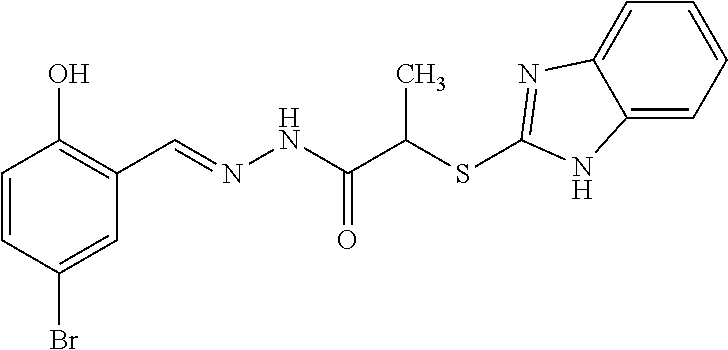 |
419.3 | — | — | 8.0* |
| *See Wu et al., Nat. Neurosci., 9, 1257-1264 (2006). | |||||


Claims (11)


Priority Applications (1)
| Application Number | Priority Date | Filing Date | Title |
|---|---|---|---|
| US16/097,087 US10981899B2 (en) | 2016-04-28 | 2017-04-28 | Inhibitors of soluble adenylyl cyclase |
Applications Claiming Priority (3)
| Application Number | Priority Date | Filing Date | Title |
|---|---|---|---|
| US201662328806P | 2016-04-28 | 2016-04-28 | |
| PCT/US2017/030188 WO2017190050A1 (en) | 2016-04-28 | 2017-04-28 | Inhibitors of soluble adenylyl cyclase |
| US16/097,087 US10981899B2 (en) | 2016-04-28 | 2017-04-28 | Inhibitors of soluble adenylyl cyclase |
Publications (2)
| Publication Number | Publication Date |
|---|---|
| US20200157084A1 US20200157084A1 (en) | 2020-05-21 |
| US10981899B2 true US10981899B2 (en) | 2021-04-20 |
Family
ID=60161194
Family Applications (1)
| Application Number | Title | Priority Date | Filing Date |
|---|---|---|---|
| US16/097,087 Active US10981899B2 (en) | 2016-04-28 | 2017-04-28 | Inhibitors of soluble adenylyl cyclase |
Country Status (2)
| Country | Link |
|---|---|
| US (1) | US10981899B2 (en) |
| WO (1) | WO2017190050A1 (en) |
Families Citing this family (1)
| Publication number | Priority date | Publication date | Assignee | Title |
|---|---|---|---|---|
| WO2022232259A1 (en) * | 2021-04-28 | 2022-11-03 | Cornell University | Soluble adenylyl cyclase (sac) inhibitors and uses thereof |
Citations (17)
| Publication number | Priority date | Publication date | Assignee | Title |
|---|---|---|---|---|
| US3892554A (en) | 1969-02-14 | 1975-07-01 | Sandoz Ltd | 2-Amino-4-isopropylamino-6-chloro-pyrimidine in maize, wheat, potatoes, onions and leeks |
| US4025515A (en) | 1969-02-14 | 1977-05-24 | Sandoz Ltd. | 6-Chloro-2,4-diaminopyrimidines |
| US5280009A (en) | 1991-07-16 | 1994-01-18 | Basf Aktiengesellschaft | Substituted pyrimidine derivatives and their use for controlling undesirable plant growth |
| US6080750A (en) | 1996-05-09 | 2000-06-27 | Nippon Shoji Kaisha Ltd. | Pyrimidine compound and anti-rotavirus composition |
| WO2000063182A2 (en) | 1999-04-20 | 2000-10-26 | Bayer Aktiengesellschaft | 2,4-diamino-pyrimidine derivatives and their use as microbicides and herbicides |
| US20040229909A1 (en) | 2001-08-10 | 2004-11-18 | Ryuichi Kiyama | Antiviral agent |
| US20070244174A1 (en) | 2004-01-21 | 2007-10-18 | Jochen Buck | Chemical Inhibitors of Soluble Adenylyl Cyclase (Sac) |
| US20080004268A1 (en) | 2004-09-24 | 2008-01-03 | Duy Nguyen | Inhibitors of soluble adenylate cyclase |
| US20080119535A1 (en) | 2006-10-19 | 2008-05-22 | Guido Galley | Aminomethyl-4-imidazoles |
| US20080255172A1 (en) | 2007-04-16 | 2008-10-16 | Hutchison Medipharma Enterprises Limeted | Pyrimidine derivatives |
| US20080261990A1 (en) | 2004-09-25 | 2008-10-23 | Bayer Healthcare Ag | Novel Pyrimidine Derivatives and their Use |
| US20100035863A1 (en) | 2006-09-12 | 2010-02-11 | Ucb Pharma, S.A. | 2 Amino-Pyrimidine Derivatives As H4 Receptor Antagonists, Processes For Preparing Them And Their Use In Pharmaceutical Compositions |
| US20110275611A1 (en) | 2008-11-20 | 2011-11-10 | Jeffrey Michael Axten | Chemical compounds |
| US20110305640A1 (en) | 2009-02-23 | 2011-12-15 | Cornell University | Method to treat psoriasis and other hyperproliferative skin disorders |
| US20120053179A1 (en) | 2002-01-23 | 2012-03-01 | Dhanapalan Nagarathnam | Rho-Kinase Inhibitors |
| US20120202806A1 (en) | 2009-09-02 | 2012-08-09 | Vifor (International) Ag | Novel Pyrimidine- And Triazine-Hepcidine Antagonists |
| US20160002175A1 (en) | 2012-11-27 | 2016-01-07 | Thomas Helledays Stiftelse För Medicinsk Forskning | Pyrimidine-2,4-Diamine Derivatives for Treatment of Cancer |
-
2017
- 2017-04-28 US US16/097,087 patent/US10981899B2/en active Active
- 2017-04-28 WO PCT/US2017/030188 patent/WO2017190050A1/en not_active Ceased
Patent Citations (17)
| Publication number | Priority date | Publication date | Assignee | Title |
|---|---|---|---|---|
| US4025515A (en) | 1969-02-14 | 1977-05-24 | Sandoz Ltd. | 6-Chloro-2,4-diaminopyrimidines |
| US3892554A (en) | 1969-02-14 | 1975-07-01 | Sandoz Ltd | 2-Amino-4-isopropylamino-6-chloro-pyrimidine in maize, wheat, potatoes, onions and leeks |
| US5280009A (en) | 1991-07-16 | 1994-01-18 | Basf Aktiengesellschaft | Substituted pyrimidine derivatives and their use for controlling undesirable plant growth |
| US6080750A (en) | 1996-05-09 | 2000-06-27 | Nippon Shoji Kaisha Ltd. | Pyrimidine compound and anti-rotavirus composition |
| WO2000063182A2 (en) | 1999-04-20 | 2000-10-26 | Bayer Aktiengesellschaft | 2,4-diamino-pyrimidine derivatives and their use as microbicides and herbicides |
| US20040229909A1 (en) | 2001-08-10 | 2004-11-18 | Ryuichi Kiyama | Antiviral agent |
| US20120053179A1 (en) | 2002-01-23 | 2012-03-01 | Dhanapalan Nagarathnam | Rho-Kinase Inhibitors |
| US20070244174A1 (en) | 2004-01-21 | 2007-10-18 | Jochen Buck | Chemical Inhibitors of Soluble Adenylyl Cyclase (Sac) |
| US20080004268A1 (en) | 2004-09-24 | 2008-01-03 | Duy Nguyen | Inhibitors of soluble adenylate cyclase |
| US20080261990A1 (en) | 2004-09-25 | 2008-10-23 | Bayer Healthcare Ag | Novel Pyrimidine Derivatives and their Use |
| US20100035863A1 (en) | 2006-09-12 | 2010-02-11 | Ucb Pharma, S.A. | 2 Amino-Pyrimidine Derivatives As H4 Receptor Antagonists, Processes For Preparing Them And Their Use In Pharmaceutical Compositions |
| US20080119535A1 (en) | 2006-10-19 | 2008-05-22 | Guido Galley | Aminomethyl-4-imidazoles |
| US20080255172A1 (en) | 2007-04-16 | 2008-10-16 | Hutchison Medipharma Enterprises Limeted | Pyrimidine derivatives |
| US20110275611A1 (en) | 2008-11-20 | 2011-11-10 | Jeffrey Michael Axten | Chemical compounds |
| US20110305640A1 (en) | 2009-02-23 | 2011-12-15 | Cornell University | Method to treat psoriasis and other hyperproliferative skin disorders |
| US20120202806A1 (en) | 2009-09-02 | 2012-08-09 | Vifor (International) Ag | Novel Pyrimidine- And Triazine-Hepcidine Antagonists |
| US20160002175A1 (en) | 2012-11-27 | 2016-01-07 | Thomas Helledays Stiftelse För Medicinsk Forskning | Pyrimidine-2,4-Diamine Derivatives for Treatment of Cancer |
Non-Patent Citations (44)
| Title |
|---|
| 6-Chloro-4-N-[2-(diethylamino)ethyl]-4-N-(thiophen-2-ylmethyl)pyrimidine-2,4-diamine, PubChem Open Chemistry Database, Nov. 29, 2013, https://pubchem.ncbi.nlm.nih.gov/compound/71853735. |
| 6-Chloro-N˜4˜-(thiophen-2-ylmethyl)pyrimidine-2,4-diamine, PubChem Open Chemistry Database, Feb. 9, 2007, https://pubchem.ncbi.nlm.nih.gov/compound/14257468. |
| 6-Chloro-N˜4˜-Cyclopropyl-N˜4˜-4[(Thiophen-2-YI)methyl]pyrimidine-2,4-Diamine, PubChem Open Chemistry Database, https://pubchem.ncbi.nlm.nih.gov/compound/47279808, (2010). |
| 6-Chloro-N4-[(4-ethylphenyl)(thiophen-2-yl)methyl]pyrimidine-2,4-diamine, PubChem Open Chemistry Database, Nov. 29, 2013, https://pubchem.ncbi.nlm.nih.gov/compound/71940097. |
| 6-Chloro-N4-[(furan-2-yl)methyl]-N4-[(5-methylthiophen-2-yl)methyl]pyrimidine-2,4-diamine, PubChem Open Chemistry Database, Nov. 29, 2013, https://pubchem.ncbi.nlm.nih.gov/compound/71884751. |
| 6-Chloro-N4-[(furan-2-yl)methyl]-N4-[(thiophen-2-yl)methyl]pyrimidine-2,4-diamine, PubChem Open Chemistry Database, Oct. 18, 2012, https://pubchem.ncbi.nlm.nih.gov/compound/60500169. |
| 6-Chloro-N4-[(oxolan-2-yl)methyl]-N4-[(thiophen-2-yl)methyl]pyrimidine-2,4-diamine, PubChem Open Chemistry Database, Nov. 29, 2013, https://pubchem.ncbi.nlm.nih.gov/compound/71850530. |
| Hisaki et al., Synthesis and anti-influenza virus activity of novel pyrimidine derivatives, Antiviral Research, Feb. 6 1999, vol. 42, No. 2, pp. 121-137. |
| Kast et al., Cardiovascular effects of a novel potent and highly selective azaindole-based inhibitor of Rho-kinase, British Journal of Pharmacology, Oct. 15, 2007, vol. 152, No. 7, pp. 1070-1080. |
| PubChem CID 71853735 (Nov. 29, 2013). * |
| PubChem CID: 47279808 (Nov. 26, 2010). * |
| PubChem CID: 60500169 (Oct. 18, 2012). * |
| PubChem CID: 71850530 (Nov. 29, 2013). * |
| PubChem SID: 116076723, PubChem Open Chemistry Database, Mar. 29, 2011, https://pubchem.ncbi.nlm.nih.gov/substance/116076723. |
| PubChem SID: 122002349, PubChem Open Chemistry Database, May 20, 2011, https://pubchem.ncbi.nlm.nih.gov/substance/122002349. |
| PubChem SID: 122401591, PubChem Open Chemistry Database, May 20, 2011, https://pubchem.ncbi.nlm.nih.gov/substance/122401591. |
| PubChem SID: 123460436, PubChem Open Chemistry Database, Jun. 21, 2011, https://pubchem.ncbi.nlm.nih.gov/substance/123460436. |
| PubChem SID: 123460917, PubChem Open Chemistry Database, Jun. 21, 2011, https://pubchem.ncbi.nlm.nih.gov/substance/123460917. |
| PubChem SID: 130336175, PubChem Open Chemistry Database, Dec. 6, 2011, https://pubchem.ncbi.nlm.nih.gov/substance/130336175. |
| PubChem SID: 130339878, PubChem Open Chemistry Database, Dec. 6, 2011, https://pubchem.ncbi.nlm.nih.gov/substance/130339878. |
| PubChem SID: 130447089, PubChem Open Chemistry Database, Dec. 6, 2011, https://pubchem.ncbi.nlm.nih.gov/substance/130447089. |
| PubChem SID: 132001164, PubChem Open Chemistry Database, Jan. 24, 2012, https://pubchem.ncbi.nlm.nih.gov/substance/132001164. |
| PubChem SID: 145051303, PubChem Open Chemistry Database, Oct. 18, 2012, https://pubchem.ncbi.nlm.nih.gov/substance/145051303. |
| PubChem SID: 165578805, PubChem Open Chemistry Database, Nov. 29, 2013, https://pubchem.ncbi.nlm.nih.gov/substance/165578805. |
| PubChem SID: 165582079, PubChem Open Chemistry Database, Nov. 29, 2013, https://pubchem.ncbi.nlm.nih.gov/substance/165582079. |
| PubChem SID: 165711971, PubChem Open Chemistry Database, Nov. 29, 2013, https://pubchem.ncbi.nlm.nih.gov/substance/165711971. |
| PubChem SID: 166426443, PubChem Open Chemistry Database, Dec. 1, 2013, https://pubchem.ncbi.nlm.nih.gov/substance/166426443. |
| PubChem SID: 166855249, PubChem Open Chemistry Database, Dec. 1, 2013, https://pubchem.ncbi.nlm.nih.gov/substance/166855249. |
| PubChem SID: 166989231, PubChem Open Chemistry Database, Dec. 1, 2013, https://pubchem.ncbi.nlm.nih.gov/substance/166989231. |
| PubChem SID: 169515389, PubChem Open Chemistry Database, Dec. 2, 2013, https://pubchem.ncbi.nlm.nih.gov/substance/169515389. |
| PubChem SID: 188954996, PubChem Open Chemistry Database, Jul. 12, 2014, https://pubchem.ncbi.nlm.nih.gov/substance/188954996. |
| PubChem SID: 188995980, PubChem Open Chemistry Database, Jul. 12, 2014, https://pubchem.ncbi.nlm.nih.gov/substance/188995980. |
| PubChem SID: 189584528, PubChem Open Chemistry Database, Jul. 12, 2014, https://pubchem.ncbi.nlm.nih.gov/substance/189584528. |
| PubChem SID: 189585899, PubChem Open Chemistry Database, Jul. 12, 2014, https://pubchem.ncbi.nlm.nih.gov/substance/189585899. |
| PubChem SID: 262864538, PubChem Open Chemistry Database, Dec. 11, 2015, https://pubchem.ncbi.nlm.nih.gov/substance/262864538. |
| PubChem SID: 266354384, PubChem Open Chemistry Database, Dec. 11, 2015, https://pubchem.ncbi.nlm.nih.gov/substance/266354384. |
| PubChem SID: 266357231, PubChem Open Chemistry Database, Dec. 11, 2015, https://pubchem.ncbi.nlm.nih.gov/substance/266357231. |
| PubChem SID: 266357232, PubChem Open Chemistry Database, Dec. 11, 2015, https://pubchem.ncbi.nlm.nih.gov/substance/266357232. |
| PubChem SID: 278548888, PubChem Open Chemistry Database, Jan. 12, 2016, https://pubchem.ncbi.nlm.nih.gov/substance/27854888. |
| PubChem SID: 299388852, PubChem Open Chemistry Database, Jan. 28, 2016, https://pubchem.ncbi.nlm.nih.gov/substance/299388852. |
| PubChem SID: 299398050, PubChem Open Chemistry Database, Jan. 28, 2016, https://pubchem.ncbi.nlm.nih.gov/substance/299398050. |
| PubChem SID: 301851888, PubChem Open Chemistry Database, Jan. 28, 2016, https://pubchem.ncbi.nlm.nih.gov/substance/301851888. |
| PubChem SID: 309529335, PubChem Open Chemistry Database, Jan. 30, 2016, https://pubchem.ncbi.nlm.nih.gov/substance/309529335. |
| Ramos-Espiritu et al., Discovery of LRE1 as a specific and allosteric inhibitor of soluble adenylyl cyclase, Nature Chemical Biology, Aug. 22, 2016, vol. 12, No. 10, pp. 838-844. |
Also Published As
| Publication number | Publication date |
|---|---|
| WO2017190050A1 (en) | 2017-11-02 |
| US20200157084A1 (en) | 2020-05-21 |
Similar Documents
| Publication | Publication Date | Title |
|---|---|---|
| Scozzafava et al. | Carbonic anhydrase inhibitors: synthesis of water-soluble, aminoacyl/dipeptidyl sulfonamides possessing long-lasting intraocular pressure-lowering properties via the topical route | |
| US6680324B2 (en) | Compounds specific to adenosine A1 receptors and uses thereof | |
| EP3353156B1 (en) | Tead transcription factor autopalmitoylation inhibitors | |
| US6673802B2 (en) | Compounds specific to adenosine A3 receptor and uses thereof | |
| US6664252B2 (en) | 4-aminopyrrolo[2,3-d]pyrimidine compounds specific to adenosine A2a receptor and uses thereof | |
| KR100840727B1 (en) | Adenosine A1, A2A and A3 receptor specific compounds and methods of using the same | |
| US20020094974A1 (en) | Compounds specific to adenosine A3 receptor and uses thereof | |
| JP2004517896A (en) | Compounds specific for the adenosine A1, A2A, and A3 receptors, and uses thereof | |
| US11053252B2 (en) | Selective proton coupled folate transporter and folate receptor, and garftase inhibitor compounds and methods of using the same | |
| US9439877B2 (en) | Small molecule inhibitors of Dusp6 and uses therefor | |
| JP2017521477A (en) | Methods for inhibiting necroptosis | |
| WO2018053373A1 (en) | Uses of satl-inducible kinase (sik) inhibitors for treating osteoporosis | |
| EA027987B1 (en) | Oxazolidin-2-one-pyrimidine derivatives | |
| EP3436005B1 (en) | L-1,2,3,4-tetrahydronorharman-3-carboxylic acid (tnca) for use in the treatment of diseases associated with mutated or abnormal calcium sensing receptor protein (casr) | |
| JP7336017B2 (en) | Boron-containing RHO kinase inhibitor | |
| EP1706114B1 (en) | Chemical inhibitors of soluble adenylyl cyclase (sac) | |
| US10981899B2 (en) | Inhibitors of soluble adenylyl cyclase | |
| JP4214057B2 (en) | Selective dopamine D3 receptor agonist for the treatment of sexual dysfunction | |
| US20250346582A1 (en) | Spleen tyrosine kinase inhibitors and methods of use thereof | |
| US20170057948A1 (en) | Indole-like trk receptor antagonists |
Legal Events
| Date | Code | Title | Description |
|---|---|---|---|
| FEPP | Fee payment procedure |
Free format text: ENTITY STATUS SET TO UNDISCOUNTED (ORIGINAL EVENT CODE: BIG.); ENTITY STATUS OF PATENT OWNER: SMALL ENTITY |
|
| FEPP | Fee payment procedure |
Free format text: ENTITY STATUS SET TO SMALL (ORIGINAL EVENT CODE: SMAL); ENTITY STATUS OF PATENT OWNER: SMALL ENTITY |
|
| STPP | Information on status: patent application and granting procedure in general |
Free format text: NON FINAL ACTION MAILED |
|
| STPP | Information on status: patent application and granting procedure in general |
Free format text: RESPONSE TO NON-FINAL OFFICE ACTION ENTERED AND FORWARDED TO EXAMINER |
|
| STPP | Information on status: patent application and granting procedure in general |
Free format text: NOTICE OF ALLOWANCE MAILED -- APPLICATION RECEIVED IN OFFICE OF PUBLICATIONS |
|
| AS | Assignment |
Owner name: STEEGBORN, CLEMENS, GERMANY Free format text: RELEASE OF ASSIGNMENT;ASSIGNOR:UNIVERSITY OF BAYREUTH;REEL/FRAME:055304/0260 Effective date: 20171016 |
|
| AS | Assignment |
Owner name: CORNELL UNIVERSITY, NEW YORK Free format text: ASSIGNMENT OF ASSIGNORS INTEREST;ASSIGNOR:STEEGBORN, CLEMENS;REEL/FRAME:055406/0238 Effective date: 20210208 Owner name: TRI-INSTITUTIONAL THERAPEUTICS DISCOVERY INSTITUTE, NEW YORK Free format text: ASSIGNMENT OF ASSIGNORS INTEREST;ASSIGNORS:SATO, AYUMU;OKAMOTO, REI;MICHINO, MAYAKO;SIGNING DATES FROM 20200406 TO 20200721;REEL/FRAME:055406/0309 |
|
| STPP | Information on status: patent application and granting procedure in general |
Free format text: PUBLICATIONS -- ISSUE FEE PAYMENT RECEIVED |
|
| STPP | Information on status: patent application and granting procedure in general |
Free format text: PUBLICATIONS -- ISSUE FEE PAYMENT VERIFIED |
|
| STCF | Information on status: patent grant |
Free format text: PATENTED CASE |
|
| CC | Certificate of correction | ||
| MAFP | Maintenance fee payment |
Free format text: PAYMENT OF MAINTENANCE FEE, 4TH YR, SMALL ENTITY (ORIGINAL EVENT CODE: M2551); ENTITY STATUS OF PATENT OWNER: SMALL ENTITY Year of fee payment: 4 |