US10980890B2 - Compounds comprising self-immolative group - Google Patents
Compounds comprising self-immolative group Download PDFInfo
- Publication number
- US10980890B2 US10980890B2 US16/545,869 US201916545869A US10980890B2 US 10980890 B2 US10980890 B2 US 10980890B2 US 201916545869 A US201916545869 A US 201916545869A US 10980890 B2 US10980890 B2 US 10980890B2
- Authority
- US
- United States
- Prior art keywords
- compound
- antibody
- integer
- alkyl
- mmol
- Prior art date
- Legal status (The legal status is an assumption and is not a legal conclusion. Google has not performed a legal analysis and makes no representation as to the accuracy of the status listed.)
- Active
Links
- 0 **[W]C.CC.[1*]C([2*])(OC(B)=O)C1=CC=C(C)C=C1 Chemical compound **[W]C.CC.[1*]C([2*])(OC(B)=O)C1=CC=C(C)C=C1 0.000 description 31
- RATRAUGKJVKXNS-IYBHLOTESA-N BC(=O)OCC1=CC=C(O[C@@H]2O[C@H](C(=O)O)[C@@H](O)[C@H](O)[C@H]2O)C(C(=O)NCCC/N=C(\C)CC/C(C)=C/CC/C(C)=C/CC)=C1.BC(=O)OCC1=CC=C(O[C@@H]2O[C@H](C(=O)O)[C@@H](O)[C@H](O)[C@H]2O)C(C(=O)NCCOCOCC2=CN(CCC/C(C)=C/CC/C(C)=C/CC)N=N2)=C1.CC.CC Chemical compound BC(=O)OCC1=CC=C(O[C@@H]2O[C@H](C(=O)O)[C@@H](O)[C@H](O)[C@H]2O)C(C(=O)NCCC/N=C(\C)CC/C(C)=C/CC/C(C)=C/CC)=C1.BC(=O)OCC1=CC=C(O[C@@H]2O[C@H](C(=O)O)[C@@H](O)[C@H](O)[C@H]2O)C(C(=O)NCCOCOCC2=CN(CCC/C(C)=C/CC/C(C)=C/CC)N=N2)=C1.CC.CC RATRAUGKJVKXNS-IYBHLOTESA-N 0.000 description 2
- GGKYVVSQQPJZQN-LVTYJFQVSA-N CCC(=O)C(CC1=CC=CC=C1)NC(=O)[C@H](C)[C@@H](OC)[C@@H]1CCCN1C(=O)C[C@@H](OC)[C@H](C(C)CC)N(C)C(=O)[C@@H](CC(=O)[C@H](C(C)C)N(C)C(C)C)C(C)C.CCC(C)[C@@H]([C@@H](CC(=O)N1CCC[C@H]1[C@H](OC)[C@@H](C)C(=O)NC(CC1=CC=C(O)C=C1)C(=O)O)OC)N(C)C(=O)[C@@H](CC(=O)[C@H](C(C)C)N(C)C(C)C)C(C)C.CCC(C)[C@@H]([C@@H](CC(=O)N1CCC[C@H]1[C@H](OC)[C@@H](C)C(=O)NC(CC1=CC=CC=C1)C(=O)O)OC)N(C)C(=O)[C@@H](CC(=O)[C@H](C(C)C)N(C)C(C)C)C(C)C.CCC(C)[C@@H]([C@@H](CC(=O)N1CCC[C@H]1[C@H](OC)[C@@H](C)C(=O)N[C@H](C)[C@@H](O)C1=CC=CC=C1)OC)N(C)C(=O)[C@@H](CC(=O)[C@H](C(C)C)N(C)C(C)C)C(C)C.COC1=CC=C(C2=CN3C(=O)C4=C(C=C(OCC5=CC(CNC(C)C)=CC(COC6=CC7=C(C=C6OC)C(=O)N6C=C(C8=CC=C(OC)C=C8)CC6C=N7)=C5)C(OC)=C4)N=CC3C2)C=C1 Chemical compound CCC(=O)C(CC1=CC=CC=C1)NC(=O)[C@H](C)[C@@H](OC)[C@@H]1CCCN1C(=O)C[C@@H](OC)[C@H](C(C)CC)N(C)C(=O)[C@@H](CC(=O)[C@H](C(C)C)N(C)C(C)C)C(C)C.CCC(C)[C@@H]([C@@H](CC(=O)N1CCC[C@H]1[C@H](OC)[C@@H](C)C(=O)NC(CC1=CC=C(O)C=C1)C(=O)O)OC)N(C)C(=O)[C@@H](CC(=O)[C@H](C(C)C)N(C)C(C)C)C(C)C.CCC(C)[C@@H]([C@@H](CC(=O)N1CCC[C@H]1[C@H](OC)[C@@H](C)C(=O)NC(CC1=CC=CC=C1)C(=O)O)OC)N(C)C(=O)[C@@H](CC(=O)[C@H](C(C)C)N(C)C(C)C)C(C)C.CCC(C)[C@@H]([C@@H](CC(=O)N1CCC[C@H]1[C@H](OC)[C@@H](C)C(=O)N[C@H](C)[C@@H](O)C1=CC=CC=C1)OC)N(C)C(=O)[C@@H](CC(=O)[C@H](C(C)C)N(C)C(C)C)C(C)C.COC1=CC=C(C2=CN3C(=O)C4=C(C=C(OCC5=CC(CNC(C)C)=CC(COC6=CC7=C(C=C6OC)C(=O)N6C=C(C8=CC=C(OC)C=C8)CC6C=N7)=C5)C(OC)=C4)N=CC3C2)C=C1 GGKYVVSQQPJZQN-LVTYJFQVSA-N 0.000 description 2
- HALYBFMEHYSOCD-ISSBBSMTSA-N CNC(=O)C1=CC(C2=CC=C(NC(=O)C3=CC(NC(=O)CCCOC4=CC5=C(C=C4OC)C(=O)N4C=C(C6=CC=C(OCCCC(C)C)C=C6)CC4C=N5)=CN3C)C=C2)=CN1C.[H][C@@]12C=NC3=C(C=C(OC)C(OCCCC(=O)NC4=CN(C)C(C(=O)NC5=CC=C(C6=CN(C)C(C(=O)NCCNC(C)C)=C6)C=C5)=C4)=C3)C(=O)N1CCC2.[H][C@@]12C=NC3=C(C=C(OC)C(OCCCC(=O)NC4=CN(C)C(C(=O)NC5=CC=C(C6=CN(C)C(C(=O)OCCCC(C)C)=C6)C=C5)=C4)=C3)C(=O)N1CCC2.[H][C@]12C=NC3=CC(OCCCOC4=CC5=C(C=C4OC)C(=O)N4C=C(C6=CC=C(NC(C)C)C=C6)C[C@@]4([H])C=N5)=C(OC)C=C3C(=O)N1C=C(C1=CC=C(OC)C=C1)C2.[H][C@]12C=NC3=CC(OCCCOC4=CC5=C(C=C4OC)C(=O)N4C=C(C6=CC=C(OCCCC(C)C)C=C6)C[C@@]4([H])C=N5)=C(OC)C=C3C(=O)N1C=C(C1=CC=C(OC)C=C1)C2 Chemical compound CNC(=O)C1=CC(C2=CC=C(NC(=O)C3=CC(NC(=O)CCCOC4=CC5=C(C=C4OC)C(=O)N4C=C(C6=CC=C(OCCCC(C)C)C=C6)CC4C=N5)=CN3C)C=C2)=CN1C.[H][C@@]12C=NC3=C(C=C(OC)C(OCCCC(=O)NC4=CN(C)C(C(=O)NC5=CC=C(C6=CN(C)C(C(=O)NCCNC(C)C)=C6)C=C5)=C4)=C3)C(=O)N1CCC2.[H][C@@]12C=NC3=C(C=C(OC)C(OCCCC(=O)NC4=CN(C)C(C(=O)NC5=CC=C(C6=CN(C)C(C(=O)OCCCC(C)C)=C6)C=C5)=C4)=C3)C(=O)N1CCC2.[H][C@]12C=NC3=CC(OCCCOC4=CC5=C(C=C4OC)C(=O)N4C=C(C6=CC=C(NC(C)C)C=C6)C[C@@]4([H])C=N5)=C(OC)C=C3C(=O)N1C=C(C1=CC=C(OC)C=C1)C2.[H][C@]12C=NC3=CC(OCCCOC4=CC5=C(C=C4OC)C(=O)N4C=C(C6=CC=C(OCCCC(C)C)C=C6)C[C@@]4([H])C=N5)=C(OC)C=C3C(=O)N1C=C(C1=CC=C(OC)C=C1)C2 HALYBFMEHYSOCD-ISSBBSMTSA-N 0.000 description 2
- PAJLSIBTGHUKDN-QWIXSGHUSA-N *.B.CNCCCN=[N+]=[N-].CNCCCO.CNCCCOS(C)(=O)=O.COC(=O)[C@H]1OC(OC(C)=O)[C@H](OC(C)=O)[C@@H](OC(C)=O)[C@@H]1C.COC(=O)[C@H]1O[C@H](Br)[C@H](OC(C)=O)[C@@H](OC(C)=O)[C@@H]1C.Cl.NCCCO.[H][C@]12OC(O)[C@H](O)[C@@]1([H])OC(=O)[C@@H]2O.[N-]=[N+]=NCCCN Chemical compound *.B.CNCCCN=[N+]=[N-].CNCCCO.CNCCCOS(C)(=O)=O.COC(=O)[C@H]1OC(OC(C)=O)[C@H](OC(C)=O)[C@@H](OC(C)=O)[C@@H]1C.COC(=O)[C@H]1O[C@H](Br)[C@H](OC(C)=O)[C@@H](OC(C)=O)[C@@H]1C.Cl.NCCCO.[H][C@]12OC(O)[C@H](O)[C@@]1([H])OC(=O)[C@@H]2O.[N-]=[N+]=NCCCN PAJLSIBTGHUKDN-QWIXSGHUSA-N 0.000 description 1
- PWJCNUWGSXAKTA-UHFFFAOYSA-N C.C.CC(C)CC1=CN(CC(C)C)N=N1.CC(C)CCC1=CN(C(C)C)N=N1.CC(C)CCN1C=C(C(C)C)N=N1 Chemical compound C.C.CC(C)CC1=CN(CC(C)C)N=N1.CC(C)CCC1=CN(C(C)C)N=N1.CC(C)CCN1C=C(C(C)C)N=N1 PWJCNUWGSXAKTA-UHFFFAOYSA-N 0.000 description 1
- FRILDVVNGKVWRP-HMVOGTMASA-N C.CC(=O)CC/C(C)=C/CC/C(C)=C/CO.CCC(C)[C@@H]([C@@H](CC(=O)N1CCC[C@H]1[C@H](OC)[C@@H](C)C(=O)NC(CC1=CC=CC=C1)C(=O)O)OC)N(C)C(=O)[C@@H](CC(=O)[C@H](C(C)C)N(C)C(=O)OCC1=CC(C)=C(O[C@@H]2O[C@H](C(=O)O)[C@@H](O)[C@H](O)[C@H]2O)C(C(=O)NCCO/N=C(\C)CC/C(C)=C/CC/C(C)=C/CO)=C1)C(C)C.CCC(C)[C@@H]([C@@H](CC(=O)N1CCC[C@H]1[C@H](OC)[C@@H](C)C(=O)NC(CC1=CC=CC=C1)C(=O)O)OC)N(C)C(=O)[C@@H](CC(=O)[C@H](C(C)C)N(C)C(=O)OCC1=CC(C)=C(O[C@@H]2O[C@H](C(=O)O)[C@@H](O)[C@H](O)[C@H]2O)C(C(=O)NCCON)=C1)C(C)C Chemical compound C.CC(=O)CC/C(C)=C/CC/C(C)=C/CO.CCC(C)[C@@H]([C@@H](CC(=O)N1CCC[C@H]1[C@H](OC)[C@@H](C)C(=O)NC(CC1=CC=CC=C1)C(=O)O)OC)N(C)C(=O)[C@@H](CC(=O)[C@H](C(C)C)N(C)C(=O)OCC1=CC(C)=C(O[C@@H]2O[C@H](C(=O)O)[C@@H](O)[C@H](O)[C@H]2O)C(C(=O)NCCO/N=C(\C)CC/C(C)=C/CC/C(C)=C/CO)=C1)C(C)C.CCC(C)[C@@H]([C@@H](CC(=O)N1CCC[C@H]1[C@H](OC)[C@@H](C)C(=O)NC(CC1=CC=CC=C1)C(=O)O)OC)N(C)C(=O)[C@@H](CC(=O)[C@H](C(C)C)N(C)C(=O)OCC1=CC(C)=C(O[C@@H]2O[C@H](C(=O)O)[C@@H](O)[C@H](O)[C@H]2O)C(C(=O)NCCON)=C1)C(C)C FRILDVVNGKVWRP-HMVOGTMASA-N 0.000 description 1
- QLQCHYWCXJOOEC-YZBICKCDSA-N C/C(=C\CC(C)C)CC/C=C(\C)CC/C(C)=N/OCCOCCOCCC(C)C.C/C(=C\CC(C)C)CC/C=C(\C)CCCN1C=C(COCCCC(C)C)N=N1 Chemical compound C/C(=C\CC(C)C)CC/C=C(\C)CC/C(C)=N/OCCOCCOCCC(C)C.C/C(=C\CC(C)C)CC/C=C(\C)CCCN1C=C(COCCCC(C)C)N=N1 QLQCHYWCXJOOEC-YZBICKCDSA-N 0.000 description 1
- HDXWXSNAJARSDW-KBIZECBCSA-N CC(=O)OCC1=CC=C(O[C@@H]2O[C@H](C(=O)O)[C@@H](O)[C@H](O)[C@H]2O)C(C(=O)NCCOCCOCCON)=C1.CC(=O)OCC1=CC=C(O[C@@H]2O[C@H](C(C)=O)[C@@H](C)[C@H](C)[C@H]2OC(C)=O)C(C(=O)O)=C1.CC(=O)OCC1=CC=C(O[C@@H]2O[C@H](C(C)=O)[C@@H](C)[C@H](C)[C@H]2OC(C)=O)C(C(=O)OCC[Si](C)(C)C)=C1.CC(=O)O[C@H]1[C@H](OC2=CC=C(COC(=O)OC3=CC=C([N+](=O)[O-])C=C3)C=C2C(=O)OCC[Si](C)(C)C)O[C@H](C(C)=O)[C@@H](C)[C@@H]1C.CCC(C)[C@@H]([C@@H](CC(=O)N1CCC[C@H]1[C@H](OC)[C@@H](C)C(=O)N[C@H](C)[C@@H](O)C1=CC=CC=C1)OC)N(C)C(=O)[C@@H](CC(=O)[C@@H](NC)C(C)C)C(C)C.CNOCCOCCOCCN.CNOCCOCCOCCNC(=O)C1=CC(COC(C)=O)=CC=C1O[C@@H]1O[C@H](C(=O)O)[C@@H](O)[C@H](O)[C@H]1O.CNOCCOCCOCCNC(=O)C1=CC(COC(C)=O)=CC=C1O[C@@H]1O[C@H](C(C)=O)[C@@H](C)[C@H](C)[C@H]1OC(C)=O Chemical compound CC(=O)OCC1=CC=C(O[C@@H]2O[C@H](C(=O)O)[C@@H](O)[C@H](O)[C@H]2O)C(C(=O)NCCOCCOCCON)=C1.CC(=O)OCC1=CC=C(O[C@@H]2O[C@H](C(C)=O)[C@@H](C)[C@H](C)[C@H]2OC(C)=O)C(C(=O)O)=C1.CC(=O)OCC1=CC=C(O[C@@H]2O[C@H](C(C)=O)[C@@H](C)[C@H](C)[C@H]2OC(C)=O)C(C(=O)OCC[Si](C)(C)C)=C1.CC(=O)O[C@H]1[C@H](OC2=CC=C(COC(=O)OC3=CC=C([N+](=O)[O-])C=C3)C=C2C(=O)OCC[Si](C)(C)C)O[C@H](C(C)=O)[C@@H](C)[C@@H]1C.CCC(C)[C@@H]([C@@H](CC(=O)N1CCC[C@H]1[C@H](OC)[C@@H](C)C(=O)N[C@H](C)[C@@H](O)C1=CC=CC=C1)OC)N(C)C(=O)[C@@H](CC(=O)[C@@H](NC)C(C)C)C(C)C.CNOCCOCCOCCN.CNOCCOCCOCCNC(=O)C1=CC(COC(C)=O)=CC=C1O[C@@H]1O[C@H](C(=O)O)[C@@H](O)[C@H](O)[C@H]1O.CNOCCOCCOCCNC(=O)C1=CC(COC(C)=O)=CC=C1O[C@@H]1O[C@H](C(C)=O)[C@@H](C)[C@H](C)[C@H]1OC(C)=O HDXWXSNAJARSDW-KBIZECBCSA-N 0.000 description 1
- METIFLRKCGNEDL-PWCVGCKKSA-N CC(=O)OCC1=CC=C(O[C@@H]2O[C@H](C(=O)O)[C@@H](O)[C@H](O)[C@H]2O)C(C(=O)NCCOCCOCCON)=C1.CC/C=C(\C)CC/C=C(\C)CC/C(C)=N/OCCOCCOCCNC(=O)C1=CC(COC(C)=O)=CC=C1O[C@@H]1O[C@H](C(=O)O)[C@@H](O)[C@H](O)[C@H]1O.Cl Chemical compound CC(=O)OCC1=CC=C(O[C@@H]2O[C@H](C(=O)O)[C@@H](O)[C@H](O)[C@H]2O)C(C(=O)NCCOCCOCCON)=C1.CC/C=C(\C)CC/C=C(\C)CC/C(C)=N/OCCOCCOCCNC(=O)C1=CC(COC(C)=O)=CC=C1O[C@@H]1O[C@H](C(=O)O)[C@@H](O)[C@H](O)[C@H]1O.Cl METIFLRKCGNEDL-PWCVGCKKSA-N 0.000 description 1
- OOOJPLAQMHTFDY-ILGFTKTBSA-N CC(=O)O[C@H]1[C@H](OC2=CC=C(CO)C=C2N)O[C@H](C(C)=O)[C@@H](C)[C@@H]1C.CC(=O)O[C@H]1[C@H](OC2=CC=C(CO)C=C2NC(=O)CCCN=[N+]=[N-])O[C@H](C(C)=O)[C@@H](C)[C@@H]1C.CC(=O)O[C@H]1[C@H](OC2=CC=C(CO)C=C2[N+](=O)[O-])O[C@H](C(C)=O)[C@@H](C)[C@@H]1C.CCOC(=O)CCCBr.CCOC(=O)CCCN=[N+]=[N-].O=C(O)C1=CC=C(O)C([N+](=O)[O-])=C1.O=[N+]([O-])C1=CC(CO)=CC=C1O.[N-]=[N+]=NCCCC(=O)Cl.[N-]=[N+]=NCCCC(=O)O Chemical compound CC(=O)O[C@H]1[C@H](OC2=CC=C(CO)C=C2N)O[C@H](C(C)=O)[C@@H](C)[C@@H]1C.CC(=O)O[C@H]1[C@H](OC2=CC=C(CO)C=C2NC(=O)CCCN=[N+]=[N-])O[C@H](C(C)=O)[C@@H](C)[C@@H]1C.CC(=O)O[C@H]1[C@H](OC2=CC=C(CO)C=C2[N+](=O)[O-])O[C@H](C(C)=O)[C@@H](C)[C@@H]1C.CCOC(=O)CCCBr.CCOC(=O)CCCN=[N+]=[N-].O=C(O)C1=CC=C(O)C([N+](=O)[O-])=C1.O=[N+]([O-])C1=CC(CO)=CC=C1O.[N-]=[N+]=NCCCC(=O)Cl.[N-]=[N+]=NCCCC(=O)O OOOJPLAQMHTFDY-ILGFTKTBSA-N 0.000 description 1
- URBLCGZFFGBPAT-UHFFFAOYSA-N CC(C)CC1=CN(CC(C)C)N=N1.CC(C)CCC1=CN(C(C)C)N=N1.CC(C)CCN1C=C(C(C)C)N=N1 Chemical compound CC(C)CC1=CN(CC(C)C)N=N1.CC(C)CCC1=CN(C(C)C)N=N1.CC(C)CCN1C=C(C(C)C)N=N1 URBLCGZFFGBPAT-UHFFFAOYSA-N 0.000 description 1
- FMIKLNJBYDXXFI-UHFFFAOYSA-N CNOCCN.CNOCCN=[N+]=[N-].CNOCCO.CNOCCOS(C)(=O)=O.Cl.OCCBr Chemical compound CNOCCN.CNOCCN=[N+]=[N-].CNOCCO.CNOCCOS(C)(=O)=O.Cl.OCCBr FMIKLNJBYDXXFI-UHFFFAOYSA-N 0.000 description 1
Images


Classifications
-
- A—HUMAN NECESSITIES
- A61—MEDICAL OR VETERINARY SCIENCE; HYGIENE
- A61K—PREPARATIONS FOR MEDICAL, DENTAL OR TOILETRY PURPOSES
- A61K47/00—Medicinal preparations characterised by the non-active ingredients used, e.g. carriers or inert additives; Targeting or modifying agents chemically bound to the active ingredient
- A61K47/50—Medicinal preparations characterised by the non-active ingredients used, e.g. carriers or inert additives; Targeting or modifying agents chemically bound to the active ingredient the non-active ingredient being chemically bound to the active ingredient, e.g. polymer-drug conjugates
- A61K47/51—Medicinal preparations characterised by the non-active ingredients used, e.g. carriers or inert additives; Targeting or modifying agents chemically bound to the active ingredient the non-active ingredient being chemically bound to the active ingredient, e.g. polymer-drug conjugates the non-active ingredient being a modifying agent
- A61K47/54—Medicinal preparations characterised by the non-active ingredients used, e.g. carriers or inert additives; Targeting or modifying agents chemically bound to the active ingredient the non-active ingredient being chemically bound to the active ingredient, e.g. polymer-drug conjugates the non-active ingredient being a modifying agent the modifying agent being an organic compound
- A61K47/549—Sugars, nucleosides, nucleotides or nucleic acids
-
- A—HUMAN NECESSITIES
- A61—MEDICAL OR VETERINARY SCIENCE; HYGIENE
- A61K—PREPARATIONS FOR MEDICAL, DENTAL OR TOILETRY PURPOSES
- A61K47/00—Medicinal preparations characterised by the non-active ingredients used, e.g. carriers or inert additives; Targeting or modifying agents chemically bound to the active ingredient
- A61K47/50—Medicinal preparations characterised by the non-active ingredients used, e.g. carriers or inert additives; Targeting or modifying agents chemically bound to the active ingredient the non-active ingredient being chemically bound to the active ingredient, e.g. polymer-drug conjugates
-
- A—HUMAN NECESSITIES
- A61—MEDICAL OR VETERINARY SCIENCE; HYGIENE
- A61K—PREPARATIONS FOR MEDICAL, DENTAL OR TOILETRY PURPOSES
- A61K47/00—Medicinal preparations characterised by the non-active ingredients used, e.g. carriers or inert additives; Targeting or modifying agents chemically bound to the active ingredient
- A61K47/50—Medicinal preparations characterised by the non-active ingredients used, e.g. carriers or inert additives; Targeting or modifying agents chemically bound to the active ingredient the non-active ingredient being chemically bound to the active ingredient, e.g. polymer-drug conjugates
- A61K47/51—Medicinal preparations characterised by the non-active ingredients used, e.g. carriers or inert additives; Targeting or modifying agents chemically bound to the active ingredient the non-active ingredient being chemically bound to the active ingredient, e.g. polymer-drug conjugates the non-active ingredient being a modifying agent
- A61K47/68—Medicinal preparations characterised by the non-active ingredients used, e.g. carriers or inert additives; Targeting or modifying agents chemically bound to the active ingredient the non-active ingredient being chemically bound to the active ingredient, e.g. polymer-drug conjugates the non-active ingredient being a modifying agent the modifying agent being an antibody, an immunoglobulin or a fragment thereof, e.g. an Fc-fragment
- A61K47/6801—Drug-antibody or immunoglobulin conjugates defined by the pharmacologically or therapeutically active agent
-
- A—HUMAN NECESSITIES
- A61—MEDICAL OR VETERINARY SCIENCE; HYGIENE
- A61K—PREPARATIONS FOR MEDICAL, DENTAL OR TOILETRY PURPOSES
- A61K47/00—Medicinal preparations characterised by the non-active ingredients used, e.g. carriers or inert additives; Targeting or modifying agents chemically bound to the active ingredient
- A61K47/50—Medicinal preparations characterised by the non-active ingredients used, e.g. carriers or inert additives; Targeting or modifying agents chemically bound to the active ingredient the non-active ingredient being chemically bound to the active ingredient, e.g. polymer-drug conjugates
- A61K47/51—Medicinal preparations characterised by the non-active ingredients used, e.g. carriers or inert additives; Targeting or modifying agents chemically bound to the active ingredient the non-active ingredient being chemically bound to the active ingredient, e.g. polymer-drug conjugates the non-active ingredient being a modifying agent
- A61K47/68—Medicinal preparations characterised by the non-active ingredients used, e.g. carriers or inert additives; Targeting or modifying agents chemically bound to the active ingredient the non-active ingredient being chemically bound to the active ingredient, e.g. polymer-drug conjugates the non-active ingredient being a modifying agent the modifying agent being an antibody, an immunoglobulin or a fragment thereof, e.g. an Fc-fragment
- A61K47/6801—Drug-antibody or immunoglobulin conjugates defined by the pharmacologically or therapeutically active agent
- A61K47/6803—Drugs conjugated to an antibody or immunoglobulin, e.g. cisplatin-antibody conjugates
-
- A—HUMAN NECESSITIES
- A61—MEDICAL OR VETERINARY SCIENCE; HYGIENE
- A61K—PREPARATIONS FOR MEDICAL, DENTAL OR TOILETRY PURPOSES
- A61K47/00—Medicinal preparations characterised by the non-active ingredients used, e.g. carriers or inert additives; Targeting or modifying agents chemically bound to the active ingredient
- A61K47/50—Medicinal preparations characterised by the non-active ingredients used, e.g. carriers or inert additives; Targeting or modifying agents chemically bound to the active ingredient the non-active ingredient being chemically bound to the active ingredient, e.g. polymer-drug conjugates
- A61K47/51—Medicinal preparations characterised by the non-active ingredients used, e.g. carriers or inert additives; Targeting or modifying agents chemically bound to the active ingredient the non-active ingredient being chemically bound to the active ingredient, e.g. polymer-drug conjugates the non-active ingredient being a modifying agent
- A61K47/68—Medicinal preparations characterised by the non-active ingredients used, e.g. carriers or inert additives; Targeting or modifying agents chemically bound to the active ingredient the non-active ingredient being chemically bound to the active ingredient, e.g. polymer-drug conjugates the non-active ingredient being a modifying agent the modifying agent being an antibody, an immunoglobulin or a fragment thereof, e.g. an Fc-fragment
- A61K47/6801—Drug-antibody or immunoglobulin conjugates defined by the pharmacologically or therapeutically active agent
- A61K47/6803—Drugs conjugated to an antibody or immunoglobulin, e.g. cisplatin-antibody conjugates
- A61K47/68031—Drugs conjugated to an antibody or immunoglobulin, e.g. cisplatin-antibody conjugates the drug being an auristatin
-
- A—HUMAN NECESSITIES
- A61—MEDICAL OR VETERINARY SCIENCE; HYGIENE
- A61K—PREPARATIONS FOR MEDICAL, DENTAL OR TOILETRY PURPOSES
- A61K47/00—Medicinal preparations characterised by the non-active ingredients used, e.g. carriers or inert additives; Targeting or modifying agents chemically bound to the active ingredient
- A61K47/50—Medicinal preparations characterised by the non-active ingredients used, e.g. carriers or inert additives; Targeting or modifying agents chemically bound to the active ingredient the non-active ingredient being chemically bound to the active ingredient, e.g. polymer-drug conjugates
- A61K47/51—Medicinal preparations characterised by the non-active ingredients used, e.g. carriers or inert additives; Targeting or modifying agents chemically bound to the active ingredient the non-active ingredient being chemically bound to the active ingredient, e.g. polymer-drug conjugates the non-active ingredient being a modifying agent
- A61K47/68—Medicinal preparations characterised by the non-active ingredients used, e.g. carriers or inert additives; Targeting or modifying agents chemically bound to the active ingredient the non-active ingredient being chemically bound to the active ingredient, e.g. polymer-drug conjugates the non-active ingredient being a modifying agent the modifying agent being an antibody, an immunoglobulin or a fragment thereof, e.g. an Fc-fragment
- A61K47/6801—Drug-antibody or immunoglobulin conjugates defined by the pharmacologically or therapeutically active agent
- A61K47/6803—Drugs conjugated to an antibody or immunoglobulin, e.g. cisplatin-antibody conjugates
- A61K47/6811—Drugs conjugated to an antibody or immunoglobulin, e.g. cisplatin-antibody conjugates the drug being a protein or peptide, e.g. transferrin or bleomycin
-
- A—HUMAN NECESSITIES
- A61—MEDICAL OR VETERINARY SCIENCE; HYGIENE
- A61K—PREPARATIONS FOR MEDICAL, DENTAL OR TOILETRY PURPOSES
- A61K47/00—Medicinal preparations characterised by the non-active ingredients used, e.g. carriers or inert additives; Targeting or modifying agents chemically bound to the active ingredient
- A61K47/50—Medicinal preparations characterised by the non-active ingredients used, e.g. carriers or inert additives; Targeting or modifying agents chemically bound to the active ingredient the non-active ingredient being chemically bound to the active ingredient, e.g. polymer-drug conjugates
- A61K47/51—Medicinal preparations characterised by the non-active ingredients used, e.g. carriers or inert additives; Targeting or modifying agents chemically bound to the active ingredient the non-active ingredient being chemically bound to the active ingredient, e.g. polymer-drug conjugates the non-active ingredient being a modifying agent
- A61K47/68—Medicinal preparations characterised by the non-active ingredients used, e.g. carriers or inert additives; Targeting or modifying agents chemically bound to the active ingredient the non-active ingredient being chemically bound to the active ingredient, e.g. polymer-drug conjugates the non-active ingredient being a modifying agent the modifying agent being an antibody, an immunoglobulin or a fragment thereof, e.g. an Fc-fragment
- A61K47/6801—Drug-antibody or immunoglobulin conjugates defined by the pharmacologically or therapeutically active agent
- A61K47/6803—Drugs conjugated to an antibody or immunoglobulin, e.g. cisplatin-antibody conjugates
- A61K47/6811—Drugs conjugated to an antibody or immunoglobulin, e.g. cisplatin-antibody conjugates the drug being a protein or peptide, e.g. transferrin or bleomycin
- A61K47/6813—Drugs conjugated to an antibody or immunoglobulin, e.g. cisplatin-antibody conjugates the drug being a protein or peptide, e.g. transferrin or bleomycin the drug being a peptidic cytokine, e.g. an interleukin or interferon
-
- A—HUMAN NECESSITIES
- A61—MEDICAL OR VETERINARY SCIENCE; HYGIENE
- A61K—PREPARATIONS FOR MEDICAL, DENTAL OR TOILETRY PURPOSES
- A61K47/00—Medicinal preparations characterised by the non-active ingredients used, e.g. carriers or inert additives; Targeting or modifying agents chemically bound to the active ingredient
- A61K47/50—Medicinal preparations characterised by the non-active ingredients used, e.g. carriers or inert additives; Targeting or modifying agents chemically bound to the active ingredient the non-active ingredient being chemically bound to the active ingredient, e.g. polymer-drug conjugates
- A61K47/51—Medicinal preparations characterised by the non-active ingredients used, e.g. carriers or inert additives; Targeting or modifying agents chemically bound to the active ingredient the non-active ingredient being chemically bound to the active ingredient, e.g. polymer-drug conjugates the non-active ingredient being a modifying agent
- A61K47/68—Medicinal preparations characterised by the non-active ingredients used, e.g. carriers or inert additives; Targeting or modifying agents chemically bound to the active ingredient the non-active ingredient being chemically bound to the active ingredient, e.g. polymer-drug conjugates the non-active ingredient being a modifying agent the modifying agent being an antibody, an immunoglobulin or a fragment thereof, e.g. an Fc-fragment
- A61K47/6835—Medicinal preparations characterised by the non-active ingredients used, e.g. carriers or inert additives; Targeting or modifying agents chemically bound to the active ingredient the non-active ingredient being chemically bound to the active ingredient, e.g. polymer-drug conjugates the non-active ingredient being a modifying agent the modifying agent being an antibody, an immunoglobulin or a fragment thereof, e.g. an Fc-fragment the modifying agent being an antibody or an immunoglobulin bearing at least one antigen-binding site
- A61K47/6851—Medicinal preparations characterised by the non-active ingredients used, e.g. carriers or inert additives; Targeting or modifying agents chemically bound to the active ingredient the non-active ingredient being chemically bound to the active ingredient, e.g. polymer-drug conjugates the non-active ingredient being a modifying agent the modifying agent being an antibody, an immunoglobulin or a fragment thereof, e.g. an Fc-fragment the modifying agent being an antibody or an immunoglobulin bearing at least one antigen-binding site the antibody targeting a determinant of a tumour cell
- A61K47/6855—Medicinal preparations characterised by the non-active ingredients used, e.g. carriers or inert additives; Targeting or modifying agents chemically bound to the active ingredient the non-active ingredient being chemically bound to the active ingredient, e.g. polymer-drug conjugates the non-active ingredient being a modifying agent the modifying agent being an antibody, an immunoglobulin or a fragment thereof, e.g. an Fc-fragment the modifying agent being an antibody or an immunoglobulin bearing at least one antigen-binding site the antibody targeting a determinant of a tumour cell the tumour determinant being from breast cancer cell
-
- A—HUMAN NECESSITIES
- A61—MEDICAL OR VETERINARY SCIENCE; HYGIENE
- A61K—PREPARATIONS FOR MEDICAL, DENTAL OR TOILETRY PURPOSES
- A61K47/00—Medicinal preparations characterised by the non-active ingredients used, e.g. carriers or inert additives; Targeting or modifying agents chemically bound to the active ingredient
- A61K47/50—Medicinal preparations characterised by the non-active ingredients used, e.g. carriers or inert additives; Targeting or modifying agents chemically bound to the active ingredient the non-active ingredient being chemically bound to the active ingredient, e.g. polymer-drug conjugates
- A61K47/51—Medicinal preparations characterised by the non-active ingredients used, e.g. carriers or inert additives; Targeting or modifying agents chemically bound to the active ingredient the non-active ingredient being chemically bound to the active ingredient, e.g. polymer-drug conjugates the non-active ingredient being a modifying agent
- A61K47/68—Medicinal preparations characterised by the non-active ingredients used, e.g. carriers or inert additives; Targeting or modifying agents chemically bound to the active ingredient the non-active ingredient being chemically bound to the active ingredient, e.g. polymer-drug conjugates the non-active ingredient being a modifying agent the modifying agent being an antibody, an immunoglobulin or a fragment thereof, e.g. an Fc-fragment
- A61K47/6835—Medicinal preparations characterised by the non-active ingredients used, e.g. carriers or inert additives; Targeting or modifying agents chemically bound to the active ingredient the non-active ingredient being chemically bound to the active ingredient, e.g. polymer-drug conjugates the non-active ingredient being a modifying agent the modifying agent being an antibody, an immunoglobulin or a fragment thereof, e.g. an Fc-fragment the modifying agent being an antibody or an immunoglobulin bearing at least one antigen-binding site
- A61K47/6871—Medicinal preparations characterised by the non-active ingredients used, e.g. carriers or inert additives; Targeting or modifying agents chemically bound to the active ingredient the non-active ingredient being chemically bound to the active ingredient, e.g. polymer-drug conjugates the non-active ingredient being a modifying agent the modifying agent being an antibody, an immunoglobulin or a fragment thereof, e.g. an Fc-fragment the modifying agent being an antibody or an immunoglobulin bearing at least one antigen-binding site the antibody targeting an enzyme
-
- A—HUMAN NECESSITIES
- A61—MEDICAL OR VETERINARY SCIENCE; HYGIENE
- A61K—PREPARATIONS FOR MEDICAL, DENTAL OR TOILETRY PURPOSES
- A61K47/00—Medicinal preparations characterised by the non-active ingredients used, e.g. carriers or inert additives; Targeting or modifying agents chemically bound to the active ingredient
- A61K47/50—Medicinal preparations characterised by the non-active ingredients used, e.g. carriers or inert additives; Targeting or modifying agents chemically bound to the active ingredient the non-active ingredient being chemically bound to the active ingredient, e.g. polymer-drug conjugates
- A61K47/51—Medicinal preparations characterised by the non-active ingredients used, e.g. carriers or inert additives; Targeting or modifying agents chemically bound to the active ingredient the non-active ingredient being chemically bound to the active ingredient, e.g. polymer-drug conjugates the non-active ingredient being a modifying agent
- A61K47/68—Medicinal preparations characterised by the non-active ingredients used, e.g. carriers or inert additives; Targeting or modifying agents chemically bound to the active ingredient the non-active ingredient being chemically bound to the active ingredient, e.g. polymer-drug conjugates the non-active ingredient being a modifying agent the modifying agent being an antibody, an immunoglobulin or a fragment thereof, e.g. an Fc-fragment
- A61K47/6889—Conjugates wherein the antibody being the modifying agent and wherein the linker, binder or spacer confers particular properties to the conjugates, e.g. peptidic enzyme-labile linkers or acid-labile linkers, providing for an acid-labile immuno conjugate wherein the drug may be released from its antibody conjugated part in an acidic, e.g. tumoural or environment
-
- A—HUMAN NECESSITIES
- A61—MEDICAL OR VETERINARY SCIENCE; HYGIENE
- A61K—PREPARATIONS FOR MEDICAL, DENTAL OR TOILETRY PURPOSES
- A61K47/00—Medicinal preparations characterised by the non-active ingredients used, e.g. carriers or inert additives; Targeting or modifying agents chemically bound to the active ingredient
- A61K47/50—Medicinal preparations characterised by the non-active ingredients used, e.g. carriers or inert additives; Targeting or modifying agents chemically bound to the active ingredient the non-active ingredient being chemically bound to the active ingredient, e.g. polymer-drug conjugates
- A61K47/69—Medicinal preparations characterised by the non-active ingredients used, e.g. carriers or inert additives; Targeting or modifying agents chemically bound to the active ingredient the non-active ingredient being chemically bound to the active ingredient, e.g. polymer-drug conjugates the conjugate being characterised by physical or galenical forms, e.g. emulsion, particle, inclusion complex, stent or kit
-
- A—HUMAN NECESSITIES
- A61—MEDICAL OR VETERINARY SCIENCE; HYGIENE
- A61P—SPECIFIC THERAPEUTIC ACTIVITY OF CHEMICAL COMPOUNDS OR MEDICINAL PREPARATIONS
- A61P31/00—Antiinfectives, i.e. antibiotics, antiseptics, chemotherapeutics
- A61P31/04—Antibacterial agents
-
- A—HUMAN NECESSITIES
- A61—MEDICAL OR VETERINARY SCIENCE; HYGIENE
- A61P—SPECIFIC THERAPEUTIC ACTIVITY OF CHEMICAL COMPOUNDS OR MEDICINAL PREPARATIONS
- A61P31/00—Antiinfectives, i.e. antibiotics, antiseptics, chemotherapeutics
- A61P31/10—Antimycotics
-
- A—HUMAN NECESSITIES
- A61—MEDICAL OR VETERINARY SCIENCE; HYGIENE
- A61P—SPECIFIC THERAPEUTIC ACTIVITY OF CHEMICAL COMPOUNDS OR MEDICINAL PREPARATIONS
- A61P31/00—Antiinfectives, i.e. antibiotics, antiseptics, chemotherapeutics
- A61P31/12—Antivirals
-
- A—HUMAN NECESSITIES
- A61—MEDICAL OR VETERINARY SCIENCE; HYGIENE
- A61P—SPECIFIC THERAPEUTIC ACTIVITY OF CHEMICAL COMPOUNDS OR MEDICINAL PREPARATIONS
- A61P33/00—Antiparasitic agents
-
- A—HUMAN NECESSITIES
- A61—MEDICAL OR VETERINARY SCIENCE; HYGIENE
- A61P—SPECIFIC THERAPEUTIC ACTIVITY OF CHEMICAL COMPOUNDS OR MEDICINAL PREPARATIONS
- A61P35/00—Antineoplastic agents
-
- A—HUMAN NECESSITIES
- A61—MEDICAL OR VETERINARY SCIENCE; HYGIENE
- A61P—SPECIFIC THERAPEUTIC ACTIVITY OF CHEMICAL COMPOUNDS OR MEDICINAL PREPARATIONS
- A61P37/00—Drugs for immunological or allergic disorders
- A61P37/02—Immunomodulators
-
- A—HUMAN NECESSITIES
- A61—MEDICAL OR VETERINARY SCIENCE; HYGIENE
- A61P—SPECIFIC THERAPEUTIC ACTIVITY OF CHEMICAL COMPOUNDS OR MEDICINAL PREPARATIONS
- A61P43/00—Drugs for specific purposes, not provided for in groups A61P1/00-A61P41/00
-
- C—CHEMISTRY; METALLURGY
- C07—ORGANIC CHEMISTRY
- C07D—HETEROCYCLIC COMPOUNDS
- C07D249/00—Heterocyclic compounds containing five-membered rings having three nitrogen atoms as the only ring hetero atoms
- C07D249/02—Heterocyclic compounds containing five-membered rings having three nitrogen atoms as the only ring hetero atoms not condensed with other rings
- C07D249/04—1,2,3-Triazoles; Hydrogenated 1,2,3-triazoles
-
- C—CHEMISTRY; METALLURGY
- C07—ORGANIC CHEMISTRY
- C07D—HETEROCYCLIC COMPOUNDS
- C07D309/00—Heterocyclic compounds containing six-membered rings having one oxygen atom as the only ring hetero atom, not condensed with other rings
- C07D309/02—Heterocyclic compounds containing six-membered rings having one oxygen atom as the only ring hetero atom, not condensed with other rings having no double bonds between ring members or between ring members and non-ring members
- C07D309/08—Heterocyclic compounds containing six-membered rings having one oxygen atom as the only ring hetero atom, not condensed with other rings having no double bonds between ring members or between ring members and non-ring members with hetero atoms or with carbon atoms having three bonds to hetero atoms with at the most one bond to halogen, e.g. ester or nitrile radicals, directly attached to ring carbon atoms
- C07D309/10—Oxygen atoms
-
- C—CHEMISTRY; METALLURGY
- C07—ORGANIC CHEMISTRY
- C07D—HETEROCYCLIC COMPOUNDS
- C07D487/00—Heterocyclic compounds containing nitrogen atoms as the only ring hetero atoms in the condensed system, not provided for by groups C07D451/00 - C07D477/00
- C07D487/02—Heterocyclic compounds containing nitrogen atoms as the only ring hetero atoms in the condensed system, not provided for by groups C07D451/00 - C07D477/00 in which the condensed system contains two hetero rings
- C07D487/04—Ortho-condensed systems
-
- C—CHEMISTRY; METALLURGY
- C07—ORGANIC CHEMISTRY
- C07D—HETEROCYCLIC COMPOUNDS
- C07D519/00—Heterocyclic compounds containing more than one system of two or more relevant hetero rings condensed among themselves or condensed with a common carbocyclic ring system not provided for in groups C07D453/00 or C07D455/00
-
- C—CHEMISTRY; METALLURGY
- C07—ORGANIC CHEMISTRY
- C07K—PEPTIDES
- C07K16/00—Immunoglobulins [IG], e.g. monoclonal or polyclonal antibodies
- C07K16/18—Immunoglobulins [IG], e.g. monoclonal or polyclonal antibodies against material from animals or humans
- C07K16/32—Immunoglobulins [IG], e.g. monoclonal or polyclonal antibodies against material from animals or humans against translation products of oncogenes
-
- C—CHEMISTRY; METALLURGY
- C07—ORGANIC CHEMISTRY
- C07K—PEPTIDES
- C07K19/00—Hybrid peptides, i.e. peptides covalently bound to nucleic acids, or non-covalently bound protein-protein complexes
-
- A—HUMAN NECESSITIES
- A61—MEDICAL OR VETERINARY SCIENCE; HYGIENE
- A61K—PREPARATIONS FOR MEDICAL, DENTAL OR TOILETRY PURPOSES
- A61K39/00—Medicinal preparations containing antigens or antibodies
- A61K2039/505—Medicinal preparations containing antigens or antibodies comprising antibodies
-
- C—CHEMISTRY; METALLURGY
- C07—ORGANIC CHEMISTRY
- C07K—PEPTIDES
- C07K2317/00—Immunoglobulins specific features
- C07K2317/20—Immunoglobulins specific features characterized by taxonomic origin
- C07K2317/24—Immunoglobulins specific features characterized by taxonomic origin containing regions, domains or residues from different species, e.g. chimeric, humanized or veneered
-
- C—CHEMISTRY; METALLURGY
- C07—ORGANIC CHEMISTRY
- C07K—PEPTIDES
- C07K2317/00—Immunoglobulins specific features
- C07K2317/90—Immunoglobulins specific features characterized by (pharmaco)kinetic aspects or by stability of the immunoglobulin
- C07K2317/94—Stability, e.g. half-life, pH, temperature or enzyme-resistance
Definitions
- the present invention relates to compounds comprising a self-immolative group
- the compounds comprising a self-immolative group according to the present invention may include a protein (for example, an oligopeptide, a polypeptide, an antibody, or the like) having substrate-specificity for a target and an active agent (for example, a drug, a toxin, a ligand, a detection probe, or the like) having a specific function or activity.
- An antibody-drug conjugate (ADC) technology is a novel target-oriented technology for causing apoptosis of cancer cells by releasing a toxic material in the cells after binding a toxin to an antibody bound to an antigen. Since the ADC technology may allow a drug to be accurately delivered to target cancer cells and released only under a specific condition while minimizing an influence on healthy cells, the ADC technology may have more excellent efficacy than that of a therapeutic antibody itself, and significantly decrease the risk of an adverse reaction as compared to existing anticancer drugs.
- a basic structure of the antibody-drug conjugates as described above is composed of an “antibody-linker-low molecular weight drug (toxin)”.
- the linker should allow the drug to exhibit a drug effect on target cancer cells while being easily separated by an antibody-drug dissociation phenomenon (for example, a result caused by hydrolysis by an enzyme) after the drug stably reaches to the target cells at the time of circulation and is introduced into the cells, in addition to playing a functional role of simply connecting the antibody and the drug. That is, since efficacy, systemic toxicity, and the like, of the antibody-drug conjugates depend on stability of the linker, the linker plays an important role in view of safety (Discovery Medicine 2010, 10(53): 329-39).
- linkers of the antibody-drug conjugates developed up to now are roughly classified into a non-cleavable type and a cleavable type.
- thioether is mainly used, and a drug is not dissociated due to separation of the linker in cells, but the drug is dissociated in a form in which the drug includes the linker and a single amino acid derived from an antibody.
- a reaction is easily carried out at pH of about 6 to 7, but a reverse reaction may also be easily chemically carried out, such that there is a problem in stability.
- a linker separated by a chemical method or a linker hydrolyzed by an enzyme reaction is mainly used.
- a linker having a chemical separation mechanism a linker containing a disulfide bond is representative.
- hydrazone or oxime linkers are also used.
- a disulfide linker which uses a phenomenon that a drug is dissociated using a thiol exchange reaction, uses the fact that a concentration of thiol (particularly, glutathione) in cells is higher than that in blood.
- thiols for example, albumin, and glutathione
- a drug may be separated during circulation.
- a hydrazone linker it is known that the hydrazone linker is relatively stable in the blood, but is unstable in cells, endosomes, or lysosomes, in which acidity is high, such that the hydrazone linker is rapidly hydrolyzed (Bioconjugate Chem. 2008, 19, 759-765; Bioconjugate Chem., 2010, 21, 5-13).
- a linker hydrolyzed by an enzyme reaction in cells has been developed, and a peptide linker (for example, valine-citrulline) and a ⁇ -glucuronide linker belong thereto.
- Valine-citrulline and ⁇ -glucuronide are not directly connected to a drug but are bound to self-immolative groups, such that the drug is dissociated by a mechanism such as 1,6-elimination or cyclization mechanism after hydrolysis by an enzyme reaction, thereby exhibiting efficacy (Clinical Cancer Res., 2005, 11, 843-852).
- valine-citrulline peptide linker is selectively decomposed by lysosome protease such as cathepsin B, and increases stability in the blood as compared to the hydrazone linker, which is chemically decomposed, and thus, an anti-cancer effect is increased (Bioconjugate Chem. 2008, 19, 1960-1963; J. Org. Chem., 2002, 67, 1866-1872).
- the peptide linker has hydrophobicity, such that there are disadvantages such as aggregation of prepared antibody-drug conjugates.
- the ⁇ -glucuronide linker which is recognized to thereby be hydrolyzed by ⁇ -glucuronidase, has high hydrophilicity unlike the peptide linker, such that at the time of binding the ⁇ -glucuronide linker to a drug having high hydrophobicity, solubility of antibody-drug conjugates may be increased.
- Examples of binding antibodies to various drugs for example, monomethylauristatin F, monomethylauristatin E, doxorubicinpropyloxazoline (DPO) using the ⁇ 5-glucuronide linker to prepare antibody-drug conjugates have been reported (Conjugation Chem., 2006, 17, 831-840; US2012/0107332). According to the report, the antibody-drug conjugates prepared using the glucuronide linker are significantly stable in rat plasma, but stability thereof in mouse plasma was not reported.
- the present invention is to develop an effective linker comprising a self-immolative group, capable of being more stable in the plasma, being stable in the circulation, and allowing a drug to be easily released in cancer cells to exhibit a drug effect.
- An object of the present invention is to provide compounds comprising a self-immolative group.
- compounds comprise a self-immolative group represented by the following Chemical Formula 1:
- G is a glucuronic acid moiety or a derivative thereof
- A is (C 1 -C 20 )hydrocarbyl, a biomaterial, or a modified biomaterial;
- B is (C 1 -C 100 )hydrocarbyl
- W is an electron withdrawing group
- Z is hydrogen, (C 1 -C 8 )alkyl, halogen, cyano, or nitro;
- n is an integer of 1 to 3, and when n is an integer of 2 or more, each of the Z(s) are the same as or different from each other;
- L is a linker connecting A and W of the self-immolative group by covalent bonds
- R 1 and R 2 are each independently hydrogen, (C 1 -C 8 )alkyl, or (C 3 -C 8 )cycloalkyl.
- R 3 may be hydrogen or a carboxyl protecting group, and R 4 (s) are each independently hydrogen or a hydroxyl protecting group.
- W may be —C(O)—, —C(O)NR′—, —C(O)O—, —SO 2 NR′—, —P(O)R′′NR′—, —SONR′—, or —PO 2 NR′—
- R′ and R′′ may be each independently hydrogen, (C 1 -C 8 )alkyl, (C 3 -C 8 )cycloalkyl, (C 1 -C 8 )alkoxy, (C 1 -C 8 )alkylthio, mono- or di-(C 1 -C 8 )alkylamino, (C 3 -C 20 )heteroaryl or (C 6 -C 20 )aryl.
- the linker L may be alkylene having 1 to 50 carbon atoms and satisfy at least one of the following (i) to (iv):
- the alkylene includes at least one unsaturated bond
- the alkylene includes at least one heteroarylene
- the carbon atom of the alkylene is substituted with one or more hetero atoms selected from nitrogen (N), oxygen (O), and sulfur (S), and
- the alkylene is further substituted with one or more alkyls having 1 to 20 carbon atoms.
- the linker L may include at least one isoprenyl derivative unit represented by the following Chemical Formula A, which may be recognized by isoprenoid transferase.
- the linker L may further include a binding unit formed by 1,3-dipolar cycloaddition reactions, hetero-diels reactions, nucleophilic substitution reactions, non-aldol type carbonyl reactions, additions to carbon-carbon multiple bonds, oxidation reactions, or click reactions.
- the binding unit may be formed by a reaction between acetylene and azide, or a reaction between an aldehyde or ketone group and hydrazine or hydroxylamine.
- the binding unit may be represented by the following Chemical Formula B, C, D, or E:
- L 1 is a single bond or alkylene having 1 to 30 carbon atoms
- R 11 is hydrogen or alkyl having 1 to 10 carbon atoms
- L 2 is alkylene having 1 to 30 carbon atoms.
- the linker L may further include a connection unit represented by the following Chemical Formula F or G: —(CH 2 ) r (V(CH 2 ) p ) q — [Chemical Formula F] —(CH 2 CH 2 X) w — [Chemical Formula G]
- V is a single bond, —O—, —S—, —NR 21 —, —C(O)NR 22 —, —NR 23 C(O)—, —NR 24 SO 2 —, or —SO 2 NR 25 —;
- X is —O—, (C 1 -C 8 )alkylene, or —NR 21 —;
- R 21 to R 25 are each independently hydrogen, (C 1 -C 6 )alkyl, (C 1 -C 6 )alkyl(C 6 -C 20 )aryl, or (C 1 -C 6 )alkyl(C 3 -C 20 )heteroaryl;
- r is an integer of 1 to 10;
- p is an integer of 0 to 10;
- q is an integer of 1 to 10;
- w is an integer of 1 to 10.
- L When A is hydrocarbyl having 1 to 20 carbon atoms, L may be
- V may be a single bond, —O—, —S—, —NR 21 —, —C(O)NR 22 —, —NR 23 C(O)—, —NR 24 SO 2 —, or —SO 2 NR 25 —
- R 21 to R 25 may be each independently hydrogen, (C 1 -C 6 )alkyl, (C 1 -C 6 )alkyl(C 6 -C 20 )aryl, or (C 1 -C 6 )alkyl(C 3 -C 20 )heteroaryl
- r may be an integer of 1 to 10
- p may be an integer of 0 to 10
- q may be an integer of 1 to 10
- L 1 may be a single bond.
- the biomaterial may be a protein.
- the protein may be an oligopeptide, a polypeptide, an antibody, a fragment of an antigenic polypeptide, or a repebody.
- the protein may have an amino acid motif capable of being recognized by isoprenoid transferase.
- the protein may further include a spacer unit composed of an amino acid, an oligopeptide, or a polypeptide between the protein and the amino acid motif.
- the protein may be covalently bonded to the linker L through the amino acid motif.
- the amino acid motif may be covalently bonded to a C-terminal of the protein, or covalently bonded to at least one spacer unit covalently bonded to the C-terminal of the protein.
- the C-terminal of the protein may be a C-terminal of a light chain or heavy chain of the antibody.
- the isoprenoid transferase may be farnesyl protein transferase (FTase) or geranylgeranyl transferase (GGTase).
- FTase farnesyl protein transferase
- GTTase geranylgeranyl transferase
- the antibody may be selected from the group consisting of intact polyclonal antibodies, intact monoclonal antibodies, antibody fragments, single chain Fv (scFv) mutants, multispecific antibodies, bispecific antibodies, chimeric antibodies, humanized antibodies, human antibodies, fusion proteins including an antigen determination portion of an antibody, and other modified immunoglobulin molecules including an antigen recognition site.
- intact polyclonal antibodies intact monoclonal antibodies, antibody fragments, single chain Fv (scFv) mutants, multispecific antibodies, bispecific antibodies, chimeric antibodies, humanized antibodies, human antibodies, fusion proteins including an antigen determination portion of an antibody, and other modified immunoglobulin molecules including an antigen recognition site.
- the antibody may be selected from the group consisting of muromonab-CD3 abciximab, rituximab, daclizumab, palivizumab, infliximab, trastuzumab, (referred to as ‘Herceptin’), etanercept, basiliximab, gemtuzumab ozogamicin, alemtuzumab, ibritumomab tiuxetan, adalimumab, alefacept, omalizumab, efalizumab, tositumomob-I 131 , cetuximab, bevacizumab, natalizumab, ranibizumab, panitumumab, eculizumab, rilonacept, certolizumab pegol, romiplostim, AMG-531, CNTO-148, CNTO-1275, ABT-874, LEA-29Y
- the protein may be a monoclonal antibody.
- the amino acid motif may be CYYX, XXCC, XCXC, or CXX, wherein C represents cysteine, Y represents an aliphatic amino acid, and X represents an amino acid that determines a substrate specificity of the isoprenoid transferase.
- B may be active agent.
- the active agent may be a drug, a toxin, an affinity ligand, a detection probe, or a combination thereof.
- the active agent may be an immunomodulatory compound, an anticancer agent, an antiviral agent, an antibacterial agent, an antifungal agent, an antiparasitic agent, or a combination thereof.
- the protein having an amino acid motif may be selected from the group consisting of A-HC-(G) z CVIM, A-HC-(G) z CVLL, A-LC-(G) z CVIM, and A-LC-(G) z CVLL, wherein A represents the antibody, HC represents a heavy chain, LC represents a light chain, G represents a glycine unit, and z is an integer of 0 to 20.
- the compounds may be selected from compounds having the following structures:
- Z is hydrogen, (C 1 -C 8 )alkyl, halogen, cyano, or nitro;
- X is —O—, (C 1 -C 8 )alkylene, or —NR 21 —;
- R 21 is hydrogen, (C 1 -C 6 )alkyl, (C 1 -C 6 )alkyl(C 6 -C 20 )aryl, or (C 1 -C 6 )alkyl(C 3 -C 20 )heteroaryl;
- n is an integer of 1 to 3, and when n is an integer of 2 or more, each of the Z(s) are the same as or different from each other;
- r is an integer of 1 to 10;
- q is an integer of 1 to 10;
- w is an integer of 1 to 10.
- x is an integer of 0 to 10;
- g is an integer of 1 to 10;
- S-mAb is A-HC-(G) z CVIM-, A-HC-(G) z CVLL-, A-LC-(G) z CVIM-, or A-LC-(G) z CVLL-, wherein A represents the antibody, HC represents a heavy chain, LC represents a light chain, G represents a glycine unit, and z is an integer of 0 to 20;
- B is a drug having a structure selected from the following structures.
- y is an integer of 1 to 10.
- Compounds comprising a self-immolative group according to the present invention may include a protein (for example, an oligopeptide, a polypeptide, an antibody, or the like) having substrate-specificity for a target and an active agent (for example, a drug, a toxin, a ligand, a detection probe, or the like) having a specific function or activity.
- the self-immolative group may be more stable in blood, plasma, and the like, as compared to the existing linker while specifically binding to a protein over-expressed in cells causing a disease, but may be separated in target cancer cells, such that the active agent may specifically act on the cells causing the disease, thereby making it possible to use the compounds to treat diseases.
- FIG. 1 illustrates an active drug release mechanism from ⁇ -glucuronide based linker.
- FIG. 2 illustrates a result obtained by measuring a hydrolysis rate by ⁇ -glucuronidase in Experimental Example 1.
- FIG. 3 illustrates a result obtained by measuring plasma stability in Experimental Example 2.
- FIG. 4 illustrates a result obtained by measuring plasma stability of LCB14-0648 prepared in Example 5.
- FIG. 5 illustrates a result obtained by measuring plasma stability of LCB14-0663 prepared in Example 6.
- FIG. 6 illustrates a result obtained by measuring plasma stability of LCB14-0664 prepared in Example 7.
- FIG. 7 is a schematic view illustrating reactions in Example 9.
- FIG. 8 illustrates a result obtained by measuring mouse plasma stability of ADC (LCB14-0109) prepared in Example 8.
- FIG. 9 illustrates a result obtained by variously measuring plasma stability of ADC (LCB14-0110) prepared in Example 9.
- FIG. 10 is a graph illustrating a result obtained by observing a tumor volume depending on QW dose in Experimental Example 6 (Vehicle, Herceptin (5 mg/kg), and ADC109 (0.1, 1, 5 mg/kg)).
- FIG. 11 is a graph illustrating a result obtained by observing a drug effect depending on repetitive administration in Experimental Example 6 (Vehicle, Herceptin (5 mg/kg), ADC109 (5 mg/kg), and ADC110 (5 mg/kg)).
- FIG. 12 is a graph illustrating a result obtained by observing a drug effect depending on single-dose administration in Experimental Example 6 (Vehicle, Herceptin (5 mg/kg), ADC109 (5 mg/kg), and ADC110 (5 mg/kg)).
- FIG. 13 illustrates a result obtained by evaluating in vitro plasma stability of ADC 110 (Example 10) in Experimental Example 7.
- FIG. 14 illustrates a result obtained by evaluating in vitro plasma stability of ADC 113 (Example 11) in Experimental Example 7.
- FIG. 15 illustrates a result obtained by evaluating in vitro plasma stability of Kadcyla in Experimental Example 7.
- FIG. 16 is a graph illustrating a result obtained by observing in vivo PK profile in a mouse, in Experimental Example 8.
- FIG. 17 is a graph illustrating a result obtained by observing in vivo PK profile of ADC 110 (Example 10) in a rat in Experimental Example 8.
- FIG. 18 is a graph illustrating a result obtained by observing an in vivo drug-antibody ratio (DAR) of ADC 110 (Example 10) in a rat in Experimental Example 8.
- DAR drug-antibody ratio
- FIG. 19 is a graph illustrating a result obtained by observing an in vivo free payload concentration of ADC 110 (Example 10) in a rat in Experimental Example 8.
- FIG. 20 is a graph illustrating a result obtained by observing in vivo PK profile of ADC 110 (Example 10) in a monkey in Experimental Example 8.
- FIG. 21 is a graph illustrating a result obtained by observing in vivo drug-antibody ratio (DAR) of ADC 110 (Example 10) in a monkey in Experimental Example 8.
- DAR drug-antibody ratio
- FIG. 22 is a graph illustrating a result obtained by observing an in vivo free payload concentration of ADC 110 (Example 10) in a monkey in Experimental Example 8.
- the present invention relates to compounds comprising a self-immolative group.
- the compounds comprising a self-immolative group according to the present invention may be represented by the following Chemical Formula and include a protein (for example, an oligopeptide, a polypeptide, an antibody, or the like) having substrate-specificity for a target and an active agent (for example, a drug, a toxin, a ligand, a detection probe, or the like) having a specific function or activity.
- G is a glucuronic acid moiety or a derivative thereof
- A is (C 1 -C 20 )hydrocarbyl, a biomaterial, or a modified biomaterial;
- B is (C 1 -C 100 )hydrocarbyl
- W is an electron withdrawing group
- Z is hydrogen, (C 1 -C 8 )alkyl, halogen, cyano, or nitro;
- n is an integer of 1 to 3, and when n is an integer of 2 or more, each of the Z(s) are the same as or different from each other;
- L is a linker connecting A and W of the self-immolative group by covalent bonds
- R 1 and R 2 are each independently hydrogen, (C 8 -C 8 )alkyl, or (C 3 -C 8 )cycloalkyl.
- the self-immolative group may be bound to glucuronide capable of being separated by ⁇ -glucuronidase
- G which is the glucuronide group or the derivative thereof capable of being separated by ⁇ -glucuronidase, may be represented by the following structure.
- R 3 is hydrogen or a carboxyl protecting group
- R 4 (s) are each independently hydrogen or a hydroxyl protecting group.
- the carboxyl protecting group which is a general protecting group capable of being used in organic synthesis, may be preferably methyl, methoxymethyl, methylthiomethyl, tetrahydropyranyl, benzyloxymethyl, phenacyl, N-phthalimidomethyl, 2,2,2-trichloroethyl, 2-haloethyl, 2-(p-toluenesulfonyl)ethyl, t-butyl, cinnamyl, benzyl, triphenylmethyl, bis(o-nitrophenyl)methyl, 9-anthramethyl, 2-(9,10-dioxo)anthrylmethyl, piperonyl, trimethylsilyl, t-butyldimethylsilyl, or S-t-butyl, 2-alkyl-1,3-oxazolinyl, but is not limited thereto.
- the hydroxyl protecting group which is a general protecting group capable of being used in organic synthesis, may be preferably acetyl, methyl, ethoxyethyl, benzoyl, benzyl, 4-methoxybenzyl, 3,4-dimethoxybenzyl, tetrahydropyranyl (THP), tetrahydrofuran (THF), tert-butyldimethylsilyl (TBDMS), trimethylsilyl (TMS), triethylsilyl (TES), triisopropylsilyl (TIP), tert-butyldiphenylsilyl (TBDPS), tri-iso-propylsilyloxymethyl (TOM), ⁇ -methoxyethoxymethyl (MEM), methoxymethyl (MOM), allyl, or trityl, but is not limited thereto.
- W which is the electron withdrawing group
- W may be preferably —(O)—, —C(O)NR′—, —C(O)O—, —SO 2 NR′—, —P(O)R′′NR′—, —SONR′—, or —PO 2 NR′—, but is not limited thereto
- R′ and R′′ may be each independently hydrogen, (C 1 -C 8 )alkyl, (C 3 -C 8 )cycloalkyl, (C 1 -C 8 )alkoxy, (C 1 -C 8 )alkylthio, mono- or di-(C 1 -C 8 )alkylamino, (C 3 -C 20 ) heteroaryl or (C 6 -C 20 )aryl.
- the linker L may be alkylene having 1 to 50 carbon atoms and satisfy at least one, preferably, at least two of the following (i) to (iv):
- the alkylene includes at least one unsaturated bond
- the alkylene includes at least one heteroarylene
- a carbon atom of the alkylene is substituted by one or more hetero atoms selected from nitrogen (N), oxygen (O), and sulfur (S), and
- the alkylene is further substituted with one or more alkyls having 1 to 20 carbon atoms.
- the linker L may include at least one isoprenyl derivative unit represented by the following Chemical Formula A, which may be recognized by isoprenoid transferase.
- the linker L may further include a binding unit formed by 1,3-dipolar cycloaddition reactions, hetero-diels Alder reactions, nucleophilic substitution reactions, non-aldol type carbonyl reactions, additions to carbon-carbon multiple bonds, oxidation reactions, or click reactions.
- the binding unit which is formed by a reaction between acetylene and azide, or a reaction between an aldehyde or ketone group and hydrazine or hydroxylamine, may be preferably represented by the following Chemical Formula B, C, D, or E.
- L 1 is a single bond or alkylene having 1 to 30 carbon atoms
- R 11 is hydrogen or alkyl having 1 to 10 carbon atoms
- L 2 is alkylene having 1 to 30 carbon atoms.
- Click chemistry reactions are carried out in a mild condition, thereby making it possible to easily handle proteins.
- the click chemistry reaction shows significantly high reaction specificity. Therefore, even though a protein has other functional groups (for example, a side chain residue, or at a C- or N-terminal), these functional groups are not affected by the click chemistry reaction.
- a click chemistry reaction between an azide group and an acetylene group of a protein may occur while other functional groups of the protein are not affected by the click chemistry reaction.
- the click chemistry reaction may specifically occur regardless of the kind of involved ligand. In some cases, the ligand may be selected so as to improve overall reaction efficiency.
- an azide-acetylene click chemistry reaction may produce triazole with a high yield (ref: Rhiannon K. Hia et al, Chem. Rev. 2009, 109, 5620; Morten Meldal and Christian Wenzel Tornoe, Chem Rev., 2008, 108, 2952; Hartmuth C. Kolb et al, Angew. Chemie Int. Ed. Engl., 2001, 40, 2004, which are all incorporated herein by reference).
- the azide and acetylene groups are functional groups that do not exist in amino acid sequences of natural proteins. In the case in which a conjugation reaction occurs using these functional groups, none of the side chain residues and none of the N-terminal or C-terminal functional groups are affected by the click chemistry reaction.
- linker L may further include a connection unit represented by Chemical Formula F or G: —(CH 2 ) r (V(CH 2 ) p ) q — [Chemical Formula F] —(CH 2 CH 2 X) w — [Chemical Formula G]
- V is a single bond, —O—, —S—, —NR 21 —, —C(O)NR 22 —, —NR 23 C(O)—, —NR 24 SO 2 —, or —SO 2 NR 25 ;
- X is —O—, (C 1 -C 8 )alkylene, or —NR 21 —;
- R 21 to R 25 are each independently hydrogen, (C 1 -C 6 )alkyl, (C 1 -C 6 )alkyl(C 6 -C 20 )aryl, or (C 1 -C 6 )alkyl(C 3 -C 20 ) heteroaryl;
- r is an integer of 1 to 10;
- p is an integer of 0 to 10;
- q is an integer of 1 to 10;
- w is an integer of 1 to 10.
- the linker L may all include at least one isoprenyl derivative unit represented by Chemical Formula A, the binding unit represented by Chemical Formula B, C, D, or E, and the connection unit represented by Chemical Formula F or G.
- linker L may be represented by the following structures.
- L when A is hydrocarbyl having 1 to 20 carbon atoms, L may be
- V may be a single bond, —O—, —S—, —NR 21 —, —C(O)NR 22 —, —NR 23 C(O)—, —NR 24 SO 2 —, or —SO 2 NR 25 —
- R 21 to R 25 may be each independently hydrogen, (C 1 -C 6 )alkyl, (C 1 -C 6 )alkyl(C 6 -C 20 ) aryl, or (C 1 -C 6 )alkyl(C 3 -C 20 )heteroaryl
- r may be an integer of 1 to 10
- p may be an integer of 0 to 10
- q may be an integer of 1 to 10
- L 1 may be a single bond.
- the biomaterial may be a protein, wherein the protein includes an oligopeptide, a polypeptide, an antibody, a fragment of an antigenic polypeptide, and a repebody.
- the protein has an amino acid motif capable of being recognized by isoprenoid transferase. That is, a C-terminal (fragment, an analog or derivative thereof) of the protein may be bound to the amino acid motif capable of being recognized by isoprenoid transferase.
- the protein may further include a spacer unit composed of an amino acid, an oligopeptide, or a polypeptide between the protein and the amino acid motif.
- the protein has a deletion at the carboxyl (C) terminal of the protein or an addition by a covalent bond of the spacer unit at the carboxyl terminal of the protein.
- the protein may be directly covalently bound to the amino acid motif or be covalently bound to the spacer unit to thereby be connected to the amino acid motif.
- the amino acid spacer unit is composed of 1 to 20 amino acids, among them, a glycine unit is preferable.
- the protein has an amino acid motif capable of being recognized by isoprenoid transferase. That is, a C-terminal (fragment, an analog or derivative thereof) of the protein may be bound to the amino acid motif capable of being recognized by isoprenoid transferase.
- the protein may further include a spacer unit composed of an amino acid, an oligopeptide, or a polypeptide between the protein and the amino acid motif.
- the protein has a deletion at the carboxyl (C) terminal of the protein or an addition by a covalent bond of the spacer unit at the carboxyl terminal of the protein.
- the protein may be directly covalently bound to the amino acid motif or be covalently bound to the spacer unit to thereby be connected to the amino acid motif.
- the amino acid spacer unit is composed of 1 to 20 amino acids, among them, a glycine unit is preferable.
- isoprenoid transferase may include farnesyl protein transferase (FTase) or geranylgeranyl transferase (GGTase), which involve the transfer of a farnesyl or a geranyl-geranyl residue to C-terminal cysteine(s) of a target protein, respectively.
- GGTase may be classified into GGTase I and GGTase II.
- FTase and GGTase I may recognize a CAAX motif
- GGTase II may recognize a XXCC, XCXC, or CXX motif
- C represents cysteine
- A represents an aliphatic amino acid
- X represents an amino acid determining the substrate specificity of the isoprenoid transferases
- Lane KT Bees LS, Structural Biology of Protein of Farnesyltransferase and Geranylgeranyl transferase Type I, Journal of Lipid Research, 47, pp. 681-699 (2006); Patrick J. Kasey, Miguel C. Seabra; Protein Prenyl transferases, The Journal of Biological Chemistry, Vol. 271, No. 10, Issue of March 8, pp. 5289-5292 (1996), the contents of these references are incorporated by reference in their entirety).
- isoprenoid transferases from a variety of sources, for example, humans, animals, plants, bacteria, virus, and the like, may be used.
- naturally occurring isoprenoid transferases can be used.
- naturally or artificially modified isoprenoid transferases may be used.
- an isoprenoid transferase having at least one amino acid sequence naturally changed (including post-translational modification), a naturally or artificially truncated form of a naturally occurring isoprenoid transferase, and an isoprenoid transferase modified by at least one of (His)-tag, GST, GFP, MBP, CBP, Iospeptag, BCCP, Myc-tag, Calmodulin-tag, FLAG-tag, HA-tag, Maltose binding protein-tag, Nus-tag, Glutathione-S-transferase-tag, Green fluorescent protein-tag, Thioredoxin-tag, S-tag, Softag 1, Softag 3, Strep-tag, SBP-tag, Ty-tag, and the like.
- Isoprenoid transferases may recognize an isosubstrate as well as a substrate.
- the isosubstrate refers to a substrate analog which has a modification in the substrate.
- Isoprenoid transferases alkylate a specific amino acid motif (for example, CAAX motif) at the C-terminal of a protein (Ref: Benjamin P. Duckworth et al, ChemBioChem 2007, 8, 98; Uyen T. T. Nguyen et al, ChemBioChem 2007, 8, 408; Guillermo R. Labadie et al, J. Org. Chem. 2007, 72(24), 9291; James W.
- a specific amino acid motif for example, CAAX motif
- a functionalized protein may be produced using an isoprenoid transferase and an isosubstrate through alkylation at a C-terminal cysteine(s).
- cysteine residue of a C-terminal CAAX motif may be reacted with an isosubstrate using an isoprenoid transferase.
- AAX may be then removed by a protease.
- the obtained cysteine may then be methylated at the carboxyl terminal by an enzyme (ref: Iran M. Bell, J. Med. Chem. 2004, 47(8), 1869, which is incorporated herein by reference).
- the proteins of the present invention may be prepared using any molecular biological method or cell biological method well known in the art. For example, transient transfection methods may be used. Genetic sequences encoding a specific amino acid motif capable of being recognized by an isoprenoid transferase may be inserted into a known plasmid vector using standard PCR technologies so as to express a protein (a fragment or an analog thereof) having the specific amino acid motif at a C-terminus thereof. As described above, the protein having at least one amino acid motif capable of being recognized by the isoprenoid transferase may be expressed.
- protein used herein is understood as two or more independently selected natural or non-natural amino acids bound by a covalent bond (for example, a peptide bond).
- a peptide may include 2, 3, 4, 5, 6, 7, 8, 9, 10, 11, 12, 13, 14, 15, 16, 17, 18, 19, 20, or more natural or non-natural amino acids bound by peptide bonds.
- Polypeptides as described herein include full length proteins (for example, fully processed proteins) as well as shorter amino acid sequences (for example, fragments of natural proteins or synthetic polypeptide fragments).
- protein used herein also includes an antibody, a fragment of an antigenic polypeptide, or an analog or derivative thereof.
- antibody refers to an immunoglobulin molecule that recognizes and specifically binds to a target, for example, a protein, a polypeptide, a peptide, a carbohydrate, a polynucleotide, a lipid, or a combination thereof through at least one antigen recognition site within a variable region of the immunoglobulin molecule.
- antibody includes intact polyclonal antibodies, intact monoclonal antibodies, antibody fragments (for example, Fab, Fab′, F(ab′) 2 , Fd, and Fv fragments), single chain Fv (scFv) mutants, multispecific antibodies such as bispecific antibodies generated from two or more intact antibodies, chimeric antibodies, humanized antibodies, human antibodies, fusion proteins including an antigen determination portion of an antibody, and any other modified immunoglobulin molecule including an antigen recognition site so long as the antibodies exhibit the desired biological activity.
- antibody fragments for example, Fab, Fab′, F(ab′) 2 , Fd, and Fv fragments
- scFv single chain Fv mutants
- multispecific antibodies such as bispecific antibodies generated from two or more intact antibodies, chimeric antibodies, humanized antibodies, human antibodies, fusion proteins including an antigen determination portion of an antibody, and any other modified immunoglobulin molecule including an antigen recognition site so long as the antibodies exhibit the desired biological activity.
- the antibody may be any of the five major classes of immunoglobulins: IgA, IgD, IgE, IgG, and IgM, or subclasses (isotypes) thereof (for example, IgG1, IgG2, IgG3, IgG4, IgA1, and IgA2), based on the identity of their heavy chain constant domains referred to as alpha, delta, epsilon, gamma, and mu, respectively.
- the different classes of immunoglobulins have different and well-known subunit structures and three-dimensional configurations.
- antibody fragment refers to a portion of an intact antibody and refers to antigenic determining variable regions of an intact antibody.
- antibody fragments include Fab, Fab′, F(ab′) 2 , Fd, and Fv fragments, linear antibodies, single chain antibodies, and multispecific antibodies formed from antibody fragments.
- the term “monoclonal antibody” refers to a homogeneous antibody population involved in the highly specific recognition and binding of a single antigenic determinant or epitope. This is in contrast to polyclonal antibodies that typically include different antibodies directed against a variety of different antigenic determinants.
- the term “monoclonal antibody” includes antibody fragments (such as Fab, Fab′, F(ab′) 2 , Fd, Fv), single chain (scFv) mutants, fusion proteins including an antibody portion, and any other modified immunoglobulin molecule including an antigen recognition site as well as both intact and full-length monoclonal antibodies, but are not limited thereto. Additionally, “monoclonal antibody” refers to such antibodies made in any number of methods including but not limited to hybridoma, phage selection, recombinant expression, and transgenic animals.
- humanized antibody refers to forms of non-human (e.g., murine) antibodies that are specific immunoglobulin chains, chimeric immunoglobulins, or fragments thereof that contain minimal non-human (e.g., murine) sequences.
- humanized antibodies are human immunoglobulins in which residues from complementary determining region (CDR) are replaced by residues from CDR of a non-human species (e.g., mouse, rat, rabbit, and hamster) having the desired specificity, affinity, and capability (ref: Jones et al., 1986, Nature, 321:522-525; Riechmann et al., 1988, Nature, 332:323-327; Verhoeyen et al., 1988, Science, 239:1534-1536).
- Fv framework region (FR) residues of a human immunoglobulin are replaced with the corresponding residues in an antibody from a non-human species having the desired specificity, affinity, and/or binding capability.
- the humanized antibody may be further modified by the substitution of additional residues either in the Fv framework region and/or within the replaced non-human residues to refine and optimize antibody specificity, affinity, and/or binding capability.
- the humanized antibody includes substantially all of at least one, and typically two or three, variable domains containing all or substantially all of the CDRs that correspond to the non-human immunoglobulin whereas all or substantially all of the framework regions (FRs) have those of a human immunoglobulin consensus sequence.
- the humanized antibody may also include at least a portion of an immunoglobulin constant region or domain (Fc), typically that of a human immunoglobulin. Examples of methods used to generate humanized antibodies are described in U.S. Pat. No. 5,225,539.
- human antibody refers to an antibody produced by a human or an antibody having an amino acid sequence corresponding to an antibody produced by a human using any technique known in the art. This definition of the human antibody includes intact or full-length antibodies, fragments thereof, and/or antibodies including at least one human heavy and/or light chain polypeptide such as, for example, an antibody including murine light chain and human heavy chain polypeptides.
- chimeric antibody refers to an antibody wherein an amino acid sequence of an immunoglobulin molecule is derived from two or more species.
- variable regions of both light and heavy chains correspond to variable regions of antibodies derived from one species of mammals (e.g., mouse, rat, rabbit, etc) with the desired specificity, affinity, and capability, while constant regions are homologous to the sequences in antibodies derived from another species (usually human) to avoid eliciting an immune response in that species.
- epitopes and “antigenic determinant” are used interchangeably herein and refer to that portion of an antigen capable of being recognized and specifically bound by a particular antibody.
- the antigen is a polypeptide
- epitopes may be formed both from non-contiguous amino acids and contiguous amino acids juxtaposed by tertiary folding of a protein. Epitopes formed from contiguous amino acids are typically retained upon protein denaturing, whereas epitopes formed by tertiary folding are typically lost upon protein denaturing.
- An epitope typically includes three or more, five or more, or 8 to 10 or more amino acids in a unique spatial conformation.
- an antibody “specifically binds” to an epitope or antigenic molecule, which means that the antibody reacts or associates more frequently, more rapidly, with greater duration, with greater affinity, or with some combination of the above to an epitope or antigenic molecule than alternative substances, including unrelated proteins.
- “specifically binds” means, for instance, that an antibody binds to a protein with a K D of about 0.1 mM or less, but more usually, less than about 1 ⁇ M.
- “specifically binds” means that an antibody binds to a protein at times with a K D of about 0.1 ⁇ M or less, and at other times, with about 0.01 ⁇ M or less.
- specific binding may include an antibody recognizing a particular protein in more than one species. It is understood that an antibody or binding residue that specifically binds to a first target may or may not specifically bind to a second target. As described above, “specific binding” does not necessarily require (although it may include) exclusive binding, that is, binding to a single target. Generally, but not necessarily, reference to binding means specific binding.
- the antibodies may be obtained using methods known in the art (ref: McCafferty et al., Nature 348:552-554 (1990); Clackson et al., Nature 352:624-628; Marks et al., J. Mol. Biol. 222:581-597 (1991); Marks et al., Bio/Technology 10:779-783 (1992); Waterhouse et al., Nucleic. Acids Res.
- the antibody may be preferably selected from the group consisting of muromonab-CD3, abciximab, rituximab, daclizumab, palivizumab, infliximab, trastuzumab (referred to as ‘Herceptin’), etanercept, basiliximab, gemtuzumab ozogamicin, alemtuzumab, ibritumomab tiuxetan, adalimumab, alefacept, omalizumab, efalizumab, tositumomab-I 131 , cetuximab, bevacizumab, natalizumab, ranibizumab, panitumumab, eculizumab, rilonacept, certolizumab pegol, romiplostim, AMG-531, CNTO-148, CNTO-1275, ABT-874, LE
- protein used herein also includes a repebody, which is a polypeptide optimized by consensus design through fusion of a N-terminal of internaline having a leucine-rich repeat (LRR) protein structure and a variable lymphocyte receptor (VLR) based on structural similarity thereof.
- the repebody may include all fusion LRR family proteins obtained by using all proteins included in a LRR family having the repeat module to improve water solubility expression and biophysical properties of proteins by the above-mentioned method.
- At least one light chain of the monoclonal antibody, or at least one heavy chain of the monoclonal antibody, or both may comprise an amino acid region having an amino acid motif capable of being recognized by isoprenoid transferase.
- a protein for example, a target cell of a subject
- the protein includes a fragment of an antibody or antigen specifically binding to the target of interest.
- the amino acid motif may be CYYX, XXCC, XCXC, or CXX, (here, C represents cysteine, Y represents an aliphatic amino acid, and X represents an amino acid that determines a substrate specificity of the isoprenoid transferase) and it is more preferable that the amino acid motif is CYYX.
- the protein is the antibody or repebody.
- B which is the active agent, may be covalently bound to the amino acid motif existing at the carboxyl terminal of the protein via one or more linkers.
- the active agent includes a drug, a toxin, an affinity ligand, a detection probe, or a combination thereof.
- the drug may be selected from the group consisting of erlotinib (TARCEVA; Genentech/OSI Pharm.); bortezomib (VELCADE; Millenium Pharm.); fulvestrant (FASLODEX; AstraZeneca); sutent (SU11248; Pfizer); letrozole (FEMARA; Novartis); imatinib mesylate (GLEEVEC; Novartis); PTK787/ZK 222584 (Novartis); oxaliplatin (Eloxatin; Sanofi); 5-fluorouracil (5-FU); leucovorin; rapamycin (Sirolimus, RAPAMUNE; Wyeth); lapatinib (TYKERB, GSK572016; GlaxoSmithKline); lonafarnib (SCH 66336); sorafenib (BAY43-9006; Bayer Labs.); gefitinib (IRESSA; Astrazeneca); AG
- additional drugs include (i) anti-hormonal agents that act to regulate or inhibit hormone action on tumors such as anti-estrogens and selective estrogen receptor modulators (SERMs), including, for example, tamoxifen (including NOLVADEX® tamoxifen), raloxifene, droloxifene, 4-hydroxytamoxifen, trioxifene, keoxifene, LY117018, onapristone, and FAREATON® toremifene; (ii) aromatase inhibitors that inhibit aromatase enzyme, which regulates estrogen production in the adrenal glands, for example, 4(5)-imidazoles, aminoglutethimide, MEGASE® megestrol acetate, AROMASIN® exemestane, FEMARA® letrozole, and ARIMIDEX® anastrozole; (iii) anti-androgens such as flutamide, nilutamide, bicalutamide, leuprol
- cytokines may be used as the drug.
- Cytokines are small cell-signaling protein molecules that are secreted by numerous cells and are a category of signaling molecules used extensively in intercellular communication.
- the cytokines include monokines, lymphokines, traditional polypeptide hormones, and the like.
- cytokines examples include growth hormone (for example, human growth hormone, N-methionyl human growth hormone, or bovine growth hormone); parathyroid hormone; thyroxine; insulin; proinsulin; relaxin; prorelaxin; glycoprotein hormone (for example, follicle stimulating hormone (FSH), thyroid stimulating hormone (TSH), or luteinizing hormone (LH)); hepatic growth factor; fibroblast growth factor; prolactin; placental lactogen; tumornecrosis factor- ⁇ ; tumornecrosis factor- ⁇ ; mullerian-inhibiting substance; mouse gonadotropin-associated peptide; inhibin; activin; vascular endothelial growth factor; integrin, thrombopoietin (TPO); nerve growth factor (for example, NGF- ⁇ ); platelet-growth factor; transforming growth factor (TGF) (for example, TGF- ⁇ or TGF- ⁇ ); insulin-like growth factor-I, insulin-like growth factor-II; eryth
- toxin refers to a poisonous substance produced within living cells or organisms.
- Toxins may be small molecules, peptides or proteins capable of causing diseases at the time of contact with or absorption by body tissue interacting with biological macromolecules such as enzyme or cellular receptors.
- the toxins include plant toxins and animal toxins. Examples of animal toxins include diphtheria toxin, botulinum toxin, tetanus toxin, dysentery toxin, cholera toxin, tetrodotoxin, brevetoxin, and ciguatoxin, but are not limited thereto. Examples of plant toxins include ricin and AM-toxin, but are not limited thereto.
- small molecule toxins examples include auristatin, tubulysin, geldanamycin (Kerr et al., 1997, Bioconjugate Chem. 8(6):781-784), maytansinoid (EP 1391213, ACR 2008, 41, 98-107), calicheamicin (US 2009105461, Cancer Res. 1993, 53, 3336-3342), daunomycin, doxorubicin, methotrexate, vindesine, SG2285 (Cancer Res.
- Toxins may exhibit cytotoxicity and cell growth-inhibiting activity by tubulin binding, DNA binding, topoisomerase suppression, and the like.
- ligand refers to a molecule capable of forming a complex with a target biomolecule.
- An example of the ligand is a molecule bound to a predetermined position of a target protein to transmit a signal.
- the ligand may be a substrate, an inhibitor, a stimulating agent, a neurotransmitter, or a radioisotope.
- Detectable moiety refers to a composition detectable by spectroscopic, photochemical, biochemical, immunochemical, radioactive, or chemical means.
- useful labels include 32 P, 35 S, fluorescent dyes, electron-dense reagents, enzymes (for example, enzymes commonly used in an ELISA), biotin-streptavidin, dioxigenin, haptens and proteins for which antisera or monoclonal antibodies are available, or nucleic acid molecules with a sequence complementary to a target.
- the detectable moiety often generates a measurable signal, such as a radioactive, chromogenic, or fluorescent signal, that may be used to quantify the amount of bound detectable moiety in a sample.
- Quantitation of the signal is achieved, for example, by scintillation counting, densitometry, flow cytometry, ELISA, or direct analysis by mass spectrometry of intact or subsequently digested peptides (one or more peptide may be assessed).
- scintillation counting densitometry
- flow cytometry flow cytometry
- ELISA electrospreading assay
- mass spectrometry mass spectrometry
- probe refers to a material that may (i) provide a detectable signal, (ii) interact a first probe or a second probe to modify a detectable signal provided by the first or second probe, such as fluorescence resonance energy transfer (FRET), (iii) stabilize an interaction with an antigen or a ligand or increase binding affinity; (iv) affect electrophoresis mobility or cell-intruding activity by a physical parameter such as charge, hydrophobicity, etc., or (v) control ligand affinity, antigen-antibody binding, or ionic complex formation.
- FRET fluorescence resonance energy transfer
- the active agent includes an immunomodulatory compound, an anticancer agent, an antiviral agent, an antibacterial agent, an antifungal agent, an antiparasitic agent, or a combination thereof.
- the immunomodulatory compound may be selected from the group consisting of aminocaproic acid, azathioprine, bromocriptine, chloroquine, chlorambucil, cyclosporine, cyclosporine A, danazol, dehydroepiandrosterone (DHEA), dexamethasone, etanercept, hydroxychloroquine, hydrocortisone, infliximab, meloxicam, methotrexate, cyclophosphamide, mycophenylate mofetil, prednisone, sirolimus, and tacrolimus.
- the anticancer agent may be selected from the group consisting of methotrexate, taxol, L-asparaginase, mercaptopurine, thioguanine, hydroxyurea, cytarabine, cyclophosphamide, ifosfamide, nitrosourea, cisplatin, carboplatin, mitomycin, dacarbazine, procarbazine, topotecan, nitrogen mustard, cytoxan, etoposide, 5-fluorouracil, bis-chloroethylnitrosourea (BCNU), irinotecan, camptothecin, bleomycin, doxorubicin, idarubicin, daunorubicin, dactinomycin, plicamycin, mitoxantrone, asparaginase, vinblastine, vincristine, vinorelbine, paclitaxel, docetaxel, chlorambucil, melphalan
- the antiviral agent may be selected from the group consisting of pencicyclovir, valacyclovir, gancicyclovir, foscarnet, ribavirin, idoxuridine, vidarabine, trifluridine, acyclovir, famcicyclovir, amantadine, rimantadine, cidofovir, antisense oligonucleotide, immunoglobulin, and interferon.
- the antibacterial agent may be selected from the group consisting of chloramphenicol, vancomycin, metronidazole, trimethoprin, sulfamethazole, quinupristin, dalfopristin, rifampin, spectinomycin, and nitrofurantoin.
- the antifungal agent may be selected from the group consisting of amphotericin B, candicidin, filipin, hamycin, natamycin, nystatin, rimocidin, bifonazole, butoconazole, clotrimazole, econazole, fenticonazole, isoconazole, ketoconazole, luliconazole, miconazole, omoconazole, oxiconazole, sertaconazole, sulconazole, tioconazole, albaconazole, fluconazole, isavuconazole, itraconazole, posaconazole, ravuconazole, terconazole, voriconazole, abafungin, amorolfin, butenafine, naftifine, terbinafine, anidulafungin, caspofungin, micafungin, benzoic acid, ciclopirox, flucytosine
- the antiparasitic agent may be selected from the group consisting of mebendazole, pyrantel pamoate, thiabendazole, diethylcarbamazine, ivermectin, niclosamide, praziquantel, albendazole, rifampin, amphotericin B, melarsoprol, eflornithine, metronidazole, tinidazole, and miltefosine.
- the protein having an amino acid motif may be selected from the group consisting of A-HC-(G) z CVIM, A-HC-(G) z CVLL, A-LC-(G) z CVIM, and A-LC-(G) z CVLL, wherein A represents an antibody, HC represents a heavy chain, a LC represents a light chain, G represents a glycine unit, and z is an integer of 0 to 20.
- the compounds comprising a self-immolative group according to the present invention may be selected from compounds having the following structures.
- Z is hydrogen, (C 1 -C 8 )alkyl, halogen, cyano, or nitro;
- X is —O—, (C 1 -C 8 )alkylene, or —NR 21 —;
- R 21 is hydrogen, (C 1 -C 6 )alkyl, (C 1 -C 6 )alkyl(C 6 -C 20 ) aryl, or (C 1 -C 6 )alkyl(C 3 -C 20 ) heteroaryl;
- n is an integer of 1 to 3, and when n is an integer of 2 or more, each of the Z(s) are the same as or different from each other;
- r is an integer of 1 to 10;
- q is an integer of 1 to 10;
- w is an integer of 1 to 10.
- x is an integer of 0 to 10;
- g is an integer of 1 to 10;
- S-mAb is A-HC-(G) z CVIM-, A-HC-(G) z CVLL-, A-LC-(G) z CVIM-, or A-LC-(G) z CVLL-, wherein A represents an antibody, HC represents a heavy chain, LC represents a light chain, G represents a glycine unit, and z is an integer of 0 to 20;
- B is a drug having a structure selected from the following structures.
- y is an integer of 1 to 10.
- the compound when A is a protein and B is an active agent, the compound may be used to transfer the active agent to a target cell of a subject to treat the subject using a method of preparing a composition known to those skilled in the art.
- compositions are prepared in an injectable form, either as a liquid solution or as a suspension.
- Solid forms suitable for injection may also be prepared as emulsions, or with polypeptides encapsulated in liposomes.
- the compounds comprising a self-immolative group may be combined with a pharmaceutically acceptable carrier, which includes any carrier that does not induce production of antibodies harmful to the subject receiving the carrier.
- Suitable carriers typically comprise large macromolecules that are slowly metabolized, for example, proteins, polysaccharides, polylactic acids, polyglycolic acids, polymeric amino acids, amino acid copolymers, lipid aggregates, and the like. These carriers are well known to those skilled in the art.
- compositions may also contain diluents, for example, water, saline, glycerol, and ethanol.
- diluents for example, water, saline, glycerol, and ethanol.
- Auxiliary substances for example, wetting or emulsifying agents, pH buffering substances, and the like may also be present therein.
- Proteins may be formulated into vaccines as neutral or salt forms.
- the compositions may be parenterally administered by injection wherein such injection may be either subcutaneous or intramuscular injection. Additional formulations are suitable for other forms of administration, such as suppository or oral administration.
- Oral compositions may be administered as a solution, suspension, tablet, pill, capsule, or sustained release formulation.
- compositions are administered in a manner compatible with a dose and a formulation.
- the composition comprises a therapeutically effective amount of the compound comprising a self-immolative group.
- a “therapeutically effective amount” is meant a single dose, or a composition administered in a multiple dose schedule, that is effective for the treatment or prevention of a disease or disorder.
- An administration dose may vary, depending on the subject to be treated, the subject's health and physical conditions, a degree of protection to be desired, and other relevant factors. An accurately required amount of an active ingredient depends on the judgment of a doctor.
- a therapeutically effective amount of the compound comprising a self-immolative group or composition containing the same may be administered to a patient suffering from cancer or tumor to treat caner or tumor.
- a therapeutically effective amount of the compound comprising a self-immolative group or composition containing the same may be administered to a patient to treat or prevent infection by pathogens (for example, virus, bacteria, fungi, parasites, or the like).
- pathogens for example, virus, bacteria, fungi, parasites, or the like.
- the compound comprising a self-immolative group according to the present invention or the composition containing the same may be administered in a form of a pharmaceutically acceptable salt or solvate thereof.
- the compound comprising a self-immolative group according to the present invention or the composition containing the same may be administered with a pharmaceutically acceptable carrier, a pharmaceutically acceptable excipient, and/or a pharmaceutically acceptable additive.
- the pharmaceutically effective amount and the type of the pharmaceutically acceptable salt or solvate, excipient and additive may be measured using standard methods (ref: Remington's Pharmaceutical Sciences, Mack Publishing Co., Easton, Pa., 18th Edition, 1990).
- terapéuticaally effective amount with regard to cancer or tumor means an amount that may decrease the number of cancer cells; decrease a size of cancer cells; prohibit cancer cells from intruding peripheral systems or decrease the intrusion; prohibit cancer cells from spreading to other systems or decrease the spreading; prohibit cancer cells from growing; and/or ameliorate at least one symptom related to the cancer.
- the effectiveness of a drug may be assessed by time to tumor progression (TTP) and/or response rate (RR).
- terapéuticaally effective amount with regard to infection by pathogens means an amount that can prevent, treat, or reduce the symptoms associated with infection.
- pharmaceutically acceptable salts used herein includes organic salts and inorganic salts. Examples thereof include hydrochloride, hydrobromide, hydroiodide, sulfate, citrate, acetate, oxalate, chloride, bromide, iodide, nitrate, bisulfate, phosphate, acidic phosphate, isonicotinate, lactate, salicylate, acidic citrate, tartrate, oleate, tannate, pantonate, bitartrate, ascorbate, succinate, maleate, gentisinate, fumarate, gluconate, glucoronate, saccharate, formate, benzoate, glutamate, methane sulfonate, ethane sulfonate, benzene sulfonate, p-toluene sulfonate, and pamoate (that is, 1,1′-methylenebis-(2-hydroxy-3-naph), benzane
- the pharmaceutically acceptable salt may include another molecule (for example, acetate ions, succinate ions, and other counter ions, etc.).
- the pharmaceutically acceptable salt may also include at least one charged atom.
- the pharmaceutically acceptable salt may also include at least one counter ion.
- Exemplary solvates that may be used for pharmaceutically acceptable solvates of the compounds comprising a self-immolative group according to the present invention include water, isopropanol, ethanol, methanol, dimethyl sulfoxide (DMSO), ethyl acetate, acetic acid, and ethanol amine, but are not limited thereto.
- DMSO dimethyl sulfoxide
- Compound 4i was prepared using prepared 3-bromo-5-formylsalicylic acid (Compound 4a) by a method similar to methods of preparing Compounds 2i and 3i of Examples 2 and 3.
- Compound C was prepared by a method disclosed in Korean Patent Laid-Open Publication No. 10-2014-0035393.
- LCB14-0663 (Example 6) and LCB14-0664 (Example 7) were prepared by a method similar to the method of preparing LCB14-0648 (Example 5).
- Compound 1k of Example 1 and Compound 5k of Comparative Example 1 were each prepared as 500 ⁇ M and 50 ⁇ M DMSO stock solutions.
- Reaction solutions in which 880 ⁇ L of phosphate buffer saline (PBS) solution and 100 ⁇ L of Compound 1k and Compound 5k stock solutions were mixed with each other, respectively, were prepared (final concentrations thereof were 50 ⁇ M and 5 ⁇ M, respectively).
- PBS phosphate buffer saline
- E. coli ⁇ -glucuronidase enzyme (1 mg/ml, Sigma: E.C.3.2.1.31 Type IX-A; 1 mg/mL in PBS; 3.6 ⁇ g, 13 ⁇ mol
- MMAF released from each of the supernatants obtained by performing centrifugation (4° C., 15 min, 14000 rpm) on the mixture samples was quantitatively analyzed using LC-MS/MS (the experiment was performed by a method similar to a method disclosed in US2012-0107332).
- the supernatants obtained by performing centrifugation (4° C., 15 min, 14000 rpm) on the mixture samples were quantitatively analyzed using LC-MS/MS (the experiment was performed by a method similar to a method disclosed in Journal of Chromatography B, 780 (2002) 451-457).
- LCB14-0648 (Example 5), LCB14-0664 (Example 6), and LCB14-0663 (Example 7), which were compounds prepared in Examples 5 to 7, were all stable in mouse, rat, dog, and human plasmas up to 7 days.
- LCB14-0109 was prepared similarly to LCB14-0105 using a method disclosed in US2012/0308584.
- LCB14-0606 was prepared by a method disclosed in Korean Patent Laid-Open Publication No. 10-2014-0035393.
- Step 1 Prenylated Antibody, D
- Step 1 Preparation of Substrate (D) Disclosed in US2012/0308584
- a prenylation reaction mixture of an antibody was prepared and reacted at 30° C. for 12 hours.
- the reaction mixture was composed of a buffer solution (50 mM Tris-HCl (pH7.4), 5 mM MgCl 2 , 10 ⁇ M ZnCl 2 , 5 mM DTT) containing 24 ⁇ M antibody, 200 nM FTase (Calbiochem #344145), and 1 mM LCB14-0606 (in house, US2012/0308584).
- a prenylated antibody was purified by G25 Sepharose column on an AKTA purifier (GE healthcare), which was equilibrated with PBS buffer solution.
- the prenylated antibody (final concentration: 12 ⁇ M) was treated with 1 mM CuSO 4 and reacted at 30° C. for 3 hours to thereby be reoxidized. After the reaction was completed, 2 mM (final concentration) EDTA was added thereto and kept at 30° C. for 30 minutes while being weakly stirred. In order to remove an excessive amount of small molecules used in the reaction, the resultant was purified by FPLC.
- Step 2 (Method of Preparing LCB14-0110)
- LCB14-0113 (ADC113) was prepared using the prepared Compound 6e by a method similar to a preparation process of Example 10.
- Plasma stability of the ADC(s) (LCB14-0109 (ADC109) prepared in Example 9 and LCB14-0110 (ADC110) prepared in Example 10) prepared as described above was evaluated by the following method, and the results were illustrated in FIGS. 8 and 9 .
- the ADC was prepared at a concentration of 0.5 mg/ml (MMAF concentration: 6.8 ⁇ M) in blank plasma and incubated at 37° C. A 50 ⁇ M aliquot of sample was taken at 0, 1, 2, and 7 days, and stored at ⁇ 70° C. before analysis. An amount of toxin (free MMAF) released from the sample was measured, thereby evaluating plasma stability of the ADC.
- MMAF concentration 6.8 ⁇ M
- a 20 mM MMAF stock solution was prepared using DMSO, and 0.02, 0.04, 0.2, 0.4, 2, 4, 20, 40, and 80 ⁇ M MMAF standard solutions were prepared by diluting the MMAF stock solution with acetonitrile. Each of the MMAF standard solutions was diluted 20 times with blank plasma to thereby be used as a sample for calibration curve.
- LCB14-0109 In the ADC prepared in Example 9 of the present invention, LCB14-0109 (ADC109), the amount of free MMAF was less than 0.5% even at 7 days, such that a significantly stable experimental result was obtained. Further, it may be appreciated that a half-life of the ADC prepared in Example 10 of the present invention, LCB14-0110 (ADC110) was 7 days or more (in mouse, rat, dog, and human plasmas), such that LCB14-0110 (ADC110) was significantly stable.
- Anti-cell proliferation activities of antibodies, a drug, and ADC(s) illustrated in the following Table 2 on cancer cell lines were measured.
- cancer cell lines commercialized human breast cancer cell lines MCF-7 (HER2-negative or -normal) and SK-Br3 (HER2 positive), and a commercialized ovarian cancer cell lines SK-OV3 (HER2 positive) were used.
- drug MMAF was used.
- antibody commercialized Herceptin-G7-CVIM (LC) and Herceptin-G7-CVIM(HC) were used.
- ADC LCB14-0109 (ADC109) of Example 8 and LCB14-0110 (ADC110) of Example 9 were used.
- the antibody and ADC were treated at a concentration of 0.01563-2 ⁇ g/ml (2 times serial dilution), and the drug was treated at a concentration of 4-500 nM (2 times serial dilution). After 72 hours, the numbers of living cells were quantified using a Sulforhodamine B (SRB) dye.
- SRB Sulforhodamine B
- efficacy of LCB14-0109 ADC109) and LCB14-0110(ADC110) corresponding to the antibody-drug conjugates efficacy in SK-Br3 was equal to or more than times that of the antibody, such that efficacy of the ADC(s) was more excellent than that of the antibody itself.
- a human breast carcinoma cell line BT-474 was purchased from Korea Cell Line Bank and cultured using RPMI 1640 (10% FBS, 1% penicillin/streptomycin) in an incubator (37° C., 5% CO 2 ) in which a constant temperature and humidity was maintained.
- RPMI 1640 10% FBS, 1% penicillin/streptomycin
- As experimental animals Balb/c-nu female mice (6 weeks old) purchased from Japan SLC were used, and after acclimation period of 1 week, 17b-estradiol pellet (1.72 mg/pellet, Innovative Research of America, Sarasota, Fla.) was subcutaneously administered.
- BT474 cell 5 ⁇ 10 6 cells in 100 ⁇ L was suitably mixed with 50% PBS/50% phenol red-free Matrigel (Becton Dickinson Bioscience) and injected into the second mammary fat pad, thereby making orthotopic models.
- a tumor size was measured twice per a week, and a volume was calculated by 1 ⁇ 2 [length (mm)] ⁇ [width (mm)] 2 .
- the mice were grouped so as to have an average tumor volume of 100 mm 3 in each group after 3 weeks from cell injection, and then used in the experiment.
- Herceptin manufactured by Roche was purchased and used, and various ADCs were produced by the present inventors, and administered once a week or one time to the experimental animals through the lateral tail vein.
- a total of 5 animal groups that is, a vehicle administration group, a Herceptin (5 mg/kg) administration group and ADC109 (0.1, 1, 5 mg/kg) administration groups were used, and a total of 11 mice were used per group.
- the drug was administered once a week for a total of three times through the tail vein, and as a result, in the Herceptin (5 mg/kg) administration group, tumor growth was partially inhibited until an end point in time of the experiment. This result was similar to that in the ADC109 (1 mg/Kg) administration group.
- the ADC109 (5 mg/kg) administration group tumor growth inhibition was initiated after 4 days of the first administration, and tumor regression was observed within the experimental period of 2 weeks ( FIG. 10 ).
- the drug was administered by the same method as in 1), and a body weight change depending on an ADC109 dose was observed. As a result, during the entire experimental period, a body weight change was not observed, and the result was illustrated in the following Table 3.
- ADC109 In order to evaluate drug efficacy of Herceptin, ADC109, and ADC110 in a human epidermal growth factor receptor (Her2)-positive human breast cancer orthotopic model depending on multi-dose administration, an experiment was performed.
- a total of 4 animal groups that is, a Vehicle administration group, a Herceptin (5 mg/kg) administration group, an ADC109 (5 mg/kg) administration group, and an ADC110 (5 mg/kg) administration group were used, a total of 11 BT474 orthotopic mice were used per group, and the drugs were administered once a week for a total of 4 times through the tail vein.
- Plasma stability was evaluated on the ADC110 of Example 10, the ADC113 of Example 11, and Kadcyla by the following method, and the results were illustrated in FIGS. 13 to 15 .
- the ADC was diluted at a concentration of 1 mg/ml using PBS and mixed with plasma so as to have a final concentration of 0.16 mg/ml.
- the mixture was cultured at 37° C., a plasma sample was collected at predetermined times (1 day, 3 days, 5 days, and 7 days), and only an antibody was recovered from the plasma sample using protein A magnetic beads.
- a test material obtained from a supernatant obtained by washing the magnetic beads with a solution containing 30% acetonitrile and 1% formic acid was analyzed using LC-MS, and a drug-antibody ratio (DAR) change was observed.
- Kadcyla (T-DM1) which was a control material, only stability thereof in PBS was observed.
- Kadcyla (T-DM1) which was a control material, only stability thereof in PBS was observed.
- test materials that is, Herceptin (G1), ADC109 (G2), and ADC110 (G3) were intravenously administered to ICR male mice, respectively (dose: 2.5 mg/kg).
- 50 uL of blood was collected from the retro-orbital vein using a capillary tube coated with sodium-heparin at predetermined times (15 minutes, 1 hour, 2 hours, 4 hours, 6 hours, 1 day, 2 days, 3 days, 7 days, 10 days, and 14 days after administration).
- the collected blood was transferred to a 1.5 ml PE tube (Denvil, USA) and stored in an ice bath, and plasma obtained by centrifuging the stored blood at 14,000 rpm for 5 minutes within 1 hour after storage was stored in a deep freezer set to ⁇ 70° C. until analysis.
- a test material in the mouse plasma was measured in the inside using an enzyme-linked immunosorbent assay (ELISA) analysis.
- ELISA enzyme-linked immunosorbent assay
- Pharmacokinetics were analyzed by non-compartment analysis using Phoenix ⁇ WinNonlin® (ver. 6.3, Pharsight), and area under the plasma concentration-time curves (AUC), maximum blood concentrations (C max ), half-lives (t 1/2 ), clearances (CL) and volumes of distribution (Vss) of FIG. 16 were calculated.
- ADC109 and ADC110 were antibody-drug conjugates (ADCs) unlike Herceptin, the result as described above is due to a difference in binding affinity to anti-human IgG (Fab specific or Fc specific) antibody used in the ELISA analysis.
- AUC INF of Herceptin was 356.00 day* ⁇ g/ml
- C C value was 39.20 ⁇ g/ml
- CL was 7.04 mL/day/Kg
- Vss was 186.00 mL/Kg
- T 1/2 was 18.40 days, which were similar to those in PK profile in document.
- AUC INF , C 0 , CL, Vss, and T 1/2 values were 235.55 day* ⁇ g/ml, 31.56 ⁇ g/ml, 11.25 mL/day/Kg, 239.28 mL/Kg, and 15.04 days, respectively
- AUC INF , C 0 , CL, Vss, and T 1/2 values were 373.60 day* ⁇ g/ml, 35.11 ⁇ g/ml, 7.49 mL/day/Kg, 326.68 mL/Kg, and 35.72 days, respectively.
- test materials were intravenously administered to female rats, respectively (Dose: 3.0 mg/kg).
- 0.4 mL of blood was collected from the jugular vein using a 1 mL syringe (25 Gauge) treated with heparin (85 IU/mL, 35 uL) at predetermined times (3 minutes, 1 hour, 3 hours, 6 hours, 1 day, 2 days, 3 days, 4 days, 7 days, days, 14 days, 17 days, 21 days, and 28 days after administration), put into a micro tub, treated with a roll mixer for several minutes, and then centrifuged at 14,000 rpm for 5 minutes, thereby separating plasma. The separated plasma was put into a micro tube and stored in a deep freezer until analysis. The test materials in the plasma were measured using LC-MS.
- PK analysis was performed by compartment model 2 using PhoenixTM WinNonlin® (ver. 6.3, Pharsight), and a drug-antibody ratio was quantified by LC-MS/MS after separating ADC110 using protein A beads.
- the results were illustrated in FIGS. 17 to 19 , respectively.
- area under the plasma concentration-time curves (AUC), maximum blood concentrations (C.), half-lives (t 1/2 ), clearances (CL), distribution half-lives (Alpha HL), secretion half-lives (beta HL), volumes of distribution (V1), and volumes of distribution (Vss) of Table 4 were calculated.
- AUC was 684.83 ⁇ g*day/mL
- CL was 4.38 mL/day/Kg
- Cmax value was 92.18 ⁇ g/ml
- Vss was 43.83 mL/Kg
- T 1/2 was 8.55 days
- AUC was 622.87 ⁇ g*day/mL
- CL was 4.87 mL/day/Kg
- C max value was 81.70 ⁇ g/ml
- Vss was 56.53 mL/Kg
- T 1/2 was 10.10 days. It may be confirmed that the PK profiles of Herceptin and ADC110 were similar to each other, such that the binding of drug to the antibody hardly affected the pharmacokinetics in the rat.
- test materials In order to confirm pharmacokinetics of test materials at the time of intravenously administering single dose of Herceptin and ADC110 to a monkey, an experiment was performed as follows.
- the test materials, Herceptin and ADC110 were intravenously administered to female monkeys, respectively (Dose: 3.0 mg/kg).
- AUC was 965.54 ⁇ g*day/mL
- CL was 3.11 mL/day/Kg
- C max value was 117.56 ⁇ g/mL
- Vss was 55.65 mL/Kg
- T 1/2 was 12.79 days
- AUC was 689.30 ⁇ g*day/mL
- CL was 4.35 mL/day/Kg
- C max value was 83.14 ⁇ g/mL
- Vss was 80.92 mL/Kg
- T 1/2 was 13.44 days. It was confirmed that although the AUC of ADC 110 was slightly high, the PK profiles of Herceptin and ADC110 were entirely similar to each other, such that the binding of drug to the antibody hardly affected the pharmacokinetics in the monkey.
- ADC110 was stably bound to the antibody and MMAF drug in the blood of living organisms, which was a basic cause of high activity of ADC110 in the in vivo efficacy test as compared to Kadcyla. It may be judged from the stability as described above that ADC110 may contribute to increasing a possibility that ADC110 will exhibit more excellent efficacy in patients than that of Kadcyla, which is a control drug. It was confirmed that the drug detached from the antibody was not detected at a content more than that in the calibration curve ( FIGS. 19 and 22 ), and this result may mean that ADC 110 may be more excellent than Kadcyla in view of stability.
- Compounds comprising a self-immolative group according to the present invention may include a protein (for example, an oligopeptide, a polypeptide, an antibody, or the like) having substrate-specificity for a target and an active agent (for example, a drug, a toxin, a ligand, a detection probe, or the like) having a specific function or activity.
- the self-immolative group may be more stable in blood, plasma, and the like, as compared to the existing linker while specifically binding to a protein over-expressed in cells causing a disease, but may be separated in target cancer cells, such that the active agent may specifically act on the cells causing the disease, thereby making it possible to use the compounds to treat diseases.
Landscapes
- Health & Medical Sciences (AREA)
- Chemical & Material Sciences (AREA)
- Life Sciences & Earth Sciences (AREA)
- Bioinformatics & Cheminformatics (AREA)
- Engineering & Computer Science (AREA)
- Organic Chemistry (AREA)
- Medicinal Chemistry (AREA)
- General Health & Medical Sciences (AREA)
- Veterinary Medicine (AREA)
- Public Health (AREA)
- Pharmacology & Pharmacy (AREA)
- Animal Behavior & Ethology (AREA)
- Epidemiology (AREA)
- Immunology (AREA)
- Biochemistry (AREA)
- Molecular Biology (AREA)
- Nuclear Medicine, Radiotherapy & Molecular Imaging (AREA)
- General Chemical & Material Sciences (AREA)
- Chemical Kinetics & Catalysis (AREA)
- Oncology (AREA)
- Proteomics, Peptides & Aminoacids (AREA)
- Biophysics (AREA)
- Genetics & Genomics (AREA)
- Cell Biology (AREA)
- Communicable Diseases (AREA)
- Virology (AREA)
- Tropical Medicine & Parasitology (AREA)
- Peptides Or Proteins (AREA)
- Medicines Containing Antibodies Or Antigens For Use As Internal Diagnostic Agents (AREA)
- Medicines That Contain Protein Lipid Enzymes And Other Medicines (AREA)
- Pharmaceuticals Containing Other Organic And Inorganic Compounds (AREA)
- Medicinal Preparation (AREA)
- Saccharide Compounds (AREA)
- Nitrogen Condensed Heterocyclic Rings (AREA)
Abstract
Description


R3 may be hydrogen or a carboxyl protecting group, and R4(s) are each independently hydrogen or a hydroxyl protecting group.


—(CH2)r(V(CH2)p)q— [Chemical Formula F]
—(CH2CH2X)w— [Chemical Formula G]

V may be a single bond, —O—, —S—, —NR21—, —C(O)NR22—, —NR23C(O)—, —NR24SO2—, or —SO2NR25—, R21 to R25 may be each independently hydrogen, (C1-C6)alkyl, (C1-C6)alkyl(C6-C20)aryl, or (C1-C6)alkyl(C3-C20)heteroaryl, r may be an integer of 1 to 10, p may be an integer of 0 to 10, q may be an integer of 1 to 10, and L1 may be a single bond.


—(CH2)r(V(CH2)p)q— [Chemical Formula F]
—(CH2CH2X)w— [Chemical Formula G]
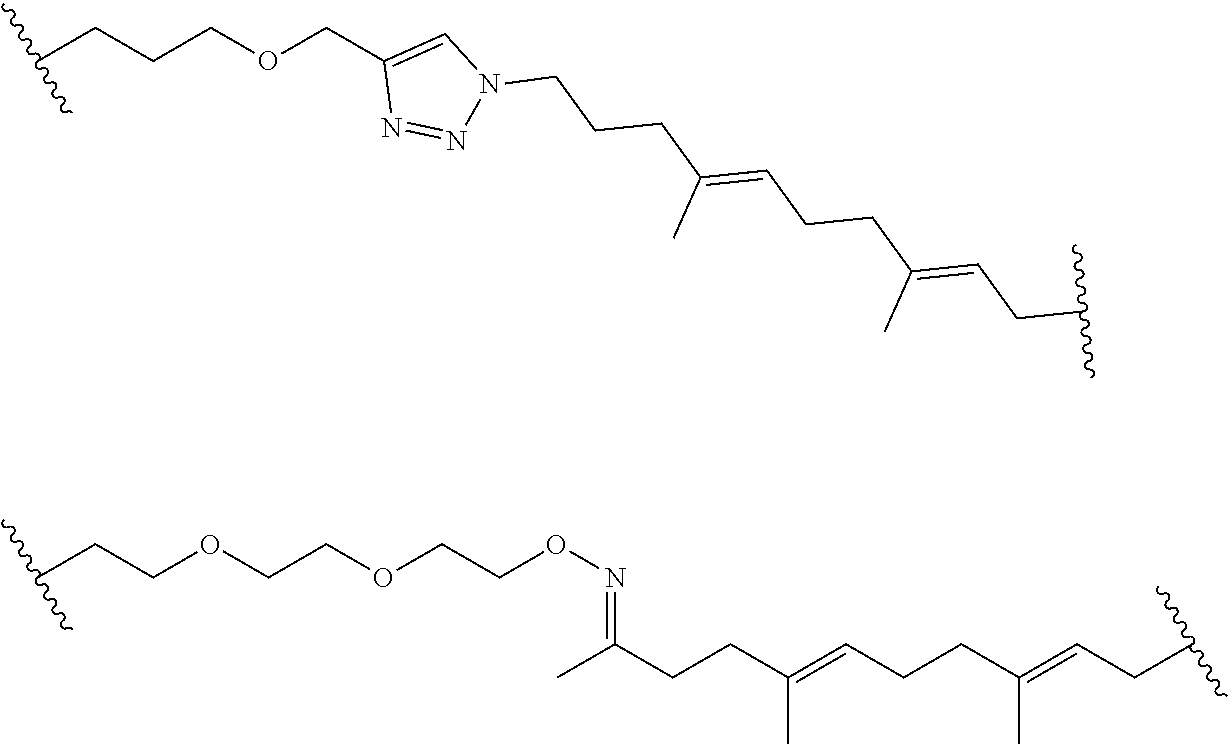

V may be a single bond, —O—, —S—, —NR21—, —C(O)NR22—, —NR23C(O)—, —NR24SO2—, or —SO2NR25—, R21 to R25 may be each independently hydrogen, (C1-C6)alkyl, (C1-C6)alkyl(C6-C20) aryl, or (C1-C6)alkyl(C3-C20)heteroaryl, r may be an integer of 1 to 10, p may be an integer of 0 to 10, q may be an integer of 1 to 10, and L1 may be a single bond.


| TABLE 1 | ||
| Compound 1k of | Compound 5k of | |
| Example 1 | Comparative Example 1 | |
| Linker | | Glucuronide |
| Plasma | ||
| 80 |
14% Stability | |
| Stability | (@7 days) | (@1 day) |
| (in mouse) | ||
| Result | Stable | Unstable |


| TABLE 2 | ||
| IC50 (μg/ml) | ||
| Breast | Ovarian | Breast | ||
| Cancer | Cancer | Cancer | ||
| Cell | Cell | Cell | ||
| Line | Line | Line | ||
| MCF-7 | SK-OV3 | SK-Br3 | ||
| Drug | MMAF (nM) | 142.4 | 227.0 | 135.7 |
| Antibody | Herceptin-G7- | 1.54 | >2 | 1.98 |
| CVIM (LC) | ||||
| Herceptin-G7- | >2 | >2 | 1.53 | |
| CVIM (HC) | ||||
| ADC | LCB14-0109 | >2 | >2 | 0.078 |
| (ADC109, | ||||
| Example 9) | ||||
| LCB14-0110 | >2 | 0.315 | 0.14 | |
| (ADC110, | ||||
| Example 10) | ||||
| TABLE 3 |
| Body Weight Change |
| Experimental period |
| Day | Day | | Day | ||||
| Day | |||||||
| 1 | |
|
10 | 14 | 17 | 21 | |
| Vehicle | 20.8 | 21.7 | 22.2 | 21.9 | 21.7 | 21.3 | 22.0 |
| Herceptin | 20.7 | 22.1 | 22.1 | 21.9 | 21.1 | 21.4 | 22.5 |
| (5 mg/kg) | |||||||
| ADC109 | 20.9 | 22.3 | 22.8 | 22.4 | 22.8 | 21.0 | 23.1 |
| (0.1 mg/kg) | |||||||
| ADC109 | 20.8 | 21.3 | 21.9 | 22.1 | 21.9 | 22.9 | 21.8 |
| (1 mg/kg) | |||||||
| ADC109 | 20.6 | 21.2 | 21.9 | 21.8 | 21.5 | 22.2 | 21.5 |
| (5 mg/kg) | |||||||
| TABLE 4 |
| PK of ADC110 and Herceptin in Rat |
| ADC110 | Herceptin | ||
| AUC (μg * day/mL) | 684.83 ± 20.38 | 622.87 ± 26.45 | |
| CL (mL/day/kg) | 4.38 ± 0.13 | 4.87 ± 0.21 | |
| Alpha HL (day) | 2.45 ± 0.60 | 2.16 ± 0.50 | |
| Beta HL (day) | 8.55 ± 1.38 | 10.10 ± 1.81 | |
| cmax (μg/mL) | 92.18 ± 2.13 | 81.70 ± 2.41 | |
| V1 (mL/kg) | 32.55 ± 0.75 | 36.72 ± 1.08 | |
| Vss (mL/kg) | 43.83 ± 2.6 | 56.53 ± 4.72 | |
| TABLE 5 |
| PK of ADC110 and Herceptin in Monkey |
| ADC110 | Herceptin | ||
| AUC (μg * day/mL) | 965.54 ± 33.49 | 689.30 ± 21.90 | |
| CL (mL/day/kg) | 3.11 ± 0.11 | 0.30 ± 0.04 | |
| Alpha HL (day) | 0.30 ± 0.04 | 0.41 ± 0.04 | |
| Beta HL (day) | 12.79 ± 0.68 | 13.44 ± 0.67 | |
| cmax (μg/mL) | 117.56 ± 2.58 | 83.14 ± 1.43 | |
| V1 (mL/kg) | 25.52 ± 0.56 | 36.08 ± 0.62 | |
| Vss (mL/kg) | 55.65 ± 1.57 | 80.92 ± 2.17 | |
| TABLE 6 |
| Half-life Comparison of ADC110, Herceptin, and Kadcyla |
| Terminal half-life (day) |
| Herceptin | Kadcyla | ADC110 | |
| Rat | 13.4 | (3 mpk) | 4.9~5.4 | (0.3~20 mpk) | 12.8 | (3 mpk) |
| Monkey | 6 | (0.5 mpk) | 1 | (0.3 mpk) | 8.6 | (3 mpk) |
| 10.1 | (3 mpk) | 5.3 | (30 mpk) | |||
| Human | 5.8 | (4 → 2 mpk) | 4 | (3.6 mpk) | — | |
Claims (22)


—(CH2)r(V(CH2)p)q— [Chemical Formula F]
—(CH2CH2X)w— [Chemical Formula G]

—(CH2)r(V(CH2)p)q— [Chemical Formula F]
—(CH2CH2X)w— [Chemical Formula G]

—(CH2)r(V(CH2)p)q— [Chemical Formula F]
—(CH2CH2X)w— [Chemical Formula G]


Priority Applications (1)
| Application Number | Priority Date | Filing Date | Title |
|---|---|---|---|
| US16/545,869 US10980890B2 (en) | 2014-05-28 | 2019-08-20 | Compounds comprising self-immolative group |
Applications Claiming Priority (8)
| Application Number | Priority Date | Filing Date | Title |
|---|---|---|---|
| KR10-2014-0064360 | 2014-05-28 | ||
| KR20140064360 | 2014-05-28 | ||
| KR1020150073161A KR101628872B1 (en) | 2014-05-28 | 2015-05-26 | Compounds comprising self-immolative group |
| KR10-2015-0073161 | 2015-05-26 | ||
| PCT/KR2015/005299 WO2015182984A1 (en) | 2014-05-28 | 2015-05-27 | Compound containing self-immolative group |
| US14/898,932 US9993568B2 (en) | 2014-05-28 | 2015-05-27 | Compounds comprising self-immolative group |
| US16/005,245 US10383949B2 (en) | 2014-05-28 | 2018-06-11 | Compounds comprising self-immolative group |
| US16/545,869 US10980890B2 (en) | 2014-05-28 | 2019-08-20 | Compounds comprising self-immolative group |
Related Parent Applications (1)
| Application Number | Title | Priority Date | Filing Date |
|---|---|---|---|
| US16/005,245 Continuation US10383949B2 (en) | 2014-05-28 | 2018-06-11 | Compounds comprising self-immolative group |
Publications (2)
| Publication Number | Publication Date |
|---|---|
| US20200069816A1 US20200069816A1 (en) | 2020-03-05 |
| US10980890B2 true US10980890B2 (en) | 2021-04-20 |
Family
ID=54872920
Family Applications (4)
| Application Number | Title | Priority Date | Filing Date |
|---|---|---|---|
| US14/898,932 Active US9993568B2 (en) | 2014-05-28 | 2015-05-27 | Compounds comprising self-immolative group |
| US14/865,778 Active US9919057B2 (en) | 2014-05-28 | 2015-09-25 | Compounds comprising self-immolative group |
| US16/005,245 Active US10383949B2 (en) | 2014-05-28 | 2018-06-11 | Compounds comprising self-immolative group |
| US16/545,869 Active US10980890B2 (en) | 2014-05-28 | 2019-08-20 | Compounds comprising self-immolative group |
Family Applications Before (3)
| Application Number | Title | Priority Date | Filing Date |
|---|---|---|---|
| US14/898,932 Active US9993568B2 (en) | 2014-05-28 | 2015-05-27 | Compounds comprising self-immolative group |
| US14/865,778 Active US9919057B2 (en) | 2014-05-28 | 2015-09-25 | Compounds comprising self-immolative group |
| US16/005,245 Active US10383949B2 (en) | 2014-05-28 | 2018-06-11 | Compounds comprising self-immolative group |
Country Status (12)
| Country | Link |
|---|---|
| US (4) | US9993568B2 (en) |
| EP (1) | EP3156424A4 (en) |
| JP (2) | JP6815201B2 (en) |
| KR (1) | KR101628872B1 (en) |
| CN (2) | CN105358579B (en) |
| AU (2) | AU2015268300B2 (en) |
| CA (1) | CA2949943A1 (en) |
| IL (1) | IL249181B2 (en) |
| MX (1) | MX390676B (en) |
| NZ (1) | NZ727007A (en) |
| RU (2) | RU2020101906A (en) |
| WO (1) | WO2015182984A1 (en) |
Cited By (10)
| Publication number | Priority date | Publication date | Assignee | Title |
|---|---|---|---|---|
| US11173214B2 (en) | 2015-11-25 | 2021-11-16 | Legochem Biosciences, Inc. | Antibody-drug conjugates comprising branched linkers and methods related thereto |
| US11413353B2 (en) | 2015-11-25 | 2022-08-16 | Legochem Biosciences, Inc. | Conjugates comprising self-immolative groups and methods related thereto |
| US11434291B2 (en) | 2019-05-14 | 2022-09-06 | Provention Bio, Inc. | Methods and compositions for preventing type 1 diabetes |
| US11654197B2 (en) | 2017-03-29 | 2023-05-23 | Legochem Biosciences, Inc. | Pyrrolobenzodiazepine dimer prodrug and ligand-linker conjugate compound of the same |
| US11707533B2 (en) | 2019-09-04 | 2023-07-25 | Legochem Biosciences, Inc. | Antibody-drug conjugate comprising antibody against human ROR1 and use for the same |
| US11827703B2 (en) | 2018-05-09 | 2023-11-28 | Legochem Biosciences, Inc. | Compositions and methods related to anti-CD19 antibody drug conjugates |
| US12006366B2 (en) | 2020-06-11 | 2024-06-11 | Provention Bio, Inc. | Methods and compositions for preventing type 1 diabetes |
| US12565529B2 (en) | 2021-05-24 | 2026-03-03 | Provention Bio, Inc. | Methods for treating type 1 diabetes |
| USD1116103S1 (en) | 2019-06-05 | 2026-03-03 | Regeneron Pharmaceuticals, Inc. | Dose delivery device |
| USD1120314S1 (en) | 2022-11-30 | 2026-03-24 | Regeneron Pharmaceuticals, Inc. | Dose delivery device |
Families Citing this family (40)
| Publication number | Priority date | Publication date | Assignee | Title |
|---|---|---|---|---|
| MX393973B (en) * | 2011-05-08 | 2025-03-24 | Legochem Biosciences Inc | PROTEIN-ACTIVE AGENT CONJUGATES AND METHOD FOR THEIR PREPARATION. |
| KR101628872B1 (en) | 2014-05-28 | 2016-06-09 | 주식회사 레고켐 바이오사이언스 | Compounds comprising self-immolative group |
| WO2017051249A1 (en) | 2015-09-25 | 2017-03-30 | Legochem Biosciences, Inc. | Compositions and methods related to anti-cd19 antibody drug conjugates |
| WO2017051254A1 (en) | 2015-09-25 | 2017-03-30 | Legochem Biosciences, Inc. | Compositions and methods related to anti-egfr antibody drug conjugates |
| KR102847348B1 (en) | 2015-11-25 | 2025-08-19 | 주식회사 리가켐바이오사이언스 | Conjugate containing a peptide group and a manufacturing method related thereto |
| PE20231050A1 (en) * | 2016-03-02 | 2023-07-11 | Eisai Randd Man Co Ltd | ERIBULIN-BASED ANTIBODY-DRUG CONJUGATES AND METHODS FOR THEIR USE |
| KR102085798B1 (en) | 2016-12-28 | 2020-03-06 | 주식회사 인투셀 | Compounds comprising beta-galactoside self-immolative linker |
| WO2018124758A2 (en) * | 2016-12-28 | 2018-07-05 | 주식회사 인투셀 | Compound bearing beta-galactoside-introduced self-immolative linker |
| KR102127421B1 (en) | 2017-03-21 | 2020-06-26 | 주식회사 펩트론 | Antibody specifically binding to MUC1 and Use thereof |
| WO2018174544A2 (en) | 2017-03-21 | 2018-09-27 | 주식회사 펩트론 | Antibody binding specifically to muc1 and use thereof |
| WO2018182341A1 (en) * | 2017-03-29 | 2018-10-04 | 주식회사 레고켐 바이오사이언스 | Pyrrolobenzodiazepine dimer precursor and ligand-linker conjugate compound thereof |
| CN120682290A (en) | 2017-07-04 | 2025-09-23 | 尹图赛利有限公司 | Compounds comprising cleavable linkers and uses thereof |
| WO2019035649A1 (en) * | 2017-08-14 | 2019-02-21 | 주식회사 레고켐 바이오사이언스 | Antibody-drug conjugates including antibody against egfrviii |
| KR102275930B1 (en) | 2018-03-14 | 2021-07-12 | (주)알테오젠 | Antibody specifically binding to FOLR1 and Use thereof |
| WO2019212253A1 (en) | 2018-05-02 | 2019-11-07 | 사회복지법인 삼성생명공익재단 | Antibody specifically binding to c-met, and use thereof |
| MX2020012674A (en) | 2018-05-29 | 2021-02-09 | Bristol Myers Squibb Co | Modified self-immolating moieties for use in prodrugs and conjugates and methods of using and making. |
| WO2020141923A2 (en) | 2019-01-03 | 2020-07-09 | 주식회사 레고켐 바이오사이언스 | Pyrrolobenzodiazepine dimer compound with improved safety and use thereof |
| KR20210099658A (en) * | 2019-01-03 | 2021-08-12 | 주식회사 인투셀 | Compounds comprising cleavable linkers and uses thereof |
| WO2020141459A1 (en) * | 2019-01-03 | 2020-07-09 | Intocell, Inc. | Compounds comprising cleavable linker and uses thereof |
| EP3936150A4 (en) * | 2019-03-06 | 2023-03-29 | LegoChem Biosciences, Inc. | ANTIBODY-DRUG CONJUGATES WITH ANTIBODIES TO HUMAN DLK1 AND USE THEREOF |
| JP6704083B1 (en) | 2019-11-22 | 2020-06-03 | 東邦チタニウム株式会社 | Copper powder and its manufacturing method |
| KR20220082775A (en) | 2020-12-10 | 2022-06-17 | 주식회사 유틸렉스 | Anti-PD-1 Antibody and Use Thereof |
| CN114716548B (en) | 2021-01-05 | 2024-11-05 | (株)爱恩德生物 | Anti-FGFR3 antibodies and uses thereof |
| EP4301782A1 (en) | 2021-03-05 | 2024-01-10 | Go Therapeutics, Inc. | Anti-glyco-cd44 antibodies and their uses |
| WO2022211508A1 (en) | 2021-03-30 | 2022-10-06 | 주식회사 레고켐바이오사이언스 | Antibody-drug conjugate including antibody against human cldn18.2, and use thereof |
| US20250101126A1 (en) | 2021-08-05 | 2025-03-27 | Go Therapeutics, Inc. | Anti-glyco-muc4 antibodies and their uses |
| JP7763948B2 (en) | 2021-11-05 | 2025-11-04 | ソウル ナショナル ユニバーシティ ホスピタル | Resistin-specific antibodies and uses thereof |
| GB202203070D0 (en) | 2022-03-04 | 2022-04-20 | Iksuda Therapeutics Ltd | Anti-canag antibody conjugate |
| KR102911201B1 (en) * | 2022-03-30 | 2026-01-13 | 기초과학연구원 | Fluorescence probe for labeling M1 macrophages and M1 macrophage monitoring system using the same |
| JP2025525296A (en) | 2022-06-27 | 2025-08-05 | トライオール インコーポレイテッド | Compounds containing self-immolative groups and ligand-drug conjugates containing the same |
| KR20240016216A (en) | 2022-07-26 | 2024-02-06 | (주)에임드바이오 | Anti-ROR1 Antibody and Use Thereof |
| KR20250169306A (en) | 2023-04-18 | 2025-12-02 | 아스트라제네카 아베 | Conjugate comprising a cleavable linker |
| EP4737482A1 (en) | 2023-06-27 | 2026-05-06 | Atheon Bio, Inc. | Humanized anti-myct1 antibody and use thereof |
| TW202525344A (en) | 2023-08-15 | 2025-07-01 | 瑞典商阿斯特捷利康公司 | Conjugates comprising cleavable linkers |
| GB202313214D0 (en) | 2023-08-30 | 2023-10-11 | Iksuda Therapeutics Ltd | Co-administration of antibody-drug conjugate |
| CN121752572A (en) | 2023-08-31 | 2026-03-27 | 匹诺生物股份有限公司 | Novel camptothecin derivatives and antibody-drug conjugates comprising the same |
| AU2024201132A1 (en) | 2023-09-20 | 2025-04-10 | Uci Therapeutics Inc. | Anti-mesothelin antibodies and uses thereof |
| WO2025233682A1 (en) * | 2024-05-08 | 2025-11-13 | Ligachem Biosciences Inc. | Antibody drug conjugates comprising sting agonists and uses thereof |
| WO2026078165A1 (en) | 2024-10-10 | 2026-04-16 | Astrazeneca Ab | Conjugates comprising cleavable linkers |
| WO2026078620A1 (en) | 2024-10-11 | 2026-04-16 | Medimmune Llc | Cd22 antibody and drug conjugates and uses thereof |
Citations (39)
| Publication number | Priority date | Publication date | Assignee | Title |
|---|---|---|---|---|
| US1011896A (en) | 1911-05-10 | 1911-12-19 | Western Electric Co | Fuse. |
| US5112739A (en) | 1988-08-02 | 1992-05-12 | Polaroid Corporation | Enzyme controlled release system |
| WO1998019705A1 (en) | 1996-11-05 | 1998-05-14 | Bristol-Myers Squibb Company | Branched peptide linkers |
| US5935995A (en) | 1996-03-12 | 1999-08-10 | Heochst Aktiengesellschaft | Prodrugs for the therapy of tumors and inflammatory disorders |
| US6218519B1 (en) | 1996-04-12 | 2001-04-17 | Pro-Neuron, Inc. | Compounds and methods for the selective treatment of cancer and bacterial infections |
| WO2004050089A1 (en) | 2002-12-05 | 2004-06-17 | Schering Ag | Epothilone analogs for site specific delivery in the treatment of proliferative diseases |
| US6759509B1 (en) | 1996-11-05 | 2004-07-06 | Bristol-Myers Squibb Company | Branched peptide linkers |
| US20050238649A1 (en) | 2003-11-06 | 2005-10-27 | Seattle Genetics, Inc. | Monomethylvaline compounds capable of conjugation to ligands |
| US20060088522A1 (en) | 2004-09-10 | 2006-04-27 | Wyeth | Humanized anti-5T4 antibodies and anti-5T4/calicheamicin conjugates |
| WO2007011968A2 (en) | 2005-07-18 | 2007-01-25 | Seattle Genetics, Inc. | Beta-glucuronide-linker drug conjugates |
| WO2008034120A2 (en) | 2006-09-15 | 2008-03-20 | Enzon Pharmaceuticals, Inc. | Lysine-based polymeric linkers |
| WO2009054863A2 (en) | 2006-12-13 | 2009-04-30 | Medarex, Inc. | Human antibodies that bind cd19 and uses thereof |
| WO2011066418A1 (en) | 2009-11-25 | 2011-06-03 | Academia Sinica | The tumor-selective anti-cancer prodrug bqc-g |
| WO2011145068A1 (en) | 2010-05-20 | 2011-11-24 | Centre National De La Recherche Scientifique | Novel self-reactive arms and prodrugs comprising same |
| US20120030858A1 (en) | 2010-08-05 | 2012-02-09 | Duffin Robert Lagrand | Absorbent sleeve |
| WO2012153193A2 (en) | 2011-05-08 | 2012-11-15 | Legochem Biosciences, Inc. | Protein-active agent conjugates and method for preparing the same |
| WO2013055990A1 (en) | 2011-10-14 | 2013-04-18 | Seattle Genetics, Inc. | Pyrrolobenzodiazepines and targeted conjugates |
| WO2013103707A1 (en) | 2012-01-03 | 2013-07-11 | Invictus Oncology Pvt. Ltd. | Ligand-targeted molecules and methods thereof |
| US20140032535A1 (en) | 2011-04-29 | 2014-01-30 | Anurag Singla | Systems and methods for in-memory processing of events |
| US20140286969A1 (en) | 2013-03-15 | 2014-09-25 | Abbvie Inc. | Anti-egfr antibody drug conjugate formulations |
| WO2014194030A2 (en) | 2013-05-31 | 2014-12-04 | Immunogen, Inc. | Conjugates comprising cell-binding agents and cytotoxic agents |
| WO2015057699A2 (en) | 2013-10-15 | 2015-04-23 | Seattle Genetics, Inc. | Pegylated drug-linkers for improved ligand-drug conjugate pharmacokinetics |
| WO2015095755A1 (en) | 2013-12-19 | 2015-06-25 | Seattle Genetics, Inc. | Methylene carbamate linkers for use with targeted-drug conjugates |
| EP2913064A1 (en) | 2014-02-26 | 2015-09-02 | celares GmbH | Branched drug-linker conjugates for the coupling to biological targeting molecules |
| WO2015182984A1 (en) | 2014-05-28 | 2015-12-03 | 주식회사 레고켐 바이오사이언스 | Compound containing self-immolative group |
| WO2016033570A1 (en) | 2014-08-28 | 2016-03-03 | Juno Therapeutics, Inc. | Antibodies and chimeric antigen receptors specific for cd19 |
| WO2016040684A1 (en) | 2014-09-11 | 2016-03-17 | Seattle Genetics, Inc | Targeted delivery of tertiary amine-containing drug substances |
| WO2016094517A1 (en) | 2014-12-09 | 2016-06-16 | Abbvie Inc. | Bcl-xl inhibitory compounds and antibody drug conjugates including the same |
| WO2016108587A1 (en) | 2014-12-29 | 2016-07-07 | 주식회사 레고켐 바이오사이언스 | Repebody derivative-drug conjugate, preparation method and use thereof |
| US20160257709A1 (en) | 2015-01-30 | 2016-09-08 | Sutro Biopharma, Inc. | Hemiasterlin derivatives for conjugation and therapy |
| WO2017051249A1 (en) | 2015-09-25 | 2017-03-30 | Legochem Biosciences, Inc. | Compositions and methods related to anti-cd19 antibody drug conjugates |
| WO2017051254A1 (en) | 2015-09-25 | 2017-03-30 | Legochem Biosciences, Inc. | Compositions and methods related to anti-egfr antibody drug conjugates |
| WO2017066136A2 (en) | 2015-10-13 | 2017-04-20 | Eureka Therapeutics, Inc. | Antibody agents specific for human cd19 and uses thereof |
| WO2017089890A1 (en) | 2015-11-25 | 2017-06-01 | Legochem Biosciences, Inc. | Conjugates comprising self-immolative groups and methods related thereto |
| WO2017089894A1 (en) | 2015-11-25 | 2017-06-01 | Legochem Biosciences, Inc. | Conjugates comprising peptide groups and methods related thereto |
| WO2017089895A1 (en) | 2015-11-25 | 2017-06-01 | Legochem Biosciences, Inc. | Antibody-drug conjugates comprising branched linkers and methods related thereto |
| WO2018083535A1 (en) | 2016-11-04 | 2018-05-11 | Novimmune Sa | Anti-cd19 antibodies and methods of use thereof |
| WO2019215510A2 (en) | 2018-05-09 | 2019-11-14 | Legochem Biosciences, Inc. | Compositions and methods related to anti-cd19 antibody drug conjugates |
| WO2020180121A1 (en) * | 2019-03-06 | 2020-09-10 | 주식회사 레고켐 바이오사이언스 | Antibody-drug conjugates including antibody against human dlk1, and use thereof |
Family Cites Families (1)
| Publication number | Priority date | Publication date | Assignee | Title |
|---|---|---|---|---|
| KR100192328B1 (en) | 1996-04-03 | 1999-06-15 | 구본준 | Charge coupled device with two-directional horizontal-charge transferring function |
-
2015
- 2015-05-26 KR KR1020150073161A patent/KR101628872B1/en active Active
- 2015-05-27 IL IL249181A patent/IL249181B2/en unknown
- 2015-05-27 RU RU2020101906A patent/RU2020101906A/en unknown
- 2015-05-27 US US14/898,932 patent/US9993568B2/en active Active
- 2015-05-27 CN CN201580000364.2A patent/CN105358579B/en active Active
- 2015-05-27 AU AU2015268300A patent/AU2015268300B2/en active Active
- 2015-05-27 WO PCT/KR2015/005299 patent/WO2015182984A1/en not_active Ceased
- 2015-05-27 MX MX2016015511A patent/MX390676B/en unknown
- 2015-05-27 NZ NZ727007A patent/NZ727007A/en unknown
- 2015-05-27 JP JP2016569844A patent/JP6815201B2/en active Active
- 2015-05-27 RU RU2016151190A patent/RU2712744C2/en active
- 2015-05-27 CN CN201710524324.9A patent/CN107648613B/en active Active
- 2015-05-27 CA CA2949943A patent/CA2949943A1/en active Pending
- 2015-05-27 EP EP15799360.1A patent/EP3156424A4/en active Pending
- 2015-09-25 US US14/865,778 patent/US9919057B2/en active Active
-
2018
- 2018-06-11 US US16/005,245 patent/US10383949B2/en active Active
-
2019
- 2019-08-20 US US16/545,869 patent/US10980890B2/en active Active
-
2020
- 2020-05-07 JP JP2020082104A patent/JP2020143098A/en active Pending
-
2021
- 2021-06-21 AU AU2021204136A patent/AU2021204136B2/en active Active
Patent Citations (64)
| Publication number | Priority date | Publication date | Assignee | Title |
|---|---|---|---|---|
| US1011896A (en) | 1911-05-10 | 1911-12-19 | Western Electric Co | Fuse. |
| US5112739A (en) | 1988-08-02 | 1992-05-12 | Polaroid Corporation | Enzyme controlled release system |
| US5935995A (en) | 1996-03-12 | 1999-08-10 | Heochst Aktiengesellschaft | Prodrugs for the therapy of tumors and inflammatory disorders |
| RU2191021C2 (en) | 1996-03-12 | 2002-10-20 | Авентис Фарма Дойчланд Гмбх | Prodrug for therapy of tumors and inflammatory diseases |
| US6218519B1 (en) | 1996-04-12 | 2001-04-17 | Pro-Neuron, Inc. | Compounds and methods for the selective treatment of cancer and bacterial infections |
| WO1998019705A1 (en) | 1996-11-05 | 1998-05-14 | Bristol-Myers Squibb Company | Branched peptide linkers |
| US6759509B1 (en) | 1996-11-05 | 2004-07-06 | Bristol-Myers Squibb Company | Branched peptide linkers |
| WO2004050089A1 (en) | 2002-12-05 | 2004-06-17 | Schering Ag | Epothilone analogs for site specific delivery in the treatment of proliferative diseases |
| US20050238649A1 (en) | 2003-11-06 | 2005-10-27 | Seattle Genetics, Inc. | Monomethylvaline compounds capable of conjugation to ligands |
| US20060088522A1 (en) | 2004-09-10 | 2006-04-27 | Wyeth | Humanized anti-5T4 antibodies and anti-5T4/calicheamicin conjugates |
| WO2007011968A2 (en) | 2005-07-18 | 2007-01-25 | Seattle Genetics, Inc. | Beta-glucuronide-linker drug conjugates |
| JP2009501800A (en) | 2005-07-18 | 2009-01-22 | シアトル ジェネティックス, インコーポレイテッド | β-glucuronide-linker drug conjugate |
| US8039273B2 (en) | 2005-07-18 | 2011-10-18 | Seattle Genetics, Inc. | β-glucuronide-linker drug conjugates |
| US8568728B2 (en) | 2005-07-18 | 2013-10-29 | Seattle Genetics, Inc. | Beta-glucuronide-linker drug conjugates |
| US20140031535A1 (en) | 2005-07-18 | 2014-01-30 | Seattle Genetics, Inc. | Beta-glucuronide-linker drug conjugates |
| US20120107332A1 (en) | 2005-07-18 | 2012-05-03 | Seattle Genetics, Inc. | Beta-Glucuronide-Linker Drug Conjugates |
| WO2008034120A2 (en) | 2006-09-15 | 2008-03-20 | Enzon Pharmaceuticals, Inc. | Lysine-based polymeric linkers |
| WO2009054863A2 (en) | 2006-12-13 | 2009-04-30 | Medarex, Inc. | Human antibodies that bind cd19 and uses thereof |
| WO2011066418A1 (en) | 2009-11-25 | 2011-06-03 | Academia Sinica | The tumor-selective anti-cancer prodrug bqc-g |
| WO2011145068A1 (en) | 2010-05-20 | 2011-11-24 | Centre National De La Recherche Scientifique | Novel self-reactive arms and prodrugs comprising same |
| US20120030858A1 (en) | 2010-08-05 | 2012-02-09 | Duffin Robert Lagrand | Absorbent sleeve |
| US20140032535A1 (en) | 2011-04-29 | 2014-01-30 | Anurag Singla | Systems and methods for in-memory processing of events |
| US20120308584A1 (en) | 2011-05-08 | 2012-12-06 | Legochem Biosciences, Inc. | Protein-active agent conjugates and method for preparing the same |
| WO2012153193A2 (en) | 2011-05-08 | 2012-11-15 | Legochem Biosciences, Inc. | Protein-active agent conjugates and method for preparing the same |
| KR20140035393A (en) | 2011-05-08 | 2014-03-21 | 주식회사 레고켐 바이오사이언스 | Protein-active agent conjugates and method for preparing the same |
| US20140161829A1 (en) | 2011-05-08 | 2014-06-12 | Legochem Biosciences, Inc. | Antibody-active agent conjugates and methods of use |
| US20140187756A1 (en) | 2011-05-08 | 2014-07-03 | Legochem Biosciences, Inc. | Methods of preparing antibody-active agent conjugates |
| US20150105541A1 (en) | 2011-05-08 | 2015-04-16 | Legochem Biosciences, Inc. | Antibody-active agent conjugates and methods of use |
| WO2013055990A1 (en) | 2011-10-14 | 2013-04-18 | Seattle Genetics, Inc. | Pyrrolobenzodiazepines and targeted conjugates |
| WO2013103707A1 (en) | 2012-01-03 | 2013-07-11 | Invictus Oncology Pvt. Ltd. | Ligand-targeted molecules and methods thereof |
| US20140286969A1 (en) | 2013-03-15 | 2014-09-25 | Abbvie Inc. | Anti-egfr antibody drug conjugate formulations |
| WO2014194030A2 (en) | 2013-05-31 | 2014-12-04 | Immunogen, Inc. | Conjugates comprising cell-binding agents and cytotoxic agents |
| WO2015057699A2 (en) | 2013-10-15 | 2015-04-23 | Seattle Genetics, Inc. | Pegylated drug-linkers for improved ligand-drug conjugate pharmacokinetics |
| WO2015095755A1 (en) | 2013-12-19 | 2015-06-25 | Seattle Genetics, Inc. | Methylene carbamate linkers for use with targeted-drug conjugates |
| EP2913064A1 (en) | 2014-02-26 | 2015-09-02 | celares GmbH | Branched drug-linker conjugates for the coupling to biological targeting molecules |
| US20170095576A1 (en) | 2014-05-28 | 2017-04-06 | Legochem Biosciences, Inc. | Compounds comprising self-immolative group |
| US10383949B2 (en) | 2014-05-28 | 2019-08-20 | Legochem Biosciences, Inc. | Compounds comprising self-immolative group |
| US20200069816A1 (en) | 2014-05-28 | 2020-03-05 | Legochem Biosciences, Inc. | Compounds comprising self-immolative group |
| US9919057B2 (en) | 2014-05-28 | 2018-03-20 | Legochem Biosciences, Inc. | Compounds comprising self-immolative group |
| US9993568B2 (en) | 2014-05-28 | 2018-06-12 | Legochem Biosciences, Inc. | Compounds comprising self-immolative group |
| US20160184451A1 (en) | 2014-05-28 | 2016-06-30 | Legochem Biosciences, Inc. | Compounds comprising self-immolative group |
| KR20150137015A (en) | 2014-05-28 | 2015-12-08 | 주식회사 레고켐 바이오사이언스 | Compounds comprising self-immolative group |
| WO2015182984A1 (en) | 2014-05-28 | 2015-12-03 | 주식회사 레고켐 바이오사이언스 | Compound containing self-immolative group |
| WO2016033570A1 (en) | 2014-08-28 | 2016-03-03 | Juno Therapeutics, Inc. | Antibodies and chimeric antigen receptors specific for cd19 |
| WO2016040684A1 (en) | 2014-09-11 | 2016-03-17 | Seattle Genetics, Inc | Targeted delivery of tertiary amine-containing drug substances |
| WO2016094517A1 (en) | 2014-12-09 | 2016-06-16 | Abbvie Inc. | Bcl-xl inhibitory compounds and antibody drug conjugates including the same |
| WO2016108587A1 (en) | 2014-12-29 | 2016-07-07 | 주식회사 레고켐 바이오사이언스 | Repebody derivative-drug conjugate, preparation method and use thereof |
| US20160257709A1 (en) | 2015-01-30 | 2016-09-08 | Sutro Biopharma, Inc. | Hemiasterlin derivatives for conjugation and therapy |
| US10183997B2 (en) | 2015-09-25 | 2019-01-22 | Legochem Biosciences, Inc. | Compositions and methods related to anti-CD19 antibody drug conjugates |
| US20170088614A1 (en) | 2015-09-25 | 2017-03-30 | Legochem Biosciences, Inc. | Compositions and methods related to anti-cd19 antibody drug conjugates |
| WO2017051249A1 (en) | 2015-09-25 | 2017-03-30 | Legochem Biosciences, Inc. | Compositions and methods related to anti-cd19 antibody drug conjugates |
| US20170088621A1 (en) | 2015-09-25 | 2017-03-30 | Legochem Biosciences, Inc. | Compositions and methods related to anti-egfr antibody drug conjugates |
| WO2017051254A1 (en) | 2015-09-25 | 2017-03-30 | Legochem Biosciences, Inc. | Compositions and methods related to anti-egfr antibody drug conjugates |
| WO2017066136A2 (en) | 2015-10-13 | 2017-04-20 | Eureka Therapeutics, Inc. | Antibody agents specific for human cd19 and uses thereof |
| WO2017089894A1 (en) | 2015-11-25 | 2017-06-01 | Legochem Biosciences, Inc. | Conjugates comprising peptide groups and methods related thereto |
| WO2017089890A1 (en) | 2015-11-25 | 2017-06-01 | Legochem Biosciences, Inc. | Conjugates comprising self-immolative groups and methods related thereto |
| US20190151465A1 (en) | 2015-11-25 | 2019-05-23 | Legochem Biosciences, Inc. | Antibody-drug conjugates comprising branched linkers and methods related thereto |
| WO2017089895A1 (en) | 2015-11-25 | 2017-06-01 | Legochem Biosciences, Inc. | Antibody-drug conjugates comprising branched linkers and methods related thereto |
| US20200297865A1 (en) * | 2015-11-25 | 2020-09-24 | Legochem Biosciences, Inc. | Conjugates comprising self-immolative groups and methods related thereto |
| US20190381185A1 (en) | 2015-11-25 | 2019-12-19 | Legochem Biosciences, Inc. | Conjugates comprising peptide groups and methods related thereto |
| WO2018083535A1 (en) | 2016-11-04 | 2018-05-11 | Novimmune Sa | Anti-cd19 antibodies and methods of use thereof |
| US20200095317A1 (en) * | 2018-05-09 | 2020-03-26 | Legochem Biosciences, Inc. | Compositions and methods related to anti-cd19 antibody drug conjugates |
| WO2019215510A2 (en) | 2018-05-09 | 2019-11-14 | Legochem Biosciences, Inc. | Compositions and methods related to anti-cd19 antibody drug conjugates |
| WO2020180121A1 (en) * | 2019-03-06 | 2020-09-10 | 주식회사 레고켐 바이오사이언스 | Antibody-drug conjugates including antibody against human dlk1, and use thereof |
Non-Patent Citations (31)
| Title |
|---|
| Behrens et al., "Methods for Site-specific Drug Conjugation to Antibodies," MAbs, 6(1): 46-53 (2014). |
| Bergmann, CP et al. Dental Ceramics. Microstructure, Properties, and Degradation. Ch. 2, Biomaterials, p. 9 (2013). |
| Carey, FA. Organic Chemistry 6th Ed. McGraw Hill, Ch. 1(9) (2006). |
| Christie et al., "Stabilization of cysteine-linked antibody drug conjugates with N-aryl maleimides," Journal of Controlled Release, 220:660-670 (2015). |
| Chu et al., "Antibody-drug Conjugates for the Treatment of B-cell Non-Hodgkin's Lymphoma and Leukemia," Future Oncol, 9(3): 355-368 (2013). |
| Connolly et al., "Discovery of Orally Active 4-amino-6-arylaminopyrimidine-5-carbaldehyde Oximes with Dual EGFR and HER2 Inhibitory Activity," AACR 104th Annual Meeting, Abstract 2456 (2013). |
| Desbene et al. "Doxorubicin prodrugs with reduced cytotoxicity suited for tumour-specific activation," Anti-Cancer Drug Design 13(955) (1998). |
| Dunn, PJ. et al. Green Chemistry Principle #8. ACS What is Green Chemistry. Accessed from ACS Website on Jan. 8, 2016. |
| Extended European Search Report for EP Application No. 16868096.5 dated Jun. 21, 2019. |
| Extended European Search Report for EP Application No. EP 16868095 dated Jul. 29, 2019. |
| Extended European Search Report for EP application No. PCT/IB2016001772 dated May 17, 2019. |
| Extended European Search Report issued by the European Patent Office in corresponding Application No. EP 15799360.1, dated Dec. 21, 2017. |
| Grinda, M. et al., A Self-lmmolative Dendritic Glucuronide Prodrug of Doxorubicin, Medicinal Chemistry Communications, 3(1):68-70 (2012). |
| International Search Report and Written Opinion for International Application No. PCT/IB2016/001772 dated Apr. 6, 2017. |
| International Search Report and Written Opinion for International Application No. PCT/IB2016/001810 dated Apr. 19, 2017. |
| International Search Report and Written Opinion for International Application No. PCT/IB2016/001811 dated Apr. 19, 2017. |
| International Search Report and Written Opinion for International Application No. PCT/IB2019/000577 dated Nov. 28, 2019. |
| International Search Report and Written Opinion from corresponding International Application Publication No. WO2015182984, dated Dec. 3, 2015. |
| Jeffrey et al., "Development and properties of β-glucuronide linkers for monoclonal antibody-drug conjugates," Bioconjugate Chem, 17:835 (2006). |
| Jeffrey et al., "Minor groove binder antibody conjugates employing a water soluble β-glucuronide linker," Bioorganic & Medicinal Chemistry Letters, 17:2278-2280 (2007). |
| Kim et al., "Synthesis of Bispecific Antibodies Using Genetically Encoded Unnatural Amino Acids," J Am Chem Soc, 134: 9918-9921 (2012). |
| Lartigue, "Antibody-Drug Conjugates: Guided Missiles Deployed Against Cancerous Cells," Oncology Live 1 (2012). |
| Lee et al., "Enzymatic prenylation and oxime ligation for the synthesis of stable and homogeneous protein-drug conjugates for targeted therapy," Angewandte Chemie, 54(41):12020-12024 (2015). |
| Leong, KW. Biomaterials. El Sevier. Accessed on Sep. 26, 2016. |
| Lu et al., "Linkers Having a Crucial Role in Antibody—Drug Conjugates," Int J Molec Sci 17(561):1-22 (2016). |
| McCombs et al., "Antibody Drug Conjugates: Design and Selection of Linker, Payload and Conjugation Chemistry," AAPS J, 17(2): 339-351 (2015). |
| Merriam-Webster. Biomaterial Definition. Accessed on Sep. 26, 2016. |
| Tranoy-Opalinski et al., "β-Glucuronidase-responsive prodrugs for selective cancer chemotherapy: an update," Eur J Med Chem, 74:302-313 (2014). |
| Wermuth, "Similarity in drugs: reflections on analogue design," Drug Discov Today, 11(Issues 7-8): 248-254 (2006). |
| Yewale et al., "Epidermal growth factor receptor targeting in cancer: A review of trends and strategies," Biomaterials, 34: 8690-8707 (2013). |
| Zimmerman et al., "Production of Site-Specific Antibody-Drug Conjugates Using Optimized Non-Natural Amino Acids in a Cell-Free Expression System," Bioconjugate Chem., 25(2):351-361 (2014). |
Cited By (12)
| Publication number | Priority date | Publication date | Assignee | Title |
|---|---|---|---|---|
| US11173214B2 (en) | 2015-11-25 | 2021-11-16 | Legochem Biosciences, Inc. | Antibody-drug conjugates comprising branched linkers and methods related thereto |
| US11413353B2 (en) | 2015-11-25 | 2022-08-16 | Legochem Biosciences, Inc. | Conjugates comprising self-immolative groups and methods related thereto |
| US11975076B2 (en) | 2015-11-25 | 2024-05-07 | Legochem Biosciences, Inc. | Antibody-drug conjugates comprising branched linkers and methods related thereto |
| US11654197B2 (en) | 2017-03-29 | 2023-05-23 | Legochem Biosciences, Inc. | Pyrrolobenzodiazepine dimer prodrug and ligand-linker conjugate compound of the same |
| US12398124B2 (en) | 2017-03-29 | 2025-08-26 | Ligachem Biosciences Inc. | Pyrrolobenzodiazepine dimer prodrug and ligand-linker conjugate compound of the same |
| US11827703B2 (en) | 2018-05-09 | 2023-11-28 | Legochem Biosciences, Inc. | Compositions and methods related to anti-CD19 antibody drug conjugates |
| US11434291B2 (en) | 2019-05-14 | 2022-09-06 | Provention Bio, Inc. | Methods and compositions for preventing type 1 diabetes |
| USD1116103S1 (en) | 2019-06-05 | 2026-03-03 | Regeneron Pharmaceuticals, Inc. | Dose delivery device |
| US11707533B2 (en) | 2019-09-04 | 2023-07-25 | Legochem Biosciences, Inc. | Antibody-drug conjugate comprising antibody against human ROR1 and use for the same |
| US12006366B2 (en) | 2020-06-11 | 2024-06-11 | Provention Bio, Inc. | Methods and compositions for preventing type 1 diabetes |
| US12565529B2 (en) | 2021-05-24 | 2026-03-03 | Provention Bio, Inc. | Methods for treating type 1 diabetes |
| USD1120314S1 (en) | 2022-11-30 | 2026-03-24 | Regeneron Pharmaceuticals, Inc. | Dose delivery device |
Also Published As
Similar Documents
| Publication | Publication Date | Title |
|---|---|---|
| US10980890B2 (en) | Compounds comprising self-immolative group | |
| US11975076B2 (en) | Antibody-drug conjugates comprising branched linkers and methods related thereto | |
| US10183997B2 (en) | Compositions and methods related to anti-CD19 antibody drug conjugates | |
| US10118965B2 (en) | Compositions and methods related to anti-EGFR antibody drug conjugates | |
| US11413353B2 (en) | Conjugates comprising self-immolative groups and methods related thereto | |
| US11167040B2 (en) | Conjugates comprising peptide groups and methods related thereto | |
| JP2024160336A (en) | Ligand-drug conjugates containing linkers having a tris structure | |
| KR102501394B1 (en) | Ligand-drug conjugate comprising linker having tris structure | |
| BR112016027722B1 (en) | COMPOUND CONTAINING AUTOIMULATIVE GROUP AND THERAPEUTIC USE OF THE SAME | |
| HK1261957B (en) | Conjugates comprising self-immolative groups and methods related thereto | |
| HK1261957A1 (en) | Conjugates comprising self-immolative groups and methods related thereto | |
| HK1216180B (en) | Compound containing self-immolative group |
Legal Events
| Date | Code | Title | Description |
|---|---|---|---|
| FEPP | Fee payment procedure |
Free format text: ENTITY STATUS SET TO UNDISCOUNTED (ORIGINAL EVENT CODE: BIG.); ENTITY STATUS OF PATENT OWNER: LARGE ENTITY Free format text: ENTITY STATUS SET TO UNDISCOUNTED (ORIGINAL EVENT CODE: BIG.); ENTITY STATUS OF PATENT OWNER: SMALL ENTITY |
|
| AS | Assignment |
Owner name: LEGOCHEM BIOSCIENCES, INC., KOREA, REPUBLIC OF Free format text: ASSIGNMENT OF ASSIGNORS INTEREST;ASSIGNORS:KIM, YONG ZU;PARK, TAE KYO;WOO, SUNG HO;AND OTHERS;REEL/FRAME:050203/0082 Effective date: 20160120 |
|
| FEPP | Fee payment procedure |
Free format text: ENTITY STATUS SET TO SMALL (ORIGINAL EVENT CODE: SMAL); ENTITY STATUS OF PATENT OWNER: LARGE ENTITY Free format text: ENTITY STATUS SET TO SMALL (ORIGINAL EVENT CODE: SMAL); ENTITY STATUS OF PATENT OWNER: SMALL ENTITY |
|
| STPP | Information on status: patent application and granting procedure in general |
Free format text: NON FINAL ACTION MAILED |
|
| STPP | Information on status: patent application and granting procedure in general |
Free format text: RESPONSE TO NON-FINAL OFFICE ACTION ENTERED AND FORWARDED TO EXAMINER |
|
| STPP | Information on status: patent application and granting procedure in general |
Free format text: FINAL REJECTION MAILED |
|
| STPP | Information on status: patent application and granting procedure in general |
Free format text: NOTICE OF ALLOWANCE MAILED -- APPLICATION RECEIVED IN OFFICE OF PUBLICATIONS |
|
| STPP | Information on status: patent application and granting procedure in general |
Free format text: PUBLICATIONS -- ISSUE FEE PAYMENT RECEIVED |
|
| STPP | Information on status: patent application and granting procedure in general |
Free format text: PUBLICATIONS -- ISSUE FEE PAYMENT VERIFIED |
|
| STCF | Information on status: patent grant |
Free format text: PATENTED CASE |
|
| FEPP | Fee payment procedure |
Free format text: ENTITY STATUS SET TO UNDISCOUNTED (ORIGINAL EVENT CODE: BIG.); ENTITY STATUS OF PATENT OWNER: LARGE ENTITY |
|
| RF | Reissue application filed |
Effective date: 20210914 |
|
| FEPP | Fee payment procedure |
Free format text: PETITION RELATED TO MAINTENANCE FEES GRANTED (ORIGINAL EVENT CODE: PTGR); ENTITY STATUS OF PATENT OWNER: LARGE ENTITY |
|
| RF | Reissue application filed |
Effective date: 20210914 |
|
| RF | Reissue application filed |
Effective date: 20230816 |
|
| AS | Assignment |
Owner name: LIGACHEM BIOSCIENCES INC., KOREA, REPUBLIC OF Free format text: CHANGE OF NAME;ASSIGNOR:LEGOCHEM BIOSCIENCES, INC.;REEL/FRAME:067540/0341 Effective date: 20240422 |
|
| MAFP | Maintenance fee payment |
Free format text: PAYMENT OF MAINTENANCE FEE, 4TH YEAR, LARGE ENTITY (ORIGINAL EVENT CODE: M1551); ENTITY STATUS OF PATENT OWNER: LARGE ENTITY Year of fee payment: 4 |