US10961455B2 - Polymerizable liquid crystal composition and liquid crystal polymer - Google Patents
Polymerizable liquid crystal composition and liquid crystal polymer Download PDFInfo
- Publication number
- US10961455B2 US10961455B2 US16/322,117 US201716322117A US10961455B2 US 10961455 B2 US10961455 B2 US 10961455B2 US 201716322117 A US201716322117 A US 201716322117A US 10961455 B2 US10961455 B2 US 10961455B2
- Authority
- US
- United States
- Prior art keywords
- group
- carbon atoms
- formula
- liquid crystal
- independently
- Prior art date
- Legal status (The legal status is an assumption and is not a legal conclusion. Google has not performed a legal analysis and makes no representation as to the accuracy of the status listed.)
- Expired - Fee Related, expires
Links
- 0 C=C1CC(C(C)C)OC1=O.C=COC(C)C.[1*]C(=C)C(=O)OC(C)C.[1*]C1(C(C)C)COC1.[1*]C1(COC(C)C)COC1.[1*]C1([1*])OC1([1*])C(C)C.[1*]C1([1*])OC1([1*])COC(C)C.[1*]C12CCC(C(C)C)CC1([1*])O2.[1*]C1=C([1*])C(=O)N(C(C)C)C1=O Chemical compound C=C1CC(C(C)C)OC1=O.C=COC(C)C.[1*]C(=C)C(=O)OC(C)C.[1*]C1(C(C)C)COC1.[1*]C1(COC(C)C)COC1.[1*]C1([1*])OC1([1*])C(C)C.[1*]C1([1*])OC1([1*])COC(C)C.[1*]C12CCC(C(C)C)CC1([1*])O2.[1*]C1=C([1*])C(=O)N(C(C)C)C1=O 0.000 description 17
- LYLPXCOVLOKDIA-UHFFFAOYSA-N CCCC1=CC=C(CCC(=O)OC2CCC(C(=O)OC3=CC=C(OC(=O)C4CCC(OC(=O)CCC5=CC=C(CCC)C=C5)CC4)C(C)=C3)CC2)C=C1 Chemical compound CCCC1=CC=C(CCC(=O)OC2CCC(C(=O)OC3=CC=C(OC(=O)C4CCC(OC(=O)CCC5=CC=C(CCC)C=C5)CC4)C(C)=C3)CC2)C=C1 LYLPXCOVLOKDIA-UHFFFAOYSA-N 0.000 description 5
- QXSRCCKOGSPZNJ-UHFFFAOYSA-N CCCC1=CC=C(CC2CCC(C(=O)OC3=CC=C(OC(=O)C4CCC(CC5=CC=C(CCC)C=C5)CC4)C(C)=C3)CC2)C=C1 Chemical compound CCCC1=CC=C(CC2CCC(C(=O)OC3=CC=C(OC(=O)C4CCC(CC5=CC=C(CCC)C=C5)CC4)C(C)=C3)CC2)C=C1 QXSRCCKOGSPZNJ-UHFFFAOYSA-N 0.000 description 3
- QHELKICJQTVVCU-UHFFFAOYSA-N C=C(C)C(=O)OCC(O)COCCOC1=CC=C(C2(C3=CC=C(OCCOCC(O)COC(=O)C(=C)C)C=C3)C3=C(C=CC=C3)C3=C2/C=C\C=C/3)C=C1.C=C(C)C(=O)OCCOCCOC1=CC=C(C2(C3=CC(OCCOCCOC(=O)C(=C)C)=C(OCCOCCOC(=O)C(=C)C)C=C3)C3=C(C=CC=C3)C3=C2/C=C\C=C/3)C=C1OCCOCCOC(=O)C(=C)C.C=C(C)C(=O)OCCOCCOC1=CC=C(C2(C3=CC=C(OCCOCCOC(=O)C(=C)C)C=C3)C3=C(C=CC=C3)C3=C2/C=C\C=C/3)C=C1 Chemical compound C=C(C)C(=O)OCC(O)COCCOC1=CC=C(C2(C3=CC=C(OCCOCC(O)COC(=O)C(=C)C)C=C3)C3=C(C=CC=C3)C3=C2/C=C\C=C/3)C=C1.C=C(C)C(=O)OCCOCCOC1=CC=C(C2(C3=CC(OCCOCCOC(=O)C(=C)C)=C(OCCOCCOC(=O)C(=C)C)C=C3)C3=C(C=CC=C3)C3=C2/C=C\C=C/3)C=C1OCCOCCOC(=O)C(=C)C.C=C(C)C(=O)OCCOCCOC1=CC=C(C2(C3=CC=C(OCCOCCOC(=O)C(=C)C)C=C3)C3=C(C=CC=C3)C3=C2/C=C\C=C/3)C=C1 QHELKICJQTVVCU-UHFFFAOYSA-N 0.000 description 1
- SSWYNUBRZXNKLS-HBPYZAGRSA-N C=CC(=O)CC1=CC=C(CCC(=O)O)C=C1.C=CC(=O)CC1=CC=C(CCC(=O)O[C@H]2CC[C@H](C(=O)O)CC2)C=C1.COCCl.COCOC(=O)[C@H]1CC[C@H](O)CC1.O=C(O)[C@H]1CC[C@H](O)CC1 Chemical compound C=CC(=O)CC1=CC=C(CCC(=O)O)C=C1.C=CC(=O)CC1=CC=C(CCC(=O)O[C@H]2CC[C@H](C(=O)O)CC2)C=C1.COCCl.COCOC(=O)[C@H]1CC[C@H](O)CC1.O=C(O)[C@H]1CC[C@H](O)CC1 SSWYNUBRZXNKLS-HBPYZAGRSA-N 0.000 description 1
- RKDKQFWRJDVXMO-UHFFFAOYSA-N C=CC(=O)OCCCCCCOC1=CC=C(CCC(=O)O)C=C1.C=CC(=O)OCCCCCCOC1=CC=C(CCC(=O)OC2=CC=C(C(=O)OC3=CC=C(OC(=O)C4=CC=C(OC(=O)CCC5=CC=C(C(CCCCC=O)OC(=O)C=C)C=C5)C=C4)C=C3C)C=C2)C=C1.CC1=CC(O)=CC=C1O.CC1=CC(OC(=O)C2=CC=C(O)C=C2)=CC=C1OC(=O)C1=CC=C(O)C=C1.O=C(O)C1=CC=C(O)C=C1.[CH3-] Chemical compound C=CC(=O)OCCCCCCOC1=CC=C(CCC(=O)O)C=C1.C=CC(=O)OCCCCCCOC1=CC=C(CCC(=O)OC2=CC=C(C(=O)OC3=CC=C(OC(=O)C4=CC=C(OC(=O)CCC5=CC=C(C(CCCCC=O)OC(=O)C=C)C=C5)C=C4)C=C3C)C=C2)C=C1.CC1=CC(O)=CC=C1O.CC1=CC(OC(=O)C2=CC=C(O)C=C2)=CC=C1OC(=O)C1=CC=C(O)C=C1.O=C(O)C1=CC=C(O)C=C1.[CH3-] RKDKQFWRJDVXMO-UHFFFAOYSA-N 0.000 description 1
- PQJLGYCWZSCRDH-UHFFFAOYSA-N C=CC(=O)OCCCCCCOC1=CC=C(CCC(=O)OC2=CC=C(C(=O)OC3=CC=C(OC(=O)C4=CC=C(OC(=O)CCC5=CC=C(OC(=O)C=C)C=C5)C=C4)C(C)=C3)C=C2)C=C1.CCCOCCC Chemical compound C=CC(=O)OCCCCCCOC1=CC=C(CCC(=O)OC2=CC=C(C(=O)OC3=CC=C(OC(=O)C4=CC=C(OC(=O)CCC5=CC=C(OC(=O)C=C)C=C5)C=C4)C(C)=C3)C=C2)C=C1.CCCOCCC PQJLGYCWZSCRDH-UHFFFAOYSA-N 0.000 description 1
- ABYLFEHAQVTERN-KJNLSPOESA-N C=CC(=O)OCCCCCCOC1=CC=C(CCC(=O)OC2CCC(C(=O)OC3=CC=C(OC(=O)[C@H]4CC[C@H](OC(=O)CCC5=CC=C(OC(=O)C=C)C=C5)CC4)C(C(=O)OC)=C3)CC2)C=C1.CCCOCCC Chemical compound C=CC(=O)OCCCCCCOC1=CC=C(CCC(=O)OC2CCC(C(=O)OC3=CC=C(OC(=O)[C@H]4CC[C@H](OC(=O)CCC5=CC=C(OC(=O)C=C)C=C5)CC4)C(C(=O)OC)=C3)CC2)C=C1.CCCOCCC ABYLFEHAQVTERN-KJNLSPOESA-N 0.000 description 1
- AOHKORDHXIIYCV-RVJBUSQLSA-N C=CC(=O)OCCCCCCOC1=CC=C(CCC(=O)O[C@H]2CC[C@H](C(=O)O)CC2)C=C1.C=CC(=O)OCCCCCCOC1=CC=C(CCC(=O)O[C@H]2CC[C@H](C(=O)OC3=CC=C(OC(=O)[C@H]4CC[C@H](OC(=O)CCC5=CC=C(C(CCCCC=O)OC(=O)C=C)C=C5)CC4)C=C3C)CC2)C=C1.CC1=CC(O)=CC=C1O Chemical compound C=CC(=O)OCCCCCCOC1=CC=C(CCC(=O)O[C@H]2CC[C@H](C(=O)O)CC2)C=C1.C=CC(=O)OCCCCCCOC1=CC=C(CCC(=O)O[C@H]2CC[C@H](C(=O)OC3=CC=C(OC(=O)[C@H]4CC[C@H](OC(=O)CCC5=CC=C(C(CCCCC=O)OC(=O)C=C)C=C5)CC4)C=C3C)CC2)C=C1.CC1=CC(O)=CC=C1O AOHKORDHXIIYCV-RVJBUSQLSA-N 0.000 description 1
- NLLVOOATZARPJE-RURZHJEBSA-N C=CC(=O)OCCCCCCOC1=CC=C(CCC(=O)O[C@H]2CC[C@H](C(=O)OC3=CC=C(OC(=O)[C@H]4CC[C@H](OC(=O)CCC5=CC=C(OC(=O)C=C)C=C5)CC4)C=C3C(C)=O)CC2)C=C1.CCCOCCC Chemical compound C=CC(=O)OCCCCCCOC1=CC=C(CCC(=O)O[C@H]2CC[C@H](C(=O)OC3=CC=C(OC(=O)[C@H]4CC[C@H](OC(=O)CCC5=CC=C(OC(=O)C=C)C=C5)CC4)C=C3C(C)=O)CC2)C=C1.CCCOCCC NLLVOOATZARPJE-RURZHJEBSA-N 0.000 description 1
- WUZUSXCSDLZOCG-UHFFFAOYSA-N C=CC(=O)OCCCCOC1=CC=C(C(=O)OC2=CC=C(OC(=O)C3=CC=C(OCCCCOC(=O)C=C)C=C3)C(C)=C2)C=C1.C=CC(=O)OCCCCOC1=CC=C(C(=O)OC2=CC=C3C(=C2)C(C)C2=C3C=CC(OC(=O)C3=CC=C(OCCCCOC(=O)C=C)C=C3)=C2)C=C1 Chemical compound C=CC(=O)OCCCCOC1=CC=C(C(=O)OC2=CC=C(OC(=O)C3=CC=C(OCCCCOC(=O)C=C)C=C3)C(C)=C2)C=C1.C=CC(=O)OCCCCOC1=CC=C(C(=O)OC2=CC=C3C(=C2)C(C)C2=C3C=CC(OC(=O)C3=CC=C(OCCCCOC(=O)C=C)C=C3)=C2)C=C1 WUZUSXCSDLZOCG-UHFFFAOYSA-N 0.000 description 1
- XNTMDDZJAGTWNT-GYYIWELASA-N C=CC(=O)OCCCCOC1=CC=C(OC(=O)[C@H]2CC[C@H](C(=O)O)CC2)C=C1.C=CC(=O)OCCCCOC1=CC=C(OC(=O)[C@H]2CC[C@H](C(=O)OC3=CC=C(OC(=O)[C@H]4CC[C@H](C(=O)OC5=CC=C(C(CCC=O)OC(=O)C=C)C=C5)CC4)C=C3C(=O)OC)CC2)C=C1.COC(=O)C1=CC(O)=CC=C1O.[CH2-2] Chemical compound C=CC(=O)OCCCCOC1=CC=C(OC(=O)[C@H]2CC[C@H](C(=O)O)CC2)C=C1.C=CC(=O)OCCCCOC1=CC=C(OC(=O)[C@H]2CC[C@H](C(=O)OC3=CC=C(OC(=O)[C@H]4CC[C@H](C(=O)OC5=CC=C(C(CCC=O)OC(=O)C=C)C=C5)CC4)C=C3C(=O)OC)CC2)C=C1.COC(=O)C1=CC(O)=CC=C1O.[CH2-2] XNTMDDZJAGTWNT-GYYIWELASA-N 0.000 description 1
- OYGIEGCPEGAGBU-VUCIFKSFSA-N C=CC(=O)OCCCCOC1=CC=C(OC(=O)[C@H]2CC[C@H](C(=O)OC3=CC=C(OC(=O)[C@H]4CC[C@H](C(=O)OC5=CC=C(OC(=O)C=C)C=C5)CC4)C(C(=O)OC)=C3)CC2)C=C1.CCOCC Chemical compound C=CC(=O)OCCCCOC1=CC=C(OC(=O)[C@H]2CC[C@H](C(=O)OC3=CC=C(OC(=O)[C@H]4CC[C@H](C(=O)OC5=CC=C(OC(=O)C=C)C=C5)CC4)C(C(=O)OC)=C3)CC2)C=C1.CCOCC OYGIEGCPEGAGBU-VUCIFKSFSA-N 0.000 description 1
- BZQLJMORBGKUPN-FQHZWJPGSA-N CC(C)(C)CC(C)(C(C)(C)C(C)(C)CC(CC(OC)=O)(C(C)(C)C)C(OCCOc1ccc(/C=C/C(OC)=O)cc1)=O)C(OCCOc1ccc(/C=C/C(OC)=O)cc1)=O Chemical compound CC(C)(C)CC(C)(C(C)(C)C(C)(C)CC(CC(OC)=O)(C(C)(C)C)C(OCCOc1ccc(/C=C/C(OC)=O)cc1)=O)C(OCCOc1ccc(/C=C/C(OC)=O)cc1)=O BZQLJMORBGKUPN-FQHZWJPGSA-N 0.000 description 1
- NNPPMTNAJDCUHE-UHFFFAOYSA-N CC(C)C Chemical compound CC(C)C NNPPMTNAJDCUHE-UHFFFAOYSA-N 0.000 description 1
- ZXGAZUIJMDZBLV-ICWQEWPPSA-N CC/C=C/C1=CC(OC(=O)C2CCC(C(=O)OCCC3=CC=C(CCC)C=C3)CC2)=CC=C1OC(=O)C1CCC(C(=O)OCCC2=CC=C(CCC)C=C2)CC1.CCCC1=CC=C(CCOC(=O)C2CCC(C(=O)OC3=CC=C(OC(=O)C4CCC(C(=O)OCCC5=CC=C(CCC)C=C5)CC4)C(CC#C(F)(F)(F)(F)F)=C3)CC2)C=C1.CCCC1=CC=C(CCOC(=O)C2CCC(C(=O)OC3=CC=C(OC(=O)C4CCC(C(=O)OCCC5=CC=C(CCC)C=C5)CC4)C(Cl)=C3)CC2)C=C1.CCCC1=CC=C(CCOC(=O)C2CCC(C(=O)OC3=CC=C(OC(=O)C4CCC(C(=O)OCCC5=CC=C(CCC)C=C5)CC4)C(F)=C3)CC2)C=C1 Chemical compound CC/C=C/C1=CC(OC(=O)C2CCC(C(=O)OCCC3=CC=C(CCC)C=C3)CC2)=CC=C1OC(=O)C1CCC(C(=O)OCCC2=CC=C(CCC)C=C2)CC1.CCCC1=CC=C(CCOC(=O)C2CCC(C(=O)OC3=CC=C(OC(=O)C4CCC(C(=O)OCCC5=CC=C(CCC)C=C5)CC4)C(CC#C(F)(F)(F)(F)F)=C3)CC2)C=C1.CCCC1=CC=C(CCOC(=O)C2CCC(C(=O)OC3=CC=C(OC(=O)C4CCC(C(=O)OCCC5=CC=C(CCC)C=C5)CC4)C(Cl)=C3)CC2)C=C1.CCCC1=CC=C(CCOC(=O)C2CCC(C(=O)OC3=CC=C(OC(=O)C4CCC(C(=O)OCCC5=CC=C(CCC)C=C5)CC4)C(F)=C3)CC2)C=C1 ZXGAZUIJMDZBLV-ICWQEWPPSA-N 0.000 description 1
- QUXRBSMZCATKIO-JYFOCSDGSA-N CCC(C)(CC(C)(CC(=O)CO)C(=O)OCCOC1=CC=C(/C=C/C(=O)OC)C=C1)C(=O)OCCOC1=CC=C(/C=C/C(=O)OC)C=C1 Chemical compound CCC(C)(CC(C)(CC(=O)CO)C(=O)OCCOC1=CC=C(/C=C/C(=O)OC)C=C1)C(=O)OCCOC1=CC=C(/C=C/C(=O)OC)C=C1 QUXRBSMZCATKIO-JYFOCSDGSA-N 0.000 description 1
- VCXNEEIWWQMRQM-UHFFFAOYSA-N CCCC1=CC=C(CC2CCC(C(=O)OC)CC2)C=C1.CCCC1=CC=C(CC2CCC(C(=O)OC3=CC=C(C)C(C)=C3)CC2)C=C1 Chemical compound CCCC1=CC=C(CC2CCC(C(=O)OC)CC2)C=C1.CCCC1=CC=C(CC2CCC(C(=O)OC3=CC=C(C)C(C)=C3)CC2)C=C1 VCXNEEIWWQMRQM-UHFFFAOYSA-N 0.000 description 1
- MALDIUYLESYYRB-UHFFFAOYSA-N CCCC1=CC=C(CCC(=O)OC2CCC(C(=O)OC3=CC=C(OC(=O)C4CCC(OC(=O)CCC5=CC=C(CCC)C=C5)CC4)C(C(=O)OC)=C3)CC2)C=C1.CCCC1=CC=C(CCC(=O)OC2CCC(C(=O)OC3=CC=C(OC(=O)C4CCC(OC(=O)CCC5=CC=C(CCC)C=C5)CC4)C(C(C)=O)=C3)CC2)C=C1.CCCC1=CC=C(CCC(=O)OC2CCC(C(=O)OC3=CC=C(OC(=O)C4CCC(OC(=O)CCC5=CC=C(CCC)C=C5)CC4)C(C)=C3)CC2)C=C1.CCCC1=CC=C(CCC(=O)OC2CCC(C(=O)OC3=CC=C(OC(=O)C4CCC(OC(=O)CCC5=CC=C(CCC)C=C5)CC4)C(C=O)=C3)CC2)C=C1.CCCC1=CC=C(CCC(=O)OC2CCC(C(=O)OC3=CC=C(OC(=O)C4CCC(OC(=O)CCC5=CC=C(CCC)C=C5)CC4)C(F)=C3)CC2)C=C1.CCCCCC1=CC(OC(=O)C2CCC(OC(=O)CCC3=CC=C(CCC)C=C3)CC2)=CC=C1OC(=O)C1CCC(OC(=O)CCC2=CC=C(CCC)C=C2)CC1.CCCOC(=O)C1=CC(OC(=O)C2CCC(OC(=O)CCC3=CC=C(CCC)C=C3)CC2)=CC=C1OC(=O)C1CCC(OC(=O)CCC2=CC=C(CCC)C=C2)CC1 Chemical compound CCCC1=CC=C(CCC(=O)OC2CCC(C(=O)OC3=CC=C(OC(=O)C4CCC(OC(=O)CCC5=CC=C(CCC)C=C5)CC4)C(C(=O)OC)=C3)CC2)C=C1.CCCC1=CC=C(CCC(=O)OC2CCC(C(=O)OC3=CC=C(OC(=O)C4CCC(OC(=O)CCC5=CC=C(CCC)C=C5)CC4)C(C(C)=O)=C3)CC2)C=C1.CCCC1=CC=C(CCC(=O)OC2CCC(C(=O)OC3=CC=C(OC(=O)C4CCC(OC(=O)CCC5=CC=C(CCC)C=C5)CC4)C(C)=C3)CC2)C=C1.CCCC1=CC=C(CCC(=O)OC2CCC(C(=O)OC3=CC=C(OC(=O)C4CCC(OC(=O)CCC5=CC=C(CCC)C=C5)CC4)C(C=O)=C3)CC2)C=C1.CCCC1=CC=C(CCC(=O)OC2CCC(C(=O)OC3=CC=C(OC(=O)C4CCC(OC(=O)CCC5=CC=C(CCC)C=C5)CC4)C(F)=C3)CC2)C=C1.CCCCCC1=CC(OC(=O)C2CCC(OC(=O)CCC3=CC=C(CCC)C=C3)CC2)=CC=C1OC(=O)C1CCC(OC(=O)CCC2=CC=C(CCC)C=C2)CC1.CCCOC(=O)C1=CC(OC(=O)C2CCC(OC(=O)CCC3=CC=C(CCC)C=C3)CC2)=CC=C1OC(=O)C1CCC(OC(=O)CCC2=CC=C(CCC)C=C2)CC1 MALDIUYLESYYRB-UHFFFAOYSA-N 0.000 description 1
- DSHRGGKVFMBTQC-UHFFFAOYSA-N CCCC1=CC=C(CCC(=O)OC2CCC(C(=O)OC3=CC=C(OC(=O)C4CCC(OC(=O)CCC5=CC=C(CCC)C=C5)CC4)C(OC(=O)CC)=C3)CC2)C=C1.CCCC1=CC=C(CCC(=O)OC2CCC(C(=O)OC3=CC=C(OC(=O)C4CCC(OC(=O)CCC5=CC=C(CCC)C=C5)CC4)C(OC)=C3)CC2)C=C1.CCCC1=CC=C(CCOC(=O)C2CCC(C(=O)OC3=CC=C(OC(=O)C4CCC(C(=O)OCCC5=CC=C(CCC)C=C5)CC4)C(C(=O)OC)=C3)CC2)C=C1.CCCC1=CC=C(CCOC(=O)C2CCC(C(=O)OC3=CC=C(OC(=O)C4CCC(C(=O)OCCC5=CC=C(CCC)C=C5)CC4)C(C(C)=O)=C3)CC2)C=C1.CCCC1=CC=C(CCOC(=O)C2CCC(C(=O)OC3=CC=C(OC(=O)C4CCC(C(=O)OCCC5=CC=C(CCC)C=C5)CC4)C(C(F)(F)F)=C3)CC2)C=C1.CCCC1=CC=C(CCOC(=O)C2CCC(C(=O)OC3=CC=C(OC(=O)C4CCC(C(=O)OCCC5=CC=C(CCC)C=C5)CC4)C(CC)=C3)CC2)C=C1.CCCCC(=O)C1=CC(OC(=O)C2CCC(OC(=O)CCC3=CC=C(CCC)C=C3)CC2)=CC=C1OC(=O)C1CCC(OC(=O)CCC2=CC=C(CCC)C=C2)CC1 Chemical compound CCCC1=CC=C(CCC(=O)OC2CCC(C(=O)OC3=CC=C(OC(=O)C4CCC(OC(=O)CCC5=CC=C(CCC)C=C5)CC4)C(OC(=O)CC)=C3)CC2)C=C1.CCCC1=CC=C(CCC(=O)OC2CCC(C(=O)OC3=CC=C(OC(=O)C4CCC(OC(=O)CCC5=CC=C(CCC)C=C5)CC4)C(OC)=C3)CC2)C=C1.CCCC1=CC=C(CCOC(=O)C2CCC(C(=O)OC3=CC=C(OC(=O)C4CCC(C(=O)OCCC5=CC=C(CCC)C=C5)CC4)C(C(=O)OC)=C3)CC2)C=C1.CCCC1=CC=C(CCOC(=O)C2CCC(C(=O)OC3=CC=C(OC(=O)C4CCC(C(=O)OCCC5=CC=C(CCC)C=C5)CC4)C(C(C)=O)=C3)CC2)C=C1.CCCC1=CC=C(CCOC(=O)C2CCC(C(=O)OC3=CC=C(OC(=O)C4CCC(C(=O)OCCC5=CC=C(CCC)C=C5)CC4)C(C(F)(F)F)=C3)CC2)C=C1.CCCC1=CC=C(CCOC(=O)C2CCC(C(=O)OC3=CC=C(OC(=O)C4CCC(C(=O)OCCC5=CC=C(CCC)C=C5)CC4)C(CC)=C3)CC2)C=C1.CCCCC(=O)C1=CC(OC(=O)C2CCC(OC(=O)CCC3=CC=C(CCC)C=C3)CC2)=CC=C1OC(=O)C1CCC(OC(=O)CCC2=CC=C(CCC)C=C2)CC1 DSHRGGKVFMBTQC-UHFFFAOYSA-N 0.000 description 1
Classifications
-
- C—CHEMISTRY; METALLURGY
- C09—DYES; PAINTS; POLISHES; NATURAL RESINS; ADHESIVES; COMPOSITIONS NOT OTHERWISE PROVIDED FOR; APPLICATIONS OF MATERIALS NOT OTHERWISE PROVIDED FOR
- C09K—MATERIALS FOR MISCELLANEOUS APPLICATIONS, NOT PROVIDED FOR ELSEWHERE
- C09K19/00—Liquid crystal materials
- C09K19/04—Liquid crystal materials characterised by the chemical structure of the liquid crystal components, e.g. by a specific unit
- C09K19/38—Polymers
- C09K19/3804—Polymers with mesogenic groups in the main chain
- C09K19/3809—Polyesters; Polyester derivatives, e.g. polyamides
-
- C—CHEMISTRY; METALLURGY
- C07—ORGANIC CHEMISTRY
- C07C—ACYCLIC OR CARBOCYCLIC COMPOUNDS
- C07C69/00—Esters of carboxylic acids; Esters of carbonic or haloformic acids
- C07C69/74—Esters of carboxylic acids having an esterified carboxyl group bound to a carbon atom of a ring other than a six-membered aromatic ring
- C07C69/757—Esters of carboxylic acids having an esterified carboxyl group bound to a carbon atom of a ring other than a six-membered aromatic ring having any of the groups OH, O—metal, —CHO, keto, ether, acyloxy, groups, groups, or in the acid moiety
-
- C—CHEMISTRY; METALLURGY
- C07—ORGANIC CHEMISTRY
- C07C—ACYCLIC OR CARBOCYCLIC COMPOUNDS
- C07C69/00—Esters of carboxylic acids; Esters of carbonic or haloformic acids
- C07C69/76—Esters of carboxylic acids having a carboxyl group bound to a carbon atom of a six-membered aromatic ring
-
- C—CHEMISTRY; METALLURGY
- C07—ORGANIC CHEMISTRY
- C07C—ACYCLIC OR CARBOCYCLIC COMPOUNDS
- C07C69/00—Esters of carboxylic acids; Esters of carbonic or haloformic acids
- C07C69/76—Esters of carboxylic acids having a carboxyl group bound to a carbon atom of a six-membered aromatic ring
- C07C69/84—Esters of carboxylic acids having a carboxyl group bound to a carbon atom of a six-membered aromatic ring of monocyclic hydroxy carboxylic acids, the hydroxy groups and the carboxyl groups of which are bound to carbon atoms of a six-membered aromatic ring
- C07C69/86—Esters of carboxylic acids having a carboxyl group bound to a carbon atom of a six-membered aromatic ring of monocyclic hydroxy carboxylic acids, the hydroxy groups and the carboxyl groups of which are bound to carbon atoms of a six-membered aromatic ring with esterified hydroxyl groups
-
- C—CHEMISTRY; METALLURGY
- C07—ORGANIC CHEMISTRY
- C07C—ACYCLIC OR CARBOCYCLIC COMPOUNDS
- C07C69/00—Esters of carboxylic acids; Esters of carbonic or haloformic acids
- C07C69/76—Esters of carboxylic acids having a carboxyl group bound to a carbon atom of a six-membered aromatic ring
- C07C69/84—Esters of carboxylic acids having a carboxyl group bound to a carbon atom of a six-membered aromatic ring of monocyclic hydroxy carboxylic acids, the hydroxy groups and the carboxyl groups of which are bound to carbon atoms of a six-membered aromatic ring
- C07C69/92—Esters of carboxylic acids having a carboxyl group bound to a carbon atom of a six-membered aromatic ring of monocyclic hydroxy carboxylic acids, the hydroxy groups and the carboxyl groups of which are bound to carbon atoms of a six-membered aromatic ring with etherified hydroxyl groups
-
- C—CHEMISTRY; METALLURGY
- C08—ORGANIC MACROMOLECULAR COMPOUNDS; THEIR PREPARATION OR CHEMICAL WORKING-UP; COMPOSITIONS BASED THEREON
- C08F—MACROMOLECULAR COMPOUNDS OBTAINED BY REACTIONS ONLY INVOLVING CARBON-TO-CARBON UNSATURATED BONDS
- C08F2/00—Processes of polymerisation
- C08F2/46—Polymerisation initiated by wave energy or particle radiation
- C08F2/48—Polymerisation initiated by wave energy or particle radiation by ultraviolet or visible light
-
- C—CHEMISTRY; METALLURGY
- C08—ORGANIC MACROMOLECULAR COMPOUNDS; THEIR PREPARATION OR CHEMICAL WORKING-UP; COMPOSITIONS BASED THEREON
- C08F—MACROMOLECULAR COMPOUNDS OBTAINED BY REACTIONS ONLY INVOLVING CARBON-TO-CARBON UNSATURATED BONDS
- C08F20/00—Homopolymers and copolymers of compounds having one or more unsaturated aliphatic radicals, each having only one carbon-to-carbon double bond, and only one being terminated by only one carboxyl radical or a salt, anhydride, ester, amide, imide or nitrile thereof
- C08F20/02—Monocarboxylic acids having less than ten carbon atoms, Derivatives thereof
- C08F20/10—Esters
- C08F20/26—Esters containing oxygen in addition to the carboxy oxygen
- C08F20/30—Esters containing oxygen in addition to the carboxy oxygen containing aromatic rings in the alcohol moiety
-
- C—CHEMISTRY; METALLURGY
- C09—DYES; PAINTS; POLISHES; NATURAL RESINS; ADHESIVES; COMPOSITIONS NOT OTHERWISE PROVIDED FOR; APPLICATIONS OF MATERIALS NOT OTHERWISE PROVIDED FOR
- C09D—COATING COMPOSITIONS, e.g. PAINTS, VARNISHES OR LACQUERS; FILLING PASTES; CHEMICAL PAINT OR INK REMOVERS; INKS; CORRECTING FLUIDS; WOODSTAINS; PASTES OR SOLIDS FOR COLOURING OR PRINTING; USE OF MATERIALS THEREFOR
- C09D4/00—Coating compositions, e.g. paints, varnishes or lacquers, based on organic non-macromolecular compounds having at least one polymerisable carbon-to-carbon unsaturated bond ; Coating compositions, based on monomers of macromolecular compounds of groups C09D183/00 - C09D183/16
-
- C—CHEMISTRY; METALLURGY
- C09—DYES; PAINTS; POLISHES; NATURAL RESINS; ADHESIVES; COMPOSITIONS NOT OTHERWISE PROVIDED FOR; APPLICATIONS OF MATERIALS NOT OTHERWISE PROVIDED FOR
- C09K—MATERIALS FOR MISCELLANEOUS APPLICATIONS, NOT PROVIDED FOR ELSEWHERE
- C09K19/00—Liquid crystal materials
- C09K19/04—Liquid crystal materials characterised by the chemical structure of the liquid crystal components, e.g. by a specific unit
-
- C—CHEMISTRY; METALLURGY
- C09—DYES; PAINTS; POLISHES; NATURAL RESINS; ADHESIVES; COMPOSITIONS NOT OTHERWISE PROVIDED FOR; APPLICATIONS OF MATERIALS NOT OTHERWISE PROVIDED FOR
- C09K—MATERIALS FOR MISCELLANEOUS APPLICATIONS, NOT PROVIDED FOR ELSEWHERE
- C09K19/00—Liquid crystal materials
- C09K19/04—Liquid crystal materials characterised by the chemical structure of the liquid crystal components, e.g. by a specific unit
- C09K19/06—Non-steroidal liquid crystal compounds
- C09K19/08—Non-steroidal liquid crystal compounds containing at least two non-condensed rings
- C09K19/30—Non-steroidal liquid crystal compounds containing at least two non-condensed rings containing saturated or unsaturated non-aromatic rings, e.g. cyclohexane rings
- C09K19/3001—Cyclohexane rings
- C09K19/3066—Cyclohexane rings in which the rings are linked by a chain containing carbon and oxygen atoms, e.g. esters or ethers
- C09K19/3068—Cyclohexane rings in which the rings are linked by a chain containing carbon and oxygen atoms, e.g. esters or ethers chain containing -COO- or -OCO- groups
-
- C—CHEMISTRY; METALLURGY
- C09—DYES; PAINTS; POLISHES; NATURAL RESINS; ADHESIVES; COMPOSITIONS NOT OTHERWISE PROVIDED FOR; APPLICATIONS OF MATERIALS NOT OTHERWISE PROVIDED FOR
- C09K—MATERIALS FOR MISCELLANEOUS APPLICATIONS, NOT PROVIDED FOR ELSEWHERE
- C09K19/00—Liquid crystal materials
- C09K19/04—Liquid crystal materials characterised by the chemical structure of the liquid crystal components, e.g. by a specific unit
- C09K19/38—Polymers
- C09K19/3833—Polymers with mesogenic groups in the side chain
- C09K19/3842—Polyvinyl derivatives
- C09K19/3852—Poly(meth)acrylate derivatives
-
- C—CHEMISTRY; METALLURGY
- C09—DYES; PAINTS; POLISHES; NATURAL RESINS; ADHESIVES; COMPOSITIONS NOT OTHERWISE PROVIDED FOR; APPLICATIONS OF MATERIALS NOT OTHERWISE PROVIDED FOR
- C09K—MATERIALS FOR MISCELLANEOUS APPLICATIONS, NOT PROVIDED FOR ELSEWHERE
- C09K19/00—Liquid crystal materials
- C09K19/52—Liquid crystal materials characterised by components which are not liquid crystals, e.g. additives with special physical aspect: solvents, solid particles
- C09K19/54—Additives having no specific mesophase characterised by their chemical composition
- C09K19/56—Aligning agents
-
- G—PHYSICS
- G02—OPTICS
- G02B—OPTICAL ELEMENTS, SYSTEMS OR APPARATUS
- G02B5/00—Optical elements other than lenses
- G02B5/30—Polarising elements
-
- G—PHYSICS
- G02—OPTICS
- G02B—OPTICAL ELEMENTS, SYSTEMS OR APPARATUS
- G02B5/00—Optical elements other than lenses
- G02B5/30—Polarising elements
- G02B5/3016—Polarising elements involving passive liquid crystal elements
-
- G—PHYSICS
- G02—OPTICS
- G02F—OPTICAL DEVICES OR ARRANGEMENTS FOR THE CONTROL OF LIGHT BY MODIFICATION OF THE OPTICAL PROPERTIES OF THE MEDIA OF THE ELEMENTS INVOLVED THEREIN; NON-LINEAR OPTICS; FREQUENCY-CHANGING OF LIGHT; OPTICAL LOGIC ELEMENTS; OPTICAL ANALOGUE/DIGITAL CONVERTERS
- G02F1/00—Devices or arrangements for the control of the intensity, colour, phase, polarisation or direction of light arriving from an independent light source, e.g. switching, gating or modulating; Non-linear optics
- G02F1/01—Devices or arrangements for the control of the intensity, colour, phase, polarisation or direction of light arriving from an independent light source, e.g. switching, gating or modulating; Non-linear optics for the control of the intensity, phase, polarisation or colour
- G02F1/13—Devices or arrangements for the control of the intensity, colour, phase, polarisation or direction of light arriving from an independent light source, e.g. switching, gating or modulating; Non-linear optics for the control of the intensity, phase, polarisation or colour based on liquid crystals, e.g. single liquid crystal display cells
- G02F1/133—Constructional arrangements; Operation of liquid crystal cells; Circuit arrangements
- G02F1/1333—Constructional arrangements; Manufacturing methods
- G02F1/1335—Structural association of cells with optical devices, e.g. polarisers or reflectors
- G02F1/13363—Birefringent elements, e.g. for optical compensation
-
- C—CHEMISTRY; METALLURGY
- C07—ORGANIC CHEMISTRY
- C07C—ACYCLIC OR CARBOCYCLIC COMPOUNDS
- C07C2601/00—Systems containing only non-condensed rings
- C07C2601/12—Systems containing only non-condensed rings with a six-membered ring
- C07C2601/14—The ring being saturated
-
- C—CHEMISTRY; METALLURGY
- C08—ORGANIC MACROMOLECULAR COMPOUNDS; THEIR PREPARATION OR CHEMICAL WORKING-UP; COMPOSITIONS BASED THEREON
- C08F—MACROMOLECULAR COMPOUNDS OBTAINED BY REACTIONS ONLY INVOLVING CARBON-TO-CARBON UNSATURATED BONDS
- C08F222/00—Copolymers of compounds having one or more unsaturated aliphatic radicals, each having only one carbon-to-carbon double bond, and at least one being terminated by a carboxyl radical and containing at least one other carboxyl radical in the molecule; Salts, anhydrides, esters, amides, imides, or nitriles thereof
- C08F222/10—Esters
- C08F222/1006—Esters of polyhydric alcohols or polyhydric phenols
- C08F222/102—Esters of polyhydric alcohols or polyhydric phenols of dialcohols, e.g. ethylene glycol di(meth)acrylate or 1,4-butanediol dimethacrylate
-
- C—CHEMISTRY; METALLURGY
- C09—DYES; PAINTS; POLISHES; NATURAL RESINS; ADHESIVES; COMPOSITIONS NOT OTHERWISE PROVIDED FOR; APPLICATIONS OF MATERIALS NOT OTHERWISE PROVIDED FOR
- C09K—MATERIALS FOR MISCELLANEOUS APPLICATIONS, NOT PROVIDED FOR ELSEWHERE
- C09K19/00—Liquid crystal materials
- C09K19/04—Liquid crystal materials characterised by the chemical structure of the liquid crystal components, e.g. by a specific unit
- C09K2019/0444—Liquid crystal materials characterised by the chemical structure of the liquid crystal components, e.g. by a specific unit characterized by a linking chain between rings or ring systems, a bridging chain between extensive mesogenic moieties or an end chain group
- C09K2019/0448—Liquid crystal materials characterised by the chemical structure of the liquid crystal components, e.g. by a specific unit characterized by a linking chain between rings or ring systems, a bridging chain between extensive mesogenic moieties or an end chain group the end chain group being a polymerizable end group, e.g. -Sp-P or acrylate
-
- C—CHEMISTRY; METALLURGY
- C09—DYES; PAINTS; POLISHES; NATURAL RESINS; ADHESIVES; COMPOSITIONS NOT OTHERWISE PROVIDED FOR; APPLICATIONS OF MATERIALS NOT OTHERWISE PROVIDED FOR
- C09K—MATERIALS FOR MISCELLANEOUS APPLICATIONS, NOT PROVIDED FOR ELSEWHERE
- C09K19/00—Liquid crystal materials
- C09K19/04—Liquid crystal materials characterised by the chemical structure of the liquid crystal components, e.g. by a specific unit
- C09K19/06—Non-steroidal liquid crystal compounds
- C09K19/08—Non-steroidal liquid crystal compounds containing at least two non-condensed rings
- C09K19/30—Non-steroidal liquid crystal compounds containing at least two non-condensed rings containing saturated or unsaturated non-aromatic rings, e.g. cyclohexane rings
- C09K19/3001—Cyclohexane rings
- C09K19/3066—Cyclohexane rings in which the rings are linked by a chain containing carbon and oxygen atoms, e.g. esters or ethers
- C09K19/3068—Cyclohexane rings in which the rings are linked by a chain containing carbon and oxygen atoms, e.g. esters or ethers chain containing -COO- or -OCO- groups
- C09K2019/3075—Cy-COO-Ph
Definitions
- the present invention relates to a polymerizable liquid crystal composition using which a retardation film can be obtained and a liquid crystal polymer obtained by polymerizing the same.
- liquid crystal display devices include a retardation film therein.
- a retardation film a stretched polymer film exhibiting birefringence is generally used. Since liquid crystal polymers exhibit birefringence, a liquid crystal polymer produced by curing a polymerizable liquid crystal composition can be used as a retardation film.
- Use of a liquid crystal polymer has been studied in consideration of ease of film formation, thinning the film thickness, improvement in durability, and the like.
- Patent Literature 1 In a retardation film made of a liquid crystal polymer, in order to improve front contrast, attempts to fix alignment in a smectic phase state have been made (Patent Literature 1).
- An object of the present invention is to provide a retardation film having high front contrast when used for a liquid crystal display device.
- Another object of the present invention is to provide a liquid crystal polymer for producing the retardation film and a polymerizable liquid crystal composition as a raw material of the liquid crystal polymer.
- the inventors found that, when a liquid crystal polymer obtained by polymerizing a polymerizable liquid crystal composition including a polymerizable liquid crystal compound having 5 ring structures including a cyclohexane ring is used, it is possible to provide a retardation film having high front contrast.
- a polymerizable liquid crystal composition including a compound represented by Formula (1):
- W 1 is a fluorine atom, a chlorine atom, a formyl group, an alkyl group having 1 to 5 carbon atoms, an alkoxy group having 1 to 5 carbon atoms, an alkenyl group having 2 to 5 carbon atoms, an alkoxycarbonyl group having 1 to 5 carbon atoms, an alkanoyl group having 1 to 5 carbon atoms, an alkanoyloxy group having 1 to 5 carbon atoms, or a fluoroalkyl group having 1 to 5 carbon atoms,
- Z 1 is —CH 2 CH 2 COO— or —CH 2 CH 2 OCO—
- Z 2 is —OCOCH 2 CH 2 — or —COOCH 2 CH 2 —
- Y 1 and Y 2 are independently a single bond, —O—, —COO—, —OCO—, or —OCOO—,
- Q 1 and Q 2 are independently a single bond or an alkylene group having 1 to 20 carbon atoms, and in this alkylene group, at least one —CH 2 — is optionally substituted with —O—, —COO—, —OCO—, —CH ⁇ CH—, or —CH ⁇ CH—, and
- P 1 and P 2 are independently a functional group represented by any one of Formula (P-1) to Formula (P-9)).
- R 1 's are independently a hydrogen atom, a halogen atom, a methyl group, an ethyl group, or a trifluoromethyl group).
- W 1 is an alkyl group having 1 to 5 carbon atoms, an alkoxy group having 1 to 5 carbon atoms, an alkoxycarbonyl group having 1 to 5 carbon atoms, an alkanoyl group having 1 to 5 carbon atoms, or an alkanoyloxy group having 1 to 5 carbon atoms.
- Z 1 is —CH 2 CH 2 COO—
- Z 2 is —OCOCH 2 CH 2 —.
- W 1 is an alkoxycarbonyl group having 1 to 5 carbon atoms, an alkanoyl group having 1 to 5 carbon atoms, or an alkanoyloxy group having 1 to 5 carbon atoms
- Y 1 and Y 2 , Q 1 and Q 2 , and P 1 and P 2 are the same as those in Formula (1)).
- P 1 and P 2 are a functional group represented by Formula (P-1).
- a M 's are independently 1,4-phenylene, 1,4-cyclohexylene, naphthalene-2,6-diyl, or fluorene-2,7-diyl, and in the 1,4-phenylene, naphthalene-2,6-diyl or fluorene-2,7-diyl, at least one hydrogen atom is optionally substituted with a fluorine atom, a chlorine atom, a cyano group, a formyl group, an alkyl group having 1 to 5 carbon atoms, an alkoxy group having 1 to 5 carbon atoms, an alkenyl group having 2 to 5 carbon atoms, an alkoxycarbonyl group having 1 to 5 carbon atoms, an alkanoyl group having 1 to 5 carbon atoms, or a fluoroalkyl group having 1 to 5 carbon atoms,
- Z M 's are independently a single bond, —CH 2 CH 2 —, —COO—, —OCO—, —C ⁇ C—, —CH ⁇ CHCOO—, —OCOCH ⁇ CH—, —CH 2 CH 2 COO—, —OCOCH 2 CH 2 —, —CH 2 CH 2 OCO—, or —COOCH 2 CH 2 —,
- a 1 or 2
- W M 's are independently a hydrogen atom, a fluorine atom, a chlorine atom, a formyl group, an alkyl group having 1 to 5 carbon atoms, an alkenyl group having 2 to 5 carbon atoms, an alkoxycarbonyl group having 1 to 5 carbon atoms, an alkanoyl group having 1 to 5 carbon atoms, or a fluoroalkyl group having 1 to 5 carbon atoms,
- Y M 's are independently a single bond, —O—, —COO—, —OCO—, or —OCOO—,
- Q M 's are independently a single bond or an alkylene group having 1 to 20 carbon atoms, and in this alkylene group, at least one —CH 2 — is optionally substituted with —O—, —COO—, —OCO—, —CH ⁇ CH—, or —CH ⁇ CH—,
- P M is independently a functional group represented by any one of Formula (P-1) to Formula (P-9), and
- R M is a fluorine atom, a chlorine atom, a cyano group, an alkyl group having 1 to 5 carbon atoms, an alkoxy group having 1 to 5 carbon atoms, an alkenyl group having 2 to 5 carbon atoms, an alkoxycarbonyl group having 1 to 5 carbon atoms, an alkanoyl group having 1 to 5 carbon atoms, a fluoroalkyl group having 1 to 5 carbon atoms, or a functional group represented by any one of Formula (P-1) to Formula (P-9)).
- R 1 's are independently a hydrogen atom, a halogen atom, a methyl group, an ethyl group, or a trifluoromethyl group.
- P M is a functional group represented by Formula (P-1).
- T M 's are independently a hydrogen atom, a fluorine atom, a chlorine atom, a formyl group, an alkyl group having 1 to 5 carbon atoms, an alkoxy group having 1 to 5 carbon atoms, an alkenyl group having 2 to 5 carbon atoms, an alkoxycarbonyl group having 1 to 5 carbon atoms, an alkanoyl group having 1 to 5 carbon atoms, or a fluoroalkyl group having 1 to 5 carbon atoms,
- W M 's are independently a hydrogen atom, a fluorine atom, a chlorine atom, a formyl group, an alkyl group having 1 to 5 carbon atoms, an alkoxy group having 1 to 5 carbon atoms, an alkenyl group having 2 to 5 carbon atoms, an alkoxycarbonyl group having 1 to 5 carbon atoms, an alkanoyl group having 1 to 5 carbon atoms, or a fluoroalkyl group having 1 to 5 carbon atoms,
- Z M 's are independently a single bond, —CH 2 CH 2 —, —COO—, —OCO—, —C ⁇ C—, —CH ⁇ CHCOO—, —OCOCH ⁇ CH—, —CH 2 CH 2 COO—, —OCOCH 2 CH 2 —, —CH 2 CH 2 OCO—, or —COOCH 2 CH 2 —,
- Y M 's are independently a single bond, —O—, —COO—, —OCO—, or —OCOO—,
- Q M 's are independently a single bond or an alkylene group having 1 to 20 carbon atoms, and in this alkylene group, at least one —CH 2 — is optionally substituted with —O—, —COO—, —OCO—, —CH ⁇ CH—, or —CH ⁇ CH—, and
- R 2 's are independently a hydrogen atom or a methyl group).
- a display element including the liquid crystal polymer according to [11] or [12].
- W 1 is an alkoxycarbonyl group having 1 to 5 carbon atoms, an alkanoyl group having 1 to 5 carbon atoms, or an alkanoyloxy group having 1 to 5 carbon atoms,
- Y 1 and Y 2 are independently a single bond, —O—, —COO—, —OCO—, or —OCOO—,
- Q 1 and Q 2 are independently a single bond or an alkylene group having 1 to 20 carbon atoms, and in this alkylene group, at least one —CH 2 — is optionally substituted with —O—, —COO—, —OCO—, —CH ⁇ CH—, or —CH ⁇ CH—, and
- P 1 and P 2 are independently a functional group represented by any one of Formula (P-1) to Formula (P-9))
- R 1 's are independently a hydrogen atom, a halogen atom, a methyl group, an ethyl group, or a trifluoromethyl group).
- liquid crystal polymer that can be used for a retardation film having high front contrast with a polymerizable liquid crystal composition including a polymerizable liquid crystal compound having 5 ring structures having a cyclohexane ring.
- front contrast means a value of (luminance in a crossed nicols state)/(luminance in a parallel nicols state) when a retardation film is disposed between two polarizing plates.
- a “crossed nicols state” refers to a state in which polarization axes of polarizing plates disposed to face each other are orthogonal, and a “parallel nicols state” refers to a state in which polarization axes of polarizing plates disposed to face each other are aligned.
- transparency refers to a transmittance of light with an arbitrary wavelength in a range of 380 to 780 nm.
- a “compound (X)” refers to a compound represented by Formula (X).
- X in the “compound (X)” means a character string, a number, a symbol, or the like.
- liquid crystal compound is a general term for a compound having a liquid crystal phase and a compound that can be used as a component of a liquid crystal composition when it is mixed with other liquid crystal compounds even if the compound itself does not have a liquid crystal phase.
- a “polymerizable functional group” refers to a functional group of which polymerization occurs according to a method using light, heat, or a catalyst, and change to a polymer having a higher molecular weight occurs when it is included in a compound.
- a “monofunctional compound” refers to a compound having one polymerizable functional group.
- a “multi-functional compound” refers to a compound having a plurality of polymerizable functional groups.
- an “X-functional compound” refers to a compound having X polymerizable functional groups.
- X in the “X-functional compound” is an integer.
- a “polymerizable compound” refers to a compound having at least one polymerizable functional group.
- a “polymerizable liquid crystal compound” refers to a compound which is a liquid crystal compound and a polymerizable compound.
- a “non-liquid crystalline polymerizable compound” is a polymerizable compound which is not a liquid crystal compound.
- a “polymerizable liquid crystal composition” refers to a composition including a polymerizable compound and a liquid crystal compound or a composition including a “polymerizable liquid crystal compound.”
- a “liquid crystal polymer with a substrate” refers to a product that is obtained by polymerizing a polymerizable liquid crystal composition on a substrate and includes a substrate.
- a “liquid crystal polymer without a substrate” refers to a product obtained by removing a substrate from a liquid crystal polymer with a substrate.
- liquid crystal polymer is a general term for a liquid crystal polymer with a substrate and a liquid crystal polymer without a substrate.
- polar group includes a hydroxyl group, a carboxyl group, an amino group, a thiol group, a sulfonic acid group, an ester group, an amide group, and an ammonium group.
- a tilt angle is an angle between an alignment direction of liquid crystal molecules and a surface of a support substrate.
- homogeneous alignment refers to a state in which a tilt angle is 0 degrees to 5 degrees.
- homeotropic alignment refers to a state in which a tilt angle is 85 degrees to 90 degrees.
- tilt alignment refers to a state in which an alignment direction of long axes of liquid crystal molecules rises from parallel to a substrate to perpendicular thereto, moving away from the substrate.
- twist alignment refers to a state in which an alignment direction of liquid crystal molecules in a long axis direction is parallel to a substrate, and when liquid crystal molecules move away from the substrate, twisting occurs stepwise around the helix axis.
- room temperature refers to a range of 15° C. to 35° C.
- a polymerizable liquid crystal composition of the present invention includes a compound (1).
- the number of types of the compound (1) in the polymerizable liquid crystal composition may be one or plural.
- a liquid crystal polymer obtained using a polymerizable liquid crystal composition to which a polymerizable liquid crystal compound represented by Formula (1) is added as a raw material has improved front contrast.
- the liquid crystal polymer has improved transparency.
- the liquid crystal polymer has improved surface hardness.
- the polymerizable liquid crystal composition of the present invention contains a large amount of the polymerizable liquid crystal compound, no crystals are generated in the polymerizable liquid crystal composition even after a solvent is removed. It is possible to obtain a liquid crystal polymer without alignment defects from this polymerizable liquid crystal composition. In addition, a liquid crystal polymer in which variation in retardation depending on a point of incidence on a surface of incidence of the liquid crystal polymer does not occur is obtained.
- W 1 is a fluorine atom, a chlorine atom, a formyl group, an alkyl group having 1 to 5 carbon atoms, an alkoxy group having 1 to 5 carbon atoms, an alkenyl group having 2 to 5 carbon atoms, an alkoxycarbonyl group having 1 to 5 carbon atoms, an alkanoyl group having 1 to 5 carbon atoms, an alkanoyloxy group having 1 to 5 carbon atoms or a fluoroalkyl group having 1 to 5 carbon atoms.
- W 1 is an alkyl group having 1 to 5 carbon atoms, an alkoxy group having 1 to 5 carbon atoms, an alkoxycarbonyl group having 1 to 5 carbon atoms, an alkanoyl group having 1 to 5 carbon atoms or an alkanoyloxy group having 1 to 5 carbon atoms because thereby a liquid crystal phase of the polymerizable liquid crystal composition is likely to be exhibited, and phase separation with respect to other liquid crystal compounds in the polymerizable liquid crystal composition and an organic solvent becomes difficult.
- W 1 it is more preferable for W 1 to be an alkoxycarbonyl group having 1 to 5 carbon atoms, an alkanoyl group having 1 to 5 carbon atoms or an alkanoyloxy group having 1 to 5 carbon atoms because thereby phase separation with respect to an organic solvent becomes difficult.
- Z 1 is —CH 2 CH 2 COO— or —CH 2 CH 2 OCO—
- Z 2 is —OCOCH 2 CH 2 — or —COOCH 2 CH 2 —.
- Z 1 is —CH 2 CH 2 COO—
- Z 2 is —OCOCH 2 CH 2 —
- a polymerizable liquid crystal composition including the compound (1) is likely to be exhibited even under conditions of a wide liquid crystal phase, and phase separation with respect to other liquid crystal compounds in the polymerizable liquid crystal composition or an organic solvent becomes difficult.
- the compound (1) can be produced at low cost.
- Y 1 and Y 2 are independently a single bond, —O—, —COO—, —OCO—, or —OCOO—. It is preferable for Y 1 and Y 2 to both be —O— because thereby the compound (1) can be produced at low cost and a polymerizable liquid crystal composition including the compound (1) is likely to be exhibited even under conditions of a wide liquid crystal phase.
- Q 1 and Q 2 are independently a single bond or an alkylene group having 1 to 20 carbon atoms, and in this alkylene group, at least one —CH 2 — is optionally substituted with —O—, —COO—, or —OCO—.
- Q 1 and Q 2 are independently an alkylene group having 1 to 20 carbon atoms, a liquid crystal phase of the polymerizable liquid crystal composition is likely to be exhibited, and phase separation with respect to other liquid crystal compounds in the polymerizable liquid crystal composition and an organic solvent becomes difficult.
- P 1 and P 2 are independently a functional group represented by any one of Formula (P-1) to Formula (P-9).
- Functional groups represented by Formula (P-1), Formula (P-2), Formula (P-8), and Formula (P-9) are polymerizable functional groups of which polymerization occurs according to various methods and change to a polymer having a higher molecular weight occurs because they have an electron withdrawing substituent in an alkene group.
- Functional groups represented by Formula (P-3) to Formula (P-7) are polymerizable functional groups of which polymerization occurs according to various methods and change to a polymer having a higher molecular weight occurs because they have a strained ether ring.
- R 1 's are independently a hydrogen atom, a halogen atom, a methyl group, an ethyl group, or a trifluoromethyl group.
- the halogen atom is a fluorine, chlorine, bromine, or iodine atom.
- Functional groups represented by Formula (P-1) to Formula (P-9) can be appropriately selected according to film production conditions. For example, when a film is produced according to light curing that is generally used, in consideration of high curability, solubility in a solvent, and ease of handling, an acrylic group, a methacrylic group, or the like represented by Formula (P-1) is suitable.
- a compound represented by Formula (1-1) is a preferable example.
- W 1 is an alkoxycarbonyl group having 1 to 5 carbon atoms, an alkanoyl group having 1 to 5 carbon atoms, or an alkanoyloxy group having 1 to 5 carbon atoms, and
- Y 1 and Y 2 , Q 1 and Q 2 , and P 1 and P 2 are the same as those in Formula (1)).
- Y 1 's are independently a single bond, —O—, —COO—, —OCO—, or —OCOO—
- Q 1 's are independently a single bond or an alkylene group having 1 to 20 carbon atoms, and in this alkylene group, at least one —CH 2 — is optionally substituted with —O—, —COO—, or —OCO—
- P 1 and P 2 are independently any one of functional groups represented by above Formula (P-1) to Formula (P-9).
- the compound (1) can be synthesized by combining known organic synthetic chemistry methods.
- 1,4-cyclohexylene can be introduced using 4-hydroxycyclohexane carboxylic acid and derivatives thereof.
- r is an integer of 2 to 20.
- the structure of the synthesized compound can be confirmed using a proton NMR spectrum.
- the polymerizable liquid crystal composition of the present invention includes at least one compound (1).
- preferably, 10 to 100 weight % of the compound (1) is contained, and more preferably, 30 to 90 weight % of the compound (1) is contained.
- the polymerizable liquid crystal composition of the present invention with respect to a total amount of the polymerizable liquid crystal composition, preferably, 0.5 to 50 weight % of the compound (1) is contained, and more preferably, 1.5 to 30 weight % of the compound (1) is contained.
- the polymerizable liquid crystalline composition of the present invention further includes the following compound (M).
- a M 's are independently 1,4-phenylene, 1,4-cyclohexylene, naphthalene-2,6-diyl, or fluorene-2,7-diyl, and in the 1,4-phenylene, naphthalene-2,6-diyl, or fluorene-2,7-diyl, at least one hydrogen atom is optionally substituted with a fluorine atom, a chlorine atom, a cyano group, a formyl group, an alkyl group having 1 to 5 carbon atoms, an alkoxy group having 1 to 5 carbon atoms, an alkenyl group having 2 to 5 carbon atoms, an alkoxycarbonyl group having 1 to 5 carbon atoms, an alkanoyl group having 1 to 5 carbon atoms, or a fluoroalkyl group having 1 to 5 carbon atoms, Z M 's are independently a single bond, —CH 2 CH 2 —, —
- R 1 's are independently a hydrogen atom, a halogen atom, a methyl group, an ethyl group, or a trifluoromethyl group.
- the compound (M) is a monofunctional compound
- a polymerizable liquid crystal composition to which the compound (M) is added it is easy to control a liquid crystal temperature range, optical properties, and alignment properties.
- a polymerizable liquid crystal composition in which an added amount of the compound (M) which is a monofunctional compound is increased tends to have a higher tilt angle and homeotropic alignment is easier.
- R M is not a polymerizable functional group, the compound (M) becomes a monofunctional compound.
- a multi-functional compound is added to the polymerizable liquid crystal composition, either or both of the mechanical strength and chemical resistance of the liquid crystal polymer are improved.
- a polymer of a polymerizable liquid crystal composition in which the compound (M) which is a bifunctional compound is added has a three-dimensional structure.
- the compound (M) which is a bifunctional compound is added, a polymer of a polymerizable liquid crystal composition having a three-dimensional structure becomes harder.
- R M is a polymerizable functional group, the compound (M) becomes a bifunctional compound.
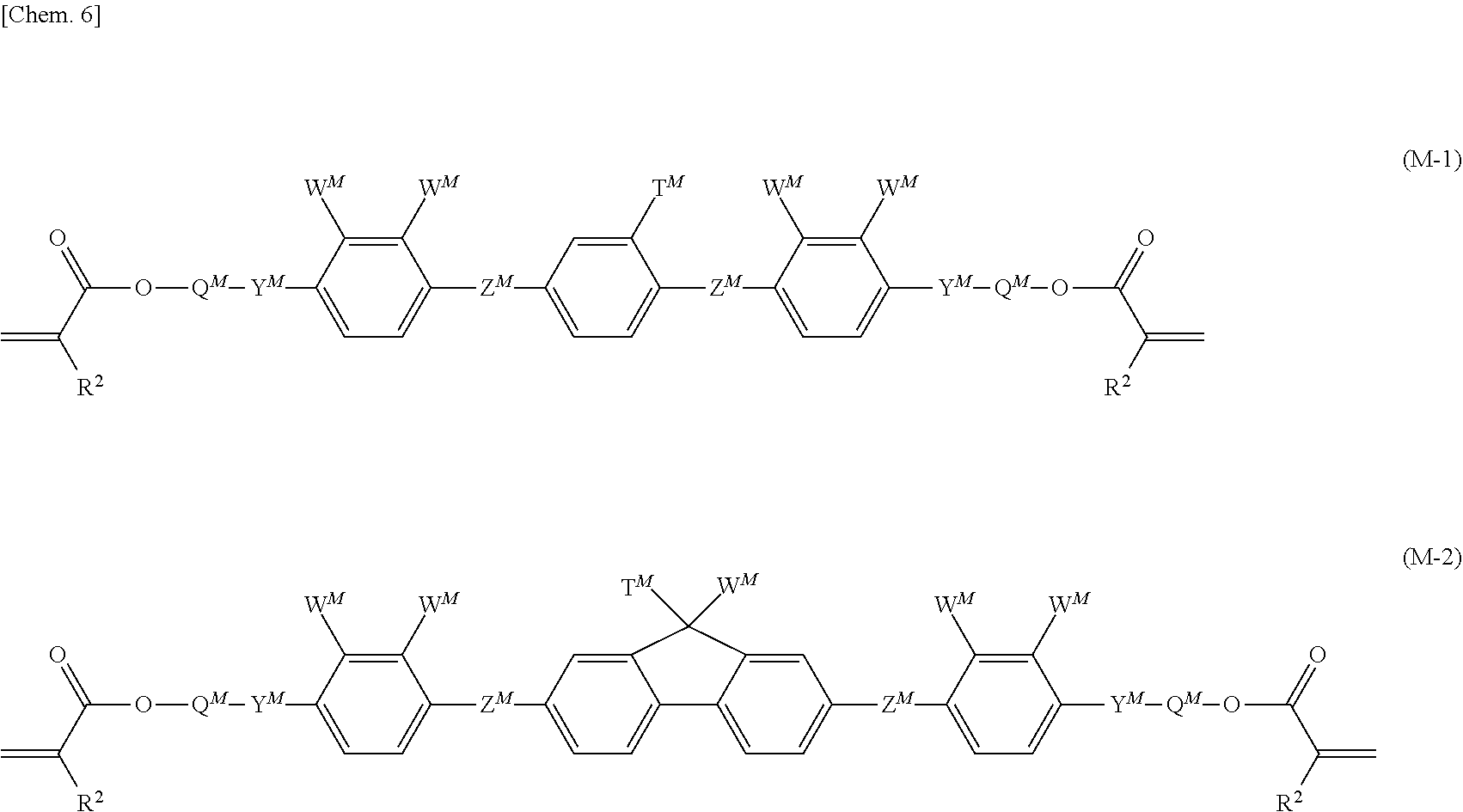
- the polymerizable liquid crystal composition of the present invention it is preferable for the polymerizable liquid crystal composition of the present invention to include a compound represented by Formula (M-1) as the compound (M) or a compound represented by Formula (M-2) because a liquid crystal phase of the polymerizable liquid crystal composition is likely to be exhibited, phase separation with respect to the compound (1) and an organic solvent becomes difficult, and the durability of the liquid crystal polymer after polymerization is excellent.
- a compound represented by Formula (M-1) as the compound (M) or a compound represented by Formula (M-2) because a liquid crystal phase of the polymerizable liquid crystal composition is likely to be exhibited, phase separation with respect to the compound (1) and an organic solvent becomes difficult, and the durability of the liquid crystal polymer after polymerization is excellent.
- T M 's are independently a hydrogen atom, a fluorine atom, a chlorine atom, a formyl group, an alkyl group having 1 to 5 carbon atoms, an alkoxy group having 1 to 5 carbon atoms, an alkenyl group having 2 to 5 carbon atoms, an alkoxycarbonyl group having 1 to 5 carbon atoms, an alkanoyl group having 1 to 5 carbon atoms, or a fluoroalkyl group having 1 to 5 carbon atoms
- W M 's are independently a hydrogen atom, a fluorine atom, a chlorine atom, a formyl group, an alkyl group having 1 to 5 carbon atoms, an alkoxy group having 1 to 5 carbon atoms, an alkenyl group having 2 to 5 carbon atoms, an alkoxycarbonyl group having 1 to 5 carbon atoms, an alkanoyl group having 1 to 5 carbon atoms, or a fluoroalkyl group having 1 to 5
- the polymerizable liquid crystal composition of the present invention can have a mode in which, with respect to a total weight of 100 weight % of compounds represented by Formula (1) and Formula (M), 10 to 90 weight % of the compound represented by Formula (1) is contained, and preferably, 30 to 90 weight % of the compound represented by Formula (1) is contained, or a mode in which 10 to 90 weight % of the compound represented by Formula (M) is contained and more preferably 10 to 70 weight % of the compound represented by Formula (M) is contained.
- R 2 's are independently a hydrogen atom or a methyl group, and a's are independently an integer of 1 to 12.
- R 2 's are independently a hydrogen atom or a methyl group, and a's are independently an integer of 1 to 12.
- the polymerizable liquid crystal composition of the present invention is applied onto a plastic substrate to which an alignment treatment such as a rubbing treatment is performed or a support substrate of which a surface is covered with a thin plastic film to form a film, and thus homogeneous alignment and tilt alignment of a liquid crystal polymer without a substrate are induced.
- Additives of one or more types may be added to the polymerizable liquid crystal component of the present invention.
- the nonionic surfactant has an effect of preventing tilt alignment on the side of an air interface of the liquid crystal polymer.
- a silicone-based nonionic surfactant, a fluorine-based nonionic surfactant, a vinyl-based nonionic surfactant, and a hydrocarbon-based nonionic surfactant may be the nonionic surfactant.
- a surfactant as a polymerizable compound is preferably added to the polymerizable liquid crystal composition because it has an effect of integrating with other polymerizable liquid crystal compounds.
- the surfactant is preferably a surfactant that initiates a polymerization reaction with ultraviolet light.
- a content of the surfactant in the polymerizable liquid crystal composition is preferably 0.0001 to 0.5 weight %, and more preferably 0.01 to 0.2 weight % with respect to a total amount of the polymerizable liquid crystal composition.
- the surfactant examples include an ionic surfactant and a nonionic surfactant such as a silicone-based nonionic surfactant, a fluorine-based nonionic surfactant, and a vinyl-based nonionic surfactant.
- a nonionic surfactant such as a silicone-based nonionic surfactant, a fluorine-based nonionic surfactant, and a vinyl-based nonionic surfactant.
- ionic surfactant examples include titanate-based compounds, imidazoline, quaternary ammonium salts, alkylamine oxides, polyamine derivatives, polyoxyethylene-polyoxypropylene condensates, polyethylene glycols and esters thereof, sodium lauryl sulfate, ammonium lauryl sulfate, amine lauryl sulfate, alkyl-substituted aromatic sulfonates, alkyl phosphates, aliphatic or aromatic sulfonic acid formalin condensates, lauryl amidopropyl betaine, laurylaminoacetic acid betaine, polyethylene glycol fatty acid esters, polyoxyethylene alkylamines, perfluoroalkyl sulfonate, and perfluoroalkyl carboxylates.
- silicone-based nonionic surfactant examples include a compound which is a linear polymer including a siloxane bond and has a side chain and/or terminal to which an organic group such as a polyether and a long chain alkyl is introduced.
- fluorine-based nonionic surfactant examples include a compound having a perfluoroalkyl group or perfluoroalkenyl group having 2 to 7 carbon atoms.
- vinyl-based nonionic surfactant examples include a (meth)acrylic polymer with a weight average molecular weight of 1,000 to 1,000,000.
- the polymerizable liquid crystal composition of the present invention may contain a non-liquid crystalline polymerizable compound.
- a total weight of the non-liquid crystalline polymerizable compound in the polymerizable liquid crystal composition is preferably 30 weight % or less with respect to a total proportion by weight of the polymerizable compounds in the polymerizable liquid crystal composition.
- non-liquid crystalline polymerizable compound examples include a compound having one or two or more vinyl-based polymerizable groups.
- non-liquid crystalline polymerizable compound which is a monofunctional compound examples include styrene, nucleus substituted styrene, acrylonitrile, vinyl chloride, vinylidene chloride, vinylpyridine, N-vinylpyrrolidone, vinyl sulfonic acid, fatty acid vinyl, ⁇ , ⁇ -ethylenically unsaturated carboxylic acids, an alkyl ester of (meth)acrylic acid in which an alkyl group has 1 to 18 carbon atoms, a hydroxyalkyl ester of (meth)acrylic acid in which a hydroxyalkyl group has 1 to 18 carbon atoms, an aminoalkyl ester of (meth)acrylic acid in which an aminoalkyl group has 1 to 18 carbon atoms, an ether oxygen-containing alkyl ester of (meth)acrylic acid in which an ether oxygen-containing alkyl group has 3 to 18 carbon atoms, N-vinylacetamide, vinyl p-t
- Examples of “fatty acid vinyl” here include vinyl acetate.
- non-liquid crystalline polymerizable compound which is a bifunctional compound examples include 1,4-butanediol diacrylate, 1,6-hexanediol diacrylate, 1,9-nonanediol diacrylate, neopentyl glycol diacrylate, dimethylol tricyclodecane diacrylate, triethylene glycol diacrylate, dipropylene glycol diacrylate, tripropylene glycol diacrylate, tetraethylene glycol diacrylate, bisphenol A, EO diacrylate adducts, bisphenol A glycidyl diacrylate, polyethylene glycol diacrylate, and a methacrylate compound of these compounds.
- non-liquid crystalline polymerizable compounds which are multi-functional compounds which are not a bifunctional compound include pentaerythritol triacrylate, trimethylolpropane triacrylate, trimethylol EO-adduct triacrylate, trisacryloyloxyethyl phosphate, tris(acryloyloxyethyl) isocyanurate, alkyl-modified dipentaerythritol triacrylate, EO-modified trimethylolpropane triacrylate, PO-modified trimethylolpropane triacrylate, pentaerythritol tetraacrylate, alkyl-modified dipentaerythritol tetraacrylate, ditrimethylolpropane tetraacrylate, dipentaerythritol hexaacrylate, dipentaerythritol monohydroxypentaacrylate, alkyl-modified dipentaerythritol pentaacrylate,
- Examples of polymerizable fluorene derivatives having a cardo structure include Compounds ( ⁇ -1) to ( ⁇ -3).
- R ⁇ 's are independently a hydrogen atom or a methyl group, and s's are independently an integer of 0 to 4.
- a polymerization initiator When a polymerization initiator is added, a polymerization rate of the polymerizable liquid crystal composition is optimized.
- the polymerization initiator include a photoradical initiator.
- photoradical initiator examples include 1-hydroxy-cyclohexyl-phenyl-ketone, 2-hydroxy-2-methyl-1-phenylpropan-1-one, 1-hydroxycyclohexyl phenyl ketone, 2,2-dimethoxy-1,2-diphenylethan-1-one, p-methoxyphenyl-2,4-bis(trichloromethyl)triazine, 2-(p-butoxystyryl)-5-trichloromethyl-1,3,4-oxadiazole, 9-phenylacridine, 9,10-benzphenazine, benzophenone/Michler's ketone mixture, hexaarylbiimidazole/mercaptobenzimidazole mixture, 1-(4-isopropylphenyl)-2-hydroxy-2-methylpropan-1-one, benzyl dimethyl ketal, 2-methyl-1-[4-(methylthio)phenyl]-2-morpholinopropane-1-one, 2,4-diethy
- a total content by weight of a photoradical polymerization initiator in the polymerizable liquid crystal composition is preferably 0.01 to 10 weight %, more preferably 0.1 to 4 weight %, and most preferably 0.5 to 4 weight % with respect to a total amount of the polymerizable liquid crystal composition.
- a sensitizer may be added to the polymerizable liquid crystal component together with the photoradical polymerization initiator.
- the sensitizer include isopropyl thioxanthone, diethyl thioxanthone, ethyl-4dimethylaminobenzoate, and 2-ethylhexyl-4-dimethylaminobenzoate.
- chain transfer agent examples include thiol derivatives and styrene dimer derivatives.
- thiol derivatives examples include monofunctional thiol derivatives and multi-functional thiol derivatives.
- Examples of the monofunctional thiol derivatives include dodecanethiol, and 2-ethylhexyl-(3-mercapto)propionate.
- Examples of multi-functional thiol derivatives include trimethylolpropane tris(3-mercaptopropionate), pentaerythritol tetrakis(3-mercaptopropionate), 1,4-bis(3-mercaptobutyryloxy)butane, pentaerythritol tetrakis(3-mercaptobutyrate), and 1,3,5-tris(3-mercaptobutyloxyethyl)-1,3,5-triazine-2,4,6(1H, 3H, 5H)-trione.
- Examples of the styrene dimer chain transfer agent include 2,4-diphenyl-4-methyl-1-pentene, and 2,4-diphenyl-1-butene.
- a polymerization preventing agent When a polymerization preventing agent is added to the polymerizable liquid crystal composition, polymerization initiation during storage of the polymerizable liquid crystal composition is prevented.
- the polymerization preventing agent include (1) a compound having a nitroso group; 2,5-di(t-butyl)hydroxytoluene, hydroquinone, methylene blue, diphenyl picric acid hydrazide, phenothiazine, and N,N-dimethyl-4-nitrosoaniline, and (2) benzothiazine derivatives; o-hydroxybenzophenone, and 2H-1,3-benzothiazine-2,4-(3H)dione.
- the polymerization inhibitor examples include (1) a phenol-based antioxidant, (2) a sulfur-based antioxidant, (3) a phosphate-based antioxidant, and (4) an amine-based antioxidant.
- a phenol-based antioxidant is preferable.
- a compound having a t-butyl group at the ortho position relative to a hydroxyl group is preferable as a phenol-based antioxidant.
- a solvent is preferably added to the polymerizable liquid crystal component.
- the solvent component examples include an ester, an amide compound, an alcohol, an ether, a glycol monoalkyl ether, an aromatic hydrocarbon, a halogenated aromatic hydrocarbon, an aliphatic hydrocarbon, a halogenated aliphatic hydrocarbon, an alicyclic hydrocarbon, a ketone, and an acetate solvent.
- the amide compound refers to a compound having an amide group and serves as a solvent component.
- the acetate solvent refers to a compound having an acetate structure and serves as a solvent component.
- ester examples include alkyl acetates, ethyl trifluoroacetate, alkyl propionates, alkyl butyrates, dialkyl malonates, alkyl glycolates, alkyl lactates, monoacetin, ⁇ -butyrolactone, and ⁇ -valerolactone.
- alkyl acetate here include methyl acetate, ethyl acetate, propyl acetate, isopropyl acetate, butyl acetate, 3-methoxybutyl acetate, isobutyl acetate, pentyl acetate, and isopentyl acetate.
- alkyl propionate here include methyl propionate, methyl 3-methoxypropionate, ethyl propionate, propyl propionate, and butyl propionate.
- alkyl butyrate here include methyl butyrate, ethyl butyrate, butyl butyrate, isobutyl butyrate, and propyl butyrate.
- dialkyl malonate here include diethyl malonate.
- alkyl glycolate here include methyl glycolate and ethyl glycolate.
- alkyl lactate here include methyl lactate, ethyl lactate, isopropyl lactate, n-propyl lactate, butyl lactate, and ethylhexyl lactate.
- amide compound examples include N-methyl-2-pyrrolidone, N,N-dimethylacetamide, N-methylpropionamide, N,N-dimethylformamide, N,N-diethylformamide, N,N-diethylacetamide, N,N-dimethylacetamide dimethyl acetal, N-methylcaprolactam, and dimethylimidazolidinone.
- Examples of the alcohol include methanol, ethanol, 1-propanol, 2-propanol, 1-methoxy-2-propanol, t-butyl alcohol, sec-butyl alcohol, butanol, 2-ethylbutanol, n-hexanol, n-heptanol, n-octanol, 1-dodecanol, ethylhexanol, 3,5,5-trimethylhexanol, n-amyl alcohol, hexafluoro-2-propanol, glycerin, ethylene glycol, diethylene glycol, triethylene glycol, tetraethylene glycol, propylene glycol, dipropylene glycol, tripropylene glycol, hexylene glycol, 1,3-butanediol, 1,4-butanediol, 2,3-butanediol, 1,5-pentanediol, 2,4-pentane
- ether ethylene glycol dimethyl ether, diethylene glycol dimethyl ether, bis (2-propyl) ether, 1,4-dioxane, THF, and the like are preferable.
- glycol monoalkyl ether examples include ethylene glycol monoalkyl ether, diethylene glycol monoalkyl ether, triethylene glycol monoalkyl ether, propylene glycol monoalkyl ether, dipropylene glycol monoalkyl ether, ethylene glycol monoalkyl ether acetate, diethylene glycol monoalkyl ether acetate, triethylene glycol monoalkyl ether acetate, propylene glycol monoalkyl ether acetate, dipropylene glycol monoalkyl ether acetate, and diethylene glycol methyl ethyl ether.
- aromatic hydrocarbon examples include benzene, toluene, xylene, mesitylene, ethylbenzene, diethylbenzene, i-propylbenzene, n-propylbenzene, t-butylbenzene, s-butylbenzene, n-butylbenzene, and tetralin.
- halogenated aromatic hydrocarbon examples include chlorobenzene.
- aliphatic hydrocarbon examples include hexane and heptane.
- halogenated aliphatic hydrocarbon examples include chloroform, dichloromethane, carbon tetrachloride, dichloroethane, trichlorethylene, and tetrachlorethylene.
- alicyclic hydrocarbon examples include cyclohexane and decalin.
- ketone examples include acetone, methyl ethyl ketone, methyl isobutyl ketone, cyclohexanone, cyclopentanone, and methyl propyl ketone.
- acetate solvent examples include ethylene glycol monomethyl ether acetate, propylene glycol monomethyl ether acetate, propylene glycol monoethyl ether acetate, methyl acetoacetate, and 1-methoxy-2-propyl acetate.
- the polymerizable liquid crystal composition of the present invention may include a compound having optical activity.
- a compound having optical activity is added to the liquid crystal composition, the liquid crystal polymer without a substrate is induced to have twist alignment.
- the liquid crystal polymer can be used as a selective reflection film in a wavelength range of 300 to 2,000 nm and a negative type C plate.
- Examples of the compound having optical activity include a compound having an asymmetric carbon atom, an axially asymmetric compound having a binaphthyl structure, a helicene structure, or the like, and a plane asymmetric compound having a cyclophane structure or the like.
- a compound having optical activity in this case is preferably a polymerizable compound.
- the liquid crystal polymer of the present invention may contain a dichroic dye.
- a liquid crystal polymer complexed with a dichroic dye can be used as an absorptive polarizing plate.
- a dichroic dye having a maximum absorption wavelength in a range of 300 to 700 nm is preferable.
- Acridine dyes, oxazine dyes, cyanine dyes, naphthalene dyes, azo dyes, and anthraquinone dyes can be used as dichroic dyes.
- Examples of azo dyes include monoazo dyes, bisazo dyes, trisazo dyes, tetrakisazo dyes, and stilbene azo dyes.
- the liquid crystal polymer of the present invention may contain a fluorescent dye.
- a liquid crystal polymer complexed with a fluorescent dye can be used as a polarized light emitting film and a wavelength conversion film.
- a glass, a plastic, and a metal are a material of a substrate.
- a surface of the glass or metal may be processed into a slit shape.
- the plastic may be subjected to a surface treatment such as a stretching treatment, a hydrophilic treatment, and a hydrophobic treatment.
- a surface treatment is performed on the substrate to induce alignment of the liquid crystal polymer.
- methods of (a) rubbing a substrate, (b) obliquely depositing silicon oxide on a substrate, and (c) providing a polymer coating on a substrate and emitting polarized UV to the polymer coating.
- a rubbing cloth made of a material such as rayon, cotton, or polyamide is wound around a metal roller,
- the roller is moved parallel to a surface of the substrate while rotating the roller or the substrate is moved while the roller is fixed.
- a polymer coating may be provided on the substrate, and rubbing may be performed on the coating.
- a coating a coating called a rubbing alignment film of polyimide, polyamic acid, or polyvinyl alcohol is used.
- a polymer coating called a photoalignment film is provided on a substrate, and
- a heat treatment may be performed as necessary.
- the photoalignment film includes a photosensitive group-containing polyimide, polyamic acid or polyacrylate.
- the photosensitive group is preferably a chalcone group, cinnamyl carboxyl group, cinnamoyl group, or azo group.
- the liquid crystal polymer with a substrate of the present invention is obtained according to the following processes.
- a polymerizable liquid crystal component is applied onto a substrate and, as necessary, dried to form a coating film.
- the polymerizable liquid crystal composition is polymerized by a method using light, heat, or a catalyst, and a liquid crystal polymer with a substrate is obtained.
- the polymerizable liquid crystal composition in the coating film is fixed in a liquid crystal state.
- Various coating methods are used for applying a polymerizable liquid crystal composition.
- a coating method a spin coating method, a micro gravure coating method, a gravure coating method, a wire bar coating method, a dip coating method, a spray coating method, a meniscus coating method, and a die coating method are preferable.
- a heat treatment is preferably performed during drying.
- the heat treatment can be performed using a hot plate, a drying furnace, and warm air or hot air blowing.
- a wavelength range of light emitted in order to obtain the liquid crystal polymer is 150 to 500 nm.
- a preferable wavelength range of light is 250 to 450 nm, a more preferable range is 300 to 400 nm.
- a low pressure mercury lamp, a high pressure discharge lamp, and a short arc discharge lamp can be used as a light source of the light.
- the low pressure mercury lamp include sterilization lamp, a fluorescent chemical lamp, and a black light.
- the high pressure discharge lamp include a high pressure mercury lamp and a metal halide lamp.
- the short arc discharge lamp include an ultra high pressure mercury lamp, a xenon lamp, and a mercury xenon lamp.
- the liquid crystal polymer can be disposed inside or outside a liquid crystal cell of a liquid crystal display element.
- the liquid crystal polymer can be disposed inside the liquid crystal cell because the variation in retardation of the liquid crystal polymer due to a thermal history is small and an amount of impurities eluted from the liquid crystal polymer to a liquid crystal is small.
- liquid crystal polymer When the liquid crystal polymer is formed using a polarizing plate as a substrate, it is possible to produce a polarizing plate having a function such as optical compensation. For example, when a liquid crystal polymer having a quarter wavelength retardation plate and a polarizing plate are combined, a circularly polarizing plate can be produced.
- the polarizing plate examples include an absorptive polarizing plate doped with iodine or a dichroic dye, and a reflective polarizing plate such as a wire grid polarizing plate.
- the present invention is not limited to only the disclosed examples.
- DCC is 1,3-dicyclohexylcarbodiimide.
- DMAP is 4-dimethylaminopyridine.
- pTSA is p-toluenesulfonic acid.
- Irg-907 is Irgacure (trademark) 907 (Irg-907) (commercially available from BASF Japan).
- NCI-930 is Adeka Cruise (trademark) NCI-930 (commercially available from ADEKA).
- FTX-218 is Ftergent (trademark) FTX-218 (commercially available from Neos Corporation).
- TEGOFlow370 is TEGOFlow (trademark) 370 (commercially available from Evonik Japan).
- a structure of a compound was confirmed by measurement of proton NMR at 500 MHz using DRX-500 (commercially available from Bruker Corporation). The unit of the numerical value described is ppm. s is a singlet, d is a doublet, t is a triplet, and m is a multiplet.
- a sample was placed on a hot plate of a melting point measuring device and a transition temperature was measured under a polarizing microscope. The transition temperature was measured while heating at a rate of 3° C./min.
- a crystal phase, a nematic phase, a smectic phase, and an isotropic liquid are denoted as “C,” “N,” “S,” and “I,” respectively.
- a number between phases refers to a transition temperature represented by the degree Celsius.
- C50N63I indicates that a crystal phase transitions at 50° C. to a nematic phase, and a nematic phase transitions at 63° C. to an isotropic liquid.
- the letter in the parentheses indicates a monotropic liquid crystal phase.
- a substrate on which a retardation film was formed was interposed between two polarizing plates disposed in crossed nicols and observed. The substrate was rotated horizontally and a light or dark state was confirmed. The substrate on which a retardation film was formed was observed under a polarizing microscope and it was checked whether there was an alignment defect. When there was a part in which light appeared to be missing in a dark state or when neither a light state nor a dark state was confirmed, it was determined that an “alignment defect was present.” When an “alignment defect” was not present, it was determined that there was “no alignment defect.”
- a part of a liquid crystal polymer was cut off from a glass substrate with a liquid crystal film.
- a film thickness of a step of the part was measured using a micro shape measuring device Alpha-Step IQ (commercially available from KLA TENCOR).
- a retardation Re was measured by an OPIPRO polarization analyzer (commercially available from Shintec Co., Ltd.). Retardation was measured while reducing a light incident angle with respect to a surface of the liquid crystal polymer from 90°. A wavelength of light used for measurement was 450 nm, 550 nm, and 650 nm.
- a birefringence ⁇ n for each wavelength was calculated by (retardation Re)/(film thickness).
- a substrate on which a retardation film was formed was interposed between two polarizing plates of a polarizing microscope, and a luminance in a crossed nicols state and a luminance in a parallel nicols state were evaluated using a luminance meter.
- YOKOGAWA 3298F was used as the luminance meter.
- a luminance that was minimum when the substrate was rotated horizontally was regarded as a “luminance in a crossed nicols state.”
- a luminance that was maximum when the substrate was rotated in a horizontal plane was regarded as a “luminance in a parallel nicols state.”
- a transmittance of a laminate of a glass substrate, an alignment film, and a liquid crystal polymer was measured using a ultraviolet visible spectrophotometer (V650DS) (commercially available from JASCO Corporation). The blank was air.
- V650DS ultraviolet visible spectrophotometer
- the hardness of a liquid crystal polymer was measured according to JIS standard “JIS-K-5400 8.4 pencil scratch test” except for parts described in this specification.
- a pencil Uni (commercially available from Mitsubishi Pencil Co., Ltd.) was used.
- a pencil hardness tester C-221 (commercially available from Yoshimitsu Seiki) was used.
- the liquid crystal polymer was scratched with a pencil lead fixed at an angle of 45°.
- the hardness of the softest pencil lead that scratched the liquid crystal polymer was measured.
- the pencil lead softens in order of H, F, HB, B, 2B, 3B, and 4B.
- a polymer represented by Formula (J) was synthesized in the same manner as in the method according to Example 9 in Japanese Unexamined Patent Application Publication No. 2012-087286.
- x was 0.1, and a weight average molecular weight Mw was 53,700. 5 weight % of a polymer represented by Formula (J) was dissolved in 95 weight % of cyclopentanone, filtered off using a filter with a pore size of 0.2 m, and thereby a light alignment agent (1) was prepared.
- a glass substrate with a polarized UV treated alignment film was produced according to the following processes.
- the light alignment agent (1) was spin-coated on a glass to produce a coating film.
- a 250 W ultra high pressure mercury lamp (multi-light-250 commercially available from Ushio Inc.) was used. Emission was performed under a nitrogen atmosphere at room temperature. Emission light was 30 mW/cm 2 (365 nm) and an emission time was 30 seconds.
- a compound (1-1-1-1) was synthesized according to the following procedure.
- a compound ex-1 was synthesized in the same procedure as in the method described in Example 5 in Japanese Unexamined Patent Application Publication No. 2016-047813.
- a phase transition temperature and NMR analysis values of the compound (1-1-1-1) are as follows.
- a compound (1-1-2-1) was synthesized according to the same method described in Example 1 except that 2′,5′-dihydroxyacetophenone was used in place of methylhydroquinone in Example 1.
- a phase transition temperature and NMR analysis values of the compound (1-1-2-1) are as follows.
- a compound (1-1-3-1) was synthesized according to the same method described in Example 1 except that methyl 2,5-dihydroxybenzoate was used in place of methylhydroquinone in Example 1.
- a phase transition temperature and NMR analysis values of the compound (1-1-3-1) are as follows.
- composition (1) (M-1-1-1) (M-2-1-1) initiator surfactant solvent S-1 2 0 16 2 1.2 weight % 0.06 78.74 weight % weight % weight % of Irg-907 weight % weight % of of compound FTX-218 (1-1-1-1) S-2 8 0 10 2 1.2 weigh % of 0.06 78.74 weight % weight % weight % NCI-930 weight % weight % of of compound TEGOFlow (1-1-2-1) 370 S-3 16 0 2 2 1.2 weigh % of 0.06 78.74 weight % weight % weight % Irg-907 weight % weight % of of compound TEGOFlow (1-1-3-1) 370 S-4 4 14 0 1 1.2 weight % 0.06 79.74 weight % weight % weight % of
- a compound cex-2 was synthesized according to the same method described in Example 5 in Japanese Unexamined Patent Application Publication No. 2016-047813.
- a compound cex-3 was synthesized according to the same method described in Example 4 in Japanese Unexamined Patent Application Publication No. 2016-047813.
- a liquid crystal polymer (F-1) was produced according to the following procedures.
- a polymerizable liquid crystal composition (S-1) was applied onto a glass substrate with a polarized UV treated alignment film by spin coating.
- the substrate was polymerized by emission of ultraviolet light in air at room temperature.
- the liquid crystal polymer (F-1) was homogeneously aligned and had no alignment defects.
- Liquid crystal polymers (F-2) to (F-5) were obtained according to the procedure described in Example 9 using polymerizable liquid crystal compositions (S-2) to (S-5) instead of the polymerizable liquid crystal composition (S-1).
- liquid crystal polymers (F-2) to (F-5) were homogeneously aligned and had no alignment defects.
- liquid crystal polymers (CF-1) and (CF-2) were obtained according to the procedure described in Example 9 using polymerizable liquid crystal compositions (SC-1) and (SC-2) instead of the polymerizable liquid crystal composition (S-1).
- Table 3 shows a retardation Re at a light wavelength of 550 nm, a birefringence ⁇ n at a light wavelength of 550 nm, and front contrast for each liquid crystal polymer having no liquid crystal.
- the front contrast of the liquid crystal polymers (F-1) to (F-5) was significantly higher than the front contrast of the liquid crystal polymers (CF-1) and (CF-2).
- the front contrast became higher as the content of the compound (1) was larger.
- the transmittance at 380 nm of the liquid crystal polymers (F-1) to (F-5) was significantly higher than the transmittance of the liquid crystal polymers (CF-1) and (CF-2).
- the pencil hardness of the liquid crystal polymers (F-1) to (F-5) was significantly harder than the pencil hardness of the liquid crystal polymers (CF-1) and (CF-2).
- a liquid crystal polymer obtained by using the polymerizable liquid crystal composition of the present invention as a raw material can be used for a display element having a film or an element having an optically anisotropic film such as a phase difference film, an optical compensation film, a reflective film, a selective reflection film, an antireflection film, a viewing angle compensation film, a liquid crystal alignment film, a polarizing element, a circularly polarizing element, and an elliptically polarizing element.
- an optically anisotropic film such as a phase difference film, an optical compensation film, a reflective film, a selective reflection film, an antireflection film, a viewing angle compensation film, a liquid crystal alignment film, a polarizing element, a circularly polarizing element, and an elliptically polarizing element.
Landscapes
- Chemical & Material Sciences (AREA)
- Organic Chemistry (AREA)
- Physics & Mathematics (AREA)
- Crystallography & Structural Chemistry (AREA)
- Engineering & Computer Science (AREA)
- Materials Engineering (AREA)
- General Physics & Mathematics (AREA)
- Optics & Photonics (AREA)
- Nonlinear Science (AREA)
- Mathematical Physics (AREA)
- Medicinal Chemistry (AREA)
- Polymers & Plastics (AREA)
- Chemical Kinetics & Catalysis (AREA)
- Health & Medical Sciences (AREA)
- Life Sciences & Earth Sciences (AREA)
- Wood Science & Technology (AREA)
- Addition Polymer Or Copolymer, Post-Treatments, Or Chemical Modifications (AREA)
- Liquid Crystal (AREA)
- Polarising Elements (AREA)
- Organic Low-Molecular-Weight Compounds And Preparation Thereof (AREA)
- Liquid Crystal Substances (AREA)
Abstract
Description

(in Formula (1),

(in Formula (P-1) to Formula (P-9), R1's are independently a hydrogen atom, a halogen atom, a methyl group, an ethyl group, or a trifluoromethyl group).
[2]

(in Formula (1-1),

(in Formula (M),

(in Formula (P-1) to Formula (P-9), R1's are independently a hydrogen atom, a halogen atom, a methyl group, an ethyl group, or a trifluoromethyl group).
[7] The polymerizable liquid crystal composition according to [6],
(in Formulae (M-1) and (M-2),

(in Formula (1-1),

(in Formula (P-1) to Formula (P-9), R1's are independently a hydrogen atom, a halogen atom, a methyl group, an ethyl group, or a trifluoromethyl group).

<<Polymerizable Liquid Crystal Composition>>


(in Formula (1-1),


| TABLE 1 | |||||||
| Content | Content | ||||||
| Name of | and name | and name | Content | Content | Content and | Content | Content of |
| polymerizable | of | of | of | of | name of | and name | cyclohexanone |
| liquid crystal | compound | compound | compound | compound | polymerization | of | used as |
| composition | (1) | (1) | (M-1-1-1) | (M-2-1-1) | initiator | surfactant | solvent |
| S-1 | 2 | 0 | 16 | 2 | 1.2 weight % | 0.06 | 78.74 |
| weight % | weight % | weight % | of Irg-907 | weight % | weight % | ||
| of | of | ||||||
| compound | FTX-218 | ||||||
| (1-1-1-1) | |||||||
| S-2 | 8 | 0 | 10 | 2 | 1.2 weigh % of | 0.06 | 78.74 |
| weight % | weight % | weight % | NCI-930 | weight % | weight % | ||
| of | of | ||||||
| compound | TEGOFlow | ||||||
| (1-1-2-1) | 370 | ||||||
| S-3 | 16 | 0 | 2 | 2 | 1.2 weigh % of | 0.06 | 78.74 |
| weight % | weight % | weight % | Irg-907 | weight % | weight % | ||
| of | of | ||||||
| compound | TEGOFlow | ||||||
| (1-1-3-1) | 370 | ||||||
| S-4 | 4 | 14 | 0 | 1 | 1.2 weight % | 0.06 | 79.74 |
| weight % | weight % | weight % | of | weight % | weight % | ||
| of | of | NCI-930 | of | ||||
| compound | compound | TEGOFlow | |||||
| (1-1-1-1) | (1-1-3-1) | 370 | |||||
| S-5 | 11 | 11 | 0 | 0 | 1.8 weight % | 0.08 | 76.12 |
| weight % | weight % | of Irg-907 | weight % | weight % | |||
| of | of | of | |||||
| compound | compound | TEGOFlow | |||||
| (1-1-2-1) | (1-1-3-1) | 370 | |||||


| TABLE 2 | |||||||
| Name of | Content | Content | Content | Content | Content and | Content | Content of |
| polymerizable | of | of | of | of | name of | and name | cyclohexanone |
| liquid crystal | compound | compound | compound | compound | polymerization | of | used as |
| composition | (C-1) | (C-2) | (M-1-1-1) | (M-2-1-1) | initiator | surfactant | solvent |
| SC-1 | 0 | 0 | 16 | 4 | 1.2 weight % | 0.06 | 78.74 |
| weight % | weight % | of Irg-907 | weight % of | weight % | |||
| FTX-218 | |||||||
| SC-2 | 2 | 0 | 16 | 2 | 1.2 weight of | 0.06 | 78.74 |
| weight % | weight % | weight % | Irg-907 | weight % of | weight % | ||
| FTX-218 | |||||||
| SC-3 | 0 | 16 | 2 | 2 | 1.2 weight % | 0.06 | 78.74 |
| weight % | weight % | weight % | of Irg-907 | weight % of | weight % | ||
| TEGOFlow | |||||||
| 370 | |||||||
<Production of Liquid Crystal Polymer>
| TABLE 3 | ||||
| Name of | ||||
| polymerizable | ||||
| Name of liquid | liquid crystal | Retardation | Birefringence | Front |
| crystal polymer | composition | Re | Δn | contrast |
| F-1 | S-1 | 139.7 | 0.18 | 5,300 |
| F-2 | S-2 | 131.5 | 0.15 | 5,900 |
| F-3 | S-3 | 137.1 | 0.12 | 6,100 |
| F-4 | S-4 | 142.3 | 0.02 | 7,000 |
| F-5 | S-5 | 134.4 | 0.11 | 7,100 |
| CF-1 | SC-1 | 136.9 | 0.18 | 4,900 |
| CF-2 | SC-2 | 138.2 | 0.18 | 5,100 |
| TABLE 4 | |||
| Name of | |||
| polymerizable | |||
| Name of liquid | liquid crystal | Transmittance at | Pencil |
| crystal polymer | composition | 380 nm | hardness |
| F-1 | S-1 | 83% | B |
| F-2 | S-2 | 85% | HB |
| F-3 | S-3 | 87% | F |
| F-4 | S-4 | 89% | H |
| F-5 | S-5 | 89% | H |
| CF-1 | SC-1 | 82% | 4B |
| CF-2 | SC-2 | 81% | 3B |
Claims (16)


Applications Claiming Priority (4)
| Application Number | Priority Date | Filing Date | Title |
|---|---|---|---|
| JP2016-156553 | 2016-08-09 | ||
| JPJP2016-156553 | 2016-08-09 | ||
| JP2016156553 | 2016-08-09 | ||
| PCT/JP2017/027635 WO2018030190A1 (en) | 2016-08-09 | 2017-07-31 | Polymerizable liquid crystal composition and liquid crystal polymer |
Publications (2)
| Publication Number | Publication Date |
|---|---|
| US20190185749A1 US20190185749A1 (en) | 2019-06-20 |
| US10961455B2 true US10961455B2 (en) | 2021-03-30 |
Family
ID=61163240
Family Applications (1)
| Application Number | Title | Priority Date | Filing Date |
|---|---|---|---|
| US16/322,117 Expired - Fee Related US10961455B2 (en) | 2016-08-09 | 2017-07-31 | Polymerizable liquid crystal composition and liquid crystal polymer |
Country Status (6)
| Country | Link |
|---|---|
| US (1) | US10961455B2 (en) |
| JP (1) | JP6954288B2 (en) |
| KR (1) | KR20190035743A (en) |
| CN (1) | CN109563408B (en) |
| TW (1) | TWI731135B (en) |
| WO (1) | WO2018030190A1 (en) |
Families Citing this family (5)
| Publication number | Priority date | Publication date | Assignee | Title |
|---|---|---|---|---|
| JP6976336B2 (en) * | 2017-08-15 | 2021-12-08 | 富士フイルム株式会社 | Liquid crystal composition, light absorption anisotropic film, laminate and image display device |
| JP2019144461A (en) * | 2018-02-22 | 2019-08-29 | Jnc株式会社 | In-cell phase-difference film |
| WO2019220673A1 (en) * | 2018-05-15 | 2019-11-21 | Jnc株式会社 | Compound, liquid crystal composition, and liquid crystal display element |
| US11858817B2 (en) * | 2019-11-26 | 2024-01-02 | The Government Of The United States Of America, As Represented By The Secretary Of The Navy | Nanodiamond reduction photochemistry |
| CN116113858A (en) * | 2020-08-04 | 2023-05-12 | 富士胶片株式会社 | Method for producing an optically anisotropic layer |
Citations (14)
| Publication number | Priority date | Publication date | Assignee | Title |
|---|---|---|---|---|
| JP2008239567A (en) | 2007-03-28 | 2008-10-09 | Dic Corp | Polymerizable compound having 5, 6 and 7 rings, and polymerizable liquid crystal composition containing the compound |
| JP2008274235A (en) | 2007-03-30 | 2008-11-13 | Dic Corp | Polymer-stabilized ferroelectric liquid crystal composition and liquid crystal display device |
| JP2010270108A (en) | 2009-04-21 | 2010-12-02 | Sumitomo Chemical Co Ltd | Compound |
| JP2015075492A (en) | 2013-10-04 | 2015-04-20 | Dic株式会社 | Liquid crystal composite material |
| WO2015147243A1 (en) | 2014-03-28 | 2015-10-01 | 富士フイルム株式会社 | Polymerizable compound, polymer, polymerizable composition, film, and half mirror for projection image display |
| JP2015187212A (en) | 2014-03-26 | 2015-10-29 | Dic株式会社 | Liquid crystal composition and liquid crystal display device containing the same |
| US20160068756A1 (en) | 2014-08-29 | 2016-03-10 | Fujifilm Corporation | Retardation film, method of manufacturing retardation film, laminate, composition, polarizing plate and liquid crystal display device |
| JP2016128403A (en) | 2014-12-02 | 2016-07-14 | Jnc株式会社 | Liquid crystalline compound, liquid crystal composition and polymer of the same |
| JP2016166344A (en) | 2015-03-02 | 2016-09-15 | Jnc株式会社 | Polymerizable liquid crystal composition and optically anisotropic film |
| US20170009138A1 (en) | 2014-03-28 | 2017-01-12 | Fujifilm Corporation | Polymerizable compound, polymer, polymerizable composition, film, and half mirror for displaying projection image |
| JP2017014381A (en) | 2015-06-30 | 2017-01-19 | Jnc株式会社 | Polymerizable liquid crystal compound, composition and polymer thereof |
| WO2017090644A1 (en) | 2015-11-26 | 2017-06-01 | 富士フイルム株式会社 | Optical film, polarizing plate, image display device, polymerizable compound and 1,4-cyclohexane dicarboxylic acid mono aryl ester production method |
| US20170174992A1 (en) | 2015-12-21 | 2017-06-22 | Jnc Corporation | Polymerizable liquid crystal compound, composition, liquid crystal polymerization film-kind thereof and use thereof |
| US20180163135A1 (en) * | 2016-12-07 | 2018-06-14 | Jnc Corporation | Liquid crystal polymerized films using alignment film and polymerizable liquid crystal compostion |
Family Cites Families (2)
| Publication number | Priority date | Publication date | Assignee | Title |
|---|---|---|---|---|
| JP2015127793A (en) * | 2013-11-26 | 2015-07-09 | Jnc株式会社 | Optical anisotropic material and liquid crystal display |
| JP6648438B2 (en) * | 2014-08-27 | 2020-02-14 | Jnc株式会社 | Liquid crystal compound, liquid crystal composition and polymer thereof |
-
2017
- 2017-07-31 CN CN201780047142.5A patent/CN109563408B/en active Active
- 2017-07-31 US US16/322,117 patent/US10961455B2/en not_active Expired - Fee Related
- 2017-07-31 JP JP2018532940A patent/JP6954288B2/en not_active Expired - Fee Related
- 2017-07-31 KR KR1020197004059A patent/KR20190035743A/en not_active Withdrawn
- 2017-07-31 WO PCT/JP2017/027635 patent/WO2018030190A1/en not_active Ceased
- 2017-08-07 TW TW106126500A patent/TWI731135B/en active
Patent Citations (17)
| Publication number | Priority date | Publication date | Assignee | Title |
|---|---|---|---|---|
| JP2008239567A (en) | 2007-03-28 | 2008-10-09 | Dic Corp | Polymerizable compound having 5, 6 and 7 rings, and polymerizable liquid crystal composition containing the compound |
| JP2008274235A (en) | 2007-03-30 | 2008-11-13 | Dic Corp | Polymer-stabilized ferroelectric liquid crystal composition and liquid crystal display device |
| JP2010270108A (en) | 2009-04-21 | 2010-12-02 | Sumitomo Chemical Co Ltd | Compound |
| JP2015075492A (en) | 2013-10-04 | 2015-04-20 | Dic株式会社 | Liquid crystal composite material |
| JP2015187212A (en) | 2014-03-26 | 2015-10-29 | Dic株式会社 | Liquid crystal composition and liquid crystal display device containing the same |
| US20170009138A1 (en) | 2014-03-28 | 2017-01-12 | Fujifilm Corporation | Polymerizable compound, polymer, polymerizable composition, film, and half mirror for displaying projection image |
| WO2015147243A1 (en) | 2014-03-28 | 2015-10-01 | 富士フイルム株式会社 | Polymerizable compound, polymer, polymerizable composition, film, and half mirror for projection image display |
| US20160068756A1 (en) | 2014-08-29 | 2016-03-10 | Fujifilm Corporation | Retardation film, method of manufacturing retardation film, laminate, composition, polarizing plate and liquid crystal display device |
| JP2016051178A (en) | 2014-08-29 | 2016-04-11 | 富士フイルム株式会社 | Retardation film, production method of retardation film, laminate, composition, polarizing plate and liquid crystal display device |
| JP2016128403A (en) | 2014-12-02 | 2016-07-14 | Jnc株式会社 | Liquid crystalline compound, liquid crystal composition and polymer of the same |
| JP2016166344A (en) | 2015-03-02 | 2016-09-15 | Jnc株式会社 | Polymerizable liquid crystal composition and optically anisotropic film |
| JP2017014381A (en) | 2015-06-30 | 2017-01-19 | Jnc株式会社 | Polymerizable liquid crystal compound, composition and polymer thereof |
| WO2017090644A1 (en) | 2015-11-26 | 2017-06-01 | 富士フイルム株式会社 | Optical film, polarizing plate, image display device, polymerizable compound and 1,4-cyclohexane dicarboxylic acid mono aryl ester production method |
| US20180267368A1 (en) | 2015-11-26 | 2018-09-20 | Fujifilm Corporation | Optical film, polarizing plate, image display device, polymerizable compound, and method for manufacturing 1,4-cyclohexanedicarboxylic acid monoaryl ester |
| US20170174992A1 (en) | 2015-12-21 | 2017-06-22 | Jnc Corporation | Polymerizable liquid crystal compound, composition, liquid crystal polymerization film-kind thereof and use thereof |
| JP2017125009A (en) | 2015-12-21 | 2017-07-20 | Jnc株式会社 | Polymerizable liquid crystal compound, polymerizable liquid crystal composition, liquid crystal polymer thereof and method for producing liquid crystal polymer |
| US20180163135A1 (en) * | 2016-12-07 | 2018-06-14 | Jnc Corporation | Liquid crystal polymerized films using alignment film and polymerizable liquid crystal compostion |
Non-Patent Citations (2)
| Title |
|---|
| "International Preliminary Report on Patentability of PCT/JP2017/027635; this report contains the following items :Form PCT/IB/338, PCT/IB/373, PCT/ISA237(cover sheet), PCT/ISA237(Box No. I), PCT/ISA237(Box No. V)", dated Feb. 12, 2019, which is English translation of "Written Opinion of the International Search Authority", p. 1-p. 9. |
| "International Search Report (Form PCT/ISA/210) of PCT/JP2017/027635," dated Aug. 29, 2017, with English translation thereof, pp. 1-4. |
Also Published As
| Publication number | Publication date |
|---|---|
| KR20190035743A (en) | 2019-04-03 |
| JP6954288B2 (en) | 2021-10-27 |
| US20190185749A1 (en) | 2019-06-20 |
| TWI731135B (en) | 2021-06-21 |
| TW201821399A (en) | 2018-06-16 |
| WO2018030190A1 (en) | 2018-02-15 |
| CN109563408B (en) | 2022-04-19 |
| CN109563408A (en) | 2019-04-02 |
| JPWO2018030190A1 (en) | 2019-06-06 |
Similar Documents
| Publication | Publication Date | Title |
|---|---|---|
| JP4946151B2 (en) | Polymerizable liquid crystal composition | |
| US10961455B2 (en) | Polymerizable liquid crystal composition and liquid crystal polymer | |
| JP4915523B2 (en) | Polymerizable liquid crystal composition | |
| JP6665581B2 (en) | Polymerizable liquid crystal composition and optically anisotropic film | |
| CN103725291B (en) | Polymerizable liquid crystal composition, optical anisotropy film and liquid crystal display element | |
| KR20150060512A (en) | Optically anisotropic substance and liquid crystal display | |
| KR20170074178A (en) | Polymerizable liquid crystal compound, composition, liquid crystal polymerized film-kinds thereof and use thereof | |
| US9541690B2 (en) | Film using polymerizable liquid crystal composition containing peeling preventive agent | |
| KR20140001106A (en) | Polymerizable liquid crystal composition | |
| KR20150014362A (en) | Polymerizable liquid crystal composition and optical anisotropic film | |
| US10494571B2 (en) | Polymerizable liquid crystal compound, polymerizable liquid crystal composition, and liquid crystal polymerized films | |
| US10392562B2 (en) | Polymerizable liquid crystal compounds, polymerizable liquid crystal compositions, liquid crystalline polymers, phase difference film and display device | |
| JP4742217B2 (en) | Organosilicon compound-containing polymerizable liquid crystal composition | |
| KR101855525B1 (en) | Polymerizable liquid crystal composition and optical anisotropic body | |
| US10844283B2 (en) | Polymerizable liquid crystal compound, polymerizable liquid crystal composition and liquid crystal polymerized film | |
| JP2021147410A (en) | Polymerizable liquid crystal compound, polymerizable liquid crystal composition, liquid crystal polymer film, polarizing plate, and display element | |
| KR20190005800A (en) | Polymerizable liquid crystal composition and a liquid crystal polymer film | |
| CN110184076A (en) | Phase difference film and liquid crystal display element in unit | |
| JP2021161269A (en) | Polymerizable liquid crystal composition, liquid crystal polymer, laminate of liquid crystal polymer, optical element and production method thereof | |
| JP2022043618A (en) | Polymerizable liquid crystal composition and liquid crystal polymers | |
| JP2019206677A (en) | Polymerizable liquid crystal compound, composition and polymer thereof |
Legal Events
| Date | Code | Title | Description |
|---|---|---|---|
| FEPP | Fee payment procedure |
Free format text: ENTITY STATUS SET TO UNDISCOUNTED (ORIGINAL EVENT CODE: BIG.); ENTITY STATUS OF PATENT OWNER: LARGE ENTITY |
|
| AS | Assignment |
Owner name: JNC CORPORATION, JAPAN Free format text: ASSIGNMENT OF ASSIGNORS INTEREST;ASSIGNORS:OOTSUKI, DAISUKE;MIYAGAWA, NAGAHISA;REEL/FRAME:048363/0505 Effective date: 20181220 Owner name: JNC PETROCHEMICAL CORPORATION, JAPAN Free format text: ASSIGNMENT OF ASSIGNORS INTEREST;ASSIGNORS:OOTSUKI, DAISUKE;MIYAGAWA, NAGAHISA;REEL/FRAME:048363/0505 Effective date: 20181220 |
|
| STPP | Information on status: patent application and granting procedure in general |
Free format text: DOCKETED NEW CASE - READY FOR EXAMINATION |
|
| STPP | Information on status: patent application and granting procedure in general |
Free format text: NON FINAL ACTION MAILED |
|
| STPP | Information on status: patent application and granting procedure in general |
Free format text: NOTICE OF ALLOWANCE MAILED -- APPLICATION RECEIVED IN OFFICE OF PUBLICATIONS |
|
| STPP | Information on status: patent application and granting procedure in general |
Free format text: PUBLICATIONS -- ISSUE FEE PAYMENT VERIFIED |
|
| STCF | Information on status: patent grant |
Free format text: PATENTED CASE |
|
| FEPP | Fee payment procedure |
Free format text: MAINTENANCE FEE REMINDER MAILED (ORIGINAL EVENT CODE: REM.); ENTITY STATUS OF PATENT OWNER: LARGE ENTITY |
|
| LAPS | Lapse for failure to pay maintenance fees |
Free format text: PATENT EXPIRED FOR FAILURE TO PAY MAINTENANCE FEES (ORIGINAL EVENT CODE: EXP.); ENTITY STATUS OF PATENT OWNER: LARGE ENTITY |
|
| STCH | Information on status: patent discontinuation |
Free format text: PATENT EXPIRED DUE TO NONPAYMENT OF MAINTENANCE FEES UNDER 37 CFR 1.362 |
|
| FP | Lapsed due to failure to pay maintenance fee |
Effective date: 20250330 |