US109461A - Improvement in insulators for telegraph-wires - Google Patents
Improvement in insulators for telegraph-wires Download PDFInfo
- Publication number
- US109461A US109461A US109461DA US109461A US 109461 A US109461 A US 109461A US 109461D A US109461D A US 109461DA US 109461 A US109461 A US 109461A
- Authority
- US
- United States
- Prior art keywords
- blocks
- wire
- box
- insulators
- improvement
- Prior art date
- Legal status (The legal status is an assumption and is not a legal conclusion. Google has not performed a legal analysis and makes no representation as to the accuracy of the status listed.)
- Expired - Lifetime
Links
- 239000012212 insulator Substances 0.000 title description 10
- 239000011521 glass Substances 0.000 description 12
- XLYOFNOQVPJJNP-UHFFFAOYSA-N water Substances O XLYOFNOQVPJJNP-UHFFFAOYSA-N 0.000 description 6
- 230000008014 freezing Effects 0.000 description 2
- 238000007710 freezing Methods 0.000 description 2
- 244000286663 Ficus elastica Species 0.000 description 1
- RRHGJUQNOFWUDK-UHFFFAOYSA-N Isoprene Chemical compound CC(=C)C=C RRHGJUQNOFWUDK-UHFFFAOYSA-N 0.000 description 1
- QBPFLULOKWLNNW-UHFFFAOYSA-N chrysazin Chemical compound O=C1C2=CC=CC(O)=C2C(=O)C2=C1C=CC=C2O QBPFLULOKWLNNW-UHFFFAOYSA-N 0.000 description 1
- 239000013013 elastic material Substances 0.000 description 1
- 238000009413 insulation Methods 0.000 description 1
- 229920001195 polyisoprene Polymers 0.000 description 1
- 208000005123 swayback Diseases 0.000 description 1
- 238000004804 winding Methods 0.000 description 1
Images

Classifications
-
- H—ELECTRICITY
- H01—ELECTRIC ELEMENTS
- H01B—CABLES; CONDUCTORS; INSULATORS; SELECTION OF MATERIALS FOR THEIR CONDUCTIVE, INSULATING OR DIELECTRIC PROPERTIES
- H01B17/00—Insulators or insulating bodies characterised by their form
- H01B17/24—Insulators apertured for fixing by nail, screw, wire, or bar, e.g. diabolo, bobbin
Definitions
- Insulator l 110.109,161. Patented Nov. 22,1870.
- the second partot ⁇ our invention relates to the glass insulator, t'ormed ot' two blocks ot' glass, divided horizontally. .I.he upper surfaee ofthe lower block is curved upward in the center, to tit into a corresponding curve on the lower side ot' the upper block. The blocks, when together, lit closely.
- the channel to receive the wire is cnt out ot' the blocks: in the lower block, lengthwise .through the curve aml slightly rounding, following the form ofthe curve; in the upper block it is cut away only at the ends, so that, when the wire is placed between the blocks, it is griped securely, and prevented t'rom drawing through; the ends of both upper and lower blocks are out out in a cone-shaped recess, to allow l'or the sway ot' the wire; the outline ot' the blocks is oval, to suit the form ofthe recess in the box, thus holding the blocks lsecurely iu the box.
- the third part ot' our invention relates to the top or cover, said top is secured to the box in any convenient manner; on the edge of the top are drips, to lead the water, which, it' the drips were not used, would i'ollow over the edge ot' the top, and pass into y*the box. between theglass and ease. .ln the winter, the water, freezing, would rupture the glass; the drips, as is easily seen, attract the water, and by their position on the under side, and near the ends ot' the top, and clear oll the box, prevent the water from passing into the. box.
- the cover can be made of any convenient form.
- the t'ourth part of our invention relates to the gasket, made of india rubber, or any elastic material; said gasket is placed between the glass blocks and the bottom ot'the box, n'iaking' an elastic bed t'or the. blocks.
- Figure 1V view of the elastic gasket.
- Figure Y section ofthe top, showing the drip.
- A is a box, its interior ot' an oval forni, with the pin or screw ll projecting from its bottom, making an attachment to the pole, or any other support.
- .lhe block (l is slight-ly grooved near its ends to receive the. wire.
- both blocks When both blocks are in position, and pressed together, theyv securely gripe the wire between them, preventing it t'rom drawing ⁇ through.
- both blocks have a conc-shaped open. ing, to allow the wire to swayback or forth without breaking the glass.
- Said cover has the dripfpoints a. projecting t'roni its under surliice, Itwo on a side, near the ends ot' the top and clear of the box, the use of which, as easily seen, is to lead the water during rain, and cause it to drop clear ot' the box and wire; it' the drips @were not used, the water would run under the top, and down between the box and the glass blocks, freezing in the winter, and destroying its pert'ect insulation.
- the wire has to be wound round the cone, and then secured by a short piece ot' wire wound round the cone above the wire, and secured to the main wirel by twisting the ends round the wire, necessitating the use ot'a tool.
Landscapes
- Insulating Bodies (AREA)
Description
s111111 an PBTUNGBLL.
Insulator. l 110.109,161. Patented Nov. 22,1870.
ffl@ QZ/ Y anni ditto.
ASH/BEL GRATTAN SMITH ANI) \VILL'[AM PETTINGEL'L, OF PAINESYILLE, OHIO, AS- SYGNORS TO THEMSELVES AND WI'LLTAM H. FOWLER, OF SAME PLACE.
Letters Patent No. 109,461, dated November 22, 1870; antedated November 11. 1870.
IMPROVEMENT lN INSULATORS FOR TELEGRAPH-WIRES.
Thel Schedule referred 'to in these Letters Patent and making part of the same.
divided horizontally, this tbrming a fr)Y und complete' insulator.
The second partot` our invention relates to the glass insulator, t'ormed ot' two blocks ot' glass, divided horizontally. .I.he upper surfaee ofthe lower block is curved upward in the center, to tit into a corresponding curve on the lower side ot' the upper block. The blocks, when together, lit closely. The channel to receive the wire is cnt out ot' the blocks: in the lower block, lengthwise .through the curve aml slightly rounding, following the form ofthe curve; in the upper block it is cut away only at the ends, so that, when the wire is placed between the blocks, it is griped securely, and prevented t'rom drawing through; the ends of both upper and lower blocks are out out in a cone-shaped recess, to allow l'or the sway ot' the wire; the outline ot' the blocks is oval, to suit the form ofthe recess in the box, thus holding the blocks lsecurely iu the box.
The third part ot' our invention relates to the top or cover, said top is secured to the box in any convenient manner; on the edge of the top are drips, to lead the water, which, it' the drips were not used, would i'ollow over the edge ot' the top, and pass into y*the box. between theglass and ease. .ln the winter, the water, freezing, would rupture the glass; the drips, as is easily seen, attract the water, and by their position on the under side, and near the ends ot' the top, and clear oll the box, prevent the water from passing into the. box. The cover can be made of any convenient form.
The t'ourth part of our invention relates to the gasket, made of india rubber, or any elastic material; said gasket is placed between the glass blocks and the bottom ot'the box, n'iaking' an elastic bed t'or the. blocks.
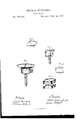
The following is a description ol` the accompanying drawiu g Figure .l is a perspective view ot' the .insulator complete in all 'its parts, :tud embodying our inven- Itioi'i.A
Figure ll, longitudinal section ot'tbe same.
Figure .'lli, perspe/ctive view ot' the curved glass insulating-blocks.
Figure 1V, view ofthe elastic gasket. Figure Y, section ofthe top, showing the drip.
A is a box, its interior ot' an oval forni, with the pin or screw ll projecting from its bottom, making an attachment to the pole, or any other support.
lhe elastiegasket (l is first placed in the bottom ot' the box, serving as an elastic bed for the glass i11- sulating-blocks O and l) to rest on, and confining, by itsspring, both blocks tirnily together.
'lhe lower curved glass block l) is cut out lengt-hwise, through the curve. lil, to receive the Wire.
.lhe lower curved glass block l) is placed in position on the gasket (t, the upper block O is then placedt on .the block l), the curve l in said block titting over and receiring the curve on the block 1).
.lhe block (l is slight-ly grooved near its ends to receive the. wire.
When both blocks are in position, and pressed together, theyv securely gripe the wire between them, preventing it t'rom drawing` through.
.lhe ends ot' both blocks have a conc-shaped open. ing, to allow the wire to swayback or forth without breaking the glass.
'.lhe oval t'orm ot the blocks titting into the o 'al seat in the box keeps them iu their place; the top or cover is secured to the. box in any convenient mauner.
Said cover has the dripfpoints a. projecting t'roni its under surliice, Itwo on a side, near the ends ot' the top and clear of the box, the use of which, as easily seen, is to lead the water during rain, and cause it to drop clear ot' the box and wire; it' the drips @were not used, the water would run under the top, and down between the box and the glass blocks, freezing in the winter, and destroying its pert'ect insulation.
.lhe advantage in this improvement is, it is not necessary t'or the winkmeu to carry tools up the post to secure the wire to the insulator.
Where the glass cone. is used, the wire has to be wound round the cone, and then secured by a short piece ot' wire wound round the cone above the wire, and secured to the main wirel by twisting the ends round the wire, necessitating the use ot'a tool.
We are well awarethat wire has been secured to insulators without winding, as by passing through hooks or otherwise.; most ot' them are expensive and wet insulators.
,ln our improvement, the workman, in putting up the wire, secures the'insulator to the postlbcfore raising it atter the pole is raised he carries the wire up L). The. elastic gmskob H, Substantially :ls hcl-einhouo sot forth.
1. 'Iho .ourhuzlou o1" ho orul hox A, cowl' J, with tho u'ulor-drpsul ou th(l lowor edge of' the cover l, 1h@ curved glass blocks U aud l), und the vluslc guskct :111 comhiucd nud used iu combination, :rs :lud ior tho purposo :1s hcroiuhoforc .ser 'orth.
ASHBEL GR-A'LTAN SBHTH. \\'I LLL-UI ll'llbW-.l hh.
Wi mossos:
Joux J. Bhrcuum., Holmgu Amour).
Publications (1)
| Publication Number | Publication Date |
|---|---|
| US109461A true US109461A (en) | 1870-11-22 |
Family
ID=2178934
Family Applications (1)
| Application Number | Title | Priority Date | Filing Date |
|---|---|---|---|
| US109461D Expired - Lifetime US109461A (en) | Improvement in insulators for telegraph-wires |
Country Status (1)
| Country | Link |
|---|---|
| US (1) | US109461A (en) |
-
0
- US US109461D patent/US109461A/en not_active Expired - Lifetime
Similar Documents
| Publication | Publication Date | Title |
|---|---|---|
| US1886721A (en) | Road marker | |
| US956657A (en) | Umbrella-runner. | |
| US1636562A (en) | Battery clamp | |
| US1732058A (en) | Guard for gutters | |
| US1099706A (en) | Funnel. | |
| US1947820A (en) | Tire carrier | |
| US1848337A (en) | Windshield heater | |
| US743257A (en) | Awning-fixture. | |
| US1423560A (en) | Milk bottle | |
| US341892A (en) | Traction underground railway | |
| US710516A (en) | Ice-cleaner for trolley-wires. | |
| US2307691A (en) | Sanitary liquid dispenser | |
| US1618334A (en) | Hanger | |
| US396312A (en) | Suspension device for electric-railway conductors | |
| US1370050A (en) | Trolley-conductor device | |
| US640897A (en) | Jar-closure. | |
| US589022A (en) | Rubber tire | |
| US844819A (en) | Shuttle. | |
| US1095963A (en) | Grinding-machine. | |
| US871490A (en) | Insulator-pin mounting. | |
| US1090960A (en) | Calk attachment for crutches. | |
| US930336A (en) | Trolley-wheel holder. | |
| US959790A (en) | Carriage-top rest. | |
| US1138184A (en) | Suspension device for trolley-wires. | |
| US2051439A (en) | Percolator top |