US10937809B1 - Three-dimensional memory device containing ferroelectric memory elements encapsulated by transition metal nitride materials and method of making thereof - Google Patents
Three-dimensional memory device containing ferroelectric memory elements encapsulated by transition metal nitride materials and method of making thereof Download PDFInfo
- Publication number
- US10937809B1 US10937809B1 US16/541,289 US201916541289A US10937809B1 US 10937809 B1 US10937809 B1 US 10937809B1 US 201916541289 A US201916541289 A US 201916541289A US 10937809 B1 US10937809 B1 US 10937809B1
- Authority
- US
- United States
- Prior art keywords
- layer
- transition metal
- metal nitride
- vertical
- ferroelectric
- Prior art date
- Legal status (The legal status is an assumption and is not a legal conclusion. Google has not performed a legal analysis and makes no representation as to the accuracy of the status listed.)
- Active
Links
Images




Classifications
-
- H—ELECTRICITY
- H10—SEMICONDUCTOR DEVICES; ELECTRIC SOLID-STATE DEVICES NOT OTHERWISE PROVIDED FOR
- H10B—ELECTRONIC MEMORY DEVICES
- H10B51/00—Ferroelectric RAM [FeRAM] devices comprising ferroelectric memory transistors
- H10B51/20—Ferroelectric RAM [FeRAM] devices comprising ferroelectric memory transistors characterised by the three-dimensional [3D] arrangements, e.g. with cells on different height levels
-
- H01L27/11597—
-
- H—ELECTRICITY
- H10—SEMICONDUCTOR DEVICES; ELECTRIC SOLID-STATE DEVICES NOT OTHERWISE PROVIDED FOR
- H10D—INORGANIC ELECTRIC SEMICONDUCTOR DEVICES
- H10D64/00—Electrodes of devices having potential barriers
- H10D64/01—Manufacture or treatment
- H10D64/031—Manufacture or treatment of data-storage electrodes
- H10D64/033—Manufacture or treatment of data-storage electrodes comprising ferroelectric layers
-
- H01L27/11587—
-
- H01L27/1159—
-
- H01L27/11592—
-
- H—ELECTRICITY
- H10—SEMICONDUCTOR DEVICES; ELECTRIC SOLID-STATE DEVICES NOT OTHERWISE PROVIDED FOR
- H10B—ELECTRONIC MEMORY DEVICES
- H10B51/00—Ferroelectric RAM [FeRAM] devices comprising ferroelectric memory transistors
- H10B51/10—Ferroelectric RAM [FeRAM] devices comprising ferroelectric memory transistors characterised by the top-view layout
-
- H—ELECTRICITY
- H10—SEMICONDUCTOR DEVICES; ELECTRIC SOLID-STATE DEVICES NOT OTHERWISE PROVIDED FOR
- H10B—ELECTRONIC MEMORY DEVICES
- H10B51/00—Ferroelectric RAM [FeRAM] devices comprising ferroelectric memory transistors
- H10B51/30—Ferroelectric RAM [FeRAM] devices comprising ferroelectric memory transistors characterised by the memory core region
-
- H—ELECTRICITY
- H10—SEMICONDUCTOR DEVICES; ELECTRIC SOLID-STATE DEVICES NOT OTHERWISE PROVIDED FOR
- H10B—ELECTRONIC MEMORY DEVICES
- H10B51/00—Ferroelectric RAM [FeRAM] devices comprising ferroelectric memory transistors
- H10B51/40—Ferroelectric RAM [FeRAM] devices comprising ferroelectric memory transistors characterised by the peripheral circuit region
-
- G—PHYSICS
- G11—INFORMATION STORAGE
- G11C—STATIC STORES
- G11C11/00—Digital stores characterised by the use of particular electric or magnetic storage elements; Storage elements therefor
- G11C11/21—Digital stores characterised by the use of particular electric or magnetic storage elements; Storage elements therefor using electric elements
- G11C11/22—Digital stores characterised by the use of particular electric or magnetic storage elements; Storage elements therefor using electric elements using ferroelectric elements
- G11C11/223—Digital stores characterised by the use of particular electric or magnetic storage elements; Storage elements therefor using electric elements using ferroelectric elements using MOS with ferroelectric gate insulating film
-
- H—ELECTRICITY
- H10—SEMICONDUCTOR DEVICES; ELECTRIC SOLID-STATE DEVICES NOT OTHERWISE PROVIDED FOR
- H10B—ELECTRONIC MEMORY DEVICES
- H10B51/00—Ferroelectric RAM [FeRAM] devices comprising ferroelectric memory transistors
- H10B51/50—Ferroelectric RAM [FeRAM] devices comprising ferroelectric memory transistors characterised by the boundary region between the core and peripheral circuit regions
Definitions
- the present disclosure relates generally to the field of semiconductor devices, and particular to a three-dimensional memory device containing ferroelectric memory elements encapsulated by transition metal nitride materials and methods of manufacturing the same.
- a ferroelectric material refers to a material that displays spontaneous polarization of electrical charges in the absence of an applied electric field.
- the net polarization P of electrical charges within the ferroelectric material is non-zero in the minimum energy state.
- spontaneous ferroelectric polarization of the material occurs, and the ferroelectric material accumulates surfaces charges of opposite polarity types on two opposing surfaces.
- Polarization P of a ferroelectric material as a function of an applied voltage V thereacross displays hysteresis.
- the product of the remanent polarization and the coercive field of a ferroelectric material is a metric for characterizing effectiveness of the ferroelectric material.
- a ferroelectric memory device is a memory device containing the ferroelectric material which is used to store information.
- the ferroelectric material acts as the memory material of the memory device.
- the dipole moment of the ferroelectric material is programmed in two different orientations (e.g., “up” or “down” polarization positions based on atom positions, such as oxygen and/or metal atom positions, in the crystal lattice) depending on the polarity of the applied electric field to the ferroelectric material to store information in the ferroelectric material.
- the different orientations of the dipole moment of the ferroelectric material may be detected by the electric field generated by the dipole moment of the ferroelectric material.
- the orientation of the dipole moment may be detected by measuring electrical current passing through a semiconductor channel provided adjacent to the ferroelectric material in a field effect transistor ferroelectric memory device.
- a three-dimensional ferroelectric memory device includes an alternating stack of insulating layers and electrically conductive layers located over a substrate, where each of the electrically conductive layers comprises a respective transition metal nitride liner and a respective conductive fill material layer, a vertical semiconductor channel vertically extending through the alternating stack, a vertical stack of transition metal nitride spacers laterally surrounding the vertical semiconductor channel and located at levels of the electrically conductive layers, and discrete ferroelectric material portions laterally surrounding the respective transition metal nitride spacers and located at the levels of the electrically conductive layers.
- a method of forming a three-dimensional ferroelectric memory device comprises forming an alternating stack of insulating layers and sacrificial material layers over a substrate, forming memory openings vertically extending through the alternating stack, forming annular recesses at levels of the sacrificial material layers around each of the memory openings, forming a combination of an amorphous dielectric material portion and a transition metal nitride spacer within, or adjacent to, each of the annular recesses, wherein the amorphous dielectric material portion comprises an amorphous dielectric material capable of transitioning into a ferroelectric phase after crystallization, forming a vertical semiconductor channel over a respective set of transition metal nitride spacers in each of the memory openings, forming backside recesses by removing the sacrificial material layers selective to the insulating layers, forming electrically conductive layers in remaining volumes of the backside recesses on the amorphous dielectric material portions, where
- FIG. 1 is a schematic vertical cross-sectional view of an exemplary structure after formation of at least one peripheral device and a semiconductor material layer according to an embodiment of the present disclosure.
- FIG. 2 is a schematic vertical cross-sectional view of the exemplary structure after formation of an alternating stack of insulating layers and sacrificial material layers according to an embodiment of the present disclosure.
- FIG. 3 is a schematic vertical cross-sectional view of the exemplary structure after formation of stepped terraces and a retro-stepped dielectric material portion according to an embodiment of the present disclosure.
- FIG. 4A is a schematic vertical cross-sectional view of the exemplary structure after formation of memory openings and support openings according to an embodiment of the present disclosure.
- FIG. 4B is a top-down view of the exemplary structure of FIG. 4A .
- the vertical plane A-A′ is the plane of the cross-section for FIG. 4A .
- FIGS. 5A-5H are sequential schematic vertical cross-sectional views of a memory opening within the exemplary structure during formation of a first exemplary memory opening fill structure according to a first embodiment of the present disclosure.
- FIGS. 5I and 5J are vertical cross-sectional views of alternative configurations of the first exemplary memory opening fill structures according to the first embodiment of the present disclosure.
- FIG. 6 is a schematic vertical cross-sectional view of the exemplary structure after formation of memory stack structures and support pillar structures according to an embodiment of the present disclosure.
- FIG. 7A is a schematic vertical cross-sectional view of the exemplary structure after formation of backside trenches according to an embodiment of the present disclosure.
- FIG. 7B is a partial see-through top-down view of the exemplary structure of FIG. 7A .
- the vertical plane A-A′ is the plane of the schematic vertical cross-sectional view of FIG. 7A .
- FIG. 8 is a schematic vertical cross-sectional view of the exemplary structure after formation of backside recesses according to an embodiment of the present disclosure.
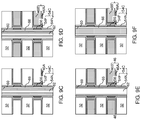
- FIGS. 9A-9D are sequential vertical cross-sectional views of a memory opening during formation of a first exemplary memory opening fill structure according to the first embodiment of the present disclosure.
- FIGS. 9E and 9F are vertical cross-sectional views of a memory opening after formation of alternative configurations of the first exemplary memory opening fill structure according to the first embodiment of the present disclosure.
- FIG. 10 is a schematic vertical cross-sectional view of the exemplary structure at the processing step of FIG. 9D , FIG. 9E or FIG. 9F .
- FIG. 11A is a schematic vertical cross-sectional view of the exemplary structure after removal of a deposited conductive material from within the backside trench according to an embodiment of the present disclosure.
- FIG. 11B is a partial see-through top-down view of the exemplary structure of FIG. 11A .
- the vertical plane A-A′ is the plane of the schematic vertical cross-sectional view of FIG. 11A .
- FIG. 12 is a schematic vertical cross-sectional view of the exemplary structure after formation of an insulating spacer and a backside contact structure according to an embodiment of the present disclosure.
- FIG. 13A is a schematic vertical cross-sectional view of the exemplary structure after formation of additional contact via structures according to an embodiment of the present disclosure.
- FIG. 13B is a top-down view of the exemplary structure of FIG. 13A .
- the vertical plane A-A′ is the plane of the schematic vertical cross-sectional view of FIG. 13A .
- FIGS. 14A-14H are sequential schematic vertical cross-sectional views of a memory opening within the exemplary structure during formation of a second exemplary memory opening fill structure according to a second embodiment of the present disclosure.
- FIG. 14I is a vertical cross-sectional view of an alternative configuration of the second exemplary memory opening fill structure according to the second embodiment of the present disclosure.
- FIGS. 15A-15D are sequential vertical cross-sectional views of a memory opening during formation of a second exemplary memory opening fill structure according to the second embodiment of the present disclosure.
- FIG. 15E is a vertical cross-sectional view of a memory opening after formation of an alternative configuration of the second exemplary memory opening fill structure according to the second embodiment of the present disclosure.
- FIGS. 16A-16H are sequential schematic vertical cross-sectional views of a memory opening within the exemplary structure during formation of a third exemplary memory opening fill structure according to a third embodiment of the present disclosure.
- FIG. 161 is a vertical cross-sectional view of an alternative configuration of the third exemplary memory opening fill structure according to the third embodiment of the present disclosure.
- FIGS. 17A-17D are sequential vertical cross-sectional views of a memory opening during formation of a third exemplary memory opening fill structure according to the third embodiment of the present disclosure.
- FIG. 17E is a vertical cross-sectional view of a memory opening after formation of an alternative configuration of the third exemplary memory opening fill structure according to the third embodiment of the present disclosure.
- FIGS. 18A-18H are sequential schematic vertical cross-sectional views of a memory opening within the exemplary structure during formation of a fourth exemplary memory opening fill structure according to a fourth embodiment of the present disclosure.
- FIG. 18I is a vertical cross-sectional view of an alternative configuration of the fourth exemplary memory opening fill structure according to the fourth embodiment of the present disclosure.
- FIGS. 19A-19D are sequential vertical cross-sectional views of a memory opening during formation of a fourth exemplary memory opening fill structure according to the fourth embodiment of the present disclosure.
- FIG. 19E is a vertical cross-sectional view of a memory opening after formation of an alternative configuration of the fourth exemplary memory opening fill structure according to the fourth embodiment of the present disclosure.
- the present disclosure is directed to a three-dimensional ferroelectric memory device including ferroelectric memory elements encapsulated by transition metal nitride materials and methods of manufacturing the same, the various aspects of which are described below.
- the embodiments of the disclosure may be employed to form various structures including a multilevel memory structure, non-limiting examples of which include semiconductor devices such as three-dimensional monolithic memory array devices comprising a plurality of NAND memory strings.
- a first element located “on” a second element may be located on the exterior side of a surface of the second element or on the interior side of the second element.
- a first element is located “directly on” a second element if there exist a physical contact between a surface of the first element and a surface of the second element.
- a first element is “electrically connected to” a second element if there exists a conductive path consisting of at least one conductive material between the first element and the second element.
- a “prototype” structure or an “in-process” structure refers to a transient structure that is subsequently modified in the shape or composition of at least one component therein.
- a “layer” refers to a material portion including a region having a thickness.
- a layer may extend over the entirety of an underlying or overlying structure, or may have an extent less than the extent of an underlying or overlying structure. Further, a layer may be a region of a homogeneous or inhomogeneous continuous structure that has a thickness less than the thickness of the continuous structure. For example, a layer may be located between any pair of horizontal planes between, or at, a top surface and a bottom surface of the continuous structure. A layer may extend horizontally, vertically, and/or along a tapered surface.
- a substrate may be a layer, may include one or more layers therein, or may have one or more layer thereupon, thereabove, and/or therebelow.
- a first surface and a second surface are “vertically coincident” with each other if the second surface overlies or underlies the first surface and there exists a vertical plane or a substantially vertical plane that includes the first surface and the second surface.
- a substantially vertical plane is a plane that extends straight along a direction that deviates from a vertical direction by an angle less than 5 degrees.
- a vertical plane or a substantially vertical plane is straight along a vertical direction or a substantially vertical direction, and may, or may not, include a curvature along a direction that is perpendicular to the vertical direction or the substantially vertical direction.
- a monolithic three-dimensional memory array is a memory array in which multiple memory levels are formed above a single substrate, such as a semiconductor wafer, with no intervening substrates.
- the term “monolithic” means that layers of each level of the array are directly deposited on the layers of each underlying level of the array.
- two dimensional arrays may be formed separately and then packaged together to form a non-monolithic memory device.
- non-monolithic stacked memories have been constructed by forming memory levels on separate substrates and vertically stacking the memory levels, as described in U.S. Pat. No.
- the substrates may be thinned or removed from the memory levels before bonding, but as the memory levels are initially formed over separate substrates, such memories are not true monolithic three-dimensional memory arrays.
- the various three-dimensional memory devices of the present disclosure include a monolithic three-dimensional NAND string memory device, and may be fabricated employing the various embodiments described herein.
- a semiconductor package refers to a unit semiconductor device that may be attached to a circuit board through a set of pins or solder balls.
- a semiconductor package may include a semiconductor chip (or a “chip”) or a plurality of semiconductor chips that are bonded thereamongst, for example, by flip-chip bonding or another chip-to-chip bonding.
- a package or a chip may include a single semiconductor die (or a “die”) or a plurality of semiconductor dies.
- a die is the smallest unit that can independently execute external commands or report status.
- a package or a chip with multiple dies is capable of simultaneously executing as many number of external commands as the total number of planes therein. Each die includes one or more planes.
- Identical concurrent operations may be executed in each plane within a same die, although there may be some restrictions.
- a die is a memory die, i.e., a die including memory elements
- concurrent read operations, concurrent write operations, or concurrent erase operations may be performed in each plane within a same memory die.
- each plane contains a number of memory blocks (or “blocks”), which are the smallest unit that may be erased by in a single erase operation.
- Each memory block contains a number of pages, which are the smallest units that may be selected for programming.
- a page is also the smallest unit that may be selected to a read operation.
- the exemplary structure includes a substrate ( 9 , 10 ), which may be a semiconductor substrate.
- the substrate can include a substrate semiconductor layer 9 and an optional semiconductor material layer 10 .
- the substrate semiconductor layer 9 maybe a semiconductor wafer or a semiconductor material layer, and can include at least one elemental semiconductor material (e.g., single crystal silicon wafer or layer), at least one III-V compound semiconductor material, at least one II-VI compound semiconductor material, at least one organic semiconductor material, or other semiconductor materials known in the art.
- the substrate can have a major surface 7 , which may be, for example, a topmost surface of the substrate semiconductor layer 9 .
- the major surface 7 may be a semiconductor surface.
- the major surface 7 may be a single crystalline semiconductor surface, such as a single crystalline semiconductor surface.
- a “semiconducting material” refers to a material having electrical conductivity in the range from 1.0 ⁇ 10 ⁇ 5 S/m to 1.0 ⁇ 10 5 S/m.
- a “semiconductor material” refers to a material having electrical conductivity in the range from 1.0 ⁇ 10 ⁇ 5 S/m to 1.0 S/m in the absence of electrical dopants therein, and is capable of producing a doped material having electrical conductivity in a range from 1.0 S/m to 1.0 ⁇ 10 5 S/m upon suitable doping with an electrical dopant.
- an “electrical dopant” refers to a p-type dopant that adds a hole to a valence band within a band structure, or an n-type dopant that adds an electron to a conduction band within a band structure.
- a “conductive material” refers to a material having electrical conductivity greater than 1.0 ⁇ 10 5 S/m.
- an “insulator material” or a “dielectric material” refers to a material having electrical conductivity less than 1.0 ⁇ 10 ⁇ 5 S/m.
- a “heavily doped semiconductor material” refers to a semiconductor material that is doped with electrical dopant at a sufficiently high atomic concentration to become a conductive material either as formed as a crystalline material or if converted into a crystalline material through an anneal process (for example, from an initial amorphous state), i.e., to have electrical conductivity greater than 1.0 ⁇ 10 5 S/m.
- a “doped semiconductor material” may be a heavily doped semiconductor material, or may be a semiconductor material that includes electrical dopants (i.e., p-type dopants and/or n-type dopants) at a concentration that provides electrical conductivity in the range from 1.0 ⁇ 10 ⁇ 5 S/m to 1.0 ⁇ 10 5 S/m.
- An “intrinsic semiconductor material” refers to a semiconductor material that is not doped with electrical dopants.
- a semiconductor material may be semiconducting or conductive, and may be an intrinsic semiconductor material or a doped semiconductor material.
- a doped semiconductor material may be semiconducting or conductive depending on the atomic concentration of electrical dopants therein.
- a “metallic material” refers to a conductive material including at least one metallic element therein. All measurements for electrical conductivities are made at the standard condition.
- At least one semiconductor device 700 for a peripheral circuitry may be formed on a portion of the substrate semiconductor layer 9 .
- the at least one semiconductor device can include, for example, field effect transistors.
- at least one shallow trench isolation structure 720 may be formed by etching portions of the substrate semiconductor layer 9 and depositing a dielectric material therein.
- a gate dielectric layer, at least one gate conductor layer, and a gate cap dielectric layer may be formed over the substrate semiconductor layer 9 , and may be subsequently patterned to form at least one gate structure ( 750 , 752 , 754 , 758 ), each of which can include a gate dielectric 750 , a gate electrode ( 752 , 754 ), and a gate cap dielectric 758 .
- the gate electrode ( 752 , 754 ) may include a stack of a first gate electrode portion 752 and a second gate electrode portion 754 .
- At least one gate spacer 756 may be formed around the at least one gate structure ( 750 , 752 , 754 , 758 ) by depositing and anisotropically etching a dielectric liner.
- Active regions 730 may be formed in upper portions of the substrate semiconductor layer 9 , for example, by introducing electrical dopants employing the at least one gate structure ( 750 , 752 , 754 , 758 ) as masking structures. Additional masks may be employed as needed.
- the active region 730 can include source regions and drain regions of field effect transistors.
- a first dielectric liner 761 and a second dielectric liner 762 may be optionally formed.
- Each of the first and second dielectric liners ( 761 , 762 ) can comprise a silicon oxide layer, a silicon nitride layer, and/or a dielectric metal oxide layer.
- silicon oxide includes silicon dioxide as well as non-stoichiometric silicon oxides having more or less than two oxygen atoms for each silicon atoms. Silicon dioxide is preferred.
- the first dielectric liner 761 may be a silicon oxide layer
- the second dielectric liner 762 may be a silicon nitride layer.
- the least one semiconductor device for the peripheral circuitry can contain a driver circuit for memory devices to be subsequently formed, which can include at least one NAND device.
- a dielectric material such as silicon oxide may be deposited over the at least one semiconductor device, and may be subsequently planarized to form a planarization dielectric layer 770 .
- the planarized top surface of the planarization dielectric layer 770 may be coplanar with a top surface of the dielectric liners ( 761 , 762 ).
- the planarization dielectric layer 770 and the dielectric liners ( 761 , 762 ) may be removed from an area to physically expose a top surface of the substrate semiconductor layer 9 .
- a surface is “physically exposed” if the surface is in physical contact with vacuum, or a gas phase material (such as air).
- the optional semiconductor material layer 10 may be formed on the top surface of the substrate semiconductor layer 9 prior to, or after, formation of the at least one semiconductor device 700 by deposition of a single crystalline semiconductor material, for example, by selective epitaxy.
- the deposited semiconductor material may be the same as, or may be different from, the semiconductor material of the substrate semiconductor layer 9 .
- the deposited semiconductor material may be any material that may be employed for the substrate semiconductor layer 9 as described above.
- the single crystalline semiconductor material of the semiconductor material layer 10 may be in epitaxial alignment with the single crystalline structure of the substrate semiconductor layer 9 .
- Portions of the deposited semiconductor material located above the top surface of the planarization dielectric layer 770 may be removed, for example, by chemical mechanical planarization (CMP).
- CMP chemical mechanical planarization
- the semiconductor material layer 10 can have a top surface that is coplanar with the top surface of the planarization dielectric layer 770 .
- the region (i.e., area) of the at least one semiconductor device 700 is herein referred to as a peripheral device region 200 .
- the region in which a memory array is subsequently formed is herein referred to as a memory array region 100 .
- a staircase region 300 for subsequently forming stepped terraces of electrically conductive layers may be provided between the memory array region 100 and the peripheral device region 200 .
- the at least one semiconductor device 700 is formed under the memory array region 100 in a CMOS under array (“CUA”) configuration.
- the peripheral device region 200 may be omitted or used in combination with the CUA configuration.
- the at least one semiconductor device 700 may be formed on a separate substrate and then bonded to substrate ( 9 , 10 ) containing the memory array region 100 .
- a stack of an alternating plurality of first material layers (which may be insulating layers 32 ) and second material layers (which may be sacrificial material layer 42 ) is formed over the top surface of the substrate ( 9 , 10 ).
- a “material layer” refers to a layer including a material throughout the entirety thereof.
- an alternating plurality of first elements and second elements refers to a structure in which instances of the first elements and instances of the second elements alternate.
- first elements may have the same thickness thereamongst, or may have different thicknesses.
- the second elements may have the same thickness thereamongst, or may have different thicknesses.
- the alternating plurality of first material layers and second material layers may begin with an instance of the first material layers or with an instance of the second material layers, and may end with an instance of the first material layers or with an instance of the second material layers.
- an instance of the first elements and an instance of the second elements may form a unit that is repeated with periodicity within the alternating plurality.
- Each first material layer includes a first material
- each second material layer includes a second material that is different from the first material.
- each first material layer may be an insulating layer 32
- each second material layer may be a sacrificial material layer.
- the stack can include an alternating plurality of insulating layers 32 and sacrificial material layers 42 , and constitutes a prototype stack of alternating layers comprising insulating layers 32 and sacrificial material layers 42 .
- the stack of the alternating plurality is herein referred to as an alternating stack ( 32 , 42 ).
- the alternating stack ( 32 , 42 ) can include insulating layers 32 composed of the first material, and sacrificial material layers 42 composed of a second material different from that of insulating layers 32 .
- the first material of the insulating layers 32 may be at least one insulating material.
- each insulating layer 32 may be an insulating material layer.
- Insulating materials that may be employed for the insulating layers 32 include, but are not limited to, silicon oxide (including doped or undoped silicate glass), silicon nitride, silicon oxynitride, organosilicate glass (OSG), spin-on dielectric materials, dielectric metal oxides that are commonly known as high dielectric constant (high-k) dielectric oxides (e.g., aluminum oxide, hafnium oxide, etc.) and silicates thereof, dielectric metal oxynitrides and silicates thereof, and organic insulating materials.
- the first material of the insulating layers 32 may be silicon oxide.
- the second material of the sacrificial material layers 42 is a sacrificial material that may be removed selective to the first material of the insulating layers 32 .
- a removal of a first material is “selective to” a second material if the removal process removes the first material at a rate that is at least twice the rate of removal of the second material.
- the ratio of the rate of removal of the first material to the rate of removal of the second material is herein referred to as a “selectivity” of the removal process for the first material with respect to the second material.
- the sacrificial material layers 42 may comprise an insulating material, a semiconductor material, or a conductive material.
- the second material of the sacrificial material layers 42 may be subsequently replaced with electrically conductive electrodes which can function, for example, as control gate electrodes of a vertical NAND device.
- Non-limiting examples of the second material include silicon nitride, an amorphous semiconductor material (such as amorphous silicon), and a polycrystalline semiconductor material (such as polysilicon).
- the sacrificial material layers 42 may be spacer material layers that comprise silicon nitride or a semiconductor material including at least one of silicon and germanium.
- the insulating layers 32 can include silicon oxide, and sacrificial material layers can include silicon nitride sacrificial material layers.
- the first material of the insulating layers 32 may be deposited, for example, by chemical vapor deposition (CVD).
- CVD chemical vapor deposition
- TEOS tetraethyl orthosilicate
- the second material of the sacrificial material layers 42 may be formed, for example, CVD or atomic layer deposition (ALD).
- the sacrificial material layers 42 may be suitably patterned so that conductive material portions to be subsequently formed by replacement of the sacrificial material layers 42 can function as electrically conductive electrodes, such as the control gate electrodes of the monolithic three-dimensional NAND string memory devices to be subsequently formed.
- the sacrificial material layers 42 may comprise a portion having a strip shape extending substantially parallel to the major surface 7 of the substrate.
- the thicknesses of the insulating layers 32 and the sacrificial material layers 42 may be in a range from 20 nm to 50 nm, although lesser and greater thicknesses may be employed for each insulating layer 32 and for each sacrificial material layer 42 .
- the number of repetitions of the pairs of an insulating layer 32 and a sacrificial material layer (e.g., a control gate electrode or a sacrificial material layer) 42 may be in a range from 2 to 1,024, and typically from 8 to 256, although a greater number of repetitions can also be employed.
- the top and bottom gate electrodes in the stack may function as the select gate electrodes.
- each sacrificial material layer 42 in the alternating stack ( 32 , 42 ) can have a uniform thickness that is substantially invariant within each respective sacrificial material layer 42 .
- spacer material layers are sacrificial material layers 42 that are subsequently replaced with electrically conductive layers
- embodiments are expressly contemplated herein in which the sacrificial material layers are formed as electrically conductive layers. In this case, steps for replacing the spacer material layers with electrically conductive layers may be omitted.
- an insulating cap layer 70 may be formed over the alternating stack ( 32 , 42 ).
- the insulating cap layer 70 includes a dielectric material that is different from the material of the sacrificial material layers 42 .
- the insulating cap layer 70 can include a dielectric material that may be employed for the insulating layers 32 as described above.
- the insulating cap layer 70 can have a greater thickness than each of the insulating layers 32 .
- the insulating cap layer 70 may be deposited, for example, by chemical vapor deposition.
- the insulating cap layer 70 may be a silicon oxide layer.
- stepped surfaces are formed at a peripheral region of the alternating stack ( 32 , 42 ), which is herein referred to as a terrace region.
- stepped surfaces refer to a set of surfaces that include at least two horizontal surfaces and at least two vertical surfaces such that each horizontal surface is adjoined to a first vertical surface that extends upward from a first edge of the horizontal surface, and is adjoined to a second vertical surface that extends downward from a second edge of the horizontal surface.
- a stepped cavity is formed within the volume from which portions of the alternating stack ( 32 , 42 ) are removed through formation of the stepped surfaces.
- a “stepped cavity” refers to a cavity having stepped surfaces.
- the terrace region is formed in the staircase region 300 , which is located between the memory array region 100 and the peripheral device region 200 containing the at least one semiconductor device for the peripheral circuitry.
- the stepped cavity can have various stepped surfaces such that the horizontal cross-sectional shape of the stepped cavity changes in steps as a function of the vertical distance from the top surface of the substrate ( 9 , 10 ).
- the stepped cavity may be formed by repetitively performing a set of processing steps.
- the set of processing steps can include, for example, an etch process of a first type that vertically increases the depth of a cavity by one or more levels, and an etch process of a second type that laterally expands the area to be vertically etched in a subsequent etch process of the first type.
- a “level” of a structure including alternating plurality is defined as the relative position of a pair of a first material layer and a second material layer within the structure.
- the terrace region includes stepped surfaces of the alternating stack ( 32 , 42 ) that continuously extend from a bottommost layer within the alternating stack ( 32 , 42 ) to a topmost layer within the alternating stack ( 32 , 42 ).
- Each vertical step of the stepped surfaces can have the height of one or more pairs of an insulating layer 32 and a sacrificial material layer.
- each vertical step can have the height of a single pair of an insulating layer 32 and a sacrificial material layer 42 .
- multiple “columns” of staircases may be formed along a first horizontal direction hd 1 such that each vertical step has the height of a plurality of pairs of an insulating layer 32 and a sacrificial material layer 42 , and the number of columns may be at least the number of the plurality of pairs.
- Each column of staircase may be vertically offset from each other such that each of the sacrificial material layers 42 has a physically exposed top surface in a respective column of staircases.
- two columns of staircases are formed for each block of memory stack structures to be subsequently formed such that one column of staircases provide physically exposed top surfaces for odd-numbered sacrificial material layers 42 (as counted from the bottom) and another column of staircases provide physically exposed top surfaces for even-numbered sacrificial material layers (as counted from the bottom).
- Configurations employing three, four, or more columns of staircases with a respective set of vertical offsets among the physically exposed surfaces of the sacrificial material layers 42 may also be employed.
- Each sacrificial material layer 42 has a greater lateral extent, at least along one direction, than any overlying sacrificial material layers 42 such that each physically exposed surface of any sacrificial material layer 42 does not have an overhang.
- the vertical steps within each column of staircases may be arranged along the first horizontal direction hd 1
- the columns of staircases may be arranged along a second horizontal direction hd 2 that is perpendicular to the first horizontal direction hd 1 .
- the first horizontal direction hd 1 may be perpendicular to the boundary between the memory array region 100 and the staircase region 300 .
- a retro-stepped dielectric material portion 65 (i.e., an insulating fill material portion) may be formed in the stepped cavity by deposition of a dielectric material therein.
- a dielectric material such as silicon oxide may be deposited in the stepped cavity. Excess portions of the deposited dielectric material may be removed from above the top surface of the insulating cap layer 70 , for example, by chemical mechanical planarization (CMP). The remaining portion of the deposited dielectric material filling the stepped cavity constitutes the retro-stepped dielectric material portion 65 .
- a “retro-stepped” element refers to an element that has stepped surfaces and a horizontal cross-sectional area that increases monotonically as a function of a vertical distance from a top surface of a substrate on which the element is present. If silicon oxide is employed for the retro-stepped dielectric material portion 65 , the silicon oxide of the retro-stepped dielectric material portion 65 may, or may not, be doped with dopants such as B, P, and/or F.
- drain select level isolation structures 72 may be formed through the insulating cap layer 70 and a subset of the sacrificial material layers 42 located at drain select levels.
- the drain select level isolation structures 72 may be formed, for example, by forming drain select level isolation trenches and filling the drain select level isolation trenches with a dielectric material such as silicon oxide. Excess portions of the dielectric material may be removed from above the top surface of the insulating cap layer 70 .
- a lithographic material stack including at least a photoresist layer may be formed over the insulating cap layer 70 and the retro-stepped dielectric material portion 65 , and may be lithographically patterned to form openings therein.
- the openings include a first set of openings formed over the memory array region 100 and a second set of openings formed over the staircase region 300 .
- the pattern in the lithographic material stack may be transferred through the insulating cap layer 70 or the retro-stepped dielectric material portion 65 , and through the alternating stack ( 32 , 42 ) by at least one anisotropic etch that employs the patterned lithographic material stack as an etch mask.
- a “memory opening” refers to a structure in which memory elements, such as a memory stack structure, is subsequently formed.
- a “support opening” refers to a structure in which a support structure (such as a support pillar structure) that mechanically supports other elements is subsequently formed.
- the memory openings 49 are formed through the insulating cap layer 70 and the entirety of the alternating stack ( 32 , 42 ) in the memory array region 100 .
- the support openings 19 are formed through the retro-stepped dielectric material portion 65 and the portion of the alternating stack ( 32 , 42 ) that underlie the stepped surfaces in the staircase region 300 .
- the memory openings 49 extend through the entirety of the alternating stack ( 32 , 42 ).
- the support openings 19 extend through a subset of layers within the alternating stack ( 32 , 42 ).
- the chemistry of the anisotropic etch process employed to etch through the materials of the alternating stack ( 32 , 42 ) can alternate to optimize etching of the first and second materials in the alternating stack ( 32 , 42 ).
- the anisotropic etch may be, for example, a series of reactive ion etches.
- the sidewalls of the memory openings 49 and the support openings 19 may be substantially vertical, or may be tapered.
- the patterned lithographic material stack may be subsequently removed, for example, by ashing.
- the memory openings 49 and the support openings 19 can extend from the top surface of the alternating stack ( 32 , 42 ) to at least the horizontal plane including the topmost surface of the semiconductor material layer 10 .
- an overetch into the semiconductor material layer 10 may be optionally performed after the top surface of the semiconductor material layer 10 is physically exposed at a bottom of each memory opening 49 and each support opening 19 .
- the overetch may be performed prior to, or after, removal of the lithographic material stack.
- the recessed surfaces of the semiconductor material layer 10 may be vertically offset from the un-recessed top surfaces of the semiconductor material layer 10 by a recess depth.
- the recess depth may be, for example, in a range from 1 nm to 50 nm, although lesser and greater recess depths can also be employed.
- the overetch is optional, and may be omitted. If the overetch is not performed, the bottom surfaces of the memory openings 49 and the support openings 19 may be coplanar with the topmost surface of the semiconductor material layer 10 .
- Each of the memory openings 49 and the support openings 19 may include a sidewall (or a plurality of sidewalls) that extends substantially perpendicular to the topmost surface of the substrate.
- a two-dimensional array of memory openings 49 may be formed in the memory array region 100 .
- a two-dimensional array of support openings 19 may be formed in the staircase region 300 .
- the substrate semiconductor layer 9 and the semiconductor material layer 10 collectively constitutes a substrate ( 9 , 10 ), which may be a semiconductor substrate. Alternatively, the semiconductor material layer 10 may be omitted, and the memory openings 49 and the support openings 19 may be extend to a top surface of the substrate semiconductor layer 9 .
- FIGS. 5A-5H illustrate structural changes in a memory opening 49 , which is one of the memory openings 49 in the exemplary structure of FIGS. 4A and 4B .
- the same structural change occurs simultaneously in each of the other memory openings 49 and in each of the support openings 19 .
- each support opening 19 can extend through the retro-stepped dielectric material portion 65 , a subset of layers in the alternating stack ( 32 , 42 ), and optionally through the upper portion of the semiconductor material layer 10 .
- the recess depth of the bottom surface of each memory opening with respect to the top surface of the semiconductor material layer 10 may be in a range from 0 nm to 30 nm, although greater recess depths can also be employed.
- the sacrificial material layers 42 may be laterally recessed partially to form lateral recesses (not shown), for example, by an isotropic etch.
- an isotropic etch process may be performed to etch proximal portions of the sacrificial material layers 42 selective to the insulating layers 32 .
- the sacrificial material layers 42 include silicon nitride and if the insulating layers 32 include silicon oxide
- a timed phosphoric acid wet etch process may be used to laterally recess sidewalls of the sacrificial material layers 42 relative to sidewalls of the insulating layers 32 .
- Annular recesses 45 may be formed by laterally recessing the sidewalls of the sacrificial material layers 42 selective to the insulating layers 32 around each memory opening 49 .
- removal of a first material is “selective to” a second material if the etch rate for the first material is at least three times the etch rate for the second material.
- Lateral etch distance of the isotropic etch process may be in a range from 20 nm to 50 nm, such as 30 to 40 nm, although lesser and greater lateral etch distances can also be employed.
- the lateral etch distance is the distance between a vertical plane including a recessed sidewall of a sacrificial material layer 42 and a vertical plane including a sidewall of an insulating layer 32 around each memory opening 49 .
- a continuous amorphous dielectric material layer 54 L is deposited on the physically exposed sidewalls of the insulating layers 32 and the sacrificial material layers 42 of the alternating stack ( 32 , 42 ) by a conformal deposition method.
- the continuous amorphous dielectric material layer 54 L can include, and/or can consist essentially of, an amorphous hafnium oxide dielectric material capable of transitioning into a ferroelectric non-centrosymmetric orthorhombic phase after a crystallization anneal.
- the continuous amorphous dielectric material layer 54 L can include zero to 30 volume percent of any one or more crystalline phases, such as monoclinic, orthorhombic, cubic and/or tetragonal crystalline phases.
- a “ferroelectric material” refers to a crystalline material that exhibits spontaneous electrical polarization in the absence of an external electric field.
- the ferroelectric material comprises hafnium oxide, which has a predominant non-centrosymmetric orthorhombic phase and is preferably doped with at least one dopant selected from Al, Si, Gd, La, Y, Sr or Zr.
- the dopant concentration of Al, Gd, Y or Sr may range from about 2 atomic percent to about 5 atomic percent, such as about 3 atomic percent to about 4 atomic percent.
- the dopant concentration of silicon may range from about 3 atomic percent to about 8 atomic percent, such as about 3 atomic percent to about 5 atomic percent.
- the dopant concentration of lanthanum may range from about 7 atomic percent to about 17 atomic percent, such as about 10 atomic percent to about 15 atomic percent. If hafnium oxide is doped with zirconium, then the resulting material may form a solid solution of hafnium oxide and zirconium oxide, and the dopant concentration for zirconium may range from about 30 atomic percent to about 70 atomic percent, such as about 40 atomic percent to about 60 atomic percent.
- the ferroelectric material may have the following formula: Hf 1 ⁇ x D x O 2 ⁇ y , where D is a dopant selected from Al, Si, Gd, La, Y, Sr and/or Zr, where 0 ⁇ y ⁇ 0.01, and where x range for Al, Gd, Y or Sr is 0.02 ⁇ x ⁇ 0.05, for Si 0.03 is ⁇ x ⁇ 0.08, for La is 0.07 ⁇ x ⁇ 0.17, and for Zr is 0.3 ⁇ x ⁇ 0.7.
- D is a dopant selected from Al, Si, Gd, La, Y, Sr and/or Zr, where 0 ⁇ y ⁇ 0.01, and where x range for Al, Gd, Y or Sr is 0.02 ⁇ x ⁇ 0.05, for Si 0.03 is ⁇ x ⁇ 0.08, for La is 0.07 ⁇ x ⁇ 0.17, and for Zr is 0.3 ⁇ x ⁇ 0.7.
- the ferroelectric material has a predominant non-centrosymmetric orthorhombic phase, such that at least 50 volume percent, such as 70 to 100 volume percent of the ferroelectric material comprises the non-centrosymmetric orthorhombic phase, and has less than 50 volume percent, such as 0 to 30 volume percent total of amorphous, monoclinic, cubic and tetragonal phases.
- ferroelectric hafnium oxide material exhibits ferroelectric properties only its non-centrosymmetric orthorhombic crystalline phase.
- amorphous hafnium oxide having substantially the same material composition as the ferroelectric hafnium oxide material generally does not exhibit ferroelectric properties.
- substantially the same material composition refers to exactly the same compositions, or compositions that differ by less than 1 atomic percent.
- an “an amorphous dielectric material capable of transitioning into a ferroelectric phase” refers to a dielectric material, such as hafnium oxide, that is predominantly in the amorphous phase and has a substantially similar material composition as the ferroelectric material in the non-centrosymmetric orthorhombic crystalline phase, and as such, is inherently capable of transitioning into a ferroelectric material upon crystallization into a suitable phase.
- hafnium oxide displays ferroelectric properties only in the non-centrosymmetric orthorhombic phase, and does not display ferroelectric properties in other crystalline phases, such as monoclinic, tetragonal or cubic phases.
- the continuous amorphous dielectric material layer 54 L partially fills the annular recesses 45 at the levels of the sacrificial material layers 42 .
- the continuous amorphous dielectric material layer 54 L that extends through, and contacts each of, the insulating layers 32 and the sacrificial material layers 42 of the alternating stack ( 32 , 42 ).
- the continuous amorphous dielectric material layer 54 L may be deposited employing a conformal deposition process, such as an atomic layer deposition (ALD) process or a chemical vapor deposition (CVD) process.
- the deposition temperature of the conformal deposition process may be below the crystallization temperature of the amorphous material in the continuous amorphous dielectric material layer 54 L.
- the deposition temperature may be lower than 400 degrees Celsius, such as 250 to 350 degrees Celsius.
- the continuous amorphous dielectric material layer 54 L can have a thickness in a range from 2 nm to 40 nm, such as from 5 nm to 20 nm, although lesser and greater thicknesses can also be employed.
- An outer sidewall of the continuous amorphous dielectric material layer 54 L may have a laterally-undulating profile along a vertical direction, and can include laterally-protruding surfaces at each level of the sacrificial material layers 42 .
- a continuous transition metal nitride layer 56 L may be formed on the inner sidewall of the continuous amorphous dielectric material layer 54 L.
- the continuous transition metal nitride layer 56 L includes a conductive metal nitride material of a transition metal, such as TiN or TaN.
- the continuous transition metal nitride layer 56 L may be deposited by a conformal deposition process such as a chemical vapor deposition process.
- the thickness of the continuous transition metal nitride layer 56 L may be in a range from 3 nm to 40 nm, such as from 6 nm to 20 nm, although lesser and greater thicknesses can also be employed.
- anisotropic etch process may be performed to etch the material of the continuous transition metal nitride layer 56 L selective to the material of the continuous amorphous dielectric material layer 54 L. Portions of the continuous transition metal nitride layer 56 L located at the levels of the insulating layers 32 are removed by the anisotropic etch process, and portions of the continuous transition metal nitride layer 56 L located in the annular recesses 45 at laterally recessed portions of the continuous amorphous dielectric material layer 54 L at the levels of the sacrificial material layers 42 are not removed by the anisotropic etch process.
- transition metal nitride spacers 56 comprise remaining portions of the continuous transition metal nitride layer 56 L that are present adjacent to the annular recesses 45 .
- Each transition metal nitride spacer 56 has a tubular configuration.
- Each of the transition metal nitride spacers 56 has an inner cylindrical sidewall and an outer cylindrical sidewall that is laterally offset from the inner cylindrical sidewall by a uniform lateral thickness.
- the thickness of each transition metal nitride spacer 56 may be uniform, and may be in a range from 3 nm to 30 nm, although lesser and greater thicknesses can also be employed.
- the inner sidewalls of the transition metal nitride spacer 56 may be vertically coincident with the inner sidewall of the continuous amorphous dielectric material layer 54 L.
- a combination of an amorphous dielectric material portion (comprising a portion of the continuous amorphous dielectric material layer 54 L) and a transition metal nitride spacer 56 is formed adjacent to each of the annular recesses 45 .
- the amorphous dielectric material portion comprises an amorphous dielectric material capable of transitioning into a ferroelectric phase under crystallization.
- an optional gate dielectric layer 66 may be formed by conformal deposition of a dielectric material on the physically exposed inner surfaces of the transition metal nitride spacer 56 and the physically exposed portions of the inner sidewall of the continuous amorphous dielectric material layer 54 L.
- the gate dielectric layer 66 can include a dielectric material such as silicon oxide, silicon oxynitride and/or a non-ferroelectric dielectric metal oxide (such as aluminum oxide).
- the gate dielectric layer 66 can comprise a straight outer sidewall that extends through each layer of the alternating stack ( 32 , 42 ) and contacting a respective vertical stack of transition metal nitride spacers 56 .
- the gate dielectric layer 66 may be deposited by a conformal deposition process such as chemical vapor deposition (CVD).
- the thickness of the gate dielectric layer 66 may be in a range from 1 nm to 6 nm, such as from 2 nm to 4 nm, although lesser and greater thicknesses can also be employed.
- An anisotropic etch process may be performed to remove horizontal portions of the gate dielectric layer 66 , and to physically expose a top surface of the semiconductor material layer 10 at the bottom of each memory opening 49 .
- a vertical semiconductor channel 60 may be formed by conformal deposition of a semiconductor channel material on the inner sidewall of the gate dielectric layer 66 .
- the vertical semiconductor channel 60 includes a semiconductor material such as at least one elemental semiconductor material, at least one III-V compound semiconductor material, at least one II-VI compound semiconductor material, at least one organic semiconductor material, or other semiconductor materials known in the art.
- the vertical semiconductor channel 60 includes polysilicon or amorphous silicon that is subsequently crystallized into polysilicon by annealing.
- a vertical semiconductor channel 60 is formed directly on a respective set of transition metal nitride spacers 56 in each of the memory openings 49 .
- the vertical semiconductor channel 60 may be formed by a conformal deposition method such as low pressure chemical vapor deposition (LPCVD).
- the vertical semiconductor channel 60 can include electrical dopants of a first conductivity type, which may be p-type or n-type.
- the atomic concentration of dopants of the first conductivity type in the vertical semiconductor channel 60 may be in a range from 1.0 ⁇ 10 14 /cm 3 to 3.0 ⁇ 10 17 /cm 3 , although lesser and greater dopant concentrations can also be employed.
- the thickness of the vertical semiconductor channel 60 may be in a range from 2 nm to 10 nm, although lesser and greater thicknesses can also be employed.
- a bottom end of the vertical semiconductor channel 60 may be electrically connected to, and may directly contact, the semiconductor material layer 10 within the substrate ( 9 , 10 ).
- An optional memory cavity may be present in the volume of each memory opening 49 that is not filled with the vertical semiconductor channel 60 .
- the gate dielectric layer 66 can include a straight inner sidewall that extends through each layer of the alternating stack ( 32 , 42 ) and contacting the vertical semiconductor channel 60 .
- the gate dielectric layer 66 laterally surrounds the vertical semiconductor channel 60 , and is laterally surrounded by a vertical stack of transition metal nitride spacers 56 .
- a dielectric material such as silicon oxide may be deposited in the memory cavity to form a dielectric core 62 .
- a drain region 63 may be formed by vertically recessing the dielectric core to form a cavity at the level of the insulating cap layer 70 , and by filling the cavity with a doped semiconductor material including dopants of a second conductivity type.
- the second conductivity type is the opposite of the first conductivity type.
- the atomic concentration of dopants of the second conductivity in the drain regions may be in a range from 5.0 ⁇ 10 19 /cm 3 to 2.0 ⁇ 10 21 /cm 3 , although lesser and greater thicknesses can also be employed.
- the set of all material portions that fills a memory opening 49 constitutes a memory opening fill structure 58 .
- the set of all material portions that fills a support opening 19 constitutes a support pillar structure 20 .
- Each of the memory opening fill structures 58 and each of the support pillar structures 20 can comprise a continuous amorphous dielectric material layer 54 L, a vertical stack of transition metal nitride spacers 56 , an optional gate dielectric layer 66 , a vertical semiconductor channel 60 , an optional dielectric core 62 , and a drain region 63 .
- the drain region 63 may be connected to a top end of the vertical semiconductor channel 60 .
- FIG. 5I an alternative configuration of the first exemplary structure is illustrated, which may be derived from the exemplary structure illustrated in FIG. 5H by omitting formation of the gate dielectric layer 66 .
- FIG. 5J another alternative configuration of the first exemplary structure is illustrated, which may be derived from the exemplary structure illustrated in FIG. 5H by omitting formation of the dielectric core 62 .
- the vertical semiconductor channel fills the entire central axial portion of the memory opening.
- the gate dielectric layer 66 may be present in the structure of FIG. 5J or may be omitted similar to the structure of FIG. 5I .
- a contact level dielectric layer 73 may be formed over the alternating stack ( 32 , 42 ) of insulating layer 32 and sacrificial material layers 42 , and over the memory opening fill structures 58 and the support pillar structures 20 .
- the contact level dielectric layer 73 includes a dielectric material that is different from the dielectric material of the sacrificial material layers 42 .
- the contact level dielectric layer 73 can include silicon oxide.
- the contact level dielectric layer 73 can have a thickness in a range from 50 nm to 500 nm, although lesser and greater thicknesses can also be employed.
- a photoresist layer (not shown) may be applied over the contact level dielectric layer 73 , and is lithographically patterned to form openings in areas between clusters of memory opening fill structures 58 .
- the pattern in the photoresist layer may be transferred through the contact level dielectric layer 73 , the alternating stack ( 32 , 42 ) and/or the retro-stepped dielectric material portion 65 employing an anisotropic etch to form backside trenches 79 , which vertically extend from the top surface of the contact level dielectric layer 73 at least to the top surface of the substrate ( 9 , 10 ), and laterally extend through the memory array region 100 and the staircase region 300 .
- the backside trenches 79 can laterally extend along a first horizontal direction hd 1 and may be laterally spaced apart from each other along a second horizontal direction hd 2 that is perpendicular to the first horizontal direction hd 1 .
- the memory opening fill structures 58 may be arranged in rows that extend along the first horizontal direction hd 1 .
- the drain select level isolation structures 72 can laterally extend along the first horizontal direction hd 1 .
- Each backside trench 79 can have a uniform width that is invariant along the lengthwise direction (i.e., along the first horizontal direction hd 1 ).
- Each drain select level isolation structure 72 can have a uniform vertical cross-sectional profile along vertical planes that are perpendicular to the first horizontal direction hd 1 that is invariant with translation along the first horizontal direction hd 1 .
- Multiple rows of memory opening fill structures 58 may be located between a neighboring pair of a backside trench 79 and a drain select level isolation structure 72 , or between a neighboring pair of drain select level isolation structures 72 .
- the backside trenches 79 can include a source contact opening in which a source contact via structure may be subsequently formed. The photoresist layer may be removed, for example, by ashing.
- an etchant that selectively etches the second material of the sacrificial material layers 42 with respect to the first material of the insulating layers 32 may be introduced into the backside trenches 79 , for example, employing an etch process.
- Backside recesses 43 are formed in volumes from which the sacrificial material layers 42 are removed.
- the removal of the second material of the sacrificial material layers 42 may be selective to the first material of the insulating layers 32 , the material of the retro-stepped dielectric material portion 65 , the semiconductor material of the semiconductor material layer 10 , and the material of the continuous amorphous dielectric material layer 54 L.
- the sacrificial material layers 42 can include silicon nitride, and the materials of the insulating layers 32 and the retro-stepped dielectric material portion 65 may be selected from silicon oxide and dielectric metal oxides.
- the etch process that removes the second material selective to the first material and the continuous amorphous dielectric material layer 54 L may be a wet etch process employing a wet etch solution, or may be a gas phase (dry) etch process in which the etchant is introduced in a vapor phase into the backside trenches 79 .
- the etch process may be a wet etch process in which the exemplary structure is immersed within a wet etch tank including phosphoric acid, which etches silicon nitride selective to silicon oxide, silicon, and various other materials employed in the art.
- the support pillar structure 20 , the retro-stepped dielectric material portion 65 , and the memory opening fill structures 58 provide structural support while the backside recesses 43 are present within volumes previously occupied by the sacrificial material layers 42 .
- Each backside recess 43 may be a laterally extending cavity having a lateral dimension that is greater than the vertical extent of the cavity. In other words, the lateral dimension of each backside recess 43 may be greater than the height of the backside recess 43 .
- a plurality of backside recesses 43 may be formed in the volumes from which the second material of the sacrificial material layers 42 is removed.
- the memory openings in which the memory opening fill structures 58 are formed are herein referred to as front side openings or front side cavities in contrast with the backside recesses 43 .
- the memory array region 100 comprises an array of monolithic three-dimensional NAND strings having a plurality of device levels disposed above the substrate ( 9 , 10 ). In this case, each backside recess 43 can define a space for receiving a respective word line of the array of monolithic three-dimensional NAND strings.
- Each of the plurality of backside recesses 43 can extend substantially parallel to the top surface of the substrate ( 9 , 10 ).
- a backside recess 43 may be vertically bounded by a top surface of an underlying insulating layer 32 and a bottom surface of an overlying insulating layer 32 .
- each backside recess 43 can have a uniform height throughout.
- a transition metal nitride liner 46 A may be deposited in the backside recesses 43 on the physically exposed surfaces of the ferroelectric material layer 54 L.
- the transition metal nitride liner 46 A can include, and/or can consist essentially of, a conductive nitride material of at least one transition metal element.
- the transition metal nitride liner 46 A can include, and/or can consist essentially of, TiN and/or TaN.
- the transition metal nitride liner 46 A may be deposited by a conformal deposition process such as a chemical vapor deposition process.
- the transition metal nitride liner 46 A can have a thickness in a range from 2 nm to 40 nm, such as from 4 nm to 15 nm, although lesser and greater thicknesses can also be employed.
- a crystallization anneal process is performed to convert the continuous amorphous dielectric material layer 54 L into crystallized material portions. While the crystallization anneal may be conducted at an earlier process step, such as after deposition of the continuous amorphous dielectric material layer 54 L, in a preferred embodiment, the crystallization anneal is conducted after both sides of the continuous amorphous dielectric material layer 54 L are in contact with a metal nitride material, such as when the continuous amorphous dielectric material layer 54 L contacts both the transition metal nitride spacer 56 and the transition metal nitride liner 46 A.
- the continuous amorphous dielectric material layer 54 L can include, and/or can consist essentially of, an amorphous dielectric material capable of transitioning into a ferroelectric phase after crystallization.
- the temperature and the duration of the anneal process is selected such that the amorphous dielectric material portions located between, and preferably contacting, each neighboring pair of a transition metal nitride spacer 56 and a vertically-extending portion of the transition metal nitride liner 46 A are converted into discrete ferroelectric material portions 54 F which have a predominant ferroelectric crystalline phase, while the remaining non-ferroelectric dielectric material portions 54 N of the continuous amorphous dielectric material layer 54 L have a predominant non-ferroelectric phase.
- the ferroelectric material portions 54 F comprise hafnium oxide, which is preferably doped with at least one dopant selected from Al, Si, Gd, La, Y, Sr or Zr, and have a predominant non-centrosymmetric orthorhombic phase, such that at least 50 volume percent, such as 70 to 100 volume percent of the ferroelectric material portions 54 F comprise the non-centrosymmetric orthorhombic phase, and contain less than 50 volume percent, such as 0 to 30 volume percent of amorphous, monoclinic, cubic and tetragonal phases.
- the non-ferroelectric dielectric material portions 54 N comprise hafnium oxide, which is preferably doped with at least one dopant selected from Al, Si, Gd, La, Y, Sr or Zr, and have a predominant non-ferroelectric phase or phases, such as amorphous, monoclinic, cubic and/or tetragonal phase or phases, such that at least 50 volume percent, such as 70 to 100 volume percent of the non-ferroelectric dielectric material portions 54 N comprise amorphous, monoclinic, cubic and/or tetragonal phases or phases, and comprise less than 50 volume percent, such as 0 to 30 volume percent of the orthorhombic phase.
- a predominant non-ferroelectric phase or phases such as amorphous, monoclinic, cubic and/or tetragonal phase or phases, such that at least 50 volume percent, such as 70 to 100 volume percent of the non-ferroelectric dielectric material portions 54 N comprise amorphous, monoclinic, cubic and/or tetragonal
- the crystallization anneal process may be conducted at a temperature from 400 degrees Celsius to 1000 degrees Celsius, such as from 725 degrees Celsius to 800 degrees Celsius, for 1 second to 20 minutes, such as 1 second to 10 minutes.
- the anneal may be a rapid thermal anneal having a duration of 20 to 60 seconds and a temperature from 725 degrees Celsius to 800 degrees Celsius.
- amorphous hafnium oxide which is preferably doped with at least one dopant selected from Al, Si, Gd, La, Y, Sr or Zr, that physically contacts the transition metal nitride, such as TiN and/or TaN of the transition metal nitride spacers 56 and liner 46 A, is crystallized predominantly into the ferroelectric non-centrosymmetric orthorhombic phase.
- the amorphous hafnium oxide which is preferably doped with at least one dopant selected from Al, Si, Gd, La, Y, Sr or Zr, that does not physically contact the transition metal nitride, such as TiN and/or TaN of the transition metal nitride spacers 56 and liner 46 A, either remains predominantly amorphous or crystallizes predominantly into one or more of the non-ferroelectric crystalline phases (e.g., monoclinic, cubic and/or tetragonal phase).
- the transition metal nitride such as TiN and/or TaN of the transition metal nitride spacers 56 and liner 46 A
- portions or segments of the continuous amorphous dielectric material layer 54 L located between neighboring pairs of a transition metal nitride spacer 56 and a vertically-extending portion of the transition metal nitride liner 46 A are crystallized into the ferroelectric material portions 54 F, while the remaining portions or segments of the continuous amorphous dielectric material layer 54 L that do not contact neighboring pairs of a transition metal nitride spacer 56 and a vertically-extending portion of the transition metal nitride liner 46 A are converted into non-ferroelectric crystalline material portions 54 N.
- Each of the non-ferroelectric dielectric material portions 54 N may be located between vertically neighboring pairs of ferroelectric material portions 54 F.
- Each of the ferroelectric material portions 54 F may have a tubular shape, and may laterally surround a respective transition metal nitride spacer 56 .
- Each contiguous combination of at least one ferroelectric material portion 54 F and at least one non-ferroelectric dielectric material portion 54 N constitutes a continuous dielectric material layer 54 C.
- the ferroelectric material portions 54 F of the continuous dielectric material layer 54 C laterally surround the vertical stack of transition metal nitride spacers 56 .
- the ferroelectric material portions 54 F and the non-ferroelectric dielectric material portions 54 N can have substantially the same material composition but different phases.
- the ferroelectric material portions 54 F can include polycrystalline, silicon doped hafnium oxide in a predominant non-centrosymmetric orthorhombic phase
- the non-ferroelectric dielectric material portions 54 N can include polycrystalline, silicon doped hafnium oxide in a predominant non-orthorhombic phase, such as a cubic phase, a tetragonal phase, and/or a monoclinic phase.
- a metal fill material is deposited in remaining volumes of the plurality of backside recesses 43 , on the sidewalls of the at least one the backside trench 79 , and over the top surface of the contact level dielectric layer 73 to form a conductive fill material layer 46 B.
- the metallic fill material may be deposited by a conformal deposition method, which may be, for example, chemical vapor deposition (CVD), atomic layer deposition (ALD), electroless plating, electroplating, or a combination thereof.
- the conductive fill material layer 46 B can consist essentially of at least one elemental metal.
- the at least one elemental metal of the conductive fill material layer 46 B may be selected, for example, from tungsten, cobalt, ruthenium, titanium, and tantalum. In one embodiment, the conductive fill material layer 46 B can consist essentially of a single elemental metal. In one embodiment, the conductive fill material layer 46 B may be deposited employing a fluorine-containing precursor gas such as WF 6 . In one embodiment, the conductive fill material layer 46 B may be a tungsten layer including a residual level of fluorine atoms as impurities. The conductive fill material layer 46 B is spaced from the insulating layers 32 and the memory opening fill structures 58 by the transition metal nitride liner 46 A.
- each portion of the transition metal nitride liner 46 A and the conductive fill material layer 46 B that is located within a backside recess 43 constitutes an electrically conductive layer 46 .
- the continuous dielectric material layer 54 C comprises a vertical stack of ferroelectric material portions 54 F located at levels of the electrically conductive layers 46 and a vertical stack of non-ferroelectric dielectric material portions 54 N located at levels of the insulating layers 32 , having substantially the same material composition as the vertical stack of ferroelectric material portions 54 F, and being in a non-ferroelectric phase.
- a plurality of electrically conductive layers 46 may be formed in the plurality of backside recesses 43 , and a continuous electrically conductive layer 46 L may be formed on the sidewalls of each backside trench 79 and over the contact level dielectric layer 73 .
- Each electrically conductive layer 46 includes a portion of the transition metal nitride liner 46 A and a portion of the conductive fill material layer 46 B that are located between a vertically neighboring pair of dielectric material layers such as a pair of insulating layers 32 .
- the continuous electrically conductive layer 46 L includes a continuous portion of the transition metal nitride liner 46 A and a continuous portion of the conductive fill material layer 46 B that are located in the backside trenches 79 or above the contact level dielectric layer 73 .
- Each sacrificial material layer 42 may be replaced with an electrically conductive layer 46 .
- a backside cavity is present in the portion of each backside trench 79 that is not filled with the continuous dielectric material layer 54 C and the continuous electrically conductive layer 46 L.
- FIG. 9E is an alternative configuration of the exemplary structure of the first embodiment that may be derived from the exemplary structure of the first embodiment illustrated in FIG. 9D by employing the structure of FIG. 5I that lacks the gate dielectric layer 66 instead of the structure illustrated in FIG. 5H .
- FIG. 9F is another alternative configuration of the exemplary structure of the first embodiment that may be derived from the exemplary structure of the first embodiment illustrated in FIG. 9D by employing the structure of FIG. 5J that lacks the dielectric core 62 instead of the structure illustrated in FIG. 5H .
- the deposited metallic material of the continuous electrically conductive layer 46 L is etched back from the sidewalls of each backside trench 79 and from above the contact level dielectric layer 73 , for example, by an isotropic wet etch, an anisotropic dry etch, or a combination thereof.
- Each remaining portion of the deposited metallic material in the backside recesses 43 constitutes an electrically conductive layer 46 .
- Each electrically conductive layer 46 may be a conductive line structure.
- the sacrificial material layers 42 are replaced with the electrically conductive layers 46 .
- the electrically conductive layers 46 are formed in remaining volumes of the backside recesses 43 .
- Each of the electrically conductive layers 46 comprises a transition metal nitride liner 46 A and a conductive fill material layer 46 B embedded within the transition metal nitride liner 36 A.
- Each of the electrically conductive material layers 46 may be laterally spaced from each of the vertical stacks of transition metal nitride spacers 56 by a respective ferroelectric material portion 54 F.
- each of the ferroelectric material portions 54 F may be adjoined to a pair of dielectric material portions (i.e., non-ferroelectric dielectric material portions 54 N) having a same composition as the ferroelectric material portions 54 F and having a non-ferroelectric material phase.
- each of the transition metal nitride spacers 56 is spaced from the insulating layers 32 by a respective one of the ferroelectric material portions 54 F and/or a dielectric material portion (i.e., non-ferroelectric dielectric material portions 54 N) having a same material composition as the ferroelectric material portions 54 F and having a non-ferroelectric material phase.
- each of the ferroelectric material portions 54 F is in contact with a respective one of the transition metal nitride spacers 56 , with a respective one of the transition metal nitride liners 46 A, with an overlying one of the insulating layers 32 , and with a respective one of the underlying insulating layers 32 .
- an insulating material layer may be formed in the backside trenches 79 and over the contact level dielectric layer 73 by a conformal deposition process.
- exemplary conformal deposition processes include, but are not limited to, chemical vapor deposition and atomic layer deposition.
- the insulating material layer includes an insulating material such as silicon oxide, silicon nitride, a dielectric metal oxide, an organosilicate glass, or a combination thereof.
- the insulating material layer can include silicon oxide.
- the insulating material layer may be formed, for example, by low pressure chemical vapor deposition (LPCVD) or atomic layer deposition (ALD).
- the thickness of the insulating material layer may be in a range from 1.5 nm to 60 nm, although lesser and greater thicknesses can also be employed.
- An anisotropic etch is performed to remove horizontal portions of the insulating material layer from above the contact level dielectric layer 73 and at the bottom of each backside trench 79 .
- Each remaining portion of the insulating material layer constitutes an insulating spacer 74 .
- a backside cavity 79 ′ is present within a volume surrounded by each insulating spacer 74 .
- a top surface of the semiconductor material layer 10 may be physically exposed at the bottom of each backside trench 79 .
- a source region 61 may be formed at a surface portion of the semiconductor material layer 10 under each backside cavity 79 ′ by implantation of electrical dopants into physically exposed surface portions of the semiconductor material layer 10 .
- Each source region 61 is formed in a surface portion of the substrate ( 9 , 10 ) that underlies a respective opening through the insulating spacer 74 . Due to the straggle of the implanted dopant atoms during the implantation process and lateral diffusion of the implanted dopant atoms during a subsequent activation anneal process, each source region 61 can have a lateral extent greater than the lateral extent of the opening through the insulating spacer 74 .
- An upper portion of the semiconductor material layer 10 that extends between the source region 61 and the vertical semiconductor channels 60 constitutes a horizontal semiconductor channel 59 for a plurality of field effect transistors (e.g., vertical ferroelectric NAND strings).
- the horizontal semiconductor channel 59 connects the source region 61 to multiple vertical semiconductor channels 60 .
- One or more bottommost electrically conductive layers 46 provided upon formation of the electrically conductive layers 46 within the alternating stack ( 32 , 46 ) may comprise source select gate electrode(s) for a vertical ferroelectric NAND string.
- One or more topmost electrically conductive layers 46 provided upon formation of the electrically conductive layers 46 within the alternating stack ( 32 , 46 ) may comprise drain select gate electrode(s) for the vertical ferroelectric NAND string.
- the electrically conductive layers 46 between the source and the drain select gate electrodes comprise control gates/word lines for the vertical ferroelectric NAND string.
- Each source region 61 is formed in an upper portion of the substrate ( 9 , 10 ).
- Semiconductor channels ( 59 , 60 ) extend between each source region 61 and a respective set of drain regions 63 .
- the semiconductor channels ( 59 , 60 ) include the vertical semiconductor channels 60 of the memory opening fill structures 58 .
- a backside contact via structure 76 may be formed within each backside cavity. Each contact via structure 76 can fill a respective backside cavity 79 ′.
- the contact via structures 76 may be formed by depositing at least one conductive material in the remaining unfilled volume (i.e., the backside cavity 79 ′) of the backside trench 79 .
- the at least one conductive material can include a conductive liner 76 A and a conductive fill material layer 76 B.
- the conductive liner 76 A can include a conductive metallic liner such as TiN, TaN, WN, TiC, TaC, WC, an alloy thereof, or a stack thereof.
- the thickness of the conductive liner 76 A may be in a range from 3 nm to 30 nm, although lesser and greater thicknesses can also be employed.
- the conductive fill material layer 76 B can include a metal or a metallic alloy.
- the conductive fill material layer 76 B can include W, Cu, Al, Co, Ru, Ni, an alloy thereof, or a stack thereof.
- the at least one conductive material may be planarized employing the contact level dielectric layer 73 overlying the alternating stack ( 32 , 46 ) as a stopping layer. If chemical mechanical planarization (CMP) process is employed, the contact level dielectric layer 73 may be employed as a CMP stopping layer. Each remaining continuous portion of the at least one conductive material in the backside trenches 79 constitutes a backside contact via structure 76 .
- the backside contact via structure 76 extends through the alternating stack ( 32 , 46 ), and contacts a top surface of the source region 61 .
- additional contact via structures may be formed through the contact level dielectric layer 73 , and optionally through the retro-stepped dielectric material portion 65 .
- drain contact via structures 88 may be formed through the contact level dielectric layer 73 on each drain region 63 .
- Word line contact via structures 86 may be formed on the electrically conductive layers 46 through the contact level dielectric layer 73 , and through the retro-stepped dielectric material portion 65 .
- Peripheral device contact via structures 8 P may be formed through the retro-stepped dielectric material portion 65 directly on respective nodes of the peripheral devices.
- the peripheral devices 700 are formed on a separate substrate and then bonded to the memory devices.
- peripheral device contact via structures 8 P may be omitted.
- the peripheral devices 700 may be formed underneath the alternating stack ( 32 , 46 ).
- a horizontal source line may be provided in contact with a side of the vertical semiconductor channels 60 and the peripheral device contact via structures 8 P may extend through the alternating stack ( 32 , 46 ).
- FIGS. 14A-14H are sequential schematic vertical cross-sectional views of a memory opening 49 within the exemplary structure during formation of a second exemplary memory opening fill structure according to a second embodiment of the present disclosure.
- FIG. 14A a memory opening 49 is shown at the processing step of FIG. 5 A.
- the lateral annular recesses 45 may be formed by isotropically recess the sacrificial material layers 42 relative to the insulating layers 32 around each memory opening 49 , using the processing steps of FIG. 5B .
- the continuous amorphous dielectric material layer 54 L may be formed by performing the processing steps of FIG. 5C .
- the continuous amorphous dielectric material layer 54 L can have the same thickness and the same material composition as in the structure of FIG. 5C .
- a continuous transition metal nitride layer 56 L may be formed on the inner sidewall of the continuous amorphous dielectric material layer 54 L.
- the continuous transition metal nitride layer 56 L can have the same thickness and the same material composition as in the structure of FIG. 5D .
- an anisotropic etch process may be performed to remove portions of the continuous transition metal nitride layer 56 L and the continuous amorphous dielectric material layer 54 L that are located in the annular recesses 45 and are not masked by an overlying portion of a respective insulating layer 32 . Portions of the continuous transition metal nitride layer 56 L and the continuous amorphous dielectric material layer 54 L that are located within a cylindrical volume bounded by the sidewalls of the insulating layers 32 may be removed by the anisotropic etch process.
- a combination of an amorphous dielectric material portion 54 A and a transition metal nitride spacer 56 is formed within each of the annular recesses 45 .
- Each amorphous dielectric material portion 54 A is a remaining portion of the continuous amorphous dielectric material layer 54 L.
- Each transition metal nitride spacer 56 is a remaining portion of the continuous transition metal nitride layer 56 L.
- the amorphous dielectric material portions 54 A comprise an amorphous dielectric material capable of transitioning into a ferroelectric phase under crystallization.
- each the amorphous dielectric material portions 54 A is formed entirely within a volume of a respective one of the annular recesses 45 , and a vertical stack of transition metal nitride spacers 56 is formed on each amorphous dielectric material portion 54 A at levels of the sacrificial material layers 42 within the volume of the respective one of the annular recesses 45 .
- the processing steps of FIG. 5F may be performed to form the optional gate dielectric layer 66 .
- the gate dielectric layer 66 can have the same thickness and the same material composition as in the structure of FIG. 5F .
- An anisotropic etch process may be performed to remove horizontal portions of the gate dielectric layer 66 , and to physically expose a top surface of the semiconductor material layer 10 at the bottom of each memory opening 49 .
- the processing steps of FIG. 5G may be performed to form the vertical semiconductor channel 60 on an inner sidewall of the gate dielectric layer 66 .
- the vertical semiconductor channel 60 can have the same thickness and the same material composition as in the structure of FIG. 5G .
- the processing steps of FIGS. 5H and 6 may be performed to form the optional dielectric core 62 and a drain region (not shown) in each memory opening.
- FIG. 14I an alternative configuration of the structure of FIG. 14H is illustrated, which may be derived from the structure of FIG. 14H by omitting formation of the gate dielectric layer 66 .
- FIGS. 7A and 7B, 8, and 9A may be performed to provide the structure illustrated in FIG. 15A .
- the processing steps of FIG. 9B may be performed to form a transition metal nitride liner 46 A in the backside recesses 43 on the physically exposed surfaces of the amorphous dielectric material portions 54 A.
- the processing steps of FIG. 9C may be performed to convert the amorphous dielectric material portions 54 A into the ferroelectric material portions 54 F.
- the amorphous dielectric material portions 54 A are located between neighboring pairs of a transition metal nitride spacer 56 and a vertically-extending portion of the transition metal nitride liner 46 A. As such, each amorphous dielectric material portion 54 A may be converted into the ferroelectric material portion 54 F.
- the processing steps of FIGS. 9D and 10 may be performed to deposit the metal fill material in remaining volumes of the plurality of backside recesses 43 , on the sidewalls of the at least one the backside trench 79 , and over the top surface of the contact level dielectric layer 73 to form the conductive fill material layer 46 B.
- the electrically conductive layer 46 may be formed within each backside recess 43 .
- FIG. 15E an alternative configuration of the structure of FIG. 15D is illustrated, which may be derived from the structure illustrated in FIG. 15D by employing the structure of FIG. 14I that lacks the gate dielectric layer 66 instead of the structure of FIG. 14H .
- FIGS. 11A and 11B, 12, 13A and 13B may be performed.
- the ferroelectric material portions 54 F comprise vertical stacks of ferroelectric material spacers.
- the ferroelectric material spacers within each vertical stack of ferroelectric material spacers are vertically spaced apart and have a respective vertical extent that is not greater than, and may be the same as, a vertical spacing between a vertically neighboring pair of insulating layers 32 that include a respective overlying insulating layer 32 and a respective underlying insulating layer 32 .
- each of the ferroelectric material portions 54 F embeds a respective one of the transition metal nitride spacers 56 , and comprises a cylindrical ferroelectric material segment that contacts a respective one of the electrically conductive layers 46 , an upper annular ferroelectric material segment that contacts the respective overlying insulating layer 32 , and a lower annular segment that contacts the respective underlying insulating layer 32 .
- an inner sidewall of the upper annular segment and an inner sidewall of the lower annular segment are vertically coincident with an inner sidewall of the respective one of the transition metal nitride spacers 56 .
- FIGS. 16A-16H are sequential schematic vertical cross-sectional views of a memory opening within the exemplary structure during formation of a third exemplary memory opening fill structure according to a third embodiment of the present disclosure.
- FIG. 16A a memory opening 49 is shown at the processing step of FIG. 5A .
- the lateral annular recesses 45 may be formed by isotropically recess the sacrificial material layers 42 relative to the insulating layers 32 around each memory opening 49 , using the processing steps of FIG. 5B .
- the duration of the isotropic etch process may be longer than during the processing steps of FIG. 5B and may be selected such that a lateral recess distance is in a range from 10 nm to 150 nm, such as from 20 nm to 70 nm, although lesser and greater lateral recess distances can also be employed.
- the annular recesses 45 are wider in the third exemplary structure than in the first exemplary structure of FIG. 5B .
- the continuous amorphous dielectric material layer 54 L may be formed by performing the processing steps of FIG. 5C .
- the continuous amorphous dielectric material layer 54 L can have the same thickness and the same material composition as in the structure of FIG. 5C .
- the continuous transition metal nitride layer 56 L may be formed on the inner sidewall of the continuous amorphous dielectric material layer 54 L.
- the continuous transition metal nitride layer 56 L can have the same thickness and the same material composition as in the structure of FIG. 5D .
- the anisotropic etch process of FIG. 5E may be performed to remove portions of the continuous transition metal nitride layer 56 L selective to the continuous amorphous dielectric material layer 54 L.
- portions of the continuous transition metal nitride layer 56 L that are not masked by an overlying portion of the continuous amorphous dielectric material layer 54 L are removed by the anisotropic etch process.
- Each remaining portion of the continuous transition metal nitride layer 56 L constitutes a transition metal nitride spacer 56 .
- each transition metal nitride spacer 56 can have a tubular portion, a top annular portion adjoined to an upper end of the tubular portion, and a bottom annular portion adjoined to a lower end of the tubular portion.
- a vertical cross-sectional view of each transition metal nitride spacer 56 can have a pair of “C-shaped” portions that face each other.
- a combination of an amorphous dielectric material portion (which is a portion of the continuous amorphous dielectric material layer 54 L) and a transition metal nitride spacer 56 is formed within each of the annular recesses 54 .
- each amorphous dielectric material portion comprises an amorphous dielectric material capable of transitioning into a ferroelectric phase under crystallization.
- each the amorphous dielectric material portions is formed within a volume of a respective one of the annular recesses 45 , and a vertical stack of transition metal nitride spacers 56 is formed on each amorphous dielectric material portion at levels of the sacrificial material layers 42 within the volume of the respective one of the annular recesses 45 .
- the processing steps of FIG. 5F may be performed to form the optional gate dielectric layer 66 .
- the gate dielectric layer 66 can have the same thickness and the same material composition as in the structure of FIG. 5F .
- An anisotropic etch process may be performed to remove horizontal portions of the gate dielectric layer 66 , and to physically expose a top surface of the semiconductor material layer 10 at the bottom of each memory opening 49 .
- the gate dielectric layer 66 can have a laterally undulating profile in a vertical cross-sectional view.
- the processing steps of FIG. 5G may be performed to form the vertical semiconductor channel 60 on an inner sidewall of the gate dielectric layer 66 .
- the vertical semiconductor channel 60 can have the same thickness and the same material composition as in the structure of FIG. 5G .
- the vertical semiconductor channel 60 can have a laterally undulating profile in a vertical cross-sectional view.
- the processing steps of FIGS. 5H and 6 may be performed to form the optional dielectric core 62 and a drain region (not shown) in each memory opening.
- optional voids 69 may be formed within each dielectric core 62 at levels of the sacrificial material layers 42 .
- FIG. 161 an alternative configuration of the structure of FIG. 16H is illustrated, which may be derived from the structure of FIG. 16H by omitting formation of a gate dielectric layer 66 .
- FIGS. 7A and 7B, 8, and 9A may be performed to provide the structure illustrated in FIG. 17A .
- the processing steps of FIG. 9B may be performed to form a transition metal nitride liner 46 A in the backside recesses 43 on the physically exposed surfaces of the amorphous dielectric material layer 54 L.
- the processing steps of FIG. 9C may be performed to convert vertically-extending segments of the amorphous dielectric material layer 54 L into ferroelectric material portions 54 F.
- Portions of the amorphous dielectric material layer 54 L located between neighboring pairs of a transition metal nitride spacer 56 and a vertically-extending portion of the transition metal nitride liner 46 A may be converted into ferroelectric material portions 54 F.
- Portions of the amorphous dielectric material layer 54 L contacting the insulating layers 32 may be converted into the non-ferroelectric dielectric material portions 54 N.
- Each contiguous combination of at least one ferroelectric material portion 54 F and at least one non-ferroelectric dielectric material portion 54 N constitutes the continuous dielectric material layer 54 C.
- the processing steps of FIGS. 9D and 10 may be performed to deposit a metal fill material in remaining volumes of the plurality of backside recesses 43 , on the sidewalls of the at least one the backside trench 79 , and over the top surface of the contact level dielectric layer 73 to form a conductive fill material layer 46 B.
- An electrically conductive layer 46 may be formed within each backside recess 43 .
- FIG. 17E an alternative configuration of the structure of FIG. 17D is illustrated, which may be derived from the structure illustrated in FIG. 17D by employing the structure of FIG. 161 instead of the structure of FIG. 16H .
- FIGS. 11A and 11B, 12, 13A and 13B may be performed.
- the ferroelectric material portion 54 F are formed as portions of a respective continuous dielectric material layer 54 C that extends through and contacts each of the insulating layers 32 and the electrically conductive layers 46 of the alternating stack ( 32 , 46 ).
- a vertical stack of transition metal nitride spacers 56 is formed on each continuous dielectric material layer 54 C at levels of the electrically conductive layers 46 . Regions of the amorphous dielectric material that are in direct contact with the insulating layers 32 are converted into non-ferroelectric dielectric material portions 54 N located between vertically neighboring pairs of ferroelectric material portions 54 F.
- FIGS. 18A-18H are sequential schematic vertical cross-sectional views of a memory opening within the exemplary structure during formation of a fourth exemplary memory opening fill structure according to a fourth embodiment of the present disclosure.
- the memory opening 49 is shown at the processing step of FIG. 5A .
- the lateral annular recesses 45 may be formed by isotropically recess the sacrificial material layers 42 relative to the insulating layers 32 around each memory opening 49 , using the processing steps of FIG. 5B .
- the duration of the isotropic etch process may be selected similar to the third embodiment, such that a lateral recess distance is in a range from 10 nm to 150 nm, such as from 20 nm to 70 nm, although lesser and greater lateral recess distances can also be employed.
- the continuous amorphous dielectric material layer 54 L may be formed by performing the processing steps of FIG. 5C .
- the continuous amorphous dielectric material layer 54 L can have the same thickness and the same material composition as in the structure of FIG. 5C .
- the continuous transition metal nitride layer 56 L may be formed on the inner sidewall of the continuous amorphous dielectric material layer 54 L.
- the continuous transition metal nitride layer 56 L can have the same thickness and the same material composition as in the structure of FIG. 5D .
- an anisotropic etch process may be performed to remove portions of the continuous transition metal nitride layer 56 L and the continuous amorphous dielectric material layer 54 L that are located outside the annular recesses 45 and are not masked by an overlying portion of a respective insulating layer 32 . Portions of the continuous transition metal nitride layer 56 L and the continuous amorphous dielectric material layer 54 L that are located within a cylindrical volume bounded by the sidewalls of the insulating layers 32 may be removed by the anisotropic etch process.
- a combination of an amorphous dielectric material portion 54 A and a transition metal nitride spacer 56 is formed within each of the annular recesses 45 .
- Each amorphous dielectric material portion 54 A is a remaining portion of the continuous amorphous dielectric material layer 54 L.
- Each transition metal nitride spacer 56 is a remaining portion of the continuous transition metal nitride layer 56 L.
- the amorphous dielectric material portions 54 A comprise an amorphous dielectric material capable of transitioning into a ferroelectric phase under crystallization.
- each the amorphous dielectric material portions 54 A is formed entirely within a volume of a respective one of the annular recesses 45 , and a vertical stack of transition metal nitride spacers 56 is formed on each amorphous dielectric material portion 54 A at levels of the sacrificial material layers 42 within the volume of the respective one of the annular recesses 45 .
- each transition metal nitride spacer 56 can have a tubular portion, a top annular portion adjoined to an upper end of the tubular portion, and a bottom annular portion adjoined to a lower end of the tubular portion.
- a vertical cross-sectional view of each transition metal nitride spacer 56 can have a pair of “C-shaped” portions that face each other.
- Each amorphous dielectric material portion 54 A can have a tubular portion, a top annular portion adjoined to an upper end of the tubular portion, and a bottom annular portion adjoined to a lower end of the tubular portion.
- a vertical cross-sectional view of each amorphous dielectric material portion 54 A can have a pair of “C-shaped” portions that face each other.
- the processing steps of FIG. 5F may be performed to form the optional gate dielectric layer 66 .
- the gate dielectric layer 66 can have the same thickness and the same material composition as in the structure of FIG. 5F .
- An anisotropic etch process may be performed to remove horizontal portions of the gate dielectric layer 66 , and to physically expose a top surface of the semiconductor material layer 10 at the bottom of each memory opening 49 .
- the gate dielectric layer 66 can have a laterally undulating profile in a vertical cross-sectional view.
- the processing steps of FIG. 5G may be performed to form the vertical semiconductor channel 60 on an inner sidewall of the gate dielectric layer 66 .
- the vertical semiconductor channel 60 can have the same thickness and the same material composition as in the structure of FIG. 5G .
- the vertical semiconductor channel 60 can have a laterally undulating profile in a vertical cross-sectional view.
- the processing steps of FIGS. 5H and 6 may be performed to form the optional dielectric core 62 and a drain region (not shown) in each memory opening.
- Voids 69 may be present within each dielectric core 62 due to pinching off of a vertical cavity during deposition of the dielectric material of the dielectric cores 62 .
- FIG. 18I an alternative embodiment of the structure of FIG. 18H is illustrated, which may be derived from the structure of FIG. 14H by omitting formation of a gate dielectric layer 66 .
- FIGS. 7A and 7B, 8, and 9A may be performed to provide the structure illustrated in FIG. 19A .
- the processing steps of FIG. 9B may be performed to form a transition metal nitride liner 46 A on the physically exposed surfaces of the amorphous dielectric material portions 54 A.
- the processing steps of FIG. 9C may be performed to convert vertically-extending segments of the amorphous dielectric material portions 54 A into ferroelectric material portions 54 F.
- the vertically-extending segments of the amorphous dielectric material portions 54 A are located between neighboring pairs of a transition metal nitride spacer 56 and a vertically-extending portion of the transition metal nitride liner 46 A. As such, each vertically-extending segment of the amorphous dielectric material portions 54 A may be converted into a ferroelectric material portion 54 F.
- each amorphous dielectric material portion 54 A may be converted into a ferroelectric material portion 54 F.
- annular horizontal segments of the amorphous dielectric material portions 54 A may not be converted into a ferroelectric material, but may be converted into a non-ferroelectric material to form the non-ferroelectric dielectric material portions 54 N.
- the processing conditions employed during the anneal process that forms the ferroelectric material portions 54 F can affect presence or absence, and/or the extent, of the non-ferroelectric dielectric material portions 54 N.
- Each contiguous combination of a ferroelectric material portions 54 F and at least one non-ferroelectric dielectric material portion 54 N constitutes the continuous dielectric material layer 54 C.
- the processing steps of FIGS. 9D and 10 may be performed to deposit the metal fill material in remaining volumes of the plurality of backside recesses 43 , on the sidewalls of the at least one the backside trench 79 , and over the top surface of the contact level dielectric layer 73 to form the conductive fill material layer 46 B.
- the electrically conductive layer 46 may be formed within each backside recess 43 .
- FIG. 19E an alternative configuration of the structure of FIG. 19D is illustrated, which may be derived from the structure illustrated in FIG. 19D by employing the structure of FIG. 18I that lacks the gate dielectric layer 66 instead of the structure of FIG. 18H .
- FIGS. 11A and 11B, 12, 13A and 13B may be performed.
- the ferroelectric material portions 54 F comprise vertical stacks of discrete ferroelectric material spacers.
- the discrete ferroelectric material spacers within each vertical stack of discrete ferroelectric material spacers are vertically spaced apart and have a respective vertical extent that is not greater than, and may be the same as, a vertical spacing between a vertically neighboring pair of insulating layers 32 that include a respective overlying insulating layer 32 and a respective underlying insulating layer 32 .
- each of the ferroelectric material portions 54 F embeds a respective one of the transition metal nitride spacers 56 inside, and comprises a cylindrical ferroelectric material segment that contacts a respective one of the electrically conductive layers 46 .
- An upper annular ferroelectric material segment that contacts the respective overlying insulating layer 32 and a lower annular segment that contacts the respective underlying insulating layer 32 may, or may not, be present within a ferroelectric material portion 54 F.
- an inner sidewall of the upper annular segment and an inner sidewall of the lower annular segment may be vertically coincident with an inner sidewall of the respective one of the transition metal nitride spacers 56 .
- the dielectric core 62 may be omitted, and the semiconductor channel 60 fills the entire central axial portion of the memory opening 49 , similar to the configuration shown in FIG. 9F .
- a three-dimensional ferroelectric memory device includes an alternating stack of insulating layers 32 and electrically conductive layers 46 located over a substrate ( 9 , 10 ), where each of the electrically conductive layers 46 comprises a respective transition metal nitride liner 46 A and a respective conductive fill material layer 46 B.
- a vertical semiconductor channel 60 vertically extends through the alternating stack ( 32 , 46 ), a vertical stack of transition metal nitride spacers 56 laterally surrounds the vertical semiconductor channel 60 and is located at levels of the electrically conductive layers 46 , and discrete ferroelectric material portions 54 F laterally surround the respective transition metal nitride spacers 56 and are located at the levels of the electrically conductive layers 46 .
- the discrete ferroelectric material portions 54 F comprise hafnium oxide which has a predominant non-centrosymmetric orthorhombic phase and which is doped with at least one dopant selected from Al, Si, Gd, La, Y, Sr or Zr, the transition metal nitride spacers 56 comprise TiN or TaN spacers, and the transition metal nitride liner 46 A comprises a TiN or TaN liner.
- a continuous dielectric material layer 54 C comprises a vertical stack of the discrete ferroelectric material portions 54 F located at levels of the electrically conductive layers 46 and a vertical stack of non-ferroelectric dielectric material portions 54 N located at levels of the insulating layers 32 .
- the non-ferroelectric material portions 54 N comprise hafnium oxide which has a predominant monoclinic, cubic or tetragonal phase and which is doped with at least one dopant selected from Al, Si, Gd, La, Y, Sr or Zr.
- an outer sidewall of the continuous dielectric material layer 54 C has a laterally-undulating profile along a vertical direction, and includes laterally-protruding surfaces at each level of the electrically conductive layers 46 .
- the discrete ferroelectric material portions 54 F comprise vertical stacks of discrete ferroelectric material spacers 54 F, and discrete ferroelectric material spacers within each vertical stack of ferroelectric material spacers are vertically spaced apart and have a respective vertical extent that is not greater than, and may be the same as, a vertical spacing between a vertically neighboring pair of insulating layers 32 .
- each of the discrete ferroelectric material spacers 54 F embeds a respective one of the transition metal nitride spacers 56 and comprises: a cylindrical ferroelectric material segment that contacts a respective one of the electrically conductive layers 46 ; an upper annular ferroelectric material segment that contacts the respective overlying insulating layer 32 ; and a lower annular segment that contacts the respective underlying insulating layer 32 .
- An inner sidewall of the upper annular segment and an inner sidewall of the lower annular segment may be vertically coincident with an inner sidewall of the respective one of the transition metal nitride spacers 56 .
- a gate dielectric layer 66 laterally surrounds a respective vertical semiconductor channel 60 , and is laterally surrounded by a respective vertical stack of transition metal nitride spacers 56 .
- the gate dielectric layer 66 comprises: a straight outer sidewall that extends through each layer of the alternating stack ( 32 , 46 ) and contacting the respective vertical stack of transition metal nitride spacers 56 ; and a straight inner sidewall that extends through each layer of the alternating stack ( 32 , 46 ) and contacting the respective vertical semiconductor channel 60 .
- the gate dielectric layer 66 has a laterally undulating vertical cross-sectional profile, and laterally protruding segments of the gate dielectric layer 66 contact a respective one of the transition metal nitride spacers 56 , and connecting segments of the gate dielectric layer 66 that connect a vertically neighboring pair of laterally protruding segments contact a respective one of the insulating layers 32 .
- each of the discrete ferroelectric material portions 54 F is in contact with a respective one of the transition metal nitride spacers 56 , and with a respective one of the transition metal nitride liners 46 A, and each of the transition metal nitride spacers 56 contacts a sidewall of the vertical semiconductor channel 60 .
- the vertical semiconductor channel 60 has a solid cylindrical shape and the dielectric core 62 is omitted. In another embodiment, the vertical semiconductor channel 60 has a hollow cylindrical shape, and the dielectric core 62 , optionally containing at least one void (i.e., air gap) 69 is surrounded by the vertical semiconductor channel 60 .
- the various embodiments of the present disclosure can provide a vertical stack of ferroelectric material portions 54 F having a limited vertical extent that is about the same as, or does not exceed, the vertical extent of a respective electrically conductive layer 46 .
- the ferroelectric properties of each ferroelectric material portion 54 F are decoupled from the ferroelectric properties of neighboring ferroelectric material portions 54 F.
- interference between neighboring ferroelectric memory cells may be minimized by the configurations of the ferroelectric memory devices of the embodiments present disclosure.
- An additional benefit of having lower cell to cell interference is that it allows the use of thinner isolation dielectric layers, such as silicon oxide insulating layers 32 , for example. This reduces aspect ratios and makes integration of etch and deposition steps much easier and enables transition to future smaller nodes easier to achieve.
Landscapes
- Engineering & Computer Science (AREA)
- Computer Hardware Design (AREA)
- Non-Volatile Memory (AREA)
- Semiconductor Memories (AREA)
Abstract
Description
Claims (13)
Priority Applications (6)
| Application Number | Priority Date | Filing Date | Title |
|---|---|---|---|
| US16/541,289 US10937809B1 (en) | 2019-08-15 | 2019-08-15 | Three-dimensional memory device containing ferroelectric memory elements encapsulated by transition metal nitride materials and method of making thereof |
| US16/743,436 US11024648B2 (en) | 2019-08-15 | 2020-01-15 | Ferroelectric memory devices including a stack of ferroelectric and antiferroelectric layers and method of making the same |
| PCT/US2020/023423 WO2021029915A1 (en) | 2019-08-15 | 2020-03-18 | Ferroelectric memory devices including a stack of ferroelectric and antiferroelectric layers and method of making the same |
| KR1020217017956A KR102677465B1 (en) | 2019-08-15 | 2020-03-18 | Ferroelectric memory device comprising a stack of ferroelectric and antiferroelectric layers and method of manufacturing the same |
| US17/081,147 US11430813B2 (en) | 2019-08-15 | 2020-10-27 | Antiferroelectric memory devices and methods of making the same |
| US17/081,122 US11502104B2 (en) | 2019-08-15 | 2020-10-27 | Antiferroelectric memory devices and methods of making the same |
Applications Claiming Priority (1)
| Application Number | Priority Date | Filing Date | Title |
|---|---|---|---|
| US16/541,289 US10937809B1 (en) | 2019-08-15 | 2019-08-15 | Three-dimensional memory device containing ferroelectric memory elements encapsulated by transition metal nitride materials and method of making thereof |
Related Child Applications (1)
| Application Number | Title | Priority Date | Filing Date |
|---|---|---|---|
| US16/743,436 Continuation-In-Part US11024648B2 (en) | 2019-08-15 | 2020-01-15 | Ferroelectric memory devices including a stack of ferroelectric and antiferroelectric layers and method of making the same |
Publications (2)
| Publication Number | Publication Date |
|---|---|
| US20210050371A1 US20210050371A1 (en) | 2021-02-18 |
| US10937809B1 true US10937809B1 (en) | 2021-03-02 |
Family
ID=74567554
Family Applications (1)
| Application Number | Title | Priority Date | Filing Date |
|---|---|---|---|
| US16/541,289 Active US10937809B1 (en) | 2019-08-15 | 2019-08-15 | Three-dimensional memory device containing ferroelectric memory elements encapsulated by transition metal nitride materials and method of making thereof |
Country Status (1)
| Country | Link |
|---|---|
| US (1) | US10937809B1 (en) |
Cited By (17)
| Publication number | Priority date | Publication date | Assignee | Title |
|---|---|---|---|---|
| US11101274B2 (en) * | 2019-12-05 | 2021-08-24 | Micron Technology, Inc. | Ferroelectric capacitor, a ferroelectric memory cell, an array of ferroelectric memory cells, and a method of forming a ferroelectric capacitor |
| US11164872B1 (en) * | 2020-07-30 | 2021-11-02 | Micron Technology, Inc. | Underbody contact to horizontal access devices for vertical three-dimensional (3D) memory |
| DE102020124477A1 (en) | 2020-06-26 | 2021-12-30 | Taiwan Semiconductor Manufacturing Co., Ltd. | THREE DIMENSIONAL STACKABLE FERROELECTRIC DIRECT ACCESS STORAGE DEVICES AND MANUFACTURING METHODS |
| US11282848B2 (en) * | 2020-05-18 | 2022-03-22 | Sandisk Technologies Llc | Three-dimensional memory device including ferroelectric-metal-insulator memory cells and methods of making the same |
| US11309332B2 (en) * | 2019-09-12 | 2022-04-19 | Sandisk Technologies Llc | Three-dimensional memory device containing ferroelectric memory elements encapsulated by transition metal-containing conductive elements and method of making thereof |
| US20220139960A1 (en) * | 2019-09-12 | 2022-05-05 | Sandisk Technologies Llc | Three-dimensional memory device containing ferroelectric-assisted memory elements and method of making the same |
| US11367726B2 (en) * | 2020-10-26 | 2022-06-21 | Micron Technology, Inc. | Vertical digit lines for semiconductor devices |
| US12035535B2 (en) | 2019-12-27 | 2024-07-09 | Sandisk Technologies Llc | Three-dimensional NOR array including vertical word lines and discrete memory elements and methods of manufacture |
| US12106790B2 (en) | 2022-03-24 | 2024-10-01 | Sandisk Technologies Llc | Magnetoresistive memory device and method of operating same using ferroelectric-controlled exchange coupling |
| US12211535B2 (en) | 2022-03-24 | 2025-01-28 | Sandisk Technologies Llc | Magnetoresistive memory device and method of operating same using ferroelectric-controlled exchange coupling |
| US12356627B2 (en) | 2022-08-19 | 2025-07-08 | SanDisk Technologies, Inc. | Memory device containing composition-controlled ferroelectric memory elements and method of making the same |
| US12362301B2 (en) | 2020-06-26 | 2025-07-15 | SanDisk Technologies, Inc. | Bonded memory devices and methods of making the same |
| US12363905B2 (en) | 2022-08-19 | 2025-07-15 | SanDisk Technologies, Inc. | Memory device containing composition-controlled ferroelectric memory elements and method of making the same |
| US12438091B2 (en) | 2021-10-06 | 2025-10-07 | Samsung Electronics Co., Ltd. | Semiconductor device including a nonvolatile vertical memory device and electronic system including the semiconductor device |
| US12563973B2 (en) | 2020-06-26 | 2026-02-24 | SanDisk Technologies, Inc. | Bonded memory devices and methods of making the same |
| US12581665B2 (en) | 2023-08-22 | 2026-03-17 | SanDisk Technologies, Inc. | Bonded memory MRAM arrays sharing a common driver circuit and methods of making the same |
| US12592267B2 (en) | 2022-03-24 | 2026-03-31 | SanDisk Technologies, Inc. | Magnetoresistive memory device and method of operating same using phase controlled magnetic anisotropy |
Families Citing this family (5)
| Publication number | Priority date | Publication date | Assignee | Title |
|---|---|---|---|---|
| US11665908B2 (en) * | 2019-03-22 | 2023-05-30 | Kioxia Corporation | Semiconductor memory device incorporating hafnium oxide insulative portions |
| JP2021002629A (en) * | 2019-06-24 | 2021-01-07 | キオクシア株式会社 | Storage device |
| KR102605394B1 (en) * | 2021-08-27 | 2023-11-23 | 인하대학교 산학협력단 | Ferroelectric memory device and method of fabricating the same |
| US11923321B2 (en) * | 2022-01-12 | 2024-03-05 | Sandisk Technologies Llc | Three-dimensional memory device including dielectric rails for warpage reduction and method of making the same |
| US20240064995A1 (en) * | 2022-08-19 | 2024-02-22 | Sandisk Technologies Llc | Memory device containing ferroelectric-spacer-ferroelectric memory elements and method of making the same |
Citations (8)
| Publication number | Priority date | Publication date | Assignee | Title |
|---|---|---|---|---|
| JPH07106658A (en) | 1993-10-04 | 1995-04-21 | Matsushita Electric Ind Co Ltd | Thin film material |
| US5915167A (en) | 1997-04-04 | 1999-06-22 | Elm Technology Corporation | Three dimensional structure memory |
| US9941299B1 (en) | 2017-05-24 | 2018-04-10 | Sandisk Technologies Llc | Three-dimensional ferroelectric memory device and method of making thereof |
| US20180130823A1 (en) | 2016-11-09 | 2018-05-10 | SK Hynix Inc. | Nonvolatile memory device and method of manufacturing the same |
| KR20180059271A (en) | 2016-11-25 | 2018-06-04 | 연세대학교 산학협력단 | 3 dimensional ferroelectric memory device and method of fabricating the same |
| US20180366476A1 (en) | 2017-06-14 | 2018-12-20 | Nustorage Technology Co., Ltd. | Ferroelectric field effect transistor, ferroelectric memory and data reading/writing method and manufacturing method thereof |
| US20200119047A1 (en) * | 2018-10-11 | 2020-04-16 | SK Hynix Inc. | Semiconductor device having ferroelectric material and method of fabricating the same |
| US20200251495A1 (en) * | 2019-02-01 | 2020-08-06 | Applied Materials, Inc. | Vertical transistor fabrication for memory applications |
-
2019
- 2019-08-15 US US16/541,289 patent/US10937809B1/en active Active
Patent Citations (8)
| Publication number | Priority date | Publication date | Assignee | Title |
|---|---|---|---|---|
| JPH07106658A (en) | 1993-10-04 | 1995-04-21 | Matsushita Electric Ind Co Ltd | Thin film material |
| US5915167A (en) | 1997-04-04 | 1999-06-22 | Elm Technology Corporation | Three dimensional structure memory |
| US20180130823A1 (en) | 2016-11-09 | 2018-05-10 | SK Hynix Inc. | Nonvolatile memory device and method of manufacturing the same |
| KR20180059271A (en) | 2016-11-25 | 2018-06-04 | 연세대학교 산학협력단 | 3 dimensional ferroelectric memory device and method of fabricating the same |
| US9941299B1 (en) | 2017-05-24 | 2018-04-10 | Sandisk Technologies Llc | Three-dimensional ferroelectric memory device and method of making thereof |
| US20180366476A1 (en) | 2017-06-14 | 2018-12-20 | Nustorage Technology Co., Ltd. | Ferroelectric field effect transistor, ferroelectric memory and data reading/writing method and manufacturing method thereof |
| US20200119047A1 (en) * | 2018-10-11 | 2020-04-16 | SK Hynix Inc. | Semiconductor device having ferroelectric material and method of fabricating the same |
| US20200251495A1 (en) * | 2019-02-01 | 2020-08-06 | Applied Materials, Inc. | Vertical transistor fabrication for memory applications |
Non-Patent Citations (16)
| Title |
|---|
| Boscke, T.S. et al., "Ferroelectricity in Hafnium Oxide Thin Films," Appl. Phys. Lett., vol. 99, pp. 102903-1 to 102903-3; https://doi.org/10.1063/1.3634052, (2011). |
| Kim, S.J. et al., "Large ferroelectric polarization of TiN/Hf0.52r0.5O2/TiN capacitors due to stress-induced crystallization at low thermal budget," Appl. Phys. Lett., vol. 111, pp. 242901-1 to 242901-5; https://doi.org/10.1063/1.4995619, (2017). |
| Notification of Transmittal of the International Search Report and Written Opinion of the International Search Authority for International Patent Application No. PCT/US2020/023423, dated Jul. 23, 2020, 12 pages. |
| Schroeder, U., "Hafnium Oxide Based Ferroelectric Materials," http://www.namlab.de/research/dielectric-materials-1/hafnium-oxide-based-ferroelectric-materials, (Viewed on Aug. 8, 2019). |
| U.S. Appl. No. 16/024,048, filed Jun. 28, 2018, SanDisk Technologies LLC. |
| U.S. Appl. No. 16/138,001, filed Sep. 21, 2018, SanDisk Technologies LLC. |
| U.S. Appl. No. 16/227,889, filed Dec. 20, 2018, SanDisk Technologies LLC. |
| U.S. Appl. No. 16/249,300, filed Jan. 16, 2019, SanDisk Technologies LLC. |
| U.S. Appl. No. 16/291,673, filed Mar. 4, 2019, SanDisk Technologies LLC. |
| U.S. Appl. No. 16/412,764, filed May 15, 2019, SanDisk Technologies LLC. |
| U.S. Appl. No. 16/454,458, filed Jun. 27, 2019, SanDisk Technologies LLC. |
| U.S. Appl. No. 16/454,475, filed Jun. 27, 2019, SanDisk Technologies LLC. |
| U.S. Appl. No. 16/456,736, filed Jun. 28, 2019, SanDisk Technologies LLC. |
| U.S. Appl. No. 16/457,687, filed Jun. 28, 2019, SanDisk Technologies LLC. |
| U.S. Appl. No. 16/457,721, filed Jun. 28, 2019, SanDisk Technologies LLC. |
| U.S. Appl. No. 16/530,256, filed Aug. 2, 2019, SanDisk Technologies LLC. |
Cited By (25)
| Publication number | Priority date | Publication date | Assignee | Title |
|---|---|---|---|---|
| US11309332B2 (en) * | 2019-09-12 | 2022-04-19 | Sandisk Technologies Llc | Three-dimensional memory device containing ferroelectric memory elements encapsulated by transition metal-containing conductive elements and method of making thereof |
| US12317502B2 (en) * | 2019-09-12 | 2025-05-27 | SanDisk Technologies, Inc. | Three-dimensional memory device containing ferroelectric-assisted memory elements and method of making the same |
| US20220139960A1 (en) * | 2019-09-12 | 2022-05-05 | Sandisk Technologies Llc | Three-dimensional memory device containing ferroelectric-assisted memory elements and method of making the same |
| US11825662B2 (en) | 2019-12-05 | 2023-11-21 | Micron Technology, Inc. | Ferroelectric capacitor, a ferroelectric memory cell, an array of ferroelectric memory cells, and a method of forming a ferroelectric capacitor |
| US11101274B2 (en) * | 2019-12-05 | 2021-08-24 | Micron Technology, Inc. | Ferroelectric capacitor, a ferroelectric memory cell, an array of ferroelectric memory cells, and a method of forming a ferroelectric capacitor |
| US12035535B2 (en) | 2019-12-27 | 2024-07-09 | Sandisk Technologies Llc | Three-dimensional NOR array including vertical word lines and discrete memory elements and methods of manufacture |
| US11282848B2 (en) * | 2020-05-18 | 2022-03-22 | Sandisk Technologies Llc | Three-dimensional memory device including ferroelectric-metal-insulator memory cells and methods of making the same |
| US11552103B2 (en) | 2020-06-26 | 2023-01-10 | Taiwan Semiconductor Manufacturing Company, Ltd. | Three-dimensional stackable ferroelectric random access memory devices and methods of forming |
| US11991886B2 (en) | 2020-06-26 | 2024-05-21 | Taiwan Semiconductor Manufacturing Company, Ltd. | Three-dimensional stackable ferroelectric random access memory devices and methods of forming |
| DE102020124477A1 (en) | 2020-06-26 | 2021-12-30 | Taiwan Semiconductor Manufacturing Co., Ltd. | THREE DIMENSIONAL STACKABLE FERROELECTRIC DIRECT ACCESS STORAGE DEVICES AND MANUFACTURING METHODS |
| US12563973B2 (en) | 2020-06-26 | 2026-02-24 | SanDisk Technologies, Inc. | Bonded memory devices and methods of making the same |
| US12362301B2 (en) | 2020-06-26 | 2025-07-15 | SanDisk Technologies, Inc. | Bonded memory devices and methods of making the same |
| DE102020124477B4 (en) * | 2020-06-26 | 2026-02-12 | Taiwan Semiconductor Manufacturing Co., Ltd. | Three-dimensional stackable ferroelectric direct access storage devices and manufacturing processes |
| US12396175B2 (en) | 2020-06-26 | 2025-08-19 | Taiwan Semiconductor Manufacturing Company, Ltd. | Three-dimensional stackable ferroelectric random access memory devices and methods of forming |
| US11164872B1 (en) * | 2020-07-30 | 2021-11-02 | Micron Technology, Inc. | Underbody contact to horizontal access devices for vertical three-dimensional (3D) memory |
| US11367726B2 (en) * | 2020-10-26 | 2022-06-21 | Micron Technology, Inc. | Vertical digit lines for semiconductor devices |
| US12604464B2 (en) | 2020-10-26 | 2026-04-14 | Micron Technology, Inc. | Vertical digit lines for semiconductor devices |
| US12575085B2 (en) | 2020-10-26 | 2026-03-10 | Micron Technology, Inc. | Vertical digit lines for semiconductor devices |
| US12438091B2 (en) | 2021-10-06 | 2025-10-07 | Samsung Electronics Co., Ltd. | Semiconductor device including a nonvolatile vertical memory device and electronic system including the semiconductor device |
| US12211535B2 (en) | 2022-03-24 | 2025-01-28 | Sandisk Technologies Llc | Magnetoresistive memory device and method of operating same using ferroelectric-controlled exchange coupling |
| US12592267B2 (en) | 2022-03-24 | 2026-03-31 | SanDisk Technologies, Inc. | Magnetoresistive memory device and method of operating same using phase controlled magnetic anisotropy |
| US12106790B2 (en) | 2022-03-24 | 2024-10-01 | Sandisk Technologies Llc | Magnetoresistive memory device and method of operating same using ferroelectric-controlled exchange coupling |
| US12363905B2 (en) | 2022-08-19 | 2025-07-15 | SanDisk Technologies, Inc. | Memory device containing composition-controlled ferroelectric memory elements and method of making the same |
| US12356627B2 (en) | 2022-08-19 | 2025-07-08 | SanDisk Technologies, Inc. | Memory device containing composition-controlled ferroelectric memory elements and method of making the same |
| US12581665B2 (en) | 2023-08-22 | 2026-03-17 | SanDisk Technologies, Inc. | Bonded memory MRAM arrays sharing a common driver circuit and methods of making the same |
Also Published As
| Publication number | Publication date |
|---|---|
| US20210050371A1 (en) | 2021-02-18 |
Similar Documents
| Publication | Publication Date | Title |
|---|---|---|
| US10937809B1 (en) | Three-dimensional memory device containing ferroelectric memory elements encapsulated by transition metal nitride materials and method of making thereof | |
| US11024648B2 (en) | Ferroelectric memory devices including a stack of ferroelectric and antiferroelectric layers and method of making the same | |
| US11309332B2 (en) | Three-dimensional memory device containing ferroelectric memory elements encapsulated by transition metal-containing conductive elements and method of making thereof | |
| US11502104B2 (en) | Antiferroelectric memory devices and methods of making the same | |
| US11968839B2 (en) | Memory device using a multilayer ferroelectric stack and method of forming the same | |
| US11430813B2 (en) | Antiferroelectric memory devices and methods of making the same | |
| US11239254B2 (en) | Three-dimensional memory device containing epitaxial ferroelectric memory elements and methods for forming the same | |
| US11101288B2 (en) | Three-dimensional memory device containing plural work function word lines and methods of forming the same | |
| US11049880B2 (en) | Three-dimensional memory device containing epitaxial ferroelectric memory elements and methods for forming the same | |
| US12317502B2 (en) | Three-dimensional memory device containing ferroelectric-assisted memory elements and method of making the same | |
| US11335790B2 (en) | Ferroelectric memory devices with dual dielectric confinement and methods of forming the same | |
| US11063063B2 (en) | Three-dimensional memory device containing plural work function word lines and methods of forming the same | |
| US11450687B2 (en) | Multibit ferroelectric memory cells and methods for forming the same | |
| WO2022154827A1 (en) | Three-dimensional ferroelectric memory device containing lattice-matched templates and methods of making the same | |
| US20200286907A1 (en) | Three-dimensional memory device with mobility-enhanced vertical channels and methods of forming the same | |
| US12363905B2 (en) | Memory device containing composition-controlled ferroelectric memory elements and method of making the same | |
| US12356627B2 (en) | Memory device containing composition-controlled ferroelectric memory elements and method of making the same | |
| US20240130137A1 (en) | Three-dimensional memory device containing self-aligned ferroelectric memory elements and method of making the same | |
| US12289889B2 (en) | Three-dimensional memory device containing templated crystalline ferroelectric memory elements and method of making thereof | |
| US20240064995A1 (en) | Memory device containing ferroelectric-spacer-ferroelectric memory elements and method of making the same |
Legal Events
| Date | Code | Title | Description |
|---|---|---|---|
| AS | Assignment |
Owner name: SANDISK TECHNOLOGIES LLC, TEXAS Free format text: ASSIGNMENT OF ASSIGNORS INTEREST;ASSIGNORS:SHARANGPANI, RAHUL;MAKALA, RAGHUVEER S.;YANG, SEUNG-YEUL;AND OTHERS;REEL/FRAME:050060/0332 Effective date: 20190814 |
|
| FEPP | Fee payment procedure |
Free format text: ENTITY STATUS SET TO UNDISCOUNTED (ORIGINAL EVENT CODE: BIG.); ENTITY STATUS OF PATENT OWNER: LARGE ENTITY |
|
| STCF | Information on status: patent grant |
Free format text: PATENTED CASE |
|
| MAFP | Maintenance fee payment |
Free format text: PAYMENT OF MAINTENANCE FEE, 4TH YEAR, LARGE ENTITY (ORIGINAL EVENT CODE: M1551); ENTITY STATUS OF PATENT OWNER: LARGE ENTITY Year of fee payment: 4 |
|
| AS | Assignment |
Owner name: SANDISK TECHNOLOGIES, INC., CALIFORNIA Free format text: ASSIGNMENT OF ASSIGNORS INTEREST;ASSIGNOR:SANDISK TECHNOLOGIES LLC;REEL/FRAME:069796/0423 Effective date: 20241227 |
|
| AS | Assignment |
Owner name: SANDISK TECHNOLOGIES, INC., CALIFORNIA Free format text: PARTIAL RELEASE OF SECURITY INTERESTS;ASSIGNOR:JPMORGAN CHASE BANK, N.A., AS AGENT;REEL/FRAME:071382/0001 Effective date: 20250424 Owner name: JPMORGAN CHASE BANK, N.A., AS COLLATERAL AGENT, ILLINOIS Free format text: SECURITY AGREEMENT;ASSIGNOR:SANDISK TECHNOLOGIES, INC.;REEL/FRAME:071050/0001 Effective date: 20250424 |