US10932509B2 - System and method of supplementing human hair volume - Google Patents
System and method of supplementing human hair volume Download PDFInfo
- Publication number
- US10932509B2 US10932509B2 US16/093,519 US201716093519A US10932509B2 US 10932509 B2 US10932509 B2 US 10932509B2 US 201716093519 A US201716093519 A US 201716093519A US 10932509 B2 US10932509 B2 US 10932509B2
- Authority
- US
- United States
- Prior art keywords
- microtube
- sleeve
- rod
- onto
- hair
- Prior art date
- Legal status (The legal status is an assumption and is not a legal conclusion. Google has not performed a legal analysis and makes no representation as to the accuracy of the status listed.)
- Active, expires
Links
Images



Classifications
-
- A—HUMAN NECESSITIES
- A41—WEARING APPAREL
- A41G—ARTIFICIAL FLOWERS; WIGS; MASKS; FEATHERS
- A41G5/00—Hair pieces, inserts, rolls, pads, or the like; Toupées
- A41G5/004—Hair pieces
- A41G5/0053—Fastening thereof
- A41G5/006—Fastening thereof by threading with the remaining hair of the user
- A41G5/0066—Fastening thereof by threading with the remaining hair of the user using deformable connecting sleeves
-
- A—HUMAN NECESSITIES
- A41—WEARING APPAREL
- A41G—ARTIFICIAL FLOWERS; WIGS; MASKS; FEATHERS
- A41G5/00—Hair pieces, inserts, rolls, pads, or the like; Toupées
- A41G5/004—Hair pieces
- A41G5/0086—Applicators or tools for applying hair extensions
Definitions
- the present disclosure is directed to supplementing existing human hair and, more particularly, to adding volume by attachment of additional hair strands to a host strand of hair.
- hair transplants only achieve a 30% to 50% increase in hair density. While an increase of 50% in hair density generally looks better, a lower density of hair improvement usually presents a thin head of hair. Ideally, the goal is to obtain a thickening of 100% or more of existing hair.
- a system and method for supplementing existing hair which can include thickening of the hair by adding hair extensions to a host hair to increase volume, such as density or length or both.
- the system includes a sleeve, a rod, a microtube, a transitional member, and an acceptance member.
- the rod is sized and shaped to have an external surface that has an outer diameter that is smaller than a width of the existing hair and configured to accept the sleeve on the external surface.
- the rod is configured to enable the sleeve to slide along the external surface of the rod.
- the sleeve is formed on the rod, such as by dipping the rod into a liquid latex rubber solution multiple times to create multiple coatings.
- the transitional member is sized and shaped to enable the sleeve to be slid from the external surface of the rod and stretched onto an external surface of the microtube.
- the microtube is sized and shaped to have an internal bore that is configured to accept the existing hair and an external surface that has an outer diameter that is larger than the outer diameter of the external surface of the rod.
- the acceptance member is sized and shaped to enable the existing hair to be positioned into the internal bore of the microtube.
- the microtube is configured to enable the sleeve to slide off the external surface of the microtube and onto the existing hair. When the sleeve is slid off the microtube and onto the existing hair, the sleeve constricts towards its original diameter, thus gripping the existing hair.
- FIG. 1 is an exploded view of a supplemental hair installation system that includes a rod, a transitional member, a microtube, a connector member, and an acceptance member in accordance with the present disclosure
- FIGS. 2A-2G are side views of the process of creating a sleeve with supplemental hairs onto the rod in accordance with the present disclosure
- FIGS. 3A-3D are side views of the process of sliding the sleeve from the rod over the transitional member and onto the microtube in accordance with the present disclosure
- FIG. 4A is an end view of the connector member and the acceptance member in accordance with the present disclosure.
- FIGS. 4B-4C are top views of the microtube, connector member, and acceptance member to accept a host hair in the microtube in accordance with the present disclosure
- FIG. 4D is a perspective view of the microtube, connector member, and acceptance member to accept a host hair in the microtube in accordance with the present disclosure
- FIG. 4E is a perspective view of the microtube with a host hair in accordance with the present disclosure.
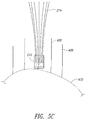
- FIGS. 5A-5C are side views of the process for sliding the sleeve off the microtube and onto the host hair in accordance with the present disclosure.
- FIG. 6 is a top view of a plurality of plates that are used to insert multiple hairs into multiple sleeves at once in accordance with the present disclosure.
- the present disclosure is directed to a system and method of using an elastic sleeve (or tube) to attach several supplemental hairs (synthetic or real) to a host hair, such as a human hair growing out of the scalp.
- a host hair such as a human hair growing out of the scalp.
- the hair density i.e., the number of hairs per square inch
- Several procedures and components are utilized to create the sleeve, position the sleeve onto a component that can allow an installer to put the sleeve onto a host hair, and position the host hair into such a component.
- FIG. 1 is an exploded view of a supplemental hair installation system in accordance with the present disclosure.
- the system includes a rod 102 , a transitional member 104 , a microtube 106 , a connector member 108 , and an acceptance member 110 .
- a sleeve 210 (shown in FIGS. 2A-2E ) is formed onto the rod 102 .
- the rod 102 is attached to the transitional member 104 , which is inserted into the microtube 106 .
- the sleeve is slid from the rod 102 up and over the transitional member 104 and onto the microtube 106 .
- the transitional member 104 and the rod 102 can be removed from the microtube 106 .
- the acceptance member 110 is connected to the microtube using the connector member 108 .
- the connector member 108 slides over a portion of the acceptance member and a portion of the microtube 106 , but does not interfere with the sleeve on the microtube.
- the acceptance member 110 enables a host hair (not illustrated) to be inserted into the microtube 106 . Once the host hair is inserted into the microtube 106 , the connector member 108 and the acceptance member 110 can be removed from the host hair, leaving the microtube 106 on the host hair.
- the sleeve is then slid off the microtube 106 and onto the host hair, resulting in a host hair with a sleeve having one or more supplemental hairs.
- a host hair e.g., host hair 408
- each person's hair can have a different diameter (e.g., between 0.04 mm to 0.15 mm), so the units described herein can be adjusted for a specific diameter of hair, such as that of a user.
- example measurements may also be given.
- a target or average host hair diameter can also be used. In this way, small, medium, and large sleeves can be created for the different thicknesses of human hair.
- FIGS. 2A-2E are side views of the process of creating a sleeve 210 with supplemental hairs 214 on a rod 102 .
- a host hair may be assumed to have a width or diameter of two units.
- the rod 102 has an outside diameter of one unit, so that once formed onto the rod 102 , a sleeve 210 has a natural diameter of one unit, which is smaller than the diameter of the host hair.
- the diameter of the rod may be approximately 0.05 mm (e.g., if the rod is a 44 gauge wire), which results in a sleeve 210 with a natural internal diameter of approximately 0.05 mm.
- the rod 102 is dipped into a container 202 of liquid latex rubber 204 , e.g., as illustrated in FIG. 2A .
- the liquid latex rubber 204 sticks to the rod 102 so that when the rod 102 is removed from the latex rubber 204 , a layer of wet latex 208 is formed on the rod 102 .
- one or more portions 206 and 212 of the rod 102 may be treated or configured so that the liquid latex rubber 204 does not adhere to the rod 102 , e.g., as illustrated in FIGS. 2B-2C .
- portions 206 and 212 of the rod 102 may be nano coated, covered in a release agent, or polished such that the sleeve 210 (once the liquid latex rubber cures) can easily slide on the rod 102 . In this way, the sleeve 210 is created on the rod 102 .
- the supplemental hairs 214 are added to the sleeve 210 , as illustrated in FIG. 2D .
- the supplemental hairs 214 may be aligned and laid on a flat surface.
- the rod 102 is rolled through the supplemental hairs 214 so that the supplemental hairs 214 are substantially parallel to the rod 102 with one end of the supplemental hairs 214 being in the sleeve 210 .
- the supplemental hairs 214 may be coated with a bonding agent to help them bind to the latex rubber in the sleeve 210 .
- the rod 102 may be re-dipped into the container 202 of the liquid latex rubber 204 to add additional latex to the sleeve 210 .
- this re-dipping procedure is performed such that the supplemental hairs 214 are not dipped into the liquid latex rubber 204 , as illustrated in FIG. 2E .
- a coating of the liquid latex rubber 204 can form around the supplemental hairs 214 on the sleeve 210 without getting all over the supplemental hairs 214 .
- These additional coatings can help stabilize and attach the supplemental hairs 214 to the sleeve 210 .
- the rod 102 may be dipped into the liquid latex rubber 204 one or more times (e.g., between four and ten times, or even more) before or after, or before and after, the supplemental hairs 214 are added to the sleeve 210 .
- the supplemental hairs 214 may be added over the course of multiple coatings.
- the rod may be dipped in the liquid latex and two hairs may be added to this first coat of the liquid latex. After the first coat cures, the rod may be dipped again to create a second coat. After the second coat cures, the rod may be dipped again and two more hairs may be added to this third coat.
- the rod may be dipped again, resulting in a sleeve with four coats of latex. It should be recognized that multiple coats can be used to create the sleeve and that one or more hairs can be added to one or more coats of the sleeve.
- a ridge 216 may be formed on the sleeve 210 , as shown in FIG. 2F .
- the ridge 216 provides a surface for a manufacturer to grab onto the sleeve 210 when moving the sleeve 210 from the rod 102 and onto the microtube 106 , as described herein.
- the ridge 216 is removed once the sleeve is moved onto the microtube 106 .
- the ridge 216 is left on the sleeve 210 so that an installer has a surface to grab onto when adjusting a position of the sleeve on the host hair once the sleeve is installed on the host hair (e.g., move the sleeve closer to the scalp as the host hair grows out).
- the ridge 216 may be formed by performing multiple additional dips of the rod 102 into the liquid latex rubber 204 , but only on a portion of the sleeve 210 .
- the ridge 216 is described as being formed by multiple partial dips or coatings of the liquid latex rubber 204 on the sleeve 210 , the disclosure is not so limited, and other methods of building up a ridge or ring on a liquid latex rubber cylinder may be employed, such as by rolling up the end of the sleeve.
- the rod 102 is attached to the transitional member, as illustrated in FIGS. 2F and 2G .
- Pliers 218 are used to slide the sleeve 210 off the rod 102 and onto the transitional member 104 , which is illustrated in FIG. 2G .
- the pliers 218 may be sized and shaped to be slightly curved to fit around the sleeve 210 and engage the ridge 216 .
- the ridge 216 provides a surface for the pliers 218 to push against to slide the sleeve 210 along the length of the rod 102 .
- the pliers 218 may be fused into the ridge 216 by applying extra coats of liquid latex rubber.
- the rod 102 may include micro grooves formed at an angle into the rod.
- the micro grooves may be formed such that when the rod 102 is dipped into the liquid latex rubber 204 , the liquid latex rubber 204 picks up or maps these indentations, thus forming micro grooves on the inside diameter of the sleeve.
- the micro grooves may be angled in a same direction as the supplemental hairs 214 so that the sleeve 210 can only slide in one direction, which is opposite of the supplemental hairs 214 . In this way, the sleeve 210 can still be slid from the rod 102 to the microtube 106 and onto a host hair, as described herein.
- the sleeve would resist moving in that direction once the sleeve is positioned on a host hair, while still allowing the sleeve to move towards the scalp for repositioning.
- FIGS. 3A-3D are side views of the process of sliding the sleeve 210 from the rod 102 over the transitional member 104 and onto the microtube 106 .
- the microtube 106 has an outside diameter of four units and an inside diameter of three units.
- the microtube 106 has an outside diameter of 0.2 mm and an inside diameter of 0.15 mm.
- the transitional member 104 includes a tip 304 , a midsection 306 and a base 316 .
- the tip 304 has a diameter of one unit and the base 316 has a diameter of four units
- the midsection 306 has a diameter that is tapered from one unit at the tip 304 to four units at the base 316 .
- a first end 302 of the rod 102 is attached to the tip 304 of the transitional member 104 using an adhesive or other attachment compound.
- the tip 304 of the transitional member 104 is the same diameter as or slightly smaller than the outside diameter of the first end 302 of the rod 102 , which helps to allow the sleeve 210 to slide from the rod 102 and onto the transitional member 104 .
- the transitional member 104 is nano coated, covered in a release agent, or polished such that the sleeve 210 can easily slide on the transitional member 104 .
- the transitional member 104 also includes a shaft 308 to engage the microtube 106 and temporarily connect the transitional member 104 to the microtube 106 .
- the shaft 308 of the transitional member 104 has an external diameter that is sized and shaped to fit inside a first end 310 of the microtube 106 , which has an internal diameter 312 .
- the first end 310 of the microtube 106 abuts a base 316 of the transitional member 104 .
- a diameter of the base 316 is the same as or slightly larger than a diameter 314 of the microtube 106 , which helps to allow the sleeve 210 to slide from the transitional member 104 to the microtube 106 .
- the sleeve 210 can be slid from the rod 102 onto the transitional member 104 and onto the microtube 106 .
- the microtube 106 has an outside diameter of four units (although some larger or smaller diameters may be employed, depending on the elastic properties of the sleeve 210 ).
- the midsection 306 of the transitional member 104 is sized and shaped to change the diameter of the sleeve 210 as the sleeve is slid from the rod 102 to the microtube 106 .
- the midsection 306 is frustoconical or otherwise tapered from the tip 304 to the base 316 .
- the microtube 106 is nano coated, covered in a release agent, or polished such that the sleeve 210 can easily slide on the microtube 106 .
- the rod 102 and transitional member 104 are removed from the microtube 106 .
- the connector member 108 and acceptance member 110 are then connected to the microtube 106 to allow a host hair to be positioned inside the microtube 106 .
- FIGS. 4A-4E show various views of the interaction between the microtube 106 , the connector member 108 , and the acceptance member 110 , and the insertion of a host hair 408 into the microtube 106 .
- the connector member 108 enables the acceptance member 110 to couple to and abut the end of the microtube 106 so that the acceptance member 110 is temporarily connected to the microtube 106 .
- the connector member 108 and the acceptance member 110 may be permanently connected, or they may be separate but engage with one another when inserting a free end of the host hair 408 into the microtube 106 , as illustrated.
- the connector member 108 and the microtube 106 are sized so that the microtube 106 slides inside the connector member 108 .
- the connector member 108 can be referred to as a two-thirds cylinder since it does not fully close around the microtube 106 and includes a gap along the length of the connector member 108 .
- the connector member 108 may be more or less than two-thirds, but sized and shaped so that the connector member 108 engages the microtube 106 when the microtube is partially inserted into the connector member 108 , and so that the connector member 108 can be separated from the microtube 106 (by sliding the connector member 108 off the microtube 106 ) and removed from the host hair 408 once the host hair 408 is inserted into the microtube 106 .
- the acceptance member 110 is a half-funnel-like shape.
- the open half of the acceptance member 110 is positioned in a same direction as the gap in the connector member 108 , which allows the acceptance member 110 to be removed from the host hair 408 once the host hair 408 is inserted into the microtube 106 .
- the microtube 106 abuts a first end 420 of the acceptance member 110 .
- the first end 420 includes a wall thickness that is the same as (or slightly larger than) the thickness of the wall of the microtube 106 , such that the internal surface of the microtube 106 aligns with an internal surface of the acceptance member 110 , which allows the host hair 408 to slide from the acceptance member 110 into the microtube 106 without interruption.
- the first end 420 has the same dimensions as the microtube 106 , but is only a half section, again to allow the acceptance member 110 to be removed once the host hair 408 is inserted into the microtube 106 .
- the sleeve 210 may be created on the rod 102 and moved onto the microtube 106 by a manufacturer prior to installation. The manufacturer may also attach the connector member 108 and the acceptance member 110 to the microtube 106 .
- This combination of components maybe provided to the installer as the resulting product (i.e., the sleeve with the supplemental hairs) and the installation tool (i.e., the microtube, connector member, and acceptance member). Therefore, a plurality of product/installation tools can be used by an installer (e.g., a hair stylist) to provide enhanced hair density for a user.
- the connector member 108 and the acceptance member 110 may not be utilized to guide the host hair 408 into the microtube 106 . Rather a thread and lasso method may also be used.
- the thread would pass through the microtube 106 from the end with the supplemental hairs 214 towards the user's scalp 430 .
- On the end with the user's scalp 430 is a lasso configured into the tread. In this way, an installer can capture the host hair 408 with the lasso and then pull the thread back through the microtube 106 , which results in the host hair 408 being pulled through the microtube 106 .
- the sleeve 210 is then slid off the microtube 106 and onto the host hair 408 , as discussed in more detail below.
- the sleeve 210 could be slid off the microtube 106 and onto the thread prior to a host hair being captured by the lasso. In this way, the installer would receive the sleeve 210 on a thread and lasso (without the microtube 106 ) and the installer can capture the host hair 408 with the lasso and then pull the host hair 408 through the sleeve 210 by pulling the thread and lasso back through the sleeve 210 .
- the host hair or the thread, or both may be lubricated to help enable the thread and host hair to be pulled through the sleeve.
- the sleeve 210 may include a ridge 216 , as discussed elsewhere herein, to help enable the installer to slide the sleeve onto the host hair.
- FIGS. 5A-5C are side views of the process for sliding a sleeve 210 off a microtube 106 and onto a host hair 408 .
- a host hair 408 a is inserted into the microtube 106 , such as described above in conjunction with FIGS. 4A-4E , the sleeve 210 is slid down off the microtube 106 and towards the scalp 430 .
- pliers (not illustrated), similar to what is described above, may be used to slide the sleeve 210 off the microtube 106 .
- the sleeve 210 has a natural diameter that is smaller than the diameter of the host hair 408 a (e.g., roughly the diameter of the rod 102 that the sleeve 210 was formed on), and since the diameter of the sleeve 210 was stretched when the sleeve 210 was moved from the rod 102 over the transitional member 104 and onto the microtube 106 , the diameter of the sleeve 210 will shrink back to substantially its natural diameter when the sleeve 210 is slid off the microtube 106 . And since the natural diameter is smaller than the diameter of the host hair 408 a , the sleeve 210 will grip the host hair.
- the sleeve 210 may be positioned closer to the scalp 430 so that the sleeve 210 is hidden against the scalp 430 and under the supplemental hairs 214 . It should be noted that a sleeve 210 may not be placed on every hair on a user's head, although they could be. Rather, a separate sleeve 210 may be placed on every fifth hair (or other density), such that if a hair with a sleeve falls out another sleeve 210 can be placed onto an adjacent host hair.
- an adhesive may also be added to the sleeve 210 to further ensure that the sleeve 210 will stay on the host hair 408 .
- the adhesive may be added to the host hair 408 prior to sliding the sleeve 210 off the microtube 106 and onto the host hair 408 .
- the adhesive may be added to the outside of the microtube 106 , such that the inside of the sleeve 210 becomes at least partially coated with the adhesive when the sleeve 210 is slid off the microtube 106 and onto the host hair 408 .
- the sleeve 210 itself may be pre-conditioned with adhesive, such as a head sensitive adhesive that activates under higher temperatures.
- FIG. 6 is a top view of a plurality of plates that are used to insert multiple host hairs 408 a - 408 d into multiple sleeves 210 a - 210 b at once.
- a first plate 602 includes a plurality of grooves for each separate host hair 408 a - 408 d to be arranged in a direction away from a user's scalp 430 .
- a second plate 604 includes a plurality of product/installation tools that are created as described herein.
- the host hairs 408 a - 408 d align with the corresponding acceptance members 110 a - 110 d , which allows the host hairs 408 a - 408 d to be slid into the corresponding microtubes 106 a - 106 d .
- the connector members 108 a - 108 d and the acceptance members 110 a - 110 d are removed so that the sleeves 210 a - 210 d can be slid off the corresponding microtubes 106 a - 106 d and onto the corresponding host hairs 408 a - 408 d , as described above.
Landscapes
- Engineering & Computer Science (AREA)
- Textile Engineering (AREA)
- Hair Curling (AREA)
Abstract
Description
Claims (20)
Priority Applications (1)
| Application Number | Priority Date | Filing Date | Title |
|---|---|---|---|
| US16/093,519 US10932509B2 (en) | 2016-04-13 | 2017-04-04 | System and method of supplementing human hair volume |
Applications Claiming Priority (3)
| Application Number | Priority Date | Filing Date | Title |
|---|---|---|---|
| US201662321990P | 2016-04-13 | 2016-04-13 | |
| US16/093,519 US10932509B2 (en) | 2016-04-13 | 2017-04-04 | System and method of supplementing human hair volume |
| PCT/US2017/025976 WO2017180370A1 (en) | 2016-04-13 | 2017-04-04 | System and method of supplementing human hair volume |
Publications (2)
| Publication Number | Publication Date |
|---|---|
| US20190125021A1 US20190125021A1 (en) | 2019-05-02 |
| US10932509B2 true US10932509B2 (en) | 2021-03-02 |
Family
ID=60042044
Family Applications (1)
| Application Number | Title | Priority Date | Filing Date |
|---|---|---|---|
| US16/093,519 Active 2037-09-12 US10932509B2 (en) | 2016-04-13 | 2017-04-04 | System and method of supplementing human hair volume |
Country Status (2)
| Country | Link |
|---|---|
| US (1) | US10932509B2 (en) |
| WO (1) | WO2017180370A1 (en) |
Families Citing this family (12)
| Publication number | Priority date | Publication date | Assignee | Title |
|---|---|---|---|---|
| US20170181489A1 (en) * | 2015-12-11 | 2017-06-29 | Ryan Tokko | Hair Extension Tip and Method for Making Therefor |
| KR101849673B1 (en) * | 2017-06-30 | 2018-04-19 | (주)하이모 | Extension hair and method for manufacturing and connecting of extension hair |
| US10925718B2 (en) | 2017-07-31 | 2021-02-23 | Loria Products Llc | Extension apparatus for artificial hair implants |
| MX2020001324A (en) | 2017-07-31 | 2020-10-28 | Loria Products Llc | Hair implants comprising enhanced anchoring and medical safety features. |
| US12279946B2 (en) | 2017-07-31 | 2025-04-22 | Loria Hair Implant Company Llc | Hair implants comprising enhanced anchoring and medical safety features |
| US10561490B2 (en) | 2017-07-31 | 2020-02-18 | Loria Products Llc | Hair implants comprising enhanced anchoring and medical safety features |
| US11564789B2 (en) | 2017-07-31 | 2023-01-31 | Loria Products Llc | Hair implants comprising enhanced anchoring and medical safety features |
| US11986036B2 (en) | 2018-05-16 | 2024-05-21 | Ruxton C. Doubt | System and method of supplementing human hair volume |
| AT520643B1 (en) * | 2018-09-05 | 2019-06-15 | Hairdreams Haarhandelsgmbh | Clamping connection for attachment of foreign hair to own hair |
| WO2020106320A1 (en) * | 2018-11-21 | 2020-05-28 | Loria Products Llc | Extension apparatus for artificial hair implants |
| USD917050S1 (en) | 2019-08-26 | 2021-04-20 | Loria Products Llc | Hair implant |
| JP6732148B1 (en) * | 2020-01-21 | 2020-07-29 | 隆喜 平野 | Hair extensions |
Citations (22)
| Publication number | Priority date | Publication date | Assignee | Title |
|---|---|---|---|---|
| US3295534A (en) | 1963-12-17 | 1967-01-03 | Dorkin Jess | Hair thickening method |
| US4934387A (en) | 1989-05-05 | 1990-06-19 | Salvatore Megna | Hair extension process |
| US5107867A (en) | 1991-08-29 | 1992-04-28 | Barrington Mark C | Process for extending human hair |
| US5752530A (en) | 1995-08-02 | 1998-05-19 | Traintinger; Felix | Method of attaching foreign hair to scalp hair |
| US5784747A (en) | 1995-11-01 | 1998-07-28 | The Procter & Gamble Company | Cleansing puff |
| US5787747A (en) * | 1996-03-08 | 1998-08-04 | Lucent Technologies, Inc. | Process and apparatus for making in-situ-formed multifilamentary composites |
| US5894846A (en) | 1994-11-09 | 1999-04-20 | Gang; Heide-Rose | Apparatus and method for lengthening and thickening hair and for fastening hair pieces |
| US5937867A (en) | 1998-04-07 | 1999-08-17 | Williams; Ella J. | Hairpiece and method of using same |
| US20040103910A1 (en) | 2002-11-29 | 2004-06-03 | Gerhard Ott | Applicator for replacement hair strands |
| US20040149302A1 (en) | 2003-01-31 | 2004-08-05 | Isao Toda | Method of attaching hair-thickening hair material and hair-thickening hair material fixture used for the method |
| US20040173223A1 (en) | 2003-03-05 | 2004-09-09 | Fang-Ping Hu | Pressure-sharing and burning-enhancing structure of tobacco chamber of pipe |
| US20040173233A1 (en) | 2003-03-03 | 2004-09-09 | Ryan Tokko | Hair extension system and method |
| US6820625B2 (en) | 2002-05-30 | 2004-11-23 | Hui Suk Park | Method for attaching supplemental hair to human hair |
| US6837249B2 (en) | 2002-06-19 | 2005-01-04 | International Hairgoods, Inc. | Supplemental hair attachment method and apparatus |
| US6938624B2 (en) | 2003-01-30 | 2005-09-06 | Hairlocs, Inc. | Methods and devices for applying hair extensions |
| US20050268932A1 (en) | 2002-09-16 | 2005-12-08 | Gold David A | Method and assembly for increasing hair volume |
| DE102005033189A1 (en) | 2005-07-13 | 2007-01-25 | Renata Stevlova | Method for extending hair, comprises dipping of tips of extension into liquid rubber |
| US7192635B2 (en) | 2002-12-23 | 2007-03-20 | Bege Privatstiftung | U-shaped thermoplastic hair-connecting element |
| US7614403B2 (en) | 2004-08-06 | 2009-11-10 | Rejouir, Ltd. | Devices and methods for applying hair extensions |
| US20110056507A1 (en) | 2008-01-24 | 2011-03-10 | Ryan Tokko | Hair Extension and Method for Hair Extension |
| US20120124777A1 (en) | 2009-05-13 | 2012-05-24 | Georg Utz Holding Ag | Hinge connection for a transport container made of plastic |
| US8944076B1 (en) | 2014-04-21 | 2015-02-03 | Ruxton C. Doubt | System and method for increasing hair volume |
-
2017
- 2017-04-04 WO PCT/US2017/025976 patent/WO2017180370A1/en not_active Ceased
- 2017-04-04 US US16/093,519 patent/US10932509B2/en active Active
Patent Citations (25)
| Publication number | Priority date | Publication date | Assignee | Title |
|---|---|---|---|---|
| US3295534A (en) | 1963-12-17 | 1967-01-03 | Dorkin Jess | Hair thickening method |
| US4934387A (en) | 1989-05-05 | 1990-06-19 | Salvatore Megna | Hair extension process |
| US5107867A (en) | 1991-08-29 | 1992-04-28 | Barrington Mark C | Process for extending human hair |
| US5894846A (en) | 1994-11-09 | 1999-04-20 | Gang; Heide-Rose | Apparatus and method for lengthening and thickening hair and for fastening hair pieces |
| US5752530A (en) | 1995-08-02 | 1998-05-19 | Traintinger; Felix | Method of attaching foreign hair to scalp hair |
| US5784747A (en) | 1995-11-01 | 1998-07-28 | The Procter & Gamble Company | Cleansing puff |
| US5787747A (en) * | 1996-03-08 | 1998-08-04 | Lucent Technologies, Inc. | Process and apparatus for making in-situ-formed multifilamentary composites |
| US5937867A (en) | 1998-04-07 | 1999-08-17 | Williams; Ella J. | Hairpiece and method of using same |
| US6820625B2 (en) | 2002-05-30 | 2004-11-23 | Hui Suk Park | Method for attaching supplemental hair to human hair |
| US6837249B2 (en) | 2002-06-19 | 2005-01-04 | International Hairgoods, Inc. | Supplemental hair attachment method and apparatus |
| US20050268932A1 (en) | 2002-09-16 | 2005-12-08 | Gold David A | Method and assembly for increasing hair volume |
| US20040103910A1 (en) | 2002-11-29 | 2004-06-03 | Gerhard Ott | Applicator for replacement hair strands |
| US7192635B2 (en) | 2002-12-23 | 2007-03-20 | Bege Privatstiftung | U-shaped thermoplastic hair-connecting element |
| US6938624B2 (en) | 2003-01-30 | 2005-09-06 | Hairlocs, Inc. | Methods and devices for applying hair extensions |
| US7726321B2 (en) | 2003-01-30 | 2010-06-01 | Hairlocs Extension System, Inc. | Methods and devices for applying hair extensions |
| US20040149302A1 (en) | 2003-01-31 | 2004-08-05 | Isao Toda | Method of attaching hair-thickening hair material and hair-thickening hair material fixture used for the method |
| US20040173233A1 (en) | 2003-03-03 | 2004-09-09 | Ryan Tokko | Hair extension system and method |
| US20040173223A1 (en) | 2003-03-05 | 2004-09-09 | Fang-Ping Hu | Pressure-sharing and burning-enhancing structure of tobacco chamber of pipe |
| US7614403B2 (en) | 2004-08-06 | 2009-11-10 | Rejouir, Ltd. | Devices and methods for applying hair extensions |
| DE102005033189A1 (en) | 2005-07-13 | 2007-01-25 | Renata Stevlova | Method for extending hair, comprises dipping of tips of extension into liquid rubber |
| US20110056507A1 (en) | 2008-01-24 | 2011-03-10 | Ryan Tokko | Hair Extension and Method for Hair Extension |
| US20120124777A1 (en) | 2009-05-13 | 2012-05-24 | Georg Utz Holding Ag | Hinge connection for a transport container made of plastic |
| US8944076B1 (en) | 2014-04-21 | 2015-02-03 | Ruxton C. Doubt | System and method for increasing hair volume |
| US20160000165A1 (en) | 2014-04-21 | 2016-01-07 | Ruxton C. Doubt | System and method for increasing hair volume |
| US9877530B2 (en) * | 2014-04-21 | 2018-01-30 | Ruxton C. Doubt | System and method for increasing hair volume |
Also Published As
| Publication number | Publication date |
|---|---|
| US20190125021A1 (en) | 2019-05-02 |
| WO2017180370A1 (en) | 2017-10-19 |
Similar Documents
| Publication | Publication Date | Title |
|---|---|---|
| US10932509B2 (en) | System and method of supplementing human hair volume | |
| US8944076B1 (en) | System and method for increasing hair volume | |
| EP3136898B1 (en) | Hair extensions | |
| KR102009954B1 (en) | Method for extension of eyelash using artificial eyelash | |
| EP2010015B1 (en) | Hair extension kit and extension-hair fixing method | |
| US10874157B2 (en) | Method and device for extending strands of a person's own | |
| US9993041B2 (en) | Methods and apparatuses for tapering artificial eyelashes | |
| US12127617B2 (en) | Eyelash extension system and methods | |
| EP2096949B1 (en) | Hair extension element, method for installing it and a holding member | |
| CN103382764B (en) | Composite levelling tool and its manufacture | |
| JP2016516535A5 (en) | ||
| US20200009712A1 (en) | Cosmetic applicator and detachable handle | |
| US8845845B1 (en) | Carbon fiber tubular pole and method of manufacture | |
| KR101782595B1 (en) | Micro embo lash set and method for extending eyelash ushing the same | |
| US11986036B2 (en) | System and method of supplementing human hair volume | |
| CN112334270A (en) | Extension spring assembly and method of making same | |
| JP3159628U (en) | Eyeliner-Mascara shared applicator | |
| BE1017068A3 (en) | Hair extension, comprises hair filaments attachable to hair via heat shrinkable plastic strip | |
| EP4105014A4 (en) | ASSEMBLY STRUCTURE, ASSEMBLY METHOD, OUTER BODY FOR WIRE HARNESS AND WIRE HARNESS | |
| JP7515408B2 (en) | Fabric sleeved cable and method of manufacturing same | |
| TWM624532U (en) | Hair attaching structure | |
| US9884473B1 (en) | Carbon fiber tubular pole and method of manufacture | |
| JP2017022951A (en) | Instrument for line arrangement | |
| RU2407823C1 (en) | Procedure for production of line spiral hardware | |
| CN104793307A (en) | Clamping piece for invisible optical cable, invisible optical cable and laying method of invisible optical cable |
Legal Events
| Date | Code | Title | Description |
|---|---|---|---|
| FEPP | Fee payment procedure |
Free format text: ENTITY STATUS SET TO UNDISCOUNTED (ORIGINAL EVENT CODE: BIG.); ENTITY STATUS OF PATENT OWNER: SMALL ENTITY |
|
| FEPP | Fee payment procedure |
Free format text: ENTITY STATUS SET TO SMALL (ORIGINAL EVENT CODE: SMAL); ENTITY STATUS OF PATENT OWNER: SMALL ENTITY |
|
| STPP | Information on status: patent application and granting procedure in general |
Free format text: DOCKETED NEW CASE - READY FOR EXAMINATION |
|
| AS | Assignment |
Owner name: FUCINA, INC., WASHINGTON Free format text: ASSIGNMENT OF ASSIGNORS INTEREST;ASSIGNOR:DOUBT, ROARK MICHAEL;REEL/FRAME:049544/0424 Effective date: 20190619 Owner name: FUCINA, INC., WASHINGTON Free format text: ASSIGNMENT OF ASSIGNORS INTEREST;ASSIGNOR:DOUBT, RUXTON C.;REEL/FRAME:049544/0404 Effective date: 20190620 |
|
| STPP | Information on status: patent application and granting procedure in general |
Free format text: NON FINAL ACTION MAILED |
|
| STPP | Information on status: patent application and granting procedure in general |
Free format text: RESPONSE TO NON-FINAL OFFICE ACTION ENTERED AND FORWARDED TO EXAMINER |
|
| STPP | Information on status: patent application and granting procedure in general |
Free format text: NOTICE OF ALLOWANCE MAILED -- APPLICATION RECEIVED IN OFFICE OF PUBLICATIONS |
|
| STCF | Information on status: patent grant |
Free format text: PATENTED CASE |
|
| MAFP | Maintenance fee payment |
Free format text: PAYMENT OF MAINTENANCE FEE, 4TH YR, SMALL ENTITY (ORIGINAL EVENT CODE: M2551); ENTITY STATUS OF PATENT OWNER: SMALL ENTITY Year of fee payment: 4 |