US10930068B2 - Estimation apparatus, estimation method, and non-transitory computer-readable storage medium for storing estimation program - Google Patents
Estimation apparatus, estimation method, and non-transitory computer-readable storage medium for storing estimation program Download PDFInfo
- Publication number
- US10930068B2 US10930068B2 US16/194,658 US201816194658A US10930068B2 US 10930068 B2 US10930068 B2 US 10930068B2 US 201816194658 A US201816194658 A US 201816194658A US 10930068 B2 US10930068 B2 US 10930068B2
- Authority
- US
- United States
- Prior art keywords
- line segment
- additional
- instruction
- point
- estimation
- Prior art date
- Legal status (The legal status is an assumption and is not a legal conclusion. Google has not performed a legal analysis and makes no representation as to the accuracy of the status listed.)
- Active
Links
Images




Classifications
-
- G—PHYSICS
- G06—COMPUTING OR CALCULATING; COUNTING
- G06T—IMAGE DATA PROCESSING OR GENERATION, IN GENERAL
- G06T17/00—Three-dimensional [3D] modelling for computer graphics
- G06T17/20—Finite element generation, e.g. wire-frame surface description, tesselation
-
- G—PHYSICS
- G06—COMPUTING OR CALCULATING; COUNTING
- G06T—IMAGE DATA PROCESSING OR GENERATION, IN GENERAL
- G06T7/00—Image analysis
- G06T7/70—Determining position or orientation of objects or cameras
- G06T7/73—Determining position or orientation of objects or cameras using feature-based methods
-
- G06T11/203—
-
- G—PHYSICS
- G06—COMPUTING OR CALCULATING; COUNTING
- G06T—IMAGE DATA PROCESSING OR GENERATION, IN GENERAL
- G06T11/00—Two-dimensional [2D] image generation
- G06T11/20—Drawing from basic elements
- G06T11/23—Drawing from basic elements using straight lines or curves
-
- G—PHYSICS
- G06—COMPUTING OR CALCULATING; COUNTING
- G06T—IMAGE DATA PROCESSING OR GENERATION, IN GENERAL
- G06T19/00—Manipulating three-dimensional [3D] models or images for computer graphics
- G06T19/20—Editing of three-dimensional [3D] images, e.g. changing shapes or colours, aligning objects or positioning parts
-
- G—PHYSICS
- G06—COMPUTING OR CALCULATING; COUNTING
- G06T—IMAGE DATA PROCESSING OR GENERATION, IN GENERAL
- G06T7/00—Image analysis
- G06T7/60—Analysis of geometric attributes
- G06T7/62—Analysis of geometric attributes of area, perimeter, diameter or volume
-
- G—PHYSICS
- G06—COMPUTING OR CALCULATING; COUNTING
- G06T—IMAGE DATA PROCESSING OR GENERATION, IN GENERAL
- G06T7/00—Image analysis
- G06T7/70—Determining position or orientation of objects or cameras
- G06T7/73—Determining position or orientation of objects or cameras using feature-based methods
- G06T7/75—Determining position or orientation of objects or cameras using feature-based methods involving models
-
- G—PHYSICS
- G06—COMPUTING OR CALCULATING; COUNTING
- G06T—IMAGE DATA PROCESSING OR GENERATION, IN GENERAL
- G06T2207/00—Indexing scheme for image analysis or image enhancement
- G06T2207/30—Subject of image; Context of image processing
- G06T2207/30244—Camera pose
Definitions
- the embodiment discussed herein is related to an estimation apparatus, an estimation method, and a non-transitory computer-readable storage medium for storing an estimation program.
- AR augmented reality
- the position and orientation of a camera in three-dimensional (3D) space is estimated in accordance with an image of an object that is captured by using a camera included in a personal computer (PC), a mobile terminal device, or the like; and content information is displayed in a superimposed manner onto the image at an arbitrary position based on the determined position and orientation of the camera.
- PC personal computer
- content information is displayed in a superimposed manner onto the image at an arbitrary position based on the determined position and orientation of the camera.
- CAD computer-aided design
- Examples of the related art include International Publication Pamphlet No. WO 2012-173141 (patent literature 1), Japanese Laid-open Patent Publication No. 2017-91078 (patent literature 2), Japanese Laid-open Patent Publication No. 2017-182302 (patent literature 3), H. H. Chen, “Pose Determination from Line-to-Plane Correspondences: Existence Condition and Close-form Solutions”, IEEE Transactions on Pattern Analysis and Machine Intelligence VOL. 13, NO. 6, pages 530-541, 1991 (non-patent literature 1), and J. Z. C. Lai, “Sensitivity Analysis of Line Correspondence”, IEEE Transactions on Systems, Man, and Cybernetics VOL. 25, NO. 6, pages 1016-1023, 1995 (non-patent literature 2).
- an estimation apparatus includes: a memory configured to store shape information containing information about multiple line segments that depict a shape of an object; and a processor coupled to the memory and configured to execute detection processing that includes detecting multiple feature lines in an image of the object captured by an imaging apparatus, execute reception processing that includes receiving a first instruction for associating a feature line selected from the multiple feature lines with a line segment selected from the multiple line segments and a second instruction for associating two points selected in the image with two end points selected from end points of the multiple line segments, execute generation processing that includes generating a first line segment connecting the two points and a second line segment connecting the two end points, and execute estimation processing that includes estimating a position and orientation of the imaging apparatus in three-dimensional space by using a combination of the selected feature line and the selected line segment and a combination of the first line segment and the second line segment.
- FIG. 1 illustrates a functional configuration of an estimation apparatus
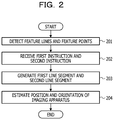
- FIG. 2 is a flowchart illustrating an estimation processing
- FIG. 3 illustrates a specific example of a functional configuration of the estimation apparatus
- FIGS. 4A and 4B are a flowchart illustrating a specific example of the estimation processing
- FIGS. 5A to 5D illustrate the estimation processing for an object of a polyhedron
- FIGS. 6A and 6B illustrate a selection operation with specifying an imaginary line segment
- FIGS. 7A to 7C illustrate a selection operation for selecting an actual line segment corresponding pair and a selection operation without specifying an imaginary line segment
- FIGS. 8A to 8D illustrate a selection operation for adding a corresponding pair to an imaginary line segment corresponding pair
- FIG. 9 illustrates a feature point within a predetermined region
- FIG. 10 illustrates a calculation method in accordance with an area
- FIG. 11 illustrates a calculation method in accordance with a distance
- FIG. 12 illustrates a configuration of an information processing apparatus.
- an object of an embodiment is to estimate, with a simple operation, the position and orientation of an imaging apparatus by using an image of an object captured by the imaging apparatus and shape information about the object.
- the position and orientation of a camera is calculated by using combinations (initial corresponding pairs) of multiple projection lines obtained by projecting onto a captured image of an object multiple candidate lines contained in the CAD data of the object and multiple feature lines detected in the image. Subsequently, other candidate lines are projected onto the image by using the calculated position and orientation of the camera and another combination of a projection line and a feature line is automatically added. By using the added combination of a projection line and a feature line, the position and orientation of the camera is calculated again.
- patent literature 3 does not mention a method for easily selecting initial corresponding pairs.
- selected feature lines or selected line segments preferably do not include three parallel feature lines or three parallel line segments. Therefore, it may take time to select an appropriate combination of a feature line and an incorrect combination of a feature line and a line segment may be selected.
- FIG. 1 illustrates an example of a functional configuration of an estimation apparatus of the embodiment.
- An estimation apparatus 101 in FIG. 1 includes a storage unit 111 , a detection unit 112 , a reception unit 113 , a generation unit 114 , and an estimation unit 115 .
- the storage unit 111 stores shape information 121 containing information about multiple line segments that depict the shape of an object.
- the detection unit 112 , the reception unit 113 , the generation unit 114 , and the estimation unit 115 perform estimation processing by using the shape information 121 stored in the storage unit 111 .
- FIG. 2 is a flowchart illustrating an example of the estimation processing performed by the estimation apparatus 101 in FIG. 1 .
- the detection unit 112 detects multiple feature lines and multiple points in an image of an object captured by an imaging apparatus (step 201 ), and the reception unit 113 receives a first instruction and a second instruction (step 202 ).
- the first instruction associates a feature line selected from the multiple feature lines with a line segment selected from multiple line segments whose information is contained in shape information.
- the second instruction associates two points selected in the image of the object with two end points selected from end points of the multiple line segments whose information is contained in the shape information.
- the generation unit 114 generates a first line segment that connects the two points processed under the second instruction to each other and a second line segment that connects the two end points processed under the second instruction to each other (step 203 ).
- the estimation unit 115 estimates the position and orientation of the imaging apparatus in three-dimensional space by using a combination of a selected feature line and a selected line segment and a combination of the first line segment and the second line segment (step 204 ).
- the estimation apparatus 101 is able to estimate, with a simple operation, the position and orientation of an imaging apparatus by using an image of an object captured by the imaging apparatus and shape information about the object.
- FIG. 3 illustrates a specific example of the estimation apparatus 101 in FIG. 1 .
- the estimation apparatus 101 in FIG. 3 includes the storage unit 111 , the detection unit 112 , the reception unit 113 , the generation unit 114 , the estimation unit 115 , an image acquisition unit 311 , an extraction unit 312 , and a display unit 313 .
- the detection unit 112 includes a feature line detection unit 321 and a feature point detection unit 322
- the estimation unit 115 includes a calculation unit 341 , a determination unit 342 , and an evaluation unit 343 .
- the estimation apparatus 101 may be a mobile terminal device, such as a tablet computer, a notebook computer, or a smart device, or may be an information processing device, such as a desktop computer.
- An imaging apparatus 301 is, for example, a camera that has an imaging element, such as a charged-coupled device (CCD) or a complementary metal-oxide-semiconductor (CMOS), and that captures an image 351 of an object.
- the image acquisition unit 311 acquires the image 351 from the imaging apparatus 301 and stores the image 351 in the storage unit 111 .
- the storage unit 111 stores a 3D model 352 indicating the shape of an object whose image is captured by the imaging apparatus 301 .
- the 3D model 352 corresponds to the shape information 121 in FIG. 1 and is, for example, CAD data of an object.
- the 3D model 352 includes vertex information about multiple vertexes that define the three-dimensional shape of an object and line segment information about multiple line segments.
- the vertex information includes three-dimensional coordinates of vertexes of an object, and the line segment information includes discrimination information indicating end points at both ends of the respective line segments.
- the feature line detection unit 321 performs edge detection processing for the image 351 , detects multiple edge lines in the image 351 , and stores the detected edge lines as feature lines 353 in the storage unit 111 .
- the feature point detection unit 322 performs feature point detection processing for the image 351 , detects multiple feature points 354 in the image 351 , and stores the detected feature points 354 in the storage unit 111 .
- the feature point detection unit 322 is able to detect a feature point in the image 351 in accordance with, for example, the grayscale level because the grayscale level largely varies in the surrounding area of the focus point in the image 351 and the position of a focus point is uniquely specified in the image 351 in accordance with the grayscale level.
- the extraction unit 312 extracts from the 3D model 352 the line segment information about multiple line segments depicting the three-dimensional shape of the object.
- the display unit 313 displays the image 351 on a screen and displays the multiple feature lines 353 and the multiple feature points 354 on the displayed image 351 in a superimposed manner.
- the display unit 313 also displays as the 3D model 352 the multiple line segments that are indicated by the line segment information extracted by the extraction unit 312 on the screen.
- Displaying the multiple feature lines 353 and the multiple feature points 354 on the image 351 in a superimposed manner facilitates the operation for selecting the feature line 353 and the feature point 354 .
- Displaying the multiple line segments as the 3D model 352 facilitates the operation for selecting a line segment.
- a user selects one or more feature lines 353 from the multiple feature lines 353 displayed on the image 351 in a superimposed manner and one or more line segments from the multiple line segments displayed as the 3D model 352 .
- the user inputs into the estimation apparatus 101 an instruction for associating the selected feature line 353 in the image 351 with the respective selected line segment in the 3D model 352 , and the reception unit 113 receives the instruction.
- the generation unit 114 generates combinations (corresponding pairs) in which the feature lines 353 are associated with the respective line segments selected by the user and stores in the storage unit 111 the generated corresponding pairs as actual line segment corresponding pairs 355 .
- the user selects two or more points from multiple points selectable in the image 351 and two or more end points from end points of the multiple line segment displayed as the 3D model 352 .
- the multiple points selectable in the image 351 include the multiple feature points 354 displayed on the image 351 in a superimposed manner and a point other than the feature points 354 that is visually recognizable as a vertex of the object by the user.
- the user then inputs into the estimation apparatus 101 an instruction for associating the points selected in the image 351 with the respective end points selected in the 3D model 352 , and the reception unit 113 receives the instruction.
- the generation unit 114 generates an imaginary line segment VL 1 that connects two points selected in the image 351 by the user and an imaginary line segment VL 2 that connects two end points selected in the 3D model 352 by the user. Subsequently, the generation unit 114 generates a corresponding pair in which the imaginary line segment VL 1 is associated with the imaginary line segment VL 2 and stores in the storage unit 111 the generated corresponding pair as an imaginary line segment corresponding pair 356 .
- the user is able to select a point in the image 351 and an end point included in the 3D model 352 by performing the following selection operation.
- the user explicitly designates a point at each end of the imaginary line segment VL 1 and an end point at each end of the imaginary line segment VL 2 for each of one or more corresponding pairs and inputs into the estimation apparatus 101 an instruction for associating the designated points in the image 351 with the respective designated end points included in the 3D model 352 .
- the generation unit 114 generates the imaginary line segment VL 1 that connects the two designated points in the image 351 and the imaginary line segment VL 2 that connects the two designated end points in the 3D model 352 . In such a manner, one or more corresponding pairs, in which the imaginary line segment VL 1 is associated with the imaginary line segment VL 2 are generated.
- the user selects M points (M is an integer equal to or more than two) in the image 351 and M end points included in the 3D model 352 and inputs in the estimation apparatus 101 an instruction for associating the selected points in the image 351 with the respective selected end points included in the 3D model 352 .
- the generation unit 114 generates M(M ⁇ 1)/2 kinds of combinations of two respective points among the M points in the image 351 and generates the imaginary line segments VL 1 that each connect two points included in the respective combinations.
- the generation unit 114 also generates M(M ⁇ 1)/2 kinds of combinations of respective two end points among the M end points included in the 3D model 352 and generates the imaginary line segments VL 2 that each connect two end points included in the respective combinations. In such a manner, M(M ⁇ 1)/2 kinds of corresponding pairs in each of which the imaginary line segment VL 1 is associated with the imaginary line segment VL 2 are generated.
- the determination unit 342 determines whether it is possible to accurately estimate the position and orientation of the imaging apparatus 301 in accordance with the generated actual line segment corresponding pair 355 and the generated imaginary line segment corresponding pair 356 .
- the determination unit 342 may determine that it is possible to accurately estimate the position and orientation of the imaging apparatus 301 when the total number of corresponding pairs including the actual line segment corresponding pair 355 and the imaginary line segment corresponding pair 356 is four or more.
- the determination unit 342 may, by using the technology in non-patent literature 1 or the technology in non-patent literature 2, determine whether it is possible to accurately estimate the position and orientation of the imaging apparatus 301 .
- the technology in non-patent literature 1 estimates the position and orientation of a camera in accordance with a combination of three line segments in an image and three line segments in a 3D model.
- the technology in non-patent literature 1 also determines whether it is possible to estimate the position and orientation of the camera in accordance with a positional relationship of line segments that are used. In a case where the position and orientation of the camera are not determined in accordance with any combination of three line segments in the image and three line segments in the 3D model, it is determined that estimating the position and orientation of the camera is not possible.
- the technology in non-patent literature 2 evaluates the accuracy of estimating the position and orientation of a camera by using a positional relationship between a line segment in an image and a line segment in a 3D model and an approximate position and orientation of the camera.
- the calculation unit 341 calculates the position and orientation of the imaging apparatus 301 in three-dimensional space by using the actual line segment corresponding pair 355 and the imaginary line segment corresponding pair 356 .
- the calculation unit 341 stores in the storage unit 111 information on the calculated position and orientation as an estimation result 357 .
- the calculation unit 341 is able to calculate the position and orientation of the imaging apparatus 301 by employing the calculation method described in patent literature 3.
- the evaluation unit 343 calculates an estimation error of the position and orientation of the imaging apparatus 301 indicated by the estimation result 357 and outputs information for requesting an additional instruction in accordance with the estimation error.
- the evaluation unit 343 is capable of calculating the estimation error by employing the calculation method described in patent literature 3.
- the evaluation unit 343 outputs information for requesting an additional instruction.
- the information for requesting an additional instruction may be a mark or a text message displayed on the screen or an audio message.
- the user selects one or more additional points from multiple points selectable in the image 351 and one or more additional end points from end points of the multiple line segments displayed as the 3D model 352 .
- the user subsequently inputs in the estimation apparatus 101 an instruction for associating the selected additional points with the respective selected additional end points, and the reception unit 113 receives the instruction.
- the generation unit 114 selects two points including an additional point from the points and the additional points that have been selected in the image 351 by the user and generates an imaginary line segment VL 3 that connects the two points.
- the generation unit 114 also selects two end points including an additional end point from the end points and the additional end points that have been selected in the 3D model 352 by the user and generates an imaginary line segment VL 4 that connects the two end points. Subsequently, the generation unit 114 generates a corresponding pair in which the imaginary line segment VL 3 is associated with the imaginary line segment VL 4 and adds the generated corresponding pair to the imaginary line segment corresponding pair 356 .
- the calculation unit 341 calculates again the position and orientation of the imaging apparatus 301 by using the actual line segment corresponding pair 355 and the imaginary line segment corresponding pair 356 to which the corresponding pair has been added and updates the estimation result 357 in accordance with the calculated position and orientation.
- the estimation apparatus 101 in FIG. 3 it is desirable that the user select only one corresponding pair of the feature line 353 in the image 351 and a line segment in the 3D model 352 . Furthermore, it is easy to select as a point in the image 351 the feature point 354 displayed on the image 351 in a superimposed manner, and a vertex of an object that is not detected as the feature point 354 is selectable by using as a clue the feature line 353 displayed on the image 351 in a superimposed manner. Moreover, it is easy to select an end point included in the 3D model 352 .
- FIG. 4 is a flowchart illustrating a specific example of the estimation processing performed by the estimation apparatus 101 in FIG. 3 .
- the image acquisition unit 311 acquires the image 351 from the imaging apparatus 301 (step 401 ), the feature line detection unit 321 detects the multiple feature lines 353 in the image 351 , and the feature point detection unit 322 detects the multiple feature points 354 in the image 351 (step 402 ).
- the extraction unit 312 acquires the 3D model 352 from the storage unit 111 (step 403 ) and extracts multiple line segments from the 3D model 352 (step 404 ).
- the display unit 313 displays on the screen the image 351 , the multiple feature lines 353 , the multiple feature points 354 , and the multiple line segments indicating the 3D model 352 .
- a user selects the feature line 353 in the image 351 and a line segment in the 3D model 352 , and the reception unit 113 receives an instruction for associating the selected feature line 353 with the selected line segment (step 405 ).
- the generation unit 114 generates the actual line segment corresponding pair 355 in which the feature line 353 is associated with the line segment.
- the user selects two or more points in the image 351 and two or more end points in the 3D model 352 , and the reception unit 113 receives an instruction for associating the selected points with the respective selected end points (step 406 ).
- the generation unit 114 generates the imaginary line segment VL 1 that connects the two points to each other and the imaginary line segment VL 2 that connects the two end points to each other and then generates the imaginary line segment corresponding pair 356 in which the imaginary line segment VL 1 is associated with the imaginary line segment VL 2 (step 407 ).
- the determination unit 342 determines whether it is possible to accurately estimate the position and orientation of the imaging apparatus 301 in accordance with the actual line segment corresponding pair 355 and the imaginary line segment corresponding pair 356 (step 408 ). In a case where it is not possible to accurately estimate the position and orientation of the imaging apparatus 301 (NO in step 408 ), the estimation apparatus 101 repeats processing from step 405 . In this manner, a new corresponding pair is generated and added to the actual line segment corresponding pair 355 or the imaginary line segment corresponding pair 356 .
- the calculation unit 341 calculates the position and orientation of the imaging apparatus 301 by using the actual line segment corresponding pair 355 and the imaginary line segment corresponding pair 356 (step 409 ). In this manner, the estimation result 357 is generated.
- the evaluation unit 343 calculates the estimation error of the position and orientation of the imaging apparatus 301 (step 410 ) and compares the estimation error with a predetermined threshold TH (step 411 ). In a case where the estimation error is equal to or more than the threshold TH (NO in step 411 ), the evaluation unit 343 instructs the display unit 313 to display information for requesting an additional instruction.
- the calculation unit 341 projects the 3D model 352 on the image 351 by using the position and orientation of the imaging apparatus 301 calculated in step 409 as a tentative position and orientation.
- the display unit 313 then displays the 3D model 352 projected on the image 351 in a superimposed manner and the information for requesting an additional instruction on the screen (step 413 ).
- the user may select an additional end point or an additional line segment in the 3D model 352 and an additional point or an additional feature line in the image 351 .
- the evaluation unit 343 determines whether the first selection operation is for the 3D model 352 or the image 351 (step 414 ).
- the user selects an additional end point or an additional line segment, and the reception unit 113 receives information about the selected additional end point or the selected additional line segment (step 415 ).
- the calculation unit 341 searches for a candidate of an additional point or an additional feature line in the image 351 corresponding to the selected additional end point or the selected additional line segment and instructs the display unit 313 to display in an emphasized manner the candidate that has been found (step 416 ).
- the display unit 313 displays in an emphasized manner the candidate of an additional point or an additional feature line in the image 351 .
- the display unit 313 displays the candidate in an emphasized manner by displaying in an enlarged manner the candidate of an additional point or an additional feature line, displaying in an enlarged manner an area including the candidate of an additional point or an additional feature line, or changing the color of the candidate of an additional point or an additional feature line.
- the user selects the candidate of an additional point or an additional feature line displayed in an emphasized manner and inputs in the estimation apparatus 101 an instruction for associating the selected additional end point or the selected additional line segment with the selected additional point or the selected additional feature line (step 417 ).
- the reception unit 113 receives the instruction.
- the user selects an additional point or an additional feature line, and the reception unit 113 receives information about the selected additional point or the selected additional feature line (step 418 ).
- the calculation unit 341 searches for a candidate of an additional end point or an additional line segment in the 3D model 352 corresponding to the selected additional point or the selected additional feature line and instructs the display unit 313 to display in an emphasized manner the candidate that has been found (step 419 ).
- the display unit 313 displays in an emphasized manner the candidate of an additional end point or an additional line segment in the 3D model 352 .
- the user selects the candidate of an additional end point or an additional line segment displayed in an emphasized manner and inputs in the estimation apparatus 101 an instruction for associating the selected additional point or the selected additional feature line with the selected additional end point or the selected additional line segment (step 420 ).
- the reception unit 113 receives the instruction.
- the generation unit 114 generates the imaginary line segment VL 3 that connects the point having been selected in the image 351 to the additional point newly selected and the imaginary line segment VL 4 that connects the end point having been selected in the 3D model 352 to the additional end point newly selected (step 421 ).
- the generation unit 114 adds a corresponding pair in which the imaginary line segment VL 3 is associated with the imaginary line segment VL 4 to the imaginary line segment corresponding pair 356 , and the estimation apparatus 101 performs processing from step 409 . In this manner, the number of corresponding pairs included in the imaginary line segment corresponding pair 356 increases, and therefore, it is expected that the estimation error decreases in step 410 .
- the calculation unit 341 projects the 3D model 352 on the image 351 by using the calculated position and orientation of the imaging apparatus 301 (step 412 ).
- the display unit 313 displays the 3D model 352 on the image 351 in a superimposed manner.
- the generation unit 114 may generate a corresponding pair in which the imaginary line segment VL 3 is associated with the additional line segment selected in the 3D model 352 or a corresponding pair in which the additional feature line selected in the image 351 is associated with the imaginary line segment VL 4 .
- a tentative position and orientation is calculated.
- a corresponding pair of the imaginary line segment VL 3 and the imaginary line segment VL 4 is added to the imaginary line segment corresponding pair 356 and another tentative position and orientation is calculated. In this manner, it is determined whether to request an additional instruction from the user in accordance with the desired accuracy of estimation.
- a candidate for selection included in the other of the operation targets is displayed in an emphasized manner. In this manner, many selectable objects included in the other of the operation targets narrow to selectable objects useful for adding an imaginary line segment and only the useful selectable objects are displayed, thereby facilitating the selection operation.
- step 411 instead of the evaluation unit 343 comparing the estimation error with the threshold TH, the user may visually evaluate the estimation error.
- the calculation unit 341 projects the 3D model 352 on the image 351 by using the tentative position and orientation of the imaging apparatus 301 , and the display unit 313 displays the 3D model 352 projected on the image 351 in a superimposed manner.
- the user determines that the estimation error is large. In a case where the interval between the image 351 and the 3D model 352 is relatively small, the user determines that the estimation error is small. In a case where it is determined that the estimation error is large, processing from step 413 is performed. In a case where it is determined that the estimation error is small, processing from step 412 is performed.
- FIGS. 5A to 5D illustrate examples of the estimation processing for an object of a polyhedron.
- FIG. 5A illustrates an example of an image 501 of an object, and feature lines and feature points that are detected in the image 501 .
- a line segment represents a feature line and x represents a feature point.
- a feature point 511 is merely an end point of a feature line corresponding to an edge of the object, and thus a 3D model 502 of the object in FIG. 5B does not include an end point corresponding to the feature point 511 .
- FIG. 5B illustrates an example of the actual line segment corresponding pair 355 , feature points selected in the image 501 by a user, and end points selected in the 3D model 502 .
- a feature line 531 in the image 501 is associated with a line segment 532 in the 3D model 502 and the actual line segment corresponding pair 355 is generated.
- the selection operation without specifying an imaginary line segment is performed and a feature point 512 , a feature point 513 , and a feature point 514 in the image 501 are associated with an end point 521 , an end point 522 , and an end point 523 in the 3D model 502 , respectively.
- FIG. 5C illustrates an example of the imaginary line segment corresponding pair 356 .
- six imaginary line segments are generated as follows.
- FIG. 5D illustrates an example of an additional feature point selected in the image 501 by the user and an additional end point selected in the 3D model 502 .
- a feature point 515 in the image 501 is selected as an additional feature point and an end point 524 in the 3D model 502 is selected as an additional end point.
- the following six imaginary line segments are newly generated.
- FIGS. 6A and 6B illustrate examples of the selection operation with specifying an imaginary line segment.
- FIG. 6A illustrates an example of the selection operation for selecting a feature point in the image 501 and an end point in the 3D model 502 .
- a line segment in the image 501 represents a feature line and a black circle represents a feature point.
- the user selects the feature point 512 and the feature point 515 in the image 501 and the end point 521 and the end point 524 in the 3D model 502 .
- the generation unit 114 generates the imaginary line segment 544 that connects the feature point 512 and the feature point 515 and the imaginary line segment 554 that connects the end point 521 and the end point 524 and accordingly generates a corresponding pair in which the imaginary line segment 544 is associated with the imaginary line segment 554 .
- FIG. 6B illustrates an example of the selection operation for selecting a feature point in the image 501 and a line segment in the 3D model 502 .
- the user selects the feature point 512 and the feature point 513 in the image 501 and a line segment 601 in the 3D model 502 , thereby designating the end point 521 and the end point 522 of the line segment 601 .
- the generation unit 114 generates the imaginary line segment 541 that connects the feature point 512 and the feature point 513 and the imaginary line segment 551 that connects the end point 521 and the end point 522 and accordingly generates a corresponding pair in which the imaginary line segment 541 is associated with the imaginary line segment 551 .
- the generated imaginary line segment 551 coincides with the line segment 601 , the user may directly select the line segment 601 .
- FIGS. 7A to 7C illustrate examples of the selection operation for selecting the actual line segment corresponding pair 355 and the selection operation without specifying an imaginary line segment.
- FIG. 7A illustrates an example of the selection operation for selecting the actual line segment corresponding pair 355 .
- a line segment in the image 501 represents a feature line and a black circle represents a feature point.
- the user selects a feature line 701 in the image 501 and a line segment 702 in the 3D model 502 , and the generation unit 114 generates the actual line segment corresponding pair 355 by associating the feature line 701 with the line segment 702 .
- FIG. 7B illustrates an example of the selection operation without specifying an imaginary line segment.
- the user selects the feature point 512 , the feature point 513 , and the feature point 711 in the image 351 , and the generation unit 114 generates three kinds of combinations of respective two feature points among the three selected feature points and accordingly generates imaginary line segments that each connect two feature points included in the respective combinations.
- the user selects the end point 521 , the end point 522 , and an end point 712 in the 3D model 502 as end points corresponding to the feature point 512 , the feature point 513 , and the feature point 711 , respectively.
- the generation unit 114 generates three kinds of combinations of respective two end points among the three selected end points and accordingly generates an imaginary line segments that each connect two end points included in the respective combinations. In this manner, the following six imaginary line segments are generated.
- FIG. 7C illustrates an example of displaying in a superimposed manner in accordance with the tentative position and orientation of the imaging apparatus 301 .
- the calculation unit 341 calculates the tentative position and orientation by using the actual line segment corresponding pair 355 generated by the selection operation illustrated in FIG. 7A and the imaginary line segment corresponding pair 356 generated by the selection operation illustrated in FIG. 7B .
- the display unit 313 displays in a superimposed manner the image 501 and the 3D model 502 projected on the image 501 by using the tentative position and orientation. In this example, since the estimation error is equal to or more than the threshold TH, the display unit 313 displays on the screen a mark 721 as the information for requesting an additional instruction.
- FIGS. 8A to 8D illustrate examples of the selection operation for adding a corresponding pair to the imaginary line segment corresponding pair 356 in displaying in a superimposed manner illustrated in FIG. 7C .
- FIG. 8A illustrates an example of the selection operation for the 3D model 502 in order to add a corresponding pair.
- the user firstly selects an end point 801 in the 3D model 502 as an additional end point, and the calculation unit 341 searches for a candidate 802 of an additional point in the image 501 corresponding to the selected end point 801 .
- the display unit 313 displays in a window 804 an area 803 containing the candidate 802 of an additional point in an enlarged manner. In this manner, the candidate 802 of an additional point is displayed in an emphasized manner.
- FIG. 8B illustrates an example of the selection operation for the image 501 in order to add another corresponding pair after the candidate 802 of an additional point has been selected and a corresponding pair in which the end point 801 is associated with the candidate 802 of an additional point has been added.
- the user firstly selects the feature point 514 in the image 501 as an additional feature point, and the calculation unit 341 searches for a candidate 523 of an additional end point in the 3D model 502 corresponding to the selected feature point 514 .
- the display unit 313 displays in a window 811 an area containing the candidate 523 of an additional end point in an enlarged manner. In this manner, the candidate 523 of an additional end point is displayed in an emphasized manner.
- FIG. 8C illustrates an example of a state in which the candidate 523 of an additional end point is selected and a corresponding pair in which the feature point 514 is associated with the candidate 523 of an additional end point is added.
- the actual line segment corresponding pair 355 is a corresponding pair in which the feature line 701 is associated with the line segment 702 .
- the imaginary line segment corresponding pair 356 includes ten corresponding pairs generated from five points including the feature points 512 to 514 , and 711 , and a point 802 , and five end points including the end points 521 to 523 , and 712 , and the end point 801 .
- FIG. 8D illustrates an example of displaying in a superimposed manner in accordance with a final position and orientation of the imaging apparatus 301 .
- the calculation unit 341 calculates the position and orientation of the imaging apparatus 301 by using the actual line segment corresponding pair 355 and the imaginary line segment corresponding pair 356 in the state in FIG. 8C , and the display unit 313 displays the image 501 and the 3D model 502 in a superimposed manner. In this example, since the estimation error is smaller than the threshold TH, the display unit 313 does not display the mark 721 .
- the display unit 313 may display on the screen only the feature point 354 useful as a selectable object among the multiple feature points 354 .
- the feature point detection unit 322 specifies the feature point 354 within a predetermined region around an intersection point of the multiple feature lines 353 among the multiple feature points 354 detected in the image 351 , and the display unit 313 displays only the feature point 354 specified by the feature point detection unit 322 .
- FIG. 9 illustrates an example of the feature point 354 within a predetermined region around an intersection point of the feature lines 353 .
- An area 901 of the image 501 corresponds to a predetermined region (an neighborhood area) around an intersection point of a feature line 911 and a feature line 912 that are detected in the image 501 and includes the feature point 514 detected in the image 501 .
- the display unit 313 displays only the feature point 514 in the area 901 as a selectable object corresponding to the intersection point of the feature line 911 and the feature line 912 .
- the display unit 313 displays only a feature point within an neighborhood area around an intersection point as a selectable object corresponding to the intersection point of other feature lines detected in the image 501 .
- a feature point detected in accordance with a pattern or shade on a surface of an object which is similar to a feature point 921 in an area 902 , is excluded from selectable objects. This decreases the number of feature points as selectable objects, thereby decreasing the operation load.
- the evaluation unit 343 is able to calculate the estimation error by employing the calculation method described in patent literature 3.
- the evaluation unit 343 calculates a sum E of squared errors for the N corresponding pairs as the estimation error.
- the sum E of squared errors are calculated by the following equation.
- the evaluation unit 343 is capable of calculating the error Ei by employing, for example, a method illustrated in FIG. 10 or a method illustrated in FIG. 11 .
- FIG. 10 illustrates an example of a calculation method in accordance with the area between a feature line and a line segment.
- a line segment included in an ith corresponding pair is a line segment 1001 and a feature line included in the ith corresponding pair is a line segment 1002
- a line segment 1003 and a line segment 1004 that each connect one of two ends of the line segment 1001 and one of two ends of the line segment 1002 are determined.
- an area Ai surrounded by the line segments 1001 to 1004 is used as the error Ei.
- Ei Ai (2)
- the error Ei decreases, and when the line segment 1001 completely overlaps with the line segment 1002 , the error Ei is 0.
- the error Ei decreases, and when the line segment 1001 completely overlaps with the line segment 1002 , the error Ei is 0.
- the configuration of the estimation apparatus 101 illustrated in FIGS. 1 and 3 is merely an example, and some components may be omitted or changed in accordance with the usage or the condition of the estimation apparatus 101 .
- the estimation apparatus 10 in FIG. 3 may omits the extraction unit 312 .
- the display unit 313 may be omitted.
- the feature point detection unit 322 may be omitted.
- CAD data other shape information indicating the shape of an object may be used as the 3D model 352 .
- FIGS. 2 and 4 are merely examples, and part of processing may be omitted or changed in accordance with the configuration or the condition of the estimation apparatus 101 .
- the estimation processing illustrated in FIG. 4 in a case where it is not desired to display the feature point 354 as a selectable object, only the feature line 353 is detected in step 402 .
- processing in steps 416 and 419 may be omitted.
- the image 501 , the 3D model 502 , the feature lines, the feature points, the line segments, the end points, and the like illustrated in FIGS. 5 to 9 are merely examples, and the image, the 3D model, the feature line, the feature point, the line segment, the end point, and the like vary in accordance with an object targeted for image capturing.
- Equations (1) to (3) are merely examples, and other equations may be applied in accordance with the configuration or the condition of the estimation apparatus 101 .
- the estimation apparatus 101 in FIGS. 1 and 3 may be implemented by using, for example, an information processing apparatus (a computer) illustrated in FIG. 12 .
- the information processing apparatus in FIG. 12 includes a central processing unit (CPU) 1201 , a memory 1202 , an input device 1203 , an output device 1204 , an auxiliary storage device 1205 , a medium driving device 1206 , and a network connection device 1207 .
- a bus 1208 couples these components to each other.
- the bus 1208 may be couple to the imaging apparatus 301 in FIG. 3 .
- the memory 1202 is, for example, a semiconductor memory, such as a read only memory (ROM), a random access memory (RAM), or a flash memory, and stores a program and data that are used for processing.
- the memory 1202 may be used as the storage unit 111 in FIGS. 1 and 3 .
- the CPU 1201 (a processor) operates as the detection unit 112 , the reception unit 113 , the generation unit 114 , and the estimation unit 115 in FIGS. 1 and 3 by, for example, executing a program by using the memory 1202 .
- the CPU 1201 also operates as the image acquisition unit 311 , the extraction unit 312 , the feature line detection unit 321 , the feature point detection unit 322 , the calculation unit 341 , the determination unit 342 , and the evaluation unit 343 in FIG. 3 by executing a program by using the memory 1202 .
- the input device 1203 is, for example, a keyboard, and/or a pointing device, and used by an operator or a user for inputting an instruction or information.
- the output device 1204 is, for example, a display device, a printer, and/or a speaker, and used for outputting an inquiry or an instruction for an operator or a user, and a processing result.
- the processing result may be the estimation result 357 or the 3D model 352 superimposed onto the image 351 .
- the output device 1204 may be used as the display unit 313 in FIG. 3 .
- the auxiliary storage device 1205 is, for example, a magnetic disk drive, an optical disk drive, a magneto-optical disk drive, or a tape drive.
- the auxiliary storage device 1205 may be a hard disk drive or a flash memory.
- the information processing apparatus stores a program and data in the auxiliary storage device 1205 and uses the program and the data by loading them in the memory 1202 .
- the auxiliary storage device 1205 may be used as the storage unit 111 in FIGS. 1 and 3 .
- the medium driving device 1206 drives a portable storage medium 1209 and accesses the recorded content in the portable storage medium 1209 .
- the portable storage medium 1209 is, for example, a memory device, a flexible disk, an optical disk, or a magneto-optical disk.
- the portable storage medium 1209 may be, for example, a compact disk read only memory (CD-ROM), a digital versatile disk (DVD), a universal serial bus (USB) memory.
- An operator or a user stores a program and data in the portable storage medium 1209 and uses the program and the data by loading them in the memory 1202 .
- a computer-readable storage medium storing a program and data used for processing is a physical (non-transitory) storage medium such as the memory 1202 , the auxiliary storage device 1205 , or the portable storage medium 1209 .
- the network connection device 1207 is a communication interface circuit that is connected to a communication network, such as a local area network or a wide area network, and that performs data conversion for communication.
- the information processing apparatus receives a program and data from an external device via the network connection device 1207 and uses the program and the data by loading them in the memory 1202 .
- the information processing apparatus may not include all components in FIG. 12 , and some components may be omitted in accordance with the usage and the condition.
- the medium driving device 1206 or the network connection device 1207 may be omitted.
Landscapes
- Engineering & Computer Science (AREA)
- Physics & Mathematics (AREA)
- General Physics & Mathematics (AREA)
- Theoretical Computer Science (AREA)
- Computer Vision & Pattern Recognition (AREA)
- Geometry (AREA)
- Computer Graphics (AREA)
- Software Systems (AREA)
- Architecture (AREA)
- Computer Hardware Design (AREA)
- General Engineering & Computer Science (AREA)
- Length Measuring Devices By Optical Means (AREA)
- Studio Devices (AREA)
- Image Analysis (AREA)
Abstract
Description
-
- An imaginary line segment 541: a line segment that connects the
feature point 512 and thefeature point 513 - An imaginary line segment 542: a line segment that connects the
feature point 513 and thefeature point 514 - An imaginary line segment 543: a line segment that connects the
feature point 514 and thefeature point 511 - An imaginary line segment 551: a line segment that connects the
end point 521 and theend point 522 - An imaginary line segment 552: a line segment that connects the
end point 522 and theend point 523 - An imaginary line segment 553: a line segment that connects the
end point 523 and theend point 521
- An imaginary line segment 541: a line segment that connects the
-
- A corresponding pair in which the
imaginary line segment 541 is associated with theimaginary line segment 551 - A corresponding pair in which the
imaginary line segment 542 is associated with theimaginary line segment 552 - A corresponding pair in which the
imaginary line segment 543 is associated with theimaginary line segment 553
- A corresponding pair in which the
-
- An imaginary line segment 544: a line segment that connects the
feature point 515 and thefeature point 512 - An imaginary line segment 545: a line segment that connects the
feature point 515 and thefeature point 513 - An imaginary line segment 546: a line segment that connects the
feature point 515 and thefeature point 514 - An imaginary line segment 554: a line segment that connects the
end point 524 and theend point 521 - An imaginary line segment 555: a line segment that connects the
end point 524 and theend point 522 - An imaginary line segment 556: a line segment that connects the
end point 524 and theend point 523
- An imaginary line segment 544: a line segment that connects the
-
- A corresponding pair in which the
imaginary line segment 544 is associated with theimaginary line segment 554 - A corresponding pair in which the
imaginary line segment 545 is associated with theimaginary line segment 555 - A corresponding pair in which the
imaginary line segment 546 is associated with theimaginary line segment 556
- A corresponding pair in which the
-
- An imaginary line segment that connects the
feature point 512 and thefeature point 513 - An imaginary line segment that connects the
feature point 513 and thefeature point 711 - An imaginary line segment that connects the
feature point 711 and thefeature point 512 - An imaginary line segment that connects the
end point 521 and theend point 522 - An imaginary line segment that connects the
end point 522 and theend point 712 - An imaginary line segment that connects the
end point 712 and theend point 521
- An imaginary line segment that connects the
Ei=Ai (2)
Ei=Li1+Li2 (3)
Claims (15)
Applications Claiming Priority (3)
| Application Number | Priority Date | Filing Date | Title |
|---|---|---|---|
| JP2017238051A JP7003617B2 (en) | 2017-12-12 | 2017-12-12 | Estimator, estimation method, and estimation program |
| JPJP2017-238051 | 2017-12-12 | ||
| JP2017-238051 | 2017-12-12 |
Publications (2)
| Publication Number | Publication Date |
|---|---|
| US20190180503A1 US20190180503A1 (en) | 2019-06-13 |
| US10930068B2 true US10930068B2 (en) | 2021-02-23 |
Family
ID=66697064
Family Applications (1)
| Application Number | Title | Priority Date | Filing Date |
|---|---|---|---|
| US16/194,658 Active US10930068B2 (en) | 2017-12-12 | 2018-11-19 | Estimation apparatus, estimation method, and non-transitory computer-readable storage medium for storing estimation program |
Country Status (2)
| Country | Link |
|---|---|
| US (1) | US10930068B2 (en) |
| JP (1) | JP7003617B2 (en) |
Families Citing this family (3)
| Publication number | Priority date | Publication date | Assignee | Title |
|---|---|---|---|---|
| US11043042B2 (en) * | 2016-05-16 | 2021-06-22 | Hewlett-Packard Development Company, L.P. | Generating a shape profile for a 3D object |
| CN113190150B (en) * | 2021-04-20 | 2023-09-01 | 北京百度网讯科技有限公司 | Overlay display method, device and storage medium |
| JP2024042278A (en) * | 2022-09-15 | 2024-03-28 | 古野電気株式会社 | Navigation support device, navigation support system, navigation support method, and navigation support program |
Citations (7)
| Publication number | Priority date | Publication date | Assignee | Title |
|---|---|---|---|---|
| US20120051645A1 (en) * | 2010-08-30 | 2012-03-01 | Alibaba Group Holding Limited | Recognition of digital images |
| US20120269388A1 (en) * | 2011-04-20 | 2012-10-25 | Qualcomm Incorporated | Online reference patch generation and pose estimation for augmented reality |
| WO2012173141A1 (en) | 2011-06-16 | 2012-12-20 | オリンパス株式会社 | Image processing apparatus, image processing method, and program |
| US20140176530A1 (en) * | 2012-12-21 | 2014-06-26 | Dassault Systèmes Delmia Corp. | Location correction of virtual objects |
| US20150016723A1 (en) * | 2012-01-02 | 2015-01-15 | Telecom Italia S.P.A. | Method and system for comparing images |
| US20170132752A1 (en) | 2015-11-06 | 2017-05-11 | Fujitsu Limited | Superimposed display method and superimposed display apparatus |
| JP2017182302A (en) | 2016-03-29 | 2017-10-05 | 富士通株式会社 | Image processing program, image processing apparatus, and image processing method |
Family Cites Families (1)
| Publication number | Priority date | Publication date | Assignee | Title |
|---|---|---|---|---|
| US8442304B2 (en) | 2008-12-29 | 2013-05-14 | Cognex Corporation | System and method for three-dimensional alignment of objects using machine vision |
-
2017
- 2017-12-12 JP JP2017238051A patent/JP7003617B2/en not_active Expired - Fee Related
-
2018
- 2018-11-19 US US16/194,658 patent/US10930068B2/en active Active
Patent Citations (10)
| Publication number | Priority date | Publication date | Assignee | Title |
|---|---|---|---|---|
| US20120051645A1 (en) * | 2010-08-30 | 2012-03-01 | Alibaba Group Holding Limited | Recognition of digital images |
| US20120269388A1 (en) * | 2011-04-20 | 2012-10-25 | Qualcomm Incorporated | Online reference patch generation and pose estimation for augmented reality |
| WO2012173141A1 (en) | 2011-06-16 | 2012-12-20 | オリンパス株式会社 | Image processing apparatus, image processing method, and program |
| US20140098091A1 (en) | 2011-06-16 | 2014-04-10 | Olympus Corporation | Image processing apparatus, image processing method, and program |
| US20150016723A1 (en) * | 2012-01-02 | 2015-01-15 | Telecom Italia S.P.A. | Method and system for comparing images |
| US20140176530A1 (en) * | 2012-12-21 | 2014-06-26 | Dassault Systèmes Delmia Corp. | Location correction of virtual objects |
| US20170132752A1 (en) | 2015-11-06 | 2017-05-11 | Fujitsu Limited | Superimposed display method and superimposed display apparatus |
| JP2017091078A (en) | 2015-11-06 | 2017-05-25 | 富士通株式会社 | Superimposed display method, superimposed display device, and superimposed display program |
| JP2017182302A (en) | 2016-03-29 | 2017-10-05 | 富士通株式会社 | Image processing program, image processing apparatus, and image processing method |
| US20170287154A1 (en) | 2016-03-29 | 2017-10-05 | Fujitsu Limited | Image processing apparatus and image processing method |
Non-Patent Citations (2)
| Title |
|---|
| H. H. Chen, "Pose Determination from Line-to-Plane Correspondences: Existence Condition and Closed-form Solutions", IEEE Transactions on Pattern Analysis and Machine Intelligence, vol. 13, No. 6, pp. 530-541, 1991 (12 pages). |
| J. Z. C. Lai, "Sensitivity Analysis of Line Correspondence", IEEE Transactions on Systems, Man, and Cybernetics, vol. 25, No. 6, pp. 1016-1023, 1995 (8 pages). |
Also Published As
| Publication number | Publication date |
|---|---|
| JP2019106008A (en) | 2019-06-27 |
| US20190180503A1 (en) | 2019-06-13 |
| JP7003617B2 (en) | 2022-01-20 |
Similar Documents
| Publication | Publication Date | Title |
|---|---|---|
| US10354402B2 (en) | Image processing apparatus and image processing method | |
| US10157478B2 (en) | Enabling use of three-dimensional locations of features with two-dimensional images | |
| US9633450B2 (en) | Image measurement device, and recording medium | |
| US9824450B2 (en) | Localisation and mapping | |
| US10318102B2 (en) | 3D model generation from 2D images | |
| US10311576B2 (en) | Image processing device and image processing method | |
| US10304196B2 (en) | File conversion method and apparatus | |
| US10185399B2 (en) | Image processing apparatus, non-transitory computer-readable recording medium, and image processing method | |
| US20150310617A1 (en) | Display control device and display control method | |
| US9348465B2 (en) | Input method, input device, and storage medium | |
| CN112085842B (en) | Depth value determination method and device, electronic device and storage medium | |
| WO2019093457A1 (en) | Information processing device, information processing method and program | |
| JP2016212784A (en) | Image processing apparatus and image processing method | |
| KR101956275B1 (en) | Method and apparatus for detecting information of body skeleton and body region from image | |
| US10600202B2 (en) | Information processing device and method, and program | |
| US20190180503A1 (en) | Estimation apparatus, estimation method, and non-transitory computer-readable storage medium for storing estimation program | |
| US20190066734A1 (en) | Image processing apparatus, image processing method, and storage medium | |
| US10146331B2 (en) | Information processing system for transforming coordinates of a position designated by a pointer in a virtual image to world coordinates, information processing apparatus, and method of transforming coordinates | |
| US11138759B2 (en) | Image processing apparatus and image processing method | |
| JP7232663B2 (en) | Image processing device and image processing method | |
| US10755439B2 (en) | Estimation device, estimation method and storage medium | |
| US10796435B2 (en) | Image processing method and image processing apparatus | |
| JP2020098575A (en) | Image processing apparatus, image processing method, and image processing program | |
| TWI571753B (en) | Electronic computing device for generating an interactive index code image of an image, method thereof and computer program product thereof | |
| JP6716897B2 (en) | Operation detection method, operation detection device, and operation detection program |
Legal Events
| Date | Code | Title | Description |
|---|---|---|---|
| AS | Assignment |
Owner name: FUJITSU LIMITED, JAPAN Free format text: ASSIGNMENT OF ASSIGNORS INTEREST;ASSIGNORS:KARASUDANI, AYU;AOYAGI, TOMOHIRO;REEL/FRAME:047538/0024 Effective date: 20181026 |
|
| FEPP | Fee payment procedure |
Free format text: ENTITY STATUS SET TO UNDISCOUNTED (ORIGINAL EVENT CODE: BIG.); ENTITY STATUS OF PATENT OWNER: LARGE ENTITY |
|
| STPP | Information on status: patent application and granting procedure in general |
Free format text: DOCKETED NEW CASE - READY FOR EXAMINATION |
|
| STPP | Information on status: patent application and granting procedure in general |
Free format text: NON FINAL ACTION MAILED |
|
| STPP | Information on status: patent application and granting procedure in general |
Free format text: RESPONSE TO NON-FINAL OFFICE ACTION ENTERED AND FORWARDED TO EXAMINER |
|
| STPP | Information on status: patent application and granting procedure in general |
Free format text: DOCKETED NEW CASE - READY FOR EXAMINATION |
|
| STCF | Information on status: patent grant |
Free format text: PATENTED CASE |
|
| MAFP | Maintenance fee payment |
Free format text: PAYMENT OF MAINTENANCE FEE, 4TH YEAR, LARGE ENTITY (ORIGINAL EVENT CODE: M1551); ENTITY STATUS OF PATENT OWNER: LARGE ENTITY Year of fee payment: 4 |