US10916706B2 - Composition, film production method, and light emitting device - Google Patents
Composition, film production method, and light emitting device Download PDFInfo
- Publication number
- US10916706B2 US10916706B2 US16/480,719 US201816480719A US10916706B2 US 10916706 B2 US10916706 B2 US 10916706B2 US 201816480719 A US201816480719 A US 201816480719A US 10916706 B2 US10916706 B2 US 10916706B2
- Authority
- US
- United States
- Prior art keywords
- group
- fluorinated alcohol
- composition
- formula
- integer
- Prior art date
- Legal status (The legal status is an assumption and is not a legal conclusion. Google has not performed a legal analysis and makes no representation as to the accuracy of the status listed.)
- Expired - Fee Related
Links
- 0 *C1=C(*)C(*)=C(C)C(C)=C1*.*C1=C(*)C(C)=C(*)C(*)=C1C.*C1=C(*)C(C)=C(*)C(C)=C1*.*C1=C(*)C2=C(C(*)=C(*)C(*)=C2C)C(C)=C1*.*C1=C(*)C2=C(C(*)=C(*)C(C)=C2*)C(*)=C1C.*C1=C(*)C2=C(C(*)=C1*)C(C)=C(*)C(*)=C2C Chemical compound *C1=C(*)C(*)=C(C)C(C)=C1*.*C1=C(*)C(C)=C(*)C(*)=C1C.*C1=C(*)C(C)=C(*)C(C)=C1*.*C1=C(*)C2=C(C(*)=C(*)C(*)=C2C)C(C)=C1*.*C1=C(*)C2=C(C(*)=C(*)C(C)=C2*)C(*)=C1C.*C1=C(*)C2=C(C(*)=C1*)C(C)=C(*)C(*)=C2C 0.000 description 12
- AFGVNRHIOSLHPO-UHFFFAOYSA-N C#CC.C1=CC=C2CCC2=C1.C=CC.C=CC(C)=O.C=CC(C)C=C.C=CC1=CC=CC=C1.C=CC=CC.C=CCC(C)CC=C.C=CCN(C)CC=C.C=COC.CC.CC Chemical compound C#CC.C1=CC=C2CCC2=C1.C=CC.C=CC(C)=O.C=CC(C)C=C.C=CC1=CC=CC=C1.C=CC=CC.C=CCC(C)CC=C.C=CCN(C)CC=C.C=COC.CC.CC AFGVNRHIOSLHPO-UHFFFAOYSA-N 0.000 description 1
- BBWLTOCSXWMGIO-UHFFFAOYSA-N C.C.C.CC.CC1=CC2=C(C=CC=C2)C=C1.CC1=CC2=C(C=CC=C2)C=C1.CC1=CC=CC=C1.CC1=CC=CC=C1.CC1=CC=CC=C1.CC1=CC=CC=C1.CC1=CC=CC=C1.CC1=CC=CC=C1.CC1=CC=CC=C1.CC1=CC=CC=C1.CCC(=O)[O-]C.CCC(=O)[O-]C.CCCCCCC.CCCCCCCCCC.CCCCCCCCCOC.CCCCCCOC.CCOCCOCCOCCOC.COCCCCOCCCCOCCCCOC.COCCOCCOCCOC.COCCOCCOCCOCCOC.COCCOCCOCCOCCOCCOCCOCCOCCOCCOCCOC.C[O-]C(C)=O.C[O-]C(C)=O.C[O-]C(C)=O.C[O-]C(C)=O.C[O-]C(C)=O.C[O-]C(C)=O.C[O-]C(C)=O.C[O-]C(C)=O.C[O-]C(C)=O Chemical compound C.C.C.CC.CC1=CC2=C(C=CC=C2)C=C1.CC1=CC2=C(C=CC=C2)C=C1.CC1=CC=CC=C1.CC1=CC=CC=C1.CC1=CC=CC=C1.CC1=CC=CC=C1.CC1=CC=CC=C1.CC1=CC=CC=C1.CC1=CC=CC=C1.CC1=CC=CC=C1.CCC(=O)[O-]C.CCC(=O)[O-]C.CCCCCCC.CCCCCCCCCC.CCCCCCCCCOC.CCCCCCOC.CCOCCOCCOCCOC.COCCCCOCCCCOCCCCOC.COCCOCCOCCOC.COCCOCCOCCOCCOC.COCCOCCOCCOCCOCCOCCOCCOCCOCCOCCOC.C[O-]C(C)=O.C[O-]C(C)=O.C[O-]C(C)=O.C[O-]C(C)=O.C[O-]C(C)=O.C[O-]C(C)=O.C[O-]C(C)=O.C[O-]C(C)=O.C[O-]C(C)=O BBWLTOCSXWMGIO-UHFFFAOYSA-N 0.000 description 1
- SHHADBSMLQJNRP-UHFFFAOYSA-N C1=CC(C2=NC(C3=CC=CC(N4C5=C(C=CC=C5)C5=C4C=CC=C5)=C3)=CC=C2)=CC(N2C3=C(C=CC=C3)C3=C2C=CC=C3)=C1.C1=CC2=C(C=C1)N(C1=CC3=C(C=C1)C1(C4=C(C=CC=C4)C4=C1C=CC=C4)C1=C3/C=C(N3C4=C(C=CC=C4)C4=C3C=CC=C4)\C=C/1)C1=C2C=CC=C1.C1=CC2=C(C=C1)N(C1=CC3=C(C=C1)C1(C4=C(C=CC=C4)C4=C1C=CC=C4)C1=C3/C=C\C=C/1)C1=C2C=CC=C1.C1=CC2=C(C=C1)N(C1=CC3=C(C=C1)SC1=C3/C=C(N3C4=C(C=CC=C4)C4=C3C=CC=C4)\C=C/1)C1=C2C=CC=C1.CC(C)(C)C1=CC=C(C2=NN=C(C3=CC=CC(C4=NN=C(C5=CC=C(C(C)(C)C)C=C5)O4)=C3)O2)C=C1 Chemical compound C1=CC(C2=NC(C3=CC=CC(N4C5=C(C=CC=C5)C5=C4C=CC=C5)=C3)=CC=C2)=CC(N2C3=C(C=CC=C3)C3=C2C=CC=C3)=C1.C1=CC2=C(C=C1)N(C1=CC3=C(C=C1)C1(C4=C(C=CC=C4)C4=C1C=CC=C4)C1=C3/C=C(N3C4=C(C=CC=C4)C4=C3C=CC=C4)\C=C/1)C1=C2C=CC=C1.C1=CC2=C(C=C1)N(C1=CC3=C(C=C1)C1(C4=C(C=CC=C4)C4=C1C=CC=C4)C1=C3/C=C\C=C/1)C1=C2C=CC=C1.C1=CC2=C(C=C1)N(C1=CC3=C(C=C1)SC1=C3/C=C(N3C4=C(C=CC=C4)C4=C3C=CC=C4)\C=C/1)C1=C2C=CC=C1.CC(C)(C)C1=CC=C(C2=NN=C(C3=CC=CC(C4=NN=C(C5=CC=C(C(C)(C)C)C=C5)O4)=C3)O2)C=C1 SHHADBSMLQJNRP-UHFFFAOYSA-N 0.000 description 1
- IXPKZPBKKAVNLG-UHFFFAOYSA-N C1=CC2=C(C=C1)C1=C(C=CC(C3=CC4=C(C=C3)C3(C5=C(C=CC=C5)C5=C3C=CC=C5)C3=C4/C=C\C=C/3)=C1)O2.C1=CC2=C(C=C1)C1=C(C=CC(C3=CC4=C(C=C3)C3(C5=C(C=CC=C5)C5=C3C=CC=C5)C3=C4/C=C\C=C/3)=C1)S2.O=P(C1=CC=CC=C1)(C1=CC=C2/C=C\C3=C4C(=CC=C3)C=CC1=C24)/C1=C/C=C2/C=C\C3=C\C=C/C4=C3C2=C1C=C4.O=P(C1=CC=CC=C1)(C1=CC=CC=C1)C1=CC(N2C3=C(C=CC=C3)C3=C2/C=C\C=C/3)=CC(P(=O)(C2=CC=CC=C2)C2=CC=CC=C2)=C1.O=P(C1=CC=NC2=C1C=CC=C2)(C1=CC=NC2=C1C=CC=C2)C1=C2C=CC=CC2=CC=C1 Chemical compound C1=CC2=C(C=C1)C1=C(C=CC(C3=CC4=C(C=C3)C3(C5=C(C=CC=C5)C5=C3C=CC=C5)C3=C4/C=C\C=C/3)=C1)O2.C1=CC2=C(C=C1)C1=C(C=CC(C3=CC4=C(C=C3)C3(C5=C(C=CC=C5)C5=C3C=CC=C5)C3=C4/C=C\C=C/3)=C1)S2.O=P(C1=CC=CC=C1)(C1=CC=C2/C=C\C3=C4C(=CC=C3)C=CC1=C24)/C1=C/C=C2/C=C\C3=C\C=C/C4=C3C2=C1C=C4.O=P(C1=CC=CC=C1)(C1=CC=CC=C1)C1=CC(N2C3=C(C=CC=C3)C3=C2/C=C\C=C/3)=CC(P(=O)(C2=CC=CC=C2)C2=CC=CC=C2)=C1.O=P(C1=CC=NC2=C1C=CC=C2)(C1=CC=NC2=C1C=CC=C2)C1=C2C=CC=CC2=CC=C1 IXPKZPBKKAVNLG-UHFFFAOYSA-N 0.000 description 1
- CXAHIKIKXCXPCI-UHFFFAOYSA-N C1=CC=C(C2=NC(C3=CC=CC=C3)=NC(C3=CC4=C(C=C3)C3(C5=CC=CC=C5C5=C3C=CC=C5)C3=C4/C=C(C4=NC(C5=CC=CC=C5)=NC(C5=CC=CC=C5)=N4)\C=C/3)=N2)C=C1.C1=CC=C(C2=NC(C3=CC=CC=C3)=NC(C3=CC=CC=C3)=N2)C=C1.C1=CC=C(N2C3=CC=CC=C3N=C2C2=CC(C3=NC4=C(C=CC=C4)N3C3=CC=CC=C3)=CC(C3=NC4=C(C=CC=C4)N3C3=CC=CC=C3)=C2)C=C1.CCCCCCCCOC1=CC2=C(C=C1C1=CC(C3=CC=C(C(C)(C)C)C=C3)=CC(C3=CC=C(C(C)(C)C)C=C3)=C1)SC1=C2/C=C(OCCCCCCCC)\C(C2=CC(C3=CC=C(C(C)(C)C)C=C3)=CC(C3=CC=C(C(C)(C)C)C=C3)=C2)=C/1 Chemical compound C1=CC=C(C2=NC(C3=CC=CC=C3)=NC(C3=CC4=C(C=C3)C3(C5=CC=CC=C5C5=C3C=CC=C5)C3=C4/C=C(C4=NC(C5=CC=CC=C5)=NC(C5=CC=CC=C5)=N4)\C=C/3)=N2)C=C1.C1=CC=C(C2=NC(C3=CC=CC=C3)=NC(C3=CC=CC=C3)=N2)C=C1.C1=CC=C(N2C3=CC=CC=C3N=C2C2=CC(C3=NC4=C(C=CC=C4)N3C3=CC=CC=C3)=CC(C3=NC4=C(C=CC=C4)N3C3=CC=CC=C3)=C2)C=C1.CCCCCCCCOC1=CC2=C(C=C1C1=CC(C3=CC=C(C(C)(C)C)C=C3)=CC(C3=CC=C(C(C)(C)C)C=C3)=C1)SC1=C2/C=C(OCCCCCCCC)\C(C2=CC(C3=CC=C(C(C)(C)C)C=C3)=CC(C3=CC=C(C(C)(C)C)C=C3)=C2)=C/1 CXAHIKIKXCXPCI-UHFFFAOYSA-N 0.000 description 1
- NNPPMTNAJDCUHE-UHFFFAOYSA-N CC(C)C Chemical compound CC(C)C NNPPMTNAJDCUHE-UHFFFAOYSA-N 0.000 description 1
- JROSRQQLKQVGMF-UHFFFAOYSA-I CC1=CC(COCCOCCOCCO)=C(C)C=C1C(=O)[O-].COCCOCCOCCOC1=C([Cs+]OC=O)C=C(C2=C3C=C(C)C=C(C4=CC(C(=O)[O-])=C(OCCOCCOCCOC)C=C4)C3=CC(C)=C2)C=C1.COCCOCCOCCOC1=CC(C)=CC2=C(C(=O)[O-])C=C(C)C=C12.COCCOCCOCCOC1=CC=C(C2=CC(C)=CC=C2C)C=C1[Cs+]OC=O.[Cs+].[Cs+].[Cs+] Chemical compound CC1=CC(COCCOCCOCCO)=C(C)C=C1C(=O)[O-].COCCOCCOCCOC1=C([Cs+]OC=O)C=C(C2=C3C=C(C)C=C(C4=CC(C(=O)[O-])=C(OCCOCCOCCOC)C=C4)C3=CC(C)=C2)C=C1.COCCOCCOCCOC1=CC(C)=CC2=C(C(=O)[O-])C=C(C)C=C12.COCCOCCOCCOC1=CC=C(C2=CC(C)=CC=C2C)C=C1[Cs+]OC=O.[Cs+].[Cs+].[Cs+] JROSRQQLKQVGMF-UHFFFAOYSA-I 0.000 description 1
- VCZYAARRGOAEEP-UHFFFAOYSA-J CC1=CC2=C(C=C1)C1=C(/C=C(C)\C=C/1)C2(C1=CC=C(C(=O)[O-])C(C(=O)[O-])=C1)C1=CC(COCCOCCOCCOCCO)=C(COCCOCCOCCOCCO)C=C1.COCCOCCOCCOC1=CC=C(C2(C)C3=C(C=CC(C)=C3)C3=C2/C=C(C)\C=C/3)C=C1C(=O)[O-].COCCOCCOCCOC1=CC=C(C2(C3=CC([Cs+]OC=O)=C(COCCOCCOCCO)C=C3)C3=C(C=CC(C)=C3)C3=C2/C=C(C)\C=C/3)C=C1C(=O)[O-].COCCOCCOCCOCCOC1=CC=C(C2(C3=CC(C[NH+](C)C)=C(COCCOCCOCCOCCO)C=C3)C3=C(C=CC(C)=C3)C3=C2/C=C(C)\C=C/3)C=C1[N+](C)(C)C.[Cs+].[Cs+].[Cs+].[Cs+] Chemical compound CC1=CC2=C(C=C1)C1=C(/C=C(C)\C=C/1)C2(C1=CC=C(C(=O)[O-])C(C(=O)[O-])=C1)C1=CC(COCCOCCOCCOCCO)=C(COCCOCCOCCOCCO)C=C1.COCCOCCOCCOC1=CC=C(C2(C)C3=C(C=CC(C)=C3)C3=C2/C=C(C)\C=C/3)C=C1C(=O)[O-].COCCOCCOCCOC1=CC=C(C2(C3=CC([Cs+]OC=O)=C(COCCOCCOCCO)C=C3)C3=C(C=CC(C)=C3)C3=C2/C=C(C)\C=C/3)C=C1C(=O)[O-].COCCOCCOCCOCCOC1=CC=C(C2(C3=CC(C[NH+](C)C)=C(COCCOCCOCCOCCO)C=C3)C3=C(C=CC(C)=C3)C3=C2/C=C(C)\C=C/3)C=C1[N+](C)(C)C.[Cs+].[Cs+].[Cs+].[Cs+] VCZYAARRGOAEEP-UHFFFAOYSA-J 0.000 description 1
- UEXBQGZZVBVZRK-UHFFFAOYSA-N CC1=CC=CC=C1.CC1=CC=CC=C1.CC1=CC=CC=C1.COCC1COCCOCCOCCOCCOCCO1.COCCOCCOCCOC.COCCOCCOCCOC.COCCOCCOCCOC.C[O-]C(C)=O.C[O-]C(C)=O.C[O-]C(C)=O.C[O-]C(C)=O Chemical compound CC1=CC=CC=C1.CC1=CC=CC=C1.CC1=CC=CC=C1.COCC1COCCOCCOCCOCCOCCO1.COCCOCCOCCOC.COCCOCCOCCOC.COCCOCCOCCOC.C[O-]C(C)=O.C[O-]C(C)=O.C[O-]C(C)=O.C[O-]C(C)=O UEXBQGZZVBVZRK-UHFFFAOYSA-N 0.000 description 1
- QHDLOHVXAICIKM-UHFFFAOYSA-N CC1=CCOC1=O.CC1CCO1.CC1CO1.CC1COC1.CN1CC1.CN1CCC1.CN=[N+]=[N-] Chemical compound CC1=CCOC1=O.CC1CCO1.CC1CO1.CC1COC1.CN1CC1.CN1CCC1.CN=[N+]=[N-] QHDLOHVXAICIKM-UHFFFAOYSA-N 0.000 description 1
- HODUXSCCVOEQBC-UHFFFAOYSA-N CCC(C)CC.[HH].[HH] Chemical compound CCC(C)CC.[HH].[HH] HODUXSCCVOEQBC-UHFFFAOYSA-N 0.000 description 1
- MXTLYBXUBSTQHX-UHFFFAOYSA-N CCCC(C)CCC.[HH].[HH].[HH].[HH].[HH] Chemical compound CCCC(C)CCC.[HH].[HH].[HH].[HH].[HH] MXTLYBXUBSTQHX-UHFFFAOYSA-N 0.000 description 1
- SBNOTUJAAAHWMC-UHFFFAOYSA-N CCCCCCC1=CC(B2OC(C)(C)C(C)(C)O2)=C(CCCCCC)C=C1B1OC(C)(C)C(C)(C)O1.CCOC(=O)C1=CC(C2(C3=CC(C)=C(COCCOCCOCCO)C=C3)C3=C(C=CC(Br)=C3)C3=C2/C=C(Br)\C=C/3)=CC=C1OCCOCCOCCOC Chemical compound CCCCCCC1=CC(B2OC(C)(C)C(C)(C)O2)=C(CCCCCC)C=C1B1OC(C)(C)C(C)(C)O1.CCOC(=O)C1=CC(C2(C3=CC(C)=C(COCCOCCOCCO)C=C3)C3=C(C=CC(Br)=C3)C3=C2/C=C(Br)\C=C/3)=CC=C1OCCOCCOCCOC SBNOTUJAAAHWMC-UHFFFAOYSA-N 0.000 description 1
- FQSNIZRZWJYYQP-UHFFFAOYSA-O CCCCCCCCC1(CCCCCCCC)C2=C(C=CC(C)=C2)C2=C1/C=C(C1=C/C3=C(\C=C/1)C1=C(C=C(C)C=C1)C3(CCC[NH+](C)CC)CCC[N+](C)(C)CC)\C=C/2.[Br-].[Br-] Chemical compound CCCCCCCCC1(CCCCCCCC)C2=C(C=CC(C)=C2)C2=C1/C=C(C1=C/C3=C(\C=C/1)C1=C(C=C(C)C=C1)C3(CCC[NH+](C)CC)CCC[N+](C)(C)CC)\C=C/2.[Br-].[Br-] FQSNIZRZWJYYQP-UHFFFAOYSA-O 0.000 description 1
- OXKRNVHCJZIJKJ-UHFFFAOYSA-N COCCOCCOCCOC1=CC=C(C2(C3=CC([Cs]C(=O)[O-2])=C(COCCOCCOCCO)C=C3)C3=C(C=CC(C)=C3)C3=C2/C=C(C)\C=C/3)C=C1C(=O)[Cs].[O-2] Chemical compound COCCOCCOCCOC1=CC=C(C2(C3=CC([Cs]C(=O)[O-2])=C(COCCOCCOCCO)C=C3)C3=C(C=CC(C)=C3)C3=C2/C=C(C)\C=C/3)C=C1C(=O)[Cs].[O-2] OXKRNVHCJZIJKJ-UHFFFAOYSA-N 0.000 description 1
- YIKIOOTUQSGIMJ-UHFFFAOYSA-N C[O-]C(=O)C1=CC=C(C2=NC(C3=CC=C(COC=O)C=C3)=NC(C3=CC=C(C(=O)[O-]C)C=C3)=N2)C=C1.C[O-]C(=O)C1=NC2=C(/C=C\C3=C(C4=CC=CC=C4)C=C(COC=O)N=C32)C(C2=CC=CC=C2)=C1 Chemical compound C[O-]C(=O)C1=CC=C(C2=NC(C3=CC=C(COC=O)C=C3)=NC(C3=CC=C(C(=O)[O-]C)C=C3)=N2)C=C1.C[O-]C(=O)C1=NC2=C(/C=C\C3=C(C4=CC=CC=C4)C=C(COC=O)N=C32)C(C2=CC=CC=C2)=C1 YIKIOOTUQSGIMJ-UHFFFAOYSA-N 0.000 description 1
Classifications
-
- C—CHEMISTRY; METALLURGY
- C09—DYES; PAINTS; POLISHES; NATURAL RESINS; ADHESIVES; COMPOSITIONS NOT OTHERWISE PROVIDED FOR; APPLICATIONS OF MATERIALS NOT OTHERWISE PROVIDED FOR
- C09D—COATING COMPOSITIONS, e.g. PAINTS, VARNISHES OR LACQUERS; FILLING PASTES; CHEMICAL PAINT OR INK REMOVERS; INKS; CORRECTING FLUIDS; WOODSTAINS; PASTES OR SOLIDS FOR COLOURING OR PRINTING; USE OF MATERIALS THEREFOR
- C09D11/00—Inks
- C09D11/30—Inkjet printing inks
-
- H—ELECTRICITY
- H10—SEMICONDUCTOR DEVICES; ELECTRIC SOLID-STATE DEVICES NOT OTHERWISE PROVIDED FOR
- H10K—ORGANIC ELECTRIC SOLID-STATE DEVICES
- H10K71/00—Manufacture or treatment specially adapted for the organic devices covered by this subclass
- H10K71/10—Deposition of organic active material
- H10K71/12—Deposition of organic active material using liquid deposition, e.g. spin coating
- H10K71/15—Deposition of organic active material using liquid deposition, e.g. spin coating characterised by the solvent used
-
- H—ELECTRICITY
- H10—SEMICONDUCTOR DEVICES; ELECTRIC SOLID-STATE DEVICES NOT OTHERWISE PROVIDED FOR
- H10K—ORGANIC ELECTRIC SOLID-STATE DEVICES
- H10K85/00—Organic materials used in the body or electrodes of devices covered by this subclass
- H10K85/10—Organic polymers or oligomers
- H10K85/111—Organic polymers or oligomers comprising aromatic, heteroaromatic, or aryl chains, e.g. polyaniline, polyphenylene or polyphenylene vinylene
- H10K85/115—Polyfluorene; Derivatives thereof
-
- H01L51/0039—
-
- B—PERFORMING OPERATIONS; TRANSPORTING
- B41—PRINTING; LINING MACHINES; TYPEWRITERS; STAMPS
- B41M—PRINTING, DUPLICATING, MARKING, OR COPYING PROCESSES; COLOUR PRINTING
- B41M5/00—Duplicating or marking methods; Sheet materials for use therein
- B41M5/0041—Digital printing on surfaces other than ordinary paper
- B41M5/0047—Digital printing on surfaces other than ordinary paper by ink-jet printing
-
- C—CHEMISTRY; METALLURGY
- C08—ORGANIC MACROMOLECULAR COMPOUNDS; THEIR PREPARATION OR CHEMICAL WORKING-UP; COMPOSITIONS BASED THEREON
- C08G—MACROMOLECULAR COMPOUNDS OBTAINED OTHERWISE THAN BY REACTIONS ONLY INVOLVING UNSATURATED CARBON-TO-CARBON BONDS
- C08G61/00—Macromolecular compounds obtained by reactions forming a carbon-to-carbon link in the main chain of the macromolecule
- C08G61/02—Macromolecular compounds containing only carbon atoms in the main chain of the macromolecule, e.g. polyxylylenes
- C08G61/10—Macromolecular compounds containing only carbon atoms in the main chain of the macromolecule, e.g. polyxylylenes only aromatic carbon atoms, e.g. polyphenylenes
-
- C—CHEMISTRY; METALLURGY
- C09—DYES; PAINTS; POLISHES; NATURAL RESINS; ADHESIVES; COMPOSITIONS NOT OTHERWISE PROVIDED FOR; APPLICATIONS OF MATERIALS NOT OTHERWISE PROVIDED FOR
- C09D—COATING COMPOSITIONS, e.g. PAINTS, VARNISHES OR LACQUERS; FILLING PASTES; CHEMICAL PAINT OR INK REMOVERS; INKS; CORRECTING FLUIDS; WOODSTAINS; PASTES OR SOLIDS FOR COLOURING OR PRINTING; USE OF MATERIALS THEREFOR
- C09D11/00—Inks
- C09D11/02—Printing inks
- C09D11/10—Printing inks based on artificial resins
- C09D11/102—Printing inks based on artificial resins containing macromolecular compounds obtained by reactions other than those only involving unsaturated carbon-to-carbon bonds
-
- C—CHEMISTRY; METALLURGY
- C09—DYES; PAINTS; POLISHES; NATURAL RESINS; ADHESIVES; COMPOSITIONS NOT OTHERWISE PROVIDED FOR; APPLICATIONS OF MATERIALS NOT OTHERWISE PROVIDED FOR
- C09D—COATING COMPOSITIONS, e.g. PAINTS, VARNISHES OR LACQUERS; FILLING PASTES; CHEMICAL PAINT OR INK REMOVERS; INKS; CORRECTING FLUIDS; WOODSTAINS; PASTES OR SOLIDS FOR COLOURING OR PRINTING; USE OF MATERIALS THEREFOR
- C09D11/00—Inks
- C09D11/52—Electrically conductive inks
-
- C—CHEMISTRY; METALLURGY
- C09—DYES; PAINTS; POLISHES; NATURAL RESINS; ADHESIVES; COMPOSITIONS NOT OTHERWISE PROVIDED FOR; APPLICATIONS OF MATERIALS NOT OTHERWISE PROVIDED FOR
- C09K—MATERIALS FOR MISCELLANEOUS APPLICATIONS, NOT PROVIDED FOR ELSEWHERE
- C09K11/00—Luminescent materials, e.g. electroluminescent or chemiluminescent
- C09K11/06—Luminescent materials, e.g. electroluminescent or chemiluminescent containing organic luminescent materials
-
- H01L51/0043—
-
- H—ELECTRICITY
- H05—ELECTRIC TECHNIQUES NOT OTHERWISE PROVIDED FOR
- H05B—ELECTRIC HEATING; ELECTRIC LIGHT SOURCES NOT OTHERWISE PROVIDED FOR; CIRCUIT ARRANGEMENTS FOR ELECTRIC LIGHT SOURCES, IN GENERAL
- H05B33/00—Electroluminescent light sources
- H05B33/10—Apparatus or processes specially adapted to the manufacture of electroluminescent light sources
-
- H—ELECTRICITY
- H10—SEMICONDUCTOR DEVICES; ELECTRIC SOLID-STATE DEVICES NOT OTHERWISE PROVIDED FOR
- H10K—ORGANIC ELECTRIC SOLID-STATE DEVICES
- H10K50/00—Organic light-emitting devices
- H10K50/10—OLEDs or polymer light-emitting diodes [PLED]
- H10K50/14—Carrier transporting layers
- H10K50/16—Electron transporting layers
-
- H—ELECTRICITY
- H10—SEMICONDUCTOR DEVICES; ELECTRIC SOLID-STATE DEVICES NOT OTHERWISE PROVIDED FOR
- H10K—ORGANIC ELECTRIC SOLID-STATE DEVICES
- H10K85/00—Organic materials used in the body or electrodes of devices covered by this subclass
- H10K85/10—Organic polymers or oligomers
- H10K85/111—Organic polymers or oligomers comprising aromatic, heteroaromatic, or aryl chains, e.g. polyaniline, polyphenylene or polyphenylene vinylene
-
- H—ELECTRICITY
- H10—SEMICONDUCTOR DEVICES; ELECTRIC SOLID-STATE DEVICES NOT OTHERWISE PROVIDED FOR
- H10K—ORGANIC ELECTRIC SOLID-STATE DEVICES
- H10K85/00—Organic materials used in the body or electrodes of devices covered by this subclass
- H10K85/10—Organic polymers or oligomers
- H10K85/151—Copolymers
-
- C—CHEMISTRY; METALLURGY
- C08—ORGANIC MACROMOLECULAR COMPOUNDS; THEIR PREPARATION OR CHEMICAL WORKING-UP; COMPOSITIONS BASED THEREON
- C08G—MACROMOLECULAR COMPOUNDS OBTAINED OTHERWISE THAN BY REACTIONS ONLY INVOLVING UNSATURATED CARBON-TO-CARBON BONDS
- C08G2261/00—Macromolecular compounds obtained by reactions forming a carbon-to-carbon link in the main chain of the macromolecule
- C08G2261/10—Definition of the polymer structure
- C08G2261/12—Copolymers
- C08G2261/124—Copolymers alternating
-
- C—CHEMISTRY; METALLURGY
- C08—ORGANIC MACROMOLECULAR COMPOUNDS; THEIR PREPARATION OR CHEMICAL WORKING-UP; COMPOSITIONS BASED THEREON
- C08G—MACROMOLECULAR COMPOUNDS OBTAINED OTHERWISE THAN BY REACTIONS ONLY INVOLVING UNSATURATED CARBON-TO-CARBON BONDS
- C08G2261/00—Macromolecular compounds obtained by reactions forming a carbon-to-carbon link in the main chain of the macromolecule
- C08G2261/10—Definition of the polymer structure
- C08G2261/14—Side-groups
- C08G2261/141—Side-chains having aliphatic units
- C08G2261/1412—Saturated aliphatic units
-
- C—CHEMISTRY; METALLURGY
- C08—ORGANIC MACROMOLECULAR COMPOUNDS; THEIR PREPARATION OR CHEMICAL WORKING-UP; COMPOSITIONS BASED THEREON
- C08G—MACROMOLECULAR COMPOUNDS OBTAINED OTHERWISE THAN BY REACTIONS ONLY INVOLVING UNSATURATED CARBON-TO-CARBON BONDS
- C08G2261/00—Macromolecular compounds obtained by reactions forming a carbon-to-carbon link in the main chain of the macromolecule
- C08G2261/10—Definition of the polymer structure
- C08G2261/14—Side-groups
- C08G2261/142—Side-chains containing oxygen
- C08G2261/1424—Side-chains containing oxygen containing ether groups, including alkoxy
-
- C—CHEMISTRY; METALLURGY
- C08—ORGANIC MACROMOLECULAR COMPOUNDS; THEIR PREPARATION OR CHEMICAL WORKING-UP; COMPOSITIONS BASED THEREON
- C08G—MACROMOLECULAR COMPOUNDS OBTAINED OTHERWISE THAN BY REACTIONS ONLY INVOLVING UNSATURATED CARBON-TO-CARBON BONDS
- C08G2261/00—Macromolecular compounds obtained by reactions forming a carbon-to-carbon link in the main chain of the macromolecule
- C08G2261/10—Definition of the polymer structure
- C08G2261/14—Side-groups
- C08G2261/142—Side-chains containing oxygen
- C08G2261/1426—Side-chains containing oxygen containing carboxy groups (COOH) and/or -C(=O)O-moieties
-
- C—CHEMISTRY; METALLURGY
- C08—ORGANIC MACROMOLECULAR COMPOUNDS; THEIR PREPARATION OR CHEMICAL WORKING-UP; COMPOSITIONS BASED THEREON
- C08G—MACROMOLECULAR COMPOUNDS OBTAINED OTHERWISE THAN BY REACTIONS ONLY INVOLVING UNSATURATED CARBON-TO-CARBON BONDS
- C08G2261/00—Macromolecular compounds obtained by reactions forming a carbon-to-carbon link in the main chain of the macromolecule
- C08G2261/10—Definition of the polymer structure
- C08G2261/14—Side-groups
- C08G2261/143—Side-chains containing nitrogen
-
- C—CHEMISTRY; METALLURGY
- C08—ORGANIC MACROMOLECULAR COMPOUNDS; THEIR PREPARATION OR CHEMICAL WORKING-UP; COMPOSITIONS BASED THEREON
- C08G—MACROMOLECULAR COMPOUNDS OBTAINED OTHERWISE THAN BY REACTIONS ONLY INVOLVING UNSATURATED CARBON-TO-CARBON BONDS
- C08G2261/00—Macromolecular compounds obtained by reactions forming a carbon-to-carbon link in the main chain of the macromolecule
- C08G2261/10—Definition of the polymer structure
- C08G2261/14—Side-groups
- C08G2261/148—Side-chains having aromatic units
-
- C—CHEMISTRY; METALLURGY
- C08—ORGANIC MACROMOLECULAR COMPOUNDS; THEIR PREPARATION OR CHEMICAL WORKING-UP; COMPOSITIONS BASED THEREON
- C08G—MACROMOLECULAR COMPOUNDS OBTAINED OTHERWISE THAN BY REACTIONS ONLY INVOLVING UNSATURATED CARBON-TO-CARBON BONDS
- C08G2261/00—Macromolecular compounds obtained by reactions forming a carbon-to-carbon link in the main chain of the macromolecule
- C08G2261/10—Definition of the polymer structure
- C08G2261/18—Definition of the polymer structure conjugated
-
- C—CHEMISTRY; METALLURGY
- C08—ORGANIC MACROMOLECULAR COMPOUNDS; THEIR PREPARATION OR CHEMICAL WORKING-UP; COMPOSITIONS BASED THEREON
- C08G—MACROMOLECULAR COMPOUNDS OBTAINED OTHERWISE THAN BY REACTIONS ONLY INVOLVING UNSATURATED CARBON-TO-CARBON BONDS
- C08G2261/00—Macromolecular compounds obtained by reactions forming a carbon-to-carbon link in the main chain of the macromolecule
- C08G2261/10—Definition of the polymer structure
- C08G2261/22—Molecular weight
- C08G2261/228—Polymers, i.e. more than 10 repeat units
-
- C—CHEMISTRY; METALLURGY
- C08—ORGANIC MACROMOLECULAR COMPOUNDS; THEIR PREPARATION OR CHEMICAL WORKING-UP; COMPOSITIONS BASED THEREON
- C08G—MACROMOLECULAR COMPOUNDS OBTAINED OTHERWISE THAN BY REACTIONS ONLY INVOLVING UNSATURATED CARBON-TO-CARBON BONDS
- C08G2261/00—Macromolecular compounds obtained by reactions forming a carbon-to-carbon link in the main chain of the macromolecule
- C08G2261/30—Monomer units or repeat units incorporating structural elements in the main chain
- C08G2261/31—Monomer units or repeat units incorporating structural elements in the main chain incorporating aromatic structural elements in the main chain
- C08G2261/312—Non-condensed aromatic systems, e.g. benzene
-
- C—CHEMISTRY; METALLURGY
- C08—ORGANIC MACROMOLECULAR COMPOUNDS; THEIR PREPARATION OR CHEMICAL WORKING-UP; COMPOSITIONS BASED THEREON
- C08G—MACROMOLECULAR COMPOUNDS OBTAINED OTHERWISE THAN BY REACTIONS ONLY INVOLVING UNSATURATED CARBON-TO-CARBON BONDS
- C08G2261/00—Macromolecular compounds obtained by reactions forming a carbon-to-carbon link in the main chain of the macromolecule
- C08G2261/30—Monomer units or repeat units incorporating structural elements in the main chain
- C08G2261/31—Monomer units or repeat units incorporating structural elements in the main chain incorporating aromatic structural elements in the main chain
- C08G2261/314—Condensed aromatic systems, e.g. perylene, anthracene or pyrene
- C08G2261/3142—Condensed aromatic systems, e.g. perylene, anthracene or pyrene fluorene-based, e.g. fluorene, indenofluorene, or spirobifluorene
-
- C—CHEMISTRY; METALLURGY
- C08—ORGANIC MACROMOLECULAR COMPOUNDS; THEIR PREPARATION OR CHEMICAL WORKING-UP; COMPOSITIONS BASED THEREON
- C08G—MACROMOLECULAR COMPOUNDS OBTAINED OTHERWISE THAN BY REACTIONS ONLY INVOLVING UNSATURATED CARBON-TO-CARBON BONDS
- C08G2261/00—Macromolecular compounds obtained by reactions forming a carbon-to-carbon link in the main chain of the macromolecule
- C08G2261/90—Applications
- C08G2261/95—Use in organic luminescent diodes
-
- H01L51/0005—
-
- H01L51/5016—
-
- H—ELECTRICITY
- H10—SEMICONDUCTOR DEVICES; ELECTRIC SOLID-STATE DEVICES NOT OTHERWISE PROVIDED FOR
- H10K—ORGANIC ELECTRIC SOLID-STATE DEVICES
- H10K2101/00—Properties of the organic materials covered by group H10K85/00
- H10K2101/10—Triplet emission
-
- H—ELECTRICITY
- H10—SEMICONDUCTOR DEVICES; ELECTRIC SOLID-STATE DEVICES NOT OTHERWISE PROVIDED FOR
- H10K—ORGANIC ELECTRIC SOLID-STATE DEVICES
- H10K2102/00—Constructional details relating to the organic devices covered by this subclass
- H10K2102/301—Details of OLEDs
- H10K2102/351—Thickness
-
- H—ELECTRICITY
- H10—SEMICONDUCTOR DEVICES; ELECTRIC SOLID-STATE DEVICES NOT OTHERWISE PROVIDED FOR
- H10K—ORGANIC ELECTRIC SOLID-STATE DEVICES
- H10K50/00—Organic light-emitting devices
- H10K50/10—OLEDs or polymer light-emitting diodes [PLED]
- H10K50/11—OLEDs or polymer light-emitting diodes [PLED] characterised by the electroluminescent [EL] layers
-
- H—ELECTRICITY
- H10—SEMICONDUCTOR DEVICES; ELECTRIC SOLID-STATE DEVICES NOT OTHERWISE PROVIDED FOR
- H10K—ORGANIC ELECTRIC SOLID-STATE DEVICES
- H10K71/00—Manufacture or treatment specially adapted for the organic devices covered by this subclass
- H10K71/10—Deposition of organic active material
- H10K71/12—Deposition of organic active material using liquid deposition, e.g. spin coating
- H10K71/13—Deposition of organic active material using liquid deposition, e.g. spin coating using printing techniques, e.g. ink-jet printing or screen printing
- H10K71/135—Deposition of organic active material using liquid deposition, e.g. spin coating using printing techniques, e.g. ink-jet printing or screen printing using ink-jet printing
Definitions
- the present invention relates to a composition and production methods of a film and a light emitting device using the composition.
- Patent Document 1 International Publication WO2009/063850
- the dischargeablity of the above solution is not necessarily sufficient, and clogging of an inkjet apparatus may occur.
- the present invention has an object of providing a composition that is excellent in dischargeability by an ink jet method and is less likely to cause clogging of an ink jet apparatus, and production methods of a film and a light emitting device using the composition.
- the present invention provides the following [1] to [11].
- a composition comprising a fluorinated alcohol A represented by the formula (1) and having a boiling point of 50° C. or more and less than 150° C., a fluorinated alcohol B represented by the formula (1) and having a boiling point of 150° C. or more and less than 300° C. and a charge transportable compound, wherein
- a ratio of the above-described fluorinated alcohol B with respect to 100 parts by mass of the sum of the above-described fluorinated alcohol A and the above-described fluorinated alcohol B is 10 parts by mass to 90 parts by mass: C nF H 2nF+1-mF F nF OH (1)
- nF is an integer of 1 to 12 and mF is an integer of 1 to 25, provided that 2nF+1 ⁇ mF.).
- the above-described charge transportable compound is at least one selected from the group consisting of aromatic hydrocarbon compounds, aromatic heterocyclic compounds, organic silane compounds, alkali metal salts and alkaline earth metal salts of aromatic hydrocarbon compounds, alkali metal salts and alkaline earth metal salts of aromatic heterocyclic compounds, alkali metal salts and alkaline earth metal salts of organic silane compounds, halides
- a production method of a film comprising a step of forming a film by an application method using the composition according to any one of [1] to [9].
- a production method of a light emitting device comprising a step of forming a layer by an application method using the composition according to any one of [1] to [9].
- a composition that is excellent in dischargeability by an ink jet method and is less likely to cause clogging of an ink jet apparatus, and production methods of an organic film and a light emitting device using the composition can be provided.
- Me represents a methyl group
- Et represents an ethyl group
- Bu represents a butyl group
- i-Pr represents an isopropyl group
- t-Bu represents a test-butyl group.
- the hydrogen atom may be a heavy hydrogen atom or a light hydrogen atom.
- the solid line representing a bond to the central metal means a covalent bond or a coordinate bond.
- the “polymer compound” denotes a polymer having molecular weight distribution and having a polystyrene-equivalent number-average molecular weight of 1 ⁇ 10 3 to 1 ⁇ 10 8 .
- the polymer compound may be any of a block copolymer, a random copolymer, an alternating copolymer or a graft copolymer, and may also take another form.
- the end group of a polymer compound is preferably a stable group since if the polymerization active group is left as it is, the light emission characteristics or the luminance life may be reduced when the polymer compound is used for fabrication of a light emitting device.
- the end group of a polymer compound is preferably a group conjugated with the main chain, and for example, a group connected to an aryl group or a monovalent heterocyclic group bonded to the main chain of a polymer compound via a carbon-carbon bond is mentioned.
- the “low molecular compound” denotes a compound having no molecular weight distribution and having a molecular weight of 1 ⁇ 10 4 or less.
- substitutional unit denotes one or more units present in a polymer compound.
- the “alkyl group” may be any of linear or branched.
- the number of carbon atoms of the linear alkyl group is, not including the number of carbon atoms of the substituent, for example 1 to 50, preferably 3 to 30, more preferably 4 to 20.
- the number of carbon atoms of the branched alkyl group is, not including the number of carbon atoms of the substituent, for example 3 to 50, preferably 3 to 30, more preferably 4 to 20.
- the alkyl group optionally has a substituent and includes, for example a methyl group, an ethyl group, a propyl group, an isopropyl group, a butyl group, a 2-butyl group, an isobutyl group, a test-butyl group, a pentyl group, an isoamyl group, a 2-ethylbutyl group, a hexyl group, a heptyl group, an octyl group, a 2-ethylhexyl group, a 3-propylheptyl group, a decyl group, a 3,7-dimethyloctyl group, a 2-ethyloctyl group, a 2-hexyldecyl group and a dodecyl group, and groups obtained by substituting a hydrogen atom of these groups with a cycloalkyl group, an alkoxy group, a cycloalkoxy
- the number of carbon atoms of the “cycloalkyl group” is, not including the number of carbon atoms of the substituent, for example 3 to 50, preferably 3 to 30, more preferably 4 to 20.
- the cycloalkyl group optionally has a substituent and includes, for example, a cyclohexyl group, a cyclohexylmethyl group and a cyclohexylethyl group.
- the “aryl group” denotes an atomic group remaining after removing from an aromatic hydrocarbon one hydrogen atom bonding directly to a carbon atom constituting the ring.
- the number of carbon atoms of the aryl group is, not including the number of carbon atoms of the substituent, for example 6 to 60, preferably 6 to 20, more preferably 6 to 10.
- the aryl group optionally has a substituent and includes, for example, a phenyl group, a 1-naphthyl group, a 2-naphthyl group, a 1-anthracenyl group, a 2-anthracenyl group, a 9-anthracenyl group, a 1-pyrenyl group, 2a -pyrenyl group, a 4-pyrenyl group, a 2-fluorenyl group, a 3-fluorenyl group, a 4-fluorenyl group, a 2-phenylphenyl group, a 3-phenylphenyl group and a 4-phenylphenyl group, and groups obtained by substituting a hydrogen atom in these groups with an alkyl group, a cycloalkyl group, an alkoxy group, a cycloalkoxy group, an aryl group, a fluorine atom and the like.
- the “alkoxy group” may be any of linear or branched.
- the number of carbon atoms of the linear alkoxy group is, not including the number of carbon atoms of the substituent, for example 1 to 40, preferably 4 to 10.
- the number of carbon atoms of the branched alkoxy group is, not including the number of carbon atoms of the substituent, for example 3 to 40, preferably 4 to 10.
- the alkoxy group optionally has a substituent and includes, for example, a methoxy group, an ethoxy group, a propyloxy group, an isopropvloxy group, a butyloxy group, an isobutyloxy group, a tert-butyloxy group, a pentyloxy group, a hexyloxy group, a heptyloxy group, an octyloxy group, a 2-ethylhexyloxy group, a nonyloxy group, a decyloxy group, a 3,7-dimethyloctyloxy group and a lauryloxy group, and groups obtained by substituting a hydrogen atom of these groups with a cycloalkyl group, an alkoxy group, a cycloalkoxy group, an aryl group, a fluorine atom and the like.
- the number of carbon atoms of the “cycloalkoxy group” is, not including the number of carbon atoms of the substituent, for example 3 to 40, preferably 4 to 10.
- the cycloalkoxy group optionally has a substituent and includes, for example, a cyclohexyloxy group.
- the number of carbon atoms of the “aryloxy group” is, not including the number of carbon atoms of the substituent, for example 6 to 60, preferably 6 to 48.
- the aryloxy group optionally has a substituent and includes, for example, a phenoxy group, a 1-naphthyloxy group, a 2-naphthyloxy group, a 1-anthracenyloxy group, 9a -anthracenyloxy group and a 1-pyrenyloxy group, and groups obtained by substituting a hydrogen atom of these groups with an alkyl group, a cycloalkyl group, an alkoxy group, a cycloalkoxy group, a fluorine atom and the like.
- the “p-valent heterocyclic group” (p represents an integer of 1 or more) denotes an atomic group remaining after removing p hydrogen atoms among hydrogen atoms bonding directly to carbon atoms or hetero atoms constituting the ring.
- p-valent heterocyclic groups preferable are “p-valent aromatic heterocyclic groups” which are atomic groups remaining after removing p--hydrogen atoms among hydrogen atoms bonding directly to carbon atoms or hetero atoms constituting the ring.
- aromatic heterocyclic compound denotes a compound in which the hetero ring itself shows aromaticity such as oxadiazole, thiadiazole, thiazole, oxazole, thiophene, pyrrole, phosphole, furan, pyridine, pyrazine, pyrimidine, triazine, pyridazine, guinoline, isoquinoline, azole, diazole, triazole, carbazole, azacarbazole, diazacarbazole, dibenzophosphole and the like, and a compound in which the aromatic ring is condensed to the hetero ring even if the hetero ring itself shows no aromaticity such as phenoxazine, phenothiazine, dibenzoborole, dibenzosilole, benzopyran and the like.
- the number of carbon atoms of the monovalent heterocyclic group is, not including the number of carbon atoms of the substituent, for example 2 to 60, preferably 4 to 20.
- the monovalent heterocyclic group optionally has a substituent and includes, for example, a thienyl group, a pyrrolyl group, a furyl group, a pyridyl group, a piperidinyl group, a guinolinyl group, an isoguinolinyl group, a pyrimidinyl group and a triazinyl group, and groups obtained by substituting a hydrogen atom in these groups with an alkyl group, a cycloalkyl group, an alkoxy group, a cycloalkoxy group and the like.
- halogen atom denotes a fluorine atom, a chlorine atom, a bromine atom or an iodine atom.
- amino group optionally has a substituent, and the substituted amino group is preferred.
- the substituent which the amino group has is preferably an alkyl group, a cycloalkyl group, an aryl group or a monovalent heterocyclic group.
- the substituted amino group includes, for example, a dialkylamino group, a dicycloalkylamino group and a diarylamino group.
- the amino group includes, for example, a dimethylamino group, a diethylamino group, a diphenylamino group, a bis(4-methylphenyl)amino group, a bis(4-test-butylphenyl)amino group and a bis(3,5-di-tert-butylphenyl)amino group.
- alkynyl group may be any of linear or branched.
- the number of carbon atoms of the linear alkynyl group is, not including the number of carbon atoms of the substituent, for example 2 to 30, preferably 3 to 20.
- the number of carbon atoms of the branched alkynyl group is, not including the number of carbon atoms of the substituent, for example 3 to 30, preferably 4 to 20.
- the number of carbon atoms of the “cycloalkynyl group” is, not including the number of carbon atoms of the substituent, for example 3 to 30, preferably 4 to 20.
- the alkenyl group and the cycloalkenyl group optionally have a substituent and include, for example, a vinyl group, a 1-propenyl group, a 2-propenyl group, a 2-butenyl group, a 3-butenyl group, a 3-pentenyl group, a 4-pentenyl group, a 1-hexenyl group, a 5-hexenyl group and a 7-octenyl group, and these groups having a substituent.
- alkynyl group may be any of linear or branched.
- the number of carbon atoms of the alkynyl group is, not including the number of carbon atoms of the substituent, for example 2 to 20, preferably 3 to 20.
- the number of carbon atoms of the branched alkynyl group is, not including the number of carbon atoms of the substituent, for example 4 to 30, preferably 4 to 20.
- the number of carbon atoms of the “cycloalkynyl group” is, not including the number of carbon atoms of the substituent, for example 4 to 30, preferably 4 to 20.
- the alkynyl group and the cycloalkynyl group optionally have a substituent and include, for example, an ethynyl group, a 1-propynyl group, a 2-propynyl group, a 2-butynyl group, a 3-butynyl group, a 3-pentynyl group, a 4-pentynyl group, a 1-hexynyl group and a 5-hexynyl group, and these groups having a substituent.
- the “arylene group” denotes an atomic group remaining after removing from an aromatic hydrocarbon two hydrogen atoms bonding directly to carbon atoms constituting the ring.
- the number of carbon atoms of the arylene group is, not including the number of carbon atoms of the substituent, for example 6 to 60, preferably 6 to 30, more preferably 6 to 18.
- the arylene group optionally has a substituent and includes, for example, a phenylene group, a naphthalenediyl group, an anthracenediyl group, a phenanthrenediyl group, a dihydrophenanthrenediyl group, a naphthacenediyl group, a fluorenediyl group, a pyrenediyl group, a perylenediyl group and a chrysenediyl group, and these groups having a substituent, and preferable are groups represented by the formula (A-1) to the formula (A-20).
- the arylene group includes groups obtained by bonding a plurality of these groups.
- R and R a each independently represent a hydrogen atom, an alkyl group, a cycloalkyl group, an aryl group or a monovalent heterocyclic group.
- a plurality of R and R a each may be the same or different, and groups R a may be combined together to form a ring together with atoms to which they are attached.
- the number of carbon atoms of the divalent heterocyclic group is, not including the number of carbon atoms of the substituent, for example 2 to 60, preferably 3 to 20, more preferably 4 to 15.
- the divalent heterocyclic group optionally has a substituent and includes divalent groups obtained by removing from, for example, pyridine, diazabenzene, triazine, azanaphthalene, diazanaphthalene, carbazole, azacarbazole, diazacarbazole, dibenzofuran, dibenzothiophene, dibenzosilole, phenoxazine, phenothiazine, acridine, dihydroacridine, furan, thiophene, azole, diazole and triazole two hydrogen atoms among hydrogen atoms bonding directly to carbon atoms or hetero atoms constituting the ring, and preferably, groups represented by the formula (AA-1) to the formula (AA-38).
- the divalent heterocyclic group includes groups obtained by bonding a plurality of these group.
- crosslinking group is a group capable of generating a new bond by being subjected to heating, ultraviolet irradiation, near ultraviolet irradiation, visible light irradiation, infrared irradiation, radical reaction and the like, preferably, a group represented by any of the formula (B-1) to the formula (B-17). These groups optionally have a substituent.
- the “substituent” represents a halogen atom, a cyano group, an alkyl group, a cycloalkyl group, an aryl group, a monovalent heterocyclic group, an alkoxy group, a cycloalkoxy group, an aryloxy group, an amino group, a substituted amino group, an alkynyl group, a cycloalkenyl group, an alkynyl group or a cycloalkynyl group.
- the substituent may also be a crosslinking group.
- composition of the present invention is a mixture of the composition of the present invention.
- composition comprising a fluorinated alcohol A represented by the above-described formula (1) and having a boiling point of 50° C. or more and less than 150° C., a fluorinated alcohol B represented by the above-described formula (1) and having a boiling point of 150° C. or more and less than 300° C. and a charge transportable compound, wherein
- the ratio of the above-described fluorinated alcohol B with respect to 100 parts by mass of the sum of the above-described fluorinated alcohol A and the above-described fluorinated alcohol B is 10 parts by mass to 90 parts by mass.
- the boiling points of the fluorinated alcohol A and the fluorinated alcohol B are values under standard pressure.
- the fluorinated alcohol A and the fluorinated alcohol B may each be contained singly or in combination of two or more in the composition of the present invention.
- the fluorinated alcohol is a compound in which one or more hydrogen atoms other than the hydrogen atom constituting a hydroxyl group are substituted with fluorine atoms in an alcohol, and represented by the above-described the formula (1).
- nF is preferably an integer of 1 to 10, more preferably an integer of 2 to 8, since excellent viscosity is obtained.
- nF is preferably an integer of 4 to 10, more preferably an integer of 5 to 8, since drying of the composition of the present invention can be suppressed.
- nF satisfies the above-described preferable ranges in both the fluorinated alcohol A and the fluorinated alcohol B.
- mF is preferably an integer of 4 to 12, more preferably an integer of 6 to 12, further preferably an integer of 8 to 12, since the composition of the present invention is excellent in film formability.
- mF satisfies the above-described preferable ranges in both the fluorinated alcohol A and the fluorinated alcohol B.
- the fluorinated alcohol represented by the formula (1) includes primary alcohols, secondary alcohols and tertiary alcohols, and preferable are primary alcohols.
- the fluorinated alcohol represented by the formula (1) may be a linear alcohol (i.e., alcohol having a linear structure) or a branched alcohol (i.e., alcohol having a branched structure), and is preferably a linear alcohol and since it is easy to obtain the fluorinated alcohol represented by the formula (1). That is, it is preferable that both the fluorinated alcohol A and the fluorinated alcohol B are each a linear alcohol.
- the fluorinated alcohol A includes, for example, 1H,1H-trifiuoroethanol (boiling point: 74 to 75° C.) 1H,1H-pentafluoropropanol (boiling point: 81 to 83° C.) 1H,1H-heptafluorobutanol (boiling point: 95° C.) 2-(perfluorobutyl)ethanol (boiling point: 140 to 143° C.), 1H,1H,3H-tetrafluoropropanol (boiling point: 109 to 110° C.), 1H,1H,5H-octafluoropentanol (boiling point: 140 to 141° C.) 2H-hexafluoro2-propanol (boiling point: 58.6° C.) and 1H,1H,3H-hexafluorobutanol (boiling point: 108 to
- the fluorinated alcohol B includes, for example, 6-(perfluoroethyl)hexanol (boiling point: 173° C.) 3-(perfluorobutyl)propanol (boiling point: 179 to 182° C.), 6-(perfluorobutyl)hexanol (boiling point: 203 to 210° C.), 2-(perfluorohexyl)ethanol (boiling point: 195 to 200° C.) 3-(perfluorohexyl)propanol (boiling point: 208° C.) 6-(perfluorohexyl)hexanol (boiling point: 250 to 253° C.), 6-(perfluorol-methylethyl)hexanol (boiling point: 155 to 156° C.) and 1H,1H,7H-dodecafluoroneptanol (boiling point: 169 to 1
- the fluorinated alcohol A has a boiling point of Preferably 80° C. to 145° C., more preferably 90° C. to 145° C., further preferably 110° C. to 145° C., particularly preferably 135° C. to 145° C., since the viscosity of the composition of the present invention can be reduced and the composition is more excellent in dischargeability by an ink jet method.
- the fluorinated alcohol B has a boiling point of preferably 160° C. to 300° C., more preferably 165° C. to 250° C., further preferably 165° C. to 200° C., particularly preferably 165° C. to 185° C., since the composition of the present invention is less likely to cause clogging of an ink jet apparatus and is more excellent in dischargeability by an ink jet method.
- a difference in the boiling point between the fluorinated alcohol A and the fluorinated alcohol B is preferably 50° C. or less, more preferably 5° C. to 45° C., more preferably 10° C. to 40° C., further preferably 20° C. to 35° C., particularly preferably 25° C. to 35° C.
- the ratio of the fluorinated alcohol B contained in the composition of the present invention is preferably 20 parts by mass to 80 parts by mass, more preferably 30 parts by mass to 70 parts by mass with respect to 100 parts by mass of the sum of the fluorinated alcohol A and the fluorinated alcohol B, since the composition of the present invention is less likely to cause clogging of an ink jet apparatus and is more excellent in dischargeability by an ink jet method.
- the charge transportable compound includes, for example,
- aromatic hydrocarbon compounds typified by phenylene and derivatives thereof, naphthalene and derivatives thereof, anthracene and derivatives thereof, phenanthrene and derivatives thereof, dihydrophenanthrene and derivatives thereof, naphthacene and derivatives thereof, fluorene and derivatives thereof, pyrene and derivatives thereof, perylene and derivatives thereof, chrysene and derivatives thereof, and polymer compounds containing constitutional units derived from them;
- aromatic heterocyclic compounds typified by oxadiazole and derivatives thereof, thiadiazole and derivatives thereof, thiazole and derivatives thereof, oxazole and derivatives thereof, thiophene and derivatives thereof, pyrrole and derivatives thereof, phosphole and derivatives thereof, furan and derivatives thereof, pyridine and derivatives thereof, pyrazine and derivatives thereof, pyrimidine and derivatives thereof, triazine and derivatives thereof, pyridazine and derivatives thereof, quinoline and derivatives thereof, isoquinoline and derivatives thereof, azole and derivatives thereof, diazole and derivatives thereof, triazole and derivatives thereof, carbazole and derivatives thereof, azacarbazole and derivatives thereof, diazacarbazole and derivatives thereof, dibenzophosphole and derivatives thereof, phenoxazine and derivatives thereof, phenothiazine and derivatives thereof, dibenzoborole and derivatives thereof, dibenzosilole and
- organic silane compounds and polymer compounds containing constitutional units derived from them are organic silane compounds and polymer compounds containing constitutional units derived from them;
- alkali metal salts and alkaline earth metal salts or aromatic hydrocarbon compounds alkali metal salts and alkaline earth metal salts of aromatic heterocyclic compounds and alkali metal salts and alkaline earth metal salts of organic silane compounds;
- aromatic hydrocarbon compounds aromatic heterocyclic compounds, alkali metal salts or alkaline earth metal salts of aromatic hydrocarbon compounds, or alkali metal salts or alkaline earth metal salts of aromatic heterocyclic compounds,
- alkali metal salts or alkaline earth metal salts of aromatic hydrocarbon compounds or alkali metal salts or alkaline earth metal salts of aromatic heterocyclic compounds,
- the charge transportable compound may be contained singly or in combination of two or more in the composition of the present invention.
- the polymer compound is preferably a polymer compound containing a constitutional unit represented by the formula (ET-1) or polyaniline, more preferably a polymer compound containing a polymer compound represented by the formula (ET-1).
- the constitutional unit represented by the formula (ET-1) may be contained singly or in combination of two or more in the polymer compound.
- nE1 represents an integer of 0 or more.
- Ar E1 represents an aromatic hydrocarbon group or a heterocyclic group, and these groups optionally have a substituent other than R E1 .
- R E1 represents a group represented by the formula (ES-1). When a plurality of R E1 are present, they may be the same or different.] —R E2 - ⁇ (Q E1 ) nF2 -Y E1 (M E1 ) aE1 (2 E1 ) bE1 ⁇ mE1 (ES-1) [wherein,
- nE2 represents an integer of 0 or more
- aE1 represents an integer of 1 or more
- bE1 represents an integer of 0 or more
- mE1 represents an integer of 1 or more.
- RE 2 is a single bond
- mE1 is 1.
- aE1 and bE1 are selected so that the charge of a group represented by the formula (ES-1) is 0.
- R E2 represents a single bond, a hydrocarbon group, a heterocyclic group or —O—R E2 ′ (R E2 ′ represents a hydrocarbon group or a heterocyclic group.), and these groups optionally have a substituent.
- Q E1 represents an alkylene group, a cycloalkylene group, an arylene group, an oxygen atom or a sulfur atom, and these groups optionally have a substituent. When a plurality of Q E1 are present, they may be the same or different.
- Y E1 represents —CO 2 ⁇ , —SO 3 ⁇ , —SO 2 ⁇ or PO 3 2 ⁇ .
- a plurality of Y E1 may be the same or different.
- M E1 represents an alkali metal cation, an alkaline earth metal cation or an ammonium cation, and this ammonium cation optionally has a substituent.
- M E1 represents an alkali metal cation, an alkaline earth metal cation or an ammonium cation, and this ammonium cation optionally has a substituent.
- Z E1 represents F ⁇ , Cl ⁇ , Br ⁇ , I ⁇ , OH ⁇ , B(R E4 ) 4 ⁇ , R E4 SO 3 ⁇ , R E4 COO ⁇ , NO 3 ⁇ , SO 4 2 ⁇ , HSO 4 ⁇ , PO 4 3 ⁇ , HPO 4 2 ⁇ , H 2 PO 4 ⁇ , BF 4 ⁇ or PF 6 ⁇ .
- R E4 represents an alkyl group, a cycloalkyl group or an aryl group, and these groups optionally have a substituent. When a plurality of Z E1 are present, they may be the same or different.
- hydrocarbon group denotes an atomic group remaining after removing one or hydrogen atoms from a hydrocarbon.
- aromatic hydrocarbon group denotes an atomic group remaining after removing one or more hydrogen atoms from an aromatic compound, among “hydrocarbon groups”.
- nE1 is, for example, an integer of 0 to 4, preferably 1 or 2.
- aromatic hydrocarbon group or the heterocyclic group represented by Ar E1 is a group obtained by removing from a 1,4-phenylene group, a 1,3-phenylene group, a 1,2-phenylene group, a 2,6-naphthalenediyl group, a 1,4-naphthalenediyl group, a 2,7-fluorenediyl group, a 3,6-fluorenediyl group, a 2,7-phenanthrenediyl group, a 2,7-carbazolediyl group or a thiophenediyl group nE1 hydrogen atoms bonding directly to atoms constituting the ring, more preferable is a group obtained by removing from a 2,7-fluorenediyl group or a 3,6-fluorenediyl group nE1 hydrogen atoms bonding directly to atoms constituting the ring, and a substituent other than R E1 may be carried.
- the substituent other than R E1 which Ar E1 optionally has includes, for example, a halogen atom, a cyano group, an alkyl group, a cycloalkyl group, an aryl group, a monovalent heterocyclic group, an alkoxy group, a cycloalkoxy group, an aryloxy group, an amino group, a substituted amino group, an alkynyl group, a cycloalkenyl group, an alkynyl group, a cycloalkynyl group, a carboxyl group and a group represented by the formula (ES-3), preferably an alkyl group.
- n′, m′ and nx each independently represent an integer of 1 or more.
- n′ is, for example, an integer of 1 to 10, preferably an integer of 1 to 6, more preferably 2 or 3.
- m′ is, for example, an integer of 1 to 10, preferably an integer of 1 to 6, more preferably I or 2.
- Nx is, for example, an integer of 1 to 10, preferably an integer of 1 to 6, more preferably an integer of 2 to 4.
- nE2 is, for example, an integer of 0 to 10, preferably an integer of 0 to 8, more preferably an integer of 0 to 2.
- aE1 is, for example, an integer of 1 to 10, preferably an integer of 1 to 5, more preferably 1 or 2.
- bE1 is, for example, an integer of 0 to 10, preferably an integer of 0 to 4, more preferably 0 or
- mE1 is, for example, an integer of 1 to 5, preferably 1 or 2, more preferably 1.
- R E2 is —O—R E2 ′
- the group represented by the formula (ES-1) is a group represented by the following formula. —O—R E2 ′- ⁇ (Q E1 ) nE2 -Y E1 (M E1 ) aE1 (Z E1 ) bE1 ⁇ mE1
- R E2 is preferably a hydrocarbon group or a heterocyclic group, more preferably an aromatic hydrocarbon group or an aromatic heterocyclic group, further preferably an aromatic hydrocarbon group.
- the substituent which R 32 optionally has includes an alkyl group, a cycloalkyl group, an aryl group, a monovalent heterocyclic group and a group resented by the formula (ES-3), preferably a group represented by the formula (ES-3).
- Q E1 is preferably an alkylene group, an arylene group or an oxygen atom, more preferably an alkylene group or an oxygen atom.
- Y E1 is preferably —CO 2 ⁇ , —SO 3 ⁇ or PO 3 2 ⁇ , more preferably —CO 2 ⁇ .
- the alkali metal cation represented by M E1 includes, for example, Li + , Na + , K + , Rb + and Cs + , Preferably K + , Rb + or Cs + , more preferably Cs + .
- the alkaline earth metal cation represented by. M E1 includes, for example, Be 2+ , Mg 2+ , Ca 2+ , Sr 2+ and Ba 2+ , preferably Mg 2+ , Ca 2+ , Sr 2+ or Ba 2+ , more preferably Ba 2+ .
- M E1 is preferably an alkali metal cation or an alkaline earth metal cation, more preferably an alkali metal cation.
- Z E1 is preferably F ⁇ , Cl ⁇ , Br ⁇ , I ⁇ , OH ⁇ , B (R E4 ) 4 ⁇ , R E4 SO 3 ⁇ , R E4 COO ⁇ or NO 3 ⁇ , more preferably F ⁇ , Cl ⁇ , Br ⁇ , I ⁇ , OH ⁇ , R E4 SO 3 ⁇ or R E4 COO ⁇ .
- R E4 is preferably an alkyl group.
- the group represented by the formula (ES-1) includes, for example, groups represented by the following formulae.
- M + represents Li + , Na + , K + , Cs + or N(CH 3 ) 4 + .
- M + represents Li + , Na + , K + , Cs + or N(CH 3 ) 4 + .
- the constitutional unit represented by the formula (ET-1) includes, for example, constitutional units represented by the formula (ET-31) to the formula (ET-38), preferably constitutional units represented by the formula (ET-31) or the formula (ET-33).
- the charge transportable compound is a polymer compound
- the polymer compound can be synthesized in accordance with methods described, for example, in Unexamined Japanese Patent Application Publication (JP-A) No. 2009-239279, JP-A No. 2012-033845, JP-A No. 2012-216821, JP-A No. 2012-216822 and JP-A. No. 2012-216815.
- the charge transportable compound is a low molecular compound
- the low molecular compound is preferably a compound represented by the formula (H-1).
- n H3 represents an integer of 0 or more.
- n H1 represents 0 or 1. When a plurality of n H1 are present, they may be the same or different.
- n H2 represents 0 or 1.
- a plurality of n H2 may be the same or different.
- L H1 represents a group obtained by removing nE3 hydrogen atoms from an arylene group or a divalent heterocyclic group, a group represented by —[C(R H11 ) 2 ]n H11 - or a group represented by —[P( ⁇ O) (R H12 )]n H12 - and these groups optionally have a substituent other than R E2 .
- L H1 When a plurality of L H1 are present, they may be the same or different.
- n H11 and n H12 each independently represent an integer of 1 to 10.
- R H11 and R H12 each independently represent a hydrogen atom, an alkyl group, a cycloalkyl group, an alkoxy group, a cycloalkoxy group, an aryl group or a monovalent heterocyclic group, and these groups optionally have a substituent.
- a plurality of R H11 may be the same or different and may be combined together to form a ring together with carbon atoms to which they are attached.
- a plurality of R H12 may be the same or different and may be combined together to form a ring together with carbon atoms to which they are attached.
- nE3 represents an integer of 0 or more. nE3 represents 0 when L H1 represents a group represented by —[C(R H11 ) 2 ]n H11 - or a group represented by —[P( ⁇ O) (R H2 )]n H12 . When a plurality of nE3 are present, they may be the same or different.
- R E3 represents a group represented by the formula (ES-1) described above. When a plurality of R E3 are present, they may be the same or different.
- L H2 represents a group represented by —N(-L H21 -R H21 )—. When a plurality of L H2 are present, they may be the same or different.
- L H21 represents a single bond, an arylene group or a divalent heterocyclic group, and these groups optionally have a substituent.
- R H21 represents a hydrogen atom, an alkyl group, a cycloalkyl group, an aryl group or a monovalent heterocyclic group, and these groups optionally have a substituent.
- Ar H1 represents a group obtained by removing nE4 hydrogen atoms from an aryl group or a monovalent heterocyclic group, and these groups optionally have a substituent other than R E4 .
- Ar H2 represents a group obtained by removing nE5 hydrogen atoms from an aryl group or a monovalent heterocyclic group, and these groups optionally have a substituent other than R E5 .
- n E4 and n E5 each independently represent an integer of 0 or more.
- R E4 and R E5 each independently represent a group represented by the formula (ES-1) described above.
- a plurality of R E4 may be the same or different.
- a plurality of R E3 may be the same or different.
- n H3 is for example an integer of 0 or more and 10 or less, preferably an integer of 0 or more and 5 or less, further preferably an integer of 1 or more and 3 or less, particularly preferably 1.
- n H1 is preferably 1.
- n H2 is preferably 0.
- n H11 is preferably an integer of 1 or more and 5 or less, more preferably an integer of 1 or more and 3 or less, further preferably 1.
- n H12 is preferably an integer of 1 or more and 5 or less, more preferably an integer of 1 or more and or less, further preferably 1.
- L H1 is preferably a group obtained by removing nE3 hydrogen atoms from an arylene group or a divalent heterocyclic group from the standpoint of the charge transportability of a low molecular compound, and preferably a group represented by —[P( ⁇ O) (R H12 )]n H12 - from the standpoint of solubility in a fluorinated alcohol.
- L H1 is a group obtained by removing nE3 hydrogen atoms from an arylene group or a divalent heterocyclic group
- L H1 is preferably a group obtained by removing nE3 hydrogen atoms from a group represented by the formula (A-1) to the formula (A-3), the formula (A-8) to the formula (A-10), the formula (AA-1) to the formula (AA-6), the formula (AA-10) to the formula (AA-21) or the formula (AA-24) to the formula (AA-38), more preferably a group obtained by removing nE3 hydrogen atoms from a group represented by the formula (A-1), the formula (A-2), the formula (AA-2), the formula (AA-4) or the formula (AA-14).
- the substituent which L H1 optionally has is a halogen atom, an alkyl group, a cycloalkyl group, an alkoxy group, a cycloalkoxy group, an aryl group or a monovalent heterocyclic group, more preferably an alkyl group, an aryl group or a monovalent heterocyclic group, and these groups optionally further have a substituent.
- L H21 is preferably a single bond or an arylene group, more preferably a single bond, and this arylene group optionally has a substituent.
- the arylene group or the divalent heterocyclic group represented by L H21 is preferably a group represented by the formula (A-1) to the formula (A-3), the formula (A-8) to the formula (A-10), the formula (AA-1) to the formula (AA-6), the formula (AA-10) to the formula (AA-21) or the formula (AA-24) to the formula (AA 38), more preferably a group represented by the formula (A-1), the formula (A-2), the formula (AA-2), the formula (AA-4) or the formula (AA-14).
- R H21 is preferably an aryl group or a monovalent heterocyclic group, and these groups optionally have a substituent.
- the aryl group or the monovalent heterocyclic group represented by R H21 is preferably a phenyl group, a spirobifluorenyl group, a pyridyl group, a pyrimidinyl group, a triazinyl group, a dibenzothienyl group, a dibenzofuryl group, a carbazolyl group or an azacarhazolyl group, more preferably a phenyl group, a pyridyl group, a carbazolyl group or an azacarhazolyl group.
- the substituent which R H21 optionally has is preferably an alkyl group, a cycloalkoxy group, an alkoxy group or a cycloalkoxy group, an alkyl group or a cycloalkoxy group, and these groups optionally further have a substituent.
- the group obtained by removing nE4 hydrogen atoms from an aryl group or a monovalent heterocyclic group represented by Ar H1 is preferably a group obtained by removing nE4 hydrogen atoms from a phenyl group, a spirobifluorenyl group, a pyridyl group, a pyrimidinyl group, a triazinyl group, a dibenzothienyl group, a dibenzofuryl group, a carbazolyl group or an azacarbazolyl group, more preferably a group obtained by removing nE4 hydrogen atoms from a phenyl group, a pyridyl group, a carbazolyl group or an azacarbazolyl group.
- the group obtained by removing nE5 hydrogen atoms from an aryl group or a monovalent heterocyclic group represented by Ar H2 is preferably a group obtained by removing nE5 hydrogen atoms from a phenyl group, a spirobifluorenyl group, a pyridyl group, a pyrimidinyl group, a triazinyl group, a dibenzothienyl group, a dibenzofuryl;l group, a carbazolyl group or an azacarbazolyl group, more preferably a group obtained by removing nE5 hydrogen atoms from a phenyl group, a pyridyl group, a carbazolyl group or an azacarhazolyl group.
- the compound represented by the formula (H-1) is preferably a compound represented by the formula (H-2).
- n H3 , L H1 , nE3, R E3 , Ar H1 , Ar H2 , nE4, nE5, R E4 and R E5 represent the same meaning as described. above.
- nE3, nE4 and nE5 is an integer of 1 or more.
- M + represents Li + , Na + , K + , Cs + or N(CH 3 ) 4 + .
- M + represents Li + , Na + , K + , Cs + or N(CH 3 ) 4 + .
- the ratio of the charge transportable compound contained in the composition of the present invention is preferably 0.01 parts by mass to 10 parts by mass, more preferably 0.05 parts by mass to 5 parts by mass, further preferably 0.05 parts by mass to 2 parts by mass with respect to 100 parts by mass of the composition, since dischargeability in an ink jet method is more excellent.
- the charge transportable compound contained in the composition of the present invention is preferably a polymer compound from the standpoint of the flatness of a film formed by using the composition of the present invention, and preferably a low molecular compound from the standpoint of dischargeability in an ink let method.
- composition of the present invention may contain optional components other than the fluorinated alcohol A, the fluorinated alcohol B and the charge transportable compound.
- the optional components include a solvent having surface tension higher than that of the fluorinated alcohol A and the fluorinated alcohol B and having a boiling point higher than that of the fluorinated alcohol A and the fluorinated alcohol B (hereinafter, referred to also as “solvent C”), and water.
- solvent C a solvent having surface tension higher than that of the fluorinated alcohol A and the fluorinated alcohol B and having a boiling point higher than that of the fluorinated alcohol A and the fluorinated alcohol B
- the solvent C may be contained singly or in combination of two or more in the composition of the present invention.
- the composition of the present invention further contains the solvent C as an optional component since shrink in forming a film of the composition (that is, a phenomenon in which when a film formed by applying the composition is dried, the film shrinks, and the area of the film after drying becomes smaller than the area of the film before drying) can be suppressed.
- a difference between the highest surface tension of the fluorinated alcohol A and the fluorinated alcohol B and the lowest surface tension of the solvent C is preferably 10 mN/m to 70 mN/m, more preferably 15 mN/m to 70 mN/m, further preferably 20 mN/m to 65 mN/m.
- a difference between the highest boiling point of the fluorinated alcohol B and the lowest boiling point of the solvent C is preferably 5° C. to 50° C., more preferably 10° C. to 40° C.
- the solvent C includes, for example, chlorine solvents such as o-dichlorobenzene and the like; ether solvents such as anisole, 4-methylanisole and the like; aromatic hydrocarbon solvents such as mesitylene, n-hexylbenzene, cyclohexylbenzene and the like; aliphatic hydrocarbon solvents such as n-nonane, n-decane, n-dodecane, bicyclohexyl and the like; ketone solvents such as cyclohexanone, acetophenone and the like; ester solvents such as ethylcellosolve acetate, methyl benzoate, phenyl acetate and the like; poly-hydric alcohol solvents such as glycerin and the like; non-fluorinated alcohol solvents such as cyclohexanol and the like, diol solvents such as ethylene glycol, 1,2-propanediol, 1,3-propan
- ketone solvents, ester solvents, non-fluorinated alcohol solvents, diol solvents, fluorinated diol solvents, sulfoxide solvents, amide solvents or carboxylic acid solvents are preferable, ester solvents, non-fluorinated alcohol solvents, diol solvents or fluorinated dial solvents are more preferable, fluorinated dial solvents or diol solvents are further preferable, since affinity with the fluorinated alcohol A and the fluorinated alcohol B is good.
- the ratio rate of the solvent C contained in the composition of the present invention is preferably 0.1 part by mass to 20 parts by mass, more preferably 0.5 parts by mass to 10 parts by mass with respect to 100 parts by mass of the composition, since wettability is excellent when applying the composition to form a film.
- composition of the present invention further contains water as an optional component, since the viscosity of the composition can be decreased.
- the ratio of water contained in the composition of the present invention is preferably 0.5 parts by mass to 10 parts by mass, more preferably 1 part by mass to 5 parts by mass with respect to 100 parts by mass of the composition, since the viscosity of the composition can be decreased and uniformity of the composition can be kept.
- the production method of a film of the present invention comprises a step of forming a film by an application method using the composition of the present invention.
- the application method includes, for example, a spin coat method, a casting method, a gravure printing method, a bar coat method, a slit coat method, an ink jet method and a nozzle coat method, preferably an ink jet method.
- the thickness of a film produced by the production method of the present invention is usually 1 nm to 1 ⁇ m.
- the production method of a light emitting device of the present invention comprises a step of forming a layer by an application method using the composition of the present invention.
- the production method of a light emitting device of the present invention usually comprises a step of forming a light emitting layer and a step of forming a layer by an application method using the composition of the present invention.
- the layer formed by an application method using the composition of the present invention is preferably' at least one layer selected from the group consisting of a hole injection layer, a hole transporting layer, an electron injection layer and an electron transporting layer, more preferably at least one layer selected from the group consisting of an electron injection layer and an electron transporting layer.
- the application method includes, for example, a spin coat method, a casting method, a gravure printing method, a bar coat method, a slit coat method, an ink jet method and a nozzle coat method, preferably an ink jet method.
- the nozzle of an ink jet apparatus may be one which can supply the composition of the present invention in the form of fine liquid drops.
- the size of the liquid drop of the composition supplied from an injection nozzle of an ink jet apparatus depends on the tube diameter of the nozzle (inner diameter), the viscosity and surface tension of the composition, and the supply speed of the composition and the like, and it is preferable that the maximum diameter is 2000 ⁇ m or less.
- the speed of the composition supplied to the surface of a substrate from injection nozzles of an ink jet apparatus is preferably 1 pl/min to 10 ml/min per one injection nozzle.
- the thickness of the resulting film can be controlled.
- the supply of the composition from injection nozzles of an ink jet apparatus is usually conducted in so-called pulse supply mode in which discharge (injection) is repeated at a constant interval.
- the pulse width is preferably 1 ⁇ s to 1 ms, more preferably 20 ⁇ s to 50 ⁇ s
- the pulse interval is preferably 1 ⁇ s to 1 ms, more preferably 40 ⁇ s to 100 ⁇ s.
- the light emitting device produced by the production method of the present invention usually has an anode, a cathode, a light emitting layer, and a layer formed by an application method using the composition of the present invention.
- the light emitting device produced by the production method of the present invention may further have a protective layer, a buffer layer, a reflection layer, a sealing layer, an insulation layer and the like.
- the method for forming each layer includes, for example, a vacuum vapor-deposition method from a powder and a method by film formation from solution or melted state, and when a polymer compound is used, the method includes, for example, a method by film formation from solution or melted state (application methods such as, for example, a spin coat method, a casting method, a gravure method, a bar coat method, a slit coat method, an ink let method, a nozzle coat method and the like).
- the method for forming each layer is preferably a method by film formation from a solution, among them.
- the order, number and thickness of layers to be laminated may be adjusted in view of light emission efficiency and device life.
- the substrate which the light emitting device produced by the production method of the present invention can have is one that does not chemically change in forming an electrode and an organic layer, and for example, is a substrate such as, for example, glass, plastic, polymer film, metal film, silicon and the like.
- the hole injection layer and the hole transporting foyer each can be formed, for example, by using one or two or more of the above-described charge transportable compound.
- the hole injection layer and the hole transporting layer each has a thickness of, for example, 1 nm to 1 ⁇ m.
- the light emitting layer can be formed by using a light emitting material.
- the light emitting materials are classified into low molecular compounds and polymer compounds.
- the low molecular compound includes, for example, naphthalene and derivatives thereof, anthracene and derivatives thereof, perylene and derivatives thereof, and triplet light emitting complexes such as metal complexes having iridium, platinum or europium as the central metal and having phenylpyridine, phenylimidazole, phenyltriazole, phenylquinoline, phenanthroline, acetylacetone, porphyrin or the like as the ligand.
- These low molecular compounds optionally have a crosslinking group.
- the polymer compound includes, for example, polymer compounds containing a phenylene group, a naphthalenediyl group, a fluorenediyl group, a phenanthrenediyl group, a dihydrophenanthrenediyl group, a carbazolediyl group, a phenoxazinediyl group, a phenothiazinediyl group, an anthracenediyl group, a pyrenediyl group and the like, polyarylenes having an aromatic amine structure in the side chain or the main chain, and derivatives thereof. These polymer compounds optionally have a crosslinking group.
- the light emitting material may be used alone or in combination of two or more.
- the light emitting layer may be form using a light emitting material and a host material.
- the host materials are classified into low molecular compounds and polymer compounds.
- the low molecular compound used in the host material includes, for example, compounds having a carbazole structure, compounds having a triarylamine structure, compounds having a phenanthroline structure, compounds having a triaryltriazine structure, compounds having an azole structure, compounds having a benzothiophene structure, compounds having a benzofuran structure, compounds having a fluorene structure and compounds having a spirobifluorene structure.
- the polymer compound used in the host material includes polymer compounds containing one or more selected from the group consisting of arylene groups, divalent heterocyclic groups and divalent aromatic amine groups as constitutional units.
- the thickness of the light emitting layer is, for example, 5 nm to 1 ⁇ m.
- Electron Transporting Layer [Electron Injection Layer, Electron Transporting Layer]
- the electron injection layer and the electron transporting layer each can be formed, for example, by using one or two or more of the above-described charge transportable compound.
- the electron injection layer and the electron transporting layer each has a thickness of, for example, 1 nm to 1 ⁇ m.
- the material of the anode may be, for example, an electrically conductive metal oxide or a semi-transparent metal, and is, preferably, indium oxide, zinc oxide, tin oxide; an electrically conductive compound such as indium-tin-oxide (ITO), indium-zinc-oxide or the like; argentine-palladium-copper composite (APC); NESA, gold, platinum, silver or copper.
- an electrically conductive metal oxide or a semi-transparent metal is, preferably, indium oxide, zinc oxide, tin oxide
- an electrically conductive compound such as indium-tin-oxide (ITO), indium-zinc-oxide or the like
- argentine-palladium-copper composite APC
- NESA gold, platinum, silver or copper.
- known methods can be used, and examples thereof include a vacuum vapor-deposition method, a sputtering method, an ion plating method, a plating method, a method by film formation from a solution (a mixed solution with a polymer binder may also be used), and the like.
- the anode has a thickness of, for example, 10 nm to 10 ⁇ m.
- the material of the cathode includes, for example, metals such as lithium, sodium, potassium, rubidium, cesium, beryllium, magnesium, calcium, strontium, barium, aluminum, zinc, indium and the like; alloys composed of two or more of them; alloys composed of one or more of them and one or more of silver, copper, manganese, titanium, cobalt, nickel, tungsten and tin; and graphite and graphite intercalation compounds.
- the method for fabricating the cathode known methods can be used, and exemplified are a vacuum vapor-deposition method, a sputtering method, an ion plating method and a method by film formation from a solution (a mixed solution with a polymer binder may also be used).
- a method by film formation from a solution is used.
- the cathode has a thickness of, for example, 1 to 1000 nm.
- the light emitting device produced by the production method of the present invention can be suitably used as a display of computers, televisions, mobile terminals and the like, a planar light source for backlight of liquid crystal displays or a planar illumination light source.
- a flexible substrate When a flexible substrate is used, it can be also used as a curved light source or display.
- polystyrene-equivalent number-average molecular weight (Mn) and polystyrene-equivalent weight-average molecular weight (Mw) of a polymer compound were determined according to the measurement condition of size exclusion chromatography (SEC) described below using tetrahpdrofuran as a mobile phase.
- SEC size exclusion chromatography
- a polymer compound to be measured was dissolved in tetrahydrofuran at a concentration of about 0.05% by mass, and 10 pL of the resultant solution was injected into SEC. The mobile phase was flowed at a flow rate of 1.0 mL/min.
- PLgel MIXED-B manufactured by Polymer Laboratories, Ltd.
- UV-VIS Detector trade name: UV-8320 GPC, manufactured by Tosoh Corp.
- a measurement sample (5 to 10 mg) was dissolved in about 0.5 mL of heavy chloroform, heavy tetrahydrofuran, heavy dimethyl sulfoxide, heavy acetone, heavy N,N-dimethylformamide, heavy toluene, heavy methanol, heavy ethanol, heavy 2-propanol or heavy methylene chloride, and NMR thereof was measured using an NMR apparatus (trade name: INOVA300 or MERCURY400VX, manufactured by Agilent).
- HPLC high performance liquid chromatography
- Kaseisorb LC ODS 2000 manufactured by Tokyo Chemical Industry Co., Ltd.
- ODS column having the equivalent ability was used.
- Photodiode Array Detector (trade name: SPD-M20A, manufactured by Shimadzu Corp.) was used.
- the viscosity of the composition was measured using a viscosity measuring apparatus (manufactured by Brookfield, Inc., US, trade name: LVDV-II+Pro CP).
- Monomers CM1 and CM2 were synthesized in accordance with methods described in the following documents, and those showing an HPLC area percentage value of 99.5% or more were adopted.
- the monomer CMI was synthesized in accordance with a method described in JP-A. No. 2012-033845.
- the monomer CM2 was synthesized in accordance with a method described in JP-A No. 2010-189630.
- the resultant reaction solution was cooled, then, dropped into methanol, to generate a precipitate.
- the resultant precipitate was isolated filtration, and washed with methanol and water respectively, then, dried, to obtain a solid.
- the resultant solid was dissolved in chloroform, and purified by passing sequentially through an alumina column and a silica gel column through which chloroform had passed previously.
- the resultant purified solution was dropped into methanol, and the mixture was stirred, to generate a precipitate.
- the resultant precipitate was isolated by filtration, and dried, to obtain a polymer compound P1 (7.15 g).
- the polymer compound P1 had an Mn of 3.2 ⁇ 10 4 and an Mw of 6.0 ⁇ 10 4 .
- the polymer compound P1 is a copolymer constituted of a constitutional unit derived from the monomer CM1 and a constitutional unit derived from the monomer CM2 at a molar ratio of 50:50 according to the theoretical values calculated from the amounts of the charged raw materials.
- the polymer compound 1 is a copolymer constituted of a constitutional unit represented by the following formula and a constitutional unit derived from the monomer CM2 at a molar ratio of 50:50 according to the theoretical values calculated from the amounts of the charged raw materials.
- the polymer compound 1 was dissolved at a concentration of 0.05% by mass in a mixed solvent of 1H,1H,5H-octafluoropentanol (boiling point: 140 to 141° C., surface tension: 22.1 mN/m) and 1H,1H,7H-dodecafluoroheptanol (boiling point: 169 to 170° C., surface tension: 18.2 mN/m) (mass ratio 70:30), to prepare a composition 1 (viscosity: 0.0177 Pa ⁇ s)
- a composition 2 (viscosity: 0.0221 Pa ⁇ s) was prepared in the same manner as in Example 1, except that the mass ratio of the mixed solvent was 50:50 in Example 1.
- a composition 3 (viscosity: 0.0247 Pa ⁇ S) was prepared in the same manner as in Example 1, except that the mass ratio of the mixed solvent was 30:70 in Example 1.
- a composition 4 (viscosity: 0.0111 Pa ⁇ S) was prepared in the same manner as in Example 1, except that the mixed solvent was changed to a mixed solvent of 1H,1H,5H-octafluoropentanol, 1H,1H,7H-dodecafluoroheptanol and water (mass ratio 27:70:3).
- the polymer compound 2 (a polymer compound containing a constitutional unit represented by the formula (ET-1), Ar E1 is a 2,7-fluorenediyl group, nE1 is 1) synthesized by the same method as for the polymer compound 1 was dissolved at a concentration of 0.2% by mass in a mixed solvent of 1H,1H,5H-octafluoropentanol and 1H,1H,7H-dodecafluoroheptanol (mass ratio 60:40), to prepare a composition 5 (viscosity: 0.020 Pa's).
- the polymer compound 1 was dissolved at a concentration of 0.05% by mass in 1H,1H,5H-octafluoropentanol, to prepare a composition C1 (viscosity: 0.0143 Pa ⁇ s).
- the polymer compound 1 was dissolved at a concentration of 0.05% by mass in 1H,1H,7H-dodecafiuoroheptanol, to prepare a composition C2 (viscosity: 0.0329 Pa ⁇ s).
- the polymer compound 4 was synthesized in accordance with a method described in “Chemistry of Materials, 2004, vol. 16, p. 708”.
- the polymer compound 4 had an Mn of 2.5 ⁇ 10 3 and an Mw of 3.1 ⁇ 10 3 .
- the polymer compound 4 is a polymer compound composed of a constitutional unit represented by the following formula.
- the polymer compound 1 was dissolved at a concentration of 0.05% by mass in a mixed solvent of 13,1H-pentafluoropropanol (boiling point: 81 to 83° C., surface tension: 17.3 mN/m) and 1H,1H,7H-dodecafluoroheptanol (mass ratio 60:40), to prepare a composition 7 (viscosity: 0.0090 Pa ⁇ s).
- the polymer compound 4 was dissolved at a concentration of 0.05% by mass in a mixed solvent of 1H,1H,5H-octafluoropentanol and 1H,1H,7H-dodecafluoroheptanol (mass ratio 60:40), to prepare a composition 8 (viscosity: 0.0200 Pa ⁇ s).
- the polymer compound 1 was dissolved at a concentration of 0.05% by mass in 1H,1H-pentafluoropropanol, to prepare a composition C3 (viscosity: 0.0041 Pa ⁇ s).
- the polymer compound 4 was dissolved at a concentration of 0.05% by mass in 1H,1H,5H-octafluoropentanol, to prepare a composition C4 (viscosity :0.0170 Pa ⁇ s).
- the polymer compound 4 was dissolved at a concentration of 0.05% by mass in 1H,1H,7H-dodecafluoroheptanol, to prepare a composition C5 (viscosity: 0.0315 Pa ⁇ s).
- Liquid droplets of each composition were discharged by an ink jet method, and dischargeability was evaluated according to the following criteria. The results are shown in Table 1.
- Discharge is charge as a droplet was not obtained, or discharge was not obtained as a droplet within 5 minutes from the discharge start.
- a phosphorescent material was dissolved as a solid component in a mixed solvent of 4-methoxytoluene and cyclohexylbenzene (mass ratio 20:80) to a concentration of 1.5% by mass, to prepare a solution.
- the prepared solution was applied on a glass substrate by an ink jet method, then, vacuum-dried at 10 Pa, then, calcined for 10 minutes at 130° C. under standard pressure, to form a phosphorescent material layer having a thickness of 100 nm.
- the composition 5 was applied in a rectangle form of 30 mm length and 50 mm width on the phosphorescent material layer by an ink jet method, then, vacuum-dried at 10 Pa, then, calcined for 10 minutes at 130° C. under standard pressure, to form a film 1 with a thickness of 10 nm.
- Films 2 to 8 were formed in the same manner as for the film 1, except that the kind of the composition and the thickness of the film were changed as shown in Table 2.
- a composition that is excellent in dischargeability by an ink jet method and is less likely to cause clogging of an ink jet apparatus and production methods of a film and a light emitting device using the composition can be provided.
Landscapes
- Chemical & Material Sciences (AREA)
- Engineering & Computer Science (AREA)
- Materials Engineering (AREA)
- Organic Chemistry (AREA)
- Life Sciences & Earth Sciences (AREA)
- Wood Science & Technology (AREA)
- Chemical Kinetics & Catalysis (AREA)
- Manufacturing & Machinery (AREA)
- Health & Medical Sciences (AREA)
- Medicinal Chemistry (AREA)
- Polymers & Plastics (AREA)
- Physics & Mathematics (AREA)
- Optics & Photonics (AREA)
- Electroluminescent Light Sources (AREA)
- Organic Low-Molecular-Weight Compounds And Preparation Thereof (AREA)
Abstract
CnFH2nF+1-mFFnFOH (1)
In formula (1), nF is an integer of 1 to 12 and mF is an integer of 1 to 25, provided that 2nF+1≥mF.
Description
CnFH2nF+1-mFFnFOH (1)


[wherein, R and Ra each independently represent a hydrogen atom, an alkyl group, a cycloalkyl group, an aryl group or a monovalent heterocyclic group. A plurality of R and Ra each may be the same or different, and groups Ra may be combined together to form a ring together with atoms to which they are attached.]


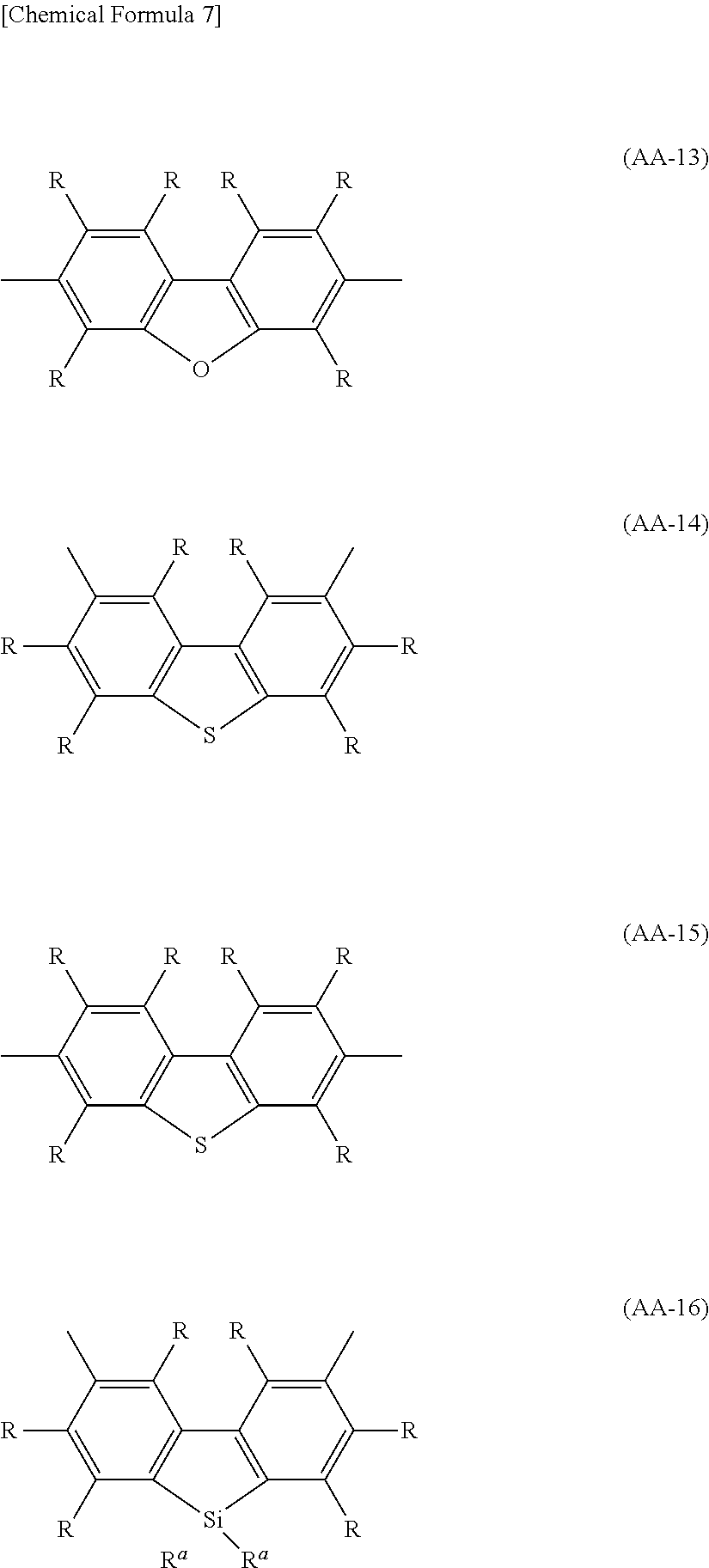


[wherein, R and Ra represent the same meaning as described above.]


[wherein,
—RE2-{(QE1)nF2-YE1(ME1)aE1(2E1)bE1}mE1 (ES-1)
[wherein,
—O—(Cn.H2n.O)nx-Cm.H2m.+1 (ES-3)
[wherein, n′, m′ and nx each independently represent an integer of 1 or more.]
—O—RE2′-{(QE1)nE2-YE1 (ME1)aE1(ZE1)bE1}mE1


[wherein, M+ represents Li+, Na+, K+, Cs+ or N(CH3)4 +. When a plurality of M+ are present, they may be the same or different.]


wherein,

[wherein, nH3, LH1, nE3, RE3, ArH1, ArH2, nE4, nE5, RE4 and RE5 represent the same meaning as described. above.]


[wherein, M+ represents Li+, Na+, K+, Cs+ or N(CH3)4 +. When a plurality of M+ are present, they may be the same or different.]


| TABLE 1 | |||||
| viscosity | |||||
| composition | (Pa · s) | dischargeability | clogging | ||
| Example 1 | 1 | 0.0177 | ∘ | ∘ |
| Example 2 | 2 | 0.0221 | ∘ | ∘ |
| Example 3 | 3 | 0.0247 | ∘ | ∘ |
| Example 4 | 4 | 0.0111 | ∘ | ∘ |
| Example 5 | 5 | 0.0200 | ∘ | ∘ |
| Example 6 | 6 | 0.0160 | ∘ | ∘ |
| Example 7 | 7 | 0.0090 | ∘ | ∘ |
| Example 8 | 8 | 0.0200 | ∘ | ∘ |
| Comparative | C1 | 0.0143 | ∘ | x |
| Example 1 | ||||
| Comparative | C2 | 0.0329 | x | ∘ |
| Example 2 | ||||
| Comparative | C3 | 0.0041 | ∘ | x |
| Example 3 | ||||
| Comparative | C4 | 0.0170 | ∘ | x |
| Example 4 | ||||
| Comparative | C5 | 0.0315 | x | ∘ |
| Example 5 | ||||
<Evaluation of Film Formability>
| TABLE 2 | |||||
| film | composition | thickness (nm) | shrink amount (mm) | ||
| 1 | 5 | 10 | 2 | ||
| 2 | 5 | 20 | 3 | ||
| 3 | 5 | 30 | 6 | ||
| 4 | 5 | 40 | 7.5 | ||
| 5 | 6 | 10 | 0 | ||
| 6 | 6 | 20 | 0.5 | ||
| 7 | 6 | 30 | 0.5 | ||
| 8 | 6 | 40 | 0.5 | ||
Claims (11)
CnFH2nF+1-mFFnFOH (1)
Applications Claiming Priority (3)
| Application Number | Priority Date | Filing Date | Title |
|---|---|---|---|
| JP2017-012846 | 2017-01-27 | ||
| JP2017012846 | 2017-01-27 | ||
| PCT/JP2018/001941 WO2018139442A1 (en) | 2017-01-27 | 2018-01-23 | Composition, film using said composition, and method for producing light emitting element |
Publications (2)
| Publication Number | Publication Date |
|---|---|
| US20190386222A1 US20190386222A1 (en) | 2019-12-19 |
| US10916706B2 true US10916706B2 (en) | 2021-02-09 |
Family
ID=62978492
Family Applications (1)
| Application Number | Title | Priority Date | Filing Date |
|---|---|---|---|
| US16/480,719 Expired - Fee Related US10916706B2 (en) | 2017-01-27 | 2018-01-23 | Composition, film production method, and light emitting device |
Country Status (6)
| Country | Link |
|---|---|
| US (1) | US10916706B2 (en) |
| EP (1) | EP3576175B1 (en) |
| JP (2) | JP6332582B1 (en) |
| KR (1) | KR102428038B1 (en) |
| CN (1) | CN110235267B (en) |
| WO (1) | WO2018139442A1 (en) |
Families Citing this family (4)
| Publication number | Priority date | Publication date | Assignee | Title |
|---|---|---|---|---|
| JP2020128525A (en) * | 2019-02-08 | 2020-08-27 | 住友化学株式会社 | Polymer compound and light-emitting device using the same |
| CN112300631A (en) * | 2020-11-06 | 2021-02-02 | 广东聚华印刷显示技术有限公司 | Ink for ink-jet printing, preparation method thereof and light-emitting device |
| CN112831009A (en) * | 2021-03-15 | 2021-05-25 | 重庆建峰浩康化工有限公司 | Preparation method of fluorine-containing monohydric alcohol mixed etherified modified amino resin |
| KR20230001053A (en) | 2021-06-25 | 2023-01-04 | 삼성디스플레이 주식회사 | Ink composition for light emitting device and light emitting device made with same |
Citations (8)
| Publication number | Priority date | Publication date | Assignee | Title |
|---|---|---|---|---|
| WO2009063850A1 (en) | 2007-11-12 | 2009-05-22 | Konica Minolta Holdings, Inc. | Method for manufacturing organic electronic element |
| JP2010192369A (en) | 2009-02-20 | 2010-09-02 | Konica Minolta Holdings Inc | Method of manufacturing organic electroluminescent element and organic electroluminescent elelement manufactured by this method |
| WO2012063656A1 (en) | 2010-11-08 | 2012-05-18 | コニカミノルタホールディングス株式会社 | Process for producing organic electroluminescent element |
| JP2013166871A (en) | 2012-02-16 | 2013-08-29 | Sumitomo Chemical Co Ltd | Film forming composition and film forming method using the same, laminate structure and organic electronic element |
| JP2013200941A (en) | 2012-03-23 | 2013-10-03 | Konica Minolta Inc | Method of manufacturing organic electroluminescent element |
| JP2014044972A (en) | 2012-08-24 | 2014-03-13 | Konica Minolta Inc | Organic electroluminescent element, display device, lighting device, and method of manufacturing organic electroluminescent element |
| JP2015038976A (en) | 2013-07-19 | 2015-02-26 | セントラル硝子株式会社 | Film forming composition, film thereof, and method for producing organic semiconductor element using the same |
| JP2017183409A (en) | 2016-03-29 | 2017-10-05 | 住友化学株式会社 | Light-emitting device and method of manufacturing the same |
Family Cites Families (12)
| Publication number | Priority date | Publication date | Assignee | Title |
|---|---|---|---|---|
| JP2005029540A (en) * | 2003-07-11 | 2005-02-03 | Jsr Corp | Novel fluorine-containing unsaturated alcohol and process for producing the same |
| EP2846374B1 (en) | 2008-03-07 | 2019-11-06 | Sumitomo Chemical Company Limited | Layered structure |
| JP5720097B2 (en) | 2009-01-20 | 2015-05-20 | 住友化学株式会社 | Metaphenylene polymer compound and light emitting device using the same |
| KR101704090B1 (en) | 2009-09-30 | 2017-02-07 | 스미또모 가가꾸 가부시키가이샤 | Laminated structure, polymer, electroluminescent element, and photoelectric conversion element |
| US9389525B2 (en) * | 2011-03-09 | 2016-07-12 | Fuji Xerox Co., Ltd. | Fluorine-containing resin particle dispersion, method for preparing fluorine-containing resin particle dispersion, coating liquid which contains fluorine-containing resin particles, method for preparing coating film which contains fluorine-containing resin particles, coating film which contains fluorine-containing resin particles, molded body, electrophotographic photoreceptor, method for preparing electrophotographic photoreceptor, image forming apparatus, and process cartridge |
| JP5724471B2 (en) * | 2011-03-09 | 2015-05-27 | 富士ゼロックス株式会社 | Electrophotographic photoreceptor, method for producing electrophotographic photoreceptor, image forming apparatus, and process cartridge |
| WO2012133465A1 (en) | 2011-03-28 | 2012-10-04 | 住友化学株式会社 | Electronic device, polymer compound, organic compound, and method of producing polymer compound |
| WO2012133381A1 (en) | 2011-03-28 | 2012-10-04 | 住友化学株式会社 | Electronic device, polymer compound |
| JP2012216822A (en) | 2011-03-28 | 2012-11-08 | Sumitomo Chemical Co Ltd | Electronic device, polymer compound |
| CN113248975B (en) * | 2014-10-24 | 2023-06-16 | 精工爱普生株式会社 | Inkjet ink composition and inkjet recording method |
| CN104829432B (en) * | 2015-03-18 | 2017-02-01 | 武汉工程大学 | Method of preparing fluoroalcohol |
| JP6549434B2 (en) * | 2015-07-15 | 2019-07-24 | コニカミノルタ株式会社 | Method of manufacturing organic electroluminescent device |
-
2018
- 2018-01-23 JP JP2018506635A patent/JP6332582B1/en active Active
- 2018-01-23 KR KR1020197024413A patent/KR102428038B1/en active Active
- 2018-01-23 CN CN201880008561.2A patent/CN110235267B/en not_active Expired - Fee Related
- 2018-01-23 US US16/480,719 patent/US10916706B2/en not_active Expired - Fee Related
- 2018-01-23 WO PCT/JP2018/001941 patent/WO2018139442A1/en not_active Ceased
- 2018-01-23 EP EP18744168.8A patent/EP3576175B1/en active Active
- 2018-04-25 JP JP2018083718A patent/JP2018125300A/en active Pending
Patent Citations (11)
| Publication number | Priority date | Publication date | Assignee | Title |
|---|---|---|---|---|
| WO2009063850A1 (en) | 2007-11-12 | 2009-05-22 | Konica Minolta Holdings, Inc. | Method for manufacturing organic electronic element |
| US20100267180A1 (en) | 2007-11-12 | 2010-10-21 | Konica Minolta Holdings, Inc. | Method for manufacturing organic electronic element |
| JP2010192369A (en) | 2009-02-20 | 2010-09-02 | Konica Minolta Holdings Inc | Method of manufacturing organic electroluminescent element and organic electroluminescent elelement manufactured by this method |
| WO2012063656A1 (en) | 2010-11-08 | 2012-05-18 | コニカミノルタホールディングス株式会社 | Process for producing organic electroluminescent element |
| JP2013166871A (en) | 2012-02-16 | 2013-08-29 | Sumitomo Chemical Co Ltd | Film forming composition and film forming method using the same, laminate structure and organic electronic element |
| JP2013200941A (en) | 2012-03-23 | 2013-10-03 | Konica Minolta Inc | Method of manufacturing organic electroluminescent element |
| JP2014044972A (en) | 2012-08-24 | 2014-03-13 | Konica Minolta Inc | Organic electroluminescent element, display device, lighting device, and method of manufacturing organic electroluminescent element |
| JP2015038976A (en) | 2013-07-19 | 2015-02-26 | セントラル硝子株式会社 | Film forming composition, film thereof, and method for producing organic semiconductor element using the same |
| US20160181531A1 (en) | 2013-07-19 | 2016-06-23 | Central Glass Company, Limited | Film-Forming Composition, Film Formed Thereby, and Method for Manufacturing Organic Semiconductor Element Using Same |
| JP2017183409A (en) | 2016-03-29 | 2017-10-05 | 住友化学株式会社 | Light-emitting device and method of manufacturing the same |
| US20190048131A1 (en) | 2016-03-29 | 2019-02-14 | Sumitomo Chemical Company, Limited | Light-emitting device and method for producing same |
Non-Patent Citations (2)
| Title |
|---|
| International Search Report dated Apr. 3, 2018 in International Application No. PCT/JP2018/001941. |
| Written Opinion dated Apr. 3, 2018 in International Application No. PCT/JP2018/001941. |
Also Published As
| Publication number | Publication date |
|---|---|
| JPWO2018139442A1 (en) | 2019-01-31 |
| EP3576175B1 (en) | 2021-06-16 |
| JP6332582B1 (en) | 2018-05-30 |
| WO2018139442A1 (en) | 2018-08-02 |
| EP3576175A4 (en) | 2020-10-28 |
| CN110235267B (en) | 2021-07-13 |
| KR102428038B1 (en) | 2022-08-03 |
| CN110235267A (en) | 2019-09-13 |
| US20190386222A1 (en) | 2019-12-19 |
| EP3576175A1 (en) | 2019-12-04 |
| KR20190112015A (en) | 2019-10-02 |
| JP2018125300A (en) | 2018-08-09 |
Similar Documents
| Publication | Publication Date | Title |
|---|---|---|
| US11271166B2 (en) | Light emitting device and composition useful for production of same light emitting device | |
| US20200203615A1 (en) | Light-emitting device | |
| US10916706B2 (en) | Composition, film production method, and light emitting device | |
| US11424410B2 (en) | Light emitting device | |
| JP2018061029A (en) | Light emitting element | |
| US11158806B2 (en) | Film for light emitting device and light emitting device using the same | |
| JP2019050371A (en) | Light-emitting element | |
| US20200216480A1 (en) | Light emitting device | |
| US10811610B2 (en) | Composition and light emitting device obtained by using the composition | |
| US20200407386A1 (en) | Composition and light emitting device using the same | |
| US20200152882A1 (en) | Light emitting device | |
| JP2017183724A (en) | Light-emitting element | |
| JP6596918B2 (en) | Light emitting element | |
| US10686135B2 (en) | Composition | |
| EP3576176B1 (en) | Composition for a light emitting element | |
| US20190341560A1 (en) | Light emitting device, and metal complex and composition used in same | |
| US20230192737A1 (en) | Metal complex, composition and light emitting element |
Legal Events
| Date | Code | Title | Description |
|---|---|---|---|
| AS | Assignment |
Owner name: SUMITOMO CHEMICAL COMPANY, LIMITED, JAPAN Free format text: ASSIGNMENT OF ASSIGNORS INTEREST;ASSIGNORS:TANAKA, MASANOBU;NODA, MOTOO;SIGNING DATES FROM 20190530 TO 20190603;REEL/FRAME:049857/0356 |
|
| FEPP | Fee payment procedure |
Free format text: ENTITY STATUS SET TO UNDISCOUNTED (ORIGINAL EVENT CODE: BIG.); ENTITY STATUS OF PATENT OWNER: LARGE ENTITY |
|
| STPP | Information on status: patent application and granting procedure in general |
Free format text: NON FINAL ACTION MAILED |
|
| STPP | Information on status: patent application and granting procedure in general |
Free format text: NOTICE OF ALLOWANCE MAILED -- APPLICATION RECEIVED IN OFFICE OF PUBLICATIONS |
|
| STCF | Information on status: patent grant |
Free format text: PATENTED CASE |
|
| FEPP | Fee payment procedure |
Free format text: MAINTENANCE FEE REMINDER MAILED (ORIGINAL EVENT CODE: REM.); ENTITY STATUS OF PATENT OWNER: LARGE ENTITY |
|
| LAPS | Lapse for failure to pay maintenance fees |
Free format text: PATENT EXPIRED FOR FAILURE TO PAY MAINTENANCE FEES (ORIGINAL EVENT CODE: EXP.); ENTITY STATUS OF PATENT OWNER: LARGE ENTITY |
|
| STCH | Information on status: patent discontinuation |
Free format text: PATENT EXPIRED DUE TO NONPAYMENT OF MAINTENANCE FEES UNDER 37 CFR 1.362 |
|
| FP | Lapsed due to failure to pay maintenance fee |
Effective date: 20250209 |