US10907473B2 - Low volume in-line filtration methods for analyzing hydrocarbon-containing fluid to evaluate asphaltene content and behavior during production operations - Google Patents
Low volume in-line filtration methods for analyzing hydrocarbon-containing fluid to evaluate asphaltene content and behavior during production operations Download PDFInfo
- Publication number
- US10907473B2 US10907473B2 US15/811,972 US201715811972A US10907473B2 US 10907473 B2 US10907473 B2 US 10907473B2 US 201715811972 A US201715811972 A US 201715811972A US 10907473 B2 US10907473 B2 US 10907473B2
- Authority
- US
- United States
- Prior art keywords
- asphaltenes
- solvents
- asphaltene
- amount
- eluted fraction
- Prior art date
- Legal status (The legal status is an assumption and is not a legal conclusion. Google has not performed a legal analysis and makes no representation as to the accuracy of the status listed.)
- Active, expires
Links
- 239000012530 fluid Substances 0.000 title claims abstract description 80
- 229930195733 hydrocarbon Natural products 0.000 title claims abstract description 69
- 150000002430 hydrocarbons Chemical class 0.000 title claims abstract description 69
- 239000004215 Carbon black (E152) Substances 0.000 title claims abstract description 66
- 238000004519 manufacturing process Methods 0.000 title claims abstract description 56
- 238000001914 filtration Methods 0.000 title claims description 17
- 238000000034 method Methods 0.000 claims abstract description 75
- 239000002904 solvent Substances 0.000 claims description 200
- 239000000654 additive Substances 0.000 claims description 64
- 150000001335 aliphatic alkanes Chemical class 0.000 claims description 63
- 239000002270 dispersing agent Substances 0.000 claims description 50
- 239000002245 particle Substances 0.000 claims description 44
- 239000007787 solid Substances 0.000 claims description 38
- 230000000996 additive effect Effects 0.000 claims description 25
- 238000001556 precipitation Methods 0.000 claims description 20
- 238000004811 liquid chromatography Methods 0.000 claims description 10
- 238000011084 recovery Methods 0.000 claims description 8
- 238000012544 monitoring process Methods 0.000 claims description 5
- 230000002401 inhibitory effect Effects 0.000 claims description 4
- 239000000243 solution Substances 0.000 description 75
- -1 clays Chemical compound 0.000 description 60
- 239000000203 mixture Substances 0.000 description 53
- YMWUJEATGCHHMB-UHFFFAOYSA-N Dichloromethane Chemical compound ClCCl YMWUJEATGCHHMB-UHFFFAOYSA-N 0.000 description 51
- 150000001875 compounds Chemical class 0.000 description 50
- 239000010779 crude oil Substances 0.000 description 40
- OKKJLVBELUTLKV-UHFFFAOYSA-N Methanol Chemical compound OC OKKJLVBELUTLKV-UHFFFAOYSA-N 0.000 description 36
- IMNFDUFMRHMDMM-UHFFFAOYSA-N N-Heptane Chemical compound CCCCCCC IMNFDUFMRHMDMM-UHFFFAOYSA-N 0.000 description 32
- 125000004432 carbon atom Chemical group C* 0.000 description 27
- 125000000217 alkyl group Chemical group 0.000 description 24
- 238000012545 processing Methods 0.000 description 23
- 239000002253 acid Substances 0.000 description 19
- 150000001412 amines Chemical class 0.000 description 17
- 238000006243 chemical reaction Methods 0.000 description 16
- 239000000463 material Substances 0.000 description 16
- 239000003921 oil Substances 0.000 description 16
- 235000019198 oils Nutrition 0.000 description 16
- 150000001336 alkenes Chemical class 0.000 description 14
- 238000002474 experimental method Methods 0.000 description 14
- OFBQJSOFQDEBGM-UHFFFAOYSA-N Pentane Chemical compound CCCCC OFBQJSOFQDEBGM-UHFFFAOYSA-N 0.000 description 12
- 125000002887 hydroxy group Chemical group [H]O* 0.000 description 12
- 238000009826 distribution Methods 0.000 description 11
- 239000007788 liquid Substances 0.000 description 11
- 239000000047 product Substances 0.000 description 11
- CURLTUGMZLYLDI-UHFFFAOYSA-N Carbon dioxide Chemical compound O=C=O CURLTUGMZLYLDI-UHFFFAOYSA-N 0.000 description 10
- 235000014113 dietary fatty acids Nutrition 0.000 description 10
- 238000000105 evaporative light scattering detection Methods 0.000 description 10
- 239000000194 fatty acid Substances 0.000 description 10
- 229930195729 fatty acid Natural products 0.000 description 10
- 125000000524 functional group Chemical group 0.000 description 10
- 239000010935 stainless steel Substances 0.000 description 10
- 229910001220 stainless steel Inorganic materials 0.000 description 10
- 238000003860 storage Methods 0.000 description 10
- 125000001424 substituent group Chemical group 0.000 description 10
- RTZKZFJDLAIYFH-UHFFFAOYSA-N Diethyl ether Chemical compound CCOCC RTZKZFJDLAIYFH-UHFFFAOYSA-N 0.000 description 9
- 229920002367 Polyisobutene Polymers 0.000 description 9
- ATUOYWHBWRKTHZ-UHFFFAOYSA-N Propane Chemical compound CCC ATUOYWHBWRKTHZ-UHFFFAOYSA-N 0.000 description 9
- 239000007795 chemical reaction product Substances 0.000 description 9
- 239000011162 core material Substances 0.000 description 9
- 238000010828 elution Methods 0.000 description 9
- UFWIBTONFRDIAS-UHFFFAOYSA-N Naphthalene Chemical compound C1=CC=CC2=CC=CC=C21 UFWIBTONFRDIAS-UHFFFAOYSA-N 0.000 description 8
- 230000000875 corresponding effect Effects 0.000 description 8
- 239000001257 hydrogen Substances 0.000 description 8
- 229910052739 hydrogen Inorganic materials 0.000 description 8
- 230000009467 reduction Effects 0.000 description 8
- 239000011148 porous material Substances 0.000 description 7
- 229920005989 resin Polymers 0.000 description 7
- 239000011347 resin Substances 0.000 description 7
- 150000003839 salts Chemical class 0.000 description 7
- 239000000126 substance Substances 0.000 description 7
- 229940014800 succinic anhydride Drugs 0.000 description 7
- IJGRMHOSHXDMSA-UHFFFAOYSA-N Atomic nitrogen Chemical compound N#N IJGRMHOSHXDMSA-UHFFFAOYSA-N 0.000 description 6
- OKTJSMMVPCPJKN-UHFFFAOYSA-N Carbon Chemical compound [C] OKTJSMMVPCPJKN-UHFFFAOYSA-N 0.000 description 6
- VQTUBCCKSQIDNK-UHFFFAOYSA-N Isobutene Chemical compound CC(C)=C VQTUBCCKSQIDNK-UHFFFAOYSA-N 0.000 description 6
- 239000004696 Poly ether ether ketone Substances 0.000 description 6
- YXFVVABEGXRONW-UHFFFAOYSA-N Toluene Chemical compound CC1=CC=CC=C1 YXFVVABEGXRONW-UHFFFAOYSA-N 0.000 description 6
- 150000007513 acids Chemical class 0.000 description 6
- 150000008064 anhydrides Chemical class 0.000 description 6
- 230000006399 behavior Effects 0.000 description 6
- 229910052799 carbon Inorganic materials 0.000 description 6
- 229910002092 carbon dioxide Inorganic materials 0.000 description 6
- 229920002530 polyetherether ketone Polymers 0.000 description 6
- 238000006277 sulfonation reaction Methods 0.000 description 6
- AKEJUJNQAAGONA-UHFFFAOYSA-N sulfur trioxide Chemical compound O=S(=O)=O AKEJUJNQAAGONA-UHFFFAOYSA-N 0.000 description 6
- FALRKNHUBBKYCC-UHFFFAOYSA-N 2-(chloromethyl)pyridine-3-carbonitrile Chemical compound ClCC1=NC=CC=C1C#N FALRKNHUBBKYCC-UHFFFAOYSA-N 0.000 description 5
- KXDHJXZQYSOELW-UHFFFAOYSA-N Carbamic acid Chemical compound NC(O)=O KXDHJXZQYSOELW-UHFFFAOYSA-N 0.000 description 5
- 125000003178 carboxy group Chemical group [H]OC(*)=O 0.000 description 5
- 150000001732 carboxylic acid derivatives Chemical class 0.000 description 5
- 150000008280 chlorinated hydrocarbons Chemical class 0.000 description 5
- 150000004665 fatty acids Chemical class 0.000 description 5
- 239000007789 gas Substances 0.000 description 5
- 150000003903 lactic acid esters Chemical class 0.000 description 5
- 229920000642 polymer Polymers 0.000 description 5
- 230000008569 process Effects 0.000 description 5
- 238000011282 treatment Methods 0.000 description 5
- MUTGBJKUEZFXGO-OLQVQODUSA-N (3as,7ar)-3a,4,5,6,7,7a-hexahydro-2-benzofuran-1,3-dione Chemical compound C1CCC[C@@H]2C(=O)OC(=O)[C@@H]21 MUTGBJKUEZFXGO-OLQVQODUSA-N 0.000 description 4
- OZAIFHULBGXAKX-UHFFFAOYSA-N 2-(2-cyanopropan-2-yldiazenyl)-2-methylpropanenitrile Chemical compound N#CC(C)(C)N=NC(C)(C)C#N OZAIFHULBGXAKX-UHFFFAOYSA-N 0.000 description 4
- LFQSCWFLJHTTHZ-UHFFFAOYSA-N Ethanol Chemical compound CCO LFQSCWFLJHTTHZ-UHFFFAOYSA-N 0.000 description 4
- 239000002841 Lewis acid Substances 0.000 description 4
- YNAVUWVOSKDBBP-UHFFFAOYSA-N Morpholine Chemical compound C1COCCN1 YNAVUWVOSKDBBP-UHFFFAOYSA-N 0.000 description 4
- ISWSIDIOOBJBQZ-UHFFFAOYSA-N Phenol Chemical compound OC1=CC=CC=C1 ISWSIDIOOBJBQZ-UHFFFAOYSA-N 0.000 description 4
- QQONPFPTGQHPMA-UHFFFAOYSA-N Propene Chemical compound CC=C QQONPFPTGQHPMA-UHFFFAOYSA-N 0.000 description 4
- 239000000443 aerosol Substances 0.000 description 4
- 125000001931 aliphatic group Chemical group 0.000 description 4
- 125000003118 aryl group Chemical group 0.000 description 4
- 238000004364 calculation method Methods 0.000 description 4
- 238000011088 calibration curve Methods 0.000 description 4
- 238000004891 communication Methods 0.000 description 4
- 230000001186 cumulative effect Effects 0.000 description 4
- 238000013461 design Methods 0.000 description 4
- 230000000694 effects Effects 0.000 description 4
- 150000002148 esters Chemical class 0.000 description 4
- LZCLXQDLBQLTDK-UHFFFAOYSA-N ethyl 2-hydroxypropanoate Chemical group CCOC(=O)C(C)O LZCLXQDLBQLTDK-UHFFFAOYSA-N 0.000 description 4
- 125000000623 heterocyclic group Chemical group 0.000 description 4
- 238000004128 high performance liquid chromatography Methods 0.000 description 4
- 150000002466 imines Chemical class 0.000 description 4
- 239000003999 initiator Substances 0.000 description 4
- JVTAAEKCZFNVCJ-UHFFFAOYSA-N lactic acid Chemical compound CC(O)C(O)=O JVTAAEKCZFNVCJ-UHFFFAOYSA-N 0.000 description 4
- 150000007517 lewis acids Chemical class 0.000 description 4
- 230000004048 modification Effects 0.000 description 4
- 238000012986 modification Methods 0.000 description 4
- 229910052757 nitrogen Inorganic materials 0.000 description 4
- 239000001294 propane Substances 0.000 description 4
- 230000004044 response Effects 0.000 description 4
- 229910052717 sulfur Inorganic materials 0.000 description 4
- QIJIUJYANDSEKG-UHFFFAOYSA-N 2,4,4-trimethylpentan-2-amine Chemical compound CC(C)(C)CC(C)(C)N QIJIUJYANDSEKG-UHFFFAOYSA-N 0.000 description 3
- LSNNMFCWUKXFEE-UHFFFAOYSA-M Bisulfite Chemical compound OS([O-])=O LSNNMFCWUKXFEE-UHFFFAOYSA-M 0.000 description 3
- WSFSSNUMVMOOMR-UHFFFAOYSA-N Formaldehyde Chemical compound O=C WSFSSNUMVMOOMR-UHFFFAOYSA-N 0.000 description 3
- UFHFLCQGNIYNRP-UHFFFAOYSA-N Hydrogen Chemical compound [H][H] UFHFLCQGNIYNRP-UHFFFAOYSA-N 0.000 description 3
- ABLZXFCXXLZCGV-UHFFFAOYSA-N Phosphorous acid Chemical compound OP(O)=O ABLZXFCXXLZCGV-UHFFFAOYSA-N 0.000 description 3
- NINIDFKCEFEMDL-UHFFFAOYSA-N Sulfur Chemical compound [S] NINIDFKCEFEMDL-UHFFFAOYSA-N 0.000 description 3
- RTAQQCXQSZGOHL-UHFFFAOYSA-N Titanium Chemical compound [Ti] RTAQQCXQSZGOHL-UHFFFAOYSA-N 0.000 description 3
- 150000008065 acid anhydrides Chemical class 0.000 description 3
- 230000002378 acidificating effect Effects 0.000 description 3
- 239000005456 alcohol based solvent Substances 0.000 description 3
- 125000003342 alkenyl group Chemical group 0.000 description 3
- 125000003368 amide group Chemical group 0.000 description 3
- 150000004945 aromatic hydrocarbons Chemical class 0.000 description 3
- 239000003849 aromatic solvent Substances 0.000 description 3
- 230000008901 benefit Effects 0.000 description 3
- 230000015572 biosynthetic process Effects 0.000 description 3
- 150000007942 carboxylates Chemical class 0.000 description 3
- 239000003054 catalyst Substances 0.000 description 3
- 238000006482 condensation reaction Methods 0.000 description 3
- 125000004122 cyclic group Chemical group 0.000 description 3
- 230000008021 deposition Effects 0.000 description 3
- ZBCBWPMODOFKDW-UHFFFAOYSA-N diethanolamine Chemical compound OCCNCCO ZBCBWPMODOFKDW-UHFFFAOYSA-N 0.000 description 3
- LVTYICIALWPMFW-UHFFFAOYSA-N diisopropanolamine Chemical compound CC(O)CNCC(C)O LVTYICIALWPMFW-UHFFFAOYSA-N 0.000 description 3
- 239000006185 dispersion Substances 0.000 description 3
- 239000008157 edible vegetable oil Substances 0.000 description 3
- 238000005516 engineering process Methods 0.000 description 3
- 229910052751 metal Inorganic materials 0.000 description 3
- 239000002184 metal Substances 0.000 description 3
- 239000000178 monomer Substances 0.000 description 3
- WWZKQHOCKIZLMA-UHFFFAOYSA-N octanoic acid Chemical compound CCCCCCCC(O)=O WWZKQHOCKIZLMA-UHFFFAOYSA-N 0.000 description 3
- 150000007524 organic acids Chemical class 0.000 description 3
- 229910052698 phosphorus Inorganic materials 0.000 description 3
- 229920000768 polyamine Polymers 0.000 description 3
- 229920006149 polyester-amide block copolymer Polymers 0.000 description 3
- 239000002244 precipitate Substances 0.000 description 3
- 239000011541 reaction mixture Substances 0.000 description 3
- 230000000717 retained effect Effects 0.000 description 3
- 150000003335 secondary amines Chemical class 0.000 description 3
- 239000011593 sulfur Substances 0.000 description 3
- 238000012360 testing method Methods 0.000 description 3
- 229910052719 titanium Inorganic materials 0.000 description 3
- 239000010936 titanium Substances 0.000 description 3
- 238000011144 upstream manufacturing Methods 0.000 description 3
- 239000004711 α-olefin Substances 0.000 description 3
- WRIDQFICGBMAFQ-UHFFFAOYSA-N (E)-8-Octadecenoic acid Natural products CCCCCCCCCC=CCCCCCCC(O)=O WRIDQFICGBMAFQ-UHFFFAOYSA-N 0.000 description 2
- VXNZUUAINFGPBY-UHFFFAOYSA-N 1-Butene Chemical compound CCC=C VXNZUUAINFGPBY-UHFFFAOYSA-N 0.000 description 2
- LIKMAJRDDDTEIG-UHFFFAOYSA-N 1-hexene Chemical compound CCCCC=C LIKMAJRDDDTEIG-UHFFFAOYSA-N 0.000 description 2
- JOLVYUIAMRUBRK-UHFFFAOYSA-N 11',12',14',15'-Tetradehydro(Z,Z-)-3-(8-Pentadecenyl)phenol Natural products OC1=CC=CC(CCCCCCCC=CCC=CCC=C)=C1 JOLVYUIAMRUBRK-UHFFFAOYSA-N 0.000 description 2
- SMZOUWXMTYCWNB-UHFFFAOYSA-N 2-(2-methoxy-5-methylphenyl)ethanamine Chemical compound COC1=CC=C(C)C=C1CCN SMZOUWXMTYCWNB-UHFFFAOYSA-N 0.000 description 2
- NIXOWILDQLNWCW-UHFFFAOYSA-N 2-Propenoic acid Natural products OC(=O)C=C NIXOWILDQLNWCW-UHFFFAOYSA-N 0.000 description 2
- LQJBNNIYVWPHFW-UHFFFAOYSA-N 20:1omega9c fatty acid Natural products CCCCCCCCCCC=CCCCCCCCC(O)=O LQJBNNIYVWPHFW-UHFFFAOYSA-N 0.000 description 2
- YLKVIMNNMLKUGJ-UHFFFAOYSA-N 3-Delta8-pentadecenylphenol Natural products CCCCCCC=CCCCCCCCC1=CC=CC(O)=C1 YLKVIMNNMLKUGJ-UHFFFAOYSA-N 0.000 description 2
- UYCICMIUKYEYEU-ZHACJKMWSA-N 3-[(e)-dodec-2-enyl]oxolane-2,5-dione Chemical compound CCCCCCCCC\C=C\CC1CC(=O)OC1=O UYCICMIUKYEYEU-ZHACJKMWSA-N 0.000 description 2
- QSBYPNXLFMSGKH-UHFFFAOYSA-N 9-Heptadecensaeure Natural products CCCCCCCC=CCCCCCCCC(O)=O QSBYPNXLFMSGKH-UHFFFAOYSA-N 0.000 description 2
- XKRFYHLGVUSROY-UHFFFAOYSA-N Argon Chemical compound [Ar] XKRFYHLGVUSROY-UHFFFAOYSA-N 0.000 description 2
- JOLVYUIAMRUBRK-UTOQUPLUSA-N Cardanol Chemical compound OC1=CC=CC(CCCCCCC\C=C/C\C=C/CC=C)=C1 JOLVYUIAMRUBRK-UTOQUPLUSA-N 0.000 description 2
- FAYVLNWNMNHXGA-UHFFFAOYSA-N Cardanoldiene Natural products CCCC=CCC=CCCCCCCCC1=CC=CC(O)=C1 FAYVLNWNMNHXGA-UHFFFAOYSA-N 0.000 description 2
- KCXVZYZYPLLWCC-UHFFFAOYSA-N EDTA Chemical compound OC(=O)CN(CC(O)=O)CCN(CC(O)=O)CC(O)=O KCXVZYZYPLLWCC-UHFFFAOYSA-N 0.000 description 2
- VGGSQFUCUMXWEO-UHFFFAOYSA-N Ethene Chemical compound C=C VGGSQFUCUMXWEO-UHFFFAOYSA-N 0.000 description 2
- VZCYOOQTPOCHFL-OWOJBTEDSA-N Fumaric acid Chemical compound OC(=O)\C=C\C(O)=O VZCYOOQTPOCHFL-OWOJBTEDSA-N 0.000 description 2
- 244000068988 Glycine max Species 0.000 description 2
- QIGBRXMKCJKVMJ-UHFFFAOYSA-N Hydroquinone Chemical compound OC1=CC=C(O)C=C1 QIGBRXMKCJKVMJ-UHFFFAOYSA-N 0.000 description 2
- XEEYBQQBJWHFJM-UHFFFAOYSA-N Iron Chemical compound [Fe] XEEYBQQBJWHFJM-UHFFFAOYSA-N 0.000 description 2
- UQSXHKLRYXJYBZ-UHFFFAOYSA-N Iron oxide Chemical compound [Fe]=O UQSXHKLRYXJYBZ-UHFFFAOYSA-N 0.000 description 2
- KFZMGEQAYNKOFK-UHFFFAOYSA-N Isopropanol Chemical compound CC(C)O KFZMGEQAYNKOFK-UHFFFAOYSA-N 0.000 description 2
- CERQOIWHTDAKMF-UHFFFAOYSA-N Methacrylic acid Chemical compound CC(=C)C(O)=O CERQOIWHTDAKMF-UHFFFAOYSA-N 0.000 description 2
- LRHPLDYGYMQRHN-UHFFFAOYSA-N N-Butanol Chemical compound CCCCO LRHPLDYGYMQRHN-UHFFFAOYSA-N 0.000 description 2
- PXHVJJICTQNCMI-UHFFFAOYSA-N Nickel Chemical compound [Ni] PXHVJJICTQNCMI-UHFFFAOYSA-N 0.000 description 2
- ZQPPMHVWECSIRJ-UHFFFAOYSA-N Oleic acid Natural products CCCCCCCCC=CCCCCCCCC(O)=O ZQPPMHVWECSIRJ-UHFFFAOYSA-N 0.000 description 2
- OAICVXFJPJFONN-UHFFFAOYSA-N Phosphorus Chemical compound [P] OAICVXFJPJFONN-UHFFFAOYSA-N 0.000 description 2
- JUJWROOIHBZHMG-UHFFFAOYSA-N Pyridine Chemical compound C1=CC=NC=C1 JUJWROOIHBZHMG-UHFFFAOYSA-N 0.000 description 2
- BQCADISMDOOEFD-UHFFFAOYSA-N Silver Chemical compound [Ag] BQCADISMDOOEFD-UHFFFAOYSA-N 0.000 description 2
- 238000010793 Steam injection (oil industry) Methods 0.000 description 2
- DKGAVHZHDRPRBM-UHFFFAOYSA-N Tert-Butanol Chemical compound CC(C)(C)O DKGAVHZHDRPRBM-UHFFFAOYSA-N 0.000 description 2
- 240000008042 Zea mays Species 0.000 description 2
- 235000005824 Zea mays ssp. parviglumis Nutrition 0.000 description 2
- 235000002017 Zea mays subsp mays Nutrition 0.000 description 2
- 239000008186 active pharmaceutical agent Substances 0.000 description 2
- 150000003973 alkyl amines Chemical class 0.000 description 2
- 229910045601 alloy Inorganic materials 0.000 description 2
- 239000000956 alloy Substances 0.000 description 2
- XXROGKLTLUQVRX-UHFFFAOYSA-N allyl alcohol Chemical compound OCC=C XXROGKLTLUQVRX-UHFFFAOYSA-N 0.000 description 2
- 229910052782 aluminium Inorganic materials 0.000 description 2
- XAGFODPZIPBFFR-UHFFFAOYSA-N aluminium Chemical compound [Al] XAGFODPZIPBFFR-UHFFFAOYSA-N 0.000 description 2
- 125000003277 amino group Chemical group 0.000 description 2
- 150000001450 anions Chemical class 0.000 description 2
- 125000003710 aryl alkyl group Chemical group 0.000 description 2
- 125000004429 atom Chemical group 0.000 description 2
- QVGXLLKOCUKJST-UHFFFAOYSA-N atomic oxygen Chemical compound [O] QVGXLLKOCUKJST-UHFFFAOYSA-N 0.000 description 2
- BTANRVKWQNVYAZ-UHFFFAOYSA-N butan-2-ol Chemical compound CCC(C)O BTANRVKWQNVYAZ-UHFFFAOYSA-N 0.000 description 2
- IAQRGUVFOMOMEM-UHFFFAOYSA-N butene Natural products CC=CC IAQRGUVFOMOMEM-UHFFFAOYSA-N 0.000 description 2
- 239000001569 carbon dioxide Substances 0.000 description 2
- PTFIPECGHSYQNR-UHFFFAOYSA-N cardanol Natural products CCCCCCCCCCCCCCCC1=CC=CC(O)=C1 PTFIPECGHSYQNR-UHFFFAOYSA-N 0.000 description 2
- YCIMNLLNPGFGHC-UHFFFAOYSA-N catechol Chemical compound OC1=CC=CC=C1O YCIMNLLNPGFGHC-UHFFFAOYSA-N 0.000 description 2
- 150000001768 cations Chemical class 0.000 description 2
- 230000008859 change Effects 0.000 description 2
- 239000003795 chemical substances by application Substances 0.000 description 2
- 238000004587 chromatography analysis Methods 0.000 description 2
- 239000002131 composite material Substances 0.000 description 2
- 238000009833 condensation Methods 0.000 description 2
- 230000005494 condensation Effects 0.000 description 2
- 239000000470 constituent Substances 0.000 description 2
- 235000005822 corn Nutrition 0.000 description 2
- 230000002596 correlated effect Effects 0.000 description 2
- 239000000412 dendrimer Substances 0.000 description 2
- 229920000736 dendritic polymer Polymers 0.000 description 2
- VILAVOFMIJHSJA-UHFFFAOYSA-N dicarbon monoxide Chemical compound [C]=C=O VILAVOFMIJHSJA-UHFFFAOYSA-N 0.000 description 2
- POULHZVOKOAJMA-UHFFFAOYSA-N dodecanoic acid Chemical compound CCCCCCCCCCCC(O)=O POULHZVOKOAJMA-UHFFFAOYSA-N 0.000 description 2
- XXUJMEYKYHETBZ-UHFFFAOYSA-N ethyl 4-nitrophenyl ethylphosphonate Chemical compound CCOP(=O)(CC)OC1=CC=C([N+]([O-])=O)C=C1 XXUJMEYKYHETBZ-UHFFFAOYSA-N 0.000 description 2
- 229940116333 ethyl lactate Drugs 0.000 description 2
- 230000006870 function Effects 0.000 description 2
- PCHJSUWPFVWCPO-UHFFFAOYSA-N gold Chemical compound [Au] PCHJSUWPFVWCPO-UHFFFAOYSA-N 0.000 description 2
- 229910052737 gold Inorganic materials 0.000 description 2
- 239000010931 gold Substances 0.000 description 2
- 150000002431 hydrogen Chemical group 0.000 description 2
- 125000002636 imidazolinyl group Chemical group 0.000 description 2
- 238000002347 injection Methods 0.000 description 2
- 239000007924 injection Substances 0.000 description 2
- QXJSBBXBKPUZAA-UHFFFAOYSA-N isooleic acid Natural products CCCCCCCC=CCCCCCCCCC(O)=O QXJSBBXBKPUZAA-UHFFFAOYSA-N 0.000 description 2
- 239000004310 lactic acid Substances 0.000 description 2
- 235000014655 lactic acid Nutrition 0.000 description 2
- 230000000670 limiting effect Effects 0.000 description 2
- 235000020778 linoleic acid Nutrition 0.000 description 2
- OYHQOLUKZRVURQ-HZJYTTRNSA-N linoleic acid group Chemical group C(CCCCCCC\C=C/C\C=C/CCCCC)(=O)O OYHQOLUKZRVURQ-HZJYTTRNSA-N 0.000 description 2
- 238000004949 mass spectrometry Methods 0.000 description 2
- VNWKTOKETHGBQD-UHFFFAOYSA-N methane Chemical compound C VNWKTOKETHGBQD-UHFFFAOYSA-N 0.000 description 2
- VLKZOEOYAKHREP-UHFFFAOYSA-N n-Hexane Chemical compound CCCCCC VLKZOEOYAKHREP-UHFFFAOYSA-N 0.000 description 2
- ZQPPMHVWECSIRJ-KTKRTIGZSA-N oleic acid Chemical compound CCCCCCCC\C=C/CCCCCCCC(O)=O ZQPPMHVWECSIRJ-KTKRTIGZSA-N 0.000 description 2
- 235000021313 oleic acid Nutrition 0.000 description 2
- 239000003960 organic solvent Substances 0.000 description 2
- 239000001301 oxygen Substances 0.000 description 2
- 229910052760 oxygen Inorganic materials 0.000 description 2
- 230000020477 pH reduction Effects 0.000 description 2
- YWAKXRMUMFPDSH-UHFFFAOYSA-N pentene Chemical compound CCCC=C YWAKXRMUMFPDSH-UHFFFAOYSA-N 0.000 description 2
- 229920001568 phenolic resin Polymers 0.000 description 2
- UEZVMMHDMIWARA-UHFFFAOYSA-M phosphonate Chemical compound [O-]P(=O)=O UEZVMMHDMIWARA-UHFFFAOYSA-M 0.000 description 2
- 239000011574 phosphorus Substances 0.000 description 2
- 150000004885 piperazines Chemical class 0.000 description 2
- 229920001281 polyalkylene Polymers 0.000 description 2
- 238000006068 polycondensation reaction Methods 0.000 description 2
- 238000002360 preparation method Methods 0.000 description 2
- 150000003141 primary amines Chemical class 0.000 description 2
- 125000002924 primary amino group Chemical group [H]N([H])* 0.000 description 2
- WQGWDDDVZFFDIG-UHFFFAOYSA-N pyrogallol Chemical compound OC1=CC=CC(O)=C1O WQGWDDDVZFFDIG-UHFFFAOYSA-N 0.000 description 2
- 238000004451 qualitative analysis Methods 0.000 description 2
- 238000011002 quantification Methods 0.000 description 2
- 238000004445 quantitative analysis Methods 0.000 description 2
- 230000035484 reaction time Effects 0.000 description 2
- 238000005067 remediation Methods 0.000 description 2
- GHMLBKRAJCXXBS-UHFFFAOYSA-N resorcinol Chemical compound OC1=CC=CC(O)=C1 GHMLBKRAJCXXBS-UHFFFAOYSA-N 0.000 description 2
- 239000004576 sand Substances 0.000 description 2
- 238000000926 separation method Methods 0.000 description 2
- 229910052709 silver Inorganic materials 0.000 description 2
- 239000004332 silver Substances 0.000 description 2
- 238000003756 stirring Methods 0.000 description 2
- 150000003512 tertiary amines Chemical group 0.000 description 2
- 150000003568 thioethers Chemical class 0.000 description 2
- VZCYOOQTPOCHFL-UHFFFAOYSA-N trans-butenedioic acid Natural products OC(=O)C=CC(O)=O VZCYOOQTPOCHFL-UHFFFAOYSA-N 0.000 description 2
- 229930195735 unsaturated hydrocarbon Natural products 0.000 description 2
- XLYOFNOQVPJJNP-UHFFFAOYSA-N water Substances O XLYOFNOQVPJJNP-UHFFFAOYSA-N 0.000 description 2
- KMOUUZVZFBCRAM-OLQVQODUSA-N (3as,7ar)-3a,4,7,7a-tetrahydro-2-benzofuran-1,3-dione Chemical compound C1C=CC[C@@H]2C(=O)OC(=O)[C@@H]21 KMOUUZVZFBCRAM-OLQVQODUSA-N 0.000 description 1
- OYHQOLUKZRVURQ-NTGFUMLPSA-N (9Z,12Z)-9,10,12,13-tetratritiooctadeca-9,12-dienoic acid Chemical compound C(CCCCCCC\C(=C(/C\C(=C(/CCCCC)\[3H])\[3H])\[3H])\[3H])(=O)O OYHQOLUKZRVURQ-NTGFUMLPSA-N 0.000 description 1
- GOLAKLHPPDDLST-HZJYTTRNSA-N (9z,12z)-octadeca-9,12-dien-1-amine Chemical compound CCCCC\C=C/C\C=C/CCCCCCCCN GOLAKLHPPDDLST-HZJYTTRNSA-N 0.000 description 1
- RQHGZNBWBKINOY-PLNGDYQASA-N (z)-4-tert-butylperoxy-4-oxobut-2-enoic acid Chemical compound CC(C)(C)OOC(=O)\C=C/C(O)=O RQHGZNBWBKINOY-PLNGDYQASA-N 0.000 description 1
- UATFHWVUSDADRL-FPLPWBNLSA-N (z)-hexadec-9-en-1-amine Chemical compound CCCCCC\C=C/CCCCCCCCN UATFHWVUSDADRL-FPLPWBNLSA-N 0.000 description 1
- QGLWBTPVKHMVHM-KTKRTIGZSA-N (z)-octadec-9-en-1-amine Chemical compound CCCCCCCC\C=C/CCCCCCCCN QGLWBTPVKHMVHM-KTKRTIGZSA-N 0.000 description 1
- HNSDLXPSAYFUHK-UHFFFAOYSA-N 1,4-bis(2-ethylhexyl) sulfosuccinate Chemical compound CCCCC(CC)COC(=O)CC(S(O)(=O)=O)C(=O)OCC(CC)CCCC HNSDLXPSAYFUHK-UHFFFAOYSA-N 0.000 description 1
- DGOCVXRCYJMCRY-UHFFFAOYSA-N 1-(2-hydroxybutylamino)butan-2-ol;2-(2-hydroxyethylamino)ethanol Chemical compound OCCNCCO.CCC(O)CNCC(O)CC DGOCVXRCYJMCRY-UHFFFAOYSA-N 0.000 description 1
- FJLUATLTXUNBOT-UHFFFAOYSA-N 1-Hexadecylamine Chemical compound CCCCCCCCCCCCCCCCN FJLUATLTXUNBOT-UHFFFAOYSA-N 0.000 description 1
- PVOAHINGSUIXLS-UHFFFAOYSA-N 1-Methylpiperazine Chemical compound CN1CCNCC1 PVOAHINGSUIXLS-UHFFFAOYSA-N 0.000 description 1
- TYFSYONDMQEGJK-UHFFFAOYSA-N 2-(2,2-dihydroxyethylamino)acetic acid Chemical compound OC(O)CNCC(O)=O TYFSYONDMQEGJK-UHFFFAOYSA-N 0.000 description 1
- HZAXFHJVJLSVMW-UHFFFAOYSA-N 2-Aminoethan-1-ol Chemical compound NCCO HZAXFHJVJLSVMW-UHFFFAOYSA-N 0.000 description 1
- URDCARMUOSMFFI-UHFFFAOYSA-N 2-[2-[bis(carboxymethyl)amino]ethyl-(2-hydroxyethyl)amino]acetic acid Chemical compound OCCN(CC(O)=O)CCN(CC(O)=O)CC(O)=O URDCARMUOSMFFI-UHFFFAOYSA-N 0.000 description 1
- KJJPLEZQSCZCKE-UHFFFAOYSA-N 2-aminopropane-1,3-diol Chemical compound OCC(N)CO KJJPLEZQSCZCKE-UHFFFAOYSA-N 0.000 description 1
- LTHNHFOGQMKPOV-UHFFFAOYSA-N 2-ethylhexan-1-amine Chemical compound CCCCC(CC)CN LTHNHFOGQMKPOV-UHFFFAOYSA-N 0.000 description 1
- IFXDUNDBQDXPQZ-UHFFFAOYSA-N 2-methylbutan-2-yl 2-ethylhexaneperoxoate Chemical compound CCCCC(CC)C(=O)OOC(C)(C)CC IFXDUNDBQDXPQZ-UHFFFAOYSA-N 0.000 description 1
- QTWJRLJHJPIABL-UHFFFAOYSA-N 2-methylphenol;3-methylphenol;4-methylphenol Chemical compound CC1=CC=C(O)C=C1.CC1=CC=CC(O)=C1.CC1=CC=CC=C1O QTWJRLJHJPIABL-UHFFFAOYSA-N 0.000 description 1
- OORRCVPWRPVJEK-UHFFFAOYSA-N 2-oxidanylethanoic acid Chemical compound OCC(O)=O.OCC(O)=O OORRCVPWRPVJEK-UHFFFAOYSA-N 0.000 description 1
- ZSPTYLOMNJNZNG-UHFFFAOYSA-N 3-Buten-1-ol Chemical compound OCCC=C ZSPTYLOMNJNZNG-UHFFFAOYSA-N 0.000 description 1
- KQIGMPWTAHJUMN-UHFFFAOYSA-N 3-aminopropane-1,2-diol Chemical compound NCC(O)CO KQIGMPWTAHJUMN-UHFFFAOYSA-N 0.000 description 1
- DFATXMYLKPCSCX-UHFFFAOYSA-N 3-methylsuccinic anhydride Chemical compound CC1CC(=O)OC1=O DFATXMYLKPCSCX-UHFFFAOYSA-N 0.000 description 1
- ZOXBWJMCXHTKNU-UHFFFAOYSA-N 5-methyl-2-benzofuran-1,3-dione Chemical compound CC1=CC=C2C(=O)OC(=O)C2=C1 ZOXBWJMCXHTKNU-UHFFFAOYSA-N 0.000 description 1
- FKBMTBAXDISZGN-UHFFFAOYSA-N 5-methyl-3a,4,5,6,7,7a-hexahydro-2-benzofuran-1,3-dione Chemical compound C1C(C)CCC2C(=O)OC(=O)C12 FKBMTBAXDISZGN-UHFFFAOYSA-N 0.000 description 1
- AAIUWVOMXTVLRG-UHFFFAOYSA-N 8,8-dimethylnonan-1-amine Chemical compound CC(C)(C)CCCCCCCN AAIUWVOMXTVLRG-UHFFFAOYSA-N 0.000 description 1
- 244000226021 Anacardium occidentale Species 0.000 description 1
- 235000017060 Arachis glabrata Nutrition 0.000 description 1
- 244000105624 Arachis hypogaea Species 0.000 description 1
- 235000010777 Arachis hypogaea Nutrition 0.000 description 1
- 235000018262 Arachis monticola Nutrition 0.000 description 1
- OMPJBNCRMGITSC-UHFFFAOYSA-N Benzoylperoxide Chemical class C=1C=CC=CC=1C(=O)OOC(=O)C1=CC=CC=C1 OMPJBNCRMGITSC-UHFFFAOYSA-N 0.000 description 1
- ZOXJGFHDIHLPTG-UHFFFAOYSA-N Boron Chemical compound [B] ZOXJGFHDIHLPTG-UHFFFAOYSA-N 0.000 description 1
- 244000056139 Brassica cretica Species 0.000 description 1
- 235000003351 Brassica cretica Nutrition 0.000 description 1
- 240000002791 Brassica napus Species 0.000 description 1
- 235000003343 Brassica rupestris Nutrition 0.000 description 1
- 235000004977 Brassica sinapistrum Nutrition 0.000 description 1
- DPUOLQHDNGRHBS-UHFFFAOYSA-N Brassidinsaeure Natural products CCCCCCCCC=CCCCCCCCCCCCC(O)=O DPUOLQHDNGRHBS-UHFFFAOYSA-N 0.000 description 1
- 125000006539 C12 alkyl group Chemical group [H]C([H])([H])C([H])([H])C([H])([H])C([H])([H])C([H])([H])C([H])([H])C([H])([H])C([H])([H])C([H])([H])C([H])([H])C([H])([H])C([H])([H])* 0.000 description 1
- 244000020518 Carthamus tinctorius Species 0.000 description 1
- 235000003255 Carthamus tinctorius Nutrition 0.000 description 1
- 241000284156 Clerodendrum quadriloculare Species 0.000 description 1
- 244000060011 Cocos nucifera Species 0.000 description 1
- 235000013162 Cocos nucifera Nutrition 0.000 description 1
- XDTMQSROBMDMFD-UHFFFAOYSA-N Cyclohexane Chemical compound C1CCCCC1 XDTMQSROBMDMFD-UHFFFAOYSA-N 0.000 description 1
- MHZGKXUYDGKKIU-UHFFFAOYSA-N Decylamine Chemical compound CCCCCCCCCCN MHZGKXUYDGKKIU-UHFFFAOYSA-N 0.000 description 1
- RPNUMPOLZDHAAY-UHFFFAOYSA-N Diethylenetriamine Chemical compound NCCNCCN RPNUMPOLZDHAAY-UHFFFAOYSA-N 0.000 description 1
- URXZXNYJPAJJOQ-UHFFFAOYSA-N Erucic acid Natural products CCCCCCC=CCCCCCCCCCCCC(O)=O URXZXNYJPAJJOQ-UHFFFAOYSA-N 0.000 description 1
- PIICEJLVQHRZGT-UHFFFAOYSA-N Ethylenediamine Chemical compound NCCN PIICEJLVQHRZGT-UHFFFAOYSA-N 0.000 description 1
- 235000010469 Glycine max Nutrition 0.000 description 1
- 240000002795 Guizotia abyssinica Species 0.000 description 1
- 235000003239 Guizotia abyssinica Nutrition 0.000 description 1
- 238000004566 IR spectroscopy Methods 0.000 description 1
- 239000005639 Lauric acid Substances 0.000 description 1
- 235000013500 Melia azadirachta Nutrition 0.000 description 1
- 244000237986 Melia azadirachta Species 0.000 description 1
- 238000005481 NMR spectroscopy Methods 0.000 description 1
- REYJJPSVUYRZGE-UHFFFAOYSA-N Octadecylamine Chemical compound CCCCCCCCCCCCCCCCCCN REYJJPSVUYRZGE-UHFFFAOYSA-N 0.000 description 1
- 240000007817 Olea europaea Species 0.000 description 1
- 239000005642 Oleic acid Substances 0.000 description 1
- 235000019482 Palm oil Nutrition 0.000 description 1
- 235000008753 Papaver somniferum Nutrition 0.000 description 1
- LGRFSURHDFAFJT-UHFFFAOYSA-N Phthalic anhydride Natural products C1=CC=C2C(=O)OC(=O)C2=C1 LGRFSURHDFAFJT-UHFFFAOYSA-N 0.000 description 1
- OFOBLEOULBTSOW-UHFFFAOYSA-N Propanedioic acid Natural products OC(=O)CC(O)=O OFOBLEOULBTSOW-UHFFFAOYSA-N 0.000 description 1
- 238000001069 Raman spectroscopy Methods 0.000 description 1
- 235000003434 Sesamum indicum Nutrition 0.000 description 1
- 244000000231 Sesamum indicum Species 0.000 description 1
- ATJFFYVFTNAWJD-UHFFFAOYSA-N Tin Chemical compound [Sn] ATJFFYVFTNAWJD-UHFFFAOYSA-N 0.000 description 1
- GSEJCLTVZPLZKY-UHFFFAOYSA-N Triethanolamine Chemical compound OCCN(CCO)CCO GSEJCLTVZPLZKY-UHFFFAOYSA-N 0.000 description 1
- HCHKCACWOHOZIP-UHFFFAOYSA-N Zinc Chemical compound [Zn] HCHKCACWOHOZIP-UHFFFAOYSA-N 0.000 description 1
- 125000002015 acyclic group Chemical group 0.000 description 1
- 150000001298 alcohols Chemical class 0.000 description 1
- 125000003282 alkyl amino group Chemical group 0.000 description 1
- 125000005011 alkyl ether group Chemical group 0.000 description 1
- 125000004414 alkyl thio group Chemical group 0.000 description 1
- 230000029936 alkylation Effects 0.000 description 1
- 238000005804 alkylation reaction Methods 0.000 description 1
- DTOSIQBPPRVQHS-PDBXOOCHSA-N alpha-linolenic acid Chemical compound CC\C=C/C\C=C/C\C=C/CCCCCCCC(O)=O DTOSIQBPPRVQHS-PDBXOOCHSA-N 0.000 description 1
- 235000020661 alpha-linolenic acid Nutrition 0.000 description 1
- 150000001408 amides Chemical class 0.000 description 1
- LHIJANUOQQMGNT-UHFFFAOYSA-N aminoethylethanolamine Chemical compound NCCNCCO LHIJANUOQQMGNT-UHFFFAOYSA-N 0.000 description 1
- 238000004458 analytical method Methods 0.000 description 1
- 239000012062 aqueous buffer Substances 0.000 description 1
- 239000007864 aqueous solution Substances 0.000 description 1
- 229910052786 argon Inorganic materials 0.000 description 1
- 238000000149 argon plasma sintering Methods 0.000 description 1
- 229910052785 arsenic Inorganic materials 0.000 description 1
- RQNWIZPPADIBDY-UHFFFAOYSA-N arsenic atom Chemical compound [As] RQNWIZPPADIBDY-UHFFFAOYSA-N 0.000 description 1
- 239000012298 atmosphere Substances 0.000 description 1
- 229920005601 base polymer Polymers 0.000 description 1
- 235000019400 benzoyl peroxide Nutrition 0.000 description 1
- QKSKPIVNLNLAAV-UHFFFAOYSA-N bis(2-chloroethyl) sulfide Chemical compound ClCCSCCCl QKSKPIVNLNLAAV-UHFFFAOYSA-N 0.000 description 1
- 229910052797 bismuth Inorganic materials 0.000 description 1
- JCXGWMGPZLAOME-UHFFFAOYSA-N bismuth atom Chemical compound [Bi] JCXGWMGPZLAOME-UHFFFAOYSA-N 0.000 description 1
- 229910052796 boron Inorganic materials 0.000 description 1
- 150000001649 bromium compounds Chemical class 0.000 description 1
- JHIWVOJDXOSYLW-UHFFFAOYSA-N butyl 2,2-difluorocyclopropane-1-carboxylate Chemical compound CCCCOC(=O)C1CC1(F)F JHIWVOJDXOSYLW-UHFFFAOYSA-N 0.000 description 1
- 125000002915 carbonyl group Chemical group [*:2]C([*:1])=O 0.000 description 1
- 150000001244 carboxylic acid anhydrides Chemical class 0.000 description 1
- 125000002843 carboxylic acid group Chemical group 0.000 description 1
- 235000020226 cashew nut Nutrition 0.000 description 1
- 238000005119 centrifugation Methods 0.000 description 1
- 238000012512 characterization method Methods 0.000 description 1
- 150000001805 chlorine compounds Chemical class 0.000 description 1
- 238000004140 cleaning Methods 0.000 description 1
- 230000001010 compromised effect Effects 0.000 description 1
- 238000010924 continuous production Methods 0.000 description 1
- 238000005336 cracking Methods 0.000 description 1
- 229930003836 cresol Natural products 0.000 description 1
- LDHQCZJRKDOVOX-NSCUHMNNSA-N crotonic acid Chemical compound C\C=C\C(O)=O LDHQCZJRKDOVOX-NSCUHMNNSA-N 0.000 description 1
- 125000000753 cycloalkyl group Chemical group 0.000 description 1
- 238000010908 decantation Methods 0.000 description 1
- 230000003247 decreasing effect Effects 0.000 description 1
- 230000007547 defect Effects 0.000 description 1
- GLUUGHFHXGJENI-UHFFFAOYSA-N diethylenediamine Natural products C1CNCCN1 GLUUGHFHXGJENI-UHFFFAOYSA-N 0.000 description 1
- 229940043276 diisopropanolamine Drugs 0.000 description 1
- 238000006073 displacement reaction Methods 0.000 description 1
- 238000004821 distillation Methods 0.000 description 1
- JRBPAEWTRLWTQC-UHFFFAOYSA-N dodecylamine Chemical compound CCCCCCCCCCCCN JRBPAEWTRLWTQC-UHFFFAOYSA-N 0.000 description 1
- DPUOLQHDNGRHBS-KTKRTIGZSA-N erucic acid Chemical compound CCCCCCCC\C=C/CCCCCCCCCCCC(O)=O DPUOLQHDNGRHBS-KTKRTIGZSA-N 0.000 description 1
- 125000004185 ester group Chemical group 0.000 description 1
- 230000032050 esterification Effects 0.000 description 1
- 238000005886 esterification reaction Methods 0.000 description 1
- 239000004210 ether based solvent Substances 0.000 description 1
- 125000001033 ether group Chemical group 0.000 description 1
- 238000006266 etherification reaction Methods 0.000 description 1
- 238000011156 evaluation Methods 0.000 description 1
- 238000000605 extraction Methods 0.000 description 1
- 239000011552 falling film Substances 0.000 description 1
- 238000000855 fermentation Methods 0.000 description 1
- 230000004151 fermentation Effects 0.000 description 1
- 238000011049 filling Methods 0.000 description 1
- 238000001506 fluorescence spectroscopy Methods 0.000 description 1
- 235000019256 formaldehyde Nutrition 0.000 description 1
- 125000002485 formyl group Chemical group [H]C(*)=O 0.000 description 1
- 239000000295 fuel oil Substances 0.000 description 1
- 239000001530 fumaric acid Substances 0.000 description 1
- VANNPISTIUFMLH-UHFFFAOYSA-N glutaric anhydride Chemical compound O=C1CCCC(=O)O1 VANNPISTIUFMLH-UHFFFAOYSA-N 0.000 description 1
- 229910000856 hastalloy Inorganic materials 0.000 description 1
- 230000036541 health Effects 0.000 description 1
- 238000010438 heat treatment Methods 0.000 description 1
- KAJZYANLDWUIES-UHFFFAOYSA-N heptadecan-1-amine Chemical compound CCCCCCCCCCCCCCCCCN KAJZYANLDWUIES-UHFFFAOYSA-N 0.000 description 1
- 125000004404 heteroalkyl group Chemical group 0.000 description 1
- ZSIAUFGUXNUGDI-UHFFFAOYSA-N hexan-1-ol Chemical compound CCCCCCO ZSIAUFGUXNUGDI-UHFFFAOYSA-N 0.000 description 1
- 239000008240 homogeneous mixture Substances 0.000 description 1
- 125000001183 hydrocarbyl group Chemical group 0.000 description 1
- 125000004435 hydrogen atom Chemical group [H]* 0.000 description 1
- 125000005027 hydroxyaryl group Chemical group 0.000 description 1
- 238000011065 in-situ storage Methods 0.000 description 1
- 230000010365 information processing Effects 0.000 description 1
- 150000002484 inorganic compounds Chemical class 0.000 description 1
- 229910010272 inorganic material Inorganic materials 0.000 description 1
- 230000003993 interaction Effects 0.000 description 1
- 230000009878 intermolecular interaction Effects 0.000 description 1
- 229910052742 iron Inorganic materials 0.000 description 1
- 125000005647 linker group Chemical group 0.000 description 1
- OYHQOLUKZRVURQ-IXWMQOLASA-N linoleic acid Natural products CCCCC\C=C/C\C=C\CCCCCCCC(O)=O OYHQOLUKZRVURQ-IXWMQOLASA-N 0.000 description 1
- 229960004488 linolenic acid Drugs 0.000 description 1
- KQQKGWQCNNTQJW-UHFFFAOYSA-N linolenic acid Natural products CC=CCCC=CCC=CCCCCCCCC(O)=O KQQKGWQCNNTQJW-UHFFFAOYSA-N 0.000 description 1
- 229920002521 macromolecule Polymers 0.000 description 1
- 238000012423 maintenance Methods 0.000 description 1
- VZCYOOQTPOCHFL-UPHRSURJSA-N maleic acid Chemical compound OC(=O)\C=C/C(O)=O VZCYOOQTPOCHFL-UPHRSURJSA-N 0.000 description 1
- 239000011976 maleic acid Substances 0.000 description 1
- FPYJFEHAWHCUMM-UHFFFAOYSA-N maleic anhydride Chemical group O=C1OC(=O)C=C1 FPYJFEHAWHCUMM-UHFFFAOYSA-N 0.000 description 1
- 230000008018 melting Effects 0.000 description 1
- 238000002844 melting Methods 0.000 description 1
- 239000002923 metal particle Substances 0.000 description 1
- VUZPPFZMUPKLLV-UHFFFAOYSA-N methane;hydrate Chemical compound C.O VUZPPFZMUPKLLV-UHFFFAOYSA-N 0.000 description 1
- 239000011859 microparticle Substances 0.000 description 1
- 235000010460 mustard Nutrition 0.000 description 1
- BXYVQNNEFZOBOZ-UHFFFAOYSA-N n-[3-(dimethylamino)propyl]-n',n'-dimethylpropane-1,3-diamine Chemical compound CN(C)CCCNCCCN(C)C BXYVQNNEFZOBOZ-UHFFFAOYSA-N 0.000 description 1
- 230000007935 neutral effect Effects 0.000 description 1
- 229910052759 nickel Inorganic materials 0.000 description 1
- MGFYIUFZLHCRTH-UHFFFAOYSA-N nitrilotriacetic acid Chemical compound OC(=O)CN(CC(O)=O)CC(O)=O MGFYIUFZLHCRTH-UHFFFAOYSA-N 0.000 description 1
- QJGQUHMNIGDVPM-UHFFFAOYSA-N nitrogen group Chemical group [N] QJGQUHMNIGDVPM-UHFFFAOYSA-N 0.000 description 1
- 125000000018 nitroso group Chemical group N(=O)* 0.000 description 1
- 231100000252 nontoxic Toxicity 0.000 description 1
- 230000003000 nontoxic effect Effects 0.000 description 1
- IOQPZZOEVPZRBK-UHFFFAOYSA-N octan-1-amine Chemical compound CCCCCCCCN IOQPZZOEVPZRBK-UHFFFAOYSA-N 0.000 description 1
- 239000003129 oil well Substances 0.000 description 1
- JRZJOMJEPLMPRA-UHFFFAOYSA-N olefin Natural products CCCCCCCC=C JRZJOMJEPLMPRA-UHFFFAOYSA-N 0.000 description 1
- 150000002889 oleic acids Chemical class 0.000 description 1
- 230000003287 optical effect Effects 0.000 description 1
- 150000002894 organic compounds Chemical class 0.000 description 1
- 229920000620 organic polymer Polymers 0.000 description 1
- 150000002923 oximes Chemical class 0.000 description 1
- 239000003346 palm kernel oil Substances 0.000 description 1
- 235000019865 palm kernel oil Nutrition 0.000 description 1
- 239000002540 palm oil Substances 0.000 description 1
- 230000036961 partial effect Effects 0.000 description 1
- 235000020232 peanut Nutrition 0.000 description 1
- 239000003208 petroleum Substances 0.000 description 1
- 239000003209 petroleum derivative Substances 0.000 description 1
- 125000004437 phosphorous atom Chemical group 0.000 description 1
- 230000000704 physical effect Effects 0.000 description 1
- 239000006069 physical mixture Substances 0.000 description 1
- 229920000333 poly(propyleneimine) Polymers 0.000 description 1
- 229920006260 polyaryletherketone Polymers 0.000 description 1
- 238000006116 polymerization reaction Methods 0.000 description 1
- 229920001343 polytetrafluoroethylene Polymers 0.000 description 1
- 239000004810 polytetrafluoroethylene Substances 0.000 description 1
- 230000001376 precipitating effect Effects 0.000 description 1
- 150000003139 primary aliphatic amines Chemical class 0.000 description 1
- 230000001902 propagating effect Effects 0.000 description 1
- BDERNNFJNOPAEC-UHFFFAOYSA-N propan-1-ol Chemical compound CCCO BDERNNFJNOPAEC-UHFFFAOYSA-N 0.000 description 1
- 238000000746 purification Methods 0.000 description 1
- UMJSCPRVCHMLSP-UHFFFAOYSA-N pyridine Natural products COC1=CC=CN=C1 UMJSCPRVCHMLSP-UHFFFAOYSA-N 0.000 description 1
- 229940079877 pyrogallol Drugs 0.000 description 1
- 238000000197 pyrolysis Methods 0.000 description 1
- 239000002994 raw material Substances 0.000 description 1
- 239000000376 reactant Substances 0.000 description 1
- 230000009257 reactivity Effects 0.000 description 1
- 230000002829 reductive effect Effects 0.000 description 1
- 238000007670 refining Methods 0.000 description 1
- 238000000611 regression analysis Methods 0.000 description 1
- 238000012216 screening Methods 0.000 description 1
- 238000007789 sealing Methods 0.000 description 1
- 239000010802 sludge Substances 0.000 description 1
- 239000002002 slurry Substances 0.000 description 1
- 230000003381 solubilizing effect Effects 0.000 description 1
- 239000003549 soybean oil Substances 0.000 description 1
- 235000012424 soybean oil Nutrition 0.000 description 1
- 230000000087 stabilizing effect Effects 0.000 description 1
- 238000010561 standard procedure Methods 0.000 description 1
- 238000006467 substitution reaction Methods 0.000 description 1
- RINCXYDBBGOEEQ-UHFFFAOYSA-N succinic anhydride Chemical compound O=C1CCC(=O)O1 RINCXYDBBGOEEQ-UHFFFAOYSA-N 0.000 description 1
- BDHFUVZGWQCTTF-UHFFFAOYSA-M sulfonate Chemical compound [O-]S(=O)=O BDHFUVZGWQCTTF-UHFFFAOYSA-M 0.000 description 1
- 125000004434 sulfur atom Chemical group 0.000 description 1
- 235000020238 sunflower seed Nutrition 0.000 description 1
- 239000004094 surface-active agent Substances 0.000 description 1
- 239000000725 suspension Substances 0.000 description 1
- 238000003786 synthesis reaction Methods 0.000 description 1
- 239000003784 tall oil Substances 0.000 description 1
- PFBLRDXPNUJYJM-UHFFFAOYSA-N tert-butyl 2-methylpropaneperoxoate Chemical compound CC(C)C(=O)OOC(C)(C)C PFBLRDXPNUJYJM-UHFFFAOYSA-N 0.000 description 1
- 125000000999 tert-butyl group Chemical group [H]C([H])([H])C(*)(C([H])([H])[H])C([H])([H])[H] 0.000 description 1
- 229920001169 thermoplastic Polymers 0.000 description 1
- 239000004416 thermosoftening plastic Substances 0.000 description 1
- 239000011135 tin Substances 0.000 description 1
- 229910052718 tin Inorganic materials 0.000 description 1
- LDHQCZJRKDOVOX-UHFFFAOYSA-N trans-crotonic acid Natural products CC=CC(O)=O LDHQCZJRKDOVOX-UHFFFAOYSA-N 0.000 description 1
- ABVVEAHYODGCLZ-UHFFFAOYSA-N tridecan-1-amine Chemical compound CCCCCCCCCCCCCN ABVVEAHYODGCLZ-UHFFFAOYSA-N 0.000 description 1
- LENZDBCJOHFCAS-UHFFFAOYSA-N tris Chemical group OCC(N)(CO)CO LENZDBCJOHFCAS-UHFFFAOYSA-N 0.000 description 1
- 238000000870 ultraviolet spectroscopy Methods 0.000 description 1
- QFKMMXYLAPZKIB-UHFFFAOYSA-N undecan-1-amine Chemical compound CCCCCCCCCCCN QFKMMXYLAPZKIB-UHFFFAOYSA-N 0.000 description 1
- 239000011800 void material Substances 0.000 description 1
- 239000001993 wax Substances 0.000 description 1
- 239000010497 wheat germ oil Substances 0.000 description 1
- 229910052725 zinc Inorganic materials 0.000 description 1
- 239000011701 zinc Substances 0.000 description 1
Images




Classifications
-
- E—FIXED CONSTRUCTIONS
- E21—EARTH OR ROCK DRILLING; MINING
- E21B—EARTH OR ROCK DRILLING; OBTAINING OIL, GAS, WATER, SOLUBLE OR MELTABLE MATERIALS OR A SLURRY OF MINERALS FROM WELLS
- E21B49/00—Testing the nature of borehole walls; Formation testing; Methods or apparatus for obtaining samples of soil or well fluids, specially adapted to earth drilling or wells
- E21B49/08—Obtaining fluid samples or testing fluids, in boreholes or wells
- E21B49/086—Withdrawing samples at the surface
-
- E—FIXED CONSTRUCTIONS
- E21—EARTH OR ROCK DRILLING; MINING
- E21B—EARTH OR ROCK DRILLING; OBTAINING OIL, GAS, WATER, SOLUBLE OR MELTABLE MATERIALS OR A SLURRY OF MINERALS FROM WELLS
- E21B37/00—Methods or apparatus for cleaning boreholes or wells
- E21B37/06—Methods or apparatus for cleaning boreholes or wells using chemical means for preventing or limiting, e.g. eliminating, the deposition of paraffins or like substances
Definitions
- the present invention generally relates to a series of low volume, in-line filtration methods used for analyzing a hydrocarbon-containing fluid located in a well, wellhead or a production line proximate the wellhead to evaluate asphaltene content and behavior in order to predict, prevent or remediate the occurrence of asphaltene deposition during production operations including enhanced oil recovery and control treatments.
- Hydrocarbon-containing fluids generally contain polar core materials, such as asphaltenes, dispersed in lower polarity solvent(s).
- polar core materials such as asphaltenes
- Intermediate polarity material(s) usually referred to as resin(s)
- resin(s) can associate with the polar core materials to maintain a homogeneous mixture of the components.
- Asphaltenes are organic heterocyclic macromolecules which occur in crude oils. Under normal reservoir conditions, asphaltenes are usually stabilized in the crude oil by maltenes and resins that are chemically compatible with asphaltenes, but that have lower molecular weight. Polar regions of the maltenes and resins surround the asphaltene while non-polar regions are attracted to the oil phase. Thus, these molecules act as surfactants and result in stabilizing the asphaltenes in the crude.
- changes in pressure, temperature or composition of the crude oils can alter the stability of the dispersion and increase the tendency of the asphaltenes to agglomerate into larger particles contributing to the formation of deposits. As these asphaltene agglomerates grow, so does their tendency to precipitate out of solution.
- Flow assurance issues in wells as well as in production facilities can be caused by natural declining of the well, i.e. decrease in pressure as by changes in production operations such as starting commingling operations, applying chemical treatments and/or beginning Enhanced Oil Recovery (EOR), i.e. CO2 flooding, steam injection, etc.
- EOR Enhanced Oil Recovery
- a method for optimizing a concentration of one or more asphaltene dispersant additives in a hydrocarbon-containing fluid located in a well, a wellhead or a production line proximate the wellhead comprising the steps of:
- step (vii) providing one or more second carbonaceous deposits from the hydrocarbon-containing fluid in step (a) and containing one or more asphaltene dispersant additives wherein the one or more second carbonaceous deposits have the inorganic portion and the organic portion;
- At least one processor coupled to the memory, wherein the at least one processor is configured to operate the plurality of components to cause:
- the methods and systems of the present invention advantageously determine the asphaltene content, if any, from a hydrocarbon-containing fluid located in a well, a wellhead or a production line proximate the wellhead in a simple, cost efficient and repeatable manner by using carbonaceous deposits in the fluid. In this way, preventative measures can be taken in order to, for example, improve flow of a hydrocarbon-containing fluid from the well, wellhead or production line proximate the wellhead.
- advantages of the methods of the present invention include (a) employing an asphaltene solubility profile to evaluate the tendency towards precipitation of asphaltenes in a produced crude oil, (b) employing asphaltene distribution/solubility to evaluate how changes in the way of production or treatments might affect asphaltene behavior; (c) application of low volume, in-filtration methods to monitor changes in asphaltene precipitation tendencies due to application of enhanced oil recovery processes, e.g., steam injection, CO 2 flooding, etc., and (d) application of low volume, in-line filtration methods to select leading asphaltene dispersant additives and their optimum concentration to prevent asphaltene precipitation problems.
- FIG. 1 shows one embodiment of a filter housing assembly for use in the present invention as assembled.
- FIG. 2 shows an exploded view an embodiment of a filter housing assembly for use in the present invention with internal elements exposed.
- FIG. 3 illustrates a method of assembly for an embodiment of a filter housing assembly for use in the present invention.
- FIG. 4 shows a cross section of an embodiment of a filter housing assembly for use in the present invention when assembled.
- FIG. 5 is a close-up cross section of the flow area near the low volume filter of the assembled invention as shown in FIG. 4 .
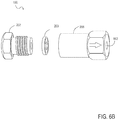
- FIG. 6 a shows one embodiment of a filter housing assembly for use in the present invention as assembled.
- FIG. 6 b shows a blow apart view of the filter housing assembly of FIG. 6 a.
- FIG. 7 shows a comparison between a crude oil with no additive and blends of the crude oil with two asphaltene dispersant additives.
- FIG. 8 shows the percentages of reduction of asphaltene content for two asphaltene dispersant additives vs. the case with no additive.
- FIG. 9 shows a comparison between the solubility profile of a parent crude oil and its deposit.
- FIG. 10 shows a comparison of deposits obtained from different pressurized tests using propane.
- FIG. 11 shows a comparison of the solubility profile of pentane and heptane extracted asphaltenes.
- FIG. 12 shows the effect of the molar ratio gas/crude oil on asphaltene precipitation.
- FIG. 13 illustrates a computer system in accordance with which one or more embodiments of the invention can be implemented, according to an exemplary embodiment of the invention.
- FIG. 14 illustrates a distributed communications/computing network in accordance with which one or more embodiments of the invention can be implemented, according to an exemplary embodiment of the invention
- a method of the present invention determines an asphaltene content of a hydrocarbon-containing fluid located in a well, a wellhead or a production line proximate the wellhead located in a well, wellhead or a production line proximate the wellhead using carbonaceous deposits from the fluid.
- the method involves the steps of: (a) providing one or more carbonaceous deposits from a hydrocarbon-containing fluid located in a well, a wellhead or a production line proximate the wellhead, wherein the one or more carbonaceous deposits have an inorganic portion and an organic portion; (b) dissolving the organic portion of the one or more carbonaceous deposits with one or more solvents having a solubility parameter of at least about 16.8 MPa 0.5 and up to about 30.0 MPa 0.5 to provide a first solution comprising solid particles of the inorganic portion of the one or more carbonaceous deposits and the dissolved organic portion; (c) removing the solid particles of the inorganic portion of the one or more carbonaceous deposits from the first solution to provide a second solution containing the dissolved organic portion; (d) contacting the second solution with one or more alkane mobile phase solvents and capturing any precipitated asphaltenes in one or more low volume filters comprising a porous filter element comprising an area through which a fluid may flow; (e
- the one or more carbonaceous deposits can be obtained from a hydrocarbon-containing fluid located in a well, a wellhead or a production line proximate the wellhead.
- carbonaceous deposits are solids produced, generated or accumulated from petroleum upstream operations which contains organic and inorganic compounds, including but not limited to hydrocarbons and/or asphaltenes. They also contain indigenous material to the reservoir or additives used during production.
- the source of the hydrocarbon-containing fluid may be one or more producing wells in fluid communication with a subterranean oil reservoir.
- the producing well(s) may be under any production conditions such as thermal recovery conditions, carbon dioxide flooding, etc. or the producing well(s) may be in a light, medium or heavy oil field where the hydrocarbon crude or oil is being produced from a reservoir having a strong water-drive.
- the source of the hydrocarbon-containing fluid is one that results in a light or medium crude oil.
- the carbonaceous deposits are typically in the form of solid particles which can be in a colloidal suspension such as a paste, a slurry or sludge.
- the carbonaceous deposits will have an inorganic portion and an organic portion.
- the inorganic portion includes, by way of example, iron oxide, clays, sand, etc.
- the organic portion includes, by way of example, light components of the crude oil, waxes, asphaltenes, etc.
- the organic portion of the one or more carbonaceous deposits is then dissolved with one or more solvents having a solubility parameter of at least about 16.8 MPa 0.5 and to up to about 30.0 MPa 0.5 to provide a first solution comprising solid particles of the inorganic portion of the one or more carbonaceous deposits and the dissolved organic portion.
- a solubility parameter as described herein is determined by the Hansen's methodology described in Barton, A. F. M. Handbook of Solubility Parameters and Other Cohesion Parameters ; CRC Pres Inc.: Boca Raton, Fla., p. 95 (1983).
- Useful solvents include any solvent in which the organic portion of the sample is soluble.
- solvents include cycloalkyls, e.g., cyclohexane; aromatic hydrocarbons, e.g., toluene; chlorinated hydrocarbons, e.g., dichloromethane; heterocyclic organic solvents, e.g., pyridine, etc.
- substantially all or all of the solid particles of the inorganic portion of the one or more carbonaceous deposits are then removed from the first solution using convention techniques, e.g., filtration, centrifugation, decantation, etc., to provide a second solution containing the dissolved organic portion.
- convention techniques e.g., filtration, centrifugation, decantation, etc.
- the second solution is contacted with one or more alkane mobile phase solvents and any precipitated asphaltenes are captured in one or more low volume filters comprising a porous filter element comprising an area through which a fluid may flow.
- alkane mobile phase solvents can be determined by one skilled in the art.
- the alkane mobile phase solvent is n-heptane.
- other alkane mobile phase solvents such as, for example, n-pentane or n-hexane may be used.
- the second solution is passed into the one or more low volume filters, and then one or more alkane mobile phase solvents are passed through the one or more low volume filters.
- the one or more alkane mobile phase solvents should be passed into the one or more low volume filters for a time period sufficient to elute the alkane soluble fraction, commonly known as maltenes or petrolenes, and induce precipitation of the alkane insoluble fraction, i.e., the precipitated asphaltenes, from the second solution.
- the alkane mobile phase solvent i.e., one or more first solvents
- the alkane mobile phase solvent dilutes and displaces the solvent in the second solution, thereby allowing the asphaltenes to substantially precipitate therefrom.
- the alkane soluble fraction then elutes from the one or more low volume filters.
- the second solution is first combined with one or more alkane mobile phase solvents to induce any precipitation of the asphaltenes from the second solution and form an alkane soluble fraction.
- the solution is then passed into the one or more low volume filters such that the precipitated asphaltenes are captured in the one or more low volume filters and the alkane soluble fraction is eluted through the one or more low volume filters.
- the one or more low volume filters for use in the methods of the present invention can be any suitable one or more low volume filters for separation of particles and/or molecules in a liquid sample.
- Suitable low volume filters for use herein include those that are commercially available from such sources as, for example, Restek, (State College, Pa.), Idex Health & Science, (Oak Harbor, Wash.), and Phenomenex, (Torrance, Calif.), or those disclosed in, for example, U.S. Pat. No. 5,911,954, and U.S. Patent Application Publication Nos. 20130312501 and 20140021116, the contents of which are incorporated by reference herein.
- low volume as used herein shall be understood to mean the volume of the void in the filter where no filter material is present.
- a suitable low volume filter will have a volume of less than 100 ⁇ L, e.g., from about 1 ⁇ L to about a 100 ⁇ L or from about to 1 ⁇ L to about 10 ⁇ L.
- the one or more low volume filters can be made of low surface energy materials such as, for example, stainless steel, gold, titanium, silver, gold coated stainless steel, titanium coated stainless steel or silver coated stainless steel, carbon composite, nickel-containing alloys such as Hastelloy® Alloy (available from Haynes International), polyaryletherketones, polytetrafluoroethylene, and the like.
- the elements forming the one or more low volume filters can be made of the same or different material.
- the low volume filters comprising a porous filter element is generally circular in shape.
- the one or more low volume filters will be able to operate at pressures up to about 15,000 psi (about 103421 kPa). In one embodiment, the one or more low volume filters will operate at pressures ranging from about 14 psi (about 97 kPa) to about 15,000 psi. (about 103421 kPa)
- the one or more low volume filters can operate at room temperature or can be subjected to a temperature up to about 350° C., e.g., a temperature ranging from about 18° C. to about 350° C.
- porous filter element of the low volume filters will comprise an area through which a fluid may flow.
- porous filter element shall be understood to mean a porous filter element constructed from a woven or non-woven material and excludes a packed media filter.
- non-woven material can be a porous material having an area through which a fluid can flow, such as sintered metal particles formed into the porous filter element.
- the porous filter element will ordinarily have an average pore diameter less than about 10 microns, e.g., an average pore diameter ranging from 0.1 to about 10 microns. In one embodiment, the porous filter element will have an average pore diameter ranging from about 0.1 to about 5 microns. In one preferred embodiment, the porous filter element will have an average pore diameter less than about 1 microns, e.g., an average pore diameter ranging from 0.2 to about 1 microns.
- FIG. 1 illustrates the compact nature of a low volume filter 100 for use in the present invention as well as its simple means of assembly.
- FIG. 2 shows the elements of one embodiment of the low volume filters of the present invention.
- a filter element 201 will be sandwiched between inlet filter housing 202 and porous filter element 203 .
- the porous filter element 203 while porous in the central region may be solid along its perimeter.
- this porous filter element does not adsorb sample elements, nor is there an associated depth of material to absorb sample.
- the porous filter element allows a uniform flow through the filter into the chamber downstream therefrom due to the uniformity of the filter.
- Another benefit of the porous filter element is that there is likely to be less flow impedance over the exposed surface of the filter element.
- an O-ring 204 or gasket which seals the filter to the O-ring retainer 205 , which is keyed to prevent it from rotating relative to the inlet filter housing 202 .
- the O-ring retainer 205 is threaded to receive a properly threaded outlet fitting.
- the outlet filter housing 206 is threaded so as to allow it to mate with outlet filter housing 206 . As the two halves of the filter housing, inlet filter housing 202 and outlet filter housing 206 are tightened together, they compress the O-ring 204 and seal the assembly.
- the O-ring retainer As the O-ring retainer is not threaded, but is keyed to the inlet filter housing 202 it remains fixed relative to the inlet filter housing 202 but allows the outlet filter housing 206 to rotate freely relative thereto during the assembly.
- This design makes it impossible for the filter element 201 to be rotated during the assembly process, thereby ensuring a fully assembled low volume filter housing assembly 200 of a low volume filter 100 whose integrity has not been compromised by possible tearing or cracking of the filter element while the assembly is sealed.
- the assembled low volume filter housing assembly may then be placed in-line with a chromatography or other flowing system as discussed below by connecting tubing from the upstream source to the inlet filter housing by means of a ferrule 207 and a fitting 208 .
- a corresponding ferrule 207 and fitting 208 may be used on the outlet side through which the fluid will be delivered downstream of the filter.
- the inlet filter housing 202 and the outlet filter housing 206 may be threaded so as to receive coned inlet and outlet fittings rather than the flangeless fitting 208 and accompanying ferrule 207 shown in FIG. 2 .
- FIG. 3 exhibits means by which the low volume filter housing assembly of low volume filter 100 is put together and the elements combined.
- the filter housing elements 301 and 302 may be screwed together by hand without the need for tools, and the finger tight seal is adequate for even high pressure systems. The same is true when connecting the filter housing assembly to the flowing system by means of finger tight fittings, either cone or flangeless, thus obviating the need for any tools.
- FIG. 4 A cross section of the assembled low volume filter housing assembly of a low volume filter 100 is illustrated in FIG. 4 .
- the inlet fitting 401 is screwed into the inlet filter housing 202 .
- Ferrule element 403 holds the inlet tubing (not shown) in place.
- the filter element and porous filter element are sealed by the compressed O-ring 404 which is placed between the filter and porous filter elements and the O-ring retainer 205 .
- the O-ring retainer 205 compresses the compressed O-ring 404 by means of downward pressure applied on the O-ring retainer by the outlet filter housing 206 which is screwed onto the inlet filter housing 202 .
- the outlet fitting 407 is threaded into the O-ring retainer 205 and presses upon the outlet ferrule element 408 .
- Each element of the low volume filter housing assembly of low volume filter 100 may be made of a material suitable for the desired application as discussed above.
- wetted elements may be made of polyether ether ketone (PEEK), which is an organic polymer thermoplastic commonly used in high pressure liquid chromatography (HPLC) systems.
- PEEK polyether ether ketone
- HPLC high pressure liquid chromatography
- some organic solvents are incompatible with PEEK, and therefore wetted elements may be made of, for example, stainless steel.
- some elements may be made of one material, and other elements may be made of another material.
- non-wetted elements may be chosen for attributes other than reactivity with solvents and samples, such as ease of manufacture, expense or mechanical durability.
- the outlet filter housing is generally non-wetted, and therefore it could be made of a very durable material such as stainless steel while the remainder of the elements might be made of PEEK.
- porous filter element 203 is the porous filter element 203 as shown in FIG. 2 .
- this porous filter element is of a woven structure of a suitable metal such as stainless steel and is porous in the central regions of its generally circular shape, but is non-porous at the perimeter, as discussed above.
- This porous filter element enables a particularly good seal and minimizes potential leakage.
- the porous filter element might be manufactured in the same way as described above, but fabricated from a different metal such as titanium. Alternatively, it could be made of a combination of materials, such as a stainless steel bound to a PEEK perimeter.
- the porous filter element is of a non-woven structure of, for example, PEEK or a carbon composite and is porous in the central regions of its generally circular shape, but can be non-porous at the perimeter, as discussed above.
- Other possible embodiments do not require that the porous filter element be non-porous along its perimeter, as the compressed O-ring 404 is capable of sealing the system, as shown in FIG. 4 , between the O-ring retainer 205 and the inlet filter housing 202 .
- FIG. 5 A close-up cross section of the region surrounding the porous filter element is shown in FIG. 5 .
- Fluid flows through the inlet channel 501 into the inlet 502 until it is of adequate pressure to pass through the porous filter element 503 which is supported by the filter support 504 before filling the outlet 505 and passing into the outlet channel 506 .
- O-ring 204 and 507 are compressed such that a seal is maintained between the O-ring retainer 205 and the filter support 504 and the inlet housing 509 .
- the design enables maximal use of the surface area of the filter element due to the positioning and shape of the inlet and outlet 502 and 505 .
- FIG. 6 a illustrates a low volume filter 100 for use in the present invention.
- FIG. 6 a shows an inlet filter housing 202 with an opening (not shown) for receiving the flow of the sample to be filtered and an outlet filter housing 206 with opening 602 for flow of the liquid sample, i.e., effluent, of the filtered liquid sample.
- FIG. 6 a also shows porous filter element 203 .
- FIG. 6 b shows an exploded view of low volume filter 100 for use in the present invention.
- the inlet filter housing 202 can be operatively connected to outlet filter housing 206 by way of, for example, screwing inlet filter housing 202 into outlet filter housing 206 .
- inlet filter housing 202 will hold an inlet tubing (not shown) in place for receiving the liquid sample to be filtered and opening 602 in outlet filter housing 206 will hold an outlet tubing (not shown).
- the porous filter element 203 is sealed in the inlet filter housing 202 and outlet filter housing 206 when inlet filter housing 202 is operatively connected to outlet filter housing 206 .
- the one or more alkane mobile phase solvents should be passed into the one or more low volume filters to induce the precipitation of the precipitated asphaltenes from the second solution and elute the alkane soluble fraction.
- the one or more alkane mobile phase solvents should be passed into the one or more low volume filters to induce the instantaneous precipitation of the precipitated asphaltenes from the second solution and elute the alkane soluble fraction. If no alkane insoluble fraction has precipitated from the solution, then there is no asphaltene content present in the carbonaceous deposit. Accordingly, the preventative measures taken by one skilled in the art would be to simply contact the carbonaceous deposits in the hydrocarbon-containing fluid, where they are present, with a suitable solvent that will be able to dissolve them. In this way, the flow of a hydrocarbon-containing fluid from the well, wellhead or a production line proximate the wellhead can be improved.
- the next step of the method of the present invention involves determining one or more solubility characteristics of the precipitated asphaltenes once substantially all of the alkane soluble fraction has eluted.
- the one or more solubility characteristics of the precipitated asphaltenes to be determined include, by way of example, solubility parameters, miscibility numbers, Kauri-butanol numbers, dipole moments, relative permitivities, polarity indexes, refractive indexes and specific types of intermolecular interaction in liquid media such as acid and base numbers.
- solubility characteristics of the precipitated asphaltenes can be determined according to the following methods: (1) Solubility Fraction Method; and (2) Solubility Profile Method.
- the solubility fraction method involves the step of determining one or more solubility characteristics of the precipitated asphaltenes by (1) dissolving at least part of the amount of the asphaltenes in one or more first solvents having a solubility parameter at least 0.7 MPa 0.5 higher than the one or more alkane mobile phase solvents; and (2) dissolving a second amount of the precipitated asphaltenes in one or more second solvents having a solubility parameter higher than the one or more first solvents, wherein the solubility parameter of the one or more second solvents is at least about 21 MPa 0.5 but no greater than about 30 MPa 0.5 .
- a solubility parameter as described herein is determined by the Hansen's methodology described in Barton, A. F. M. Handbook of Solubility Parameters and Other Cohesion Parameters ; CRC Pres Inc.: Boca Raton, Fla., p. 95 (1983).
- Suitable one or more first solvents having a solubility parameter at least 0.7 MPa 0.5 higher than the one or more alkane mobile phase solvents can be determined by one skilled in the art.
- Useful first solvents include, but are not limited to, one or more alkane solvents, one or more chlorinated hydrocarbon solvents, one or more aromatic solvents, one or more ether solvents, one or more alcohol solvents and the like and mixtures thereof. Representative examples of such solvents can be any of those disclosed above. It is also contemplated that blends of such solvents can be used. In one embodiment, a blend can contain from about 0.5 wt. % to about 99.5 wt. % chlorinated solvent and from about 99.5 wt. % to about 0.5 wt. % alkane solvent. In another embodiment, a blend can contain from about 10 wt. % to about 25 wt. % chlorinated solvent and from about 90 wt. % to about 75 wt. % alkane solvent
- Suitable one or more second solvents having a solubility parameter higher than the one or more first solvents, wherein the solubility parameter of the one or more second solvents is at least about 21 MPa 0.5 but no greater than about 30 MPa 0.5 can be determined by one skilled in the art.
- the one or more second solvents will dissolve any remaining precipitated asphaltenes captured in the one or more low volume filters.
- Useful solvents include, but are not limited to, one or more alcohol solvents, one or more chlorinated hydrocarbon solvents, one or more aromatic solvents, one or more ether second solvents and the like and mixtures thereof. Representative examples of such solvents can be any of those disclosed above. It is also contemplated that blends of such solvents can be used.
- a blend can contain from about 0.5 wt. % to about 99.5 wt. % chlorinated solvent and from about 99.5 wt. % to about 0.5 wt. % alcohol solvent. In another embodiment, a blend can contain from about 80 wt. % to about 95 wt. % chlorinated solvent and from about 20 wt. % to about 5 wt. % alcohol solvent.
- one or more additional solvents or solvent blends can be used to dissolve at least part of the amount of the precipitated asphaltenes remaining in the one or more low volume filters after the addition of the one or more second solvents and before the addition of the one or more third solvents.
- the one or more additional solvents or solvent blends will have a solubility parameter greater than the previously added one or more solvents or solvent blends and less than the solubility parameter of the one or more third solvents.
- one or more third solvents having a solubility parameter between the solubility parameter of the one or more first solvents and the solubility parameter of the one or more second solvents can be added to dissolve at least part of the amount of the precipitated asphaltenes.
- one or more fourth solvents having a solubility parameter between the solubility parameter of the one or more third solvents and the solubility parameter of the one or more second solvents can be added to dissolve at least part of the amount of the precipitated asphaltenes.
- one or more fifth solvents having a solubility parameter between the solubility parameter of the one or more fourth solvents and the solubility parameter of the one or more third solvents can be added to the dissolve at least part of the amount of the precipitated asphaltenes.
- Suitable additional solvents include, but are not limited to, one or more alkane solvents, one or more chlorinated hydrocarbon solvents, one or more alcohol solvents, one or more aromatic solvents and the like and mixtures thereof. Representative examples of such solvents can be any of those disclosed above.
- the asphaltene concentration in the eluted fractions from the one or more low volume filters is continuously monitored using, for example, a liquid chromatography detector which generates a signal proportional to the amount of each eluted fraction and is recorded in a manner well known in the art.
- liquid chromatography detectors there are a number of commercially available liquid chromatography detectors that can be used including, e.g., refractive index detectors, mass spectrometry, liquid chromatography/mass spectrometry, nuclear magnetic resonance (NMR) spectroscopy, Raman spectroscopy, infrared spectroscopy, fluorescence spectroscopy, UV-Vis spectroscopy, diode array detector, charged aerosol detector, evaporative light scattering detectors (ELSD) and the like; all of which can be used in the methods described herein.
- NMR nuclear magnetic resonance
- Raman spectroscopy Raman spectroscopy
- infrared spectroscopy infrared spectroscopy
- fluorescence spectroscopy fluorescence spectroscopy
- UV-Vis spectroscopy UV-Vis spectroscopy
- Other online detectors are known to those skilled in the art.
- a charged aerosol detector is used as a liquid chromatography detector to monitor each eluting sample's concentration to determine the solubility characteristics of the precipitated asphaltenes.
- the operating principle of a Charged Aerosol detector is as follows: The sample is nebulized into droplets, which are subsequently dried into particles. The particle size increases with the amount of sample. A stream of positively charged gas collides with the sample particles. The charge is then transferred to the particles. These particles are transferred to a collector where the charge is measured by a highly sensitive electrometer. This generates a signal in direct proportion to the quantity of sample present. For example, in the case of the asphaltenes, the result is a single peak for the eluted solvent fraction.
- the area under the asphaltene peak is then measured using conventional High Performance Liquid Chromatography (HPLC) software packages, Chemstation® by Agilent Technologies (Santa Clara, Calif.), and this area is directly proportional to the asphaltene concentration.
- HPLC High Performance Liquid Chromatography
- Chemstation® by Agilent Technologies (Santa Clara, Calif.)
- this area is directly proportional to the asphaltene concentration.
- it is possible to analyze directly effluents which originate from the one or more low volume filters under the condition of selecting a mobile phase which is volatile enough to be directly used as a carrier liquid for the evaporative light scattering detector.
- the result is a single peak for each eluted solvent fraction with each peak representing a solubility characteristic of the asphaltenes.
- the solubility profile method involves the step of determining one or more solubility characteristics of the precipitated asphaltenes by dissolving a first amount and a second amount of the precipitated asphaltenes by gradually and continuously changing the alkane mobile phase solvent to a final mobile phase solvent having a solubility parameter at least 1 MPa 0.5 higher than the alkane mobile phase solvent.
- the first amount of the precipitated asphaltenes also referred to as “easy to dissolve asphaltenes”
- the second amount of asphaltenes also referred to as “hard to dissolve asphaltenes”.
- gradually as used herein shall be understood to mean that the alkane mobile phase solvent is incrementally removed from the column over a period of time by continuously adding a final mobile phase solvent having a solubility parameter at least 1 MPa 0.5 higher than the alkane mobile phase solvent to the one or more low volume filters.
- gradually and continuously changing from essentially the alkane mobile phase solvent to the final mobile phase solvent can occur during a period of about 5 minutes to about 120 minutes at a flow rate of about 1 mL/min. to about 4 mL/min.
- gradually and continuously changing from the alkane mobile phase solvent to the final mobile phase solvent can occur during a period of about 15 minutes to about 30 minutes at a flow rate of about 1 mL/min. to about 4 mL/min.
- the first amount of the precipitated asphaltenes are dissolved by gradually and continuously changing the one or more alkane mobile solvents to a first final mobile phase solvent having a solubility parameter at least 1 MPa 0.5 higher than the alkane mobile phase solvent.
- the selection of the first final mobile phase solvent will depend on such factors as moving from a low solubility parameter solvent (low solvent power) to a high solubility parameter solvent (high solvent power) using solvents that have the right combination of dispersion, polar and hydrogen bonding forces.
- a first final mobile phase solvent such as a chlorinated hydrocarbon solvent, e.g., dichloromethane, an ether solvent, an aromatic hydrocarbon solvent or mixtures thereof is gradually and continuously added to the column to sequentially change the one or more first solvents from 100% first solvent(s) to 100% first final mobile phase solvent, i.e., the first solvent(s) is changed to 1% dichloromethane in 99% first solvent(s), then to 2% dichloromethane in 98% first solvent(s), until the mobile phase solvent in the column is 100% dichloromethane and 0% first solvent(s).
- a chlorinated hydrocarbon solvent e.g., dichloromethane, an ether solvent, an aromatic hydrocarbon solvent or mixtures thereof
- a second or remaining amount of the precipitated asphaltenes (which are not capable of being redissolved in the one or more first final mobile phase solvents) is left in the one or more low volume filters.
- the second amount of precipitated asphaltenes also referred to as hard to dissolve asphaltenes (i.e., higher solubility parameter asphaltenes)
- This can advantageously allow for a more accurate determination of the solubility profile of the various asphaltene components in the hydrocarbon-containing fluid.
- the selection of the second final mobile phase solvent will depend on such factors as moving from a lower solubility parameter solvent (the first final mobile phase solvent) to a higher solubility parameter solvent (the second final mobile phase solvent) using solvents that have the right combination of dispersion, polar and hydrogen bonding forces.
- a suitable one or more second final mobile phase solvent can readily be determined by one skilled in the art, e.g., a C 1 to C 6 alcohol such as methanol.
- methanol is gradually and continuously added to the column to sequentially change the first final mobile phase solvent, e.g., dichloromethane, from 100% dichloromethane to 100% methanol, i.e., dichloromethane is first changed to 1% methanol in 99% dichloromethane, then to 2% methanol in 98% dichloromethane, until the second final mobile phase solvent in the column is 100% methanol and 0% dichloromethane.
- the first final mobile phase solvent e.g., dichloromethane
- the flow rate and time period for gradually and continuously adding the one or more second final mobile phase solvents are substantially the same as for the first final mobile phase solvents.
- the asphaltene concentration in the eluted fractions from the one or more low volume filters is continuously monitored using, for example, a liquid chromatography detector as discussed hereinabove.
- an evaporative light scattering detector is used as a liquid chromatography detector to monitor each eluting sample's concentration.
- the operating principle of an evaporative light scattering detector is as follows: the compounds to be analyzed are transported by a mobile phase or a more volatile carrier liquid which is then nebulized and evaporated at a relatively low temperature (being able to be in the order of from about 30 to about 150° C.) so that residual micro-particles alone remain—ideally the compounds to be analyzed—which can be detected by light scattering.
- a solubility profile of the asphaltenes in the liquid sample can be created by techniques known in the art. For example, when asphaltenes are quantified using an evaporative light scattering detector, the result is a curve that represents the solubility parameter distribution of the asphaltene in the hydrocarbon-containing feedstock. Since the solubility parameter of a mixture of solvents is given by the volumetric average of the components, it is possible to convert the time scale of the elution to a solubility parameter scale using the following equation:
- ⁇ i the solubility parameter of each of the components, respectively.
- the volume fraction is the volume fraction of the blend of each solvent and readily determined by the chromatography apparatus.
- the solubility parameter of a component is either known in the art, e.g., Barton, A. F. M. Handbook of Solubility Parameters and Other Cohesion Parameters ; CRC Pres Inc.: Boca Raton, Fla., 1983, or can be determined by techniques within the purview of one skilled in the art.
- the asphaltene content can be determined by analyzing the one or more solubility characteristics for a given hydrocarbon-containing fluid as follows.
- the result is one peak for each eluted solvent fraction with each peak representing a solubility characteristic of the asphaltenes.
- the area under the separate peaks can be determined using commercially available software packages for qualitative and quantitative analysis that include quantification of peak area and height.
- Commercially available software packages include, by way of example, GRAMS/AI package provided by Thermo Galactic (Salem, N.H.) and Chemstation® by Agilent Technologies (Santa Clara, Calif.).
- each area is correlated to an asphaltene mass according to a calibration curve that depends on the type of detector used as within the purview of one skilled in the art.
- the calibration may or may not be the same for all the peaks.
- the total asphaltene mass (TAM) for the sample would therefore be the addition of all the asphaltene masses (M) determined for each peak:
- the amount of asphaltenes is determined by calculating the area of the second peak of the solubility profile.
- An asphaltene solubility profile normally shows either two peaks or one peak and one shoulder from the evaporative light scattering detector.
- the two peaks or peak/shoulder can be separated by numerical methods well known in the art such as, for example, peak deconvolution or peak fitting.
- the area under the peaks, e.g., the second peak can be determined using commercially available software packages for qualitative and quantitative analysis that include quantification of peak area and height.
- preventative measures can then be applied to (1) the hydrocarbon-containing fluid; or (2) the well, wellhead or a production line proximate the wellhead.
- preventative measures includes (1) adding a solvent to the hydrocarbon-containing fluid, (2) adding an amount of one or more asphaltene dispersant additives to the hydrocarbon-containing fluid and (3) mechanically cleaning the pipeline or one or more crude hydrocarbon refining components. In this manner, improved flow of the hydrocarbon-containing fluid from a well, a wellhead or a production line proximate the wellhead can be achieved.
- a method for determining an effectiveness of one or more asphaltene dispersant additives for inhibiting or preventing asphaltene precipitation in a hydrocarbon-containing fluid located in a well, a wellhead or a production line proximate the wellhead comprising the steps of:
- step (h) providing one or more second carbonaceous deposits from the same hydrocarbon-containing fluid in step (a) and containing one or more asphaltene dispersant additives wherein the one or more second carbonaceous deposits have an inorganic portion and an organic portion;
- one or more asphaltene dispersant additives are added to the hydrocarbon-containing fluid prior to removing the one or more carbonaceous deposits.
- the one or more asphaltene dispersant additives can be any presently known or later-discovered asphaltene dispersant additive, e.g., U.S. Patent Application Publication Nos. 20040039125, 20040050752, 20040163995, 20040232042, 20040232043, 20040232044, 20040238404, 20050082231, 20050091915, 20060079434, 20060096757, and 20060096758, the contents of each of which are incorporated by reference herein. Additional examples of asphaltene dispersant additive can be found in, for example, International Patent Applications Nos.
- an asphaltene dispersant additive includes one or more alkyl phenols.
- the alkyl group on the alkyl phenol is a linear chain or a branched chain alkyl group.
- the alkyl group on the alkyl phenol is a mixture of linear chain and branched chain alkyl groups or mixtures thereof.
- the branched chain alkyl group on the alkyl phenol has from about 4 carbon atoms to about 60 carbon atoms.
- the branched chain alkyl group on the alkyl phenol has from about 6 carbon atoms to about 40 carbon atoms.
- the branched chain alkyl group on the alkyl phenol has from about 6 carbon atoms to about 18 carbon atoms.
- the linear chain alkyl group on the alkyl phenol has from about 4 carbon atoms to about 60 carbon atoms. In one embodiment, the linear chain alkyl group on the alkyl phenol has from about 6 carbon atoms to about 40 carbon atoms. In one embodiment, the linear chain alkyl group on the alkyl phenol has from about 6 carbon atoms to about 18 carbon atoms.
- an asphaltene dispersant additive includes one or more alkyl-substituted hydroxyaromatic compounds.
- Suitable hydroxyaromatic compounds include mononuclear monohydroxy and polyhydroxy aromatic hydrocarbons having 1 to 4, and preferably 1 to 3, hydroxyl groups.
- Suitable hydroxyaromatic compounds include phenol, catechol, resorcinol, hydroquinone, pyrogallol, cresol, and the like.
- a preferred hydroxyaromatic compound is phenol.
- the alkyl substituted moiety of the alkyl-substituted hydroxyaromatic carboxylic acid is derived from an alpha olefin having from about 6 to about 80 carbon atoms.
- the olefins employed may be linear, isomerized linear, branched or partially branched linear.
- the olefin may be a mixture of linear olefins, a mixture of isomerized linear olefins, a mixture of branched olefins, a mixture of partially branched linear or a mixture of any of the foregoing.
- the mixture of linear olefins that may be used is a mixture of normal alpha olefins selected from olefins having from about 6 to about 30 carbon atoms per molecule.
- the normal alpha olefins are isomerized using at least one of a solid, or liquid catalyst.
- an asphaltene dispersant additive includes one or more fatty acid esters, one or more lactic acid esters, and mixtures thereof.
- Suitable fatty acid esters include, by way of example, C 1 to C 4 esters of C 16 to C 20 fatty acids including edible vegetable oils. Such oils may have a melting point of ⁇ 10° C. or less.
- Useful edible vegetable oils include corn, coconut, mustard, palm kernel oil, neem, niger seed, olive, peanut, poppy seed, safflower, rapeseed, sesame, soybean, sunflower seed, wheat germ oil and other polyunsaturated containing oils (such as oleic acid, linoleic acid, erucic acid, and linolenic acid).
- the C 16 to C 20 fatty acid ester may further be a mixture of oils. Edible vegetable oils containing a mixture of about 70 to about 90 weight percent oleic and linoleic acids are often preferred.
- Suitable lactic acid esters include a C 1 to C 4 ester of lactic acid.
- Exemplary C 1 to C 4 alcohols for producing the lactic acid ester include methanol, ethanol, propanol, isopropanol, allyl alcohol, butanol, 3-buten-1-ol, t-butanol and sec-butanol.
- the lactic acid ester is ethyl lactate. Ethyl lactate is the ester of natural lactic acid produced by fermentation of corn-derived feedstock.
- lactic acid esters are 100% biodegradable, breaking down into carbon dioxide and water, non-toxic, and renewable.
- an asphaltene dispersant additive includes a composition comprising: (i) a chelating aminocarboxylic acid-C 8 to C 22 amine complex; (ii) a C 15 to C 21 bis(2-hydroxyethyl)amide; and (iii) a C 15 to C 44 imidazoline compound.
- the chelating aminocarboxylic acid-C 8 to C 22 amine complexes are generally formed by heating the C 8 to C 22 amine with the chelating aminocarboxylic acid.
- amine and chelating aminocarboxylic acid used to form the complexes can vary greatly, depending on several factors such as the particular application, and the composition and physical properties of the heavy crude oil (HCO) or other petroleum product; however, in general the molar equivalent ratio of amine to acid equivalent of chelating aminocarboxylic acid can be in the range of about 10:1 to about 1:2.
- a chelating aminocarboxylic acid is a compound having an amine group, and having at least two carboxylic acid groups that can form coordinate bonds to a single metal atom.
- Suitable chelating aminocarboxylic acids include, by way of example, ethylenediaminetetraacetic acid (EDTA), hydroxyethyl ethyl enediaminetriacetic acid, nitrilotriacetic acid (NTA), N-dihydroxyethylglycine and ethylenebishydroxyphenyglycine.
- EDTA ethylenediaminetetraacetic acid
- NTA nitrilotriacetic acid
- N-dihydroxyethylglycine N-dihydroxyethylglycine
- ethylenebishydroxyphenyglycine ethylenebishydroxyphenyglycine
- Suitable C 8 to C 22 amines include n-octylamine, 2-ethylhexylamine, t-octylamine, n-decylamine, tertiary-alkyl primary amines (either singly or in any combinations thereof), tridecylamine, n-undecylamine, lauryl amine, hexadecylamine, heptadecylamine, octadecylamine, decenylamine, dodecenylamine, palmitoleylamine, oleylamine, linoleylamine, eicosenylamine and polyetheramine; and polyalkylamines such as polyisobutyleneamine.
- Suitable primary aliphatic amines in the C 12 to C 18 range include ARMEEN O and ARMEEN OD (Akzo Nobel; Stratford, Conn.). It is preferred to use oil-soluble aliphatic amines in which the aliphatic group is a tertiary aliphatic group, most preferably a tertiary alkyl group, e.g., tertiary-alkyl primary amines.
- tertiary-alkyl primary amines include 1,1,3,3-tetramethylbutylamine (PRIMENE TOA); an isomeric mixture of C 16 to C 22 tertiary alkyl primary amines (PRIMENE JM-T); an isomeric mixture of C 8 to C 10 tertiary alkyl primary amines (PRIMENE BC-9); an isomeric mixture of C 10 to C 15 tertiary alkyl primary amines (PRIMENE 81-R); or mixtures thereof. (Rohm and Haas Company; Philadelphia, Pa.).
- a suitable C 15 to C 21 bis(2-hydroxyethyl)amide is represented by the following formula (I)
- R is C 15 to C 21 alkyl, C 15 to C 21 alkenyl, or a mixture thereof
- the imidazoline ring has at least one C 15 to C 22 alkyl or alkenyl side chain. In one embodiment, the imidazoline ring also has an alkenylamide side chain having from 10 to 24 carbon atoms. In one embodiment, the C 15 to C 44 imidazoline compound is a C 30 to C 44 imidazoline compound. In another embodiment, the imidazoline compound is a reaction product of a fatty acid and a polyamine. Suitable polyamines include, by way of example, ethylenediamine, diethylenetriamine, and hydroxyethyl ethylenediamine.
- Suitable fatty acids include, by way of example, C 12 to C 20 alkyl and/or alkenyl carboxylic acids, including polyunsaturated acids.
- Suitable fatty acids include oleic, linoleic and fatty acid mixtures derived from tall oil, soybean or palm oils. Preparation of fatty acid-polyamine reaction products is known, and is disclosed, e.g., in WO 01/25214.
- the composition can contain from about 10 to about 80% of a chelating aminocarboxylic acid-C 8 to C 22 amine complex, about 10 to about 80% of a C 15 to C 21 bis(2-hydroxyethyl)amide, and about 15 to about 80% of a C 15 to C 44 imidazoline compound, with all amounts being exclusive of solvents.
- an asphaltene dispersant additive includes at least one compound of the general formula (II)
- R 1 is C 10 to C 22 alkyl or aralkyl
- R 2 and R 3 independently are hydrogen or C 1 to C 4 alkyl
- R 4 is hydrogen, C 1 to C 22 alkyl, C 7 to C 22 alkyl or —CH(R 5 )CH(R 6 )COOH, wherein R 5 and R 6 independently are hydrogen or C 1 to C 4 alkyl.
- a compound of formula (II) results from reaction of a primary or secondary amine with an unsaturated acid such as acrylic acid, methacrylic acid or crotonic acid, or combinations thereof.
- R 4 is hydrogen.
- a 1:2 adduct has R 4 equal to ⁇ CH(R 5 )CH(R 6 )COOH.
- R 1 is derived from an unsubstituted C 10 to C 22 alkyl amine, R 1 NH 2 , preferably one which is an oil-soluble amine.
- the alkyl amine is a tertiary alkyl primary amine, i.e., a primary amine in which the alkyl group is attached to the amino group through a tertiary carbon.
- tertiary alkyl primary amines are the PrimeneTM, amines available from Rohm and Haas Company, Philadelphia, Pa.
- an asphaltene dispersant additive includes at least one reaction product of (a) an amine; and (b) a carboxylic, phosphonic or sulfonic acid.
- the reaction product has no new covalent bonds, i.e., bonds not present in the amine or the acid.
- the reaction product is either a salt or a physical mixture or complex of the amine and the acid.
- a reaction product used in this invention is a salt, preferably one that is soluble in oil at least at the aforementioned levels.
- the salt has at least ten carbon atoms, more preferably at least 15 carbon atoms.
- the salt when used in this invention, has a cation and an anion, and is not zwitterionic.
- the acid is a carboxylic acid having no other acidic functional groups, i.e., groups having pK a ⁇ 6. In another embodiment, the acid is a phosphonic acid having no other acidic functional groups. In another embodiment, the acid is a sulfonic acid having no other acidic functional groups.
- an asphaltene dispersant additive includes at least one reaction product of (a) an imine; and (b) an organic acid.
- the organic acid is a carboxylic, phosphonic or sulfonic acid
- the separation between a polar group and a carboxylate, phosphonate or sulfonate ion (collectively: “conjugate base group”); or a protonated imine (“conjugate acid group”); is measured by the number of covalent chemical bonds intervening between either: (i) the atom of the polar group through which it is attached (e.g., the oxygen of hydroxy; the nitrogen of amino or nitroso; or the sulfur of sulfur-containing groups); or (ii) a carbonyl or imine carbon of the polar group (e.g., the carbonyl carbon of amide or the imine carbon of oxime); and one of: the carboxylate carbon, the phosphorus atom of a phosphonate, the sulfur atom of a s
- the oxygen of the hydroxy group is two bonds from the carbonyl carbon of the carboxylate group.
- at least one polar group in a compound of this invention is located two to eight chemical bonds from either a conjugate acid or base functional group, more preferably from two to seven chemical bonds, and most preferably two, three, four, five or six chemical bonds from either a conjugate acid or base functional group.
- an asphaltene dispersant additive includes at least one compound having: (i) at least one carboxyl group; (ii) at least one amide group; and (iii) at least fifteen carbon atoms.
- the compound is not in the form of a salt having an anion and a cation, i.e., a salt that is not a zwitterion; more preferably the compound is a neutral compound.
- a carboxyl or amide functional group is not part of a heterocyclic ring.
- the compound is aliphatic.
- the compound is acyclic.
- the compound is represented by formula (III)
- R 5 is C 1 to C 70 difunctional alkyl or C 6 to C 14 difunctional aryl
- R 3 and R 4 independently are hydrogen or organic functional groups.
- R 3 and R 4 independently are hydrogen, alkyl, heteroalkyl, heterocyclic, aryl or aralkyl.
- at least one R 3 , R 4 and R 5 has at least 12 carbon atoms.
- an asphaltene dispersant additive includes non-sulfonated and sulfonated alkyl phenol formaldehydes.
- the sulfonated alkyl phenol formaldehydes are products obtainable by sulfonation of compounds corresponding to formula (IV) or (V):
- n is a number of 2 to 12 and R is a C 3 to C 24 alkyl, C 6 to C 12 aryl or hydroxyaryl or C 7 to C 12 alkyl group.
- Ph in formula (I) and (II) is a phenol residue.
- the sulfonation products are obtained by sulfonation of compounds known per se corresponding to general formulae (IV) and/or (V). These starting products are known, for example, from DE 197 09 797 A1. Reference is made here to formulae (IV) and (V) in claim 1 of DE 197 09 797 A1, to the disclosure on page 2, lines 40 to 44 and to the disclosure on page 3 of that document. The disclosures of those passages are specifically included in the disclosure of the present application. Formulae (IV) and (V) in DE 197 09 797 are identical with those of the present application.
- the compounds in question are resins which are obtainable, for example, under the name of Dowfax DM 645 (Dow Chemicals).
- the educts corresponding to formulae (IV) and (V) are sulfonated in a known manner with gaseous SO 3 .
- the sulfonation products are not neutralized, but are present as free acids.
- the sulfonation of the educts can be carried out by a continuous process in a falling film reactor.
- the gaseous sulfur trioxide is produced in situ by pyrolysis of pure sulfur.
- the polyalkyl formaldehyde resin used is preferably reacted with sulfur trioxide in an equimolar ratio.
- the reaction itself advantageously takes place at a temperature of 75 to 80° C.
- the end product is preferably not neutralized.
- the sulfonation products are obtained in the form of aqueous solutions which may be directly formulated and used as asphaltene dispersants without any further steps.
- an asphaltene dispersant additive includes a compound of formula (VI):
- A is an optionally substituted ring system containing 6 to 14 carbon atoms; n is at least 1 and may equal the number of positions available for substitution in A; each X is independently a linker group; and each R is independently a hydrocarbyl group containing 10 to 25 carbon atoms.
- the compound of formula (I) is an amphiphilic molecule primarily consisting of two active parts; an adsorbing part (ring system A), which sticks to the surface of the asphaltene particle and which carries a long chain (X—R) attached to the ring.
- A is a primarily aromatic, largely flat molecule whose ring(s) give sufficient interactions through van der Waal's forces to attach itself to the similarly aromatic asphaltene.
- the chain being primarily aliphatic, is surrounded by a good solvent, such as oil, and adopts an attitude with many possible conformations while attached to the asphaltene particle at one end through the ring system A.
- A is naphthalene
- X is selected from a C 1 to C 4 alkyl ether group, a C 1 to C 4 alkyl thio group and a C 1 to C 4 alkyl amino group
- n is 1 and R is a C 12 to C 16 alkyl chain.
- A is naphthalene
- X is selected from an ether link, an amine link or a thio ether link
- n is 1 and R is a C 14 to C 18 alkyl chain.
- A is naphthalene
- X is selected from an ether link, an amine link or a thio ether link
- n is 1 and R is a C 16 alkyl chain.
- A is naphthalene, X is an ether link, n is 1 and R is n-hexadecyl.
- an asphaltene dispersant additive in another embodiment, includes a dendrimeric compound.
- Dendrimeric compounds are in essence three-dimensional, highly branched oligomeric or polymeric molecules comprising a core, a number of branching generations and an external surface composed of end groups.
- a branching generation is composed of structural units, which are bound radially to the core or to the structural units of a previous generation and which extend outwards.
- the structural units have at least two reactive mono-functional groups and/or at least one mono-functional group and one multifunctional group.
- the term multifunctional is understood as having a functionality of 2 or higher. To each functionality a new structural unit may be linked, a higher branching generation being produced as a result.
- the structural units can be the same for each successive generation but they can also be different.
- the degree of branching of a particular generation present in a dendrimeric compound is defined as the ratio between the number of branchings present and the maximum number of branchings possible in a completely branched dendrimer of the same generation.
- the term functional end groups of a dendrimeric compound refer to those reactive groups which-form part of the external surface. Branchings may occur with greater or lesser regularity and the branchings at the surface may belong to different generations depending on the level of control exercised during synthesis. Dendrimeric compounds may have defects in the branching structure, may also be branched asymmetrically or have an incomplete degree of branching in which case the dendrimeric compound is said to contain both functional groups and functional end groups.
- Dendrimeric compounds as referred to hereinabove have been described in, for example, International Patent Application Publications Nos. WO 93/14147 and WO 97/19987 and in Dutch Patent Application No. 9200043. Dendrimeric compounds have also been referred to as “starburst conjugates”, see, for example, International Patent Application Publication No. WO 88/01180. Such compounds are described as being polymers characterised by regular dendrimeric (tree-like) branching with radial symmetry.
- Functionalized dendrimeric compounds are characterized in that one or more of the reactive functional groups present in the dendrimeric compounds have been allowed to react with active moieties different from those featuring in the structural units of the starting dendrimeric compounds. These moieties can be selectively chosen such that, with regard to its ability to solubilize asphaltenes, the functionalized dendrimeric compound outperforms the dendrimeric compound.
- the hydroxyl group is one example of a functional group and functional end group of a dendrimeric compound.
- Dendrimeric compounds containing hydroxyl groups can be functionalized through well-known chemical reactions such as esterification, etherification, alkylation, condensation and the like.
- Functionalized dendrimeric compounds also include compounds that have been modified by related but not identical constituents of the structural units such as different amines, which as such may also contain hydroxyl groups.
- a preferred class of dendrimeric compounds capable of solubilizing asphaltenes comprises the so-called hyperbranched polyesteramides, commercially referred to as HYBRANES (the word HYBRANE is a trademark).
- HYBRANE is a trademark.
- the dendrimeric compound is preferably a condensation polymer containing ester groups and at least one amide group in the backbone, having at least one hydroxyalkylamide end group and having a number average molecular weight of at least 500 g/mol.
- This class of polymers has a lower degree of branching than the poly(propylene imine) dendrimers described in WO-A-93/14147, but still retains the non-linear shape and the high number of reactive end groups, which are characteristic of dendrimeric compounds.
- Compounds belonging to this class of dendrimers are suitably produced by reacting a cyclic anhydride with an alkanolamine, giving rise to dendrimeric compounds by allowing them to undergo a number of (self-) condensation reactions leading to a predetermined level of branching. It is also possible to use more than one cyclic anhydride and/or more than one alkanolamine.
- the alkanolamine may be a dialkanolamine, a trialkanolamine or a mixture thereof.
- suitable dialkanolamines are 3-amino-1,2-propanediol, 2-amino-1, 3-propanediol, diethanolamine bis(2-hydroxy-1-butyl)amine, dicyclohexanolamine and diisopropanolamine.
- An example of a suitable trialkanolamine is tris(hydroxymethyl)amino methane or triethanolamine.
- Suitable cyclic anhydrides comprise succinic anhydride, glutaric anhydride, tetrahydrophthalic anhydride, hexahydrophthalic anhydride, phthalic anhydride, norbornene-2,3-dicarboxylic anhydride, and naphthalenic dicarboxylic anhydride.
- the cyclic anhydrides may contain substituents, in particular hydrocarbon (alkyl or alkenyl) substituents.
- the substituents suitably comprise from 1 to 15 carbon atoms.
- the cyclic anhydride contains a polyalkenyl substituent.
- the alkene from which the polyalkylene chain has been built is an ethylenically unsaturated hydrocarbon containing from 2 to 10, preferably from 2 to 6 carbon atoms.
- the alkene is suitably ethene, propene, butene, isobutene, pentene or hexene.
- Most preferred is a poly(isobutenyl) chain as substituent.
- the chain may have various lengths. Good results are obtainable with substituents comprising from 6 to 50 alkene monomers. More preferred is a chain with from 10 to 40 alkene monomers.
- Suitable non-polymeric examples of substituted cyclic anhydrides include.
- a mixture of succinic anhydride and poly(isobutenyl)succinic anhydride is used.
- the molar ratio between succinic anhydride to poly(isobutenyl)-succinic anhydride suitably ranges from 1:9 to 9:1, preferably from 2:3 to 9:1.
- the self-condensation reaction is suitably carried out without a catalyst at temperatures between 100 and 200° C. By carrying out such self-condensation reactions compounds will be obtained having amide-type nitrogen moieties as branching points and with hydroxyl end groups in the base polymer.
- predetermined molecular weight ranges and number of end groups can be set.
- hexahydrophthalic anhydride and di-isopropanolamine polymers can be produced having a number average molecular weight tuned between 500 and 50,000, preferably between 670 and 10,000, more preferably between 670 and 5000.
- the number of hydroxyl groups per molecule in such case is suitably in the range between 0 and 13.
- the functional end groups, in particular hydroxyl groups, of the polycondensation products can be modified by further reactions as disclosed in the above-mentioned applications WO-A-00/58388 and WO-A-00/56804. Suitable modification can take place by partial replacement of the alkanolamine by other amines, such as secondary amines, e.g. N,N-bis-(3-dimethylaminopropyl)amine, morpholine or non-substituted or alkyl-substituted piperazine, in particular N-methyl piperazine.
- secondary amines e.g. N,N-bis-(3-dimethylaminopropyl)amine, morpholine or non-substituted or alkyl-substituted piperazine, in particular N-methyl piperazine.
- the use of N,N-bis-(dialkylaminoalkyl)amines results in dendrimeric polymers that have been modified to have tert
- the products prepared by the polycondensation of 2-dodecenyl succinic anhydride or hexahydrophthalic anhydride with di-isopropanolamine that have been modified by morpholine, tertiary amine or non-substituted or alkyl-substituted piperazine end groups are very suitable for use in the process of the present invention.
- a preferred type of modification can be obtained by reaction of at least part of the hydroxyl end groups with acids or acid anhydrides.
- the hydroxyl groups can be modified by a reaction with an organic acid or an acid anhydride, such as with succinic anhydride, alkenyl succinic anhydride, hexahydrophthalic anhydride, coco fatty acid or lauric acid.
- an organic acid or an acid anhydride such as with succinic anhydride, alkenyl succinic anhydride, hexahydrophthalic anhydride, coco fatty acid or lauric acid.
- an acid anhydride is used that contains a polyalkenyl substituent.
- the alkene from which the polyalkylene chain has been built is an ethylenically unsaturated hydrocarbon containing from 2 to 10 carbon atoms.
- the alkene is suitably ethene, propene, butene, isobutene, pentene or hexene.
- Most preferred is a poly(isobutenyl) chain as substituent.
- the chain may have various lengths, e.g., substituents comprising from 6 to 50 alkene monomers.
- a poly(isobutylene) chain as substituent to succinic acid anhydride is used. In this way the dendrimeric compound contains hydroxyl functional groups and carboxylic functional groups.
- an asphaltene dispersant additive includes a polyester amide obtainable by a two-stage reaction in which (A) a polyisobutylene is reacted with at least monounsaturated acids containing 3 to 21 carbon atoms or derivatives thereof, either (A.1) in the presence of radical initiators at temperatures of 65 to 100° C. or (A.2) without radical initiators, optionally catalyzed by Lewis acids, at 150 to 250° C., and (B) an alkylamine with the general formula R—NH 2 , in which R is an alkyl group containing 1 to 4 carbon atoms, is added to the product thus obtained and the mixture is stirred at 60 to 100° C. and then cooled and the product is isolated in known manner.
- A a polyisobutylene is reacted with at least monounsaturated acids containing 3 to 21 carbon atoms or derivatives thereof, either (A.1) in the presence of radical initiators at temperatures of 65 to 100° C. or (A.2) without radical initiators, optional
- the polyester amides are based on polyisobutylene, a raw material which is industrially obtained by polymerization of isobutylene.
- the polyisobutylenes can have molecular weights of 500 to 50,000, preferably in the range from 1,000 to 25,000 and more preferably in the range from 1,500 to 15,000.
- the polyisobutylenes are introduced into a reaction vessel at temperatures of at least 60° C. and the unsaturated acids are then added. These acids or their derivatives are at least mono-olefinically unsaturated and preferably contain 3 to 7 carbon atoms.
- the anhydrides are particularly preferred.
- a preferred anhydride is maleic anhydride. However, maleic acid or fumaric acid or their esters or acrylic acid, methacrylic acid and derivatives thereof are also suitable components in step (A).
- the reaction in the first step takes place in the presence of radical initiators, such as azo-bis-isobutyronitrile (AIBN), dibenzoyl peroxides, tert-amyl peroxy-2-ethylhexanoate, tert-butyl peroxi-2-ethylhexanoate, tert-butyl peroxyisobutyrate and tert-butyl monoperoxymaleate.
- radical initiators such as azo-bis-isobutyronitrile (AIBN), dibenzoyl peroxides, tert-amyl peroxy-2-ethylhexanoate, tert-butyl peroxi-2-ethylhexanoate, tert-butyl peroxyisobutyrate and tert-butyl monoperoxymaleate.
- reaction according to (A.2) systematically represents an “ene” reaction, it being possible to carry this out in the presence of catalysts selected from the group of Lewis acids.
- Suitable Lewis acids include, for example, the bromides of phosphorus and aluminum, the chlorides of boron, aluminum, phosphorus, bismuth, arsenic, iron, zinc and tin.
- the reaction temperature in the case of variant (A.2) is higher than for (A.1), namely in the range from 150 to 250° C.
- Step (A) of the process takes place under an inert atmosphere, for example, argon or nitrogen.
- the ratio by weight of polyisobutylene to carboxylic anhydride will range from 200:1 to 1:200.
- the choice of suitable ratios by weight is governed by the molecular weight of the components used and may readily be made by the expert.
- the reaction time is at least 3 hours at a temperature of at least 60° C. in the case (A.1) or at least 150° C. in the case (A.2), higher temperatures and longer reaction times, for example, 4 to 8 hours being preferred.
- a suitable amine with the formula R—NH 2 may be added to the reaction mixture.
- the reaction mixture may also first be freed from unreacted anhydride, preferably by distillation under reduced pressure, and the reaction mixture thus worked up subsequently reacted with the amine at a temperature of at least 50° C. Under the effect of the exothermic reaction of the polyisobutylene/anhydride product with the amine, the temperature in the reaction vessel rises to around 100° C. The mixture containing the end product then cools down again and may then be used without further purification. Process steps (A) and (B) may be carried out in a single reaction stage or in two separate stages either continuously or in batches.
- the amines of the formula R—NH 2 are known compounds, such as monoethanolamine.
- the ratio by weight between polyisobutylene and amine can be between 100:1 and 10:1
- an asphaltene dispersant additive includes cardanol-aldehyde resins.
- cardanol-aldehyde resins are obtainable by reacting cardanol with a compound of the formula (VII)
- R 1 is H, CHO, COOH, COOR 2 or R 2
- R 2 is a C 1 to C 30 -alkyl, C 2 to C 30 -alkenyl, C 6 to C 18 -aryl or a C 7 to C 30 -alkylaryl, and which have a number-average molecular weight of from 250 to 100 000 units.
- Cardanol is a constituent of oil that is obtained from the shell of cashew kernels.
- the one or more asphaltene dispersant additives will be added to the second hydrocarbon-containing fluid at a concentration of from about 0.1 to about 50,000 mg of asphaltene dispersant additive per kilogram of hydrocarbon-containing fluid.
- FIG. 13 illustrates a computer system 1300 in accordance with which one or more embodiments of the method can be implemented. That is, one, more than one, or all of the components and/or functionalities shown and described in the context above may be implemented via the computer system depicted in FIG. 13 .
- FIG. 13 depicts a processor 1302 , a memory 1304 , and an input/output (I/O) interface formed by a display 1306 and a keyboard/mouse/touchscreen 1308 . More or less devices may be part of the I/O interface.
- the processor 1302 , memory 1304 and I/O interface are interconnected via computer bus 1310 as part of a processing unit or system 1312 (such as a computer, workstation, server, client device, etc.). Interconnections via computer bus 1310 are also provided to a network interface 1314 and a media interface 1316 .
- Network interface 1314 (which can include, for example, transceivers, modems, routers and Ethernet cards) enables the system to couple to other processing systems or devices (such as remote displays or other computing and storage devices) through intervening private or public computer networks (wired and/or wireless).
- Media interface 1316 (which can include, for example, a removable disk drive) interfaces with media 1318 .
- the processor 1302 can include, for example, a central processing unit (CPU), a microprocessor, a microcontroller, an application-specific integrated circuit (ASIC), a field programmable gate array (FPGA) or other type of processing circuitry, as well as portions or combinations of such circuitry elements.
- Components of systems as disclosed herein can be implemented at least in part in the form of one or more software programs stored in memory and executed by a processor of a processing device such as processor 1302 .
- Memory 1304 (or other storage device) having such program code embodied therein is an example of what is more generally referred to herein as a processor-readable storage medium.
- Articles of manufacture comprising such processor-readable storage media are considered embodiments of the invention.
- a given such article of manufacture may comprise, for example, a storage device such as a storage disk, a storage array or an integrated circuit containing memory.
- the term “article of manufacture” as used herein should be understood to exclude transitory, propagating signals.
- memory 1304 may comprise electronic memory such as random access memory (RAM), read-only memory (ROM) or other types of memory, in any combination.
- RAM random access memory
- ROM read-only memory
- the one or more software programs when executed by a processing device such as the processing unit or system 1312 causes the device to perform functions associated with one or more of the components/steps of system/methodologies described above.
- processor-readable storage media embodying embodiments of the invention may include, for example, optical or magnetic disks.
- the I/O interface formed by display 1306 and keyboard/mouse/touchscreen 1308 is used for inputting data to the processor 1302 and for providing initial, intermediate and/or final results associated with the processor 1302 .
- FIG. 14 illustrates a distributed communications/computing network (processing platform) in accordance with which one or more embodiments of the invention can be implemented.
- FIG. 14 depicts a distributed communications/computing network (processing platform) 1400 that includes a plurality of computing devices 1404 - 1 through 1404 -P (herein collectively referred to as computing devices 1404 ) configured to communicate with one another over a network 1402 .
- computing devices 1404 in FIG. 14 may be configured as shown in FIG. 13 . It is to be appreciated that the methodologies described herein may be executed in one or more such computing devices 1404 , or executed in a distributed manner across two or more such computing devices 1404 .
- the network 1402 may include, for example, a global computer network such as the Internet, a wide area network (WAN), a local area network (LAN), a satellite network, a telephone or cable network, or various portions or combinations of these and other types of networks (including wired and/or wireless networks).
- WAN wide area network
- LAN local area network
- satellite network a satellite network
- telephone or cable network a telephone or cable network
- the computing devices 1404 may represent a large variety of devices.
- the computing devices 1404 can include a portable device such as a mobile telephone, a smart phone, personal digital assistant (PDA), tablet, computer, a client device, etc.
- the computing devices 1404 may alternatively include a desktop or laptop personal computer (PC), a server, a microcomputer, a workstation, a kiosk, a mainframe computer, or any other information processing device which can implement any or all of the techniques detailed in accordance with one or more embodiments of the invention.
- One or more of the computing devices 1404 may also be considered a “user.”
- the term “user,” as used in this context, should be understood to encompass, by way of example and without limitation, a user device, a person utilizing or otherwise associated with the device, or a combination of both. An operation described herein as being performed by a user may therefore, for example, be performed by a user device, a person utilizing or otherwise associated with the device, or by a combination of both the person and the device, the context of which is apparent from the description.
- one or more modules, elements or components described in connection with embodiments of the invention can be located geographically-remote from one or more other modules, elements or components. That is, for example, the modules, elements or components shown and described above can be distributed in an Internet-based environment, a mobile telephony-based environment, a kiosk-based environment and/or a local area network environment.
- the transaction analysis system as described herein, is not limited to any particular one of these implementation environments. However, depending on the operations being performed by the system, one implementation environment may have some functional and/or physical benefits over another implementation environment.
- the processing platform 1400 shown in FIG. 14 may comprise additional known components such as batch processing systems, parallel processing systems, physical machines, virtual machines, virtual switches, storage volumes, etc. Again, the particular processing platform shown in this figure is presented by way of example only, and may include additional or alternative processing platforms, as well as numerous distinct processing platforms in any combination. Also, numerous other arrangements of servers, clients, computers, storage devices or other components are possible in processing platform 1400 .
- the processing platform 1400 of FIG. 14 can comprise virtual machines (VMs) implemented using a hypervisor.
- a hypervisor is an example of what is more generally referred to herein as “virtualization infrastructure.”
- the hypervisor runs on physical infrastructure.
- the techniques illustratively described herein can be provided in accordance with one or more cloud services.
- the cloud services thus run on respective ones of the virtual machines under the control of the hypervisor.
- Processing platform 1400 may also include multiple hypervisors, each running on its own physical infrastructure. Portions of that physical infrastructure might be virtualized.
- virtual machines are logical processing elements that may be instantiated on one or more physical processing elements (e.g., servers, computers, processing devices). That is, a “virtual machine” generally refers to a software implementation of a machine (i.e., a computer) that executes programs like a physical machine. Thus, different virtual machines can run different operating systems and multiple applications on the same physical computer. Virtualization is implemented by the hypervisor which is directly inserted on top of the computer hardware in order to allocate hardware resources of the physical computer dynamically and transparently. The hypervisor affords the ability for multiple operating systems to run concurrently on a single physical computer and share hardware resources with each other.
- exemplary embodiments herein include a method for improving flow of a hydrocarbon-containing fluid from a well, a wellhead or a production line proximate the wellhead, the method comprising the steps of:
- Another exemplary embodiment herein includes a method for monitoring changes in asphaltene precipitation tendencies in a hydrocarbon-containing fluid located in a well, a wellhead or a production line proximate the wellhead comprising the steps of:
- Yet another exemplary embodiment herein includes a method for determining an effectiveness of one or more asphaltene dispersant additives for inhibiting or preventing asphaltene precipitation in a hydrocarbon-containing fluid located in a well, wellhead or a production line proximate the wellhead comprising the steps of:
- step (h) providing one or more second carbonaceous deposits from the same hydrocarbon-containing fluid in step (a) and containing one or more asphaltene dispersant additives wherein the one or more second carbonaceous deposits have an inorganic portion and an organic portion;
- an in-line filtration method was used to evaluate the effectiveness of two asphaltene dispersant additives to improve the solubility of asphaltenes in Crude Oil A during surface production operations.
- Two different additives were added to Crude Oil A at a concentration of 100 ppm with respect to crude oil. Solutions of the additives in toluene at the same concentrations (100 ppm) were prepared as reference samples.
- the blends and the reference samples were tested using the in-line filtration technique.
- the setup for this method consisted of a HPLC system composed of a HP Series 1200 chromatograph and a Corona Ultra Detector charged aerosol detector (CAD) from Dionex operating at room temperature using low volume filter containing a 0.5 micron stainless steel porous filter element purchased from Restek (Cat. No. 24993), having a volume of 5 ⁇ L volume (see as http://www.restek.com/catalog/view/10607 as retrieved on Jun. 18, 2014). 4 microliters of the blend and reference samples were injected using a heptane mobile phase at a flow rate of 2 mL/min.
- CAD Corona Ultra Detector charged aerosol detector
- the maltenes (heptane solubles) first eluted from the filter. After 2 min, the precipitated asphaltenes captured in the filter were eluted by using a blend a 90/10 methylene chloride/methanol blend (Solubility Parameter of 21.23 MPa 0.5 ) at a flow rate of 2 mL/min. After 4 min, the solvent was switched back to 100% heptane at a flow rate of 2 mL/min. The test lasted less than 8 minutes.
- the asphaltene contents were determined based on the signal coming from the CAD and using a calibration curve generated for asphaltenes.
- an asphaltene solution was prepared using asphaltenes extracted from Crude Oil A.
- the recommended concentration of this solution was 0.0100 g in 10 mL of methylene chloride.
- the response A was determined for different injection volumes in the range from 0.5 ⁇ L to 8 ⁇ L. Then, the responses were related to the masses injected M according to equation (1).
- Asphaltenes [ Asphaltene ⁇ ⁇ Content with _ ⁇ ⁇ Additives - Asphaltene ⁇ ⁇ Content without _ ⁇ ⁇ Additives ] Asphaltene ⁇ ⁇ Content without _ ⁇ ⁇ Additives ⁇ 100 ( 2 )
- FIG. 8 shows the percentages of reduction of asphaltene content for two asphaltene dispersant additives vs. the case with no additive. In the presence of the additives, a 18.5% and 9.1% reduction in the asphaltene contents was measured. This example shows that the efficiency of asphaltene dispersants could be quantified by measuring the percentage of reduction of asphaltene area in the presence of the additive in comparison with the case without dispersant.
- Asphaltene solubility characterization of a deposit and its parent crude oil Asphaltene solubility characterization of a deposit and its parent crude oil.
- Crude Oil X is a medium crude oil (33.0 API) with an asphaltene content of 1.7 wt %.
- an in-line filtration method was used to evaluate the colloidal stability of a crude oil towards asphaltene precipitation and to establish a comparison between the solubility characteristics of the asphaltenes present in the crude oil and those that preferentially precipitated to form the deposit.
- the parent crude oil and its deposit were tested using the in-line filtration technique.
- the setup for this example consisted of a HPLC system composed of a HP Series 1100 liquid chromatograph and an Alltech ELSD 2000 detector operating at 75° C. A volumetric flow of 3.5 L/min of nitrogen was used for the nebulizing gas of the ELSD.
- the instrument uses a low volume filter containing a 0.5-micron stainless steel porous filter element purchased from Restek (Cat. No. 24993), having a volume of 5 ⁇ L volume (see as http://www.restek.com/catalog/view/10607 as retrieved on Jun. 18, 2014).
- the flow rate of the solvents during the tests was 2 mL/min.
- peaks also called “solubility profiles” (starting at around 6 min) shown in FIG. 9 correspond to the elution of asphaltenes. These peaks are curves that represent the solubility distributions of crude oil and deposit from the more soluble (left side of the peak) to the less soluble (right side of the peak) in hydrocarbons.
- the colloidal stability of the crude oil or ⁇ PS was measured. This parameter was measured as the difference in time between the maximum of the first peak and 75% of the total distribution. The 75% of the distribution was determined by the cumulative areas of the whole distribution that represents the solubility profile of the asphaltenes in the sample. The value obtained for the crude oil was 1.50, indicating low colloidal stability.
- Deposits came from two different experiments using the same crude oil X: PVT cell and core flood experiments. In both experiments, propane was used as the precipitating agent.
- propane was used as the precipitating agent.
- the deposit was collected from a 4:1 propane/live crude oil experiment (122° F. [50° C.] and 1087 psi [7495 kPa]) after five days of stirring. The deposit was separated by filtration.
- Example 2 the in-line filtration method, as described in Example 2, was used to evaluate the differences in the solubility distributions of the asphaltenes that preferentially precipitated to form the deposit. These experiments were aimed to evaluate solvent injection process for enhanced recovery of crude oils.
- Precipitated material was recovered from PVT experiments carried out at 9000 psi (62053 kPa) and 245° F. (118° C.). In these experiments, a crude oil was blended with deep water gas (58 vol %. methane) until it reached equilibrium conditions after five days of stirring. The deposits were analyzed to obtained asphaltene content using the method described in Example 1.
- FIG. 12 shows the effect of the molar ratio gas/crude oil on asphaltene precipitation.
Landscapes
- Life Sciences & Earth Sciences (AREA)
- Mining & Mineral Resources (AREA)
- Geology (AREA)
- Engineering & Computer Science (AREA)
- Physics & Mathematics (AREA)
- Environmental & Geological Engineering (AREA)
- Fluid Mechanics (AREA)
- General Life Sciences & Earth Sciences (AREA)
- Geochemistry & Mineralogy (AREA)
- Chemical & Material Sciences (AREA)
- General Chemical & Material Sciences (AREA)
- Chemical Kinetics & Catalysis (AREA)
- Production Of Liquid Hydrocarbon Mixture For Refining Petroleum (AREA)
Abstract
Description
wherein δ is the solubility profile of the mixture, ϕi is the volume fraction and δi is the solubility parameter of each of the components, respectively. The volume fraction is the volume fraction of the blend of each solvent and readily determined by the chromatography apparatus. The solubility parameter of a component is either known in the art, e.g., Barton, A. F. M. Handbook of Solubility Parameters and Other Cohesion Parameters; CRC Pres Inc.: Boca Raton, Fla., 1983, or can be determined by techniques within the purview of one skilled in the art.
Log TAM=0.5336 log A−6.097
where TAM is the total asphaltene mass in the sample and A is the area of the second deconvoluted peak respectively.

wherein R is C15 to C21 alkyl, C15 to C21 alkenyl, or a mixture thereof

or a zwitterionic form or salt thereof, wherein R1 is C10 to C22 alkyl or aralkyl; R2 and R3 independently are hydrogen or C1 to C4 alkyl; R4 is hydrogen, C1 to C22 alkyl, C7 to C22 alkyl or —CH(R5)CH(R6)COOH, wherein R5 and R6 independently are hydrogen or C1 to C4 alkyl. Typically, a compound of formula (II) results from reaction of a primary or secondary amine with an unsaturated acid such as acrylic acid, methacrylic acid or crotonic acid, or combinations thereof. Formation of a 1:1 adduct of a primary amine and an unsaturated acid results in a product in which R4 is hydrogen. A 1:2 adduct has R4 equal to −CH(R5)CH(R6)COOH. An adduct of a secondary amine and an unsaturated acid has R4=C10 to C22 alkyl or alkyl. In one embodiment, R1 is derived from an unsubstituted C10 to C22 alkyl amine, R1NH2, preferably one which is an oil-soluble amine. In one embodiment, the alkyl amine is a tertiary alkyl primary amine, i.e., a primary amine in which the alkyl group is attached to the amino group through a tertiary carbon. Examples of commercially available tertiary alkyl primary amines are the Primene™, amines available from Rohm and Haas Company, Philadelphia, Pa.

wherein R5 is C1 to C70 difunctional alkyl or C6 to C14 difunctional aryl, and R3 and R4 independently are hydrogen or organic functional groups. Preferably, R3 and R4 independently are hydrogen, alkyl, heteroalkyl, heterocyclic, aryl or aralkyl. Preferably, at least one R3, R4 and R5 has at least 12 carbon atoms.

in which n is a number of 2 to 12 and R is a C3 to C24 alkyl, C6 to C12 aryl or hydroxyaryl or C7 to C12 alkyl group. In addition, Ph in formula (I) and (II) is a phenol residue.

wherein A is an optionally substituted ring system containing 6 to 14 carbon atoms; n is at least 1 and may equal the number of positions available for substitution in A; each X is independently a linker group; and each R is independently a hydrocarbyl group containing 10 to 25 carbon atoms. The compound of formula (I) is an amphiphilic molecule primarily consisting of two active parts; an adsorbing part (ring system A), which sticks to the surface of the asphaltene particle and which carries a long chain (X—R) attached to the ring. A is a primarily aromatic, largely flat molecule whose ring(s) give sufficient interactions through van der Waal's forces to attach itself to the similarly aromatic asphaltene. Thus it provides an anchor for the chain which is much longer and extends into the oil. The chain, being primarily aliphatic, is surrounded by a good solvent, such as oil, and adopts an attitude with many possible conformations while attached to the asphaltene particle at one end through the ring system A.

in which R1 is H, CHO, COOH, COOR2 or R2, and R2 is a C1 to C30-alkyl, C2 to C30-alkenyl, C6 to C18-aryl or a C7 to C30-alkylaryl, and which have a number-average molecular weight of from 250 to 100 000 units. Cardanol is a constituent of oil that is obtained from the shell of cashew kernels.
Log M=D log A+E (1)
where D and E are the calibration constants, and A is the response of the CAD corresponding to the mass M.
δA=δs (3)
δs=ϕhδh+ϕmcδmc+ϕmδm (4)
where δh, δmc, and δm are the solubility parameters of heptane, methylene chloride, and methanol respectively and ϕh, ϕmc and ϕm are the volumetric concentrations of heptane, methylene chloride and methanol at ATE (Average Time of Elution). Solubility parameter values for asphaltenes in the crude oil and the deposit were 17.4 MPa0.5 and 17.8 MPa0.5, respectively.
Claims (17)
Ratio=(area peak 3+area peak 4)/(area peak 1+area peak 2)
Ratio=(area peak 3+area peak 4)/(area peak 1+area peak 2)
Priority Applications (1)
| Application Number | Priority Date | Filing Date | Title |
|---|---|---|---|
| US15/811,972 US10907473B2 (en) | 2017-11-14 | 2017-11-14 | Low volume in-line filtration methods for analyzing hydrocarbon-containing fluid to evaluate asphaltene content and behavior during production operations |
Applications Claiming Priority (1)
| Application Number | Priority Date | Filing Date | Title |
|---|---|---|---|
| US15/811,972 US10907473B2 (en) | 2017-11-14 | 2017-11-14 | Low volume in-line filtration methods for analyzing hydrocarbon-containing fluid to evaluate asphaltene content and behavior during production operations |
Publications (2)
| Publication Number | Publication Date |
|---|---|
| US20190145255A1 US20190145255A1 (en) | 2019-05-16 |
| US10907473B2 true US10907473B2 (en) | 2021-02-02 |
Family
ID=66431904
Family Applications (1)
| Application Number | Title | Priority Date | Filing Date |
|---|---|---|---|
| US15/811,972 Active 2038-10-20 US10907473B2 (en) | 2017-11-14 | 2017-11-14 | Low volume in-line filtration methods for analyzing hydrocarbon-containing fluid to evaluate asphaltene content and behavior during production operations |
Country Status (1)
| Country | Link |
|---|---|
| US (1) | US10907473B2 (en) |
Families Citing this family (1)
| Publication number | Priority date | Publication date | Assignee | Title |
|---|---|---|---|---|
| WO2023215424A1 (en) * | 2022-05-03 | 2023-11-09 | Chevron U.S.A. Inc. | System and method for asphaltene anomaly prediction |
Citations (89)
| Publication number | Priority date | Publication date | Assignee | Title |
|---|---|---|---|---|
| US3793189A (en) | 1971-12-03 | 1974-02-19 | Exxon Research Engineering Co | Reconstituted asphalt paving compositions |
| US4595667A (en) | 1984-04-27 | 1986-06-17 | Nippon Oil Co., Ltd. | Catalyst for the hydrotreating of heavy hydrocarbon oils |
| US4634680A (en) | 1983-07-14 | 1987-01-06 | International Coal Refining Company | Sequential elution process |
| WO1988001180A1 (en) | 1986-08-18 | 1988-02-25 | The Dow Chemical Company | Starburst conjugates |
| US4843247A (en) | 1985-11-08 | 1989-06-27 | Cosmo Oil Co., Ltd. | Determination of asphaltene content and device therefor |
| US5143594A (en) | 1989-11-08 | 1992-09-01 | Nalco Chemical Company | Refinery anti-foulant - asphaltene dispersant |
| WO1993014147A1 (en) | 1992-01-13 | 1993-07-22 | Dsm N.V. | Dendritic macromolecule and the preparation thereof |
| NL9200043A (en) | 1992-01-13 | 1993-08-02 | Dsm Nv | Dendritic macromolecule for electronics etc. |
| US5374350A (en) | 1991-07-11 | 1994-12-20 | Mobil Oil Corporation | Process for treating heavy oil |
| WO1997019987A1 (en) | 1995-11-28 | 1997-06-05 | Dsm N.V. | Composition comprising a plastic and an additive dendrimer combination |
| EP0795579A1 (en) | 1996-03-12 | 1997-09-17 | Degussa Aktiengesellschaft | Dust-free, well dispersible granulates based on organosilicon modified siliceous fillers |
| WO1999016810A1 (en) | 1997-10-01 | 1999-04-08 | Dsm N.V. | Condensation polymer containing hydroxyalkylamide groups |
| US5911954A (en) | 1993-08-12 | 1999-06-15 | Optimize Technologies, Inc. | Integral fitting and filter |
| US6039885A (en) | 1996-09-27 | 2000-03-21 | Institut Francais Du Petrole | Process and device intended for ultrafiltration of particles in fluids |
| US6087662A (en) | 1998-05-22 | 2000-07-11 | Marathon Ashland Petroleum Llc | Process for analysis of asphaltene content in hydrocarbon mixtures by middle infrared spectroscopy |
| WO2000056804A1 (en) | 1999-03-24 | 2000-09-28 | Dsm N.V. | Condensation polymer containing esteralkylamide-acid groups |
| WO2000058388A1 (en) | 1999-03-26 | 2000-10-05 | Dsm N.V. | Condensation polymer containing dialkylamide endgroups, process for producing said condensation polymers and applications thereof |
| US6180683B1 (en) | 1997-03-10 | 2001-01-30 | Clariant Gmbh | Synergistic mixtures of alkylphenol-formaldehyde resins with oxalkylated amines as asphaltene dispersants |
| US6197075B1 (en) | 1998-04-02 | 2001-03-06 | Crompton Corporation | Overbased magnesium deposit control additive for residual fuel oils |
| EP1091085A1 (en) | 1999-10-09 | 2001-04-11 | Cognis Deutschland GmbH, Dep. Intellectual Properties | Asphaltene inhibitors |
| WO2001025214A1 (en) | 1999-10-01 | 2001-04-12 | Hercules Incorporated | Method of producing low-odor imidazolines, imidazolines produced thereby and paper and paper products containing the same |
| CA2326288A1 (en) | 1999-11-18 | 2001-05-18 | Adriana Fornes | Surfactant for enhanced oil recovery and for reducing the viscosity of heavy oil in pipelines and pumps |
| RU2172817C1 (en) | 2000-06-27 | 2001-08-27 | Научно-производственный центр "Инвента" | Composition for removing asphaltene-tar-paraffin deposits |
| RU2173320C1 (en) | 2000-01-17 | 2001-09-10 | Институт нефтехимии и катализа АН РБ и УНЦ РАН | Method of preparing 1-vinyl-1-methyl-3-alkylsilacyclopentanes |
| WO2001074966A1 (en) | 2000-03-31 | 2001-10-11 | Imperial Chemical Industries Plc | Maintenance of oil production and refining equipment |
| RU2185412C1 (en) | 2001-05-03 | 2002-07-20 | ОАО "Средневолжский научно-исследовательский институт по нефтепереработке" | Composition for removal of asphaltene-resin-paraffin deposits |
| US20030211621A1 (en) | 2002-05-10 | 2003-11-13 | The University Of Wyoming Research Corporation | Continuous on-line process control of residua distillation |
| RU2220999C1 (en) | 2002-05-14 | 2004-01-10 | Общество с ограниченной ответственностью "Дельта-пром" | Composition for production and transport of crude oil and a method for preparation thereof |
| RU2223294C1 (en) | 2002-12-09 | 2004-02-10 | ООО НПП "Химнефть" | Composition for removal of asphaltene-resinous and paraffin deposits |
| US20040039125A1 (en) | 2000-09-01 | 2004-02-26 | Wolfgang Breuer | Use of polyester amides for the stabilisation of asphaltenes in crude oil |
| US20040050752A1 (en) | 2001-02-10 | 2004-03-18 | Dirk Leinweber | Use of cardanol aldehyde resins as asphalt dispersants in crude oil |
| WO2004033602A1 (en) | 2002-10-08 | 2004-04-22 | Chimec S.P.A. | A fuel oil additive comprising alkaline-earth metal salts of alkylbenzene sulphonic acid |
| US6773921B1 (en) | 1999-06-10 | 2004-08-10 | The University Of Wyoming Research Corporation | Predicting proximity to coke formation |
| US20040163995A1 (en) | 2001-06-14 | 2004-08-26 | Cornelisse Pieter Marinus Willem | Method for solubilising asphaltenes in a hydrocarbon mixture |
| RU2237799C2 (en) | 2002-07-29 | 2004-10-10 | Общество с ограниченной ответственностью "ПермНИПИнефть" | Solid reagent for preventing asphaltene-tar-paraffin deposits during production and transportation of crude oil |
| US20040232043A1 (en) | 2003-05-23 | 2004-11-25 | Ravindranath Mukkamala | Amine-unsaturated acid adducts as asphaltene dispersants in crude oil |
| US20040232044A1 (en) | 2003-05-23 | 2004-11-25 | Ravindranath Mukkamala | Oil-soluble imine-acid reaction products as asphaltene dispersants in crude oil |
| US20040232042A1 (en) | 2003-05-23 | 2004-11-25 | Ravindranath Mukkamala | Amine-acid reaction products as asphaltene dispersants in crude oil |
| US20040238404A1 (en) | 2003-05-29 | 2004-12-02 | Ravindranath Mukkamala | Compounds containing amide and carboxyl groups as asphaltene dispersants in crude oil |
| WO2005010126A1 (en) | 2003-07-21 | 2005-02-03 | Baker Hughes Incorporated | Improved stability of hydrocarbons containing asphaltenes |
| RU2250247C1 (en) | 2003-12-17 | 2005-04-20 | Открытое Акционерное Общество "Научно-исследовательский институт по нефтепромысловой химии" (ОАО "НИИнефтепромхим") | Composition for destroying water-oil emulsions and protecting oil-field equipment against corrosion and asphaltene-tar-paraffin deposits |
| US20050082231A1 (en) | 2001-07-31 | 2005-04-21 | Gochin John J. | Method of controlling asphaltene precipitation in a fluid |
| US20050091915A1 (en) | 2001-12-21 | 2005-05-05 | Cognis Deutschland Gmbh & Co, Kg | Use of sulphonated alkyl phenol formaldehydes in the stabilization of ashphaltenes in crude oil |
| WO2005054321A1 (en) | 2003-12-03 | 2005-06-16 | Clariant Gmbh | Ether carboxylic acid-substituted alkylphenol resins |
| RU2261887C1 (en) | 2004-05-18 | 2005-10-10 | Открытое акционерное общество "Акционерная нефтяная компания "Башнефть" | Composition for removing asphalt-tar and paraffin deposits |
| RU2261983C2 (en) | 2003-06-16 | 2005-10-10 | Общество с ограниченной ответственностью "Кубаньгазпром" (ООО "Кубаньгазпром") | Reagent for preventing or removing the depositions of asphaltene-paraffin in oil production equipment and pipelines |
| US20060079434A1 (en) | 2004-10-07 | 2006-04-13 | Banavali Rajiv M | Formulations useful as asphaltene dispersants in petroleum products |
| WO2006047745A1 (en) | 2004-10-27 | 2006-05-04 | The Lubrizol Corporation | Asphaltene inhibition |
| US20060096758A1 (en) | 2004-11-10 | 2006-05-11 | Bj Services Company | Method of treating an oil or gas well with biodegradable low toxicity fluid system |
| US20060096757A1 (en) | 2004-11-10 | 2006-05-11 | Bj Services Company | Method of treating an oil or gas well with biodegradable low toxicity fluid system |
| US20070048874A1 (en) | 2005-08-25 | 2007-03-01 | The University Of Wyoming Research Corporation D/B/A Western Research Institute | Processing and analysis techniques involving in-vessel material generation |
| US20070056881A1 (en) | 2005-09-14 | 2007-03-15 | Stephen Dunn | Method for extracting and upgrading of heavy and semi-heavy oils and bitumens |
| US20080056822A1 (en) | 2006-09-06 | 2008-03-06 | Hall David R | Asphalt Reconditioning Machine |
| US20080251418A1 (en) | 2007-04-06 | 2008-10-16 | Manuel Anthony Francisco | Upgrading of petroleum resid, bitumen, shale oil, and other heavy oils by the separation of asphaltenes and/or resins therefrom by electrophilic aromatic substitution |
| US20090052986A1 (en) | 2007-08-20 | 2009-02-26 | Hall David R | Nozzle for a Pavement Reconditioning Machine |
| US20090057196A1 (en) | 2007-08-28 | 2009-03-05 | Leta Daniel P | Production of an enhanced resid coker feed using ultrafiltration |
| US20090163350A1 (en) | 2007-12-20 | 2009-06-25 | Da Costa Andre R | Heavy oil upgrade process including recovery of spent catalyst |
| US20090159505A1 (en) | 2007-12-20 | 2009-06-25 | Da Costa Andre R | Heavy oil upgrade process including recovery of spent catalyst |
| US20090242459A1 (en) | 2008-03-26 | 2009-10-01 | General Electric Company | Oxidative desulfurization of fuel oil |
| US20100136698A1 (en) | 2007-06-28 | 2010-06-03 | Bp Oil International Limited | Sample plate |
| US20100182591A1 (en) | 2007-06-26 | 2010-07-22 | Cecile Chambon | Cell, device comprising this cell and method for measuring the amount of insoluble particles in a fluid and applications |
| US7790646B2 (en) | 2007-12-20 | 2010-09-07 | Chevron U.S.A. Inc. | Conversion of fine catalyst into coke-like material |
| US20100251935A1 (en) | 2001-02-05 | 2010-10-07 | University Of Wyoming Research Corporation D/B/A Western Research Institute | Blended Asphaltic Composition |
| US20110066441A1 (en) | 2009-09-14 | 2011-03-17 | Chevron U.S.A. Inc. | Method for predicting reactivity of a hydrocarbon-containing feedstock for hydroprocessing |
| US20110098507A1 (en) | 2007-12-15 | 2011-04-28 | Clariant Finance (Bvi) Limited | Asphalt Dispersers On The Basis Of Phosphonic Acids |
| US20110152136A1 (en) | 2008-04-23 | 2011-06-23 | Trevor Hughes | Solvent assisted oil recovery |
| US20110172924A1 (en) * | 2008-04-23 | 2011-07-14 | Schlumberger Technology Corporation | Forecasting asphaltic precipitation |
| US20110198264A1 (en) | 2005-05-31 | 2011-08-18 | Idemitsu Kosan Co., Ltd. | Process oil, process for production of deasphalted oil, process for production of extract, and process for production of process oil |
| US20110247964A1 (en) | 2008-12-18 | 2011-10-13 | Johannes Leendert Willem Cornelis Den Boestert | Process for removing asphaltenic particles |
| US20110278460A1 (en) | 2010-05-13 | 2011-11-17 | Baker Hughes Incorporated | Method and apparatus for determining the coke generation tendency of hydrocarbons |
| US20120160015A1 (en) | 2010-03-11 | 2012-06-28 | Chevron U.S.A. Inc. | Methods for predicting fouling tendencies of hydrocarbon containing feedstocks |
| US20130067991A1 (en) | 2011-09-20 | 2013-03-21 | University Of Wyoming Research Corporation D/B/A Western Research Institute | Hydrocarbon Separation and Analysis Apparatus and Methods |
| US20130104772A1 (en) | 2005-08-25 | 2013-05-02 | The University Of Wyoming Research Corporation D/B/A Western Research Institute | Methods for Changing Stability of Water and Oil Emulsions |
| US20130124105A1 (en) | 2011-11-11 | 2013-05-16 | Chevron U.S.A. Inc | Method for predicting sediment content of a hydroprocessed hydrocarbon product |
| US20130124106A1 (en) | 2011-11-11 | 2013-05-16 | Chevron U.S.A. Inc. | Method for estimating sediment content of a hydroprocessed hydrocarbon-containing feedstock |
| US20130312501A1 (en) | 2012-05-24 | 2013-11-28 | Wyatt Technology Corporation | Inline filter housing assembly |
| US20140021101A1 (en) | 2011-03-08 | 2014-01-23 | The University Of Wyoming Research Corporation D/B/A Western Research Institute | Hydrocarbon Viscosity Reduction Method |
| US20140021116A1 (en) | 2012-07-17 | 2014-01-23 | Fh Instruments, Llc | Hplc frit filter assembly |
| US20140020456A1 (en) | 2011-04-14 | 2014-01-23 | Sebastien L. Dreyfus | Method For Preparing Petroleum Based Samples For Analysis of Elemental and Isotopic Species |
| US8658030B2 (en) | 2009-09-30 | 2014-02-25 | General Electric Company | Method for deasphalting and extracting hydrocarbon oils |
| US20140130581A1 (en) * | 2012-11-13 | 2014-05-15 | Chevron U.S.A. | Method for determining the effectiveness of asphaltene dispersant additives for inhibiting or preventing asphaltene precipitation in a hydrocarbon-containing material subjected to elevated temperature and pressure conditions |
| US20140369889A1 (en) | 2012-02-23 | 2014-12-18 | Schlumberger Technology Corporation | Apparatus and System for Measuring Asphaltene Content of Crude Oil |
| US20140375991A1 (en) | 2012-03-01 | 2014-12-25 | Schlumberger Technology Corporation | Method and Apparatus for Determining Asphaltene Yield and Flocculation Point of Crude Oil |
| US20150218461A1 (en) | 2012-09-12 | 2015-08-06 | The University Of Wyoming Research Corporation D/B/A Western Research Institute | Methods for Changing Stability of Water and Oil Emulsions |
| US20150225655A1 (en) | 2012-09-12 | 2015-08-13 | The University of Wyoming Research Corpoation d/b/a Western Research Institute | Continuous Destabilization of Emulsions |
| US9321967B2 (en) * | 2009-08-17 | 2016-04-26 | Brack Capital Energy Technologies Limited | Oil sands extraction |
| US20160169858A1 (en) * | 2014-12-11 | 2016-06-16 | Chevron U.S.A. Inc. | Low volume in-line filtration method for evaluation of asphaltenes for hydrocarbon-containing feedstock |
| US20190209988A1 (en) * | 2005-08-25 | 2019-07-11 | The University Of Wyoming Research Corporation Dba Western Research Institute | Methods for Estimating a Property of a Hydrocarbon |
| US20190211272A1 (en) * | 2011-09-20 | 2019-07-11 | The University Of Wyoming Research Corporation Dba Western Research Institute | Hydrocarbon Analysis Methods |
-
2017
- 2017-11-14 US US15/811,972 patent/US10907473B2/en active Active
Patent Citations (100)
| Publication number | Priority date | Publication date | Assignee | Title |
|---|---|---|---|---|
| US3793189A (en) | 1971-12-03 | 1974-02-19 | Exxon Research Engineering Co | Reconstituted asphalt paving compositions |
| US4634680A (en) | 1983-07-14 | 1987-01-06 | International Coal Refining Company | Sequential elution process |
| US4595667A (en) | 1984-04-27 | 1986-06-17 | Nippon Oil Co., Ltd. | Catalyst for the hydrotreating of heavy hydrocarbon oils |
| US4843247A (en) | 1985-11-08 | 1989-06-27 | Cosmo Oil Co., Ltd. | Determination of asphaltene content and device therefor |
| WO1988001180A1 (en) | 1986-08-18 | 1988-02-25 | The Dow Chemical Company | Starburst conjugates |
| US5143594A (en) | 1989-11-08 | 1992-09-01 | Nalco Chemical Company | Refinery anti-foulant - asphaltene dispersant |
| US5374350A (en) | 1991-07-11 | 1994-12-20 | Mobil Oil Corporation | Process for treating heavy oil |
| NL9200043A (en) | 1992-01-13 | 1993-08-02 | Dsm Nv | Dendritic macromolecule for electronics etc. |
| WO1993014147A1 (en) | 1992-01-13 | 1993-07-22 | Dsm N.V. | Dendritic macromolecule and the preparation thereof |
| US5911954A (en) | 1993-08-12 | 1999-06-15 | Optimize Technologies, Inc. | Integral fitting and filter |
| WO1997019987A1 (en) | 1995-11-28 | 1997-06-05 | Dsm N.V. | Composition comprising a plastic and an additive dendrimer combination |
| EP0795579A1 (en) | 1996-03-12 | 1997-09-17 | Degussa Aktiengesellschaft | Dust-free, well dispersible granulates based on organosilicon modified siliceous fillers |
| US6039885A (en) | 1996-09-27 | 2000-03-21 | Institut Francais Du Petrole | Process and device intended for ultrafiltration of particles in fluids |
| US6180683B1 (en) | 1997-03-10 | 2001-01-30 | Clariant Gmbh | Synergistic mixtures of alkylphenol-formaldehyde resins with oxalkylated amines as asphaltene dispersants |
| WO1999016810A1 (en) | 1997-10-01 | 1999-04-08 | Dsm N.V. | Condensation polymer containing hydroxyalkylamide groups |
| US6197075B1 (en) | 1998-04-02 | 2001-03-06 | Crompton Corporation | Overbased magnesium deposit control additive for residual fuel oils |
| US6087662A (en) | 1998-05-22 | 2000-07-11 | Marathon Ashland Petroleum Llc | Process for analysis of asphaltene content in hydrocarbon mixtures by middle infrared spectroscopy |
| WO2000056804A1 (en) | 1999-03-24 | 2000-09-28 | Dsm N.V. | Condensation polymer containing esteralkylamide-acid groups |
| WO2000058388A1 (en) | 1999-03-26 | 2000-10-05 | Dsm N.V. | Condensation polymer containing dialkylamide endgroups, process for producing said condensation polymers and applications thereof |
| US6773921B1 (en) | 1999-06-10 | 2004-08-10 | The University Of Wyoming Research Corporation | Predicting proximity to coke formation |
| WO2001025214A1 (en) | 1999-10-01 | 2001-04-12 | Hercules Incorporated | Method of producing low-odor imidazolines, imidazolines produced thereby and paper and paper products containing the same |
| EP1091085A1 (en) | 1999-10-09 | 2001-04-11 | Cognis Deutschland GmbH, Dep. Intellectual Properties | Asphaltene inhibitors |
| CA2326288A1 (en) | 1999-11-18 | 2001-05-18 | Adriana Fornes | Surfactant for enhanced oil recovery and for reducing the viscosity of heavy oil in pipelines and pumps |
| RU2173320C1 (en) | 2000-01-17 | 2001-09-10 | Институт нефтехимии и катализа АН РБ и УНЦ РАН | Method of preparing 1-vinyl-1-methyl-3-alkylsilacyclopentanes |
| WO2001074966A1 (en) | 2000-03-31 | 2001-10-11 | Imperial Chemical Industries Plc | Maintenance of oil production and refining equipment |
| RU2172817C1 (en) | 2000-06-27 | 2001-08-27 | Научно-производственный центр "Инвента" | Composition for removing asphaltene-tar-paraffin deposits |
| US20040039125A1 (en) | 2000-09-01 | 2004-02-26 | Wolfgang Breuer | Use of polyester amides for the stabilisation of asphaltenes in crude oil |
| US20100251935A1 (en) | 2001-02-05 | 2010-10-07 | University Of Wyoming Research Corporation D/B/A Western Research Institute | Blended Asphaltic Composition |
| US8236564B2 (en) | 2001-02-05 | 2012-08-07 | University Of Wyoming Research Corporation | Automated titration method for use on blended asphalts |
| US20040050752A1 (en) | 2001-02-10 | 2004-03-18 | Dirk Leinweber | Use of cardanol aldehyde resins as asphalt dispersants in crude oil |
| RU2185412C1 (en) | 2001-05-03 | 2002-07-20 | ОАО "Средневолжский научно-исследовательский институт по нефтепереработке" | Composition for removal of asphaltene-resin-paraffin deposits |
| US20040163995A1 (en) | 2001-06-14 | 2004-08-26 | Cornelisse Pieter Marinus Willem | Method for solubilising asphaltenes in a hydrocarbon mixture |
| US20050082231A1 (en) | 2001-07-31 | 2005-04-21 | Gochin John J. | Method of controlling asphaltene precipitation in a fluid |
| US20050091915A1 (en) | 2001-12-21 | 2005-05-05 | Cognis Deutschland Gmbh & Co, Kg | Use of sulphonated alkyl phenol formaldehydes in the stabilization of ashphaltenes in crude oil |
| US20030211621A1 (en) | 2002-05-10 | 2003-11-13 | The University Of Wyoming Research Corporation | Continuous on-line process control of residua distillation |
| RU2220999C1 (en) | 2002-05-14 | 2004-01-10 | Общество с ограниченной ответственностью "Дельта-пром" | Composition for production and transport of crude oil and a method for preparation thereof |
| RU2237799C2 (en) | 2002-07-29 | 2004-10-10 | Общество с ограниченной ответственностью "ПермНИПИнефть" | Solid reagent for preventing asphaltene-tar-paraffin deposits during production and transportation of crude oil |
| WO2004033602A1 (en) | 2002-10-08 | 2004-04-22 | Chimec S.P.A. | A fuel oil additive comprising alkaline-earth metal salts of alkylbenzene sulphonic acid |
| RU2223294C1 (en) | 2002-12-09 | 2004-02-10 | ООО НПП "Химнефть" | Composition for removal of asphaltene-resinous and paraffin deposits |
| US20040232044A1 (en) | 2003-05-23 | 2004-11-25 | Ravindranath Mukkamala | Oil-soluble imine-acid reaction products as asphaltene dispersants in crude oil |
| US20040232042A1 (en) | 2003-05-23 | 2004-11-25 | Ravindranath Mukkamala | Amine-acid reaction products as asphaltene dispersants in crude oil |
| US20040232043A1 (en) | 2003-05-23 | 2004-11-25 | Ravindranath Mukkamala | Amine-unsaturated acid adducts as asphaltene dispersants in crude oil |
| US20040238404A1 (en) | 2003-05-29 | 2004-12-02 | Ravindranath Mukkamala | Compounds containing amide and carboxyl groups as asphaltene dispersants in crude oil |
| RU2261983C2 (en) | 2003-06-16 | 2005-10-10 | Общество с ограниченной ответственностью "Кубаньгазпром" (ООО "Кубаньгазпром") | Reagent for preventing or removing the depositions of asphaltene-paraffin in oil production equipment and pipelines |
| WO2005010126A1 (en) | 2003-07-21 | 2005-02-03 | Baker Hughes Incorporated | Improved stability of hydrocarbons containing asphaltenes |
| WO2005054321A1 (en) | 2003-12-03 | 2005-06-16 | Clariant Gmbh | Ether carboxylic acid-substituted alkylphenol resins |
| RU2250247C1 (en) | 2003-12-17 | 2005-04-20 | Открытое Акционерное Общество "Научно-исследовательский институт по нефтепромысловой химии" (ОАО "НИИнефтепромхим") | Composition for destroying water-oil emulsions and protecting oil-field equipment against corrosion and asphaltene-tar-paraffin deposits |
| RU2261887C1 (en) | 2004-05-18 | 2005-10-10 | Открытое акционерное общество "Акционерная нефтяная компания "Башнефть" | Composition for removing asphalt-tar and paraffin deposits |
| US20060079434A1 (en) | 2004-10-07 | 2006-04-13 | Banavali Rajiv M | Formulations useful as asphaltene dispersants in petroleum products |
| WO2006047745A1 (en) | 2004-10-27 | 2006-05-04 | The Lubrizol Corporation | Asphaltene inhibition |
| US20060096758A1 (en) | 2004-11-10 | 2006-05-11 | Bj Services Company | Method of treating an oil or gas well with biodegradable low toxicity fluid system |
| US20060096757A1 (en) | 2004-11-10 | 2006-05-11 | Bj Services Company | Method of treating an oil or gas well with biodegradable low toxicity fluid system |
| US20110198264A1 (en) | 2005-05-31 | 2011-08-18 | Idemitsu Kosan Co., Ltd. | Process oil, process for production of deasphalted oil, process for production of extract, and process for production of process oil |
| US20070048874A1 (en) | 2005-08-25 | 2007-03-01 | The University Of Wyoming Research Corporation D/B/A Western Research Institute | Processing and analysis techniques involving in-vessel material generation |
| US8530240B1 (en) | 2005-08-25 | 2013-09-10 | The University Of Wyoming Research Corporation | Method for determining processability of a hydrocarbon containing feedstock |
| US8492154B1 (en) | 2005-08-25 | 2013-07-23 | The University Of Wyoming Research Corporation | Method for predicting fouling tendency of a hydrocarbon-containing feedstock |
| US8628970B1 (en) | 2005-08-25 | 2014-01-14 | The University Of Wyoming Research Corporation | Method for estimating processability of a hydrocarbon-containing feedstock for hydroprocessing |
| US20130104772A1 (en) | 2005-08-25 | 2013-05-02 | The University Of Wyoming Research Corporation D/B/A Western Research Institute | Methods for Changing Stability of Water and Oil Emulsions |
| US8367425B1 (en) | 2005-08-25 | 2013-02-05 | The University Of Wyoming Research Corporation | Method for determining asphaltene stability of a hydrocarbon-containing material |
| US8273581B2 (en) | 2005-08-25 | 2012-09-25 | The University Of Wyoming Research Corporation | Processing and analysis techniques involving in-vessel material generation |
| US20190209988A1 (en) * | 2005-08-25 | 2019-07-11 | The University Of Wyoming Research Corporation Dba Western Research Institute | Methods for Estimating a Property of a Hydrocarbon |
| US8241920B2 (en) | 2005-08-25 | 2012-08-14 | The University Of Wyoming Research Corporation | Processing and analysis techniques involving in-vessel material generation |
| US20110120950A1 (en) | 2005-08-25 | 2011-05-26 | The University Of Wyoming Research Corporation D/B/A Western Research Institute | Processing and Analysis Techniques Involving In-Vessel Material Generation |
| US9458389B1 (en) | 2005-08-25 | 2016-10-04 | The University Of Wyoming Research Corporation | Methods for estimating properties of hydrocarbons comprising asphaltenes based on their solubility |
| US20070056881A1 (en) | 2005-09-14 | 2007-03-15 | Stephen Dunn | Method for extracting and upgrading of heavy and semi-heavy oils and bitumens |
| US20080056822A1 (en) | 2006-09-06 | 2008-03-06 | Hall David R | Asphalt Reconditioning Machine |
| US20080251418A1 (en) | 2007-04-06 | 2008-10-16 | Manuel Anthony Francisco | Upgrading of petroleum resid, bitumen, shale oil, and other heavy oils by the separation of asphaltenes and/or resins therefrom by electrophilic aromatic substitution |
| US20100182591A1 (en) | 2007-06-26 | 2010-07-22 | Cecile Chambon | Cell, device comprising this cell and method for measuring the amount of insoluble particles in a fluid and applications |
| US20100136698A1 (en) | 2007-06-28 | 2010-06-03 | Bp Oil International Limited | Sample plate |
| US20090052986A1 (en) | 2007-08-20 | 2009-02-26 | Hall David R | Nozzle for a Pavement Reconditioning Machine |
| US20090057196A1 (en) | 2007-08-28 | 2009-03-05 | Leta Daniel P | Production of an enhanced resid coker feed using ultrafiltration |
| US20110098507A1 (en) | 2007-12-15 | 2011-04-28 | Clariant Finance (Bvi) Limited | Asphalt Dispersers On The Basis Of Phosphonic Acids |
| US7790646B2 (en) | 2007-12-20 | 2010-09-07 | Chevron U.S.A. Inc. | Conversion of fine catalyst into coke-like material |
| US20090159505A1 (en) | 2007-12-20 | 2009-06-25 | Da Costa Andre R | Heavy oil upgrade process including recovery of spent catalyst |
| US20090163350A1 (en) | 2007-12-20 | 2009-06-25 | Da Costa Andre R | Heavy oil upgrade process including recovery of spent catalyst |
| US20090242459A1 (en) | 2008-03-26 | 2009-10-01 | General Electric Company | Oxidative desulfurization of fuel oil |
| US20110172924A1 (en) * | 2008-04-23 | 2011-07-14 | Schlumberger Technology Corporation | Forecasting asphaltic precipitation |
| US20110152136A1 (en) | 2008-04-23 | 2011-06-23 | Trevor Hughes | Solvent assisted oil recovery |
| US20110247964A1 (en) | 2008-12-18 | 2011-10-13 | Johannes Leendert Willem Cornelis Den Boestert | Process for removing asphaltenic particles |
| US9321967B2 (en) * | 2009-08-17 | 2016-04-26 | Brack Capital Energy Technologies Limited | Oil sands extraction |
| US20110066441A1 (en) | 2009-09-14 | 2011-03-17 | Chevron U.S.A. Inc. | Method for predicting reactivity of a hydrocarbon-containing feedstock for hydroprocessing |
| US8658030B2 (en) | 2009-09-30 | 2014-02-25 | General Electric Company | Method for deasphalting and extracting hydrocarbon oils |
| US20120160015A1 (en) | 2010-03-11 | 2012-06-28 | Chevron U.S.A. Inc. | Methods for predicting fouling tendencies of hydrocarbon containing feedstocks |
| US20110278460A1 (en) | 2010-05-13 | 2011-11-17 | Baker Hughes Incorporated | Method and apparatus for determining the coke generation tendency of hydrocarbons |
| US20140021101A1 (en) | 2011-03-08 | 2014-01-23 | The University Of Wyoming Research Corporation D/B/A Western Research Institute | Hydrocarbon Viscosity Reduction Method |
| US20140020456A1 (en) | 2011-04-14 | 2014-01-23 | Sebastien L. Dreyfus | Method For Preparing Petroleum Based Samples For Analysis of Elemental and Isotopic Species |
| US9353317B2 (en) | 2011-09-20 | 2016-05-31 | The University Of Wyoming Research Corporation | Hydrocarbon separation and analysis apparatus and methods |
| US20130067991A1 (en) | 2011-09-20 | 2013-03-21 | University Of Wyoming Research Corporation D/B/A Western Research Institute | Hydrocarbon Separation and Analysis Apparatus and Methods |
| US20190211272A1 (en) * | 2011-09-20 | 2019-07-11 | The University Of Wyoming Research Corporation Dba Western Research Institute | Hydrocarbon Analysis Methods |
| US20130124105A1 (en) | 2011-11-11 | 2013-05-16 | Chevron U.S.A. Inc | Method for predicting sediment content of a hydroprocessed hydrocarbon product |
| US20130124106A1 (en) | 2011-11-11 | 2013-05-16 | Chevron U.S.A. Inc. | Method for estimating sediment content of a hydroprocessed hydrocarbon-containing feedstock |
| US20140369889A1 (en) | 2012-02-23 | 2014-12-18 | Schlumberger Technology Corporation | Apparatus and System for Measuring Asphaltene Content of Crude Oil |
| US20140375991A1 (en) | 2012-03-01 | 2014-12-25 | Schlumberger Technology Corporation | Method and Apparatus for Determining Asphaltene Yield and Flocculation Point of Crude Oil |
| US20130312501A1 (en) | 2012-05-24 | 2013-11-28 | Wyatt Technology Corporation | Inline filter housing assembly |
| US20140021116A1 (en) | 2012-07-17 | 2014-01-23 | Fh Instruments, Llc | Hplc frit filter assembly |
| US20150225655A1 (en) | 2012-09-12 | 2015-08-13 | The University of Wyoming Research Corpoation d/b/a Western Research Institute | Continuous Destabilization of Emulsions |
| US20150218461A1 (en) | 2012-09-12 | 2015-08-06 | The University Of Wyoming Research Corporation D/B/A Western Research Institute | Methods for Changing Stability of Water and Oil Emulsions |
| US20140130581A1 (en) * | 2012-11-13 | 2014-05-15 | Chevron U.S.A. | Method for determining the effectiveness of asphaltene dispersant additives for inhibiting or preventing asphaltene precipitation in a hydrocarbon-containing material subjected to elevated temperature and pressure conditions |
| US20160169858A1 (en) * | 2014-12-11 | 2016-06-16 | Chevron U.S.A. Inc. | Low volume in-line filtration method for evaluation of asphaltenes for hydrocarbon-containing feedstock |
| US9671384B2 (en) | 2014-12-11 | 2017-06-06 | Chevron U.S.A. Inc. | Low volume in-line filtration method for evaluation of asphaltenes for hydrocarbon-containing feedstock |
Non-Patent Citations (36)
| Title |
|---|
| Al-Jarrah M.F., et al., Fuel Science Technology Int. I, 4, 1986, pp. 249-260. |
| Al-Sahhaf, Taher A. et al., "Retardation of asphaltene precipitation by addition of toluene, resins, deasphalted oil and surfactants," Fluid Phase Equilibria, 194-197 (2002) pp. 1045-1057. |
| Alvarez et al., "Modeling simulation and analysis of heavy oil hydroprocessing in fixed-bed reactors employing liquid quench stream," Applied Catalysis A: General 2009, v. 361, pp. 1-12. |
| Barton, A.F.M., Handbook of Solubility Parameters and other Cohesion Parameters, CRC Press, USA, 2nd Edition 1991, p. 63. |
| Barton, A.F.M., Handbook of Solubility Parameters and Other Cohesion Parameters, CRC Press, USA, 2nd Edition 1991, pp. 104-107. |
| Barton, A.F.M., Handbook of Solubility Parameters and Other Cohesion Parameters; CRC Press Inc.: Boca Raton, FL, 1983, p. 95. |
| Barton, A.F.M., Handbook of Solubility, CRC Press, 2nd Edition, 1991, pp. 88-93. |
| Barton, A.F.M., Handbook of Solubility; CRC Press, 2nd Edition, 1991, pp. 288-289. |
| Carbognani, et al., Energy Fuels, 2002, 16, 1348. |
| Ceballo, et al., Petroleum Science and Technology, 1999, 17, 783. |
| Dickakian, et al. (1988) "Asphaltene Precipitation Primary Crude Exchanger Fouling Mechanism", Technology, pp. 47-50. |
| F.K. Schweighardt et al., "Evaluation of Analytical Techniques for SRC-1 Characterization, Recycle Solvent Studies, and Product Fractionation Studies: Development of SRC-1 Product Analysis," United States Department of Energy Technical Report No. DOE/OR/03054-61-vol. 2, Sep. 1983, pp. 250 and 276. |
| F.P. Burke et al., "Liquid Column Fractionation: A Method of Solvent Fractionation of Coal Liquefaction and Petroleum Products," Fuel, 1979, pp. 539-541, vol. 28, No. 7. |
| Fan, et al. (2010) "Investigation of Fouling Mechanisms of a Light Crude Oil Using an Alcor Hot Liquid Process Simulator", Energy & Fuels, pp. 6110-6118. |
| Garcia (2001) "Asphaltenes Deposition Control in Lake Maracaibo Crude Oil Production", SPE International Symposium, pp. 1-9. |
| http://www.restek.com/catalog/view/10607. |
| http://www.slb.com/˜/media/Files/core_pvt_lab/product_sheets/fluid_lab_equipment_phase_behavior_cells_ps.pdf. |
| Johson et al., "Pretreatment of resid FCC feestocks", Jul. 2004, http://www.digitalrefining.com/article/1000161. |
| Liaw et al. "Catalytic Hydrotreatment of Coal-Derived Naphtha Using First Row Transition Metal Sulfides", ACS Fuel Preprint, Aug. 1993, pp. 1065-1072: http://web.anl.gov/PCS/acsfuel/preprint%20archive/files/38_3_CHICAG0_08-93_1065.pdf. |
| M.M. Boduszynski et al., "Separation of Solvent-Refined Coal into Solvent-Derived Fractions," Analytical Chemistry, 1982, pp. 372-375, vol. 54, No. 3. |
| Mariaca-Domanguez et al., "Reactivity of Fluid Catalytic Cracking Feedstocks as a Function of Reactive Hydrogen Content", Petroleum Science and Technology, 2004, vol. 22, Issue 1-2, pp. 13-29. |
| Matsushita et al., "Relation between relative solubility of asphaltenes in the product oil and coke deposition in residue hydroprocessing," Fuel, 2004, 83, pp. 1669-1674. |
| McLean et al., "Reactivity Screening of Feedstocks for Catalytic Coal/Oil Co-Processing", ACS Fuel Preprint, Sep. 1986, pp. 169-180: http://web.anl.gov/PCS/acsfuel/preprint%20archive/Files/31_4_Anaheim_09-86_0169.pdf. |
| Mitchell, et al., Fuel, 1973, 52, 151. |
| Moschopedis, et al., Fuel, 1971, 50, 34. |
| Snyder et al., Introduction to Modern Liquid Chromatography, 1997, Wiley, p. 208. |
| Snyder et al., Practical HPLC Method Development Wiley and Sons, 1997, p. 208. |
| Stanislaus et al., "Pilot Plant Study of the Performance of an Industrial Mo03/A1203 Catalyst in Hydrotreatment of Kuwait Atmospheric Residue", ACS Fuel Preprints, Aug. 1999: http://web.anl.gov/PCS/acsfuel/preprint%20archive/Files/44_4_NEW%200RLEANS_08-99_0827.pdf. |
| U.S. Appl. No. 60/711,599, date of publication Jul. 23, 2013. |
| VICI JOUR-Filters and Mobile Phase Filters, VICI AG International, 2013. |
| VICI JOUR—Filters and Mobile Phase Filters, VICI AG International, 2013. |
| Watkinson (2003) "Heat of Crude Oil Fouling Using Two Different Probes", ECI Digital Archives, pp. 1-7. |
| Watkinson, et al. (2000) "Fouling of a Sweet Crude Oil Under Inert and Oxygenated Conditions", Energy & Fuels, pp. 64-69. |
| Xiang et al., "Ultrahigh pressure liquid chromatography using elevated temperature," Journal of Chromatography A, 1104 (2006) 198-202. |
| Xu et al., "Catalytic hydrotreatment of coal-derived naphtha," ACS Fuel Preprint, Aug. 1991: http://web.anl.gov/PCS/acsfuel/preprint%20archive/Files/36_4_NEW%20YORK_08-91_1909.pdf. |
| Yang et al., "Characteristics on HDS and HDN kinetics on narrow fractions from residua", ACS Fuel Preprint, Aug. 1998 http://web.anl.gov/PCS/acsfuel/preprint%20archive/Files/43_3_BOSTON_08-98_0751.pdf. |
Also Published As
| Publication number | Publication date |
|---|---|
| US20190145255A1 (en) | 2019-05-16 |
Similar Documents
| Publication | Publication Date | Title |
|---|---|---|
| US9921205B2 (en) | Method for determining the effectiveness of asphaltene dispersant additives for inhibiting or preventing asphaltene precipitation in a hydrocarbon-containing material subjected to elevated temperature and presssure conditions | |
| Al-Hosani et al. | Review of asphaltene deposition modeling in oil and gas production | |
| Cheng et al. | Geochemical evolution of occluded hydrocarbons inside geomacromolecules: a review | |
| Alshareef et al. | Formation of archipelago structures during thermal cracking implicates a chemical mechanism for the formation of petroleum asphaltenes | |
| Vilas Bôas Fávero et al. | Mechanistic investigation of asphaltene deposition | |
| Qureshi et al. | Gas hydrate prevention and flow assurance by using mixtures of ionic liquids and synergent compounds: combined kinetics and thermodynamic approach | |
| Li et al. | Resin from Liaohe heavy oil: molecular structure, aggregation behavior, and effect on oil viscosity | |
| Kayukova et al. | Changes of asphaltenes’ structural phase characteristics in the process of conversion of heavy oil in the hydrothermal catalytic system | |
| García et al. | Asphaltene− paraffin structural interactions. Effect on crude oil stability | |
| Acevedo et al. | Investigation of physical chemistry properties of asphaltenes using solubility parameters of asphaltenes and their fractions A1 and A2 | |
| Tang et al. | Environmentally friendly antiagglomerants: a promising solution for gas hydrate plugging and corrosion risk management in oil and gas pipelines | |
| Kayukova et al. | Conversion of heavy oil with different chemical compositions under catalytic aquathermolysis with an amphiphilic Fe-Co-Cu catalyst and kaolin | |
| Joonaki et al. | Effects of waxes and the related chemicals on asphaltene aggregation and deposition phenomena: Experimental and modeling studies | |
| Kayukova et al. | Conversion of the organic matter of domanic shale and permian bituminous rocks in hydrothermal catalytic processes | |
| Ghloum et al. | Mitigation of asphaltenes precipitation phenomenon via chemical inhibitors | |
| Ghamartale et al. | New molecular insights into aggregation of pure and mixed asphaltenes in the presence of n-octylphenol inhibitor | |
| Lou et al. | Synthesis of effective kinetic inhibitors for natural gas hydrates | |
| Moradi et al. | Investigation of asphaltene precipitation in miscible gas injection processes: experimental study and modeling | |
| Kuang et al. | Investigation of asphaltene deposition at high temperature and under dynamic conditions | |
| Mehana et al. | Asphaltene aggregation in oil and gas mixtures: Insights from molecular simulation | |
| Abutaqiya et al. | Systematic investigation of asphaltene deposition in the wellbore and near-wellbore region of a deepwater oil reservoir under gas injection. Part 1: thermodynamic modeling of the phase behavior of polydisperse asphaltenes | |
| Ning et al. | Investigation on hydrate formation and growth characteristics in dissolved asphaltene-containing water-in-oil emulsion | |
| Cheng et al. | Effect of aromatic pendants in a maleic anhydride-co-octadecene polymer on the precipitation of asphaltenes extracted from heavy crude oil | |
| Min et al. | Anti-adhesive behaviors between solid hydrate and liquid aqueous phase induced by hydrophobic silica nanoparticles | |
| Alpandi et al. | Investigation on wax deposition reduction using natural plant-based additives for sustainable energy production from Penara oilfield Malaysia basin |
Legal Events
| Date | Code | Title | Description |
|---|---|---|---|
| AS | Assignment |
Owner name: CHEVRON U.S.A. INC., CALIFORNIA Free format text: ASSIGNMENT OF ASSIGNORS INTEREST;ASSIGNORS:ROGEL, ESTRELLA;OVALLES, CESAR;MOIR, MICHAEL;REEL/FRAME:044706/0869 Effective date: 20171113 |
|
| FEPP | Fee payment procedure |
Free format text: ENTITY STATUS SET TO UNDISCOUNTED (ORIGINAL EVENT CODE: BIG.); ENTITY STATUS OF PATENT OWNER: LARGE ENTITY |
|
| STPP | Information on status: patent application and granting procedure in general |
Free format text: DOCKETED NEW CASE - READY FOR EXAMINATION |
|
| STPP | Information on status: patent application and granting procedure in general |
Free format text: NON FINAL ACTION MAILED |
|
| STPP | Information on status: patent application and granting procedure in general |
Free format text: RESPONSE TO NON-FINAL OFFICE ACTION ENTERED AND FORWARDED TO EXAMINER |
|
| STPP | Information on status: patent application and granting procedure in general |
Free format text: NON FINAL ACTION MAILED |
|
| STPP | Information on status: patent application and granting procedure in general |
Free format text: RESPONSE TO NON-FINAL OFFICE ACTION ENTERED AND FORWARDED TO EXAMINER |
|
| STPP | Information on status: patent application and granting procedure in general |
Free format text: FINAL REJECTION MAILED |
|
| STPP | Information on status: patent application and granting procedure in general |
Free format text: NOTICE OF ALLOWANCE MAILED -- APPLICATION RECEIVED IN OFFICE OF PUBLICATIONS |
|
| STPP | Information on status: patent application and granting procedure in general |
Free format text: AWAITING TC RESP, ISSUE FEE PAYMENT VERIFIED |
|
| STCF | Information on status: patent grant |
Free format text: PATENTED CASE |
|
| MAFP | Maintenance fee payment |
Free format text: PAYMENT OF MAINTENANCE FEE, 4TH YEAR, LARGE ENTITY (ORIGINAL EVENT CODE: M1551); ENTITY STATUS OF PATENT OWNER: LARGE ENTITY Year of fee payment: 4 |