US10907331B1 - Rapid-install undermount sink bracket - Google Patents
Rapid-install undermount sink bracket Download PDFInfo
- Publication number
- US10907331B1 US10907331B1 US16/691,474 US201916691474A US10907331B1 US 10907331 B1 US10907331 B1 US 10907331B1 US 201916691474 A US201916691474 A US 201916691474A US 10907331 B1 US10907331 B1 US 10907331B1
- Authority
- US
- United States
- Prior art keywords
- base member
- support apparatus
- channel base
- adjustable support
- curved
- Prior art date
- Legal status (The legal status is an assumption and is not a legal conclusion. Google has not performed a legal analysis and makes no representation as to the accuracy of the status listed.)
- Active
Links
- 239000000463 material Substances 0.000 claims description 6
- 238000009434 installation Methods 0.000 claims description 4
- 229910000677 High-carbon steel Inorganic materials 0.000 claims description 2
- 238000005452 bending Methods 0.000 claims 1
- 230000002265 prevention Effects 0.000 claims 1
- 238000000034 method Methods 0.000 description 8
- 230000008901 benefit Effects 0.000 description 3
- 239000002184 metal Substances 0.000 description 3
- 239000000853 adhesive Substances 0.000 description 2
- 230000001070 adhesive effect Effects 0.000 description 2
- 230000000284 resting effect Effects 0.000 description 2
- 229910000639 Spring steel Inorganic materials 0.000 description 1
- 229910052799 carbon Inorganic materials 0.000 description 1
- 238000005553 drilling Methods 0.000 description 1
- 238000007373 indentation Methods 0.000 description 1
- 230000002093 peripheral effect Effects 0.000 description 1
- 238000010079 rubber tapping Methods 0.000 description 1
- 239000000565 sealant Substances 0.000 description 1
- 239000002023 wood Substances 0.000 description 1
Images



Classifications
-
- E—FIXED CONSTRUCTIONS
- E03—WATER SUPPLY; SEWERAGE
- E03C—DOMESTIC PLUMBING INSTALLATIONS FOR FRESH WATER OR WASTE WATER; SINKS
- E03C1/00—Domestic plumbing installations for fresh water or waste water; Sinks
- E03C1/12—Plumbing installations for waste water; Basins or fountains connected thereto; Sinks
- E03C1/32—Holders or supports for basins
- E03C1/33—Fastening sinks or basins in an apertured support
-
- E—FIXED CONSTRUCTIONS
- E03—WATER SUPPLY; SEWERAGE
- E03C—DOMESTIC PLUMBING INSTALLATIONS FOR FRESH WATER OR WASTE WATER; SINKS
- E03C1/00—Domestic plumbing installations for fresh water or waste water; Sinks
- E03C1/12—Plumbing installations for waste water; Basins or fountains connected thereto; Sinks
- E03C1/32—Holders or supports for basins
- E03C1/33—Fastening sinks or basins in an apertured support
- E03C1/335—Fastening sinks or basins in an apertured support the fastening means comprising a screw
Definitions
- the present invention relates, in general, to the attachment of under-mount sinks and more particularly, this invention relates to the rapid mounting and securing of under-mount sinks beneath counter tops.
- 9,290,919 discloses a fixed length support member that can be fastened at one end to a cabinet wall such as to hold up undermount sinks, but with no adjustment provisions once installed.
- Elnar teaches a ratchet bracket with two columns of teeth. Elnar discloses that the purpose of the two rows is to provide added durability and support strength by supporting the bottom edge of the sliding piece with two teeth simultaneously.
- the present invention provides an apparatus and method of adjustably securing a sink to the bottom of a counter top and includes an elongated channel base member configured for attachment to a cabinet wall beneath a counter top, and at least one column of ratchet teeth in the middle section.
- a movable sled member slides within edge channels on the channel base member and includes a sink-contact arm at an upper end and at least one blade spring at a lower end, wherein the blade spring is configured to engage with the ratchet teeth such as to permit upward movement, but not in the down direction, unless the blade spring tip is temporarily pried free of the ratchet teeth.
- Another object of the present invention is to provide a self contained way of attaching a sink-support bracket requiring no external drilling, tapping, screwing, bolting, threading or adhesives while allowing the end user the option of securing the bracket by screws.
- Still another object of the present invention is to provide 180° range of horizontal pivoting of the arm that will engage the sink flange to accommodate various size gaps between a cabinet wall and a sink flange.
- An additional object of the present invention is to provide a faster action of adjustable vertical range of motion to engage the bracket with the sink flange by way of a sliding ratchet mechanism, and yet provide a release means if needed.
- Still another object of the present invention is to provide enhanced variable height adjustment, which allows the sink to be cradled below the countertop. This allows an open window for the application of sink sealant. The sink is then raised to meet with the bottom of the countertop.
- An additional object of the present invention is to provide a narrow-profile version of a bracket to support a sink where there is little clearance to work in the front region of the sink and side walls of the cabinetry.
- Yet another objective is to include a design feature in a sliding ratchet assembly with finer adjustment of height than a typical ratchet device would offer.
- FIG. 1 illustrates a perspective side elevation view of a preferred embodiment of the present invention.
- FIG. 2 provides a perspective view of an alternative embodiment of the present invention with a different method of wall attachment.
- FIG. 3 provides a bottom end view of a key feature of the present invention.
- FIG. 4 is a side sectional elevation view of the preferred embodiment.
- FIG. 5 provides an elevation view of a prior art ratchet bracket.
- FIG. 6 is an elevation view of a key element of the present invention.
- FIGS. 7 ( a ), ( b ) and ( c ) provide perspective views of an optional adapter for the present invention.
- FIG. 8 provides a perspective view of an alternative embodiment of the present invention.
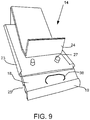
- FIG. 9 provides a perspective view of an alternative embodiment of the sled member of the present invention.
- FIG. 10 is a front elevation view of an alternative embodiment of the present invention.
- FIG. 11 presents a side elevation view of the alternative embodiment of FIG. 10 .
- FIG. 1 this provides a perspective view of a preferred embodiment of the present sink support bracket invention in use generally shows as 10 .
- An elongated channel base member 12 has at a top end a inward curving thin gauge metal clip 30 fixed to the top of the back plate 13 of the channel base member 12 , configured to compresses inward against a side cabinet wall compressing the wood cabinet.
- Metal clip 30 is pretensioned and is adjustable to meet different cabinet wall thicknesses, and in this same area are two points of no return one way stab-locks locks 28 .
- the top of the bracket has two stab locks 28 to engage the top of the cabinet wall, this is to prevent sag when there is a load on arm 26 .
- the main body of the base member 12 also includes at least one column of vertically oriented ratchet teeth 16 having a plurality of teeth 16 through a pair of parallel outwardly facing spaced apart columns of peripheral louvers or protrusions 16 .
- ratchet teeth is meant they permit movement across them in one direction, but not the other unless special methods are utilized.
- the two columns preferably have the teeth staggered in horizontal misalignment for finer adjustment of height as explained further later.
- the sled member 14 adjusts vertically with at least one blade spring 18 at the bottom end, but preferably two, with curved tips that engage on the teeth 16 of the channel base member when sliding upward, but prevents downward movement.
- blade spring is meant a strip of preselected semi-flexible material with a predetermined thickness and a free end that can be temporarily flexed from its resting position but then return when released to its original resting position. This contrasts with semi-flexible materials that when bent substantially remain essentially in the new position.
- the semi-flexible material can be either metal or plastic.
- the preselected material is a high-carbon spring steel with a preselected thickness in the range of 0.3 to 0.7 mm. Any thinner than the low end of the range would probably make it too weak to support the load above, and above the top of the range it would be too resistant to manual pushing of the sled. Any use of power tools would tend to lift the counter top excessively.
- a sink-contact arm 26 At the top end of the sled member 14 is a sink-contact arm 26 , which preferably has an upward curving tip and an 180° adjustable horizontal range of pivot motion to engage the rim of the sink depending of the gap to the cabinet wall.
- FIG. 2 provides a perspective profile view of an alternative embodiment of the present invention with a different method of wall attachment.
- the main body 12 shown without clip includes mounting apertures 22 in the planar back plate of the base member 13 that secures to a vertical surface by way of mounting screws (not shown) through the apertures 22 . It is preferable but optional to have one or more adhesive pads (not shown) on the back side for ease of installation. This gives the end user the option to secure the device to a cabinet wall where the clip-on version shown in FIG. 1 cannot be used.
- This figure also shows the preferred curved longitudinal edges 34 the sled member 14 configured for sliding engagement with the edge channels 20 of the channel base member 13 .
- FIG. 3 provides a bottom end view of a key feature for both embodiments of the present invention. The importance of this would not be obvious until one attempts to lower the sled member for height adjustment or removal of the sink because the ratchet teeth 16 inhibit downward movement, just upward.
- a screwdriver or other tool is inserted in the notch opening 37 between the two curved tips and pried outward to temporarily release the curved ends of the blade springs 18 from the teeth 16 . With just blade spring, the notch 37 is cut into the curved bottom of the blade spring 18 . Pulling down the lower flange 24 on the sled member 14 enables lowering the sled member while the foot tabs are still pried up. Removing the tool allows the foot tabs to re-engage with the ratchet teeth, or the sled member to be completely separated from the ratchet channel bracket.
- FIG. 4 is a side sectional elevation view of the preferred embodiment including the top clip 30 .
- This view also shows the curved tip 19 of the blade spring 18 which is the lower part of the sled member 14 in other figures. It also shows how the clip 30 engages the top of the cabinet wall 50 , and the stab-locks 28 are forced into the wall.
- FIG. 5 provides an elevation view of a prior art ratchet bracket.
- Elnar in the previously-referenced patent teaches using two rows of ratchet teeth (indentations) for “greater reliability and durability” (col. 4, line 34).
- the bottom edge of the slider portion 24 shows that the top edge of the teeth 27 in each row are in lateral alignment.
- This arrangement allows for two points of support contact to provide more reliable load support.
- the next level of support must be one full increment of tooth height, which by the nature of ratchet teeth must be a certain finite increment. Sometimes, one level may not provide tight-enough support, but the next level may be too far up.
- FIG. 6 is an elevation view of a key element of the present invention: the bracket plate 13 with two columns of ratchet teeth 16 .
- the teeth in one column herewith are purposely in staggered misalignment horizontally with the opposing tooth in the other column. It can be further explained by noting that the height of the top edge of the first tooth from the bottom on the right is at a height 92 intermediate between the heights of the the bottom two on the left, 90 and 94 . This is a significant feature because it provides finer adjustment of height as the sliding member is pushed upward.
- the teeth must have a finite height to function, and that sets a certain minimum increment in height as the sliding member is pushed up and one blade springs engages a ratchet tooth on one side and subsequently the other blade spring engages with a tooth on the opposite column on ratchet.
- the next increment of supported height is about half as much.
- the device of Elnar cannot provide this, and in fact teaches away from it by emphasizing greater support strength.
- FIGS. 7( a ) , 7 ( b ) and 7 ( c ) provide perspective views of an optional adapter 40 for the present invention.
- the width 98 of channel 46 is such that it engages operably over the edge rails 20 of the channel base member.
- This optional adapter become advantageous when helping to secure an undermount sink that is already installed, but now loosened from the underside of the counter top. Due to the narrow clearance between the sink and the inside front of the cabinet, it helps very much to first install the adapter plate 40 via the flange portion 42 .
- the adapter plate 40 is attached to the underside of the cabinet in the front with the flange portioned screwed onto the top wooden rim.
- the channels 20 of the base member slide into the channels 46 of the installed adapter plate 40 as shown in FIG. 7( c ) and assists in holding it there until the lower screws are put into the cabinet front wall.
- FIG. 8 provides a perspective view of an alternative embodiment of the sled portion 14 of the present invention.
- the blade springs 18 in this variation are non-integral and made of a semi-bendable leaf spring sort of a preselected material, typically high-carbon steel. This is so that they will slide more readily over the teeth as the sled 14 is pushed up into place. They are held in place with fasteners 27 such as rivets or bolts. In case the sled needs to be lowered, it can be released temporarily from the teeth with a prying means that can be operably engaged with a screwdriver.
- the means may be a ring or hoop 38 , or a notch 37 as shown in FIG. 3 .
- an alternative means of enabling finer tuning of the height is for one curved tip of one foot tab 18 to be marginally longer by a predetermined gap 88 .
- the gap 88 is about half of the spacing between top edges of the teeth. If 88 was equal to the gap between teeth, there would be no finer adjustment.
- FIG. 9 provides a perspective view of an alternative embodiment of the sled member 14 of the present invention.
- the blade spring 18 is a single unit with a single tip portion 19 .
- the blade spring 18 can be integral with the rest of the sled member 14 or attached with fasteners 27 .
- the prying means to release the curved 19 from the ratchet teeth is a ring 38 under which a screwdriver can fit and be used to lift the blade spring 18 away from the ratchet teeth.
- An optional feature is a reduced thickness portion 25 that is configured to reduce the force needed to bend the tips and thus reduce the upward force necessary.
- FIG. 10 is a front elevation view of an alternative embodiment of the present invention.
- An elongated channel member 12 includes a channel with curved edges, 20 , fixed to a mounting base plate 13 .
- a sliding member 14 has a multitude of teeth 16 .
- a sink support arm with a curved tip 26 is pivotably connected to the top end of the sliding member 14 .
- At least two apertures in the mounting plate 13 allow for secure mounting to a cabinet wall with screws, nails or bolts.
- the teeth 16 on the sliding member 14 in this example a rod, can slide over the curved tip 19 as it is pushed upward over blade spring 18 on the back plate 13 , but both are configured to not allow movement of the sliding member 14 downward.
- FIG. 11 presents a side elevation view of the alternative embodiment of FIG. 10 .
- the spring blade 18 fixed to the back plate 13 has a curved or bent portion 19 to allow engagement with the teeth 16 on the sliding member 14 , which in the example shown is a threaded rod.
- the distal end of the bend portion 19 is generally tapered like a knife edge for better engagement with threads.
- the combination of teeth 16 and spring blade 18 are configured to permit unidirectional movement by manual force.
- the curved lateral edges 20 of the channel member 12 restrict movement of the sliding member 14 other than for free movement upward. While not the preferred mode, the interior of the channel 20 may also be threaded such that the threaded rod 14 can be screwed up or down.
- the curved-tip arm 26 is free to pivot at the top rivet or bolt 24 such that the underside rim of a sink being supported can be engaged at various distances from a cabinet wall.
Landscapes
- Engineering & Computer Science (AREA)
- Environmental & Geological Engineering (AREA)
- Health & Medical Sciences (AREA)
- Life Sciences & Earth Sciences (AREA)
- Hydrology & Water Resources (AREA)
- Public Health (AREA)
- Water Supply & Treatment (AREA)
- Combinations Of Kitchen Furniture (AREA)
Abstract
An adjustable sink positioning and mounting apparatus for rapidly attaching sinks to the bottom of a counter top includes a channel base member with two columns of ratchet teeth horizontally misaligned, and a sliding sled member releasably engaged with the ratchet base channel. The sliding sled member includes an arm adjacent the top end and at least one blade spring with a curved tip at the lower end.
Description
The present application is a continuation-in-part of and claims the benefit of pending non-provisional application Ser. No. 16/510,982 filed on Jul. 13, 2019, and incorporated herein.
The present invention relates, in general, to the attachment of under-mount sinks and more particularly, this invention relates to the rapid mounting and securing of under-mount sinks beneath counter tops.
The attaching of under-mount sinks beneath counter tops has always been laborious and time consuming. There are many methods and a variety of installation techniques. The many models of sinks available in the market place pose different types of installation techniques. Information relevant to attempts to address this problem can be found in a few exemplary types of cross members. One suitable for the purpose of supporting sinks is described in U.S. Pat. No. 7,429,021. Another exemplary cross member suitable for use as a sink support is described in U.S. Pat. No. 5,538,206. But none of these examples of prior art have addressed the supporting of the front of a sink. Blaine in U.S. Pat. No. 9,290,919 discloses a fixed length support member that can be fastened at one end to a cabinet wall such as to hold up undermount sinks, but with no adjustment provisions once installed. In U.S. Pat. No. 6,105,182, Elnar teaches a ratchet bracket with two columns of teeth. Elnar discloses that the purpose of the two rows is to provide added durability and support strength by supporting the bottom edge of the sliding piece with two teeth simultaneously.
The present invention provides an apparatus and method of adjustably securing a sink to the bottom of a counter top and includes an elongated channel base member configured for attachment to a cabinet wall beneath a counter top, and at least one column of ratchet teeth in the middle section. A movable sled member slides within edge channels on the channel base member and includes a sink-contact arm at an upper end and at least one blade spring at a lower end, wherein the blade spring is configured to engage with the ratchet teeth such as to permit upward movement, but not in the down direction, unless the blade spring tip is temporarily pried free of the ratchet teeth.
It is, therefore, one of the primary objects of the present invention to provide a fast, easy, effective, efficient, simple and economical way of attaching and reliably securing an undermount sink to a countertop.
Another object of the present invention is to provide a self contained way of attaching a sink-support bracket requiring no external drilling, tapping, screwing, bolting, threading or adhesives while allowing the end user the option of securing the bracket by screws.
Still another object of the present invention is to provide 180° range of horizontal pivoting of the arm that will engage the sink flange to accommodate various size gaps between a cabinet wall and a sink flange.
An additional object of the present invention is to provide a faster action of adjustable vertical range of motion to engage the bracket with the sink flange by way of a sliding ratchet mechanism, and yet provide a release means if needed.
Still another object of the present invention is to provide enhanced variable height adjustment, which allows the sink to be cradled below the countertop. This allows an open window for the application of sink sealant. The sink is then raised to meet with the bottom of the countertop.
An additional object of the present invention is to provide a narrow-profile version of a bracket to support a sink where there is little clearance to work in the front region of the sink and side walls of the cabinetry.
Yet another objective is to include a design feature in a sliding ratchet assembly with finer adjustment of height than a typical ratchet device would offer.
In addition to the various objects and advantages of the present invention described with some degree of specificity above, it should be obvious that additional objects and advantages of the present invention will become more readily apparent to those persons who are skilled in the relevant art from the following more detailed descriptions of the invention, particularly, when such description is taken in conjunction with the attached drawing figures and with the appended claims.
Prior to proceeding to the more detailed description of the present invention it should be noted that, for the sake of clarity and understanding, identical components which have identical functions have been identified with identical reference numerals throughout the several views illustrated in the figures. An exception is the prior art FIG. 5 .
Referring initially to FIG. 1 , this provides a perspective view of a preferred embodiment of the present sink support bracket invention in use generally shows as 10. An elongated channel base member 12 has at a top end a inward curving thin gauge metal clip 30 fixed to the top of the back plate 13 of the channel base member 12, configured to compresses inward against a side cabinet wall compressing the wood cabinet. Metal clip 30 is pretensioned and is adjustable to meet different cabinet wall thicknesses, and in this same area are two points of no return one way stab-locks locks 28. The top of the bracket has two stab locks 28 to engage the top of the cabinet wall, this is to prevent sag when there is a load on arm 26. There are also two hammer-in type stab locks 28, adjacent the bottom end of the base member 12, to prevent counter rotation when there is a load on the sink-contact arm 26 in the fully retracted position. This method of attachment requires no external fasteners. The installed bracket is held in place vertically by the weight of the countertop and the stab locks. The main body of the base member 12 also includes at least one column of vertically oriented ratchet teeth 16 having a plurality of teeth 16 through a pair of parallel outwardly facing spaced apart columns of peripheral louvers or protrusions 16. By ratchet teeth is meant they permit movement across them in one direction, but not the other unless special methods are utilized. The two columns preferably have the teeth staggered in horizontal misalignment for finer adjustment of height as explained further later. The sled member 14 adjusts vertically with at least one blade spring 18 at the bottom end, but preferably two, with curved tips that engage on the teeth 16 of the channel base member when sliding upward, but prevents downward movement. By blade spring is meant a strip of preselected semi-flexible material with a predetermined thickness and a free end that can be temporarily flexed from its resting position but then return when released to its original resting position. This contrasts with semi-flexible materials that when bent substantially remain essentially in the new position. Herein, the semi-flexible material can be either metal or plastic. Preferably, the preselected material is a high-carbon spring steel with a preselected thickness in the range of 0.3 to 0.7 mm. Any thinner than the low end of the range would probably make it too weak to support the load above, and above the top of the range it would be too resistant to manual pushing of the sled. Any use of power tools would tend to lift the counter top excessively. At the top end of the sled member 14 is a sink-contact arm 26, which preferably has an upward curving tip and an 180° adjustable horizontal range of pivot motion to engage the rim of the sink depending of the gap to the cabinet wall.
Claims (12)
1. An adjustable support apparatus for under-mount sinks comprising:
a) an elongated channel base member configured for attachment to a cabinet wall wherein the channel base member includes channels on longitudinal sides of the channel base member, a planar back plate, and one of apertures and stab-locks in the planar back plate;
b) a sliding member configured to movably engage within the channels of the channel base member, wherein said sliding member has an arm adjacent a top end;
c) at least one column of ratchet teeth on said planar back plate;
d) at least one blade spring with a curved tip adjacent a free end of the blade spring, wherein said blade spring is fixed at an end opposite the curved tip to said sliding member; and
e) a prying means proximal said curved tip configured for temporarily disengaging said curved tip free of said column of ratchet teeth.
2. The adjustable support apparatus of claim 1 , wherein said planar back plate further includes a top end clip.
3. The adjustable support apparatus of claim 1 , wherein said sliding member is a sled unit which further includes curved lateral edges configured for sliding with said channels on said channel base member.
4. An adjustable support apparatus for under-mount sinks comprising:
an elongated channel base member configured for attachment to a cabinet wall wherein the channel base member includes channels on longitudinal sides of the channel base member, a planar back plate with two columns of ratchet teeth, and one of apertures and stab-locks in the planar back plate, wherein said two columns of ratchet teeth are two spaced apart columns of at least 5 ratchet teeth each in staggered horizontal misalignment and configured for height adjustment in increments intermediate to that of horizontal alignment, said ratchet teeth configured for prevention of downward movement of an attached sled member; and
wherein the sled member is configured to movably engage within said channels of said channel base member, wherein said sled member has an arm adjacent a top end and at least one blade spring with curved tip adjacent a lower end, and wherein said blade spring of said sled member includes a means for prying proximal said curved tip wherein said means for prying is configured for temporarily lifting said curved tip free of said columns of ratchet teeth.
5. The adjustable support apparatus of claim 4 , wherein said at least one blade spring with curved tip includes two parallel blade springs with curved tips at a free end of the blade springs.
6. The adjustable support apparatus of claim 4 , wherein said arm of said sled member has an upwardly curved distal end and a pivoting means.
7. The adjustable support apparatus of claim 4 , wherein said channel base member further includes a flanged adapter plate configured to slidingly engage with the channels on the longitudinal sides of said channel base member such as to facilitate installation of said channel base member adjacent a top edge of a cabinet front.
8. The adjustable support apparatus of claim 5 , wherein said two blade springs are non-integral and of a preselected material and predetermined thickness with the curved tips at the free end of said blade springs.
9. The adjustable support apparatus of claim 8 , wherein said curved tips of said blade springs of said sled member are of unequal length with a predetermined gap configured for finer height adjustment than with equal length.
10. The adjustable support apparatus of claim 8 , wherein said curved tips of said blade springs of said sled member are made of a high-carbon steel with a thickness between 0.3 and 0.7 millimeters.
11. The adjustable support apparatus of claim 8 , wherein said two blade springs are configured with one of a ring or notch operably engaged with said blade spring for temporarily disengaging said sled member from said ratchet teeth.
12. The adjustable support apparatus of claim 4 , wherein said at least one blade spring includes a reduced-thickness portion configured to reduce bending force without substantially reducing support strength.
Priority Applications (2)
| Application Number | Priority Date | Filing Date | Title |
|---|---|---|---|
| US16/691,474 US10907331B1 (en) | 2019-07-13 | 2019-11-21 | Rapid-install undermount sink bracket |
| US17/089,252 US11053672B2 (en) | 2019-11-21 | 2020-11-04 | Undermount sink installation apparatus and method |
Applications Claiming Priority (2)
| Application Number | Priority Date | Filing Date | Title |
|---|---|---|---|
| US16/510,902 US10563387B1 (en) | 2019-07-13 | 2019-07-13 | Rapid-install undermount sink bracket |
| US16/691,474 US10907331B1 (en) | 2019-07-13 | 2019-11-21 | Rapid-install undermount sink bracket |
Related Parent Applications (1)
| Application Number | Title | Priority Date | Filing Date |
|---|---|---|---|
| US16/510,902 Continuation-In-Part US10563387B1 (en) | 2019-07-13 | 2019-07-13 | Rapid-install undermount sink bracket |
Related Child Applications (1)
| Application Number | Title | Priority Date | Filing Date |
|---|---|---|---|
| US17/089,252 Continuation-In-Part US11053672B2 (en) | 2019-11-21 | 2020-11-04 | Undermount sink installation apparatus and method |
Publications (2)
| Publication Number | Publication Date |
|---|---|
| US20210010253A1 US20210010253A1 (en) | 2021-01-14 |
| US10907331B1 true US10907331B1 (en) | 2021-02-02 |
Family
ID=74101891
Family Applications (1)
| Application Number | Title | Priority Date | Filing Date |
|---|---|---|---|
| US16/691,474 Active US10907331B1 (en) | 2019-07-13 | 2019-11-21 | Rapid-install undermount sink bracket |
Country Status (1)
| Country | Link |
|---|---|
| US (1) | US10907331B1 (en) |
Citations (24)
| Publication number | Priority date | Publication date | Assignee | Title |
|---|---|---|---|---|
| US139408A (en) * | 1873-05-27 | Improvement in brackets for shelving | ||
| US277510A (en) * | 1883-05-15 | Adjustable and portable shelving | ||
| US391438A (en) * | 1888-10-23 | Adjustable bracket | ||
| US498945A (en) * | 1893-06-06 | Island | ||
| US515836A (en) * | 1894-03-06 | Basin-clamp | ||
| US565539A (en) * | 1896-08-11 | Frank e | ||
| US569640A (en) * | 1896-10-20 | Shelving | ||
| US845917A (en) * | 1906-07-19 | 1907-03-05 | Joshua J Worley | Shelf-supporting bracket. |
| US1066806A (en) * | 1911-03-11 | 1913-07-08 | Maurice Freud | Shop-window frame. |
| US1135181A (en) * | 1914-07-06 | 1915-04-13 | Micke Hastreiter | Adjustable washstand. |
| US2457373A (en) * | 1946-02-06 | 1948-12-28 | Charles H S Hunter | Removable bracket |
| US3008150A (en) * | 1958-12-24 | 1961-11-14 | Lyon Inc | Sink retaining means |
| US3022519A (en) * | 1959-12-10 | 1962-02-27 | Robert A B Lang | Sink clamping device |
| US3583002A (en) * | 1969-12-05 | 1971-06-08 | Richard H Roberts | Counter top sink assembly |
| US3813707A (en) * | 1973-05-21 | 1974-06-04 | American Standard Inc | Lavatory mounting structure |
| US4340199A (en) * | 1979-05-08 | 1982-07-20 | Rita Brock | Hanging device or catch |
| US5653550A (en) * | 1994-10-21 | 1997-08-05 | A. Raymond Gmbh & Co. Kg | Retaining device for fastening an appliance insert in a base panel |
| US6105182A (en) * | 1999-08-23 | 2000-08-22 | Elnar; Joseph G. | Adjustable, spa massager mounting assembly |
| US20100301175A1 (en) | 2009-05-31 | 2010-12-02 | Bennett Grayson | Sink brace |
| US20110272549A1 (en) * | 2005-05-10 | 2011-11-10 | Bsh Bosch Und Siemens Hausgerate Gmbh | Support arrangement and refrigerator provided therewith |
| US8356367B2 (en) | 2009-03-11 | 2013-01-22 | Peter S Flynn | Adjustable support system for undermounted sinks |
| US20150272353A1 (en) * | 2014-03-28 | 2015-10-01 | James Christodoulou | Low profile adjustable hanger device and system |
| US9290919B2 (en) | 2013-10-23 | 2016-03-22 | Dow Blaine | Mounting driver for undermounted sinks |
| US10184236B2 (en) * | 2016-04-12 | 2019-01-22 | Ningbo Afa Kitchen And Bath Co., Ltd. | Kitchen mounting part |
-
2019
- 2019-11-21 US US16/691,474 patent/US10907331B1/en active Active
Patent Citations (24)
| Publication number | Priority date | Publication date | Assignee | Title |
|---|---|---|---|---|
| US139408A (en) * | 1873-05-27 | Improvement in brackets for shelving | ||
| US277510A (en) * | 1883-05-15 | Adjustable and portable shelving | ||
| US391438A (en) * | 1888-10-23 | Adjustable bracket | ||
| US498945A (en) * | 1893-06-06 | Island | ||
| US515836A (en) * | 1894-03-06 | Basin-clamp | ||
| US565539A (en) * | 1896-08-11 | Frank e | ||
| US569640A (en) * | 1896-10-20 | Shelving | ||
| US845917A (en) * | 1906-07-19 | 1907-03-05 | Joshua J Worley | Shelf-supporting bracket. |
| US1066806A (en) * | 1911-03-11 | 1913-07-08 | Maurice Freud | Shop-window frame. |
| US1135181A (en) * | 1914-07-06 | 1915-04-13 | Micke Hastreiter | Adjustable washstand. |
| US2457373A (en) * | 1946-02-06 | 1948-12-28 | Charles H S Hunter | Removable bracket |
| US3008150A (en) * | 1958-12-24 | 1961-11-14 | Lyon Inc | Sink retaining means |
| US3022519A (en) * | 1959-12-10 | 1962-02-27 | Robert A B Lang | Sink clamping device |
| US3583002A (en) * | 1969-12-05 | 1971-06-08 | Richard H Roberts | Counter top sink assembly |
| US3813707A (en) * | 1973-05-21 | 1974-06-04 | American Standard Inc | Lavatory mounting structure |
| US4340199A (en) * | 1979-05-08 | 1982-07-20 | Rita Brock | Hanging device or catch |
| US5653550A (en) * | 1994-10-21 | 1997-08-05 | A. Raymond Gmbh & Co. Kg | Retaining device for fastening an appliance insert in a base panel |
| US6105182A (en) * | 1999-08-23 | 2000-08-22 | Elnar; Joseph G. | Adjustable, spa massager mounting assembly |
| US20110272549A1 (en) * | 2005-05-10 | 2011-11-10 | Bsh Bosch Und Siemens Hausgerate Gmbh | Support arrangement and refrigerator provided therewith |
| US8356367B2 (en) | 2009-03-11 | 2013-01-22 | Peter S Flynn | Adjustable support system for undermounted sinks |
| US20100301175A1 (en) | 2009-05-31 | 2010-12-02 | Bennett Grayson | Sink brace |
| US9290919B2 (en) | 2013-10-23 | 2016-03-22 | Dow Blaine | Mounting driver for undermounted sinks |
| US20150272353A1 (en) * | 2014-03-28 | 2015-10-01 | James Christodoulou | Low profile adjustable hanger device and system |
| US10184236B2 (en) * | 2016-04-12 | 2019-01-22 | Ningbo Afa Kitchen And Bath Co., Ltd. | Kitchen mounting part |
Also Published As
| Publication number | Publication date |
|---|---|
| US20210010253A1 (en) | 2021-01-14 |
Similar Documents
| Publication | Publication Date | Title |
|---|---|---|
| US10563387B1 (en) | Rapid-install undermount sink bracket | |
| US5231713A (en) | Detachable bed legs | |
| US7374308B2 (en) | Linear spring clip for securing lighting reflectors or housings into mounting frames | |
| US6736277B2 (en) | Adjustable rackmount assembly | |
| US6196141B1 (en) | Vertically stabilized adjustable shelf bracket assembly | |
| US4731965A (en) | Adjustable shim | |
| US5897002A (en) | Tool hanging rack | |
| US8356367B2 (en) | Adjustable support system for undermounted sinks | |
| US7478785B2 (en) | Vertically stabilized adjustable shelf bracket assembly | |
| US8070110B2 (en) | Sink support systems | |
| US5791089A (en) | Rolling device for a sliding leaf of a door window or the like | |
| US4175292A (en) | Sink mounting means | |
| US20030006681A1 (en) | Vertically stabilized adjustable shelf bracket assembly | |
| US20060010811A1 (en) | Molding for drywall ceiling grid | |
| US12006684B2 (en) | Ceiling grid hanger assembly with indexing tabs | |
| US20060091271A1 (en) | Wall unit support system | |
| EP0164815A2 (en) | An elongate shelf support | |
| US6793190B2 (en) | Retainer clip for mounting sink to countertop | |
| US20180135865A1 (en) | System and Method for Mounting Undercabinet Ventilation Hood | |
| US11053672B2 (en) | Undermount sink installation apparatus and method | |
| US10907331B1 (en) | Rapid-install undermount sink bracket | |
| NO319472B1 (en) | Removable suspension system for shelves, drawers or similar | |
| US20140208655A1 (en) | Sash cam for side load window balance system | |
| EP1486639B1 (en) | Lowerable door seal | |
| KR20190090245A (en) | Kickstand of sink |
Legal Events
| Date | Code | Title | Description |
|---|---|---|---|
| FEPP | Fee payment procedure |
Free format text: ENTITY STATUS SET TO UNDISCOUNTED (ORIGINAL EVENT CODE: BIG.); ENTITY STATUS OF PATENT OWNER: SMALL ENTITY |
|
| FEPP | Fee payment procedure |
Free format text: ENTITY STATUS SET TO SMALL (ORIGINAL EVENT CODE: SMAL); ENTITY STATUS OF PATENT OWNER: SMALL ENTITY |
|
| STCF | Information on status: patent grant |
Free format text: PATENTED CASE |
|
| MAFP | Maintenance fee payment |
Free format text: PAYMENT OF MAINTENANCE FEE, 4TH YR, SMALL ENTITY (ORIGINAL EVENT CODE: M2551); ENTITY STATUS OF PATENT OWNER: SMALL ENTITY Year of fee payment: 4 |