US10900106B2 - Ferritic steel - Google Patents
Ferritic steel Download PDFInfo
- Publication number
- US10900106B2 US10900106B2 US15/978,422 US201815978422A US10900106B2 US 10900106 B2 US10900106 B2 US 10900106B2 US 201815978422 A US201815978422 A US 201815978422A US 10900106 B2 US10900106 B2 US 10900106B2
- Authority
- US
- United States
- Prior art keywords
- amount
- less
- ferritic steel
- steel
- ferritic
- Prior art date
- Legal status (The legal status is an assumption and is not a legal conclusion. Google has not performed a legal analysis and makes no representation as to the accuracy of the status listed.)
- Expired - Fee Related, expires
Links
- 229910000831 Steel Inorganic materials 0.000 title claims abstract description 88
- 239000010959 steel Substances 0.000 title claims abstract description 88
- PXHVJJICTQNCMI-UHFFFAOYSA-N Nickel Chemical compound [Ni] PXHVJJICTQNCMI-UHFFFAOYSA-N 0.000 claims abstract description 34
- 239000011651 chromium Substances 0.000 claims abstract description 31
- 239000010936 titanium Substances 0.000 claims abstract description 31
- 239000011572 manganese Substances 0.000 claims abstract description 23
- 229910052799 carbon Inorganic materials 0.000 claims abstract description 19
- 229910052719 titanium Inorganic materials 0.000 claims abstract description 19
- OKTJSMMVPCPJKN-UHFFFAOYSA-N Carbon Chemical compound [C] OKTJSMMVPCPJKN-UHFFFAOYSA-N 0.000 claims abstract description 18
- VYZAMTAEIAYCRO-UHFFFAOYSA-N Chromium Chemical compound [Cr] VYZAMTAEIAYCRO-UHFFFAOYSA-N 0.000 claims abstract description 16
- 229910052782 aluminium Inorganic materials 0.000 claims abstract description 16
- 229910052804 chromium Inorganic materials 0.000 claims abstract description 16
- RTAQQCXQSZGOHL-UHFFFAOYSA-N Titanium Chemical compound [Ti] RTAQQCXQSZGOHL-UHFFFAOYSA-N 0.000 claims abstract description 14
- XAGFODPZIPBFFR-UHFFFAOYSA-N aluminium Chemical compound [Al] XAGFODPZIPBFFR-UHFFFAOYSA-N 0.000 claims abstract description 14
- XUIMIQQOPSSXEZ-UHFFFAOYSA-N Silicon Chemical compound [Si] XUIMIQQOPSSXEZ-UHFFFAOYSA-N 0.000 claims abstract description 13
- 229910052710 silicon Inorganic materials 0.000 claims abstract description 13
- 239000010703 silicon Substances 0.000 claims abstract description 13
- LEONUFNNVUYDNQ-UHFFFAOYSA-N vanadium atom Chemical compound [V] LEONUFNNVUYDNQ-UHFFFAOYSA-N 0.000 claims abstract description 13
- 229910052748 manganese Inorganic materials 0.000 claims abstract description 12
- 229910052759 nickel Inorganic materials 0.000 claims abstract description 12
- PWHULOQIROXLJO-UHFFFAOYSA-N Manganese Chemical compound [Mn] PWHULOQIROXLJO-UHFFFAOYSA-N 0.000 claims abstract description 11
- XEEYBQQBJWHFJM-UHFFFAOYSA-N Iron Chemical compound [Fe] XEEYBQQBJWHFJM-UHFFFAOYSA-N 0.000 claims abstract description 10
- IJGRMHOSHXDMSA-UHFFFAOYSA-N Atomic nitrogen Chemical compound N#N IJGRMHOSHXDMSA-UHFFFAOYSA-N 0.000 claims description 16
- 239000010955 niobium Substances 0.000 claims description 13
- 229910052698 phosphorus Inorganic materials 0.000 claims description 10
- 229910052717 sulfur Inorganic materials 0.000 claims description 10
- OAICVXFJPJFONN-UHFFFAOYSA-N Phosphorus Chemical compound [P] OAICVXFJPJFONN-UHFFFAOYSA-N 0.000 claims description 9
- NINIDFKCEFEMDL-UHFFFAOYSA-N Sulfur Chemical compound [S] NINIDFKCEFEMDL-UHFFFAOYSA-N 0.000 claims description 9
- 229910052757 nitrogen Inorganic materials 0.000 claims description 9
- 239000011574 phosphorus Substances 0.000 claims description 9
- 239000011593 sulfur Substances 0.000 claims description 9
- 229910052758 niobium Inorganic materials 0.000 claims description 7
- GUCVJGMIXFAOAE-UHFFFAOYSA-N niobium atom Chemical compound [Nb] GUCVJGMIXFAOAE-UHFFFAOYSA-N 0.000 claims description 6
- 230000015572 biosynthetic process Effects 0.000 abstract description 12
- 229910000859 α-Fe Inorganic materials 0.000 abstract description 9
- 230000005484 gravity Effects 0.000 abstract description 8
- 230000003247 decreasing effect Effects 0.000 abstract description 6
- 230000000052 comparative effect Effects 0.000 description 17
- 238000005096 rolling process Methods 0.000 description 12
- 238000000034 method Methods 0.000 description 11
- 239000000463 material Substances 0.000 description 9
- 239000000047 product Substances 0.000 description 8
- 238000012360 testing method Methods 0.000 description 8
- 239000000956 alloy Substances 0.000 description 7
- 229910045601 alloy Inorganic materials 0.000 description 6
- 239000004615 ingredient Substances 0.000 description 6
- 229910052720 vanadium Inorganic materials 0.000 description 6
- 229910001566 austenite Inorganic materials 0.000 description 5
- 239000011159 matrix material Substances 0.000 description 5
- 238000000137 annealing Methods 0.000 description 4
- 230000000694 effects Effects 0.000 description 4
- 238000010438 heat treatment Methods 0.000 description 4
- 239000000203 mixture Substances 0.000 description 4
- 239000000446 fuel Substances 0.000 description 3
- 238000004519 manufacturing process Methods 0.000 description 3
- 230000000704 physical effect Effects 0.000 description 3
- 238000005097 cold rolling Methods 0.000 description 2
- 239000012535 impurity Substances 0.000 description 2
- 230000036314 physical performance Effects 0.000 description 2
- 239000002244 precipitate Substances 0.000 description 2
- 238000001556 precipitation Methods 0.000 description 2
- 238000011160 research Methods 0.000 description 2
- 230000000087 stabilizing effect Effects 0.000 description 2
- 238000010998 test method Methods 0.000 description 2
- QVGXLLKOCUKJST-UHFFFAOYSA-N atomic oxygen Chemical compound [O] QVGXLLKOCUKJST-UHFFFAOYSA-N 0.000 description 1
- 230000009172 bursting Effects 0.000 description 1
- 238000010276 construction Methods 0.000 description 1
- 238000012937 correction Methods 0.000 description 1
- 239000013078 crystal Substances 0.000 description 1
- 230000009977 dual effect Effects 0.000 description 1
- 230000002708 enhancing effect Effects 0.000 description 1
- 238000005530 etching Methods 0.000 description 1
- 238000002474 experimental method Methods 0.000 description 1
- 238000010191 image analysis Methods 0.000 description 1
- 150000001247 metal acetylides Chemical class 0.000 description 1
- ZLANVVMKMCTKMT-UHFFFAOYSA-N methanidylidynevanadium(1+) Chemical class [V+]#[C-] ZLANVVMKMCTKMT-UHFFFAOYSA-N 0.000 description 1
- 150000004767 nitrides Chemical class 0.000 description 1
- 229910052760 oxygen Inorganic materials 0.000 description 1
- 239000001301 oxygen Substances 0.000 description 1
- 239000003208 petroleum Substances 0.000 description 1
- 238000005498 polishing Methods 0.000 description 1
- 230000001376 precipitating effect Effects 0.000 description 1
- 238000003303 reheating Methods 0.000 description 1
- 230000006641 stabilisation Effects 0.000 description 1
- 238000011105 stabilization Methods 0.000 description 1
Images


Classifications
-
- C—CHEMISTRY; METALLURGY
- C22—METALLURGY; FERROUS OR NON-FERROUS ALLOYS; TREATMENT OF ALLOYS OR NON-FERROUS METALS
- C22C—ALLOYS
- C22C38/00—Ferrous alloys, e.g. steel alloys
- C22C38/06—Ferrous alloys, e.g. steel alloys containing aluminium
-
- C—CHEMISTRY; METALLURGY
- C21—METALLURGY OF IRON
- C21D—MODIFYING THE PHYSICAL STRUCTURE OF FERROUS METALS; GENERAL DEVICES FOR HEAT TREATMENT OF FERROUS OR NON-FERROUS METALS OR ALLOYS; MAKING METAL MALLEABLE, e.g. BY DECARBURISATION OR TEMPERING
- C21D6/00—Heat treatment of ferrous alloys
- C21D6/004—Heat treatment of ferrous alloys containing Cr and Ni
-
- C—CHEMISTRY; METALLURGY
- C21—METALLURGY OF IRON
- C21D—MODIFYING THE PHYSICAL STRUCTURE OF FERROUS METALS; GENERAL DEVICES FOR HEAT TREATMENT OF FERROUS OR NON-FERROUS METALS OR ALLOYS; MAKING METAL MALLEABLE, e.g. BY DECARBURISATION OR TEMPERING
- C21D6/00—Heat treatment of ferrous alloys
- C21D6/005—Heat treatment of ferrous alloys containing Mn
-
- C—CHEMISTRY; METALLURGY
- C21—METALLURGY OF IRON
- C21D—MODIFYING THE PHYSICAL STRUCTURE OF FERROUS METALS; GENERAL DEVICES FOR HEAT TREATMENT OF FERROUS OR NON-FERROUS METALS OR ALLOYS; MAKING METAL MALLEABLE, e.g. BY DECARBURISATION OR TEMPERING
- C21D6/00—Heat treatment of ferrous alloys
- C21D6/008—Heat treatment of ferrous alloys containing Si
-
- C—CHEMISTRY; METALLURGY
- C22—METALLURGY; FERROUS OR NON-FERROUS ALLOYS; TREATMENT OF ALLOYS OR NON-FERROUS METALS
- C22C—ALLOYS
- C22C38/00—Ferrous alloys, e.g. steel alloys
- C22C38/02—Ferrous alloys, e.g. steel alloys containing silicon
-
- C—CHEMISTRY; METALLURGY
- C22—METALLURGY; FERROUS OR NON-FERROUS ALLOYS; TREATMENT OF ALLOYS OR NON-FERROUS METALS
- C22C—ALLOYS
- C22C38/00—Ferrous alloys, e.g. steel alloys
- C22C38/04—Ferrous alloys, e.g. steel alloys containing manganese
-
- C—CHEMISTRY; METALLURGY
- C22—METALLURGY; FERROUS OR NON-FERROUS ALLOYS; TREATMENT OF ALLOYS OR NON-FERROUS METALS
- C22C—ALLOYS
- C22C38/00—Ferrous alloys, e.g. steel alloys
- C22C38/18—Ferrous alloys, e.g. steel alloys containing chromium
- C22C38/40—Ferrous alloys, e.g. steel alloys containing chromium with nickel
- C22C38/46—Ferrous alloys, e.g. steel alloys containing chromium with nickel with vanadium
-
- C—CHEMISTRY; METALLURGY
- C22—METALLURGY; FERROUS OR NON-FERROUS ALLOYS; TREATMENT OF ALLOYS OR NON-FERROUS METALS
- C22C—ALLOYS
- C22C38/00—Ferrous alloys, e.g. steel alloys
- C22C38/18—Ferrous alloys, e.g. steel alloys containing chromium
- C22C38/40—Ferrous alloys, e.g. steel alloys containing chromium with nickel
- C22C38/50—Ferrous alloys, e.g. steel alloys containing chromium with nickel with titanium or zirconium
-
- C—CHEMISTRY; METALLURGY
- C21—METALLURGY OF IRON
- C21D—MODIFYING THE PHYSICAL STRUCTURE OF FERROUS METALS; GENERAL DEVICES FOR HEAT TREATMENT OF FERROUS OR NON-FERROUS METALS OR ALLOYS; MAKING METAL MALLEABLE, e.g. BY DECARBURISATION OR TEMPERING
- C21D2211/00—Microstructure comprising significant phases
- C21D2211/005—Ferrite
Definitions
- the present invention relates to a ferritic steel having decreased specific gravity while maintaining excellent mechanical strength by suppressing formation of ⁇ -carbide therein.
- ferritic lightweight steel, austenitic lightweight steel, ferrite-austenite dual phase (duplex) lightweight steel, and the like have been used. Since this lightweight steel contains a large amount of A1 in a steel material to have high specific strength, this lightweight steel has been spotlighted as an advanced structural material such as a vehicle component.
- the ferritic lightweight steel may not need additional alloy material for austenite stabilization, the ferritic lightweight steel may be more economical than other kinds of lightweight steel in view of cost of an alloy.
- the ferritic lightweight steel may include a kappa ( ⁇ )-phase that may be formed from components of the ferritic lightweight steel, when heat treatment and the components are not added in the optimal conditions, and thus formability may be deteriorated due to excessive precipitation of the ⁇ -phase.
- the present invention provides a ferritic steel and a composition thereof.
- the ferritic steel may have decreased specific gravity while maintaining excellent mechanical strength by suppressing formation of a ⁇ -phase. Accordingly, the ferritic steel may be suitably used in a vehicle component to which various heat treatments need to be applied.
- a ferrite steel may include: carbon (C) in an amount of about 0.05 to 0.12 wt %; aluminum (Al) in an amount of about 3.0 to 7.0 wt %; manganese (Mn) in an amount of about 0.5 wt % or less (not 0 wt %); nickel (Ni) in an amount of about 0.5 wt % or less (not 0 wt %); chromium (Cr) in an amount of about 0.75 wt % or less (not 0 wt %); silicon (Si) in an amount of about 0.3 to 0.75 wt %; a combined amount of titanium (Ti) and vanadium (V) in an amount of about 0.25 to 0.7 wt %; and a balance being iron (Fe), all the wt % are based on the total weight of the ferritic steel.
- the ferrite steel may further include other materials particularly niobium (Nb) in an amount of about 0.02 wt % or less, phosphorus (P) in an amount of about 0.1 wt % or less, sulfur (S) in an amount of about 0.05 wt % or less, nitrogen (N) in an amount of about 0.01 wt % or less, or a combination thereof, all the wt % based on the total weight of the ferric steel. It is understood that these additional materials, if present, would be in amount of greater than 0, such as about 0.01 wt %, all the wt % based on the total weight of the ferric steel.
- the ferritic steel may essentially consist of, consist essentially of, or consist of the components as described herein.
- the ferritic steel may essentially consist of, consist essentially of, or consist of: carbon (C) in an amount of about 0.05 to 0.12 wt %; aluminum (Al) in an amount of about 3.0 to 7.0 wt %; manganese (Mn) in an amount of about 0.5 wt % or less (not 0 wt %); nickel (Ni) in an amount of about 0.5 wt % or less (not 0 wt %); chromium (Cr) in an amount of about 0.75 wt % or less (not 0 wt %); silicon (Si) in an amount of about 0.3 to 0.75 wt %; a combined amount of titanium (Ti) and vanadium (V) in an amount of about 0.25 to 0.7 wt %; and a balance being iron (Fe), all the wt % are
- the ferritic steel may essentially consist of, consist essentially of, or consist of: carbon (C) in an amount of about 0.05 to 0.12 wt %; aluminum (Al) in an amount of about 3.0 to 7.0 wt %; manganese (Mn) in an amount of about 0.5 wt % or less (not 0 wt %); nickel (Ni) in an amount of about 0.5 wt % or less (not 0 wt %); chromium (Cr) in an amount of about 0.75 wt % or less (not 0 wt %); silicon (Si) in an amount of about 0.3 to 0.75 wt %; a combined amount of titanium (Ti) and vanadium (V) in an amount of about 0.25 to 0.7 wt %; niobium (Nb) in an amount of about 0.02 wt % or less, phosphorus (P) in an amount of about 0.1 wt % or less,
- the ferritic steel may have yield strength of about 500 Mpa or greater, preferably, of about 570M pa or greater.
- the ferritic steel may have tensile strength of about 540 Mpa or greater, preferably, of about 611 Mpa or greater.
- the ferritic steel may have an elongation of about 10% or greater.
- the ferritic steel may have a density of about 7.0 to 7.5 g/cm 3 .
- a fraction of formed ⁇ -carbide may be less than about 1%.
- a vehicle that may include the ferritic steel as described herein.
- FIG. 1 is a table of compositions in Examples and Comparative Examples
- FIG. 2 is a table of physical properties and performance in Examples and Comparative Examples
- FIGS. 3A and 3B are photographs of micro structures observed in Examples.
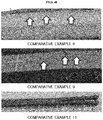
- FIGS. 4A and 4B are photographs of products in Examples and Comparative Examples.
- vehicle or “vehicular” or other similar term as used herein is inclusive of motor vehicles in general such as passenger automobiles including sports utility vehicles (SUV), buses, trucks, various commercial vehicles, watercraft including a variety of boats and ships, aircraft, and the like, and includes hybrid vehicles, electric vehicles, plug-in hybrid electric vehicles, hydrogen-powered vehicles and other alternative fuel vehicles (e.g. fuels derived from resources other than petroleum).
- a hybrid vehicle is a vehicle that has two or more sources of power, for example both gasoline-powered and electric-powered vehicles.
- Ferritic steel as described herein may be utilized in a variety of ways, for instance, as a material of construction of vehicle body, engine component, of the other vehicle component.
- the term “about” is understood as within a range of normal tolerance in the art, for example within 2 standard deviations of the mean. “About” can be understood as within 10%, 9%, 8%, 7%, 6%, 5%, 4%, 3%, 2%, 1%, 0.5%, 0.1%, 0.05%, or 0.01% of the stated value. Unless otherwise clear from the context, all numerical values provided herein are modified by the term “about.”
- FIG. 1 is a table illustrating ingredients in Examples and Comparative Examples
- FIG. 2 is a table illustrating physical properties and performance in Examples and Comparative Examples.
- a ferritic steel in an exemplary embodiment of the present invention, formation of ⁇ -carbide is suppressed by optimizing contents of main alloy ingredients.
- the ferrite steel may include: carbon (C) in an amount of about 0.05 to 0.12 wt %; aluminum (Al) in an amount of about 3.0 to 7.0 wt %; manganese (Mn) in an amount of about 0.5 wt % or less (not 0 wt %); nickel (Ni) in an amount of about 0.5 wt % or less (not 0 wt %); chromium (Cr) in an amount of about 0.75 wt % or less (not 0 wt %); silicon (Si) in an amount of about 0.3 to 0.75 wt %; a combined amount of titanium (Ti) and vanadium (V) in an amount of about 0.25 to 0.7 wt %; and a balance being iron (Fe), all the wt % are
- the reason to restrict the alloy ingredients and composition range thereof is as follows.
- % disclosed as a unit of the composition range means “weight % (wt %)”.
- a content of carbon (C) may be about 0.05 to 0.12 wt % based on the total weight of the ferritic steel.
- carbon (C) may be an element effective in improving strength of steel, since a fraction of ⁇ -carbide is increased as the amount of the carbon is increased, the content of carbon (C) may be limited up to about 0.12 wt % which may correspond to a high-temperature solubility limit of carbon (C) in BCC (Body Centered Cubic).
- the content of the carbon is of about or greater than 0.05 wt %, which may correspond to a low-temperature solubility limit of carbon (C) in a low-temperature BCC, an effect of enhancing strength through formation of carbide may be obtained.
- BCC as used herein may include a stable crystal structure of the ferrite steel, for example, at room temperature.
- a content of aluminum (Al) may be about 3.0 to 7.0 wt % based on the total weight of the ferritic steel.
- aluminum may effectively decrease a specific gravity of a material at the time of adding aluminum to an alloy.
- the aluminum is included in the amount greater than the predetermined amount, e.g., greater than 7 wt %, at which an equilibrium phase of ⁇ -carbide is not present in an entire temperature range, a large amount of ⁇ -carbide may be precipitated.
- a decrease in specific gravity may be insufficient, and a matrix structure may be mainly formed of austenite, such that there is no difference with a material according to the related art.
- the contents of manganese (Mn) and nickel (Ni) may be each 0.5 wt % or less (not 0 wt %) based on the total weight of the ferritic steel.
- the amounts of manganese (Mn) and nickel (Ni) are added greater than the predetermined amount, e.g., greater than about 0.5 wt %, ⁇ -carbide may be formed in austenite.
- a content of chromium (Cr) may be about 0.75 wt % or less (not 0 wt %) based on the total weight of the ferritic steel.
- chromium (Cr) is a ferrite stabilizing element, since chromium (Cr) may cause brittleness at the time of adding a large amount of chromium (Cr), the content of chromium may be included up to about 0.75 wt % or less.
- a content of silicon (Si) may be about 0.3 to 0.75 wt % based on the total weight of the ferritic steel.
- Silicon (Si) as used herein may be a ferrite stabilizing element similarly to chromium (Cr), and the content may be added in an amount of 0.3 wt % or greater in order to form a stable ferrite phase.
- silicon (Si) may also cause brittleness, similarly to chromium (Cr).
- a combined content of titanium (Ti) and vanadium (V) may be of about 0.25 to 0.7 wt % based on the total weight of the ferritic steel.
- Titanium (Ti) and vanadium (V) as used herein may improve strength and suppress formation of ⁇ -carbide by forming micro-carbide at a high temperature of about 1200° C. or greater when titanium (Ti) and vanadium (V) are each added alone or added in combination. Therefore, in order to suppress formation of ⁇ -carbide, because the upper limit of the content of carbon (C) is about 0.12 wt %, a theoretical maximum combined content of Ti and V may be about 0.48 wt %.
- the combined content may be about or less than 0.7 wt %. Further, the combined content thereof may be of about or greater than 0.25 wt % to prevent strength decreased due to unformation of ⁇ -carbide by formation of TiC and VC.
- the ferritic steel may further include niobium (Nb) in an amount of about 0.02 wt % or less, phosphorus (P) in an amount of about 0.1 wt % or less, sulfur (S) in an amount of about 0.05 wt % or less, nitrogen (N) in an amount of about 0.01 wt % or less, or a combination thereof, based on the total weight of the ferritic steel.
- Nb niobium
- P phosphorus
- S sulfur
- N nitrogen
- a content of niobium (Nb) may be included of about or less than about 0.02 wt % based on the total weight of the ferritic steel.
- contents of phosphorus (P) and sulfur (S) may be limited as low as possible, but in consideration of a removal process of phosphorus (P) and sulfur (S), the content of phosphorus (P) may be of about or less than about 0.1 wt %, and a the content of sulfur (S) may be of about or less than about 0.05 wt %.
- a content of nitrogen (N) may be controlled as low as possible in order to suppress formation of nitrides of Ti, V, Al, and the like, and in consideration of a removal process, the content of nitrogen (N) may be of about or less than about 0.01 wt % based on the total weight of the ferritic steel.
- the balance except for the above-mentioned ingredient may be Fe and other inevitable impurities.
- the manufactured bloom was re-heated in a temperature section of 1000 to 1300° C. at a rate of 2 minutes per thickness 1 mm for the hot rough rolling process.
- an additional heat treatment process may be further performed thereon at the above-mentioned reheating temperature at a rate of 1 hour per thickness 25 mm.
- the re-heated bloom was subjected to a rolling process at a temperature of 800° C. or greater at a reduction ratio of 3.5 or greater, thereby manufacturing a billet.
- the rolled billet was subjected to the primary warm rolling process in a temperature section of 700 to 1000° C. to thereby be formed in a form of steel bar or coil. Then, the rolled steel bar or coil may be subjected to the primary annealing process in a temperature section of 600 to 900° C.
- the primarily annealed steel bar or coil may be subjected to the secondary warm rolling process in a temperature section of 500 to 850° C., and the secondary rolled steel bar or coil may be subjected to the secondary annealing process in a temperature section of 650 to 850° C.
- the secondarily annealed steel bar or coil as described above may be subjected to the cold rolling process for final size correction.
- test samples according to Examples and Comparative Examples were processed so as to satisfy ASTM E 8 specifications for a steel bar standard sample at a position of 1 ⁇ 2R of steel bar rolled at ⁇ 35.
- test sample was evaluated according to ASTM E 8 test methods at a temperature of 25° C. and a humidity of 65% using a uniaxial tensile tester with a maximum load capacity of 250 kN, thereby measuring the yield strength, tensile strength, and elongation.
- the density of the test sample was measured according to ASTM D 792 method A.
- the fraction of ⁇ -carbide was determined by primarily measuring a fraction of ⁇ -carbide of a test sample weakly polished after mirror polishing and then verifying consistency with an image analysis result after Lepera color etching.
- the yield strength was maintained to be 500 Mpa or greater, and preferably, the yield strength was 570 Mpa or greater.
- the tensile strength was maintained to be 540 Mpa or greater, and preferably, the tensile strength was 611 Mpa or greater.
- the elongation was maintained to be 10% or greater, and the density was in a range of 7.0 to 7.5 g/cm 3 .
- the fraction of the formed ⁇ -carbide was less than 1%.
- Comparative Example 1 a content of Al was insufficient, such that there was no effect of decreasing specific gravity, a fraction of ⁇ -carbide exceeded the requirement (less than 1%) of the present invention, and an austenite phase matrix was formed.
- FIG. 3A is a photograph of a micro structure in Example 1
- FIG. 3B is a photograph of micro structure in Example 2.
- Example 1 precipitates such as TiC, VC, and M7C3 were formed in a ferritic matrix structure, and precipitation of ⁇ -carbide was not observed.
- Example 2 precipitates such as TiC, VC, and M7C3 were formed in a ferritic matrix structure, and a fraction of precipitated ⁇ -carbide was less than 1%.
- FIG. 4A which is a photograph illustrating products in Examples 1 and 2, is a photograph of products during and after rolling the products in a form of steel bar. As illustrated in FIG. 4A , it may be confirmed that in Examples according to the present invention, rolling was normally performed, and surface quality of the product was excellent.
- FIG. 4B which is a photograph illustrating products in Examples 8, 9, and 11, is a photograph of products during and after rolling the products in a form of steel bar.
- FIG. 4B it may be confirmed that in Comparative Examples 8 and 9 corresponding to test samples in which fractions of precipitated ⁇ -carbide were about 1.5% and 2.4%, respectively, cracks occurred in a surface during the rolling. Further, it may be confirmed that in Comparative Example 11 corresponding to a test sample in which fractions of precipitated ⁇ -carbide was about 4.3%, bursting occurred during the rolling.
- the ferritic lightweight steel capable of securing an elongation of 10% or greater and decreasing specific gravity while maintaining excellent yield strength and tensile strength may be obtained.
- ⁇ -carbide In ferritic low specific gravity lightweight steel according to the related art, about 1 to 30% of ⁇ -carbide is formed due to relatively high contents of Al and C.
- formation of ⁇ -carbide may be suppressed by suppressing the content of Al in a range of 7% or less so as to allow a stable phase of the ⁇ -carbide not to exist and controlling an amount of solute carbon in a matrix at a significantly low level while securing strength by formation of titanium or vanadium carbides in a region of 1000° C. or greater.
Landscapes
- Chemical & Material Sciences (AREA)
- Engineering & Computer Science (AREA)
- Mechanical Engineering (AREA)
- Materials Engineering (AREA)
- Metallurgy (AREA)
- Organic Chemistry (AREA)
- Physics & Mathematics (AREA)
- Thermal Sciences (AREA)
- Crystallography & Structural Chemistry (AREA)
- Heat Treatment Of Sheet Steel (AREA)
Abstract
Description
Claims (10)
Applications Claiming Priority (2)
| Application Number | Priority Date | Filing Date | Title |
|---|---|---|---|
| KR10-2017-0165083 | 2017-12-04 | ||
| KR1020170165083A KR20190065671A (en) | 2017-12-04 | 2017-12-04 | Ferric lightweight steel |
Publications (2)
| Publication Number | Publication Date |
|---|---|
| US20190169720A1 US20190169720A1 (en) | 2019-06-06 |
| US10900106B2 true US10900106B2 (en) | 2021-01-26 |
Family
ID=66548324
Family Applications (1)
| Application Number | Title | Priority Date | Filing Date |
|---|---|---|---|
| US15/978,422 Expired - Fee Related US10900106B2 (en) | 2017-12-04 | 2018-05-14 | Ferritic steel |
Country Status (4)
| Country | Link |
|---|---|
| US (1) | US10900106B2 (en) |
| KR (1) | KR20190065671A (en) |
| CN (1) | CN109868420B (en) |
| DE (1) | DE102018113060A1 (en) |
Families Citing this family (2)
| Publication number | Priority date | Publication date | Assignee | Title |
|---|---|---|---|---|
| CN111334716B (en) * | 2020-03-25 | 2021-04-13 | 江西理工大学 | Chromium-titanium-boron-containing low-carbon high-strength deep drawing steel and preparation method and application thereof |
| EP4444922A1 (en) * | 2021-12-10 | 2024-10-16 | ArcelorMittal | Low density hot rolled steel, method of production thereof and use of such steel to produce vehicle parts |
Citations (2)
| Publication number | Priority date | Publication date | Assignee | Title |
|---|---|---|---|---|
| KR20100019443A (en) | 2007-05-16 | 2010-02-18 | 아르셀러미탈 프랑스 | Low density steel with good stamping capability |
| KR20170005251A (en) | 2015-07-01 | 2017-01-12 | 주식회사 포스코 | Ferric lightweight steel sheet having excellent strength and ductility and method for manufacturing the same |
Family Cites Families (7)
| Publication number | Priority date | Publication date | Assignee | Title |
|---|---|---|---|---|
| JP5042694B2 (en) * | 2007-04-13 | 2012-10-03 | 新日本製鐵株式会社 | High strength low specific gravity steel plate excellent in ductility and workability and method for producing the same |
| EP3088548B1 (en) * | 2013-12-26 | 2020-09-30 | Posco | Steel sheet having high strength and low density and method of manufacturing same |
| KR101685490B1 (en) * | 2015-06-22 | 2016-12-13 | 현대자동차주식회사 | Bearing alloy steel improved fatigue durability and the method of manufacturing the same |
| CN104928456B (en) * | 2015-06-30 | 2017-08-25 | 宝山钢铁股份有限公司 | A kind of manufacture method for improving general chill ferritic lightweight steel ductility |
| CN104928568B (en) * | 2015-06-30 | 2017-07-28 | 宝山钢铁股份有限公司 | A kind of ferrite low-density high-strength steel and its manufacture method |
| KR101745192B1 (en) * | 2015-12-04 | 2017-06-09 | 현대자동차주식회사 | Ultra high strength spring steel |
| CN106244927B (en) * | 2016-09-30 | 2018-04-03 | 北京理工大学 | A kind of low-density unimach and preparation method thereof |
-
2017
- 2017-12-04 KR KR1020170165083A patent/KR20190065671A/en not_active Ceased
-
2018
- 2018-05-14 US US15/978,422 patent/US10900106B2/en not_active Expired - Fee Related
- 2018-05-31 DE DE102018113060.0A patent/DE102018113060A1/en not_active Ceased
- 2018-06-05 CN CN201810568236.3A patent/CN109868420B/en active Active
Patent Citations (3)
| Publication number | Priority date | Publication date | Assignee | Title |
|---|---|---|---|---|
| KR20100019443A (en) | 2007-05-16 | 2010-02-18 | 아르셀러미탈 프랑스 | Low density steel with good stamping capability |
| US20100300585A1 (en) * | 2007-05-16 | 2010-12-02 | Arcelormittal France | Low-density steel having good drawability |
| KR20170005251A (en) | 2015-07-01 | 2017-01-12 | 주식회사 포스코 | Ferric lightweight steel sheet having excellent strength and ductility and method for manufacturing the same |
Also Published As
| Publication number | Publication date |
|---|---|
| US20190169720A1 (en) | 2019-06-06 |
| CN109868420A (en) | 2019-06-11 |
| DE102018113060A1 (en) | 2019-06-06 |
| KR20190065671A (en) | 2019-06-12 |
| CN109868420B (en) | 2022-07-12 |
Similar Documents
| Publication | Publication Date | Title |
|---|---|---|
| KR101779305B1 (en) | Austenitic stainless steel sheet and method for producing same | |
| JP5393459B2 (en) | High manganese type high strength steel plate with excellent impact characteristics | |
| EP3395980B1 (en) | Non-magnetic steel material having excellent hot workability and manufacturing method therefor | |
| TWI510637B (en) | High carbon steel sheet and method for producing the same | |
| KR101163028B1 (en) | High cold-rolled steel with excellent strength and elongation, and method preparing the same | |
| KR101943591B1 (en) | Austenitic stainless steel having niobium and manufacturing method of the same | |
| CN103080359B (en) | The high tensile hot rolled steel sheet of excellent processability and manufacture method thereof | |
| US20100037993A1 (en) | Ultrahigh-strength twip steel sheet and manufacturing method thereof | |
| WO2009008548A1 (en) | Process for producing high-strength cold rolled steel sheet with low yield strength and with less material quality fluctuation | |
| US10900106B2 (en) | Ferritic steel | |
| KR101568519B1 (en) | Hot rolled steel sheet having excellent deformation anisotropy in sheared edge and anti fatigue property and method for manufacturing the same | |
| KR101657793B1 (en) | Bake hardening steel sheet having excellent drawability and method for manufacturing thereof | |
| CN104039999A (en) | High carbon hot-rolled steel sheet with excellent hardenability and minimal in-plane anisotropy, and method for producing same | |
| EP3872212A1 (en) | Cryogenic austenitic high-manganese steel having excellent corrosion resistance, and manufacturing method therefor | |
| KR101518580B1 (en) | Steel sheet having excellent strength and ductility and method for manufacturing the same | |
| KR20140010700A (en) | High carbon steel sheet having excellent uniformity and manufacturing mehtod for the same | |
| KR101505297B1 (en) | Hot-rolled steel sheet for enamel and method of manufacturing the same | |
| EP4438761A1 (en) | Hot-rolled steel sheet and method for manufacturing same | |
| KR101988762B1 (en) | High-manganese steel sheet having excellent formability, and method for manufacturing thereof | |
| KR101205122B1 (en) | 440MPa GRADE HIGH STRENGTH STEEL PLATE APPLIED BATCH ANNEALING TYPE AND METHOD FOR MANUFACTURING THE SAME | |
| KR101683987B1 (en) | Precipitation hardening steels having low density, high strength and elongation and manufacturing method thereof | |
| KR101965149B1 (en) | Austenitic lihgt-weight steel with excellent balance between tensile strength and elongation and method of manufacturing the same | |
| KR101597411B1 (en) | Steel sheet and method of manufacturing the same | |
| US20200354805A1 (en) | Austenitic light weight steel | |
| KR102207723B1 (en) | Lihgt-weight stainless steel with excellent mechanical properties and method of manufacturing the same |
Legal Events
| Date | Code | Title | Description |
|---|---|---|---|
| AS | Assignment |
Owner name: KIA MOTORS CORPORATION, KOREA, REPUBLIC OF Free format text: ASSIGNMENT OF ASSIGNORS INTEREST;ASSIGNORS:KIM, DONG HWI;JO, BONG LAE;REEL/FRAME:045795/0136 Effective date: 20180409 Owner name: HYUNDAI MOTOR COMPANY, KOREA, REPUBLIC OF Free format text: ASSIGNMENT OF ASSIGNORS INTEREST;ASSIGNORS:KIM, DONG HWI;JO, BONG LAE;REEL/FRAME:045795/0136 Effective date: 20180409 |
|
| FEPP | Fee payment procedure |
Free format text: ENTITY STATUS SET TO UNDISCOUNTED (ORIGINAL EVENT CODE: BIG.); ENTITY STATUS OF PATENT OWNER: LARGE ENTITY |
|
| STPP | Information on status: patent application and granting procedure in general |
Free format text: DOCKETED NEW CASE - READY FOR EXAMINATION |
|
| STPP | Information on status: patent application and granting procedure in general |
Free format text: NON FINAL ACTION MAILED |
|
| STPP | Information on status: patent application and granting procedure in general |
Free format text: NON FINAL ACTION MAILED |
|
| STPP | Information on status: patent application and granting procedure in general |
Free format text: FINAL REJECTION MAILED |
|
| STPP | Information on status: patent application and granting procedure in general |
Free format text: RESPONSE AFTER FINAL ACTION FORWARDED TO EXAMINER |
|
| STPP | Information on status: patent application and granting procedure in general |
Free format text: PUBLICATIONS -- ISSUE FEE PAYMENT RECEIVED |
|
| STPP | Information on status: patent application and granting procedure in general |
Free format text: PUBLICATIONS -- ISSUE FEE PAYMENT VERIFIED |
|
| STCF | Information on status: patent grant |
Free format text: PATENTED CASE |
|
| FEPP | Fee payment procedure |
Free format text: MAINTENANCE FEE REMINDER MAILED (ORIGINAL EVENT CODE: REM.); ENTITY STATUS OF PATENT OWNER: LARGE ENTITY |
|
| LAPS | Lapse for failure to pay maintenance fees |
Free format text: PATENT EXPIRED FOR FAILURE TO PAY MAINTENANCE FEES (ORIGINAL EVENT CODE: EXP.); ENTITY STATUS OF PATENT OWNER: LARGE ENTITY |
|
| STCH | Information on status: patent discontinuation |
Free format text: PATENT EXPIRED DUE TO NONPAYMENT OF MAINTENANCE FEES UNDER 37 CFR 1.362 |
|
| FP | Lapsed due to failure to pay maintenance fee |
Effective date: 20250126 |