US10899278B2 - Vehicular visual recognition device - Google Patents

Vehicular visual recognition device Download PDF

Info

Publication number
US10899278B2
US10899278B2 US16/763,449 US201816763449A US10899278B2 US 10899278 B2 US10899278 B2 US 10899278B2 US 201816763449 A US201816763449 A US 201816763449A US 10899278 B2 US10899278 B2 US 10899278B2
Authority
US
United States
Prior art keywords
support body
visual recognition
fluid passageway
connection portion
housing body
Prior art date
Legal status (The legal status is an assumption and is not a legal conclusion. Google has not performed a legal analysis and makes no representation as to the accuracy of the status listed.)
Expired - Fee Related
Application number
US16/763,449
Other versions
US20200298762A1 (en
Inventor
Reiya Ichimura
Suguru Fujisaki
Current Assignee (The listed assignees may be inaccurate. Google has not performed a legal analysis and makes no representation or warranty as to the accuracy of the list.)
Tokai Rika Co Ltd
Original Assignee
Tokai Rika Co Ltd
Priority date (The priority date is an assumption and is not a legal conclusion. Google has not performed a legal analysis and makes no representation as to the accuracy of the date listed.)
Filing date
Publication date
Application filed by Tokai Rika Co Ltd filed Critical Tokai Rika Co Ltd
Assigned to KABUSHIKI KAISHA TOKAI-RIKA-DENKI-SEISAKUSHO reassignment KABUSHIKI KAISHA TOKAI-RIKA-DENKI-SEISAKUSHO ASSIGNMENT OF ASSIGNORS INTEREST (SEE DOCUMENT FOR DETAILS). Assignors: FUJISAKI, Suguru, ICHIMURA, Reiya
Publication of US20200298762A1 publication Critical patent/US20200298762A1/en
Application granted granted Critical
Publication of US10899278B2 publication Critical patent/US10899278B2/en
Expired - Fee Related legal-status Critical Current
Anticipated expiration legal-status Critical

Links

Images

Classifications

    • BPERFORMING OPERATIONS; TRANSPORTING
    • B60VEHICLES IN GENERAL
    • B60RVEHICLES, VEHICLE FITTINGS, OR VEHICLE PARTS, NOT OTHERWISE PROVIDED FOR
    • B60R1/00Optical viewing arrangements; Real-time viewing arrangements for drivers or passengers using optical image capturing systems, e.g. cameras or video systems specially adapted for use in or on vehicles
    • B60R1/12Mirror assemblies combined with other articles, e.g. clocks
    • BPERFORMING OPERATIONS; TRANSPORTING
    • B60VEHICLES IN GENERAL
    • B60RVEHICLES, VEHICLE FITTINGS, OR VEHICLE PARTS, NOT OTHERWISE PROVIDED FOR
    • B60R11/00Arrangements for holding or mounting articles, not otherwise provided for
    • B60R11/04Mounting of cameras operative during drive; Arrangement of controls thereof relative to the vehicle
    • BPERFORMING OPERATIONS; TRANSPORTING
    • B60VEHICLES IN GENERAL
    • B60RVEHICLES, VEHICLE FITTINGS, OR VEHICLE PARTS, NOT OTHERWISE PROVIDED FOR
    • B60R1/00Optical viewing arrangements; Real-time viewing arrangements for drivers or passengers using optical image capturing systems, e.g. cameras or video systems specially adapted for use in or on vehicles
    • B60R1/02Rear-view mirror arrangements
    • B60R1/06Rear-view mirror arrangements mounted on vehicle exterior
    • BPERFORMING OPERATIONS; TRANSPORTING
    • B60VEHICLES IN GENERAL
    • B60SSERVICING, CLEANING, REPAIRING, SUPPORTING, LIFTING, OR MANOEUVRING OF VEHICLES, NOT OTHERWISE PROVIDED FOR
    • B60S1/00Cleaning of vehicles
    • B60S1/02Cleaning windscreens, windows or optical devices
    • B60S1/56Cleaning windscreens, windows or optical devices specially adapted for cleaning other parts or devices than front windows or windscreens
    • BPERFORMING OPERATIONS; TRANSPORTING
    • B60VEHICLES IN GENERAL
    • B60SSERVICING, CLEANING, REPAIRING, SUPPORTING, LIFTING, OR MANOEUVRING OF VEHICLES, NOT OTHERWISE PROVIDED FOR
    • B60S1/00Cleaning of vehicles
    • B60S1/02Cleaning windscreens, windows or optical devices
    • B60S1/56Cleaning windscreens, windows or optical devices specially adapted for cleaning other parts or devices than front windows or windscreens
    • B60S1/60Cleaning windscreens, windows or optical devices specially adapted for cleaning other parts or devices than front windows or windscreens for signalling devices, e.g. reflectors
    • HELECTRICITY
    • H04ELECTRIC COMMUNICATION TECHNIQUE
    • H04NPICTORIAL COMMUNICATION, e.g. TELEVISION
    • H04N23/00Cameras or camera modules comprising electronic image sensors; Control thereof
    • H04N23/50Constructional details
    • H04N23/51Housings
    • HELECTRICITY
    • H04ELECTRIC COMMUNICATION TECHNIQUE
    • H04NPICTORIAL COMMUNICATION, e.g. TELEVISION
    • H04N23/00Cameras or camera modules comprising electronic image sensors; Control thereof
    • H04N23/50Constructional details
    • H04N23/52Elements optimising image sensor operation, e.g. for electromagnetic interference [EMI] protection or temperature control by heat transfer or cooling elements
    • H04N5/2252
    • H04N5/22521
    • HELECTRICITY
    • H04ELECTRIC COMMUNICATION TECHNIQUE
    • H04NPICTORIAL COMMUNICATION, e.g. TELEVISION
    • H04N7/00Television systems
    • H04N7/18Closed-circuit television [CCTV] systems, i.e. systems in which the video signal is not broadcast
    • BPERFORMING OPERATIONS; TRANSPORTING
    • B60VEHICLES IN GENERAL
    • B60RVEHICLES, VEHICLE FITTINGS, OR VEHICLE PARTS, NOT OTHERWISE PROVIDED FOR
    • B60R1/00Optical viewing arrangements; Real-time viewing arrangements for drivers or passengers using optical image capturing systems, e.g. cameras or video systems specially adapted for use in or on vehicles
    • B60R1/12Mirror assemblies combined with other articles, e.g. clocks
    • B60R2001/1253Mirror assemblies combined with other articles, e.g. clocks with cameras, video cameras or video screens
    • BPERFORMING OPERATIONS; TRANSPORTING
    • B60VEHICLES IN GENERAL
    • B60RVEHICLES, VEHICLE FITTINGS, OR VEHICLE PARTS, NOT OTHERWISE PROVIDED FOR
    • B60R11/00Arrangements for holding or mounting articles, not otherwise provided for
    • B60R2011/0042Arrangements for holding or mounting articles, not otherwise provided for characterised by mounting means
    • B60R2011/008Adjustable or movable supports
    • B60R2011/0082Adjustable or movable supports collapsible, e.g. for storing after use
    • BPERFORMING OPERATIONS; TRANSPORTING
    • B60VEHICLES IN GENERAL
    • B60RVEHICLES, VEHICLE FITTINGS, OR VEHICLE PARTS, NOT OTHERWISE PROVIDED FOR
    • B60R11/00Arrangements for holding or mounting articles, not otherwise provided for
    • B60R2011/0042Arrangements for holding or mounting articles, not otherwise provided for characterised by mounting means
    • B60R2011/008Adjustable or movable supports
    • B60R2011/0085Adjustable or movable supports with adjustment by rotation in their operational position

Definitions

  • the present invention relates to a vehicular visual recognition device.
  • JP-A Japanese Patent Application Laid-Open (JP-A) No. 2012-37548 discloses a vehicular visual recognition device (an onboard optical sensor device) including a camera to assist a vehicle occupant with visual recognition to the rear of the vehicle.
  • the vehicular visual recognition device disclosed in JP-A No. 2012-37548 includes a nozzle to jet cleaning liquid toward a lens of the camera. Snow or ice that has adhered to the camera lens can accordingly be removed by the cleaning liquid jetted through the nozzle.
  • an object of the present invention is to obtain a vehicular visual recognition device that can be reduced in size, while securing the field of view of a visual recognition section to assist visual recognition by a vehicle occupant.
  • a vehicular visual recognition device includes a visual recognition section configured to assist visual recognition by an occupant of a vehicle, a housing body configured to house the visual recognition section, a support body configured to support the housing body such that the housing body is capable of moving, a first fluid passageway that is provided on the support body side and through which passes a fluid to be ejected onto the visual recognition section in order to secure a field of view of the visual recognition section, and a second fluid passageway that is provided on the housing body side such that when the housing body is positioned at a predetermined position with respect to the support body a support body side of the second fluid passageway is connected to the first fluid passageway so as to enable passage of the fluid from the first fluid passageway, and when the housing body is positioned at a different position from the predetermined position with respect to the support body the support body side of the second fluid passageway is disconnected from the first fluid passageway.
  • a vehicular visual recognition device is the vehicular visual recognition device of the first aspect, wherein when the housing body is positioned at a different position from the predetermined position with respect to the support body the support body side of the second fluid passageway is closed off by part of the support body.
  • a vehicular visual recognition device is the vehicular visual recognition device of the first aspect or the second aspect, wherein in a state in which the support body side of the second fluid passageway is closed off by part of the support body when the housing body is positioned at a different position from the predetermined position with respect to the support body, a housing body side of the first fluid passageway is covered by part of the housing body.
  • a vehicular visual recognition device is the vehicular visual recognition device of any one of the first aspect to the third aspect, wherein the support body includes a main support body and a support body cover configured to cover the main support body.
  • a tube-shaped first connection portion to which the first fluid passageway is connected is provided to the support body cover, and a tube-shaped second connection portion to which the second fluid passageway is connected is provided to the housing body.
  • the first connection portion and the second connection portion are disposed coaxially to one another when the housing body is positioned at the predetermined position with respect to the support body, and the second connection portion is disposed at a different position that is not coaxial to the first connection portion when the housing body is positioned at a different position from the predetermined position with respect to the support body.
  • a vehicular visual recognition device is the vehicular visual recognition device of the fourth aspect, wherein a tube-shaped seal member is provided at a peripheral edge of the second connection portion of the housing body such that an end portion on the support body cover side of the seal member is configured to abut the support body cover.
  • a vehicular visual recognition device is the vehicular visual recognition device of any one of the first aspect to the fifth aspect, wherein a foreign matter suppressing member is provided between the housing body and the support body in order to suppress ingress of foreign matter into the first fluid passageway.
  • the housing body when the housing body is positioned at the predetermined position with respect to the support body, the passage of the fluid from the first fluid passageway into the second fluid passageway is enabled. The fluid is then ejected onto the visual recognition section through the first fluid passageway and the second fluid passageway in order to secure the field of view of the visual recognition section.
  • the first fluid passageway and the second fluid passageway are not linked to one another. This prevents or suppresses constraints relating to the routing of the flow path through which the fluid passes, compared to configurations in which the first fluid passageway and the second fluid passageway are always linked to one another.
  • the size of the vehicular visual recognition device can be reduced as a result.
  • the support body side of the second fluid passageway is closed off by part of the support body.
  • the support body side of the second fluid passageway can thereby be closed off without providing another member to close off the support body side of the second fluid passageway.
  • the housing body side of the first fluid passageway in a state in which the support body side of the second fluid passageway is closed off by part of the support body, the housing body side of the first fluid passageway is covered by part of the housing body. This prevents or suppresses the housing body side of the first fluid passageway from being seen, thereby enabling a negative impact on the external styling of the vehicular visual recognition device to be prevented or suppressed.
  • the first fluid passageway is connected to the first connection portion of the support body cover, and the second fluid passageway is connected to the second connection portion of the housing body.
  • the first connection portion and the second connection portion are disposed coaxially to one another. This enables the fluid to pass from the first fluid passageway into the second fluid passageway.
  • the second connection portion is disposed at a different position that is not coaxial to the first connection portion. The first fluid passageway and the second fluid passageway are thus no longer linked to one another.
  • the vehicular visual recognition device enables the first fluid passageway and the second fluid passageway to be linked together through the first connection portion of the support body cover and the second connection portion of the housing body.
  • the tube-shaped seal member is provided at a peripheral edge of the second connection portion of the housing body such that the end portion on the support body cover side of the seal member abuts the support body cover. This enables the fluid to be prevented or suppressed from leaking out from between the first fluid passageway and the second fluid passageway.
  • the foreign matter suppressing member is provided between the housing body and the support body, thereby enabling the ingress of foreign matter to the first fluid passageway to be suppressed.
  • FIG. 1 is a side view illustrating an electronic outer mirror device.
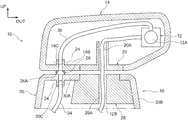
  • FIG. 2 is a cross-section illustrating the electronic outer mirror device illustrated in
  • FIG. 1 is a diagrammatic representation of FIG. 1 .
  • FIG. 3 is a cross-section illustrating a region between a visor and a base cover when positioned at a stowed position.
  • FIG. 4 is a cross-section corresponding to FIG. 2 , illustrating an electronic outer mirror device of another embodiment.
  • the arrow FR, the arrow OUT, and the arrow UP respectively indicate a vehicle front side, a vehicle width direction outside, and a vehicle upper side of a vehicle including the electronic outer mirror device, as appropriate.
  • simple reference to front, rear, up, and down directions in the below explanation respectively refers to front and rear in a vehicle front-rear direction, and up and down in a vehicle up-down direction.
  • An electronic outer mirror device 10 of the present exemplary embodiment illustrated in FIG. 1 is supported at an outer side of a front side door of a vehicle, not illustrated in the drawings. Images captured by a camera 12 , serving as a visual recognition section, are displayed on a monitor provided inside the vehicle, and the electronic outer mirror device 10 thereby serves to assist visual recognition by an occupant of the vehicle.
  • the electronic outer mirror device 10 includes a visor 14 serving as a housing body that houses the camera 12 , a base 16 serving as a support body that supports the visor 14 such that the visor 14 is capable of moving, and a foreign matter removal device 18 that secures the field of view of the camera 12 by removing foreign matter such as dust, snow, and ice that has adhered to a lens of the camera 12 .
  • the visor 14 is formed in a box shape and includes an internal space in which the camera 12 and so on are disposed.
  • a circular exposing opening 14 A is formed in the visor 14 on the opposite side of the visor 14 to a side supported by the base 16 , described below.
  • a lens 12 A of the camera 12 is exposed through the exposing opening 14 A.
  • the base 16 side of the visor 14 is fixed to a stand 20 .
  • a portion of the visor 14 surrounding a lower end of the stand 20 is referred to as a bottom wall 14 B.
  • the stand 20 is supported by the base 16 so as to be capable of moving (capable of swiveling) such that the visor 14 pivots in the front-rear direction with respect to the base 16 .
  • the visor 14 may be pivoted with respect to the base 16 either electronically or manually.
  • the state illustrated in FIG. 1 and FIG. 2 is a state in which the visor 14 is positioned at a neutral position. In this state, visual recognition of the oblique rear of the vehicle by the occupant of the vehicle is made possible by the camera 12 and the monitor.
  • the visor 14 is disposed at a stowed position by pivoting the visor 14 with respect to the base 16 .
  • the visor 14 is suppressed from projecting out with respect to the front side door when in this state.
  • a wiring insertion hole 20 A through which wiring 12 B of the camera 12 is inserted is formed in the stand 20 .
  • a tube-shaped second connection portion 14 C that places the interior and the exterior of the visor 14 in communication with each other is provided to the bottom wall 14 B, this being a portion of the visor 14 bordering the stand 20 .
  • a second tube 36 is connected to one side of the second connection portion 14 C.
  • the other side of the second connection portion 14 C is open toward the base 16 .
  • a clamp member 24 is attached to the second connection portion 14 C to prevent or suppress the second tube 36 from detaching from the second connection portion 14 C.
  • a tube-shaped seal member 26 is attached to an outer side of the visor 14 at a peripheral edge of the second connection portion 14 C.
  • An end portion 26 A of the seal member 26 on the side of a base cover 30 described later, abuts an apex wall 30 A of the base cover 30 .
  • An internal diameter of the seal member 26 gradually decreases on progression from the base 16 side toward the visor 14 side.
  • the seal member 26 thereby has a funnel shape that narrows on progression from the base 16 side toward the visor 14 side.
  • the base 16 is configured including a main base body 28 serving as a main support body, and the base cover 30 serving as a support body cover that is attached to the main base body 28 so as to cover the main base body 28 .
  • the stand 20 previously described is supported by the main base body 28 so as to be capable of swiveling.
  • a wiring insertion hole 28 A through which the wiring 12 B of the camera 12 is inserted is formed in the main base body 28 .
  • the wiring 12 B of the camera 12 is inserted through the wiring insertion hole 20 A formed in the stand 20 and the wiring insertion hole 28 A in the main base body 28 , enabling the wiring 12 B to be routed to the inside of the front side door.
  • the base cover 30 includes the apex wall 30 A that is disposed opposing the bottom wall 14 B of the visor 14 and extending substantially parallel to the bottom wall 14 B, and side walls 30 B that cover the main base body 28 from the sides.
  • a tube-shaped first connection portion 30 C that places the interior and the exterior of the base cover 30 in communication with each other is provided to the apex wall 30 A.
  • a first tube 34 described later, is connected to one side of the first connection portion 30 C. Another side of the first connection portion 30 C is open toward the visor 14 .
  • a clamp member 24 is attached to the first connection portion 30 C to prevent or suppress the first tube 34 from detaching from the first connection portion 30 C.
  • first connection portion 30 C and the second connection portion 14 C of the visor 14 are disposed coaxially to one another.
  • the first tube 34 and the second tube 36 are thus linked together through the first connection portion 30 C, the seal member 26 , and the second connection portion 14 C.
  • the first connection portion 30 C and the second connection portion 14 C of the visor 14 are disposed on different axes to each other.
  • the end portion 26 A on the base cover 30 side of the seal member 26 is closed off by the apex wall 30 A of the base cover 30 when in this state.
  • the second tube 36 is thereby closed off on the base 16 side.
  • an open end side (visor 14 side) of the first connection portion 30 C opposes the bottom wall 14 B of the visor 14 . Namely, the open end side of the first connection portion 30 C is covered by the bottom wall 14 B of the visor 14 .
  • the foreign matter removal device 18 includes a fluid supply section 32 that supplies a fluid such as washer liquid or warm air to be ejected onto the lens 12 A of the camera 12 .
  • a washer pump that conveys washer liquid under pressure
  • a blower motor that conveys temperature-controlled warm air under pressure, or the like may be employed as the fluid supply section 32 .
  • the foreign matter removal device 18 also includes the first tube 34 , serving as a first fluid passageway that has one end connected to the fluid supply section 32 and another end connected to the first connection portion 30 C of the base cover 30 .
  • the foreign matter removal device 18 further includes the second tube 36 serving as a second fluid passageway that has one end connected to the second connection portion 14 C of the visor 14 and another end opposing the lens 12 A side of the camera 12 so as to be disposed close to the lens 12 A.
  • the washer liquid, warm air, or the like is ejected through the other end of the second tube 36 toward the lens 12 A of the camera 12 , thereby enabling foreign matter that has adhered to the lens 12 A of the camera 12 to be removed.
  • a fluid such as washer liquid or warm air is supplied from the fluid supply section 32 .
  • the fluid such as washer liquid or warm air supplied from the fluid supply section 32 passes through the first tube 34 , the first connection portion 30 C of the base cover 30 , the seal member 26 , the second connection portion 14 C of the visor 14 , and the second tube 36 , and is ejected onto the lens 12 A of the camera 12 . Foreign matter that has adhered to the lens 12 A of the camera 12 is thereby removed.
  • the end portion 26 A on the base cover 30 side of the seal member 26 is closed off by the apex wall 30 A of the base cover 30 .
  • the base 16 side of the second tube 36 is thereby closed off.
  • the first tube 34 and the second tube 36 are not linked to one another. This prevents or suppresses constraints relating to the routing of the flow path through which the fluid passes, compared to configurations in which the first tube 34 and the second tube 36 are always linked to one another.
  • the size of the electronic outer mirror device 10 can be reduced as a result.
  • Such a configuration in which the end portion 26 A on the base cover 30 side of the seal member 26 is closed off by the apex wall 30 A of the base cover 30 enables an increase in the number of components configuring the electronic outer mirror device 10 to be suppressed compared to cases in which a separate member is provided in order to close off the end portion 26 A on the base cover 30 side of the seal member 26 .
  • the internal diameter of the seal member 26 gradually decreases on progression from the base 16 side toward the visor 14 side, thereby enabling the contact surface area between the end portion 26 A of the seal member 26 and the apex wall 30 A of the base cover 30 to be reduced. This enables sliding resistance between the end portion 26 A of the seal member 26 and the apex wall 30 A of the base cover 30 to be reduced when the visor 14 pivots with respect to the base 16 .
  • the seal member 26 is provided between the base 16 and the visor 14 , thereby enabling the fluid such as washer liquid or warm air to be suppressed from leaking out at the connection portion between the first tube 34 and the second tube 36 .
  • the only fluid that flows along the first tube 34 and the second tube 36 is a fluid that may be permitted to leak out at the connection portion between the first tube 34 and the second tube 36 (for example warm air)
  • a configuration may be applied in which the seal member 26 is not provided.
  • the open end side (visor 14 side) of the first connection portion 30 C opposes the bottom wall 14 B of the visor 14 .
  • the open end side of the first connection portion 30 C is covered by the bottom wall 14 B of the visor 14 . This prevents or suppresses the open end side of the first connection portion 30 C, this being the portion to which the first tube 34 is connected, from being seen, thereby enabling a negative impact on the external styling of the electronic outer mirror device 10 to be prevented or suppressed.
  • a ring shaped lip member 40 serving as a foreign matter suppressing member is attached to an outer side of the base cover 30 configuring an outer peripheral portion of the apex wall 30 A.
  • An end portion on the visor 14 side of the lip member 40 abuts the bottom wall 14 B of the visor 14 .
  • the camera 12 is given as an example of a visual recognition section in the electronic outer mirror devices 10 , 38 described above, the present invention is not limited thereto.
  • the configuration of the present invention may be applied to another vehicular visual recognition device such as an outer mirror device including a mirror serving as a visual recognition section.
  • fluid may be ejected through the first tube 34 onto a transparent cover that covers the lens 12 A of the camera 12 .
  • an end portion on the visor 14 side of the first connection portion 30 C may for example be closed off by a stopper portion provided to the bottom wall 14 B.

Landscapes

  • Engineering & Computer Science (AREA)
  • Multimedia (AREA)
  • Mechanical Engineering (AREA)
  • Signal Processing (AREA)
  • Physics & Mathematics (AREA)
  • Electromagnetism (AREA)
  • Rear-View Mirror Devices That Are Mounted On The Exterior Of The Vehicle (AREA)
  • Fittings On The Vehicle Exterior For Carrying Loads, And Devices For Holding Or Mounting Articles (AREA)
  • Closed-Circuit Television Systems (AREA)
  • Studio Devices (AREA)

Abstract

An electronic outer mirror device includes a camera to assist visual recognition by an occupant of a vehicle, a visor configured to house the camera, and a base configured to support the visor such that the visor is capable of moving. The electronic outer mirror device further includes a first tube that is provided on the base side and through which passes a fluid to be ejected onto the camera in order to secure a field of view of the camera. The electronic outer mirror device further includes a second tube that is provided on the visor side such that when the visor is positioned at a predetermined position with respect to the base a base side of the second tube is connected to the first tube so as to enable passage of the fluid from the first tube, and when the visor is positioned at a different position from the predetermined position with respect to the base the base side of the second tube is disconnected from the first tube.

Description

CROSS-REFERENCE TO RELATED APPLICATIONS
The present application is a U.S. National Phase of PCT/JP2018/038151 filed on Oct. 12, 2018, claiming priority under 35 USC 119 from Japanese Patent Application No. 2017-219780 filed Nov. 15, 2017, the disclosure of which is incorporated by reference herein.
TECHNICAL FIELD
The present invention relates to a vehicular visual recognition device.
BACKGROUND ART
Japanese Patent Application Laid-Open (JP-A) No. 2012-37548 discloses a vehicular visual recognition device (an onboard optical sensor device) including a camera to assist a vehicle occupant with visual recognition to the rear of the vehicle.
The vehicular visual recognition device disclosed in JP-A No. 2012-37548 includes a nozzle to jet cleaning liquid toward a lens of the camera. Snow or ice that has adhered to the camera lens can accordingly be removed by the cleaning liquid jetted through the nozzle.
However, there is a desire to reduce the size of vehicular visual recognition devices disposed at the outer side of a vehicle, while securing the field of view of a visual recognition section such as a camera for assisting a vehicle occupant with visual recognition.
SUMMARY OF INVENTION Technical Problem
In consideration of the above circumstances, an object of the present invention is to obtain a vehicular visual recognition device that can be reduced in size, while securing the field of view of a visual recognition section to assist visual recognition by a vehicle occupant.
Solution to Problem
A vehicular visual recognition device according to a first aspect includes a visual recognition section configured to assist visual recognition by an occupant of a vehicle, a housing body configured to house the visual recognition section, a support body configured to support the housing body such that the housing body is capable of moving, a first fluid passageway that is provided on the support body side and through which passes a fluid to be ejected onto the visual recognition section in order to secure a field of view of the visual recognition section, and a second fluid passageway that is provided on the housing body side such that when the housing body is positioned at a predetermined position with respect to the support body a support body side of the second fluid passageway is connected to the first fluid passageway so as to enable passage of the fluid from the first fluid passageway, and when the housing body is positioned at a different position from the predetermined position with respect to the support body the support body side of the second fluid passageway is disconnected from the first fluid passageway.
A vehicular visual recognition device according to a second aspect is the vehicular visual recognition device of the first aspect, wherein when the housing body is positioned at a different position from the predetermined position with respect to the support body the support body side of the second fluid passageway is closed off by part of the support body.
A vehicular visual recognition device according to a third aspect is the vehicular visual recognition device of the first aspect or the second aspect, wherein in a state in which the support body side of the second fluid passageway is closed off by part of the support body when the housing body is positioned at a different position from the predetermined position with respect to the support body, a housing body side of the first fluid passageway is covered by part of the housing body.
A vehicular visual recognition device according to a fourth aspect is the vehicular visual recognition device of any one of the first aspect to the third aspect, wherein the support body includes a main support body and a support body cover configured to cover the main support body. A tube-shaped first connection portion to which the first fluid passageway is connected is provided to the support body cover, and a tube-shaped second connection portion to which the second fluid passageway is connected is provided to the housing body. The first connection portion and the second connection portion are disposed coaxially to one another when the housing body is positioned at the predetermined position with respect to the support body, and the second connection portion is disposed at a different position that is not coaxial to the first connection portion when the housing body is positioned at a different position from the predetermined position with respect to the support body.
A vehicular visual recognition device according to a fifth aspect is the vehicular visual recognition device of the fourth aspect, wherein a tube-shaped seal member is provided at a peripheral edge of the second connection portion of the housing body such that an end portion on the support body cover side of the seal member is configured to abut the support body cover.
A vehicular visual recognition device according to a sixth aspect is the vehicular visual recognition device of any one of the first aspect to the fifth aspect, wherein a foreign matter suppressing member is provided between the housing body and the support body in order to suppress ingress of foreign matter into the first fluid passageway.
Advantageous Effects of Invention
In the vehicular visual recognition device according to the first aspect, when the housing body is positioned at the predetermined position with respect to the support body, the passage of the fluid from the first fluid passageway into the second fluid passageway is enabled. The fluid is then ejected onto the visual recognition section through the first fluid passageway and the second fluid passageway in order to secure the field of view of the visual recognition section. When the housing body is positioned at a different position from the predetermined position with respect to the support body, the first fluid passageway and the second fluid passageway are not linked to one another. This prevents or suppresses constraints relating to the routing of the flow path through which the fluid passes, compared to configurations in which the first fluid passageway and the second fluid passageway are always linked to one another. The size of the vehicular visual recognition device can be reduced as a result.
In the vehicular visual recognition device according to the second aspect, when the housing body is positioned at a different position from the predetermined position with respect to the support body, the support body side of the second fluid passageway is closed off by part of the support body. The support body side of the second fluid passageway can thereby be closed off without providing another member to close off the support body side of the second fluid passageway.
In the vehicular visual recognition device according to the third aspect, in a state in which the support body side of the second fluid passageway is closed off by part of the support body, the housing body side of the first fluid passageway is covered by part of the housing body. This prevents or suppresses the housing body side of the first fluid passageway from being seen, thereby enabling a negative impact on the external styling of the vehicular visual recognition device to be prevented or suppressed.
In the vehicular visual recognition device according to the fourth aspect, the first fluid passageway is connected to the first connection portion of the support body cover, and the second fluid passageway is connected to the second connection portion of the housing body. Moreover, when the housing body is positioned at the predetermined position with respect to the support body, the first connection portion and the second connection portion are disposed coaxially to one another. This enables the fluid to pass from the first fluid passageway into the second fluid passageway. When the housing body is positioned at a different position from the predetermined position with respect to the support body, the second connection portion is disposed at a different position that is not coaxial to the first connection portion. The first fluid passageway and the second fluid passageway are thus no longer linked to one another. In this manner, the vehicular visual recognition device according to the fourth aspect enables the first fluid passageway and the second fluid passageway to be linked together through the first connection portion of the support body cover and the second connection portion of the housing body.
In the vehicular visual recognition device according to the fifth aspect, the tube-shaped seal member is provided at a peripheral edge of the second connection portion of the housing body such that the end portion on the support body cover side of the seal member abuts the support body cover. This enables the fluid to be prevented or suppressed from leaking out from between the first fluid passageway and the second fluid passageway.
In the vehicular visual recognition device according to the sixth aspect, the foreign matter suppressing member is provided between the housing body and the support body, thereby enabling the ingress of foreign matter to the first fluid passageway to be suppressed.
BRIEF DESCRIPTION OF DRAWINGS
FIG. 1 is a side view illustrating an electronic outer mirror device.
FIG. 2 is a cross-section illustrating the electronic outer mirror device illustrated in
FIG. 1.
FIG. 3 is a cross-section illustrating a region between a visor and a base cover when positioned at a stowed position.
FIG. 4 is a cross-section corresponding to FIG. 2, illustrating an electronic outer mirror device of another embodiment.
DESCRIPTION OF EMBODIMENTS
Explanation follows regarding an electronic outer mirror device, serving as a vehicular visual recognition device of the present invention, with reference to FIG. 1 to FIG. 3. Note that in the drawings, the arrow FR, the arrow OUT, and the arrow UP respectively indicate a vehicle front side, a vehicle width direction outside, and a vehicle upper side of a vehicle including the electronic outer mirror device, as appropriate. Unless specifically stated otherwise, simple reference to front, rear, up, and down directions in the below explanation respectively refers to front and rear in a vehicle front-rear direction, and up and down in a vehicle up-down direction.
An electronic outer mirror device 10 of the present exemplary embodiment illustrated in FIG. 1 is supported at an outer side of a front side door of a vehicle, not illustrated in the drawings. Images captured by a camera 12, serving as a visual recognition section, are displayed on a monitor provided inside the vehicle, and the electronic outer mirror device 10 thereby serves to assist visual recognition by an occupant of the vehicle. Specifically, the electronic outer mirror device 10 includes a visor 14 serving as a housing body that houses the camera 12, a base 16 serving as a support body that supports the visor 14 such that the visor 14 is capable of moving, and a foreign matter removal device 18 that secures the field of view of the camera 12 by removing foreign matter such as dust, snow, and ice that has adhered to a lens of the camera 12.
As illustrated in FIG. 1 and FIG. 2, the visor 14 is formed in a box shape and includes an internal space in which the camera 12 and so on are disposed. A circular exposing opening 14A is formed in the visor 14 on the opposite side of the visor 14 to a side supported by the base 16, described below. In a state in which the camera 12 is disposed inside the visor 14 and fixed to the visor 14, a lens 12A of the camera 12 is exposed through the exposing opening 14A.
As illustrated in FIG. 2, the base 16 side of the visor 14 is fixed to a stand 20. Note that a portion of the visor 14 surrounding a lower end of the stand 20 is referred to as a bottom wall 14B. The stand 20 is supported by the base 16 so as to be capable of moving (capable of swiveling) such that the visor 14 pivots in the front-rear direction with respect to the base 16. Note that the visor 14 may be pivoted with respect to the base 16 either electronically or manually. The state illustrated in FIG. 1 and FIG. 2 is a state in which the visor 14 is positioned at a neutral position. In this state, visual recognition of the oblique rear of the vehicle by the occupant of the vehicle is made possible by the camera 12 and the monitor. The visor 14 is disposed at a stowed position by pivoting the visor 14 with respect to the base 16. The visor 14 is suppressed from projecting out with respect to the front side door when in this state. A wiring insertion hole 20A through which wiring 12B of the camera 12 is inserted is formed in the stand 20.
As illustrated in FIG. 2, a tube-shaped second connection portion 14C that places the interior and the exterior of the visor 14 in communication with each other is provided to the bottom wall 14B, this being a portion of the visor 14 bordering the stand 20. A second tube 36, described later, is connected to one side of the second connection portion 14C. The other side of the second connection portion 14C is open toward the base 16. Note that a clamp member 24 is attached to the second connection portion 14C to prevent or suppress the second tube 36 from detaching from the second connection portion 14C.
A tube-shaped seal member 26 is attached to an outer side of the visor 14 at a peripheral edge of the second connection portion 14C. An end portion 26A of the seal member 26 on the side of a base cover 30, described later, abuts an apex wall 30A of the base cover 30. An internal diameter of the seal member 26 gradually decreases on progression from the base 16 side toward the visor 14 side. The seal member 26 thereby has a funnel shape that narrows on progression from the base 16 side toward the visor 14 side.
The base 16 is configured including a main base body 28 serving as a main support body, and the base cover 30 serving as a support body cover that is attached to the main base body 28 so as to cover the main base body 28. The stand 20 previously described is supported by the main base body 28 so as to be capable of swiveling. A wiring insertion hole 28A through which the wiring 12B of the camera 12 is inserted is formed in the main base body 28. The wiring 12B of the camera 12 is inserted through the wiring insertion hole 20A formed in the stand 20 and the wiring insertion hole 28A in the main base body 28, enabling the wiring 12B to be routed to the inside of the front side door.
The base cover 30 includes the apex wall 30A that is disposed opposing the bottom wall 14B of the visor 14 and extending substantially parallel to the bottom wall 14B, and side walls 30B that cover the main base body 28 from the sides. A tube-shaped first connection portion 30C that places the interior and the exterior of the base cover 30 in communication with each other is provided to the apex wall 30A. A first tube 34, described later, is connected to one side of the first connection portion 30C. Another side of the first connection portion 30C is open toward the visor 14. Note that a clamp member 24 is attached to the first connection portion 30C to prevent or suppress the first tube 34 from detaching from the first connection portion 30C.
In a state in which the visor 14 is positioned at the neutral position, the first connection portion 30C and the second connection portion 14C of the visor 14 are disposed coaxially to one another. The first tube 34 and the second tube 36 are thus linked together through the first connection portion 30C, the seal member 26, and the second connection portion 14C.
As illustrated in FIG. 3, in a state in which the visor 14 is positioned at the stowed position, the first connection portion 30C and the second connection portion 14C of the visor 14 are disposed on different axes to each other. The end portion 26A on the base cover 30 side of the seal member 26 is closed off by the apex wall 30A of the base cover 30 when in this state. The second tube 36 is thereby closed off on the base 16 side. In the state in which the visor 14 is positioned at the stowed position, an open end side (visor 14 side) of the first connection portion 30C (see FIG. 2) opposes the bottom wall 14B of the visor 14. Namely, the open end side of the first connection portion 30C is covered by the bottom wall 14B of the visor 14.
As illustrated in FIG. 1 and FIG. 2, the foreign matter removal device 18 includes a fluid supply section 32 that supplies a fluid such as washer liquid or warm air to be ejected onto the lens 12A of the camera 12. Note that a washer pump that conveys washer liquid under pressure, a blower motor that conveys temperature-controlled warm air under pressure, or the like may be employed as the fluid supply section 32. The foreign matter removal device 18 also includes the first tube 34, serving as a first fluid passageway that has one end connected to the fluid supply section 32 and another end connected to the first connection portion 30C of the base cover 30. The foreign matter removal device 18 further includes the second tube 36 serving as a second fluid passageway that has one end connected to the second connection portion 14C of the visor 14 and another end opposing the lens 12A side of the camera 12 so as to be disposed close to the lens 12A. The washer liquid, warm air, or the like is ejected through the other end of the second tube 36 toward the lens 12A of the camera 12, thereby enabling foreign matter that has adhered to the lens 12A of the camera 12 to be removed.
Operation and Advantageous Effects of Present Exemplary Embodiment
Explanation follows regarding operation and advantageous effects of the present exemplary embodiment.
As illustrated in FIG. 1 and FIG. 2, in the state in which the visor 14 is positioned at the neutral position, visual recognition of the oblique rear of the vehicle by the occupant of the vehicle is made possible by the camera 12 and the monitor.
Note that when the foreign matter removal device 18 is manually or automatically actuated when foreign matter has adhered to the lens 12A of the camera 12, a fluid such as washer liquid or warm air is supplied from the fluid supply section 32. The fluid such as washer liquid or warm air supplied from the fluid supply section 32 passes through the first tube 34, the first connection portion 30C of the base cover 30, the seal member 26, the second connection portion 14C of the visor 14, and the second tube 36, and is ejected onto the lens 12A of the camera 12. Foreign matter that has adhered to the lens 12A of the camera 12 is thereby removed.
As illustrated in FIG. 3, in the state in which the visor 14 is positioned at the stowed position, the end portion 26A on the base cover 30 side of the seal member 26 is closed off by the apex wall 30A of the base cover 30. The base 16 side of the second tube 36 is thereby closed off. Namely, in the state in which the visor 14 is positioned at the stowed position, the first tube 34 and the second tube 36 are not linked to one another. This prevents or suppresses constraints relating to the routing of the flow path through which the fluid passes, compared to configurations in which the first tube 34 and the second tube 36 are always linked to one another. The size of the electronic outer mirror device 10 can be reduced as a result. Moreover, in the present exemplary embodiment, there is no need to install glass to cover the lens 12A of the camera 12 or a heater to heat this glass, thereby enabling a further reduction in the size of the visor 14 at the peripheral edge of the camera 12. Moreover, there is no need to insert heater wiring through the wiring insertion hole 20A formed in the stand 20 and the wiring insertion hole 28A in the main base body 28 together with the first tube 34 and the second tube 36. This enables a reduction in the size of the stand 20 and the main base body 28.
Such a configuration in which the end portion 26A on the base cover 30 side of the seal member 26 is closed off by the apex wall 30A of the base cover 30 enables an increase in the number of components configuring the electronic outer mirror device 10 to be suppressed compared to cases in which a separate member is provided in order to close off the end portion 26A on the base cover 30 side of the seal member 26.
Furthermore, the internal diameter of the seal member 26 gradually decreases on progression from the base 16 side toward the visor 14 side, thereby enabling the contact surface area between the end portion 26A of the seal member 26 and the apex wall 30A of the base cover 30 to be reduced. This enables sliding resistance between the end portion 26A of the seal member 26 and the apex wall 30A of the base cover 30 to be reduced when the visor 14 pivots with respect to the base 16.
Moreover, in the present exemplary embodiment, the seal member 26 is provided between the base 16 and the visor 14, thereby enabling the fluid such as washer liquid or warm air to be suppressed from leaking out at the connection portion between the first tube 34 and the second tube 36. Note that in cases in which in which the only fluid that flows along the first tube 34 and the second tube 36 is a fluid that may be permitted to leak out at the connection portion between the first tube 34 and the second tube 36 (for example warm air), a configuration may be applied in which the seal member 26 is not provided.
Moreover, in the present exemplary embodiment, in the state in which the visor 14 is positioned at the stowed position, the open end side (visor 14 side) of the first connection portion 30C (see FIG. 2) opposes the bottom wall 14B of the visor 14. Namely, the open end side of the first connection portion 30C is covered by the bottom wall 14B of the visor 14. This prevents or suppresses the open end side of the first connection portion 30C, this being the portion to which the first tube 34 is connected, from being seen, thereby enabling a negative impact on the external styling of the electronic outer mirror device 10 to be prevented or suppressed.
Other Embodiment of Electronic Outer Mirror Device
Explanation follows regarding an electronic outer mirror device 38 of another embodiment, with reference to FIG. 4. Note that members and portions of the electronic outer mirror device 38 of the other embodiment that correspond to those of the electronic outer mirror device 10 described above are allocated the same reference numerals as the corresponding members and portions of the electronic outer mirror device 10, and explanation thereof is omitted.
As illustrated in FIG. 4, in the electronic outer mirror device 38 according to the other embodiment, a ring shaped lip member 40 serving as a foreign matter suppressing member is attached to an outer side of the base cover 30 configuring an outer peripheral portion of the apex wall 30A. An end portion on the visor 14 side of the lip member 40 abuts the bottom wall 14B of the visor 14. This configuration enables ingress of foreign matter into the first connection portion 30C and the first tube 34 though a gap between the visor 14 and the base cover 30 to be prevented or suppressed.
Note that although the camera 12 is given as an example of a visual recognition section in the electronic outer mirror devices 10, 38 described above, the present invention is not limited thereto. For example, the configuration of the present invention may be applied to another vehicular visual recognition device such as an outer mirror device including a mirror serving as a visual recognition section.
Moreover, fluid may be ejected through the first tube 34 onto a transparent cover that covers the lens 12A of the camera 12. Furthermore, in the state in which the visor 14 is positioned at the stowed position, an end portion on the visor 14 side of the first connection portion 30C may for example be closed off by a stopper portion provided to the bottom wall 14B.
Exemplary embodiments of the present invention have been described above. However, the present invention is not limited thereto, and obviously various other modifications may be implemented within a range not departing from the spirit of the present invention.
The entire content of the disclosure of Japanese Patent Application No. 2017-219780 filed on Nov. 15, 2017 is incorporated by reference in the present specification.
Claims (6)

The invention claimed is:
1. A vehicular visual recognition device comprising:
a visual recognition section configured to assist visual recognition by an occupant of a vehicle;
a housing body configured to house the visual recognition section;
a support body configured to support the housing body such that the housing body is capable of moving;
a first fluid passageway that is provided at the support body side and through which passes a fluid to be ejected onto the visual recognition section in order to secure a field of view of the visual recognition section; and
a second fluid passageway that is provided at the housing body side such that: when the housing body is positioned at a predetermined position with
respect to the support body, a support body side of the second fluid passageway is connected to the first fluid passageway so as to enable passage of the fluid from the first fluid passageway, and
when the housing body is positioned at a different position from the predetermined position with respect to the support body, the support body side of the second fluid passageway is disconnected from the first fluid passageway.
2. The vehicular visual recognition device of claim 1, wherein, when the
housing body is positioned at a different position from the predetermined position with respect to the support body, the support body side of the second fluid passageway is closed off by part of the support body.
3. The vehicular visual recognition device of claim 1, wherein,
in a state in which the support body side of the second fluid passageway is closed off by a part of the support body, when the housing body is positioned at a different position from the predetermined position with respect to the support body, a housing body side of the first fluid passageway is covered by a part of the housing body.
4. The vehicular visual recognition device of claim 1, wherein:
the support body includes a main support body and a support body cover configured to cover the main support body,
a tube-shaped first connection portion to which the first fluid passageway is connected is provided at the support body cover,
a tube-shaped second connection portion to which the second fluid passageway is connected is provided at the housing body,
the first connection portion and the second connection portion are disposed coaxially to one another when the housing body is positioned at the predetermined position with respect to the support body, and
the second connection portion is disposed at a different position that is not coaxial to the first connection portion when the housing body is positioned at a different position from the predetermined position with respect to the support body.
5. The vehicular visual recognition device of claim 4, wherein
a tube-shaped seal member is provided at a peripheral edge of the second connection portion of the housing body, and an end portion on a support body cover side of the seal member is configured to abut the support body cover.
6. The vehicular visual recognition device of claim 1, wherein
a foreign matter suppressing member is provided between the housing body and the support body in order to suppress ingress of foreign matter into the first fluid passageway.
US16/763,449 2017-11-15 2018-10-12 Vehicular visual recognition device Expired - Fee Related US10899278B2 (en)

Applications Claiming Priority (3)

Application Number Priority Date Filing Date Title
JP2017219780A JP2019089466A (en) 2017-11-15 2017-11-15 View monitoring device for vehicle
JP2017-219780 2017-11-15
PCT/JP2018/038151 WO2019097917A1 (en) 2017-11-15 2018-10-12 Visual recognition device for vehicle

Publications (2)

Publication Number Publication Date
US20200298762A1 US20200298762A1 (en) 2020-09-24
US10899278B2 true US10899278B2 (en) 2021-01-26

Family

ID=66540141

Family Applications (1)

Application Number Title Priority Date Filing Date
US16/763,449 Expired - Fee Related US10899278B2 (en) 2017-11-15 2018-10-12 Vehicular visual recognition device

Country Status (3)

Country Link
US (1) US10899278B2 (en)
JP (1) JP2019089466A (en)
WO (1) WO2019097917A1 (en)

Cited By (2)

* Cited by examiner, † Cited by third party
Publication number Priority date Publication date Assignee Title
EP4335700A1 (en) * 2022-09-07 2024-03-13 Motherson Innovations Company Ltd. Base assembly of an exterior rear view device, exterior rear view device and vehicle
US12391181B2 (en) 2021-03-25 2025-08-19 Motherson Innovations Company Limited Base assembly with camera, cleaning system, base frame and base cover, rear view device, vehicle and assembling and dis-assembling method

Families Citing this family (8)

* Cited by examiner, † Cited by third party
Publication number Priority date Publication date Assignee Title
NL2018838B1 (en) * 2017-05-03 2018-11-14 Mci Mirror Controls Int Netherlands B V Adjustment instrument and method
US11912204B2 (en) 2020-06-24 2024-02-27 Magna Mirrors Of America, Inc. Low-profile actuator for extendable camera
US12528424B2 (en) 2020-06-24 2026-01-20 Magna Mirrors Of America, Inc. Vehicular imaging system with extendable camera
US11708035B2 (en) * 2020-07-31 2023-07-25 Magna Mirrors Of America, Inc. Vehicular imaging system with extendable camera
DE102020132253A1 (en) 2020-12-04 2022-06-09 Zf Cv Systems Global Gmbh Module housing, mirror replacement system, vehicle
DE102021107589B3 (en) 2021-03-25 2022-08-25 Motherson Innovations Company Limited REAR VIEW DEVICE WITH MULTIFUNCTIONAL RESTRAINT DEVICE, METHOD OF ASSEMBLY AND VEHICLE
DE102022106903B4 (en) * 2022-03-23 2025-05-08 Motherson Innovations Company Limited METHOD FOR ASSEMBLING A BASE ASSEMBLY OF AN EXTERIOR REARVIEW DEVICE
DE102023131936A1 (en) * 2023-11-16 2025-05-22 Man Truck & Bus Se Sensor device and commercial vehicle with the sensor device

Citations (6)

* Cited by examiner, † Cited by third party
Publication number Priority date Publication date Assignee Title
JPH03284449A (en) 1990-03-31 1991-12-16 Tokai Rika Co Ltd Automotive door mirror with air spraying type water droplet removing device
JPH03284451A (en) 1990-03-31 1991-12-16 Tokai Rika Co Ltd Automotive door mirror with air spraying type water droplet removing device
JP2000085474A (en) 1998-09-17 2000-03-28 Sony Corp Vehicle door mirror device
US20110266375A1 (en) 2010-04-28 2011-11-03 Denso Corporation Cover of vehicle optical sensor and vehicle optical sensor device
JP2012037548A (en) 2010-08-03 2012-02-23 Denso Corp On-vehicle optical sensor cover and on-vehicle optical sensor device
US20150210081A1 (en) * 2014-01-28 2015-07-30 Seiko Epson Corporation Liquid supplying apparatus, liquid ejecting apparatus, and liquid container unit

Family Cites Families (15)

* Cited by examiner, † Cited by third party
Publication number Priority date Publication date Assignee Title
JPH0247067Y2 (en) * 1985-11-14 1990-12-11
FR2661380B1 (en) * 1990-04-25 1995-08-25 Peugeot WINDSCREEN WASHER DEVICE FOR AN OUTSIDE MIRROR OF A MOTOR VEHICLE.
JP2590987Y2 (en) * 1991-07-31 1999-02-24 學 舩田 Car rearview mirror device
FR2681567A1 (en) * 1991-09-19 1993-03-26 Peugeot Device for washing a side window of a vehicle
JPH0653336U (en) * 1992-12-28 1994-07-19 廣太郎 前田 Snow and rain removal and drying equipment for automobile side mirrors
JPH1016725A (en) * 1996-06-28 1998-01-20 Ichikoh Ind Ltd Raindrop removal device for remote control type outside mirror device for vehicles
JPH1016724A (en) * 1996-06-28 1998-01-20 Ichikoh Ind Ltd Rain droplet removing device in remote-controlled vehicle outside mirror device
JPH10315927A (en) * 1997-05-22 1998-12-02 Honda Motor Co Ltd Water droplet removal device for vehicles
DE19827639B4 (en) * 1998-06-20 2006-02-16 Siemens Ag Mirrors
JP2013159145A (en) * 2012-02-01 2013-08-19 Asmo Co Ltd Vehicle cleaning device
JP2013248958A (en) * 2012-05-31 2013-12-12 Asmo Co Ltd Vehicle cleaning device
JP6205644B2 (en) * 2013-05-30 2017-10-04 市光工業株式会社 Side camera device for vehicle
JP6549474B2 (en) * 2015-11-13 2019-07-24 株式会社東海理化電機製作所 Imaging device
JP6683474B2 (en) * 2015-12-21 2020-04-22 株式会社東海理化電機製作所 Imaging device
JP2017208781A (en) * 2016-05-20 2017-11-24 株式会社東海理化電機製作所 Imaging apparatus

Patent Citations (6)

* Cited by examiner, † Cited by third party
Publication number Priority date Publication date Assignee Title
JPH03284449A (en) 1990-03-31 1991-12-16 Tokai Rika Co Ltd Automotive door mirror with air spraying type water droplet removing device
JPH03284451A (en) 1990-03-31 1991-12-16 Tokai Rika Co Ltd Automotive door mirror with air spraying type water droplet removing device
JP2000085474A (en) 1998-09-17 2000-03-28 Sony Corp Vehicle door mirror device
US20110266375A1 (en) 2010-04-28 2011-11-03 Denso Corporation Cover of vehicle optical sensor and vehicle optical sensor device
JP2012037548A (en) 2010-08-03 2012-02-23 Denso Corp On-vehicle optical sensor cover and on-vehicle optical sensor device
US20150210081A1 (en) * 2014-01-28 2015-07-30 Seiko Epson Corporation Liquid supplying apparatus, liquid ejecting apparatus, and liquid container unit

Cited By (2)

* Cited by examiner, † Cited by third party
Publication number Priority date Publication date Assignee Title
US12391181B2 (en) 2021-03-25 2025-08-19 Motherson Innovations Company Limited Base assembly with camera, cleaning system, base frame and base cover, rear view device, vehicle and assembling and dis-assembling method
EP4335700A1 (en) * 2022-09-07 2024-03-13 Motherson Innovations Company Ltd. Base assembly of an exterior rear view device, exterior rear view device and vehicle

Also Published As

Publication number Publication date
WO2019097917A1 (en) 2019-05-23
US20200298762A1 (en) 2020-09-24
JP2019089466A (en) 2019-06-13

Similar Documents

Publication Publication Date Title
US10899278B2 (en) Vehicular visual recognition device
CN106255618B (en) The motor vehicle of rear-view mirror device with no rearview mirror
JP5936288B2 (en) Vehicle imaging device
US10752219B2 (en) Cleaning device for cleaning a transparent camera cover
CN107000705B (en) Integrated airborne vehicle vision and cleaning system
US10676030B2 (en) Vehicle exterior camera device
JP6855216B2 (en) Optical unit and how to attach the optical unit
JP2012035654A (en) Nozzle device for on-board camera, on-board camera with cleaning device, and cleaning system for on-board camera
CN113613951B (en) Camera device for vehicle
JP2012201122A (en) Nozzle device for vehicle-mounted camera, vehicle-mounted camera with cleaning device, and cleaning system for vehicle-mounted camera
CN107914674A (en) Device for preventing water drop from shielding lens of automobile camera lens
JP5529782B2 (en) In-vehicle camera with washer nozzle and cleaning system for in-vehicle camera
JP2013154771A (en) On-vehicle camera device
US9586517B2 (en) Exterior mirror for a motor vehicle with liquid container refill funnel
CN106494308B (en) Outside mirror apparatus
CN110877598A (en) Side window defroster
CN114537292B (en) Vehicle Camera Mounting Kit
CN110877599B (en) Side window defroster
JP7191666B2 (en) camera cooler
CN107206936A (en) Filming apparatus
CN119078741A (en) Dual outlet fluid jet nozzle for a motor vehicle

Legal Events

Date Code Title Description
FEPP Fee payment procedure

Free format text: ENTITY STATUS SET TO UNDISCOUNTED (ORIGINAL EVENT CODE: BIG.); ENTITY STATUS OF PATENT OWNER: LARGE ENTITY

AS Assignment

Owner name: KABUSHIKI KAISHA TOKAI-RIKA-DENKI-SEISAKUSHO, JAPAN

Free format text: ASSIGNMENT OF ASSIGNORS INTEREST;ASSIGNORS:ICHIMURA, REIYA;FUJISAKI, SUGURU;REEL/FRAME:052673/0386

Effective date: 20200421

STPP Information on status: patent application and granting procedure in general

Free format text: PUBLICATIONS -- ISSUE FEE PAYMENT VERIFIED

STCF Information on status: patent grant

Free format text: PATENTED CASE

FEPP Fee payment procedure

Free format text: MAINTENANCE FEE REMINDER MAILED (ORIGINAL EVENT CODE: REM.); ENTITY STATUS OF PATENT OWNER: LARGE ENTITY

LAPS Lapse for failure to pay maintenance fees

Free format text: PATENT EXPIRED FOR FAILURE TO PAY MAINTENANCE FEES (ORIGINAL EVENT CODE: EXP.); ENTITY STATUS OF PATENT OWNER: LARGE ENTITY

STCH Information on status: patent discontinuation

Free format text: PATENT EXPIRED DUE TO NONPAYMENT OF MAINTENANCE FEES UNDER 37 CFR 1.362

FP Lapsed due to failure to pay maintenance fee

Effective date: 20250126