US10875303B2 - Liquid ejecting head, liquid ejecting apparatus, and wiring substrate - Google Patents
Liquid ejecting head, liquid ejecting apparatus, and wiring substrate Download PDFInfo
- Publication number
- US10875303B2 US10875303B2 US16/451,072 US201916451072A US10875303B2 US 10875303 B2 US10875303 B2 US 10875303B2 US 201916451072 A US201916451072 A US 201916451072A US 10875303 B2 US10875303 B2 US 10875303B2
- Authority
- US
- United States
- Prior art keywords
- terminals
- protrusions
- wiring substrate
- liquid ejecting
- head unit
- Prior art date
- Legal status (The legal status is an assumption and is not a legal conclusion. Google has not performed a legal analysis and makes no representation as to the accuracy of the status listed.)
- Active
Links
- 239000000758 substrate Substances 0.000 title claims abstract description 102
- 239000007788 liquid Substances 0.000 title claims abstract description 60
- 239000011295 pitch Substances 0.000 claims abstract description 7
- 230000003746 surface roughness Effects 0.000 claims abstract description 7
- 239000000976 ink Substances 0.000 description 26
- 238000003860 storage Methods 0.000 description 14
- 238000004519 manufacturing process Methods 0.000 description 13
- 238000004891 communication Methods 0.000 description 9
- 230000006870 function Effects 0.000 description 7
- 239000000463 material Substances 0.000 description 7
- 239000006096 absorbing agent Substances 0.000 description 6
- 239000000853 adhesive Substances 0.000 description 6
- 238000000034 method Methods 0.000 description 6
- 238000012545 processing Methods 0.000 description 6
- 238000010586 diagram Methods 0.000 description 5
- 230000002093 peripheral effect Effects 0.000 description 4
- 239000004065 semiconductor Substances 0.000 description 4
- XUIMIQQOPSSXEZ-UHFFFAOYSA-N Silicon Chemical compound [Si] XUIMIQQOPSSXEZ-UHFFFAOYSA-N 0.000 description 3
- 239000013078 crystal Substances 0.000 description 3
- 239000002184 metal Substances 0.000 description 3
- 229910052751 metal Inorganic materials 0.000 description 3
- 238000007639 printing Methods 0.000 description 3
- 229910052710 silicon Inorganic materials 0.000 description 3
- 239000010703 silicon Substances 0.000 description 3
- 239000000243 solution Substances 0.000 description 3
- 230000007723 transport mechanism Effects 0.000 description 3
- RTAQQCXQSZGOHL-UHFFFAOYSA-N Titanium Chemical compound [Ti] RTAQQCXQSZGOHL-UHFFFAOYSA-N 0.000 description 2
- 230000000052 comparative effect Effects 0.000 description 2
- 239000010949 copper Substances 0.000 description 2
- 239000010931 gold Substances 0.000 description 2
- 230000004048 modification Effects 0.000 description 2
- 238000012986 modification Methods 0.000 description 2
- 239000011347 resin Substances 0.000 description 2
- 229920005989 resin Polymers 0.000 description 2
- 230000032258 transport Effects 0.000 description 2
- RYGMFSIKBFXOCR-UHFFFAOYSA-N Copper Chemical compound [Cu] RYGMFSIKBFXOCR-UHFFFAOYSA-N 0.000 description 1
- 238000000018 DNA microarray Methods 0.000 description 1
- 238000013459 approach Methods 0.000 description 1
- 230000008901 benefit Effects 0.000 description 1
- 239000003086 colorant Substances 0.000 description 1
- 238000004040 coloring Methods 0.000 description 1
- 239000004020 conductor Substances 0.000 description 1
- 229910052802 copper Inorganic materials 0.000 description 1
- 238000001312 dry etching Methods 0.000 description 1
- 230000000694 effects Effects 0.000 description 1
- 239000004744 fabric Substances 0.000 description 1
- -1 for example Substances 0.000 description 1
- PCHJSUWPFVWCPO-UHFFFAOYSA-N gold Chemical compound [Au] PCHJSUWPFVWCPO-UHFFFAOYSA-N 0.000 description 1
- 229910052737 gold Inorganic materials 0.000 description 1
- 230000012447 hatching Effects 0.000 description 1
- 238000001746 injection moulding Methods 0.000 description 1
- 238000007641 inkjet printing Methods 0.000 description 1
- 239000004973 liquid crystal related substance Substances 0.000 description 1
- 239000005416 organic matter Substances 0.000 description 1
- 230000000737 periodic effect Effects 0.000 description 1
- 230000003014 reinforcing effect Effects 0.000 description 1
- 238000007789 sealing Methods 0.000 description 1
- 229910001220 stainless steel Inorganic materials 0.000 description 1
- 239000010935 stainless steel Substances 0.000 description 1
- 239000010936 titanium Substances 0.000 description 1
- 229910052719 titanium Inorganic materials 0.000 description 1
- WFKWXMTUELFFGS-UHFFFAOYSA-N tungsten Chemical compound [W] WFKWXMTUELFFGS-UHFFFAOYSA-N 0.000 description 1
- 229910052721 tungsten Inorganic materials 0.000 description 1
- 239000010937 tungsten Substances 0.000 description 1
- 238000001039 wet etching Methods 0.000 description 1
Images


Classifications
-
- B—PERFORMING OPERATIONS; TRANSPORTING
- B41—PRINTING; LINING MACHINES; TYPEWRITERS; STAMPS
- B41J—TYPEWRITERS; SELECTIVE PRINTING MECHANISMS, i.e. MECHANISMS PRINTING OTHERWISE THAN FROM A FORME; CORRECTION OF TYPOGRAPHICAL ERRORS
- B41J2/00—Typewriters or selective printing mechanisms characterised by the printing or marking process for which they are designed
- B41J2/005—Typewriters or selective printing mechanisms characterised by the printing or marking process for which they are designed characterised by bringing liquid or particles selectively into contact with a printing material
- B41J2/01—Ink jet
-
- B—PERFORMING OPERATIONS; TRANSPORTING
- B41—PRINTING; LINING MACHINES; TYPEWRITERS; STAMPS
- B41J—TYPEWRITERS; SELECTIVE PRINTING MECHANISMS, i.e. MECHANISMS PRINTING OTHERWISE THAN FROM A FORME; CORRECTION OF TYPOGRAPHICAL ERRORS
- B41J2/00—Typewriters or selective printing mechanisms characterised by the printing or marking process for which they are designed
- B41J2/005—Typewriters or selective printing mechanisms characterised by the printing or marking process for which they are designed characterised by bringing liquid or particles selectively into contact with a printing material
- B41J2/01—Ink jet
- B41J2/135—Nozzles
- B41J2/14—Structure thereof only for on-demand ink jet heads
- B41J2/14201—Structure of print heads with piezoelectric elements
- B41J2/14233—Structure of print heads with piezoelectric elements of film type, deformed by bending and disposed on a diaphragm
-
- B—PERFORMING OPERATIONS; TRANSPORTING
- B41—PRINTING; LINING MACHINES; TYPEWRITERS; STAMPS
- B41J—TYPEWRITERS; SELECTIVE PRINTING MECHANISMS, i.e. MECHANISMS PRINTING OTHERWISE THAN FROM A FORME; CORRECTION OF TYPOGRAPHICAL ERRORS
- B41J2/00—Typewriters or selective printing mechanisms characterised by the printing or marking process for which they are designed
- B41J2/005—Typewriters or selective printing mechanisms characterised by the printing or marking process for which they are designed characterised by bringing liquid or particles selectively into contact with a printing material
- B41J2/01—Ink jet
- B41J2/015—Ink jet characterised by the jet generation process
- B41J2/04—Ink jet characterised by the jet generation process generating single droplets or particles on demand
- B41J2/045—Ink jet characterised by the jet generation process generating single droplets or particles on demand by pressure, e.g. electromechanical transducers
- B41J2/04501—Control methods or devices therefor, e.g. driver circuits, control circuits
- B41J2/04581—Control methods or devices therefor, e.g. driver circuits, control circuits controlling heads based on piezoelectric elements
-
- B—PERFORMING OPERATIONS; TRANSPORTING
- B41—PRINTING; LINING MACHINES; TYPEWRITERS; STAMPS
- B41J—TYPEWRITERS; SELECTIVE PRINTING MECHANISMS, i.e. MECHANISMS PRINTING OTHERWISE THAN FROM A FORME; CORRECTION OF TYPOGRAPHICAL ERRORS
- B41J2/00—Typewriters or selective printing mechanisms characterised by the printing or marking process for which they are designed
- B41J2/005—Typewriters or selective printing mechanisms characterised by the printing or marking process for which they are designed characterised by bringing liquid or particles selectively into contact with a printing material
- B41J2/01—Ink jet
- B41J2/135—Nozzles
- B41J2/14—Structure thereof only for on-demand ink jet heads
-
- B—PERFORMING OPERATIONS; TRANSPORTING
- B41—PRINTING; LINING MACHINES; TYPEWRITERS; STAMPS
- B41J—TYPEWRITERS; SELECTIVE PRINTING MECHANISMS, i.e. MECHANISMS PRINTING OTHERWISE THAN FROM A FORME; CORRECTION OF TYPOGRAPHICAL ERRORS
- B41J2/00—Typewriters or selective printing mechanisms characterised by the printing or marking process for which they are designed
- B41J2/005—Typewriters or selective printing mechanisms characterised by the printing or marking process for which they are designed characterised by bringing liquid or particles selectively into contact with a printing material
- B41J2/01—Ink jet
- B41J2/135—Nozzles
- B41J2/14—Structure thereof only for on-demand ink jet heads
- B41J2/1433—Structure of nozzle plates
-
- B—PERFORMING OPERATIONS; TRANSPORTING
- B41—PRINTING; LINING MACHINES; TYPEWRITERS; STAMPS
- B41J—TYPEWRITERS; SELECTIVE PRINTING MECHANISMS, i.e. MECHANISMS PRINTING OTHERWISE THAN FROM A FORME; CORRECTION OF TYPOGRAPHICAL ERRORS
- B41J2/00—Typewriters or selective printing mechanisms characterised by the printing or marking process for which they are designed
- B41J2/005—Typewriters or selective printing mechanisms characterised by the printing or marking process for which they are designed characterised by bringing liquid or particles selectively into contact with a printing material
- B41J2/01—Ink jet
- B41J2/135—Nozzles
- B41J2/14—Structure thereof only for on-demand ink jet heads
- B41J2/14201—Structure of print heads with piezoelectric elements
- B41J2/14233—Structure of print heads with piezoelectric elements of film type, deformed by bending and disposed on a diaphragm
- B41J2002/14258—Multi layer thin film type piezoelectric element
-
- B—PERFORMING OPERATIONS; TRANSPORTING
- B41—PRINTING; LINING MACHINES; TYPEWRITERS; STAMPS
- B41J—TYPEWRITERS; SELECTIVE PRINTING MECHANISMS, i.e. MECHANISMS PRINTING OTHERWISE THAN FROM A FORME; CORRECTION OF TYPOGRAPHICAL ERRORS
- B41J2/00—Typewriters or selective printing mechanisms characterised by the printing or marking process for which they are designed
- B41J2/005—Typewriters or selective printing mechanisms characterised by the printing or marking process for which they are designed characterised by bringing liquid or particles selectively into contact with a printing material
- B41J2/01—Ink jet
- B41J2/135—Nozzles
- B41J2/14—Structure thereof only for on-demand ink jet heads
- B41J2002/14419—Manifold
-
- B—PERFORMING OPERATIONS; TRANSPORTING
- B41—PRINTING; LINING MACHINES; TYPEWRITERS; STAMPS
- B41J—TYPEWRITERS; SELECTIVE PRINTING MECHANISMS, i.e. MECHANISMS PRINTING OTHERWISE THAN FROM A FORME; CORRECTION OF TYPOGRAPHICAL ERRORS
- B41J2/00—Typewriters or selective printing mechanisms characterised by the printing or marking process for which they are designed
- B41J2/005—Typewriters or selective printing mechanisms characterised by the printing or marking process for which they are designed characterised by bringing liquid or particles selectively into contact with a printing material
- B41J2/01—Ink jet
- B41J2/135—Nozzles
- B41J2/14—Structure thereof only for on-demand ink jet heads
- B41J2002/14491—Electrical connection
-
- B—PERFORMING OPERATIONS; TRANSPORTING
- B41—PRINTING; LINING MACHINES; TYPEWRITERS; STAMPS
- B41J—TYPEWRITERS; SELECTIVE PRINTING MECHANISMS, i.e. MECHANISMS PRINTING OTHERWISE THAN FROM A FORME; CORRECTION OF TYPOGRAPHICAL ERRORS
- B41J2202/00—Embodiments of or processes related to ink-jet or thermal heads
- B41J2202/01—Embodiments of or processes related to ink-jet heads
- B41J2202/13—Heads having an integrated circuit
Definitions
- the present disclosure relates to a technique for ejecting a liquid such as ink.
- JP-A-2017-164944 discloses a liquid ejection apparatus that ejects a liquid by supplying a drive signal to piezoelectric elements.
- a wiring substrate on which input terminals to which a drive signal for driving the piezoelectric elements is input is formed is bonded to a flexible substrate that supplies the drive signal to the wiring substrate.
- a liquid ejecting head includes a head unit including a mounting surface on which a plurality of first terminals, to which a signal to eject ink from a nozzle is supplied, are formed; and a flexible wiring substrate including a plurality of second terminals that supply the signal to the head unit, the flexible wiring substrate bonded to the head unit with nonconductive paste while the second terminals and the first terminals are in an electrically coupled state.
- the plurality of second terminals are arranged at pitches of 50 ⁇ m or less, and protrusions in contact with surfaces of the first terminals are formed on surfaces of the second terminals, in which the protrusions protrude at a height exceeding a surface roughness of the second terminals.
- FIG. 1 is a block diagram illustrating a configuration of a liquid ejecting apparatus according to a first embodiment of the present disclosure.
- FIG. 2 is an exploded perspective view of a head unit.
- FIG. 3 is a cross-sectional view of the head unit (a cross-sectional view taken along line III-III in FIG. 2 ).
- FIG. 4 is a waveform diagram of a drive signal.
- FIG. 5 is a block diagram illustrating a functional configuration of the liquid ejecting apparatus.
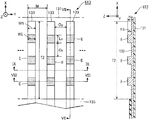
- FIG. 6 includes a plan view and a cross-sectional view of a second wiring substrate.
- FIG. 7 is a cross-sectional view of a state in which the first wiring substrate and the second wiring substrate are bonded to each other (a cross-sectional view taken along line VII-VII in FIG. 6 ).
- FIG. 8 is a cross-sectional view of the state in which the first wiring substrate and the second wiring substrate are bonded to each other (a cross-sectional view taken along line VIII-VIII in FIG. 6 ).
- FIG. 9 is a cross-sectional view of the state in which the first wiring substrate and the second wiring substrate are bonded to each other (a cross-sectional view taken along line IX-IX in FIG. 6 ).
- FIG. 10 is a plan view of a second wiring substrate according to a second embodiment.
- FIG. 11 is a plan view of a second wiring substrate according to a third embodiment.
- FIG. 1 is a block diagram illustrating an example of a liquid ejecting apparatus 100 according to a first embodiment of the present disclosure.
- the liquid ejecting apparatus 100 of the first embodiment is an ink jet printing apparatus that ejects ink, which is an example of a liquid, on a medium 12 .
- the medium 12 is typically printing paper, an object to be printed formed of any material, such as a resin film or fabric, is used as the medium 12 .
- a liquid container 14 that stores ink is installed in the liquid ejecting apparatus 100 .
- a cartridge configured to detach from the liquid ejecting apparatus 100 , a bag-shaped ink pack formed of a flexible film, or an ink tank into which ink can be refilled is used as the liquid container 14 .
- a plurality of types of inks of different colors are stored in the liquid container 14 .
- the liquid ejecting apparatus 100 includes a control unit 20 , a transport mechanism 22 , and a line head 26 .
- the control unit 20 includes a processing circuit such as a central processing unit (CPU) or a field programmable gate array (FPGA) and a memory circuit such as a semiconductor memory, and controls each element of the liquid ejecting apparatus 100 in an integrated manner.
- the transport mechanism 22 transports the medium 12 in a Y direction under the control of the control unit 20 .
- the line head 26 includes a plurality of liquid ejecting heads 261 .
- Each liquid ejecting head 261 is a structure that ejects ink from nozzles.
- the plurality of liquid ejecting heads 261 are arranged in an X direction orthogonal to the Y direction.
- the plurality of liquid ejecting heads 261 are, for example, arranged in a zigzag manner or in a staggered manner.
- Each liquid ejecting head 261 ejects the ink supplied from the liquid container 14 to the medium 12 under the control of the control unit 20 .
- a desired image is formed on a surface of the medium 12 by having each of the liquid ejecting heads 261 eject ink onto the medium 12 concurrently with the transportation of the medium 12 performed by the transport mechanism 22 .
- a direction perpendicular to an XY plane parallel to the surface of the medium 12 is hereinafter referred to as a Z direction.
- a direction in which the ink is ejected with each liquid ejecting head 261 corresponds to the Z direction.
- the Z direction is the vertical direction.
- FIG. 2 is an exploded perspective view of the line head 26
- FIG. 3 is a cross-sectional view taken along line III-III in FIG. 2
- each liquid ejecting head 261 includes a plurality of nozzles N arranged in the X direction.
- the plurality of nozzles N of the first embodiment are divided into a first line L 1 and a second line L 2 that are arranged side by side with a space in between in the Y direction.
- Each of the first line L 1 and the second line L 2 is a set of a plurality of nozzles N linearly arranged in the Y direction.
- the liquid ejecting head 261 of the first embodiment is structured so that the elements related to each of the nozzles N in the first line L 1 and the elements related to each of the nozzles N in the second line L 2 are disposed in a substantially axisymmetric manner.
- each liquid ejecting head 261 includes a head unit 611 that ejects ink from the nozzles N, and a second wiring substrate 613 .
- the control unit 20 and the head units 611 are electrically coupled to each other with the second wiring substrate 613 .
- the control unit 20 in FIG. 1 generates a signal and voltage to eject the ink from the nozzles. For example, a control signal S and a drive signal D are generated by the control unit 20 .
- the control signal S instructs each nozzle N whether or not to eject ink (ejection/non-ejection).
- the drive signal D is a periodic signal whose voltage changes across a predetermined base voltage, and is used to make the head unit 611 eject ink. As illustrated as an example in FIG. 4 , the drive signal D is a voltage signal including a drive pulse P in each predetermined period. Note that the drive signal D having a waveform including a plurality of drive pulses P may be used.
- the drive signal D and the control signal S generated by the control unit 20 are supplied to each head unit 611 through the second wiring substrate 613 .
- each head unit 611 includes a flow path structure 30 , piezoelectric elements 44 , a first wiring substrate 46 , a containing body 48 , and a drive circuit 80 .
- the flow path structure 30 is a structure that forms flow paths that supply ink to the plurality of nozzles N.
- the flow path structure 30 of the first embodiment includes a flow path substrate 32 , a pressure chamber substrate 34 , a diaphragm 42 , a nozzle plate 62 , and first vibration absorbers 64 .
- Each member constituting the flow path structure 30 is a plate-shaped member elongated in the X direction.
- the containing body 48 and the pressure chamber substrate 34 are provided on a surface of the flow path substrate 32 on a negative side in the Z direction.
- the nozzle plate 62 and the first vibration absorbers 64 are provided on a surface of the flow path substrate 32 on a positive side in the Z direction.
- Each member is fixed with an adhesive agent, for example.
- the nozzle plate 62 is a plate-shaped member having the plurality of nozzles N formed therein. Each of the plurality of nozzles N is a circular through hole through which ink passes.
- the plurality of nozzles N constituting the first line L 1 and the plurality of nozzles N constituting the second line L 2 are formed.
- the nozzle plate 62 is fabricated by processing a single crystal substrate formed of silicon (Si) using a semiconductor manufacturing technique (for example, a processing technique such as dry etching or wet etching), for example. However, any known materials and any manufacturing methods can be adopted to manufacture the nozzle plate 62 .
- opening portions 320 , a plurality of supply flow paths 322 , a plurality of communication flow paths 324 , and a plurality of connection flow paths 326 are formed for each of the first line L 1 and the second line L 2 of the flow path substrate 32 .
- Each opening portion 320 is an elongated opening formed in the X direction in a plan view (that is, when viewed in the Z direction), and the supply flow paths 322 and the communication flow paths 324 are through holes formed for each nozzle N.
- Each connection flow path 326 is an elongated space formed in the X direction across a plurality of nozzles N, and communicates the opening portions 320 and the plurality of supply flow paths 322 to each other.
- Each of the plurality of communication flow paths 324 overlaps a corresponding single nozzle N in plan view.
- the pressure chamber substrate 34 is a plate-shaped member in which a plurality of pressure chambers 342 are formed in each of the first line L 1 and the second line L 2 .
- the plurality of pressure chambers 342 are arranged in the X direction.
- Each of the pressure chambers 342 (cavities) is an elongated space that is formed for each nozzle N and that extends in the Y direction in a plan view.
- the flow path substrate 32 and the pressure chamber substrate 34 are fabricated by processing a single crystal substrate formed of silicon using a semiconductor manufacturing technique. However, any known materials and any manufacturing methods can be adopted to manufacture the flow path substrate 32 and the pressure chamber substrate 34 .
- the diaphragm 42 is formed on a surface of the pressure chamber substrate 34 opposite the flow path substrate 32 .
- the diaphragm 42 of the first embodiment is a plate-shaped member configured to vibrate elastically. Note that portions or the entire diaphragm 42 can be formed so as to be integrated with the pressure chamber substrate 34 by selectively removing the plate-shaped member having a predetermined plate thickness at portions corresponding to the pressure chambers 342 in the plate thickness direction.
- the pressure chambers 342 are spaces located between the flow path substrate 32 and the diaphragm 42 .
- the plurality of pressure chambers 342 are arranged in the X direction.
- the pressure chambers 342 are in communication with the communication flow paths 324 and the supply flow paths 322 .
- the pressure chambers 342 are in communication with the nozzles N through the communication flow paths 324 and are in communication with the opening portions 320 through the supply flow paths 322 and the connection flow paths 326 .
- the piezoelectric elements 44 are positioned on a surface of the flow path structure 30 on a side opposite the nozzles N. Specifically, in each of the first line L 1 and the second line L 2 , the plurality of piezoelectric elements 44 each corresponding to different nozzles N are formed on the surface of the diaphragm 42 of the flow path structure 30 on a side opposite the pressure chambers 342 .
- Each piezoelectric element 44 is a passive element that changes the pressure in the corresponding pressure chamber 342 by being deformed by a drive signal D supplied from the drive circuit 80 .
- the drive signal output D output from the drive circuit 80 is supplied to each piezoelectric element 44 through connection terminals T of the first wiring substrate 46 .
- the drive signal D is supplied to the drive circuit 80 from the control unit 20 through the second wiring substrate 613 .
- the drive circuit 80 is configured to include a plurality of switches each corresponding to a different piezoelectric element 44 , and performs, on for each piezoelectric element 44 , control of whether to supply the drive pulse P of the drive signal D to the piezoelectric elements 44 according to the control signal S. Specifically, the drive circuit 80 supplies the drive pulse P to the piezoelectric element 44 corresponding to the nozzle N to which the control signal S has instructed an ejection of ink, and does not supply the drive pulse P to the piezoelectric element 44 corresponding to the nozzle N to which the control signal S has not instructed a non-ejection of ink.
- the first wiring substrate 46 in FIG. 2 is a plate-shaped member opposing the surface of the diaphragm 42 , on which the plurality of piezoelectric elements 44 are formed, with a gap in between. In other words, the first wiring substrate 46 is positioned on the side opposite the flow path structure 30 with respect to the piezoelectric elements 44 . Wiring that electrically couples the drive circuit 80 and the piezoelectric elements 44 to each other is formed in the first wiring substrate 46 .
- the first wiring substrate 46 of the first embodiment also functions as a reinforcing plate that reinforces the mechanical strength of the liquid ejecting head 261 and a sealing plate that protects and seals the piezoelectric elements 44 .
- the first wiring substrate 46 is electrically coupled to the control unit 20 through the second wiring substrate 613 .
- the second wiring substrate 613 is a flexible wiring substrate that supplies various signals including the drive signal D and the control signal S or voltages from the control unit 20 to the first wiring substrate 46 .
- An end portion of the second wiring substrate 613 is bonded to the first wiring substrate 46 .
- the end portion of the second wiring substrate 613 on the positive side in the X direction and an end portion of the first wiring substrate 46 on the negative side in the X direction are bonded to each other.
- a connecting component such as a flexible printed circuit (FPC) or a flexible flat cable (FFC) is suitably adopted as the second wiring substrate 613 .
- the containing body 48 is a case that stores the ink supplied to the plurality of pressure chambers 342 .
- a surface of the containing body 48 on the positive side in the Z direction is bonded to the flow path substrate 32 with, for example, an adhesive agent.
- the containing body 48 is, in a plan view, a structure inside of which liquid storage chambers (reservoirs) R elongated in the X direction are formed.
- the liquid storage chambers R are formed for each of the first line L 1 and the second line L 2 .
- each liquid storage chamber R includes a first space R 1 extending in the Y direction and a second space R 2 extending in the Z direction in a cross-sectional view.
- the first space R 1 overlaps the piezoelectric elements 44 in a plan view.
- the corresponding second space R 2 and the corresponding opening portion 320 of the flow path substrate 32 are in communication with each other.
- Ink is supplied to the liquid storage chambers R through the inlets 482 formed in the containing body 48 .
- the inlets 482 are each a tubular portion that communicates the corresponding liquid storage chamber R of the containing body 48 to a portion external to the containing body 48 .
- the ink inside the liquid storage chambers R is supplied to the pressure chambers 342 through the connection flow paths 326 and the supply flow path 322 .
- the containing body 48 is formed, for example, by injection molding a resin material.
- the drive circuit 80 is disposed in the space formed by the containing body 48 .
- Opening portions 484 are formed in the containing body 48 of the first embodiment. Each opening portion 484 is an opening formed elongated in the X direction so as to overlap the corresponding liquid storage chamber R. As illustrated as an example in FIGS. 2 and 3 , second vibration absorbers 486 are provided on an upper surface of the containing body 48 . Each second vibration absorber 486 is a flexible film that functions as a compliance substrate that absorbs pressure fluctuations of the ink inside the corresponding liquid storage chamber R, and is installed on the upper surface of the containing body 48 so as to close the corresponding opening portion 484 to constitute a wall surface of the liquid storage chamber R.
- the first vibration absorbers 64 are elements that absorb pressure fluctuations of the ink inside the liquid storage chambers R.
- the first vibration absorbers 64 of the first embodiment each include an elastic film 641 and a support plate 643 .
- the elastic film 641 is a flexible member formed in a film shape.
- Each elastic film 641 of the first embodiment is disposed on the surface of the flow path substrate 32 so as to close the corresponding opening 320 , the corresponding supply flow path 322 , and the corresponding connection flow path 326 .
- the support plate 643 is a flat plate formed of a material with high rigidity such as stainless steel, and supports the elastic film 641 on the surface of the flow path substrate 32 so that the opening formed in the flow path substrate 32 is closed by the elastic film 641 .
- the pressure fluctuation inside each liquid storage chamber R is suppressed by deforming the corresponding elastic film 641 according to the pressure of the ink in the storage chamber R.
- the second wiring substrate 613 includes a second base portion 131 and a plurality of second wires 133 .
- the second base portion 131 is a flexible film-like member elongated in the X direction, and a plurality of second wires 133 are formed on the surface opposing the first wiring substrate 46 .
- the plurality of second wires 133 electrically couples the control unit 20 and the first wiring substrate 46 to each other.
- FIG. 5 is a block diagram illustrating a functional configuration of the liquid ejecting apparatus 100 .
- various signals and voltages generated by the control unit 20 are transmitted to the first wiring substrate 46 with the plurality of second wires 133 .
- the second wires 133 to which the drive signal D is supplied and the second wires 133 to which the control signal S is supplied are formed on the second wiring substrate 613 . Note that in FIG. 5 , illustration of the second wires 133 that transmit a signal and voltage different from the drive signal D and the control signal S are omitted.
- the first wiring substrate 46 includes a first base portion 70 and a plurality of first wires 72 .
- the first base portion 70 is an insulating plate-shaped member elongated in the X direction, and is positioned between the flow path structure 30 and the drive circuit 80 .
- the first base portion 70 is fabricated by processing a single crystal substrate formed of silicon using a semiconductor manufacturing technique, for example. However, any known materials and any manufacturing methods can be adopted to manufacture the first base portion 70 .
- the first base portion 70 includes a first surface F 1 and a second surface F 2 positioned opposite each other, and is fixed to a surface of the diaphragm 42 on a side opposite the flow path substrate 32 using an adhesive agent, for example. Specifically, the first base portion 70 is provided so that the second surface F 2 opposes the surface of the diaphragm 42 with a gap in between.
- the plurality of first wires 72 are formed at an end portion of the first surface F 1 of the first base portion 70 on the negative side in the X direction.
- the plurality of first wires 72 electrically couple the second wiring substrate 613 and the drive circuit 80 to each other.
- the plurality of first wires 72 are formed to correspond to the plurality of second wires 133 of the second wiring substrate 613 .
- the drive signal D and the control signal S supplied from the second wiring substrate 613 are transmitted to the drive circuit 80 through the plurality of first wires 72 .
- the first wiring substrate 46 includes the first wires 72 to which the drive signal D is supplied and the first wires 72 to which the control signal S is supplied.
- the head unit 611 and the second wiring substrate 613 are bonded to each other by an adhesive agent.
- Nonconductive paste is used as the adhesive agent.
- the first wiring substrate 46 and the second wiring substrate 613 are bonded to each other.
- a portion (typically, an end portion) of each of the second wires 133 of the second wiring substrate 613 functions as a second terminal T 2 that supplies the drive signal D and the control signal S to the head unit 611 .
- a portion (typically, an end portion) of each of the first wires 72 of the first wiring substrate 46 functions as a first terminal T 1 to which the drive signal D and the control signal S are supplied.
- the first surface F 1 of the first base portion 70 functions as a mounting surface on which the first terminals T 1 are formed.
- the first wiring substrate 46 and the second wiring substrate 613 of the head unit 611 are bonded to each other. Accordingly, as illustrated as an example in FIG. 5 , the drive signal D and the control signal S generated by the control unit 20 are supplied to the drive circuit 80 through the second wiring substrate 613 and the first wiring substrate 46 .
- FIG. 6 includes a plan view (the left drawing) and a cross-sectional view (the right drawing) of the second wiring substrate 613 .
- the second wiring substrate 613 includes an insulating film 135 that covers a portion of the second base portion 131 . Portions of the second wires 133 exposed from a peripheral edge of the insulating film 135 are the second terminals T 2 .
- the plurality of second terminals T 2 are formed in the second base portion 131 at predetermined intervals Oy in the Y direction.
- the plurality of second terminals T 2 are arranged at a pitch M of 50 ⁇ m or less.
- the pitch M is a distance between peripheral edges of two adjacent second terminals T 2 on the negative side in the Y direction.
- the pitch M is also referred to as the sum of the interval Oy between two second terminals T 2 adjacent to each other in the Y direction and the width of the second terminal T 2 .
- protrusions E protruding from a surface of the second terminal T 2 is formed on the surface thereof.
- hatching is added to the protrusions E for convenience sake.
- the protrusions E protrude from the surface of the second terminal T 2 toward the first wiring substrate 46 .
- the planar shape of each protrusion E is, for example, a rectangle.
- the plurality of protrusions E are formed on the surface of each second terminal T 2 at predetermined intervals Ox in the X direction in which the second terminal T 2 extends.
- positions of the protrusions E in the X direction in which the second terminals T 2 extend are the same.
- the plurality of protrusions E corresponding to each other are arranged in the Y direction in the plurality of second terminals T 2 .
- the protrusions E are formed across the entire width of each second terminal T 2 .
- widths WE of the protrusions E are equal to widths WN of portions other than the protrusions E in each second terminal T 2 .
- the interval Ox between two protrusions E adjacent to each other in the X direction among the plurality of protrusions E formed in each second terminal T 2 exceeds a length Lx of each protrusion E in the X direction in which the second terminal T 2 extends (Ox>Lx). Furthermore, the interval Oy between two second terminals T 2 exceeds the length Lx of each protrusion E in the X direction in which the second terminal T 2 extend (Oy>Lx).
- each protrusion E protrudes at a height Hb that exceeds a surface roughness of each second terminal T 2 .
- the surface roughness of each second terminal T 2 is, for example, 2 ⁇ m or less.
- the protrusion E of the first embodiment protrudes at the same height Hb throughout the protrusion E.
- the cross-sectional shape of the protrusion E is a rectangle.
- the height Hb of the protrusions E exceeds half the thickness Ha of the second terminals T 2 at portions where the protrusions E are situated, (Hb>Ha/2), for example.
- the thickness Ha of the second terminal T 2 is a length between the contact surface of the second terminal T 2 in contact with the second base portion 131 and the surface of the protrusion E. It can also be said that the maximum value of the length of the second terminal T 2 in the Z direction is the thickness of the second terminal T 2 . Specifically, the thickness Ha of the second terminal T 2 is 9 ⁇ m, for example.
- the height Hb of each protrusion E is a length between the surface of the portion other than the protrusion E to the surface of the protrusion E in the second terminal T 2 . Specifically, the height Hb of the protrusion E is, for example, 6 ⁇ m.
- FIGS. 7 to 9 are cross-sectional views of a state in which the first wiring substrate 46 and the second wiring substrate 613 are bonded to each other.
- FIG. 7 is a cross-sectional view taken along line VII-VII in FIG. 6
- FIG. 8 is a cross-sectional view taken along line VIII-VIII in FIG. 6
- FIG. 9 is a cross-sectional view taken along line IX-IX in FIG. 6 .
- FIG. 8 is a cross-sectional view of a section passing through the protrusions E of the plurality of second wires 133
- FIG. 9 is a cross-sectional view of a section passing through portions other than the protrusions E of the plurality of second wires 133 .
- each first wire 72 of the first wiring substrate 46 is a wire formed by layering a plurality of conductive layers.
- grooves are formed that extend along the laminated wiring.
- Each groove is a recessed portion having a rectangular section recessed with respect to the first surface F 1 of the first base portion 70 .
- Each first wire 72 is constituted by layers of first layered wiring 721 and second layered wiring 722 .
- Each first layered wiring 721 is a conductive pattern formed of metal such as, for example, copper (Cu) having a low resistance.
- the first layered wiring 721 is a trench wiring formed inside the groove.
- each second layered wiring 722 is a conductive pattern that covers the corresponding first layered wiring 721 .
- Each second layered wiring 722 covers the first layered wiring 721 inside the corresponding groove and continues to the first surface F 1 of the first base portion 70 .
- the second layered wiring 722 is constituted by layers of, for example, an adhesion layer that is formed of metal such as titanium (T 1 ) or tungsten (W) and that is formed on a surface of the first layered wiring 721 , and a wiring layer that is formed of metal such as gold (Au) and that is formed on a surface of the adhesion layer.
- the adhesion layer is a conductive layer that improves adhesion between the first layered wiring 721 and the wiring layer. Portions of the first wires 72 opposing the second terminals T 2 function as the first terminals T 1 .
- the surfaces of the protrusions E of the second terminals T 2 contact the surfaces of the first terminals T 1 .
- the first wiring substrate 46 and the second wiring substrate 613 are bonded to each other.
- portions of the second terminals T 2 other than the protrusions E do not contact the surface of the first terminals T 1 .
- Nonconductive paste is interposed between the surfaces of the second terminals T 2 other than the protrusions E and the surfaces of the first terminals T 1 . Note that the portions of the second terminals T 2 other than the protrusions E may be in contact with the surface of the first terminals T 1 .
- the surfaces of the terminals need to be sufficiently in close contact with each other.
- a configuration hereinafter, referred to as a “comparative example” in which terminals having flat surfaces are bonded to each other
- the terminals are not sufficiently in contact with each other, and the reliability of the electrical connection between the terminals are degraded. It is presumed that the terminals do not sufficiently contact each other, for example, due to unevennesses formed on the surfaces of the terminals owing to technical manufacturing problems and the terminals not contacting each other sufficiently.
- the terminals When the terminals are not sufficiently in contact with each other, there is a problem that the signal is not accurately supplied from one of the terminals to the other terminal, or the terminals generate heat due to the contact portions becoming high in resistance.
- the first terminals T 1 and the second terminals T 2 are sufficiently in contact with each other while the protrusions E are pressed and deformed by the first terminals T 1 . Accordingly, compared with the comparative example, the reliability of the electrical connection between the first terminals T 1 and the second terminals T 2 is larger.
- FIG. 10 is a plan view of a second wiring substrate 613 according to the second embodiment.
- the positions of the protrusions E in the X direction in which the second terminals T 2 extend are the same.
- the positions of the protrusions E in the X direction in which the second terminals T 2 extend are not the same.
- the protrusions E of one second terminal T 2 are formed at positions corresponding to the intervals Ox between the two protrusions E of the other second terminal T 2 in the X direction.
- the protrusions E of one second terminal T 2 is formed at positions corresponding to middle points of the intervals Ox in the other second terminal T 2 .
- the positions of the protrusions E are different between the even-numbered second terminals T 2 and the odd-numbered second terminals T 2 .
- the protrusions E approach each other due to deformation thereof and short circuiting may occur between the two second terminals T 2 .
- the positions of the protrusions E in the X direction in which the second terminals T 2 extend are not the same; accordingly, a distance is obtained between the protrusions E of the two second terminals T 2 . Accordingly, the possibility of short circuiting happening owing to the deformation of the protrusions E can be reduced.
- FIG. 11 is a plan view of a second wiring substrate 613 according to the third embodiment.
- the widths WE of the protrusions E are equal to the widths WN of the portions of the second terminals T 2 other than the protrusions E.
- the widths WE of the protrusions E are smaller than the widths WN of the portions of the second terminals T 2 other than the protrusions E.
- the peripheral edges of the protrusions E in the Y direction are positioned inside the peripheral edges of the portions of the second terminals T 2 other than the protrusions E in the Y direction.
- the configuration of the third embodiment a distance is obtained between the protrusions E of the two adjacent second terminals T 2 . Accordingly, the possibility of short circuiting happening owing to the deformation of the protrusions E can be reduced. Note that the configuration of the third embodiment can also be applied to the configuration of the second embodiment.
- the first surface F 1 of the first base portion 70 is exemplified as the mounting surface on which the first terminals T 1 are formed; however, a surface of an element in the head unit 611 other than that of the first base portion 70 may be the mounting surface.
- the second wiring substrate 613 is bonded to the surface of the diaphragm 42 as the mounting surface.
- the element of the head unit 611 bonded to the second wiring substrate 613 with the adhesive agent is not limited to the first wiring substrate 46 .
- the height Hb of the protrusions E exceeds half the thickness Ha of the second terminals T 2 at the portions where the protrusions E are situated; however, the height Hb of the protrusions E can be any height that protrudes at a height that exceeds the surface roughness of the second terminals T 2 .
- the interval Oy between the two second terminals T 2 exceeds the length Lx of the protrusion E in the direction in which the second terminal T 2 extend is illustrated, the interval Oy may be smaller than the length Lx of the protrusion E.
- each protrusion E is rectangular; however, the cross-sectional shape of the protrusion E may be trapezoidal or triangular, for example. In other words, each protrusion E do not have to protrude at a height that is the same as the height Hb across the entire protrusion E.
- the protrusion E having a rectangular planar shape is illustrated as an example; however, the planar shape of the protrusion E is not limited to the example described above.
- the planar shape of the protrusion E may be, for example, circular or oval.
- the positions of the protrusions E in the two second terminal T 2 adjacent to each other are not limited to those in the configuration illustrated in FIG. 10 as long as the positions of the protrusions E in the direction in which the second terminals T 2 extend are different.
- the liquid ejecting apparatuses 100 described as examples in the embodiments described above may be employed in various apparatuses other than an apparatus dedicated to printing, such as a facsimile machine and a copier.
- the application of the liquid ejecting apparatus 100 of the present disclosure is not limited to printing.
- a liquid ejecting apparatus that ejects a coloring material solution is used as a manufacturing apparatus that forms a color filter of a display device such as a liquid crystal display panel.
- a liquid ejecting apparatus that ejects a conductive material solution is used as a manufacturing apparatus that forms wiring and electrodes of a wiring substrate.
- a liquid ejecting apparatus that ejects a solution of an organic matter related to a living body is used, for example, as a manufacturing apparatus that manufactures a biochip.
Landscapes
- Particle Formation And Scattering Control In Inkjet Printers (AREA)
Abstract
Description
Claims (7)
Applications Claiming Priority (2)
| Application Number | Priority Date | Filing Date | Title |
|---|---|---|---|
| JP2018120578A JP2020001201A (en) | 2018-06-26 | 2018-06-26 | Liquid ejecting head, liquid ejecting apparatus, and wiring board |
| JP2018-120578 | 2018-06-26 |
Publications (2)
| Publication Number | Publication Date |
|---|---|
| US20190389219A1 US20190389219A1 (en) | 2019-12-26 |
| US10875303B2 true US10875303B2 (en) | 2020-12-29 |
Family
ID=68981243
Family Applications (1)
| Application Number | Title | Priority Date | Filing Date |
|---|---|---|---|
| US16/451,072 Active US10875303B2 (en) | 2018-06-26 | 2019-06-25 | Liquid ejecting head, liquid ejecting apparatus, and wiring substrate |
Country Status (3)
| Country | Link |
|---|---|
| US (1) | US10875303B2 (en) |
| JP (1) | JP2020001201A (en) |
| CN (1) | CN110641149B (en) |
Citations (7)
| Publication number | Priority date | Publication date | Assignee | Title |
|---|---|---|---|---|
| US20110074848A1 (en) * | 2009-09-30 | 2011-03-31 | Toru Yamashita | Liquid discharge apparatus and image forming apparatus |
| US20150217567A1 (en) * | 2013-03-27 | 2015-08-06 | Seiko Epson Corporation | Liquid ejecting head and liquid ejecting apparatus |
| US20160093794A1 (en) * | 2014-09-26 | 2016-03-31 | Brother Kogyo Kabushiki Kaisha | Piezoelectric actuator and method for manufacturing piezoelectric actuator |
| US20170266969A1 (en) | 2016-03-15 | 2017-09-21 | Seiko Epson Corporation | Liquid discharge head and liquid discharge apparatus |
| US20180090664A1 (en) * | 2016-09-28 | 2018-03-29 | Brother Kogyo Kabushiki Kaisha | Actuator device, liquid ejection apparatus, and connection structure |
| US20180090866A1 (en) * | 2016-09-28 | 2018-03-29 | Brother Kogyo Kabushiki Kaisha | Actuator device, liquid ejector, and connection structure for connecting first contacts and second contacts of wire member |
| US20180111372A1 (en) * | 2016-01-20 | 2018-04-26 | Seiko Epson Corporation | MEMS Device, Liquid Ejecting Head, Liquid Ejecting Apparatus, and MEMS Device Manufacturing Method |
Family Cites Families (4)
| Publication number | Priority date | Publication date | Assignee | Title |
|---|---|---|---|---|
| JP3589277B2 (en) * | 1997-01-27 | 2004-11-17 | セイコーエプソン株式会社 | Ink jet recording head |
| JP5029821B2 (en) * | 2007-06-19 | 2012-09-19 | ブラザー工業株式会社 | Flexible wiring body and droplet discharge head |
| US8814326B2 (en) * | 2012-10-03 | 2014-08-26 | Xerox Corporation | Reduced mechanical coupling with structured flex circuits |
| JP6167715B2 (en) * | 2013-07-17 | 2017-07-26 | セイコーエプソン株式会社 | Liquid jet head |
-
2018
- 2018-06-26 JP JP2018120578A patent/JP2020001201A/en active Pending
-
2019
- 2019-06-21 CN CN201910540841.4A patent/CN110641149B/en active Active
- 2019-06-25 US US16/451,072 patent/US10875303B2/en active Active
Patent Citations (8)
| Publication number | Priority date | Publication date | Assignee | Title |
|---|---|---|---|---|
| US20110074848A1 (en) * | 2009-09-30 | 2011-03-31 | Toru Yamashita | Liquid discharge apparatus and image forming apparatus |
| US20150217567A1 (en) * | 2013-03-27 | 2015-08-06 | Seiko Epson Corporation | Liquid ejecting head and liquid ejecting apparatus |
| US20160093794A1 (en) * | 2014-09-26 | 2016-03-31 | Brother Kogyo Kabushiki Kaisha | Piezoelectric actuator and method for manufacturing piezoelectric actuator |
| US20180111372A1 (en) * | 2016-01-20 | 2018-04-26 | Seiko Epson Corporation | MEMS Device, Liquid Ejecting Head, Liquid Ejecting Apparatus, and MEMS Device Manufacturing Method |
| US20170266969A1 (en) | 2016-03-15 | 2017-09-21 | Seiko Epson Corporation | Liquid discharge head and liquid discharge apparatus |
| JP2017164944A (en) | 2016-03-15 | 2017-09-21 | セイコーエプソン株式会社 | Liquid discharge head and liquid discharge device |
| US20180090664A1 (en) * | 2016-09-28 | 2018-03-29 | Brother Kogyo Kabushiki Kaisha | Actuator device, liquid ejection apparatus, and connection structure |
| US20180090866A1 (en) * | 2016-09-28 | 2018-03-29 | Brother Kogyo Kabushiki Kaisha | Actuator device, liquid ejector, and connection structure for connecting first contacts and second contacts of wire member |
Also Published As
| Publication number | Publication date |
|---|---|
| JP2020001201A (en) | 2020-01-09 |
| US20190389219A1 (en) | 2019-12-26 |
| CN110641149B (en) | 2020-12-29 |
| CN110641149A (en) | 2020-01-03 |
Similar Documents
| Publication | Publication Date | Title |
|---|---|---|
| US8348394B2 (en) | Liquid ejecting head | |
| US20180272697A1 (en) | Liquid ejecting head and liquid ejecting apparatus | |
| US10513115B2 (en) | Liquid ejecting head and liquid ejecting apparatus | |
| EP2769846B1 (en) | Liquid ejection apparatus and connection method for flexible wiring board | |
| US9393785B2 (en) | Liquid ejecting head and liquid ejecting apparatus | |
| JP6859639B2 (en) | Liquid injection head and liquid injection device | |
| US8371679B2 (en) | Liquid ejecting head unit and liquid ejecting apparatus | |
| JP2016132123A (en) | Liquid discharge device | |
| US10875303B2 (en) | Liquid ejecting head, liquid ejecting apparatus, and wiring substrate | |
| JP6604035B2 (en) | Liquid ejection device and method of manufacturing liquid ejection device | |
| US10836161B2 (en) | Liquid ejecting head and liquid ejecting apparatus | |
| US9434162B2 (en) | Liquid ejecting head and liquid ejecting apparatus | |
| JP6413803B2 (en) | Liquid ejecting head and liquid ejecting apparatus | |
| US10843463B2 (en) | Liquid ejecting head and liquid ejecting apparatus | |
| JP7226002B2 (en) | Liquid ejecting head, liquid ejecting apparatus and electronic device | |
| JP7718256B2 (en) | Liquid ejection head and liquid ejection device | |
| US11577512B2 (en) | Liquid discharge head, liquid discharge apparatus, and actuator | |
| JP7379900B2 (en) | Liquid ejection head and liquid ejection device | |
| US10850519B2 (en) | Liquid ejecting head and liquid ejecting apparatus | |
| US9610770B2 (en) | Liquid ejecting head and liquid ejecting apparatus | |
| JP7310133B2 (en) | liquid injection unit | |
| JP2021003827A (en) | Liquid discharge head, liquid discharge device, and actuator | |
| JP2020179579A (en) | Liquid jet head and liquid jet device | |
| JP2020055284A (en) | Liquid jet head and liquid jet device | |
| JP2020082564A (en) | Liquid jetting head and liquid jetting device |
Legal Events
| Date | Code | Title | Description |
|---|---|---|---|
| AS | Assignment |
Owner name: SEIKO EPSON CORPORATION, JAPAN Free format text: ASSIGNMENT OF ASSIGNORS INTEREST;ASSIGNORS:WATANABE, SHUNSUKE;TOMIMATSU, SHINGO;REEL/FRAME:049574/0463 Effective date: 20190417 |
|
| FEPP | Fee payment procedure |
Free format text: ENTITY STATUS SET TO UNDISCOUNTED (ORIGINAL EVENT CODE: BIG.); ENTITY STATUS OF PATENT OWNER: LARGE ENTITY |
|
| FEPP | Fee payment procedure |
Free format text: ENTITY STATUS SET TO SMALL (ORIGINAL EVENT CODE: SMAL); ENTITY STATUS OF PATENT OWNER: LARGE ENTITY Free format text: ENTITY STATUS SET TO UNDISCOUNTED (ORIGINAL EVENT CODE: BIG.); ENTITY STATUS OF PATENT OWNER: LARGE ENTITY |
|
| STPP | Information on status: patent application and granting procedure in general |
Free format text: DOCKETED NEW CASE - READY FOR EXAMINATION |
|
| STPP | Information on status: patent application and granting procedure in general |
Free format text: RESPONSE TO NON-FINAL OFFICE ACTION ENTERED AND FORWARDED TO EXAMINER |
|
| STCF | Information on status: patent grant |
Free format text: PATENTED CASE |
|
| MAFP | Maintenance fee payment |
Free format text: PAYMENT OF MAINTENANCE FEE, 4TH YEAR, LARGE ENTITY (ORIGINAL EVENT CODE: M1551); ENTITY STATUS OF PATENT OWNER: LARGE ENTITY Year of fee payment: 4 |