US10868314B2 - Porous separator including plurality of porous patterns, method for preparing the same, and fuel cell using the same - Google Patents

Porous separator including plurality of porous patterns, method for preparing the same, and fuel cell using the same Download PDF

Info

Publication number
US10868314B2
US10868314B2 US16/098,656 US201716098656A US10868314B2 US 10868314 B2 US10868314 B2 US 10868314B2 US 201716098656 A US201716098656 A US 201716098656A US 10868314 B2 US10868314 B2 US 10868314B2
Authority
US
United States
Prior art keywords
porous
porous pattern
pattern structure
separator
pattern
Prior art date
Legal status (The legal status is an assumption and is not a legal conclusion. Google has not performed a legal analysis and makes no representation as to the accuracy of the status listed.)
Active, expires
Application number
US16/098,656
Other versions
US20190148742A1 (en
Inventor
Dahora LEE
Jae Choon YANG
Current Assignee (The listed assignees may be inaccurate. Google has not performed a legal analysis and makes no representation or warranty as to the accuracy of the list.)
LG Chem Ltd
Original Assignee
LG Chem Ltd
Priority date (The priority date is an assumption and is not a legal conclusion. Google has not performed a legal analysis and makes no representation as to the accuracy of the date listed.)
Filing date
Publication date
Application filed by LG Chem Ltd filed Critical LG Chem Ltd
Assigned to LG CHEM, LTD. reassignment LG CHEM, LTD. ASSIGNMENT OF ASSIGNORS INTEREST (SEE DOCUMENT FOR DETAILS). Assignors: LEE, Dahora, YANG, JAE CHOON
Publication of US20190148742A1 publication Critical patent/US20190148742A1/en
Application granted granted Critical
Publication of US10868314B2 publication Critical patent/US10868314B2/en
Active legal-status Critical Current
Adjusted expiration legal-status Critical

Links

Images

Classifications

    • HELECTRICITY
    • H01ELECTRIC ELEMENTS
    • H01MPROCESSES OR MEANS, e.g. BATTERIES, FOR THE DIRECT CONVERSION OF CHEMICAL ENERGY INTO ELECTRICAL ENERGY
    • H01M8/00Fuel cells; Manufacture thereof
    • H01M8/02Details
    • H01M8/0202Collectors; Separators, e.g. bipolar separators; Interconnectors
    • H01M8/023Porous and characterised by the material
    • H01M8/0241Composites
    • H01M8/0245Composites in the form of layered or coated products
    • HELECTRICITY
    • H01ELECTRIC ELEMENTS
    • H01MPROCESSES OR MEANS, e.g. BATTERIES, FOR THE DIRECT CONVERSION OF CHEMICAL ENERGY INTO ELECTRICAL ENERGY
    • H01M8/00Fuel cells; Manufacture thereof
    • H01M8/02Details
    • H01M8/0202Collectors; Separators, e.g. bipolar separators; Interconnectors
    • H01M8/023Porous and characterised by the material
    • H01M8/0232Metals or alloys
    • HELECTRICITY
    • H01ELECTRIC ELEMENTS
    • H01MPROCESSES OR MEANS, e.g. BATTERIES, FOR THE DIRECT CONVERSION OF CHEMICAL ENERGY INTO ELECTRICAL ENERGY
    • H01M8/00Fuel cells; Manufacture thereof
    • H01M8/02Details
    • H01M8/0202Collectors; Separators, e.g. bipolar separators; Interconnectors
    • H01M8/023Porous and characterised by the material
    • H01M8/0234Carbonaceous material
    • HELECTRICITY
    • H01ELECTRIC ELEMENTS
    • H01MPROCESSES OR MEANS, e.g. BATTERIES, FOR THE DIRECT CONVERSION OF CHEMICAL ENERGY INTO ELECTRICAL ENERGY
    • H01M8/00Fuel cells; Manufacture thereof
    • H01M8/02Details
    • H01M8/0202Collectors; Separators, e.g. bipolar separators; Interconnectors
    • H01M8/0258Collectors; Separators, e.g. bipolar separators; Interconnectors characterised by the configuration of channels, e.g. by the flow field of the reactant or coolant
    • HELECTRICITY
    • H01ELECTRIC ELEMENTS
    • H01MPROCESSES OR MEANS, e.g. BATTERIES, FOR THE DIRECT CONVERSION OF CHEMICAL ENERGY INTO ELECTRICAL ENERGY
    • H01M8/00Fuel cells; Manufacture thereof
    • H01M8/10Fuel cells with solid electrolytes
    • H01M2008/1095Fuel cells with polymeric electrolytes
    • YGENERAL TAGGING OF NEW TECHNOLOGICAL DEVELOPMENTS; GENERAL TAGGING OF CROSS-SECTIONAL TECHNOLOGIES SPANNING OVER SEVERAL SECTIONS OF THE IPC; TECHNICAL SUBJECTS COVERED BY FORMER USPC CROSS-REFERENCE ART COLLECTIONS [XRACs] AND DIGESTS
    • Y02TECHNOLOGIES OR APPLICATIONS FOR MITIGATION OR ADAPTATION AGAINST CLIMATE CHANGE
    • Y02EREDUCTION OF GREENHOUSE GAS [GHG] EMISSIONS, RELATED TO ENERGY GENERATION, TRANSMISSION OR DISTRIBUTION
    • Y02E60/00Enabling technologies; Technologies with a potential or indirect contribution to GHG emissions mitigation
    • Y02E60/30Hydrogen technology
    • Y02E60/50Fuel cells
    • YGENERAL TAGGING OF NEW TECHNOLOGICAL DEVELOPMENTS; GENERAL TAGGING OF CROSS-SECTIONAL TECHNOLOGIES SPANNING OVER SEVERAL SECTIONS OF THE IPC; TECHNICAL SUBJECTS COVERED BY FORMER USPC CROSS-REFERENCE ART COLLECTIONS [XRACs] AND DIGESTS
    • Y02TECHNOLOGIES OR APPLICATIONS FOR MITIGATION OR ADAPTATION AGAINST CLIMATE CHANGE
    • Y02PCLIMATE CHANGE MITIGATION TECHNOLOGIES IN THE PRODUCTION OR PROCESSING OF GOODS
    • Y02P70/00Climate change mitigation technologies in the production process for final industrial or consumer products
    • Y02P70/50Manufacturing or production processes characterised by the final manufactured product

Definitions

  • the present invention relates to a method of preparing a porous separator for a fuel cell and a porous separator for a fuel cell.
  • a basic structure of a fuel cell is a structure in which a membrane-electrode assembly (MEA) in which an electrochemical reaction is generated, a gas diffusion layer (GDL) that is a porous medium which evenly disperses reaction gas to the MEA, and a separator are alternately and repeatedly stacked.
  • MEA membrane-electrode assembly
  • GDL gas diffusion layer
  • separator separator
  • a polymer electrolyte membrane fuel cell (PEMFC) among the fuel cells is an electricity generating apparatus which directly generates electricity by an electrochemical reaction of hydrogen and oxygen.
  • hydrogen is supplied through an anode and oxygen is supplied to a cathode.
  • the hydrogen supplied through the anode is separated into hydrogen ions and electrons by electrode layers formed at both sides of an electrolyte.
  • the hydrogen ions pass through an electrolyte membrane and are transmitted to the cathode, and the electrons are collected through an external conductive line through the separator to generate a current. Further, the hydrogen ions transmitted to the cathode meets oxygen in the supplied air to generate water.
  • the separator serves as a structure which collects and transmits the generated current, prevents a direct contact of hydrogen and oxygen to prevent a risk of explosion and combustion, transports reaction gas and a product, transmits reaction heat, and joins each electrode and a catalyst, and a gas diffusion layer.
  • a porous separator distributes fuel of a fuel cell and improves electrochemical performance, but the porous separator has very complex entire shape and structure, and it is difficult to form and mass-produce the separator due to the complex shape.
  • an etching processing method or a stamping processing method is utilized, but lots of preparing cost and preparing time are consumed and it is difficult to prepare a porous separator having minute and various shapes due to a limitation in the forming.
  • Patent Document 1 Korean Patent Application Laid-Open No. 10-2015-0134583
  • the Document describes a separator for a fuel cell and a fuel cell including the same.
  • Patent Document 1 Korean Patent Application Laid-Open No. 10-2015-0134583
  • the present invention relates to a method of preparing a porous separator for a fuel cell and a porous separator for a fuel cell.
  • An exemplary embodiment of the present invention provides a method of preparing a porous separator for a fuel cell, the method including: preparing a plurality of porous pattern structures, each of which includes a plurality of regularly repeated unit holes and in which a center axis is set to pass through a center of one unit hole and a center of another unit hole adjacent to the one unit hole; and preparing a porous separator by stacking the plurality of porous pattern structures, in which in the preparing of the porous separator, a center axis of one porous pattern structure and a center axis of another porous pattern structure adjacent to the one porous pattern structure are spaced apart from each other or intersect to form an angle of larger than 0° but lower than 90°.
  • porous separator for a fuel cell
  • the porous separator including: a plurality of stacked porous pattern structures, each of which includes a plurality of regularly repeated unit holes and in which a center axis is set to pass through a center of one unit hole and a center of another unit hole adjacent to the one unit hole, in which in the plurality of porous pattern structures, center axes of adjacent porous pattern structures are spaced apart from one another or intersect to form an angle of larger than 0° but lower than 90°.
  • Still another exemplary embodiment of the present invention provides a fuel cell including the porous separator for the fuel cell according to another exemplary embodiment of the present invention.
  • the method of preparing a porous separator for a fuel cell which is capable of simply and easily preparing a porous separator for a fuel cell having a complex shape.
  • porous separator for the fuel cell with improved fuel distributing performance and mass production availability.
  • FIGS. 1A to 1C are diagrams illustrating a porous pattern structure in which a plurality of unit holes is formed according to an exemplary embodiment of the present invention.
  • FIGS. 2A to 2C are diagrams illustrating the case where the porous pattern structures are stacked in order to prepare a porous separator for a fuel cell according to an exemplary embodiment of the present invention.
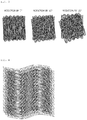
  • FIG. 3 is a diagram illustrating the case where a new flow path pattern is formed according to an angle formed by center axes of the adjacent porous pattern structures according to the exemplary embodiment of the present invention.
  • FIG. 4 is a diagram illustrating the case where the porous pattern structures are stacked in such a manner that the center axes of the porous pattern structures are spaced apart from one another in order to prepare the porous separator for the fuel cell according to the exemplary embodiment of the present invention.
  • FIG. 5 is a diagram illustrating the case where porous pattern structures are stacked in order to prepare a porous separator for a fuel cell according to Example 1 of the present invention.
  • FIG. 6 is a diagram illustrating the case where porous pattern structures are stacked in order to prepare a porous separator for a fuel cell according to Example 2 of the present invention.
  • FIG. 7 is a graph representing I-V curves of a fuel cell including the porous separator for the fuel cell according to Example 1 of the present invention and a fuel cell including a separator according to Comparative Example 1.
  • An exemplary embodiment of the present invention provides a method of preparing a porous separator for a fuel cell, the method including: preparing a plurality of porous pattern structures which includes a plurality of regularly repeated unit holes, and in which a center axis is set to pass through a center of one unit hole and a center of another unit hole adjacent to the one unit hole; and preparing a porous separator by stacking the plurality of porous pattern structures, and in the preparing of the porous separator, a center axis of one porous pattern structure is spaced apart from a center axis of another porous pattern structure adjacent to the one porous pattern structure or a center axis of one porous pattern structure intersects a center axis of another porous pattern structure adjacent to the one porous pattern structure with an angle larger than 0° but lower than 90°.
  • the plurality of unit holes included in the porous pattern structure may be regularly repeated, and may have the same shape.
  • the plurality of unit holes is formed on the porous pattern structure, so that the porous pattern structure may have a porous pattern having a shape of a mesh.
  • the unit hole may have a circular shape, a polygonal shape, or a shape formed of a curved line.
  • the unit hole may have a shape, such as an elliptical shape and a hemispherical shape, in addition to a circular shape.
  • the unit hole may also have a shape in which one or more sides of a polygon are formed with curved lines, in addition to the polygon, such as a triangle, a quadrangle, a pentagon, and a hexagon.
  • the foregoing shape of the unit hole is simply an example for description, and does not limit a shape of the unit hole.
  • the porous pattern structure may have a porous pattern shaped like a mesh.
  • the porous pattern structure may have a porous pattern with a hole pattern, a line pattern, and a mesh pattern.
  • FIGS. 1A to 1C are diagrams illustrating a porous pattern structure in which a plurality of unit holes is formed according to an exemplary embodiment of the present invention.
  • FIG. 1A is a diagram illustrating a porous pattern structure in which a porous pattern with a hole pattern is formed
  • FIG. 1B is a diagram illustrating a porous pattern structure in which a porous pattern with a mesh pattern is formed
  • FIG. 1C is a diagram illustrating a porous pattern structure in which a porous pattern with a line pattern is formed.
  • the porous pattern structure 100 a may have a porous pattern with a hole pattern, in which boundaries of unit holes 110 a are spaced apart from one another. That is, the porous pattern structure 100 a may have a porous pattern having a mesh form, in which the plurality of unit holes 110 a forms a hole pattern. Further, the unit hole 110 a may have a circular shape, an elliptical shape, a hemispherical shape, or a shape formed with a curved line.
  • each of the unit holes 110 a may have an area of 0.5 mm 2 or more and 7 mm 2 or less, and particularly, may have an area of 2 mm 2 or more and 5 mm 2 or less. Further, one unit hole and another unit hole adjacent to the one unit hole may be formed on the porous pattern structure while being spaced apart from each other by a distance between a center of one unit hole and a center of another unit hole adjacent to the one unit hole is 5 mm or less.
  • the porous pattern structure 100 b may have a porous pattern with a line pattern.
  • the unit hole 110 b may be elongated in a direction of one side of the porous pattern structure, and may have a shape having a predetermined width.
  • a boundary of the unit hole 110 b may have a shape of a straight line, a saw tooth pattern, a curve, or a wave pattern.
  • the unit hole 110 b may have a width d of 2 mm or less.
  • the porous pattern structure 100 c may have a porous pattern with a mesh pattern, in which boundaries of the plurality of unit holes 110 c are in contact with one another. That is, the porous pattern structure 100 c may have a porous pattern having a mesh form, in which the plurality of unit holes 110 c forms a mesh pattern.
  • the unit hole 110 c may have a shape of a triangle, a quadrangle, a pentagon, a hexagon, or a polygon. Further, each of the unit holes 110 c may have an area of 0.5 mm 2 or more and 7 mm 2 or less, and particularly, have an area of 2 mm 2 or more and 5 mm 2 or less.
  • a center axis is set to pass through a center of one unit hole and a center of another unit hole adjacent to the one unit hole, and the one unit hole and another unit hole may have a structure that is symmetric based on the center axis.
  • the center axis may be set to pass through a center of one unit hole of the porous pattern structure and a center of another unit hole that is most adjacent to the one unit hole.
  • the preparing of the porous separator may stack the plurality of porous pattern structures in such a manner that the center axis of one porous pattern structure is spaced apart from the center axis of another porous pattern structure adjacent to the one porous pattern structure or the center axis of one porous pattern structure passes through the center axis of another porous pattern structure adjacent to the one porous pattern structure to form an angle of larger than 0° but lower than 90°.
  • porous separator having a flow path pattern with a new shape by stacking the plurality of porous pattern structures so that the center axes of the adjacent porous pattern structures are spaced apart from one another or intersect one another to form an angle of larger than 0° but lower than 90°.
  • the unit holes of the plurality of porous pattern structures overlap, so that the porous separator may form a three-dimensional flow path pattern.
  • the porous pattern structures including the plurality of unit holes are stacked, so that it is possible to prepare the porous separator, in which the two-dimensional unit holes overlap to form the three-dimensional flow path pattern having a more complex shape.
  • the porous pattern structure having the unit holes having the simple shape through the simple method of stacking the porous pattern structure having the unit holes having the simple shape, it is possible to easily prepare the porous separator having the three-dimensional flow path pattern having a complex shape.
  • FIGS. 2A to 2C are diagrams illustrating the case where the porous pattern structures are stacked in order to prepare a porous separator for a fuel cell according to an exemplary embodiment of the present invention.
  • the porous separator having a flow path pattern having a new shape that is different from the shape of the unit hole of the porous pattern structure by stacking two porous pattern structures, each of which has a porous pattern with a mesh pattern formed with the plurality of hexagonal unit holes so as to have a predetermined angle between center axes of the respective porous pattern structures.
  • the porous separator When the porous separator is applied to a fuel cell, raw materials required for driving the fuel cell, an unreacted material, or a reaction product within the fuel cell may flow through the flow path pattern formed in the porous separator.
  • FIG. 2B similar to FIG. 2A , two porous pattern structures having the same mesh pattern are stacked, but the two porous pattern structures may be stacked in such a manner that an angle formed by center axes of the two porous pattern structures may be different from that of FIG. 2A .
  • FIG. 3 is a diagram illustrating the case where a new flow path pattern is formed according to an angle formed by center axes of the adjacent porous pattern structures according to the exemplary embodiment of the present invention.
  • FIG. 3 is a diagram illustrating the case where the porous pattern structures are stacked while varying angles formed by center axes of the porous pattern structures having porous patterns with line patterns including the plurality of unit holes which has curve-shaped boundaries.
  • the plurality of porous pattern structures may be stacked in such a manner that the center axes of the adjacent porous pattern structures intersect to form angles larger than 0° but lower than 90°.
  • the plurality of porous pattern structures may be stacked in such a manner that the center axes of the adjacent porous pattern structures intersect to form angles of 10° or more and 80° or less, 20° or more and 60° or less, and 25° or more and 45° or less.
  • a porous separator formed with a flow path pattern having a new shape that is different from the shape of the unit hole of the porous pattern structure by stacking the plurality of porous pattern structures so that the center axes of the plurality of porous pattern structures have angles larger than 0° but lower than 90°.
  • another porous pattern structure may be stacked on a porous pattern structure positioned in the lowermost layer in such a manner that a center axis of another porous pattern structure has an angle of about 5° in a clockwise direction with respect to a center axis of the porous pattern structure positioned in the lowermost layer, and still another porous pattern structure may be stacked on another foregoing porous pattern structure in such a manner that a center axis of still another porous pattern structure has an angle of about 5° in a clockwise direction with respect to the center axis of another foregoing porous pattern structure.
  • another porous pattern structure may be stacked on one porous pattern structure in such a manner that a center axis of another porous pattern structure has an angle of about 5° in a clockwise direction with respect to a center axis of the one porous pattern structure
  • still another porous pattern structure may be stacked on another foregoing porous pattern structure in such a manner that a center axis of still another porous pattern structure has an angle of about 5° in a counterclockwise direction with respect to the center axis of the one porous pattern structure.
  • each of the plurality of porous pattern structures may be stacked in such a manner that center axes of the adjacent porous pattern structures have different angles.
  • another porous pattern structure may be stacked on a porous pattern structure positioned in a lower layer in such a manner that a center axis of another porous pattern structure has an angle of about 5° in a clockwise direction with respect to a center axis of the porous pattern structure positioned in the lower layer
  • still another porous pattern structure may be stacked on another foregoing porous pattern structure in such a manner that a center axis of still another porous pattern structure has an angle of about 7° in a clockwise direction with respect to the center axis of another foregoing porous pattern structure.
  • FIG. 4 is a diagram illustrating the case where the porous pattern structures are stacked in such a manner that the center axes of the porous pattern structures are spaced apart from one another in order to prepare the porous separator for the fuel cell according to the exemplary embodiment of the present invention.
  • a porous separator formed with a flow path pattern by stacking one porous pattern structure on another porous pattern structure adjacent to the one porous pattern structure in the state where a center axis of the one porous pattern structure is spaced apart from a center axis of another porous pattern structure. It is possible to prepare the porous separator formed with a three-dimensional flow path pattern by stacking the plurality of porous pattern structures so that boundaries of unit holes of the plurality of porous pattern structures do not completely overlap one another and the center axes of the plurality of porous pattern structures are spaced apart from one another.
  • the porous separator formed with the complex-shape flow path pattern by stacking the plurality of porous pattern structures in such a manner that the center axes of the plurality of porous pattern structures are spaced apart from one another with a predetermined interval.
  • the two porous pattern structures may be stacked in such a manner than the center axes of the two porous pattern structures are spaced apart from each other with a predetermined interval.
  • the flow path pattern may be formed with a moiré pattern on one surface of the porous separator.
  • the plurality of porous pattern structures including the plurality of unit holes is stacked and the plurality of unit holes overlaps, so that it is possible to form the flow path pattern on the porous separator.
  • the flow path pattern may be represented with a moiré pattern in a plane direction of the porous separator formed with the flow path pattern. That is, when an operator and the like view the porous separator in a plane direction of the porous separator, the flow path pattern may be viewed as a moiré pattern.
  • the porous separator may include two to five porous pattern structures. It is possible to prepare the porous separator formed with the flow path pattern by stacking two or more porous pattern structures. It is possible to prepare a porous separator for a fuel cell by stacking five or less porous pattern structures in order to decrease a volume of a fuel cell stack in which the porous separator is used.
  • porous separator by stacking five or more porous pattern structures by adjusting a thickness of the porous pattern structure, and in order to form a more complex flow path pattern, it is also possible to stack five or more porous pattern structures.
  • the porous pattern structure may be formed of metal material, carbon material, or carbon composite material.
  • metal material particularly, stainless steel, titanium, or nickel may be used as the metal material, and a mixture of carbon fiber and resin or graphite may be used as the carbon composite material.
  • the foregoing kind of material usable in the porous pattern structure is an example for description, and the kind of material is not limited.
  • the porous pattern structure formed of the metal material When the porous pattern structure formed of the metal material is used, the porous pattern structure, on which a surface treatment is performed, may be used in an aspect of electrical conductivity.
  • a thickness of the porous pattern structure may be 0.05 mm or more and 0.25 mm or less.
  • the porous pattern structure having the thickness of 0.05 mm or more and 0.25 mm or less is used, thereby decreasing a volume of the porous separator formed with the flow path pattern.
  • the unit holes of each of the porous pattern structures may have the same shape.
  • Each of the porous pattern structures has the unit holes having the same shape, so that the flow path pattern may have a moiré pattern on one surface of the porous separator.
  • the porous separator formed with the flow path pattern may be cut in a predetermined size.
  • the porous separator, in which the plurality of porous pattern structures is stacked, so that the three-dimensional flow path pattern is formed, is cut in accordance with a desired size, and is usable as the porous separator for the fuel cell.
  • the porous separator formed with the flow path pattern is cut by using a knife or a laser in accordance with a usage area of the fuel cell and is usable as the porous separator for the fuel cell.
  • the porous separator having a more complex flow path pattern by simply stacking and cutting the porous pattern structures including the plurality of unit holes having a simple shape, thereby mass producing the porous separator for the fuel cell with desired performance by a simple process.
  • a plurality of porous pattern structures which includes a plurality of regularly repeated unit holes and in which a center axis is set to pass through a center of one unit hole and a center of another unit hole adjacent to the one unit hole, is stacked, and in the plurality of porous pattern structures, the center axes of the adjacent porous pattern structures are spaced apart from one another or intersect to form an angle of larger than 0° but lower than 90°.
  • porous separator for the fuel cell with improved fuel distributing performance and mass production availability.
  • the porous pattern structure used in the porous separator for the fuel cell according to another exemplary embodiment of the present invention may be the same as the porous pattern structure used in the method of preparing the porous separator for the fuel cell according to the exemplary embodiment of the present invention.
  • the unit hole may have a circular shape, a polygonal shape, or a shape formed of a curved line.
  • the unit hole may have a shape, such as an elliptical shape and a hemispherical shape, in addition to a circular shape.
  • the unit hole may also have a shape in which one or more sides of a polygon are formed with curved lines, in addition to the polygon, such as a triangle, a quadrangle, a pentagon, and a hexagon.
  • the foregoing shape of the unit hole is simply an example for description, and does not limit a shape of the unit hole.
  • the porous separator may have a three-dimensional flow path pattern which is formed according to overlapping of the unit holes of the plurality of porous pattern structures.
  • the plurality of porous pattern structures is stacked, so that the three-dimensional flow path pattern having a complex shape different from the shape of the unit hole of the porous pattern structure may be formed in the porous separator.
  • porous separator formed with the three-dimensional flow path pattern When the porous separator formed with the three-dimensional flow path pattern is used as the porous separator for the fuel cell, fuel may be smoothly supplied to a catalyst layer of the fuel cell through the three-dimensional flow path pattern formed in the porous separator, water occupied in most of the reaction product may be easily discharged, and a current generated in the fuel cell may be easily collected and transferred, thereby improving performance of the fuel cell.
  • the porous separator for the fuel cell has the three-dimensional flow path pattern having the complex shape, so that fuel distribution performance and electrochemical performance of the fuel cell may be excellent.
  • the center axes of the adjacent porous pattern structures may be spaced apart from one another or may intersect to form an angle of larger than 0° but lower than 90°.
  • the plurality of porous pattern structures may be stacked in such a manner that the center axes of the adjacent porous pattern structures intersect to form angles of 10° or more and 80° or less, 20° or more and 60° or less, and 25° or more and 45° or less.
  • another porous pattern structure may be stacked on a porous pattern structure positioned in the lowermost layer in such a manner that a center axis of another porous pattern structure has an angle of about 5° in a clockwise direction with respect to a center axis of the porous pattern structure positioned in the lowermost layer, and still another porous pattern structure may be stacked on another foregoing porous pattern structure so that a center axis of still another porous pattern structure has an angle of about 5° in a clockwise direction with respect to the center axis of another foregoing porous pattern structure.
  • another porous pattern structure may be stacked on one porous pattern structure so that a center axis of another porous pattern structure has an angle of about 5° in a clockwise direction with respect to a center axis of the one porous pattern structure
  • still another porous pattern structure may be stacked on another foregoing porous pattern structure so that a center axis of still another porous pattern structure has an angle of about 5° in a counterclockwise direction with respect to the center axis of the one porous pattern structure.
  • each of the plurality of porous pattern structures may be stacked in such a manner that center axes of the adjacent porous pattern structures have different angles.
  • another porous pattern structure may be stacked on a porous pattern structure positioned in a lower layer in such a manner that a center axis of another porous pattern structure has an angle of about 5° in a clockwise direction with respect to a center axis of the porous pattern structure positioned in the lower layer
  • still another porous pattern structure may be stacked on another foregoing porous pattern structure in such a manner that a center axis of still another porous pattern structure has an angle of about 7° in a clockwise direction with respect to the center axis of another foregoing porous pattern structure.
  • one porous pattern structure may be stacked on another porous pattern structure adjacent to the one porous pattern structure in a state where a center axis of the one porous pattern structure is spaced apart from a center axis of another porous pattern structure.
  • the porous separator may have the three-dimensional flow path pattern by stacking the plurality of porous pattern structures so that boundaries of unit holes of the plurality of porous pattern structures do not completely overlap one another and the center axes of the plurality of porous pattern structures are spaced apart from one another.
  • the two porous pattern structures may be stacked in such a manner than the center axes of the two porous pattern structures are spaced apart from each other with a predetermined interval.
  • the flow path pattern may be formed with a moiré pattern on one surface of the porous separator.
  • the flow path pattern may be represented with a moiré pattern in a plane direction of the porous separator formed with the flow path pattern. That is, when an operator and the like view the porous separator in a plane direction of the porous separator, the flow path pattern may be viewed as a moiré pattern.
  • the unit holes of each of the porous pattern structures may have the same shape.
  • Each of the porous pattern structures has the unit holes having the same shape, so that the flow path pattern may have a moiré pattern on one surface of the porous separator.
  • Still another exemplary embodiment of the present invention provides a fuel cell including the porous separator for a fuel cell according to another exemplary embodiment of the present invention.
  • the fuel cell may have the same configuration as that of the fuel cell typically used in the art.
  • the fuel cell may include a membrane electrode assembly (MEA) provided with an electrolyte layer between an anode and a cathode, a separator, and a gas diffusion layer, and the porous separator for the fuel cell according to another exemplary embodiment of the present invention may be used as the separator.
  • MEA membrane electrode assembly
  • the fuel cell includes the porous separator for the fuel cell according to another exemplary embodiment of the present invention, thereby having excellent fuel distribution performance and electrochemical performance.
  • FIG. 5 is a diagram illustrating the case where porous pattern structures are stacked in order to prepare a porous separator for a fuel cell according to Example 1 of the present invention.
  • two porous pattern structures each of which had a porous pattern with a mesh pattern including repeated hexagonal unit holes having an area of 0.8 mm 2 , had a thickness of 0.2 mm, and was made of stainless steel, were prepared. Carbon coating was performed on the two porous pattern structures before stacking, so that a surface of the porous pattern structure was conducting processed.
  • One porous pattern structure between the two porous pattern structures was positioned, and the other porous pattern structure was stacked so as to have 15° in a counterclockwise direction with respect to a center axis of the one porous pattern structure.
  • a porous separator formed with a three-dimensional flow path pattern was prepared by stacking two porous pattern structures having the porous pattern with the mesh pattern. As illustrated in FIG.
  • the flow path pattern is represented as a moiré pattern in a plane direction of the porous separator.
  • the porous separator for the fuel cell was prepared by cutting the porous separator having the flow path pattern in 50 mm in width and 50 mm in length.
  • FIG. 6 is a diagram illustrating the case where porous pattern structures are stacked in order to prepare a porous separator for a fuel cell according to Example 2 of the present invention.
  • porous pattern structures each of which had a porous pattern with a line pattern which has a width of 0.1 mm and in which boundary surfaces of unit holes are spaced apart from one another by 0.1 mm, had a thickness of 0.1 mm, and was made of stainless steel, were prepared. Except for the preparation of the two porous pattern structures, a porous separator for a fuel cell was prepared as illustrated in FIG. 6 by the same method as that of Example 1.
  • a flow separator (LG CHEM Company), which had a thickness of 0.2 mm and included a plurality of circular holes having a diameter of 1 mm, was prepared.
  • FIG. 7 is a graph representing I-V curves of a fuel cell including the porous separator for the fuel cell according to Example 1 of the present invention and a fuel cell including a separator according to Comparative Example 1.
  • FIG. 7 represents I-V curves of fuel cell 1 and fuel cell 2 , and a voltage corresponding to each current density was measured with a gap of 50 mA/cm 2 in a current density range of 0 or more and 2,000 or less mA/cm 2 .
  • a voltage of the fuel cell 1 including the porous separator for the fuel cell according to Example 1 of the present invention is higher than a voltage of fuel cell 2 including the porous separator for the fuel cell according to Comparative Example 1. Accordingly, it can be seen that performance of fuel cell 1 including the porous separator for the fuel cell according to Example 1 of the present invention is more excellent than that of fuel cell 2 including the porous separator for the fuel cell according to Comparative Example 1.

Landscapes

  • Chemical & Material Sciences (AREA)
  • Life Sciences & Earth Sciences (AREA)
  • Engineering & Computer Science (AREA)
  • Manufacturing & Machinery (AREA)
  • Sustainable Development (AREA)
  • Sustainable Energy (AREA)
  • Chemical Kinetics & Catalysis (AREA)
  • Electrochemistry (AREA)
  • General Chemical & Material Sciences (AREA)
  • Composite Materials (AREA)
  • Fuel Cell (AREA)

Abstract

A method of preparing a porous separator for a fuel cell, including preparing a plurality of porous pattern structures, each porous pattern structure includes a plurality of regularly repeated unit holes and a center axis passing through a center of one unit hole and through a center of another unit hole adjacent to the one unit hole, and stacking the plurality of porous pattern structures, wherein a center axis of one porous pattern structure and a center axis of another porous pattern structure adjacent to the one porous pattern structure are spaced apart from each other or intersect to form an angle of larger than 0° but lower than 90°.

Description

TECHNICAL FIELD
This specification claims priority to and the benefit of Korean Patent Application No. 10-2016-0056649 filed in the Korean Intellectual Property Office on May 9, 2016, the entire contents of which are incorporated herein by reference.
The present invention relates to a method of preparing a porous separator for a fuel cell and a porous separator for a fuel cell.
BACKGROUND ART
A basic structure of a fuel cell is a structure in which a membrane-electrode assembly (MEA) in which an electrochemical reaction is generated, a gas diffusion layer (GDL) that is a porous medium which evenly disperses reaction gas to the MEA, and a separator are alternately and repeatedly stacked. A polymer electrolyte membrane fuel cell (PEMFC) among the fuel cells is an electricity generating apparatus which directly generates electricity by an electrochemical reaction of hydrogen and oxygen.
In the PEMFC, hydrogen is supplied through an anode and oxygen is supplied to a cathode. The hydrogen supplied through the anode is separated into hydrogen ions and electrons by electrode layers formed at both sides of an electrolyte. The hydrogen ions pass through an electrolyte membrane and are transmitted to the cathode, and the electrons are collected through an external conductive line through the separator to generate a current. Further, the hydrogen ions transmitted to the cathode meets oxygen in the supplied air to generate water.
The separator serves as a structure which collects and transmits the generated current, prevents a direct contact of hydrogen and oxygen to prevent a risk of explosion and combustion, transports reaction gas and a product, transmits reaction heat, and joins each electrode and a catalyst, and a gas diffusion layer.
A porous separator distributes fuel of a fuel cell and improves electrochemical performance, but the porous separator has very complex entire shape and structure, and it is difficult to form and mass-produce the separator due to the complex shape. In order to prepare a porous separator, an etching processing method or a stamping processing method is utilized, but lots of preparing cost and preparing time are consumed and it is difficult to prepare a porous separator having minute and various shapes due to a limitation in the forming.
A related art literature is Korean Patent Application Laid-Open No. 10-2015-0134583 (Patent Document 1), and the Document describes a separator for a fuel cell and a fuel cell including the same.
RELATED ART LITERATURE Patent Document
Patent Document 1: Korean Patent Application Laid-Open No. 10-2015-0134583
DETAILED DESCRIPTION OF THE INVENTION Technical Problem
The present invention relates to a method of preparing a porous separator for a fuel cell and a porous separator for a fuel cell.
Technical Solution
An exemplary embodiment of the present invention provides a method of preparing a porous separator for a fuel cell, the method including: preparing a plurality of porous pattern structures, each of which includes a plurality of regularly repeated unit holes and in which a center axis is set to pass through a center of one unit hole and a center of another unit hole adjacent to the one unit hole; and preparing a porous separator by stacking the plurality of porous pattern structures, in which in the preparing of the porous separator, a center axis of one porous pattern structure and a center axis of another porous pattern structure adjacent to the one porous pattern structure are spaced apart from each other or intersect to form an angle of larger than 0° but lower than 90°.
Another exemplary embodiment of the present invention provides a porous separator for a fuel cell, the porous separator including: a plurality of stacked porous pattern structures, each of which includes a plurality of regularly repeated unit holes and in which a center axis is set to pass through a center of one unit hole and a center of another unit hole adjacent to the one unit hole, in which in the plurality of porous pattern structures, center axes of adjacent porous pattern structures are spaced apart from one another or intersect to form an angle of larger than 0° but lower than 90°.
Still another exemplary embodiment of the present invention provides a fuel cell including the porous separator for the fuel cell according to another exemplary embodiment of the present invention.
Advantageous Effects
According to the exemplary embodiment of the present invention, it is possible to provide the method of preparing a porous separator for a fuel cell, which is capable of simply and easily preparing a porous separator for a fuel cell having a complex shape.
According to another exemplary embodiment of the present invention, it is possible to provide the porous separator for the fuel cell with improved fuel distributing performance and mass production availability.
BRIEF DESCRIPTION OF DRAWINGS
FIGS. 1A to 1C are diagrams illustrating a porous pattern structure in which a plurality of unit holes is formed according to an exemplary embodiment of the present invention.
FIGS. 2A to 2C are diagrams illustrating the case where the porous pattern structures are stacked in order to prepare a porous separator for a fuel cell according to an exemplary embodiment of the present invention.
FIG. 3 is a diagram illustrating the case where a new flow path pattern is formed according to an angle formed by center axes of the adjacent porous pattern structures according to the exemplary embodiment of the present invention.
FIG. 4 is a diagram illustrating the case where the porous pattern structures are stacked in such a manner that the center axes of the porous pattern structures are spaced apart from one another in order to prepare the porous separator for the fuel cell according to the exemplary embodiment of the present invention.
FIG. 5 is a diagram illustrating the case where porous pattern structures are stacked in order to prepare a porous separator for a fuel cell according to Example 1 of the present invention.
FIG. 6 is a diagram illustrating the case where porous pattern structures are stacked in order to prepare a porous separator for a fuel cell according to Example 2 of the present invention.
FIG. 7 is a graph representing I-V curves of a fuel cell including the porous separator for the fuel cell according to Example 1 of the present invention and a fuel cell including a separator according to Comparative Example 1.
BEST MODE
Throughout the specification, unless explicitly described to the contrary, the word “comprise” and variations such as “comprises” or “comprising”, will be understood to imply the inclusion of stated elements but not the exclusion of any other elements. Further, in the present specification, when it is said that a specific member is positioned “on” the other member, this includes a case where another member is present between two members, as well as a case where the specific member is in contact with the other member.
Hereinafter, the present specification will be described in more detail.
An exemplary embodiment of the present invention provides a method of preparing a porous separator for a fuel cell, the method including: preparing a plurality of porous pattern structures which includes a plurality of regularly repeated unit holes, and in which a center axis is set to pass through a center of one unit hole and a center of another unit hole adjacent to the one unit hole; and preparing a porous separator by stacking the plurality of porous pattern structures, and in the preparing of the porous separator, a center axis of one porous pattern structure is spaced apart from a center axis of another porous pattern structure adjacent to the one porous pattern structure or a center axis of one porous pattern structure intersects a center axis of another porous pattern structure adjacent to the one porous pattern structure with an angle larger than 0° but lower than 90°.
According to the exemplary embodiment of the present invention, it is possible to provide a method of preparing a porous separator for a fuel cell, which is capable of simply and easily preparing a porous separator for a fuel cell having a complex shape.
According to the exemplary embodiment of the present invention, the plurality of unit holes included in the porous pattern structure may be regularly repeated, and may have the same shape. The plurality of unit holes is formed on the porous pattern structure, so that the porous pattern structure may have a porous pattern having a shape of a mesh.
According to the exemplary embodiment of the present invention, the unit hole may have a circular shape, a polygonal shape, or a shape formed of a curved line. Particularly, the unit hole may have a shape, such as an elliptical shape and a hemispherical shape, in addition to a circular shape. Further, the unit hole may also have a shape in which one or more sides of a polygon are formed with curved lines, in addition to the polygon, such as a triangle, a quadrangle, a pentagon, and a hexagon. However, the foregoing shape of the unit hole is simply an example for description, and does not limit a shape of the unit hole.
According to the exemplary embodiment of the present invention, the porous pattern structure may have a porous pattern shaped like a mesh. Particularly, according to the repetition form of the plurality of unit holes formed in the porous pattern structure, the porous pattern structure may have a porous pattern with a hole pattern, a line pattern, and a mesh pattern.
FIGS. 1A to 1C are diagrams illustrating a porous pattern structure in which a plurality of unit holes is formed according to an exemplary embodiment of the present invention. FIG. 1A is a diagram illustrating a porous pattern structure in which a porous pattern with a hole pattern is formed, FIG. 1B is a diagram illustrating a porous pattern structure in which a porous pattern with a mesh pattern is formed, and FIG. 1C is a diagram illustrating a porous pattern structure in which a porous pattern with a line pattern is formed.
Referring to FIG. 1A, the porous pattern structure 100 a may have a porous pattern with a hole pattern, in which boundaries of unit holes 110 a are spaced apart from one another. That is, the porous pattern structure 100 a may have a porous pattern having a mesh form, in which the plurality of unit holes 110 a forms a hole pattern. Further, the unit hole 110 a may have a circular shape, an elliptical shape, a hemispherical shape, or a shape formed with a curved line. When the porous pattern structure 100 a has the porous pattern with the hole pattern, each of the unit holes 110 a may have an area of 0.5 mm2 or more and 7 mm2 or less, and particularly, may have an area of 2 mm2 or more and 5 mm2 or less. Further, one unit hole and another unit hole adjacent to the one unit hole may be formed on the porous pattern structure while being spaced apart from each other by a distance between a center of one unit hole and a center of another unit hole adjacent to the one unit hole is 5 mm or less.
Referring to FIG. 1B, the porous pattern structure 100 b may have a porous pattern with a line pattern. The unit hole 110 b may be elongated in a direction of one side of the porous pattern structure, and may have a shape having a predetermined width. A boundary of the unit hole 110 b may have a shape of a straight line, a saw tooth pattern, a curve, or a wave pattern. Further, when the porous pattern structure 100 b has the porous pattern with the line pattern, the unit hole 110 b may have a width d of 2 mm or less.
Referring to FIG. 1C, the porous pattern structure 100 c may have a porous pattern with a mesh pattern, in which boundaries of the plurality of unit holes 110 c are in contact with one another. That is, the porous pattern structure 100 c may have a porous pattern having a mesh form, in which the plurality of unit holes 110 c forms a mesh pattern. The unit hole 110 c may have a shape of a triangle, a quadrangle, a pentagon, a hexagon, or a polygon. Further, each of the unit holes 110 c may have an area of 0.5 mm2 or more and 7 mm2 or less, and particularly, have an area of 2 mm2 or more and 5 mm2 or less.
Referring to FIGS. 1A to 1C, in the porous pattern structure, a center axis is set to pass through a center of one unit hole and a center of another unit hole adjacent to the one unit hole, and the one unit hole and another unit hole may have a structure that is symmetric based on the center axis. The center axis may be set to pass through a center of one unit hole of the porous pattern structure and a center of another unit hole that is most adjacent to the one unit hole.
According to the exemplary embodiment of the present invention, the preparing of the porous separator may stack the plurality of porous pattern structures in such a manner that the center axis of one porous pattern structure is spaced apart from the center axis of another porous pattern structure adjacent to the one porous pattern structure or the center axis of one porous pattern structure passes through the center axis of another porous pattern structure adjacent to the one porous pattern structure to form an angle of larger than 0° but lower than 90°. It is possible to prepare the porous separator having a flow path pattern with a new shape by stacking the plurality of porous pattern structures so that the center axes of the adjacent porous pattern structures are spaced apart from one another or intersect one another to form an angle of larger than 0° but lower than 90°.
According to the exemplary embodiment of the present invention, the unit holes of the plurality of porous pattern structures overlap, so that the porous separator may form a three-dimensional flow path pattern.
The porous pattern structures including the plurality of unit holes are stacked, so that it is possible to prepare the porous separator, in which the two-dimensional unit holes overlap to form the three-dimensional flow path pattern having a more complex shape.
Accordingly, according to the exemplary embodiment of the present invention, through the simple method of stacking the porous pattern structure having the unit holes having the simple shape, it is possible to easily prepare the porous separator having the three-dimensional flow path pattern having a complex shape.
FIGS. 2A to 2C are diagrams illustrating the case where the porous pattern structures are stacked in order to prepare a porous separator for a fuel cell according to an exemplary embodiment of the present invention.
Referring to FIG. 2A, it is possible to prepare the porous separator having a flow path pattern having a new shape that is different from the shape of the unit hole of the porous pattern structure by stacking two porous pattern structures, each of which has a porous pattern with a mesh pattern formed with the plurality of hexagonal unit holes so as to have a predetermined angle between center axes of the respective porous pattern structures. When the porous separator is applied to a fuel cell, raw materials required for driving the fuel cell, an unreacted material, or a reaction product within the fuel cell may flow through the flow path pattern formed in the porous separator.
Referring to FIG. 2B, similar to FIG. 2A, two porous pattern structures having the same mesh pattern are stacked, but the two porous pattern structures may be stacked in such a manner that an angle formed by center axes of the two porous pattern structures may be different from that of FIG. 2A.
Referring to FIG. 2C, it is possible to prepare a porous separator having a flow path pattern having a new shape by stacking three porous pattern structures having a mesh pattern.
FIG. 3 is a diagram illustrating the case where a new flow path pattern is formed according to an angle formed by center axes of the adjacent porous pattern structures according to the exemplary embodiment of the present invention. FIG. 3 is a diagram illustrating the case where the porous pattern structures are stacked while varying angles formed by center axes of the porous pattern structures having porous patterns with line patterns including the plurality of unit holes which has curve-shaped boundaries.
Referring to FIG. 3, it is possible to prepare a porous separator formed with a flow path pattern having various shapes by varying the angles formed by the center axes of the stacked porous pattern structures.
According to the exemplary embodiment of the present invention, the plurality of porous pattern structures may be stacked in such a manner that the center axes of the adjacent porous pattern structures intersect to form angles larger than 0° but lower than 90°. Particularly, the plurality of porous pattern structures may be stacked in such a manner that the center axes of the adjacent porous pattern structures intersect to form angles of 10° or more and 80° or less, 20° or more and 60° or less, and 25° or more and 45° or less.
It is possible to prepare a porous separator formed with a flow path pattern having a new shape that is different from the shape of the unit hole of the porous pattern structure by stacking the plurality of porous pattern structures so that the center axes of the plurality of porous pattern structures have angles larger than 0° but lower than 90°.
Particularly, another porous pattern structure may be stacked on a porous pattern structure positioned in the lowermost layer in such a manner that a center axis of another porous pattern structure has an angle of about 5° in a clockwise direction with respect to a center axis of the porous pattern structure positioned in the lowermost layer, and still another porous pattern structure may be stacked on another foregoing porous pattern structure in such a manner that a center axis of still another porous pattern structure has an angle of about 5° in a clockwise direction with respect to the center axis of another foregoing porous pattern structure. Further, another porous pattern structure may be stacked on one porous pattern structure in such a manner that a center axis of another porous pattern structure has an angle of about 5° in a clockwise direction with respect to a center axis of the one porous pattern structure, and still another porous pattern structure may be stacked on another foregoing porous pattern structure in such a manner that a center axis of still another porous pattern structure has an angle of about 5° in a counterclockwise direction with respect to the center axis of the one porous pattern structure.
Further, each of the plurality of porous pattern structures may be stacked in such a manner that center axes of the adjacent porous pattern structures have different angles. Particularly, another porous pattern structure may be stacked on a porous pattern structure positioned in a lower layer in such a manner that a center axis of another porous pattern structure has an angle of about 5° in a clockwise direction with respect to a center axis of the porous pattern structure positioned in the lower layer, and still another porous pattern structure may be stacked on another foregoing porous pattern structure in such a manner that a center axis of still another porous pattern structure has an angle of about 7° in a clockwise direction with respect to the center axis of another foregoing porous pattern structure.
FIG. 4 is a diagram illustrating the case where the porous pattern structures are stacked in such a manner that the center axes of the porous pattern structures are spaced apart from one another in order to prepare the porous separator for the fuel cell according to the exemplary embodiment of the present invention.
According to the exemplary embodiment of the present invention, it is possible to prepare a porous separator formed with a flow path pattern by stacking one porous pattern structure on another porous pattern structure adjacent to the one porous pattern structure in the state where a center axis of the one porous pattern structure is spaced apart from a center axis of another porous pattern structure. It is possible to prepare the porous separator formed with a three-dimensional flow path pattern by stacking the plurality of porous pattern structures so that boundaries of unit holes of the plurality of porous pattern structures do not completely overlap one another and the center axes of the plurality of porous pattern structures are spaced apart from one another.
Referring to FIG. 4, it is possible to easily prepare the porous separator formed with the complex-shape flow path pattern by stacking the plurality of porous pattern structures in such a manner that the center axes of the plurality of porous pattern structures are spaced apart from one another with a predetermined interval.
Particularly, in a state where an angle between a center axis of a porous pattern structure positioned in the lowermost layer and a center axis of another porous pattern structure adjacently positioned on the porous pattern structure is 0°, the two porous pattern structures may be stacked in such a manner than the center axes of the two porous pattern structures are spaced apart from each other with a predetermined interval.
According to the exemplary embodiment of the present invention, the flow path pattern may be formed with a moiré pattern on one surface of the porous separator.
The plurality of porous pattern structures including the plurality of unit holes is stacked and the plurality of unit holes overlaps, so that it is possible to form the flow path pattern on the porous separator. The flow path pattern may be represented with a moiré pattern in a plane direction of the porous separator formed with the flow path pattern. That is, when an operator and the like view the porous separator in a plane direction of the porous separator, the flow path pattern may be viewed as a moiré pattern.
According to the exemplary embodiment of the present invention, the porous separator may include two to five porous pattern structures. It is possible to prepare the porous separator formed with the flow path pattern by stacking two or more porous pattern structures. It is possible to prepare a porous separator for a fuel cell by stacking five or less porous pattern structures in order to decrease a volume of a fuel cell stack in which the porous separator is used.
However, it is possible to prepare a porous separator by stacking five or more porous pattern structures by adjusting a thickness of the porous pattern structure, and in order to form a more complex flow path pattern, it is also possible to stack five or more porous pattern structures.
According to the exemplary embodiment of the present invention, the porous pattern structure may be formed of metal material, carbon material, or carbon composite material. Particularly, stainless steel, titanium, or nickel may be used as the metal material, and a mixture of carbon fiber and resin or graphite may be used as the carbon composite material. However, the foregoing kind of material usable in the porous pattern structure is an example for description, and the kind of material is not limited.
When the porous pattern structure formed of the metal material is used, the porous pattern structure, on which a surface treatment is performed, may be used in an aspect of electrical conductivity.
According to the exemplary embodiment of the present invention, a thickness of the porous pattern structure may be 0.05 mm or more and 0.25 mm or less. The porous pattern structure having the thickness of 0.05 mm or more and 0.25 mm or less is used, thereby decreasing a volume of the porous separator formed with the flow path pattern.
According to the exemplary embodiment of the present invention, the unit holes of each of the porous pattern structures may have the same shape. Each of the porous pattern structures has the unit holes having the same shape, so that the flow path pattern may have a moiré pattern on one surface of the porous separator. Particularly, it is possible to prepare the porous separator for the fuel cell having the flow path pattern formed with a moiré pattern by stacking the porous pattern structures in which the circular unit holes are regularly repeated.
According to the exemplary embodiment of the present invention, the porous separator formed with the flow path pattern may be cut in a predetermined size. The porous separator, in which the plurality of porous pattern structures is stacked, so that the three-dimensional flow path pattern is formed, is cut in accordance with a desired size, and is usable as the porous separator for the fuel cell. Particularly, the porous separator formed with the flow path pattern is cut by using a knife or a laser in accordance with a usage area of the fuel cell and is usable as the porous separator for the fuel cell.
According to the exemplary embodiment of the present invention, it is possible to prepare the porous separator having a more complex flow path pattern by simply stacking and cutting the porous pattern structures including the plurality of unit holes having a simple shape, thereby mass producing the porous separator for the fuel cell with desired performance by a simple process.
Another exemplary embodiment of the present invention provides a porous separator for a fuel cell, in which a plurality of porous pattern structures, which includes a plurality of regularly repeated unit holes and in which a center axis is set to pass through a center of one unit hole and a center of another unit hole adjacent to the one unit hole, is stacked, and in the plurality of porous pattern structures, the center axes of the adjacent porous pattern structures are spaced apart from one another or intersect to form an angle of larger than 0° but lower than 90°.
According to another exemplary embodiment of the present invention, it is possible to provide the porous separator for the fuel cell with improved fuel distributing performance and mass production availability.
The porous pattern structure used in the porous separator for the fuel cell according to another exemplary embodiment of the present invention may be the same as the porous pattern structure used in the method of preparing the porous separator for the fuel cell according to the exemplary embodiment of the present invention.
According to another exemplary embodiment of the present invention, the unit hole may have a circular shape, a polygonal shape, or a shape formed of a curved line. Particularly, the unit hole may have a shape, such as an elliptical shape and a hemispherical shape, in addition to a circular shape. Further, the unit hole may also have a shape in which one or more sides of a polygon are formed with curved lines, in addition to the polygon, such as a triangle, a quadrangle, a pentagon, and a hexagon. However, the foregoing shape of the unit hole is simply an example for description, and does not limit a shape of the unit hole.
According to another exemplary embodiment of the present invention, the porous separator may have a three-dimensional flow path pattern which is formed according to overlapping of the unit holes of the plurality of porous pattern structures. The plurality of porous pattern structures is stacked, so that the three-dimensional flow path pattern having a complex shape different from the shape of the unit hole of the porous pattern structure may be formed in the porous separator. When the porous separator formed with the three-dimensional flow path pattern is used as the porous separator for the fuel cell, fuel may be smoothly supplied to a catalyst layer of the fuel cell through the three-dimensional flow path pattern formed in the porous separator, water occupied in most of the reaction product may be easily discharged, and a current generated in the fuel cell may be easily collected and transferred, thereby improving performance of the fuel cell.
Accordingly, according to another exemplary embodiment of the present invention, the porous separator for the fuel cell has the three-dimensional flow path pattern having the complex shape, so that fuel distribution performance and electrochemical performance of the fuel cell may be excellent.
According to another exemplary embodiment of the present invention, in the plurality of porous pattern structures included in the porous separator, the center axes of the adjacent porous pattern structures may be spaced apart from one another or may intersect to form an angle of larger than 0° but lower than 90°. The plurality of porous pattern structures may be stacked in such a manner that the center axes of the adjacent porous pattern structures intersect to form angles of 10° or more and 80° or less, 20° or more and 60° or less, and 25° or more and 45° or less.
Particularly, another porous pattern structure may be stacked on a porous pattern structure positioned in the lowermost layer in such a manner that a center axis of another porous pattern structure has an angle of about 5° in a clockwise direction with respect to a center axis of the porous pattern structure positioned in the lowermost layer, and still another porous pattern structure may be stacked on another foregoing porous pattern structure so that a center axis of still another porous pattern structure has an angle of about 5° in a clockwise direction with respect to the center axis of another foregoing porous pattern structure. Further, another porous pattern structure may be stacked on one porous pattern structure so that a center axis of another porous pattern structure has an angle of about 5° in a clockwise direction with respect to a center axis of the one porous pattern structure, and still another porous pattern structure may be stacked on another foregoing porous pattern structure so that a center axis of still another porous pattern structure has an angle of about 5° in a counterclockwise direction with respect to the center axis of the one porous pattern structure.
Further, each of the plurality of porous pattern structures may be stacked in such a manner that center axes of the adjacent porous pattern structures have different angles. Particularly, another porous pattern structure may be stacked on a porous pattern structure positioned in a lower layer in such a manner that a center axis of another porous pattern structure has an angle of about 5° in a clockwise direction with respect to a center axis of the porous pattern structure positioned in the lower layer, and still another porous pattern structure may be stacked on another foregoing porous pattern structure in such a manner that a center axis of still another porous pattern structure has an angle of about 7° in a clockwise direction with respect to the center axis of another foregoing porous pattern structure.
According to another exemplary embodiment of the present invention, one porous pattern structure may be stacked on another porous pattern structure adjacent to the one porous pattern structure in a state where a center axis of the one porous pattern structure is spaced apart from a center axis of another porous pattern structure.
The porous separator may have the three-dimensional flow path pattern by stacking the plurality of porous pattern structures so that boundaries of unit holes of the plurality of porous pattern structures do not completely overlap one another and the center axes of the plurality of porous pattern structures are spaced apart from one another.
Particularly, in a state where an angle between a center axis of a porous pattern structure positioned in the lowermost layer and a center axis of another porous pattern structure adjacently positioned on the porous pattern structure is 0°, the two porous pattern structures may be stacked in such a manner than the center axes of the two porous pattern structures are spaced apart from each other with a predetermined interval.
According to another exemplary embodiment of the present invention, the flow path pattern may be formed with a moiré pattern on one surface of the porous separator. The flow path pattern may be represented with a moiré pattern in a plane direction of the porous separator formed with the flow path pattern. That is, when an operator and the like view the porous separator in a plane direction of the porous separator, the flow path pattern may be viewed as a moiré pattern.
According to another exemplary embodiment of the present invention, the unit holes of each of the porous pattern structures may have the same shape. Each of the porous pattern structures has the unit holes having the same shape, so that the flow path pattern may have a moiré pattern on one surface of the porous separator.
Still another exemplary embodiment of the present invention provides a fuel cell including the porous separator for a fuel cell according to another exemplary embodiment of the present invention.
According to still another exemplary embodiment of the present invention, the fuel cell may have the same configuration as that of the fuel cell typically used in the art. Particularly, the fuel cell may include a membrane electrode assembly (MEA) provided with an electrolyte layer between an anode and a cathode, a separator, and a gas diffusion layer, and the porous separator for the fuel cell according to another exemplary embodiment of the present invention may be used as the separator.
Accordingly, according to still another exemplary embodiment of the present invention, the fuel cell includes the porous separator for the fuel cell according to another exemplary embodiment of the present invention, thereby having excellent fuel distribution performance and electrochemical performance.
Hereinafter, the present invention will be described in more detail with reference to the Examples. These Examples are only illustrative and are not intended to limit the technical scope of the present invention.
Example 1
FIG. 5 is a diagram illustrating the case where porous pattern structures are stacked in order to prepare a porous separator for a fuel cell according to Example 1 of the present invention.
Referring to FIG. 5, two porous pattern structures, each of which had a porous pattern with a mesh pattern including repeated hexagonal unit holes having an area of 0.8 mm2, had a thickness of 0.2 mm, and was made of stainless steel, were prepared. Carbon coating was performed on the two porous pattern structures before stacking, so that a surface of the porous pattern structure was conducting processed. One porous pattern structure between the two porous pattern structures was positioned, and the other porous pattern structure was stacked so as to have 15° in a counterclockwise direction with respect to a center axis of the one porous pattern structure. A porous separator formed with a three-dimensional flow path pattern was prepared by stacking two porous pattern structures having the porous pattern with the mesh pattern. As illustrated in FIG. 5, it can be seen that the flow path pattern is represented as a moiré pattern in a plane direction of the porous separator. The porous separator for the fuel cell was prepared by cutting the porous separator having the flow path pattern in 50 mm in width and 50 mm in length.
Example 2
FIG. 6 is a diagram illustrating the case where porous pattern structures are stacked in order to prepare a porous separator for a fuel cell according to Example 2 of the present invention.
Referring to FIG. 6, two porous pattern structures, each of which had a porous pattern with a line pattern which has a width of 0.1 mm and in which boundary surfaces of unit holes are spaced apart from one another by 0.1 mm, had a thickness of 0.1 mm, and was made of stainless steel, were prepared. Except for the preparation of the two porous pattern structures, a porous separator for a fuel cell was prepared as illustrated in FIG. 6 by the same method as that of Example 1.
Comparative Example 1
A flow separator (LG CHEM Company), which had a thickness of 0.2 mm and included a plurality of circular holes having a diameter of 1 mm, was prepared.
Test of Fuel Cell Performance
Fuel cell 1 including the porous separator for the fuel cell according to Example 1, a cathode (LG CHEM Company), an anode (LG CHEM Company), a hydrocarbon-based MEA (LG CHEM Company), a gas diffusion layer (JNT30, JNTG Company) was prepared. Further, except that the porous separator for the fuel cell according to Comparative Example 1 was included, fuel cell 2 having the same configuration as that of fuel cell 1 was prepared.
Under a temperature condition of 70° C., a pressure condition of 1 bar, and a humidity condition of RH 50%, hydrogen was supplied to an anode of each of fuel cell 1 and fuel cell 2 and oxygen was supplied to a cathode of each of fuel cell 1 and fuel cell 2 by adjusting a flow rate of hydrogen to be 1.5 and a flow rate of air to be 2.0 based on a stoichiometric ratio.
FIG. 7 is a graph representing I-V curves of a fuel cell including the porous separator for the fuel cell according to Example 1 of the present invention and a fuel cell including a separator according to Comparative Example 1. FIG. 7 represents I-V curves of fuel cell 1 and fuel cell 2, and a voltage corresponding to each current density was measured with a gap of 50 mA/cm2 in a current density range of 0 or more and 2,000 or less mA/cm2.
Referring to FIG. 7, it can be seen that a voltage of the fuel cell 1 including the porous separator for the fuel cell according to Example 1 of the present invention is higher than a voltage of fuel cell 2 including the porous separator for the fuel cell according to Comparative Example 1. Accordingly, it can be seen that performance of fuel cell 1 including the porous separator for the fuel cell according to Example 1 of the present invention is more excellent than that of fuel cell 2 including the porous separator for the fuel cell according to Comparative Example 1.
The above description of the present invention is illustrative, and those skilled in the art to which the present invention pertains may understand that modifications to other particular forms may be easily made without changing the technical spirit or the essential feature of the present invention. Thus, it is to be appreciated that the embodiments described above are intended to be illustrative in every sense, and not restrictive. For example, each constituent element described in a singular form may be distributed and carried out, and similarly, constituent elements described in a distributed form may be carried out in a combination form.
The scope of the present invention is represented by the claims to be described below rather than the detailed description, and it is to be interpreted that the meaning and scope of the claims and all the changes or modified forms derived from the equivalents thereof come within the scope of the present invention.
EXPLANATION OF REFERENCE NUMERALS AND SYMBOLS
100 a, 100 b, 100 c: Porous pattern structure
    • 110 a, 110 b, 110 c: Unit hole

Claims (18)

The invention claimed is:
1. A method of preparing a porous separator for a fuel cell, the method comprising:
preparing a plurality of porous pattern structures, wherein each porous pattern structure includes a plurality of regularly repeated unit holes and a center axis passing through a center of one unit hole of the unit holes and a center of another unit hole of the unit holes adjacent to the one unit hole in a first direction, each unit hole having an area of 0.5 to 7 square millimeters;
rotating a second porous pattern structure relative to a first porous pattern structure by up to 15 degrees; and
stacking the plurality of porous pattern structures in a second direction,
wherein the center axis of the first porous pattern structure and the center axis of the second porous pattern structure adjacent to the first porous pattern structure are spaced apart from each other in the second direction and intersect to form an angle of larger than 0° but lower than 90°.
2. The method of claim 1, wherein the unit holes of each of the porous pattern structure have the same shape.
3. The method of claim 1, wherein each unit hole has a circular shape, a polygonal shape, or a shape formed with a curve.
4. The method of claim 1, wherein the respective unit holes of the plurality of porous pattern structures overlap, and the porous separator is formed with a three-dimensional flow path pattern.
5. The method of claim 1, wherein the plurality of porous pattern structures includes two to five porous pattern structures.
6. The method of claim 1, wherein each porous pattern structure is formed of metal material, carbon material, or carbon composite material.
7. The method of claim 1, wherein a thickness of each porous pattern structure is 0.05 mm or more and 0.25 mm or less.
8. The method of claim 1, further comprising forming circular apertures in a sheet of material to form each of the plurality of porous pattern structures.
9. The method of claim 1, wherein the first porous pattern structure is identical to the second porous pattern structure.
10. The method of claim 9, wherein each unit hole has a circular shape.
11. A porous separator for a fuel cell, the porous separator comprising:
a plurality of stacked porous pattern structures, wherein each porous pattern structure includes a plurality of regularly repeated unit holes and a center axis passing through a center of one unit hole of the unit holes and passing through a center of another unit hole of the unit holes adjacent to the one unit hole in a first direction, each unit hole having an area of 0.5 to 7 square millimeters,
wherein the center axis of a first porous pattern structure and the center axis of a second porous pattern structure adjacent to the first porous pattern structure are spaced apart from one another in a second direction and intersect to form an angle of larger than 0° but lower than 90°, and
wherein the second porous pattern structure is rotated relative to the first porous pattern structure by up to 15 degrees so that an upper edge of the second porous pattern structure is offset from an upper edge of the first porous pattern structure by up to 15 degrees.
12. The porous separator of claim 11, wherein the unit holes of each of the porous pattern structures have the same shape.
13. The porous separator of claim 11, wherein each unit hole has a circular shape, a polygonal shape, or a shape formed with a curve.
14. The porous separator of claim 11, wherein the porous separator has a three-dimensional flow path pattern formed by overlapping of the respective unit holes of the plurality of porous pattern structures.
15. The porous separator of claim 11, wherein each of the plurality of porous pattern structures is a sheet having circular apertures.
16. The porous separator of claim 11, wherein the first porous pattern structure is identical to the second porous pattern structure.
17. The porous separator of claim 16, wherein each unit hole has a circular shape.
18. A fuel cell comprising the porous separator of claim 11.
US16/098,656 2016-05-09 2017-05-08 Porous separator including plurality of porous patterns, method for preparing the same, and fuel cell using the same Active 2037-09-02 US10868314B2 (en)

Applications Claiming Priority (3)

Application Number Priority Date Filing Date Title
KR10-2016-0056649 2016-05-09
KR20160056649 2016-05-09
PCT/KR2017/004779 WO2017196050A1 (en) 2016-05-09 2017-05-08 Method for manufacturing fuel cell porous separator, and fuel cell porous separator

Publications (2)

Publication Number Publication Date
US20190148742A1 US20190148742A1 (en) 2019-05-16
US10868314B2 true US10868314B2 (en) 2020-12-15

Family

ID=60267139

Family Applications (1)

Application Number Title Priority Date Filing Date
US16/098,656 Active 2037-09-02 US10868314B2 (en) 2016-05-09 2017-05-08 Porous separator including plurality of porous patterns, method for preparing the same, and fuel cell using the same

Country Status (5)

Country Link
US (1) US10868314B2 (en)
EP (1) EP3454402B1 (en)
KR (1) KR20170126414A (en)
CN (1) CN109075355B (en)
WO (1) WO2017196050A1 (en)

Families Citing this family (2)

* Cited by examiner, † Cited by third party
Publication number Priority date Publication date Assignee Title
TWI699037B (en) * 2018-12-25 2020-07-11 財團法人工業技術研究院 Electrode separator structure and fuel cell applied with the same
KR102831188B1 (en) * 2025-02-20 2025-07-10 데스틴파워 주식회사 Current balancing controller of dc-dc converter

Citations (12)

* Cited by examiner, † Cited by third party
Publication number Priority date Publication date Assignee Title
WO1999067447A1 (en) * 1998-06-22 1999-12-29 Proton Energy Systems Screen assembly for an electrochemical cell
JP2004296138A (en) 2003-03-25 2004-10-21 Nissan Motor Co Ltd Fuel cell separator and fuel cell laminate
JP2005093095A (en) 2003-09-12 2005-04-07 Toyota Motor Corp Fuel cell
US20060024558A1 (en) 2004-07-29 2006-02-02 Proton Energy Systems, Inc. Low profile electrochemical cell
WO2007105072A2 (en) 2006-03-15 2007-09-20 Toyota Jidosha Kabushiki Kaisha Fuel cell
KR100778584B1 (en) 2006-09-28 2007-11-29 현대자동차주식회사 Fuel Cell with Multilayer Separator
US20110024295A1 (en) 2009-07-31 2011-02-03 Christopher Callahan Electrochemical cell
US20110310037A1 (en) * 2009-02-26 2011-12-22 Moran Cristin E Touch screen sensor and patterned substrate having overlaid micropatterns with low visibility
JP2012190746A (en) 2011-03-14 2012-10-04 Denso Corp Fuel cell stack and fuel cell
US20140034511A1 (en) 2011-04-20 2014-02-06 Ralf Cordes Electrolytic cell having a laminated core of laminations which are stacked one on top of the other with recesses, and method for manufacturing and operating same
JP2015022802A (en) 2013-07-16 2015-02-02 日産自動車株式会社 Fuel cell stack
KR20150134583A (en) 2014-05-22 2015-12-02 주식회사 엘지화학 Separator for fuel cell and fuel cell comprising the same

Family Cites Families (5)

* Cited by examiner, † Cited by third party
Publication number Priority date Publication date Assignee Title
JP4974495B2 (en) * 2004-09-21 2012-07-11 勝 堀 FUEL CELL SEPARATOR, FUEL CELL ELECTRODE STRUCTURE, METHOD FOR PRODUCING THEM, AND SOLID POLYMER FUEL CELL HAVING THE SAME
US8557462B2 (en) * 2009-01-14 2013-10-15 Samsung Sdi Co., Ltd. Fuel cell stack and fuel cell system using the same
US8785077B2 (en) * 2009-12-28 2014-07-22 Societe Bic Apparatus and methods for connecting fuel cells to an external circuit
KR101361298B1 (en) * 2011-12-13 2014-02-11 현대자동차주식회사 Seperator for fuel cell having holes
KR20160056649A (en) 2014-11-12 2016-05-20 주식회사 엘지생활건강 Cosmetic composition comtaining Lethariella cladonioides for man

Patent Citations (13)

* Cited by examiner, † Cited by third party
Publication number Priority date Publication date Assignee Title
WO1999067447A1 (en) * 1998-06-22 1999-12-29 Proton Energy Systems Screen assembly for an electrochemical cell
JP2004296138A (en) 2003-03-25 2004-10-21 Nissan Motor Co Ltd Fuel cell separator and fuel cell laminate
JP2005093095A (en) 2003-09-12 2005-04-07 Toyota Motor Corp Fuel cell
US20060024558A1 (en) 2004-07-29 2006-02-02 Proton Energy Systems, Inc. Low profile electrochemical cell
WO2007105072A2 (en) 2006-03-15 2007-09-20 Toyota Jidosha Kabushiki Kaisha Fuel cell
JP2007250297A (en) 2006-03-15 2007-09-27 Toyota Motor Corp Fuel cell
KR100778584B1 (en) 2006-09-28 2007-11-29 현대자동차주식회사 Fuel Cell with Multilayer Separator
US20110310037A1 (en) * 2009-02-26 2011-12-22 Moran Cristin E Touch screen sensor and patterned substrate having overlaid micropatterns with low visibility
US20110024295A1 (en) 2009-07-31 2011-02-03 Christopher Callahan Electrochemical cell
JP2012190746A (en) 2011-03-14 2012-10-04 Denso Corp Fuel cell stack and fuel cell
US20140034511A1 (en) 2011-04-20 2014-02-06 Ralf Cordes Electrolytic cell having a laminated core of laminations which are stacked one on top of the other with recesses, and method for manufacturing and operating same
JP2015022802A (en) 2013-07-16 2015-02-02 日産自動車株式会社 Fuel cell stack
KR20150134583A (en) 2014-05-22 2015-12-02 주식회사 엘지화학 Separator for fuel cell and fuel cell comprising the same

Non-Patent Citations (3)

* Cited by examiner, † Cited by third party
Title
European Office Action for European Application No. 17796350.1, dated Jun. 17, 2020.
European Search Report for European Application 17796350.1, corresponds to PCT/KR2017/004779, dated Mar. 1, 2019.
International Search Report issued in PCT/KR2017/004779 (PCT/ISA/210), dated Aug. 11, 2017.

Also Published As

Publication number Publication date
EP3454402A4 (en) 2019-04-03
CN109075355B (en) 2021-12-03
EP3454402A1 (en) 2019-03-13
WO2017196050A1 (en) 2017-11-16
KR20170126414A (en) 2017-11-17
CN109075355A (en) 2018-12-21
EP3454402B1 (en) 2025-07-02
US20190148742A1 (en) 2019-05-16

Similar Documents

Publication Publication Date Title
AU2020200913A1 (en) Flow fields for use with an electrochemical cell
US20190198904A1 (en) Redox flow secondary battery and electrode thereof
KR102141882B1 (en) The mixed catalysts composition for fuel cell electrode, the electrode of fuel cell and manufacturing method of the electrode
WO2011027539A1 (en) Membrane electrode assembly, production method for same, and fuel cell
JP2008270143A (en) Fuel cell stack and manufacturing method thereof
US10593957B2 (en) Gas diffusion layer for fuel cells and method of manufacturing the same
US10096845B2 (en) Methods of forming fuel cell layers
US10868314B2 (en) Porous separator including plurality of porous patterns, method for preparing the same, and fuel cell using the same
JP2020521301A (en) Method for producing a fuel cell and fuel cell
US10971736B2 (en) Electrode separator structure and fuel cell applied with the same
US11923550B2 (en) Catalyst layer for fuel cell, and fuel cell
JP2017168227A (en) Gas diffusion layer for fuel battery and fuel battery
TWM579825U (en) Electrode separator structure and fuel cell applied with the same
JP2014175286A (en) Fuel battery and manufacturing method thereof
KR102288898B1 (en) Gas diffusion layer of polymer electrolyte membrane fuel cell
KR20120140295A (en) Membrane electrode assembly for fuel cells having improved efficiency and durability and fuel cell comprising the same
EP4075554B1 (en) Fuel cell with a separator and fuel cell stack
US20240290993A1 (en) A separator element arrangement for an electrochemical cell comprising a nanostructure
US20250070388A1 (en) A separator element with a coating comprising nanostructures
US20230089402A1 (en) Method for production of a fuel cell, device for production of a membrane electrode assembly for a fuel cell, fuel cell and fuel cell stack
KR20230090577A (en) Polymer electrolyte membrane, method for manufacturing the same and membraneelectrode assembly comprising the same
GB2403061A (en) Flow field plate geometries
KR101175236B1 (en) Unit cell of SOFC fuel-cell
CN113745613A (en) Membrane electrode, preparation method thereof and fuel cell

Legal Events

Date Code Title Description
FEPP Fee payment procedure

Free format text: ENTITY STATUS SET TO UNDISCOUNTED (ORIGINAL EVENT CODE: BIG.); ENTITY STATUS OF PATENT OWNER: LARGE ENTITY

AS Assignment

Owner name: LG CHEM, LTD., KOREA, REPUBLIC OF

Free format text: ASSIGNMENT OF ASSIGNORS INTEREST;ASSIGNORS:LEE, DAHORA;YANG, JAE CHOON;REEL/FRAME:047410/0949

Effective date: 20181029

STPP Information on status: patent application and granting procedure in general

Free format text: DOCKETED NEW CASE - READY FOR EXAMINATION

STPP Information on status: patent application and granting procedure in general

Free format text: NON FINAL ACTION MAILED

STPP Information on status: patent application and granting procedure in general

Free format text: RESPONSE TO NON-FINAL OFFICE ACTION ENTERED AND FORWARDED TO EXAMINER

STCF Information on status: patent grant

Free format text: PATENTED CASE

MAFP Maintenance fee payment

Free format text: PAYMENT OF MAINTENANCE FEE, 4TH YEAR, LARGE ENTITY (ORIGINAL EVENT CODE: M1551); ENTITY STATUS OF PATENT OWNER: LARGE ENTITY

Year of fee payment: 4