US10863185B2 - Systems and methods for hybrid video encoding - Google Patents
Systems and methods for hybrid video encoding Download PDFInfo
- Publication number
- US10863185B2 US10863185B2 US16/217,224 US201816217224A US10863185B2 US 10863185 B2 US10863185 B2 US 10863185B2 US 201816217224 A US201816217224 A US 201816217224A US 10863185 B2 US10863185 B2 US 10863185B2
- Authority
- US
- United States
- Prior art keywords
- background
- encoding
- image
- threshold value
- detection
- Prior art date
- Legal status (The legal status is an assumption and is not a legal conclusion. Google has not performed a legal analysis and makes no representation as to the accuracy of the status listed.)
- Active
Links
- 238000000034 method Methods 0.000 title claims abstract description 251
- 238000001514 detection method Methods 0.000 claims abstract description 112
- 230000008859 change Effects 0.000 claims description 45
- 238000000605 extraction Methods 0.000 claims description 12
- 238000007781 pre-processing Methods 0.000 claims description 6
- 238000004364 calculation method Methods 0.000 claims description 5
- 230000008569 process Effects 0.000 description 68
- 238000005204 segregation Methods 0.000 description 57
- 238000010586 diagram Methods 0.000 description 35
- 238000012544 monitoring process Methods 0.000 description 24
- 238000012545 processing Methods 0.000 description 7
- 230000001960 triggered effect Effects 0.000 description 5
- 238000004458 analytical method Methods 0.000 description 3
- 230000008901 benefit Effects 0.000 description 3
- 230000006835 compression Effects 0.000 description 2
- 238000007906 compression Methods 0.000 description 2
- 238000004590 computer program Methods 0.000 description 2
- 238000005516 engineering process Methods 0.000 description 2
- 239000000284 extract Substances 0.000 description 2
- 230000006870 function Effects 0.000 description 2
- 238000012986 modification Methods 0.000 description 2
- 230000004048 modification Effects 0.000 description 2
- 238000005070 sampling Methods 0.000 description 2
- 238000000926 separation method Methods 0.000 description 2
- 238000013459 approach Methods 0.000 description 1
- 238000004891 communication Methods 0.000 description 1
- 238000007405 data analysis Methods 0.000 description 1
- 238000011835 investigation Methods 0.000 description 1
- 238000004519 manufacturing process Methods 0.000 description 1
- 238000013507 mapping Methods 0.000 description 1
- 230000007246 mechanism Effects 0.000 description 1
- 230000000877 morphologic effect Effects 0.000 description 1
- 230000006855 networking Effects 0.000 description 1
- 238000007619 statistical method Methods 0.000 description 1
- 230000000153 supplemental effect Effects 0.000 description 1
Images




Classifications
-
- H—ELECTRICITY
- H04—ELECTRIC COMMUNICATION TECHNIQUE
- H04N—PICTORIAL COMMUNICATION, e.g. TELEVISION
- H04N19/00—Methods or arrangements for coding, decoding, compressing or decompressing digital video signals
- H04N19/20—Methods or arrangements for coding, decoding, compressing or decompressing digital video signals using video object coding
- H04N19/23—Methods or arrangements for coding, decoding, compressing or decompressing digital video signals using video object coding with coding of regions that are present throughout a whole video segment, e.g. sprites, background or mosaic
-
- H—ELECTRICITY
- H04—ELECTRIC COMMUNICATION TECHNIQUE
- H04N—PICTORIAL COMMUNICATION, e.g. TELEVISION
- H04N19/00—Methods or arrangements for coding, decoding, compressing or decompressing digital video signals
- H04N19/10—Methods or arrangements for coding, decoding, compressing or decompressing digital video signals using adaptive coding
- H04N19/102—Methods or arrangements for coding, decoding, compressing or decompressing digital video signals using adaptive coding characterised by the element, parameter or selection affected or controlled by the adaptive coding
- H04N19/115—Selection of the code volume for a coding unit prior to coding
-
- H—ELECTRICITY
- H04—ELECTRIC COMMUNICATION TECHNIQUE
- H04N—PICTORIAL COMMUNICATION, e.g. TELEVISION
- H04N19/00—Methods or arrangements for coding, decoding, compressing or decompressing digital video signals
- H04N19/10—Methods or arrangements for coding, decoding, compressing or decompressing digital video signals using adaptive coding
- H04N19/102—Methods or arrangements for coding, decoding, compressing or decompressing digital video signals using adaptive coding characterised by the element, parameter or selection affected or controlled by the adaptive coding
- H04N19/103—Selection of coding mode or of prediction mode
-
- H—ELECTRICITY
- H04—ELECTRIC COMMUNICATION TECHNIQUE
- H04N—PICTORIAL COMMUNICATION, e.g. TELEVISION
- H04N19/00—Methods or arrangements for coding, decoding, compressing or decompressing digital video signals
- H04N19/10—Methods or arrangements for coding, decoding, compressing or decompressing digital video signals using adaptive coding
- H04N19/134—Methods or arrangements for coding, decoding, compressing or decompressing digital video signals using adaptive coding characterised by the element, parameter or criterion affecting or controlling the adaptive coding
- H04N19/136—Incoming video signal characteristics or properties
- H04N19/137—Motion inside a coding unit, e.g. average field, frame or block difference
-
- H—ELECTRICITY
- H04—ELECTRIC COMMUNICATION TECHNIQUE
- H04N—PICTORIAL COMMUNICATION, e.g. TELEVISION
- H04N19/00—Methods or arrangements for coding, decoding, compressing or decompressing digital video signals
- H04N19/10—Methods or arrangements for coding, decoding, compressing or decompressing digital video signals using adaptive coding
- H04N19/134—Methods or arrangements for coding, decoding, compressing or decompressing digital video signals using adaptive coding characterised by the element, parameter or criterion affecting or controlling the adaptive coding
- H04N19/142—Detection of scene cut or scene change
-
- H—ELECTRICITY
- H04—ELECTRIC COMMUNICATION TECHNIQUE
- H04N—PICTORIAL COMMUNICATION, e.g. TELEVISION
- H04N19/00—Methods or arrangements for coding, decoding, compressing or decompressing digital video signals
- H04N19/10—Methods or arrangements for coding, decoding, compressing or decompressing digital video signals using adaptive coding
- H04N19/134—Methods or arrangements for coding, decoding, compressing or decompressing digital video signals using adaptive coding characterised by the element, parameter or criterion affecting or controlling the adaptive coding
- H04N19/146—Data rate or code amount at the encoder output
-
- H—ELECTRICITY
- H04—ELECTRIC COMMUNICATION TECHNIQUE
- H04N—PICTORIAL COMMUNICATION, e.g. TELEVISION
- H04N19/00—Methods or arrangements for coding, decoding, compressing or decompressing digital video signals
- H04N19/10—Methods or arrangements for coding, decoding, compressing or decompressing digital video signals using adaptive coding
- H04N19/134—Methods or arrangements for coding, decoding, compressing or decompressing digital video signals using adaptive coding characterised by the element, parameter or criterion affecting or controlling the adaptive coding
- H04N19/167—Position within a video image, e.g. region of interest [ROI]
-
- H—ELECTRICITY
- H04—ELECTRIC COMMUNICATION TECHNIQUE
- H04N—PICTORIAL COMMUNICATION, e.g. TELEVISION
- H04N19/00—Methods or arrangements for coding, decoding, compressing or decompressing digital video signals
- H04N19/10—Methods or arrangements for coding, decoding, compressing or decompressing digital video signals using adaptive coding
- H04N19/169—Methods or arrangements for coding, decoding, compressing or decompressing digital video signals using adaptive coding characterised by the coding unit, i.e. the structural portion or semantic portion of the video signal being the object or the subject of the adaptive coding
- H04N19/17—Methods or arrangements for coding, decoding, compressing or decompressing digital video signals using adaptive coding characterised by the coding unit, i.e. the structural portion or semantic portion of the video signal being the object or the subject of the adaptive coding the unit being an image region, e.g. an object
- H04N19/176—Methods or arrangements for coding, decoding, compressing or decompressing digital video signals using adaptive coding characterised by the coding unit, i.e. the structural portion or semantic portion of the video signal being the object or the subject of the adaptive coding the unit being an image region, e.g. an object the region being a block, e.g. a macroblock
Definitions
- a large amount of monitoring video data usually needs huge storage cost.
- the conventional technology often sacrifices video quality, which goes against the fundamental objective of video monitoring—capability of identification. Therefore, facing such a large volume of monitoring video data, a video encoding technique with higher compression ratio is needed to save storage cost.
- Monitoring video data has its own characteristic. Background scenario information is relatively stable. The foreground and the background of an image can be segmented utilizing a background segregation technology for intelligent analysis and relevant information is sent to an encoder. Then, the encoder can further improve the compression ratio of the background information without influencing quality, thereby reducing the storage cost of video.
- the foreground mainly includes targets of interest, moving objects and objects that approach camera.
- the background mainly refers to targets of no interest, still objects and objects that move away from the camera.
- Video cameras for video monitoring include two types, namely, stationary cameras and dynamic cameras. After a stationary camera is installed, the background can be stably obtained. If results of the background-foreground segregation are used for encoding, the bit rate can be reduced without sacrificing encoding quality of target of interest. If a dynamic camera rotates, the background changes accordingly. Maintaining the background may be difficult, and clean background may not be obtained. During the rotation process, foreground and background are used for encoding; therefore the bit rate can increase. Moreover, the reference background can expire, and the encoding quality may suffer, so that semi-structured encoding may not be achieved.
- An example method includes: acquiring image information; extracting a background image based at least in part on the image information; detecting whether the background image is stable; and performing encoding switching between a background-based encoding method and a non-background encoding method based at least in part on the detection.
- a system for hybrid video encoding includes: a background modeling module configured to extract a background image based at least in part on image information; a background detection module configured to detect whether the background image is stable; an encoding switching module configured to perform encoding switching between a background-based encoding method and a non-background encoding method based at least in part on the detection; and an encoder configured to perform encoding operations based at least in part on an encoding-switching command from the encoding switching module.
- a system for hybrid video encoding includes: one or more data processors; and one or more non-transitory computer-readable storage media encoded with instructions for commanding the data processors to execute certain operations.
- the operations include: acquiring image information; extracting a background image based at least in part on the image information; detecting whether the background image is stable; and performing encoding switching between a background-based encoding method and a non-background encoding method based at least in part on the detection.
- a non-transitory computer-readable storage medium is encoded with instructions for commanding one or more processors to execute a method for hybrid video encoding.
- the method comprises: acquiring image information; extracting a background image based at least in part on the image information; detecting whether the background image is stable; and performing encoding switching between a background-based encoding method and a non-background encoding method based at least in part on the detection.
- FIG. 1 is an example diagram showing structured video encoding based on foreground/background segregation.
- FIG. 2 is an example computer-implemented environment wherein users can interact with a hybrid video encoding system hosted on one or more servers through a network, according to one embodiment of the present invention.
- FIG. 3 is an example diagram showing hybrid video encoding based on encoding switching according to one embodiment of the present invention.
- FIG. 4 is an example diagram showing reference relation of coding frames for a background-segregation encoding method according to one embodiment of the present invention.
- FIG. 5 is an example diagram showing reference relation of coding frames for a non-background encoding method according to one embodiment of the present invention.
- FIG. 6 is an example flow diagram showing a method for hybrid video encoding based on encoding switching according to one embodiment of the present invention.
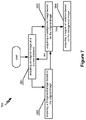
- FIG. 7 is an example flow diagram for a background-segregation encoding method according to one embodiment of the present invention.
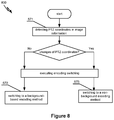
- FIG. 8 is an example flow diagram for the encoding switching method based on PTZ coordinates according to one embodiment of the present invention.
- FIG. 9 is an example flow diagram for an encoding switching method based on a background model according to one embodiment of the present invention.
- FIG. 10 is an example flow diagram for background frame detection according to one embodiment of the present invention.
- FIG. 11 is an example flow diagram for an encoding switching method based on sudden bit-rate changes according to one embodiment of the present invention.
- FIG. 12 is an example diagram for a hybrid encoding system based on encoding switching according to one embodiment of the present invention.
- FIG. 13 is an example diagram showing a background modeling module according to one embodiment of the present invention.
- FIG. 14 is an example diagram showing a first background detection unit according to one embodiment of the present invention.
- FIG. 15 is an example diagram showing a second background detection unit according to one embodiment of the present invention.
- FIG. 16 is an example diagram showing a third background detection unit according to one embodiment of the present invention.
- FIG. 17 is an example diagram for a system for hybrid video encoding according to one embodiment of the present invention.
- FIG. 18 is an example diagram showing a computing system for hybrid video encoding.
- FIG. 1 is an example diagram showing structured video encoding based on foreground/background segregation.
- an original image is divided into foreground and background through a background reconstruction technique.
- Foreground and background have different degrees of importance, and are respectively processed during encoding and formed into a bit stream after encoding.
- the scheme as shown in FIG. 1 is mainly applied to monitoring stationary images.
- the orientation and the focal length of a monitoring screen changes, and the background changes accordingly. If the foreground and the background are used for encoding, the bit rate may increase. Moreover, the referenced background may expire, and the encoding quality may suffer, so that semi-structured encoding may not be achieved.
- FIG. 2 is an example computer-implemented environment wherein users 102 can interact with a hybrid video encoding system 104 hosted on one or more servers 106 through a network 108 , according to one embodiment of the present invention.
- the users 102 can interact with the hybrid video encoding system 104 through a number of ways, such as over one or more networks 108 .
- One or more servers 106 accessible through the network(s) 108 can host the hybrid video encoding system 104 .
- the one or more servers 106 can also contain or have access to one or more data stores 110 for storing data for the hybrid video encoding system 104 .
- the one or more servers 106 implement one or more data processors 110 .
- the data processors 110 can be configured for parallel computing.
- the hybrid video encoding system 104 can assist the users 102 to implement hybrid encoding based on encoding switching as described herein.
- FIG. 3 is an example diagram showing hybrid video encoding based on encoding switching according to one embodiment of the present invention.
- hybrid video encoding combines a background-based encoding method (e.g., a background-segregation encoding method) and a non-background encoding method through encoding switching.
- the background-segregation encoding method is based on background segregation and adopts a structured encoding technique using background and foreground.
- FIG. 4 is an example diagram showing reference relation of coding frames for a background-segregation encoding method according to one embodiment of the present invention.
- coding frames include three types, namely, background frames, refreshment frames and common frames.
- a background frame is used, compared with conventional coding techniques.
- a background frame is extracted through background analysis.
- a refreshment frame is obtained when the encoder encodes an input video image, and encoding refreshment frames is similar to P frame encoding in H.264. Only one or more background frames are referred to during encoding of refreshment frames.
- Encoding of a common frame is similar to P frame encoding in H.264, and both a preceding frame and a background frame are referred to when a common frame is encoded.
- FIG. 5 is an example diagram showing reference relation of coding frames for a non-background encoding method according to one embodiment of the present invention.
- the non-background encoding method can be any known encoding method, such as, MPEG-1, MPEG-2, MPEG-4, H.261, H.263, H.264, etc.
- a stable background has not been established, and the non-background encoding method is used.
- a stationary background image is detected, and the encoding process switches from the non-background encoding method to the background-segregation encoding method.
- a stationary background image may not be detected, and the background-segregation encoding method switches to the non-background encoding method.
- FIG. 6 is an example flow diagram showing a method for hybrid video encoding based on encoding switching according to one embodiment of the present invention.
- a stable background image e.g., corresponding to t 0 and t 1 as shown in FIG. 3
- the background-segregation encoding method is used.
- no stable background image e.g., at t 1
- the non-background encoding method is used.
- the stable background image corresponds to a stationary background image or a background image with a variation range (e.g., corresponding to one or more thresholds).
- the method 600 comprises multiple processes.
- the process S 1 includes acquiring image information.
- the image information of one or more monitoring scenes is acquired by a camera, and is input to a mode-switching device in a video processing device.
- the image information includes PTZ coordinates of the background image in the monitoring video, a real-time bit rate, a confidence degree, frame difference images, etc.
- the process S 2 includes extracting a background image.
- the acquired image information is encoded using a background-segregation encoding method. Foreground and background images based on the image information are extracted through background modeling.
- the process S 3 includes detecting whether the background image is stable. For example, whether a stable background image exists is determined in real time through detecting and analyzing the background image information in image information.
- a stable background image indicates that there is no obvious change in the monitoring area, so that the background image in the acquired image information remains stable or stationary.
- Detected background image information includes but not limited to PTZ coordinates of the background image, a real-time bit rate, a confidence degree, background frame information, etc.
- the process S 4 includes executing an encoding switching method according to the detection result of the process S 3 to switch between the background-segregation encoding method and the non-background encoding method. Depending on whether a stable background image is detected, the encoding switching method is executed to switch between the background-segregation encoding method and the non-background encoding method.
- the encoding switching method comprises the following two processes: the process S 41 of switching to the background-segregation encoding method when a stable background image is detected; and the process S 42 of switching to the non-background encoding method when a stable background image is not detected.
- the non-background encoding method is used. At to, if a stable background is detected, the encoding process switches from the non-background encoding method to the background-segregation encoding method. At t 1 , a stable background may not be detected, and the encoding process switches back to the non-background encoding method.
- FIG. 7 is an example flow diagram for a background-segregation encoding method according to one embodiment of the present invention.
- a background-segregation encoding method 700 includes multiple processes.
- the background-segregation encoding method 700 is used in the process S 2 and the process S 4 as shown in FIG. 6 .
- the process S 61 includes acquiring an original image at a current moment. Before encoding, the original image information of an image frame at the current moment may be acquired. For example, down-sampling can be conducted for the original image to obtain a low resolution image to facilitate subsequent foreground extraction and background extraction.
- the process S 62 includes acquiring a foreground image based on the original image.
- Background modeling is conducted for the low resolution image.
- the foreground image that includes only a moving object can be obtained in real time through background modeling.
- the background modeling can adopt, but not limited to, a mixed Gaussian method.
- the process S 63 includes acquiring a background image based on the original image.
- the process S 63 can be executed through the following operations:
- the operation S 631 includes comparing frame difference images of two frames (e.g., a preceding frame, the current frame or a next frame).
- the operation S 632 includes determining whether the current frame image is a stable image (or a stationary image) not containing foreground information (e.g., the moving object).
- the operation S 633 includes, if the current frame image is a stable image (or a stationary image) that does not contain foreground information, designating the current frame image as the background image.
- the operation S 634 includes, if the current frame image is not a stable image (or a stationary image) that does not contain foreground information, obtaining original image information of an original image at a next moment for further processing.
- the process S 63 further includes the operation S 635 that includes: designating the current frame image as the background frame and inputting the background frame to the encoder.
- a background modeling module outputs a sign that the current frame image can be taken as the background image, and the encoder takes the current frame as the background frame to encode the current frame into the bit stream.
- the process S 64 includes: acquiring a region of variation of the current frame relative to the background image based on the background image.
- the background modeling module uses the detected stationary image as the background image, subtracts the background image from the real time image of each frame, and acquires the region of variation. Further, the background modeling module performs connected domain analysis and/or morphological operations on the region of variation to output in real time a foreground area relative to the background frame.
- the hybrid encoding method based on encoding switching is adopted in the process S 4 and the process S 5 .
- the encoding process switches from the background-segregation encoding method to the non-background encoding method.
- the hybrid encoding method that combines the background-segregation encoding method with the non-background encoding method can be applied to any cameras, such as a rotating dome camera, and is not limited to stationary cameras, thereby extending the application of the hybrid encoding method.
- FIG. 8 is an example flow diagram for the encoding switching method based on PTZ coordinates according to one embodiment of the present invention.
- PTZ coordinates of image information can be used as reference for detecting whether the background image is stable.
- PTZ is the abbreviation of Pan/Tilt/Zoom in security monitoring applications, and indicates parameter variation of omnidirectional (left/right/up/down) movement and zoom control of a camera.
- the encoding switching method 800 based on PTZ coordinates comprises multiple processes.
- the process S 71 includes: detecting PTZ coordinates in image information.
- a dynamic camera e.g., a dome camera
- the PTZ coordinates of the camera may be recorded in real time.
- the process S 72 includes: if no change of PTZ coordinates is detected, adopting the background-segregation encoding method.
- the execution of the process S 72 includes two conditions.
- a first condition is that the camera itself does not have PTZ coordinates, and thus no PTZ coordinate information can be detected.
- the background-segregation encoding method may be implemented as a default option or other types of encoding methods may be triggered, which is described in detail below.
- a second condition is that the camera has PTZ coordinates, but the camera remains stationary. Therefore, the detected PTZ coordinates have no change, and the background-segregation encoding method may be implemented as the default option until a change of the PTZ coordinates is detected.
- the process S 73 includes: when a change of PTZ coordinates is detected, switching to the non-background encoding method.
- the encoding process switches from the background-segregation encoding method to the non-background encoding method.
- the encoding switching method based on PTZ coordinates can be independently executed as the background-segregation encoding method.
- information associated with the PTZ coordinates can be supplemental information for the encoding switching method based on a background model which is described in detail below. That is, if no change of PTZ coordinates is detected in the process S 72 , an encoding switching method based on a background model may be triggered.
- FIG. 9 is an example flow diagram for an encoding switching method based on a background model according to one embodiment of the present invention.
- the encoding switching method 900 is based on a background model and adopts one or more confidence degrees and frame information of a background frame in the background model as reference to detect whether the background image is stable.
- the encoding switching method 900 includes multiple processes.
- the process S 81 includes calculating one or more confidence degrees of a background model. For example, since the creation process of a background image is often influenced by a moving object in the scenario, if the moving object stays in the scenario longer than the background appearing at the position of the moving object. That is, the real background at the position of the moving object is covered, and the moving object can be regarded as background. Thus, the background image created at this time may not be clean, and some pixel values of the moving object exist in the background image. To reduce the influence of the moving object on the background image, a confidence degree (i.e., a degree of reliability) of the background model may be calculated in the creation process of the background image. The confidence degree indicates the historical movement information of the background model. The larger the confidence degree is, the more stable and reliable the background image at the position is. Then the background-segregation encoding method can be adopted.
- a confidence degree i.e., a degree of reliability
- the confidence degree of the background model can adopt a macro-block confidence degree or a whole-frame confidence degree.
- the macro-block confidence degree may correspond to a confidence degree of a background macro block in the background model, and indicate the historical movement information at the position of the background macro block.
- the macro-block confidence degree is calculated based on macro blocks.
- a macro block is at the pixel level, and can include one pixel or N pixels (e.g., N is an integer).
- the macro-block confidence degree can be calculated according to (1 ⁇ n/1500)*255, where n represents a number of frames.
- the whole-frame confidence degree corresponds to a confidence degree of the entire background frame.
- the whole-frame confidence degree is obtained through calculating, in a background-confidence-degree image, the proportion of macro blocks of which confidence degrees are greater than a threshold value th (e.g., 200 ).
- th e.g. 200
- the whole-frame confidence degree is calculated based on the whole background image.
- the macro block is at pixel-level, and the whole frame is at image level.
- the whole-frame confidence degree is based on the macro-block confidence degree, and corresponds to a statistical value associated with confidence degree values of large macro blocks.
- a macro-block confidence degree may be used to determine whether a macro block is reliable.
- a whole-frame confidence degree can be used to determine whether the whole background image is reliable.
- the process S 82 includes: detecting whether a confidence degree is smaller than a predetermined threshold value.
- the confidence degree of a background model can be used to determine the stability of the background image. The larger the confidence degree, the more reliable the background at the position is. The smaller the confidence degree (e.g., smaller than a predetermined threshold value), the less stable the background image at the position may be. For example, the monitoring screen has obvious changes. At this time, the background-segregation encoding method may not be adopted, and may be switched to the non-background encoding method.
- the confidence degree of the background macro block is 255 (e.g., a maximum value). If the background macro blocks of n frames within 1500 frames move, the macro-block confidence degree can be calculated as (1 ⁇ n/1500)*255. The larger the confidence degree is, the more reliable the background at the position is. Upon encoding, the macro-block confidence degree can be used to determine whether the background macro block can be referenced.
- the process S 83 includes: if the confidence degree is smaller than the predetermined threshold value, switching to the non-background encoding method. If the confidence degree of the background model is smaller than the predetermined threshold value, a clean background model may not be acquired. A stable background image may not exist, and subsequent background frame detection may be disturbed. Then the encoding process switches to the non-background encoding method.
- the process S 84 includes: if the confidence degree is not smaller than the predetermined threshold value, detecting whether a background frame exists. If the background model confidence degree is higher than or equal to the predetermined threshold value, then a stable background image may exist. Background frame detection can be made and used for further determination.
- the background frame detection includes: analyzing a foreground image and a frame difference image in the foreground and background segregation process; acquiring (e.g., based on statistical analysis) foreground points and frame difference points for each frame. If there is a stationary image satisfying point conditions within a predetermined time period, a background frame is detected. Then, a background-existence sign may be output and the background-segregation encoding method is used.
- the process S 85 includes: if the background frame is detected, switching to the background-segregation encoding method. For example, when the background frame is detected, the background-existence sign may be output and the background-segregation encoding method is used.
- the process S 86 includes: if a background frame is not detected, switching to the non-background encoding method.
- FIG. 10 is an example flow diagram for background frame detection according to one embodiment of the present invention. As shown in FIG. 10 , the process S 84 is executed to detect whether a background frame exists. The process S 84 includes multiple operations.
- the operation S 91 includes: acquiring foreground points of a foreground image. For example, a foreground image and a frame difference image from foreground background segregation of the current image to acquire the foreground points of the foreground image.
- the operation S 92 includes: acquiring frame difference points of a frame difference image. For example, the foreground image and the frame difference image from foreground background segregation of the current image to obtain frame difference points of the frame difference image.
- the operation S 91 and the operation S 92 may be executed in sequence or simultaneously.
- the operation S 93 includes: detecting within a predetermined time period whether one or more image frames of which foreground points are smaller than a first threshold value exist. Within the predetermined time period, whether one or more image frames of which foreground points are smaller than a first threshold value exist is detected. If there are one or more image frames of which foreground points are smaller than the first threshold value, a next operation is executed. Then, whether these image frames that satisfy the conditions include one or more image frames of which frame difference points are smaller than a second threshold value may be detected.
- the operation S 94 includes: detecting within a predetermined time period whether one or more image frames of which frame difference points are smaller than the second threshold value. Within the predetermined time period, among the image frames of which the foreground points are smaller than the first threshold value, whether one or more image frames of which frame difference points are smaller than the second threshold value exist is detected.
- the operation S 93 and the operation S 94 may be executed in sequence or simultaneously.
- the operation S 94 can be executed first. That is, whether one or more image frame of which foreground points are smaller than the first threshold value exist among image frames of which frame difference points are smaller than the second threshold value can be detected.
- the operation S 95 includes: if within the predetermined time period, one or more image frames of which foreground points are smaller than the first threshold value and frame difference points are smaller than the second threshold value are detected, switching to the background-segregation encoding method. If a stationary image that satisfy the conditions is detected within the predetermined time period, a background frame is detected. Then a background-existence sign may be output and the background-segregation encoding method is used.
- the operation S 96 includes: if no image frame of which foreground points are smaller than the first threshold value and frame difference points are smaller than the second threshold value is detected within the predetermined time period, switching to the non-background encoding method. If a stationary image that satisfies the conditions is not detected within the predetermined time period, then there is no stationary image can be used as a background frame. The monitoring scene may have changed obviously during the time period, then the non-background encoding method rather than the background-segregation encoding method is used. After expiration of the predetermined time period, the process returns, and the above-noted operations are executed again within a next predetermined time period.
- FIG. 11 is an example flow diagram for an encoding switching method based on sudden bit-rate changes according to one embodiment of the present invention. As shown in FIG. 11 , the real-time bit rate is monitored during a monitoring encoding process to implement encoding switching.
- the encoding switching method 1100 comprises multiple processes.
- the process S 101 includes: recording bit rates within a time period. Real-time statistics of the bit rate values within a time period (for example, bit rate values of the latest 25 frames) can be recorded, and a bit rate curve with bit rate values and time as coordinates can be generated so as to detect whether the bit rate curve varies suddenly.
- the process S 102 includes: detecting whether a change of the bit rates between consecutive times exceeds a third threshold value. When a sudden change of the bit rates between consecutive times is detected, whether the change exceeds the predetermined third threshold value. If the change exceeds the predetermined third threshold value, a next process is executed. If the change does not exceed the predetermined third threshold value, the process S 101 is executed to continue to record and detect changes of the bit rate.
- the process S 103 includes: detecting whether the time period during which the change of the bit rates exceeds the third threshold value is longer than a fourth threshold value. When the change between consecutive times that exceeds the predetermined third threshold value is detected, it is further detected whether the time period during which the change of the bit rates exceeds the third threshold value is longer than the fourth threshold value.
- the process S 104 includes: if the time period during which the change of the bit rates exceeds the third threshold value is longer than a fourth threshold value, executing the encoding switching method based on the background model (e.g., as shown in FIG. 9 ).
- the process S 105 includes: if the time period during which the change of the bit rates exceeds the third threshold value is not longer than a fourth threshold value, returning to the process S 101 to continue to record and detect changes of the bit rate.
- the encoding switching method 1100 can be executed as the background-segregation encoding method.
- the method 1100 can be regarded as an auxiliary process to the background-segregation encoding method to trigger the encoding switching method based on the background model. That is, the method 1100 can be executed before the encoding switching method based on the background model to trigger the encoding switching method based on the background model when certain conditions are satisfied so as to make detection of the background image more accurate.
- the bit rate monitoring may not be executed, and the encoding switching method based on the background model can be directly triggered.
- the hybrid encoding method based on encoding switching includes detection for encoding switching throughout the entire encoding process. As shown in FIG. 5 , when the background-segregation encoding method is adopted, if no stable background frame is detected, the encoding process switches to the non-background encoding method. When the non-background encoding method is adopted, if one or more stable background frames are detected, the encoding process switches to the background-segregation encoding method.
- the hybrid encoding method can solve the application bottleneck problem of the background-segregation encoding method to ensure quality and achieve bit rate savings.
- FIG. 12 is an example diagram for a hybrid encoding system based on encoding switching according to one embodiment of the present invention.
- the hybrid encoding system 1200 based on encoding switching comprises a background modeling module 1 , a background detection module 2 , an encoding switching module 3 and an encoder 4 .
- the background modeling module 1 is configured to extract a background image in acquired image information. Specifically, the background modeling module 1 encodes the acquired image information using a background-segregation encoding method and extracts foreground and background images based on the image information through background modeling.
- the background detection module 2 (e.g., connected to the background modeling module 1 ) is configured to detect whether a background image is stable and send a stable-background signal or an unstable-background signal.
- the stable-background signal indicates that a stable background image is detected and the unstable-background signal indicates no stable background is detected.
- the background detection module 2 determines whether a stable background image exists in real time through detecting and analyzing the background image information in image information.
- a stable background image indicates that there is no obvious change in the monitoring area, so that the background image in the acquired image information remains stable or stationary.
- Detected background image information includes but not limited to PTZ coordinates of the background image, a real-time bit rate, a confidence degree, background frame information, etc.
- the background detection module 2 comprises a first background detection unit 21 , a second background detection unit 22 and/or a third background detection unit 23 .
- the first background detection unit 21 performs background detection based on confidence degrees of the background model and background frames.
- the second background detection unit 22 performs background detection based on PTZ coordinates.
- the third background detection unit 23 performs background detection based on bit rates.
- the second background detection unit 22 and the third background detection unit 23 are optional and are configured to assist the first background detection unit 21 to make background detection so as to improve detection accuracy.
- the encoding switching module 3 (e.g., connected to the background detection module 2 ) is configured to perform encoding switching operation between the background-segregation encoding method and the non-background encoding method according to detection results of the background detection module 2 . Specifically, when the background detection module 2 detects a stable background image, a stable-background signal is sent to the encoding switching module 3 . The encoding switching module 3 then sends an encoding method switch command to the encoder 4 to switch to the background-segregation encoding method. When the background detection module 2 does not detect any stable background image, an unstable-background signal is sent to the encoding switching module 3 .
- the encoding switching module 3 then sends an encoding method switch command to the encoder 4 to switch to the non-background encoding method.
- the non-background encoding method can be any known encoding method, such as, MPEG-1, MPEG-2, MPEG-4, H.261, H.263, H.264, etc.
- the encoder 4 (e.g., connected to the encoding switching module 3 ) is configured to receive the encoding method switch command sent by the encoding switching module 3 and execute corresponding encoding operations according to the encoding method switch command.
- FIG. 13 is an example diagram showing a background modeling module according to one embodiment of the present invention.
- the background modeling module 1 further comprises an image preprocessing module 11 , a foreground image extraction module 12 and a background image extraction module 13 .
- the image preprocessing module 11 is configured to preprocess the acquired original image to get image formats that satisfy certain conditions. For example, the image processing module 11 executes down-sampling for the acquired original image to obtain a low resolution image to facilitate subsequent foreground extraction and background extraction.
- the foreground image extraction module 12 (e.g., connected to the image preprocessing module 11 ) is configured to perform background modeling for the low-resolution image after preprocessing and obtain in real time through background modeling a foreground image that includes only a moving object.
- the background modeling can adopt, but not limited to, a mixed Gaussian method.
- the background image extraction module 13 (e.g., connected to the image preprocessing module 11 and the foreground image extraction module 12 ) is configured to extract a background image from the preprocessed low-resolution image using the foreground image. For example, the background image extraction module 13 extracts a stable image (or a stationary image) that does not include foreground information (e.g., a moving object) as the background image.
- foreground information e.g., a moving object
- FIG. 14 is an example diagram showing a first background detection unit according to one embodiment of the present invention.
- the first background detection unit 21 is configured to perform encoding switching operations based on the background model and detect whether a stable background image exists based on confidence degrees of the background model and background frames.
- the first background detection unit 21 further comprises a confidence-degree-calculation module 210 , a confidence-degree-detection module 211 and/or a background-frame-detection module 212 .
- the confidence-degree-calculation module 210 is configured to calculate one or more confidence degrees of a background model and send the confidence degrees to the confidence-degree-detection module 211 . Specifically, the confidence-degree-calculation module 210 calculates a confidence degree (i.e., a degree of reliability) of the background model in the creation process of the background image. The confidence degree indicates the historical movement information of the background model. The larger the confidence degree is, the more stable and reliable the background image at the position is. Then the background-segregation encoding method can be adopted.
- a confidence degree i.e., a degree of reliability
- the confidence degree of the background model can use a macro-block confidence degree or a whole-frame confidence degree.
- a macro-block confidence degree represents the confidence degree of a background macro block in the background model and historical movement information of the background macro block.
- a whole-frame confidence degree represents the confidence degree of the entire background frame. The whole-frame confidence degree is obtained through calculating, in a background-confidence-degree image, the proportion of macro blocks of which confidence degrees are greater than a threshold value th (e.g., 200 ), to determine whether the entire background image is reliable.
- th e.g. 200
- the confidence-degree-detection module 211 (e.g., connected to the confidence-degree-calculation module 210 ) is configured to detect whether a confidence degree is smaller than a predetermined threshold value. Specifically, when the confidence-degree-detection module 211 detects that the confidence degree is smaller than the predetermined threshold value, an unstable-background signal is sent to the encoding switching module 3 . The encoding switching module 3 then sends an encoding method switch command to the encoder 4 to switch to the non-background encoding method.
- a background-frame-detection command is sent to the background-frame-detection module 212 which is triggered to execute one or more background frame detection operations.
- the background-frame-detection module 212 (e.g., connected to the confidence-degree-detection module 211 ) is configured to detect whether there is a background frame. Specifically, when the background-frame-detection module 212 receives a background-frame-detection command sent by the confidence-degree-detection module 211 , a background frame detection operation is performed to detect whether there is a background frame. When the background-frame-detection module 212 detects a background frame, a stable-background signal is sent to the encoding switching module 3 . The encoding switching module 3 sends an encoding method switch command to the encoder 4 to switch to the background-segregation encoding method.
- the background-frame-detection module 212 When the background-frame-detection module 212 does not detect a background frame, an unstable-background signal is sent to the encoding switching module 3 .
- the encoding switching module 3 sends an encoding method switch command to the encoder 4 to switch to the non-background encoding method.
- FIG. 15 is an example diagram showing a second background detection unit according to one embodiment of the present invention.
- the second background detection unit 22 comprises a PTZ-coordinate-acquisition module 220 and a PTZ-coordinate-detection module 221 .
- the PTZ-coordinate-acquisition module 220 is configured to acquire current PTZ coordinates of a camera and send the PTZ coordinates to the PTZ-coordinate-detection module 221 . For example, if the PTZ-coordinate-acquisition module 220 does not acquire the PTZ coordinates of the camera, that indicates that the camera does not have PTZ coordinates and the PTZ coordinates information cannot be detected. Then the PTZ-coordinate-acquisition module 220 sends a stable-background signal to the encoding switching module 3 and the first background detection unit 21 .
- the background-segregation encoding method is adopted by default or the first background detection unit 21 is triggered to execute other encoding switching methods.
- the PTZ-coordinate-detection module 221 (e.g., connected to the PTZ-coordinate-acquisition module 220 ) is configured to detect whether the PTZ coordinates change. When the change of the PTZ coordinates is detected, the PTZ-coordinate-detection module 221 sends an unstable-background signal to the encoding switching module 3 which switches to the non-background encoding method. If the change of the PTZ coordinates is not detected, the PTZ-coordinate-detection module 221 sends a stable-background signal to the encoding switching module 3 which switches the background-segregation encoding method.
- FIG. 16 is an example diagram showing a third background detection unit according to one embodiment of the present invention.
- the third background detection unit 23 comprises: a bit-rate-recording module 230 , a first bit-rate-detection module 231 and a second bit-rate-detection module 232 .
- the bit-rate-recording module 230 is configured to generate real-time statistics of bit rates within a time period. For example, bit rate values of the latest 25 frames can be recorded. A bit rate curve with bit rate values and time as coordinates can be generated so as to detect whether the bit rate curve varies suddenly.
- the first bit-rate-detection module 231 (e.g., connected to the bit-rate-recording module 230 ) is configured to detect whether a change of the bit rates between consecutive times exceeds a third threshold value.
- the first bit-rate-detection module 231 receives bit rate values sent by the bit-rate-recording module 230 and detects whether the bit rate between consecutive times varies suddenly. When a sudden change of the bit rates is detected, the first bit-rate-detection module 231 detects whether the change exceeds the predetermined third threshold value. If the change exceeds the predetermined third threshold value, a first bit-rate-sudden-change signal is sent to the second bit-rate-detection module 232 . If the change does not exceed the predetermined third threshold value, whether the bit rate value varies suddenly is detected continuously.
- the second bit-rate-detection module 232 (e.g., connected to the first bit-rate-detection module 231 ) is configured to detect whether the time period during which the change of the bit rates exceeds the third threshold value is longer than a fourth threshold value.
- the second bit-rate-detection module 232 receives the first bit-rate-sudden-change signal sent by the first bit-rate-detection module 231 and detects whether the time period during which the change of the bit rates exceeds the third threshold value is longer than the fourth threshold value.
- a second bit-rate-sudden-change signal is sent to the first background detection unit 21 to trigger encoding switching operations based on the background model. If the time period during which the change of the bit rates exceeds the third threshold value is not longer than the fourth threshold value, a bit-rate-normal signal is sent to the first bit-rate-detection module 231 which continues to detect whether the bit rate varies suddenly.
- the hybrid encoding system 1200 executes encoding switching operations based on background detection in the entire encoding process. For example, if no stable background frame is detected, the encoding process switches to the non-background encoding method. If one or more stable background frames are detected, the encoding process switches to the background-segregation encoding method.
- the hybrid encoding system 1200 can solve the application bottleneck problem of the background-segregation encoding method to ensure quality and achieve bit rate savings.
- the hybrid encoding methods and systems are provided based on encoding switching.
- the encoding switching is realized through combination of the background-segregation encoding method and the non-background encoding method.
- High-quality encoding can be achieved using low bit rates with fixed backgrounds, and the encoding quality is maintained when backgrounds change.
- FIG. 17 is an example diagram for a system for hybrid video encoding according to one embodiment of the present invention.
- the system 1700 includes a computing system 1712 which contains a processor 1714 , a storage device 1716 and a hybrid-video-encoding module 1718 .
- the computing system 1712 includes any suitable type of computing device (e.g., a server, a desktop, a laptop, a tablet, a mobile phone, etc.) that includes the processor 1714 or provide access to a processor via a network or as part of a cloud based application.
- the hybrid-video-encoding module 1718 includes tasks and is implemented as part of a user interface module (not shown in FIG. 17 ).
- FIG. 18 is an example diagram showing a computing system for hybrid video encoding.
- the computing system 1612 includes a processor 1614 , memory devices 1702 and 1704 , one or more input/output devices 1706 , one or more networking components 1708 , and a system bus 1710 .
- the computing system 1612 includes the hybrid-video-encoding module 1718 , and provides access to the hybrid-video-encoding module 1718 to a user as a stand-alone computer.
- a method for hybrid video encoding includes: acquiring image information; extracting a background image based at least in part on the image information; detecting whether the background image is stable; and performing encoding switching between a background-based encoding method and a non-background encoding method based at least in part on the detection.
- a system for hybrid video encoding includes: a background modeling module configured to extract a background image based at least in part on image information; a background detection module configured to detect whether the background image is stable; an encoding switching module configured to perform encoding switching between a background-based encoding method and a non-background encoding method based at least in part on the detection; and an encoder configured to perform encoding operations based at least in part on an encoding-switching command from the encoding switching module.
- a system for hybrid video encoding includes: one or more data processors; and one or more non-transitory computer-readable storage media encoded with instructions for commanding the data processors to execute certain operations.
- the operations include: acquiring image information; extracting a background image based at least in part on the image information; detecting whether the background image is stable; and performing encoding switching between a background-based encoding method and a non-background encoding method based at least in part on the detection.
- a non-transitory computer-readable storage medium is encoded with instructions for commanding one or more processors to execute a method for hybrid video encoding.
- the method comprises: acquiring image information; extracting a background image based at least in part on the image information; detecting whether the background image is stable; and performing encoding switching between a background-based encoding method and a non-background encoding method based at least in part on the detection.
- some or all components of various embodiments of the present invention each are, individually and/or in combination with at least another component, implemented using one or more software components, one or more hardware components, and/or one or more combinations of software and hardware components.
- some or all components of various embodiments of the present invention each are, individually and/or in combination with at least another component, implemented in one or more circuits, such as one or more analog circuits and/or one or more digital circuits.
- various embodiments and/or examples of the present invention can be combined.
- the methods and systems described herein may be implemented on many different types of processing devices by program code comprising program instructions that are executable by the device processing subsystem.
- the software program instructions may include source code, object code, machine code, or any other stored data that is operable to cause a processing system to perform the methods and operations described herein.
- Other implementations may also be used, however, such as firmware or even appropriately designed hardware configured to perform the methods and systems described herein.
- the systems' and methods' data may be stored and implemented in one or more different types of computer-implemented data stores, such as different types of storage devices and programming constructs (e.g., RAM, ROM, EEPROM, Flash memory, flat files, databases, programming data structures, programming variables, IF-THEN (or similar type) statement constructs, application programming interface, etc.).
- storage devices and programming constructs e.g., RAM, ROM, EEPROM, Flash memory, flat files, databases, programming data structures, programming variables, IF-THEN (or similar type) statement constructs, application programming interface, etc.
- data structures describe formats for use in organizing and storing data in databases, programs, memory, or other computer-readable media for use by a computer program.
- the systems and methods may be provided on many different types of computer-readable media including computer storage mechanisms (e.g., CD-ROM, diskette, RAM, flash memory, computer's hard drive, DVD, etc.) that contain instructions (e.g., software) for use in execution by a processor to perform the methods' operations and implement the systems described herein.
- computer storage mechanisms e.g., CD-ROM, diskette, RAM, flash memory, computer's hard drive, DVD, etc.
- instructions e.g., software
- the computer components, software modules, functions, data stores and data structures described herein may be connected directly or indirectly to each other in order to allow the flow of data needed for their operations.
- a module or processor includes a unit of code that performs a software operation, and can be implemented for example as a subroutine unit of code, or as a software function unit of code, or as an object (as in an object-oriented paradigm), or as an applet, or in a computer script language, or as another type of computer code.
- the software components and/or functionality may be located on a single computer or distributed across multiple computers depending upon the situation at hand.
- the computing system can include client devices and servers.
- a client device and server are generally remote from each other and typically interact through a communication network.
- the relationship of client device and server arises by virtue of computer programs running on the respective computers and having a client device-server relationship to each other.
Landscapes
- Engineering & Computer Science (AREA)
- Multimedia (AREA)
- Signal Processing (AREA)
- Compression Or Coding Systems Of Tv Signals (AREA)
Abstract
Description
Claims (8)
Priority Applications (1)
| Application Number | Priority Date | Filing Date | Title |
|---|---|---|---|
| US16/217,224 US10863185B2 (en) | 2015-03-10 | 2018-12-12 | Systems and methods for hybrid video encoding |
Applications Claiming Priority (5)
| Application Number | Priority Date | Filing Date | Title |
|---|---|---|---|
| CN201510103507 | 2015-03-10 | ||
| CN201510103507 | 2015-03-10 | ||
| CN201510103507.4 | 2015-03-10 | ||
| US15/064,744 US10187649B2 (en) | 2015-03-10 | 2016-03-09 | Systems and methods for hybrid video encoding |
| US16/217,224 US10863185B2 (en) | 2015-03-10 | 2018-12-12 | Systems and methods for hybrid video encoding |
Related Parent Applications (1)
| Application Number | Title | Priority Date | Filing Date |
|---|---|---|---|
| US15/064,744 Continuation US10187649B2 (en) | 2015-03-10 | 2016-03-09 | Systems and methods for hybrid video encoding |
Publications (2)
| Publication Number | Publication Date |
|---|---|
| US20190116370A1 US20190116370A1 (en) | 2019-04-18 |
| US10863185B2 true US10863185B2 (en) | 2020-12-08 |
Family
ID=55586147
Family Applications (2)
| Application Number | Title | Priority Date | Filing Date |
|---|---|---|---|
| US15/064,744 Active 2036-11-26 US10187649B2 (en) | 2015-03-10 | 2016-03-09 | Systems and methods for hybrid video encoding |
| US16/217,224 Active US10863185B2 (en) | 2015-03-10 | 2018-12-12 | Systems and methods for hybrid video encoding |
Family Applications Before (1)
| Application Number | Title | Priority Date | Filing Date |
|---|---|---|---|
| US15/064,744 Active 2036-11-26 US10187649B2 (en) | 2015-03-10 | 2016-03-09 | Systems and methods for hybrid video encoding |
Country Status (3)
| Country | Link |
|---|---|
| US (2) | US10187649B2 (en) |
| EP (2) | EP3068135A1 (en) |
| CN (1) | CN106034237B (en) |
Families Citing this family (11)
| Publication number | Priority date | Publication date | Assignee | Title |
|---|---|---|---|---|
| US10686859B2 (en) * | 2017-12-28 | 2020-06-16 | Intel Corporation | Content scenario and network condition based multimedia communication |
| CN112543328B (en) * | 2019-09-20 | 2024-06-21 | 广州虎牙科技有限公司 | Auxiliary encoding method, device, computer equipment and storage medium |
| US10958700B1 (en) * | 2020-02-13 | 2021-03-23 | Comcast Cable Communications, Llc | Methods, systems, and apparatuses for improved content delivery |
| CN113301337B (en) * | 2020-02-24 | 2025-05-06 | 北京三星通信技术研究有限公司 | Coding and decoding method and device |
| CN113556551B (en) * | 2020-04-23 | 2023-06-23 | 上海高德威智能交通系统有限公司 | An encoding and decoding method, device and equipment |
| CN111669600B (en) * | 2020-06-05 | 2024-03-29 | 浙江大华技术股份有限公司 | Video coding method, device, coder and storage device |
| CN111654660B (en) * | 2020-06-08 | 2021-03-23 | 上海纽菲斯信息科技有限公司 | Video conference system coding transmission method based on image segmentation |
| CN112019848B (en) * | 2020-09-11 | 2022-09-16 | 深圳市梦网视讯有限公司 | Method, system and equipment for rapidly analyzing prediction mode |
| US12432362B2 (en) * | 2021-09-02 | 2025-09-30 | Samsung Electronics Co., Ltd. | Encoding and decoding video data |
| CN114245145A (en) * | 2021-12-18 | 2022-03-25 | 杭州视洞科技有限公司 | A video compression method for monitoring equipment based on background frames |
| CN116208769A (en) * | 2023-03-15 | 2023-06-02 | 京东科技信息技术有限公司 | Video encoding method and device, electronic equipment and storage medium |
Citations (20)
| Publication number | Priority date | Publication date | Assignee | Title |
|---|---|---|---|---|
| US5787199A (en) * | 1994-12-29 | 1998-07-28 | Daewoo Electronics, Co., Ltd. | Apparatus for detecting a foreground region for use in a low bit-rate image signal encoder |
| US20030095598A1 (en) * | 2001-11-17 | 2003-05-22 | Lg Electronics Inc. | Object-based bit rate control method and system thereof |
| US7016411B2 (en) | 2001-07-04 | 2006-03-21 | Matsushita Electric Industrial Co. Ltd. | Image signal coding method, image signal coding apparatus and storage medium |
| WO2007093199A2 (en) | 2006-02-14 | 2007-08-23 | Fotonation Vision Limited | Foreground/background segmentation in digital images |
| US7321624B1 (en) * | 2001-03-16 | 2008-01-22 | Objectvideo, Inc. | Bit-rate allocation system for object-based video encoding |
| CN101489138A (en) | 2009-02-11 | 2009-07-22 | 四川长虹电器股份有限公司 | Secondary coded group of picture dividing method based on scene |
| CN101511026A (en) | 2009-02-23 | 2009-08-19 | 四川长虹电器股份有限公司 | Code rate control method for AVS secondary encode based on scene |
| WO2010003140A1 (en) | 2008-07-03 | 2010-01-07 | Anagenesis Trees Corporation | Combined heat, ice, power, and steam system |
| US20100119157A1 (en) * | 2007-07-20 | 2010-05-13 | Fujifilm Corporation | Image processing apparatus, image processing method and computer readable medium |
| CN101720044A (en) | 2009-12-10 | 2010-06-02 | 四川长虹电器股份有限公司 | Adaptive frame structure-based AVS coding method |
| US20120169923A1 (en) * | 2010-12-30 | 2012-07-05 | Pelco Inc. | Video coding |
| CN102625106A (en) | 2012-03-28 | 2012-08-01 | 上海交通大学 | Scene-adaptive screen coding rate control method and system |
| US20130129144A1 (en) * | 2011-11-23 | 2013-05-23 | Seoul National University Industry Foundation | Apparatus and method for detecting object using ptz camera |
| US20130142250A1 (en) * | 2011-12-06 | 2013-06-06 | Broadcom Corporation | Region based classification and adaptive rate control method and apparatus |
| CN103179402A (en) | 2013-03-19 | 2013-06-26 | 中国科学院半导体研究所 | A video compression encoding and decoding method and device thereof |
| US20140198838A1 (en) * | 2013-01-15 | 2014-07-17 | Nathan R. Andrysco | Techniques for managing video streaming |
| US9232233B2 (en) | 2011-07-01 | 2016-01-05 | Apple Inc. | Adaptive configuration of reference frame buffer based on camera and background motion |
| US20160211003A1 (en) | 2015-01-16 | 2016-07-21 | Hangzhou Hikvision Digital Technology Co., Ltd. | Systems, Devices and Methods for Video Storage |
| US20160212444A1 (en) | 2015-01-16 | 2016-07-21 | Hangzhou Hikvision Digital Technology Co., Ltd. | Systems, Devices and Methods for Video Encoding and Decoding |
| US20160212422A1 (en) | 2015-01-16 | 2016-07-21 | Hangzhou Hikvision Digital Technology Co., Ltd. | Systems, Devices and Methods for Video Coding |
Family Cites Families (1)
| Publication number | Priority date | Publication date | Assignee | Title |
|---|---|---|---|---|
| CN101729902B (en) | 2008-10-15 | 2012-09-05 | 深圳市融创天下科技股份有限公司 | Video compression method |
-
2015
- 2015-03-20 CN CN201510126313.6A patent/CN106034237B/en active Active
-
2016
- 2016-03-09 US US15/064,744 patent/US10187649B2/en active Active
- 2016-03-10 EP EP16159613.5A patent/EP3068135A1/en not_active Ceased
- 2016-03-10 EP EP24151266.4A patent/EP4329302A3/en active Pending
-
2018
- 2018-12-12 US US16/217,224 patent/US10863185B2/en active Active
Patent Citations (20)
| Publication number | Priority date | Publication date | Assignee | Title |
|---|---|---|---|---|
| US5787199A (en) * | 1994-12-29 | 1998-07-28 | Daewoo Electronics, Co., Ltd. | Apparatus for detecting a foreground region for use in a low bit-rate image signal encoder |
| US7321624B1 (en) * | 2001-03-16 | 2008-01-22 | Objectvideo, Inc. | Bit-rate allocation system for object-based video encoding |
| US7016411B2 (en) | 2001-07-04 | 2006-03-21 | Matsushita Electric Industrial Co. Ltd. | Image signal coding method, image signal coding apparatus and storage medium |
| US20030095598A1 (en) * | 2001-11-17 | 2003-05-22 | Lg Electronics Inc. | Object-based bit rate control method and system thereof |
| WO2007093199A2 (en) | 2006-02-14 | 2007-08-23 | Fotonation Vision Limited | Foreground/background segmentation in digital images |
| US20100119157A1 (en) * | 2007-07-20 | 2010-05-13 | Fujifilm Corporation | Image processing apparatus, image processing method and computer readable medium |
| WO2010003140A1 (en) | 2008-07-03 | 2010-01-07 | Anagenesis Trees Corporation | Combined heat, ice, power, and steam system |
| CN101489138A (en) | 2009-02-11 | 2009-07-22 | 四川长虹电器股份有限公司 | Secondary coded group of picture dividing method based on scene |
| CN101511026A (en) | 2009-02-23 | 2009-08-19 | 四川长虹电器股份有限公司 | Code rate control method for AVS secondary encode based on scene |
| CN101720044A (en) | 2009-12-10 | 2010-06-02 | 四川长虹电器股份有限公司 | Adaptive frame structure-based AVS coding method |
| US20120169923A1 (en) * | 2010-12-30 | 2012-07-05 | Pelco Inc. | Video coding |
| US9232233B2 (en) | 2011-07-01 | 2016-01-05 | Apple Inc. | Adaptive configuration of reference frame buffer based on camera and background motion |
| US20130129144A1 (en) * | 2011-11-23 | 2013-05-23 | Seoul National University Industry Foundation | Apparatus and method for detecting object using ptz camera |
| US20130142250A1 (en) * | 2011-12-06 | 2013-06-06 | Broadcom Corporation | Region based classification and adaptive rate control method and apparatus |
| CN102625106A (en) | 2012-03-28 | 2012-08-01 | 上海交通大学 | Scene-adaptive screen coding rate control method and system |
| US20140198838A1 (en) * | 2013-01-15 | 2014-07-17 | Nathan R. Andrysco | Techniques for managing video streaming |
| CN103179402A (en) | 2013-03-19 | 2013-06-26 | 中国科学院半导体研究所 | A video compression encoding and decoding method and device thereof |
| US20160211003A1 (en) | 2015-01-16 | 2016-07-21 | Hangzhou Hikvision Digital Technology Co., Ltd. | Systems, Devices and Methods for Video Storage |
| US20160212444A1 (en) | 2015-01-16 | 2016-07-21 | Hangzhou Hikvision Digital Technology Co., Ltd. | Systems, Devices and Methods for Video Encoding and Decoding |
| US20160212422A1 (en) | 2015-01-16 | 2016-07-21 | Hangzhou Hikvision Digital Technology Co., Ltd. | Systems, Devices and Methods for Video Coding |
Non-Patent Citations (9)
| Title |
|---|
| Chinese Office Action dated Aug. 8, 2018 in connection with CN106034237 (English translation included). |
| Chinese Office Action dated Jan. 29, 2019 in connection with CN106034237 (English translation included). |
| Chinese Search Report dated Jul. 24, 2018 in connection with CN106034237 (English translation included). |
| European Patent Office; Communication pursuant to Article 94(3) EPC dated Jun. 2, 2017 in connection with EP16159613. |
| European Patent Office; European Search Report, EP 16159613; dated May 2, 2016. |
| European Patent Office; Summons to attend oral proceedings pursuant to Rule 115(1) EPC dated Nov. 20, 2018 in connection with EP16159613. |
| Liu, Chang, Cao, Ruipeng, Jia, Sa, Zhang, Yanan, Wang, Bo, Zhao, Qingjie; The PTZ Tracking Algorithms Evaluation Virtual Platform System; 2014 International Conference on Multisensor Fusion and Information Integration for Intelligent Systems; pp. 1-6; Sep. 2014. |
| Schaefer, R.; MPEG-4: A Multimedia Compression Standard for Interactive Applications and Services; Electronics & Communication Engineering Journal, 10(6); pp. 253-262; Dec. 1998. |
| Wong, Da-Yong, Sun, Shi-Xin; Region-Based Rate Control and Bit Allocation for Video Coding; International Conference on Apperceiving Computing and Intelligence Analysis; pp. 147-151; Dec. 2008. |
Also Published As
| Publication number | Publication date |
|---|---|
| EP3068135A1 (en) | 2016-09-14 |
| US20160269734A1 (en) | 2016-09-15 |
| US20190116370A1 (en) | 2019-04-18 |
| CN106034237B (en) | 2020-07-03 |
| EP4329302A2 (en) | 2024-02-28 |
| US10187649B2 (en) | 2019-01-22 |
| EP4329302A3 (en) | 2024-03-06 |
| CN106034237A (en) | 2016-10-19 |
Similar Documents
| Publication | Publication Date | Title |
|---|---|---|
| US10187649B2 (en) | Systems and methods for hybrid video encoding | |
| US8331617B2 (en) | Robot vision system and detection method | |
| US10349060B2 (en) | Encoding video frames using generated region of interest maps | |
| US8218831B2 (en) | Combined face detection and background registration | |
| US11823404B2 (en) | Structured light depth imaging under various lighting conditions | |
| US10037599B2 (en) | Automatic gain control filter in a video analysis system | |
| JP2023526207A (en) | Maintaining a constant size of the target object in the frame | |
| US10567796B2 (en) | Systems, devices and methods for video encoding and decoding | |
| WO2018099136A1 (en) | Method and device for denoising image with low illumination, and storage medium | |
| US10021381B2 (en) | Camera pose estimation | |
| US10542248B2 (en) | Hierarchical binary structured light patterns | |
| CN111553259A (en) | Image duplicate removal method and system | |
| US10936876B2 (en) | Content recognition method, system and storage medium thereof | |
| KR20210157100A (en) | The device processing the image and method operating the same | |
| US10917648B2 (en) | Image processing apparatus, image processing method, and non-transitory computer-readable storage medium | |
| Biswas et al. | Anomaly detection in compressed H. 264/AVC video | |
| Cao et al. | Using physical dynamics: Accurate and real-time object detection for high-resolution video streaming on Internet of Things devices | |
| CN114157870B (en) | Coding method, medium and electronic device | |
| JP2017512398A (en) | Method and apparatus for presenting video | |
| KR20190109662A (en) | User Concern Image Detecting Method at Security System and System thereof | |
| Chen et al. | Bandwidth on a Budget: Real-Time Configuration for Edge Video Analysis | |
| CN117528141A (en) | Video encoding methods, devices, electronic equipment, storage media and program products | |
| KR102557904B1 (en) | The Method of Detecting Section in which a Movement Frame Exists | |
| Singh et al. | Motion detection application using web camera | |
| Zhang et al. | A Background Subtraction Algorithm Robust to Intensity Flicker Based on IP Camera. |
Legal Events
| Date | Code | Title | Description |
|---|---|---|---|
| AS | Assignment |
Owner name: HANGZHOU HIKVISION DIGITAL TECHNOLOGY CO., LTD., C Free format text: ASSIGNMENT OF ASSIGNORS INTEREST;ASSIGNORS:TONG, JUNYAN;PU, SHILIANG;SHEN, LINJIE;AND OTHERS;REEL/FRAME:047751/0387 Effective date: 20160309 Owner name: HANGZHOU HIKVISION DIGITAL TECHNOLOGY CO., LTD., CHINA Free format text: ASSIGNMENT OF ASSIGNORS INTEREST;ASSIGNORS:TONG, JUNYAN;PU, SHILIANG;SHEN, LINJIE;AND OTHERS;REEL/FRAME:047751/0387 Effective date: 20160309 |
|
| FEPP | Fee payment procedure |
Free format text: ENTITY STATUS SET TO UNDISCOUNTED (ORIGINAL EVENT CODE: BIG.); ENTITY STATUS OF PATENT OWNER: LARGE ENTITY |
|
| STPP | Information on status: patent application and granting procedure in general |
Free format text: DOCKETED NEW CASE - READY FOR EXAMINATION |
|
| STPP | Information on status: patent application and granting procedure in general |
Free format text: NON FINAL ACTION MAILED |
|
| STPP | Information on status: patent application and granting procedure in general |
Free format text: RESPONSE TO NON-FINAL OFFICE ACTION ENTERED AND FORWARDED TO EXAMINER |
|
| STPP | Information on status: patent application and granting procedure in general |
Free format text: FINAL REJECTION MAILED |
|
| STPP | Information on status: patent application and granting procedure in general |
Free format text: NON FINAL ACTION MAILED |
|
| STPP | Information on status: patent application and granting procedure in general |
Free format text: NOTICE OF ALLOWANCE MAILED -- APPLICATION RECEIVED IN OFFICE OF PUBLICATIONS |
|
| STCF | Information on status: patent grant |
Free format text: PATENTED CASE |
|
| MAFP | Maintenance fee payment |
Free format text: PAYMENT OF MAINTENANCE FEE, 4TH YEAR, LARGE ENTITY (ORIGINAL EVENT CODE: M1551); ENTITY STATUS OF PATENT OWNER: LARGE ENTITY Year of fee payment: 4 |