US10857852B2 - Adaptive radiant heating for a vehicle - Google Patents
Adaptive radiant heating for a vehicle Download PDFInfo
- Publication number
- US10857852B2 US10857852B2 US16/400,536 US201916400536A US10857852B2 US 10857852 B2 US10857852 B2 US 10857852B2 US 201916400536 A US201916400536 A US 201916400536A US 10857852 B2 US10857852 B2 US 10857852B2
- Authority
- US
- United States
- Prior art keywords
- sensor
- radiant heating
- cabin
- climate
- seat
- Prior art date
- Legal status (The legal status is an assumption and is not a legal conclusion. Google has not performed a legal analysis and makes no representation as to the accuracy of the status listed.)
- Active, expires
Links
- 238000010438 heat treatment Methods 0.000 title claims abstract description 75
- 230000003044 adaptive effect Effects 0.000 title claims abstract description 21
- 238000004891 communication Methods 0.000 claims abstract description 6
- 238000004146 energy storage Methods 0.000 claims abstract description 5
- 230000004044 response Effects 0.000 claims abstract description 5
- 239000003570 air Substances 0.000 claims description 24
- 230000001105 regulatory effect Effects 0.000 claims description 5
- 239000013589 supplement Substances 0.000 claims description 5
- 239000012080 ambient air Substances 0.000 claims description 4
- 238000003491 array Methods 0.000 description 3
- 238000002485 combustion reaction Methods 0.000 description 3
- 239000002826 coolant Substances 0.000 description 3
- 239000000463 material Substances 0.000 description 3
- 230000004913 activation Effects 0.000 description 2
- 238000005516 engineering process Methods 0.000 description 2
- 230000003287 optical effect Effects 0.000 description 2
- 238000010248 power generation Methods 0.000 description 2
- 238000012546 transfer Methods 0.000 description 2
- 239000002918 waste heat Substances 0.000 description 2
- RYGMFSIKBFXOCR-UHFFFAOYSA-N Copper Chemical compound [Cu] RYGMFSIKBFXOCR-UHFFFAOYSA-N 0.000 description 1
- 230000003190 augmentative effect Effects 0.000 description 1
- 230000005540 biological transmission Effects 0.000 description 1
- 239000006227 byproduct Substances 0.000 description 1
- 230000003750 conditioning effect Effects 0.000 description 1
- 238000005265 energy consumption Methods 0.000 description 1
- 239000000835 fiber Substances 0.000 description 1
- 238000007710 freezing Methods 0.000 description 1
- 230000007246 mechanism Effects 0.000 description 1
- 238000000034 method Methods 0.000 description 1
- 230000002085 persistent effect Effects 0.000 description 1
- 230000008569 process Effects 0.000 description 1
- 238000012545 processing Methods 0.000 description 1
- 230000035807 sensation Effects 0.000 description 1
- 230000003319 supportive effect Effects 0.000 description 1
- 238000001931 thermography Methods 0.000 description 1
Images



Classifications
-
- B—PERFORMING OPERATIONS; TRANSPORTING
- B60—VEHICLES IN GENERAL
- B60H—ARRANGEMENTS OF HEATING, COOLING, VENTILATING OR OTHER AIR-TREATING DEVICES SPECIALLY ADAPTED FOR PASSENGER OR GOODS SPACES OF VEHICLES
- B60H1/00—Heating, cooling or ventilating [HVAC] devices
- B60H1/00642—Control systems or circuits; Control members or indication devices for heating, cooling or ventilating devices
- B60H1/00735—Control systems or circuits characterised by their input, i.e. by the detection, measurement or calculation of particular conditions, e.g. signal treatment, dynamic models
- B60H1/00742—Control systems or circuits characterised by their input, i.e. by the detection, measurement or calculation of particular conditions, e.g. signal treatment, dynamic models by detection of the vehicle occupants' presence; by detection of conditions relating to the body of occupants, e.g. using radiant heat detectors
-
- B—PERFORMING OPERATIONS; TRANSPORTING
- B60—VEHICLES IN GENERAL
- B60H—ARRANGEMENTS OF HEATING, COOLING, VENTILATING OR OTHER AIR-TREATING DEVICES SPECIALLY ADAPTED FOR PASSENGER OR GOODS SPACES OF VEHICLES
- B60H1/00—Heating, cooling or ventilating [HVAC] devices
- B60H1/00642—Control systems or circuits; Control members or indication devices for heating, cooling or ventilating devices
- B60H1/00814—Control systems or circuits characterised by their output, for controlling particular components of the heating, cooling or ventilating installation
- B60H1/00878—Control systems or circuits characterised by their output, for controlling particular components of the heating, cooling or ventilating installation the components being temperature regulating devices
-
- B—PERFORMING OPERATIONS; TRANSPORTING
- B60—VEHICLES IN GENERAL
- B60H—ARRANGEMENTS OF HEATING, COOLING, VENTILATING OR OTHER AIR-TREATING DEVICES SPECIALLY ADAPTED FOR PASSENGER OR GOODS SPACES OF VEHICLES
- B60H1/00—Heating, cooling or ventilating [HVAC] devices
- B60H1/02—Heating, cooling or ventilating [HVAC] devices the heat being derived from the propulsion plant
- B60H1/03—Heating, cooling or ventilating [HVAC] devices the heat being derived from the propulsion plant and from a source other than the propulsion plant
- B60H1/034—Heating, cooling or ventilating [HVAC] devices the heat being derived from the propulsion plant and from a source other than the propulsion plant from the cooling liquid of the propulsion plant and from an electric heating device
-
- B—PERFORMING OPERATIONS; TRANSPORTING
- B60—VEHICLES IN GENERAL
- B60H—ARRANGEMENTS OF HEATING, COOLING, VENTILATING OR OTHER AIR-TREATING DEVICES SPECIALLY ADAPTED FOR PASSENGER OR GOODS SPACES OF VEHICLES
- B60H1/00—Heating, cooling or ventilating [HVAC] devices
- B60H1/22—Heating, cooling or ventilating [HVAC] devices the heat being derived otherwise than from the propulsion plant
- B60H1/2215—Heating, cooling or ventilating [HVAC] devices the heat being derived otherwise than from the propulsion plant the heat being derived from electric heaters
- B60H1/2218—Heating, cooling or ventilating [HVAC] devices the heat being derived otherwise than from the propulsion plant the heat being derived from electric heaters controlling the operation of electric heaters
-
- B—PERFORMING OPERATIONS; TRANSPORTING
- B60—VEHICLES IN GENERAL
- B60H—ARRANGEMENTS OF HEATING, COOLING, VENTILATING OR OTHER AIR-TREATING DEVICES SPECIALLY ADAPTED FOR PASSENGER OR GOODS SPACES OF VEHICLES
- B60H1/00—Heating, cooling or ventilating [HVAC] devices
- B60H1/22—Heating, cooling or ventilating [HVAC] devices the heat being derived otherwise than from the propulsion plant
- B60H1/2215—Heating, cooling or ventilating [HVAC] devices the heat being derived otherwise than from the propulsion plant the heat being derived from electric heaters
- B60H1/2226—Electric heaters using radiation
-
- B—PERFORMING OPERATIONS; TRANSPORTING
- B60—VEHICLES IN GENERAL
- B60H—ARRANGEMENTS OF HEATING, COOLING, VENTILATING OR OTHER AIR-TREATING DEVICES SPECIALLY ADAPTED FOR PASSENGER OR GOODS SPACES OF VEHICLES
- B60H1/00—Heating, cooling or ventilating [HVAC] devices
- B60H1/22—Heating, cooling or ventilating [HVAC] devices the heat being derived otherwise than from the propulsion plant
- B60H2001/2228—Heating, cooling or ventilating [HVAC] devices the heat being derived otherwise than from the propulsion plant controlling the operation of heaters
- B60H2001/2237—Heating, cooling or ventilating [HVAC] devices the heat being derived otherwise than from the propulsion plant controlling the operation of heaters supplementary heating, e.g. during stop and go of a vehicle
Definitions
- the present disclosure is drawn to an adaptive radiant heating system for regulating climate inside a cabin of a motor vehicle.
- a majority of modern motor vehicles employ a conventional powertrain using an internal combustion (IC) engine for power generation and propulsion.
- Some motor vehicles employ a combination of an IC engine and one or more electric motor-generators forming a hybrid powertrain.
- an emerging category of motor vehicles employs electric motor-generators as their sole source of power generation and propulsion.
- vehicle cabin climate including cabin warm-up
- vehicle cabin climate is typically accomplished via forced air systems having heat exchangers that utilize waste heat energy produced by the IC engine.
- subject heat exchangers are coolant-to-air type, with the engine coolant being used to transfer heat energy to the air that is forced into the vehicle cabin.
- Some conventional powertrain motor vehicles, as well as hybrid and electric vehicles employ electrically powered heaters to provide vehicle cabin warm-up and thermal comfort of vehicle occupants.
- An adaptive radiant heating system is configured to regulate a climate inside a cabin of a motor vehicle having a seat configured to support a vehicle occupant.
- the system includes a plurality of radiant heating tiles arranged inside the cabin proximate the seat and configured to generate thermal energy.
- the system additionally includes an energy storage device configured to power the plurality of radiant heating tiles.
- the system also includes a first sensor configured to detect a parameter indicative of a position of the vehicle occupant supported by the seat and generate a first signal indicative of the detected parameter.
- the system additionally includes a second sensor configured to detect a characteristic of the climate, i.e., temperature inside the cabin, and generate a second signal indicative thereof.
- the system furthermore includes an electronic controller in operative communication with the plurality of radiant heating tiles, the first sensor, and the second sensor, and configured or programmed to regulate the climate of the cabin proximate the seat via selective control of the radiant heating tiles.
- the electronic controller is configured to receive the first and second signals and activate at least one of the plurality of radiant heating tiles in response to the first and second signals, to thereby regulate the climate proximate the seat.
- the electronic controller may be additionally configured to identify one or more of the plurality of radiant heating tiles corresponding to a location of the second sensor in the cabin. Furthermore, the electronic controller may be configured to assess the climate proximate the location of the second sensor in comparison to a predetermined climate set-point at the location of the second sensor. In such an embodiment, the electronic controller may also be configured to activate the identified one or more of the plurality of radiant heating tiles when the assessed climate proximate the location of the second sensor is below the predetermined climate set-point.
- the first sensor may be configured to detect a weight of the vehicle occupant supported by the seat.
- the first sensor may be an in-vehicle camera configured to detect a size of the vehicle occupant
- the first sensor may be configured to detect a position of the seat in the cabin.
- the seat may include a seatback recliner.
- the first sensor may be configured to detect a position of the seatback recliner.
- the second sensor may be configured to detect one of a temperature of ambient air proximate the vehicle occupant and a temperature of the occupant.
- the second sensor configured to detect the temperature of the occupant
- the second sensor may be an infrared sensor.
- the motor vehicle may include a vehicle body defining the cabin, arranged along a longitudinal axis, and defined by longitudinal body sides, a floor, and a roof.
- the plurality of radiant heating tiles may be arranged along the longitudinal axis in an array proximate one of the longitudinal body sides, the floor, and the roof.
- the motor vehicle may additionally include a forced-air climate control system.
- the electronic controller may be additionally configured to supplement a heat output of the forced-air climate control system with the plurality of radiant heating tiles by coordinating regulation of the forced-air climate control system and the selective control of the plurality of radiant heating tiles.
- a motor vehicle employing the adaptive radiant heating system for regulating a climate inside the vehicle cabin is also disclosed.
- FIG. 1 is a schematic plan view of a motor vehicle having an adaptive radiant heating system along with a forced-air climate control system, according to the present disclosure.
- FIG. 2 is a partial perspective view of a vehicle cabin showing a conventional seating arrangement and the adaptive radiant heating system tiles arranged in individual arrays, according to the present disclosure.
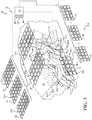
- FIG. 3 is a partial perspective view of the vehicle cabin shown in FIG. 2 , showing variable selection of the adaptive radiant heating system tiles among the individual arrays in accordance with the position of the vehicle occupant, according to the present disclosure.
- FIG. 4 is a partial perspective view of the vehicle cabin showing an alternative seating arrangement, according to the present disclosure.
- FIG. 1 schematically depicts a motor vehicle 10 .
- the motor vehicle 10 includes a powerplant configured to generate an output torque for powering the vehicle.
- the powerplant may be an internal combustion (IC) engine 12 A configured to propel the vehicle via driven wheels.
- IC internal combustion
- Such an internal combustion engine 12 A may be a spark-ignition type or a compression-ignition or diesel type of an engine.
- the vehicle 10 may employ hybrid propulsion, where torque output from the engine 12 A is augmented by other power sources, such as electric motor(s) 12 B.
- the vehicle 10 may employ electric motor(s) 12 B without an IC engine, and thus be configured as an electric vehicle.
- the vehicle 10 may be configured as an autonomous vehicle in which assistance from various vehicle systems is employed in operating the vehicle, up to and including full automation which eschews operator involvement.
- the vehicle 10 is generally characterized by a vehicle body 14 arranged along a longitudinal axis X in a vehicle body plane P, and defined by longitudinal body sides 14 - 1 , 14 - 2 (shown in FIG. 1 ), a floor 14 - 3 , and, in some cases, a roof 14 - 4 (shown in FIGS. 2 and 4 ).
- the vehicle body 14 defines a vehicle interior or cabin 16 configured to accommodate vehicle occupant(s) or passenger(s) 17 (shown in FIGS. 2-4 ). Specifically, as shown in FIGS.
- At least one seat 18 is moveably arranged or mounted in the cabin 16 .
- Each seat 18 is configured to support the vehicle occupant 17 via a number of adjustments, such as for seat position along the axis X and seat height relative to the floor 14 - 3 .
- the seat 18 includes a seatback 18 - 1 and a cushion 18 - 2 .
- the seat 18 may also include a recliner mechanism 18 - 3 , i.e., a recline adjustment of the seatback 18 - 1 relative to the cushion 18 - 2 .
- FIGS. 2 and 3 specifically depict a conventional seating arrangement, where the seats 18 face the front of the vehicle 10 .
- the vehicle 10 may employ an alternative seating arrangement, where at least some of the seats 18 face each other. Such an alternative seating arrangement may be especially useful in autonomous vehicles.
- the vehicle 10 also includes an adaptive radiant heating system 20 for regulating a climate inside the cabin of a motor vehicle, the system including a plurality of radiant heating tiles 22 inside the cabin 16 proximate the seat 18 .
- the term “radiant” denotes that the heating tiles are configured to generate thermal energy and radiate such energy inside the cabin and toward the occupant of the seat 18 . Radiant heating provides almost instantaneous warmth sensation to vehicle occupants 17 with less energy consumption suitable for both electric and non-electric vehicles.
- Each of the radiant heating tiles 22 may be constructed from a positive temperature coefficient (PTC) material.
- PTC material is characterized by internal resistance that increases with temperature.
- PTC material is a self-regulating heater capable of rapidly heating up to a constant temperature with application of electrical current, radiating heat outward, and maintaining its temperature unaffected by changes in ambient temperature.
- An energy storage device 24 (shown in FIG. 1 ), such as a battery, is configured to power the radiant heating tiles 22 , and facilitate generation of the thermal energy thereby.
- the radiant heating tiles 22 may be generally arranged along the longitudinal axis X in an array 22 A (shown in FIGS. 2-4 ) proximate one of the longitudinal body sides 14 - 1 , 14 - 2 , proximate the floor 14 - 3 , or proximate the roof 14 - 4 .
- the adaptive radiant heating system 20 also includes one or more first sensors 26 (shown in FIG. 1 ).
- Each first sensor 26 is arranged in the cabin 16 and configured to detect a parameter indicative of a position of the vehicle occupant 17 supported by the seat 18 and generate a first signal 28 indicative of the detected subject parameter.
- the parameter detected by the first sensor 26 may be indicative of a size, such as weight and height, of the vehicle occupant 17 .
- the parameter detected by an embodiment of the first sensor 26 may be indicative of a position of the seat 18 in the cabin 16 , or, if the seat includes the seatback recliner 18 - 3 , a position or state of the recliner and the seatback 18 - 1 .
- An embodiment of the first sensor 26 may be an electronic position sensor 26 - 1 , for example mounted on the seat 18 , configured to detect a position of the seat relative to the cabin 16 , such as along the axis X.
- the first sensor 26 - 1 may be configured to detect a position of the recliner, and therefore of the seatback 18 - 1 .
- the first sensor 26 - 1 may be a weight sensor 26 - 2 , such as a strain gauge, configured to detect a weight of the vehicle occupant 17 supported by the seat 18 .
- the first sensor 26 - 2 may be mounted to the seatback 18 - 1 and another sensor may be mounted on the cushion 18 - 2 .
- the first sensor 26 may be an in-vehicle camera 26 - 3 configured to detect a size, e.g., height and girth, of the vehicle occupant 17 and/or the position of the vehicle occupant within the cabin 16 .
- the adaptive radiant heating system 20 may include a plurality of first sensors, such that more than one embodiment of the first sensor 26 - 1 , 26 - 2 , and 26 - 3 , with attendant specific parameters being detected, is included on the particular vehicle 10 .
- the adaptive radiant heating system 20 also includes a second sensor 30 (shown in FIG. 1 ).
- the second sensor 30 is arranged in the cabin 16 proximate the plurality of radiant heating tiles 22 .
- the second sensor 30 is configured to detect a characteristic of the climate inside the cabin 16 , specifically the temperature within the cabin 16 proximate the seat 18 , and generate a second signal 32 indicative of the detected temperature.
- the system 20 may include a plurality of second sensors 30 to detect ambient temperature in multiple locations throughout the cabin 16 . It is specifically intended that there would be at least one second sensor 30 arranged proximate every seat 18 and configured to detect cabin 16 temperature when the subject seat is occupied.
- the second sensor 30 may be a temperature sensor 30 - 1 specifically configured to detect a temperature of the ambient cabin air proximate the vehicle occupant 17 .
- the second sensor 30 may be a temperature sensor 30 - 2 configured to detect a temperature of the vehicle occupant 17 .
- a number of second temperature sensors 30 - 2 configured to detect a temperature of individual areas of the vehicle occupant 17 , such as the head, the torso, and the leg areas.
- the second sensor(s) 30 - 2 may utilize infrared technology.
- the infrared sensor embodiment of the second sensor(s) 30 - 2 may, therefore, be configured to generate thermal imaging data indicative of the occupant's temperature and communicate such data via the second signal 32 .
- the adaptive radiant heating system 20 may include a plurality of second sensors, such that more than one embodiment of the second sensor 30 - 1 and 30 - 2 with attendant specific parameters being detected, is included on the particular vehicle 10 .
- the adaptive radiant heating system 20 further includes an electronic controller 34 .
- the electronic controller 34 is in operative communication with the plurality of radiant heating tiles 22 , the first sensor 26 , and the second sensor 30 , and configured or programmed to regulate the ambient climate of the cabin 16 proximate the seat 18 via selective control of the plurality of tiles.
- the electronic controller 34 is configured to receive the first signal(s) 28 and the second signal(s) 32 .
- the signals from the first and second sensors 26 , 30 may be communicated to the electronic controller 34 via a data network, e.g. a Controller Area Network (CAN bus), arranged in the vehicle 10 .
- a data network e.g. a Controller Area Network (CAN bus)
- the electronic controller 34 is configured, i.e., structured and programmed, to activate at least one of the plurality of radiant heating tiles 22 in response to the first and second signals 28 , 32 , to thereby regulate the climate proximate the seat 18 and provide thermal comfort of the vehicle occupant 17 .
- the electronic controller 34 is arranged on the vehicle 10 .
- the electronic controller 34 may be a central processing unit (CPU) or a body control module (BCM) configured to regulate operation of various vehicle systems.
- the electronic controller 34 includes a memory that is tangible and non-transitory.
- the memory may be a recordable medium that participates in providing computer-readable data or process instructions. Such a medium may take many forms, including but not limited to non-volatile media and volatile media.
- Non-volatile media used by the electronic controller 34 may include, for example, optical or magnetic disks and other persistent memory.
- Volatile media of each of the controller's memory may include, for example, dynamic random-access memory (DRAM), which may constitute a main memory.
- DRAM dynamic random-access memory
- Such instructions may be transmitted by one or more transmission medium, including coaxial cables, copper wire and fiber optics, including the wires that comprise a system bus coupled to respective first and second sensors 26 , 30 .
- Memory of the electronic controller 34 may also include a flexible disk, hard disk, magnetic tape, other magnetic medium, a CD-ROM, DVD, other optical medium, etc.
- the electronic controller 34 may be equipped with a high-speed primary clock, requisite Analog-to-Digital (A/D) and/or Digital-to-Analog (D/A) circuitry, input/output circuitry and devices (I/O), as well as appropriate signal conditioning and/or buffer circuitry. Algorithms required by the electronic controller 34 or accessible thereby may be stored in the memory and automatically executed to provide the required functionality.
- A/D Analog-to-Digital
- D/A Digital-to-Analog circuitry
- I/O input/output circuitry and devices
- Algorithms required by the electronic controller 34 or accessible thereby may be stored in the memory and automatically executed to provide the required functionality.
- the electronic controller 34 may also be configured to identify one or more of the plurality of radiant heating tiles 22 corresponding to a location of a particular identified second sensor 30 in the cabin 16 .
- the electronic controller 34 may be additionally configured to assess the climate, i.e., temperature, proximate the location of the identified second sensor 30 in comparison to a predetermined climate or temperature set-point 36 at the location of the subject second sensor 30 .
- the electronic controller 34 may be configured to automatically activate the identified one or more of the plurality of radiant heating tiles 22 when the assessed climate proximate the location of the identified second sensor 30 is below the predetermined climate set-point 36 .
- the radiant heating system 20 may be configured to regulate and adapt localized climate in the cabin 16 to specific requirements of an individual vehicle occupant 17 .
- the adaptive radiant heating system 20 may also include a gesture recognition feature, such as via a built-in camera, configured to acknowledge a vehicle occupant's physical gestures signifying operative system commands.
- the adaptive radiant heating system 20 may additionally include an over-ride feature 38 A, such as a switch or an electronic input via the climate control panel 38 , configured to deselect automatic activation of the radiant heating tiles 22 via the electronic controller 34 .
- a desired temperature profile for each of the radiant heating tiles 22 may be preprogrammed and stored on an information technology (IT) cloud platform (not shown).
- the electronic controller 34 may be in operative communication with the IT cloud platform.
- IT cloud platform is a provider-managed suite of hardware and software.
- An IT paradigm enables universal access to shared pools of configurable system resources and higher-level services that may be rapidly provisioned with minimal management effort, often over the Internet. Such utilization of IT cloud resources may be especially useful for managing a fleet of autonomous vehicles 10 .
- the motor vehicle 10 may additionally include a forced-air climate control system 40 .
- the forced-air climate control system 40 may employ one or more heat exchangers 42 that utilize waste heat energy produced by the IC engine 12 A as a byproduct of generated power.
- the subject heat exchanger(s) 42 may be configured as engine coolant-to-air type with the air being forced through the heat exchanger(s) via fan(s) (not shown). Accordingly, inside the heat exchanger(s) 42 coolant from the IC engine 12 A is used to transfer heat energy to the exterior ambient air that is forced through the heat exchanger(s) and into the vehicle cabin 16 to provide cabin warm-up.
- the electronic controller 34 may be additionally configured to supplement a heat output of the forced-air climate control system with the thermal energy generated by the plurality of radiant heating tiles 22 .
- the electronic controller 34 may be programmed to coordinate regulation of the forced-air climate control system 40 and the selective control of the plurality of radiant heating tiles 22 to provide more rapid cabin 16 warm-up. For example, as the IC engine 12 A is started from cold at sub-freezing temperature, the electronic controller 34 may access ambient temperature data via an exterior temperature sensor 42 (shown in FIG. 1 ) and/or interior temperature data via the second sensor 30 . The electronic controller 34 may then activate one or more of the plurality of the radiant heating tiles 22 to provide rapid warm-up of the cabin 16 proximate the seat(s) 18 occupied by the vehicle passenger(s) 17 .
- the electronic controller 34 may reduce, pause, or halt the heat output of the subject radiant heating tiles 22 and supplement the output of the tiles with the forced-air climate control system 40 . Accordingly, in such an embodiment, the electronic controller 34 may utilize and coordinate regulation of the forced-air climate control system 40 and the radiant heating system 20 to adapt the localized climate in the cabin 16 to the specific requirements of an individual vehicle occupant 17 .
Landscapes
- Engineering & Computer Science (AREA)
- Physics & Mathematics (AREA)
- Thermal Sciences (AREA)
- Mechanical Engineering (AREA)
- Chemical & Material Sciences (AREA)
- Combustion & Propulsion (AREA)
- Air-Conditioning For Vehicles (AREA)
- Seats For Vehicles (AREA)
Abstract
Description
Claims (18)
Priority Applications (1)
| Application Number | Priority Date | Filing Date | Title |
|---|---|---|---|
| US16/400,536 US10857852B2 (en) | 2019-05-01 | 2019-05-01 | Adaptive radiant heating for a vehicle |
Applications Claiming Priority (1)
| Application Number | Priority Date | Filing Date | Title |
|---|---|---|---|
| US16/400,536 US10857852B2 (en) | 2019-05-01 | 2019-05-01 | Adaptive radiant heating for a vehicle |
Publications (2)
| Publication Number | Publication Date |
|---|---|
| US20200346516A1 US20200346516A1 (en) | 2020-11-05 |
| US10857852B2 true US10857852B2 (en) | 2020-12-08 |
Family
ID=73016251
Family Applications (1)
| Application Number | Title | Priority Date | Filing Date |
|---|---|---|---|
| US16/400,536 Active 2039-06-05 US10857852B2 (en) | 2019-05-01 | 2019-05-01 | Adaptive radiant heating for a vehicle |
Country Status (1)
| Country | Link |
|---|---|
| US (1) | US10857852B2 (en) |
Cited By (3)
| Publication number | Priority date | Publication date | Assignee | Title |
|---|---|---|---|---|
| US20240149634A1 (en) * | 2022-11-09 | 2024-05-09 | Jvis-Usa, Llc | Vehicular Temperature Regulating System and Panel Assembly Including a Touch Panel Configured to be Heated or Cooled within a Passenger Compartment of a Vehicle |
| WO2024156453A1 (en) * | 2023-01-25 | 2024-08-02 | Bayerische Motoren Werke Aktiengesellschaft | Heating system for a motor vehicle roof, motor vehicle roof for a motor vehicle, and motor vehicle comprising a motor vehicle roof |
| FR3159771A1 (en) * | 2024-02-29 | 2025-09-05 | Stellantis Auto Sas | METHOD FOR HEATING THE PASSENGER COMPARTMENT OF AN AUTONOMOUS VEHICLE |
Families Citing this family (2)
| Publication number | Priority date | Publication date | Assignee | Title |
|---|---|---|---|---|
| US11897317B2 (en) * | 2019-08-19 | 2024-02-13 | Volvo Car Corporation | Infrared heating module, vehicle and software program for providing climate control |
| US11827079B2 (en) * | 2020-10-14 | 2023-11-28 | GM Global Technology Operations LLC | Class a surface radiant heating system |
Citations (62)
| Publication number | Priority date | Publication date | Assignee | Title |
|---|---|---|---|---|
| US6079485A (en) * | 1997-04-28 | 2000-06-27 | Honda Giken Kogyo Kabushiki Kaisha | Vehicle air-conditioning system with seat heating and cooling device |
| US6158225A (en) * | 1997-12-10 | 2000-12-12 | Seiko Seiki Kabushiki Kaisha | Automotive air-conditioning apparatus |
| US6439468B1 (en) * | 2001-04-09 | 2002-08-27 | Delphi Technologies, Inc. | Acoustic HVAC control system |
| US6470960B2 (en) * | 2000-04-20 | 2002-10-29 | Behr Gmbh & Co. | Air-conditioning system for a commercial vehicle |
| US20040076214A1 (en) * | 2001-02-09 | 2004-04-22 | Bell Lon K | High power density thermoelectric systems |
| US6886356B2 (en) * | 2001-03-28 | 2005-05-03 | Sanyo Electric Co., Ltd. | Car air-conditioning system |
| US7095501B2 (en) * | 2003-01-21 | 2006-08-22 | Delphi Technologies, Inc. | Ethyl alcohol sensor and method of use |
| US20080103660A1 (en) * | 2006-11-01 | 2008-05-01 | Gm Global Technology Operations, Inc. | Systems for Detecting Animate Objects in a Vehicle Compartment |
| US7380586B2 (en) * | 2004-05-10 | 2008-06-03 | Bsst Llc | Climate control system for hybrid vehicles using thermoelectric devices |
| US20080173342A1 (en) * | 2001-02-09 | 2008-07-24 | Bell Lon E | Thermoelectric power generating systems utilizing segmented thermoelectric elements |
| US20080248736A1 (en) * | 2007-04-03 | 2008-10-09 | Denso Corporation | Air conditioner for vehicle |
| US7533535B2 (en) * | 2004-05-20 | 2009-05-19 | Delphi Technologies, Inc | Thermally conditioned container for a vehicle |
| US20100140366A1 (en) * | 2007-08-10 | 2010-06-10 | Honda Motor Co., Ltd. | Low humidity detection system and method thereof |
| US20100175406A1 (en) * | 2009-01-13 | 2010-07-15 | Gm Global Technology Operations, Inc. | Auxiliary Battery Cooling for a Vehicle |
| US7918100B2 (en) * | 1994-05-09 | 2011-04-05 | Automotive Technologies International, Inc. | Vehicular HVAC control systems and methods |
| US20110127025A1 (en) * | 2009-11-27 | 2011-06-02 | Gm Global Technology Operations, Inc. | Air conditioner for a motor vehicle |
| US20110165829A1 (en) * | 2010-02-25 | 2011-07-07 | Ford Global Technologies, Llc | Automotive vehicle and method for operating climate system of same |
| US20110172880A1 (en) * | 2008-09-26 | 2011-07-14 | Pioneer Corporation | Air conditioning control device and air conditioning control method |
| US20110199026A1 (en) * | 2010-02-15 | 2011-08-18 | Earl David Forrest | Method of charging an energy storage device |
| US20120112694A1 (en) * | 2009-05-02 | 2012-05-10 | Daimler Ag | Method and Arrangement for Data Communication Between A Service Provider and A Vehicle |
| US8191187B2 (en) * | 2009-08-31 | 2012-06-05 | Amerigon Incorporated | Environmentally-conditioned topper member for beds |
| US20120227926A1 (en) * | 2009-11-16 | 2012-09-13 | Sunamp Limited | Energy storage systems |
| US8359871B2 (en) * | 2009-02-11 | 2013-01-29 | Marlow Industries, Inc. | Temperature control device |
| US8412381B2 (en) * | 2010-03-24 | 2013-04-02 | Mitsubishi Electric Research Laboratories, Inc. | HVAC control system |
| US20140084679A1 (en) * | 2012-09-24 | 2014-03-27 | General Electric Company | Power supply management apparatus and method thereof |
| US8839632B2 (en) * | 2012-03-09 | 2014-09-23 | Visteon Global Technologies, Inc. | Control strategy for a zonal heating, ventilating, and air conditioning system of a vehicle |
| US20140293538A1 (en) * | 2013-03-28 | 2014-10-02 | GM Global Technology Operations LLC | Temperature regulation of inductive charging devices in extreme vehicle environments |
| US20140306814A1 (en) * | 2013-04-15 | 2014-10-16 | Flextronics Ap, Llc | Pedestrian monitoring application |
| US20150041113A1 (en) * | 2013-08-06 | 2015-02-12 | Volkswagen Aktiengesellschaft | Method and device for regulating a stationary climate control for a vehicle |
| US20150094914A1 (en) * | 2004-02-26 | 2015-04-02 | Geelux Holding, Ltd. | Method and apparatus for biological evaluation |
| US20150129192A1 (en) * | 2013-11-14 | 2015-05-14 | International Business Machines Corporation | System and method to adjust vehicle temperature based on driver location |
| US20150183293A1 (en) * | 2013-12-26 | 2015-07-02 | Hyundai Motor Company | Energy saving automatic air conditioning control system and method |
| US20150197135A1 (en) * | 2014-01-13 | 2015-07-16 | GM Global Technology Operations LLC | Systems for improving vehicle occupant climate comfort via steering assembly air delivery |
| US20150197136A1 (en) * | 2014-01-13 | 2015-07-16 | GM Global Technology Operations LLC | Systems for improving climate comfort for rear vehicle passengers |
| US9168810B2 (en) * | 2012-10-09 | 2015-10-27 | Delphi Technologies, Inc. | Heating and cooling system for occupants of the rear portion of a vehicle |
| US20160107506A1 (en) * | 2014-10-21 | 2016-04-21 | Atieva, Inc. | EV Multi-Mode Thermal Management System |
| US20160107508A1 (en) * | 2014-10-21 | 2016-04-21 | Atieva, Inc. | EV Multi-Mode Thermal Management System |
| US20160152112A1 (en) * | 2014-12-02 | 2016-06-02 | Rick R. Stetler | Solar-power system and control for vehicle air conditioning system |
| US20170138627A1 (en) * | 2015-11-12 | 2017-05-18 | GM Global Technology Operations LLC | Model based automatic climate control system for an improved thermal comfort |
| US9676308B2 (en) * | 2011-08-19 | 2017-06-13 | Gentherm Gmbh | Heating device |
| US9682609B1 (en) * | 2016-06-07 | 2017-06-20 | Ford Global Technologies, Llc | Autonomous vehicle dynamic climate control |
| US20170369069A1 (en) * | 2016-06-22 | 2017-12-28 | GM Global Technology Operations LLC | Driving behavior analysis based on vehicle braking |
| US9857107B2 (en) * | 2006-10-12 | 2018-01-02 | Gentherm Incorporated | Thermoelectric device with internal sensor |
| US20180120873A1 (en) * | 2015-06-12 | 2018-05-03 | University Of Maryland, College Park | Comfort units and systems, methods, and devices for use thereof |
| US20180361825A1 (en) * | 2017-06-16 | 2018-12-20 | Ford Global Technologies, Llc | Method and system to manage vehicle thermal conditions |
| US20190077217A1 (en) * | 2017-09-14 | 2019-03-14 | Lin Yu | Vehicle interior environment control |
| US10391876B2 (en) * | 2015-03-11 | 2019-08-27 | Robert Bosch Gmbh | Charging station and electric vehicle |
| US20190279447A1 (en) * | 2015-12-03 | 2019-09-12 | Autoconnect Holdings Llc | Automatic vehicle diagnostic detection and communication |
| US20190283529A1 (en) * | 2016-11-01 | 2019-09-19 | Ford Motor Company | Methods and apparatus for vehicle hvac control using portable devices |
| US10421333B2 (en) * | 2015-12-24 | 2019-09-24 | Hyundai Dymos Incorporated | System of air-conditioning seat for vehicle and method for controlling the same |
| US20190320503A1 (en) * | 2018-04-16 | 2019-10-17 | GM Global Technology Operations LLC | Ptc radiant heating system and method |
| US10507745B2 (en) * | 2017-08-29 | 2019-12-17 | Ford Global Technologies, Llc | Seating assembly with thermoelectric devices |
| US20200077540A1 (en) * | 2018-09-05 | 2020-03-05 | GM Global Technology Operations LLC | Apparatus and method that manage sensor module temperature |
| US20200086714A1 (en) * | 2018-09-14 | 2020-03-19 | Ford Global Technologies, Llc | Method and system for heating a vehicle |
| US10603976B2 (en) * | 2014-12-19 | 2020-03-31 | Gentherm Incorporated | Thermal conditioning systems and methods for vehicle regions |
| US10611211B2 (en) * | 2017-02-28 | 2020-04-07 | Garin System Co., Ltd. | System and method for controlling air conditioner for vehicle |
| US10675948B2 (en) * | 2016-09-29 | 2020-06-09 | Bergstrom, Inc. | Systems and methods for controlling a vehicle HVAC system |
| US20200180396A1 (en) * | 2018-12-11 | 2020-06-11 | Hyundai Motor Company | Vehicle and Method for Controlling the Same |
| US20200189352A1 (en) * | 2018-12-12 | 2020-06-18 | GM Global Technology Operations LLC | Vehicle with thermal comfort sensor for cabin climate control |
| US20200193792A1 (en) * | 2018-12-18 | 2020-06-18 | Fenglou Mao | Vehicle Occupancy Reminder System |
| US20200198445A1 (en) * | 2018-12-20 | 2020-06-25 | Ford Global Technologies, Llc | Air sanitizing apparatus for interior of vehicle and method of sanitizing air in the vehicle using the apparatus |
| US20200223283A1 (en) * | 2017-07-07 | 2020-07-16 | Nissan Motor Co., Ltd. | Vehicle air-conditioning method and vehicle air-conditioning device |
-
2019
- 2019-05-01 US US16/400,536 patent/US10857852B2/en active Active
Patent Citations (62)
| Publication number | Priority date | Publication date | Assignee | Title |
|---|---|---|---|---|
| US7918100B2 (en) * | 1994-05-09 | 2011-04-05 | Automotive Technologies International, Inc. | Vehicular HVAC control systems and methods |
| US6079485A (en) * | 1997-04-28 | 2000-06-27 | Honda Giken Kogyo Kabushiki Kaisha | Vehicle air-conditioning system with seat heating and cooling device |
| US6158225A (en) * | 1997-12-10 | 2000-12-12 | Seiko Seiki Kabushiki Kaisha | Automotive air-conditioning apparatus |
| US6470960B2 (en) * | 2000-04-20 | 2002-10-29 | Behr Gmbh & Co. | Air-conditioning system for a commercial vehicle |
| US20080173342A1 (en) * | 2001-02-09 | 2008-07-24 | Bell Lon E | Thermoelectric power generating systems utilizing segmented thermoelectric elements |
| US20040076214A1 (en) * | 2001-02-09 | 2004-04-22 | Bell Lon K | High power density thermoelectric systems |
| US6886356B2 (en) * | 2001-03-28 | 2005-05-03 | Sanyo Electric Co., Ltd. | Car air-conditioning system |
| US6439468B1 (en) * | 2001-04-09 | 2002-08-27 | Delphi Technologies, Inc. | Acoustic HVAC control system |
| US7095501B2 (en) * | 2003-01-21 | 2006-08-22 | Delphi Technologies, Inc. | Ethyl alcohol sensor and method of use |
| US20150094914A1 (en) * | 2004-02-26 | 2015-04-02 | Geelux Holding, Ltd. | Method and apparatus for biological evaluation |
| US7380586B2 (en) * | 2004-05-10 | 2008-06-03 | Bsst Llc | Climate control system for hybrid vehicles using thermoelectric devices |
| US7533535B2 (en) * | 2004-05-20 | 2009-05-19 | Delphi Technologies, Inc | Thermally conditioned container for a vehicle |
| US9857107B2 (en) * | 2006-10-12 | 2018-01-02 | Gentherm Incorporated | Thermoelectric device with internal sensor |
| US20080103660A1 (en) * | 2006-11-01 | 2008-05-01 | Gm Global Technology Operations, Inc. | Systems for Detecting Animate Objects in a Vehicle Compartment |
| US20080248736A1 (en) * | 2007-04-03 | 2008-10-09 | Denso Corporation | Air conditioner for vehicle |
| US20100140366A1 (en) * | 2007-08-10 | 2010-06-10 | Honda Motor Co., Ltd. | Low humidity detection system and method thereof |
| US20110172880A1 (en) * | 2008-09-26 | 2011-07-14 | Pioneer Corporation | Air conditioning control device and air conditioning control method |
| US20100175406A1 (en) * | 2009-01-13 | 2010-07-15 | Gm Global Technology Operations, Inc. | Auxiliary Battery Cooling for a Vehicle |
| US8359871B2 (en) * | 2009-02-11 | 2013-01-29 | Marlow Industries, Inc. | Temperature control device |
| US20120112694A1 (en) * | 2009-05-02 | 2012-05-10 | Daimler Ag | Method and Arrangement for Data Communication Between A Service Provider and A Vehicle |
| US8191187B2 (en) * | 2009-08-31 | 2012-06-05 | Amerigon Incorporated | Environmentally-conditioned topper member for beds |
| US20120227926A1 (en) * | 2009-11-16 | 2012-09-13 | Sunamp Limited | Energy storage systems |
| US20110127025A1 (en) * | 2009-11-27 | 2011-06-02 | Gm Global Technology Operations, Inc. | Air conditioner for a motor vehicle |
| US20110199026A1 (en) * | 2010-02-15 | 2011-08-18 | Earl David Forrest | Method of charging an energy storage device |
| US20110165829A1 (en) * | 2010-02-25 | 2011-07-07 | Ford Global Technologies, Llc | Automotive vehicle and method for operating climate system of same |
| US8412381B2 (en) * | 2010-03-24 | 2013-04-02 | Mitsubishi Electric Research Laboratories, Inc. | HVAC control system |
| US9676308B2 (en) * | 2011-08-19 | 2017-06-13 | Gentherm Gmbh | Heating device |
| US8839632B2 (en) * | 2012-03-09 | 2014-09-23 | Visteon Global Technologies, Inc. | Control strategy for a zonal heating, ventilating, and air conditioning system of a vehicle |
| US20140084679A1 (en) * | 2012-09-24 | 2014-03-27 | General Electric Company | Power supply management apparatus and method thereof |
| US9168810B2 (en) * | 2012-10-09 | 2015-10-27 | Delphi Technologies, Inc. | Heating and cooling system for occupants of the rear portion of a vehicle |
| US20140293538A1 (en) * | 2013-03-28 | 2014-10-02 | GM Global Technology Operations LLC | Temperature regulation of inductive charging devices in extreme vehicle environments |
| US20140306814A1 (en) * | 2013-04-15 | 2014-10-16 | Flextronics Ap, Llc | Pedestrian monitoring application |
| US20150041113A1 (en) * | 2013-08-06 | 2015-02-12 | Volkswagen Aktiengesellschaft | Method and device for regulating a stationary climate control for a vehicle |
| US20150129192A1 (en) * | 2013-11-14 | 2015-05-14 | International Business Machines Corporation | System and method to adjust vehicle temperature based on driver location |
| US20150183293A1 (en) * | 2013-12-26 | 2015-07-02 | Hyundai Motor Company | Energy saving automatic air conditioning control system and method |
| US20150197136A1 (en) * | 2014-01-13 | 2015-07-16 | GM Global Technology Operations LLC | Systems for improving climate comfort for rear vehicle passengers |
| US20150197135A1 (en) * | 2014-01-13 | 2015-07-16 | GM Global Technology Operations LLC | Systems for improving vehicle occupant climate comfort via steering assembly air delivery |
| US20160107506A1 (en) * | 2014-10-21 | 2016-04-21 | Atieva, Inc. | EV Multi-Mode Thermal Management System |
| US20160107508A1 (en) * | 2014-10-21 | 2016-04-21 | Atieva, Inc. | EV Multi-Mode Thermal Management System |
| US20160152112A1 (en) * | 2014-12-02 | 2016-06-02 | Rick R. Stetler | Solar-power system and control for vehicle air conditioning system |
| US10603976B2 (en) * | 2014-12-19 | 2020-03-31 | Gentherm Incorporated | Thermal conditioning systems and methods for vehicle regions |
| US10391876B2 (en) * | 2015-03-11 | 2019-08-27 | Robert Bosch Gmbh | Charging station and electric vehicle |
| US20180120873A1 (en) * | 2015-06-12 | 2018-05-03 | University Of Maryland, College Park | Comfort units and systems, methods, and devices for use thereof |
| US20170138627A1 (en) * | 2015-11-12 | 2017-05-18 | GM Global Technology Operations LLC | Model based automatic climate control system for an improved thermal comfort |
| US20190279447A1 (en) * | 2015-12-03 | 2019-09-12 | Autoconnect Holdings Llc | Automatic vehicle diagnostic detection and communication |
| US10421333B2 (en) * | 2015-12-24 | 2019-09-24 | Hyundai Dymos Incorporated | System of air-conditioning seat for vehicle and method for controlling the same |
| US9682609B1 (en) * | 2016-06-07 | 2017-06-20 | Ford Global Technologies, Llc | Autonomous vehicle dynamic climate control |
| US20170369069A1 (en) * | 2016-06-22 | 2017-12-28 | GM Global Technology Operations LLC | Driving behavior analysis based on vehicle braking |
| US10675948B2 (en) * | 2016-09-29 | 2020-06-09 | Bergstrom, Inc. | Systems and methods for controlling a vehicle HVAC system |
| US20190283529A1 (en) * | 2016-11-01 | 2019-09-19 | Ford Motor Company | Methods and apparatus for vehicle hvac control using portable devices |
| US10611211B2 (en) * | 2017-02-28 | 2020-04-07 | Garin System Co., Ltd. | System and method for controlling air conditioner for vehicle |
| US20180361825A1 (en) * | 2017-06-16 | 2018-12-20 | Ford Global Technologies, Llc | Method and system to manage vehicle thermal conditions |
| US20200223283A1 (en) * | 2017-07-07 | 2020-07-16 | Nissan Motor Co., Ltd. | Vehicle air-conditioning method and vehicle air-conditioning device |
| US10507745B2 (en) * | 2017-08-29 | 2019-12-17 | Ford Global Technologies, Llc | Seating assembly with thermoelectric devices |
| US20190077217A1 (en) * | 2017-09-14 | 2019-03-14 | Lin Yu | Vehicle interior environment control |
| US20190320503A1 (en) * | 2018-04-16 | 2019-10-17 | GM Global Technology Operations LLC | Ptc radiant heating system and method |
| US20200077540A1 (en) * | 2018-09-05 | 2020-03-05 | GM Global Technology Operations LLC | Apparatus and method that manage sensor module temperature |
| US20200086714A1 (en) * | 2018-09-14 | 2020-03-19 | Ford Global Technologies, Llc | Method and system for heating a vehicle |
| US20200180396A1 (en) * | 2018-12-11 | 2020-06-11 | Hyundai Motor Company | Vehicle and Method for Controlling the Same |
| US20200189352A1 (en) * | 2018-12-12 | 2020-06-18 | GM Global Technology Operations LLC | Vehicle with thermal comfort sensor for cabin climate control |
| US20200193792A1 (en) * | 2018-12-18 | 2020-06-18 | Fenglou Mao | Vehicle Occupancy Reminder System |
| US20200198445A1 (en) * | 2018-12-20 | 2020-06-25 | Ford Global Technologies, Llc | Air sanitizing apparatus for interior of vehicle and method of sanitizing air in the vehicle using the apparatus |
Cited By (3)
| Publication number | Priority date | Publication date | Assignee | Title |
|---|---|---|---|---|
| US20240149634A1 (en) * | 2022-11-09 | 2024-05-09 | Jvis-Usa, Llc | Vehicular Temperature Regulating System and Panel Assembly Including a Touch Panel Configured to be Heated or Cooled within a Passenger Compartment of a Vehicle |
| WO2024156453A1 (en) * | 2023-01-25 | 2024-08-02 | Bayerische Motoren Werke Aktiengesellschaft | Heating system for a motor vehicle roof, motor vehicle roof for a motor vehicle, and motor vehicle comprising a motor vehicle roof |
| FR3159771A1 (en) * | 2024-02-29 | 2025-09-05 | Stellantis Auto Sas | METHOD FOR HEATING THE PASSENGER COMPARTMENT OF AN AUTONOMOUS VEHICLE |
Also Published As
| Publication number | Publication date |
|---|---|
| US20200346516A1 (en) | 2020-11-05 |
Similar Documents
| Publication | Publication Date | Title |
|---|---|---|
| US10857852B2 (en) | Adaptive radiant heating for a vehicle | |
| US10857853B2 (en) | Adaptive radiant heating system and method for achieving vehicle occupant thermal comfort | |
| CN103303096B (en) | Control strategy for district heating, ventilation and the air handling system of vehicle | |
| US9067475B1 (en) | Method and system of heating cabin of hybrid electric vehicle | |
| US9150132B2 (en) | Vehicle comfort system with efficient coordination of complementary thermal units | |
| EP2221199B1 (en) | Vehicle heating system | |
| US8316650B2 (en) | System and method for heating and cooling a vehicle | |
| US11254185B2 (en) | Air-conditioning control system for vehicle, air-conditioning control method for vehicle, and recording medium | |
| US20110127025A1 (en) | Air conditioner for a motor vehicle | |
| US8807445B2 (en) | Auxiliary heater pump control | |
| US20170080779A1 (en) | Heating system for vehicle | |
| US9963013B2 (en) | Method of heating the interior of a vehicle | |
| US20190283531A1 (en) | Intelligent thermal control system for autonomous vehicle | |
| CN108933303B (en) | Method for conditioning the battery on demand when not charging | |
| US11041474B2 (en) | Vehicle start and stop control based on seat heater actuation | |
| US20090301116A1 (en) | Climate controlling system | |
| WO2022007684A1 (en) | Thermal management method and device, and electric vehicle | |
| US20190061576A1 (en) | Power source for thermal components | |
| CN114425977A (en) | A seat temperature control device and control method thereof | |
| WO2025151474A1 (en) | Holistic seat climate system | |
| KR102226551B1 (en) | System and method for controlling a radiation heater for a vehicle | |
| CN107650614A (en) | System and method for controlling electric vehicle heater | |
| CN102963235A (en) | Air conditioner system for vehicle | |
| JP7089693B2 (en) | Vehicle temperature control device | |
| CN112440663A (en) | Steering wheel preconditioning |
Legal Events
| Date | Code | Title | Description |
|---|---|---|---|
| AS | Assignment |
Owner name: GM GLOBAL TECHNOLOGY OPERATIONS LLC, MICHIGAN Free format text: ASSIGNMENT OF ASSIGNORS INTEREST;ASSIGNORS:YEN, CHIH-HUNG;CHEN, KUO-HUEY;HAN, TAEYOUNG;AND OTHERS;SIGNING DATES FROM 20190429 TO 20190430;REEL/FRAME:049052/0917 |
|
| FEPP | Fee payment procedure |
Free format text: ENTITY STATUS SET TO UNDISCOUNTED (ORIGINAL EVENT CODE: BIG.); ENTITY STATUS OF PATENT OWNER: LARGE ENTITY |
|
| STCF | Information on status: patent grant |
Free format text: PATENTED CASE |
|
| MAFP | Maintenance fee payment |
Free format text: PAYMENT OF MAINTENANCE FEE, 4TH YEAR, LARGE ENTITY (ORIGINAL EVENT CODE: M1551); ENTITY STATUS OF PATENT OWNER: LARGE ENTITY Year of fee payment: 4 |