US10857790B2 - Liquid discharge head, liquid discharge apparatus, and wiring substrate - Google Patents
Liquid discharge head, liquid discharge apparatus, and wiring substrate Download PDFInfo
- Publication number
- US10857790B2 US10857790B2 US16/443,937 US201916443937A US10857790B2 US 10857790 B2 US10857790 B2 US 10857790B2 US 201916443937 A US201916443937 A US 201916443937A US 10857790 B2 US10857790 B2 US 10857790B2
- Authority
- US
- United States
- Prior art keywords
- electrode
- drive
- wiring
- signal
- electrically connected
- Prior art date
- Legal status (The legal status is an assumption and is not a legal conclusion. Google has not performed a legal analysis and makes no representation as to the accuracy of the status listed.)
- Active
Links
- 239000000758 substrate Substances 0.000 title claims abstract description 200
- 239000007788 liquid Substances 0.000 title claims abstract description 100
- 230000001902 propagating effect Effects 0.000 claims abstract description 6
- 239000000976 ink Substances 0.000 description 42
- 238000007689 inspection Methods 0.000 description 39
- 206010010071 Coma Diseases 0.000 description 38
- 238000007639 printing Methods 0.000 description 28
- 238000012790 confirmation Methods 0.000 description 13
- 238000010586 diagram Methods 0.000 description 9
- 230000000644 propagated effect Effects 0.000 description 8
- 238000006243 chemical reaction Methods 0.000 description 6
- 239000000853 adhesive Substances 0.000 description 4
- 230000001070 adhesive effect Effects 0.000 description 4
- 239000011347 resin Substances 0.000 description 4
- 229920005989 resin Polymers 0.000 description 4
- 230000004308 accommodation Effects 0.000 description 3
- 238000007599 discharging Methods 0.000 description 3
- 239000010752 BS 2869 Class D Substances 0.000 description 2
- 238000006073 displacement reaction Methods 0.000 description 2
- 238000000034 method Methods 0.000 description 2
- 230000005856 abnormality Effects 0.000 description 1
- 239000006096 absorbing agent Substances 0.000 description 1
- 239000003086 colorant Substances 0.000 description 1
- 238000001514 detection method Methods 0.000 description 1
- 238000005516 engineering process Methods 0.000 description 1
- 239000004744 fabric Substances 0.000 description 1
- PCHJSUWPFVWCPO-UHFFFAOYSA-N gold Chemical compound [Au] PCHJSUWPFVWCPO-UHFFFAOYSA-N 0.000 description 1
- 239000010931 gold Substances 0.000 description 1
- 229910052737 gold Inorganic materials 0.000 description 1
- 238000001746 injection moulding Methods 0.000 description 1
- 239000012212 insulator Substances 0.000 description 1
- 239000000463 material Substances 0.000 description 1
- 239000002184 metal Substances 0.000 description 1
- 229910052751 metal Inorganic materials 0.000 description 1
- 238000003825 pressing Methods 0.000 description 1
- 239000004065 semiconductor Substances 0.000 description 1
Images


Classifications
-
- B—PERFORMING OPERATIONS; TRANSPORTING
- B41—PRINTING; LINING MACHINES; TYPEWRITERS; STAMPS
- B41J—TYPEWRITERS; SELECTIVE PRINTING MECHANISMS, i.e. MECHANISMS PRINTING OTHERWISE THAN FROM A FORME; CORRECTION OF TYPOGRAPHICAL ERRORS
- B41J2/00—Typewriters or selective printing mechanisms characterised by the printing or marking process for which they are designed
- B41J2/005—Typewriters or selective printing mechanisms characterised by the printing or marking process for which they are designed characterised by bringing liquid or particles selectively into contact with a printing material
- B41J2/01—Ink jet
- B41J2/015—Ink jet characterised by the jet generation process
- B41J2/04—Ink jet characterised by the jet generation process generating single droplets or particles on demand
- B41J2/045—Ink jet characterised by the jet generation process generating single droplets or particles on demand by pressure, e.g. electromechanical transducers
- B41J2/04501—Control methods or devices therefor, e.g. driver circuits, control circuits
- B41J2/04581—Control methods or devices therefor, e.g. driver circuits, control circuits controlling heads based on piezoelectric elements
-
- B—PERFORMING OPERATIONS; TRANSPORTING
- B41—PRINTING; LINING MACHINES; TYPEWRITERS; STAMPS
- B41J—TYPEWRITERS; SELECTIVE PRINTING MECHANISMS, i.e. MECHANISMS PRINTING OTHERWISE THAN FROM A FORME; CORRECTION OF TYPOGRAPHICAL ERRORS
- B41J2/00—Typewriters or selective printing mechanisms characterised by the printing or marking process for which they are designed
- B41J2/005—Typewriters or selective printing mechanisms characterised by the printing or marking process for which they are designed characterised by bringing liquid or particles selectively into contact with a printing material
- B41J2/01—Ink jet
- B41J2/135—Nozzles
- B41J2/14—Structure thereof only for on-demand ink jet heads
- B41J2/14201—Structure of print heads with piezoelectric elements
- B41J2/14233—Structure of print heads with piezoelectric elements of film type, deformed by bending and disposed on a diaphragm
-
- B—PERFORMING OPERATIONS; TRANSPORTING
- B41—PRINTING; LINING MACHINES; TYPEWRITERS; STAMPS
- B41J—TYPEWRITERS; SELECTIVE PRINTING MECHANISMS, i.e. MECHANISMS PRINTING OTHERWISE THAN FROM A FORME; CORRECTION OF TYPOGRAPHICAL ERRORS
- B41J2/00—Typewriters or selective printing mechanisms characterised by the printing or marking process for which they are designed
- B41J2/005—Typewriters or selective printing mechanisms characterised by the printing or marking process for which they are designed characterised by bringing liquid or particles selectively into contact with a printing material
- B41J2/01—Ink jet
- B41J2/015—Ink jet characterised by the jet generation process
- B41J2/04—Ink jet characterised by the jet generation process generating single droplets or particles on demand
- B41J2/045—Ink jet characterised by the jet generation process generating single droplets or particles on demand by pressure, e.g. electromechanical transducers
- B41J2/04501—Control methods or devices therefor, e.g. driver circuits, control circuits
- B41J2/0457—Power supply level being detected or varied
-
- B—PERFORMING OPERATIONS; TRANSPORTING
- B41—PRINTING; LINING MACHINES; TYPEWRITERS; STAMPS
- B41J—TYPEWRITERS; SELECTIVE PRINTING MECHANISMS, i.e. MECHANISMS PRINTING OTHERWISE THAN FROM A FORME; CORRECTION OF TYPOGRAPHICAL ERRORS
- B41J2/00—Typewriters or selective printing mechanisms characterised by the printing or marking process for which they are designed
- B41J2/005—Typewriters or selective printing mechanisms characterised by the printing or marking process for which they are designed characterised by bringing liquid or particles selectively into contact with a printing material
- B41J2/01—Ink jet
- B41J2/135—Nozzles
- B41J2/14—Structure thereof only for on-demand ink jet heads
- B41J2/14016—Structure of bubble jet print heads
- B41J2/14072—Electrical connections, e.g. details on electrodes, connecting the chip to the outside...
-
- B—PERFORMING OPERATIONS; TRANSPORTING
- B41—PRINTING; LINING MACHINES; TYPEWRITERS; STAMPS
- B41J—TYPEWRITERS; SELECTIVE PRINTING MECHANISMS, i.e. MECHANISMS PRINTING OTHERWISE THAN FROM A FORME; CORRECTION OF TYPOGRAPHICAL ERRORS
- B41J2/00—Typewriters or selective printing mechanisms characterised by the printing or marking process for which they are designed
- B41J2/005—Typewriters or selective printing mechanisms characterised by the printing or marking process for which they are designed characterised by bringing liquid or particles selectively into contact with a printing material
- B41J2/01—Ink jet
- B41J2/135—Nozzles
- B41J2/14—Structure thereof only for on-demand ink jet heads
- B41J2/14201—Structure of print heads with piezoelectric elements
-
- B—PERFORMING OPERATIONS; TRANSPORTING
- B41—PRINTING; LINING MACHINES; TYPEWRITERS; STAMPS
- B41J—TYPEWRITERS; SELECTIVE PRINTING MECHANISMS, i.e. MECHANISMS PRINTING OTHERWISE THAN FROM A FORME; CORRECTION OF TYPOGRAPHICAL ERRORS
- B41J2/00—Typewriters or selective printing mechanisms characterised by the printing or marking process for which they are designed
- B41J2/005—Typewriters or selective printing mechanisms characterised by the printing or marking process for which they are designed characterised by bringing liquid or particles selectively into contact with a printing material
- B41J2/01—Ink jet
- B41J2/135—Nozzles
- B41J2/14—Structure thereof only for on-demand ink jet heads
- B41J2002/14419—Manifold
-
- B—PERFORMING OPERATIONS; TRANSPORTING
- B41—PRINTING; LINING MACHINES; TYPEWRITERS; STAMPS
- B41J—TYPEWRITERS; SELECTIVE PRINTING MECHANISMS, i.e. MECHANISMS PRINTING OTHERWISE THAN FROM A FORME; CORRECTION OF TYPOGRAPHICAL ERRORS
- B41J2/00—Typewriters or selective printing mechanisms characterised by the printing or marking process for which they are designed
- B41J2/005—Typewriters or selective printing mechanisms characterised by the printing or marking process for which they are designed characterised by bringing liquid or particles selectively into contact with a printing material
- B41J2/01—Ink jet
- B41J2/135—Nozzles
- B41J2/14—Structure thereof only for on-demand ink jet heads
- B41J2002/14491—Electrical connection
Definitions
- the present disclosure relates to a liquid discharge head, a liquid discharge apparatus, and a wiring substrate.
- a liquid discharge apparatus such as an ink jet printer discharges a liquid such as ink filled in a cavity from nozzles by driving a drive element such as a piezoelectric element provided in a liquid discharge head by a drive signal to form characters and images on a recording medium.
- a drive element such as a piezoelectric element provided in a liquid discharge head by a drive signal to form characters and images on a recording medium.
- a configuration in which a drive IC outputting a drive signal input to the liquid discharge head, an interposer substrate, and an actuator substrate on which a drive element is provided, are electrically connected by bump electrodes, is known.
- JP-A-2017-164994 discloses an ink jet head (liquid discharge head) where an actuator substrate on which a piezoelectric element as a drive element is formed, an interposer substrate, and a drive IC that outputs a drive signal in which a piezoelectric element is driven, are electrically connected using bump electrodes.
- a nozzle line is formed by forming a plurality of nozzles in one direction on the actuator substrate used for a liquid discharge head of a liquid discharge apparatus. Therefore, in the configuration in which the drive IC, the actuator substrate, and the interposer substrate described in JP-A-2017-164994 are electrically connected by the bump electrodes, when performing an inspection of a drive signal output from the drive IC, and propagated on the actuator substrate and the interposer substrate, a plurality of inspection terminals used for the inspection are provided in an end portion of the nozzle line in a direction in which the nozzle line is formed. As a result, there is a concern that variations may occur in a wiring length for propagating the drive signal to be inspected to the inspection terminal, and an inspection accuracy of the drive signal may be lowered.
- a liquid discharge head including a first drive element driven by a first signal supplied thereto, a second drive element driven by a second signal supplied thereto, a drive IC that outputs the first signal and the second signal, and a wiring substrate having a first side and a second side longer than the first side, electrically connected to the drive IC, and propagating the first signal and the second signal, in which the wiring substrate includes a first electrode to which the first signal is input, a second electrode to which the second signal is input, a third electrode electrically connected to the first electrode, and a fourth electrode electrically connected to the second electrode, and in a direction along the second side, the second electrode is positioned between the first electrode and the third electrode, and the third electrode is positioned between the second electrode and the fourth electrode.
- a plurality of nozzles including a nozzle that discharges liquid by driving the first drive element may be arranged in the direction along the second side, and the first electrode, the second electrode, the third electrode, and the fourth electrode may be arranged in the direction along the second side.
- the third electrode and the fourth electrode may be provided at positions not overlapping with the drive IC in a plan view of the wiring substrate.
- a third signal that is a base of the first signal and the second signal may be input to the drive IC
- the wiring substrate may include a fifth electrode that outputs the third signal to the drive IC, and a sixth electrode electrically connected to the fifth electrode, and a distance between the sixth electrode and the second side may be longer than a distance between the first electrode and the second side.
- a liquid discharge apparatus including the aspect of the liquid discharge head and a control circuit that controls the liquid discharge head.
- a wiring substrate which is provided in a liquid discharge head including a first drive element driven by a first signal supplied thereto, a second drive element driven by a second signal supplied thereto, and a drive IC that outputs the first signal and the second signal, which has a first side and a second side longer than the first side, which is electrically connected to the drive IC, and which propagates the first signal and the second signal, the wiring substrate including a first electrode to which the first signal is input, a second electrode to which the second signal is input, a third electrode electrically connected to the first electrode, and a fourth electrode electricall connected to the second electrode, in which in a direction along the second side, the second electrode is positioned between the first electrode and the third electrode, and the third electrode is positioned between the second electrode and the fourth electrode.
- FIG. 1 is a diagram showing a schematic configuration of a liquid discharge apparatus.
- FIG. 2 is a block diagram showing an electrical configuration of the liquid discharge apparatus.
- FIG. 3 is a disassembled perspective view of a liquid discharge head.
- FIG. 4 is a cross-sectional view showing a cross section of the liquid discharge head taken along line IV-IV in FIG. 3 .
- FIG. 5 is a diagram showing an example of drive signals.
- FIG. 6 is a diagram for explaining electrical connectings of a drive IC, an interposer substrate, an actuator substrate, and piezoelectric elements.
- FIG. 7 is a diagram showing an example of a configuration of a bump electrode.
- FIG. 8 is a plan view showing a configuration when the interposer substrate is viewed from a surface.
- FIG. 9 is a plan view showing a configuration when the interposer substrate is viewed from a surface.
- FIG. 10 is a plan view showing a surface on the interposer substrate side of the actuator substrate, and on which piezoelectric elements are formed.
- FIG. 11 is a plan view showing a configuration when an interposer substrate of a second embodiment is viewed from the surface.
- FIG. 12 is a plan view showing a configuration when the interposer substrate of the second embodiment is viewed from the surface.
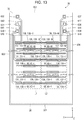
- FIG. 13 is a plan view showing a surface on the interposer substrate side of the actuator substrate of the second embodiment, and on which the piezoelectric elements are formed.
- liquid discharge head provided with a wiring substrate according to the present disclosure will be described by taking a liquid discharge head applied to a liquid discharge apparatus as a printing apparatus, as an example.
- FIG. 1 is a diagram showing a schematic configuration of a liquid discharge apparatus 1 to which a liquid discharge head of the present embodiment is applied.
- the liquid discharge apparatus 1 according to the present embodiment is a serial printing type ink jet printer where a carriage 22 , on which liquid discharge heads 21 for discharging ink as an example of a liquid are mounted, reciprocates and ink is discharged onto a medium P to be transported.
- a carriage 22 on which liquid discharge heads 21 for discharging ink as an example of a liquid are mounted, reciprocates and ink is discharged onto a medium P to be transported.
- an axis in which the carriage 22 moves is a X axis
- a direction in which the medium P is transported is a Y direction
- a direction in which the ink is discharged is a Z direction.
- the X axis, the Y direction and the Z direction are orthogonal to each other.
- the medium P any printing target such as a printing paper, a resin film, and a cloth may be
- the liquid discharge apparatus 1 includes a liquid container 2 , a control unit 10 , a head unit 20 , a moving unit 80 , and a transport unit 70 .
- the liquid container 2 a plurality of kinds of inks to be discharged onto the medium P are stored. Specifically, six types of inks of black, cyan, magenta, yellow, red, and gray are stored in the liquid container 2 .
- the number and types of inks stored in the liquid container 2 is merely an example, and the number of inks stored in the liquid container 2 may be five or less, or may be seven or more.
- inks of colors such as light cyan, light magenta, green may be stored in the liquid container 2 .
- an ink cartridge, a bag-shaped ink pack formed of a flexible film, an ink tank capable of replenishing ink, or the like are used.
- the control unit 10 includes a processing circuit such as a central processing unit (CPU), a field programmable gate array (FPGA), or the like and a memory circuit such as a semiconductor memory, and controls each element of the liquid discharge apparatus 1 .
- a processing circuit such as a central processing unit (CPU), a field programmable gate array (FPGA), or the like and a memory circuit such as a semiconductor memory, and controls each element of the liquid discharge apparatus 1 .
- the head unit 20 includes the liquid discharge heads 21 and the carriage 22 .
- the liquid discharge heads 21 are mounted on the carriage 22 .
- the carriage 22 is fixed to an endless belt 82 included in the moving unit 80 in a state where the liquid discharge heads 21 are mounted.
- the liquid container 2 may also be mounted on the carriage 22 .
- control signals Ctrl-H including a plurality of signals for controlling the liquid discharge heads 21 and one or a plurality of drive signals COM for driving the liquid discharge heads 21 are input from the control unit 10 to the liquid discharge heads 21 .
- the liquid discharge heads 21 discharge ink supplied from the liquid container 2 in the Z direction based on the control signals Ctrl-H and one or more drive signals COM.
- the moving unit 80 includes a carriage motor 81 and the endless belt 82 .
- the carriage motor 81 operates based on a control signal Ctrl-C input from the control unit 10 .
- the endless belt 82 pivots in accordance with an operation of the carriage motor 81 . In this way, the carriage 22 fixed to the endless belt 82 reciprocates in the X axis.
- the transport unit 70 includes a transport motor 71 and transport rollers 72 .
- the transport motor 71 operates based on a control signal Ctrl-T input from the control unit 10 . Then, the transport rollers 72 pivot according to an operation of the transport motor 71 .
- the medium P is transported in the Y direction according to the pivot of the transport rollers 72 .
- the liquid discharge apparatus 1 causes ink to land at any position on a surface of the medium P to form a desired image on the medium P by discharging the ink from the liquid discharge heads 21 included in the head unit 20 in conjunction with the transport of the medium P by the transport unit 70 and the reciprocation of the head unit 20 by the moving unit 80 based on various signals output from the control unit 10 .
- FIG. 2 is a block diagram showing an electrical configuration of the liquid discharge apparatus 1 .
- the liquid discharge apparatus 1 includes the control unit 10 , the head unit 20 , the moving unit 80 , and the transport unit 70 .
- the control unit 10 includes a control circuit 100 , drive circuits 50 a and 50 b , a reference voltage generation circuit 51 , and a power supply voltage generation circuit 53 .
- the control circuit 100 includes, for example, a processor such as a microcontroller.
- the control circuit 100 generates data or signals for controlling the liquid discharge apparatus 1 based on various signals such as image data supplied from a host computer.
- control circuit 100 outputs the control signal Ctrl-C corresponding to a scanning position of the head unit 20 to the moving unit 80 .
- the control circuit 100 outputs the control signal Ctrl-T to the transport unit 70 . Consequently, the transportation of the medium P is controlled.
- the control signal Ctrl-C may be supplied to the moving unit 80 after a signal conversion by a signal conversion circuit (not shown).
- the control signal Ctrl-T may be supplied to the transport unit 70 after a signal conversion by the signal conversion circuit (not shown).
- control circuit 100 outputs a printing data signal SI, a change signal CH, a latch signal LAT, and a clock signal SCK as the control signal Ctrl-H for controlling the head unit 20 based on various signals such as image data supplied from the host computer.
- control circuit 100 outputs drive control signals dA and dB which are digital signals of the drive circuits 50 a and 50 b , respectively.
- the drive control signal dA is input to the drive circuit 50 a .
- the drive circuit 50 a performs digital/analog conversion on the drive control signal dA, and then class-D amplifies the converted analog signal to generate the drive signal COMA.
- the drive circuit 50 a outputs the generated drive signal COMA to the head unit 20 .
- the drive control signal dB is input to the drive circuit 50 b .
- the drive circuit 50 b performs digital/analog conversion on the drive control signal dB, and then class-D amplifies the converted analog signal to generate the drive signal COMB.
- the drive circuit 50 b outputs the generated drive signal COMB to the head unit 20 .
- the reference voltage generation circuit 51 generates a reference voltage signal VBS supplied to piezoelectric elements 60 included in the head unit 20 .
- the reference voltage signal VBS is, for example, a voltage signal of DC 6 V. Then, the reference voltage generation circuit 51 outputs the generated reference voltage signal VBS to the head unit 20 . Note that the reference voltage generation circuit 51 may generate and output a voltage signal of a different voltage value other than DC 6 V such as a ground electric potential.
- the power supply voltage generation circuit 53 generates a high voltage signal VHV and a low voltage signal VDD.
- the high voltage signal VHV is, for example, a voltage signal of DC 42 V.
- the low voltage signal VDD is, for example, a voltage signal of 3.3 V.
- Each of the high voltage signal VHV and the low voltage signal VDD is used as a power supply voltage of various configurations in the control unit 10 and is also output to the head unit 20 .
- the power supply voltage generation circuit 53 may generate various voltage signals other than the high voltage signal VHV and the low voltage signal VDD.
- the head unit 20 includes a plurality of liquid discharge heads 21 .
- the print data signal SI, the change signal CH, the latch signal LAT, the clock signal SCK, the drive signals COMA and COMB, the reference voltage signal VBS, the high voltage signal VHV and the low voltage signal VDD, which are input to the head unit 20 , are branched in the head unit 20 and then supplied to each of the plurality of liquid discharge heads 21 .
- each of the plurality of liquid discharge heads 21 has the same configuration.
- Each liquid discharge head 21 includes a drive signal selection circuit 200 and a plurality of discharge units 600 .
- the drive signal selection circuit 200 generates drive signals VOUT by selecting or deselecting the drive signals COMA and COMB based on the input signals such as print data signal SI, the clock signal SCK, the latch signal LAT and the change signal CH. Then, the drive signal selection circuit 200 supplies the drive signal VOUT to the piezoelectric element 60 included in the corresponding discharge unit 600 . The piezoelectric element 60 is displaced when the drive signal VOUT is supplied. Then the amount of ink according to the displacement is discharged from the discharge unit 600 .
- FIG. 3 is a disassembled perspective view of a liquid discharge head 21 .
- FIG. 4 is a cross-sectional view showing a cross section of the liquid discharge head 21 taken along the line IV-IV in FIG. 3 .
- the liquid discharge head 21 includes 2M number of nozzles N arranged in the Y direction.
- 2M number nozzles N are arranged in two lines of a line L 1 and a line L 2 .
- nozzles N 1 each of the M number of nozzles N belonging to the line L 1
- nozzles N 2 each of the M number of nozzles N belonging to the line L 2 .
- 2M number of nozzles N may be arranged in so-called, a zigzag shape or a staggered shape, so that the position in the Y direction between the positions of the m-th nozzle N 1 among the M number of nozzles N 1 belonging to the line L 1 and the m-th nozzle N 2 among the M number of nozzles N 2 belonging to the line L 2 are different.
- the liquid discharge head 21 includes a flow channel substrate 32 .
- the flow channel substrate 32 is a plate-shaped member including a surface F 1 and a surface FA.
- the surface F 1 is a surface on the side of the medium P as viewed from the liquid discharge head 21
- the surface FA is a surface on the side opposite to the surface F 1 .
- a pressure chamber substrate 34 On top of the surface of the surface FA, a pressure chamber substrate 34 , a vibration substrate 36 , a plurality of piezoelectric elements 60 , an interposer substrate 38 , and a housing portion 40 are provided.
- a nozzle plate 52 and a vibration absorber 54 are provided on top of the surface of the surface F 1 .
- Each element of the liquid discharge head 21 is roughly a plate-shaped member elongated in the Y direction, and is stacked in the Z direction.
- the nozzle plate 52 is a plate-shaped member, and 2M number of nozzles N, which are through holes, are formed in the nozzle plate 52 .
- 600 or more nozzles N are formed on the nozzle plate 52 , and the nozzles N corresponding to each of the lines L 1 and L 2 are provided at a density of 300 or more nozzles per inch.
- the flow channel substrate 32 is a plate-shaped member for forming a flow channel for ink. As shown in FIGS. 3 and 4 , a flow channel RA is formed on the flow channel substrate 32 . Further, on the flow channel substrate 32 , 2M number of flow channels 31 and 2M number of flow channels 33 are formed so as to correspond to 2M number of nozzles N on a one-to-one basis. The flow channels 31 and the flow channels 33 are opening ports formed so as to pass through the flow channel substrate 32 as shown in FIG. 4 . A flow channel 33 communicates with a nozzle N corresponding to the flow channel 33 . Further, on the surface F 1 of the flow channel substrate 32 , two flow channels 39 are formed.
- One of the two flow channels 39 is a flow channel that connects the flow channel RA and M number of flow channels 31 corresponding one to one to the M number of nozzles N 1 belonging to the line L 1
- the other is a flow channel that connects the flow channel RA and M number of flow channels 31 corresponding one to one to the M number of nozzles N 2 belonging to the line L 2 .
- the pressure chamber substrate 34 is a plate-shaped member in which 2M number of opening ports 37 are formed so as to correspond to the 2M number of nozzles N in a one-to-one correspondence.
- the vibration substrate 36 is provided on a surface of the pressure chamber substrate 34 opposite to the flow channel substrate 32 .
- the vibration substrate 36 and the surface FA of the flow channel substrate 32 face each other with a space inside each opening port 37 .
- the space located between the surface FA of the flow channel substrate 32 and the vibration substrate 36 inside the opening port 37 functions as a pressure chamber C for applying pressure to the ink filled in the space.
- the pressure chamber C is, for example, a space having an X axis as a longitudinal axis and a Y direction as a short axis.
- 2M number of pressure chambers C are provided so as to correspond to the 2M number of nozzles N on a one-to-one basis.
- the pressure chamber C provided corresponding to the nozzle N 1 communicates with the flow channel RA via the flow channel 31 and the flow channel 39 , and also communicates with the nozzle N 1 via the flow channel 33 . Further, the pressure chamber C provided corresponding to the nozzle N 2 communicates with the flow channel RA via the flow channel 31 and the flow channel 39 , and also communicates with the nozzle N 2 via the flow channel 33 .
- 2M number of piezoelectric elements 60 are provided so as to correspond to the 2M number of pressure chambers C in a one-to-one basis.
- the drive signal VOUT based on the drive signals COMA and COMB is supplied to one end of the piezoelectric element 60 , and the reference voltage signal VBS is supplied to the other end.
- the piezoelectric element 60 deforms (drives) in accordance with an electric potential difference between the drive signal VOUT and the reference voltage signal VBS.
- the vibration substrate 36 vibrates interlockingly with the deformation of the piezoelectric element 60 , and when the vibration substrate 36 vibrates, a pressure in the pressure chamber C changes. As the pressure in the pressure chamber C changes, the ink filled in the pressure chamber C is discharged via the flow channel 33 and the nozzle N.
- the pressure chamber C, the flow channels 31 and 33 , the nozzle N, the vibration substrate 36 , and the piezoelectric element 60 function as the discharge unit 600 for discharging the ink filled in the pressure chamber C by driving the piezoelectric element 60 . That is, in the liquid discharge head 21 , a plurality of discharge units 600 are arranged in two lines along the Y direction.
- the interposer substrate 38 shown in FIGS. 3 and 4 has a surface G 1 and a surface G 2 oppose the surface G 1 , and propagates drive signals COMA and COMB to the drive IC 62 .
- the interposer substrate 38 is a plate-shaped member for protecting the 2M number of piezoelectric elements 60 formed on the vibration substrate 36 , and is provided on the surface of the vibration substrate 36 or the surface of the pressure chamber substrate 34 .
- Two accommodation spaces 45 are formed on the surface G 1 of the interposer substrate 38 , which is a surface on the side of the medium P as viewed from the liquid discharge head 21 .
- One of the two accommodation spaces 45 is a space for accommodating M number of piezoelectric elements 60 corresponding to the M number of nozzles N 1 and the other is a space for accommodating M number of piezoelectric elements 60 corresponding to the M number of nozzles N 2 .
- a height which is a width in a Z direction of the accommodation space 45 is sufficiently large so that the piezoelectric element 60 and the interposer substrate 38 do not come into contact with each other even when the piezoelectric element 60 is displaced.
- the drive IC 62 is provided on the surface G 2 of the interposer substrate 38 , which is a surface on the side opposite to the surface G 1 .
- the drive signal selection circuit 200 shown in FIG. 2 is mounted on the drive IC 62 .
- the drive signals COMA and COMB, the printing data signal SI, the change signal CH, the latch signal LAT and the clock signal SCK input to the liquid discharge head 21 are input to the drive IC 62 .
- the drive IC 62 generates and outputs a drive signal VOUT by switching whether or not to supply the drive signals COMA and COMB to each piezoelectric element 60 . That is, the drive IC 62 controls a supply of the drive signals COMA and COMB to the piezoelectric element 60 .
- a plurality of wirings are provided on the interposer substrate 38 for propagating the drive signals COMA, COMB, and VOUT, the print data signal SI, the change signal CH, the latch signal LAT and the clock signal SCK.
- the drive signal VOUT output from the drive IC 62 is supplied to the piezoelectric element 60 via the wiring.
- connection wiring 64 is electrically connected to the interposer substrate 38 .
- the connection wiring 64 is a member in which a plurality of wirings for transferring a plurality of signals input to the liquid discharge head 21 to the drive IC 62 are formed, and may be, for example, an flexible printed circuit (FPC), an flexible flat cable (FFC), or the like. Details of the plurality of wirings formed on the interposer substrate 38 will be described later.
- the drive IC 62 generates and outputs the drive signal VOUT supplied to the piezoelectric element 60 by selecting or deselecting the drive signals COMA and COMB based on the printing data signal SI, the change signal CH, and the latch signal LAT.
- the latch signal LAT defines a printing cycle Ta, which is a cycle for forming dots on the medium P. Specifically, a cycle from a generation of the latch signal LAT to a next generation of the latch signal LAT becomes the printing cycle Ta. Further, the change signal CH divides the printing cycle Ta into a plurality of cycles Tn (n is a positive integer).
- the printing data signal SI includes data signals corresponding to each of a plurality of discharge units 600 , and selects or deselects each of the drive signals COMA and COMB for each cycle Tn. In this way, the drive IC 62 generates the drive signal VOUT in the printing cycle Ta by selecting or deselecting each of the drive signals COMA and COMB for each cycle Tn based on the printing data signal SI.
- a generation procedure of the drive signal VOUT in the drive IC 62 will be described by taking the drive signals COMA and COMB shown in FIG. 5 as an example.
- the printing cycle Ta in FIG. 5 is configured with two cycles, which are a cycle T 1 from a generation of the latch signal LAT to a generation of the change signal CH and a cycle T 2 from a generation of the change signal CH to a generation of the latch signal LAT.
- the drive signal COMA is a signal configured with a waveform in which a trapezoidal waveform Adp 1 disposed in the cycle T 1 and a trapezoidal waveform Adp 2 disposed in the cycle T 2 are continuous.
- the trapezoidal waveforms Adp 1 and Adp 2 have substantially the same waveforms, and when each of the waveforms is supplied to one end of the piezoelectric element 60 , a moderate amount of ink is discharged from the corresponding nozzle N of the discharge unit 600 .
- the drive signal COMB is a signal configured with a waveform in which a trapezoidal waveform Bdp 1 disposed in the cycle T 1 and a trapezoidal waveform Bdp 2 disposed in the cycle T 2 are continuous.
- the trapezoidal waveforms Bdp 1 and Bdp 2 have different waveforms, and among the waveforms, the trapezoidal waveform Bdp 1 is a waveform for slightly vibrating the ink in the vicinity of the opening portion of the nozzle N to prevent viscosity of the ink from increasing. Therefore, even if the trapezoidal waveform Bdp 1 is supplied to one end of the piezoelectric element 60 , an ink droplet is not discharged from the corresponding nozzle N of the discharge unit 600 .
- the trapezoidal waveform Bdp 2 is a waveform different from that of both of the trapezoidal waveforms Adp 1 and Adp 2 , and when the trapezoidal waveform Bdp 2 is supplied to one end of the piezoelectric element 60 , a small amount of ink less than the moderate amount is discharged from the corresponding nozzle N of the discharge unit 600 .
- the drive IC 62 Based on the printing data signal SI, the drive IC 62 generates the drive signal VOUT by controlling whether to supply each of the drive signals COMA and COMB to each of the piezoelectric elements 60 included in the plurality of discharge units 600 in the cycle T 1 and the cycle T 2 .
- the drive signal COMA is selected in the cycles T 1 and T 2 .
- the drive IC 62 outputs the drive signal VOUT configured with a waveform in which the trapezoidal waveform Adp 1 and the trapezoidal waveform Adp 2 are continuous in the printing cycle Ta.
- a moderate amount of ink is discharged twice from the nozzle N corresponding to the piezoelectric element 60 to which the drive signal VOUT is supplied. Therefore, a large dot is formed on the medium P.
- the drive signal COMA is selected in the cycle T 1
- the drive signal COMB is selected in the cycle T 2 .
- the drive IC 62 outputs the drive signal VOUT configured with a waveform in which the trapezoidal waveform Adp 1 and the trapezoidal waveform Bdp 2 are continuous in the printing cycle Ta.
- a moderate amount of ink and a small amount of ink are discharged from the nozzle N corresponding to the piezoelectric element 60 to which the drive signal VOUT is supplied. Therefore, a medium dot is formed on the medium P.
- the drive IC 62 outputs the drive signal VOUT configured with the trapezoidal waveform Bdp 2 in the printing cycle Ta. At this time, a small amount of ink is discharged from the nozzle N corresponding to the piezoelectric element 60 to which the drive signal VOUT is supplied. Therefore, a small dot is formed on the medium P.
- the drive signal COMB is selected in the cycle T 1 , and neither the drive signals COMA nor COMB are selected in the cycle T 2 .
- the drive IC 62 outputs the drive signal VOUT configured with the trapezoidal waveform Bdp 1 in the printing cycle Ta.
- the piezoelectric element 60 to which the drive signal VOUT is supplied is driven to such an extent that the ink is not discharged, and the ink is not discharged from the nozzle N corresponding to the piezoelectric element 60 . Therefore, a dot is not formed on the medium P.
- a voltage at the start timing of the trapezoidal waveforms Adp 1 , Adp 2 , Bdp 1 , and Bdp 2 and a voltage at the end timing are common to the voltage Vc. That is, each of the drive signals COMA and COMB is configured with a waveform starting at the voltage Vc and ending at the voltage Vc. Note that the drive signals COMA and COMB shown in FIG. 5 are examples and are not limited thereto.
- a housing portion 40 is a case for storing the ink supplied to the 2M number of pressure chambers C.
- a surface FB of the casing portion 40 which is a surface on the side of the medium P as viewed from the liquid discharge head 21 , is for example, fixed to the surface FA of the flow channel substrate 32 with an adhesive.
- On the surface FB of the casing portion 40 a groove-shaped concave portion 42 extending in the Y direction is formed.
- the interposer substrate 38 and the drive IC 62 are accommodated inside the concave portion 42 .
- the connection wiring 64 is extended in the Y direction so as to pass through inside of the concave portion 42 .
- the housing portion 40 is formed by, for example, injection molding of a resin material. As shown in FIG. 4 , a flow channel RB communicating with the flow channel RA is formed in the housing portion 40 .
- the flow channel RA and the flow channel RB function as a reservoir Q that stores the ink to be supplied to the 2M number of pressure chambers C.
- two introducing ports 43 for introducing the ink supplied from the liquid container 2 to the reservoir Q are provided on the surface F 2 which is a surface opposite to the surface FB of the housing portion 40 .
- the ink supplied from the liquid container 2 to the two introducing ports 43 flows into the flow channel RA via the flow channel RB.
- a part of the ink flowed into the flow channel RA is supplied to the pressure chamber C corresponding to the nozzle N via the flow channel 39 and the flow channel 31 .
- the ink filled in the pressure chamber C corresponding to the nozzle N is discharged from the nozzle N via the flow channel 33 by driving the piezoelectric element 60 corresponding to the nozzle N.
- FIG. 6 is a diagram for explaining electrical connections of the drive IC 62 , the interposer substrate 38 , the vibration substrate 36 , and piezoelectric elements 60 .
- the vibration substrate 36 is a plate-shaped member and can vibrate.
- a plurality of piezoelectric elements 60 are arranged in two lines in the Y direction as shown in FIG. 3 .
- a lower electrode layer 137 , a piezoelectric layer 138 , and an upper electrode layer 139 are sequentially stacked along the Z direction on an upper surface of the vibration substrate 36 .
- the piezoelectric layer 138 is displaced in accordance with an electric potential difference generated between the lower electrode layer 137 and the upper electrode layer 139 of the piezoelectric element 60 configured as described above, and the vibration substrate 36 is deformed in the Z direction in accordance with the displacement of the piezoelectric layer 138 .
- the lower electrode layer 137 is an individual electrode that supplies the drive signal VOUT to each piezoelectric element 60
- the upper electrode layer 139 is a common electrode common to supply the reference voltage signal VBS to the plurality of piezoelectric elements 60 .
- the lower electrode layer 137 may be a common electrode and the upper electrode layer 139 may be an individual electrode.
- the interposer substrate 38 is stacked on the upper surface of the vibration substrate 36 in the Z direction. On the interposer substrate 38 , a plurality of wirings and electrodes for supplying various signals to the vibration substrate 36 are provided. Details of the plurality of wirings and electrodes provided on the interposer substrate 38 will be described later.
- bump electrodes 141 and 142 for supplying the drive signal VOUT output from the drive IC 62 to the corresponding piezoelectric element 60 are provided.
- the bump electrode 141 is provided inside the plurality of piezoelectric elements 60 arranged in two lines, for example, at a position corresponding to the lower electrode layer 137 of the piezoelectric element 60 corresponding to the nozzle N 1 included in the line L 1 shown in FIG. 3 .
- the bump electrode 141 and the lower electrode layer 137 are electrically connected to each other, whereby the drive signal VOUT is supplied to the piezoelectric element 60 .
- the bump electrode 141 is also electrically connected to an electrode 151 formed on the surface G 1 of the interposer substrate 38 .
- the bump electrode 142 is provided inside the plurality of piezoelectric elements 60 arranged in two lines, for example, at a position corresponding to the lower electrode layer 137 of the piezoelectric element 60 corresponding to the nozzle N 2 included in the line L 2 shown in FIG. 3 .
- the bump electrode 142 and the lower electrode layer 137 are electrically connected to each other, whereby the drive signal VOUT is supplied to the piezoelectric element 60 .
- the bump electrode 142 is also electrically connected to an electrode 152 formed on the surface G 1 of the interposer substrate 38 .
- a bump electrode 143 for supplying the reference voltage signal VBS to the piezoelectric element 60 is provided on the surface G 1 of the interposer substrate 38 .
- the bump electrode 143 is provided at a position corresponding to the upper electrode layer 139 of the piezoelectric element 60 .
- the bump electrode 143 and the upper electrode layer 139 are electrically connected to each other, whereby the reference voltage signal VBS is supplied to the piezoelectric element 60 .
- the bump electrode 143 is also electrically connected to an electrode 153 formed on the surface G 1 of the interposer substrate 38 .
- An electrode 171 corresponding to the electrode 151 is formed on the surface G 2 of the interposer substrate 38 on the side opposite to the surface G 1 .
- the electrode 151 and the electrode 171 are electrically connected by a through-wiring 173 passing through the interposer substrate 38 .
- An electrode 172 corresponding to the electrode 152 is formed on the surface G 2 of the interposer substrate 38 .
- the electrode 152 and the electrode 172 are electrically connected by a through-wiring 174 passing through the interposer substrate 38 .
- electrodes 190 to 199 are formed between the electrode 171 and the electrode 172 .
- the electrodes 190 to 199 are arranged in the order of the electrodes 190 , 191 , 192 , 193 , 194 , 195 , 196 , 197 , 198 , and 199 in a direction from the electrode 171 toward the electrode 172 between the electrode 171 and the electrode 172 .
- the drive IC 62 is mounted on the upper surface of the interposer substrate 38 in the Z direction.
- a bump electrode 201 is provided, on a surface of the drive IC 62 facing the interposer substrate 38 and in a region facing the electrode 171 of the interposer substrate 38 . Further, the bump electrode 201 is also electrically connected to an electrode 211 formed on the drive IC 62 .
- a bump electrode 202 is provided, on a surface of the drive IC 62 facing the interposer substrate 38 and in a region facing the electrode 172 of the interposer substrate 38 . Further, the bump electrode 202 is also electrically connected to an electrode 212 formed on the drive IC 62 .
- Bump electrodes 220 to 229 are provided, on a surface of the drive IC 62 facing the interposer substrate 38 and in a region facing each of the electrodes 190 to 199 of the interposer substrate 38 . Further, each of the bump electrodes 220 to 229 is electrically connected to each of the electrodes 230 to 239 formed on the drive IC 62 .
- FIG. 7 is a diagram showing an example of a configuration of a bump electrode 240 .
- a top view in FIG. 7 shows a plan view of the bump electrode 240
- a bottom view in FIG. 7 shows a side view of the bump electrode 240 .
- the bump electrode 240 is a resin core bump including a resin core portion 241 protrudingly provided, and a metal electrode 242 formed on the upper part of the core portion 241 .
- a spacing between the bump electrodes 240 can be reduced since a space between patterns of the electrodes 242 can be constituted by an insulator core portion 241 .
- the bump electrode 240 is illustrated and described as including the core portion 241 and the electrode 242 individually, a plurality of bump electrodes 240 may be formed by forming a plurality of electrodes 242 on an upper part of the core portion 241 provided in common.
- each of the drive IC 62 , the interposer substrate 38 , and the vibration substrate 36 may be electrically connected by a method other than the bump electrode 240 described above.
- each of the drive IC 62 , the interposer substrate 38 , and the vibration substrate 36 may be electrically connected by gold bumps.
- Each of the drive IC 62 , the interposer substrate 38 , and the vibration substrate 36 is joined by a bonding technology using adhesion such as a conductive adhesive, a non-conductive adhesive, an anisotropic conductive adhesive, or the like in a state of being electrically connected by the bump electrode 240 .
- FIG. 8 is a plan view showing a configuration when the interposer substrate 38 is viewed from the surface G 2 .
- the drive ICs 62 mounted on the interposer substrate 38 are indicated by one-dot chain lines.
- FIG. 9 is a plan view showing a configuration when the interposer substrate 38 is viewed from the surface G 1 .
- FIG. 10 is a plan view showing a surface which is on the interposer substrate 38 side of the actuator substrate 35 including the vibration substrate 36 , and on which piezoelectric elements 60 are formed. Note that the interposer substrate 38 described below is an example of a wiring substrate in the present embodiment.
- the interposer substrate 38 includes a substrate 300 .
- the substrate 300 has a first surface 305 and a second surface 306 opposite to the first surface 305 .
- the substrate 300 has a substantially rectangular shape formed by a side 301 , a side 302 facing the side 301 , a side 303 longer than the side 301 , and a side 304 facing the side 303 .
- the side 301 or the side 302 is an example of a first side
- the side 303 or the side 304 is an example of a second side.
- connection wiring region 65 including a plurality of electrodes to which the connection wiring 64 is connected, a plurality of wirings, and a plurality of electrodes, are formed.
- the first surface 305 of the substrate 300 is a surface having the same direction as the surface G 2 of the interposer substrate 38 and the second surface 306 of the substrate 300 is a surface having the same direction as the surface G 1 of the interposer substrate 38 .
- electrodes 380 to 389 and 392 to which the connection wiring 64 is electrically connected are formed in the connection wiring region 65 .
- the electrode 380 is formed on the wiring 310 .
- the electrode 380 electrically connectes the wiring 310 with the connection wiring 64 .
- the wiring 310 is a wiring pattern formed along the Y direction from the side 301 toward the side 302 on the first surface 305 of the substrate 300 .
- the drive signal COMA is supplied to the electrode 380 .
- the wiring 310 propagates the drive signal COMA input via the electrode 380 .
- an electrode 190 is formed on the wiring 310 .
- the electrode 190 is electrically connected to the bump electrode 220 as shown in FIG. 6 .
- the drive signal COMA supplied via the electrode 380 is propagated through the wiring 310 and then supplied to the drive IC 62 via the bump electrode 220 .
- M number of electrodes 190 are formed on the wiring 310 corresponding to each of the M number of nozzles N 1 forming the line L 1 .
- M number of bump electrodes 220 are provided corresponding to the M number of electrodes 190 .
- the electrode 381 is formed on the wiring 311 .
- the electrode 381 electrically connectes the wiring 311 with the connection wiring 64 .
- the wiring 311 is a wiring pattern formed along the Y direction from the side 301 toward the side 302 on the side 304 side of the wiring 310 on the first surface 305 of the substrate 300 .
- the drive signal COMB is supplied to the electrode 381 .
- the wiring 311 propagates the drive signal COMB input via the electrode 381 .
- an electrode 191 is formed on the wiring 311 .
- the electrode 191 is electrically connected to the bump electrode 221 as shown in FIG. 6 .
- the drive signal COMB supplied via the electrode 381 is propagated through the wiring 311 and then supplied to the drive IC 62 via the bump electrode 221 .
- M number of electrodes 191 are formed on the wiring 311 corresponding to each of the M number of nozzles N 1 forming the line L 1 .
- M number of bump electrodes 221 are provided corresponding to the M number of electrodes 191 .
- the electrode 382 is formed on the wiring 312 .
- the electrode 382 electrically connectes the wiring 312 with the connection wiring 64 .
- the wiring 312 is a wiring pattern formed along the Y direction from the side 301 toward the side 302 on the side 304 side of the wiring 311 on the first surface 305 of the substrate 300 .
- the high voltage signal VHV is supplied to the electrode 382 .
- the wiring 312 propagates the high voltage signal VHV input via the electrode 382 .
- an electrode 192 is formed on the wiring 312 .
- the electrode 192 is electrically connected to the bump electrode 222 as shown in FIG. 6 .
- the high voltage signal VHV supplied via the electrode 382 is propagated through the wiring 312 and then supplied to the drive IC 62 via the bump electrode 222 .
- M number of electrodes 192 are formed on the wiring 312 corresponding to each of the M number of nozzles N 1 or nozzles N 2 forming the line L 1 or the line L 2 .
- M number of bump electrodes 222 are provided corresponding to the M number of electrodes 192 .
- Each of the electrodes 383 to 386 is formed on each wiring of the wirings 313 to 316 .
- Each of the electrodes 383 to 386 electrically connectes each of the wirings 313 to 316 with the connection wiring 64 .
- the wiring 313 is a wiring pattern formed along the Y direction from the side 301 toward the side 302 on the side 304 side of the wiring 312 on the first surface 305 of the substrate 300 .
- the wiring 313 propagates the printing data signal SI input via the electrode 383 .
- the wiring 314 is a wiring pattern formed along the Y direction from the side 301 toward the side 302 on the side 304 side of the wiring 313 on the first surface 305 of the substrate 300 .
- the wiring 314 propagates the change signal CH input via the electrode 384 .
- the wiring 315 is a wiring pattern formed along the Y direction from the side 301 toward the side 302 on the side 304 side of the wiring 314 on the first surface 305 of the substrate 300 .
- the wiring 315 propagates the latch signal LAT input via the electrode 385 .
- the wiring 316 is a wiring pattern formed along the Y direction from the side 301 toward the side 302 on the side 304 side of the wiring 315 on the first surface 305 of the substrate 300 .
- the wiring 316 propagates the clock signal SCK input via the electrode 386 .
- Each of electrodes 193 to 196 is formed on each wiring of the wirings 313 to 316 .
- Each of the electrodes 193 to 196 is electrically connected to each of the bump electrodes 223 to 226 as shown in FIG. 6 .
- the printing data signal SI, the change signal CH, the latch signal LAT, and the clock signal SCK are supplied to the drive IC 62 .
- each of the electrodes 193 to 196 is formed by M number of electrodes along the Y direction corresponding to the M number of nozzles N 1 or nozzles N 2 forming the line L 1 or L 2 .
- each of the bump electrodes 223 to 226 is formed by M number of bump electrodes corresponding to each of the electrodes 193 to 196 .
- the electrode 387 is formed on the wiring 317 .
- the electrode 387 electrically connectes the wiring 317 with the connection wiring 64 .
- the wiring 317 is a wiring pattern formed along the Y direction from the side 301 toward the side 302 on the side 304 side of the wiring 316 on the first surface 305 of the substrate 300 .
- the low voltage signal VDD is supplied to the electrode 387 .
- the wiring 317 propagates the low voltage signal VDD input via the electrode 387 .
- an electrode 197 is formed on the wiring 317 .
- the electrode 197 is electrically connected to the bump electrode 227 as shown in FIG. 6 .
- the low voltage signal VDD supplied via the electrode 387 is propagated through the wiring 317 and then supplied to the drive IC 62 via the bump electrode 227 .
- M number of electrodes 197 are formed on the wiring 317 corresponding to each of the M number of nozzles N 1 or nozzles N 2 forming the line L 1 or the line L 2 .
- M number of bump electrodes 227 are provided corresponding to the M number of electrodes 197 .
- the electrode 388 is formed on the wiring 318 .
- the electrode 388 electrically connectes the wiring 318 with the connection wiring 64 .
- the wiring 318 is a wiring pattern formed along the Y direction from the side 301 toward the side 302 on the side 304 side of the wiring 317 on the first surface 305 of the substrate 300 .
- the drive signal COMB is supplied to the electrode 388 .
- the wiring 318 propagates the drive signal COMB input via the electrode 388 .
- an electrode 198 is formed on the wiring 318 .
- the electrode 198 is electrically connected to the bump electrode 228 as shown in FIG. 6 .
- the drive signal COMB supplied via the electrode 388 is propagated through the wiring 318 and then supplied to the drive IC 62 via the bump electrode 228 .
- M number of electrodes 198 are formed on the wiring 318 corresponding to each of the M number of nozzles N 2 forming the line L 2 .
- M number of bump electrodes 228 are provided corresponding to the M number of electrodes 198 .
- the electrode 389 is formed on the wiring 319 .
- the electrode 389 electrically connectes the wiring 319 with the connection wiring 64 .
- the wiring 319 is a wiring pattern formed along the Y direction from the side 301 toward the side 302 on the side 304 side of the wiring 318 on the first surface 305 of the substrate 300 .
- the drive signal COMA is supplied to the electrode 389 .
- the wiring 319 propagates the drive signal COMA input via the electrode 389 .
- an electrode 199 is formed on the wiring 319 .
- the electrode 199 is electrically connected to the bump electrode 229 as shown in FIG. 6 .
- the drive signal COMA supplied via the electrode 389 is propagated through the wiring 319 and then supplied to the drive IC 62 via the bump electrode 229 .
- M number of electrodes 199 are formed on the wiring 319 corresponding to each of the M number of nozzles N 2 forming the line L 2 .
- M number of bump electrodes 229 are provided corresponding to the M number of electrodes 199 .
- the drive signals COMA and COMB, the high voltage signal VHV, the low voltage signal VDD, the printing data signal SI, the change signal CH, the latch signal LAT and the clock signal SCK, which are input to the interposer substrate 38 via the connection wiring 64 , are supplied to the drive ICs 62 .
- the number of the electrodes 190 to 199 and the bump electrodes 220 to 229 connection the interposer substrate 38 with the drive ICs 62 does not have to match the number of the nozzles N 1 or N 2 forming the line L 1 and the line L 2 . That is, the number of the electrodes 190 to 199 and the bump electrodes 220 to 229 provided on the interposer substrate 38 may be M pieces or more, and may be less than M pieces.
- the electrode 392 is formed on the wiring 390 .
- the electrode 392 electrically connectes the wiring 390 with the connection wiring 64 .
- the wiring 390 is formed between the wiring 314 and the wiring 315 which are formed on the first surface 305 of the substrate 300 , and is formed on a side of the side 301 .
- the reference voltage signal VBS is supplied to the electrode 392 .
- a through-wiring 391 passing through the substrate 300 and electrically connected to the wiring 390 is formed on a wiring 390 .
- the through-wiring 391 is electrically connected to the wiring 590 formed on the second surface 306 . That is, the through-wiring 391 passes through the substrate 300 and electrically connectes the wirings 390 with 590 .
- the reference voltage signal VBS input via the electrode 392 is propagated through the wiring 590 via the wiring 390 and the through-wiring 391 .
- An electrode 153 is formed on the wiring 590 .
- a bump electrode 143 is provided on the electrode 153 .
- the bump electrode 143 is electrically connected to an upper electrode layer 139 of the piezoelectric element 60 provided on the vibration substrate 36 .
- the reference voltage signal VBS is supplied to the piezoelectric element 60 via the electrode 153 and the bump electrode 143 .
- an electrode 171 is formed on the side 303 side of the wiring 310 on the first surface 305 of the substrate 300 .
- the drive signal VOUT supplied from the drive IC 62 to the piezoelectric element 60 corresponding to the nozzle N 1 is output to the electrode 171 .
- a through-wiring 173 passing through the substrate 300 and electrically connected to the electrode 171 is formed on a side 303 side of the electrode 171 .
- the through-wiring 173 is electrically connected to the electrode 151 on the second surface 306 .
- a bump electrode 141 is provided on the electrode 151 . As shown in FIG.
- the bump electrode 141 is electrically connected to a lower electrode layer 137 of the nozzle N 1 forming the line L 1 , among the piezoelectric elements 60 provided on the vibration substrate 36 .
- the drive signal VOUT is supplied to the piezoelectric element 60 via the electrode 151 and the bump electrode 141 .
- an electrode 172 is formed on the side 304 side of the wiring 319 on the first surface 305 of the substrate 300 .
- the drive signal VOUT supplied from the drive IC 62 to the piezoelectric element 60 corresponding to the nozzle N 2 is output to the electrode 172 .
- a through-wiring 174 passing through the substrate 300 and electrically connected to the electrode 172 is formed on a side 304 side of the electrode 172 .
- the through-wiring 174 is electrically connected to the electrode 152 on the second surface 306 .
- a bump electrode 142 is provided on the electrode 152 . As shown in FIG.
- the bump electrode 142 is electrically connected to the lower electrode layer 137 of the nozzle N 2 forming the line L 2 , among the piezoelectric elements 60 provided on the vibration substrate 36 .
- the drive signal VOUT is supplied to the piezoelectric element 60 via the electrode 152 and the bump electrode 142 .
- the actuator substrate 35 includes the vibration substrate 36 .
- M number of sets of the lower electrode layer 137 and the piezoelectric layer 138 corresponding to the nozzle N 1 forming the line L 1 , the lower electrode layer 137 and the piezoelectric layer 138 corresponding to the nozzle N 2 forming the line L 2 , and the upper electrode layer 139 commonly provided on the lines L 1 and L 2 are formed along the Y direction corresponding to the M number of nozzles N 1 forming the line L 1 . That is, as shown in FIGS.
- M number of electrodes are formed for each of the electrodes 151 , 152 , and 153
- M number of bump electrodes are formed for each of the bump electrodes 141 , 142 , and 143 .
- the electrode 171 - 1 provided on a side closest to the side 301 is electrically connected to a wiring 340 .
- the wiring 340 is formed along the Y direction from the side 301 side toward the side 302 side.
- the wiring 340 is electrically connected to the electrode 330 provided on the side 302 side of the electrode 171 -M.
- the electrode 171 - 1 is electrically connected to the drive IC 62 .
- the drive signal VOUT is input to the electrode 171 - 1 from the drive IC 62 .
- the drive signal VOUT input to the electrode 171 - 1 is supplied to the piezoelectric element 60 - 1 included in the line L 1 via the through-wiring 173 - 1 , the electrode 151 - 1 , and the bump electrode 141 - 1 . Therefore, the drive signal VOUT supplied to the piezoelectric element 60 - 1 included in the line L 1 , is supplied to the electrode 330 which is electrically connected to the electrode 171 - 1 .
- the electrode 330 provided as described above functions as an inspection electrode for performing an inspection/confirmation of signal waveform of the drive signal VOUT supplied to the piezoelectric element 60 - 1 included in the line L 1 .
- the piezoelectric element 60 - 1 included in the line L 1 is an example of a first drive element
- the drive signal VOUT supplied to the piezoelectric element 60 - 1 included in the line L 1 is an example of a first signal
- the electrode 171 - 1 to which the drive signal VOUT is input to the interposer substrate 38 is an example of a first electrode
- the electrode 330 electrically connected to the electrode 171 - 1 is an example of a third electrode.
- the electrode 171 -M provided on a side closest to the side 302 and provided at the M-th position from the side 301 , is electrically connected to the wiring 342 .
- the wiring 342 is formed along the Y direction from the side 301 toward the side 302 .
- the wiring 342 is electrically connected to the electrode 332 provided on the side 302 side of the electrode 330 .
- the electrode 171 -M is electrically connected to the drive IC 62 .
- the drive signal VOUT is input to the electrode 171 -M from the drive IC 62 .
- the drive signal VOUT input to the electrode 171 -M is supplied to the piezoelectric element 60 -M included in the line L 1 via the through-wiring 173 -M, the electrode 151 -M, and the bump electrode 141 -M. Therefore, the drive signal VOUT supplied to the piezoelectric element 60 -M included in the line L 1 , is supplied to the electrode 332 which is electrically connected to the electrode 171 -M.
- the electrode 332 provided as described above functions as an inspection electrode for performing an inspection/confirmation of signal waveform of the drive signal VOUT supplied to the piezoelectric element 60 -M included in the line L 1 .
- the piezoelectric element 60 -M included in the line L 1 is an example of a second drive element
- the drive signal VOUT supplied to the piezoelectric element 60 -M included in the line L 1 is an example of a second signal
- the electrode 171 -M to which the drive signal VOUT is input to the interposer substrate 38 is an example of a second electrode
- the electrode 332 electrically connected to the electrode 171 -M is an example of a fourth electrode.
- the electrode 171 - i provided at the i-th (i is any one of 2 to M ⁇ 1) position from the side 301 is electrically connected to the wiring 341 .
- the wiring 341 is formed along the Y direction from the side 301 toward the side 302 .
- the wiring 341 is electrically connected to the electrode 331 provided between the electrode 330 and the electrode 332 .
- the electrode 171 - i is electrically connected to the drive IC 62 .
- the drive signal VOUT is input to the electrode 171 - i from the drive IC 62 .
- the drive signal VOUT input to the electrode 171 - i is supplied to the piezoelectric element 60 - i included in the line L 1 via the through-wiring 173 - i , the electrode 151 - i , and the bump electrode 141 - i . Therefore, the drive signal VOUT supplied to the piezoelectric element 60 - i included in the line L 1 , is supplied to the electrode 331 which is electrically connected to the electrode 171 - i .
- the electrode 331 provided as described above functions as an inspection electrode for performing an inspection/confirmation of signal waveform of the drive signal VOUT supplied to the piezoelectric element 60 - i included in the line L 1 .
- the electrodes 171 - 1 , 171 - i , and 171 -M, and the electrodes 330 , 331 , and 332 are provided in the order of the electrodes 171 - 1 , 171 - i , 171 -M, 330 , 331 , and 332 , in the direction from the side 301 toward the side 302 . That is, in the Y direction along the side 303 , the electrode 171 -M is positioned between the electrode 171 - 1 and the electrode 331 , and the electrode 331 is positioned between the electrode 171 -M and the electrode 333 .
- the electrode 172 - 1 provided on a side closest to the side 301 is electrically connected to a wiring 349 .
- the wiring 349 is formed along the Y direction from the side 301 toward the side 302 .
- the wiring 349 is electrically connected to the electrode 339 provided on the side 302 side of the electrode 172 -M.
- the electrode 172 - 1 is electrically connected to the drive IC 62 .
- the drive signal VOUT is input to the electrode 172 - 1 from the drive IC 62 .
- the drive signal VOUT input to the electrode 172 - 1 is supplied to the piezoelectric element 60 - 1 included in the line L 2 via the through-wiring 174 - 1 , the electrode 152 - 1 , and the bump electrode 142 - 1 . Therefore, the drive signal VOUT supplied to the piezoelectric element 60 - 1 included in the line L 2 , is supplied to the electrode 339 which is electrically connected to the electrode 172 - 1 .
- the electrode 339 provided as described above functions as an inspection electrode for performing an inspection/confirmation of signal waveform of the drive signal VOUT supplied to the piezoelectric element 60 - 1 included in the line L 2 .
- the piezoelectric element 60 - 1 included in the line L 2 is another example of the first drive element
- the drive signal VOUT supplied to the piezoelectric element 60 - 1 included in the line L 2 is another example of the first signal
- the electrode 172 - 1 to which the drive signal VOUT is input to the interposer substrate 38 is another example of the first electrode
- the electrode 339 electrically connected to the electrode 172 - 1 is another example of the third electrode.
- the electrode 172 -M provided on a side closest to the side 302 and provided at the M-th position from the side 301 , is electrically connected to the wiring 347 .
- the wiring 347 is formed along the Y direction from the side 301 toward the side 302 .
- the wiring 347 is electrically connected to the electrode 337 provided on the side 302 side of the electrode 339 .
- the electrode 172 -M is electrically connected to the drive IC 62 .
- the drive signal VOUT is input to the electrode 172 -M from the drive IC 62 .
- the drive signal VOUT input to the electrode 172 -M is supplied to the piezoelectric element 60 -M included in the line L 2 via the through-wiring 174 -M, the electrode 152 -M, and the bump electrode 142 -M. Therefore, the drive signal VOUT supplied to the piezoelectric element 60 -M included in the line L 2 , is supplied to the electrode 337 which is electrically connected to the electrode 172 -M.
- the electrode 337 provided as described above functions as an inspection electrode for performing an inspection/confirmation of signal waveform of the drive signal VOUT supplied to the piezoelectric element 60 -M included in the line L 2 .
- the piezoelectric element 60 -M included in the line L 2 is another example of the second drive element
- the drive signal VOUT supplied to the piezoelectric element 60 -M included in the line L 2 is another example of the second signal
- the electrode 172 -M to which the drive signal VOUT is input to the interposer substrate 38 is another example of the second electrode
- the electrode 337 electrically connected to the electrode 172 -M is another example of the fourth electrode.
- the electrode 172 - i provided at the i-th (i is any one of 2 to M ⁇ 1) position from the side 301 is electrically connected to the wiring 348 .
- the wiring 348 is formed along the Y direction from the side 301 toward the side 302 .
- the wiring 348 is electrically connected to the electrode 338 provided between the electrode 337 and the electrode 339 .
- the electrode 172 - i is electrically connected to the drive IC 62 .
- the drive signal VOUT is input to the electrode 172 - i from the drive IC 62 .
- the drive signal VOUT input to the electrode 172 - i is supplied to the piezoelectric element 60 - i included in the line L 2 via the through-wiring 174 - i , the electrode 152 - i , and the bump electrode 142 - i . Therefore, the drive signal VOUT supplied to the piezoelectric element 60 - i included in the line L 2 , is supplied to the electrode 338 which is electrically connected to the electrode 172 - i .
- the electrode 338 provided as described above functions as an inspection electrode for performing an inspection/confirmation of signal waveform of the drive signal VOUT supplied to the piezoelectric element 60 - i.
- the electrodes 172 - 1 , 172 - i , and 172 -M, and the electrodes 337 , 338 , and 339 are provided in the order of the electrodes 172 - 1 , 172 - i , 172 -M, 339 , 338 , and 337 , in the direction from the side 301 toward the side 302 . That is, in the Y direction along the side 303 , the electrode 172 -M is positioned between the electrode 172 - 1 and the electrode 339 , and the electrode 339 is positioned between the electrode 172 -M and the electrode 337 .
- the electrode 333 is electrically connected to the wiring 310 that propagates the drive signal COMA input from the connection wiring 64 via the electrode 380 and outputs the drive signal COMA to the drive IC 62 via the electrode 190 , via a wiring 343 .
- the wiring 343 is electrically connected to the side 302 side of the wiring 310 .
- the wiring 343 is formed along the Y direction from the side 301 toward the side 302 .
- the electrode 333 is positioned on the side 302 side of the wiring 310 . Further, the electrode 333 is provided closer to the side 304 than the electrodes 330 , 331 , and 332 provided along the side 303 , and provided closer to the side 303 than the electrodes 337 , 338 , and 339 provided along the side 304 . In other words, a distance between the electrode 333 and the side 303 is longer than a distance between the electrode 330 and the side 303 , and a distance between the electrode 333 and the side 304 is longer than a distance between the electrode 339 and the side 304 .
- the electrode 334 is electrically connected to the wiring 311 that propagates the drive signal COMB input from the connection wiring 64 via the electrode 381 and outputs the drive signal COMB to the drive IC 62 via the electrode 191 , via a wiring 344 .
- the wiring 344 is electrically connected to the side 302 side of the wiring 311 .
- the wiring 344 is formed along the Y direction from the side 301 toward the side 302 .
- the electrode 334 is positioned on the side 302 side of the wiring 310 . Further, the electrode 334 is provided closer to the side 304 than the electrodes 330 , 331 , and 332 provided along the side 303 , and provided closer to the side 303 than the electrodes 337 , 338 , and 339 provided along the side 304 . In other words, a distance between the electrode 334 and the side 303 is longer than a distance between the electrode 330 and the side 303 , and a distance between the electrode 334 and the side 304 is longer than a distance between the electrode 339 and the side 304 .
- the electrode 335 is electrically connected to the wiring 318 that propagates the drive signal COMB input from the connection wiring 64 via the electrode 388 and outputs the drive signal COMB to the drive IC 62 via the electrode 198 , via a wiring 345 .
- the wiring 345 is electrically connected to the side 302 side of the wiring 318 .
- the wiring 345 is formed along the Y direction from the side 301 toward the side 302 .
- the electrode 335 is positioned on the side 302 side of the wiring 318 . Further, the electrode 335 is provided closer to the side 304 than the electrodes 330 , 331 , and 332 provided along the side 303 , and provided closer to the side 303 than the electrodes 337 , 338 , and 339 provided along the side 304 . In other words, a distance between the electrode 335 and the side 303 is longer than a distance between the electrode 330 and the side 303 , and a distance between the electrode 335 and the side 304 is longer than a distance between the electrode 339 and the side 304 .
- the electrode 336 is electrically connected to the wiring 319 that propagates the drive signal COMA input from the connection wiring 64 via the electrode 389 and outputs the drive signal COMA to the drive IC 62 via the electrode 199 , via a wiring 346 .
- the wiring 346 is electrically connected to the side 302 side of the wiring 319 .
- the wiring 346 is formed along the Y direction from the side 301 toward the side 302 .
- the electrode 336 is positioned on the side 302 side of the wiring 319 . Further, the electrode 336 is provided closer to the side 304 than the electrodes 330 , 331 , and 332 provided along the side 303 , and provided closer to the side 303 than the electrodes 337 , 338 , and 339 provided along the side 304 . In other words, a distance between the electrode 336 and the side 303 is longer than a distance between the electrode 330 and the side 303 , and a distance between the electrode 336 and the side 304 is longer than a distance between the electrode 339 and the side 304 .
- the electrodes 333 to 336 provided as described above function as inspection electrodes for performing inspections/confirmations of signal waveforms of the drive signals COMA and COMB input to the drive ICs 62 before being input to the drive ICs 62 .
- an abnormality such as a distortion occurs in the signal waveform of the drive signal VOUT
- One of the drive signals COMA and COMB as the basis of the drive signal VOUT is an example of a third signal
- one of the electrodes 190 , 191 , 198 , and 199 is an example of a fifth electrode
- one of the electrodes 333 to 336 is an example of a sixth electrode.
- the electrodes 330 to 339 provided as described above may be provided at positions not overlapping the drive ICs 62 mounted on the interposer substrate 38 , when the interposer substrate 38 is viewed from the first surface 305 in a plan view. It is possible to easily inspect/confirm the signal waveform of the drive signal VOUT by providing the electrodes 330 to 339 at positions not overlapping with the drive ICs 62 .
- the electrode 171 electrically connected to the wiring 340 is described as an electrode 171 - 1 provided on a side closest to the side 301 of the interposer substrate 38
- the electrode 171 electrically connected to the wiring 342 is described as an electrode 171 -M provided on a side closest to the side 302 of the interposer substrate 38
- the electrode 171 electrically connected to the wiring 340 may be set the j-th electrode 171 - j from the side 301 and the electrode 171 electrically connected to the wiring 342 may be set the k-th electrode 171 - k from the side 301 , and in this case, it suffices that the relationship of 1 ⁇ j ⁇ k ⁇ M is satisfied.
- liquid discharge apparatus 1 of a second embodiment a liquid discharge head 21 and an actuator substrate 35 which is a wiring substrate will be described.
- the same reference numerals are given to the same configurations as those of the first embodiment, and the description thereof will be omitted.
- the liquid discharge head 21 according to the second embodiment is different from the first embodiment in that an inspection electrode for confirming the signal waveform of the drive signal VOUT is provided on the vibration substrate 36 . That is, in the liquid discharge head 21 according to the second embodiment, an actuator substrate 35 including the vibration substrate 36 and a plurality of detection electrodes also provided on the vibration substrate 36 is another example of the wiring substrate.
- FIG. 11 is a plan view showing a configuration when the interposer substrate 38 is viewed from the surface G 2 .
- the drive ICs 62 mounted on the interposer substrate 38 are indicated by one-dot chain lines.
- FIG. 12 is a plan view showing a configuration when the interposer substrate 38 is viewed from the surface G 1 .
- FIG. 13 is a plan view showing a surface which is on the interposer substrate 38 side of the actuator substrate 35 , and on which piezoelectric elements 60 are formed.
- the interposer substrate 38 electrically connected to the actuator substrate 35 is indicated by a dashed line.
- the actuator substrate 35 includes a vibration substrate 36 , a plurality of piezoelectric elements 60 , and a plurality of inspection electrodes.
- the vibration substrate 36 has a substantially rectangular shape formed by a side 601 , a side 602 facing the side 601 , a side 603 longer than the side 601 , and a side 604 facing the side 603 .
- the side 601 or the side 602 is an example of a first side
- the side 603 or the side 604 is an example of a second side.
- drive signals COMA and COMB, a printing data signal SI, a change signal CH, a latch signal LAT, and a clock signal SCK are input to the interposer substrate 38 via electrodes 380 to 389 and 392 . Then, the input various signals are input to the drive IC 62 via the electrodes 190 to 199 .
- the drive IC 62 outputs a plurality of drive signals VOUT corresponding to each of the M number of piezoelectric elements 60 included in the line L 1 and the M number of piezoelectric elements 60 included in the line L 2 based on the various signals input thereto.
- the drive signal VOUT output from the drive IC 62 is supplied to the lower electrode layers 137 - 1 to 137 -M included in the piezoelectric elements 60 - 1 to 60 -M formed on the vibration substrate 36 , via the electrodes 171 - 1 to 171 -M, the through-wirings 173 - 1 to 173 -M, the electrodes 151 - 1 to 151 -M, and the bump electrodes 141 - 1 to 141 -M, which are provided on the interposer substrate 38 .
- Each of the piezoelectric elements 60 - 1 to 60 -M is driven based on the input drive signal VOUT.
- the lower electrode layer 137 - 1 included in the piezoelectric element 60 - 1 provided on a side closest to the side 601 is electrically connected to a wiring 640 .
- the wiring 640 is formed along the Y direction from the side 601 toward the side 602 .
- the wiring 640 is electrically connected to the electrode 630 provided on the side 602 side of the line L 1 .
- the drive signal VOUT supplied to the piezoelectric element 60 - 1 included in the line L 1 is supplied to the lower electrode layer 137 - 1 . Therefore, the drive signal VOUT supplied to the piezoelectric element 60 - 1 included in the line L 1 , is supplied to the electrode 630 which is electrically connected to the lower electrode layer 137 - 1 .
- the electrode 630 provided as described above functions as an inspection electrode for performing an inspection/confirmation of signal waveform of the drive signal VOUT supplied to the piezoelectric element 60 - 1 included in the line L 1 .
- the piezoelectric element 60 - 1 included in the line L 1 is an example of a first drive element in the second embodiment
- the drive signal VOUT supplied to the piezoelectric element 60 - 1 included in the line L 1 is an example of a first signal in the second embodiment
- the lower electrode layer 137 - 1 to which the drive signal VOUT is input to the vibration substrate 36 is an example of a first electrode
- the electrode 630 electrically connected to the lower electrode layer 137 - 1 is an example of a third electrode.
- the lower electrode layer 137 -M included in the piezoelectric element 60 -M provided on a side closest to the side 602 and provided at the M-th position from the side 601 is electrically connected to the wiring 642 .
- the wiring 642 is formed along the Y direction from the side 601 toward the side 602 .
- the wiring 642 is electrically connected to the electrode 632 provided on the side 602 side of the electrode 630 .
- the drive signal VOUT supplied to the piezoelectric element 60 -M included in the line L 1 is supplied to the lower electrode layer 137 -M. Therefore, the drive signal VOUT supplied to the piezoelectric element 60 -M included in the line L 1 , is supplied to the electrode 632 which is electrically connected to the lower electrode layer 137 -M.
- the electrode 632 provided as described above functions as an inspection electrode for performing an inspection/confirmation of signal waveform of the drive signal VOUT supplied to the piezoelectric element 60 -M included in the line L 1 .
- the piezoelectric element 60 -M included in the line L 1 is an example of a second drive element in the second embodiment
- the drive signal VOUT supplied to the piezoelectric element 60 -M included in the line L 1 is an example of a second signal in the second embodiment
- the lower electrode layer 137 -M to which the drive signal VOUT is input to the vibration substrate 36 is an example of a second electrode
- the electrode 632 electrically connected to the lower electrode layer 137 -M is an example of a fourth electrode.
- the lower electrode layer 137 - i provided at the i-th (i is any one of 2 to M ⁇ 1) position from the side 601 is electrically connected to the wiring 641 .
- the wiring 641 is formed along the Y direction from the side 601 toward the side 602 .
- the wiring 641 is electrically connected to the electrode 631 provided between the electrode 630 and the electrode 632 .
- the drive signal VOUT supplied to the piezoelectric element 60 - i included in the line L 1 is supplied to the lower electrode layer 137 - i . Therefore, the drive signal VOUT supplied to the piezoelectric element 60 - i included in the line L 1 , is supplied to the electrode 631 which is electrically connected to the lower electrode layer 137 - i .
- the electrode 631 provided as described above functions as an inspection electrode for performing an inspection/confirmation of signal waveform of the drive signal VOUT supplied to the piezoelectric element 60 - i included in the line L 1 .
- the lower electrode layer 137 - 1 included in the piezoelectric element 60 - 1 provided on a side closest to the side 601 is electrically connected to a wiring 649 .
- the wiring 649 is formed along the Y direction from the side 601 toward the side 602 .
- the wiring 649 is electrically connected to the electrode 639 provided on the side 602 side of the line L 1 .
- the drive signal VOUT supplied to the piezoelectric element 60 - 1 included in the line L 2 is supplied to the lower electrode layer 137 - 1 . Therefore, the drive signal VOUT supplied to the piezoelectric element 60 - 1 included in the line L 2 , is supplied to the electrode 639 which is electrically connected to the lower electrode layer 137 - 1 .
- the electrode 639 provided as described above functions as an inspection electrode for performing an inspection/confirmation of signal waveform of the drive signal VOUT supplied to the piezoelectric element 60 - 1 included in the line L 2 .
- the piezoelectric element 60 - 1 included in the line L 2 is another example of the first drive element in the second embodiment
- the drive signal VOUT supplied to the piezoelectric element 60 - 1 included in the line L 2 is another example of the first signal in the second embodiment
- the lower electrode layer 137 - 1 to which the drive signal VOUT is input to the vibration substrate 36 is another example of the first electrode
- the electrode 639 electrically connected to the lower electrode layer 137 - 1 is another example of the third electrode.
- the lower electrode layer 137 -M included in the piezoelectric element 60 -M provided on a side closest to the side 602 and provided at the M-th position from the side 601 is electrically connected to the wiring 647 .
- the wiring 647 is formed along the Y direction from the side 601 toward the side 602 .
- the wiring 647 is electrically connected to the electrode 637 provided on the side 602 side of the electrode 630 .
- the drive signal VOUT supplied to the piezoelectric element 60 -M included in the line L 2 is supplied to the lower electrode layer 137 -M. Therefore, the drive signal VOUT supplied to the piezoelectric element 60 -M included in the line L 1 , is supplied to the electrode 637 which is electrically connected to the lower electrode layer 137 -M.
- the electrode 637 provided as described above functions as an inspection electrode for performing an inspection/confirmation of signal waveform of the drive signal VOUT supplied to the piezoelectric element 60 -M included in the line L 1 .
- the piezoelectric element 60 -M included in the line L 2 is another example of the second drive element in the second embodiment
- the drive signal VOUT supplied to the piezoelectric element 60 -M included in the line L 2 is another example of the second signal in the second embodiment
- the lower electrode layer 137 -M to which the drive signal VOUT is input to the vibration substrate 36 is another example of the second electrode
- the electrode 637 electrically connected to the lower electrode layer 137 -M is another example of the fourth electrode.
- the lower electrode layer 137 - i provided at the i-th (i is any one of 2 to M ⁇ 1) position from the side 601 is electrically connected to the wiring 648 .
- the wiring 648 is formed along the Y direction from the side 601 toward the side 602 .
- the wiring 648 is electrically connected to the electrode 638 provided between the electrode 639 and the electrode 637 .
- the drive signal VOUT supplied to the piezoelectric element 60 - i included in the line L 2 is supplied to the lower electrode layer 137 - i . Therefore, the drive signal VOUT supplied to the piezoelectric element 60 - i included in the line L 2 , is supplied to the electrode 638 which is electrically connected to the lower electrode layer 137 - i .
- the electrode 638 provided as described above functions as an inspection electrode for performing an inspection/confirmation of signal waveform of the drive signal VOUT supplied to the piezoelectric element 60 - i included in the line L 2 .
- the lower electrode layers 137 - 1 , 137 - i , and 137 -M and the electrodes 630 , 631 , and 632 included in the piezoelectric element 60 - i included in the line L 1 are arranged in the order of the lower electrode layers 137 - 1 , 137 - i , and 137 -M, and the electrodes 630 , 631 , and 632 , in a direction from the side 601 toward the side 602 .
- the lower electrode layers 137 - 1 , 137 - i , and 137 -M and the electrodes 637 , 638 , and 639 included in the piezoelectric element 60 - i included in the line L 2 are arranged in the order of the lower electrode layers 137 - 1 , 137 - i , and 137 -M, and the electrodes 639 , 638 , and 637 , in a direction from the side 601 toward the side 602 .
- the electrodes 630 to 632 and 637 to 639 provided as described above may be provided at positions not overlapping with the interposer substrate 38 mounted on the vibration substrate 36 when the vibration substrate 36 is viewed in a plan view. It is possible to easily inspect/confirm the signal waveform of the drive signal VOUT by providing the electrodes 630 to 632 , 637 to 639 and the interposer substrate 38 at positions not overlapping with each other.
Landscapes
- Particle Formation And Scattering Control In Inkjet Printers (AREA)
Abstract
Description
Claims (9)
Applications Claiming Priority (2)
| Application Number | Priority Date | Filing Date | Title |
|---|---|---|---|
| JP2018115841A JP7052589B2 (en) | 2018-06-19 | 2018-06-19 | Liquid discharge head, liquid discharge device and wiring board |
| JP2018-115841 | 2018-06-19 |
Publications (2)
| Publication Number | Publication Date |
|---|---|
| US20190381795A1 US20190381795A1 (en) | 2019-12-19 |
| US10857790B2 true US10857790B2 (en) | 2020-12-08 |
Family
ID=68839096
Family Applications (1)
| Application Number | Title | Priority Date | Filing Date |
|---|---|---|---|
| US16/443,937 Active US10857790B2 (en) | 2018-06-19 | 2019-06-18 | Liquid discharge head, liquid discharge apparatus, and wiring substrate |
Country Status (2)
| Country | Link |
|---|---|
| US (1) | US10857790B2 (en) |
| JP (1) | JP7052589B2 (en) |
Families Citing this family (3)
| Publication number | Priority date | Publication date | Assignee | Title |
|---|---|---|---|---|
| WO2020195741A1 (en) * | 2019-03-25 | 2020-10-01 | 京セラ株式会社 | Electronic component and method for manufacturing same |
| JP7397681B2 (en) * | 2020-01-16 | 2023-12-13 | キヤノン株式会社 | liquid discharge head |
| JP7499581B2 (en) * | 2020-03-04 | 2024-06-14 | 東芝テック株式会社 | Liquid ejection device |
Citations (7)
| Publication number | Priority date | Publication date | Assignee | Title |
|---|---|---|---|---|
| US20010045967A1 (en) * | 2000-01-31 | 2001-11-29 | Kimiyuki Hayasaki | Printhead, printhead driving method, and data output apparatus |
| US20060237229A1 (en) * | 2005-04-25 | 2006-10-26 | Brother Kogyo Kabushiki Kaisha | Method for forming pattern and a wired board |
| US20120247816A1 (en) * | 2011-03-28 | 2012-10-04 | Shohei Koide | Flexible wiring substrate, method for assembling flexible wiring substrate, and method for manufacturing liquid jetting apparatus |
| US20170210133A1 (en) * | 2016-01-25 | 2017-07-27 | Seiko Epson Corporation | Piezoelectric Device, Inspection Method for Piezoelectric Device, and Liquid Ejecting Head |
| US20170266969A1 (en) | 2016-03-15 | 2017-09-21 | Seiko Epson Corporation | Liquid discharge head and liquid discharge apparatus |
| JP2017164994A (en) | 2016-03-16 | 2017-09-21 | 富士電機株式会社 | Resin molding machine and resin molding method |
| US20180001637A1 (en) * | 2014-04-30 | 2018-01-04 | Hewlett-Packard Development Company, L.P. | Piezoelectric printhead assembly |
Family Cites Families (5)
| Publication number | Priority date | Publication date | Assignee | Title |
|---|---|---|---|---|
| JPH11188857A (en) * | 1997-12-25 | 1999-07-13 | Canon Inc | Element substrate, inkjet head, and driving element |
| JP2006332615A (en) * | 2005-04-25 | 2006-12-07 | Brother Ind Ltd | Pattern formation method |
| WO2013165335A1 (en) * | 2012-04-29 | 2013-11-07 | Hewlett-Packard Development Company, L.P. | Piezoelectric inkjet die stack |
| JP6397258B2 (en) * | 2014-08-07 | 2018-09-26 | キヤノン株式会社 | Element substrate, liquid discharge head, and recording apparatus |
| JP6398844B2 (en) * | 2015-03-31 | 2018-10-03 | ブラザー工業株式会社 | Liquid ejection device |
-
2018
- 2018-06-19 JP JP2018115841A patent/JP7052589B2/en active Active
-
2019
- 2019-06-18 US US16/443,937 patent/US10857790B2/en active Active
Patent Citations (8)
| Publication number | Priority date | Publication date | Assignee | Title |
|---|---|---|---|---|
| US20010045967A1 (en) * | 2000-01-31 | 2001-11-29 | Kimiyuki Hayasaki | Printhead, printhead driving method, and data output apparatus |
| US20060237229A1 (en) * | 2005-04-25 | 2006-10-26 | Brother Kogyo Kabushiki Kaisha | Method for forming pattern and a wired board |
| US20120247816A1 (en) * | 2011-03-28 | 2012-10-04 | Shohei Koide | Flexible wiring substrate, method for assembling flexible wiring substrate, and method for manufacturing liquid jetting apparatus |
| US20180001637A1 (en) * | 2014-04-30 | 2018-01-04 | Hewlett-Packard Development Company, L.P. | Piezoelectric printhead assembly |
| US20170210133A1 (en) * | 2016-01-25 | 2017-07-27 | Seiko Epson Corporation | Piezoelectric Device, Inspection Method for Piezoelectric Device, and Liquid Ejecting Head |
| US20170266969A1 (en) | 2016-03-15 | 2017-09-21 | Seiko Epson Corporation | Liquid discharge head and liquid discharge apparatus |
| JP2017164944A (en) | 2016-03-15 | 2017-09-21 | セイコーエプソン株式会社 | Liquid discharge head and liquid discharge device |
| JP2017164994A (en) | 2016-03-16 | 2017-09-21 | 富士電機株式会社 | Resin molding machine and resin molding method |
Also Published As
| Publication number | Publication date |
|---|---|
| JP7052589B2 (en) | 2022-04-12 |
| US20190381795A1 (en) | 2019-12-19 |
| JP2019217667A (en) | 2019-12-26 |
Similar Documents
| Publication | Publication Date | Title |
|---|---|---|
| US10744761B2 (en) | Liquid ejecting apparatus | |
| JP7196690B2 (en) | PRINT HEAD CONTROL CIRCUIT, PRINT HEAD AND LIQUID EJECTION DEVICE | |
| US20190381795A1 (en) | Liquid discharge head, liquid discharge apparatus, and wiring substrate | |
| JP7302201B2 (en) | Print head control circuit and liquid ejection device | |
| CN114103449B (en) | Liquid ejecting apparatus, head driving circuit, and liquid ejecting head | |
| EP3626457B1 (en) | Print head control circuit, print head, and liquid discharge apparatus | |
| US10882313B2 (en) | Print head control circuit, print head, and liquid discharge apparatus | |
| JP7238473B2 (en) | PRINT HEAD CONTROL CIRCUIT, PRINT HEAD AND LIQUID EJECTION DEVICE | |
| JP2010155418A (en) | Droplet discharge head and droplet discharge device | |
| CN113442580B (en) | Print head, liquid ejection device, and integrated circuit device for driving capacitive load | |
| JP7683371B2 (en) | LIQUID EJECTION HEAD UNIT AND LIQUID EJECTION APPARATUS | |
| CN110920254B (en) | Print head control circuit and liquid ejecting apparatus | |
| EP3693171B1 (en) | Print head control circuit | |
| JP7272013B2 (en) | Print head control circuit and liquid ejection device | |
| US10889115B2 (en) | Liquid discharge head having a wiring substrate with surface wirings connected at both ends via through-wirings | |
| US9770905B2 (en) | Liquid ejecting apparatus and control method and program of liquid ejecting apparatus | |
| JP4715896B2 (en) | Inkjet head demodulator and inkjet head data transfer unit | |
| JP2023031359A (en) | Drive device and liquid discharge head | |
| JP7853077B2 (en) | Inkjet heads and inkjet recording devices | |
| US11440314B2 (en) | Print head control circuit, print head, and liquid discharge apparatus | |
| JP2019217657A (en) | Liquid discharge head, liquid discharge device, and electronic device for liquid discharge device | |
| JP7461760B2 (en) | Liquid ejection device and method for manufacturing the same | |
| JP2019073033A (en) | Head unit and liquid discharge device | |
| JP2025089686A (en) | Liquid ejection device and print head | |
| US10603902B2 (en) | Print head |
Legal Events
| Date | Code | Title | Description |
|---|---|---|---|
| AS | Assignment |
Owner name: SEIKO EPSON CORPORATION, JAPAN Free format text: ASSIGNMENT OF ASSIGNORS INTEREST;ASSIGNORS:TONOMURA, OSAMU;HIRAI, EIJU;TAKABE, MOTOKI;AND OTHERS;REEL/FRAME:049495/0706 Effective date: 20190422 |
|
| FEPP | Fee payment procedure |
Free format text: ENTITY STATUS SET TO UNDISCOUNTED (ORIGINAL EVENT CODE: BIG.); ENTITY STATUS OF PATENT OWNER: LARGE ENTITY |
|
| STPP | Information on status: patent application and granting procedure in general |
Free format text: DOCKETED NEW CASE - READY FOR EXAMINATION |
|
| STPP | Information on status: patent application and granting procedure in general |
Free format text: NON FINAL ACTION MAILED |
|
| STPP | Information on status: patent application and granting procedure in general |
Free format text: RESPONSE TO NON-FINAL OFFICE ACTION ENTERED AND FORWARDED TO EXAMINER |
|
| STPP | Information on status: patent application and granting procedure in general |
Free format text: RESPONSE AFTER FINAL ACTION FORWARDED TO EXAMINER |
|
| STCF | Information on status: patent grant |
Free format text: PATENTED CASE |
|
| MAFP | Maintenance fee payment |
Free format text: PAYMENT OF MAINTENANCE FEE, 4TH YEAR, LARGE ENTITY (ORIGINAL EVENT CODE: M1551); ENTITY STATUS OF PATENT OWNER: LARGE ENTITY Year of fee payment: 4 |