US10853414B2 - Computer-implemented method for providing content in accordance with emotional state that user is to reach - Google Patents
Computer-implemented method for providing content in accordance with emotional state that user is to reach Download PDFInfo
- Publication number
- US10853414B2 US10853414B2 US15/974,512 US201815974512A US10853414B2 US 10853414 B2 US10853414 B2 US 10853414B2 US 201815974512 A US201815974512 A US 201815974512A US 10853414 B2 US10853414 B2 US 10853414B2
- Authority
- US
- United States
- Prior art keywords
- emotional state
- user
- content
- state value
- target
- Prior art date
- Legal status (The legal status is an assumption and is not a legal conclusion. Google has not performed a legal analysis and makes no representation as to the accuracy of the status listed.)
- Active, expires
Links
Images



Classifications
-
- A—HUMAN NECESSITIES
- A61—MEDICAL OR VETERINARY SCIENCE; HYGIENE
- A61M—DEVICES FOR INTRODUCING MEDIA INTO, OR ONTO, THE BODY; DEVICES FOR TRANSDUCING BODY MEDIA OR FOR TAKING MEDIA FROM THE BODY; DEVICES FOR PRODUCING OR ENDING SLEEP OR STUPOR
- A61M21/00—Other devices or methods to cause a change in the state of consciousness; Devices for producing or ending sleep by mechanical, optical, or acoustical means, e.g. for hypnosis
- A61M21/02—Other devices or methods to cause a change in the state of consciousness; Devices for producing or ending sleep by mechanical, optical, or acoustical means, e.g. for hypnosis for inducing sleep or relaxation, e.g. by direct nerve stimulation, hypnosis, analgesia
-
- G—PHYSICS
- G06—COMPUTING OR CALCULATING; COUNTING
- G06F—ELECTRIC DIGITAL DATA PROCESSING
- G06F16/00—Information retrieval; Database structures therefor; File system structures therefor
- G06F16/60—Information retrieval; Database structures therefor; File system structures therefor of audio data
- G06F16/63—Querying
- G06F16/635—Filtering based on additional data, e.g. user or group profiles
- G06F16/636—Filtering based on additional data, e.g. user or group profiles by using biological or physiological data
-
- A—HUMAN NECESSITIES
- A61—MEDICAL OR VETERINARY SCIENCE; HYGIENE
- A61B—DIAGNOSIS; SURGERY; IDENTIFICATION
- A61B5/00—Measuring for diagnostic purposes; Identification of persons
- A61B5/16—Devices for psychotechnics; Testing reaction times ; Devices for evaluating the psychological state
- A61B5/165—Evaluating the state of mind, e.g. depression, anxiety
-
- A—HUMAN NECESSITIES
- A61—MEDICAL OR VETERINARY SCIENCE; HYGIENE
- A61M—DEVICES FOR INTRODUCING MEDIA INTO, OR ONTO, THE BODY; DEVICES FOR TRANSDUCING BODY MEDIA OR FOR TAKING MEDIA FROM THE BODY; DEVICES FOR PRODUCING OR ENDING SLEEP OR STUPOR
- A61M21/00—Other devices or methods to cause a change in the state of consciousness; Devices for producing or ending sleep by mechanical, optical, or acoustical means, e.g. for hypnosis
-
- G—PHYSICS
- G06—COMPUTING OR CALCULATING; COUNTING
- G06F—ELECTRIC DIGITAL DATA PROCESSING
- G06F16/00—Information retrieval; Database structures therefor; File system structures therefor
- G06F16/60—Information retrieval; Database structures therefor; File system structures therefor of audio data
- G06F16/68—Retrieval characterised by using metadata, e.g. metadata not derived from the content or metadata generated manually
- G06F16/683—Retrieval characterised by using metadata, e.g. metadata not derived from the content or metadata generated manually using metadata automatically derived from the content
-
- A—HUMAN NECESSITIES
- A61—MEDICAL OR VETERINARY SCIENCE; HYGIENE
- A61B—DIAGNOSIS; SURGERY; IDENTIFICATION
- A61B5/00—Measuring for diagnostic purposes; Identification of persons
- A61B5/02—Detecting, measuring or recording for evaluating the cardiovascular system, e.g. pulse, heart rate, blood pressure or blood flow
-
- A—HUMAN NECESSITIES
- A61—MEDICAL OR VETERINARY SCIENCE; HYGIENE
- A61B—DIAGNOSIS; SURGERY; IDENTIFICATION
- A61B5/00—Measuring for diagnostic purposes; Identification of persons
- A61B5/02—Detecting, measuring or recording for evaluating the cardiovascular system, e.g. pulse, heart rate, blood pressure or blood flow
- A61B5/0205—Simultaneously evaluating both cardiovascular conditions and different types of body conditions, e.g. heart and respiratory condition
-
- A—HUMAN NECESSITIES
- A61—MEDICAL OR VETERINARY SCIENCE; HYGIENE
- A61B—DIAGNOSIS; SURGERY; IDENTIFICATION
- A61B5/00—Measuring for diagnostic purposes; Identification of persons
- A61B5/02—Detecting, measuring or recording for evaluating the cardiovascular system, e.g. pulse, heart rate, blood pressure or blood flow
- A61B5/0205—Simultaneously evaluating both cardiovascular conditions and different types of body conditions, e.g. heart and respiratory condition
- A61B5/02055—Simultaneously evaluating both cardiovascular condition and temperature
-
- A—HUMAN NECESSITIES
- A61—MEDICAL OR VETERINARY SCIENCE; HYGIENE
- A61B—DIAGNOSIS; SURGERY; IDENTIFICATION
- A61B5/00—Measuring for diagnostic purposes; Identification of persons
- A61B5/02—Detecting, measuring or recording for evaluating the cardiovascular system, e.g. pulse, heart rate, blood pressure or blood flow
- A61B5/024—Measuring pulse rate or heart rate
- A61B5/02405—Determining heart rate variability
-
- A—HUMAN NECESSITIES
- A61—MEDICAL OR VETERINARY SCIENCE; HYGIENE
- A61M—DEVICES FOR INTRODUCING MEDIA INTO, OR ONTO, THE BODY; DEVICES FOR TRANSDUCING BODY MEDIA OR FOR TAKING MEDIA FROM THE BODY; DEVICES FOR PRODUCING OR ENDING SLEEP OR STUPOR
- A61M21/00—Other devices or methods to cause a change in the state of consciousness; Devices for producing or ending sleep by mechanical, optical, or acoustical means, e.g. for hypnosis
- A61M2021/0005—Other devices or methods to cause a change in the state of consciousness; Devices for producing or ending sleep by mechanical, optical, or acoustical means, e.g. for hypnosis by the use of a particular sense, or stimulus
- A61M2021/0027—Other devices or methods to cause a change in the state of consciousness; Devices for producing or ending sleep by mechanical, optical, or acoustical means, e.g. for hypnosis by the use of a particular sense, or stimulus by the hearing sense
Definitions
- the present disclosure relates to a content providing method, a content providing device, and a recording medium for providing a content for changing an emotional state to a user.
- Japanese Unexamined Patent Application Publication No. 2006-155157 discloses an automatic tune selecting device including a database for registering tune data of music and a musical sensitive space coordinate value which is the coordinate value of space expressing a mental impression of the tune, a voice inputter for detecting the user's voice, a voice analyzer for extracting a physical feature amount from a voice signal detected by the voice inputter, an emotional information generator for generating emotional information expressing the user's emotions based on the physical feature amount extracted by the voice analyzer, an emotional information/musical sensitive space coordinate converter for determining the musical sensitive space coordinate value which is the coordinate value of space expressing the mental impression of the recommended tune based on the emotional information obtained by the emotional information generator, a tune selector for selecting a tune closest to the musical sensitive space coordinate value determined by the emotional information/musical sensitive space coordinate converter, from the database, and a player for playing the tune selected by the tune selector.
- a tune suitable for the present emotion of a user may be selected.
- the techniques disclosed here feature a computer-implemented method for selectively providing content, the method including: receiving, from a user device, user ID information for specifying a user, a target emotional state value representing a target emotional state that the user is to reach, and target time information indicating a time when the user is to reach the target emotional state; acquiring personal physiological rhythm data of the user associated with the user ID information from a data storage, the personal physiological rhythm data including a plurality of emotional state values representing emotional states of the user at different times; acquiring present time information indicating a present time; determining one, which corresponds to the present time, selected from the plurality of emotional state values as a present emotional state value representing a present emotional state of the user; calculating a difference value between the present emotional state value and the target emotional state value; estimating, based on the physiological rhythm data, a spontaneous variation by which an emotional state value of the user is assumed to change during a period from the present time to the target time if no content is provided; compensating the difference value by the spontaneous variation
- FIG. 1 is a block diagram of an example of a configuration of a content providing system according to an embodiment of the present disclosure
- FIG. 2 is a diagram explaining a target emotional state value input by a target emotional state inputter in the present embodiment
- FIG. 3 is a diagram illustrating an example of rhythm characteristic data stored in a rhythm characteristic data storage in the present embodiment
- FIG. 4 is a diagram illustrating an example of a response profile data stored in a response profile data storage in the present embodiment
- FIG. 5 is a first flowchart for explaining an operation of the content providing system in the present embodiment.
- FIG. 6 is a second flowchart for explaining an operation of the content providing system in the present embodiment.
- a content providing method acquires a target emotional state value representing an emotional state targeted by a user, acquires physiological data of the user, calculates a present emotional state value representing a present emotional state of the user based on the physiological data, calculates a difference value between the target emotional state value and the present emotional state value, determines a content for changing the emotional state in accordance with the difference value, and provides the determined content to the user.
- a target emotional state value representing an emotional state targeted by a user is acquired.
- Physiological data of the user is acquired.
- a present emotional state value representing a present emotional state of the user is calculated based on the physiological data.
- a difference value between the target emotional state value and the present emotional state value is calculated.
- a content for changing the emotional state is determined in accordance with the difference value. The determined content is provided to the user.
- the content for changing the emotional state is determined, and the determined content is provided to the user. This enables to guide the emotional state of the user to the emotional state targeted by the user.
- user specification information for specifying the user may be acquired.
- the physiological data of the user may be acquired when a predetermined period of time has elapsed after the content has been provided.
- a feature amount may be extracted from the provided content.
- an emotional state change value representing an emotional state of the user that has been changed by the provided content may be calculated.
- the user specification information, content specification information for specifying the content, and the emotional state change value may be stored in an emotional state change value storage in association with each other.
- the content specification information corresponding to the emotional state change value approximate to the difference value may be read from the emotional state change value storage.
- a content corresponding to the content specification information may be read from a content storage.
- user specification information for specifying the user is acquired.
- the physiological data of the user is acquired when a predetermined period of time has elapsed after the content has been provided.
- a feature amount is extracted from the provided content.
- an emotional state change value representing an emotional state of the user that has been changed by the provided content is calculated.
- the user specification information, content specification information for specifying the content, and the emotional state change value are stored in an emotional state change value storage in association with each other.
- the content specification information corresponding to the emotional state change value approximate to the difference value is read from the emotional state change value storage.
- a content corresponding to the content specification information is read from a content storage.
- the emotional state change value representing an emotional state of the user that has been changed by the provided content is calculated, and the user specification information, the content specification information for specifying the content, and the calculated emotional state change value are stored in the emotional state change value storage in association with each other. This enables to store the emotional state change value in accordance with each individual user and thus provide a content in accordance with the each individual user.
- the content may include a plurality of contents.
- a target time indicating a time for reaching the target emotional state value, which is targeted by the user, may be acquired.
- a plurality of pieces of content specification information for specifying the plurality of contents may be read from the emotional state change value storage such that the total value of the emotional state change values for the plurality of contents becomes equal to the difference value before the target time is reached.
- a content includes a plurality of contents.
- the emotional state change value is smaller than the difference value
- a plurality of pieces of content specification information for specifying the plurality of contents are read from the emotional state change value storage such that the total value of the emotional state change values for the plurality of contents becomes equal to the difference value before the target time is reached.
- the emotional state of the user can be guided to the emotional state targeted by the user.
- a change pattern of the emotional state value of the user that cyclically changes in a predetermined period may be acquired. Based on the change pattern, the emotional state value changing from the present time to the target time may be calculated as a compensated value. The calculated compensated value may be used to compensate the difference value.
- a change pattern of the emotional state value of the user that cyclically changes in a predetermined period is acquired. Based on the change pattern, the emotional state value changing from the present time to the target time is calculated as a compensated value. The calculated compensated value is used to compensate the difference value.
- the difference value is calculated with consideration for the emotional state value changing from the present time to the target time, whereby the content can be determined.
- the content may include a musical content that changes the emotional state.
- the emotional state of the user can be guided to the emotional state targeted by the user by letting the user listen to the musical content.
- the content may include a video content that changes the emotional state.
- the emotional state of the user can be guided to the emotional state targeted by the user by letting the user watch the video content.
- the content may include a light content that changes the emotional state by changing the color of the light in the space in which the user is located.
- the content includes a light content that changes the emotional state by changing the color of the light in the space in which the user is located, the emotional state of the user can be guided to the emotional state targeted by the user by letting the user see the light content.
- the target emotional state value and the present emotional state value may be represented by two-dimensional coordinates indicating arousal degree and emotional valence.
- the target emotional state value and the present emotional state value are represented by two-dimensional coordinates indicating arousal degree and emotional valence
- the emotional state of the user can be represented by two values of arousal degree and emotional valence.
- the two-dimensional coordinates may be displayed.
- an input of the target emotional state value by the user may be received.
- the physiological data may include at least one of the user's blood flow, heart rate, pulse rate, brain wave, and blood pressure.
- the physiological data includes at least one of the user's blood flow, heart rate, pulse rate, brain wave, and blood pressure
- the present emotional state of the user can be estimated based on the at least one of the user's blood flow, heart rate, pulse rate, brain wave, and blood pressure.
- a content providing device includes a target emotional state value acquirer that acquires a target emotional state value representing an emotional state targeted by a user, a physiological data acquirer that acquires physiological data of the user, a present emotional state value calculator that calculates a present emotional state value representing a present emotional state of the user based on the physiological data, a difference value calculator that calculates a difference value between the target emotional state value and the present emotional state value, a content determiner that determines a content for changing the emotional state in accordance with the difference value, and a content provider that provides the determined content to the user.
- a target emotional state value representing an emotional state targeted by a user is acquired.
- Physiological data of the user is acquired.
- a present emotional state value representing a present emotional state of the user is calculated based on the physiological data.
- a difference value between the target emotional state value and the present emotional state value is calculated.
- a content for changing the emotional state is determined in accordance with the difference value. The determined content is provided to the user.
- the content for changing the emotional state is determined, and the determined content is provided to the user. This enables to guide the emotional state of the user to the emotional state targeted by the user.
- a content providing program causes a computer to function as a target emotional state value acquirer that acquires a target emotional state value representing an emotional state targeted by a user, a physiological data acquirer that acquires physiological data of the user, a present emotional state value calculator that calculates a present emotional state value representing a present emotional state of the user based on the physiological data, a difference value calculator that calculates a difference value between the target emotional state value and the present emotional state value, and a content determiner that determines a content for changing the emotional state in accordance with the difference value.
- a target emotional state value representing an emotional state targeted by a user is acquired.
- Physiological data of the user is acquired.
- a present emotional state value representing a present emotional state of the user is calculated based on the physiological data.
- a difference value between the target emotional state value and the present emotional state value is calculated.
- a content for changing the emotional state is determined in accordance with the difference value.
- the content for changing the emotional state is determined. This enables to guide the emotional state of the user to the emotional state targeted by the user.
- all or a part of the functions of the device may be implemented as a computer program executed by a computer including a processor, a memory, and the like.
- the computer program may be recorded in a computer-readable non-transitory recording medium such as a CD-ROM.
- FIG. 1 is a block diagram of an example of a configuration of a content providing system according to an embodiment of the present disclosure.
- the content providing system illustrated in FIG. 1 includes a terminal device 100 and a content providing device 200 .
- the terminal device 100 is a personal computer, a tablet type computer, or a smartphone, for example, and is arranged in a space in which a user is located.
- the content providing device 200 is a server including a processor, memory, and the like, for example, and provides a content for changing an emotional state of the user. It is to be noted that in the present embodiment, although the content providing device 200 provides a musical content as an example of the content to the user, the present disclosure is not particularly limited to this.
- the content providing device 200 may provide a video content for changing an emotional state of the user and may provide a light content for changing an emotional state of the user by changing the color of the light in the space in which the user is located.
- the terminal device 100 and the content providing device 200 are communicably connected to each other via a network such as the Internet.
- the terminal device 100 includes a musical content outputter 101 , a physiological data measurer 102 , a target emotional state inputter 103 , a user ID inputter 104 , and a communicator 105 .
- the musical content outputter 101 is a speaker, for example, and outputs a musical content received by the communicator 105 to the outside. It is to be noted that the musical content outputter 101 may not be incorporated into the terminal device 100 , or may be located outside the terminal device 100 .
- the physiological data measurer 102 includes various sensors, for example, and measures physiological data of the user and acquires the measured data. Furthermore, the physiological data measurer 102 measures physiological data of the user at the time when a predetermined period of time has elapsed after the musical content is provided and acquires the measured data. To the physiological data, the user's blood flow, heart rate, pulse rate, brain wave, blood pressure, physiological gas, respiration, and/or body temperature correspond, for example.
- the physiological data measurer 102 includes a sensor that uses a high-sensitive spectrum diffusion type millimeter-wave radar and the like to measure the user's pulse wave in a noncontact manner, for example, and detects the user's heart rate and heart rate variability.
- the configuration of the physiological data measurer 102 is not particularly limited to this example.
- a smartwatch for measuring data such as physiological data of a person may be attached to the user and the data such as physiological data may be acquired from the smartwatch.
- the terminal device 100 includes a physiological data acquirer that acquires the measured physiological data.
- the target emotional state inputter 103 is a keyboard, a mouse, or a touch panel display, for example, and receives an input of a target emotional state value representing an emotional state targeted by a user. Furthermore, the target emotional state inputter 103 receives an input of a target time indicating a time for reaching the target emotional state value, which is targeted by the user.
- FIG. 2 is a diagram explaining a target emotional state value input by a target emotional state inputter in the present embodiment.
- the vertical axis represents arousal degree and the horizontal axis represents emotional valence.
- the target emotional state value is represented by two-dimensional coordinates indicating arousal degree and emotional valence.
- the target emotional state inputter 103 displays the two-dimensional coordinates and receives an input of the target emotional state value by the user on the displayed two-dimensional coordinates.
- the two-dimensional coordinates illustrated in FIG. 2 are based on a circumplex model of affect of Russell (James A. Russell, “A Circumplex Model of Affect”, Journal of Personality and Social Psychology, 1980, Vol. 39, No. 6, 1161-1178).
- Arousal degree is represented by a value from ⁇ 1.0 (sleepiness) to +1.0 (arousal)
- emotional valence is represented by a value from ⁇ 1.0 (displeasure) to +1.0 (pleasure).
- the user ID inputter 104 is a keyboard, a mouse, or a touch panel display, for example, and receives an input of a user ID (user specification information) for specifying the user. It is to be noted that the user ID inputter 104 may be a physiological authentication device that authenticates the user with physiological information such as a fingerprint or a card reader that authenticates the user with an IC card.
- the communicator 105 transmits the target emotional state value and the target time input by the target emotional state inputter 103 to the content providing device 200 . Furthermore, the communicator 105 transmits the user ID input by the user ID inputter 104 to the content providing device 200 . Furthermore, the communicator 105 transmits the physiological data measured by the physiological data measurer 102 to the content providing device 200 . Furthermore, the communicator 105 receives the musical content transmitted from the content providing device 200 .
- the communicator 105 may transmit the target emotional state value, the user ID, and the target time separately and may transmit the target emotional state value, the user ID, and the target time collectively.
- the content providing device 200 includes a communicator 201 a rhythm feedback reflector 202 , a rhythm characteristic data storage 203 , a reaction feedback reflector 204 , a response profile data storage 205 , a time information acquirer 206 , a musical content determiner 207 , a musical content storage 208 , and a musical feature amount extractor 209 .
- the communicator 201 receives the target emotional state value, the user ID, and the target time transmitted from the terminal device 100 . Furthermore, the communicator 201 receives the physiological data transmitted from the terminal device 100 . That is to say, the communicator 201 acquires the physiological data while acquiring the target emotional state value. Furthermore, the communicator 201 transmits the musical content determined by the musical content determiner 207 to the terminal device 100 . The communicator 201 outputs the received target emotional state value to the musical content determiner 207 . The communicator 201 outputs the received user ID to the musical content determiner 207 , the rhythm characteristic data storage 203 , and the response profile data storage 205 . The communicator 201 outputs the received physiological data to the rhythm feedback reflector 202 and the reaction feedback reflector 204 .
- the time information acquirer 206 acquires time information indicating the present time.
- the time information acquirer 206 outputs the time information to the musical content determiner 207 and the rhythm feedback reflector 202 .
- the rhythm feedback reflector 202 calculates the present emotional state value representing the present emotional state of the user based on the physiological data.
- the rhythm feedback reflector 202 calculates an emotional state value at the present time based on the time information input from the time information acquirer 206 and the physiological data received by the communicator 201 .
- the rhythm feedback reflector 202 stores therein in advance a table associating the physiological data value and the emotional state value or a function for converting the physiological data value into the emotional state value, for example.
- the rhythm feedback reflector 202 reads the emotional state value associated with the received physiological data value from the table or calculates the emotional state value by substituting the received physiological data value with the function.
- the rhythm feedback reflector 202 stores rhythm characteristic data associating the present time and the emotional state value in the rhythm characteristic data storage 203 .
- the rhythm characteristic data indicates a periodic emotional change pattern depending on the time zone for each user.
- the rhythm characteristic data storage 203 stores therein the rhythm characteristic data associating the user ID received by the communicator 201 and the time and the emotional state value calculated by the rhythm feedback reflector 202 .
- FIG. 3 is a diagram illustrating an example of the rhythm characteristic data stored in the rhythm characteristic data storage in the present embodiment.
- the rhythm characteristic data includes the user ID, the time zone, and the emotional state value.
- the rhythm characteristic data includes the emotional state value per hour, for example, and includes the emotional state value in a predetermined period, for example, one day, one week, or one month.
- the user ID is “1111”, for example, and the emotional state values (arousal degree, emotional valence) being ( ⁇ 0.3, ⁇ 0.2) are associated with the time zone from 7:00 AM to 8:00 AM.
- the emotional state values may be average values of the emotional state values in the predetermined time zone, or may be the emotional state values at an optional time within the predetermined time zone.
- the rhythm characteristic data storage 203 may store therein in advance general emotional state values of a person as initial values of the rhythm characteristic data. The initial values may be updated by the rhythm feedback reflector 202 .
- the rhythm feedback reflector 202 may acquire the physiological data of the user in one day, convert the acquired physiological data in one day into the emotional state values, and store the emotional state values in one day in the rhythm characteristic data storage 203 . It is to be noted that the rhythm feedback reflector 202 preferably converts the physiological data acquired in a state in which no musical content is provided to the user into the emotional state values and stores a change pattern of the emotional state values in one day in the rhythm characteristic data storage 203 as the rhythm characteristic data.
- the musical feature amount extractor 209 extracts a predetermined musical feature amount from the provided musical content.
- the musical feature amount extractor 209 extracts a physical feature amount of a musical signal.
- physical feature amounts for example, tempo (speed of a tune), whiteness of beat (appearance frequency ratio between a sound contributing and a sound not contributing to beat formation), spectrum variation degree (degree of spectrum variation between frames having a predetermined duration), average sound generation number (sound generation frequency of a sound generated in the tune), sound generation non-periodicity (degree of non-periodicity of a sound generated in the tune), beat period (duration corresponding to a quarter note in the tune), beat period ratio (period ratio between a sound corresponding to a quarter note in the tune and a sound dominantly generated), beat intensity 1 (intensity of a sound generated in a period corresponding to approximately half the beat period), beat intensity 2 (intensity of a sound generated in a period corresponding to approximately quarter the beat period), beat intensity ratio (ratio between the
- the reaction feedback reflector 204 calculates the emotional state change value representing the emotional state of the user that has been changed with the musical content provided, based on the physiological data of the user at the time when a predetermined period of time has elapsed after the musical content is provided, which has been received by the communicator 201 , and the musical feature amount extracted by the musical feature amount extractor 209 .
- the reaction feedback reflector 204 stores response profile data associating the user ID, a tune ID for specifying the musical content (content specification information), a tune title indicating the title of the musical content, the musical feature amount, and the calculated emotional state change value in the response profile data storage 205 .
- the response profile data include information on a personal response profile to music, for example.
- the response profile data storage 205 stores therein response profile data associating the user ID, the tune ID, the tune title, the musical feature amount, and the emotional state change value.
- FIG. 4 is a diagram illustrating an example of a response profile data stored in a response profile data storage in the present embodiment.
- the response profile data includes the user ID, the tune ID, the tune title, the musical feature amount, and the emotional state change value.
- the musical feature amount includes a first musical feature amount, a second musical feature amount, and a third musical feature amount.
- the first musical feature amount is the tempo
- the second musical feature amount is the average sound generation number
- the third musical feature amount is the beat intensity 1 . It is to be noted that in the present embodiment, the number of the musical feature amounts associated with one musical content is not limited to three. In FIG.
- the user ID is “1111”
- the tune ID is “0033”
- the tune title is “A”
- the first musical feature amount (tempo) is “89.3 BPM”
- the second musical feature amount is “0.58”
- the third musical feature amount is “8.22”
- the emotional state change values are (+0.2, +0.5), for example.
- the emotional state change value represents the emotional state changed with the user listening to the musical content. That is to say, in the example in FIG. 4 , the user whose user ID is “1111” listens to the musical content whose tune ID is “0033”, whereby the arousal degree increases by +0.2 and the emotional valence increases by +0.5.
- the musical content storage 208 stores therein a plurality of musical contents.
- the musical content storage 208 stores therein the tune ID, the tune title, and the musical content in association with each other.
- the musical content determiner 207 acquires the target emotional state value, the target time, and the user ID that have been received by the communicator 201 .
- the musical content determiner 207 calculates the difference value between the target emotional state value and the present emotional state value and determines the musical content for changing the emotional state in accordance with the calculated difference value.
- the musical content determiner 207 acquires the present time from the time information acquirer 206 and reads the emotional state value corresponding to the present time from the rhythm characteristic data stored in the rhythm characteristic data storage 203 and corresponding to the acquired user ID as the present emotional state value.
- the musical content determiner 207 extracts the tune ID corresponding to the emotional state change value approximate to the difference value from the response profile data stored in the response profile data storage 205 and corresponding to the acquired user ID and reads the musical content corresponding to the extracted tune ID from the musical content storage 208 .
- the musical content determiner 207 compensates the difference value between the target emotional state value and the present emotional state value based on the rhythm characteristic data corresponding to the user ID. That is to say, the musical content determiner 207 acquires the rhythm characteristic data indicating the change pattern of the emotional state values of the user that cyclically changes in a predetermined period. The musical content determiner 207 calculates the emotional state value changing from the present time to the target time as the compensated value based on the rhythm characteristic data and compensates the difference value using the calculated compensated value. The musical content determiner 207 calculates, as the compensated value, the emotional state value automatically changing from the present time to the target time if no tune is played, from the rhythm characteristic data.
- the musical content determiner 207 reads the emotional state value in the time zone corresponding to the present time and the emotional state value in the time zone corresponding to the target time from the rhythm characteristic data, subtracts the emotional state value in the time zone corresponding to the present time from the emotional state value in the time zone corresponding to the target time, and calculates the subtracted value as the compensated value.
- the musical content determiner 207 then compensates the difference value by subtracting the compensated value from the difference value between the target emotional state value and the present emotional state value.
- the musical content determiner 207 may read a plurality of tune IDs for specifying a plurality of musical contents from the response profile data storage 205 such that the total value of the emotional state change values for the plurality of contents becomes equal to the difference value before the target time is reached. For example, when the difference values (arousal degree, emotional valence) are (+1.2, +0.9), the unit time of compensation for compensating the emotional state of the user with one musical content is 10 minutes, and the period from the present time to the target time is one hour, the musical content determiner 207 selects a musical content whose emotional state change values (arousal degree, emotional valence) are (+0.2, +0.15) six times.
- the terminal device 100 plays the musical content six times and thereby changes the emotional state of the user to be the target emotional state value before the target time. Furthermore, when the difference values (arousal degree, emotional valence) are (+1.2, +0.9), the unit time of compensation for compensating the emotional state of the user with one musical content is 10 minutes, and the period from the present time to the target time is two hour, the musical content determiner 207 selects a musical content whose emotional state change values (arousal degree, emotional valence) are (+0.1, +0.075) twelve times.
- the musical content determiner 207 outputs the determined musical content to the communicator 201 .
- the communicator 201 transmits the musical content determined by the musical content determiner 207 to the terminal device 100 .
- the communicator 105 of the terminal device 100 receives the musical content transmitted by the content providing device 200 and outputs the received musical content to the musical content outputter 101 .
- the musical content outputter 101 outputs the musical content received by the communicator 105 and provides the determined musical content to the user.
- the communicator 201 corresponds to an example of the target emotional state value acquirer and the physiological data acquirer.
- the rhythm feedback reflector 202 corresponds to an example of the present emotional state value calculator.
- the musical content determiner 207 corresponds to an example of the difference value calculator and the content determiner.
- the musical content outputter 101 corresponds to an example of the content provider.
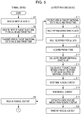
- FIG. 5 is a first flowchart for explaining an operation of the content providing system in the present embodiment.
- FIG. 6 is a second flowchart for explaining an operation of the content providing system in the present embodiment.
- Step S 1 the user ID inputter 104 of the terminal device 100 receives an input of the user ID by the user.
- the target emotional state inputter 103 receives an input of the target emotional state value and the target time by the user.
- the target emotional state inputter 103 receives an input of the target emotional state value by receiving selection of coordinate values targeted by the user on the circumplex model of affect illustrated in FIG. 2 .
- the target emotional state inputter 103 may receive an input by the user of the target time indicating the time taken from the present time to the time targeted by the user.
- Step S 3 the communicator 105 transmits the user ID input by the user ID inputter 104 and the target emotional state value and target time that have been input by the target emotional state inputter 103 to the content providing device 200 .
- Step S 11 the communicator 201 of the content providing device 200 receives the user ID, the target emotional state value, and the target time that have been transmitted by the terminal device 100 .
- Step S 12 the musical content determiner 207 reads the rhythm characteristic data corresponding to the received user ID from the rhythm characteristic data storage 203 .
- Step S 13 the musical content determiner 207 reads the response profile data corresponding to the received user ID from the response profile data storage 205 .
- the time information acquirer 206 acquires the time information indicating the present time.
- the time information acquirer 206 outputs the acquired time information to the musical content determiner 207 .
- the musical content determiner 207 calculates the present emotional state value corresponding to the present time based on the rhythm characteristic data read from the rhythm characteristic data storage 203 and the present time acquired by the time information acquirer 206 . For example, when the rhythm characteristic data includes the emotional state values in one day, the musical content determiner 207 extracts the emotional state value corresponding to the present time from the rhythm characteristic data.
- the musical content determiner 207 calculates the difference value between the received target emotional state value and the calculated present emotional state value. For example, when the target emotional state values (arousal degree, emotional valence) are (+0.8, +0.4) and the present emotional state values (arousal degree, emotional valence) are ( ⁇ 0.3, ⁇ 0.2), the difference values (arousal degree, emotional valence) are (+1.1, +0.6).
- the musical content determiner 207 compensates the difference value between the target emotional state value and the present emotional state value based on the rhythm characteristic data corresponding to the user ID.
- the present time is 3:00 PM and the target time is 7:00 PM
- the rhythm characteristic data illustrated in FIG. 3 the emotional state values (arousal degree, emotional valence) at 3:00 PM are (+0.1, ⁇ 0.1) and the emotional state values (arousal degree, emotional valence) at 7:00 PM are (+0.3, +0.4).
- the rhythm characteristic data indicates a periodic emotional change pattern depending on the time zone, and thus, even if the user does not listen to the music, the emotional state value of arousal degree increases by +0.2 and the emotional state value of emotional valence increases by +0.5 when the time reaches 7:00 PM from 3:00 PM.
- the musical content determiner 207 thus reads the emotional state value in the time zone corresponding to the present time and the emotional state value in the time zone corresponding to the target time from the rhythm characteristic data, subtracts the emotional state value in the time zone corresponding to the present time from the emotional state value in the time zone corresponding to the target time, and calculates the subtracted value as the compensated value.
- This compensated value is the emotional state value automatically changing even if no tune is played at the target time.
- the compensated values (arousal degree, emotional valence) are (+0.2, +0.5).
- the musical content determiner 207 calculates the subtracted values (+0.9, +0.1) obtained by subtracting the compensated values from the difference values as the difference values after compensation.
- the musical content determiner 207 extracts the tune ID corresponding to the emotional state change value approximate to the difference value from the read response profile data and reads the musical content corresponding to the extracted tune ID from the musical content storage 208 .
- the musical content determiner 207 may select a plurality of musical contents with which the total value of the emotional state change values becomes equal to the difference value before the received target time is reached and extract a plurality of tune IDs corresponding to the selected plurality of musical contents from the response profile data.
- the plurality of musical contents to be selected may be the same musical contents, or may be different musical contents. The same musical contents may be played for a plurality of times, and each of the different musical contents may be played.
- the musical content determiner 207 reads the determined musical content from the musical content storage 208 .
- the musical content determiner 207 reads the musical content corresponding to the tune ID that has been extracted from the response profile data from the musical content storage 208 .
- the musical content determiner 207 may read the determined plurality of musical contents.
- the musical content determiner 207 outputs the read musical contents to the communicator 201 .
- the musical feature amount extractor 209 extracts a predetermined musical feature amount from the musical content output from the musical content determiner 207 .
- Step S 20 the communicator 201 transmits the read musical content by the musical content determiner 207 to the terminal device 100 .
- the communicator 201 may transmit the determined plurality of musical contents to the terminal device 100 .
- Step S 4 the communicator 105 of the terminal device 100 receives the musical content transmitted by the content providing device 200 .
- the communicator 105 may receive the plurality of musical contents.
- the communicator 105 outputs the received musical contents to the musical content outputter 101 .
- the musical content outputter 101 outputs the musical contents received by the communicator 105 to the outside.
- the musical content outputter 101 outputs the plurality of musical contents sequentially to the outside. Furthermore, when a plurality of musical contents are output, the musical content outputter 101 outputs a first musical content and a second musical content sequentially out of the plurality of musical contents.
- Step S 6 the physiological data measurer 102 determines whether the output of the musical content has been completed.
- the processing returns to Step S 5 , and the musical content outputter 101 continuously outputs the musical content to the outside.
- the physiological data measurer 102 may determine whether the output of one musical content out of the plurality of musical contents has been completed.
- Step S 7 the physiological data measurer 102 determines whether a predetermined period of time has been elapsed after the output of the musical content has been completed. At this point, when it is determined that a predetermined period of time has not been elapsed after the output of the musical content has been completed (NO at Step S 7 ), the processing of Step S 7 is repeatedly performed until the predetermined period of time has elapsed.
- Step S 8 the physiological data measurer 102 measures the physiological data of the user. On the physiological data measured at this point, the emotional state of the user changed by listening to the musical content is reflected.
- Step S 9 the communicator 105 transmits the physiological data measured by the physiological data measurer 102 to the content providing device 200 .
- the processing from Step S 6 to Step S 9 may be performed.
- the next musical content is to be output.
- the communicator 105 may transmit the measured physiological data each time each of the plurality of musical contents is output.
- the communicator 105 may transmit a plurality of pieces of physiological data measured for each of the plurality of musical contents.
- the communicator 201 of the content providing device 200 receives the physiological data transmitted by the terminal device 100 .
- the communicator 201 outputs the received physiological data to the musical content determiner 207 , the rhythm feedback reflector 202 , and the reaction feedback reflector 204 .
- the time information acquirer 206 acquires the time information indicating the present time.
- the time information acquirer 206 outputs the acquired time information to the rhythm feedback reflector 202 .
- the rhythm feedback reflector 202 calculates the present emotional state value representing the present emotional state of the user based on the physiological data and generates the rhythm characteristic data associating the present time acquired by the time information acquirer 206 and the calculated present emotional state value.
- Step S 24 the rhythm feedback reflector 202 stores the generated rhythm characteristic data in the rhythm characteristic data storage 203 . It is to be noted that when the rhythm characteristic data in a state in which no musical content is provided to the user is acquired, the processing from Step S 22 to Step S 24 may not be performed.
- the reaction feedback reflector 204 calculates the emotional state change value representing the emotional state of the user changed with the musical content provided based on the physiological data received by the communicator 201 and the musical feature amount extracted by the musical feature amount extractor 209 , and generates the response profile data associating the user ID, the tune ID, the tune title, the musical feature amount, and the emotional state change value.
- Step S 26 the reaction feedback reflector 204 stores the generated response profile data in the response profile data storage 205 .
- the musical content for changing the emotional state is determined in accordance with the difference value between the target emotional state value representing the emotional state targeted by the user and the present emotional state value representing the present emotional state of the user, and the determined musical content is provided to the user, whereby the emotional state of the user can be guided to the emotional state targeted by the user.
- the content providing method, the content providing device, and the content providing program according to the present disclosure can guide the emotional state of the user to the emotional state targeted by the user, and are effective as the content providing method, the content providing device, and the content providing program for providing a content for changing the emotional state to the user.
- a content providing method includes (A) a step of receiving, from a user device, user ID information for specifying a user, a target emotional state value representing a target emotional state that the user is to reach, and target time information indicating a time when the user is to reach the target emotional state, (B) a step of acquiring personal physiological rhythm data of the user associated with the user ID information from a data storage, the personal physiological rhythm data including a plurality of emotional state values representing emotional states of the user at different times, (C) a step of acquiring present time information indicating a present time, (D) a step of determining one, which corresponds to the present time, selected from the plurality of emotional state values as a present emotional state value representing a present emotional state of the user, (E) a step of calculating a difference value between the present emotional state value and the target emotional state value, (F) a step of estimating, based on the physiological rhythm data, a spontaneous variation by which an emotional state value of the user is assumed to change during
- Steps S 11 , S 12 , S 14 , and S 15 in FIG. 5 can be cited, respectively.
- Step S 16 in FIG. 5 can be cited.
- steps (H) and (I) Steps S 17 and S 20 in FIG. 5 can be cited.
- the “rhythm characteristic data” described in the embodiment can be cited.
- the physiological rhythm data may be circadian rhythm data indicating a circadian rhythm, for example.
- the “compensated value” described in the embodiment can be cited.
- a computer selects a content while predicting a future emotional state of the user such that the emotional state of the user reaches a desired state by the target time and provides the selected content.
- the emotional state of the user changes with a factor other than the content (for example, a circadian rhythm), and the degree of the change greatly differs among individuals.
- the accuracy with which the computer predicts the future emotional state of the user tends to be insufficient.
- a method is thinkable with which the period from the present time to the target time is separated into a plurality of short times and the emotional state of the user is monitored to eliminate a deviation of the predication each time.
- another method is thinkable with which more than sufficient contents are provided in advance so that the emotional state of the user can securely exceed a desired state by the target time.
- each of the above-described measures requires an excessive amount of processing to be performed by the user device and the content providing device and/or has a risk of generating an excessive amount of data communication between these devices.
- the content providing method according to the above-described aspect has a technical advantage.
- generating the physiological rhythm data may be performed by continuously or intermittently performing a cycle including the following (b 1 ) to (b 3 ) plural times during a predetermined period, (b 1 ) a step of acquiring physiological data of the user through at least one sensor, (b 2 ) a step of acquiring acquisition time information indicating an acquisition time when the physiological data are acquired, and (b 3 ) a step of calculating the emotional state value of the user at the acquisition time, based on the physiological data and the acquisition time information.
- Steps S 21 , S 22 , and S 23 FIG. 6 can be cited, respectively.
- the “acquisition time” may be the time at which the terminal device has measured the physiological data, or may be the time at which the content providing device has received the physiological data.
- each of the plurality of contents may be, in a reaction characteristic database, associated with a reactive variation by which the emotional state value of the user is assumed to change due to the each of the plurality of contents.
- the “emotional state change value” in the embodiment can be cited.
- step (H) may include (h 1 ) a substep of selecting, from among a plurality of reactive variations registered in the reaction characteristic database, a combination of reactive variations corresponding to the compensated difference value, and (h 2 ) a substep of determining the at least one content associated with the selected combination of the reactive variations.
- the “combination of the reactive variations” according to the present disclosure may be a single reactive variation, may be the total obtained by adding several times the same reactive variation, or may be the total obtained by adding a plurality of reactive variations different from one another.
- the reactive variation corresponding to each content may be calculated based on the physiological data that has been actually measured, or may be estimated from a known reactive variation based on similarity in the feature amounts of the plurality of contents.
- the following steps (i) to (vi) may be performed for each of contents, (i) a step of acquiring first physiological data of the user through at least one sensor, (ii) a step of causing the user device to play a content for the user after the step of (i), (iii) a step of acquiring second physiological data of the user through the at least one sensor after the step of (ii), (iv) a step of calculating a first emotional state value of the user, based on the first physiological data, (v) a step of calculating a second emotional state value of the user, based on the second physiological data, and (vi) a step of associating a variation between the first emotional state value and the second emotional state value as the reactive variation with the played content.
- Steps S 20 , S 21 , S 23 , and S 24 are implemented by combining Steps S 20 , S 21 , S 23 , and S 24 in the present embodiment, for example.
- the following steps ( ⁇ ) to ( ⁇ ) may be performed, ( ⁇ ) a step of extracting a plurality of feature amounts from the plurality of contents and registering the plurality of feature amounts into the reaction characteristic database, ( ⁇ ) a step of estimating the plurality of reactive variations based on the plurality of feature amounts, and ( ⁇ ) a step of registering, into the reaction characteristic database, the plurality of reactive variations in association with the plurality of feature amounts.
Landscapes
- Engineering & Computer Science (AREA)
- Health & Medical Sciences (AREA)
- Life Sciences & Earth Sciences (AREA)
- Physics & Mathematics (AREA)
- Theoretical Computer Science (AREA)
- Biomedical Technology (AREA)
- General Health & Medical Sciences (AREA)
- Biophysics (AREA)
- Molecular Biology (AREA)
- Psychiatry (AREA)
- Heart & Thoracic Surgery (AREA)
- Animal Behavior & Ethology (AREA)
- Public Health (AREA)
- Veterinary Medicine (AREA)
- Multimedia (AREA)
- General Physics & Mathematics (AREA)
- Library & Information Science (AREA)
- Psychology (AREA)
- Data Mining & Analysis (AREA)
- Databases & Information Systems (AREA)
- General Engineering & Computer Science (AREA)
- Anesthesiology (AREA)
- Surgery (AREA)
- Pathology (AREA)
- Medical Informatics (AREA)
- Developmental Disabilities (AREA)
- Child & Adolescent Psychology (AREA)
- Physiology (AREA)
- Educational Technology (AREA)
- Hospice & Palliative Care (AREA)
- Social Psychology (AREA)
- Hematology (AREA)
- Acoustics & Sound (AREA)
- Pain & Pain Management (AREA)
- Information Retrieval, Db Structures And Fs Structures Therefor (AREA)
- Measurement Of The Respiration, Hearing Ability, Form, And Blood Characteristics Of Living Organisms (AREA)
- Management, Administration, Business Operations System, And Electronic Commerce (AREA)
- Medical Treatment And Welfare Office Work (AREA)
- Cardiology (AREA)
Abstract
Description
Claims (12)
Applications Claiming Priority (2)
| Application Number | Priority Date | Filing Date | Title |
|---|---|---|---|
| JP2017097884A JP6839818B2 (en) | 2017-05-17 | 2017-05-17 | Content provision method, content provision device and content provision program |
| JP2017-097884 | 2017-05-17 |
Publications (2)
| Publication Number | Publication Date |
|---|---|
| US20180336276A1 US20180336276A1 (en) | 2018-11-22 |
| US10853414B2 true US10853414B2 (en) | 2020-12-01 |
Family
ID=64271833
Family Applications (1)
| Application Number | Title | Priority Date | Filing Date |
|---|---|---|---|
| US15/974,512 Active 2038-11-11 US10853414B2 (en) | 2017-05-17 | 2018-05-08 | Computer-implemented method for providing content in accordance with emotional state that user is to reach |
Country Status (3)
| Country | Link |
|---|---|
| US (1) | US10853414B2 (en) |
| JP (1) | JP6839818B2 (en) |
| CN (1) | CN108939251B (en) |
Families Citing this family (23)
| Publication number | Priority date | Publication date | Assignee | Title |
|---|---|---|---|---|
| CN107731225A (en) * | 2016-08-10 | 2018-02-23 | 松下知识产权经营株式会社 | Receive guests device, method of receiving guests and system of receiving guests |
| US20210369654A1 (en) | 2018-10-16 | 2021-12-02 | Nippon Chemiphar Co., Ltd. | Agent for improving quality of sleep |
| JP7550054B2 (en) | 2018-10-16 | 2024-09-12 | 日本ケミファ株式会社 | Agent for suppressing intoxication or hangover caused by alcoholic beverage intake |
| JP7381045B2 (en) * | 2019-03-12 | 2023-11-15 | Necソリューションイノベータ株式会社 | Lifestyle expression device, lifestyle expression method, program and recording medium |
| JP7090573B2 (en) * | 2019-03-15 | 2022-06-24 | ヤフー株式会社 | Providing equipment, providing method and providing program |
| JP7175810B2 (en) * | 2019-03-20 | 2022-11-21 | ヤフー株式会社 | Selection device, selection method and selection program |
| JP7496514B2 (en) | 2019-06-06 | 2024-06-07 | パナソニックIpマネジメント株式会社 | Content selection method, content selection device, and content selection program |
| JP2022536356A (en) * | 2019-06-11 | 2022-08-15 | エイチアイ エルエルシー | Non-invasive system and method for detecting and modulating a user's mental state through subjective priming effect |
| CN110947075B (en) * | 2019-11-27 | 2026-02-06 | 华南理工大学 | Individualized mental state adjusting system and method based on brain wave music |
| EP4163924A4 (en) * | 2020-06-25 | 2023-11-29 | Sony Group Corporation | Content presentation system, content presentation device and content presentation method |
| US20220122569A1 (en) * | 2020-10-16 | 2022-04-21 | Matthew Caren | Method and Apparatus for the Composition of Music |
| JP2022138233A (en) | 2021-03-10 | 2022-09-26 | ソニーグループ株式会社 | Content recommendation system, content recommendation method, content library, content library generation method and target input user interface |
| CN116963667B (en) * | 2021-03-15 | 2025-01-28 | 三菱电机株式会社 | Emotion estimation device and emotion estimation method |
| KR102814888B1 (en) * | 2021-12-31 | 2025-05-30 | 주식회사 후원 | Symptom relief and management system for patient with tics using vr contents |
| JPWO2023139849A1 (en) * | 2022-01-18 | 2023-07-27 | ||
| JPWO2023145257A1 (en) * | 2022-01-25 | 2023-08-03 | ||
| US20230368794A1 (en) * | 2022-05-13 | 2023-11-16 | Sony Interactive Entertainment Inc. | Vocal recording and re-creation |
| CN114949531A (en) * | 2022-05-13 | 2022-08-30 | 青岛大学 | VR dual-mode emotion automatic control system based on physiological signals |
| JP7408103B2 (en) * | 2022-06-08 | 2024-01-05 | ソフトバンク株式会社 | Information processing device, information processing method, and information processing program |
| WO2024006950A1 (en) * | 2022-06-29 | 2024-01-04 | Deepwell Dtx | Dynamically neuro-harmonized audible signal feedback generation |
| EP4562533A1 (en) * | 2022-07-26 | 2025-06-04 | COMPASS Pathfinder Limited | Predicting response to psilocybin therapy for treatment resistant depression |
| JP7402577B1 (en) * | 2023-06-16 | 2023-12-21 | 株式会社ファーストスター・ヘルスケア | music provision system |
| WO2025150321A1 (en) * | 2024-01-09 | 2025-07-17 | パナソニックIpマネジメント株式会社 | Information processing device, information processing method, and information processing program |
Citations (22)
| Publication number | Priority date | Publication date | Assignee | Title |
|---|---|---|---|---|
| JP2006155157A (en) | 2004-11-29 | 2006-06-15 | Sanyo Electric Co Ltd | Automatic music selecting device |
| US20080114219A1 (en) * | 2006-10-31 | 2008-05-15 | Yi Zhang | Monitoring of chronobiological rhythms for disease and drug management using one or more implantable device |
| US20080188354A1 (en) * | 2005-02-14 | 2008-08-07 | Koninklijke Philips Electronics, N.V. | Electronic Device and Method For Selecting Content Items |
| US20090132593A1 (en) * | 2007-11-15 | 2009-05-21 | Vimicro Corporation | Media player for playing media files by emotion classes and method for the same |
| US20100191037A1 (en) * | 2007-06-01 | 2010-07-29 | Lorenzo Cohen | Iso music therapy program and methods of using the same |
| US20110295843A1 (en) * | 2010-05-26 | 2011-12-01 | Apple Inc. | Dynamic generation of contextually aware playlists |
| US20120117071A1 (en) * | 2010-11-09 | 2012-05-10 | Takayuki Sakamoto | Information processing device and method, information processing system, and program |
| US20120316660A1 (en) * | 2011-06-07 | 2012-12-13 | Jiebo Luo | Automatically selecting thematically representative music |
| JP2013054447A (en) | 2011-09-01 | 2013-03-21 | Hitachi Ltd | Feeling improvement system and feeling improvement method |
| US20130297599A1 (en) * | 2009-11-10 | 2013-11-07 | Dulcetta Inc. | Music management for adaptive distraction reduction |
| US20140223462A1 (en) * | 2012-12-04 | 2014-08-07 | Christopher Allen Aimone | System and method for enhancing content using brain-state data |
| US20150199010A1 (en) * | 2012-09-14 | 2015-07-16 | Interaxon Inc. | Systems and methods for collecting, analyzing, and sharing bio-signal and non-bio-signal data |
| US20150206523A1 (en) * | 2014-01-23 | 2015-07-23 | National Chiao Tung University | Method for selecting music based on face recognition, music selecting system and electronic apparatus |
| US20150297109A1 (en) * | 2014-04-22 | 2015-10-22 | Interaxon Inc. | System and method for associating music with brain-state data |
| JP2016002109A (en) | 2014-06-13 | 2016-01-12 | パナソニックIpマネジメント株式会社 | Activity evaluation apparatus, evaluation processing equipment, and program |
| US20160162565A1 (en) * | 2014-12-09 | 2016-06-09 | Hyundai Motor Company | Method and device for generating music playlist |
| US20160196105A1 (en) * | 2015-01-02 | 2016-07-07 | Gracenote, Inc. | Machine-led mood change |
| US9788777B1 (en) * | 2013-08-12 | 2017-10-17 | The Neilsen Company (US), LLC | Methods and apparatus to identify a mood of media |
| US20170339484A1 (en) * | 2014-11-02 | 2017-11-23 | Ngoggle Inc. | Smart audio headphone system |
| US20170352283A1 (en) * | 2016-06-07 | 2017-12-07 | Cerekinetic, Inc. | Self-administered evaluation and training method to improve mental state |
| US20190155840A1 (en) * | 2014-03-18 | 2019-05-23 | Timothy Chester O'Konski | Method and system for dynamic playlist generation |
| US20190336724A1 (en) * | 2016-12-29 | 2019-11-07 | Huawei Technologies Co., Ltd. | Method and Apparatus for Adjusting User Emotion |
Family Cites Families (10)
| Publication number | Priority date | Publication date | Assignee | Title |
|---|---|---|---|---|
| JP2003310761A (en) * | 2002-04-19 | 2003-11-05 | Itoki Crebio Corp | Controller for work space system and recording medium for operation program |
| US20100217358A1 (en) * | 2007-08-20 | 2010-08-26 | Universite Laval | Artificial light apparatus and its use for influencing a condition in a subject |
| US20130090520A1 (en) * | 2009-06-19 | 2013-04-11 | Randall Redfield | Bone Conduction Apparatus and Multi-sensory Brain Integration Method |
| CN105212948A (en) * | 2014-05-26 | 2016-01-06 | 南京专创知识产权服务有限公司 | Emotion monitoring and auxiliary adjustment system |
| US20160136384A1 (en) * | 2014-11-18 | 2016-05-19 | Treasure Vox Llc | System, method and kit for reminiscence therapy for people with dementia |
| CN104491969A (en) * | 2014-12-10 | 2015-04-08 | 深圳市量子智慧文化发展有限公司 | Body and mind regulation method and system based on sound |
| KR101808739B1 (en) * | 2014-12-31 | 2017-12-14 | 한국전자통신연구원 | Apparatus and Method for recommending a content based on emotion |
| JP6636792B2 (en) * | 2015-01-30 | 2020-01-29 | パナソニック株式会社 | Stimulus presentation system, stimulus presentation method, computer, and control method |
| CN106264571A (en) * | 2016-08-29 | 2017-01-04 | 无锡卓信信息科技股份有限公司 | A kind of inmate's emotion adjustment method and system |
| CN106345034A (en) * | 2016-11-09 | 2017-01-25 | 武汉智普天创科技有限公司 | Device based on brain electricity acquisition terminal for cognitive emotion regulation |
-
2017
- 2017-05-17 JP JP2017097884A patent/JP6839818B2/en active Active
-
2018
- 2018-05-08 US US15/974,512 patent/US10853414B2/en active Active
- 2018-05-08 CN CN201810429420.XA patent/CN108939251B/en active Active
Patent Citations (22)
| Publication number | Priority date | Publication date | Assignee | Title |
|---|---|---|---|---|
| JP2006155157A (en) | 2004-11-29 | 2006-06-15 | Sanyo Electric Co Ltd | Automatic music selecting device |
| US20080188354A1 (en) * | 2005-02-14 | 2008-08-07 | Koninklijke Philips Electronics, N.V. | Electronic Device and Method For Selecting Content Items |
| US20080114219A1 (en) * | 2006-10-31 | 2008-05-15 | Yi Zhang | Monitoring of chronobiological rhythms for disease and drug management using one or more implantable device |
| US20100191037A1 (en) * | 2007-06-01 | 2010-07-29 | Lorenzo Cohen | Iso music therapy program and methods of using the same |
| US20090132593A1 (en) * | 2007-11-15 | 2009-05-21 | Vimicro Corporation | Media player for playing media files by emotion classes and method for the same |
| US20130297599A1 (en) * | 2009-11-10 | 2013-11-07 | Dulcetta Inc. | Music management for adaptive distraction reduction |
| US20110295843A1 (en) * | 2010-05-26 | 2011-12-01 | Apple Inc. | Dynamic generation of contextually aware playlists |
| US20120117071A1 (en) * | 2010-11-09 | 2012-05-10 | Takayuki Sakamoto | Information processing device and method, information processing system, and program |
| US20120316660A1 (en) * | 2011-06-07 | 2012-12-13 | Jiebo Luo | Automatically selecting thematically representative music |
| JP2013054447A (en) | 2011-09-01 | 2013-03-21 | Hitachi Ltd | Feeling improvement system and feeling improvement method |
| US20150199010A1 (en) * | 2012-09-14 | 2015-07-16 | Interaxon Inc. | Systems and methods for collecting, analyzing, and sharing bio-signal and non-bio-signal data |
| US20140223462A1 (en) * | 2012-12-04 | 2014-08-07 | Christopher Allen Aimone | System and method for enhancing content using brain-state data |
| US9788777B1 (en) * | 2013-08-12 | 2017-10-17 | The Neilsen Company (US), LLC | Methods and apparatus to identify a mood of media |
| US20150206523A1 (en) * | 2014-01-23 | 2015-07-23 | National Chiao Tung University | Method for selecting music based on face recognition, music selecting system and electronic apparatus |
| US20190155840A1 (en) * | 2014-03-18 | 2019-05-23 | Timothy Chester O'Konski | Method and system for dynamic playlist generation |
| US20150297109A1 (en) * | 2014-04-22 | 2015-10-22 | Interaxon Inc. | System and method for associating music with brain-state data |
| JP2016002109A (en) | 2014-06-13 | 2016-01-12 | パナソニックIpマネジメント株式会社 | Activity evaluation apparatus, evaluation processing equipment, and program |
| US20170339484A1 (en) * | 2014-11-02 | 2017-11-23 | Ngoggle Inc. | Smart audio headphone system |
| US20160162565A1 (en) * | 2014-12-09 | 2016-06-09 | Hyundai Motor Company | Method and device for generating music playlist |
| US20160196105A1 (en) * | 2015-01-02 | 2016-07-07 | Gracenote, Inc. | Machine-led mood change |
| US20170352283A1 (en) * | 2016-06-07 | 2017-12-07 | Cerekinetic, Inc. | Self-administered evaluation and training method to improve mental state |
| US20190336724A1 (en) * | 2016-12-29 | 2019-11-07 | Huawei Technologies Co., Ltd. | Method and Apparatus for Adjusting User Emotion |
Also Published As
| Publication number | Publication date |
|---|---|
| CN108939251B (en) | 2021-08-13 |
| JP2018195043A (en) | 2018-12-06 |
| US20180336276A1 (en) | 2018-11-22 |
| CN108939251A (en) | 2018-12-07 |
| JP6839818B2 (en) | 2021-03-10 |
Similar Documents
| Publication | Publication Date | Title |
|---|---|---|
| US10853414B2 (en) | Computer-implemented method for providing content in accordance with emotional state that user is to reach | |
| AU2015101130B4 (en) | Heart rate path optimizer | |
| EP3627518A1 (en) | Information processing system, information processing server, information processing program, and information providing method | |
| KR101749706B1 (en) | Method and system for expecting user's mood based on status information and biometric information acquired by using user equipment | |
| US20150193654A1 (en) | Evaluation method, evaluation apparatus, and recording medium | |
| JP2016083349A (en) | Exercise managing method and exercise managing apparatus | |
| US20230014315A1 (en) | Trained model establishment method, estimation method, performance agent recommendation method, performance agent adjustment method, trained model establishment system, estimation system, trained model establishment program, and estimation program | |
| US20250235028A1 (en) | Control method, information providing method, control system, information providing system, and recording medium | |
| CN115543078A (en) | A scene control method, device, equipment and storage medium | |
| JP7402577B1 (en) | music provision system | |
| CN109106383A (en) | Emotion sensing system and method | |
| JP6899609B1 (en) | Biometric information calculation system and server | |
| JP7083195B1 (en) | Biological information calculation system | |
| US20240186002A1 (en) | Information processing apparatus, feature quantity extraction method, training data generation method, estimation model generation method, stress level estimation method, and storage medium | |
| US12102472B2 (en) | Detecting subjects with disordered breathing | |
| JP5993968B2 (en) | Sleep stage estimation apparatus, method and program | |
| US20210038857A1 (en) | Patient Tailored System and Process For Treating ASD and ADHD Conditions Using Music Therapy & Mindfulness with Indian Classical Music | |
| CN116018088B (en) | Biological information calculation system | |
| KR101886221B1 (en) | Method and apparatus for calculating similarity of life log data | |
| KR20230110489A (en) | Health support device, health support method, and recording medium | |
| CN116157062A (en) | Biological Information Computing System | |
| JP7083194B1 (en) | Biological information calculation system | |
| JP6845520B1 (en) | Biological information calculation system | |
| JP7142997B1 (en) | Biometric information calculation system, server, and biometric information calculation method | |
| JP7083193B1 (en) | Biological information calculation system |
Legal Events
| Date | Code | Title | Description |
|---|---|---|---|
| FEPP | Fee payment procedure |
Free format text: ENTITY STATUS SET TO UNDISCOUNTED (ORIGINAL EVENT CODE: BIG.); ENTITY STATUS OF PATENT OWNER: LARGE ENTITY |
|
| STPP | Information on status: patent application and granting procedure in general |
Free format text: DOCKETED NEW CASE - READY FOR EXAMINATION |
|
| AS | Assignment |
Owner name: PANASONIC INTELLECTUAL PROPERTY MANAGEMENT CO., LTD., JAPAN Free format text: ASSIGNMENT OF ASSIGNORS INTEREST;ASSIGNORS:FUKINO, MIWA;OHMORI, MOTOJI;SIGNING DATES FROM 20180419 TO 20180420;REEL/FRAME:046312/0800 Owner name: PANASONIC INTELLECTUAL PROPERTY MANAGEMENT CO., LT Free format text: ASSIGNMENT OF ASSIGNORS INTEREST;ASSIGNORS:FUKINO, MIWA;OHMORI, MOTOJI;SIGNING DATES FROM 20180419 TO 20180420;REEL/FRAME:046312/0800 |
|
| STPP | Information on status: patent application and granting procedure in general |
Free format text: NON FINAL ACTION MAILED |
|
| STPP | Information on status: patent application and granting procedure in general |
Free format text: PUBLICATIONS -- ISSUE FEE PAYMENT VERIFIED |
|
| STPP | Information on status: patent application and granting procedure in general |
Free format text: WITHDRAW FROM ISSUE AWAITING ACTION |
|
| STPP | Information on status: patent application and granting procedure in general |
Free format text: AWAITING TC RESP., ISSUE FEE NOT PAID |
|
| STCF | Information on status: patent grant |
Free format text: PATENTED CASE |
|
| MAFP | Maintenance fee payment |
Free format text: PAYMENT OF MAINTENANCE FEE, 4TH YEAR, LARGE ENTITY (ORIGINAL EVENT CODE: M1551); ENTITY STATUS OF PATENT OWNER: LARGE ENTITY Year of fee payment: 4 |