US10831706B2 - Database maintenance using backup and restore technology - Google Patents
Database maintenance using backup and restore technology Download PDFInfo
- Publication number
- US10831706B2 US10831706B2 US15/045,106 US201615045106A US10831706B2 US 10831706 B2 US10831706 B2 US 10831706B2 US 201615045106 A US201615045106 A US 201615045106A US 10831706 B2 US10831706 B2 US 10831706B2
- Authority
- US
- United States
- Prior art keywords
- database
- data file
- snapshot
- snapshot copy
- file
- Prior art date
- Legal status (The legal status is an assumption and is not a legal conclusion. Google has not performed a legal analysis and makes no representation as to the accuracy of the status listed.)
- Expired - Fee Related, expires
Links
Images


Classifications
-
- G—PHYSICS
- G06—COMPUTING OR CALCULATING; COUNTING
- G06F—ELECTRIC DIGITAL DATA PROCESSING
- G06F16/00—Information retrieval; Database structures therefor; File system structures therefor
- G06F16/10—File systems; File servers
- G06F16/11—File system administration, e.g. details of archiving or snapshots
- G06F16/128—Details of file system snapshots on the file-level, e.g. snapshot creation, administration, deletion
-
- G—PHYSICS
- G06—COMPUTING OR CALCULATING; COUNTING
- G06F—ELECTRIC DIGITAL DATA PROCESSING
- G06F16/00—Information retrieval; Database structures therefor; File system structures therefor
- G06F16/20—Information retrieval; Database structures therefor; File system structures therefor of structured data, e.g. relational data
- G06F16/22—Indexing; Data structures therefor; Storage structures
- G06F16/2282—Tablespace storage structures; Management thereof
-
- G—PHYSICS
- G06—COMPUTING OR CALCULATING; COUNTING
- G06F—ELECTRIC DIGITAL DATA PROCESSING
- G06F11/00—Error detection; Error correction; Monitoring
- G06F11/07—Responding to the occurrence of a fault, e.g. fault tolerance
- G06F11/14—Error detection or correction of the data by redundancy in operations
- G06F11/1446—Point-in-time backing up or restoration of persistent data
- G06F11/1448—Management of the data involved in backup or backup restore
-
- G—PHYSICS
- G06—COMPUTING OR CALCULATING; COUNTING
- G06F—ELECTRIC DIGITAL DATA PROCESSING
- G06F11/00—Error detection; Error correction; Monitoring
- G06F11/07—Responding to the occurrence of a fault, e.g. fault tolerance
- G06F11/14—Error detection or correction of the data by redundancy in operations
- G06F11/1446—Point-in-time backing up or restoration of persistent data
- G06F11/1458—Management of the backup or restore process
- G06F11/1469—Backup restoration techniques
-
- G—PHYSICS
- G06—COMPUTING OR CALCULATING; COUNTING
- G06F—ELECTRIC DIGITAL DATA PROCESSING
- G06F11/00—Error detection; Error correction; Monitoring
- G06F11/07—Responding to the occurrence of a fault, e.g. fault tolerance
- G06F11/14—Error detection or correction of the data by redundancy in operations
- G06F11/1471—Error detection or correction of the data by redundancy in operations involving logging of persistent data for recovery
-
- G—PHYSICS
- G06—COMPUTING OR CALCULATING; COUNTING
- G06F—ELECTRIC DIGITAL DATA PROCESSING
- G06F16/00—Information retrieval; Database structures therefor; File system structures therefor
- G06F16/10—File systems; File servers
- G06F16/18—File system types
- G06F16/182—Distributed file systems
-
- G—PHYSICS
- G06—COMPUTING OR CALCULATING; COUNTING
- G06F—ELECTRIC DIGITAL DATA PROCESSING
- G06F11/00—Error detection; Error correction; Monitoring
- G06F11/07—Responding to the occurrence of a fault, e.g. fault tolerance
- G06F11/14—Error detection or correction of the data by redundancy in operations
- G06F11/1446—Point-in-time backing up or restoration of persistent data
-
- G—PHYSICS
- G06—COMPUTING OR CALCULATING; COUNTING
- G06F—ELECTRIC DIGITAL DATA PROCESSING
- G06F2201/00—Indexing scheme relating to error detection, to error correction, and to monitoring
- G06F2201/80—Database-specific techniques
-
- G—PHYSICS
- G06—COMPUTING OR CALCULATING; COUNTING
- G06F—ELECTRIC DIGITAL DATA PROCESSING
- G06F2201/00—Indexing scheme relating to error detection, to error correction, and to monitoring
- G06F2201/84—Using snapshots, i.e. a logical point-in-time copy of the data
Definitions
- This disclosure relates generally to database maintenance. More particularly, it relates to database maintenance using backup and restore technology.
- Databases are organized collections of information integral to the use of computer systems for many applications. Modern databases are typically optimized for transactional performance. When a transaction comes in, the data is written to the database in a manner that results in the quickest storage. The storage location is usually not sequential with related data or the most space-efficient location for the overall database. Over time, the database can become badly defragmented. This problem is similar to file system defragmentation, but can be even worse, because even empty space in databases takes storage space. A database defragmentation operation may reduce the size of database file by as much as 90%. Furthermore, there may be occasional logical or physical corruption in the database tables or files, due to disk errors or other errors. For these and other reasons, databases need periodic maintenance operations. Some maintenance operations can be done online, but a significant amount of database maintenance must still be performed offline.
- databases can be required to be operational more than ninety-nine percent of the time, so there is minimal opportunity to perform offline database maintenance.
- Shutting down and restarting a large database might take an hour or more in some cases.
- maintenance operations can take twenty-four hours or more. Understandably, some users forgo maintenance for years. After such a long period, when the users are finally forced to restore the database, they find that their databases, and thus their backups, are corrupt.
- a database running in a computer includes a first data file and a first log file.
- a snapshot copy of the first data file is created.
- Database maintenance is performed on the first snapshot copy of the first data file to produce a maintained snapshot copy of the first data file.
- a snapshot restore operation is performed on the database by replacing the first data file with the maintained snapshot copy of the first data file.
- the maintained snapshot copy of the first data file is updated according to logged transactions in the first log file which occurred after the snapshot copy of the first data file was created. In this way, a new data file is created which is both a product of the database maintenance as well as the database transactions which occurred while the database maintenance occurred.
- FIG. 1 depicts an exemplary block diagram of a distributed data processing environment in which exemplary aspects of the illustrative embodiments may be implemented;
- FIG. 2 is an exemplary block diagram of a data processing system in which exemplary aspects of the illustrative embodiments may be implemented;
- FIG. 3 illustrates an exemplary computing architecture in which the disclosed subject matter may be implemented
- FIG. 4 is a flow diagram of a preferred embodiment of the invention.
- FIG. 5 is a flow diagram of the database maintenance process according to one preferred embodiment of the invention.
- the present invention employs snapshot and roll forward technology to improve database maintenance.
- the invention takes a snapshot backup of the database and performs the database maintenance on the snapshot copy. Meanwhile the production copy of the database continues to accept user requests and perform transactions as normal. Once the database maintenance is completed on the snapshot copy, the invention “snapshots” the maintained snapshot copy back to the production copy, thereby replacing the production copy, and applies the transactions that occurred during the maintenance on the maintained snapshot copy.
- database downtime for maintenance is reduced from hours to only seconds or minutes. Once the database maintenance is accomplished, there is less data to back up and store.
- the restore of the maintained snapshot copy is a faster restore, then say a database backup which had not been maintained, as only the data portion is restored; the invention does not restore the empty space of the database which existed in the production copy prior to maintenance.
- the database errors are corrected without taking the database system offline; individual databases are dismounted to do maintenance. It is much faster to dismount and mount a database than to stop the database service.
- FIGS. 1-2 exemplary diagrams of data processing environments are provided in which illustrative embodiments of the disclosure may be implemented. It should be appreciated that FIGS. 1-2 are only exemplary and are not intended to assert or imply any limitation with regard to the environments in which aspects or embodiments of the disclosed subject matter may be implemented. Many modifications to the depicted environments may be made without departing from the spirit and scope of the present invention.
- FIG. 1 depicts a pictorial representation of an exemplary distributed data processing system in which aspects of the illustrative embodiments may be implemented.
- Distributed data processing system 100 may include a network of computers in which aspects of the illustrative embodiments may be implemented.
- the distributed data processing system 100 contains at least one network 102 , which is the medium used to provide communication links between various devices and computers connected together within distributed data processing system 100 .
- the network 102 may include connections, such as wire, wireless communication links, or fiber optic cables.
- server 104 and server 106 are connected to network 102 along with storage unit 108 .
- clients 110 , 112 , and 114 are also connected to network 102 .
- These clients 110 , 112 , and 114 may be, for example, personal computers, network computers, or the like.
- server 104 provides data, such as boot files, operating system images, and applications to the clients 110 , 112 , and 114 .
- Clients 110 , 112 , and 114 are clients to server 104 in the depicted example.
- Distributed data processing system 100 may include additional servers, clients, and other devices not shown.
- distributed data processing system 100 is the Internet with network 102 representing a worldwide collection of networks and gateways that use the Transmission Control Protocol/Internet Protocol (TCP/IP) suite of protocols to communicate with one another.
- TCP/IP Transmission Control Protocol/Internet Protocol
- the distributed data processing system 100 may also be implemented to include a number of different types of networks, such as for example, an intranet, a local area network (LAN), a wide area network (WAN), or the like.
- FIG. 1 is intended as an example, not as an architectural limitation for different embodiments of the disclosed subject matter, and therefore, the particular elements shown in FIG. 1 should not be considered limiting with regard to the environments in which the illustrative embodiments of the present invention may be implemented.
- Data processing system 200 is an example of a computer, such as client 110 in FIG. 1 , in which computer usable code or instructions implementing the processes for illustrative embodiments of the disclosure may be located.
- Data processing system 200 is an example of a computer, such as server 104 or client 110 in FIG. 1 , in which computer-usable program code or instructions implementing the processes may be located for the illustrative embodiments.
- data processing system 200 includes communications fabric 202 , which provides communications between processor unit 204 , memory 206 , persistent storage 208 , communications unit 210 , input/output (I/O) unit 212 , and display 214 .
- communications fabric 202 which provides communications between processor unit 204 , memory 206 , persistent storage 208 , communications unit 210 , input/output (I/O) unit 212 , and display 214 .
- Processor unit 204 serves to execute instructions for software that may be loaded into memory 206 .
- Processor unit 204 may be a set of one or more processors or may be a multi-processor core, depending on the particular implementation. Further, processor unit 204 may be implemented using one or more heterogeneous processor systems in which a main processor is present with secondary processors on a single chip. As another illustrative example, processor unit 204 may be a symmetric multi-processor (SMP) system containing multiple processors of the same type.
- SMP symmetric multi-processor
- Memory 206 and persistent storage 208 are examples of storage devices.
- a storage device is any piece of hardware that is capable of storing information either on a temporary basis and/or a permanent basis.
- Memory 206 in these examples, may be, for example, a random access memory or any other suitable volatile or non-volatile storage device.
- Persistent storage 208 may take various forms depending on the particular implementation.
- persistent storage 208 may contain one or more components or devices.
- persistent storage 208 may be a hard drive, a flash memory, a rewritable optical disk, a rewritable magnetic tape, or some combination of the above.
- the media used by persistent storage 208 also may be removable.
- a removable hard drive may be used for persistent storage 208 .
- Communications unit 210 in these examples, provides for communications with other data processing systems or devices.
- communications unit 210 is a network interface card.
- Communications unit 210 may provide communications through the use of either or both physical and wireless communications links.
- Input/output unit 212 allows for input and output of data with other devices that may be connected to data processing system 200 .
- input/output unit 212 may provide a connection for user input through a keyboard and mouse. Further, input/output unit 212 may send output to a printer.
- Display 214 provides a mechanism to display information to a user.
- Instructions for the operating system and applications or programs are located on persistent storage 208 . These instructions may be loaded into memory 206 for execution by processor unit 204 .
- the processes of the different embodiments may be performed by processor unit 204 using computer implemented instructions, which may be located in a memory, such as memory 206 .
- These instructions are referred to as program code, computer-usable program code, or computer-readable program code that may be read and executed by a processor in processor unit 204 .
- the program code in the different embodiments may be embodied on different physical or tangible computer-readable media, such as memory 206 or persistent storage 208 .
- Program code 216 is located in a functional form on computer-readable media 218 that is selectively removable and may be loaded onto or transferred to data processing system 200 for execution by processor unit 204 .
- Program code 216 and computer-readable media 218 form computer program product 220 in these examples.
- computer-readable media 218 may be in a tangible form, such as, for example, an optical or magnetic disc that is inserted or placed into a drive or other device that is part of persistent storage 208 for transfer onto a storage device, such as a hard drive that is part of persistent storage 208 .
- computer-readable media 218 also may take the form of a persistent storage, such as a hard drive, a thumb drive, or a flash memory that is connected to data processing system 200 .
- the tangible form of computer-readable media 218 is also referred to as computer-recordable storage media. In some instances, computer-recordable media 218 may not be removable.
- program code 216 may be transferred to data processing system 200 from computer-readable media 218 through a communications link to communications unit 210 and/or through a connection to input/output unit 212 .
- the communications link and/or the connection may be physical or wireless in the illustrative examples.
- the computer-readable media also may take the form of non-tangible media, such as communications links or wireless transmissions containing the program code.
- the different components illustrated for data processing system 200 are not meant to provide architectural limitations to the manner in which different embodiments may be implemented. The different illustrative embodiments may be implemented in a data processing system including components in addition to or in place of those illustrated for data processing system 200 . Other components shown in FIG. 2 can be varied from the illustrative examples shown.
- a storage device in data processing system 200 is any hardware apparatus that may store data.
- Memory 206 , persistent storage 208 , and computer-readable media 218 are examples of storage devices in a tangible form.
- a bus system may be used to implement communications fabric 202 and may be comprised of one or more buses, such as a system bus or an input/output bus.
- the bus system may be implemented using any suitable type of architecture that provides for a transfer of data between different components or devices attached to the bus system.
- a communications unit may include one or more devices used to transmit and receive data, such as a modem or a network adapter.
- a memory may be, for example, memory 206 or a cache such as found in an interface and memory controller hub that may be present in communications fabric 202 .
- Computer program code for carrying out operations of the present invention may be written in any combination of one or more programming languages, including an object-oriented programming language such as JavaTM, Smalltalk, C++, C#, Objective-C, or the like, and conventional procedural programming languages.
- the program code may execute entirely on the user's computer, partly on the user's computer, as a stand-alone software package, partly on the user's computer and partly on a remote computer, or entirely on the remote computer or server.
- the remote computer may be connected to the user's computer through any type of network, including a local area network (LAN) or a wide area network (WAN), or the connection may be made to an external computer (for example, through the Internet using an Internet Service Provider).
- LAN local area network
- WAN wide area network
- Internet Service Provider for example, AT&T, MCI, Sprint, EarthLink, MSN, GTE, etc.
- FIGS. 1-2 may vary depending on the implementation.
- Other internal hardware or peripheral devices such as flash memory, equivalent non-volatile memory, or optical disk drives and the like, may be used in addition to or in place of the hardware depicted in FIGS. 1-2 .
- the processes of the illustrative embodiments may be applied to a multiprocessor data processing system, other than the SMP system mentioned previously, without departing from the spirit and scope of the disclosed subject matter.
- each client or server machine is a data processing system such as illustrated in FIG. 2 comprising hardware and software, and these entities communicate with one another over a network, such as the Internet, an intranet, an extranet, a private network, or any other communications medium or link.
- a data processing system typically includes one or more processors, an operating system, one or more applications, and one or more utilities.
- the applications on the data processing system provide native support for Web services including, without limitation, support for HTTP, SOAP, XML, WSDL, UDDI, and WSFL, among others.
- Information regarding SOAP, WSDL, UDDI and WSFL is available from the World Wide Web Consortium (W3C), which is responsible for developing and maintaining these standards; further information regarding HTTP and XML is available from Internet Engineering Task Force (IETF). Familiarity with these standards is presumed.
- W3C World Wide Web Consortium
- IETF Internet Engineering Task Force
- FIG. 3 illustrates an exemplary computing architecture in which the disclosed subject matter may be implemented.
- the database server 301 and database management system 302 which is resident thereon are executing a plurality of databases.
- database 1 303 , database 2 305 , database 3 307 and database 4 309 are resident on database server 301 .
- Four databases are shown for the sake of simplicity, however, the number of databases operated by the database server can be greater and is largely limited by the capacity of the systems on which they are resident as well as the performance needed by the applications which use the databases.
- Each of the databases is composed of several files, including a log file and a data file.
- a log file is a file in which the database transactions are recorded.
- a data file is the main data file in which the data for the database is stored.
- the data file is broken up into a plurality of data files in many databases, but a single data file is shown for ease in illustration.
- the actual data in the databases is typically stored in pages referenced by the data file. As user transactions continue to be committed to the database, the data file becomes more fragmented, convoluted and layered, and in need of database maintenance.
- the log file is a sequential description of the actions which the user(s) take on the database. Like the data file, some databases break the log file into many sequential log files.
- the log file has many uses. For example, it can be used to store a transaction before (or after) it is written to the data file as well as to check the integrity of the data file. In the case of a system crash, the log file is used to reconcile the state of the data file. In many cases, a transaction is written to the log file before it is committed to the data file since a user can make many, sometimes contradictory, changes to the same data. In some databases, it can be more efficient to store a transaction in the log file prior to making a change to the data file. Other terms for the log file include transaction log, database log or audit trail file.
- an entry in the log file comprised of a time stamp, a log sequence number which is a unique ID for a log record, a link to their last log entry, a transaction ID number which is a reference to the database transaction generating the log record, type of database log record and information about the actual database changes that triggered the log record to be written.
- database 1 303 is composed of log file 311 and data file 319
- database 2 305 is composed of log file 313 and data file 321
- database 3 307 is composed of log file 315 and data file 323
- database 4 309 is composed of log file 317 and data file 325 .
- transactions committed to the data file and stored within the log file can be compared by referring to header information in the data file containing transaction information.
- header information in the data file containing transaction information.
- database maintenance tools 327 are also resident on the database server 301 .
- the Database maintenance tools 327 may be part of the database management system 302 in alternative embodiments.
- Exemplary database maintenance tools include defragger 329 , database integrity tool 331 and indexer 333 .
- defragger 329 When defragmenting a database, the defragger will reorder the blocks so that sequential blocks are contiguous. It will also compact (remove) the empty space. Without defragmentation, overall performance of the database may be degraded, and it may continue to grow and use space unnecessarily.
- an integrity check a utility will make sure that the database pages are correct, using checksum and other techniques. If there is an error, the tool will correct it.
- the system also includes a storage server 351 , on which is resident a snapshot application 353 which creates “snapshots” from an original source, e.g., such as a database, and a set of snapshot collections 355 - 363 .
- a “snapshot” is a known means of replicating a data record at a specific point in time.
- Snapshots are commonly used for backups and to restore the original data records in the event of corruption or user mistakes such as accidental file deletion.
- the contents of the data record are restored from the snapshot, essentially returning the data record to the point in time that the snapshot was created. Multiple snapshots can be taken of a single data record.
- Snapshot records 355 - 361 represent respective collections of snapshot copies taken at different points in time for databases 1 - 4 so that the administrator can return the database to a particular point in time.
- Some snapshot technologies store subsequent snapshots only as a delta of the changes from, plus a pointer to, a base snapshot.
- the snapshots in some technologies are exact copies of the original data record; in other technologies, the snapshots include a set of pointers or metadata pointing to the locations of the stored data which comprises the record.
- the snapshot is a view of the data file as it existed when the database was created, minus any uncommitted transactions.
- database server 301 and storage server 351 are separate systems in the network, and can be systems similar to those described above in connection with FIGS. 1 and 2 .
- the database server 301 and storage server 351 could be the same machine, i.e. applications running on the same system.
- the database management system 302 and database maintenance tools 327 could be running on a different system than the system that the databases run on.
- FIG. 4 is a high level flow diagram of a preferred embodiment of the invention.
- the database administrator wants to perform offline database maintenance. For example, the administrator needs to defrag the database, re-index a table, and re-organize another table within the database.
- database DB 1 at time 1:00 consists of data file, File 1 and transaction log file, Log 1 .
- the system backs up database DB 1 using a snapshot-type backup.
- this is accomplished by having the database management system issue commands to the snapshot application to create a new snapshot.
- the snapshot application is used to create snapshots which are used for normal backup. That is, the snapshot application is used both for the database maintenance process of the present invention as well as normal backup.
- the database is not halted for an extended period. Typically, during the snapshot process, writes to the database are held for fewer than 10 seconds.
- the snapshot backup contains the data file, File 1 ′, and, optionally, transaction log file, Log 1 ′.
- step 403 the database maintenance is performed on the snapshot backup copy of the data file, i.e. on File 1 ′.
- the production copy of the database (File 1 ) is unaffected and continues accepting user transactions as normal.
- database maintenance is not performed on the snapshot of the transaction log file, Log 1 ′ as most types of data problems are present in the data file.
- database maintenance such as an integrity check is performed on the log file.
- an integrity check is performed on the log file, while defragging, reindexing, and an integrity check are performed on the data file.
- a maintained version of the log file is created.
- the database maintenance process can require time to accomplish, depending on the size of the data file and how long it has been since it was last maintained. In the example, in step 405 , nine hours after the process begins, at 10:00, the offline maintenance completes.
- the result of the database maintenance step is a maintained snapshot copy which in this example is called Maintained File 1 ′.
- step 407 the system dismounts DB 1 from the overall database management system.
- DB 1 it is meant that the one database is taken offline so that data write operations are no longer directed to the database.
- the dismounting process halts DB 1 so that it can be updated safely, while allowing the database management system to operate other databases without interruption to continue normal operation and service requests. Further, by dismounting a database, the information storage commands directed to a particular group of databases are not stopped unless the database that is dismounted is the only database within the group.
- step 409 the system performs a snapshot restore operation using the maintained snapshot copy of the data file, Maintained File 1 ′ to replace the current production copy of the data file, File 1 .
- the log file optionally captured in step 401 is not restored, as the production copy of log file, Log 1 , contains the transactions which occurred between 01:00 and 10:00, and is thus a more accurate source of the transactions performed on the database.
- Maintained File 1 ′ only contains the transactions which occurred up to the point in time the snapshot occurred, it must be brought up to date using the production log file, Log 1 .
- the system applies the logged transactions from 01:00 to 10:00 sequentially in the order in which they occurred to the restored version of the maintained data file, Maintained File 1 ′.
- this operation may take a few seconds to several minutes.
- roll forward technology is used to update the maintained snapshot. Roll-forward technology is typically used in the event of a system crash, that is, for recovery to restore a damaged database to the most recent state before a failure occurred, rather than for database maintenance of an operating database.
- step 413 the system remounts DB 1 and resumes committing transactions to Database 1 .
- the new production copy of DB 1 is a derivative of the maintained snapshot copy of the data file, Maintained File 1 ′, and the active log file of the production database, Log 1 .
- step 415 the new version of the production copy of the database is optionally backed up, either through another snapshot operation or another type of backup operation.
- the production database contains the completed maintenance changes.
- the database will be smaller, requiring less system resource and its performance will improve. It will also be a consistent, uncorrupted copy.
- the database may also be reindexed for faster operations. Any backup, or restore operation from the backup, will enjoy similar advantages.
- the production database is only offline between steps 407 and 413 . This outage might only last a few seconds or minutes.
- the backup step 415 is optional, and therefore, one could save further time by its omission. However, if a backup of the database is needed in the case of a restore operation, one based on the new production copy will be much quicker than a backup using an existing database copy, because the database has been defragged, for example. Further, by backing up the database, the work of database maintenance will not need to be repeated in the event of a database crash.
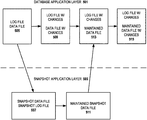
- FIG. 5 shows a different representation of a preferred embodiment of the invention, showing the data files and log files as they are transferred between the production database application layer 501 and snapshot application layer 503 with the passage of time.
- the set of data files includes a plurality of data files and the set of log files includes a plurality of log files.
- a set can include one file.
- the production database at the time of the snapshot 505 comprises Log File and Data File.
- the snapshot application creates snapshot copies 507 of the files, Snapshot Data File and Snapshot Log File.
- the Data File and the Snapshot Data File as well as the Log File and the Snapshot Log File contain the same information.
- the Log File and Data File in the production database application layer 509 are changed due to the transactions requested by the users of the database. Meanwhile, in one preferred embodiment, the Snapshot Log File is discarded while the Snapshot Data File undergoes database maintenance, e.g., defrag, reindexing, to improve the quality of the data file and to become the Maintained Snapshot Data File 511 .
- database maintenance e.g., defrag, reindexing
- the database is dismounted so that the Maintained Snapshot Data File can replace the production version of the data file.
- the Log File with the new transactions is retained 513 .
- the changes in the log file which occurred after the snapshot are applied to the Maintained Snapshot Data File (which is now the production data file) so that the maintained version of the data file can be brought up to date.
- the Log File and the Maintained Data File 515 are consistent with the transactions requested by the users while database maintenance was taking place.
- the present invention has many advantages over the prior art.
- One of the benefits of the invention is a faster restore process by only restoring the data portion of the database and not restoring blank space.
- Database downtime during maintenance is reduced from hours to only seconds or minutes.
- Database errors are corrected without taking the database system offline.
- Individual databases can be dismounted to do maintenance. It is much faster to dismount and mount a database than to stop the database service. The other databases on the system stay online, and even the database that is dismounted is offline for a shorter period than if the administrator shut down the database system.
- the functionality described above may be implemented as a standalone approach, e.g., one or more software-based functions executed by one or more hardware processors, or it may be available as a managed service (including as a web service via a SOAP/XML or RESTful interface).
- a managed service including as a web service via a SOAP/XML or RESTful interface.
- computing devices within the context of the disclosed subject matter are each a data processing system comprising hardware and software, and these entities communicate with one another over a network, such as the Internet, an intranet, an extranet, a private network, or any other communications medium or link.
- the applications on the data processing system provide native support for Web and other known services and protocols including, without limitation, support for HTTP, FTP, SMTP, SOAP, XML, WSDL, UDDI, and WSFL, among others.
- Information regarding SOAP, WSDL, UDDI and WSFL is available from the World Wide Web Consortium (W3C), which is responsible for developing and maintaining these standards; further information regarding HTTP, FTP, SMTP and XML is available from Internet Engineering Task Force (IETF).
- W3C World Wide Web Consortium
- IETF Internet Engineering Task Force
- server-side architectures including simple n-tier architectures, web portals, federated systems, and the like.
- the subject matter described herein can take the form of an entirely hardware embodiment, an entirely software embodiment or an embodiment containing both hardware and software elements.
- the trusted platform module function is implemented in software, which includes but is not limited to firmware, resident software, microcode, and the like.
- the download and delete interfaces and functionality can take the form of a computer program product accessible from a computer-usable or computer-readable medium providing program code for use by or in connection with a computer or any instruction execution system.
- a computer-usable or computer readable medium can be any apparatus that can contain or store the program for use by or in connection with the instruction execution system, apparatus, or device.
- the medium can be an electronic, magnetic, optical, electromagnetic, infrared, or a semiconductor system (or apparatus or device).
- Examples of a computer-readable medium include a semiconductor or solid state memory, magnetic tape, a removable computer diskette, a random access memory (RAM), a read-only memory (ROM), a rigid magnetic disk and an optical disk.
- Current examples of optical disks include compact disk-read only memory (CD-ROM), compact disk-read/write (CD-R/W) and DVD.
- the computer-readable medium is a tangible, non-transitory item.
- the computer program product may be a product having program instructions (or program code) to implement one or more of the described functions.
- Those instructions or code may be stored in a computer readable storage medium in a data processing system after being downloaded over a network from a remote data processing system.
- those instructions or code may be stored in a computer readable storage medium in a server data processing system and adapted to be downloaded over a network to a remote data processing system for use in a computer readable storage medium within the remote system.
- the techniques are implemented in a special purpose computing platform, preferably in software executed by one or more processors.
- the software is maintained in one or more data stores or memories associated with the one or more processors, and the software may be implemented as one or more computer programs.
- the functionality provided herein is implemented as an adjunct or extension to an existing cloud compute deployment management solution.
Landscapes
- Engineering & Computer Science (AREA)
- Theoretical Computer Science (AREA)
- Physics & Mathematics (AREA)
- General Engineering & Computer Science (AREA)
- General Physics & Mathematics (AREA)
- Data Mining & Analysis (AREA)
- Databases & Information Systems (AREA)
- Quality & Reliability (AREA)
- Software Systems (AREA)
- Information Retrieval, Db Structures And Fs Structures Therefor (AREA)
Abstract
Description
Claims (20)
Priority Applications (1)
| Application Number | Priority Date | Filing Date | Title |
|---|---|---|---|
| US15/045,106 US10831706B2 (en) | 2016-02-16 | 2016-02-16 | Database maintenance using backup and restore technology |
Applications Claiming Priority (1)
| Application Number | Priority Date | Filing Date | Title |
|---|---|---|---|
| US15/045,106 US10831706B2 (en) | 2016-02-16 | 2016-02-16 | Database maintenance using backup and restore technology |
Publications (2)
| Publication Number | Publication Date |
|---|---|
| US20170235745A1 US20170235745A1 (en) | 2017-08-17 |
| US10831706B2 true US10831706B2 (en) | 2020-11-10 |
Family
ID=59562198
Family Applications (1)
| Application Number | Title | Priority Date | Filing Date |
|---|---|---|---|
| US15/045,106 Expired - Fee Related US10831706B2 (en) | 2016-02-16 | 2016-02-16 | Database maintenance using backup and restore technology |
Country Status (1)
| Country | Link |
|---|---|
| US (1) | US10831706B2 (en) |
Cited By (2)
| Publication number | Priority date | Publication date | Assignee | Title |
|---|---|---|---|---|
| US20210119935A1 (en) * | 2020-12-23 | 2021-04-22 | Thijs Metsch | Objective driven orchestration |
| US11468011B2 (en) * | 2019-04-11 | 2022-10-11 | Singlestore, Inc. | Database management system |
Families Citing this family (7)
| Publication number | Priority date | Publication date | Assignee | Title |
|---|---|---|---|---|
| US10176036B2 (en) * | 2015-10-29 | 2019-01-08 | Commvault Systems, Inc. | Monitoring, diagnosing, and repairing a management database in a data storage management system |
| US10802926B2 (en) * | 2018-09-21 | 2020-10-13 | Microsoft Technology Licensing, Llc | Accessing prior storage segment server state |
| US11210274B2 (en) * | 2019-04-26 | 2021-12-28 | Dell Products L.P. | Prediction and repair of database fragmentation |
| US11288140B2 (en) * | 2019-08-29 | 2022-03-29 | Microsoft Technology Licensing, Llc | Point in time blob restore |
| CN111767339B (en) * | 2020-05-11 | 2023-06-30 | 北京奇艺世纪科技有限公司 | Data synchronization method and device, electronic equipment and storage medium |
| CN113821382B (en) * | 2021-11-24 | 2022-03-01 | 西安热工研究院有限公司 | Real-time database data processing method, system and equipment |
| CN122332399A (en) * | 2024-12-30 | 2026-07-03 | 华为技术有限公司 | A data processing method and corresponding apparatus |
Citations (40)
| Publication number | Priority date | Publication date | Assignee | Title |
|---|---|---|---|---|
| US6226651B1 (en) * | 1998-03-27 | 2001-05-01 | International Business Machines Corporation | Database disaster remote site recovery |
| US6256773B1 (en) * | 1999-08-31 | 2001-07-03 | Accenture Llp | System, method and article of manufacture for configuration management in a development architecture framework |
| US6324647B1 (en) * | 1999-08-31 | 2001-11-27 | Michel K. Bowman-Amuah | System, method and article of manufacture for security management in a development architecture framework |
| US20030237081A1 (en) * | 2002-06-21 | 2003-12-25 | Taylor Keith M. | Updating an application using database replication |
| US20040117572A1 (en) * | 2002-01-22 | 2004-06-17 | Columbia Data Products, Inc. | Persistent Snapshot Methods |
| US20040133602A1 (en) * | 2002-10-16 | 2004-07-08 | Microsoft Corporation | Optimizing defragmentation operations in a differential snapshotter |
| US20050278397A1 (en) * | 2004-06-02 | 2005-12-15 | Clark Kevin J | Method and apparatus for automated redundant data storage of data files maintained in diverse file infrastructures |
| US20060047997A1 (en) * | 2004-08-30 | 2006-03-02 | Mendocino Software, Inc. | Systems and methods for event driven recovery management |
| US20060047932A1 (en) * | 2004-08-30 | 2006-03-02 | Mendocino Software, Inc. | Protocol for communicating data block copies in an error recovery environment |
| US20060206544A1 (en) * | 2005-03-09 | 2006-09-14 | Microsoft Corporation | Automatic backup and restore system and method |
| US20060253500A1 (en) * | 2005-05-04 | 2006-11-09 | Rajesh Kapur | Method for validating system changes by use of a replicated system as a system testbed |
| US7139999B2 (en) * | 1999-08-31 | 2006-11-21 | Accenture Llp | Development architecture framework |
| US7200626B1 (en) | 2004-01-22 | 2007-04-03 | Unisys Corporation | System and method for verification of a quiesced database copy |
| US7200625B2 (en) | 2002-10-18 | 2007-04-03 | Taiwan Semiconductor Manufacturing Co., Ltd. | System and method to enhance availability of a relational database |
| US20070143563A1 (en) * | 2005-12-16 | 2007-06-21 | Microsoft Corporation | Online storage volume shrink |
| US20070168692A1 (en) * | 2005-11-30 | 2007-07-19 | Microsoft Corporation | Remote location failover server application |
| US20070260830A1 (en) * | 2006-05-08 | 2007-11-08 | Sorin Faibish | Distributed maintenance of snapshot copies by a primary processor managing metadata and a secondary processor providing read-write access to a production dataset |
| US20080086640A1 (en) * | 2005-07-28 | 2008-04-10 | Jmj Software, Llc | Systems, methods and apparatus of an email client |
| US20080177994A1 (en) * | 2003-01-12 | 2008-07-24 | Yaron Mayer | System and method for improving the efficiency, comfort, and/or reliability in Operating Systems, such as for example Windows |
| US20080184219A1 (en) * | 2007-01-30 | 2008-07-31 | Kunitoshi Matsumoto | Software updating apparatus and software updating system |
| US20080270719A1 (en) * | 2007-04-30 | 2008-10-30 | Cochran Robert A | Method and system for efficient snapshot operations in mass-storage arrays |
| US7644112B2 (en) * | 2007-02-01 | 2010-01-05 | International Business Machines Corporation | Apparatus, system, and method for initializing a synchronized remote database |
| US20100036851A1 (en) * | 2008-08-08 | 2010-02-11 | Roland Paterson-Jones | Managing access of multiple executing programs to non-local block data storage |
| US7707184B1 (en) * | 2002-10-09 | 2010-04-27 | Netapp, Inc. | System and method for snapshot full backup and hard recovery of a database |
| US7730446B2 (en) * | 2003-03-12 | 2010-06-01 | Microsoft Corporation | Software business process model |
| US7778976B2 (en) * | 2005-02-07 | 2010-08-17 | Mimosa, Inc. | Multi-dimensional surrogates for data management |
| US7987157B1 (en) | 2003-07-18 | 2011-07-26 | Symantec Operating Corporation | Low-impact refresh mechanism for production databases |
| US7996636B1 (en) * | 2007-11-06 | 2011-08-09 | Netapp, Inc. | Uniquely identifying block context signatures in a storage volume hierarchy |
| US20110246419A1 (en) * | 2010-03-31 | 2011-10-06 | Salesforce.Com, Inc. | Reducing database downtime |
| US20120101991A1 (en) * | 2010-06-19 | 2012-04-26 | Srivas Mandayam C | Map-Reduce Ready Distributed File System |
| US8250033B1 (en) * | 2008-09-29 | 2012-08-21 | Emc Corporation | Replication of a data set using differential snapshots |
| US8285758B1 (en) * | 2007-06-30 | 2012-10-09 | Emc Corporation | Tiering storage between multiple classes of storage on the same container file system |
| US8392461B2 (en) * | 2007-11-19 | 2013-03-05 | Teradota Us, Inc. | Virtual data maintenance |
| US8548955B1 (en) * | 2004-11-30 | 2013-10-01 | Centurylink Intellectual Property Llc | System and method for automating disaster recovery of a mainframe computing system |
| US20140068040A1 (en) * | 2012-09-04 | 2014-03-06 | Bank Of America Corporation | System for Enabling Server Maintenance Using Snapshots |
| US20140108352A1 (en) * | 2012-10-11 | 2014-04-17 | Delphix Corporation | Retrieving Point-In-Time Copies of a Source Database For Creating Virtual Databases |
| US8874519B1 (en) * | 2007-12-18 | 2014-10-28 | Symantec Corporation | Method and apparatus for restoring a table in a database |
| US9274907B1 (en) * | 2013-12-19 | 2016-03-01 | Emc Corporation | Decommissioning of virtual backup appliances |
| US20160117228A1 (en) * | 2014-10-28 | 2016-04-28 | Microsoft Corporation | Point in Time Database Restore from Storage Snapshots |
| US20170116220A1 (en) * | 2015-10-23 | 2017-04-27 | Oracle International Corporation | Synchronized test master |
-
2016
- 2016-02-16 US US15/045,106 patent/US10831706B2/en not_active Expired - Fee Related
Patent Citations (41)
| Publication number | Priority date | Publication date | Assignee | Title |
|---|---|---|---|---|
| US6226651B1 (en) * | 1998-03-27 | 2001-05-01 | International Business Machines Corporation | Database disaster remote site recovery |
| US6256773B1 (en) * | 1999-08-31 | 2001-07-03 | Accenture Llp | System, method and article of manufacture for configuration management in a development architecture framework |
| US6324647B1 (en) * | 1999-08-31 | 2001-11-27 | Michel K. Bowman-Amuah | System, method and article of manufacture for security management in a development architecture framework |
| US7139999B2 (en) * | 1999-08-31 | 2006-11-21 | Accenture Llp | Development architecture framework |
| US20040117572A1 (en) * | 2002-01-22 | 2004-06-17 | Columbia Data Products, Inc. | Persistent Snapshot Methods |
| US20030237081A1 (en) * | 2002-06-21 | 2003-12-25 | Taylor Keith M. | Updating an application using database replication |
| US7707184B1 (en) * | 2002-10-09 | 2010-04-27 | Netapp, Inc. | System and method for snapshot full backup and hard recovery of a database |
| US20040133602A1 (en) * | 2002-10-16 | 2004-07-08 | Microsoft Corporation | Optimizing defragmentation operations in a differential snapshotter |
| US7200625B2 (en) | 2002-10-18 | 2007-04-03 | Taiwan Semiconductor Manufacturing Co., Ltd. | System and method to enhance availability of a relational database |
| US20080177994A1 (en) * | 2003-01-12 | 2008-07-24 | Yaron Mayer | System and method for improving the efficiency, comfort, and/or reliability in Operating Systems, such as for example Windows |
| US7730446B2 (en) * | 2003-03-12 | 2010-06-01 | Microsoft Corporation | Software business process model |
| US7987157B1 (en) | 2003-07-18 | 2011-07-26 | Symantec Operating Corporation | Low-impact refresh mechanism for production databases |
| US7200626B1 (en) | 2004-01-22 | 2007-04-03 | Unisys Corporation | System and method for verification of a quiesced database copy |
| US20050278397A1 (en) * | 2004-06-02 | 2005-12-15 | Clark Kevin J | Method and apparatus for automated redundant data storage of data files maintained in diverse file infrastructures |
| US20060047997A1 (en) * | 2004-08-30 | 2006-03-02 | Mendocino Software, Inc. | Systems and methods for event driven recovery management |
| US20060047932A1 (en) * | 2004-08-30 | 2006-03-02 | Mendocino Software, Inc. | Protocol for communicating data block copies in an error recovery environment |
| US8548955B1 (en) * | 2004-11-30 | 2013-10-01 | Centurylink Intellectual Property Llc | System and method for automating disaster recovery of a mainframe computing system |
| US7778976B2 (en) * | 2005-02-07 | 2010-08-17 | Mimosa, Inc. | Multi-dimensional surrogates for data management |
| US20060206544A1 (en) * | 2005-03-09 | 2006-09-14 | Microsoft Corporation | Automatic backup and restore system and method |
| US20060253500A1 (en) * | 2005-05-04 | 2006-11-09 | Rajesh Kapur | Method for validating system changes by use of a replicated system as a system testbed |
| US20080086640A1 (en) * | 2005-07-28 | 2008-04-10 | Jmj Software, Llc | Systems, methods and apparatus of an email client |
| US20070168692A1 (en) * | 2005-11-30 | 2007-07-19 | Microsoft Corporation | Remote location failover server application |
| US20070143563A1 (en) * | 2005-12-16 | 2007-06-21 | Microsoft Corporation | Online storage volume shrink |
| US20070260830A1 (en) * | 2006-05-08 | 2007-11-08 | Sorin Faibish | Distributed maintenance of snapshot copies by a primary processor managing metadata and a secondary processor providing read-write access to a production dataset |
| US20080184219A1 (en) * | 2007-01-30 | 2008-07-31 | Kunitoshi Matsumoto | Software updating apparatus and software updating system |
| US7644112B2 (en) * | 2007-02-01 | 2010-01-05 | International Business Machines Corporation | Apparatus, system, and method for initializing a synchronized remote database |
| US20080270719A1 (en) * | 2007-04-30 | 2008-10-30 | Cochran Robert A | Method and system for efficient snapshot operations in mass-storage arrays |
| US8285758B1 (en) * | 2007-06-30 | 2012-10-09 | Emc Corporation | Tiering storage between multiple classes of storage on the same container file system |
| US7996636B1 (en) * | 2007-11-06 | 2011-08-09 | Netapp, Inc. | Uniquely identifying block context signatures in a storage volume hierarchy |
| US8392461B2 (en) * | 2007-11-19 | 2013-03-05 | Teradota Us, Inc. | Virtual data maintenance |
| US8874519B1 (en) * | 2007-12-18 | 2014-10-28 | Symantec Corporation | Method and apparatus for restoring a table in a database |
| US20100036851A1 (en) * | 2008-08-08 | 2010-02-11 | Roland Paterson-Jones | Managing access of multiple executing programs to non-local block data storage |
| US8250033B1 (en) * | 2008-09-29 | 2012-08-21 | Emc Corporation | Replication of a data set using differential snapshots |
| US20110246419A1 (en) * | 2010-03-31 | 2011-10-06 | Salesforce.Com, Inc. | Reducing database downtime |
| US9720951B2 (en) * | 2010-03-31 | 2017-08-01 | Salesforce.Com, Inc. | Reducing database downtime |
| US20120101991A1 (en) * | 2010-06-19 | 2012-04-26 | Srivas Mandayam C | Map-Reduce Ready Distributed File System |
| US20140068040A1 (en) * | 2012-09-04 | 2014-03-06 | Bank Of America Corporation | System for Enabling Server Maintenance Using Snapshots |
| US20140108352A1 (en) * | 2012-10-11 | 2014-04-17 | Delphix Corporation | Retrieving Point-In-Time Copies of a Source Database For Creating Virtual Databases |
| US9274907B1 (en) * | 2013-12-19 | 2016-03-01 | Emc Corporation | Decommissioning of virtual backup appliances |
| US20160117228A1 (en) * | 2014-10-28 | 2016-04-28 | Microsoft Corporation | Point in Time Database Restore from Storage Snapshots |
| US20170116220A1 (en) * | 2015-10-23 | 2017-04-27 | Oracle International Corporation | Synchronized test master |
Cited By (4)
| Publication number | Priority date | Publication date | Assignee | Title |
|---|---|---|---|---|
| US11468011B2 (en) * | 2019-04-11 | 2022-10-11 | Singlestore, Inc. | Database management system |
| US12038873B2 (en) | 2019-04-11 | 2024-07-16 | Singlestore, Inc. | Database management system |
| US12530319B2 (en) | 2019-04-11 | 2026-01-20 | Singlestore, Inc. | Database management system |
| US20210119935A1 (en) * | 2020-12-23 | 2021-04-22 | Thijs Metsch | Objective driven orchestration |
Also Published As
| Publication number | Publication date |
|---|---|
| US20170235745A1 (en) | 2017-08-17 |
Similar Documents
| Publication | Publication Date | Title |
|---|---|---|
| US12147305B2 (en) | Restoring a database using a fully hydrated backup | |
| US20170235745A1 (en) | Database maintenance using backup and restore technology | |
| US10678448B2 (en) | Deduplication of virtual machine content | |
| US8260747B2 (en) | System, method, and computer program product for allowing access to backup data | |
| US8666942B2 (en) | Systems and methods for managing snapshots of replicated databases | |
| EP1974296B1 (en) | Systems and methods for performing data replication | |
| EP2751662B1 (en) | Method for an efficient application disaster recovery | |
| US10067952B2 (en) | Retrieving point-in-time copies of a source database for creating virtual databases | |
| EP3796174B1 (en) | Restoring a database using a fully hydrated backup | |
| US8880475B2 (en) | Reusing snapshots in a network data management protocol backup operation | |
| US11494271B2 (en) | Dynamically updating database archive log dependency and backup copy recoverability | |
| US20230236953A1 (en) | Dynamic debug log enabler for any protection failure jobs | |
| US12423196B1 (en) | Fast database recovery in a multi-volume database environment via transactional awareness | |
| JP2015527620A (en) | Computer system, server, and data management method | |
| US12353397B1 (en) | Volume durable log sequence number movement in a multi-volume database environment | |
| US12561213B1 (en) | Lossless database recovery using logical replay in a multi-volume database environment | |
| US11403192B1 (en) | Enabling point-in-time recovery for databases that change transaction log recovery models |
Legal Events
| Date | Code | Title | Description |
|---|---|---|---|
| AS | Assignment |
Owner name: INTERNATIONAL BUSINESS MACHINES CORPORATION, NEW YORK Free format text: ASSIGNMENT OF ASSIGNORS INTEREST;ASSIGNORS:HOOBLER, DELBERT B;NGUYEN, LU;SIGNING DATES FROM 20160211 TO 20160215;REEL/FRAME:037746/0157 Owner name: INTERNATIONAL BUSINESS MACHINES CORPORATION, NEW Y Free format text: ASSIGNMENT OF ASSIGNORS INTEREST;ASSIGNORS:HOOBLER, DELBERT B;NGUYEN, LU;SIGNING DATES FROM 20160211 TO 20160215;REEL/FRAME:037746/0157 |
|
| STPP | Information on status: patent application and granting procedure in general |
Free format text: NON FINAL ACTION MAILED |
|
| STPP | Information on status: patent application and granting procedure in general |
Free format text: RESPONSE TO NON-FINAL OFFICE ACTION ENTERED AND FORWARDED TO EXAMINER |
|
| STPP | Information on status: patent application and granting procedure in general |
Free format text: FINAL REJECTION MAILED |
|
| STPP | Information on status: patent application and granting procedure in general |
Free format text: RESPONSE AFTER FINAL ACTION FORWARDED TO EXAMINER |
|
| STPP | Information on status: patent application and granting procedure in general |
Free format text: ADVISORY ACTION MAILED |
|
| STPP | Information on status: patent application and granting procedure in general |
Free format text: DOCKETED NEW CASE - READY FOR EXAMINATION |
|
| STPP | Information on status: patent application and granting procedure in general |
Free format text: NON FINAL ACTION MAILED |
|
| STPP | Information on status: patent application and granting procedure in general |
Free format text: RESPONSE TO NON-FINAL OFFICE ACTION ENTERED AND FORWARDED TO EXAMINER |
|
| STPP | Information on status: patent application and granting procedure in general |
Free format text: NOTICE OF ALLOWANCE MAILED -- APPLICATION RECEIVED IN OFFICE OF PUBLICATIONS |
|
| STPP | Information on status: patent application and granting procedure in general |
Free format text: PUBLICATIONS -- ISSUE FEE PAYMENT VERIFIED |
|
| STCF | Information on status: patent grant |
Free format text: PATENTED CASE |
|
| LAPS | Lapse for failure to pay maintenance fees |
Free format text: PATENT EXPIRED FOR FAILURE TO PAY MAINTENANCE FEES (ORIGINAL EVENT CODE: EXP.); ENTITY STATUS OF PATENT OWNER: LARGE ENTITY |
|
| STCH | Information on status: patent discontinuation |
Free format text: PATENT EXPIRED DUE TO NONPAYMENT OF MAINTENANCE FEES UNDER 37 CFR 1.362 |
|
| FP | Lapsed due to failure to pay maintenance fee |
Effective date: 20241110 |