US10824005B2 - Display device with display presenting image based on externally provided image data and doubling as see-through display - Google Patents
Display device with display presenting image based on externally provided image data and doubling as see-through display Download PDFInfo
- Publication number
- US10824005B2 US10824005B2 US16/470,352 US201816470352A US10824005B2 US 10824005 B2 US10824005 B2 US 10824005B2 US 201816470352 A US201816470352 A US 201816470352A US 10824005 B2 US10824005 B2 US 10824005B2
- Authority
- US
- United States
- Prior art keywords
- liquid crystal
- modulation element
- polarization modulation
- display
- crystal panel
- Prior art date
- Legal status (The legal status is an assumption and is not a legal conclusion. Google has not performed a legal analysis and makes no representation as to the accuracy of the status listed.)
- Active
Links
- 239000004973 liquid crystal related substance Substances 0.000 claims abstract description 302
- 230000010287 polarization Effects 0.000 claims description 129
- 238000005192 partition Methods 0.000 claims description 12
- 230000003213 activating effect Effects 0.000 claims description 6
- 230000002708 enhancing effect Effects 0.000 abstract description 7
- 235000019557 luminance Nutrition 0.000 description 84
- 238000010586 diagram Methods 0.000 description 40
- 238000006243 chemical reaction Methods 0.000 description 15
- 230000007274 generation of a signal involved in cell-cell signaling Effects 0.000 description 15
- 230000000694 effects Effects 0.000 description 11
- 230000001965 increasing effect Effects 0.000 description 7
- 238000005070 sampling Methods 0.000 description 7
- 239000011159 matrix material Substances 0.000 description 5
- 230000005540 biological transmission Effects 0.000 description 4
- 230000008859 change Effects 0.000 description 4
- 238000005286 illumination Methods 0.000 description 3
- VYPSYNLAJGMNEJ-UHFFFAOYSA-N Silicium dioxide Chemical compound O=[Si]=O VYPSYNLAJGMNEJ-UHFFFAOYSA-N 0.000 description 2
- 239000003795 chemical substances by application Substances 0.000 description 2
- 230000006870 function Effects 0.000 description 2
- 230000003287 optical effect Effects 0.000 description 2
- 238000002834 transmittance Methods 0.000 description 2
- 239000004988 Nematic liquid crystal Substances 0.000 description 1
- 238000010521 absorption reaction Methods 0.000 description 1
- NIXOWILDQLNWCW-UHFFFAOYSA-N acrylic acid group Chemical group C(C=C)(=O)O NIXOWILDQLNWCW-UHFFFAOYSA-N 0.000 description 1
- 239000003086 colorant Substances 0.000 description 1
- 230000007423 decrease Effects 0.000 description 1
- 230000004313 glare Effects 0.000 description 1
- 239000011521 glass Substances 0.000 description 1
- 230000006872 improvement Effects 0.000 description 1
- 230000001678 irradiating effect Effects 0.000 description 1
- 239000004417 polycarbonate Substances 0.000 description 1
- 229920000515 polycarbonate Polymers 0.000 description 1
- 239000011347 resin Substances 0.000 description 1
- 229920005989 resin Polymers 0.000 description 1
- 230000004044 response Effects 0.000 description 1
- 239000000377 silicon dioxide Substances 0.000 description 1
- 230000007704 transition Effects 0.000 description 1
Images




Classifications
-
- G—PHYSICS
- G02—OPTICS
- G02F—OPTICAL DEVICES OR ARRANGEMENTS FOR THE CONTROL OF LIGHT BY MODIFICATION OF THE OPTICAL PROPERTIES OF THE MEDIA OF THE ELEMENTS INVOLVED THEREIN; NON-LINEAR OPTICS; FREQUENCY-CHANGING OF LIGHT; OPTICAL LOGIC ELEMENTS; OPTICAL ANALOGUE/DIGITAL CONVERTERS
- G02F1/00—Devices or arrangements for the control of the intensity, colour, phase, polarisation or direction of light arriving from an independent light source, e.g. switching, gating or modulating; Non-linear optics
- G02F1/01—Devices or arrangements for the control of the intensity, colour, phase, polarisation or direction of light arriving from an independent light source, e.g. switching, gating or modulating; Non-linear optics for the control of the intensity, phase, polarisation or colour
- G02F1/13—Devices or arrangements for the control of the intensity, colour, phase, polarisation or direction of light arriving from an independent light source, e.g. switching, gating or modulating; Non-linear optics for the control of the intensity, phase, polarisation or colour based on liquid crystals, e.g. single liquid crystal display cells
- G02F1/133—Constructional arrangements; Operation of liquid crystal cells; Circuit arrangements
- G02F1/1333—Constructional arrangements; Manufacturing methods
- G02F1/1335—Structural association of cells with optical devices, e.g. polarisers or reflectors
- G02F1/133528—Polarisers
- G02F1/133536—Reflective polarizers
-
- G—PHYSICS
- G09—EDUCATION; CRYPTOGRAPHY; DISPLAY; ADVERTISING; SEALS
- G09G—ARRANGEMENTS OR CIRCUITS FOR CONTROL OF INDICATING DEVICES USING STATIC MEANS TO PRESENT VARIABLE INFORMATION
- G09G3/00—Control arrangements or circuits, of interest only in connection with visual indicators other than cathode-ray tubes
- G09G3/20—Control arrangements or circuits, of interest only in connection with visual indicators other than cathode-ray tubes for presentation of an assembly of a number of characters, e.g. a page, by composing the assembly by combination of individual elements arranged in a matrix no fixed position being assigned to or needed to be assigned to the individual characters or partial characters
- G09G3/34—Control arrangements or circuits, of interest only in connection with visual indicators other than cathode-ray tubes for presentation of an assembly of a number of characters, e.g. a page, by composing the assembly by combination of individual elements arranged in a matrix no fixed position being assigned to or needed to be assigned to the individual characters or partial characters by control of light from an independent source
- G09G3/36—Control arrangements or circuits, of interest only in connection with visual indicators other than cathode-ray tubes for presentation of an assembly of a number of characters, e.g. a page, by composing the assembly by combination of individual elements arranged in a matrix no fixed position being assigned to or needed to be assigned to the individual characters or partial characters by control of light from an independent source using liquid crystals
- G09G3/3611—Control of matrices with row and column drivers
-
- G—PHYSICS
- G02—OPTICS
- G02B—OPTICAL ELEMENTS, SYSTEMS OR APPARATUS
- G02B6/00—Light guides; Structural details of arrangements comprising light guides and other optical elements, e.g. couplings
- G02B6/0001—Light guides; Structural details of arrangements comprising light guides and other optical elements, e.g. couplings specially adapted for lighting devices or systems
- G02B6/0011—Light guides; Structural details of arrangements comprising light guides and other optical elements, e.g. couplings specially adapted for lighting devices or systems the light guides being planar or of plate-like form
-
- G—PHYSICS
- G02—OPTICS
- G02F—OPTICAL DEVICES OR ARRANGEMENTS FOR THE CONTROL OF LIGHT BY MODIFICATION OF THE OPTICAL PROPERTIES OF THE MEDIA OF THE ELEMENTS INVOLVED THEREIN; NON-LINEAR OPTICS; FREQUENCY-CHANGING OF LIGHT; OPTICAL LOGIC ELEMENTS; OPTICAL ANALOGUE/DIGITAL CONVERTERS
- G02F1/00—Devices or arrangements for the control of the intensity, colour, phase, polarisation or direction of light arriving from an independent light source, e.g. switching, gating or modulating; Non-linear optics
- G02F1/01—Devices or arrangements for the control of the intensity, colour, phase, polarisation or direction of light arriving from an independent light source, e.g. switching, gating or modulating; Non-linear optics for the control of the intensity, phase, polarisation or colour
- G02F1/13—Devices or arrangements for the control of the intensity, colour, phase, polarisation or direction of light arriving from an independent light source, e.g. switching, gating or modulating; Non-linear optics for the control of the intensity, phase, polarisation or colour based on liquid crystals, e.g. single liquid crystal display cells
- G02F1/133—Constructional arrangements; Operation of liquid crystal cells; Circuit arrangements
- G02F1/1333—Constructional arrangements; Manufacturing methods
- G02F1/1347—Arrangement of liquid crystal layers or cells in which the final condition of one light beam is achieved by the addition of the effects of two or more layers or cells
- G02F1/13471—Arrangement of liquid crystal layers or cells in which the final condition of one light beam is achieved by the addition of the effects of two or more layers or cells in which all the liquid crystal cells or layers remain transparent, e.g. FLC, ECB, DAP, HAN, TN, STN, SBE-LC cells
-
- G—PHYSICS
- G02—OPTICS
- G02F—OPTICAL DEVICES OR ARRANGEMENTS FOR THE CONTROL OF LIGHT BY MODIFICATION OF THE OPTICAL PROPERTIES OF THE MEDIA OF THE ELEMENTS INVOLVED THEREIN; NON-LINEAR OPTICS; FREQUENCY-CHANGING OF LIGHT; OPTICAL LOGIC ELEMENTS; OPTICAL ANALOGUE/DIGITAL CONVERTERS
- G02F1/00—Devices or arrangements for the control of the intensity, colour, phase, polarisation or direction of light arriving from an independent light source, e.g. switching, gating or modulating; Non-linear optics
- G02F1/01—Devices or arrangements for the control of the intensity, colour, phase, polarisation or direction of light arriving from an independent light source, e.g. switching, gating or modulating; Non-linear optics for the control of the intensity, phase, polarisation or colour
- G02F1/13—Devices or arrangements for the control of the intensity, colour, phase, polarisation or direction of light arriving from an independent light source, e.g. switching, gating or modulating; Non-linear optics for the control of the intensity, phase, polarisation or colour based on liquid crystals, e.g. single liquid crystal display cells
- G02F1/137—Devices or arrangements for the control of the intensity, colour, phase, polarisation or direction of light arriving from an independent light source, e.g. switching, gating or modulating; Non-linear optics for the control of the intensity, phase, polarisation or colour based on liquid crystals, e.g. single liquid crystal display cells characterised by the electro-optical or magneto-optical effect, e.g. field-induced phase transition, orientation effect, guest-host interaction or dynamic scattering
- G02F1/139—Devices or arrangements for the control of the intensity, colour, phase, polarisation or direction of light arriving from an independent light source, e.g. switching, gating or modulating; Non-linear optics for the control of the intensity, phase, polarisation or colour based on liquid crystals, e.g. single liquid crystal display cells characterised by the electro-optical or magneto-optical effect, e.g. field-induced phase transition, orientation effect, guest-host interaction or dynamic scattering based on orientation effects in which the liquid crystal remains transparent
- G02F1/1396—Devices or arrangements for the control of the intensity, colour, phase, polarisation or direction of light arriving from an independent light source, e.g. switching, gating or modulating; Non-linear optics for the control of the intensity, phase, polarisation or colour based on liquid crystals, e.g. single liquid crystal display cells characterised by the electro-optical or magneto-optical effect, e.g. field-induced phase transition, orientation effect, guest-host interaction or dynamic scattering based on orientation effects in which the liquid crystal remains transparent the liquid crystal being selectively controlled between a twisted state and a non-twisted state, e.g. TN-LC cell
-
- G—PHYSICS
- G09—EDUCATION; CRYPTOGRAPHY; DISPLAY; ADVERTISING; SEALS
- G09F—DISPLAYING; ADVERTISING; SIGNS; LABELS OR NAME-PLATES; SEALS
- G09F9/00—Indicating arrangements for variable information in which the information is built-up on a support by selection or combination of individual elements
- G09F9/46—Indicating arrangements for variable information in which the information is built-up on a support by selection or combination of individual elements in which the desired character is selected from a number of characters arranged one behind the other
-
- G—PHYSICS
- G09—EDUCATION; CRYPTOGRAPHY; DISPLAY; ADVERTISING; SEALS
- G09G—ARRANGEMENTS OR CIRCUITS FOR CONTROL OF INDICATING DEVICES USING STATIC MEANS TO PRESENT VARIABLE INFORMATION
- G09G3/00—Control arrangements or circuits, of interest only in connection with visual indicators other than cathode-ray tubes
- G09G3/20—Control arrangements or circuits, of interest only in connection with visual indicators other than cathode-ray tubes for presentation of an assembly of a number of characters, e.g. a page, by composing the assembly by combination of individual elements arranged in a matrix no fixed position being assigned to or needed to be assigned to the individual characters or partial characters
- G09G3/34—Control arrangements or circuits, of interest only in connection with visual indicators other than cathode-ray tubes for presentation of an assembly of a number of characters, e.g. a page, by composing the assembly by combination of individual elements arranged in a matrix no fixed position being assigned to or needed to be assigned to the individual characters or partial characters by control of light from an independent source
- G09G3/36—Control arrangements or circuits, of interest only in connection with visual indicators other than cathode-ray tubes for presentation of an assembly of a number of characters, e.g. a page, by composing the assembly by combination of individual elements arranged in a matrix no fixed position being assigned to or needed to be assigned to the individual characters or partial characters by control of light from an independent source using liquid crystals
- G09G3/3611—Control of matrices with row and column drivers
- G09G3/3674—Details of drivers for scan electrodes
- G09G3/3677—Details of drivers for scan electrodes suitable for active matrices only
-
- G—PHYSICS
- G09—EDUCATION; CRYPTOGRAPHY; DISPLAY; ADVERTISING; SEALS
- G09G—ARRANGEMENTS OR CIRCUITS FOR CONTROL OF INDICATING DEVICES USING STATIC MEANS TO PRESENT VARIABLE INFORMATION
- G09G3/00—Control arrangements or circuits, of interest only in connection with visual indicators other than cathode-ray tubes
- G09G3/20—Control arrangements or circuits, of interest only in connection with visual indicators other than cathode-ray tubes for presentation of an assembly of a number of characters, e.g. a page, by composing the assembly by combination of individual elements arranged in a matrix no fixed position being assigned to or needed to be assigned to the individual characters or partial characters
- G09G3/34—Control arrangements or circuits, of interest only in connection with visual indicators other than cathode-ray tubes for presentation of an assembly of a number of characters, e.g. a page, by composing the assembly by combination of individual elements arranged in a matrix no fixed position being assigned to or needed to be assigned to the individual characters or partial characters by control of light from an independent source
- G09G3/36—Control arrangements or circuits, of interest only in connection with visual indicators other than cathode-ray tubes for presentation of an assembly of a number of characters, e.g. a page, by composing the assembly by combination of individual elements arranged in a matrix no fixed position being assigned to or needed to be assigned to the individual characters or partial characters by control of light from an independent source using liquid crystals
- G09G3/3611—Control of matrices with row and column drivers
- G09G3/3685—Details of drivers for data electrodes
- G09G3/3688—Details of drivers for data electrodes suitable for active matrices only
-
- G—PHYSICS
- G02—OPTICS
- G02F—OPTICAL DEVICES OR ARRANGEMENTS FOR THE CONTROL OF LIGHT BY MODIFICATION OF THE OPTICAL PROPERTIES OF THE MEDIA OF THE ELEMENTS INVOLVED THEREIN; NON-LINEAR OPTICS; FREQUENCY-CHANGING OF LIGHT; OPTICAL LOGIC ELEMENTS; OPTICAL ANALOGUE/DIGITAL CONVERTERS
- G02F1/00—Devices or arrangements for the control of the intensity, colour, phase, polarisation or direction of light arriving from an independent light source, e.g. switching, gating or modulating; Non-linear optics
- G02F1/01—Devices or arrangements for the control of the intensity, colour, phase, polarisation or direction of light arriving from an independent light source, e.g. switching, gating or modulating; Non-linear optics for the control of the intensity, phase, polarisation or colour
- G02F1/13—Devices or arrangements for the control of the intensity, colour, phase, polarisation or direction of light arriving from an independent light source, e.g. switching, gating or modulating; Non-linear optics for the control of the intensity, phase, polarisation or colour based on liquid crystals, e.g. single liquid crystal display cells
- G02F1/133—Constructional arrangements; Operation of liquid crystal cells; Circuit arrangements
- G02F1/1333—Constructional arrangements; Manufacturing methods
- G02F1/1335—Structural association of cells with optical devices, e.g. polarisers or reflectors
- G02F1/133528—Polarisers
- G02F1/133531—Polarisers characterised by the arrangement of polariser or analyser axes
-
- G—PHYSICS
- G02—OPTICS
- G02F—OPTICAL DEVICES OR ARRANGEMENTS FOR THE CONTROL OF LIGHT BY MODIFICATION OF THE OPTICAL PROPERTIES OF THE MEDIA OF THE ELEMENTS INVOLVED THEREIN; NON-LINEAR OPTICS; FREQUENCY-CHANGING OF LIGHT; OPTICAL LOGIC ELEMENTS; OPTICAL ANALOGUE/DIGITAL CONVERTERS
- G02F1/00—Devices or arrangements for the control of the intensity, colour, phase, polarisation or direction of light arriving from an independent light source, e.g. switching, gating or modulating; Non-linear optics
- G02F1/01—Devices or arrangements for the control of the intensity, colour, phase, polarisation or direction of light arriving from an independent light source, e.g. switching, gating or modulating; Non-linear optics for the control of the intensity, phase, polarisation or colour
- G02F1/13—Devices or arrangements for the control of the intensity, colour, phase, polarisation or direction of light arriving from an independent light source, e.g. switching, gating or modulating; Non-linear optics for the control of the intensity, phase, polarisation or colour based on liquid crystals, e.g. single liquid crystal display cells
- G02F1/133—Constructional arrangements; Operation of liquid crystal cells; Circuit arrangements
- G02F1/1333—Constructional arrangements; Manufacturing methods
- G02F1/1335—Structural association of cells with optical devices, e.g. polarisers or reflectors
- G02F1/1336—Illuminating devices
- G02F1/133615—Edge-illuminating devices, i.e. illuminating from the side
-
- G—PHYSICS
- G02—OPTICS
- G02F—OPTICAL DEVICES OR ARRANGEMENTS FOR THE CONTROL OF LIGHT BY MODIFICATION OF THE OPTICAL PROPERTIES OF THE MEDIA OF THE ELEMENTS INVOLVED THEREIN; NON-LINEAR OPTICS; FREQUENCY-CHANGING OF LIGHT; OPTICAL LOGIC ELEMENTS; OPTICAL ANALOGUE/DIGITAL CONVERTERS
- G02F1/00—Devices or arrangements for the control of the intensity, colour, phase, polarisation or direction of light arriving from an independent light source, e.g. switching, gating or modulating; Non-linear optics
- G02F1/01—Devices or arrangements for the control of the intensity, colour, phase, polarisation or direction of light arriving from an independent light source, e.g. switching, gating or modulating; Non-linear optics for the control of the intensity, phase, polarisation or colour
- G02F1/13—Devices or arrangements for the control of the intensity, colour, phase, polarisation or direction of light arriving from an independent light source, e.g. switching, gating or modulating; Non-linear optics for the control of the intensity, phase, polarisation or colour based on liquid crystals, e.g. single liquid crystal display cells
- G02F1/133—Constructional arrangements; Operation of liquid crystal cells; Circuit arrangements
- G02F1/1333—Constructional arrangements; Manufacturing methods
- G02F1/1335—Structural association of cells with optical devices, e.g. polarisers or reflectors
- G02F1/1336—Illuminating devices
- G02F1/133616—Front illuminating devices
-
- G02F2001/133531—
-
- G—PHYSICS
- G09—EDUCATION; CRYPTOGRAPHY; DISPLAY; ADVERTISING; SEALS
- G09G—ARRANGEMENTS OR CIRCUITS FOR CONTROL OF INDICATING DEVICES USING STATIC MEANS TO PRESENT VARIABLE INFORMATION
- G09G2300/00—Aspects of the constitution of display devices
- G09G2300/02—Composition of display devices
- G09G2300/023—Display panel composed of stacked panels
-
- G—PHYSICS
- G09—EDUCATION; CRYPTOGRAPHY; DISPLAY; ADVERTISING; SEALS
- G09G—ARRANGEMENTS OR CIRCUITS FOR CONTROL OF INDICATING DEVICES USING STATIC MEANS TO PRESENT VARIABLE INFORMATION
- G09G2320/00—Control of display operating conditions
- G09G2320/06—Adjustment of display parameters
- G09G2320/066—Adjustment of display parameters for control of contrast
Definitions
- the present invention relates to display devices, particularly to a display device functioning as a see-through display and enhancing the contrast ratio of a display image.
- Such a see-through display adjusts luminances for high and low gradation values by modulating the polarization of light from a light source. In this case, the luminances increase at the same rate, resulting in no change in display image contrast ratio. Accordingly, image display quality cannot be enhanced.
- Patent Document 1 describes a display device with display quality enhanced by increasing a video contrast ratio.
- Patent Document 1 also describes a projection display system including a reflective or transmissive panel (e.g., an LCoS panel) disposed so as to be able to receive incident light. Such a panel outputs incident light to a projection element after some adjustments based on applied signals.
- a display system can enhance the contrast ratio of a video displayed on a screen by disposing a low-retardance film at least on an input optical path or an output optical path.
- Patent Document 1 Japanese Translation of PCT International Application Publication No. 2005-502070
- the projection display system disclosed in Patent Document 1 displays a video on the screen by irradiating the screen with light based on red, green, and blue components obtained from a video signal. Accordingly, for the viewer watching the video displayed on the screen, the contrast ratio is the proportion of the luminance of the video and the luminance of the screen where no video is displayed. When the surroundings of the screen are dark, the luminance of the screen is zero, and therefore, the contrast ratio is maximized. However, in most cases, the surroundings of the screen are not completely dark, and ambient brightness changes, with the result that, even when the same video continues to be displayed, the contrast ratio changes. Therefore, it is difficult for the display system disclosed in Patent Document 1 to enhance the contrast ratio without being affected by ambient brightness.
- an objective of the present invention is to provide a display device enhancing an image contrast ratio and hence display quality without being affected by ambient brightness.
- a first aspect of the present invention is directed to a display device with a display presenting an image based on externally provided image data and doubling as a see-through display, wherein,
- the display includes:
- the second polarization modulation element is driven with gradation representation in accordance with a gradation value of an image displayed on the first polarization modulation element, so as to control a quantity of light with which the light source illuminates the first polarization modulation element.
- the second polarization modulation element has the same number of pixels as the first polarization modulation element.
- the pixels of the first polarization modulation element and the pixels of the second polarization modulation element that correspond to the pixels of the first polarization modulation element are driven with gradation representation by drive image signals generated based on the same image data.
- the first polarization modulation element is driven with gradation representation in a field-sequential mode by the light source emitting light in different colors for respective subfield periods included in a field period, and
- the second polarization modulation element is driven with gradation representation for one field period by a luminance adjustment image signal generated based on a highest gradation image signal representing the same gradation value as the highest of all gradation values during the respective subfield periods included in the field period.
- the display further includes:
- the highest gradation image signal is generated based on the image data by an arithmetic circuit provided in either the display control circuit or the data signal line driver circuit.
- the second polarization modulation element has fewer pixels than the first polarization modulation element.
- the pixel of the second polarization modulation element has integer-multiple lengths in row and column directions compared to the pixel of the first polarization modulation element
- numbers of pixels of the first polarization modulation element in vertical and horizontal directions are respectively divisible by numbers of pixels of the second polarization modulation element in the vertical and horizontal directions
- pixel frames that partition the pixels of the first polarization modulation element and pixel frames that partition the pixels of the second polarization modulation element are formed so as to be positioned on each other when the first polarization modulation element and the second polarization modulation element are disposed in the display, and
- the pixels of the second polarization modulation element are driven with gradation representation by luminance adjustment image signals generated based on average gradation image signals representing average gradation values for respectively corresponding sets of pixels of the first polarization modulation element.
- the second polarization modulation element includes one pixel having the same length as a total length of all the pixels of the first polarization modulation element in each of the row and column directions, and
- the pixel of the second polarization modulation element is driven with gradation representation by a luminance adjustment image signal generated based on an average gradation image signal representing an average gradation value for all the pixels of the first polarization modulation element.
- the display further includes:
- the average gradation image signal is generated based on the image data by an arithmetic circuit provided in either the display control circuit or the data signal line driver circuit.
- the polarizing plate disposed on the front-side surface of the second polarization modulation element is an absorptive polarizing plate.
- the first polarization modulation element and the second polarization modulation element are liquid crystal panels.
- the first polarization modulation element and the second polarization modulation element are normally white liquid crystal panels.
- the liquid crystal panels are twisted noematic panels.
- the second polarization modulation element is driven in accordance with the gradation value of an image displayed on the first polarization modulation element, thereby enhancing contrast ratios of still and video images.
- display quality is enhanced for still and video images.
- the first polarization modulation element has the same number of pixels as the second polarization modulation element. Therefore, each pixel of the second polarization modulation element can be driven according to the gradation value of the image displayed on the corresponding pixel of the first polarization modulation element.
- display image luminance for still and video images can be controlled in more detail, with the result that contrast ratios of the still and video images can be readily enhanced.
- the second polarization modulation element is driven in accordance with the gradation value of an image displayed on the first polarization modulation element so as to achieve higher absolute values for the quantity and the luminance of light illuminating the first polarization modulation element.
- the luminance for a low gradation value does not change, but the luminance for a high gradation value increases.
- higher absolute values can be achieved for the quantity and the luminance of light illuminating the first polarization modulation element, whereby the contrast ratio of an image displayed on the first polarization modulation element and the display quality of the image are enhanced.
- image display quality can be enhanced not only for video display but also for still image display.
- the first polarization modulation element is sequentially provided with drive image signals for displaying images with different gradation values during respective subfield periods included in one field period.
- the second polarization modulation element is provided with a luminance adjustment image signal representing the highest gradation value during all of the subfield periods.
- the highest gradation image signal for the same gradation value as the highest of the gradation values during the subfield periods included in one field period is produced based on an image signal by the arithmetic circuit provided in the display control circuit or the data signal line driver circuit.
- the highest gradation image signal can be readily produced.
- the pixel size of the second polarization modulation element is larger than the pixel size of the first polarization modulation element, and therefore, the proportion of a switching element provided in each pixel relative to the pixel decreases.
- the pixel of the second polarization modulation element correspondingly increases in transmittance, and therefore, the quantity of light transmitted through the second polarization modulation element can be increased.
- the quantity of light illuminating the first polarization modulation element increases for the high gradation value, resulting in an enhanced display image luminance.
- the pixel frames that partition the pixels of the first polarization modulation element appear to lie exactly on the pixel frames that partition the pixels of the second polarization modulation element.
- light emitted by the second polarization modulation element illuminates the first polarization modulation element without being blocked by the pixel frames of the first polarization modulation element, and therefore, the first polarization modulation element can efficiently utilize the illumination.
- the second polarization modulation element includes one pixel having the same size as the total size of all the pixels of the first polarization modulation element and is driven with gradation representation by a luminance adjustment image signal representing an average luminance for all the pixels of the first polarization modulation element for each frame period.
- the average gradation image signal based on the average gradation value for all or some of the pixels of the first polarization modulation element is generated for each frame period by the arithmetic circuit provided in the display control circuit or the data signal line driver circuit.
- the average gradation image signal can be readily obtained.
- the polarizing plate disposed between the light guide plate and the second polarization modulation element is an absorptive polarizing plate and absorbs either a first or second polarized wave emitted toward the back side by the light guide plate.
- the absorbed polarized wave is not transmitted to the back side, resulting in less glare perceived by the viewer on the back side of the display.
- the first and second polarization modulation elements are liquid crystal panels, and therefore, the polarization of incident light can be readily controlled.
- the first and second polarization modulation elements are normally white liquid crystal panels, and therefore, when these liquid crystal panels are powered off, the see-through display function is effected, so that the viewer can see the back or front side through the liquid crystal panels.
- power consumed by the see-through display function can be reduced.
- the first and second polarization modulation elements are twisted nematic liquid crystal panels, and therefore, first and second polarized waves can be readily converted therebetween.
- FIG. 1 is a diagram illustrating the configuration of a display used in a first basic study.
- FIG. 2 is a diagram showing the quantity of light for each light trajectory in the display shown in FIG. 1 .
- FIG. 3 is a diagram illustrating the configuration of a display used in a second basic study.
- FIG. 4 is a diagram showing the quantity of light for each light trajectory in the display shown in FIG. 3 .
- FIG. 5 is a table for comparison between the first and second basic studies.
- FIG. 6 is a block diagram illustrating the configuration of a liquid crystal display device according to a first embodiment of the present invention.
- FIG. 7 is a diagram illustrating the configurations of first and second liquid crystal panels of the liquid crystal display device shown in FIG. 6 .
- FIG. 8 is a diagram illustrating light trajectories in a display of the liquid crystal display device shown in FIG. 6 where light emitted by a light guide plate upon lighting of a light source is transmitted to a front side.
- FIG. 9 provides graphs showing the relationship between gradation value and quantity of light transmitted through the first liquid crystal panel in the display of the liquid crystal display device shown in FIG. 6 or luminance of an image displayed on the first liquid crystal panel; more specifically, part (A) is a graph showing the quantity proportion (quantity ratio) of light transmitted through the first liquid crystal panel to the front side in all light emitted by the light guide plate, part (B) is a graph showing an example of luminance for image data provided to the first and second liquid crystal panels, for each gradation value, and part (C) is a graph showing the luminance of an image presented on the display, based on the quantity ratio shown in part (A) and the image data luminance shown in part (B).
- FIG. 10 is a diagram illustrating light trajectories in the display of the liquid crystal display device shown in FIG. 6 where light incident from a back side is transmitted to the front side.
- FIG. 11 is a diagram illustrating light trajectories in the display of the liquid crystal display device shown in FIG. 6 where light incident from the front side is transmitted to the back side.
- FIG. 12 is a block diagram illustrating the configuration of a liquid crystal display device according to a second embodiment of the present invention.
- FIG. 13 is a block diagram illustrating the configurations of first and second data signal line driver circuits of the liquid crystal display device shown in FIG. 12 .
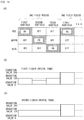
- FIG. 14 provides diagrams showing the relationship between lighting statuses of a light source and images displayed on the first and second liquid crystal panels of the liquid crystal display device shown in FIG. 12 ; more specifically, part (A) is a diagram showing ON/OFF states of red, green, and blue LEDs during first through third subfield periods, part (B) is a diagram showing a gradation value represented by a drive image signal provided to the first liquid crystal panel, for each subfield period, and part (C) is a diagram showing a gradation value represented by a luminance adjustment image signal provided to the second liquid crystal panel, for each subfield period.
- part (A) is a diagram showing ON/OFF states of red, green, and blue LEDs during first through third subfield periods
- part (B) is a diagram showing a gradation value represented by a drive image signal provided to the first liquid crystal panel, for each subfield period
- part (C) is a diagram showing a gradation value represented by a luminance adjustment image signal provided to the second liquid crystal panel, for
- FIG. 15 is a block diagram illustrating the configuration of a display control circuit provided in a liquid crystal display device according to a variant of the second embodiment.
- FIG. 16 is a block diagram illustrating the configuration of a liquid crystal display device according to a third embodiment of the present invention.
- FIG. 17 provides enlarged views of portions of first and second liquid crystal panels in the liquid crystal display device shown in FIG. 16 .
- FIG. 18 is a block diagram illustrating the configurations of a second scanning signal line driver circuit and a second data signal line driver circuit in the liquid crystal display device shown in FIG. 16 .
- FIG. 19 is a block diagram illustrating the configuration of a display control circuit in a liquid crystal display device according to a variant of the third variant.
- FIG. 20 is a block diagram illustrating the configuration of a liquid crystal display device according to a fourth embodiment of the present invention.
- FIG. 21 is a cross-sectional view illustrating the configuration of a display of a liquid crystal display device according to a variant of the first through fourth embodiments, along with light trajectories.
- FIG. 1 is a diagram illustrating the configuration of a display 11 used in the first basic study.
- a first absorptive polarizing plate 41 a first liquid crystal panel 30 a , a second absorptive polarizing plate 42 , and a light guide plate 20 are disposed sequentially from front to back side, as shown in FIG. 1 .
- the first and second absorptive polarizing plates 41 and 42 have respective absorption axes perpendicular to each other.
- the first liquid crystal panel 30 a is a normally white panel driven in TN (twisted nematic) mode.
- the first liquid crystal panel 30 a Since the first liquid crystal panel 30 a is driven in TN mode, pixels of the first liquid crystal panel 30 a that are in the state of not being driven (i.e., in OFF state), either where no drive image signal in accordance with provided image data is being written or where a 0V drive image signal is being written, output incident polarized waves after rotating respective polarization axes 90 degrees. On the other hand, once the state transitions to a drive state (i.e., ON state) where drive image signals are being written, the first liquid crystal panel 30 a allows the polarized waves to be outputted without rotating the polarization axes.
- a drive state i.e., ON state
- the light guide plate 20 has attached to an edge a light source 25 , including, for example, LEDs (light-emitting devices), as shown in FIG. 1 .
- a light source 25 including, for example, LEDs (light-emitting devices), as shown in FIG. 1 .
- the light source 25 is lit up (ON)
- light from the light source 25 is incident on the light guide plate 20 , which emits the light toward the front and back sides.
- First and second polarized waves included in the light emitted toward the front side are incident on the second absorptive polarizing plate 42 .
- the first polarized wave is transmitted through the second absorptive polarizing plate 42
- the second polarized wave is absorbed by the second absorptive polarizing plate 42 .
- the first polarized wave After being transmitted through the second absorptive polarizing plate 42 , the first polarized wave is incident on the first liquid crystal panel 30 a . Since the first liquid crystal panel 30 a is driven in TN mode, the first polarized wave that is incident on the first liquid crystal panel 30 a at pixels in OFF state is outputted after being converted into a second polarized wave by the polarization axis being rotated 90 degrees. The first polarized wave that is incident on pixels in ON state is outputted without the polarization axis being rotated.
- the second polarized wave emitted by the first liquid crystal panel 30 a is transmitted through the first absorptive polarizing plate 41 to the front side, whereas the first polarized wave is absorbed by the first absorptive polarizing plate 41 .
- FIG. 2 is a diagram showing the quantity of light for each light trajectory in the display 11 .
- the light guide plate 20 emits first and second polarized waves toward the front and back sides at an equal proportion, that is, “0.25”. Accordingly, each of the first and second polarized waves is transmitted through the light guide plate 20 to the back side at a proportion of “0.25”. As a result, the light that is transmitted to the back side consists of the first and second polarized waves, the total proportion of which is “0.5”.
- the proportion of the second polarized wave that reaches the front side after being converted from the first polarized wave emitted toward the front side by the light guide plate 20 is “0.25”.
- the second polarized wave that is emitted toward the front side by the light guide plate 20 at a proportion of “0.25” is absorbed by the first absorptive polarizing plate 41 and therefore cannot be transmitted to the front side.
- the second polarized wave converted from the first polarized wave is the only light that is transmitted to the front side, and the proportion thereof is “0.25”.
- the first polarized wave included in the light emitted toward the front side by the light guide plate 20 is converted into the second polarized wave, which is transmitted through the first liquid crystal panel 30 a toward the front side, and therefore contributes to screen brightness on the first liquid crystal panel 30 a .
- the second polarized wave is absorbed by the second absorptive polarizing plate 42 and therefore does not contribute to screen brightness on the first liquid crystal panel 30 a .
- the first and second polarized waves emitted toward the back side by the light guide plate 20 are transmitted to the back side, and therefore, neither wave contributes to screen brightness.
- the light emitted by the light source 25 contributes to screen brightness at a proportion of “0.25”.
- FIG. 3 is a diagram illustrating the configuration of a display 12 used in the second basic study.
- a first absorptive polarizing plate 41 a first liquid crystal panel 30 a , a second absorptive polarizing plate 42 , a light guide plate 20 , a third absorptive polarizing plate 43 , a second liquid crystal panel 30 b , and a reflective polarizing plate 51 are disposed sequentially from front to back side, as shown in FIG. 3 .
- the display 12 is a display configured by additionally disposing the third absorptive polarizing plate 43 , the second liquid crystal panel 30 b , and the reflective polarizing plate 51 on the back side relative to the light guide plate 20 in the display 11 shown in FIG. 1 .
- the third absorptive polarizing plate 43 has a transmission axis in the same direction as a reflection axis of the reflective polarizing plate 51 and a transmission axis of the second absorptive polarizing plate 42 .
- the second liquid crystal panel 30 b has only one pixel provided across the entirety thereof.
- FIG. 4 is a diagram showing the quantity of light for each light trajectory in the display 12 .
- the light guide plate 20 emits first and second polarized waves toward the front and back sides equally at a proportion of “0.25”, and the second liquid crystal panel 30 b is in ON state.
- the second polarized wave converted from the first polarized wave by ON-state pixels of the first liquid crystal panel 30 a is the only light that is transmitted through the first absorptive polarizing plate 41 to the front side, and the proportion thereof is “0.25”.
- the first polarized wave emitted toward the back side by the light guide plate 20 at a proportion of “0.25” is transmitted through the third absorptive polarizing plate 43 and also through the second liquid crystal panel 30 b in ON-state and reflected toward the front side by the reflective polarizing plate 51 .
- the reflected first polarized wave is transmitted sequentially through the second liquid crystal panel 30 b in ON-state, the third absorptive polarizing plate 43 , the light guide plate 20 , and the second absorptive polarizing plate 42 , and strikes the first liquid crystal panel 30 a at a proportion of “0.25”.
- the first polarized wave incident on the first liquid crystal panel 30 a at OFF-state pixels is converted into a second polarized wave, which is emitted at a proportion of “0.25”.
- the first polarized wave incident on ON-state pixels is emitted without conversion and maintains the proportion of “0.25”.
- the first polarized wave with the proportion of “0.25” is absorbed by the first absorptive polarizing plate 41 , and therefore, only the second polarized wave with the proportion of “0.25” is transmitted through the first absorptive polarizing plate 41 to the front side.
- the second polarized wave emitted toward the back side by the light guide plate 20 at a proportion of “0.25” is absorbed by the third absorptive polarizing plate 43 .
- the light that reaches the front side includes the second polarized wave converted from the first polarized wave emitted toward the front side by the light guide plate 20 at a proportion of “0.25” and also includes the second polarized wave converted by the OFF-state pixels of the first liquid crystal panel 30 a from the first polarized wave emitted toward the back side by the light guide plate 20 at a proportion of “0.25” and reflected by the reflective polarizing plate 51 .
- the total proportion of these second polarized waves is “0.5”. Accordingly, in the second basic study, the quantity of light transmitted to the front side is twice as much as in the first basic study. In this case, the proportion of each of the first and second polarized waves transmitted to the back side is “0”.
- FIG. 5 is a table for comparison between the first and second basic studies. As shown in FIG. 5 , the proportion of the quantity of light that reaches the front side is “0.5” in the second basic study and is twice as much as the proportion of “0.25” in the first basic study. Accordingly, the display 12 in the second basic study has a brighter screen than the display 11 in the first basic study.
- the quantity of light that is transmitted to the front side is twice as much as in the first basic study, as shown in FIG. 5 .
- the contrast ratio of an image displayed on the first liquid crystal panel 30 a is the same for both the displays 11 and 12 . Therefore, it can be appreciated that the display 12 is not an improvement to the display 11 in terms of contrast ratio.
- liquid crystal display devices capable of realizing higher contrast ratios and doubling as see-through displays.
- FIG. 6 is a block diagram illustrating the configuration of a liquid crystal display device according to a first embodiment of the present invention.
- the liquid crystal display device is an active-matrix display device including a first liquid crystal panel 30 a , a second liquid crystal panel 30 b , a display control circuit 110 , a scanning signal line driver circuit 130 , and a data signal line driver circuit 150 , as shown in FIG. 6 .
- the liquid crystal display device also includes a light guide plate disposed between the first liquid crystal panel 30 a and the second liquid crystal panel 30 b , a light source attached to an edge of the light guide plate, a light source driver circuit for driving the light source, and various polarizing plates disposed on surfaces of the first and second liquid crystal panels 30 a and 30 b , but any illustrations thereof are omitted.
- Each of the first and second liquid crystal panels 30 a and 30 b includes n scanning signal lines G 1 to G n , m data signal lines S 1 to S m , and (m ⁇ n) pixels P ij (where m and n are integers of 2 or more, i is an integer of from 1 to n, and j is an integer of from 1 to m).
- the scanning signal lines G 1 to G n are disposed parallel to each other, and the data signal lines S 1 to S m are disposed parallel to each other so as to cross the scanning signal lines G 1 to G n .
- the pixels P ij are disposed near intersections of the scanning signal lines G i and the data signal lines S j .
- the (m ⁇ n) pixels P ij are disposed in a matrix with each row consisting of m pixels and each column consisting of n pixels.
- the scanning signal line G i is connected in common to the pixels P ij in the i'th row, and the data signal line S j is connected in common to the pixels P ij in the j'th column.
- the first liquid crystal panel 30 a has red, green, and blue filters formed for each pixel.
- the second liquid crystal panel 30 b is a panel for controlling the quantity of light to be transmitted and therefore has no color filters formed thereon.
- the display control circuit 110 of the liquid crystal display device is externally provided with control signals, such as a horizontal synchronization signal HSYNC and a vertical synchronization signal VSYNC, and image data DAT.
- the display control circuit 110 generates and outputs a control signal SC 1 , including a clock signal and a gate start pulse signal GST, to the scanning signal line driver circuit 130 , and also generates and outputs a digital image signal DV and a control signal SC 2 , including a source start pulse signal, a source clock signal, and a latch strobe signal, to the data signal line driver circuit 150 .
- the scanning signal line driver circuit 130 applies scanning signals sequentially to the scanning signal lines G 1 to G n of the first and second liquid crystal panels 30 a and 30 b one by one so as to activate the scanning signal lines G 1 to G n .
- the scanning signal lines G 1 to G n are sequentially selected one by one, whereby the pixels P ij are collectively selected in one row at a time.
- the data signal line driver circuit 150 generates and applies drive image signals, which are analog signals, to the data signal lines S 1 to S m .
- the drive image signals are written in the selected pixels P ij of the first and second liquid crystal panels 30 a and 30 b , in one row at a time.
- drive image signals of the same voltage value are written in corresponding pixels of the first and second liquid crystal panels 30 a and 30 b.
- the first and second liquid crystal panels 30 a and 30 b are simultaneously provided with the same drive image signals, and therefore, one scanning signal line driver circuit 130 and one data signal line driver circuit 150 are simply provided and shared by the first and second liquid crystal panels 30 a and 30 b.
- each of the first and second liquid crystal panels 30 a and 30 b may be provided with a set of scanning signal line driver circuit and data signal line driver circuit.
- one of the scanning signal line driver circuit or the data signal line driver circuit may be provided for each of the first and second liquid crystal panels 30 a and 30 b , and the other may be shared between the first and second liquid crystal panels 30 a and 30 b.
- the configuration of a display 15 included in the liquid crystal display device in the present embodiment is the same as the configuration of the display 12 used in the second basic study shown in FIG. 3 , and therefore, any description thereof will be omitted. Note that while the second liquid crystal panel 30 b of the display 12 has only one pixel provided across the entirety thereof, the second liquid crystal panel 30 b in the present embodiment, as with the first liquid crystal panel 30 a , has a plurality of pixels formed thereon.
- the first liquid crystal panel 30 a is a liquid crystal panel provided with a plurality of pixels, and polarized waves incident on ON-state pixels are emitted without polarization conversion.
- incident polarized waves experience polarization conversion before emission.
- a first polarized wave transmitted through the second absorptive polarizing plate 42 and incident on OFF-state pixels is converted into a second polarized wave.
- the first polarized wave transmitted through the second absorptive polarizing plate 42 is converted into a second polarized wave, which is transmitted through the first absorptive polarizing plate 41 .
- the first polarized wave transmitted through the second absorptive polarizing plate 42 and incident on ON-state pixels is transmitted through the ON-state pixels without conversion. Accordingly, the first polarized wave transmitted through the second absorptive polarizing plate 42 is absorbed by the first absorptive polarizing plate 41 .
- the conversion may be performed so as to not only completely change one polarization state to the other but also allow for both polarization states.
- incident light is transmitted in part through the polarizing plate disposed on the front side relative to the first liquid crystal panel 30 a , with the result that an image or a background can be displayed with intermediate gradation values.
- the light guide plate 20 is made of a transparent resin, such as acrylic or polycarbonate, or glass, and has a dotted pattern formed thereon or a diffusing agent, such as silica, applied thereto, so as to emit incident light derived from the light source 25 , toward the front and back sides.
- the light guide plate 20 has attached to an edge the light source 25 , including, for example, LEDs for emitting red, green, and blue light. Accordingly, when the light source 25 is lit up, light emitted by the light source 25 is incident on the light guide plate 20 and travels through the light guide plate 20 while repeatedly experiencing total reflections on surfaces of the light guide plate 20 , until the light exits the light guide plate 20 toward the front or back side upon incidence on the dotted pattern or the diffusing agent.
- the second liquid crystal panel 30 b in the present embodiment is a liquid crystal panel provided with a plurality of pixels.
- FIG. 7 is a diagram illustrating the configurations of the first and second liquid crystal panels 30 a and 30 b . As shown in FIG. 7 , the pixels formed on the first and second liquid crystal panels 30 a and 30 b are equal in size and arrangement.
- first and second liquid crystal panels 30 a and 30 b are disposed one in front of the other, when the first liquid crystal panel 30 a is viewed from the front side toward the back side, pixel frames that partition the pixels of the first liquid crystal panel 30 a appear to lie exactly on pixel frames that partition the pixels of the second liquid crystal panels 30 b.
- the second liquid crystal panel 30 b also, ON-state pixels transmit incident light therethrough without polarization conversion, and OFF-state pixels transmit incident light therethrough after polarization conversion. In this manner, the second liquid crystal panel 30 b also can emit a polarized wave after polarization conversion for each pixel or without polarization conversion.
- FIG. 8 is a diagram illustrating light trajectories in the display 15 where light emitted by the light guide plate 20 upon lighting of the light source 25 is transmitted to the front side.
- the light source 25 is lit up.
- First and second polarized waves emitted toward the front side by the light guide plate 20 are incident on the second absorptive polarizing plate 42 .
- the second polarized wave is absorbed by the second absorptive polarizing plate 42
- the first polarized wave is transmitted through the second absorptive polarizing plate 42 .
- a first polarized wave emitted toward the back side by the light guide plate 20 is transmitted through the third absorptive polarizing plate 43 and strikes the second liquid crystal panel 30 b . Because each pixel of the second liquid crystal panel 30 b is in ON state, the first polarized wave incident on the second liquid crystal panel 30 b is not changed in polarization by the second liquid crystal panel 30 b and strikes the reflective polarizing plate 51 .
- the first polarized wave is reflected toward the front side by the reflective polarizing plate 51 , whose reflection axis is in the same direction as a transmission axis of the third absorptive polarizing plate 43 , with the result that the first polarized wave is transmitted sequentially through the second liquid crystal panel 30 b , the third absorptive polarizing plate 43 , the light guide plate 20 , and the second absorptive polarizing plate 42 and strikes the first liquid crystal panel 30 a .
- Light trajectories along which the first polarized wave incident on the first liquid crystal panel 30 a reaches the front side is the same as in the case shown in FIG. 4 , and therefore, any descriptions thereof will be omitted.
- a second polarized wave emitted toward the back side by the light guide plate 20 is absorbed by the third absorptive polarizing plate 43 .
- the viewer on the front side can see a screen that appears luminous (displayed in white) in places corresponding to OFF-state pixels of the first liquid crystal panel 30 a and also appears to be displayed in black in places corresponding to ON-state pixels.
- the display 15 is capable of providing a combination of luminous and black display representations.
- FIG. 9 provides graphs showing the relationship between gradation value and quantity of light transmitted through the first liquid crystal panel 30 a of the display 15 in the present embodiment or luminance of an image displayed on the first liquid crystal panel 30 a ; more specifically, FIG. 9(A) is a graph showing the quantity proportion (quantity ratio) of light transmitted through the first liquid crystal panel 30 a to the front side in all light emitted by the light guide plate 20 , FIG. 9(B) is a graph showing an example of luminance for image data provided to the first and second liquid crystal panels 30 a and 30 b , for each gradation value, and FIG. 9(C) is a graph showing the luminance of an image presented on the display 15 , based on the quantity ratio shown in FIG. 9(A) and the image data luminance shown in FIG. 9(B) .
- the quantity ratio of light that reaches the front side to all the light emitted by the light guide plate 20 is “0.25” for the first basic study and “0.5” for the second basic study. Accordingly, in the case of the display 15 in the present embodiment, it is assumed that the quantity ratio is “0.25” for the gradation value 0 and “0.5” for the gradation value 255 and increases proportionally as the gradation value increases from 0 to 255.
- the luminance of an image displayed on the first liquid crystal panel 30 a is calculated as the product of the quantity ratio shown in FIG. 9(A) and the luminance shown in FIG. 9(B) .
- the luminance thus calculated for an image displayed on the first liquid crystal panel 30 a of the display 15 is as shown in FIG. 9(C) .
- the luminance gradually increases in slope as the gradation value increases from 0 to 255, as shown in FIG. 9(C) .
- luminance A for the gradation value 0 in the present embodiment is the same as luminance a for the gradation value 0 in the first basic study.
- the luminance for the low gradation value is the same as in the case of the display 11 used in the first basic study.
- the luminance for the high gradation value is higher than that in the case of the display 12 used in the second basic study. Accordingly, the contrast ratio of the display 15 in the present embodiment increases with the gradation value, resulting in enhanced image display quality. Note that unless otherwise specified herein, the contrast ratio is referred to for both video and still images.
- FIG. 10 is a diagram illustrating light trajectories in the display 15 where light incident from the back side is transmitted to the front side. As shown in FIG. 10 , each pixel of the second liquid crystal panel 30 b is in OFF state, and the light source 25 is turned off. A first polarized wave incident from the back side is reflected toward the back side by the reflective polarizing plate 51 .
- a second polarized wave incident from the back side is transmitted through the reflective polarizing plate 51 and strikes the second liquid crystal panel 30 b . Since the pixels of the second liquid crystal panel 30 b are in OFF state, the second polarized wave is transmitted through the second liquid crystal panel 30 b after being converted into a first polarized wave.
- the first polarized wave strikes the third absorptive polarizing plate 43 and is sequentially transmitted through the third absorptive polarizing plate 43 , the light guide plate 20 , and the second absorptive polarizing plate 42 to the first liquid crystal panel 30 a because the third absorptive polarizing plate 43 has a transmission axis in the same direction as that of the reflective polarizing plate 51 .
- the first polarized wave incident on the first liquid crystal panel 30 a follows the same light trajectory as in the second basic study shown in FIG. 4 , and therefore, any description of the trajectory will be omitted. Consequently, the first polarized wave is converted into a second polarized wave while being transmitted through OFF-state pixels of the first liquid crystal panel 30 a , and the second polarized wave is transmitted through the second absorptive polarizing plate 42 to the front side.
- some portion of the first polarized wave is transmitted through ON-state pixels of the first liquid crystal panel 30 a without conversion and absorbed by the first absorptive polarizing plate 41 after exiting the first liquid crystal panel 30 a . Accordingly, the viewer on the front side can see the back side in places corresponding to the OFF-state pixels and also the screen that appears to be displayed in black in places corresponding to the ON-state pixels.
- FIG. 11 is a diagram illustrating light trajectories along which light incident from the front side is transmitted to the back side in the display 15 .
- the second liquid crystal panel 30 b has ON-state and OFF-state pixels, and the light source 25 is turned off.
- a first polarized wave incident from the front side is absorbed by the first absorptive polarizing plate 41 , and a second polarized wave is transmitted through the first absorptive polarizing plate 41 and strikes the first liquid crystal panel 30 a.
- the second polarized wave incident on the ON-state pixels of the first liquid crystal panel 30 a is transmitted through the first liquid crystal panel 30 a without conversion and absorbed by the second absorptive polarizing plate 42 .
- the second polarized wave incident on the OFF-state pixels is converted into a first polarized wave, which strikes the second liquid crystal panel 30 b after being transmitted sequentially through the second absorptive polarizing plate 42 , the light guide plate 20 , and the third absorptive polarizing plate 43 .
- the first polarized wave that is incident on the OFF-state pixels of the second liquid crystal panel 30 b is converted into a second polarized wave, which exits the second liquid crystal panel 30 b and strikes the reflective polarizing plate 51 .
- the first polarized wave that is incident on the ON-state pixels is transmitted without conversion and strikes the reflective polarizing plate 51 .
- the first polarized wave is reflected by the reflective polarizing plate 51 and absorbed by the third absorptive polarizing plate 43 .
- the second polarized wave incident on the reflective polarizing plate 51 is transmitted through the reflective polarizing plate 51 to the back side. Accordingly, the viewer on the back side can see the front side in places corresponding to the OFF-state pixels of the second liquid crystal panel 30 b and also the screen that appears to be displayed in black in places corresponding to the ON-state pixels.
- the display 15 can also be used as a see-through display in which light incident from the back side is transmitted to the front side and light incident from the front side is transmitted to the back side. Note that similar to the above, displays in embodiments to be described below can also be used as see-through displays, but such descriptions will be omitted.
- the second liquid crystal panel 30 b is driven in accordance with the gradation value of an image displayed on the first liquid crystal panel 30 a .
- luminance for the gradation value 0 is the same as in the first basic study, but luminance for the high gradation value is higher than in the second basic study. Accordingly, higher absolute values can be achieved for the quantity and the luminance of light illuminating the first liquid crystal panel 30 a , resulting in an enhanced contrast ratio of an image displayed on the first liquid crystal panel 30 a and enhanced display quality of the displayed image.
- image display quality can be enhanced not only for video display but also for still image display.
- FIG. 12 is a block diagram illustrating the configuration of a liquid crystal display device according to a second embodiment of the present invention.
- the liquid crystal display device according to the present embodiment is an active-matrix display device including a first liquid crystal panel 30 a , a second liquid crystal panel 30 b , a display control circuit 110 , a scanning signal line driver circuit 130 , a first data signal line driver circuit 150 a , and a second data signal line driver circuit 150 b , as shown in FIG. 12 .
- the first data signal line driver circuit 150 a generates a drive image signal on the basis of a digital image signal DV provided by the display control circuit 110 , and outputs the generated signal to the first liquid crystal panel 30 a .
- the second data signal line driver circuit 150 b generates a luminance adjustment image signal to be described later, on the basis of the digital image signal DV provided by the display control circuit 110 , and provides the generated signal to the second liquid crystal panel 30 b.
- first liquid crystal panel 30 a the second liquid crystal panel 30 b
- the display control circuit 110 the scanning signal line driver circuit 130
- a display in the present embodiment is provided with the same elements as in the first embodiment shown in FIG. 6 , including the first liquid crystal panel 30 a , the second liquid crystal panel 30 b , the light guide plate 20 , the light source 25 attached to the light guide plate 20 , and various polarizing plates disposed on surfaces of the first and second liquid crystal panels 30 a and 30 b . Therefore, any cross-sectional view and description of the display in the present embodiment will be omitted.
- the liquid crystal display device employs a field-sequential mode in which red, green, and blue LEDs included in the light source 25 are sequentially lit up in a time division manner for respective subfield periods. Accordingly, unlike in the first embodiment, each pixel of the first liquid crystal panel 30 a has no color filter formed thereon and is sequentially provided with red, green, and blue drive image signals in accordance with the timing of red, green, and blue illumination emitted by the light source 25 in a time division manner, and the second liquid crystal panel 30 b is provided with a luminance adjustment image signal generated in a manner as will be described later. Note that the display configuration in the present embodiment is the same as in the first embodiment, and therefore, any cross-sectional view and description illustrating the display configuration will be omitted.
- the luminance adjustment image signal to be written in the second liquid crystal panel 30 b is an image signal for a color whose gradation value is the highest among the red, green, and blue image signals that are sequentially written in each pixel of the first liquid crystal panel 30 a during respective subfield periods in which red, green, and blue light are lit up.
- Such a luminance adjustment image signal is written in the second liquid crystal panel 30 b for one whole field period.
- the second data signal line driver circuit 150 b connected to the data signal lines S 1 to S m of the second liquid crystal panel 30 b is configured differently from the first data signal line driver circuit 150 a connected to the data signal lines S 1 to S m of the second liquid crystal panel 30 a.
- FIG. 13 is a block diagram illustrating the configurations of the first and second data signal line driver circuits 150 a and 150 b .
- the second data signal line driver circuit 150 b includes a shift register 151 , sampling memory 152 , hold memory 153 , a D/A converter 154 , and an output buffer circuit 155 , as does the first data signal line driver circuit 150 a , and further includes an arithmetic circuit 156 between the sampling memory 152 and the hold memory 153 .
- the shift register 151 transfers pulses sequentially from input to output terminals in accordance with a clock signal included in a control signal SC 2 provided by the display control circuit 110 , whereby the pulses are outputted to the sampling memory 152 .
- the sampling memory 152 samples and latches digital image signals provided by the display control circuit 110 and outputs the digital image signals to the arithmetic circuit 156 .
- the arithmetic circuit 156 calculates gradation values of red, green, and blue image signals for one field, on the basis of the image signals memorized in the sampling memory 152 .
- the hold memory 153 has memorized therein image data for one horizontal line, and outputs a memorized image signal to the D/A converter 154 upon reception of a latch strobe signal included in the control signal SC 2 from the display control circuit 110 . While the hold memory 153 is outputting the image signal, the sampling memory 152 sequentially memorizes image signals for the next horizontal line.
- the D/A converter 154 converts the image signals sequentially provided by the hold memory 153 into luminance adjustment image signals, which are analog signals and outputted to the output buffer circuit 155 .
- the output buffer circuit 155 provides the luminance adjustment image signals to the data signal lines S 1 to Sm of the second liquid crystal panel 30 b .
- the second data signal line driver circuit 150 b obtains the image signals for the highest gradation value by means of the arithmetic circuit 156 and also the luminance adjustment image signals on the basis of the image signals for the highest gradation value, and provides the obtained luminance adjustment image signals to the data signal lines S 1 to Sm.
- the second data signal line driver circuit 150 b outputs the luminance adjustment image signals that correspond to the highest of the gradation values for the red, green, and blue image data, to the data signal lines S 1 to S m of the second liquid crystal panel 30 b for each field period, i.e., over all subfield periods included in each field period.
- the configurations of the scanning signal line driver circuit 130 and the first data signal line driver circuit 150 a in the present embodiment are the same as those of known scanning signal line driver circuits and data signal line driver circuits for use in field-sequential modes, and therefore, any descriptions thereof will be omitted.
- FIG. 14 provides diagrams showing the relationship between lighting statuses of the light source and images displayed on the first and second liquid crystal panels 30 a and 30 b in the present embodiment; more specifically, FIG. 14(A) is a diagram showing ON/OFF states of the red, green, and blue LEDs during first through third subfield periods, FIG. 14(B) is a diagram showing a gradation value represented by a drive image signal provided to the first liquid crystal panel 30 a , for each subfield period, and FIG. 14(C) is a diagram showing a gradation value represented by a luminance adjustment image signal provided to the second liquid crystal panel 30 b , for each subfield period.
- the red, green, and blue LEDs are sequentially lit up during the first, second, and third subfield periods, respectively, within one field period, as shown in FIG. 14(A) .
- Gradation values for images displayed on the first liquid crystal panel 30 a are, for example, in the sequence: 128, 90, and 128, during the first, second, and third subfield periods, respectively, as shown in FIG. 14(B) .
- the highest of these gradation values is 128.
- each pixel of the second liquid crystal panel 30 b is provided with a luminance adjustment image signal for the gradation value 128 over the entire field period, as shown in FIG. 14(C) .
- the second liquid crystal panel 30 b is provided with the luminance adjustment image signal for the gradation value 128 during all of the first through third subfield periods within the field period.
- the first liquid crystal panel 30 a is sequentially provided with drive image signals for displaying a red image with the gradation value 128, a green image with the gradation value 90, and a blue image with the gradation value 128, during the first, second, and third subfield periods, respectively.
- the present embodiment renders it possible to achieve effects similar to those achieved by the first embodiment. Moreover, even when the first liquid crystal panel 30 a is driven at high speed in a field-sequential mode, the second liquid crystal panel 30 b can adequately follow the operation speed of the first liquid crystal panel 30 a . Thus, it is possible to increase the quantity of light transmitted to the front side and thereby enhance the luminance of a display image.
- FIG. 15 is a block diagram illustrating the configuration of a display control circuit 110 provided in a liquid crystal display device according to a variant of the present embodiment.
- the display control circuit 110 includes an input buffer circuit 111 , a first output signal generation circuit 112 , a first output buffer circuit 113 , a second output signal generation circuit 114 , and a second output buffer circuit 115 , and further, the second output signal generation circuit 114 includes an arithmetic circuit 116 .
- the input buffer circuit 111 When the input buffer circuit 111 is externally provided with image data DAT, the input buffer circuit 111 provides the image data to the first output signal generation circuit 112 and the second output signal generation circuit 114 .
- the first output signal generation circuit 112 On the basis of the image data DAT, the first output signal generation circuit 112 generates a digital image signal DV and control signals SC 1 and SC 2 for controlling the scanning signal line driver circuit 130 and the first data signal line driver circuit 150 a , respectively, and outputs the control signal SC 1 to the scanning signal line driver circuit 130 via the first output buffer circuit 113 and the digital image signal DV and the control signal SC 2 to the first data signal line driver circuit 150 a also via the first output buffer circuit 113 .
- the second output signal generation circuit 114 produces a control signal SC 2 for controlling the second data signal line driver circuit 150 b .
- the arithmetic circuit 116 included in the second output signal generation circuit 114 calculates gradation values for red, green, and blue image signals for one field, and produces an image signal (hereinafter, referred to as a “highest gradation image signal”) MDV having the highest of the calculated gradation values.
- the second output signal generation circuit 114 outputs the highest gradation image signal MDV and the control signal SC 2 to the second data signal line driver circuit 150 b . In this manner, the display control circuit 110 can obtain the highest gradation image signal by means of the arithmetic circuit 116 .
- the first data signal line driver circuit 150 a generates a drive image signal on the basis of the digital image signal DV and provides the drive image signal to the first liquid crystal panel 30 a .
- the second data signal line driver circuit 150 b generates a luminance adjustment image signal on the basis of the highest gradation image signal MDV and provides the luminance adjustment image signal to the second liquid crystal panel 30 b.
- liquid crystal display device achieves the same effects as those achieved by the liquid crystal display device according to the present embodiment, and therefore, any descriptions of the effects will be omitted.
- FIG. 16 is a block diagram illustrating the configuration of a liquid crystal display device according to a third embodiment of the present invention.
- the liquid crystal display device according to the present embodiment is an active-matrix display device including a first liquid crystal panel 30 a , a second liquid crystal panel 30 b , a display control circuit 110 , a first scanning signal line driver circuit 130 a , a second scanning signal line driver circuit 130 b , a first data signal line driver circuit 150 a , and a second data signal line driver circuit 150 b , as shown in FIG. 16 .
- the first liquid crystal panel 30 a is driven by the first scanning signal line driver circuit 130 a and the first data signal line driver circuit 150 a
- the second liquid crystal panel 30 b is driven by the second scanning signal line driver circuit 130 b and the second data signal line driver circuit 150 b.
- the display configuration in the present embodiment is the same as in the first embodiment, and therefore, any cross-sectional view and description illustrating the display configuration will be omitted.
- FIG. 17 provides enlarged views of portions of the first and second liquid crystal panels 30 a and 30 b .
- Each pixel formed on the second liquid crystal panel 30 b is twice as large in dimension in each of the row and column directions as each pixel formed on the first liquid crystal panel 30 a , and hence has four times as large an area, as shown in FIG. 17 .
- four pixels P 11 , P 12 , P 21 , and P 22 of the first liquid crystal panel 30 a correspond to one pixel P 11 of the second liquid crystal panel 30 b .
- the number of pixels formed on the second liquid crystal panel 30 b is half the number of pixels formed on the first liquid crystal panel 30 a . Accordingly, scanning signal lines and data signal lines formed on the second liquid crystal panel 30 b are simply required to be respectively one-half in number of the scanning signal lines G 1 to G n and the data signal lines S 1 to S m formed on the second liquid crystal panel 30 b in the first embodiment. Therefore, the second liquid crystal panel 30 b has formed thereon signal lines corresponding to odd-numbered lines of both the n scanning signal lines G 1 to G n and the m data signal lines S 1 to S m formed on the first liquid crystal panel 30 a.
- FIG. 18 is a block diagram illustrating the configurations of the second scanning signal line driver circuit 130 b and the second data signal line driver circuit 150 b .
- the second scanning signal line driver circuit 130 b includes a shift register 131 , a level shifter 132 , and an output buffer circuit 133 , as included in known scanning signal line driver circuits, and further includes an arithmetic circuit 135 between the shift register 131 and the level shifter 132 .
- the arithmetic circuit 135 generates scanning signals for sequentially activating and selecting scanning signal lines of the second liquid crystal panel 30 b , and sequentially provides the generated scanning signals to odd-numbered lines of the scanning signal lines G 1 to G n .
- the configuration of the second data signal line driver circuit 150 b is the same as that shown in FIG. 13 , and therefore will not be elaborated upon.
- the second data signal line driver circuit 150 b shown in FIG. 18 is also additionally provided with an arithmetic circuit 156 between the sampling memory 152 and the hold memory 153 .
- the arithmetic circuit 156 calculates average gradation values for sets of four pixels of the first liquid crystal panel 30 a , and then generates average gradation image signals ADV corresponding to the average gradation values.
- the D/A converter 154 is provided with the average gradation image signals ADV on the basis of which luminance adjustment image signals are produced and simultaneously outputted to the data signal lines S 1 to S m of the second liquid crystal panel 30 b .
- each pixel of the second liquid crystal panel 30 b is provided with a luminance adjustment image signal that represents an average gradation value for four corresponding pixels of the first liquid crystal panel 30 a.
- the pixel of the second liquid crystal panel 30 b has been described as being twice as large in dimension in each of the row and column directions as the pixel of the first liquid crystal panel 30 a .
- each dimension may be an integer multiple, such as three or four times, so long as the numbers of pixels of the first liquid crystal panel 30 a in the vertical and horizontal directions are divisible by the respective numbers of pixels of the second liquid crystal panel 30 b in the vertical and horizontal directions.
- pixel frames that partition the pixels of the first liquid crystal panel 30 a appear to lie exactly on pixel frames that partition the pixels of the second liquid crystal panel 30 b . Accordingly, light emitted by the second liquid crystal panel 30 b illuminates the first liquid crystal panel 30 a without being blocked by the pixel frames of the first liquid crystal panel 30 a , with the result that the first liquid crystal panel 30 a can efficiently utilize the illumination.
- each pixel of the second liquid crystal panel 30 b has four times as large an area as each pixel of the first liquid crystal panel 30 a , resulting in a reduced proportion of a switching element provided in each pixel. Accordingly, the pixel of the second liquid crystal panel 30 b correspondingly increases in transmittance, and therefore, the quantity of light transmitted through the second liquid crystal panel 30 b increases. Thus, the quantity of light illuminating the first liquid crystal panel 30 a at the high gradation value increases, resulting in an enhanced display image luminance.
- the arithmetic circuit 135 provided in the second scanning signal line driver circuit 130 b produces scanning signals for sequentially activating the scanning signal lines
- the arithmetic circuit 156 provided in the second data signal line driver circuit 150 b produces luminance adjustment image signals on the basis of average gradation image signals ADV representing average gradation values for sets of four pixels.
- FIG. 19 is a block diagram illustrating the configuration of the display control circuit 110 in the present variant.
- the input buffer circuit 111 the first output signal generation circuit 112 , the first output buffer circuit 113 , the second output signal generation circuit 114 , and the second output buffer circuit 115 are provided, and further, the second output signal generation circuit 114 includes the arithmetic circuit 116 .
- the arithmetic circuit 116 produces average gradation image signals ADV representing average gradation values for sets of four pixels of the first liquid crystal panel 30 a , each set corresponding to one pixel of the second liquid crystal panel 30 b , and the produced average gradation image signals ADV, along with a control signal SC 2 , are provided to the second data signal line driver circuit 150 b . Moreover, a control signal SC 1 is generated and provided to the second scanning signal line driver circuit 130 b . As a result, the pixels of the second liquid crystal panel 30 b are provided with the average gradation image signals ADV representing the average gradation values for the sets of four pixels of the first liquid crystal panel.
- the first output signal generation circuit 112 generates the control signal SC 1 provided to the first scanning signal line driver circuit 130 a of the first liquid crystal panel 30 a and also generates the control signal SC 2 and the digital image signal DV, which are provided to the first data signal line driver circuit 150 a .
- Such operations are the same as in the case shown in FIG. 15 , and therefore, any descriptions thereof will be omitted.
- the liquid crystal display device according to this variant achieves the same effects as in the present embodiment, and therefore, any description thereof will be omitted.
- FIG. 20 is a block diagram illustrating the configuration of a liquid crystal display device according to a fourth embodiment of the present invention.
- the liquid crystal display device according to the present embodiment is an active-matrix display device including a first liquid crystal panel 30 a , a second liquid crystal panel 30 b , a display control circuit 110 , a first scanning signal line driver circuit 130 a , a second scanning signal line driver circuit 130 b , a first data signal line driver circuit 150 a , and a second data signal line driver circuit 150 b , as shown in FIG. 20 .
- the first liquid crystal panel 30 a is driven by the first scanning signal line driver circuit 130 a and the first data signal line driver circuit 150 a
- the second liquid crystal panel 30 b is driven by the second scanning signal line driver circuit 130 b and the second data signal line driver circuit 150 b.
- the configuration of the liquid crystal display device according to the present embodiment is similar to the configuration of the liquid crystal display device according to the third embodiment shown in FIG. 16 .
- the present embodiment differs from the liquid crystal display device shown in FIG. 16 in that the second liquid crystal panel 30 b has formed thereon only one pixel P 11 having the same size as the total size of the (m ⁇ n) pixels P ij formed on the first liquid crystal panel 30 a . Accordingly, when the viewer sees the first liquid crystal panel 30 a from the front side of the display, the area of the first liquid crystal panel 30 a in which the pixels P ij are formed appear to lie on a frame of the pixel P 11 on the second liquid crystal panel 30 b.
- the second liquid crystal panel 30 b is driven such that the gradation value for the pixel P 11 of the second liquid crystal panel 30 b is also 0.
- the second liquid crystal panel 30 b is driven such that the gradation value for the pixel P 11 of the second liquid crystal panel 30 b is also 128.
- the second liquid crystal panel 30 b is driven such that the gradation value for the pixel P 11 of the second liquid crystal panel 30 b is also 255.
- the configuration of the display control circuit 110 in the present embodiment is the same as the configuration of the display control circuit 110 in the third embodiment shown in FIG. 19 . Therefore, differences between the display control circuit 110 in the present embodiment and the display control circuit 110 in the third embodiment will be described with reference to FIG. 19 .
- the arithmetic circuit 116 provided in the second output signal generation circuit 114 in the present embodiment calculates an average gradation value for all pixels during one frame period, on the basis of image data DAT for one frame provided by the input buffer circuit 111 , and produces an average gradation image signal ADV corresponding to the calculated average gradation value.
- the average gradation image signal ADV along with a control signal SC 2 , is outputted to the second data signal line driver circuit 150 b via the second output buffer circuit 115 , which also outputs a control signal SC 1 to the second scanning signal line driver circuit 130 b .
- the second data signal line driver circuit 150 b produces a luminance adjustment image signal in accordance with the average gradation image signal ADV and the control signal SC 2 , and provides the produced luminance adjustment image signal to the data signal line S 1 of the second liquid crystal panel 30 b.
- the second scanning signal line driver circuit 130 b generates a scanning signal for activating the scanning signal line G 1 and continuously provides the scanning signal to the scanning signal line G 1 for one frame period.
- the luminance adjustment image signal is written in the pixel P ij of the second liquid crystal panel 30 b , thereby adjusting the quantity of light emitted by the pixel P 11 of the second liquid crystal panel 30 b for one frame period.
- the arithmetic circuit 116 has been described above as being provided in the second output signal generation circuit 114 of the display control circuit 110 . However, as in other embodiments, the arithmetic circuit may be provided in the second data signal line driver circuit 150 b.
- the luminance adjustment image signal representing the average luminance for all the pixels of the first liquid crystal panel 30 a is written in the pixel P 11 of the second liquid crystal panel 30 b . Accordingly, when the average gradation value for all the pixels of the first liquid crystal panel 30 a is 255, the second liquid crystal panel 30 b , which is a normally white panel, is set in ON state.
- a first polarized wave emitted toward the back side by the light guide plate 20 is transmitted through the second liquid crystal panel 30 b without experiencing polarization conversion and strikes the first liquid crystal panel 30 a after being reflected by the reflective polarizing plate 51 , as in the case shown in FIG. 4 .
- the first liquid crystal panel 30 a converts the first polarized wave into a second polarized wave, which is transmitted to the front side.
- the light that is emitted toward the back side by the light guide plate 20 contributes to enhancing the luminance of an image displayed on the first liquid crystal panel 30 a .
- the quantity of light transmitted to the front side doubles.
- the second liquid crystal panel 30 b is set in OFF state.
- a first polarized wave emitted toward the back side by the light guide plate 20 is converted into a second polarized wave by the second liquid crystal panel 30 b , and the second polarized wave is transmitted through the reflective polarizing plate 51 to the back side. Accordingly, the light emitted toward the back side by the light guide plate 20 does not contribute to enhancing the luminance of an image displayed on the first liquid crystal panel 30 a.
- luminances for the gradation values 0 and 255 in the first and second basic studies are respectively expressed as a and b
- luminances for the gradation values 0 and 255 in the present embodiment can be respectively expressed as a and 2b.
- the contrast ratio obtained by equation (4) is twice as high as the contrast ratio obtained by equation (1).
- the liquid crystal display device has only one large pixel P 11 formed on the second liquid crystal panel 30 b . Accordingly, the entire second liquid crystal panel 30 b transmits or blocks light by which the first liquid crystal panel 30 a is to be illuminated. Therefore, the contrast ratio of an image displayed on the first liquid crystal panel 30 a cannot be enhanced. However, in the case where, for example, video images are displayed on the entire screen of the first liquid crystal panel 30 a , when the gradation value changes from 0 to 255, the light transmitted through the second liquid crystal panel 30 b to illuminate the first liquid crystal panel changes similarly.
- the viewer can watch the video displayed on the first liquid crystal panel 30 a with a doubled contrast ratio when the image luminance is doubled during the current frame compared to the immediately preceding frame.
- the video contrast ratio is not enhanced to two times, but still, the video contrast ratio can be enhanced to a certain level.
- the contrast ratio during video watching which is referred to herein as the “video contrast ratio”
- the contrast ratio that can be perceived for both still and video images being watched with any of the liquid crystal display devices according to the first through third embodiments is referred to herein simply as the “contrast ratio”.
- the pixel P 11 of the second liquid crystal panel 30 b is driven with gradation representation by a luminance adjustment image signal representing an average luminance for all pixels of the first liquid crystal panel 30 a for each frame period. Accordingly, in the case where the luminance adjustment image signal is intended for displaying an image with a high gradation value, light emitted toward the back side by the light source 25 is reflected by the reflective polarizing plate 51 and thereby transmitted to the front side, and therefore, the quantity of light transmitted to the front side doubles.
- the luminance adjustment image signal is intended for displaying an image with a low gradation value
- light emitted toward the back side by the light source 25 is transmitted through the reflective polarizing plate 51 , and therefore, the quantity of light transmitted to the front side is not increased.
- the video contrast ratio can be enhanced to up to two times.
- FIG. 21 is a cross-sectional view illustrating the configuration of the display 16 of a liquid crystal display device according to the present variant, along with light trajectories.
- the display 16 shown in FIG. 21 has a reflective polarizing plate disposed in place of the third absorptive polarizing plate 43 of the display 15 shown in FIG. 11 .
- the same reflective polarizing plate as in the display 15 will be referred to as the first reflective polarizing plate 51 a and the additionally provided reflective polarizing plate will be referred to as the second reflective polarizing plate 51 b.
- a second polarized wave emitted toward the back surface side by the light guide plate 20 is reflected toward the front side by the second reflective polarizing plate 51 b .
- the reflected second polarized wave is transmitted through the light guide plate 20 and absorbed by the second absorptive polarizing plate upon incidence thereon.
- the light that is transmitted to the front side of the display 16 includes a second polarized wave obtained by OFF-state pixels of the first liquid crystal panel 30 a through conversion from a first polarized wave included in light emitted toward the front side by the light guide plate 20 , and also includes another second polarized wave obtained by the first liquid crystal panel 30 a through conversion from light emitted toward the back side by the light guide plate 20 and reflected by the first reflective polarizing plate 51 a .
- the quantity of light transmitted through the display 16 to the front side is equal to the quantity of light transmitted through the display 15 to the front side.
- the first through fourth embodiments can achieve similar effects even when the display 15 is replaced by the display 16 .
- both the first and second liquid crystal panels 30 a and 30 b have been described as TN liquid crystal panels, but may be VA (vertical alignment) liquid crystal panels. Moreover, both the first and second liquid crystal panels 30 a and 30 b have been described as being normally white liquid crystal panels, but may be normally black liquid crystal panels.
- the embodiments have been described with respect to the case where the contrast ratio is increased to up to two times. However, such an increase is determined by the quantity of light emitted toward the first liquid crystal panel, and therefore, it is understood that the contrast ratio is increased to up to more than two times as the quantity ratio increases.
- the display panel including the first liquid crystal panel 30 a is also referred to as the “first polarization modulation element”, and the display panel including the second liquid crystal panel 30 b is also referred to as the “second polarization modulation element”.
Landscapes
- Physics & Mathematics (AREA)
- General Physics & Mathematics (AREA)
- Engineering & Computer Science (AREA)
- Chemical & Material Sciences (AREA)
- Crystallography & Structural Chemistry (AREA)
- Nonlinear Science (AREA)
- Optics & Photonics (AREA)
- Theoretical Computer Science (AREA)
- Computer Hardware Design (AREA)
- Mathematical Physics (AREA)
- Control Of Indicators Other Than Cathode Ray Tubes (AREA)
- Liquid Crystal Display Device Control (AREA)
Abstract
B:A=B/A:1>2b/a:1.
Description
-
- a light source configured to emit light including a first polarized wave and a second polarized wave having a polarization axis perpendicular to a polarization axis of the first polarized wave;
- a light guide plate configured to emit the light derived from the light source, toward front and back sides of the display;
- a first polarization modulation element disposed on the front side relative to the light guide plate and having a plurality of pixels formed thereon;
- absorptive polarizing plates respectively disposed on front-side and back-side surfaces of the first polarization modulation element;
- a second polarization modulation element disposed on the back side relative to the light guide plate and having formed thereon a pixel or pixels whose number is equal to or less than the pixels of the first polarization modulation element;
- a polarizing plate disposed on a front-side surface of the second polarization modulation element; and
- a reflective polarizing plate disposed on a back-side surface of the second polarization modulation element,
-
- a scanning signal line driver circuit configured to generate scanning signals for selectively activating a plurality of scanning signal lines formed in the second polarization modulation element and to provide the scanning signals to the scanning signal lines;
- a data signal line driver circuit configured to generate the luminance adjustment image signal and provide the luminance adjustment image signal to a plurality of data signal lines formed in the second polarization modulation element; and
- a display control circuit configured to generate control signals for controlling operations of the scanning signal line driver circuit and the data signal line driver circuit and to provide the control signals respectively to the scanning signal line driver circuit and the data signal line driver circuit,
-
- a scanning signal line driver circuit configured to generate scanning signals for selectively activating a plurality of scanning signal lines formed in the second polarization modulation element and to provide the scanning signals to the scanning signal lines;
- a data signal line driver circuit configured to generate the luminance adjustment image signal and provide the luminance adjustment image signal to a plurality of data signal lines formed in the second polarization modulation element; and
- a display control circuit configured to generate control signals for controlling operations of the scanning signal line driver circuit and the data signal line driver circuit and to provide the control signals respectively to the scanning signal line driver circuit and the data signal line driver circuit,
b:a=b/a:1 (1)
2b:2a=b/a:1 (2)
B:A=B/A:1>2b/a:1 (3)
2b:a=2b/a:1 (4)
The contrast ratio obtained by equation (4) is twice as high as the contrast ratio obtained by equation (1). Thus, in the case where the liquid crystal display device according to the present embodiment displays a video, for example, when the gradation value is 0 for an immediately preceding frame and also 255 for the current frame, the viewer can see an image with a doubled contrast ratio.
-
- 15 display
- 20 light guide plate
- 25 light source
- 30 a first liquid crystal panel (first polarization modulation element)
- 30 b second liquid crystal panel (second polarization modulation element)
- 41 first absorptive polarizing plate
- 42 second absorptive polarizing plate
- 43 third absorptive polarizing plate (polarizing plate)
- 51 reflective polarizing plate
- 51 a the first reflective polarizing plate
- 51 b the second reflective polarizing plate
- 110 display control circuit
- 116 arithmetic circuit
- 130 scanning signal line driver circuit
- 130 a first scanning signal line driver circuit
- 130 b second scanning signal line driver circuit
- 135 arithmetic circuit
- 150 data signal line driver circuit
- 150 a first data signal line driver circuit
- 150 b second data signal line driver circuit
- 156 arithmetic circuit
Claims (6)
Applications Claiming Priority (3)
| Application Number | Priority Date | Filing Date | Title |
|---|---|---|---|
| JP2017-005091 | 2017-01-16 | ||
| JP2017005091 | 2017-01-16 | ||
| PCT/JP2018/000165 WO2018131558A1 (en) | 2017-01-16 | 2018-01-09 | Display device |
Publications (2)
| Publication Number | Publication Date |
|---|---|
| US20200124913A1 US20200124913A1 (en) | 2020-04-23 |
| US10824005B2 true US10824005B2 (en) | 2020-11-03 |
Family
ID=62839947
Family Applications (1)
| Application Number | Title | Priority Date | Filing Date |
|---|---|---|---|
| US16/470,352 Active US10824005B2 (en) | 2017-01-16 | 2018-01-09 | Display device with display presenting image based on externally provided image data and doubling as see-through display |
Country Status (3)
| Country | Link |
|---|---|
| US (1) | US10824005B2 (en) |
| CN (1) | CN110383161A (en) |
| WO (1) | WO2018131558A1 (en) |
Families Citing this family (6)
| Publication number | Priority date | Publication date | Assignee | Title |
|---|---|---|---|---|
| JP2022546678A (en) * | 2019-08-19 | 2022-11-07 | スリーエム イノベイティブ プロパティズ カンパニー | display system |
| CN113867059A (en) * | 2020-06-30 | 2021-12-31 | 京东方科技集团股份有限公司 | Liquid crystal display panel and liquid crystal display device |
| US11605358B2 (en) * | 2021-03-12 | 2023-03-14 | Sharp Kabushiki Kaisha | Liquid crystal display including two overlapping display panels that differ from each other in terms of the size of their respective display pixels |
| CN114545692A (en) * | 2022-02-09 | 2022-05-27 | 业成科技(成都)有限公司 | Stacked screen liquid crystal display device |
| CN115083339B (en) | 2022-07-26 | 2023-01-03 | 惠科股份有限公司 | Driving method and driving device of display panel |
| CN115903318B (en) * | 2022-10-24 | 2026-01-02 | 深圳康佳电子科技有限公司 | An LCD projection display device and display method |
Citations (5)
| Publication number | Priority date | Publication date | Assignee | Title |
|---|---|---|---|---|
| US20020159033A1 (en) | 2001-04-30 | 2002-10-31 | Koninklijke Philips Electronics N.V. | Color video projection display system with low-retardance compensator film for improved contrast |
| US20130271674A1 (en) | 2012-04-17 | 2013-10-17 | Young Lighting Technology Inc. | Display device |
| WO2015053023A1 (en) | 2013-10-08 | 2015-04-16 | シャープ株式会社 | Image display device |
| US20180120639A1 (en) * | 2016-11-02 | 2018-05-03 | Innolux Corporation | Display device |
| US20180284546A1 (en) * | 2017-03-31 | 2018-10-04 | Panasonic Liquid Crystal Display Co., Ltd. | Pixel configuration for a curved dual-panel electronic display device |
Family Cites Families (8)
| Publication number | Priority date | Publication date | Assignee | Title |
|---|---|---|---|---|
| JP2008216963A (en) * | 2007-02-06 | 2008-09-18 | Nitto Denko Corp | Optical device, image display device, and liquid crystal display device |
| US9864243B2 (en) * | 2010-05-14 | 2018-01-09 | Dolby Laboratories Licensing Corporation | High dynamic range displays using filterless LCD(s) for increasing contrast and resolution |
| CN103901664A (en) * | 2012-12-24 | 2014-07-02 | 联想(北京)有限公司 | Display device and electronic device |
| WO2015020032A1 (en) * | 2013-08-05 | 2015-02-12 | シャープ株式会社 | Image display device |
| CN103969871A (en) * | 2014-04-21 | 2014-08-06 | 合肥鑫晟光电科技有限公司 | Display device |
| CN106461991A (en) * | 2014-05-12 | 2017-02-22 | 夏普株式会社 | Image display device |
| US20180197488A1 (en) * | 2015-07-03 | 2018-07-12 | Sharp Kabushiki Kaisha | Display device and display method |
| CN105223731A (en) * | 2015-10-20 | 2016-01-06 | 深圳市华星光电技术有限公司 | Double-sided liquid crystal display device and backlight module thereof |
-
2018
- 2018-01-09 CN CN201880005634.2A patent/CN110383161A/en active Pending
- 2018-01-09 US US16/470,352 patent/US10824005B2/en active Active
- 2018-01-09 WO PCT/JP2018/000165 patent/WO2018131558A1/en not_active Ceased
Patent Citations (7)
| Publication number | Priority date | Publication date | Assignee | Title |
|---|---|---|---|---|
| US20020159033A1 (en) | 2001-04-30 | 2002-10-31 | Koninklijke Philips Electronics N.V. | Color video projection display system with low-retardance compensator film for improved contrast |
| JP2005502070A (en) | 2001-04-30 | 2005-01-20 | コーニンクレッカ フィリップス エレクトロニクス エヌ ヴィ | Projection display system |
| US20130271674A1 (en) | 2012-04-17 | 2013-10-17 | Young Lighting Technology Inc. | Display device |
| WO2015053023A1 (en) | 2013-10-08 | 2015-04-16 | シャープ株式会社 | Image display device |
| US20160187724A1 (en) | 2013-10-08 | 2016-06-30 | Sharp Kabushiki Kaisha | Image display device |
| US20180120639A1 (en) * | 2016-11-02 | 2018-05-03 | Innolux Corporation | Display device |
| US20180284546A1 (en) * | 2017-03-31 | 2018-10-04 | Panasonic Liquid Crystal Display Co., Ltd. | Pixel configuration for a curved dual-panel electronic display device |
Also Published As
| Publication number | Publication date |
|---|---|
| US20200124913A1 (en) | 2020-04-23 |
| CN110383161A (en) | 2019-10-25 |
| WO2018131558A1 (en) | 2018-07-19 |
Similar Documents
| Publication | Publication Date | Title |
|---|---|---|
| US10824005B2 (en) | Display device with display presenting image based on externally provided image data and doubling as see-through display | |
| CN105940441B (en) | Image display device | |
| US8115728B2 (en) | Image display device with reduced flickering and blur | |
| KR100712471B1 (en) | Time division type liquid crystal display device and color image display method thereof | |
| US8957838B2 (en) | Liquid crystal display device and television receiver | |
| US9001198B2 (en) | Image display viewing system, optical modulator and image display device | |
| WO2005081217A1 (en) | Video display device | |
| US20190171045A1 (en) | Display device | |
| US9509983B2 (en) | Image display viewing system and image display device | |
| US9552782B2 (en) | Image display device, presentation box employing same, and method of driving image display device | |
| US20160187724A1 (en) | Image display device | |
| US9620044B2 (en) | Image display device and drive method therefor | |
| KR20080033525A (en) | Liquid Crystal Display Including Scanning Backlight | |
| US20110221788A1 (en) | Liquid crystal display and picture display system | |
| US9548013B2 (en) | Image display device and drive method therefor | |
| US11054692B2 (en) | Display device | |
| WO2018008720A1 (en) | Display device | |
| JP6761719B2 (en) | Color display device | |
| WO2013047230A1 (en) | Liquid crystal display device | |
| WO2022009466A1 (en) | Display device and display method | |
| KR102910318B1 (en) | Liquid crystal display device | |
| JP2014157320A (en) | Display device and lighting system | |
| WO2016059847A1 (en) | Display device | |
| WO2022009467A1 (en) | Display device and display method | |
| US20180120622A1 (en) | Display device |
Legal Events
| Date | Code | Title | Description |
|---|---|---|---|
| AS | Assignment |
Owner name: SHARP KABUSHIKI KAISHA, JAPAN Free format text: ASSIGNMENT OF ASSIGNORS INTEREST;ASSIGNOR:MASUDA, JUNICHI;REEL/FRAME:049485/0089 Effective date: 20190521 |
|
| FEPP | Fee payment procedure |
Free format text: ENTITY STATUS SET TO UNDISCOUNTED (ORIGINAL EVENT CODE: BIG.); ENTITY STATUS OF PATENT OWNER: LARGE ENTITY |
|
| STPP | Information on status: patent application and granting procedure in general |
Free format text: RESPONSE TO NON-FINAL OFFICE ACTION ENTERED AND FORWARDED TO EXAMINER |
|
| STPP | Information on status: patent application and granting procedure in general |
Free format text: PUBLICATIONS -- ISSUE FEE PAYMENT VERIFIED |
|
| STCF | Information on status: patent grant |
Free format text: PATENTED CASE |
|
| MAFP | Maintenance fee payment |
Free format text: PAYMENT OF MAINTENANCE FEE, 4TH YEAR, LARGE ENTITY (ORIGINAL EVENT CODE: M1551); ENTITY STATUS OF PATENT OWNER: LARGE ENTITY Year of fee payment: 4 |