US10815228B2 - Aztreonam derivatives and uses thereof - Google Patents
Aztreonam derivatives and uses thereof Download PDFInfo
- Publication number
- US10815228B2 US10815228B2 US16/351,300 US201916351300A US10815228B2 US 10815228 B2 US10815228 B2 US 10815228B2 US 201916351300 A US201916351300 A US 201916351300A US 10815228 B2 US10815228 B2 US 10815228B2
- Authority
- US
- United States
- Prior art keywords
- substituted
- alkyl
- compound
- heterocycloalkyl
- formula
- Prior art date
- Legal status (The legal status is an assumption and is not a legal conclusion. Google has not performed a legal analysis and makes no representation as to the accuracy of the status listed.)
- Expired - Fee Related
Links
- 0 [1*]C([1*])([2*][3*])COS(=O)(=O)N1C(=O)[C@@H](CC(=O)/C(=N/OC(C)(C)C(=O)O[7*])C2=CSC(N([5*])[6*])=N2)[C@@H]1C Chemical compound [1*]C([1*])([2*][3*])COS(=O)(=O)N1C(=O)[C@@H](CC(=O)/C(=N/OC(C)(C)C(=O)O[7*])C2=CSC(N([5*])[6*])=N2)[C@@H]1C 0.000 description 38
- VNMDQUKZJLFBDY-UHFFFAOYSA-N CCCCCCCOC(=O)C(C)(C)COS(=O)(=O)Cl Chemical compound CCCCCCCOC(=O)C(C)(C)COS(=O)(=O)Cl VNMDQUKZJLFBDY-UHFFFAOYSA-N 0.000 description 5
- UDTUWSBTBPKKSP-UHFFFAOYSA-N CCCCCCOC(=O)C(C)(C)COS(=O)(=O)Cl Chemical compound CCCCCCOC(=O)C(C)(C)COS(=O)(=O)Cl UDTUWSBTBPKKSP-UHFFFAOYSA-N 0.000 description 5
- VFHDNXOLRHWZLI-UHFFFAOYSA-N CCC(=O)OCCC(C)(C)COS(=O)(=O)Cl Chemical compound CCC(=O)OCCC(C)(C)COS(=O)(=O)Cl VFHDNXOLRHWZLI-UHFFFAOYSA-N 0.000 description 4
- FHAVVFKAHOSHKD-UHFFFAOYSA-N CCOC(=O)C1(COS(=O)(=O)Cl)CCCCC1 Chemical compound CCOC(=O)C1(COS(=O)(=O)Cl)CCCCC1 FHAVVFKAHOSHKD-UHFFFAOYSA-N 0.000 description 4
- QKPFARRHSJZNGS-QBLXMBLGSA-N COC(=O)C(C)(C)COS(=O)(=O)N1C(=O)[C@@H](CC(=O)/C(=N/OC(C)(C)OC=O)C2=CSC(N)=N2)[C@@H]1C Chemical compound COC(=O)C(C)(C)COS(=O)(=O)N1C(=O)[C@@H](CC(=O)/C(=N/OC(C)(C)OC=O)C2=CSC(N)=N2)[C@@H]1C QKPFARRHSJZNGS-QBLXMBLGSA-N 0.000 description 4
- VYZQSNFSWKJYEM-UHFFFAOYSA-N COCCOC(=O)C(C)(C)COS(=O)(=O)Cl Chemical compound COCCOC(=O)C(C)(C)COS(=O)(=O)Cl VYZQSNFSWKJYEM-UHFFFAOYSA-N 0.000 description 4
- FLQCZBVUDWRPOI-UHFFFAOYSA-N CC(C)(CCOC(=O)C1=CC=CC=C1)COS(=O)(=O)Cl Chemical compound CC(C)(CCOC(=O)C1=CC=CC=C1)COS(=O)(=O)Cl FLQCZBVUDWRPOI-UHFFFAOYSA-N 0.000 description 3
- HUOJCOTWIQUMGL-UHFFFAOYSA-N CC(C)(CCOC(=O)CCCCC(=O)OCC1=CC=CC=C1)COS(=O)(=O)Cl Chemical compound CC(C)(CCOC(=O)CCCCC(=O)OCC1=CC=CC=C1)COS(=O)(=O)Cl HUOJCOTWIQUMGL-UHFFFAOYSA-N 0.000 description 3
- GSDXFZZDKAQJSD-UHFFFAOYSA-N CC(C)(CO)CCOC(=O)C1=CC=CC=C1 Chemical compound CC(C)(CO)CCOC(=O)C1=CC=CC=C1 GSDXFZZDKAQJSD-UHFFFAOYSA-N 0.000 description 3
- HZTJKNGYIBTPDJ-UHFFFAOYSA-N CC(C)(COC(=O)C1=CC=CC=C1)C(C)(C)COS(=O)(=O)Cl Chemical compound CC(C)(COC(=O)C1=CC=CC=C1)C(C)(C)COS(=O)(=O)Cl HZTJKNGYIBTPDJ-UHFFFAOYSA-N 0.000 description 3
- MLKQWHOBBVAYIW-UHFFFAOYSA-N CC(C)(COC(=O)C1=CC=CC=C1)COS(=O)(=O)Cl Chemical compound CC(C)(COC(=O)C1=CC=CC=C1)COS(=O)(=O)Cl MLKQWHOBBVAYIW-UHFFFAOYSA-N 0.000 description 3
- FEMYPLKIPVJVJX-UHFFFAOYSA-N CC(C)(COS(=O)(=O)Cl)C(=O)OC1COC1 Chemical compound CC(C)(COS(=O)(=O)Cl)C(=O)OC1COC1 FEMYPLKIPVJVJX-UHFFFAOYSA-N 0.000 description 3
- VRZYKULPKHQCHS-UHFFFAOYSA-N CC(C)(COS(=O)(=O)Cl)C(=O)OCC1=CC=CC=C1 Chemical compound CC(C)(COS(=O)(=O)Cl)C(=O)OCC1=CC=CC=C1 VRZYKULPKHQCHS-UHFFFAOYSA-N 0.000 description 3
- QWYHNBGEJNPGDW-UHFFFAOYSA-N CC(C)OC(=O)C(C)(C)CO Chemical compound CC(C)OC(=O)C(C)(C)CO QWYHNBGEJNPGDW-UHFFFAOYSA-N 0.000 description 3
- XYFSHWJKAHGAJS-UHFFFAOYSA-N CC1(C)CC(C)(COS(=O)(=O)Cl)C(=O)O1 Chemical compound CC1(C)CC(C)(COS(=O)(=O)Cl)C(=O)O1 XYFSHWJKAHGAJS-UHFFFAOYSA-N 0.000 description 3
- OVPCAOSUXQAHAO-UHFFFAOYSA-N CCCCCCCOC(=O)CCC(C)(C)COS(=O)(=O)Cl Chemical compound CCCCCCCOC(=O)CCC(C)(C)COS(=O)(=O)Cl OVPCAOSUXQAHAO-UHFFFAOYSA-N 0.000 description 3
- AGZKZFGNNOGMLZ-UHFFFAOYSA-N CCCCCCOC(=O)C(C)(C)CO Chemical compound CCCCCCOC(=O)C(C)(C)CO AGZKZFGNNOGMLZ-UHFFFAOYSA-N 0.000 description 3
- VOCAIDDBEJJKHT-UHFFFAOYSA-N CCOC(=O)CCC(C)(C)COS(=O)(=O)Cl Chemical compound CCOC(=O)CCC(C)(C)COS(=O)(=O)Cl VOCAIDDBEJJKHT-UHFFFAOYSA-N 0.000 description 3
- GGBKLHKNOVMGTE-UHFFFAOYSA-N COC(=O)C(C)(C)COS(=O)(=O)Cl Chemical compound COC(=O)C(C)(C)COS(=O)(=O)Cl GGBKLHKNOVMGTE-UHFFFAOYSA-N 0.000 description 3
- PWTOGGIKPBKEKY-UHFFFAOYSA-N COC1=CC=CC(OC)=C1C(=O)OCC(C)(C)CC(C)(C)COS(=O)(=O)Cl Chemical compound COC1=CC=CC(OC)=C1C(=O)OCC(C)(C)CC(C)(C)COS(=O)(=O)Cl PWTOGGIKPBKEKY-UHFFFAOYSA-N 0.000 description 3
- IYQGYMLFLRGGHE-UHFFFAOYSA-N COC1=CC=CC(OC)=C1C(=O)OCCCC(C)(C)COS(=O)(=O)Cl Chemical compound COC1=CC=CC(OC)=C1C(=O)OCCCC(C)(C)COS(=O)(=O)Cl IYQGYMLFLRGGHE-UHFFFAOYSA-N 0.000 description 3
- VVASEWGTTIUCFA-UHFFFAOYSA-N CC(=O)OC1=CC=CC=C1CC(C)(C)COS(=O)(=O)Cl Chemical compound CC(=O)OC1=CC=CC=C1CC(C)(C)COS(=O)(=O)Cl VVASEWGTTIUCFA-UHFFFAOYSA-N 0.000 description 2
- ARSUPGACNNULCF-UHFFFAOYSA-N CC(=O)OCC(C)(COC(C)=O)COS(=O)(=O)Cl Chemical compound CC(=O)OCC(C)(COC(C)=O)COS(=O)(=O)Cl ARSUPGACNNULCF-UHFFFAOYSA-N 0.000 description 2
- CTJOLPLUTLSHAU-UHFFFAOYSA-N CC(=O)SCCC(C)(C)COS(=O)(=O)Cl Chemical compound CC(=O)SCCC(C)(C)COS(=O)(=O)Cl CTJOLPLUTLSHAU-UHFFFAOYSA-N 0.000 description 2
- KXAICRNWVOWIEE-UHFFFAOYSA-N CC(=O)SCCCC(C)(C)COS(=O)(=O)Cl Chemical compound CC(=O)SCCCC(C)(C)COS(=O)(=O)Cl KXAICRNWVOWIEE-UHFFFAOYSA-N 0.000 description 2
- ZWIFLZOICZVSOH-UHFFFAOYSA-N CC(C)(C)OC(=O)C(C)(C)COS(=O)(=O)Cl Chemical compound CC(C)(C)OC(=O)C(C)(C)COS(=O)(=O)Cl ZWIFLZOICZVSOH-UHFFFAOYSA-N 0.000 description 2
- UNUUMMDHHXREBI-UHFFFAOYSA-N CC(C)(CCCOC(=O)C1=CC=CC=C1)COS(=O)(=O)Cl Chemical compound CC(C)(CCCOC(=O)C1=CC=CC=C1)COS(=O)(=O)Cl UNUUMMDHHXREBI-UHFFFAOYSA-N 0.000 description 2
- NSKACFDJUWRLEH-UHFFFAOYSA-N CC(C)(CCOC(=O)C(C)(C)C)COS(=O)(=O)Cl Chemical compound CC(C)(CCOC(=O)C(C)(C)C)COS(=O)(=O)Cl NSKACFDJUWRLEH-UHFFFAOYSA-N 0.000 description 2
- SYDZWSPQNYDKTA-UHFFFAOYSA-N CC(C)(CCOC(=O)C12CC3CC(CC(C3)C1)C2)COS(=O)(=O)Cl Chemical compound CC(C)(CCOC(=O)C12CC3CC(CC(C3)C1)C2)COS(=O)(=O)Cl SYDZWSPQNYDKTA-UHFFFAOYSA-N 0.000 description 2
- YFWJJWFYGLXCMC-UHFFFAOYSA-N CC(C)(CO)C(=O)OC1COC1 Chemical compound CC(C)(CO)C(=O)OC1COC1 YFWJJWFYGLXCMC-UHFFFAOYSA-N 0.000 description 2
- SCCCNTIPHLJBNF-UHFFFAOYSA-N CC(C)(CO)CC(C)(C)COC(=O)C1=CC=CC=C1 Chemical compound CC(C)(CO)CC(C)(C)COC(=O)C1=CC=CC=C1 SCCCNTIPHLJBNF-UHFFFAOYSA-N 0.000 description 2
- GQSZUUPRBBBHRI-UHFFFAOYSA-N CC(C)(CO)CCO Chemical compound CC(C)(CO)CCO GQSZUUPRBBBHRI-UHFFFAOYSA-N 0.000 description 2
- DKZFIPFKXAGEBP-UHFFFAOYSA-N CC(C)(CO)COC(=O)C1=CC=CC=C1 Chemical compound CC(C)(CO)COC(=O)C1=CC=CC=C1 DKZFIPFKXAGEBP-UHFFFAOYSA-N 0.000 description 2
- BQACKRRISVTIGI-UHFFFAOYSA-N CC(C)(COC(=O)C(C)(C)C)COS(=O)(=O)Cl Chemical compound CC(C)(COC(=O)C(C)(C)C)COS(=O)(=O)Cl BQACKRRISVTIGI-UHFFFAOYSA-N 0.000 description 2
- OYGSSDXLMKJMTK-UHFFFAOYSA-N CC(C)(COC(=O)C12CC3CC(CC(C3)C1)C2)COS(=O)(=O)Cl Chemical compound CC(C)(COC(=O)C12CC3CC(CC(C3)C1)C2)COS(=O)(=O)Cl OYGSSDXLMKJMTK-UHFFFAOYSA-N 0.000 description 2
- QTZCXDZDXZYQNO-UHFFFAOYSA-N CC(C)(COC(=O)C1=CC=CC=C1)CC(C)(C)COS(=O)(=O)Cl Chemical compound CC(C)(COC(=O)C1=CC=CC=C1)CC(C)(C)COS(=O)(=O)Cl QTZCXDZDXZYQNO-UHFFFAOYSA-N 0.000 description 2
- AVEQVNIQJIKRBD-UHFFFAOYSA-M CC(C)(COS(=O)(=O)Cl)C(=O)[O-] Chemical compound CC(C)(COS(=O)(=O)Cl)C(=O)[O-] AVEQVNIQJIKRBD-UHFFFAOYSA-M 0.000 description 2
- LWLSUYZXNNADRV-UHFFFAOYSA-N CC(C)(COS(=O)(=O)Cl)CC1=CC=CC=C1OC(=O)C(C)(C)C Chemical compound CC(C)(COS(=O)(=O)Cl)CC1=CC=CC=C1OC(=O)C(C)(C)C LWLSUYZXNNADRV-UHFFFAOYSA-N 0.000 description 2
- LQWXUXUFVLFZNK-UBDNFVMVSA-N CC(C)OC(=O)C(C)(C)COS(=O)(=O)N1C(=O)[C@@H](CC(=O)/C(=N/OC(C)(C)OC=O)C2=CSC(N)=N2)[C@@H]1C Chemical compound CC(C)OC(=O)C(C)(C)COS(=O)(=O)N1C(=O)[C@@H](CC(=O)/C(=N/OC(C)(C)OC=O)C2=CSC(N)=N2)[C@@H]1C LQWXUXUFVLFZNK-UBDNFVMVSA-N 0.000 description 2
- AHELBWJGKBELPS-UHFFFAOYSA-N CC(COC(=O)C1=CC=CC=C1)(COC(=O)C1=CC=CC=C1)COS(=O)(=O)Cl Chemical compound CC(COC(=O)C1=CC=CC=C1)(COC(=O)C1=CC=CC=C1)COS(=O)(=O)Cl AHELBWJGKBELPS-UHFFFAOYSA-N 0.000 description 2
- SVFCAAUCKLXXJO-UHFFFAOYSA-N CC1(CO)CCCOC1=O Chemical compound CC1(CO)CCCOC1=O SVFCAAUCKLXXJO-UHFFFAOYSA-N 0.000 description 2
- QZJBLMZLNIYQDX-UHFFFAOYSA-N CC1(COS(=O)(=O)Cl)CCCOC1=O Chemical compound CC1(COS(=O)(=O)Cl)CCCOC1=O QZJBLMZLNIYQDX-UHFFFAOYSA-N 0.000 description 2
- LLJNZJLFGYYGKV-UHFFFAOYSA-N CC1=C(COC(=O)C(C)(C)COS(=O)(=O)Cl)OC(=O)O1 Chemical compound CC1=C(COC(=O)C(C)(C)COS(=O)(=O)Cl)OC(=O)O1 LLJNZJLFGYYGKV-UHFFFAOYSA-N 0.000 description 2
- ZFFOSNPHHFJJPU-UHFFFAOYSA-N CC1=CC=CC(C)=C1C(=O)OCC(C)(C)C(C)(C)COS(=O)(=O)Cl Chemical compound CC1=CC=CC(C)=C1C(=O)OCC(C)(C)C(C)(C)COS(=O)(=O)Cl ZFFOSNPHHFJJPU-UHFFFAOYSA-N 0.000 description 2
- XWFQWNXONZUSJA-UHFFFAOYSA-N CC1=CC=CC(C)=C1C(=O)OCC(C)(C)CC(C)(C)COS(=O)(=O)Cl Chemical compound CC1=CC=CC(C)=C1C(=O)OCC(C)(C)CC(C)(C)COS(=O)(=O)Cl XWFQWNXONZUSJA-UHFFFAOYSA-N 0.000 description 2
- DRDNJCHJQYGISB-UHFFFAOYSA-N CC1=CC=CC(C)=C1C(=O)OCC(C)(C)COS(=O)(=O)Cl Chemical compound CC1=CC=CC(C)=C1C(=O)OCC(C)(C)COS(=O)(=O)Cl DRDNJCHJQYGISB-UHFFFAOYSA-N 0.000 description 2
- AEDXELLKZUEZEE-UHFFFAOYSA-N CC1=CC=CC(C)=C1C(=O)OCCC(C)(C)COS(=O)(=O)Cl Chemical compound CC1=CC=CC(C)=C1C(=O)OCCC(C)(C)COS(=O)(=O)Cl AEDXELLKZUEZEE-UHFFFAOYSA-N 0.000 description 2
- MRBROCKMEVNUML-UHFFFAOYSA-N CC1=CC=CC(C)=C1C(=O)OCCCC(C)(C)COS(=O)(=O)Cl Chemical compound CC1=CC=CC(C)=C1C(=O)OCCCC(C)(C)COS(=O)(=O)Cl MRBROCKMEVNUML-UHFFFAOYSA-N 0.000 description 2
- SQAJHKRDLLXVNI-UHFFFAOYSA-N CC1=CC=CC=C1C(=O)OCCC(C)(C)COS(=O)(=O)Cl Chemical compound CC1=CC=CC=C1C(=O)OCCC(C)(C)COS(=O)(=O)Cl SQAJHKRDLLXVNI-UHFFFAOYSA-N 0.000 description 2
- OFHLMURNLSJUDQ-UHFFFAOYSA-N CCC(=O)OCC(C)(C)C(C)(C)COS(=O)(=O)Cl Chemical compound CCC(=O)OCC(C)(C)C(C)(C)COS(=O)(=O)Cl OFHLMURNLSJUDQ-UHFFFAOYSA-N 0.000 description 2
- ORNKCERJDCYAMP-UHFFFAOYSA-N CCC(=O)OCC(C)(C)CC(C)(C)COS(=O)(=O)Cl Chemical compound CCC(=O)OCC(C)(C)CC(C)(C)COS(=O)(=O)Cl ORNKCERJDCYAMP-UHFFFAOYSA-N 0.000 description 2
- NLUFGAJTTKCPFQ-UHFFFAOYSA-N CCC(=O)OCCC(C)(C)CO Chemical compound CCC(=O)OCCC(C)(C)CO NLUFGAJTTKCPFQ-UHFFFAOYSA-N 0.000 description 2
- UVRUFOJUIDMJFL-GKODOKDNSA-N CCC(=O)OCCC(C)(C)COS(=O)(=O)N1C(=O)[C@@H](CC(=O)/C(=N/OC(C)(C)OC=O)C2=CSC(N)=N2)[C@@H]1C Chemical compound CCC(=O)OCCC(C)(C)COS(=O)(=O)N1C(=O)[C@@H](CC(=O)/C(=N/OC(C)(C)OC=O)C2=CSC(N)=N2)[C@@H]1C UVRUFOJUIDMJFL-GKODOKDNSA-N 0.000 description 2
- ARAXBZZGTUACAC-UHFFFAOYSA-N CCCCCCCOC(=O)C(C)(C)CO Chemical compound CCCCCCCOC(=O)C(C)(C)CO ARAXBZZGTUACAC-UHFFFAOYSA-N 0.000 description 2
- SAOLFOVWUVWLIY-FHKZRMDBSA-N CCCCCCCOC(=O)C(C)(C)COS(=O)(=O)N1C(=O)[C@@H](CC(=O)/C(=N/OC(C)(C)OC=O)C2=CSC(N)=N2)[C@@H]1C Chemical compound CCCCCCCOC(=O)C(C)(C)COS(=O)(=O)N1C(=O)[C@@H](CC(=O)/C(=N/OC(C)(C)OC=O)C2=CSC(N)=N2)[C@@H]1C SAOLFOVWUVWLIY-FHKZRMDBSA-N 0.000 description 2
- XDGWVFNMBAADML-GDWYCXHWSA-N CCCCCCOC(=O)C(C)(C)COS(=O)(=O)N1C(=O)[C@@H](CC(=O)/C(=N/OC(C)(C)OC=O)C2=CSC(N)=N2)[C@@H]1C Chemical compound CCCCCCOC(=O)C(C)(C)COS(=O)(=O)N1C(=O)[C@@H](CC(=O)/C(=N/OC(C)(C)OC=O)C2=CSC(N)=N2)[C@@H]1C XDGWVFNMBAADML-GDWYCXHWSA-N 0.000 description 2
- ZRSGSAJOOXJZBU-UHFFFAOYSA-N CCCCCCOC(=O)CCC(C)(C)COS(=O)(=O)Cl Chemical compound CCCCCCOC(=O)CCC(C)(C)COS(=O)(=O)Cl ZRSGSAJOOXJZBU-UHFFFAOYSA-N 0.000 description 2
- LPPUZUCHMRGXLY-UHFFFAOYSA-N CCCOC(=O)C(C)(C)COS(=O)(=O)Cl Chemical compound CCCOC(=O)C(C)(C)COS(=O)(=O)Cl LPPUZUCHMRGXLY-UHFFFAOYSA-N 0.000 description 2
- DMJPMGIRCNBTLR-UHFFFAOYSA-N CCOC(=O)C(C)(C)COS(=O)(=O)Cl Chemical compound CCOC(=O)C(C)(C)COS(=O)(=O)Cl DMJPMGIRCNBTLR-UHFFFAOYSA-N 0.000 description 2
- FJQHUOXZXGIUJV-AEFFLSMTSA-N CCOC(=O)C(C)(C)COS(=O)(=O)N[C@H](C)[C@H](NC(=O)OCC1=CC=CC=C1)C(=O)OC(C)(C)C Chemical compound CCOC(=O)C(C)(C)COS(=O)(=O)N[C@H](C)[C@H](NC(=O)OCC1=CC=CC=C1)C(=O)OC(C)(C)C FJQHUOXZXGIUJV-AEFFLSMTSA-N 0.000 description 2
- ZLRSVJFBGOHGAN-UHFFFAOYSA-N CCOC(=O)C(C)(COS(=O)(=O)Cl)C(=O)OCC Chemical compound CCOC(=O)C(C)(COS(=O)(=O)Cl)C(=O)OCC ZLRSVJFBGOHGAN-UHFFFAOYSA-N 0.000 description 2
- ZFMKUHYYOWPMEO-UHFFFAOYSA-N CCOC(=O)C1(COS(=O)(=O)Cl)CCCC1 Chemical compound CCOC(=O)C1(COS(=O)(=O)Cl)CCCC1 ZFMKUHYYOWPMEO-UHFFFAOYSA-N 0.000 description 2
- BYTKLYUSOCGWIZ-UBDNFVMVSA-N CCOC(=O)C1(COS(=O)(=O)N2C(=O)[C@@H](CC(=O)/C(=N/OC(C)(C)OC=O)C3=CSC(N)=N3)[C@@H]2C)CCC1 Chemical compound CCOC(=O)C1(COS(=O)(=O)N2C(=O)[C@@H](CC(=O)/C(=N/OC(C)(C)OC=O)C3=CSC(N)=N3)[C@@H]2C)CCC1 BYTKLYUSOCGWIZ-UBDNFVMVSA-N 0.000 description 2
- ZOEVHJYHQSPXTM-MBQYMCAJSA-N CCOC(=O)C1(COS(=O)(=O)N2C(=O)[C@@H](CC(=O)/C(=N/OC(C)(C)OC=O)C3=CSC(N)=N3)[C@@H]2C)CCCC1 Chemical compound CCOC(=O)C1(COS(=O)(=O)N2C(=O)[C@@H](CC(=O)/C(=N/OC(C)(C)OC=O)C3=CSC(N)=N3)[C@@H]2C)CCCC1 ZOEVHJYHQSPXTM-MBQYMCAJSA-N 0.000 description 2
- OFIXLSCQYWDVOX-QHUAUBCESA-N CCOC(=O)C1(COS(=O)(=O)N2C(=O)[C@@H](CC(=O)/C(=N/OC(C)(C)OC=O)C3=CSC(N)=N3)[C@@H]2C)CCCCC1 Chemical compound CCOC(=O)C1(COS(=O)(=O)N2C(=O)[C@@H](CC(=O)/C(=N/OC(C)(C)OC=O)C3=CSC(N)=N3)[C@@H]2C)CCCCC1 OFIXLSCQYWDVOX-QHUAUBCESA-N 0.000 description 2
- IMVAUNICRKOGFM-UHFFFAOYSA-N COC1=C(C(=O)OCC(C)(C)C(C)(C)COS(=O)(=O)Cl)C(OC)=C(Cl)C=C1 Chemical compound COC1=C(C(=O)OCC(C)(C)C(C)(C)COS(=O)(=O)Cl)C(OC)=C(Cl)C=C1 IMVAUNICRKOGFM-UHFFFAOYSA-N 0.000 description 2
- JQVYKOQUKZIMLK-UHFFFAOYSA-N COC1=C(C(=O)OCC(C)(C)COS(=O)(=O)Cl)C(OC)=C(Cl)C=C1 Chemical compound COC1=C(C(=O)OCC(C)(C)COS(=O)(=O)Cl)C(OC)=C(Cl)C=C1 JQVYKOQUKZIMLK-UHFFFAOYSA-N 0.000 description 2
- VGKWVYAMIMSSFE-UHFFFAOYSA-N COC1=CC=CC(OC)=C1C(=O)OCCC(C)(C)COS(=O)(=O)Cl Chemical compound COC1=CC=CC(OC)=C1C(=O)OCCC(C)(C)COS(=O)(=O)Cl VGKWVYAMIMSSFE-UHFFFAOYSA-N 0.000 description 2
- KOOXVPCZVJDGKQ-UHFFFAOYSA-N COCCOC(=O)C(C)(C)CO Chemical compound COCCOC(=O)C(C)(C)CO KOOXVPCZVJDGKQ-UHFFFAOYSA-N 0.000 description 2
- WNOAIXAXKLIEME-UBDNFVMVSA-N COCCOC(=O)C(C)(C)COS(=O)(=O)N1C(=O)[C@@H](CC(=O)/C(=N/OC(C)(C)OC=O)C2=CSC(N)=N2)[C@@H]1C Chemical compound COCCOC(=O)C(C)(C)COS(=O)(=O)N1C(=O)[C@@H](CC(=O)/C(=N/OC(C)(C)OC=O)C2=CSC(N)=N2)[C@@H]1C WNOAIXAXKLIEME-UBDNFVMVSA-N 0.000 description 2
- CBINOVZYNQSJEV-UHFFFAOYSA-N COCCOC(=O)CCC(C)(C)COS(=O)(=O)Cl Chemical compound COCCOC(=O)CCC(C)(C)COS(=O)(=O)Cl CBINOVZYNQSJEV-UHFFFAOYSA-N 0.000 description 2
- RWWUXLXHDIQYJM-WATOBKEJSA-N C[C@H]1[C@H](CC(=O)/C(=N/OC(C)(C)OC=O)C2=CSC(N)=N2)C(=O)N1S(=O)(=O)OCC(C)(C)C(=O)OC(C)(C)C Chemical compound C[C@H]1[C@H](CC(=O)/C(=N/OC(C)(C)OC=O)C2=CSC(N)=N2)C(=O)N1S(=O)(=O)OCC(C)(C)C(=O)OC(C)(C)C RWWUXLXHDIQYJM-WATOBKEJSA-N 0.000 description 2
- WBSWMURDIZLJQH-HHYPBPIISA-N C[C@H]1[C@H](CC(=O)/C(=N/OC(C)(C)OC=O)C2=CSC(N)=N2)C(=O)N1S(=O)(=O)OCC(C)(C)C(=O)OC1COC1 Chemical compound C[C@H]1[C@H](CC(=O)/C(=N/OC(C)(C)OC=O)C2=CSC(N)=N2)C(=O)N1S(=O)(=O)OCC(C)(C)C(=O)OC1COC1 WBSWMURDIZLJQH-HHYPBPIISA-N 0.000 description 2
- ARSRBJFXBSTBCI-RZNJIZPRSA-N C[C@H]1[C@H](CC(=O)/C(=N/OC(C)(C)OC=O)C2=CSC(N)=N2)C(=O)N1S(=O)(=O)OCC(C)(C)C(=O)OCC1=CC=CC=C1 Chemical compound C[C@H]1[C@H](CC(=O)/C(=N/OC(C)(C)OC=O)C2=CSC(N)=N2)C(=O)N1S(=O)(=O)OCC(C)(C)C(=O)OCC1=CC=CC=C1 ARSRBJFXBSTBCI-RZNJIZPRSA-N 0.000 description 2
- AQSUUYQUUDDAOS-IBMMKKSUSA-N C[C@H]1[C@H](CC(=O)/C(=N/OC(C)(C)OC=O)C2=CSC(N)=N2)C(=O)N1S(=O)(=O)OCC(C)(C)CCOC(=O)C1=CC=CC=C1 Chemical compound C[C@H]1[C@H](CC(=O)/C(=N/OC(C)(C)OC=O)C2=CSC(N)=N2)C(=O)N1S(=O)(=O)OCC(C)(C)CCOC(=O)C1=CC=CC=C1 AQSUUYQUUDDAOS-IBMMKKSUSA-N 0.000 description 2
- BAENZLFADAVNDP-GGDWFVEQSA-N C[C@H]1[C@H](CC(=O)/C(=N/OC(C)(C)OC=O)C2=CSC(N)=N2)C(=O)N1S(=O)(=O)OCC(C)(C)CCOC(=O)CCCCC(=O)OCC1=CC=CC=C1 Chemical compound C[C@H]1[C@H](CC(=O)/C(=N/OC(C)(C)OC=O)C2=CSC(N)=N2)C(=O)N1S(=O)(=O)OCC(C)(C)CCOC(=O)CCCCC(=O)OCC1=CC=CC=C1 BAENZLFADAVNDP-GGDWFVEQSA-N 0.000 description 2
- AZHYBHASSLEBNH-RZNJIZPRSA-N C[C@H]1[C@H](CC(=O)/C(=N/OC(C)(C)OC=O)C2=CSC(N)=N2)C(=O)N1S(=O)(=O)OCC(C)(C)COC(=O)C1=CC=CC=C1 Chemical compound C[C@H]1[C@H](CC(=O)/C(=N/OC(C)(C)OC=O)C2=CSC(N)=N2)C(=O)N1S(=O)(=O)OCC(C)(C)COC(=O)C1=CC=CC=C1 AZHYBHASSLEBNH-RZNJIZPRSA-N 0.000 description 2
- UCIQTSIHNTXNFR-ASQGZXELSA-N BrCC1=CC=CC=C1.[H][C@](C)(O)[C@H](NC(=O)OC(C)(C)C)C(=O)O.[H][C@](C)(O)[C@H](NC(=O)OC(C)(C)C)C(=O)OCC1=CC=CC=C1 Chemical compound BrCC1=CC=CC=C1.[H][C@](C)(O)[C@H](NC(=O)OC(C)(C)C)C(=O)O.[H][C@](C)(O)[C@H](NC(=O)OC(C)(C)C)C(=O)OCC1=CC=CC=C1 UCIQTSIHNTXNFR-ASQGZXELSA-N 0.000 description 1
- UXGHOOXGISLVMT-NGMZUHFRSA-N C1=CC=C(P(C2=CC=CC=C2)C2=CC=CC=C2)C=C1.[H][C@](C)(N)[C@H](NC(=O)OC(C)(C)C)C(=O)OCC1=CC=CC=C1.[H][C@](C)(N=[N+]=[N-])[C@H](NC(=O)OC(C)(C)C)C(=O)OCC1=CC=CC=C1 Chemical compound C1=CC=C(P(C2=CC=CC=C2)C2=CC=CC=C2)C=C1.[H][C@](C)(N)[C@H](NC(=O)OC(C)(C)C)C(=O)OCC1=CC=CC=C1.[H][C@](C)(N=[N+]=[N-])[C@H](NC(=O)OC(C)(C)C)C(=O)OCC1=CC=CC=C1 UXGHOOXGISLVMT-NGMZUHFRSA-N 0.000 description 1
- VIAWEDBWQATQPR-UHFFFAOYSA-N C=C(OCCCCCCC)C(C)(C)CO Chemical compound C=C(OCCCCCCC)C(C)(C)CO VIAWEDBWQATQPR-UHFFFAOYSA-N 0.000 description 1
- XTJHBVFHOPNZCO-UHFFFAOYSA-N C=C1OC(C)=C(CC(C)C)O1 Chemical compound C=C1OC(C)=C(CC(C)C)O1 XTJHBVFHOPNZCO-UHFFFAOYSA-N 0.000 description 1
- QAMATOQPABBQKQ-UHFFFAOYSA-N CC(=O)CCCCC(=O)OC1=C(F)C(F)=C(F)C(F)=C1F Chemical compound CC(=O)CCCCC(=O)OC1=C(F)C(F)=C(F)C(F)=C1F QAMATOQPABBQKQ-UHFFFAOYSA-N 0.000 description 1
- WEJBGTQSODDMGU-UHFFFAOYSA-N CC(=O)CCCCC(=O)OCCC(C)(C)COS(=O)(=O)Cl Chemical compound CC(=O)CCCCC(=O)OCCC(C)(C)COS(=O)(=O)Cl WEJBGTQSODDMGU-UHFFFAOYSA-N 0.000 description 1
- WHOBWENTUOSCCP-UHFFFAOYSA-N CC(=O)OC1=CC=CC=C1CC(C)(C)CO.CC(=O)OCC(C)(C)CC1=CC=CC=C1O Chemical compound CC(=O)OC1=CC=CC=C1CC(C)(C)CO.CC(=O)OCC(C)(C)CC1=CC=CC=C1O WHOBWENTUOSCCP-UHFFFAOYSA-N 0.000 description 1
- HLEOMTBIAZIVOB-UHFFFAOYSA-N CC(=O)OC1=CC=CC=C1CC(C)(C)CO[Si](C)(C)C(C)(C)C Chemical compound CC(=O)OC1=CC=CC=C1CC(C)(C)CO[Si](C)(C)C(C)(C)C HLEOMTBIAZIVOB-UHFFFAOYSA-N 0.000 description 1
- JIVWHDITVZRBLJ-UHFFFAOYSA-N CC(=O)OCC(C)(CO)COC(C)=O Chemical compound CC(=O)OCC(C)(CO)COC(C)=O JIVWHDITVZRBLJ-UHFFFAOYSA-N 0.000 description 1
- FOKQANFJIPRUJF-UHFFFAOYSA-N CC(=O)SCC(C)(C)CO Chemical compound CC(=O)SCC(C)(C)CO FOKQANFJIPRUJF-UHFFFAOYSA-N 0.000 description 1
- WOGAYNVKHVDYCW-UHFFFAOYSA-N CC(=O)SCC(C)(C)COS(=O)(=O)Cl Chemical compound CC(=O)SCC(C)(C)COS(=O)(=O)Cl WOGAYNVKHVDYCW-UHFFFAOYSA-N 0.000 description 1
- OGOVYIVLPFYVMX-UHFFFAOYSA-N CC(=O)SCCCC(C)(C)CO Chemical compound CC(=O)SCCCC(C)(C)CO OGOVYIVLPFYVMX-UHFFFAOYSA-N 0.000 description 1
- RLFQMGRNOHPVPI-UHFFFAOYSA-N CC(C)(C)OC(=O)C(C)(C)CO Chemical compound CC(C)(C)OC(=O)C(C)(C)CO RLFQMGRNOHPVPI-UHFFFAOYSA-N 0.000 description 1
- HUANFFMYAPANKL-DYXWYGFZSA-N CC(C)(C)OC(=O)C(C)(C)O/N=C(\C(=O)O)C1=CSC(N)=N1.CC(C)(C)OC(=O)C(C)(C)O/N=C(\C(=O)O)C1=CSC(NC(C2=CC=CC=C2)(C2=CC=CC=C2)C2=CC=CC=C2)=N1.ClC(C1=CC=CC=C1)(C1=CC=CC=C1)C1=CC=CC=C1 Chemical compound CC(C)(C)OC(=O)C(C)(C)O/N=C(\C(=O)O)C1=CSC(N)=N1.CC(C)(C)OC(=O)C(C)(C)O/N=C(\C(=O)O)C1=CSC(NC(C2=CC=CC=C2)(C2=CC=CC=C2)C2=CC=CC=C2)=N1.ClC(C1=CC=CC=C1)(C1=CC=CC=C1)C1=CC=CC=C1 HUANFFMYAPANKL-DYXWYGFZSA-N 0.000 description 1
- YGBGILGNEYAEAA-AGQSCQTHSA-N CC(C)(C)OC(=O)C(C)(C)O/N=C(\C(=O)O)C1=CSC(NC(C2=CC=CC=C2)(C2=CC=CC=C2)C2=CC=CC=C2)=N1.[H][C@]1(C)[C@H](C)C(=O)N1S(=O)(=O)OCC(C)(C)C(=O)OCC.[H][C@]1(C)[C@H](CC(=O)/C(=N\OC(C)(C)C(=O)OC(C)(C)C)C2=CSC(NC(C3=CC=CC=C3)(C3=CC=CC=C3)C3=CC=CC=C3)=N2)C(=O)N1S(=O)(=O)OCC(C)(C)C(=O)OCC Chemical compound CC(C)(C)OC(=O)C(C)(C)O/N=C(\C(=O)O)C1=CSC(NC(C2=CC=CC=C2)(C2=CC=CC=C2)C2=CC=CC=C2)=N1.[H][C@]1(C)[C@H](C)C(=O)N1S(=O)(=O)OCC(C)(C)C(=O)OCC.[H][C@]1(C)[C@H](CC(=O)/C(=N\OC(C)(C)C(=O)OC(C)(C)C)C2=CSC(NC(C3=CC=CC=C3)(C3=CC=CC=C3)C3=CC=CC=C3)=N2)C(=O)N1S(=O)(=O)OCC(C)(C)C(=O)OCC YGBGILGNEYAEAA-AGQSCQTHSA-N 0.000 description 1
- UWHGIFFBLHNNEZ-UHFFFAOYSA-N CC(C)(CO)C(C)(C)CO Chemical compound CC(C)(CO)C(C)(C)CO UWHGIFFBLHNNEZ-UHFFFAOYSA-N 0.000 description 1
- FAOBCSSMMOHQBL-UHFFFAOYSA-N CC(C)(CO)C(C)(C)COC(=O)C1=CC=CC=C1 Chemical compound CC(C)(CO)C(C)(C)COC(=O)C1=CC=CC=C1 FAOBCSSMMOHQBL-UHFFFAOYSA-N 0.000 description 1
- ZZVPZQYRTWBZQT-UHFFFAOYSA-N CC(C)(CO)CC(C)(C)CO Chemical compound CC(C)(CO)CC(C)(C)CO ZZVPZQYRTWBZQT-UHFFFAOYSA-N 0.000 description 1
- FYAVZBDXFVHZBS-UHFFFAOYSA-N CC(C)(CO)CC1=CC=CC=C1O Chemical compound CC(C)(CO)CC1=CC=CC=C1O FYAVZBDXFVHZBS-UHFFFAOYSA-N 0.000 description 1
- QOHPIHZJWWELGK-UHFFFAOYSA-N CC(C)(CO)CC1=CC=CC=C1OC(=O)C(C)(C)C Chemical compound CC(C)(CO)CC1=CC=CC=C1OC(=O)C(C)(C)C QOHPIHZJWWELGK-UHFFFAOYSA-N 0.000 description 1
- WMOFCIBGNJYRRC-UHFFFAOYSA-N CC(C)(CO)CCCBr Chemical compound CC(C)(CO)CCCBr WMOFCIBGNJYRRC-UHFFFAOYSA-N 0.000 description 1
- UAAAJNYRMJSNPF-UHFFFAOYSA-N CC(C)(CO)CCCOC(=O)C1=CC=CC=C1 Chemical compound CC(C)(CO)CCCOC(=O)C1=CC=CC=C1 UAAAJNYRMJSNPF-UHFFFAOYSA-N 0.000 description 1
- KIMWSUCBWININJ-UHFFFAOYSA-N CC(C)(CO)CCOC(=O)C(C)(C)C Chemical compound CC(C)(CO)CCOC(=O)C(C)(C)C KIMWSUCBWININJ-UHFFFAOYSA-N 0.000 description 1
- QJGJZCOMXHPKDK-UHFFFAOYSA-N CC(C)(CO)CCOC(=O)C12CC3CC(CC(C3)C1)C2 Chemical compound CC(C)(CO)CCOC(=O)C12CC3CC(CC(C3)C1)C2 QJGJZCOMXHPKDK-UHFFFAOYSA-N 0.000 description 1
- IZDXPEIMLFHYME-UHFFFAOYSA-N CC(C)(CO)CCOC(=O)CCCCC(=O)OCC1=CC=CC=C1 Chemical compound CC(C)(CO)CCOC(=O)CCCCC(=O)OCC1=CC=CC=C1 IZDXPEIMLFHYME-UHFFFAOYSA-N 0.000 description 1
- JPRCUFGNDQWZFT-UHFFFAOYSA-N CC(C)(CO)COC(=O)C(C)(C)C Chemical compound CC(C)(CO)COC(=O)C(C)(C)C JPRCUFGNDQWZFT-UHFFFAOYSA-N 0.000 description 1
- XGYIULOJXWILRE-UHFFFAOYSA-N CC(C)(CO)COC(=O)C12CC3CC(CC(C3)C1)C2 Chemical compound CC(C)(CO)COC(=O)C12CC3CC(CC(C3)C1)C2 XGYIULOJXWILRE-UHFFFAOYSA-N 0.000 description 1
- RYMAKNXMPITBEV-UHFFFAOYSA-N CC(C)(CO[Si](C)(C)C(C)(C)C)CC1=CC=CC=C1O Chemical compound CC(C)(CO[Si](C)(C)C(C)(C)C)CC1=CC=CC=C1O RYMAKNXMPITBEV-UHFFFAOYSA-N 0.000 description 1
- GAQJDTIXSILUCR-UHFFFAOYSA-N CC(C)(CO[Si](C)(C)C(C)(C)C)CC1=CC=CC=C1OC(=O)C(C)(C)C Chemical compound CC(C)(CO[Si](C)(C)C(C)(C)C)CC1=CC=CC=C1OC(=O)C(C)(C)C GAQJDTIXSILUCR-UHFFFAOYSA-N 0.000 description 1
- UWDJTKAOPVMGLQ-WUXMJOGZSA-N CC(C)(OC=O)O/N=C(/C(=O)O)C1=CSC(N)=N1 Chemical compound CC(C)(OC=O)O/N=C(/C(=O)O)C1=CSC(N)=N1 UWDJTKAOPVMGLQ-WUXMJOGZSA-N 0.000 description 1
- YOJJBALWOKEBJI-UHFFFAOYSA-N CC(C)C1CCCN1.CC(C)C1CCNC1 Chemical compound CC(C)C1CCCN1.CC(C)C1CCNC1 YOJJBALWOKEBJI-UHFFFAOYSA-N 0.000 description 1
- ROAAYNWEPGYOES-UHFFFAOYSA-N CC(C)OC(=O)C(C)(C)COC(=O)(=O)Cl Chemical compound CC(C)OC(=O)C(C)(C)COC(=O)(=O)Cl ROAAYNWEPGYOES-UHFFFAOYSA-N 0.000 description 1
- OKEPIEXJEOMDTL-UHFFFAOYSA-N CC(C)OC(=O)C(C)(C)COS(=O)(=O)Cl Chemical compound CC(C)OC(=O)C(C)(C)COS(=O)(=O)Cl OKEPIEXJEOMDTL-UHFFFAOYSA-N 0.000 description 1
- DOKIJONAMRRRCN-UHFFFAOYSA-N CC(CO)(COC(=O)C1=CC=CC=C1)COC(=O)C1=CC=CC=C1 Chemical compound CC(CO)(COC(=O)C1=CC=CC=C1)COC(=O)C1=CC=CC=C1 DOKIJONAMRRRCN-UHFFFAOYSA-N 0.000 description 1
- FOGJNWCHLGBXST-UHFFFAOYSA-N CC1(C)CC(C)(CO)C(=O)O1 Chemical compound CC1(C)CC(C)(CO)C(=O)O1 FOGJNWCHLGBXST-UHFFFAOYSA-N 0.000 description 1
- MTJHDVVECRXWPJ-UHFFFAOYSA-N CC1(C)CC(C)(COCC2=CC=CC=C2)C(=O)O1 Chemical compound CC1(C)CC(C)(COCC2=CC=CC=C2)C(=O)O1 MTJHDVVECRXWPJ-UHFFFAOYSA-N 0.000 description 1
- SUADFFSZHUSHIU-UHFFFAOYSA-N CC1(C)CC2=C(C=CC=C2)OC1=O Chemical compound CC1(C)CC2=C(C=CC=C2)OC1=O SUADFFSZHUSHIU-UHFFFAOYSA-N 0.000 description 1
- KCNWLXKETMYSEK-UHFFFAOYSA-N CC1(C)CCC(=O)OC1 Chemical compound CC1(C)CCC(=O)OC1 KCNWLXKETMYSEK-UHFFFAOYSA-N 0.000 description 1
- IXKHRQQBRLLUEI-UHFFFAOYSA-N CC1(C)COC(=O)C(C)(C)C1 Chemical compound CC1(C)COC(=O)C(C)(C)C1 IXKHRQQBRLLUEI-UHFFFAOYSA-N 0.000 description 1
- RZHRUYGHSFEBCR-UHFFFAOYSA-N CC1(COCC2=CC=CC=C2)CCCOC1=O Chemical compound CC1(COCC2=CC=CC=C2)CCCOC1=O RZHRUYGHSFEBCR-UHFFFAOYSA-N 0.000 description 1
- FKDBTYSXPOSJGJ-UHFFFAOYSA-N CC1(COS(=O)(=O)Cl)CCOC1=O Chemical compound CC1(COS(=O)(=O)Cl)CCOC1=O FKDBTYSXPOSJGJ-UHFFFAOYSA-N 0.000 description 1
- IANIUDUTDMIMDA-UHFFFAOYSA-N CC1=C(COC(=O)C(C)(C)CO)OC(=O)O1 Chemical compound CC1=C(COC(=O)C(C)(C)CO)OC(=O)O1 IANIUDUTDMIMDA-UHFFFAOYSA-N 0.000 description 1
- YGVPLAIVOGBRNC-UHFFFAOYSA-N CC1=C(COC(C)C)OC(=O)O1 Chemical compound CC1=C(COC(C)C)OC(=O)O1 YGVPLAIVOGBRNC-UHFFFAOYSA-N 0.000 description 1
- OVGVIQLVHNKGEF-UHFFFAOYSA-N CC1=CC=CC(C)=C1C(=O)OCC(C)(C)C(C)(C)CO Chemical compound CC1=CC=CC(C)=C1C(=O)OCC(C)(C)C(C)(C)CO OVGVIQLVHNKGEF-UHFFFAOYSA-N 0.000 description 1
- AVTMOYXAVQBKCT-UHFFFAOYSA-N CC1=CC=CC(C)=C1C(=O)OCC(C)(C)CC(C)(C)CO Chemical compound CC1=CC=CC(C)=C1C(=O)OCC(C)(C)CC(C)(C)CO AVTMOYXAVQBKCT-UHFFFAOYSA-N 0.000 description 1
- WHYUTXFRDYGGEP-UHFFFAOYSA-N CC1=CC=CC(C)=C1C(=O)OCC(C)(C)CO Chemical compound CC1=CC=CC(C)=C1C(=O)OCC(C)(C)CO WHYUTXFRDYGGEP-UHFFFAOYSA-N 0.000 description 1
- ZBEXDUOQPYQBEM-UHFFFAOYSA-N CC1=CC=CC(C)=C1C(=O)OCCC(C)(C)CCO Chemical compound CC1=CC=CC(C)=C1C(=O)OCCC(C)(C)CCO ZBEXDUOQPYQBEM-UHFFFAOYSA-N 0.000 description 1
- SMRKHUKEMRIUQH-UHFFFAOYSA-N CC1=CC=CC(C)=C1C(=O)OCCC(C)(C)CO Chemical compound CC1=CC=CC(C)=C1C(=O)OCCC(C)(C)CO SMRKHUKEMRIUQH-UHFFFAOYSA-N 0.000 description 1
- BCBCSGIYOXTGQW-UHFFFAOYSA-N CC1=CC=CC=C1C(=O)OCCC(C)(C)CO Chemical compound CC1=CC=CC=C1C(=O)OCCC(C)(C)CO BCBCSGIYOXTGQW-UHFFFAOYSA-N 0.000 description 1
- MERKSIJKRHUJNG-UHFFFAOYSA-N CC1CC(C)(C)OC1=O Chemical compound CC1CC(C)(C)OC1=O MERKSIJKRHUJNG-UHFFFAOYSA-N 0.000 description 1
- WKDHTNBTOJANNR-UHFFFAOYSA-N CCC(=O)OCC(C)(C)C(C)(C)CO Chemical compound CCC(=O)OCC(C)(C)C(C)(C)CO WKDHTNBTOJANNR-UHFFFAOYSA-N 0.000 description 1
- WTOORWBHUWFZGK-UHFFFAOYSA-N CCC(=O)OCC(C)(C)CC(C)(C)CO Chemical compound CCC(=O)OCC(C)(C)CC(C)(C)CO WTOORWBHUWFZGK-UHFFFAOYSA-N 0.000 description 1
- SXOJBIULPXPTDB-DBBNRENVSA-N CCCCCCCC.CCCCCCCC.[H]C(C)(C)[C@H](NC(=O)OC(C)(C)C)C(=O)OCC1=CC=CC=C1.[H][C@](C)(N=[N+]=[N-])[C@H](NC(=O)OC(C)(C)C)C(=O)OCC1=CC=CC=C1.[H][C@](C)(O)[C@H](NC(=O)OC(C)(C)C)C(=O)OCC1=CC=CC=C1.[N-]=[N+]=NN Chemical compound CCCCCCCC.CCCCCCCC.[H]C(C)(C)[C@H](NC(=O)OC(C)(C)C)C(=O)OCC1=CC=CC=C1.[H][C@](C)(N=[N+]=[N-])[C@H](NC(=O)OC(C)(C)C)C(=O)OCC1=CC=CC=C1.[H][C@](C)(O)[C@H](NC(=O)OC(C)(C)C)C(=O)OCC1=CC=CC=C1.[N-]=[N+]=NN SXOJBIULPXPTDB-DBBNRENVSA-N 0.000 description 1
- IYUTXRUOLAMFCF-UHFFFAOYSA-M CCCCCCCOC(=O)CCC(C)(C)C(=O)[Na]O Chemical compound CCCCCCCOC(=O)CCC(C)(C)C(=O)[Na]O IYUTXRUOLAMFCF-UHFFFAOYSA-M 0.000 description 1
- DJHRTLUGGXRANH-UHFFFAOYSA-N CCCCCCCOC(=O)CCC(C)(C)CO Chemical compound CCCCCCCOC(=O)CCC(C)(C)CO DJHRTLUGGXRANH-UHFFFAOYSA-N 0.000 description 1
- KOELKAJEWMREJB-UHFFFAOYSA-M CCCCCCOC(=O)CCC(C)(C)C(=O)[Na]O Chemical compound CCCCCCOC(=O)CCC(C)(C)C(=O)[Na]O KOELKAJEWMREJB-UHFFFAOYSA-M 0.000 description 1
- OVBPHLAJJSIEKR-UHFFFAOYSA-N CCCCCCOC(=O)CCC(C)(C)CO Chemical compound CCCCCCOC(=O)CCC(C)(C)CO OVBPHLAJJSIEKR-UHFFFAOYSA-N 0.000 description 1
- KZYMDQIJPDZYEK-UHFFFAOYSA-N CCCCOC(=O)C(C)(C)CO Chemical compound CCCCOC(=O)C(C)(C)CO KZYMDQIJPDZYEK-UHFFFAOYSA-N 0.000 description 1
- DHCAFFJRNKWWKF-UHFFFAOYSA-N CCCCOC(=O)C(C)(C)COS(=O)(=O)Cl Chemical compound CCCCOC(=O)C(C)(C)COS(=O)(=O)Cl DHCAFFJRNKWWKF-UHFFFAOYSA-N 0.000 description 1
- OXRIILANARZVDB-CGUPRBNSSA-M CCCC[N+](CCCC)(CCCC)CCCC.C[C@H]1[C@H](NC(=O)OCC2=CC=CC=C2)C(=O)N1S(=O)(=O)[O-] Chemical compound CCCC[N+](CCCC)(CCCC)CCCC.C[C@H]1[C@H](NC(=O)OCC2=CC=CC=C2)C(=O)N1S(=O)(=O)[O-] OXRIILANARZVDB-CGUPRBNSSA-M 0.000 description 1
- JRZNZEOJCGPFAR-UHFFFAOYSA-N CCCOC(=O)C(C)(C)CO Chemical compound CCCOC(=O)C(C)(C)CO JRZNZEOJCGPFAR-UHFFFAOYSA-N 0.000 description 1
- LWHZWDOLVLYGHI-UHFFFAOYSA-N CCOC(=O)C(C)(C)C(C)OS(=O)(=O)Cl Chemical compound CCOC(=O)C(C)(C)C(C)OS(=O)(=O)Cl LWHZWDOLVLYGHI-UHFFFAOYSA-N 0.000 description 1
- CEVBCGWANITCBD-UHFFFAOYSA-N CCOC(=O)C(C)(C)CC1=CC=CC=C1OC Chemical compound CCOC(=O)C(C)(C)CC1=CC=CC=C1OC CEVBCGWANITCBD-UHFFFAOYSA-N 0.000 description 1
- JUMWOIVPEPTSBE-UCBAWRPESA-N CCOC(=O)C(C)(C)COS(=O)(=O)Cl.[H][C@](C)(N)[C@H](NC(=O)OC(C)(C)C)C(=O)OCC1=CC=CC=C1.[H][C@](C)(NS(=O)(=O)OCC(C)(C)C(=O)CC)[C@@H](NC(=O)OC(C)(C)C)C(C)=O Chemical compound CCOC(=O)C(C)(C)COS(=O)(=O)Cl.[H][C@](C)(N)[C@H](NC(=O)OC(C)(C)C)C(=O)OCC1=CC=CC=C1.[H][C@](C)(NS(=O)(=O)OCC(C)(C)C(=O)CC)[C@@H](NC(=O)OC(C)(C)C)C(C)=O JUMWOIVPEPTSBE-UCBAWRPESA-N 0.000 description 1
- WCWKGSMYNUHZHC-IUCAKERBSA-N CCOC(=O)C(C)(C)COS(=O)(=O)N1C(=O)[C@@H](C)[C@@H]1C Chemical compound CCOC(=O)C(C)(C)COS(=O)(=O)N1C(=O)[C@@H](C)[C@@H]1C WCWKGSMYNUHZHC-IUCAKERBSA-N 0.000 description 1
- SENJCSKZHWEKJE-LGMBHIPDSA-N CCOC(=O)C(C)(C)COS(=O)(=O)N1C(=O)[C@@H](C)[C@@H]1C.CCOC(=O)C(C)(C)COS(=O)(=O)N1C(=O)[C@@H](N)[C@@H]1C Chemical compound CCOC(=O)C(C)(C)COS(=O)(=O)N1C(=O)[C@@H](C)[C@@H]1C.CCOC(=O)C(C)(C)COS(=O)(=O)N1C(=O)[C@@H](N)[C@@H]1C SENJCSKZHWEKJE-LGMBHIPDSA-N 0.000 description 1
- IVXSWPOEDXVNRB-FFNHTDCDSA-N CCOC(=O)C(C)(C)COS(=O)(=O)N1C(=O)[C@@H](C)[C@@H]1C.[H][C@@](C)(NS(=O)(=O)OCC(C)(C)C(=O)OCC)[C@H](C)C(=O)O Chemical compound CCOC(=O)C(C)(C)COS(=O)(=O)N1C(=O)[C@@H](C)[C@@H]1C.[H][C@@](C)(NS(=O)(=O)OCC(C)(C)C(=O)OCC)[C@H](C)C(=O)O IVXSWPOEDXVNRB-FFNHTDCDSA-N 0.000 description 1
- YXTWDMIUUKWGDV-HOCLYGCPSA-N CCOC(=O)C(C)(C)COS(=O)(=O)N1C(=O)[C@@H](CC(=O)OCC2=CC=CC=C2)[C@@H]1C Chemical compound CCOC(=O)C(C)(C)COS(=O)(=O)N1C(=O)[C@@H](CC(=O)OCC2=CC=CC=C2)[C@@H]1C YXTWDMIUUKWGDV-HOCLYGCPSA-N 0.000 description 1
- GZGXSIJTOIVGOK-HIFRSBDPSA-N CCOC(=O)C(C)(C)COS(=O)(=O)N[C@H](C)[C@H](NC(=O)OCC1=CC=CC=C1)C(=O)O Chemical compound CCOC(=O)C(C)(C)COS(=O)(=O)N[C@H](C)[C@H](NC(=O)OCC1=CC=CC=C1)C(=O)O GZGXSIJTOIVGOK-HIFRSBDPSA-N 0.000 description 1
- JSAJNHHEMXTZIP-UHFFFAOYSA-N CCOC(=O)C(C)(CO)C(=O)OCC Chemical compound CCOC(=O)C(C)(CO)C(=O)OCC JSAJNHHEMXTZIP-UHFFFAOYSA-N 0.000 description 1
- JLUYSMWSPGAFLE-UHFFFAOYSA-N CCOC(=O)C(CC)(CC)COS(=O)(=O)Cl Chemical compound CCOC(=O)C(CC)(CC)COS(=O)(=O)Cl JLUYSMWSPGAFLE-UHFFFAOYSA-N 0.000 description 1
- CHMBRLRRLJHXRK-UHFFFAOYSA-N CCOC(=O)C1(CO)CCCCC1 Chemical compound CCOC(=O)C1(CO)CCCCC1 CHMBRLRRLJHXRK-UHFFFAOYSA-N 0.000 description 1
- FRRIUUKWZWTJPH-UHFFFAOYSA-N CCOC(=O)C1(COS(=O)(=O)Cl)CCC1 Chemical compound CCOC(=O)C1(COS(=O)(=O)Cl)CCC1 FRRIUUKWZWTJPH-UHFFFAOYSA-N 0.000 description 1
- CUMKAFSGVPFTCR-UHFFFAOYSA-N CCOC(=O)CCC(C)(C)CO Chemical compound CCOC(=O)CCC(C)(C)CO CUMKAFSGVPFTCR-UHFFFAOYSA-N 0.000 description 1
- JSCRNRFOVZUGLJ-MUOATWQGSA-N CCOC(C1(COS(N([C@@H](C)[C@@H]2NC(/C(/c3c[s]c(N)n3)=N/OC(C)(C)C(O)=O)=O)C2=O)(=O)=O)CCCC1)=O Chemical compound CCOC(C1(COS(N([C@@H](C)[C@@H]2NC(/C(/c3c[s]c(N)n3)=N/OC(C)(C)C(O)=O)=O)C2=O)(=O)=O)CCCC1)=O JSCRNRFOVZUGLJ-MUOATWQGSA-N 0.000 description 1
- ASEUGKSOCHMFDT-UHFFFAOYSA-N COC1=CC=CC(OC)=C1C(=O)OCC(C)(C)C(C)(C)CO Chemical compound COC1=CC=CC(OC)=C1C(=O)OCC(C)(C)C(C)(C)CO ASEUGKSOCHMFDT-UHFFFAOYSA-N 0.000 description 1
- JYVDPSDGMHSIHM-UHFFFAOYSA-N COC1=CC=CC(OC)=C1C(=O)OCC(C)(C)CC(C)(C)CO Chemical compound COC1=CC=CC(OC)=C1C(=O)OCC(C)(C)CC(C)(C)CO JYVDPSDGMHSIHM-UHFFFAOYSA-N 0.000 description 1
- AWGQDPHLVRYRCU-UHFFFAOYSA-N COC1=CC=CC(OC)=C1C(=O)OCC(C)(C)CO Chemical compound COC1=CC=CC(OC)=C1C(=O)OCC(C)(C)CO AWGQDPHLVRYRCU-UHFFFAOYSA-N 0.000 description 1
- JBQUWRUPAMZZGL-UHFFFAOYSA-N COC1=CC=CC(OC)=C1C(=O)OCCC(C)(C)CO Chemical compound COC1=CC=CC(OC)=C1C(=O)OCCC(C)(C)CO JBQUWRUPAMZZGL-UHFFFAOYSA-N 0.000 description 1
- QVRROEJLWBNOIH-UHFFFAOYSA-N COC1=CC=CC(OC)=C1C(=O)OCCCC(C)(C)CO Chemical compound COC1=CC=CC(OC)=C1C(=O)OCCCC(C)(C)CO QVRROEJLWBNOIH-UHFFFAOYSA-N 0.000 description 1
- ABBYLBAUINKXQO-UHFFFAOYSA-M COCCOC(=O)CCC(C)(C)C(=O)[Na]O Chemical compound COCCOC(=O)CCC(C)(C)C(=O)[Na]O ABBYLBAUINKXQO-UHFFFAOYSA-M 0.000 description 1
- WWWGYJVEZPNJEI-UHFFFAOYSA-N COCCOC(=O)CCC(C)(C)CO Chemical compound COCCOC(=O)CCC(C)(C)CO WWWGYJVEZPNJEI-UHFFFAOYSA-N 0.000 description 1
- DHWZAHYFLCVFNJ-OCCSQVGLSA-N C[C@@H](N)[C@H](CC(=O)OCC1=CC=CC=C1)C(=O)OC(C)(C)C Chemical compound C[C@@H](N)[C@H](CC(=O)OCC1=CC=CC=C1)C(=O)OC(C)(C)C DHWZAHYFLCVFNJ-OCCSQVGLSA-N 0.000 description 1
- OUBRPLJAZCWXGP-HDDAIOAOSA-N C[C@@H]([C@@H](C1=O)NC(/C(/c2c[s]c(N)n2)=N/OC(C)(C)C(O)=O)=O)N1S(OCC(C)(C)C(OC1COC1)=O)(=O)=O Chemical compound C[C@@H]([C@@H](C1=O)NC(/C(/c2c[s]c(N)n2)=N/OC(C)(C)C(O)=O)=O)N1S(OCC(C)(C)C(OC1COC1)=O)(=O)=O OUBRPLJAZCWXGP-HDDAIOAOSA-N 0.000 description 1
- FJRKXJHISSBCKR-PLINVWHZSA-N C[C@@H]([C@@H](C1=O)NC(/C(/c2c[s]c(N)n2)=N/OC(C)(C)C(O)=O)=O)N1S(OCC(C)(C)C(OCCOC)=O)(=O)=O Chemical compound C[C@@H]([C@@H](C1=O)NC(/C(/c2c[s]c(N)n2)=N/OC(C)(C)C(O)=O)=O)N1S(OCC(C)(C)C(OCCOC)=O)(=O)=O FJRKXJHISSBCKR-PLINVWHZSA-N 0.000 description 1
- YFUABHOFARKLOP-AYPHNFTCSA-N C[C@@H]([C@@H](C1=O)NC(/C(/c2c[s]c(N)n2)=N/OC(C)(C)C(O)=O)=O)N1S(OCC(C)(C)CCOC(CCCCC(O)=O)=O)(=O)=O Chemical compound C[C@@H]([C@@H](C1=O)NC(/C(/c2c[s]c(N)n2)=N/OC(C)(C)C(O)=O)=O)N1S(OCC(C)(C)CCOC(CCCCC(O)=O)=O)(=O)=O YFUABHOFARKLOP-AYPHNFTCSA-N 0.000 description 1
- WSEXZMQCIOWBAE-WPRPVWTQSA-M C[C@@H]([C@@H](C1=O)NC(OCc2ccccc2)=O)N1S([O-])(=O)=O Chemical compound C[C@@H]([C@@H](C1=O)NC(OCc2ccccc2)=O)N1S([O-])(=O)=O WSEXZMQCIOWBAE-WPRPVWTQSA-M 0.000 description 1
- YXSBQJVGKIKQKX-WHFBIAKZSA-N C[C@@H]1NC(=O)[C@H]1CBC=O Chemical compound C[C@@H]1NC(=O)[C@H]1CBC=O YXSBQJVGKIKQKX-WHFBIAKZSA-N 0.000 description 1
- FJMUPOXYAUZESL-BDGXRWMGSA-N C[C@@H]1NC(=O)[C@H]1CC(=O)/C(=N/OC(C)(C)OC=O)C1=CSC(N)=N1 Chemical compound C[C@@H]1NC(=O)[C@H]1CC(=O)/C(=N/OC(C)(C)OC=O)C1=CSC(N)=N1 FJMUPOXYAUZESL-BDGXRWMGSA-N 0.000 description 1
- NLIIGHUGRWVWMF-WPRPVWTQSA-N C[C@@H]1NC(=O)[C@H]1NC(=O)OCC1=CC=CC=C1 Chemical compound C[C@@H]1NC(=O)[C@H]1NC(=O)OCC1=CC=CC=C1 NLIIGHUGRWVWMF-WPRPVWTQSA-N 0.000 description 1
- JZQPIDYETHSPHN-WPRPVWTQSA-O C[C@H]([NH3+])[C@H](NC(=O)OCC1=CC=CC=C1)C(=O)O.[Cl-] Chemical compound C[C@H]([NH3+])[C@H](NC(=O)OCC1=CC=CC=C1)C(=O)O.[Cl-] JZQPIDYETHSPHN-WPRPVWTQSA-O 0.000 description 1
- PSWVQAGZGGNFSG-KPABQRDQSA-N C[C@H]1[C@H](CC(=O)/C(=N/OC(C)(C)C(=O)O)C2=CSC(N)=N2)C(=O)N1S(=O)(=O)O Chemical compound C[C@H]1[C@H](CC(=O)/C(=N/OC(C)(C)C(=O)O)C2=CSC(N)=N2)C(=O)N1S(=O)(=O)O PSWVQAGZGGNFSG-KPABQRDQSA-N 0.000 description 1
- LYCPYJJTAFISSA-SBXJMUCMSA-N C[C@H]1[C@H](CC(=O)/C(=N/OC(C)(C)OC=O)C2=CSC(N)=N2)C(=O)N1S(=O)(=O)OCC(C)(C)CCOC(=O)CCCCC(=O)O Chemical compound C[C@H]1[C@H](CC(=O)/C(=N/OC(C)(C)OC=O)C2=CSC(N)=N2)C(=O)N1S(=O)(=O)OCC(C)(C)CCOC(=O)CCCCC(=O)O LYCPYJJTAFISSA-SBXJMUCMSA-N 0.000 description 1
- LLPPSZDUKQQMLS-UHFFFAOYSA-N O=C(CCCCC(=O)OC1=C(F)C(F)=C(F)C(F)=C1F)OCC1=CC=CC=C1 Chemical compound O=C(CCCCC(=O)OC1=C(F)C(F)=C(F)C(F)=C1F)OCC1=CC=CC=C1 LLPPSZDUKQQMLS-UHFFFAOYSA-N 0.000 description 1
- XBXHEDNNWSJZPK-UHFFFAOYSA-N O=S(=O)(Cl)OC1=CC=CC=C1 Chemical compound O=S(=O)(Cl)OC1=CC=CC=C1 XBXHEDNNWSJZPK-UHFFFAOYSA-N 0.000 description 1
- FADLRZNLPUZNBL-JTNRNYSUSA-N [H][C@@](C)(NS(=O)(=O)OCC(C)(C)C(=O)OCC)[C@H](C)C(=O)O.[H][C@@](C)(NS(=O)(=O)OCC(C)(C)C(=O)OCC)[C@H](C)C(=O)OCC1=CC=CC=C1 Chemical compound [H][C@@](C)(NS(=O)(=O)OCC(C)(C)C(=O)OCC)[C@H](C)C(=O)O.[H][C@@](C)(NS(=O)(=O)OCC(C)(C)C(=O)OCC)[C@H](C)C(=O)OCC1=CC=CC=C1 FADLRZNLPUZNBL-JTNRNYSUSA-N 0.000 description 1
Images


Classifications
-
- C—CHEMISTRY; METALLURGY
- C07—ORGANIC CHEMISTRY
- C07D—HETEROCYCLIC COMPOUNDS
- C07D417/00—Heterocyclic compounds containing two or more hetero rings, at least one ring having nitrogen and sulfur atoms as the only ring hetero atoms, not provided for by group C07D415/00
- C07D417/02—Heterocyclic compounds containing two or more hetero rings, at least one ring having nitrogen and sulfur atoms as the only ring hetero atoms, not provided for by group C07D415/00 containing two hetero rings
- C07D417/12—Heterocyclic compounds containing two or more hetero rings, at least one ring having nitrogen and sulfur atoms as the only ring hetero atoms, not provided for by group C07D415/00 containing two hetero rings linked by a chain containing hetero atoms as chain links
-
- A—HUMAN NECESSITIES
- A61—MEDICAL OR VETERINARY SCIENCE; HYGIENE
- A61K—PREPARATIONS FOR MEDICAL, DENTAL OR TOILETRY PURPOSES
- A61K31/00—Medicinal preparations containing organic active ingredients
- A61K31/33—Heterocyclic compounds
- A61K31/395—Heterocyclic compounds having nitrogen as a ring hetero atom, e.g. guanethidine or rifamycins
- A61K31/41—Heterocyclic compounds having nitrogen as a ring hetero atom, e.g. guanethidine or rifamycins having five-membered rings with two or more ring hetero atoms, at least one of which being nitrogen, e.g. tetrazole
- A61K31/425—Thiazoles
- A61K31/427—Thiazoles not condensed and containing further heterocyclic rings
-
- A—HUMAN NECESSITIES
- A61—MEDICAL OR VETERINARY SCIENCE; HYGIENE
- A61K—PREPARATIONS FOR MEDICAL, DENTAL OR TOILETRY PURPOSES
- A61K45/00—Medicinal preparations containing active ingredients not provided for in groups A61K31/00 - A61K41/00
- A61K45/06—Mixtures of active ingredients without chemical characterisation, e.g. antiphlogistics and cardiaca
-
- A—HUMAN NECESSITIES
- A61—MEDICAL OR VETERINARY SCIENCE; HYGIENE
- A61K—PREPARATIONS FOR MEDICAL, DENTAL OR TOILETRY PURPOSES
- A61K9/00—Medicinal preparations characterised by special physical form
- A61K9/0012—Galenical forms characterised by the site of application
- A61K9/0053—Mouth and digestive tract, i.e. intraoral and peroral administration
-
- A—HUMAN NECESSITIES
- A61—MEDICAL OR VETERINARY SCIENCE; HYGIENE
- A61P—SPECIFIC THERAPEUTIC ACTIVITY OF CHEMICAL COMPOUNDS OR MEDICINAL PREPARATIONS
- A61P31/00—Antiinfectives, i.e. antibiotics, antiseptics, chemotherapeutics
- A61P31/04—Antibacterial agents
-
- C—CHEMISTRY; METALLURGY
- C07—ORGANIC CHEMISTRY
- C07C—ACYCLIC OR CARBOCYCLIC COMPOUNDS
- C07C309/00—Sulfonic acids; Halides, esters, or anhydrides thereof
- C07C309/78—Halides of sulfonic acids
- C07C309/79—Halides of sulfonic acids having halosulfonyl groups bound to acyclic carbon atoms
- C07C309/82—Halides of sulfonic acids having halosulfonyl groups bound to acyclic carbon atoms of a carbon skeleton substituted by singly-bound oxygen atoms
-
- A—HUMAN NECESSITIES
- A61—MEDICAL OR VETERINARY SCIENCE; HYGIENE
- A61K—PREPARATIONS FOR MEDICAL, DENTAL OR TOILETRY PURPOSES
- A61K2300/00—Mixtures or combinations of active ingredients, wherein at least one active ingredient is fully defined in groups A61K31/00 - A61K41/00
-
- Y—GENERAL TAGGING OF NEW TECHNOLOGICAL DEVELOPMENTS; GENERAL TAGGING OF CROSS-SECTIONAL TECHNOLOGIES SPANNING OVER SEVERAL SECTIONS OF THE IPC; TECHNICAL SUBJECTS COVERED BY FORMER USPC CROSS-REFERENCE ART COLLECTIONS [XRACs] AND DIGESTS
- Y02—TECHNOLOGIES OR APPLICATIONS FOR MITIGATION OR ADAPTATION AGAINST CLIMATE CHANGE
- Y02A—TECHNOLOGIES FOR ADAPTATION TO CLIMATE CHANGE
- Y02A50/00—TECHNOLOGIES FOR ADAPTATION TO CLIMATE CHANGE in human health protection, e.g. against extreme weather
- Y02A50/30—Against vector-borne diseases, e.g. mosquito-borne, fly-borne, tick-borne or waterborne diseases whose impact is exacerbated by climate change
Definitions
- the present disclosure relates to aztreonam derivatives and pharmaceutical compositions thereof and the use of the aztreonam derivatives to treat bacterial infections.
- the aztreonam derivatives can be administered orally to provide orally bioavailable aztreonam.
- Aztreonam is a monobactam antibiotic used primarily to treat gram negative bacteria. Aztreonam has poor oral bioavailability and therefore is administered intravenously, intramuscularly or by inhalation.
- each R 1 is independently selected from C 1-6 alkyl, or each R 1 and the geminal carbon atom to which each R 1 is bonded forms a C 3-6 cycloalkyl ring, a C 3-6 heterocycloalkyl ring, a substituted C 3-6 cycloalkyl ring, or a substituted C 3-6 heterocycloalkyl ring;
- R 2 is selected from a single bond, C 1-6 alkanediyl, C 1-6 heteroalkanediyl, C 5-6 cycloalkanediyl, C 5-6 heterocycloalkanediyl, C 6 arenediyl, C 5-6 heteroarenediyl, substituted C 1-6 alkanediyl, substituted C 1-6 heteroalkanediyl, substituted C 5-6 cycloalkanediyl, substituted C 5-6 heterocycloalkanediyl, substituted C 6 arenediyl, and substituted C 5-6 heteroarenediyl;
- R 3 is selected from C 1-6 alkyl, —O—C(O)—R 4 , —S—C(O)—R 4 , —NH—C(O)—R 4 , —O—C(O)—O—R 4 , —S—C(O)—O—R 4 , —NH—C(O)—O—R 4 , —C(O)—O—R 4 , —C(O)—S—R 4 , —C(O)—NH—R 4 , —O—C(O)—O—R 4 , —O—C(O)—S—R 4 , —O—C(O)—NH—R 4 , —S—S—R 4 , —S—R 4 , —NH—R 4 , —CH(—NH 2 )(—R 4 ), C 5-6 heterocycloalkyl, C 5-6 heteroaryl, substituted C 5-6 cycloalkyl, substituted C 5
- R 5 is selected from hydrogen, C 1-6 alkyl, C 5-8 cycloalkyl, C 6-12 cycloalkylalkyl, C 2-6 heteroalkyl, C 5-8 heterocycloalkyl, C 6-12 heterocycloalkylalkyl, substituted C 1-6 alkyl, substituted C 5-8 cycloalkyl, substituted C 6-12 cycloalkylalkyl, substituted C 2-6 heteroalkyl, substituted C 5-8 heterocycloalkyl, and substituted C 6-12 heterocycloalkylalkyl;
- R 6 is selected from hydrogen, C 1-6 alkyl, C 5-8 cycloalkyl, C 6-12 cycloalkylalkyl, C 2-6 heteroalkyl, C 5-8 heterocycloalkyl, C 6-12 heterocycloalkylalkyl, substituted C 1-6 alkyl, substituted C 5-8 cycloalkyl, substituted C 6-12 cycloalkylalkyl, substituted C 2-6 heteroalkyl, substituted C 5-8 heterocycloalkyl, and substituted C 6-12 heterocycloalkylalkyl; and
- R 7 is selected from hydrogen, C 1-6 alkyl, C 5-8 cycloalkyl, C 6-12 cycloalkylalkyl, C 2-6 heteroalkyl, C 5-8 heterocycloalkyl, C 6-12 heterocycloalkylalkyl, substituted C 1-6 alkyl, substituted C 5-8 cycloalkyl, substituted C 6-12 cycloalkylalkyl, substituted C 2-6 heteroalkyl, substituted C 5-8 heterocycloalkyl, and substituted C 6-12 heterocycloalkylalkyl.
- compositions comprise a compound according to the present invention and a pharmaceutically acceptable vehicle.
- methods of treating a bacterial infection in a patient comprise administering to a patient in need of such treatment a therapeutically effective amount of a compound according to the present invention.
- methods of treating a bacterial infection in a patient comprise administering to a patient in need of such treatment a therapeutically effective amount of a pharmaceutical composition according to the present invention.
- methods of synthesizing a derivative of aztreonam comprise: reacting 3-amino-2-tert-butoxycarbonylamino-butyric acid benzyl ester and a chlorosulfonyloxy ester in the presence of a base to provide the corresponding ((2R,3R)-4-(benzyloxy)-3-((tert-butoxycarbonyl)amino)-4-oxobutan-2-yl)sulfonyloxy ester; hydrogenating the ((2R,3R)-4-(benzyloxy)-3-((tert-butoxycarbonyl)amino)-4-oxobutan-2-yl)sulfonyloxy ester to provide the corresponding (2R,3R)-2-((tert-butoxycarbonyl)amino)-3-((sulfonyloxy)amino)butanoic acid ester; and cyclizing the (2R,3R)-2
- methods of synthesizing a derivative of aztreonam comprise: reacting tert-butyl (2S,3R)-3-amino-2-(((benzyloxy)carbonyl)-amino)butanoate and a chlorosulfonyloxy ester in the presence of a base to provide the corresponding tert-butyl (2S,3R)-2-(((benzyloxy)carbonyl)amino)-3-((sulfonyloxy)amino)butanoate ester; and cyclizing the tert-butyl (2S,3R)-2-(((benzyloxy)carbonyl)amino)-3-((sulfonyloxy)amino)butanoate ester in the presence of a cyclization agent to provide the corresponding 3-lactam.
- FIG. 1 shows certain steps in synthesizing aztreonam derivatives provided by the present disclosure. The steps correspond to those disclosed in Examples 20-24.
- FIG. 2 shows certain steps in synthesizing aztreonam derivatives provided by the present disclosure. The steps correspond to those disclosed in Examples 30-34.
- FIG. 3 shows certain steps in synthesizing aztreonam derivatives provided by the present disclosure. The steps correspond to those disclosed in Examples 2 and 27.
- a dash (“-”) that is not between two letters or symbols is used to indicate a point of attachment for a moiety or substituent. For example, —CONH 2 is attached through the carbon atom.
- Alkyl refers to a saturated or unsaturated, branched, or straight-chain, monovalent hydrocarbon radical derived by the removal of one hydrogen atom from a single carbon atom of a parent alkane, alkene, or alkyne.
- alkyl groups include methyl; ethyls such as ethanyl, ethenyl, and ethynyl; propyls such as propan-1-yl, propan-2-yl, prop-1-en-1-yl, prop-1-en-2-yl, prop-2-en-1-yl (allyl), prop-1-yn-1-yl, prop-2-yn-1-yl, etc.; butyls such as butan-1-yl, butan-2-yl, 2-methyl-propan-1-yl, 2-methyl-propan-2-yl, but-1-en-1-yl, but-1-en-2-yl, 2-methyl-prop-1-en-1-yl, but-2-en-1-yl, but-2-en-2-yl, buta-1,3-dien-1-yl, buta-1,3-dien-2-yl, but-1-yn-1-yl, but-1-yn-3-yl, but-3-yn-1-yl
- alkyl includes groups having any degree or level of saturation, i.e., groups having exclusively carbon-carbon single bonds, groups having one or more carbon-carbon double bonds, groups having one or more carbon-carbon triple bonds, and groups having combinations of carbon-carbon single, double, and triple bonds. Where a specific level of saturation is intended, the terms alkanyl, alkenyl, and alkynyl are used.
- An alkyl group can be C 1-6 alkyl, C 1-5 alkyl, C 1-4 alkyl, C 1-3 alkyl, ethyl or methyl.
- Alkoxy refers to a radical —OR where R is alkyl as defined herein. Examples of alkoxy groups include methoxy, ethoxy, propoxy, and butoxy. An alkoxy group can be C 1-6 alkoxy, C 1-5 alkoxy, C 1-4 alkoxy, C 1-3 alkoxy, ethoxy or methoxy.
- Aryl by itself or as part of another substituent refers to a monovalent aromatic hydrocarbon radical derived by the removal of one hydrogen atom from a single carbon atom of a parent aromatic ring system.
- Aryl encompasses 5- and 6-membered carbocyclic aromatic rings, for example, benzene; bicyclic ring systems wherein at least one ring is carbocyclic and aromatic, for example, naphthalene, indane, and tetralin; and tricyclic ring systems wherein at least one ring is carbocyclic and aromatic, for example, fluorene.
- Aryl encompasses multiple ring systems having at least one carbocyclic aromatic ring fused to at least one carbocyclic aromatic ring, cycloalkyl ring, or heterocycloalkyl ring.
- aryl includes a phenyl ring fused to a 5- to 7-membered heterocycloalkyl ring containing one or more heteroatoms selected from N, O, and S.
- the radical carbon atom may be at the carbocyclic aromatic ring or at the heterocycloalkyl ring.
- aryl groups include groups derived from aceanthrylene, acenaphthylene, acephenanthrylene, anthracene, azulene, benzene, chrysene, coronene, fluoranthene, fluorene, hexacene, hexaphene, hexalene, as-indacene, s-indacene, indane, indene, naphthalene, octacene, octaphene, octalene, ovalene, pentacene, pentalene, pentaphene, perylene, phenalene, phenanthrene, picene, pleiadene, pyrene, pyranthrene, rubicene, triphenylene, trinaphthalene, and the like.
- An aryl group can be C 6-10 aryl, C 6-9 aryl, C 6-8 ary
- Arylalkyl refers to an acyclic alkyl radical in which one of the hydrogen atoms bonded to a carbon atom is replaced with an aryl group.
- arylalkyl groups include benzyl, 2-phenylethan-1-yl, 2-phenylethen-1-yl, naphthylmethyl, 2-naphthylethan-1-yl, 2-naphthylethen-1-yl, naphthobenzyl, 2-naphthophenylethan-1-yl and the like. Where specific alkyl moieties are intended, the nomenclature arylalkanyl, arylalkenyl, or arylalkynyl is used.
- An arylalkyl group can be C 7-16 arylalkyl, e.g., the alkanyl, alkenyl or alkynyl moiety of the arylalkyl group is C 1-6 and the aryl moiety is C 6-10 .
- An arylalkyl group can be C 7-16 arylalkyl, e.g., the alkanyl, alkenyl or alkynyl moiety of the arylalkyl group is C 1-6 and the aryl moiety is C 6-10 .
- An arylalkyl group can be C 7-9 arylalkyl, wherein the alkyl moiety is C 1-3 alkyl and the aryl moiety is phenyl.
- An arylalkyl group can be C 7-16 arylalkyl, C 7-14 arylalkyl, C 7-12 arylalkyl, C 7-10 arylalkyl, C 7-8 arylalkyl, or benzyl.
- Bioavailability refers to the rate and amount of a drug that reaches the systemic circulation of a patient following administration of the drug or prodrug thereof to the patient and can be determined by evaluating, for example, the plasma or blood concentration-versus-time profile for a drug.
- Parameters useful in characterizing a plasma or blood concentration-versus-time curve include the area under the curve (AUC), the time to maximum concentration (T max ), and the maximum drug concentration (C max ), where C max is the maximum concentration of a drug in the plasma or blood of a patient following administration of a dose of the drug or form of drug to the patient, and T max is the time to the maximum concentration (C max ) of a drug in the plasma or blood of a patient following administration of a dose of the drug or form of drug to the patient.
- Oral bioavailability (F %) refers to the fraction of an oral administered drug that reaches systemic circulation. Oral bioavailability is a product of fraction absorbed, fraction escaping gut-wall elimination, and fraction escaping hepatic elimination; and the factors that influence bioavailability can be divided into physiological, physicochemical, and biopharmaceutical factors.
- Compounds and moieties disclosed herein include any specific compounds within the disclosed formula. Compounds may be identified either by chemical structure and/or by chemical name. Compounds are named using the ChemBioDraw Ultra 14.0.0.117 (CambridgeSoft, Cambridge, Mass.) nomenclature program. When the chemical structure and chemical name conflict, the chemical structure is determinative of the identity of the compound.
- the compounds described herein may comprise one or more stereogenic centers and/or double bonds and therefore may exist as stereoisomers such as double-bond isomers (i.e., geometric isomers), enantiomers, diastereomers, or atropisomers.
- any chemical structures within the scope of the specification depicted, in whole or in part, with a relative configuration encompass all possible enantiomers and stereoisomers of the illustrated compounds including the stereoisomerically pure form (e.g., geometrically pure, enantiomerically pure, or diastereomerically pure) and enantiomeric and stereoisomeric mixtures.
- Enantiomeric and stereoisomeric mixtures may be resolved into their component enantiomers or stereoisomers using separation techniques or chiral synthesis techniques well known to the skilled in the art.
- Compounds and moieties disclosed herein include optical isomers of compounds and moieties, racemates thereof, and other mixtures thereof.
- the single enantiomers or diastereomers may be obtained by asymmetric synthesis or by resolution of the racemates.
- Resolution of the racemates may be accomplished, for example, by conventional methods such as crystallization in the presence of a resolving agent, or chromatography, using, for example a chiral high-pressure liquid chromatography (HPLC) column with chiral stationary phases.
- compounds include (Z)- and (E)-forms (or cis- and trans-forms) of compounds with double bonds either as single geometric isomers or mixtures thereof.
- Compounds and moieties may also exist in several tautomeric forms including the enol form, the keto form, and mixtures thereof. Accordingly, the chemical structures depicted herein encompass all possible tautomeric forms of the illustrated compounds. Compounds may exist in unsolvated forms as well as solvated forms, including hydrated forms. Certain compounds may exist in multiple crystalline, co-crystalline, or amorphous forms. Compounds include pharmaceutically acceptable salts thereof, or pharmaceutically acceptable solvates of the free acid form of any of the foregoing, as well as crystalline forms of any of the foregoing
- Cycloalkyl refers to a saturated or partially unsaturated cyclic alkyl radical.
- a cycloalkyl group can be C 3-6 cycloalkyl, C 3-5 cycloalkyl, C 5-6 cycloalkyl, cyclopropyl, cyclopentyl, or cyclohexyl.
- a cycloalkyl can be selected from cyclopropyl, cyclobutyl, cyclopentyl, and cyclohexyl.
- Cycloalkylalkyl refers to an acyclic alkyl radical in which one of the hydrogen atoms bonded to a carbon atom is replaced with a cycloalkyl group as defined herein. Where specific alkyl moieties are intended, the nomenclature cycloalkylalkyl, cycloalkylalkenyl, or cycloalkylalkynyl is used.
- a cycloalkylalkyl group can be C 4-30 cycloalkylalkyl, e.g., the alkanyl, alkenyl, or alkynyl moiety of the cycloalkylalkyl group is C 1-10 and the cycloalkyl moiety of the cycloalkylalkyl moiety is C 3-20 .
- a cycloalkylalkyl group can be C 4-20 cycloalkylalkyl, e.g., the alkanyl, alkenyl, or alkynyl moiety of the cycloalkylalkyl group is C 1-8 and the cycloalkyl moiety of the cycloalkylalkyl group is C 3-12 .
- a cycloalkylalkyl can be C 4-9 cycloalkylalkyl, wherein the alkyl moiety of the cycloalkylalkyl group is C 1-3 alkyl, and the cycloalkyl moiety of the cycloalkylalkyl group is C 3-6 cycloalkyl.
- a cycloalkylalkyl group can be C 4-12 cycloalkylalkyl, C 4-10 cycloalkylalkyl, C 4-8 cycloalkylalkyl, and C 4-6 cycloalkylalkyl.
- a cycloalkylalkyl group can be cyclopropylmethyl (—CH 2 -cyclo-C 3 H 5 ), cyclopentylmethyl (—CH 2 -cyclo-C 5 H 9 ), or cyclohexylmethyl (—CH 2 -cyclo-C 6 H 11 ).
- a cycloalkylalkyl group can be cyclopropylethenyl (—CH ⁇ CH-cyclo-C 3 H 5 ), cyclopentylethynyl (—C ⁇ C-cyclo-C 5 H 9 ), or the like.
- Cycloalkylheteroalkyl by itself or as part of another substituent refers to a heteroalkyl group in which one or more of the carbon atoms (and certain associated hydrogen atoms) of an alkyl group are independently replaced with the same or different heteroatomic group or groups and in which one of the hydrogen atoms bonded to a carbon atom is replaced with a cycloalkyl group.
- specific alkyl moieties are intended, the nomenclature cycloalkylheteroalkanyl, cycloalkylheteroalkenyl, and cycloalkylheteroalkynyl is used.
- the heteroatomic group in a cycloalkylheteroalkyl, can be selected from —O—, —S—, —NH—, —N(—CH 3 )—, —SO—, and —SO 2 —, or the heteroatomic group can be selected from —O— and —NH—, or the heteroatomic group is —O— or —NH—.
- Cycloalkyloxy refers to a radical —OR where R is cycloalkyl as defined herein.
- Examples of cycloalkyloxy groups include cyclopropyloxy, cyclobutyloxy, cyclopentyloxy, and cyclohexyloxy.
- a cycloalkyloxy group can be C 3-6 cycloalkyloxy, C 3-5 cycloalkyloxy, C 5-6 cycloalkyloxy, cyclopropyloxy, cyclobutyloxy, cyclopentyloxy, or cyclohexyloxy.
- Disease refers to a disease, disorder, condition, or symptom of any of the foregoing.
- “Drug” as defined under 21 U.S.C. ⁇ 321(g)(1) means “(A) articles recognized in the official United States Pharmacopoeia, official Homeopathic Pharmacopoeia of the United States, or official National Formulary, or any supplement to any of them; and (B) articles intended for use in the diagnosis, cure, mitigation, treatment, or prevention of disease in man or other animals; and (C) articles (other than food) intended to affect the structure or any function of the body of man or other animals . . . ”.
- Fluoroalkyl refers to an alkyl group as defined herein in which one or more of the hydrogen atoms is replaced with a fluoro.
- a fluoroalkyl group can be C 1-6 fluoroalkyl, C 1-5 fluoroalkyl, C 1-4 fluoroalkyl, or C 1-3 fluoroalkyl.
- a fluoroalkyl group can be pentafluoroethyl (—CF 2 CF 3 ), or trifluoromethyl (—CF 3 ).
- Fluoroalkoxy refers to an alkoxy group as defined herein in which one or more of the hydrogen atoms is replaced with a fluoro.
- a fluoroalkoxy group can be C 1-6 fluoroalkoxy, C 1-5 fluoroalkoxy, C 1-4 fluoroalkoxy C 1-3 , fluoroalkoxy, —OCF 2 CF 3 or —OCF 3 .
- Halogen refers to a fluoro, chloro, bromo, or iodo group.
- Heteroalkoxy refers to an alkoxy group in which one or more of the carbon atoms are replaced with a heteroatom.
- a heteroalkoxy group can be C 1-6 heteroalkoxy, C 1-5 heteroalkoxy, C 1-4 heteroalkoxy, or C 1-3 heteroalkoxy.
- the heteroatomic group can be selected from —O—, —S—, —NH—, —NR— where R is C 1-6 alkyl, —SO 2 —, and —SO 2 —, or the heteroatomic group can be selected from —O— and —NH—, or the heteroatomic group is —O— and —NH—.
- a heteroalkoxy group can be C 1-6 heteroalkoxy, C 1-5 heteroalkoxy, C 1-4 heteroalkoxy, or C 1-3 heteroalkoxy.
- Heteroalkyl by itself or as part of another substituent refer to an alkyl group in which one or more of the carbon atoms (and certain associated hydrogen atoms) are independently replaced with the same or different heteroatomic group or groups.
- heteroatomic groups include —O—, —S—, —NH—, —NR—, —O—O—, —S—S—, ⁇ N—N ⁇ , —N ⁇ N—, —N ⁇ N—NR—, —PR—, —P(O)OR—, —P(O)R—, —POR—, —SO—, —SO 2 —, and —Sn(R) 2 —, where each R is independently selected from hydrogen, C 1-6 alkyl, substituted C 1-6 alkyl, C 6-12 aryl, substituted C 6-12 aryl, C 7-18 arylalkyl, substituted C 7-18 arylalkyl, C 3-7 cycloalkyl, substituted C 3-7 cycloal
- Each R can be independently selected from hydrogen and C 1-3 alkyl.
- Reference to, for example, a C 1-6 heteroalkyl means a C 1-6 alkyl group in which at least one of the carbon atoms (and certain associated hydrogen atoms) is replaced with a heteroatom.
- C 1-6 heteroalkyl includes groups having five carbon atoms and one heteroatom, groups having four carbon atoms and two heteroatoms, etc.
- the heteroatomic group in a heteroalkyl, can be selected from —O—, —S—, —NH—, —N(—CH 3 )—, —SO—, and —SO 2 —, or the heteroatomic group can be selected from —O— and —NH—, or the heteroatomic group can be —O— or —NH—.
- a heteroalkyl group can be C 1-6 heteroalkyl, C 1-5 heteroalkyl, or C 1-4 heteroalkyl, or C 1-3 heteroalkyl.
- Heteroaryl by itself or as part of another substituent refers to a monovalent heteroaromatic radical derived by the removal of one hydrogen atom from a single atom of a parent heteroaromatic ring system.
- Heteroaryl encompasses multiple ring systems having at least one heteroaromatic ring fused to at least one other ring, which may be aromatic or non-aromatic.
- heteroaryl encompasses bicyclic rings in which one ring is heteroaromatic and the second ring is a heterocycloalkyl ring.
- the radical carbon may be at the aromatic ring or at the heterocycloalkyl ring.
- the heteroatoms may or may not be adjacent to one another.
- the total number of heteroatoms in the heteroaryl group is not more than two.
- the heteroatomic group can be selected from —O—, —S—, —NH—, —N(—CH 3 )—, —SO—, and —SO 2 —, or the heteroatomic group can be selected from —O— and —NH—, or the heteroatomic group can be —O— or —NH—.
- a heteroaryl group can be selected from C 5-10 heteroaryl, C 5-9 heteroaryl, C 5-8 heteroaryl, C 5-7 heteroaryl, C 5-6 heteroaryl, C 5 heteroaryl or C 6 heteroaryl.
- heteroaryl groups include groups derived from acridine, arsindole, carbazole, ⁇ -carboline, chromane, chromene, cinnoline, furan, imidazole, indazole, indole, indoline, indolizine, isobenzofuran, isochromene, isoindole, isoindoline, isoquinoline, isothiazole, isoxazole, naphthyridine, oxadiazole, oxazole, perimidine, phenanthridine, phenanthroline, phenazine, phthalazine, pteridine, purine, pyran, pyrazine, pyrazole, pyridazine, pyridine, pyrimidine, pyrrole, pyrrolizine, quinazoline, quinoline, quinolizine, quinoxaline, tetrazole, thiadiazol
- a heteroaryl groups can be derived, for example, from thiophene, pyrrole, benzothiophene, benzofuran, indole, pyridine, quinoline, imidazole, oxazole, or pyrazine.
- a heteroaryl can be C 5 heteroaryl and can be selected from furyl, thienyl, pyrrolyl, imidazolyl, pyrazolyl, isothiazolyl, or isoxazolyl.
- a heteroaryl can be C 6 heteroaryl, and can be selected from pyridinyl, pyrazinyl, pyrimidinyl, and pyridazinyl.
- Heteroarylalkyl refers to an arylalkyl group in which one of the carbon atoms (and certain associated hydrogen atoms) is replaced with a heteroatom.
- a heteroarylalkyl group can be C 6-16 heteroarylalkyl, C 6-14 heteroarylalkyl, C 6-12 heteroarylalkyl, C 6-10 heteroarylalkyl, C 6-8 heteroarylalkyl, or C 7 heteroarylalkyl, or C 6 heteroarylalkyl.
- the heteroatomic group in a heteroarylalkyl, can be selected from —O—, —S—, —NH—, —N(—CH 3 )—, —SO—, and —SO 2 —, or the heteroatomic group can be selected from —O— and —NH—, or the heteroatomic group can be —O— or —NH—.
- Heterocycloalkyl by itself or as part of another substituent refers to a saturated or unsaturated cyclic alkyl radical in which one or more carbon atoms (and certain associated hydrogen atoms) are independently replaced with the same or different heteroatom; or to a parent aromatic ring system in which one or more carbon atoms (and certain associated hydrogen atoms) are independently replaced with the same or different heteroatom such that the ring system violates the Hückel-rule.
- heteroatoms to replace the carbon atom(s) include N, P, O, S, and Si.
- heterocycloalkyl groups include groups derived from epoxides, azirines, thiiranes, imidazolidine, morpholine, piperazine, piperidine, pyrazolidine, pyrrolidine, and quinuclidine.
- a heterocycloalkyl can be C 5 heterocycloalkyl and is selected from pyrrolidinyl, tetrahydrofuranyl, tetrahydrothiophenyl, imidazolidinyl, oxazolidinyl, thiazolidinyl, doxolanyl, and dithiolanyl.
- a heterocycloalkyl can be C 6 heterocycloalkyl and can be selected from piperidinyl, tetrahydropyranyl, piperizinyl, oxazinyl, dithianyl, and dioxanyl.
- a heterocycloalkyl group can be C 3-6 heterocycloalkyl, C 3-5 heterocycloalkyl, C 5-6 heterocycloalkyl, C 5 heterocycloalkyl or C 6 heterocycloalkyl.
- the heteroatomic group in a heterocycloalkyl, can be selected from —O—, —S—, —NH—, —N(—CH 3 )—, —SO—, and —SO 2 —, or the heteroatomic group can be selected from —O— and —NH—, or the heteroatomic group can be —O— or —NH—.
- Heterocycloalkylalkyl refers to a cycloalkylalkyl group in which one or more carbon atoms (and certain associated hydrogen atoms) of the cycloalkyl ring are independently replaced with the same or different heteroatom.
- a heterocycloalkylalkyl can be C 4-12 heterocycloalkylalkyl, C 4-10 heterocycloalkylalkyl, C 4-8 heterocycloalkylalkyl, C 4-6 heterocycloalkylalkyl, C 6-7 heterocycloalkylalkyl, or C 6 heterocycloalkylalkyl or C 7 heterocycloalkylalkyl.
- the heteroatomic group in a heterocycloalkylalkyl, can be selected from —O—, —S—, —NH—, —N(—CH 3 )—, —SO—, and —SO 2 —, or the heteroatomic group can be selected from —O— and —NH—, or the heteroatomic group can be —O— or —NH—.
- Parent aromatic ring system refers to an unsaturated cyclic or polycyclic ring system having a cyclic conjugated ⁇ (pi) electron system with 4n+2 electrons (Hückel rule). Included within the definition of “parent aromatic ring system” are fused ring systems in which one or more of the rings are aromatic and one or more of the rings are saturated or unsaturated, such as, for example, fluorene, indane, indene, phenalene, etc.
- parent aromatic ring systems include aceanthrylene, acenaphthylene, acephenanthrylene, anthracene, azulene, benzene, chrysene, coronene, fluoranthene, fluorene, hexacene, hexaphene, hexalene, as-indacene, s-indacene, indane, indene, naphthalene, octacene, octaphene, octalene, ovalene, pentacene, pentalene, pentaphene, perylene, phenalene, phenanthrene, picene, pleiadene, pyrene, pyranthrene, rubicene, triphenylene, trinaphthalene, and the like.
- “Hydrates” refers to incorporation of water into to the crystal lattice of a compound described herein, in stoichiometric proportions, resulting in the formation of an adduct.
- Methods of making hydrates include, but are not limited to, storage in an atmosphere containing water vapor, dosage forms that include water, or routine pharmaceutical processing steps such as, for example, crystallization (i.e., from water or mixed aqueous solvents), lyophilization, wet granulation, aqueous film coating, or spray drying. Hydrates may also be formed, under certain circumstances, from crystalline solvates upon exposure to water vapor, or upon suspension of the anhydrous material in water. Hydrates may also crystallize in more than one form resulting in hydrate polymorphism.
- Metal intermediate refers to a compound that is formed in vivo by metabolism of a parent compound and that further undergoes reaction in vivo to release an active agent.
- Compounds of Formula (1) are protected sulfonate nucleophile prodrugs of aztreonam that are metabolized in vivo to provide the corresponding metabolic intermediates.
- Metabolic intermediates undergo nucleophilic cyclization to release aztreonam and one or more reaction products. It is desirable that the reaction products or metabolites thereof not be toxic.
- Neopentyl refers to a radical in which a methylene carbon is bonded to a carbon atom, which is bonded to three non-hydrogen substituents.
- non-hydrogen substituents include carbon, oxygen, nitrogen, and sulfur.
- Each of the three non-hydrogen substituents can be carbon.
- Two of the three non-hydrogen substituents can be carbon, and the third non-hydrogen substituent can be selected from oxygen and nitrogen.
- a neopentyl group can have the structure:
- each R 1 can be defined as for Formula (1).
- Parent aromatic ring system refers to an unsaturated cyclic or polycyclic ring system having a conjugated n electron system. Specifically included within the definition of “parent aromatic ring system” are fused ring systems in which one or more of the rings are aromatic and one or more of the rings are saturated or unsaturated, such as, for example, fluorene, indane, indene, phenalene, etc.
- parent aromatic ring systems include aceanthrylene, acenaphthylene, acephenanthrylene, anthracene, azulene, benzene, chrysene, coronene, fluoranthene, fluorene, hexacene, hexaphene, hexalene, as-indacene, s-indacene, indane, indene, naphthalene, octacene, octaphene, octalene, ovalene, penta-2,4-diene, pentacene, pentalene, pentaphene, perylene, phenalene, phenanthrene, picene, pleiadene, pyrene, pyranthrene, rubicene, triphenylene, and trinaphthalene.
- Parent heteroaromatic ring system refers to an aromatic ring system in which one or more carbon atoms (and any associated hydrogen atoms) are independently replaced with the same or different heteroatom in such a way as to maintain the continuous ⁇ -electron system characteristic of aromatic systems and a number of ⁇ -electrons corresponding to the Hückel rule (4n+2).
- heteroatoms to replace the carbon atoms include N, P, O, S, and Si, etc.
- fused ring systems in which one or more of the rings are aromatic and one or more of the rings are saturated or unsaturated, such as, for example, arsindole, benzodioxan, benzofuran, chromane, chromene, indole, indoline, xanthene, etc.
- parent heteroaromatic ring systems include arsindole, carbazole, ⁇ -carboline, chromane, chromene, cinnoline, furan, imidazole, indazole, indole, indoline, indolizine, isobenzofuran, isochromene, isoindole, isoindoline, isoquinoline, isothiazole, isoxazole, naphthyridine, oxadiazole, oxazole, perimidine, phenanthridine, phenanthroline, phenazine, phthalazine, pteridine, purine, pyran, pyrazine, pyrazole, pyridazine, pyridine, pyrimidine, pyrrole, pyrrolizine, quinazoline, quinoline, quinolizine, quinoxaline, tetrazole, thiadiazole, thiazole
- Patient refers to a mammal, for example, a human.
- “Pharmaceutically acceptable” refers to approved or approvable by a regulatory agency of the Federal or a state government or listed in the U.S. Pharmacopoeia or other generally recognized pharmacopoeia for use in animals, and more particularly in humans.
- “Pharmaceutically acceptable salt” refers to a salt of a compound, which possesses the desired pharmacological activity of the parent compound. Such salts include acid addition salts, formed with inorganic acids and one or more protonable functional groups such as primary, secondary, or tertiary amines within the parent compound. Examples of suitable inorganic acids include hydrochloric acid, hydrobromic acid, sulfuric acid, nitric acid, phosphoric acid, and the like.
- a salt can be formed with organic acids such as acetic acid, propionic acid, hexanoic acid, cyclopentanepropionic acid, glycolic acid, pyruvic acid, lactic acid, malonic acid, succinic acid, malic acid, maleic acid, fumaric acid, tartaric acid, citric acid, benzoic acid, 3-(4-hydroxybenzoyl) benzoic acid, cinnamic acid, mandelic acid, methanesulfonic acid, ethanesulfonic acid, 1,2-ethane-disulfonic acid, 2-hydroxyethanesulfonic acid, benzenesulfonic acid, 4-chlorobenzenesulfonic acid, 2-naphthalenesulfonic acid, 4-toluenesulfonic acid, camphorsulfonic acid, 4-methylbicyclo[2.2.2]-oct-2-ene-1-carboxylic acid, glucoheptonic acid, 3-phenylpropi
- a salt can be formed when one or more acidic protons present in the parent compound are replaced by a metal ion, e.g., an alkali metal ion, an alkaline earth ion, or an aluminum ion, or combinations thereof; or coordinates with an organic base such as ethanolamine, diethanolamine, triethanolamine, N-methylglucamine, and the like.
- a pharmaceutically acceptable salt can be the hydrochloride salt.
- a pharmaceutically acceptable salt can be the sodium salt.
- a pharmaceutically acceptable salt can comprise one or more counterions, such as a bi-salt, for example, a dihydrochloride salt.
- pharmaceutically acceptable salt includes hydrates and other solvates, as well as salts in crystalline or non-crystalline form. Where a particular pharmaceutically acceptable salt is disclosed, it is understood that the particular salt (e.g., a hydrochloride salt) is an example of a salt, and that other salts may be formed using techniques known to one of skill in the art. Additionally, one of skill in the art would be able to convert the pharmaceutically acceptable salt to the corresponding compound, free base and/or free acid, using techniques generally known in the art.
- “Pharmaceutically acceptable vehicle” refers to a pharmaceutically acceptable diluent, a pharmaceutically acceptable adjuvant, a pharmaceutically acceptable excipient, a pharmaceutically acceptable carrier, or a combination of any of the foregoing with which a compound provided by the present disclosure may be administered to a patient and which does not destroy the pharmacological activity thereof and which is non-toxic when administered in doses sufficient to provide a therapeutically effective amount of the compound.
- “Pharmaceutical composition” refers to a compound of Formula (1) or a pharmaceutically acceptable salt thereof and at least one pharmaceutically acceptable vehicle, with which the compound of Formula (1) or a pharmaceutically acceptable salt thereof is administered to a patient.
- Pharmaceutically acceptable vehicles are known in the art.
- Preventing refers to a reduction in risk of acquiring a disease or disorder (i.e., causing at least one of the clinical symptoms of the disease not to develop in a patient that may be exposed to or predisposed to the disease but does not yet experience or display symptoms of the disease).
- preventing refers to reducing symptoms of the disease by administering a compound provided by the present disclosure in a preventative fashion.
- the application of a therapeutic agent for preventing or prevention of a disease of disorder is known as ‘prophylaxis.’
- Compounds provided by the present disclosure can provide superior prophylaxis because of lower long-term side effects over long time periods.
- Prodrug refers to a derivative of a drug molecule that requires a transformation within the body to release the active drug. Prodrugs are frequently, although not necessarily, pharmacologically inactive until converted to the parent drug. Prodrugs may be obtained by bonding a promoiety (defined herein) typically via a functional group, to a drug. For example, referring to compounds of Formula (1), promoieties bonded to the drug aztreonam, via the sulfate group aztreonam of Compounds of Formula (1) are prodrugs of aztreonam that can be metabolized within a patient's body to release aztreonam.
- “Promoiety” refers to a group bonded to a drug, typically to a functional group of the drug, via bond(s) that are cleavable under specified conditions of use.
- the bond(s) between the drug and promoiety may be cleaved by enzymatic or non-enzymatic means. Under the conditions of use, for example following administration to a patient, the bond(s) between the drug and promoiety may be cleaved to release the parent drug.
- the cleavage of the promoiety may proceed spontaneously, such as via a hydrolysis reaction, or it may be catalyzed or induced by another agent, such as by an enzyme, by light, by acid, or by a change of or exposure to a physical or environmental parameter, such as a change of temperature, pH, etc.
- the agent may be endogenous to the conditions of use, such as an enzyme present in the systemic circulation of a patient to which the prodrug is administered or the acidic conditions of the stomach or the agent may be supplied exogenously.
- a promoiety has the structure:
- R 1 , R 2 , and R 3 can be defined as for Formula (1).
- Single bond as in the expression “R 2 is selected from a single bond” refers to a moiety in which R 2 and two of the bonds to R 2 correspond to a single bond.
- —R 2 — corresponds to a single bond (—)
- the moiety has the structure —C(R 1 ) 2 —R 3 .
- solvent refers to a molecular complex of a compound with one or more solvent molecules in a stoichiometric or non-stoichiometric amount.
- solvent molecules are those commonly used in the pharmaceutical arts, which are known to be innocuous to a patient, such as water or ethanol.
- a molecular complex of a compound or moiety of a compound and a solvent can be stabilized by non-covalent intra-molecular forces such as, for example, electrostatic forces, van der Waals forces, or hydrogen bonds.
- hydrate refers to a solvate in which the one or more solvent molecules is water.
- Solidvates refers to incorporation of solvents into to the crystal lattice of a compound described herein, in stoichiometric proportions, resulting in the formation of an adduct.
- Methods of making solvates include, for example, storage in an atmosphere containing a solvent, dosage forms that include the solvent, or routine pharmaceutical processing steps such as, for example, crystallization (i.e., from solvent or mixed solvents) vapor diffusion.
- Solvates may also be formed, under certain circumstances, from other crystalline solvates or hydrates upon exposure to the solvent or upon suspension material in solvent. Solvates may crystallize in more than one form resulting in solvate polymorphism.
- “Substituted” refers to a group in which one or more hydrogen atoms are independently replaced with the same or different substituent(s).
- Each substituent can be independently selected from deuterio, halogen, —OH, —CN, —CF 3 , —OCF 3 , ⁇ O, —NO 2 , C 1-6 alkoxy, C 1-6 alkyl, —COOR, —NR 2 , and —CONR 2 ; wherein each R is independently selected from hydrogen and C 1-6 alkyl.
- Each substituent can be independently selected from deuterio, halogen, —NH 2 , —OH, C 1-3 alkoxy, and C 1-3 alkyl, trifluoromethoxy, and trifluoromethyl.
- Each substituent can be independently selected from deuterio, —OH, methyl, ethyl, trifluoromethyl, methoxy, ethoxy, and trifluoromethoxy.
- Each substituent can be selected from deuterio, C 1-3 alkyl, ⁇ O, C 1-3 alkyl, C 1-3 alkoxy, and phenyl.
- Each substituent can be selected from deuterio, —OH, —NH 2 , C 1-3 alkyl, and C 1-3 alkoxy.
- sustained release refers to release of a compound from a dosage form of a pharmaceutical composition at a rate effective to achieve a therapeutic or prophylactic concentration of the compound or active metabolite thereof, in the systemic circulation of a patient over a prolonged period of time relative to that achieved by administration of an immediate release formulation of the same compound by the same route of administration. In some embodiments, release of a compound occurs over a time period of at least about 4 hours, such as at least about 8 hours, at least about 12 hours, at least about 16 hours, at least about 20 hours, and in some embodiments, at least about 24 hours.
- Treating” or “treatment” of a disease refers to arresting or ameliorating a disease or at least one of the clinical symptoms of a disease or disorder, reducing the risk of acquiring a disease or at least one of the clinical symptoms of a disease, reducing the development of a disease or at least one of the clinical symptoms of the disease or reducing the risk of developing a disease or at least one of the clinical symptoms of a disease.
- Treating” or “treatment” also refers to inhibiting the disease, either physically, (e.g., stabilization of a discernible symptom), physiologically, (e.g., stabilization of a physical parameter), or both, and to inhibiting at least one physical parameter or manifestation that may or may not be discernible to the patient.
- Treating” or “treatment” also refers to delaying the onset of the disease or delaying the onset of at least one or more symptoms thereof in a patient who may be exposed to or predisposed to a disease or disorder even though that patient does not yet experience or display symptoms of the disease.
- “Therapeutically effective amount” refers to the amount of a compound that, when administered to a patient for treating a disease, or at least one of the clinical symptoms of a disease, is sufficient to affect such treatment of the disease or symptom thereof.
- the “therapeutically effective amount” may vary depending, for example, on the compound, the disease and/or symptoms of the disease, severity of the disease and/or symptoms of the disease or disorder, the age, weight, and/or health of the patient to be treated, and the judgment of the prescribing physician. An appropriate amount in any given instance may be ascertained by those skilled in the art or capable of determination by routine experimentation.
- “Therapeutically effective dose” refers to a dose that provides effective treatment of a disease or disorder in a patient.
- a therapeutically effective dose may vary from compound to compound, and from patient to patient, and may depend upon factors such as the condition of the patient and the route of delivery.
- a therapeutically effective dose may be determined in accordance with routine pharmacological procedures known to those skilled in the art.
- Vehicle refers to a diluent, excipient or carrier with which a compound is administered to a patient.
- a vehicle can be a pharmaceutically acceptable vehicle.
- Pharmaceutically acceptable vehicles are known in the art.
- Aztreonam is a monobactam antibiotic used to treat infections caused primarily by gram-negative bacteria. Aztreonam has poor oral bioavailability.
- Compounds provided by the present disclosure are N-sulfonate ester prodrugs of aztreonam.
- the aztreonam N-sulfonate ester prodrugs exhibit enhanced oral bioavailability compared to aztreonam.
- a nucleophilic moiety is positioned proximate the sulfonyl group. In vivo, the nucleophilic moiety reacts to release aztreonam in the systemic circulation.
- Aztreonam (2-((((E)-1-(2-aminothiazol-4-yl)-2-(((2S,3S)-2-methyl-4-oxo-1-sulfoazetidin-3-yl)amino)-2-oxoethylidene)amino)oxy)-2-methylpropanoic acid), has the structure:
- each R 1 can be independently selected from C 1-6 alkyl, or each R 1 and the geminal carbon atom to which each R 1 is bonded forms a C 3-6 cycloalkyl ring, a C 3-6 heterocycloalkyl ring, a substituted C 3-6 cycloalkyl ring, or a substituted C 3-6 heterocycloalkyl ring;
- R 2 can be selected from a single bond, C 1-6 alkanediyl, C 1-6 heteroalkanediyl, C 5-6 cycloalkanediyl, C 5-6 heterocycloalkanediyl, C 6 arenediyl, C 5-6 heteroarenediyl, substituted C 1-6 alkanediyl, substituted C 1-6 heteroalkanediyl, substituted C 5-6 cycloalkanediyl, substituted C 5-6 heterocycloalkanediyl, substituted C 6 arenediyl, and substituted C 5-6 heteroarenediyl,
- R 3 can be selected from C 1-6 alkyl, —O—C(O)—R 4 , —S—C(O)—R 4 , —NH—C(O)—R 4 , —O—C(O)—O—R 4 , —S—C(O)—O—R 4 , —NH—C(O)—O—R 4 , —C(O)—O—R 4 , —C(O)—S—R 4 , —C(O)—NH—R 4 , —O—C(O)—O—R 4 , —O—C(O)—S—R 4 , —O—C(O)—NH—R 4 , —S—S—R 4 , —S—R 4 , —NH—R 4 , —CH(—NH 2 )(—R 4 ), C 5-6 heterocycloalkyl, C 5-6 heteroaryl, substituted C 5-6 cycloalkyl, substituted C
- R 5 can be selected from hydrogen, C 1-6 alkyl, C 5-8 cycloalkyl, C 6-12 cycloalkylalkyl, C 2-6 heteroalkyl, C 5-8 heterocycloalkyl, C 6-12 heterocycloalkylalkyl, substituted C 1-6 alkyl, substituted C 5-8 cycloalkyl, substituted C 6-12 cycloalkylalkyl, substituted C 2-6 heteroalkyl, substituted C 5-8 heterocycloalkyl, and substituted C 6-12 heterocycloalkylalkyl;
- R 6 can be selected from hydrogen, C 1-6 alkyl, C 5-8 cycloalkyl, C 6-12 cycloalkylalkyl, C 2-6 heteroalkyl, C 5-8 heterocycloalkyl, C 6-12 heterocycloalkylalkyl, substituted C 1-6 alkyl, substituted C 5-8 cycloalkyl, substituted C 6-12 cycloalkylalkyl, substituted C 2-6 heteroalkyl, substituted C 5-8 heterocycloalkyl, and substituted C 6-12 heterocycloalkylalkyl; and
- R 7 can be selected from hydrogen, C 1-6 alkyl, C 5-8 cycloalkyl, C 6-12 cycloalkylalkyl, C 2-6 heteroalkyl, C 5-8 heterocycloalkyl, C 6-12 heterocycloalkylalkyl, substituted C 1-6 alkyl, substituted C 5-8 cycloalkyl, substituted C 6-12 cycloalkylalkyl, substituted C 2-6 heteroalkyl, substituted C 5-8 heterocycloalkyl, and substituted C 6-12 heterocycloalkylalkyl
- the compounds can have the structure of Formula (2):
- R 1 , R 2 , R 3 , and R 7 are defined as for Formula (1).
- each substituent can independently be selected from deuterio, —OH, —CN, —CF 3 , —OCF 3 , ⁇ O, —NO 2 , C 1-6 alkoxy, C 1-6 alkyl, —COOR, —NR 2 , and —CONR 2 ; wherein each R can be independently selected from hydrogen and C 1-6 alkyl, such has methyl, ethyl, n-propyl, isopropyl, n-butyl, tert-butyl, or iso-butyl.
- a substituent group can be a nucleophilic group.
- Nucleophilic groups are functional group having a reactive pair of electrons and having the ability of forming a chemical bond by donating electrons. Examples of suitable nucleophilic groups include esters, carboxylates, sulfonates, substituted or unsubstituted amines, alcohols (hydroxyl), thiols, sulfides, hydroxylamines, and imines.
- nucleophilic groups include —OH, —CF 3 , —O—CF 3 , —NO 2 , —O—C(O)—R 4 , —S—C(O)—R 4 , —NH—C(O)—R 4 , —O—C(O)—O—R 4 , —S—C(O)—O—R 4 , —NH—C(O)—O—R 4 , —C(O)—O—R 4 , —C(O)—S—R 4 , —C(O)—NH—R 4 , —O—C(O)—O—R 4 , —O—C(O)—S—R 4 , —O—C(O)—NH—R 4 , —S—S—R 4 , —S—R 4 , —NH—R 4 , —CH(—NH 2 )(—R 4 ), where each R 4 can be independently selected from hydrogen, C
- each substituent can independently be selected from —OH, —CF 3 , —O—CF 3 , —NO 2 , —O—C(O)—R 4 , —S—C(O)—R 4 , —NH—C(O)—R 4 , —O—C(O)—O—R 4 , —S—C(O)—O—R 4 , —NH—C(O)—O—R 4 , —C(O)—O—R 4 , —C(O)—S—R 4 , —C(O)—NH—R 4 , —O—C(O)—O—R 4 , —O—C(O)—S—R 4 , —O—C(O)—NH—R 4 , —S—S—R 4 , —S—R 4 , —NH—R 4 , —CH(—NH 2 )(—R 4 ), wherein each R 4 can be selected
- R 7 can be hydrogen.
- R 7 can be C 1-3 alkyl, such as methyl, ethyl, n-propyl, or iso-propyl.
- each of R 5 and R 6 can be hydrogen.
- R 7 can be hydrogen; and R 5 and R 6 can be hydrogen.
- R 7 can be C 1-3 alkyl, such as methyl, ethyl, n-propyl, or iso-propyl; and each of R 5 and R 6 can be hydrogen.
- R 7 can be selected from hydrogen, C 1-6 alkyl, C 5-8 cycloalkyl, C 6-12 cycloalkylalkyl, C 2-6 heteroalkyl, C 5-8 heterocycloalkyl, C 6-12 heterocycloalkylalkyl.
- R 7 can be selected from hydrogen, C 1-6 alkyl, C 5-8 cycloalkyl, and C 6-12 cycloalkylalkyl.
- R 7 can be selected from hydrogen, ethyl, tert-butyl, hexyl, —(CH 2 ) 2 —O—CH 3 , and
- R 7 can be selected from hydrogen and C 1-6 alkyl.
- each of R 5 , R 6 , and R 7 can be hydrogen.
- the compounds can have the structure of Formula (3):
- R 1 , R 2 , and R 3 are defined as for Formula (1).
- R 5 can be C 2-6 heteroalkyl comprising a terminal amine group, and R 6 can be hydrogen.
- R 5 can be —O—(CH 2 ) 2 —NH 2 , —CH 2 —O—CH 2 —NH 2 , or —(CH 2 ) 2 —O—CH 2 —NH 2 , —CH 2 —O—(CH 2 ) 2 —NH 2 .
- R 7 can be hydrogen
- R 5 can be —O—(CH 2 ) 2 —NH 2
- R 6 can be hydrogen
- R 5 can be C 4-6 heterocycloalkyl comprising at least one —NH— moiety, and R 6 can be hydrogen.
- R 5 can be 2-yl-piperidine, 3-yl-piperidine, or 4-yl-piperidine.
- R 7 can be hydrogen
- R 5 can be 4-yl-piperidine
- R 6 can be hydrogen
- each R 1 can independently be C 1-6 alkyl.
- each R 1 can independently be methyl, ethyl, or n-propyl.
- each R 1 can be the same and can be methyl, ethyl, or n-propyl.
- each R 1 can be methyl.
- each R 1 together with the geminal carbon atom to which each R 1 can be bonded can form a C 3-6 cycloalkyl ring or a substituted C 3-6 cycloalkyl ring.
- each R 1 together with the geminal carbon atom to which each R 1 is bonded can form a C 3-6 cycloalkyl ring.
- each R 1 together with the geminal carbon atom to which each R 1 is bonded can form a cyclopropyl ring, a cyclobutyl ring, a cyclopentyl ring, or a cyclohexyl ring.
- each R 1 together with the geminal carbon atom to which each R 1 is bonded can form a C 3-6 heterocycloalkyl ring or a substituted C 3-6 heterocycloalkyl ring.
- R 2 can be selected from a single bond, C 1-2 alkanediyl, and substituted C 1-2 alkanediyl.
- R 2 can be a single bond.
- R 2 can be a single bond; and R 3 can be C 1-6 alkyl.
- R 2 can be selected from C 1-2 alkanediyl and substituted C 1-2 alkanediyl.
- R 2 can be methanediyl, ethanediyl, substituted methanediyl, or substituted ethanediyl.
- R 2 can be substituted C 1-2 alkanediyl where the substituent group can be selected from —OH, —CN, —CF 3 , —OCF 3 , ⁇ O, —NO 2 , C 1-6 alkoxy, C 1-6 alkyl, —COOR, —NR 2 , and —CONR 2 ; wherein each R can be independently selected from hydrogen and C 1-6 alkyl.
- R 2 can be substituted C 1-2 alkanediyl where the substituent group can be a nucleophilic group.
- R 2 can be substituted C 1-2 alkanediyl where the substituent group can be selected from —OH, —CF 3 , —O—CF 3 , —NO 2 , —O—C(O)—R 4 , —S—C(O)—R 4 , —NH—C(O)—R 4 , —O—C(O)—O—R 4 , —S—C(O)—O—R 4 , —NH—C(O)—O—R 4 , —C(O)—O—R 4 , —C(O)—S—R 4 , —C(O)—NH—R 4 , —O—C(O)—O—R 4 , —O—C(O)—S—R 4 , —O—C(O)—NH—R 4 , —O—
- R 2 can be substituted C 1-2 alkanediyl where the substituent group can be selected from —OH, —O—C(O)—R 4 , —S—C(O)—R 4 , —NH—C(O)—R 4 , —C(O)—O—R 4 , —C(O)—S—R 4 , —C(O)—NH—R 4 , —S—S—R 4 , —S—R 4 , —NH—R 4 , —CH(—NH 2 )(—R 4 ), substituted C 5-6 aryl, —NHR 4 , and —CH(—NH 2 )(—R 4 ), where R 4 is defined as for Formula (1), or each R 4 can be selected from hydrogen and C 1-8 alkyl.
- R 2 can be substituted C 1-6 alkanediyl, substituted C 1-6 heteroalkanediyl, or substituted C 5-6 arenediyl
- the stereochemistry of the carbon atom to which the substituent group is bonded can be of the (S) configuration.
- R 2 can be substituted C 1-6 alkanediyl, substituted C 1-6 heteroalkanediyl, or substituted C 5-6 arenediyl
- the stereochemistry of the carbon atom to which the substituent group is bonded can be of the (R) configuration.
- R 2 can be selected from C 5-6 cycloalkanediyl, C 5-6 heterocycloalkanediyl, C 5-6 arenediyl, and C 5-6 heterocycloalkanediyl.
- R 2 can be cyclopenta-1,3-diene-diyl, substituted cyclopenta-1,3-diene-diyl, benzene-diyl or substituted benzene-diyl.
- R 2 can be 1,2-benzene-diyl or substituted 1,2-benzene-diyl.
- R 3 can be selected from —O—C(O)—R 4 , —S—C(O)—R 4 , —NH—C(O)—R 4 , —O—C(O)—O—R 4 , —S—C(O)—O—R 4 , —NH—C(O)—O—R 4 , —C(O)—O—R 4 , —C(O)—S—R 4 , —C(O)—NH—R 4 , —O—C(O)—O—R 4 , —O—(O)—S—R 4 , —O—C(O)—NH—R 4 , —S—S—R 4 , —S—R 4 , —NH—R 4 , and —CH(—NH 2 )(—R 4 ), where R 4 is defined as for Formula (1), or each R 4 can be selected from hydrogen and C 1-8 alkyl.
- R 3 can be selected from —O—C(O)—R 4 , —C(O)—O—R 4 , —S—C(O)—R 4 , —C(O)—S—R 4 , —S—S—R 4 , —NH—R 4 , and —CH(—NH 2 )(—R 4 ); where R 4 is defined as for Formula (1), or each R 4 can be selected from hydrogen and C 1-8 alkyl.
- R 3 can be —C(O)—O—R 4 , where R 4 is defined as for Formula (1), or each R 4 can be selected from hydrogen and C 1-8 alkyl.
- R 4 can be selected from hydrogen, C 1-3 alkyl, C 5-6 cycloalkyl, C 5-6 heterocycloalkyl, C 5-6 aryl, substituted C 1-3 alkyl, substituted C 5-6 cycloalkyl, substituted C 5-6 heterocycloalkyl, and substituted C 5-6 aryl.
- R 4 can be selected from methyl, ethyl, phenyl, and benzyl.
- R 4 can be selected from hydrogen and C 1-8 alkyl.
- R 4 can be selected from C 1-8 alkyl, C 1-8 heteroalkyl, C 7-9 arylalkyl, C 5-7 heterocycloalkyl, substituted C 1-8 alkyl, substituted C 1-8 heteroalkyl, substituted C 7-9 arylalkyl, and substituted C 5-7 heterocycloalkyl.
- R 4 can be selected from C 1-8 alkyl, C 1-8 heteroalkyl, C 7-9 arylalkyl, and C 5-7 heterocycloalkyl.
- R 4 can be selected from methyl, ethyl, n-propyl, isopropyl, n-butyl, sec-butyl isobutyl, tert-butyl, 2-methoxyethyl, methylbenzene, oxetane-3-oxy-yl, cyclopentyl, cyclohexyl, and 2-pyrrolidinyl.
- R 3 can be —C(O)—O—R 4 ; and R 4 can be selected from C 1-8 alkyl, C 1-8 heteroalkyl, C 5-7 cycloalkyl, C 5-7 heterocycloalkyl, C 6 aryl, C 7-9 arylalkyl, substituted C 1-8 alkyl, substituted C 1-8 heteroalkyl, substituted C 5-6 cycloalkyl, substituted C 5-6 heterocycloalkyl, substituted C 6 aryl, and C 7-9 arylalkyl,
- R 3 can be —C(O)—O—R 4 ; and R 4 can be selected from C 1-8 alkyl, C 1-8 heteroalkyl, C 7-9 arylalkyl, C 5-7 heterocycloalkyl, substituted C 1-8 alkyl, substituted C 1-8 heteroalkyl, substituted C 7-9 arylalkyl, and substituted C 5-7 heterocycloalkyl.
- R 3 can be —C(O)—O—R 4 ; and R 4 can be selected from C 1-8 alkyl, C 1-8 heteroalkyl, C 7-9 arylalkyl, and C 5-7 heterocycloalkyl.
- R 3 can be selected from —O—C(O)—CH 3 , —O—C(O)—CH 2 —CH 3 , —O—C(O)-phenyl, —O—C(O)—CH 2 -phenyl, —S—C(O)—CH 3 , —S—C(O)—CH 2 —CH 3 , —S—C(O)— phenyl, —S—C(O)—CH 2 -phenyl, —NH—C(O)—CH 3 , —NH—C(O)—CH 2 —CH 3 , —NH—C(O)-phenyl, —NH—C(O)—CH 2 -phenyl, —O—C(O)—O—CH 3 , —O—C(O)—O—CH 2 —CH 3 , —O—C(O)—O—CH 2 —CH 3 , —O—C(O)—O—CH 2
- R 3 can be selected from C 5-6 cycloalkyl, C 5-6 heterocycloalkyl, C 5-6 aryl, C 5-6 heteroaryl, substituted C 5-6 cycloalkyl, substituted C 5-6 heterocycloalkyl, and substituted C 5-6 aryl, and substituted C 5-6 heteroaryl, comprising at least one nucleophilic group.
- R 3 can have the structure of Formula (5a) or Formula (5b):
- R 4 can be selected from C 1-3 alkyl, C 5-6 cycloalkyl, C 5-6 heterocycloalkyl, C 5-6 aryl, substituted C 1-3 alkyl, substituted C 5-6 cycloalkyl, substituted C 5-6 heterocycloalkyl, and substituted C 5-6 aryl.
- each R 1 together with the carbon atom to which each R 1 is bonded form a C 4-6 heterocycloalkyl ring comprising two adjacent S atoms or a substituted C 4-6 heterocycloalkyl ring comprising at least one heteroatom selected from O and S, and a ⁇ O substituent group bonded to a carbon atom adjacent the at least one heteroatom.
- R 2 can be a single bond;
- R 3 can be C 1-3 alkyl; and each R 1 together with the carbon atom to which each R 1 is bonded form a C 4-6 heterocycloalkyl ring comprising two adjacent S atoms or a substituted C 4-6 heterocycloalkyl ring comprising at least one heteroatom selected from O and S, and a ⁇ O substituent group bonded to a carbon atom adjacent the heteroatom.
- each R 1 together with the carbon atom to which they are bonded can from a C 4 -, C 5 -, or C 6 -heterocycloalkyl group.
- the heterocycloalkyl group can have two adjacent sulfur atoms.
- R 2 can be a single bond and R 3 can be C 1-6 alkyl, such as C 1-4 alkyl, such as methyl or ethyl:
- each R 1 together with the carbon atom to which they are bonded can from a substituted C 4 -, substituted C 5 -, or substituted C 6 -heterocycloalkyl group.
- the substituted heterocycloalkyl group can have a sulfur atom and an adjacent carbonyl ( ⁇ O) group.
- the substituted heterocycloalkyl group can have am oxygen atom and an adjacent carbonyl ( ⁇ O) group.
- each R 1 together with the carbon atom to which they are bonded can from a substituted C 4 -, substituted C 5 -, or substituted C 6 -heterocycloalkyl group
- R 3 can be a single bond
- R 4 can be C 1-6 alkyl, such as C 1-4 alkyl, such as methyl or ethyl:
- R 2 can be a single bond;
- R 3 can be C 1-3 alkyl; and each R 1 together with the carbon atom to which each R 1 is bonded can form a C 4-6 heterocycloalkyl ring or a substituted C 4-6 heterocycloalkyl ring.
- R 2 can be a single bond;
- R 3 can be C 1-3 alkyl; and each R 1 together with the carbon atom to which each R 1 is bonded can form a C 4-6 heterocycloalkyl ring comprising two adjacent S atoms or a substituted C 4-6 heterocycloalkyl ring comprising at least one heteroatom selected from O and S, and a ⁇ O substituent group bonded to a carbon atom adjacent the heteroatom.
- R 2 can be a single bond;
- R 3 can be C 1-3 alkyl; and each R 1 together with the carbon atom to which each R 1 is bonded can form a 1,2-dithiolante ring, a 1,2-dithane ring, a thietan-2-one ring, a dihydrothiophen-2(3H)-one ring, a tetrahydro-2H-thipyran-2-one ring, an oxetan-2-one ring, a dihydrofuran-2(3H)-one ring, or a tetrahydro-2H-pyran-2-one ring.
- each R 1 can be methyl
- R 2 can be selected from a single bond, methanediyl, ethanediyl, —CH(—OH)—, —CH(—O—C(O)—CH 2 CH 3 )—, and 1,2-benzene-diyl;
- R 3 can be selected from —O—C(O)—R 4 , —C(O)—O—R 4 , —S—C(O)—R 4 , —C(O)—S—R 4 , —S—S—R 4 , —NHR 4 , and —CH(—NH 2 )(—R 4 ), where R 4 can be selected from hydrogen, methyl, ethyl, cyclopentyl, cyclohexyl, phenyl, benzyl, and 2-pyrrolidinyl.
- each R 1 and the geminal carbon to which each R 1 is bonded can form a C 3-6 cycloalkyl ring;
- R 2 can be selected from a single bond, methanediyl, ethanediyl, —CH(—OH)—, —CH(—O—C(O)—CH 2 CH 3 )—, and 1,2-benzene-diyl;
- R 3 can be selected from —O—C(O)—R 4 , —C(O)—O—R 4 , —S—C(O)—R 4 , —C(O)—S—R 4 , —S—S—R 4 , —NHR 4 , and —CH(—NH 2 )(—R 4 ), where R 4 can be selected from hydrogen, methyl, ethyl, cyclopentyl, cyclohexyl, phenyl, benzyl, and 2-pyrrolidinyl.
- R 2 can be a single bond
- R 3 be C 1-3 alkyl
- each R 1 together with the carbon atom to which each R 1 is bonded can form a 1,2-dithiolante ring, a 1,2-dithane ring, a thietan-2-one ring, a dihydrothiophen-2(3H)-one ring, a tetrahydro-2H-thipyran-2-one ring, an oxetan-2-one ring, a dihydrofuran-2(3H)-one ring, or a tetrahydro-2H-pyran-2-one ring.
- each R 1 can be methyl
- R 2 can be selected from a single bond, methanediyl, ethanediyl, —CH(—OH)—, —CH(—O—C(O)—CH 2 CH 3 )—, and 1,2-benzene-diyl;
- R 3 can be selected from —O—C(O)—R 4 , —C(O)—O—R 4 , —S—C(O)—R 4 , —C(O)—S—R 4 , —S—S—R 4 , —NHR 4 , and —CH(—NH 2 )(—R 4 ); wherein R 4 can be selected from C 1-8 alkyl, C 1-8 heteroalkyl, C 7-9 arylalkyl, and C 5-7 heterocycloalkyl.
- each R 1 can be methyl
- R 2 can be selected from a single bond, methanediyl, ethanediyl, —CH(—OH)—, —CH(—O—C(O)—CH 2 CH 3 )—, and 1,2-benzene-diyl;
- R 3 can be —C(O)—O—R 4 ; wherein R 4 can be selected from C 1-8 alkyl, C 1-8 heteroalkyl, C 7-9 arylalkyl, and C 5-7 heterocycloalkyl.
- each R 1 can be methyl
- R 2 can be selected from a single bond, methanediyl, ethanediyl, —CH(—OH)—, —CH(—O—C(O)—CH 2 CH 3 )—, and 1,2-benzene-diyl;
- R 3 can be selected from —O—C(O)—R 4 , —C(O)—O—R 4 , —S—C(O)—R 4 , —C(O)—S—R 4 , —S—S—R 4 , —NHR 4 , and —CH(—NH 2 )(—R 4 ); wherein R 4 can be selected from methyl, ethyl, n-propyl, isopropyl, n-butyl, sec-butyl isobutyl, tert-butyl, 2-methoxyethyl, methylbenzene, oxetane-3-oxy-yl, cyclopentyl, cyclohexyl, and 2-pyrrolidinyl.
- each R 1 can be methyl
- R 2 can be selected from a single bond, methanediyl, ethanediyl, —CH(—OH)—, —CH(—O—C(O)—CH 2 CH 3 )—, and 1,2-benzene-diyl;
- R 3 can be —C(O)—O—R 4 ; wherein R 4 can be selected from methyl, ethyl, n-propyl, isopropyl, n-butyl, sec-butyl isobutyl, tert-butyl, 2-methoxyethyl, methylbenzene, oxetane-3-oxy-yl, cyclopentyl, cyclohexyl, and 2-pyrrolidinyl.
- each R 1 can be methyl
- R 2 can be a single bond
- R 3 can be —C(O)—O—R 4 ;
- R 4 can be selected from C 1-10 alkyl, C 1-10 heteroalkyl, C 7-10 alkylarene, and C 5-10 heteroalkylcycloalkyl.
- each R 1 can be methyl
- R 2 can be a single bond
- R 3 can be —C(O)—O—R 4 ; wherein R 4 can be selected from C 1-10 alkyl, C 1-10 heteroalkyl, C 7-10 alkylarene, and C 5-10 heteroalkylcycloalkyl; and
- each of R 5 , R 6 , and R 7 can be hydrogen.
- each of R 5 , R 6 , and R 7 can be hydrogen.
- each R 1 can be independently C 1-3 alkyl; each R 2 can be a single bond; and each of R 5 , R 6 , and R 7 can be hydrogen.
- each R 1 can be independently C 1-3 alkyl; and each R 2 can be a single bond.
- each R 1 can be independently selected from C 1-3 alkyl, or each R 1 together with the geminal carbon atom to which they are bonded form a C 3-6 cycloalkyl ring, a substituted C 3-6 cycloalkyl ring, a C 3-6 heterocycloalkyl ring, or a substituted C 3-6 heterocycloalkyl ring;
- R 2 can be a single bond
- R 3 can be —C(O)—O—R 4 ;
- R 4 can be selected from C 1-8 alkyl, C 1-8 heteroalkyl, C 7-9 arylalkyl, C 5-7 heterocycloalkyl, substituted C 1-8 alkyl, substituted C 1-8 heteroalkyl, substituted C 7-9 arylalkyl, and substituted C 5-7 heterocycloalkyl.
- each R 1 can be independently selected from C 1-3 alkyl, or each R 1 together with the carbon atom to which they are bonded form a C 3-6 cycloalkyl ring;
- R 2 can be selected from single bond, methane-diyl, and ethane-diyl
- R 3 can be selected from —C(O)—O—R 4 and —S—C(O)—R 4 , wherein R 4 can be selected from C 1-10 alkyl, C 1-10 heteroalkyl, C 5-10 arylalkyl, C 3-6 heterocycloalkyl, and substituted C 4-10 heterocycloalkylalkyl.
- each R 1 can be independently selected from C 1-3 alkyl, or each R 1 together with the carbon atom to which they are bonded form a C 3-6 cycloalkyl ring;
- R 2 can be a single bond
- R 3 can be —C(O)—O—R 4 , where R 4 can be selected from C 1-10 alkyl, C 1-10 heteroalkyl, C 5-10 arylalkyl, C 3-6 heterocycloalkyl, and substituted C 4-10 heterocycloalkylalkyl.
- each R 1 can be independently selected from C 1-3 alkyl, or each R 1 together with the carbon atom to which they are bonded form a C 3-6 cycloalkyl ring;
- R 2 can be —(CH 2 ) 2 —
- R 3 can be —C(O)—O—R 4 wherein R 4 can be selected from C 1-10 alkyl, C 1-10 heteroalkyl, C 5-10 arylalkyl, C 3-6 heterocycloalkyl, and substituted C 4-10 heterocycloalkylalkyl.
- each R 1 can be selected from C 1-3 alkyl, or each R 1 together with the carbon atom to which they are bonded form a C 3-6 cycloalkyl ring;
- R 2 can be —CH 2 —
- R 3 can be —S—C(O)—R 4 , wherein R 4 can be selected from C 1-10 alkyl, C 1-10 heteroalkyl, C 5-10 arylalkyl, C 3-6 heterocycloalkyl, substituted C 4-10 heterocycloalkylalkyl.
- each R 1 together with the carbon atom to which they are bonded form a C 3-6 cycloalkyl ring, a C 3-6 heterocycloalkyl ring, a C 3-6 cycloalkyl ring, or a C 3-6 heterocycloalkyl ring;
- R 2 can be a single bond
- R 3 can be C 1-3 alkyl.
- each R 1 can be independently selected from C 1-3 alkyl
- R 2 can be selected from a single bond and methanediyl
- R 3 can be selected from —O—C(O)—R 4 and —C(O)—O—R 4 , wherein R 4 can be selected from C 1-10 alkyl and substituted phenyl.
- each R 1 can be independently selected from C 1-3 alkyl
- R 2 can be a single bond
- R 3 can be —CH ⁇ C(R 4 ) 2 , wherein each R 4 can be —C(O)—O—R 8 , or each R 4 together with the carbon atom to which they are bonded from a substituted heterocyclohexyl ring; and
- each R 8 can be C 1-4 alkyl.
- each R 1 can be independently selected from C 1-3 alkyl
- R 2 can be selected from a single bond and methanediyl
- R 3 can be substituted phenyl, wherein the one or more substituents can be independently selected from —CH 2 —O—C(O)—R 4 and —O—C(O)—R 4 , wherein R 4 can be selected from C 1-10 alkyl and phenyl.
- each R 1 can be independently selected from C 1-3 alkyl
- R 2 can be selected from —C(R 8 ) 2 — and —CH 2 —C(R 8 ) 2 —, wherein each R 8 can be independently selected from C 1-3 alkyl;
- R 3 can be selected from —C(O)—O—R 4 and —O—C(O)—R 4 , wherein R 4 can be selected from C 1-10 alkyl, C 1-10 heteroalkyl, substituted C 1-10 alkyl, substituted C 1-10 heteroalkyl, and 4(yl-methyl)-5-methyl-1,3-dioxol-2-one.
- each R 1 together with the carbon atom to which they are bonded form a substituted C 5-6 heterocyclic ring
- R 2 can be a single bond
- R 3 can be C 1-3 alkyl.
- each of R 5 and R 6 can be hydrogen
- R 7 can be selected from hydrogen, C 1-6 alkyl, C 1-6 heteroalkyl, and 4-(yl-methyl)-5-methyl-1,3-dioxol-2-one;
- R 2 is a single bond
- R 3 is —C(O)—O—R 4 , where R 4 is selected from C 1-6 alkyl.
- a compound of Formula (1) can be a compound of sub-genus (1A), or a pharmaceutically acceptable salt thereof, wherein,
- each of R 5 and R 6 can be hydrogen
- R 7 can be selected from hydrogen, C 1-6 alkyl, C 1-6 heteroalkyl, and 4-(yl-methyl)-5-methyl-1,3-dioxol-2-one;
- each R 1 can be independently selected from C 1-3 alkyl, or each R 1 together with the carbon atom to which they are bonded form a C 3-6 cycloalkyl ring;
- R 2 can be selected from single bond, methane-diyl, and ethane-diyl
- R 3 can be selected from —C(O)—O—R 4 and —S—C(O)—R 4 , wherein R 4 can be selected from C 1-10 alkyl, C 1-10 heteroalkyl, C 5-10 arylalkyl, C 3-6 heterocycloalkyl, and substituted C 4-10 heterocycloalkylalkyl.
- each of R 5 , R 6 , and R 7 can be hydrogen.
- each of R 5 and R 6 can be hydrogen; and R 7 can be selected from C 1-6 alkyl and C 1-6 heteroalkyl.
- each R 1 can be independently selected from C 1-3 alkyl.
- each R 1 together with the carbon atom to which they are bonded form a C 3-6 cycloalkyl ring.
- R 2 a single bond.
- R 2 can be methane-diyl.
- R 2 can be ethane-diyl.
- R 3 can be —C(O)—O—R 4 .
- R 3 can be —S—C(O)—R 4 .
- R 4 can be C 1-10 alkyl.
- R 4 can be C 1-10 heteroalkyl.
- R 4 can be C 5-10 arylalkyl.
- R 4 can be C 3-6 heterocycloalkyl.
- R 4 can be substituted C 4-10 heterocycloalkylalkyl.
- a compound of Formula (1) can be a compound of sub-genus (1B), or a pharmaceutically acceptable salt thereof, wherein,
- each of R 5 and R 6 can be hydrogen
- R 7 can be selected from hydrogen, C 1-6 alkyl, C 1-6 heteroalkyl, and 4-(yl-methyl)-5-methyl-1,3-dioxol-2-one;
- each R 1 can be independently selected from C 1-3 alkyl, or each R 1 together with the carbon atom to which they are bonded form a C 3-6 cycloalkyl ring;
- R 2 can be a single bond
- R 3 can be —C(O)—O—R 4 , where R 4 can be selected from C 1-10 alkyl, C 1-10 heteroalkyl, C 5-10 arylalkyl, C 3-6 heterocycloalkyl, and substituted C 4-10 heterocycloalkylalkyl.
- each of R 5 , R 6 , and R 7 can be hydrogen.
- each of R 5 and R 6 can be hydrogen; and R 7 can be selected from C 1-6 alkyl and C 1-6 heteroalkyl.
- each R 1 can be independently selected from C 1-3 alkyl.
- each R 1 together with the carbon atom to which they are bonded form a C 3-6 cycloalkyl ring.
- R 4 can be selected from C 1-7 alkyl, C 1-10 heteroalkyl wherein the one or more heteroatoms can be oxygen, —CH 2 —C 4-6 cycloalkyl, —(CH 2 ) 2 —C 4-6 cycloalkyl, C 3-6 heterocycloalkyl wherein the one or more heteroatoms can be oxygen, and —CH 2 —C 3-6 substituted heterocycloalkyl, and —(CH 2 ) 2 —C 3-6 substituted heterocycloalkyl.
- the one or more heteroatoms can be oxygen, and the one or more substituents can be independently selected from C 1-3 alkyl and ⁇ O.
- each R 1 can be methyl, or each R 1 together with the carbon atom to which they are bonded form a cyclohexyl ring or a cyclopentyl ring.
- R 4 can be selected from methyl, ethyl, n-propyl, iso-propyl, n-butyl, n-hexyl, n-heptyl, —CH 2 —CH 2 —O—CH 3 , benzyl, 3-oxetanyl, and methyl-5-methyl-1,3-dioxol-2-one.
- each of R 5 and R 6 can be hydrogen
- R 7 can be selected from hydrogen, C 1-6 alkyl, C 1-6 heteroalkyl, and 4-(yl-methyl)-5-methyl-1,3-dioxol-2-one;
- each R 1 can be methyl, or each R 1 together with the carbon atom to which they are bonded form a cyclohexyl ring or a cyclopentyl ring;
- R 2 can be a single bond
- R 3 can be —C(O)—O—R 4 , wherein R 4 can be selected from methyl, ethyl, n-propyl, iso-propyl, n-butyl, n-hexyl, n-heptyl, —CH 2 —CH 2 —O—CH 3 , —CH 2 -phenyl (benzyl), 3-oxetanyl, and methyl-5-methyl-1,3-dioxol-2-one.
- a compound of Formula (1) can be a compound of sub-genus (1C), or a pharmaceutically acceptable salt thereof, wherein,
- each of R 5 and R 6 can be hydrogen
- R 7 can be selected from hydrogen, C 1-6 alkyl, C 1-6 heteroalkyl, and 4-(yl-methyl)-5-methyl-1,3-dioxol-2-one;
- each R 1 can be independently selected from C 1-3 alkyl, or each R 1 together with the carbon atom to which they are bonded form a C 3-6 cycloalkyl ring;
- R 2 can be —(CH 2 ) 2 —
- R 3 can be —C(O)—O—R 4 wherein R 4 can be selected from C 1-10 alkyl, C 1-10 heteroalkyl, C 5-10 arylalkyl, C 3-6 heterocycloalkyl, and substituted C 4-10 heterocycloalkylalkyl.
- each of R 5 , R 6 , and R 7 can be hydrogen.
- each of R 5 and R 6 can be hydrogen; and R 7 can be selected from C 1-6 alkyl and C 1-6 heteroalkyl.
- each R 1 can be independently selected from C 1-3 alkyl.
- each R 1 together with the carbon atom to which they are bonded form a C 3-6 cycloalkyl ring.
- R 4 can be selected from C 1-7 alkyl, C 1-10 heteroalkyl wherein the one or more heteroatoms can be oxygen, —CH 2 —C 4-6 cycloalkyl, —(CH 2 ) 2 —C 4-6 cycloalkyl, C 3-6 heterocycloalkyl wherein the one or more heteroatoms can be oxygen, —CH 2 —C 3-6 substituted heterocycloalkyl, and —(CH 2 ) 2 —C 3-6 substituted heterocycloalkyl.
- the one or more heteroatoms can be oxygen, and the one or more substituents can be independently selected from C 1-3 alkyl and ⁇ O.
- R 4 can be C 1-10 alkyl.
- each of R 5 and R 6 can be hydrogen
- R 7 can be selected from hydrogen, C 1-6 alkyl, C 1-6 heteroalkyl, and 4-(yl-methyl)-5-methyl-1,3-dioxol-2-one;
- each R 1 can be methyl
- R 2 can be —(CH 2 ) 2 —
- R 3 can be —C(O)—O—R 4 wherein R 4 can be selected from n-hexyl and n-heptyl.
- a compound of Formula (1) can be a compound of sub-genus (1D), or a pharmaceutically acceptable salt thereof, wherein,
- each of R 5 and R 6 can be hydrogen
- R 7 can be selected from hydrogen, C 1-6 alkyl, C 1-6 heteroalkyl, and 4-(yl-methyl)-5-methyl-1,3-dioxol-2-one;
- each R 1 can be selected from C 1-3 alkyl, or each R 1 together with the carbon atom to which they are bonded form a C 3-6 cycloalkyl ring;
- R 2 can be —CH 2 —
- R 3 can be —S—C(O)—R 4 , wherein R 4 can be selected from C 1-10 alkyl, C 1-10 heteroalkyl, C 5-10 arylalkyl, C 3-6 heterocycloalkyl, substituted C 4-10 heterocycloalkylalkyl.
- each of R 5 , R 6 , and R 7 can be hydrogen.
- each of R 5 and R 6 can be hydrogen; and R 7 can be selected from C 1-6 alkyl and C 1-6 heteroalkyl.
- each R 1 can be independently selected from C 1-3 alkyl.
- each R 1 together with the carbon atom to which they are bonded form a C 3-6 cycloalkyl ring.
- R 4 can be selected from C 1-7 alkyl, C 1-10 heteroalkyl wherein the one or more heteroatoms can be oxygen, —CH 2 —C 4-6 cycloalkyl, —(CH 2 ) 2 —C 4-6 cycloalkyl, C 3 -heterocycloalkyl wherein the one or more heteroatoms can be oxygen, —CH 2 —C 3-6 substituted heterocycloalkyl, —(CH 2 ) 2 —C 3-6 substituted heterocycloalkyl.
- the one or more heteroatoms can be oxygen, and the one or more substituents can be independently selected from C 1-3 alkyl and ⁇ O.
- R 4 can be C 1-10 alkyl.
- each of R 5 and R 6 can be hydrogen
- R 7 can be selected from hydrogen, C 1-6 alkyl, C 1-6 heteroalkyl, and 4-(yl-methyl)-5-methyl-1,3-dioxol-2-one;
- each R 1 can be methyl
- R 2 can be —CH 2 —
- R 3 can be —S—C(O)—R 4 , wherein R 4 can be methyl.
- a compound of Formula (1) can be a compound of sub-genus (1E), or a pharmaceutically acceptable salt thereof, wherein,
- each of R 5 , R 6 , and R 7 can be hydrogen
- each R 1 together with the carbon atom to which they are bonded form a C 3-6 cycloalkyl ring, a C 3-6 heterocycloalkyl ring, a C 3-6 cycloalkyl ring, or a C 3-6 heterocycloalkyl ring;
- R 2 can be a single bond
- R 3 can be C 1-3 alkyl.
- each of R 5 , R 6 , and R 7 can be hydrogen.
- each of R 5 and R 6 can be hydrogen; and R 7 can be selected from C 1-6 alkyl and C 1-6 heteroalkyl.
- each R 1 together with the carbon atom to which they are bonded form a C 3-6 heterocycloalkyl ring or a C 3-6 heterocycloalkyl ring;
- the one or more heteroatoms can be oxygen and the one or more substituents can be ⁇ O.
- each R 1 together with the carbon atom to which they are bonded form a dihydrofuran-2(3H)-one ring;
- R 2 can be a single bond
- R 3 can be methyl.
- a compound of Formula (1) can be a compound of sub-genus (1F), or a pharmaceutically acceptable salt thereof, wherein,
- each of R 5 and R 6 can be hydrogen
- R 7 can be selected from hydrogen, C 1-6 alkyl, C 1-6 heteroalkyl, and 4-(yl-methyl)-5-methyl-1,3-dioxol-2-one;
- each R 1 can be independently selected from C 1-3 alkyl
- R 2 can be selected from a single bond and methanediyl
- R 3 can be selected from —O—C(O)—R 4 and —C(O)—O—R 4 , wherein R 4 can be selected from C 1-10 alkyl and substituted phenyl.
- each of R 5 , R 6 , and R 7 can be hydrogen.
- each of R 5 and R 6 can be hydrogen; and R 7 can be selected from C 1-6 alkyl and C 1-6 heteroalkyl.
- R 2 can be a single bond.
- R 2 can be methanediyl.
- R 3 can be —O—C(O)—R 4 .
- R 2 can be methanediyl; and R 3 can be —O—C(O)—R 4 .
- R 3 can be —C(O)—O—R 4 .
- R 2 can be a single bond; and R 3 can be —C(O)—O—R 4 .
- R 2 can be a single bond; R 3 can be —C(O)—O—R 4 ; and R 4 can be C 1-3 alkyl.
- R 4 can be C 1-10 alkyl.
- R 4 can be C 1-4 alkyl.
- R 4 can be substituted phenyl.
- R 2 can be methanediyl; R 3 can be —O—C(O)—R 4 ; and R 4 can be substituted phenyl.
- the one or more substituents can be independently selected from halogen, C 1-3 alkyl, and C 1-3 alkoxy.
- the substituted phenyl can be 2,6-substituted phenyl.
- each of the substituents can be selected from C 1-3 alkyl and C 1-3 alkoxy.
- the substituted phenyl can be 2,5,6-substituted phenyl.
- each of the substituents at the 2 and 6 positions can be independently selected from C 1-3 alkyl and C 1-3 alkoxy; and the substituent at the 5 position can be halogen.
- a compound of Formula (1) can be a compound of sub-genus (1G), or a pharmaceutically acceptable salt thereof, wherein,
- each of R 5 and R 6 can be hydrogen
- R 7 can be selected from hydrogen, C 1-6 alkyl, C 1-6 heteroalkyl, and 4-(yl-methyl)-5-methyl-1,3-dioxol-2-one;
- each R 1 can be independently selected from C 1-3 alkyl
- R 2 can be a single bond
- R 3 can be —CH ⁇ C(R 4 ) 2 , wherein each R 4 can be —C(O)—O—R 8 , or each R 4 together with the carbon atom to which they are bonded from a substituted heterocyclohexyl ring; and
- each R 8 can be C 1-4 alkyl.
- each of R 5 , R 6 , and R 7 can be hydrogen.
- each of R 5 and R 6 can be hydrogen; and R 7 can be selected from C 1-6 alkyl and C 1-6 heteroalkyl.
- each R 4 can be —C(O)—O—R 8 .
- each R 4 can be —C(O)—O—R 8 , or each R 4 together with the carbon atom to which they are bonded from a substituted heterocyclohexyl ring.
- the one or more heteroatoms in the substituted heterocyclohexyl ring, can be oxygen.
- the one or more substituents in the substituted heterocyclohexyl ring, can be independently selected from C 1-3 alkyl and ⁇ O.
- the substituted heterocycloalkyl ring can be 2,2-dimethyl-5-yl-1,3-dioxane-4,6-dione.
- a compound of Formula (1) can be a compound of sub-genus (1H), or a pharmaceutically acceptable salt thereof, wherein,
- each of R 5 and R 6 can be hydrogen
- R 7 can be selected from hydrogen, C 1-6 alkyl, C 1-6 heteroalkyl, and 4-(yl-methyl)-5-methyl-1,3-dioxol-2-one;
- each of R 5 , R 6 , and R 7 can be hydrogen
- each R 1 can be independently selected from C 1-3 alkyl
- R 2 can be selected from a single bond and methanediyl
- R 3 can be substituted phenyl, wherein the one or more substituents can be independently selected from —CH 2 —O—C(O)—R 4 and —O—C(O)—R 4 , wherein R 4 can be selected from C 1-10 alkyl and phenyl.
- each of R 5 , R 6 , and R 7 can be hydrogen.
- each of R 5 and R 6 can be hydrogen; and R 7 can be selected from C 1-6 alkyl, and C 1-6 heteroalkyl.
- R 2 can be a single bond.
- R 2 can be 2-substituted phenyl.
- the one or more substituents can be —CH 2 —O—C(O)—R 4 .
- the one or more substituents can be —O—C(O)—R 4 .
- R 4 can be C 1-10 alkyl.
- R 4 can be selected from methyl, ethyl, iso-propyl, pivalolyl, and phenyl.
- a compound of Formula (1) can be a compound of sub-genus (11), or a pharmaceutically acceptable salt thereof, wherein,
- each of R 5 and R 6 can be hydrogen
- R 7 can be selected from hydrogen, C 1-6 alkyl, C 1-6 heteroalkyl, and 4-(yl-methyl)-5-methyl-1,3-dioxol-2-one;
- each R 1 can be independently selected from C 1-3 alkyl
- R 2 can be selected from —C(R 8 ) 2 — and —CH 2 —C(R 8 ) 2 —, wherein each R 8 can be independently selected from C 1-3 alkyl;
- R 3 can be selected from —C(O)—O—R 4 and —O—C(O)—R 4 , wherein R 4 can be selected from C 1-10 alkyl, C 1-10 heteroalkyl, substituted C 1-10 alkyl, substituted C 1-10 heteroalkyl, and 4(yl-methyl)-5-methyl-1,3-dioxol-2-one.
- each of R 5 , R 6 , and R 7 can be hydrogen.
- each of R 5 and R 6 can be hydrogen; and R 7 can be selected from C 1-6 alkyl and C 1-6 heteroalkyl.
- each R 1 can be methyl.
- R 2 can be —C(R 8 ) 2 —.
- R 2 can be —CH 2 —C(R 8 ) 2 —.
- each R 8 can be methyl.
- each R 1 can be methyl; and each R 8 can be methyl.
- R 3 can be —C(O)—O—R 4 .
- R 3 can be —O—C(O)—R 4 .
- a compound of Formula (1) can be a compound of sub-genus (1J), or a pharmaceutically acceptable salt thereof, wherein,
- each of R 5 and R 6 can be hydrogen
- R 7 can be selected from hydrogen, C 1-6 alkyl, C 1-6 heteroalkyl, and 4-(yl-methyl)-5-methyl-1,3-dioxol-2-one;
- each R 1 together with the carbon atom to which they are bonded form a substituted C 5 -heterocyclic ring;
- R 2 can be a single bond
- R 3 can be C 1-3 alkyl.
- the one or more heteroatoms in the substituted C 5-6 heterocyclic ring, can be oxygen; and the one or more substituents can be independently selected from C 1-3 alkyl and ⁇ O.
- each R 1 together with the carbon atom to which they are bonded form a tetrahydro-2H-pyran-2-one ring.
- each of R 5 and R 6 can be hydrogen
- R 7 can be selected from hydrogen, C 1-6 alkyl, C 1-6 heteroalkyl, and 4-(yl-methyl)-5-methyl-1,3-dioxol-2-one;
- each R 1 can be independently selected from C 1-3 alkyl
- R 2 can be selected from C 2-4 alkanediyl
- R 3 can be substituted C 5-6 heterocycloalkyl, wherein the one or more heteroatoms can be independently selected from N and O; and the one or more substituents can be independently selected from C 1-3 alkyl and ⁇ O.
- each of R 5 , R 6 , and R 7 can be hydrogen.
- each of R 5 and R 6 can be hydrogen; and R 7 can be selected from C 1-6 alkyl and C 1-6 heteroalkyl.
- R 3 can have the structure of Formula (5):
- R 9 can be selected from hydrogen, C 1-6 alkyl, C 4-6 cycloalkyl, C 1-6 heteroalkyl, C 4-6 heterocycloalkyl, substituted C 1-6 alkyl, substituted C 4-6 cycloalkyl, substituted C 1-6 heteroalkyl, and substituted C 4-6 heterocycloalkyl.
- R 9 can be selected from hydrogen and C 1-6 alkyl such as C 1-4 alkyl such as methyl or ethyl.
- a compound of Formula (1) can have the structure of Formula (4):
- R 1 , R 4 , and R 7 is defined as for Formula (1).
- each R 1 can be selected from C 1-6 alkyl
- R 4 can be selected from C 1-6 alkyl, C 1-6 heteroalkyl, C 5-6 cycloalkyl, and C 5-6 heterocycloalkyl;
- R 7 can be selected from hydrogen, C 1-6 alkyl, C 1-6 heteroalkyl, and 4-(yl-methyl)-5-methyl-1,3-dioxol-2-one.
- each R 1 can be selected from C 1-3 alkyl;
- R 4 can be selected from C 1-6 alkyl and C 5-6 cycloalkyl; and
- R 7 can be selected from hydrogen and C 1-6 alkyl.
- the compound can be selected from:
- the compound can be selected from:
- a compound of Formula (1)-(4) can be a solvate, a pharmaceutically acceptable salt, or a combination thereof.
- a pharmaceutically acceptable salt can be the hydrochloride salt.
- a pharmaceutically acceptable salt can be the dihydrochloride salt.
- a compound of Formula (1)-(4) can be a pharmaceutically acceptable salt of a compound of Formula (1)-(4), a hydrate thereof, or a solvate of any of the foregoing.
- FIG. 2 shows an alternative route for synthesizing sulfonate ester prodrugs of aztreonam.
- formation of the N-Cbz ⁇ -lactam followed by desulfation provides the corresponding oxazetidine 30.
- Treatment of the oxazetidine 9 with aqueous formic acid affords the crystalline amino acid 31.
- the sulfonylation proceeds from acid 31 to the corresponding to tert-butyl ester.
- Treatment with a chlorosulfonate as shown in FIG. 1 provides acid N-sulfonate ester 33.
- FIG. 3 shows a method for attaching a 2-((((2-aminothiazol-4-yl)(carboxy)methylene)amino)oxy)-2-methylpropanoic acid sidechain to the N-sulfonated oxazetidine ring.
- the steps are provided in Examples 26-27.
- (Z)-2-(2-Aminothiazol-4-yl)-2-(((1-(tert-butoxy)-2-methyl-1-oxopropan-2-yl)oxy)imino)acetic acid (1a) is reacted with tritylchloride in the presence of a base to provide the corresponding tritylamine 26.
- the tritylamine 26 is reacted with the N-sulfonate ester to provide the corresponding 3-((((2S,3S)-3-((E)-2-(((1-(tert-butoxy)-2-methyl-1-oxopropan-2-yl)oxy)imino)-2-(2-(tert-butylamino)thiazol-4-yl)acetamido)-2-methyl-4-oxoazetidin-1-yl)sulfonyl)oxy) ester 25/35 which can be deprotected and then esterified as appropriate to provide the corresponding aztreonam N-sulfonate ester prodrugs.
- Compounds of Formula (1) or pharmaceutically acceptable salts thereof may be incorporated into pharmaceutical compositions to be administered to a patient by any appropriate route of administration including intradermal, intramuscular, intraperitoneal, intravenous, subcutaneous, intranasal, epidural, oral, peroral, sublingual, intracerebral, intravaginal, transdermal, rectal, inhalation, or topical.
- Pharmaceutical compositions provided by the present disclosure can be provided as oral formulations.
- Oral formulations may be oral dosage forms.
- compositions provided by the present disclosure may comprise a therapeutically-effective amount of a compound of Formula (1) or a pharmaceutically acceptable salt thereof together with a suitable amount of one or more pharmaceutically acceptable vehicles so as to provide a composition for proper administration to a patient.
- suitable pharmaceutical vehicles and methods of preparing pharmaceutical compositions are described in the art. Examples of suitable pharmaceutical vehicles are described in the art.
- compositions comprising a compound may be manufactured by means of conventional mixing, dissolving, granulating, levitating, emulsifying, encapsulating, entrapping or lyophilizing processes.
- Pharmaceutical compositions may be formulated in a suitable manner using one or more physiologically acceptable carriers, diluents; excipients or auxiliaries, which facilitate processing of compounds into preparations which can be used pharmaceutically. Suitable formulation is dependent upon the route of administration chosen.
- a compound of Formula (1) may be incorporated into pharmaceutical compositions to be administered orally. Oral administration of such pharmaceutical compositions may result in uptake of the compound of Formula (1) throughout or in a portion of the gastrointestinal tract and entry into the systemic circulation.
- Such compositions may be prepared in a manner known in the pharmaceutical art and can comprise a compound of Formula (1) and at least one pharmaceutically acceptable vehicle.
- Pharmaceutical compositions may include a therapeutically effective amount of a compound of Formula (1) and a suitable amount of a pharmaceutically acceptable vehicle, so as to provide an appropriate form for administration to a patient.
- compositions for oral delivery may be in the form of tablets, lozenges, aqueous or oily suspensions, granules, powders, emulsions, capsules, syrups, or elixirs, for example.
- Orally administered pharmaceutical compositions may contain one or more optional agents, for example, sweetening agents such as fructose, aspartame or saccharin, flavoring agents such as peppermint, oil of wintergreen, or cherry coloring agents and preserving agents, to provide a pharmaceutically palatable preparation.
- the pharmaceutical compositions may be coated to delay disintegration and absorption in the gastrointestinal tract, thereby providing a sustained action over an extended period of time.
- Selectively permeable membranes surrounding an osmotically active driving compound are also suitable for orally administered compounds and pharmaceutical compositions.
- fluid from the environment surrounding the capsule is imbibed by the driving compound, which swells to displace the agent or agent composition through an aperture.
- delivery platforms can provide an essentially zero order delivery profile as opposed to the spiked profiles of immediate release formulations.
- a time delay material such as glycerol monostearate or glycerol stearate may also be used.
- Oral pharmaceutical compositions may include standard vehicles such as mannitol, lactose, starch, magnesium stearate, sodium saccharine, cellulose, magnesium carbonate, etc. Such vehicles may be of pharmaceutical grade.
- suitable carriers, excipients, or diluents include water, saline, alkylene glycols (e.g., propylene glycol), polyalkylene glycols (e.g., polyethylene glycol) oils, alcohols, slightly acidic buffers from about pH 4 to about pH 6 (e.g., acetate, citrate, ascorbate from about 5 mM to about 50 mM), etc.
- alkylene glycols e.g., propylene glycol
- polyalkylene glycols e.g., polyethylene glycol
- slightly acidic buffers from about pH 4 to about pH 6 (e.g., acetate, citrate, ascorbate from about 5 mM to about 50 mM)
- flavoring agents, preservatives, coloring agents, bile salts, acylcarnitines, and the like may be added.
- compositions comprising a compound of Formula (1) associated with at least one pharmaceutically acceptable vehicle including excipients, carriers, diluents and/or adjuvants.
- a compound of Formula (1) may be mixed with an excipient, diluted by a diluent or enclosed within a carrier, which can be in the form of a capsule, sachet, paper or other container.
- a carrier which can be in the form of a capsule, sachet, paper or other container.
- an excipient serves as a diluent, it can be a solid, semi-solid, or liquid material, which can act as a vehicle, carrier, or medium for a compound of Formula (1).
- compositions may be in the form of tablets, pills, powders, lozenges, sachets, cachets, elixirs, suspensions, emulsions, solutions, and syrups containing, for example, up to 90 wt % of a compound of Formula (1) using, for example, soft and hard gelatin capsules, where wt % is based on the total weight of the dosage form.
- a compound of Formula (1) may be adjusted depending on the aqueous solubility, and can be, for example, less than 200 mesh, less than 100 mesh, or less than 40 mesh.
- suitable excipients include lactose, dextrose, sucrose, sorbitol, mannitol, starches, gum acacia, calcium phosphate, alginates, tragacanth, gelatin, calcium silicate, microcrystalline cellulose, polyvinylpyrrolidone, cellulose, water, syrup, and methylcellulose.
- compositions may additionally include lubricating agents such as talc, magnesium stearate, and mineral oil, wetting agents, emulsifying and suspending agents, preserving agents such as methyl- and propylhydroxy-benzoates, sweetening agents, pH adjusting and buffering agents, toxicity adjusting agents, flavoring agents, and the like.
- lubricating agents such as talc, magnesium stearate, and mineral oil
- wetting agents such as talc, magnesium stearate, and mineral oil
- emulsifying and suspending agents such as methyl- and propylhydroxy-benzoates
- preserving agents such as methyl- and propylhydroxy-benzoates
- sweetening agents pH adjusting and buffering agents
- toxicity adjusting agents such as a compound of Formula (1) after oral administration to the patient by employing procedures known in the art.
- a composition may be formulated in unit dosage form, each dosage form comprising an equivalent weight of a compound of Formula (1) within a range, for example, from 10 mg to 10 g.
- a unit dosage form refers to a physically discrete unit suitable as a unitary dosage for humans and other mammals, each unit containing a predetermined quantity of active material calculated to produce an intended therapeutic effect, in association with a suitable pharmaceutical excipient, diluent, carrier and/or adjuvant.
- a compound of Formula (1) may be mixed with a pharmaceutical excipient, diluent, carrier and/or adjuvant to form a solid pre-formulation composition containing a homogeneous mixture containing a compound of Formula (1).
- a compound of Formula (1) is dispersed evenly throughout the composition so that the composition can be readily subdivided into equally effective unit dosage forms such as tablets, pills, or capsules.
- This solid pre-formulation can then be subdivided into unit dosage forms of the type described herein comprising, for example, an equivalent weight of aztreonam ranging from about 10 mg to about 10 g.
- Tablets or pills comprising a compound of Formula (1) may be coated or otherwise compounded to provide a dosage form affording the advantage of sustained release.
- a tablet or pill may comprise an inner dosage and an outer dosage component, the latter being in the form of an envelope over and/or enclosing the former.
- the two components may be separated by an enteric layer.
- the enteric layer may serve to resist disintegration in the stomach and permit the inner component to pass intact into the duodenum, or to delay release.
- enteric layers or coatings include a number of polymeric acids and mixtures of polymeric acids with such materials as shellac, cetyl alcohol, or cellulose acetate.
- Liquid dosage forms in which the compositions a compound of Formula (1) may be incorporated for oral administration can include aqueous solutions suitably flavored syrups, aqueous or oil suspensions, and flavored emulsions with edible oils such as cottonseed oil, sesame oil, coconut oil, or peanut oil, as well as elixirs and similar pharmaceutical vehicles.
- aqueous solutions suitably flavored syrups, aqueous or oil suspensions, and flavored emulsions with edible oils such as cottonseed oil, sesame oil, coconut oil, or peanut oil, as well as elixirs and similar pharmaceutical vehicles.
- An oral formulation comprising a compound of Formula (1) may be practiced with a number of different dosage forms, which can be adapted to provide sustained release of a compound of Formula (1) following oral administration.
- a sustained release oral dosage form can comprise, for example, beads that on dissolution or diffusion release the prodrug over an extended period of hours, in certain embodiments, over a period of at least about 4 hours, in some embodiments, over a period of at least about 8 hours, over a period of at least about 12 hours, over a period of at least about 16 hours, over a period of at least about 20 hours, over a period of at least about 24 hours, and in certain embodiments, over a period of more than about 24 hours.
- Prodrug-releasing beads may have a central composition or core comprising a compound of Formula (1) and at least one pharmaceutically acceptable vehicle, and may include an optional lubricant, antioxidant, and/or buffer. Examples of suitable timed-release beads are known in the art.
- Enteric-coated preparations may be used for oral sustained release administration.
- Coating materials include polymers with a pH-dependent solubility (i.e., pH-controlled release), polymers with a slow or pH-dependent rate of swelling, dissolution or erosion (i.e., time-controlled release), polymers that can be degraded by enzymes (i.e., enzyme-controlled release) and polymers that form firm layers that can be destroyed by an increase in pressure (i.e., pressure-controlled release).
- Drug-releasing lipid matrices or prodrug-releasing waxes may be used for oral sustained release administration.
- Dosage forms may comprise a compound of Formula (1) coated on a polymer substrate.
- the polymer may be an erodible or a non-erodible polymer.
- a dosage form may comprise a compound of Formula (1) loaded into a polymeric matrix that releases the prodrug by diffusion through a polymer, or by flux through pores or by rupture of a polymer matrix.
- Osmotic delivery systems are used for oral sustained release administration
- a compound of Formula (1) may be released from a dosage form such as an orally administered dosage form, over a sufficient period of time to provide prolonged therapeutic concentrations of a compound of Formula (1) in the blood of a patient enabling administration of the dosage form on only a once or twice per day basis.
- dosage forms comprising a compound of Formula (1) can provide a therapeutic or prophylactic concentration of aztreonam in the plasma and/or blood of a patient for a time period of at least about 4 hours, for at least about 8 hours, for at least about 12 hours, for at least about 16 hours, for at least about 20 hours, or for at least about 24 hours following oral administration of the dosage form to the patient.
- a therapeutically or prophylactically effective concentration of aztreonam in the blood and/or plasma of a patient can depend on a number of factors including, for example, the disease being treated, the severity of the disease, the weight of the patient, the health of the patient, and so forth.
- compositions provided by the present disclosure comprise a compound of Formula (1) together with a suitable amount of one or more pharmaceutically acceptable vehicles so as to provide a composition for proper administration to a patient.
- suitable pharmaceutical vehicles are known in the art.
- compositions comprising a compound of Formula (1) may be manufactured by means of conventional mixing, dissolving, granulating, dragee-making, levigating, emulsifying, encapsulating, entrapping, or lyophilizing processes.
- Pharmaceutical compositions may be formulated in a conventional manner using one or more physiologically acceptable carriers, diluents, excipients, or auxiliaries, which facilitate processing of compounds of Formula (1) or crystalline form thereof and one or more pharmaceutically acceptable vehicles into formulations that can be used pharmaceutically. Proper formulation is dependent upon the route of administration chosen.
- a pharmaceutical composition comprising a compound of Formula (1) or crystalline form thereof may be formulated for oral administration, and in certain embodiments for sustained release oral administration.
- compositions provided by the present disclosure may take the form of solutions, suspensions, emulsion, tablets, pills, pellets, capsules, capsules containing liquids, powders, sustained-release formulations, suppositories, emulsions, aerosols, sprays, suspensions, or any other form suitable for administration to a patient.
- compositions provided by the present disclosure may be formulated in a unit dosage form.
- a unit dosage form refers to a physically discrete unit suitable as a unitary dose for patients undergoing treatment, with each unit containing a predetermined quantity of at least one compound of Formula (1) calculated to produce an intended therapeutic effect.
- a unit dosage form may be for a single daily dose, for administration 2 times per day, or one of multiple daily doses, e.g., 3 or more times per day. When multiple daily doses are used, a unit dosage may be the same or different for each dose.
- One or more dosage forms may comprise a dose, which may be administered to a patient at a single point in time or during a time interval.
- a compound of Formula (1) may be incorporated into pharmaceutical compositions to be administered orally. Oral administration of such pharmaceutical compositions may result in uptake of a compound of Formula (1) throughout the intestine and entry into the systemic circulation.
- Such oral compositions may be prepared in a manner known in the pharmaceutical art and comprise at least one compound of Formula (1) and at least one pharmaceutically acceptable vehicle.
- Oral pharmaceutical compositions may include a therapeutically effective amount of at least one compound of Formula (1) and a suitable amount of a pharmaceutically acceptable vehicle, so as to provide an appropriate form for administration to a patient.
- compositions comprising at least one compound of Formula (1) may be formulated for immediate release for parenteral administration, oral administration, or for any other appropriate route of administration.
- Controlled drug delivery systems may be designed to deliver a drug in such a way that the drug level is maintained within a therapeutically effective window and effective and safe blood levels are maintained for a period as long as the system continues to deliver the drug at a particular rate.
- Controlled drug delivery may produce substantially constant blood levels of a drug over a period of time as compared to fluctuations observed with immediate release dosage forms. For some drugs, maintaining a constant blood and tissue concentration throughout the course of therapy is the most desirable mode of treatment. Immediate release of drugs may cause blood levels to peak above the level required to elicit a desired response, which may waste the drug and may cause or exacerbate toxic side effects. Controlled drug delivery can result in optimum therapy, and not only can reduce the frequency of dosing, but may also reduce the severity of side effects. Examples of controlled release dosage forms include dissolution-controlled systems, diffusion-controlled systems, ion exchange resins, osmotically controlled systems, erodable matrix systems, pH independent formulations, gastric retention systems, and the like.
- An oral dosage form provided by the present disclosure may be a controlled release dosage form.
- Controlled delivery technologies can improve the absorption of a drug in a particular region or regions of the gastrointestinal tract.
- the appropriate oral dosage form for a particular pharmaceutical composition provided by the present disclosure may depend, at least in part, on the gastrointestinal absorption properties of a compound of Formula (1), the stability of a compound of Formula (1) in the gastrointestinal tract, the pharmacokinetics of a compound of Formula (1), and the intended therapeutic profile.
- An appropriate controlled release oral dosage form may be selected for a particular compound of Formula (1).
- gastric retention oral dosage forms may be appropriate for compounds absorbed primarily from the upper gastrointestinal tract
- sustained release oral dosage forms may be appropriate for compounds absorbed primarily from the lower gastrointestinal tract.
- Certain compounds are absorbed primarily from the small intestine. In general, compounds traverse the length of the small intestine in about 3 to 5 hours. For compounds that are not easily absorbed by the small intestine or that do not dissolve readily, the window for active agent absorption in the small intestine may be too short to provide a desired therapeutic effect.
- Gastric retention dosage forms i.e., dosage forms that are designed to be retained in the stomach for a prolonged period of time, may increase the bioavailability of drugs that are most readily absorbed by the upper gastrointestinal tract.
- certain compounds of Formula (1) may exhibit limited colonic absorption and be absorbed primarily from the upper gastrointestinal tract.
- dosage forms that release a compound of Formula (1) in the upper gastrointestinal tract and/or retard transit of the dosage form through the upper gastrointestinal tract will tend to enhance the oral bioavailability of the compound of Formula (1).
- the residence time of a conventional dosage form in the stomach is about 1 to about 3 hours. After transiting the stomach, there is approximately a 3-hour to 5-hour window of bioavailability before the dosage form reaches the colon.
- gastric retention dosage forms are to improve the bioavailability of a drug that is unstable to the basic conditions of the intestine.
- compositions provided by the present disclosure may be practiced with dosage forms adapted to provide sustained release of a compound of Formula (1) upon oral administration.
- Sustained release oral dosage forms may be used to release drugs over a prolonged time period and are useful when it is desired that a drug or drug form be delivered to the lower gastrointestinal tract.
- Sustained release oral dosage forms include any oral dosage form that maintains therapeutic concentrations of a drug in a biological fluid such as the plasma, blood, cerebrospinal fluid, or in a tissue or organ for a prolonged time period.
- Sustained release oral dosage forms include diffusion-controlled systems such as reservoir devices and matrix devices, dissolution-controlled systems, osmotic systems, and erosion-controlled systems. Sustained release oral dosage forms and methods of preparing the same are well known in the art.
- Sustained release oral dosage forms may be in any appropriate form for oral administration, such as, for example, in the form of tablets, pills, or granules. Granules can be filled into capsules, compressed into tablets, or included in a liquid suspension. Sustained release oral dosage forms may additionally include an exterior coating to provide, for example, acid protection, ease of swallowing, flavor, identification, and the like.
- sustained release oral dosage forms may comprise a therapeutically effective amount of a compound of Formula (1) and at least one pharmaceutically acceptable vehicle.
- a sustained release oral dosage form may comprise less than a therapeutically effective amount of a compound of Formula (1) and a pharmaceutically effective vehicle.
- Multiple sustained release oral dosage forms, each dosage form comprising less than a therapeutically effective amount of a compound of Formula (1) may be administered at a single time or over a period of time to provide a therapeutically effective dose or regimen for treating a disease in a patient.
- a sustained release oral dosage form comprises more than one compound of Formula (1).
- Sustained release oral dosage forms can release a compound of Formula (1) from the dosage form to facilitate the ability of the compound of Formula (1) to be absorbed from an appropriate region of the gastrointestinal tract, for example, in the small intestine or in the colon.
- Sustained release oral dosage forms may release a compound of Formula (1) from the dosage form over a period of at least about 4 hours, at least about 8 hours, at least about 12 hours, at least about 16 hours, at least about 20 hours, and in certain embodiments, at least about 24 hours.
- sustained release oral dosage forms may release a compound of Formula (1) from the dosage form in a delivery pattern corresponding to about 0 wt % to about 20 wt % in about 0 to about 4 hours; about 20 wt % to about 50 wt % in about 0 to about 8 hours; about 55 wt % to about 85 wt % in about 0 to about 14 hours; and about 80 wt % to about 100 wt % in about 0 to about 24 hours; where wt % refers to the percent of the total weight of the compound in the dosage form.
- Sustained release oral dosage forms may release a compound of Formula (1) from the dosage form in a delivery pattern corresponding to about 0 wt % to about 20 wt % in about 0 to about 4 hours; about 20 wt % to about 50 wt % in about 0 to about 8 hours; about 55 wt % to about 85 wt % in about 0 to about 14 hours; and about 80 wt % to about 100 wt % in about 0 to about 20 hours.
- Sustained release oral dosage forms may release a compound of Formula (1) from the dosage form in a delivery pattern corresponding to about 0 wt % to about 20 wt % in about 0 to about 2 hours; about 20 wt % to about 50 wt % in about 0 to about 4 hours; about 55 wt % to about 85 wt % in about 0 to about 7 hours; and about 80 wt % to about 100 wt % in about 0 to about 8 hours.
- Sustained release oral dosage forms comprising a compound of Formula (1) may provide a concentration of the corresponding drug in the plasma, blood, cerebrospinal fluid, or tissue of a patient over time, following oral administration to the patient.
- the concentration profile of the drug may exhibit an AUC that is proportional to the dose of the corresponding compound of Formula (1).
- a compound of Formula (1) may be released from an orally administered dosage form over a sufficient period of time to provide prolonged therapeutic concentrations of the compound of Formula (1) in the plasma and/or blood of a patient.
- a dosage form comprising a compound of Formula (1) may provide a therapeutically effective concentration of the corresponding drug in the plasma and/or blood of a patient for a continuous time period of at least about 4 hours, of at least about 8 hours, for at least about 12 hours, for at least about 16 hours, and in certain embodiments, for at least about 20 hours following oral administration of the dosage form to the patient.
- the continuous time periods during which a therapeutically effective concentration of the drug is maintained may be the same or different.
- the continuous period of time during which a therapeutically effective plasma concentration of the drug is maintained may begin shortly after oral administration or following a time interval.
- An appropriate dosage of a compound of Formula (1) or pharmaceutical composition comprising a compound of Formula (1) may be determined according to any one of several well-established protocols. For example, animal studies such as studies using mice, rats, dogs, and/or monkeys may be used to determine an appropriate dose of a pharmaceutical compound. Results from animal studies may be extrapolated to determine doses for use in other species, such as for example, humans.
- compositions provided by the present disclosure may be administered for therapeutic or prophylactic treatments.
- a therapeutic amount is an amount sufficient to remedy a disease state or symptoms, or otherwise prevent, hinder, retard, or reverse the progression of disease or any other undesirable symptoms in any way whatsoever.
- pharmaceutical compositions or the present disclosure may be administered to a patient susceptible to or otherwise at risk of a particular disease or infection.
- a prophylactically effective amount is an amount sufficient to prevent, hinder or retard a disease state or its symptoms.
- An appropriate dosage of the pharmaceutical composition may be determined according to any one of several well-established protocols. For example, animal studies, such as studies using mice or rats, may be used to determine an appropriate dose of a pharmaceutical compound. Results based on animal studies can be extrapolated to determine doses for use in other species, such as for example, humans. For example, the efficacy of a compound of Formula (1) and compositions thereof for treating an infectious disease may be assessed using animal and human models of infectious disease and clinical studies.
- a compound of Formula (1) or pharmaceutical compositions thereof may be administered as sustained release systems, and in certain embodiments, as orally administered sustained release systems.
- a compound of Formula (1) may be delivered by oral sustained release administration.
- a compound of Formula (1) or pharmaceutical compositions thereof may be orally administered, for example, twice per day, once per day, or at intervals greater than once per day.
- the amount of a compound of Formula (1) that will be effective in the treatment of a cancer will depend, at least in part, on the nature of the disease, and may be determined by standard clinical techniques known in the art. In addition, in vitro or in vivo assays may be employed to help identify optimal dosing ranges. Dosing regimens and dosing intervals may also be determined by methods known to those skilled in the art.
- the amount of compound of Formula (1) administered may depend on, among other factors, the patient being treated, the weight of the patient, the severity of the disease, the route of administration, and the judgment of the prescribing physician.
- a therapeutically effective dose may be estimated initially from in vitro assays.
- Initial doses may also be estimated from in vivo data, e.g., animal models, using techniques that are known in the art. Such information may be used to more accurately determine useful doses in humans.
- One having ordinary skill in the art may optimize administration to humans based on animal data.
- a dose of compound of Formula (1) and appropriate dosing intervals may be selected to maintain a sustained therapeutically effective concentration of the compound of Formula (1) in the blood of a patient, and in certain embodiments, without exceeding a minimum adverse concentration.
- an administered dose is less than a toxic dose.
- Toxicity of the compositions described herein may be determined by standard pharmaceutical procedures in cell cultures or experimental animals, e.g., by determining the LD 50 (the dose lethal to 50% of the population) or the LD 100 (the dose lethal to 100% of the population). The dose ratio between toxic and therapeutic effect is the therapeutic index.
- an aztreonam prodrug may exhibit a high therapeutic index. The data obtained from these cell culture assays and animal studies may be used in formulating a dosage range that is not toxic for use in humans.
- a dose of an aztreonam prodrug provided by the present disclosure may be within a range of circulating concentrations in for example the blood, plasma, or central nervous system, that include the effective dose and that exhibits little or no toxicity.
- a dose may vary within this range depending upon the dosage form employed and the route of administration utilized.
- an escalating dose may be administered.
- compositions comprising a compound of Formula (1) may be administered once per day, twice per day, and in certain embodiments at intervals of more than once per day. Dosing may be provided alone or in combination with other drugs and may continue as long as required for effective treatment of the disease. Dosing may also be undertaken using continuous or semi-continuous administration over a period of time. Dosing includes administering a pharmaceutical composition to a mammal, such as a human, in a fed or fasted state.
- a pharmaceutical composition may be administered in a single dosage form or in multiple dosage forms or as a continuous or an accumulated dose over a period of time.
- the amount of compound of Formula (1) contained within each of the multiple dosage forms may be the same or different.
- Suitable daily dosage ranges for administration may range from about 2 ⁇ g to about 20 mg of a compound of Formula (1) per kilogram body weight.
- Suitable daily dosage ranges for administration may range from about 1 ⁇ g to about 50 mg of a compound of Formula (1) per square meter (m 2 ) of body surface.
- a compound of Formula (1) may be administered to treat an infectious disease in a patient in an amount from about 1 mg to about 2,000 mg per day, from about 100 ⁇ g to about 1,500 mg per day, from about 20 ⁇ g to about 1,000 mg per day, or in any other appropriate daily dose.
- compositions comprising a compound of Formula (1) may be administered to treat an infectious disease in a patient and provide a therapeutically effective concentration of a compound of Formula (1) in the blood or plasma of the patient.
- a therapeutically effective concentration of a compound of Formula (1) in the blood or plasma of a patient can be, for example, from about 1 ⁇ g/mL to about 60 ⁇ g/mL, from about 2 ⁇ g/mL to about 50 ⁇ g/mL, from about 5 ⁇ g/mL to about 40 ⁇ g/mL, from about 5 ⁇ g/mL to about 20 ⁇ g/mL, or from about 5 ⁇ g/mL to about 10 ⁇ g/mL.
- a therapeutically effective concentration of a compound of Formula (1) in the blood or plasma of a patient can be, for example, at least about 2 ⁇ g/mL, at least about 5 ⁇ g/mL, at least about 10 ⁇ g/mL, at least about 15 ⁇ g/mL, at least about 25 ⁇ g/mL, or at least about 30 ⁇ g/mL.
- a therapeutically effective concentration of a compound of Formula (1) in the blood or plasma of a patient can be less than an amount that causes unacceptable adverse effects including adverse effects to homeostasis.
- a therapeutically effective concentration of a compound of Formula (1) in the blood or plasma of a patient can be an amount sufficient to restore and/or maintain homeostasis in the patient.
- a therapeutically effective amount of aztreonam can be maintained for greater than 1 hour, greater than 2 hours, greater than 3 hours, greater than 4 hours, greater than 5 hours, greater than 6 hours, greater than 7 hours, or greater than 8 hours.
- a therapeutically effective amount of aztreonam can be maintained, for example, from 1 hour to 10 hours, from 2 hours to 8 hours, from 2 hours to 6 hours, or from 2 hours to 4 hours.
- compositions comprising a compound of Formula (1) may be administered to treat an infectious disease in a patient so as to provide a therapeutically effective concentration of a compound of Formula (1) in the blood or plasma of a patient for an extended period of time such as, for example, for at least about 4 hours, for at least about 6 hours, for at least about 8 hours, for at least about 10 hours, and in certain embodiments, for at least about 12 hours.
- the amount of a compound of Formula (1) administered may vary during a treatment regimen.
- compositions provided by the present disclosure may further comprise one or more pharmaceutically active compounds in addition to a compound of Formula (1).
- Such compounds may be provided to treat the infectious disease being treated with the compound of Formula (1) or to treat a disease, disorder, or condition other than the infectious disease being treated with the compound of Formula (1).
- a compound of Formula (1) may be used in combination with at least one other therapeutic agent.
- a compound of Formula (1) may be administered to a patient together with another compound for treating infectious disease in the patient.
- the at least one other therapeutic agent may be a second compound encompassed by compounds of Formula (1).
- a compound of Formula (1) and the at least one other therapeutic agent may act additively or, and in certain embodiments, synergistically.
- the at least one additional therapeutic agent may be included in the same pharmaceutical composition or vehicle comprising the compound of Formula (1) or may be in a separate pharmaceutical composition or vehicle.
- methods provided by the present disclosure further include, in addition to administering a compound of Formula (1), administering one or more therapeutic agents effective for treating an infectious disease or a different disease, disorder or condition than the infectious disease.
- Methods provided by the present disclosure include administration of a compound of Formula (1) and one or more other therapeutic agents provided that the combined administration does not inhibit the therapeutic efficacy of a compound of Formula (1) and/or does not produce adverse combination effects.
- compositions comprising a compound of Formula (1) may be administered concurrently with the administration of another therapeutic agent, which may be part of the same pharmaceutical composition as, or in a different pharmaceutical composition than that comprising a compound of Formula (1).
- a compound of Formula (1) may be administered prior or subsequent to administration of another therapeutic agent.
- the combination therapy may comprise alternating between administering a compound of Formula (1) and a composition comprising another therapeutic agent, e.g., to minimize adverse drug effects associated with a particular drug and/or to enhance treatment efficacy.
- the other therapeutic agent may be administered at a dose that falls below the threshold at which the adverse drug reaction is elicited.
- compositions comprising a compound of Formula (1) may be administered with one or more substances to enhance, modulate and/or control release, bioavailability, therapeutic efficacy, therapeutic potency, stability, and the like of a compound of Formula (1).
- a compound of Formula (1) or a pharmaceutical composition comprising a compound of Formula (1) may be co-administered with one or more active agents to increase the absorption or diffusion of the compound of Formula (1) from the gastrointestinal tract to the systemic circulation, or to inhibit degradation of the compound of Formula (1) in the blood of a patient.
- a pharmaceutical composition comprising a compound of Formula (1) may be co-administered with an active agent having pharmacological effects that enhance the therapeutic efficacy of the compound of Formula (1).
- a compound of Formula (1) or a pharmaceutical composition comprising a compound of Formula (1) may be administered in conjunction with an agent known or believed to be effective in treating an infectious disease in a patient.
- the active ingredient may be administered at once or may be divided into a number of smaller doses to be administered at intervals of time. It is understood that the precise dosage and duration of treatment is a function of the disease being treated and may be determined empirically using known testing protocols or by extrapolation from in vivo or in vitro test data or subsequent clinical testing. It is to be noted that concentrations and dosage values may also vary with the severity of the condition to be alleviated. It is to be further understood that for any particular patient, specific dosage regimens should be adjusted over time according to the individual need and the professional judgment of the person administering or supervising the administration of the compositions and that the concentration ranges set forth herein are exemplary only and are not intended to limit the scope or practice of the claimed compositions.
- a therapeutically effective dose can be estimated initially from in vitro assays.
- a dose can be formulated in animal models to achieve a circulating concentration range that includes the IC 50 as determined in cell culture (i.e., the concentration of test compound that is lethal to 50% of a cell culture), the MIC as determined in cell culture (i.e., the minimal inhibitory concentration for growth) or the IC 100 as determined in cell culture (i.e., the concentration of antimicrobial sulfonamide derivative that is lethal to 100% of a cell culture).
- IC 50 as determined in cell culture
- the MIC i.e., the minimal inhibitory concentration for growth
- the IC 100 as determined in cell culture
- Initial dosages can also be estimated from in vivo data (e.g., animal models) using techniques that are well known in the art.
- in vivo data e.g., animal models
- One of ordinary skill in the art can readily optimize administration to humans based on animal data.
- initial dosages can be determined from the dosages administered of known antimicrobial agents by comparing the IC 50 , MIC and/or I 000 of the specific compound disclosed herein with that of a known antimicrobial agent and adjusting the initial dosages accordingly.
- the optimal dosage may be obtained from these initial values by routine optimization
- a therapeutically effective dose of the compounds described herein will provide therapeutic benefit without causing substantial toxicity.
- Toxicity of compounds can be determined using standard pharmaceutical procedures in cell cultures or experimental animals, e.g., by determining the LD 50 (the dose lethal to 50% of the population) or the LD 100 (the dose lethal to 100% of the population). The dose ratio between toxic and therapeutic effect is the therapeutic index. Compounds which exhibit high therapeutic indices are preferred. The data obtained from these cell culture assays and animal studies can be used in formulating a dosage range that is not toxic for use in patients.
- the dosage of the compounds described herein lies preferably within a range of circulating concentrations that include the effective dose with little or no toxicity.
- the dosage may vary within this range depending upon the dosage form employed and the route of administration utilized.
- the exact formulation, route of administration and dosage can be chosen by the individual physician in view of the patient's condition (See, e.g., Fingl et al., 1975, In: The Pharmacological Basis of Therapeutics , Ch. 1, p. 1).
- the therapy may be repeated intermittently while infections are detectable, or even when they are not detectable.
- Administration of the same formulation provided herein may be repeated and the administrations may be separated by at least 1 day, 2 days, 3 days, 5 days, 10 days, 15 days, 30 days, 45 days, 2 months, 75 days, 3 months, or 6 months.
- a compound of Formula (1) and/or pharmaceutical composition thereof can generally be used in an amount effective to achieve the intended purpose.
- a compound of Formula (1) and/or pharmaceutical compositions thereof may be administered or applied in a therapeutically effective amount.
- a therapeutically effective dose of a compound of Formula (1) and/or pharmaceutical composition thereof will provide therapeutic benefit without causing substantial toxicity.
- Toxicity of compounds of Formula (1) and/or pharmaceutical compositions thereof may be determined using standard pharmaceutical procedures and may be readily ascertained by the skilled artisan.
- the dose ratio between toxic and therapeutic effect is the therapeutic index.
- a compound of Formula (1) and/or pharmaceutical composition thereof exhibits a particularly high therapeutic index in treating disease and disorders.
- a dose of a compound of Formula (1) and/or pharmaceutical composition thereof will be within a range of circulating concentrations that include an effective dose with minimal toxicity.
- a compound of Formula (1), a pharmaceutically acceptable salt thereof, or a pharmaceutical composition of any of the foregoing may be included in a kit that may be used to administer the compound to a patient for therapeutic purposes.
- a kit may include a pharmaceutical composition comprising a compound of Formula (1) suitable for administration to a patient and instructions for administering the pharmaceutical composition to the patient.
- a kit for use in treating a bacterial infection in a patient comprises a compound of Formula (1) or a pharmaceutically acceptable salt thereof, a pharmaceutically acceptable vehicle for administering the compound, and instructions for administering the compound to a patient.
- kit Instructions supplied with a kit may be printed and/or supplied, for example, as an electronic-readable medium, a video cassette, an audiotape, a flash memory device, or may be published on an internet web site or distributed to a patient and/or health care provider as an electronic communication.
- the amount of a compound of Formula (1) that will be effective in the treatment of a bacterial infection will depend, at least in part, on the nature of the disease, and may be determined by standard clinical techniques known in the art. In addition, in vitro or in vivo assays may be employed to help identify optimal dosing ranges. Dosing regimens and dosing intervals may also be determined by methods known to those skilled in the art.
- the amount of compound of Formula (1) administered may depend on, among other factors, the patient being treated, the weight of the patient, the severity of the disease, the route of administration, and the judgment of the prescribing physician.
- a therapeutically effective dose may be estimated initially from in vitro assays.
- Initial doses may also be estimated from in vivo data, e.g., animal models, using techniques that are known in the art. Such information may be used to more accurately determine useful doses in humans.
- One having ordinary skill in the art may optimize administration to humans based on animal data.
- a dose of compound of Formula (1) and appropriate dosing intervals may be selected to maintain a sustained therapeutically effective concentration of the compound of Formula (1) in the blood of a patient, and in certain embodiments, without exceeding a minimum adverse concentration.
- the compounds and compositions described herein can be used in a wide variety of applications to treat infectious diseases in a patient.
- the methods generally involve administering a therapeutically effective amount of a compound of Formula (1) or a pharmaceutical composition thereof to the patient or administering a therapeutically effective amount of a compound of Formula (1) and an additional antibiotic, or a pharmaceutical composition thereof to the patient.
- the additional antibiotic can be administered orally or by any other suitable route.
- Compounds provided by the present disclosure are prodrugs of aztreonam.
- Compounds and compositions provided by the present disclosure can be used to treat a disease in which the etiology of the disease is associated with an infection caused by gram-negative bacteria.
- Compounds and compositions provided by the present disclosure can be used to treat a bacterial infection or a diseased caused by a bacterial infection in a patient such as an infection or disease caused by gram-negative bacteria.
- compounds and composition provided by the present disclosure can be used to treat a bacterial infection associated with bacteria such as obligate aerobic bacteria, obligate anaerobic bacteria, faculative anaerobic bacteria, and microaerophilic bacteria.
- Examples of obligate aerobic bacteria include gram-negative cocci such as Moraxella catarrhalis, Neisseria gonorrhoeae , and N. meningitidi ; gram-positive bacilli such as Corynebacterium jeikeium ; acid-fast bacilli such as Mycobacterium avium complex, M. kansasii, M. leprae, M.
- gram-negative cocci such as Moraxella catarrhalis, Neisseria gonorrhoeae , and N. meningitidi
- gram-positive bacilli such as Corynebacterium jeikeium
- acid-fast bacilli such as Mycobacterium avium complex, M. kansasii, M. leprae, M.
- nonfermentative, non-enterobacteriaceae such as Acinetobacter calcoaceticus, Elizabethkingia meningoseptica (previously Flavobacterium meningosepticum ), Pseudomonas aeruginosa, P. alcaligenes , other Pseudomonas sp, and Stenotrophomonas maltophilia ; fastidious gram-negative coccobacilli and bacilli such as Brucella, Bordetella, Francisella , and Legionella spp; and treponemataceae (spiral bacteria) such as Leptospira sp.
- nonfermentative, non-enterobacteriaceae such as Acinetobacter calcoaceticus, Elizabethkingia meningoseptica (previously Flavobacterium meningosepticum ), Pseudomonas aeruginosa, P. alcaligenes ,
- Examples of obligate anaerobic bacteria include gram-negative bacilli such as Bacteroides fragilis , other Bacteroides sp, and Fusobacterium sp, Prevotella sp; gram-negative cocci such as Veillonella sp.; gram-positive cocci such as Peptococcus niger , and Peptostreptococcus sp.; non-spore-forming gram-positive bacilli such as Clostridium botulinum, C. perfringens, C. tetani , other Clostridium sp; and endospore-forming gram-positive bacilli such as Clostridium botulinum, C. perfringens, C. tetani , and other Clostridium sp.
- gram-negative bacilli such as Bacteroides fragilis , other Bacteroides sp, and Fusobacterium sp, Prevotella
- facultative anaerobic bacteria examples include gram-positive cocci, catalase-positive such as Staphylococcus aureus (coagulase-positive), S. epidermidis (coagulase-negative), and other coagulase-negative staphylococci; gram-positive cocci, catalase-negative such as Enterococcus faecalis, E. faecium, Streptococcus agalactiae (group B streptococcus ), S. bovis, S. pneumoniae, S. pyogenes (group A streptococcus ), viridans group streptococci ( S. mutans, S. mitis, S. salivarius, S.
- catalase-positive such as Staphylococcus aureus (coagulase-positive), S. epidermidis (coagulase-negative), and other coagulase-negative staphylococci
- gram-positive cocci catalase-negative such
- S. anginosus group S. anginosus, S. milleri, S. constellatus
- Gemella morbillorum gram-positive bacilli such as Bacillus anthracis, Erysipelothrix rhusiopathiae , and Gardnerella vaginalis (gram-variable); gram-negative bacilli such as Enterobacteriaceae ( Citrobacter sp, Enterobacter aerogenes, Escherichia coli, Klebsiella sp, Morganella morganii, Proteus sp, Plesiomonas shigelloides, Providencia rettgeri, Salmonella typhi , other Salmonella sp, Serratia marcescens , and Shigella sp, Yersinia enterocolitica, Y.
- Enterobacteriaceae Citrobacter sp, Enterobacter aerogenes, Escherichia coli
- fermentative, non-Enterobacteriaceae such as Aeromonas hydrophila, Chromobacterium violaceum , and Pasteurella multocida
- fastidious gram-negative coccobacilli and bacilli such as Actinobacillus actinomycetemcomitans, Bartonella bacilliformis, B. henselae, B. quintana, Eikenella corrodens, Haemophilus influenzae , and other Haemophilus sp
- mycoplasma such as Mycoplasma pneumoniae
- treponemataceae spiral bacteria
- microaerophilic bacteria examples include curved bacilli such as Campylobacter jejuni, Helicobacter pylori, Vibrio cholerae , and V. vulnificus ; obligate intracellular parasitic; chlamydiaceae such as Chlamydia trachomatis, Chlamydophila pneumoniae , and C. psittaci ; coxiellaceae such as Coxiella burnetii ; and rickettsiales such as Rickettsia prowazekii, R. rickettsii, R. typhi, R. tsutsugamushi, Ehrlichia chaffeensis , and Anaplasma phagocytophilum.
- curved bacilli such as Campylobacter jejuni, Helicobacter pylori, Vibrio cholerae , and V. vulnificus
- obligate intracellular parasitic chlamy
- Compounds and compositions provided by the present disclosure can be used to treat a bacterial disease associated with gram-negative bacteria.
- Compounds and compositions provided by the present disclosure can be used to treat a bacterial disease in which aztreonam is effective in treating the bacterial disease such as a bacterial infection.
- An infectious disease can be a bacterial infection.
- a bacterial infection can be an infection of a gram-positive bacteria.
- Examples of gram-negative bacteria include Acinetobacter, Aeromonas, Bacteroides, Burkholderia, Citrobacter, Enterobacter, Escherichia, Fusobacterium, Haemophilus, Klebsiella, Moraxella, Morganella, Mycoplasma, Neisseria, Pantoea, Pasteurella, Plesiomonas, Porphyromonas, Prevotella, Proteus, Providencia, Pseudomonas, Salmonella, Serratia, Shigella, Spirillum, Stenotrophomonas, Streptobacillus, Treponema , and Yersinia .
- Additional examples of gram-negative bacteria include Acinetobacter baumannii, Aeromonas hydrophila, Arizona hinshawii, Bacteroides fragilis, Branhamella catarrhalis, Burkholderia cepacia, Citrobacter diversus, Citrobacterfreundii, Enterobacter aerogenes, Enterobacter cloacae, Escherichia coli, Fusobacterium nucleatum, Haemophilus influenzae, Haemophilus parainfluenzae, Klebsiella oxytoca, Klebsiella pneumoniae, Moraxella catarrhalis, Morganella morganii, Neisseria gonorrhoeae, Neisseria meningitidis, Pantoea agglomerans, Pasteurella multocida, Plesiomonas shigelloides, Prevotella melaninogenica, Proteus mirabilis, Proteus rettgeri, Proteus vulgar
- a compound of Formula (1) or a pharmaceutical composition thereof can be used to treat an infectious disease caused by Citrobacter species, Enterobacter species, Escherichia coli, Haemophilus influenzae, Klebsiella pneumoniae, Proteus mirabilis, Pseudomonas aerugiosa, Serratia species, Aeromonas hydrophila, Morganella morganii, Neisseria gonorrhoeae, Pasteurella multocida, Proteus vulgaris, Providencia stuartii, Providencia rettgeri , or Yersinia enterocolitica.
- the compounds and compositions described herein may be used treat or prevent various diseases caused by the above bacteria.
- Compounds and compositions provided by the present disclosure can be administered orally.
- Compounds provided by the present disclosure when orally administered, provide an enhanced oral bioavailability of aztreonam compared to the oral bioavailability of orally administered aztreonam.
- compounds of Formula (1) can exhibit an oral bioavailability (% F) of at least 10%, at least 20%, at least 30%, at least 40%, at least 50%, or at least 60%.
- Compounds of Formula (1) can provide an oral availability of aztreonam, for example, from 5% to 90% from, 10% to 80%, from 15% to 70%, or from 20% to 60%.
- the oral bioavailability of aztreonam is less than 1%.
- compositions provided by the present disclosure may further comprise one or more pharmaceutically active compounds in addition to a compound of Formula (1).
- Such compounds may be provided to treat the bacterial infection being treated with the compound of Formula (1) or to treat a disease, disorder, or condition other than the bacterial infection being treated with the compound of Formula (1).
- a compound of Formula (1) may be used in combination with at least one other therapeutic agent.
- a compound of Formula (1) may be administered to a patient together with another compound for treating a bacterial infection in the patient.
- the at least one other therapeutic agent may be a different compound encompassed by Formula (1).
- a compound of Formula (1) and the at least one other therapeutic agent may act additively or synergistically.
- the at least one additional therapeutic agent may be included in the same pharmaceutical composition or vehicle comprising the compound of Formula (1) or may be in a separate pharmaceutical composition or vehicle.
- methods provided by the present disclosure further include, in addition to administering a compound of Formula (1), administering one or more therapeutic agents effective for treating a bacterial infection or a different disease, disorder or condition than a bacterial infection.
- Methods provided by the present disclosure include administration of a compound of Formula (1) and one or more other therapeutic agents provided that the combined administration does not inhibit the therapeutic efficacy of a compound of Formula (1) and/or does not produce adverse combination effects.
- compositions comprising a compound of Formula (1) may be administered concurrently with the administration of another therapeutic agent, which may be part of the same pharmaceutical composition as, or in a different pharmaceutical composition than that comprising a compound of Formula (1).
- a compound of Formula (1) may be administered prior or subsequent to administration of another therapeutic agent.
- the combination therapy may comprise alternating between administering a compound of Formula (1) and a composition comprising another therapeutic agent, e.g., to minimize adverse drug effects associated with a particular drug.
- the other therapeutic agent may be administered at a dose that falls below the threshold at which the adverse drug reaction is elicited.
- compositions comprising a compound of Formula (1) may be administered with one or more substances to enhance, modulate and/or control release, bioavailability, therapeutic efficacy, therapeutic potency, stability, and the like of a compound of Formula (1).
- a compound of Formula (1) or a pharmaceutical composition comprising a compound of Formula (1) may be co-administered with one or more active agents to increase the absorption or diffusion of the compound of Formula (1) from the gastrointestinal tract to the systemic circulation, or to inhibit degradation of the compound of Formula (1) in the blood of a patient.
- a pharmaceutical composition comprising a compound of Formula (1) may be co-administered with an active agent having pharmacological effects that enhances the therapeutic efficacy of the compound of Formula (1).
- a compound of Formula (1) may be administered together with another therapeutic compound, where the other therapeutic compound enhances the efficacy of a compound of Formula (1).
- the other therapeutic compound can be a ⁇ -lactamase inhibitor, which can enhance the efficacy of aztreonam by inhibiting the hydrolysis of the ⁇ -lactam ring.
- Compounds and compositions provided by the present disclosure can be administered in combination with an antibiotic, a ⁇ -lactamase inhibitor, or a combination thereof.
- a compound of Formula (1) or a composition thereof can be administered with another suitable antibiotic such as an antibiotic useful in treating infections caused by gram-positive bacteria, an antibiotic useful in treating infections caused by gram-negative bacteria, an antibiotic useful in treating infections caused by anaerobic bacteria, an atypical antibiotic, or a combination of any of the foregoing.
- antibiotics for treating infections caused by gram-positive bacteria include, penicillins such as amipicillin, amoxicillin, dicloxacillin, and oxacillin, cephalosporins, macrolides such as erythromycin, clarithromycin, and azithromycin, vanomycin, sulfonamides and trimethoprim, clindamycin, chloramphenicaol, and others such as linezolid and synercid.
- antibiotics for treating infections caused by gram-negative bacteria include broad spectrum penicillins such as ticarcilln-clavulanate and piperacillin-tazobactam, cephalosporins, aminoglycosides, macrolides such as azithromycin, quinolones such as ciprofloxacin, monobactams such as aztreonam, sulfonamide/trimethoprim, carbapenems such as imipenem, and chloramphenicol.
- antibiotics for treating infections caused by anaerobic bacteria include metronidazole, clindamycin, broad spectrum penicillins, quinolones such as gatifloxacin, and moxifloxacin, carbapenems, and chlorampjhenicol.
- Examples of atypical antibiotics include marolides, tetracyclines, quinolones, chloramphenicol, and ampicillin.
- Antibiotics include, for example, aminoglycosides such as amikacin, gentamicin, neomycin, streptomycin, and tobramycin; ⁇ -lactams (cephalosporins, first generation) such as cefadroxil, cefazolin, cephalexin; ⁇ -lactams (cephalosporins, second generation) such as cefaclor, cefotetan, cefoxitin, cefprozil, and cefuroxime; ⁇ -lactams (cephalosporins, third generation) such as cefotaxime, cefpodoxime, ceftazidime, ceftibuten, and ceftriaxone; ⁇ -lactams (cephalosporins, sixth generation) such as cefepime; ⁇ -lactams (cephalosporins, fifth generation) such as ceftaroline; ⁇ -lactams (penicillins) such as am
- antibiotics include penicillins such as aminopenicillins including amoxicillin and ampicillin, antipseudomonal penicillins including carbenicillin, peperacillin, and ticarcillin, ⁇ -lactamase inhibitors including amoxicillin, ampicillin, piperacillin, and clavulanate, natural penicillins including penicillin g benzathine, penicillin v potassium, and procaine penicillin, and penicillinase resistant penicillin including oxacillin, dicloxacillin, and nafcillin; tetracyclines; cephalosporins cefadroxil, cefadroxil, cephalexin, and cefazolin; quinolones such as lomefloxacin, ofloxacin, norfloxacin, gatifloxacin, ciprofloxacin, moxifloxacin, levofloxacin, gemifloxacin, delafoxacin, cinoxacin,
- Compounds of Formula (1) and pharmaceutical compositions thereof may be co-administered with aminoglycosides, arekacin, or tobramycin, which are known to have synergistic effects with aztreonam.
- Suitable ⁇ -lactam antibiotics include penams such as ⁇ -lactamase-sensitive penams such as benzathine penicillin, benzylpenicillin, phenoxymethyl penicillin, and procain penicillin; ⁇ -lactamase-resistant penams such as cloxacillin, dicloxacillin, flucloxacillin, methicillin, nafcillin, oxacillin, and temocillin; broad spectrum penams such as amoxicillin and ampicillin; extended-spectrum penams such as mecillanam; carboxypenicillins such as carbenicillin and ticarcillin, and ureidopenicillins such as azlocillin, mezlocillin, and peperacillin.
- penams such as ⁇ -lactamase-sensitive penams such as benzathine penicillin, benzylpenicillin, phenoxymethyl penicillin, and procain penicillin
- Suitable ⁇ -lactam antibiotics include cephams such as first generation cephams including cefazolin, cephalexin, cephalosporin C, cephalothin; second generation cephams such as cefaclor, cefamoandole, cefuroxime, cefotetan, and cefoxitin; third generation cephams such as cefixime, cefotaxime, cefpodoxime, ceflazidime, and ceftriaxone; fourth generation cephams such as cefipime and cefpirome; and fifth generation cephams such as ceftaroline.
- cephams such as first generation cephams including cefazolin, cephalexin, cephalosporin C, cephalothin
- second generation cephams such as cefaclor, cefamoandole, cefuroxime, cefotetan, and cefoxitin
- third generation cephams such as cefixime,
- Suitable ⁇ -lactam antibiotics include carbapenems and penems such as biapenem, doripenem, ertapenem, faropenem, imipenem, meropenem, panipernem, razupenem, tebipenem, and thienamycin.
- Suitable ⁇ -lactam antibiotics include monobactams such as aztreonam, tigemonam, nocardicin A, and tabtoxinine ⁇ -lactam.
- ⁇ -lactamase inhibitors and/or carbapenemase inhibitors can be administered with ⁇ -lactamase inhibitors and/or carbapenemase inhibitors or pharmaceutical compositions thereof.
- suitable ⁇ -lactamase inhibitors and/or carbapenemase inhibitors include clavulanic acid, sulbactam, avibactam, tazobactam, relebactam, nacubactam, vaborbactam, ETX 2514, RG6068 (i.e., OP0565) (Livermore et al., J AntiMicrob Chemother 2015, 70: 3032) and RPX7009 (Hecker et al., J Med Chem 2015 58: 3682-3692).
- an aztreonam derivative of Formula (1) can be co-administered with a ⁇ -lactamase inhibitor such as clavulanic acid, sulbactam, avibactam, tazobactam, relebactam, nacubactam, vaborbactam, ETX 2514, RG6068, RPX7009, or a combination of any of the foregoing.
- a ⁇ -lactamase inhibitor such as clavulanic acid, sulbactam, avibactam, tazobactam, relebactam, nacubactam, vaborbactam, ETX 2514, RG6068, RPX7009, or a combination of any of the foregoing.
- Compounds of Formula (1) can be co-administered with a ⁇ -lactamase inhibitor derivative that exhibits oral bioavailability of the corresponding ⁇ -lactamase inhibitor.
- suitable derivatives of ⁇ -lactamase inhibitors that provide oral bioavailability of the corresponding ⁇ -lactamase inhibitor include derivatives of avibactam, derivatives of relebactam, and derivatives of nacubactam, as described, for example, in U.S. application Ser. No. 15/934,497, filed on Mar. 23, 2018, and due to issue as U.S. Pat. No. 10,085,999.
- Orally bioavailable derivatives of relebactam and nacubactam are disclose U.S.
- Orally bioavailable avibactam derivatives can have the structure of Formula (20):
- each R 1 is independently selected from C 1-6 alkyl, or each R 1 and the geminal carbon atom to which they are bonded forms a C 3-6 cycloalkyl ring, a C 3-6 heterocycloalkyl ring, a substituted C 3-6 cycloalkyl ring, or a substituted C 3-6 heterocycloalkyl ring;
- R 2 is selected from a single bond, C 1-6 alkanediyl, C 1-6 heteroalkanediyl, C 5-6 cycloalkanediyl, C 5-6 heterocycloalkanediyl, C 6 arenediyl, C 5-6 heteroarenediyl, substituted C 1-6 alkanediyl, substituted C 1-6 heteroalkanediyl, substituted C 5-6 cycloalkanediyl, substituted C 5-6 heterocycloalkanediyl, substituted C 6 arenediyl, and substituted C 5-6 heteroarenediyl;
- R 3 is selected from C 1-6 alkyl, —O—C(O)—R 4 , —S—C(O)—R 4 , —NH—C(O)—R 4 , —O—C(O)—O—R 4 , —S—C(O)—O—R 4 , —NH—C(O)—O—R 4 , —C(O)—O—R 4 , —C(O)—S—R 4 , —C(O)—NH—R 4 , —O—C(O)—O—R 4 , —O—C(O)—S—R 4 , —O—C(O)—NH—R 4 , —S—S—R 4 , —S—R 4 , —NH—R 4 , —CH(—NH 2 )(—R 4 ), C 5-6 heterocycloalkyl, C 5-6 heteroaryl, substituted C 5-6 cycloalkyl, substituted C 5
- R 5 is selected from hydrogen, C 1-6 alkyl, C 5-8 cycloalkyl, C 6-12 cycloalkylalkyl, C 2 -heteroalkyl, C 5-8 heterocycloalkyl, C 6-12 heterocycloalkylalkyl, substituted C 1-6 alkyl, substituted C 5-8 cycloalkyl, substituted C 6-12 cycloalkylalkyl, substituted C 2-6 heteroalkyl, substituted C 5-8 heterocycloalkyl, and substituted C 6-12 heterocycloalkylalkyl;
- R 6 is selected from hydrogen, C 1-6 alkyl, C 5-8 cycloalkyl, C 6-12 cycloalkylalkyl, C 2 -heteroalkyl, C 5-8 heterocycloalkyl, C 6-12 heterocycloalkylalkyl, substituted C 1-6 alkyl, substituted C 5-8 cycloalkyl, substituted C 6-12 cycloalkylalkyl, substituted C 2-6 heteroalkyl, substituted C 5-8 heterocycloalkyl, and substituted C 6-12 heterocycloalkylalkyl; and
- A is a single bond (—) and R 7 is hydrogen, or A is a double bond ( ⁇ ) and R 7 is C 1-3 alkyl.
- Orally bioavailable relebactam derivatives can have the structure of Formula (21):
- R 1 , R 2 , and R are defined as for Formula (20).
- Orally bioavailable nacubactam derivatives can have the structure of Formula (22):
- R 1 , R 2 , and R 3 are defined as for Formula (20).
- Orally bioavailable nacubactam derivatives can have the structure of Formula (23):
- each R 1 is independently selected from C 1-6 alkyl, or each R 1 and the geminal carbon atom to which they are bonded forms a C 3-6 cycloalkyl ring, a C 3-6 heterocycloalkyl ring, a substituted C 3-6 cycloalkyl ring, or a substituted C 3-6 heterocycloalkyl ring;
- R 2 is selected from a single bond, C 1-6 alkanediyl, C 1-6 heteroalkanediyl, C 5-6 cycloalkanediyl, C 5-6 heterocycloalkanediyl, C 6 arenediyl, C 5-6 heteroarenediyl, substituted C 1-6 alkanediyl, substituted C 1-6 heteroalkanediyl, substituted C 5-6 cycloalkanediyl, substituted C 5-6 heterocycloalkanediyl, substituted C 6 arenediyl, and substituted C 5-6 heteroarenediyl;
- R 3 is selected from C 1-6 alkyl, —O—C(O)—R 4 , —S—C(O)—R 4 , —NH—C(O)—R 4 , —O—C(O)—O—R 4 , —S—C(O)—O—R 4 , —NH—C(O)—O—R 4 , —(O)—O—R 4 , —C(O)—S—R 4 , —C(O)—NH—R 4 , —O—(O)—O—R 4 , —O—C(O)—S—R 4 , —O—C(O)—NH—R 4 , —S—S—R 4 , —S—R 4 , —NH—R 4 , —CH(—NH 2 )(—R 4 ), C 5-6 heterocycloalkyl, C 5-6 heteroaryl, substituted C 5-6 cycloalkyl, substituted C 5-6 hetero
- R 6 is selected from a moiety of Formula (10), a moiety of Formula (11), a moiety of Formula (12), and a moiety of Formula (13):
- each R 7 is independently selected from hydrogen, C 1-8 alkyl, or each R 7 and the geminal carbon atom to which they are bonded forms a C 3-6 cycloalkyl ring, a C 3-6 heterocycloalkyl ring, a substituted C 3-6 cycloalkyl ring, or a substituted C 3-6 heterocycloalkyl ring;
- n is an integer from 1 to 4.
- X is selected from O and NH
- R 8 is selected from hydrogen, C 1-8 alkyl, C 1-8 heteroalkyl, C 5-8 cycloalkyl, C 5-8 heterocycloalkyl, C 5-10 cycloalkylalkyl, C 5-10 heterocycloalkylalkyl, C 6-8 aryl, C 5-8 heteroaryl, C 7-10 arylalkyl, C 5-10 heteroarylalkyl, substituted C 1-8 alkyl, substituted C 1-8 heteroalkyl, substituted C 5-8 cycloalkyl, substituted C 5-8 heterocycloalkyl, substituted C 5-10 cycloalkylalkyl, substituted C 5-10 heterocycloalkylalkyl, substituted C 6-8 aryl, substituted C 5-8 heteroaryl, substituted C 7-11 arylalkyl, and substituted C 5-10 heteroarylalkyl;
- R 9 is selected from hydrogen and C 1-6 alkyl
- R 10 is selected from C 1-8 alkyl, C 1-8 heteroalkyl, C 5-8 cycloalkyl, C 5-8 heterocycloalkyl, C 5-10 cycloalkylalkyl, C 5-10 heterocycloalkylalkyl, C 6-8 aryl, C 5-8 heteroaryl, C 7-10 arylalkyl, C 5-10 heteroarylalkyl, substituted C 1-8 alkyl, substituted C 1-8 heteroalkyl, substituted C 5-8 cycloalkyl, substituted C 5-8 heterocycloalkyl, substituted C 5-10 cycloalkylalkyl, substituted C 5-10 heterocycloalkylalkyl, substituted C 6-8 aryl, substituted C 5-8 heteroaryl, substituted C 7-10 arylalkyl, and substituted C 5-10 heteroarylalkyl; C 1-6 alkyl;
- R 11 is selected from hydrogen and C 1-6 alkyl
- R 12 is selected from hydrogen, C 1-8 alkyl, C 1-8 heteroalkyl, C 5-8 cycloalkyl, C 5-8 heterocycloalkyl, C 5-10 cycloalkylalkyl, C 5-10 heterocycloalkylalkyl, C 6-8 aryl, C 5-8 heteroaryl, C 7-10 arylalkyl, C 5-10 heteroarylalkyl, substituted C 1-8 alkyl, substituted C 1-8 heteroalkyl, substituted C 5-8 cycloalkyl, substituted C 5-8 heterocycloalkyl, substituted C 5-10 cycloalkylalkyl, substituted C 5-10 heterocycloalkylalkyl, substituted C 6-8 aryl, substituted C 5-8 heteroaryl, substituted C 7-11 arylalkyl, and substituted C 5-10 heteroarylalkyl.
- Orally bioavailable nacubactam derivatives can have the structure of Formula (24):
- each R 1 is independently selected from C 1-6 alkyl, or each R 1 and the geminal carbon atom to which they are bonded forms a C 3-6 cycloalkyl ring, a C 3-6 heterocycloalkyl ring, a substituted C 3-6 cycloalkyl ring, or a substituted C 3-6 heterocycloalkyl ring;
- R 2 is selected from a single bond, C 1-6 alkanediyl, C 1-6 heteroalkanediyl, C 5-6 cycloalkanediyl, C 5-6 heterocycloalkanediyl, C 6 arenediyl, C 5-6 heteroarenediyl, substituted C 1-6 alkanediyl, substituted C 1-6 heteroalkanediyl, substituted C 5-6 cycloalkanediyl, substituted C 5-6 heterocycloalkanediyl, substituted C 6 arenediyl, and substituted C 5-6 heteroarenediyl;
- R 3 is selected from C 1-6 alkyl, —O—C(O)—R 4 , —S—C(O)—R 4 , —NH—C(O)—R 4 , —O—C(O)—O—R 4 , —S—C(O)—O—R 4 , —NH—C(O)—O—R 4 , —C(O)—O—R 4 , —C(O)—S—R 4 , —C(O)—NH—R 4 , —O—C(O)—O—R 4 , —O—C(O)—S—R 4 , —O—C(O)—NH—R 4 , —S—S—R 4 , —S—R 4 , —NH—R 4 , —CH(—NH 2 )(—R 4 ), C 5-6 heterocycloalkyl, C 5-6 heteroaryl, substituted C 5-6 cycloalkyl, substituted C 5
- R 6 is selected from a moiety of Formula (10), a moiety of Formula (11), a moiety of Formula (12), and a moiety of Formula (13):
- each R 7 is independently selected from hydrogen, C 1-8 alkyl, or each R 7 and the geminal carbon atom to which they are bonded forms a C 3-6 cycloalkyl ring, a C 3-6 heterocycloalkyl ring, a substituted C 3-6 cycloalkyl ring, or a substituted C 3-6 heterocycloalkyl ring;
- n is an integer from 1 to 4.
- X is selected from O and NH
- R 8 is selected from hydrogen, C 1-8 alkyl, C 1-8 heteroalkyl, C 5-8 cycloalkyl, C 5-8 heterocycloalkyl, C 5-10 cycloalkylalkyl, C 5-10 heterocycloalkylalkyl, C 6-8 aryl, C 5-8 heteroaryl, C 7-10 arylalkyl, C 5-10 heteroarylalkyl, substituted C 1-8 alkyl, substituted C 1-8 heteroalkyl, substituted C 5-8 cycloalkyl, substituted C 5-8 heterocycloalkyl, substituted C 5-10 cycloalkylalkyl, substituted C 5-10 heterocycloalkylalkyl, substituted C 6-8 aryl, substituted C 5-8 heteroaryl, substituted C 7-11 arylalkyl, and substituted C 5-10 heteroarylalkyl;
- R 9 is selected from hydrogen and C 1-6 alkyl
- R 10 is selected from C 1-8 alkyl, C 1-8 heteroalkyl, C 5-8 cycloalkyl, C 5-8 heterocycloalkyl, C 5-10 cycloalkylalkyl, C 5-10 heterocycloalkylalkyl, C 6-8 aryl, C 5-8 heteroaryl, C 7-10 arylalkyl, C 5-10 heteroarylalkyl, substituted C 1-8 alkyl, substituted C 1-8 heteroalkyl, substituted C 5-8 cycloalkyl, substituted C 5-8 heterocycloalkyl, substituted C 5-10 cycloalkylalkyl, substituted C 5-10 heterocycloalkylalkyl, substituted C 6-8 aryl, substituted C 5-8 heteroaryl, substituted C 7- 10 arylalkyl, and substituted C 5-10 heteroarylalkyl; C 1-6 alkyl;
- R 11 is selected from hydrogen and C 1-6 alkyl
- R 12 is selected from hydrogen, C 1-8 alkyl, C 1-8 heteroalkyl, C 5-8 cycloalkyl, C 5-8 heterocycloalkyl, C 5-10 cycloalkylalkyl, C 5-10 heterocycloalkylalkyl, C 6-8 aryl, C 5-8 heteroaryl, C 7-11 arylalkyl, C 5-10 heteroarylalkyl, substituted C 1-8 alkyl, substituted C 1-8 heteroalkyl, substituted C 5-8 cycloalkyl, substituted C 5-8 heterocycloalkyl, substituted C 5-10 cycloalkylalkyl, substituted C 5-10 heterocycloalkylalkyl, substituted C 6-8 aryl, substituted C 5-8 heteroaryl, substituted C 7-11 arylalkyl, and substituted C 5-10 heteroarylalkyl.
- compositions provided by the present disclosure include administering an aztreonam derivative of Formula (1) in combination with an avibactam derivative of Formula (20), a relebactam derivative of Formula (21), a nacubactam derivative of Formula (22), a relebactam derivative of Formula (23), a nacubactam derivative of Formula (24), or a combination of any of the foregoing to a patient to treat a bacterial infection.
- Methods provided by the present disclosure can comprise treating a bacterial infection in a patient by administering a therapeutically effective amount of an aztreonam derivative of Formula (1) in combination with a therapeutically effective amount of an avibactam derivative of Formula (20), a relebactam derivative of Formula (21), a nacubactam derivative of Formula (22), a relebactam derivative of Formula (23), a nacubactam derivative of Formula (24), or a combination of any of the foregoing, to a patient in need thereof.
- An aztreonam derivative of Formula (1) and an orally bioavailable derivative of avibactam, relebactam, nacubactam, or a combination of any of the foregoing can be included in a single dosage form or in different dosage forms.
- An aztreonam derivative of Formula (1) and an orally bioavailable derivative of avibactam, relebactam, nacubactam, or a combination of any of the foregoing can be administered simultaneously or at various intervals.
- Compounds and compositions provided by the present disclosure be used in combination with one or more other active ingredients.
- a compound may be administered in combination, or sequentially, with another therapeutic agent.
- Such other therapeutic agents include those known for treatment, prevention, or amelioration of infectious disease.
- any suitable combination of the compounds and pharmaceutical compositions provided herein with one or more of the above therapeutic agents and optionally one or more further pharmacologically active substances are considered to be within the scope of the present disclosure.
- the compounds and pharmaceutical compositions provided by the present disclosure are administered prior to or subsequent to the one or more additional active ingredients.
- each R 1 is independently selected from C 1-6 alkyl, or each R 1 and the geminal carbon atom to which each R 1 is bonded forms a C 3-6 cycloalkyl ring, a C 3-6 heterocycloalkyl ring, a substituted C 3-6 cycloalkyl ring, or a substituted C 3-6 heterocycloalkyl ring;
- R 2 is selected from a single bond, C 1-6 alkanediyl, C 1-6 heteroalkanediyl, C 5-6 cycloalkanediyl, C 5-6 heterocycloalkanediyl, C 6 arenediyl, C 5-6 heteroarenediyl, substituted C 1-6 alkanediyl, substituted C 1-6 heteroalkanediyl, substituted C 5-6 cycloalkanediyl, substituted C 5-6 heterocycloalkanediyl, substituted C 6 arenediyl, and substituted C 5-6 heteroarenediyl;
- R 3 is selected from C 1-6 alkyl, —O—C(O)—R 4 , —S—C(O)—R 4 , —NH—C(O)—R 4 , —O—C(O)—O—R 4 , —S—C(O)—O—R 4 , —NH—C(O)—O—R 4 , —C(O)—O—R 4 , —C(O)—S—R 4 , —C(O)—NH—R 4 , —O—C(O)—O—R 4 , —O—C(O)—S—R 4 , —O—C(O)—NH—R 4 , —S—S—R 4 , —S—R 4 , —NH—R 4 , —CH(—NH 2 )(—R 4 ), C 5-6 heterocycloalkyl, C 5-6 heteroaryl, substituted C 5-6 cycloalkyl, substituted C 5
- R 5 is selected from hydrogen, C 1-6 alkyl, C 5-8 cycloalkyl, C 6-12 cycloalkylalkyl, C 2 -heteroalkyl, C 5-8 heterocycloalkyl, C 6-12 heterocycloalkylalkyl, substituted C 1-6 alkyl, substituted C 5-8 cycloalkyl, substituted C 6-12 cycloalkylalkyl, substituted C 2-6 heteroalkyl, substituted C 5-8 heterocycloalkyl, and substituted C 6-12 heterocycloalkylalkyl;
- R 6 is selected from hydrogen, C 1-6 alkyl, C 5-8 cycloalkyl, C 6-12 cycloalkylalkyl, C 2 -heteroalkyl, C 5-8 heterocycloalkyl, C 6-12 heterocycloalkylalkyl, substituted C 1-6 alkyl, substituted C 5-8 cycloalkyl, substituted C 6-12 cycloalkylalkyl, substituted C 2-6 heteroalkyl, substituted C 5-8 heterocycloalkyl, and substituted C 6-12 heterocycloalkylalkyl; and
- R 7 is selected from hydrogen, C 1-6 alkyl, C 5-8 cycloalkyl, C 6-12 cycloalkylalkyl, C 2 -heteroalkyl, C 5-8 heterocycloalkyl, C 6-12 heterocycloalkylalkyl, substituted C 1-6 alkyl, substituted C 5-8 cycloalkyl, substituted C 6-12 cycloalkylalkyl, substituted C 2-6 heteroalkyl, substituted C 5-8 heterocycloalkyl, and substituted C 6-12 heterocycloalkylalkyl
- Aspect 2 The compound of aspect 1, wherein each substituent is independently selected from —OH, —CN, —CF 3 , —OCF 3 , ⁇ O, —NO 2 , C 1-6 alkoxy, C 1-6 alkyl, —COOR, —NR 2 , and —CONR 2 ; wherein each R is independently selected from hydrogen and C 1-6 alkyl.
- Aspect 3 The compound of any one of aspects 1 to 2, wherein each substituent is independently selected from —OH, —CF 3 , —O—CF 3 , —NO 2 , —O—C(O)—R 4 , —S—C(O)—R 4 , —NH—C(O)—R 4 , —O—C(O)—O—R 4 , —S—C(O)—O—R 4 , —NH—C(O)—O—R 4 , —C(O)—O—R 4 , —C(O)—S—R 4 , —C(O)—NH—R 4 , —O—C(O)—O—R 4 , —O—C(O)—S—R 4 , —O—C(O)—NH—R 4 , —S—S—R 4 , —S—R 4 , —NH—R 4 , —CH(—NH 2 )(—R 4
- Aspect 4 The compound of any one of aspects 1 to 3, wherein the compound has the structure of Formula (2):
- Aspect 5 The compound of any one of aspects 1 to 4, wherein R 5 is hydrogen; and R 6 is hydrogen.
- Aspect 6 The compound of any one of aspects 1 to 5, wherein R 7 is hydrogen.
- Aspect 7 The compound of any one of aspects 1 to 6, wherein each R 1 is independently C 1-6 alkyl.
- Aspect 8 The compound of any one of aspects 1 to 7, wherein each R 1 is methyl.
- Aspect 9 The compound of any one of aspects 1 to 8, wherein each of R 5 , R 6 , and R 7 is hydrogen.
- Aspect 10 The compound of any one of aspects 1 to 6 and 9, wherein each R 1 together with the geminal carbon atom to which each R 1 is bonded form a C 3-6 cycloalkyl ring or a substituted C 3-6 cycloalkyl ring.
- Aspect 11 The compound of any one of aspects 1 to 6, 9, and 10, wherein each R 1 together with the geminal carbon atom to which each R 1 is bonded form a C 3-6 cycloalkyl ring.
- Aspect 12 The compound of any one of aspects 1 to 6 and 9 to 11, wherein each R 1 together with the geminal carbon atom to which each R 1 is bonded form a cyclopropyl ring, a cyclobutyl ring, a cyclopentyl ring, or a cyclohexyl ring.
- Aspect 13 The compound of any one of aspects 1 to 6 and 9, wherein each R 1 together with the geminal carbon atom to which each R 1 is bonded form a C 3-6 heterocycloalkyl ring or a substituted C 3-6 heterocycloalkyl ring.
- Aspect 14 The compound of any one of aspects 1 to 13, wherein R 2 is a single bond.
- Aspect 15 The compound of any one of aspects 1 to 13, wherein R 2 is a single bond; and R 3 is C 1-6 alkyl.
- Aspect 16 The compound of any one of aspects 1 to 13, wherein R 2 is selected from C 1-2 alkanediyl and substituted C 1-2 alkanediyl.
- Aspect 17 The compound of aspect 16, wherein the substituent group is selected from —OH, —CN, —CF 3 , —OCF 3 , ⁇ O, —NO 2 , C 1-6 alkoxy, C 1-6 alkyl, —COOR, —NR 2 , and —CONR 2 ; wherein each R is independently selected from hydrogen and C 1-6 alkyl.
- Aspect 18 The compound of claim 16 , wherein the substituent group is selected from —OH, —O—C(O)—R 4 , —S—C(O)—R 4 , —NH—C(O)—R 4 , —C(O)—O—R 4 , —(O)—S—R 4 , —C(O)—NH—R 4 , —S—S—R 4 , —S—R 4 , —NH—R 4 , —CH(—NH 2 )(—R 4 ), and —CH(—NH 2 )(—R 4 ); and R 4 is selected from hydrogen and C 1-6 alkyl.
- Aspect 19 The compound of any one of aspects 1 to 18, wherein, R 2 is substituted C 1-2 alkanediyl; and the stereochemistry of the carbon atom to which the substituent group is bonded is of the (S) configuration.
- Aspect 20 The compound of any one of aspects 1 to 18, wherein, R 2 is substituted C 1-2 alkanediyl; and the stereochemistry of the carbon atom to which the substituent group is bonded is of the (R) configuration.
- Aspect 21 The compound of any one of aspects 1 to 20, wherein R 2 is selected from C 5-6 cycloalkanediyl, C 5-6 heterocycloalkanediyl, C 6 arenediyl, and C 5-6 heterocycloalkanediyl.
- Aspect 22 The compound of any one of aspects 1 to 21, wherein R 3 is selected from —O—C(O)—R 4 , —C(O)—O—R 4 , —S—C(O)—R 4 , —C(O)—S—R 4 , —S—S—R 4 , —NH—R 4 , and —CH(—NH 2 )(—R 4 ).
- Aspect 23 The compound of any one of aspects 1 to 22, wherein R 3 is —(O)—O—R 4 .
- Aspect 24 The compound of any one of aspects 1 to 23, wherein R 4 is selected from C 1 -C 8 alkyl, C 1-8 heteroalkyl, C 5-7 cycloalkyl, C 5-7 heterocycloalkyl, C 6 aryl, C 7-9 arylalkyl, substituted C 1-8 alkyl, substituted C 1-8 heteroalkyl, substituted C 5-6 cycloalkyl, substituted C 5-6 heterocycloalkyl, substituted C 6 aryl, and C 7-9 arylalkyl.
- Aspect 25 The compound of any one of aspects 1 to 24, wherein R 4 is selected from C 1-8 alkyl, C 1-8 heteroalkyl, C 7-9 arylalkyl, C 5-7 heterocycloalkyl, substituted C 1-8 alkyl, substituted C 1-8 heteroalkyl, substituted C 7-9 arylalkyl, and substituted C 5-7 heterocycloalkyl.
- Aspect 26 The compound of any one of aspects 1 to 25, wherein R 4 is selected from C 1-8 alkyl, C 1-8 heteroalkyl, C 7-9 arylalkyl, and C 5-7 heterocycloalkyl.
- Aspect 27 The compound of any one of aspects 1 to 26, wherein R 4 is selected from methyl, ethyl, n-propyl, isopropyl, n-butyl, sec-butyl isobutyl, tert-butyl, 2-methoxyethyl, methylbenzene, oxetane-3-oxy-yl, cyclopentyl, cyclohexyl, and 2-pyrrolidinyl.
- Aspect 28 The compound of any one of aspects 1 to 27, wherein, R 3 is —C(O)—O—R 4 ; and R 4 is selected from C 1-8 alkyl, C 1-8 heteroalkyl, C 5-7 cycloalkyl, C 5-7 heterocycloalkyl, C 6 aryl, C 7-9 arylalkyl, substituted C 1-8 alkyl, substituted C 1-8 heteroalkyl, substituted C 5-6 cycloalkyl, substituted C 5-6 heterocycloalkyl, substituted C 6 aryl, and C 7-9 arylalkyl.
- Aspect 29 The compound of any one of aspects 1 to 28, wherein, R 3 is —C(O)—O—R 4 ; and R 4 is selected from C 1-8 alkyl, C 1-8 heteroalkyl, C 7-9 arylalkyl, C 5-7 heterocycloalkyl, substituted C 1-8 alkyl, substituted C 1-8 heteroalkyl, substituted C 7-9 arylalkyl, and substituted C 5-7 heterocycloalkyl.
- Aspect 30 The compound of any one of aspects 1 to 29, wherein, R 3 is —C(O)—O—R 4 ; and R 4 is selected from C 1-8 alkyl, C 1-8 heteroalkyl, C 7-9 arylalkyl, and C 5-7 heterocycloalkyl.
- Aspect 31 The compound of any one of aspects 1 to 30, wherein each R 1 together with the carbon atom to which each R 1 is bonded form a C 4-6 heterocycloalkyl ring comprising two adjacent S atoms or a substituted C 4-6 heterocycloalkyl ring comprising at least one heteroatom selected from O and S, and a ⁇ O substituent group bonded to a carbon atom adjacent the at least one heteroatom.
- Aspect 32 The compound of any one of aspects 1 to 31, wherein, R 2 is a single bond; R 3 is C 1-3 alkyl; and each R 1 together with the carbon atom to which each R 1 is bonded form a C 4-6 heterocycloalkyl ring or a substituted C 4-6 heterocycloalkyl ring.
- Aspect 33 The compound of any one of aspects 1 to 32, wherein, R 2 is a single bond; R 3 is C 1-3 alkyl; and each R 1 together with the carbon atom to which each R 1 is bonded form a C 4-6 heterocycloalkyl ring comprising two adjacent S atoms or a substituted C 4-6 heterocycloalkyl ring comprising at least one heteroatom selected from O and S, and a ⁇ O substituent group bonded to a carbon atom adjacent the heteroatom.
- Aspect 34 The compound of any one of aspects 1 to 33, wherein, R 2 is a single bond; R 3 is C 1-3 alkyl; and each R 1 together with the carbon atom to which each R 1 is bonded form a 1,2-dithiolante ring, a 1,2-dithane ring, a thietan-2-one ring, a dihydrothiophen-2(3H)-one ring, a tetrahydro-2H-thipyran-2-one ring, an oxetan-2-one ring, a dihydrofuran-2(3H)-one ring, or a tetrahydro-2H-pyran-2-one ring.
- each R 1 is methyl
- R 2 is selected from a single bond, methanediyl, ethanediyl, —CH(—OH)—, —CH(—O—C(O)—CH 2 CH 3 )—, and 1,2-benzene-diyl
- R 3 is selected from —O—C(O)—R 4 , —C(O)—O—R 4 , —S—C(O)—R 4 , —C(O)—S—R 4 , —S—S—R 4 , —NHR 4 , and —CH(—NH 2 )(—R 4 ); wherein R 4 is selected from C 1-8 alkyl, C 1-8 heteroalkyl, C 7-9 arylalkyl, and C 5-7 heterocycloalkyl.
- Aspect 36 The compound of any one of aspects 1 to 35, wherein, each R 1 is methyl; R 2 is selected from a single bond, methanediyl, ethanediyl, —CH(—OH)—, —CH(—O—C(O)—CH 2 CH 3 )—, and 1,2-benzene-diyl; and R 3 is selected from —C(O)—O—R 4 ; wherein R 4 is selected from C 1-8 alkyl, C 1-8 heteroalkyl, C 7-9 arylalkyl, and C 5-7 heterocycloalkyl.
- each R 1 is methyl
- R 2 is selected from a single bond, methanediyl, ethanediyl, —CH(—OH)—, —CH(—O—C(O)—CH 2 CH 3 )—, and 1,2-benzene-diyl
- R 3 is selected from —O—C(O)—R 4 , —C(O)—O—R 4 , —S—C(O)—R 4 , —C(O)—S—R 4 , —S—S—R 4 , —NHR 4 , and —CH(—NH 2 )(—R 4 ); wherein R 4 is selected from methyl, ethyl, n-propyl, isopropyl, n-butyl, sec-butyl isobutyl, tert-butyl, 2-methoxyethyl, methylbenzene,
- Aspect 38 The compound of any one of aspects 1 to 37, wherein, each R 1 is methyl; R 2 is selected from a single bond, methanediyl, ethanediyl, —CH(—OH)—, —CH(—O—C(O)—CH 2 CH 3 )—, and 1,2-benzene-diyl; and R 3 is selected from —C(O)—O—R 4 ; wherein R 4 is selected from methyl, ethyl, n-propyl, isopropyl, n-butyl, sec-butyl isobutyl, tert-butyl, 2-methoxyethyl, methylbenzene, oxetane-3-oxy-yl, cyclopentyl, cyclohexyl, and 2-pyrrolidinyl.
- Aspect 39 The compound of any one of aspects 1 to 38, wherein each of R 5 , R 6 , and R 7 is hydrogen.
- Aspect 40 The compound of any one of aspects 1 to 39, wherein, each R 1 is independently C 1-3 alkyl; each R 2 is a single bond; and each of R 5 , R 6 , and R 7 is hydrogen.
- Aspect 41 The compound of any one of aspects 1 to 40, wherein, each R 1 is methyl; R 2 is a single bond; and R 3 is —C(O)—O—R 4 , wherein R 4 is selected from C 1-10 alkyl, C 1-10 heteroalkyl, C 7-10 alkylarene, and C 5-10 heteroalkylcycloalkyl.
- Aspect 42 The compound of any one of aspects 1 to 41, wherein, each R 1 is methyl; R 2 is a single bond; R 3 is —C(O)—O—R 4 , wherein R 4 is selected from C 1-10 alkyl, C 1-10 heteroalkyl, C 7-10 alkylarene, and C 5-10 heteroalkylcycloalkyl; and each of R 5 , R 6 , and R 7 is hydrogen.
- Aspect 43 The compound of any one of aspects 1 to 42, wherein the compound is selected from:
- a pharmaceutical composition comprising the compound of any one of aspects 1 to 43 and a pharmaceutically acceptable vehicle.
- Aspect 45 The pharmaceutical composition of aspect 44, further comprising an antibiotic.
- Aspect 46 The pharmaceutical composition of any one of aspects 44 to 45, wherein the antibiotic comprises a ⁇ -lactam antibiotic.
- Aspect 47 The pharmaceutical composition of any one of aspects 44 to 46, wherein the pharmaceutical composition comprises an oral dosage formulation.
- Aspect 48 The pharmaceutical composition of any one of aspects 44 to 47, wherein the pharmaceutical composition comprises an oral dosage form.
- Aspect 49 The pharmaceutical composition of any one of aspects 44 to 48, comprising an amount of the compound of any one of aspects 1 to 43 effective for treating a bacterial infection in a patient.
- Aspect 50 The pharmaceutical composition of any one of aspects 44 to 49, further comprising a ⁇ -lactamase inhibitor.
- a method of treating a bacterial infection in a patient comprising administering to a patient in need of such treatment a therapeutically effective amount of the compound of any one of aspects 1 to 43.
- Aspect 52 The method of aspect 51, wherein administering comprises orally administering.
- Aspect 53 The method of any one of aspects 50 to 52, wherein administering comprises administering an oral dosage form.
- Aspect 54 The method of any one of aspects 50 to 53, further comprising administering an antibiotic to the patient.
- Aspect 55 The method of aspect 54, wherein the antibiotic comprises a ⁇ -lactam antibiotic.
- Aspect 56 The method of any one of aspects 50 to 55, further comprising administering a ⁇ -lactamase inhibitor to the patient.
- a method of treating a bacterial infection in a patient comprising administering to a patient in need of such treatment a therapeutically effective amount of the pharmaceutical composition of any one of aspects 44 to 50.
- Aspect 58 The method of aspect 57, wherein administering comprises orally administering.
- Aspect 59 The method of any one of aspects 50 to 58, wherein administering comprises administering an oral dosage form.
- Aspect 60 The method of any one of aspects 50 to 59, further comprising administering an antibiotic to the patient.
- Aspect 61 The method of aspect 60, wherein the antibiotic comprises a ⁇ -lactam antibiotic.
- Aspect 62 The method of any one of aspect 50 to 61, wherein the bacterial infection comprises a gram negative bacterial infection.
- Aspect 63 The method of any one of aspect 50 to 62, wherein the bacterial infection is capable of being treated with a therapeutically effective amount of aztreonam.
- Aspect 64 The method of any one of aspect 50 to 63, wherein the bacterial infection is capable of being treated with a therapeutically effective amount of aztreonam when co-administered with a therapeutically effective amount of a ⁇ -lactamase inhibitor.
- Aspect 65 A compound of Formula (1), or a pharmaceutically acceptable salt thereof, wherein,
- each of R 5 , R 6 , and R 7 is hydrogen
- each R 1 is independently selected from C 1-3 alkyl, or each R 1 together with the carbon atom to which they are bonded form a C 3-6 cycloalkyl ring;
- R 2 is selected from single bond, methane-diyl, and ethane-diyl
- R 3 is selected from —C(O)—O—R 4 and —S—C(O)—R 4 , wherein R 4 is selected from C 1-10 alkyl, C 1-10 heteroalkyl, C 5-10 arylalkyl, C 3-6 heterocycloalkyl, and substituted C 4-10 heterocycloalkylalkyl.
- Aspect 66 The compound of aspect 65, wherein each R 1 is independently selected from C 1-3 alkyl.
- Aspect 68 The compound of aspect 65, wherein R 2 a single bond.
- Aspect 69 The compound of any one of aspects 65 to 68, wherein R 2 is methane-diyl.
- Aspect 70 The compound of any one of aspects 65 to 68, wherein R 2 is ethane-diyl.
- Aspect 71 The compound of any one of aspects 65 to 71, wherein R 3 is —C(O)—O—R 4 .
- Aspect 72 The compound of any one of aspects 65 to 72, wherein R 3 is —S—C(O)—R 4 .
- Aspect 73 The compound of any one of aspects 65 to 72, wherein R 4 is C 1-10 alkyl.
- Aspect 74 The compound of any one of aspects 65 to 72, wherein R 4 is C 1-10 heteroalkyl.
- Aspect 75 The compound of any one of aspects 65 to 72, wherein R 4 is C 5-10 arylalkyl.
- Aspect 76 The compound of any one of aspects 65 to 72, wherein R 4 is C 3-6 heterocycloalkyl.
- Aspect 77 The compound of any one of aspects 65 to 72, wherein R 4 is substituted C 4-10 heterocycloalkylalkyl.
- Aspect 78 A compound of aspect 1 or a pharmaceutically acceptable salt thereof, wherein,
- each of R 5 , R 6 , and R 7 is hydrogen
- each R 1 is independently selected from C 1-3 alkyl, or each R 1 together with the carbon atom to which they are bonded form a C 3-6 cycloalkyl ring;
- R 2 is a single bond
- R 3 is —(O)—O—R 4 , where R 4 is selected from C 1-10 alkyl, C 1-10 heteroalkyl, C 5-10 arylalkyl, C 3-6 heterocycloalkyl, and substituted C 4-10 heterocycloalkylalkyl.
- Aspect 80 The compound of aspect 78, wherein each R 1 together with the carbon atom to which they are bonded form a C 3-6 cycloalkyl ring.
- Aspect 81 The compound of any one of aspects 78 to 80, wherein R 4 is selected from C 1-7 alkyl, C 1-10 heteroalkyl wherein the one or more heteroatoms is oxygen, —CH 2 —C 4-6 cycloalkyl, —(CH 2 ) 2 —C 4-6 cycloalkyl, C 3-6 heterocycloalkyl wherein the one or more heteroatoms is oxygen, and —CH 2 —C 3-6 substituted heterocycloalkyl, and —(CH 2 ) 2 —C 3-6 substituted heterocycloalkyl.
- Aspect 82 The compound of aspect 81, wherein in the substituted C 3-6 heterocycloalkyl the one or more heteroatoms is oxygen, and the one or more substituents is independently selected from C 1 -3 alkyl and ⁇ O.
- Aspect 83 The compound of any one of aspects 78 to 83, wherein each R 1 is methyl, or each R 1 together with the carbon atom to which they are bonded form a cyclohexyl ring or a cyclopentyl ring.
- Aspect 84 The compound of any one of aspects 78 to 83, wherein R 4 is selected from methyl, ethyl, n-propyl, iso-propyl, n-butyl, n-hexyl, n-heptyl, —CH 2 —CH 2 —O—CH 3 , benzyl, 3-oxetanyl, and methyl-5-methyl-1,3-dioxol-2-one.
- each of R 5 , R 6 , and R 7 is hydrogen
- each R 1 is methyl, or each R 1 together with the carbon atom to which they are bonded form a cyclohexyl ring or a cyclopentyl ring;
- R 2 is a single bond
- R 3 is —C(O)—O—R 4 , wherein R 4 is selected from methyl, ethyl, n-propyl, iso-propyl, n-butyl, n-hexyl, n-heptyl, —CH 2 —CH 2 —O—CH 3 , —CH 2 -phenyl (benzyl), 3-oxetanyl, and methyl-5-methyl-1,3-dioxol-2-one.
- Aspect 86 A compound of aspect 1 or a pharmaceutically acceptable salt thereof, wherein,
- each of R 5 , R 6 , and R 7 is hydrogen
- each R 1 is independently selected from C 1-3 alkyl, or each R 1 together with the carbon atom to which they are bonded form a C 3-6 cycloalkyl ring;
- R 2 is —(CH 2 ) 2 —
- R 3 is —C(O)—O—R 4 wherein R 4 is selected from C 1-10 alkyl, C 1-10 heteroalkyl, C 5-10 arylalkyl, C 3-6 heterocycloalkyl, and substituted C 4-10 heterocycloalkylalkyl.
- Aspect 88 The compound of aspect 86, wherein each R 1 together with the carbon atom to which they are bonded form a C 3-6 cycloalkyl ring.
- Aspect 89 The compound of any one of aspects 86 to 88, wherein R 4 is selected from C 1-7 alkyl, C 1-10 heteroalkyl wherein the one or more heteroatoms is oxygen, —CH 2 —C 4-6 cycloalkyl, —(CH 2 ) 2 —C 4-6 cycloalkyl, C 3-6 heterocycloalkyl wherein the one or more heteroatoms is oxygen, —CH 2 —C 3-6 substituted heterocycloalkyl, and —(CH 2 ) 2 —C 3-6 substituted heterocycloalkyl.
- Aspect 90 The compound of aspect 89, wherein in the substituted C 3-6 heterocycloalkyl the one or more heteroatoms is oxygen, and the one or more substituents is independently selected from C 1-3 alkyl and ⁇ O.
- Aspect 91 The compound of any one of aspects 86 to 88, wherein R 4 is C 1-10 alkyl.
- each of R 5 , R 6 , and R 7 is hydrogen
- each R 1 is methyl
- R 2 is —(CH 2 ) 2 —
- R 3 is —C(O)—O—R 4 where R 4 is selected from n-hexyl and n-heptyl.
- Aspect 93 A compound of aspect 1 or a pharmaceutically acceptable salt thereof, wherein,
- each of R 5 , R 6 , and R 7 is hydrogen
- each R 1 is selected from C 1-3 alkyl, or each R 1 together with the carbon atom to which they are bonded form a C 3-6 cycloalkyl ring;
- R 2 is —CH 2 —
- R 3 is —S—C(O)—R 4 , wherein R 4 is selected from C 1-10 alkyl, C 1-10 heteroalkyl, C 5-10 arylalkyl, C 3-6 heterocycloalkyl, substituted C 4-10 heterocycloalkylalkyl.
- Aspect 94 The compound of aspect 93, wherein each R 1 is independently selected from C 1-3 alkyl.
- Aspect 95 The compound of aspect 93, wherein each R 1 together with the carbon atom to which they are bonded form a C 3-6 cycloalkyl ring.
- Aspect 96 The compound of any one of aspects 93 to 95, wherein R 4 is selected from C 1-7 alkyl, C 1-10 heteroalkyl wherein the one or more heteroatoms is oxygen, —CH 2 —C 4-6 cycloalkyl, —(CH 2 ) 2 —C 4-6 cycloalkyl, C 3-6 heterocycloalkyl wherein the one or more heteroatoms is oxygen, —CH 2 —C 3-6 substituted heterocycloalkyl, —(CH 2 ) 2 —C 3-6 substituted heterocycloalkyl.
- Aspect 97 The compound of aspect 96, wherein, in the substituted C 3-6 heterocycloalkyl the one or more heteroatoms is oxygen, and the one or more substituents is independently selected from C 1-3 alkyl and ⁇ O.
- Aspect 98 The compound of any one of aspects 93 to 95, wherein R 4 is C 1-10 alkyl.
- each of R 5 , R 6 , and R 7 is hydrogen
- each R 1 is methyl
- R 2 is —CH 2 —
- R 3 is —S—C(O)—R 4 , wherein R 4 is methyl
- Aspect 100 A compound of aspect 1 or a pharmaceutically acceptable salt thereof, wherein,
- each of R 5 , R 6 , and R 7 is hydrogen
- each R 1 together with the carbon atom to which they are bonded form a C 3-6 cycloalkyl ring, a C 3-6 heterocycloalkyl ring, a C 3-6 cycloalkyl ring, or a C 3-6 heterocycloalkyl ring;
- R 2 is a single bond
- R 3 is C 1-3 alkyl.
- Aspect 101 The compound of aspect 100 wherein each R 1 together with the carbon atom to which they are bonded form a C 3-6 heterocycloalkyl ring or a C 3-6 heterocycloalkyl ring;
- Aspect 102 The compound of aspect 101, wherein the one or more heteroatoms is oxygen and the one or more substituents is ⁇ O.
- each R 1 together with the carbon atom to which they are bonded form a dihydrofuran-2(3H)-one ring;
- R 2 is a single bond
- R 3 is methyl
- Aspect 104 A compound of aspect 1 or a pharmaceutically acceptable salt thereof, wherein,
- each of R 5 , R 6 , and R 7 is hydrogen
- each R 1 is independently selected from C 1-3 alkyl
- R 2 is selected from a single bond and methanediyl
- R 3 is selected from —O—C(O)—R 4 and —C(O)—O—R 4 , wherein R 4 is selected from C 1-10 alkyl and substituted phenyl.
- Aspect 105 The compound of aspect 104, wherein R 2 is a single bond.
- Aspect 106 The compound of aspect 104, wherein R 2 is methanediyl.
- Aspect 107 The compound of any one of aspects 104 to 106, wherein R 3 is —O—C(O)—R 4 .
- Aspect 108 The compound of any one of aspects 104 to 106, wherein R 2 is methanediyl; and R 3 is —O—C(O)—R 4 .
- Aspect 109 The compound of any one of aspects 104 to 106, wherein R 3 is —C(O)—O—R 4 .
- Aspect 110 The compound of any one of aspects 104 to 106, wherein R 2 is a single bond; and R 3 is —C(O)—O—R 4 .
- Aspect 111 The compound of aspect 104, wherein R 2 is a single bond; R 3 is —C(O)—O—R 4 ; and R 4 is C 1-3 alkyl.
- Aspect 112 The compound of any one of aspects 104 to 111, wherein R 4 is C 1-10 alkyl.
- Aspect 113 The compound of any one of aspects 104 to 111, wherein R 4 is C 1-4 alkyl.
- Aspect 114 The compound of any one of aspects 104 to 111, wherein R 4 is substituted phenyl.
- Aspect 115 The compound of aspect 104, wherein R 2 is methanediyl; R 3 is —O—C(O)—R 4 ; and R 4 is substituted phenyl.
- Aspect 116 The compound of aspect 115, wherein the one or more substituents is independently selected from halogen, C 1-3 alkyl, and C 1-3 alkoxy.
- Aspect 117 The compound of aspect 115, wherein the substituted phenyl is 2,6-substituted phenyl.
- Aspect 118 The compound of aspect 117, wherein each of the substituents is selected from C 1 -3 alkyl and C 1-3 alkoxy.
- Aspect 119 The compound of aspect 115, wherein the substituted phenyl is 2,5,6-substituted phenyl.
- Aspect 120 The compound of aspect 119, wherein each of the substituents at the 2 and 6 positions is independently selected from C 1-3 alkyl and C 1-3 alkoxy; and the substituent at the 5 position is halogen.
- Aspect 121 A compound of aspect 1 or a pharmaceutically acceptable salt thereof, wherein,
- each of R 5 , R 6 , and R 7 is hydrogen
- each R 1 is independently selected from C 1-3 alkyl
- R 2 is a single bond
- R 3 is —CH ⁇ C(R 4 ) 2 , wherein each R 4 is —C(O)—O—R 8 , or each R 4 together with the carbon atom to which they are bonded from a substituted heterocyclohexyl ring;
- each R 8 is C 1-4 alkyl.
- each R 4 is —C(O)—O—R 8 .
- each R 4 is —C(O)—O—R 8 , or each R 4 together with the carbon atom to which they are bonded from a substituted heterocyclohexyl ring.
- Aspect 124 The compound of aspect 122, wherein in the substituted heterocyclohexyl ring, the one or more heteroatoms is oxygen.
- Aspect 125 The compound of any one of aspects 123 to 124, wherein in the substituted heterocyclohexyl ring, the one or more substituents is independently selected from C 1-3 alkyl and ⁇ O.
- Aspect 126 The compound of aspect 123, wherein the substituted heterocycloalkyl ring is 2,2-dimethyl-5-yl-1,3-dioxane-4,6-dione.
- Aspect 127 A compound of aspect 1 or a pharmaceutically acceptable salt thereof, wherein,
- each of R 5 , R 6 , and R 7 is hydrogen
- each R 1 is independently selected from C 1-3 alkyl
- R 2 is selected from a single bond and methanediyl
- R 3 is substituted phenyl, wherein the one or more substituents is independently selected from —CH 2 —O—C(O)—R 4 and —O—C(O)—R 4 , wherein R 4 is selected from C 1-10 alkyl and phenyl.
- Aspect 128 The compound of aspect 127, wherein R 2 is a single bond.
- Aspect 129 The compound of aspect 127, wherein R 2 is methanediyl
- Aspect 130 The compound of aspect 127, wherein R 2 is 2-substituted phenyl.
- Aspect 131 The compound of any one of aspects 127 to 130, wherein the one or more substituents is —CH 2 —O—C(O)—R 4 .
- Aspect 132 The compound of any one of aspects 127 to 130, wherein the one or more substituents is —O—C(O)—R 4 .
- Aspect 133 The compound of any one of aspects 127 to 132, wherein R 4 is C 1-10 alkyl.
- Aspect 134 The compound of any one of aspects 127 to 132, wherein R 4 is selected from methyl, ethyl, iso-propyl, pivalolyl, and phenyl.
- Aspect 135. A compound of aspect 1 or a pharmaceutically acceptable salt thereof, wherein,
- each of R 5 , R 6 , and R 7 is hydrogen
- each R 1 is independently selected from C 1-3 alkyl
- R 2 is selected from —C(R 8 ) 2 — and —CH 2 —C(R 8 ) 2 —, wherein each R 8 is independently selected from C 1-3 alkyl;
- R 3 is selected from —C(O)—O—R 4 and —O—C(O)—R 4 , wherein R 4 is selected from C 1-10 alkyl, C 1-10 heteroalkyl, substituted C 1-10 alkyl, substituted C 1-10 heteroalkyl, and 4(yl-methyl)-5-methyl-1,3-dioxol-2-one.
- Aspect 136 The compound of aspect 135, wherein each R 1 is methyl.
- Aspect 137 The compound of any one of aspects 135 to 136, wherein R 2 is —C(R 8 ) 2 —.
- Aspect 138 The compound of any one of aspects 135 to 136, wherein R 2 is —CH 2 —C(R 8 ) 2 —
- Aspect 139 The compound of any one of aspects 135 to 138, wherein each R 8 is methyl.
- Aspect 140 The compound of any one of aspects 135 to 138, wherein each R 1 is methyl; and each R 8 is methyl.
- Aspect 141 The compound of any one of aspects 135 to 140, wherein R 3 is —C(O)—O—R 4 .
- Aspect 142 The compound of any one of aspects 135 to 140, wherein R 3 is —O—C(O)—R 4 .
- Aspect 143 A compound of aspect 1 or a pharmaceutically acceptable salt thereof, wherein,
- each of R 5 , R 6 , and R 7 is hydrogen
- each R 1 together with the carbon atom to which they are bonded form a substituted C 5 -heterocyclic ring;
- R 2 is a single bond
- R 3 is C 1-3 alkyl.
- Aspect 144 The compound of aspect 143, wherein in the substituted C 5-6 heterocyclic ring, the one or more heteroatoms is oxygen; and the one or more substituents is independently selected from C 1-3 alkyl and ⁇ O.
- Aspect 145 The compound of aspect 143, wherein each R 1 together with the carbon atom to which they are bonded form a tetrahydro-2H-pyran-2-one ring.
- each of R 5 , R 6 , and R 7 is hydrogen
- each R 1 is independently selected from C 1-3 alkyl
- R 2 is selected from C 2-4 alkanediyl
- R 3 is substituted C 5-6 heterocycloalkyl, wherein the one or more heteroatoms is independently selected from N and O; and the one or more substituents is independently selected from C 1-3 alkyl and ⁇ O.
- R 9 is selected from hydrogen, C 1-6 alkyl, C 4-6 cycloalkyl, C 1-6 heteroalkyl, C 4-6 heterocycloalkyl, substituted C 1-6 alkyl, substituted C 4-6 cycloalkyl, substituted C 1-6 heteroalkyl, and substituted C 4-6 heterocycloalkyl.
- Aspect 148 The compound of aspect 147, wherein R 9 is selected from hydrogen and C 1-6 alkyl.
- each R 1 can be selected from C 1-3 alkyl; R 4 can be selected from C 1-6 alkyl and C 5-6 cycloalkyl; and R 7 can be selected from hydrogen and C 1-6 alkyl.
- a pharmaceutical composition comprising the compound of any one of aspects 65 to 151 and a pharmaceutically acceptable vehicle.
- Aspect 153 The pharmaceutical composition of aspect 152, further comprising an antibiotic.
- Aspect 154 The pharmaceutical composition of any one of aspects 152 to 149, wherein the antibiotic comprises a ⁇ -lactam antibiotic.
- Aspect 155 The pharmaceutical composition of any one of aspects 152 to 154, wherein the pharmaceutical composition comprises an oral dosage formulation.
- Aspect 156 The pharmaceutical composition of any one of aspects 152 to 155, wherein the pharmaceutical composition comprises an oral dosage form.
- Aspect 157 The pharmaceutical composition of any one of aspects 152 to 156, comprising an amount of the compound of any one of aspects 65 to 151 effective for treating a bacterial infection in a patient.
- Aspect 158 The pharmaceutical composition of any one of aspects 152 to 157, further comprising a ⁇ -lactamase inhibitor.
- Aspect 159 The pharmaceutical composition of any one of aspect 56 and 158, wherein the ⁇ -lactamase inhibitor comprises an orally bioavailable ⁇ -lactamase inhibitor.
- Aspect 160 The pharmaceutical composition of any one of aspects 158 to 159, wherein the ⁇ -lactamase inhibitor comprises a derivative of a ⁇ -lactamase inhibitor, which when orally administered to a patient provides the ⁇ -lactamase inhibitor in the systemic circulation of the patient.
- Aspect 161 The pharmaceutical composition of aspect 160, wherein the derivative of a 3-lactamase inhibitor has the structure of Formula (20):
- each R 1 is independently selected from C 1-6 alkyl, or each R 1 and the geminal carbon atom to which they are bonded forms a C 3-6 cycloalkyl ring, a C 3-6 heterocycloalkyl ring, a substituted C 3-6 cycloalkyl ring, or a substituted C 3-6 heterocycloalkyl ring;
- R 2 is selected from a single bond, C 1-6 alkanediyl, C 1-6 heteroalkanediyl, C 5-6 cycloalkanediyl, C 5-6 heterocycloalkanediyl, C 6 arenediyl, C 5-6 heteroarenediyl, substituted C 1-6 alkanediyl, substituted C 1-6 heteroalkanediyl, substituted C 5-6 cycloalkanediyl, substituted C 5-6 heterocycloalkanediyl, substituted C 6 arenediyl, and substituted C 5-6 heteroarenediyl;
- R 3 is selected from C 1-6 alkyl, —O—C(O)—R 4 , —S—C(O)—R 4 , —NH—C(O)—R 4 , —O—C(O)—O—R 4 , —S—C(O)—O—R 4 , —NH—C(O)—O—R 4 , —C(O)—O—R 4 , —C(O)—S—R 4 , —C(O)—NH—R 4 , —O—C(O)—O—R 4 , —O—C(O)—S—R 4 , —O—C(O)—NH—R 4 , —S—S—R 4 , —S—R 4 , —NH—R 4 , —CH(—NH 2 )(—R 4 ), C 5-6 heterocycloalkyl, C 5-6 heteroaryl, substituted C 5-6 cycloalkyl, substituted C 5
- R 5 is selected from hydrogen, C 1-6 alkyl, C 5-8 cycloalkyl, C 6-12 cycloalkylalkyl, C 2-6 heteroalkyl, C 5-8 heterocycloalkyl, C 6-12 heterocycloalkylalkyl, substituted C 1-6 alkyl, substituted C 5-8 cycloalkyl, substituted C 6-12 cycloalkylalkyl, substituted C 2-6 heteroalkyl, substituted C 5-8 heterocycloalkyl, and substituted C 6-12 heterocycloalkylalkyl;
- R 6 is selected from hydrogen, C 1-6 alkyl, C 5-8 cycloalkyl, C 6-12 cycloalkylalkyl, C 2-6 heteroalkyl, C 5-8 heterocycloalkyl, C 6-12 heterocycloalkylalkyl, substituted C 1-6 alkyl, substituted C 5-8 cycloalkyl, substituted C 6-12 cycloalkylalkyl, substituted C 2-6 heteroalkyl, substituted C 5-8 heterocycloalkyl, and substituted C 6-12 heterocycloalkylalkyl; and
- A is a single bond (—) and R 7 is hydrogen, or A is a double bond ( ⁇ ) and R 7 is C 1-3 alkyl.
- Aspect 162 The pharmaceutical composition of any one of aspects 160 to 161, wherein the derivative of a ⁇ -lactamase inhibitor comprises a derivative of avibactam, a derivative of relebactam, a derivative of nacubactam, or a combination of any of the foregoing.
- Aspect 163 The pharmaceutical composition of any one of aspects 160 to 162, wherein the derivative or avibactam has the structure of Formula (20a), the derivative of relebactam has the structure of Formula (21), and the derivative of nacubactam has the structure of Formula (22):
- each R 1 is independently selected from C 1-6 alkyl, or each R 1 and the geminal carbon atom to which they are bonded forms a C 3-6 cycloalkyl ring, a C 3-6 heterocycloalkyl ring, a substituted C 3-6 cycloalkyl ring, or a substituted C 3-6 heterocycloalkyl ring;
- R 2 is selected from a single bond, C 1-6 alkanediyl, C 1-6 heteroalkanediyl, C 5-6 cycloalkanediyl, C 5-6 heterocycloalkanediyl, C 6 arenediyl, C 5-6 heteroarenediyl, substituted C 1-6 alkanediyl, substituted C 1-6 heteroalkanediyl, substituted C 5-6 cycloalkanediyl, substituted C 5-6 heterocycloalkanediyl, substituted C 6 arenediyl, and substituted C 5-6 heteroarenediyl;
- R 3 is selected from C 1-6 alkyl, —O—C(O)—R 4 , —S—C(O)—R 4 , —NH—C(O)—R 4 , —O—C(O)—O—R 4 , —S—C(O)—O—R 4 , —NH—C(O)—O—R 4 , —C(O)—O—R 4 , —C(O)—S—R 4 , —C(O)—NH—R 4 , —O—C(O)—O—R 4 , —O—C(O)—S—R 4 , —O—C(O)—NH—R 4 , —S—S—R 4 , —S—R 4 , —NH—R 4 , —CH(—NH 2 )(—R 4 ), C 5-6 heterocycloalkyl, C 5-6 heteroaryl, substituted C 5-6 cycloalkyl, substituted C 5
- R 5 is selected from hydrogen, C 1-6 alkyl, C 5-8 cycloalkyl, C 6-12 cycloalkylalkyl, C 2-6 heteroalkyl, C 5-8 heterocycloalkyl, C 6-12 heterocycloalkylalkyl, substituted C 1-6 alkyl, substituted C 5-8 cycloalkyl, substituted C 6-12 cycloalkylalkyl, substituted C 2-6 heteroalkyl, substituted C 5-8 heterocycloalkyl, and substituted C 6-12 heterocycloalkylalkyl; and
- R 6 is selected from hydrogen, C 1-6 alkyl, C 5-8 cycloalkyl, C 6-12 cycloalkylalkyl, C 2-6 heteroalkyl, C 5-8 heterocycloalkyl, C 6-12 heterocycloalkylalkyl, substituted C 1-6 alkyl, substituted C 5-8 cycloalkyl, substituted C 6-12 cycloalkylalkyl, substituted C 2-6 heteroalkyl, substituted C 5-8 heterocycloalkyl, and substituted C 6-12 heterocycloalkylalkyl.
- Aspect 164 The pharmaceutical composition of any one of aspects 160 to 162, wherein the derivative of relebactam has the structure of Formula (23) and the derivative of nacubactam has the structure of Formula (24):
- each R 1 is independently selected from C 1-6 alkyl, or each R 1 and the geminal carbon atom to which they are bonded forms a C 3-6 cycloalkyl ring, a C 3-6 heterocycloalkyl ring, a substituted C 3-6 cycloalkyl ring, or a substituted C 3-6 heterocycloalkyl ring;
- R 2 is selected from a single bond, C 1-6 alkanediyl, C 1-6 heteroalkanediyl, C 5-6 cycloalkanediyl, C 5-6 heterocycloalkanediyl, C 6 arenediyl, C 5-6 heteroarenediyl, substituted C 1-6 alkanediyl, substituted C 1-6 heteroalkanediyl, substituted C 5-6 cycloalkanediyl, substituted C 5-6 heterocycloalkanediyl, substituted C 6 arenediyl, and substituted C 5-6 heteroarenediyl;
- R 3 is selected from C 1-6 alkyl, —O—C(O)—R 4 , —S—C(O)—R 4 , —NH—C(O)—R 4 , —O—C(O)—O—R 4 , —S—C(O)—O—R 4 , —NH—C(O)—O—R 4 , —C(O)—O—R 4 , —C(O)—S—R 4 , —C(O)—NH—R 4 , —O—C(O)—O—R 4 , —O—C(O)—S—R 4 , —O—C(O)—NH—R 4 , —S—S—R 4 , —S—R 4 , —NH—R 4 , —CH(—NH 2 )(—R 4 ), C 5-6 heterocycloalkyl, C 5-6 heteroaryl, substituted C 5-6 cycloalkyl, substituted C 5
- R 6 is selected from a moiety of Formula (10), a moiety of Formula (11), a moiety of Formula (12), and a moiety of Formula (13):
- Aspect 165 The pharmaceutical composition of any one of aspects 160 to 162, wherein the derivative of avibactam has the structure of Formula (20a):
- each R 1 is independently selected from C 1-6 alkyl, or each R 1 and the geminal carbon atom to which they are bonded forms a C 3-6 cycloalkyl ring, a C 3-6 heterocycloalkyl ring, a substituted C 3-6 cycloalkyl ring, or a substituted C 3-6 heterocycloalkyl ring;
- R 2 is selected from a single bond, C 1-6 alkanediyl, C 1-6 heteroalkanediyl, C 5-6 cycloalkanediyl, C 5-6 heterocycloalkanediyl, C 6 arenediyl, C 5-6 heteroarenediyl, substituted C 1-6 alkanediyl, substituted C 1-6 heteroalkanediyl, substituted C 5-6 cycloalkanediyl, substituted C 5-6 heterocycloalkanediyl, substituted C 6 arenediyl, and substituted C 5-6 heteroarenediyl;
- R 3 is selected from C 1-6 alkyl, —O—C(O)—R 4 , —S—C(O)—R 4 , —NH—C(O)—R 4 , —O—C(O)—O—R 4 , —S—C(O)—O—R 4 , —NH—C(O)—O—R 4 , —C(O)—O—R 4 , —C(O)—S—R 4 , —C(O)—NH—R 4 , —O—C(O)—O—R 4 , —O—C(O)—S—R 4 , —O—C(O)—NH—R 4 , —S—S—R 4 , —S—R 4 , —NH—R 4 , —CH(—NH 2 )(—R 4 ), C 5-6 heterocycloalkyl, C 5-6 heteroaryl, substituted C 5-6 cycloalkyl, substituted C 5
- R 5 is selected from hydrogen, C 1-6 alkyl, C 5-8 cycloalkyl, C 6-12 cycloalkylalkyl, C 2-6 heteroalkyl, C 5-8 heterocycloalkyl, C 6-12 heterocycloalkylalkyl, substituted C 1-6 alkyl, substituted C 5-8 cycloalkyl, substituted C 6-12 cycloalkylalkyl, substituted C 2-6 heteroalkyl, substituted C 5-8 heterocycloalkyl, and substituted C 6-12 heterocycloalkylalkyl; and
- R 6 is selected from hydrogen, C 1-6 alkyl, C 5-8 cycloalkyl, C 6-12 cycloalkylalkyl, C 2 -heteroalkyl, C 5-8 heterocycloalkyl, C 6-12 heterocycloalkylalkyl, substituted C 1-6 alkyl, substituted C 5-8 cycloalkyl, substituted C 6-12 cycloalkylalkyl, substituted C 2-6 heteroalkyl, substituted C 5-8 heterocycloalkyl, and substituted C 6-12 heterocycloalkylalkyl.
- Aspect 166 A method of treating a bacterial infection in a patient comprising administering to a patient in need of such treatment a therapeutically effective amount of the compound of any one of aspects 65 to 151.
- Aspect 167 The method of aspect 166, wherein administering comprises orally administering.
- Aspect 168 The method of any one of aspects 166 to 167, wherein administering comprises administering an oral dosage form.
- Aspect 169 The method of any one of aspects 166 to 168, further comprising administering an antibiotic to the patient.
- Aspect 170 The method of aspect 169, wherein the antibiotic comprises a ⁇ -lactam antibiotic.
- Aspect 171 The method of any one of aspects 166 to 170, further comprising administering a ⁇ -lactamase inhibitor to the patient.
- Aspect 172 The method of aspect 171, wherein administering a ⁇ -lactamase inhibitor comprises orally administering a ⁇ -lactamase inhibitor.
- Aspect 173 The method of aspect 172, wherein administering a ⁇ -lactamase inhibitor comprises orally administering a compound that provides a therapeutically effective amount of a 3-lactamase inhibitor.
- Aspect 174 The method of any one of aspects 171 to 174, wherein the ⁇ -lactamase inhibitor comprises a derivative of a ⁇ -lactamase inhibitor, which when orally administered to a patient provides the ⁇ -lactamase inhibitor in the systemic circulation of the patient.
- Aspect 175. The pharmaceutical composition of aspect 174, wherein the derivative of a 3-lactamase inhibitor has the structure of Formula (20):
- each R 1 is independently selected from C 1-6 alkyl, or each R 1 and the geminal carbon atom to which they are bonded forms a C 3-6 cycloalkyl ring, a C 3-6 heterocycloalkyl ring, a substituted C 3-6 cycloalkyl ring, or a substituted C 3-6 heterocycloalkyl ring;
- R 2 is selected from a single bond, C 1-6 alkanediyl, C 1-6 heteroalkanediyl, C 5-6 cycloalkanediyl, C 5-6 heterocycloalkanediyl, C 6 arenediyl, C 5-6 heteroarenediyl, substituted C 1-6 alkanediyl, substituted C 1-6 heteroalkanediyl, substituted C 5-6 cycloalkanediyl, substituted C 5-6 heterocycloalkanediyl, substituted C 6 arenediyl, and substituted C 5-6 heteroarenediyl;
- R 3 is selected from C 1-6 alkyl, —O—C(O)—R 4 , —S—C(O)—R 4 , —NH—C(O)—R 4 , —O—C(O)—O—R 4 , —S—C(O)—O—R 4 , —NH—C(O)—O—R 4 , —C(O)—O—R 4 , —C(O)—S—R 4 , —C(O)—NH—R 4 , —O—C(O)—O—R 4 , —O—C(O)—S—R 4 , —O—C(O)—NH—R 4 , —S—S—R 4 , —S—R 4 , —NH—R 4 , —CH(—NH 2 )(—R 4 ), C 5-6 heterocycloalkyl, C 5-6 heteroaryl, substituted C 5-6 cycloalkyl, substituted C 5
- R 5 is selected from hydrogen, C 1-6 alkyl, C 5-8 cycloalkyl, C 6-12 cycloalkylalkyl, C 2 -heteroalkyl, C 5-8 heterocycloalkyl, C 6-12 heterocycloalkylalkyl, substituted C 1-6 alkyl, substituted C 5-8 cycloalkyl, substituted C 6-12 cycloalkylalkyl, substituted C 2-6 heteroalkyl, substituted C 5-8 heterocycloalkyl, and substituted C 6-12 heterocycloalkylalkyl;
- R 6 is selected from hydrogen, C 1-6 alkyl, C 5-8 cycloalkyl, C 6-12 cycloalkylalkyl, C 2 -heteroalkyl, C 5-8 heterocycloalkyl, C 6-12 heterocycloalkylalkyl, substituted C 1-6 alkyl, substituted C 5-8 cycloalkyl, substituted C 6-12 cycloalkylalkyl, substituted C 2-6 heteroalkyl, substituted C 5-8 heterocycloalkyl, and substituted C 6-12 heterocycloalkylalkyl; and
- A is a single bond (—) and R 7 is hydrogen, or A is a double bond ( ⁇ ) and R 7 is C 1-3 alkyl.
- Aspect 176 The pharmaceutical composition of aspect 174, wherein the derivative of a 3-lactamase inhibitor comprises a derivative of avibactam, a derivative of relebactam, a derivative of nacubactam, or a combination of any of the foregoing.
- Aspect 177 The pharmaceutical composition of aspect 176, wherein the derivative or avibactam has the structure of Formula (20a), the derivative of relebactam has the structure of Formula (21), and the derivative of nacubactam has the structure of Formula (22):
- each R 1 is independently selected from C 1-6 alkyl, or each R 1 and the geminal carbon atom to which they are bonded forms a C 3-6 cycloalkyl ring, a C 3-6 heterocycloalkyl ring, a substituted C 3-6 cycloalkyl ring, or a substituted C 3-6 heterocycloalkyl ring;
- R 2 is selected from a single bond, C 1-6 alkanediyl, C 1-6 heteroalkanediyl, C 5-6 cycloalkanediyl, C 5-6 heterocycloalkanediyl, C 6 arenediyl, C 5-6 heteroarenediyl, substituted C 1-6 alkanediyl, substituted C 1-6 heteroalkanediyl, substituted C 5-6 cycloalkanediyl, substituted C 5-6 heterocycloalkanediyl, substituted C 6 arenediyl, and substituted C 5-6 heteroarenediyl;
- R 3 is selected from C 1-6 alkyl, —O—C(O)—R 4 , —S—C(O)—R 4 , —NH—C(O)—R 4 , —O—C(O)—O—R 4 , —S—(O)—O—R 4 , —NH—C(O)—O—R 4 , —C(O)—O—R 4 , —C(O)—S—R 4 , —C(O)—NH—R 4 , —O—C(O)—O—R 4 , —O—C(O)—S—R 4 , —O—C(O)—NH—R 4 , —S—S—R 4 , —S—R 4 , —NH—R 4 , —CH(—NH 2 )(—R 4 ), C 5-6 heterocycloalkyl, C 5-6 heteroaryl, substituted C 5-6 cycloalkyl, substituted C 5-6
- R 5 is selected from hydrogen, C 1-6 alkyl, C 5-8 cycloalkyl, C 6-12 cycloalkylalkyl, C 2-6 heteroalkyl, C 5-8 heterocycloalkyl, C 6-12 heterocycloalkylalkyl, substituted C 1-6 alkyl, substituted C 5-8 cycloalkyl, substituted C 6-12 cycloalkylalkyl, substituted C 2-6 heteroalkyl, substituted C 5-8 heterocycloalkyl, and substituted C 6-12 heterocycloalkylalkyl; and
- R 6 is selected from hydrogen, C 1-6 alkyl, C 5-8 cycloalkyl, C 6-12 cycloalkylalkyl, C 2-6 heteroalkyl, C 5-8 heterocycloalkyl, C 6-12 heterocycloalkylalkyl, substituted C 1-6 alkyl, substituted C 5-8 cycloalkyl, substituted C 6-12 cycloalkylalkyl, substituted C 2-6 heteroalkyl, substituted C 5-8 heterocycloalkyl, and substituted C 6-12 heterocycloalkylalkyl.
- Aspect 178 The pharmaceutical composition of any one of aspects 176, wherein the derivative of relebactam has the structure of Formula (23) and the derivative of nacubactam has the structure of Formula (24):
- each R 1 is independently selected from C 1-6 alkyl, or each R 1 and the geminal carbon atom to which they are bonded forms a C 3-6 cycloalkyl ring, a C 3-6 heterocycloalkyl ring, a substituted C 3-6 cycloalkyl ring, or a substituted C 3-6 heterocycloalkyl ring;
- R 2 is selected from a single bond, C 1-6 alkanediyl, C 1-6 heteroalkanediyl, C 5-6 cycloalkanediyl, C 5-6 heterocycloalkanediyl, C 6 arenediyl, C 5-6 heteroarenediyl, substituted C 1-6 alkanediyl, substituted C 1-6 heteroalkanediyl, substituted C 5-6 cycloalkanediyl, substituted C 5-6 heterocycloalkanediyl, substituted C 6 arenediyl, and substituted C 5-6 heteroarenediyl;
- R 3 is selected from C 1-6 alkyl, —O—C(O)—R 4 , —S—C(O)—R 4 , —NH—C(O)—R 4 , —O—C(O)—O—R 4 , —S—(O)—O—R 4 , —NH—C(O)—O—R 4 , —C(O)—O—R 4 , —C(O)—S—R 4 , —C(O)—NH—R 4 , —O—C(O)—O—R 4 , —O—C(O)—S—R 4 , —O—C(O)—NH—R 4 , —S—S—R 4 , —S—R 4 , —NH—R 4 , —CH(—NH 2 )(—R 4 ), C 5-6 heterocycloalkyl, C 5-6 heteroaryl, substituted C 5-6 cycloalkyl, substituted C 5-6
- R 6 is selected from a moiety of Formula (10), a moiety of Formula (11), a moiety of Formula (12), and a moiety of Formula (13):
- Aspect 179 The method f any one of aspects 166 to 178, wherein administering comprises orally administering.
- Aspect 180 The method of any one of aspects 166 to 179, wherein administering comprises administering an oral dosage form.
- the bacterial infection comprises a gram negative bacterial infection.
- Aspect 182 The method of any one of aspects 166 to 181, the bacterial infection is capable of being treated with a therapeutically effective amount of aztreonam.
- Aspect 183 The method of any one of aspect 166 to 182, wherein the bacterial infection is capable of being treated with a therapeutically effective amount of aztreonam when co-administered with a therapeutically effective amount of a ⁇ -lactamase inhibitor.
- a method of synthesizing a derivative of aztreonam comprising:
- a method of synthesizing a derivative of aztreonam comprising:
- Step 1 Synthesis of (E)-2-((((2-aminothiazol-4-yl)(carboxy)methylene)amino)oxy)-2-methylpropanoic acid (1a)
- Step 3 Synthesis of 2-((((E)-1-(2-aminothiazol-4-yl)-2-(((2S,3S)-2-methyl-4-oxoazetidin-3-yl)amino)-2-oxoethylidene)amino)oxy)-2-methylpropanoic acid (1)
- Benzoyl chloride (4.0 mL, 34.5 mmol) was added dropwise to a stirred solution of 2,2-dimethylpropane-1,3-diol (10.8 g, 103.4 mmol), pyridine (5.8 mL, 71.6 mmol) and N,N-4-dimethylaminopyridine (840 mg, 6.9 mmol) in dichloromethane (207 mL) at ca. 0° C.
- the mixture was stirred overnight with gradual warming to room temperature, quenched by addition of 1N HCl (100 mL) at 0° C. and extracted twice with dichloromethane.
- Step 3 Synthesis of 2-((((E)-1-(2-aminothiazol-4-yl)-2-(((2S,3S)-1-((3-(benzoyloxy)-2,2-dimethylpropoxy) sulfonyl)-2-methyl-4-oxoazetidin-3-yl)amino)-2-oxoethylidene)amino)oxy)-2-methylpropanoic acid (2)
- Step 2 Synthesis of 2-((((E)-1-(2-aminothiazol-4-yl)-2-(((2S,3S)-1-((3-methoxy-2,2-dimethyl-3-oxopropoxy)sulfonyl)-2-methyl-4-oxoazetidin-3-yl)amino)-2-oxoethylidene)amino)oxy)-2-methylpropanoic acid (3)
- Step 2 Synthesis of 2-((((E)-1-(2-aminothiazol-4-yl)-2-(((2S,3S)-1-((3-(benzyloxy)-2,2-dimethyl-3-oxopropoxy)sulfonyl)-2-methyl-4-oxoazetidin-3-yl)amino)-2-oxoethylidene)amino)oxy)-2-methylpropanoic acid (4)
Landscapes
- Health & Medical Sciences (AREA)
- Chemical & Material Sciences (AREA)
- Organic Chemistry (AREA)
- Life Sciences & Earth Sciences (AREA)
- Veterinary Medicine (AREA)
- Public Health (AREA)
- General Health & Medical Sciences (AREA)
- Medicinal Chemistry (AREA)
- Animal Behavior & Ethology (AREA)
- Pharmacology & Pharmacy (AREA)
- Epidemiology (AREA)
- Nuclear Medicine, Radiotherapy & Molecular Imaging (AREA)
- General Chemical & Material Sciences (AREA)
- Chemical Kinetics & Catalysis (AREA)
- Oncology (AREA)
- Communicable Diseases (AREA)
- Nutrition Science (AREA)
- Physiology (AREA)
- Pharmaceuticals Containing Other Organic And Inorganic Compounds (AREA)
- Nitrogen Condensed Heterocyclic Rings (AREA)
- Plural Heterocyclic Compounds (AREA)
- Solid-Sorbent Or Filter-Aiding Compositions (AREA)
Abstract
Description

wherein,
-
- R4 is selected from hydrogen, C1-8 alkyl, C1-8 heteroalkyl, C5-8 cycloalkyl, C5-8 heterocycloalkyl, C5-10 cycloalkylalkyl, C5-10 heterocycloalkylalkyl, C6-8 aryl, C5-8 heteroaryl, C7-10 arylalkyl, C5-10 heteroarylalkyl, substituted C1-8 alkyl, substituted C1-8 heteroalkyl, substituted C5-8 cycloalkyl, substituted C5-8 heterocycloalkyl, substituted C5-10 cycloalkylalkyl, substituted C5-10 heterocycloalkylalkyl, substituted C6-8 aryl, substituted C5-8 heteroaryl, substituted C7-10 arylalkyl, and substituted C5-10 heteroarylalkyl;

where each R1 can be defined as for Formula (1).

where R1, R2, and R3 can be defined as for Formula (1).


wherein,
-
- R4 can be selected from hydrogen, C1-8 alkyl, C1-8 heteroalkyl, C5-8 cycloalkyl, C5-8 heterocycloalkyl, C5-10 cycloalkylalkyl, C5-10 heterocycloalkylalkyl, C6-8 aryl, C5-8 heteroaryl, C7-10 arylalkyl, C5-10 heteroarylalkyl, substituted C1-8 alkyl, substituted C1-8 heteroalkyl, substituted C5-8 cycloalkyl, substituted C5-8 heterocycloalkyl, substituted C5-10 cycloalkylalkyl, substituted C5-10 heterocycloalkylalkyl, substituted C6-8 aryl, substituted C5-8 heteroaryl, substituted C7-10 arylalkyl, and substituted C5-10 heteroarylalkyl;

wherein each R1, R2, R3, and R7 are defined as for Formula (1).

(4-(yl-methyl)-5-methyl-1,3-dioxol-2-one).
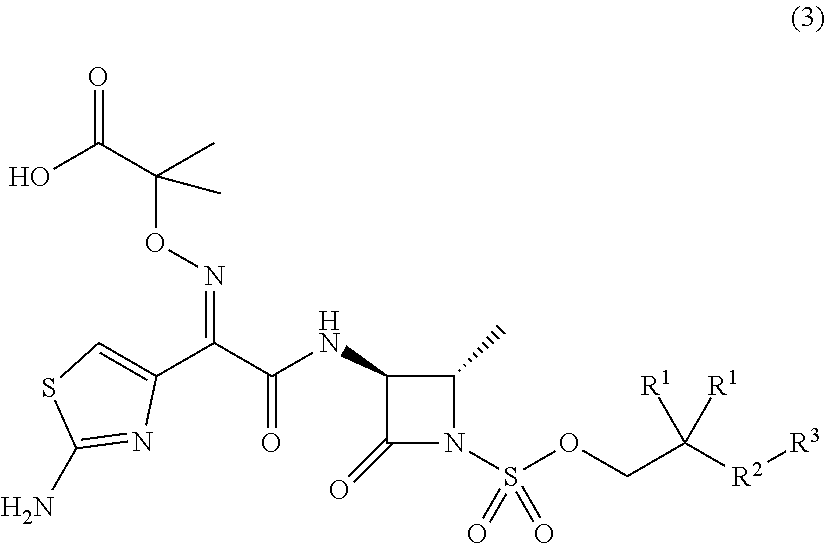
wherein each R1, R2, and R3 are defined as for Formula (1).


wherein each R1, R4, and R7 is defined as for Formula (1).
- 2-((((E)-1-(2-aminothiazol-4-yl)-2-(((2S,3S)-1-((3-methoxy-2,2-dimethyl-3-oxopropoxy)sulfonyl)-2-methyl-4-oxoazetidin-3-yl)amino)-2-oxoethylidene)amino)oxy)-2-methylpropanoic acid;
- 2-((((E)-1-(2-aminothiazol-4-yl)-2-(((2S,3S)-1-((3-ethoxy-2,2-dimethyl-3-oxopropoxy)sulfonyl)-2-methyl-4-oxoazetidin-3-yl)amino)-2-oxoethylidene)amino)oxy)-2-methylpropanoic acid;
- 2-((((E)-1-(2-aminothiazol-4-yl)-2-(((2S,3S)-1-((2,2-dimethyl-3-oxo-3-propoxypropoxy)sulfonyl)-2-methyl-4-oxoazetidin-3-yl)amino)-2-oxoethylidene)amino)oxy)-2-methylpropanoic acid;
- methyl 3-((((2S,3S)-3-((E)-2-(2-aminothiazol-4-yl)-2-(((1-methoxy-2-methyl-1-oxopropan-2-yl)oxy)imino)acetamido)-2-methyl-4-oxoazetidin-1-yl)sulfonyl)oxy)-2,2-dimethylpropanoate;
- ethyl 3-((((2S,3S)-3-((E)-2-(2-aminothiazol-4-yl)-2-(((1-methoxy-2-methyl-1-oxopropan-2-yl)oxy)imino)acetamido)-2-methyl-4-oxoazetidin-1-yl)sulfonyl)oxy)-2,2-dimethylpropanoate;
- propyl 3-((((2S,3S)-3-((E)-2-(2-aminothiazol-4-yl)-2-(((1-methoxy-2-methyl-1-oxopropan-2-yl)oxy)imino)acetamido)-2-methyl-4-oxoazetidin-1-yl)sulfonyl)oxy)-2,2-dimethylpropanoate;
- methyl 3-((((2S,3S)-3-((E)-2-(2-aminothiazol-4-yl)-2-(((1-ethoxy-2-methyl-1-oxopropan-2-yl)oxy)imino)acetamido)-2-methyl-4-oxoazetidin-1-yl)sulfonyl)oxy)-2,2-dimethylpropanoate;
- ethyl 3-((((2S,3S)-3-((E)-2-(2-aminothiazol-4-yl)-2-(((1-ethoxy-2-methyl-1-oxopropan-2-yl)oxy)imino)acetamido)-2-methyl-4-oxoazetidin-1-yl)sulfonyl)oxy)-2,2-dimethylpropanoate;
- propyl 3-((((2S,3S)-3-((E)-2-(2-aminothiazol-4-yl)-2-(((1-ethoxy-2-methyl-1-oxopropan-2-yl)oxy)imino)acetamido)-2-methyl-4-oxoazetidin-1-yl)sulfonyl)oxy)-2,2-dimethylpropanoate;
- methyl 3-((((2S,3S)-3-((E)-2-(2-aminothiazol-4-yl)-2-(((1-(tert-butoxy)-2-methyl-1-oxopropan-2-yl)oxy)imino)acetamido)-2-methyl-4-oxoazetidin-1-yl)sulfonyl)oxy)-2,2-dimethylpropanoate;
- ethyl 3-((((2S,3S)-3-((E)-2-(2-aminothiazol-4-yl)-2-(((1-(tert-butoxy)-2-methyl-1-oxopropan-2-yl)oxy)imino)acetamido)-2-methyl-4-oxoazetidin-1-yl)sulfonyl)oxy)-2,2-dimethylpropanoate;
- propyl 3-((((2S,3S)-3-((E)-2-(2-aminothiazol-4-yl)-2-(((1-(tert-butoxy)-2-methyl-1-oxopropan-2-yl)oxy)imino)acetamido)-2-methyl-4-oxoazetidin-1-yl)sulfonyl)oxy)-2,2-dimethylpropanoate;
- 2-((((E)-1-(2-aminothiazol-4-yl)-2-(((2S,3S)-1-((3-(benzoyloxy)-2,2-dimethylpropoxy) sulfonyl)-2-methyl-4-oxoazetidin-3-yl)amino)-2-oxoethylidene)amino)oxy)-2-methylpropanoic acid;
- 2-((((E)-1-(2-aminothiazol-4-yl)-2-(((2S,3S)-1-((3-methoxy-2,2-dimethyl-3-oxopropoxy)sulfonyl)-2-methyl-4-oxoazetidin-3-yl)amino)-2-oxoethylidene)amino)oxy)-2-methylpropanoic acid;
- 2-((((E)-1-(2-aminothiazol-4-yl)-2-(((2S,3S)-1-((3-ethoxy-2,2-dimethyl-3-oxopropoxy)sulfonyl)-2-methyl-4-oxoazetidin-3-yl)amino)-2-oxoethylidene)amino)oxy)-2-methylpropanoic acid;
- 2-((((E)-1-(2-aminothiazol-4-yl)-2-(((2S,3S)-1-((4-(benzoyloxy)-2,2-dimethylbutoxy)sulfonyl)-2-methyl-4-oxoazetidin-3-yl)amino)-2-oxoethylidene)amino)oxy)-2-methylpropanoic acid;
- 2-((((E)-1-(2-aminothiazol-4-yl)-2-(((2S,3S)-1-((2,2-dimethyl-4-(propionyloxy)butoxy)sulfonyl)-2-methyl-4-oxoazetidin-3-yl)amino)-2-oxoethylidene)amino)oxy)-2-methylpropanoic acid;
- 2-((((E)-1-(2-aminothiazol-4-yl)-2-(((2S,3S)-1-((4-((6-(benzyloxy)-6-oxohexanoyl)oxy)-2,2-dimethylbutoxy)sulfonyl)-2-methyl-4-oxoazetidin-3-yl)amino)-2-oxoethylidene)amino)oxy)-2-methylpropanoic acid;
- 6-(4-((((2S,3S)-3-((E)-2-(2-aminothiazol-4-yl)-2-(((2-carboxypropan-2-yl)oxy)imino)acetamido)-2-methyl-4-oxoazetidin-1-yl)sulfonyl)oxy)-3,3-dimethylbutoxy)-6-oxohexanoic acid;
- 2-((((E)-1-(2-aminothiazol-4-yl)-2-(((2S,3S)-1-((3-methoxy-2,2-dimethyl-3-oxopropoxy)sulfonyl)-2-methyl-4-oxoazetidin-3-yl)amino)-2-oxoethylidene)amino)oxy)-2-methylpropanoic acid;
- 2-((((E)-1-(2-aminothiazol-4-yl)-2-(((2S,3S)-1-((3-isopropoxy-2,2-dimethyl-3-oxopropoxy)sulfonyl)-2-methyl-4-oxoazetidin-3-yl)amino)-2-oxoethylidene)amino)oxy)-2-methylpropanoic acid;
- 2-((((E)-1-(2-aminothiazol-4-yl)-2-(((2S,3S)-1-((3-(hexyloxy)-2,2-dimethyl-3-oxopropoxy)sulfonyl)-2-methyl-4-oxoazetidin-3-yl)amino)-2-oxoethylidene)amino)oxy)-2-methylpropanoic acid;
- 2-((((E)-1-(2-aminothiazol-4-yl)-2-(((2S,3S)-1-((3-(heptyloxy)-2,2-dimethyl-3-oxopropoxy)sulfonyl)-2-methyl-4-oxoazetidin-3-yl)amino)-2-oxoethylidene)amino)oxy)-2-methylpropanoic acid;
- 2-((((E)-1-(2-aminothiazol-4-yl)-2-(((2S,3S)-1-((3-(tert-butoxy)-2,2-dimethyl-3-oxopropoxy)sulfonyl)-2-methyl-4-oxoazetidin-3-yl)amino)-2-oxoethylidene)amino)oxy)-2-methylpropanoic acid;
- 2-((((E)-1-(2-aminothiazol-4-yl)-2-(((2S,3S)-1-((3-(2-methoxyethoxy)-2,2-dimethyl-3-oxopropoxy)sulfonyl)-2-methyl-4-oxoazetidin-3-yl)amino)-2-oxoethylidene)amino)oxy)-2-methylpropanoic acid;
- 2-((((E)-1-(2-aminothiazol-4-yl)-2-(((2S,3S)-1-((2,2-dimethyl-3-(oxetan-3-yloxy)-3-oxopropoxy)sulfonyl)-2-methyl-4-oxoazetidin-3-yl)amino)-2-oxoethylidene)amino)oxy)-2-methylpropanoic acid;
- 2-((((E)-1-(2-aminothiazol-4-yl)-2-(((2S,3S)-1-(((1-(ethoxycarbonyl)cyclohexyl)methoxy)sulfonyl)-2-methyl-4-oxoazetidin-3-yl)amino)-2-oxoethylidene)amino)oxy)-2-methylpropanoic acid;
- 2-((((E)-1-(2-aminothiazol-4-yl)-2-(((2S,3S)-1-(((1-(ethoxycarbonyl)cyclopentyl)methoxy)sulfonyl)-2-methyl-4-oxoazetidin-3-yl)amino)-2-oxoethylidene)amino)oxy)-2-methylpropanoic acid;
- 2-((((E)-1-(2-aminothiazol-4-yl)-2-(((2S,3S)-1-(((1-(ethoxycarbonyl)cyclobutyl)methoxy)sulfonyl)-2-methyl-4-oxoazetidin-3-yl)amino)-2-oxoethylidene)amino)oxy)-2-methylpropanoic acid;

-
- R4 is selected from hydrogen, C1-8 alkyl, C1-8 heteroalkyl, C5-8 cycloalkyl, C5-8 heterocycloalkyl, C5-10 cycloalkylalkyl, C5-10 heterocycloalkylalkyl, C6-8 aryl, C5-8 heteroaryl, C7-10 arylalkyl, C5-10 heteroarylalkyl, substituted C1-8 alkyl, substituted C1-8 heteroalkyl, substituted C5-8 cycloalkyl, substituted C5-8 heterocycloalkyl, substituted C5-10 cycloalkylalkyl, substituted C5-10 heterocycloalkylalkyl, substituted C6-8 aryl, substituted C5-8 heteroaryl, substituted C7-10 arylalkyl, and substituted C5-10 heteroarylalkyl;

where R1, R2, and R are defined as for Formula (20).

where R1, R2, and R3 are defined as for Formula (20).

-
- R4 is selected from hydrogen, C1-8 alkyl, C1-8 heteroalkyl, C5-8 cycloalkyl, C5-8 heterocycloalkyl, C5-10 cycloalkylalkyl, C5-10 heterocycloalkylalkyl, C6-8 aryl, C5-8 heteroaryl, C7-10 arylalkyl, C5-10 heteroarylalkyl, substituted C1-8 alkyl, substituted C1-8 heteroalkyl, substituted C5-8 cycloalkyl, substituted C5-8 heterocycloalkyl, substituted C5-10 cycloalkylalkyl, substituted C5-10 heterocycloalkylalkyl, substituted C6-8 aryl, substituted C5-8 heteroaryl, substituted C7-10 arylalkyl, and substituted C5-10 heteroarylalkyl; and

wherein,

wherein,
-
- R4 is selected from hydrogen, C1-8 alkyl, C1-8 heteroalkyl, C5-8 cycloalkyl, C5-8 heterocycloalkyl, C5-10 cycloalkylalkyl, C5-10 heterocycloalkylalkyl, C6-8 aryl, C5-8 heteroaryl, C7-10 arylalkyl, C5-10 heteroarylalkyl, substituted C1-8 alkyl, substituted C1-8 heteroalkyl, substituted C5-8 cycloalkyl, substituted C5-8 heterocycloalkyl, substituted C5-10 cycloalkylalkyl, substituted C5-10 heterocycloalkylalkyl, substituted C6-8 aryl, substituted C5-8 heteroaryl, substituted C7-10 arylalkyl, and substituted C5-10 heteroarylalkyl;

- 2-((((E)-1-(2-aminothiazol-4-yl)-2-(((2S,3S)-1-((3-(benzoyloxy)-2,2-dimethylpropoxy) sulfonyl)-2-methyl-4-oxoazetidin-3-yl)amino)-2-oxoethylidene)amino)oxy)-2-methylpropanoic acid
- 2-((((E)-1-(2-aminothiazol-4-yl)-2-(((2S,3S)-1-((3-methoxy-2,2-dimethyl-3-oxopropoxy)sulfonyl)-2-methyl-4-oxoazetidin-3-yl)amino)-2-oxoethylidene)amino)oxy)-2-methylpropanoic acid;
- 2-((((E)-1-(2-aminothiazol-4-yl)-2-(((2S,3S)-1-((3-(benzyloxy)-2,2-dimethyl-3-oxopropoxy)sulfonyl)-2-methyl-4-oxoazetidin-3-yl)amino)-2-oxoethylidene)amino)oxy)-2-methylpropanoic acid;
- 2-((((E)-1-(2-aminothiazol-4-yl)-2-(((2S,3S)-1-((4-(benzoyloxy)-2,2-dimethylbutoxy)sulfonyl)-2-methyl-4-oxoazetidin-3-yl)amino)-2-oxoethylidene)amino)oxy)-2-methylpropanoic acid;
- 2-((((E)-1-(2-aminothiazol-4-yl)-2-(((2S,3S)-1-((2,2-dimethyl-4-(propionyloxy)butoxy)sulfonyl)-2-methyl-4-oxoazetidin-3-yl)amino)-2-oxoethylidene)amino)oxy)-2-methylpropanoic acid;
- 2-((((E)-1-(2-aminothiazol-4-yl)-2-(((2S,3S)-1-((4-((6-(benzyloxy)-6-oxohexanoyl)oxy)-2,2-dimethylbutoxy)sulfonyl)-2-methyl-4-oxoazetidin-3-yl)amino)-2-oxoethylidene)amino)oxy)-2-methylpropanoic acid;
- 6-(4-((((2S,3S)-3-((E)-2-(2-aminothiazol-4-yl)-2-(((2-carboxypropan-2-yl)oxy)imino)acetamido)-2-methyl-4-oxoazetidin-1-yl)sulfonyl)oxy)-3,3-dimethylbutoxy)-6-oxohexanoic acid;
- 2-((((E)-1-(2-aminothiazol-4-yl)-2-(((2S,3S)-1-((3-methoxy-2,2-dimethyl-3-oxopropoxy)sulfonyl)-2-methyl-4-oxoazetidin-3-yl)amino)-2-oxoethylidene)amino)oxy)-2-methylpropanoic acid;
- 2-((((E)-1-(2-aminothiazol-4-yl)-2-(((2S,3S)-1-((3-isopropoxy-2,2-dimethyl-3-oxopropoxy)sulfonyl)-2-methyl-4-oxoazetidin-3-yl)amino)-2-oxoethylidene)amino)oxy)-2-methylpropanoic acid;
- 2-((((E)-1-(2-aminothiazol-4-yl)-2-(((2S,3S)-1-((3-(hexyloxy)-2,2-dimethyl-3-oxopropoxy)sulfonyl)-2-methyl-4-oxoazetidin-3-yl)amino)-2-oxoethylidene)amino)oxy)-2-methylpropanoic acid;
- 2-((((E)-1-(2-aminothiazol-4-yl)-2-(((2S,3S)-1-((3-(heptyloxy)-2,2-dimethyl-3-oxopropoxy)sulfonyl)-2-methyl-4-oxoazetidin-3-yl)amino)-2-oxoethylidene)amino)oxy)-2-methylpropanoic acid;
- 2-((((E)-1-(2-aminothiazol-4-yl)-2-(((2S,3S)-1-((3-(tert-butoxy)-2,2-dimethyl-3-oxopropoxy)sulfonyl)-2-methyl-4-oxoazetidin-3-yl)amino)-2-oxoethylidene)amino)oxy)-2-methylpropanoic acid;
- 2-((((E)-1-(2-aminothiazol-4-yl)-2-(((2S,3S)-1-((3-(2-methoxyethoxy)-2,2-dimethyl-3-oxopropoxy)sulfonyl)-2-methyl-4-oxoazetidin-3-yl)amino)-2-oxoethylidene)amino)oxy)-2-methylpropanoic acid;
- 2-((((E)-1-(2-aminothiazol-4-yl)-2-(((2S,3S)-1-((2,2-dimethyl-3-(oxetan-3-yloxy)-3-oxopropoxy)sulfonyl)-2-methyl-4-oxoazetidin-3-yl)amino)-2-oxoethylidene)amino)oxy)-2-methylpropanoic acid;
- 2-((((E)-1-(2-aminothiazol-4-yl)-2-(((2S,3S)-1-(((1-(ethoxycarbonyl)cyclohexyl)methoxy)sulfonyl)-2-methyl-4-oxoazetidin-3-yl)amino)-2-oxoethylidene)amino)oxy)-2-methylpropanoic acid;
- 2-((((E)-1-(2-aminothiazol-4-yl)-2-(((2S,3S)-1-(((1-(ethoxycarbonyl)cyclopentyl)methoxy)sulfonyl)-2-methyl-4-oxoazetidin-3-yl)amino)-2-oxoethylidene)amino)oxy)-2-methylpropanoic acid;
- 2-((((E)-1-(2-aminothiazol-4-yl)-2-(((2S,3S)-1-(((1-(ethoxycarbonyl)cyclobutyl)methoxy)sulfonyl)-2-methyl-4-oxoazetidin-3-yl)amino)-2-oxoethylidene)amino)oxy)-2-methylpropanoic acid;


-
- each R1 can be selected from C1-6 alkyl;
- R4 can be selected from C1-6 alkyl, C1-6 heteroalkyl, C5-6 cycloalkyl, and C5-6 heterocycloalkyl; and
- R7 can be selected from hydrogen, C1-6 alkyl, C1-6 heteroalkyl, and 4-(yl-methyl)-5-methyl-1,3-dioxol-2-one.
- 2-((((E)-1-(2-aminothiazol-4-yl)-2-(((2S,3S)-1-((3-methoxy-2,2-dimethyl-3-oxopropoxy)sulfonyl)-2-methyl-4-oxoazetidin-3-yl)amino)-2-oxoethylidene)amino)oxy)-2-methylpropanoic acid;
- 2-((((E)-1-(2-aminothiazol-4-yl)-2-(((2S,3S)-1-((3-ethoxy-2,2-dimethyl-3-oxopropoxy)sulfonyl)-2-methyl-4-oxoazetidin-3-yl)amino)-2-oxoethylidene)amino)oxy)-2-methylpropanoic acid;
- 2-((((E)-1-(2-aminothiazol-4-yl)-2-(((2S,3S)-1-((2,2-dimethyl-3-oxo-3-propoxypropoxy)sulfonyl)-2-methyl-4-oxoazetidin-3-yl)amino)-2-oxoethylidene)amino)oxy)-2-methylpropanoic acid;
- methyl 3-((((2S,3S)-3-((E)-2-(2-aminothiazol-4-yl)-2-(((1-methoxy-2-methyl-1-oxopropan-2-yl)oxy)imino)acetamido)-2-methyl-4-oxoazetidin-1-yl)sulfonyl)oxy)-2,2-dimethylpropanoate;
- ethyl 3-((((2S,3S)-3-((E)-2-(2-aminothiazol-4-yl)-2-(((1-methoxy-2-methyl-1-oxopropan-2-yl)oxy)imino)acetamido)-2-methyl-4-oxoazetidin-1-yl)sulfonyl)oxy)-2,2-dimethylpropanoate;
- propyl 3-((((2S,3S)-3-((E)-2-(2-aminothiazol-4-yl)-2-(((1-methoxy-2-methyl-1-oxopropan-2-yl)oxy)imino)acetamido)-2-methyl-4-oxoazetidin-1-yl)sulfonyl)oxy)-2,2-dimethylpropanoate;
- methyl 3-((((2S,3S)-3-((E)-2-(2-aminothiazol-4-yl)-2-(((1-ethoxy-2-methyl-1-oxopropan-2-yl)oxy)imino)acetamido)-2-methyl-4-oxoazetidin-1-yl)sulfonyl)oxy)-2,2-dimethylpropanoate;
- ethyl 3-((((2S,3S)-3-((E)-2-(2-aminothiazol-4-yl)-2-(((1-ethoxy-2-methyl-1-oxopropan-2-yl)oxy)imino)acetamido)-2-methyl-4-oxoazetidin-1-yl)sulfonyl)oxy)-2,2-dimethylpropanoate;
- propyl 3-((((2S,3S)-3-((E)-2-(2-aminothiazol-4-yl)-2-(((1-ethoxy-2-methyl-1-oxopropan-2-yl)oxy)imino)acetamido)-2-methyl-4-oxoazetidin-1-yl)sulfonyl)oxy)-2,2-dimethylpropanoate;
- methyl 3-((((2S,3S)-3-((E)-2-(2-aminothiazol-4-yl)-2-(((1-(tert-butoxy)-2-methyl-1-oxopropan-2-yl)oxy)imino)acetamido)-2-methyl-4-oxoazetidin-1-yl)sulfonyl)oxy)-2,2-dimethylpropanoate;
- ethyl 3-((((2S,3S)-3-((E)-2-(2-aminothiazol-4-yl)-2-(((1-(tert-butoxy)-2-methyl-1-oxopropan-2-yl)oxy)imino)acetamido)-2-methyl-4-oxoazetidin-1-yl)sulfonyl)oxy)-2,2-dimethylpropanoate;
- propyl 3-((((2S,3S)-3-((E)-2-(2-aminothiazol-4-yl)-2-(((1-(tert-butoxy)-2-methyl-1-oxopropan-2-yl)oxy)imino)acetamido)-2-methyl-4-oxoazetidin-1-yl)sulfonyl)oxy)-2,2-dimethylpropanoate;

-
- R4 is selected from hydrogen, C1-8 alkyl, C1-8 heteroalkyl, C5-8 cycloalkyl, C5-8 heterocycloalkyl, C5-10 cycloalkylalkyl, C5-10 heterocycloalkylalkyl, C6-8 aryl, C5-8 heteroaryl, C7-10 arylalkyl, C5-10 heteroarylalkyl, substituted C1-8 alkyl, substituted C1-8 heteroalkyl, substituted C5-8 cycloalkyl, substituted C5-8 heterocycloalkyl, substituted C5-10 cycloalkylalkyl, substituted C5-10 heterocycloalkylalkyl, substituted C6-8 aryl, substituted C5-8 heteroaryl, substituted C7-10 arylalkyl, and substituted C5-10 heteroarylalkyl;

-
- R4 is selected from hydrogen, C4-8 alkyl, C4-8 heteroalkyl, C5-8 cycloalkyl, C5-8 heterocycloalkyl, C5-10 cycloalkylalkyl, C5-10 heterocycloalkylalkyl, C6-8 aryl, C5-8 heteroaryl, C7-10 arylalkyl, C5-10 heteroarylalkyl, substituted C1-8 alkyl, substituted C1-8 heteroalkyl, substituted C5-8 cycloalkyl, substituted C5-8 heterocycloalkyl, substituted C5-10 cycloalkylalkyl, substituted C5-10 heterocycloalkylalkyl, substituted C6-8 aryl, substituted C5-8 heteroaryl, substituted C7-10 arylalkyl, and substituted C5-10 heteroarylalkyl; and

-
- each R7 is independently selected from hydrogen, C1-8 alkyl, or each R7 and the geminal carbon atom to which they are bonded forms a C3-6 cycloalkyl ring, a C3-6 heterocycloalkyl ring, a substituted C3-6 cycloalkyl ring, or a substituted C3-6 heterocycloalkyl ring;
- n is an integer from 1 to 4;
- X is selected from O and NH;
- R8 is selected from hydrogen, C1-8 alkyl, C1-8 heteroalkyl, C5-8 cycloalkyl, C5-8 heterocycloalkyl, C5-10 cycloalkylalkyl, C5-10 heterocycloalkylalkyl, C6-8 aryl, C5-8 heteroaryl, C7-10 arylalkyl, C5-10 heteroarylalkyl, substituted C1-8 alkyl, substituted C1-8 heteroalkyl, substituted C5-8 cycloalkyl, substituted C5-8 heterocycloalkyl, substituted C5-10 cycloalkylalkyl, substituted C5-10 heterocycloalkylalkyl, substituted C6-8 aryl, substituted C5-8 heteroaryl, substituted C7-10 arylalkyl, and substituted C5-10 heteroarylalkyl;
- R9 is selected from hydrogen and C1-6 alkyl;
- R10 is selected from C1-8 alkyl, C1-8 heteroalkyl, C5-8 cycloalkyl, C5-8 heterocycloalkyl, C5-10 cycloalkylalkyl, C5-10 heterocycloalkylalkyl, C6-8 aryl, C5-8 heteroaryl, C7-10 arylalkyl, C5-10 heteroarylalkyl, substituted C1-8 alkyl, substituted C1-8 heteroalkyl, substituted C5-8 cycloalkyl, substituted C5-8 heterocycloalkyl, substituted C5-10 cycloalkylalkyl, substituted C5-10 heterocycloalkylalkyl, substituted C6-8 aryl, substituted C5-8 heteroaryl, substituted C7-10 arylalkyl, and substituted C5-10 heteroarylalkyl; C1-6 alkyl;
- R11 is selected from hydrogen and C1-6 alkyl; and
- R12 is selected from hydrogen, C1-8 alkyl, C1-8 heteroalkyl, C5-8 cycloalkyl, C5-8 heterocycloalkyl, C5-10 cycloalkylalkyl, C5-10 heterocycloalkylalkyl, C6-8 aryl, C5-8 heteroaryl, C7-10 arylalkyl, C5-10 heteroarylalkyl, substituted C1-8 alkyl, substituted C1-8 heteroalkyl, substituted C5-8 cycloalkyl, substituted C5-8 heterocycloalkyl, substituted C5-10 cycloalkylalkyl, substituted C5-10 heterocycloalkylalkyl, substituted C6-8 aryl, substituted C5-8 heteroaryl, substituted CT-0 arylalkyl, and substituted C5-10 heteroarylalkyl.

-
- R4 is selected from hydrogen, C1-8 alkyl, C1-8 heteroalkyl, C5-8 cycloalkyl, C5-8 heterocycloalkyl, C5-10 cycloalkylalkyl, C5-10 heterocycloalkylalkyl, C6-8 aryl, C5-8 heteroaryl, C7-10 arylalkyl, C5-10 heteroarylalkyl, substituted C1-8 alkyl, substituted C1-8 heteroalkyl, substituted C5-8 cycloalkyl, substituted C5-8 heterocycloalkyl, substituted C5-10 cycloalkylalkyl, substituted C5-10 heterocycloalkylalkyl, substituted C6-8 aryl, substituted C5-8 heteroaryl, substituted C7-10 arylalkyl, and substituted C5-10 heteroarylalkyl;

-
- R4 is selected from hydrogen, C1-8 alkyl, C1-8 heteroalkyl, C5-8 cycloalkyl, C5-8 heterocycloalkyl, C5-10 cycloalkylalkyl, C5-10 heterocycloalkylalkyl, C6-8 aryl, C5-8 heteroaryl, C7-10 arylalkyl, C5-10 heteroarylalkyl, substituted C1-8 alkyl, substituted C1-8 heteroalkyl, substituted C5-8 cycloalkyl, substituted C5-8 heterocycloalkyl, substituted C5-10 cycloalkylalkyl, substituted C5-10 heterocycloalkylalkyl, substituted C6-8 aryl, substituted C5-8 heteroaryl, substituted C7-10 arylalkyl, and substituted C5-10 heteroarylalkyl; and

-
- each R7 is independently selected from hydrogen, C1-8 alkyl, or each R7 and the geminal carbon atom to which they are bonded forms a C3-6 cycloalkyl ring, a C3-6 heterocycloalkyl ring, a substituted C3-6 cycloalkyl ring, or a substituted C3-6 heterocycloalkyl ring;
- n is an integer from 1 to 4;
- X is selected from O and NH;
- R8 is selected from hydrogen, C1-8 alkyl, C1-8 heteroalkyl, C5-8 cycloalkyl, C5-8 heterocycloalkyl, C5-10 cycloalkylalkyl, C5-10 heterocycloalkylalkyl, C6-8 aryl, C5-8 heteroaryl, C7-10 arylalkyl, C5-10 heteroarylalkyl, substituted C1-8 alkyl, substituted C1-8 heteroalkyl, substituted C5-8 cycloalkyl, substituted C5-8 heterocycloalkyl, substituted C5-10 cycloalkylalkyl, substituted C5-10 heterocycloalkylalkyl, substituted C6-8 aryl, substituted C5-8 heteroaryl, substituted C7-10 arylalkyl, and substituted C5-10 heteroarylalkyl;
- R9 is selected from hydrogen and C1-6 alkyl;
- R10 is selected from C1-8 alkyl, C1-8 heteroalkyl, C5-8 cycloalkyl, C5-8 heterocycloalkyl, C5-10 cycloalkylalkyl, C5-10 heterocycloalkylalkyl, C6-8 aryl, C5-8 heteroaryl, C7-10 arylalkyl, C5-10 heteroarylalkyl, substituted C1-8 alkyl, substituted C1-8 heteroalkyl, substituted C5-8 cycloalkyl, substituted C5-8 heterocycloalkyl, substituted C5-10 cycloalkylalkyl, substituted C5-10 heterocycloalkylalkyl, substituted C6-8 aryl, substituted C5-8 heteroaryl, substituted C7-10 arylalkyl, and substituted C5-10 heteroarylalkyl; C1-6 alkyl;
- R11 is selected from hydrogen and C1-6 alkyl; and
- R12 is selected from hydrogen, C1-8 alkyl, C1-8 heteroalkyl, C5-8 cycloalkyl, C5-8 heterocycloalkyl, C5-10 cycloalkylalkyl, C5-10 heterocycloalkylalkyl, C6-8 aryl, C5-8 heteroaryl, C7-10 arylalkyl, C5-10 heteroarylalkyl, substituted C1-8 alkyl, substituted C1-8 heteroalkyl, substituted C5-8 cycloalkyl, substituted C5-8 heterocycloalkyl, substituted C5-10 cycloalkylalkyl, substituted C5-10 heterocycloalkylalkyl, substituted C6-8 aryl, substituted C5-8 heteroaryl, substituted C7-10 arylalkyl, and substituted C5-10 heteroarylalkyl.


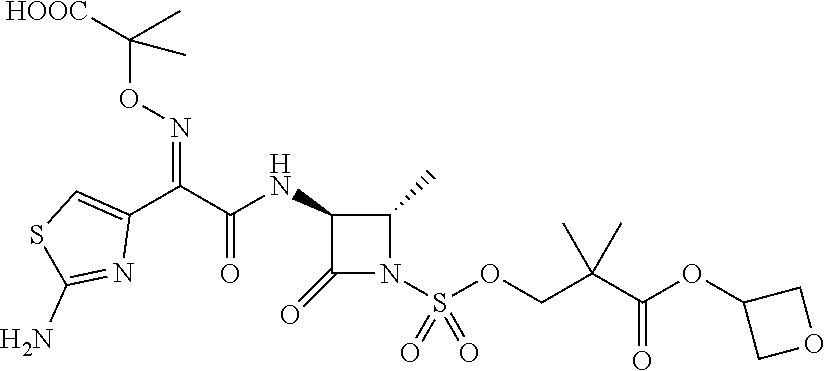


Claims (29)


Priority Applications (2)
| Application Number | Priority Date | Filing Date | Title |
|---|---|---|---|
| US16/351,300 US10815228B2 (en) | 2017-10-02 | 2019-03-12 | Aztreonam derivatives and uses thereof |
| US17/025,091 US20210009580A1 (en) | 2017-10-02 | 2020-09-18 | Aztreonam derivatives and uses thereof |
Applications Claiming Priority (3)
| Application Number | Priority Date | Filing Date | Title |
|---|---|---|---|
| US201762566909P | 2017-10-02 | 2017-10-02 | |
| US16/148,788 US10280161B2 (en) | 2017-10-02 | 2018-10-01 | Aztreonam derivatives and uses thereof |
| US16/351,300 US10815228B2 (en) | 2017-10-02 | 2019-03-12 | Aztreonam derivatives and uses thereof |
Related Parent Applications (1)
| Application Number | Title | Priority Date | Filing Date |
|---|---|---|---|
| US16/148,788 Continuation US10280161B2 (en) | 2017-10-02 | 2018-10-01 | Aztreonam derivatives and uses thereof |
Related Child Applications (1)
| Application Number | Title | Priority Date | Filing Date |
|---|---|---|---|
| US17/025,091 Continuation US20210009580A1 (en) | 2017-10-02 | 2020-09-18 | Aztreonam derivatives and uses thereof |
Publications (2)
| Publication Number | Publication Date |
|---|---|
| US20190211006A1 US20190211006A1 (en) | 2019-07-11 |
| US10815228B2 true US10815228B2 (en) | 2020-10-27 |
Family
ID=63963503
Family Applications (3)
| Application Number | Title | Priority Date | Filing Date |
|---|---|---|---|
| US16/148,788 Active US10280161B2 (en) | 2017-10-02 | 2018-10-01 | Aztreonam derivatives and uses thereof |
| US16/351,300 Expired - Fee Related US10815228B2 (en) | 2017-10-02 | 2019-03-12 | Aztreonam derivatives and uses thereof |
| US17/025,091 Abandoned US20210009580A1 (en) | 2017-10-02 | 2020-09-18 | Aztreonam derivatives and uses thereof |
Family Applications Before (1)
| Application Number | Title | Priority Date | Filing Date |
|---|---|---|---|
| US16/148,788 Active US10280161B2 (en) | 2017-10-02 | 2018-10-01 | Aztreonam derivatives and uses thereof |
Family Applications After (1)
| Application Number | Title | Priority Date | Filing Date |
|---|---|---|---|
| US17/025,091 Abandoned US20210009580A1 (en) | 2017-10-02 | 2020-09-18 | Aztreonam derivatives and uses thereof |
Country Status (12)
| Country | Link |
|---|---|
| US (3) | US10280161B2 (en) |
| EP (1) | EP3676247B8 (en) |
| JP (1) | JP6991345B2 (en) |
| KR (1) | KR102455390B1 (en) |
| CN (1) | CN111448182A (en) |
| AU (1) | AU2018345321B2 (en) |
| BR (1) | BR112020006594A2 (en) |
| CA (1) | CA3077474A1 (en) |
| IL (1) | IL273571A (en) |
| MX (1) | MX2020004071A (en) |
| SG (1) | SG11202002300QA (en) |
| WO (1) | WO2019070595A1 (en) |
Families Citing this family (9)
| Publication number | Priority date | Publication date | Assignee | Title |
|---|---|---|---|---|
| MX2020004071A (en) | 2017-10-02 | 2020-07-28 | Arixa Pharmaceuticals Inc | Aztreonam derivatives and uses thereof. |
| ES2991492T3 (en) | 2018-10-01 | 2024-12-03 | Arixa Pharmaceuticals Inc | Relebactam derivatives and their uses |
| US11008321B2 (en) | 2019-03-12 | 2021-05-18 | Arixa Pharmaceuticals, Inc. | Crystalline form of an avibactam derivative |
| WO2020219258A1 (en) * | 2019-04-25 | 2020-10-29 | Arixa Pharmaceuticals, Inc. | Methods of synthesizing aztreonam derivatives |
| EP4021443A1 (en) | 2019-08-29 | 2022-07-06 | Arixa Pharmaceuticals, Inc. | Orally administered combinations of beta-lactam antibiotics and avibactam derivatives for treating bacterial infections |
| CN112047840A (en) * | 2020-08-31 | 2020-12-08 | 山东药品食品职业学院 | Synthesis method of 7-bromo-2, 2-dimethylheptanoic acid ethyl ester and product obtained by synthesis |
| CN112661716A (en) * | 2020-12-31 | 2021-04-16 | 山东金城柯瑞化学有限公司 | Preparation method of trityl aminothiazoly loximate |
| CN115448920B (en) * | 2022-10-14 | 2025-01-03 | 广州楷石医药有限公司 | A β-lactamase inhibitor and its application |
| CN118561730B (en) * | 2024-07-03 | 2024-11-22 | 北京世纪迈劲生物科技有限公司 | A method for preparing aztreonam main ring intermediate |
Citations (28)
| Publication number | Priority date | Publication date | Assignee | Title |
|---|---|---|---|---|
| US3658849A (en) | 1969-02-19 | 1972-04-25 | Reynolds Tobacco Co R | Treatment of 2-substituted aldehydes with lead dioxide |
| DE3045373A1 (en) | 1980-12-02 | 1982-07-01 | Henkel KGaA, 4000 Düsseldorf | Use of 3-hydroxy-2,2-di:methyl-propionate ester(s) as fragrances - including new propyl ester |
| US4522811A (en) | 1982-07-08 | 1985-06-11 | Syntex (U.S.A.) Inc. | Serial injection of muramyldipeptides and liposomes enhances the anti-infective activity of muramyldipeptides |
| US4652651A (en) | 1983-05-31 | 1987-03-24 | Hoffmann-La Roche Inc. | Process for the manufacture of 1-sulpho-2-oxoazetidine carboxylic acid intermediates via catalytic ester cleavage |
| US4775670A (en) | 1980-09-29 | 1988-10-04 | E. R. Squibb & Sons, Inc. | 2-oxo-1-azetidinesulfonic acid salts |
| US5674533A (en) | 1994-07-07 | 1997-10-07 | Recordati, S.A., Chemical And Pharmaceutical Company | Pharmaceutical composition for the controlled release of moguisteine in a liquid suspension |
| US7112592B2 (en) | 2000-08-01 | 2006-09-26 | Aventis Pharma S.A. | Azabicyclic compounds, preparation thereof and use as medicines, in particular as antibacterial agents |
| WO2007116922A1 (en) | 2006-03-30 | 2007-10-18 | Mitsubishi Tanabe Pharma Corporation | A process for preparing tetrahydroquinoline derivatives |
| WO2009033079A1 (en) | 2007-09-07 | 2009-03-12 | Xenoport, Inc. | Externally masked neopentyl sulfonyl ester cyclization release prodrugs of acamprosate, compositions thereof, and methods of use |
| WO2009033054A1 (en) | 2007-09-07 | 2009-03-12 | Xenoport, Inc. | Complex pantoic acid ester neopentyl sulfonyl ester cyclization release prodrugs of acamprosate, compositions thereof, and methods of use |
| US20090099253A1 (en) | 2007-10-15 | 2009-04-16 | Xenoport, Inc. | Internally Masked Neopentyl Sulfonyl Ester Cyclization Release Prodrugs of Acamprosate, Compositions Thereof, and Methods of Use |
| WO2009092606A2 (en) | 2008-01-25 | 2009-07-30 | Barry Callebaut Ag | Composition |
| WO2011046771A1 (en) | 2009-10-14 | 2011-04-21 | Schering Corporation | SUBSTITUTED PIPERIDINES THAT INCREASE p53 ACTIVITY AND THE USES THEREOF |
| WO2011150380A1 (en) | 2010-05-28 | 2011-12-01 | Xenoport, Inc. | Methods of treatment of fragile x syndrome, down's syndrome, autism and related disorders |
| WO2012086241A1 (en) | 2010-12-22 | 2012-06-28 | Meiji Seikaファルマ株式会社 | Optically-active diazabicyclooctane derivative and method for manufacturing same |
| WO2012165648A1 (en) | 2011-05-30 | 2012-12-06 | Sumitomo Chemical Company, Limited | Cyclohexanone compounds and herbicides comprising the same |
| US20140045943A1 (en) | 2008-12-03 | 2014-02-13 | Naurex, Inc. | Hydroxamic Acid Derivatives, Preparation and Therapeutic Uses Thereof |
| US8772490B2 (en) | 2010-12-22 | 2014-07-08 | Meiji Seika Pharma Co., Ltd. | Optically active diazabicyclooctane derivatives and process for preparing the same |
| US20150196559A1 (en) | 2008-02-04 | 2015-07-16 | The Translational Genomics Research Institute | Compounds, pharmaceutical compositions and methods of use of hydroxamic acid derivatives |
| US20150225335A1 (en) | 2010-04-20 | 2015-08-13 | Taisho Pharmaceutical Co., Ltd. | Novel hydroxamic acid derivative |
| US9340493B2 (en) | 2008-09-19 | 2016-05-17 | Pfizer Inc. | Hydroxamic acid derivatives useful as antibacterial agents |
| US9393239B2 (en) | 2011-12-02 | 2016-07-19 | Fedora Pharmaceuticals Inc. | Bicyclic compounds and their use as antibacterial agents and betalactamase inhibitors |
| WO2016116788A1 (en) | 2015-01-24 | 2016-07-28 | Wockhardt Limited | Nitrogen containing bicyclic compounds and their use in treatment of bacterial infections |
| WO2017045510A1 (en) | 2015-09-16 | 2017-03-23 | 山东轩竹医药科技有限公司 | Β-lactamase inhibitor and application thereof |
| US20170165371A1 (en) | 2017-02-22 | 2017-06-15 | Joel Steven Goldberg | Novel synthesis of potential ester prodrugs |
| US20170290918A1 (en) | 2014-09-12 | 2017-10-12 | Toyama Chical Co., Ltd. | Novel pharmaceutical composition containing hydroxamic acid derivative or salt thereof |
| US20170296503A1 (en) | 2014-09-12 | 2017-10-19 | Toyama Chemical Co., Ltd. | Method for using novel hydroxamic acid derivative and antibacterial substance in combination |
| WO2019070595A1 (en) | 2017-10-02 | 2019-04-11 | Arixa Pharmaceuticals, Inc. | Aztreonam derivatives and uses thereof |
Family Cites Families (12)
| Publication number | Priority date | Publication date | Assignee | Title |
|---|---|---|---|---|
| GB2113997B (en) * | 1982-02-02 | 1985-07-03 | Leo Pharm Prod Ltd | Synergistic antibacterial compositions |
| JPS60222480A (en) * | 1984-04-20 | 1985-11-07 | Kanegafuchi Chem Ind Co Ltd | 2-azetidinone-1-sulfonic acid derivative |
| US5192785A (en) * | 1989-09-03 | 1993-03-09 | A. H. Robins Company, Incorporated | Sulfamates as antiglaucoma agents |
| WO2002092606A1 (en) | 2001-05-15 | 2002-11-21 | Takeda Chemical Industries, Ltd. | Fused imidazolidine derivatives, process for preparation of the same and use thereof |
| CN101171251A (en) * | 2005-05-09 | 2008-04-30 | 西科尔公司 | The preparation method of aztreonam |
| WO2007083187A2 (en) | 2006-01-16 | 2007-07-26 | Orchid Chemicals & Pharmaceuticals Limited | An improved process for the preparation of monobactam antibiotic |
| CN101514200B (en) * | 2009-03-31 | 2011-02-16 | 海南美大制药有限公司 | Compound of aztreonam and a synthetic method thereof |
| CN102127068B (en) * | 2010-12-31 | 2012-08-29 | 山西普德药业股份有限公司 | Method for synthesizing aztreonam compound |
| UY34585A (en) * | 2012-01-24 | 2013-09-02 | Aicuris Gmbh & Co Kg | B-LACTAMIC COMPOUNDS REPLACED WITH AMIDINE, ITS PREPARATION AND USE |
| CN103232449B (en) * | 2013-05-08 | 2014-04-09 | 四川省惠达药业有限公司 | Aztreonam compound, as well as preparation method and pharmaceutical composition thereof |
| HUE042134T2 (en) * | 2014-03-24 | 2019-06-28 | Novartis Ag | Monobactam organic compounds for the treatment of bacterial infections |
| US10085999B1 (en) | 2017-05-10 | 2018-10-02 | Arixa Pharmaceuticals, Inc. | Beta-lactamase inhibitors and uses thereof |
-
2018
- 2018-10-01 MX MX2020004071A patent/MX2020004071A/en unknown
- 2018-10-01 KR KR1020207012589A patent/KR102455390B1/en not_active Expired - Fee Related
- 2018-10-01 SG SG11202002300QA patent/SG11202002300QA/en unknown
- 2018-10-01 WO PCT/US2018/053778 patent/WO2019070595A1/en not_active Ceased
- 2018-10-01 JP JP2020539680A patent/JP6991345B2/en not_active Expired - Fee Related
- 2018-10-01 EP EP18792709.0A patent/EP3676247B8/en active Active
- 2018-10-01 CN CN201880076555.0A patent/CN111448182A/en active Pending
- 2018-10-01 BR BR112020006594-3A patent/BR112020006594A2/en not_active IP Right Cessation
- 2018-10-01 CA CA3077474A patent/CA3077474A1/en active Pending
- 2018-10-01 US US16/148,788 patent/US10280161B2/en active Active
- 2018-10-01 AU AU2018345321A patent/AU2018345321B2/en not_active Ceased
-
2019
- 2019-03-12 US US16/351,300 patent/US10815228B2/en not_active Expired - Fee Related
-
2020
- 2020-03-24 IL IL273571A patent/IL273571A/en unknown
- 2020-09-18 US US17/025,091 patent/US20210009580A1/en not_active Abandoned
Patent Citations (36)
| Publication number | Priority date | Publication date | Assignee | Title |
|---|---|---|---|---|
| US3658849A (en) | 1969-02-19 | 1972-04-25 | Reynolds Tobacco Co R | Treatment of 2-substituted aldehydes with lead dioxide |
| US4775670A (en) | 1980-09-29 | 1988-10-04 | E. R. Squibb & Sons, Inc. | 2-oxo-1-azetidinesulfonic acid salts |
| DE3045373A1 (en) | 1980-12-02 | 1982-07-01 | Henkel KGaA, 4000 Düsseldorf | Use of 3-hydroxy-2,2-di:methyl-propionate ester(s) as fragrances - including new propyl ester |
| US4522811A (en) | 1982-07-08 | 1985-06-11 | Syntex (U.S.A.) Inc. | Serial injection of muramyldipeptides and liposomes enhances the anti-infective activity of muramyldipeptides |
| US4652651A (en) | 1983-05-31 | 1987-03-24 | Hoffmann-La Roche Inc. | Process for the manufacture of 1-sulpho-2-oxoazetidine carboxylic acid intermediates via catalytic ester cleavage |
| US5674533A (en) | 1994-07-07 | 1997-10-07 | Recordati, S.A., Chemical And Pharmaceutical Company | Pharmaceutical composition for the controlled release of moguisteine in a liquid suspension |
| US7112592B2 (en) | 2000-08-01 | 2006-09-26 | Aventis Pharma S.A. | Azabicyclic compounds, preparation thereof and use as medicines, in particular as antibacterial agents |
| WO2007116922A1 (en) | 2006-03-30 | 2007-10-18 | Mitsubishi Tanabe Pharma Corporation | A process for preparing tetrahydroquinoline derivatives |
| WO2009033061A1 (en) | 2007-09-07 | 2009-03-12 | Xenoport, Inc. | Masked carboxylate neopentyl sulfonyl ester cyclization release prodrugs of acamprosate, compositions thereof, and methods of use |
| WO2009033079A1 (en) | 2007-09-07 | 2009-03-12 | Xenoport, Inc. | Externally masked neopentyl sulfonyl ester cyclization release prodrugs of acamprosate, compositions thereof, and methods of use |
| WO2009033054A1 (en) | 2007-09-07 | 2009-03-12 | Xenoport, Inc. | Complex pantoic acid ester neopentyl sulfonyl ester cyclization release prodrugs of acamprosate, compositions thereof, and methods of use |
| WO2009033069A1 (en) | 2007-09-07 | 2009-03-12 | Xenoport, Inc. | Simple pantoic acid ester neopentyl sulfonyl ester cyclization release prodrugs of acamprosate, compositions thereof, and methods of use |
| US8168617B2 (en) | 2007-09-07 | 2012-05-01 | Xenoport, Inc. | Complex pantoic acid ester neopentyl sulfonyl ester cyclization release prodrugs of acamprosate, compositions thereof, and methods of use |
| US7994218B2 (en) | 2007-09-07 | 2011-08-09 | Xenoport, Inc. | Simple pantoic acid ester neopentyl sulfonyl ester cyclization release prodrugs of acamprosate, compositions thereof, and methods of use |
| US20090099253A1 (en) | 2007-10-15 | 2009-04-16 | Xenoport, Inc. | Internally Masked Neopentyl Sulfonyl Ester Cyclization Release Prodrugs of Acamprosate, Compositions Thereof, and Methods of Use |
| WO2009092606A2 (en) | 2008-01-25 | 2009-07-30 | Barry Callebaut Ag | Composition |
| US20150196559A1 (en) | 2008-02-04 | 2015-07-16 | The Translational Genomics Research Institute | Compounds, pharmaceutical compositions and methods of use of hydroxamic acid derivatives |
| US9340493B2 (en) | 2008-09-19 | 2016-05-17 | Pfizer Inc. | Hydroxamic acid derivatives useful as antibacterial agents |
| US20140045943A1 (en) | 2008-12-03 | 2014-02-13 | Naurex, Inc. | Hydroxamic Acid Derivatives, Preparation and Therapeutic Uses Thereof |
| WO2011046771A1 (en) | 2009-10-14 | 2011-04-21 | Schering Corporation | SUBSTITUTED PIPERIDINES THAT INCREASE p53 ACTIVITY AND THE USES THEREOF |
| US20150225335A1 (en) | 2010-04-20 | 2015-08-13 | Taisho Pharmaceutical Co., Ltd. | Novel hydroxamic acid derivative |
| WO2011150380A1 (en) | 2010-05-28 | 2011-12-01 | Xenoport, Inc. | Methods of treatment of fragile x syndrome, down's syndrome, autism and related disorders |
| WO2012086241A1 (en) | 2010-12-22 | 2012-06-28 | Meiji Seikaファルマ株式会社 | Optically-active diazabicyclooctane derivative and method for manufacturing same |
| US9035062B2 (en) | 2010-12-22 | 2015-05-19 | Meiji Seika Pharma Co., Ltd. | Process for preparing a compound useful for producing an optically active diazabicyclooctane compound |
| US8772490B2 (en) | 2010-12-22 | 2014-07-08 | Meiji Seika Pharma Co., Ltd. | Optically active diazabicyclooctane derivatives and process for preparing the same |
| US9284273B2 (en) | 2010-12-22 | 2016-03-15 | Meiji Seika Pharma Co., Ltd. | Compounds useful for producing an optically active diazabicyclooctane compound |
| WO2012165648A1 (en) | 2011-05-30 | 2012-12-06 | Sumitomo Chemical Company, Limited | Cyclohexanone compounds and herbicides comprising the same |
| US9393239B2 (en) | 2011-12-02 | 2016-07-19 | Fedora Pharmaceuticals Inc. | Bicyclic compounds and their use as antibacterial agents and betalactamase inhibitors |
| US20170296503A1 (en) | 2014-09-12 | 2017-10-19 | Toyama Chemical Co., Ltd. | Method for using novel hydroxamic acid derivative and antibacterial substance in combination |
| US20170290918A1 (en) | 2014-09-12 | 2017-10-12 | Toyama Chical Co., Ltd. | Novel pharmaceutical composition containing hydroxamic acid derivative or salt thereof |
| WO2016116788A1 (en) | 2015-01-24 | 2016-07-28 | Wockhardt Limited | Nitrogen containing bicyclic compounds and their use in treatment of bacterial infections |
| WO2017045510A1 (en) | 2015-09-16 | 2017-03-23 | 山东轩竹医药科技有限公司 | Β-lactamase inhibitor and application thereof |
| US20180148448A1 (en) | 2015-09-16 | 2018-05-31 | Xuanzhu Pharma Co., Ltd. | ß-LACTAMASE INHIBITORS AND USES THEREOF |
| US20170165371A1 (en) | 2017-02-22 | 2017-06-15 | Joel Steven Goldberg | Novel synthesis of potential ester prodrugs |
| WO2019070595A1 (en) | 2017-10-02 | 2019-04-11 | Arixa Pharmaceuticals, Inc. | Aztreonam derivatives and uses thereof |
| US10280161B2 (en) * | 2017-10-02 | 2019-05-07 | Arixa Pharmaceuticals, Inc. | Aztreonam derivatives and uses thereof |
Non-Patent Citations (25)
| Title |
|---|
| Beaudoin et al., "Bioanalytical method validation for the simultaneous determination of ceftazidime and avibactam in rat plasma," Bioanalysis, 2016, vol. 8, No. 2, p. 111-122. |
| Beaudoin et al., "Preparation of Unsymmetrical Sulfonyureas from N,N-Sulfuryldiimidazoles," the Journal of Organic Chemistry, 2003, vol. 68, No. 1, p. 115-119. |
| Beutner et al., "TCFH-NMI: Direct Access to N-Acyl Imidazoliums for Challenging Amide Bond Formations", Organic Letters, Jul. 2018, vol. 20, No. 14, p. 4218-4222. |
| Boyd et al., "NMR spectroscopic studies of intermediary metabolites of cyclophosphamide. 2. Direct observation, characterization, and reactivity studies of iminocyclophosphamide and related species," The Journal of Medicinal Chemistry, 1987, vol. 30, No. 2, p. 366-374. |
| Carpino et al., "Tetramethylfluoroformamidinium Hexafluorophosphate: A Rapid-Acting Peptide Coupling Reagent for Solution and Solid Phase Peptide Synthesis", Journal of American Chemical Society, 1995, vol. 117, p. 5401-5402. |
| DAVID HUTCHINSON, MEGHAN BARCLAY, WILLIAM A PRESCOTT, JACK BROWN: "Inhaled aztreonam lysine: an evidence-based review", EXPERT OPINION ON PHARMACOTHERAPY, ASHLEY PUBLICATIONS LTD., LONDON, UK, vol. 14, no. 15, 1 October 2013 (2013-10-01), LONDON, UK, pages 2115 - 2124, XP055524539, ISSN: 1465-6566, DOI: 10.1517/14656566.2013.831070 |
| DeBergh et al., "Synthesis of Aryl Sulfonamides via Palladium-Catalyzed Chlorosulfonylation of Arylboronic Acids," Journal of the American Chemical Society, 2013, vol. 135, No. 29, p. 10638-10641. |
| Hecker et al., "Discovery of a Cyclic Boronic Acid β-Lactamase Inhibitor (RPX7009) with Utility vs Class A Serine Carbapenemases," Journal of Medicinal Chemistry, 2015, vol. 58, p. 3682-3692. |
| Hutchinson, David, et al., "Inhaled Aztreonam Lysine: An Evidence-Based Review", Expert Opinion on Pharmacotherapy, vol. 14, No. 15, Aug. 31, 2013, pp. 2115-2124, XP055524539, 11 pages. |
| Illa et al., "Practical and Highly Selective Sulfur Ylide-Mediated Asymmetric Expoxidations and Aziridinations Using a Cheap and Readily Available Chiral Sulfide: Extensive Studies to Map Out Scope, Limitations, and Rationalization of Diastereo- and Enantioselectivities," Journal of the American Chemical Society, 2013, vol. 135, No. 32, p. 11951-11966. |
| International Search Report and Written Opinion for Application No. PCT/US2018/030652, dated Aug. 29, 2018, 13 pages. |
| International Search Report and Written Opinion for Application No. PCT/US2018/053778, dated Nov. 26, 2018, 11 pages. |
| International Search Report and Written Opinion for Application No. PCT/US2020/026821, dated Jul. 20, 2020, 22 pages. |
| King et al., "Structural and Kinetic Characterization of Diazabicyclooctanes as Dual Inhibitors of Both Seratin-B-Lactamase and Penicillin-Binding Proteins," ACS Chemical Biology, 2016, vol. 11, No. 4, p. 864-868. |
| Klinger-Strobel, Mareike, et al., "Aspects of Pulmonary Drug Delivery Strategies for Infections in Cystic Fibrosis-Where Do We Stand?", Expert Opinion on Drug Delivery, vol. 12, No. 8, pp. 1351-1374, XP055524515, 25 pages. |
| Levasseur et al., "In vitro antibacterial activity of the ceftazidime-avibactam combination against enterobacteriaceae, including strains with well-characterized β-lactamases," Antimicrobial Agents Chemotherapy, 2015, vol. 59, No. 4, p. 1931-1634. |
| Livermore et al., "Activity of OP0595/β-lactam combinations against Gram-negative bacteria with extended-spectrum, AmpC and carapenem—hydrolysing β-lactamases," Journal of Antimicrobial Chemotherapy, 2015, vol. 70, Issue 11, p. 3032-3041. |
| MAREIKE KLINGER-STROBEL, CHRISTIAN LAUTENSCHLÄGER, DAGMAR FISCHER, JOCHEN G MAINZ, TONY BRUNS, LORENA TUCHSCHERR, MATHIAS W PLETZ,: "Aspects of pulmonary drug delivery strategies for infections in cystic fibrosis – where do we stand?", EXPERT OPINION ON DRUG DELIVERY, INFORMA HEALTHCARE, GB, vol. 12, no. 8, 3 August 2015 (2015-08-03), GB, pages 1351 - 1374, XP055524515, ISSN: 1742-5247, DOI: 10.1517/17425247.2015.1007949 |
| Oger et al., "Lipase-Catalyzed Regioselective Monoacetylation of Unsymmetrical 1,5-Primary Diols," The Journal of Organic Chemistry, 2010, vol. 75, No. 6, p. 1892-1897. |
| Rusha et al., "Design and application of esterase-labile sulfonate protecting groups," Chemical Communications, 2011, vol. 47, p. 2038-2040. |
| Shi et al., "The Rhodium-Catalyzed Carbene Cyclization Cycloaddition Cascade Reaction of Vinylsulfonates," Advanced Synthesis and Catalysis, 2009, vol. 351, p. 3128-3132. |
| Simpson et al., "A Comprehensive Approach to the Synthesis of Sulfate Esters," Journal of the American Chemical Society, 2006, vol. 128, No. 5, p. 1605-1610. |
| Soengas et al., "Convenient Procedure for the Indium-Mediated Hydroxymethylation of Active Bromo Compounds: Transformation of Ketones into a-Hydroxymethyl Nitroalkanes," Synlett, 2010, vol. 17, p. 2625-2627. |
| Zasowski et al., "The β-Lactams Strike Back: Ceftazidime-Avibactam," Pharmacotherapy, 2015, vol. 35, Issue 8, p. 755-770. |
| Zhang et al., "Enhanced Photoresponsive Ultrathin Graphitic-Phase C3N4 Nanosheets for Bioimaging," Journal of the American Chemical Society, 2013, vol. 135, No. 1, p. 18-21. |
Also Published As
| Publication number | Publication date |
|---|---|
| EP3676247B8 (en) | 2023-04-12 |
| AU2018345321B2 (en) | 2021-05-20 |
| US20210009580A1 (en) | 2021-01-14 |
| US20190211006A1 (en) | 2019-07-11 |
| BR112020006594A2 (en) | 2020-12-15 |
| SG11202002300QA (en) | 2020-04-29 |
| MX2020004071A (en) | 2020-07-28 |
| CN111448182A (en) | 2020-07-24 |
| WO2019070595A1 (en) | 2019-04-11 |
| JP2020536122A (en) | 2020-12-10 |
| KR102455390B1 (en) | 2022-10-17 |
| EP3676247B1 (en) | 2023-03-08 |
| EP3676247A1 (en) | 2020-07-08 |
| KR20200060490A (en) | 2020-05-29 |
| JP6991345B2 (en) | 2022-01-12 |
| AU2018345321A1 (en) | 2020-04-16 |
| CA3077474A1 (en) | 2019-04-11 |
| US10280161B2 (en) | 2019-05-07 |
| IL273571A (en) | 2020-05-31 |
| US20190100516A1 (en) | 2019-04-04 |
Similar Documents
| Publication | Publication Date | Title |
|---|---|---|
| US10280161B2 (en) | Aztreonam derivatives and uses thereof | |
| US10722521B2 (en) | Beta-lactamase inhibitors and uses thereof | |
| US11008321B2 (en) | Crystalline form of an avibactam derivative | |
| US11180500B2 (en) | Derivatives of relebactam and uses thereof | |
| RU2815314C2 (en) | Beta-lactamase inhibitors and their use | |
| NZ758795B2 (en) | Atropine pharmaceutical compositions | |
| NZ758795A (en) | Process for the synthesis of an indoleamine 2,3-dioxygenase inhibitor |
Legal Events
| Date | Code | Title | Description |
|---|---|---|---|
| AS | Assignment |
Owner name: ARIXA PHARMACEUTICALS, INC., CALIFORNIA Free format text: ASSIGNMENT OF ASSIGNORS INTEREST;ASSIGNORS:GORDON, ERIC M.;DUNCTON, MATTHEW A.J.;FREUND, JOHN;SIGNING DATES FROM 20181025 TO 20181027;REEL/FRAME:048578/0778 |
|
| FEPP | Fee payment procedure |
Free format text: ENTITY STATUS SET TO UNDISCOUNTED (ORIGINAL EVENT CODE: BIG.); ENTITY STATUS OF PATENT OWNER: LARGE ENTITY Free format text: ENTITY STATUS SET TO UNDISCOUNTED (ORIGINAL EVENT CODE: BIG.); ENTITY STATUS OF PATENT OWNER: SMALL ENTITY |
|
| FEPP | Fee payment procedure |
Free format text: ENTITY STATUS SET TO SMALL (ORIGINAL EVENT CODE: SMAL); ENTITY STATUS OF PATENT OWNER: LARGE ENTITY Free format text: ENTITY STATUS SET TO SMALL (ORIGINAL EVENT CODE: SMAL); ENTITY STATUS OF PATENT OWNER: SMALL ENTITY |
|
| STPP | Information on status: patent application and granting procedure in general |
Free format text: NON FINAL ACTION MAILED |
|
| STPP | Information on status: patent application and granting procedure in general |
Free format text: NOTICE OF ALLOWANCE MAILED -- APPLICATION RECEIVED IN OFFICE OF PUBLICATIONS |
|
| STPP | Information on status: patent application and granting procedure in general |
Free format text: AWAITING TC RESP., ISSUE FEE NOT PAID |
|
| STCF | Information on status: patent grant |
Free format text: PATENTED CASE |
|
| FEPP | Fee payment procedure |
Free format text: ENTITY STATUS SET TO UNDISCOUNTED (ORIGINAL EVENT CODE: BIG.); ENTITY STATUS OF PATENT OWNER: LARGE ENTITY |
|
| AS | Assignment |
Owner name: ARIXA PHARMACEUTICALS, INC., NEW YORK Free format text: CHANGE OF ADDRESS FOR ASSIGNEE;ASSIGNOR:ARIXA PHARMACEUTICALS, INC.;REEL/FRAME:063825/0333 Effective date: 20230307 |
|
| FEPP | Fee payment procedure |
Free format text: MAINTENANCE FEE REMINDER MAILED (ORIGINAL EVENT CODE: REM.); ENTITY STATUS OF PATENT OWNER: LARGE ENTITY |
|
| LAPS | Lapse for failure to pay maintenance fees |
Free format text: PATENT EXPIRED FOR FAILURE TO PAY MAINTENANCE FEES (ORIGINAL EVENT CODE: EXP.); ENTITY STATUS OF PATENT OWNER: LARGE ENTITY |
|
| STCH | Information on status: patent discontinuation |
Free format text: PATENT EXPIRED DUE TO NONPAYMENT OF MAINTENANCE FEES UNDER 37 CFR 1.362 |
|
| FP | Lapsed due to failure to pay maintenance fee |
Effective date: 20241027 |