US10797348B2 - Electrolyte and lithium-ion battery - Google Patents
Electrolyte and lithium-ion battery Download PDFInfo
- Publication number
- US10797348B2 US10797348B2 US15/845,950 US201715845950A US10797348B2 US 10797348 B2 US10797348 B2 US 10797348B2 US 201715845950 A US201715845950 A US 201715845950A US 10797348 B2 US10797348 B2 US 10797348B2
- Authority
- US
- United States
- Prior art keywords
- lithium
- electrolyte
- trifluoromethanesulfonate
- ion battery
- compound
- Prior art date
- Legal status (The legal status is an assumption and is not a legal conclusion. Google has not performed a legal analysis and makes no representation as to the accuracy of the status listed.)
- Active, expires
Links
Classifications
-
- H—ELECTRICITY
- H01—ELECTRIC ELEMENTS
- H01M—PROCESSES OR MEANS, e.g. BATTERIES, FOR THE DIRECT CONVERSION OF CHEMICAL ENERGY INTO ELECTRICAL ENERGY
- H01M10/00—Secondary cells; Manufacture thereof
- H01M10/05—Accumulators with non-aqueous electrolyte
- H01M10/056—Accumulators with non-aqueous electrolyte characterised by the materials used as electrolytes, e.g. mixed inorganic/organic electrolytes
- H01M10/0564—Accumulators with non-aqueous electrolyte characterised by the materials used as electrolytes, e.g. mixed inorganic/organic electrolytes the electrolyte being constituted of organic materials only
- H01M10/0566—Liquid materials
- H01M10/0567—Liquid materials characterised by the additives
-
- H—ELECTRICITY
- H01—ELECTRIC ELEMENTS
- H01M—PROCESSES OR MEANS, e.g. BATTERIES, FOR THE DIRECT CONVERSION OF CHEMICAL ENERGY INTO ELECTRICAL ENERGY
- H01M10/00—Secondary cells; Manufacture thereof
- H01M10/05—Accumulators with non-aqueous electrolyte
- H01M10/052—Li-accumulators
- H01M10/0525—Rocking-chair batteries, i.e. batteries with lithium insertion or intercalation in both electrodes; Lithium-ion batteries
-
- H—ELECTRICITY
- H01—ELECTRIC ELEMENTS
- H01M—PROCESSES OR MEANS, e.g. BATTERIES, FOR THE DIRECT CONVERSION OF CHEMICAL ENERGY INTO ELECTRICAL ENERGY
- H01M10/00—Secondary cells; Manufacture thereof
- H01M10/05—Accumulators with non-aqueous electrolyte
- H01M10/056—Accumulators with non-aqueous electrolyte characterised by the materials used as electrolytes, e.g. mixed inorganic/organic electrolytes
- H01M10/0564—Accumulators with non-aqueous electrolyte characterised by the materials used as electrolytes, e.g. mixed inorganic/organic electrolytes the electrolyte being constituted of organic materials only
- H01M10/0566—Liquid materials
- H01M10/0568—Liquid materials characterised by the solutes
-
- H—ELECTRICITY
- H01—ELECTRIC ELEMENTS
- H01M—PROCESSES OR MEANS, e.g. BATTERIES, FOR THE DIRECT CONVERSION OF CHEMICAL ENERGY INTO ELECTRICAL ENERGY
- H01M2300/00—Electrolytes
- H01M2300/0017—Non-aqueous electrolytes
- H01M2300/0025—Organic electrolyte
-
- Y—GENERAL TAGGING OF NEW TECHNOLOGICAL DEVELOPMENTS; GENERAL TAGGING OF CROSS-SECTIONAL TECHNOLOGIES SPANNING OVER SEVERAL SECTIONS OF THE IPC; TECHNICAL SUBJECTS COVERED BY FORMER USPC CROSS-REFERENCE ART COLLECTIONS [XRACs] AND DIGESTS
- Y02—TECHNOLOGIES OR APPLICATIONS FOR MITIGATION OR ADAPTATION AGAINST CLIMATE CHANGE
- Y02E—REDUCTION OF GREENHOUSE GAS [GHG] EMISSIONS, RELATED TO ENERGY GENERATION, TRANSMISSION OR DISTRIBUTION
- Y02E60/00—Enabling technologies; Technologies with a potential or indirect contribution to GHG emissions mitigation
- Y02E60/10—Energy storage using batteries
Definitions
- the present disclosure relates to the field of secondary battery, and particularly relates to an electrolyte and a lithium-ion battery
- a lithium-ion battery has advantages such as large energy density, high output power, long cycle life and small environmental pollution and the like, therefore it has been widely used in electric vehicles and consumer electronics.
- demands on the lithium-ion battery are: high power, long cycle life, long storage life and excellent safety performance.
- this is a big challenge for the existing lithium-ion battery system.
- a stable solid electrolyte interface (SEI) film can provide a better protection for the negative electrode, so as to ensure more longer cycle life and more longer storage life of the lithium-ion battery, however, it also increases interface impedance at the same time, thereby decreasing power performance of the lithium-ion battery. Therefore, how to improve the cycle life and the storage life of the lithium-ion battery but not to reduce the power performance of the lithium-ion battery at the same time becomes one of the difficulties in current research.
- SEI solid electrolyte interface
- a voltage of the lithium-ion battery needs to be increased in order to improve the energy density of the lithium-ion battery, however, the high voltage of the lithium-ion battery will usually improve an electrode potential of the positive active material, oxidisability of the positive active material is more stronger, side reactions during the cycle process and the storage process of the lithium-ion battery increase, and gas generation during the cycle process and the storage process of the lithium-ion battery is also serious, therefore the lithium-ion battery has worse cycle life and worse storage life, which may also result in safety problem of the lithium-ion battery.
- the above problems may be improved by using a positive additive
- the positive additive can form a protective layer on surface active points of the positive active material, thereby avoiding the surface active points of the positive active material directly contacting the electrolyte and in turn thereby inhibiting the side reactions.
- the use of the positive additive may also decrease the power performance of the lithium-ion battery.
- an object of the present disclosure is to provide an electrolyte and a lithium-ion battery, the electrolyte can significantly decrease low temperature resistance of the lithium-ion battery, and improve power performance of the lithium-ion battery, and the electrolyte can also significantly inhibit gas generation during cycle process and storage process of the lithium-ion battery, and significantly improve cycle performance, high temperature storage performance and safety performance of the lithium-ion battery.
- the present disclosure provides an electrolyte, which comprises: an organic solvent; a lithium salt dissolved in the organic solvent; and an additive.
- the additive comprises trifluoromethanesulfonate silyl compound, lithium fluorophosphate compound and cyclic phosphonitrile compound.
- the present disclosure provides a lithium-ion battery, which comprises the electrolyte according to the one aspect of the present disclosure.
- the trifluoromethanesulfonate silyl compound, the lithium fluorophosphate compound and the cyclic phosphonitrile compound are added.
- the three types of compounds can cooperate to act on the electrode interface of the lithium-ion battery, so as to significantly decrease the impedance of the SEI film on the surface of the negative electrode of the lithium-ion battery, decrease the low temperature resistance of the lithium-ion battery, and improve the power performance of the lithium-ion battery.
- the three types of compounds can also significantly inhibit the gas generation during the cycle process and the storage process of the lithium-ion battery, and significantly improve the cycle performance, the high temperature storage performance and the safety performance of the lithium-ion battery.
- the electrolyte according to the first aspect of the present disclosure comprises: an organic solvent; a lithium salt dissolved in the organic solvent; and an additive.
- the additive comprises trifluoromethanesulfonate silyl compound, lithium fluorophosphate compound and cyclic phosphonitrile compound.
- the trifluoromethanesulfonate silyl compound, the lithium fluorophosphate compound and the cyclic phosphonitrile compound are added.
- the three types of compounds can cooperate to act on the electrode interface of the lithium-ion battery, so as to significantly decrease the impedance of the SEI film on the surface of the negative electrode of the lithium-ion battery, decrease the low temperature resistance of the lithium-ion battery, and improve the power performance of the lithium-ion battery.
- the three types of compounds can also significantly inhibit the gas generation during the cycle process and the storage process of the lithium-ion battery, and significantly improve the cycle performance, the high temperature storage performance and the safety performance of the lithium-ion battery.
- a structural formula of the trifluoromethanesulfonate silyl compound is represented by formula 1.
- R 1 , R 2 , R 3 each are independently one selected from a group consisting of C 1-5 alkyl, C 2-5 alkenyl, C 2-5 alkynyl and C 1-5 alkoxy, and hydrogen atoms in alkyl, alkenyl, alkynyl and alkoxy can be partially or fully substituted by one or more selected from a group consisting of F, Cl, Br, —CN, carboxylic acid group and sulfonic acid group.
- the trifluoromethanesulfonate silyl compound is one or more selected from a group consisting of trimethylsilyl trifluoromethanesulfonate (A1), diethylmethylsilyl trifluoromethanesulfonate (A2), triethylsilyl trifluoromethanesulfonate (A3), trifluoromethyldimethylsilyl trifluoromethanesulfonate (A4), tri(trifluoromethyl)silyl trifluoromethanesulfonate (A5), dimethylethylsilyl trifluoromethanesulfonate (A6), trivinylsilyl trifluoromethanesulfonate (A7), triethynylsilyl trifluoromethanesulfonate (A8) and triethoxsilyl trifluoromethanesulfonate (A9)
- a content of the trifluoromethanesulfonate silyl compound may be 0.1%-8% of a total weight of the electrolyte.
- the content of the trifluoromethanesulfonate silyl compound may be 0.2%-7.5% of the total weight of the electrolyte.
- the content of the trifluoromethanesulfonate silyl compound may be 0.3%-5% of the total weight of the electrolyte.
- the lithium fluorophosphate compound may be one or two selected from a group consisting of LiPO 2 F 2 and LiPOF 4 .
- a content of the lithium fluorophosphate compound may be 0.1%-5% of the total weight of the electrolyte.
- the content of the lithium fluorophosphate compound may be 0.5%-3% of the total weight of the electrolyte.
- a structural formula of the cyclic phosphonitrile compound is represented by formula 2.
- R 4 , R 5 , R 6 , R 7 , R 8 , R 9 each are independently one selected from a group consisting of H, halogen atom, C 1-20 alkyl, C 2-20 alkenyl, C 2-20 alkynyl, C 6-20 aryl, C 1-20 haloalkyl, C 2-20 haloalkenyl, C 2-20 haloalkynyl, C 6-20 haloaryl, C 1-20 alkoxy, C 2-20 alkenoxy, C 2-20 alkynoxy, C 6-20 aryloxy, C 1-20 haloalkoxy, C 2-20 haloalkenoxy, C 2-20 haloalkynoxy and C 6-20 haloaryloxy, and at least two of R 5 , R 7 and R 9 are a halogen atom.
- the halogen atom is
- At least one of R 4 , R 6 , R 8 is one selected from a group consisting of C 1-20 alkoxy, C 2-20 alkenoxy, C 2-20 alkynoxy, C 6-20 aryloxy, C 1-20 haloalkoxy, C 2-20 haloalkenoxy, C 2-20 haloalkynoxy and C 6-20 haloaryloxy.
- R 4 , R 5 , R 6 , R 7 , R 8 , R 9 each are independently one selected from a group consisting of H, halogen atom, C 1-10 alkyl, C 2-10 alkenyl, C 2-10 alkynyl, C 6-10 aryl, C 1-10 haloalkyl, C 2-10 haloalkenyl, C 2-10 haloalkynyl, C 6-10 haloaryl, C 1-10 alkoxy, C 2-10 alkenoxy, C 2-10 alkynoxy, C 6-10 aryloxy, C 1-10 haloalkoxy, C 2-10 haloalkenoxy, C 2-10 haloalkynoxy and C 6-10 haloaryloxy, and at least two of R 5 , R 7 and R 9 are a halogen atom, and at least one of R 4 , R 6 , R 8 are independently one selected from a group
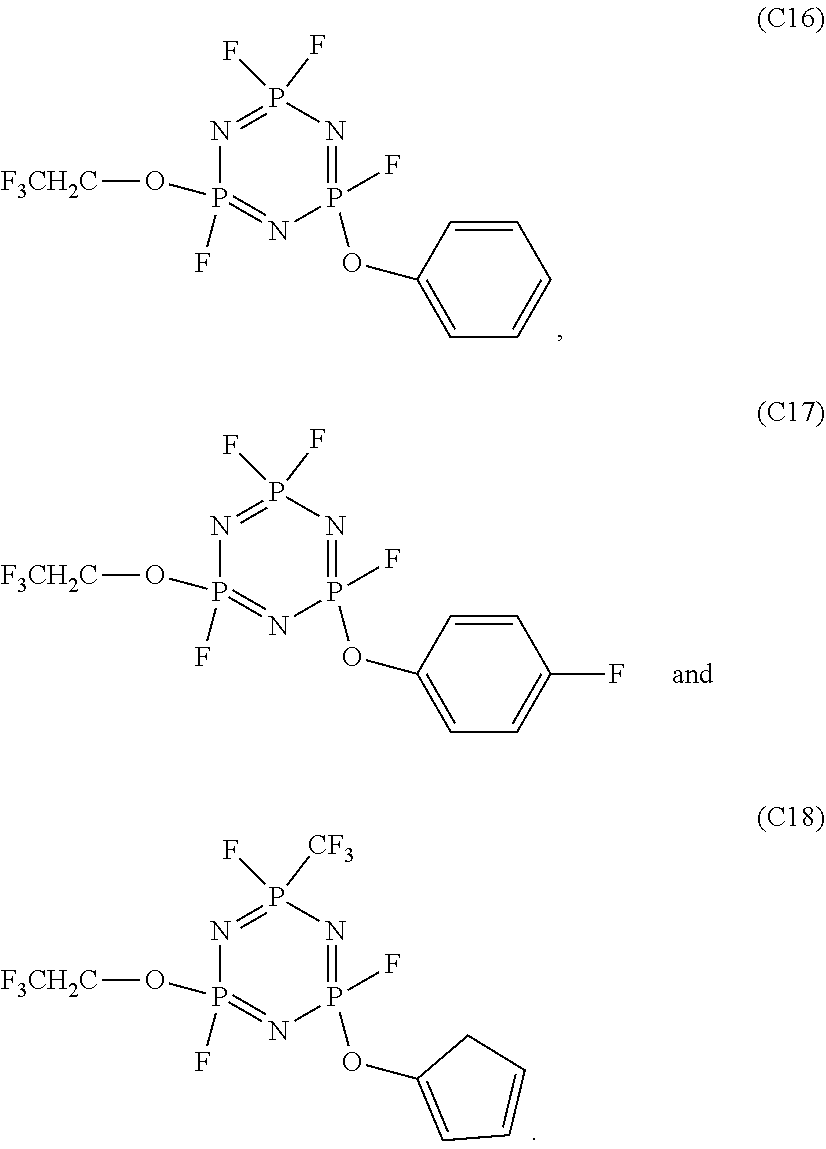
- the cyclic phosphonitrile compound may be one or more selected from the group of compounds consisting of:
- a content of the cyclic phosphonitrile compound may be 0.1%-8% of the total weight of the electrolyte.
- the content of the cyclic phosphonitrile compound may be 1%-5% of the total weight of the electrolyte.
- the lithium salt may be one or more selected from a group consisting of LiPF 6 , LiBF 4 , LiN(SO 2 F) 2 (LiFSI), LiClO 4 , LiAsF 6 , LiB(C 2 O 4 ) 2 (LiBOB), LiBF 2 (C 2 O 4 ) (LiDFOB), LiN(SO 2 RF) 2 and LiN(SO 2 F)(SO 2 RF).
- the lithium salt may be one or more selected from a group consisting of LiPF 6 , LiN(SO 2 F) 2 , LiN(CF 3 SO 2 ) 2 , LiB(C 2 O 4 ) 2 and LiBF 2 (C 2 O 4 ). Further preferably, the lithium salt may be one or more selected from a group consisting of LiPF 6 , LiN(SO 2 F) 2 and LiBF 2 (C 2 O 4 ).
- RF represents C n F 2n+1 , n is an integer of 1-10.
- RF may be —CF 3 , —C 2 F 5 or —CF 2 CF 2 CF 3 .
- a content of the lithium salt may be 6.25%-25% of the total weight of the electrolyte.
- the content of the lithium salt may be 6.25%-18.8% of the total weight of the electrolyte.
- a specific type of the organic solvent may be selected based on actual demands.
- a non-aqueous organic solvent is used.
- the non-aqueous organic solvent may comprise carbonate ester (such as cyclic carbonate ester or chain carbonate ester), carboxylic acid ester (such as cyclic carboxylic acid ester or chain carboxylic acid ester), halocarbonate ester and the like.
- the organic solvent may be one or more selected from a group consisting of ethylene carbonate, propylene carbonate, 2,3-butylene carbonate, amylene carbonate, dimethyl carbonate, diethyl carbonate, dipropyl carbonate, ethyl methyl carbonate, ⁇ -butyrolactone, methyl propionate, methyl butyrate, ethyl acetate, ethyl propionate, propyl propionate and ethyl butyrate.
- the additive may further comprise one or more selected from a group consisting of fluoro-cyclic carbonate ester, 1,3-propylene sulfite (PS) and vinylene carbonate (VC).
- a content of the fluoro-cyclic carbonate ester may be 1%-5% of the total weight of the electrolyte.
- a content of 1,3-propylene sulfite may be 1%-5% of the total weight of the electrolyte.
- a content of vinylene carbonate may be 1%-5% of the total weight of the electrolyte.
- the fluoro-cyclic carbonate ester can significantly improve the cycle performance of the lithium-ion battery.
- 1,3-propylene sulfite and/or vinylene carbonate can further inhibit the gas generation in the high temperature environment (such as the high temperature cycle process and the high temperature storage process) of the lithium-ion battery, however, a higher content of 1,3-propylene sulfite and/or vinylene carbonate may significantly increase the DCR of the lithium-ion battery.
- the lithium-ion battery may further improve the power performance of the lithium-ion battery, inhibit the gas generation in the high temperature environment of the lithium-ion battery, and improve the cycle performance, the high temperature storage performance and the safety performance of the lithium-ion battery by further adding one or more selected from a group consisting of fluoro-cyclic carbonate ester, 1,3-propylene sulfite and vinylene carbonate into the electrolyte.
- a structural formula of the fluoro-cyclic carbonate ester is represented by formula 3.
- Rio is halogen atom or C 1-20 haloalkyl.
- the fluoro-cyclic carbonate ester may be one or more selected from the group of compounds consisting of:
- alkyl, alkenyl, alkynyl, the halogenated compound thereof such as haloalkyl, haloalkenyl, haloalkynyl
- the oxogenated compound thereof such as alkoxy, alkenoxy, alkynoxy
- the lithium-ion battery according to the second aspect of the present disclosure comprises the electrolyte according to the first aspect of the present disclosure.
- the lithium-ion battery according to the second aspect of the present disclosure further comprises a positive electrode plate, a negative electrode plate and a separator.
- the separator is interposed between the positive electrode plate and the negative electrode plate.
- the positive electrode plate comprises a positive current collector and a positive film positioned on the positive current collector.
- the positive film comprises a positive active material, a conductive agent and a binder.
- the positive active material may be at least one selected from a group consisting of lithium cobaltate, ternary positive material, phosphate material and lithium manganese dioxide.
- the positive active material may be one or more selected from a group consisting of LiCoO 2 , LiNi x A y B (1-x-y) O 2 , LiMPO 4 and Li 1-x′ (Q y′ L z′ C 1-y′-z′ )O 2 .
- A, B each are independently one selected from a group consisting of Co, Al, Ni, Mn, A and B are different, 0 ⁇ x ⁇ 1, 0 ⁇ y ⁇ 1 and x+y ⁇ 1.
- LiMPO 4 has an olivine structure, M is one selected from a group consisting of Co, Ni, Fe, Mn and V.
- Q, L, C each are independently one selected from a group consisting of Co, Ni, Fe and Mn, 0 ⁇ x′ ⁇ 1, 0 ⁇ y′ ⁇ 1, 0 ⁇ z′ ⁇ 1 and y′+z′ ⁇ 1.
- the negative electrode plate comprises a negative current collector and a negative film positioned on the negative current collector.
- the negative film comprises a negative active material, a conductive agent and a binder.
- the negative active material may be one or more selected from a group consisting of lithium metal, natural graphite, artificial graphite, meso-carbon micro bead (MCMB), hard carbon, soft carbon, silicon, silicon-carbon composite, Li—Sn alloy, Li—Sn—O alloy, Sn, SnO, SnO 2 , lithiated TiO 2 —Li 4 Ti 5 O 12 having a spinel structure and Li—Al alloy.
- Lithium-ion batteries of comparative examples 1-7 and examples 1-11 were all prepared in accordance with the following preparation method.
- LiNi 0.33 Co 0.33 Mn 0.33 O 2 positive active material
- polyvinylidene fluoride binder
- acetylene black conductive agent
- the organic solvent was a mixed solution comprising ethylene carbonate (EC), ethyl methyl carbonate (EMC) and diethyl carbonate (DEC), a weight ratio of EC, EMC and DEC was 1:1:1.
- the lithium salt was LiPF 6 , a content of LiPF 6 was 12.5% of a total weight of the electrolyte. Specific type and content of each additive were illustrated in table 1, the content of the additive was a weight percentage calculated based on the total weight of the electrolyte.
- the positive electrode plate, the negative electrode plate and the separator were wound together to form a cell, then the cell was put into a package shell, then the electrolyte was injected, which was followed by packaging, standing, hot and cold pressing, formation, degassing, capacity testing and the like, and finally a lithium-ion battery was obtained.
- the lithium-ion battery was stood for 30 min, then the lithium-ion battery was charged to 4.2 V at a constant current of 1 C, then the lithium-ion battery was charged to a current less than or equal to 0.05 C at a constant voltage of 4.2 V and then stood for 5 min; then the lithium-ion battery was discharged to 2.8 V at a constant current of 1 C, the obtained discharge capacity was a rated capacity of the lithium-ion battery, that was the lithium-ion battery was under 100% SOC.
- DCR DC discharge resistance
- the lithium-ion battery was charged to 4.2 V at a constant current of 1 C, then the lithium-ion battery was charged to 0.05 C at a constant voltage of 4.2 V, then the lithium-ion battery was discharged to 2.8 V at a constant current of 1 C, this process was the first cycle process, the obtained discharge capacity was the first cycle discharge capacity; then the cycle process of the lithium-ion battery was repeated until the discharge capacity of the lithium-ion battery was less than or equal to 80% of the first cycle discharge capacity, the cycle number of the lithium-ion battery was marked.
- the lithium-ion battery was stood for 30 min, then the lithium-ion battery was charged to 4.2 V at a constant current of 1 C, then the lithium-ion battery was charged to a current less than or equal to 0.05 C at a constant voltage of 4.2 V and then stood for 5 min, then the lithium-ion battery was discharged to 2.5 V at a constant current of 1 C, the obtained discharge capacity was the capacity of the lithium-ion battery before the high temperature storage process.
- the lithium-ion battery was stood for 30 min, then the lithium-ion battery was charged to 4.2 V at a constant current of 1 C, then the lithium-ion battery was charged to a current less than or equal to 0.05 C at a constant voltage of 4.2 V and then stood for 5 min, then the lithium-ion battery was stored for 30 days under 60° C., and finally the lithium-ion battery was discharged to 2.5 V at a constant current of 1 C, the obtained discharge capacity was the capacity of the lithium-ion battery after the high temperature storage process.
- Reversible capacity retention rate of the lithium-ion battery after stored for 30 days under 60° C. (%) (capacity after the high temperature storage process/capacity before the high temperature storage process) ⁇ 100%.
- Comparative 500 420 310 80% 30% example 1 Comparative 380 440 330 80% 29% example 2 Comparative 420 400 290 87% 10% example 3 Comparative 470 425 326 75% 30% example 4 Comparative 378 419 310 81% 15% example 5 Comparative 377 430 331 80% 31% example 6 Comparative 371 424 312 79% 31% example 7 Example 1 362 820 789 92% 9% Example 2 360 821 772 91% 27% Example 3 361 1020 838 95% 10% Example 4 419 900 789 90% 12% Example 5 358 940 788 89% 19% Example 6 386 970 794 88% 10% Example 7 385 887 658 87% 9% Example 8 416 885 670 90% 18% Example 9 401 889 695 84% 22% Example 10 399 990 770 94% 8% Example 11 408 940 766 93% 7%
- the trifluoromethanesulfonate silyl compound, the lithium fluorophosphate compound and the cyclic phosphonitrile compound were added into the electrolytes of the lithium-ion batteries of examples 1-11, the above three types of compounds could cooperate to act on the electrode interface of the lithium-ion battery, so as to significantly decrease the impedance of the SEI film on the surface of the negative electrode of the lithium-ion battery, decrease the low temperature DCR of the lithium-ion battery and improve the power performance of the lithium-ion battery, and the above three types of compounds could also significantly inhibit the gas generation during the cycle process and the storage process of the lithium-ion battery, and significantly improve the cycle performance, the high temperature storage performance and the safety performance of the lithium-ion battery.
- the fluorophosphates lithium compound might participate in the formation of the CEI (cathode electrolyte interface) film on the surface of the positive electrode so as to inhibit oxidative decomposition of both LiPF 6 and the organic solvent on the surface of the positive electrode, and inhibit the gas generation during the high temperature storage process of the lithium-ion battery; meanwhile, the formed CEI film might protect the positive electrode, therefore it was also helpful to decrease the low temperature DCR of the lithium-ion battery; moreover, the formed CEI film might separate the positive active material and the electrolyte and avoid the positive active material directly contacting the electrolyte, therefore it might also improve the high temperature storage performance of the lithium-ion battery to a certain extent by adding the lithium fluorophosphate compound into the electrolyte.
- CEI cathode electrolyte interface
- the cyclic phosphonitrile compound could be decomposed into polyphosphate, the polyphosphate might participate in the formation of the SEI film on the surface of the negative electrode, so as to effectively decrease the surface resistance of the negative electrode; moreover, the cyclic phosphonitrile compound might also neutralize the hydrofluoric acid in the electrolyte, thereby reducing corrosion of the hydrofluoric acid on the positive protective film and the negative protective film, and inhibiting the gas generation during the high temperature storage process of the lithium-ion battery; moreover, the cyclic phosphonitrile compound might further improve the cycle performance of the lithium-ion battery, however, a too higher content of the cyclic phosphonitrile compound might increase the gas generation during the high temperature storage process of the lithium-ion battery.
Landscapes
- Chemical & Material Sciences (AREA)
- Engineering & Computer Science (AREA)
- Manufacturing & Machinery (AREA)
- Chemical Kinetics & Catalysis (AREA)
- Electrochemistry (AREA)
- General Chemical & Material Sciences (AREA)
- Physics & Mathematics (AREA)
- Condensed Matter Physics & Semiconductors (AREA)
- General Physics & Mathematics (AREA)
- Inorganic Chemistry (AREA)
- Materials Engineering (AREA)
- Secondary Cells (AREA)
Abstract
Description


| TABLE 1 |
| Types and contents of additives of comparative examples 1-7 and examples 1-11 |
| Additive A | Additive B | Additive C | Additive D | PS | VC |
| Type | Content | Type | Content | Type | Content | Type | Content | Content | Content | ||
| Comparative | / | / | / | / | / | / | / | / | / | / |
| example 1 | ||||||||||
| Comparative | A1 | 2.0% | / | / | / | / | / | / | / | / |
| example 2 | ||||||||||
| Comparative | / | / | B1 | 1.0% | / | / | / | / | / | / |
| example 3 | ||||||||||
| Comparative | / | / | / | / | C2 | 2.0% | / | / | / | / |
| example 4 | ||||||||||
| Comparative | A1 | 2.0% | B1 | 1.0% | / | / | / | / | / | / |
| example 5 | ||||||||||
| Comparative | / | / | B1 | 1.0% | C2 | 2.0% | / | / | / | / |
| example 6 | ||||||||||
| Comparative | A1 | 2.0% | / | / | C2 | 2.0% | / | / | / | / |
| example 7 | ||||||||||
| Example 1 | A1 | 2.0% | B1 | 1.0% | C2 | 2.0% | / | / | / | / |
| Example 2 | A2 | 5.0% | B2 | 0.1% | C2 | 2.0% | / | / | / | / |
| Example 3 | A1 | 1.0% | B1 | 1.0% | C2 | 2.0% | D1 | 5% | / | / |
| Example 4 | A1 | 0.1% | B1 | 1.0% | C2 | 2.0% | D1 | 5% | / | / |
| Example 5 | A3 | 8.0% | B1 | 0.5% | C2 | 2.0% | D1 | 1% | / | / |
| Example 6 | A1 | 1.0% | B1 | 3.0% | C1 | 2.0% | D1 | 5% | / | / |
| Example 7 | A4 | 1.0% | B1 | 5.0% | C2 | 0.1% | D2 | 5% | / | / |
| Example 8 | A5 | 0.2% | B1 | 1.0% | C2 | 5.0% | D3 | 5% | / | / |
| Example 9 | A1 | 0.3% | B1 | 1.0% | C3 | 8.0% | D1 | 5% | 1% | / |
| Example 10 | A1 | 1.0% | B1 | 1.0% | C2 | 1.0% | D1 | 5% | 5% | 5% |
| Example 11 | A1 | 1.0% | B1 | 1.0% | C2 | 1.0% | D1 | 5% | 1% | 1% |
DCR=(U 0 −U 1)/I. U 0 represented the voltage before the discharge process and U 1 represented the voltage after the discharge process.
Reversible capacity retention rate of the lithium-ion battery after stored for 30 days under 60° C. (%)=(capacity after the high temperature storage process/capacity before the high temperature storage process)×100%.
Volume expansion rate of the lithium-ion battery after stored for 10 days under 70° C. (%)=(volume after storage−volume before storage)/volume before storage×100%.
| TABLE 2 |
| Testing results of comparative examples 1-7 and examples 1-11 |
| Reversible capacity | Volume expansion | |||||
| 25° C. | 45° C. | retention rate after | rate after | |||
| DCR | cycle | cycle | stored for 30 days | stored for 10 days | ||
| (mohm) | number | number | under 60° C. | under 70° C. | ||
| Comparative | 500 | 420 | 310 | 80% | 30% |
| example 1 | |||||
| Comparative | 380 | 440 | 330 | 80% | 29% |
| example 2 | |||||
| Comparative | 420 | 400 | 290 | 87% | 10% |
| example 3 | |||||
| Comparative | 470 | 425 | 326 | 75% | 30% |
| example 4 | |||||
| Comparative | 378 | 419 | 310 | 81% | 15% |
| example 5 | |||||
| Comparative | 377 | 430 | 331 | 80% | 31% |
| example 6 | |||||
| Comparative | 371 | 424 | 312 | 79% | 31% |
| example 7 | |||||
| Example 1 | 362 | 820 | 789 | 92% | 9% |
| Example 2 | 360 | 821 | 772 | 91% | 27% |
| Example 3 | 361 | 1020 | 838 | 95% | 10% |
| Example 4 | 419 | 900 | 789 | 90% | 12% |
| Example 5 | 358 | 940 | 788 | 89% | 19% |
| Example 6 | 386 | 970 | 794 | 88% | 10% |
| Example 7 | 385 | 887 | 658 | 87% | 9% |
| Example 8 | 416 | 885 | 670 | 90% | 18% |
| Example 9 | 401 | 889 | 695 | 84% | 22% |
| Example 10 | 399 | 990 | 770 | 94% | 8% |
| Example 11 | 408 | 940 | 766 | 93% | 7% |
Claims (14)


Applications Claiming Priority (3)
| Application Number | Priority Date | Filing Date | Title |
|---|---|---|---|
| CN201611244549.0A CN108258297B (en) | 2016-12-29 | 2016-12-29 | Electrolyte and lithium ion battery |
| CN201611244549 | 2016-12-29 | ||
| CN201611244549.0 | 2016-12-29 |
Publications (2)
| Publication Number | Publication Date |
|---|---|
| US20180191032A1 US20180191032A1 (en) | 2018-07-05 |
| US10797348B2 true US10797348B2 (en) | 2020-10-06 |
Family
ID=62711303
Family Applications (1)
| Application Number | Title | Priority Date | Filing Date |
|---|---|---|---|
| US15/845,950 Active 2038-11-12 US10797348B2 (en) | 2016-12-29 | 2017-12-18 | Electrolyte and lithium-ion battery |
Country Status (2)
| Country | Link |
|---|---|
| US (1) | US10797348B2 (en) |
| CN (1) | CN108258297B (en) |
Families Citing this family (10)
| Publication number | Priority date | Publication date | Assignee | Title |
|---|---|---|---|---|
| CN109935904B (en) | 2017-12-15 | 2021-08-20 | 华为技术有限公司 | An electrolyte additive, lithium secondary battery electrolyte and lithium secondary battery |
| CN109638353B (en) * | 2018-11-27 | 2021-01-01 | 杉杉新材料(衢州)有限公司 | Battery electrolyte additive, electrolyte containing additive and application of electrolyte |
| CN110911752A (en) * | 2019-12-06 | 2020-03-24 | 广州天赐高新材料股份有限公司 | Low-internal-resistance lithium secondary battery electrolyte and lithium secondary battery |
| CN114069045A (en) * | 2020-07-31 | 2022-02-18 | 浙江中蓝新能源材料有限公司 | Silane additive composition, electrolyte containing same and lithium ion battery |
| US20220115694A1 (en) * | 2020-10-12 | 2022-04-14 | Wildcat Discovery Technologies, Inc | Lithium ion batteries with high voltage electrolyte additives |
| KR20220126035A (en) * | 2021-03-08 | 2022-09-15 | 현대자동차주식회사 | Electrolyte solution for lithium secondary battery and lithium secondary battery comprising the same |
| CN113451650B (en) * | 2021-06-28 | 2023-04-28 | 万向一二三股份公司 | Electrolyte for lithium battery and lithium ion battery |
| CN116154290A (en) * | 2023-01-04 | 2023-05-23 | 广州鹏辉能源科技股份有限公司 | Low-impedance water-removing electrolyte additives for lithium-ion batteries, non-aqueous electrolytes, lithium-ion batteries and electrical equipment |
| CN117374393B (en) * | 2023-10-10 | 2025-10-14 | 龙子湖新能源实验室 | A phosphazene-modified ionic liquid electrolyte additive and its preparation method and application |
| CN117219871A (en) * | 2023-11-09 | 2023-12-12 | 宁德时代新能源科技股份有限公司 | Electrolyte, sodium secondary battery and electricity utilization device |
Citations (5)
| Publication number | Priority date | Publication date | Assignee | Title |
|---|---|---|---|---|
| CN1385919A (en) | 2001-05-11 | 2002-12-18 | 三星Sdi株式会社 | Electrolyte solution for lithium secondary battery and lithium secondary battery containing the electrolyte solution |
| US20120225359A1 (en) | 2010-07-06 | 2012-09-06 | U.S. Government As Represented By The Secretary Of The Army | Electrolytes in Support of 5 V Li ion Chemistry |
| JP2014170689A (en) | 2013-03-04 | 2014-09-18 | Mitsui Chemicals Inc | Nonaqueous electrolyte and lithium secondary battery |
| WO2014203912A1 (en) * | 2013-06-21 | 2014-12-24 | 宇部興産株式会社 | Nonaqueous electrolyte solution, electricity storage device using same, and biphenyl group-containing carbonate compound used in same |
| CN105745779A (en) | 2013-12-25 | 2016-07-06 | 旭化成株式会社 | Composition for addition to electrolyte solutions containing silyl group-containing compound, electrolyte solution for nonaqueous electricity storage devices containing said composition, and lithium ion secondary battery containing said electrolyte solution |
Family Cites Families (2)
| Publication number | Priority date | Publication date | Assignee | Title |
|---|---|---|---|---|
| CN101894974A (en) * | 2005-10-20 | 2010-11-24 | 三菱化学株式会社 | Lithium secondary battery and nonaqueous electrolyte used therein |
| JP2016189327A (en) * | 2015-03-27 | 2016-11-04 | 旭化成株式会社 | Electrolyte additive for non-aqueous storage devices |
-
2016
- 2016-12-29 CN CN201611244549.0A patent/CN108258297B/en active Active
-
2017
- 2017-12-18 US US15/845,950 patent/US10797348B2/en active Active
Patent Citations (7)
| Publication number | Priority date | Publication date | Assignee | Title |
|---|---|---|---|---|
| CN1385919A (en) | 2001-05-11 | 2002-12-18 | 三星Sdi株式会社 | Electrolyte solution for lithium secondary battery and lithium secondary battery containing the electrolyte solution |
| US20050244719A1 (en) * | 2001-05-11 | 2005-11-03 | Samsung Sdi Co., Ltd. | Electrolyte for lithium secondary battery and lithium secondary battery comprising same |
| US20120225359A1 (en) | 2010-07-06 | 2012-09-06 | U.S. Government As Represented By The Secretary Of The Army | Electrolytes in Support of 5 V Li ion Chemistry |
| JP2014170689A (en) | 2013-03-04 | 2014-09-18 | Mitsui Chemicals Inc | Nonaqueous electrolyte and lithium secondary battery |
| WO2014203912A1 (en) * | 2013-06-21 | 2014-12-24 | 宇部興産株式会社 | Nonaqueous electrolyte solution, electricity storage device using same, and biphenyl group-containing carbonate compound used in same |
| US20160126593A1 (en) * | 2013-06-21 | 2016-05-05 | Ube Industries, Ltd. | Nonaqueous electrolyte solution, electricity storage device using same, and biphenyl group-containing carbonate compound used in same |
| CN105745779A (en) | 2013-12-25 | 2016-07-06 | 旭化成株式会社 | Composition for addition to electrolyte solutions containing silyl group-containing compound, electrolyte solution for nonaqueous electricity storage devices containing said composition, and lithium ion secondary battery containing said electrolyte solution |
Non-Patent Citations (1)
| Title |
|---|
| Contemporary Amperex Technology Co., Limited, The First Office Action, CN201611244549.0, dated Jun. 25, 2019, 11 pgs. |
Also Published As
| Publication number | Publication date |
|---|---|
| US20180191032A1 (en) | 2018-07-05 |
| CN108258297A (en) | 2018-07-06 |
| CN108258297B (en) | 2020-07-17 |
Similar Documents
| Publication | Publication Date | Title |
|---|---|---|
| US10797348B2 (en) | Electrolyte and lithium-ion battery | |
| CN114520371B (en) | Nonaqueous electrolyte and lithium ion battery comprising same | |
| CN107171022B (en) | A kind of lithium-ion electrolyte and its lithium ion battery | |
| EP1304759A1 (en) | Nonaqueous electrolyte secondary cell | |
| US20240154115A1 (en) | Lithium-ion Battery | |
| CN109148951A (en) | Electrolyte and lithium ion battery | |
| US12322755B2 (en) | Electrolyte of lithium-ion secondary battery and application thereof | |
| CN115663286B (en) | A lithium ion battery | |
| CN108242566A (en) | Electrolyte solution and secondary battery | |
| JP2007087883A (en) | Nonaqueous electrolyte for secondary battery and nonaqueous electrolyte secondary battery | |
| EP4220805A2 (en) | Electrolytic solution, electrochemical device, and electronic device | |
| CN106997959B (en) | Additive, non-aqueous electrolyte and lithium ion battery | |
| US20180294483A1 (en) | Positive electrode plate and energy storage device | |
| CN109473717B (en) | Electrolyte suitable for high-voltage high-nickel power battery and high-voltage high-nickel power battery | |
| CN115966766A (en) | A kind of non-aqueous electrolyte and lithium ion battery | |
| CN109309248B (en) | Electrolyte solution and secondary battery | |
| CN109309249B (en) | Electrolyte and electrochemical energy storage device | |
| CN110970652A (en) | Non-aqueous electrolytes and lithium-ion batteries | |
| CN110970663A (en) | Non-aqueous electrolytes and lithium-ion batteries | |
| JP4010701B2 (en) | Non-aqueous electrolyte and non-aqueous electrolyte secondary battery | |
| US20250055034A1 (en) | Electrolyte solution and battery including the same | |
| CN107403958A (en) | Electrolyte and lithium ion battery | |
| KR101651142B1 (en) | Lithium secondary battery having improved cycle life | |
| CN110649317B (en) | Silicon-based lithium ion battery electrolyte and lithium ion secondary battery | |
| CN110797572B (en) | Lithium ion battery electrolyte and lithium ion battery |
Legal Events
| Date | Code | Title | Description |
|---|---|---|---|
| FEPP | Fee payment procedure |
Free format text: ENTITY STATUS SET TO UNDISCOUNTED (ORIGINAL EVENT CODE: BIG.); ENTITY STATUS OF PATENT OWNER: LARGE ENTITY |
|
| STPP | Information on status: patent application and granting procedure in general |
Free format text: DOCKETED NEW CASE - READY FOR EXAMINATION |
|
| AS | Assignment |
Owner name: CONTEMPORARY AMPEREX TECHNOLOGY CO., LIMITED, CHIN Free format text: ASSIGNMENT OF ASSIGNORS INTEREST;ASSIGNORS:LIU, JIQIONG;HAN, CHANGLONG;ZHU, JIANWEI;AND OTHERS;SIGNING DATES FROM 20171204 TO 20171205;REEL/FRAME:051088/0506 Owner name: CONTEMPORARY AMPEREX TECHNOLOGY CO., LIMITED, CHINA Free format text: ASSIGNMENT OF ASSIGNORS INTEREST;ASSIGNORS:LIU, JIQIONG;HAN, CHANGLONG;ZHU, JIANWEI;AND OTHERS;SIGNING DATES FROM 20171204 TO 20171205;REEL/FRAME:051088/0506 |
|
| STPP | Information on status: patent application and granting procedure in general |
Free format text: NON FINAL ACTION MAILED |
|
| STPP | Information on status: patent application and granting procedure in general |
Free format text: NON FINAL ACTION MAILED |
|
| STPP | Information on status: patent application and granting procedure in general |
Free format text: RESPONSE TO NON-FINAL OFFICE ACTION ENTERED AND FORWARDED TO EXAMINER |
|
| STPP | Information on status: patent application and granting procedure in general |
Free format text: NOTICE OF ALLOWANCE MAILED -- APPLICATION RECEIVED IN OFFICE OF PUBLICATIONS |
|
| STCF | Information on status: patent grant |
Free format text: PATENTED CASE |
|
| MAFP | Maintenance fee payment |
Free format text: PAYMENT OF MAINTENANCE FEE, 4TH YEAR, LARGE ENTITY (ORIGINAL EVENT CODE: M1551); ENTITY STATUS OF PATENT OWNER: LARGE ENTITY Year of fee payment: 4 |
|
| AS | Assignment |
Owner name: CONTEMPORARY AMPEREX TECHNOLOGY (HONG KONG) LIMITED, CHINA Free format text: ASSIGNMENT OF ASSIGNORS INTEREST;ASSIGNOR:CONTEMPORARY AMPEREX TECHNOLOGY CO., LIMITED;REEL/FRAME:068338/0723 Effective date: 20240806 Owner name: CONTEMPORARY AMPEREX TECHNOLOGY (HONG KONG) LIMITED, CHINA Free format text: ASSIGNMENT OF ASSIGNOR'S INTEREST;ASSIGNOR:CONTEMPORARY AMPEREX TECHNOLOGY CO., LIMITED;REEL/FRAME:068338/0723 Effective date: 20240806 |