US10793581B2 - Stereochemically defined polypropionates and methods for making and using the same - Google Patents
Stereochemically defined polypropionates and methods for making and using the same Download PDFInfo
- Publication number
- US10793581B2 US10793581B2 US16/521,691 US201916521691A US10793581B2 US 10793581 B2 US10793581 B2 US 10793581B2 US 201916521691 A US201916521691 A US 201916521691A US 10793581 B2 US10793581 B2 US 10793581B2
- Authority
- US
- United States
- Prior art keywords
- compound
- formula
- salt
- mixture
- formulas
- Prior art date
- Legal status (The legal status is an assumption and is not a legal conclusion. Google has not performed a legal analysis and makes no representation as to the accuracy of the status listed.)
- Active
Links
- 0 O=S=O.O=S=O.O=S=O.O=S=O.O=S=O.O=S=O.[3*]O[C@@H](CCC1=CC=CC=C1)[C@@H](C)[C@@H](O[3*])[C@@H](C)C=C.[3*]O[C@@H]([C@@H](C)C=C)[C@H](C)[C@@H](O[3*])[C@@H](C)CC1=CC=CC=C1.[3*]O[C@@H]([C@@H](C)C=C)[C@H](C)[C@@H](O[3*])[C@H](C)CC1=CC=CC=C1.[3*]O[C@@H]([C@@H](C)[C@H](O[3*])[C@H](C)CC1=CC=CC=C1)[C@H](C)C=C.[3*]O[C@H](CCC1=CC=CC=C1)[C@H](C)[C@H](O[3*])[C@H](C)C=C.[3*]O[C@H]([C@@H](C)CC1=CC=CC=C1)[C@H](C)[C@H](O[3*])[C@H](C)C=C Chemical compound O=S=O.O=S=O.O=S=O.O=S=O.O=S=O.O=S=O.[3*]O[C@@H](CCC1=CC=CC=C1)[C@@H](C)[C@@H](O[3*])[C@@H](C)C=C.[3*]O[C@@H]([C@@H](C)C=C)[C@H](C)[C@@H](O[3*])[C@@H](C)CC1=CC=CC=C1.[3*]O[C@@H]([C@@H](C)C=C)[C@H](C)[C@@H](O[3*])[C@H](C)CC1=CC=CC=C1.[3*]O[C@@H]([C@@H](C)[C@H](O[3*])[C@H](C)CC1=CC=CC=C1)[C@H](C)C=C.[3*]O[C@H](CCC1=CC=CC=C1)[C@H](C)[C@H](O[3*])[C@H](C)C=C.[3*]O[C@H]([C@@H](C)CC1=CC=CC=C1)[C@H](C)[C@H](O[3*])[C@H](C)C=C 0.000 description 23
- AJKWVJRCUCRGEY-UHFFFAOYSA-N [H]C12OC3([H])C(C)C(OC3C1O)C2C Chemical compound [H]C12OC3([H])C(C)C(OC3C1O)C2C AJKWVJRCUCRGEY-UHFFFAOYSA-N 0.000 description 6
- AJKWVJRCUCRGEY-HNCIISEESA-N [H][C@@]12O[C@@]3([H])[C@@H](O)[C@@H]1O[C@H]([C@@H]3C)[C@H]2C Chemical compound [H][C@@]12O[C@@]3([H])[C@@H](O)[C@@H]1O[C@H]([C@@H]3C)[C@H]2C AJKWVJRCUCRGEY-HNCIISEESA-N 0.000 description 4
- NEYNYCILPPXKTD-YTMNWYGFSA-N [H][C@@]12O[C@]3([H])[C@@H](C)C(O[C@@H]3OC1=C)[C@H]2C Chemical compound [H][C@@]12O[C@]3([H])[C@@H](C)C(O[C@@H]3OC1=C)[C@H]2C NEYNYCILPPXKTD-YTMNWYGFSA-N 0.000 description 4
- HRPZBUWNLZTHKG-KEYYPUKTSA-N [H][C@@]12O[C@]3([H])[C@@H](C)C(O[C@@H]3[C@H]1C)[C@H]2C Chemical compound [H][C@@]12O[C@]3([H])[C@@H](C)C(O[C@@H]3[C@H]1C)[C@H]2C HRPZBUWNLZTHKG-KEYYPUKTSA-N 0.000 description 4
- YHJOVVLIZCBCSM-QSQJEUMLSA-N [H][C@]12O[C@](C)(C3O[C@@H]31)[C@H](C)[C@H](O)[C@@H]2C Chemical compound [H][C@]12O[C@](C)(C3O[C@@H]31)[C@H](C)[C@H](O)[C@@H]2C YHJOVVLIZCBCSM-QSQJEUMLSA-N 0.000 description 4
- HHDYVHIHIGKDTH-GQYPVWNLSA-N C/C=C/[C@H]1O[C@@H](C)[C@@H](C)[C@@H](O)[C@H]1C.O=C=O Chemical compound C/C=C/[C@H]1O[C@@H](C)[C@@H](C)[C@@H](O)[C@H]1C.O=C=O HHDYVHIHIGKDTH-GQYPVWNLSA-N 0.000 description 3
- IBDUHJIBWUPDIJ-YYUZWCERSA-N C[C@@H]1[C@H](/C=C/C2=CC=CC=C2)O[C@H](C)[C@H](C)[C@@H]1O.O=S=O Chemical compound C[C@@H]1[C@H](/C=C/C2=CC=CC=C2)O[C@H](C)[C@H](C)[C@@H]1O.O=S=O IBDUHJIBWUPDIJ-YYUZWCERSA-N 0.000 description 3
- BLURPWMWGHWQOJ-CNEQOPDMSA-N [H][C@@]12O[C@@]3([H])C(=O)O[C@@H]1OC([C@@H]3C)[C@H]2C Chemical compound [H][C@@]12O[C@@]3([H])C(=O)O[C@@H]1OC([C@@H]3C)[C@H]2C BLURPWMWGHWQOJ-CNEQOPDMSA-N 0.000 description 3
- LLYNFPZKJQUNID-CELBRUJLSA-N C=C[C@@H](C)[C@@H](O)[C@@H](C)[C@H](O)CCC1=CC=CC=C1.C=C[C@@H](C)[C@@H](O)[C@@H](C)[C@H](O)[C@@H](C)CC1=CC=CC=C1.C=C[C@@H](C)[C@@H](O)[C@@H](C)[C@H](O)[C@H](C)CC1=CC=CC=C1.C=C[C@H](C)[C@H](O)[C@H](C)[C@@H](O)CCC1=CC=CC=C1.C=C[C@H](C)[C@H](O)[C@H](C)[C@@H](O)[C@@H](C)CC1=CC=CC=C1.C=C[C@H](C)[C@H](O)[C@H](C)[C@@H](O)[C@H](C)CC1=CC=CC=C1.O=S=O.O=S=O.O=S=O.O=S=O.O=S=O.O=S=O Chemical compound C=C[C@@H](C)[C@@H](O)[C@@H](C)[C@H](O)CCC1=CC=CC=C1.C=C[C@@H](C)[C@@H](O)[C@@H](C)[C@H](O)[C@@H](C)CC1=CC=CC=C1.C=C[C@@H](C)[C@@H](O)[C@@H](C)[C@H](O)[C@H](C)CC1=CC=CC=C1.C=C[C@H](C)[C@H](O)[C@H](C)[C@@H](O)CCC1=CC=CC=C1.C=C[C@H](C)[C@H](O)[C@H](C)[C@@H](O)[C@@H](C)CC1=CC=CC=C1.C=C[C@H](C)[C@H](O)[C@H](C)[C@@H](O)[C@H](C)CC1=CC=CC=C1.O=S=O.O=S=O.O=S=O.O=S=O.O=S=O.O=S=O LLYNFPZKJQUNID-CELBRUJLSA-N 0.000 description 2
- JHCWVMLVQJUOMV-UHFFFAOYSA-N [H]C12OC3([H])C(C)C(OC3C1OC(=O)C1=C(C(=O)O)C=CC=C1)C2C Chemical compound [H]C12OC3([H])C(C)C(OC3C1OC(=O)C1=C(C(=O)O)C=CC=C1)C2C JHCWVMLVQJUOMV-UHFFFAOYSA-N 0.000 description 2
- NEYNYCILPPXKTD-UHFFFAOYSA-N [H]C12OC3([H])C(OC1=C)OC(C2C)C3C Chemical compound [H]C12OC3([H])C(OC1=C)OC(C2C)C3C NEYNYCILPPXKTD-UHFFFAOYSA-N 0.000 description 2
- BLURPWMWGHWQOJ-YKBFINDHSA-N [H][C@@]12O[C@@]3([H])C(=O)OC1O[C@H]([C@@H]3C)[C@H]2C Chemical compound [H][C@@]12O[C@@]3([H])C(=O)OC1O[C@H]([C@@H]3C)[C@H]2C BLURPWMWGHWQOJ-YKBFINDHSA-N 0.000 description 2
- BLURPWMWGHWQOJ-ZUUCLVOTSA-N [H][C@@]12O[C@@]3([H])C(=O)O[C@@H]1O[C@H]([C@@H]3C)[C@H]2C Chemical compound [H][C@@]12O[C@@]3([H])C(=O)O[C@@H]1O[C@H]([C@@H]3C)[C@H]2C BLURPWMWGHWQOJ-ZUUCLVOTSA-N 0.000 description 2
- NEYNYCILPPXKTD-SLHBOANUSA-N [H][C@@]12O[C@@]3([H])C(OC1=C)O[C@H]([C@@H]3C)[C@H]2C Chemical compound [H][C@@]12O[C@@]3([H])C(OC1=C)O[C@H]([C@@H]3C)[C@H]2C NEYNYCILPPXKTD-SLHBOANUSA-N 0.000 description 2
- MKUJDGGNKXCXHA-RPRQQFKYSA-N [H][C@@]12O[C@@]3([H])[C@@H](O)[C@@H]1O[C@H]([C@@H]3C)[C@H]2C.[H][C@]12O[C@@]3([H])C(O[C@H]([C@@H]3C)[C@H]1C)[C@H]2O Chemical compound [H][C@@]12O[C@@]3([H])[C@@H](O)[C@@H]1O[C@H]([C@@H]3C)[C@H]2C.[H][C@]12O[C@@]3([H])C(O[C@H]([C@@H]3C)[C@H]1C)[C@H]2O MKUJDGGNKXCXHA-RPRQQFKYSA-N 0.000 description 2
- JHCWVMLVQJUOMV-DWMAFKKASA-N [H][C@@]12O[C@]3([H])[C@@H](C)[C@@H](O[C@H]1[C@@H]3OC(=O)C1=CC=CC=C1C(=O)O)[C@H]2C Chemical compound [H][C@@]12O[C@]3([H])[C@@H](C)[C@@H](O[C@H]1[C@@H]3OC(=O)C1=CC=CC=C1C(=O)O)[C@H]2C JHCWVMLVQJUOMV-DWMAFKKASA-N 0.000 description 2
- YZWMWPDPHGWNRB-NVGKDMCFSA-N *.B.CO[C@@](C)(C(=O)Cl)C1=CC=CC=C1.[H][C@@]12O[C@@]3([H])[C@@H](OC(=O)C4=CC=CC=C4C(=O)O)C1O[C@H]([C@@H]3C)[C@H]2C.[H][C@@]12O[C@]3([H])[C@@H](C)[C@@H](O[C@]1([H])[C@@H]3OC(=O)[C@](C)(OC)C1=CC=CC=C1)[C@H]2C.[H][C@]12O[C@@]3([H])C(O[C@H]([C@@H]3C)[C@H]1C)[C@H]2OC(=O)[C@](C)(OC)C1=CC=CC=C1 Chemical compound *.B.CO[C@@](C)(C(=O)Cl)C1=CC=CC=C1.[H][C@@]12O[C@@]3([H])[C@@H](OC(=O)C4=CC=CC=C4C(=O)O)C1O[C@H]([C@@H]3C)[C@H]2C.[H][C@@]12O[C@]3([H])[C@@H](C)[C@@H](O[C@]1([H])[C@@H]3OC(=O)[C@](C)(OC)C1=CC=CC=C1)[C@H]2C.[H][C@]12O[C@@]3([H])C(O[C@H]([C@@H]3C)[C@H]1C)[C@H]2OC(=O)[C@](C)(OC)C1=CC=CC=C1 YZWMWPDPHGWNRB-NVGKDMCFSA-N 0.000 description 1
- SCHMLOKTNMDNBP-JCVWYFDASA-L B.C1=COC=C1.CC(Br)C(=O)C(C)Br.C[C@@H]([NH3+])C1=CC=CC=C1.C[C@@H]([NH3+])C1=CC=CC=C1.C[C@H](N)C1=CC=CC=C1.C[C@H]([NH3+])C1=CC=CC=C1.C[C@H]([NH3+])C1=CC=CC=C1.C[C@H]([NH3+])C1=CC=CC=C1.Cl.O[Na].O[Na].[H]C12O[C@@]3([H])C(O[C@H]([C@@H]3C)[C@H]1C)[C@H]2OC(=O)C1=C(C(=O)O)C=CC=C1.[H][C@@]12C=C[C@@]([H])(O1)[C@H](C)C(=O)[C@@H]2C.[H][C@@]12O[C@@]([H])([C@H]3OC31)[C@@H](C)C(=O)[C@H]2C.[H][C@@]12O[C@@]([H])([C@H]3OC31)[C@@H](C)[C@@H](O)[C@H]2C.[H][C@@]12O[C@@]3([H])[C@@H](O)C1O[C@H]([C@@H]3C)[C@H]2C.[H][C@@]12O[C@@]3([H])[C@@H](OC(=O)C4=CC=CC=C4C(=O)[O-])C1O[C@H]([C@@H]3C)[C@H]2C.[H][C@@]12O[C@@]3([H])[C@@H](OC(=O)C4=CC=CC=C4C(=O)[O-])C1O[C@H]([C@@H]3C)[C@H]2C.[H][C@@]12O[C@]3([H])[C@@H](C)[C@@H](O[C@@H]3[C@H]1OC(=O)C1=C(C(=O)[O-])C=CC=C1)[C@H]2C.[H][C@]12O[C@@]3([H])C(O[C@H]([C@@H]3C)[C@H]1C)[C@H]2O.[H][C@]12O[C@@]3([H])C(O[C@H]([C@@H]3C)[C@H]1C)[C@H]2O.[H][C@]12O[C@@]3([H])C(O[C@H]([C@@H]3C)[C@H]1C)[C@H]2OC(=O)C1=C(C(=O)[O-])C=CC=C1.[H][C@]12O[C@@]3([H])C(O[C@H]([C@@H]3C)[C@H]1C)[C@H]2OC(=O)C1=C(C(=O)[O-])C=CC=C1.[NaH] Chemical compound B.C1=COC=C1.CC(Br)C(=O)C(C)Br.C[C@@H]([NH3+])C1=CC=CC=C1.C[C@@H]([NH3+])C1=CC=CC=C1.C[C@H](N)C1=CC=CC=C1.C[C@H]([NH3+])C1=CC=CC=C1.C[C@H]([NH3+])C1=CC=CC=C1.C[C@H]([NH3+])C1=CC=CC=C1.Cl.O[Na].O[Na].[H]C12O[C@@]3([H])C(O[C@H]([C@@H]3C)[C@H]1C)[C@H]2OC(=O)C1=C(C(=O)O)C=CC=C1.[H][C@@]12C=C[C@@]([H])(O1)[C@H](C)C(=O)[C@@H]2C.[H][C@@]12O[C@@]([H])([C@H]3OC31)[C@@H](C)C(=O)[C@H]2C.[H][C@@]12O[C@@]([H])([C@H]3OC31)[C@@H](C)[C@@H](O)[C@H]2C.[H][C@@]12O[C@@]3([H])[C@@H](O)C1O[C@H]([C@@H]3C)[C@H]2C.[H][C@@]12O[C@@]3([H])[C@@H](OC(=O)C4=CC=CC=C4C(=O)[O-])C1O[C@H]([C@@H]3C)[C@H]2C.[H][C@@]12O[C@@]3([H])[C@@H](OC(=O)C4=CC=CC=C4C(=O)[O-])C1O[C@H]([C@@H]3C)[C@H]2C.[H][C@@]12O[C@]3([H])[C@@H](C)[C@@H](O[C@@H]3[C@H]1OC(=O)C1=C(C(=O)[O-])C=CC=C1)[C@H]2C.[H][C@]12O[C@@]3([H])C(O[C@H]([C@@H]3C)[C@H]1C)[C@H]2O.[H][C@]12O[C@@]3([H])C(O[C@H]([C@@H]3C)[C@H]1C)[C@H]2O.[H][C@]12O[C@@]3([H])C(O[C@H]([C@@H]3C)[C@H]1C)[C@H]2OC(=O)C1=C(C(=O)[O-])C=CC=C1.[H][C@]12O[C@@]3([H])C(O[C@H]([C@@H]3C)[C@H]1C)[C@H]2OC(=O)C1=C(C(=O)[O-])C=CC=C1.[NaH] SCHMLOKTNMDNBP-JCVWYFDASA-L 0.000 description 1
- LEWQRPLWLOIGGC-MWYMXHIQSA-N B.CC#CC.COC(=O)[C@H]1O[C@@H](CCC2=CC=CC=C2)[C@@H](C)[C@@H](C)[C@H]1C.C[C@@H]1[C@H](CCC2=CC=CC=C2)O[C@H](CO)[C@H](C)[C@@H]1C.O=S=O.O=S=O.[2H][2H].[2H][2H].[LiH] Chemical compound B.CC#CC.COC(=O)[C@H]1O[C@@H](CCC2=CC=CC=C2)[C@@H](C)[C@@H](C)[C@H]1C.C[C@@H]1[C@H](CCC2=CC=CC=C2)O[C@H](CO)[C@H](C)[C@@H]1C.O=S=O.O=S=O.[2H][2H].[2H][2H].[LiH] LEWQRPLWLOIGGC-MWYMXHIQSA-N 0.000 description 1
- ZDBXSUZBWHJUGZ-AVDHKNMFSA-N B.Cl.[H][C@@]12O[C@@]([H])([C@H]3OC31)[C@@H](C)C(=O)[C@H]2C.[H][C@@]12O[C@@]([H])([C@H]3OC31)[C@@H](C)C(=O)[C@H]2C.[H][C@]12O[C@@]3([H])C(O[C@H]([C@@H]3C)[C@H]1C)[C@H]2O.[NaH] Chemical compound B.Cl.[H][C@@]12O[C@@]([H])([C@H]3OC31)[C@@H](C)C(=O)[C@H]2C.[H][C@@]12O[C@@]([H])([C@H]3OC31)[C@@H](C)C(=O)[C@H]2C.[H][C@]12O[C@@]3([H])C(O[C@H]([C@@H]3C)[C@H]1C)[C@H]2O.[NaH] ZDBXSUZBWHJUGZ-AVDHKNMFSA-N 0.000 description 1
- GACFKKRHRFIABO-MZWSFSCYSA-N BB(B)B.CC#CC.COC(=O)[C@H]1O[C@@H](CCC2=CC=CC=C2)[C@@H](C)[C@@H](C)[C@H]1C.COC(=O)[C@H]1O[C@@H](CCC2=CC=CC=C2)[C@@H](C)[C@@H](O)[C@H]1C.O=S=O.O=S=O Chemical compound BB(B)B.CC#CC.COC(=O)[C@H]1O[C@@H](CCC2=CC=CC=C2)[C@@H](C)[C@@H](C)[C@H]1C.COC(=O)[C@H]1O[C@@H](CCC2=CC=CC=C2)[C@@H](C)[C@@H](O)[C@H]1C.O=S=O.O=S=O GACFKKRHRFIABO-MZWSFSCYSA-N 0.000 description 1
- OKJPKJNUWNNYPH-FHXLLNJWSA-N C.C.C=C[C@H](C)[C@H](C)[C@H](C)[C@@H](O)/C=C/C1=CC=CC=C1.C=C[C@H](C)[C@H](O)[C@H](C)[C@@H](O)[C@@H](C)CC1=CC=CC=C1.O=S=O.O=S=O Chemical compound C.C.C=C[C@H](C)[C@H](C)[C@H](C)[C@@H](O)/C=C/C1=CC=CC=C1.C=C[C@H](C)[C@H](O)[C@H](C)[C@@H](O)[C@@H](C)CC1=CC=CC=C1.O=S=O.O=S=O OKJPKJNUWNNYPH-FHXLLNJWSA-N 0.000 description 1
- IXAODHSVGWWTES-SMXQTZJGSA-N C.C.C=C[C@H](C)[C@H](C)[C@H](C)[C@@H](O)/C=C/C1=CC=CC=C1.C=C[C@H](C)[C@H](O)[C@H](C)[C@@H](O)[C@H](C)CC1=CC=CC=C1.CC.O=S=O.O=S=O.[LiH] Chemical compound C.C.C=C[C@H](C)[C@H](C)[C@H](C)[C@@H](O)/C=C/C1=CC=CC=C1.C=C[C@H](C)[C@H](O)[C@H](C)[C@@H](O)[C@H](C)CC1=CC=CC=C1.CC.O=S=O.O=S=O.[LiH] IXAODHSVGWWTES-SMXQTZJGSA-N 0.000 description 1
- VXIHERWQXPETLW-RUTFYYNTSA-N C.C=C[C@H](C)[C@H](C)[C@H](C)[C@@H](C)CCC1=CC=CC=C1.C=C[C@H](C)[C@H](C)[C@H](C)[C@@H](O)CCC1=CC=CC=C1.FF.FF.O=S=O.O=S=O Chemical compound C.C=C[C@H](C)[C@H](C)[C@H](C)[C@@H](C)CCC1=CC=CC=C1.C=C[C@H](C)[C@H](C)[C@H](C)[C@@H](O)CCC1=CC=CC=C1.FF.FF.O=S=O.O=S=O VXIHERWQXPETLW-RUTFYYNTSA-N 0.000 description 1
- DAALQDCKXUJWLH-YWRNLKJBSA-N C.C=C[C@H](C)[C@H](C)[C@H](C)[C@@H](O)/C=C/C1=CC=CC=C1.C[C@@H]1[C@H](/C=C/C2=CC=CC=C2)O[C@H](CI)[C@H](C)[C@@H]1C.II(I)I.O=S=O.O=S=O Chemical compound C.C=C[C@H](C)[C@H](C)[C@H](C)[C@@H](O)/C=C/C1=CC=CC=C1.C[C@@H]1[C@H](/C=C/C2=CC=CC=C2)O[C@H](CI)[C@H](C)[C@@H]1C.II(I)I.O=S=O.O=S=O DAALQDCKXUJWLH-YWRNLKJBSA-N 0.000 description 1
- FJGQPVNQFZIAGJ-GRUIUEFLSA-N C.C=C[C@H](C)[C@H](C)[C@H](C)[C@@H](O)CCC1=CC=CC=C1.C[C@@H]1[C@H](CCC2=CC=CC=C2)O[C@H](CI)[C@H](C)[C@@H]1C.FF.FF.O=S=O.O=S=O Chemical compound C.C=C[C@H](C)[C@H](C)[C@H](C)[C@@H](O)CCC1=CC=CC=C1.C[C@@H]1[C@H](CCC2=CC=CC=C2)O[C@H](CI)[C@H](C)[C@@H]1C.FF.FF.O=S=O.O=S=O FJGQPVNQFZIAGJ-GRUIUEFLSA-N 0.000 description 1
- CJBKIUBFPDDDFN-KFUVCQDRSA-N C.COC(=O)[C@H]1O[C@@H](/C=C/C2=CC=CC=C2)[C@@H](C)[C@@H](C)[C@H]1C.C[C@@H]1[C@H](/C=C/C2=CC=CC=C2)O[C@H](CO)[C@H](C)[C@@H]1C.O=S=O.O=S=O.[HH].[HH] Chemical compound C.COC(=O)[C@H]1O[C@@H](/C=C/C2=CC=CC=C2)[C@@H](C)[C@@H](C)[C@H]1C.C[C@@H]1[C@H](/C=C/C2=CC=CC=C2)O[C@H](CO)[C@H](C)[C@@H]1C.O=S=O.O=S=O.[HH].[HH] CJBKIUBFPDDDFN-KFUVCQDRSA-N 0.000 description 1
- XJBVQVRPYSLXSS-GJJBTUFDSA-N C.C[C@@H]1[C@H](CCC2=CC=CC=C2)O[C@H](CI)[C@H](C)[C@@H]1C.C[C@@H]1[C@H](CCC2=CC=CC=C2)O[C@H](CO)[C@H](C)[C@@H]1C.O=S=O.O=S=O.[2H][2H].[2H][2H] Chemical compound C.C[C@@H]1[C@H](CCC2=CC=CC=C2)O[C@H](CI)[C@H](C)[C@@H]1C.C[C@@H]1[C@H](CCC2=CC=CC=C2)O[C@H](CO)[C@H](C)[C@@H]1C.O=S=O.O=S=O.[2H][2H].[2H][2H] XJBVQVRPYSLXSS-GJJBTUFDSA-N 0.000 description 1
- GCQMZNWBHNROEM-GPHOPROCSA-N C/C=C/[C@@H]1O[C@H](C(=O)OC)[C@H](C)[C@H](O)[C@@H]1C.CCP(=O)(OC)OC.O=C=O.O=C=O.[H][C@@]12O[C@]3([H])[C@@H](C)C(O[C@@H]3OC1=O)[C@H]2C Chemical compound C/C=C/[C@@H]1O[C@H](C(=O)OC)[C@H](C)[C@H](O)[C@@H]1C.CCP(=O)(OC)OC.O=C=O.O=C=O.[H][C@@]12O[C@]3([H])[C@@H](C)C(O[C@@H]3OC1=O)[C@H]2C GCQMZNWBHNROEM-GPHOPROCSA-N 0.000 description 1
- NRISCBZOKJUEBV-HJYYKTJASA-N C1=COC=C1.CC(Br)C(=O)C(C)Br.[H][C@@]12C=C[C@@]([H])(O1)[C@H](C)C(=O)[C@@H]2C Chemical compound C1=COC=C1.CC(Br)C(=O)C(C)Br.[H][C@@]12C=C[C@@]([H])(O1)[C@H](C)C(=O)[C@@H]2C NRISCBZOKJUEBV-HJYYKTJASA-N 0.000 description 1
- AMFZJOVOEQKCBT-HVYKQWAVSA-N C=C[C@@H](O)[C@H](C)[C@@H]1O[C@H](OC)C[C@H]1C.C=C[C@H](C)[C@H](C)[C@H](C)[C@@H](C)CCC1=CC=CC=C1.CO[C@@H]1C[C@@H](C)[C@H]([C@@H](C)[C@H](O)/C=C/[C@H](C)[C@H](C)[C@H](C)[C@@H](C)CCC2=CC=CC=C2)O1.O=S=O.O=S=O Chemical compound C=C[C@@H](O)[C@H](C)[C@@H]1O[C@H](OC)C[C@H]1C.C=C[C@H](C)[C@H](C)[C@H](C)[C@@H](C)CCC1=CC=CC=C1.CO[C@@H]1C[C@@H](C)[C@H]([C@@H](C)[C@H](O)/C=C/[C@H](C)[C@H](C)[C@H](C)[C@@H](C)CCC2=CC=CC=C2)O1.O=S=O.O=S=O AMFZJOVOEQKCBT-HVYKQWAVSA-N 0.000 description 1
- BLURPWMWGHWQOJ-ZOQIDPATSA-N CC([C@@H]1O[C@@H]2C3C)C3OC1OC2=O Chemical compound CC([C@@H]1O[C@@H]2C3C)C3OC1OC2=O BLURPWMWGHWQOJ-ZOQIDPATSA-N 0.000 description 1
- XTJVRCTWXYJVHU-PZSYXTRHSA-N CC([NH3+])C1=CC=CC=C1.[H][C@]12O[C@@]3([H])C(O[C@H]([C@@H]3C)[C@H]1C)[C@H]2OC(=O)C1=C(C(=O)[O-])C=CC=C1 Chemical compound CC([NH3+])C1=CC=CC=C1.[H][C@]12O[C@@]3([H])C(O[C@H]([C@@H]3C)[C@H]1C)[C@H]2OC(=O)C1=C(C(=O)[O-])C=CC=C1 XTJVRCTWXYJVHU-PZSYXTRHSA-N 0.000 description 1
- WLPALPDROMMWHH-YVWYRUKOSA-N CCC[C@H]1O[C@@H](C)[C@@H](C)[C@@H](O)[C@H]1C.O=C=O Chemical compound CCC[C@H]1O[C@@H](C)[C@@H](C)[C@@H](O)[C@H]1C.O=C=O WLPALPDROMMWHH-YVWYRUKOSA-N 0.000 description 1
- VOSFAUWIAIAFIA-VXLVMFPGSA-N CO[C@@H]1C[C@@H](C)[C@H]([C@@H](C)[C@H](O)/C=C/[C@H](C)[C@H](C)[C@H](C)[C@@H](C)CCC2=CC=CC=C2)O1.CO[C@@H]1C[C@@H](C)[C@H]([C@@H](C)[C@H](O)CC[C@H](C)[C@H](C)[C@H](C)[C@@H](C)CCC2=CC=CC=C2)O1.O=S=O.O=S=O Chemical compound CO[C@@H]1C[C@@H](C)[C@H]([C@@H](C)[C@H](O)/C=C/[C@H](C)[C@H](C)[C@H](C)[C@@H](C)CCC2=CC=CC=C2)O1.CO[C@@H]1C[C@@H](C)[C@H]([C@@H](C)[C@H](O)CC[C@H](C)[C@H](C)[C@H](C)[C@@H](C)CCC2=CC=CC=C2)O1.O=S=O.O=S=O VOSFAUWIAIAFIA-VXLVMFPGSA-N 0.000 description 1
- TVYLYOJKMFBJQX-CZYLXPNTSA-N CO[C@@](C)(C(=O)Cl)C1=CC=CC=C1.C[C@H]([NH3+])C1=CC=CC=C1.[H][C@@]12O[C@@]3([H])[C@@H](OC(=O)C4=CC=CC=C4C(=O)[O-])C1O[C@H]([C@@H]3C)[C@H]2C.[H][C@@]12O[C@]3([H])[C@@H](C)[C@@H](O[C@]1([H])[C@@H]3OC(=O)[C@](C)(OC)C1=CC=CC=C1)[C@H]2C Chemical compound CO[C@@](C)(C(=O)Cl)C1=CC=CC=C1.C[C@H]([NH3+])C1=CC=CC=C1.[H][C@@]12O[C@@]3([H])[C@@H](OC(=O)C4=CC=CC=C4C(=O)[O-])C1O[C@H]([C@@H]3C)[C@H]2C.[H][C@@]12O[C@]3([H])[C@@H](C)[C@@H](O[C@]1([H])[C@@H]3OC(=O)[C@](C)(OC)C1=CC=CC=C1)[C@H]2C TVYLYOJKMFBJQX-CZYLXPNTSA-N 0.000 description 1
- MTJLYHZKNFZKPM-PUXIEZBWSA-N C[C@@H]([NH3+])C1=CC=CC=C1.C[C@H](N)C1=CC=CC=C1.C[C@H]([NH3+])C1=CC=CC=C1.C[C@H]([NH3+])C1=CC=CC=C1.[H][C@@]12O[C@@]3([H])[C@@H](OC(=O)C4=CC=CC=C4C(=O)[O-])C1O[C@H]([C@@H]3C)[C@H]2C.[H][C@]12O[C@@]3([H])C(O[C@H]([C@@H]3C)[C@H]1C)[C@H]2OC(=O)C1=C(C(=O)O)C=CC=C1.[H][C@]12O[C@@]3([H])C(O[C@H]([C@@H]3C)[C@H]1C)[C@H]2OC(=O)C1=C(C(=O)[O-])C=CC=C1.[H][C@]12O[C@@]3([H])C(O[C@H]([C@@H]3C)[C@H]1C)[C@H]2OC(=O)C1=C(C(=O)[O-])C=CC=C1 Chemical compound C[C@@H]([NH3+])C1=CC=CC=C1.C[C@H](N)C1=CC=CC=C1.C[C@H]([NH3+])C1=CC=CC=C1.C[C@H]([NH3+])C1=CC=CC=C1.[H][C@@]12O[C@@]3([H])[C@@H](OC(=O)C4=CC=CC=C4C(=O)[O-])C1O[C@H]([C@@H]3C)[C@H]2C.[H][C@]12O[C@@]3([H])C(O[C@H]([C@@H]3C)[C@H]1C)[C@H]2OC(=O)C1=C(C(=O)O)C=CC=C1.[H][C@]12O[C@@]3([H])C(O[C@H]([C@@H]3C)[C@H]1C)[C@H]2OC(=O)C1=C(C(=O)[O-])C=CC=C1.[H][C@]12O[C@@]3([H])C(O[C@H]([C@@H]3C)[C@H]1C)[C@H]2OC(=O)C1=C(C(=O)[O-])C=CC=C1 MTJLYHZKNFZKPM-PUXIEZBWSA-N 0.000 description 1
- NPRVBFQWBDBVAN-VYEIYYNZSA-M C[C@@H]([NH3+])C1=CC=CC=C1.O[Na].[H][C@]12O[C@@]3([H])C(O[C@H]([C@@H]3C)[C@H]1C)[C@H]2O.[H][C@]12O[C@@]3([H])C(O[C@H]([C@@H]3C)[C@H]1C)[C@H]2OC(=O)C1=C(C(=O)[O-])C=CC=C1 Chemical compound C[C@@H]([NH3+])C1=CC=CC=C1.O[Na].[H][C@]12O[C@@]3([H])C(O[C@H]([C@@H]3C)[C@H]1C)[C@H]2O.[H][C@]12O[C@@]3([H])C(O[C@H]([C@@H]3C)[C@H]1C)[C@H]2OC(=O)C1=C(C(=O)[O-])C=CC=C1 NPRVBFQWBDBVAN-VYEIYYNZSA-M 0.000 description 1
- OBMVAIDFXDYYLP-ZHYTZOMHSA-N C[C@@H]1[C@H](/C=C/C2=CC=CC=C2)O[C@H](CI)[C@H](C)[C@@H]1C.C[C@@H]1[C@H](/C=C/C2=CC=CC=C2)O[C@H](CO)[C@H](C)[C@@H]1C.II(I)I.O=S=O.O=S=O.[HH].[HH] Chemical compound C[C@@H]1[C@H](/C=C/C2=CC=CC=C2)O[C@H](CI)[C@H](C)[C@@H]1C.C[C@@H]1[C@H](/C=C/C2=CC=CC=C2)O[C@H](CO)[C@H](C)[C@@H]1C.II(I)I.O=S=O.O=S=O.[HH].[HH] OBMVAIDFXDYYLP-ZHYTZOMHSA-N 0.000 description 1
- DCXHDYDRNYNONE-SXNHZRORSA-N C[C@@H]1[C@H](CCC2=CC=CC=C2)O[C@H](C)[C@H](C)[C@@H]1O.O=S=O Chemical compound C[C@@H]1[C@H](CCC2=CC=CC=C2)O[C@H](C)[C@H](C)[C@@H]1O.O=S=O DCXHDYDRNYNONE-SXNHZRORSA-N 0.000 description 1
- RYXATUZNJFMULL-BZQIZSTOSA-N C[C@H]([C@H]1OC[C@@H]2C)[C@H]2O[C@@H]1C(C)=O Chemical compound C[C@H]([C@H]1OC[C@@H]2C)[C@H]2O[C@@H]1C(C)=O RYXATUZNJFMULL-BZQIZSTOSA-N 0.000 description 1
- BLURPWMWGHWQOJ-LZHOOAHBSA-N C[C@H]([C@H]1O[C@H]2[C@@H]3C)[C@H]3O[C@@H]1OC2=O Chemical compound C[C@H]([C@H]1O[C@H]2[C@@H]3C)[C@H]3O[C@@H]1OC2=O BLURPWMWGHWQOJ-LZHOOAHBSA-N 0.000 description 1
- NPRVBFQWBDBVAN-ZYIPWDBZSA-M C[C@H]([NH3+])C1=CC=CC=C1.O[Na].[H][C@@]12O[C@@]3([H])[C@@H](O)C1O[C@H]([C@@H]3C)[C@H]2C.[H][C@@]12O[C@@]3([H])[C@@H](OC(=O)C4=CC=CC=C4C(=O)[O-])C1O[C@H]([C@@H]3C)[C@H]2C Chemical compound C[C@H]([NH3+])C1=CC=CC=C1.O[Na].[H][C@@]12O[C@@]3([H])[C@@H](O)C1O[C@H]([C@@H]3C)[C@H]2C.[H][C@@]12O[C@@]3([H])[C@@H](OC(=O)C4=CC=CC=C4C(=O)[O-])C1O[C@H]([C@@H]3C)[C@H]2C NPRVBFQWBDBVAN-ZYIPWDBZSA-M 0.000 description 1
- XTJVRCTWXYJVHU-GZYZVQOHSA-N C[C@H]([NH3+])C1=CC=CC=C1.[H][C@@]12O[C@]3([H])[C@@H](C)[C@@H](O[C@H]1[C@@H]3OC(=O)C1=CC=CC=C1C(=O)[O-])[C@H]2C Chemical compound C[C@H]([NH3+])C1=CC=CC=C1.[H][C@@]12O[C@]3([H])[C@@H](C)[C@@H](O[C@H]1[C@@H]3OC(=O)C1=CC=CC=C1C(=O)[O-])[C@H]2C XTJVRCTWXYJVHU-GZYZVQOHSA-N 0.000 description 1
- FPTCGCKJENJQGV-BPDALDPPSA-N C[C@H]1[C@H]2O[C@H](C3O)[C@@H]1O[C@H]3[C@@H]2[Ne]=C Chemical compound C[C@H]1[C@H]2O[C@H](C3O)[C@@H]1O[C@H]3[C@@H]2[Ne]=C FPTCGCKJENJQGV-BPDALDPPSA-N 0.000 description 1
- HYOXECRYYOBCDH-LDPAEYBZSA-N [H]C12OC3([H])[C@H](C)[C@H](O[C@@H]1[C@H]3OC(=O)C1=C(C(=O)O)C=CC=C1)[C@@H]2C.[H][C@@]12O[C@]3([H])[C@@H](C)[C@@H](O[C@H]1[C@@H]3OC(=O)C1=CC=CC=C1C(=O)O)[C@H]2C Chemical compound [H]C12OC3([H])[C@H](C)[C@H](O[C@@H]1[C@H]3OC(=O)C1=C(C(=O)O)C=CC=C1)[C@@H]2C.[H][C@@]12O[C@]3([H])[C@@H](C)[C@@H](O[C@H]1[C@@H]3OC(=O)C1=CC=CC=C1C(=O)O)[C@H]2C HYOXECRYYOBCDH-LDPAEYBZSA-N 0.000 description 1
- RLAVHIOONSZTKO-WAUJMSFPSA-N [H]C12O[C@@]3([H])C(O[C@H]([C@@H]3C)[C@H]1C)[C@H]2OC(=O)C1=C(C(=O)O)C=CC=C1.[H][C@@]12O[C@@]3([H])[C@@H](O)C1O[C@H]([C@@H]3C)[C@H]2C.[H][C@@]12O[C@@]3([H])[C@@H](OC(=O)C4=CC=CC=C4C(=O)O)C1O[C@H]([C@@H]3C)[C@H]2C.[H][C@]12O[C@@]3([H])C(O[C@H]([C@@H]3C)[C@H]1C)[C@H]2O Chemical compound [H]C12O[C@@]3([H])C(O[C@H]([C@@H]3C)[C@H]1C)[C@H]2OC(=O)C1=C(C(=O)O)C=CC=C1.[H][C@@]12O[C@@]3([H])[C@@H](O)C1O[C@H]([C@@H]3C)[C@H]2C.[H][C@@]12O[C@@]3([H])[C@@H](OC(=O)C4=CC=CC=C4C(=O)O)C1O[C@H]([C@@H]3C)[C@H]2C.[H][C@]12O[C@@]3([H])C(O[C@H]([C@@H]3C)[C@H]1C)[C@H]2O RLAVHIOONSZTKO-WAUJMSFPSA-N 0.000 description 1
- QECBYGZKCHACNB-KJXDQKPASA-N [H]C12O[C@@]3([H])C(O[C@H]([C@@H]3C)[C@H]1C)[C@H]2OC(=O)C1=C(C(=O)O)C=CC=C1.[H][C@]12O[C@@]3([H])C(O[C@H]([C@@H]3C)[C@H]1C)[C@H]2O Chemical compound [H]C12O[C@@]3([H])C(O[C@H]([C@@H]3C)[C@H]1C)[C@H]2OC(=O)C1=C(C(=O)O)C=CC=C1.[H][C@]12O[C@@]3([H])C(O[C@H]([C@@H]3C)[C@H]1C)[C@H]2O QECBYGZKCHACNB-KJXDQKPASA-N 0.000 description 1
- JHCWVMLVQJUOMV-MYVZBVJASA-N [H]C12O[C@]3([H])[C@@H](C)C(O[C@@H]3[C@H]1OC(=O)C1=C(C(=O)O)C=CC=C1)[C@H]2C Chemical compound [H]C12O[C@]3([H])[C@@H](C)C(O[C@@H]3[C@H]1OC(=O)C1=C(C(=O)O)C=CC=C1)[C@H]2C JHCWVMLVQJUOMV-MYVZBVJASA-N 0.000 description 1
- HYOXECRYYOBCDH-OFYNHOLGSA-N [H]C12O[C@]3([H])[C@@H](C)C(O[C@@H]3[C@H]1OC(=O)C1=C(C(=O)O)C=CC=C1)[C@H]2C.[H][C@@]12O[C@]3([H])[C@@H](C)[C@@H](O[C@H]1[C@@H]3OC(=O)C1=CC=CC=C1C(=O)O)[C@H]2C Chemical compound [H]C12O[C@]3([H])[C@@H](C)C(O[C@@H]3[C@H]1OC(=O)C1=C(C(=O)O)C=CC=C1)[C@H]2C.[H][C@@]12O[C@]3([H])[C@@H](C)[C@@H](O[C@H]1[C@@H]3OC(=O)C1=CC=CC=C1C(=O)O)[C@H]2C HYOXECRYYOBCDH-OFYNHOLGSA-N 0.000 description 1
- MWMAEEQLXJHXBP-ICVRSYLVSA-N [H][C@@]12C=C[C@@]([H])(O1)[C@H](C)C(=O)[C@@H]2C.[H][C@@]12O[C@@]([H])([C@H]3OC31)[C@@H](C)C(=O)[C@H]2C Chemical compound [H][C@@]12C=C[C@@]([H])(O1)[C@H](C)C(=O)[C@@H]2C.[H][C@@]12O[C@@]([H])([C@H]3OC31)[C@@H](C)C(=O)[C@H]2C MWMAEEQLXJHXBP-ICVRSYLVSA-N 0.000 description 1
- WOBPPIQDBYDVAJ-AGHZYUKSSA-N [H][C@@]12O[C@@]3([H])C(=O)C1O[C@H]([C@@H]3C)[C@H]2C Chemical compound [H][C@@]12O[C@@]3([H])C(=O)C1O[C@H]([C@@H]3C)[C@H]2C WOBPPIQDBYDVAJ-AGHZYUKSSA-N 0.000 description 1
- JLFXLPDKRKOIBK-QWWNBQGNSA-N [H][C@@]12O[C@@]3([H])C(=O)OC1O[C@H]([C@@H]3C)[C@H]2C.[H][C@@]12O[C@@]3([H])[C@@H](O)C1O[C@H]([C@@H]3C)[C@H]2C Chemical compound [H][C@@]12O[C@@]3([H])C(=O)OC1O[C@H]([C@@H]3C)[C@H]2C.[H][C@@]12O[C@@]3([H])[C@@H](O)C1O[C@H]([C@@H]3C)[C@H]2C JLFXLPDKRKOIBK-QWWNBQGNSA-N 0.000 description 1
- RMEIVKKEOVABQI-CQULDIIFSA-N [H][C@@]12O[C@@]3([H])C(=O)O[C@@H]1OC([C@@H]3C)[C@H]2C.[H][C@@]12O[C@]3([H])[C@@H](C)C(O[C@@H]3OC1=O)[C@H]2C Chemical compound [H][C@@]12O[C@@]3([H])C(=O)O[C@@H]1OC([C@@H]3C)[C@H]2C.[H][C@@]12O[C@]3([H])[C@@H](C)C(O[C@@H]3OC1=O)[C@H]2C RMEIVKKEOVABQI-CQULDIIFSA-N 0.000 description 1
- OYTFPTDCOPZLHB-QRJVPSNDSA-N [H][C@@]12O[C@@]3([H])C(=O)O[C@@H]1O[C@H]([C@@H]3C)[C@H]2C.[H][C@@]12O[C@@]3([H])[C@@H](O)[C@@H]1O[C@H]([C@@H]3C)[C@H]2C.[H][C@@]12O[C@]3([H])[C@@H](C)C(O[C@@H]3OC1=O)[C@H]2C.[H][C@@]12O[C@]3([H])[C@@H](C)C(O[C@@H]3OC1=O)[C@H]2C.[H][C@@]12O[C@]3([H])[C@@H](C)C(O[C@@H]3[C@H]1O)[C@H]2C.[H][C@@]12O[C@]3([H])[C@@H](C)C(O[C@@H]3[C@H]1O)[C@H]2C.[H][C@]12O[C@@]3([H])[C@H](OC([C@@H]3C)[C@H]1C)C2=O Chemical compound [H][C@@]12O[C@@]3([H])C(=O)O[C@@H]1O[C@H]([C@@H]3C)[C@H]2C.[H][C@@]12O[C@@]3([H])[C@@H](O)[C@@H]1O[C@H]([C@@H]3C)[C@H]2C.[H][C@@]12O[C@]3([H])[C@@H](C)C(O[C@@H]3OC1=O)[C@H]2C.[H][C@@]12O[C@]3([H])[C@@H](C)C(O[C@@H]3OC1=O)[C@H]2C.[H][C@@]12O[C@]3([H])[C@@H](C)C(O[C@@H]3[C@H]1O)[C@H]2C.[H][C@@]12O[C@]3([H])[C@@H](C)C(O[C@@H]3[C@H]1O)[C@H]2C.[H][C@]12O[C@@]3([H])[C@H](OC([C@@H]3C)[C@H]1C)C2=O OYTFPTDCOPZLHB-QRJVPSNDSA-N 0.000 description 1
- FKYMEALHMOHJCA-CLMUCWORSA-N [H][C@@]12O[C@@]3([H])C(OC1=O)O[C@H]([C@@H]3C)[C@H]2C.[H][C@]12O[C@@]3([H])C(O[C@H]([C@@H]3C)[C@H]1C)C2=O Chemical compound [H][C@@]12O[C@@]3([H])C(OC1=O)O[C@H]([C@@H]3C)[C@H]2C.[H][C@]12O[C@@]3([H])C(O[C@H]([C@@H]3C)[C@H]1C)C2=O FKYMEALHMOHJCA-CLMUCWORSA-N 0.000 description 1
- JLFXLPDKRKOIBK-PGYCNXTFSA-N [H][C@@]12O[C@@]3([H])C(OC1=O)O[C@H]([C@@H]3C)[C@H]2C.[H][C@]12O[C@@]3([H])C(O[C@H]([C@@H]3C)[C@H]1C)[C@H]2O Chemical compound [H][C@@]12O[C@@]3([H])C(OC1=O)O[C@H]([C@@H]3C)[C@H]2C.[H][C@]12O[C@@]3([H])C(O[C@H]([C@@H]3C)[C@H]1C)[C@H]2O JLFXLPDKRKOIBK-PGYCNXTFSA-N 0.000 description 1
- CPAFVZBEUFKCPL-DVOCEDBFSA-N [H][C@@]12O[C@]3([H])[C@@H](C)C(O[C@@H]3O[C@H]1C)[C@H]2C Chemical compound [H][C@@]12O[C@]3([H])[C@@H](C)C(O[C@@H]3O[C@H]1C)[C@H]2C CPAFVZBEUFKCPL-DVOCEDBFSA-N 0.000 description 1
- AJKWVJRCUCRGEY-RCZHAADISA-N [H][C@@]12O[C@]3([H])[C@@H](C)C(O[C@@H]3[C@H]1O)[C@H]2C Chemical compound [H][C@@]12O[C@]3([H])[C@@H](C)C(O[C@@H]3[C@H]1O)[C@H]2C AJKWVJRCUCRGEY-RCZHAADISA-N 0.000 description 1
- BMLHUOFCNVHVAO-QWMFDHTJSA-N [H][C@@]12O[C@]3([H])[C@@H](C)C(O[C@@H]3[C@H]1O)[C@H]2C.[H][C@]12O[C@@]3([H])[C@H](OC([C@@H]3C)[C@H]1C)C2=O Chemical compound [H][C@@]12O[C@]3([H])[C@@H](C)C(O[C@@H]3[C@H]1O)[C@H]2C.[H][C@]12O[C@@]3([H])[C@H](OC([C@@H]3C)[C@H]1C)C2=O BMLHUOFCNVHVAO-QWMFDHTJSA-N 0.000 description 1
- JHCWVMLVQJUOMV-VKMAGECGSA-N [H][C@@]12O[C@]3([H])[C@@H](C)C(O[C@@H]3[C@H]1OC(=O)C1=C(C(=O)O)C=CC=C1)[C@H]2C Chemical compound [H][C@@]12O[C@]3([H])[C@@H](C)C(O[C@@H]3[C@H]1OC(=O)C1=C(C(=O)O)C=CC=C1)[C@H]2C JHCWVMLVQJUOMV-VKMAGECGSA-N 0.000 description 1
- HYOXECRYYOBCDH-IDOMORTESA-N [H][C@@]12O[C@]3([H])[C@@H](C)C(O[C@@H]3[C@H]1OC(=O)C1=C(C(=O)O)C=CC=C1)[C@H]2C.[H][C@@]12O[C@]3([H])[C@@H](C)[C@@H](O[C@H]1[C@@H]3OC(=O)C1=CC=CC=C1C(=O)O)[C@H]2C Chemical compound [H][C@@]12O[C@]3([H])[C@@H](C)C(O[C@@H]3[C@H]1OC(=O)C1=C(C(=O)O)C=CC=C1)[C@H]2C.[H][C@@]12O[C@]3([H])[C@@H](C)[C@@H](O[C@H]1[C@@H]3OC(=O)C1=CC=CC=C1C(=O)O)[C@H]2C HYOXECRYYOBCDH-IDOMORTESA-N 0.000 description 1
- WOBPPIQDBYDVAJ-PLHGMFESSA-N [H][C@]12O[C@@]3([H])C(O[C@H]([C@@H]3C)[C@H]1C)C2=O Chemical compound [H][C@]12O[C@@]3([H])C(O[C@H]([C@@H]3C)[C@H]1C)C2=O WOBPPIQDBYDVAJ-PLHGMFESSA-N 0.000 description 1
Images

Classifications
-
- C—CHEMISTRY; METALLURGY
- C07—ORGANIC CHEMISTRY
- C07D—HETEROCYCLIC COMPOUNDS
- C07D493/00—Heterocyclic compounds containing oxygen atoms as the only ring hetero atoms in the condensed system
- C07D493/22—Heterocyclic compounds containing oxygen atoms as the only ring hetero atoms in the condensed system in which the condensed system contains four or more hetero rings
-
- C—CHEMISTRY; METALLURGY
- C07—ORGANIC CHEMISTRY
- C07B—GENERAL METHODS OF ORGANIC CHEMISTRY; APPARATUS THEREFOR
- C07B57/00—Separation of optically-active compounds
-
- C—CHEMISTRY; METALLURGY
- C07—ORGANIC CHEMISTRY
- C07D—HETEROCYCLIC COMPOUNDS
- C07D313/00—Heterocyclic compounds containing rings of more than six members having one oxygen atom as the only ring hetero atom
-
- C—CHEMISTRY; METALLURGY
- C07—ORGANIC CHEMISTRY
- C07D—HETEROCYCLIC COMPOUNDS
- C07D493/00—Heterocyclic compounds containing oxygen atoms as the only ring hetero atoms in the condensed system
- C07D493/02—Heterocyclic compounds containing oxygen atoms as the only ring hetero atoms in the condensed system in which the condensed system contains two hetero rings
- C07D493/08—Bridged systems
-
- C—CHEMISTRY; METALLURGY
- C07—ORGANIC CHEMISTRY
- C07D—HETEROCYCLIC COMPOUNDS
- C07D493/00—Heterocyclic compounds containing oxygen atoms as the only ring hetero atoms in the condensed system
- C07D493/12—Heterocyclic compounds containing oxygen atoms as the only ring hetero atoms in the condensed system in which the condensed system contains three hetero rings
- C07D493/18—Bridged systems
Definitions
- the present invention relates to stereochemically defined polypropionates and methods for preparing and using the same.
- the stereochemically defined polypropionates may be useful in the synthesis of natural products and/or natural product-like libraries.
- Biologically active natural products have played a key role in the elucidation of cellular processes and biological mechanisms, and have been fruitful sources of therapeutic agents for many decades. Nearly half of the new chemical entities introduced in drug discovery between 1981 and 2002 were natural products or semi-synthetic analogs of natural products. (Vasilevich, N. I., et al., J. Med. Chem. 2012, 55, 7003-7009.) Polypropionate tetrads and pentads comprise a core structural element of many biologically active natural products.
- the present invention provides stereochemically defined polypropionates, including stereochemically defined pentads and tetrads, and methods for preparing and using the same.
- Ph is phenyl
- R 3 is each independently a hydrogen or an oxygen protecting group
- a compound of Formula II′, III′, IV′, V′, VI′, and/or VII′ can be used in a method of preparing a therapeutic.
- a compound of Formula II, III, IV, V, VI, and/or VII having the following structure:
- the invention provides methods for preparing stereochemically defined polypropionate pentads, such as compounds of Formulas II′, II, III′, III, V′, V, VI′, and VI, and stereochemically defined polypropionate tetrads, such as compounds of Formulas IV′, IV, VII′, and VII, from a compound of Formula I having the following structure:
- a compound of Formula II′, II, III′, III, IV′, and/or IV is prepared from an enantiomerically pure compound of Formula Ia having the following structure:
- a compound of Formula V′, V, VI′, VI, VII′, and/or VII is prepared from an enantiomerically pure compound of Formula Ib having the following structure:
- methods for preparing compounds of Formulas Ia and Ib are provided.
- compounds of Formulas Ia and Ib are prepared in optically active form.
- compounds of Formulas Ia and/or Ib are prepared by oxidizing a compound of Formula 1 having the following structure:
- a compound of Formula Ia or Ib is prepared by oxidizing an optically active compound of Formula 1A or 1B, respectively, having the following structure:
- compounds of Formulas 1A and/or 1B can be obtained by resolving a mixture of compounds of Formulas 1A and 1B.
- the resolution compounds of Formulas 1A and 1B can be achieved by selective crystallization and/or selective precipitation of a mixture of diastereomeric salts of Formulas 1A and 1B.
- the mixture of diastereomeric salts of Formulas 1A and 1B can be obtained by forming a mixture of esters of Formulas 1A and 1B having free carboxylate groups, and then treating the mixture of esters of Formulas 1A and 1B having free carboxylate groups with a chiral amine-containing compound.
- the mixture of esters of Formulas 1A and 1B having free carboxylate groups is obtained by treating a mixture of Formulas 1A and 1B with phthalic anhydride, to form a mixture of phthalates of Formulas 2A and 2B.
- the mixture of phthalates of Formulas 2A and 2B is reacted with a chiral amine-containing compound to produce a mixture of diastereomeric salts.
- the chiral amine is an enantiomer of ⁇ -methylbenzylamine.
- the mixture of Formulas 2A and 2B is reacted with (R)- ⁇ -methylbenzylamine.
- the mixture of Formulas 2A and 2B is reacted with (S)- ⁇ -methylbenzylamine.
- the mixture of diastereomeric salts is resolved by selective crystallization, or selective crystallization followed by recrystallization.
- the mixture of Formulas 2A and 2B is treated with (S)- ⁇ -methylbenzylamine, and one of the diastereomeric salts is removed by filtration after it precipitates.
- a process for resolving enantiomers of a compound of Formula 1 comprising the steps of:
- R is hydrogen or —C(O)R 1 , and
- R 1 is selected from the group consisting of C 1 -C 8 alkyl, C 1 -C 8 alkenyl, aryl, and heteroaryl, R 1 may be unsubstituted or substituted from 1 to 3 times with independently selected C 1 -C 6 alkyl, hydroxy, hydroxyC 1 -C 6 alkyl, methoxy, methoxyC 1 -C 6 alkyl, halo, haloC 1 -C 6 alkyl, —C(O)NH 2 , —NHCOOC 1 -C 6 alkyl, or —COOH group(s);
- a process for preparing a compound of Formula 1 comprising the steps of:
- FIG. 1 shows exemplary natural products and illustrates portions corresponding to a compound of Formula II or IV.
- compounds of the invention may optionally be substituted with one or more substituents, such as those illustrated generally herein, or as exemplified by particular classes, subclasses, and species of the invention.
- substituents such as those illustrated generally herein, or as exemplified by particular classes, subclasses, and species of the invention.
- substituted refers to the replacement of a hydrogen atom in a given structure with a specified substituent.
- a substituted group may have a substituent at each substitutable position of the group, and when more than one position in any given structure may be substituted with more than one substituent selected from a specified group, the substituent may be either the same or different at every position.
- Combinations of substituents envisioned by this invention are preferably those that result in the formation of stable or chemically feasible compounds.
- “Isomers” refer to compounds having the same number and kind of atoms and hence the same molecular weight, but differing with respect to the arrangement or configuration of the atoms.
- Stepoisomers refer to isomers that differ only in the arrangement of the atoms in space.
- Stereoisomers or “diastereomers” and grammatical variants thereof, as used herein, refer to stereoisomers that are not mirror images of each other.
- Enantiomers and grammatical variants thereof, as used herein, refer to stereoisomers that are non-superimposable mirror images of one another.
- Enantiomers include “enantiomerically pure” isomers that comprise substantially a single enantiomer, for example, greater than or equal to 90%, 92%, 95%, 98%, or 99%, or equal to 100% of a single enantiomer.
- Enantiomerically pure refers a compound that comprises substantially a single enantiomer, for example, greater than or equal to 90%, 92%, 95%, 98%, or 99%, or equal to 100% of a single enantiomer.
- a composition may comprise a compound that is enantiomerically pure.
- “Stereomerically pure” as used herein means a compound or composition thereof that comprises one stereoisomer of a compound and is substantially free of other stereoisomers of that compound.
- a stereomerically pure composition of a compound having one chiral center will be substantially free of the opposite enantiomer of the compound.
- a stereomerically pure composition of a compound having two chiral centers will be substantially free of diastereomers, and substantially free of the enantiomer, of the compound.
- a typical stereomerically pure compound comprises greater than about 80% by weight of one stereoisomer of the compound and less than about 20% by weight of other stereoisomers of the compound, more preferably greater than about 90% by weight of one stereoisomer of the compound and less than about 10% by weight of the other stereoisomers of the compound, even more preferably greater than about 95% by weight of one stereoisomer of the compound and less than about 5% by weight of the other stereoisomers of the compound, and most preferably greater than about 97% by weight of one stereoisomer of the compound and less than about 3% by weight of the other stereoisomers of the compound. See, e.g., U.S. Pat. No. 7,189,715.
- R and S as terms describing isomers are descriptors of the stereochemical configuration at an asymmetrically substituted carbon atom.
- the designation of an asymmetrically substituted carbon atom as “R” or “S” is done by application of the Cahn-Ingold-Prelog priority rules, as are well known to those skilled in the art, and described in the International Union of Pure and Applied Chemistry (IUPAC) Rules for the Nomenclature of Organic Chemistry. Section E, Stereochemistry.
- Enantiomeric excess (ee) of an enantiomer is [(the mole fraction of the major enantiomer) minus (the mole fraction of the minor enantiomer)] ⁇ 100.
- “Stable”, as used herein, refers to compounds that are not substantially altered when subjected to conditions to allow for their production, detection, and preferably their recovery, purification, and use for one or more of the purposes disclosed herein.
- a stable compound or chemically feasible compound is one that is not substantially altered when kept at a temperature of 40° C. or less, in the absence of moisture or other chemically reactive conditions, for at least a week.
- Refluxing refers to a technique in which vapors from a boiling liquid are condensed and returned to the mixture from which it came, typically by boiling the liquid in a vessel attached to a condenser.
- “Powdered iron” or “iron powder” is iron having an average particle size of less than 0.1, 0.5, 1, 5, 10, 20, 50, 250, 500 or 1000 m. Particle size can be measured using methods known in the art, e.g., mesh sizing, laser diffraction, etc.
- Zero dust is zinc having an average particle size of less than 0.001, 0.05, 0.1, 0.5, 1, 5, 10, 15 or 20 m.
- Zinc powder is zinc having an average particle size of less than 200, 175, 150, 125, or 100 m. Particle size can be measured using methods known in the art, e.g., mesh sizing, laser diffraction, etc.
- an “organic” compound as used herein is a compound that contains carbon.
- an “organic solvent” is a compound containing carbon that is useful as a solvent.
- An “inorganic” compound is a compound not containing carbon.
- Mineral acid as used herein is the acid of an inorganic compound. Examples include, but are not limited to, hydrochloric acid (HCl), nitric acid (HNO 3 ), phosphoric acid (H 3 PO 4 ), sulfuric acid (H 2 SO 4 ), boric acid (B(OH) 3 ), hydrofluoric acid (HF), hydrobromic acid (HBr), perchoric acid (HClO 4 ), etc.
- hydrocarbon is an organic compound consisting of carbon and hydrogen atoms.
- hydrocarbon solvents include, but are not limited to, an “aromatic hydrocarbon solvent” such as benzene, toluene, xylenes, etc., and an “aliphatic hydrocarbon solvent” such as pentane, hexane, heptane, etc.
- amine or “amine base” as used herein refers to an organic compound having a basic nitrogen atom (R—NR′R′′), and may be a primary (R—NH 2 ), secondary (R—NHR′) or tertiary (R—NR′R′′) amine.
- strong base is a compound that is capable of deprotonating very weak acids.
- strong bases include, but are not limited to, hydroxides, alkoxides, and ammonia.
- hydroxide is the commonly known diatomic anion OH ⁇ , or a salt thereof (typically an alkali metal or alkaline earth metal salt thereof).
- hydroxides include, but are not limited to, sodium hydroxide (NaCl), potassium hydroxide (KOH), lithium hydroxide (LiOH), and calcium hydroxide (CaOH).
- an “alkoxide” is RO ⁇ , the conjugate base of an alcohol. Examples include, but are not limited to, methoxide, ethoxide, and propoxide.
- Ar or aryl refer to an aromatic carbocyclic moiety having one or more closed rings. Examples include, without limitation, phenyl, naphthyl, anthracenyl, phenanthracenyl, biphenyl, and pyrenyl.
- Heteroaryl refers to a cyclic moiety having one or more closed rings, with one or more heteroatoms (for example, oxygen, nitrogen or sulfur) in at least one of the rings, wherein at least one of the rings is aromatic, and wherein the ring or rings may independently be fused, and/or bridged.
- heteroatoms for example, oxygen, nitrogen or sulfur
- Examples include without limitation phenyl, thiophenyl, triazolyl, pyridinyl, pyrimidinyl, pyridazinyl, pyrazinyl, quinolinyl, isoquinolinyl, indolyl, furyl, thienyl, pyrazolyl, quinoxalinyl, pyrrolyl, indazolyl, thieno[2,3-c]pyrazolyl, benzofuryl, pyrazolo[1,5-a]pyridyl, thiophenylpyrazolyl, benzothienyl, benzothiazolyl, thiazolyl, 2-phenylthiazolyl, and isoxazolyl.
- Alkyl or “alkyl group,” as used herein, means a straight-chain (i.e., unbranched), branched, or cyclic hydrocarbon chain that is completely saturated.
- alkyl groups contain 1, 2, or 3, to 4, 5, 6, 7, or 8 carbon atoms (e.g., C 1-4 , C 2-4 , C 3-4 , C 1-5 , C 2-5 , C 3-5 , C 1-6 , C 2-6 , C 3-6 , C 2-7 , C 1-8 , C 4-8 , etc.).
- alkyl groups contain 1-8 carbon atoms.
- alkyl groups contain 1-6 carbon atoms.
- alkyl groups contain 2-3 carbon atoms, and in yet other embodiments alkyl groups contain 1-4 carbon atoms.
- the term “alkyl” or “alkyl group” refers to a cycloalkyl group, also known as carbocycle.
- exemplary alkyl groups include methyl, ethyl, propyl, isopropyl, butyl, cyclopropyl and cyclohexyl.
- alkenyl refers to a straight-chain (i.e., unbranched), branched, or cyclic hydrocarbon chain that has one or more double bonds.
- alkenyl groups contain 1-8 carbon atoms.
- alkenyl groups contain 1-6 carbon atoms.
- alkenyl groups contain 1-4 carbon atoms, and in yet other embodiments alkenyl groups contain 2-3 carbon atoms.
- alkenyl refers to a straight chain hydrocarbon having two double bonds, also referred to as “diene.”
- the term “alkenyl” or “alkenyl group” refers to a cycloalkenyl group.
- exemplary alkenyl groups include —CH ⁇ CH 2 , —CH 2 CH ⁇ CH 2 (also referred to as allyl), —CH ⁇ CHCH 3 , —CH 2 CH 2 CH ⁇ CH 2 , —CH 2 CH ⁇ CHCH 3 , —CH ⁇ CH 2 CH 2 CH 3 , —CH ⁇ CH 2 CH ⁇ CH 2 , and cyclobutenyl.
- Alkoxy or “alkylthio”, as used herein, refers to an alkyl group, as previously defined, attached to the principal carbon chain through an oxygen (“alkoxy”) or sulfur (“alkylthio”) atom.
- Methylene “ethylene”, “ethylene”, and “propylene” as used herein refer to the bivalent moieties —CH 2 —, —CH 2 CH 2 —, and —CH 2 CH 2 CH 2 —, respectively.
- Ethenylene”, “propenylene”, and “butenylene” as used herein refer to the bivalent moieties —CH ⁇ CH—, —CH ⁇ CHCH 2 —, —CH 2 CH ⁇ CH—, —CH ⁇ CHCH 2 CH 2 —, —CH 2 CH ⁇ CH 2 CH 2 —, and —CH 2 CH 2 CH ⁇ CH—, where each ethenylene, propenylene, and butenylene group can be in the cis or trans configuration. In certain embodiments, an ethenylene, propenylene, or butenylene group can be in the trans configuration.
- Alkylidene refers to a bivalent hydrocarbon group formed by mono or dialkyl substitution of methylene.
- an alkylidene group has 1-6 carbon atoms.
- an alkylidene group has 2-6, 1-5, 2-4, or 1-3 carbon atoms.
- Such groups include propylidene (CH 3 CH 2 CH ⁇ ), ethylidene (CH 3 CH ⁇ ), and isopropylidene (CH 3 (CH 3 )CH ⁇ ), and the like.
- Alkenylidene refers to a bivalent hydrocarbon group having one or more double bonds formed by mono or dialkenyl substitution of methylene.
- an alkenylidene group has 2-6 carbon atoms.
- an alkenylidene group has 2-6, 2-5, 2-4, or 2-3 carbon atoms.
- an alkenylidene has two double bonds.
- Exemplary alkenylidene groups include CH 3 CH ⁇ C ⁇ , CH 2 ⁇ CHCH ⁇ , CH 2 ⁇ CHCH 2 CH ⁇ , and CH 2 ⁇ CHCH 2 CH ⁇ CHCH ⁇ .
- C 1-6 alkyl ester or amide refers to a C 1-6 alkyl ester or a C 1-6 alkyl amide where each C 1-6 alkyl group is as defined above.
- Such C 1-6 alkyl ester groups are of the formula (C 1-6 alkyl)OC( ⁇ O)— or (C 1-6 alkyl)C( ⁇ O)O—.
- Such C 1-6 alkyl amide groups are of the formula (C 1-6 alkyl)NHC( ⁇ O)— or (C 1-6 alkyl)C( ⁇ O)NH—.
- C 2-6 alkenyl ester or amide refers to a C 2-6 alkenyl ester or a C 2-6 alkenyl amide where each C 2-6 alkenyl group is as defined above.
- Such C 2-6 alkenyl ester groups are of the formula (C 2-6 alkenyl)OC( ⁇ O)— or (C 2-6 alkenyl)C( ⁇ O)O—.
- Such C 2-6 alkenyl amide groups are of the formula (C 2-6 alkenyl)NHC( ⁇ O)— or (C 2-6 alkenyl)C( ⁇ O)NH—.
- Halo refers to fluoro, chloro, bromo or iodo.
- Haloalkyl refers to an alkyl group substituted with one or more halo atoms (e.g., fluoro, chloro, bromo, and/or iodo atoms).
- fluoromethyl refers to a methyl group substituted with one or more fluoro atoms (e.g., monofluoromethyl, difluoromethyl, and trifluoromethyl).
- Hydroalkyl refers to an alkyl group substituted with a hydroxyl group (—OH).
- Fluoromethoxy refers to a fluoromethyl group, as previously defined, attached to the principal carbon chain through an oxygen atom.
- Protecting group is meant that a particular functional moiety, e.g., O, S, or N, is temporarily blocked so that a reaction can be carried out selectively at another reactive site in a multifunctional compound.
- a particular functional moiety e.g., O, S, or N
- certain exemplary oxygen protecting groups are utilized.
- Oxygen protecting groups include, but are not limited to, groups bonded to the oxygen to form an ether, such as methyl, substituted methyl (e.g., Trt (triphenylmethyl), MOM (methoxymethyl), MTM (methylthiomethyl), BOM (benzyloxymethyl), PMBM or MPM (p-methoxybenzyloxymethyl)), substituted ethyl (e.g., 2-(trimethylsilyl)ethyl), benzyl, substituted benzyl (e.g., para-methoxybenzyl), silyl (e.g., TMS (trimethylsilyl), TES (triethylsilyl), TIPS (triisopropylsilyl), TBDMS (t-butyldimethylsilyl), tribenzylsilyl, TBDPS (t-butyldiphenyl silyl), 2-trimethylsilylprop-2-enyl, t-butyl, tetrahydro
- a compound of the present invention may be provided as a salt, such as a pharmaceutically acceptable salt.
- Pharmaceutically acceptable salts are salts that retain the desired biological activity of the parent compound and do not impart undesired toxicological effects.
- Specific examples of pharmaceutically acceptable salts include inorganic acid salts (such as sulfates, nitrates, perchlorates, phosphates, carbonates, bicarbonates, hydrofluorides, hydrochlorides, hydrobromides and hydroiodides), organic carboxylates (such as acetates, oxalates, maleates, tartrates, fumarates and citrates), organic sulfonates (such as methanesulfonates, trifluoromethanesulfonates, ethanesulfonates, benzenesulfonates, toluenesulfonates and camphorsulfonates), amino acid salts (such as aspartates and glutamates), quaternary amine salts
- structures depicted herein are meant to include all enantiomeric, diastereomeric, and geometric (or conformational) forms of the structure; for example, the R and S configurations for each asymmetric center, (Z) and (E) double bond isomers, and (Z) and (E) conformational isomers. Therefore, single stereochemical isomers as well as enantiomeric, diastereomeric, and geometric (or conformational) mixtures of the present compounds are within the scope of the invention. Unless otherwise stated, all tautomeric forms of the compounds of the invention are within the scope of the invention.
- structures depicted herein are also meant to include compounds that differ only in the presence of one or more isotopically enriched atoms.
- compounds having the present structures except for the replacement of hydrogen by deuterium or tritium, or the replacement of a carbon by a 13 C- or 14 C-enriched carbon are within the scope of this invention.
- Such compounds are useful, for example, as analytical tools or probes in biological assays.
- R is hydrogen or —C(O)R 1 , and
- R 1 is selected from the group consisting of C 1 -C 8 alkyl, C 1 -C 8 alkenyl, aryl, and heteroaryl, R 1 may be unsubstituted or substituted from 1 to 3 times with independently selected C 1 -C 6 alkyl, hydroxy, hydroxyC 1 -C 6 alkyl, methoxy, methoxyC 1 -C 6 alkyl, halo, haloC 1 -C 6 alkyl, —C(O)NH 2 , —NHCOOC 1 -C 6 alkyl, or —COOH group(s);
- a compound of Formula 1′ has the stereochemistry of Formula 1A′:
- a compound of Formula I has the stereochemistry of Formula IB:
- R in a compound of Formula 1′ is a hydrogen and the compound has a structure of Formula 1:
- a compound of Formula 1 has the stereochemistry of Formula 1A:
- a compound of Formula 1 has the stereochemistry of Formula 1B:
- R in a compound of Formula 1′ is —C(O)R 1 or a salt thereof.
- R in a compound of Formula 1′ is —C(O)R 1 and R 1 is substituted with —COOH, or a salt thereof.
- a compound of Formula 2 has the stereochemistry of Formula 2A:
- a compound of Formula 2 has the stereochemistry of Formula 2B:
- a process for preparing a compound of Formula 1 may comprise reacting 6,8-dimethyl-3,9-dioxatricyclo[3.3.1.0 2 ′4]nonan-7-one with a reducing agent to form an intermediate having the following structure:
- Exemplary reducing agents that may be used in preparing a compound of Formula 1 include, but are not limited to, hydrides, such as sodium borohydride, potassium borohydride, lithium borohydride, lithium aluminum hydride, and sodium cyanoborohydride.
- the reducing agent may be sodium borohydride.
- Exemplary acids that may be used in preparing a compound of Formula 1 include, but are not limited to, hydrochloric acid, hydrofluoric acid, hydrobromic acid, hydroiodic acid, sulfuric acid, nitric acid, citric acid, glycolic acid, formic acid, oxalic acid, boric acid, and/or acetic acid.
- the acid may be hydrochloric acid.
- a process for resolving enantiomers of the compound of Formula 1 is provided.
- the process may be a process for resolving a mixture of compounds of Formulas 1A and 1B.
- the resolution compounds of Formulas 1A and 1B may be achieved by selective crystallization and/or selective precipitation of a mixture of diastereomeric salts of Formulas 1A and 1B.
- the mixture of diastereomeric salts of Formulas 1A and 1B may be obtained by forming a mixture of esters of Formulas 1A and 1B having free carboxylate groups, and then by treating the mixture of esters of Formulas 1A and 1B having free carboxylate groups with a chiral amine-containing compound (i.e., a chiral amine), such as, for example, ⁇ -methylbenzylamine.
- a chiral amine-containing compound i.e., a chiral amine
- a process for resolving enantiomers of the compound of Formula 1 may comprise reacting the racemic compound of Formula 1:
- the racemic mixture of phthalates of Formula 2 may be reacted with a first chiral amine in a solvent to form a pair of diastereomeric salts thereof in a solution, and a first diastereomeric salt of the pair of diastereomeric salts may be precipitated from the solution to provide an isolated first diastereomeric salt and an second diastereomeric salt.
- Enantiomers of the compound of Formula 1 may then be formed from the isolated first diastereomeric salt and the second diastereomeric salt, thereby resolving the enantiomers of the compound of Formula 1.
- the racemic mixture of phthalates of Formula 2 may be dissolved in the solvent prior to reacting the racemic mixture of phthalates of Formula 2 with the first chiral amine in the solvent to form the pair of diastereomeric salts thereof in the solution.
- the racemic mixture of phthalates of Formula 2 may be dissolved in the solvent at a volume ratio in a range of about 1:12 to about 1:20 (phthalates:solvent), such as, but not limited to, at a volume ratio of about 1:12, 1:13, 1:14, 1:15, 1:16, 1:17, 1:18, 1:19, or 1:20.
- the volume ratio may be about 1:15.
- the solvent may be acetone.
- the first chiral amine is (S)- ⁇ -methylbenzylamine. Reacting (S)- ⁇ -methylbenzylamine with the racemic mixture of phthalates of Formula 2 in a solvent may precipitate the first diastereomeric salt of the pair of diastereomeric salts from the solution, thereby providing the isolated first diastereomeric salt.
- the isolated first diastereomeric salt may have the following structure of Formula 2B′:
- a process for resolving enantiomers of the compound of Formula 1 may comprise treating the isolated first diastereomeric salt with a base to form a first enantiomeric compound of Formula 1.
- bases include, but are not limited to, sodium hydroxide, potassium hydroxide, barium hydroxide, calcium hydroxide, cesium hydroxide, and/or alkoxides, such as, for example sodium, potassium, and/or lithium methoxide, ethoxide, propoxide, and/or n-butoxide.
- the isolated first diastereomeric salt may be a compound of Formula 2B′ and the first enantiomeric compound of Formula 1 may be a compound of Formula 1B having the following structure:
- the first diastereomeric salt may be in crystalline form. Accordingly, the process may comprise one or more crystallization steps (e.g., crystallizing and/or recrystallizing steps).
- a process for resolving enantiomers of the compound of Formula 1 may comprise separating the first diastereomeric salt from the solution to separately provide the isolated first diastereomeric salt and the second diastereomeric salt.
- Exemplary methods of separating will be known to those of skill in the art and include, but are not limited to, filtering the solution to separately provide the isolated first diastereomeric salt and the second diastereomeric salt.
- a process for resolving enantiomers of the compound of Formula 1 may comprise acidifying the second diastereomeric salt to form a free phthalate.
- the second diastereomeric salt may have the following structure of Formula 2A′:
- the free phthalate may be reacted with a second chiral amine to reform the second diastereomeric salt in a solution.
- the second chiral amine is (R)- ⁇ -methylbenzylamine.
- the second diastereomeric salt may be precipitated from the solution to form an isolated second diastereomeric salt.
- the isolated second diastereomeric salt may be a compound of Formula 2A′.
- a second enantiomeric compound of Formula 1 may be from the isolated second diastereomeric salt.
- the free phthalate may be dissolved in a solvent prior to reacting the free phthalate with the second chiral amine to reform the second diastereomeric salt in the solution.
- the free phthalate may be dissolved in the solvent at a volume ratio in a range of about 1:12 to about 1:20 (phthalate:solvent), such as, but not limited to, at a volume ratio of about 1:12, 1:13, 1:14, 1:15, 1:16, 1:17, 1:18, 1:19, or 1:20.
- the volume ratio may be about 1:15.
- the solvent may be acetone.
- a process for resolving enantiomers of the compound of Formula 1 may comprise treating the isolated second diastereomeric salt with a base to form a second enantiomeric compound of Formula 1.
- bases include, but are not limited to, sodium hydroxide, potassium hydroxide, barium hydroxide, calcium hydroxide, cesium hydroxide, and/or alkoxides, such as, for example sodium, potassium, and/or lithium methoxide, ethoxide, propoxide, and/or n-butoxide.
- the isolated second diastereomeric salt may be a compound of Formula 2A′ and the second enantiomeric compound of Formula 1 may be a compound of Formula 1A having the following structure:
- the second diastereomeric salt may be in crystalline form. Accordingly, the process may comprise one or more crystallization steps (e.g., crystallizing and/or recrystallizing steps).
- a compound of Formula I may have the stereochemistry of a compound of Formula Ia:
- a compound of Formula I may have the stereochemistry of a compound of Formula Ib:
- a process for preparing a compound of Formula I may be provided.
- the process may comprise treating a compound of Formula 1:
- oxidizing agents include, but are not limited to, peracetic acid, perbenzoic acid, m-chloroperbenzoic acid, perphthalic acid, performic acid, trifluoroperacetic acid, sulfur trioxide pyridine complex, hydrogen peroxide, pyridinium dichromate (PDC), and/or pyridinium chlorochromate (PCC).
- the oxidizing agent may be m-chloroperbenzoic acid.
- the oxidizing agent may be a sulfur trioxide pyridine complex.
- a catalyst may optionally be present during the treatment of a compound of Formula 1 with an oxidizing agent to form a compound of Formula I.
- exemplary catalysts include, but are not limited to, 2,2,6,6-tetramethyl-1-piperidinyloxy, 4-hydroxy-2,2,6,6-tetramethyl-1-piperidinyloxy, 4-(2-chloroacetamido)-2,2,6,6-tetramethyl-1-piperidinyloxy, and/or 4-(acetylamino)-2,2,6,6-tetramethyl-piperidinyloxy.
- the catalyst may be 2,2,6,6-tetramethyl-1-piperidinyloxy.
- the catalyst may be 2,2,6,6-tetramethyl-1-piperidinyloxy and the oxidizing agent may be m-chloroperbenzoic acid.
- a process for preparing a compound of Formula I may form an intermediate ketone having the following structure of Formula Ia′′:
- a process for preparing a compound of Formula I may form an intermediate ketone having the following structure of Formula Ib′′:
- a compound of Formula 1 may be reacted with an oxidizing agent, such as, for example, a sulfur trioxide pyridine complex, to form the intermediate ketone of Formula Ia′′ and/or Formula Ib′′.
- an oxidizing agent such as, for example, a sulfur trioxide pyridine complex
- the intermediate ketone of Formula Ia′′ and/or Formula Ib′′ may be then reacted with an oxidizing agent, such as, for example, m-chloroperbenzoic acid, optionally in the presence of a catalyst.
- a process for preparing a compound of Formula I may comprise treating a compound of Formula 1a:
- a process for preparing a compound of Formula I may comprise treating a compound of Formula 1b:
- a compound of Formula II′, III′, IV′, V′, VI′, and/or VII′ having the following structure:
- At least one R 3 is hydrogen in a compound of Formula II′, III′, IV′, V′, VI′, or VII′. In some embodiments, at least one R 3 is an oxygen protecting group in a compound of Formula II′, III′, IV′, V′, VI′, or VII′. In some embodiments, at least one R 3 is hydrogen and at least one R 3 is an oxygen protecting group in a compound of Formula II′, III′, IV′, V′, VI′, or VII′. In some embodiments, two or more R 3 are hydrogen in a compound of Formula II′, III′, IV′, V′, VI′, or VII′.
- two or more R 3 are an oxygen protecting group that may be the same as or different than another R 3 in a compound of Formula II′, III′, IV′, V′, VI′, or VII′. In certain embodiments, all R 3 are hydrogen in a compound of Formula II′, III′, IV′, V′, VI′, or VII′. In certain embodiments, all R 3 are an oxygen protecting group that may be the same as or different than another R 3 in a compound of Formula II′, III′, IV′, V′, VI′, or VII′.
- oxygen protecting groups include, but are not limited to, those described herein, such as Trt (triphenylmethyl), MOM (methoxymethyl), MTM (methylthiomethyl), BOM (benzyloxymethyl), PMBM or MPM (p-methoxybenzyloxymethyl)), substituted ethyl (e.g., 2-(trimethylsilyl)ethyl), benzyl, substituted benzyl (e.g., para-methoxybenzyl), silyl (e.g., TMS (trimethylsilyl), TES (triethylsilyl), TIPS (triisopropylsilyl), TBDMS (t-butyldimethylsilyl), tribenzylsilyl, TBDPS (t-butyldiphenyl silyl), 2-trimethylsilylprop-2-enyl, t-butyl, tetrahydropyranyl, and/or allyl.
- the oxygen protecting group is
- a compound of Formula II, III, IV, V, VI, and/or VII having the following structure:
- a method for preparing a compound of Formula II′, II, III′, III, IV′, IV, V′, V, VI′, VI, VII′, and/or VII Described below are exemplary processes for preparing a compound of Formula II, III, IV, V, VI, and VII. As those skilled in the art will readily appreciate the exemplary processes may be modified, such as by not removing the oxygen protecting group to prepare a compound of Formula II′, III′, IV′, V′, VI′, or VII′. Exemplary reducing agents and oxygen protecting that may be used in a method for preparing a compound of Formula II′, II, III′, III, IV′, IV, V′, V, VI′, VI, VII′, and/or VII include those described herein.
- a process for preparing a compound of Formula IV may comprise providing a mixture of a dialkyl((arylsulfonyl)methyl)phosphonate and a compound of Formula I having the stereochemistry of a compound of Formula Ia:
- Ph is a phenyl group
- R 2 is an oxygen protecting group
- a process for preparing a compound of Formula III may comprise providing a mixture of a dialkyl((arylsulfonyl)methyl)phosphonate and a compound of Formula I having the stereochemistry of a compound of Formula Ia:
- Ph is a phenyl group
- R 2 is an oxygen protecting group
- a process for preparing a compound of Formula II may comprise providing a mixture of a dialkyl((arylsulfonyl)methyl)phosphonate and a compound of Formula I having the stereochemistry of a compound of Formula Ia:
- Ph is a phenyl group
- R 2 is an oxygen protecting group
- a process for preparing a compound of Formula VII may comprise providing a mixture of a dialkyl((arylsulfonyl)methyl)phosphonate and a compound of Formula I having the stereochemistry of a compound of Formula Ib:
- Ph is a phenyl group
- R 2 is an oxygen protecting group
- a process for preparing a compound of Formula VI may comprise providing a mixture of a dialkyl((arylsulfonyl)methyl)phosphonate and a compound of Formula I having the stereochemistry of a compound of Formula Ib:
- Ph is a phenyl group
- R 2 is an oxygen protecting group
- a process for preparing a compound of Formula V may comprise providing a mixture of a dialkyl((arylsulfonyl)methyl)phosphonate and a compound of Formula I having the stereochemistry of a compound of Formula Ib:
- Ph is a phenyl group
- R 2 is an oxygen protecting group
- dialkyl((arylsulfonyl)methyl)phosphonate may be used in a process for preparing a compound of Formula II, III, IV, V, VI, or VII.
- the dialkyl((arylsulfonyl)methyl)phosphonate may be dimethyl((phenylsulfonyl)methylphosphonate.
- the alkoxide in a process for preparing a compound of Formula II, III, IV, V, VI, or VII, may be present in an excess of about 2 to about 3 equivalents, such as, for example, in an excess of about 2, 2.1, 2.2, 2.3, 2.4, 2.5, 2.6, 2.7, 2.8, 2.9, or 3 equivalents.
- Any suitable alkoxide may be used in a process for preparing a compound of Formula II, III, IV, V, VI, or VII.
- the alkoxide is a sodium alkoxide, such as, but not limited to, sodium methoxide and sodium ethoxide.
- any suitable polar protic solvent may be used in a process for preparing a compound of Formula II, III, IV, V, VI, or VII.
- the polar protic solvent in a process for preparing a compound of Formula II, III, IV, V, VI, or VII, is an alcohol, such as, but not limited to, methanol and ethanol. Any suitable alcohol may be used in a process for preparing a compound of Formula II, III, IV, V, VI, or VII.
- the polar protic solvent and alkoxide used in a process for preparing a compound of Formula II, III, IV, V, VI, or VII may be compatible.
- the alkoxide may be sodium methoxide and the polar protic solvent may be methanol.
- a method of using a compound of Formula II′, III′, IV′, V′, VI′, and/or VII′ is provided. In some embodiments, a method of using a compound of Formula II, III, IV, V, VI, and/or VII is provided.
- a compound of Formula II′, III′, IV′, V′, VI′, and/or VII′ may be used to prepare a natural product or an intermediate thereof.
- a compound of Formula II, III, IV, V, VI, and/or VII may be used to prepare a natural product or an intermediate thereof.
- Exemplary natural products include, but are not limited to, spirangien A, spirangien B, dolabriferol, scytophycin C, zincophorin, stigmatellin, rifamycin SV, tirandamycin A, aplyronine A, aplyronine E, reidispongioloide, misakinolide, and/or mycarolide.
- FIG. 1 illustrates exemplary natural products and indicates areas (i.e., the boxed areas) that are consistent with a compound of Formula II or IV and/or in which a compound of Formula II or IV may be used to prepare that portion of the natural product.
- a compound of Formula II or IV may be used to prepare the shown natural products or intermediates thereof.
- a compound described herein, or a salt thereof may be useful in a method of synthesizing a fused aminodihydrothiazine derivative.
- the compound may be a compound of Formula II′, II, III′, III, IV′, IV, V′, V, VI′, VI, VII′, and/or VII.
- a compound described herein, or salt thereof may be used to prepare a combinatorial library.
- a compound of Formula II′, III′, IV′, V′, VI′, and/or VII′ may be used to prepare a combinatorial library.
- a compound of Formula II, III, IV, V, VI, and/or VII may be used to prepare a combinatorial library.
- a reactor e.g., a reaction vessel, flask, glass reactor, and the like
- an essentially moisture-free or dry, inert gas such as nitrogen, argon, and the like.
- equivalent as used herein describes the stoichiometry (molar ratio) of a reagent or a reacting compound by comparison to a pre-established starting material.
- weight corresponds to the ratio of the mass of a substance or a group of substances by comparison to the mass of a particular chemical component of a reaction or purification specifically referenced in the examples below.
- the ratio is calculated as: g/g, or Kg/Kg.
- volume corresponds to the ratio of the volume of a given substance or a group of substances to the mass or volume of a pre-established chemical component of a reaction or purification.
- the units used in the equation involve matching orders of magnitude. For example, a ratio is calculated as: mL/mL, mL/g, L/L or L/Kg.
- TMS Trimethylsilyl TBAF Tetrabutylammonium fluoride NaOH Sodium hydroxide Bu 4 N HSO 4 Tetrabutylammonium hydrogen sulfate
- THF Tetrahydrofuran rt Room temperature h Hour(s) NaCl Sodium chloride HCOOH Formic acid
- V Volumes wt Weights CDI 1,1′-Carbonyldiimidazole DCM Dichloromethane Aq Aqueous Sat.
- the resulting precipitate was filtered through celite 545 (2.4 kg) and sequentially washed with MTBE (1 L) and methylene chloride (4 L).
- the organic layer was separated from the filtrate, diluted with MTBE (1 L), and sequentially washed with 28% ammonium hydroxide (3.5 L) and a mixture of 28% ammonium hydroxide (3 L) and water (1 L).
- the organic layer was further diluted with MTBE (6.5 L), and sequentially washed with water (2 L, containing sodium chloride (25 g)), a mixture of 28% ammonium hydroxide (1.5 L) and water (1 L), and water (4 L).
- the first aqueous layer was back-extracted twice with a mixture of MTBE (3 L) and methylene chloride (3 L).
- the organic layers were combined, washed twice with a mixture of 28% ammonium hydroxide (2.5 L), water (1 L) and sodium chloride (25 g), and then washed with water (4 L).
- the yellow organic layer was concentrated under reduced pressure, and azeotroped with n-heptane (4 L).
- the residue was treated with n-heptane (4 L), concentrated down to ⁇ 3 L, and stirred at ⁇ 20° C. overnight.
- the resulting solid was dissolved in methylene chloride (8 L) and washed with water (4 L). The aqueous layer was back-extracted with methylene chloride (4 L). The organic layers were combined, dried over anhydrous sodium sulfate and stood at 0° C. overnight. The sodium sulfate was removed by vacuum filtration and rinsed with methylene chloride (1 L).
- the crude product was chased with toluene (4 L) and then heated in toluene (5.6 L) to 70° C. to obtain a clear solution.
- the solution was allowed to cool to 65° C. where solids began falling out of solution, and slowly cooled to rt overnight.
- the white solid product was collected by vacuum filtration, washed with toluene (1 L), and dried under vacuum.
- the product was recrystallized again in toluene (5.6 L) by heating to 75°, cooling to rt at a rate of 10° C. per hour, and stirring at rt overnight. Solids began falling out of solution at 65° C.
- the resulting precipitate was collected by vacuum filtration, washed with toluene (1 L), and dried under vacuum at 40° C.
- a phthalate of rac-6,7-dimethylhexahydro-2,5-methanofuro[3,2-b]furan-3-ol (800 g) was dissolved in acetone (12 L) with slight heating to 50° C. The resulting clear solution was treated with (S)-methylbenzylamine (324 mL) and stirred at 50° C. for 10 min. The mixture was stirred at 45° C. for 1 h, at 40° C. for 1 h, and at 35° C. for 1 h before cooling to 18-22° C. over 2 h. The mixture was then allowed to stir at 18-22° C. for 17 h.
- the phthalate of racemic alcohol (77 mg) prepared by above procedure was dissolved in MTBE (6 mL) and treated with 3 N NaOH (1 mL). After stirring at rt for 1 h, the organic layer was separated, dried over MgSO4 and concentrated in vacuo.
- (2S,3S,3aR,5S,6S,6aR,7R)-6,7-dimethylhexahydro-2,5-methanofuro[3,2-b]furan-3-ol (20 g) was dissolved in a mixture of methylene chloride (300 mL) and saturated aqueous NaHCO 3 (230 mL). After cooling to 0° C., the mixture was treated with 2,2,6,6-tetramethyl-1-piperidinyloxy, free radical (370 mg) and m-chloroperbenzoic acid (105 g). The mixture was stirred at 0° C. for 10 min and at rt for 16 h.
- the filtrate was concentrated under vacuum and recrystallized from isopropyl alcohol (300 mL) by dissolving at 55° C., slowly cooling to 22° C. over 1.5 h, and stirring at 0-5° C. for 1 h.
- the precipitate was collected by vacuum filtration, washed with isopropyl alcohol (75 mL), and dried under vacuum at 35° C. to give the title compound (85.5 g, 79%) as a white solid.
- the mixture was diluted with 2-methoxy-2-methylpropane (100 mL) and sequentially washed with water (50 mL) and saturated aqueous NaHCO 3 (50 mL). The aqueous layers were combined and back-extracted with 2-methoxy-2-methylpropane (50 mL). The organic layers were combined, dried over MgSO4 and concentrated in vacuo to give the title compound (10.3 g, 97%).
- the mixture was diluted with 2-methoxy-2-methylpropane (20 mL) and treated with 20 wt % citric acid (3.87 mL) maintaining the internal temperature below 10° C.
- the mixture was vigorously stirred for 10 min.
- the organic layer was separated and the aqueous layer was extracted with 2-methoxy-2-methylpropane (20 mL).
- the organic layers were combined, washed twice with sat. NaHCO3 and then concentrated under vacuum to give the title compound (0.90 g, 95%) as a clear oil.
- the protected tetrad of Formula 3 was used to prepare intermediates of aplyronine as described below.
Landscapes
- Chemical & Material Sciences (AREA)
- Organic Chemistry (AREA)
- Pharmaceuticals Containing Other Organic And Inorganic Compounds (AREA)
- Organic Low-Molecular-Weight Compounds And Preparation Thereof (AREA)
Abstract
Description


and

wherein:


or a salt thereof.


or a salt thereof.


reacting the intermediate with an acid to form the compound of Formula 1.

with phthalic anhydride to form a racemic mixture of phthalates of Formulas 2A and 2A:

The racemic mixture of phthalates of Formula 2 may be reacted with a first chiral amine in a solvent to form a pair of diastereomeric salts thereof in a solution, and a first diastereomeric salt of the pair of diastereomeric salts may be precipitated from the solution to provide an isolated first diastereomeric salt and an second diastereomeric salt. Enantiomers of the compound of Formula 1 may then be formed from the isolated first diastereomeric salt and the second diastereomeric salt, thereby resolving the enantiomers of the compound of Formula 1.


or a salt thereof. The first diastereomeric salt may be in crystalline form. Accordingly, the process may comprise one or more crystallization steps (e.g., crystallizing and/or recrystallizing steps).
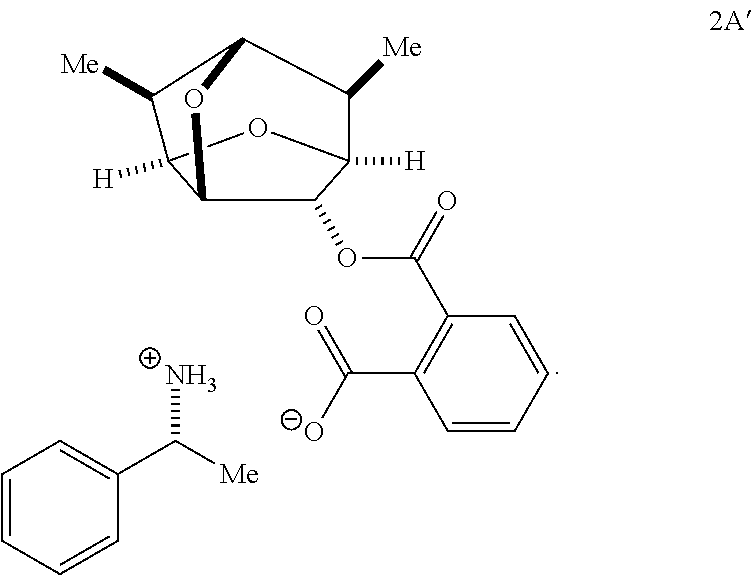
The free phthalate may be reacted with a second chiral amine to reform the second diastereomeric salt in a solution. In some embodiments, the second chiral amine is (R)-α-methylbenzylamine. The second diastereomeric salt may be precipitated from the solution to form an isolated second diastereomeric salt. In some embodiments, the isolated second diastereomeric salt may be a compound of Formula 2A′. A second enantiomeric compound of Formula 1 may be from the isolated second diastereomeric salt.


with an oxidizing agent to form the compound of Formula I. Exemplary oxidizing agents include, but are not limited to, peracetic acid, perbenzoic acid, m-chloroperbenzoic acid, perphthalic acid, performic acid, trifluoroperacetic acid, sulfur trioxide pyridine complex, hydrogen peroxide, pyridinium dichromate (PDC), and/or pyridinium chlorochromate (PCC). In some embodiments, the oxidizing agent may be m-chloroperbenzoic acid. In some embodiments, the oxidizing agent may be a sulfur trioxide pyridine complex.


with an oxidizing agent, optionally in the presence of a catalyst, to form a compound of Formula Ia:


with an oxidizing agent, optionally in the presence of a catalyst, to form a compound of Formula Ib:


-
- wherein:
- Ph is phenyl; and
- R3 is each independently a hydrogen or an oxygen protecting group;
- or a salt thereof.


| Abbreviation | Definition | ||
| TMS | Trimethylsilyl | ||
| TBAF | Tetrabutylammonium fluoride | ||
| NaOH | Sodium hydroxide | ||
| Bu4N HSO4 | Tetrabutylammonium hydrogen sulfate | ||
| THF | Tetrahydrofuran | ||
| rt | Room temperature | ||
| h | Hour(s) | ||
| NaCl | Sodium chloride | ||
| HCOOH | Formic acid | ||
| V | Volumes | ||
| wt | Weights | ||
| CDI | 1,1′-Carbonyldiimidazole | ||
| DCM | Dichloromethane | ||
| Aq | Aqueous | ||
| Sat. | Saturated | ||
| HCl | Hydrochloric acid | ||
| HRMS | High Resolution Mass Spectrometry | ||
| nBuLi | n-butyl lithium | ||
| NH4Cl | Ammonium chloride | ||
| MeOH | Methanol | ||
| EtOAc | Ethyl acetate | ||
| NaHCO3 | Sodium bicarbonate | ||
| M | Molar (moles/liter) | ||
| T | Temperature | ||
| MTBE | Methyl tert-butyl ether | ||
| TLC | Thin layer chromatography | ||
| N | Normal (equivalents per liter) | ||
| iPrMgBr | Isopropyl magnesium bromide | ||
| LiCl | Lithium chloride | ||
| NaOAc | Sodium acetate | ||
| NH4OH | Ammonium hydroxide | ||
| HPLC | High performance liquid chromatography | ||
| ee | Enantiomeric excess | ||
| DMI | 1,3-Dimethyl-2-imidazolidinone | ||
| UV | Ultraviolet | ||
| RRT | Relative retention time | ||
| OROT | Optical rotation | ||
| Bz | Benzoyl | ||
| T3P ® (Archimica) | n-propyl phosphonic acid anhydride | ||
| Ph | Phenyl | ||
| TES | Triethylsilyl | ||


Claims (19)


Priority Applications (1)
| Application Number | Priority Date | Filing Date | Title |
|---|---|---|---|
| US16/521,691 US10793581B2 (en) | 2014-08-04 | 2019-07-25 | Stereochemically defined polypropionates and methods for making and using the same |
Applications Claiming Priority (5)
| Application Number | Priority Date | Filing Date | Title |
|---|---|---|---|
| US201462032757P | 2014-08-04 | 2014-08-04 | |
| PCT/US2015/043535 WO2016022519A1 (en) | 2014-08-04 | 2015-08-04 | Stereochemically defined polypropionates and methods for making and using the same |
| US201715501658A | 2017-02-03 | 2017-02-03 | |
| US15/906,401 US10407439B2 (en) | 2014-08-04 | 2018-02-27 | Stereochemically defined polypropionates and methods for making and using the same |
| US16/521,691 US10793581B2 (en) | 2014-08-04 | 2019-07-25 | Stereochemically defined polypropionates and methods for making and using the same |
Related Parent Applications (1)
| Application Number | Title | Priority Date | Filing Date |
|---|---|---|---|
| US15/906,401 Division US10407439B2 (en) | 2014-08-04 | 2018-02-27 | Stereochemically defined polypropionates and methods for making and using the same |
Publications (2)
| Publication Number | Publication Date |
|---|---|
| US20200055866A1 US20200055866A1 (en) | 2020-02-20 |
| US10793581B2 true US10793581B2 (en) | 2020-10-06 |
Family
ID=55264408
Family Applications (3)
| Application Number | Title | Priority Date | Filing Date |
|---|---|---|---|
| US15/501,658 Active US10160768B2 (en) | 2014-08-04 | 2015-08-04 | Stereochemically defined polypropionates and methods for making and using the same |
| US15/906,401 Active US10407439B2 (en) | 2014-08-04 | 2018-02-27 | Stereochemically defined polypropionates and methods for making and using the same |
| US16/521,691 Active US10793581B2 (en) | 2014-08-04 | 2019-07-25 | Stereochemically defined polypropionates and methods for making and using the same |
Family Applications Before (2)
| Application Number | Title | Priority Date | Filing Date |
|---|---|---|---|
| US15/501,658 Active US10160768B2 (en) | 2014-08-04 | 2015-08-04 | Stereochemically defined polypropionates and methods for making and using the same |
| US15/906,401 Active US10407439B2 (en) | 2014-08-04 | 2018-02-27 | Stereochemically defined polypropionates and methods for making and using the same |
Country Status (2)
| Country | Link |
|---|---|
| US (3) | US10160768B2 (en) |
| WO (1) | WO2016022519A1 (en) |
Families Citing this family (1)
| Publication number | Priority date | Publication date | Assignee | Title |
|---|---|---|---|---|
| WO2016022519A1 (en) | 2014-08-04 | 2016-02-11 | Eisai R&D Management Co., Ltd. | Stereochemically defined polypropionates and methods for making and using the same |
Citations (4)
| Publication number | Priority date | Publication date | Assignee | Title |
|---|---|---|---|---|
| US20020052028A1 (en) | 2000-08-09 | 2002-05-02 | Daniel Santi | Bio-intermediates for use in the chemical synthesis of polyketides |
| US7189715B2 (en) | 2002-10-24 | 2007-03-13 | Sepracor Inc. | Compositions comprising zopiclone derivatives and methods of making and using the same |
| US7700783B2 (en) | 2003-10-09 | 2010-04-20 | The Trustees Of The University Of Pennsylvania | Synthesis of discodermolide and variants thereof |
| US20170240560A1 (en) | 2014-08-04 | 2017-08-24 | Eisai R&D Management Co., Ltd. | Stereochemically defined polypropionates and methods for making and using the same |
-
2015
- 2015-08-04 WO PCT/US2015/043535 patent/WO2016022519A1/en not_active Ceased
- 2015-08-04 US US15/501,658 patent/US10160768B2/en active Active
-
2018
- 2018-02-27 US US15/906,401 patent/US10407439B2/en active Active
-
2019
- 2019-07-25 US US16/521,691 patent/US10793581B2/en active Active
Patent Citations (4)
| Publication number | Priority date | Publication date | Assignee | Title |
|---|---|---|---|---|
| US20020052028A1 (en) | 2000-08-09 | 2002-05-02 | Daniel Santi | Bio-intermediates for use in the chemical synthesis of polyketides |
| US7189715B2 (en) | 2002-10-24 | 2007-03-13 | Sepracor Inc. | Compositions comprising zopiclone derivatives and methods of making and using the same |
| US7700783B2 (en) | 2003-10-09 | 2010-04-20 | The Trustees Of The University Of Pennsylvania | Synthesis of discodermolide and variants thereof |
| US20170240560A1 (en) | 2014-08-04 | 2017-08-24 | Eisai R&D Management Co., Ltd. | Stereochemically defined polypropionates and methods for making and using the same |
Non-Patent Citations (13)
| Title |
|---|
| Bowers, et al., "Thromboxane A, Analogues from 8-Oxabicyclo[3.2.1]oct-6-en-3-ones", J. Chem. Soc. Perkin Trans., vol. 1, 1987, pp. 1657-1666. |
| CAS, CAS Registry No. 1401932-23-7, Oct. 24, 2012 , 3 pages. |
| International Search Report (PCT/ISA/210) dated Nov. 2, 2015, by the U.S. Patent Office as the International Searching Authority for International Application No. PCT/US2015/043535. |
| Kigoshi, et al., "Synthetic Studies on Aplyronine A, a Potent Antitumor Substance of Marine Origin: Stereocontrolled Synthesis of the C21-C34 Segment", Tetrahedron Letters, vol. 35, issue 8, 1994, pp. 1247-1250. |
| Kvasnicaa, et al., "Synthesis of phthalates of betulinic acid and betulin with cytotoxic activity", Bioorganic & Medicinal Chemistry, vol. 13, No. 10, 2005, pp. 3447-3454. |
| Lautens, "Silacupration of oxabicyclic compounds. An interrupted ring opening reaction", J. Org. Chem., vol. 57, No. 2, 1992, pp. 422-424. |
| Montana, et al., "Synthesis of 2,6-dioxatricyclo[3.3.1.0 3.7]nonanes by intramolecular haloetherification and/or transannular hydroxycyclization of alkenes in [4+3]-cycloadducts", Tetrahedron, vol. 65, issue 27, 2009, pp. 5308-5321. |
| Plet, et al., "Synthesis of the bicyclic core of tagetitoxin", Chem. Commun., 2006, pp. 1197-1199. |
| PUBCHEM. SID 78854871, formula , Jun. 12, 2009, p. 3. |
| Rieser, et al., "Determination of Absolute Configuration of Stereogenic Carbinol Centers in Annonaceous Acetodenins by 1H- and 19 F-NMR Analysis of Mosher Ester Derivatives", J. Am. Chem. Soc., vol. 114, No. 26, 1992, pp. 10203-10213. |
| Vairaprakash, et al., "Efficient resolution of (±)-trans-2,3-diphenylpiperazine using (1S)-(+) 10-camphorsulfonic acid and enrichment of enantiomeric purity of non racemic 2,3-diphenylpiperazine using different achiral acids", Journal of Chemical Sciences, vol. 120 , 2008, pp. 175-179. |
| Vasilevich , et al., "Lessons from Natural Products Chemistry Can Offer Novel Approaches for Synthetic Chemistry in Drug Discovery", J. Med. Chem., vol. 55, 2012, pp. 7003-7009. |
| Written Opinion (PCT/ISA/237) dated Nov. 2, 2015, by the U.S. Patent Office as the International Searching Authority for International Application No. PCT/US2015/043535. |
Also Published As
| Publication number | Publication date |
|---|---|
| WO2016022519A1 (en) | 2016-02-11 |
| US20200055866A1 (en) | 2020-02-20 |
| US10407439B2 (en) | 2019-09-10 |
| US10160768B2 (en) | 2018-12-25 |
| US20180186810A1 (en) | 2018-07-05 |
| US20170240560A1 (en) | 2017-08-24 |
Similar Documents
| Publication | Publication Date | Title |
|---|---|---|
| US10494388B2 (en) | Compounds useful in the synthesis of halichondrin B analogs | |
| TWI383983B (en) | Novel intermediate and process for preparing entecavir using same | |
| CA2859296C (en) | Method for manufacturing neuraminic acid derivatives | |
| US10793581B2 (en) | Stereochemically defined polypropionates and methods for making and using the same | |
| AU2019338793B2 (en) | Novel heteroaromatic amide derivative and medicament containing the same | |
| JP6212429B2 (en) | Process for producing 1,3,4,5-tetracaffeoylquinic acid and intermediate compounds | |
| US7635782B1 (en) | Stereospecific method for the preparation of dioxa-bicyclooctane compounds | |
| US8785669B2 (en) | Taxane compounds, compositions and methods | |
| US8507696B2 (en) | Intermediates in the synthesis zearalenone macrolide analogs | |
| US10450251B2 (en) | Process for the preparation of 3-substituted cannabinoid compounds | |
| US9227948B2 (en) | Process for the preparation of 2-substituted-2-(6-(substituted)-7-methylbenzo[D][1,3]dioxol-4-yl)acetic acid derivatives | |
| van Maarseveen et al. | Transformations of the tetracyclic skeleton of eudistomins by neighboring‐group participation in the Mitsunobu reaction | |
| ES2331296B1 (en) | DERIVATIVES OF 1-AZAESPIRO (3.5) NONAN-2-ONA-5,7-CARBOLACTONE AND 5.7-PROTECTED-1-AZAESPIRO (3.5) NONAN-2-ONA AND ITS USE AS INTERMEDIATE PRODUCTS IN TTX SYNTHESIS. | |
| HK40127529A (en) | Processes and intermediates for preparing mcl1 inhibitors | |
| KR100618232B1 (en) | Method for producing famciclovir | |
| Zhao | I. Total synthesis of (±) ovalicin and its analogues. II. Bio-based polymers from vegetable oil. III. New synthetic methods of diacetylene fatty acids | |
| JPH07330656A (en) | Intermediate for synthesis of taxol and production thereof | |
| WO2010055138A1 (en) | New stereospecific method for the preparation of dioxa-bicyclooctane compounds |
Legal Events
| Date | Code | Title | Description |
|---|---|---|---|
| AS | Assignment |
Owner name: EISAI R&D MANAGEMENT CO., LTD., JAPAN Free format text: ASSIGNMENT OF ASSIGNORS INTEREST;ASSIGNORS:FANG, FRANCIS G.;CHOI, HYEONG-WOOK;CAMPAGNA, SILVIO;AND OTHERS;SIGNING DATES FROM 20140828 TO 20140926;REEL/FRAME:049858/0152 |
|
| FEPP | Fee payment procedure |
Free format text: ENTITY STATUS SET TO UNDISCOUNTED (ORIGINAL EVENT CODE: BIG.); ENTITY STATUS OF PATENT OWNER: LARGE ENTITY |
|
| STPP | Information on status: patent application and granting procedure in general |
Free format text: NON FINAL ACTION MAILED |
|
| STPP | Information on status: patent application and granting procedure in general |
Free format text: RESPONSE TO NON-FINAL OFFICE ACTION ENTERED AND FORWARDED TO EXAMINER |
|
| STPP | Information on status: patent application and granting procedure in general |
Free format text: NOTICE OF ALLOWANCE MAILED -- APPLICATION RECEIVED IN OFFICE OF PUBLICATIONS |
|
| STPP | Information on status: patent application and granting procedure in general |
Free format text: PUBLICATIONS -- ISSUE FEE PAYMENT VERIFIED |
|
| STCF | Information on status: patent grant |
Free format text: PATENTED CASE |
|
| MAFP | Maintenance fee payment |
Free format text: PAYMENT OF MAINTENANCE FEE, 4TH YEAR, LARGE ENTITY (ORIGINAL EVENT CODE: M1551); ENTITY STATUS OF PATENT OWNER: LARGE ENTITY Year of fee payment: 4 |