US10788441B2 - Measuring method of sensor using interdigitated array electrode, measuring apparatus and computer readable medium storing measuring program - Google Patents
Measuring method of sensor using interdigitated array electrode, measuring apparatus and computer readable medium storing measuring program Download PDFInfo
- Publication number
- US10788441B2 US10788441B2 US15/232,338 US201615232338A US10788441B2 US 10788441 B2 US10788441 B2 US 10788441B2 US 201615232338 A US201615232338 A US 201615232338A US 10788441 B2 US10788441 B2 US 10788441B2
- Authority
- US
- United States
- Prior art keywords
- electrode
- current value
- value
- measuring
- sample
- Prior art date
- Legal status (The legal status is an assumption and is not a legal conclusion. Google has not performed a legal analysis and makes no representation as to the accuracy of the status listed.)
- Active, expires
Links
- 238000000034 method Methods 0.000 title claims abstract description 35
- 239000004615 ingredient Substances 0.000 claims abstract description 63
- 238000012937 correction Methods 0.000 claims abstract description 36
- 239000003153 chemical reaction reagent Substances 0.000 claims abstract description 11
- 244000126211 Hericium coralloides Species 0.000 claims description 36
- 230000001052 transient effect Effects 0.000 claims description 9
- 210000004369 blood Anatomy 0.000 claims description 6
- 239000008280 blood Substances 0.000 claims description 6
- 238000005534 hematocrit Methods 0.000 claims description 4
- 238000005259 measurement Methods 0.000 description 40
- WQZGKKKJIJFFOK-GASJEMHNSA-N Glucose Natural products OC[C@H]1OC(O)[C@H](O)[C@@H](O)[C@@H]1O WQZGKKKJIJFFOK-GASJEMHNSA-N 0.000 description 20
- 239000008103 glucose Substances 0.000 description 20
- 238000003860 storage Methods 0.000 description 10
- 230000008859 change Effects 0.000 description 9
- 125000006850 spacer group Chemical group 0.000 description 8
- 108090000790 Enzymes Proteins 0.000 description 7
- 102000004190 Enzymes Human genes 0.000 description 7
- 238000004891 communication Methods 0.000 description 7
- 229940088598 enzyme Drugs 0.000 description 7
- 239000002253 acid Substances 0.000 description 6
- 238000011088 calibration curve Methods 0.000 description 6
- -1 polyethylene terephthalate Polymers 0.000 description 6
- 230000004044 response Effects 0.000 description 6
- 239000000758 substrate Substances 0.000 description 6
- 230000006870 function Effects 0.000 description 5
- 230000033116 oxidation-reduction process Effects 0.000 description 5
- 230000007423 decrease Effects 0.000 description 4
- 239000010931 gold Substances 0.000 description 4
- JVTAAEKCZFNVCJ-UHFFFAOYSA-M Lactate Chemical compound CC(O)C([O-])=O JVTAAEKCZFNVCJ-UHFFFAOYSA-M 0.000 description 3
- KDLHZDBZIXYQEI-UHFFFAOYSA-N Palladium Chemical compound [Pd] KDLHZDBZIXYQEI-UHFFFAOYSA-N 0.000 description 3
- LEHOTFFKMJEONL-UHFFFAOYSA-N Uric Acid Chemical compound N1C(=O)NC(=O)C2=C1NC(=O)N2 LEHOTFFKMJEONL-UHFFFAOYSA-N 0.000 description 3
- 150000002576 ketones Chemical class 0.000 description 3
- BASFCYQUMIYNBI-UHFFFAOYSA-N platinum Chemical compound [Pt] BASFCYQUMIYNBI-UHFFFAOYSA-N 0.000 description 3
- 230000008569 process Effects 0.000 description 3
- 239000000126 substance Substances 0.000 description 3
- AZQWKYJCGOJGHM-UHFFFAOYSA-N 1,4-benzoquinone Chemical compound O=C1C=CC(=O)C=C1 AZQWKYJCGOJGHM-UHFFFAOYSA-N 0.000 description 2
- ZSZRUEAFVQITHH-UHFFFAOYSA-N 2-(2-methylprop-2-enoyloxy)ethyl 2-(trimethylazaniumyl)ethyl phosphate Chemical compound CC(=C)C(=O)OCCOP([O-])(=O)OCC[N+](C)(C)C ZSZRUEAFVQITHH-UHFFFAOYSA-N 0.000 description 2
- 108010050375 Glucose 1-Dehydrogenase Proteins 0.000 description 2
- 108010015776 Glucose oxidase Proteins 0.000 description 2
- 239000004366 Glucose oxidase Substances 0.000 description 2
- 108010073450 Lactate 2-monooxygenase Proteins 0.000 description 2
- XJLXINKUBYWONI-NNYOXOHSSA-O NADP(+) Chemical compound NC(=O)C1=CC=C[N+]([C@H]2[C@@H]([C@H](O)[C@@H](COP(O)(=O)OP(O)(=O)OC[C@@H]3[C@H]([C@@H](OP(O)(O)=O)[C@@H](O3)N3C4=NC=NC(N)=C4N=C3)O)O2)O)=C1 XJLXINKUBYWONI-NNYOXOHSSA-O 0.000 description 2
- 239000004697 Polyetherimide Substances 0.000 description 2
- 239000004698 Polyethylene Substances 0.000 description 2
- 108010092464 Urate Oxidase Proteins 0.000 description 2
- 238000010586 diagram Methods 0.000 description 2
- 238000005516 engineering process Methods 0.000 description 2
- 210000003743 erythrocyte Anatomy 0.000 description 2
- 230000001747 exhibiting effect Effects 0.000 description 2
- 229940116332 glucose oxidase Drugs 0.000 description 2
- 235000019420 glucose oxidase Nutrition 0.000 description 2
- PCHJSUWPFVWCPO-UHFFFAOYSA-N gold Chemical compound [Au] PCHJSUWPFVWCPO-UHFFFAOYSA-N 0.000 description 2
- 229910052737 gold Inorganic materials 0.000 description 2
- 238000003780 insertion Methods 0.000 description 2
- 230000037431 insertion Effects 0.000 description 2
- 238000004519 manufacturing process Methods 0.000 description 2
- 239000000463 material Substances 0.000 description 2
- 229910052751 metal Inorganic materials 0.000 description 2
- 239000002184 metal Substances 0.000 description 2
- 230000036961 partial effect Effects 0.000 description 2
- 229920001601 polyetherimide Polymers 0.000 description 2
- 229920000573 polyethylene Polymers 0.000 description 2
- 229920000139 polyethylene terephthalate Polymers 0.000 description 2
- 239000005020 polyethylene terephthalate Substances 0.000 description 2
- 229920000642 polymer Polymers 0.000 description 2
- 229920005992 thermoplastic resin Polymers 0.000 description 2
- 230000001960 triggered effect Effects 0.000 description 2
- PZTGRDMCBZUJDL-UHFFFAOYSA-N 1,2-naphthoquinone-4-sulfonic acid Chemical compound C1=CC=C2C(S(=O)(=O)O)=CC(=O)C(=O)C2=C1 PZTGRDMCBZUJDL-UHFFFAOYSA-N 0.000 description 1
- RBTBFTRPCNLSDE-UHFFFAOYSA-N 3,7-bis(dimethylamino)phenothiazin-5-ium Chemical compound C1=CC(N(C)C)=CC2=[S+]C3=CC(N(C)C)=CC=C3N=C21 RBTBFTRPCNLSDE-UHFFFAOYSA-N 0.000 description 1
- RXGJTUSBYWCRBK-UHFFFAOYSA-M 5-methylphenazinium methyl sulfate Chemical compound COS([O-])(=O)=O.C1=CC=C2[N+](C)=C(C=CC=C3)C3=NC2=C1 RXGJTUSBYWCRBK-UHFFFAOYSA-M 0.000 description 1
- BAWFJGJZGIEFAR-NNYOXOHSSA-N NAD zwitterion Chemical compound NC(=O)C1=CC=C[N+]([C@H]2[C@@H]([C@H](O)[C@@H](COP([O-])(=O)OP(O)(=O)OC[C@@H]3[C@H]([C@@H](O)[C@@H](O3)N3C4=NC=NC(N)=C4N=C3)O)O2)O)=C1 BAWFJGJZGIEFAR-NNYOXOHSSA-N 0.000 description 1
- BAWFJGJZGIEFAR-NNYOXOHSSA-O NAD(+) Chemical compound NC(=O)C1=CC=C[N+]([C@H]2[C@@H]([C@H](O)[C@@H](COP(O)(=O)OP(O)(=O)OC[C@@H]3[C@H]([C@@H](O)[C@@H](O3)N3C4=NC=NC(N)=C4N=C3)O)O2)O)=C1 BAWFJGJZGIEFAR-NNYOXOHSSA-O 0.000 description 1
- OAICVXFJPJFONN-UHFFFAOYSA-N Phosphorus Chemical compound [P] OAICVXFJPJFONN-UHFFFAOYSA-N 0.000 description 1
- ZLMJMSJWJFRBEC-UHFFFAOYSA-N Potassium Chemical compound [K] ZLMJMSJWJFRBEC-UHFFFAOYSA-N 0.000 description 1
- 239000012327 Ruthenium complex Substances 0.000 description 1
- 239000006087 Silane Coupling Agent Substances 0.000 description 1
- BQCADISMDOOEFD-UHFFFAOYSA-N Silver Chemical compound [Ag] BQCADISMDOOEFD-UHFFFAOYSA-N 0.000 description 1
- 229930006000 Sucrose Natural products 0.000 description 1
- CZMRCDWAGMRECN-UGDNZRGBSA-N Sucrose Chemical compound O[C@H]1[C@H](O)[C@@H](CO)O[C@@]1(CO)O[C@@H]1[C@H](O)[C@@H](O)[C@H](O)[C@@H](CO)O1 CZMRCDWAGMRECN-UGDNZRGBSA-N 0.000 description 1
- 230000009471 action Effects 0.000 description 1
- 230000003213 activating effect Effects 0.000 description 1
- 230000001154 acute effect Effects 0.000 description 1
- 230000008901 benefit Effects 0.000 description 1
- WQZGKKKJIJFFOK-VFUOTHLCSA-N beta-D-glucose Chemical compound OC[C@H]1O[C@@H](O)[C@H](O)[C@@H](O)[C@@H]1O WQZGKKKJIJFFOK-VFUOTHLCSA-N 0.000 description 1
- 210000000601 blood cell Anatomy 0.000 description 1
- 239000000919 ceramic Substances 0.000 description 1
- 238000000970 chrono-amperometry Methods 0.000 description 1
- 239000004020 conductor Substances 0.000 description 1
- 230000003247 decreasing effect Effects 0.000 description 1
- 238000002848 electrochemical method Methods 0.000 description 1
- 238000005401 electroluminescence Methods 0.000 description 1
- 230000002708 enhancing effect Effects 0.000 description 1
- 239000003822 epoxy resin Substances 0.000 description 1
- 239000000284 extract Substances 0.000 description 1
- KTWOOEGAPBSYNW-UHFFFAOYSA-N ferrocene Chemical compound [Fe+2].C=1C=C[CH-]C=1.C=1C=C[CH-]C=1 KTWOOEGAPBSYNW-UHFFFAOYSA-N 0.000 description 1
- 230000014509 gene expression Effects 0.000 description 1
- 239000011521 glass Substances 0.000 description 1
- 230000003100 immobilizing effect Effects 0.000 description 1
- RSAZYXZUJROYKR-UHFFFAOYSA-N indophenol Chemical compound C1=CC(O)=CC=C1N=C1C=CC(=O)C=C1 RSAZYXZUJROYKR-UHFFFAOYSA-N 0.000 description 1
- 239000011810 insulating material Substances 0.000 description 1
- 239000004973 liquid crystal related substance Substances 0.000 description 1
- 229920002521 macromolecule Polymers 0.000 description 1
- 239000012528 membrane Substances 0.000 description 1
- 150000002739 metals Chemical class 0.000 description 1
- 229960000907 methylthioninium chloride Drugs 0.000 description 1
- 229950006238 nadide Drugs 0.000 description 1
- 229930027945 nicotinamide-adenine dinucleotide Natural products 0.000 description 1
- 230000003287 optical effect Effects 0.000 description 1
- 229910052762 osmium Inorganic materials 0.000 description 1
- SYQBFIAQOQZEGI-UHFFFAOYSA-N osmium atom Chemical compound [Os] SYQBFIAQOQZEGI-UHFFFAOYSA-N 0.000 description 1
- 229910052763 palladium Inorganic materials 0.000 description 1
- 239000000123 paper Substances 0.000 description 1
- 239000008363 phosphate buffer Substances 0.000 description 1
- 150000003904 phospholipids Chemical class 0.000 description 1
- 239000011574 phosphorus Substances 0.000 description 1
- 229910052698 phosphorus Inorganic materials 0.000 description 1
- 229910052697 platinum Inorganic materials 0.000 description 1
- 229920002401 polyacrylamide Polymers 0.000 description 1
- 229920000647 polyepoxide Polymers 0.000 description 1
- 229920001721 polyimide Polymers 0.000 description 1
- 239000009719 polyimide resin Substances 0.000 description 1
- 229910052700 potassium Inorganic materials 0.000 description 1
- 239000011591 potassium Substances 0.000 description 1
- 238000002360 preparation method Methods 0.000 description 1
- 238000012545 processing Methods 0.000 description 1
- 239000003223 protective agent Substances 0.000 description 1
- 108090000623 proteins and genes Proteins 0.000 description 1
- 102000004169 proteins and genes Human genes 0.000 description 1
- MMXZSJMASHPLLR-UHFFFAOYSA-N pyrroloquinoline quinone Chemical compound C12=C(C(O)=O)C=C(C(O)=O)N=C2C(=O)C(=O)C2=C1NC(C(=O)O)=C2 MMXZSJMASHPLLR-UHFFFAOYSA-N 0.000 description 1
- 230000002829 reductive effect Effects 0.000 description 1
- 230000003252 repetitive effect Effects 0.000 description 1
- 229920005989 resin Polymers 0.000 description 1
- 239000011347 resin Substances 0.000 description 1
- 230000027756 respiratory electron transport chain Effects 0.000 description 1
- 229910052709 silver Inorganic materials 0.000 description 1
- 239000004332 silver Substances 0.000 description 1
- 229910021647 smectite Inorganic materials 0.000 description 1
- 239000005720 sucrose Substances 0.000 description 1
- 229940005267 urate oxidase Drugs 0.000 description 1
Images



Classifications
-
- G—PHYSICS
- G01—MEASURING; TESTING
- G01N—INVESTIGATING OR ANALYSING MATERIALS BY DETERMINING THEIR CHEMICAL OR PHYSICAL PROPERTIES
- G01N27/00—Investigating or analysing materials by the use of electric, electrochemical, or magnetic means
- G01N27/26—Investigating or analysing materials by the use of electric, electrochemical, or magnetic means by investigating electrochemical variables; by using electrolysis or electrophoresis
- G01N27/28—Electrolytic cell components
- G01N27/30—Electrodes, e.g. test electrodes; Half-cells
- G01N27/327—Biochemical electrodes, e.g. electrical or mechanical details for in vitro measurements
- G01N27/3271—Amperometric enzyme electrodes for analytes in body fluids, e.g. glucose in blood
- G01N27/3272—Test elements therefor, i.e. disposable laminated substrates with electrodes, reagent and channels
-
- G—PHYSICS
- G01—MEASURING; TESTING
- G01N—INVESTIGATING OR ANALYSING MATERIALS BY DETERMINING THEIR CHEMICAL OR PHYSICAL PROPERTIES
- G01N27/00—Investigating or analysing materials by the use of electric, electrochemical, or magnetic means
- G01N27/26—Investigating or analysing materials by the use of electric, electrochemical, or magnetic means by investigating electrochemical variables; by using electrolysis or electrophoresis
- G01N27/28—Electrolytic cell components
- G01N27/30—Electrodes, e.g. test electrodes; Half-cells
- G01N27/327—Biochemical electrodes, e.g. electrical or mechanical details for in vitro measurements
- G01N27/3271—Amperometric enzyme electrodes for analytes in body fluids, e.g. glucose in blood
- G01N27/3274—Corrective measures, e.g. error detection, compensation for temperature or hematocrit, calibration
-
- C—CHEMISTRY; METALLURGY
- C12—BIOCHEMISTRY; BEER; SPIRITS; WINE; VINEGAR; MICROBIOLOGY; ENZYMOLOGY; MUTATION OR GENETIC ENGINEERING
- C12Q—MEASURING OR TESTING PROCESSES INVOLVING ENZYMES, NUCLEIC ACIDS OR MICROORGANISMS; COMPOSITIONS OR TEST PAPERS THEREFOR; PROCESSES OF PREPARING SUCH COMPOSITIONS; CONDITION-RESPONSIVE CONTROL IN MICROBIOLOGICAL OR ENZYMOLOGICAL PROCESSES
- C12Q1/00—Measuring or testing processes involving enzymes, nucleic acids or microorganisms; Compositions therefor; Processes of preparing such compositions
- C12Q1/001—Enzyme electrodes
- C12Q1/005—Enzyme electrodes involving specific analytes or enzymes
- C12Q1/006—Enzyme electrodes involving specific analytes or enzymes for glucose
-
- G—PHYSICS
- G01—MEASURING; TESTING
- G01N—INVESTIGATING OR ANALYSING MATERIALS BY DETERMINING THEIR CHEMICAL OR PHYSICAL PROPERTIES
- G01N33/00—Investigating or analysing materials by specific methods not covered by groups G01N1/00 - G01N31/00
- G01N33/48—Biological material, e.g. blood, urine; Haemocytometers
- G01N33/483—Physical analysis of biological material
- G01N33/487—Physical analysis of biological material of liquid biological material
- G01N33/49—Blood
Definitions
- the embodiment pertains to a measuring method of a sensor using an interdigitated array electrode, a measuring apparatus and a measuring program.
- a concentration of a target ingredient in a sample is measured by using a biosensor.
- a measurement value of a target ingredient in a blood is influenced by a hematocrit value (Hct value) as the case may be. It is therefore fundamental to eliminate the influence of the Hct value in order to obtain a correct measurement value.
- the Hct value is a numerical value indicating a volume percentage of blood cells occupying a blood volume.
- Patent document 1 discloses, byway of specific Example, a method of manufacturing an interdigitated array electrode having a total planar dimension of electrodes, an inter-electrode distance and widths of the electrodes or the number of electrodes in a biosensor including the electrodes. Additionally, it is also disclosed that the Hct influence was lessened when measuring a glucose concentration in horse preserved blood by using the biosensor manufactured by this manufacturing method.
- a system e.g., Patent document 2 exists, which corrects a measurement value of glucose and other equivalent ingredients by providing an Hct electrode pair to measure the Hct value in addition to an electrode pair for measuring the glucose in order to reduce influence of the Hct value.
- a measuring method e.g., Patent document 3 of correcting the influence of the Hct value on the measurement of the objective ingredient by acquiring a plurality of signals derived from an objective ingredient in the sample containing red blood cells by use of the biosensor and referring to a relation between a quantity of the objective ingredient and the plurality of signals corresponding thereto.
- one aspect of the embodiment pertains to a measuring method of measuring a concentration of a target ingredient in a sample by using a sensor including an interdigitated array electrode that includes a first electrode having a first comb tooth and a second electrode having a second comb tooth, and a reagent layer on the interdigitated array electrode, in which the first comb tooth and the second comb tooth are alternately arrayed, the measuring method including:
- the third current value is the first current value or the second current value.
- the first current value is measured in advance of the second current value. Further, in the measuring method according to one aspect of the embodiment, the measuring the first current value is executed after a transient current flows between the first electrode and the second electrode.
- the first current value is smaller than the second current value.
- the correction value is a ratio of the second current value to the first current value.
- the sample is a blood sample and is subjected to a hematocrit correction based on the correction value.
- One of the embodiment pertains to a measuring apparatus to measure a concentration of a target ingredient in a sample, the measuring apparatus including:
- a sensor including an interdigitated array electrode that includes a first electrode having a first comb tooth and a second electrode having a second comb tooth, and a reagent layer on the interdigitated array electrode, in which the first comb tooth and the second comb tooth are alternately arrayed;
- a measuring unit to apply a voltage to between the first electrode and the second electrode and to measure a first current value and a second current value of an electric current flowing between the first electrode and the second electrode;
- control unit configured to calculate the concentration of the target ingredient in the sample based on a third current value, to calculate a correction value based on the first current value and the second current value, and to correct the concentration of the target ingredient in the sample based on the correction value.
- one aspect of the embodiment may also be a program for making the computer, other devices, machines, etc realize any one of the functions described above. Still further, one aspect of the embodiment may also be a recording medium recorded with such a program, which can be read by the computer etc.
- FIG. 1 is an exploded perspective view illustrating one example of a biosensor according to an embodiment.
- FIG. 2 is a plan view of an interdigitated array electrode.
- FIG. 3 is a perspective view illustrating one example of a measuring apparatus according to the embodiment.
- FIG. 4 is a partial sectional view of the measuring apparatus according to the embodiment.
- FIG. 5 is a diagram of a functional configuration of the measuring apparatus according to the embodiment.
- FIG. 6 is a graph depicting a change with the passage of time in current value.
- FIG. 7 is a graph depicting the change with the passage of time in current value.
- FIG. 8 is a table indicating a ratio (current value after 15 sec/current value after 1.2 sec).
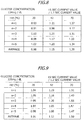
- FIG. 9 is a table indicating the ratio (current value after 15 sec/current value after 1.2 sec).
- FIG. 10 is a flowchart illustrating one example of a process of measuring a concentration of a target ingredient in a sample by a measuring apparatus.
- FIG. 1 is an exploded perspective view illustrating one example of a biosensor 1 according to the embodiment.
- the biosensor 1 includes a substrate 2 , a spacer 3 , a cover 4 and an interdigitated array electrode 5 .
- the substrate 2 , the spacer 3 and the cover 4 are composed of insulating materials instanced by a thermoplastic resin, a polyimide resin, an epoxy resin, glass, ceramics, paper and other equivalent materials.
- the thermoplastic resin includes polyether-imide (PEI), polyethylene terephthalate (PET), polyethylene (PE) and other equivalent resins.
- the interdigitated array electrode 5 is formed by using a metal conductive material instanced by gold (Au), silver (Ag), platinum (Pt), palladium (Pd) and other equivalent metals. Any known materials may be applied to the substrate 2 , the spacer 3 , the cover 4 and the interdigitated array electrode 5 . Sizes, i.e., dimensions and thicknesses of the substrate 2 , the spacer 3 , the cover 4 and the interdigitated array electrode 5 may be properly set.
- the interdigitated array electrode 5 is formed on an upper surface of the substrate 2 .
- An unillustrated reagent layer is formed on part of the interdigitated array electrode 5
- the spacer 3 is provided to cover part of the substrate 2 and the part of the interdigitated array electrode 5 .
- the cover 4 is provided on the spacer 3 .
- the spacer 3 is provided with a notch through which to expose the part of the interdigitated array electrode 5 and the reagent layer, and the cover 4 also covers an upper portion of the notch of the spacer 3 , thus forming a capillary 6 inside the biosensor 1 .
- a specimen is introduced into the capillary 6 by a capillary phenomenon, and a concentration of the specimen is thus measured.
- the reagent layer contains, e.g., oxidation-reduction enzyme and a mediator (electron transfer substance).
- the oxidation-reduction enzyme and the mediator are properly selected corresponding to a type of target ingredient (specified substance) of a sample (specimen) to be measured.
- the sample to be measured is an erythrocyte containing sample instanced by a blood sample and other equivalent samples.
- the target ingredient in the sample is exemplified by glucose, lactate acid, urate acid, a ketone body and other equivalent ingredients.
- the oxidation-reduction enzyme is exemplified by glucose oxidase (GOD), glucose dehydrogenase (GDH), lactate oxidase (LOD), urate oxidase (uricase) and other equivalent enzymes.
- a method of immobilizing the oxidation-reduction enzyme may involve adopting a variety of known methods, e.g., a method of utilizing an MPC (2-methacryloyloxyethyl phosphorylcholine) polymer produced by introducing a silane coupling agent into polymerized gel, macromolecules of polyacrylamide and phosphorus, and a phospholipid polymer, or utilizing a protein membrane.
- the mediator may be exemplified by potassium ferricyanide, p-benzoquinone, phenazine methosulfate, indophenol, derivatives thereof, ⁇ -naphthoquinone-4-sulfonic acid potassium, methylene blue, ferrocene, derivatives thereof, osmium complex, ruthenium complex, NAD+ (nicotinamide adenine dinucleotide +), NADP+ (nicotinamide adenine dinucleotide phosphate +) and pyrroloquinoline quinone (PQQ).
- potassium ferricyanide potassium ferricyanide
- p-benzoquinone phenazine methosulfate
- indophenol derivatives thereof
- ⁇ -naphthoquinone-4-sulfonic acid potassium methylene blue
- ferrocene derivatives thereof, osmium complex, ruthenium complex, NAD+ (nicot
- FIG. 2 is a plan view of the interdigitated array electrode 5 .
- the interdigitated array electrode 5 includes a working electrode 11 and a counter electrode 12 .
- the working electrode 11 is one example of a first electrode
- the counter electrode 12 is one example of a second electrode.
- Each of the working electrode 11 and the counter electrode 12 is formed in an interdigital shape.
- the working electrode 11 has a plurality of comb teeth 111
- the counter electrode 12 has a plurality of comb teeth 121 .
- the interdigitated array electrode 5 is configured so that the plurality of comb teeth 111 and the plurality of comb teeth 121 are arrayed to be alternately opposite to each other.
- the reagent layer is immobilized to the working electrode 11 .
- the working electrode 11 has an arbitrary number of comb teeth 111
- the counter electrode 12 also has an arbitrary number of comb teeth 121 . It may be sufficient that the working electrode 11 has at least two comb teeth 111 , and the counter electrode 12 has at least one comb tooth 121 ; or alternatively the working electrode 11 has at least one comb tooth 111 , and the counter electrode 12 has at least two comb teeth 121 .
- the working electrode 11 may have 10 through 50 comb teeth 111
- the counter electrode 12 may also have 10 through 50 comb teeth 121 .
- the comb tooth 111 of the working electrode 11 has a width (W 1 ) taking an arbitrary value.
- the width (W 1 ) of the comb tooth 111 of the working electrode 11 may be set to preferably 5 ⁇ m through 50 ⁇ m and more preferably to 5 ⁇ m through 30 ⁇ m.
- the comb tooth 111 of the working electrode 11 has a length (L 1 ) taking an arbitrary value.
- the length (L 1 ) of the comb tooth 111 of the working electrode 11 may be set to 0.1 mm through 2.0 mm.
- the comb tooth 121 of the counter electrode 12 has a width (W 2 ) taking an arbitrary value.
- the width (W 2 ) of the comb tooth 121 of the counter electrode 12 may be set to 10 ⁇ m through 30 ⁇ m.
- the comb tooth 121 of the counter electrode 12 has a length (L 2 ) taking an arbitrary value.
- the length (L 2 ) of the comb tooth 121 of the counter electrode 12 may be set to 0.1 mm through 2.0 mm.
- a distance (D) between the comb tooth 111 of the working electrode 11 and the comb tooth 121 of the counter electrode 12 takes an arbitrary value.
- the distance (D) between the comb tooth 111 of the working electrode 11 and the comb tooth 121 of the counter electrode 12 may be set to preferably 5 ⁇ m through 50 ⁇ m, and more preferably 5 ⁇ m through 30 ⁇ m.
- FIG. 3 is a perspective view illustrating one example of a measuring apparatus 21 according to the embodiment.
- FIG. 4 is a partial sectional view illustrating the measuring apparatus 21 according to the embodiment.
- the measuring apparatus 21 measures the sample by an electrochemical method using the biosensor 1 .
- the measuring apparatus 21 includes a housing 22 , a display panel 23 , operation buttons 24 , a sensor insertion port 25 , a fitting portion 26 and a connector 27 .
- the measuring apparatus 21 has, though an illustration is omitted, a circuit board mounted with electronic components instanced by a CPU (Central Processing Unit), a RAM (Random Access Memory) and a ROM (Read Only Memory), which are fundamental for the measuring apparatus 21 to perform predetermined operations (such as applying a voltage and performing communications with the outside).
- a CPU Central Processing Unit
- RAM Random Access Memory
- ROM Read Only Memory
- the housing 22 is provided with the display panel 23 and the plurality of operation buttons 24 .
- the display panel 23 displays a measurement result and an error, and also displays an operation procedure, an operation status and other equivalent operation items when setting.
- the display panel 23 is a display device instanced by a liquid crystal panel, a plasma display panel and an electroluminescence panel.
- the plurality of operation buttons 24 is used for a variety of settings (such as setting measurement conditions and inputting an examinee ID), and for operations such as starting and finishing the measurement.
- the plurality of operation buttons 24 may involve using a contact-type touch panel.
- the display panel 23 may be integrated with the operation buttons 24 .
- the biosensor 1 is inserted into the sensor insertion port 25 and is fitted to the fitting portion 26 , in which case the interdigitated array electrode 5 of the biosensor 1 is electrically connected to the connector 27 .
- the voltage is applied to the interdigitated array electrode 5 .
- the target ingredient in the sample is reduced by the oxidation-reduction enzyme.
- electrons are extracted from the target ingredient in the sample introduced into the capillary 6 .
- the extracted electrons are supplied to the working electrode 11 via the mediator.
- An electric charge quantity of the electrons supplied to the working electrode 11 is measured as a response current.
- FIG. 5 is a diagram of a functional configuration of the measuring apparatus 21 according to the embodiment.
- the measuring apparatus 21 includes a communication unit 31 , a power source unit 32 , a measuring unit 33 , a storage unit 34 and a control unit 35 .
- the communication unit 31 performs data communications with other external devices.
- the data communications may utilize, e.g., a wireless communication means (IrDA (Infrared Data Association) using infrared rays, or Bluetooth using a frequency band of 2.4 GHz). Wired data communications may also be performed by connecting the measuring apparatus 21 to other external devices via a cable instanced by USB (Universal Serial Bus).
- the power source unit 32 supplies electric power for activating the measuring apparatus 21 .
- the power source unit 32 may be a primary battery instanced by a button battery, and may also be a secondary repetitive chargeable/dischargeable battery.
- the measuring unit 33 For measuring the concentration of the target ingredient in the sample, the measuring unit 33 applies the voltage to between the working electrode 11 and counter electrode 12 of the interdigitated array electrode 5 provided in the biosensor 1 , thereby measuring a value of the current flowing between the working electrode 11 and the counter electrode 12 .
- the measuring unit 33 controls, e.g., a voltage application timing, a value of the applied voltage and other equivalent items.
- the measuring unit 33 measure the current at least twice during a period till a measurement result is displayed on the display panel 23 since completing preparations for measuring the concentration of the target ingredient in the sample ingredients.
- the current to be measured first time is referred to as a first current value
- the current to be measured second time is referred to as a second current value.
- a period of time till the first current value is measured since applying the voltage is termed first measurement time
- a period of time till the second current value is measured since applying the voltage is termed second measurement time.
- first measurement time A period of time till the first current value is measured since applying the voltage
- second measurement time a period of time till the second current value is measured since applying the voltage
- the storage unit 34 stores programs, various items of data and other equivalent software, which are fundamental to a variety of arithmetic operations.
- the storage unit 34 is previously stored with calibration curve data representing a corresponding relation between the current values and the concentrations of the target ingredients in the samples, in which the current values are acquired by using the known samples with the concentrations being known of the target ingredients in the samples.
- the calibration curve data are stored as, e.g., mathematical expressions and a corresponding table in the storage unit 34 .
- the control unit 35 refers to a calibration curve based on the measured current values, thus calculating (measuring) the concentration of the target ingredient in the sample.
- the current value used for calculating the concentration of the target ingredient in the sample may be the first current value, may also be the second current value, and may further be a current value (third current value) at a spot other than those of the first and second current values.
- the third current value may be measured before, e.g., the first measurement time, may also be measured between the first measurement time and the second measurement time, and may further be measured after the second measurement time.
- the control unit 35 may calculate the concentration of the target ingredient in the sample on the basis of the first current value or the second current value.
- the third current value is set as the first current value or the second current value, in which case this setting has an advantage of decreasing a current measurement count.
- the control unit 35 calculates a correction value (correction coefficient), based on the first current value and the second current value.
- the correction value is a ratio of the second current value to the first current value (second current value/first current value), and is also data for correcting the concentration of the target ingredient in the sample.
- the control unit 35 calculates the correction value by dividing the second current value by the first current value.
- the control unit 35 corrects, based on the correction value, the concentration of the target ingredient in the sample.
- FIGS. 6 and 7 are graphs each depicting a change with the passage of time in current value (time course) in the measurement by a chronoamperometry method of applying a voltage of +200 mV at a temperature of 25° C. ( ⁇ 1° C.).
- Prepared are the specimens having glucose concentrations of 134 mg/dL and 335 mg/dL, and three types of samples having Hct values that are 20%, 42% and 72% are created for the respective specimens.
- FIG. 6 illustrates the change with the passage of time in current value with respect to the glucose concentration of 134 mg/dL
- FIG. 7 illustrates the change with the passage of time in current value with respect to the glucose concentration of 335 mg/dL.
- the current measurements in FIGS. 6 and 7 are made by using an electrochemical analyzer of a 2-electrode system.
- the working electrode (WE) and the counter electrode (CE) involve using the gold (Au)-based interdigitated array electrode 5 .
- Width (W 1 ) of Comb Tooth 111 of Working Electrode 11 /Width (W 2 ) of Comb Tooth 121 of Counter Electrode 12 /Inter-Comb-Teeth Distance (D) (Distance between Comb Tooth 111 and Comb Tooth 121 ) 30 ⁇ m/30 ⁇ m/30 ⁇ m
- the number of the comb teeth 111 of the working electrode 11 is “13”, and the number of the comb teeth 121 of the counter electrode 12 is “13”.
- a planar dimension (as viewed on the plane) of the working electrode 11 is 0.546 mm 2
- a planar dimension (as viewed on the plane) of the counter electrode 12 is 0.546 mm 2 .
- a capacity of the capillary 6 of the biosensor 1 used for the current measurements in FIGS. 6 and 7 is 0.8 ⁇ L.
- the biosensor of which the reagent layer was formed by applying a reagent solution adjusted as below onto the interdigitated array electrode 5 , was used for the current measurements in FIGS. 6 and 7 .
- FIGS. 6 and 7 depict the current values when the Hct values are 20%, 42% and 70%.
- Application of the voltage to the interdigitated array electrode 5 was started after 1 sec subsequent to introducing the sample by connecting the biosensor 1 to the connector 27 .
- FIGS. 6 and 7 with the measurements being made after 15 sec subsequent to applying the voltage, transient responses exhibiting acute peaks occurred in the glucose concentrations immediately after the voltage application was started. In other words, transient currents flow immediately after the start of the voltage application.
- differences between the changes with the passage of time (time course) in current value are seen in terms of the Hct values.
- the current indicates a substantially fixed value.
- the Hct values are 42% and 70%, the current values decrease after the transient responses, then gently rise after exhibiting negative peaks, and thereafter remain stable as substantially fixed values.
- the change with the passage of time in current value indicates the same tendency with respect to the glucose concentration of 134 mg/dL and the glucose concentration of 335 mg/dL.
- a decline of current, which is caused after the transient response, is larger as the Hct value is higher.
- a tendency of the change with the passage of time in current value therefore depends on the Hct value irrespective of the glucose concentration.
- the correction coefficient is calculated by using the change with the passage of time in current value, thereby enabling the Hct value to be estimated and the glucose concentration to be corrected.
- the first current value was measured after 1.2 sec subsequent to a start of applying the voltage, and the second current value was measured after 15 sec subsequent to the start of applying the voltage.
- the first measurement time is 1.2 sec
- the second measurement time is 15 sec.
- the glucose concentration was calculated based on the second current value measured after 15 sec subsequent to applying the voltage by using the calibration curve, an Hct correction described below was thereafter made, and a final glucose concentration was measured.
- FIGS. 8 and 9 are tables each indicating the ratios of the second current value to the first current value. In FIGS. 8 and 9 , the current values are measured five times when the Hct values are 20%, 42% and 70%.
- the ratio of the second current value (measured after 15 sec) to the first current value (measured after 1.2 sec) will hereinafter be referred to as the ratio (current value after 15 sec/current value after 1.2 sec).
- the ratio (current value after 15 sec/current value after 1.2 sec) differs corresponding to a magnitude of the glucose concentration but rises as the Hct value increases.
- the first current value (measured after 1.2 sec) is, though some variations occur depending on the Hct value, totally smaller than the second current value (measured after 15 sec). Accordingly, the correction value is calculated based on the ratio between the current values at the two measuring points, and it is feasible to calculate the Hct value from the corresponding tables as depicted in FIGS.
- the Hct correction was conducted by using the correction value in the discussion given above, and the glucose concentration may, however, be corrected by use of an Hct concentration by calculating this Hct concentration from the ratio (current value after 15 sec/current value after 1.2 sec).
- the method of correcting the glucose concentration based on the Hct value may involve adopting a variety of methods, e.g., a method of using a correction table, the calibration curve data and other equivalent information.
- a method of using a correction table e.g., a method of using a correction table, the calibration curve data and other equivalent information.
- the discussion given above has described the case in which the target ingredient in the sample of the glucose, and the embodiment is not, however, limited to the glucose as the target ingredient in the sample.
- the target ingredients in the sample are the lactate acid, the urate acid, the ketone body and other equivalent ingredients
- the correction value is calculated based on the ratio between the current values at the two points of time, and it is possible to calculate the Hct value from the corresponding table on the basis of the calculated correction value.
- the method of correcting the concentrations of the lactate acid, the urate acid, the ketone body and other equivalent ingredients on the basis of the Hct value may involve adopting a variety of known methods, e.g., a method using a correction table, calibration curve data and other equivalent information.
- the application of the voltage was started after 1 sec subsequent to introducing the sample; the first current value was measured after 1.2 sec subsequent to applying the voltage; the second current value was measured after 15 sec subsequent to applying the voltage; and the measurement time may, however, be properly determined corresponding to a period of time expended till applying the voltage since after introducing the specimen, and the measurement conditions.
- any one of values i.e., 0.1 sec, 0.2 sec, 0.3 sec, 0.4 sec, 0.5 sec, 0.6 sec, 0.7 sec, 0.8 sec, 0.9 sec, 1.0 sec, 1.1 sec, 1.2 sec, 1.3 sec, 1.4 sec, 1.5 sec, 1.6 sec, 1.7 sec, 1.8 sec, 1.9 sec and 2.0 sec, may be set as the first measurement time.
- a value given by adding 0.1 sec to the first measurement time maybe set as the second measurement time.
- any one of values i.e., 1 sec, 2 sec, 3 sec, 4 sec, 5 sec, 10 sec, 15 sec, 20 sec, 30 sec, 40 sec, 50 sec, 1 min, 1 min 30 sec, 2 min, 2 min 30 sec, 3 min, 3 min 30 sec, 4 min, 4 min 30 sec and 5 min, may be set as the second measurement time.
- the first current value is desirable for the first current value to be measured after the transient response in order to enhance measurement accuracy, and it is more preferable to measure the current value at a spot indicating the smallest current value after the transient current.
- the second current value maybe measured anytime as far as after the measurement of the first current value; and it is, however, suitable to measure a stable current value as the second current value occurring after a gentle rise of the current value because of a large difference between the first current value and the second current value being preferable for enhancing the measurement accuracy.
- the start time for applying the voltage may not be after 1 sec subsequent to introducing the sample, and the application of the voltage may be started immediately after introducing the sample and may also be started at an interval of 1 sec or longer subsequent to introducing the sample.
- the storage unit 34 previously stores a corresponding table (which will hereinafter be termed an Hct corresponding table) containing the correction value acquired by using such a sample that the concentration of the target ingredient is already known and the Hct value by associating these values with each other.
- the control unit 35 calculates (extracts) the Hct value from the Hct corresponding table on the basis of the correction value.
- the control unit 35 corrects, based on the Hct value, the concentration of the target ingredient in the sample.
- the control unit 35 displays, on the display panel 23 , the concentration (post-correcting concentration) of the target ingredient in the sample after being corrected.
- the measuring unit 33 may measure, as the first current value, a value of the current flowing between the working electrode 11 and the counter electrode 12 a plural number of times during a period till first predetermined time elapses since after starting the application of the voltage. An arbitrary period of time may beset as the first predetermined time. The same value as the first measurement time may also be set as the first predetermined time.
- the measuring unit 33 may measure, as the second current value, a value of the current flowing between the working electrode 11 and the counter electrode 12 a plural number of times during a period till second predetermined time elapses since after an elapse of the first predetermined time. An arbitrary period of time may be set as the second predetermined time. The same value as the second measurement time may also be set as the second predetermined time.
- the control unit 35 may calculate a plurality of correction values on the basis of a plurality of first current values measured during the period till the elapse of the first predetermined time since after starting the application of the voltage and a plurality of second current values measured during the period till the elapse of the second predetermined time since after the elapse of the first predetermined time.
- the control unit 35 performs an arithmetic operation to average the plurality of correction values, and may correct the concentration of the target ingredient in the sample, based on the averaged correction value.
- FIG. 10 is a flowchart illustrating one example of of a process of measuring the concentration of the target ingredient by the measuring apparatus 21 .
- a start of the flow illustrated in FIG. 10 is triggered by an event that the control unit 35 accepts a start process of measuring the concentration of the target ingredient, upon operating the operation button 24 of the measuring apparatus 21 .
- the start of the flow illustrated in FIG. 10 may be triggered by an event that the control unit 35 detects fitting of the biosensor 1 , upon the biosensor 1 being fitted to the measuring apparatus 21 .
- step S 101 the measuring unit 33 applies the voltage to between the working electrode 11 and the counter electrode 12 of the interdigitated array electrode 5 .
- the applied voltage is properly set corresponding to the type of the target ingredient in the sample.
- step S 102 the measuring unit 33 measures the first current value of the current flowing between the working electrode 11 and the counter electrode 12 .
- the measuring unit 33 stores the first current value in the storage unit 34 .
- step S 103 the measuring unit 33 measures the second current value of the current flowing between the working electrode 11 and the counter electrode 12 .
- the measuring unit 33 stores the second current value in the storage unit 34 .
- step S 104 the control unit 35 calculates the concentration of the target ingredient in the sample on the basis of the first current value or the second current value.
- step S 105 the control unit 35 calculates the correction value on the basis of the first current value and the second current value.
- step S 106 the control unit 35 corrects the concentration of the target ingredient in the sample.
- the control unit 35 stores the post-correcting concentration of the target ingredient in the sample in the storage unit 34 .
- the control unit 35 displays a measurement result (the post-correcting concentration of the target ingredient in the sample) on the display panel 23 .
- the control unit 35 displays the error (error message) on the display panel 23 .
- the control unit 35 may display the measurement result on the display panel 23 , corresponding to the operation on the operation button.
- the biosensor 1 it is not fundamental to separately provide the biosensor 1 with an electrode pair for measuring the Hct value. It is therefore feasible to reduce influence of the Hct value on the target ingredient in the sample by at least two electrodes.
- the biosensor 1 is not separately provided with the electrode pair for measuring the Hct value, and hence a connector count of the measuring apparatus 21 is restrained from increasing. It is therefore possible to reduce the influence of the Hct value on the target ingredient in the sample without increasing the connector count of the measuring apparatus 21 , thus leading to a decrease in costs of the measuring apparatus 21 .
- the connector count of the measuring apparatus 21 does not increase, and it is therefore feasible to reduce the influence of the Hct value on the target ingredient in the sample with the simple configuration of the apparatus.
- Any of the functions of the embodiment described above may be encoded and stored in a storage area of a computer-readable medium.
- a program for realizing the function may be provided to the computer, or to a computer incorporated into a machine or an apparatus, via the computer-readable medium.
- the function can be realized by having the computer, or the computer incorporated into a machine or an apparatus, read the program from the storage area of the computer-readable medium and execute the program.
- the computer-readable medium denotes a recording medium that employs an electric, magnetic, optical, chemical, physical, or mechanical action to accumulate information such as programs and data and holds the information in a condition that allows reading thereof to a computer.
- a flexible disk, a magneto-optical disk, a CD-ROM, a CD-R/W, a DVD, a DAT, 8 mm tape, a memory card, and so on may be cited as examples of recording media that can be attached to and detached from a computer.
- a hard disk, a ROM, and so on may be cited as recording media that are fixed to a computer.
Landscapes
- Health & Medical Sciences (AREA)
- Life Sciences & Earth Sciences (AREA)
- Chemical & Material Sciences (AREA)
- Engineering & Computer Science (AREA)
- Hematology (AREA)
- Physics & Mathematics (AREA)
- Biochemistry (AREA)
- Molecular Biology (AREA)
- General Health & Medical Sciences (AREA)
- Immunology (AREA)
- Analytical Chemistry (AREA)
- Biomedical Technology (AREA)
- Pathology (AREA)
- General Physics & Mathematics (AREA)
- Biophysics (AREA)
- Organic Chemistry (AREA)
- Chemical Kinetics & Catalysis (AREA)
- Electrochemistry (AREA)
- Wood Science & Technology (AREA)
- Zoology (AREA)
- Proteomics, Peptides & Aminoacids (AREA)
- Urology & Nephrology (AREA)
- Ecology (AREA)
- Food Science & Technology (AREA)
- Medicinal Chemistry (AREA)
- Emergency Medicine (AREA)
- Genetics & Genomics (AREA)
- Biotechnology (AREA)
- General Engineering & Computer Science (AREA)
- Bioinformatics & Cheminformatics (AREA)
- Microbiology (AREA)
- Investigating Or Analysing Biological Materials (AREA)
- Investigating Or Analyzing Materials By The Use Of Electric Means (AREA)
Abstract
Description
- [Patent document 1] International Publication Pamphlet No. WO 2014/112569
- [Patent document 2] U.S. Patent Application Publication No. 2011/0139634
- [Patent document 3] Japanese Laid-open Patent Publication No. 2011-075362
- Mediator (1M potassium ferricyanide): 150 mM
- Protective agent (30% sucrose): 0.5%
- Phosphate buffer (pH7.0): 100 mM
- Enzyme: 3 U/chip
- 1.2% synthetic smectite: 0.3%
Claims (7)
Applications Claiming Priority (4)
| Application Number | Priority Date | Filing Date | Title |
|---|---|---|---|
| JP2015-158357 | 2015-08-10 | ||
| JP2015158357 | 2015-08-10 | ||
| JP2016-151022 | 2016-08-01 | ||
| JP2016151022A JP6553554B2 (en) | 2015-08-10 | 2016-08-01 | Measuring method, measuring apparatus and measuring program for sensor using comb-shaped electrode |
Publications (2)
| Publication Number | Publication Date |
|---|---|
| US20170045469A1 US20170045469A1 (en) | 2017-02-16 |
| US10788441B2 true US10788441B2 (en) | 2020-09-29 |
Family
ID=56609803
Family Applications (1)
| Application Number | Title | Priority Date | Filing Date |
|---|---|---|---|
| US15/232,338 Active 2037-11-07 US10788441B2 (en) | 2015-08-10 | 2016-08-09 | Measuring method of sensor using interdigitated array electrode, measuring apparatus and computer readable medium storing measuring program |
Country Status (2)
| Country | Link |
|---|---|
| US (1) | US10788441B2 (en) |
| EP (1) | EP3130916B1 (en) |
Families Citing this family (2)
| Publication number | Priority date | Publication date | Assignee | Title |
|---|---|---|---|---|
| EP4266036A4 (en) | 2020-12-21 | 2024-09-11 | Fujidenolo Co., Ltd. | Measurement device and measurement method |
| IT202300001014A1 (en) * | 2023-01-24 | 2024-07-24 | Fidelio Medical S R L | ELECTROANALYTIC METHOD AND SENSOR TO DETECT AND/OR QUANTIFY, IN A BLOOD SAMPLE OR DERIVED BIOLOGICAL FLUID, A PANEL OF HEMATOLOGICAL PARAMETERS |
Citations (12)
| Publication number | Priority date | Publication date | Assignee | Title |
|---|---|---|---|---|
| WO2001057510A2 (en) | 2000-02-02 | 2001-08-09 | Lifescan, Inc. | Electrochemical methods and devices for use in the determination of hematocrit corrected analyte concentrations |
| US6576117B1 (en) * | 1998-05-20 | 2003-06-10 | Arkray | Method and apparatus for electrochemical measurement using statistical technique |
| JP2004233294A (en) * | 2003-01-31 | 2004-08-19 | Tanita Corp | Electrochemical sensor measuring device and its measuring method |
| US20050145490A1 (en) * | 2003-10-02 | 2005-07-07 | Matsushita Electric Industrial Co., Ltd. | Method of measuring blood component and sensor used in the method |
| WO2005114164A2 (en) | 2004-05-14 | 2005-12-01 | Bayer Healthcare Llc | Voltammetric systems for assaying biological analytes |
| US20100219084A1 (en) * | 2006-10-05 | 2010-09-02 | Stephen Patrick Blythe | Method for determining hematocrit corrected analyte concentrations |
| CN101929977A (en) | 2010-08-31 | 2010-12-29 | 刘丹 | Enzyme bioelectrochemical sensing chip and preparation and using methods thereof |
| EP2306190A1 (en) | 2009-09-30 | 2011-04-06 | Arkray, Inc. | Method for measuring target component in erythrocyte-containing specimen |
| US20110139634A1 (en) | 2009-12-14 | 2011-06-16 | Taidoc Technology Corporation | System and method for measuring analyte concentration with interferant correction |
| CN103096793A (en) | 2010-09-13 | 2013-05-08 | 生命扫描苏格兰有限公司 | Analyte measurement method and system with hematocrit compensation |
| US20130285682A1 (en) | 2007-12-10 | 2013-10-31 | Diana Biskupski | Gas sensor |
| WO2014112569A1 (en) | 2013-01-17 | 2014-07-24 | 田中貴金属工業株式会社 | Biosensor and process for producing same |
Family Cites Families (1)
| Publication number | Priority date | Publication date | Assignee | Title |
|---|---|---|---|---|
| US20040233294A1 (en) * | 2003-05-20 | 2004-11-25 | Mingjian Zheng | System and method for USB compatible I-frame only MPEG image compression |
-
2016
- 2016-08-08 EP EP16183179.7A patent/EP3130916B1/en active Active
- 2016-08-09 US US15/232,338 patent/US10788441B2/en active Active
Patent Citations (18)
| Publication number | Priority date | Publication date | Assignee | Title |
|---|---|---|---|---|
| US6576117B1 (en) * | 1998-05-20 | 2003-06-10 | Arkray | Method and apparatus for electrochemical measurement using statistical technique |
| WO2001057510A2 (en) | 2000-02-02 | 2001-08-09 | Lifescan, Inc. | Electrochemical methods and devices for use in the determination of hematocrit corrected analyte concentrations |
| US20020125145A1 (en) * | 2000-02-02 | 2002-09-12 | Timothy Ohara | Electrochemical methods and devices for use in the determination of hematocrit corrected analyte concentrations |
| CN1394280A (en) | 2000-02-02 | 2003-01-29 | 生命扫描有限公司 | Electrochemical method and apparatus for determining hematocrit-corrected analyte concentration |
| JP2004233294A (en) * | 2003-01-31 | 2004-08-19 | Tanita Corp | Electrochemical sensor measuring device and its measuring method |
| US20050145490A1 (en) * | 2003-10-02 | 2005-07-07 | Matsushita Electric Industrial Co., Ltd. | Method of measuring blood component and sensor used in the method |
| WO2005114164A2 (en) | 2004-05-14 | 2005-12-01 | Bayer Healthcare Llc | Voltammetric systems for assaying biological analytes |
| CN103901092A (en) | 2004-05-14 | 2014-07-02 | 拜尔健康护理有限责任公司 | Voltammetric systems for assaying biological analytes |
| US20100219084A1 (en) * | 2006-10-05 | 2010-09-02 | Stephen Patrick Blythe | Method for determining hematocrit corrected analyte concentrations |
| US20130285682A1 (en) | 2007-12-10 | 2013-10-31 | Diana Biskupski | Gas sensor |
| EP2306190A1 (en) | 2009-09-30 | 2011-04-06 | Arkray, Inc. | Method for measuring target component in erythrocyte-containing specimen |
| JP2011075362A (en) | 2009-09-30 | 2011-04-14 | Arkray Inc | Method for measuring target component in erythrocyte-containing sample |
| US20110139634A1 (en) | 2009-12-14 | 2011-06-16 | Taidoc Technology Corporation | System and method for measuring analyte concentration with interferant correction |
| CN101929977A (en) | 2010-08-31 | 2010-12-29 | 刘丹 | Enzyme bioelectrochemical sensing chip and preparation and using methods thereof |
| US20130199943A1 (en) | 2010-09-13 | 2013-08-08 | Lifescan Scotland Limited | Analyte measurement method and system with hematocrit compensation |
| CN103096793A (en) | 2010-09-13 | 2013-05-08 | 生命扫描苏格兰有限公司 | Analyte measurement method and system with hematocrit compensation |
| WO2014112569A1 (en) | 2013-01-17 | 2014-07-24 | 田中貴金属工業株式会社 | Biosensor and process for producing same |
| US20150362501A1 (en) | 2013-01-17 | 2015-12-17 | Tanaka Kikinzoku Kogyo K.K. | Biosensor and process for producing same |
Non-Patent Citations (5)
| Title |
|---|
| An Office Action issued by the China National Intellectual Property Administration dated Apr. 25, 2019, which corresponds to Chinese Patent Application No. 201610653829.0 and is related to U.S. Appl. No. 15/232,338. |
| An Office Action issued by the European Patent Office dated Mar. 14, 2019, which corresponds to European Patent Application No. 16 183 179.7 and is related to U.S. Appl. No. 15/232,338. |
| An Office Action mailed by the State Intellectual Property Office of the People's Republic of China dated Dec. 16, 2019, which corresponds to Chinese Patent Application No. 201610653829.0 and is related to U.S. Appl. No. 15/232,338. |
| Machine Translation of JP 2004-233294 A; published Aug. 19, 2004; accessed and printed Nov. 23, 2018 (Year: 2018). * |
| The extended European search report issued by the European Patent Office dated Dec. 23, 2016, which corresponds to European Patent Application No. 16183179.7-1554 and is related to U.S. Appl. No. 15/232,338; 11pp. |
Also Published As
| Publication number | Publication date |
|---|---|
| US20170045469A1 (en) | 2017-02-16 |
| EP3130916B1 (en) | 2022-01-12 |
| EP3130916A1 (en) | 2017-02-15 |
Similar Documents
| Publication | Publication Date | Title |
|---|---|---|
| JP4964552B2 (en) | Method and apparatus for rapid electrochemical analysis | |
| RU2573612C2 (en) | System and method to detect electrochemical analyte | |
| CN1867826B (en) | Methods and equipment for assaying electrochemical properties | |
| JP5745835B2 (en) | Filling sufficiency method and system | |
| US10352890B2 (en) | Biosensor system, sensor chip, and method of measuring analyte concentration in blood sample | |
| JP2018165729A (en) | Method and device for measuring substance using electrochemical biosensor | |
| JP6817111B2 (en) | Material measurement method and measuring device using electrochemical biosensor | |
| JP2003185615A (en) | Determination of sample volume adequacy | |
| JP6553554B2 (en) | Measuring method, measuring apparatus and measuring program for sensor using comb-shaped electrode | |
| US20190250119A1 (en) | Liquid sample measurement device, liquid sample measurement method, and biosensor | |
| KR101357134B1 (en) | Method for Measuring Analytes in Blood Samples Using Electrochemical Biosensor and a Portable Analyzer | |
| RU2670215C1 (en) | Precise measurements of the analyte using the electrochemical test-strip for the determination of the time of the analyte measuring on the basis of the measured temperature, physical characteristics and estimation concentration of the analyte and their temperature-compensated values | |
| JP6607437B2 (en) | Biosensor | |
| US20170045469A1 (en) | Measuring method of sensor using interdigitated array electrode, measuring apparatus and computer readable medium storing measuring program | |
| US20170038331A1 (en) | System and method for compensating sample-related measurements based on polarization effects of test strips | |
| CN114544732A (en) | Apparatus and method for measuring glucose | |
| EP3770594A1 (en) | Method for measuring quantity of blood components in blood | |
| EP3667307B1 (en) | Method for measuring amount of blood component in blood | |
| HK1181851B (en) | Electrochemical analyte measurement system and method |
Legal Events
| Date | Code | Title | Description |
|---|---|---|---|
| AS | Assignment |
Owner name: ULTIZYME INTERNATIONAL LTD., JAPAN Free format text: ASSIGNMENT OF ASSIGNORS INTEREST;ASSIGNORS:KANEDA, HISASHI;KUSAKA, YASUHIDE;SODE, KOJI;SIGNING DATES FROM 20160831 TO 20160925;REEL/FRAME:040327/0819 Owner name: ARKRAY, INC., JAPAN Free format text: ASSIGNMENT OF ASSIGNORS INTEREST;ASSIGNORS:KANEDA, HISASHI;KUSAKA, YASUHIDE;SODE, KOJI;SIGNING DATES FROM 20160831 TO 20160925;REEL/FRAME:040327/0819 Owner name: TANAKA KIKINZOKU KOGYO K.K., JAPAN Free format text: ASSIGNMENT OF ASSIGNORS INTEREST;ASSIGNORS:KANEDA, HISASHI;KUSAKA, YASUHIDE;SODE, KOJI;SIGNING DATES FROM 20160831 TO 20160925;REEL/FRAME:040327/0819 |
|
| AS | Assignment |
Owner name: ULTIZYME INTERNATIONAL LTD., JAPAN Free format text: CORRECTIVE ASSIGNMENT TO CORRECT THE ADDRESS OF THE FIRST ASSIGNEE PREVIOUSLY RECORDED ON REEL 040327 FRAME 0819. ASSIGNOR(S) HEREBY CONFIRMS THE ASSIGNMENT;ASSIGNORS:KANEDA, HISASHI;KUSAKA, YASUHIDE;SODE, KOJI;SIGNING DATES FROM 20160831 TO 20160925;REEL/FRAME:040634/0093 Owner name: TANAKA KIKINZOKU KOGYO K.K., JAPAN Free format text: CORRECTIVE ASSIGNMENT TO CORRECT THE ADDRESS OF THE FIRST ASSIGNEE PREVIOUSLY RECORDED ON REEL 040327 FRAME 0819. ASSIGNOR(S) HEREBY CONFIRMS THE ASSIGNMENT;ASSIGNORS:KANEDA, HISASHI;KUSAKA, YASUHIDE;SODE, KOJI;SIGNING DATES FROM 20160831 TO 20160925;REEL/FRAME:040634/0093 Owner name: ARKRAY, INC., JAPAN Free format text: CORRECTIVE ASSIGNMENT TO CORRECT THE ADDRESS OF THE FIRST ASSIGNEE PREVIOUSLY RECORDED ON REEL 040327 FRAME 0819. ASSIGNOR(S) HEREBY CONFIRMS THE ASSIGNMENT;ASSIGNORS:KANEDA, HISASHI;KUSAKA, YASUHIDE;SODE, KOJI;SIGNING DATES FROM 20160831 TO 20160925;REEL/FRAME:040634/0093 |
|
| AS | Assignment |
Owner name: ARKRAY, INC., JAPAN Free format text: CORRECTIVE ASSIGNMENT TO CORRECT THE APPLICATION NUMBER PREVIOUSLY RECORDED ON REEL 040634 FRAME 0093. ASSIGNOR(S) HEREBY CONFIRMS THE ASSIGNMENT WAS INCORRECTLY RECORDED IN APPLICATION NO. 15/252,238.;ASSIGNORS:KANEDA, HISASHI;KUSAKA, YASUHIDE;SODE, KOJI;SIGNING DATES FROM 20160831 TO 20160925;REEL/FRAME:040996/0952 Owner name: ULTIZYME INTERNATIONAL LTD., JAPAN Free format text: CORRECTIVE ASSIGNMENT TO CORRECT THE APPLICATION NUMBER PREVIOUSLY RECORDED ON REEL 040634 FRAME 0093. ASSIGNOR(S) HEREBY CONFIRMS THE ASSIGNMENT WAS INCORRECTLY RECORDED IN APPLICATION NO. 15/252,238.;ASSIGNORS:KANEDA, HISASHI;KUSAKA, YASUHIDE;SODE, KOJI;SIGNING DATES FROM 20160831 TO 20160925;REEL/FRAME:040996/0952 Owner name: TANAKA KIKINZOKU KOGYO K.K., JAPAN Free format text: CORRECTIVE ASSIGNMENT TO CORRECT THE APPLICATION NUMBER PREVIOUSLY RECORDED ON REEL 040634 FRAME 0093. ASSIGNOR(S) HEREBY CONFIRMS THE ASSIGNMENT WAS INCORRECTLY RECORDED IN APPLICATION NO. 15/252,238.;ASSIGNORS:KANEDA, HISASHI;KUSAKA, YASUHIDE;SODE, KOJI;SIGNING DATES FROM 20160831 TO 20160925;REEL/FRAME:040996/0952 |
|
| STPP | Information on status: patent application and granting procedure in general |
Free format text: RESPONSE TO NON-FINAL OFFICE ACTION ENTERED AND FORWARDED TO EXAMINER |
|
| AS | Assignment |
Owner name: ULTIZYME INTERNATIONAL LTD., JAPAN Free format text: ASSIGNMENT OF ASSIGNORS INTEREST;ASSIGNOR:TANAKA KIKINZOKU KOGYO K.K.;REEL/FRAME:049150/0514 Effective date: 20190408 Owner name: ARKRAY, INC., JAPAN Free format text: ASSIGNMENT OF ASSIGNORS INTEREST;ASSIGNOR:TANAKA KIKINZOKU KOGYO K.K.;REEL/FRAME:049150/0514 Effective date: 20190408 |
|
| STPP | Information on status: patent application and granting procedure in general |
Free format text: NON FINAL ACTION MAILED |
|
| STPP | Information on status: patent application and granting procedure in general |
Free format text: RESPONSE TO NON-FINAL OFFICE ACTION ENTERED AND FORWARDED TO EXAMINER |
|
| STPP | Information on status: patent application and granting procedure in general |
Free format text: FINAL REJECTION MAILED |
|
| STPP | Information on status: patent application and granting procedure in general |
Free format text: ADVISORY ACTION MAILED |
|
| STPP | Information on status: patent application and granting procedure in general |
Free format text: NOTICE OF ALLOWANCE MAILED -- APPLICATION RECEIVED IN OFFICE OF PUBLICATIONS |
|
| STPP | Information on status: patent application and granting procedure in general |
Free format text: PUBLICATIONS -- ISSUE FEE PAYMENT RECEIVED |
|
| STCF | Information on status: patent grant |
Free format text: PATENTED CASE |
|
| MAFP | Maintenance fee payment |
Free format text: PAYMENT OF MAINTENANCE FEE, 4TH YEAR, LARGE ENTITY (ORIGINAL EVENT CODE: M1551); ENTITY STATUS OF PATENT OWNER: LARGE ENTITY Year of fee payment: 4 |