US10766864B2 - Morphinan derivatives for the treatment of neuropathic pain - Google Patents
Morphinan derivatives for the treatment of neuropathic pain Download PDFInfo
- Publication number
- US10766864B2 US10766864B2 US15/569,726 US201615569726A US10766864B2 US 10766864 B2 US10766864 B2 US 10766864B2 US 201615569726 A US201615569726 A US 201615569726A US 10766864 B2 US10766864 B2 US 10766864B2
- Authority
- US
- United States
- Prior art keywords
- mmol
- compound
- optionally substituted
- hydrogen
- certain embodiments
- Prior art date
- Legal status (The legal status is an assumption and is not a legal conclusion. Google has not performed a legal analysis and makes no representation as to the accuracy of the status listed.)
- Active
Links
- 0 [1*]C1=C([2*])C2=C(C([10*])=C1[11*])C([9*])[C@H]1N([8*])CC[C@@]23C([3*])[C@]([4*])([5*])C([6*])C([7*])[C@@]13[H] Chemical compound [1*]C1=C([2*])C2=C(C([10*])=C1[11*])C([9*])[C@H]1N([8*])CC[C@@]23C([3*])[C@]([4*])([5*])C([6*])C([7*])[C@@]13[H] 0.000 description 17
- PDQGHYOXXLWIQR-UHFFFAOYSA-N CC(C)C(=O)C1CCNCC1 Chemical compound CC(C)C(=O)C1CCNCC1 PDQGHYOXXLWIQR-UHFFFAOYSA-N 0.000 description 4
- OFKWIQJLYCKDNY-UHFFFAOYSA-N CC1=CC=C(Br)C=N1 Chemical compound CC1=CC=C(Br)C=N1 OFKWIQJLYCKDNY-UHFFFAOYSA-N 0.000 description 2
- NUGWTXRFQKNOJH-SXLOBPIMSA-N [H][C@@]12CCC(=O)C[C@@]13CCN(C)[C@@H]2CC1=C3C=C(OCCOC)C=C1 Chemical compound [H][C@@]12CCC(=O)C[C@@]13CCN(C)[C@@H]2CC1=C3C=C(OCCOC)C=C1 NUGWTXRFQKNOJH-SXLOBPIMSA-N 0.000 description 2
- PLKAGRHICCXNTD-NIRIFSCTSA-N [H][C@@]12CCCC[C@@]13CCN(C)[C@@H]2CC1=C3C=C(NC(=O)C2=CC=CC=C2OC)C=C1 Chemical compound [H][C@@]12CCCC[C@@]13CCN(C)[C@@H]2CC1=C3C=C(NC(=O)C2=CC=CC=C2OC)C=C1 PLKAGRHICCXNTD-NIRIFSCTSA-N 0.000 description 2
- KPUVSYRPEVRSKP-WYMJOSIYSA-N [H][C@@]12CCCC[C@@]13CCN(C)[C@@H]2CC1=C3C=C(NC2=CC(OCCOCCOC)=CN=C2)C=C1 Chemical compound [H][C@@]12CCCC[C@@]13CCN(C)[C@@H]2CC1=C3C=C(NC2=CC(OCCOCCOC)=CN=C2)C=C1 KPUVSYRPEVRSKP-WYMJOSIYSA-N 0.000 description 2
- RODIJVGDZYQGSX-DFQSSKMNSA-N [H][C@@]12CCCC[C@@]13CCN(C)[C@@H]2CC1=C3C=C(NCCOC)C=C1 Chemical compound [H][C@@]12CCCC[C@@]13CCN(C)[C@@H]2CC1=C3C=C(NCCOC)C=C1 RODIJVGDZYQGSX-DFQSSKMNSA-N 0.000 description 2
- WYCJXHSUOORFCQ-MUTQCRLMSA-N [H][C@@]12CCCC[C@@]13CCN(C)[C@@H]2CC1=C3C=C2/N=C(/NC(=O)CCCOCCOCCOCCOCCOC)SC2=C1 Chemical compound [H][C@@]12CCCC[C@@]13CCN(C)[C@@H]2CC1=C3C=C2/N=C(/NC(=O)CCCOCCOCCOCCOCCOC)SC2=C1 WYCJXHSUOORFCQ-MUTQCRLMSA-N 0.000 description 2
- GKRGPMHMCSCLMS-QXATTWAWSA-N [H][C@@]12CCCC[C@@]13CCN(C)[C@@H]2CC1=C3C=C2/N=C(/NC(=O)NCCOC)SC2=C1 Chemical compound [H][C@@]12CCCC[C@@]13CCN(C)[C@@H]2CC1=C3C=C2/N=C(/NC(=O)NCCOC)SC2=C1 GKRGPMHMCSCLMS-QXATTWAWSA-N 0.000 description 2
- IAUAZASZAPERRT-BMGDILEWSA-N [H][C@@]12CCCC[C@@]13CCN(C)[C@@H]2CC1=CC(C#N)=C(N)C=C13 Chemical compound [H][C@@]12CCCC[C@@]13CCN(C)[C@@H]2CC1=CC(C#N)=C(N)C=C13 IAUAZASZAPERRT-BMGDILEWSA-N 0.000 description 2
- PDJNFIBGTQJRMJ-QXAKKESOSA-N [H][C@@]12CCCC[C@@]13CCN(C)[C@@H]2CC1=CC=C(NC(C)=O)C=C13 Chemical compound [H][C@@]12CCCC[C@@]13CCN(C)[C@@H]2CC1=CC=C(NC(C)=O)C=C13 PDJNFIBGTQJRMJ-QXAKKESOSA-N 0.000 description 2
- AHPSIZIASUDDPP-QXAKKESOSA-N [H][C@@]12CCCC[C@@]13CCN(CCOC)[C@@H]2CC1=C3C=C(OS(=O)(=O)C(F)(F)F)C=C1 Chemical compound [H][C@@]12CCCC[C@@]13CCN(CCOC)[C@@H]2CC1=C3C=C(OS(=O)(=O)C(F)(F)F)C=C1 AHPSIZIASUDDPP-QXAKKESOSA-N 0.000 description 2
- YZRJRCHRPHUSRD-QPTUXGOLSA-N [H][C@@]12CCCC[C@@]13CCN(CCOCCOC)[C@@H]2CC1=C3C=C(C2=CNN=C2)C=C1 Chemical compound [H][C@@]12CCCC[C@@]13CCN(CCOCCOC)[C@@H]2CC1=C3C=C(C2=CNN=C2)C=C1 YZRJRCHRPHUSRD-QPTUXGOLSA-N 0.000 description 2
- PPGPMZWPUYGERK-ADBMCNSYSA-N CC(C)(C)OC(N(CC1)CCC1C(Nc1nc(cc([C@@]2(CCCC3)[C@@H]3[C@@H](C3)N(C)CC2)c3c2)c2[s]1)O)=O Chemical compound CC(C)(C)OC(N(CC1)CCC1C(Nc1nc(cc([C@@]2(CCCC3)[C@@H]3[C@@H](C3)N(C)CC2)c3c2)c2[s]1)O)=O PPGPMZWPUYGERK-ADBMCNSYSA-N 0.000 description 1
- GFAHFMLMKPQTAK-UHFFFAOYSA-N CC(C)C1N=C(N)SC1C(C)C Chemical compound CC(C)C1N=C(N)SC1C(C)C GFAHFMLMKPQTAK-UHFFFAOYSA-N 0.000 description 1
- KJSHRGNATIWUSZ-UHFFFAOYSA-N CC(C)NC1=CN=CC=C1 Chemical compound CC(C)NC1=CN=CC=C1 KJSHRGNATIWUSZ-UHFFFAOYSA-N 0.000 description 1
- QEXUWWZEXKGXFN-KSEOMHKRSA-N CC1=CN(CCOCCOC)[C@H](C2)[C@H](CCCC3)[C@]13c1c2ccc(OS(C(F)(F)F)(=O)=O)c1 Chemical compound CC1=CN(CCOCCOC)[C@H](C2)[C@H](CCCC3)[C@]13c1c2ccc(OS(C(F)(F)F)(=O)=O)c1 QEXUWWZEXKGXFN-KSEOMHKRSA-N 0.000 description 1
- DAOZBJCTEPJGES-UHFFFAOYSA-N CC1=NC=CC(Cl)=C1 Chemical compound CC1=NC=CC(Cl)=C1 DAOZBJCTEPJGES-UHFFFAOYSA-N 0.000 description 1
- NKNXRXMZNJCGNI-UHFFFAOYSA-N CCC1=CN=CC(NC(C)(C)C)=C1.CCC1=NC=C(NC(C)(C)C)C=C1.CCC1=NC=CC(NC(C)(C)C)=C1 Chemical compound CCC1=CN=CC(NC(C)(C)C)=C1.CCC1=NC=C(NC(C)(C)C)C=C1.CCC1=NC=CC(NC(C)(C)C)=C1 NKNXRXMZNJCGNI-UHFFFAOYSA-N 0.000 description 1
- HISJNRNMCFLQDU-GAUHOVIDSA-N CCCO[C@@H]1CCC2[C@H]3CC4=CC=C(OC)C=C4[C@@]2(CCN3C)C1 Chemical compound CCCO[C@@H]1CCC2[C@H]3CC4=CC=C(OC)C=C4[C@@]2(CCN3C)C1 HISJNRNMCFLQDU-GAUHOVIDSA-N 0.000 description 1
- YITARTGBZDDOOQ-ILZDJORESA-N CCNC(N(CC1)[C@H](C2)[C@H](CCCC3)[C@]13c1c2ccc(OC)c1)=O Chemical compound CCNC(N(CC1)[C@H](C2)[C@H](CCCC3)[C@]13c1c2ccc(OC)c1)=O YITARTGBZDDOOQ-ILZDJORESA-N 0.000 description 1
- DXEZAOQWZHMHPY-YLNQCHSVSA-N CN(CC1)[C@H](C2)[C@H](CCC[C@@H]3OCCOCCOCCOC)C13c1c2ccc(OC)c1 Chemical compound CN(CC1)[C@H](C2)[C@H](CCC[C@@H]3OCCOCCOCCOC)C13c1c2ccc(OC)c1 DXEZAOQWZHMHPY-YLNQCHSVSA-N 0.000 description 1
- PXSFUPWSKSLQMX-DHKXBZMVSA-N CN(CC1)[C@H](Cc2c3)[C@H](CCCC4)[C@]14c2cc(NC(CCl)O)c3[N+]([O-])=O Chemical compound CN(CC1)[C@H](Cc2c3)[C@H](CCCC4)[C@]14c2cc(NC(CCl)O)c3[N+]([O-])=O PXSFUPWSKSLQMX-DHKXBZMVSA-N 0.000 description 1
- IOQYMPDRXDDAHE-PALXJHBUSA-N CN(CC1)[C@H]2[C@H](CCCC3)C13c1cc(Nc3cncnc3)ccc1C2 Chemical compound CN(CC1)[C@H]2[C@H](CCCC3)C13c1cc(Nc3cncnc3)ccc1C2 IOQYMPDRXDDAHE-PALXJHBUSA-N 0.000 description 1
- IMQCVIVQJQDXIT-KJYTXNCISA-N CN(CCC1)[C@H]2[C@H](CCCC3)[C@]13c1cc(Nc3cncc(OCCOCCOC)c3)ccc1C2 Chemical compound CN(CCC1)[C@H]2[C@H](CCCC3)[C@]13c1cc(Nc3cncc(OCCOCCOC)c3)ccc1C2 IMQCVIVQJQDXIT-KJYTXNCISA-N 0.000 description 1
- FNAYBAIAGSJLEY-VUOSCMKMSA-N CN1CC[C@]23CCCCC2[C@H]1CC1=CC(I)=C(O)C=C13 Chemical compound CN1CC[C@]23CCCCC2[C@H]1CC1=CC(I)=C(O)C=C13 FNAYBAIAGSJLEY-VUOSCMKMSA-N 0.000 description 1
- GJMFSVUQMOIKSL-LQRGHNGLSA-N COCCOC1=C(O)C=C2C(=C1)C[C@@H]1C3CCCC[C@]23CCN1C Chemical compound COCCOC1=C(O)C=C2C(=C1)C[C@@H]1C3CCCC[C@]23CCN1C GJMFSVUQMOIKSL-LQRGHNGLSA-N 0.000 description 1
- GSUHACPRJUGMRQ-UHFFFAOYSA-N COCCOCCN1C=C(C2=CC3=C(C=C2)CC2C4CCCCC34CCN2C)C=N1 Chemical compound COCCOCCN1C=C(C2=CC3=C(C=C2)CC2C4CCCCC34CCN2C)C=N1 GSUHACPRJUGMRQ-UHFFFAOYSA-N 0.000 description 1
- RBSOPRDQQYRXFN-UHFFFAOYSA-N COCCOCCOC1=CC=CC(C)=C1 Chemical compound COCCOCCOC1=CC=CC(C)=C1 RBSOPRDQQYRXFN-UHFFFAOYSA-N 0.000 description 1
- DRXYAKQXGFANKR-UHFFFAOYSA-N COCCOCCOC1=CC=CC=C1Br Chemical compound COCCOCCOC1=CC=CC=C1Br DRXYAKQXGFANKR-UHFFFAOYSA-N 0.000 description 1
- YNBHWFRNBZDIOI-UHFFFAOYSA-N COCCOCCOC1=CN=CC(C)=C1 Chemical compound COCCOCCOC1=CN=CC(C)=C1 YNBHWFRNBZDIOI-UHFFFAOYSA-N 0.000 description 1
- SZQQSOHZNRSBHV-UHFFFAOYSA-N COCCOCCOC1=CN=CC=C1Cl Chemical compound COCCOCCOC1=CN=CC=C1Cl SZQQSOHZNRSBHV-UHFFFAOYSA-N 0.000 description 1
- NPXLSLUYOKNJLW-PDOMDSBESA-N COCCOCCOCCN(CC1)[C@H]2[C@H](CCC(C3)=O)C13c1cc(O)ccc1C2 Chemical compound COCCOCCOCCN(CC1)[C@H]2[C@H](CCC(C3)=O)C13c1cc(O)ccc1C2 NPXLSLUYOKNJLW-PDOMDSBESA-N 0.000 description 1
- HKQFGVZYAYHZJS-UHFFFAOYSA-N COCCOCCOCCOCCCC(=O)O Chemical compound COCCOCCOCCOCCCC(=O)O HKQFGVZYAYHZJS-UHFFFAOYSA-N 0.000 description 1
- MUQLAZDNGAMYCA-UHFFFAOYSA-N COCCOCCOCCOCCOCCOC1=CN=CC(C)=C1 Chemical compound COCCOCCOCCOCCOCCOC1=CN=CC(C)=C1 MUQLAZDNGAMYCA-UHFFFAOYSA-N 0.000 description 1
- DRVQXPKAWCJOJN-FXXYKOEOSA-N COCCOCCOCCO[C@@H]1CCC2[C@H]3CC4=CC=C(O)C=C4[C@@]2(CCN3C)C1 Chemical compound COCCOCCOCCO[C@@H]1CCC2[C@H]3CC4=CC=C(O)C=C4[C@@]2(CCN3C)C1 DRVQXPKAWCJOJN-FXXYKOEOSA-N 0.000 description 1
- MIDZVHCKABPONF-BRNHRJKVSA-N COCCOCCOCCO[C@@H]1CCC2[C@H]3CC4=CC=C(OC)C=C4[C@@]2(CCN3C)C1 Chemical compound COCCOCCOCCO[C@@H]1CCC2[C@H]3CC4=CC=C(OC)C=C4[C@@]2(CCN3C)C1 MIDZVHCKABPONF-BRNHRJKVSA-N 0.000 description 1
- CMKSOXCXFNUNTI-FQVATPOOSA-N COCCO[C@@H]1CCC2[C@H]3CC4=CC=C(O)C=C4[C@@]2(CCN3C)C1 Chemical compound COCCO[C@@H]1CCC2[C@H]3CC4=CC=C(O)C=C4[C@@]2(CCN3C)C1 CMKSOXCXFNUNTI-FQVATPOOSA-N 0.000 description 1
- WBHOKHYDRQUXIU-OXFYSEKESA-N C[C@H]([C@H](CCCC1)[C@]11CC2)[N]2(CCOC)c(cc2)c1cc2OC Chemical compound C[C@H]([C@H](CCCC1)[C@]11CC2)[N]2(CCOC)c(cc2)c1cc2OC WBHOKHYDRQUXIU-OXFYSEKESA-N 0.000 description 1
- JKCZGODUHXNABN-HVUSROSISA-N O=C=O.[H][C@@]12CCCC[C@@]13CCN(C)[C@@H]2CC1=CC(/C=C/C)=C(N)C=C13 Chemical compound O=C=O.[H][C@@]12CCCC[C@@]13CCN(C)[C@@H]2CC1=CC(/C=C/C)=C(N)C=C13 JKCZGODUHXNABN-HVUSROSISA-N 0.000 description 1
- MTIJXKSXAFMIDM-LSMWDBJESA-N [H]C1(CN2CC[C@]34CCCC[C@@]3([H])[C@H]2CC2=CC=C(C)C=C24)CCO1 Chemical compound [H]C1(CN2CC[C@]34CCCC[C@@]3([H])[C@H]2CC2=CC=C(C)C=C24)CCO1 MTIJXKSXAFMIDM-LSMWDBJESA-N 0.000 description 1
- MUGKLXUJZFCIQV-KSRCZVEISA-N [H]C1(CN2CC[C@]34CCCC[C@@]3([H])[C@H]2CC2=CC=C(O)C=C24)CCO1 Chemical compound [H]C1(CN2CC[C@]34CCCC[C@@]3([H])[C@H]2CC2=CC=C(O)C=C24)CCO1 MUGKLXUJZFCIQV-KSRCZVEISA-N 0.000 description 1
- MVWRRMIXOYGGPL-MORSLUCNSA-N [H]C1=NC2=C(C=C3C(=C2)C[C@H]2N(C)CC[C@@]34CCCC[C@@]24[H])N1 Chemical compound [H]C1=NC2=C(C=C3C(=C2)C[C@H]2N(C)CC[C@@]34CCCC[C@@]24[H])N1 MVWRRMIXOYGGPL-MORSLUCNSA-N 0.000 description 1
- LVYYHBPAWFABPE-JCKWVBRZSA-N [H][C@@]12CC3=C(C[C@@]14CCN(C)[C@@H]2CC1=CC=C(O)C=C14)N=C(N)S3 Chemical compound [H][C@@]12CC3=C(C[C@@]14CCN(C)[C@@H]2CC1=CC=C(O)C=C14)N=C(N)S3 LVYYHBPAWFABPE-JCKWVBRZSA-N 0.000 description 1
- DRLCTBKVUWSSIT-UAGQMJEPSA-N [H][C@@]12CCC(=O)C[C@@]13CCN(C)[C@@H]2CC1=C3C=C(O)C=C1 Chemical compound [H][C@@]12CCC(=O)C[C@@]13CCN(C)[C@@H]2CC1=C3C=C(O)C=C1 DRLCTBKVUWSSIT-UAGQMJEPSA-N 0.000 description 1
- FPNXHBQFPMNCRT-ITHJLQSDSA-N [H][C@@]12CCC(=O)C[C@@]13CCN(C)[C@@H]2CC1=C3C=C(OCCOCCOCCOCCOCCOC)C=C1 Chemical compound [H][C@@]12CCC(=O)C[C@@]13CCN(C)[C@@H]2CC1=C3C=C(OCCOCCOCCOCCOCCOC)C=C1 FPNXHBQFPMNCRT-ITHJLQSDSA-N 0.000 description 1
- PKZPSGXPXQQAPQ-SXLOBPIMSA-N [H][C@@]12CCC(=O)C[C@@]13CCN(CCOC)[C@@H]2CC1=C3C=C(C)C=C1 Chemical compound [H][C@@]12CCC(=O)C[C@@]13CCN(CCOC)[C@@H]2CC1=C3C=C(C)C=C1 PKZPSGXPXQQAPQ-SXLOBPIMSA-N 0.000 description 1
- ICQVSCFBXDCNMW-UHOSZYNNSA-N [H][C@@]12CCC(=O)C[C@@]13CCN(CCOC)[C@@H]2CC1=C3C=C(O)C=C1 Chemical compound [H][C@@]12CCC(=O)C[C@@]13CCN(CCOC)[C@@H]2CC1=C3C=C(O)C=C1 ICQVSCFBXDCNMW-UHOSZYNNSA-N 0.000 description 1
- MDFDKUXOEJWYGP-NNWRFLSQSA-N [H][C@@]12CCC(=O)C[C@@]13CCN(CCOCCOC)[C@@H]2CC1=C3C=C(C)C=C1 Chemical compound [H][C@@]12CCC(=O)C[C@@]13CCN(CCOCCOC)[C@@H]2CC1=C3C=C(C)C=C1 MDFDKUXOEJWYGP-NNWRFLSQSA-N 0.000 description 1
- ZQCIXAUNCDXUCQ-QTJGBDASSA-N [H][C@@]12CCC(=O)C[C@@]13CCN(CCOCCOCCOC)[C@@H]2CC1=C3C=C(C)C=C1 Chemical compound [H][C@@]12CCC(=O)C[C@@]13CCN(CCOCCOCCOC)[C@@H]2CC1=C3C=C(C)C=C1 ZQCIXAUNCDXUCQ-QTJGBDASSA-N 0.000 description 1
- NPXLSLUYOKNJLW-WWNPGLIZSA-N [H][C@@]12CCC(=O)C[C@@]13CCN(CCOCCOCCOC)[C@@H]2CC1=C3C=C(O)C=C1 Chemical compound [H][C@@]12CCC(=O)C[C@@]13CCN(CCOCCOCCOC)[C@@H]2CC1=C3C=C(O)C=C1 NPXLSLUYOKNJLW-WWNPGLIZSA-N 0.000 description 1
- AZYNEOYRNSWCHQ-ILZDJORESA-N [H][C@@]12CCCC[C@@]13CCN(C(=O)NCC)[C@@H]2CC1=C3C=C(C)C=C1 Chemical compound [H][C@@]12CCCC[C@@]13CCN(C(=O)NCC)[C@@H]2CC1=C3C=C(C)C=C1 AZYNEOYRNSWCHQ-ILZDJORESA-N 0.000 description 1
- NCQTYPDUJSMSRV-WPKBUWHJSA-N [H][C@@]12CCCC[C@@]13CCN(C)[C@@H]2CC1=C(I)C=C(OC)C(O)=C13 Chemical compound [H][C@@]12CCCC[C@@]13CCN(C)[C@@H]2CC1=C(I)C=C(OC)C(O)=C13 NCQTYPDUJSMSRV-WPKBUWHJSA-N 0.000 description 1
- WJMWUHVGXXDCCJ-ILZDJORESA-N [H][C@@]12CCCC[C@@]13CCN(C)[C@@H]2CC1=C(OCCOC)C=C(O)C=C13 Chemical compound [H][C@@]12CCCC[C@@]13CCN(C)[C@@H]2CC1=C(OCCOC)C=C(O)C=C13 WJMWUHVGXXDCCJ-ILZDJORESA-N 0.000 description 1
- MSNVMLJXYFKSGB-GCKMJXCFSA-N [H][C@@]12CCCC[C@@]13CCN(C)[C@@H]2CC1=C(OCCOC)C=C(OC)C(OS(=O)(=O)C(F)(F)F)=C13 Chemical compound [H][C@@]12CCCC[C@@]13CCN(C)[C@@H]2CC1=C(OCCOC)C=C(OC)C(OS(=O)(=O)C(F)(F)F)=C13 MSNVMLJXYFKSGB-GCKMJXCFSA-N 0.000 description 1
- ZEYUDUXYIHDNDR-FBBABVLZSA-N [H][C@@]12CCCC[C@@]13CCN(C)[C@@H]2CC1=C(OCCOC)C=C(OC)C=C13 Chemical compound [H][C@@]12CCCC[C@@]13CCN(C)[C@@H]2CC1=C(OCCOC)C=C(OC)C=C13 ZEYUDUXYIHDNDR-FBBABVLZSA-N 0.000 description 1
- CNHRCEWOQBXBSM-WAOWUJCRSA-N [H][C@@]12CCCC[C@@]13CCN(C)[C@@H]2CC1=C3C(OCCOC)=C(C)C=C1 Chemical compound [H][C@@]12CCCC[C@@]13CCN(C)[C@@H]2CC1=C3C(OCCOC)=C(C)C=C1 CNHRCEWOQBXBSM-WAOWUJCRSA-N 0.000 description 1
- QUWJBORBZNAHJA-RZQQEMMASA-N [H][C@@]12CCCC[C@@]13CCN(C)[C@@H]2CC1=C3C(OCCOC)=C(O)C=C1 Chemical compound [H][C@@]12CCCC[C@@]13CCN(C)[C@@H]2CC1=C3C(OCCOC)=C(O)C=C1 QUWJBORBZNAHJA-RZQQEMMASA-N 0.000 description 1
- WQASNRGGHKKUAQ-PIBDYAPNSA-N [H][C@@]12CCCC[C@@]13CCN(C)[C@@H]2CC1=C3C2=C(C=C1)N=C(NCCOCCOCCOC)S2 Chemical compound [H][C@@]12CCCC[C@@]13CCN(C)[C@@H]2CC1=C3C2=C(C=C1)N=C(NCCOCCOCCOC)S2 WQASNRGGHKKUAQ-PIBDYAPNSA-N 0.000 description 1
- JWEMIEDKYWEOKW-ZLZBJJAKSA-N [H][C@@]12CCCC[C@@]13CCN(C)[C@@H]2CC1=C3C2=C(C=C1)N=C(NCCOCCOCCOCCOCCOC)S2 Chemical compound [H][C@@]12CCCC[C@@]13CCN(C)[C@@H]2CC1=C3C2=C(C=C1)N=C(NCCOCCOCCOCCOCCOC)S2 JWEMIEDKYWEOKW-ZLZBJJAKSA-N 0.000 description 1
- DAGGIZXNHYRAFA-QQKQFIJSSA-N [H][C@@]12CCCC[C@@]13CCN(C)[C@@H]2CC1=C3C=C(C(=O)NC2=CC=C(OC)C=C2)C=C1 Chemical compound [H][C@@]12CCCC[C@@]13CCN(C)[C@@H]2CC1=C3C=C(C(=O)NC2=CC=C(OC)C=C2)C=C1 DAGGIZXNHYRAFA-QQKQFIJSSA-N 0.000 description 1
- KVRXLAPFKMRJDS-XKCSPQBFSA-N [H][C@@]12CCCC[C@@]13CCN(C)[C@@H]2CC1=C3C=C(C(=O)NCCOCCOC)C=C1 Chemical compound [H][C@@]12CCCC[C@@]13CCN(C)[C@@H]2CC1=C3C=C(C(=O)NCCOCCOC)C=C1 KVRXLAPFKMRJDS-XKCSPQBFSA-N 0.000 description 1
- DFDAHXVMYPJMPU-QQKQFIJSSA-N [H][C@@]12CCCC[C@@]13CCN(C)[C@@H]2CC1=C3C=C(C(=O)NCCOCCOCCOC)C=C1 Chemical compound [H][C@@]12CCCC[C@@]13CCN(C)[C@@H]2CC1=C3C=C(C(=O)NCCOCCOCCOC)C=C1 DFDAHXVMYPJMPU-QQKQFIJSSA-N 0.000 description 1
- QRWUXFDTYPGZOJ-BMGDILEWSA-N [H][C@@]12CCCC[C@@]13CCN(C)[C@@H]2CC1=C3C=C(C)C([N+](=O)[O-])=C1 Chemical compound [H][C@@]12CCCC[C@@]13CCN(C)[C@@H]2CC1=C3C=C(C)C([N+](=O)[O-])=C1 QRWUXFDTYPGZOJ-BMGDILEWSA-N 0.000 description 1
- TUALFXRCEKLSEG-KSEOMHKRSA-N [H][C@@]12CCCC[C@@]13CCN(C)[C@@H]2CC1=C3C=C(C2=CC=NC=C2)C=C1 Chemical compound [H][C@@]12CCCC[C@@]13CCN(C)[C@@H]2CC1=C3C=C(C2=CC=NC=C2)C=C1 TUALFXRCEKLSEG-KSEOMHKRSA-N 0.000 description 1
- MONSGXFZAAWXHZ-FBBABVLZSA-N [H][C@@]12CCCC[C@@]13CCN(C)[C@@H]2CC1=C3C=C(C2=CN=C(N)N=C2)C=C1 Chemical compound [H][C@@]12CCCC[C@@]13CCN(C)[C@@H]2CC1=C3C=C(C2=CN=C(N)N=C2)C=C1 MONSGXFZAAWXHZ-FBBABVLZSA-N 0.000 description 1
- BWUGXOANMVYZRB-DFQSSKMNSA-N [H][C@@]12CCCC[C@@]13CCN(C)[C@@H]2CC1=C3C=C(C2=CNN=C2)C=C1 Chemical compound [H][C@@]12CCCC[C@@]13CCN(C)[C@@H]2CC1=C3C=C(C2=CNN=C2)C=C1 BWUGXOANMVYZRB-DFQSSKMNSA-N 0.000 description 1
- QZJRBGLHWMSMFY-CEWLAPEOSA-N [H][C@@]12CCCC[C@@]13CCN(C)[C@@H]2CC1=C3C=C(C2=COC=C2)C=C1 Chemical compound [H][C@@]12CCCC[C@@]13CCN(C)[C@@H]2CC1=C3C=C(C2=COC=C2)C=C1 QZJRBGLHWMSMFY-CEWLAPEOSA-N 0.000 description 1
- BPWMEURAYKTELK-CAKYRVLISA-N [H][C@@]12CCCC[C@@]13CCN(C)[C@@H]2CC1=C3C=C(N(C2=NC=CC=C2)C2=NC=CC=C2)C=C1 Chemical compound [H][C@@]12CCCC[C@@]13CCN(C)[C@@H]2CC1=C3C=C(N(C2=NC=CC=C2)C2=NC=CC=C2)C=C1 BPWMEURAYKTELK-CAKYRVLISA-N 0.000 description 1
- CYPHSPITDGFDMD-USXIJHARSA-N [H][C@@]12CCCC[C@@]13CCN(C)[C@@H]2CC1=C3C=C(N)C=C1 Chemical compound [H][C@@]12CCCC[C@@]13CCN(C)[C@@H]2CC1=C3C=C(N)C=C1 CYPHSPITDGFDMD-USXIJHARSA-N 0.000 description 1
- VGCJOLCYMLOJTB-DFQSSKMNSA-N [H][C@@]12CCCC[C@@]13CCN(C)[C@@H]2CC1=C3C=C(N2C=CN=C2)C=C1 Chemical compound [H][C@@]12CCCC[C@@]13CCN(C)[C@@H]2CC1=C3C=C(N2C=CN=C2)C=C1 VGCJOLCYMLOJTB-DFQSSKMNSA-N 0.000 description 1
- BNMGAKYFGHEJFA-CGTJXYLNSA-N [H][C@@]12CCCC[C@@]13CCN(C)[C@@H]2CC1=C3C=C(N=C=S)C=C1 Chemical compound [H][C@@]12CCCC[C@@]13CCN(C)[C@@H]2CC1=C3C=C(N=C=S)C=C1 BNMGAKYFGHEJFA-CGTJXYLNSA-N 0.000 description 1
- CEJINZMFZRZSGC-QQKQFIJSSA-N [H][C@@]12CCCC[C@@]13CCN(C)[C@@H]2CC1=C3C=C(NC(=O)C2=CC=C(OC)C=C2)C=C1 Chemical compound [H][C@@]12CCCC[C@@]13CCN(C)[C@@H]2CC1=C3C=C(NC(=O)C2=CC=C(OC)C=C2)C=C1 CEJINZMFZRZSGC-QQKQFIJSSA-N 0.000 description 1
- HLQJYWFNRUZHGG-QQKQFIJSSA-N [H][C@@]12CCCC[C@@]13CCN(C)[C@@H]2CC1=C3C=C(NC(=O)C2=CC=CC(OC)=C2)C=C1 Chemical compound [H][C@@]12CCCC[C@@]13CCN(C)[C@@H]2CC1=C3C=C(NC(=O)C2=CC=CC(OC)=C2)C=C1 HLQJYWFNRUZHGG-QQKQFIJSSA-N 0.000 description 1
- AVNANFCEXBYANM-GGBSJPMNSA-N [H][C@@]12CCCC[C@@]13CCN(C)[C@@H]2CC1=C3C=C(NC(=O)CC2=CC=C(OC)C=C2)C=C1 Chemical compound [H][C@@]12CCCC[C@@]13CCN(C)[C@@H]2CC1=C3C=C(NC(=O)CC2=CC=C(OC)C=C2)C=C1 AVNANFCEXBYANM-GGBSJPMNSA-N 0.000 description 1
- KVWVOYXEDLMPET-CZTZKLFOSA-N [H][C@@]12CCCC[C@@]13CCN(C)[C@@H]2CC1=C3C=C(NC(=O)CCCOC)C=C1 Chemical compound [H][C@@]12CCCC[C@@]13CCN(C)[C@@H]2CC1=C3C=C(NC(=O)CCCOC)C=C1 KVWVOYXEDLMPET-CZTZKLFOSA-N 0.000 description 1
- PPEVMIUSHIHTJR-XKCSPQBFSA-N [H][C@@]12CCCC[C@@]13CCN(C)[C@@H]2CC1=C3C=C(NC(=O)CCOCCOC)C=C1 Chemical compound [H][C@@]12CCCC[C@@]13CCN(C)[C@@H]2CC1=C3C=C(NC(=O)CCOCCOC)C=C1 PPEVMIUSHIHTJR-XKCSPQBFSA-N 0.000 description 1
- YLKHAAVXMAEWDZ-BGWNEDDSSA-N [H][C@@]12CCCC[C@@]13CCN(C)[C@@H]2CC1=C3C=C(NC(=O)COCCOCCOC)C=C1 Chemical compound [H][C@@]12CCCC[C@@]13CCN(C)[C@@H]2CC1=C3C=C(NC(=O)COCCOCCOC)C=C1 YLKHAAVXMAEWDZ-BGWNEDDSSA-N 0.000 description 1
- UMUJCZQCNAWYSH-CVXIRMMQSA-N [H][C@@]12CCCC[C@@]13CCN(C)[C@@H]2CC1=C3C=C(NC(=O)COCCOCCOCCOCCOCCOC)C=C1 Chemical compound [H][C@@]12CCCC[C@@]13CCN(C)[C@@H]2CC1=C3C=C(NC(=O)COCCOCCOCCOCCOCCOC)C=C1 UMUJCZQCNAWYSH-CVXIRMMQSA-N 0.000 description 1
- PXVPDOBANIVJQM-LRXVAGHRSA-N [H][C@@]12CCCC[C@@]13CCN(C)[C@@H]2CC1=C3C=C(NC(=O)OC(C)(C)C)C=C1 Chemical compound [H][C@@]12CCCC[C@@]13CCN(C)[C@@H]2CC1=C3C=C(NC(=O)OC(C)(C)C)C=C1 PXVPDOBANIVJQM-LRXVAGHRSA-N 0.000 description 1
- HKJJRJBJBHJMKZ-GGBSJPMNSA-N [H][C@@]12CCCC[C@@]13CCN(C)[C@@H]2CC1=C3C=C(NC(=S)CCCOCCOCCOC)C=C1 Chemical compound [H][C@@]12CCCC[C@@]13CCN(C)[C@@H]2CC1=C3C=C(NC(=S)CCCOCCOCCOC)C=C1 HKJJRJBJBHJMKZ-GGBSJPMNSA-N 0.000 description 1
- NSOJCPFAGXHDPN-CVXIRMMQSA-N [H][C@@]12CCCC[C@@]13CCN(C)[C@@H]2CC1=C3C=C(NC(=S)CCCOCCOCCOCCOCCOC)C=C1 Chemical compound [H][C@@]12CCCC[C@@]13CCN(C)[C@@H]2CC1=C3C=C(NC(=S)CCCOCCOCCOCCOCCOC)C=C1 NSOJCPFAGXHDPN-CVXIRMMQSA-N 0.000 description 1
- KLESJSNAGIGBAY-GEWUYGHSSA-N [H][C@@]12CCCC[C@@]13CCN(C)[C@@H]2CC1=C3C=C(NC2=C(OCCOCCOC)C=NC=C2)C=C1 Chemical compound [H][C@@]12CCCC[C@@]13CCN(C)[C@@H]2CC1=C3C=C(NC2=C(OCCOCCOC)C=NC=C2)C=C1 KLESJSNAGIGBAY-GEWUYGHSSA-N 0.000 description 1
- QDYVRQAKSXHGIS-QPTUXGOLSA-N [H][C@@]12CCCC[C@@]13CCN(C)[C@@H]2CC1=C3C=C(NC2=CC(OC)=CC=C2)C=C1 Chemical compound [H][C@@]12CCCC[C@@]13CCN(C)[C@@H]2CC1=C3C=C(NC2=CC(OC)=CC=C2)C=C1 QDYVRQAKSXHGIS-QPTUXGOLSA-N 0.000 description 1
- CXLWIGWRFVFUFO-KJYTXNCISA-N [H][C@@]12CCCC[C@@]13CCN(C)[C@@H]2CC1=C3C=C(NC2=CC(OCCOCCOC)=CC=C2)C=C1 Chemical compound [H][C@@]12CCCC[C@@]13CCN(C)[C@@H]2CC1=C3C=C(NC2=CC(OCCOCCOC)=CC=C2)C=C1 CXLWIGWRFVFUFO-KJYTXNCISA-N 0.000 description 1
- NWODTPDXLFONNU-FCIJAXDVSA-N [H][C@@]12CCCC[C@@]13CCN(C)[C@@H]2CC1=C3C=C(NC2=CC(OCCOCCOCCOCCOCCOC)=CN=C2)C=C1 Chemical compound [H][C@@]12CCCC[C@@]13CCN(C)[C@@H]2CC1=C3C=C(NC2=CC(OCCOCCOCCOCCOCCOC)=CN=C2)C=C1 NWODTPDXLFONNU-FCIJAXDVSA-N 0.000 description 1
- JZUCFHJFDSJMAK-QPTUXGOLSA-N [H][C@@]12CCCC[C@@]13CCN(C)[C@@H]2CC1=C3C=C(NC2=CC=C(OC)C=C2)C=C1 Chemical compound [H][C@@]12CCCC[C@@]13CCN(C)[C@@H]2CC1=C3C=C(NC2=CC=C(OC)C=C2)C=C1 JZUCFHJFDSJMAK-QPTUXGOLSA-N 0.000 description 1
- ZAIGWOQRNCFKSB-KJYTXNCISA-N [H][C@@]12CCCC[C@@]13CCN(C)[C@@H]2CC1=C3C=C(NC2=CC=C(OCCOCCOC)C=C2)C=C1 Chemical compound [H][C@@]12CCCC[C@@]13CCN(C)[C@@H]2CC1=C3C=C(NC2=CC=C(OCCOCCOC)C=C2)C=C1 ZAIGWOQRNCFKSB-KJYTXNCISA-N 0.000 description 1
- QWEAALVMRRNHNP-BPUDTRNYSA-N [H][C@@]12CCCC[C@@]13CCN(C)[C@@H]2CC1=C3C=C(NC2=CC=CC=C2OC)C=C1 Chemical compound [H][C@@]12CCCC[C@@]13CCN(C)[C@@H]2CC1=C3C=C(NC2=CC=CC=C2OC)C=C1 QWEAALVMRRNHNP-BPUDTRNYSA-N 0.000 description 1
- CEQLFVOLZBFJDV-DANFDKMISA-N [H][C@@]12CCCC[C@@]13CCN(C)[C@@H]2CC1=C3C=C(NC2=CC=CC=C2OCCOCCOC)C=C1 Chemical compound [H][C@@]12CCCC[C@@]13CCN(C)[C@@H]2CC1=C3C=C(NC2=CC=CC=C2OCCOCCOC)C=C1 CEQLFVOLZBFJDV-DANFDKMISA-N 0.000 description 1
- CKKURZGXXLJGDQ-KSEOMHKRSA-N [H][C@@]12CCCC[C@@]13CCN(C)[C@@H]2CC1=C3C=C(NC2=CC=CN=C2)C=C1 Chemical compound [H][C@@]12CCCC[C@@]13CCN(C)[C@@H]2CC1=C3C=C(NC2=CC=CN=C2)C=C1 CKKURZGXXLJGDQ-KSEOMHKRSA-N 0.000 description 1
- WCUYMTZQGXZETI-FBBABVLZSA-N [H][C@@]12CCCC[C@@]13CCN(C)[C@@H]2CC1=C3C=C(NC2=CC=CN=N2)C=C1 Chemical compound [H][C@@]12CCCC[C@@]13CCN(C)[C@@H]2CC1=C3C=C(NC2=CC=CN=N2)C=C1 WCUYMTZQGXZETI-FBBABVLZSA-N 0.000 description 1
- RBHOXGFHKHYUKX-VXQMPNGUSA-N [H][C@@]12CCCC[C@@]13CCN(C)[C@@H]2CC1=C3C=C(NC2=CC=NC(OCCOCCOC)=C2)C=C1 Chemical compound [H][C@@]12CCCC[C@@]13CCN(C)[C@@H]2CC1=C3C=C(NC2=CC=NC(OCCOCCOC)=C2)C=C1 RBHOXGFHKHYUKX-VXQMPNGUSA-N 0.000 description 1
- XQBOQLFWEURSOA-KSEOMHKRSA-N [H][C@@]12CCCC[C@@]13CCN(C)[C@@H]2CC1=C3C=C(NC2=CC=NC=C2)C=C1 Chemical compound [H][C@@]12CCCC[C@@]13CCN(C)[C@@H]2CC1=C3C=C(NC2=CC=NC=C2)C=C1 XQBOQLFWEURSOA-KSEOMHKRSA-N 0.000 description 1
- FDUWLQDCEWONCO-WWPVKYPJSA-N [H][C@@]12CCCC[C@@]13CCN(C)[C@@H]2CC1=C3C=C(NC2=CC=NC=C2C)C=C1 Chemical compound [H][C@@]12CCCC[C@@]13CCN(C)[C@@H]2CC1=C3C=C(NC2=CC=NC=C2C)C=C1 FDUWLQDCEWONCO-WWPVKYPJSA-N 0.000 description 1
- DCGOBNGIKSHTOP-VXQMPNGUSA-N [H][C@@]12CCCC[C@@]13CCN(C)[C@@H]2CC1=C3C=C(NC2=CN=C(OCCOCCOC)C=C2)C=C1 Chemical compound [H][C@@]12CCCC[C@@]13CCN(C)[C@@H]2CC1=C3C=C(NC2=CN=C(OCCOCCOC)C=C2)C=C1 DCGOBNGIKSHTOP-VXQMPNGUSA-N 0.000 description 1
- DYPJEZFFUVQHGU-KCTCJIHVSA-N [H][C@@]12CCCC[C@@]13CCN(C)[C@@H]2CC1=C3C=C(NC2=CN=C(OCCOCCOCCOCCOCCOC)C=C2)C=C1 Chemical compound [H][C@@]12CCCC[C@@]13CCN(C)[C@@H]2CC1=C3C=C(NC2=CN=C(OCCOCCOCCOCCOCCOC)C=C2)C=C1 DYPJEZFFUVQHGU-KCTCJIHVSA-N 0.000 description 1
- IOQYMPDRXDDAHE-CEWLAPEOSA-N [H][C@@]12CCCC[C@@]13CCN(C)[C@@H]2CC1=C3C=C(NC2=CN=CN=C2)C=C1 Chemical compound [H][C@@]12CCCC[C@@]13CCN(C)[C@@H]2CC1=C3C=C(NC2=CN=CN=C2)C=C1 IOQYMPDRXDDAHE-CEWLAPEOSA-N 0.000 description 1
- KWXQCUSYHYZZEP-CEWLAPEOSA-N [H][C@@]12CCCC[C@@]13CCN(C)[C@@H]2CC1=C3C=C(NC2=CN=NC=C2)C=C1 Chemical compound [H][C@@]12CCCC[C@@]13CCN(C)[C@@H]2CC1=C3C=C(NC2=CN=NC=C2)C=C1 KWXQCUSYHYZZEP-CEWLAPEOSA-N 0.000 description 1
- OGBLWRYSVDHZAP-CZTZKLFOSA-N [H][C@@]12CCCC[C@@]13CCN(C)[C@@H]2CC1=C3C=C(NC2=NC=CC=C2)C=C1 Chemical compound [H][C@@]12CCCC[C@@]13CCN(C)[C@@H]2CC1=C3C=C(NC2=NC=CC=C2)C=C1 OGBLWRYSVDHZAP-CZTZKLFOSA-N 0.000 description 1
- HZXNFFUIEXCYPN-FBBABVLZSA-N [H][C@@]12CCCC[C@@]13CCN(C)[C@@H]2CC1=C3C=C(NC2=NC=CC=N2)C=C1 Chemical compound [H][C@@]12CCCC[C@@]13CCN(C)[C@@H]2CC1=C3C=C(NC2=NC=CC=N2)C=C1 HZXNFFUIEXCYPN-FBBABVLZSA-N 0.000 description 1
- IJYSFWGIKWABGZ-FBBABVLZSA-N [H][C@@]12CCCC[C@@]13CCN(C)[C@@H]2CC1=C3C=C(NC2=NC=CN=C2)C=C1 Chemical compound [H][C@@]12CCCC[C@@]13CCN(C)[C@@H]2CC1=C3C=C(NC2=NC=CN=C2)C=C1 IJYSFWGIKWABGZ-FBBABVLZSA-N 0.000 description 1
- YYPXEZBQCQDIFT-ILZDJORESA-N [H][C@@]12CCCC[C@@]13CCN(C)[C@@H]2CC1=C3C=C(NC2=NC=CS2)C=C1 Chemical compound [H][C@@]12CCCC[C@@]13CCN(C)[C@@H]2CC1=C3C=C(NC2=NC=CS2)C=C1 YYPXEZBQCQDIFT-ILZDJORESA-N 0.000 description 1
- VKQRPMZOEQRJHI-FBBABVLZSA-N [H][C@@]12CCCC[C@@]13CCN(C)[C@@H]2CC1=C3C=C(NC2=NC=NC=C2)C=C1 Chemical compound [H][C@@]12CCCC[C@@]13CCN(C)[C@@H]2CC1=C3C=C(NC2=NC=NC=C2)C=C1 VKQRPMZOEQRJHI-FBBABVLZSA-N 0.000 description 1
- DWVBPGUQZLRZIQ-QKYXUNIQSA-N [H][C@@]12CCCC[C@@]13CCN(C)[C@@H]2CC1=C3C=C(NCCC)C([N+](=O)[O-])=C1 Chemical compound [H][C@@]12CCCC[C@@]13CCN(C)[C@@H]2CC1=C3C=C(NCCC)C([N+](=O)[O-])=C1 DWVBPGUQZLRZIQ-QKYXUNIQSA-N 0.000 description 1
- ANBUQKJNVMRWKH-KJYTXNCISA-N [H][C@@]12CCCC[C@@]13CCN(C)[C@@H]2CC1=C3C=C(NCCOCCOCCOCCOCCOC)C=C1 Chemical compound [H][C@@]12CCCC[C@@]13CCN(C)[C@@H]2CC1=C3C=C(NCCOCCOCCOCCOCCOC)C=C1 ANBUQKJNVMRWKH-KJYTXNCISA-N 0.000 description 1
- RHKNNDFXUCSIKD-CGTJXYLNSA-N [H][C@@]12CCCC[C@@]13CCN(C)[C@@H]2CC1=C3C=C(NS(C)(=O)=O)C=C1 Chemical compound [H][C@@]12CCCC[C@@]13CCN(C)[C@@H]2CC1=C3C=C(NS(C)(=O)=O)C=C1 RHKNNDFXUCSIKD-CGTJXYLNSA-N 0.000 description 1
- OZNMIGSWQZSRCV-FBBABVLZSA-N [H][C@@]12CCCC[C@@]13CCN(C)[C@@H]2CC1=C3C=C(OC(=O)NCCOC)C=C1 Chemical compound [H][C@@]12CCCC[C@@]13CCN(C)[C@@H]2CC1=C3C=C(OC(=O)NCCOC)C=C1 OZNMIGSWQZSRCV-FBBABVLZSA-N 0.000 description 1
- SPKGRYPBZGYRLT-KJYTXNCISA-N [H][C@@]12CCCC[C@@]13CCN(C)[C@@H]2CC1=C3C=C(OCCOCCOCCOCCOCCOC)C=C1 Chemical compound [H][C@@]12CCCC[C@@]13CCN(C)[C@@H]2CC1=C3C=C(OCCOCCOCCOCCOCCOC)C=C1 SPKGRYPBZGYRLT-KJYTXNCISA-N 0.000 description 1
- FWQMRSWFMHVDGL-USXIJHARSA-N [H][C@@]12CCCC[C@@]13CCN(C)[C@@H]2CC1=C3C=C(OS(=O)(=O)C(F)(F)F)C=C1 Chemical compound [H][C@@]12CCCC[C@@]13CCN(C)[C@@H]2CC1=C3C=C(OS(=O)(=O)C(F)(F)F)C=C1 FWQMRSWFMHVDGL-USXIJHARSA-N 0.000 description 1
- MFCKRIRSBAZCHR-WBHUJUFNSA-N [H][C@@]12CCCC[C@@]13CCN(C)[C@@H]2CC1=C3C=C2/N=C(/N)SC2=C1 Chemical compound [H][C@@]12CCCC[C@@]13CCN(C)[C@@H]2CC1=C3C=C2/N=C(/N)SC2=C1 MFCKRIRSBAZCHR-WBHUJUFNSA-N 0.000 description 1
- XOVJSVCEBWUDBP-NXQMDHLFSA-N [H][C@@]12CCCC[C@@]13CCN(C)[C@@H]2CC1=C3C=C2/N=C(/NC(=O)COCCOCCOC)SC2=C1 Chemical compound [H][C@@]12CCCC[C@@]13CCN(C)[C@@H]2CC1=C3C=C2/N=C(/NC(=O)COCCOCCOC)SC2=C1 XOVJSVCEBWUDBP-NXQMDHLFSA-N 0.000 description 1
- CWUKEXMRQFESRE-MUTQCRLMSA-N [H][C@@]12CCCC[C@@]13CCN(C)[C@@H]2CC1=C3C=C2/N=C(/NC(=O)COCCOCCOCCOCCOCCOC)SC2=C1 Chemical compound [H][C@@]12CCCC[C@@]13CCN(C)[C@@H]2CC1=C3C=C2/N=C(/NC(=O)COCCOCCOCCOCCOCCOC)SC2=C1 CWUKEXMRQFESRE-MUTQCRLMSA-N 0.000 description 1
- JKEFMBQTVJWSQA-QKYXUNIQSA-N [H][C@@]12CCCC[C@@]13CCN(C)[C@@H]2CC1=C3C=C2/N=C(/NC)CC2=C1 Chemical compound [H][C@@]12CCCC[C@@]13CCN(C)[C@@H]2CC1=C3C=C2/N=C(/NC)CC2=C1 JKEFMBQTVJWSQA-QKYXUNIQSA-N 0.000 description 1
- OEXIPXXTGIVSKU-URKNILKWSA-N [H][C@@]12CCCC[C@@]13CCN(C)[C@@H]2CC1=C3C=C2/N=C(/NC)SC2=C1 Chemical compound [H][C@@]12CCCC[C@@]13CCN(C)[C@@H]2CC1=C3C=C2/N=C(/NC)SC2=C1 OEXIPXXTGIVSKU-URKNILKWSA-N 0.000 description 1
- LJVJIXGLJTYWBT-QXATTWAWSA-N [H][C@@]12CCCC[C@@]13CCN(C)[C@@H]2CC1=C3C=C2/N=C(/NC3=NC=CC=N3)SC2=C1 Chemical compound [H][C@@]12CCCC[C@@]13CCN(C)[C@@H]2CC1=C3C=C2/N=C(/NC3=NC=CC=N3)SC2=C1 LJVJIXGLJTYWBT-QXATTWAWSA-N 0.000 description 1
- NLQGUOCGUWIBIR-UWUFEASWSA-N [H][C@@]12CCCC[C@@]13CCN(C)[C@@H]2CC1=C3C=C2/N=C(/NCCOCCOCCOC)SC2=C1 Chemical compound [H][C@@]12CCCC[C@@]13CCN(C)[C@@H]2CC1=C3C=C2/N=C(/NCCOCCOCCOC)SC2=C1 NLQGUOCGUWIBIR-UWUFEASWSA-N 0.000 description 1
- BPIVZYHKFAIQEJ-BOBPPRSMSA-N [H][C@@]12CCCC[C@@]13CCN(C)[C@@H]2CC1=C3C=C2/N=C(/NCCOCCOCCOCCOCCOCCOC)SC2=C1 Chemical compound [H][C@@]12CCCC[C@@]13CCN(C)[C@@H]2CC1=C3C=C2/N=C(/NCCOCCOCCOCCOCCOCCOC)SC2=C1 BPIVZYHKFAIQEJ-BOBPPRSMSA-N 0.000 description 1
- UVHUCUKOWJBUGQ-IOHHAYIISA-N [H][C@@]12CCCC[C@@]13CCN(C)[C@@H]2CC1=C3C=C2N=C(NC(=N)N)SC2=C1 Chemical compound [H][C@@]12CCCC[C@@]13CCN(C)[C@@H]2CC1=C3C=C2N=C(NC(=N)N)SC2=C1 UVHUCUKOWJBUGQ-IOHHAYIISA-N 0.000 description 1
- VRANSLSVODJKTA-QXATTWAWSA-N [H][C@@]12CCCC[C@@]13CCN(C)[C@@H]2CC1=C3C=C2N=C(NC(=N)NCCOC)SC2=C1 Chemical compound [H][C@@]12CCCC[C@@]13CCN(C)[C@@H]2CC1=C3C=C2N=C(NC(=N)NCCOC)SC2=C1 VRANSLSVODJKTA-QXATTWAWSA-N 0.000 description 1
- NCLSCLDZWBLRKD-YOLRXJNRSA-N [H][C@@]12CCCC[C@@]13CCN(C)[C@@H]2CC1=C3C=C2N=C(NC(=O)C3CCN(C(=O)OC(C)(C)C)CC3)SC2=C1 Chemical compound [H][C@@]12CCCC[C@@]13CCN(C)[C@@H]2CC1=C3C=C2N=C(NC(=O)C3CCN(C(=O)OC(C)(C)C)CC3)SC2=C1 NCLSCLDZWBLRKD-YOLRXJNRSA-N 0.000 description 1
- BVCPVZLELNTQEA-JCURWCKSSA-N [H][C@@]12CCCC[C@@]13CCN(C)[C@@H]2CC1=CC(I)=C(N)C=C13 Chemical compound [H][C@@]12CCCC[C@@]13CCN(C)[C@@H]2CC1=CC(I)=C(N)C=C13 BVCPVZLELNTQEA-JCURWCKSSA-N 0.000 description 1
- DLGSQNIUMUHMQO-JCURWCKSSA-N [H][C@@]12CCCC[C@@]13CCN(C)[C@@H]2CC1=CC(N)=C(N)C=C13 Chemical compound [H][C@@]12CCCC[C@@]13CCN(C)[C@@H]2CC1=CC(N)=C(N)C=C13 DLGSQNIUMUHMQO-JCURWCKSSA-N 0.000 description 1
- BUOIWMJBUYPCAR-BOFPYLFWSA-N [H][C@@]12CCCC[C@@]13CCN(C)[C@@H]2CC1=CC(N)=C(NC(=O)CCl)C=C13 Chemical compound [H][C@@]12CCCC[C@@]13CCN(C)[C@@H]2CC1=CC(N)=C(NC(=O)CCl)C=C13 BUOIWMJBUYPCAR-BOFPYLFWSA-N 0.000 description 1
- RDJNSASQHRXOGO-XGWLTEMNSA-N [H][C@@]12CCCC[C@@]13CCN(C)[C@@H]2CC1=CC([N+](=O)[O-])=C(N)C=C13 Chemical compound [H][C@@]12CCCC[C@@]13CCN(C)[C@@H]2CC1=CC([N+](=O)[O-])=C(N)C=C13 RDJNSASQHRXOGO-XGWLTEMNSA-N 0.000 description 1
- YFXVUZXXODYHAO-URKNILKWSA-N [H][C@@]12CCCC[C@@]13CCN(C)[C@@H]2CC1=CC([N+](=O)[O-])=C(NC(=O)CCl)C=C13 Chemical compound [H][C@@]12CCCC[C@@]13CCN(C)[C@@H]2CC1=CC([N+](=O)[O-])=C(NC(=O)CCl)C=C13 YFXVUZXXODYHAO-URKNILKWSA-N 0.000 description 1
- KPRGVVYJZUVDQV-POZUXBRTSA-N [H][C@@]12CCCC[C@@]13CCN(C)[C@@H]2CC1=CC([N+](=O)[O-])=C(NC(C)=O)C=C13 Chemical compound [H][C@@]12CCCC[C@@]13CCN(C)[C@@H]2CC1=CC([N+](=O)[O-])=C(NC(C)=O)C=C13 KPRGVVYJZUVDQV-POZUXBRTSA-N 0.000 description 1
- HTECYXGHNINGCB-QKYXUNIQSA-N [H][C@@]12CCCC[C@@]13CCN(C)[C@@H]2CC1=CC2=C(C=C13)N=C(Cl)C=C2 Chemical compound [H][C@@]12CCCC[C@@]13CCN(C)[C@@H]2CC1=CC2=C(C=C13)N=C(Cl)C=C2 HTECYXGHNINGCB-QKYXUNIQSA-N 0.000 description 1
- KLUHDOZGCGHHQC-BOFPYLFWSA-N [H][C@@]12CCCC[C@@]13CCN(C)[C@@H]2CC1=CC2=C(C=C13)N=C(Cl)C=N2 Chemical compound [H][C@@]12CCCC[C@@]13CCN(C)[C@@H]2CC1=CC2=C(C=C13)N=C(Cl)C=N2 KLUHDOZGCGHHQC-BOFPYLFWSA-N 0.000 description 1
- BCQNZUSAYWXZOS-QKYXUNIQSA-N [H][C@@]12CCCC[C@@]13CCN(C)[C@@H]2CC1=CC2=C(C=C13)N=C(N)C=C2 Chemical compound [H][C@@]12CCCC[C@@]13CCN(C)[C@@H]2CC1=CC2=C(C=C13)N=C(N)C=C2 BCQNZUSAYWXZOS-QKYXUNIQSA-N 0.000 description 1
- DUPQGPZNUFLJCF-BOFPYLFWSA-N [H][C@@]12CCCC[C@@]13CCN(C)[C@@H]2CC1=CC2=C(C=C13)N=C(N)C=N2 Chemical compound [H][C@@]12CCCC[C@@]13CCN(C)[C@@H]2CC1=CC2=C(C=C13)N=C(N)C=N2 DUPQGPZNUFLJCF-BOFPYLFWSA-N 0.000 description 1
- OKMNPEFDTMKVCQ-BJOOFOGMSA-N [H][C@@]12CCCC[C@@]13CCN(C)[C@@H]2CC1=CC2=C(C=C13)N=C(N)N=N2 Chemical compound [H][C@@]12CCCC[C@@]13CCN(C)[C@@H]2CC1=CC2=C(C=C13)N=C(N)N=N2 OKMNPEFDTMKVCQ-BJOOFOGMSA-N 0.000 description 1
- WRYQXXBEXNUBEW-WBHUJUFNSA-N [H][C@@]12CCCC[C@@]13CCN(C)[C@@H]2CC1=CC2=C(C=C13)N=C(N)N=[N+]2O Chemical compound [H][C@@]12CCCC[C@@]13CCN(C)[C@@H]2CC1=CC2=C(C=C13)N=C(N)N=[N+]2O WRYQXXBEXNUBEW-WBHUJUFNSA-N 0.000 description 1
- OUGRTQSIBAMVLO-DANFDKMISA-N [H][C@@]12CCCC[C@@]13CCN(C)[C@@H]2CC1=CC2=C(C=C13)N=C(NCC1=CC=C(OC)C=C1)C=C2 Chemical compound [H][C@@]12CCCC[C@@]13CCN(C)[C@@H]2CC1=CC2=C(C=C13)N=C(NCC1=CC=C(OC)C=C1)C=C2 OUGRTQSIBAMVLO-DANFDKMISA-N 0.000 description 1
- AHBZYCYLQYAXKD-BOFPYLFWSA-N [H][C@@]12CCCC[C@@]13CCN(C)[C@@H]2CC1=CC2=C(C=C13)N=C(O)C=N2 Chemical compound [H][C@@]12CCCC[C@@]13CCN(C)[C@@H]2CC1=CC2=C(C=C13)N=C(O)C=N2 AHBZYCYLQYAXKD-BOFPYLFWSA-N 0.000 description 1
- CPIXYNBRHVNTNN-PWIZWCRZSA-N [H][C@@]12CCCC[C@@]13CCN(C)[C@@H]2CC1=CC2=C(C=C13)N=CC=C2 Chemical compound [H][C@@]12CCCC[C@@]13CCN(C)[C@@H]2CC1=CC2=C(C=C13)N=CC=C2 CPIXYNBRHVNTNN-PWIZWCRZSA-N 0.000 description 1
- WQXGTBRXNGNOKL-QKYXUNIQSA-N [H][C@@]12CCCC[C@@]13CCN(C)[C@@H]2CC1=CC2=C(C=C13)NC(=O)C=C2 Chemical compound [H][C@@]12CCCC[C@@]13CCN(C)[C@@H]2CC1=CC2=C(C=C13)NC(=O)C=C2 WQXGTBRXNGNOKL-QKYXUNIQSA-N 0.000 description 1
- YSYPSSPQISMWBQ-BJOOFOGMSA-N [H][C@@]12CCCC[C@@]13CCN(C)[C@@H]2CC1=CC2=C(C=C13)NC(N)=N2 Chemical compound [H][C@@]12CCCC[C@@]13CCN(C)[C@@H]2CC1=CC2=C(C=C13)NC(N)=N2 YSYPSSPQISMWBQ-BJOOFOGMSA-N 0.000 description 1
- NJRSGGHAVKESGY-DFQSSKMNSA-N [H][C@@]12CCCC[C@@]13CCN(C1COC1)[C@@H]2CC1=CC=C(C)C=C13 Chemical compound [H][C@@]12CCCC[C@@]13CCN(C1COC1)[C@@H]2CC1=CC=C(C)C=C13 NJRSGGHAVKESGY-DFQSSKMNSA-N 0.000 description 1
- XACJBOULEVXTTP-QXAKKESOSA-N [H][C@@]12CCCC[C@@]13CCN(C1COC1)[C@@H]2CC1=CC=C(O)C=C13 Chemical compound [H][C@@]12CCCC[C@@]13CCN(C1COC1)[C@@H]2CC1=CC=C(O)C=C13 XACJBOULEVXTTP-QXAKKESOSA-N 0.000 description 1
- YSTAPDGDOHWKQR-CEWLAPEOSA-N [H][C@@]12CCCC[C@@]13CCN(CC1CCC1)[C@@H]2CC1=CC=C(O)C=C13 Chemical compound [H][C@@]12CCCC[C@@]13CCN(CC1CCC1)[C@@H]2CC1=CC=C(O)C=C13 YSTAPDGDOHWKQR-CEWLAPEOSA-N 0.000 description 1
- RTGBFYXGEAQCNA-DFQSSKMNSA-N [H][C@@]12CCCC[C@@]13CCN(CC1COC1)[C@@H]2CC1=CC=C(O)C=C13 Chemical compound [H][C@@]12CCCC[C@@]13CCN(CC1COC1)[C@@H]2CC1=CC=C(O)C=C13 RTGBFYXGEAQCNA-DFQSSKMNSA-N 0.000 description 1
- ROVJXQAMDFXEPL-MDNUFGMLSA-N [H][C@@]12CCCC[C@@]13CCN(CCO)[C@@H]2CC1=C3C=C(NC2=CC=NC=C2)C=C1 Chemical compound [H][C@@]12CCCC[C@@]13CCN(CCO)[C@@H]2CC1=C3C=C(NC2=CC=NC=C2)C=C1 ROVJXQAMDFXEPL-MDNUFGMLSA-N 0.000 description 1
- RVLZSXXTLPHBIC-QPTUXGOLSA-N [H][C@@]12CCCC[C@@]13CCN(CCOC)[C@@H]2CC1=C3C=C(NC2=CC=NC=C2)C=C1 Chemical compound [H][C@@]12CCCC[C@@]13CCN(CCOC)[C@@H]2CC1=C3C=C(NC2=CC=NC=C2)C=C1 RVLZSXXTLPHBIC-QPTUXGOLSA-N 0.000 description 1
- UJQLEUAQSTWSCQ-QPTUXGOLSA-N [H][C@@]12CCCC[C@@]13CCN(CCOC)[C@@H]2CC1=C3C=C(NC2=CN=CC=C2)C=C1 Chemical compound [H][C@@]12CCCC[C@@]13CCN(CCOC)[C@@H]2CC1=C3C=C(NC2=CN=CC=C2)C=C1 UJQLEUAQSTWSCQ-QPTUXGOLSA-N 0.000 description 1
- BRIKJIUSSPUTGA-QXAKKESOSA-N [H][C@@]12CCCC[C@@]13CCN(CCOC)[C@@H]2CC1=C3C=C(O)C=C1 Chemical compound [H][C@@]12CCCC[C@@]13CCN(CCOC)[C@@H]2CC1=C3C=C(O)C=C1 BRIKJIUSSPUTGA-QXAKKESOSA-N 0.000 description 1
- LRAIXHDABSIHIJ-DFQSSKMNSA-N [H][C@@]12CCCC[C@@]13CCN(CCOC)[C@@H]2CC1=C3C=C(OC)C=C1 Chemical compound [H][C@@]12CCCC[C@@]13CCN(CCOC)[C@@H]2CC1=C3C=C(OC)C=C1 LRAIXHDABSIHIJ-DFQSSKMNSA-N 0.000 description 1
- XQJDKNZQAQDRGA-MDNUFGMLSA-N [H][C@@]12CCCC[C@@]13CCN(CCOCCO)[C@@H]2CC1=CC=C(C2=CNN=C2)C=C13 Chemical compound [H][C@@]12CCCC[C@@]13CCN(CCOCCO)[C@@H]2CC1=CC=C(C2=CNN=C2)C=C13 XQJDKNZQAQDRGA-MDNUFGMLSA-N 0.000 description 1
- SILMVTUHMWZGJA-ICDZXHCJSA-N [H][C@@]12CCCC[C@@]13CCN(CCOCCOC)[C@@H]2CC1=C3C=C(C2=COC=C2)C=C1 Chemical compound [H][C@@]12CCCC[C@@]13CCN(CCOCCOC)[C@@H]2CC1=C3C=C(C2=COC=C2)C=C1 SILMVTUHMWZGJA-ICDZXHCJSA-N 0.000 description 1
- VMIWHFQJHHSOSR-CEWLAPEOSA-N [H][C@@]12CCCC[C@@]13CCN(CCOCCOC)[C@@H]2CC1=C3C=C(N)C=C1 Chemical compound [H][C@@]12CCCC[C@@]13CCN(CCOCCOC)[C@@H]2CC1=C3C=C(N)C=C1 VMIWHFQJHHSOSR-CEWLAPEOSA-N 0.000 description 1
- IVUYTIOTZPFQNJ-SKBVVQJISA-N [H][C@@]12CCCC[C@@]13CCN(CCOCCOC)[C@@H]2CC1=C3C=C(NC2=CC=NC=C2)C=C1 Chemical compound [H][C@@]12CCCC[C@@]13CCN(CCOCCOC)[C@@H]2CC1=C3C=C(NC2=CC=NC=C2)C=C1 IVUYTIOTZPFQNJ-SKBVVQJISA-N 0.000 description 1
- CCFHDVWKLJXWCM-SKBVVQJISA-N [H][C@@]12CCCC[C@@]13CCN(CCOCCOC)[C@@H]2CC1=C3C=C(NC2=CN=CC(F)=C2)C=C1 Chemical compound [H][C@@]12CCCC[C@@]13CCN(CCOCCOC)[C@@H]2CC1=C3C=C(NC2=CN=CC(F)=C2)C=C1 CCFHDVWKLJXWCM-SKBVVQJISA-N 0.000 description 1
- BTJOQHJNZXDUAU-SKBVVQJISA-N [H][C@@]12CCCC[C@@]13CCN(CCOCCOC)[C@@H]2CC1=C3C=C(NC2=CN=CC=C2)C=C1 Chemical compound [H][C@@]12CCCC[C@@]13CCN(CCOCCOC)[C@@H]2CC1=C3C=C(NC2=CN=CC=C2)C=C1 BTJOQHJNZXDUAU-SKBVVQJISA-N 0.000 description 1
- HJWUNVQEAYMLGM-ICDZXHCJSA-N [H][C@@]12CCCC[C@@]13CCN(CCOCCOC)[C@@H]2CC1=C3C=C(NC2=CN=NC=C2)C=C1 Chemical compound [H][C@@]12CCCC[C@@]13CCN(CCOCCOC)[C@@H]2CC1=C3C=C(NC2=CN=NC=C2)C=C1 HJWUNVQEAYMLGM-ICDZXHCJSA-N 0.000 description 1
- QLECEANEMQBWRJ-BGWNEDDSSA-N [H][C@@]12CCCC[C@@]13CCN(CCOCCOC)[C@@H]2CC1=C3C=C(NC2=NC=CS2)C=C1 Chemical compound [H][C@@]12CCCC[C@@]13CCN(CCOCCOC)[C@@H]2CC1=C3C=C(NC2=NC=CS2)C=C1 QLECEANEMQBWRJ-BGWNEDDSSA-N 0.000 description 1
- VIFACTNVEJWRQH-CEWLAPEOSA-N [H][C@@]12CCCC[C@@]13CCN(CCOCCOC)[C@@H]2CC1=C3C=C(O)C=C1 Chemical compound [H][C@@]12CCCC[C@@]13CCN(CCOCCOC)[C@@H]2CC1=C3C=C(O)C=C1 VIFACTNVEJWRQH-CEWLAPEOSA-N 0.000 description 1
- GUPDFNBMKUJOIE-KSEOMHKRSA-N [H][C@@]12CCCC[C@@]13CCN(CCOCCOC)[C@@H]2CC1=C3C=C(OC)C=C1 Chemical compound [H][C@@]12CCCC[C@@]13CCN(CCOCCOC)[C@@H]2CC1=C3C=C(OC)C=C1 GUPDFNBMKUJOIE-KSEOMHKRSA-N 0.000 description 1
- PDKSKTSQLNWNRH-CEWLAPEOSA-N [H][C@@]12CCCC[C@@]13CCN(CCOCCOC)[C@@H]2CC1=C3C=C(OS(=O)(=O)C(F)(F)F)C=C1 Chemical compound [H][C@@]12CCCC[C@@]13CCN(CCOCCOC)[C@@H]2CC1=C3C=C(OS(=O)(=O)C(F)(F)F)C=C1 PDKSKTSQLNWNRH-CEWLAPEOSA-N 0.000 description 1
- MSKNNQUPDKTVGU-DKZVUGQWSA-N [H][C@@]12CCCC[C@@]13CCN(CCOCCOC)[C@@H]2CC1=C3C=C2N=C(N)SC2=C1 Chemical compound [H][C@@]12CCCC[C@@]13CCN(CCOCCOC)[C@@H]2CC1=C3C=C2N=C(N)SC2=C1 MSKNNQUPDKTVGU-DKZVUGQWSA-N 0.000 description 1
- SSGWIHUDOROWPI-MDNUFGMLSA-N [H][C@@]12CCCC[C@@]13CCN(CCOCCOCCOC)[C@@H]2CC1=C3C=C(O)C=C1 Chemical compound [H][C@@]12CCCC[C@@]13CCN(CCOCCOCCOC)[C@@H]2CC1=C3C=C(O)C=C1 SSGWIHUDOROWPI-MDNUFGMLSA-N 0.000 description 1
- ODXDEZRJGFXEIM-QPTUXGOLSA-N [H][C@@]12CCCC[C@@]13CCN(CCOCCOCCOC)[C@@H]2CC1=C3C=C(OC)C=C1 Chemical compound [H][C@@]12CCCC[C@@]13CCN(CCOCCOCCOC)[C@@H]2CC1=C3C=C(OC)C=C1 ODXDEZRJGFXEIM-QPTUXGOLSA-N 0.000 description 1
- IIKMMXUELCGKAI-NUEKZKHPSA-N [H][C@@]12CCCC[C@@]13CCN[C@@H]2CC1=C3C=C(OS(=O)(=O)C(F)(F)F)C=C1 Chemical compound [H][C@@]12CCCC[C@@]13CCN[C@@H]2CC1=C3C=C(OS(=O)(=O)C(F)(F)F)C=C1 IIKMMXUELCGKAI-NUEKZKHPSA-N 0.000 description 1
- BOCOJTBDLONOHJ-USXIJHARSA-N [H][C@@]12CCCC[C@@]13CCN[C@@H]2CC1=CC=C(C)C=C13 Chemical compound [H][C@@]12CCCC[C@@]13CCN[C@@H]2CC1=CC=C(C)C=C13 BOCOJTBDLONOHJ-USXIJHARSA-N 0.000 description 1
- BZTZWILYFGXIMZ-IGABQKFOSA-N [H][C@@]12CCC[C@H](OCCOCCOCCOC)[C@@]13CCN(C)[C@@H]2CC1=CC=C(O)C=C13 Chemical compound [H][C@@]12CCC[C@H](OCCOCCOCCOC)[C@@]13CCN(C)[C@@H]2CC1=CC=C(O)C=C13 BZTZWILYFGXIMZ-IGABQKFOSA-N 0.000 description 1
- DXEZAOQWZHMHPY-VHXCZSFDSA-N [H][C@@]12CCC[C@H](OCCOCCOCCOC)[C@@]13CCN(C)[C@@H]2CC1=CC=C(OC)C=C13 Chemical compound [H][C@@]12CCC[C@H](OCCOCCOCCOC)[C@@]13CCN(C)[C@@H]2CC1=CC=C(OC)C=C13 DXEZAOQWZHMHPY-VHXCZSFDSA-N 0.000 description 1
- NQJQWBREVQVMMX-ONIAQPFYSA-N [H][C@@]12CC[C@H](O)C[C@@]13CCN(C)[C@@H]2CC1=C3C=C(C)C=C1 Chemical compound [H][C@@]12CC[C@H](O)C[C@@]13CCN(C)[C@@H]2CC1=C3C=C(C)C=C1 NQJQWBREVQVMMX-ONIAQPFYSA-N 0.000 description 1
- YFLVFMVVSNKPEP-HFOXQMJASA-N [H][C@@]12CC[C@H](OCCOCCOCCOC)C[C@@]13CCN(C)[C@@H]2CC1=C3C=C(C)C=C1 Chemical compound [H][C@@]12CC[C@H](OCCOCCOCCOC)C[C@@]13CCN(C)[C@@H]2CC1=C3C=C(C)C=C1 YFLVFMVVSNKPEP-HFOXQMJASA-N 0.000 description 1
- DRVQXPKAWCJOJN-ZQRMPTRQSA-N [H][C@@]12CC[C@H](OCCOCCOCCOC)C[C@@]13CCN(C)[C@@H]2CC1=C3C=C(O)C=C1 Chemical compound [H][C@@]12CC[C@H](OCCOCCOCCOC)C[C@@]13CCN(C)[C@@H]2CC1=C3C=C(O)C=C1 DRVQXPKAWCJOJN-ZQRMPTRQSA-N 0.000 description 1
- OAQJGHQMUOCPMD-KGKLHAENSA-N [H][C@@]12CC[C@H](OCCOCCOCCOCCOCCOC)C[C@@]13CCN(C)[C@@H]2CC1=C3C=C(C)C=C1 Chemical compound [H][C@@]12CC[C@H](OCCOCCOCCOCCOCCOC)C[C@@]13CCN(C)[C@@H]2CC1=C3C=C(C)C=C1 OAQJGHQMUOCPMD-KGKLHAENSA-N 0.000 description 1
- CXEZQVZGASVAQE-KWNVVKLJSA-N [H][C@@]12CC[C@H](OCCOCCOCCOCCOCCOC)C[C@@]13CCN(C)[C@@H]2CC1=C3C=C(O)C=C1 Chemical compound [H][C@@]12CC[C@H](OCCOCCOCCOCCOCCOC)C[C@@]13CCN(C)[C@@H]2CC1=C3C=C(O)C=C1 CXEZQVZGASVAQE-KWNVVKLJSA-N 0.000 description 1
- SEIDYRBNMLQNJM-HYHZCSIDSA-N [H][C@@]12CC[C@H](OCCOCCOCCOCCOCCOCCOC)C[C@@]13CCN(C)[C@@H]2CC1=C3C=C(O)C=C1 Chemical compound [H][C@@]12CC[C@H](OCCOCCOCCOCCOCCOCCOC)C[C@@]13CCN(C)[C@@H]2CC1=C3C=C(O)C=C1 SEIDYRBNMLQNJM-HYHZCSIDSA-N 0.000 description 1
- BVMCYFZNUDJGEL-HCZUIKNCSA-N [H][C@@]12CC[C@H](OCCOCCOCCOCCOCCOCCOCCOC)C[C@@]13CCN(C)[C@@H]2CC1=C3C=C(O)C=C1 Chemical compound [H][C@@]12CC[C@H](OCCOCCOCCOCCOCCOCCOCCOC)C[C@@]13CCN(C)[C@@H]2CC1=C3C=C(O)C=C1 BVMCYFZNUDJGEL-HCZUIKNCSA-N 0.000 description 1
Classifications
-
- C—CHEMISTRY; METALLURGY
- C07—ORGANIC CHEMISTRY
- C07D—HETEROCYCLIC COMPOUNDS
- C07D221/00—Heterocyclic compounds containing six-membered rings having one nitrogen atom as the only ring hetero atom, not provided for by groups C07D211/00 - C07D219/00
- C07D221/02—Heterocyclic compounds containing six-membered rings having one nitrogen atom as the only ring hetero atom, not provided for by groups C07D211/00 - C07D219/00 condensed with carbocyclic rings or ring systems
- C07D221/22—Bridged ring systems
- C07D221/28—Morphinans
-
- A—HUMAN NECESSITIES
- A61—MEDICAL OR VETERINARY SCIENCE; HYGIENE
- A61P—SPECIFIC THERAPEUTIC ACTIVITY OF CHEMICAL COMPOUNDS OR MEDICINAL PREPARATIONS
- A61P25/00—Drugs for disorders of the nervous system
- A61P25/04—Centrally acting analgesics, e.g. opioids
-
- C—CHEMISTRY; METALLURGY
- C07—ORGANIC CHEMISTRY
- C07D—HETEROCYCLIC COMPOUNDS
- C07D401/00—Heterocyclic compounds containing two or more hetero rings, having nitrogen atoms as the only ring hetero atoms, at least one ring being a six-membered ring with only one nitrogen atom
- C07D401/02—Heterocyclic compounds containing two or more hetero rings, having nitrogen atoms as the only ring hetero atoms, at least one ring being a six-membered ring with only one nitrogen atom containing two hetero rings
- C07D401/12—Heterocyclic compounds containing two or more hetero rings, having nitrogen atoms as the only ring hetero atoms, at least one ring being a six-membered ring with only one nitrogen atom containing two hetero rings linked by a chain containing hetero atoms as chain links
-
- C—CHEMISTRY; METALLURGY
- C07—ORGANIC CHEMISTRY
- C07D—HETEROCYCLIC COMPOUNDS
- C07D407/00—Heterocyclic compounds containing two or more hetero rings, at least one ring having oxygen atoms as the only ring hetero atoms, not provided for by group C07D405/00
- C07D407/02—Heterocyclic compounds containing two or more hetero rings, at least one ring having oxygen atoms as the only ring hetero atoms, not provided for by group C07D405/00 containing two hetero rings
- C07D407/04—Heterocyclic compounds containing two or more hetero rings, at least one ring having oxygen atoms as the only ring hetero atoms, not provided for by group C07D405/00 containing two hetero rings directly linked by a ring-member-to-ring-member bond
-
- C—CHEMISTRY; METALLURGY
- C07—ORGANIC CHEMISTRY
- C07D—HETEROCYCLIC COMPOUNDS
- C07D407/00—Heterocyclic compounds containing two or more hetero rings, at least one ring having oxygen atoms as the only ring hetero atoms, not provided for by group C07D405/00
- C07D407/02—Heterocyclic compounds containing two or more hetero rings, at least one ring having oxygen atoms as the only ring hetero atoms, not provided for by group C07D405/00 containing two hetero rings
- C07D407/12—Heterocyclic compounds containing two or more hetero rings, at least one ring having oxygen atoms as the only ring hetero atoms, not provided for by group C07D405/00 containing two hetero rings linked by a chain containing hetero atoms as chain links
-
- C—CHEMISTRY; METALLURGY
- C07—ORGANIC CHEMISTRY
- C07D—HETEROCYCLIC COMPOUNDS
- C07D417/00—Heterocyclic compounds containing two or more hetero rings, at least one ring having nitrogen and sulfur atoms as the only ring hetero atoms, not provided for by group C07D415/00
- C07D417/02—Heterocyclic compounds containing two or more hetero rings, at least one ring having nitrogen and sulfur atoms as the only ring hetero atoms, not provided for by group C07D415/00 containing two hetero rings
- C07D417/12—Heterocyclic compounds containing two or more hetero rings, at least one ring having nitrogen and sulfur atoms as the only ring hetero atoms, not provided for by group C07D415/00 containing two hetero rings linked by a chain containing hetero atoms as chain links
-
- C—CHEMISTRY; METALLURGY
- C07—ORGANIC CHEMISTRY
- C07D—HETEROCYCLIC COMPOUNDS
- C07D471/00—Heterocyclic compounds containing nitrogen atoms as the only ring hetero atoms in the condensed system, at least one ring being a six-membered ring with one nitrogen atom, not provided for by groups C07D451/00 - C07D463/00
- C07D471/02—Heterocyclic compounds containing nitrogen atoms as the only ring hetero atoms in the condensed system, at least one ring being a six-membered ring with one nitrogen atom, not provided for by groups C07D451/00 - C07D463/00 in which the condensed system contains two hetero rings
- C07D471/08—Bridged systems
-
- C—CHEMISTRY; METALLURGY
- C07—ORGANIC CHEMISTRY
- C07D—HETEROCYCLIC COMPOUNDS
- C07D513/00—Heterocyclic compounds containing in the condensed system at least one hetero ring having nitrogen and sulfur atoms as the only ring hetero atoms, not provided for in groups C07D463/00, C07D477/00 or C07D499/00 - C07D507/00
- C07D513/02—Heterocyclic compounds containing in the condensed system at least one hetero ring having nitrogen and sulfur atoms as the only ring hetero atoms, not provided for in groups C07D463/00, C07D477/00 or C07D499/00 - C07D507/00 in which the condensed system contains two hetero rings
- C07D513/08—Bridged systems
Definitions
- the present disclosure relates to novel compounds and to their use as agonists of the mu opioid receptor.
- the disclosure also relates to methods for preparation of the compounds and to pharmaceutical compositions containing such compounds.
- the compounds described herein relate to and/or have application(s) in (among others) the fields of drug discovery, pharmacotherapy, physiology, organic chemistry and polymer chemistry.
- Neuropathic pain is a form of chronic pain resulting from injury or disease to the peripheral or central nervous system that often persists long after initial injury has resolved. Multiple mechanisms are believed to play a role in the maintenance of the persistent pain state and therefore effective treatment of neuropathic pain often utilizes drugs that alternatives to prototypical and currently used mu opioid analgesics.
- mu opioid analgesics are commonly used to treat certain types of pain, their use for the treatment of neuropathic pain is limited due to concerns of addiction and tolerance that may develop following the chronic use of high doses of those compounds. Such effects can be amplified when mu opioid analgesics are used in treating patients suffering from neuropathic pain because the doses used are often increased over those used to treat nociceptive pain.
- the NMDA receptor is believed to negatively regulate the ability of mu opioid agonists to alleviate neuropathic pain. It has been postulated that bifunctional drugs, e.g., those acting as both mu opioid agonists and NMDA receptor agonists could provide a new avenue for treating neuropathic pain.
- Levorphanol is a synthetic opioid that is approved for the treatment of pain that has demonstrated some promise in the treatment of neuropathic pain.
- levorphanol binds to the mu opioid receptor and also shows activity at inhibiting the serotonin transporter (SERT), norepinephrine transporter (NERT), and as an antagonist of the NMDA receptor.
- SERT serotonin transporter
- NERT norepinephrine transporter
- the multimodal mechanism of action at alleviating pain suggests that levorphanol could be potentially useful in the treatment of neuropathic pain.
- levorphanol was shown to be effective in reducing neuropathic pain in a Phase II clinical study although its use was associated with severe dose-limiting side effects. Rowbotham et al. (2003) N. Engl. J Med. 348:13.
- R 1 is selected from hydroxyl, —O—(R 12 ), —O—C(O)—N(R 13 )(R 14 ), —NHC(O)—(R 15 ), —NH—C(O)—NH(R 16 ), —N(R 17 )(R 18 ), —NHC(O)O—(R 19 ), —NH—S(O) 2 —(R 20 ), —C(O)—N(R 21 )(R 22 ), optionally substituted heteroaryl, and —X-POLY;
- R 2 is selected from hydrogen, —O—(R 25 ) and —X-POLY, or
- R 1 and R 2 are taken together with their intervening atoms to form a fused, optionally substituted heteroaryl or optionally substituted heterocyclyl;
- R 3 is selected from hydrogen and X-POLY
- R 4 is selected from hydrogen, —O—(R 26 ) and —X-POLY;
- R 5 is selected from hydrogen, —O—(R 27 ) and —X-POLY; or R 4 and R 5 are optionally taken together to form a carbonyl;
- R 6 is selected from hydrogen, OH, and X-POLY; or
- R 5 and R 6 are taken together with their intervening atoms to form a fused, optionally substituted heteroaryl wherein R 4 is absent;
- R 7 is selected from hydrogen, OH, and X-POLY
- R 8 is selected from hydrogen, optionally substituted alkyl, optionally substituted heterocyclyl, —C(O)—N(R 23 )(R 24 ) and —X-POLY;
- R 11 is hydrogen, or
- R 1 and R 11 are taken together with their intervening atoms to form a fused, optionally substituted heteroaryl or optionally substituted heterocyclyl, provided the heteroaryl is not thiazole substituted with —NH 2 when R 8 is methyl;
- R 9 is selected from hydrogen and X-POLY
- R 10 is selected from hydrogen, OH, and X-POLY;
- R 12 is selected from optionally substituted alkyl, aryl, and heteroaryl
- R 13 is selected from hydrogen and optionally substituted alkyl
- R 14 is selected from hydrogen and optionally substituted alkyl
- R 15 is selected from hydrogen, optionally substituted alkyl, optionally substituted aryl, X-POLY, and optionally substituted heteroaryl;
- R 16 is selected from hydrogen, optionally substituted alkyl, optionally substituted aryl, and optionally substituted heteroaryl, provided that when R 16 is phenyl the phenyl is substituted with —X-POLY or if R 17 is benzyl the benzyl is substituted with —X-POLY;
- R 17 is selected from hydrogen, optionally substituted alkyl, optionally substituted aryl, and optionally substituted heteroaryl, provided that when R 17 is phenyl the phenyl is substituted with —X-POLY or if R 17 is benzyl the benzyl is substituted with —X-POLY;
- R 18 is selected from hydrogen, X-POLY, optionally substituted alkyl, optionally substituted aryl, and optionally substituted heteroaryl provided that when R 17 is phenyl the phenyl is substituted with —X-POLY;
- R 19 is selected from hydrogen, optionally substituted alkyl, optionally substituted aryl, and optionally substituted heteroaryl;
- R 20 is selected from hydrogen, optionally substituted alkyl, optionally substituted aryl, and optionally substituted heteroaryl;
- R 21 is selected from hydrogen, optionally substituted alkyl, optionally substituted aryl, and optionally substituted heteroaryl;
- R 22 is selected from hydrogen, optionally substituted alkyl, optionally substituted aryl, and optionally substituted heteroaryl;
- R 23 is selected from hydrogen and optionally substituted alkyl
- R 24 is selected from hydrogen and optionally substituted alkyl
- R 25 is selected from hydrogen, optionally substituted alkyl, optionally substituted aryl, and optionally substituted heteroaryl;
- R 26 is selected from hydrogen, optionally substituted alkyl, optionally substituted aryl, and optionally substituted heteroaryl;
- R 27 is selected from hydrogen, optionally substituted alkyl, optionally substituted aryl, and optionally substituted heteroaryl;
- R 1 is OCH 3
- R 2 is OH
- R 8 is methyl and R 4 and R 5 form a carbonyl
- R 3 , R 6 , R 7 , and R 9-11 are not all hydrogen
- R 1 is OCH 3
- R 8 is methyl and R 4 and R 5 form a carbonyl
- R 2 , R 3 , R 6 , R 7 , and R 9-11 are not all hydrogen
- R 3-7 and R 9-11 are not all hydrogen
- R 2 -R 7 and R 9-11 are not all hydrogen
- R 1 is OH
- R 8 is methyl and R 4 and R 5 form a carbonyl
- R 2 , R 3 , R 6 , R 7 , and R 9-11 are not all hydrogen
- R 2-11 are not all hydrogen
- R 2-7 and R 9-11 are not all hydrogen
- R 2-7 and R 9-11 are not all hydrogen
- R 1 is OH and R 8 is CH 2 CH 2 OCH 3 ,
- R 2-7 and R 9-11 are not all hydrogen
- R 1 is OCH 3 and R 8 is C(O)CH 3 or C(O)OCH 3 ,
- R 2-7 and R 9-11 are not all hydrogen
- R 2-7 and R 9-11 are not all hydrogen
- R 1 is selected from NHC(O)CH 3 , C(O)NH 2 , and C(O)OH, and R 8 is methyl
- R 2-7 and R 9-11 are not all hydrogen
- R 1 is OH
- R 8 is methyl and one of R 4 and R 5 are hydroxyl
- R 2 , R 3 , R 6 , R 7 , and R 9-11 are not all hydrogen
- R 2-7 and R 9-11 are not all hydrogen
- R 8 is CH 3 and R 2-7 , R 9 and R 10 are hydrogen
- R 1 and R 11 are not taken together to form thiazole substituted with NH 2 .
- composition comprising (i) a compound as described herein, and, optionally, (ii) a pharmaceutically acceptable excipient.
- composition of matter comprising a compound as described herein, wherein the compound is present in a dosage form.
- a method comprising administering a compound as described herein to a patient in need thereof.
- alkyl refers to a monoradical branched or unbranched saturated hydrocarbon chain having from 1 to 20 carbon atoms, or from 1 to 15 carbon atoms, or from 1 to 10 carbon atoms, or from 1 to 8 carbon atoms, or from 1 to 6 carbon atoms, or from 1 to 4 carbon atoms. This term is exemplified by groups such as methyl, ethyl, n-propyl, iso-propyl, n-butyl, iso-butyl, t-butyl, n-hexyl, n-decyl, tetradecyl, and the like.
- lower alkyl refers to an alkyl group having from 1 to 6 carbon atoms. Specific examples of lower alkyl include, but are not limited to, methyl, ethyl, n-propyl, iso-propyl, n-butyl, iso-butyl, t-butyl, n-hexyl, and the like.
- substituted alkyl refers to an alkyl group having 1 to 5 substituents (in certain embodiments 1, 2, or 3) selected from alkenyl, alkynyl, alkoxy, cycloalkyl, cycloalkenyl, cycloalkoxy, cycloalkenyloxy, acyl, acylamino, acyloxy, amino, substituted amino, aminocarbonyl, alkoxycarbonylamino, azido, cyano, halogen, hydroxyl, keto, thiocarbonyl, carboxy, carboxyalkyl, arylthio, heteroarylthio, heterocyclylthio, thiol, alkylthio, aryl, aryloxy, heteroaryl, aminosulfonyl, aminocarbonylamino, heteroaryloxy, heterocyclyl, heterocyclooxy, hydroxy amino, alkoxy amino, nitro, —S(O)-alkyl, —S(O)-alkyl,
- substituents may optionally be further substituted by 1, 2 or 3 substituents chosen from alkyl, alkenyl, alkynyl, carboxy, carboxyalkyl, aminocarbonyl, hydroxy, alkoxy, halogen, CF 3 , amino, substituted amino, cyano, cycloalkyl, heterocyclyl, aryl, heteroaryl, and —S(O) n R a , in which R a is alkyl, aryl or heteroaryl and n is 0, 1, or 2.
- “Substituted lower alkyl” refers to a lower alkyl group defined above, substituted as defined for alkyl.
- alkylene refers to a diradical of a branched or unbranched saturated hydrocarbon chain, in certain embodiments, having from 1 to 20 carbon atoms (e.g., 1-10 carbon atoms or 1, 2, 3, 4, 5 or 6 carbon atoms). This term is exemplified by groups such as methylene (—CH 2 —), ethylene (—CH 2 CH 2 —), the propylene isomers (e.g., —CH 2 CH 2 CH 2 — and —CH(CH 3 )CH 2 —), and the like.
- the term “lower alkylene” refers to a diradical of a branched or unbranched saturated hydrocarbon chain, in certain embodiments, having 1, 2, 3, 4, 5 or 6 carbon atoms.
- substituted alkylene and “substituted lower alkylene” refer to an alkylene group or lower alkylene group, respectively, as defined above having 1 to 5 substituents (in certain embodiments, 1, 2 or 3 substituents) as defined for substituted alkyl.
- aralkyl refers to an aryl group covalently linked to an alkylene group, where aryl and alkylene are defined herein.
- Optionally substituted aralkyl refers to an optionally substituted aryl group covalently linked to an optionally substituted alkylene group.
- Such aralkyl groups are exemplified by benzyl, phenylethyl, 3-(4-methoxyphenyl)propyl, and the like.
- aralkyloxy refers to the group —O-aralkyl. “Optionally substituted aralkyloxy” refers to an optionally substituted aralkyl group covalently linked to an optionally substituted alkylene group. Such aralkyl groups are exemplified by benzyloxy, phenylethyloxy, and the like.
- alkenyl refers to a monoradical of a branched or unbranched unsaturated hydrocarbon group having from 2 to 20 carbon atoms (in certain embodiments, from 2 to 10 carbon atoms, e.g., 2 to 6 carbon atoms) and having from 1 to 6 carbon-carbon double bonds, e.g. 1, 2 or 3 carbon-carbon double bonds.
- alkenyl groups include ethenyl (or vinyl, i.e., —CH ⁇ CH 2 ), 1-propylene (or allyl, i.e., —CH 2 CH ⁇ CH 2 ), isopropylene (—C(CH 3 ) ⁇ CH 2 ), and the like.
- lower alkenyl refers to alkenyl as defined above having from 2 to 6 carbon atoms.
- substituted alkenyl refers to an alkenyl group as defined above having 1 to 5 substituents (in certain embodiments, 1, 2, or 3 substituents) as defined for substituted alkyl.
- substituted lower alkenyl refers to a lower alkenyl group as defined above having 1 to 5 substituents (in certain embodiments, 1, 2, or 3 substituents) as defined for substituted alkyl.
- alkenylene refers to a diradical of a branched or unbranched unsaturated hydrocarbon group having from 2 to 20 carbon atoms (in certain embodiments, from 2 to 10 carbon atoms, e.g., 2 to 6 carbon atoms) and having from 1 to 6 carbon-carbon double bonds, e.g., 1, 2, or 3 carbon-carbon double bonds.
- alkynyl refers to a monoradical of an unsaturated hydrocarbon, in certain embodiments, having from 2 to 20 carbon atoms (in certain embodiments, from 2 to 10 carbon atoms, e.g., 2 to 6 carbon atoms) and having from 1 to 6 carbon-carbon triple bonds, e.g., 1, 2, or 3 carbon-carbon triple bonds.
- alkynyl groups include ethynyl (—C ⁇ CH), propargyl (or propynyl, i.e., —C ⁇ CCH 3 ), and the like.
- substituted alkynyl refers to an alkynyl group as defined above having 1 to 5 substituents (in certain embodiments, 1, 2, or 3 substituents) as defined for substituted alkyl.
- alkynylene refers to a diradical of an unsaturated hydrocarbon, in certain embodiments, having from 2 to 20 carbon atoms (in certain embodiments, from 2 to 10 carbon atoms, e.g., 2 to 6 carbon atoms) and having from 1 to 6 carbon-carbon triple bonds e.g., 1, 2, or 3 carbon-carbon triple bonds.
- hydroxy and “hydroxyl” refer to —OH.
- alkoxy refers to the group R—O—, where R is alkyl or —Y—Z, in which Y is alkylene and Z is alkenyl or alkynyl, where alkyl, alkenyl and alkynyl are as defined herein.
- alkoxy groups are alkyl-O— and include, by way of example, methoxy, ethoxy, n-propoxy, iso-propoxy, n-butoxy, tert-butoxy, sec-butoxy, n-pentoxy, n-hexyloxy, 1,2-dimethylbutoxy, and the like.
- lower alkoxy refers to the group R—O— in which R is optionally substituted lower alkyl. This term is exemplified by groups such as methoxy, ethoxy, n-propoxy, iso-propoxy, n-butoxy, iso-butoxy, t-butoxy, n-hexyloxy, and the like.
- substituted alkoxy refers to the group R—O—, where R is substituted alkyl or —Y—Z, in which Y is optionally substituted alkylene and Z is substituted alkenyl or substituted alkynyl, where substituted alkyl, substituted alkenyl and substituted alkynyl are as defined herein.
- haloalkyl refers to an alkyl group having from 1 to 3 carbon atoms covalently bonded to from 1 to 7, or from 1 to 6, or from 1 to 3, halogen(s), where alkyl and halogen are defined herein.
- C 1-3 haloalkyl includes, by way of example, trifluoromethyl, difluoromethyl, fluoromethyl, 2,2,2-trifluoroethyl, 2,2-difluoroethyl, 2-fluoroethyl, 3,3,3-trifluoropropyl, 3,3-difluoropropyl, and 3-fluoropropyl.
- cycloalkyl refers to cyclic alkyl groups of from 3 to 20 carbon atoms, or from 3 to 10 carbon atoms, having a single cyclic ring or multiple condensed rings.
- Such cycloalkyl groups include, by way of example, single ring structures such as cyclopropyl, cyclobutyl, cyclopentyl, cyclooctyl and the like or multiple ring structures such as adamantanyl and bicyclo[2.2.1]heptanyl or cyclic alkyl groups to which is fused an aryl group, for example indanyl, and the like, provided that the point of attachment is through the cyclic alkyl group.
- cycloalkenyl refers to cyclic alkyl groups of from 3 to 20 carbon atoms having a single cyclic ring or multiple condensed rings and having at least one double bond and in certain embodiments, from 1 to 2 double bonds.
- substituted cycloalkyl and “substituted cycloalkenyl” refer to cycloalkyl or cycloalkenyl groups having 1, 2, 3, 4 or 5 substituents (in certain embodiments, 1, 2 or 3 substituents), selected from alkyl, alkenyl, alkynyl, alkoxy, cycloalkyl, cycloalkenyl, cycloalkoxy, cycloalkenyloxy, acyl, acylamino, acyloxy, amino, substituted amino, amino carbonyl, alkoxycarbonylamino, azido, cyano, halogen, hydroxy, keto, thiocarbonyl, carboxy, carboxyalkyl, arylthio, heteroarylthio, heterocyclylthio, thiol, alkylthio, aryl, aryloxy, heteroaryl, aminosulfonyl, aminocarbonylamino, heteroaryloxy, hetero
- substituted cycloalkyl also includes cycloalkyl groups wherein one or more of the annular carbon atoms of the cycloalkyl group has an oxo group bonded thereto.
- a substituent on the cycloalkyl or cycloalkenyl may be attached to the same carbon atom as, or is geminal to, the attachment of the substituted cycloalkyl or cycloalkenyl to the 6,7-ring system.
- substituents may optionally be further substituted by 1, 2 or 3 substituents chosen from alkyl, alkenyl, alkynyl, carboxy, carboxyalkyl, aminocarbonyl, hydroxy, alkoxy, halogen, CF 3 , amino, substituted amino, cyano, cycloalkyl, heterocyclyl, aryl, heteroaryl, and —S(O) n R a , in which R a is alkyl, aryl or heteroaryl and n is 0, 1, or 2.
- —X-POLY refers to a water-soluble, nonpeptidic oligomer, POLY, attached through a linker, “X.”
- POLY is made of one or more ethylene glycol sub-units.
- Water soluble oligomer indicates a non-peptidic oligomer that is at least 35% (by weight) soluble, preferably greater than 70% (by weight), and more preferably greater than 95% (by weight) soluble, in water at room temperature. It is most preferred, however, that the water-soluble oligomer is at least 95% (by weight) soluble in water or completely soluble in water. With respect to being “non-peptidic,” an oligomer is non-peptidic when it has less than 35% (by weight) of amino acid residues.
- oligomer refers to one of the basic structural units of a polymer or oligomer.
- a homo-oligomer a single repeating structural unit forms the oligomer.
- two or more structural units are repeated—either in a pattern or randomly—to form the oligomer.
- the oligomers used in connection with present the invention are homo-oligomers.
- the water-soluble oligomer typically comprises one or more monomers serially attached to form a chain of monomers.
- the oligomer can be formed from a single monomer type (i.e., is homo-oligomeric) or two or three monomer types (i.e., is co-oligomeric).
- an “oligomer” is a molecule possessing from about 1 to about 50 monomers, preferably from about 1 to about 30 monomers. In certain embodiments, an “oligomer” is a molecule possessing from about 2 to about 50 monomers, in certain embodiments from about 2 to about 30 monomers.
- the architecture of an oligomer can vary. Specific oligomers for use in the invention include those having a variety of geometries such as linear, branched, or forked, to be described in greater detail below.
- PEG polyethylene glycol
- polyethylene glycol is meant to encompass any water-soluble poly(ethylene oxide).
- a “PEG oligomer” or any polyethylene glycol is one in which substantially all (preferably all) monomeric subunits are ethylene oxide subunits, though, the oligomer may contain distinct end capping moieties or functional groups, e.g., for providing a site of covalent modification or reaction with another compound.
- PEG oligomers for use in the present invention will comprise one of the two following structures: “—(CH 2 CH 2 O) n —” or “—(CH 2 CH 2 O) n ⁇ 1 CH 2 CH 2 —,” depending upon whether or not the terminal oxygen(s) has been displaced, e.g., during a synthetic transformation.
- the variable (n) ranges from about 1 to 50, and the terminal groups and architecture of the overall PEG can vary.
- PEG further comprises a functional group, A, for linking to, e.g., a small molecule, the functional group when covalently attached to a PEG oligomer does not result in formation of an oxygen-oxygen bond (—O—O—, a peroxide linkage).
- end-capped or “terminally capped” are interchangeably used herein to refer to a terminal or endpoint of an oligomer having an end-capping moiety.
- the end-capping moiety comprises a hydroxy or C 1-20 alkoxy group.
- examples of end-capping moieties include alkoxy (e.g., methoxy, ethoxy and benzyloxy), as well as aryl, alkyl, heteroaryl, cyclo, heterocyclo, and the like. Further examples include C 1-3 haloalkyl and carboxy.
- saturated, unsaturated, substituted and unsubstituted forms of each of the foregoing are envisioned.
- R is a capping group selected from hydrogen, lower alkyl (e.g. CH 3 ), haloalkyl (e.g. CF 3 ), and carboxyl.
- substantially or “essentially” means nearly totally or completely, for instance, 95% or greater, in certain embodiments 97% or greater, in certain embodiments 98% or greater, in certain embodiments 99% or greater, and in certain embodiments 99.9% or greater.
- “Monodisperse” refers to an oligomer composition wherein substantially all of the oligomers in the composition have a well-defined, single molecular weight and defined number of monomers, as determined by chromatography or mass spectrometry.
- Monodisperse oligomer compositions are in one sense pure, that is, substantially comprising molecules having a single and definable number of monomers rather than several different numbers of monomers (i.e., an oligomer composition having three or more different oligomer sizes).
- a monodisperse oligomer composition possesses a MW/Mn value of 1.0005 or less, and in certain embodiments, a MW/Mn value of 1.0000.
- a composition comprised of monodisperse compounds means that substantially all oligomers of all compounds in the composition have a single and definable number (as a whole number) of monomers rather than a distribution and would possess a MW/Mn value of 1.0005, and in certain embodiments, a MW/Mn value of 1.0000 if the oligomer were not attached to a compound of the present invention.
- a composition comprised of monodisperse compounds can include, however, one or more substances such as solvents, reagents, excipients, and so forth.
- “Bimodal,” in reference to an oligomer composition, refers to an oligomer composition wherein substantially all oligomers in the composition have one of two definable and different numbers (as whole numbers) of monomers rather than a distribution, and whose distribution of molecular weights, when plotted as a number fraction versus molecular weight, appears as two separate identifiable peaks.
- each peak is generally symmetric about its mean, although the size of the two peaks may differ.
- the polydispersity index of each peak in the bimodal distribution, Mw/Mn is 1.01 or less, in certain embodiments 1.001 or less, in certain embodiments 1.0005 or less, and in certain embodiments a MW/Mn value of 1.0000.
- a composition comprised of bimodal compounds means that substantially all oligomers of all compounds in the composition have one of two definable and different numbers (as whole numbers) of monomers rather than a large distribution and would possess a MW/Mn value of 1.01 or less, in certain embodiments 1.001 or less, in certain embodiments 1.0005 or less, and in certain embodiments a MW/Mn value of 1.0000 if the oligomer were not attached to a compound of the present invention.
- a composition comprised of bimodal compounds can include, however, one or more substances such as solvents, reagents, excipients, and so forth.
- Branched in reference to the geometry or overall structure of an oligomer, refers to an oligomer having two or more oligomers representing distinct “arms” that extend from a branch point.
- Formked in reference to the geometry or overall structure of an oligomer, refers to an oligomer having two or more functional groups (typically through one or more atoms) extending from a branch point.
- a “branch point” refers to a bifurcation point comprising one or more atoms at which an oligomer branches or forks from a linear structure into one or more additional arms.
- X is a spacer moiety including a covalent bond or a group of 1-20 atoms.
- X may include, but is not limited to optionally substituted alkylene, optionally substituted alkenylene, optionally substituted alkynylene, optionally substituted alkoxy, hydroxyl, optionally substituted amino, optionally substituted awl, optionally substituted heterocyclyl, optionally substituted heteroaryl, optionally substituted ester, alkyl amine, dialkyl amine, keto, optionally substituted acyl, aminocarbonyl, carboxyalkyl, acyloxy, acylamino, alkoxycarbonylamino, aminocarbonylamino, and the like.
- spacer X will comprise diradicals of the respective groups.
- Exemplary spacer moieties include a covalent bond, —O—, —NH—, —S—, —C(O)O—, —OC(O)—, —CH 2 —C(O)O—, —CH 2 —OC(O)—, —C(O)O—CH 2 —, —OC(O)—CH 2 —, C(O)—NH, NH—C(O)—NH, O—C(O)—NH, —C(S)—, —CH 2 —, —CH 2 —CH 2 —, —CH 2 —CH 2 —CH 2 —, —CH 2 —CH 2 —CH 2 —, —CH 2 CHOHCH 2 —, —O—CH 2 —, —CH 2 —O—, —O—CH 2 —CH 2 —, —CH 2 —O—, —O—CH 2 —
- Additional spacers include, acylamino, acyl, aryloxy, alkylene, amino, substituted amino, piperidino, and pyrrolidino.
- a group of atoms is not considered a spacer when it is immediately adjacent to an oligomeric segment, and the group of atoms is the same as a monomer of the oligomer such that the group would represent a mere extension of the oligomer chain.
- cycloalkoxy refers to the group cycloalkyl-O—.
- substituted cycloalkoxy refers to the group substituted cycloalkyl-O—.
- cycloalkenyloxy refers to the group cycloalkenyl-O—.
- substituted cycloalkenyloxy refers to the group substituted cycloalkenyl-O—.
- aryl refers to an aromatic carbocyclic group of 6 to 20 carbon atoms having a single ring (e.g., phenyl) or multiple rings (e.g., biphenyl) or multiple condensed (fused) rings (e.g., naphthyl, fluorenyl and anthryl).
- aryls include phenyl, fluorenyl, naphthyl, anthryl, and the like.
- such aryl groups can optionally be substituted with 1, 2, 3, 4, or 5 substituents (In certain embodiments, 1, 2 or 3 substituents), selected from the group consisting of alkyl, alkenyl, alkynyl, alkoxy, cycloalkyl, cycloalkenyl, cycloalkoxy, cycloalkenyloxy, acyl, acylamino, acyloxy, amino, substituted amino, amino carbonyl, alkoxycarbonylamino, azido, cyano, halogen, hydroxy, keto, thiocarbonyl, carboxy, carboxyalkyl, arylthio, heteroarylthio, heterocyclylthio, thiol, alkylthio, aryl, aryloxy, heteroaryl, aminosulfonyl, aminocarbonylamino, heteroaryloxy, heterocyclyl, heterocyclooxy, hydroxyamino,
- substituents may optionally be further substituted by 1, 2, or 3 substituents chosen from alkyl, alkenyl, alkynyl, carboxy, carboxyalkyl, aminocarbonyl, hydroxy, alkoxy, halogen, CF 3 , amino, substituted amino, cyano, cycloalkyl, heterocyclyl, aryl, heteroaryl, and —S(O) n R a , in which R a is alkyl, aryl or heteroaryl and n is 0, 1, or 2.
- aryloxy refers to the group aryl-O— wherein the aryl group is as defined above, and includes optionally substituted aryl groups as also defined above.
- arylthio refers to the group R—S—, where R is as defined for aryl.
- heterocyclyl refers to a monoradical saturated group having a single ring or multiple condensed rings, having from 1 to 40 carbon atoms and from 1 to 10 hetero atoms, and from 1 to 4 heteroatoms, selected from nitrogen, sulfur, phosphorus, and/or oxygen within the ring.
- the “heterocyclyl,” “heterocycle,” or “heterocyclic” group is linked to the remainder of the molecule through one of the heteroatoms within the ring.
- heterocyclic groups can be optionally substituted with 1 to 5 substituents (in certain embodiments, 1, 2 or 3 substituents), selected from the group consisting of alkyl, alkenyl, alkynyl, alkoxy, cycloalkyl, cycloalkenyl, cycloalkoxy, cycloalkenyloxy, acyl, acylamino, acyloxy, amino, substituted amino, amino carbonyl, alkoxycarbonylamino, azido, cyano, halogen, hydroxy, keto, thiocarbonyl, carboxy, carboxyalkyl, arylthio, heteroarylthio, heterocyclylthio, thiol, alkylthio, aryl, aryloxy, heteroaryl, aminosulfonyl, aminocarbonylamino, heteroaryloxy, heterocyclyl, heterocyclooxy, hydroxyamino, alkoxy
- substituents may optionally be further substituted by 1, 2, or 3 substituents chosen from alkyl, alkenyl, alkynyl, carboxy, carboxyalkyl, aminocarbonyl, hydroxy, alkoxy, halogen, CF 3 , amino, substituted amino, cyano, cycloalkyl, heterocyclyl, aryl, heteroaryl, and —S(O) n R a , in which R a is alkyl, aryl or heteroaryl and n is 0, 1, or 2.
- heterocyclics include tetrahydrofuranyl, morpholino, piperidinyl, and the like.
- heterocyclooxy refers to the group —O-heterocyclyl.
- heteroaryl refers to a group comprising single or multiple rings comprising 1 to 15 carbon atoms and 1 to 4 heteroatoms selected from oxygen, nitrogen and sulfur within at least one ring.
- heteroaryl is generic to the terms “aromatic heteroaryl” and “partially saturated heteroaryl”.
- aromatic heteroaryl refers to a heteroaryl in which at least one ring is aromatic, regardless of the point of attachment. Examples of aromatic heteroaryls include pyrrole, thiophene, pyridine, quinoline, pteridine.
- partially saturated heteroaryl refers to a heteroaryl having a structure equivalent to an underlying aromatic heteroaryl which has had one or more double bonds in an aromatic ring of the underlying aromatic heteroaryl saturated.
- partially saturated heteroaryls include dihydropyrrole, dihydropyridine, chroman, 2-oxo-1,2-dihydropyridin-4-yl, and the like.
- heteroaryl groups can be optionally substituted with 1 to 5 substituents (in certain embodiments, 1, 2, or 3 substituents) selected from the group consisting alkyl, alkenyl, alkynyl, alkoxy, cycloalkyl, cycloalkenyl, cycloalkoxy, cycloalkenyloxy, acyl, acylamino, acyloxy, amino, substituted amino, amino carbonyl, alkoxycarbonylamino, azido, cyano, halogen, hydroxy, keto, thiocarbonyl, carboxy, carboxyalkyl, arylthio, heteroarylthio, heterocyclylthio, thiol, alkylthio, aryl, aryloxy, heteroaryl, aminosulfonyl, aminocarbonylamino, heteroaryloxy, heterocyclyl, heterocyclooxy, hydroxyamino, alkoxya
- substituents may optionally be further substituted by 1, 2, or 3 substituents chosen from alkyl; alkenyl, alkynyl, carboxy, carboxyalkyl, aminocarbonyl, hydroxy, alkoxy, halogen, CF 3 , amino, substituted amino, cyano, cycloalkyl, heterocyclyl, aryl, heteroaryl, and —S(O) n R a , in which R a is alkyl, aryl or heteroaryl and n is 0, 1, or 2.
- heteroaryl groups can have a single ring (e.g., pyridyl or furyl) or multiple condensed rings (e.g., indolizinyl, benzothiazole or benzothienyl).
- nitrogen heterocyclyls and heteroaryls include, but are not limited to, pyrrole, imidazole, pyrazole, pyridine, pyrazine, pyrimidine, pyridazine, indolizine, isoindole, indole, indazole, purine, quinolizine, isoquinoline, quinoline, phthalazine, naphthylpyridine, quinoxaline, quinazoline, cinnoline, pteridine, carbazole, carboline, phenanthridine, acridine, phenanthroline, isothiazole, phenazine, isoxazole, phenoxazine, phenothiazine
- heteroaryloxy refers to the group heteroaryl-O—.
- amino refers to the group —NH 2 .
- substituted amino refers to the group —NRR where each R is independently selected from the group consisting of hydrogen, alkyl, cycloalkyl, aryl, heteroaryl and heterocyclyl provided that both R groups are not hydrogen, or a group —Y—Z, in which Y is optionally substituted alkylene and Z is alkenyl, cycloalkenyl or alkynyl.
- substituents may optionally be further substituted by 1, 2, or 3 substituents chosen from alkyl, alkenyl, alkynyl, carboxy, carboxyalkyl, aminocarbonyl, hydroxy, alkoxy, halogen, CF 3 , amino, substituted amino, cyano, cycloalkyl, heterocyclyl, aryl, heteroaryl, and —S(O) n R a , in which R a is alkyl, aryl or heteroaryl and n is 0, 1, or 2.
- alkyl amine refers to —NHR in which R is optionally substituted alkyl.
- dialkyl amine refers to —NRR in which each R is independently an optionally substituted alkyl.
- cyano refers to the group —CN.
- azido refers to a group N ⁇ N ⁇ N.
- keto or “oxo” refers to a group ⁇ O.
- esters or “carboxyester” refers to the group —C(O)OR, where R is alkyl, cycloalkyl, aryl, heteroaryl or heterocyclyl, which may be optionally further substituted by alkyl, alkoxy, halogen, CF 3 , amino, substituted amino, cyano or —S(O) n R a , in which R a is alkyl, aryl or heteroaryl and n is 0, 1, or 2.
- acyl denotes the group —C(O)R, in which R is hydrogen, alkyl, cycloalkyl, heterocyclyl, aryl or heteroaryl. Unless otherwise constrained by the definition, all substituents may optionally be further substituted by 1, 2 or 3 substituents selected from the group consisting of alkyl, alkenyl, alkynyl, carboxy, carboxyalkyl, aminocarbonyl, hydroxy, alkoxy, halogen, CF 3 , amino, substituted amino, cyano, cycloalkyl, heterocyclyl, aryl, heteroaryl, and —S(O) n R a , in which R a is alkyl, aryl or heteroaryl and n is 0, 1, or 2.
- carboxyalkyl refers to the groups —C(O)O-alkyl or —C(O)O— cycloalkyl, where alkyl and cycloalkyl are as defined herein, and may be optionally further substituted by alkyl, alkenyl, alkynyl, carboxy, carboxyalkyl, aminocarbonyl, hydroxy, alkoxy, halogen, CF 3 , amino, substituted amino, cyano, cycloalkyl, heterocyclyl, aryl, heteroaryl, and —S(O) n R a , in which R a is alkyl, aryl or heteroaryl and n is 0, 1, or 2.
- aminocarbonyl refers to the group —C(O)NRR where each R is independently hydrogen, alkyl, cycloalkyl, aryl, heteroaryl, or heterocyclyl, or where both R groups are joined to form a heterocyclic group (e.g., morpholino).
- substituents may optionally be further substituted by 1, 2, or 3 substituents selected from the group consisting of alkyl, alkenyl, alkynyl, carboxy, carboxyalkyl, aminocarbonyl, hydroxy, alkoxy, halogen, CF 3 , amino, substituted amino, cyano, cycloalkyl, heterocyclyl, aryl, heteroaryl, and —S(O) n R a , in which R a is alkyl, aryl or heteroaryl and n is 0, 1, or 2.
- acyloxy refers to the group —OC(O)—R, in which R is alkyl, cycloalkyl, heterocyclyl, aryl or heteroaryl. Unless otherwise constrained by the definition, all substituents may optionally be further substituted by 1, 2, or 3 substituents selected from the group consisting of alkyl, alkenyl, alkynyl, carboxy, carboxyalkyl, aminocarbonyl, hydroxy, alkoxy, halogen, CF 3 , amino, substituted amino, cyano, cycloalkyl, heterocyclyl, aryl, heteroaryl, and —S(O) n R a , in which R a is alkyl, aryl or heteroaryl and n is 0, 1, or 2.
- acylamino refers to the group —NRC(O)R where each R is independently hydrogen, alkyl, cycloalkyl, aryl, heteroaryl or heterocyclyl. Unless otherwise constrained by the definition, all substituents may optionally be further substituted by 1, 2, or 3 substituents selected from the group consisting of alkyl, alkenyl, alkynyl, carboxy, carboxyalkyl, aminocarbonyl, hydroxy, alkoxy, halogen, CF 3 , amino, substituted amino, cyano, cycloalkyl, heterocyclyl, aryl, heteroaryl, and —S(O) n R a , in which R a is alkyl, aryl or heteroaryl and n is 0, 1, or 2.
- alkoxycarbonylamino refers to the group —N(R d )C(O)OR in which R is alkyl and R d is hydrogen or alkyl. Unless otherwise constrained by the definition, each alkyl may optionally be further substituted by 1, 2, or 3 substituents selected from alkyl, alkenyl, alkynyl, carboxy, carboxyalkyl, aminocarbonyl, hydroxy, alkoxy, halogen, CF 3 , amino, substituted amino, cyano, cycloalkyl, heterocyclyl, aryl, heteroaryl, and —S(O) n R a , in which R a is alkyl, aryl or heteroaryl and n is 0, 1, or 2.
- aminocarbonylamino refers to the group —NR′C(O)NRR, wherein R c is hydrogen or alkyl and each R is hydrogen, alkyl, cycloalkyl, aryl, heteroaryl or heterocyclyl.
- substituents may optionally be further substituted by 1, 2, or 3 substituents selected from the group consisting of alkyl, alkenyl, alkynyl, carboxy, carboxyalkyl, aminocarbonyl, hydroxy, alkoxy, halogen, CF 3 , amino, substituted amino, cyano, cycloalkyl, heterocyclyl, aryl, heteroaryl, and —S(O) n R a , in which R a is alkyl, aryl or heteroaryl and n is 0, 1, or 2.
- thiol refers to the group —SH.
- thiocarbonyl refers to a group ⁇ S.
- alkylthio refers to the group —S-alkyl.
- substituted alkylthio refers to the group —S-substituted alkyl.
- heterocyclylthio refers to the group —S-heterocyclyl.
- arylthio refers to the group —S-aryl.
- heteroarylthiol refers to the group —S-heteroaryl wherein the heteroaryl group is as defined above including optionally substituted heteroaryl groups as also defined above.
- sulfoxide refers to a group —S(O)R, in which R is alkyl, cycloalkyl, heterocyclyl, aryl or heteroaryl.
- substituted sulfoxide refers to a group —S(O)R, in which R is substituted alkyl, substituted cycloalkyl, substituted heterocyclyl, substituted aryl or substituted heteroaryl, as defined herein.
- sulfone refers to a group —S(O) 2 R, in which R is alkyl, cycloalkyl, heterocyclyl, aryl or heteroaryl. “Substituted sulfone” refers to a group —S(O) 2 R, in which R is substituted alkyl, substituted cycloalkyl, substituted heterocyclyl, substituted aryl or substituted heteroaryl, as defined herein.
- aminonosulfonyl refers to the group —S(O) 2 NRR, wherein each R is independently hydrogen, alkyl, cycloalkyl, aryl, heteroaryl or heterocyclyl. Unless otherwise constrained by the definition, all substituents may optionally be further substituted by 1, 2, or 3 substituents selected from alkyl, alkenyl, alkynyl, carboxy, carboxyalkyl, aminocarbonyl, hydroxy, alkoxy, halogen, CF 3 , amino, substituted amino, —X-POLY, cyano, cycloalkyl, heterocyclyl, aryl, heteroaryl, and —S(O) n R a , in which R a is alkyl, aryl or heteroaryl and n is 0, 1, or 2.
- hydroxyamino refers to the group —NHOH.
- alkoxyamino refers to the group —NHOR in which R is optionally substituted alkyl.
- halogen refers to fluoro, bromo, chloro and iodo.
- a “substituted” group includes embodiments in which a monoradical substituent is bound to a single atom of the substituted group (e.g., forming a branch), and also includes embodiments in which the substituent may be a diradical bridging group bound to two adjacent atoms of the substituted group, thereby forming a fused ring on the substituted group.
- a “biological membrane” is any membrane, typically made from specialized cells or tissues, that serves as a barrier to at least some foreign entities or otherwise undesirable materials.
- a “biological membrane” includes those membranes that are associated with physiological protective barriers including, for example: the blood-brain barrier (BBB); the blood-cerebrospinal fluid barrier; the blood-placental barrier; the blood-milk barrier; the blood-testes barrier; and mucosal barriers including the vaginal mucosa, urethral mucosa, anal mucosa, buccal mucosa, sublingual mucosa, rectal mucosa, and so forth.
- BBB blood-brain barrier
- the blood-cerebrospinal fluid barrier the blood-placental barrier
- the blood-milk barrier the blood-testes barrier
- mucosal barriers including the vaginal mucosa, urethral mucosa, anal mucosa, buccal mucosa, sublingual mucosa, rectal
- biological membrane does not include those membranes associated with the middle gastro-intestinal tract (e.g., stomach and small intestines).
- middle gastro-intestinal tract e.g., stomach and small intestines.
- a “biological membrane crossing rate,” as used herein, provides a measure of a compound's ability to cross a biological membrane (such as the membrane associated with the blood-brain barrier).
- a variety of methods can be used to assess transport of a molecule across any given biological membrane.
- Methods to assess the biological membrane crossing rate associated with any given biological barrier e.g., the blood-cerebrospinal fluid barrier, the blood-placental barrier, the blood-milk barrier, the intestinal barrier, and so forth), are known in the art, described herein and/or in the relevant literature, and/or can be determined by one of ordinary skill in the art.
- “Pharmacologically effective amount,” “physiologically effective amount,” and “therapeutically effective amount” are used interchangeably herein to mean the amount of a compound of the present invention alone or present in a composition that is needed to provide a threshold level of the compound in the bloodstream or in the target tissue. The precise amount will depend upon numerous factors, e.g., the particular active agent, the components and physical characteristics of the composition, intended patient population, patient considerations, and the like, and can readily be determined by one skilled in the art, based upon the information provided herein and available in the relevant literature.
- salts refers to non-toxic salts of the compounds of this invention.
- Pharmaceutically acceptable acid addition salts may be prepared from inorganic and organic acids. Salts derived from inorganic acids include hydrochloric acid, hydrobromic acid, sulfuric acid, nitric acid, phosphoric acid, and the like.
- Salts derived from organic acids include acetic acid, propionic acid, glycolic acid, pyruvic acid, oxalic acid, malic acid, malonic acid, succinic acid, maleic acid, fumaric acid, tartaric acid, citric acid, benzoic acid, cinnamic acid, mandelic acid, methanesulfonic acid, ethanesulfonic acid, p-toluene-sulfonic acid, salicylic acid, and the like. Also included are salts with acidic amino acid such as aspartate and glutamate.
- Base addition salts include: alkali metal salts such as sodium salt and potassium salt; alkaline earth metal salts such as magnesium salt and calcium salt; ammonium salt; organic basic salts such as trimethylamine salt, triethylamine salt, pyridine salt, picoline salt, dicyclohexylamine salt, and N,N′-dibenzylethylenediamine salt; and salts with a basic amino acid such as lysine salt and arginine salt.
- the salts may be in some cases hydrates or solvates.
- solvate refers to a complex formed by the combining of a compound of the present invention and a solvent.
- hydrate refers to the complex formed by the combining of a compound of the present invention and water.
- patient refers to a living organism suffering from or prone to a condition that can be prevented or treated by administration of a compound as described herein, and includes both humans and animals.
- R 1 is selected from hydroxyl, —O—(R 12 ), —O—C(O)—N(R 13 )(R 14 ), —NHC(O)—(R 15 ), —NH—C(O)—NH(R 16 ), —N(R 17 )(R 18 ), —NHC(O)O—(R 19 ), —NH—S(O) 2 —(R 20 ), —C(O)—N(R 21 )(R 22 ), optionally substituted heteroaryl, and —X-POLY;
- R 2 is selected from hydrogen, —O—(R 25 ) and —X-POLY, or
- R 1 and R 2 are taken together with their intervening atoms to form a fused, optionally substituted heteroaryl or optionally substituted heterocyclyl;
- R 3 is selected from hydrogen and X-POLY
- R 4 is selected from hydrogen, —O—(R 26 ) and —X-POLY;
- R 5 is selected from hydrogen, —O—(R 27 ) and —X-POLY; or R 4 and R 5 are optionally taken together to form a carbonyl;
- R 6 is selected from hydrogen, OH, and X-POLY; or
- R 5 and R 6 are taken together with their intervening atoms to form a fused, optionally substituted heteroaryl wherein R 4 is absent;
- R 7 is selected from hydrogen, OH, and X-POLY
- R 8 is selected from hydrogen, optionally substituted alkyl, optionally substituted heterocyclyl, —C(O)—N(R 23 )(R 24 ) and —X-POLY;
- R 11 is hydrogen, or
- R 1 and R 11 are taken together with their intervening atoms to form a fused, optionally substituted heteroaryl or optionally substituted heterocyclyl, provided the heteroaryl is not thiazole substituted with —NH 2 when R 8 is methyl;
- R 9 is selected from hydrogen and X-POLY
- R 10 is selected from hydrogen, OH, and X-POLY;
- R 12 is selected from optionally substituted alkyl, aryl, and heteroaryl
- R 13 is selected from hydrogen and optionally substituted alkyl
- R 14 is selected from hydrogen and optionally substituted alkyl
- R 15 is selected from hydrogen, optionally substituted alkyl, optionally substituted aryl, X-POLY, and optionally substituted heteroaryl;
- R 16 is selected from hydrogen, optionally substituted alkyl, optionally substituted aryl, and optionally substituted heteroaryl, provided that when R 16 is phenyl the phenyl is substituted with —X-POLY or if R 17 is benzyl the benzyl is substituted with —X-POLY;
- R 17 is selected from hydrogen, optionally substituted alkyl, optionally substituted aryl, and optionally substituted heteroaryl, provided that when R 17 is phenyl the phenyl is substituted with —X-POLY or if R 17 is benzyl the benzyl is substituted with —X-POLY;
- R 18 is selected from hydrogen, X-POLY, optionally substituted alkyl, optionally substituted aryl, and optionally substituted heteroaryl provided that when R 17 is phenyl the phenyl is substituted with —X-POLY;
- R 19 is selected from hydrogen, optionally substituted alkyl, optionally substituted aryl, and optionally substituted heteroaryl;
- R 20 is selected from hydrogen, optionally substituted alkyl, optionally substituted aryl, and optionally substituted heteroaryl;
- R 21 is selected from hydrogen, optionally substituted alkyl, optionally substituted aryl, and optionally substituted heteroaryl;
- R 22 is selected from hydrogen, optionally substituted alkyl, optionally substituted aryl, and optionally substituted heteroaryl;
- R 23 is selected from hydrogen and optionally substituted alkyl
- R 24 is selected from hydrogen and optionally substituted alkyl
- R 25 is selected from hydrogen, optionally substituted alkyl, optionally substituted aryl, and optionally substituted heteroaryl;
- R 26 is selected from hydrogen, optionally substituted alkyl, optionally substituted aryl, and optionally substituted heteroaryl;
- R 27 is selected from hydrogen, optionally substituted alkyl, optionally substituted aryl, and optionally substituted heteroaryl;
- R 1 is OCH 3
- R 2 is OH
- R 8 is methyl and R 4 and R 5 form a carbonyl
- R 1 is OCH 3
- R 8 is methyl and R 4 and R 5 form a carbonyl
- R 1 is OH
- R 8 is methyl and R 4 and R 5 form a carbonyl
- R 1 is OH and R 8 is CH 2 CH 2 OCH 3 ,
- R 1 is OCH 3 and R 8 is C(O)CH 3 or C(O)OCH 3 ,
- R 1 is selected from NHC(O)CH 3 , C(O)NH 2 , and C(O)OH, and R 8 is methyl
- R 1 is OH
- R 8 is methyl and one of R 4 and R 5 are hydroxyl
- R 8 is CH 3 and R 2-7 , R 9 and R 10 are hydrogen
- provided herein is a compound of Formula I, wherein R 2 is hydrogen.
- provided herein is a compound of Formula I, wherein R 3 is hydrogen.
- provided herein is a compound of Formula I, wherein R 6 is hydrogen.
- provided herein is a compound of Formula I, wherein R 7 is hydrogen.
- provided herein is a compound of Formula I, wherein R 8 is lower alkyl.
- provided herein is a compound of Formula I, wherein R 8 is methyl.
- provided herein is a compound of Formula I, wherein R 9 is hydrogen.
- provided herein is a compound of Formula I, wherein R 10 is hydrogen.
- provided herein is a compound of Formula I, wherein R 4 and R 5 are hydrogen. In certain embodiments, provided herein is a compound of Formula I, wherein R 4 and R 5 together from a carbonyl.
- provided herein is a compound of Formula I, wherein R 11 is hydrogen.
- R 1 is selected from: —O—C(O)—N(R 13 )(R 14 ), —NHC(O)—(R 15 ), —NH—C(O)—NH(R 16 ), —N(R 17 )(R 18 ), —NHC(O)O—(R 19 ), —NH—S(O) 2 —(R 20 ), —C(O)—N(R 21 )(R 22 ), optionally substituted heterocyclyl, optionally substituted heteroaryl, and —X—(CH 2 CH 2 O) n —R, where n is 1 to 30 and R is selected from hydrogen, lower alkyl; haloalkyl, and carboxyl.
- R 1 is selected from —O—C(O)—N(R 13 )(R 14 ), —NHC(O)—(R 15 ), —NH—C(O)—NH(R 11 ), —N(R 17 )(R 18 ), —NHC(O)O—(R 19 ), —NH—S(O) 2 —(R 20 ), —C(O)—N(R 21 )(R 22 ), optionally substituted heterocyclyl, optionally substituted heteroaryl, and —X—(CH 2 CH 2 O) n —R, where n is 1 to 30 and R is selected from hydrogen, lower alkyl, haloalkyl and carboxyl.
- R 1 is selected from:
- R 13 is selected from hydrogen and optionally substituted lower alkyl and R 14 is selected from hydrogen and optionally substituted lower alkyl;
- R 15 is selected from hydrogen, optionally substituted phenyl, and optionally substituted lower alkyl;
- R 16 is selected from hydrogen, optionally substituted lower alkyl, and phenyl substituted with —X—(CH 2 CH 2 O) n —R;
- R 17 is selected from hydrogen and optionally substituted pyridinyl
- R 18 is selected from hydrogen, phenyl substituted with —X—(CH 2 CH 2 O) n —R; optionally substituted pyridinyl, optionally substituted pyrimidinyl, optionally substituted pyrazinyl, optionally substituted pyridazinyl; optionally substituted imidazoyl, optionally substituted thiazolyl, optionally substituted pyrazolyl, optionally substituted furanyl, and optionally substituted heteroaryl;
- R 19 is selected from hydrogen, optionally substituted alkyl, optionally substituted aryl, and optionally substituted heteroaryl;
- R 20 is selected from hydrogen and optionally substituted lower alkyl
- R 21 is selected from hydrogen and optionally substituted heteroaryl and R 22 is selected from hydrogen, optionally substituted lower alkyl, and optionally substituted phenyl;
- n 1 to 30 and R is selected from hydrogen, lower alkyl, haloalkyl and carboxyl.
- R 1 is —O—C(O)—N(R 13 )(R 14 ) wherein R 13 is selected from hydrogen and optionally substituted lower alkyl and R 19 is selected from hydrogen and optionally substituted lower alkyl.
- R 1 is —O—C(O)—N(R 13 )(R 14 ) wherein R 11 is hydrogen and R 14 is selected from ethyl, ethyl substituted a group selected from hydroxyl and lower alkoxy.
- provided herein is a compound of Formula I or II, wherein R 1 is —O—C(O)—N(R 13 )(R 14 ) wherein R n is hydrogen and R 14 is 2-methoxyethyl.
- R 1 is —NHC(O)—(R 15 ), wherein R 15 is selected from hydrogen, phenyl; phenyl substituted with lower alkoxy, and lower alkyl substituted with X—(CH 2 CH 2 O) n —R wherein n is an integer from 1 to 30, R is selected from hydrogen, CH 3 , CF 3 , and carboxyl, and X is selected from a covalent bond and —O—; and X—(CH 2 CH 2 O) n —R wherein n is an integer from 1 to 30, R is selected from hydrogen, CH 3 ,CF 3 , and carboxyl, and X is selected from a covalent bond and —O—.
- R 1 is —NHC(O)—(R 15 ), wherein R 15 is selected from phenyl, 2-methoxyphenyl, 3-methoxyphenyl, 4-methoxyphenyl, and methyl substituted with —X—(CH 2 CH 2 O) n CH 3 wherein n is an integer from 1 to 10 and X is selected from a covalent bond and —O—.
- provided herein is a compound of Formula I or II, wherein R 1 is —NH—C(O)—N(R 16 ) and wherein R 16 is selected from lower alkyl substituted with lower alkoxy.
- provided herein is a compound of Formula I or II, wherein R 16 is 2-methoxyethyl.
- R 1 is —N(R 17 )(R 18 ) wherein R 17 and R 18 are pyridinyl; or R 17 is hydrogen and R 18 is selected from pyrimidinyl, pyrazinyl, pyridazinyl, thiazolyl, pyridinyl, pyridinyl substituted with —X—(CH 2 CH 2 O) n R wherein n is an integer from 1 to 30, R is selected from hydrogen, lower alkyl, haloalkyl, and carboxyl and X is selected from a covalent bond and —O—; and phenyl substituted with —X—(CH 2 CH 2 O) n R wherein n is an integer from 1 to 30, R is selected from hydrogen, lower alkyl, haloalkyl, and carboxyl, and X is selected from a covalent bond and —O—.
- R 1 is —N(R 17 )(R 18 ), wherein R 17 is hydrogen and R 18 is selected from pyrimidin-2-yl, pyrimidin-4-yl, pyrimidin-5-yl, pyrazin-2-yl, pyridazin-3-yl, pyridazin-4-yl, thiazol-2-yl, pyridin-2-yl, pyridin-3-yl, pyridin-4-yl, pyridin-3-yl substituted with —O—(CH 2 CH 2 O) n CH 3 wherein n is an integer from 1 to 10, pyridin-4-yl substituted with —O—(CH 2 CH 2 O) n CH 3 wherein n is an integer from 1 to 10, and phenyl substituted with —O—(CH 2 CH 2 O) n CH 3 wherein n is an integer from 1 to 10.
- provided herein is a compound of Formula I or II, wherein R 1 is —NH—S(O) 2 —(R 20 ) and R 20 is lower alkyl.
- provided herein is a compound of Formula I or II, wherein R 1 is —NH—S(O) 2 —(R 20 ) and R 20 is methyl.
- R 1 is —C(O)—N(R 21 )(R 22 ); wherein R 21 is hydrogen and R 22 is selected from phenyl, phenyl substituted with lower alkoxy, and lower alkyl substituted with —X—(CH 2 CH 2 O) n R, wherein n is an integer from 1 to 30, R is selected from hydrogen, lower alkyl, haloalkyl, and carboxyl and X is a covalent bond or O.
- R 1 is —C(O)—N(R 21 )(R 22 ), wherein R 21 is hydrogen and R 22 is selected from phenyl, 4-methoxyphenyl, and ethyl substituted with —O—(CH 2 CH 2 O) n CH 3 wherein n is an integer from 1 to 10.
- R 1 is selected from pyrazolyl, furanyl, imidazolyl, and pyrazolyl substituted with lower alkyl substituted with —X—(CH 2 CH 2 O) n R, wherein n is an integer from 1 to 30, R is selected from hydrogen, lower alkyl, haloalkyl, and carboxyl and X is a covalent bond or O.
- R 1 is selected from pyrazolyl, furanyl, imidazolyl, and pyrazolyl substituted with lower alkyl substituted with —O—(CH 2 CH 2 O) n CH 3 , wherein n is an integer from 1 to 10.
- R 1 is selected from pyridin-3-yl, 1H-pyrazol-4-yl, 1-(2-(2-methoxyethoxy)ethyl)-1H-pyrazol-4-yl, furan-3-yl, and 1H-imidazol-1-yl.
- R 1 is —X—(CH 2 CH 2 O) n —R, where n is 1 to 30, R is selected from hydrogen, lower alkyl, haloalkyl and carboxyl, and X is a covalent bond or —O—.
- n 1 to 10 and R is methyl.
- provided herein is a compound of Formula I or II, wherein R 1 and R 11 are taken together with their intervening atoms to form a fused, optionally substituted heteroaryl, provided that the heteroaryl is not a thiazole substituted with an —NH 2 .
- a compound of Formula I or II wherein R 1 and R 11 are taken together with their intervening atoms to form an optionally substituted thiazole, optionally substituted imidazole, optionally substituted pyridine, optionally substituted pyrazine, and optionally substituted triazine.
- provided herein is a compound of Formula I or II, wherein R 1 and R 11 are taken together with their intervening atoms to form a thiazole, imidazole, pyridine, pyrazine, or triazine.
- z is 0 or 1;
- G is selected from —S—, —NH—, —CH ⁇ CH—, —CH ⁇ N—, and —N ⁇ N—, provided that when G is S, z is not zero;
- X is a linker
- n 1 to 30;
- R is selected from hydrogen, lower alkyl, haloalkyl and carboxyl.
- X is selected from a covalent bond, —CH 2 CH 2 —, —CH 2 C(O)—, —NH—C( ⁇ NH)—, —NHC(O)—, and
- provided herein is a compound of Formula III, wherein G is S. In certain embodiments, provided herein is a compound of Formula III, wherein G is —NH—. In certain embodiments, provided herein is a compound of Formula III, wherein G is —CH ⁇ CH—. In certain embodiments, provided herein is a compound of Formula III, wherein G is —CH ⁇ N—. In certain embodiments, provided herein is a compound of Formula III, wherein G is —N ⁇ N—.
- provided herein is a compound of Formula III, wherein z is 1.
- provided herein is a compound of Formula III, wherein R is selected from hydrogen, CF 3 , carboxy, and CH 3 . In certain embodiments, provided herein is a compound of Formula III, wherein R is CH 3 .
- n 1 to 10.
- X is a linker
- n 1 to 30.
- X is selected from a covalent bond, —CH 2 CH 2 —, —CH 2 C(O)—, —NH—C( ⁇ NH)—, —NHC(O)—, and
- n 1 to 10.
- R 1 is selected from hydroxyl, optionally substituted heteroaryl, —N(R 17 )(R 18 ); and —O—(R 12 ); and is hydrogen, or R 11 and are taken together with their intervening atoms to form a fused, optionally substituted heteroaryl;
- R 8 is selected from —C(O)—N(R 23 )(R 24 ), substituted alkyl, optionally substituted heterocyclyl, or X—(CH 2 CH 2 O) n R, wherein X is a covalent bond or a lower alkyl group, n is 1 to 30, and R is selected from hydrogen, lower alkyl, haloalkyl and carboxyl, provided that when R 1 is hydroxyl and R 8 is X—(CH 2 CH 2 O) n CH 3 , n is 2 to 30;
- R 12 is lower alkyl
- R 17 is selected from hydrogen, optionally substituted alkyl, optionally substituted awl, and optionally substituted heteroaryl;
- R 18 is selected from hydrogen, optionally substituted alkyl, optionally substituted aryl, and optionally substituted heteroaryl;
- R 23 is hydrogen
- R 24 is lower alkyl.
- R 8 is —C(O)—N(R 23 )(R 24 ), R 23 is hydrogen, and R 24 is ethyl.
- provided herein is a compound of Formula V, wherein R 8 is optionally substituted heterocyclyl or lower alkyl substituted with optionally substituted heterocyclyl.
- provided herein is a compound of Formula V, wherein R 8 is a 4 to 6 membered heterocyclyl having an oxygen within the heterocyclyl ring or R 8 is methyl substituted with a 4 to 6 membered heterocyclyl having an oxygen within the heterocyclyl ring.
- provided herein is a compound of Formula V, wherein R 8 is oxetanyl or oxetanylmethyl.
- R 8 is X—(CH 2 CH 2 O) n R, wherein X is a covalent bond, n is 1 to 30; and R is selected from hydrogen, CH 3 , CF 3 , and carboxyl, provided that when R 1 is hydroxyl and R 8 is X—(CH 2 CH 2 O) n CH 3 , n is 2 to 30.
- n 1 to 10.
- R 1 is selected from hydroxyl, methoxy, ethoxy, optionally substituted pyrazolyl, and —N(R 17 )(R 18 ) where R 17 is hydrogen and R 18 is optionally substituted heteroaryl or hydrogen.
- R 1 is selected from hydroxyl, methoxy, ethoxy, pyrazol-4-yl, and —N(R 17 )(R 18 ) where R 17 is hydrogen and R 18 is selected from hydrogen, 5-fluoropyridin-3-yl, pyridin-4-yl, pyridin-3-yl, and pyridazin-4-yl.
- provided herein is a compound of Formula V, wherein R 1 is methoxy and is hydrogen.
- provided herein is a compound of Formula V, wherein R 1 is hydroxyl.
- provided herein is a compound of Formula V, wherein R 1 and R 11 are taken together with their intervening atoms to form a fused, optionally substituted thiazole.
- a compound of Formula V wherein R 1 and R 11 are taken together with their intervening atoms to form a fused thiazole substituted with NH 2 or NH—X—(CH 2 CH 2 O) n —R, where X is a linker; n is 1 to 30; and R is selected from hydrogen, lower alkyl, haloalkyl and carboxyl.
- provided herein is a compound of Formula V, wherein R 1 and are taken together with their intervening atoms to form a fused thiazole substituted with NH 2 .
- X is selected from a covalent bond, —CH 2 CH 2 —, —CH 2 C(O)—, —NH—C( ⁇ NH)—, —NHC(O)—, and
- provided herein is a compound of Formula V, wherein R is CH 3 .
- provided herein is a compound of Formula V, wherein R 1 is hydroxyl.
- R 1 is selected from hydroxyl and —O—(R 12 );
- R 4 is selected from hydrogen and —X—(CH 2 CH 2 O) n R,
- R 5 is selected from hydrogen and —X—(CH 2 CH 2 O) n R,
- R 12 is a lower alkyl
- each X is selected from a covalent bond, —O—, and lower alkyl
- each n is 1 to 30;
- each R is selected from hydrogen, lower alkyl, haloalkyl, and carboxy;
- R 5 is —X—(CH 2 CH 2 O) n R;
- R 4 is —X—(CH 2 CH 2 O) n R.
- R 1 is selected from hydroxyl and —O—CH 3 ;
- R 4 is selected from hydrogen and —O—(CH 2 CH 2 O) n CH 3 ;
- R 5 is selected from hydrogen and —O—(CH 2 CH 2 O) n CH 3 ;
- each n is independently selected from 1 to 30.
- n is selected from 1 to 10.
- R 1 is selected from hydroxyl and —O—(R 12 );
- R 2 is selected from —O—(R 25 ) and —X—(CH 2 CH 2 O) n —R; or R 1 and R 2 are taken together with their intervening atoms to form a fused, optionally substituted heteroaryl;
- R 12 is a lower alkyl
- R 25 is a lower alkyl
- X is selected from a covalent bond, —O—, and lower alkyl
- n 1 to 30;
- R is selected from hydrogen, lower alkyl, haloalkyl and carboxyl.
- R 1 is selected from hydroxyl and methoxy; and R 2 is selected from —O(CH 2 CH 2 O) n CH 3 , wherein n is 1 to 30.
- n 1 to 10.
- provided herein is a compound of Formula VII, wherein R 1 and R 11 are taken together with their intervening atoms to form a fused, optionally substituted thiazole.
- a compound of Formula VII wherein R 1 and R 11 are taken together with their intervening atoms to form a fused thiazole substituted with NH 2 or NH—X—(CH 2 CH 2 O) n —R, where X is a linker, n is 1 to 30; and R is selected from hydrogen, lower alkyl, haloalkyl and carboxyl.
- provided herein is a compound of Formula VII, wherein R 1 and R 11 are taken together with their intervening atoms to form a fused thiazole substituted with NH 2 .
- X is selected from a covalent bond, —CH 2 CH 2 —, —CH 2 C(O)—, —NH—C( ⁇ NH)—, —NHC(O)—, and
- provided herein is a compound of Formula VII, wherein R is CH 3 .
- n 1 to 10.
- R 1 is selected from hydroxyl, —O—(R 12 ) and —X—(CH 2 CH 2 O) n —R;
- R 8 is selected from optionally substituted alkyl and —X—(CH 2 CH 2 O) n —R;
- R 12 is a lower alkyl
- each X is selected from a covalent bond, —O—, or a lower alkyl group
- each n is 1 to 30;
- each R is selected from hydrogen, lower alkyl, haloalkyl and carboxyl
- R 12 is CH 3
- R 8 is not CH 3 .
- R 1 is selected from hydroxyl, —O—(CH 2 CH 2 O) n CH 3 where n is 1 to 10, and —O—(R 12 ), where R 12 is lower alkyl.
- R 1 is selected from hydroxyl, —O—(CH 2 CH 2 O) n CH 3 where n is 1 to 10, and —O—CH 3 .
- provided herein is a compound according to Formula VIII, wherein R 8 is methyl. In certain embodiments, provided herein is a compound according to Formula VIII, wherein R 8 is —(CH 2 CH 2 O) n CH 3 and n is 1 to 30.
- n 1 to 10.
- R 1 is —OH, —NH 2 , or
- R 11 is hydrogen; or R 1 and R 11 together with their intervening atoms form
- R 8 is methyl or —(CH 2 CH 2 O) n CH 3 ;
- n 1 or 2.
- the compounds of the invention may be in a racemic mixture, or an optically active form, for example, a single optically active enantiomer, or any combination or ratio of enantiomers (i.e., scalemic mixture).
- the compound may possess one or more geometric isomers.
- a composition can comprise a single geometric isomer or a mixture of two or more geometric isomers.
- a compound for use in the present invention can be in its customary active form, or may possess some degree of modification.
- the compounds of the invention can also exist as tautomeric isomers in certain cases. Although only one delocalized resonance structure may be depicted, all such forms are contemplated within the scope of the invention.
- ene-amine tautomers can exist for purine, pyrimidine, imidazole, guanidine, amidine, and tetrazole systems and all their possible tautomeric forms are within the scope of the invention.
- Selected substituents comprising the compounds of Formula I may be present to a recursive degree.
- “recursive substituent” means that a substituent may recite another instance of itself. The multiple recitations may be direct or indirect through a sequence of other substituents. Because of the recursive nature of such substituents, theoretically, a large number of compounds may be present in any given embodiment.
- One of ordinary skill in the art of medicinal chemistry understands that the total number of such substituents is reasonably limited by the desired properties of the compound intended. Such properties include, by way of example and not limitation, physical properties such as molecular weight, solubility or log P, application properties such as activity against the intended target, and practical properties such as ease of synthesis.
- Recursive substituents may be an intended aspect of the invention.
- One of ordinary skill in the art of medicinal chemistry understands the versatility of such substituents.
- names of compounds of the present disclosure are provided using ACD/Name software for naming chemical compounds (Advanced Chemistry Development, Inc., Toronto, Canada). For example, a compound of the formula
- the compounds of the present invention may be prepared using techniques known to one of skill in the art.
- certain compounds of Formula I comprise at least one —X-POLY group.
- the incorporation of the —X-POLY group into a compound of Formula I can be achieved by reacting a synthetic precursor/synthetic intermediate of a compound of Formula I with a -POLY group having a functional group that is capable of reacting with a functional group on the synthetic intermediate to compound of Formula I.
- the synthetic intermediate of a compound of Formula I may in certain embodiments possess a group suitable for covalent attachment of the oligomer.
- groups include, but are not limited to, a free hydroxyl, carboxyl, carbonyl, thio, amino group, or the like.
- Such groups can be incorporated into the synthetic intermediate to provide a point of attachment for the oligomer.
- the oligomer can be incorporated at various stages of the synthesis, depending on the synthetic scheme.
- the introduction and conversion of functional groups in a synthetic intermediate are transformations that are generally known to those of skill in the art and can be found in the relevant texts. See e.g. M. Smith, March's Advanced Organic Chemistry: Reactions, Mechanisms and Structure , (7 th ed. 2013); Carey and Sundberg, Advanced Organic Chemistry , (5 th ed. 2007).
- the group “X” adjacent to POLY in the compound of Formula I is often formed by reaction of a functional group on a terminus of the oligomer (or one or more monomers when it is desired to “grow” the oligomer onto the compound of the present invention) with a corresponding functional group within synthetic precursor/intermediate to a compound of Formula I.
- a functional group on an oligomer may be reacted with a carboxylic acid or an activated carboxylic acid derivative on the intermediate, or vice versa, to produce an amide linkage.
- reaction of an amine on an oligomer with an activated carbonate e.g., succinimidyl or benzotriazyl carbonate
- an activated carbonate e.g., succinimidyl or benzotriazyl carbonate
- reaction of an amine on an oligomer with an isocyanate (R—N ⁇ C ⁇ O) on an intermediate, or vice versa forms a urea linkage (R—NH—(C ⁇ O)—NH—R′).
- reaction of an alcohol (alkoxide) group on an oligomer with an alkyl halide, or halide group within an intermediate, or vice versa forms an ether linkage.
- an intermediate having an aldehyde function is coupled to an oligomer amino group by reductive amination, resulting in formation of a secondary amine linkage between the oligomer and the compound (or intermediate thereof) of the present invention.
- each “POLY” is composed of up to three different monomer types selected from the group consisting of: alkylene oxide, such as ethylene oxide or propylene oxide; olefinic alcohol, such as vinyl alcohol; 1-propenol or 2-propenol; vinyl pyrrolidone: hydroxyalkyl methacrylamide or hydroxyalkyl methacrylate, where in certain embodiments, alkyl is methyl; ⁇ -hydroxy acid, such as lactic acid or glycolic acid; phosphazene, oxazoline, amino acids, carbohydrates such as monosaccharides, saccharide or mannitol; and N-acryloylmorpholine.
- alkylene oxide such as ethylene oxide or propylene oxide
- olefinic alcohol such as vinyl alcohol
- 1-propenol or 2-propenol vinyl pyrrolidone: hydroxyalkyl methacrylamide or hydroxyalkyl methacrylate, where in certain embodiments, alkyl is methyl
- ⁇ -hydroxy acid
- monomer types include alkylene oxide, olefinic alcohol, hydroxyalkyl methacrylamide or methacrylate, N-acryloylmorpholine, and ⁇ -hydroxy acid.
- each oligomer is, independently, a co-oligomer of two monomer types selected from this group, or, in certain embodiments, is a homo-oligomer of one monomer type selected from this group.
- the two monomer types in a co-oligomer may be of the same monomer type, for example, two alkylene oxides, such as ethylene oxide and propylene oxide.
- the oligomer is a homo-oligomer of ethylene oxide.
- the terminus (or termini) of the oligomer that is not covalently attached to a compound (or intermediate thereof) of the present invention is capped to render it unreactive.
- the terminus may include a reactive group.
- the reactive group is either selected such that it is unreactive under the conditions of formation of the final oligomer or during covalent attachment of the oligomer to a compound (or intermediate thereof) of the present invention, or it is protected as necessary.
- One common end-functional group is hydroxyl or —OH, particularly for oligoethylene oxides.
- the water-soluble oligomer (e.g., “POLY” in the structures provided herein) can have any of a number of different geometries. For example, it can be linear, branched, or forked. Most typically, the water-soluble oligomer is linear or is branched, for example, having one branch point. Although much of the discussion herein is focused upon poly(ethylene oxide) as an illustrative oligomer, the discussion and structures presented herein can be readily extended to encompass any of the water-soluble oligomers described above.
- the molecular weight of the water-soluble oligomer, excluding the linker portion, in certain embodiments is generally relatively low.
- the molecular weight of the water-soluble oligomer is typically below about 2200 Daltons, and more typically at around 1500 Daltons or below. In certain other embodiments, the molecular weight of the water-soluble oligomer may be below 800 Daltons.
- exemplary values of the molecular weight of the water-soluble oligomer include less than or equal to about 500 Daltons, or less than or equal to about 420 Daltons, or less than or equal to about 370 Daltons, or less than or equal to about 370 Daltons, or less than or equal to about 325 Daltons, less than or equal to about 280 Daltons, less than or equal to about 235 Daltons, or less than or equal to about 200 Daltons, less than or equal to about 175 Daltons, or less than or equal to about 150 Daltons, or less than or equal to about 135 Daltons, less than or equal to about 90 Daltons, or less than or equal to about 60 Daltons, or even less than or equal to about 45 Daltons.
- exemplary values of the molecular weight of the water-soluble oligomer, excluding the linker portion include: below about 1500 Daltons; below about 1450 Daltons; below about 1400 Daltons; below about 1350 Daltons; below about 1300 Daltons; below about 1250 Daltons; below about 1200 Daltons; below about 1150 Daltons; below about 1100 Daltons; below about 1050 Daltons; below about 1000 Daltons; below about 950 Daltons; below about 900 Daltons; below about 850 Daltons; below about 800 Daltons; below about 750 Daltons; below about 700 Daltons; below about 650 Daltons; below about 600 Daltons; below about 550 Daltons; below about 500 Daltons; below about 450 Daltons; below about 400 Daltons; and below about 350 Daltons; but in each case above about 250 Daltons.
- the number of monomers in the water-soluble oligomer falls within one or more of the following inclusive ranges: between 1 and 30 (i.e., is selected from 1, 2, 3, 4, 5, 6, 7, 8, 9, 10, 11, 12, 13, 14, 15, 16, 17, 18, 19, 20, 21, 22, 23, 24, 25, 26, 27, 28, 29, and 30); between 1 and 25 (i.e., is selected from 1, 2, 3, 4, 5, 6, 7, 8, 9, 10, 11, 12, 13, 14, 15, 16, 17, 18, 19, 20, 21, 22, 23, 24, and 25); between 1 and 20 (i.e., is selected from 1, 2, 3, 4, 5, 6, 7, 8, 9, 10, 11, 12, 13, 14, 15, 16, 17, 18, 19, and 20); between 1 and 15 (is selected from 1, 2, 3, 4, 5, 6, 7, 8, 9, 10, 11, 12, 13, 14, 15); between 1 and 10 (i.e., is selected from 1, 2, 3, 4, 5, 6, 7, 8, 9, and 10); between 10 and 25 (i.e., is selected from 10, 11, 12, 13, 14, 15, 16, 17, 18, 19, 20, 21, 22, 23, 24, and 25); and between 15 and 20 (i.e., is selected from 15, 16, 17, 18, 19, and 20).
- between 1 and 30
- the number of monomers in series in the oligomer (and the corresponding compound) is one of 1, 2, 3, 4, 5, 6, 7, 8, 9, 10, 11, 12, 13, 14, 15, 16, 17, 18, 19, 20, 21, 22, 23, 24, or 25.
- n is an integer that can be 1, 2, 3, 4, 5, 6, 7, 8, 9, 10, 11, 12, 13, 14, 15, 16, 17, 18, 19, 20, 21, 22, 23, 24, or 25.
- the number of monomers in the water-soluble oligomer falls within one or more of the following inclusive ranges: between 1 and 5 (i.e., is selected from 1, 2, 3, 4, and 5); between 1 and 4 (i.e., can be 1, 2, 3, or 4); between 1 and 3 (i.e., selected from 1, 2, or 3); between 1 and 2 (i.e., can be 1 or 2); between 2 and 5 (i.e., can be selected from 2, 3, 4, and 5); between 2 and 4 (i.e., is selected from 2, 3, and 4); between 2 and 3 (i.e., is either 2 or 3); between 3 and 5 (i.e., is either 3, 4 or 5); between 3 and 4 (i.e., is 3 or 4); and between 4 and 5 (i.e., is 4 or 5).
- between 1 and 5 i.e., is selected from 1, 2, 3, 4, and 5
- between 1 and 4 i.e., can be 1, 2, 3, or 4
- between 1 and 3 i.e., selected from 1,
- the number of monomers in series in the oligomer (and the corresponding compound) is selected from 1, 2, 3, 4, or 5.
- the water-soluble oligomer includes CH 3 —(OCH 2 CH 2 ) n —, “n” is an integer that can be 1, 2, 3, 4, or 5.
- the composition containing an activated form of the water-soluble oligomer may be monodispersed.
- the composition will possess a bimodal distribution centering around any two of the above numbers of monomers.
- the polydispersity index of each peak in the bimodal distribution, Mw/Mn is 1.01 or less, and in certain embodiments, is 1.001 or less, and in certain embodiments is 1.0005 or less.
- each peak possesses a MW/Mn value of 1.0000.
- a bimodal oligomer may have any one of the following exemplary combinations of monomer subunits: 1-2, 1-3, 1-4, 1-5, 1-6, 1-7, 1-8, 1-9, 1-10, and so forth; 2-3, 2-4, 2-5, 2-6, 2-7, 2-8, 2-9, 2-10, and so forth; 3-4, 3-5, 3-6, 3-7, 3-8, 3-9, 3-10, and so forth; 4-5, 4-6, 4-7, 4-8, 4-9, 4-10, and so forth; 5-6, 5-7, 5-8, 5-9, 5-10, and so forth; 6-7, 6-8, 6-9, 6-10, and so forth; 7-8, 7-9, 7-10, and so forth; and 8-9, 8-10, and so forth.
- the composition containing an activated form of the water-soluble oligomer will be trimodal or even tetramodal, possessing a range of monomers units as previously described.
- Oligomer compositions possessing a well-defined mixture of oligomers i.e., being bimodal, trimodal, tetramodal, and so forth
- can be prepared by mixing purified monodisperse oligomers to obtain a desired profile of oligomers a mixture of two oligomers differing only in the number of monomers is bimodal; a mixture of three oligomers differing only in the number of monomers is trimodal; a mixture of four oligomers differing only in the number of monomers is tetramodal
- a desired profile of oligomers a mixture of two oligomers differing only in the number of monomers is bimodal; a mixture of three oligomers differing only in the number of monomers is trimodal; a mixture of four oligomers differing only in the number of monomers is
- the water-soluble oligomer is obtained from a composition that is unimolecular or monodisperse. That is, the oligomers in the composition possess the same discrete molecular weight value rather than a distribution of molecular weights.
- Some monodisperse oligomers can be purchased from commercial sources such as those available from Sigma-Aldrich, or alternatively, can be prepared directly from commercially available starting materials such as Sigma-Aldrich.
- Water-soluble oligomers can be prepared as described in Chen and Baker, J. Org. Chem. 6870-6873 (1999), WO 02/098949, and U.S. Patent Application Publication 2005/0136031.
- the water-soluble oligomer includes at least one functional group prior to reaction with the synthetic intermediate of a compound of Formula I.
- the functional group typically comprises an electrophilic or nucleophilic group for covalent attachment to the intermediate, depending upon the reactive group contained within the intermediate.
- nucleophilic groups that may be present in either the oligomer or the intermediate include hydroxyl, amine, hydrazine (—NHNH 2 ), hydrazide (—C(O)NHNH 2 ), and thiol.
- Preferred nucleophiles include amine, hydrazine, hydrazide, and thiol, particularly amine.
- electrophilic functional groups that may be present in either an oligomer, reactant, or the synthetic intermediate of a compound of Formula I include carboxylic acid, carboxylic ester; particularly imide esters, orthoester, carbonate, isocyanate, isothiocyanate, aldehyde, ketone, thione, alkenyl, acrylate; methacrylate, acrylamide, sulfone, maleimide, disulfide, iodo, epoxy, sulfonate, thiosulfonate, silane, alkoxysilane, and halosilane.
- succinimidyl ester or carbonate imidazoyl ester or carbonate, benzotriazole ester or carbonate
- vinyl sulfone chloroethylsulfone
- vinylpyridine pyridyl disulfide
- iodoacetamide glyoxal
- dione mesylate, tosylate, and tresylate (2,2,2-trifluoroethanesulfonate.
- sulfur analogs of several of these groups such as thione, thione hydrate, thioketal, is 2-thiazolidine thione, etc., as well as hydrates or protected derivatives of any of the above moieties (e.g. aldehyde hydrate, hemiacetal, acetal, ketone hydrate, hemiketal, ketal, thioketal, thioacetal).
- a synthetic intermediate of a compound of Formula I bearing a carboxyl group by coupling it to an amino-terminated oligomeric ethylene glycol, to provide a synthetic intermediate for further modification or a compounds of Formula I wherein X comprises an amide.
- This can be performed, for example, by combining the carboxyl group-bearing intermediate with the amino-terminated oligomeric ethylene glycol in the presence of a coupling reagent, (such as dicyclohexylcarbodiimide or “DCC”) in an anhydrous organic solvent.
- a coupling reagent such as dicyclohexylcarbodiimide or “DCC”
- the above reaction may take place between a synthetic intermediate of a compound of Formula I bearing an amino group and a carboxyl-terminated oligomeric ethylene glycol.
- the above reactions can also be used to form compounds of Formula I, where the reactant is not an oligomer, but contains an amine or carboxylic acid group for reacting with the synthetic
- a synthetic intermediate of a compound of Formula I bearing a hydroxyl group with an oligomeric ethylene glycol halide to result in a synthetic intermediate for further modification or a compound of Formula I wherein X comprises an ether (—O—).
- This can be performed, for example, by using sodium hydride to deprotonate the hydroxyl group followed by reaction with a halide-terminated oligomeric ethylene glycol.
- the above reaction may take place between a synthetic intermediate of a compound of Formula I bearing a halo group and an oligomeric ethylene glycol bearing a hydroxyl group.
- the above reactions can also be used to form compounds of Formula I, where the reactant is not an oligomer, but contains a leaving group (e.g., halide) or hydroxyl for reacting with the synthetic intermediate of a compound of Formula I.
- a ketone of a synthetic intermediate of a compound of Formula I bearing a ketone group to a hydroxyl group by first reducing the ketone group to form the corresponding hydroxyl group. Thereafter, the synthetic intermediate may be reacted now bearing a hydroxyl group may be reacted as described herein.
- a synthetic intermediate of a compound of Formula I bearing an amine group it is possible to react a synthetic intermediate of a compound of Formula I bearing an amine group.
- the amine group-bearing synthetic intermediate and a carbonyl-bearing oligomer are dissolved in a suitable buffer after which a suitable reducing agent (e.g., NaCNBH 3 ) is added.
- a suitable reducing agent e.g., NaCNBH 3
- the reaction may take place where the synthetic intermediate bears a carbonyl group and the oligomer bears and amine.
- non oligomeric reactants bearing the above functional groups may be used to further functionalize the synthetic intermediates of a compound of Formula I.
- a carboxylic acid-bearing oligomer or other non-oligomeric reagent
- the amine group-bearing intermediate are combined, typically in the presence of a coupling reagent (e.g., DCC).
- a coupling reagent e.g., DCC
- an “activated” R 1 represents a reactant that forms an R 1 group of Formula I after this initial reaction or through further modification.
- a compound of Formula I may be prepared by reacting an optionally substituted aryl halide or optionally substituted heteroaryl halide with R to form a compound of Formula I where R 1 is NR 16 R 17 wherein R 16 is hydrogen and R 17 is an optionally substituted aryl or optionally substituted heteroaryl.
- R′ is NH 2
- a compound of Formula I may be prepared by reacting a carboxylic acid-bearing reactant to form a compound of Formula I where R 1 is —NHC(O)—(R 15 ).
- R′ is OH and can be reacted with R 1 -LG (LG is a leaving group), to form certain compounds of Formula I, where R 1 is, for example, —O—(CH 2 CH 2 O) n CH 3 and OR 12 .
- R 1 is a halogen
- a compound of Formula I where R 1 is optionally substituted aryl or optionally substituted heteroaryl may be formed by reacting a boronic acid derivative of the optionally substituted aryl or optionally substituted heteroaryl under conditions to result in coupling of the optionally substituted heteroaryl or optionally substituted aryl.
- Modifications at the R 8 position may performed by utilizing an unsubstituted precursor to a compound of Formula I, as depicted below:
- R 8 is a synthetic precursor to R 8 that is capable of reacting with a free amine to form R 8 of Formula I.
- Examples may include carboxylic acids, reactants containing a suitable leaving group (e.g. halogens, mesylates).
- the above general scheme may be used to prepare compounds of Formula I, such as where R 8 is X—(CH 2 CH 2 O) n —R, optionally substituted alkyl, optionally substituted heterocyclyl.
- R 8 is X—(CH 2 CH 2 O) n —R, optionally substituted alkyl, optionally substituted heterocyclyl.
- the above schemes are meant to be exemplary and non-limiting.
- Compounds of the present invention may be made by means other than those disclosed herein or by modifying the general and/or specific examples provided herein.
- Certain compounds of the present invention are understood to have activity as agonists of at least one opioid receptor.
- the compounds are agonists of the mu opioid receptor.
- the ability of each compound disclosed herein to act as mu opioid agonists may be determined using methods known to those of skill in the art and as disclosed herein.
- the activity of compounds as mu agonists can be assessed with in-vitro binding and functional assays in mu opioid receptor expressing cell lines/membranes and compared to known mu agonists.
- Certain compounds of the present invention are understood to have activity as antagonists of the NMDA receptor.
- the ability of each compound disclosed herein to act as NMDA receptor antagonists may be determined using methods known to those of skill in the art and as disclosed herein.
- the activity of compounds as mu agonists can be assessed with in-vitro binding and functional assays in NMDA receptor expressing cell lines/membranes and compared to known NMDA receptor antagonists.
- the compounds of the present invention have measureable activities as both mu opioid agonists and NDMA receptor antagonists.
- Exemplary ratios believed to be useful in the context of treating a patient suffering from neuropathic pain include a mu agonist activity:NMDA receptor antagonist activity ratio satisfying at least one of the following parameters: at least 0.01; at least 0.1; at least 1; at least 10; and at least 100.
- the compounds of the present invention have oral analgesic activity in an automated formalin paw test. Briefly, in such an assay, the compound to be tested is administered 30-60 minutes prior to injection of 5% formalin in the hind-paw of rats and paw movements are measured using an automated system for 60 minutes post-formalin injection. In some instances, rats can be pre-treated 16-22 hours prior to injection of formalin with the cytochrome-P450 inhibitor, 1-aminobenzotriazole (ABT), which allows for the assessment of activity of the test compound in the absence of significant quantities of metabolites. ED 50 values can be calculated based on the cumulative number of flinches.
- ABT 1-aminobenzotriazole
- Exemplary ED 50 values (based on the number of flinches 10-60 minutes versus the dose of the test compound) believed to be useful in the context of treating a patient suffering from neuropathic pain include those values satisfying at least one of the following parameters: less than 500 mg/kg; less than 250 mg/kg; less than 150 mg/kg; less than 100 mg/kg; less than 75 mg/kg; less than 60 mg/kg; less than 50 mg/kg; less than 40 mg/kg; less than 30 mg/kg; less than 20 mg/kg; less than 15 mg/kg; less than 10 mg/kg; and less than 5 mg/kg.
- a compound for use in the treatment of a patient suffering from neuropathic pain will satisfy at least one of: (a) a mu agonist activity:NMDA receptor antagonist activity ratio of at least 1; and (b) an ED 50 value based on an automatic formalin paw test (described in the preceding paragraph) of less than 250 mg/kg. More preferably, however, a compound for use in the treatment of neuropathic pain will satisfy both (a) and (b) in the preceding sentence.
- a compound Formula I includes at least one —X-POLY group. It is believed that the -POLY portion of the compound of Formula I acts to reduce the rate and/or extent to which the compound of Formula I crosses into the central nervous system. The propensity of a compound of the present invention to cross the blood-brain barrier may be measured by methods those described herein.
- this barrier consists of a continuous layer of unique endothelial cells joined by tight junctions.
- the cerebral capillaries which comprise more than 95% of the total surface area of the BBB, represent the principal route for the entry of most solutes and drugs into the central nervous system.
- molecular size, lipophilicity, and P-glycoprotein (“PgP”) interaction are among the primary parameters affecting the intrinsic BBB permeability properties of a given molecule. That is to say, these factors, when taken in combination, play a significant role in determining whether a given molecule passes through the BBB. Other factors (e.g., other active transport mechanisms) may also play a role in ultimately determining whether a given molecule will pass through the BBB.
- the molecular size plays a significant role in determining whether a given molecule will pass through the BBB. Relatively very large molecules, for example a molecule having a molecular weight of 5,000 Daltons, will not cross the BBB, whereas relatively small molecules are more likely to cross the BBB. Other factors, however, also play a role in BBB crossing.
- Antipyrine and atenolol are both small molecule drugs; antipyrine readily crosses the BBB, whereas passage of atenolol is very limited, or effectively non-existent.
- Antipyrine is an industry standard for a high BBB permeation; atenolol is an industry standard for low permeation of the BBB. See, e.g., Summerfield et al. (2007) J Pharmacol Exp Ther 322:205-213.
- Lipophilicity is also a factor in BBB permeation. Lipophilicity may be expressed as log P (partition coefficient) or in some instances log D (distribution coefficient).
- the log P (or log D) for a given molecule can be readily assessed by one of ordinary skill in the art.
- the value for log P may be a negative number (indicating relatively greater hydrophilicity) or a positive number (indicating relatively greater hydrophobicity).
- “more negative” means moving in the direction, on the log P scale, from positive to negative log P (e.g., a log P of 2.0 is “more negative” than a log P of 4.0, and a log P of ⁇ 2.0 is “more negative” than a log P of ⁇ 1.0). Molecules having a negative log P (hydrophilic molecules) generally do not permeate the BBB.
- Permeability across the BBB is also dependent on the influence of transporters, such as P-glycoprotein, or PgP, an ATP-dependent efflux transporter highly expressed at the BBB.
- transporters such as P-glycoprotein, or PgP
- PgP P-glycoprotein
- ATP-dependent efflux transporter highly expressed at the BBB.
- One of skill in the art can readily determine whether a compound is a substrate for PgP using in vitro methods. Compounds which are substrates for PgP in vitro likely will not permeate the BBB in vivo. Conversely, poor substrates for PgP, as assessed in vitro, are generally likely to display in vivo permeability of the BBB, provided the compound meets other criteria as discussed herein and as known to one of skill in the art. See, e.g., Tsuji (2005) NeuroRx 2:54-62 and Rubin et al. (1999) Annu. Rev. Neurosci. 22:11-28.
- BBB crossing ability can be determined using a suitable animal model such as an in situ rat brain perfusion (“RBP”) model.
- RBP in situ rat brain perfusion
- the RBP technique involves cannulation of the carotid artery followed by perfusion with a compound solution under controlled conditions, followed by a wash out phase to remove compound remaining in the vascular space. More specifically, in the RBP model, a cannula is placed in the left carotid artery and the side branches are tied off.
- a physiologic buffer containing the analyte typically but not necessarily at a 5 micromolar concentration level
- blood-brain barrier permeability can be estimated based upon a calculation of the compound's molecular polar surface area (“PSA”), which is defined as the sum of surface contributions of polar atoms (usually oxygens, nitrogens and attached hydrogens) in a molecule.
- PSA molecular polar surface area
- the compounds of the present invention are expected to have varying degrees of activity against opioid receptors and/or NMDA receptors, as well as, varying degrees to which they cross the BBB. While the compounds of the present invention may have activity against the mu opioid receptor and/or NMDA receptors, they are believed to also have some degree of exclusion from the central nervous system based on, for example, the presence of a —X-POLY group in those compounds that have —X-POLY as a substituent.
- Brain PK studies may also be conducted to measure the extent of brain entry in vivo drug concentrations that enter the CNS at various time post-dose.
- rodents are administered with the test article (oral, subcutaneous, or other). At various times post dose terminal blood is collected. Then the rodent is transcardially perfused with cold isotonic saline to remove most of the blood from the brain and tissues before the brain and tissues are extracted. Both plasma and brain are measured for drug content with LC/MS/MS.
- the locomotor activity (LMA) model may be conducted to measure changes in activity following test article administration, which may be used to assess the CNS effects of the drug.
- rats are placed into observation chambers which are equipped with infrared photocells that can sense motion in the x, y, and z planes. Activity is measured as the number of photobeam breaks in a given plane (horizontal or vertical) or total distance traveled.
- the invention provides for compositions comprising the compounds disclosed herein (e.g., a compound of any of Formulas I-IX) and a pharmaceutically acceptable excipient or carrier.
- a pharmaceutically acceptable excipient or carrier e.g., a pharmaceutically acceptable excipient or carrier.
- the compound itself will be in a solid form (e.g., a precipitate), which can be combined with a suitable pharmaceutical excipient that can be in either solid or liquid form.
- Exemplary excipients include, without limitation, those selected from the group consisting of carbohydrates, inorganic salts, antimicrobial agents, antioxidants, surfactants, buffers, acids, bases, and combinations thereof.
- a carbohydrate such as a sugar, a derivatized sugar such as an alditol, aldonic acid, an esterified sugar, and/or a sugar polymer may be present as an excipient.
- Specific carbohydrate excipients include, for example: monosaccharides, such as fructose, maltose, galactose, glucose, D-mannose, sorbose, and the like; disaccharides, such as lactose, sucrose, trehalose, cellobiose, and the like; polysaccharides, such as raffinose, melezitose, maltodextrins, dextrans, starches, and the like; and alditols, such as mannitol, xylitol, maltitol, lactitol, xylitol, sorbitol (glucitol), pyranosyl sorbitol, myoinositol, and
- the excipient can also include an inorganic salt or buffer such as citric acid, sodium chloride, potassium chloride, sodium sulfate, potassium nitrate, sodium phosphate monobasic, sodium phosphate dibasic, and combinations thereof.
- an inorganic salt or buffer such as citric acid, sodium chloride, potassium chloride, sodium sulfate, potassium nitrate, sodium phosphate monobasic, sodium phosphate dibasic, and combinations thereof.
- the preparation may also include an antimicrobial agent for preventing or deterring microbial growth.
- antimicrobial agents suitable for the present invention include benzalkonium chloride, benzethonium chloride, benzyl alcohol, cetylpyridinium chloride, chlorobutanol, phenol, phenylethyl alcohol, phenylmercuric nitrate, thimersol, and combinations thereof.
- An antioxidant can be present in the preparation as well. Antioxidants are used to prevent oxidation, thereby preventing the deterioration of the compound or other components of the preparation.
- Suitable antioxidants for use in the present invention include, for example, ascorbyl palmitate, butylated hydroxyanisole, butylated hydroxytoluene, hypophosphorous acid, monothioglycerol, propyl gallate, sodium bisulfite, sodium formaldehyde sulfoxylate, sodium metabisulfite, and combinations thereof.
- a surfactant may be present as an excipient.
- exemplary surfactants include: polysorbates, such as “Tween 20” and “Tween 80,” and pluronics such as F68 and F88 (both of which are available from BASF, Mount Olive, N.J.); sorbitan esters; lipids, such as phospholipids such as lecithin and other phosphatidylcholines, phosphatidylethanolamines (although preferably not in liposomal form), fatty acids and fatty esters; steroids, such as cholesterol; and chelating agents, such as EDTA, zinc and other such suitable cations.
- acids or bases may be present as an excipient in the preparation.
- acids that can be used include those acids selected from the group consisting of hydrochloric acid, acetic acid, phosphoric acid, citric acid, malic acid, lactic acid, formic acid, trichloroacetic acid, nitric acid, perchloric acid, phosphoric acid, sulfuric acid, fumaric acid, and combinations thereof.
- Suitable bases include, without limitation, bases selected from the group consisting of sodium hydroxide, sodium acetate, ammonium hydroxide, potassium hydroxide, ammonium acetate, potassium acetate, sodium phosphate, potassium phosphate, sodium citrate, sodium formate, sodium sulfate, potassium sulfate, potassium fumerate, and combinations thereof.
- the amount of the compound in the composition will vary depending on a number of factors, but will optimally be a therapeutically effective dose when the composition is stored in a unit dose container.
- a therapeutically effective dose can be determined experimentally by repeated administration of increasing amounts of the compound in order to determine which amount produces a clinically desired endpoint.
- the amount of any individual excipient in the composition will vary depending on the activity of the excipient and particular needs of the composition.
- the optimal amount of any individual excipient is determined through routine experimentation, i.e., by preparing compositions containing varying amounts of the excipient (ranging from low to high), examining the stability and other parameters, and then determining the range at which optimal performance is attained with no significant adverse effects.
- the excipient will be present in the composition in an amount of about 1% to about 99% by weight, in certain embodiments from about 5%-98% by weight, in certain embodiments from about 15-95% by weight of the excipient, and in certain embodiments concentrations less than 30% by weight.
- compositions can take any number of forms and the invention is not limited in this regard.
- preparations are in a form suitable for oral administration such as a tablet, caplet, capsule, gel cap, troche, dispersion, suspension, solution, elixir, syrup, lozenge, transdermal patch, spray, suppository, and powder.
- Oral dosage forms are preferred for those compounds that are orally active, and include tablets, caplets, capsules, gel caps, suspensions, solutions, elixirs, and syrups, and can also comprise a plurality of granules, beads, powders or pellets that are optionally encapsulated.
- Such dosage forms are prepared using conventional methods known to those in the field of pharmaceutical formulation and described in the pertinent texts.
- Tablets and caplets can be manufactured using standard tablet processing procedures and equipment. Direct compression and granulation techniques are preferred when preparing tablets or caplets containing the compounds described herein.
- the tablets and caplets will generally contain inactive, pharmaceutically acceptable carrier materials such as binders, lubricants, disintegrants, fillers, stabilizers, surfactants, coloring agents, and the like. Binders are used to impart cohesive qualities to a tablet, and thus ensure that the tablet remains intact.
- Suitable binder materials include, but are not limited to, starch (including corn starch and pregelatinized starch), gelatin, sugars (including sucrose, glucose, dextrose and lactose), polyethylene glycol, waxes, and natural and synthetic gums, e.g., acacia sodium alginate, polyvinylpyrrolidone, cellulosic polymers (including hydroxypropyl cellulose, hydroxypropyl methylcellulose, methyl cellulose, microcrystalline cellulose, ethyl cellulose, hydroxyethyl cellulose, and the like), and Veegum.
- Lubricants are used to facilitate tablet manufacture, promoting powder flow and preventing particle capping (i.e., particle breakage) when pressure is relieved.
- Useful lubricants are magnesium stearate, calcium stearate, and stearic acid.
- Disintegrants are used to facilitate disintegration of the tablet, and are generally starches, clays, celluloses, algins, gums, or cross-linked polymers.
- Fillers include, for example, materials such as silicon dioxide, titanium dioxide, alumina, talc, kaolin, powdered cellulose, and microcrystalline cellulose, as well as soluble materials such as mannitol, urea, sucrose, lactose, dextrose, sodium chloride, and sorbitol.
- Stabilizers as well known in the art, are used to inhibit or retard drug decomposition reactions that include, by way of example, oxidative reactions.
- Capsules are also preferred oral dosage forms, in which case the compound-containing composition can be encapsulated in the form of a liquid or gel (e.g., in the case of a gel cap) or solid (including particulates such as granules, beads, powders or pellets).
- Suitable capsules include hard and soft capsules, and are generally made of gelatin, starch, or a cellulosic material. Two-piece hard gelatin capsules are preferably sealed, such as with gelatin bands or the like.
- parenteral formulations in the substantially dry form typically as a lyophilizate or precipitate, which can be in the form of a powder or cake
- formulations prepared for injection which are typically liquid and requires the step of reconstituting the dry form of parenteral formulation.
- suitable diluents for reconstituting solid compositions prior to injection include bacteriostatic water for injection, dextrose 5% in water, phosphate-buffered saline, Ringer's solution, saline, sterile water, deionized water, and combinations thereof.
- compositions intended for parenteral administration can take the form of non-aqueous solutions, suspensions, or emulsions, each typically being sterile.
- non-aqueous solvents or vehicles are propylene glycol, polyethylene glycol, vegetable oils, such as olive oil and corn oil, gelatin, and injectable organic esters such as ethyl oleate.
- parenteral formulations described herein can also contain adjuvants such as preserving, wetting, emulsifying, and dispersing agents.
- adjuvants such as preserving, wetting, emulsifying, and dispersing agents.
- the formulations are rendered sterile by incorporation of a sterilizing agent, filtration through a bacteria-retaining filter, irradiation, or heat.
- the compound can also be administered through the skin using conventional transdermal patch or other transdermal delivery system, wherein the compound is contained within a laminated structure that serves as a drug delivery device to be affixed to the skin.
- the compound is contained in a layer, or “reservoir,” underlying an upper backing layer.
- the laminated structure can contain a single reservoir, or it can contain multiple reservoirs.
- the compound can also be formulated into a suppository for rectal administration.
- a suppository base material which is (e.g., an excipient that remains solid at room temperature but softens, melts or dissolves at body temperature) such as coca butter (theobroma oil), polyethylene glycols, glycerinated gelatin, fatty acids, and combinations thereof.
- Suppositories can be prepared by, for example, performing the following steps (not necessarily in the order presented): melting the suppository base material to form a melt; incorporating the compound (either before or after melting of the suppository base material); pouring the melt into a mold; cooling the melt (e.g., placing the melt-containing mold in a room temperature environment) to thereby form suppositories; and removing the suppositories from the mold.
- a compound described herein e.g., a compound of any of Formulas I-IX
- a dosage form e.g., a compound of any of Formulas I-IX
- the invention also provides a method for administering a compound provided herein to a patient suffering from a condition that is responsive to treatment with the compound such as pain, in certain embodiments, neuropathic pain.
- the method comprises administering, generally orally, a therapeutically effective amount of the compound (in certain embodiments provided as part of a pharmaceutical preparation).
- Other modes of administration are also contemplated, such as pulmonary, nasal, buccal, rectal, sublingual, transdermal, and parenteral.
- parenteral includes subcutaneous, intravenous, intra-arterial, intraperitoneal, intracardiac, intrathecal, and intramuscular injection, as well as infusion injections.
- provided herein is a method for treating an individual in need to treatment for neuropathic pain, the method comprising the step of administering to the individual a compound described herein (e.g., a compound of any of Formulas I-IX).
- a method for treating an individual in need to treatment for neuropathic pain the method comprising the step of administering to the individual a compound having the following Formula I:
- R 1 is selected from hydroxyl, —O—(R 12 ), —O—C(O)—N(R 13 )(R 14 ), —NHC(O)—(R 15 ), —NH—C(O)—NH(R 16 ), —N(R 17 )(R 18 ), —NHC(O)O—(R 19 ), —NH—S(O) 2 -(e), —C(O)—N(R 21 )(R 22 ), optionally substituted heteroaryl, and —X-POLY;
- R 2 is selected from hydrogen, —O—(R 25 ) and —X-POLY;
- R 3 is selected from hydrogen and X-POLY
- R 4 is selected from hydrogen, —O—(R 26 ) and —X-POLY;
- R 5 is selected from hydrogen, —O—(R 27 ) and —X-POLY; or R 4 and R 5 are optionally taken together to form a carbonyl;
- R 6 is selected from hydrogen, OH, and X-POLY; or
- R 5 and R 6 are taken together with their intervening atoms to form a fused, optionally substituted heteroaryl wherein R 4 is absent;
- R 7 is selected from hydrogen, OH, and X-POLY
- R 8 is selected from hydrogen, optionally substituted alkyl, optionally substituted heterocyclyl, —C(O)—N(R 23 )(R 24 ) and —X-POLY;
- R 11 is hydrogen
- R 1 and R 11 are taken together with their intervening atoms to form a fused, optionally substituted heteroaryl or optionally substituted heterocyclyl, provided the heteroaryl is not thiazole substituted with —NH 2 when R 8 is methyl;
- R 9 is selected from hydrogen and X-POLY
- R 10 is selected from hydrogen, OH, and X-POLY;
- R 12 is selected from optionally substituted alkyl, aryl, and heteroaryl
- R 13 is selected from hydrogen and optionally substituted alkyl
- R 14 is selected from hydrogen and optionally substituted alkyl
- R 15 is selected from hydrogen, optionally substituted alkyl, optionally substituted aryl, X-POLY, and optionally substituted heteroaryl;
- R 16 is selected from hydrogen, optionally substituted alkyl, optionally substituted aryl, and optionally substituted heteroaryl, provided that when R 16 is phenyl the phenyl is substituted with —X-POLY or if R 17 is benzyl the benzyl is substituted with —X-POLY;
- R 17 is selected from hydrogen, optionally substituted alkyl, optionally substituted aryl, and optionally substituted heteroaryl, provided that when R 17 is phenyl the phenyl is substituted with —X-POLY or if R 17 is benzyl the benzyl is substituted with —X-POLY;
- R 18 is selected from hydrogen, X-POLY, optionally substituted alkyl, optionally substituted aryl, and optionally substituted heteroaryl provided that when R 17 is phenyl the phenyl is substituted with —X-POLY;
- R 19 is selected from hydrogen, optionally substituted alkyl, optionally substituted aryl, and optionally substituted heteroaryl;
- R 20 is selected from hydrogen, optionally substituted alkyl, optionally substituted aryl, and optionally substituted heteroaryl;
- R 21 is selected from hydrogen, optionally substituted alkyl, optionally substituted aryl, and optionally substituted heteroaryl;
- R 22 is selected from hydrogen, optionally substituted alkyl, optionally substituted aryl, and optionally substituted heteroaryl;
- R 23 is selected from hydrogen and optionally substituted alkyl
- R 24 is selected from hydrogen and optionally substituted alkyl
- R 25 is selected from hydrogen, optionally substituted alkyl, optionally substituted aryl, and optionally substituted heteroaryl;
- R 26 is selected from hydrogen, optionally substituted alkyl, optionally substituted aryl, and optionally substituted heteroaryl;
- R 27 is selected from hydrogen, optionally substituted alkyl, optionally substituted aryl, and optionally substituted heteroaryl; and pharmaceutically acceptable salts thereof.
- a method for treating an individual in need to treatment for neuropathic pain comprising the step of administering to the individual a compound selected from the group consisting of: 17-[2-(2-methoxyethoxy)ethyl]-N-(pyridin-3-yl)morphinan-3-amine; 3-hydroxy-17-(2-methoxyethyl)morphinan; 3-amino-17-morphinan; (4aR,5R,11bR)-14-methyl-2,3,4,4a,5,6-hexahydro-1H-5,11b-(epiminoethano)phenanthro[3,2-d]thiazol-9-amine; and pharmaceutically acceptable salts of each of the foregoing.
- the method of administering may be used to treat any condition that can be remedied or prevented by administration of a mu opioid agonist and/or a NMDA antagonist.
- the compounds provided herein are administered for the management of pain, including neuropathic pain.
- Those of ordinary skill in the art appreciate which conditions a specific compound can effectively treat.
- the actual dose to be administered will vary depending upon the age, weight, and general condition of the subject as well as the severity of the condition being treated, the judgment of the health care professional, and compound being administered.
- Therapeutically effective amounts are known to those skilled in the art and/or are described in the pertinent reference texts and literature. Generally, a therapeutically effective amount will range from about 0.001 mg to 1000 mg, in certain embodiments in doses from 0.01 mg/day to 750 mg/day, and in certain embodiments in doses from 0.10 mg/day to 500 mg/day.
- the unit dosage of any given compound can be administered in a variety of dosing schedules depending on the judgment of the clinician, needs of the patient, and so forth.
- the specific dosing schedule will be known by those of ordinary skill in the art or can be determined experimentally using routine methods.
- Exemplary dosing schedules include, without limitation, administration five times a day, four times a day, three times a day, twice daily, once daily, three times weekly, twice weekly, once weekly, twice monthly, once monthly, and any combination thereof. Once the clinical endpoint has been achieved, dosing of the composition is halted.
- a compound that is provided in salt form is understood to be in the salt form produced by the conditions recited for the compound.
- a reference to a compound provided as the “hydrochloride salt” shall mean the hydrochloride salt form (e.g., the monohydrochloride salt, the dihydrochloride salt, the trihydrochloride salt, and so forth), which is dependent upon the number of basic sites in the compound, the pKa of those basic sites, the conditions used to form the salt, and so forth.
- the hydrochloride salt form e.g., the monohydrochloride salt, the dihydrochloride salt, the trihydrochloride salt, and so forth
- 3-Methoxy-17-methyl-morphinan-6-one (2.00 g, 7.01 mmol) was dissolved in tetrahydrofuran (20 mL) and the mixture cooled to ⁇ 20° C. in a dry ice/acetone bath. A 1 M solution of K-Selectride in tetrahydrofuran (16.8 mL) was then added dropwise for fifteen minutes, and the mixture was allowed to warm up to room temperature over a two hour period. The reaction was quenched with 1M hydrochloric acid, diluted to 100 mL with water and extracted with 2 ⁇ 25 mL of diethyl ether.
- 3-Hydroxy-17-methylmorphinan-6-one 200 mg, 0.737 mmol was added to an 8 mL vial.
- 2-methoxyethyl 4-methylbenzenesulfonate (170 mg, 0.737 mmol), sodium hydride 60% in mineral oil, (88 mg, 4.977 mmol) and tetrahydrofuran (4 mL) were then added.
- the resulting solution was heated at 55° C. for 2 days.
- the solution was then acidified to pH 3 with 1 N hydrochloric acid and then washed with hexanes.
- 3-Hydroxy-17-methylmorphinan-6-one (110 mg, 0.400 mmol) was added to an 8 mL vial with a stirring bar. 2,5,8,11,14-pentaoxahexadecan-16-yl methanesulfonate (132 mg, 0.040 mmol), potassium carbonate (102 mg, 0.738 mmol) and acetonitrile (2 mL) were then added. The resulting solution was heated at 50° C. for 2.5 hours, then at 55° C. for 16 hours and finally at 60° C. for 2 days. The solution was decanted off of the potassium carbonate and was concentrated.
- 3-Methoxy-morphinan 250 mg, 0.97 mmol was dissolved in acetonitrile and diisopropylethylamine (150 mg, 1.16 mmol) and 2-methoxyethyl 4-methylbenzenesulfonate (223 mg, 0.97 mmol) was added. The reaction was heated at 50° C. and stirred at this temperature until the reaction was complete (ca. 90 minutes). The reaction mixture was allowed to cool at room temperature, the solvent was removed and the mixture was purified by HPLC to afford 3-methoxy-17-(2-methoxyethyl)morphinan (11), trifluoroacetic acid salt (36 mg, 11.75% yield).
- 17-Methylmorphinan-3-ol (also known as levorphanol) (80 mg, 0.35 mmol) was added to an 8 mL vial with a stir bar. 2,5,8,11,14-Pentaoxahexadecan-16-yl methanesulfonate (128 mg, 0.39 mmol), potassium carbonate (97 mg, 0.70 mmol) and acetonitrile (2 mL) were then added. The resulting mixture was heated at 60° C. for two days.
- the resulting trifluoroacetic acid salt was treated with sodium bicarbonate and extracted with chloroform.
- the freebase was solved in acetonitrile and 2.0 M hydrochloric acid in diethyl ether was added. This solution was then lyophilized to give the corresponding hydrochloride salt as a pale yellow oil (14 mg, 8.1%).
- 3-methoxy-17-[2-(2-methoxyethoxy)ethyl]morphinan (12) (0.210 g, 0.56 mmol) was dissolved in anhydrous dimethylformamide (2 mL) and thiophenol (0.062 g, 0.56 mmol) and potassium carbonate (0.100 g, 0.73 mmol) were added.
- the reaction was heated at 150° C. until completion (about two hours).
- the reaction mixture was partitioned between ethyl ether and 5% sodium hydroxide solution.
- the basic aqueous layer was acidified to pH 5 with citric acid and the pH adjusted to 8-9 with a saturated sodium bicarbonate solution.
- 17-Methylmorphinan-3-ol (167 mg, 0.65 mmol) was added to a 20 mL vial with a stirring bar. Chloroform (6 mL) was then added, followed by addition of 4-nitrophenyl chloroformate (144 mg, 0.838 mmol) and diisopropylethylamine (0.30 mL, 1.72 mmol). The resulting solution was stirred at 40-45° C. for four hours. 2-Methoxyethanamine (150 mg, 2.00 mmol) was dissolved in 5 mL of dimethylformamide and added to the reaction, which was then allowed to stir overnight at room temperature.
- the title compound was prepared following the same method as for Example 10, but using 2,5,8,11,14,17-hexaoxanonadecan-19-yl 4-methylbenzenesulfonate instead. From 200 mg of (6 ⁇ )-3-methoxy-17-methylmorphinan-6-ol, 203 mg of (6 ⁇ )-6-(2, 5, 8, 11, 14, 17-hexaoxanonadecan-19-yloxy)-17-methylmorphinan-3-ol (19) trifluoroacetic acid salt was obtained (53%).
- the title compound was prepared following the same method as for Example 10, but using 2,5,8,11,14,17,20-heptaoxadocosan-22-yl 4-methylbenzenesulfonate instead. From 200 mg of (6 ⁇ )-3-methoxy-17-methylmorphinan-6-ol, 174 mg of (6 ⁇ )-6-(2,5,8,11,14,17,20-heptaoxadocosan-22-yloxy)-17-methylmorphinan-3-01 (20) trifluoroacetic acid salt was obtained (42%).
- the free base (31.5 mg) was dissolved in 2 mL of acetonitrile. To the solution was added 0.5 mL of 1N hydrochloride. The mixture was lyophilized to afford 35.3 mg of the product as hydrochloride salt.
- the free base (30.6 mg) was dissolved in 2 mL of acetonitrile. To the solution was added 0.5 mL of 1N hydrochloride. The mixture was lyophilized to afford 31 mg of product as hydrochloride salt.
- the material was converted to the HCl salt in methanol/water (1/5; 3 mL), and lyophilized overnight to afford the HCl salt as a pale tan glass.
- Step 1 Potassium carbonate (839 mg, 6.07 mmol) was suspended in DMF (5 mL). 4-Bromophenol (350 mg, 2.023 mmol) and 1-bromo-2-(2-methoxyethoxy)ethane (407 mg, 2.225 mmol) were added to the suspension. The mixture was stirred at 60° C. overnight. The reaction mixture was poured into 20 mL of 5% LiCl solution and extracted with ethyl acetate (3 ⁇ 30 mL). The organic layer was washed with brine, was dried over sodium sulfate, was filtered and was concentrated.
- Step 2 A flask was charged with 17-methylmorphinan-3-amine (132.3 mg, 0.516 mmol) [Neumeyer et al. (2012) J Med Chem 55(8):3878-3890 and Zhang et al. (2004) J Med Chem 47(1):165-174] and 1-bromo-4-(2-(2-methoxyethoxy)ethoxy)benzene (151.1 mg, 0,549 mmol). Then, anhydrous toluene (12 mL) was added. Thereafter, a pre-mixed catalyst mixture of tris(dibenzylideneacetone)dipalladium(0):BINAP:sodium tert-butoxide (0.05:0.15:2) (124.3 mg) was added.
- the free base (10.5 mg) was dissolved in 1 mL of acetonitrile. To the solution was added 0.2 mL of 1N hydrochloride. The mixture was lyophilized to afford 9.5 mg of the product as the hydrochloride salt.
- the free base (23.8 mg) was dissolved in 2 mL of acetonitrile. To the solution was added 0.5 mL of 1N hydrochloric acid. The mixture was lyophilized to afford 25.9 mg of the product as the hydrochloride salt.
- the free base (26.8 mg) was dissolved in 2 mL of acetonitrile. To the solution was added 0.5 mL of 1N hydrochloric acid. The mixture was lyophilized to afford 33.7 mg of the product as the hydrochloride salt.
- the free base (33.6 mg) was dissolved in 2 mL of acetonitrile. To the solution was added 0.5 mL of 1N hydrochloric acid. The mixture was lyophilized to afford 35 mg of the product as the hydrochloride salt.
- the free base (65.7 mg) was dissolved in 3 mL of acetonitrile. To the solution was added 1 mL of 1N hydrochloric acid. The mixture was lyophilized to afford 71.4 mg of the product as the hydrochloride salt.
- the free base (35.7 mg) was dissolved in 2 mL of acetonitrile. To the solution was added 0.5 mL of 1N hydrochloric acid. The mixture was lyophilized to afford 39.2 mg of the product as the hydrochloride salt.
- the free base (57.4 mg) was dissolved in 3 mL of acetonitrile. To the solution was added 1 mL of 1N hydrochloric acid. The mixture was lyophilized to afford 65.3 mg of the product as the hydrochloride salt.
- the free base (20.6 mg) was dissolved in 2 mL of acetonitrile. To the solution was added 0.5 mL of 1N hydrochloric acid. The mixture was lyophilized to afford 22.6 mg of the product as the hydrochloride salt.
- the material was converted to the HCl salt by dissolution in acetonitrile (5 mL), water (0.5 mL) and 2 M HCl (200 uL), and concentrated in vacuo to yield the HCl salt as a light yellow wax.
- the free base (48 mg) was dissolved in 2 mL of acetonitrile. To the solution was added 1 mL of 1N hydrochloric acid. The mixture was lyophilized to afford 46 mg of the product as the hydrochloride salt.
- the mixture was degassed and was irradiated in a microwave for one hour at 100° C.
- the mixture was cooled to room temperature, and partitioned between with dichloromethane (50 mL) and water (10 mL). Brine (30 mL) was added.
- the organic solution was separated and the aqueous solution was extracted with dichloromethane (25 mL).
- the combined organic solution was dried over anhydrous sodium sulfate, was filtered and was concentrated.
- the residue was purified by flash column chromatography on silica gel to afford the product (51) (75.5 mg) as the free base in 66% yield.
- the free base was dissolved in 3 mL of acetonitrile, and 3 mL of 1M hydrochloric acid was added. The mixture was lyophilized to afford 80.8 mg of the product as the hydrochloride salt.
- a microwave vial was charged with potassium carbonate (50.6 mg, 0.366 mmol), (2-aminopyrimidin-5-yl)boronic acid (33.9 mg, 0.244 mmol) and tetrakis(triphenylphosphine)palladium(0) (28.2 mg, 0.024 mmol).
- the mixture was purged under nitrogen, followed by the addition of a degassed mixture of 17-methylmorphinan-3-yl trifluoromethanesulfonate [Zhang et al. (2004) J Med Chem 47(1):165-174] (47.5 mg, 0.122 mmol) in dimethylformamide (0.5 mL) and water (50 ⁇ L).
- the vial was then irradiated in a microwave oven at 130° C. for thirty minutes.
- the mixture was diluted with water (25 mL) and was extracted with ethyl acetate (3 ⁇ 25 mL).
- the combined organic layer was dried over anhydrous magnesium sulfate, was filtered and was concentrated.
- the residue was first purified by flash chromatography (99:1:0.1 to 90:10:1 dichloromethane/methanol/aqueous ammonia) and then by reverse phase chromatography (0-20% water/acetonitrile/0.01% hydrochloric acid).
- a microwave vial was charged with 5-bromopyrimidine (62 mg, 0.390 mmol), 2,2′-bis(diphenylphosphino)-1,1′-binaphthalene (24.2 mg, 0.039 mmol), sodium tert-butoxide (56.2 mg, 0.585 mmol), 17-methylmorphinan-3-amine [Zhang et al. (2004) J Med Chem 47(1):165-174] (50 mg, 0.195 mmol) and tris(dibenzylideneacetone)dipalladium(0) (17.8 mg, 0.02 mmol). The mixture was purged under nitrogen, followed by the addition of degassed toluene (1 mL).
- the free base (39.5 mg) was dissolved in 2 mL of acetonitrile. To the solution was added 1 mL of 1N hydrochloric acid. The mixture was lyophilized to afford 44.7 mg of the product as the hydrochloride salt.
- the vial was then irradiated in a microwave oven at 130° C. for 30 minutes.
- the solids were filtered and washed with tetrahydrofuran and the filtrate was concentrated.
- the residue was first purified by flash chromatography (99:1:0.1 to 93:7:0.7 dichloromethane/methanol/aqueous ammonia) and then by reverse phase chromatography (0-30% water/acetonitrile/0.01% hydrochloric acid).
- the combined fractions were treated with 1N hydrochloric acid to afford 17-methyl-N-(pyrazin-2-yl)morphinan-3-amine (55) hydrochloride salt (3.9 mg, 6.2%) as a bright yellow solid.
- a microwave vial was charged with dicyclohexyl(2′,4′,6′-triisopropyl-[1,1′-biphenyl]-2-yl)phosphine (27.5 mg, 0.058 mmol), cesium carbonate (84 mg, 0.257 mmol), pyridazin-4-amine (15.8 mg, 0.167 mmol) and tris(dibenzylideneacetone)dipalladium(0) (17.6 mg, 0.019 mmol). The mixture was purged under nitrogen, followed by the addition of a degassed mixture of 17-methylmorphinan-3-yl trifluoromethanesulfonate [Zhang et al.
- the free base was dissolved in 3 mL of acetonitrile, followed by the addition of 2.5 mL of 1 M hydrochloric acid. The mixture was lyophilized to afford 100.9 mg of the product as the hydrochloride salt.
- the starting material was purged with nitrogen. The mixture was stirred at 90° C. for 17 hours. The mixture was concentrated. The residue was mixed with water. A small amount of brine was added. The mixture was then extracted with dichloromethane (3 ⁇ 30 mL). The combined organic solution was dried over anhydrous sodium sulfate, was filtered and was concentrated. The residue was purified with flash column chromatography on silica gel to afford 133.9 mg of product the (60) as the free base in 62% yield.
- a microwave vial was charged with dicyclohexyl(2′,4′,6′-triisopropyl-[1,1′-biphenyl]-2-yl)phosphine (28.6 mg, 0.06 mmol), cesium carbonate (87 mg, 0.267 mmol), pyridazin-3-amine (16.5 mg, 0.174 mmol) and tris(dibenzylideneacetone)dipalladium(0) (18.3 mg, 0.02 mmol). The mixture was purged under nitrogen, followed by the addition of a degassed mixture of 17-methylmorphinan-3-yl trifluoromethanesulfonate [Zhang et al.
- the free base was solved in acetonitrile and water and treated with 1 N hydrochloric acid.
- the solvents were removed in the lyophilizer to generate the hydrochloride salt of the title compound as a bright yellow solid.
- 17-Methylmorphinan-3-yl trifluoromethanesulfonate (54.7 mg, 0.140 mmol) and 1H-imidazole (14.4 mg, 0.211 mmol) were dissolved in tert-butanol (2 mL). Potassium phosphate (59.6 mg, 0.281 mmol) was added to the solution. The mixture was degassed under nitrogen for five minutes.
- Tris(dibenzylideneacetone)dipalladium(0) (6.4 mg, 0.007 mmol)
- di-tert-butyl(2′,4′,6′-triisopropyl-3,4,5,6-tetramethyl-[1,1′-biphenyl]-2-yl)phosphine (13.5 mg, 0.028 mmol) were added.
- the mixture was degassed for ten minutes under nitrogen and irradiated in microwave at 120° C. for two hours. The solvent was removed. The residue was dissolved in dichloromethane (15 mL) and washed with brine (15 mL). The organic solution was dried over anhydrous sodium sulfate, was filtered and was concentrated.
- the free base (12.2 mg) was dissolved in 1 mL of acetonitrile. To the solution was added 0.5 mL of 1 N hydrochloric acid. The mixture was lyophilized to afford 14.5 mg of the product as the hydrochloride salt.
- Step 1 Preparation of 5-bromo-2-(2,5,8,11,14-pentaoxahexadecan-16-yloxy)pyridine
- Step 2 Preparation of 17-methyl-N-[6-(2,5,8,11,14-pentaoxahexadecan-16-yloxy)pyridin-3-yl]morphinan-3-amine hydrochloride salt
- the free base (31.9 mg) was dissolved in 2 mL of acetonitrile. To the solution was added 0.5 mL of 1 N hydrochloric acid. The mixture was lyophilized to afford 37.5 mg of colorless solid as the hydrochloride salt.
- a solution of potassium tri-iodide was prepared by stirring potassium iodide (351 mg, 2.11 mmol) and iodine (357 mg, 1.408 mmol) in water (12 mL). The iodine did not completely dissolve. A portion (7 mL) of the resultant solution of potassium triiodide was added dropwise over five minutes to a solution of 17-methylmorphinan-3-ol tartrate dihydrate (312 mg, 0.70 mmol) and sodium hydroxide (MO mg, 3.52 mmol) in water (12 mL), until the color of the potassium triiodide solution no longer dissipated rapidly. Additional portions (0.6 mL and 0.3 mL) were added after 1.16 hours and 4.7 hours respectively.
Landscapes
- Chemical & Material Sciences (AREA)
- Organic Chemistry (AREA)
- Health & Medical Sciences (AREA)
- Pain & Pain Management (AREA)
- Engineering & Computer Science (AREA)
- Bioinformatics & Cheminformatics (AREA)
- Biomedical Technology (AREA)
- Neurology (AREA)
- Neurosurgery (AREA)
- Chemical Kinetics & Catalysis (AREA)
- General Chemical & Material Sciences (AREA)
- Medicinal Chemistry (AREA)
- Nuclear Medicine, Radiotherapy & Molecular Imaging (AREA)
- Pharmacology & Pharmacy (AREA)
- Life Sciences & Earth Sciences (AREA)
- Animal Behavior & Ethology (AREA)
- General Health & Medical Sciences (AREA)
- Public Health (AREA)
- Veterinary Medicine (AREA)
- Pharmaceuticals Containing Other Organic And Inorganic Compounds (AREA)
Abstract

Description

wherein:

-
- R3, R6, R7, and R9-11 are not all hydrogen;
-
- R2, R3, R6, R7, and R9-11 are not all hydrogen;
-
- R3-7 and R9-11 are not all hydrogen;
-
- R2-R7 and R9-11 are not all hydrogen;
-
- R2, R3, R6, R7, and R9-11 are not all hydrogen;
-
- R2-11 are not all hydrogen;
-
- R2-7 and R9-11 are not all hydrogen;
-
- R2-7 and R9-11 are not all hydrogen;
-
- R2-7 and R9-11 are not all hydrogen;
-
- R2-7 and R9-11 are not all hydrogen;
-
- R2-7 and R9-11 are not all hydrogen;
-
- R2-7 and R9-11 are not all hydrogen;
-
- R2, R3, R6, R7, and R9-11 are not all hydrogen;
-
- R2-7 and R9-11 are not all hydrogen; and
-
- R1 and R11 are not taken together to form thiazole substituted with NH2.

wherein:
—X—(CH2CH2O)n—R;

wherein:


wherein:


wherein:


wherein:

and pharmaceutically acceptable salts thereof, wherein:


is named N-{5-[2-(2-Methoxyethoxy)ethoxy]pyridin-3-yl}-17-methylmorphinan-3-amine.
Compound Preparation


where “activated” R8 is a synthetic precursor to R8 that is capable of reacting with a free amine to form R8 of Formula I. Examples may include carboxylic acids, reactants containing a suitable leaving group (e.g. halogens, mesylates). The above general scheme may be used to prepare compounds of Formula I, such as where R8 is X—(CH2CH2O)n—R, optionally substituted alkyl, optionally substituted heterocyclyl. The above schemes are meant to be exemplary and non-limiting. Compounds of the present invention may be made by means other than those disclosed herein or by modifying the general and/or specific examples provided herein.
Compound Activity

wherein:


A version of this same synthesis is described above in Step 3 of Example 86.


-
- +++: IC50 values range from 0.1-10 nM
- ++: IC50 values range from 10-100 nM
- +: IC50 values range from 100-1000 nM
- −: IC50 values are greater than 1000 nM; and
-
- +++: IC50 values range from 0.1-100 nM
- ++: IC50 values range from 100-1000 nM
- +: IC50 values range from 1000-10,000 nM
- −: IC50 values are greater than 10,000 nM.
| TABLE 1 |
| Relative Affinities of Various Compounds at the Mu |
| Opioid Receptor (MOR) and NMDA Receptor in vitro |
| Example/ | MOR | NMDA | MOR cAMP | ||
| Compound | IC50 (nM) | IC50 (nM) | IC50 (nM) | ||
| 1 | − | − | |||
| 2 | − | − | |||
| 3 | +++ | +++ | |||
| 4 | − | − | |||
| 5 | + | − | |||
| 6 | + | − | |||
| 7 | + | − | + | ||
| 8 | − | − | |||
| 9 | ++ | − | |||
| 10 | + | − | |||
| 11 | + | + | |||
| 12 | − | − | − | ||
| 13 | − | − | |||
| 14 | − | − | |||
| 15 | ++ | − | ++ | ||
| 16 | − | − | |||
| 17 | − | − | |||
| 18 | + | + | + | ||
| 21 | + | ||||
| 22 | ++ | ++ | |||
| 23 | + | − | |||
| 24 | + | − | |||
| 25 | − | − | |||
| 26 | − | − | |||
| 27 | ++ | + | |||
| 28 | +++ | + | |||
| 29 | +++ | + | |||
| 30 | ++ | + | ++ | ||
| 31 | +++ | + | |||
| 32 | − | ++ | |||
| 33 | + | − | + | ||
| 34 | +++ | − | |||
| 35 | + | − | |||
| 36 | ++ | + | ++ | ||
| 37 | + | + | |||
| 38 | + | − | |||
| 39 | + | − | |||
| 40 | + | + | |||
| 41 | − | − | |||
| 42 | + | − | |||
| 43 | +++ | +++ | +++ | ||
| 44 | ++ | ++ | ++ | ||
| 45 | − | + | |||
| 46 | ++ | ++ | ++ | ||
| 47 | +++ | +++ | |||
| 48 | ++ | − | |||
| 49 | + | +++ | |||
| 50 | + | +++ | |||
| 51 | ++ | + | |||
| 52 | − | + | |||
| 53 | ++ | − | |||
| 54 | ++ | − | |||
| 55 | +++ | − | |||
| 56 | + | +++ | |||
| 57 | − | + | |||
| 58 | ++ | − | |||
| 59 | + | + | |||
| 60 | + | − | |||
| 61 | + | + | |||
| 62 | ++ | ++ | |||
| 63 | + | ++ | |||
| 64 | ++ | − | |||
| 65 | − | − | |||
| 66 | + | + | |||
| 67 | + | − | |||
| 68 | − | + | |||
| 69 | + | + | + | ||
| 70 | − | ||||
| 71 | + | + | |||
| 72 | − | − | |||
| 73 | + | + | |||
| 74 | − | − | |||
| 75 | ++ | − | |||
| 76 | − | − | |||
| 77 | − | − | |||
| 78 | − | − | |||
| 79 | − | − | |||
| 80 | − | + | |||
| 81 | ++ | − | |||
| 82 | + | − | |||
| 83 | + | + | |||
| 84 | + | + | |||
| 85 | − | − | |||
| 86 | +++ | + | |||
| 87 | − | − | |||
| 88 | ++ | + | |||
| 89 | + | + | |||
| 90 | ++ | − | |||
| 91 | +++ | + | |||
| 92 | + | − | |||
| 93 | ++ | +++ | |||
| 94 | − | ++ | |||
| 95 | − | + | |||
| 96 | − | − | |||
| 97 | − | + | |||
| 98 | + | ++ | |||
| 99 | − | + | |||
| 100 | − | + | |||
| 101 | ++ | + | |||
| 102 | − | − | |||
| 103 | − | − | |||
| 104 | ++ | − | |||
| 105 | + | − | |||
| 106 | + | − | |||
| 113 | +++ | ++ | +++ | ||
| 114 | + | ++ | + | ||
| 115 | ++ | +++ | ++ | ||
Claims (8)


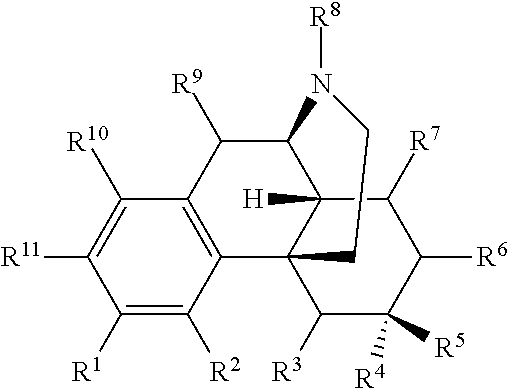

Priority Applications (1)
| Application Number | Priority Date | Filing Date | Title |
|---|---|---|---|
| US15/569,726 US10766864B2 (en) | 2015-05-08 | 2016-05-05 | Morphinan derivatives for the treatment of neuropathic pain |
Applications Claiming Priority (3)
| Application Number | Priority Date | Filing Date | Title |
|---|---|---|---|
| US201562159120P | 2015-05-08 | 2015-05-08 | |
| PCT/US2016/030933 WO2016182840A1 (en) | 2015-05-08 | 2016-05-05 | Morphinan derivatives for the treatment of neuropathic pain |
| US15/569,726 US10766864B2 (en) | 2015-05-08 | 2016-05-05 | Morphinan derivatives for the treatment of neuropathic pain |
Publications (2)
| Publication Number | Publication Date |
|---|---|
| US20180127375A1 US20180127375A1 (en) | 2018-05-10 |
| US10766864B2 true US10766864B2 (en) | 2020-09-08 |
Family
ID=56024404
Family Applications (1)
| Application Number | Title | Priority Date | Filing Date |
|---|---|---|---|
| US15/569,726 Active US10766864B2 (en) | 2015-05-08 | 2016-05-05 | Morphinan derivatives for the treatment of neuropathic pain |
Country Status (3)
| Country | Link |
|---|---|
| US (1) | US10766864B2 (en) |
| EP (1) | EP3294714B1 (en) |
| WO (1) | WO2016182840A1 (en) |
Families Citing this family (7)
| Publication number | Priority date | Publication date | Assignee | Title |
|---|---|---|---|---|
| WO2017093519A1 (en) * | 2015-12-03 | 2017-06-08 | Heinrich-Heine-Universität Düsseldorf | Dextrorphan-derivatives with suppressed central nervous activity |
| US10745402B2 (en) | 2017-01-02 | 2020-08-18 | Purdue Pharma L.P. | Morphinan derivatives and use thereof |
| CN110290792A (en) * | 2017-01-05 | 2019-09-27 | 景凯生物科技股份有限公司 | Morphinan derivatives and compositions thereof for use in the treatment of autoimmune, inflammatory or infection-related disorders |
| KR20220035378A (en) | 2019-07-19 | 2022-03-22 | 닛뽕 케미파 가부시키가이샤 | Method for preparing phenol derivatives |
| AU2020385852A1 (en) * | 2019-11-22 | 2022-06-02 | Nippon Chemiphar Co., Ltd. | Pyrazolomorphinan derivative |
| WO2023059443A1 (en) * | 2021-10-07 | 2023-04-13 | Pantherics Incorporated | Methods and compounds for treating inflammation |
| CN121064095A (en) * | 2024-06-03 | 2025-12-05 | 苏州旺山旺水生物医药股份有限公司 | Morphinan compounds, preparation method and application thereof |
Citations (8)
| Publication number | Priority date | Publication date | Assignee | Title |
|---|---|---|---|---|
| GB1097167A (en) | 1966-05-31 | 1967-12-29 | Shionogi & Co | 3-hydroxy-6-oxo-n-phenethylmorphinan compounds and their production |
| US3654280A (en) | 1968-03-21 | 1972-04-04 | Shionogi & Co | L-n allylic-3-hydroxy-6-oxomorphinans |
| US3793329A (en) | 1971-02-19 | 1974-02-19 | H Merz | N-(furyl-methyl)-3-oxy-morphinans and salts thereof |
| WO2002098949A1 (en) | 2001-06-04 | 2002-12-12 | Nobex Corporation | Methods of synthesizing substantially monodispersed mixtures of polymers having polyethylene glycol moieties |
| WO2004045562A2 (en) | 2002-11-18 | 2004-06-03 | The Mclean Hospital Corporation | Mixed kappa/mu opioids and uses thereof |
| US20050136031A1 (en) | 2003-12-16 | 2005-06-23 | Bentley Michael D. | Chemically modified small molecules |
| WO2006071730A1 (en) | 2004-12-27 | 2006-07-06 | Astrazeneca Ab | Pyrazolone compounds as metabotropic glutamate receptor agonists for the treatment of neurological and psychiatric disorders |
| US20100048602A1 (en) | 2007-03-12 | 2010-02-25 | Nektar Therapeutics | Oligomer-Opioid Agonist Conjugates |
Family Cites Families (2)
| Publication number | Priority date | Publication date | Assignee | Title |
|---|---|---|---|---|
| FR1361979A (en) | 1963-04-08 | 1964-05-29 | Shionogi & Co | Manufacturing process for 6-hydroxy-morphine derivatives |
| US8987293B2 (en) * | 2010-12-23 | 2015-03-24 | Phoenix Pharmalabs, Inc. | Morphinans useful as analgesics |
-
2016
- 2016-05-05 EP EP16723889.8A patent/EP3294714B1/en active Active
- 2016-05-05 US US15/569,726 patent/US10766864B2/en active Active
- 2016-05-05 WO PCT/US2016/030933 patent/WO2016182840A1/en not_active Ceased
Patent Citations (8)
| Publication number | Priority date | Publication date | Assignee | Title |
|---|---|---|---|---|
| GB1097167A (en) | 1966-05-31 | 1967-12-29 | Shionogi & Co | 3-hydroxy-6-oxo-n-phenethylmorphinan compounds and their production |
| US3654280A (en) | 1968-03-21 | 1972-04-04 | Shionogi & Co | L-n allylic-3-hydroxy-6-oxomorphinans |
| US3793329A (en) | 1971-02-19 | 1974-02-19 | H Merz | N-(furyl-methyl)-3-oxy-morphinans and salts thereof |
| WO2002098949A1 (en) | 2001-06-04 | 2002-12-12 | Nobex Corporation | Methods of synthesizing substantially monodispersed mixtures of polymers having polyethylene glycol moieties |
| WO2004045562A2 (en) | 2002-11-18 | 2004-06-03 | The Mclean Hospital Corporation | Mixed kappa/mu opioids and uses thereof |
| US20050136031A1 (en) | 2003-12-16 | 2005-06-23 | Bentley Michael D. | Chemically modified small molecules |
| WO2006071730A1 (en) | 2004-12-27 | 2006-07-06 | Astrazeneca Ab | Pyrazolone compounds as metabotropic glutamate receptor agonists for the treatment of neurological and psychiatric disorders |
| US20100048602A1 (en) | 2007-03-12 | 2010-02-25 | Nektar Therapeutics | Oligomer-Opioid Agonist Conjugates |
Non-Patent Citations (49)
| Title |
|---|
| Chen et al., "Synthesis and Properties of ABA Amphiphiles", J. Org Chem., vol. 64, pp. 6870-6873, (1999). |
| Decker et al., "Synthesis and Opioid Receptor Binding Affinities of 2-Substituted and 3-Aminomorphinans: Ligands for mu, kappa and delta Opioid Receptors", J. Med. Chem., vol. 53, No. 1, pp. 1-50, (Jan. 14, 2010). |
| Eddy et al., "Synthetic analgesics. Aralkyl substitution on nitrogen of morphinan", Bulletin on Narcotics, vol. 10, No. 4, pp. 23-41, (1958). |
| Enzon Pharmaceuticals, Macromolecular Engineering Technologies, 16 pages, (2004). |
| Ertl et al., "Fast Calculation of Molecular Polar Surface Area as a Sum of Fragment-Based Contributions and Its Applications to the Prediction of Drug Transport Properties", J. Med. Chem., vol. 43, pp. 3714-3717, (2000). |
| Foley, "Opioids and Chronic Neuropathic Pain", N. Engl. J. Med., vol. 348, No. 13, pp. 1279-1281, (Mar. 27, 2003). |
| Herlihy et al., "Novel Opiates and Antagonists 5. 7-Carbethoxy-N-(cycloalkylmethyl)-3-hydroxymorphinan-6-ones and -isomorphinans-6-ones", J. Med. Chem., vol. 25, pp. 986-990, (1982). |
| Kelder et al., "Polar Molecular Surface as a Dominating Determinant for Oral Absorption and Brain Penetration of Drugs", Pharmaceutical Research, vol. 16, No. 10, pp. 1514-1519, (1999). |
| Nektar™-Transforming Therapeutics, Nektar Advanced PEGylation: Polyethylene Glycol and Derivatives for Advanced PEGylation, 27 pages, Catalog-2004, (Jul. 2004). |
| Nektar™—Transforming Therapeutics, Nektar Advanced PEGylation: Polyethylene Glycol and Derivatives for Advanced PEGylation, 27 pages, Catalog—2004, (Jul. 2004). |
| Nektar™-Transforming Therapeutics, Nektar Advanced PEGylation: Polyethylene Glycol and Derivatives for Advanced PEGylation, 33 pages, (Catalog 2005-2006). |
| Nektar™—Transforming Therapeutics, Nektar Advanced PEGylation: Polyethylene Glycol and Derivatives for Advanced PEGylation, 33 pages, (Catalog 2005-2006). |
| Nektar™-Transforming Therapeutics, Nektar Molecule Engineering: Polyethylene Glycol and Derivatives for Advanced PEGylation, 24 pages, Catalog-2003, (Jul. 2003). |
| Nektar™—Transforming Therapeutics, Nektar Molecule Engineering: Polyethylene Glycol and Derivatives for Advanced PEGylation, 24 pages, Catalog—2003, (Jul. 2003). |
| Neumeyer et al., "Mixed κ Agonists and μ Agonists/Antagonists as Potential Pharmacotherapeutics for Cocaine Abuse: Synthesis and Opioid Receptor Binding Affinity of N-Substituted Derivatives of Morphinan", Bioorganic & Medicinal Chemistry Letters, vol. 11, pp. 2735-2740, (2001). |
| Neumeyer et al., "Synthesis and Opioid Receptor Affinity of Morphinan and Benzomorphan Derivatives: Mixed κ Agonists and μ Agonists/Antagonists as Potential Pharmacotherapeutics for Cocaine Dependence", J. Med. Chem., vol. 43, pp. 114-122. |
| Neumeyer et al., "Synthesis, Binding Affinity, and Functional In Vitro Activity of 3-Benzylaminomorphinan and 3-Benzylaminomorphine Ligands at Opioid Receptors", J. Med. Chem., vol. 55, No. 8, pp. 3878-3890, (Apr. 26, 2012). |
| Neumeyer et al., Bioorganic & Med. Chem. Letters. 11(20), 2001, pp. 2735-2740. * |
| Neunneyer et al., J'nal of Med. Chem. 43(1), 2000, pp. 114-122. * |
| NOF Corporation, PEG Derivatives, Phospholipid and Drug Delivery Materials for Pharmaceuticals, 27 pages, Catalogue 2003-2nd, (Mar. 2004). |
| NOF Corporation, PEG Derivatives, Phospholipid and Drug Delivery Materials for Pharmaceuticals, 46 pages, Catalogue 2003-1st, (Jan. 2003). |
| NOF Corporation, PEG Derivatives, Phospholipids and Drug Delivery Materials for Pharmaceutical Products and Formulations, 60 pages, Catalogue Ver. 8, (Apr. 2006). |
| PCT International Preliminary Report on Patentability in PCT Application No. PCT/US2016/030933 dated Nov. 23, 2017. |
| PCT International Search Report and the Written Opinion in PCT Application No. PCT/US2016/030933 dated Aug. 29, 2016. |
| Polypure Products, PEG amines; PEG acids and amino acids; PEG thiols and disulfides; BIOTINS, 5 pages, (Apr. 2004). |
| Polypure Products, PEG amines; PEG acids and amino acids; PEG thiols and disulfides; Biotins, 5 pages, (Apr. 2005). |
| Prommer, "Levorphanol: the forgotten opioid", Support Care Cancer, vol. 15, pp. 259-264, (2007). |
| Quanta Biodesign, Labeling, Derivatization and Crosslinking Reagents for Biological and Related Materials with dPEG™, 38 pages, (Mar. 12, 2004). |
| Quanta Biodesign, Labeling, Modification and Crosslinking Reagents incorporating our unique monodispersed dPEG™Technology, 31 pages, (Nov. 5, 2004). |
| Quanta Biodesign, Ltd., Leading innovator, producer and provider of monodisperse discrete PEG™(dPEG™) derivatives, (Product Catalog), 26 pages, (Updated: Jul. 18, 2005). |
| Quanta Biodesign, Ltd., Leading innovator, producer and provider of monodisperse discrete PEG™(dPEG™) derivatives, (Product Catalog), 26 pages, (Updated: Nov. 17, 2005). |
| Rodriguez-Muñoz et al., "The Mu-Opioid Receptor and the NMDA Receptor Associate in PAG Neurons: Implications in Pain Control", Neuropsychopharmacology vol. 37, pp. 338-349, (2012). |
| Rowbotham et al., "Oral Opioid Therapy for Chronic Peripheral and Central Neuropathic Pain", The New England Journal of Medicine, vol. 348, pp. 1223-1232, (2003). |
| Rubin, "The Cell Biology of the Blood-Brain Barrier", Annu. Rev. Neurosci., vol. 22, pp. 11-28, (1999). |
| Shearwater Corporation, Polyethylene Glycol and Derivatives for Biomedical Applications, 20 pages, Catalog-(Jul. 2001). |
| Shearwater Corporation, Polyethylene Glycol and Derivatives for Biomedical Applications, 20 pages, Catalog—(Jul. 2001). |
| Shearwater Polymers, Inc., Polyethylene Glycol and Derivatives: Functionalized Biocompatible Polymers for Research and Pharmaceuticals, 50 pages, Catalog-(Jan. 2000). |
| Shearwater Polymers, Inc., Polyethylene Glycol and Derivatives: Functionalized Biocompatible Polymers for Research and Pharmaceuticals, 50 pages, Catalog—(Jan. 2000). |
| Shearwater Polymers, Inc., Polyethylene Glycol Derivatives, 50 pages, Catalog-(Mar. 1995). |
| Shearwater Polymers, Inc., Polyethylene Glycol Derivatives, 50 pages, Catalog—(Mar. 1995). |
| Shearwater Polymers, Inc., Polyethylene Glycol Derivatives, 55 pages, Catalog 1997-1998, (Jul. 1997). |
| Summerfield et al., "Central Nervous System Drug Disposition: The Relationship between in Situ Brain Permeability and Brain Free Fraction", The Journal of Pharmacology and Experimental Therapeutics, vol. 322, No. 1, pp. 205-213, (2007). |
| Tsuji, "Small Molecular Drug Transfer across the Blood-Brain Barrier via Carrier-Mediated Transport Systems", NeuroRx: The Journal of the American Society for Experimental NeuroTherapeutics, vol. 2, pp. 54-62, (Jan. 2005). |
| Wager et al., "Defining Desirable Central Nervous System Drug Space through the Alignment of Molecular Properties, in Vitro ADME, and Safety Attributes", ACS Chem. Neurosci., vol. 1, pp. 420-434, (2010). |
| Zhang et al., "10-Ketomorphinan and 3-Substituted-3-desoxymorphinan Analogues as Mixed κ and μ Opioid Ligands: Synthesis and Biological Evaluation of Their Binding Affinity at Opioid Receptors", J. Med. Chem., vol. 47, pp. 165-174, (2004). |
| Zhang et al., "2-Aminothiazole-Derived Opioids. Bioisosteric Replacement of Phenols", J. Med. Chem., vol. 47, pp. 1886-1888, (2004). |
| Zhang et al., "Synthesis and Pharmacological Evaluation of 6,7-Indolo/Thiazolo-Morphinans-Further SAR of Levorphanol", J. Med. Chem., vol. 50, pp. 2747-2751, (2007). |
| Zhang et al., "Synthesis and Pharmacological Evaluation of 6,7-Indolo/Thiazolo-Morphinans—Further SAR of Levorphanol", J. Med. Chem., vol. 50, pp. 2747-2751, (2007). |
| Zhang et al., J'nal of Med Chem, Am. Chem. Society, 47(1), 2004, pp. 165-174. * |
Also Published As
| Publication number | Publication date |
|---|---|
| US20180127375A1 (en) | 2018-05-10 |
| WO2016182840A1 (en) | 2016-11-17 |
| EP3294714A1 (en) | 2018-03-21 |
| EP3294714B1 (en) | 2023-03-15 |
Similar Documents
| Publication | Publication Date | Title |
|---|---|---|
| EP3294714B1 (en) | Morphinan derivatives for the treatment of neuropathic pain | |
| US9284283B2 (en) | Macrocyclic compounds for modulating IL-17 | |
| US20250186436A1 (en) | Spirocyclic pyridine-1,5-diones exhibiting mnk inhibition and their method of use | |
| US20200155550A1 (en) | Compound with kinase inhibitory activity and preparation method and use thereof | |
| US20210300901A1 (en) | Novel ureas having androgen receptor degradation activity and uses thereof | |
| US12479816B2 (en) | 20-HETE formation inhibitors | |
| JP6378179B2 (en) | Novel compound, detection agent and activity inhibitor of organic cation transporter 3 | |
| US10106522B2 (en) | Benzimidazole derivatives as antihistamine agents | |
| EP4089088A1 (en) | Mor receptor agonist compound, preparation method therefor, and use thereof | |
| US20190352291A1 (en) | Kappa opioid agonists and uses thereof | |
| US11999747B2 (en) | Furoquinolinediones as inhibitors of TDP2 | |
| US12325708B2 (en) | Adenosine 2 receptor antagonists | |
| US6903132B2 (en) | Non-peptide GnRH agents, pharmaceutical compositions and methods for their use | |
| JP2021505672A (en) | Antifungal agent that is a heterocyclic substituted pyridine derivative | |
| US20250034135A1 (en) | Anti-apoptotic protein bcl-2 inhibitor, pharmaceutical composition and uses thereof | |
| US20250114436A1 (en) | Dynamic-covalent hydrogels with glucose-specific and glucose-responsive diboronate crosslinking | |
| US7115596B2 (en) | Thiazole compounds as integrin receptor antagonists derivatives | |
| US10865186B2 (en) | Opioid agonists and uses thereof | |
| CN118119611A (en) | Small molecules for degrading DOT1L and uses thereof | |
| HK40130127A (en) | Imidazo[1,2-α]pyridine compounds for use in treating cancer and inflammatory diseases and methods to prepare said compounds | |
| HK40034453B (en) | Pyrimidine cyclohexenyl glucocorticoid receptor modulators |
Legal Events
| Date | Code | Title | Description |
|---|---|---|---|
| FEPP | Fee payment procedure |
Free format text: ENTITY STATUS SET TO UNDISCOUNTED (ORIGINAL EVENT CODE: BIG.); ENTITY STATUS OF PATENT OWNER: LARGE ENTITY |
|
| AS | Assignment |
Owner name: TC LENDING, LLC, AS COLLATERAL AGENT, TEXAS Free format text: SECURITY INTEREST;ASSIGNOR:NEKTAR THERAPEUTICS;REEL/FRAME:044515/0727 Effective date: 20171221 |
|
| AS | Assignment |
Owner name: NEKTAR THERAPEUTICS, CALIFORNIA Free format text: ASSIGNMENT OF ASSIGNORS INTEREST;ASSIGNORS:ANAND, NEEL K.;AURRECOECHEA, NATALIA;CHENG, LIN;AND OTHERS;SIGNING DATES FROM 20171114 TO 20171223;REEL/FRAME:045327/0203 Owner name: NANOSYN INC., CALIFORNIA Free format text: ASSIGNMENT OF ASSIGNORS INTEREST;ASSIGNOR:KROGH-JESPERSEN, ERIK;REEL/FRAME:045327/0245 Effective date: 20171205 Owner name: NEKTAR THERAPEUTICS, CALIFORNIA Free format text: ASSIGNMENT OF ASSIGNORS INTEREST;ASSIGNOR:NANOSYN INC.;REEL/FRAME:045720/0635 Effective date: 20180207 |
|
| AS | Assignment |
Owner name: TC LENDING, LLC, AS COLLATERAL AGENT, TEXAS Free format text: CORRECTIVE ASSIGNMENT TO CORRECT THE APPLICATION NUMBER 15/835,115 PREVIOUSLY RECORDED AT REEL: 044515 FRAME: 0727. ASSIGNOR(S) HEREBY CONFIRMS THE ASSIGNMENT;ASSIGNOR:NEKTAR THERAPEUTICS;REEL/FRAME:046762/0412 Effective date: 20171221 |
|
| STPP | Information on status: patent application and granting procedure in general |
Free format text: RESPONSE TO NON-FINAL OFFICE ACTION ENTERED AND FORWARDED TO EXAMINER |
|
| STPP | Information on status: patent application and granting procedure in general |
Free format text: NON FINAL ACTION MAILED |
|
| STPP | Information on status: patent application and granting procedure in general |
Free format text: RESPONSE TO NON-FINAL OFFICE ACTION ENTERED AND FORWARDED TO EXAMINER |
|
| STPP | Information on status: patent application and granting procedure in general |
Free format text: EX PARTE QUAYLE ACTION MAILED |
|
| AS | Assignment |
Owner name: NEKTAR THERAPEUTICS, CALIFORNIA Free format text: RELEASE BY SECURED PARTY;ASSIGNOR:TC LENDING, LLC, AS COLLATERAL AGENT;REEL/FRAME:053180/0009 Effective date: 20200413 |
|
| STPP | Information on status: patent application and granting procedure in general |
Free format text: NOTICE OF ALLOWANCE MAILED -- APPLICATION RECEIVED IN OFFICE OF PUBLICATIONS |
|
| STCF | Information on status: patent grant |
Free format text: PATENTED CASE |
|
| MAFP | Maintenance fee payment |
Free format text: PAYMENT OF MAINTENANCE FEE, 4TH YEAR, LARGE ENTITY (ORIGINAL EVENT CODE: M1551); ENTITY STATUS OF PATENT OWNER: LARGE ENTITY Year of fee payment: 4 |