US10759799B2 - Indazole containing macrocycles and therapeutic uses thereof - Google Patents
Indazole containing macrocycles and therapeutic uses thereof Download PDFInfo
- Publication number
- US10759799B2 US10759799B2 US16/440,284 US201916440284A US10759799B2 US 10759799 B2 US10759799 B2 US 10759799B2 US 201916440284 A US201916440284 A US 201916440284A US 10759799 B2 US10759799 B2 US 10759799B2
- Authority
- US
- United States
- Prior art keywords
- mmol
- compound
- cancer
- disease
- formulas
- Prior art date
- Legal status (The legal status is an assumption and is not a legal conclusion. Google has not performed a legal analysis and makes no representation as to the accuracy of the status listed.)
- Active
Links
- 0 *.C*C1=CC=CC2=C1N=C(C1=NNC3=CC=C(C)C=C31)N2 Chemical compound *.C*C1=CC=CC2=C1N=C(C1=NNC3=CC=C(C)C=C31)N2 0.000 description 9
- JMZPENXYLBRFKM-UHFFFAOYSA-N C1=CC2=CC(=C1)C1=CC=CC3=C1/N=C(\N3)C1=NNC3=CC=C(C=C31)C1=CC(=CN=C1)CCC2 Chemical compound C1=CC2=CC(=C1)C1=CC=CC3=C1/N=C(\N3)C1=NNC3=CC=C(C=C31)C1=CC(=CN=C1)CCC2 JMZPENXYLBRFKM-UHFFFAOYSA-N 0.000 description 2
- QPNWKWICHCTVNF-UHFFFAOYSA-N C1=CC2=CC(=C1)C1=CC=CC3=C1/N=C(\N3)C1=NNC3=CC=C(C=C31)C1=NC(=CN=C1)NCCO2 Chemical compound C1=CC2=CC(=C1)C1=CC=CC3=C1/N=C(\N3)C1=NNC3=CC=C(C=C31)C1=NC(=CN=C1)NCCO2 QPNWKWICHCTVNF-UHFFFAOYSA-N 0.000 description 2
- RLQGYLQSSXQDLL-UHFFFAOYSA-N C1=CC2=CC(=C1)C1=CN=CC3=C1/N=C(\N3)C1=NNC3=CC=C(C=C31)C1=CC(=CN=C1)CCC2 Chemical compound C1=CC2=CC(=C1)C1=CN=CC3=C1/N=C(\N3)C1=NNC3=CC=C(C=C31)C1=CC(=CN=C1)CCC2 RLQGYLQSSXQDLL-UHFFFAOYSA-N 0.000 description 2
- TWEMEIGKHOGZIO-UHFFFAOYSA-N C1=CC2=CC(=C1)C1=CN=CC3=C1/N=C(\N3)C1=NNC3=CC=C(C=C31)C1=CC(=CN=C1)OCCC2 Chemical compound C1=CC2=CC(=C1)C1=CN=CC3=C1/N=C(\N3)C1=NNC3=CC=C(C=C31)C1=CC(=CN=C1)OCCC2 TWEMEIGKHOGZIO-UHFFFAOYSA-N 0.000 description 2
- UNMNREHRDCTVTF-UHFFFAOYSA-N C1=CC2=CC(=C1)C1=CN=CC3=C1/N=C(\N3)C1=NNC3=CC=C(C=C31)C1=NC(=CN=C1)NCCO2 Chemical compound C1=CC2=CC(=C1)C1=CN=CC3=C1/N=C(\N3)C1=NNC3=CC=C(C=C31)C1=NC(=CN=C1)NCCO2 UNMNREHRDCTVTF-UHFFFAOYSA-N 0.000 description 2
- GMUJGUXGVJZHSK-UHFFFAOYSA-N CC(C)C1CCC(C(C)C)CC1 Chemical compound CC(C)C1CCC(C(C)C)CC1 GMUJGUXGVJZHSK-UHFFFAOYSA-N 0.000 description 2
- MURDNBFVOLGBQI-UHFFFAOYSA-N CN1CC2=CC(=CC=C2)C2=CC=CC3=C2/N=C(\N3)C2=NNC3=CC=C(C=C32)C2=C(C1)N(C)N=C2 Chemical compound CN1CC2=CC(=CC=C2)C2=CC=CC3=C2/N=C(\N3)C2=NNC3=CC=C(C=C32)C2=C(C1)N(C)N=C2 MURDNBFVOLGBQI-UHFFFAOYSA-N 0.000 description 2
- BZBHASXBVBZAIF-UHFFFAOYSA-N CN1CC2=CN=CC(=C2)C2=CN=C3NN=C(C3=C2)/C2=N/C3=C(C=CC=C3C3=CC=CC(=C3)C1)N2 Chemical compound CN1CC2=CN=CC(=C2)C2=CN=C3NN=C(C3=C2)/C2=N/C3=C(C=CC=C3C3=CC=CC(=C3)C1)N2 BZBHASXBVBZAIF-UHFFFAOYSA-N 0.000 description 2
- ROSXQTSIMBHPJK-UHFFFAOYSA-N CN1CCCCN(C)C2=CC=CC3=C2/N=C(\N3)C2=NNC3=CC=C(N=C32)C2=CC(=CN=C2)C1 Chemical compound CN1CCCCN(C)C2=CC=CC3=C2/N=C(\N3)C2=NNC3=CC=C(N=C32)C2=CC(=CN=C2)C1 ROSXQTSIMBHPJK-UHFFFAOYSA-N 0.000 description 2
- XWYRXSBAKIDHSZ-UHFFFAOYSA-N CN1CCCN2C=C(N=N2)C2=CC=CC3=C2/N=C(\N3)C2=NNC3=CC=C(C=C32)C2=CC(=CN=C2)C1 Chemical compound CN1CCCN2C=C(N=N2)C2=CC=CC3=C2/N=C(\N3)C2=NNC3=CC=C(C=C32)C2=CC(=CN=C2)C1 XWYRXSBAKIDHSZ-UHFFFAOYSA-N 0.000 description 2
- WYAQZEMORLXDIK-UHFFFAOYSA-N CN1N=CC2=C1CNCC1=CC(=CC=C1)C1=CC=CC3=C1/N=C(\N3)C1=NNC3=CC=C2C=C31 Chemical compound CN1N=CC2=C1CNCC1=CC(=CC=C1)C1=CC=CC3=C1/N=C(\N3)C1=NNC3=CC=C2C=C31 WYAQZEMORLXDIK-UHFFFAOYSA-N 0.000 description 2
- ZUSPVRYKSMCYRC-UHFFFAOYSA-N CN1N=CC2=C1CNCC1=CC(=CC=C1)C1=NC=CC3=C1/N=C(\N3)C1=NNC3=CC=C2C=C31 Chemical compound CN1N=CC2=C1CNCC1=CC(=CC=C1)C1=NC=CC3=C1/N=C(\N3)C1=NNC3=CC=C2C=C31 ZUSPVRYKSMCYRC-UHFFFAOYSA-N 0.000 description 2
- VCTQAPFAVNTBFG-UHFFFAOYSA-N O=C1CCC2=CC(=CC=C2)C2=CC(=CN=C2)NC(=O)C2=NN/C3=C\C=C(\C=C/23)C2=CC(=CN=C2)CN1 Chemical compound O=C1CCC2=CC(=CC=C2)C2=CC(=CN=C2)NC(=O)C2=NN/C3=C\C=C(\C=C/23)C2=CC(=CN=C2)CN1 VCTQAPFAVNTBFG-UHFFFAOYSA-N 0.000 description 2
- HYCOZWOXXFEZLZ-UHFFFAOYSA-N O=C1CCC2=CC(=CC=C2)C2=CC=CC3=C2/N=C(\N3)C2=NNC3=CC=C(N=C32)C2=CC(=CN=C2)N1 Chemical compound O=C1CCC2=CC(=CC=C2)C2=CC=CC3=C2/N=C(\N3)C2=NNC3=CC=C(N=C32)C2=CC(=CN=C2)N1 HYCOZWOXXFEZLZ-UHFFFAOYSA-N 0.000 description 2
- WWEJNRUKFYYOGK-UHFFFAOYSA-N O=C1CCC2=CC(=CC=C2)C2=CC=CC3=C2/N=C(\N3)C2=NNC3=CN=C(C=C32)C2=CC(=CN=C2)N1 Chemical compound O=C1CCC2=CC(=CC=C2)C2=CC=CC3=C2/N=C(\N3)C2=NNC3=CN=C(C=C32)C2=CC(=CN=C2)N1 WWEJNRUKFYYOGK-UHFFFAOYSA-N 0.000 description 2
- ZKFLVSYKYXLULH-UHFFFAOYSA-N O=C1CCC2=CC(=CC=C2)C2=CC=CC3=C2/N=C(\N3)C2=NNC3=NC=C(C=C32)C2=CC(=CN=C2)N1 Chemical compound O=C1CCC2=CC(=CC=C2)C2=CC=CC3=C2/N=C(\N3)C2=NNC3=NC=C(C=C32)C2=CC(=CN=C2)N1 ZKFLVSYKYXLULH-UHFFFAOYSA-N 0.000 description 2
- QHKNDBYBXAYJDZ-UHFFFAOYSA-N O=C1CCC2=CC(=CC=C2)C2=CC=NC3=C2/N=C(\N3)C2=NNC3=CC=C(C=C32)C2=CC(=CN=C2)N1 Chemical compound O=C1CCC2=CC(=CC=C2)C2=CC=NC3=C2/N=C(\N3)C2=NNC3=CC=C(C=C32)C2=CC(=CN=C2)N1 QHKNDBYBXAYJDZ-UHFFFAOYSA-N 0.000 description 2
- PPVASYJRWJUURU-UHFFFAOYSA-N O=C1CCC2=CC(=CC=C2)C2=CN=CC3=C2/N=C(\N3)C2=NNC3=CC=C(C=C32)C2=CC(=CN=C2)N1 Chemical compound O=C1CCC2=CC(=CC=C2)C2=CN=CC3=C2/N=C(\N3)C2=NNC3=CC=C(C=C32)C2=CC(=CN=C2)N1 PPVASYJRWJUURU-UHFFFAOYSA-N 0.000 description 2
- IMWDJFUZWJQXFN-UHFFFAOYSA-N O=C1CCC2=CC(=CC=C2)C2=NC=CC3=C2/N=C(\N3)C2=NNC3=CC=C(C=C32)C2=CC(=CN=C2)N1 Chemical compound O=C1CCC2=CC(=CC=C2)C2=NC=CC3=C2/N=C(\N3)C2=NNC3=CC=C(C=C32)C2=CC(=CN=C2)N1 IMWDJFUZWJQXFN-UHFFFAOYSA-N 0.000 description 2
- UORHOTGTEJJIKC-UHFFFAOYSA-N O=C1CCCC2=CC(=CC=C2)C2=CC=CC3=C2N=C(N3)C2=NNC3=CC=C(C=C32)C2=CC(=CN=C2)N1 Chemical compound O=C1CCCC2=CC(=CC=C2)C2=CC=CC3=C2N=C(N3)C2=NNC3=CC=C(C=C32)C2=CC(=CN=C2)N1 UORHOTGTEJJIKC-UHFFFAOYSA-N 0.000 description 2
- SRSXJLBSRWRFOV-UHFFFAOYSA-N O=C1CCCC2=CC(=CC=C2)C2=CC=CC3=C2N=C(N3)C2=NNC3=CC=C(N=C32)C2=CC(=CN=C2)N1 Chemical compound O=C1CCCC2=CC(=CC=C2)C2=CC=CC3=C2N=C(N3)C2=NNC3=CC=C(N=C32)C2=CC(=CN=C2)N1 SRSXJLBSRWRFOV-UHFFFAOYSA-N 0.000 description 2
- DDHPWNQZVLJQPV-UHFFFAOYSA-N O=C1CCCC2=CC(=CC=C2)C2=CC=NC3=C2N=C(N3)C2=NNC3=CC=C(C=C32)C2=CC(=CN=C2)N1 Chemical compound O=C1CCCC2=CC(=CC=C2)C2=CC=NC3=C2N=C(N3)C2=NNC3=CC=C(C=C32)C2=CC(=CN=C2)N1 DDHPWNQZVLJQPV-UHFFFAOYSA-N 0.000 description 2
- MUQFTBHLXJOYBZ-UHFFFAOYSA-N O=C1COC2=CC(=CC=C2)C2=CN=CC3=C2/N=C(\N3)C2=NNC3=CC=C(C=C32)C2=CC(=CN=C2)N1 Chemical compound O=C1COC2=CC(=CC=C2)C2=CN=CC3=C2/N=C(\N3)C2=NNC3=CC=C(C=C32)C2=CC(=CN=C2)N1 MUQFTBHLXJOYBZ-UHFFFAOYSA-N 0.000 description 2
- MEVAYWIJMYMJMW-UHFFFAOYSA-N O=C1NC2CCC(CC2)NCC2=CN=CC(=C2)C2=CC=C3NN=C(C3=C2)/C2=N/C3=C(C=CC=C13)N2 Chemical compound O=C1NC2CCC(CC2)NCC2=CN=CC(=C2)C2=CC=C3NN=C(C3=C2)/C2=N/C3=C(C=CC=C13)N2 MEVAYWIJMYMJMW-UHFFFAOYSA-N 0.000 description 2
- JUHMTZUJAGTFGC-UHFFFAOYSA-I *.*.*.*.*.C.CB1OC(C)(C)C(C)(C)O1.CCC.CCC.CCC.CCC1=CC=CC2=C1N=C(C1=NN(C)C3=CC=C(C)C=C31)N2.CCCC1=CC=CC(N)=C1N.CCCC1=CC=CC2=C1N=C(C1=NN(C)C3=CC=C(Br)C=C31)N2.CCCC1=CC=CC2=C1N=C(C1=NN(C)C3=CC=C(C)C=C31)N2.CCCCCC1=CC=CC2=C1N=C(C1=NN(C)C3=CC=C(C)C=C31)N2.CCCCCC1=CC=CC2=C1N=C(C1=NNC3=CC=C(C)C=C31)N2.CI.CI.CN1N=C(C=O)C2=CC(Br)=CC=C21.I.ICI.I[V](I)I.I[V]I.[V]CI Chemical compound *.*.*.*.*.C.CB1OC(C)(C)C(C)(C)O1.CCC.CCC.CCC.CCC1=CC=CC2=C1N=C(C1=NN(C)C3=CC=C(C)C=C31)N2.CCCC1=CC=CC(N)=C1N.CCCC1=CC=CC2=C1N=C(C1=NN(C)C3=CC=C(Br)C=C31)N2.CCCC1=CC=CC2=C1N=C(C1=NN(C)C3=CC=C(C)C=C31)N2.CCCCCC1=CC=CC2=C1N=C(C1=NN(C)C3=CC=C(C)C=C31)N2.CCCCCC1=CC=CC2=C1N=C(C1=NNC3=CC=C(C)C=C31)N2.CI.CI.CN1N=C(C=O)C2=CC(Br)=CC=C21.I.ICI.I[V](I)I.I[V]I.[V]CI JUHMTZUJAGTFGC-UHFFFAOYSA-I 0.000 description 1
- VLGKLTYVCDNFKS-UHFFFAOYSA-N *.*.*.*.*.CB1OC(C)(C)C(C)(C)O1.CC.CC(I)(I)I.CC(I)I.CC([V])I.CCC.CCC.CCC.CCC1=CC=CC(NC(=O)C2=NN(C)C3=CC=C(C)C=C32)=C1.CCCC1=CC(N)=CC=C1.CCCC1=CC=CC(NC(=O)C2=NN(C)C3=CC=C(Br)C=C32)=C1.CCCC1=CC=CC(NC(=O)C2=NN(C)C3=CC=C(C)C=C32)=C1.CCCCCC1=CC=CC(NC(=O)C2=NN(C)C3=CC=C(C)C=C32)=C1.CCCCCC1=CC=CC(NC(=O)C2=NNC3=CC=C(C)C=C32)=C1.CCI.CC[V].CI.CN1N=C(C(=O)O)C2=CC(Br)=CC=C21.C[V] Chemical compound *.*.*.*.*.CB1OC(C)(C)C(C)(C)O1.CC.CC(I)(I)I.CC(I)I.CC([V])I.CCC.CCC.CCC.CCC1=CC=CC(NC(=O)C2=NN(C)C3=CC=C(C)C=C32)=C1.CCCC1=CC(N)=CC=C1.CCCC1=CC=CC(NC(=O)C2=NN(C)C3=CC=C(Br)C=C32)=C1.CCCC1=CC=CC(NC(=O)C2=NN(C)C3=CC=C(C)C=C32)=C1.CCCCCC1=CC=CC(NC(=O)C2=NN(C)C3=CC=C(C)C=C32)=C1.CCCCCC1=CC=CC(NC(=O)C2=NNC3=CC=C(C)C=C32)=C1.CCI.CC[V].CI.CN1N=C(C(=O)O)C2=CC(Br)=CC=C21.C[V] VLGKLTYVCDNFKS-UHFFFAOYSA-N 0.000 description 1
- FHSBGFSIRXZPEQ-UHFFFAOYSA-G *.*.*.*.*.CB1OC(C)(C)C(C)(C)O1.CC.CC.CC.CC.CCCC1=CC=CC(NC(=O)C2=NN(C)C3=CC=C(C)C=C32)=C1.CCCCC1=CC(N)=CC=C1.CCCCC1=CC=CC(NC(=O)C2=NN(C)C3=CC=C(Br)C=C32)=C1.CCCCC1=CC=CC(NC(=O)C2=NN(C)C3=CC=C(C)C=C32)=C1.CCCCCC1=CC=CC(NC(=O)C2=NN(C)C3=CC=C(C)C=C32)=C1.CCCCCC1=CC=CC(NC(=O)C2=NNC3=CC=C(C)C=C32)=C1.CCI.CCI.CN1N=C(C(=O)O)C2=CC(Br)=CC=C21.C[V].C[V](I)(I)I.C[V](I)I.C[V]I.[V]I Chemical compound *.*.*.*.*.CB1OC(C)(C)C(C)(C)O1.CC.CC.CC.CC.CCCC1=CC=CC(NC(=O)C2=NN(C)C3=CC=C(C)C=C32)=C1.CCCCC1=CC(N)=CC=C1.CCCCC1=CC=CC(NC(=O)C2=NN(C)C3=CC=C(Br)C=C32)=C1.CCCCC1=CC=CC(NC(=O)C2=NN(C)C3=CC=C(C)C=C32)=C1.CCCCCC1=CC=CC(NC(=O)C2=NN(C)C3=CC=C(C)C=C32)=C1.CCCCCC1=CC=CC(NC(=O)C2=NNC3=CC=C(C)C=C32)=C1.CCI.CCI.CN1N=C(C(=O)O)C2=CC(Br)=CC=C21.C[V].C[V](I)(I)I.C[V](I)I.C[V]I.[V]I FHSBGFSIRXZPEQ-UHFFFAOYSA-G 0.000 description 1
- GPIHNVLHQXZOJS-UHFFFAOYSA-G *.*.*.*.*.CB1OC(C)(C)C(C)(C)O1.CC.CC.CC.CCCC1=CC=CC2=C1N=C(C1=NN(C)C3=CC=C(C)C=C31)N2.CCCCC1=CC=CC(N)=C1N.CCCCC1=CC=CC2=C1N=C(C1=NN(C)C3=CC=C(Br)C=C31)N2.CCCCC1=CC=CC2=C1N=C(C1=NN(C)C3=CC=C(C)C=C31)N2.CCCCCC1=CC=CC2=C1N=C(C1=NN(C)C3=CC=C(C)C=C31)N2.CCCCCC1=CC=CC2=C1N=C(C1=NNC3=CC=C(C)C=C31)N2.CN1N=C(C=O)C2=CC(Br)=CC=C21.I.II.I[IH]I.I[V](I)I.I[V]I.[V].[V]I.[V]I Chemical compound *.*.*.*.*.CB1OC(C)(C)C(C)(C)O1.CC.CC.CC.CCCC1=CC=CC2=C1N=C(C1=NN(C)C3=CC=C(C)C=C31)N2.CCCCC1=CC=CC(N)=C1N.CCCCC1=CC=CC2=C1N=C(C1=NN(C)C3=CC=C(Br)C=C31)N2.CCCCC1=CC=CC2=C1N=C(C1=NN(C)C3=CC=C(C)C=C31)N2.CCCCCC1=CC=CC2=C1N=C(C1=NN(C)C3=CC=C(C)C=C31)N2.CCCCCC1=CC=CC2=C1N=C(C1=NNC3=CC=C(C)C=C31)N2.CN1N=C(C=O)C2=CC(Br)=CC=C21.I.II.I[IH]I.I[V](I)I.I[V]I.[V].[V]I.[V]I GPIHNVLHQXZOJS-UHFFFAOYSA-G 0.000 description 1
- PRCNUHOZIGNUJE-UHFFFAOYSA-H B.CC(=O)C1=CC=CN=C1Cl.CC(C)I.CC(O)C1=CC=CN=C1Cl.CC1=NNC2=NC=C(Br)C=C12.CC1=NNC2=NC=CC=C12.CCC.CCC(I)(I)I.CCC(I)I.CCC([V])I.CCCI.CCC[V].CCC[V](I)(I)I.CCC[V](I)I.CCC[V]I.CN1N=C(C=O)C2=CC(Br)=CN=C21.CN1N=C(CO)C2=CC(Br)=CN=C21.COC(=O)C1=NN(C)C2=NC=C(Br)C=C12.COC(=O)C1=NNC2=NC=C(Br)C=C21.ClC1=NC=CC=C1.NN.O=C(O)C1=NNC2=NC=C(Br)C=C21.[LiH] Chemical compound B.CC(=O)C1=CC=CN=C1Cl.CC(C)I.CC(O)C1=CC=CN=C1Cl.CC1=NNC2=NC=C(Br)C=C12.CC1=NNC2=NC=CC=C12.CCC.CCC(I)(I)I.CCC(I)I.CCC([V])I.CCCI.CCC[V].CCC[V](I)(I)I.CCC[V](I)I.CCC[V]I.CN1N=C(C=O)C2=CC(Br)=CN=C21.CN1N=C(CO)C2=CC(Br)=CN=C21.COC(=O)C1=NN(C)C2=NC=C(Br)C=C12.COC(=O)C1=NNC2=NC=C(Br)C=C21.ClC1=NC=CC=C1.NN.O=C(O)C1=NNC2=NC=C(Br)C=C21.[LiH] PRCNUHOZIGNUJE-UHFFFAOYSA-H 0.000 description 1
- MAUNQSPRIIYMTK-UHFFFAOYSA-H BrC1=CC=C2NC=CC2=C1.CC[V](I)(I)I.CC[V](I)I.CC[V]I.[H]C(=O)C1=NN(C(C2=CC=CC=C2)(C2=CC=CC=C2)C2=CC=CC=C2)C2=CC=C(Br)C=C21.[H]C(=O)C1=NNC2=CC=C(Br)C=C21 Chemical compound BrC1=CC=C2NC=CC2=C1.CC[V](I)(I)I.CC[V](I)I.CC[V]I.[H]C(=O)C1=NN(C(C2=CC=CC=C2)(C2=CC=CC=C2)C2=CC=CC=C2)C2=CC=C(Br)C=C21.[H]C(=O)C1=NNC2=CC=C(Br)C=C21 MAUNQSPRIIYMTK-UHFFFAOYSA-H 0.000 description 1
- UCROMLLMNLZUGC-YJZCZZQBSA-M C#CC1=C([N+](=O)[O-])C(N)=CC=N1.CO.NC1=C(N)C(C2=CN(CCCO)N=N2)=NC=C1.NC1=C([N+](=O)[O-])C(C2=CN(CCCO)N=N2)=NC=C1.O=C1O[C@H]([C@@H](O)CO)C(O[Na])=C1O.[H]C.[N-]=[N+]=NCCCO Chemical compound C#CC1=C([N+](=O)[O-])C(N)=CC=N1.CO.NC1=C(N)C(C2=CN(CCCO)N=N2)=NC=C1.NC1=C([N+](=O)[O-])C(C2=CN(CCCO)N=N2)=NC=C1.O=C1O[C@H]([C@@H](O)CO)C(O[Na])=C1O.[H]C.[N-]=[N+]=NCCCO UCROMLLMNLZUGC-YJZCZZQBSA-M 0.000 description 1
- NBUAXPWRKNOHFH-UHFFFAOYSA-N C.C.C1=CC2=CC(=C1)C1=CC=CC3=C1N=C(N3)C1=NNC3=CC=C(C=C31)C1=NC(=CN=C1)NCCO2.CC(C)I.CC([V])(I)I.CC1(C)OB(C2=CC=C3C(=C2)C(C=O)=NN3C(C2=CC=CC=C2)(C2=CC=CC=C2)C2=CC=CC=C2)OC1(C)C.CCC.CCCOC1=CC(C2=CC=CC3=C2N=C(C2=NN(C(C4=CC=CC=C4)(C4=CC=CC=C4)C4=CC=CC=C4)C4=CC=C(B5OC(C)(C)C(C)(C)O5)C=C42)N3)=CC=C1.CCCOC1=CC(C2=CC=CC3=C2N=C(C2=NN(C(C4=CC=CC=C4)(C4=CC=CC=C4)C4=CC=CC=C4)C4=CC=C(C5=NC(Cl)=CN=C5)C=C42)N3)=CC=C1.CCCOC1=CC=CC(C2=C(N)C(N)=CC=C2)=C1.ClC1=NC(Br)=CN=C1.ICI.NCCOC1=CC(C2=CC=CC3=C2N=C(C2=NNC4=CC=C(C5=NC(Cl)=CN=C5)C=C42)N3)=CC=C1 Chemical compound C.C.C1=CC2=CC(=C1)C1=CC=CC3=C1N=C(N3)C1=NNC3=CC=C(C=C31)C1=NC(=CN=C1)NCCO2.CC(C)I.CC([V])(I)I.CC1(C)OB(C2=CC=C3C(=C2)C(C=O)=NN3C(C2=CC=CC=C2)(C2=CC=CC=C2)C2=CC=CC=C2)OC1(C)C.CCC.CCCOC1=CC(C2=CC=CC3=C2N=C(C2=NN(C(C4=CC=CC=C4)(C4=CC=CC=C4)C4=CC=CC=C4)C4=CC=C(B5OC(C)(C)C(C)(C)O5)C=C42)N3)=CC=C1.CCCOC1=CC(C2=CC=CC3=C2N=C(C2=NN(C(C4=CC=CC=C4)(C4=CC=CC=C4)C4=CC=CC=C4)C4=CC=C(C5=NC(Cl)=CN=C5)C=C42)N3)=CC=C1.CCCOC1=CC=CC(C2=C(N)C(N)=CC=C2)=C1.ClC1=NC(Br)=CN=C1.ICI.NCCOC1=CC(C2=CC=CC3=C2N=C(C2=NNC4=CC=C(C5=NC(Cl)=CN=C5)C=C42)N3)=CC=C1 NBUAXPWRKNOHFH-UHFFFAOYSA-N 0.000 description 1
- JFJSGBGNHSKHGM-UHFFFAOYSA-J C.C.C1=CC=C(C(C2=CC=CC=C2)(C2=CC=CC=C2)N2N=C3C4=CC(=CC=C42)C2=CC(=CN=C2)CCCC2=CC(=CC=C2)C2=CC=CC4=C2N=C3N4)C=C1.CC(C)(C)OC(=O)CCC1=CC=CC(C2=CC=CC(N)=C2N)=C1.CC(C)(C)OC(=O)CCC1=CC=CC(C2=CC=CC3=C2N=C(C2=NN(C(C4=CC=CC=C4)(C4=CC=CC=C4)C4=CC=CC=C4)C4=CC=C(Br)C=C42)N3)=C1.CC(C)(C)OC(=O)CCC1=CC=CC(C2=CC=CC3=C2N=C(C2=NN(C(C4=CC=CC=C4)(C4=CC=CC=C4)C4=CC=CC=C4)C4=CC=C(C5=CC(C=O)=CN=C5)C=C42)N3)=C1.CC(C)I.CC(I)(I)[V]I.CC([V])(I)I.CC1(C)OB(C2=CC(C=O)=CN=C2)OC1(C)C.CC[V](I)(I)I.CI.CN1CC2=CN=CC(=C2)C2=CC=C3C(=C2)C(=NN3C(C2=CC=CC=C2)(C2=CC=CC=C2)C2=CC=CC=C2)C2=NC3=C(C=CC=C3C3=CC=CC(=C3)C1)N2.CN1CC2=CN=CC(=C2)C2=CC=C3NN=C(C3=C2)C2=NC3=C(C=CC=C3C3=CC=CC(=C3)C1)N2.NCC1=CC=CC(C2=CC=CC3=C2N=C(C2=NN(C(C4=CC=CC=C4)(C4=CC=CC=C4)C4=CC=CC=C4)C4=CC=C(C5=CC(C=O)=CN=C5)C=C42)N3)=C1.O=CC1=NN(C(C2=CC=CC=C2)(C2=CC=CC=C2)C2=CC=CC=C2)C2=CC=C(Br)C=C21 Chemical compound C.C.C1=CC=C(C(C2=CC=CC=C2)(C2=CC=CC=C2)N2N=C3C4=CC(=CC=C42)C2=CC(=CN=C2)CCCC2=CC(=CC=C2)C2=CC=CC4=C2N=C3N4)C=C1.CC(C)(C)OC(=O)CCC1=CC=CC(C2=CC=CC(N)=C2N)=C1.CC(C)(C)OC(=O)CCC1=CC=CC(C2=CC=CC3=C2N=C(C2=NN(C(C4=CC=CC=C4)(C4=CC=CC=C4)C4=CC=CC=C4)C4=CC=C(Br)C=C42)N3)=C1.CC(C)(C)OC(=O)CCC1=CC=CC(C2=CC=CC3=C2N=C(C2=NN(C(C4=CC=CC=C4)(C4=CC=CC=C4)C4=CC=CC=C4)C4=CC=C(C5=CC(C=O)=CN=C5)C=C42)N3)=C1.CC(C)I.CC(I)(I)[V]I.CC([V])(I)I.CC1(C)OB(C2=CC(C=O)=CN=C2)OC1(C)C.CC[V](I)(I)I.CI.CN1CC2=CN=CC(=C2)C2=CC=C3C(=C2)C(=NN3C(C2=CC=CC=C2)(C2=CC=CC=C2)C2=CC=CC=C2)C2=NC3=C(C=CC=C3C3=CC=CC(=C3)C1)N2.CN1CC2=CN=CC(=C2)C2=CC=C3NN=C(C3=C2)C2=NC3=C(C=CC=C3C3=CC=CC(=C3)C1)N2.NCC1=CC=CC(C2=CC=CC3=C2N=C(C2=NN(C(C4=CC=CC=C4)(C4=CC=CC=C4)C4=CC=CC=C4)C4=CC=C(C5=CC(C=O)=CN=C5)C=C42)N3)=C1.O=CC1=NN(C(C2=CC=CC=C2)(C2=CC=CC=C2)C2=CC=CC=C2)C2=CC=C(Br)C=C21 JFJSGBGNHSKHGM-UHFFFAOYSA-J 0.000 description 1
- GNEFHUJQGACHGW-UHFFFAOYSA-N C.C.CC1(C)OB(C2=CC=C3C(=C2)C(C=O)=NN3C(C2=CC=CC=C2)(C2=CC=CC=C2)C2=CC=CC=C2)OC1(C)C.CCCC1=CN=CC(C2=CC=C3NN=C(C4=NC5=C(C=CN=C5C5=CN(CCCCl)N=N5)N4)C3=C2)=C1.CN(CC1=CN=CC(Br)=C1)C(=O)OC(C)(C)C.CN(CC1=CN=CC(C2=CC=C3C(=C2)C(C2=NC4=C(C=CN=C4C4=CN(CCCO)N=N4)N2)=NN3C(C2=CC=CC=C2)(C2=CC=CC=C2)C2=CC=CC=C2)=C1)C(=O)OC(C)(C)C.CN(CC1=CN=CC(C2=CC=C3C(=C2)C(C=O)=NN3C(C2=CC=CC=C2)(C2=CC=CC=C2)C2=CC=CC=C2)=C1)C(=O)OC(C)(C)C.CN1CCCN2C=C(N=N2)C2=NC=CC3=C2N=C(N3)C2=NNC3=CC=C(C=C32)C2=CC(=CN=C2)C1.C[V].IC(I)I.ICI.NC1=C(N)C(C2=CN(CCCO)N=N2)=NC=C1.[V]CI Chemical compound C.C.CC1(C)OB(C2=CC=C3C(=C2)C(C=O)=NN3C(C2=CC=CC=C2)(C2=CC=CC=C2)C2=CC=CC=C2)OC1(C)C.CCCC1=CN=CC(C2=CC=C3NN=C(C4=NC5=C(C=CN=C5C5=CN(CCCCl)N=N5)N4)C3=C2)=C1.CN(CC1=CN=CC(Br)=C1)C(=O)OC(C)(C)C.CN(CC1=CN=CC(C2=CC=C3C(=C2)C(C2=NC4=C(C=CN=C4C4=CN(CCCO)N=N4)N2)=NN3C(C2=CC=CC=C2)(C2=CC=CC=C2)C2=CC=CC=C2)=C1)C(=O)OC(C)(C)C.CN(CC1=CN=CC(C2=CC=C3C(=C2)C(C=O)=NN3C(C2=CC=CC=C2)(C2=CC=CC=C2)C2=CC=CC=C2)=C1)C(=O)OC(C)(C)C.CN1CCCN2C=C(N=N2)C2=NC=CC3=C2N=C(N3)C2=NNC3=CC=C(C=C32)C2=CC(=CN=C2)C1.C[V].IC(I)I.ICI.NC1=C(N)C(C2=CN(CCCO)N=N2)=NC=C1.[V]CI GNEFHUJQGACHGW-UHFFFAOYSA-N 0.000 description 1
- BFTNUAONALXMSK-UHFFFAOYSA-K C.CC(C)(C)OC(=O)CCC1=CN=CC(B2OC(C)(C)C(C)(C)O2)=C1.CC(C)(I)I.CC(C)([V])I.CC(C)[V].CC(I)(I)CI.CCCC1=CC(C2=CC(N)=CN=C2)=CC=C1.CCCC1=CC(C2=CC(NC(=O)C3=NN(C4CCCCO4)C4=CC=C(Br)C=C43)=CN=C2)=CC=C1.CCCC1=CC(C2=CC(NC(=O)C3=NN(C4CCCCO4)C4=CC=C(C5=CC(CCC(=O)OC(C)(C)C)=CN=C5)C=C43)=CN=C2)=CC=C1.CCCC1=CC(C2=CC(NC(=O)C3=NNC4=CC=C(C5=CC(CN)=CN=C5)C=C43)=CN=C2)=CC=C1.CC[V](I)(I)I.O=C(O)C1=NN(C2CCCCO2)C2=CC=C(Br)C=C21.O=C1CCC2=CC(=CC=C2)C2=CC(=CN=C2)NC(=O)C2=NNC3=CC=C(C=C32)C2=CC(=CN=C2)CN1.O=C=O.O=C=O.O=C=O.O=C=O.O=C=O.[H]CCC1=CC(C2=CC(NC(=O)C3=NNC4=CC=C(C5=CC(CN)=CN=C5)C=C43)=CN=C2)=CC=C1 Chemical compound C.CC(C)(C)OC(=O)CCC1=CN=CC(B2OC(C)(C)C(C)(C)O2)=C1.CC(C)(I)I.CC(C)([V])I.CC(C)[V].CC(I)(I)CI.CCCC1=CC(C2=CC(N)=CN=C2)=CC=C1.CCCC1=CC(C2=CC(NC(=O)C3=NN(C4CCCCO4)C4=CC=C(Br)C=C43)=CN=C2)=CC=C1.CCCC1=CC(C2=CC(NC(=O)C3=NN(C4CCCCO4)C4=CC=C(C5=CC(CCC(=O)OC(C)(C)C)=CN=C5)C=C43)=CN=C2)=CC=C1.CCCC1=CC(C2=CC(NC(=O)C3=NNC4=CC=C(C5=CC(CN)=CN=C5)C=C43)=CN=C2)=CC=C1.CC[V](I)(I)I.O=C(O)C1=NN(C2CCCCO2)C2=CC=C(Br)C=C21.O=C1CCC2=CC(=CC=C2)C2=CC(=CN=C2)NC(=O)C2=NNC3=CC=C(C=C32)C2=CC(=CN=C2)CN1.O=C=O.O=C=O.O=C=O.O=C=O.O=C=O.[H]CCC1=CC(C2=CC(NC(=O)C3=NNC4=CC=C(C5=CC(CN)=CN=C5)C=C43)=CN=C2)=CC=C1 BFTNUAONALXMSK-UHFFFAOYSA-K 0.000 description 1
- LOIJSTMUBJDXCX-UHFFFAOYSA-K C.CC(I)(I)I.CC([V])I.CC1(C)OB(C2=CC(N)=CN=C2)OC1(C)C.CCCC1=CC=CC(C2=CC=CC(N)=C2N)=C1.CCCC1=CC=CC(C2=CC=CC3=C2N=C(C2=NN(C(C4=CC=CC=C4)(C4=CC=CC=C4)C4=CC=CC=C4)C4=CC=C(Br)C=C42)N3)=C1.CCCC1=CC=CC(C2=CC=CC3=C2N=C(C2=NN(C(C4=CC=CC=C4)(C4=CC=CC=C4)C4=CC=CC=C4)C4=CC=C(C5=CC(N)=CN=C5)C=C42)N3)=C1.CC[V].CC[V](I)(I)I.O=C1CCC2=CC(=CC=C2)C2=CC=CC3=C2N=C(N3)C2=NN(C(C3=CC=CC=C3)(C3=CC=CC=C3)C3=CC=CC=C3)C3=CC=C(C=C32)C2=CC(=CN=C2)N1.O=C1CCC2=CC(=CC=C2)C2=CC=CC3=C2N=C(N3)C2=NNC3=CC=C(C=C32)C2=CC(=CN=C2)N1.O=C=O.O=C=O.O=C=O.O=C=O.O=CC1=NN(C(C2=CC=CC=C2)(C2=CC=CC=C2)C2=CC=CC=C2)C2=CC=C(Br)C=C21.[H]CCC1=CC=CC(C2=CC=CC3=C2N=C(C2=NN(C(C4=CC=CC=C4)(C4=CC=CC=C4)C4=CC=CC=C4)C4=CC=C(C5=CC(N)=CN=C5)C=C42)N3)=C1 Chemical compound C.CC(I)(I)I.CC([V])I.CC1(C)OB(C2=CC(N)=CN=C2)OC1(C)C.CCCC1=CC=CC(C2=CC=CC(N)=C2N)=C1.CCCC1=CC=CC(C2=CC=CC3=C2N=C(C2=NN(C(C4=CC=CC=C4)(C4=CC=CC=C4)C4=CC=CC=C4)C4=CC=C(Br)C=C42)N3)=C1.CCCC1=CC=CC(C2=CC=CC3=C2N=C(C2=NN(C(C4=CC=CC=C4)(C4=CC=CC=C4)C4=CC=CC=C4)C4=CC=C(C5=CC(N)=CN=C5)C=C42)N3)=C1.CC[V].CC[V](I)(I)I.O=C1CCC2=CC(=CC=C2)C2=CC=CC3=C2N=C(N3)C2=NN(C(C3=CC=CC=C3)(C3=CC=CC=C3)C3=CC=CC=C3)C3=CC=C(C=C32)C2=CC(=CN=C2)N1.O=C1CCC2=CC(=CC=C2)C2=CC=CC3=C2N=C(N3)C2=NNC3=CC=C(C=C32)C2=CC(=CN=C2)N1.O=C=O.O=C=O.O=C=O.O=C=O.O=CC1=NN(C(C2=CC=CC=C2)(C2=CC=CC=C2)C2=CC=CC=C2)C2=CC=C(Br)C=C21.[H]CCC1=CC=CC(C2=CC=CC3=C2N=C(C2=NN(C(C4=CC=CC=C4)(C4=CC=CC=C4)C4=CC=CC=C4)C4=CC=C(C5=CC(N)=CN=C5)C=C42)N3)=C1 LOIJSTMUBJDXCX-UHFFFAOYSA-K 0.000 description 1
- WIXBTEULAHBAKF-UHFFFAOYSA-K C.CC.CCI.CC[V](I)(I)I.CN(CCCCN(C)C1=NC=CC(N)=C1N)C(=O)OC(C)(C)C.CN(CCCCN(C)C1=NC=CC2=C1N=C(C1=NN(C(C3=CC=CC=C3)(C3=CC=CC=C3)C3=CC=CC=C3)C3=CC=C(C4=CC(CCl)=CN=C4)C=C31)N2)C(=O)OC(C)(C)C.CN(CCCCN(C)C1=NC=CC2=C1N=C(C1=NN(C(C3=CC=CC=C3)(C3=CC=CC=C3)C3=CC=CC=C3)C3=CC=C(C4=CC(CO)=CN=C4)C=C31)N2)C(=O)OC(C)(C)C.CN1CCCCN(C)C2=NC=CC3=C2N=C(N3)C2=NNC3=CC=C(C=C32)C2=CC(=CN=C2)C1.CNCCCCN(C)C1=NC=CC2=C1N=C(C1=NNC3=CC=C(C4=CC(CCl)=CN=C4)C=C31)N2.O=CC1=NN(C(C2=CC=CC=C2)(C2=CC=CC=C2)C2=CC=CC=C2)C2=CC=C(Br)C=C21.O=CC1=NN(C(C2=CC=CC=C2)(C2=CC=CC=C2)C2=CC=CC=C2)C2=CC=C(C3=CC(CO)=CN=C3)C=C21.OCC1=CN=CC(B(O)O)=C1.[V]C(I)(I)I.[V]C(I)I.[V]CI Chemical compound C.CC.CCI.CC[V](I)(I)I.CN(CCCCN(C)C1=NC=CC(N)=C1N)C(=O)OC(C)(C)C.CN(CCCCN(C)C1=NC=CC2=C1N=C(C1=NN(C(C3=CC=CC=C3)(C3=CC=CC=C3)C3=CC=CC=C3)C3=CC=C(C4=CC(CCl)=CN=C4)C=C31)N2)C(=O)OC(C)(C)C.CN(CCCCN(C)C1=NC=CC2=C1N=C(C1=NN(C(C3=CC=CC=C3)(C3=CC=CC=C3)C3=CC=CC=C3)C3=CC=C(C4=CC(CO)=CN=C4)C=C31)N2)C(=O)OC(C)(C)C.CN1CCCCN(C)C2=NC=CC3=C2N=C(N3)C2=NNC3=CC=C(C=C32)C2=CC(=CN=C2)C1.CNCCCCN(C)C1=NC=CC2=C1N=C(C1=NNC3=CC=C(C4=CC(CCl)=CN=C4)C=C31)N2.O=CC1=NN(C(C2=CC=CC=C2)(C2=CC=CC=C2)C2=CC=CC=C2)C2=CC=C(Br)C=C21.O=CC1=NN(C(C2=CC=CC=C2)(C2=CC=CC=C2)C2=CC=CC=C2)C2=CC=C(C3=CC(CO)=CN=C3)C=C21.OCC1=CN=CC(B(O)O)=C1.[V]C(I)(I)I.[V]C(I)I.[V]CI WIXBTEULAHBAKF-UHFFFAOYSA-K 0.000 description 1
- JDTJTTZBKPTUJT-UHFFFAOYSA-N C1=CC2=CC(=C1)C1=CC=CC3=C1/N=C(\N3)C1=NNC3=CC=C(C=C31)C1=CC(=CN=C1)OCCC2 Chemical compound C1=CC2=CC(=C1)C1=CC=CC3=C1/N=C(\N3)C1=NNC3=CC=C(C=C31)C1=CC(=CN=C1)OCCC2 JDTJTTZBKPTUJT-UHFFFAOYSA-N 0.000 description 1
- BMGWXSJVCKVZQN-UHFFFAOYSA-N C1=CC2=CC(=C1)C1=CC=CC3=C1/N=C(\N3)C1=NNC3=CC=C(N=C31)C1=CC(=CN=C1)CCC2 Chemical compound C1=CC2=CC(=C1)C1=CC=CC3=C1/N=C(\N3)C1=NNC3=CC=C(N=C31)C1=CC(=CN=C1)CCC2 BMGWXSJVCKVZQN-UHFFFAOYSA-N 0.000 description 1
- VUPRYGRZGUUOPA-UHFFFAOYSA-N C1=CC2=CC(=C1)C1=CC=CC3=C1/N=C(\N3)C1=NNC3=CC=C(N=C31)C1=CC(=CN=C1)OCCC2 Chemical compound C1=CC2=CC(=C1)C1=CC=CC3=C1/N=C(\N3)C1=NNC3=CC=C(N=C31)C1=CC(=CN=C1)OCCC2 VUPRYGRZGUUOPA-UHFFFAOYSA-N 0.000 description 1
- WQCQFRCGPLGFPL-UHFFFAOYSA-N C1=CC2=CC(=C1)C1=CC=CC3=C1/N=C(\N3)C1=NNC3=CC=C(N=C31)C1=NC(=CN=C1)NCCO2 Chemical compound C1=CC2=CC(=C1)C1=CC=CC3=C1/N=C(\N3)C1=NNC3=CC=C(N=C31)C1=NC(=CN=C1)NCCO2 WQCQFRCGPLGFPL-UHFFFAOYSA-N 0.000 description 1
- AAFLGNHKHUVONE-UHFFFAOYSA-N C1=CC2=CC(=C1)C1=CC=CC3=C1/N=C(\N3)C1=NNC3=CN=C(C=C31)C1=CC(=CN=C1)CCC2 Chemical compound C1=CC2=CC(=C1)C1=CC=CC3=C1/N=C(\N3)C1=NNC3=CN=C(C=C31)C1=CC(=CN=C1)CCC2 AAFLGNHKHUVONE-UHFFFAOYSA-N 0.000 description 1
- SXSFBZGCCNTPCN-UHFFFAOYSA-N C1=CC2=CC(=C1)C1=CC=CC3=C1/N=C(\N3)C1=NNC3=CN=C(C=C31)C1=CC(=CN=C1)OCCC2 Chemical compound C1=CC2=CC(=C1)C1=CC=CC3=C1/N=C(\N3)C1=NNC3=CN=C(C=C31)C1=CC(=CN=C1)OCCC2 SXSFBZGCCNTPCN-UHFFFAOYSA-N 0.000 description 1
- KWXRADTVEGPAFH-UHFFFAOYSA-N C1=CC2=CC(=C1)C1=CC=CC3=C1/N=C(\N3)C1=NNC3=CN=C(C=C31)C1=NC(=CN=C1)NCCO2 Chemical compound C1=CC2=CC(=C1)C1=CC=CC3=C1/N=C(\N3)C1=NNC3=CN=C(C=C31)C1=NC(=CN=C1)NCCO2 KWXRADTVEGPAFH-UHFFFAOYSA-N 0.000 description 1
- YUXQEOPZZXOJQX-UHFFFAOYSA-N C1=CC2=CC(=C1)C1=CC=CC3=C1/N=C(\N3)C1=NNC3=NC=C(C=C31)C1=CC(=CN=C1)CCC2 Chemical compound C1=CC2=CC(=C1)C1=CC=CC3=C1/N=C(\N3)C1=NNC3=NC=C(C=C31)C1=CC(=CN=C1)CCC2 YUXQEOPZZXOJQX-UHFFFAOYSA-N 0.000 description 1
- JHTBHOVTDSKSKF-UHFFFAOYSA-N C1=CC2=CC(=C1)C1=CC=CC3=C1/N=C(\N3)C1=NNC3=NC=C(C=C31)C1=CC(=CN=C1)OCCC2 Chemical compound C1=CC2=CC(=C1)C1=CC=CC3=C1/N=C(\N3)C1=NNC3=NC=C(C=C31)C1=CC(=CN=C1)OCCC2 JHTBHOVTDSKSKF-UHFFFAOYSA-N 0.000 description 1
- ZEAHRWNQMCUVSK-UHFFFAOYSA-N C1=CC2=CC(=C1)C1=CC=CC3=C1/N=C(\N3)C1=NNC3=NC=C(C=C31)C1=NC(=CN=C1)NCCO2 Chemical compound C1=CC2=CC(=C1)C1=CC=CC3=C1/N=C(\N3)C1=NNC3=NC=C(C=C31)C1=NC(=CN=C1)NCCO2 ZEAHRWNQMCUVSK-UHFFFAOYSA-N 0.000 description 1
- FGEVGRCOUJBBQG-UHFFFAOYSA-N C1=CC2=CC(=C1)C1=CC=CC3=C1N=C(N3)C1=NNC3=CC=C(C=C31)C1=CC(=CN=C1)CCC2.C1=CC2=CC(=C1)C1=CC=CC3=C1N=C(N3)C1=NNC3=CC=C(C=C31)C1=CC(=CN=C1)CCC2.C1=CC2=CC(=C1)C1=CC=CC3=C1N=C(N3)C1=NNC3=NC=C(C=C31)C1=CC(=CN=C1)CCC2.C1=CC2=CC(=C1)C1=NC=CC3=C1N=C(N3)C1=NNC3=CC=C(C=C31)C1=CC(=CN=C1)CCC2 Chemical compound C1=CC2=CC(=C1)C1=CC=CC3=C1N=C(N3)C1=NNC3=CC=C(C=C31)C1=CC(=CN=C1)CCC2.C1=CC2=CC(=C1)C1=CC=CC3=C1N=C(N3)C1=NNC3=CC=C(C=C31)C1=CC(=CN=C1)CCC2.C1=CC2=CC(=C1)C1=CC=CC3=C1N=C(N3)C1=NNC3=NC=C(C=C31)C1=CC(=CN=C1)CCC2.C1=CC2=CC(=C1)C1=NC=CC3=C1N=C(N3)C1=NNC3=CC=C(C=C31)C1=CC(=CN=C1)CCC2 FGEVGRCOUJBBQG-UHFFFAOYSA-N 0.000 description 1
- AJQASIHLFZRYNV-UHFFFAOYSA-N C1=CC2=CC(=C1)C1=CC=CC3=C1N=C(N3)C1=NNC3=CC=C(C=C31)C1=CC(=CN=C1)NCCO2 Chemical compound C1=CC2=CC(=C1)C1=CC=CC3=C1N=C(N3)C1=NNC3=CC=C(C=C31)C1=CC(=CN=C1)NCCO2 AJQASIHLFZRYNV-UHFFFAOYSA-N 0.000 description 1
- MOWJJHHJNNXQJR-UHFFFAOYSA-N C1=CC2=CC(=C1)C1=CC=CC3=C1N=C(N3)C1=NNC3=CC=C(C=C31)C1=CC(=CN=C1)NCCO2.C1=CC2=CC(=C1)C1=CC=CC3=C1N=C(N3)C1=NNC3=CC=C(C=C31)C1=CC(=CN=C1)NCCO2.C1=CC2=CC(=C1)C1=NC=CC3=C1N=C(N3)C1=NNC3=CC=C(C=C31)C1=CC(=CN=C1)NCCO2.O=C1CCCC2=CC(=CC=C2)C2=CC=CC3=C2N=C(N3)C2=NNC3=CC=C(N=C32)C2=CC(=CN=C2)N1 Chemical compound C1=CC2=CC(=C1)C1=CC=CC3=C1N=C(N3)C1=NNC3=CC=C(C=C31)C1=CC(=CN=C1)NCCO2.C1=CC2=CC(=C1)C1=CC=CC3=C1N=C(N3)C1=NNC3=CC=C(C=C31)C1=CC(=CN=C1)NCCO2.C1=CC2=CC(=C1)C1=NC=CC3=C1N=C(N3)C1=NNC3=CC=C(C=C31)C1=CC(=CN=C1)NCCO2.O=C1CCCC2=CC(=CC=C2)C2=CC=CC3=C2N=C(N3)C2=NNC3=CC=C(N=C32)C2=CC(=CN=C2)N1 MOWJJHHJNNXQJR-UHFFFAOYSA-N 0.000 description 1
- XESZCJKKZPRJTI-UHFFFAOYSA-N C1=CC2=CC(=C1)C1=CC=CC3=C1N=C(N3)C1=NNC3=CC=C(C=C31)C1=CC(=CN=C1)NCCO2.C1=CC2=CC(=C1)C1=CC=CC3=C1N=C(N3)C1=NNC3=CC=C(N=C31)C1=CC(=CN=C1)NCCO2.C1=CC2=CC(=C1)C1=CC=CC3=C1N=C(N3)C1=NNC3=CN=C(C=C31)C1=CC(=CN=C1)NCCO2.C1=CC2=CC(=C1)C1=CC=CC3=C1N=C(N3)C1=NNC3=NC=C(C=C31)C1=CC(=CN=C1)NCCO2 Chemical compound C1=CC2=CC(=C1)C1=CC=CC3=C1N=C(N3)C1=NNC3=CC=C(C=C31)C1=CC(=CN=C1)NCCO2.C1=CC2=CC(=C1)C1=CC=CC3=C1N=C(N3)C1=NNC3=CC=C(N=C31)C1=CC(=CN=C1)NCCO2.C1=CC2=CC(=C1)C1=CC=CC3=C1N=C(N3)C1=NNC3=CN=C(C=C31)C1=CC(=CN=C1)NCCO2.C1=CC2=CC(=C1)C1=CC=CC3=C1N=C(N3)C1=NNC3=NC=C(C=C31)C1=CC(=CN=C1)NCCO2 XESZCJKKZPRJTI-UHFFFAOYSA-N 0.000 description 1
- LPIDFOVNLYPUOS-UHFFFAOYSA-N C1=CC2=CC(=C1)C1=CC=CC3=C1N=C(N3)C1=NNC3=CC=C(C=C31)C1=CC(=CN=C1)OCCC2.C1=CC2=CC(=C1)C1=CC=CC3=C1N=C(N3)C1=NNC3=CC=C(C=C31)C1=CC(=CN=C1)OCCC2.C1=CC2=CC(=C1)C1=CN=CC3=C1N=C(N3)C1=NNC3=CC=C(C=C31)C1=CC(=CN=C1)OCCC2.C1=CC2=CC(=C1)C1=NC=CC3=C1N=C(N3)C1=NNC3=CC=C(C=C31)C1=CC(=CN=C1)OCCC2 Chemical compound C1=CC2=CC(=C1)C1=CC=CC3=C1N=C(N3)C1=NNC3=CC=C(C=C31)C1=CC(=CN=C1)OCCC2.C1=CC2=CC(=C1)C1=CC=CC3=C1N=C(N3)C1=NNC3=CC=C(C=C31)C1=CC(=CN=C1)OCCC2.C1=CC2=CC(=C1)C1=CN=CC3=C1N=C(N3)C1=NNC3=CC=C(C=C31)C1=CC(=CN=C1)OCCC2.C1=CC2=CC(=C1)C1=NC=CC3=C1N=C(N3)C1=NNC3=CC=C(C=C31)C1=CC(=CN=C1)OCCC2 LPIDFOVNLYPUOS-UHFFFAOYSA-N 0.000 description 1
- JCWLGPGASOUAAR-UHFFFAOYSA-K C1=CC2=CC(=C1)C1=CC=CC3=C1N=C(N3)C1=NNC3=CC=C(C=C31)C1=CC(=CN=C1)OCCC2.C1=CC=C(C(C2=CC=CC=C2)(C2=CC=CC=C2)N2N=C3C4=CC(=CC=C42)C2=CC(=CN=C2)OCCCC2=CC(=CC=C2)C2=CC=CC4=C2N=C3N4)C=C1.CC(I)(I)I.CC(I)I.CC([V])I.CC([V])I.CC1(C)OB(C2=CC(O)=CN=C2)OC1(C)C.CCCC1=CC=CC(C2=CC=CC3=C2N=C(C2=NN(C(C4=CC=CC=C4)(C4=CC=CC=C4)C4=CC=CC=C4)C4=CC=C(Br)C=C42)N3)=C1.CC[V].CC[V](I)(I)I.COC(=O)CCC1=CC=CC(C2=C(N)C(N)=CC=C2)=C1.O=C=O.O=CC1=NN(C(C2=CC=CC=C2)(C2=CC=CC=C2)C2=CC=CC=C2)C2=CC=C(Br)C=C21.OC1=CN=CC(C2=CC=C3C(=C2)C(C2=NC4=C(C=CC=C4C4=CC(CCCBr)=CC=C4)N2)=NN3C(C2=CC=CC=C2)(C2=CC=CC=C2)C2=CC=CC=C2)=C1.OCCCC1=CC=CC(C2=CC=CC3=C2N=C(C2=NN(C(C4=CC=CC=C4)(C4=CC=CC=C4)C4=CC=CC=C4)C4=CC=C(Br)C=C42)N3)=C1.OCCCC1=CC=CC(C2=CC=CC3=C2N=C(C2=NN(C(C4=CC=CC=C4)(C4=CC=CC=C4)C4=CC=CC=C4)C4=CC=C(C5=CC(O)=CN=C5)C=C42)N3)=C1 Chemical compound C1=CC2=CC(=C1)C1=CC=CC3=C1N=C(N3)C1=NNC3=CC=C(C=C31)C1=CC(=CN=C1)OCCC2.C1=CC=C(C(C2=CC=CC=C2)(C2=CC=CC=C2)N2N=C3C4=CC(=CC=C42)C2=CC(=CN=C2)OCCCC2=CC(=CC=C2)C2=CC=CC4=C2N=C3N4)C=C1.CC(I)(I)I.CC(I)I.CC([V])I.CC([V])I.CC1(C)OB(C2=CC(O)=CN=C2)OC1(C)C.CCCC1=CC=CC(C2=CC=CC3=C2N=C(C2=NN(C(C4=CC=CC=C4)(C4=CC=CC=C4)C4=CC=CC=C4)C4=CC=C(Br)C=C42)N3)=C1.CC[V].CC[V](I)(I)I.COC(=O)CCC1=CC=CC(C2=C(N)C(N)=CC=C2)=C1.O=C=O.O=CC1=NN(C(C2=CC=CC=C2)(C2=CC=CC=C2)C2=CC=CC=C2)C2=CC=C(Br)C=C21.OC1=CN=CC(C2=CC=C3C(=C2)C(C2=NC4=C(C=CC=C4C4=CC(CCCBr)=CC=C4)N2)=NN3C(C2=CC=CC=C2)(C2=CC=CC=C2)C2=CC=CC=C2)=C1.OCCCC1=CC=CC(C2=CC=CC3=C2N=C(C2=NN(C(C4=CC=CC=C4)(C4=CC=CC=C4)C4=CC=CC=C4)C4=CC=C(Br)C=C42)N3)=C1.OCCCC1=CC=CC(C2=CC=CC3=C2N=C(C2=NN(C(C4=CC=CC=C4)(C4=CC=CC=C4)C4=CC=CC=C4)C4=CC=C(C5=CC(O)=CN=C5)C=C42)N3)=C1 JCWLGPGASOUAAR-UHFFFAOYSA-K 0.000 description 1
- ARKKDBDVJIWSJO-UHFFFAOYSA-N C1=CC2=CC(=C1)C1=CC=CC3=C1N=C(N3)C1=NNC3=CC=C(N=C31)C1=CC(=CN=C1)CCC2.C1=CC2=CC(=C1)C1=CC=CC3=C1N=C(N3)C1=NNC3=CN=C(C=C31)C1=CC(=CN=C1)CCC2.CN1N=CC2=C1CNCC1=CC(=CC=C1)C1=CC=CC3=C1N=C(N3)C1=NNC3=CC=C2C=C31.CN1N=CC2=C1CNCC1=CC(=CC=C1)C1=NC=CC3=C1N=C(N3)C1=NNC3=CC=C2C=C31 Chemical compound C1=CC2=CC(=C1)C1=CC=CC3=C1N=C(N3)C1=NNC3=CC=C(N=C31)C1=CC(=CN=C1)CCC2.C1=CC2=CC(=C1)C1=CC=CC3=C1N=C(N3)C1=NNC3=CN=C(C=C31)C1=CC(=CN=C1)CCC2.CN1N=CC2=C1CNCC1=CC(=CC=C1)C1=CC=CC3=C1N=C(N3)C1=NNC3=CC=C2C=C31.CN1N=CC2=C1CNCC1=CC(=CC=C1)C1=NC=CC3=C1N=C(N3)C1=NNC3=CC=C2C=C31 ARKKDBDVJIWSJO-UHFFFAOYSA-N 0.000 description 1
- VEOPDVIXCDNPTD-UHFFFAOYSA-N C1=CC2=CC(=C1)C1=CC=CC3=C1N=C(N3)C1=NNC3=CC=C(N=C31)C1=CC(=CN=C1)NCCO2 Chemical compound C1=CC2=CC(=C1)C1=CC=CC3=C1N=C(N3)C1=NNC3=CC=C(N=C31)C1=CC(=CN=C1)NCCO2 VEOPDVIXCDNPTD-UHFFFAOYSA-N 0.000 description 1
- SNWISZLHXNJGLS-UHFFFAOYSA-N C1=CC2=CC(=C1)C1=CC=CC3=C1N=C(N3)C1=NNC3=CC=C(N=C31)C1=CC(=CN=C1)OCCC2.C1=CC2=CC(=C1)C1=CC=CC3=C1N=C(N3)C1=NNC3=CN=C(C=C31)C1=CC(=CN=C1)OCCC2.C1=CC2=CC(=C1)C1=CC=CC3=C1N=C(N3)C1=NNC3=NC=C(C=C31)C1=CC(=CN=C1)OCCC2.O=C1NC2CCC(CC2)NCC2=CN=CC(=C2)C2=CC=C3NN=C(C3=C2)C2=NC3=C(C=CC=C13)N2 Chemical compound C1=CC2=CC(=C1)C1=CC=CC3=C1N=C(N3)C1=NNC3=CC=C(N=C31)C1=CC(=CN=C1)OCCC2.C1=CC2=CC(=C1)C1=CC=CC3=C1N=C(N3)C1=NNC3=CN=C(C=C31)C1=CC(=CN=C1)OCCC2.C1=CC2=CC(=C1)C1=CC=CC3=C1N=C(N3)C1=NNC3=NC=C(C=C31)C1=CC(=CN=C1)OCCC2.O=C1NC2CCC(CC2)NCC2=CN=CC(=C2)C2=CC=C3NN=C(C3=C2)C2=NC3=C(C=CC=C13)N2 SNWISZLHXNJGLS-UHFFFAOYSA-N 0.000 description 1
- MHUZHFMPTWYGGP-UHFFFAOYSA-N C1=CC2=CC(=C1)C1=CC=CC3=C1N=C(N3)C1=NNC3=CN=C(C=C31)C1=CC(=CN=C1)NCCO2 Chemical compound C1=CC2=CC(=C1)C1=CC=CC3=C1N=C(N3)C1=NNC3=CN=C(C=C31)C1=CC(=CN=C1)NCCO2 MHUZHFMPTWYGGP-UHFFFAOYSA-N 0.000 description 1
- IVQHSVHDRFYRMT-UHFFFAOYSA-N C1=CC2=CC(=C1)C1=CC=CC3=C1N=C(N3)C1=NNC3=NC=C(C=C31)C1=CC(=CN=C1)NCCO2 Chemical compound C1=CC2=CC(=C1)C1=CC=CC3=C1N=C(N3)C1=NNC3=NC=C(C=C31)C1=CC(=CN=C1)NCCO2 IVQHSVHDRFYRMT-UHFFFAOYSA-N 0.000 description 1
- AGTGORMPQXJUMH-UHFFFAOYSA-N C1=CC2=CC(=C1)C1=CC=NC3=C1/N=C(\N3)C1=NNC3=CC=C(C=C31)C1=CC(=CN=C1)CCC2 Chemical compound C1=CC2=CC(=C1)C1=CC=NC3=C1/N=C(\N3)C1=NNC3=CC=C(C=C31)C1=CC(=CN=C1)CCC2 AGTGORMPQXJUMH-UHFFFAOYSA-N 0.000 description 1
- XPWMKJATAKHFPX-UHFFFAOYSA-N C1=CC2=CC(=C1)C1=CC=NC3=C1/N=C(\N3)C1=NNC3=CC=C(C=C31)C1=CC(=CN=C1)OCCC2 Chemical compound C1=CC2=CC(=C1)C1=CC=NC3=C1/N=C(\N3)C1=NNC3=CC=C(C=C31)C1=CC(=CN=C1)OCCC2 XPWMKJATAKHFPX-UHFFFAOYSA-N 0.000 description 1
- JADYJWSTXKOBMT-UHFFFAOYSA-N C1=CC2=CC(=C1)C1=CC=NC3=C1/N=C(\N3)C1=NNC3=CC=C(C=C31)C1=NC(=CN=C1)NCCO2 Chemical compound C1=CC2=CC(=C1)C1=CC=NC3=C1/N=C(\N3)C1=NNC3=CC=C(C=C31)C1=NC(=CN=C1)NCCO2 JADYJWSTXKOBMT-UHFFFAOYSA-N 0.000 description 1
- UFZYDUBMTXDDPW-UHFFFAOYSA-N C1=CC2=CC(=C1)C1=CC=NC3=C1N=C(N3)C1=NNC3=CC=C(C=C31)C1=CC(=CN=C1)NCCO2 Chemical compound C1=CC2=CC(=C1)C1=CC=NC3=C1N=C(N3)C1=NNC3=CC=C(C=C31)C1=CC(=CN=C1)NCCO2 UFZYDUBMTXDDPW-UHFFFAOYSA-N 0.000 description 1
- CPCWLTINRVZYEE-UHFFFAOYSA-N C1=CC2=CC(=C1)C1=CN=CC3=C1N=C(N3)C1=NNC3=CC=C(C=C31)C1=CC(=CN=C1)CCC2.O=C1CCC2=CC(=CC=C2)C2=CC=CC3=C2N=C(N3)C2=NNC3=CC=C(N=C32)C2=CC(=CN=C2)N1.O=C1CCC2=CC(=CC=C2)C2=CC=CC3=C2N=C(N3)C2=NNC3=CN=C(C=C32)C2=CC(=CN=C2)N1.O=C1CCC2=CC(=CC=C2)C2=CC=CC3=C2N=C(N3)C2=NNC3=NC=C(C=C32)C2=CC(=CN=C2)N1 Chemical compound C1=CC2=CC(=C1)C1=CN=CC3=C1N=C(N3)C1=NNC3=CC=C(C=C31)C1=CC(=CN=C1)CCC2.O=C1CCC2=CC(=CC=C2)C2=CC=CC3=C2N=C(N3)C2=NNC3=CC=C(N=C32)C2=CC(=CN=C2)N1.O=C1CCC2=CC(=CC=C2)C2=CC=CC3=C2N=C(N3)C2=NNC3=CN=C(C=C32)C2=CC(=CN=C2)N1.O=C1CCC2=CC(=CC=C2)C2=CC=CC3=C2N=C(N3)C2=NNC3=NC=C(C=C32)C2=CC(=CN=C2)N1 CPCWLTINRVZYEE-UHFFFAOYSA-N 0.000 description 1
- JXROZUWSQPZZSO-UHFFFAOYSA-N C1=CC2=CC(=C1)C1=CN=CC3=C1N=C(N3)C1=NNC3=CC=C(C=C31)C1=CC(=CN=C1)NCCO2 Chemical compound C1=CC2=CC(=C1)C1=CN=CC3=C1N=C(N3)C1=NNC3=CC=C(C=C31)C1=CC(=CN=C1)NCCO2 JXROZUWSQPZZSO-UHFFFAOYSA-N 0.000 description 1
- IQPWFZLQNAAEHL-UHFFFAOYSA-N C1=CC2=CC(=C1)C1=NC=CC3=C1/N=C(\N3)C1=NNC3=CC=C(C=C31)C1=CC(=CN=C1)CCC2 Chemical compound C1=CC2=CC(=C1)C1=NC=CC3=C1/N=C(\N3)C1=NNC3=CC=C(C=C31)C1=CC(=CN=C1)CCC2 IQPWFZLQNAAEHL-UHFFFAOYSA-N 0.000 description 1
- PFPMMTHQFWJNIT-UHFFFAOYSA-N C1=CC2=CC(=C1)C1=NC=CC3=C1/N=C(\N3)C1=NNC3=CC=C(C=C31)C1=CC(=CN=C1)OCCC2 Chemical compound C1=CC2=CC(=C1)C1=NC=CC3=C1/N=C(\N3)C1=NNC3=CC=C(C=C31)C1=CC(=CN=C1)OCCC2 PFPMMTHQFWJNIT-UHFFFAOYSA-N 0.000 description 1
- SUQPBONYYZOHHX-UHFFFAOYSA-N C1=CC2=CC(=C1)C1=NC=CC3=C1/N=C(\N3)C1=NNC3=CC=C(C=C31)C1=NC(=CN=C1)NCCO2 Chemical compound C1=CC2=CC(=C1)C1=NC=CC3=C1/N=C(\N3)C1=NNC3=CC=C(C=C31)C1=NC(=CN=C1)NCCO2 SUQPBONYYZOHHX-UHFFFAOYSA-N 0.000 description 1
- MLSPYIHGWDRELR-UHFFFAOYSA-N C1=CC2=CC(=C1)C1=NC=CC3=C1N=C(N3)C1=NNC3=CC=C(C=C31)C1=CC(=CN=C1)NCCO2 Chemical compound C1=CC2=CC(=C1)C1=NC=CC3=C1N=C(N3)C1=NNC3=CC=C(C=C31)C1=CC(=CN=C1)NCCO2 MLSPYIHGWDRELR-UHFFFAOYSA-N 0.000 description 1
- NWULCIVJPRXCSC-UHFFFAOYSA-N CC(C)(C)OC(=O)CCC1=CC(B(O)O)=CC=C1.CC(C)(C)OC(=O)CCC1=CC=CC(C2=C(N)C(N)=CC=C2)=C1.CC(C)(C)OC(=O)CCC1=CC=CC(C2=C(N)C([N+](=O)[O-])=CC=C2)=C1.CO.NC1=C(Br)C=CC=C1[N+](=O)[O-].[H]C Chemical compound CC(C)(C)OC(=O)CCC1=CC(B(O)O)=CC=C1.CC(C)(C)OC(=O)CCC1=CC=CC(C2=C(N)C(N)=CC=C2)=C1.CC(C)(C)OC(=O)CCC1=CC=CC(C2=C(N)C([N+](=O)[O-])=CC=C2)=C1.CO.NC1=C(Br)C=CC=C1[N+](=O)[O-].[H]C NWULCIVJPRXCSC-UHFFFAOYSA-N 0.000 description 1
- ZKHFSIFSDDZEKS-UHFFFAOYSA-N CC(C)(C)OC(=O)CCC1=CC=CC(C2=C(N)C(N)=CN=C2)=C1 Chemical compound CC(C)(C)OC(=O)CCC1=CC=CC(C2=C(N)C(N)=CN=C2)=C1 ZKHFSIFSDDZEKS-UHFFFAOYSA-N 0.000 description 1
- ADZFPWYBKARQCL-KCLHNEFYSA-N CC(C)(C)OC(=O)C[C@H]1CC[C@H](NC(=O)C2=CC=CC(N)=C2N)CC1.CC(C)(C)OC(=O)C[C@H]1CC[C@H](NC(=O)C2=CC=CC([N+](=O)[O-])=C2N)CC1.CC(C)(C)OC(=O)N[C@H]1CC[C@H](N)CC1.O=C=O.[H]C.[H]C1=CC=CC([N+](=O)[O-])=C1N Chemical compound CC(C)(C)OC(=O)C[C@H]1CC[C@H](NC(=O)C2=CC=CC(N)=C2N)CC1.CC(C)(C)OC(=O)C[C@H]1CC[C@H](NC(=O)C2=CC=CC([N+](=O)[O-])=C2N)CC1.CC(C)(C)OC(=O)N[C@H]1CC[C@H](N)CC1.O=C=O.[H]C.[H]C1=CC=CC([N+](=O)[O-])=C1N ADZFPWYBKARQCL-KCLHNEFYSA-N 0.000 description 1
- AXVUXSDMDXFGJH-UHFFFAOYSA-N CC(C)(C)OC(=O)NCCOC1=CC=CC(C2=CC=CC(N)=C2N)=C1 Chemical compound CC(C)(C)OC(=O)NCCOC1=CC=CC(C2=CC=CC(N)=C2N)=C1 AXVUXSDMDXFGJH-UHFFFAOYSA-N 0.000 description 1
- UNEATYXSUBPPKP-UHFFFAOYSA-N CC(C)C1=CC=CC(C(C)C)=C1 Chemical compound CC(C)C1=CC=CC(C(C)C)=C1 UNEATYXSUBPPKP-UHFFFAOYSA-N 0.000 description 1
- NDYMJKKCMBCOPE-UHFFFAOYSA-N CC(C)C1=CC=CC(C(C)C)=C1.CC(C)C1=CN(C(C)C)C=N1.CC(C)C1=CN(C(C)C)N=C1.CC(C)C1=CN(C(C)C)N=N1.CC(C)C1=CN=CC(C(C)C)=C1 Chemical compound CC(C)C1=CC=CC(C(C)C)=C1.CC(C)C1=CN(C(C)C)C=N1.CC(C)C1=CN(C(C)C)N=C1.CC(C)C1=CN(C(C)C)N=N1.CC(C)C1=CN=CC(C(C)C)=C1 NDYMJKKCMBCOPE-UHFFFAOYSA-N 0.000 description 1
- FQGGMDHXCMSLQW-UHFFFAOYSA-N CC(C)C1=CN(C(C)C)C=N1 Chemical compound CC(C)C1=CN(C(C)C)C=N1 FQGGMDHXCMSLQW-UHFFFAOYSA-N 0.000 description 1
- MVBHKFIDJNBJNR-UHFFFAOYSA-N CC(C)C1=CN(C(C)C)N=C1 Chemical compound CC(C)C1=CN(C(C)C)N=C1 MVBHKFIDJNBJNR-UHFFFAOYSA-N 0.000 description 1
- VOJXWVNLAGSXBL-UHFFFAOYSA-N CC(C)C1=CN(C(C)C)N=N1 Chemical compound CC(C)C1=CN(C(C)C)N=N1 VOJXWVNLAGSXBL-UHFFFAOYSA-N 0.000 description 1
- ORCCCTYBDUJYQP-UHFFFAOYSA-N CC(C)C1=CN=CC(C(C)C)=C1 Chemical compound CC(C)C1=CN=CC(C(C)C)=C1 ORCCCTYBDUJYQP-UHFFFAOYSA-N 0.000 description 1
- WMYHTRVAGQUNTK-UHFFFAOYSA-N CC1(C)OB(B2OC(C)(C)C(C)(C)O2)OC1(C)C.CO.COC(=O)CCC1=CC=CC(B2OC(C)(C)C(C)(C)O2)=C1.COC(=O)CCC1=CC=CC(Br)=C1.COC(=O)CCC1=CC=CC(C2=C(N)C(N)=CC=C2)=C1.COC(=O)CCC1=CC=CC(C2=C([N+](=O)[O-])C(N)=CC=C2)=C1.NC1=CC=CC(Br)=C1[N+](=O)[O-].[H]C Chemical compound CC1(C)OB(B2OC(C)(C)C(C)(C)O2)OC1(C)C.CO.COC(=O)CCC1=CC=CC(B2OC(C)(C)C(C)(C)O2)=C1.COC(=O)CCC1=CC=CC(Br)=C1.COC(=O)CCC1=CC=CC(C2=C(N)C(N)=CC=C2)=C1.COC(=O)CCC1=CC=CC(C2=C([N+](=O)[O-])C(N)=CC=C2)=C1.NC1=CC=CC(Br)=C1[N+](=O)[O-].[H]C WMYHTRVAGQUNTK-UHFFFAOYSA-N 0.000 description 1
- ZJFWHWOQOQABNQ-UHFFFAOYSA-N CCCC1=CC(B(O)O)=CC=C1.CCCC1=CC(C2=CC(N)=CN=C2)=CC=C1.NC1=CN=CC(Br)=C1.O=C=O.O=C=O Chemical compound CCCC1=CC(B(O)O)=CC=C1.CCCC1=CC(C2=CC(N)=CN=C2)=CC=C1.NC1=CN=CC(Br)=C1.O=C=O.O=C=O ZJFWHWOQOQABNQ-UHFFFAOYSA-N 0.000 description 1
- XULGWULOHDNQSK-UHFFFAOYSA-N CCCC1=CN=CC(Br)=C1.CN(CC1=CN=CC(Br)=C1)C(=O)OC(C)(C)C.O=CC1=CN=CC(Br)=C1 Chemical compound CCCC1=CN=CC(Br)=C1.CN(CC1=CN=CC(Br)=C1)C(=O)OC(C)(C)C.O=CC1=CN=CC(Br)=C1 XULGWULOHDNQSK-UHFFFAOYSA-N 0.000 description 1
- WOXNNYQKHHTVQO-UHFFFAOYSA-N CCCCCCNC.CN(CCCCN(C)C1=NC=CC(N)=C1N)C(=O)OC(C)(C)C.CN(CCCCN(C)C1=NC=CC(N)=C1[N+](=O)[O-])C(=O)OC(C)(C)C.CNCCCCN(C)C1=NC=CC(N)=C1[N+](=O)[O-].CO.NC1=C([N+](=O)[O-])C(Cl)=NC=C1.[H]C Chemical compound CCCCCCNC.CN(CCCCN(C)C1=NC=CC(N)=C1N)C(=O)OC(C)(C)C.CN(CCCCN(C)C1=NC=CC(N)=C1[N+](=O)[O-])C(=O)OC(C)(C)C.CNCCCCN(C)C1=NC=CC(N)=C1[N+](=O)[O-].CO.NC1=C([N+](=O)[O-])C(Cl)=NC=C1.[H]C WOXNNYQKHHTVQO-UHFFFAOYSA-N 0.000 description 1
- FORPXCHWTSZPNC-UHFFFAOYSA-N CCOC(=O)COC1=CC=CC(C2=CN=CC(N)=C2N)=C1 Chemical compound CCOC(=O)COC1=CC=CC(C2=CN=CC(N)=C2N)=C1 FORPXCHWTSZPNC-UHFFFAOYSA-N 0.000 description 1
- ALTPFDVMVLGEAS-UHFFFAOYSA-N CN1CC2=CC(=CC=C2)C2=CC=CC(=C2)NC(=O)C2=NNC3=CC=C(C=C32)C2=C(C1)N(C)N=C2 Chemical compound CN1CC2=CC(=CC=C2)C2=CC=CC(=C2)NC(=O)C2=NNC3=CC=C(C=C32)C2=C(C1)N(C)N=C2 ALTPFDVMVLGEAS-UHFFFAOYSA-N 0.000 description 1
- IUXFZHOMJBBRCO-UHFFFAOYSA-N CN1CC2=CC(=CC=C2)C2=CC=CC3=C2/N=C(\N3)C2=NNC3=CC=C(N=C32)C2=C(C1)N(C)N=C2 Chemical compound CN1CC2=CC(=CC=C2)C2=CC=CC3=C2/N=C(\N3)C2=NNC3=CC=C(N=C32)C2=C(C1)N(C)N=C2 IUXFZHOMJBBRCO-UHFFFAOYSA-N 0.000 description 1
- PSHAMOIDEBEAOR-UHFFFAOYSA-N CN1CC2=CC(=CC=C2)C2=CC=CC3=C2/N=C(\N3)C2=NNC3=CN=C(C=C32)C2=C(C1)N(C)N=C2 Chemical compound CN1CC2=CC(=CC=C2)C2=CC=CC3=C2/N=C(\N3)C2=NNC3=CN=C(C=C32)C2=C(C1)N(C)N=C2 PSHAMOIDEBEAOR-UHFFFAOYSA-N 0.000 description 1
- NKBDHCHTZMDPML-UHFFFAOYSA-N CN1CC2=CC(=CC=C2)C2=CC=CC3=C2/N=C(\N3)C2=NNC3=NC=C(C=C32)C2=C(C1)N(C)N=C2 Chemical compound CN1CC2=CC(=CC=C2)C2=CC=CC3=C2/N=C(\N3)C2=NNC3=NC=C(C=C32)C2=C(C1)N(C)N=C2 NKBDHCHTZMDPML-UHFFFAOYSA-N 0.000 description 1
- FEMHULGBVNEUQH-UHFFFAOYSA-N CN1CC2=CC(=CC=C2)C2=CC=CC3=C2N=C(N3)C2=NNC3=CC=C(C=C32)C2=C(C1)N(C)N=C2.CN1CC2=CC(=CC=C2)C2=CC=CC3=C2N=C(N3)C2=NNC3=CC=C(C=C32)C2=C(C1)N(C)N=C2.CN1CC2=CC(=CC=C2)C2=CN=CC3=C2N=C(N3)C2=NNC3=CC=C(C=C32)C2=C(C1)N(C)N=C2.CN1CC2=CC(=CC=C2)C2=NC=CC3=C2N=C(N3)C2=NNC3=CC=C(C=C32)C2=C(C1)N(C)N=C2 Chemical compound CN1CC2=CC(=CC=C2)C2=CC=CC3=C2N=C(N3)C2=NNC3=CC=C(C=C32)C2=C(C1)N(C)N=C2.CN1CC2=CC(=CC=C2)C2=CC=CC3=C2N=C(N3)C2=NNC3=CC=C(C=C32)C2=C(C1)N(C)N=C2.CN1CC2=CC(=CC=C2)C2=CN=CC3=C2N=C(N3)C2=NNC3=CC=C(C=C32)C2=C(C1)N(C)N=C2.CN1CC2=CC(=CC=C2)C2=NC=CC3=C2N=C(N3)C2=NNC3=CC=C(C=C32)C2=C(C1)N(C)N=C2 FEMHULGBVNEUQH-UHFFFAOYSA-N 0.000 description 1
- UZIRJNAAMHSCCN-UHFFFAOYSA-N CN1CC2=CC(=CC=C2)C2=CC=CC3=C2N=C(N3)C2=NNC3=CC=C(N=C32)C2=C(C1)N(C)N=C2.CN1CC2=CC(=CC=C2)C2=CC=CC3=C2N=C(N3)C2=NNC3=CN=C(C=C32)C2=C(C1)N(C)N=C2.CN1CC2=CC(=CC=C2)C2=CC=CC3=C2N=C(N3)C2=NNC3=NC=C(C=C32)C2=C(C1)N(C)N=C2.O=C1COC2=CC(=CC=C2)C2=CC=CC3=C2N=C(N3)C2=NNC3=CC=C(C=C32)C2=CC(=CN=C2)N1 Chemical compound CN1CC2=CC(=CC=C2)C2=CC=CC3=C2N=C(N3)C2=NNC3=CC=C(N=C32)C2=C(C1)N(C)N=C2.CN1CC2=CC(=CC=C2)C2=CC=CC3=C2N=C(N3)C2=NNC3=CN=C(C=C32)C2=C(C1)N(C)N=C2.CN1CC2=CC(=CC=C2)C2=CC=CC3=C2N=C(N3)C2=NNC3=NC=C(C=C32)C2=C(C1)N(C)N=C2.O=C1COC2=CC(=CC=C2)C2=CC=CC3=C2N=C(N3)C2=NNC3=CC=C(C=C32)C2=CC(=CN=C2)N1 UZIRJNAAMHSCCN-UHFFFAOYSA-N 0.000 description 1
- MWOOSVBHEMIVCJ-UHFFFAOYSA-N CN1CC2=CC(=CC=C2)C2=CC=NC3=C2/N=C(\N3)C2=NNC3=CC=C(C=C32)C2=C(C1)N(C)N=C2 Chemical compound CN1CC2=CC(=CC=C2)C2=CC=NC3=C2/N=C(\N3)C2=NNC3=CC=C(C=C32)C2=C(C1)N(C)N=C2 MWOOSVBHEMIVCJ-UHFFFAOYSA-N 0.000 description 1
- QUNLYNRHVLULSK-UHFFFAOYSA-N CN1CC2=CC(=CC=C2)C2=CN=CC(=C2)NC(=O)C2=NNC3=CC=C(C=C32)C2=C(C1)N(C)N=C2 Chemical compound CN1CC2=CC(=CC=C2)C2=CN=CC(=C2)NC(=O)C2=NNC3=CC=C(C=C32)C2=C(C1)N(C)N=C2 QUNLYNRHVLULSK-UHFFFAOYSA-N 0.000 description 1
- FKPPFJHBNXCONT-UHFFFAOYSA-N CN1CC2=CC(=CC=C2)C2=CN=CC3=C2/N=C(\N3)C2=NNC3=CC=C(C=C32)C2=C(C1)N(C)N=C2 Chemical compound CN1CC2=CC(=CC=C2)C2=CN=CC3=C2/N=C(\N3)C2=NNC3=CC=C(C=C32)C2=C(C1)N(C)N=C2 FKPPFJHBNXCONT-UHFFFAOYSA-N 0.000 description 1
- IZBYRCLSMQBSFG-UHFFFAOYSA-N CN1CC2=CC(=CC=C2)C2=NC=CC3=C2/N=C(\N3)C2=NNC3=CC=C(C=C32)C2=C(C1)N(C)N=C2 Chemical compound CN1CC2=CC(=CC=C2)C2=NC=CC3=C2/N=C(\N3)C2=NNC3=CC=C(C=C32)C2=C(C1)N(C)N=C2 IZBYRCLSMQBSFG-UHFFFAOYSA-N 0.000 description 1
- MMONKADZIAJRCS-UHFFFAOYSA-N CN1CC2=CN=CC(=C2)C2=CC=C3NN=C(C(=O)NC4=CC(=CC=C4)C4=CC=CC(=C4)C1)C3=C2 Chemical compound CN1CC2=CN=CC(=C2)C2=CC=C3NN=C(C(=O)NC4=CC(=CC=C4)C4=CC=CC(=C4)C1)C3=C2 MMONKADZIAJRCS-UHFFFAOYSA-N 0.000 description 1
- XMDISGQYNLRNPQ-UHFFFAOYSA-N CN1CC2=CN=CC(=C2)C2=CC=C3NN=C(C(=O)NC4=CC(=CN=C4)C4=CC=CC(=C4)C1)C3=C2 Chemical compound CN1CC2=CN=CC(=C2)C2=CC=C3NN=C(C(=O)NC4=CC(=CN=C4)C4=CC=CC(=C4)C1)C3=C2 XMDISGQYNLRNPQ-UHFFFAOYSA-N 0.000 description 1
- NZEMGQWZIJRGOJ-UHFFFAOYSA-N CN1CC2=CN=CC(=C2)C2=CC=C3NN=C(C3=C2)/C2=N/C3=C(C=CC=C3C3=CC=CC(=C3)C1)N2 Chemical compound CN1CC2=CN=CC(=C2)C2=CC=C3NN=C(C3=C2)/C2=N/C3=C(C=CC=C3C3=CC=CC(=C3)C1)N2 NZEMGQWZIJRGOJ-UHFFFAOYSA-N 0.000 description 1
- IUYVBBMMZGSTSR-UHFFFAOYSA-N CN1CC2=CN=CC(=C2)C2=CC=C3NN=C(C3=C2)/C2=N/C3=C(C=CN=C3C3=CC=CC(=C3)C1)N2 Chemical compound CN1CC2=CN=CC(=C2)C2=CC=C3NN=C(C3=C2)/C2=N/C3=C(C=CN=C3C3=CC=CC(=C3)C1)N2 IUYVBBMMZGSTSR-UHFFFAOYSA-N 0.000 description 1
- YELABQYUIFOWGO-UHFFFAOYSA-N CN1CC2=CN=CC(=C2)C2=CC=C3NN=C(C3=C2)/C2=N/C3=C(C=NC=C3C3=CC=CC(=C3)C1)N2 Chemical compound CN1CC2=CN=CC(=C2)C2=CC=C3NN=C(C3=C2)/C2=N/C3=C(C=NC=C3C3=CC=CC(=C3)C1)N2 YELABQYUIFOWGO-UHFFFAOYSA-N 0.000 description 1
- POVVCDKLTGAWJO-UHFFFAOYSA-N CN1CC2=CN=CC(=C2)C2=CC=C3NN=C(C3=C2)/C2=N/C3=C(N=CC=C3C3=CC=CC(=C3)C1)N2 Chemical compound CN1CC2=CN=CC(=C2)C2=CC=C3NN=C(C3=C2)/C2=N/C3=C(N=CC=C3C3=CC=CC(=C3)C1)N2 POVVCDKLTGAWJO-UHFFFAOYSA-N 0.000 description 1
- FEAUBIQWTJMSDY-UHFFFAOYSA-N CN1CC2=CN=CC(=C2)C2=CC=C3NN=C(C3=C2)C2=NC3=C(C=CC=C3C3=CC=CC(=C3)C1)N2.CN1CC2=CN=CC(=C2)C2=CC=C3NN=C(C3=C2)C2=NC3=C(C=CN=C3C3=CC=CC(=C3)C1)N2.CN1CC2=CN=CC(=C2)C2=CC=C3NN=C(C3=C2)C2=NC3=C(C=NC=C3C3=CC=CC(=C3)C1)N2.CN1N=CC2=C1CNCC1=CC(=CC=C1)C1=CC=CC3=C1N=C(N3)C1=NNC3=CC=C2N=C31 Chemical compound CN1CC2=CN=CC(=C2)C2=CC=C3NN=C(C3=C2)C2=NC3=C(C=CC=C3C3=CC=CC(=C3)C1)N2.CN1CC2=CN=CC(=C2)C2=CC=C3NN=C(C3=C2)C2=NC3=C(C=CN=C3C3=CC=CC(=C3)C1)N2.CN1CC2=CN=CC(=C2)C2=CC=C3NN=C(C3=C2)C2=NC3=C(C=NC=C3C3=CC=CC(=C3)C1)N2.CN1N=CC2=C1CNCC1=CC(=CC=C1)C1=CC=CC3=C1N=C(N3)C1=NNC3=CC=C2N=C31 FEAUBIQWTJMSDY-UHFFFAOYSA-N 0.000 description 1
- LNEJFIDPNWNRCR-UHFFFAOYSA-N CN1CC2=CN=CC(=C2)C2=CC=C3NN=C(C3=C2)C2=NC3=C(C=CC=C3C3=CC=CC(=C3)C1)N2.CN1CC2=CN=CC(=C2)C2=CC=C3NN=C(C4=NC5=C(C=CC=C5C5=CC=CC(=C5)C1)N4)C3=N2.CN1CC2=CN=CC(=C2)C2=CN=C3NN=C(C3=C2)C2=NC3=C(C=CC=C3C3=CC=CC(=C3)C1)N2.CN1CC2=CN=CC(=C2)C2=NC=C3NN=C(C3=C2)C2=NC3=C(C=CC=C3C3=CC=CC(=C3)C1)N2 Chemical compound CN1CC2=CN=CC(=C2)C2=CC=C3NN=C(C3=C2)C2=NC3=C(C=CC=C3C3=CC=CC(=C3)C1)N2.CN1CC2=CN=CC(=C2)C2=CC=C3NN=C(C4=NC5=C(C=CC=C5C5=CC=CC(=C5)C1)N4)C3=N2.CN1CC2=CN=CC(=C2)C2=CN=C3NN=C(C3=C2)C2=NC3=C(C=CC=C3C3=CC=CC(=C3)C1)N2.CN1CC2=CN=CC(=C2)C2=NC=C3NN=C(C3=C2)C2=NC3=C(C=CC=C3C3=CC=CC(=C3)C1)N2 LNEJFIDPNWNRCR-UHFFFAOYSA-N 0.000 description 1
- SEPLFTBLGIRKBO-UHFFFAOYSA-N CN1CC2=CN=CC(=C2)C2=CC=C3NN=C(C3=N2)/C2=N/C3=C(C=CC=C3C3=CC=CC(=C3)C1)N2 Chemical compound CN1CC2=CN=CC(=C2)C2=CC=C3NN=C(C3=N2)/C2=N/C3=C(C=CC=C3C3=CC=CC(=C3)C1)N2 SEPLFTBLGIRKBO-UHFFFAOYSA-N 0.000 description 1
- OGGVJJLDJZVYEY-UHFFFAOYSA-N CN1CC2=CN=CC(=C2)C2=NC=C3NN=C(C3=C2)/C2=N/C3=C(C=CC=C3C3=CC=CC(=C3)C1)N2 Chemical compound CN1CC2=CN=CC(=C2)C2=NC=C3NN=C(C3=C2)/C2=N/C3=C(C=CC=C3C3=CC=CC(=C3)C1)N2 OGGVJJLDJZVYEY-UHFFFAOYSA-N 0.000 description 1
- XOPDZMOSDAGWKH-UHFFFAOYSA-N CN1CCCCN(C)C2=CC=CC(=C2)NC(=O)C2=NNC3=CC=C(C=C32)C2=CC(=CN=C2)C1 Chemical compound CN1CCCCN(C)C2=CC=CC(=C2)NC(=O)C2=NNC3=CC=C(C=C32)C2=CC(=CN=C2)C1 XOPDZMOSDAGWKH-UHFFFAOYSA-N 0.000 description 1
- JCFCAUVIQAOLRW-UHFFFAOYSA-N CN1CCCCN(C)C2=CC=CC3=C2/N=C(\N3)C2=NNC3=CC=C(C=C32)C2=CC(=CN=C2)C1 Chemical compound CN1CCCCN(C)C2=CC=CC3=C2/N=C(\N3)C2=NNC3=CC=C(C=C32)C2=CC(=CN=C2)C1 JCFCAUVIQAOLRW-UHFFFAOYSA-N 0.000 description 1
- PFWLTBBXHXYLNM-UHFFFAOYSA-N CN1CCCCN(C)C2=CC=CC3=C2/N=C(\N3)C2=NNC3=CN=C(C=C32)C2=CC(=CN=C2)C1 Chemical compound CN1CCCCN(C)C2=CC=CC3=C2/N=C(\N3)C2=NNC3=CN=C(C=C32)C2=CC(=CN=C2)C1 PFWLTBBXHXYLNM-UHFFFAOYSA-N 0.000 description 1
- HUVMCFDKCIOZSO-UHFFFAOYSA-N CN1CCCCN(C)C2=CC=CC3=C2/N=C(\N3)C2=NNC3=NC=C(C=C32)C2=CC(=CN=C2)C1 Chemical compound CN1CCCCN(C)C2=CC=CC3=C2/N=C(\N3)C2=NNC3=NC=C(C=C32)C2=CC(=CN=C2)C1 HUVMCFDKCIOZSO-UHFFFAOYSA-N 0.000 description 1
- SAMIYQPQVMHRDQ-UHFFFAOYSA-N CN1CCCCN(C)C2=CC=CC3=C2N=C(N3)C2=NNC3=CC=C(C=C32)C2=CC(=CN=C2)C1.CN1CCCCN(C)C2=CC=CC3=C2N=C(N3)C2=NNC3=CC=C(N=C32)C2=CC(=CN=C2)C1.CN1CCCCN(C)C2=CC=CC3=C2N=C(N3)C2=NNC3=CN=C(C=C32)C2=CC(=CN=C2)C1.CN1CCCCN(C)C2=CC=CC3=C2N=C(N3)C2=NNC3=NC=C(C=C32)C2=CC(=CN=C2)C1 Chemical compound CN1CCCCN(C)C2=CC=CC3=C2N=C(N3)C2=NNC3=CC=C(C=C32)C2=CC(=CN=C2)C1.CN1CCCCN(C)C2=CC=CC3=C2N=C(N3)C2=NNC3=CC=C(N=C32)C2=CC(=CN=C2)C1.CN1CCCCN(C)C2=CC=CC3=C2N=C(N3)C2=NNC3=CN=C(C=C32)C2=CC(=CN=C2)C1.CN1CCCCN(C)C2=CC=CC3=C2N=C(N3)C2=NNC3=NC=C(C=C32)C2=CC(=CN=C2)C1 SAMIYQPQVMHRDQ-UHFFFAOYSA-N 0.000 description 1
- UQNAMSOEYYJBFH-UHFFFAOYSA-N CN1CCCCN(C)C2=CC=CC3=C2N=C(N3)C2=NNC3=CC=C(C=C32)C2=CC(=CN=C2)C1.CN1CCCCN(C)C2=CN=CC3=C2N=C(N3)C2=NNC3=CC=C(C=C32)C2=CC(=CN=C2)C1.CN1CCCCN(C)C2=NC=CC3=C2N=C(N3)C2=NNC3=CC=C(C=C32)C2=CC(=CN=C2)C1.CN1CCCN2C=C(N=N2)C2=CC=CC3=C2N=C(N3)C2=NNC3=CC=C(N=C32)C2=CC(=CN=C2)C1 Chemical compound CN1CCCCN(C)C2=CC=CC3=C2N=C(N3)C2=NNC3=CC=C(C=C32)C2=CC(=CN=C2)C1.CN1CCCCN(C)C2=CN=CC3=C2N=C(N3)C2=NNC3=CC=C(C=C32)C2=CC(=CN=C2)C1.CN1CCCCN(C)C2=NC=CC3=C2N=C(N3)C2=NNC3=CC=C(C=C32)C2=CC(=CN=C2)C1.CN1CCCN2C=C(N=N2)C2=CC=CC3=C2N=C(N3)C2=NNC3=CC=C(N=C32)C2=CC(=CN=C2)C1 UQNAMSOEYYJBFH-UHFFFAOYSA-N 0.000 description 1
- ZCGPEIKFWVACGX-UHFFFAOYSA-N CN1CCCCN(C)C2=CC=NC3=C2/N=C(\N3)C2=NNC3=CC=C(C=C32)C2=CC(=CN=C2)C1 Chemical compound CN1CCCCN(C)C2=CC=NC3=C2/N=C(\N3)C2=NNC3=CC=C(C=C32)C2=CC(=CN=C2)C1 ZCGPEIKFWVACGX-UHFFFAOYSA-N 0.000 description 1
- MLDINKBEFQAGKR-UHFFFAOYSA-N CN1CCCCN(C)C2=CN=CC(=C2)NC(=O)C2=NNC3=CC=C(C=C32)C2=CC(=CN=C2)C1 Chemical compound CN1CCCCN(C)C2=CN=CC(=C2)NC(=O)C2=NNC3=CC=C(C=C32)C2=CC(=CN=C2)C1 MLDINKBEFQAGKR-UHFFFAOYSA-N 0.000 description 1
- IEICENDPTQAWQJ-UHFFFAOYSA-N CN1CCCCN(C)C2=CN=CC3=C2/N=C(\N3)C2=NNC3=CC=C(C=C32)C2=CC(=CN=C2)C1 Chemical compound CN1CCCCN(C)C2=CN=CC3=C2/N=C(\N3)C2=NNC3=CC=C(C=C32)C2=CC(=CN=C2)C1 IEICENDPTQAWQJ-UHFFFAOYSA-N 0.000 description 1
- TWKBVVZMVBHJJU-UHFFFAOYSA-N CN1CCCCN(C)C2=NC=CC3=C2/N=C(\N3)C2=NNC3=CC=C(C=C32)C2=CC(=CN=C2)C1 Chemical compound CN1CCCCN(C)C2=NC=CC3=C2/N=C(\N3)C2=NNC3=CC=C(C=C32)C2=CC(=CN=C2)C1 TWKBVVZMVBHJJU-UHFFFAOYSA-N 0.000 description 1
- GGGKIGDTMQYHTM-UHFFFAOYSA-N CN1CCCN2C=C(N=N2)C2=CC=CC(=C2)NC(=O)C2=NNC3=CC=C(C=C32)C2=CC(=CN=C2)C1 Chemical compound CN1CCCN2C=C(N=N2)C2=CC=CC(=C2)NC(=O)C2=NNC3=CC=C(C=C32)C2=CC(=CN=C2)C1 GGGKIGDTMQYHTM-UHFFFAOYSA-N 0.000 description 1
- FFFNMSRQDFRVTJ-UHFFFAOYSA-N CN1CCCN2C=C(N=N2)C2=CC=CC3=C2/N=C(\N3)C2=NNC3=CC=C(N=C32)C2=CC(=CN=C2)C1 Chemical compound CN1CCCN2C=C(N=N2)C2=CC=CC3=C2/N=C(\N3)C2=NNC3=CC=C(N=C32)C2=CC(=CN=C2)C1 FFFNMSRQDFRVTJ-UHFFFAOYSA-N 0.000 description 1
- UOEAFMMKTXLHIL-UHFFFAOYSA-N CN1CCCN2C=C(N=N2)C2=CC=CC3=C2/N=C(\N3)C2=NNC3=CN=C(C=C32)C2=CC(=CN=C2)C1 Chemical compound CN1CCCN2C=C(N=N2)C2=CC=CC3=C2/N=C(\N3)C2=NNC3=CN=C(C=C32)C2=CC(=CN=C2)C1 UOEAFMMKTXLHIL-UHFFFAOYSA-N 0.000 description 1
- XDORJQQTURMPAX-UHFFFAOYSA-N CN1CCCN2C=C(N=N2)C2=CC=CC3=C2N=C(N3)C2=NNC3=CC=C(C=C32)C2=CC(=CN=C2)C1.CN1CCCN2C=C(N=N2)C2=CC=CC3=C2N=C(N3)C2=NNC3=CN=C(C=C32)C2=CC(=CN=C2)C1.CN1CCCN2C=C(N=N2)C2=CC=CC3=C2N=C(N3)C2=NNC3=NC=C(C=C32)C2=CC(=CN=C2)C1.CN1CCCN2C=C(N=N2)C2=CN=CC3=C2N=C(N3)C2=NNC3=CC=C(C=C32)C2=CC(=CN=C2)C1 Chemical compound CN1CCCN2C=C(N=N2)C2=CC=CC3=C2N=C(N3)C2=NNC3=CC=C(C=C32)C2=CC(=CN=C2)C1.CN1CCCN2C=C(N=N2)C2=CC=CC3=C2N=C(N3)C2=NNC3=CN=C(C=C32)C2=CC(=CN=C2)C1.CN1CCCN2C=C(N=N2)C2=CC=CC3=C2N=C(N3)C2=NNC3=NC=C(C=C32)C2=CC(=CN=C2)C1.CN1CCCN2C=C(N=N2)C2=CN=CC3=C2N=C(N3)C2=NNC3=CC=C(C=C32)C2=CC(=CN=C2)C1 XDORJQQTURMPAX-UHFFFAOYSA-N 0.000 description 1
- KLEFJABSRIUYJQ-UHFFFAOYSA-N CN1CCCN2C=C(N=N2)C2=CC=CC3=C2N=C(N3)C2=NNC3=CC=C(C=C32)C2=CC(=CN=C2)C1.CN1CCCN2C=C(N=N2)C2=NC=CC3=C2N=C(N3)C2=NNC3=CC=C(C=C32)C2=CC(=CN=C2)C1.O=C1COC2=CC(=CC=C2)C2=CC=CC3=C2N=C(N3)C2=NNC3=CC=C(N=C32)C2=CC(=CN=C2)N1.O=C1COC2=CC(=CC=C2)C2=CC=CC3=C2N=C(N3)C2=NNC3=CN=C(C=C32)C2=CC(=CN=C2)N1 Chemical compound CN1CCCN2C=C(N=N2)C2=CC=CC3=C2N=C(N3)C2=NNC3=CC=C(C=C32)C2=CC(=CN=C2)C1.CN1CCCN2C=C(N=N2)C2=NC=CC3=C2N=C(N3)C2=NNC3=CC=C(C=C32)C2=CC(=CN=C2)C1.O=C1COC2=CC(=CC=C2)C2=CC=CC3=C2N=C(N3)C2=NNC3=CC=C(N=C32)C2=CC(=CN=C2)N1.O=C1COC2=CC(=CC=C2)C2=CC=CC3=C2N=C(N3)C2=NNC3=CN=C(C=C32)C2=CC(=CN=C2)N1 KLEFJABSRIUYJQ-UHFFFAOYSA-N 0.000 description 1
- NLSRIVIIAPXCQJ-UHFFFAOYSA-N CN1CCCN2C=C(N=N2)C2=CC=NC3=C2/N=C(\N3)C2=NNC3=CC=C(C=C32)C2=CC(=CN=C2)C1 Chemical compound CN1CCCN2C=C(N=N2)C2=CC=NC3=C2/N=C(\N3)C2=NNC3=CC=C(C=C32)C2=CC(=CN=C2)C1 NLSRIVIIAPXCQJ-UHFFFAOYSA-N 0.000 description 1
- NJJCZPLXZKGQJT-UHFFFAOYSA-N CN1CCCN2C=C(N=N2)C2=CN=CC(=C2)NC(=O)C2=NNC3=CC=C(C=C32)C2=CC(=CN=C2)C1 Chemical compound CN1CCCN2C=C(N=N2)C2=CN=CC(=C2)NC(=O)C2=NNC3=CC=C(C=C32)C2=CC(=CN=C2)C1 NJJCZPLXZKGQJT-UHFFFAOYSA-N 0.000 description 1
- ZHSYVUNWNMMWOM-UHFFFAOYSA-N CN1CCCN2C=C(N=N2)C2=CN=CC3=C2/N=C(\N3)C2=NNC3=CC=C(C=C32)C2=CC(=CN=C2)C1 Chemical compound CN1CCCN2C=C(N=N2)C2=CN=CC3=C2/N=C(\N3)C2=NNC3=CC=C(C=C32)C2=CC(=CN=C2)C1 ZHSYVUNWNMMWOM-UHFFFAOYSA-N 0.000 description 1
- FKDIRJDOTOCJHL-UHFFFAOYSA-N CN1CCCN2C=C(N=N2)C2=NC=CC3=C2/N=C(\N3)C2=NNC3=CC=C(C=C32)C2=CC(=CN=C2)C1 Chemical compound CN1CCCN2C=C(N=N2)C2=NC=CC3=C2/N=C(\N3)C2=NNC3=CC=C(C=C32)C2=CC(=CN=C2)C1 FKDIRJDOTOCJHL-UHFFFAOYSA-N 0.000 description 1
- GQZZERVIJBBYME-UHFFFAOYSA-N CN1N=CC2=C1CNCC1=CC(=CC=C1)C1=CC=CC(=C1)NC(=O)C1=NNC3=CC=C2C=C31 Chemical compound CN1N=CC2=C1CNCC1=CC(=CC=C1)C1=CC=CC(=C1)NC(=O)C1=NNC3=CC=C2C=C31 GQZZERVIJBBYME-UHFFFAOYSA-N 0.000 description 1
- SHDWMTZGSYTACZ-UHFFFAOYSA-N CN1N=CC2=C1CNCC1=CC(=CC=C1)C1=CC=CC3=C1/N=C(\N3)C1=NNC3=CC=C2N=C31 Chemical compound CN1N=CC2=C1CNCC1=CC(=CC=C1)C1=CC=CC3=C1/N=C(\N3)C1=NNC3=CC=C2N=C31 SHDWMTZGSYTACZ-UHFFFAOYSA-N 0.000 description 1
- JKCGUAPHUFQKSI-UHFFFAOYSA-N CN1N=CC2=C1CNCC1=CC(=CC=C1)C1=CC=CC3=C1/N=C(\N3)C1=NNC3=CN=C2C=C31 Chemical compound CN1N=CC2=C1CNCC1=CC(=CC=C1)C1=CC=CC3=C1/N=C(\N3)C1=NNC3=CN=C2C=C31 JKCGUAPHUFQKSI-UHFFFAOYSA-N 0.000 description 1
- RLAIOCMDFAYACB-UHFFFAOYSA-N CN1N=CC2=C1CNCC1=CC(=CC=C1)C1=CC=CC3=C1/N=C(\N3)C1=NNC3=NC=C2C=C31 Chemical compound CN1N=CC2=C1CNCC1=CC(=CC=C1)C1=CC=CC3=C1/N=C(\N3)C1=NNC3=NC=C2C=C31 RLAIOCMDFAYACB-UHFFFAOYSA-N 0.000 description 1
- URFIZHBZTXROLO-UHFFFAOYSA-N CN1N=CC2=C1CNCC1=CC(=CC=C1)C1=CC=CC3=C1N=C(N3)C1=NNC3=CC=C2C=C31.CN1N=CC2=C1CNCC1=CC(=CC=C1)C1=CC=CC3=C1N=C(N3)C1=NNC3=CN=C2C=C31.CN1N=CC2=C1CNCC1=CC(=CC=C1)C1=CC=CC3=C1N=C(N3)C1=NNC3=NC=C2C=C31.CN1N=CC2=C1CNCC1=CC(=CC=C1)C1=CN=CC3=C1N=C(N3)C1=NNC3=CC=C2C=C31 Chemical compound CN1N=CC2=C1CNCC1=CC(=CC=C1)C1=CC=CC3=C1N=C(N3)C1=NNC3=CC=C2C=C31.CN1N=CC2=C1CNCC1=CC(=CC=C1)C1=CC=CC3=C1N=C(N3)C1=NNC3=CN=C2C=C31.CN1N=CC2=C1CNCC1=CC(=CC=C1)C1=CC=CC3=C1N=C(N3)C1=NNC3=NC=C2C=C31.CN1N=CC2=C1CNCC1=CC(=CC=C1)C1=CN=CC3=C1N=C(N3)C1=NNC3=CC=C2C=C31 URFIZHBZTXROLO-UHFFFAOYSA-N 0.000 description 1
- GGJPPNFGOIBTOJ-UHFFFAOYSA-N CN1N=CC2=C1CNCC1=CC(=CC=C1)C1=CC=NC3=C1/N=C(\N3)C1=NNC3=CC=C2C=C31 Chemical compound CN1N=CC2=C1CNCC1=CC(=CC=C1)C1=CC=NC3=C1/N=C(\N3)C1=NNC3=CC=C2C=C31 GGJPPNFGOIBTOJ-UHFFFAOYSA-N 0.000 description 1
- HFBLPCSDGAUXLI-UHFFFAOYSA-N CN1N=CC2=C1CNCC1=CC(=CC=C1)C1=CN=CC(=C1)NC(=O)C1=NNC3=CC=C2C=C31 Chemical compound CN1N=CC2=C1CNCC1=CC(=CC=C1)C1=CN=CC(=C1)NC(=O)C1=NNC3=CC=C2C=C31 HFBLPCSDGAUXLI-UHFFFAOYSA-N 0.000 description 1
- AADLBBSZFZTMNC-UHFFFAOYSA-N CN1N=CC2=C1CNCC1=CC(=CC=C1)C1=CN=CC3=C1/N=C(\N3)C1=NNC3=CC=C2C=C31 Chemical compound CN1N=CC2=C1CNCC1=CC(=CC=C1)C1=CN=CC3=C1/N=C(\N3)C1=NNC3=CC=C2C=C31 AADLBBSZFZTMNC-UHFFFAOYSA-N 0.000 description 1
- QUFPJPLINUWTLT-UHFFFAOYSA-N COC(=O)C1=NN(C2CCCCO2)C2=CC=C(Br)C=C21.COC(=O)C1=NNC2=CC=C(Br)C=C21.O=C(O)C1=NN(C2CCCCO2)C2=CC=C(Br)C=C21.O=C(O)C1=NNC2=CC=C(Br)C=C21.O=C(O)C1=NNC2=CC=CC=C21 Chemical compound COC(=O)C1=NN(C2CCCCO2)C2=CC=C(Br)C=C21.COC(=O)C1=NNC2=CC=C(Br)C=C21.O=C(O)C1=NN(C2CCCCO2)C2=CC=C(Br)C=C21.O=C(O)C1=NNC2=CC=C(Br)C=C21.O=C(O)C1=NNC2=CC=CC=C21 QUFPJPLINUWTLT-UHFFFAOYSA-N 0.000 description 1
- SPGTWXAVVOKSEC-UHFFFAOYSA-N COC(=O)CCC1=CC=CC(C2=C(N)C(N)=CC=N2)=C1 Chemical compound COC(=O)CCC1=CC=CC(C2=C(N)C(N)=CC=N2)=C1 SPGTWXAVVOKSEC-UHFFFAOYSA-N 0.000 description 1
- TYWCHCBDXLOYOY-UHFFFAOYSA-N COC(=O)CCC1=CC=CC(C2=C(N)C(N)=CN=C2)=C1 Chemical compound COC(=O)CCC1=CC=CC(C2=C(N)C(N)=CN=C2)=C1 TYWCHCBDXLOYOY-UHFFFAOYSA-N 0.000 description 1
- JFPJWTSHTQGIPJ-UHFFFAOYSA-N COC(=O)CCC1=CC=CC(C2=C(N)C(N)=NC=C2)=C1 Chemical compound COC(=O)CCC1=CC=CC(C2=C(N)C(N)=NC=C2)=C1 JFPJWTSHTQGIPJ-UHFFFAOYSA-N 0.000 description 1
- IVSHLPVKHCDICY-UHFFFAOYSA-N COC(=O)CCCC1=CC=CC(C2=CC=CC(N)=C2N)=C1 Chemical compound COC(=O)CCCC1=CC=CC(C2=CC=CC(N)=C2N)=C1 IVSHLPVKHCDICY-UHFFFAOYSA-N 0.000 description 1
- PQBVAUCYYRUYEX-XYDFAIMESA-N ClC1=NC2=C(C=C1)N(C1CCCCO1)N=C2/C=C/C1=CC=CC=C1.ClC1=NC2=C(C=C1)N(C1CCCCO1)N=C2I.ClC1=NC2=C(C=C1)NN=C2.ClC1=NC2=C(C=C1)NN=C2I.O=CC1=NN(C2CCCCO2)C2=C1N=C(Cl)C=C2.OB(O)/C=C/C1=CC=CC=C1 Chemical compound ClC1=NC2=C(C=C1)N(C1CCCCO1)N=C2/C=C/C1=CC=CC=C1.ClC1=NC2=C(C=C1)N(C1CCCCO1)N=C2I.ClC1=NC2=C(C=C1)NN=C2.ClC1=NC2=C(C=C1)NN=C2I.O=CC1=NN(C2CCCCO2)C2=C1N=C(Cl)C=C2.OB(O)/C=C/C1=CC=CC=C1 PQBVAUCYYRUYEX-XYDFAIMESA-N 0.000 description 1
- FPPZYJRTZYZCGR-UHFFFAOYSA-N O=C(c1n[nH]c(cc2)c1cc2-c1cncc(CNCc2cc-3ccc2)c1)Nc1cncc-3c1 Chemical compound O=C(c1n[nH]c(cc2)c1cc2-c1cncc(CNCc2cc-3ccc2)c1)Nc1cncc-3c1 FPPZYJRTZYZCGR-UHFFFAOYSA-N 0.000 description 1
- SUUHJGVYRQGPFD-UHFFFAOYSA-N O=C1CCC2=CC(=CC=C2)C2=CC(=CC=C2)NC(=O)C2=NNC3=CC=C(C=C32)C2=CC(=CN=C2)CN1 Chemical compound O=C1CCC2=CC(=CC=C2)C2=CC(=CC=C2)NC(=O)C2=NNC3=CC=C(C=C32)C2=CC(=CN=C2)CN1 SUUHJGVYRQGPFD-UHFFFAOYSA-N 0.000 description 1
- MLJPXMDONXENQV-UHFFFAOYSA-N O=C1CCC2=CC(=CC=C2)C2=CC=CC3=C2/N=C(\N3)C2=NNC3=CC=C(C=C32)C2=CC(=CN=C2)N1 Chemical compound O=C1CCC2=CC(=CC=C2)C2=CC=CC3=C2/N=C(\N3)C2=NNC3=CC=C(C=C32)C2=CC(=CN=C2)N1 MLJPXMDONXENQV-UHFFFAOYSA-N 0.000 description 1
- ZFZXKOJTUQYVMW-UHFFFAOYSA-N O=C1CCC2=CC(=CC=C2)C2=CC=CC3=C2N=C(N3)C2=NNC3=CC=C(C=C32)C2=CC(=CN=C2)N1.O=C1CCC2=CC(=CC=C2)C2=CC=CC3=C2N=C(N3)C2=NNC3=CC=C(C=C32)C2=CC(=CN=C2)N1.O=C1CCC2=CC(=CC=C2)C2=CN=CC3=C2N=C(N3)C2=NNC3=CC=C(C=C32)C2=CC(=CN=C2)N1.O=C1CCC2=CC(=CC=C2)C2=NC=CC3=C2N=C(N3)C2=NNC3=CC=C(C=C32)C2=CC(=CN=C2)N1 Chemical compound O=C1CCC2=CC(=CC=C2)C2=CC=CC3=C2N=C(N3)C2=NNC3=CC=C(C=C32)C2=CC(=CN=C2)N1.O=C1CCC2=CC(=CC=C2)C2=CC=CC3=C2N=C(N3)C2=NNC3=CC=C(C=C32)C2=CC(=CN=C2)N1.O=C1CCC2=CC(=CC=C2)C2=CN=CC3=C2N=C(N3)C2=NNC3=CC=C(C=C32)C2=CC(=CN=C2)N1.O=C1CCC2=CC(=CC=C2)C2=NC=CC3=C2N=C(N3)C2=NNC3=CC=C(C=C32)C2=CC(=CN=C2)N1 ZFZXKOJTUQYVMW-UHFFFAOYSA-N 0.000 description 1
- IHPXUXDYFLEHMA-UHFFFAOYSA-N O=C1CCCC2=CC(=CC=C2)C2=CC=CC(=C2)NC(=O)C2=NNC3=CC=C(C=C32)C2=CC(=CN=C2)N1 Chemical compound O=C1CCCC2=CC(=CC=C2)C2=CC=CC(=C2)NC(=O)C2=NNC3=CC=C(C=C32)C2=CC(=CN=C2)N1 IHPXUXDYFLEHMA-UHFFFAOYSA-N 0.000 description 1
- MXRQIFHXVJJHPR-UHFFFAOYSA-N O=C1CCCC2=CC(=CC=C2)C2=CC=CC3=C2N=C(N3)C2=NNC3=CC=C(C=C32)C2=CC(=CN=C2)N1.O=C1CCCC2=CC(=CC=C2)C2=CC=CC3=C2N=C(N3)C2=NNC3=CC=C(C=C32)C2=CC(=CN=C2)N1.O=C1CCCC2=CC(=CC=C2)C2=CC=CC3=C2N=C(N3)C2=NNC3=CN=C(C=C32)C2=CC(=CN=C2)N1.O=C1CCCC2=CC(=CC=C2)C2=CC=CC3=C2N=C(N3)C2=NNC3=NC=C(C=C32)C2=CC(=CN=C2)N1 Chemical compound O=C1CCCC2=CC(=CC=C2)C2=CC=CC3=C2N=C(N3)C2=NNC3=CC=C(C=C32)C2=CC(=CN=C2)N1.O=C1CCCC2=CC(=CC=C2)C2=CC=CC3=C2N=C(N3)C2=NNC3=CC=C(C=C32)C2=CC(=CN=C2)N1.O=C1CCCC2=CC(=CC=C2)C2=CC=CC3=C2N=C(N3)C2=NNC3=CN=C(C=C32)C2=CC(=CN=C2)N1.O=C1CCCC2=CC(=CC=C2)C2=CC=CC3=C2N=C(N3)C2=NNC3=NC=C(C=C32)C2=CC(=CN=C2)N1 MXRQIFHXVJJHPR-UHFFFAOYSA-N 0.000 description 1
- UJYKEAQXSQSRKF-UHFFFAOYSA-N O=C1CCCC2=CC(=CC=C2)C2=CC=CC3=C2N=C(N3)C2=NNC3=CC=C(C=C32)C2=CC(=CN=C2)N1.O=C1CCCC2=CC(=CC=C2)C2=NC=CC3=C2N=C(N3)C2=NNC3=CC=C(C=C32)C2=CC(=CN=C2)N1.O=C1NC2CCC(CC2)NCC2=CN=CC(=C2)C2=CC=C3NN=C(C4=NC5=C(C=CC=C15)N4)C3=N2.O=C1NC2CCC(CC2)NCC2=CN=CC(=C2)C2=NC=C3NN=C(C3=C2)C2=NC3=C(C=CC=C13)N2 Chemical compound O=C1CCCC2=CC(=CC=C2)C2=CC=CC3=C2N=C(N3)C2=NNC3=CC=C(C=C32)C2=CC(=CN=C2)N1.O=C1CCCC2=CC(=CC=C2)C2=NC=CC3=C2N=C(N3)C2=NNC3=CC=C(C=C32)C2=CC(=CN=C2)N1.O=C1NC2CCC(CC2)NCC2=CN=CC(=C2)C2=CC=C3NN=C(C4=NC5=C(C=CC=C15)N4)C3=N2.O=C1NC2CCC(CC2)NCC2=CN=CC(=C2)C2=NC=C3NN=C(C3=C2)C2=NC3=C(C=CC=C13)N2 UJYKEAQXSQSRKF-UHFFFAOYSA-N 0.000 description 1
- IIERSMRHIVETPZ-UHFFFAOYSA-N O=C1CCCC2=CC(=CC=C2)C2=CC=CC3=C2N=C(N3)C2=NNC3=CN=C(C=C32)C2=CC(=CN=C2)N1 Chemical compound O=C1CCCC2=CC(=CC=C2)C2=CC=CC3=C2N=C(N3)C2=NNC3=CN=C(C=C32)C2=CC(=CN=C2)N1 IIERSMRHIVETPZ-UHFFFAOYSA-N 0.000 description 1
- SYBPJPNZPFVIBQ-UHFFFAOYSA-N O=C1CCCC2=CC(=CC=C2)C2=CC=CC3=C2N=C(N3)C2=NNC3=NC=C(C=C32)C2=CC(=CN=C2)N1 Chemical compound O=C1CCCC2=CC(=CC=C2)C2=CC=CC3=C2N=C(N3)C2=NNC3=NC=C(C=C32)C2=CC(=CN=C2)N1 SYBPJPNZPFVIBQ-UHFFFAOYSA-N 0.000 description 1
- QHKZHOIHNYAPLV-UHFFFAOYSA-N O=C1CCCC2=CC(=CC=C2)C2=CN=CC(=C2)NC(=O)C2=NNC3=CC=C(C=C32)C2=CC(=CN=C2)N1 Chemical compound O=C1CCCC2=CC(=CC=C2)C2=CN=CC(=C2)NC(=O)C2=NNC3=CC=C(C=C32)C2=CC(=CN=C2)N1 QHKZHOIHNYAPLV-UHFFFAOYSA-N 0.000 description 1
- RDTXQMOKEGJXNT-UHFFFAOYSA-N O=C1CCCC2=CC(=CC=C2)C2=CN=CC3=C2N=C(N3)C2=NNC3=CC=C(C=C32)C2=CC(=CN=C2)N1 Chemical compound O=C1CCCC2=CC(=CC=C2)C2=CN=CC3=C2N=C(N3)C2=NNC3=CC=C(C=C32)C2=CC(=CN=C2)N1 RDTXQMOKEGJXNT-UHFFFAOYSA-N 0.000 description 1
- YZYWKNZORZTMTN-UHFFFAOYSA-N O=C1CCCC2=CC(=CC=C2)C2=NC=CC3=C2N=C(N3)C2=NNC3=CC=C(C=C32)C2=CC(=CN=C2)N1 Chemical compound O=C1CCCC2=CC(=CC=C2)C2=NC=CC3=C2N=C(N3)C2=NNC3=CC=C(C=C32)C2=CC(=CN=C2)N1 YZYWKNZORZTMTN-UHFFFAOYSA-N 0.000 description 1
- DDOIAJQXPZBYKI-UHFFFAOYSA-N O=C1COC2=CC(=CC=C2)C2=CC=CC(=C2)NC(=O)C2=NNC3=CC=C(C=C32)C2=CC(=CN=C2)N1 Chemical compound O=C1COC2=CC(=CC=C2)C2=CC=CC(=C2)NC(=O)C2=NNC3=CC=C(C=C32)C2=CC(=CN=C2)N1 DDOIAJQXPZBYKI-UHFFFAOYSA-N 0.000 description 1
- QCPUSLWDKQJOLP-UHFFFAOYSA-N O=C1COC2=CC(=CC=C2)C2=CC=CC3=C2/N=C(\N3)C2=NNC3=CC=C(C=C32)C2=CC(=CN=C2)N1 Chemical compound O=C1COC2=CC(=CC=C2)C2=CC=CC3=C2/N=C(\N3)C2=NNC3=CC=C(C=C32)C2=CC(=CN=C2)N1 QCPUSLWDKQJOLP-UHFFFAOYSA-N 0.000 description 1
- GTEDBPNGIGXOAX-UHFFFAOYSA-N O=C1COC2=CC(=CC=C2)C2=CC=CC3=C2/N=C(\N3)C2=NNC3=CC=C(N=C32)C2=CC(=CN=C2)N1 Chemical compound O=C1COC2=CC(=CC=C2)C2=CC=CC3=C2/N=C(\N3)C2=NNC3=CC=C(N=C32)C2=CC(=CN=C2)N1 GTEDBPNGIGXOAX-UHFFFAOYSA-N 0.000 description 1
- CPBIQKWRGUVQQS-UHFFFAOYSA-N O=C1COC2=CC(=CC=C2)C2=CC=CC3=C2/N=C(\N3)C2=NNC3=CN=C(C=C32)C2=CC(=CN=C2)N1 Chemical compound O=C1COC2=CC(=CC=C2)C2=CC=CC3=C2/N=C(\N3)C2=NNC3=CN=C(C=C32)C2=CC(=CN=C2)N1 CPBIQKWRGUVQQS-UHFFFAOYSA-N 0.000 description 1
- KOWNIEYUEXPVBU-UHFFFAOYSA-N O=C1COC2=CC(=CC=C2)C2=CC=CC3=C2/N=C(\N3)C2=NNC3=NC=C(C=C32)C2=CC(=CN=C2)N1 Chemical compound O=C1COC2=CC(=CC=C2)C2=CC=CC3=C2/N=C(\N3)C2=NNC3=NC=C(C=C32)C2=CC(=CN=C2)N1 KOWNIEYUEXPVBU-UHFFFAOYSA-N 0.000 description 1
- MJYLIXJHMRDDCT-UHFFFAOYSA-N O=C1COC2=CC(=CC=C2)C2=CC=CC3=C2N=C(N3)C2=NNC3=CC=C(C=C32)C2=CC(=CN=C2)N1.O=C1COC2=CC(=CC=C2)C2=CC=CC3=C2N=C(N3)C2=NNC3=NC=C(C=C32)C2=CC(=CN=C2)N1.O=C1COC2=CC(=CC=C2)C2=CN=CC3=C2N=C(N3)C2=NNC3=CC=C(C=C32)C2=CC(=CN=C2)N1.O=C1COC2=CC(=CC=C2)C2=NC=CC3=C2N=C(N3)C2=NNC3=CC=C(C=C32)C2=CC(=CN=C2)N1 Chemical compound O=C1COC2=CC(=CC=C2)C2=CC=CC3=C2N=C(N3)C2=NNC3=CC=C(C=C32)C2=CC(=CN=C2)N1.O=C1COC2=CC(=CC=C2)C2=CC=CC3=C2N=C(N3)C2=NNC3=NC=C(C=C32)C2=CC(=CN=C2)N1.O=C1COC2=CC(=CC=C2)C2=CN=CC3=C2N=C(N3)C2=NNC3=CC=C(C=C32)C2=CC(=CN=C2)N1.O=C1COC2=CC(=CC=C2)C2=NC=CC3=C2N=C(N3)C2=NNC3=CC=C(C=C32)C2=CC(=CN=C2)N1 MJYLIXJHMRDDCT-UHFFFAOYSA-N 0.000 description 1
- MTMRDPCTCQEJNV-UHFFFAOYSA-N O=C1COC2=CC(=CC=C2)C2=CC=NC3=C2/N=C(\N3)C2=NNC3=CC=C(C=C32)C2=CC(=CN=C2)N1 Chemical compound O=C1COC2=CC(=CC=C2)C2=CC=NC3=C2/N=C(\N3)C2=NNC3=CC=C(C=C32)C2=CC(=CN=C2)N1 MTMRDPCTCQEJNV-UHFFFAOYSA-N 0.000 description 1
- GSLJTPMFVRIZLK-UHFFFAOYSA-N O=C1COC2=CC(=CC=C2)C2=CN=CC(=C2)NC(=O)C2=NNC3=CC=C(C=C32)C2=CC(=CN=C2)N1 Chemical compound O=C1COC2=CC(=CC=C2)C2=CN=CC(=C2)NC(=O)C2=NNC3=CC=C(C=C32)C2=CC(=CN=C2)N1 GSLJTPMFVRIZLK-UHFFFAOYSA-N 0.000 description 1
- FMWLADBRWYUNKK-UHFFFAOYSA-N O=C1COC2=CC(=CC=C2)C2=NC=CC3=C2/N=C(\N3)C2=NNC3=CC=C(C=C32)C2=CC(=CN=C2)N1 Chemical compound O=C1COC2=CC(=CC=C2)C2=NC=CC3=C2/N=C(\N3)C2=NNC3=CC=C(C=C32)C2=CC(=CN=C2)N1 FMWLADBRWYUNKK-UHFFFAOYSA-N 0.000 description 1
- PQUJVZSTUVJIMJ-UHFFFAOYSA-N O=C1NC2=CC(=CC=C2)C2=CC=CC(=C2)CCCC2=CN=CC(=C2)C2=CC=C3NN=C1C3=C2 Chemical compound O=C1NC2=CC(=CC=C2)C2=CC=CC(=C2)CCCC2=CN=CC(=C2)C2=CC=C3NN=C1C3=C2 PQUJVZSTUVJIMJ-UHFFFAOYSA-N 0.000 description 1
- WPTJAPJBCSALKW-UHFFFAOYSA-N O=C1NC2=CC(=CC=C2)C2=CC=CC(=C2)CCCOC2=CN=CC(=C2)C2=CC=C3NN=C1C3=C2 Chemical compound O=C1NC2=CC(=CC=C2)C2=CC=CC(=C2)CCCOC2=CN=CC(=C2)C2=CC=C3NN=C1C3=C2 WPTJAPJBCSALKW-UHFFFAOYSA-N 0.000 description 1
- GPOYPGBTKQBBSE-UHFFFAOYSA-N O=C1NC2=CC(=CC=C2)C2=CC=CC(=C2)OCCNC2=CN=CC(=C2)C2=CC=C3N/N=C/1C3=C2 Chemical compound O=C1NC2=CC(=CC=C2)C2=CC=CC(=C2)OCCNC2=CN=CC(=C2)C2=CC=C3N/N=C/1C3=C2 GPOYPGBTKQBBSE-UHFFFAOYSA-N 0.000 description 1
- FDRYZWWWHKKBTM-UHFFFAOYSA-N O=C1NC2=CC(=CN=C2)C2=CC=CC(=C2)CCCC2=CN=CC(=C2)C2=CC=C3NN=C1C3=C2 Chemical compound O=C1NC2=CC(=CN=C2)C2=CC=CC(=C2)CCCC2=CN=CC(=C2)C2=CC=C3NN=C1C3=C2 FDRYZWWWHKKBTM-UHFFFAOYSA-N 0.000 description 1
- PRTAZVFMISAREZ-UHFFFAOYSA-N O=C1NC2=CC(=CN=C2)C2=CC=CC(=C2)CCCOC2=CN=CC(=C2)C2=CC=C3NN=C1C3=C2 Chemical compound O=C1NC2=CC(=CN=C2)C2=CC=CC(=C2)CCCOC2=CN=CC(=C2)C2=CC=C3NN=C1C3=C2 PRTAZVFMISAREZ-UHFFFAOYSA-N 0.000 description 1
- UVFKNUVEOBNURW-UHFFFAOYSA-N O=C1NC2=CC(=CN=C2)C2=CC=CC(=C2)OCCNC2=CN=CC(=C2)C2=CC=C3N/N=C/1C3=C2 Chemical compound O=C1NC2=CC(=CN=C2)C2=CC=CC(=C2)OCCNC2=CN=CC(=C2)C2=CC=C3N/N=C/1C3=C2 UVFKNUVEOBNURW-UHFFFAOYSA-N 0.000 description 1
- ZSQRSPDZYICISP-UHFFFAOYSA-N O=C1NC2CCC(CC2)NCC2=CN=CC(=C2)C2=CC=C3NN=C(C(=O)NC4=CC1=CC=C4)C3=C2 Chemical compound O=C1NC2CCC(CC2)NCC2=CN=CC(=C2)C2=CC=C3NN=C(C(=O)NC4=CC1=CC=C4)C3=C2 ZSQRSPDZYICISP-UHFFFAOYSA-N 0.000 description 1
- RGCJQYKNRCDHCL-UHFFFAOYSA-N O=C1NC2CCC(CC2)NCC2=CN=CC(=C2)C2=CC=C3NN=C(C(=O)NC4=CC1=CN=C4)C3=C2 Chemical compound O=C1NC2CCC(CC2)NCC2=CN=CC(=C2)C2=CC=C3NN=C(C(=O)NC4=CC1=CN=C4)C3=C2 RGCJQYKNRCDHCL-UHFFFAOYSA-N 0.000 description 1
- MYGQSUSVXGQNIA-UHFFFAOYSA-N O=C1NC2CCC(CC2)NCC2=CN=CC(=C2)C2=CC=C3NN=C(C3=C2)/C2=N/C3=C(C=CN=C13)N2 Chemical compound O=C1NC2CCC(CC2)NCC2=CN=CC(=C2)C2=CC=C3NN=C(C3=C2)/C2=N/C3=C(C=CN=C13)N2 MYGQSUSVXGQNIA-UHFFFAOYSA-N 0.000 description 1
- IPVRGPZJBMHCFG-UHFFFAOYSA-N O=C1NC2CCC(CC2)NCC2=CN=CC(=C2)C2=CC=C3NN=C(C3=C2)/C2=N/C3=C(C=NC=C13)N2 Chemical compound O=C1NC2CCC(CC2)NCC2=CN=CC(=C2)C2=CC=C3NN=C(C3=C2)/C2=N/C3=C(C=NC=C13)N2 IPVRGPZJBMHCFG-UHFFFAOYSA-N 0.000 description 1
- LNEUIFVVVWCEAQ-UHFFFAOYSA-N O=C1NC2CCC(CC2)NCC2=CN=CC(=C2)C2=CC=C3NN=C(C3=C2)/C2=N/C3=C(N=CC=C13)N2 Chemical compound O=C1NC2CCC(CC2)NCC2=CN=CC(=C2)C2=CC=C3NN=C(C3=C2)/C2=N/C3=C(N=CC=C13)N2 LNEUIFVVVWCEAQ-UHFFFAOYSA-N 0.000 description 1
- FNXORBYJCJJJHX-UHFFFAOYSA-N O=C1NC2CCC(CC2)NCC2=CN=CC(=C2)C2=CC=C3NN=C(C3=C2)C2=NC3=C(C=CC=C13)N2.O=C1NC2CCC(CC2)NCC2=CN=CC(=C2)C2=CC=C3NN=C(C3=C2)C2=NC3=C(C=CN=C13)N2.O=C1NC2CCC(CC2)NCC2=CN=CC(=C2)C2=CC=C3NN=C(C3=C2)C2=NC3=C(C=NC=C13)N2.O=C1NC2CCC(CC2)NCC2=CN=CC(=C2)C2=CN=C3NN=C(C3=C2)C2=NC3=C(C=CC=C13)N2 Chemical compound O=C1NC2CCC(CC2)NCC2=CN=CC(=C2)C2=CC=C3NN=C(C3=C2)C2=NC3=C(C=CC=C13)N2.O=C1NC2CCC(CC2)NCC2=CN=CC(=C2)C2=CC=C3NN=C(C3=C2)C2=NC3=C(C=CN=C13)N2.O=C1NC2CCC(CC2)NCC2=CN=CC(=C2)C2=CC=C3NN=C(C3=C2)C2=NC3=C(C=NC=C13)N2.O=C1NC2CCC(CC2)NCC2=CN=CC(=C2)C2=CN=C3NN=C(C3=C2)C2=NC3=C(C=CC=C13)N2 FNXORBYJCJJJHX-UHFFFAOYSA-N 0.000 description 1
- NEGAJRZALQODBD-UHFFFAOYSA-N O=C1NC2CCC(CC2)NCC2=CN=CC(=C2)C2=CC=C3NN=C(C3=N2)/C2=N/C3=C(C=CC=C13)N2 Chemical compound O=C1NC2CCC(CC2)NCC2=CN=CC(=C2)C2=CC=C3NN=C(C3=N2)/C2=N/C3=C(C=CC=C13)N2 NEGAJRZALQODBD-UHFFFAOYSA-N 0.000 description 1
- DVSWCRJPOIIEGJ-UHFFFAOYSA-N O=C1NC2CCC(CC2)NCC2=CN=CC(=C2)C2=CN=C3NN=C(C3=C2)/C2=N/C3=C(C=CC=C13)N2 Chemical compound O=C1NC2CCC(CC2)NCC2=CN=CC(=C2)C2=CN=C3NN=C(C3=C2)/C2=N/C3=C(C=CC=C13)N2 DVSWCRJPOIIEGJ-UHFFFAOYSA-N 0.000 description 1
- GHHIZSQFNZKGMK-UHFFFAOYSA-N O=C1NC2CCC(CC2)NCC2=CN=CC(=C2)C2=NC=C3NN=C(C3=C2)/C2=N/C3=C(C=CC=C13)N2 Chemical compound O=C1NC2CCC(CC2)NCC2=CN=CC(=C2)C2=NC=C3NN=C(C3=C2)/C2=N/C3=C(C=CC=C13)N2 GHHIZSQFNZKGMK-UHFFFAOYSA-N 0.000 description 1
Classifications
-
- C—CHEMISTRY; METALLURGY
- C07—ORGANIC CHEMISTRY
- C07D—HETEROCYCLIC COMPOUNDS
- C07D401/00—Heterocyclic compounds containing two or more hetero rings, having nitrogen atoms as the only ring hetero atoms, at least one ring being a six-membered ring with only one nitrogen atom
- C07D401/14—Heterocyclic compounds containing two or more hetero rings, having nitrogen atoms as the only ring hetero atoms, at least one ring being a six-membered ring with only one nitrogen atom containing three or more hetero rings
-
- A—HUMAN NECESSITIES
- A61—MEDICAL OR VETERINARY SCIENCE; HYGIENE
- A61P—SPECIFIC THERAPEUTIC ACTIVITY OF CHEMICAL COMPOUNDS OR MEDICINAL PREPARATIONS
- A61P11/00—Drugs for disorders of the respiratory system
-
- A—HUMAN NECESSITIES
- A61—MEDICAL OR VETERINARY SCIENCE; HYGIENE
- A61P—SPECIFIC THERAPEUTIC ACTIVITY OF CHEMICAL COMPOUNDS OR MEDICINAL PREPARATIONS
- A61P35/00—Antineoplastic agents
-
- C—CHEMISTRY; METALLURGY
- C07—ORGANIC CHEMISTRY
- C07D—HETEROCYCLIC COMPOUNDS
- C07D401/00—Heterocyclic compounds containing two or more hetero rings, having nitrogen atoms as the only ring hetero atoms, at least one ring being a six-membered ring with only one nitrogen atom
- C07D401/02—Heterocyclic compounds containing two or more hetero rings, having nitrogen atoms as the only ring hetero atoms, at least one ring being a six-membered ring with only one nitrogen atom containing two hetero rings
- C07D401/12—Heterocyclic compounds containing two or more hetero rings, having nitrogen atoms as the only ring hetero atoms, at least one ring being a six-membered ring with only one nitrogen atom containing two hetero rings linked by a chain containing hetero atoms as chain links
-
- C—CHEMISTRY; METALLURGY
- C07—ORGANIC CHEMISTRY
- C07D—HETEROCYCLIC COMPOUNDS
- C07D471/00—Heterocyclic compounds containing nitrogen atoms as the only ring hetero atoms in the condensed system, at least one ring being a six-membered ring with one nitrogen atom, not provided for by groups C07D451/00 - C07D463/00
- C07D471/02—Heterocyclic compounds containing nitrogen atoms as the only ring hetero atoms in the condensed system, at least one ring being a six-membered ring with one nitrogen atom, not provided for by groups C07D451/00 - C07D463/00 in which the condensed system contains two hetero rings
- C07D471/04—Ortho-condensed systems
Definitions
- This disclosure relates to inhibitors of one or more proteins in the Wnt pathway, including inhibitors of one or more Wnt proteins, and compositions comprising the same. More particularly, it concerns the use of an indazole macrocycle compound or salts or analogs thereof, in the treatment of disorders characterized by the activation of Wnt pathway signaling (e.g., cancer, abnormal cellular proliferation, angiogenesis, fibrotic disorders, bone or cartilage diseases, and osteoarthritis), the modulation of cellular events mediated by Wnt pathway signaling, as well as genetic diseases and neurological conditions/disorders/diseases due to mutations or dysregulation of the Wnt pathway and/or of one or more of Wnt signaling components. Also provided are methods for treating Wnt-related disease states.
- Wnt pathway signaling e.g., cancer, abnormal cellular proliferation, angiogenesis, fibrotic disorders, bone or cartilage diseases, and osteoarthritis
- Wnt pathway signaling e.g., cancer, abnormal cellular proliferation,
- the Wnt growth factor family includes more than 10 genes identified in the mouse and at least 19 genes identified in the human.
- Members of the Wnt family of signaling molecules mediate many short- and long-range patterning processes during invertebrate and vertebrate development.
- the Wnt signaling pathway is known for its role in the inductive interactions that regulate growth and differentiation, and it also plays roles in the homeostatic maintenance of post-embryonic tissue integrity.
- Wnt stabilizes cytoplasmic ⁇ -catenin, which stimulates the expression of genes including c-myc, c jun, fra-1, and cyclin D1.
- misregulation of Wnt signaling can cause developmental defects and is implicated in the genesis of several human cancers.
- the Wnt pathway has also been implicated in the maintenance of stem or progenitor cells in a growing list of adult tissues including skin, blood, gut, prostate, muscle, and the nervous system.
- the present disclosure provides methods and reagents, involving contacting a cell with an agent, such as an indazole macrocycle compound, in a sufficient amount to antagonize a Wnt activity, e.g., to reverse or control an aberrant growth state or correct a genetic disorder due to mutations in Wnt signaling components.
- an agent such as an indazole macrocycle compound
- Some embodiments disclosed herein include Wnt inhibitors containing an indazole core. Other embodiments disclosed herein include pharmaceutical compositions and methods of treatment using these compounds.
- Ring A is a 5-6-membered heteroaryl optionally substituted with 1-4 R 1 ;
- L is -L 1 -L 2 -L 3 -L 4 -;
- L 1 is selected from the group consisting of unsubstituted —(C 1-3 alkylene)-, —NR 2 —, —NR 3 (C ⁇ O)—, —(C ⁇ O)NR 3 —, and —O—;
- L 2 is selected from the group consisting of unsubstituted —(C 1-6 alkylene)- and —NR 2 —;
- L 3 is selected from the group consisting of unsubstituted —(C 1-6 alkylene)-, —O—, and -carbocyclylene- optionally substituted with one or more halides;
- L 4 is selected from the group consisting of unsubstituted —(C 1-6 alkylene)-, —O—, —NR 2 —, —NR 3 (C ⁇ O)—, —(C ⁇ O)NR 3 —, -arylene- optionally substituted with 1-5 R 4 , and -heteroarylene- optionally substituted with 1-4 R 5 ;
- each R 1 is selected from the group consisting of halide, unsubstituted —(C 1-3 alkyl), unsubstituted —(C 1-3 haloalkyl), and —CN;
- each R 2 is selected from the group consisting of H and unsubstituted —(C 1-6 alkyl);
- each R 3 is selected from the group consisting of H and unsubstituted —(C 1-6 alkyl);
- each R 4 is selected from the group consisting of halide, unsubstituted —(C 1-6 alkyl), unsubstituted —(C 1-6 haloalkyl), and —CN;
- each R 5 is selected from the group consisting of halide, unsubstituted —(C 1-6 alkyl), unsubstituted —(C 1-6 haloalkyl), and —CN;
- Y 1 , Y 2 , Y 3 , Y 4 , Y 5 , and Y 6 are independently selected from the group consisting of carbon and nitrogen;
- Ring A is a 5-6-membered heteroaryl optionally substituted with 1-3 R 1 ;
- L is -L 1 -L 2 -L 3 -L 4 -
- L 1 is selected from the group consisting of unsubstituted —(C 1-3 alkylene)-, —NR 2 —, —NR 3 (C ⁇ O)—, —(C ⁇ O)NR 3 —, and —O—;
- L 2 is selected from the group consisting of unsubstituted —(C 1-6 alkylene)-, —NR 2 —, —NR 3 (C ⁇ O)—, and —(C ⁇ O)NR 3 —;
- L 3 is selected from the group consisting of unsubstituted —(C 1-6 alkylene)-, —O—, and carbocyclylene optionally substituted with one or more halides;
- L 4 is selected from the group consisting of unsubstituted —(C 1-6 alkylene)-, —O—, —NR 2 —, —NR 3 (C ⁇ O)—, —(C ⁇ O)NR 3 —, -arylene optionally substituted with 1-5 R 4 , and -heteroarylene optionally substituted with 1-4 R 5 ;
- each R 1 is selected from the group consisting of halide, unsubstituted —(C 1-3 alkyl), unsubstituted —(C 1-3 haloalkyl), and —CN;
- each R 2 is selected from the group consisting of H and unsubstituted —(C 1-6 alkyl);
- each R 3 is selected from the group consisting of H and unsubstituted —(C 1-6 alkyl);
- each R 4 is selected from the group consisting of halide, unsubstituted —(C 1-6 alkyl), unsubstituted —(C 1-6 haloalkyl), and —CN;
- each R 5 is selected from the group consisting of halide, unsubstituted —(C 1-6 alkyl), unsubstituted —(C 1-6 haloalkyl), and —CN;
- Y 1 , Y 2 , and Y 3 are independently selected from the group consisting of carbon and nitrogen;
- Some embodiments include stereoisomers and pharmaceutically acceptable salts of a compound of Formulas (I) and/or (II). Some embodiments include pharmaceutically acceptable salts of a compound of Formulas (I) and/or (II).
- Some embodiments include pro-drugs of a compound of Formulas (I) and/or (II).
- compositions comprising a compound of Formulas (I) and/or (II) and a pharmaceutically acceptable carrier, diluent, or excipient.
- inventions disclosed herein include methods of inhibiting one or more members of the Wnt pathway, including one or more Wnt proteins by administering to a patient affected by a disorder or disease in which aberrant Wnt signaling is implicated, such as cancer and other diseases associated with abnormal angiogenesis, cellular proliferation, cell cycling and mutations in Wnt signaling components, a compound according to Formulas (I) and/or (II). Accordingly, the compounds and compositions provided herein can be used to treat cancer, to reduce or inhibit angiogenesis, to reduce or inhibit cellular proliferation and correct a genetic disorder due to mutations in Wnt signaling components.
- Non-limiting examples of diseases which can be treated with the compounds and compositions provided herein include a variety of cancers, diabetic retinopathy, pulmonary fibrosis, rheumatoid arthritis, sepsis, ankylosing spondylitis, psoriasis, scleroderma, mycotic and viral infections, osteochondrodysplasia, Alzheimer's disease, lung disease, bone/osteoporotic (wrist, spine, shoulder and hip) fractures, articular cartilage (chondral) defects, degenerative disc disease (or intervertebral disc degeneration), polyposis coli, osteoporosis-pseudoglioma syndrome, familial exudative vitreoretinopathy, retinal angiogenesis, early coronary disease, tetra-amelia syndrome, Müllerian-duct regression and virilization, SERKAL syndrome, diabetes mellitus type 2, Fuhrmann syndrome, Al-Awadi/Raas
- Some embodiments of the present disclosure include methods to prepare compounds of Formulas (I) and (II).
- compositions and methods for inhibiting one or more members of the Wnt pathway including one or more Wnt proteins.
- Some embodiments provided herein relate to a method for treating a disease or disorder including, but not limited to, cancers, diabetic retinopathy, pulmonary fibrosis, rheumatoid arthritis, sepsis, ankylosing spondylitis, psoriasis, scleroderma, mycotic and viral infections, bone and cartilage diseases, Alzheimer's disease, lung disease, osteoarthritis, bone/osteoporotic (wrist, spine, shoulder and hip) fractures, articular cartilage (chondral) defects, degenerative disc disease (or intervertebral disc degeneration), polyposis coli, bone density and vascular defects in the eye (Osteoporosis-pseudoglioma Syndrome, OPPG), familial exudative vitreoretinopathy, retinal angiogenesis, early coronary disease, tetra-amelia, Müllerian-duct regression and virilization, SERKAL syndrome, type II diabetes, Fuhrmann
- bone and cartilage diseases which can be treated with the compounds and compositions provided herein include bone spur (osteophytes), craniosynostosis, fibrodysplasia ossificans progressiva, fibrous dysplasia, giant cell tumor of bone, hip labral tear, meniscal tears, bone/osteoporotic (wrist, spine, shoulder and hip) fractures, articular cartilage (chondral) defects, degenerative disc disease (or intervertebral disc degeneration), osteochondritis dissecans, osteochondroma (bone tumor), osteopetrosis, relapsing polychondritis, and Salter-Harris fractures.
- bone spur osteophytes
- craniosynostosis osssificans progressiva
- fibrous dysplasia giant cell tumor of bone
- hip labral tear meniscal tears
- articular cartilage (chondral) defects
- compositions are provided that are effective for treatment of a disease of an animal, e.g., a mammal, caused by the pathological activation or mutations of the Wnt pathway.
- the composition includes a pharmaceutically acceptable carrier and a compound as described herein.
- alkyl means a branched, or straight chain chemical group containing only carbon and hydrogen, such as methyl, ethyl, n-propyl, iso-propyl, n-butyl, iso-butyl, sec-butyl, tert-butyl, n-pentyl, iso-pentyl, sec-pentyl and neo-pentyl.
- Alkyl groups can either be unsubstituted or substituted with one or more substituents.
- alkyl groups include 1 to 9 carbon atoms (for example, 1 to 6 carbon atoms, 1 to 4 carbon atoms, or 1 to 2 carbon atoms).
- alkenyl means a straight or branched chain chemical group containing only carbon and hydrogen and containing at least one carbon-carbon double bond, such as ethenyl, 1-propenyl, 2-propenyl, 2-methyl-1-propenyl, 1-butenyl, 2-butenyl, and the like.
- alkenyl groups can either be unsubstituted or substituted with one or more substituents.
- alkenyl groups will comprise 2 to 9 carbon atoms (for example, 2 to 6 carbon atoms, 2 to 4 carbon atoms, or 2 carbon atoms).
- alkynyl means a straight or branched chain chemical group containing only carbon and hydrogen and containing at least one carbon-carbon triple bond, such as ethynyl, 1-propynyl, 1-butynyl, 2-butynyl, and the like.
- alkynyl groups can either be unsubstituted or substituted with one or more substituents.
- alkynyl groups will comprise 2 to 9 carbon atoms (for example, 2 to 6 carbon atoms, 2 to 4 carbon atoms, or 2 carbon atoms).
- alkylene means a bivalent branched, or straight chain chemical group containing only carbon and hydrogen, such as methylene, ethylene, n-propylene, iso-propylene, n-butylene, iso-butylene, sec-butylene, tert-butylene, n-pentylene, iso-pentylene, sec-pentylene and neo-pentylene.
- Alkylene groups can either be unsubstituted or substituted with one or more substituents.
- Alkylene groups can be saturated or unsaturated (e.g., containing —C ⁇ C— or —C ⁇ C— subunits), at one or several positions.
- alkylene groups include 1 to 9 carbon atoms (for example, 1 to 6 carbon atoms, 1 to 4 carbon atoms, or 1 to 2 carbon atoms).
- alkenylene means a bivalent branched, or straight chain chemical group containing only carbon and hydrogen and containing at least one carbon-carbon double bond, such as ethenylene, 1-propenylene, 2-propenylene, 2-methyl-1-propenylene, 1-butenylene, 2-butenylene, and the like.
- alkenylene groups can either be unsubstituted or substituted with one or more substituents.
- alkenylene groups will comprise 2 to 9 carbon atoms (for example, 2 to 6 carbon atoms, 2 to 4 carbon atoms, or 2 carbon atoms).
- alkynylene means a bivalent branched, or straight chain chemical group containing only carbon and hydrogen and containing at least one carbon-carbon triple bond, such as ethynylene, 1-propynylene, 1-butynylene, 2-butynylene, and the like.
- alkynylene groups can either be unsubstituted or substituted with one or more substituents.
- alkynylene groups will comprise 2 to 9 carbon atoms (for example, 2 to 6 carbon atoms, 2 to 4 carbon atoms, or 2 carbon atoms).
- Carbocyclyl means a cyclic ring system containing only carbon atoms in the ring system backbone, such as cyclopropyl, cyclobutyl, cyclopentyl, cyclohexyl, and cyclohexenyl. Carbocyclyls may include multiple fused rings. Carbocyclyls may have any degree of saturation provided that at least one ring in the ring system is not aromatic. Carbocyclyl groups can either be unsubstituted or substituted with one or more substituents. In some embodiments, carbocyclyl groups include 3 to 10 carbon atoms, for example, 3 to 6 carbon atoms.
- aryl means a mono-, bi-, tri- or polycyclic group with only carbon atoms present in the ring backbone having 5 to 14 ring atoms, alternatively 5, 6, 9, or 10 ring atoms; and having 6, 10, or 14 pi electrons shared in a cyclic array; wherein at least one ring in the system is aromatic.
- Aryl groups can either be unsubstituted or substituted with one or more substituents. Examples of aryl include phenyl, naphthyl, tetrahydronaphthyl, 2,3-dihydro-1H-indenyl, and others. In some embodiments, the aryl is phenyl.
- heteroaryl means a mono-, bi-, tri- or polycyclic group having 5 to 14 ring atoms, alternatively 5, 6, 9, or 10 ring atoms; and having 6, 10, or 14 pi electrons shared in a cyclic array; wherein at least one ring in the system is aromatic, and at least one ring in the system contains one or more heteroatoms independently selected from the group consisting of N, O, and S. Heteroaryl groups can either be unsubstituted or substituted with one or more substituents.
- heteroaryl examples include thienyl, pyridinyl, furyl, oxazolyl, oxadiazolyl, pyrrolyl, imidazolyl, triazolyl, thiodiazolyl, pyrazolyl, isoxazolyl, thiadiazolyl, pyranyl, pyrazinyl, pyrimidinyl, pyridazinyl, triazinyl, thiazolyl benzothienyl, benzoxadiazolyl, benzofuranyl, benzimidazolyl, benzotriazolyl, cinnolinyl, indazolyl, indolyl, isoquinolinyl, isothiazolyl, naphthyridinyl, purinyl, thienopyridinyl, pyrido[2,3-d]pyrimidinyl, pyrrolo[2,3-b]pyridinyl, quinazolinyl
- halo is a chloro, bromo, fluoro, or iodo atom radical.
- a halo is a chloro, bromo or fluoro.
- a halide can be fluoro.
- haloalkyl means a hydrocarbon substituent, which is a linear or branched, alkyl, alkenyl or alkynyl substituted with one or more chloro, bromo, fluoro, and/or iodo atom(s).
- a haloalkyl is a fluoroalkyls, wherein one or more of the hydrogen atoms have been substituted by fluoro.
- haloalkyls are of 1 to about 3 carbons in length (e.g., 1 to about 2 carbons in length or 1 carbon in length).
- haloalkylene means a diradical variant of haloalkyl, and such diradicals may act as spacers between radicals, other atoms, or between a ring and another functional group.
- heterocyclyl means a nonaromatic cyclic ring system comprising at least one heteroatom in the ring system backbone. Heterocyclyls may include multiple fused rings. Heterocyclyls may be substituted or unsubstituted with one or more substituents. In some embodiments, heterocycles have 3-11 members. In six membered monocyclic heterocycles, the heteroatom(s) are selected from one to three of O, N or S, and wherein when the heterocycle is five membered, it can have one or two heteroatoms selected from O, N, or S.
- heterocyclyl examples include azirinyl, aziridinyl, azetidinyl, oxetanyl, thietanyl, 1,4,2-dithiazolyl, dihydropyridinyl, 1,3-dioxanyl, 1,4-dioxanyl, 1,3-dioxolanyl, morpholinyl, thiomorpholinyl, piperazinyl, pyranyl, pyrrolidinyl, tetrahydrofuryl, tetrahydropyridinyl, oxazinyl, thiazinyl, thiinyl, thiazolidinyl, isothiazolidinyl, oxazolidinyl, isoxazolidinyl, piperidinyl, pyrazolidinyl imidazolidinyl, thiomorpholinyl, and others.
- the heterocyclyl is selected from azetidin
- heterocyclic heterocyclyl means a single nonaromatic cyclic ring comprising at least one heteroatom in the ring system backbone. Heterocyclyls may be substituted or unsubstituted with one or more substituents. In some embodiments, heterocycles have 3-7 members. In six membered monocyclic heterocycles, the heteroatom(s) are selected from one to three of O, N or S, and wherein when the heterocycle is five membered, it can have one or two heteroatoms selected from O, N, or S.
- heterocyclyls include azirinyl, aziridinyl, azetidinyl, oxetanyl, thietanyl, 1,4,2-dithiazolyl, dihydropyridinyl, 1,3-dioxanyl, 1,4-dioxanyl, 1,3-dioxolanyl, morpholinyl, thiomorpholinyl, piperazinyl, pyranyl, pyrrolidinyl, tetrahydrofuryl, tetrahydropyridinyl, oxazinyl, thiazinyl, thiinyl, thiazolidinyl, isothiazolidinyl, oxazolidinyl, isoxazolidinyl, piperidinyl, pyrazolidinyl imidazolidinyl, thiomorpholinyl, and others.
- bicyclic heterocyclyl means a nonaromatic bicyclic ring system comprising at least one heteroatom in the ring system backbone. Bicyclic heterocyclyls may be substituted or unsubstituted with one or more substituents. In some embodiments, bicyclic heterocycles have 4-11 members with the heteroatom(s) being selected from one to five of O, N or S.
- bicyclic heterocyclyls examples include 2-azabicyclo[1.1.0]butane, 2-azabicyclo[2.1.0]pentane, 2-azabicyclo[1.1.1]pentane, 3-azabicyclo[3.1.0]hexane, 5-azabicyclo[2.1.1]hexane, 3-azabicyclo[3.2.0]heptane, octahydrocyclopenta[c]pyrrole, 3-azabicyclo[4.1.0]heptane, 7-azabicyclo[2.2.1]heptane, 6-azabicyclo[3.1.1]heptane, 7-azabicyclo[4.2.0]octane, 2-azabicyclo[2.2.2]octane, and the like.
- spirocyclic heterocyclyl means a nonaromatic bicyclic ring system comprising at least one heteroatom in the ring system backbone and with the rings connected through just one atom. Spirocyclic heterocyclyls may be substituted or unsubstituted with one or more substituents. In some embodiments, spirocyclic heterocycles have 5-11 members with the heteroatom(s) being selected from one to five of O, N or S.
- spirocyclic heterocyclyls examples include 2-azaspiro[2.2]pentane, 4-azaspiro[2.5]octane, 1-azaspiro[3.5]nonane, 2-azaspiro[3.5]nonane, 7-azaspiro[3.5]nonane, 2-azaspiro[4.4]nonane, 6-azaspiro[2.6]nonane, 1,7-diazaspiro[4.5]decane, 2,5-diazaspiro[3.6]decane, and the like.
- substituted refers to moieties having substituents replacing a hydrogen on one or more non-hydrogen atoms of the molecule. It will be understood that “substitution” or “substituted with” includes the implicit proviso that such substitution is in accordance with permitted valence of the substituted atom and the substituent, and that the substitution results in a stable compound, e.g., which does not spontaneously undergo transformation such as by rearrangement, cyclization, elimination, etc.
- Substituents can include, for example, —(C 1-9 alkyl) optionally substituted with one or more of hydroxyl, —NH 2 , —NH(C 1-3 alkyl), and —N(C 1-3 alkyl) 2 ; —(C 1-9 haloalkyl); a halide; a hydroxyl; a carbonyl [such as —C(O)OR, and —C(O)R]; a thiocarbonyl [such as —C(S)OR, —C(O)SR, and —C(S)R]; —(C 1-9 alkoxyl) optionally substituted with one or more of halide, hydroxyl, —NH 2 , —NH(C 1-3 alkyl), and —N(C 1-3 alkyl) 2 ; —OPO(OH) 2 ; a phosphonate [such as —PO(OH) 2 and —PO(OR′) 2 ];
- the substituent is selected from —(C 1-6 alkyl), —(C 1-6 haloalkyl), a halide (e.g., F), a hydroxyl, —C(O)OR, —C(O)R, —(C 1-6 alkoxyl), —NRR′, —C(O)NRR′, and a cyano, in which each occurrence of R and R′ is independently selected from H and —(C 1-6 alkyl).
- a halide e.g., F
- rings As used herein, when two groups are indicated to be “linked” or “bonded” to form a “ring”, it is to be understood that a bond is formed between the two groups and may involve replacement of a hydrogen atom on one or both groups with the bond, thereby forming a carbocyclyl, heterocyclyl, aryl, or heteroaryl ring.
- the skilled artisan will recognize that such rings can and are readily formed by routine chemical reactions. In some embodiments, such rings have from 3-7 members, for example, 5 or 6 members.
- the compounds provided herein may encompass various stereochemical forms.
- the compounds also encompass diastereomers as well as optical isomers, e.g., mixtures of enantiomers including racemic mixtures, as well as individual enantiomers and diastereomers, which arise as a consequence of structural asymmetry in certain compounds. Separation of the individual isomers or selective synthesis of the individual isomers is accomplished by application of various methods which are well known to practitioners in the art. Unless otherwise indicated, when a disclosed compound is named or depicted by a structure without specifying the stereochemistry and has one or more chiral centers, it is understood to represent all possible stereoisomers of the compound.
- the present disclosure includes all pharmaceutically acceptable isotopically labeled compounds of Formulas (I) and/or (II) wherein one or more atoms are replaced by atoms having the same atomic number, but an atomic mass or mass number different from the atomic mass or mass number which predominates in nature.
- isotopes suitable for inclusion in the compounds of the disclosure include, but are not limited to, isotopes of hydrogen, such as 2 H (deuterium) and 3 H (tritium), carbon, such as 11 C, 13 C and 14 C, chlorine, such as 36 Cl, fluorine, such as 18 F, iodine, such as 123 I and 125 I, nitrogen, such as 13 N and 15 N, oxygen, such as 15 O, 17 O and 18 O, phosphorus, such as 32 P, and sulfur, such as 35 S.
- isotopes of hydrogen such as 2 H (deuterium) and 3 H (tritium)
- carbon such as 11 C, 13 C and 14 C
- chlorine such as 36 Cl
- fluorine such as 18 F
- iodine such as 123 I and 125 I
- nitrogen such as 13 N and 15 N
- oxygen such as 15 O, 17 O and 18 O
- phosphorus such as 32 P
- sulfur such as 35 S.
- administering refers to a method of providing a dosage of a compound or pharmaceutical composition to a vertebrate or invertebrate, including a mammal, a bird, a fish, or an amphibian, where the method is, e.g., orally, subcutaneously, intravenously, intralymphatic, intranasally, topically, transdermally, intraperitoneally, intramuscularly, intrapulmonarilly, vaginally, rectally, ontologically, neuro-otologically, intraocularly, subconjuctivally, via anterior eye chamber injection, intravitreally, intraperitoneally, intrathecally, intracystically, intrapleurally, via wound irrigation, intrabuccally, intra-abdominally, intra-articularly, intra-aurally, intrabronchially, intracapsularly, intrameningeally, via inhalation, via endotracheal or endobronchial instillation, via direct instillation into
- a “diagnostic” as used herein is a compound, method, system, or device that assists in the identification or characterization of a health or disease state.
- the diagnostic can be used in standard assays as is known in the art.
- mammal is used in its usual biological sense. Thus, it specifically includes humans, cattle, horses, monkeys, dogs, cats, mice, rats, cows, sheep, pigs, goats, and non-human primates, but also includes many other species.
- pharmaceutically acceptable carrier includes any and all solvents, co-solvents, complexing agents, dispersion media, coatings, isotonic and absorption delaying agents and the like which are not biologically or otherwise undesirable.
- pharmaceutically acceptable carrier includes any and all solvents, co-solvents, complexing agents, dispersion media, coatings, isotonic and absorption delaying agents and the like which are not biologically or otherwise undesirable.
- the use of such media and agents for pharmaceutically active substances is well known in the art. Except insofar as any conventional media or agent is incompatible with the active ingredient, its use in the therapeutic compositions is contemplated. Supplementary active ingredients can also be incorporated into the compositions.
- various adjuvants such as are commonly used in the art may be included.
- pharmaceutically acceptable salt refers to salts that retain the biological effectiveness and properties of the compounds provided herein and, which are not biologically or otherwise undesirable.
- the compounds provided herein are capable of forming acid and/or base salts by virtue of the presence of amino and/or carboxyl groups or groups similar thereto.
- Pharmaceutically acceptable acid addition salts can be formed with inorganic acids and organic acids. Inorganic acids from which salts can be derived include, for example, hydrochloric acid, hydrobromic acid, sulfuric acid, nitric acid, phosphoric acid, and the like.
- Organic acids from which salts can be derived include, for example, acetic acid, propionic acid, glycolic acid, pyruvic acid, oxalic acid, maleic acid, malonic acid, succinic acid, fumaric acid, tartaric acid, citric acid, benzoic acid, cinnamic acid, mandelic acid, methanesulfonic acid, ethanesulfonic acid, p-toluenesulfonic acid, salicylic acid, and the like.
- Pharmaceutically acceptable base addition salts can be formed with inorganic and organic bases.
- Inorganic bases from which salts can be derived include, for example, sodium, potassium, lithium, ammonium, calcium, magnesium, iron, zinc, copper, manganese, aluminum, and the like; particularly preferred are the ammonium, potassium, sodium, calcium, and magnesium salts.
- Organic bases from which salts can be derived include, for example, primary, secondary, and tertiary amines, substituted amines including naturally occurring substituted amines, cyclic amines, basic ion exchange resins, and the like, specifically such as isopropylamine, trimethylamine, diethylamine, triethylamine, tripropylamine, and ethanolamine.
- “Patient” as used herein means a human or a non-human mammal, e.g., a dog, a cat, a mouse, a rat, a cow, a sheep, a pig, a goat, a non-human primate, or a bird, e.g., a chicken, as well as any other vertebrate or invertebrate.
- the patient is a human.
- a “therapeutically effective amount” of a compound as provided herein is one which is sufficient to achieve the desired physiological effect and may vary according to the nature and severity of the disease condition, and the potency of the compound. “Therapeutically effective amount” is also intended to include one or more of the compounds of Formula I in combination with one or more other agents that are effective to treat the diseases and/or conditions described herein.
- the combination of compounds can be a synergistic combination. Synergy, as described, for example, by Chou and Talalay, Advances in Enzyme Regulation (1984), 22, 27-55, occurs when the effect of the compounds when administered in combination is greater than the additive effect of the compounds when administered alone as a single agent.
- a therapeutic effect relieves, to some extent, one or more of the symptoms of the disease.
- Treatment refers to administering a compound or pharmaceutical composition as provided herein for therapeutic purposes.
- therapeutic treatment refers to administering treatment to a patient already suffering from a disease thus causing a therapeutically beneficial effect, such as ameliorating existing symptoms, ameliorating the underlying metabolic causes of symptoms, postponing or preventing the further development of a disorder, and/or reducing the severity of symptoms that will or are expected to develop.
- the compounds and compositions described herein can be used as anti-proliferative agents, e.g., anti-cancer and anti-angiogenesis agents, and/or as inhibitors of the Wnt signaling pathway, e.g., for treating diseases or disorders associated with aberrant Wnt signaling.
- the compounds can be used as inhibitors of one or more kinases, kinase receptors, or kinase complexes.
- Such compounds and compositions are also useful for controlling cellular proliferation, differentiation, and/or apoptosis.
- Ring A is a 5-6-membered heteroaryl optionally substituted with 1-4 R 1 .
- L is -L 1 -L 2 -L 3 -L 4 -.
- L 1 is selected from the group consisting of unsubstituted —(C 1-3 alkylene)- (e.g., C 1-2 , C 1 ), —NR 2 —, —NR 3 (C ⁇ O)—, —(C ⁇ O)NR 3 —, and —O—.
- L 2 is selected from the group consisting of unsubstituted —(C 1-6 alkylene)- (e.g., C 1-5 , C 1-4 , C 1-3 , C 1-2 , C 1 ), and —NR 2 —.
- L 3 is selected from the group consisting of unsubstituted —(C 1-6 alkylene)- (e.g., C 1-5 , C 1-4 , C 1-3 , C 1-2 , C 1 ), —O—, and -carbocyclylene- optionally substituted with one or more halides.
- L 4 is selected from the group consisting of unsubstituted —(C 1-6 alkylene)-, —O—, —NR 2 —, —NR 3 (C ⁇ O)—, —(C ⁇ O)NR 3 —, -arylene- optionally substituted with 1-5 (e.g., 1-4, 1-3, 1-2, 1) R 4 , and -heteroarylene- optionally substituted with 1-4 (e.g., 1-3, 1-2, 1) R 5 .
- each R 1 is selected from the group consisting of halide (e.g., F, Cl, Br, I), unsubstituted —(C 1-3 alkyl) (e.g., C 1-2 , C 1 ), unsubstituted —(C 1-3 haloalkyl) (e.g., C 1-2 , C 1 ), and —CN.
- halide e.g., F, Cl, Br, I
- unsubstituted —(C 1-3 alkyl) e.g., C 1-2 , C 1
- unsubstituted —(C 1-3 haloalkyl) e.g., C 1-2 , C 1
- —CN e.g., —CN
- each R 2 is selected from the group consisting of H and unsubstituted —(C 1-6 alkyl) (e.g., C 1-5 , C 1-4 , C 1-3 , C 1-2 , C 1 ).
- each R 3 is selected from the group consisting of H and unsubstituted —(C 1-6 alkyl) (e.g., C 1-5 , C 1-4 , C 1-3 , C 1-2 , C 1 ).
- each R 4 is selected from the group consisting of halide (e.g., F, Cl, Br, I), unsubstituted —(C 1-6 alkyl) (e.g., C 1-5 , C 1-4 , C 1-3 , C 1-2 , C 1 ), unsubstituted —(C 1-6 haloalkyl) (e.g., C 1-5 , C 1-4 , C 1-3 , C 1-2 , C 1 ), and —CN.
- halide e.g., F, Cl, Br, I
- unsubstituted —(C 1-6 alkyl) e.g., C 1-5 , C 1-4 , C 1-3 , C 1-2 , C 1
- unsubstituted —(C 1-6 haloalkyl) e.g., C 1-5 , C 1-4 , C 1-3 , C 1-2 , C 1
- C haloalkyl e.g
- each R 5 is selected from the group consisting of halide (e.g., F, Cl, Br, I), unsubstituted —(C 1-6 alkyl) (e.g., C 1-5 , C 1-4 , C 1-3 , C 1-2 , C 1 ), unsubstituted —(C 1-6 haloalkyl) (e.g., C 1-5 , C 1-4 , C 1-3 , C 1-2 , C 1 ), and —CN.
- halide e.g., F, Cl, Br, I
- unsubstituted —(C 1-6 alkyl) e.g., C 1-5 , C 1-4 , C 1-3 , C 1-2 , C 1
- unsubstituted —(C 1-6 haloalkyl) e.g., C 1-5 , C 1-4 , C 1-3 , C 1-2 , C 1
- C haloalkyl e.g
- Y 1 , Y 2 , Y 3 , Y 4 , Y 5 , and Y 6 are independently selected from the group consisting of carbon and nitrogen.
- Y 1 is nitrogen and Y 2 and Y 3 are CH.
- Y 2 is nitrogen and Y 1 and Y 3 are CH.
- Y 3 is nitrogen and Y 1 and Y 2 are CH.
- Y 4 is nitrogen and Y 5 and Y 6 are CH.
- Y 5 is nitrogen and Y 4 and Y 6 are CH.
- Y 6 is nitrogen and Y 4 and Y 5 are CH.
- Ring A is a 5-6-membered heteroaryl optionally substituted with 1-4 R 1 .
- L is -L 1 -L 2 -L 3 -L 4 -.
- L 1 is selected from the group consisting of unsubstituted —(C 1-3 alkylene)- (e.g., C 1-2 , C 1 ), —NR 2 —, —NR 3 (C ⁇ O)—, —(C ⁇ O)NR 3 —, and —O—.
- L 2 is selected from the group consisting of unsubstituted —(C 1-6 alkylene)- (e.g., C 1-5 , C 1-4 , C 1-3 , C 1-2 , C 1 ), —NR 2 —, —NR 3 (C ⁇ O)—, and —(C ⁇ O)NR 3 —.
- L 3 is selected from the group consisting of unsubstituted —(C 1-6 alkylene)- (e.g., C 1-5 , C 1-4 , C 1-3 , C 1-2 , C 1 ), —O—, and -carbocyclylene- optionally substituted with one or more halides.
- L 4 is selected from the group consisting of unsubstituted —(C 1-6 alkylene)-, —O—, —NR 2 —, —NR 3 (C ⁇ O)—, —(C ⁇ O)NR 3 —, -arylene- optionally substituted with 1-5 (e.g., 1-4, 1-3, 1-2, 1) R 4 , and -heteroarylene- optionally substituted with 1-4 (e.g., 1-3, 1-2, 1) R 5 .
- each R 1 is selected from the group consisting of halide (e.g., F, Cl, Br, I), unsubstituted —(C 1-3 alkyl) (e.g., C 1-2 , C 1 ), unsubstituted —(C 1-3 haloalkyl) (e.g., C 1-2 , C 1 ), and —CN.
- halide e.g., F, Cl, Br, I
- unsubstituted —(C 1-3 alkyl) e.g., C 1-2 , C 1
- unsubstituted —(C 1-3 haloalkyl) e.g., C 1-2 , C 1
- —CN e.g., —CN
- each R 2 is selected from the group consisting of H and unsubstituted —(C 1-6 alkyl) (e.g., C 1-5 , C 1-4 , C 1-3 , C 1-2 , C 1 ).
- each R 3 is selected from the group consisting of H and unsubstituted —(C 1-6 alkyl) (e.g., C 1-5 , C 1-4 , C 1-3 , C 1-2 , C 1 ).
- each R 4 is selected from the group consisting of halide (e.g., F, Cl, Br, I), unsubstituted —(C 1-6 alkyl) (e.g., C 1-5 , C 1-4 , C 1-3 , C 1-2 , C 1 ), unsubstituted —(C 1-6 haloalkyl) (e.g., C 1-5 , C 1-4 , C 1-3 , C 1-2 , C 1 ), and —CN.
- halide e.g., F, Cl, Br, I
- unsubstituted —(C 1-6 alkyl) e.g., C 1-5 , C 1-4 , C 1-3 , C 1-2 , C 1
- unsubstituted —(C 1-6 haloalkyl) e.g., C 1-5 , C 1-4 , C 1-3 , C 1-2 , C 1
- each R 5 is selected from the group consisting of halide (e.g., F, Cl, Br, I), unsubstituted —(C 1-6 alkyl) (e.g., C 1-5 , C 1-4 , C 1-3 , C 1-2 , C 1 ), unsubstituted —(C 1-6 haloalkyl) (e.g., C 1-5 , C 1-4 , C 1-3 , C 1-2 , C 1 ), and —CN.
- halide e.g., F, Cl, Br, I
- unsubstituted —(C 1-6 alkyl) e.g., C 1-5 , C 1-4 , C 1-3 , C 1-2 , C 1
- unsubstituted —(C 1-6 haloalkyl) e.g., C 1-5 , C 1-4 , C 1-3 , C 1-2 , C 1
- Y 1 , Y 2 , and Y 3 are independently selected from the group consisting of carbon and nitrogen.
- Y 1 is nitrogen and Y 2 and Y 3 are CH.
- Y 2 is nitrogen and Y 1 and Y 3 are CH.
- Y 3 is nitrogen and Y 1 and Y 2 are CH.
- Ring A is a 5-membered heteroaryl and is selected from the group consisting of
- Ring A is a 6-membered heteroaryl and is selected from the group consisting of
- Ring A is a 5-6-membered heteroaryl and is selected from the group consisting of
- Ring A is a 5-6-membered heteroaryl and is selected from the group consisting of
- L 1 is selected from the group consisting of —(CH 2 )—, —NH—, —NMe-, —NH(C ⁇ O)—, —(C ⁇ O)NH—, and —O—; In some embodiments of Formulas (I) and (II), L 1 is —(CH 2 )—; In some embodiments of Formulas (I) and (II), L 1 is —NH—; In some embodiments of Formulas (I) and (II), L 1 is —NMe-; In some embodiments of Formulas (I) and (II), L 1 is —NH(C ⁇ O)—; In some embodiments of Formulas (I) and (II), L 1 is —(C ⁇ O)NH—;
- L 1 is —O—.
- L 2 is selected from the group consisting of —(CH 2 )—, —(CH 2 CH 2 )—, —(CH 2 CH 2 CH 2 )—, —NH—, and —NMe-; In some embodiments of Formulas (I), L 2 is —(CH 2 )—; In some embodiments of Formulas (I), L 2 is —(CH 2 CH 2 )—; In some embodiments of Formulas (I), L 2 is —(CH 2 CH 2 CH 2 )—; In some embodiments of Formulas (I), L 2 is —NH—; In some embodiments of Formulas (I), L 2 is —NMe-.
- L 2 is selected from the group consisting of —(CH 2 )—, —(CH 2 CH 2 )—, —(CH 2 CH 2 CH 2 )—, —NH—, —NMe-, —NH(C ⁇ O)—, and —(C ⁇ O)NH—; In some embodiments of Formulas (II), L 2 is —(CH 2 )—; In some embodiments of Formulas (II), L 2 is —(CH 2 CH 2 )—; In some embodiments of Formulas (II), L 2 is —(CH 2 CH 2 CH 2 )—; In some embodiments of Formulas (II), L 2 is —NH—; In some embodiments of Formulas (II), L 2 is —NMe-; In some embodiments of Formula (II), L 2 is —NH(C ⁇ O)—; In some embodiments of Formula (II), L 2 is —(C ⁇ O)NH—.
- L 3 is selected from the group consisting of —(CH 2 )—, —(CH 2 CH 2 )—, —(CH 2 CH 2 CH 2 )—, —(CH 2 CH 2 CH 2 CH 2 )—, —O—, and
- L 3 is —(CH 2 )—; In some embodiments of Formulas (I) and (II), L 3 is —(CH 2 CH 2 )—; In some embodiments of Formulas (I) and (II), L 3 is —(CH 2 CH 2 CH 2 )—; In some embodiments of Formulas (I) and (II), L 3 is —(CH 2 CH 2 CH 2 CH 2 )—; In some embodiments of Formulas (I) and (II), L 3 is —O—; In some embodiments of Formulas (I) and (II), L 3 is
- L 4 is selected from the group consisting of —(CH 2 )—, —(CH 2 CH 2 )—, —(CH 2 CH 2 CH 2 )—, —(CH 2 CH 2 CH 2 CH 2 )—, —O—, —NH—, —NMe-, —NH(C ⁇ O)—, and —(C ⁇ O)NH—,
- L 4 is —(CH 2 )—; In some embodiments of Formulas (I) and (II), L 4 is —(CH 2 CH 2 )—; In some embodiments of Formulas (I) and (II), L 4 is —(CH 2 CH 2 CH 2 )—; In some embodiments of Formulas (I) and (II), L 4 is —(CH 2 CH 2 CH 2 CH 2 )—; In some embodiments of Formulas (I) and (II), L 4 is —O—; In some embodiments of Formulas (I) and (II), L 4 is —NH—; In some embodiments of Formulas (I) and (II), L 4 is —NMe-; In some embodiments of Formulas (I) and (II), L 4 is —NH(C ⁇ O)—; In some embodiments of Formulas (I) and (II), L 4 is —(C ⁇ O)NH—; In some embodiments of Formulas (I) and (II), L 4 is —(C ⁇
- L 4 is
- L 4 is
- L 4 is
- L 4 is
- L is 5-12 atoms in length; in some embodiments of Formulas (I) and (II), L is 5-10 atoms in length; in some embodiments of Formulas (I) and (II), L is 5-9 atoms in length; in some embodiments of Formulas (I) and (II), L is 6-12 atoms in length; in some embodiments of Formulas (I) and (II), L is 6-10 atoms in length; in some embodiments of Formulas (I) and (II), L is 6-9 atoms in length; in some embodiments of Formulas (I) and (II), L is 6-8 atoms in length; in some embodiments of Formulas (I) and (II), L is 7-12 atoms in length; in some embodiments of Formulas (I) and (II), L is 7-10 atoms in length; in some embodiments of Formulas (I) and (II), L is 7-9 atoms in length; in some embodiments of
- each R 1 is selected from the group consisting of F, Me, CF 3 , and —CN; In some embodiments of Formulas (I) and (II), each R 1 is F; In some embodiments of Formulas (I) and (II), each R 1 is Me; In some embodiments of Formulas (I) and (II), each R 1 is CF 3 ; In some embodiments of Formulas (I) and (II), each R 1 is CN; In some embodiments of Formulas (I) and (II), R 1 is one F; In some embodiments of Formulas (I) and (II), R 1 is one Me; In some embodiments of Formulas (I) and (II), R 1 is one CF 3 ; In some embodiments of Formulas (I) and (II), R 1 is one CN.
- each R 2 is selected from the group consisting of H, Me, and Et; In some embodiments of Formulas (I) and (II), each R 2 is H; In some embodiments of Formulas (I) and (II), each R 2 is Me; In some embodiments of Formulas (I) and (II), each R 2 is Et.
- each R 3 is selected from the group consisting of H, Me, and Et; In some embodiments of Formulas (I) and (II), each R 3 is H; In some embodiments of Formulas (I) and (II), each R 3 is Me; In some embodiments of Formulas (I) and (II), each R 3 is Et.
- each R 4 is selected from the group consisting of F, Me, CF 3 , and —CN; In some embodiments of Formulas (I) and (II), each R 4 is F; In some embodiments of Formulas (I) and (II), each R 4 is Me; In some embodiments of Formulas (I) and (II), each R 4 is CF 3 ; In some embodiments of Formulas (I) and (II), each R 4 is CN; In some embodiments of Formulas (I) and (II), R 4 is one F; In some embodiments of Formulas (I) and (II), R 4 is one Me; In some embodiments of Formulas (I) and (II), R 4 is one CF 3 ; In some embodiments of Formulas (I) and (II), R 4 is one CN.
- each R 5 is selected from the group consisting of F, Me, CF 3 , and —CN; In some embodiments of Formulas (I) and (II), each R 5 is F; In some embodiments of Formulas (I) and (II), each R 5 is Me; In some embodiments of Formulas (I) and (II), each R 5 is CF 3 ; In some embodiments of Formulas (I) and (II), each R 5 is CN; In some embodiments of Formulas (I) and (II), R 5 is one F; In some embodiments of Formulas (I) and (II), R 5 is one Me; In some embodiments of Formulas (I) and (II), R 5 is one CF 3 ; In some embodiments of Formulas (I) and (II), R 5 is one CN.
- Y 1 and Y 4 are nitrogen and Y 2 , Y 3 , Y 5 and Y 6 are all CH.
- Y 1 and Y 5 are nitrogen and Y 2 , Y 3 , Y 4 and Y 6 are all CH.
- Y 1 and Y 6 are nitrogen and Y 2 , Y 3 , Y 4 and Y 5 are all CH.
- Y 2 and Y 4 are nitrogen and Y 1 , Y 3 , Y 5 , and Y 6 are all CH.
- Y 2 and Y 5 are nitrogen and Y 1 , Y 3 , Y 4 , and Y 6 are all CH.
- Y 2 and Y 6 are nitrogen and Y 1 , Y 3 , Y 4 , and Y 5 are all CH.
- Y 3 and Y 4 are nitrogen and Y 1 , Y 2 , Y 5 , and Y 6 are all CH.
- Y 3 and Y 5 are nitrogen and Y 1 , Y 2 , Y 4 , and Y 6 are all CH.
- Y 3 and Y 6 are nitrogen and Y 1 , Y 2 , Y 4 , and Y 5 are all CH.
- Y 1 is nitrogen and Y 2 , Y 3 , Y 4 , Y 5 , and Y 6 are all CH.
- Y 2 is nitrogen and Y 1 , Y 3 , Y 4 , Y 5 , and Y 6 are all CH.
- Y 3 is nitrogen and Y 1 , Y 2 , Y 4 , Y 5 , and Y 6 are all CH.
- Y 4 is nitrogen and Y 1 , Y 2 , Y 3 , Y 5 , and Y 6 are all CH.
- Y 5 is nitrogen and Y 1 , Y 2 , Y 3 , Y 4 , and Y 6 are all CH.
- Y 6 is nitrogen and Y 1 , Y 2 , Y 3 , Y 4 , and Y 5 are all CH.
- Y 1 , Y 2 , Y 3 , Y 4 , Y 5 , and Y 6 are all CH.
- compositions comprising: (a) a therapeutically effective amount of a compound provided herein, or its corresponding enantiomer, diastereoisomer or tautomer, or pharmaceutically acceptable salt; and (b) a pharmaceutically acceptable carrier.
- the compounds provided herein may also be useful in combination (administered together or sequentially) with other known agents.
- Non-limiting examples of diseases which can be treated with a combination of a compound of Formulas (I) and/or (II) and other known agents are colorectal cancer, ovarian cancer, retinitis pigmentosa, macular degeneration, diabetic retinopathy, idiopathic pulmonary fibrosis/pulmonary fibrosis, and osteoarthritis.
- colorectal cancer can be treated with a combination of a compound of Formulas (I) and/or (II) and one or more of the following drugs: 5-Fluorouracil (5-FU), which can be administered with the vitamin-like drug leucovorin (also called folinic acid);
- 5-Fluorouracil 5-FU
- leucovorin also called folinic acid
- capecitabine (XELODA®), irinotecan (CAMPOSTAR®), oxaliplatin (ELOXATIN®).
- examples of combinations of these drugs which could be further combined with a compound of Formulas (I) and/or (II) are FOLFOX (5-FU, leucovorin, and oxaliplatin), FOLFIRI (5-FU, leucovorin, and irinotecan), FOLFOXIRI (leucovorin, 5-FU, oxaliplatin, and irinotecan) and CapeOx (Capecitabine and oxaliplatin).
- chemo with 5-FU or capecitabine combined with radiation may be given before surgery (neoadjuvant treatment).
- ovarian cancer can be treated with a combination of a compound of Formulas (I) and/or (II) and one or more of the following drugs: Topotecan, Liposomal doxorubicin (DOXIL®), Gemcitabine (GEMZAR®), Cyclophosphamide (CYTOXAN®), Vinorelbine (NAVELBINE®), Ifosfamide (IFEX®), Etoposide (VP-16), Altretamine (HEXALEN®), Capecitabine (XELODA®), Irinotecan (CPT-11, CAMPTOSAR®), Melphalan, Pemetrexed (ALIMTA®) and Albumin bound paclitaxel (nab-paclitaxel, ABRAXANE®).
- Topotecan Liposomal doxorubicin (DOXIL®), Gemcitabine (GEMZAR®), Cyclophosphamide (CYTOXAN®), Vinorelbine (NAVELBINE®), Ifosf
- Examples of combinations of these drugs which could be further combined with a compound of Formulas (I) and/or (II) are TIP (paclitaxel [Taxol], ifosfamide, and cisplatin), VeIP (vinblastine, ifosfamide, and cisplatin) and VIP (etoposide [VP-16], ifosfamide, and cisplatin).
- TIP paclitaxel [Taxol], ifosfamide, and cisplatin
- VeIP vinblastine, ifosfamide, and cisplatin
- VIP etoposide [VP-16], ifosfamide, and cisplatin
- a compound of Formulas (I) and/or (II) can be used to treat cancer in combination with any of the following methods: (a) Hormone therapy such as aromatase inhibitors, LHRH [luteinizing hormone-releasing hormone] analogs and inhibitors, and others; (b) Ablation or embolization procedures such as radiofrequency ablation (RFA), ethanol (alcohol) ablation, microwave thermotherapy and cryosurgery (cryotherapy); (c) Chemotherapy using alkylating agents such as cisplatin and carboplatin, oxaliplatin, mechlorethamine, cyclophosphamide, chlorambucil and ifosfamide; (d) Chemotherapy using anti-metabolites such as azathioprine and mercaptopurine; (e) Chemotherapy using plant alkaloids and terpenoids such as vinca alkaloids (i.e.
- Hormone therapy such as aromatase inhibitors, LHRH [
- Chemotherapy using topoisomerase inhibitors such as irinotecan, topotecan, amsacrine, etoposide, etoposide phosphate, and teniposide;
- Chemotherapy using cytotoxic antibiotics such as actinomycin, anthracyclines, doxorubicin, daunorubicin, valrubicin, idarubicin, epirubicin, bleomycin, plicamycin and mitomycin;
- Chemotherapy using tyrosine-kinase inhibitors such as Imatinib mesylate (GLEEVEC®, also known as STI-571), Gefitinib (Iressa, also known as ZD1839), Erlotini
- obatoclax in clinical trials ABT-263, and Gossypol
- PARP inhibitors e.g. Iniparib, Olaparib in clinical trials
- PI3K inhibitors e.g. perifosine in a phase III trial
- VEGF Receptor 2 inhibitors e.g. Apatinib
- AN-152 e.g. AN-152, (AEZS-108)
- Braf inhibitors e.g. vemurafenib, dabrafenib and LGX818)
- MEK inhibitors e.g. trametinib and MEK162
- CDK inhibitors e.g.
- PD-0332991 PD-0332991
- salinomycin and Sorafenib
- Chemotherapy using monoclonal antibodies such as Rituximab (marketed as MABTHERA® or RITUXAN®), Trastuzumab (Herceptin also known as ErbB2), Cetuximab (marketed as ERBITUX®), and Bevacizumab (marketed as AVASTIN®); and
- k radiation therapy.
- diabetic retinopathy can be treated with a combination of a compound of Formulas (I) and/or (II) and one or more of the following natural supplements: Bilberry, Butcher's broom, Ginkgo, Grape seed extract, and Pycnogenol (Pine bark).
- natural supplements Bilberry, Butcher's broom, Ginkgo, Grape seed extract, and Pycnogenol (Pine bark).
- idiopathic pulmonary fibrosis/pulmonary fibrosis can be treated with a combination of a compound of Formulas (I) and/or (II) and one or more of the following drugs: pirfenidone (pirfenidone was approved for use in 2011 in Europe under the brand name Esbriet®), prednisone, azathioprine, N-acetylcysteine, interferon- ⁇ 1b, bosentan (bosentan is currently being studied in patients with IPF, [ The American Journal of Respiratory and Critical Care Medicine (2011), 184(1), 92-9]), Nintedanib (BIBF 1120 and Vargatef), QAX576 [ British Journal of Pharmacology (2011), 163(1), 141-172], and anti-inflammatory agents such as corticosteroids.
- pirfenidone pirfenidone was approved for use in 2011 in Europe under the brand name Esbriet®
- prednisone azathioprine
- a compound of Formulas (I) and/or (II) can be used to treat idiopathic pulmonary fibrosis/pulmonary fibrosis in combination with any of the following methods: oxygen therapy, pulmonary rehabilitation and surgery.
- a compound of Formulas (I) and/or (II) can be used to treat osteoarthritis in combination with any of the following methods: (a) Nonsteroidal anti-inflammatory drugs (NSAIDs) such as ibuprofen, naproxen, aspirin and acetaminophen; (b) physical therapy; (c) injections of corticosteroid medications; (d) injections of hyaluronic acid derivatives (e.g.
- NSAIDs Nonsteroidal anti-inflammatory drugs
- Hyalgan, Synvisc (e) narcotics, like codeine; (f) in combination with braces and/or shoe inserts or any device that can immobilize or support your joint to help you keep pressure off it (e.g., splints, braces, shoe inserts or other medical devices); (g) realigning bones (osteotomy);
- macular degeneration can be treated with a combination of a compound of Formulas (I) and/or (II) and one or more of the following drugs: Bevacizumab (Avastin®), Ranibizumab (Lucentis®), Pegaptanib (Macugen), Aflibercept (Eylea®), verteporfin (Visudyne®) in combination with photodynamic therapy (PDT) or with any of the following methods: (a) in combination with laser to destroy abnormal blood vessels (photocoagulation); and (b) in combination with increased vitamin intake of antioxidant vitamins and zinc.
- retinitis pigmentosa can be treated with a combination of a compound of Formulas (I) and/or (II) and one or more of the following drugs: UF-021 (OcusevaTM), vitamin A palmitate and pikachurin or with any of the following methods: (a) with the Argus® II retinal implant; and (b) with stem cell and/or gene therapy.
- Administration of the compounds disclosed herein or the pharmaceutically acceptable salts thereof can be via any of the accepted modes of administration, including, but not limited to, orally, subcutaneously, intravenously, intranasally, topically, transdermally, intraperitoneally, intramuscularly, intrapulmonarilly, vaginally, rectally, ontologically, neuro-otologically, intraocularly, subconjuctivally, via anterior eye chamber injection, intravitreally, intraperitoneally, intrathecally, intracystically, intrapleurally, via wound irrigation, intrabuccally, intra-abdominally, intra-articularly, intra-aurally, intrabronchially, intracapsularly, intrameningeally, via inhalation, via endotracheal or endobronchial instillation, via direct instillation into pulmonary cavities, intraspinally, intrasynovially, intrathoracically, via thoracostomy irrigation, epidurally, intratympanically, intracisternally,
- compositions may include solid, semi-solid, liquid, solutions, colloidal, liposomes, emulsions, suspensions, complexes, coacervates and aerosols.
- Dosage forms such as, e.g., tablets, capsules, powders, liquids, suspensions, suppositories, aerosols, implants, controlled release or the like.
- the compounds may be obtained, for example, as solid plugs, powders, or films by methods such as precipitation, crystallization, milling, grinding, supercritical fluid processing, coacervation, complex coacervation, encapsulation, emulsification, complexation, freeze drying, spray drying, or evaporative drying. Microwave or radio frequency drying may be used for this purpose.
- the compounds can also be administered in sustained or controlled release dosage forms, including depot injections, osmotic pumps, pills (tablets and or capsules), transdermal (including electrotransport) patches, implants and the like, for prolonged and/or timed, pulsed administration at a predetermined rate.
- the compounds can be administered either alone or in combination with a conventional pharmaceutical carrier, excipient or the like.
- Pharmaceutically acceptable excipients include, but are not limited to, ion exchangers, alumina, aluminum stearate, lecithin, self-emulsifying drug delivery systems (SEDDS) such as d- ⁇ -tocopherol polyethylene glycol 1000 succinate, surfactants used in pharmaceutical dosage forms such as Tweens, poloxamers or other similar polymeric delivery matrices, serum proteins, such as human serum albumin, buffer substances such as phosphates, tris, glycine, sorbic acid, potassium sorbate, partial glyceride mixtures of saturated vegetable fatty acids, water, salts or electrolytes, such as protamine sulfate, disodium hydrogen phosphate, potassium hydrogen phosphate, sodium-chloride, zinc salts, colloidal silica, magnesium trisilicate, polyvinyl pyrrolidone, cellulose-based substances, polyethylene glyco
- Cyclodextrins such as ⁇ -, ⁇ , and ⁇ -cyclodextrin, or chemically modified derivatives such as hydroxyalkylcyclodextrins, including 2- and 3-hydroxypropyl- ⁇ -cyclodextrins, or other solubilized derivatives can also be used to enhance delivery of compounds described herein.
- Dosage forms or compositions containing a compound as described herein in the range of 0.005% to 100% with the balance made up from non-toxic carrier may be prepared.
- the contemplated compositions may contain 0.001%-100% of a compound provided herein, in one embodiment 0.1-95%, in another embodiment 75-85%, in a further embodiment 20-80%.
- Actual methods of preparing such dosage forms are known, or will be apparent, to those skilled in this art; for example, see Remington: The Science and Practice of Pharmacy, 22 nd Edition (Pharmaceutical Press, London, U K. 2012).
- the compositions will take the form of a unit dosage form such as a pill or tablet and thus the composition may contain, along with a compound provided herein, a diluent such as lactose, sucrose, dicalcium phosphate, or the like; a lubricant such as magnesium stearate or the like; and a binder such as starch, gum acacia, polyvinylpyrrolidine, gelatin, cellulose, cellulose derivatives or the like.
- a diluent such as lactose, sucrose, dicalcium phosphate, or the like
- a lubricant such as magnesium stearate or the like
- a binder such as starch, gum acacia, polyvinylpyrrolidine, gelatin, cellulose, cellulose derivatives or the like.
- a powder, marume, solution or suspension (e.g., in propylene carbonate, vegetable oils, PEG's, poloxamer 124 or triglycerides) is encapsulated in a capsule (gelatin or cellulose base capsule).
- a capsule gelatin or cellulose base capsule.
- Unit dosage forms in which one or more compounds provided herein or additional active agents are physically separated are also contemplated; e.g., capsules with granules (or tablets in a capsule) of each drug; two-layer tablets; two-compartment gel caps, etc. Enteric coated or delayed release oral dosage forms are also contemplated.
- Liquid pharmaceutically administrable compositions can, for example, be prepared by dissolving, dispersing, etc. a compound provided herein and optional pharmaceutical adjuvants in a carrier (e.g., water, saline, aqueous dextrose, glycerol, glycols, ethanol or the like) to form a solution, colloid, liposome, emulsion, complexes, coacervate or suspension.
- a carrier e.g., water, saline, aqueous dextrose, glycerol, glycols, ethanol or the like
- the pharmaceutical composition can also contain minor amounts of nontoxic auxiliary substances such as wetting agents, emulsifying agents, co-solvents, solubilizing agents, pH buffering agents and the like (e.g., sodium acetate, sodium citrate, cyclodextrin derivatives, sorbitan monolaurate, triethanolamine acetate, triethanolamine oleate, and the like).
- nontoxic auxiliary substances such as wetting agents, emulsifying agents, co-solvents, solubilizing agents, pH buffering agents and the like (e.g., sodium acetate, sodium citrate, cyclodextrin derivatives, sorbitan monolaurate, triethanolamine acetate, triethanolamine oleate, and the like).
- the unit dosage of compounds of Formulas (I) and/or (II) is about 0.25 mg/Kg to about 50 mg/Kg in humans.
- the unit dosage of compounds of Formulas (I) and/or (II) is about 0.25 mg/Kg to about 20 mg/Kg in humans.
- the unit dosage of compounds of Formulas (I) and/or (II) is about 0.50 mg/Kg to about 19 mg/Kg in humans.
- the unit dosage of compounds of Formulas (I) and/or (II) is about 0.75 mg/Kg to about 18 mg/Kg in humans.
- the unit dosage of compounds of Formulas (I) and/or (II) is about 1.0 mg/Kg to about 17 mg/Kg in humans.
- the unit dosage of compounds of Formulas (I) and/or (II) is about 1.25 mg/Kg to about 16 mg/Kg in humans.
- the unit dosage of compounds of Formulas (I) and/or (II) is about 1.50 mg/Kg to about 15 mg/Kg in humans.
- the unit dosage of compounds of Formulas (I) and/or (II) is about 1.75 mg/Kg to about 14 mg/Kg in humans.
- the unit dosage of compounds of Formulas (I) and/or (II) is about 2.0 mg/Kg to about 13 mg/Kg in humans.
- the unit dosage of compounds of Formulas (I) and/or (II) is about 3.0 mg/Kg to about 12 mg/Kg in humans.
- the unit dosage of compounds of Formulas (I) and/or (II) is about 4.0 mg/Kg to about 11 mg/Kg in humans.
- the unit dosage of compounds of Formulas (I) and/or (II) is about 5.0 mg/Kg to about 10 mg/Kg in humans.
- compositions are provided in unit dosage forms suitable for single administration.
- compositions are provided in unit dosage forms suitable for twice a day administration.
- compositions are provided in unit dosage forms suitable for three times a day administration.
- Injectables can be prepared in conventional forms, either as liquid solutions, colloid, liposomes, complexes, coacervate or suspensions, as emulsions, or in solid forms suitable for reconstitution in liquid prior to injection.
- the percentage of a compound provided herein contained in such parenteral compositions is highly dependent on the specific nature thereof, as well as the activity of the compound and the needs of the patient. However, percentages of active ingredient of 0.01% to 10% in solution are employable, and could be higher if the composition is a solid or suspension, which could be subsequently diluted to the above percentages.
- the composition will comprise about 0.1-10% of the active agent in solution.
- the composition will comprise about 0.1-5% of the active agent in solution.
- the composition will comprise about 0.1-4% of the active agent in solution.
- the composition will comprise about 0.15-3% of the active agent in solution.
- the composition will comprise about 0.2-2% of the active agent in solution.
- compositions are provided in dosage forms suitable for continuous dosage by intravenous infusion over a period of about 1-96 hours.
- compositions are provided in dosage forms suitable for continuous dosage by intravenous infusion over a period of about 1-72 hours.
- compositions are provided in dosage forms suitable for continuous dosage by intravenous infusion over a period of about 1-48 hours.
- compositions are provided in dosage forms suitable for continuous dosage by intravenous infusion over a period of about 1-24 hours.
- compositions are provided in dosage forms suitable for continuous dosage by intravenous infusion over a period of about 1-12 hours.
- compositions are provided in dosage forms suitable for continuous dosage by intravenous infusion over a period of about 1-6 hours.
- compositions can be administered by intravenous infusion to humans at doses of about 5 mg/m 2 to about 300 mg/m 2 .
- compositions can be administered by intravenous infusion to humans at doses of about 5 mg/m 2 to about 200 mg/m 2 .
- compositions can be administered by intravenous infusion to humans at doses of about 5 mg/m 2 to about 100 mg/m 2 .
- compositions can be administered by intravenous infusion to humans at doses of about 10 mg/m 2 to about 50 mg/m 2 .
- compositions can be administered by intravenous infusion to humans at doses of about 50 mg/m 2 to about 200 mg/m 2 .
- compositions can be administered by intravenous infusion to humans at doses of about 75 mg/m 2 to about 175 mg/m 2 .
- compositions can be administered by intravenous infusion to humans at doses of about 100 mg/m 2 to about 150 mg/m 2 .
- concentrations and dosage values may also vary depending on the specific compound and the severity of the condition to be alleviated. It is to be further understood that for any particular patient, specific dosage regimens should be adjusted over time according to the individual need and the professional judgment of the person administering or supervising the administration of the compositions, and that the concentration ranges set forth herein are exemplary only and are not intended to limit the scope or practice of the claimed compositions.
- compositions can be administered to the respiratory tract (including nasal and pulmonary) e.g., through a nebulizer, metered-dose inhalers, atomizer, mister, aerosol, dry powder inhaler, insufflator, liquid instillation or other suitable device or technique.
- respiratory tract including nasal and pulmonary
- a nebulizer metered-dose inhalers, atomizer, mister, aerosol, dry powder inhaler, insufflator, liquid instillation or other suitable device or technique.
- aerosols intended for delivery to the nasal mucosa are provided for inhalation through the nose.
- inhaled particle sizes of about 5 to about 100 microns are useful, with particle sizes of about 10 to about 60 microns being preferred.
- a larger inhaled particle size may be desired to maximize impaction on the nasal mucosa and to minimize or prevent pulmonary deposition of the administered formulation.
- aerosols intended for delivery to the lung are provided for inhalation through the nose or the mouth.
- inhaled aerodynamic particle sizes of about less than 10 ⁇ m are useful (e.g., about 1 to about 10 microns).
- Inhaled particles may be defined as liquid droplets containing dissolved drug, liquid droplets containing suspended drug particles (in cases where the drug is insoluble in the suspending medium), dry particles of pure drug substance, drug substance incorporated with excipients, liposomes, emulsions, colloidal systems, coacervates, aggregates of drug nanoparticles, or dry particles of a diluent which contain embedded drug nanoparticles.
- compounds of Formulas (I) and/or (II) disclosed herein intended for respiratory delivery can be administered as aqueous formulations, as non-aqueous solutions or suspensions, as suspensions or solutions in halogenated hydrocarbon propellants with or without alcohol, as a colloidal system, as emulsions, coacervates, or as dry powders.
- Aqueous formulations may be aerosolized by liquid nebulizers employing either hydraulic or ultrasonic atomization or by modified micropump systems (like the soft mist inhalers, the Aerodose® or the AERx® systems).
- Propellant-based systems may use suitable pressurized metered-dose inhalers (pMDIs).
- Dry powders may use dry powder inhaler devices (DPIs), which are capable of dispersing the drug substance effectively. A desired particle size and distribution may be obtained by choosing an appropriate device.
- compositions of Formulas (I) and/or (II) disclosed herein can be administered to the ear by various methods.
- a round window catheter e.g., U.S. Pat. Nos. 6,440,102 and 6,648,873 can be used.
- formulations can be incorporated into a wick for use between the outer and middle ear (e.g., U.S. Pat. No. 6,120,484) or absorbed to collagen sponge or other solid support (e.g., U.S. Pat. No. 4,164,559).
- formulations of the invention can be incorporated into a gel formulation (e.g., U.S. Pat. Nos. 4,474,752 and 6,911,211).
- compounds of Formulas (I) and/or (II) disclosed herein intended for delivery to the ear can be administered via an implanted pump and delivery system through a needle directly into the middle or inner ear (cochlea) or through a cochlear implant stylet electrode channel or alternative prepared drug delivery channel such as but not limited to a needle through temporal bone into the cochlea.
- acidic or basic solid compound of Formulas (I) and/or (II) can be delivered from the reservoir of an external or internal implanted pumping system.
- Formulations of the invention also can be administered to the ear by intratympanic injection into the middle ear, inner ear, or cochlea (e.g., U.S. Pat. No. 6,377,849 and Ser. No. 11/337,815).
- Intratympanic injection of therapeutic agents is the technique of injecting a therapeutic agent behind the tympanic membrane into the middle and/or inner ear.
- the formulations described herein are administered directly onto the round window membrane via transtympanic injection.
- the ion channel modulating agent auris-acceptable formulations described herein are administered onto the round window membrane via a non-transtympanic approach to the inner ear.
- the formulation described herein is administered onto the round window membrane via a surgical approach to the round window membrane comprising modification of the crista fenestrae cochleae.
- the compounds of Formulas (I) and/or (II) are formulated in rectal compositions such as enemas, rectal gels, rectal foams, rectal aerosols, suppositories, jelly suppositories, or retention enemas, containing conventional suppository bases such as cocoa butter or other glycerides, as well as synthetic polymers such as polyvinylpyrrolidone, PEG (like PEG ointments), and the like.
- Suppositories for rectal administration of the drug can be prepared by mixing a compound provided herein with a suitable non-irritating excipient that is solid at ordinary temperatures but liquid at the rectal temperature and will therefore melt or erode/dissolve in the rectum and release the compound.
- suitable non-irritating excipient include cocoa butter, glycerinated gelatin, hydrogenated vegetable oils, poloxamers, mixtures of polyethylene glycols of various molecular weights and fatty acid esters of polyethylene glycol.
- a low-melting wax such as, but not limited to, a mixture of fatty acid glycerides, optionally in combination with cocoa butter, is first melted.
- Solid compositions can be provided in various different types of dosage forms, depending on the physicochemical properties of the compound provided herein, the desired dissolution rate, cost considerations, and other criteria.
- the solid composition is a single unit. This implies that one unit dose of the compound is comprised in a single, physically shaped solid form or article. In other words, the solid composition is coherent, which is in contrast to a multiple unit dosage form, in which the units are incoherent.
- Examples of single units which may be used as dosage forms for the solid composition include tablets, such as compressed tablets, film-like units, foil-like units, wafers, lyophilized matrix units, and the like.
- the solid composition is a highly porous lyophilized form.
- Such lyophilizates, sometimes also called wafers or lyophilized tablets, are particularly useful for their rapid disintegration, which also enables the rapid dissolution of the compound.
- the solid composition may also be formed as a multiple unit dosage form as defined above.
- multiple units are powders, granules, microparticles, pellets, mini-tablets, beads, lyophilized powders, and the like.
- the solid composition is a lyophilized powder.
- Such a dispersed lyophilized system comprises a multitude of powder particles, and due to the lyophilization process used in the formation of the powder, each particle has an irregular, porous microstructure through which the powder is capable of absorbing water very rapidly, resulting in quick dissolution.
- Effervescent compositions are also contemplated to aid the quick dispersion and absorption of the compound.
- Another type of multiparticulate system which is also capable of achieving rapid drug dissolution is that of powders, granules, or pellets from water-soluble excipients which are coated with a compound provided herein so that the compound is located at the outer surface of the individual particles.
- the water-soluble low molecular weight excipient may be useful for preparing the cores of such coated particles, which can be subsequently coated with a coating composition comprising the compound and, for example, one or more additional excipients, such as a binder, a pore former, a saccharide, a sugar alcohol, a film-forming polymer, a plasticizer, or other excipients used in pharmaceutical coating compositions.
- kits typically include one or more compounds or compositions as described herein.
- a kit can include one or more delivery systems, e.g., for delivering or administering a compound as provided herein, and directions for use of the kit (e.g., instructions for treating a patient).
- the kit can include a compound or composition as described herein and a label that indicates that the contents are to be administered to a patient with cancer.
- the kit can include a compound or composition as described herein and a label that indicates that the contents are to be administered to a patient with one or more of hepatocellular carcinoma, colon cancer, leukemia, lymphoma, sarcoma, ovarian cancer, diabetic retinopathy, pulmonary fibrosis, rheumatoid arthritis, sepsis, ankylosing spondylitis, psoriasis, scleroderma, mycotic and viral infections, bone and cartilage diseases, Alzheimer's disease, lung disease, bone/osteoporotic (wrist, spine, shoulder and hip) fractures, articular cartilage (chondral) defects, degenerative disc disease (or intervertebral disc degeneration), polyposis coli, bone density and vascular defects in the eye (Osteoporosis-pseudoglioma Syndrome, OPPG), familial exudative vitreoretinopathy, retinal angiogenesis, early coronary
- the compounds and compositions provided herein can be used as inhibitors and/or modulators of one or more components of the Wnt pathway, which may include one or more Wnt proteins, and thus can be used to treat a variety of disorders and diseases in which aberrant Wnt signaling is implicated, such as cancer and other diseases associated with abnormal angiogenesis, cellular proliferation, and cell cycling. Accordingly, the compounds and compositions provided herein can be used to treat cancer, to reduce or inhibit angiogenesis, to reduce or inhibit cellular proliferation, to correct a genetic disorder, and/or to treat a neurological condition/disorder/disease due to mutations or dysregulation of the Wnt pathway and/or of one or more of Wnt signaling components.
- Non-limiting examples of diseases which can be treated with the compounds and compositions provided herein include a variety of cancers, diabetic retinopathy, pulmonary fibrosis, rheumatoid arthritis, scleroderma, mycotic and viral infections, bone and cartilage diseases, neurological conditions/diseases such as Alzheimer's disease, amyotrophic lateral sclerosis (ALS), motor neuron disease, multiple sclerosis or autism, lung disease, bone/osteoporotic (wrist, spine, shoulder and hip) fractures, polyposis coli, bone density and vascular defects in the eye (Osteoporosis-pseudoglioma Syndrome, OPPG), familial exudative vitreoretinopathy, retinal angiogenesis, early coronary disease, tetra-amelia, Müllerian-duct regression and virilization, SERKAL syndrome, type II diabetes, Fuhrmann syndrome, Al-Awadi/Raas-Rothschild/Sch
- the Wnt pathway is known to be constitutively activated in a variety of cancers including, for example, colon cancer, hepatocellular carcinoma, lung cancer, ovarian cancer, prostate cancer, pancreatic cancer and leukemias such as CML, CLL and T-ALL. Accordingly, the compounds and compositions described herein may be used to treat these cancers in which the Wnt pathway is constitutively activated.
- the cancer is chosen from hepatocellular carcinoma, colon cancer, leukemia, lymphoma, sarcoma and ovarian cancer.
- cancers can also be treated with the compounds and compositions described herein.
- cancers that may be treated by the compounds, compositions and methods described herein include, but are not limited to, the following:
- Breast cancers including, for example ER + breast cancer, ER ⁇ breast cancer, her2 ⁇ breast cancer, her2 + breast cancer, stromal tumors such as fibroadenomas, phyllodes tumors, and sarcomas, and epithelial tumors such as large duct papillomas; carcinomas of the breast including in situ (noninvasive) carcinoma that includes ductal carcinoma in situ (including Paget's disease) and lobular carcinoma in situ, and invasive (infiltrating) carcinoma including, but not limited to, invasive ductal carcinoma, invasive lobular carcinoma, medullary carcinoma, colloid (mucinous) carcinoma, tubular carcinoma, and invasive papillary carcinoma; and miscellaneous malignant neoplasms.
- in situ (noninvasive) carcinoma that includes ductal carcinoma in situ (including Paget's disease) and lobular carcinoma in situ
- invasive (infiltrating) carcinoma including, but not limited to, invasive ductal carcinoma, invasive lobular
- breast cancers can include luminal A, luminal B, basal A, basal B, and triple negative breast cancer, which is estrogen receptor negative (ER ⁇ ), progesterone receptor negative, and her2 negative (her2 ⁇ ).
- the breast cancer may have a high risk Oncotype score.
- Cardiac cancers including, for example sarcoma, e.g., angiosarcoma, fibrosarcoma, rhabdomyosarcoma, and liposarcoma; myxoma; rhabdomyoma; fibroma; lipoma and teratoma.
- sarcoma e.g., angiosarcoma, fibrosarcoma, rhabdomyosarcoma, and liposarcoma
- myxoma rhabdomyoma
- fibroma fibroma
- lipoma and teratoma.
- Lung cancers including, for example, bronchogenic carcinoma, e.g., squamous cell, undifferentiated small cell, undifferentiated large cell, and adenocarcinoma;
- bronchogenic carcinoma e.g., squamous cell, undifferentiated small cell, undifferentiated large cell, and adenocarcinoma;
- alveolar and bronchiolar carcinoma alveolar and bronchiolar carcinoma; bronchial adenoma; sarcoma; lymphoma; chondromatous hamartoma; and mesothelioma.
- Gastrointestinal cancer including, for example, cancers of the esophagus, e.g., squamous cell carcinoma, adenocarcinoma, leiomyosarcoma, and lymphoma; cancers of the stomach, e.g., carcinoma, lymphoma, and leiomyosarcoma; cancers of the pancreas, e.g., ductal adenocarcinoma, insulinoma, glucagonoma, gastrinoma, carcinoid tumors, and vipoma; cancers of the small bowel, e.g., adenocarcinoma, lymphoma, carcinoid tumors, Kaposi's sarcoma, leiomyoma, hemangioma, lipoma, neurofibroma, and fibroma; cancers of the large bowel, e.g., adenocarcinoma, tubular adenoma, vill
- Genitourinary tract cancers including, for example, cancers of the kidney, e.g., adenocarcinoma, Wilm's tumor (nephroblastoma), lymphoma, and leukemia; cancers of the bladder and urethra, e.g., squamous cell carcinoma, transitional cell carcinoma, and adenocarcinoma; cancers of the prostate, e.g., adenocarcinoma, and sarcoma; cancer of the testis, e.g., seminoma, teratoma, embryonal carcinoma, teratocarcinoma, choriocarcinoma, sarcoma, interstitial cell carcinoma, fibroma, fibroadenoma, adenomatoid tumors, and lipoma.
- adenocarcinoma Wilm's tumor (nephroblastoma), lymphoma, and leukemia
- Liver cancers including, for example, hepatoma, e.g., hepatocellular carcinoma; cholangiocarcinoma; hepatoblastoma; angiosarcoma; hepatocellular adenoma; and hemangioma.
- hepatoma e.g., hepatocellular carcinoma
- cholangiocarcinoma e.g., hepatocellular carcinoma
- hepatoblastoma hepatoblastoma
- angiosarcoma hepatocellular adenoma
- hemangioma hemangioma
- Bone cancers including, for example, osteogenic sarcoma (osteosarcoma), fibrosarcoma, malignant fibrous histiocytoma, chondrosarcoma, Ewing's sarcoma, malignant lymphoma (reticulum cell sarcoma), multiple myeloma, malignant giant cell tumor chordoma, osteochrondroma (osteocartilaginous exostoses), benign chondroma, chondroblastoma, chondromyxofibroma, osteoid osteoma and giant cell tumors.
- osteogenic sarcoma osteosarcoma
- fibrosarcoma malignant fibrous histiocytoma
- chondrosarcoma chondrosarcoma
- Ewing's sarcoma malignant lymphoma (reticulum cell sarcoma)
- multiple myeloma malignant giant cell tumor chordoma
- Nervous system cancers including, for example, cancers of the skull, e.g., osteoma, hemangioma, granuloma, xanthoma, and osteitis deformans; cancers of the meninges, e.g., meningioma, meningiosarcoma, and gliomatosis; cancers of the brain, e.g., astrocytoma, medulloblastoma, glioma, ependymoma, germinoma (pinealoma), glioblastoma multiform, oligodendroglioma, schwannoma, retinoblastoma, and congenital tumors; and cancers of the spinal cord, e.g., neurofibroma, meningioma, glioma, and sarcoma.
- the spinal cord e.g., neurofibroma, meningioma,
- Gynecological cancers including, for example, cancers of the uterus, e.g., endometrial carcinoma; cancers of the cervix, e.g., cervical carcinoma, and pre tumor cervical dysplasia; cancers of the ovaries, e.g., ovarian carcinoma, including serous cystadenocarcinoma, mucinous cystadenocarcinoma, unclassified carcinoma, granulosa theca cell tumors, Sertoli Leydig cell tumors, dysgerminoma, and malignant teratoma; cancers of the vulva, e.g., squamous cell carcinoma, intraepithelial carcinoma, adenocarcinoma, fibrosarcoma, and melanoma; cancers of the vagina, e.g., clear cell carcinoma, squamous cell carcinoma, botryoid sarcoma, and embryonal rhabdomyosarcoma; and cancers of the va
- Hematologic cancers including, for example, cancers of the blood, e.g., acute myeloid leukemia, chronic myeloid leukemia, acute lymphoblastic leukemia, chronic lymphocytic leukemia, myeloproliferative diseases, multiple myeloma, and myelodysplastic syndrome, Hodgkin's lymphoma, non-Hodgkin's lymphoma (malignant lymphoma) and Waldenström's macroglobulinemia.
- Skin cancers and skin disorders including, for example, malignant melanoma and metastatic melanoma, basal cell carcinoma, squamous cell carcinoma, Kaposi's sarcoma, moles dysplastic nevi, lipoma, angioma, dermatofibroma, keloids, and scleroderma.
- Adrenal gland cancers including, for example, neuroblastoma.
- Cancers may be solid tumors that may or may not be metastatic. Cancers may also occur, as in leukemia, as a diffuse tissue. Thus, the term “tumor cell,” as provided herein, includes a cell afflicted by any one of the above identified disorders.
- a method of treating cancer using a compound or composition as described herein may be combined with existing methods of treating cancers, for example by chemotherapy, irradiation, or surgery (e.g., oophorectomy).
- a compound or composition can be administered before, during, or after another anticancer agent or treatment.
- the compounds and compositions described herein can be used as anti-angiogenesis agents and as agents for modulating and/or inhibiting the activity of protein kinases, thus providing treatments for cancer and other diseases associated with cellular proliferation mediated by protein kinases.
- the compounds described herein can inhibit the activity of one or more kinases. Accordingly, provided herein is a method of treating cancer or preventing or reducing angiogenesis through kinase inhibition.
- the compounds and compositions described herein can function as cell-cycle control agents for treating proliferative disorders in a patient.
- Disorders associated with excessive proliferation include, for example, cancers, scleroderma, immunological disorders involving undesired proliferation of leukocytes, and restenosis and other smooth muscle disorders.
- such compounds may be used to prevent de-differentiation of post-mitotic tissue and/or cells.
- Diseases or disorders associated with uncontrolled or abnormal cellular proliferation include, but are not limited to, the following:
- the compounds and compositions described herein can be used to treat neurological conditions, disorders and/or diseases caused by dysfunction in the Wnt signaling pathway.
- neurological conditions/disorders/diseases which can be treated with the compounds and compositions provided herein include Alzheimer's disease, aphasia, apraxia, arachnoiditis, ataxia telangiectasia, attention deficit hyperactivity disorder, auditory processing disorder, autism, alcoholism, Bell's palsy, bipolar disorder, brachial plexus injury, Canavan disease, carpal tunnel syndrome, causalgia, central pain syndrome, central pontine myelinolysis, centronuclear myopathy, cephalic disorder, cerebral aneurysm, cerebral arteriosclerosis, cerebral atrophy, cerebral gigantism, cerebral palsy, cerebral vasculitis, cervical spinal stenosis, Charcot-Marie-Tooth disease, Chiari malformation, chronic fatigue syndrome, chronic inflammatory demyelinating polyneuropathy (CIDP), chronic
- the compounds and compositions may also be useful in the inhibition of the development of invasive cancer, tumor angiogenesis and metastasis.
- the disclosure provides a method for treating a disease or disorder associated with aberrant cellular proliferation by administering to a patient in need of such treatment an effective amount of one or more of the compounds of Formulas (I) and/or (II), in combination (simultaneously or sequentially) with at least one other agent.
- the disclosure provides a method of treating or ameliorating in a patient a disorder or disease selected from the group consisting of: cancer, pulmonary fibrosis, idiopathic pulmonary fibrosis (IPF), degenerative disc disease, bone/osteoporotic fractures, bone or cartilage disease, and osteoarthritis, the method comprising administering to the patient a therapeutically effective amount of a compound according to claim 1 , or a pharmaceutically acceptable salt thereof.
- a disorder or disease selected from the group consisting of: cancer, pulmonary fibrosis, idiopathic pulmonary fibrosis (IPF), degenerative disc disease, bone/osteoporotic fractures, bone or cartilage disease, and osteoarthritis
- the pharmaceutical composition comprises a therapeutically effective amount of a compound of Formulas (I) and/or (II), or a pharmaceutically acceptable salt thereof, and a pharmaceutically acceptable excipient.
- the method of treats a disorder or disease in which aberrant Wnt signaling is implicated in a patient, the method comprises administering to the patient a therapeutically effective amount of a compound of Formulas (I) and/or (II), or a pharmaceutically acceptable salt thereof.
- the disorder or disease is cancer.
- the disorder or disease is systemic inflammation.
- the disorder or disease is metastatic melanoma.
- the disorder or disease is fatty liver disease.
- the disorder or disease is liver fibrosis.
- the disorder or disease is tendon regeneration.
- the disorder or disease is diabetes.
- the disorder or disease is degenerative disc disease.
- the disorder or disease is osteoarthritis.
- the disorder or disease is diabetic retinopathy.
- the disorder or disease is pulmonary fibrosis.
- the disorder or disease is idiopathic pulmonary fibrosis (IPF).
- IPF idiopathic pulmonary fibrosis
- the disorder or disease is degenerative disc disease.
- the disorder or disease is rheumatoid arthritis.
- the disorder or disease is scleroderma.
- the disorder or disease is a mycotic or viral infection.
- the disorder or disease is a bone or cartilage disease.
- the disorder or disease is Alzheimer's disease.
- the disorder or disease is osteoarthritis.
- the disorder or disease is lung disease
- the disorder or disease is a genetic disease caused by mutations in Wnt signaling components, wherein the genetic disease is selected from: polyposis coli, osteoporosis-pseudoglioma syndrome, familial exudative vitreoretinopathy, retinal angiogenesis, early coronary disease, tetra-amelia syndrome, Müllerian-duct regression and virilization, SERKAL syndrome, diabetes mellitus type 2, Fuhrmann syndrome, Al-Awadi/Raas-Rothschild/Schinzel phocomelia syndrome, odonto-onycho-dermal dysplasia, obesity, split-hand/foot malformation, caudal duplication syndrome, tooth agenesis, Wilms tumor, skeletal dysplasia, focal dermal hypoplasia, autosomal recessive anonychia, neural tube defects, alpha-thalassemia (ATRX) syndrome, fragile X syndrome, ICF syndrome, Angelman syndrome, Prader
- the patient is a human.
- the cancer is chosen from: hepatocellular carcinoma, colon cancer, breast cancer, pancreatic cancer, chronic myeloid leukemia (CML), chronic myelomonocytic leukemia, chronic lymphocytic leukemia (CLL), acute myeloid leukemia, acute lymphocytic leukemia, Hodgkin lymphoma, lymphoma, sarcoma and ovarian cancer.
- CML chronic myeloid leukemia
- CLL chronic lymphocytic leukemia
- acute myeloid leukemia acute lymphocytic leukemia
- Hodgkin lymphoma lymphoma
- lymphoma lymphoma
- sarcoma sarcoma and ovarian cancer.
- the cancer is chosen from: lung cancer—non-small cell, lung cancer—small cell, multiple myeloma, nasopharyngeal cancer, neuroblastoma, osteosarcoma, penile cancer, pituitary tumors, prostate cancer, retinoblastoma, rhabdomyosarcoma, salivary gland cancer, skin cancer—basal and squamous cell, skin cancer—melanoma, small intestine cancer, stomach (gastric) cancers, testicular cancer, thymus cancer, thyroid cancer, uterine sarcoma, vaginal cancer, vulvar cancer, laryngeal or hypopharyngeal cancer, kidney cancer, Kaposi sarcoma, gestational trophoblastic disease, gastrointestinal stromal tumor, gastrointestinal carcinoid tumor, gallbladder cancer, eye cancer (melanoma and lymphoma), Ewing tumor, esophagus cancer, endometrial cancer, colorectal
- the cancer is hepatocellular carcinoma.
- the cancer is colon cancer.
- the cancer is colorectal cancer.
- the cancer is breast cancer.
- the cancer is pancreatic cancer.
- the cancer is chronic myeloid leukemia (CML).
- CML chronic myeloid leukemia
- the cancer is chronic myelomonocytic leukemia.
- the cancer is chronic lymphocytic leukemia (CLL).
- CLL chronic lymphocytic leukemia
- the cancer is acute myeloid leukemia.
- the cancer is acute lymphocytic leukemia.
- the cancer is Hodgkin lymphoma.
- the cancer is lymphoma.
- the cancer is sarcoma.
- the cancer is ovarian cancer.
- the cancer is lung cancer—non-small cell.
- the cancer is lung cancer—small cell.
- the cancer is multiple myeloma.
- the cancer is nasopharyngeal cancer.
- the cancer is neuroblastoma.
- the cancer is osteosarcoma.
- the cancer is penile cancer.
- the cancer is pituitary tumors.
- the cancer is prostate cancer.
- the cancer is retinoblastoma.
- the cancer is rhabdomyosarcoma.
- the cancer is salivary gland cancer.
- the cancer is skin cancer—basal and squamous cell.
- the cancer is skin cancer—melanoma.
- the cancer is small intestine cancer.
- the cancer is stomach (gastric) cancers.
- the cancer is testicular cancer.
- the cancer is thymus cancer.
- the cancer is thyroid cancer.
- the cancer is uterine sarcoma.
- the cancer is vaginal cancer.
- the cancer is vulvar cancer.
- the cancer is Wilms tumor.
- the cancer is laryngeal or hypopharyngeal cancer.
- the cancer is kidney cancer.
- the cancer is Kaposi sarcoma.
- the cancer is gestational trophoblastic disease.
- the cancer is gastrointestinal stromal tumor.
- the cancer is gastrointestinal carcinoid tumor.
- the cancer is gallbladder cancer.
- the cancer is eye cancer (melanoma and lymphoma).
- the cancer is Ewing tumor.
- the cancer is esophagus cancer.
- the cancer is endometrial cancer.
- the cancer is colorectal cancer.
- the cancer is cervical cancer.
- the cancer is brain or spinal cord tumor.
- the cancer is bone metastasis.
- the cancer is bone cancer.
- the cancer is bladder cancer.
- the cancer is bile duct cancer.
- the cancer is anal cancer.
- the cancer is adrenal cortical cancer.
- the disorder or disease is a neurological condition, disorder or disease, wherein the neurological condition/disorder/disease is selected from: Alzheimer's disease, frontotemporal dementias, dementia with lewy bodies, prion diseases, Parkinson's disease, Huntington's disease, progressive supranuclear palsy, corticobasal degeneration, multiple system atrophy, amyotrophic lateral sclerosis (ALS), inclusion body myositis, autism, degenerative myopathies, diabetic neuropathy, other metabolic neuropathies, endocrine neuropathies, orthostatic hypotension, multiple sclerosis and Charcot-Marie-Tooth disease.
- the neurological condition/disorder/disease is selected from: Alzheimer's disease, frontotemporal dementias, dementia with lewy bodies, prion diseases, Parkinson's disease, Huntington's disease, progressive supranuclear palsy, corticobasal degeneration, multiple system atrophy, amyotrophic lateral sclerosis (ALS), inclusion body myositis, autism,
- the compound of Formulas (I) and/or (II) inhibits one or more proteins in the Wnt pathway.
- the compound of Formulas (I) and/or (II) inhibits signaling induced by one or more Wnt proteins.
- the Wnt proteins are chosen from: WNT1, WNT2, WNT2B, WNT3, WNT3A, WNT4. WNT5A, WNT5B, WNT6, WNT7A, WNT7B, WNT8A, WNT8B, WNT9A, WNT9B, WNT10A, WNT10B, WNT11, and WNT16.
- the compound of Formulas (I) and/or (II) inhibits a kinase activity.
- the method treats a disease or disorder mediated by the Wnt pathway in a patient, the method comprises administering to the patient a therapeutically effective amount of a compound (or compounds) of Formulas (I) and/or (II), or a pharmaceutically acceptable salt thereof.
- the compound of Formulas (I) and/or (II) inhibits one or more Wnt proteins.
- the method treats a disease or disorder mediated by kinase activity in a patient, the method comprises administering to the patient a therapeutically effective amount of a compound (or compounds) of Formulas (I) and/or (II), or a pharmaceutically acceptable salt thereof.
- the disease or disorder comprises tumor growth, cell proliferation, or angiogenesis.
- the method inhibits the activity of a protein kinase receptor, the method comprises contacting the receptor with an effective amount of a compound (or compounds) of Formulas (I) and/or (II), or a pharmaceutically acceptable salt thereof.
- the method treats a disease or disorder associated with aberrant cellular proliferation in a patient; the method comprises administering to the patient a therapeutically effective amount of a compound (or compounds) of Formulas (I) and/or (II), or a pharmaceutically acceptable salt thereof.
- the method prevents or reduces angiogenesis in a patient; the method comprises administering to the patient a therapeutically effective amount of a compound (or compounds) of Formulas (I) and/or (II), or a pharmaceutically acceptable salt thereof.
- the method prevents or reduces abnormal cellular proliferation in a patient; the method comprises administering to the patient a therapeutically effective amount of a compound (or compounds) of Formulas (I) and/or (II), or a pharmaceutically acceptable salt thereof.
- the method treats a disease or disorder associated with aberrant cellular proliferation in a patient, the method comprises administering to the patient a pharmaceutical composition comprising one or more of the compounds of claim 1 in combination with a pharmaceutically acceptable carrier and one or more other agents.
- the compounds and compositions for example, as inhibitors of the cyclin-dependent kinases (CDKs), can modulate the level of cellular RNA and DNA synthesis and therefore are expected to be useful in the treatment of viral infections such as HIV, human papilloma virus, herpes virus, Epstein-Barr virus, adenovirus, Sindbis virus, pox virus and the like.
- viral infections such as HIV, human papilloma virus, herpes virus, Epstein-Barr virus, adenovirus, Sindbis virus, pox virus and the like.
- CDK/cyclin complexes such as those active in the G 0 . or G. 1 stage of the cell cycle, e.g., CDK2, CDK4, and/or CDK6 complexes.
- the biological activity of the compounds described herein can be tested using any suitable assay known to those of skill in the art, see, e.g., WO 2001/053268 and WO 2005/009997.
- the activity of a compound may be tested using one or more of the test methods outlined below.
- tumor cells may be screened for Wnt independent growth.
- tumor cells of interest are contacted with a compound (i.e. inhibitor) of interest, and the proliferation of the cells, e.g. by uptake of tritiated thymidine, is monitored.
- tumor cells may be isolated from a candidate patient who has been screened for the presence of a cancer that is associated with a mutation in the Wnt signaling pathway.
- Candidate cancers include, without limitation, those listed above.
- one may utilize in vitro assays for Wnt biological activity e.g. stabilization of ⁇ -catenin and promoting growth of stem cells.
- Assays for biological activity of Wnt include stabilization of ⁇ -catenin, which can be measured, for example, by serial dilutions of a candidate inhibitor composition.
- An exemplary assay for Wnt biological activity contacts a candidate inhibitor with cells containing constitutively active Wnt/ ⁇ -catenin signaling. The cells are cultured for a period of time sufficient to stabilize ⁇ -catenin, usually at least about 1 hour, and lysed. The cell lysate is resolved by SDS PAGE, then transferred to nitrocellulose and probed with antibodies specific for ⁇ -catenin.
- the activity of a candidate compound can be measured in a Xenopus secondary axis bioassay (Leyns, L. et al. Cell (1997), 88(6), 747-756).
- the peak multiplicities are denoted as follows, s, singlet; d, doublet; t, triplet; q, quartet; ABq, AB quartet; quin, quintet; sex, sextet; sep, septet; non, nonet; dd, doublet of doublets; ddd, doublet of doublets of doublets; d/ABq, doublet of AB quartet; dt, doublet of triplets; td, triplet of doublets; dq, doublet of quartets; m, multiplet.
- Scheme 1 describes a method for preparation of aza/indazole-aza/benzimidazole derivatives (VIII) by first cyclizing the diamine intermediate (II) with the aza/indazole aldehyde intermediate (I) in the presence of sulfur to produce the bromo aza/indazole-aza/benzimidazole (III). The bromo intermediate (III) is then coupled with the borate ester (IV) using Suzuki Coupling to give aza/indazole-aza/benzimidazole analogs (V). The protecting group on the linker of (V) is removed followed by couple of the L 2 group with the L 1 group on Ring A to produce macrocycle (VII). Macrocycle (VII) is then deprotected to yield the desired aza/indazole-aza/benzimidazole derivatives (VIII).
- Scheme 2 describes an alternative method for preparation of aza/indazole-aza/benzimidazole derivatives (VIII) by first cyclizing the diamine intermediate (IX) with the aza/indazole aldehyde intermediate (I) in the presence of sulfur to produce the bromo aza/indazole-aza/benzimidazole (X).
- the bromo intermediate (X) is then coupled with the borate ester (XI) using Suzuki Coupling to give aza/indazole-aza/benzimidazole analogs (XII).
- the protecting group on the linker of (XII) is removed followed by couple of the L 3 group with the L 2 group on Ring A to produce macrocycle (VII). Macrocycle (VII) is then deprotected to yield the desired aza/indazole-aza/benzimidazole derivatives (VIII).
- Scheme 3 describes a method for preparation of indazole carboxamides derivatives (XXI) by first coupling the amine intermediate (XVI) with the indazole acid intermediate (XV) to produce the bromo indazole carboxamides (XVII). The bromo intermediate (XVII) is then coupled with the borate ester (IV) using Suzuki Coupling to give indazole carboxamides analogs (XVIII). The protecting group on the linker of (XVIII) is removed followed by couple of the L 2 group with the L 1 group on Ring A to produce macrocycle (XX). Macrocycle (XX) is then deprotected to yield the desired indazole carboxamides derivatives (XXI).
- Scheme 4 describes an alternative method for preparation of indazole carboxamides derivatives (XXI) by first coupling the amine intermediate (XXII) with the indazole acid intermediate (XV) to produce the bromo indazole carboxamides (XXIII). The bromo intermediate (XXIII) is then coupled with the borate ester (IV) using Suzuki Coupling to give indazole carboxamides analogs (XXIV). The protecting group on the linker of (XXIV) is removed followed by couple of the L 3 group with the L 2 group on Ring A to produce macrocycle (XX). Macrocycle (XX) is then deprotected to yield the desired indazole carboxamides derivatives (XXI).
- An aqueous 2N HCl solution (480 mL) was added slowly to the solution with vigorously stirring while keeping the internal temperature between 0 and 20° C. The solution was further stirred at 20° C. for 3 h after the addition.
- the solution was concentrated under reduced pressure to remove acetone while keeping the temperature below 35° C.
- the mixture was filtered through diatomaceous earth (14 Kg) followed by washing the diatomaceous earth with 3 ⁇ DCM (50 L).
- the organic layer was separated, washed with aqueous 25% NaCl (200 L) and concentrated under vacuum to a volume of 70 L.
- the product was crystallized by charging the solution with 3 ⁇ n-heptane (88 L) while concentrating the volume to 70 L after each addition of n-heptane.
- the solid was filtered and washed 3 ⁇ n-heptane (22 L). The solid was dried under vacuum at 45° C.
- the product was crystallized by charging the solution with 3 ⁇ n-heptane (8 L) while concentrating the volume to 4.8 L after each addition of n-heptane.
- the solid was filtered and dried under vacuum at 50° C. to produce methyl 5-bromo-1H-pyrazolo[3,4-b]pyridine-3-carboxylate (XXXV) (1.53 Kg, 6.0 mol, 80.6% purity, 90.4% assay yield).
- reaction mixture was quenched with an aqueous saturated Na 2 SO 4 solution at 0° C., diluted with water and extracted with EtOAc, concentrated and purified by column chromatography (0-100% EtOAc/hexanes) to obtain 3-(3-(2-(5-bromo-1-trityl-1H-indazol-3-yl)-1H-benzo[d]imidazol-4-yl)phenyl)propan-1-ol (CXII) (310 mg, 0.450 mmol, 84.9% yield) as a beige solid.
- Reporter cell lines can be generated by stably transducing cancer cell lines (e.g., colon cancer) or primary cells (e.g., IEC-6 intestinal cells) with a lentiviral construct that includes a Wnt-responsive promoter driving expression of the firefly luciferase gene.
- cancer cell lines e.g., colon cancer
- primary cells e.g., IEC-6 intestinal cells
- lentiviral construct that includes a Wnt-responsive promoter driving expression of the firefly luciferase gene.
- SW480 colon carcinoma cells were transduced with a lentiviral vector expressing luciferase with a human Sp5 promoter consisting of a sequence of eight TCF/LEF binding sites.
- SW480 cells stably expressing the Sp5-Luc reporter gene and a hygromycin resistance gene were selected by treatment with 150 ⁇ g/mL of hygromycin for 7 days. These stably transduced SW480 cells were expanded in cell culture and used for all further screening activities. Each compound was dissolved in DMSO as a 10 mM stock and used to prepare compound source plates.
- Table 2 shows the measured activity for representative compounds of Formulas (I) and (II) as described herein.
- the DYRK1A kinase assay was run using the Ser/Thr 18 peptide Z-lyte assay kit according to manufacturer's instructions (Life Technologies—a Division of Thermo-Fisher). This is a non-radioactive assay using fluorescence resonance energy transfer (FRET) between coumarin and fluorescein to detect kinase activity which is represented as a ratio of coumarin emission/fluorescein emission.
- FRET fluorescence resonance energy transfer
- DYRK1A kinase, ATP and Ser/Thr peptide 18 were prepared in 1 ⁇ Kinase buffer to final concentrations of 0.19 ⁇ g/mL, 30 ⁇ M, and 4 ⁇ M respectively. The mixture was allowed to incubate with the representative compounds for one hour at room temperature. All reactions were performed in duplicate. Unphosphorylated (“0% Control”) and phosphorylated (“100% control”) forms of Ser/Thr 18 served as control reactions. Additionally, an 11-point dose-response curve of Staurosporine (1 uM top) was run to serve as a positive compound control.
- Development Reagent A was diluted in Development Buffer then added to the reaction and allowed to further incubate for one hour at room temperature.
- the plate was read at Ex 400 Em 455 to detect the coumarin signal and Ex 400 Em 520 to measure the signal (EnVision Multilabel Plate Reader, PerkinElmer).
- Emission ratio was calculated as a ratio of the coumarin (C) emission signal (at 445 nm)/Fluorescein (F) emission signal (at 520 nm).
- the percent phosphorylation was then calculated using the following formula: [1 ⁇ ((Em ratio ⁇ F100%) ⁇ C100%)/((C0% ⁇ C100%)+(Em ratio ⁇ (F100% ⁇ F0%)))].
- Dose-response curves were generated and inhibitory concentration (IC 50 ) values were calculated using non-linear regression curve fit in the Dotmatics' Studies Software (Bishops Stortford, UK).
- Table 3 shows the measured activity for representative compounds of Formulas (I) and (II) as described herein.
- Each compound is dissolved in DMSO as a 10 mM stock and used to prepare compound source plates.
- Serial dilution (1:3, 11-point dose-response curves from 10 ⁇ M to 0.0003 ⁇ M) and compound transfer was performed using the ECHO 550 (Labcyte, Sunnyvale, Calif.) into 1536-well black-walled round bottom plates (Corning).
- the GSK3 ⁇ kinase assay is run using the Ser/Thr 09 peptide Z-lyte assay kit according to manufacturer's instructions (Life Technologies—a Division of Thermo-Fisher). This is a non-radioactive assay using fluorescence resonance energy transfer (FRET) between coumarin and fluorescein to detect kinase activity which is represented as ratio of coumarin emission/fluorescein emission.
- FRET fluorescence resonance energy transfer
- recombinant GSK3 ⁇ kinase, ATP and Ser/Thr peptide 09 are prepared in 1 ⁇ Kinase buffer to final concentrations of 0.04 ⁇ g/mL, 46 ⁇ M, and 4 ⁇ M respectively. The mixture is allowed to incubate with the representative compounds for one hour at room temperature. All reactions were performed in duplicate. Unphosphorylated (“0% Control”) and phosphorylated (“100% control”) forms of Ser/Thr 18 serve as control reactions.
- diluted Development Buffer is added to the reaction and allowed to further incubate for one hour at room temperature.
- the plate is read at Ex 400 Em 455 to detect the coumarin signal and Ex 400 Em 520 to measure the signal (EnVision Multilabel Plate Reader, PerkinElmer).
- the Emission ratio (Em) is calculated as a ratio of the coumarin (C) emission signal (at 445 nm)/Fluorescein (F) emission signal (at 520 nm).
- the percent phosphorylation is then calculated using the following formula: [1 ⁇ ((Em ratio ⁇ F100%) ⁇ C100%)/((C0% ⁇ C100%)+(Em ratio ⁇ (F100% ⁇ F0%)))].
- Dose-response curves are generated and inhibitory concentration (IC 50 ) values are calculated using non-linear regression curve fit in the Dotmatics' Studies Software (Bishops Stortford, UK).
- Table 4 shows the activity of representative compounds of Formulas (I) and (II) as provided herein.
- SW480 colon carcinoma cells were transduced with a lentiviral vector expressing luciferase with a human Sp5 promoter consisting of a sequence of eight TCF/LEF binding sites.
- SW480 cells stably expressing the Sp5-Luc reporter gene and a hygromycin resistance gene were selected by treatment with 150 ⁇ g/mL of hygromycin for 7 days. These stably transduced SW480 cells were expanded in cell culture and used for all further screening activities. Each compound was dissolved in DMSO as a 10 mM stock and used to prepare compound source plates.
- the cells were plated at 2,000 cells/well in 384-well plates with a DMEM medium containing 1% fetal bovine serum, and 1% Penicillin-Streptomycin and incubated for four days hours at 37° C. and 5% CO 2 . Eight replicates of DMSO-treated cells served as controls and cells treated with compound were performed in duplicate.
- Table 5 shows the activity of representative compounds of Formulas (I) and (II) as provided herein.
- Representative compounds were screened using primary human fibroblasts (derived from IPF patients) treated with TGF- ⁇ 1 to determine their ability to inhibit the fibrotic process.
- ⁇ -smooth muscle actin ⁇ -smooth muscle actin
- BSA Bovine Serum Albumin
- Triton X-100 Sigma
- Cells were then washed 3 times with PBS, followed by incubation with Alexa Flor-647 conjugated secondary antibody (Life Technologies [Thermo Fisher Scientific]) and DAPI in 3% Bovine Serum Albumin (BSA; Sigma) and 0.3% Triton X-100 (Sigma) in PBS at room temperature for 1 hour. Cells were then washed 3 times with PBS and plates were sealed for imaging.
- ⁇ SMA ⁇ -smooth muscle actin
- BSA Bovine Serum Albumin
- Triton X-100 Sigma
- ⁇ SMA staining was imaged by excitation at 630 nm and emission at 665 nm and quantified using the Compartmental Analysis program on the CellInsight CX5 (Thermo Scientific). Dead or apoptotic cells were excluded from analysis based on positive SYTOX green staining. % of total cells positive for ⁇ SMA were counted in each well and normalized to the average of 11 wells treated with TGF- ⁇ 1 on the same plate using Dotmatics' Studies Software. The normalized averages (fold change over untreated) of 3 replicate wells for each compound concentration were used to create dose-responses curves and EC 50 values were calculated using non-linear regression curve fit in the Dotmatics' Studies Software. For EC 50 of >10 ⁇ M, the percent inhibition at 10 ⁇ M is provided.
- Table 6 shows the activity of representative compounds of Formulas (I) and (II) as provided herein.
- Representative compounds were screened using the following assay procedure to determine their ability to inhibit IL-6 and therefore demonstrate their anti-inflammatory properties.
- Fresh Normal PB MNC (Catalog # PB001, AllCells, Alameda, Calif.) were shipped overnight at 4° C. and resuspended in Roswell Park Memorial Institute (RPMI) 1640 Medium, with GlutaMAX Supplement (Catalog #61870127, ThermoFisher Scientific, Waltham, Mass.) supplemented with 1% Penicillin-Streptomycin (Catalog #15140163, ThermoFisher Scientific, Waltham, Mass.) and 1% fetal bovine serum (FBS) (Catalog #16140089, ThermoFisher Scientific, Waltham, Mass.) assay media.
- RPMI Roswell Park Memorial Institute
- huPBMCs fresh normal human peripheral blood mononuclear cells
- FBS-RPMI assay media with 1% Penicillin-Streptomycin 1% to a cell concentration of 1 ⁇ 10e6 cells/mL.
- DMSO Catalog # D8418-100 ml, Sigma-Aldrich, St. Louis, Mo.
- Lipopolysaccharides from Escherichia coli 0111:B4 (Catalog # L5293-2ML, Sigma-Aldrich, St. Louis, Mo.) was added after 2 hours and cells were incubated for another 22 hours at 37° C.-5% CO 2 . After 22 hour incubation, a mixture of anti-IL6 XL665 and anti-IL-6 Cryptate diluted in reconstitution buffer (Catalog #62IL6PEC, Cisbio Inc., Bedford, Mass.) was added to each well.
- HTRF Homogeneous Time-Resolved Fluorescence
- Table 7 shows the activity of representative compounds of Formulas (I) and (II) as provided herein.
- Representative compounds were screened using primary human mesenchymal stem cells (hMSCs) to determine their ability to induce chondrogenesis (process by which cartilage is developed).
- hMSCs primary human mesenchymal stem cells
- hMSCs Primary human mesenchymal stem cells (hMSCs) were purchased from Lonza (Walkersville, Md.) and expanded in Mesenchymal Stem Cell Growth Media (Lonza). Cells between passage 3 and 6 were used for the experiments.
- hMSCs were plated at 20,000 cells/well in 250 ⁇ L/well Incomplete Chondrogenic Induction Medium (Lonza; DMEM, dexamethasone, ascorbate, insulin-transferrin-selenium [ITS supplement], gentamycin-amphotericin [GA-1000], sodium pyruvate, proline and L-glutamine).
- TGF- ⁇ 3 (10 ng/mL) was used as a positive control for differentiation while negative control wells were treated with 75 nL DMSO for normalization and calculating EC 50 values. Cells were incubated at 37° C. and 5% CO 2 for 6 days.
- TGF- ⁇ 3 As a positive control, the concentration of representative compounds required to induce equivalent levels of chondrogenesis is reported. In addition, the maximum activity of each compound and the respective dose that each compound reached maximum chondrogenesis activity is reported. Table 8 shows the activity of representative compounds of Formulas (I) and (II) as provided herein.
- Representative compounds were screened using primary human mesenchymal stem cells (hMSCs) to determine their ability to induce chondrogenesis (process by which cartilage is developed).
- hMSCs primary human mesenchymal stem cells
- hMSCs Primary human mesenchymal stem cells (hMSCs) were purchased from Lonza (Walkersville, Md.) and expanded in Mesenchymal Stem Cell Growth Media (Lonza). Cells between passage 2 and 4 were used for the experiments.
- Each compound was dissolved in DMSO as a 10 mM stock and used to prepare compound source plates.
- Serial dilution (1:3, 10-point dose-response curves from 5000 nM to 1 nM) and compound transfer was performed using the ECHO 550 (Labcyte, Sunnyvale, Calif.) into 96-well clear bottom assay plates (Greiner Bio-One) with appropriate DMSO backfill for a final DMSO concentration of 0.03%.
- hMSCs were plated at 20,000 cells/well in 250 ⁇ L/well Incomplete Chondrogenic Induction Medium (Lonza; DMEM, dexamethasone, ascorbate, insulin-transferrin-selenium [ITS supplement], gentamycin-amphotericin [GA-1000], sodium pyruvate, proline and L-glutamine).
- TGF- ⁇ 3 (10 ng/mL) was used as a positive control for differentiation while negative control wells were treated with 75 nL DMSO for normalization and calculating EC 50 values. Cells were incubated at 37° C. and 5% CO 2 for 6 days.
- the cells were fixed using 4% formaldehyde (Electron Microscopy Sciences), and stained with 2 ⁇ g/mL Rhodamine B (Sigma-Aldrich) and 20 ⁇ M Nile Red (Sigma-Aldrich) [Johnson K., et. al, A Stem Cell-Based Approach to Cartilage Repair, Science , (2012), 336(6082). 717-721] and DAPI (4′,6-diamidino-2-phenylindole) as a nuclear counterstain.
- Rhodamine B Sigma-Aldrich
- 20 ⁇ M Nile Red Sigma-Aldrich
- Rhodamine B staining intensity of nodules in each well was normalized to the average of 3 DMSO treated wells on the same plate using Excel (Microsoft Inc.). The normalized averages (fold change over DMSO) of 3 replicate wells for each compound concentration were calculated. EC 50 values were calculated using non-linear regression curve fitting in Prism 8 (Graphpad Inc.). Due to solubility limitations of some of the compounds, curve fitting was incomplete, and the highest observed activity was extrapolated to the insoluble doses for accurate EC 50 determinations.
Landscapes
- Organic Chemistry (AREA)
- Chemical & Material Sciences (AREA)
- Health & Medical Sciences (AREA)
- Life Sciences & Earth Sciences (AREA)
- General Health & Medical Sciences (AREA)
- Nuclear Medicine, Radiotherapy & Molecular Imaging (AREA)
- General Chemical & Material Sciences (AREA)
- Pharmacology & Pharmacy (AREA)
- Chemical Kinetics & Catalysis (AREA)
- Animal Behavior & Ethology (AREA)
- Medicinal Chemistry (AREA)
- Public Health (AREA)
- Veterinary Medicine (AREA)
- Engineering & Computer Science (AREA)
- Bioinformatics & Cheminformatics (AREA)
- Pulmonology (AREA)
- Pharmaceuticals Containing Other Organic And Inorganic Compounds (AREA)
Abstract
Description


or salts, pharmaceutically acceptable salts, or prodrugs thereof.

or salts, pharmaceutically acceptable salts, or prodrugs thereof.


In some embodiments of Formulas (I) and (II), L3 is —(CH2)—; In some embodiments of Formulas (I) and (II), L3 is —(CH2CH2)—; In some embodiments of Formulas (I) and (II), L3 is —(CH2CH2CH2)—; In some embodiments of Formulas (I) and (II), L3 is —(CH2CH2CH2CH2)—; In some embodiments of Formulas (I) and (II), L3 is —O—; In some embodiments of Formulas (I) and (II), L3 is


In some embodiments of Formulas (I) and (II), L4 is —(CH2)—; In some embodiments of Formulas (I) and (II), L4 is —(CH2CH2)—; In some embodiments of Formulas (I) and (II), L4 is —(CH2CH2CH2)—; In some embodiments of Formulas (I) and (II), L4 is —(CH2CH2CH2CH2)—; In some embodiments of Formulas (I) and (II), L4 is —O—; In some embodiments of Formulas (I) and (II), L4 is —NH—; In some embodiments of Formulas (I) and (II), L4 is —NMe-; In some embodiments of Formulas (I) and (II), L4 is —NH(C═O)—; In some embodiments of Formulas (I) and (II), L4 is —(C═O)NH—; In some embodiments of Formulas (I) and (II), L4 is

In some embodiments of Formulas (I) and (II), L4 is

In some embodiments of Formulas (I) and (II), L4 is

In some embodiments of Formulas (I) and II), L4 is

In some embodiments of Formulas (I) and (II), L4 is

| TABLE 1 | |||
| 1 |  | ||
| 2 |  | ||
| 3 |  | ||
| 4 |  | ||
| 5 |  | ||
| 6 |  | ||
| 7 |  | ||
| 8 |  | ||
| 9 |  | ||
| 10 |  | ||
| 11 |  | ||
| 12 |  | ||
| 13 |  | ||
| 14 |  | ||
| 15 |  | ||
| 16 |  | ||
| 17 |  | ||
| 18 |  | ||
| 19 |  | ||
| 20 |  | ||
| 21 |  | ||
| 22 |  | ||
| 23 |  | ||
| 24 |  | ||
| 25 |  | ||
| 26 |  | ||
| 27 |  | ||
| 28 |  | ||
| 29 |  | ||
| 30 |  | ||
| 31 |  | ||
| 32 |  | ||
| 33 |  | ||
| 34 |  | ||
| 35 |  | ||
| 36 |  | ||
| 37 |  | ||
| 38 |  | ||
| 39 |  | ||
| 40 |  | ||
| 41 |  | ||
| 42 |  | ||
| 43 |  | ||
| 44 |  | ||
| 45 |  | ||
| 46 |  | ||
| 47 |  | ||
| 48 |  | ||
| 49 |  | ||
| 50 |  | ||
| 51 |  | ||
| 52 |  | ||
| 53 |  | ||
| 54 |  | ||
| 55 |  | ||
| 56 |  | ||
| 57 |  | ||
| 58 |  | ||
| 59 |  | ||
| 60 |  | ||
| 61 |  | ||
| 62 |  | ||
| 63 |  | ||
| 64 |  | ||
| 65 |  | ||
| 66 |  | ||
| 67 |  | ||
| 68 |  | ||
| 69 |  | ||
| 70 |  | ||
| 71 |  | ||
| 72 |  | ||
| 73 |  | ||
| 74 |  | ||
| 75 |  | ||
| 76 |  | ||
| 77 | 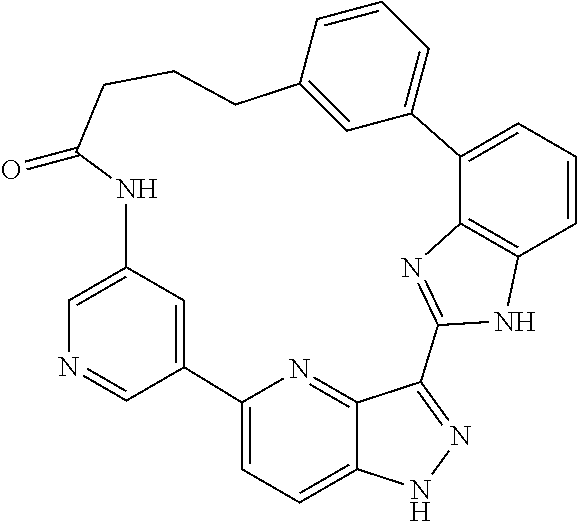 | ||
| 78 |  | ||
| 79 |  | ||
| 80 |  | ||
| 81 |  | ||
| 82 |  | ||
| 83 |  | ||
| 84 |  | ||
| 85 |  | ||
| 86 |  | ||
| 87 |  | ||
| 88 |  | ||
| 89 |  | ||
| 90 |  | ||
| 91 |  | ||
| 92 |  | ||
| 93 |  | ||
| 94 |  | ||
| 95 |  | ||
| 96 |  | ||
| 97 |  | ||
| 98 |  | ||
| 99 |  | ||
| 100 |  | ||
| 101 |  | ||
| 102 |  | ||
| 103 |  | ||
| 104 |  | ||
| 105 |  | ||
| 106 |  | ||
| 107 |  | ||
| 108 |  | ||
| 109 |  | ||
| 110 |  | ||
| 111 |  | ||
| 112 |  | ||
| 113 |  | ||
| 114 |  | ||
| 115 | 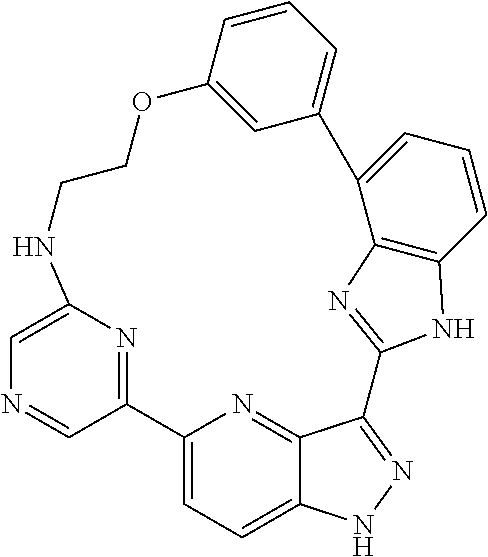 | ||
Administration and Pharmaceutical Compositions
-
- a variety of cancers, including, but not limited to, carcinoma, hematopoietic tumors of lymphoid lineage, hematopoietic tumors of myeloid lineage, tumors of mesenchymal origin, tumors of the central and peripheral nervous system and other tumors including melanoma, seminoma and Kaposi's sarcoma.
- a disease process which features abnormal cellular proliferation, e.g., benign prostatic hyperplasia, familial adenomatosis polyposis, neurofibromatosis, atherosclerosis, arthritis, glomerulonephritis, restenosis following angioplasty or vascular surgery, inflammatory bowel disease, transplantation rejection, endotoxic shock, and fungal infections. Fibrotic disorders such as skin fibrosis; scleroderma; progressive systemic fibrosis; lung fibrosis; muscle fibrosis; kidney fibrosis; glomerulosclerosis; glomerulonephritis; hypertrophic scar formation; uterine fibrosis; renal fibrosis; cirrhosis of the liver, liver fibrosis; fatty liver disease (FLD); adhesions, such as those occurring in the abdomen, pelvis, spine or tendons; chronic obstructive pulmonary disease; fibrosis following myocardial infarction; pulmonary fibrosis; fibrosis and scarring associated with diffuse/interstitial lung disease; central nervous system fibrosis, such as fibrosis following stroke; fibrosis associated with neuro-degenerative disorders such as Alzheimer's Disease or multiple sclerosis; fibrosis associated with proliferative vitreoretinopathy (PVR); restenosis; endometriosis; ischemic disease and radiation fibrosis.
- defective apoptosis-associated conditions, such as cancers (including but not limited to those types mentioned herein), viral infections (including but not limited to herpesvirus, poxvirus, Epstein-Barr virus, Sindbis virus and adenovirus), prevention of AIDS development in HIV-infected individuals, autoimmune diseases (including but not limited to systemic lupus erythematosus, rheumatoid arthritis, sepsis, ankylosing spondylitis, psoriasis, scleroderma, autoimmune mediated glomerulonephritis, inflammatory bowel disease and autoimmune diabetes mellitus), neuro-degenerative disorders (including but not limited to Alzheimer's disease, lung disease, amyotrophic lateral sclerosis, retinitis pigmentosa, Parkinson's disease, AIDS-related dementia, spinal muscular atrophy and cerebellar degeneration), myelodysplastic syndromes, aplastic anemia, ischemic injury associated with myocardial infarctions, stroke and reperfusion injury, arrhythmia, atherosclerosis, toxin-induced or alcohol related liver diseases, hematological diseases (including but not limited to chronic anemia and aplastic anemia), degenerative diseases of the musculoskeletal system (including but not limited to osteoporosis and arthritis), tendinopathies such as tendinitis and tendinosis, aspirin-sensitive rhinosinusitis, cystic fibrosis, multiple sclerosis, kidney diseases and cancer pain.
- genetic diseases due to mutations in Wnt signaling components, such as polyposis coli, bone density and vascular defects in the eye (Osteoporosis-pseudoglioma Syndrome, OPPG), familial exudative vitreoretinopathy, retinal angiogenesis, early coronary disease, tetra-amelia, Müllerian-duct regression and virilization, SERKAL syndrome, type II diabetes, Fuhrmann syndrome, Al-Awadi/Raas-Rothschild/Schinzel phocomelia syndrome, odonto-onycho-dermal dysplasia, obesity, split-hand/foot malformation, caudal duplication, tooth agenesis, Wilms tumor, skeletal dysplasia, focal dermal hypoplasia, autosomal recessive anonychia, neural tube defects, alpha-thalassemia (ATRX) syndrome, fragile X syndrome, ICF syndrome, Angelman syndrome, Prader-Willi syndrome, Beckwith-Wiedemann Syndrome, Norrie disease and Rett syndrome.
-
- The following abbreviations have the indicated meanings:
- brine=saturated aqueous sodium chloride
- CDCl3=deuterated chloroform
- DCE=dichloroethane
- DCM=dichloromethane
- DEAD=diethyl azodicarboxylate
- DIPEA=N,N-diisopropylethylamine
- DMA=dimethylacetamide
- DMAP=4-dimethylaminopyridine
- DMF=N,N-dimethylformamide
- DMSO-d6=deuterated dimethylsulfoxide
- ESIMS=electron spray mass spectrometry
- EtOAc=ethyl acetate
- HATU=1-[Bis(dimethylamino)methylene]-1H-1,2,3-triazolo[4,5-b]pyridinium 3-oxid hexafluorophosphate
- HCl=hydrochloric acid
- HOAc=acetic acid
- ISCO=Teledyne ISCO, Inc brand CombiFlash® Rf 200
- KOAc=potassium acetate
- LC/MS=Liquid chromatography-mass spectrometry
- MeCN=acetonitrile
- MeOH=methanol
- MgSO4=magnesium sulfate
- MW=microwave irradiation
- NaBH3CN=sodium cyanoborohydride
- NaHCO3=sodium bicarbonate
- Na(OAc)3BH=Sodium triacetoxyborohydride
- Na2S2O3=sodium thiosulfate
- NMR=nuclear magnetic resonance
- ON=overnight
- Pd(dppf)Cl2=1,1′-bis(diphenylphosphino)ferrocene-palladium(II)dichloride
- Pd(PPh3)4=tetrakis(triphenylphosphine)palladium(0)
- r.t.=room temperature
- SPhos Pd G4=Methanesulfonato(2-dicyclohexylphosphino-3,6-dimethoxy-2′,4′,6′-tri-i-propyl-1,1′-biphenyl)(2′-methylamino-1,1′-biphenyl-2-yl)palladium(II)
- TBAF=Tetra-n-butylammonium fluoride,
- TEA=triethylamine
- TFA=trifluoroacetic acid
- THF=tetrahydrofuran
- TLC=thin layer chromatography


Step 1

Step 1-2

Step 1

Step 1

Step 1

Step 1

Step 1

Step 1


Step 1


Step 1

Step 1

Step 1

Step 1


Step 1


Step 1

Step 1

Step 1

Step 1

Step 1
| TABLE 2 | |||
| Compound | EC50 (μM) | ||
| 1 | 0.022 | ||
| 2 | 0.022 | ||
| 3 | 0.052 | ||
| 4 | 7.658 | ||
| 5 | 0.124 | ||
| 6 | 0.009 | ||
| 7 | 0.437 | ||
| 8 | 0.042 | ||
| 10 | 0.011 | ||
| 15 | 0.059 | ||
| 22 | 0.010 | ||
| 29 | 0.082 | ||
| 38 | 0.087 | ||
| 45 | 0.338 | ||
| 51 | 0.577 | ||
| 57 | 0.475 | ||
| 64 | >10 (47.4%) | ||
| 71 | 0.017 | ||
| 97 | >10 (22.2%) | ||
| 109 | 0.034 | ||
| TABLE 3 | |||
| Compound | EC50 (μM) | ||
| 1 | 0.266 | ||
| 2 | 0.006 | ||
| 3 | 0.010 | ||
| 4 | 0.204 | ||
| 5 | 0.709 | ||
| 6 | 0.096 | ||
| 7 | >10 | ||
| 8 | 0.003 | ||
| 10 | 0.018 | ||
| 15 | 0.111 | ||
| 22 | 0.068 | ||
| 29 | 0.412 | ||
| 38 | 0.005 | ||
| 45 | 0.004 | ||
| 51 | 0.002 | ||
| 57 | >10 | ||
| 64 | 0.448 | ||
| 71 | 0.014 | ||
| 97 | 0.009 | ||
| 109 | 0.096 | ||
| TABLE 4 | |||
| Compound | EC50 (μM) | ||
| 1 | 0.007 | ||
| 2 | 0.001 | ||
| 3 | 0.001 | ||
| 4 | 0.494 | ||
| 5 | 0.048 | ||
| 6 | 0.004 | ||
| 7 | >10 | ||
| 8 | 0.001 | ||
| 10 | 0.004 | ||
| 15 | 0.010 | ||
| 22 | 0.011 | ||
| 29 | 0.015 | ||
| 38 | 0.001 | ||
| 45 | 0.001 | ||
| 51 | 0.002 | ||
| 57 | 1.866 | ||
| 64 | 0.088 | ||
| 71 | 0.014 | ||
| 97 | 0.010 | ||
| 109 | 0.062 | ||
| TABLE 5 | |||
| Compound | EC50 (μM) | ||
| 1 | 0.094 | ||
| 2 | 0.080 | ||
| 3 | 2.755 | ||
| 4 | >10 (49.5%) | ||
| 5 | 0.407 | ||
| 6 | 0.142 | ||
| 7 | 0.455 | ||
| 8 | 0.049 | ||
| 10 | 0.026 | ||
| 15 | 0.118 | ||
| 22 | 0.014 | ||
| 29 | 0.170 | ||
| 38 | 0.415 | ||
| 45 | >10 (44.1%) | ||
| 51 | 0.515 | ||
| 57 | 0.670 | ||
| 64 | >10 (15.8%) | ||
| 71 | 0.035 | ||
| 97 | >10 (25.0%) | ||
| 109 | 0.054 | ||
| TABLE 6 | |||
| Compound | EC50 (μM) | ||
| 1 | 0.024 | ||
| 2 | 0.224 | ||
| 3 | 0.042 | ||
| 5 | 0.078 | ||
| 6 | 0.029 | ||
| 7 | 0.560 | ||
| 8 | 0.019 | ||
| 10 | 9.985 | ||
| 15 | 0.087 | ||
| 22 | 0.035 | ||
| 29 | 0.077 | ||
| 38 | 0.038 | ||
| 45 | 1.541 | ||
| 51 | 0.203 | ||
| 57 | 0.637 | ||
| 64 | 10 (72.0%) | ||
| 71 | 0.021 | ||
| 97 | 0.406 | ||
| TABLE 7 | |||
| Compound | EC50 (μM) | ||
| 1 | 0.381 | ||
| 2 | 3.819 | ||
| 3 | >10 (43.7%) | ||
| 5 | >10 (9.2%) | ||
| 6 | >10 (9.5%) | ||
| 7 | >10 (11.6%) | ||
| 8 | 0.065 | ||
| 10 | 0.135 | ||
| 15 | 0.585 | ||
| 22 | 0.161 | ||
| 29 | 0.241 | ||
| 38 | 0.612 | ||
| 45 | >10 (5.9%) | ||
| 51 | 0.414 | ||
| 57 | 3.009 | ||
| 64 | >10 (12.7%) | ||
| 97 | >10 (25.7%) | ||
| TABLE 8 | |||
| Conc (nM) | Max. Activity | Conc (nM) of | |
| of Max. | as % TGF-β3 | 50% TGF-β3 | |
| Compound | activity | activity | activity |
| 1 | 5000 | 497 | 200 |
| 3 | 100 | 225 | 50 |
| 8 | 1700 | 558 | 200 |
| 10 | 600 | 607 | 50 |
| 22 | 600 | 440 | 50 |
| 38 | 100 | 185 | 100 |
| 51 | 5000 | 231 | 5000 |
| TABLE 9 | |||
| Compound | EC50 (μM) | ||
| 1 | 0.012 | ||
| 2 | 0.058 | ||
| 3 | 0.028 | ||
| 4 | 0.069 | ||
| 5 | 0.213 | ||
| 6 | 0.016 | ||
| 7 | 0.022 | ||
| 8 | 0.206 | ||
| 10 | 0.010 | ||
| 15 | 0.051 | ||
| 22 | 0.796 | ||
| 29 | 0.069 | ||
| 38 | 0.036 | ||
| 45 | 0.022 | ||
| 51 | 0.093 | ||
| 57 | 0.025 | ||
| 64 | 0.147 | ||
| 71 | 3.115 | ||
| 97 | 0.069 | ||
| 109 | 0.009 | ||
Claims (16)


Priority Applications (1)
| Application Number | Priority Date | Filing Date | Title |
|---|---|---|---|
| US16/440,284 US10759799B2 (en) | 2018-06-15 | 2019-06-13 | Indazole containing macrocycles and therapeutic uses thereof |
Applications Claiming Priority (2)
| Application Number | Priority Date | Filing Date | Title |
|---|---|---|---|
| US201862685764P | 2018-06-15 | 2018-06-15 | |
| US16/440,284 US10759799B2 (en) | 2018-06-15 | 2019-06-13 | Indazole containing macrocycles and therapeutic uses thereof |
Publications (2)
| Publication Number | Publication Date |
|---|---|
| US20190382402A1 US20190382402A1 (en) | 2019-12-19 |
| US10759799B2 true US10759799B2 (en) | 2020-09-01 |
Family
ID=67263040
Family Applications (1)
| Application Number | Title | Priority Date | Filing Date |
|---|---|---|---|
| US16/440,284 Active US10759799B2 (en) | 2018-06-15 | 2019-06-13 | Indazole containing macrocycles and therapeutic uses thereof |
Country Status (2)
| Country | Link |
|---|---|
| US (1) | US10759799B2 (en) |
| WO (1) | WO2019241540A1 (en) |
Families Citing this family (10)
| Publication number | Priority date | Publication date | Assignee | Title |
|---|---|---|---|---|
| WO2021121420A1 (en) * | 2019-12-20 | 2021-06-24 | 江苏凯迪恩医药科技有限公司 | Benzopyrazole compound and intermediate, preparation method, and application thereof |
| US12545689B2 (en) * | 2020-05-06 | 2026-02-10 | Oncodesign Precision Medicine | Macrocyclic LRRK2 kinase inhibitors |
| JP2024512449A (en) * | 2021-03-18 | 2024-03-19 | レ ラボラトワール セルヴィエ | Macrocyclic LRRK2 kinase inhibitor |
| CN115838373A (en) * | 2021-09-18 | 2023-03-24 | 北京伯汇生物技术有限公司 | Azaindazole macrocycles and uses thereof |
| MX2024014994A (en) * | 2022-06-08 | 2025-02-10 | Blossomhill Therapeutics Inc | Indazole macrocycles and their use |
| CN115353508B (en) * | 2022-08-24 | 2023-07-21 | 中国药科大学 | 5-pyridine-1H-indazole compound, pharmaceutical composition and application |
| CN118184669B (en) * | 2023-03-17 | 2025-09-23 | 北京伯汇生物技术有限公司 | Macrocyclic compounds as multi-target kinase inhibitors |
| WO2024229091A1 (en) * | 2023-05-02 | 2024-11-07 | Blossomhill Therapeutics, Inc. | Egfr inhibitors for treating disease |
| WO2025122859A1 (en) * | 2023-12-08 | 2025-06-12 | Blossomhill Therapeutics, Inc. | Indazole-based macrocyclic compounds |
| WO2025199438A1 (en) * | 2024-03-22 | 2025-09-25 | Blossomhill Therapeutics, Inc. | 7-azaindazole macrocycles and their use |
Citations (6)
| Publication number | Priority date | Publication date | Assignee | Title |
|---|---|---|---|---|
| WO2011019651A1 (en) | 2009-08-10 | 2011-02-17 | Epitherix, Llc | Indazole inhibitors of the wnt signal pathway and therapeutic uses thereof |
| WO2011084486A1 (en) | 2009-12-21 | 2011-07-14 | Epitherix, Llc | 1h-pyrazolo[3,4-b]pyridines and therapeutic uses thereof |
| WO2013040215A1 (en) | 2011-09-14 | 2013-03-21 | Samumed, Llc | Indazole-3-carboxamides and their use as wnt/b-catenin signaling pathway inhibitors |
| WO2013151708A1 (en) | 2012-04-04 | 2013-10-10 | Samumed, Llc | Indazole inhibitors of the wnt signal pathway and therapeutic uses thereof |
| WO2013166396A2 (en) | 2012-05-04 | 2013-11-07 | Samumed, Llc | 1h-pyrazolo[3,4-b]pyridines and therapeutic uses thereof |
| WO2014110086A2 (en) | 2013-01-08 | 2014-07-17 | Samumed, Llc | 3-(benzoimidazol-2-yl)-indazole inhibitors of the wnt signaling pathway and therapeutic uses thereof |
Family Cites Families (10)
| Publication number | Priority date | Publication date | Assignee | Title |
|---|---|---|---|---|
| US4164559A (en) | 1977-09-21 | 1979-08-14 | Cornell Research Foundation, Inc. | Collagen drug delivery device |
| US4474752A (en) | 1983-05-16 | 1984-10-02 | Merck & Co., Inc. | Drug delivery system utilizing thermosetting gels |
| US4783443A (en) | 1986-03-03 | 1988-11-08 | The University Of Chicago | Amino acyl cephalosporin derivatives |
| US6440102B1 (en) | 1998-07-23 | 2002-08-27 | Durect Corporation | Fluid transfer and diagnostic system for treating the inner ear |
| DE19853299C2 (en) | 1998-11-19 | 2003-04-03 | Thomas Lenarz | Catheter for the application of medication in fluid spaces of the human inner ear |
| US6120484A (en) | 1999-02-17 | 2000-09-19 | Silverstein; Herbert | Otological implant for delivery of medicament and method of using same |
| US6967023B1 (en) | 2000-01-10 | 2005-11-22 | Foamix, Ltd. | Pharmaceutical and cosmetic carrier or composition for topical application |
| YU54202A (en) | 2000-01-18 | 2006-01-16 | Agouron Pharmaceuticals Inc. | Indazole compounds,pharmaceutical compositions,and methods for mediating or inhibiting cell proliferation |
| US6648873B2 (en) | 2001-09-21 | 2003-11-18 | Durect Corp. | Aural catheter system including anchor balloon and balloon inflation device |
| US7008953B2 (en) | 2003-07-30 | 2006-03-07 | Agouron Pharmaceuticals, Inc. | 3, 5 Disubstituted indazole compounds, pharmaceutical compositions, and methods for mediating or inhibiting cell proliferation |
-
2019
- 2019-06-13 WO PCT/US2019/037024 patent/WO2019241540A1/en not_active Ceased
- 2019-06-13 US US16/440,284 patent/US10759799B2/en active Active
Patent Citations (6)
| Publication number | Priority date | Publication date | Assignee | Title |
|---|---|---|---|---|
| WO2011019651A1 (en) | 2009-08-10 | 2011-02-17 | Epitherix, Llc | Indazole inhibitors of the wnt signal pathway and therapeutic uses thereof |
| WO2011084486A1 (en) | 2009-12-21 | 2011-07-14 | Epitherix, Llc | 1h-pyrazolo[3,4-b]pyridines and therapeutic uses thereof |
| WO2013040215A1 (en) | 2011-09-14 | 2013-03-21 | Samumed, Llc | Indazole-3-carboxamides and their use as wnt/b-catenin signaling pathway inhibitors |
| WO2013151708A1 (en) | 2012-04-04 | 2013-10-10 | Samumed, Llc | Indazole inhibitors of the wnt signal pathway and therapeutic uses thereof |
| WO2013166396A2 (en) | 2012-05-04 | 2013-11-07 | Samumed, Llc | 1h-pyrazolo[3,4-b]pyridines and therapeutic uses thereof |
| WO2014110086A2 (en) | 2013-01-08 | 2014-07-17 | Samumed, Llc | 3-(benzoimidazol-2-yl)-indazole inhibitors of the wnt signaling pathway and therapeutic uses thereof |
Non-Patent Citations (1)
| Title |
|---|
| International Search Report and Written Opinion in Appln No. PCT/US2019/037024, dated Aug. 16, 2019, 10 pages. |
Also Published As
| Publication number | Publication date |
|---|---|
| WO2019241540A1 (en) | 2019-12-19 |
| US20190382402A1 (en) | 2019-12-19 |
Similar Documents
| Publication | Publication Date | Title |
|---|---|---|
| US10052331B2 (en) | 3-(3H-imidazo[4,5-C]pyridin-2-yl)-1H-pyrazolo[3,4-C]pyridine and therapeutic uses thereof | |
| US10596154B2 (en) | 3-(1H-imidazo[4,5-C]pyridin-2-yl)-1H-pyrazolo[3,4-C]pyridine and therapeutic uses thereof | |
| US10526347B2 (en) | 3-(3H-imidazo[4,5-B]pyridin-2-yl)-1H-pyrazolo[3,4-B]pyridine and therapeutic uses thereof | |
| US10280166B2 (en) | 2-(1H-indazol-3-yl)-3H-imidazo[4,5-B]pyridine and therapeutic uses thereof | |
| US10533020B2 (en) | 3-(3H-imidazo[4,5-B]pyridin-2-yl)-1 H-pyrazolo[3,4-C]pyridine and therapeutic uses thereof | |
| US10392383B2 (en) | 3-(1H-benzo[d]imidazol-2-yl)-1H-pyrazolo[4,3-b]pyridines and therapeutic uses thereof | |
| US10188634B2 (en) | 3-(3H-imidazo[4,5-C]pyridin-2-yl)-1 H-pyrazolo[4,3-B]pyridines and therapeutic uses thereof | |
| US10329309B2 (en) | 3-(3H-imidazo[4,5-B]pyridin-2-yl)-1H-pyrazolo[4,3-B]pyridines and therapeutic uses thereof | |
| US10195185B2 (en) | 3-(1H-imidazo[4,5-C]pyridin-2-yl)-1H-pyrazolo[4,3-B]pyridines and therapeutic uses thereof | |
| US9828372B2 (en) | 2-(1H-indazol-3-yl)-1H-imidazo[4,5-C]pyridine and therapeutic uses thereof | |
| US10206909B2 (en) | 3-(1H-pyrrolo[2,3-B]pyridin-2-yl)-1H-pyrazolo[4,3-B]pyridines and therapeutic uses thereof | |
| US10206908B2 (en) | 3-(1H-pyrrolo[3,2-C]pyridin-2-YL)-1H-pyrazolo[3,4-C]pyridines and therapeutic uses thereof | |
| US10285982B2 (en) | 3-(1H-pyrrolo[2,3-B]pyridin-2-yl)-1H-pyrazolo[3,4-C]pyridines and therapeutic uses thereof | |
| US20190382402A1 (en) | Indazole containing macrocycles and therapeutic uses thereof | |
| US20160068529A1 (en) | 3-(1h-benzo[d]imidazol-2-yl)-1h-pyrazolo[3,4-c]pyridine and therapeutic uses thereof | |
| BR112014023639B1 (en) | INDAZOLE INHIBITOR COMPOUND, PHARMACEUTICAL COMPOSITION COMPRISING SUCH COMPOUND AND THERAPEUTIC USE THEREOF |
Legal Events
| Date | Code | Title | Description |
|---|---|---|---|
| FEPP | Fee payment procedure |
Free format text: ENTITY STATUS SET TO UNDISCOUNTED (ORIGINAL EVENT CODE: BIG.); ENTITY STATUS OF PATENT OWNER: SMALL ENTITY |
|
| FEPP | Fee payment procedure |
Free format text: ENTITY STATUS SET TO SMALL (ORIGINAL EVENT CODE: SMAL); ENTITY STATUS OF PATENT OWNER: SMALL ENTITY |
|
| STPP | Information on status: patent application and granting procedure in general |
Free format text: DOCKETED NEW CASE - READY FOR EXAMINATION |
|
| STPP | Information on status: patent application and granting procedure in general |
Free format text: NON FINAL ACTION MAILED |
|
| AS | Assignment |
Owner name: SAMUMED, LLC, CALIFORNIA Free format text: ASSIGNMENT OF ASSIGNORS INTEREST;ASSIGNORS:KC, SUNIL KUMAR;HOFILENA, BRIAN JOSEPH;MITTAPALLI, GOPI KUMAR;AND OTHERS;SIGNING DATES FROM 20190620 TO 20190701;REEL/FRAME:051937/0047 |
|
| STPP | Information on status: patent application and granting procedure in general |
Free format text: NOTICE OF ALLOWANCE MAILED -- APPLICATION RECEIVED IN OFFICE OF PUBLICATIONS |
|
| STPP | Information on status: patent application and granting procedure in general |
Free format text: PUBLICATIONS -- ISSUE FEE PAYMENT RECEIVED |
|
| STCF | Information on status: patent grant |
Free format text: PATENTED CASE |
|
| AS | Assignment |
Owner name: BIOSPLICE THERAPEUTICS, INC., CALIFORNIA Free format text: ASSIGNMENT OF ASSIGNORS INTEREST;ASSIGNOR:SAMUMED, LLC;REEL/FRAME:055694/0001 Effective date: 20210305 |
|
| AS | Assignment |
Owner name: MED-PATHWAYS II LIMITED, VIRGIN ISLANDS, BRITISH Free format text: SECURITY INTEREST;ASSIGNOR:BIOSPLICE THERAPEUTICS, INC.;REEL/FRAME:061433/0786 Effective date: 20220912 Owner name: VICKERS-SPLICE CO-INVESTMENT LLC, CAYMAN ISLANDS Free format text: SECURITY INTEREST;ASSIGNOR:BIOSPLICE THERAPEUTICS, INC.;REEL/FRAME:061433/0786 Effective date: 20220912 Owner name: VICKERS VENTURE FUND VI (PLAN) PTE. LTD., SINGAPORE Free format text: SECURITY INTEREST;ASSIGNOR:BIOSPLICE THERAPEUTICS, INC.;REEL/FRAME:061433/0786 Effective date: 20220912 Owner name: VICKERS VENTURE FUND VI PTE. LTD., SINGAPORE Free format text: SECURITY INTEREST;ASSIGNOR:BIOSPLICE THERAPEUTICS, INC.;REEL/FRAME:061433/0786 Effective date: 20220912 |
|
| FEPP | Fee payment procedure |
Free format text: SURCHARGE FOR LATE PAYMENT, SMALL ENTITY (ORIGINAL EVENT CODE: M2554); ENTITY STATUS OF PATENT OWNER: SMALL ENTITY |
|
| MAFP | Maintenance fee payment |
Free format text: PAYMENT OF MAINTENANCE FEE, 4TH YR, SMALL ENTITY (ORIGINAL EVENT CODE: M2551); ENTITY STATUS OF PATENT OWNER: SMALL ENTITY Year of fee payment: 4 |