US10743788B2 - Bio-electrode composition, bio-electrode, and method for manufacturing a bio-electrode - Google Patents
Bio-electrode composition, bio-electrode, and method for manufacturing a bio-electrode Download PDFInfo
- Publication number
- US10743788B2 US10743788B2 US16/137,885 US201816137885A US10743788B2 US 10743788 B2 US10743788 B2 US 10743788B2 US 201816137885 A US201816137885 A US 201816137885A US 10743788 B2 US10743788 B2 US 10743788B2
- Authority
- US
- United States
- Prior art keywords
- group
- carbon atoms
- bio
- linear
- electrode
- Prior art date
- Legal status (The legal status is an assumption and is not a legal conclusion. Google has not performed a legal analysis and makes no representation as to the accuracy of the status listed.)
- Active, expires
Links
- 0 [1*][N+]([2*])([3*])[4*] Chemical compound [1*][N+]([2*])([3*])[4*] 0.000 description 103
- YHZAAYHJSFMLOG-UHFFFAOYSA-M CC.CC(=O)[N-]S(=O)(=O)[Rf][Rf][Rf][Rf][Rf][Rf][Rf].CC([Rf])([Rf][Rf])C([Rf][Rf][Rf])([Rf][Rf][Rf][Rf])S(=O)(=O)[O-].CC1=CC=C(S(=O)(=O)[O-])C=C1.CS(=O)(=O)[N-]S(=O)(=O)[Rf][Rf][Rf][Rf][Rf][Rf].[CH3+].[CH3+].[CH3+].[CH3+] Chemical compound CC.CC(=O)[N-]S(=O)(=O)[Rf][Rf][Rf][Rf][Rf][Rf][Rf].CC([Rf])([Rf][Rf])C([Rf][Rf][Rf])([Rf][Rf][Rf][Rf])S(=O)(=O)[O-].CC1=CC=C(S(=O)(=O)[O-])C=C1.CS(=O)(=O)[N-]S(=O)(=O)[Rf][Rf][Rf][Rf][Rf][Rf].[CH3+].[CH3+].[CH3+].[CH3+] YHZAAYHJSFMLOG-UHFFFAOYSA-M 0.000 description 5
- VOCTWBSFOPUMIA-VIVNKERVSA-N C#CC(=O)OCC[N+](C)(C)C.C#CC(=O)OCC[N+](CC)(CC)CC.C#CC(=O)OCC[N+](CC)(CCC)CCC.C#CC(=O)OCC[N+](CC)(CCC)CCCC.CC#CC(=O)OCC[N+](C)(C)C.CC#CC(=O)OCC[N+](CC)(CC)CC.CC#CC(=O)OCC[N+](CC)(CCC)CCC.CCCC[N+](CC)(CCC)CCOC(=O)/C=C/C1=CC=CC=C1.CCC[N+](CC)(CCC)CCOC(=O)/C=C/C1=CC=CC=C1 Chemical compound C#CC(=O)OCC[N+](C)(C)C.C#CC(=O)OCC[N+](CC)(CC)CC.C#CC(=O)OCC[N+](CC)(CCC)CCC.C#CC(=O)OCC[N+](CC)(CCC)CCCC.CC#CC(=O)OCC[N+](C)(C)C.CC#CC(=O)OCC[N+](CC)(CC)CC.CC#CC(=O)OCC[N+](CC)(CCC)CCC.CCCC[N+](CC)(CCC)CCOC(=O)/C=C/C1=CC=CC=C1.CCC[N+](CC)(CCC)CCOC(=O)/C=C/C1=CC=CC=C1 VOCTWBSFOPUMIA-VIVNKERVSA-N 0.000 description 1
- HWAZCLZUPYVUQC-UHFFFAOYSA-N C#CC(=O)SCC[N+](C)(C)C.C#CC(=O)SCC[N+](CC)(CC)CC.C#CC(=O)SCC[N+](CC)(CCC)CCC.C#CC(=O)SCC[N+](CC)(CCC)CCCC.C=C(C)C(=O)SCC[N+](C)(C)C.C=C(C)C(=O)SCC[N+](CC)(CC)CC.C=C(C)C(=O)SCC[N+](CC)(CCC)CCC.C=C(C)C(=O)SCC[N+](CC)(CCC)CCCC Chemical compound C#CC(=O)SCC[N+](C)(C)C.C#CC(=O)SCC[N+](CC)(CC)CC.C#CC(=O)SCC[N+](CC)(CCC)CCC.C#CC(=O)SCC[N+](CC)(CCC)CCCC.C=C(C)C(=O)SCC[N+](C)(C)C.C=C(C)C(=O)SCC[N+](CC)(CC)CC.C=C(C)C(=O)SCC[N+](CC)(CCC)CCC.C=C(C)C(=O)SCC[N+](CC)(CCC)CCCC HWAZCLZUPYVUQC-UHFFFAOYSA-N 0.000 description 1
- LRQUDTOUIKBPEJ-UHFFFAOYSA-N C#CC1=CC=C(C[N+](C)(C)C)C=C1.C=CC1=CC=C(C[N+](C)(C)C)C=C1.CC(=O)C1=CC=C(C[N+](C)(C)C)C=C1.CC(=O)C1=CC=CC(C[N+](C)(C)C)=C1.CC(=O)OC1=CC=C(C[N+](C)(C)C)C=C1.CC(C)(C)C(=O)OC1=CC=C(C[N+](C)(C)C)C=C1.CC(C)(C)OC1=CC=C(C[N+](C)(C)C)C=C1.CC(C)C(=O)OC1=CC=C(C[N+](C)(C)C)C=C1.CCC(=O)OC1=CC=C(C[N+](C)(C)C)C=C1.CCOC1=CC=C(C[N+](C)(C)C)C=C1.COC1=CC=C(C[N+](C)(C)C)C=C1.C[N+](C)(C)CC1=CC=C(C2=CC=CC=C2)C=C1.C[N+](C)(C)CC1=CC=C(C2CCCCC2)C=C1 Chemical compound C#CC1=CC=C(C[N+](C)(C)C)C=C1.C=CC1=CC=C(C[N+](C)(C)C)C=C1.CC(=O)C1=CC=C(C[N+](C)(C)C)C=C1.CC(=O)C1=CC=CC(C[N+](C)(C)C)=C1.CC(=O)OC1=CC=C(C[N+](C)(C)C)C=C1.CC(C)(C)C(=O)OC1=CC=C(C[N+](C)(C)C)C=C1.CC(C)(C)OC1=CC=C(C[N+](C)(C)C)C=C1.CC(C)C(=O)OC1=CC=C(C[N+](C)(C)C)C=C1.CCC(=O)OC1=CC=C(C[N+](C)(C)C)C=C1.CCOC1=CC=C(C[N+](C)(C)C)C=C1.COC1=CC=C(C[N+](C)(C)C)C=C1.C[N+](C)(C)CC1=CC=C(C2=CC=CC=C2)C=C1.C[N+](C)(C)CC1=CC=C(C2CCCCC2)C=C1 LRQUDTOUIKBPEJ-UHFFFAOYSA-N 0.000 description 1
- VNODBFMFXUBQRH-UIWJWKKBSA-N C#COCC[N+](C)(C)C.C#COCC[N+](CC)(CC)CC.C#COCC[N+](CC)(CCC)CCC.C#COCC[N+](CC)(CCC)CCCC.C/C=C/OCC[N+](C)(C)C.C=COCC[N+](C)(C)C.C=COCC[N+](CC)(CC)CC.C=COCC[N+](CC)(CCC)CCC.C=COCC[N+](CC)(CCC)CCCC.CC#COCC[N+](C)(C)C.CC#COCC[N+](CC)(CC)CC.CC#COCC[N+](CC)(CCC)CCC.CC#COCC[N+](CC)(CCC)CCCC.CCCC[N+](CC)(CCC)CCOC1=CC=CC=C1.CCC[N+](CC)(CCC)CCOC1=CC=CC=C1 Chemical compound C#COCC[N+](C)(C)C.C#COCC[N+](CC)(CC)CC.C#COCC[N+](CC)(CCC)CCC.C#COCC[N+](CC)(CCC)CCCC.C/C=C/OCC[N+](C)(C)C.C=COCC[N+](C)(C)C.C=COCC[N+](CC)(CC)CC.C=COCC[N+](CC)(CCC)CCC.C=COCC[N+](CC)(CCC)CCCC.CC#COCC[N+](C)(C)C.CC#COCC[N+](CC)(CC)CC.CC#COCC[N+](CC)(CCC)CCC.CC#COCC[N+](CC)(CCC)CCCC.CCCC[N+](CC)(CCC)CCOC1=CC=CC=C1.CCC[N+](CC)(CCC)CCOC1=CC=CC=C1 VNODBFMFXUBQRH-UIWJWKKBSA-N 0.000 description 1
- FKLFZMYNTAJTQI-SXWVZWQRSA-N C#C[N+]1(C)CCCC1.C#C[N+]1(C)CCCCC1.C/C=C/[N+]1(C)CCCC1.C/C=C/[N+]1(C)CCCCC1.C=C(C)C(=O)OC1CC(C)(C)[N+](C)(C)C(C)(C)C1.C=C(C)C(=O)OC1CC(C)[N+](C)(C)C(C)C1.C=C(C)C(=O)OC1CC[N+](C)(C)CC1.C=C[N+]1(C)CCCC1.C=C[N+]1(C)CCCCC1.CC#C[N+]1(C)CCCC1.CC#C[N+]1(C)CCCCC1.CC(C)(C)C[N+]1(C)CCCCC1.CC(C)(C)[N+]1(C)CCCCC1.CC(C)C[N+]1(C)CCCCC1.CC(C)[N+]1(C)CCCCC1.CC/C=C/[N+]1(C)CCCC1.CC/C=C/[N+]1(C)CCCCC1.CCC#C[N+]1(C)CCCC1.CCC#C[N+]1(C)CCCCC1.CCCCCC[N+]1(C)CCCCC1.CCCCC[N+]1(C)CCCCC1.CCCC[N+]1(C)CCCCC1.CCC[N+]1(C)CCCCC1.CC[N+]1(C)CCCCC1.C[N+]1(C)CCCCC1.C[N+]1(C)CCNCC1.C[N+]1(C)CCOCC1.C[N+]1(C)CCSCC1.C[N+]1(CC2=CC=CC=C2)CCCC1.C[N+]1(CCC2=CC=CC=C2)CCCC1.C[N+]1(CCCC2=CC=CC=C2)CCCC1 Chemical compound C#C[N+]1(C)CCCC1.C#C[N+]1(C)CCCCC1.C/C=C/[N+]1(C)CCCC1.C/C=C/[N+]1(C)CCCCC1.C=C(C)C(=O)OC1CC(C)(C)[N+](C)(C)C(C)(C)C1.C=C(C)C(=O)OC1CC(C)[N+](C)(C)C(C)C1.C=C(C)C(=O)OC1CC[N+](C)(C)CC1.C=C[N+]1(C)CCCC1.C=C[N+]1(C)CCCCC1.CC#C[N+]1(C)CCCC1.CC#C[N+]1(C)CCCCC1.CC(C)(C)C[N+]1(C)CCCCC1.CC(C)(C)[N+]1(C)CCCCC1.CC(C)C[N+]1(C)CCCCC1.CC(C)[N+]1(C)CCCCC1.CC/C=C/[N+]1(C)CCCC1.CC/C=C/[N+]1(C)CCCCC1.CCC#C[N+]1(C)CCCC1.CCC#C[N+]1(C)CCCCC1.CCCCCC[N+]1(C)CCCCC1.CCCCC[N+]1(C)CCCCC1.CCCC[N+]1(C)CCCCC1.CCC[N+]1(C)CCCCC1.CC[N+]1(C)CCCCC1.C[N+]1(C)CCCCC1.C[N+]1(C)CCNCC1.C[N+]1(C)CCOCC1.C[N+]1(C)CCSCC1.C[N+]1(CC2=CC=CC=C2)CCCC1.C[N+]1(CCC2=CC=CC=C2)CCCC1.C[N+]1(CCCC2=CC=CC=C2)CCCC1 FKLFZMYNTAJTQI-SXWVZWQRSA-N 0.000 description 1
- PZHUWXQCRAOISS-UHFFFAOYSA-N C.C.C.C.C.C.C.C.C.C.C.C.C.C.C.C=C(C)C(=O)OCCC[Si](C)(C)O[Si](C)(C)C.C=C(C)C(=O)OCCC[Si](CC)(CC)CC.C=C(C)C(=O)OCCC[Si](O[Si](C)(C)C)(O[Si](C)(C)C)O[Si](C)(C)C.C=C(C)C(=O)OCCC[Si]([Si](C)(C)C)([Si](C)(C)C)[Si](C)(C)C.C=C(C)C(=O)OCCC[Si]1(C)O[Si](C)(C)O[Si](C)(C)O[Si](C)(C)O1.C=C(C)C(=O)OCCOC(=O)NCCC[Si](C)(C)O[Si](C)(C)C.C=C(C)C(=O)OCC[Si]([Si](C)(C)C)([Si](C)(C)C)[Si](C)(C)C.C=C(C)C(=O)O[Si](C)(C)C.C=CC(=O)OCCC[Si](C)(C)O[Si](C)(C)C.C=CC(=O)OCCNC(=O)OCCC[Si](C)(C)O[Si](C)(C)C.C=CC(=O)OCCOC(=O)NCCC[Si](C)(C)O[Si](C)(C)C Chemical compound C.C.C.C.C.C.C.C.C.C.C.C.C.C.C.C=C(C)C(=O)OCCC[Si](C)(C)O[Si](C)(C)C.C=C(C)C(=O)OCCC[Si](CC)(CC)CC.C=C(C)C(=O)OCCC[Si](O[Si](C)(C)C)(O[Si](C)(C)C)O[Si](C)(C)C.C=C(C)C(=O)OCCC[Si]([Si](C)(C)C)([Si](C)(C)C)[Si](C)(C)C.C=C(C)C(=O)OCCC[Si]1(C)O[Si](C)(C)O[Si](C)(C)O[Si](C)(C)O1.C=C(C)C(=O)OCCOC(=O)NCCC[Si](C)(C)O[Si](C)(C)C.C=C(C)C(=O)OCC[Si]([Si](C)(C)C)([Si](C)(C)C)[Si](C)(C)C.C=C(C)C(=O)O[Si](C)(C)C.C=CC(=O)OCCC[Si](C)(C)O[Si](C)(C)C.C=CC(=O)OCCNC(=O)OCCC[Si](C)(C)O[Si](C)(C)C.C=CC(=O)OCCOC(=O)NCCC[Si](C)(C)O[Si](C)(C)C PZHUWXQCRAOISS-UHFFFAOYSA-N 0.000 description 1
- MZLHNGFQXWMMIC-UHFFFAOYSA-N C.C.C.C=C(C)C(=O)NCCC[Si](O[Si](C)(C)C)(O[Si](C)(C)C)O[Si](C)(C)C.C=C(C)C(=O)NCCC[Si]1(C)O[Si](C)(C)O[Si](C)(C)O[Si](C)(C)O1.C=C(C)C(=O)OCCC[Si]12O[Si]3(CC(C)C)O[Si]4(CC(C)C)O[Si](CC(C)C)(O1)O[Si]1(CC(C)C)O[Si](CC(C)C)(O2)O[Si](CC(C)C)(O3)O[Si](CC(C)C)(O4)O1.C=C(C)C(=O)OCCNC(=O)OCCC[Si](C)(C)O[Si](C)(C)C.C=CC1=CC=C([Si](C)(C)C)C=C1.C=CC1=CC=C([Si](C)(C)C[Si](C)(C)C)C=C1.C=CC1=CC=C([Si](C)(C)O[Si](C)(C)C)C=C1.C=CC1=CC=C([Si](C)(C)[Si](C)(C)C)C=C1.C=CC1=CC=C([Si](C[Si](C)(C)C)(C[Si](C)(C)C)C[Si](C)(C)C)C=C1.C=CC1=CC=C([Si](O[Si](C)(C)C)(O[Si](C)(C)C)O[Si](C)(C)C)C=C1 Chemical compound C.C.C.C=C(C)C(=O)NCCC[Si](O[Si](C)(C)C)(O[Si](C)(C)C)O[Si](C)(C)C.C=C(C)C(=O)NCCC[Si]1(C)O[Si](C)(C)O[Si](C)(C)O[Si](C)(C)O1.C=C(C)C(=O)OCCC[Si]12O[Si]3(CC(C)C)O[Si]4(CC(C)C)O[Si](CC(C)C)(O1)O[Si]1(CC(C)C)O[Si](CC(C)C)(O2)O[Si](CC(C)C)(O3)O[Si](CC(C)C)(O4)O1.C=C(C)C(=O)OCCNC(=O)OCCC[Si](C)(C)O[Si](C)(C)C.C=CC1=CC=C([Si](C)(C)C)C=C1.C=CC1=CC=C([Si](C)(C)C[Si](C)(C)C)C=C1.C=CC1=CC=C([Si](C)(C)O[Si](C)(C)C)C=C1.C=CC1=CC=C([Si](C)(C)[Si](C)(C)C)C=C1.C=CC1=CC=C([Si](C[Si](C)(C)C)(C[Si](C)(C)C)C[Si](C)(C)C)C=C1.C=CC1=CC=C([Si](O[Si](C)(C)C)(O[Si](C)(C)C)O[Si](C)(C)C)C=C1 MZLHNGFQXWMMIC-UHFFFAOYSA-N 0.000 description 1
- YVJFAHMJKVIYID-ISEVXXOCSA-N C/C=C/C(=O)OCC[N+](C)(C)C.C/C=C/C(=O)OCC[N+](CC)(CC)CC.C/C=C/C(=O)OCC[N+](CC)(CCC)CCC.C/C=C/C(=O)OCC[N+](CC)(CCC)CCCC.C=C(C)C(=O)OCC[N+](CC)(CCC)CCCC.CC[N+](CC)(CC)CCOC(=O)/C=C/C1=CC=CC=C1.C[N+](C)(C)CCOC(=O)/C=C/C1=CC=CC=C1 Chemical compound C/C=C/C(=O)OCC[N+](C)(C)C.C/C=C/C(=O)OCC[N+](CC)(CC)CC.C/C=C/C(=O)OCC[N+](CC)(CCC)CCC.C/C=C/C(=O)OCC[N+](CC)(CCC)CCCC.C=C(C)C(=O)OCC[N+](CC)(CCC)CCCC.CC[N+](CC)(CC)CCOC(=O)/C=C/C1=CC=CC=C1.C[N+](C)(C)CCOC(=O)/C=C/C1=CC=CC=C1 YVJFAHMJKVIYID-ISEVXXOCSA-N 0.000 description 1
- LETCJECYGUXUCU-BIIPANHASA-R C/C=C/C(=O)SCC[N+](C)(C)C.C/C=C/C(=O)SCC[N+](CC)(CC)CC.C/C=C/C(=O)SCC[N+](CC)(CCC)CCC.C/C=C/C(=O)SCC[N+](CC)(CCC)CCCC.CCCC[N+](CC)(CCC)CCOC(N)=O.CCC[N+](CC)(CCC)CCOC(N)=O.CC[N+](CC)(CC)CCOC(N)=O.C[N+](C)(C)CCOC(N)=O Chemical compound C/C=C/C(=O)SCC[N+](C)(C)C.C/C=C/C(=O)SCC[N+](CC)(CC)CC.C/C=C/C(=O)SCC[N+](CC)(CCC)CCC.C/C=C/C(=O)SCC[N+](CC)(CCC)CCCC.CCCC[N+](CC)(CCC)CCOC(N)=O.CCC[N+](CC)(CCC)CCOC(N)=O.CC[N+](CC)(CC)CCOC(N)=O.C[N+](C)(C)CCOC(N)=O LETCJECYGUXUCU-BIIPANHASA-R 0.000 description 1
- HNXMFBFYOMQSGS-UGAHWVJYSA-N C/C=C/OCC[N+](CC)(CC)CC.C/C=C/OCC[N+](CC)(CCC)CCC.C/C=C/OCC[N+](CC)(CCC)CCCC.CC(=O)OCC[N+](C)(C)C.CCC(=O)OCC[N+](C)(C)C.CCC(=O)OCC[N+](CC)(CC)CC.CCCC(=O)OCC[N+](C)(C)C.CCCC(=O)OCC[N+](CC)(CC)CC.CCCC(=O)OCC[N+](CC)(CCC)CCC.CCCC[N+](CC)(CCC)CCOC(=O)CC.CCCC[N+](CC)(CCC)CCOC(C)=O.CCC[N+](CC)(CCC)CCOC(=O)CC.CCC[N+](CC)(CCC)CCOC(C)=O.CC[N+](CC)(CC)CCOC(C)=O Chemical compound C/C=C/OCC[N+](CC)(CC)CC.C/C=C/OCC[N+](CC)(CCC)CCC.C/C=C/OCC[N+](CC)(CCC)CCCC.CC(=O)OCC[N+](C)(C)C.CCC(=O)OCC[N+](C)(C)C.CCC(=O)OCC[N+](CC)(CC)CC.CCCC(=O)OCC[N+](C)(C)C.CCCC(=O)OCC[N+](CC)(CC)CC.CCCC(=O)OCC[N+](CC)(CCC)CCC.CCCC[N+](CC)(CCC)CCOC(=O)CC.CCCC[N+](CC)(CCC)CCOC(C)=O.CCC[N+](CC)(CCC)CCOC(=O)CC.CCC[N+](CC)(CCC)CCOC(C)=O.CC[N+](CC)(CC)CCOC(C)=O HNXMFBFYOMQSGS-UGAHWVJYSA-N 0.000 description 1
- VEWHERFJGGGQKT-FWXUYZAPSA-N C1CC2C3CCC(C3)C2C1.C1CC2CCC1C2.CC(C)(CO)CO.CC(C)(CO)CO.CC(O)C(C)O.CC1(C)OC(CO)C(CO)O1.CC1=C(C)C(CO)=C(C)C(C)=C1CO.CC1=CC(CO)=C(C)C=C1CO.CCC(C)(CO)CO.CCC(CO)CC(CC)CO.CCCC(C)(CO)CO.CCCCC(C)(CO)CO.CCCCC(CC)(CO)CO.CCCCCCCC(CO)(CO)CCCCCCC.CCO.CCO.CCO.CCO.O=C(CCCCC(=O)OCCO)OCCO.O=C(CCCCC(=O)OCCOCCO)OCCOCCO.O=C(OCCCCCO)OCCCCCO.O=C(OCCCCCOCCO)OCCCCCOCCO.OC/C=C/CO.OC/C=C\CO.OCC#CCO.OCC(CO)CBr.OCC(CO)CCl.OCC/C=C/CCO.OCC1(CO)CC2C=CC1C2.OCC12CC3CC(C1)CC(CO)(C3)C2.OCC1=CC=C(CO)C=C1.OCC1C2C=CC(C2)C1CO.OCC1CCC(CO)CC1.OCCC#CCCO.OCCCCCNCCO.OCCOC/C=C/COCCO.OCCOC12CC3CC(C1)CC(OCCO)(C3)C2.OCCOCC#CCOCCO.OCCSCCCSCCO.OCCSCCSCCO Chemical compound C1CC2C3CCC(C3)C2C1.C1CC2CCC1C2.CC(C)(CO)CO.CC(C)(CO)CO.CC(O)C(C)O.CC1(C)OC(CO)C(CO)O1.CC1=C(C)C(CO)=C(C)C(C)=C1CO.CC1=CC(CO)=C(C)C=C1CO.CCC(C)(CO)CO.CCC(CO)CC(CC)CO.CCCC(C)(CO)CO.CCCCC(C)(CO)CO.CCCCC(CC)(CO)CO.CCCCCCCC(CO)(CO)CCCCCCC.CCO.CCO.CCO.CCO.O=C(CCCCC(=O)OCCO)OCCO.O=C(CCCCC(=O)OCCOCCO)OCCOCCO.O=C(OCCCCCO)OCCCCCO.O=C(OCCCCCOCCO)OCCCCCOCCO.OC/C=C/CO.OC/C=C\CO.OCC#CCO.OCC(CO)CBr.OCC(CO)CCl.OCC/C=C/CCO.OCC1(CO)CC2C=CC1C2.OCC12CC3CC(C1)CC(CO)(C3)C2.OCC1=CC=C(CO)C=C1.OCC1C2C=CC(C2)C1CO.OCC1CCC(CO)CC1.OCCC#CCCO.OCCCCCNCCO.OCCOC/C=C/COCCO.OCCOC12CC3CC(C1)CC(OCCO)(C3)C2.OCCOCC#CCOCCO.OCCSCCCSCCO.OCCSCCSCCO VEWHERFJGGGQKT-FWXUYZAPSA-N 0.000 description 1
- UVNNZPGIOBACHD-UHFFFAOYSA-N C1CC2C3CCC(C3)C2C1.CC(C)(C1=CC=C(N=C=O)C=C1)C1=CC=C(OC#N)C=C1.CC(C)(N=C=O)C1=CC=C(C(C)(C)OC#N)C=C1.CC(C)(OC#N)C1=CC=CC(C(C)(C)OC#N)=C1.CC(C)(OC#N)C1CCCC(C(C)(C)OC#N)C1.CC(N=C=O)C1=CC=C(C(C)OC#N)C=C1.CC(OC#N)C1=CC=CC(C(C)OC#N)=C1.CC1(C)CC(N=C=O)CC(C)(CN=C=O)C1.CC1=C(N=C=O)C=C(N2C(=O)N(C3=CC(N=C=O)=C(C)C=C3)C(=O)N(C3=CC(OC#N)=C(C)C=C3)C2=O)C=C1.CC1=C(OC#N)C=CC=C1N=C=O.CC1=CC(C2=CC=C(OC#N)C(C)=C2)=CC=C1N=C=O.CC1=CC=C(N=C=O)C=C1OC#N.CCN=C=O.CCOC#N.N#COC1=CC(N=C=O)=CC=C1.N#COC1=CC=C(C(=O)C2=CC=C(N=C=O)C=C2)C=C1.N#COC1=CC=C(C2=CC=C(N=C=O)C=C2)C=C1.N#COC1=CC=C(CC2=CC=C(N=C=O)C=C2)C=C1.N#COC1=CC=C(CCC2=CC=C(N=C=O)C=C2)C=C1.N#COC1=CC=C(N=C=O)C=C1.N#COC1CCC(CC2CCC(N=C=O)CC2)CC1.N#COC1CCC(N=C=O)CC1.N#COC1CCCCC1.N#COCC1=CC(CN=C=O)=CC(COC#N)=C1.N#COCC1=CC=C(CN=C=O)C=C1.N#COCC1=CC=CC(COC#N)=C1.N#COCC1CC(CN=C=O)CC(COC#N)C1.N#COCC1CCC(CN=C=O)CC1.N#COCC1CCCC(COC#N)C1.N#COCCCCCCCCN=C=O.N#COCCCCCCN=C=O.N#COCCCCCN=C=O.N#COCCCCN=C=O.N#COCCCN=C=O.N#COCCN=C=O.N#COCN=C=O.O=C=NC1=CC=CC2=C1C=CC=C2N=C=O Chemical compound C1CC2C3CCC(C3)C2C1.CC(C)(C1=CC=C(N=C=O)C=C1)C1=CC=C(OC#N)C=C1.CC(C)(N=C=O)C1=CC=C(C(C)(C)OC#N)C=C1.CC(C)(OC#N)C1=CC=CC(C(C)(C)OC#N)=C1.CC(C)(OC#N)C1CCCC(C(C)(C)OC#N)C1.CC(N=C=O)C1=CC=C(C(C)OC#N)C=C1.CC(OC#N)C1=CC=CC(C(C)OC#N)=C1.CC1(C)CC(N=C=O)CC(C)(CN=C=O)C1.CC1=C(N=C=O)C=C(N2C(=O)N(C3=CC(N=C=O)=C(C)C=C3)C(=O)N(C3=CC(OC#N)=C(C)C=C3)C2=O)C=C1.CC1=C(OC#N)C=CC=C1N=C=O.CC1=CC(C2=CC=C(OC#N)C(C)=C2)=CC=C1N=C=O.CC1=CC=C(N=C=O)C=C1OC#N.CCN=C=O.CCOC#N.N#COC1=CC(N=C=O)=CC=C1.N#COC1=CC=C(C(=O)C2=CC=C(N=C=O)C=C2)C=C1.N#COC1=CC=C(C2=CC=C(N=C=O)C=C2)C=C1.N#COC1=CC=C(CC2=CC=C(N=C=O)C=C2)C=C1.N#COC1=CC=C(CCC2=CC=C(N=C=O)C=C2)C=C1.N#COC1=CC=C(N=C=O)C=C1.N#COC1CCC(CC2CCC(N=C=O)CC2)CC1.N#COC1CCC(N=C=O)CC1.N#COC1CCCCC1.N#COCC1=CC(CN=C=O)=CC(COC#N)=C1.N#COCC1=CC=C(CN=C=O)C=C1.N#COCC1=CC=CC(COC#N)=C1.N#COCC1CC(CN=C=O)CC(COC#N)C1.N#COCC1CCC(CN=C=O)CC1.N#COCC1CCCC(COC#N)C1.N#COCCCCCCCCN=C=O.N#COCCCCCCN=C=O.N#COCCCCCN=C=O.N#COCCCCN=C=O.N#COCCCN=C=O.N#COCCN=C=O.N#COCN=C=O.O=C=NC1=CC=CC2=C1C=CC=C2N=C=O UVNNZPGIOBACHD-UHFFFAOYSA-N 0.000 description 1
- KJIHOCNMMFPMAO-UHFFFAOYSA-N C1CC2C3CCC(C3)C2C1.CC1(C)CC(N=C=O)CC(C)(CN2C(=O)N(CC3(C)CC(N=C=O)CC(C)(C)C3)C(=O)N(CC3(C)CC(OC#N)CC(C)(C)C3)C2=O)C1.CC1(C)CC(OC#N)CC(C)(CN=C=O)C1.CCN=C=O.CCOC#N.N#COCCCCCCN=C=O.N#COCCCCCCNC(=O)N(CCCCCCN=C=O)C(=O)NCCCCCCN=C=O Chemical compound C1CC2C3CCC(C3)C2C1.CC1(C)CC(N=C=O)CC(C)(CN2C(=O)N(CC3(C)CC(N=C=O)CC(C)(C)C3)C(=O)N(CC3(C)CC(OC#N)CC(C)(C)C3)C2=O)C1.CC1(C)CC(OC#N)CC(C)(CN=C=O)C1.CCN=C=O.CCOC#N.N#COCCCCCCN=C=O.N#COCCCCCCNC(=O)N(CCCCCCN=C=O)C(=O)NCCCCCCN=C=O KJIHOCNMMFPMAO-UHFFFAOYSA-N 0.000 description 1
- BEQWSJLBNVSTFC-UHFFFAOYSA-A C1CC[NH2+]CC1.C1COCC[NH2+]1.C1COCC[NH2+]1.C1COCC[NH2+]1.C1COCC[NH2+]1.C1COCC[NH2+]1.C1COCC[NH2+]1.C1COCC[NH2+]1.C1COCC[NH2+]1.C1COCC[NH2+]1.C1COCC[NH2+]1.C1COCC[NH2+]1.CCCO.CCCO.CCOC(=O)C1CCCC1.CCOC(=O)C1CCCCC1.CCOC(=O)CC.CCOC(=O)CCOC.CCOC(C)=O.CCOC(COC)OCC.CCOC(COCCOC)OCCOC.CCOC(COCCOCCOC)OCCOCCOC.CCOC(O)CO.CCOCOC.CCOCOC.O=S1(=O)CC[NH2+]CC1.O=S1(=O)CC[NH2+]CC1 Chemical compound C1CC[NH2+]CC1.C1COCC[NH2+]1.C1COCC[NH2+]1.C1COCC[NH2+]1.C1COCC[NH2+]1.C1COCC[NH2+]1.C1COCC[NH2+]1.C1COCC[NH2+]1.C1COCC[NH2+]1.C1COCC[NH2+]1.C1COCC[NH2+]1.C1COCC[NH2+]1.CCCO.CCCO.CCOC(=O)C1CCCC1.CCOC(=O)C1CCCCC1.CCOC(=O)CC.CCOC(=O)CCOC.CCOC(C)=O.CCOC(COC)OCC.CCOC(COCCOC)OCCOC.CCOC(COCCOCCOC)OCCOCCOC.CCOC(O)CO.CCOCOC.CCOCOC.O=S1(=O)CC[NH2+]CC1.O=S1(=O)CC[NH2+]CC1 BEQWSJLBNVSTFC-UHFFFAOYSA-A 0.000 description 1
- VSIYAGVERKUUMK-UHFFFAOYSA-A C1COCC[NH2+]1.C1COCC[NH2+]1.C1COCC[NH2+]1.C1COCC[NH2+]1.C1COCC[NH2+]1.C1COCC[NH2+]1.C1COCC[NH2+]1.C1COCC[NH2+]1.C1COCC[NH2+]1.C1CSCC[NH2+]1.CCO.CCO.CCO.CCOC.CCOC.CCOCCO.CCOCCOC.CCOCCOCCOC.CCOCCOCCOCCOC.CCOCCOCCOCCOCCOC.COCCOCCOCC[NH+](CCOCCOCCOC)CCOCCOCCOC.COCCOCOCC[NH+](CCOCOCCOC)CCOCOCCOC.O=S1(=O)CC[NH2+]CC1.O=S1(=O)CC[NH2+]CC1.OCCCOC[NH+](CCOCCO)CCOCCO Chemical compound C1COCC[NH2+]1.C1COCC[NH2+]1.C1COCC[NH2+]1.C1COCC[NH2+]1.C1COCC[NH2+]1.C1COCC[NH2+]1.C1COCC[NH2+]1.C1COCC[NH2+]1.C1COCC[NH2+]1.C1CSCC[NH2+]1.CCO.CCO.CCO.CCOC.CCOC.CCOCCO.CCOCCOC.CCOCCOCCOC.CCOCCOCCOCCOC.CCOCCOCCOCCOCCOC.COCCOCCOCC[NH+](CCOCCOCCOC)CCOCCOCCOC.COCCOCOCC[NH+](CCOCOCCOC)CCOCOCCOC.O=S1(=O)CC[NH2+]CC1.O=S1(=O)CC[NH2+]CC1.OCCCOC[NH+](CCOCCO)CCOCCO VSIYAGVERKUUMK-UHFFFAOYSA-A 0.000 description 1
- TVFCZGDBXKMABB-UHFFFAOYSA-P C1COCC[NH2+]1.C1COCC[NH2+]1.CCOC(=O)CCOCCOC.CCOC(=O)CCOCCOCCOC Chemical compound C1COCC[NH2+]1.C1COCC[NH2+]1.CCOC(=O)CCOCCOC.CCOC(=O)CCOCCOCCOC TVFCZGDBXKMABB-UHFFFAOYSA-P 0.000 description 1
- UTZAUICQRYLOFB-UHFFFAOYSA-Q C=C(C)C(=O)NCCC[N+](C)(C)C.C=C(C)C(=O)NCC[N+](C)(C)C.C=C(C)C(=O)OCCC[N+](C)(C)C.C=CC(=O)NCCC[N+](C)(C)C.C=CC(=O)OCCC[N+](C)(C)C.CCCC[N+](CC)(CCC)CCOCC1=CC=CC=C1.CCC[N+](CC)(CCC)CCOCC1=CC=CC=C1.CC[N+](CC)(CC)CCOCC1=CC=CC=C1.C[N+](C)(C)CCOCC1=CC=CC=C1 Chemical compound C=C(C)C(=O)NCCC[N+](C)(C)C.C=C(C)C(=O)NCC[N+](C)(C)C.C=C(C)C(=O)OCCC[N+](C)(C)C.C=CC(=O)NCCC[N+](C)(C)C.C=CC(=O)OCCC[N+](C)(C)C.CCCC[N+](CC)(CCC)CCOCC1=CC=CC=C1.CCC[N+](CC)(CCC)CCOCC1=CC=CC=C1.CC[N+](CC)(CC)CCOCC1=CC=CC=C1.C[N+](C)(C)CCOCC1=CC=CC=C1 UTZAUICQRYLOFB-UHFFFAOYSA-Q 0.000 description 1
- PFMAZZIVIHMEFZ-VZFSAEPMSA-N C=C(C)C(=O)OCCCN=C=O.C=C(C)C(=O)OCCN=C=O.C=C(C)C(=O)OCCOCCN=C=O.C=C(C)C(=O)OCCOCCOCCN=C=O.C=CC(=O)OCC(C)CN=C=O.C=CC(=O)OCCCCN=C=O.C=CC(=O)OCCCN=C=O.C=CC(=O)OCCN=C=O.C=CC(=O)OCCOCCN=C=O.C=CC(=O)OCCOCCOCCN=C=O.CC1(C)CC(N=C=O)CC(C)(CN2C(=O)N(CC3(C)CC(N=C=O)CC(C)(C)C3)C(=O)N(CC3(C)CC(OC#N)CC(C)(C)C3)C2=O)C1.CCC.CCC.CCC(=O)C(CCCCN=C=O)OC#N.CCC(COC(=O)CC1=CC(N=C=O)=C(C)C=C1)(COC(=O)NC1=CC(N=C=O)=C(C)C=C1)COC(=O)NC1=CC(OC#N)=C(C)C=C1.CCCCC/C=C\C1C(CCCCCCCCN=C=O)C=CC(CCCCC)C1CCCCCCCCN=C=O.N#COC1=CC=C(OC2=CC=C(N=C=O)C=C2)C=C1.N#COCCCCC(N=C=O)C(=O)CCN=C=O.N#COCCCCCC/N=C1\NC(=O)N(CCCCCCN=C=O)C(=O)N1CCCCCCN=C=O.N#COCCCCCCN1C(=O)N(CCCCCCN=C=O)C(=O)N(CCCCCCN=C=O)C1=O.N#COCCCCCCN1C(=O)N(CCCCCCN=C=O)C1=O.N#COCCCCCCNC(=O)N(CCCCCCN=C=O)C(=O)NCCCCCCN=C=O.O=C=NC1=CC=CC=C1.O=C=NC1=CC=CC=C1.O=C=NC1=CC=CC=C1 Chemical compound C=C(C)C(=O)OCCCN=C=O.C=C(C)C(=O)OCCN=C=O.C=C(C)C(=O)OCCOCCN=C=O.C=C(C)C(=O)OCCOCCOCCN=C=O.C=CC(=O)OCC(C)CN=C=O.C=CC(=O)OCCCCN=C=O.C=CC(=O)OCCCN=C=O.C=CC(=O)OCCN=C=O.C=CC(=O)OCCOCCN=C=O.C=CC(=O)OCCOCCOCCN=C=O.CC1(C)CC(N=C=O)CC(C)(CN2C(=O)N(CC3(C)CC(N=C=O)CC(C)(C)C3)C(=O)N(CC3(C)CC(OC#N)CC(C)(C)C3)C2=O)C1.CCC.CCC.CCC(=O)C(CCCCN=C=O)OC#N.CCC(COC(=O)CC1=CC(N=C=O)=C(C)C=C1)(COC(=O)NC1=CC(N=C=O)=C(C)C=C1)COC(=O)NC1=CC(OC#N)=C(C)C=C1.CCCCC/C=C\C1C(CCCCCCCCN=C=O)C=CC(CCCCC)C1CCCCCCCCN=C=O.N#COC1=CC=C(OC2=CC=C(N=C=O)C=C2)C=C1.N#COCCCCC(N=C=O)C(=O)CCN=C=O.N#COCCCCCC/N=C1\NC(=O)N(CCCCCCN=C=O)C(=O)N1CCCCCCN=C=O.N#COCCCCCCN1C(=O)N(CCCCCCN=C=O)C(=O)N(CCCCCCN=C=O)C1=O.N#COCCCCCCN1C(=O)N(CCCCCCN=C=O)C1=O.N#COCCCCCCNC(=O)N(CCCCCCN=C=O)C(=O)NCCCCCCN=C=O.O=C=NC1=CC=CC=C1.O=C=NC1=CC=CC=C1.O=C=NC1=CC=CC=C1 PFMAZZIVIHMEFZ-VZFSAEPMSA-N 0.000 description 1
- NOYALLFZDOYXCZ-UHFFFAOYSA-N C=C(C)C(=O)OCCC[Si]12O[Si]3(C4CCCC4)O[Si]4(C5CCCC5)O[Si](C5CCCC5)(O1)O[Si]1(C5CCCC5)O[Si](C5CCCC5)(O2)O[Si](C2CCCC2)(O3)O[Si](C2CCCC2)(O4)O1.C=C(C)C(=O)OCCC[Si]12O[Si]3(C4CCCCC4)O[Si]4(C5CCCCC5)O[Si](C5CCCCC5)(O1)O[Si]1(C5CCCCC5)O[Si](C5CCCCC5)(O2)O[Si](C2CCCCC2)(O3)O[Si](C2CCCCC2)(O4)O1 Chemical compound C=C(C)C(=O)OCCC[Si]12O[Si]3(C4CCCC4)O[Si]4(C5CCCC5)O[Si](C5CCCC5)(O1)O[Si]1(C5CCCC5)O[Si](C5CCCC5)(O2)O[Si](C2CCCC2)(O3)O[Si](C2CCCC2)(O4)O1.C=C(C)C(=O)OCCC[Si]12O[Si]3(C4CCCCC4)O[Si]4(C5CCCCC5)O[Si](C5CCCCC5)(O1)O[Si]1(C5CCCCC5)O[Si](C5CCCCC5)(O2)O[Si](C2CCCCC2)(O3)O[Si](C2CCCCC2)(O4)O1 NOYALLFZDOYXCZ-UHFFFAOYSA-N 0.000 description 1
- YHOUHNYUGACQGY-UHFFFAOYSA-N C=C(C)C(=O)OCC[N+](C)(C)C.C=C(C)C(=O)OCC[N+](CC)(CC)CC.C=C(C)C(=O)OCC[N+](CC)(CCC)CCC.C=CC(=O)OCC[N+](C)(C)C.C=CC(=O)OCC[N+](CC)(CC)CC.C=CC(=O)OCC[N+](CC)(CCC)CCC.C=CC(=O)OCC[N+](CC)(CCC)CCCC.CCCC[N+](CC)(CCC)CCOC(=O)C1C=CC2=C1C=CC=C2.CCC[N+](CC)(CCC)CCOC(=O)C1C=CC2=C1C=CC=C2.CC[N+](CC)(CC)CCOC(=O)C1C=CC2=C1C=CC=C2 Chemical compound C=C(C)C(=O)OCC[N+](C)(C)C.C=C(C)C(=O)OCC[N+](CC)(CC)CC.C=C(C)C(=O)OCC[N+](CC)(CCC)CCC.C=CC(=O)OCC[N+](C)(C)C.C=CC(=O)OCC[N+](CC)(CC)CC.C=CC(=O)OCC[N+](CC)(CCC)CCC.C=CC(=O)OCC[N+](CC)(CCC)CCCC.CCCC[N+](CC)(CCC)CCOC(=O)C1C=CC2=C1C=CC=C2.CCC[N+](CC)(CCC)CCOC(=O)C1C=CC2=C1C=CC=C2.CC[N+](CC)(CC)CCOC(=O)C1C=CC2=C1C=CC=C2 YHOUHNYUGACQGY-UHFFFAOYSA-N 0.000 description 1
- PRIKSMATUHWHPH-UHFFFAOYSA-O C=CC(=O)NCC[N+](C)(C)C.CC(C)(C)C.CCCCC.C[N+](C)(C)CCOC(=O)C1=CC=CC=C1.C[N+](C)(C)CCOC(=O)C1=CC=CC=C1.C[N+](C)(C)CCOC(=O)COC(=O)C12CC3CC(CC(C3)C1)C2.C[N+](C)(C)CCOC(=O)COC(=O)C1=CC=CC=C1.C[N+](C)(C)CCOC(=O)COC(=O)C1CCCCC1 Chemical compound C=CC(=O)NCC[N+](C)(C)C.CC(C)(C)C.CCCCC.C[N+](C)(C)CCOC(=O)C1=CC=CC=C1.C[N+](C)(C)CCOC(=O)C1=CC=CC=C1.C[N+](C)(C)CCOC(=O)COC(=O)C12CC3CC(CC(C3)C1)C2.C[N+](C)(C)CCOC(=O)COC(=O)C1=CC=CC=C1.C[N+](C)(C)CCOC(=O)COC(=O)C1CCCCC1 PRIKSMATUHWHPH-UHFFFAOYSA-O 0.000 description 1
- UTSUAQUENGBSSD-UHFFFAOYSA-N C=CC(=O)SCC[N+](C)(C)C.C=CC(=O)SCC[N+](CC)(CC)CC.C=CC(=O)SCC[N+](CC)(CCC)CCC.C=CC(=O)SCC[N+](CC)(CCC)CCCC.CC(C)(C)C(=O)SCC[N+](C)(C)C.CCCC[N+](CC)(CCC)CCSC(=O)C(C)(C)C.CCC[N+](CC)(CCC)CCSC(=O)C(C)(C)C.CC[N+](CC)(CC)CCSC(=O)C(C)(C)C Chemical compound C=CC(=O)SCC[N+](C)(C)C.C=CC(=O)SCC[N+](CC)(CC)CC.C=CC(=O)SCC[N+](CC)(CCC)CCC.C=CC(=O)SCC[N+](CC)(CCC)CCCC.CC(C)(C)C(=O)SCC[N+](C)(C)C.CCCC[N+](CC)(CCC)CCSC(=O)C(C)(C)C.CCC[N+](CC)(CCC)CCSC(=O)C(C)(C)C.CC[N+](CC)(CC)CCSC(=O)C(C)(C)C UTSUAQUENGBSSD-UHFFFAOYSA-N 0.000 description 1
- TXKHCGWPXUDMBO-GEOKFBEJSA-N C=CC(C/C=C\CO)CC/C=C/CO.C=CC(O)CO.C=CCCCCC(O)CO.C=CCOCC(O)CO.CC(CO)(CO)C(=O)O.CC(CO)CO.CC(N)(CO)CO.CC(O)CCO.CC(O)CO.CC(O)COC(C)CO.CC(O)O.CCC(CO)(CO)C(=O)O.CCC(CO)CO.CCC(O)CO.CCCCCCCCC(O)CO.CCCCCCCCCCC(O)CO.CCCCCCCCCCCCCCCCCOCC(O)CO.NC(CO)CO.NCC(O)CO.O=C(CCCCCO)OCCCOC(=O)CCCCCO.O=C(OCCCCO)OCCCOC(=O)OCCCCO.OCC(CO)OCC1=CC=CC=C1.OCC(O)CCl.OCC(O)COCC1=CC=CC=C1.OCCC(O)COCC1=CC=CC=C1.OCCCCCCCCCCCCCCO.OCCCCCCCCCCCCCO.OCCCCCCCCCCCCO.OCCCCCCCCCCCO.OCCCCCCCCCCO.OCCCCCCCCCO.OCCCCCCCCO.OCCCCCCO.OCCCCCO.OCCCCO.OCCCCOCCCCO.OCCCO.OCCO.OCCOCCO.OCCOCCO.OCCOCCOCCO.OCO Chemical compound C=CC(C/C=C\CO)CC/C=C/CO.C=CC(O)CO.C=CCCCCC(O)CO.C=CCOCC(O)CO.CC(CO)(CO)C(=O)O.CC(CO)CO.CC(N)(CO)CO.CC(O)CCO.CC(O)CO.CC(O)COC(C)CO.CC(O)O.CCC(CO)(CO)C(=O)O.CCC(CO)CO.CCC(O)CO.CCCCCCCCC(O)CO.CCCCCCCCCCC(O)CO.CCCCCCCCCCCCCCCCCOCC(O)CO.NC(CO)CO.NCC(O)CO.O=C(CCCCCO)OCCCOC(=O)CCCCCO.O=C(OCCCCO)OCCCOC(=O)OCCCCO.OCC(CO)OCC1=CC=CC=C1.OCC(O)CCl.OCC(O)COCC1=CC=CC=C1.OCCC(O)COCC1=CC=CC=C1.OCCCCCCCCCCCCCCO.OCCCCCCCCCCCCCO.OCCCCCCCCCCCCO.OCCCCCCCCCCCO.OCCCCCCCCCCO.OCCCCCCCCCO.OCCCCCCCCO.OCCCCCCO.OCCCCCO.OCCCCO.OCCCCOCCCCO.OCCCO.OCCO.OCCOCCO.OCCOCCO.OCCOCCOCCO.OCO TXKHCGWPXUDMBO-GEOKFBEJSA-N 0.000 description 1
- ZIWBERAOLDGPAK-UHFFFAOYSA-N CBr.CBr.CBr.CCCC[N+](CC)(CCC)CCOC(=O)C1=CC=CC=C1.CCC[N+](CC)(CCC)CCOC(=O)C1=CC=CC=C1.CCC[N+](CC)(CCC)CCOC(=O)C1=CC=CC=C1.CC[N+](CC)(CC)CCOC(=O)C1=CC=CC=C1.CC[N+](CC)(CC)CCOC(=O)C1=CC=CC=C1.CCl.CCl.CCl.CCl.C[N+](C)(C)CCOC(=O)C1=CC=CC=C1.C[N+](C)(C)CCOC(=O)C1=CC=CC=C1 Chemical compound CBr.CBr.CBr.CCCC[N+](CC)(CCC)CCOC(=O)C1=CC=CC=C1.CCC[N+](CC)(CCC)CCOC(=O)C1=CC=CC=C1.CCC[N+](CC)(CCC)CCOC(=O)C1=CC=CC=C1.CC[N+](CC)(CC)CCOC(=O)C1=CC=CC=C1.CC[N+](CC)(CC)CCOC(=O)C1=CC=CC=C1.CCl.CCl.CCl.CCl.C[N+](C)(C)CCOC(=O)C1=CC=CC=C1.C[N+](C)(C)CCOC(=O)C1=CC=CC=C1 ZIWBERAOLDGPAK-UHFFFAOYSA-N 0.000 description 1
- BSLMWMMNTQWZKK-UHFFFAOYSA-N CBr.CCCC[N+](CC)(CCC)CCOC(=O)C1=CC=CC=C1.CCCC[N+](CC)(CCC)CCOC(=O)C1=CC=CC=C1.CCC[N+](CC)(CCC)CCOC(=O)C1=CC=CC=C1.CC[N+](CC)(CC)CCOC(=O)C1=CC=CC=C1.CC[N+](CC)(CC)CCOC(=O)C1=CC=CC=C1.CN.CN.CN.CN.C[N+](=O)[O-].C[N+](=O)[O-].C[N+](C)(C)CCOC(=O)C1=CC=CC=C1.C[N+](C)(C)CCOC(=O)C1=CC=CC=C1 Chemical compound CBr.CCCC[N+](CC)(CCC)CCOC(=O)C1=CC=CC=C1.CCCC[N+](CC)(CCC)CCOC(=O)C1=CC=CC=C1.CCC[N+](CC)(CCC)CCOC(=O)C1=CC=CC=C1.CC[N+](CC)(CC)CCOC(=O)C1=CC=CC=C1.CC[N+](CC)(CC)CCOC(=O)C1=CC=CC=C1.CN.CN.CN.CN.C[N+](=O)[O-].C[N+](=O)[O-].C[N+](C)(C)CCOC(=O)C1=CC=CC=C1.C[N+](C)(C)CCOC(=O)C1=CC=CC=C1 BSLMWMMNTQWZKK-UHFFFAOYSA-N 0.000 description 1
- UBPXDIRSZREFRH-UHFFFAOYSA-Q CC#CC(=O)OCC[N+](CC)(CCC)CCCC.CCCC[N+](CC)(CCC)CCOC(=O)C1=CC=CO1.CCC[N+](CC)(CCC)CCOC(=O)C1=CC=CN1.CCC[N+](CC)(CCC)CCOC(=O)C1=CC=CO1.CC[N+](CC)(CC)CCOC(=O)C1=CC=CN1.CC[N+](CC)(CC)CCOC(=O)C1=CC=CO1.C[N+](C)(C)CCOC(=O)C1=CC=CN1.C[N+](C)(C)CCOC(=O)C1=CC=CO1 Chemical compound CC#CC(=O)OCC[N+](CC)(CCC)CCCC.CCCC[N+](CC)(CCC)CCOC(=O)C1=CC=CO1.CCC[N+](CC)(CCC)CCOC(=O)C1=CC=CN1.CCC[N+](CC)(CCC)CCOC(=O)C1=CC=CO1.CC[N+](CC)(CC)CCOC(=O)C1=CC=CN1.CC[N+](CC)(CC)CCOC(=O)C1=CC=CO1.C[N+](C)(C)CCOC(=O)C1=CC=CN1.C[N+](C)(C)CCOC(=O)C1=CC=CO1 UBPXDIRSZREFRH-UHFFFAOYSA-Q 0.000 description 1
- VFTOMHNFEMBUIL-UHFFFAOYSA-N CC(=O)C1=CC=CC=C1C[N+](C)(C)C.CCC(=O)C1=CC=C(C[N+](C)(C)C)C=C1.CCC(=O)C1=CC=CC(C[N+](C)(C)C)=C1.CCC(=O)C1=CC=CC=C1C[N+](C)(C)C.CCCC[N+](CC)(CCC)CCOC.CCCC[N+](CC)(CCC)CCOCC.CCCOCC[N+](C)(C)C.CCC[N+](CC)(CCC)CCOC.CCC[N+](CC)(CCC)CCOCC.CCOCC[N+](C)(C)C.CCOCC[N+](CC)(CC)CC.CC[N+](CC)(CC)CCOC.COC(=O)C1=CC=C(C[N+](C)(C)C)C=C1.COC(=O)C1=CC=CC(C[N+](C)(C)C)=C1.COC(=O)C1=CC=CC=C1C[N+](C)(C)C.COCC[N+](C)(C)C Chemical compound CC(=O)C1=CC=CC=C1C[N+](C)(C)C.CCC(=O)C1=CC=C(C[N+](C)(C)C)C=C1.CCC(=O)C1=CC=CC(C[N+](C)(C)C)=C1.CCC(=O)C1=CC=CC=C1C[N+](C)(C)C.CCCC[N+](CC)(CCC)CCOC.CCCC[N+](CC)(CCC)CCOCC.CCCOCC[N+](C)(C)C.CCC[N+](CC)(CCC)CCOC.CCC[N+](CC)(CCC)CCOCC.CCOCC[N+](C)(C)C.CCOCC[N+](CC)(CC)CC.CC[N+](CC)(CC)CCOC.COC(=O)C1=CC=C(C[N+](C)(C)C)C=C1.COC(=O)C1=CC=CC(C[N+](C)(C)C)=C1.COC(=O)C1=CC=CC=C1C[N+](C)(C)C.COCC[N+](C)(C)C VFTOMHNFEMBUIL-UHFFFAOYSA-N 0.000 description 1
- GHQXLISHDLCDID-UHFFFAOYSA-N CC(=O)OC(C)C[N+](C)(C)C.CCCC[N+](CC)(CCC)CC(C)OC(C)=O.CCCC[N+](CC)(CCC)CCOC(=O)C1=CC=CC=C1.CCCC[N+](CC)(CCC)CCOC(=O)C1=CC=NC=C1.CCC[N+](CC)(CCC)CC(C)OC(C)=O.CCC[N+](CC)(CCC)CCOC(=O)C1=CC=CC=C1.CC[N+](CC)(CC)CC(C)OC(C)=O.CC[N+](CC)(CC)CCOC(=O)C1=CC=CC=C1.CF.CF.CF.CF.C[N+](C)(C)CCOC(=O)C1=CC=CC=C1 Chemical compound CC(=O)OC(C)C[N+](C)(C)C.CCCC[N+](CC)(CCC)CC(C)OC(C)=O.CCCC[N+](CC)(CCC)CCOC(=O)C1=CC=CC=C1.CCCC[N+](CC)(CCC)CCOC(=O)C1=CC=NC=C1.CCC[N+](CC)(CCC)CC(C)OC(C)=O.CCC[N+](CC)(CCC)CCOC(=O)C1=CC=CC=C1.CC[N+](CC)(CC)CC(C)OC(C)=O.CC[N+](CC)(CC)CCOC(=O)C1=CC=CC=C1.CF.CF.CF.CF.C[N+](C)(C)CCOC(=O)C1=CC=CC=C1 GHQXLISHDLCDID-UHFFFAOYSA-N 0.000 description 1
- XEYZOWMUOCIMGT-UHFFFAOYSA-N CC(=O)OCC[N+](C)(C)CC1=CC=CC=C1.CC(C)(C)C(=O)OCC[N+](C)(C)CC1=CC=CC=C1.CCCC(=O)OCC[N+](C)(C)CC1=CC=CC=C1.CCCC[N+](CC)(CCC)CCSCCC1=CC=CC=C1.CCC[N+](CC)(CCC)CCSCCC1=CC=CC=C1.CC[N+](CC)(CC)CCSCCC1=CC=CC=C1.C[N+](C)(C)CCSCCC1=CC=CC=C1.C[N+](C)(CCOC(=O)CC1=CC=CC=C1)CC1=CC=CC=C1 Chemical compound CC(=O)OCC[N+](C)(C)CC1=CC=CC=C1.CC(C)(C)C(=O)OCC[N+](C)(C)CC1=CC=CC=C1.CCCC(=O)OCC[N+](C)(C)CC1=CC=CC=C1.CCCC[N+](CC)(CCC)CCSCCC1=CC=CC=C1.CCC[N+](CC)(CCC)CCSCCC1=CC=CC=C1.CC[N+](CC)(CC)CCSCCC1=CC=CC=C1.C[N+](C)(C)CCSCCC1=CC=CC=C1.C[N+](C)(CCOC(=O)CC1=CC=CC=C1)CC1=CC=CC=C1 XEYZOWMUOCIMGT-UHFFFAOYSA-N 0.000 description 1
- HCSYJXFZSZITJU-UHFFFAOYSA-T CC(=O)OCC[NH+](CCOC(C)=O)CCOC(C)=O.CC(C)(C)C(=O)OCC[NH+](CCOC(=O)C(C)(C)C)CCOC(=O)C(C)(C)C.CC(C)(C)C(C)(C)C1=CC=C(OCCOCC[N+](C)(C)CC2=CC=CC=C2)C=C1.CCOCC[NH+](CCOCC)CCOCC.COCC[NH+](CCOC)CCOC.O=C(OCC[NH+](CCOC(=O)C1CCCC1)CCOC(=O)C1CCCC1)C1CCCC1.OCC[NH+](CCO)CCO Chemical compound CC(=O)OCC[NH+](CCOC(C)=O)CCOC(C)=O.CC(C)(C)C(=O)OCC[NH+](CCOC(=O)C(C)(C)C)CCOC(=O)C(C)(C)C.CC(C)(C)C(C)(C)C1=CC=C(OCCOCC[N+](C)(C)CC2=CC=CC=C2)C=C1.CCOCC[NH+](CCOCC)CCOCC.COCC[NH+](CCOC)CCOC.O=C(OCC[NH+](CCOC(=O)C1CCCC1)CCOC(=O)C1CCCC1)C1CCCC1.OCC[NH+](CCO)CCO HCSYJXFZSZITJU-UHFFFAOYSA-T 0.000 description 1
- UPTMPXSLHPHHOB-UHFFFAOYSA-N CC(=O)SC(C)C[N+](C)(C)C.CCC(=O)SCC[N+](C)(C)C.CCC(=O)SCC[N+](CC)(CC)CC.CCCC(=O)SCC[N+](C)(C)C.CCCC(=O)SCC[N+](CC)(CC)CC.CCCC(=O)SCC[N+](CC)(CCC)CCC.CCCC(=O)SCC[N+](CC)(CCC)CCC.CCCC[N+](CC)(CCC)CC(C)SC(C)=O.CCCC[N+](CC)(CCC)CCSC(=O)CC.CCC[N+](CC)(CCC)CC(C)SC(C)=O.CCC[N+](CC)(CCC)CCSC(=O)CC.CC[N+](CC)(CC)CC(C)SC(C)=O Chemical compound CC(=O)SC(C)C[N+](C)(C)C.CCC(=O)SCC[N+](C)(C)C.CCC(=O)SCC[N+](CC)(CC)CC.CCCC(=O)SCC[N+](C)(C)C.CCCC(=O)SCC[N+](CC)(CC)CC.CCCC(=O)SCC[N+](CC)(CCC)CCC.CCCC(=O)SCC[N+](CC)(CCC)CCC.CCCC[N+](CC)(CCC)CC(C)SC(C)=O.CCCC[N+](CC)(CCC)CCSC(=O)CC.CCC[N+](CC)(CCC)CC(C)SC(C)=O.CCC[N+](CC)(CCC)CCSC(=O)CC.CC[N+](CC)(CC)CC(C)SC(C)=O UPTMPXSLHPHHOB-UHFFFAOYSA-N 0.000 description 1
- BUKHHVSAAGUXAQ-UHFFFAOYSA-N CC(=O)SCC[N+](C)(C)C.CCCC[N+](CC)(CCC)CC(C)OC(=O)C1=CC=CC=C1.CCCC[N+](CC)(CCC)CCSC(=O)C1=CC=CC=C1.CCCC[N+](CC)(CCC)CCSC(C)=O.CCC[N+](CC)(CCC)CCSC(=O)C1=CC=CC=C1.CCC[N+](CC)(CCC)CCSC(C)=O.CC[N+](CC)(CC)CCSC(=O)C1=CC=CC=C1.CC[N+](CC)(CC)CCSC(C)=O.C[N+](C)(C)CCSC(=O)C1=CC=CC=C1 Chemical compound CC(=O)SCC[N+](C)(C)C.CCCC[N+](CC)(CCC)CC(C)OC(=O)C1=CC=CC=C1.CCCC[N+](CC)(CCC)CCSC(=O)C1=CC=CC=C1.CCCC[N+](CC)(CCC)CCSC(C)=O.CCC[N+](CC)(CCC)CCSC(=O)C1=CC=CC=C1.CCC[N+](CC)(CCC)CCSC(C)=O.CC[N+](CC)(CC)CCSC(=O)C1=CC=CC=C1.CC[N+](CC)(CC)CCSC(C)=O.C[N+](C)(C)CCSC(=O)C1=CC=CC=C1 BUKHHVSAAGUXAQ-UHFFFAOYSA-N 0.000 description 1
- WXIBAAMOBFPFTB-UHFFFAOYSA-N CC(C)(C)C(=O)OCC[N+](C)(C)C.CCCC[N+](CC)(CCC)CCOC(=O)C(C)(C)C.CCCC[N+](CC)(CCC)CCOC(=O)C(C)C.CCC[N+](CC)(CCC)CCOC(=O)C(C)(C)C.CCC[N+](CC)(CCC)CCOC(=O)C(C)C.CC[N+](CC)(CC)CCOC(=O)C(C)(C)C Chemical compound CC(C)(C)C(=O)OCC[N+](C)(C)C.CCCC[N+](CC)(CCC)CCOC(=O)C(C)(C)C.CCCC[N+](CC)(CCC)CCOC(=O)C(C)C.CCC[N+](CC)(CCC)CCOC(=O)C(C)(C)C.CCC[N+](CC)(CCC)CCOC(=O)C(C)C.CC[N+](CC)(CC)CCOC(=O)C(C)(C)C WXIBAAMOBFPFTB-UHFFFAOYSA-N 0.000 description 1
- HBPLOYMDACRTKY-UHFFFAOYSA-O CC(C)(C)C1=CC=C(C[N+](C)(C)C)C=C1.CC(C)(C)[N+](C)(C)C.CC(C)C1=CC=C(C[N+](C)(C)C)C=C1.CC(C)[N+](C)(C)C.CC1=C(C[N+](C)(C)C)C=CC=C1.CC1=CC=C(C[N+](C)(C)C)C=C1.CC1=CC=CC(C[N+](C)(C)C)=C1.CCC1=CC=C(C[N+](C)(C)C)C=C1.CCCC1=CC=C(C[N+](C)(C)C)C=C1.CCCC[N+](C)(C)C.CCCC[N+](C)(CCCC)CCCC.CCCC[N+](CCCC)(CCCC)CC1=CC=CC=C1.CCC[N+](C)(C)C.CCC[N+](CCC)(CCC)CC1=CC=CC=C1.CC[N+](C)(C)C.CC[N+](CC)(CC)CC1=CC=CC=C1.C[N+](C)(C)C12CC3CC(CC(C3)C1)C2.C[N+](C)(C)C1=CC=CC=C1.C[N+](C)(C)C1CC2CCC1C2.C[N+](C)(C)C1CCCC1.C[N+](C)(C)CC1=CC=C(C2CCCC2)C=C1.C[N+](C)(C)CC1=CC=C(O)C=C1.C[N+](C)(C)CC1=CC=CC=C1 Chemical compound CC(C)(C)C1=CC=C(C[N+](C)(C)C)C=C1.CC(C)(C)[N+](C)(C)C.CC(C)C1=CC=C(C[N+](C)(C)C)C=C1.CC(C)[N+](C)(C)C.CC1=C(C[N+](C)(C)C)C=CC=C1.CC1=CC=C(C[N+](C)(C)C)C=C1.CC1=CC=CC(C[N+](C)(C)C)=C1.CCC1=CC=C(C[N+](C)(C)C)C=C1.CCCC1=CC=C(C[N+](C)(C)C)C=C1.CCCC[N+](C)(C)C.CCCC[N+](C)(CCCC)CCCC.CCCC[N+](CCCC)(CCCC)CC1=CC=CC=C1.CCC[N+](C)(C)C.CCC[N+](CCC)(CCC)CC1=CC=CC=C1.CC[N+](C)(C)C.CC[N+](CC)(CC)CC1=CC=CC=C1.C[N+](C)(C)C12CC3CC(CC(C3)C1)C2.C[N+](C)(C)C1=CC=CC=C1.C[N+](C)(C)C1CC2CCC1C2.C[N+](C)(C)C1CCCC1.C[N+](C)(C)CC1=CC=C(C2CCCC2)C=C1.C[N+](C)(C)CC1=CC=C(O)C=C1.C[N+](C)(C)CC1=CC=CC=C1 HBPLOYMDACRTKY-UHFFFAOYSA-O 0.000 description 1
- DKGODDWXEHUNGF-UHFFFAOYSA-N CC(C)(C)C[N+]1(C)CCCC1.CC(C)(C)[N+]1(C)CCCC1.CC(C)C[N+]1(C)CCCC1.CC(C)[N+]1(C)CCCC1.CCCCCC[N+]1(C)CCCC1.CCCCC[N+]1(C)CCCC1.CCCC[N+](CC)(CCC)CCSC(=O)N(C)C.CCCC[N+]1(C)CCCC1.CCCC[N+]1(CC)CCCC1.CCCC[N+]1(CCC)CCCC1.CCCC[N+]1(CCCC)CCCC1.CCC[N+](CC)(CCC)CCSC(=O)N(C)C.CCC[N+]1(C)CCCC1.CCC[N+]1(CC)CCCC1.CCC[N+]1(CCC)CCCC1.CC[N+](CC)(CC)CCSC(=O)N(C)C.CC[N+]1(C)CCCC1.CC[N+]1(CC)CCCC1.CN(C)C(=O)SCC[N+](C)(C)C.C[N+]1(C)CCCC1 Chemical compound CC(C)(C)C[N+]1(C)CCCC1.CC(C)(C)[N+]1(C)CCCC1.CC(C)C[N+]1(C)CCCC1.CC(C)[N+]1(C)CCCC1.CCCCCC[N+]1(C)CCCC1.CCCCC[N+]1(C)CCCC1.CCCC[N+](CC)(CCC)CCSC(=O)N(C)C.CCCC[N+]1(C)CCCC1.CCCC[N+]1(CC)CCCC1.CCCC[N+]1(CCC)CCCC1.CCCC[N+]1(CCCC)CCCC1.CCC[N+](CC)(CCC)CCSC(=O)N(C)C.CCC[N+]1(C)CCCC1.CCC[N+]1(CC)CCCC1.CCC[N+]1(CCC)CCCC1.CC[N+](CC)(CC)CCSC(=O)N(C)C.CC[N+]1(C)CCCC1.CC[N+]1(CC)CCCC1.CN(C)C(=O)SCC[N+](C)(C)C.C[N+]1(C)CCCC1 DKGODDWXEHUNGF-UHFFFAOYSA-N 0.000 description 1
- VOHHFSAEEBTTCF-UHFFFAOYSA-N CC(C)(C)OCC[N+](C)(C)C.CC(C)OCC[N+](C)(C)C.CCCCOCC[N+](C)(C)C.CCCCOCC[N+](CC)(CC)CC.CCCCOCC[N+](CC)(CCC)CCC.CCCCOCC[N+](CC)(CCC)CCCC.CCCC[N+](CC)(CCC)CCOC(C)C.CCCC[N+](CC)(CCC)CCOCCC.CCCOCC[N+](CC)(CC)CC.CCCOCC[N+](CC)(CCC)CCC.CCC[N+](CC)(CCC)CCOC(C)(C)C.CCC[N+](CC)(CCC)CCOC(C)C.CC[N+](CC)(CC)CCOC(C)(C)C.CC[N+](CC)(CC)CCOC(C)C Chemical compound CC(C)(C)OCC[N+](C)(C)C.CC(C)OCC[N+](C)(C)C.CCCCOCC[N+](C)(C)C.CCCCOCC[N+](CC)(CC)CC.CCCCOCC[N+](CC)(CCC)CCC.CCCCOCC[N+](CC)(CCC)CCCC.CCCC[N+](CC)(CCC)CCOC(C)C.CCCC[N+](CC)(CCC)CCOCCC.CCCOCC[N+](CC)(CC)CC.CCCOCC[N+](CC)(CCC)CCC.CCC[N+](CC)(CCC)CCOC(C)(C)C.CCC[N+](CC)(CCC)CCOC(C)C.CC[N+](CC)(CC)CCOC(C)(C)C.CC[N+](CC)(CC)CCOC(C)C VOHHFSAEEBTTCF-UHFFFAOYSA-N 0.000 description 1
- YGIFTQVBYLQFNR-UHFFFAOYSA-N CC(C)(CO)COCCCCOCCCCO.CC(C)(CO)COCCCO.CC(CO)(CO)CO.CC(CO)(CO)COCC(C)(CO)CO.CC(COCCO)(COCCO)COCCO.CC(O)C(O)CO.CCC(CO)(CO)CCCC(CC)(CO)CO.CCC(CO)(CO)CO.CCC(CO)(CO)COCC(CC)(CO)CO.CCC(COCCO)(COCCO)COCCO.CCN(CCO)CCO.CN(CCO)CCO.OCC(CO)(CO)CO.OCC(O)C(O)C(O)C(O)CO.OCC(O)CO.OCC12CC3(CO)CC(CO)(C1)CC(CO)(C2)C3.OCC12CC3CC(CO)(C1)CC(CO)(C3)C2.OCC1C(CO)C(CO)C(CO)C(CO)C1CO.OCC1CC(CO)C(CO)CC1CO.OCC1CCCC(CO)C1.OCC1OC(COCC2(CO)CC(O)C(O)C2O)C(O)C(O)C1O.OCCC(O)CO.OCCN(CCO)CCO.OCCNCCO.OCCOCC(COCCO)(COCCO)COCCO.OCCOCC(COCCO)OCCO.OCCOCCCCOCCO.OCCOCCN(CCOCCO)CCOCCO.[H]OCCCCCOC(=O)OCCCCCO Chemical compound CC(C)(CO)COCCCCOCCCCO.CC(C)(CO)COCCCO.CC(CO)(CO)CO.CC(CO)(CO)COCC(C)(CO)CO.CC(COCCO)(COCCO)COCCO.CC(O)C(O)CO.CCC(CO)(CO)CCCC(CC)(CO)CO.CCC(CO)(CO)CO.CCC(CO)(CO)COCC(CC)(CO)CO.CCC(COCCO)(COCCO)COCCO.CCN(CCO)CCO.CN(CCO)CCO.OCC(CO)(CO)CO.OCC(O)C(O)C(O)C(O)CO.OCC(O)CO.OCC12CC3(CO)CC(CO)(C1)CC(CO)(C2)C3.OCC12CC3CC(CO)(C1)CC(CO)(C3)C2.OCC1C(CO)C(CO)C(CO)C(CO)C1CO.OCC1CC(CO)C(CO)CC1CO.OCC1CCCC(CO)C1.OCC1OC(COCC2(CO)CC(O)C(O)C2O)C(O)C(O)C1O.OCCC(O)CO.OCCN(CCO)CCO.OCCNCCO.OCCOCC(COCCO)(COCCO)COCCO.OCCOCC(COCCO)OCCO.OCCOCCCCOCCO.OCCOCCN(CCOCCO)CCOCCO.[H]OCCCCCOC(=O)OCCCCCO YGIFTQVBYLQFNR-UHFFFAOYSA-N 0.000 description 1
- ZBYXCJDYIXYDPQ-UHFFFAOYSA-N CC(C)(CO)COCCCCOCCCCO.CC(O)COC(C)CO.CCC(CO)(CO)CO.OCC(CO)(CO)CO.OCC12CC3CC(C1)CC(CO)(C3)C2.OCC1CCCC(CO)C1.OCCCCOCCCCO.OCCOCCO Chemical compound CC(C)(CO)COCCCCOCCCCO.CC(O)COC(C)CO.CCC(CO)(CO)CO.OCC(CO)(CO)CO.OCC12CC3CC(C1)CC(CO)(C3)C2.OCC1CCCC(CO)C1.OCCCCOCCCCO.OCCOCCO ZBYXCJDYIXYDPQ-UHFFFAOYSA-N 0.000 description 1
- AREAMBNAMZRCLE-UHFFFAOYSA-N CC(C)C(=O)OCC[N+](C)(C)C.CCCCC(=O)OCC[N+](C)(C)C.CCCCC(=O)OCC[N+](CC)(CC)CC.CCCCC(=O)OCC[N+](CC)(CCC)CCC.CCCCC(=O)OCC[N+](CC)(CCC)CCCC.CCCC[N+](CC)(CCC)CCOC(=O)CCC.CC[N+](CC)(CC)CCOC(=O)C(C)C Chemical compound CC(C)C(=O)OCC[N+](C)(C)C.CCCCC(=O)OCC[N+](C)(C)C.CCCCC(=O)OCC[N+](CC)(CC)CC.CCCCC(=O)OCC[N+](CC)(CCC)CCC.CCCCC(=O)OCC[N+](CC)(CCC)CCCC.CCCC[N+](CC)(CCC)CCOC(=O)CCC.CC[N+](CC)(CC)CCOC(=O)C(C)C AREAMBNAMZRCLE-UHFFFAOYSA-N 0.000 description 1
- KOMYJJCPYOXKHS-UHFFFAOYSA-N CC(C)C(=O)SCC[N+](C)(C)C.CCCCC(=O)SCC[N+](C)(C)C.CCCCC(=O)SCC[N+](CC)(CC)CC.CCCCC(=O)SCC[N+](CC)(CCC)CCC.CCCCC(=O)SCC[N+](CC)(CCC)CCCC.CCCC[N+](CC)(CCC)CCSC(=O)C(C)C.CCC[N+](CC)(CCC)CCSC(=O)C(C)C.CC[N+](CC)(CC)CCSC(=O)C(C)C Chemical compound CC(C)C(=O)SCC[N+](C)(C)C.CCCCC(=O)SCC[N+](C)(C)C.CCCCC(=O)SCC[N+](CC)(CC)CC.CCCCC(=O)SCC[N+](CC)(CCC)CCC.CCCCC(=O)SCC[N+](CC)(CCC)CCCC.CCCC[N+](CC)(CCC)CCSC(=O)C(C)C.CCC[N+](CC)(CCC)CCSC(=O)C(C)C.CC[N+](CC)(CC)CCSC(=O)C(C)C KOMYJJCPYOXKHS-UHFFFAOYSA-N 0.000 description 1
- DJGYWAJMGVTQQO-UHFFFAOYSA-N CC(CCOCC(O)CO)[Si](C)(O[Si](C)(C)C)O[Si](C)(C)C.CC(CC[Si](C)(O[Si](C)(C)C)O[Si](C)(C)C)OCC(O)CO.CC(COCC(O)CO)C[Si](C)(O[Si](C)(C)C)O[Si](C)(C)C.C[Si](C)(C)O[Si](C)(CCCCCCOCC(O)CO)O[Si](C)(C)C Chemical compound CC(CCOCC(O)CO)[Si](C)(O[Si](C)(C)C)O[Si](C)(C)C.CC(CC[Si](C)(O[Si](C)(C)C)O[Si](C)(C)C)OCC(O)CO.CC(COCC(O)CO)C[Si](C)(O[Si](C)(C)C)O[Si](C)(C)C.C[Si](C)(C)O[Si](C)(CCCCCCOCC(O)CO)O[Si](C)(C)C DJGYWAJMGVTQQO-UHFFFAOYSA-N 0.000 description 1
- YQOZVIYFSVBAHV-UHFFFAOYSA-N CC(CO)(CO)COCCC[Si](C)(O[Si](C)(C)C)O[Si](C)(C)C.CC[Si](CC)(CC)O[Si](CC)(CC)CCCOCC(O)CO.C[Si](C)(C)O[Si](C)(CCCCCCCOCC(O)CO)O[Si](C)(C)C.C[Si](C)(C)O[Si](C)(CCCOC(CO)CO)O[Si](C)(C)C.C[Si](C)(C)O[Si](C)(CCCOCC(CO)CO)O[Si](C)(C)C Chemical compound CC(CO)(CO)COCCC[Si](C)(O[Si](C)(C)C)O[Si](C)(C)C.CC[Si](CC)(CC)O[Si](CC)(CC)CCCOCC(O)CO.C[Si](C)(C)O[Si](C)(CCCCCCCOCC(O)CO)O[Si](C)(C)C.C[Si](C)(C)O[Si](C)(CCCOC(CO)CO)O[Si](C)(C)C.C[Si](C)(C)O[Si](C)(CCCOCC(CO)CO)O[Si](C)(C)C YQOZVIYFSVBAHV-UHFFFAOYSA-N 0.000 description 1
- UGFKXBWOQBRZCW-UHFFFAOYSA-N CC(C[N+](C)(C)C)OC(=O)C1=CC=CC=C1.CCCC[N+](CC)(CCC)CCOC(=O)C1=CC=CC=C1.CCC[N+](CC)(CCC)CC(C)OC(=O)C1=CC=CC=C1.CCC[N+](CC)(CCC)CCOC(=O)C1=CC=CC=C1.CC[N+](CC)(CC)CC(C)OC(=O)C1=CC=CC=C1.CC[N+](CC)(CC)CCOC(=O)C1=CC=CC=C1.COC(C)=O.COC(C)=O.COC(C)=O.COC(C)=O.C[N+](C)(C)CCOC(=O)C1=CC=CC=C1 Chemical compound CC(C[N+](C)(C)C)OC(=O)C1=CC=CC=C1.CCCC[N+](CC)(CCC)CCOC(=O)C1=CC=CC=C1.CCC[N+](CC)(CCC)CC(C)OC(=O)C1=CC=CC=C1.CCC[N+](CC)(CCC)CCOC(=O)C1=CC=CC=C1.CC[N+](CC)(CC)CC(C)OC(=O)C1=CC=CC=C1.CC[N+](CC)(CC)CCOC(=O)C1=CC=CC=C1.COC(C)=O.COC(C)=O.COC(C)=O.COC(C)=O.C[N+](C)(C)CCOC(=O)C1=CC=CC=C1 UGFKXBWOQBRZCW-UHFFFAOYSA-N 0.000 description 1
- ZOLKCPIQCFQKCY-UHFFFAOYSA-N CC(O)C(O)COCCC[Si](C)(O[Si](C)(C)C)O[Si](C)(C)C.CCC(CO)(CO)COCCC[Si](C)(O[Si](C)(C)C)O[Si](C)(C)C.CCCC(CO)(CO)COCCC[Si](C)(O[Si](C)(C)C)O[Si](C)(C)C.C[Si](C)(C)O[Si](C)(CCCOCCC(O)CO)O[Si](C)(C)C Chemical compound CC(O)C(O)COCCC[Si](C)(O[Si](C)(C)C)O[Si](C)(C)C.CCC(CO)(CO)COCCC[Si](C)(O[Si](C)(C)C)O[Si](C)(C)C.CCCC(CO)(CO)COCCC[Si](C)(O[Si](C)(C)C)O[Si](C)(C)C.C[Si](C)(C)O[Si](C)(CCCOCCC(O)CO)O[Si](C)(C)C ZOLKCPIQCFQKCY-UHFFFAOYSA-N 0.000 description 1
- HRZNOUWBXBRMMI-UHFFFAOYSA-N CC.CC.CC.CC.CC.CC.CC(C)C.CC1=C(C)C(C)=C(C(=O)OCC[N+](C)(C)C)C(C)=C1C.CCC.CCCC.C[N+](C)(C)CCOC(=O)C1=CC=CC=C1.C[N+](C)(C)CCOC(=O)C1=CC=CC=C1.C[N+](C)(C)CCOC(=O)C1=CC=CC=C1.C[N+](C)(C)CCOC(=O)C1=CC=CC=C1.C[N+](C)(C)CCOC(=O)C1=CC=CC=C1.C[N+](C)(C)CCOC(=O)C1=CC=CC=C1.C[N+]1(CC2=CC=CC=C2)CCCCC1.C[N+]1(CCC2=CC=CC=C2)CCCCC1.C[N+]1(CCCC2=CC=CC=C2)CCCCC1 Chemical compound CC.CC.CC.CC.CC.CC.CC(C)C.CC1=C(C)C(C)=C(C(=O)OCC[N+](C)(C)C)C(C)=C1C.CCC.CCCC.C[N+](C)(C)CCOC(=O)C1=CC=CC=C1.C[N+](C)(C)CCOC(=O)C1=CC=CC=C1.C[N+](C)(C)CCOC(=O)C1=CC=CC=C1.C[N+](C)(C)CCOC(=O)C1=CC=CC=C1.C[N+](C)(C)CCOC(=O)C1=CC=CC=C1.C[N+](C)(C)CCOC(=O)C1=CC=CC=C1.C[N+]1(CC2=CC=CC=C2)CCCCC1.C[N+]1(CCC2=CC=CC=C2)CCCCC1.C[N+]1(CCCC2=CC=CC=C2)CCCCC1 HRZNOUWBXBRMMI-UHFFFAOYSA-N 0.000 description 1
- GPPXLULWXZUCOK-UHFFFAOYSA-N CCC(C)(C)C(=O)O.CCC(C)(C)C(=O)OC12CC3CC(C1)CC(C(=O)[N-]S(=O)(=O)C(F)(F)F)(C3)C2.CCC(C)(C)C(=O)OCCC[Si](C)(C)O[Si](C)(C)C.CCCCCC(CC)COCCOCCOC(=O)C(C)(C)CC.COCCOCCOCC[NH+]1CCOCC1 Chemical compound CCC(C)(C)C(=O)O.CCC(C)(C)C(=O)OC12CC3CC(C1)CC(C(=O)[N-]S(=O)(=O)C(F)(F)F)(C3)C2.CCC(C)(C)C(=O)OCCC[Si](C)(C)O[Si](C)(C)C.CCCCCC(CC)COCCOCCOC(=O)C(C)(C)CC.COCCOCCOCC[NH+]1CCOCC1 GPPXLULWXZUCOK-UHFFFAOYSA-N 0.000 description 1
- RFYFLZPOEFGMTF-UHFFFAOYSA-M CCC(C)(C)C(=O)OC12CC3CC(C1)CC(C(=O)OC(CS(=O)(=O)[O-])(C(F)(F)F)C(F)(F)F)(C3)C2.CCC(C)(C)C(=O)OCCC[Si](C)(C)O[Si](C)(C)C.CCC(C)(C)C(=O)OCCO.CCC(C)C(=O)OCCOCCOCCOC.[K+] Chemical compound CCC(C)(C)C(=O)OC12CC3CC(C1)CC(C(=O)OC(CS(=O)(=O)[O-])(C(F)(F)F)C(F)(F)F)(C3)C2.CCC(C)(C)C(=O)OCCC[Si](C)(C)O[Si](C)(C)C.CCC(C)(C)C(=O)OCCO.CCC(C)C(=O)OCCOCCOCCOC.[K+] RFYFLZPOEFGMTF-UHFFFAOYSA-M 0.000 description 1
- NTXUQJOFHZPSLX-UHFFFAOYSA-N CCC(C)(C)C(=O)OC12CC3CC(C1)CC(C(=O)OC(CS(=O)(=O)[O-])C(F)(F)F)(C3)C2.CCC(C)(C)C(=O)OCCC[Si](C)(C)O[Si](C)(C)C.CCC(C)(C)C(=O)OCCO.CCC(C)(C)C(=O)OCCOCCOC.COCOCC[NH+](CCOCOC)CCOCOC Chemical compound CCC(C)(C)C(=O)OC12CC3CC(C1)CC(C(=O)OC(CS(=O)(=O)[O-])C(F)(F)F)(C3)C2.CCC(C)(C)C(=O)OCCC[Si](C)(C)O[Si](C)(C)C.CCC(C)(C)C(=O)OCCO.CCC(C)(C)C(=O)OCCOCCOC.COCOCC[NH+](CCOCOC)CCOCOC NTXUQJOFHZPSLX-UHFFFAOYSA-N 0.000 description 1
- OECOWQGNQUVNBT-UHFFFAOYSA-N CCC(C)(C)C(=O)OC12CC3CC(C1)CC(C(=O)OCCS(=O)(=O)[O-])(C3)C2.CCC(C)(C)C(=O)OCCC[Si](C)(C)O[Si](C)(C)C.CCC(C)(C)C(=O)OCCO.CCC(C)(C)C(=O)OCCOCCOC.COCCOCC[NH+](CCOCCOC)CCOCCOC Chemical compound CCC(C)(C)C(=O)OC12CC3CC(C1)CC(C(=O)OCCS(=O)(=O)[O-])(C3)C2.CCC(C)(C)C(=O)OCCC[Si](C)(C)O[Si](C)(C)C.CCC(C)(C)C(=O)OCCO.CCC(C)(C)C(=O)OCCOCCOC.COCCOCC[NH+](CCOCCOC)CCOCCOC OECOWQGNQUVNBT-UHFFFAOYSA-N 0.000 description 1
- VOVIZDFUHIJMRV-UHFFFAOYSA-M CCC(C)(C)C(=O)OC12CC3CC(C1)CC(C(=O)[N-]S(=O)(=O)C(F)(F)F)(C3)C2.CCC(C)(C)C(=O)OCC1CO1.CCC(C)(C)C(=O)OCCC[Si](O[Si](C)(C)C)(O[Si](C)(C)C)O[Si](C)(C)C.CCCCC(CC)COC(=O)C(C)CC.[K+] Chemical compound CCC(C)(C)C(=O)OC12CC3CC(C1)CC(C(=O)[N-]S(=O)(=O)C(F)(F)F)(C3)C2.CCC(C)(C)C(=O)OCC1CO1.CCC(C)(C)C(=O)OCCC[Si](O[Si](C)(C)C)(O[Si](C)(C)C)O[Si](C)(C)C.CCCCC(CC)COC(=O)C(C)CC.[K+] VOVIZDFUHIJMRV-UHFFFAOYSA-M 0.000 description 1
- VXLCGGKNRVURPD-UHFFFAOYSA-M CCC(C)(C)C(=O)OC12CC3CC(C1)CC(C(=O)[N-]S(=O)(=O)C(F)(F)F)(C3)C2.CCC(C)(C)C(=O)OCCC[Si](C)(C)O[Si](C)(C)C.CCC(C)(C)C(=O)OCCO.CCCCC(CC)COC(=O)C(C)CC.[Na+] Chemical compound CCC(C)(C)C(=O)OC12CC3CC(C1)CC(C(=O)[N-]S(=O)(=O)C(F)(F)F)(C3)C2.CCC(C)(C)C(=O)OCCC[Si](C)(C)O[Si](C)(C)C.CCC(C)(C)C(=O)OCCO.CCCCC(CC)COC(=O)C(C)CC.[Na+] VXLCGGKNRVURPD-UHFFFAOYSA-M 0.000 description 1
- WHDSRBZQFDTNDP-UHFFFAOYSA-M CCC(C)(C)C(=O)OC12CC3CC(C1)CC(C(=O)[N-]S(=O)(=O)C(F)(F)F)(C3)C2.CCC(C)(C)C(=O)OCCC[Si](O[Si](C)(C)C)(O[Si](C)(C)C)O[Si](C)(C)C.[K+] Chemical compound CCC(C)(C)C(=O)OC12CC3CC(C1)CC(C(=O)[N-]S(=O)(=O)C(F)(F)F)(C3)C2.CCC(C)(C)C(=O)OCCC[Si](O[Si](C)(C)C)(O[Si](C)(C)C)O[Si](C)(C)C.[K+] WHDSRBZQFDTNDP-UHFFFAOYSA-M 0.000 description 1
- KWPRZZJQMXBOGV-UHFFFAOYSA-M CCC(C)(C)C(=O)OC1=C(F)C(F)=C(S(=O)(=O)[O-])C(F)=C1F.CCC(C)(C)C(=O)OCCC[Si](C)(C)O[Si](C)(C)C.CCC(C)(C)C(=O)OCCO.CCC(C)(C)C(=O)OCCOCCOC.[Na+] Chemical compound CCC(C)(C)C(=O)OC1=C(F)C(F)=C(S(=O)(=O)[O-])C(F)=C1F.CCC(C)(C)C(=O)OCCC[Si](C)(C)O[Si](C)(C)C.CCC(C)(C)C(=O)OCCO.CCC(C)(C)C(=O)OCCOCCOC.[Na+] KWPRZZJQMXBOGV-UHFFFAOYSA-M 0.000 description 1
- HHEZWBDXBUQOMM-UHFFFAOYSA-N CCC(C)(C)C(=O)OCC(O)CO.CCC(C)(C)C(=O)OCCC[Si]12O[Si]3(CC(C)C)O[Si]4(CC(C)C)O[Si](CC(C)C)(O1)O[Si]1(CC(C)C)O[Si](CC(C)C)(O2)O[Si](CC(C)C)(O3)O[Si](CC(C)C)(O4)O1.CCC(C)(C)C(=O)OCCOS(=O)(=O)[N-]S(=O)(=O)C(F)(F)F.CCC(C)C(=O)OCCOCCOC.[Na+] Chemical compound CCC(C)(C)C(=O)OCC(O)CO.CCC(C)(C)C(=O)OCCC[Si]12O[Si]3(CC(C)C)O[Si]4(CC(C)C)O[Si](CC(C)C)(O1)O[Si]1(CC(C)C)O[Si](CC(C)C)(O2)O[Si](CC(C)C)(O3)O[Si](CC(C)C)(O4)O1.CCC(C)(C)C(=O)OCCOS(=O)(=O)[N-]S(=O)(=O)C(F)(F)F.CCC(C)C(=O)OCCOCCOC.[Na+] HHEZWBDXBUQOMM-UHFFFAOYSA-N 0.000 description 1
- OXENXBQQVORSSE-UHFFFAOYSA-M CCC(C)(C)C(=O)OCCC[Si](C)(C)O[Si](C)(C)C.CCC(C)(C)C(=O)OCCN=C=O.CCC(C)(C)C(=O)OCCOCCOC.CCC(C)(C)C(=O)[N-]S(=O)(=O)C(F)(F)F.[K+] Chemical compound CCC(C)(C)C(=O)OCCC[Si](C)(C)O[Si](C)(C)C.CCC(C)(C)C(=O)OCCN=C=O.CCC(C)(C)C(=O)OCCOCCOC.CCC(C)(C)C(=O)[N-]S(=O)(=O)C(F)(F)F.[K+] OXENXBQQVORSSE-UHFFFAOYSA-M 0.000 description 1
- YYTPATOJVVAGGZ-UHFFFAOYSA-M CCC(C)(C)C(=O)OCCC[Si](C)(C)O[Si](C)(C)C.CCC(C)(C)C(=O)OCCO.CCC(C)(C)C(=O)OCCOCCOC.CCC(C)(C)C1=CC=C(COC(=O)C(F)(F)S(=O)(=O)[O-])C=C1.[Na+] Chemical compound CCC(C)(C)C(=O)OCCC[Si](C)(C)O[Si](C)(C)C.CCC(C)(C)C(=O)OCCO.CCC(C)(C)C(=O)OCCOCCOC.CCC(C)(C)C1=CC=C(COC(=O)C(F)(F)S(=O)(=O)[O-])C=C1.[Na+] YYTPATOJVVAGGZ-UHFFFAOYSA-M 0.000 description 1
- VQWYBPQEFDFKPI-UHFFFAOYSA-N CCC(C)(C)C(=O)OCCC[Si](C)(C)O[Si](C)(C)C.CCC(C)(C)C(=O)OCCO.CCC(C)(C)C(=O)OCCOCCOC.CCC(C)C1=CC=C(S(=O)(=O)[N-]S(=O)(=O)C(F)(F)F)C=C1.[Na+] Chemical compound CCC(C)(C)C(=O)OCCC[Si](C)(C)O[Si](C)(C)C.CCC(C)(C)C(=O)OCCO.CCC(C)(C)C(=O)OCCOCCOC.CCC(C)C1=CC=C(S(=O)(=O)[N-]S(=O)(=O)C(F)(F)F)C=C1.[Na+] VQWYBPQEFDFKPI-UHFFFAOYSA-N 0.000 description 1
- AFOAOBRGKKONBH-UHFFFAOYSA-N CCCCCCCC[N+](C)(CCCCCCCC)CCCCCCCC.CCCCCCCC[N+](CCCCCCCC)(CCCCCCCC)CCCCCCCC.CCCCCCC[N+](CCCCCCC)(CCCCCCC)CCCCCCC.CCCCCC[N+](CCCCCC)(CCCCCC)CCCCCC.CCCCC[N+](CCCCC)(CCCCC)CCCCC.CCCC[N+](CCCC)(CCCC)CCCC.CCC[N+](CCC)(CCC)CCC.CC[N+](CC)(CC)CC.C[N+](C)(C)C.C[N+](C)(C)C1CCCCC1 Chemical compound CCCCCCCC[N+](C)(CCCCCCCC)CCCCCCCC.CCCCCCCC[N+](CCCCCCCC)(CCCCCCCC)CCCCCCCC.CCCCCCC[N+](CCCCCCC)(CCCCCCC)CCCCCCC.CCCCCC[N+](CCCCCC)(CCCCCC)CCCCCC.CCCCC[N+](CCCCC)(CCCCC)CCCCC.CCCC[N+](CCCC)(CCCC)CCCC.CCC[N+](CCC)(CCC)CCC.CC[N+](CC)(CC)CC.C[N+](C)(C)C.C[N+](C)(C)C1CCCCC1 AFOAOBRGKKONBH-UHFFFAOYSA-N 0.000 description 1
- BRNQNCWSKAYPCA-UHFFFAOYSA-N CCCC[N+](CC)(CCC)CCOC(=O)C12CC3CC(CC(C3)C1)C2.CCCC[N+](CC)(CCC)CCOC(=O)C1CC2CCC1C2.CCC[N+](CC)(CCC)CCOC(=O)C12CC3CC(CC(C3)C1)C2.CCC[N+](CC)(CCC)CCOC(=O)C1CC2CCC1C2.CC[N+](CC)(CC)CCOC(=O)C12CC3CC(CC(C3)C1)C2.CC[N+](CC)(CC)CCOC(=O)C1CC2CCC1C2.C[N+](C)(C)CCOC(=O)C12CC3CC(CC(C3)C1)C2.C[N+](C)(C)CCOC(=O)C1CC2CCC1C2 Chemical compound CCCC[N+](CC)(CCC)CCOC(=O)C12CC3CC(CC(C3)C1)C2.CCCC[N+](CC)(CCC)CCOC(=O)C1CC2CCC1C2.CCC[N+](CC)(CCC)CCOC(=O)C12CC3CC(CC(C3)C1)C2.CCC[N+](CC)(CCC)CCOC(=O)C1CC2CCC1C2.CC[N+](CC)(CC)CCOC(=O)C12CC3CC(CC(C3)C1)C2.CC[N+](CC)(CC)CCOC(=O)C1CC2CCC1C2.C[N+](C)(C)CCOC(=O)C12CC3CC(CC(C3)C1)C2.C[N+](C)(C)CCOC(=O)C1CC2CCC1C2 BRNQNCWSKAYPCA-UHFFFAOYSA-N 0.000 description 1
- IOFLTDUCSIBEFL-UHFFFAOYSA-N CCCC[N+](CC)(CCC)CCOC(=O)C1=C2C=CC=CC2=CC2=C1C=CC=C2.CCCC[N+](CC)(CCC)CCOC(=O)C1=CCC2=C1C=CC=C2.CCC[N+](CC)(CCC)CCOC(=O)C1=CCC2=C1C=CC=C2.CC[N+](CC)(CC)CCOC(=O)C1=CCC2=C1C=CC=C2.C[N+](C)(C)CCOC(=O)C1=CCC2=C1C=CC=C2.C[N+](C)(C)CCOC(=O)C1C=CC2=C1C=CC=C2 Chemical compound CCCC[N+](CC)(CCC)CCOC(=O)C1=C2C=CC=CC2=CC2=C1C=CC=C2.CCCC[N+](CC)(CCC)CCOC(=O)C1=CCC2=C1C=CC=C2.CCC[N+](CC)(CCC)CCOC(=O)C1=CCC2=C1C=CC=C2.CC[N+](CC)(CC)CCOC(=O)C1=CCC2=C1C=CC=C2.C[N+](C)(C)CCOC(=O)C1=CCC2=C1C=CC=C2.C[N+](C)(C)CCOC(=O)C1C=CC2=C1C=CC=C2 IOFLTDUCSIBEFL-UHFFFAOYSA-N 0.000 description 1
- JLORMDGHMUAZFM-UHFFFAOYSA-N CCCC[N+](CC)(CCC)CCOC(=O)C1=CC=C2C=CC=CC2=C1.CCCC[N+](CC)(CCC)CCOC(=O)C1=CC=CC2=C1C=CC=C2.CCC[N+](CC)(CCC)CCOC(=O)C1=CC=CC2=C1C=CC=C2.CC[N+](CC)(CC)CCOC(=O)C1=CC=CC2=C1C=CC=C2.C[N+](C)(C)CCOC(=O)C1=CC=CC2=C1C=CC=C2 Chemical compound CCCC[N+](CC)(CCC)CCOC(=O)C1=CC=C2C=CC=CC2=C1.CCCC[N+](CC)(CCC)CCOC(=O)C1=CC=CC2=C1C=CC=C2.CCC[N+](CC)(CCC)CCOC(=O)C1=CC=CC2=C1C=CC=C2.CC[N+](CC)(CC)CCOC(=O)C1=CC=CC2=C1C=CC=C2.C[N+](C)(C)CCOC(=O)C1=CC=CC2=C1C=CC=C2 JLORMDGHMUAZFM-UHFFFAOYSA-N 0.000 description 1
- BLNCGHKNWFJEME-UHFFFAOYSA-N CCCC[N+](CC)(CCC)CCOC(=O)C1=CC=CC=C1.CCCC[N+](CC)(CCC)CCOC(=O)C1=CC=CC=C1.CCC[N+](CC)(CCC)CCOC(=O)C1=CC=CC=C1.CCC[N+](CC)(CCC)CCOC(=O)C1=CC=CC=C1.CC[N+](CC)(CC)CCOC(=O)C1=CC=CC=C1.CO.CO.CO.CO.C[N+](=O)[O-].C[N+](=O)[O-].C[N+](C)(C)CCOC(=O)C1=CC=CC=C1 Chemical compound CCCC[N+](CC)(CCC)CCOC(=O)C1=CC=CC=C1.CCCC[N+](CC)(CCC)CCOC(=O)C1=CC=CC=C1.CCC[N+](CC)(CCC)CCOC(=O)C1=CC=CC=C1.CCC[N+](CC)(CCC)CCOC(=O)C1=CC=CC=C1.CC[N+](CC)(CC)CCOC(=O)C1=CC=CC=C1.CO.CO.CO.CO.C[N+](=O)[O-].C[N+](=O)[O-].C[N+](C)(C)CCOC(=O)C1=CC=CC=C1 BLNCGHKNWFJEME-UHFFFAOYSA-N 0.000 description 1
- FWVQGLGFKMWHHQ-UHFFFAOYSA-N CCCC[N+](CC)(CCC)CCOC(=O)C1=CC=CC=C1.CCC[N+](CC)(CCC)CCOC(=O)C1=CC=C2C=CC=CC2=C1.CCC[N+](CC)(CCC)CCOC(=O)C1=CC=CC=C1.CC[N+](CC)(CC)CCOC(=O)C1=CC=C2C=CC=CC2=C1.CC[N+](CC)(CC)CCOC(=O)C1=CC=CC=C1.C[N+](C)(C)CCOC(=O)C1=CC=C2C=CC=CC2=C1.C[N+](C)(C)CCOC(=O)C1=CC=CC=C1 Chemical compound CCCC[N+](CC)(CCC)CCOC(=O)C1=CC=CC=C1.CCC[N+](CC)(CCC)CCOC(=O)C1=CC=C2C=CC=CC2=C1.CCC[N+](CC)(CCC)CCOC(=O)C1=CC=CC=C1.CC[N+](CC)(CC)CCOC(=O)C1=CC=C2C=CC=CC2=C1.CC[N+](CC)(CC)CCOC(=O)C1=CC=CC=C1.C[N+](C)(C)CCOC(=O)C1=CC=C2C=CC=CC2=C1.C[N+](C)(C)CCOC(=O)C1=CC=CC=C1 FWVQGLGFKMWHHQ-UHFFFAOYSA-N 0.000 description 1
- CXYVEGMHHBVRSC-UHFFFAOYSA-N CCCC[N+](CC)(CCC)CCOC(=O)C1=CC=CC=C1.CCC[N+](CC)(CCC)CCOC(=O)C1=CC=CC=C1.CC[N+](CC)(CC)CCOC(=O)C1=CC=CC=C1.COC.COC.COC.COC.C[N+](C)(C)CCOC(=O)C1=CC=CC=C1 Chemical compound CCCC[N+](CC)(CCC)CCOC(=O)C1=CC=CC=C1.CCC[N+](CC)(CCC)CCOC(=O)C1=CC=CC=C1.CC[N+](CC)(CC)CCOC(=O)C1=CC=CC=C1.COC.COC.COC.COC.C[N+](C)(C)CCOC(=O)C1=CC=CC=C1 CXYVEGMHHBVRSC-UHFFFAOYSA-N 0.000 description 1
- NOHCUTXDKQBPLC-UHFFFAOYSA-O CCCC[N+](CC)(CCC)CCOC(=O)C1=CC=CN1.CCCC[N+](CC)(CCC)CCOC(=O)C1=CC=CS1.CCC[N+](CC)(CCC)CCOC(=O)C1=CC=CS1.CCC[N+](CC)(CCC)CCOC(=O)C1=CC=NC=C1.CC[N+](CC)(CC)CCOC(=O)C1=CC=CS1.CC[N+](CC)(CC)CCOC(=O)C1=CC=NC=C1.C[N+](C)(C)CCOC(=O)C1=CC=CS1.C[N+](C)(C)CCOC(=O)C1=CC=NC=C1 Chemical compound CCCC[N+](CC)(CCC)CCOC(=O)C1=CC=CN1.CCCC[N+](CC)(CCC)CCOC(=O)C1=CC=CS1.CCC[N+](CC)(CCC)CCOC(=O)C1=CC=CS1.CCC[N+](CC)(CCC)CCOC(=O)C1=CC=NC=C1.CC[N+](CC)(CC)CCOC(=O)C1=CC=CS1.CC[N+](CC)(CC)CCOC(=O)C1=CC=NC=C1.C[N+](C)(C)CCOC(=O)C1=CC=CS1.C[N+](C)(C)CCOC(=O)C1=CC=NC=C1 NOHCUTXDKQBPLC-UHFFFAOYSA-O 0.000 description 1
- JGYPBQGOVXQRRY-UHFFFAOYSA-N CCCC[N+](CC)(CCC)CCOC(=O)C1C2=C(C=CC=C2)C2=C1C=CC=C2.CCC[N+](CC)(CCC)CCOC(=O)C1=C2C=CC=CC2=CC2=C1C=CC=C2.CCC[N+](CC)(CCC)CCOC(=O)C1C2=C(C=CC=C2)C2=C1C=CC=C2.CC[N+](CC)(CC)CCOC(=O)C1=C2C=CC=CC2=CC2=C1C=CC=C2.C[N+](C)(C)CCOC(=O)C1=C2C=CC=CC2=CC2=C1C=CC=C2 Chemical compound CCCC[N+](CC)(CCC)CCOC(=O)C1C2=C(C=CC=C2)C2=C1C=CC=C2.CCC[N+](CC)(CCC)CCOC(=O)C1=C2C=CC=CC2=CC2=C1C=CC=C2.CCC[N+](CC)(CCC)CCOC(=O)C1C2=C(C=CC=C2)C2=C1C=CC=C2.CC[N+](CC)(CC)CCOC(=O)C1=C2C=CC=CC2=CC2=C1C=CC=C2.C[N+](C)(C)CCOC(=O)C1=C2C=CC=CC2=CC2=C1C=CC=C2 JGYPBQGOVXQRRY-UHFFFAOYSA-N 0.000 description 1
- MATDUIBERBHLMY-UHFFFAOYSA-N CCCC[N+](CC)(CCC)CCOC(=O)C1CCC2=C1C=CC=C2.CCC[N+](CC)(CCC)CCOC(=O)C1CCC2=C1C=CC=C2.CC[N+](CC)(CC)CCOC(=O)C1C2=C(C=CC=C2)C2=C1C=CC=C2.CC[N+](CC)(CC)CCOC(=O)C1CCC2=C1C=CC=C2.C[N+](C)(C)CCOC(=O)C1C2=C(C=CC=C2)C2=C1C=CC=C2.C[N+](C)(C)CCOC(=O)C1CCC2=C1C=CC=C2 Chemical compound CCCC[N+](CC)(CCC)CCOC(=O)C1CCC2=C1C=CC=C2.CCC[N+](CC)(CCC)CCOC(=O)C1CCC2=C1C=CC=C2.CC[N+](CC)(CC)CCOC(=O)C1C2=C(C=CC=C2)C2=C1C=CC=C2.CC[N+](CC)(CC)CCOC(=O)C1CCC2=C1C=CC=C2.C[N+](C)(C)CCOC(=O)C1C2=C(C=CC=C2)C2=C1C=CC=C2.C[N+](C)(C)CCOC(=O)C1CCC2=C1C=CC=C2 MATDUIBERBHLMY-UHFFFAOYSA-N 0.000 description 1
- UPDGBTHXCNPFAY-UHFFFAOYSA-N CCCC[N+](CC)(CCC)CCOC(=O)C1CCCC1.CCCC[N+](CC)(CCC)CCOC(=O)C1CCCCC1.CCC[N+](CC)(CCC)CCOC(=O)C1CCCC1.CCC[N+](CC)(CCC)CCOC(=O)C1CCCCC1.CC[N+](CC)(CC)CCOC(=O)C1CCCC1.CC[N+](CC)(CC)CCOC(=O)C1CCCCC1.C[N+](C)(C)CCOC(=O)C1CCCC1.C[N+](C)(C)CCOC(=O)C1CCCCC1 Chemical compound CCCC[N+](CC)(CCC)CCOC(=O)C1CCCC1.CCCC[N+](CC)(CCC)CCOC(=O)C1CCCCC1.CCC[N+](CC)(CCC)CCOC(=O)C1CCCC1.CCC[N+](CC)(CCC)CCOC(=O)C1CCCCC1.CC[N+](CC)(CC)CCOC(=O)C1CCCC1.CC[N+](CC)(CC)CCOC(=O)C1CCCCC1.C[N+](C)(C)CCOC(=O)C1CCCC1.C[N+](C)(C)CCOC(=O)C1CCCCC1 UPDGBTHXCNPFAY-UHFFFAOYSA-N 0.000 description 1
- UKLYYHSWTHHYLL-UHFFFAOYSA-R CCCC[N+](CC)(CCC)CCOC(=O)N(C)C.CCCC[N+](CC)(CCC)CCOC(=O)NC.CCC[N+](CC)(CCC)CCOC(=O)N(C)C.CCC[N+](CC)(CCC)CCOC(=O)NC.CC[N+](CC)(CC)CCOC(=O)N(C)C.CC[N+](CC)(CC)CCOC(=O)NC.CN(C)C(=O)OCC[N+](C)(C)C.CNC(=O)OCC[N+](C)(C)C Chemical compound CCCC[N+](CC)(CCC)CCOC(=O)N(C)C.CCCC[N+](CC)(CCC)CCOC(=O)NC.CCC[N+](CC)(CCC)CCOC(=O)N(C)C.CCC[N+](CC)(CCC)CCOC(=O)NC.CC[N+](CC)(CC)CCOC(=O)N(C)C.CC[N+](CC)(CC)CCOC(=O)NC.CN(C)C(=O)OCC[N+](C)(C)C.CNC(=O)OCC[N+](C)(C)C UKLYYHSWTHHYLL-UHFFFAOYSA-R 0.000 description 1
- QFRGCCCTXSLFCZ-UHFFFAOYSA-N CCCC[N+](CC)(CCC)CCOC(C)(C)C.CCCC[N+](CC)(CCC)CCOC1CCCC1.CCCC[N+](CC)(CCC)CCOC1CCCCC1.CCC[N+](CC)(CCC)CCOC1CCCC1.CCC[N+](CC)(CCC)CCOC1CCCCC1.CC[N+](CC)(CC)CCOC1=CC=CC=C1.CC[N+](CC)(CC)CCOC1CCCC1.CC[N+](CC)(CC)CCOC1CCCCC1.C[N+](C)(C)CCOC1=CC=CC=C1.C[N+](C)(C)CCOC1CCCC1.C[N+](C)(C)CCOC1CCCCC1 Chemical compound CCCC[N+](CC)(CCC)CCOC(C)(C)C.CCCC[N+](CC)(CCC)CCOC1CCCC1.CCCC[N+](CC)(CCC)CCOC1CCCCC1.CCC[N+](CC)(CCC)CCOC1CCCC1.CCC[N+](CC)(CCC)CCOC1CCCCC1.CC[N+](CC)(CC)CCOC1=CC=CC=C1.CC[N+](CC)(CC)CCOC1CCCC1.CC[N+](CC)(CC)CCOC1CCCCC1.C[N+](C)(C)CCOC1=CC=CC=C1.C[N+](C)(C)CCOC1CCCC1.C[N+](C)(C)CCOC1CCCCC1 QFRGCCCTXSLFCZ-UHFFFAOYSA-N 0.000 description 1
- BECZNCTYJUJLHF-UHFFFAOYSA-N CCCC[N+](CC)(CCC)CCOCCC1=CC=CC=C1.CCCC[N+](CC)(CCC)CCSCC1=CC=CC=C1.CCC[N+](CC)(CCC)CCOCCC1=CC=CC=C1.CCC[N+](CC)(CCC)CCSCC1=CC=CC=C1.CC[N+](CC)(CC)CCOCCC1=CC=CC=C1.CC[N+](CC)(CC)CCSCC1=CC=CC=C1.C[N+](C)(C)CCOCCC1=CC=CC=C1.C[N+](C)(C)CCSCC1=CC=CC=C1 Chemical compound CCCC[N+](CC)(CCC)CCOCCC1=CC=CC=C1.CCCC[N+](CC)(CCC)CCSCC1=CC=CC=C1.CCC[N+](CC)(CCC)CCOCCC1=CC=CC=C1.CCC[N+](CC)(CCC)CCSCC1=CC=CC=C1.CC[N+](CC)(CC)CCOCCC1=CC=CC=C1.CC[N+](CC)(CC)CCSCC1=CC=CC=C1.C[N+](C)(C)CCOCCC1=CC=CC=C1.C[N+](C)(C)CCSCC1=CC=CC=C1 BECZNCTYJUJLHF-UHFFFAOYSA-N 0.000 description 1
- VKZWOLYPRWCMSI-UHFFFAOYSA-V CCCC[N+](CC)(CCC)CCSC(=O)NC.CCCC[N+](CC)(CCC)CCSC(N)=O.CCC[N+](CC)(CCC)CCSC(=O)NC.CCC[N+](CC)(CCC)CCSC(N)=O.CC[N+](CC)(CC)CCSC(=O)NC.CC[N+](CC)(CC)CCSC(N)=O.CNC(=O)SCC[N+](C)(C)C.C[N+](C)(C)CCSC(N)=O Chemical compound CCCC[N+](CC)(CCC)CCSC(=O)NC.CCCC[N+](CC)(CCC)CCSC(N)=O.CCC[N+](CC)(CCC)CCSC(=O)NC.CCC[N+](CC)(CCC)CCSC(N)=O.CC[N+](CC)(CC)CCSC(=O)NC.CC[N+](CC)(CC)CCSC(N)=O.CNC(=O)SCC[N+](C)(C)C.C[N+](C)(C)CCSC(N)=O VKZWOLYPRWCMSI-UHFFFAOYSA-V 0.000 description 1
- JMRSWJUSQRJOMR-UHFFFAOYSA-N CCCC[N+](CCCC)(CCCC)CCCC.CS(=O)(=O)[N-]S(=O)(=O)C(F)(F)F.CS(=O)(=O)[O-].C[N+](C)(C)CC1=CC=CC=C1 Chemical compound CCCC[N+](CCCC)(CCCC)CCCC.CS(=O)(=O)[N-]S(=O)(=O)C(F)(F)F.CS(=O)(=O)[O-].C[N+](C)(C)CC1=CC=CC=C1 JMRSWJUSQRJOMR-UHFFFAOYSA-N 0.000 description 1
- UOGGSVXGUDXNEI-UHFFFAOYSA-T CCOCC[NH+](CCOCC)CCOCC.COCOCC[NH+](CCOCOC)CCOCOC.O=C(OCC[NH+](CCOC(=O)C12CC3CC(CC(C3)C1)C2)CCOC(=O)C12CC3CC(CC(C3)C1)C2)C12CC3CC(CC(C3)C1)C2.O=C(OCC[NH+](CCOC(=O)C1=CC=CC=C1)CCOC(=O)C1=CC=CC=C1)C1=CC=CC=C1.O=C(OCC[NH+](CCOC(=O)C1CCCCC1)CCOC(=O)C1CCCCC1)C1CCCCC1.OCCOCCOCC[NH+](CCOCCOCCO)CCOCCOCCO Chemical compound CCOCC[NH+](CCOCC)CCOCC.COCOCC[NH+](CCOCOC)CCOCOC.O=C(OCC[NH+](CCOC(=O)C12CC3CC(CC(C3)C1)C2)CCOC(=O)C12CC3CC(CC(C3)C1)C2)C12CC3CC(CC(C3)C1)C2.O=C(OCC[NH+](CCOC(=O)C1=CC=CC=C1)CCOC(=O)C1=CC=CC=C1)C1=CC=CC=C1.O=C(OCC[NH+](CCOC(=O)C1CCCCC1)CCOC(=O)C1CCCCC1)C1CCCCC1.OCCOCCOCC[NH+](CCOCCOCCO)CCOCCOCCO UOGGSVXGUDXNEI-UHFFFAOYSA-T 0.000 description 1
- PSYMIBIRMUBCQX-UHFFFAOYSA-N C[Si](C)(C)O[SiH](CCCCCOCC(O)CO)O[Si](C)(C)C.C[Si](C)(C)O[Si](C)(C)O[Si](C)(C)O[Si](C)(C)O[Si](C)(C)O[Si](C)(C)O[Si](C)(C)O[Si](C)(C)O[Si](C)(C)CCCOCC(O)CO.C[Si](C)(C)O[Si](C)(C)O[Si](C)(C)O[Si](C)(C)O[Si](C)(C)O[Si](C)(C)O[Si](C)(C)O[Si](C)(C)O[Si](C)(C)O[Si](C)(C)CCCOCC(O)CO.C[Si](C)(C)O[Si](C)(C)O[Si](C)(C)O[Si](C)(C)O[Si](C)(C)O[Si](C)(C)O[Si](C)(C)O[Si](C)(C)O[Si](C)(C)O[Si](C)(C)O[Si](C)(C)CCCOCC(O)CO.C[Si](C)(C)O[Si](C)(CCCCOCC(O)CO)O[Si](C)(C)C Chemical compound C[Si](C)(C)O[SiH](CCCCCOCC(O)CO)O[Si](C)(C)C.C[Si](C)(C)O[Si](C)(C)O[Si](C)(C)O[Si](C)(C)O[Si](C)(C)O[Si](C)(C)O[Si](C)(C)O[Si](C)(C)O[Si](C)(C)CCCOCC(O)CO.C[Si](C)(C)O[Si](C)(C)O[Si](C)(C)O[Si](C)(C)O[Si](C)(C)O[Si](C)(C)O[Si](C)(C)O[Si](C)(C)O[Si](C)(C)O[Si](C)(C)CCCOCC(O)CO.C[Si](C)(C)O[Si](C)(C)O[Si](C)(C)O[Si](C)(C)O[Si](C)(C)O[Si](C)(C)O[Si](C)(C)O[Si](C)(C)O[Si](C)(C)O[Si](C)(C)O[Si](C)(C)CCCOCC(O)CO.C[Si](C)(C)O[Si](C)(CCCCOCC(O)CO)O[Si](C)(C)C PSYMIBIRMUBCQX-UHFFFAOYSA-N 0.000 description 1
- XUHAXONHIBQZLS-UHFFFAOYSA-N C[Si](C)(C)O[Si](C)(C)CCCOCC(O)CO.C[Si](C)(C)O[Si](C)(C)O[Si](C)(C)CCCOCC(O)CO.C[Si](C)(C)O[Si](C)(C)O[Si](C)(C)O[Si](C)(C)CCCOCC(O)CO.C[Si](C)(C)O[Si](C)(C)O[Si](C)(CCCOCC(O)CO)O[Si](C)(C)C.C[Si](C)(C)O[Si](C)(CCCOCC(O)CO)O[Si](C)(C)C.C[Si](C)(C)O[Si](CCCOCC(O)CO)(O[Si](C)(C)C)O[Si](C)(C)C Chemical compound C[Si](C)(C)O[Si](C)(C)CCCOCC(O)CO.C[Si](C)(C)O[Si](C)(C)O[Si](C)(C)CCCOCC(O)CO.C[Si](C)(C)O[Si](C)(C)O[Si](C)(C)O[Si](C)(C)CCCOCC(O)CO.C[Si](C)(C)O[Si](C)(C)O[Si](C)(CCCOCC(O)CO)O[Si](C)(C)C.C[Si](C)(C)O[Si](C)(CCCOCC(O)CO)O[Si](C)(C)C.C[Si](C)(C)O[Si](CCCOCC(O)CO)(O[Si](C)(C)C)O[Si](C)(C)C XUHAXONHIBQZLS-UHFFFAOYSA-N 0.000 description 1
- GGECLFOAKOUNAF-UHFFFAOYSA-N C[Si](C)(C)O[Si](C)(C)CCCOCC(O)CO.C[Si](C)(C)O[Si](C)(C)O[Si](C)(C)O[Si](C)(C)O[Si](C)(C)CCCOCC(O)CO.C[Si](C)(C)O[Si](C)(CCCOCC(O)CO)O[Si](C)(C)C.C[Si](C)(C)O[Si](CCCOCC(O)CO)(O[Si](C)(C)C)O[Si](C)(C)C Chemical compound C[Si](C)(C)O[Si](C)(C)CCCOCC(O)CO.C[Si](C)(C)O[Si](C)(C)O[Si](C)(C)O[Si](C)(C)O[Si](C)(C)CCCOCC(O)CO.C[Si](C)(C)O[Si](C)(CCCOCC(O)CO)O[Si](C)(C)C.C[Si](C)(C)O[Si](CCCOCC(O)CO)(O[Si](C)(C)C)O[Si](C)(C)C GGECLFOAKOUNAF-UHFFFAOYSA-N 0.000 description 1
- KBBZSAZDZMNRFZ-UHFFFAOYSA-N C[Si](C)(C)O[Si](C)(C)O[Si](C)(C)O[Si](C)(C)O[Si](C)(C)CCCOCC(O)CO.C[Si](C)(C)O[Si](C)(C)O[Si](C)(C)O[Si](C)(C)O[Si](C)(C)O[Si](C)(C)CCCOCC(O)CO.C[Si](C)(C)O[Si](C)(C)O[Si](C)(C)O[Si](C)(C)O[Si](C)(C)O[Si](C)(C)O[Si](C)(C)CCCOCC(O)CO.C[Si](C)(C)O[Si](C)(C)O[Si](C)(C)O[Si](C)(C)O[Si](C)(C)O[Si](C)(C)O[Si](C)(C)O[Si](C)(C)CCCOCC(O)CO Chemical compound C[Si](C)(C)O[Si](C)(C)O[Si](C)(C)O[Si](C)(C)O[Si](C)(C)CCCOCC(O)CO.C[Si](C)(C)O[Si](C)(C)O[Si](C)(C)O[Si](C)(C)O[Si](C)(C)O[Si](C)(C)CCCOCC(O)CO.C[Si](C)(C)O[Si](C)(C)O[Si](C)(C)O[Si](C)(C)O[Si](C)(C)O[Si](C)(C)O[Si](C)(C)CCCOCC(O)CO.C[Si](C)(C)O[Si](C)(C)O[Si](C)(C)O[Si](C)(C)O[Si](C)(C)O[Si](C)(C)O[Si](C)(C)O[Si](C)(C)CCCOCC(O)CO KBBZSAZDZMNRFZ-UHFFFAOYSA-N 0.000 description 1
- SGAOZESJBTUZCK-UHFFFAOYSA-N C[Si](C)(C)O[Si](C)(CCCOC(CO)CO)O[Si](C)(C)C Chemical compound C[Si](C)(C)O[Si](C)(CCCOC(CO)CO)O[Si](C)(C)C SGAOZESJBTUZCK-UHFFFAOYSA-N 0.000 description 1
Images


Classifications
-
- C—CHEMISTRY; METALLURGY
- C08—ORGANIC MACROMOLECULAR COMPOUNDS; THEIR PREPARATION OR CHEMICAL WORKING-UP; COMPOSITIONS BASED THEREON
- C08G—MACROMOLECULAR COMPOUNDS OBTAINED OTHERWISE THAN BY REACTIONS ONLY INVOLVING UNSATURATED CARBON-TO-CARBON BONDS
- C08G18/00—Polymeric products of isocyanates or isothiocyanates
- C08G18/06—Polymeric products of isocyanates or isothiocyanates with compounds having active hydrogen
- C08G18/28—Polymeric products of isocyanates or isothiocyanates with compounds having active hydrogen characterised by the compounds used containing active hydrogen
- C08G18/40—High-molecular-weight compounds
- C08G18/48—Polyethers
- C08G18/4825—Polyethers containing two hydroxy groups
-
- A—HUMAN NECESSITIES
- A61—MEDICAL OR VETERINARY SCIENCE; HYGIENE
- A61B—DIAGNOSIS; SURGERY; IDENTIFICATION
- A61B5/00—Measuring for diagnostic purposes; Identification of persons
- A61B5/24—Detecting, measuring or recording bioelectric or biomagnetic signals of the body or parts thereof
-
- A61B5/0408—
-
- A—HUMAN NECESSITIES
- A61—MEDICAL OR VETERINARY SCIENCE; HYGIENE
- A61B—DIAGNOSIS; SURGERY; IDENTIFICATION
- A61B5/00—Measuring for diagnostic purposes; Identification of persons
- A61B5/02—Detecting, measuring or recording for evaluating the cardiovascular system, e.g. pulse, heart rate, blood pressure or blood flow
- A61B5/024—Measuring pulse rate or heart rate
- A61B5/02416—Measuring pulse rate or heart rate using photoplethysmograph signals, e.g. generated by infrared radiation
- A61B5/02427—Details of sensor
-
- A—HUMAN NECESSITIES
- A61—MEDICAL OR VETERINARY SCIENCE; HYGIENE
- A61B—DIAGNOSIS; SURGERY; IDENTIFICATION
- A61B5/00—Measuring for diagnostic purposes; Identification of persons
- A61B5/24—Detecting, measuring or recording bioelectric or biomagnetic signals of the body or parts thereof
- A61B5/25—Bioelectric electrodes therefor
- A61B5/251—Means for maintaining electrode contact with the body
-
- A—HUMAN NECESSITIES
- A61—MEDICAL OR VETERINARY SCIENCE; HYGIENE
- A61B—DIAGNOSIS; SURGERY; IDENTIFICATION
- A61B5/00—Measuring for diagnostic purposes; Identification of persons
- A61B5/24—Detecting, measuring or recording bioelectric or biomagnetic signals of the body or parts thereof
- A61B5/25—Bioelectric electrodes therefor
- A61B5/263—Bioelectric electrodes therefor characterised by the electrode materials
-
- A—HUMAN NECESSITIES
- A61—MEDICAL OR VETERINARY SCIENCE; HYGIENE
- A61B—DIAGNOSIS; SURGERY; IDENTIFICATION
- A61B5/00—Measuring for diagnostic purposes; Identification of persons
- A61B5/24—Detecting, measuring or recording bioelectric or biomagnetic signals of the body or parts thereof
- A61B5/25—Bioelectric electrodes therefor
- A61B5/263—Bioelectric electrodes therefor characterised by the electrode materials
- A61B5/265—Bioelectric electrodes therefor characterised by the electrode materials containing silver or silver chloride
-
- A—HUMAN NECESSITIES
- A61—MEDICAL OR VETERINARY SCIENCE; HYGIENE
- A61B—DIAGNOSIS; SURGERY; IDENTIFICATION
- A61B5/00—Measuring for diagnostic purposes; Identification of persons
- A61B5/24—Detecting, measuring or recording bioelectric or biomagnetic signals of the body or parts thereof
- A61B5/25—Bioelectric electrodes therefor
- A61B5/263—Bioelectric electrodes therefor characterised by the electrode materials
- A61B5/268—Bioelectric electrodes therefor characterised by the electrode materials containing conductive polymers, e.g. PEDOT:PSS polymers
-
- B—PERFORMING OPERATIONS; TRANSPORTING
- B32—LAYERED PRODUCTS
- B32B—LAYERED PRODUCTS, i.e. PRODUCTS BUILT-UP OF STRATA OF FLAT OR NON-FLAT, e.g. CELLULAR OR HONEYCOMB, FORM
- B32B15/00—Layered products comprising a layer of metal
- B32B15/04—Layered products comprising a layer of metal comprising metal as the main or only constituent of a layer, which is next to another layer of the same or of a different material
- B32B15/08—Layered products comprising a layer of metal comprising metal as the main or only constituent of a layer, which is next to another layer of the same or of a different material of synthetic resin
- B32B15/095—Layered products comprising a layer of metal comprising metal as the main or only constituent of a layer, which is next to another layer of the same or of a different material of synthetic resin comprising polyurethanes
-
- C—CHEMISTRY; METALLURGY
- C08—ORGANIC MACROMOLECULAR COMPOUNDS; THEIR PREPARATION OR CHEMICAL WORKING-UP; COMPOSITIONS BASED THEREON
- C08G—MACROMOLECULAR COMPOUNDS OBTAINED OTHERWISE THAN BY REACTIONS ONLY INVOLVING UNSATURATED CARBON-TO-CARBON BONDS
- C08G18/00—Polymeric products of isocyanates or isothiocyanates
- C08G18/06—Polymeric products of isocyanates or isothiocyanates with compounds having active hydrogen
- C08G18/28—Polymeric products of isocyanates or isothiocyanates with compounds having active hydrogen characterised by the compounds used containing active hydrogen
- C08G18/30—Low-molecular-weight compounds
- C08G18/32—Polyhydroxy compounds; Polyamines; Hydroxyamines
- C08G18/3203—Polyhydroxy compounds
- C08G18/3206—Polyhydroxy compounds aliphatic
-
- C—CHEMISTRY; METALLURGY
- C08—ORGANIC MACROMOLECULAR COMPOUNDS; THEIR PREPARATION OR CHEMICAL WORKING-UP; COMPOSITIONS BASED THEREON
- C08G—MACROMOLECULAR COMPOUNDS OBTAINED OTHERWISE THAN BY REACTIONS ONLY INVOLVING UNSATURATED CARBON-TO-CARBON BONDS
- C08G18/00—Polymeric products of isocyanates or isothiocyanates
- C08G18/06—Polymeric products of isocyanates or isothiocyanates with compounds having active hydrogen
- C08G18/28—Polymeric products of isocyanates or isothiocyanates with compounds having active hydrogen characterised by the compounds used containing active hydrogen
- C08G18/30—Low-molecular-weight compounds
- C08G18/32—Polyhydroxy compounds; Polyamines; Hydroxyamines
- C08G18/3203—Polyhydroxy compounds
- C08G18/3212—Polyhydroxy compounds containing cycloaliphatic groups
-
- C—CHEMISTRY; METALLURGY
- C08—ORGANIC MACROMOLECULAR COMPOUNDS; THEIR PREPARATION OR CHEMICAL WORKING-UP; COMPOSITIONS BASED THEREON
- C08G—MACROMOLECULAR COMPOUNDS OBTAINED OTHERWISE THAN BY REACTIONS ONLY INVOLVING UNSATURATED CARBON-TO-CARBON BONDS
- C08G18/00—Polymeric products of isocyanates or isothiocyanates
- C08G18/06—Polymeric products of isocyanates or isothiocyanates with compounds having active hydrogen
- C08G18/28—Polymeric products of isocyanates or isothiocyanates with compounds having active hydrogen characterised by the compounds used containing active hydrogen
- C08G18/30—Low-molecular-weight compounds
- C08G18/38—Low-molecular-weight compounds having heteroatoms other than oxygen
- C08G18/3893—Low-molecular-weight compounds having heteroatoms other than oxygen containing silicon
-
- C—CHEMISTRY; METALLURGY
- C08—ORGANIC MACROMOLECULAR COMPOUNDS; THEIR PREPARATION OR CHEMICAL WORKING-UP; COMPOSITIONS BASED THEREON
- C08G—MACROMOLECULAR COMPOUNDS OBTAINED OTHERWISE THAN BY REACTIONS ONLY INVOLVING UNSATURATED CARBON-TO-CARBON BONDS
- C08G18/00—Polymeric products of isocyanates or isothiocyanates
- C08G18/06—Polymeric products of isocyanates or isothiocyanates with compounds having active hydrogen
- C08G18/28—Polymeric products of isocyanates or isothiocyanates with compounds having active hydrogen characterised by the compounds used containing active hydrogen
- C08G18/40—High-molecular-weight compounds
- C08G18/48—Polyethers
- C08G18/4833—Polyethers containing oxyethylene units
-
- C—CHEMISTRY; METALLURGY
- C08—ORGANIC MACROMOLECULAR COMPOUNDS; THEIR PREPARATION OR CHEMICAL WORKING-UP; COMPOSITIONS BASED THEREON
- C08G—MACROMOLECULAR COMPOUNDS OBTAINED OTHERWISE THAN BY REACTIONS ONLY INVOLVING UNSATURATED CARBON-TO-CARBON BONDS
- C08G18/00—Polymeric products of isocyanates or isothiocyanates
- C08G18/06—Polymeric products of isocyanates or isothiocyanates with compounds having active hydrogen
- C08G18/28—Polymeric products of isocyanates or isothiocyanates with compounds having active hydrogen characterised by the compounds used containing active hydrogen
- C08G18/40—High-molecular-weight compounds
- C08G18/48—Polyethers
- C08G18/4854—Polyethers containing oxyalkylene groups having four carbon atoms in the alkylene group
-
- C—CHEMISTRY; METALLURGY
- C08—ORGANIC MACROMOLECULAR COMPOUNDS; THEIR PREPARATION OR CHEMICAL WORKING-UP; COMPOSITIONS BASED THEREON
- C08G—MACROMOLECULAR COMPOUNDS OBTAINED OTHERWISE THAN BY REACTIONS ONLY INVOLVING UNSATURATED CARBON-TO-CARBON BONDS
- C08G18/00—Polymeric products of isocyanates or isothiocyanates
- C08G18/06—Polymeric products of isocyanates or isothiocyanates with compounds having active hydrogen
- C08G18/28—Polymeric products of isocyanates or isothiocyanates with compounds having active hydrogen characterised by the compounds used containing active hydrogen
- C08G18/65—Low-molecular-weight compounds having active hydrogen with high-molecular-weight compounds having active hydrogen
- C08G18/66—Compounds of groups C08G18/42, C08G18/48, or C08G18/52
- C08G18/6666—Compounds of group C08G18/48 or C08G18/52
- C08G18/667—Compounds of group C08G18/48 or C08G18/52 with compounds of group C08G18/32 or polyamines of C08G18/38
- C08G18/6681—Compounds of group C08G18/48 or C08G18/52 with compounds of group C08G18/32 or polyamines of C08G18/38 with compounds of group C08G18/32 or C08G18/3271 and/or polyamines of C08G18/38
-
- C—CHEMISTRY; METALLURGY
- C08—ORGANIC MACROMOLECULAR COMPOUNDS; THEIR PREPARATION OR CHEMICAL WORKING-UP; COMPOSITIONS BASED THEREON
- C08G—MACROMOLECULAR COMPOUNDS OBTAINED OTHERWISE THAN BY REACTIONS ONLY INVOLVING UNSATURATED CARBON-TO-CARBON BONDS
- C08G18/00—Polymeric products of isocyanates or isothiocyanates
- C08G18/06—Polymeric products of isocyanates or isothiocyanates with compounds having active hydrogen
- C08G18/70—Polymeric products of isocyanates or isothiocyanates with compounds having active hydrogen characterised by the isocyanates or isothiocyanates used
- C08G18/72—Polyisocyanates or polyisothiocyanates
- C08G18/73—Polyisocyanates or polyisothiocyanates acyclic
-
- C—CHEMISTRY; METALLURGY
- C08—ORGANIC MACROMOLECULAR COMPOUNDS; THEIR PREPARATION OR CHEMICAL WORKING-UP; COMPOSITIONS BASED THEREON
- C08G—MACROMOLECULAR COMPOUNDS OBTAINED OTHERWISE THAN BY REACTIONS ONLY INVOLVING UNSATURATED CARBON-TO-CARBON BONDS
- C08G18/00—Polymeric products of isocyanates or isothiocyanates
- C08G18/06—Polymeric products of isocyanates or isothiocyanates with compounds having active hydrogen
- C08G18/70—Polymeric products of isocyanates or isothiocyanates with compounds having active hydrogen characterised by the isocyanates or isothiocyanates used
- C08G18/72—Polyisocyanates or polyisothiocyanates
- C08G18/74—Polyisocyanates or polyisothiocyanates cyclic
- C08G18/75—Polyisocyanates or polyisothiocyanates cyclic cycloaliphatic
- C08G18/751—Polyisocyanates or polyisothiocyanates cyclic cycloaliphatic containing only one cycloaliphatic ring
- C08G18/752—Polyisocyanates or polyisothiocyanates cyclic cycloaliphatic containing only one cycloaliphatic ring containing at least one isocyanate or isothiocyanate group linked to the cycloaliphatic ring by means of an aliphatic group
- C08G18/753—Polyisocyanates or polyisothiocyanates cyclic cycloaliphatic containing only one cycloaliphatic ring containing at least one isocyanate or isothiocyanate group linked to the cycloaliphatic ring by means of an aliphatic group containing one isocyanate or isothiocyanate group linked to the cycloaliphatic ring by means of an aliphatic group having a primary carbon atom next to the isocyanate or isothiocyanate group
- C08G18/755—Polyisocyanates or polyisothiocyanates cyclic cycloaliphatic containing only one cycloaliphatic ring containing at least one isocyanate or isothiocyanate group linked to the cycloaliphatic ring by means of an aliphatic group containing one isocyanate or isothiocyanate group linked to the cycloaliphatic ring by means of an aliphatic group having a primary carbon atom next to the isocyanate or isothiocyanate group and at least one isocyanate or isothiocyanate group linked to a secondary carbon atom of the cycloaliphatic ring, e.g. isophorone diisocyanate
-
- C—CHEMISTRY; METALLURGY
- C08—ORGANIC MACROMOLECULAR COMPOUNDS; THEIR PREPARATION OR CHEMICAL WORKING-UP; COMPOSITIONS BASED THEREON
- C08G—MACROMOLECULAR COMPOUNDS OBTAINED OTHERWISE THAN BY REACTIONS ONLY INVOLVING UNSATURATED CARBON-TO-CARBON BONDS
- C08G18/00—Polymeric products of isocyanates or isothiocyanates
- C08G18/06—Polymeric products of isocyanates or isothiocyanates with compounds having active hydrogen
- C08G18/70—Polymeric products of isocyanates or isothiocyanates with compounds having active hydrogen characterised by the isocyanates or isothiocyanates used
- C08G18/72—Polyisocyanates or polyisothiocyanates
- C08G18/74—Polyisocyanates or polyisothiocyanates cyclic
- C08G18/75—Polyisocyanates or polyisothiocyanates cyclic cycloaliphatic
- C08G18/758—Polyisocyanates or polyisothiocyanates cyclic cycloaliphatic containing two or more cycloaliphatic rings
-
- C—CHEMISTRY; METALLURGY
- C08—ORGANIC MACROMOLECULAR COMPOUNDS; THEIR PREPARATION OR CHEMICAL WORKING-UP; COMPOSITIONS BASED THEREON
- C08G—MACROMOLECULAR COMPOUNDS OBTAINED OTHERWISE THAN BY REACTIONS ONLY INVOLVING UNSATURATED CARBON-TO-CARBON BONDS
- C08G18/00—Polymeric products of isocyanates or isothiocyanates
- C08G18/06—Polymeric products of isocyanates or isothiocyanates with compounds having active hydrogen
- C08G18/70—Polymeric products of isocyanates or isothiocyanates with compounds having active hydrogen characterised by the isocyanates or isothiocyanates used
- C08G18/72—Polyisocyanates or polyisothiocyanates
- C08G18/77—Polyisocyanates or polyisothiocyanates having heteroatoms in addition to the isocyanate or isothiocyanate nitrogen and oxygen or sulfur
- C08G18/78—Nitrogen
- C08G18/7806—Nitrogen containing -N-C=0 groups
- C08G18/7818—Nitrogen containing -N-C=0 groups containing ureum or ureum derivative groups
- C08G18/7831—Nitrogen containing -N-C=0 groups containing ureum or ureum derivative groups containing biuret groups
-
- C—CHEMISTRY; METALLURGY
- C08—ORGANIC MACROMOLECULAR COMPOUNDS; THEIR PREPARATION OR CHEMICAL WORKING-UP; COMPOSITIONS BASED THEREON
- C08G—MACROMOLECULAR COMPOUNDS OBTAINED OTHERWISE THAN BY REACTIONS ONLY INVOLVING UNSATURATED CARBON-TO-CARBON BONDS
- C08G18/00—Polymeric products of isocyanates or isothiocyanates
- C08G18/06—Polymeric products of isocyanates or isothiocyanates with compounds having active hydrogen
- C08G18/70—Polymeric products of isocyanates or isothiocyanates with compounds having active hydrogen characterised by the isocyanates or isothiocyanates used
- C08G18/72—Polyisocyanates or polyisothiocyanates
- C08G18/80—Masked polyisocyanates
- C08G18/8003—Masked polyisocyanates masked with compounds having at least two groups containing active hydrogen
- C08G18/8006—Masked polyisocyanates masked with compounds having at least two groups containing active hydrogen with compounds of C08G18/32
- C08G18/8009—Masked polyisocyanates masked with compounds having at least two groups containing active hydrogen with compounds of C08G18/32 with compounds of C08G18/3203
- C08G18/8022—Masked polyisocyanates masked with compounds having at least two groups containing active hydrogen with compounds of C08G18/32 with compounds of C08G18/3203 with polyols having at least three hydroxy groups
- C08G18/8025—Masked aliphatic or cycloaliphatic polyisocyanates
-
- C—CHEMISTRY; METALLURGY
- C08—ORGANIC MACROMOLECULAR COMPOUNDS; THEIR PREPARATION OR CHEMICAL WORKING-UP; COMPOSITIONS BASED THEREON
- C08K—Use of inorganic or non-macromolecular organic substances as compounding ingredients
- C08K3/00—Use of inorganic substances as compounding ingredients
- C08K3/02—Elements
- C08K3/04—Carbon
-
- C—CHEMISTRY; METALLURGY
- C08—ORGANIC MACROMOLECULAR COMPOUNDS; THEIR PREPARATION OR CHEMICAL WORKING-UP; COMPOSITIONS BASED THEREON
- C08L—COMPOSITIONS OF MACROMOLECULAR COMPOUNDS
- C08L27/00—Compositions of homopolymers or copolymers of compounds having one or more unsaturated aliphatic radicals, each having only one carbon-to-carbon double bond, and at least one being terminated by a halogen; Compositions of derivatives of such polymers
- C08L27/02—Compositions of homopolymers or copolymers of compounds having one or more unsaturated aliphatic radicals, each having only one carbon-to-carbon double bond, and at least one being terminated by a halogen; Compositions of derivatives of such polymers not modified by chemical after-treatment
- C08L27/12—Compositions of homopolymers or copolymers of compounds having one or more unsaturated aliphatic radicals, each having only one carbon-to-carbon double bond, and at least one being terminated by a halogen; Compositions of derivatives of such polymers not modified by chemical after-treatment containing fluorine atoms
-
- C—CHEMISTRY; METALLURGY
- C08—ORGANIC MACROMOLECULAR COMPOUNDS; THEIR PREPARATION OR CHEMICAL WORKING-UP; COMPOSITIONS BASED THEREON
- C08L—COMPOSITIONS OF MACROMOLECULAR COMPOUNDS
- C08L41/00—Compositions of homopolymers or copolymers of compounds having one or more unsaturated aliphatic radicals, each having only one carbon-to-carbon double bond, and at least one being terminated by a bond to sulfur or by a heterocyclic ring containing sulfur; Compositions of derivatives of such polymers
-
- C—CHEMISTRY; METALLURGY
- C08—ORGANIC MACROMOLECULAR COMPOUNDS; THEIR PREPARATION OR CHEMICAL WORKING-UP; COMPOSITIONS BASED THEREON
- C08L—COMPOSITIONS OF MACROMOLECULAR COMPOUNDS
- C08L75/00—Compositions of polyureas or polyurethanes; Compositions of derivatives of such polymers
- C08L75/04—Polyurethanes
-
- C—CHEMISTRY; METALLURGY
- C08—ORGANIC MACROMOLECULAR COMPOUNDS; THEIR PREPARATION OR CHEMICAL WORKING-UP; COMPOSITIONS BASED THEREON
- C08L—COMPOSITIONS OF MACROMOLECULAR COMPOUNDS
- C08L75/00—Compositions of polyureas or polyurethanes; Compositions of derivatives of such polymers
- C08L75/04—Polyurethanes
- C08L75/08—Polyurethanes from polyethers
-
- C—CHEMISTRY; METALLURGY
- C08—ORGANIC MACROMOLECULAR COMPOUNDS; THEIR PREPARATION OR CHEMICAL WORKING-UP; COMPOSITIONS BASED THEREON
- C08L—COMPOSITIONS OF MACROMOLECULAR COMPOUNDS
- C08L83/00—Compositions of macromolecular compounds obtained by reactions forming in the main chain of the macromolecule a linkage containing silicon with or without sulfur, nitrogen, oxygen or carbon only; Compositions of derivatives of such polymers
- C08L83/10—Block- or graft-copolymers containing polysiloxane sequences
-
- A—HUMAN NECESSITIES
- A61—MEDICAL OR VETERINARY SCIENCE; HYGIENE
- A61B—DIAGNOSIS; SURGERY; IDENTIFICATION
- A61B2562/00—Details of sensors; Constructional details of sensor housings or probes; Accessories for sensors
- A61B2562/12—Manufacturing methods specially adapted for producing sensors for in-vivo measurements
- A61B2562/125—Manufacturing methods specially adapted for producing sensors for in-vivo measurements characterised by the manufacture of electrodes
-
- B—PERFORMING OPERATIONS; TRANSPORTING
- B32—LAYERED PRODUCTS
- B32B—LAYERED PRODUCTS, i.e. PRODUCTS BUILT-UP OF STRATA OF FLAT OR NON-FLAT, e.g. CELLULAR OR HONEYCOMB, FORM
- B32B2535/00—Medical equipment, e.g. bandage, prostheses or catheter
-
- C—CHEMISTRY; METALLURGY
- C08—ORGANIC MACROMOLECULAR COMPOUNDS; THEIR PREPARATION OR CHEMICAL WORKING-UP; COMPOSITIONS BASED THEREON
- C08K—Use of inorganic or non-macromolecular organic substances as compounding ingredients
- C08K3/00—Use of inorganic substances as compounding ingredients
- C08K3/02—Elements
- C08K3/04—Carbon
- C08K3/041—Carbon nanotubes
-
- C—CHEMISTRY; METALLURGY
- C08—ORGANIC MACROMOLECULAR COMPOUNDS; THEIR PREPARATION OR CHEMICAL WORKING-UP; COMPOSITIONS BASED THEREON
- C08L—COMPOSITIONS OF MACROMOLECULAR COMPOUNDS
- C08L2203/00—Applications
- C08L2203/02—Applications for biomedical use
-
- C—CHEMISTRY; METALLURGY
- C08—ORGANIC MACROMOLECULAR COMPOUNDS; THEIR PREPARATION OR CHEMICAL WORKING-UP; COMPOSITIONS BASED THEREON
- C08L—COMPOSITIONS OF MACROMOLECULAR COMPOUNDS
- C08L2203/00—Applications
- C08L2203/20—Applications use in electrical or conductive gadgets
Definitions
- the present invention relates to a bio-electrode, which is in contact with living skin and can detect physical conditions such as a heart rate on the basis of electric signals from the skin, and a method for manufacturing the same, as well as a bio-electrode composition that is usable for a bio-electrode suitably.
- wearable devices have been developed progressively with the spread of Internet of Things (IoT). Representative examples thereof include a watch and glasses that can be connected with internet. Wearable devices that can always monitor physical conditions are also necessary in a medical field and a sports field, and are expected to be a growth field in the future.
- IoT Internet of Things
- wearable devices to monitor organic conditions have been investigated as in an electrocardiogram measurement, which detects heart beats by concentration change of ions released from skin linked to the heart beats.
- the electrocardiogram is measured by fitting a body with electrodes on which electro-conductive paste is applied, and this measurement is performed only once in a short period of time.
- the aim of development of the foregoing medical wearable device is to develop devices that monitor health conditions continuously for several weeks.
- bio-electrodes used for a medical wearable device have to keep the electric conductivity unchanged and not to cause skin allergies even when being used for a long time. In addition to these, it is desirable that the bio-electrode is light in weight and can be manufactured at low cost.
- Medical wearable devices include a type in which the device is attached to a body and a type in which the device is incorporated into clothes.
- a bio-electrode using water soluble gel containing water and electrolyte which are materials of the foregoing electro-conductive paste
- Patent Literature 1 On the other hand, as the type in which the device is incorporated into clothes, it has been proposed a means to use cloth in which an electro-conductive polymer such as poly-3,4-ethylenedioxythiophene-polystyrenesulfonate (PEDOT-PSS) or silver paste is incorporated into the fibers for electrodes (Patent Literature 2).
- PEDOT-PSS poly-3,4-ethylenedioxythiophene-polystyrenesulfonate
- silver paste silver paste
- bio-electrodes include conversion of concentration change of ions released from skin to electric signals. Accordingly, they have to have higher ionic conductivity.
- the bio-electrode of water-soluble gel electrolyte has higher ionic conductivity.
- the use of metal having higher electron conductivity such as silver or gold as a bio-electrode causes inferior electric conductance and higher resistance between the bio-electrode and skin. It has been investigated to use metal nanowire, carbon black, carbon nanotube, etc., which have excellent electron conductivity, as an electrode material (Patent Literatures 3, 4, and 5). These bio-electrodes, however, fails to exhibit high performance of bio-electrodes by the reason described above.
- silicone for use such as medical tubes and so on since silicone is excellent in biocompatibility and repels water such as perspiration.
- silicone is an insulating material.
- Urethane may be usable for bio-electrodes since urethane is also excellent in biocompatibility, and the electric insulation property is not so high as that of silicone. Urethane, however, has higher hydrophilicity and is hydrolysable, thereby being unsuitable for uses that involve contact with skin for a long time.
- Patent Literature 6 In order to prevent the hydrolysis of polyurethane, polyurethane having a silicone main chain has been investigated (Patent Literature 6).
- the bio-electrode When the bio-electrode is away from skin, it becomes impossible to obtain information from the body. Just the change of contact area fluctuates the quantity of electricity to be conducted, thereby fluctuating the baseline of an electrocardiogram (electric signals). Accordingly, the bio-electrode have to be in contact with skin continually without changing the contact area in order to obtain stable electric signals from a body.
- the bio-electrode preferably has tackiness. It also needs stretchability and flexibility to cope with expansion and contraction as well as change of bending of skin.
- Urethane is processible to a soft gel state after curing.
- Water-containing bio-electrodes based on urethane gel have been proposed for the bio-electrode use described above (Patent Literature 7).
- Patent Literature 1 International Patent Laid-Open Publication No. WO 2013/039151
- Patent Literature 2 Japanese Unexamined Patent Application Publication No. 2015-100673
- Patent Literature 3 Japanese Unexamined Patent Application Publication No. H5-095924
- Patent Literature 4 Japanese Unexamined Patent Application Publication No. 2003-225217
- Patent Literature 5 Japanese Unexamined Patent Application Publication No. 2015-019806
- Patent Literature 6 Japanese Unexamined Patent Application Publication No. 2005-320418
- Patent Literature 7 Japanese Unexamined Patent Application Publication No. 2011-201955
- the present invention has been accomplished to solve the foregoing problems, and an object thereof is to provide a bio-electrode composition capable of forming a living body contact layer for a bio-electrode that is excellent in electric conductivity and biocompatibility, light in weight, manufacturable at low cost, and free from large lowering of the electric conductivity even when it is wetted with water or dried; a bio-electrode in which the living body contact layer is formed from the bio-electrode composition; and a method for manufacturing the bio-electrode.
- the present invention provides a bio-electrode composition comprising:
- electro-conductive material is a polymer compound having one or more repeating units selected from the group consisting of fluorosulfonic acid salts shown by the following formulae (1)-1 and (1)-2, sulfonimide salts shown by the following formula (1)-3, and sulfonamide salts shown by the following formula (1)-4,
- Rf 1 and Rf 2 each represent a hydrogen atom, a fluorine atom, a trifluoromethyl group, or an oxygen atom, provided that when Rf 1 represents an oxygen atom, Rf 2 also represents an oxygen atom to form a carbonyl group together with a carbon atom bonded therewith;
- Rf 3 and Rf 4 each represent a hydrogen atom, a fluorine atom, or a trifluoromethyl group, provided that one or more fluorine atoms are contained in Rf 1 to Rf 4 ;
- Rf 5 , Rf 6 , and Rf 7 each represent a fluorine atom, or a linear or branched alkyl group having 1 to 4 carbon atoms, provided that one or more fluorine atoms are contained;
- X + represents a sodium ion, a potassium ion, or a cation having an ammonium ion structure shown by the following formula (1)-5; and “m” is an integer of 1 to 4,
- R 1 to R 4 each represent a hydrogen atom, a linear, branched, or cyclic alkyl group having 1 to 20 carbon atoms, an ether group, a thiol group, an ester group, a carbonyl group, a sulfonyl group, a cyano group, an amino group, a nitro group, or an alkenyl group having 6 to 10 carbon atoms, optionally having a halogen atom, and optionally bonded to each other to form a ring.
- the inventive bio-electrode composition is capable of forming a living body contact layer for a bio-electrode that is excellent in electric conductivity and biocompatibility, light in weight, manufacturable at low cost, and free from large lowering of the electric conductivity even when it is wetted with water or dried.
- the one or more repeating units selected from the group consisting of fluorosulfonic acid salts shown by the formulae (1)-1 and (1)-2, sulfonimide salts shown by the formula (1)-3, and sulfonamide salts shown by the formula (1)-4 be one or more repeating units selected from repeating units a1 to a7 shown by the following formulae (2),
- R 5 , R 7 , R 9 , R 12 , R 14 , R 15 , and R 17 each independently represent a hydrogen atom or a methyl group
- R 6 , R 8 , R 10 , R 13 , and R 16 each independently represent any of a single bond, an ester group, or a linear, branched, or cyclic hydrocarbon group having 1 to 12 carbon atoms optionally having either or both of an ether group and an ester group
- R 11 represents a linear or branched alkylene group having 1 to 4 carbon atoms, and one or two of the hydrogen atoms in R 11 are optionally substituted with a fluorine atom
- Z 1 , Z 2 , Z 3 , Z 4 , and Z 6 each independently represent any of a single bond, a phenylene group, a naphthylene group, an ether group, an ester group, or an amide group
- Z 5 represents any of a single bond, an ether group, or an ester group
- the electro-conductive material is preferably a polymer compound having a repeating unit of a sulfonamide salt shown by the formula (1)-4.
- the bio-electrode composition using an electro-conductive material that has the repeating unit like this is favorably used for a bio-electrode with lower irritant to skin.
- the resin containing a urethane bond in a main chain and a siloxane bond in a side chain have a structure shown by the following formula (3),
- R 20 , R 21 , R 22 , R 24 , R 25 , and R 26 each represent a linear or branched alkyl group having 1 to 4 carbon atoms, a phenyl group, or a 3,3,3-trifluoropropyl group
- R 23 represents a linear or branched alkyl group having 1 to 4 carbon atoms, a phenyl group, a 3,3,3-trifluoropropyl group, or a trialkylsiloxy group
- R 27 and R 29 each represent a single bond, a methylene group, or an ethylene group, provided that the total number of carbon atoms of R 27 and R 29 is 1 or 2
- R 28 represents a hydrogen atom or a linear alkyl group having 1 to 4 carbon atoms
- R 30 represents a hydrogen atom or a methyl group
- “A” represents a linear or branched alkylene group having 3 to 7 carbon atoms
- “s” and “t” are integers of
- the bio-electrode composition that contains a resin containing a urethane bond in a main chain and a siloxane bond in a side chain like this is favorably used for a bio-electrode with really excellent repellency.
- the resin containing a urethane bond in a main chain and a siloxane bond in a side chain have a structure containing a polyether main chain shown by the following formula (4),
- R 20 , R 21 , R 22 , R 24 , R 25 , and R 26 each represent a linear or branched alkyl group having 1 to 4 carbon atoms, a phenyl group, or a 3,3,3-trifluoropropyl group
- R 23 represents a linear or branched alkyl group having 1 to 4 carbon atoms, a phenyl group, a 3,3,3-trifluoropropyl group, or a trialkylsiloxy group
- R 27 and R 29 each represent a single bond, a methylene group, or an ethylene group, provided that the total number of carbon atoms of R 27 and R 29 is 1 or 2
- R 28 represents a hydrogen atom or a linear alkyl group having 1 to 4 carbon atoms
- R 30 represents a hydrogen atom or a methyl group
- “A” represents a linear or branched alkylene group having 3 to 7 carbon atoms
- “s” and “t” are integers of
- the bio-electrode composition that contains a resin containing a urethane bond in a main chain and a siloxane bond in a side chain like this is favorably used for a bio-electrode that is more flexible and excellent in ionic conductivity.
- the resin containing a urethane bond in a main chain and a siloxane bond in a side chain be a reaction product of a diol compound shown by the following formula (5), a polyether compound having a hydroxy group at the terminal, and a compound having an isocyanate group,
- R 20 , R 21 , R 22 , R 24 , R 25 , and R 26 each represent a linear or branched alkyl group having 1 to 4 carbon atoms, a phenyl group, or a 3,3,3-trifluoropropyl group
- R 23 represents a linear or branched alkyl group having 1 to 4 carbon atoms, a phenyl group, a 3,3,3-trifluoropropyl group, or a trialkylsiloxy group
- R 27 and R 29 each represent a single bond, a methylene group, or an ethylene group, provided that the total number of carbon atoms of R 27 and R 29 is 1 or 2
- R 28 represents a hydrogen atom or a linear alkyl group having 1 to 4 carbon atoms
- R 30 represents a hydrogen atom or a methyl group
- “A” represents a linear or branched alkylene group having 3 to 7 carbon atoms
- “s” and “t” are integers of
- the bio-electrode composition that contains a resin containing a urethane bond in a main chain and a siloxane bond in a side chain like this facilitates to form a living body contact layer for a bio-electrode that is excellent in electric conductivity and biocompatibility, light in weight, manufacturable at low cost, and free from large lowering of the electric conductivity even when it is wetted with water or dried.
- bio-electrode composition further comprise an organic solvent.
- bio-electrode composition further comprise a carbon material.
- the bio-electrode composition like this is capable of forming a living body contact layer with more improved electric conductivity.
- the carbon material be either or both of carbon black and carbon nanotube.
- bio-electrode composition of the present invention it is possible to use these carbon materials particularly favorably.
- the present invention also provides a bio-electrode comprising an electro-conductive base material and a living body contact layer formed on the electro-conductive base material;
- the living body contact layer is a cured material of the bio-electrode composition described above.
- the inventive bio-electrode is excellent in electric conductivity and biocompatibility, light in weight, manufacturable at low cost, and free from large lowering of the electric conductivity even when it is wetted with water or dried.
- the electro-conductive base material comprise one or more species selected from gold, silver, silver chloride, platinum, aluminum, magnesium, tin, tungsten, iron, copper, nickel, stainless steel, chromium, titanium, and carbon.
- the present invention also provides a method for manufacturing a bio-electrode having an electro-conductive base material and a living body contact layer formed on the electro-conductive base material, comprising:
- the inventive method for manufacturing a bio-electrode makes it possible to easily manufacture a bio-electrode that is excellent in electric conductivity and biocompatibility, light in weight, manufacturable at low cost, and free from large lowering of the electric conductivity even when it is wetted with water or dried.
- the electro-conductive base material comprise one or more species selected from gold, silver, silver chloride, platinum, aluminum, magnesium, tin, tungsten, iron, copper, nickel, stainless steel, chromium, titanium, and carbon.
- the electro-conductive base material like this is usable for the inventive method for manufacturing a bio-electrode particularly favorably.
- the inventive bio-electrode composition makes it possible to form a living body contact layer for a bio-electrode that is capable of conducting electric signals efficiently from skin to a device (i.e., excellent in electric conductivity), free from the risk of causing allergies even when it is worn on skin for a long time (i.e., excellent in biocompatibility), light in weight, manufacturable at low cost, and free from large lowering of the electric conductivity even when it is wetted with water or dried.
- the electric conductivity can be more improved by adding a carbon material. It is possible to manufacture a bio-electrode with high flexibility and stretchability to be always in contact with skin by combining flexible urethane gel.
- the inventive bio-electrode with the living body contact layer being formed by using the inventive bio-electrode composition like this, is particularly suitable as a bio-electrode used for a medical wearable device.
- the inventive method for manufacturing a bio-electrode makes it possible to manufacture such a bio-electrode easily at low cost.
- FIG. 1 is a schematic sectional view showing an example of the inventive bio-electrode
- FIG. 2 is a schematic sectional view showing an example of the inventive bio-electrode worn on a living body
- FIG. 3( a ) is a schematic view of the bio-electrode produced in Examples of the present invention viewed from the living body contact layer side; and FIG. 3( b ) is a schematic view of the bio-electrode produced in Examples of the present invention viewed from the electro-conductive base material side; and
- FIG. 4 is a photograph of a scene of measuring impedance on the surface of skin by using the bio-electrode produced in Examples of the present invention.
- bio-electrode composition capable of forming a living body contact layer for a bio-electrode that is excellent in electric conductivity and biocompatibility, light in weight, manufacturable at low cost, and free from large lowering of the electric conductivity even when it is wetted with water or dried; a bio-electrode in which the living body contact layer is formed from the bio-electrode composition; and a method for manufacturing the same.
- the bio-electrode has a function to convert concentration change of ions released from skin to electric signals. Accordingly, it is necessary to increase the ionic conductivity in the film. Metal films have very high electron conductivity, but have lower performance as a bio-electrode. This is due to lower ionic conductivity of metal films. Water or polar solvent that contains ions has higher ionic conductivity, and bio-electrodes of water-soluble gel that contain hydrous water-soluble polymers and ions have been used widely. However, it has a drawback of lowering the ionic conductivity when the water is dried as described above. It has been required for a dry bio-electrode with high ionic conductivity without containing water or organic solvent.
- the method for improving the ionic conductivity other than the addition of a salt of ion electrolyte include combination of polyether or polycarbonate and a salt.
- the ions move on the oxygen functional groups of these polymers such that they are hopping.
- polyether has stretchability, but polycarbonate does not have stretchability. Since the bio-electrode adhered on skin have to stretch along with the expansion and contraction of skin, polyether is more preferable.
- the bio-electrode film composed of a bio-electrode composition is required to be always in contact with skin without fluctuating the area. Fluctuation of contact area is not preferable since it changes the electric conductivity. Accordingly, the bio-electrode film has to be a soft film. As long as it is a soft film, the tackiness is inessential. A soft bio-electrode in a gel state can be always in contact with skin to give stable biological signals.
- Polyurethane in which a polyether group is introduced is excellent in flexibility. In this case, the urethane resin is formed by the reaction of an isocyanate compound and polyether having hydroxy groups at the terminals. A soft urethane resin with tackiness in a gel state can be produced by reducing the crosslinking density.
- Illustrative examples of the salt of ion electrolyte include ionic liquid.
- Ionic liquids are characterized by high thermal and chemical stability as well as excellent electric conductivity, thereby having been widely used for battery uses.
- Illustrative examples of known ionic liquid include hydrochloric acid salt, hydrobromic acid salt, hydroiodic acid salt, trifluoromethanesulfonic acid salt, nonafluorobutanesulfonic acid salt, bis(trifluoromethanesulfonyl)imidic acid salt, hexafluorophosphate salt, and tetrafluoroborate salt of sulfonium, phosphonium, ammonium, morpholinium, pyridinium, pyrrolidinium, and imidazolium.
- these salts are generally liable to hydrate. Therefore, in a bio-electrode in which the living body contact layer is formed from a bio-electrode composition added with these salts, there is the defect of lowering the electric conductivity due to extraction of the salt with perspiration or by washing. In addition, there is the problem that the tetrafluoroborate salt is highly toxic, and the other salts have high solubility in water to easily permeate into skin, each of which causes rough dry skin (i.e., highly irritative to skin).
- urethane resins have higher hydrophilicity and are degraded by gradual hydrolysis of the urethane bonds. To decrease the hydrolysis, it is effective to increase the hydrophobicity. Accordingly, silicone-urethanes having a silicone bond have been investigated.
- a urethane resin in which silicone is introduced into the main chain has both of a silicone part and a urethane part in the main chain. In this case, introduction of silicone lowers the stretchability and the strength. This is because silicone has lower strength compared to urethane.
- silicone with shorter chain length is introduced into the side chain, the strength is rather improved far from being lowered. This is probably due to increased hydrogen bonding of the urethane bond caused by introduction of a side chain type silicone with shorter chain length.
- the side chain silicone is capable of increasing the repellency more effectively.
- Silicones are insulators, but urethanes are allowed to have improved ionic conductivity by introducing polyether into the chain extending part. From this viewpoint, urethanes that have polyethers introduced into the main chain are preferable rather than urethanes that have polysiloxanes introduced into the main chain.
- polyethers polyethylene glycol chains have highest electric conductivity and are preferable.
- bio-electrode compositions that contain a resin containing a urethane bond in a main chain and a siloxane bond in a side chain excels in repellency and electric conductivity, and to find that bio-electrode compositions with the electro-conductive material being a polymeric salt do not cause lowering of electric conductivity due to water extraction or passing through skin to irritate the skin; thereby bringing the present invention to completion.
- the present invention is a bio-electrode composition
- a bio-electrode composition comprising:
- electro-conductive material is a polymer compound having one or more repeating units selected from the group consisting of fluorosulfonic acid salts shown by the following formulae (1)-1 and (1)-2, sulfonimide salts shown by the following formula (1)-3, and sulfonamide salts shown by the following formula (1)-4,
- Rf 1 and Rf 2 each represent a hydrogen atom, a fluorine atom, a trifluoromethyl group, or an oxygen atom, provided that when Rf 1 represents an oxygen atom, Rf 2 also represents an oxygen atom to form a carbonyl group together with a carbon atom bonded therewith;
- Rf 3 and Rf 4 each represent a hydrogen atom, a fluorine atom, or a trifluoromethyl group, provided that one or more fluorine atoms are contained in Rf 1 to Rf 4 ;
- Rf 5 , Rf 6 , and Rf 7 each represent a fluorine atom, or a linear or branched alkyl group having 1 to 4 carbon atoms, provided that one or more fluorine atoms are contained;
- X + represents a sodium ion, a potassium ion, or a cation having an ammonium ion structure shown by the following formula (1)-5; and “m” is an integer of 1 to 4,
- R 1 to R 4 each represent a hydrogen atom, a linear, branched, or cyclic alkyl group having 1 to 20 carbon atoms, an ether group, a thiol group, an ester group, a carbonyl group, a sulfonyl group, a cyano group, an amino group, a nitro group, or an alkenyl group having 6 to 10 carbon atoms, optionally having a halogen atom, and optionally bonded to each other to form a ring.
- the inventive bio-electrode composition contains an electro-conductive material (polymeric ionic material) and a resin containing a urethane bond in a main chain and a siloxane bond in a side chain (urethane resin in a form having a short chain siloxane pendant).
- an electro-conductive material polymeric ionic material
- a resin containing a urethane bond in a main chain and a siloxane bond in a side chain urethane resin in a form having a short chain siloxane pendant.
- the salt to be added to the inventive bio-electrode composition as an electro-conductive material is a polymer compound having one or more repeating units selected from the group consisting of fluorosulfonic acid salts shown by any of the following formulae (1)-1 and (1)-2, sulfonimide salts shown by the following formula (1)-3, and sulfonamide salts shown by the following formula (1)-4,
- Rf 1 and Rf 2 each represent a hydrogen atom, a fluorine atom, a trifluoromethyl group, or an oxygen atom, provided that when Rf 1 represents an oxygen atom, Rf 2 also represents an oxygen atom to form a carbonyl group together with a carbon atom bonded therewith;
- Rf 3 and Rf 4 each represent a hydrogen atom, a fluorine atom, or a trifluoromethyl group, provided that one or more fluorine atoms are contained in Rf 1 to Rf 4 ;
- Rf 5 , Rf 6 , and Rf 7 each represent a fluorine atom, or a linear or branched alkyl group having 1 to 4 carbon atoms, provided that one or more fluorine atoms are contained;
- X + represents a sodium ion, a potassium ion, or a cation having an ammonium ion structure shown by the following formula (1)-5; and “m” is an integer of 1 to 4,
- R 1 to R 4 each represent a hydrogen atom, a linear, branched, or cyclic alkyl group having 1 to 20 carbon atoms, an ether group, a thiol group, an ester group, a carbonyl group, a sulfonyl group, a cyano group, an amino group, a nitro group, or an alkenyl group having 6 to 10 carbon atoms, optionally having a halogen atom, and optionally bonded to each other to form a ring.
- the electro-conductive material used for the inventive bio-electrode composition being the salt as described above, is excellent in electric conductivity, and being a polymeric salt (ionic polymer), has extremely low water solubility and does not pass through skin.
- the irritation to skin is higher as the acid is stronger before neutralization with sodium, potassium, ammonium, etc.
- the sulfonamide shown by the formula (1)-4 has the lowest acidity and lowest irritation to skin thereby, and is preferably used.
- the one or more repeating units selected from the group consisting of fluorosulfonic acid salts shown by the formulae (1)-1 and (1)-2, sulfonimide salts shown by the formula (1)-3, and sulfonamide salts shown by the formula (1)-4 be one or more repeating units selected from repeating units a1 to a7 shown by the following formulae (2),
- R 5 , R 7 , R 9 , R 12 , R 14 , R 15 , and R 17 each independently represent a hydrogen atom or a methyl group
- R 6 , R 8 , R 10 , R 13 , and R 16 each independently represent any of a single bond, an ester group, or a linear, branched, or cyclic hydrocarbon group having 1 to 12 carbon atoms optionally having either or both of an ether group and an ester group
- R 11 represents a linear or branched alkylene group having 1 to 4 carbon atoms, and one or two of the hydrogen atoms in R 11 are optionally substituted with a fluorine atom
- Z 1 , Z 2 , Z 3 , Z 4 , and Z 6 each independently represent any of a single bond, a phenylene group, a naphthylene group, an ether group, an ester group, or an amide group
- Z 5 represents any of a single bond, an ether group, or an ester group
- the fluorosulfonic acid salt monomer to obtain the repeating unit a1 in the formulae (2) is not particularly limited, and illustrative examples thereof include the following.
- R 5 and X have the same meanings as defined above.
- the fluorosulfonic acid salt monomer to obtain the repeating unit a2 in the formulae (2) is not particularly limited, and illustrative examples thereof include the following.
- R 7 and X have the same meanings as defined above.
- the fluorosulfonic acid salt monomer to obtain the repeating unit a3 in the formulae (2) is not particularly limited, and illustrative examples thereof include the following.
- R 9 and X have the same meanings as defined above.
- the fluorosulfonic acid salt monomer to obtain the repeating unit a4 in the formulae (2) is not particularly limited, and illustrative examples thereof include the following.
- R 12 and X have the same meanings as defined above.
- the fluorosulfonic acid salt monomer to obtain the repeating unit a5 in the formulae (2) is not particularly limited, and illustrative examples thereof include the following.
- R 14 and X have the same meanings as defined above.
- the sulfonimide salt monomer to obtain the repeating unit a6 in the formulae (2) is not particularly limited, and illustrative examples thereof include the following.
- R 15 and X have the same meanings as defined above.
- the sulfonamide salt monomer to obtain the repeating unit a7 in the formulae (2) is not particularly limited, and illustrative examples thereof include the following.
- R 17 and X have the same meanings as defined above.
- ammonium cation structure shown by the formula (1)-5 is not particularly limited, and illustrative examples thereof include the following.
- the bio-electrode composition used for the present invention preferably contains an ionic polymer that has a repeating unit(s) of an ionic monomer shown by a1 to a7, but the ionic polymer may also be copolymerized with a repeating unit b having tackiness function.
- the monomer for obtaining the repeating unit b that brings tackiness is not particularly limited, and concrete examples thereof include the following.
- R represents a hydrogen atom or a methyl group.
- a repeating unit c which contains a silicon.
- the monomer for obtaining the repeating unit c containing a silicon is not particularly limited, and concrete examples thereof include the following.
- n is an integer of 0 to 100.
- the monomer for obtaining the repeating unit d having a glyme chain is not particularly limited, and concrete examples thereof include the following.
- R represents a hydrogen atom or a methyl group.
- the electro-conductive material and the urethane resin are integrated, thereby making it possible to prevent elution of the electro-conductive material.
- the electro-conductive material and the urethane resin can be bonded by the method of copolymerizing a repeating unit e, which has a hydroxy group, an oxirane group, an oxetane group, or an isocyanate group, in the urethane polymer to form the urethane resin in the presence of the electro-conductive material.
- the monomer for obtaining the repeating unit e having a hydroxy group, an oxirane group, an oxetane group, or an isocyanate group is not particularly limited, and concrete examples thereof include the following.
- R represents a hydrogen atom or a methyl group.
- heat polymerization can be performed, for example, on a desired monomer(s) that contains one or more repeating units a1 to a7 among the monomers to give the repeating unit a1, a2, a3, a4, a5, a6, a7, “b”, “c”, “d”, and/or “e” by adding a radical polymerization initiator in an organic solvent to give an electro-conductive material as a polymer compound of copolymer.
- organic solvent used in the polymerization toluene, benzene, tetrahydrofuran, diethyl ether, dioxane and so on can be exemplified.
- the polymerization initiator include 2,2′-azobisisobutyronitrile (AIBN), 2,2′-azobis(2,4-dimethylvaleronitrile), dimethyl 2,2-azobis(2-methylpropionate), benzoyl peroxide, and lauroyl peroxide.
- the temperature in the heat polymerization is preferably 50 to 80° C.
- the reaction time is preferably 2 to 100 hours, more preferably 5 to 20 hours.
- the ratios of the repeating units a1 to a7, “b”, “c”, “d”, and “e” are preferably 0 ⁇ a1 ⁇ 1.0, 0 ⁇ a2 ⁇ 1.0, 0 ⁇ a3 ⁇ 1.0, 0 ⁇ a4 ⁇ 1.0, 0 ⁇ a5 ⁇ 1.0, 0 ⁇ a6 ⁇ 1.0, 0 ⁇ a7 ⁇ 1.0, 0 ⁇ a1+a2+a3+a4+a5+a6+a7 ⁇ 1.0, 0 ⁇ b ⁇ 1.0, 0 ⁇ c ⁇ 1.0, 0 ⁇ d ⁇ 1.0, and 0 ⁇ e ⁇ 1.0; more preferably 0 ⁇ a1 ⁇ 0.9, 0 ⁇ a2 ⁇ 0.9, 0 ⁇ a3 ⁇ 0.9, 0 ⁇ a4 ⁇ 0.9, 0 ⁇ a5 ⁇ 0.9, 0 ⁇ a6 ⁇ 0.9, 0 ⁇ a7 ⁇ 0.9, 0.1 ⁇ a1+a2+a3+a4+a5+a6+a7 ⁇ 0.9, 0 ⁇ b ⁇ 0.9, 0 ⁇ c ⁇ 0.9, 0 ⁇ d ⁇ 0.8, and 0 ⁇ e
- the molecular weight of the polymer is preferably 500 or more, more preferably in a range of 1000 or more and 1000000 or less, further preferably in a range of 2000 or more and 500000 or less.
- the amount of residual monomer(s) is preferably 10 mass % or less when the whole polymer is 100 parts by mass.
- the amount of the ionic polymer blended as an electro-conductive material is preferably in a range of 0.1 to 300 parts by mass, more preferably 1 to 200 parts by mass on the basis of 100 parts by mass of the urethane resin.
- the ionic polymer blended as an electro-conductive material may be used singly or in admixture of two or more kinds.
- the method described in JP 2010-113209A can be exemplified, for example. More specifically, it can be obtained by a method in which sodium fluorosulfonate containing the fluorosulfonate anion is mixed with quarternary ammonium chloride containing a cation having one or two quarternary ammonium cation structure described above in an organic solvent, for example. In this case, it is preferable to remove sodium chloride that is formed as a bi-product by washing with water.
- the resin to be blended in the inventive bio-electrode composition is a component to hold the electro-conductive material and an electric conductivity improver such as carbon to improve the electric conductivity, and has to be soft as well as flexible and stretchable to be in contact with skin in accordance with the motion, and is required to have tackiness in some cases.
- a resin containing a urethane bond in a main chain and a siloxane bond in a side chain is used.
- a resin based on urethane gel urethane gel composition
- silicone-urethane gel is preferably used.
- the urethane gel composition is exemplified by the one that can be obtained by mixing a hydroxy compound and an isocyanate compound, for example, and by adding a catalyst to promote the reaction in some cases.
- the urethane gel with lower hardness can be obtained by reducing the crosslinking density or totally inhibiting the crosslinking. Accordingly, it is preferable to avoid addition of a cross-linkable hydroxy group-containing compound that has three or more of hydroxy groups in one molecule as possible or to reduce the amount.
- the method for forming urethane gel can be exemplified by a one shot method of mixing a hydroxy compound, an isocyanate compound, a diol compound having a branched silicone pendant, and an ionic polymer, followed by curing thereof by heating, etc.
- the one shot method has an advantage of higher productivity, but sometimes lowers the strength or stretchability due to remaining of unreacted hydroxy groups or isocyanate groups.
- a hydroxy compound and an isocyanate compound are previously mixed, and then a hydroxy compound, an isocyanate compound, a diol compound having a branched silicone pendant, and an ionic polymer are additionally mixed, followed by curing.
- the hydroxy groups and the isocyanate groups have sufficiently reacted, and there is a feature of lower ratio of residual isocyanate groups.
- the diol compound having a branched silicone pendant can also be mixed not only the hydroxy compound and the isocyanate compound.
- excess isocyanate groups has been mixed to make the terminals of prepolymer be isocyanate.
- the urethane resin contained in the inventive bio-electrode composition is preferably a resin containing a urethane bond in a main chain and a siloxane bond with 2 to 11 silicon atoms in a side chain, particularly the one having a urethane structure of short-chain silicone-pendant type shown by the following formula (3).
- urethane resin in which silicone is incorporated into the main chain lowers the strength of the film
- urethane structure which has a short-chain silicone-pendant(s) entails less lowering of the strength and is usable for a bio-electrode composition favorably.
- R 20 , R 21 , R 22 , R 24 , R 25 , and R 26 each represent a linear or branched alkyl group having 1 to 4 carbon atoms, a phenyl group, or a 3,3,3-trifluoropropyl group;
- R 23 represents a linear or branched alkyl group having 1 to 4 carbon atoms, a phenyl group, a 3,3,3-trifluoropropyl group, or a trialkylsiloxy group;
- R 27 and R 29 each represent a single bond, a methylene group, or an ethylene group, provided that the total number of carbon atoms of R 27 and R 29 is 1 or 2;
- R 28 represents a hydrogen atom or a linear alkyl group having 1 to 4 carbon atoms;
- R 30 represents a hydrogen atom or a methyl group;
- A represents a linear or branched alkylene group having 3 to 7 carbon atoms;
- s” and “t” are
- the urethane resin is preferably a resin that has a structure containing a polyether main chain shown by the following formula (4).
- the polyurethane having a polyether main chain makes it possible to form a flexible living body contact layer and to improve the ionic conductivity.
- R 20 , R 21 , R 22 , R 24 , R 25 , and R 26 each represent a linear or branched alkyl group having 1 to 4 carbon atoms, a phenyl group, or a 3,3,3-trifluoropropyl group;
- R 23 represents a linear or branched alkyl group having 1 to 4 carbon atoms, a phenyl group, a 3,3,3-trifluoropropyl group, or a trialkylsiloxy group;
- R 27 and R 29 each represent a single bond, a methylene group, or an ethylene group, provided that the total number of carbon atoms of R 27 and R 29 is 1 or 2;
- R 28 represents a hydrogen atom or a linear alkyl group having 1 to 4 carbon atoms;
- R 30 represents a hydrogen atom or a methyl group;
- A represents a linear or branched alkylene group having 3 to 7 carbon atoms;
- s” and “t” are
- the resin containing a urethane bond in a main chain and a siloxane bond in a side chain be a reaction product of a diol compound shown by the following formula (5), a polyether compound having a hydroxy group(s) at the terminal, and a compound having an isocyanate group(s).
- R 20 , R 21 , R 22 , R 24 , R 25 , and R 26 each represent a linear or branched alkyl group having 1 to 4 carbon atoms, a phenyl group, or a 3,3,3-trifluoropropyl group;
- R 23 represents a linear or branched alkyl group having 1 to 4 carbon atoms, a phenyl group, a 3,3,3-trifluoropropyl group, or a trialkylsiloxy group;
- R 27 and R 29 each represent a single bond, a methylene group, or an ethylene group, provided that the total number of carbon atoms of R 27 and R 29 is 1 or 2;
- R 28 represents a hydrogen atom or a linear alkyl group having 1 to 4 carbon atoms;
- R 30 represents a hydrogen atom or a methyl group;
- A represents a linear or branched alkylene group having 3 to 7 carbon atoms;
- s” and “t” are
- the diol compound having a short-chain silicone-pendant(s) shown by the following formula (5) can be obtained by reaction of glycerin monoallyl ether and a short-chain siloxane compound having a SiH group(s) in the presence of a platinum catalyst, for example.
- the diol compound shown by the formula (5) is not particularly limited, and concrete examples thereof include the following.
- the siloxane bond in the diol compound preferably has 2 to 11 silicon atoms.
- the bio-electrode composition has higher strength.
- the short-chain siloxane having 2 to 11 silicon atoms is sufficient for improving the repellency.
- a compound that has plurality of hydroxy groups (hydroxy compound) in addition to the silicone-pendant diol for extending the chain length or crosslinking.
- the hydroxy compound is not particularly limited, and concrete examples thereof include the following.
- urethane bonds are formed to promote the reaction for curing, thereby forming a urethane resin.
- the isocyanate compound to be used for the reaction with a hydroxy compound is not particularly limited, and concrete examples thereof include the following.
- p is an integer of 1 or more.
- the isocyanate compound it is preferable to use a compound having a blocked isocyanate group in which the isocyanate group is protected by a substituent. This facilitates to control the reaction even when the reactivity with the hydroxy group-containing compound is high.
- the isocyanate compound sometimes reacts with moisture in the air during the storage to cause inactivation of the isocyanate group, and requires full attention such as fully preventing moisture for the storage. In the compound having a blocked isocyanate group, however, these phenomena can be prevented.
- the blocked isocyanate group is a group, the blocked group of which is deprotected by heating to be an isocyanate group.
- Illustrative examples thereof include isocyanate groups substituted with alcohol, phenol, thioalcohol, imine, ketimine, amine, lactam, pyrazol, oxime, and ⁇ -diketone.
- a catalyst can be added to decrease the temperature for deprotecting the blocked isocyanate group.
- This catalyst is not particularly limited, and known examples thereof include organic tin compounds such as dibutyl tin dilaurate, bismuth salts, and zinc carboxylate such as zinc 2-ethylhexanoate and zinc acetate.
- urethane resin contained in the inventive bio-electrode composition it is also possible to add a compound that has an amino group(s). Reaction of an isocyanate group and an amino group forms a urea bond.
- the parts of urethane bond and urea bond are called hard segments, and their hydrogen bonds improve the strength. It is possible to improve the strength by introducing a urea bond(s) in addition to the urethane bond(s) not only the urethane bond(s) alone.
- the inventive bio-electrode composition may contain organic solvent.
- the organic solvent is not particularly limited, and illustrative examples thereof include aromatic hydrocarbon solvent such as toluene, xylene, cumene, 1,2,3-trimethylbenzene, 1,2,4-trimethylbenzene, 1,3,5-trimethylbenzene, styrene, ⁇ -methylstyrene, butylbenzene, sec-butylbenzene, isobutylbenzene, cymene, diethylbenzene, 2-ethyl-p-xylene, 2-propyltoluene, 3-propyltoluene, 4-propyltoluene, 1,2,3,5-tetramethyltoluene, 1,2,4,5-tetramethyltoluene, tetrahydronaphthalene, 4-phenyl-1-butene, tert-amylbenzene, amylbenzene, 2-tert-
- the amount of organic solvent is preferably in a range of 10 to 50,000 parts by mass on the basis of 100 parts by mass of the resin.
- the inventive bio-electrode composition can contain a carbon material as an electric conductivity improver to further enhance the electric conductivity.
- the carbon material may be exemplified by carbon black, carbon nanotube, and the like, and is preferably either or both of them.
- the carbon nanotube may be either single layer or multilayer, and the surface may be modified with an organic group(s).
- the amount of carbon material is preferably in a range of 1 to 50 parts by mass on the basis of 100 parts by mass of the resin.
- the inventive bio-electrode composition also can contain an electric conductivity improver other than the carbon material.
- an electric conductivity improver other than the carbon material.
- Illustrative examples thereof include particles of resin coated with noble metal such as gold, silver, and platinum; nanoparticles of gold, silver, and platinum; particles of metal oxide such as indium-tin oxide (ITO), indium-zinc oxide (IZO), tin oxide, and zinc oxide; as well as silver nanowire.
- the inventive bio-electrode composition makes it possible to form a living body contact layer for a bio-electrode that is capable of conducting electric signals efficiently from skin to a device (i.e., excellent in electric conductivity), free from the risk of causing allergies even when it is worn on skin for a long time (i.e., excellent in biocompatibility), light in weight, manufacturable at low cost, and free from large lowering of the electric conductivity even when it is wetted with water or dried. It is possible to improve the electric conductivity still more by adding a carbon material, and to manufacture a particularly soft bio-electrode with high stretchability by combining urethane resin with flexibility and stretchability. Furthermore, it is possible to improve the stretchability and tackiness to skin by additives, and to control the stretchability and tackiness by adjusting the composition of the urethane resin and the thickness of the living body contact layer appropriately.
- the present invention also provides a bio-electrode comprising an electro-conductive base material and a living body contact layer formed on the electro-conductive base material; wherein the living body contact layer is a cured material of the inventive bio-electrode composition described above.
- FIG. 1 is a schematic sectional view showing an example of the inventive bio-electrode.
- the bio-electrode 1 of FIG. 1 has the electro-conductive base material 2 and the living body contact layer 3 formed on the electro-conductive base material 2 .
- the living body contact layer 3 is a layer in which the electro-conductive material 4 and the carbon material 5 are dispersed in the urethane resin 6 .
- the carbon material 5 is an optional component.
- the inventive bio-electrode is capable of coping with both electric conductivity and biocompatibility by using the electro-conductive material described above, improving the electric conductivity further by adding electric conductivity improver such as a carbon material in accordance with needs, and obtaining electric signals from skin stably in high sensitivity because the contact area with skin is kept constant due to the tackiness thereof.
- the inventive bio-electrode comprises an electro-conductive base material.
- This electro-conductive base material is usually connected electrically with a sensor device and so on, and conducts electrical signals picked from a living body through the living body contact layer to the sensor device and so on.
- any electro-conductive material can be used without being limited to particular ones. However, it is preferable to comprise one or more species selected from gold, silver, silver chloride, platinum, aluminum, magnesium, tin, tungsten, iron, copper, nickel, stainless steel, chromium, titanium, and carbon, for example.
- the electro-conductive base material may be a hard electro-conductive substrate, an electro-conductive film having flexibility, a cloth with the surface being coated with electro-conductive paste, or a cloth into which electro-conductive polymer is kneaded without being limited to particular substrates.
- the electro-conductive substrate may be flat, uneven, or mesh-form of woven metal wires, which can be appropriately selected in accordance with the use of the bio-electrode.
- the inventive bio-electrode comprises a living body contact layer formed on the electro-conductive base material.
- This living body contact layer is a part to be actually in contact with a living body when using the bio-electrode, and is a urethane resin that has electric conductivity and repellency.
- the living body contact layer is a cured material of the inventive bio-electrode composition described above, that is to say, a resin layer of the resin containing a urethane bond in a main chain and a siloxane bond in a side chain, the resin layer containing the resin and the electro-conductive material (salt) described above, together with additives such as a carbon material in accordance with needs.
- the living body contact layer of the bio-electrode preferably has a thickness of 1 ⁇ m or more and 5 mm or less, more preferably 2 ⁇ m or more and 3 mm or less. As the living body contact layer is thinner, the tackiness lowers, but the flexibility is improved, and the weight decreases to improve the compatibility with skin.
- the thickness of the living body contact layer can be selected based on the balance of flexibility, tackiness, and texture.
- the inventive bio-electrode may be provided with a tacky film separately on the living body contact layer as previous bio-electrodes (e.g., the bio-electrode described in JP 2004-033468A) in order to prevent peeling off of the bio-electrode from a living body during the use.
- the tacky film may be formed by using a raw material for the tacky film such as an acrylic type, a urethane type, and a silicone type.
- the silicone type is suitable because of the high transparency of oxygen, which enables breathing through the skin while pasting the same, the high water repellency, which decreases lowering of tackiness due to perspiration, and the low irritation to skin.
- the inventive bio-electrode does not necessarily require the tacky film that is prepared separately described above, because peeling off from a living body can be prevented by adding tackifier to the bio-electrode composition or using a resin having good tackiness to a living body.
- wiring between the bio-electrode and a sensor device, and other components are not limited to particular ones.
- the inventive bio-electrode is capable of conducting electric signals efficiently from skin to a device (i.e., excellent in electric conductivity), free from the risk of causing allergies even when it is worn on skin for a long time (i.e., excellent in biocompatibility), light in weight, manufacturable at low cost, and free from large lowering of the electric conductivity even when it is wetted with water or dried, because the living body contact layer is formed from a cured material of the inventive bio-electrode composition described above. It is possible to improve the electric conductivity still more by adding a carbon material, and to manufacture a highly stretchable bio-electrode that is always in contact with skin by combining a urethane resin that has flexibility and stretchability.
- This urethane resin having a silicone chain in the side chain, has higher repellency to repel perspiration or water to exclude the influences thereof, together with higher biocompatibility. Additionally, this urethane resin has improved strength since it has a urethane main chain, exhibits higher ionic conductivity since it also has a polyether main chain, and functions as a highly sensitive bio-electrode thereby. It is also possible to improve the stretchability and tackiness to skin by additives, and to control the stretchability and tackiness by adjusting the composition of the resin and the thickness of the living body contact layer appropriately. Accordingly, the inventive bio-electrode described above is particularly suitable as a bio-electrode used for a medical wearable device.
- the present invention also provides a method for manufacturing a bio-electrode having an electro-conductive base material and a living body contact layer formed on the electro-conductive base material, comprising: applying the inventive bio-electrode composition described above onto the electro-conductive base material; and curing the bio-electrode composition; thereby forming the living body contact layer.
- the electro-conductive base material, the bio-electrode composition, etc. used for the inventive method for manufacturing a bio-electrode are the same as those in the inventive bio-electrode described above.
- a living body contact layer based on a urethane resin by mixing a silicone-pendant diol compound, a hydroxy group-containing compound, an ionic polymer, an electric conductivity improver, etc., followed by mixing an isocyanate compound. Since the curing reaction occurs when the isocyanate compound is mixed, it is preferable to mix the isocyanate compound at the end.
- the living body contact layer is preferable not to have openings due to foaming. Accordingly, it is preferable that the molar ratios of the isocyanate groups and the hydroxy groups be the same or the hydroxy groups be excess.
- the bio-electrode composition can be formed from a material in which a hydroxy group-containing compound, an isocyanate compound, an ionic polymer, and an electric conductivity improver are mixed with a silicone-pendant diol compound, for example.
- the hydroxy group-containing compound and the isocyanate compound may be mixed at one time or may be mixed in stages.
- the method for applying the inventive bio-electrode composition onto the electro-conductive base material is not limited to particular ones; and dip coating, spray coating, spin coating, roll coating, flow coating, doctor coating, screen printing, flexographic printing, gravure printing, and inkjet printing are suitable, for example.
- the method for curing the bio-electrode composition can be appropriately selected based on a kind of resin used for the bio-electrode composition without being limited to particular methods.
- the bio-electrode composition is preferably cured by either or both of heat and light.
- the foregoing bio-electrode composition can also be cured by adding a catalyst to generate acid or base to the bio-electrode composition, which causes a crosslinking reaction.
- the temperature may be appropriately selected based on a kind of resin used for the bio-electrode composition without being limited to particular temperature.
- a kind of resin used for the bio-electrode composition without being limited to particular temperature.
- the heating and light irradiation When the heating and light irradiation are combined, it is possible to perform the heating and the light irradiation simultaneously, to perform the heating after the light irradiation, or to perform the light irradiation after the heating. It is also possible to perform air-drying to evaporate solvent before heating the coating film.
- the inventive method for manufacturing a bio-electrode makes it possible to manufacture the inventive bio-electrode easily and at low cost, which is excellent in electric conductivity and biocompatibility, light in weight, and free from large lowering of the electric conductivity even when it is wetted with water or dried.
- Ionic polymers 1 to 12 blended to solutions of bio-electrode composition as an electro-conductive material were synthesized as follows. Each 30 mass % monomer solution in PGMEA was introduced into a reaction vessel and mixed. The reaction vessel was cooled to ⁇ 70° C. under a nitrogen atmosphere, and subjected to vacuum degassing and nitrogen blowing repeated for three times. After raising the temperature to room temperature, azobisisobutyronitrile (AIBN) was added thereto as a polymerization initiator in an amount of 0.01 mole per 1 mole of the whole monomers, this was warmed to a temperature of 60° C. and then allowed to react for 15 hours. The composition of obtained polymer was determined by 1 H-NMR after drying the solvent, and the Mw and Mw/Mn were determined by gel permeation chromatography (GPC) using tetrahydrofuran (THF) as a solvent.
- GPC gel permeation chromatography
- Ionic polymers 1 to 12 and Comparative Ammonium salts 1 to 2 each blended to the bio-electrode composition solution as an electro-conductive material.
- Silicone-pendant diol compounds 1 to 5 each blended to the bio-electrode composition as a raw material of the resin containing a urethane bond in a main chain and a siloxane bond in a side chain.
- hydroxy compounds 1 to 8 each blended to the bio-electrode composition.
- the following are electric conductivity improvers (carbon black, carbon nanotube, Au-coated particle, and Ag-coated particle) blended to the bio-electrode composition solution as an additive.
- Carbon black DENKA BLACK HS-100 manufactured by Denka Co., Ltd.
- Multilayer carbon nanotube carbon nanotube having a diameter of 0.7 to 1.1 nm and a length of 300 to 2,300 nm manufactured by Sigma-Aldrich Co. LLC.
- Au-coated particle Micropearl AU (the diameter of 3 ⁇ m) manufactured by SEKISUI CHEMICAL CO. LTD.
- Ag-coated particle Ag-coated powder (the diameter of 30 ⁇ m) manufactured by Mitsubishi Materials Electronic Chemicals Co., Ltd.
- each composition described in Table 1 On the basis of each composition described in Table 1, the ionic polymer, the hydroxy compound(s), and the additive (electric conductivity improver) were mixed and degassed, and the isocyanate compound(s) was mixed thereto at the end to prepare each bio-electrode composition solution (Bio-electrode solutions 1 to 13, Comparative bio-electrode solutions 1 to 3).
- bio-electrode solution was applied onto an aluminum disk having a diameter of 3 cm and a thickness of 0.2 mm by using an applicator. This was baked at 100° C. for 60 minutes under a nitrogen atmosphere by using an oven to be cured, thereby producing four pieces of bio-electrodes for each bio-electrode solution.
- bio-electrode was provided with the living body contact layer 3 at one side and provided with the aluminum disk 8 at the other side as an electro-conductive base material as shown in FIGS. 3( a ) and ( b ) .
- the copper wiring 9 was pasted on the surface of the aluminum disk 8 with self-adhesive tape at the side that had not been coated with the living body contact layer to form a lead-out electrode, which was connected to an impedance measurement apparatus as shown in FIG. 3 ( b ).
- Two pieces of the bio-electrodes 1 ′ were pasted on a human arm at a distance of 15 cm from each other such that the side of each living body contact layer was in contact with the skin as shown in FIG. 4 .
- the initial impedance was measured while altering the frequency by using an AC impedance measurement apparatus SI1260 manufactured by Solartron.
- each of Examples 1 to 13, in which the inventive living body contact layer was formed exhibited higher contact angle with water and lower initial impedance, without causing large increase of impedance by an order of magnitude after the water immersion and drying. That is, Examples 1 to 13 each gave a bio-electrode with higher initial electric conductivity without causing large change of the electric conductivity when it was wetted with water or dried.
- each of Comparative Examples 1 and 2 in which the living body contact layer was formed using a bio-electrode containing a conventional salt, caused large increase of the impedance such that the order of magnitude was changed after water immersion and drying although the initial impedance was low. That is, each of Comparative Examples 1 and 2 only gave a bio-electrode in which the electric conductivity largely lowered when it was wetted with water or dried although the initial electric conductivity was high.
- Comparative Example 3 in which silicone-pendant urethane was not contained whereas an ionic polymer was contained, exhibited lower contact angle with water, that is, higher hydrophilicity. As a result, the bio-electrode soaked up water after water immersion to lower the impedance, causing a result that the impedance was changed due to an influence of water.
- the bio-electrode with the living body contact layer being formed by using the inventive bio-electrode composition, was excellent in electric conductivity, biocompatibility, and adhesion properties to an electro-conductive base material; excellent in holding the electro-conductive materials such as an ionic polymer and carbon black to prevent large lowering of electric conductivity even when it was wetted with water or dried; light in weight, and manufacturable at low cost.
Landscapes
- Health & Medical Sciences (AREA)
- Chemical & Material Sciences (AREA)
- Life Sciences & Earth Sciences (AREA)
- Organic Chemistry (AREA)
- Polymers & Plastics (AREA)
- Medicinal Chemistry (AREA)
- Chemical Kinetics & Catalysis (AREA)
- Biomedical Technology (AREA)
- Physics & Mathematics (AREA)
- Molecular Biology (AREA)
- Surgery (AREA)
- Animal Behavior & Ethology (AREA)
- General Health & Medical Sciences (AREA)
- Public Health (AREA)
- Veterinary Medicine (AREA)
- Heart & Thoracic Surgery (AREA)
- Medical Informatics (AREA)
- Engineering & Computer Science (AREA)
- Pathology (AREA)
- Biophysics (AREA)
- Cardiology (AREA)
- Physiology (AREA)
- Polyurethanes Or Polyureas (AREA)
- Measurement And Recording Of Electrical Phenomena And Electrical Characteristics Of The Living Body (AREA)
- Materials For Medical Uses (AREA)
- Compositions Of Macromolecular Compounds (AREA)
- Battery Electrode And Active Subsutance (AREA)
Abstract

Description

wherein Rf1 and Rf2 each represent a hydrogen atom, a fluorine atom, a trifluoromethyl group, or an oxygen atom, provided that when Rf1 represents an oxygen atom, Rf2 also represents an oxygen atom to form a carbonyl group together with a carbon atom bonded therewith; Rf3 and Rf4 each represent a hydrogen atom, a fluorine atom, or a trifluoromethyl group, provided that one or more fluorine atoms are contained in Rf1 to Rf4; Rf5, Rf6, and Rf7 each represent a fluorine atom, or a linear or branched alkyl group having 1 to 4 carbon atoms, provided that one or more fluorine atoms are contained; X+ represents a sodium ion, a potassium ion, or a cation having an ammonium ion structure shown by the following formula (1)-5; and “m” is an integer of 1 to 4,

wherein R1 to R4 each represent a hydrogen atom, a linear, branched, or cyclic alkyl group having 1 to 20 carbon atoms, an ether group, a thiol group, an ester group, a carbonyl group, a sulfonyl group, a cyano group, an amino group, a nitro group, or an alkenyl group having 6 to 10 carbon atoms, optionally having a halogen atom, and optionally bonded to each other to form a ring.

wherein R5, R7, R9, R12, R14, R15, and R17 each independently represent a hydrogen atom or a methyl group; R6, R8, R10, R13, and R16 each independently represent any of a single bond, an ester group, or a linear, branched, or cyclic hydrocarbon group having 1 to 12 carbon atoms optionally having either or both of an ether group and an ester group; R11 represents a linear or branched alkylene group having 1 to 4 carbon atoms, and one or two of the hydrogen atoms in R11 are optionally substituted with a fluorine atom; Z1, Z2, Z3, Z4, and Z6 each independently represent any of a single bond, a phenylene group, a naphthylene group, an ether group, an ester group, or an amide group; Z5 represents any of a single bond, an ether group, or an ester group; Z7 represents a single bond, an arylene group having 6 to 12 carbon atoms, or —C(═O)—O—Z8—; and Z8 represents a linear, branched, or cyclic alkylene group having 1 to 12 carbon atoms, or a divalent aromatic hydrocarbon group having 6 to 10 carbon atoms, optionally having an ether group, a carbonyl group, or an ester group in Z8; Y represents an oxygen atom or an —NR18— group; R18 represents a hydrogen atom, or a linear or branched alkyl group having 1 to 4 carbon atoms, optionally bonded to R8 to form a ring; “m” is an integer of 1 to 4; a1, a2, a3, a4, a5, a6, and a7 satisfy 0≤a≤1.0, 0≤a2≤1.0, 0≤a3≤1.0, 0≤a4≤1.0, 0≤a5≤1.0, 0≤a6≤1.0, 0≤a7≤1.0, and 0<a1+a2+a3+a4+a5+a6+a7≤1.0; and Rf5, Rf6, Rf7, and X+ have the same meanings as defined above.

wherein R20, R21, R22, R24, R25, and R26 each represent a linear or branched alkyl group having 1 to 4 carbon atoms, a phenyl group, or a 3,3,3-trifluoropropyl group; R23 represents a linear or branched alkyl group having 1 to 4 carbon atoms, a phenyl group, a 3,3,3-trifluoropropyl group, or a trialkylsiloxy group; R27 and R29 each represent a single bond, a methylene group, or an ethylene group, provided that the total number of carbon atoms of R27 and R29 is 1 or 2; R28 represents a hydrogen atom or a linear alkyl group having 1 to 4 carbon atoms; R30 represents a hydrogen atom or a methyl group; “A” represents a linear or branched alkylene group having 3 to 7 carbon atoms; “s” and “t” are integers of 0 to 10 in the range of 1≤s+t≤10.

wherein R20, R21, R22, R24, R25, and R26 each represent a linear or branched alkyl group having 1 to 4 carbon atoms, a phenyl group, or a 3,3,3-trifluoropropyl group; R23 represents a linear or branched alkyl group having 1 to 4 carbon atoms, a phenyl group, a 3,3,3-trifluoropropyl group, or a trialkylsiloxy group; R27 and R29 each represent a single bond, a methylene group, or an ethylene group, provided that the total number of carbon atoms of R27 and R29 is 1 or 2; R28 represents a hydrogen atom or a linear alkyl group having 1 to 4 carbon atoms; R30 represents a hydrogen atom or a methyl group; “A” represents a linear or branched alkylene group having 3 to 7 carbon atoms; “s” and “t” are integers of 0 to 10 in the range of 1≤s+t≤10; R31 represents a linear, branched, or cyclic alkylene group having 2 to 12 carbon atoms; and “v” and “w” satisfy 0<v<1.0, 0<w<1.0, and 0<v+w≤1.0.

wherein R20, R21, R22, R24, R25, and R26 each represent a linear or branched alkyl group having 1 to 4 carbon atoms, a phenyl group, or a 3,3,3-trifluoropropyl group; R23 represents a linear or branched alkyl group having 1 to 4 carbon atoms, a phenyl group, a 3,3,3-trifluoropropyl group, or a trialkylsiloxy group; R27 and R29 each represent a single bond, a methylene group, or an ethylene group, provided that the total number of carbon atoms of R27 and R29 is 1 or 2; R28 represents a hydrogen atom or a linear alkyl group having 1 to 4 carbon atoms; R30 represents a hydrogen atom or a methyl group; “A” represents a linear or branched alkylene group having 3 to 7 carbon atoms; “s” and “t” are integers of 0 to 10 in the range of 1≤s+t≤10.

wherein Rf1 and Rf2 each represent a hydrogen atom, a fluorine atom, a trifluoromethyl group, or an oxygen atom, provided that when Rf1 represents an oxygen atom, Rf2 also represents an oxygen atom to form a carbonyl group together with a carbon atom bonded therewith; Rf3 and Rf4 each represent a hydrogen atom, a fluorine atom, or a trifluoromethyl group, provided that one or more fluorine atoms are contained in Rf1 to Rf4; Rf5, Rf6, and Rf7 each represent a fluorine atom, or a linear or branched alkyl group having 1 to 4 carbon atoms, provided that one or more fluorine atoms are contained; X+ represents a sodium ion, a potassium ion, or a cation having an ammonium ion structure shown by the following formula (1)-5; and “m” is an integer of 1 to 4,

wherein R1 to R4 each represent a hydrogen atom, a linear, branched, or cyclic alkyl group having 1 to 20 carbon atoms, an ether group, a thiol group, an ester group, a carbonyl group, a sulfonyl group, a cyano group, an amino group, a nitro group, or an alkenyl group having 6 to 10 carbon atoms, optionally having a halogen atom, and optionally bonded to each other to form a ring.

wherein Rf1 and Rf2 each represent a hydrogen atom, a fluorine atom, a trifluoromethyl group, or an oxygen atom, provided that when Rf1 represents an oxygen atom, Rf2 also represents an oxygen atom to form a carbonyl group together with a carbon atom bonded therewith; Rf3 and Rf4 each represent a hydrogen atom, a fluorine atom, or a trifluoromethyl group, provided that one or more fluorine atoms are contained in Rf1 to Rf4; Rf5, Rf6, and Rf7 each represent a fluorine atom, or a linear or branched alkyl group having 1 to 4 carbon atoms, provided that one or more fluorine atoms are contained; X+ represents a sodium ion, a potassium ion, or a cation having an ammonium ion structure shown by the following formula (1)-5; and “m” is an integer of 1 to 4,

wherein R1 to R4 each represent a hydrogen atom, a linear, branched, or cyclic alkyl group having 1 to 20 carbon atoms, an ether group, a thiol group, an ester group, a carbonyl group, a sulfonyl group, a cyano group, an amino group, a nitro group, or an alkenyl group having 6 to 10 carbon atoms, optionally having a halogen atom, and optionally bonded to each other to form a ring.

wherein R5, R7, R9, R12, R14, R15, and R17 each independently represent a hydrogen atom or a methyl group; R6, R8, R10, R13, and R16 each independently represent any of a single bond, an ester group, or a linear, branched, or cyclic hydrocarbon group having 1 to 12 carbon atoms optionally having either or both of an ether group and an ester group; R11 represents a linear or branched alkylene group having 1 to 4 carbon atoms, and one or two of the hydrogen atoms in R11 are optionally substituted with a fluorine atom; Z1, Z2, Z3, Z4, and Z6 each independently represent any of a single bond, a phenylene group, a naphthylene group, an ether group, an ester group, or an amide group; Z5 represents any of a single bond, an ether group, or an ester group; Z7 represents a single bond, an arylene group having 6 to 12 carbon atoms, or —C(═O)—O—Z8—; and Z8 represents a linear, branched, or cyclic alkylene group having 1 to 12 carbon atoms, or a divalent aromatic hydrocarbon group having 6 to 10 carbon atoms, optionally having an ether group, a carbonyl group, or an ester group in Z8; Y represents an oxygen atom or an —NR18— group; R18 represents a hydrogen atom, or a linear or branched alkyl group having 1 to 4 carbon atoms, optionally bonded to R8 to form a ring; “m” is an integer of 1 to 4; a1, a2, a3, a4, a5, a6, and a7 satisfy 0≤a≤1.0, 0≤a2≤1.0, 0≤a3≤1.0, 0≤a4≤1.0, 0≤a5≤1.0, 0≤a6≤1.0, 0≤a7≤1.0, and 0<a1+a2+a3+a4+a5+a6+a7≤1.0; and Rf5, Rf6, Rf7, and X+ have the same meanings as defined above.


In the formulae, R5 and X have the same meanings as defined above.


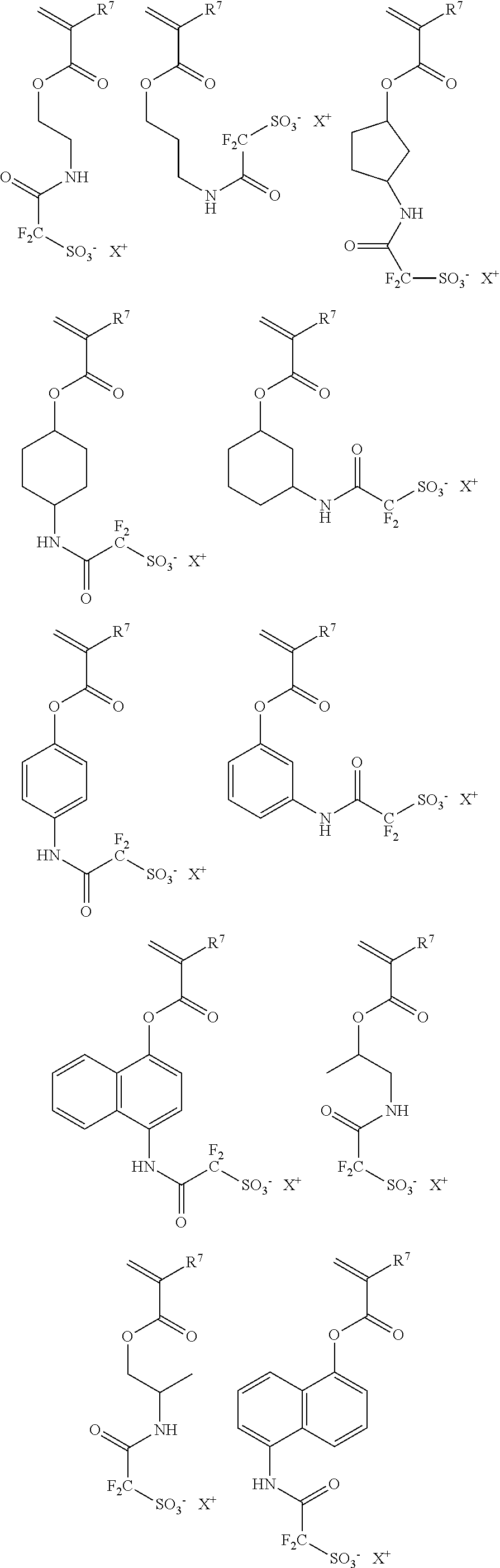


In the formulae, R7 and X have the same meanings as defined above.


In the formulae, R9 and X have the same meanings as defined above.


In the formulae, R12 and X have the same meanings as defined above.

In the formulae, R14 and X have the same meanings as defined above.


In the formulae, R15 and X have the same meanings as defined above.


In the formulae, R17 and X have the same meanings as defined above.


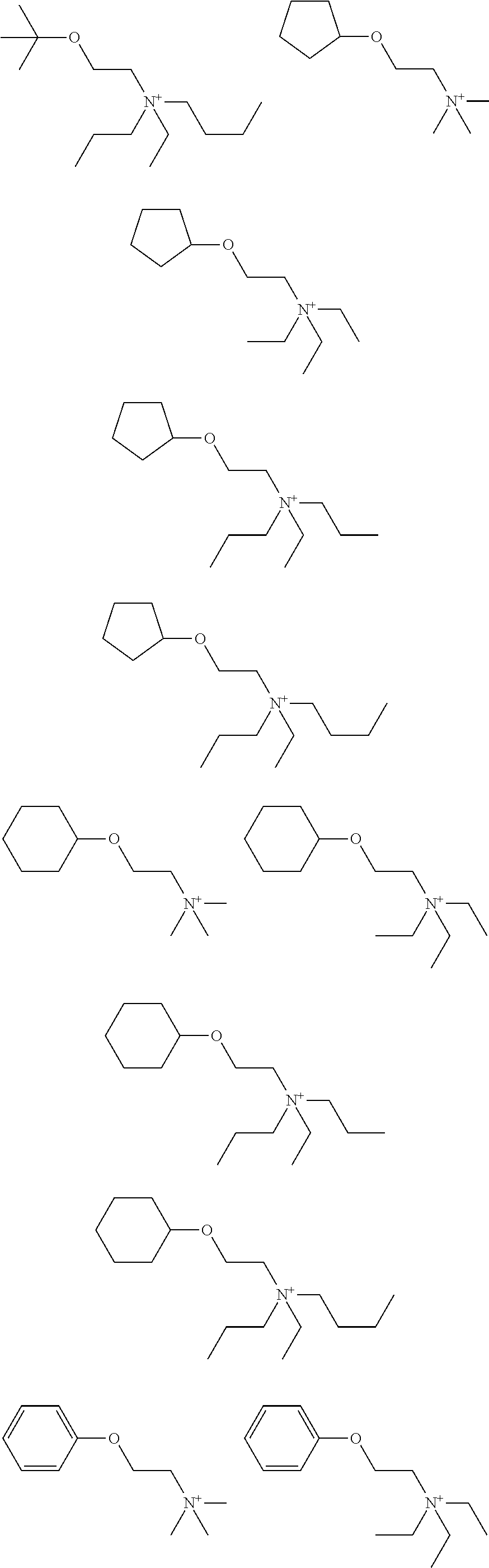


In the formulae, R represents a hydrogen atom or a methyl group.


In the formulae, “n” is an integer of 0 to 100.


In the formulae, R represents a hydrogen atom or a methyl group.


In the formulae, R represents a hydrogen atom or a methyl group.

In the formula, R20, R21, R22, R24, R25, and R26 each represent a linear or branched alkyl group having 1 to 4 carbon atoms, a phenyl group, or a 3,3,3-trifluoropropyl group; R23 represents a linear or branched alkyl group having 1 to 4 carbon atoms, a phenyl group, a 3,3,3-trifluoropropyl group, or a trialkylsiloxy group; R27 and R29 each represent a single bond, a methylene group, or an ethylene group, provided that the total number of carbon atoms of R27 and R29 is 1 or 2; R28 represents a hydrogen atom or a linear alkyl group having 1 to 4 carbon atoms; R30 represents a hydrogen atom or a methyl group; “A” represents a linear or branched alkylene group having 3 to 7 carbon atoms; “s” and “t” are integers of 0 to 10 in the range of 1≤s+t≤10.

In the formula, R20, R21, R22, R24, R25, and R26 each represent a linear or branched alkyl group having 1 to 4 carbon atoms, a phenyl group, or a 3,3,3-trifluoropropyl group; R23 represents a linear or branched alkyl group having 1 to 4 carbon atoms, a phenyl group, a 3,3,3-trifluoropropyl group, or a trialkylsiloxy group; R27 and R29 each represent a single bond, a methylene group, or an ethylene group, provided that the total number of carbon atoms of R27 and R29 is 1 or 2; R28 represents a hydrogen atom or a linear alkyl group having 1 to 4 carbon atoms; R30 represents a hydrogen atom or a methyl group; “A” represents a linear or branched alkylene group having 3 to 7 carbon atoms; “s” and “t” are integers of 0 to 10 in the range of 1≤s+t≤10; R31 represents a linear, branched, or cyclic alkylene group having 2 to 12 carbon atoms; and “v” and “w” satisfy 0<v<1.0, 0<w<1.0, and 0<v+w≤1.0.

In the formula, R20, R21, R22, R24, R25, and R26 each represent a linear or branched alkyl group having 1 to 4 carbon atoms, a phenyl group, or a 3,3,3-trifluoropropyl group; R23 represents a linear or branched alkyl group having 1 to 4 carbon atoms, a phenyl group, a 3,3,3-trifluoropropyl group, or a trialkylsiloxy group; R27 and R29 each represent a single bond, a methylene group, or an ethylene group, provided that the total number of carbon atoms of R27 and R29 is 1 or 2; R28 represents a hydrogen atom or a linear alkyl group having 1 to 4 carbon atoms; R30 represents a hydrogen atom or a methyl group; “A” represents a linear or branched alkylene group having 3 to 7 carbon atoms; “s” and “t” are integers of 0 to 10 in the range of 1≤s+t≤10.


In the formulae, “p” is an integer of 1 or more.

Mw=23,100
Mw/Mn=2.01

Mw=27,400
Mw/Mn=1.94

The repeating number in the formula shows the average value.
Mw=30,600
Mw/Mn=1.88

The repeating number in the formula shows the average value.
Mw=26,600
Mw/Mn=1.86

The repeating number in the formula shows the average value.
Mw=21,900
Mw/Mn=2.10

The repeating number in the formula shows the average value.
Ionic Polymer 7
Mw=35,700
Mw/Mn=2.33

The repeating number in the formula shows the average value.
Ionic Polymer 8
Mw=35,700
Mw/Mn=2.33

The repeating number in the formula shows the average value.
Mw=33,100
Mw/Mn=2.02

The repeating number in the formula shows the average value.
Ionic Polymer 10
Mw=21,500
Mw/Mn=1.96

The repeating number in the formula shows the average value.
Ionic Polymer 11
Mw=24,500
Mw/Mn=1.91

The repeating number in the formula shows the average value.
Ionic Polymer 12
Mw=16,300
Mw/Mn=1.75


The repeating number in the formulae show the average values.

| TABLE 1 | ||||
| Electro- | ||||
| conductive | ||||
| Bio- | material | Additive | ||
| electrode | (parts by | Hydroxy compounds | Isocyanate compound | (parts by |
| solution | mass) | (parts by mass) | (parts by mass) | mass) |
| Bio- | Ionic | Silicone-pendant diol 1 (3) | Isocyanate compound | Carbon |
| electrode | polymer 1 | Hydroxy compound 1 (5) | 1 (12) | black (2) |
| solution 1 | (4) | Hydroxy compound 2 (2) | ||
| Hydroxy compound 4 (10) | ||||
| Bio- | Ionic | Silicone-pendant diol 2 (5) | Isocyanate compound | Carbon |
| electrode | polymer 2 | Hydroxy compound 3 (1) | 2 (9) | black (3) |
| solution 2 | (6) | Hydroxy compound 5 (15) | ||
| Bio- | Ionic | Silicone-pendant diol 3 (3) | Isocyanate compound | Carbon |
| electrode | polymer 3 | Hydroxy compound 3 (1) | 3 (4) | black (2) |
| solution 3 | (5) | Hydroxy compound 6 (20) | ||
| Bio- | Ionic | Silicone-pendant diol 4 (5) | Isocyanate compound | Carbon |
| electrode | polymer 4 | Hydroxy compound 7 (5) | 3 (9) | black (2) |
| solution 4 | (5) | Hydroxy compound 3 (1) | ||
| Hydroxy compound 4 (15) | ||||
| Bio- | Ionic | Silicone-pendant diol 5 (3) | Isocyanate compound | Carbon |
| electrode | polymer 5 | Hydroxy compound 7 (5) | 3 (9) | black (2) |
| solution 5 | (6) | Hydroxy compound 3 (1) | ||
| Hydroxy compound 4 (15) | ||||
| Bio- | Ionic | Silicone-pendant diol 1 (5) | Isocyanate compound | Carbon |
| electrode | polymer 6 | Hydroxy compound 4 (18) | 4 (1) | black (2) |
| solution 6 | (6) | Isocyanate compound | ||
| 3 (2) | ||||
| Bio- | Ionic | Silicone-pendant diol 1 (5) | Isocyanate compound | Carbon |
| electrode | polymer 7 | Hydroxy compound 4 (18) | 4 (1) | black (2) |
| solution 7 | (6) | Isocyanate compound | ||
| 3 (2) | ||||
| Bio- | Ionic | Silicone-pendant diol 1 (5) | Isocyanate compound | Carbon |
| electrode | polymer 8 | Hydroxy compound 4 (18) | 5 (1) | black (2) |
| solution 8 | (6) | Isocyanate compound | ||
| 3 (2) | ||||
| Bio- | Ionic | Silicone-pendant diol 1 (5) | Isocyanate compound | Multilayer |
| electrode | polymer 9 | Hydroxy compound 4 (18) | 4 (1) | carbon |
| solution 9 | (6) | Isocyanate compound | nano-tube | |
| 3 (2) | (2) | |||
| Bio- | Ionic | Silicone-pendant diol 1 (5) | Isocyanate compound | Ag-coated |
| electrode | polymer 10 | Hydroxy compound 4 (18) | 4 (1) | particle |
| solution 10 | (6) | Isocyanate compound | (6) | |
| 3 (2) | ||||
| Bio- | Ionic | Silicone-pendant diol 1 (5) | Isocyanate compound | Au-coated |
| electrode | polymer 11 | Hydroxy compound 4 (18) | 4 (1) | particle |
| solution 11 | (8) | Isocyanate compound | (6) | |
| 3 (2) | ||||
| Bio- | Ionic | Silicone-pendant diol 1 (5) | Isocyanate compound | Carbon |
| electrode | polymer 12 | Hydroxy compound 4 (18) | 4 (1) | black (2) |
| solution 12 | (2) | Isocyanate compound | ||
| 3 (2) | ||||
| Bio- | Ionic | Silicone-pendant diol 3 (3) | Isocyanate compound | Carbon |
| electrode | polymer 3 | Hydroxy compound 3 (1) | 3 (4) | black (2) |
| solution 13 | (5) | Hydroxy compound 8 (20) | ||
| Comparative | Comparative | Silicone-pendant diol 1 (5) | Isocyanate compound | Carbon |
| bio- | ammonium | Hydroxy compound 4 (18) | 4 (1) | black (2) |
| electrode | salt 1 (2) | Isocyanate compound | ||
| solution 1 | 3 (2) | |||
| Comparative | Comparative | Silicone-pendant diol 1 (5) | Isocyanate compound | Carbon |
| bio- | ammonium | Hydroxy compound 4 (18) | 4 (1) | black (2) |
| electrode | salt 2 (2) | Isocyanate compound | ||
| solution 2 | 3 (2) | |||
| Comparative | Ionic | Hydroxy compound 1 (5) | Isocyanate compound | Carbon |
| bio- | polymer 1 | Hydroxy compound 2 (2) | 1 (10) | black (2) |
| electrode | (4) | Hydroxy compound 4 (10) | ||
| solution 3 | ||||
(Evaluation of Electric Conductivity)
| TABLE 2 | |||||
| Impedance | |||||
| Thickness | Initial | after water | |||
| Bio-electrode | of resin | Contact | impedance | immersion | |
| Examples | solution | (μm) | angle (°) | (Ω) | (Ω) |
| Example 1 | Bio-electrode solution 1 | 510 | 92 | 1.6 E4 | 1.5 E4 |
| Example 2 | |
530 | 91 | 1.2 E4 | 1.0 E4 |
| Example 3 | |
490 | 95 | 9.2 E3 | 9.3 E3 |
| Example 4 | |
480 | 91 | 7.8 E3 | 7.5 E3 |
| Example 5 | |
430 | 93 | 6.6 E4 | 5.5 E4 |
| Example 6 | |
450 | 94 | 5.5 E4 | 5.1 E4 |
| Example 7 | Bio-electrode solution 7 | 580 | 92 | 6.5 E4 | 6.3 E4 |
| Example 8 | Bio-electrode solution 8 | 510 | 91 | 7.0 E3 | 6.6 E3 |
| Example 9 | |
550 | 90 | 6.2 E4 | 7.1 E4 |
| Example 10 | Bio-electrode solution 10 | 750 | 92 | 3.2 E4 | 4.3 E4 |
| Example 11 | Bio-electrode solution 11 | 720 | 93 | 4.4 E4 | 5.8 E4 |
| Example 12 | Bio-electrode solution 12 | 490 | 94 | 5.2 E4 | 4.5 E4 |
| Example 13 | Bio-electrode solution 13 | 480 | 96 | 5.9 E4 | 5.8 E4 |
| Comparative | Comparative bio-electrode | 520 | 93 | 4.2 E4 | 5.3 E6 |
| Example 1 | solution 1 | ||||
| Comparative | Comparative bio-electrode | 530 | 93 | 5.2 E4 | 7.3 E6 |
| Example 2 | |
||||
| Comparative | Comparative bio-electrode | 520 | 70 | 5.1 E4 | 2.3 E3 |
| Example 3 | |
||||
Claims (20)


Applications Claiming Priority (2)
| Application Number | Priority Date | Filing Date | Title |
|---|---|---|---|
| JP2017-202908 | 2017-10-19 | ||
| JP2017202908 | 2017-10-19 |
Publications (2)
| Publication Number | Publication Date |
|---|---|
| US20190117101A1 US20190117101A1 (en) | 2019-04-25 |
| US10743788B2 true US10743788B2 (en) | 2020-08-18 |
Family
ID=66169002
Family Applications (1)
| Application Number | Title | Priority Date | Filing Date |
|---|---|---|---|
| US16/137,885 Active 2038-09-26 US10743788B2 (en) | 2017-10-19 | 2018-09-21 | Bio-electrode composition, bio-electrode, and method for manufacturing a bio-electrode |
Country Status (4)
| Country | Link |
|---|---|
| US (1) | US10743788B2 (en) |
| JP (1) | JP6845191B2 (en) |
| KR (1) | KR102197506B1 (en) |
| TW (1) | TWI672345B (en) |
Cited By (2)
| Publication number | Priority date | Publication date | Assignee | Title |
|---|---|---|---|---|
| US11369299B2 (en) * | 2019-04-03 | 2022-06-28 | Shin-Etsu Chemical Co., Ltd. | Bio-electrode composition, bio-electrode, and method for manufacturing bio-electrode |
| US11643492B2 (en) | 2019-04-03 | 2023-05-09 | Shin-Etsu Chemical Co., Ltd. | Bio-electrode composition, bio-electrode, and method for manufacturing bio-electrode |
Families Citing this family (9)
| Publication number | Priority date | Publication date | Assignee | Title |
|---|---|---|---|---|
| JP6919992B2 (en) * | 2017-01-30 | 2021-08-18 | 信越化学工業株式会社 | Elastic film and its formation method |
| JP7333770B2 (en) * | 2019-07-01 | 2023-08-25 | 信越化学工業株式会社 | Conductive wiring material composition, conductive wiring substrate, and method for producing conductive wiring substrate |
| JP7411537B2 (en) * | 2020-01-22 | 2024-01-11 | 信越化学工業株式会社 | Bioelectrode composition, bioelectrode, and method for producing bioelectrode |
| JP7357231B2 (en) * | 2020-03-04 | 2023-10-06 | パナソニックIpマネジメント株式会社 | Biological electrode and its manufacturing method |
| WO2021230143A1 (en) * | 2020-05-14 | 2021-11-18 | 信越化学工業株式会社 | Organosilicon compound and method for producing same |
| JP7507136B2 (en) * | 2020-11-05 | 2024-06-27 | 信越化学工業株式会社 | Bioelectrode composition, bioelectrode, and method for producing bioelectrode |
| IL301602A (en) | 2021-03-12 | 2023-05-01 | Shinetsu Chemical Co | Bio-electrode, production method for bio-electrode, and measurement method for bio-signals |
| JP2024041514A (en) | 2022-09-14 | 2024-03-27 | 富士フイルムビジネスイノベーション株式会社 | Charging members, charging devices, process cartridges, and image forming devices |
| CN119307055B (en) * | 2024-09-12 | 2025-06-10 | 中国地质大学(北京) | A IL@PVDF-HFP/PU flexible ion gel electrode and its preparation method and application |
Citations (14)
| Publication number | Priority date | Publication date | Assignee | Title |
|---|---|---|---|---|
| US4839443A (en) * | 1987-02-04 | 1989-06-13 | Chisso Corporation | Polysiloxane containing hydroxyl groups and a silicone-modified polyurethane using the same |
| JPH0595924A (en) | 1991-10-09 | 1993-04-20 | Nippon Mektron Ltd | Conductive millable urethane rubber electrode |
| US5952444A (en) * | 1997-05-22 | 1999-09-14 | Chisso Corporation | Polyurethane coating resin composition |
| JP2003225217A (en) | 2002-02-01 | 2003-08-12 | Shin Etsu Chem Co Ltd | Silicone rubber composition for bioelectrode and bioelectrode |
| JP2004033468A (en) | 2002-07-03 | 2004-02-05 | Fukuda Denshi Co Ltd | Biological electrode |
| JP2005320418A (en) | 2004-05-07 | 2005-11-17 | Shin Etsu Chem Co Ltd | UV curable organopolysiloxane composition |
| US20100119970A1 (en) | 2008-11-07 | 2010-05-13 | Shin-Etsu Chemical Co., Ltd. | Resist lower-layer composition containing thermal acid generator, resist lower layer film-formed substrate, and patterning process |
| JP2011201955A (en) | 2010-03-24 | 2011-10-13 | Sekisui Plastics Co Ltd | Method for manufacturing polyurethane gel, and method for manufacturing electrode pad |
| JP2012152725A (en) | 2011-01-28 | 2012-08-16 | Tosoh Corp | Blocked isocyanate dissociation catalyst and its application |
| WO2013039151A1 (en) | 2011-09-15 | 2013-03-21 | 積水化成品工業株式会社 | Biomedical electrode coating pad |
| JP2015019806A (en) | 2013-07-18 | 2015-02-02 | 独立行政法人科学技術振興機構 | Biocompatible electrode structure and manufacturing method therefor, and device and manufacturing method therefor |
| JP2015100673A (en) | 2013-11-28 | 2015-06-04 | 日本電信電話株式会社 | Clothing for bioelectric signal monitor |
| US20190127578A1 (en) * | 2017-10-26 | 2019-05-02 | Shin-Etsu Chemical Co., Ltd. | Bio-electrode composition, bio-electrode, and method for manufacturing a bio-electrode |
| US20190151648A1 (en) * | 2017-11-21 | 2019-05-23 | Shin-Etsu Chemical Co., Ltd. | Bio-electrode composition, bio-electrode, and method for manufacturing bio-electrode |
Family Cites Families (9)
| Publication number | Priority date | Publication date | Assignee | Title |
|---|---|---|---|---|
| JP2525181B2 (en) * | 1987-05-22 | 1996-08-14 | チッソ株式会社 | Silicone-modified polyurethane and method for producing the same |
| JP4823401B2 (en) * | 1996-12-30 | 2011-11-24 | イドロ―ケベック | Perfluorinated amide salts and their use as ion-conducting substances |
| JPH10324730A (en) * | 1997-05-22 | 1998-12-08 | Chisso Corp | Polyurethane resin reaction product |
| AUPP991799A0 (en) * | 1999-04-23 | 1999-05-20 | Cardiac Crc Nominees Pty Limited | Siloxane-containing polyurethane-urea compositions |
| KR20140004960A (en) * | 2012-07-03 | 2014-01-14 | 한국전자통신연구원 | Photocurable polyethyleneglycol silsesquioxane, polyethyleneglycol silsesquioxane network prepared therefrom, anti-biofouling device comprising the polyethyleneglycol silsesquioxane network and method of preparing for nano-pattern |
| JP6225135B2 (en) * | 2015-03-06 | 2017-11-01 | 信越化学工業株式会社 | Conductive material and substrate |
| JP2017042300A (en) * | 2015-08-25 | 2017-03-02 | 国立大学法人山梨大学 | Conductive composition, conductive member, and device for biological sensing |
| JP6652513B2 (en) * | 2016-03-03 | 2020-02-26 | 信越化学工業株式会社 | Bioelectrode manufacturing method |
| JP6549517B2 (en) * | 2016-05-09 | 2019-07-24 | 信越化学工業株式会社 | Bioelectrode and method of manufacturing the same |
-
2018
- 2018-08-16 JP JP2018153220A patent/JP6845191B2/en active Active
- 2018-09-21 US US16/137,885 patent/US10743788B2/en active Active
- 2018-10-18 TW TW107136631A patent/TWI672345B/en active
- 2018-10-19 KR KR1020180125116A patent/KR102197506B1/en active Active
Patent Citations (16)
| Publication number | Priority date | Publication date | Assignee | Title |
|---|---|---|---|---|
| US4839443A (en) * | 1987-02-04 | 1989-06-13 | Chisso Corporation | Polysiloxane containing hydroxyl groups and a silicone-modified polyurethane using the same |
| JPH0595924A (en) | 1991-10-09 | 1993-04-20 | Nippon Mektron Ltd | Conductive millable urethane rubber electrode |
| US5952444A (en) * | 1997-05-22 | 1999-09-14 | Chisso Corporation | Polyurethane coating resin composition |
| JP2003225217A (en) | 2002-02-01 | 2003-08-12 | Shin Etsu Chem Co Ltd | Silicone rubber composition for bioelectrode and bioelectrode |
| JP2004033468A (en) | 2002-07-03 | 2004-02-05 | Fukuda Denshi Co Ltd | Biological electrode |
| JP2005320418A (en) | 2004-05-07 | 2005-11-17 | Shin Etsu Chem Co Ltd | UV curable organopolysiloxane composition |
| US20100119970A1 (en) | 2008-11-07 | 2010-05-13 | Shin-Etsu Chemical Co., Ltd. | Resist lower-layer composition containing thermal acid generator, resist lower layer film-formed substrate, and patterning process |
| JP2010113209A (en) | 2008-11-07 | 2010-05-20 | Shin-Etsu Chemical Co Ltd | Resist lower-layer composition containing thermal acid generator, resist lower layer film-formed substrate, and patterning process |
| JP2011201955A (en) | 2010-03-24 | 2011-10-13 | Sekisui Plastics Co Ltd | Method for manufacturing polyurethane gel, and method for manufacturing electrode pad |
| JP2012152725A (en) | 2011-01-28 | 2012-08-16 | Tosoh Corp | Blocked isocyanate dissociation catalyst and its application |
| WO2013039151A1 (en) | 2011-09-15 | 2013-03-21 | 積水化成品工業株式会社 | Biomedical electrode coating pad |
| JP2015019806A (en) | 2013-07-18 | 2015-02-02 | 独立行政法人科学技術振興機構 | Biocompatible electrode structure and manufacturing method therefor, and device and manufacturing method therefor |
| US20160155530A1 (en) | 2013-07-18 | 2016-06-02 | Japan Science And Technology Agency | Biocompatible electrode structure and method for manufacturing the same, and device and method for manufacturing the same |
| JP2015100673A (en) | 2013-11-28 | 2015-06-04 | 日本電信電話株式会社 | Clothing for bioelectric signal monitor |
| US20190127578A1 (en) * | 2017-10-26 | 2019-05-02 | Shin-Etsu Chemical Co., Ltd. | Bio-electrode composition, bio-electrode, and method for manufacturing a bio-electrode |
| US20190151648A1 (en) * | 2017-11-21 | 2019-05-23 | Shin-Etsu Chemical Co., Ltd. | Bio-electrode composition, bio-electrode, and method for manufacturing bio-electrode |
Non-Patent Citations (1)
| Title |
|---|
| "Synthesis, Characterization, and Biocompatibility of Poly(ester-urethane)/Polyhedral Oligomeric Silsesquioxane Nanocomposites" authored by Wang et al. And published in Polymer (2009) 50, 5749-5757. * |
Cited By (2)
| Publication number | Priority date | Publication date | Assignee | Title |
|---|---|---|---|---|
| US11369299B2 (en) * | 2019-04-03 | 2022-06-28 | Shin-Etsu Chemical Co., Ltd. | Bio-electrode composition, bio-electrode, and method for manufacturing bio-electrode |
| US11643492B2 (en) | 2019-04-03 | 2023-05-09 | Shin-Etsu Chemical Co., Ltd. | Bio-electrode composition, bio-electrode, and method for manufacturing bio-electrode |
Also Published As
| Publication number | Publication date |
|---|---|
| KR102197506B1 (en) | 2020-12-31 |
| JP2019076695A (en) | 2019-05-23 |
| TWI672345B (en) | 2019-09-21 |
| JP6845191B2 (en) | 2021-03-17 |
| US20190117101A1 (en) | 2019-04-25 |
| TW201925371A (en) | 2019-07-01 |
| KR20190044021A (en) | 2019-04-29 |
Similar Documents
| Publication | Publication Date | Title |
|---|---|---|
| US11839700B2 (en) | Bio-electrode composition, bio-electrode, and method for manufacturing a bio-electrode | |
| US10743788B2 (en) | Bio-electrode composition, bio-electrode, and method for manufacturing a bio-electrode | |
| US10864366B2 (en) | Bio-electrode composition, bio-electrode, and method for manufacturing bio-electrode | |
| US11135422B2 (en) | Bio-electrode and methods for manufacturing the bio-electrode | |
| US11801333B2 (en) | Bio-electrode composition, bio-electrode, and method for manufacturing a bio-electrode | |
| US10734132B2 (en) | Bio-electrode composition, bio-electrode, method for manufacturing the bio-electrode, and polymer compound | |
| US10759938B2 (en) | Bio-electrode composition, bio-electrode, and method for manufacturing a bio-electrode | |
| US11071485B2 (en) | Bio-electrode composition, bio-electrode, and method for manufacturing bio-electrode | |
| US11643492B2 (en) | Bio-electrode composition, bio-electrode, and method for manufacturing bio-electrode | |
| US11896377B2 (en) | Bio-electrode | |
| US11612347B2 (en) | Bio-electrode composition, bio-electrode, and method for manufacturing a bio-electrode | |
| US11517236B2 (en) | Bio-electrode composition, bio-electrode, and method for manufacturing a bio-electrode | |
| US11607162B2 (en) | Bio-electrode composition, bio-electrode, and method for manufacturing a bio-electrode | |
| US11839476B2 (en) | Bio-electrode composition, bio-electrode, and method for manufacturing a bio-electrode | |
| US11547354B2 (en) | Bio-electrode composition, bio-electrode, and method for manufacturing a bio-electrode | |
| US11786160B2 (en) | Bio-electrode composition, bio-electrode, and method for manufacturing bio-electrode | |
| US11369299B2 (en) | Bio-electrode composition, bio-electrode, and method for manufacturing bio-electrode | |
| US12453501B2 (en) | Bio-electrode composition, bio-electrode, method for manufacturing bio-electrode, and reaction composite | |
| US11783958B2 (en) | Conductive wiring material composition, conductive wiring substrate and method for producing conductive wiring substrate | |
| US11234606B2 (en) | Bio-electrode composition, bio-electrode, and method for manufacturing a bio-electrode |
Legal Events
| Date | Code | Title | Description |
|---|---|---|---|
| AS | Assignment |
Owner name: SHIN-ETSU CHEMICAL CO., LTD., JAPAN Free format text: ASSIGNMENT OF ASSIGNORS INTEREST;ASSIGNORS:HATAKEYAMA, JUN;WATANABE, OSAMU;IWABUCHI, MOTOAKI;REEL/FRAME:046936/0865 Effective date: 20180815 |
|
| FEPP | Fee payment procedure |
Free format text: ENTITY STATUS SET TO UNDISCOUNTED (ORIGINAL EVENT CODE: BIG.); ENTITY STATUS OF PATENT OWNER: LARGE ENTITY |
|
| STPP | Information on status: patent application and granting procedure in general |
Free format text: DOCKETED NEW CASE - READY FOR EXAMINATION |
|
| STPP | Information on status: patent application and granting procedure in general |
Free format text: NON FINAL ACTION MAILED |
|
| STPP | Information on status: patent application and granting procedure in general |
Free format text: RESPONSE TO NON-FINAL OFFICE ACTION ENTERED AND FORWARDED TO EXAMINER |
|
| STPP | Information on status: patent application and granting procedure in general |
Free format text: NON FINAL ACTION MAILED |
|
| STPP | Information on status: patent application and granting procedure in general |
Free format text: NOTICE OF ALLOWANCE MAILED -- APPLICATION RECEIVED IN OFFICE OF PUBLICATIONS |
|
| STCF | Information on status: patent grant |
Free format text: PATENTED CASE |
|
| MAFP | Maintenance fee payment |
Free format text: PAYMENT OF MAINTENANCE FEE, 4TH YEAR, LARGE ENTITY (ORIGINAL EVENT CODE: M1551); ENTITY STATUS OF PATENT OWNER: LARGE ENTITY Year of fee payment: 4 |