US10728885B2 - Techniques and apparatuses for configuring an uplink bandwidth part for a random access channel (RACH) procedure - Google Patents
Techniques and apparatuses for configuring an uplink bandwidth part for a random access channel (RACH) procedure Download PDFInfo
- Publication number
- US10728885B2 US10728885B2 US16/141,048 US201816141048A US10728885B2 US 10728885 B2 US10728885 B2 US 10728885B2 US 201816141048 A US201816141048 A US 201816141048A US 10728885 B2 US10728885 B2 US 10728885B2
- Authority
- US
- United States
- Prior art keywords
- rach procedure
- initial active
- bandwidth part
- uplink bandwidth
- uplink
- Prior art date
- Legal status (The legal status is an assumption and is not a legal conclusion. Google has not performed a legal analysis and makes no representation as to the accuracy of the status listed.)
- Active, expires
Links
Images


Classifications
-
- H04W72/0413—
-
- H—ELECTRICITY
- H04—ELECTRIC COMMUNICATION TECHNIQUE
- H04W—WIRELESS COMMUNICATION NETWORKS
- H04W74/00—Wireless channel access
- H04W74/002—Transmission of channel access control information
- H04W74/006—Transmission of channel access control information in the downlink, i.e. towards the terminal
-
- H—ELECTRICITY
- H04—ELECTRIC COMMUNICATION TECHNIQUE
- H04W—WIRELESS COMMUNICATION NETWORKS
- H04W72/00—Local resource management
- H04W72/20—Control channels or signalling for resource management
- H04W72/21—Control channels or signalling for resource management in the uplink direction of a wireless link, i.e. towards the network
-
- H—ELECTRICITY
- H04—ELECTRIC COMMUNICATION TECHNIQUE
- H04L—TRANSMISSION OF DIGITAL INFORMATION, e.g. TELEGRAPHIC COMMUNICATION
- H04L5/00—Arrangements affording multiple use of the transmission path
- H04L5/0001—Arrangements for dividing the transmission path
- H04L5/0003—Two-dimensional division
- H04L5/0005—Time-frequency
- H04L5/0007—Time-frequency the frequencies being orthogonal, e.g. OFDM(A) or DMT
-
- H—ELECTRICITY
- H04—ELECTRIC COMMUNICATION TECHNIQUE
- H04W—WIRELESS COMMUNICATION NETWORKS
- H04W72/00—Local resource management
- H04W72/04—Wireless resource allocation
- H04W72/044—Wireless resource allocation based on the type of the allocated resource
- H04W72/0453—Resources in frequency domain, e.g. a carrier in FDMA
-
- H—ELECTRICITY
- H04—ELECTRIC COMMUNICATION TECHNIQUE
- H04W—WIRELESS COMMUNICATION NETWORKS
- H04W74/00—Wireless channel access
- H04W74/08—Non-scheduled access, e.g. ALOHA
- H04W74/0833—Random access procedures, e.g. with 4-step access
Definitions
- NR is designed to better support mobile broadband Internet access by improving spectral efficiency, lowering costs, improving services, making use of new spectrum, and better integrating with other open standards using orthogonal frequency division multiplexing (OFDM) with a cyclic prefix (CP) (CP-OFDM) on the downlink (DL), using CP-OFDM and/or SC-FDM (e.g., also known as discrete Fourier transform spread OFDM (DFT-s-OFDM)) on the uplink (UL), as well as supporting beamforming, multiple-input multiple-output (MIMO) antenna technology, and carrier aggregation.
- OFDM orthogonal frequency division multiplexing
- SC-FDM e.g., also known as discrete Fourier transform spread OFDM (DFT-s-OFDM)
- MIMO multiple-input multiple-output
- a method for wireless communication may include receiving remaining minimum system information (RMSI) from a base station (BS); determining an initial active uplink bandwidth part based at least in part on the RMSI; and using the initial active uplink bandwidth part for a random access channel (RACH) procedure between the UE and the BS.
- RMSI remaining minimum system information
- RACH random access channel
- a non-transitory computer-readable medium may store one or more instructions for wireless communication.
- the one or more instructions when executed by one or more processors of a user equipment (UE), may cause the one or more processors to receive remaining minimum system information (RMSI) from a base station (BS); determine an initial active uplink bandwidth part based at least in part on the RMSI; and use the initial active uplink bandwidth part for a random access channel (RACH) procedure between the UE and the BS.
- RMSI remaining minimum system information
- RMSI random access channel
- FIG. 4 is a block diagram conceptually illustrating two example subframe formats with the normal cyclic prefix, in accordance with various aspects of the present disclosure.
- FIG. 5 illustrates an example logical architecture of a distributed radio access network (RAN), in accordance with various aspects of the present disclosure.
- RAN radio access network
- FIG. 7 is a diagram illustrating an example of a downlink (DL)-centric subframe, in accordance with various aspects of the present disclosure.
- FIG. 10 is a diagram illustrating an example of configuring an uplink bandwidth part for a random access channel (RACH) procedure, in accordance with various aspects of the present disclosure.
- RACH random access channel
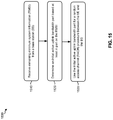
- FIG. 15 is a diagram illustrating an example process performed, for example, by a user equipment, in accordance with various aspects of the present disclosure.
- aspects may be described herein using terminology commonly associated with 3G and/or 4G wireless technologies, aspects of the present disclosure can be applied in other generation-based communication systems, such as 5G and later, including NR technologies.
- FIG. 1 is a diagram illustrating a network 100 in which aspects of the present disclosure may be practiced.
- the network 100 may be an LTE network or some other wireless network, such as a 5G or NR network.
- Wireless network 100 may include a number of BSs 110 (shown as BS 110 a , BS 110 b , BS 110 c , and BS 110 d ) and other network entities.
- a BS is an entity that communicates with user equipment (UEs) and may also be referred to as a base station, a NR BS, a Node B, a gNB, a 5G node B (NB), an access point, a transmit receive point (TRP), and/or the like.
- Each BS may provide communication coverage for a particular geographic area.
- the term “cell” can refer to a coverage area of a BS and/or a BS subsystem serving this coverage area, depending on the context in which the term is used.
- Wireless network 100 may be a heterogeneous network that includes BSs of different types, e.g., macro BSs, pico BSs, femto BSs, relay BSs, etc. These different types of BSs may have different transmit power levels, different coverage areas, and different impact on interference in wireless network 100 .
- macro BSs may have a high transmit power level (e.g., 5 to 40 Watts) whereas pico BSs, femto BSs, and relay BSs may have lower transmit power levels (e.g., 0.1 to 2 Watts).
- a network controller 130 may couple to a set of BSs and may provide coordination and control for these BSs.
- Network controller 130 may communicate with the BSs via a backhaul.
- the BSs may also communicate with one another, e.g., directly or indirectly via a wireless or wireline backhaul.
- a scheduling entity e.g., a base station
- the scheduling entity may be responsible for scheduling, assigning, reconfiguring, and releasing resources for one or more subordinate entities. That is, for scheduled communication, subordinate entities utilize resources allocated by the scheduling entity.
- a scheduling entity and one or more subordinate entities may communicate utilizing the scheduled resources.
- FIG. 2 shows a block diagram of a design 200 of base station 110 and UE 120 , which may be one of the base stations and one of the UEs in FIG. 1 .
- Base station 110 may be equipped with T antennas 234 a through 234 t
- UE 120 may be equipped with R antennas 252 a through 252 r , where in general T ⁇ 1 and R ⁇ 1.
- a transmit processor 220 may receive data from a data source 212 for one or more UEs, select one or more modulation and coding schemes (MCS) for each UE based at least in part on channel quality indicators (CQIs) received from the UE, process (e.g., encode and modulate) the data for each UE based at least in part on the MCS(s) selected for the UE, and provide data symbols for all UEs. Transmit processor 220 may also process system information (e.g., for semi-static resource partitioning information (SRPI), etc.) and control information (e.g., CQI requests, grants, upper layer signaling, etc.) and provide overhead symbols and control symbols.
- MCS modulation and coding schemes
- a receive processor 258 may process (e.g., demodulate and decode) the detected symbols, provide decoded data for UE 120 to a data sink 260 , and provide decoded control information and system information to a controller/processor 280 .
- a channel processor may determine reference signal received power (RSRP), received signal strength indicator (RSSI), reference signal received quality (RSRQ), channel quality indicator (CQI), etc.
- a transmit processor 264 may receive and process data from a data source 262 and control information (e.g., for reports comprising RSRP, RSSI, RSRQ, CQI, etc.) from controller/processor 280 . Transmit processor 264 may also generate reference symbols for one or more reference signals. The symbols from transmit processor 264 may be precoded by a TX MIMO processor 266 if applicable, further processed by modulators 254 a through 254 r (e.g., for DFT-s-OFDM, CP-OFDM, etc.), and transmitted to base station 110 .
- control information e.g., for reports comprising RSRP, RSSI, RSRQ, CQI, etc.
- Transmit processor 264 may also generate reference symbols for one or more reference signals.
- the symbols from transmit processor 264 may be precoded by a TX MIMO processor 266 if applicable, further processed by modulators 254 a through 254 r (e.g., for DFT-s-O
- a BS may transmit a primary synchronization signal (PSS) and a secondary synchronization signal (SSS) on the downlink in the center of the system bandwidth for each cell supported by the BS.
- PSS primary synchronization signal
- SSS secondary synchronization signal
- the PSS and SSS may be transmitted in symbol periods 6 and 5, respectively, in subframes 0 and 5 of each radio frame with the normal cyclic prefix, as shown in FIG. 3 .
- the PSS and SSS may be used by UEs for cell search and acquisition.
- the BS may transmit a cell-specific reference signal (CRS) across the system bandwidth for each cell supported by the BS.
- CRS cell-specific reference signal
- a Node B may transmit these or other signals (e.g., a synchronization signal block, a tracking reference signal, and/or the like) in these locations or in different locations of the subframe.
- signals e.g., a synchronization signal block, a tracking reference signal, and/or the like
- FIG. 3 is provided merely as an example. Other examples are possible and may differ from what was described with regard to FIG. 3 .
- E-UTRA Evolved Universal Terrestrial Radio Access
- aspects of the examples described herein may be associated with LTE technologies, aspects of the present disclosure may be applicable with other wireless communication systems, such as NR or 5G technologies.
- New radio may refer to radios configured to operate according to a new air interface (e.g., other than Orthogonal Frequency Divisional Multiple Access (OFDMA)-based air interfaces) or fixed transport layer (e.g., other than Internet Protocol (IP)).
- OFDM Orthogonal Frequency Divisional Multiple Access
- IP Internet Protocol
- NR may utilize OFDM with a CP (herein referred to as cyclic prefix OFDM or CP-OFDM) and/or SC-FDM on the uplink, may utilize CP-OFDM on the downlink and include support for half-duplex operation using time division duplexing (TDD).
- OFDM Orthogonal Frequency Divisional Multiple Access
- IP Internet Protocol
- NR may support a different air interface, other than an OFDM-based interface.
- NR networks may include entities such central units or distributed units.
- FIG. 5 illustrates an example logical architecture of a distributed RAN 500 , according to aspects of the present disclosure.
- a 5G access node 506 may include an access node controller (ANC) 502 .
- the ANC may be a central unit (CU) of the distributed RAN 500 .
- the backhaul interface to the next generation core network (NG-CN) 504 may terminate at the ANC.
- the backhaul interface to neighboring next generation access nodes (NG-ANs) may terminate at the ANC.
- the ANC may include one or more TRPs 508 (which may also be referred to as BSs, NR BSs, Node Bs, 5G NBs, APs, gNB, or some other term). As described above, a TRP may be used interchangeably with “cell.”
- the local architecture of RAN 500 may be used to illustrate fronthaul definition.
- the architecture may be defined that support fronthauling solutions across different deployment types.
- the architecture may be based at least in part on transmit network capabilities (e.g., bandwidth, latency, and/or jitter).
- the architecture may share features and/or components with LTE.
- the next generation AN (NG-AN) 510 may support dual connectivity with NR.
- the NG-AN may share a common fronthaul for LTE and NR.
- FIG. 8 is a diagram 800 showing an example of an UL-centric subframe or wireless communication structure.
- the UL-centric subframe of FIG. 8 may be used in RACH procedures.
- information or parameters associated with the UL-centric subframe of FIG. 8 may be based at least in part on remaining minimum system information (RMSI) received from BS 110 during a synchronization process.
- the UL-centric subframe may include a control portion 802 .
- the control portion 802 may exist in the initial or beginning portion of the UL-centric subframe.
- the control portion 802 in FIG. 8 may be similar to the control portion 702 described above with reference to FIG. 7 .
- the UL-centric subframe may also include an UL long burst portion 804 .
- the UL long burst portion 804 may sometimes be referred to as the payload of the UL-centric subframe.
- the UL portion may refer to the communication resources utilized to communicate UL data from the subordinate entity (e.g., UE) to the scheduling entity (e.g., UE or BS).
- the control portion 802 may be a physical DL control channel (PDCCH).
- PDCH physical DL control channel
- FIG. 8 is provided merely as an example. Other examples are possible and may differ from what was described with regard to FIG. 8 .
- FIG. 9 is a diagram illustrating an example 900 of a call flow for a random access channel (RACH) procedure, in accordance with various aspects of the present disclosure.
- BS 110 and UE 120 exchange communications, including communications of a RACH procedure, based at least in part on an initial activity event occurring with UE 120 .
- An initial activity may include UE 120 powering on, UE 120 entering a coverage area of BS 110 , and/or the like.
- UE 120 and BS 110 may utilize an initial active uplink bandwidth part to perform the RACH procedure of FIG. 9 .
- SIB-1 may be used to indicate the RMSI and/or the RACH configuration.
- the RACH configuration may include information associated with an initial active uplink bandwidth part for the RACH procedure of FIG. 9 to enable UE 120 and BS 110 to establish a communication link.
- the RACH configuration may indicate or provide instructions for identifying the initial active uplink bandwidth part (e.g., via a PRB frequency location of the initial active uplink bandwidth part, a bandwidth of the initial active uplink bandwidth part, and/or a numerology of the initial active uplink bandwidth part).
- an uplink PRB grid may be established for communication between UE 120 and BS 110 .
- a RACH procedure is performed (as illustrated by reference numbers 940 - 970 ) using an initial active uplink bandwidth part.
- UE 120 sends Msg.1 with a RACH request via a physical random access channel (PRACH).
- PRACH physical random access channel
- BS 110 may reply to Msg.1 with Msg.2 (random access response (RAR)) via the PDSCH.
- RAR random access response
- UE 120 sends Msg.3 (a UE identification message) via the PUSCH.
- BS 110 sends Msg.4 (contention resolution message) via the PDSCH.
- Msg.4 contention resolution message
- UE 120 may send an acknowledgement indicating that UE 120 is ready to communicate with BS 110 via an uplink PRB grid (which is used in the communication link between UE 120 and BS 110 ).
- the RMSI (e.g., within SIB-1 and/or within the RACH configuration) includes information corresponding to a PRB frequency location of the initial active uplink bandwidth part to be used in the RACH procedure of FIG. 9 . Additionally, or alternatively, the RMSI may indicate a bandwidth for the initial active uplink bandwidth part.
- the information in the RACH configuration of the RMSI may indicate that the bandwidth is to be a same bandwidth as a minimum uplink transmission bandwidth of the RACH procedure, a bandwidth of the PUSCH for Msg.3, a bandwidth of the PUCCH for the acknowledgement to Msg.4, and/or the like.
- the RMSI may include a numerology of the initial active uplink bandwidth part.
- the numerology may include or indicate a subcarrier spacing for the RACH procedure, a cyclic prefix for the RACH procedure, or a number of symbols per slot for the RACH procedure.
- the numerology may be indicated to be the same as a numerology for Msg.3 and/or the acknowledgement to Msg.4 from UE 120 .
- UE 120 and/or BS 110 may establish and/or utilize an uplink PRB grid for communications.
- UE 120 and/or BS 110 may establish the uplink PRB grid based at least in part on the PRB frequency location of the initial active uplink bandwidth part, the bandwidth of the initial active uplink bandwidth part, and/or the numerology of the initial active uplink bandwidth part.
- the uplink PRB grid for the RACH procedure may be used for one or more of the PRACH, the PUSCH, or the PUCCH mentioned in FIG. 9 .
- the UEs of FIG. 11 may select one of the offsets 1-3 from the signaled reference uplink frequency location as the PRB frequency location for the initial active uplink bandwidth part.
- the UEs may randomly select one of the offsets 1-3 and/or may select one of the offsets based at least in part on a predefined rule or setting.
- the predefined rule or setting may use a mapping/hash function generated from a parameter (e.g., an ID associated with a UE), a synchronization signal block (SSB) index of the PRACH of the RACH procedure, or a slot index of the PRACH transmission of the RACH procedure.
- a parameter e.g., an ID associated with a UE
- SSB synchronization signal block
- a plurality of initial active uplink bandwidth parts may be active or available for communication with a BS (e.g., BS 110 ) and a plurality of reference uplink frequency locations (shown as UL ARFCN F1, UL ARFCN F2, and UL ARFCN F3) may be provided with corresponding offsets (shown as offset 1, offset 2, and offset 3)
- FIG. 12 is provided as an example. Other examples are possible and may differ from what was described with respect to FIG. 12 .
- the setting may include at least one of a mapping or hash function based at least in part on a parameter of the UE, a synchronization signal block (SSB) index of a physical random access channel (PRACH) transmission of the RACH procedure, or a slot index of the PRACH transmission of the RACH procedure.
- SSB synchronization signal block
- PRACH physical random access channel
- FIG. 14 is a diagram illustrating an example process 1400 performed, for example, by a BS, in accordance with various aspects of the present disclosure.
- Example process 1400 is an example where a BS (e.g., BS 110 ) configures an initial active uplink bandwidth part for a RACH procedure.
- a BS e.g., BS 110
- the RACH configuration may include a reference uplink frequency location of an uplink transmission of the UE, and an offset from the reference uplink frequency location, wherein the PRB frequency location of the initial active uplink bandwidth part is located at a frequency location that is at the offset from the reference uplink frequency location.
- the reference uplink frequency location may include an absolute radio frequency channel number (ARFCN) indicated in the RMSI; or a physical random access channel (PRACH) frequency location indicated in the RMSI.
- ARFCN absolute radio frequency channel number
- PRACH physical random access channel
- the uplink PRB grid may be established based at least in part on a bandwidth of the initial active uplink bandwidth part.
- the bandwidth of the initial active uplink bandwidth part may be based at least in part on a bandwidth of an initial active downlink bandwidth part for the UE, a minimum uplink transmission bandwidth of the RACH procedure, a bandwidth of a physical uplink shared channel (PUSCH) for a Message 3 (Msg.3) transmission of the RACH procedure, or a bandwidth of a physical uplink control channel (PUCCH) for an acknowledgement (ACK) Message 4 (Msg.4) transmission of the RACH procedure.
- the bandwidth of the PUSCH or the PUCCH is signaled within the RMSI.
- the uplink PRB grid may be established based at least in part on a PRB frequency location of the initial active uplink bandwidth part and at least one of a bandwidth of the initial active uplink bandwidth part, or a numerology of the initial active uplink bandwidth part.
- FIG. 15 is a diagram illustrating an example process 1500 performed, for example, by a UE, in accordance with various aspects of the present disclosure.
- Example process 1500 is an example where a UE (e.g., UE 120 ) configures an initial active uplink bandwidth part for a RACH procedure.
- a UE e.g., UE 120
- process 1500 may include receiving remaining minimum system information (RMSI) from a base station (BS) (block 1510 ).
- the UE e.g., using antenna 252 , DEMOD 254 , MIMO detector 256 , receive processor 258 , controller/processor 280 , and/or the like
- the RMSI includes a numerology of the initial active uplink bandwidth part, wherein the numerology comprises at least one of: a subcarrier spacing for the RACH procedure, a cyclic prefix for the RACH procedure, or a number of symbols per slot for the RACH procedure.
- the numerology is based at least in part on at least one of: a numerology of a physical uplink shared channel (PUSCH) for a Message 3 (Msg.3) transmission of the RACH procedure, or a numerology of a physical uplink control channel (PUCCH) for an acknowledgment (ACK) of a Message 4 (Msg.4) transmission of the RACH procedure.
- PUSCH physical uplink shared channel
- Msg.3 Message 3
- PUCCH physical uplink control channel
- process 1500 may include determining an initial active uplink bandwidth part based at least in part on the RMSI (block 1520 ).
- the UE e.g., using receive processor 258 , controller/processor 280 , and/or the like
- determining the initial active uplink bandwidth part may include identifying a reference uplink frequency location of an uplink transmission of the UE; identifying an offset from the reference uplink frequency location; and identifying a physical resource block (PRB) frequency location of the initial active uplink bandwidth part to be at a frequency location at the offset from the reference uplink frequency location.
- the reference uplink frequency location comprises at least one of: an absolute radio frequency channel number indicated in the RMSI or a physical random access channel (PRACH) frequency location indicated in the RMSI.
- identifying the PRB frequency location of the initial active uplink bandwidth part may include identifying a plurality of offsets in a RACH configuration, of the RACH procedure, included within the RMSI, wherein the plurality of offsets are associated with different initial active uplink bandwidth parts; and selecting the offset, from the plurality of offsets, for the PRB frequency location of the initial active uplink bandwidth part.
- selecting the offset from the plurality of offsets may include selecting the offset based at least in part on a setting of the UE associated with the RACH procedure.
- process 1500 may include using the initial active uplink bandwidth part for a random access channel (RACH) procedure between the UE and the BS (block 1530 ).
- RACH random access channel
- the UE e.g., using antenna 252 , MOD 254 , TX MIMO processor 264 , transmit processor 266 , controller/processor 280 , and/or the like
- the initial active uplink bandwidth part for the RACH procedure is used for at least one of: a physical random access channel (PRACH) of the RACH procedure, a physical uplink control channel (PUCCH) of the RACH procedure, or a physical uplink shared channel (PUSCH) of the RACH procedure.
- PRACH physical random access channel
- PUCCH physical uplink control channel
- PUSCH physical uplink shared channel
- satisfying a threshold may refer to a value being greater than the threshold, greater than or equal to the threshold, less than the threshold, less than or equal to the threshold, equal to the threshold, not equal to the threshold, and/or the like.
- “at least one of: a, b, or c” is intended to cover a, b, c, a-b, a-c, b-c, and a-b-c, as well as any combination with multiples of the same element (e.g., a-a, a-a-a, a-a-b, a-a-c, a-b-b, a-c-c, b-b, b-b-b, b-b-c, c-c, and c-c-c or any other ordering of a, b, and c).
Landscapes
- Engineering & Computer Science (AREA)
- Signal Processing (AREA)
- Computer Networks & Wireless Communication (AREA)
- Mobile Radio Communication Systems (AREA)
Priority Applications (9)
| Application Number | Priority Date | Filing Date | Title |
|---|---|---|---|
| US16/141,048 US10728885B2 (en) | 2017-10-25 | 2018-09-25 | Techniques and apparatuses for configuring an uplink bandwidth part for a random access channel (RACH) procedure |
| KR1020207011478A KR102693846B1 (ko) | 2017-10-25 | 2018-09-26 | Rach(random access channel) 프로시저를 위한 업링크 대역폭 부분을 구성하기 위한 기법들 및 장치들 |
| SG11202002284SA SG11202002284SA (en) | 2017-10-25 | 2018-09-26 | Techniques and apparatuses for configuring an uplink bandwidth part for a random access channel (rach) procedure |
| BR112020007960-0A BR112020007960A2 (pt) | 2017-10-25 | 2018-09-26 | técnicas e aparelhos para configurar uma parte de largura de banda uplink para um procedimento de canal de acesso aleatório (rach) |
| EP18783327.2A EP3701761B1 (en) | 2017-10-25 | 2018-09-26 | Techniques and apparatuses for configuring an uplink bandwidth part for a random access channel (rach) procedure |
| CN201880068833.8A CN111264085B (zh) | 2017-10-25 | 2018-09-26 | 用于配置用于随机接入信道(rach)过程的上行链路带宽部分的技术和装置 |
| JP2020522689A JP7343494B2 (ja) | 2017-10-25 | 2018-09-26 | ランダムアクセスチャネル(rach)手順のためのアップリンク帯域幅部分を構成するための技法および装置 |
| PCT/US2018/052777 WO2019083671A1 (en) | 2017-10-25 | 2018-09-26 | TECHNIQUES AND APPARATUS FOR CONFIGURING UPLINK BANDWIDTH PART FOR RANDOM ACCESS CHANNEL (RACH) PROCEDURE |
| TW107133802A TWI772524B (zh) | 2017-10-25 | 2018-09-26 | 用於配置用於隨機存取通道(rach)程序的上行鏈路頻寬部分的技術和裝置 |
Applications Claiming Priority (2)
| Application Number | Priority Date | Filing Date | Title |
|---|---|---|---|
| US201762577155P | 2017-10-25 | 2017-10-25 | |
| US16/141,048 US10728885B2 (en) | 2017-10-25 | 2018-09-25 | Techniques and apparatuses for configuring an uplink bandwidth part for a random access channel (RACH) procedure |
Publications (2)
| Publication Number | Publication Date |
|---|---|
| US20190124646A1 US20190124646A1 (en) | 2019-04-25 |
| US10728885B2 true US10728885B2 (en) | 2020-07-28 |
Family
ID=66169664
Family Applications (1)
| Application Number | Title | Priority Date | Filing Date |
|---|---|---|---|
| US16/141,048 Active 2038-10-11 US10728885B2 (en) | 2017-10-25 | 2018-09-25 | Techniques and apparatuses for configuring an uplink bandwidth part for a random access channel (RACH) procedure |
Country Status (9)
| Country | Link |
|---|---|
| US (1) | US10728885B2 (enExample) |
| EP (1) | EP3701761B1 (enExample) |
| JP (1) | JP7343494B2 (enExample) |
| KR (1) | KR102693846B1 (enExample) |
| CN (1) | CN111264085B (enExample) |
| BR (1) | BR112020007960A2 (enExample) |
| SG (1) | SG11202002284SA (enExample) |
| TW (1) | TWI772524B (enExample) |
| WO (1) | WO2019083671A1 (enExample) |
Families Citing this family (15)
| Publication number | Priority date | Publication date | Assignee | Title |
|---|---|---|---|---|
| WO2019074337A1 (ko) | 2017-10-15 | 2019-04-18 | 엘지전자 주식회사 | 무선 통신 시스템에서 초기 접속을 수행하는 방법 및 장치 |
| US10785804B2 (en) * | 2018-02-17 | 2020-09-22 | Ofinno, Llc | Bandwidth part configuration information |
| CN112567874B (zh) * | 2018-08-08 | 2024-04-26 | 联想(新加坡)私人有限公司 | 基于空闲信道评估的带宽部分配置 |
| US11539494B2 (en) | 2019-05-13 | 2022-12-27 | Qualcomm Incorporated | Reference coordinates for two-step RACH resource configuration |
| CN112312543B (zh) * | 2019-08-02 | 2024-06-21 | 北京三星通信技术研究有限公司 | 数据传输的方法及设备 |
| US12507223B2 (en) | 2019-12-30 | 2025-12-23 | Google Llc | Supporting devices with different bandwidth capability in a communication network |
| CN113498213A (zh) * | 2020-04-03 | 2021-10-12 | 华为技术有限公司 | 用于随机接入的方法、装置及系统 |
| KR20260119406A (ko) * | 2020-05-15 | 2026-07-31 | 엘지전자 주식회사 | 무선 통신을 위한 신호 송수신 방법 및 이를 위한 장치 |
| CN113923750B (zh) | 2020-07-10 | 2025-10-17 | 华为技术有限公司 | 接入小区的方法和装置 |
| US20230292364A1 (en) * | 2020-07-31 | 2023-09-14 | Beijing Xiaomi Mobile Software Co., Ltd. | Bandwidth resource multiplexing method and apparatus, communication device and storage medium |
| KR102910320B1 (ko) | 2020-08-05 | 2026-01-08 | 지티이 코포레이션 | 시그널링 설계 및 구성을 위한 시스템 및 방법 |
| CN114375043B (zh) * | 2020-10-15 | 2025-03-04 | 北京紫光展锐通信技术有限公司 | 确定终端初始上行bwp的方法、基站、设备和介质 |
| CN114765517B (zh) * | 2021-01-15 | 2024-08-16 | 展讯通信(上海)有限公司 | 高频段非授权频谱内的初始接入参数确定方法及相关装置 |
| US12232166B2 (en) * | 2021-05-11 | 2025-02-18 | Qualcomm Incorporated | Narrowband random access channel occasions |
| WO2025039152A1 (en) * | 2023-08-21 | 2025-02-27 | Qualcomm Incorporated | Random access channel triggered bandwidth part switching |
Citations (11)
| Publication number | Priority date | Publication date | Assignee | Title |
|---|---|---|---|---|
| US20180049047A1 (en) * | 2016-08-12 | 2018-02-15 | Asustek Computer Inc. | Method and apparatus for determining numerology bandwidth for measurement in a wireless communication system |
| US20180049169A1 (en) * | 2016-08-12 | 2018-02-15 | Asustek Computer Inc. | Method and apparatus for determining numerology bandwidth in a wireless communication system |
| US20180183551A1 (en) * | 2016-12-27 | 2018-06-28 | Chie-Ming Chou | Method for signaling bandwidth part (bwp) indicators and radio communication equipment using the same |
| US20180376511A1 (en) * | 2017-06-23 | 2018-12-27 | Mediatek Inc. | Method and apparatus for random access channel procedure in wireless communication system |
| US20190044689A1 (en) * | 2017-09-28 | 2019-02-07 | Intel IP Corporation | Bandwidth part signaling and measurement handling |
| US20190045549A1 (en) * | 2017-08-01 | 2019-02-07 | Htc Corporation | Device and Method of Handling Bandwidth Parts |
| US20190053029A1 (en) * | 2017-08-10 | 2019-02-14 | Samsung Electronics Co., Ltd. | Apparatus and method of system information transmission and reception on a carrier supporting multiple bandwidth parts |
| US20190053182A1 (en) * | 2017-08-10 | 2019-02-14 | Samsung Electronics Co., Ltd. | Method and apparatus for determining uplink transmission timing |
| US20190059112A1 (en) * | 2017-08-18 | 2019-02-21 | Asustek Computer Inc. | Method and apparatus for random access configuration in a wireless communication system |
| US20190182716A1 (en) * | 2017-11-13 | 2019-06-13 | Nec Corporation | Radio access network node, and method and non-transitory computer readable medium therefor |
| US20190280843A1 (en) * | 2017-06-16 | 2019-09-12 | Intel IP Corporation | Physical resource block indexing for coexistence of narrow band, carrier aggregation, and wide band user equipment in new radio |
Family Cites Families (5)
| Publication number | Priority date | Publication date | Assignee | Title |
|---|---|---|---|---|
| US20160050667A1 (en) * | 2014-08-18 | 2016-02-18 | Samsung Electronics Co., Ltd. | Communication on licensed and unlicensed bands |
| US10314070B2 (en) * | 2015-01-23 | 2019-06-04 | Lg Electronics Inc. | Method of transmitting/receiving signal in wireless communication system supporting machine type communication and device therefor |
| EP3091700B1 (en) * | 2015-05-05 | 2018-03-21 | Mitsubishi Electric R&D Centre Europe B.V. | Method for allocating time-frequency resources for transmitting data packets over a frequency selective channel |
| US20180332605A1 (en) * | 2015-11-04 | 2018-11-15 | Interdigital Patent Holdings, Inc. | Device and methods for multiplexing transmissions with different tti duration |
| GB2563454A (en) * | 2017-06-16 | 2018-12-19 | Nec Corp | Communication system |
-
2018
- 2018-09-25 US US16/141,048 patent/US10728885B2/en active Active
- 2018-09-26 SG SG11202002284SA patent/SG11202002284SA/en unknown
- 2018-09-26 TW TW107133802A patent/TWI772524B/zh active
- 2018-09-26 CN CN201880068833.8A patent/CN111264085B/zh active Active
- 2018-09-26 KR KR1020207011478A patent/KR102693846B1/ko active Active
- 2018-09-26 JP JP2020522689A patent/JP7343494B2/ja active Active
- 2018-09-26 WO PCT/US2018/052777 patent/WO2019083671A1/en not_active Ceased
- 2018-09-26 EP EP18783327.2A patent/EP3701761B1/en active Active
- 2018-09-26 BR BR112020007960-0A patent/BR112020007960A2/pt unknown
Patent Citations (11)
| Publication number | Priority date | Publication date | Assignee | Title |
|---|---|---|---|---|
| US20180049047A1 (en) * | 2016-08-12 | 2018-02-15 | Asustek Computer Inc. | Method and apparatus for determining numerology bandwidth for measurement in a wireless communication system |
| US20180049169A1 (en) * | 2016-08-12 | 2018-02-15 | Asustek Computer Inc. | Method and apparatus for determining numerology bandwidth in a wireless communication system |
| US20180183551A1 (en) * | 2016-12-27 | 2018-06-28 | Chie-Ming Chou | Method for signaling bandwidth part (bwp) indicators and radio communication equipment using the same |
| US20190280843A1 (en) * | 2017-06-16 | 2019-09-12 | Intel IP Corporation | Physical resource block indexing for coexistence of narrow band, carrier aggregation, and wide band user equipment in new radio |
| US20180376511A1 (en) * | 2017-06-23 | 2018-12-27 | Mediatek Inc. | Method and apparatus for random access channel procedure in wireless communication system |
| US20190045549A1 (en) * | 2017-08-01 | 2019-02-07 | Htc Corporation | Device and Method of Handling Bandwidth Parts |
| US20190053029A1 (en) * | 2017-08-10 | 2019-02-14 | Samsung Electronics Co., Ltd. | Apparatus and method of system information transmission and reception on a carrier supporting multiple bandwidth parts |
| US20190053182A1 (en) * | 2017-08-10 | 2019-02-14 | Samsung Electronics Co., Ltd. | Method and apparatus for determining uplink transmission timing |
| US20190059112A1 (en) * | 2017-08-18 | 2019-02-21 | Asustek Computer Inc. | Method and apparatus for random access configuration in a wireless communication system |
| US20190044689A1 (en) * | 2017-09-28 | 2019-02-07 | Intel IP Corporation | Bandwidth part signaling and measurement handling |
| US20190182716A1 (en) * | 2017-11-13 | 2019-06-13 | Nec Corporation | Radio access network node, and method and non-transitory computer readable medium therefor |
Non-Patent Citations (9)
| Title |
|---|
| Ericsson; "On bandwidth parts"; R1-1718839; 3GPP TSG-RAN WG1 #89 Hanqzhou, China, May 15-19, 2017 (Year: 2017). * |
| International Search Report and Written Opinion—PCT/US2018/052777—ISA/EPO—dated Nov. 28, 2018. |
| MEDIATEK INC.: "Discussion on RMSI transmission", 3GPP DRAFT; R1-1716205_DISCUSSION ON RMSI TRANSMISSION, 3RD GENERATION PARTNERSHIP PROJECT (3GPP), MOBILE COMPETENCE CENTRE ; 650, ROUTE DES LUCIOLES ; F-06921 SOPHIA-ANTIPOLIS CEDEX ; FRANCE, vol. RAN WG1, no. Nagoya, Japan; 20170918 - 20170921, R1-1716205_Discussion on RMSI transmission, 12 September 2017 (2017-09-12), Mobile Competence Centre ; 650, route des Lucioles ; F-06921 Sophia-Antipolis Cedex ; France, XP051329827 |
| MEDIATEK INC.: "Further discussion on RMSI transmission", 3GPP DRAFT; R1-1718330_FURTHER DISCUSSION ON RMSI TRANSMISSION, 3RD GENERATION PARTNERSHIP PROJECT (3GPP), MOBILE COMPETENCE CENTRE ; 650, ROUTE DES LUCIOLES ; F-06921 SOPHIA-ANTIPOLIS CEDEX ; FRANCE, vol. RAN WG1, no. Prague, CZ; 20171009 - 20171013, R1-1718330_Further discussion on RMSI transmission, 8 October 2017 (2017-10-08), Mobile Competence Centre ; 650, route des Lucioles ; F-06921 Sophia-Antipolis Cedex ; France, XP051341513 |
| MEDIATEK INC.: "Remaining Details on Bandwidth Part Operation in NR", 3GPP DRAFT; R1-1716202_REMAINING DETAILS ON BANDWIDTH PART OPERATION IN NR, 3RD GENERATION PARTNERSHIP PROJECT (3GPP), MOBILE COMPETENCE CENTRE ; 650, ROUTE DES LUCIOLES ; F-06921 SOPHIA-ANTIPOLIS CEDEX ; FRANCE, vol. RAN WG1, no. Nagoya, Japan; 20170918 - 20170921, R1-1716202_remaining details on bandwidth part ope, 17 September 2017 (2017-09-17), Mobile Competence Centre ; 650, route des Lucioles ; F-06921 Sophia-Antipolis Cedex ; France, XP051339660 |
| MediaTek Inc.; "Summary of Bandwidth Part Operation"; R1-1718839; 3GPP TSG RAN WG1 Meeting 90bis Prague, CZ, Oct. 9-13, 2017 (Year: 2017). * |
| Mediatek Inc: "Discussion on RMSI Transmission", 3GPP Draft, R1-1716205, 3rd Generation Partnership Project (3GPP), Mobile Competence Centre, 650, Route Des Lucioles, F-06921 Sophia-Antipolis Cedex, France, vol. RAN WG1, No. Nagoya, Japan, Sep. 18, 2017-20178921, Sep. 12, 2017, XP051329827, Retrieved from the Internet: URL:http://www.3gpp.org/ftp/tsg_ran/WG1_RL1/TSGR_AH/NR_AH1_1709/Docs, pp. 1-2. |
| Mediatek Inc: "Further Discussion on RMSI Transmission", 3GPP Draft, R1-1718330, 3rd Generation Partnership Project (3GPP), Mobile Competence Centre, 650, Route Des Lucioles, F-06921 Sophia-Antipolis Cedex, France, vol. RAN WG1, No. Prague, CZ, Oct. 9, 2017-Oct. 13, 2017, Oct. 8, 2017 (Oct. 8, 2017), XP051341513, Retrieved from the Internet: URL:http://www.3gpp.org/ftp/Meetings_3GPP_SYNC/RAN1/Docs/, pp. 1-3. |
| Mediatek Inc: "Remaining Details on Bandwidth Part Operation in NR", 3GPP Draft, R1-1716202, 3rd Generation Partnership Project (3GPP), Mobile Competence Centre, 650, Route Des Lucioles, F-06921 Sophia-Antipolis Cedex, France, vol. RAN WG1, No. Nagoya, Japan; Sep. 18, 2017-Sep. 2, 2017, Sep. 17, 2017 (Sep. 17, 2017), XP051339660, Retrieved from the Internet: URL:http://www.3gpp.org/ftp/Meetings_3GPP_SYNC/RAN1/Docs/, 9 Pages. |
Also Published As
| Publication number | Publication date |
|---|---|
| BR112020007960A2 (pt) | 2020-10-20 |
| TW201924448A (zh) | 2019-06-16 |
| JP2021501510A (ja) | 2021-01-14 |
| WO2019083671A1 (en) | 2019-05-02 |
| KR102693846B1 (ko) | 2024-08-08 |
| SG11202002284SA (en) | 2020-05-28 |
| TWI772524B (zh) | 2022-08-01 |
| EP3701761A1 (en) | 2020-09-02 |
| US20190124646A1 (en) | 2019-04-25 |
| EP3701761B1 (en) | 2022-09-21 |
| CN111264085A (zh) | 2020-06-09 |
| JP7343494B2 (ja) | 2023-09-12 |
| KR20200073226A (ko) | 2020-06-23 |
| CN111264085B (zh) | 2023-09-29 |
Similar Documents
| Publication | Publication Date | Title |
|---|---|---|
| US11800566B2 (en) | Techniques and apparatuses for supplementary uplink random access configuration | |
| US10568128B2 (en) | Techniques and apparatuses for scheduling request acknowledgement | |
| EP3701761B1 (en) | Techniques and apparatuses for configuring an uplink bandwidth part for a random access channel (rach) procedure | |
| EP3593567B1 (en) | Multi-link transmit power control | |
| US10616847B2 (en) | Techniques and apparatuses for multiple transmission of synchronization signal blocks in new radio | |
| US10652908B2 (en) | Techniques and apparatuses for dynamic prioritization for delay-sensitive services | |
| CN110226293A (zh) | 至少部分地基于物理下行链路控制信道或者物理下行链路共享信道参考信号的多链路新无线电物理上行链路控制信道波束选择和报告 | |
| US12335848B2 (en) | Uplink control channel resource allocation | |
| WO2019047152A1 (en) | TECHNIQUES AND APPARATUS TO IMPROVE NEW RADIO COVERAGE | |
| US10917837B2 (en) | Techniques and apparatuses for common search space determination | |
| US11044064B2 (en) | Determining hybrid automatic repeat request (HARQ) processes for multi-transmit receive point (TRP) | |
| US10735160B2 (en) | Techniques and apparatuses for ultra-reliable low-latency communications transmission using grant-free resources | |
| US10917907B2 (en) | Resource allocation for random access procedure messages | |
| HK40029196A (en) | Techniques and apparatuses for configuring an uplink bandwidth part for a random access channel (rach) procedure |
Legal Events
| Date | Code | Title | Description |
|---|---|---|---|
| FEPP | Fee payment procedure |
Free format text: ENTITY STATUS SET TO UNDISCOUNTED (ORIGINAL EVENT CODE: BIG.); ENTITY STATUS OF PATENT OWNER: LARGE ENTITY |
|
| STPP | Information on status: patent application and granting procedure in general |
Free format text: DOCKETED NEW CASE - READY FOR EXAMINATION |
|
| AS | Assignment |
Owner name: QUALCOMM INCORPORATED, CALIFORNIA Free format text: ASSIGNMENT OF ASSIGNORS INTEREST;ASSIGNORS:LY, HUNG DINH;ANG, PETER PUI LOK;GAAL, PETER;AND OTHERS;SIGNING DATES FROM 20190121 TO 20190129;REEL/FRAME:048240/0034 |
|
| STPP | Information on status: patent application and granting procedure in general |
Free format text: NON FINAL ACTION MAILED |
|
| STPP | Information on status: patent application and granting procedure in general |
Free format text: NOTICE OF ALLOWANCE MAILED -- APPLICATION RECEIVED IN OFFICE OF PUBLICATIONS |
|
| STPP | Information on status: patent application and granting procedure in general |
Free format text: PUBLICATIONS -- ISSUE FEE PAYMENT VERIFIED |
|
| STCF | Information on status: patent grant |
Free format text: PATENTED CASE |
|
| MAFP | Maintenance fee payment |
Free format text: PAYMENT OF MAINTENANCE FEE, 4TH YEAR, LARGE ENTITY (ORIGINAL EVENT CODE: M1551); ENTITY STATUS OF PATENT OWNER: LARGE ENTITY Year of fee payment: 4 |