US10709727B2 - Antiviral drugs - Google Patents
Antiviral drugs Download PDFInfo
- Publication number
- US10709727B2 US10709727B2 US15/774,390 US201615774390A US10709727B2 US 10709727 B2 US10709727 B2 US 10709727B2 US 201615774390 A US201615774390 A US 201615774390A US 10709727 B2 US10709727 B2 US 10709727B2
- Authority
- US
- United States
- Prior art keywords
- seq
- virus
- gene
- target gene
- protein encoded
- Prior art date
- Legal status (The legal status is an assumption and is not a legal conclusion. Google has not performed a legal analysis and makes no representation as to the accuracy of the status listed.)
- Active
Links
- 239000003443 antiviral agent Substances 0.000 title claims abstract description 103
- 108090000623 proteins and genes Proteins 0.000 claims abstract description 486
- 230000014509 gene expression Effects 0.000 claims abstract description 174
- 102000004169 proteins and genes Human genes 0.000 claims abstract description 169
- 241000700605 Viruses Species 0.000 claims abstract description 120
- 239000000126 substance Substances 0.000 claims abstract description 114
- 230000000694 effects Effects 0.000 claims abstract description 108
- 238000000034 method Methods 0.000 claims abstract description 82
- 101150106571 DOCK11 gene Proteins 0.000 claims abstract description 57
- 101100387895 Homo sapiens DOCK11 gene Proteins 0.000 claims abstract description 57
- 102000039446 nucleic acids Human genes 0.000 claims abstract description 53
- 108020004707 nucleic acids Proteins 0.000 claims abstract description 53
- 150000007523 nucleic acids Chemical class 0.000 claims abstract description 53
- 230000009471 action Effects 0.000 claims abstract description 44
- 101000870876 Homo sapiens DENN domain-containing protein 2A Proteins 0.000 claims abstract description 36
- 238000012216 screening Methods 0.000 claims abstract description 34
- 101150063356 HECW2 gene Proteins 0.000 claims abstract description 20
- 101100123625 Homo sapiens HECW2 gene Proteins 0.000 claims abstract description 20
- 101150107380 LIPG gene Proteins 0.000 claims abstract description 19
- 108091027967 Small hairpin RNA Proteins 0.000 claims description 85
- 238000012360 testing method Methods 0.000 claims description 71
- 239000004055 small Interfering RNA Substances 0.000 claims description 66
- 230000027455 binding Effects 0.000 claims description 41
- 208000015181 infectious disease Diseases 0.000 claims description 35
- 230000009385 viral infection Effects 0.000 claims description 24
- 208000036142 Viral infection Diseases 0.000 claims description 23
- 241000700721 Hepatitis B virus Species 0.000 claims description 22
- 238000013518 transcription Methods 0.000 claims description 19
- 230000035897 transcription Effects 0.000 claims description 19
- 230000007423 decrease Effects 0.000 claims description 16
- 241000711549 Hepacivirus C Species 0.000 claims description 15
- 239000003966 growth inhibitor Substances 0.000 claims description 15
- 241000712461 unidentified influenza virus Species 0.000 claims description 14
- 239000004952 Polyamide Substances 0.000 claims description 12
- 229920002647 polyamide Polymers 0.000 claims description 12
- 201000010099 disease Diseases 0.000 claims description 11
- 208000037265 diseases, disorders, signs and symptoms Diseases 0.000 claims description 11
- 230000002255 enzymatic effect Effects 0.000 claims description 11
- 108091034117 Oligonucleotide Proteins 0.000 claims description 9
- RAXXELZNTBOGNW-UHFFFAOYSA-N imidazole Substances C1=CNC=N1 RAXXELZNTBOGNW-UHFFFAOYSA-N 0.000 claims description 9
- 239000000203 mixture Substances 0.000 claims description 9
- 230000002265 prevention Effects 0.000 claims description 9
- 239000000758 substrate Substances 0.000 claims description 9
- 230000003612 virological effect Effects 0.000 claims description 9
- 208000006454 hepatitis Diseases 0.000 claims description 7
- 241000709661 Enterovirus Species 0.000 claims description 6
- 108020004459 Small interfering RNA Proteins 0.000 claims description 6
- 150000001875 compounds Chemical class 0.000 claims description 6
- FWMNVWWHGCHHJJ-SKKKGAJSSA-N 4-amino-1-[(2r)-6-amino-2-[[(2r)-2-[[(2r)-2-[[(2r)-2-amino-3-phenylpropanoyl]amino]-3-phenylpropanoyl]amino]-4-methylpentanoyl]amino]hexanoyl]piperidine-4-carboxylic acid Chemical compound C([C@H](C(=O)N[C@H](CC(C)C)C(=O)N[C@H](CCCCN)C(=O)N1CCC(N)(CC1)C(O)=O)NC(=O)[C@H](N)CC=1C=CC=CC=1)C1=CC=CC=C1 FWMNVWWHGCHHJJ-SKKKGAJSSA-N 0.000 claims description 5
- 238000009472 formulation Methods 0.000 claims description 5
- 231100000283 hepatitis Toxicity 0.000 claims description 5
- 238000004519 manufacturing process Methods 0.000 claims description 5
- 108091070501 miRNA Proteins 0.000 claims description 5
- 239000002679 microRNA Substances 0.000 claims description 5
- 241001115402 Ebolavirus Species 0.000 claims description 4
- 241000724675 Hepatitis E virus Species 0.000 claims description 4
- 241000709721 Hepatovirus A Species 0.000 claims description 4
- 241000725303 Human immunodeficiency virus Species 0.000 claims description 4
- 241000907316 Zika virus Species 0.000 claims description 4
- 239000000074 antisense oligonucleotide Substances 0.000 claims description 4
- 238000012230 antisense oligonucleotides Methods 0.000 claims description 4
- 241000711404 Avian avulavirus 1 Species 0.000 claims description 3
- 241000709687 Coxsackievirus Species 0.000 claims description 3
- 241000725619 Dengue virus Species 0.000 claims description 3
- 241001466953 Echovirus Species 0.000 claims description 3
- 241000991587 Enterovirus C Species 0.000 claims description 3
- 241000711950 Filoviridae Species 0.000 claims description 3
- 241000710842 Japanese encephalitis virus Species 0.000 claims description 3
- 241000712902 Lassa mammarenavirus Species 0.000 claims description 3
- 241000712079 Measles morbillivirus Species 0.000 claims description 3
- 241000711386 Mumps virus Species 0.000 claims description 3
- 241001263478 Norovirus Species 0.000 claims description 3
- 241001631646 Papillomaviridae Species 0.000 claims description 3
- 241000711798 Rabies lyssavirus Species 0.000 claims description 3
- 241000702670 Rotavirus Species 0.000 claims description 3
- 241000710799 Rubella virus Species 0.000 claims description 3
- 241000711975 Vesicular stomatitis virus Species 0.000 claims description 3
- 241000710886 West Nile virus Species 0.000 claims description 3
- 241000710772 Yellow fever virus Species 0.000 claims description 3
- 239000012669 liquid formulation Substances 0.000 claims description 3
- 239000002924 silencing RNA Substances 0.000 claims description 3
- 241000701161 unidentified adenovirus Species 0.000 claims description 3
- 229940051021 yellow-fever virus Drugs 0.000 claims description 3
- 241001465754 Metazoa Species 0.000 claims description 2
- 239000007787 solid Substances 0.000 claims description 2
- 241000124008 Mammalia Species 0.000 claims 5
- 239000004480 active ingredient Substances 0.000 abstract description 16
- 210000004027 cell Anatomy 0.000 description 285
- 108091036055 CccDNA Proteins 0.000 description 71
- 108020004414 DNA Proteins 0.000 description 53
- 239000002585 base Substances 0.000 description 52
- 210000003494 hepatocyte Anatomy 0.000 description 39
- 108020004999 messenger RNA Proteins 0.000 description 39
- 108091032973 (ribonucleotides)n+m Proteins 0.000 description 35
- 206010073071 hepatocellular carcinoma Diseases 0.000 description 32
- 102100031375 Endothelial lipase Human genes 0.000 description 25
- 101000941275 Homo sapiens Endothelial lipase Proteins 0.000 description 24
- 231100000844 hepatocellular carcinoma Toxicity 0.000 description 22
- 102100031601 Dedicator of cytokinesis protein 11 Human genes 0.000 description 21
- 238000006243 chemical reaction Methods 0.000 description 21
- 230000006870 function Effects 0.000 description 21
- 101000866270 Homo sapiens Dedicator of cytokinesis protein 11 Proteins 0.000 description 19
- 229940079593 drug Drugs 0.000 description 19
- 239000003814 drug Substances 0.000 description 19
- 102000007268 rho GTP-Binding Proteins Human genes 0.000 description 19
- 108010033674 rho GTP-Binding Proteins Proteins 0.000 description 19
- 230000003247 decreasing effect Effects 0.000 description 18
- 239000000047 product Substances 0.000 description 18
- 102100033463 DENN domain-containing protein 2A Human genes 0.000 description 17
- 101000872871 Homo sapiens E3 ubiquitin-protein ligase HECW2 Proteins 0.000 description 17
- 102000011068 Cdc42 Human genes 0.000 description 15
- 239000011324 bead Substances 0.000 description 15
- 229960000980 entecavir Drugs 0.000 description 15
- YXPVEXCTPGULBZ-WQYNNSOESA-N entecavir hydrate Chemical compound O.C1=NC=2C(=O)NC(N)=NC=2N1[C@H]1C[C@H](O)[C@@H](CO)C1=C YXPVEXCTPGULBZ-WQYNNSOESA-N 0.000 description 15
- 210000004940 nucleus Anatomy 0.000 description 15
- 239000000243 solution Substances 0.000 description 13
- 230000000840 anti-viral effect Effects 0.000 description 12
- 238000010195 expression analysis Methods 0.000 description 12
- 229920002792 polyhydroxyhexanoate Polymers 0.000 description 12
- 210000001519 tissue Anatomy 0.000 description 12
- 102100034675 E3 ubiquitin-protein ligase HECW2 Human genes 0.000 description 11
- 102000004190 Enzymes Human genes 0.000 description 11
- 108090000790 Enzymes Proteins 0.000 description 11
- 208000002672 hepatitis B Diseases 0.000 description 11
- 239000003112 inhibitor Substances 0.000 description 11
- 230000007246 mechanism Effects 0.000 description 11
- 230000007774 longterm Effects 0.000 description 10
- 101150086838 CDC42 gene Proteins 0.000 description 9
- 108050001278 Cdc42 Proteins 0.000 description 9
- 241000713666 Lentivirus Species 0.000 description 8
- 239000008194 pharmaceutical composition Substances 0.000 description 8
- 239000013598 vector Substances 0.000 description 8
- QGWNDRXFNXRZMB-UUOKFMHZSA-N GDP Chemical compound C1=2NC(N)=NC(=O)C=2N=CN1[C@@H]1O[C@H](COP(O)(=O)OP(O)(O)=O)[C@@H](O)[C@H]1O QGWNDRXFNXRZMB-UUOKFMHZSA-N 0.000 description 7
- 101100387896 Mus musculus Dock11 gene Proteins 0.000 description 7
- 238000003556 assay Methods 0.000 description 7
- 238000001514 detection method Methods 0.000 description 7
- 239000004205 dimethyl polysiloxane Substances 0.000 description 7
- 239000012634 fragment Substances 0.000 description 7
- 238000005259 measurement Methods 0.000 description 7
- 239000012528 membrane Substances 0.000 description 7
- 125000003729 nucleotide group Chemical group 0.000 description 7
- 229920000435 poly(dimethylsiloxane) Polymers 0.000 description 7
- 102000053602 DNA Human genes 0.000 description 6
- PEDCQBHIVMGVHV-UHFFFAOYSA-N Glycerine Chemical compound OCC(O)CO PEDCQBHIVMGVHV-UHFFFAOYSA-N 0.000 description 6
- 108010051348 cdc42 GTP-Binding Protein Proteins 0.000 description 6
- 239000003795 chemical substances by application Substances 0.000 description 6
- 210000004748 cultured cell Anatomy 0.000 description 6
- 230000005764 inhibitory process Effects 0.000 description 6
- 238000002370 liquid polymer infiltration Methods 0.000 description 6
- 230000014759 maintenance of location Effects 0.000 description 6
- VLKZOEOYAKHREP-UHFFFAOYSA-N n-Hexane Chemical compound CCCCCC VLKZOEOYAKHREP-UHFFFAOYSA-N 0.000 description 6
- 239000002773 nucleotide Substances 0.000 description 6
- 239000000523 sample Substances 0.000 description 6
- 230000001629 suppression Effects 0.000 description 6
- 238000013519 translation Methods 0.000 description 6
- 102000011931 Nucleoproteins Human genes 0.000 description 5
- 108010061100 Nucleoproteins Proteins 0.000 description 5
- 241000283973 Oryctolagus cuniculus Species 0.000 description 5
- 239000000427 antigen Substances 0.000 description 5
- 108091007433 antigens Proteins 0.000 description 5
- 102000036639 antigens Human genes 0.000 description 5
- 238000007796 conventional method Methods 0.000 description 5
- BTCSSZJGUNDROE-UHFFFAOYSA-N gamma-aminobutyric acid Chemical group NCCCC(O)=O BTCSSZJGUNDROE-UHFFFAOYSA-N 0.000 description 5
- 238000011835 investigation Methods 0.000 description 5
- 210000005229 liver cell Anatomy 0.000 description 5
- 239000003550 marker Substances 0.000 description 5
- 239000002609 medium Substances 0.000 description 5
- 239000002953 phosphate buffered saline Substances 0.000 description 5
- 238000003753 real-time PCR Methods 0.000 description 5
- 230000008685 targeting Effects 0.000 description 5
- 102000040650 (ribonucleotides)n+m Human genes 0.000 description 4
- 101710171731 Mono-ADP-ribosyltransferase Proteins 0.000 description 4
- 241000699666 Mus <mouse, genus> Species 0.000 description 4
- 238000012228 RNA interference-mediated gene silencing Methods 0.000 description 4
- 238000012258 culturing Methods 0.000 description 4
- 210000004292 cytoskeleton Anatomy 0.000 description 4
- LOKCTEFSRHRXRJ-UHFFFAOYSA-I dipotassium trisodium dihydrogen phosphate hydrogen phosphate dichloride Chemical compound P(=O)(O)(O)[O-].[K+].P(=O)(O)([O-])[O-].[Na+].[Na+].[Cl-].[K+].[Cl-].[Na+] LOKCTEFSRHRXRJ-UHFFFAOYSA-I 0.000 description 4
- 239000000839 emulsion Substances 0.000 description 4
- 238000002474 experimental method Methods 0.000 description 4
- 230000009368 gene silencing by RNA Effects 0.000 description 4
- 230000002401 inhibitory effect Effects 0.000 description 4
- 235000019626 lipase activity Nutrition 0.000 description 4
- 230000010076 replication Effects 0.000 description 4
- 230000032258 transport Effects 0.000 description 4
- 125000003088 (fluoren-9-ylmethoxy)carbonyl group Chemical group 0.000 description 3
- ZIIUUSVHCHPIQD-UHFFFAOYSA-N 2,4,6-trimethyl-N-[3-(trifluoromethyl)phenyl]benzenesulfonamide Chemical compound CC1=CC(C)=CC(C)=C1S(=O)(=O)NC1=CC=CC(C(F)(F)F)=C1 ZIIUUSVHCHPIQD-UHFFFAOYSA-N 0.000 description 3
- 108020004635 Complementary DNA Proteins 0.000 description 3
- 102000014150 Interferons Human genes 0.000 description 3
- 108010050904 Interferons Proteins 0.000 description 3
- KFZMGEQAYNKOFK-UHFFFAOYSA-N Isopropanol Chemical compound CC(C)O KFZMGEQAYNKOFK-UHFFFAOYSA-N 0.000 description 3
- OKKJLVBELUTLKV-UHFFFAOYSA-N Methanol Chemical compound OC OKKJLVBELUTLKV-UHFFFAOYSA-N 0.000 description 3
- 108010064785 Phospholipases Proteins 0.000 description 3
- 102000015439 Phospholipases Human genes 0.000 description 3
- 102000028677 Rab9 Human genes 0.000 description 3
- 108050007276 Rab9 Proteins 0.000 description 3
- FAPWRFPIFSIZLT-UHFFFAOYSA-M Sodium chloride Chemical compound [Na+].[Cl-] FAPWRFPIFSIZLT-UHFFFAOYSA-M 0.000 description 3
- JLCPHMBAVCMARE-UHFFFAOYSA-N [3-[[3-[[3-[[3-[[3-[[3-[[3-[[3-[[3-[[3-[[3-[[5-(2-amino-6-oxo-1H-purin-9-yl)-3-[[3-[[3-[[3-[[3-[[3-[[5-(2-amino-6-oxo-1H-purin-9-yl)-3-[[5-(2-amino-6-oxo-1H-purin-9-yl)-3-hydroxyoxolan-2-yl]methoxy-hydroxyphosphoryl]oxyoxolan-2-yl]methoxy-hydroxyphosphoryl]oxy-5-(5-methyl-2,4-dioxopyrimidin-1-yl)oxolan-2-yl]methoxy-hydroxyphosphoryl]oxy-5-(6-aminopurin-9-yl)oxolan-2-yl]methoxy-hydroxyphosphoryl]oxy-5-(6-aminopurin-9-yl)oxolan-2-yl]methoxy-hydroxyphosphoryl]oxy-5-(6-aminopurin-9-yl)oxolan-2-yl]methoxy-hydroxyphosphoryl]oxy-5-(6-aminopurin-9-yl)oxolan-2-yl]methoxy-hydroxyphosphoryl]oxyoxolan-2-yl]methoxy-hydroxyphosphoryl]oxy-5-(5-methyl-2,4-dioxopyrimidin-1-yl)oxolan-2-yl]methoxy-hydroxyphosphoryl]oxy-5-(4-amino-2-oxopyrimidin-1-yl)oxolan-2-yl]methoxy-hydroxyphosphoryl]oxy-5-(5-methyl-2,4-dioxopyrimidin-1-yl)oxolan-2-yl]methoxy-hydroxyphosphoryl]oxy-5-(5-methyl-2,4-dioxopyrimidin-1-yl)oxolan-2-yl]methoxy-hydroxyphosphoryl]oxy-5-(6-aminopurin-9-yl)oxolan-2-yl]methoxy-hydroxyphosphoryl]oxy-5-(6-aminopurin-9-yl)oxolan-2-yl]methoxy-hydroxyphosphoryl]oxy-5-(4-amino-2-oxopyrimidin-1-yl)oxolan-2-yl]methoxy-hydroxyphosphoryl]oxy-5-(4-amino-2-oxopyrimidin-1-yl)oxolan-2-yl]methoxy-hydroxyphosphoryl]oxy-5-(4-amino-2-oxopyrimidin-1-yl)oxolan-2-yl]methoxy-hydroxyphosphoryl]oxy-5-(6-aminopurin-9-yl)oxolan-2-yl]methoxy-hydroxyphosphoryl]oxy-5-(4-amino-2-oxopyrimidin-1-yl)oxolan-2-yl]methyl [5-(6-aminopurin-9-yl)-2-(hydroxymethyl)oxolan-3-yl] hydrogen phosphate Polymers Cc1cn(C2CC(OP(O)(=O)OCC3OC(CC3OP(O)(=O)OCC3OC(CC3O)n3cnc4c3nc(N)[nH]c4=O)n3cnc4c3nc(N)[nH]c4=O)C(COP(O)(=O)OC3CC(OC3COP(O)(=O)OC3CC(OC3COP(O)(=O)OC3CC(OC3COP(O)(=O)OC3CC(OC3COP(O)(=O)OC3CC(OC3COP(O)(=O)OC3CC(OC3COP(O)(=O)OC3CC(OC3COP(O)(=O)OC3CC(OC3COP(O)(=O)OC3CC(OC3COP(O)(=O)OC3CC(OC3COP(O)(=O)OC3CC(OC3COP(O)(=O)OC3CC(OC3COP(O)(=O)OC3CC(OC3COP(O)(=O)OC3CC(OC3COP(O)(=O)OC3CC(OC3COP(O)(=O)OC3CC(OC3COP(O)(=O)OC3CC(OC3CO)n3cnc4c(N)ncnc34)n3ccc(N)nc3=O)n3cnc4c(N)ncnc34)n3ccc(N)nc3=O)n3ccc(N)nc3=O)n3ccc(N)nc3=O)n3cnc4c(N)ncnc34)n3cnc4c(N)ncnc34)n3cc(C)c(=O)[nH]c3=O)n3cc(C)c(=O)[nH]c3=O)n3ccc(N)nc3=O)n3cc(C)c(=O)[nH]c3=O)n3cnc4c3nc(N)[nH]c4=O)n3cnc4c(N)ncnc34)n3cnc4c(N)ncnc34)n3cnc4c(N)ncnc34)n3cnc4c(N)ncnc34)O2)c(=O)[nH]c1=O JLCPHMBAVCMARE-UHFFFAOYSA-N 0.000 description 3
- UCMIRNVEIXFBKS-UHFFFAOYSA-N beta-alanine Chemical group NCCC(O)=O UCMIRNVEIXFBKS-UHFFFAOYSA-N 0.000 description 3
- 230000000295 complement effect Effects 0.000 description 3
- 230000001419 dependent effect Effects 0.000 description 3
- 238000000502 dialysis Methods 0.000 description 3
- 238000003125 immunofluorescent labeling Methods 0.000 description 3
- 238000001727 in vivo Methods 0.000 description 3
- 206010022000 influenza Diseases 0.000 description 3
- 239000007924 injection Substances 0.000 description 3
- 238000002347 injection Methods 0.000 description 3
- 230000003993 interaction Effects 0.000 description 3
- 230000037361 pathway Effects 0.000 description 3
- WTJKGGKOPKCXLL-RRHRGVEJSA-N phosphatidylcholine Chemical compound CCCCCCCCCCCCCCCC(=O)OC[C@H](COP([O-])(=O)OCC[N+](C)(C)C)OC(=O)CCCCCCCC=CCCCCCCCC WTJKGGKOPKCXLL-RRHRGVEJSA-N 0.000 description 3
- 238000002360 preparation method Methods 0.000 description 3
- 230000002829 reductive effect Effects 0.000 description 3
- 108010003524 sodium-bile acid cotransporter Proteins 0.000 description 3
- 239000000725 suspension Substances 0.000 description 3
- UFTFJSFQGQCHQW-UHFFFAOYSA-N triformin Chemical compound O=COCC(OC=O)COC=O UFTFJSFQGQCHQW-UHFFFAOYSA-N 0.000 description 3
- IIZPXYDJLKNOIY-JXPKJXOSSA-N 1-palmitoyl-2-arachidonoyl-sn-glycero-3-phosphocholine Chemical compound CCCCCCCCCCCCCCCC(=O)OC[C@H](COP([O-])(=O)OCC[N+](C)(C)C)OC(=O)CCC\C=C/C\C=C/C\C=C/C\C=C/CCCCC IIZPXYDJLKNOIY-JXPKJXOSSA-N 0.000 description 2
- QKNYBSVHEMOAJP-UHFFFAOYSA-N 2-amino-2-(hydroxymethyl)propane-1,3-diol;hydron;chloride Chemical compound Cl.OCC(N)(CO)CO QKNYBSVHEMOAJP-UHFFFAOYSA-N 0.000 description 2
- -1 9-fluorenylmethoxycarbonyl Chemical group 0.000 description 2
- 208000030507 AIDS Diseases 0.000 description 2
- CSCPPACGZOOCGX-UHFFFAOYSA-N Acetone Chemical compound CC(C)=O CSCPPACGZOOCGX-UHFFFAOYSA-N 0.000 description 2
- 208000010507 Adenocarcinoma of Lung Diseases 0.000 description 2
- 108091003079 Bovine Serum Albumin Proteins 0.000 description 2
- 108091016585 CD44 antigen Proteins 0.000 description 2
- 108020004638 Circular DNA Proteins 0.000 description 2
- KCXVZYZYPLLWCC-UHFFFAOYSA-N EDTA Chemical compound OC(=O)CN(CC(O)=O)CCN(CC(O)=O)CC(O)=O KCXVZYZYPLLWCC-UHFFFAOYSA-N 0.000 description 2
- 241000283074 Equus asinus Species 0.000 description 2
- 108700039691 Genetic Promoter Regions Proteins 0.000 description 2
- 102000008055 Heparan Sulfate Proteoglycans Human genes 0.000 description 2
- 229920002971 Heparan sulfate Polymers 0.000 description 2
- 108010021625 Immunoglobulin Fragments Proteins 0.000 description 2
- 102000008394 Immunoglobulin Fragments Human genes 0.000 description 2
- 102000003960 Ligases Human genes 0.000 description 2
- 108090000364 Ligases Proteins 0.000 description 2
- TWRXJAOTZQYOKJ-UHFFFAOYSA-L Magnesium chloride Chemical compound [Mg+2].[Cl-].[Cl-] TWRXJAOTZQYOKJ-UHFFFAOYSA-L 0.000 description 2
- 102000029749 Microtubule Human genes 0.000 description 2
- 108091022875 Microtubule Proteins 0.000 description 2
- 206010028980 Neoplasm Diseases 0.000 description 2
- 108091028043 Nucleic acid sequence Proteins 0.000 description 2
- 229920002684 Sepharose Polymers 0.000 description 2
- 108020004682 Single-Stranded DNA Proteins 0.000 description 2
- 108090000054 Syndecan-2 Proteins 0.000 description 2
- 108091023040 Transcription factor Proteins 0.000 description 2
- 102000040945 Transcription factor Human genes 0.000 description 2
- 239000013504 Triton X-100 Substances 0.000 description 2
- 229920004890 Triton X-100 Polymers 0.000 description 2
- 108020005202 Viral DNA Proteins 0.000 description 2
- 230000004913 activation Effects 0.000 description 2
- 238000007792 addition Methods 0.000 description 2
- 239000000654 additive Substances 0.000 description 2
- 230000003321 amplification Effects 0.000 description 2
- 238000004458 analytical method Methods 0.000 description 2
- 239000012131 assay buffer Substances 0.000 description 2
- 239000000872 buffer Substances 0.000 description 2
- 201000011510 cancer Diseases 0.000 description 2
- 239000002775 capsule Substances 0.000 description 2
- 230000030570 cellular localization Effects 0.000 description 2
- 239000002299 complementary DNA Substances 0.000 description 2
- 238000011161 development Methods 0.000 description 2
- 238000005516 engineering process Methods 0.000 description 2
- 239000012091 fetal bovine serum Substances 0.000 description 2
- 238000003197 gene knockdown Methods 0.000 description 2
- 238000010362 genome editing Methods 0.000 description 2
- 239000001963 growth medium Substances 0.000 description 2
- 238000010842 high-capacity cDNA reverse transcription kit Methods 0.000 description 2
- 238000012744 immunostaining Methods 0.000 description 2
- 239000002054 inoculum Substances 0.000 description 2
- 229940047124 interferons Drugs 0.000 description 2
- 230000003834 intracellular effect Effects 0.000 description 2
- 238000001990 intravenous administration Methods 0.000 description 2
- 239000000787 lecithin Substances 0.000 description 2
- 235000010445 lecithin Nutrition 0.000 description 2
- 229940067606 lecithin Drugs 0.000 description 2
- KWGKDLIKAYFUFQ-UHFFFAOYSA-M lithium chloride Chemical compound [Li+].[Cl-] KWGKDLIKAYFUFQ-UHFFFAOYSA-M 0.000 description 2
- 238000011068 loading method Methods 0.000 description 2
- 230000004807 localization Effects 0.000 description 2
- 201000005249 lung adenocarcinoma Diseases 0.000 description 2
- 230000010534 mechanism of action Effects 0.000 description 2
- 210000004688 microtubule Anatomy 0.000 description 2
- 108091006026 monomeric small GTPases Proteins 0.000 description 2
- 238000010899 nucleation Methods 0.000 description 2
- 238000003199 nucleic acid amplification method Methods 0.000 description 2
- 210000000056 organ Anatomy 0.000 description 2
- 239000002245 particle Substances 0.000 description 2
- 230000035755 proliferation Effects 0.000 description 2
- RXWNCPJZOCPEPQ-NVWDDTSBSA-N puromycin Chemical compound C1=CC(OC)=CC=C1C[C@H](N)C(=O)N[C@H]1[C@@H](O)[C@H](N2C3=NC=NC(=C3N=C2)N(C)C)O[C@@H]1CO RXWNCPJZOCPEPQ-NVWDDTSBSA-N 0.000 description 2
- 239000000376 reactant Substances 0.000 description 2
- 230000001105 regulatory effect Effects 0.000 description 2
- 238000010839 reverse transcription Methods 0.000 description 2
- 210000002966 serum Anatomy 0.000 description 2
- 102000030938 small GTPase Human genes 0.000 description 2
- 150000003384 small molecules Chemical class 0.000 description 2
- YZHUMGUJCQRKBT-UHFFFAOYSA-M sodium chlorate Chemical compound [Na+].[O-]Cl(=O)=O YZHUMGUJCQRKBT-UHFFFAOYSA-M 0.000 description 2
- 239000011780 sodium chloride Substances 0.000 description 2
- HEMHJVSKTPXQMS-UHFFFAOYSA-M sodium hydroxide Inorganic materials [OH-].[Na+] HEMHJVSKTPXQMS-UHFFFAOYSA-M 0.000 description 2
- UCSJYZPVAKXKNQ-HZYVHMACSA-N streptomycin Chemical compound CN[C@H]1[C@H](O)[C@@H](O)[C@H](CO)O[C@H]1O[C@@H]1[C@](C=O)(O)[C@H](C)O[C@H]1O[C@@H]1[C@@H](NC(N)=N)[C@H](O)[C@@H](NC(N)=N)[C@H](O)[C@H]1O UCSJYZPVAKXKNQ-HZYVHMACSA-N 0.000 description 2
- 208000024891 symptom Diseases 0.000 description 2
- 239000003826 tablet Substances 0.000 description 2
- 229960004556 tenofovir Drugs 0.000 description 2
- VCMJCVGFSROFHV-WZGZYPNHSA-N tenofovir disoproxil fumarate Chemical compound OC(=O)\C=C\C(O)=O.N1=CN=C2N(C[C@@H](C)OCP(=O)(OCOC(=O)OC(C)C)OCOC(=O)OC(C)C)C=NC2=C1N VCMJCVGFSROFHV-WZGZYPNHSA-N 0.000 description 2
- 238000002560 therapeutic procedure Methods 0.000 description 2
- 230000002103 transcriptional effect Effects 0.000 description 2
- 238000001890 transfection Methods 0.000 description 2
- 229940117972 triolein Drugs 0.000 description 2
- 229960005486 vaccine Drugs 0.000 description 2
- OGNSCSPNOLGXSM-UHFFFAOYSA-N (+/-)-DABA Natural products NCCC(N)C(O)=O OGNSCSPNOLGXSM-UHFFFAOYSA-N 0.000 description 1
- MTBYTWZDRVOMBR-UHFFFAOYSA-N 1,2,3,4-tetrachloro-5-nitrobenzene Chemical compound [O-][N+](=O)C1=CC(Cl)=C(Cl)C(Cl)=C1Cl MTBYTWZDRVOMBR-UHFFFAOYSA-N 0.000 description 1
- LVOVQRPAMXCXTM-UHFFFAOYSA-N 1-(2-methyl-5-piperidin-1-ylsulfonylfuran-3-yl)-3-phenylurea Chemical compound CC=1OC(S(=O)(=O)N2CCCCC2)=CC=1NC(=O)NC1=CC=CC=C1 LVOVQRPAMXCXTM-UHFFFAOYSA-N 0.000 description 1
- OXHNLMTVIGZXSG-UHFFFAOYSA-N 1-Methylpyrrole Chemical group CN1C=CC=C1 OXHNLMTVIGZXSG-UHFFFAOYSA-N 0.000 description 1
- MCTWTZJPVLRJOU-UHFFFAOYSA-N 1-methyl-1H-imidazole Chemical group CN1C=CN=C1 MCTWTZJPVLRJOU-UHFFFAOYSA-N 0.000 description 1
- FWBHETKCLVMNFS-UHFFFAOYSA-N 4',6-Diamino-2-phenylindol Chemical compound C1=CC(C(=N)N)=CC=C1C1=CC2=CC=C(C(N)=N)C=C2N1 FWBHETKCLVMNFS-UHFFFAOYSA-N 0.000 description 1
- 108020000948 Antisense Oligonucleotides Proteins 0.000 description 1
- 108091023037 Aptamer Proteins 0.000 description 1
- 241000283690 Bos taurus Species 0.000 description 1
- 101500025132 Bos taurus Ubiquitin Proteins 0.000 description 1
- 101500027500 Bos taurus Ubiquitin Proteins 0.000 description 1
- 101500027539 Bos taurus Ubiquitin Proteins 0.000 description 1
- 101500028979 Bos taurus Ubiquitin Proteins 0.000 description 1
- BHLIEHKEMIYXKN-UHFFFAOYSA-N CC(=O)NCCC(=O)NCCC(=O)NC1=CN(C)C(C(=O)NC2=CN(C)C(C(=O)NC3=CN(C)C(C(=O)NC4=CN(C)C(C(=O)NCCCC(=O)CC5=CN(C)C(C(=O)CC6=CN(C)C(C(=O)CC7=CN(C)C(C(=O)CC8=CN(C)C(C(=O)CCCCN(C)C)=C8)=C7)=C6)=C5)=C4)=N3)=N2)=N1 Chemical compound CC(=O)NCCC(=O)NCCC(=O)NC1=CN(C)C(C(=O)NC2=CN(C)C(C(=O)NC3=CN(C)C(C(=O)NC4=CN(C)C(C(=O)NCCCC(=O)CC5=CN(C)C(C(=O)CC6=CN(C)C(C(=O)CC7=CN(C)C(C(=O)CC8=CN(C)C(C(=O)CCCCN(C)C)=C8)=C7)=C6)=C5)=C4)=N3)=N2)=N1 BHLIEHKEMIYXKN-UHFFFAOYSA-N 0.000 description 1
- 108091033409 CRISPR Proteins 0.000 description 1
- 238000010453 CRISPR/Cas method Methods 0.000 description 1
- UXVMQQNJUSDDNG-UHFFFAOYSA-L Calcium chloride Chemical compound [Cl-].[Cl-].[Ca+2] UXVMQQNJUSDDNG-UHFFFAOYSA-L 0.000 description 1
- 241000282693 Cercopithecidae Species 0.000 description 1
- 206010008909 Chronic Hepatitis Diseases 0.000 description 1
- 108020004394 Complementary RNA Proteins 0.000 description 1
- 230000004568 DNA-binding Effects 0.000 description 1
- 108010053770 Deoxyribonucleases Proteins 0.000 description 1
- 102000016911 Deoxyribonucleases Human genes 0.000 description 1
- 239000006144 Dulbecco’s modified Eagle's medium Substances 0.000 description 1
- 101710201734 E3 protein Proteins 0.000 description 1
- 201000011001 Ebola Hemorrhagic Fever Diseases 0.000 description 1
- 208000030820 Ebola disease Diseases 0.000 description 1
- 101710087274 Endothelial lipase Proteins 0.000 description 1
- 241000283073 Equus caballus Species 0.000 description 1
- 108010008177 Fd immunoglobulins Proteins 0.000 description 1
- 206010073069 Hepatic cancer Diseases 0.000 description 1
- 108700024845 Hepatitis B virus P Proteins 0.000 description 1
- 208000005176 Hepatitis C Diseases 0.000 description 1
- 206010019799 Hepatitis viral Diseases 0.000 description 1
- 206010019972 Herpes viral infections Diseases 0.000 description 1
- 101000600434 Homo sapiens Putative uncharacterized protein encoded by MIR7-3HG Proteins 0.000 description 1
- 108010054477 Immunoglobulin Fab Fragments Proteins 0.000 description 1
- 102000001706 Immunoglobulin Fab Fragments Human genes 0.000 description 1
- 102000017727 Immunoglobulin Variable Region Human genes 0.000 description 1
- 108010067060 Immunoglobulin Variable Region Proteins 0.000 description 1
- 206010022005 Influenza viral infections Diseases 0.000 description 1
- 102000004882 Lipase Human genes 0.000 description 1
- 108090001060 Lipase Proteins 0.000 description 1
- 239000004367 Lipase Substances 0.000 description 1
- 108010013563 Lipoprotein Lipase Proteins 0.000 description 1
- 102000043296 Lipoprotein lipases Human genes 0.000 description 1
- 108090001030 Lipoproteins Proteins 0.000 description 1
- 102000004895 Lipoproteins Human genes 0.000 description 1
- 206010067125 Liver injury Diseases 0.000 description 1
- 238000000636 Northern blotting Methods 0.000 description 1
- 101710163270 Nuclease Proteins 0.000 description 1
- 238000012408 PCR amplification Methods 0.000 description 1
- 229930182555 Penicillin Natural products 0.000 description 1
- JGSARLDLIJGVTE-MBNYWOFBSA-N Penicillin G Chemical compound N([C@H]1[C@H]2SC([C@@H](N2C1=O)C(O)=O)(C)C)C(=O)CC1=CC=CC=C1 JGSARLDLIJGVTE-MBNYWOFBSA-N 0.000 description 1
- 241000009328 Perro Species 0.000 description 1
- 208000037581 Persistent Infection Diseases 0.000 description 1
- 101710096324 Phospholipase A1 Proteins 0.000 description 1
- 229920001213 Polysorbate 20 Polymers 0.000 description 1
- 102100037401 Putative uncharacterized protein encoded by MIR7-3HG Human genes 0.000 description 1
- 101150060222 RAB9A gene Proteins 0.000 description 1
- 238000010802 RNA extraction kit Methods 0.000 description 1
- 102000042022 Rab family Human genes 0.000 description 1
- 108091079902 Rab family Proteins 0.000 description 1
- 241000700159 Rattus Species 0.000 description 1
- 102000007056 Recombinant Fusion Proteins Human genes 0.000 description 1
- 108010008281 Recombinant Fusion Proteins Proteins 0.000 description 1
- 208000035415 Reinfection Diseases 0.000 description 1
- 102000006382 Ribonucleases Human genes 0.000 description 1
- 108010083644 Ribonucleases Proteins 0.000 description 1
- 108091081021 Sense strand Proteins 0.000 description 1
- VYPSYNLAJGMNEJ-UHFFFAOYSA-N Silicium dioxide Chemical compound O=[Si]=O VYPSYNLAJGMNEJ-UHFFFAOYSA-N 0.000 description 1
- 102000004357 Transferases Human genes 0.000 description 1
- 108090000992 Transferases Proteins 0.000 description 1
- BAECOWNUKCLBPZ-HIUWNOOHSA-N Triolein Natural products O([C@H](OCC(=O)CCCCCCC/C=C\CCCCCCCC)COC(=O)CCCCCCC/C=C\CCCCCCCC)C(=O)CCCCCCC/C=C\CCCCCCCC BAECOWNUKCLBPZ-HIUWNOOHSA-N 0.000 description 1
- PHYFQTYBJUILEZ-UHFFFAOYSA-N Trioleoylglycerol Natural products CCCCCCCCC=CCCCCCCCC(=O)OCC(OC(=O)CCCCCCCC=CCCCCCCCC)COC(=O)CCCCCCCC=CCCCCCCCC PHYFQTYBJUILEZ-UHFFFAOYSA-N 0.000 description 1
- 239000007983 Tris buffer Substances 0.000 description 1
- 102000012275 Ubiquitin domains Human genes 0.000 description 1
- 108050002897 Ubiquitin domains Proteins 0.000 description 1
- 102000018478 Ubiquitin-Activating Enzymes Human genes 0.000 description 1
- 108010091546 Ubiquitin-Activating Enzymes Proteins 0.000 description 1
- 102000003431 Ubiquitin-Conjugating Enzyme Human genes 0.000 description 1
- 108060008747 Ubiquitin-Conjugating Enzyme Proteins 0.000 description 1
- 101710106011 Ubiquitin-conjugating enzyme E2 2 Proteins 0.000 description 1
- 108010005705 Ubiquitinated Proteins Proteins 0.000 description 1
- 108700005077 Viral Genes Proteins 0.000 description 1
- 208000028227 Viral hemorrhagic fever Diseases 0.000 description 1
- 208000001455 Zika Virus Infection Diseases 0.000 description 1
- 201000004296 Zika fever Diseases 0.000 description 1
- YFUAMNHCERJFPS-UHFFFAOYSA-N [K+].OB(O)[O-].OC(O)=O Chemical compound [K+].OB(O)[O-].OC(O)=O YFUAMNHCERJFPS-UHFFFAOYSA-N 0.000 description 1
- 230000001154 acute effect Effects 0.000 description 1
- 230000009798 acute exacerbation Effects 0.000 description 1
- 229960001997 adefovir Drugs 0.000 description 1
- WOZSCQDILHKSGG-UHFFFAOYSA-N adefovir depivoxil Chemical compound N1=CN=C2N(CCOCP(=O)(OCOC(=O)C(C)(C)C)OCOC(=O)C(C)(C)C)C=NC2=C1N WOZSCQDILHKSGG-UHFFFAOYSA-N 0.000 description 1
- 239000003513 alkali Substances 0.000 description 1
- 230000000692 anti-sense effect Effects 0.000 description 1
- 125000003118 aryl group Chemical group 0.000 description 1
- 238000003149 assay kit Methods 0.000 description 1
- IQFYYKKMVGJFEH-UHFFFAOYSA-N beta-L-thymidine Natural products O=C1NC(=O)C(C)=CN1C1OC(CO)C(O)C1 IQFYYKKMVGJFEH-UHFFFAOYSA-N 0.000 description 1
- 239000011230 binding agent Substances 0.000 description 1
- 230000033228 biological regulation Effects 0.000 description 1
- 210000004369 blood Anatomy 0.000 description 1
- 239000008280 blood Substances 0.000 description 1
- 230000037396 body weight Effects 0.000 description 1
- 238000009835 boiling Methods 0.000 description 1
- 239000012888 bovine serum Substances 0.000 description 1
- UDSAIICHUKSCKT-UHFFFAOYSA-N bromophenol blue Chemical compound C1=C(Br)C(O)=C(Br)C=C1C1(C=2C=C(Br)C(O)=C(Br)C=2)C2=CC=CC=C2S(=O)(=O)O1 UDSAIICHUKSCKT-UHFFFAOYSA-N 0.000 description 1
- 230000003139 buffering effect Effects 0.000 description 1
- 210000004899 c-terminal region Anatomy 0.000 description 1
- 238000010804 cDNA synthesis Methods 0.000 description 1
- 239000001110 calcium chloride Substances 0.000 description 1
- 229910001628 calcium chloride Inorganic materials 0.000 description 1
- 210000000234 capsid Anatomy 0.000 description 1
- 235000014633 carbohydrates Nutrition 0.000 description 1
- 150000001720 carbohydrates Chemical class 0.000 description 1
- 125000003178 carboxy group Chemical group [H]OC(*)=O 0.000 description 1
- 239000000969 carrier Substances 0.000 description 1
- 210000000170 cell membrane Anatomy 0.000 description 1
- 210000003855 cell nucleus Anatomy 0.000 description 1
- 239000003153 chemical reaction reagent Substances 0.000 description 1
- KMRSOJFYKZALJY-UHFFFAOYSA-N chloroform;heptane;methanol Chemical compound OC.ClC(Cl)Cl.CCCCCCC KMRSOJFYKZALJY-UHFFFAOYSA-N 0.000 description 1
- 208000019425 cirrhosis of liver Diseases 0.000 description 1
- 238000003776 cleavage reaction Methods 0.000 description 1
- 229960005338 clevudine Drugs 0.000 description 1
- GBBJCSTXCAQSSJ-XQXXSGGOSA-N clevudine Chemical compound O=C1NC(=O)C(C)=CN1[C@@H]1[C@H](F)[C@@H](O)[C@H](CO)O1 GBBJCSTXCAQSSJ-XQXXSGGOSA-N 0.000 description 1
- 239000003086 colorant Substances 0.000 description 1
- 238000004891 communication Methods 0.000 description 1
- 239000003184 complementary RNA Substances 0.000 description 1
- 238000012790 confirmation Methods 0.000 description 1
- 230000001276 controlling effect Effects 0.000 description 1
- 239000007771 core particle Substances 0.000 description 1
- 230000008878 coupling Effects 0.000 description 1
- 238000010168 coupling process Methods 0.000 description 1
- 238000005859 coupling reaction Methods 0.000 description 1
- 230000021953 cytokinesis Effects 0.000 description 1
- 210000000805 cytoplasm Anatomy 0.000 description 1
- 230000003436 cytoskeletal effect Effects 0.000 description 1
- 238000012217 deletion Methods 0.000 description 1
- 230000037430 deletion Effects 0.000 description 1
- 238000010586 diagram Methods 0.000 description 1
- 235000014113 dietary fatty acids Nutrition 0.000 description 1
- 230000006806 disease prevention Effects 0.000 description 1
- 238000010494 dissociation reaction Methods 0.000 description 1
- 230000005593 dissociations Effects 0.000 description 1
- 239000002552 dosage form Substances 0.000 description 1
- 239000003937 drug carrier Substances 0.000 description 1
- 238000001962 electrophoresis Methods 0.000 description 1
- 230000012202 endocytosis Effects 0.000 description 1
- 210000001163 endosome Anatomy 0.000 description 1
- 239000013604 expression vector Substances 0.000 description 1
- 239000000284 extract Substances 0.000 description 1
- 239000000194 fatty acid Substances 0.000 description 1
- 229930195729 fatty acid Natural products 0.000 description 1
- 150000004665 fatty acids Chemical class 0.000 description 1
- 239000000945 filler Substances 0.000 description 1
- 239000000706 filtrate Substances 0.000 description 1
- 239000000796 flavoring agent Substances 0.000 description 1
- 238000000684 flow cytometry Methods 0.000 description 1
- 235000013355 food flavoring agent Nutrition 0.000 description 1
- 235000021588 free fatty acids Nutrition 0.000 description 1
- 230000004927 fusion Effects 0.000 description 1
- 229960003692 gamma aminobutyric acid Drugs 0.000 description 1
- 239000000499 gel Substances 0.000 description 1
- 101150116317 gene 11 gene Proteins 0.000 description 1
- 239000008187 granular material Substances 0.000 description 1
- 231100000234 hepatic damage Toxicity 0.000 description 1
- 230000001900 immune effect Effects 0.000 description 1
- 238000003119 immunoblot Methods 0.000 description 1
- 229940127121 immunoconjugate Drugs 0.000 description 1
- 230000001771 impaired effect Effects 0.000 description 1
- 208000037797 influenza A Diseases 0.000 description 1
- 230000000977 initiatory effect Effects 0.000 description 1
- 238000003780 insertion Methods 0.000 description 1
- 230000037431 insertion Effects 0.000 description 1
- 229940079322 interferon Drugs 0.000 description 1
- 238000007918 intramuscular administration Methods 0.000 description 1
- 238000007912 intraperitoneal administration Methods 0.000 description 1
- 238000002372 labelling Methods 0.000 description 1
- JTEGQNOMFQHVDC-NKWVEPMBSA-N lamivudine Chemical compound O=C1N=C(N)C=CN1[C@H]1O[C@@H](CO)SC1 JTEGQNOMFQHVDC-NKWVEPMBSA-N 0.000 description 1
- 229960001627 lamivudine Drugs 0.000 description 1
- 239000003446 ligand Substances 0.000 description 1
- 235000019421 lipase Nutrition 0.000 description 1
- 150000002632 lipids Chemical class 0.000 description 1
- YFVGRULMIQXYNE-UHFFFAOYSA-M lithium;dodecyl sulfate Chemical compound [Li+].CCCCCCCCCCCCOS([O-])(=O)=O YFVGRULMIQXYNE-UHFFFAOYSA-M 0.000 description 1
- 201000007270 liver cancer Diseases 0.000 description 1
- 230000008818 liver damage Effects 0.000 description 1
- 208000014018 liver neoplasm Diseases 0.000 description 1
- 239000012139 lysis buffer Substances 0.000 description 1
- 229910001629 magnesium chloride Inorganic materials 0.000 description 1
- 230000035800 maturation Effects 0.000 description 1
- NIQQIJXGUZVEBB-UHFFFAOYSA-N methanol;propan-2-one Chemical compound OC.CC(C)=O NIQQIJXGUZVEBB-UHFFFAOYSA-N 0.000 description 1
- 238000013508 migration Methods 0.000 description 1
- 230000005012 migration Effects 0.000 description 1
- 238000002156 mixing Methods 0.000 description 1
- 229930014626 natural product Natural products 0.000 description 1
- 231100000957 no side effect Toxicity 0.000 description 1
- 210000004492 nuclear pore Anatomy 0.000 description 1
- 210000003463 organelle Anatomy 0.000 description 1
- VSZGPKBBMSAYNT-RRFJBIMHSA-N oseltamivir Chemical compound CCOC(=O)C1=C[C@@H](OC(CC)CC)[C@H](NC(C)=O)[C@@H](N)C1 VSZGPKBBMSAYNT-RRFJBIMHSA-N 0.000 description 1
- 229960003752 oseltamivir Drugs 0.000 description 1
- 238000004806 packaging method and process Methods 0.000 description 1
- 229940049954 penicillin Drugs 0.000 description 1
- 239000012466 permeate Substances 0.000 description 1
- 239000000546 pharmaceutical excipient Substances 0.000 description 1
- 239000006187 pill Substances 0.000 description 1
- 239000013612 plasmid Substances 0.000 description 1
- 229920002401 polyacrylamide Polymers 0.000 description 1
- 239000000256 polyoxyethylene sorbitan monolaurate Substances 0.000 description 1
- 235000010486 polyoxyethylene sorbitan monolaurate Nutrition 0.000 description 1
- 239000000843 powder Substances 0.000 description 1
- 239000003755 preservative agent Substances 0.000 description 1
- 230000008569 process Effects 0.000 description 1
- 238000004393 prognosis Methods 0.000 description 1
- 229950010131 puromycin Drugs 0.000 description 1
- 230000007420 reactivation Effects 0.000 description 1
- 230000006798 recombination Effects 0.000 description 1
- 238000005215 recombination Methods 0.000 description 1
- 239000004627 regenerated cellulose Substances 0.000 description 1
- 238000012107 replication analysis Methods 0.000 description 1
- 230000003362 replicative effect Effects 0.000 description 1
- 238000011160 research Methods 0.000 description 1
- 108091008146 restriction endonucleases Proteins 0.000 description 1
- 230000000717 retained effect Effects 0.000 description 1
- 238000003757 reverse transcription PCR Methods 0.000 description 1
- 238000012552 review Methods 0.000 description 1
- 239000003419 rna directed dna polymerase inhibitor Substances 0.000 description 1
- 230000007017 scission Effects 0.000 description 1
- 230000035945 sensitivity Effects 0.000 description 1
- 230000035939 shock Effects 0.000 description 1
- 239000000741 silica gel Substances 0.000 description 1
- 229910002027 silica gel Inorganic materials 0.000 description 1
- 239000007790 solid phase Substances 0.000 description 1
- 238000010532 solid phase synthesis reaction Methods 0.000 description 1
- 239000002904 solvent Substances 0.000 description 1
- 239000003381 stabilizer Substances 0.000 description 1
- 229960005322 streptomycin Drugs 0.000 description 1
- 238000007920 subcutaneous administration Methods 0.000 description 1
- 238000006467 substitution reaction Methods 0.000 description 1
- 239000006228 supernatant Substances 0.000 description 1
- 239000000829 suppository Substances 0.000 description 1
- 238000002198 surface plasmon resonance spectroscopy Methods 0.000 description 1
- 230000002195 synergetic effect Effects 0.000 description 1
- 238000001308 synthesis method Methods 0.000 description 1
- 238000003786 synthesis reaction Methods 0.000 description 1
- IQFYYKKMVGJFEH-CSMHCCOUSA-N telbivudine Chemical compound O=C1NC(=O)C(C)=CN1[C@H]1O[C@@H](CO)[C@H](O)C1 IQFYYKKMVGJFEH-CSMHCCOUSA-N 0.000 description 1
- 229960005311 telbivudine Drugs 0.000 description 1
- 230000036962 time dependent Effects 0.000 description 1
- 230000001052 transient effect Effects 0.000 description 1
- PHYFQTYBJUILEZ-IUPFWZBJSA-N triolein Chemical compound CCCCCCCC\C=C/CCCCCCCC(=O)OCC(OC(=O)CCCCCCC\C=C/CCCCCCCC)COC(=O)CCCCCCC\C=C/CCCCCCCC PHYFQTYBJUILEZ-IUPFWZBJSA-N 0.000 description 1
- LENZDBCJOHFCAS-UHFFFAOYSA-N tris Chemical compound OCC(N)(CO)CO LENZDBCJOHFCAS-UHFFFAOYSA-N 0.000 description 1
- 238000011144 upstream manufacturing Methods 0.000 description 1
- 230000002792 vascular Effects 0.000 description 1
- 230000007332 vesicle formation Effects 0.000 description 1
- 230000029812 viral genome replication Effects 0.000 description 1
- 201000001862 viral hepatitis Diseases 0.000 description 1
- 239000013603 viral vector Substances 0.000 description 1
- 239000000080 wetting agent Substances 0.000 description 1
Images


Classifications
-
- A—HUMAN NECESSITIES
- A61—MEDICAL OR VETERINARY SCIENCE; HYGIENE
- A61K—PREPARATIONS FOR MEDICAL, DENTAL OR TOILETRY PURPOSES
- A61K31/00—Medicinal preparations containing organic active ingredients
- A61K31/70—Carbohydrates; Sugars; Derivatives thereof
- A61K31/7088—Compounds having three or more nucleosides or nucleotides
- A61K31/7105—Natural ribonucleic acids, i.e. containing only riboses attached to adenine, guanine, cytosine or uracil and having 3'-5' phosphodiester links
-
- A—HUMAN NECESSITIES
- A61—MEDICAL OR VETERINARY SCIENCE; HYGIENE
- A61K—PREPARATIONS FOR MEDICAL, DENTAL OR TOILETRY PURPOSES
- A61K31/00—Medicinal preparations containing organic active ingredients
- A61K31/33—Heterocyclic compounds
- A61K31/395—Heterocyclic compounds having nitrogen as a ring hetero atom, e.g. guanethidine or rifamycins
- A61K31/41—Heterocyclic compounds having nitrogen as a ring hetero atom, e.g. guanethidine or rifamycins having five-membered rings with two or more ring hetero atoms, at least one of which being nitrogen, e.g. tetrazole
- A61K31/4164—1,3-Diazoles
- A61K31/4178—1,3-Diazoles not condensed 1,3-diazoles and containing further heterocyclic rings, e.g. pilocarpine, nitrofurantoin
-
- A—HUMAN NECESSITIES
- A61—MEDICAL OR VETERINARY SCIENCE; HYGIENE
- A61K—PREPARATIONS FOR MEDICAL, DENTAL OR TOILETRY PURPOSES
- A61K31/00—Medicinal preparations containing organic active ingredients
- A61K31/33—Heterocyclic compounds
- A61K31/395—Heterocyclic compounds having nitrogen as a ring hetero atom, e.g. guanethidine or rifamycins
- A61K31/435—Heterocyclic compounds having nitrogen as a ring hetero atom, e.g. guanethidine or rifamycins having six-membered rings with one nitrogen as the only ring hetero atom
- A61K31/44—Non condensed pyridines; Hydrogenated derivatives thereof
- A61K31/445—Non condensed piperidines, e.g. piperocaine
- A61K31/4523—Non condensed piperidines, e.g. piperocaine containing further heterocyclic ring systems
- A61K31/4525—Non condensed piperidines, e.g. piperocaine containing further heterocyclic ring systems containing a five-membered ring with oxygen as a ring hetero atom
-
- A—HUMAN NECESSITIES
- A61—MEDICAL OR VETERINARY SCIENCE; HYGIENE
- A61K—PREPARATIONS FOR MEDICAL, DENTAL OR TOILETRY PURPOSES
- A61K31/00—Medicinal preparations containing organic active ingredients
- A61K31/70—Carbohydrates; Sugars; Derivatives thereof
- A61K31/7088—Compounds having three or more nucleosides or nucleotides
-
- A—HUMAN NECESSITIES
- A61—MEDICAL OR VETERINARY SCIENCE; HYGIENE
- A61K—PREPARATIONS FOR MEDICAL, DENTAL OR TOILETRY PURPOSES
- A61K31/00—Medicinal preparations containing organic active ingredients
- A61K31/70—Carbohydrates; Sugars; Derivatives thereof
- A61K31/7088—Compounds having three or more nucleosides or nucleotides
- A61K31/713—Double-stranded nucleic acids or oligonucleotides
-
- A—HUMAN NECESSITIES
- A61—MEDICAL OR VETERINARY SCIENCE; HYGIENE
- A61K—PREPARATIONS FOR MEDICAL, DENTAL OR TOILETRY PURPOSES
- A61K45/00—Medicinal preparations containing active ingredients not provided for in groups A61K31/00 - A61K41/00
- A61K45/06—Mixtures of active ingredients without chemical characterisation, e.g. antiphlogistics and cardiaca
-
- A—HUMAN NECESSITIES
- A61—MEDICAL OR VETERINARY SCIENCE; HYGIENE
- A61K—PREPARATIONS FOR MEDICAL, DENTAL OR TOILETRY PURPOSES
- A61K48/00—Medicinal preparations containing genetic material which is inserted into cells of the living body to treat genetic diseases; Gene therapy
-
- A—HUMAN NECESSITIES
- A61—MEDICAL OR VETERINARY SCIENCE; HYGIENE
- A61P—SPECIFIC THERAPEUTIC ACTIVITY OF CHEMICAL COMPOUNDS OR MEDICINAL PREPARATIONS
- A61P31/00—Antiinfectives, i.e. antibiotics, antiseptics, chemotherapeutics
- A61P31/12—Antivirals
- A61P31/20—Antivirals for DNA viruses
-
- C—CHEMISTRY; METALLURGY
- C12—BIOCHEMISTRY; BEER; SPIRITS; WINE; VINEGAR; MICROBIOLOGY; ENZYMOLOGY; MUTATION OR GENETIC ENGINEERING
- C12N—MICROORGANISMS OR ENZYMES; COMPOSITIONS THEREOF; PROPAGATING, PRESERVING, OR MAINTAINING MICROORGANISMS; MUTATION OR GENETIC ENGINEERING; CULTURE MEDIA
- C12N15/00—Mutation or genetic engineering; DNA or RNA concerning genetic engineering, vectors, e.g. plasmids, or their isolation, preparation or purification; Use of hosts therefor
- C12N15/09—Recombinant DNA-technology
- C12N15/11—DNA or RNA fragments; Modified forms thereof; Non-coding nucleic acids having a biological activity
- C12N15/113—Non-coding nucleic acids modulating the expression of genes, e.g. antisense oligonucleotides; Antisense DNA or RNA; Triplex- forming oligonucleotides; Catalytic nucleic acids, e.g. ribozymes; Nucleic acids used in co-suppression or gene silencing
-
- C—CHEMISTRY; METALLURGY
- C12—BIOCHEMISTRY; BEER; SPIRITS; WINE; VINEGAR; MICROBIOLOGY; ENZYMOLOGY; MUTATION OR GENETIC ENGINEERING
- C12Q—MEASURING OR TESTING PROCESSES INVOLVING ENZYMES, NUCLEIC ACIDS OR MICROORGANISMS; COMPOSITIONS OR TEST PAPERS THEREFOR; PROCESSES OF PREPARING SUCH COMPOSITIONS; CONDITION-RESPONSIVE CONTROL IN MICROBIOLOGICAL OR ENZYMOLOGICAL PROCESSES
- C12Q1/00—Measuring or testing processes involving enzymes, nucleic acids or microorganisms; Compositions therefor; Processes of preparing such compositions
- C12Q1/68—Measuring or testing processes involving enzymes, nucleic acids or microorganisms; Compositions therefor; Processes of preparing such compositions involving nucleic acids
- C12Q1/6876—Nucleic acid products used in the analysis of nucleic acids, e.g. primers or probes
- C12Q1/6883—Nucleic acid products used in the analysis of nucleic acids, e.g. primers or probes for diseases caused by alterations of genetic material
-
- C—CHEMISTRY; METALLURGY
- C12—BIOCHEMISTRY; BEER; SPIRITS; WINE; VINEGAR; MICROBIOLOGY; ENZYMOLOGY; MUTATION OR GENETIC ENGINEERING
- C12Q—MEASURING OR TESTING PROCESSES INVOLVING ENZYMES, NUCLEIC ACIDS OR MICROORGANISMS; COMPOSITIONS OR TEST PAPERS THEREFOR; PROCESSES OF PREPARING SUCH COMPOSITIONS; CONDITION-RESPONSIVE CONTROL IN MICROBIOLOGICAL OR ENZYMOLOGICAL PROCESSES
- C12Q1/00—Measuring or testing processes involving enzymes, nucleic acids or microorganisms; Compositions therefor; Processes of preparing such compositions
- C12Q1/68—Measuring or testing processes involving enzymes, nucleic acids or microorganisms; Compositions therefor; Processes of preparing such compositions involving nucleic acids
- C12Q1/6876—Nucleic acid products used in the analysis of nucleic acids, e.g. primers or probes
- C12Q1/6883—Nucleic acid products used in the analysis of nucleic acids, e.g. primers or probes for diseases caused by alterations of genetic material
- C12Q1/6886—Nucleic acid products used in the analysis of nucleic acids, e.g. primers or probes for diseases caused by alterations of genetic material for cancer
-
- C—CHEMISTRY; METALLURGY
- C12—BIOCHEMISTRY; BEER; SPIRITS; WINE; VINEGAR; MICROBIOLOGY; ENZYMOLOGY; MUTATION OR GENETIC ENGINEERING
- C12Q—MEASURING OR TESTING PROCESSES INVOLVING ENZYMES, NUCLEIC ACIDS OR MICROORGANISMS; COMPOSITIONS OR TEST PAPERS THEREFOR; PROCESSES OF PREPARING SUCH COMPOSITIONS; CONDITION-RESPONSIVE CONTROL IN MICROBIOLOGICAL OR ENZYMOLOGICAL PROCESSES
- C12Q1/00—Measuring or testing processes involving enzymes, nucleic acids or microorganisms; Compositions therefor; Processes of preparing such compositions
- C12Q1/70—Measuring or testing processes involving enzymes, nucleic acids or microorganisms; Compositions therefor; Processes of preparing such compositions involving virus or bacteriophage
- C12Q1/701—Specific hybridization probes
- C12Q1/706—Specific hybridization probes for hepatitis
-
- G—PHYSICS
- G01—MEASURING; TESTING
- G01N—INVESTIGATING OR ANALYSING MATERIALS BY DETERMINING THEIR CHEMICAL OR PHYSICAL PROPERTIES
- G01N33/00—Investigating or analysing materials by specific methods not covered by groups G01N1/00 - G01N31/00
- G01N33/48—Biological material, e.g. blood, urine; Haemocytometers
- G01N33/50—Chemical analysis of biological material, e.g. blood, urine; Testing involving biospecific ligand binding methods; Immunological testing
- G01N33/53—Immunoassay; Biospecific binding assay; Materials therefor
- G01N33/569—Immunoassay; Biospecific binding assay; Materials therefor for microorganisms, e.g. protozoa, bacteria, viruses
- G01N33/56983—Viruses
-
- C—CHEMISTRY; METALLURGY
- C12—BIOCHEMISTRY; BEER; SPIRITS; WINE; VINEGAR; MICROBIOLOGY; ENZYMOLOGY; MUTATION OR GENETIC ENGINEERING
- C12Q—MEASURING OR TESTING PROCESSES INVOLVING ENZYMES, NUCLEIC ACIDS OR MICROORGANISMS; COMPOSITIONS OR TEST PAPERS THEREFOR; PROCESSES OF PREPARING SUCH COMPOSITIONS; CONDITION-RESPONSIVE CONTROL IN MICROBIOLOGICAL OR ENZYMOLOGICAL PROCESSES
- C12Q2600/00—Oligonucleotides characterized by their use
- C12Q2600/136—Screening for pharmacological compounds
-
- C—CHEMISTRY; METALLURGY
- C12—BIOCHEMISTRY; BEER; SPIRITS; WINE; VINEGAR; MICROBIOLOGY; ENZYMOLOGY; MUTATION OR GENETIC ENGINEERING
- C12Q—MEASURING OR TESTING PROCESSES INVOLVING ENZYMES, NUCLEIC ACIDS OR MICROORGANISMS; COMPOSITIONS OR TEST PAPERS THEREFOR; PROCESSES OF PREPARING SUCH COMPOSITIONS; CONDITION-RESPONSIVE CONTROL IN MICROBIOLOGICAL OR ENZYMOLOGICAL PROCESSES
- C12Q2600/00—Oligonucleotides characterized by their use
- C12Q2600/158—Expression markers
-
- G—PHYSICS
- G01—MEASURING; TESTING
- G01N—INVESTIGATING OR ANALYSING MATERIALS BY DETERMINING THEIR CHEMICAL OR PHYSICAL PROPERTIES
- G01N2500/00—Screening for compounds of potential therapeutic value
- G01N2500/02—Screening involving studying the effect of compounds C on the interaction between interacting molecules A and B (e.g. A = enzyme and B = substrate for A, or A = receptor and B = ligand for the receptor)
-
- G—PHYSICS
- G01—MEASURING; TESTING
- G01N—INVESTIGATING OR ANALYSING MATERIALS BY DETERMINING THEIR CHEMICAL OR PHYSICAL PROPERTIES
- G01N2500/00—Screening for compounds of potential therapeutic value
- G01N2500/04—Screening involving studying the effect of compounds C directly on molecule A (e.g. C are potential ligands for a receptor A, or potential substrates for an enzyme A)
-
- G—PHYSICS
- G01—MEASURING; TESTING
- G01N—INVESTIGATING OR ANALYSING MATERIALS BY DETERMINING THEIR CHEMICAL OR PHYSICAL PROPERTIES
- G01N2500/00—Screening for compounds of potential therapeutic value
- G01N2500/10—Screening for compounds of potential therapeutic value involving cells
-
- Y—GENERAL TAGGING OF NEW TECHNOLOGICAL DEVELOPMENTS; GENERAL TAGGING OF CROSS-SECTIONAL TECHNOLOGIES SPANNING OVER SEVERAL SECTIONS OF THE IPC; TECHNICAL SUBJECTS COVERED BY FORMER USPC CROSS-REFERENCE ART COLLECTIONS [XRACs] AND DIGESTS
- Y02—TECHNOLOGIES OR APPLICATIONS FOR MITIGATION OR ADAPTATION AGAINST CLIMATE CHANGE
- Y02A—TECHNOLOGIES FOR ADAPTATION TO CLIMATE CHANGE
- Y02A50/00—TECHNOLOGIES FOR ADAPTATION TO CLIMATE CHANGE in human health protection, e.g. against extreme weather
- Y02A50/30—Against vector-borne diseases, e.g. mosquito-borne, fly-borne, tick-borne or waterborne diseases whose impact is exacerbated by climate change
-
- Y02A50/385—
-
- Y02A50/387—
-
- Y02A50/389—
-
- Y02A50/391—
-
- Y02A50/393—
-
- Y02A50/463—
-
- Y02A50/465—
Definitions
- the present invention relates to a novel antiviral drug.
- HBV Hepatitis B virus
- IFNs interferons
- nucleotide analogs are used in the treatment of hepatitis B caused by HBV.
- HBV cccDNA Hepatitis B virus covalently closed circular DNA
- HBV cccDNA Since HBV cccDNA has the property of staying within the cell after HBV infection, it has attracted attention in recent years as a marker for prediction of long-term prognosis for antiviral drugs and degree of liver damage. However, the in vivo mechanism of retaining HBV after infection has not yet been elucidated, and also the behavior of HBV cccDNA remains unclear. As a drug focusing on HBV cccDNA, an artificial DNA nuclease targeting HBV cccDNA itself has been reported (Patent Document 1).
- HBV retention mechanism including behavior of cccDNA and thereby discovering a new molecule(s) that can be a target of anti-HBV drug.
- An object of the present invention is to provide a novel antiviral drug.
- the present inventors focused on the facts that the DOCK11. LIPG, DENND2A and HECW2 genes are expressed specifically in HBV mRNA-positive hepatocytes, and that suppression of the expression of these genes decreases the amount of HBV cccDNA in hepatocytes, and that these genes may be involved in the infection and proliferation mechanisms of the viruses in general, to find that substances capable of suppressing the expression or activity of the proteins encoded by these genes can be used as antiviral drugs, thereby accomplishing the present invention.
- the present invention is as follows:
- An antiviral drug comprising as an active ingredient a substance capable of suppressing an expression of a target gene or an activity of a protein encoded by said target gene, wherein said target gene is one or more genes having an action of retaining virus-derived nucleic acid in a host cell and selected from the group consisting of DOCK11 gene, LIPG gene, DENND2A gene, and HECW2 gene.
- the target gene is DOCK11 gene.
- the antiviral drug according to 1 or 2 mentioned above, wherein the substance capable of suppressing the expression of the target gene or the activity of the protein encoded by the target gene is one or more compounds selected from the group consisting of shRNA, siRNA, miRNA, antisense oligonucleotide, and pyrrole-imidazole polyamide for the target gene or transcription product thereof.
- the substance capable of suppressing the expression of the target gene or the activity of the protein encoded by the target gene recognizes a base sequence selected from any of the followings:
- the virus is selected from hepatitis B virus, hepatitis C virus, hepatitis A virus, hepatitis E virus, influenza virus, human immunodeficiency virus, RS virus, papillomavirus, adenovirus, poliovirus, echovirus, coxsackievirus, enterovirus, rhinovirus, rotavirus, norovirus, Newcastle disease virus, mumps virus, vesicular stomatitis virus, rabies virus, Lassa virus, measles virus, rubella virus, filovirus, Ebola virus, Japanese encephalitis virus, yellow fever virus, dengue virus, West Nile virus, and Zika virus.
- the virus is selected from hepatitis B virus, hepatitis C virus, hepatitis A virus, hepatitis E virus, influenza virus, human immunodeficiency virus, RS virus, papillomavirus, adenovirus, poliovirus, echovirus, coxsackie
- the antiviral drug according to any one of 1 to 6 mentioned above, wherein the virus is hepatitis virus.
- a pharmaceutical composition for treatment and/or prevention of a disease associated with viral infection which contains the antiviral drug according to any one of 1 to 9 mentioned above. 11.
- a screening method for an antiviral drug comprising selecting, as an antiviral drug, a substance capable of suppressing an expression of a target gene or an activity of a protein encoded by said target gene from test substances, wherein said target gene is one or more genes having an action of retaining virus-derived nucleic acid in a host cell and selected from the group consisting of DOCK11 gene, LIPG gene, DENND2A gene, and HECW2 gene. 12.
- step (C) selecting a test substance that causes a decrease in the expression level of the target gene in the cell as an antiviral drug through screening based on the comparison result in step (B) above.
- step (c) selecting a test substance that causes a decrease in the binding ability between the protein encoded by the target gene and the protein that interacts with the protein encoded by the target gene as an antiviral drug based on the comparison result in step (b) above.
- step (c) selecting a test substance that causes a decrease in the enzymatic activity of the protein encoded by the target gene as an antiviral drug based on the comparison result in step (b) above.
- An antiviral drug which is selected through screening by the screening method for an antiviral drug according to any one of 11 to 14 mentioned above.
- a method of detecting a gene having an action of retaining virus-derived nucleic acid in a host cell comprising analyzing a host cell after viral infection for the expression patterns of two or more finite numbers of genes, and detecting the gene having an action of retaining virus-derived nucleic acid in the host cell from host cell-derived genes. 17.
- a gene having an action of retaining virus-derived nucleic acid in a host cell which is selected by the method of selecting a gene having an action of retaining virus-derived nucleic acid in a host cell according to any one of 16 to 19 mentioned above. 21.
- An antiviral drug comprising as an active ingredient a substance capable of suppressing an expression of a target gene or an activity of a protein encoded by said target gene, wherein said target gene is a gene having an action of retaining virus-derived nucleic acid in a host cell according to any one of 20 to 22 mentioned above. 24.
- a screening method for an antiviral drug comprising selecting, as an antiviral drug, a substance capable of suppressing an expression of a target gene or an activity of a protein encoded by said target gene from test substances, wherein said target gene is a gene having an action of retaining virus-derived nucleic acid in a host cell according to any one of 20 to 22 mentioned above.
- An antiviral drug that targets a gene having an action of retaining virus-derived nucleic acid in a host cell, and comprises as an active ingredient a substance capable of suppressing an expression of the target gene or an activity of a protein encoded by the target gene, wherein the target gene is Cdc42 gene.
- a pharmaceutical composition for treatment and/or prevention of a disease associated with viral infection which contains the antiviral drug according to any one of A) to C) above.
- a screening method for an antiviral drug comprising selecting, as an antiviral drug, a substance capable of suppressing an expression of a target gene or an activity of a protein encoded by said target gene from test substances, wherein said target gene is one or more genes having an action of retaining virus-derived nucleic acid in a host cell and selected from the group consisting of CD42 gene.
- the antiviral drug of the present invention is thought to have a different mechanism of action from conventional antiviral drugs and act on the transport pathway to the nuclei after virus enters across the membrane on the surface of host cells. Therefore, it is contemplated that the antiviral drug of the present invention exhibits an antiviral effect not only on HBV but on various viruses. Further, it is contemplated that the antiviral drug of the present invention exerts an antiviral effect synergistically in combination with a conventional antiviral drug. Furthermore, by using the target gene of the present invention as an indicator, screening for an antiviral drug based on a novel mechanism can be achieved.
- the antiviral drug of the present invention can greatly reduce the amount of HBV cccDNA in hepatocytes, for example, compared to conventional growth inhibitors for hepatitis B virus, and can also completely remove it.
- the antiviral drug of the present invention can be used in combination with a conventional growth inhibitor for hepatitis B virus to synergistically remove HBV cccDNA and prevent the reactivation of HBV. Therefore, it is contemplated that the antiviral drug of the present invention can contribute to complete cure of HBV infection.
- FIG. 1 shows the results of investigation of the effects of various shRNAs against DOCK11 gene introduced into HBV-infected hepatoma cells on: the expression level of DOCK11 gene (A); the amount of HBV DNA (B); and the amount of HBV cccDNA (C).
- the expression levels are expressed as relative values by taking the control level as 1.
- FIG. 2 shows the results of investigation of the effects of various shRNAs against DENND2A introduced into HBV-infected hepatoma cells on: the expression level of DENND2A gene (A); the amount of HBV DNA (B); and the amount of HBV cccDNA (C).
- the expression levels are expressed as relative values by taking the control level as 1.
- FIG. 3 shows the results of investigation of the effects of various shRNAs against LIPG gene introduced into HBV-infected hepatoma cells on: the expression level of LIPG gene (A); the amount of HBV DNA (B); and the amount of HBV cccDNA (C).
- the expression levels are expressed as relative values by taking the control level as 1.
- FIG. 4 shows the results of investigation of the effects of various shRNAs against HECW2 gene introduced into HBV-infected hepatoma cells on: the expression level of HECW2 gene (A); the amount of HBV DNA (B); and the amount of HBV cccDNA (C).
- the expression levels are expressed as relative values by taking the control level as 1.
- FIG. 5 shows the effects of introduction of an shRNA against DOCK11 gene on: the amount of HBV DNA (A); the amount of HBV cccDNA (B); and the expression level of pregenomic RNA (hereinafter simply referred to as “pg RNA,” which is also referred to as “preg RNA”) (C), which were investigated using an HBV infection system in human hepatocytes.
- preg RNA pregenomic RNA
- the expression levels are expressed as relative values by taking the control level as 1.
- FIG. 6 shows the effects of introduction of an shRNA against DENND2A gene on: the amount of HBV DNA (A); the amount of HBV cccDNA (B); and the expression level of pg RNA (C), which were investigated using an HBV infection system in human hepatocytes.
- the expression levels are expressed as relative values by taking the control level as 1.
- FIG. 7 shows the effects of introduction of an shRNA against LIPG gene on: the amount of HBV DNA (A); the amount of HBV cccDNA (B); and the expression level of pg RNA (C), which were investigated using an HBV infection system in human hepatocytes.
- the expression levels are expressed as relative values by taking the control level as 1.
- FIG. 8 shows the effects of introduction of an shRNA against HECW2 gene on: the amount of HBV DNA (A); the amount of HBV cccDNA (B); and the expression level of pg RNA (C), which were investigated using an HBV infection system in human hepatocytes.
- the expression levels are expressed as relative values by taking the control level as 1. (Example 3)
- FIG. 9 shows the effects of introduction of an shRNA against DOCK11 gene on: the expression level of DOCK11 gene (A); the amount of HBV cccDNA (B); and the expression level of pgRNA (C), which were investigated using an HBV infection system in human hepatocytes, in which the hepatocytes were long-term cultured after the shRNA introduction.
- the expression levels are expressed as relative values by taking the level in the hepatocytes infected with HBV (cont 1) in each panel as 1.
- FIG. 10 shows the effects of introduction of an shRNA against DENND2A gene on: the expression level of DENND2A gene (A); the amount of HBV cccDNA (B); and the expression level of pg RNA (C), which were investigated using an HBV infection system in human hepatocytes, in which the hepatocytes were long-term cultured after the shRNA introduction.
- the expression levels are expressed as relative values by taking the level in the hepatocytes infected with HBV (cont 1) in each panel as 1.
- FIG. 11 shows the effects of introduction of an shRNA against LIPG gene on: the expression level of LIPG gene (A); the amount of HBV cccDNA (B); and the expression level of pg RNA (C), which were investigated using an HBV infection system in human hepatocytes, in which the hepatocytes were long-term cultured after the shRNA introduction.
- the expression levels are expressed as relative values by taking the level in the hepatocytes infected with HBV (cont 1) in each panel as 1.
- FIG. 12 shows the effects of introduction of an shRNA against HECW2 gene on: the expression level of HECW2 gene (A); the amount of HBV cccDNA (B); and the expression level of pg RNA (C), which were investigated using an HBV infection system in human hepatocytes, in which the hepatocytes were long-term cultured after the shRNA introduction.
- the expression levels are expressed as relative values by taking the level in the hepatocytes infected with HBV (cont 1) in each panel as 1.
- FIG. 13 shows the results of measuring the amount of HBV cccDNA in HBV-positive hepatoma cells (KM cells) when passaged 10 times and when passaged 32 times.
- FIG. 14 shows the effects of the DOCK11 gene knockdown by genome editing on: the amount of HBV DNA (A); the amount of HBV cccDNA (B); and the expression level of pg RNA (C), which were investigated using an HBV infection system in human hepatocytes.
- the expression levels are expressed as relative values by taking the control level as 1. (Example 5)
- FIG. 15 shows the effects of introduction of an shRNA against DOCK11 gene on: the expression level of DOCK11 gene (A); the amount of HBV cccDNA (B); and the expression level of pg RNA (C), which were investigated using an HBV infection system in human hepatocytes, in which the shRNA was introduced after the HBV infection and the hepatocytes were long-term cultured after the shRNA introduction.
- the expression levels are expressed as relative values by taking the control level (sh cont) in each panel as 1.
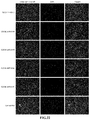
- FIG. 16 depicts images showing the localization of individual proteins investigated by indirect immunostaining in a human hepatocellular carcinoma cell line established from a hepatitis B-positive patient with hepatocellular carcinoma. (Example 7)
- FIG. 17 shows the effects of introduction of shRNAs against DOCK11 gene and subsequent culturing on: the expression level of DOCK11 gene (A); and the relative amount of HCV (B), which were investigated using a hepatitis C virus (HCV) infection system in human hepatocytes.
- the expression levels are expressed as relative values by taking the control level (Cont shRNA) as 1. (Example 8)
- FIG. 18 depicts a diagram showing a library of pyrrole-imidazole polyamides which bind to DNA in a sequence-selective manner.
- FIG. 19 exemplifies pyrrole-imidazole polyamides which can act as a substance capable of suppressing the expression or activity of the protein encoded by the target gene of the present invention.
- FIG. 20 shows the effects of treatment with an LIPG inhibitor on the amount of HBV DNA and the amount of HBV cccDNA, which were investigated using an HBV infection system in human hepatocytes. (Example 10)
- FIG. 21 shows the effects of introduction of an shRNA against Cdc42 gene on: the amount of HBV DNA (A); and the amount of HBV cccDNA (B), which were investigated using an HBV infection system in human hepatocytes. (Example 11)
- FIG. 22 shows the behavior of nucleoprotein of influenza virus in cells into which shRNA against DOCK11 or Cdc42 gene was introduced, which was investigated using an infection system of a lung adenocarcinoma cell line A549 infected with influenza virus. (Example 12)
- HCC human hepatocellular carcinoma
- the present inventors thought that a mechanism for retaining HBV mRNA could be working in these HBV mRNA positive cells, and that investigation of the HBV mRNA positive cells could lead to identification of the gene involved in the retention of HBV mRNA.
- PCT/JP2015/60841 As a result of analyzing human hepatocellular carcinoma cells established from a hepatitis B-positive patient with hepatocellular carcinoma using the comprehensive single-cell gene expression analysis method established by the present inventors (PCT/JP2015/60841), it was confirmed that only one cell among approximately 3,000 cells expressed HBV mRNA and that this HBV mRNA positive cell highly expressed DENND2A, LIPG, Dock11 and HECW2 genes as compared to other cells.
- the target genes in the present invention encode proteins such as a protein involved in cytoskeleton or a protein which interacts with the Rab family functioning as a membrane organizer, it is predicted that the target genes in the present invention will become target genes for antiviral drugs not only against HBV but against viruses in general. Examples of the viruses include HCV and influenza virus as shown in the Examples.
- a drug which acts on the target gene in the present invention can be selected as an antiviral drug through screening.
- the drug acting on the target gene is one having an action of suppressing the expression of the target gene or the activity of the protein encoded by the target gene. Suppression of the expression of the target gene means inhibition of the process in which the target gene expresses a protein it encodes.
- the protein encoded by the target gene in the present invention is thought to affect a specific enzyme activity, screening for a drug acting on the target gene can be easily performed by measuring the enzyme activity.
- screening for a drug acting on the LIPG gene can be easily performed by measuring the enzyme activity.
- the antiviral drug of the present invention is a drug targeting a gene having an action of retaining virus-derived nucleic acid in a host cell, and containing, as an active ingredient, a substance capable of suppressing the expression of the target gene or the activity of the protein encoded by the target gene.
- the target gene is preferably one or more genes selected from the group consisting of DOCK11 gene, LIPG gene, DENND2A gene, and HECW2 gene.
- the gene having an action of retaining virus-derived nucleic acid in a host cell is not a gene derived from viral genome, but a gene derived from the host cell genome. It is thought that factors of some sort in the host cell are involved in the retention of the virus in the host cell, in addition to the activity and function of the virus itself.
- the antiviral drug of the present invention targets such a factor(s) of some sort in a host cell.
- the antiviral drug of the present invention has an antiviral action.
- the antiviral action means an action of suppressing or inhibiting, for example, viral infection, replication, particle production and reinfection.
- the antiviral drug of the present invention exerts its effects to decrease the amount of viral DNA in host cells.
- the antiviral drug of the present invention exerts an effect of decreasing the amount of HBV DNA, particularly the amount of HBV cccDNA, in hepatocytes when used as an anti-HBV drug, it is thought that the drug affects the uptake of incomplete circular double-stranded DNA of HBV into the nucleus of the hepatocytes and the stability of cccDNA in the nucleus.
- antiviral drugs that can exert the effect of decreasing the amount of viral DNA by targeting genes in host cells.
- anti-HBV drugs that can exert the effect of decreasing the amount of cccDNA in nucleus by targeting genes in hepatocytes.
- the antiviral drug of the present invention exerts its antiviral action via a novel mechanism. Since the antiviral drug of the present invention is based on a novel mechanism, it can be used in combination with other viral growth inhibitors to remove viruses more effectively.
- entecavir a conventional hepatitis B virus growth inhibitor, inhibits production of HBV particles by inhibiting reverse transcription to minus-strand DNA which occurs after transcription from cccDNA to mRNA and subsequent core particle generation.
- the antiviral drug of the present invention is used as an anti-HBV drug, it can be used in combination with (an)other growth inhibitor(s) for hepatitis B virus such as entecavir to remove HBV more effectively.
- HBV In the life cycle of HBV, HBV first interacts with heparan sulfate proteoglycan (HSPG) on the liver cell surface and binds to the cell surface to enter the cell by endocytosis.
- HSPG heparan sulfate proteoglycan
- NTCP sodium taurocholate cotransporting polypeptide
- HBV infection there are NTCP-dependent and -independent systems.
- the membrane of HBV fuses to the endosomal membrane following the maturation of endosomes (vesicles), to release nucleocapsids composed of viral genome and capsid packaging the genome into the cytoplasm.
- nucleocapsids are transported within the cell using cytoskeletal microtubules and enter the nucleus through interaction with motor proteins.
- nucleocapsids send HBV DNA and HBV polymerase into the nucleus.
- the relaxed circular DNA rcDNA
- cccDNA the relaxed circular DNA
- the mechanism is thought to be common to all viruses, in which, after the virus entry into a host cell, the virus genome is transported within the cell by means of cytoskeleton such as microtubule and enters the nucleus. Since the proteins encoded by the target genes in the present invention relate to cytoskeleton, it is believed that the antiviral drug of the present invention acts on the transport of virus from the cell membrane into the nucleus and exerts the effect not only on HBV but on various viruses.
- the application of the antiviral drug of the present invention includes in vivo and ex vivo uses, and the aspect of in vivo use will be described later as a “pharmaceutical composition for treatment and/or prevention.”
- the antiviral drug of the present invention can be administered to any animal that viruses can infect.
- the antiviral drug can be administered to human and non-human mammals such as monkey, mouse, rat, dog, rabbit, cattle and horse, and in particular, it is preferably administered to human.
- Viruses targeted by the antiviral drug of the present invention may be any virus.
- the virus include hepatitis B virus, hepatitis C virus, hepatitis A virus, hepatitis E virus, influenza virus, human immunodeficiency virus, RS virus, papillomavirus, adenovirus, poliovirus, echovirus, coxsackievirus, enterovirus, rhinovirus, rotavirus, norovirus, Newcastle disease virus, mumps virus, vesicular stomatitis virus, rabies virus, Lassa virus, measles virus, rubella virus, Filovirus, Ebola virus, Japanese encephalitis virus, yellow fever virus, dengue virus, West Nile virus, and Zika virus.
- hepatitis viruses including hepatitis B virus, hepatitis C virus, hepatitis A virus and hepatitis E virus, and influenza virus, human immunodeficiency virus, Ebola virus, and Zika virus; more preferred is hepatitis viruses; still more preferred is hepatitis B virus or hepatitis C virus; and most preferred is hepatitis B virus.
- DOCK 11 (dedicator of cytokinesis 11) is a gene having the base sequence shown in GenBank Accession No. NM_144658.
- the DOCK11 gene is a member of the Dock family and is thought to have a function as a guanyl nucleotide exchange factor targeting the Rho GTPase family.
- the function of the DOCK11 gene can be confirmed by measuring the activity of the target Rho GTPase.
- the Rho GTPase family is known to have an action of controlling the cytoskeleton.
- DOCK11 is also known to interact with Cdc42, and it is also possible to use the action and the phenotype of Cdc42 as an indicator. (J. Chem. Biol., 281: 35253-35262 (2006) & J. Chem. Biol., 286: 25341-25351 (2011))
- DENND2A (DENN/MADD domain containing 2A) gene has the base sequence shown in GenBank Accession No. NM_144658.
- the DENND2A gene encodes a protein containing a DENN/MADD domain at its C-terminal side, and is thought to have a function as a guanyl nucleotide exchange factor which specifically acts on Rab.
- the function of the DENND2A gene can also be confirmed by using the function of Rab, which is a target of this gene, as an indicator.
- Rab is a small G-protein belonging to the Ras superfamily.
- Small G-proteins belonging to the Ras superfamily are known to regulate transport pathways in a cell and are thought to be involved in, for example, vesicle formation, migration of vesicles and organelles, and binding of vesicles to targets (Nature Reviews Molecular Cell Biology, 2, 107-117 (2001)).
- HECW2 HECT, C2 and WW domain containing E3 ubiquitin protein ligase 2 gene has the base sequence shown in GenBank Accession No. NM_020760.
- the HECW2 gene is also referred to as NEDL2 gene.
- the protein encoded by the HECW2 gene has a ligase activity and is thought to act as a ubiquitin transferase.
- the antiviral drug of the present invention can comprise as an active ingredient one or more substances capable of suppressing the expression of the target gene or the activity of the protein encoded by the target gene.
- the active ingredient is not particularly limited as long as it can suppress the expression of the target gene or the activity of the protein encoded by the target gene.
- the phrase “suppressing the expression of the target gene or the activity of the protein encoded by the target gene” is synonymous with suppressing the expression or activity of the protein encoded by the target gene.
- the phrase “suppressing the expression or activity of the protein” refers to any aspect in which the functional expression of the protein is suppressed (or inhibited), and includes, but is not limited to, suppressing the activity (function) of the protein, and suppressing the expression of the protein (e.g.
- the antiviral drug of the present invention may be a drug that inhibits the interaction between the protein encoded by the target gene and a specific gene or a molecule such as a protein.
- the specific gene or protein or the like may be one which has been revealed to interact with the protein encoded by the target gene, or may be one which will be confirmed to interact with it in the future.
- Examples of the active ingredient of the antiviral drug of the present invention include, but are not limited to, inhibitors of the protein encoded by the target gene; antibodies that specifically bind to the protein encoded by the target gene; compounds capable of suppressing the expression of the protein encoded by the target gene; and association inhibitors in cases where the protein acts in association with its target protein(s).
- any inhibitors for the protein encoded by the target gene which are already known or will be developed in future can be used.
- the above-described inhibitor is an inhibitor specific for the protein encoded by the target gene.
- any antibodies capable of inhibiting the function of the protein encoded by the target gene which are already known or will be developed in future, can be used.
- antibodies that bind to the active site of the protein encoded by the target gene and inhibit its function are included.
- Such antibodies may be polyclonal or monoclonal. Both polyclonal antibodies and monoclonal antibodies can be appropriately prepared by methods known to those skilled in the art. When the antibodies are monoclonal, they may be chimeric antibodies, humanized antibodies, or human antibodies prepared by known methods.
- the antibodies may also be, for example, but are not limited to, complete antibody molecules, antibody fragments, bispecific antibodies, minibodies, domain antibodies, synthetic antibodies (also referred to as “antibody mimetics”), antibody fusions (also referred to as “antibody conjugates”), or fragments thereof.
- Antibody fragments include Fab fragments, Fd fragments, Fv fragments, dAb fragments, CDR regions, F(ab′)2 fragments, single chain Fvs (ScFvs), minibodies, diabodies, triabodies, and tetrabodies.
- Examples of the compounds capable of suppressing the expression of the protein encoded by the target gene include nucleic acids, proteins, polyamides, and the like which can suppress the expression of the protein encoded by the target gene.
- Such nucleic acids, proteins, polyamides and the like may be those that can suppress the expression or activity of the protein encoded by the target gene via recognition of a base sequence selected from any of the followings:
- RNA molecules having an RNA interference action such as antisense oligonucleotides, shRNAs, siRNAs, and dsRNAs against the target gene or the transcription product thereof; and miRNAs and aptamers considered to be capable of suppressing the translation of the mRNA of the target gene.
- the antisense oligonucleotide is a single stranded DNA or RNA molecule complementary to the target sequence, and binds to the complementary DNA or RNA to inhibit its expression.
- RNA molecules having an RNA interference action can be appropriately designed by a person skilled in the art by using a known method based on the information about the base sequence of the target gene.
- the RNA molecule can be prepared by a person skilled in the art according to a known method, and those which are distributed in the market can be obtained and used.
- the above-described nucleic acid capable of suppressing the expression of the protein encoded by the target gene siRNA, shRNA and miRNA are preferable, and siRNA and shRNA are particularly preferable.
- the nucleic acids capable of suppressing the expression of the protein encoded by the target gene which can be used include, but are not limited to, those having an activity of inhibiting transcription or translation of the gene described above.
- the above-described nucleic acid capable of suppressing the expression of the protein encoded by the target gene is a nucleic acid that binds to a portion of the target gene and suppresses the expression of the protein.
- the RNA or DNA molecule capable of binding to a portion of the target gene can be introduced into a cell by a method known per se.
- RNA or DNA molecules can be introduced into a cell by using a DNA molecule, such as a vector, capable of expressing these molecules, and the vector can be appropriately prepared by a person skilled in the art by a known method.
- a DNA molecule such as a vector
- the vector can be appropriately prepared by a person skilled in the art by a known method.
- the vectors include, but are not limited to, adenoviral vectors, lentiviral vectors, and adeno-associated viral vectors.
- the vector is a lentiviral vector.
- nucleic acid capable of suppressing the expression of the protein encoded by the target gene of the present invention one or more nucleic acids selected from the nucleic acids having the nucleotide sequences listed below can be used:
- a base sequence that is obtained by substituting, deleting, adding and/or inserting one to several (preferably 5 or less, more preferably 2 or less) bases in any one of the base sequences of the above-described SEQ ID NOs: 1 to 19 and exerts RNA interference action on each gene.
- the terminal CCGG and TTTTTG or TTTTT are regions to be cleaved by a Dicer, and CTCGAG constitutes a hairpin loop structure.
- the base sequence between CCGG and CTCGAG corresponds to the target sense strand
- the base sequence between CTCGAG and TTTTTG or TTTTT corresponds to the antisense strand.
- the underlined base sequences in the sense strands correspond to the cleavage sites in the target gene, which are the base sequences of the portions of the target gene to which each shRNA can bind or the complementary sequence thereof.
- the nucleic acids capable of suppressing the expression of the protein encoded by the target gene which can be used in the present invention are not limited to the nucleic acids having the base sequence shown in SEQ ID NOs: 1 to 19, and may be nucleic acids that can bind to the underlined nucleotide sequences and/or the complementary sequences thereof and suppress the expression of the protein encoded by the target gene.
- the nucleic acids may comprise substitution, deletion, addition and/or insertion of one to several (preferably 5 or less, more preferably 2 or less) bases in each of the underlined portions, as long as such nucleic acids exert an RNA interference action on each gene.
- Pyrrole-imidazole polyamides are a group of synthetic compounds and composed of pyrrole-imidazole polyamide comprising an N-methyl pyrrole unit (hereinafter also referred to as “Py”) and an N-methyl imidazole unit (hereinafter also referred to as “Im”), which are aromatic rings, and a ⁇ -aminobutyric acid unit (Dervan: Bioorg Med Chem. 2001; 9: 2215-35).
- PIP can be synthesized by sequentially coupling Py and Im, and can be folded in the presence of ⁇ -aminobutyric acid into a U-shaped conformation.
- the Py, Im, and ⁇ -aminobutyric acid unit (also referred to as “ ⁇ linker”) are connected to each other via an amide bond (—C( ⁇ O)—NH—), and the general structure and the production method are known (JP3045706B, JP2001-136974A, WO03/000683A1, JP2009-120531A).
- PIP can be conveniently produced by an automated synthesis method based on a known solid phase method using Fmoc (9-fluorenylmethoxycarbonyl) (solid phase Fmoc method).
- PIP having a carboxyl group at the terminal can be synthesized.
- Specific examples thereof include PIPs having a ⁇ -alanine residue ( ⁇ -aminopropionic acid residue) and a ⁇ -aminobutyric acid residue at the terminal.
- PIP can bind with high affinity and specificity to a specific base pair in minor grooves in a double helical DNA.
- the specific recognition of base pairs is dependent on a one-to-one pairing between Py and Im. That is, in the U-shaped conformation in minor grooves of DNA, the Py/Im pair targets C-G base pairs, Im/Py targets G-C base pairs, and Py/Py targets both A-T and T-A base pairs (Dervan: Bioorg Med Chem. 2001; 9: 2215-35.). Since PIP can specifically inhibit a gene expression, it has no side effects. Furthermore, since PIP is a low molecular weight compound, it does not have the drawback of being degraded by ribonuclease. Since PIP can permeate into cell nuclei without using reagents for introduction or vectors and bind to a specific base pair with high affinity and specificity to suppress the expression of a specific gene, it is expected as a novel gene transcription regulator.
- the PIP capable of suppressing the transcription of the target gene of the present invention can be selected from the library shown in FIG. 18 .
- Examples of the base sequence to which PIP binds include the base sequence of the gene promoter region necessary for initiating transcription of the target gene, the base sequences shown in SEQ ID NOs: 36 to 54, or a base sequence obtained by substituting, deleting, adding and/or inserting one to several bases in any one of the base sequences of the above-described SEQ ID NOs: 36 to 54. As shown in FIG.
- PIPs ( ⁇ ) and (B) shown in FIG. 18 for the base sequence shown in SEQ ID NO: 37. It is preferable to use PIPs (B) and (A) for the base sequence shown in SEQ ID NO: 38. It is preferable to use PIPs (S) and (A) for the base sequence shown in SEQ ID NO: 39.
- W indicates A-T base pair recognition.
- the antiviral drug of the present invention may be provided as a pharmaceutical composition which contains the said antiviral drug and is for treatment and/or prevention of diseases associated with viral infection.
- diseases associated with viral infection include hepatitis B, hepatitis C, influenza, AIDS, Ebola hemorrhagic fever, and Zika fever.
- the pharmaceutical composition can be formulated according to a known technique. Specific examples of the formulations include, but are not limited to, solid formulations such as tablets, capsules, pills, powders, and granules, and liquid formulations such as solutions, suspensions, emulsions and injections. Depending on the form of the formulation, pharmaceutically acceptable carriers and additives can be added as appropriate.
- the carriers and additives include, but are not limited to, preservatives, stabilizers, excipients, fillers, binders, wetting agents, flavoring agents, and coloring agents.
- a known pharmaceutically acceptable solvent such as a physiologic saline or a solution having a buffering action can be used.
- the dose of the pharmaceutical composition of the present invention is not particularly limited as long as it can produce an antiviral effect of the active ingredient, and can be appropriately set by a person skilled in the art.
- the dose of the active ingredient can be, for example, 0.01 to 1000 mg, preferably 0.05 to 500 mg, more preferably 0.1 to 100 mg per kg body weight of patient per dose.
- the method for administering the pharmaceutical composition of the present invention is not particularly limited as long as it can produce the antiviral effect, and can be appropriately set by a person skilled in the art.
- a person skilled in the art can select an administration method needed according to the specific disease state.
- Specific modes of the administration method include, but are not limited to, injections (such as intravenous, subcutaneous, intramuscular, intraperitoneal, and injection to the affected part), oral, suppository, and transdermal administrations (such as application).
- the present invention provides a method for treating or preventing a disease associated with viral infection, comprising the step of administering a substance capable of suppressing the expression or activity of the protein encoded by the target gene.
- a substance capable of suppressing the expression or activity of the protein encoded by the target gene comprising the step of administering a substance capable of suppressing the expression or activity of the protein encoded by the target gene.
- the present invention further provides a substance capable of suppressing the expression or activity of the protein encoded by the target gene, for use in treatment or prevention of symptoms caused by viral infections.
- the present invention further provides the use of a substance capable of suppressing the expression or activity of the protein encoded by the target gene for producing a pharmaceutical composition for treatment and/or prevention of symptoms caused by viral infections.
- the antiviral drug of the present invention may be used in combination with other agents effective against viral infection. They may be administered separately during the course of treatment, or may be administered in combination with the antiviral drug of the present invention, for example, in a single dosage form such as a tablet, intravenous solution or capsule.
- the other agents effective against viral infections include viral growth inhibitors.
- the virus growth inhibitors include HBV growth inhibitors such as entecavir and tenofovir; and influenza virus growth inhibitors such as oseltamivir.
- Viral growth inhibitors preferably used in combination with the antiviral drug of the present invention are reverse transcriptase inhibitors.
- the viral growth inhibitor used in combination with the antiviral drug of the present invention is an HBV growth inhibitor, including in particular, interferon, peginterferon, lamivudine, adefovir, entecavir, tenofovir, telbivudine, and clevudine, among which entecavir is preferred.
- the present invention relates to a screening method for an antiviral drug, the method comprising selecting a substance capable of suppressing an expression or activity of a protein encoded by a target gene as an antiviral drug from test substances, wherein the target gene is one or more genes selected from the group consisting of DOCK11, DENND2A, LIPG, and HECW2 genes.
- the screening method of the present invention includes the following steps:
- test substance is a substance capable of suppressing the expression or activity of the protein encoded by the target gene
- test substance selected as an active ingredient of the antiviral drug a test substance determined in the step (i) as a substance capable of suppressing the expression or activity of the protein encoded by the target gene.
- step (i) whether or not the test substance to be screened is a substance capable of suppressing the expression or activity of the protein encoded by the target gene is determined.
- Means for determining whether or not the substance is capable of suppressing the expression or activity of the protein encoded by the target gene can be appropriately selected from any means known to those skilled in the art and developed in the future, within the range where the object is achieved, depending on the test substance to be determined and on the expression or activity of the protein encoded by the target gene whose suppression is to be determined.
- the expression level of the target gene in a cell capable of expressing the target gene may be used as an indicator.
- the level of enzymatic activity of the protein encoded by the target gene may be used as an indicator.
- the level of activity or function of a protein itself with which the protein encoded by the target gene interacts may be used as an indicator.
- test substance may be determined to be a substance capable of suppressing the expression or activity of the protein encoded by the target gene.
- a screening method for a substance capable of suppressing the activity of a protein encoded by a target gene (e.g., enzymatic activity, binding to an interacting protein) will be described below, with an illustration where the target gene is DOCK11 gene and the interacting protein is Rho GTPase.
- a screening method for a substance capable of suppressing the activity of the protein encoded by the DOCK11 gene comprises the following steps (a), (b) and (c) of:
- step (b) measuring the binding ability between Rho GTPase and the protein encoded by the DOCK11 gene in the presence of the test substance, and comparing the measured binding ability to the binding ability between Rho GTPase and the protein encoded by the DOCK gene in the absence of the test substance; (c) selecting a test substance that causes a decrease in the binding ability between Rho GTPase and the protein encoded by the DOCK11 gene as an active ingredient of the antiviral drug based on the comparison result in step (b) above.
- the protein encoded by the DOCK11 gene and Rho GTPase in step (a) can be prepared by known methods. For example, recombinant proteins can be prepared by gene recombination techniques. As the protein encoded by the DOCK11 gene or Rho GTPase, cells expressing these proteins may be used. Such cells may be, for example, cells expressing these proteins naturally, or cells transformed with expression vectors to express these proteins. Such cells can be easily identified or prepared by those skilled in the art and, for example, primary cultured cells, cell lines derived from the primary cultured cells, commercially available cell lines, and cell lines available from Cell Bank can be used.
- step (b) the binding ability between Rho GTPase and the protein encoded by the DOCK11 gene is measured in the presence of a test substance.
- the “binding ability” to be measured is not particularly limited so long as the binding between Rho GTPase and the protein encoded by the DOCK11 gene can be evaluated, and includes binding amount, binding strength (including parameters such as affinity constant, binding rate constant, and dissociation rate constant), and binding mode (including concentration dependent binding).
- the binding ability can be measured, for example, by known methods such as flow cytometry using a protein labeled with a labeling substance. Methods of measuring binding utilizing surface plasmon resonance (such as Biacore) are also suitably used.
- the binding ability between Rho GTPase and the protein encoded by the DOCK11 gene in the presence of the test substance is compared with the binding ability between Rho GTPase and the protein encoded by the DOCK11 gene in the absence of the test substance. While the binding ability between Rho GTPase and the protein encoded by the DOCK11 gene in the absence of the test substance may be measured before or simultaneously with the measurement of the binding ability between Rho GTPase and the protein encoded by the DOCK11 gene in the presence of the test substance, the binding ability simultaneously measured is preferred from the viewpoint of accuracy and reproducibility of the experiment.
- step (c) a test substance that causes a decrease in binding ability between Rho GTPase and the protein encoded by the DOCK11 gene is selected as an active ingredient of the antiviral drug.
- Cdc42 which is a Rho GTPase, is known as an associating molecule for the protein encoded by the DOCK11 gene. It is known that the protein encoded by the DOCK11 gene mediates a positive feedback activation of Cdc42. It has been reported that activated Cdc42 binds to the protein encoded by the DOCK11 gene and then enhances its guanyl nucleotide exchange factor (GEF) activity (Lin, Q., Yang, W., Baird, D., Feng, Q., Cerione, R. A., 2006. J. Biol. Chem. 281, 35253-35262).
- GEF guanyl nucleotide exchange factor
- the binding ability between the said protein and Cdc42 can be measured, as described in the explanation of step (b) above. Or, for example, measurements of the activity of Cdc42 itself and the GEF activity enhanced by Cdc42 are exemplified as such means.
- the GEF activity can be measured using a GEF assay system described below.
- Rabs in particular Rab9
- Means for determining a substance capable of suppressing the expression or activity of the protein encoded by the DENND2A gene include measuring the binding ability between the said protein and Rab9, or measuring the GEF activity or the activity of Rab9 itself.
- the GEF activity can be measured using a GEF assay system (J. Cell. Biol. Vol. 191, 367-381, 2010) as described below or known assay kits. It is known that the protein encoded by the DENND2A gene has a function of releasing GDP particularly from Rab9a or Rab9b.
- the remaining solution is divided into two tubes and incubated with 500 ⁇ l of ice cold assay buffer containing 1 mM MgCl 2 and 20 ⁇ l of packed glutathione-sepharose for 60 minutes at 4° C.
- the sepharose is transferred to a vial containing 4 ml of scintillation solution, and the amount of released GDP (pmol) is measured, which can be the GEF activity (the amount of nucleotide exchange).
- the amount of bound GTP may be measured.
- the amount of bound GTP can be measured by using only unlabeled GDP without using labeled GDP in the above-described loading solution, and using 0.5 ⁇ l of 10 mM GTP and 1 ⁇ Ci[35S]-GTP ⁇ S32 (10 mCi/ml; 5,000 Ci/mmol) instead of Mg-GTP in the GEF reaction.
- the screening method for a substance capable of suppressing the activity of a protein encoded by a target gene can be carried out by: bringing a substrate into contact with the enzyme in the presence of a test substance and allowing them to react in the above-described step (a); measuring the enzyme activity instead of the binding ability in the above-described step (b); and selecting a test substance that causes a decrease in the enzyme activity in the above-described step (c).
- the target gene is the LIPG gene
- the enzyme activity can be determined by measuring the lipase activity as shown below (see, Nature genetics, 21,424 (1999)) in which measurement for the reactant is carried out.
- the target gene is the HECW2 gene
- the enzyme activity can be determined by measuring the ubiquitin transferase activity as shown below (see Biochemical and Biophysical Research Communications 308 (2003) 106-113).
- the method for measuring the lipase activity is illustrated in detail below.
- the reaction can be stopped by adding methanol-chloroform-heptane (1.41:1.25:1) thereto and mixing potassium carbonate-borate buffer therewith.
- the reactant is centrifuged, and the supernatant is used for measurement with a scintillation counter to measure TG lipase activity.
- An assay for phospholipase can be carried out as follows. First, an emulsion of phosphatidylcholine (PC) is mixed with 14C-dipalmitoyl PC (2 ⁇ Ci; NEN), lecithin (10 ⁇ l), Tris-TCNB (100 ⁇ l; 100 mM Tris-HCl, pH 7.4, 1% Triton X-100, 5 mM CaCl 2 ), 200 mM NaCl, 0.1% BSA), and then the mixture is stirred and dried with an evaporator. The dried lipid is mixed in TCBN to prepare a reaction substrate.
- PC phosphatidylcholine
- 14C-dipalmitoyl PC 2 ⁇ Ci; NEN
- lecithin 10 ⁇ l
- Tris-TCNB 100 ⁇ l; 100 mM Tris-HCl, pH 7.4, 1% Triton X-100, 5 mM CaCl 2
- 200 mM NaCl 0.1% BSA
- the reaction substrate is mixed with a PC emulsion, MEM medium, etc., and then LIPG-expressing cells and the substrate are brought into contact with each other and incubated at 37° C. for about 2 hours to allow the reaction to occur.
- the reaction is stopped by adding HCl.
- the resulting mixture is extracted with 2-propanol:hexane (1:1), and then the upper hexane layer is filtered through a silica gel column.
- the 14C free fatty acid contained in the filtrate is measured with a scintillation counter to measure the phospholipase activity.
- a protein encoded by the HECW2 gene is mixed with an appropriate solution containing E1 (ubiquitin-activating enzyme) and E2 (ubiquitin-conjugating enzyme) and bovine ubiquitin (Sigma, Chemical), and incubated at 30° C. for 2 hours to allow the reaction to occur.
- the reaction is stopped by adding SDS solution (containing 62.5 mM Tris-Cl, pH 6.8, 2% SDS, 10% glycerol, 0.1 M DTT, 0.01% bromophenol blue) and boiling.
- SDS solution containing 62.5 mM Tris-Cl, pH 6.8, 2% SDS, 10% glycerol, 0.1 M DTT, 0.01% bromophenol blue
- the solution is subjected to electrophoresis on SDS polyacrylamide gel followed by immunoblotting to detect ubiquitinated proteins, thereby allowing measurement of the ubiquitin transferase activity.
- the present invention includes a screening method for an antiviral drug capable of suppressing the expression of a target gene or the activity of a protein encoded by the target gene, the method comprising the following steps (a) to (c) of:
- step (b) measuring the expression level of the target gene in the cell and comparing the expression level of the target gene in the cell contacted with the test substance to the expression level of the target gene in the cell not contacted with the test substance; and (c) selecting a test substance that causes a decrease in the expression level of the target gene in the cell as an antiviral drug through screening based on the comparison result in step (b) above.
- the system in which a cell expresses the target gene may be any system as long as the cell capable of expressing the target gene is in the presence of a factor that enhances the expression of the target gene, and no particular limitation is imposed on whether the factor is present intracellularly or extracellularly.
- the system may be a cell line into which a promoter for constitutively expressing the target gene is incorporated.
- a screening method for a substance capable of suppressing the expression of the target gene comprises the following steps (a′), (b′) and (c′) of:
- step (c′) selecting a test substance that causes a decrease in the expression level as an active ingredient of the antiviral drug based on the comparison result of step (b′) above.
- the test substance is placed in contact with cells in which the expression of the target gene or the protein encoded by the target gene can be measured.
- the test substance may be brought into contact with the cells in which the expression of the target gene or the protein encoded by the target gene can be measured in a culture medium.
- Cells in which the expression of the target gene or the protein encoded by the target gene can be measured refers to cells in which the expression level of the product from the target gene, such as transcription product or translation product (i.e., protein) can be evaluated.
- the cells in which the expression level of the product from the target gene can be evaluated may be cells that can naturally express the target gene or cells that allow reporter assay for the transcriptional regulatory domain of the target gene. These cells can be easily identified by those skilled in the art and, for example, primary cultured cells, cell lines derived from the primary cultured cells, commercially available cell lines, and cell lines available from Cell Bank can be used.
- the expression level of the target gene or the protein encoded by the target gene in cells contacted with the test substance is first measured.
- the expression level may be measured using methods known per se, the method being selected in consideration of, for example, the type of the cells used. For example, transcription products may be measured by preparation of total RNA from cells and subsequent RT-PCR, Northern blotting or the like, and translation products may be measured by preparation of extracts from cells and subsequent immunological procedures. When cells that allow reporter assay for the transcriptional regulatory domain of the target gene are used, the expression level may be measured based on the signal intensity of the reporter.
- the expression level of the target gene or the protein encoded by the target gene in the cells contacted with the test substance is compared with the expression level of the target gene or the protein encoded by the target gene in control cells not contacted with the test substance.
- the comparison of the expression levels is carried out based on whether a significant difference is found or not. While the expression level of the target gene or the protein encoded by the target gene in control cells not contacted with the test substance may be measured before or simultaneously with the measurement of the expression level of the target gene or the protein encoded by the target gene in the cells contacted with the test substance, the expression level simultaneously measured is preferred from the viewpoint of accuracy and reproducibility of the experiment.
- a test substance that causes a decrease in the expression level of the target gene or the protein encoded by the target gene is selected as an active ingredient of the antiviral drug.
- the above-mentioned test substance is not particularly limited as long as it can be a candidate substance for an active ingredient of the antiviral drug.
- the above-mentioned test substance may be a natural compound (e.g., a substance derived from an organism) or a synthetic compound.
- the above-mentioned test substance is a substance which is pharmaceutically acceptable for use in human.
- Specific examples of the test substance include, but are not limited to, low molecular weight compounds; proteins such as antibodies; nucleic acids capable of suppressing the expression of proteins (e.g., siRNA, shRNA, dsRNA, miRNA); and sugar chains or complex carbohydrates.
- the present invention also includes a method of detecting a gene having an action of retaining virus-derived nucleic acid in the host cell from host cell-derived genes, the method comprising analyzing a host cell after viral infection for the expression patterns of two or more finite numbers of genes.
- Comprehensive single-cell gene expression analysis International Publication WO2015/166768
- HBV-positive hepatocellular carcinoma cells and HBV-negative hepatocellular carcinoma cells have the same genome.
- the expression of HBV gene is rarely retained in human hepatocellular carcinoma cell lines established from hepatocellular carcinoma tissues from a specific cancer patient. According to the present invention, utilizing such a rare phenomenon, a gene having an action of retaining virus-derived nucleic acid in a host cell can be detected.
- the virus-derived nucleic acid in a host cell may be DNA or RNA.
- the DNA includes cccDNA of HBV.
- the method of detecting a gene having an action of retaining virus-derived nucleic acid in a host cell of the present invention comprises the following steps of:
- step (3) analyzing the virus-positive cell and virus-negative cell obtained in the step (2) for the expression patterns of two or more finite numbers of genes in each single cell;
- Factors having an action of retaining virus-derived nucleic acid in a host cell can be detected efficiently by comparing virus-positive cell(s) and virus-negative cell(s) that have occurred under the same conditions.
- virus-positive cell(s) and virus-negative cell(s) both derived from a single organism are used.
- the single organism means a single individual, and does not mean obtaining virus-positive cell(s) and virus-negative cell(s) from two or more individuals. More specifically, a virus-positive tissue specimen is collected from a single organism.
- virus-positive means being infected with each virus, and means that a marker(s) for the virus (e.g., virus-derived antigens, antibodies against the antigens, virus-derived nucleic acids (e.g., DNA, mRNA)) is/are detected.
- virus-negative means that a marker(s) of the virus and the like is/are not detected.
- HBV-positive means that at least one of cccDNA and HBV DNA is found at a detectable level and HBV mRNA is expressed.
- a tissue specimen refers to those obtained by collecting part or all of virus-positive organs and tissues from various virus-positive organs and tissues of an organism.
- a virus-positive cell line can be obtained by treating a tissue specimen with an agent or the like, separating it into single cells to form a suspension.
- a virus-positive cell line may be produced by such a method, or a virus-positive cell line already established from a virus-positive tissue specimen may be obtained and used.
- Subculturing of a virus-positive cell line results in a decrease in the proportion of virus-positive cells.
- the passage number in subculturing is not particularly limited as long as the object of the present invention is not impaired, and it is required that while virus-positive cells are decreased, virus-positive cells are still not completely disappeared. For example, a passage number in the range of about 10 to 40 is preferred.
- Expression patterns of two or more finite numbers of genes in each single cell may be analyzed by any method, for example, a comprehensive single-cell gene expression analysis disclosed in International Publication WO2015/166768. Specifically, this is a method of analyzing the constitution of nucleic acids derived from a single cell using a microplate having a plurality of reaction wells. On the microplate, one bead is placed in one reaction well. A plurality of single-stranded oligonucleotide molecules are bound to one bead, and in the single-stranded oligonucleotide, a nucleic acid-capturing sequence is exposed at the 3′ end, and a barcode sequence is contained 5′ upstream to the nucleic acid-capturing sequence. Each bead has a specific barcode sequence different from the other barcode sequences the other beads have.
- the comprehensive single-cell gene expression analysis comprises the following steps (i) to (iii) of:
- the virus express transcription products comprising poly A at their 3′ ends from genes derived from the virus. Thanks to production of transcription products (mRNAs) comprising poly A at their 3′ ends in the cell by the virus, host-derived mRNAs and virus-derived mRNAs can be simultaneously captured and analyzed in the step (i) of the comprehensive single-cell gene expression analysis described above.
- mRNAs transcription products
- virus-derived mRNAs virus-derived mRNAs
- Such a virus is preferably a hepatitis B virus
- the gene having an action of retaining virus-derived nucleic acid in a host cell is preferably a gene having an action of retaining cccDNA derived from hepatitis B virus in a host cell.
- a PDMS slide for comprehensive single-cell gene expression analysis was prepared.
- emulsion PCR was carried out using a barcode linker to prepare beads to which PCR amplification products were bound, and then the beads were purified.
- the obtained beads were treated with restriction enzymes, alkali and heat shock, to prepare beads to the surface of which several millions of oligonucleotide molecules consisting of single-stranded DNAs were bound.
- restriction enzymes alkali and heat shock
- the prepared beads were placed one by one in wells of a PDMS slide to prepare a PDMS slide for comprehensive single-cell gene expression analysis.
- a KM cell line which is a human hepatocellular carcinoma (HCC) cell line established from a specific hepatitis B-positive patient with hepatocellular carcinoma, was obtained from the First Department of Internal Medicine, Kanazawa University Hospital.
- the KM cell line was established by obtaining a human HCC specimen from a hepatitis B-positive patient with hepatocellular carcinoma who underwent radical operation at the Liver Center, Kanazawa University Hospital after acquiring informed consent, collecting an HCC tissue from the specimen, and separating the tissue into single cells in a suspension immediately after the collection.
- HCC human hepatocellular carcinoma
- HBV cccDNA, HBV DNA, and HBV mRNA i.e., pgRNA
- immunostaining for HBc antigen which was known as a marker for HBV, was carried out to observe the HBc-positive cells. Specifically, the detection was carried out as follows.
- RNAs were isolated using GenEluteTM Mammalian Total RNA Miniprep Kit (Sigma-Aldrich Japan K.K., Tokyo, Japan), and cDNAs were synthesized using High Capacity cDNA reverse transcription kit (Applied Biosystems, Carlsbad, Calif.).
- RTD-PCR was carried out using 7500 Real Time PCR System (Applied Biosystems, Carlsbad, Calif.) according to the manufacturer's instruction.
- the primers and probes used are as follows.
- RNA Primers for pg RNA: (SEQ ID NO: 21) 5′GCTCTGTATCGGGAGGCCTTA3′, and (SEQ ID NO: 22) 5′TGAGTGCTGTATGGTGAGGAGAA3′ Probe for pg RNA: (SEQ ID NO: 23) 5′FAM-AGTCTCCGGAACATT-MGB3′ Primers for PreS/S: (SEQ ID NO: 24) 5′ACCCCAACAAGGATCATTGG3′, and (SEQ ID NO: 25) 5′CGAATGCTCCCGCTCCTA3′ Probe for PreS/S: (SEQ ID NO: 26) 5′FAM-CAGAGGCAAATCAG-MGB3′ Primers for HBx: (SEQ ID NO: 27) 5′ TGTCAACGACCGACCTTGAG3′, and (SEQ ID NO: 28) 5′ CCCAACTCCTCCCAGTCCTT3′ Probe for HBx: (SEQ ID NO: 29) 5′FAM-CATACTTC
- the amount of intracellular HBV DNA was determined using DNeasy Blood & Tissue Kit (QIAGEN) according to the protocol of the product.
- the amount of HBV DNA in the medium was determined using SMI TEST EX R&D Kit (MLB) according to the protocol of the product.
- the amount of HBV DNA was determined by quantitative PCR using 5′ACTCACCAACCTCCTGTCCT3′ (SEQ ID NO: 30) and 5′′GACAAACGGGCAACATACCT3′ (SEQ ID NO: 31) as a primer set, and 5′FAM-TATCGCTGGATGTGTCTGCGGCGT-TAMRA3′ (SEQ ID NO: 32) as a probe.
- the extracted DNA (50 ng) was treated with 10 U Plasmid safe DNase1 (Epicenter) at 37° C. for 60 minutes and then treated at 70° C. for 30 minutes to inactivate the DNase.
- the amount of cccDNA was determined by quantitative PCR using 5′CGTCTGTGCCTTCTCATCTGC3′ (SEQ ID NO: 33) and 5′GCACAGCTTGGAGGCTTGAA3′ (SEQ ID NO: 34) as a primer set, and 5′FAM-CTGTAGG41CATAAATTGGT-MGB3′ (SEQ ID NO: 35) as a probe.
- Indirect immunofluorescence staining was carried out using rabbit anti-HBcAg polyclonal antibody (an antibody against HBc antigen: Thermo Fisher Scientific Inc.). Cultured cells were fixed with methanol-acetone (1:1) for 10 minutes and then permeabilized with 0.01% Triton X-100 (Merck) in 10 mmol/L phosphate buffered saline at room temperature for 10 minutes. The cells were incubated in phosphate buffered saline containing 5% BSA for 30 minutes and then incubated with rabbit anti-HBcAg polyclonal antibody diluted in phosphate buffered saline containing 3% BSA overnight at 4° C.
- rabbit anti-HBcAg polyclonal antibody an antibody against HBc antigen: Thermo Fisher Scientific Inc.
- the cells were washed with phosphate buffered saline containing Tween 20 and then incubated with secondary antibody Alexa 488-conjugated donkey anti-goat antibody and Alexa 594-conjugated donkey anti-rabbit antibody (Life Technologies) for 1 hour at room temperature. Nuclei were stained with DAPI (Dojindo Laboratories, Co., Ltd.). The numbers of liver cells and HBV-positive liver cells were counted to analyze the ratio of HBV-positive liver cells.
- HBV cccDNA and HBV DNA were both observed at detectable levels, and expression of HBV mRNA was also observed.
- the amounts of HBV cccDNA and HBV mRNA in KM cells were decreased with subculturing. For example, it was confirmed that the amount of HBV cccDNA in KM cells passaged 32 times was decreased to less than half the amount in KM cells passaged 10 times ( FIG. 13 ).
- HBc antigen known as an HBV marker was immunostained, HBc positive cells were less than 0.1% in total cells.
- Lysis buffer 500 mM LiCl in 100 mM TRIS buffer (pH 7.5) with 1% lithium dodecyl sulfate, 10 mM EDTA and 5 mM DTT was added from the upper side of the dialysis membrane to extract mRNAs in the cells, and then allowed the mRNAs to be captured by oligonucleotides on beads.
- mRNAs bound to the beads were subjected to reverse transcription reaction to synthesize the 1st strand cDNA.
- the 2nd strand was synthesized by PCR to obtain amplification products.
- the amplified products were sequenced using a next generation sequencer HiSeq 2500 (Illumina Inc.).
- HepG2.2.15 cells were infected with lentivirus expressing each shRNA against the DOCK11 gene (Sigma-Aldrich Japan K.K., Tokyo, Japan, TRCN0000369589, TRCN0000369590, TRCN0000369611, 1RCN0000376430, TRCN0000123016; sequences #1 to #5 of five shRNAs are shown below) according to a conventional method, and 72 hours later, the amount of mRNA of DOCK11 gene, the amount of HBV DNA, and the amount of HBV cccDNA were determined. The amounts of HBV DNA and HBV cccDNA were measured in the same manner as in Example 1. The mRNA of DOCK11 gene was quantified by real time PCR according to a conventional method.
- DOCK11 #1 (SEQ ID NO: 1) CCGGCCAACAGGGTGCTTACATATTCTCGAGAATAT GTAAGCACCCTGTTGGTTTTTG
- DOCK11 #2 (SEQ ID NO: 2) CCGGGTACTAGACACCATATCATTTCTCGAGAAATG ATATGGTGTCTAGTACTTTTTG
- DOCK11 #3 (SEQ ID NO: 3) CCGGACTAAATGAGCGGCTAATTAACTCGAGTTAAT TAGCCGCTCATTTAGTTTTTTG
- DENND2A, LIPG, and HECW2 genes were also confirmed using lentiviruses (Sigma-Aldrich Japan K.K., Tokyo, Japan, TRCN0000179931, TRCN0000178923, TRCN0000184030, TRCN0000179932, TRCN0000372782, TRCN0000378899, TRCN0000050893, TRCN000005044894, TRCN0000372783, TRCN0000004789, TRCN0000004790, TRCN0000004791, TRCN0000004792, TRCN0000004793) respectively expressing shRNAs shown in SEQ ID NOs: 6 to 19.
- DENND2A #1 (SEQ ID NO: 6) CCGGCTGAAGGGACTAGGCAATAAACTCGAGTTTA TTGCCTAGTCCCTTCAGTTTTTTG DENND2A #2: (SEQ ID NO: 7) CCGGCCAATGAAGGAGAACCCTTATCTCGAGATAA GGGTTCTCCTTCATTGGTTTTTTG DENND2A #3: (SEQ ID NO: 8) CCGGCCTAGTGCAGCCCTATTCTTTCTCGAGAAAG AATAGGGCTGCACTAGGTTTTTTG DENND2A #4: (SEQ ID NO: 9) CCGGCTAGTGCAGCCCTATTCTTTACTCGAGTAAA GAATAGGGCTGCACTAGTTTTTTG LIPG #1: (SEQ ID NO: 10) CCGGACGATGTCTTGGGATCAATTGCTCGAGCAATTGATC CCAAGACATCGTTTTTTG LIPG #2: (SEQ ID NO: 11) CCGGATGCAGGCAACTTCGTGAAAGCTCGAGCTTTCACGCG
- HBV cells human hepatocytes derived from PXB mouse (PhoenixBio Co., Ltd., Hiroshima, Japan)
- effects of shRNAs against each gene on infection of human hepatocytes with HBV were determined.
- Experiments were carried out by culturing PHH cells as follows. First, on day 0 of culture, the cells were infected with the lentivirus expressing the shRNA against each of the genes by a conventional method. A serum collected from an HBV-infected chimeric mouse infected with HBV (Genotype C. 5 HBV DNA copies/cell) was added to the cells as an HBV inoculum on day 1 of culture.
- Example 2 On day 2 of culture, the cells were washed three times and entecavir (ETV) (10 nM) was added thereto. On day 7 of culture, the cells were collected and the amount of HBV DNA, the amount of HBV cccDNA, and the mRNA level of each gene were determined. The amounts of HBV DNA, HBV cccDNA, and pg RNA were quantified in the same manner as in Example 1. The mRNA level of each gene was quantified in the same manner as in Example 2.
- ETV entecavir
- shRNAs having the base sequences shown in SEQ ID NOs: 2, 7, 14, and 17, respectively were used against the respective genes.
- dHCGM medium Yamamoto C, et al., J Hepatol. 2006, 44: 749-57 was used for the culture of fresh human hepatocytes (PHH cells).
- PHH cells infected with HBV were cultured for 4 weeks.
- PHH cells were infected with HBV, then at the day 2 of culture the cells were washed three times, treated with ETV (10 nM), and cultured for 2 weeks. Thereafter, the cells were washed three times to remove ETV and cultured for 2 weeks.
- PHH cells were infected with HBV, then at the day 2 of culture the cells were washed three times, treated with ETV (10 nM), and cultured for 4 weeks.
- shRNAs having the base sequences shown in SEQ ID NOs: 2, 7, 14, and 17, respectively (Sigma-Aldrich Japan K.K., Tokyo, Japan, lentiviruses expressing TRCN0000369590, TRCN0000178923, TRCN0000372783, TRCN0000004791) were used against the respective genes.
- FIGS. 9 to 12 The results are shown in FIGS. 9 to 12 .
- the last number in each item on the horizontal axis indicates the culture conditions (1) to (4) above.
- sh DOCK11 1 indicates that shRNA against DOCK11 gene was introduced and the cells were cultured under the condition (1) above.
- Const is a result obtained when the cells were cultured without introduction of shRNA of each gene.
- HepG2.2.15 cells which had been established by transfecting HepG2 human hepatoma cells with HBV, the DENND2A and Dock11 genes were knocked down using CRISPR/Cas 9 system.
- the amounts of HBV DNA, HBV cccDNA, and pg RNA in the HepG2.2.15 cells in which the target genes were knocked down were determined in the same manner as in Example 1.
- Intracellular localizations of the proteins expressed by the respective target genes in KM cells were investigated by indirect immunofluorescence staining in the same manner as in Example 1.
- an anti-HBc monoclonal antibody Institute of Immunology; 2AHC21
- an anti-LIPG antibody produced in rabbit Sigma-Aldrich; HPA016966-100UL
- an anti-NEDL2 (HECW2) antibody-N-terminal Abeam; ab154888
- an anti-NEDL2 antibody-N-terminal Abeam; ab154888
- an anti-DOCK11 antibody D-17
- SANTA CRUZ; sc-7461010 were used as antibodies against HBV-core, LIPG, HECW2, DENND2A, and DOCK11, respectively.
- the antiviral activity of the shRNA against Dock11 gene was evaluated using a replicon system for JFH1 strain.
- HCV replication analysis was performed by transfecting Huh 7.5 cells with synthetic JFH1-RNA.
- Cells in which DOCK11 was constitutively knocked down were prepared by introducing DOCK11 shRNA #2 into Huh 7.5 cells.
- Cells into which cont shRNA was introduced were used as a control.
- Huh 7.5 cells into which each shRNA had been introduced were transfected with 1 ⁇ g synthetic RNA (JFH1-RNA) using TransIT®-mRNA Transfection Kit (Mirus).
- RNAs were isolated 24, 48 and 72 hours after the transfection using High Pure RNA Isolation Kit (Roche), and cDNAs were synthesized using high-capacity cDNA reverse transcription kit (Applied Biosystems, Carlsbad, Calif.). HCV RNA was detected in the same manner as described in Shirasaki, T. et al. J Infect Dis 202, 75-85, doi: 10.1086/653081 (2010). The expression of DOCK11 gene was evaluated by determining the level of mRNA in the same manner as in Example 2.
- the results are shown in FIG. 17 .
- the expression level of DOCK11 gene in Huh7.5 cells was decreased by the shRNA against DOCK11 gene. It was also found that HCV replication in Huh7.5 cells was suppressed by the shRNA against DOCK11 gene. It was found that HCV RNA replication was effectively suppressed at 1 to 3 days (24, 48 and 72 hours) after the introduction of HCV RNA.
- HepG2.2.15 cells which were established by transfecting HepG2 human hepatoma cells with HBV, pyrrole-imidazole polyamide capable of specifically binding to the target gene is added at 5 ⁇ M from the start of culturing, and time-dependent changes are observed. After a certain period of time, the cells are collected and the mRNA expression level of DOCK11 gene, and the amounts of HBV DNA, HBV cccDNA and pg RNA are measured in the same manner as in Examples 1 and 2.
- HBV expression construct (HBV-C: provided by Dr. Yasuhito Tanaka at Nagoya City University) was introduced into Huh7 cell line.
- an LIPG inhibitor (GSK264220A) was added at 1 ⁇ M to 100 ⁇ M and the cells were cultured.
- the amounts of HBV DNA and HBV cccDNA were determined in the same manner as in Examples 1 and 2.
- Cdc42 gene which is a gene encoding Cdc42 known to interact with DOCK11 although no difference was observed in its expression level for HBV gene retention, and investigated for their antiviral actions against hepatitis B virus in the same manner as in Example 2.
- HepG2.2.15 cells were infected with lentiviruses expressing individual shRNAs against the Cdc42 gene (Sigma-Aldrich Japan K.K., Tokyo, Japan, TRCN0000047631, TRCN0000047629, TRCN0000047628, 1RCN0000047632, TRCN0000310772; sequences #1 to #5 of five shRNAs are shown below) according to a conventional method, and 1 week later, the amounts of HBV DNA and HBV cccDNA were determined. The amounts of HBV DNA and HBV cccDNA were measured in the same manner as in Example 1.
- CDC42 shRNA #1 (SEQ ID NO: 55) CCGGCCAAGAACAAACAGAAGCCTACTCGAGT AGGCTTCTGTTTGTTCTTGGTTTTTG CDC42 shRNA #2: (SEQ ID NO: 56) CCGGCGGAATATGTACCGACTGTTTCTCGAGA AACAGTCGGTACATATTCCGTTTTTG CDC42 shRNA #3: (SEQ ID NO: 57) CCGGCCCTCTACTATTGAGAAACTTCTCGAGAA GTTTCTCAATAGTAGAGGGTTTTTG CDC42 shRNA #4: (SEQ ID NO: 58) CCGGCAGATGTATTTCTAGTCTGTTCTCGAGAA CAGACTAGAAATACATCTGTTTTTG CDC42 shRNA #5: (SEQ ID NO: 59) CCGGGACTCTGTAACAGACTAATTGCTCGAGC AATTAGTCTGTTACAGAGTCTTTTTG
- nucleoprotein of influenza virus in A549 cells a lung adenocarcinoma cell line
- shRNA against DOCK11 or Cdc42 gene was introduced to the cells.
- A549 cells were seeded on a 10 cm dish. After seeding, A549 cells were infected with lentivirus comprising any one of cont shRNA, DOCK11 shRNA #2, and CDC42 shRNAs #1 to #5 in the same manner as in Examples 2 and 11. Forty eight hours after the infection, 5 ⁇ g/ml of puromycin was added. Thereafter, the cells were cultured for 1 week, and then cells into which shRNA was introduced were selected. The selected cells were seeded on a chamber slide. The cells were infected with influenza virus (WSN strain) (obtained from Dr. Masayoshi Enami at Kanazawa University) isolated from MDCK cells.
- influenza virus WSN strain
- influenza nucleoproteins were immunostained using Influenza A H1N1 HA Antibody (Thermo Fisher PAS-34929) and observed.
- the antiviral drug of the present invention can greatly reduce the amount of HBV cccDNA compared to conventional growth inhibitors for hepatitis B virus, and has a potential to completely remove it.
- the antiviral drug of the present invention is thought to have a different mechanism of action from conventional antiviral drugs and act on the transport pathway to the nuclei after virus enters across the membrane on the surface of host cells. Therefore, it is contemplated that the antiviral drug of the present invention exhibits an antiviral effect not only on HBV but on various viruses. Further, it is contemplated that the antiviral drug of the present invention exerts an antiviral effect synergistically in combination with a conventional antiviral drug.
Landscapes
- Health & Medical Sciences (AREA)
- Life Sciences & Earth Sciences (AREA)
- Chemical & Material Sciences (AREA)
- Engineering & Computer Science (AREA)
- General Health & Medical Sciences (AREA)
- Organic Chemistry (AREA)
- Molecular Biology (AREA)
- Genetics & Genomics (AREA)
- Medicinal Chemistry (AREA)
- Zoology (AREA)
- Wood Science & Technology (AREA)
- Pharmacology & Pharmacy (AREA)
- Biotechnology (AREA)
- Proteomics, Peptides & Aminoacids (AREA)
- Veterinary Medicine (AREA)
- Public Health (AREA)
- Animal Behavior & Ethology (AREA)
- Immunology (AREA)
- Biochemistry (AREA)
- Epidemiology (AREA)
- Analytical Chemistry (AREA)
- Bioinformatics & Cheminformatics (AREA)
- General Engineering & Computer Science (AREA)
- Microbiology (AREA)
- Virology (AREA)
- Physics & Mathematics (AREA)
- Biomedical Technology (AREA)
- Biophysics (AREA)
- Pathology (AREA)
- Communicable Diseases (AREA)
- Oncology (AREA)
- Hematology (AREA)
- Urology & Nephrology (AREA)
- Plant Pathology (AREA)
- Nuclear Medicine, Radiotherapy & Molecular Imaging (AREA)
- General Chemical & Material Sciences (AREA)
- Chemical Kinetics & Catalysis (AREA)
- Hospice & Palliative Care (AREA)
- Food Science & Technology (AREA)
- Tropical Medicine & Parasitology (AREA)
Abstract
Description
- Patent Document 1: JP 2015-002723 A
- Non-Patent Document 1: Christoph Seeger, William S. Mason, Virology 479-480 (2015) 672.686
- Non-Patent Document 2: Tetsuya Ishikawa, “Recent topics on hepatitis B”, Kenko Bunka No. 47 (published in October 2012) (http://www.kenkobunkajp/kenbun/kb47.html)
2. The antiviral drug according to 1 mentioned above, wherein the target gene is DOCK11 gene.
3. The antiviral drug according to 1 or 2 mentioned above, wherein the substance capable of suppressing the expression of the target gene or the activity of the protein encoded by the target gene is one or more compounds selected from the group consisting of shRNA, siRNA, miRNA, antisense oligonucleotide, and pyrrole-imidazole polyamide for the target gene or transcription product thereof.
4. The antiviral drug according to any one of 1 to 3 mentioned above, wherein the substance capable of suppressing the expression of the target gene or the activity of the protein encoded by the target gene recognizes a base sequence selected from any of the followings:
| (SEQ ID NO: 36) | |
| CCAACAGGGTGCTTACATATT | |
| (SEQ ID NO: 37) | |
| GTACTAGACACCATATCATTT | |
| (SEQ ID NO: 38) | |
| ACTAAATGAGCGGCTAATTAA | |
| (SEQ ID NO: 39) | |
| TGATGGCCATAACCCATTAAT | |
| (SEQ ID NO: 40) | |
| CCAGGCTACTTGAATCTGAAT | |
| (SEQ ID NO: 41) | |
| CTGAAGGGACTAGGCAATAAA | |
| (SEQ ID NO: 42) | |
| CCAATGAAGGAGAACCCTTAT | |
| (SEQ ID NO: 43) | |
| CCTAGTGCAGCCCTATTCTTT | |
| (SEQ ID NO: 44) | |
| CTAGTGCAGCCCTATTCTTTA | |
| (SEQ ID NO: 45) | |
| ACGATGTCTTGGGATCAATTG | |
| (SEQ ID NO: 46) | |
| ATGCAGGCAACTTCGTGAAAG | |
| (SEQ ID NO: 47) | |
| CCGTTGTAATAGCATTGGCTA | |
| (SEQ ID NO: 48) | |
| CGTCACCCTTTATGGCACTAA | |
| (SEQ ID NO: 49) | |
| TTACACGGATGCGGTCAATAA | |
| (SEQ ID NO: 50) | |
| GCCCAAACATTTCTTTGAGAT | |
| (SEQ ID NO: 51) | |
| CCAGGGAAGTTAAAGTTAATT | |
| (SEQ ID NO: 52) | |
| GCACAATACTTGGAGTCAATT | |
| (SEQ ID NO: 53) | |
| GCTTACAATGACAAGATTGTT | |
| (SEQ ID NO: 54) | |
| CCCTTATCTTAAGATGTCAAT |
| (SEQ ID NO: 1) |
| CCGGCCAACAGGGTGCTTACATATTCTCGAGAATATGTAAGCACCCTGT |
| TGGTTTTTG |
| (SEQ ID NO: 2) |
| CCGGGTACTAGACACCATATCATTTCTCGAGAAATGATATGGTGTCTAG |
| TACTTTTTG |
| (SEQ ID NO: 3) |
| CCGGACTAAATGAGCGGCTAATTAACTCGAGTTAATTAGCCGCTCATTT |
| AGTTTTTTG |
| (SEQ ID NO: 4) |
| CCGGTGATGGCCATAACCCATTAATCTCGAGATTAATGGGTTATGGCCA |
| TCATTTTTG |
| (SEQ ID NO: 5) |
| CCGGCCAGGCTACTTGAATCTGAATCTCGAGATTCAGATTCAAGTAGCC |
| TGGTTTTTG |
| (SEQ ID NO: 6) |
| CCGGCTGAAGGGACTAGGCAATAAACTCGAGTTTATTGCCTAGTCCCTT |
| CAGTTTTTTG |
| (SEQ ID NO: 7) |
| CCGGCCAATGAAGGAGAACCCTTATCTCGAGATAAGGGTTCTCCTTCAT |
| TGGTTTTTTG |
| (SEQ ID NO: 8) |
| CCGGCCTAGTGCAGCCCTATTCTTTCTCGAGAAAGAATAGGGCTGCACT |
| AGGTTTTTTG |
| (SEQ ID NO: 9) |
| CCGGCTAGTGCAGCCCTATTCTTTACTCGAGTAAAGAATAGGGCTGCAC |
| TAGTTTTTTG |
| (SEQ ID NO: 10) |
| CCGGACGATGTCTTGGGATCAATTGCTCGAGCAATTGATCCCAAGACAT |
| CGTTTTTTG |
| (SEQ ID NO: 11) |
| CCGGATGCAGGCAACTTCGTGAAAGCTCGAGCTTTCACGAAGTTGCCT |
| GCATTTTTTG |
| (SEQ ID NO: 12) |
| CCGGCCGTTGTAATAGCATTGGCTACTCGAGTAGCCAATGCTATTACAA |
| CGGTTTTTG |
| (SEQ ID NO: 13) |
| CCGGCGTCACCCTTTATGGCACTAACTCGAGTTAGTGCCATAAAGGGTG |
| ACGTTTTTG |
| (SEQ ID NO: 14) |
| CCGGTTACACGGATGCGGTCAATAACTCGAGTTATTGACCGCATCCGTG |
| TAATTTTTG |
| (SEQ ID NO: 15) |
| CCGGGCCCAAACATTTCTTTGAGATCTCGAGATCTCAAAGAAATGTTTG |
| GGCTTTTT |
| (SEQ ID NO: 16) |
| CCGGCCAGGGAAGTTAAAGTTAATTCTCGAGAATTAACTTTAACTTCCC |
| TGGTTTTT |
| (SEQ ID NO: 17) |
| CCGGGCACAATACTTGGAGTCAATTCTCGAGAATTGACTCCAAGTATTG |
| TGCTTTTT |
| (SEQ ID NO: 18) |
| CCGGGCTTACAATGACAAGATTGTTCTCGAGAACAATCTTGTCATTGTA |
| AGCTTTTT |
| (SEQ ID NO: 19) |
| CCGGCCCTTATCTTAAGATGTCAATCTCGAGATTGACATCTTAAGATAA |
| GGGTTTTT |
7. The antiviral drug according to any one of 1 to 6 mentioned above, wherein the virus is hepatitis virus.
8. The antiviral drug according to any one of 1 to 7 mentioned above, wherein the virus is hepatitis B virus.
9. The antiviral drug according to any one of 1 to 8 mentioned above, which is used in combination with a viral growth inhibitor.
10. A pharmaceutical composition for treatment and/or prevention of a disease associated with viral infection, which contains the antiviral drug according to any one of 1 to 9 mentioned above.
11. A screening method for an antiviral drug, comprising selecting, as an antiviral drug, a substance capable of suppressing an expression of a target gene or an activity of a protein encoded by said target gene from test substances, wherein said target gene is one or more genes having an action of retaining virus-derived nucleic acid in a host cell and selected from the group consisting of DOCK11 gene, LIPG gene, DENND2A gene, and HECW2 gene.
12. The screening method for an antiviral drug according to 11 mentioned above, the method comprising the following steps (A) to (C) of:
17. The method of detecting a gene having an action of retaining virus-derived nucleic acid in a host cell according to 16 mentioned above, the method comprising the following steps:
19. The method of detecting a gene having an action of retaining virus-derived nucleic acid in a host cell according to 18 mentioned above, wherein the virus is hepatitis B virus; and wherein the gene having an action of retaining virus-derived nucleic acid in a host cell is a gene having an action of retaining hepatitis B virus-derived cccDNA in a host cell.
20. A gene having an action of retaining virus-derived nucleic acid in a host cell, which is selected by the method of selecting a gene having an action of retaining virus-derived nucleic acid in a host cell according to any one of 16 to 19 mentioned above.
21. A gene derived from a host cell and having an action of retaining hepatitis B virus-derived cccDNA in a host cell.
22. The gene according to 20 or 21 mentioned above, which is one or more genes having an action of retaining virus-derived nucleic acid in a host cell selected from DOCK11 gene, LIPG gene, DENND2A gene, and HECW2 gene.
23. An antiviral drug comprising as an active ingredient a substance capable of suppressing an expression of a target gene or an activity of a protein encoded by said target gene, wherein said target gene is a gene having an action of retaining virus-derived nucleic acid in a host cell according to any one of 20 to 22 mentioned above.
24. A screening method for an antiviral drug, comprising selecting, as an antiviral drug, a substance capable of suppressing an expression of a target gene or an activity of a protein encoded by said target gene from test substances, wherein said target gene is a gene having an action of retaining virus-derived nucleic acid in a host cell according to any one of 20 to 22 mentioned above.
| (SEQ ID NO: 60) | |
| CCAAGAACAAACAGAAGCCTA | |
| (SEQ ID NO: 61) | |
| CGGAATATGTACCGACTGTTT | |
| (SEQ ID NO: 62) | |
| CCCTCTACTATTGAGAAACTT | |
| (SEQ ID NO: 63) | |
| CAGATGTATTTCTAGTCTGTT | |
| (SEQ ID NO: 64) | |
| GACTCTGTAACAGACTAATTG |
| (SEQ ID NO: 55) |
| CCGGCCAAGAACAAACAGAAGCCTACTCGAGTAGGCTTCTGTTTGTTCT |
| TGGTTTTTG |
| (SEQ ID NO: 56) |
| CCGGCGGAATATGTACCGACTGTTTCTCGAGAAACAGTCGGTACATATT |
| CCGTTTTTG |
| (SEQ ID NO: 57) |
| CCGGCCCTCTACTATTGAGAAACTTCTCGAGAAGTTTCTCAATAGTAGA |
| GGGTTTTTG |
| (SEQ ID NO: 58) |
| CCGGCAGATGTATTTCTAGTCTGTTCTCGAGAACAGACTAGAAATACAT |
| CTGTTTTTG |
| (SEQ ID NO: 59) |
| CCGGGACTCTGTAACAGACTAATTGCTCGAGCAATTAGTCTGTTACAGA |
| GTCTTTTTG |
| (SEQ ID NO: 36) | |
| CCAACAGGGTGCTTACATATT | |
| (SEQ ID NO: 37) | |
| GTACTAGACACCATATCATTT | |
| (SEQ ID NO: 38) | |
| ACTAAATGAGCGGCTAATTAA | |
| (SEQ ID NO: 39) | |
| TGATGGCCATAACCCATTAAT | |
| (SEQ ID NO: 40) | |
| CCAGGCTACTTGAATCTGAAT | |
| (SEQ ID NO: 41) | |
| CTGAAGGGACTAGGCAATAAA | |
| (SEQ ID NO: 42) | |
| CCAATGAAGGAGAACCCTTAT | |
| (SEQ ID NO: 43) | |
| CCTAGTGCAGCCCTATTCTTT | |
| (SEQ ID NO: 44) | |
| CTAGTGCAGCCCTATTCTTTA | |
| (SEQ ID NO: 45) | |
| ACGATGTCTTGGGATCAATTG | |
| (SEQ ID NO: 46) | |
| ATGCAGGCAACTTCGTGAAAG | |
| (SEQ ID NO: 47) | |
| CCGTTGTAATAGCATTGGCTA | |
| (SEQ ID NO: 48) | |
| CGTCACCCTTTATGGCACTAA | |
| (SEQ ID NO: 49) | |
| TTACACGGATGCGGTCAATAA | |
| (SEQ ID NO: 50) | |
| GCCCAAACATTTCTTTGAGAT | |
| (SEQ ID NO: 51) | |
| CCAGGGAAGTTAAAGTTAATT | |
| (SEQ ID NO: 52) | |
| GCACAATACTTGGAGTCAATT | |
| (SEQ ID NO: 53) | |
| GCTTACAATGACAAGATTGTT | |
| (SEQ ID NO: 54) | |
| CCCTTATCTTAAGATGTCAAT |
| (DOCK11 gene) |
| (SEQ ID NO: 1) |
| CCGGCCAACAGGGTGCTTACATATTCTCGAGAATATGTAAGCACCCTGT |
| TGGTTTTTG |
| (SEQ ID NO: 2) |
| CCGGGTACTAGACACCATATCATTTCTCGAGAAATGATATGGTGTCTAG |
| TACTTTTTG |
| (SEQ ID NO: 3) |
| CCGGACTAAATGAGCGGCTAATTAACTCGAGTTAATTAGCCGCTCATTT |
| AGTTTTTTG |
| (SEQ ID NO: 4) |
| CCGGTGATGGCCATAACCCATTAATCTCGAGATTAATGGGTTATGGCCA |
| TCATTTTTG |
| (DENND2A gene) |
| (SEQ ID NO: 5) |
| CCGGCCAGGCTACTTGAATCTGAATCTCGAGATTCAGATTCAAGTAGCC |
| TGGTTTTTG |
| (SEQ ID NO: 6) |
| CCGGCTGAAGGGACTAGGCAATAAACTCGAGTTTATTGCCTAGTCCCTT |
| CAGTTTTTTG |
| (SEQ ID NO: 7) |
| CCGGCCAATGAAGGAGAACCCTTATCTCGAGATAAGGGTTCTCCTTCAT |
| TGGTTTTTTG |
| (SEQ ID NO: 8) |
| CCGGCCTAGTGCAGCCCTATTCTTTCTCGAGAAAGAATAGGGCTGCACT |
| AGGTTTTTTG |
| (SEQ ID NO: 9) |
| CCGGCTAGTGCAGCCCTATTCTTTACTCGAGTAAAGAATAGGGCTGCAC |
| TAGTTTTTTG |
| (LIPG gene) |
| (SEQ ID NO: 10) |
| CCGGACGATGTCTTGGGATCAATTGCTCGAGCAATTGATCCCAAGACAT |
| CGTTTTTTG |
| (SEQ ID NO: 11) |
| CCGGATGCAGGCAACTTCGTGAAAGCTCGAGCTTTCACGAAGTTGCCT |
| GCATTTTTTG |
| (SEQ ID NO: 12) |
| CCGGCCGTTGTAATAGCATTGGCTACTCGAGTAGCCAATGCTATTACAA |
| CGGTTTTTG |
| (SEQ ID NO: 13) |
| CCGGCGTCACCCTTTATGGCACTAACTCGAGTTAGTGCCATAAAGGGTG |
| ACGTTTTTG |
| (SEQ ID NO: 14) |
| CCGGTTACACGGATGCGGTCAATAACTCGAGTTATTGACCGCATCCGTG |
| TAATTTTTG |
| (HECW2 gene) |
| (SEQ ID NO: 15) |
| CCGGGCCCAAACATTTCTTTGAGATCTCGAGATCTCAAAGAAATGTTTG |
| GGCTTTTT |
| (SEQ ID NO: 16) |
| CCGGCCAGGGAAGTTAAAGTTAATTCTCGAGAATTAACTTTAACTTCCC |
| TGGTTTTT |
| (SEQ ID NO: 17) |
| CCGGGCACAATACTTGGAGTCAATTCTCGAGAATTGACTCCAAGTATTG |
| TGCTTTTT |
| (SEQ ID NO: 18) |
| CCGGGCTTACAATGACAAGATTGTTCTCGAGAACAATCTTGTCATTGTA |
| AGCTTTTT |
| (SEQ ID NO: 19) |
| CCGGCCCTTATCTTAAGATGTCAATCTCGAGATTGACATCTTAAGATAA |
| GGGTTTTT |

(c) selecting a test substance that causes a decrease in the binding ability between Rho GTPase and the protein encoded by the DOCK11 gene as an active ingredient of the antiviral drug based on the comparison result in step (b) above.
(c) selecting a test substance that causes a decrease in the expression level of the target gene in the cell as an antiviral drug through screening based on the comparison result in step (b) above.
(ii) performing a nucleic acid amplification reaction using the nucleic acids captured by the single-stranded oligonucleotides on the beads as templates to obtain amplified fragments; and
(iii) checking barcode sequences in the obtained amplified fragments and identifying fragments having the same barcode sequences as fragments derived from the same cell.
| Barcode linkers (SEQ ID NO: 20): |
| 5′-CCATCTCATCCCTGCGTGTCTCCGACTCAGGCAGTGAAAAAAAAAAA |
| AAAAAAAAAAAAAANNNNNNNNNNNNACATAGGCCGTCTTCAGCCGCTG |
| AGACTGCCAAGGCACACAGGGGATAGG-3′ |
| N = A or T or C or G |
| Primers for pg RNA: | |
| (SEQ ID NO: 21) | |
| 5′GCTCTGTATCGGGAGGCCTTA3′, | |
| and | |
| (SEQ ID NO: 22) | |
| 5′TGAGTGCTGTATGGTGAGGAGAA3′ | |
| Probe for pg RNA: | |
| (SEQ ID NO: 23) | |
| 5′FAM-AGTCTCCGGAACATT-MGB3′ | |
| Primers for PreS/S: | |
| (SEQ ID NO: 24) | |
| 5′ACCCCAACAAGGATCATTGG3′, | |
| and | |
| (SEQ ID NO: 25) | |
| 5′CGAATGCTCCCGCTCCTA3′ | |
| Probe for PreS/S: | |
| (SEQ ID NO: 26) | |
| 5′FAM-CAGAGGCAAATCAG-MGB3′ | |
| Primers for HBx: | |
| (SEQ ID NO: 27) | |
| 5′ TGTCAACGACCGACCTTGAG3′, | |
| and | |
| (SEQ ID NO: 28) | |
| 5′ CCCAACTCCTCCCAGTCCTT3′ | |
| Probe for HBx: | |
| (SEQ ID NO: 29) | |
| 5′FAM-CATACTTCAAAGACTGTTTGTT-MGB3′ |
(ii) Determination of the Amounts of HBV DNA and HBV cccDNA by Quantitative PCR
| TABLE 1 | |||||
| Expression level in | |||||
| Number of positive | an HBV positive | ||||
| Gene | cells in 500 cells | cell (/million reads) | Official Full Name | Refseq | Gene |
| LIPG |
| 10 | 210 | lipase, endothelial | NM_006033 | lipoprotein lipase activity, | |
| phosphatidylcholine 1- | |||||
| acylhydrolase activity, | |||||
| | |||||
| DENND2A | |||||
| 3 | 203 | DENN/MADD | NM_015689 | Rab guanyl-nucleotide | |
| domain containing 2A | exchange | ||||
| DOCK11 | |||||
| 2 | 96 | dedicator of | NM_144658 | Rho GTPase binding, | |
| cytokinesis | |||||
| 11 | guanyl-nucleotide exchange | ||||
| factor activity, | |||||
| binding | |||||
| HECW2 | |||||
| 1 | 13 | HECT, C2 and WW | NM_020760 | ligase activity, ubiquitin- | |
| domain containing E3 | protein transferase activity | ||||
| |
|||||
| DOCK11 #1: | |
| (SEQ ID NO: 1) | |
| CCGGCCAACAGGGTGCTTACATATTCTCGAGAATAT | |
| GTAAGCACCCTGTTGGTTTTTG | |
| DOCK11 #2: | |
| (SEQ ID NO: 2) | |
| CCGGGTACTAGACACCATATCATTTCTCGAGAAATG | |
| ATATGGTGTCTAGTACTTTTTG | |
| DOCK11 #3: | |
| (SEQ ID NO: 3) | |
| CCGGACTAAATGAGCGGCTAATTAACTCGAGTTAAT | |
| TAGCCGCTCATTTAGTTTTTTG | |
| DOCK11 #4: | |
| (SEQ ID NO: 4) | |
| CCGGTGATGGCCATAACCCATTAATCTCGAGATTAAT | |
| GGGTTATGGCCATCATTTTTG | |
| DOCK11 #5: | |
| (SEQ ID NO: 5) | |
| CCGGCCAGGCTACTTGAATCTGAATCTCGAGATTCAG | |
| ATTCAAGTAGCCTGGTTTTTG |
| DENND2A #1: |
| (SEQ ID NO: 6) |
| CCGGCTGAAGGGACTAGGCAATAAACTCGAGTTTA |
| TTGCCTAGTCCCTTCAGTTTTTTG |
| DENND2A #2: |
| (SEQ ID NO: 7) |
| CCGGCCAATGAAGGAGAACCCTTATCTCGAGATAA |
| GGGTTCTCCTTCATTGGTTTTTTG |
| DENND2A #3: |
| (SEQ ID NO: 8) |
| CCGGCCTAGTGCAGCCCTATTCTTTCTCGAGAAAG |
| AATAGGGCTGCACTAGGTTTTTTG |
| DENND2A #4: |
| (SEQ ID NO: 9) |
| CCGGCTAGTGCAGCCCTATTCTTTACTCGAGTAAA |
| GAATAGGGCTGCACTAGTTTTTTG |
| LIPG #1: |
| (SEQ ID NO: 10) |
| CCGGACGATGTCTTGGGATCAATTGCTCGAGCAATTGATC |
| CCAAGACATCGTTTTTTG |
| LIPG #2: |
| (SEQ ID NO: 11) |
| CCGGATGCAGGCAACTTCGTGAAAGCTCGAGCTTTCACG |
| AAGTTGCCTGCATTTTTTG |
| LIPG #3: |
| (SEQ ID NO: 12) |
| CCGGCCGTTGTAATAGCATTGGCTACTCGAGTAGCCAAT |
| GCTATTACAACGGTTTTTG |
| LIPG #4: |
| (SEQ ID NO: 13) |
| CCGGCGTCACCCTTTATGGCACTAACTCGAGTTAGTGCC |
| ATAAAGGGTGACGTTTTTG |
| LIPG #5: |
| (SEQ ID NO: 14) |
| CCGGTTACACGGATGCGGTCAATAACTCGAGTTATTGAC |
| CGCATCCGTGTAATTITTG |
| HECW2 #1: |
| (SEQ ID NO: 15) |
| CCGGGCCCAAACATTTCTTTGAGATCTCGAGATCTCA |
| AAGAAATGTTTGGGCTTTTT |
| HECW2 #2: |
| (SEQ ID NO: 16) |
| CCGGCCAGGGAAGTTAAAGTTAATTCTCGAGAATTAA |
| CTTTAACTTCCCTGGTTTTT |
| HECW2 #3: |
| (SEQ ID NO: 17) |
| CCGGGCACAATACTTGGAGTCAATTCTCGAGAATTGA |
| CTCCAAGTATTGTGCTTTTT |
| HECW2 #4: |
| (SEQ ID NO: 18) |
| CCGGGCTTACAATGACAAGATTGTTCTCGAGAACAAT |
| CTTGTCATTGTAAGCTTTTT |
| HECW2 #5: |
| (SEQ ID NO: 19) |
| CCGGCCCTTATCTTAAGATGTCAATCTCGAGATTGAC |
| ATCTTAAGATAAGGGTTTTT |
| CDC42 shRNA #1: | |
| (SEQ ID NO: 55) | |
| CCGGCCAAGAACAAACAGAAGCCTACTCGAGT | |
| AGGCTTCTGTTTGTTCTTGGTTTTTG | |
| CDC42 shRNA #2: | |
| (SEQ ID NO: 56) | |
| CCGGCGGAATATGTACCGACTGTTTCTCGAGA | |
| AACAGTCGGTACATATTCCGTTTTTG | |
| CDC42 shRNA #3: | |
| (SEQ ID NO: 57) | |
| CCGGCCCTCTACTATTGAGAAACTTCTCGAGAA | |
| GTTTCTCAATAGTAGAGGGTTTTTG | |
| CDC42 shRNA #4: | |
| (SEQ ID NO: 58) | |
| CCGGCAGATGTATTTCTAGTCTGTTCTCGAGAA | |
| CAGACTAGAAATACATCTGTTTTTG | |
| CDC42 shRNA #5: | |
| (SEQ ID NO: 59) | |
| CCGGGACTCTGTAACAGACTAATTGCTCGAGC | |
| AATTAGTCTGTTACAGAGTCTTTTTG |
Claims (17)
Applications Claiming Priority (3)
| Application Number | Priority Date | Filing Date | Title |
|---|---|---|---|
| JP2015-219183 | 2015-11-09 | ||
| JP2015219183 | 2015-11-09 | ||
| PCT/JP2016/082957 WO2017082202A1 (en) | 2015-11-09 | 2016-11-07 | Antiviral drug |
Publications (2)
| Publication Number | Publication Date |
|---|---|
| US20190022126A1 US20190022126A1 (en) | 2019-01-24 |
| US10709727B2 true US10709727B2 (en) | 2020-07-14 |
Family
ID=58695283
Family Applications (1)
| Application Number | Title | Priority Date | Filing Date |
|---|---|---|---|
| US15/774,390 Active US10709727B2 (en) | 2015-11-09 | 2016-11-07 | Antiviral drugs |
Country Status (5)
| Country | Link |
|---|---|
| US (1) | US10709727B2 (en) |
| EP (1) | EP3395363B1 (en) |
| JP (1) | JP6986263B2 (en) |
| ES (1) | ES2929928T3 (en) |
| WO (1) | WO2017082202A1 (en) |
Families Citing this family (3)
| Publication number | Priority date | Publication date | Assignee | Title |
|---|---|---|---|---|
| JP7851625B2 (en) * | 2021-07-26 | 2026-04-27 | ピューロテックバイオ株式会社 | Anti-hepatitis B virus agents targeting the host factor LIPG |
| WO2023090381A1 (en) * | 2021-11-18 | 2023-05-25 | ピューロテックバイオ株式会社 | Anti-hepatitis b virus agent targeting host factor dock11 |
| WO2023176861A1 (en) * | 2022-03-15 | 2023-09-21 | ピューロテックバイオ株式会社 | Anti-hepatitis b virus agent targeting host factor dennd2a |
Citations (8)
| Publication number | Priority date | Publication date | Assignee | Title |
|---|---|---|---|---|
| WO2002090549A2 (en) | 2001-03-12 | 2002-11-14 | Proteologics Inc. | Compositions and methods for the modulation of viral maturation |
| WO2004078181A1 (en) | 2003-03-05 | 2004-09-16 | Capital Biochip Company, Ltd. | Rna interference based methods and compositions for inhibiting hbv gene expression |
| US7008776B1 (en) * | 1996-12-06 | 2006-03-07 | Aventis Pharmaceuticals Inc. | Compositions and methods for effecting the levels of high density lipoprotein (HDL) cholesterol and apolipoprotein AI very low density lipoprotein (VLDL) cholesterol and low density lipoprotein (LDL) cholesterol |
| WO2010080782A2 (en) | 2009-01-06 | 2010-07-15 | Functional Genetics, Inc. | Random homozygous gene perburbation (rhgp) with thermal assymetric interlaced (tail)-pcr |
| WO2012024170A2 (en) | 2010-08-17 | 2012-02-23 | Merck Sharp & Dohme Corp. | RNA INTERFERENCE MEDIATED INHIBITION OF HEPATITIS B VIRUS (HBV) GENE EXPRESSION USING SHORT INTERFERING NUCLEIC ACID (siNA) |
| WO2014094645A1 (en) | 2012-12-21 | 2014-06-26 | 厦门成坤生物技术有限公司 | Rna interference preparation for curing hbv |
| JP2015002723A (en) | 2013-06-21 | 2015-01-08 | 公益財団法人東京都医学総合研究所 | HBV-specific artificial DNA nuclease |
| WO2015042420A1 (en) | 2013-09-20 | 2015-03-26 | Academia Sinica | Treating hepatitis virus infection by modulating micrornas mir-130a, mir-130b, mir-204, or mir-1236 |
-
2016
- 2016-11-07 EP EP16864163.7A patent/EP3395363B1/en active Active
- 2016-11-07 ES ES16864163T patent/ES2929928T3/en active Active
- 2016-11-07 US US15/774,390 patent/US10709727B2/en active Active
- 2016-11-07 JP JP2017550307A patent/JP6986263B2/en active Active
- 2016-11-07 WO PCT/JP2016/082957 patent/WO2017082202A1/en not_active Ceased
Patent Citations (8)
| Publication number | Priority date | Publication date | Assignee | Title |
|---|---|---|---|---|
| US7008776B1 (en) * | 1996-12-06 | 2006-03-07 | Aventis Pharmaceuticals Inc. | Compositions and methods for effecting the levels of high density lipoprotein (HDL) cholesterol and apolipoprotein AI very low density lipoprotein (VLDL) cholesterol and low density lipoprotein (LDL) cholesterol |
| WO2002090549A2 (en) | 2001-03-12 | 2002-11-14 | Proteologics Inc. | Compositions and methods for the modulation of viral maturation |
| WO2004078181A1 (en) | 2003-03-05 | 2004-09-16 | Capital Biochip Company, Ltd. | Rna interference based methods and compositions for inhibiting hbv gene expression |
| WO2010080782A2 (en) | 2009-01-06 | 2010-07-15 | Functional Genetics, Inc. | Random homozygous gene perburbation (rhgp) with thermal assymetric interlaced (tail)-pcr |
| WO2012024170A2 (en) | 2010-08-17 | 2012-02-23 | Merck Sharp & Dohme Corp. | RNA INTERFERENCE MEDIATED INHIBITION OF HEPATITIS B VIRUS (HBV) GENE EXPRESSION USING SHORT INTERFERING NUCLEIC ACID (siNA) |
| WO2014094645A1 (en) | 2012-12-21 | 2014-06-26 | 厦门成坤生物技术有限公司 | Rna interference preparation for curing hbv |
| JP2015002723A (en) | 2013-06-21 | 2015-01-08 | 公益財団法人東京都医学総合研究所 | HBV-specific artificial DNA nuclease |
| WO2015042420A1 (en) | 2013-09-20 | 2015-03-26 | Academia Sinica | Treating hepatitis virus infection by modulating micrornas mir-130a, mir-130b, mir-204, or mir-1236 |
Non-Patent Citations (9)
| Title |
|---|
| Chen et al., "The Nedd4-like family of E3 ubiquitin ligases and cancer", Cancer Metastasis Rev., vol. 26, 2007, pp. 587-604. |
| European Search Report dated Jul. 26, 2019, for European Application No. 16864163. |
| Galinier et al., "Adenovirus Protein Involved in Virus Internalization Recruits Ubiquitin-Protein Ligases", Biochemistry, vol. 41, 2002, pp. 14299-14305. |
| International Search Report for International Application No. PCT/JP2016/082957, dated Feb. 7, 2017, with English translation. |
| Ishikawa, "Recent topics on hepatitis B", Kenko Bunka, vol. 47, Oct. 2012, pp. 1-6, with partial translation (Total 8 pages). |
| Miyazaki et al, "A novel HECT-type E3 ubiquitin ligase, NEDL2, stabilized p73 and enhances its transcriptional activity", Biochemical and Biophysical Research Communications, vol. 308, Jul. 3, 2003, pp. 106-113. |
| Nakayama et al., Proceedings of the Japanese Society for Immunology, 2011, p. 219, Column of 3-G-W59-11-P, (Total 3 pages). |
| Nishikimi et al., "Zizimin2: a novel, DOCK180-related Cdc42 guanine nucleotide exchange factor expressed predominantly in lymphocytes", FEBS Letters, vol. 579, No. 5, 2005, pp. 1039-1046. |
| Seeger et al., "Molecular biology of hepatitis B virus infection", Virology, vol. 479-480, 2015, pp. 672-686. |
Also Published As
| Publication number | Publication date |
|---|---|
| US20190022126A1 (en) | 2019-01-24 |
| EP3395363A4 (en) | 2019-08-28 |
| ES2929928T3 (en) | 2022-12-05 |
| JP6986263B2 (en) | 2021-12-22 |
| EP3395363A1 (en) | 2018-10-31 |
| WO2017082202A1 (en) | 2017-05-18 |
| JPWO2017082202A1 (en) | 2018-09-06 |
| EP3395363B1 (en) | 2022-10-19 |
Similar Documents
| Publication | Publication Date | Title |
|---|---|---|
| Verrier et al. | A targeted functional RNA interference screen uncovers glypican 5 as an entry factor for hepatitis B and D viruses | |
| KR102381682B1 (en) | PAPD5 and PAPD7 inhibitors to treat hepatitis B infection | |
| Yan et al. | Sodium taurocholate cotransporting polypeptide is a functional receptor for human hepatitis B and D virus | |
| Thi et al. | ARB-1740, a RNA interference therapeutic for chronic hepatitis B infection | |
| Wang et al. | Irbesartan, an FDA approved drug for hypertension and diabetic nephropathy, is a potent inhibitor for hepatitis B virus entry by disturbing Na+-dependent taurocholate cotransporting polypeptide activity | |
| Chu et al. | Autophagic membranes participate in hepatitis B virus nucleocapsid assembly, precore and core protein trafficking, and viral release | |
| Pimkova Polidarova et al. | Synthetic stimulator of interferon genes (STING) agonists induce a cytokine-mediated anti-hepatitis B virus response in nonparenchymal liver cells | |
| Gad et al. | The kinesin KIF4 mediates HBV/HDV entry through the regulation of surface NTCP localization and can be targeted by RXR agonists in vitro | |
| US10709727B2 (en) | Antiviral drugs | |
| Lee et al. | Identification of hnRNPH1, NF45, and C14orf166 as novel host interacting partners of the mature hepatitis C virus core protein | |
| US8580759B2 (en) | Anti-hepatitis C virus composition | |
| US20210315970A1 (en) | Hepatitis A Virus Replication Inhibitor Targeting mTOR | |
| Oka et al. | Suppression of mast cell activation by GPR35: GPR35 is a primary target of disodium cromoglycate | |
| Li et al. | SRPKIN-1 as an inhibitor against hepatitis B virus blocking the viral particle formation and the early step of the viral infection | |
| TW202102234A (en) | Pharmaceutical composition for inhibiting production of hepatitis b virus protein, and method for screening same | |
| Meng et al. | TAT peptides mediated small interfering RNA delivery to Huh-7 cells and efficiently inhibited hepatitis C virus RNA replication | |
| Cai et al. | Plerixafor and resatorvid inhibit hepatitis B virus in vitro by upregulating elongation factor Tu GTP-binding domain containing 2 | |
| JP6566368B2 (en) | Hepatitis B virus secretion inhibitor | |
| Quan et al. | Investigating the role of GTPase in inhibiting HBV replication and enhancing interferon therapy efficacy in chronic hepatitis B patients | |
| Marchetti | Proteomic Analysis of Nuclear HBV rcDNA Associated Proteins Identifies UV-DDB as a Host Factor Involved in cccDNA Formation | |
| Pastor et al. | Deciphering hepatitis B virus phospho-signature in primary human hepatocytes | |
| Zhang et al. | Tu GTP-binding domain containing 2 | |
| Thomas | Carla ELLER | |
| JP2019064968A (en) | Angiogenesis regulator and method of using the same | |
| CN121796556A (en) | Application of BARX1 and NKX1-1 in the treatment of hepatitis B virus |
Legal Events
| Date | Code | Title | Description |
|---|---|---|---|
| FEPP | Fee payment procedure |
Free format text: ENTITY STATUS SET TO UNDISCOUNTED (ORIGINAL EVENT CODE: BIG.); ENTITY STATUS OF PATENT OWNER: SMALL ENTITY |
|
| AS | Assignment |
Owner name: IDAC THERANOSTICS, INC., JAPAN Free format text: ASSIGNMENT OF ASSIGNORS INTEREST;ASSIGNORS:HASHIMOTO, SHIN-ICHI;KANEKO, SHUICHI;HONDA, MASAO;AND OTHERS;SIGNING DATES FROM 20180326 TO 20180331;REEL/FRAME:045750/0939 |
|
| STPP | Information on status: patent application and granting procedure in general |
Free format text: NON FINAL ACTION MAILED |
|
| STPP | Information on status: patent application and granting procedure in general |
Free format text: RESPONSE TO NON-FINAL OFFICE ACTION ENTERED AND FORWARDED TO EXAMINER |
|
| STPP | Information on status: patent application and granting procedure in general |
Free format text: NON FINAL ACTION MAILED |
|
| STPP | Information on status: patent application and granting procedure in general |
Free format text: RESPONSE TO NON-FINAL OFFICE ACTION ENTERED AND FORWARDED TO EXAMINER |
|
| FEPP | Fee payment procedure |
Free format text: ENTITY STATUS SET TO SMALL (ORIGINAL EVENT CODE: SMAL); ENTITY STATUS OF PATENT OWNER: SMALL ENTITY |
|
| STPP | Information on status: patent application and granting procedure in general |
Free format text: PUBLICATIONS -- ISSUE FEE PAYMENT VERIFIED |
|
| STCF | Information on status: patent grant |
Free format text: PATENTED CASE |
|
| AS | Assignment |
Owner name: PUROTECH BIO, INC., JAPAN Free format text: ASSIGNMENT OF ASSIGNORS INTEREST;ASSIGNOR:IDAC THERANOSTICS, INC.;REEL/FRAME:054359/0972 Effective date: 20201105 |
|
| MAFP | Maintenance fee payment |
Free format text: PAYMENT OF MAINTENANCE FEE, 4TH YR, SMALL ENTITY (ORIGINAL EVENT CODE: M2551); ENTITY STATUS OF PATENT OWNER: SMALL ENTITY Year of fee payment: 4 |