US10697818B2 - Capacitive detection device and measuring device including same - Google Patents

Capacitive detection device and measuring device including same Download PDF

Info

Publication number
US10697818B2
US10697818B2 US15/597,017 US201715597017A US10697818B2 US 10697818 B2 US10697818 B2 US 10697818B2 US 201715597017 A US201715597017 A US 201715597017A US 10697818 B2 US10697818 B2 US 10697818B2
Authority
US
United States
Prior art keywords
electrode
electrodes
capacitive
containment
capacitive detector
Prior art date
Legal status (The legal status is an assumption and is not a legal conclusion. Google has not performed a legal analysis and makes no representation as to the accuracy of the status listed.)
Active, expires
Application number
US15/597,017
Other versions
US20170336242A1 (en
Inventor
Pierre Jean-Yves Thibault
Current Assignee (The listed assignees may be inaccurate. Google has not performed a legal analysis and makes no representation or warranty as to the accuracy of the list.)
Universite Grenoble Alpes
Original Assignee
Universite Grenoble Alpes
Priority date (The priority date is an assumption and is not a legal conclusion. Google has not performed a legal analysis and makes no representation as to the accuracy of the date listed.)
Filing date
Publication date
Application filed by Universite Grenoble Alpes filed Critical Universite Grenoble Alpes
Assigned to UNIVERSITÉ GRENOBLE ALPES reassignment UNIVERSITÉ GRENOBLE ALPES ASSIGNMENT OF ASSIGNORS INTEREST (SEE DOCUMENT FOR DETAILS). Assignors: THIBAULT, Pierre Jean-Yves
Publication of US20170336242A1 publication Critical patent/US20170336242A1/en
Application granted granted Critical
Publication of US10697818B2 publication Critical patent/US10697818B2/en
Active legal-status Critical Current
Adjusted expiration legal-status Critical

Links

Images

Classifications

    • GPHYSICS
    • G01MEASURING; TESTING
    • G01FMEASURING VOLUME, VOLUME FLOW, MASS FLOW OR LIQUID LEVEL; METERING BY VOLUME
    • G01F23/00Indicating or measuring liquid level or level of fluent solid material, e.g. indicating in terms of volume or indicating by means of an alarm
    • G01F23/22Indicating or measuring liquid level or level of fluent solid material, e.g. indicating in terms of volume or indicating by means of an alarm by measuring physical variables, other than linear dimensions, pressure or weight, dependent on the level to be measured, e.g. by difference of heat transfer of steam or water
    • G01F23/26Indicating or measuring liquid level or level of fluent solid material, e.g. indicating in terms of volume or indicating by means of an alarm by measuring physical variables, other than linear dimensions, pressure or weight, dependent on the level to be measured, e.g. by difference of heat transfer of steam or water by measuring variations of capacity or inductance of capacitors or inductors arising from the presence of liquid or fluent solid material in the electric or electromagnetic fields
    • G01F23/263Indicating or measuring liquid level or level of fluent solid material, e.g. indicating in terms of volume or indicating by means of an alarm by measuring physical variables, other than linear dimensions, pressure or weight, dependent on the level to be measured, e.g. by difference of heat transfer of steam or water by measuring variations of capacity or inductance of capacitors or inductors arising from the presence of liquid or fluent solid material in the electric or electromagnetic fields by measuring variations in capacitance of capacitors
    • G01F23/268Indicating or measuring liquid level or level of fluent solid material, e.g. indicating in terms of volume or indicating by means of an alarm by measuring physical variables, other than linear dimensions, pressure or weight, dependent on the level to be measured, e.g. by difference of heat transfer of steam or water by measuring variations of capacity or inductance of capacitors or inductors arising from the presence of liquid or fluent solid material in the electric or electromagnetic fields by measuring variations in capacitance of capacitors mounting arrangements of probes
    • GPHYSICS
    • G01MEASURING; TESTING
    • G01DMEASURING NOT SPECIALLY ADAPTED FOR A SPECIFIC VARIABLE; ARRANGEMENTS FOR MEASURING TWO OR MORE VARIABLES NOT COVERED IN A SINGLE OTHER SUBCLASS; TARIFF METERING APPARATUS; MEASURING OR TESTING NOT OTHERWISE PROVIDED FOR
    • G01D5/00Mechanical means for transferring the output of a sensing member; Means for converting the output of a sensing member to another variable where the form or nature of the sensing member does not constrain the means for converting; Transducers not specially adapted for a specific variable
    • G01D5/12Mechanical means for transferring the output of a sensing member; Means for converting the output of a sensing member to another variable where the form or nature of the sensing member does not constrain the means for converting; Transducers not specially adapted for a specific variable using electric or magnetic means
    • G01D5/14Mechanical means for transferring the output of a sensing member; Means for converting the output of a sensing member to another variable where the form or nature of the sensing member does not constrain the means for converting; Transducers not specially adapted for a specific variable using electric or magnetic means influencing the magnitude of a current or voltage
    • G01D5/24Mechanical means for transferring the output of a sensing member; Means for converting the output of a sensing member to another variable where the form or nature of the sensing member does not constrain the means for converting; Transducers not specially adapted for a specific variable using electric or magnetic means influencing the magnitude of a current or voltage by varying capacitance
    • G01D5/2403Mechanical means for transferring the output of a sensing member; Means for converting the output of a sensing member to another variable where the form or nature of the sensing member does not constrain the means for converting; Transducers not specially adapted for a specific variable using electric or magnetic means influencing the magnitude of a current or voltage by varying capacitance by moving plates, not forming part of the capacitor itself, e.g. shields
    • GPHYSICS
    • G01MEASURING; TESTING
    • G01DMEASURING NOT SPECIALLY ADAPTED FOR A SPECIFIC VARIABLE; ARRANGEMENTS FOR MEASURING TWO OR MORE VARIABLES NOT COVERED IN A SINGLE OTHER SUBCLASS; TARIFF METERING APPARATUS; MEASURING OR TESTING NOT OTHERWISE PROVIDED FOR
    • G01D5/00Mechanical means for transferring the output of a sensing member; Means for converting the output of a sensing member to another variable where the form or nature of the sensing member does not constrain the means for converting; Transducers not specially adapted for a specific variable
    • G01D5/12Mechanical means for transferring the output of a sensing member; Means for converting the output of a sensing member to another variable where the form or nature of the sensing member does not constrain the means for converting; Transducers not specially adapted for a specific variable using electric or magnetic means
    • G01D5/14Mechanical means for transferring the output of a sensing member; Means for converting the output of a sensing member to another variable where the form or nature of the sensing member does not constrain the means for converting; Transducers not specially adapted for a specific variable using electric or magnetic means influencing the magnitude of a current or voltage
    • G01D5/24Mechanical means for transferring the output of a sensing member; Means for converting the output of a sensing member to another variable where the form or nature of the sensing member does not constrain the means for converting; Transducers not specially adapted for a specific variable using electric or magnetic means influencing the magnitude of a current or voltage by varying capacitance
    • G01D5/2405Mechanical means for transferring the output of a sensing member; Means for converting the output of a sensing member to another variable where the form or nature of the sensing member does not constrain the means for converting; Transducers not specially adapted for a specific variable using electric or magnetic means influencing the magnitude of a current or voltage by varying capacitance by varying dielectric
    • GPHYSICS
    • G01MEASURING; TESTING
    • G01DMEASURING NOT SPECIALLY ADAPTED FOR A SPECIFIC VARIABLE; ARRANGEMENTS FOR MEASURING TWO OR MORE VARIABLES NOT COVERED IN A SINGLE OTHER SUBCLASS; TARIFF METERING APPARATUS; MEASURING OR TESTING NOT OTHERWISE PROVIDED FOR
    • G01D5/00Mechanical means for transferring the output of a sensing member; Means for converting the output of a sensing member to another variable where the form or nature of the sensing member does not constrain the means for converting; Transducers not specially adapted for a specific variable
    • G01D5/12Mechanical means for transferring the output of a sensing member; Means for converting the output of a sensing member to another variable where the form or nature of the sensing member does not constrain the means for converting; Transducers not specially adapted for a specific variable using electric or magnetic means
    • G01D5/14Mechanical means for transferring the output of a sensing member; Means for converting the output of a sensing member to another variable where the form or nature of the sensing member does not constrain the means for converting; Transducers not specially adapted for a specific variable using electric or magnetic means influencing the magnitude of a current or voltage
    • G01D5/24Mechanical means for transferring the output of a sensing member; Means for converting the output of a sensing member to another variable where the form or nature of the sensing member does not constrain the means for converting; Transducers not specially adapted for a specific variable using electric or magnetic means influencing the magnitude of a current or voltage by varying capacitance
    • G01D5/241Mechanical means for transferring the output of a sensing member; Means for converting the output of a sensing member to another variable where the form or nature of the sensing member does not constrain the means for converting; Transducers not specially adapted for a specific variable using electric or magnetic means influencing the magnitude of a current or voltage by varying capacitance by relative movement of capacitor electrodes
    • G01D5/2412Mechanical means for transferring the output of a sensing member; Means for converting the output of a sensing member to another variable where the form or nature of the sensing member does not constrain the means for converting; Transducers not specially adapted for a specific variable using electric or magnetic means influencing the magnitude of a current or voltage by varying capacitance by relative movement of capacitor electrodes by varying overlap
    • GPHYSICS
    • G01MEASURING; TESTING
    • G01RMEASURING ELECTRIC VARIABLES; MEASURING MAGNETIC VARIABLES
    • G01R27/00Arrangements for measuring resistance, reactance, impedance, or electric characteristics derived therefrom
    • G01R27/02Measuring real or complex resistance, reactance, impedance, or other two-pole characteristics derived therefrom, e.g. time constant
    • G01R27/26Measuring inductance or capacitance; Measuring quality factor, e.g. by using the resonance method; Measuring loss factor; Measuring dielectric constants ; Measuring impedance or related variables
    • G01R27/2605Measuring capacitance

Definitions

  • the present invention relates to the field of capacitive detection devices and their applications to measuring devices, in particular measuring displacements, fluid levels, thicknesses notably of fluid film and presence detection.
  • capacitive detectors which comprise, on one face of a ribbon made of a dielectric material, two electrodes in the form of combs whose branches are arranged alternately between one another, or interdigitally, and, on the other face, a ground electrode. It is known that the presence of the ground electrode makes it possible by a three-wire measurement to increase the sensitivity of the device, and to protect it from stray external effects. In general, it is considered that the capacitance between the interdigital electrodes of such a device is the sum of a dielectric contribution inside the ribbon and of another dielectric contribution on the outer part of the plane of the electrodes, which comes from vacuum or from a fluid.
  • the European patent application published under the number 0 508 143 describes a capacitive measurement device which comprises an outer electrode situated on the outside of a container and an inner electrode situated inside this container. These electrodes constitute a measurement capacitance in relation to fluids circulating in the container.
  • the useful measured variable consists of the electrical signal deriving from this capacitance.
  • a capacitive detection device which comprises a capacitive detector and a containment electrode.
  • the capacitive detector comprises a ribbon made of a dielectric material; at least one pair of electrodes comprising a first electrode in the form of a comb formed on a first face of said ribbon and comprising parallel transverse branches linked to one another by a longitudinal link branch and a second electrode in the form of a comb formed on said first face of said ribbon and comprising parallel transverse branches linked to one another by a longitudinal link branch, the transverse branches of said first and second electrodes being arranged alternately between one another according to at least one determined period ( ⁇ ); and at least one third electrode in the form of a layer formed on the other face of said ribbon, this third electrode and said pair of electrodes covering opposite areas of said ribbon.
  • the containment electrode is arranged at least partly facing and at a distance from said pair of electrodes, this containment electrode being electrically connected to said third electrode.
  • the capacitive detector and the containment electrode can be flat and arranged parallel.
  • the capacitive detector and the containment electrode can extend along concentric circumferences.
  • the thickness (e) of the dielectric ribbon can be less than or equal to said determined period ( ⁇ ) divided by four times PI (i.e.: ⁇ /4 ⁇ e).
  • the distance between the containment electrode and the capacitive detector can lie between a twentieth of and twenty times said determined period ( ⁇ ).
  • the device can comprise an electronic measurement circuit to which said first and second electrodes are linked, the third electrode and the containment electrode being set at a same reference potential, the electronic measurement circuit comprising a measurement device linked to the first and second electrodes and capable of delivering an electrical signal relating to the measurement of the capacitance between the first and second electrodes.
  • a device for measuring the level of a fluid or the thickness of a film of fluid which comprises a detection device as defined above, in which at least a part of the liquid is present between the capacitive detector and the containment electrode; and a means for measuring the capacitance between said first and second electrodes of the pair of electrodes of the capacitive detector.
  • a device for measuring displacement of a first part relative to a second part which comprises a detection device as defined above, in which the capacitive detector is secured to one of the parts and the containment electrode is secured to the other part; and a means for measuring the capacitance between said first and second electrodes of the pair of electrodes of the capacitive detector.
  • Said parts can be capable of being displaced in the direction which moves the capacitive detector and the containment electrode away from and/or closer to one another.
  • Said parts can be capable of being displaced in the direction which increases or reduces the overlap of the containment electrode relative to the capacitive detector.
  • a device for measuring displacement of a first part relative to a second part which comprises a detection device as defined above, in which the capacitive detector and the containment electrode are secured to one of the parts, the other part comprising a dielectric element secured to the other part and engaged between the capacitive detector and the containment electrode; and a means for measuring the capacitance between said first and second electrodes of the pair of electrodes of the capacitive detector.
  • FIG. 1 illustrates, in perspective, a detection device including a capacitive detector
  • FIG. 2 illustrates a side view of the capacitive detector of FIG. 1 ;
  • FIG. 3 illustrates a longitudinal cross section of the capacitive detector of FIG. 1 ;
  • FIG. 4 illustrates an electronic circuit diagram of an electronic circuit to which the detection device of FIG. 1 is linked.
  • FIGS. 5 to 9 illustrate measurement devices including the abovementioned detection device of FIG. 1 .
  • FIGS. 1 to 3 illustrate a capacitive detection device 1 which comprises a capacitive detector 1 A and a containment electrode 1 B.
  • the capacitive detector 1 A comprises a longitudinal ribbon 2 made of a dielectric material, flexible or rigid, a pair 3 of electrodes comprising a first electrode 4 and a second electrode 5 formed on a face 6 of the dielectric ribbon 2 and a third electrode 7 formed on the other face 8 of the dielectric ribbon 2 .
  • the first electrode 4 is in the form of a comb and comprises parallel transverse branches 9 , evenly spaced apart and linked to one another by a longitudinal link branch 10 .
  • the second electrode 5 is in the form of a comb and comprises parallel transverse branches 11 , evenly spaced apart and linked to one another by a longitudinal link branch 12 .
  • the transverse branches 9 and 11 of the first and second electrodes 4 and 5 are arranged alternately between one another, have equal widths and equal lengths and are equidistantly spaced apart from one another, the transverse branches 9 extending toward the longitudinal link branch 12 and the parallel transverse branches 11 extending toward the longitudinal link branch 10 .
  • Such an arrangement is called an interdigital structure.
  • the transverse branches 9 and 11 are arranged according to a determined period ⁇ which comprises the addition of a width of the branches 9 of the electrode 4 of a width of the branches 11 of the electrode 5 and of two spaces 13 between two adjacent branches 9 and 11 .
  • the third electrode 7 takes the form of a layer which, advantageously, covers an area of the face 8 of the dielectric ribbon 2 opposite the area of the face 6 of the dielectric ribbon 2 covered by the pair 3 of interdigital electrodes 4 and 5 .
  • the dielectric ribbon 2 can be made of a plastic material such as a polyimide like Kapton, or such as a polytetrafluoroethylene (Teflon) and the electrodes 4 , 5 and 7 can be formed by layers of a metallic material such as copper or gold.
  • the opposite faces of the capacitive detector 1 A can be covered with thin protective layers covering the pair 3 of interdigital electrodes 4 and 5 and the electrode 7 , these thin protective layers being for example made of a dielectric material.
  • the containment electrode 1 B is formed by a plate made of an electrically conductive material, formed for example from a metal sheet of copper or of gold.
  • the containment electrode 1 B is situated on the side or opposite the face 6 of the ribbon 2 bearing the pair 3 of interdigital electrodes 4 and 5 and is arranged parallel to and at a distance from the capacitive detector 1 A, such that there is a space of constant thickness between the capacitive detector 1 A and the containment electrode 1 B.
  • the dielectric ribbon 2 can be, for example, made of a plastic material such as a polyimide like Kapton, or such as a polytetrafluoroethylene (Teflon).
  • the thickness e of the dielectric ribbon 2 is less than or equal to said determined period ⁇ divided by four times PI, i.e. the formula (1): ⁇ /4 ⁇ e.
  • the ratio resulting from the division in numerator of the capacitance C between two adjacent branches 9 and 11 of the first and second electrodes 4 and 5 in the presence of at least one chosen medium of dielectric permittivity ⁇ m , interposed between the capacitive detector 1 A and the containment electrode 1 B, and in denominator by the dielectric permittivity ( ⁇ m ) of the medium multiplied by the capacitance (Co) between the two adjacent branches 9 and 11 of the first and second electrodes 4 and 5 in the presence of vacuum is greater than or equal to one, i.e. the formula (2): C/ ⁇ m ⁇ Co ⁇ 1.
  • the distance between the containment electrode 1 B and the capacitive detector 1 A can advantageously lie between a twentieth of and twenty times said determined period. ⁇ .
  • the capacitive detection device 1 is linked to an electronic measurement circuit 14 .
  • the first and second interdigital electrodes 4 and 5 are respectively linked to inputs 15 and 16 of the electronic measurement circuit 14 by electrical wires 15 a and 16 a .
  • the third electrode 7 and the containment electrode 1 B are linked to a same input 17 of the electronic measurement circuit 14 by electrical wires 17 a and 17 b , such that the third electrode 7 and the containment electrode 1 B are linked to one another.
  • the electronic measurement circuit 14 is adapted so that the third electrode 7 and the containment electrode 1 B, via the input 17 , are at a reference potential.
  • the electronic measurement circuit 14 comprises a measurement device linked to the first and second interdigital electrodes 4 and 5 , via the inputs 15 and 16 , and capable of delivering on an output 18 an electrical signal relating to the measurement of the mutual capacitance between the first and second interdigital electrodes 4 and 5 . It is therefore the value of this electrical signal which constitutes the useful measured variable.
  • the measurement device can thus be a so-called three-terminal device, and can involve a so-called Blumlein bridge measurement.
  • the presence of the containment electrode 1 B influences the magnetic field lines in the environment of the pair 3 of interdigital electrodes 4 and 5 of the capacitive detector 1 A, by inducing a distribution of the field lines between the electrodes 4 and 5 of the capacitive electrode 1 A and also between the electrodes 4 and 5 and the containment electrode 1 B, such that the measurement of the mutual capacitance between the interdigital electrodes 4 and 5 depends on or varies as a function of the distance between the capacitive detector 1 A and the containment electrode 1 B, and/or on the relative overlap between the capacitive detector 1 A and the containment electrode 1 B and/or on the dielectric medium established between the capacitive detector 1 A and the containment electrode 1 B.
  • the capacitive detection device 1 can be applied in many fields.
  • the capacitive detection device 1 can be implemented to measure the level of a liquid in a tank or in a pipe.
  • the capacitive detector 1 A and the containment electrode are placed substantially vertically, the branches 9 and 11 of the electrodes 4 and 5 being horizontal, such that a blade L of the liquid extends between them.
  • the containment electrode 1 B covers, at a distance, all the surface of the capacitive detector 1 A.
  • the dielectric medium established between the capacitive detector 1 A and the containment electrode 1 B is defined by a part of the liquid, in the form of a blade L of liquid, which covers a bottom portion of the pair 3 of interdigital electrodes 4 and 5 of the capacitive detector 1 A and of the containment electrode 1 B and, above the blade L with a gas.
  • the dielectric permittivity ⁇ m of the chosen medium is that of the liquid.
  • the number of horizontal branches 9 and 11 of the interdigital electrodes 4 and 5 , covered by the blade L of liquid, depends on the level of the free surface Ls of this blade L of liquid and therefore on the level of the free surface of the liquid in the tank or the pipe.
  • the measured value of the mutual capacitance between the first and second interdigital electrodes 4 and 5 is a function of the length of the lower portion of the pair 3 of interdigital electrodes 4 and 5 of the capacitive detector 1 A, covered by the blade L of liquid and therefore, substantially on the number of horizontal branches 9 and 11 of the interdigital electrodes 4 and 5 , covered by the blade L of liquid.
  • the electronic measurement circuit 14 is capable of delivering at its output 18 the situation and values of displacement of the level of the free surface Ls of the blade L of liquid and therefore the situation of the level of the liquid in the tank. Substantially, the variation of the measured value of the mutual capacitance between the first and second interdigital electrodes 4 and 5 is proportional to the length of the capacitive detector 1 A immersed in the liquid. By calculation, the electronic measurement circuit 14 can also be capable of delivering the rate of the displacements of the free surface Ls of the blade L of liquid.
  • the containment electrode 1 B can be suspended in the tank by being held taught.
  • the capacitive detector 1 A can be suspended in the tank or the pipe by being held taught.
  • the capacitive detector 1 A can be attached to an internal wall of the tank or of the pipe.
  • the capacitive detector 1 A can be attached to an outer wall of the tank or of the pipe provided that this wall is not metallic.
  • the measurement device 1 can also be applied to the determination of the level of any materials in powder, particulate or grain form behaving in a way equivalent to a liquid.
  • the capacitive detection device 1 can be implemented to measure the thickness of a film of a dielectric material, for example of a film of liquid extending between the capacitive detector 1 A and the containment electrode 1 B.
  • the measured value of the mutual capacitance between the first and second interdigital electrodes 4 and 5 is a function of the thickness of the film.
  • the electronic measurement circuit 14 is capable of delivering at its output 18 the value of the thickness of the film.
  • the capacitive detection device 1 can be implemented to detect the presence of a mist, when the measured value of the mutual capacitance between the first and second interdigital electrodes 4 and 5 crosses a predetermined threshold, and/or the density of such a mist, the measured value of the mutual capacitance between the first and second interdigital electrodes 4 and 5 being a function of this density.
  • the capacitive detector 1 A and the containment electrode 1 B are respectively secured to parts 101 and 102 that are mobile in the direction of convergence and/or of separation of the capacitive detector 1 A and the containment electrode 1 B, the dielectric medium between the capacitive detector 1 A and the containment electrode 1 B being deformable, for example a gas.
  • the containment electrode 1 B covers, at a distance, all the surface of the capacitive detector 1 A.
  • the dielectric permittivity ⁇ m of the chosen medium is that of the dielectric medium established between the capacitive detector 1 A and the containment electrode 1 B.
  • the measured value of the mutual capacitance between the first and second interdigital electrodes 4 and 5 is a function of the distance between the capacitive detector 1 A and the containment electrode 1 B.
  • the electronic measurement circuit 14 is capable of delivering at its output 18 the position and values of displacements of the parts 101 and 102 relative to one another.
  • the electronic measurement circuit 14 can also be capable of delivering the rate of displacements of the parts 101 and 102 relative to one another.
  • the capacitive detector 1 A and the containment electrode 1 B are secured to a part 103 .
  • the containment electrode 1 B covers, at a distance, all the surface of the capacitive detector 1 A.
  • a part 104 is provided with a dielectric blade 105 which is partially engaged between the capacitive detector 1 A and the containment electrode 1 B and which is arranged parallel to and at a distance from the latter.
  • the parts are mobile relative to one another in the longitudinal direction of the capacitive detector 1 A.
  • the dielectric blade 105 has a transverse end edge 106 parallel to the branches 8 and 9 of the interdigital electrodes 4 and 5 .
  • the dielectric blade 105 covers, at a distance, all the surface of the capacitive detector 1 A.
  • the measured value of the mutual capacitance between the first and second interdigital electrodes 4 and 5 is a function of the length of the portion of the pair 3 of interdigital electrodes 4 and 5 of the capacitive detector 1 A, covered by the dielectric blade 105 , and therefore, substantially on the number of horizontal branches 9 and 11 of the interdigital electrodes 4 and 5 , covered by the dielectric blade 105 .
  • the electronic measurement circuit 14 is capable of delivering at its output 18 the longitudinal position of the dielectric blade 105 relative to the capacitive detector 1 A and therefore the longitudinal position and values of displacements of the parts 103 and 104 relative to one another. Substantially, the variation of the measured value of the mutual capacitance between the first and second interdigital electrodes 4 and 5 is proportional to the length of the dielectric blade 105 engaged between the capacitive detector 1 A and the containment electrode 1 B. By calculation, the electronic measurement circuit 14 can also be capable of delivering the rate of the displacements of the parts 103 and 104 relative to one another.
  • the capacitive detector 1 A and the containment electrode 1 B are respectively secured to parts 107 and 108 that are longitudinally mobile relative to one another.
  • the containment electrode 1 B has an end edge 109 parallel to the branches 9 and 11 of the interdigital electrodes 4 and 5 and is arranged so as to cover, at a distance, an end portion of the capacitive detector 1 A.
  • the measured value of the mutual capacitance between the first and second interdigital electrodes 4 and 5 is a function of the length of the portion of the pair 3 of interdigital electrodes 4 and 5 of the capacitive detector 1 A covered, at a distance, by the containment electrode 1 B, and therefore of the longitudinal position of the parts 107 and 108 relative to one another.
  • the electronic measurement circuit 14 is capable of delivering at its output 18 the longitudinal position of the containment electrode 1 B relative to the capacitive detector 1 A and therefore the longitudinal position and values of displacements of the parts 107 and 108 relative to one another. Substantially, the variation of the measured value of the mutual capacitance between the first and second interdigital electrodes 4 and 5 is proportional to the value of the overlap between the capacitive detector 1 A and the containment electrode 1 B. By calculation, the electronic measurement circuit 14 can also be capable of delivering the rate of the displacements of the parts 107 and 108 relative to one another.
  • the parts 110 and 111 are rotationally mobile relative to one another according to an axis of rotation.
  • the capacitive detector 1 A and the containment electrode 1 B are respectively secured to the parts 110 and 111 and are formed in an annular fashion according to circumferences co-axial to parts 110 and 111 , the capacitive detector 1 A and the containment electrode 1 B radially facing one another.
  • the branches 9 and 11 of the interdigital electrodes extend axially.
  • the containment electrode 1 B has an axial end edge 112 parallel to the branches 9 and 11 of the interdigital electrodes 4 and 5 and is arranged so as to cover, at a distance, an end portion of the capacitive detector 1 A.
  • the capacitive detector 1 A and the containment electrode 1 B could be arranged axially facing one another, the branches 9 and 11 of the interdigital electrodes then extending radially and the edge 112 then extending radially.
  • the measured value of the mutual capacitance between the first and second interdigital electrodes 4 and 5 is a function of the length of the arc of the portion of the pair 3 of interdigital electrodes 4 and 5 of the capacitive detector 1 A, covered, at a distance, by the arc of the containment electrode 1 B, and therefore of the annular position of the parts 107 and 108 relative to one another.
  • the electronic measurement circuit 14 is capable of delivering at its output 18 the angular position of the containment electrode 1 B relative to the capacitive detector 1 A and therefore the angular position and values of angular displacements of the parts 107 and 108 relative to one another.
  • the electronic measurement circuit 14 can also be capable of delivering the rate of rotation of the parts 107 and 108 relative to one another.
  • the containment electrode 1 B can be fixed to the part which bears it via a sheet 113 of a dielectric material, for example of a plastic material such as a polyimide like Kapton, or such as a polytetrafluoroethylene (Teflon), in order to avoid having the material of the part which bears the containment electrode 1 B prevent or influence the measurements performed.
  • the containment electrode 1 B can consist of a metal part of the part, subject to the condition, notably in the applications of FIGS.

Landscapes

  • Physics & Mathematics (AREA)
  • General Physics & Mathematics (AREA)
  • Engineering & Computer Science (AREA)
  • Power Engineering (AREA)
  • Electromagnetism (AREA)
  • Thermal Sciences (AREA)
  • Fluid Mechanics (AREA)
  • Measurement Of Length, Angles, Or The Like Using Electric Or Magnetic Means (AREA)
  • Measurement Of Levels Of Liquids Or Fluent Solid Materials (AREA)
  • Transmission And Conversion Of Sensor Element Output (AREA)

Abstract

A capacitive detection device comprising: a capacitive detector comprising a ribbon made of a dielectric material, a pair of electrodes formed on a first face of said ribbon and comprising a first electrode and a second electrode in the form of combs whose branches are arranged alternately between one another; and a third electrode in the form of a layer formed on the other face of said ribbon; and further comprising a containment electrode arranged at least partly facing and at a distance from said pair of electrodes, this containment electrode being electrically connected to said third electrode. Measurement devices including this capacitive detection device are also disclosed.

Description

BACKGROUND
The present invention relates to the field of capacitive detection devices and their applications to measuring devices, in particular measuring displacements, fluid levels, thicknesses notably of fluid film and presence detection.
It is known practice to produce capacitive detectors which comprise, on one face of a ribbon made of a dielectric material, two electrodes in the form of combs whose branches are arranged alternately between one another, or interdigitally, and, on the other face, a ground electrode. It is known that the presence of the ground electrode makes it possible by a three-wire measurement to increase the sensitivity of the device, and to protect it from stray external effects. In general, it is considered that the capacitance between the interdigital electrodes of such a device is the sum of a dielectric contribution inside the ribbon and of another dielectric contribution on the outer part of the plane of the electrodes, which comes from vacuum or from a fluid.
Moreover, the international patent application published under the number WO2009/122061 describes a capacitive detector whose features make it possible to increase the sensitivity of such capacitive detectors.
The European patent application published under the number 0 508 143 describes a capacitive measurement device which comprises an outer electrode situated on the outside of a container and an inner electrode situated inside this container. These electrodes constitute a measurement capacitance in relation to fluids circulating in the container. The useful measured variable consists of the electrical signal deriving from this capacitance.
SUMMARY
This summary is provided to introduce a selection of concepts in a simplified form that are further described below in the Detailed Description. This summary is not intended to identify key features of the claimed subject matter, nor is it intended to be used as an aid in determining the scope of the claimed subject matter.
According to one embodiment, a capacitive detection device is proposed which comprises a capacitive detector and a containment electrode.
The capacitive detector comprises a ribbon made of a dielectric material; at least one pair of electrodes comprising a first electrode in the form of a comb formed on a first face of said ribbon and comprising parallel transverse branches linked to one another by a longitudinal link branch and a second electrode in the form of a comb formed on said first face of said ribbon and comprising parallel transverse branches linked to one another by a longitudinal link branch, the transverse branches of said first and second electrodes being arranged alternately between one another according to at least one determined period (λ); and at least one third electrode in the form of a layer formed on the other face of said ribbon, this third electrode and said pair of electrodes covering opposite areas of said ribbon.
The containment electrode is arranged at least partly facing and at a distance from said pair of electrodes, this containment electrode being electrically connected to said third electrode.
The capacitive detector and the containment electrode can be flat and arranged parallel.
The capacitive detector and the containment electrode can extend along concentric circumferences.
The thickness (e) of the dielectric ribbon can be less than or equal to said determined period (λ) divided by four times PI (i.e.: λ/4π≤e).
The ratio, resulting from the division, in numerator, of the capacitance (C) between two adjacent branches of said first and second electrodes in the presence of at least one chosen medium of dielectric permittivity (εm), interposed between the capacitive detector and the containment electrode, and in denominator by the dielectric permittivity (εm) of the medium multiplied by the capacitance (Co) between the two adjacent branches of the first and second electrodes in the presence of vacuum, is greater than or equal to one (i.e.: C/εm·Co≥1).
The distance between the containment electrode and the capacitive detector can lie between a twentieth of and twenty times said determined period (λ).
The device can comprise an electronic measurement circuit to which said first and second electrodes are linked, the third electrode and the containment electrode being set at a same reference potential, the electronic measurement circuit comprising a measurement device linked to the first and second electrodes and capable of delivering an electrical signal relating to the measurement of the capacitance between the first and second electrodes.
Also proposed is a device for measuring the level of a fluid or the thickness of a film of fluid, which comprises a detection device as defined above, in which at least a part of the liquid is present between the capacitive detector and the containment electrode; and a means for measuring the capacitance between said first and second electrodes of the pair of electrodes of the capacitive detector.
Also proposed is a device for measuring displacement of a first part relative to a second part which comprises a detection device as defined above, in which the capacitive detector is secured to one of the parts and the containment electrode is secured to the other part; and a means for measuring the capacitance between said first and second electrodes of the pair of electrodes of the capacitive detector.
Said parts can be capable of being displaced in the direction which moves the capacitive detector and the containment electrode away from and/or closer to one another.
Said parts can be capable of being displaced in the direction which increases or reduces the overlap of the containment electrode relative to the capacitive detector.
Also proposed is a device for measuring displacement of a first part relative to a second part, which comprises a detection device as defined above, in which the capacitive detector and the containment electrode are secured to one of the parts, the other part comprising a dielectric element secured to the other part and engaged between the capacitive detector and the containment electrode; and a means for measuring the capacitance between said first and second electrodes of the pair of electrodes of the capacitive detector.
DESCRIPTION OF THE DRAWINGS
A detection device and measurement devices will now be described as non-limiting examples, illustrated by the attached drawing in which:
FIG. 1 illustrates, in perspective, a detection device including a capacitive detector;
FIG. 2 illustrates a side view of the capacitive detector of FIG. 1;
FIG. 3 illustrates a longitudinal cross section of the capacitive detector of FIG. 1;
FIG. 4 illustrates an electronic circuit diagram of an electronic circuit to which the detection device of FIG. 1 is linked; and
FIGS. 5 to 9 illustrate measurement devices including the abovementioned detection device of FIG. 1.
DETAILED DESCRIPTION
FIGS. 1 to 3 illustrate a capacitive detection device 1 which comprises a capacitive detector 1A and a containment electrode 1B.
The capacitive detector 1A comprises a longitudinal ribbon 2 made of a dielectric material, flexible or rigid, a pair 3 of electrodes comprising a first electrode 4 and a second electrode 5 formed on a face 6 of the dielectric ribbon 2 and a third electrode 7 formed on the other face 8 of the dielectric ribbon 2.
The first electrode 4 is in the form of a comb and comprises parallel transverse branches 9, evenly spaced apart and linked to one another by a longitudinal link branch 10.
The second electrode 5 is in the form of a comb and comprises parallel transverse branches 11, evenly spaced apart and linked to one another by a longitudinal link branch 12.
The transverse branches 9 and 11 of the first and second electrodes 4 and 5 are arranged alternately between one another, have equal widths and equal lengths and are equidistantly spaced apart from one another, the transverse branches 9 extending toward the longitudinal link branch 12 and the parallel transverse branches 11 extending toward the longitudinal link branch 10. Such an arrangement is called an interdigital structure.
Thus, the transverse branches 9 and 11 are arranged according to a determined period λ which comprises the addition of a width of the branches 9 of the electrode 4 of a width of the branches 11 of the electrode 5 and of two spaces 13 between two adjacent branches 9 and 11.
The third electrode 7 takes the form of a layer which, advantageously, covers an area of the face 8 of the dielectric ribbon 2 opposite the area of the face 6 of the dielectric ribbon 2 covered by the pair 3 of interdigital electrodes 4 and 5.
For example, the dielectric ribbon 2 can be made of a plastic material such as a polyimide like Kapton, or such as a polytetrafluoroethylene (Teflon) and the electrodes 4, 5 and 7 can be formed by layers of a metallic material such as copper or gold. The opposite faces of the capacitive detector 1A can be covered with thin protective layers covering the pair 3 of interdigital electrodes 4 and 5 and the electrode 7, these thin protective layers being for example made of a dielectric material.
The containment electrode 1B is formed by a plate made of an electrically conductive material, formed for example from a metal sheet of copper or of gold. The containment electrode 1B is situated on the side or opposite the face 6 of the ribbon 2 bearing the pair 3 of interdigital electrodes 4 and 5 and is arranged parallel to and at a distance from the capacitive detector 1A, such that there is a space of constant thickness between the capacitive detector 1A and the containment electrode 1B.
The dielectric ribbon 2 can be, for example, made of a plastic material such as a polyimide like Kapton, or such as a polytetrafluoroethylene (Teflon).
Advantageously, the thickness e of the dielectric ribbon 2 is less than or equal to said determined period λ divided by four times PI, i.e. the formula (1): λ/4π≥e.
The ratio resulting from the division in numerator of the capacitance C between two adjacent branches 9 and 11 of the first and second electrodes 4 and 5 in the presence of at least one chosen medium of dielectric permittivity εm, interposed between the capacitive detector 1A and the containment electrode 1B, and in denominator by the dielectric permittivity (εm) of the medium multiplied by the capacitance (Co) between the two adjacent branches 9 and 11 of the first and second electrodes 4 and 5 in the presence of vacuum is greater than or equal to one, i.e. the formula (2): C/εm·Co≥1.
The distance between the containment electrode 1B and the capacitive detector 1A can advantageously lie between a twentieth of and twenty times said determined period. λ.
As illustrated in FIG. 4, the capacitive detection device 1 is linked to an electronic measurement circuit 14. The first and second interdigital electrodes 4 and 5 are respectively linked to inputs 15 and 16 of the electronic measurement circuit 14 by electrical wires 15 a and 16 a. The third electrode 7 and the containment electrode 1B are linked to a same input 17 of the electronic measurement circuit 14 by electrical wires 17 a and 17 b, such that the third electrode 7 and the containment electrode 1B are linked to one another.
The electronic measurement circuit 14 is adapted so that the third electrode 7 and the containment electrode 1B, via the input 17, are at a reference potential. The electronic measurement circuit 14 comprises a measurement device linked to the first and second interdigital electrodes 4 and 5, via the inputs 15 and 16, and capable of delivering on an output 18 an electrical signal relating to the measurement of the mutual capacitance between the first and second interdigital electrodes 4 and 5. It is therefore the value of this electrical signal which constitutes the useful measured variable.
For example, since the electrode 5 is referenced relative to the third electrode 7 and the containment electrode 1B that are connected to one another, the measurement device can thus be a so-called three-terminal device, and can involve a so-called Blumlein bridge measurement.
The presence of the containment electrode 1B influences the magnetic field lines in the environment of the pair 3 of interdigital electrodes 4 and 5 of the capacitive detector 1A, by inducing a distribution of the field lines between the electrodes 4 and 5 of the capacitive electrode 1A and also between the electrodes 4 and 5 and the containment electrode 1B, such that the measurement of the mutual capacitance between the interdigital electrodes 4 and 5 depends on or varies as a function of the distance between the capacitive detector 1A and the containment electrode 1B, and/or on the relative overlap between the capacitive detector 1A and the containment electrode 1B and/or on the dielectric medium established between the capacitive detector 1A and the containment electrode 1B.
The capacitive detection device 1 can be applied in many fields.
According to an application illustrated in FIG. 5, the capacitive detection device 1 can be implemented to measure the level of a liquid in a tank or in a pipe.
For that, the capacitive detector 1A and the containment electrode are placed substantially vertically, the branches 9 and 11 of the electrodes 4 and 5 being horizontal, such that a blade L of the liquid extends between them. Advantageously, the containment electrode 1B covers, at a distance, all the surface of the capacitive detector 1A.
The dielectric medium established between the capacitive detector 1A and the containment electrode 1B is defined by a part of the liquid, in the form of a blade L of liquid, which covers a bottom portion of the pair 3 of interdigital electrodes 4 and 5 of the capacitive detector 1A and of the containment electrode 1B and, above the blade L with a gas.
In the abovementioned formula (2), the dielectric permittivity εm of the chosen medium is that of the liquid.
The number of horizontal branches 9 and 11 of the interdigital electrodes 4 and 5, covered by the blade L of liquid, depends on the level of the free surface Ls of this blade L of liquid and therefore on the level of the free surface of the liquid in the tank or the pipe.
Thus, the measured value of the mutual capacitance between the first and second interdigital electrodes 4 and 5 is a function of the length of the lower portion of the pair 3 of interdigital electrodes 4 and 5 of the capacitive detector 1A, covered by the blade L of liquid and therefore, substantially on the number of horizontal branches 9 and 11 of the interdigital electrodes 4 and 5, covered by the blade L of liquid.
This function being programmed, the electronic measurement circuit 14 is capable of delivering at its output 18 the situation and values of displacement of the level of the free surface Ls of the blade L of liquid and therefore the situation of the level of the liquid in the tank. Substantially, the variation of the measured value of the mutual capacitance between the first and second interdigital electrodes 4 and 5 is proportional to the length of the capacitive detector 1A immersed in the liquid. By calculation, the electronic measurement circuit 14 can also be capable of delivering the rate of the displacements of the free surface Ls of the blade L of liquid.
According to an exemplary placement, the containment electrode 1B can be suspended in the tank by being held taught. According to a variant, the capacitive detector 1A can be suspended in the tank or the pipe by being held taught. According to another option, the capacitive detector 1A can be attached to an internal wall of the tank or of the pipe. According to another option, the capacitive detector 1A can be attached to an outer wall of the tank or of the pipe provided that this wall is not metallic.
According to a usage variant, the measurement device 1 can also be applied to the determination of the level of any materials in powder, particulate or grain form behaving in a way equivalent to a liquid.
According to a variant application, the capacitive detection device 1 can be implemented to measure the thickness of a film of a dielectric material, for example of a film of liquid extending between the capacitive detector 1A and the containment electrode 1B.
The measured value of the mutual capacitance between the first and second interdigital electrodes 4 and 5 is a function of the thickness of the film. This function being programmed, the electronic measurement circuit 14 is capable of delivering at its output 18 the value of the thickness of the film.
According to a variant application, the capacitive detection device 1 can be implemented to detect the presence of a mist, when the measured value of the mutual capacitance between the first and second interdigital electrodes 4 and 5 crosses a predetermined threshold, and/or the density of such a mist, the measured value of the mutual capacitance between the first and second interdigital electrodes 4 and 5 being a function of this density.
According to another application illustrated in FIG. 6, the capacitive detector 1A and the containment electrode 1B, arranged parallel, are respectively secured to parts 101 and 102 that are mobile in the direction of convergence and/or of separation of the capacitive detector 1A and the containment electrode 1B, the dielectric medium between the capacitive detector 1A and the containment electrode 1B being deformable, for example a gas. Advantageously, the containment electrode 1B covers, at a distance, all the surface of the capacitive detector 1A.
In the abovementioned formula (2) the dielectric permittivity εm of the chosen medium is that of the dielectric medium established between the capacitive detector 1A and the containment electrode 1B.
The measured value of the mutual capacitance between the first and second interdigital electrodes 4 and 5 is a function of the distance between the capacitive detector 1A and the containment electrode 1B. This function being programmed, the electronic measurement circuit 14 is capable of delivering at its output 18 the position and values of displacements of the parts 101 and 102 relative to one another. By calculation, the electronic measurement circuit 14 can also be capable of delivering the rate of displacements of the parts 101 and 102 relative to one another.
According to another application illustrated in FIG. 7, the capacitive detector 1A and the containment electrode 1B, arranged parallel and facing, are secured to a part 103. Advantageously, the containment electrode 1B covers, at a distance, all the surface of the capacitive detector 1A.
A part 104 is provided with a dielectric blade 105 which is partially engaged between the capacitive detector 1A and the containment electrode 1B and which is arranged parallel to and at a distance from the latter.
The parts are mobile relative to one another in the longitudinal direction of the capacitive detector 1A. The dielectric blade 105 has a transverse end edge 106 parallel to the branches 8 and 9 of the interdigital electrodes 4 and 5. Advantageously, the dielectric blade 105 covers, at a distance, all the surface of the capacitive detector 1A.
In this application, there is a situation substantially equivalent to the situation described with reference to FIG. 5, the dielectric blade 105 playing a role substantially equivalent to that of the blade L of liquid.
Thus, the measured value of the mutual capacitance between the first and second interdigital electrodes 4 and 5 is a function of the length of the portion of the pair 3 of interdigital electrodes 4 and 5 of the capacitive detector 1A, covered by the dielectric blade 105, and therefore, substantially on the number of horizontal branches 9 and 11 of the interdigital electrodes 4 and 5, covered by the dielectric blade 105.
This function being programmed, the electronic measurement circuit 14 is capable of delivering at its output 18 the longitudinal position of the dielectric blade 105 relative to the capacitive detector 1A and therefore the longitudinal position and values of displacements of the parts 103 and 104 relative to one another. Substantially, the variation of the measured value of the mutual capacitance between the first and second interdigital electrodes 4 and 5 is proportional to the length of the dielectric blade 105 engaged between the capacitive detector 1A and the containment electrode 1B. By calculation, the electronic measurement circuit 14 can also be capable of delivering the rate of the displacements of the parts 103 and 104 relative to one another.
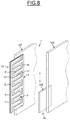
According to another application illustrated in FIG. 8, the capacitive detector 1A and the containment electrode 1B, arranged parallel and facing, are respectively secured to parts 107 and 108 that are longitudinally mobile relative to one another.
The containment electrode 1B has an end edge 109 parallel to the branches 9 and 11 of the interdigital electrodes 4 and 5 and is arranged so as to cover, at a distance, an end portion of the capacitive detector 1A.
The measured value of the mutual capacitance between the first and second interdigital electrodes 4 and 5 is a function of the length of the portion of the pair 3 of interdigital electrodes 4 and 5 of the capacitive detector 1A covered, at a distance, by the containment electrode 1B, and therefore of the longitudinal position of the parts 107 and 108 relative to one another.
This function being programmed, the electronic measurement circuit 14 is capable of delivering at its output 18 the longitudinal position of the containment electrode 1B relative to the capacitive detector 1A and therefore the longitudinal position and values of displacements of the parts 107 and 108 relative to one another. Substantially, the variation of the measured value of the mutual capacitance between the first and second interdigital electrodes 4 and 5 is proportional to the value of the overlap between the capacitive detector 1A and the containment electrode 1B. By calculation, the electronic measurement circuit 14 can also be capable of delivering the rate of the displacements of the parts 107 and 108 relative to one another.
According to another application illustrated in FIG. 9, the parts 110 and 111 are rotationally mobile relative to one another according to an axis of rotation. In this case, the capacitive detector 1A and the containment electrode 1B are respectively secured to the parts 110 and 111 and are formed in an annular fashion according to circumferences co-axial to parts 110 and 111, the capacitive detector 1A and the containment electrode 1B radially facing one another.
The branches 9 and 11 of the interdigital electrodes extend axially. The containment electrode 1B has an axial end edge 112 parallel to the branches 9 and 11 of the interdigital electrodes 4 and 5 and is arranged so as to cover, at a distance, an end portion of the capacitive detector 1A.
In a variant embodiment, the capacitive detector 1A and the containment electrode 1B could be arranged axially facing one another, the branches 9 and 11 of the interdigital electrodes then extending radially and the edge 112 then extending radially.
The measured value of the mutual capacitance between the first and second interdigital electrodes 4 and 5 is a function of the length of the arc of the portion of the pair 3 of interdigital electrodes 4 and 5 of the capacitive detector 1A, covered, at a distance, by the arc of the containment electrode 1B, and therefore of the annular position of the parts 107 and 108 relative to one another.
This function being programmed, the electronic measurement circuit 14 is capable of delivering at its output 18 the angular position of the containment electrode 1B relative to the capacitive detector 1A and therefore the angular position and values of angular displacements of the parts 107 and 108 relative to one another. By calculation, the electronic measurement circuit 14 can also be capable of delivering the rate of rotation of the parts 107 and 108 relative to one another.
In the applications which have just been described, the containment electrode 1B can be fixed to the part which bears it via a sheet 113 of a dielectric material, for example of a plastic material such as a polyimide like Kapton, or such as a polytetrafluoroethylene (Teflon), in order to avoid having the material of the part which bears the containment electrode 1B prevent or influence the measurements performed. The containment electrode 1B can consist of a metal part of the part, subject to the condition, notably in the applications of FIGS. 8 and 9, of the existence of the edges 109 and 112 which determine an end of the surface of the containment electrode 1B, allowing the measurements facing the capacitive detector 1A, and provided that the surface of the part, which follows this edge, is further away from the capacitive detector 1A.
While illustrative embodiments have been illustrated and described, it will be appreciated that various changes can be made therein without departing from the spirit and scope of the invention.

Claims (11)

The embodiments of the invention in which an exclusive property or privilege is claimed are defined as follows:
1. A capacitive detection device comprising:
a capacitive detector comprising:
a ribbon made of a dielectric material;
at least one pair of electrodes comprising a first electrode in the form of a comb formed on a first face of said ribbon and comprising parallel transverse branches linked to one another by a longitudinal link branch and a second electrode in the form of a comb formed on said first face of said ribbon and comprising parallel transverse branches linked to one another by a longitudinal link branch, the parallel transverse branches of said first and second electrodes being arranged alternately between one another according to at least one determined period (λ); and
at least one third electrode in the form of a layer formed on a second face of said ribbon, this at least one third electrode and said at least one pair of electrodes covering opposite areas of said ribbon;
wherein a containment electrode is arranged at least partly facing and at a distance from said pair of electrodes, so as to leave, between the containment electrode and said pair of electrodes, a fluid-receiving space that is configured to receive a fluid, with the containment electrode being electrically connected to said third electrode.
2. The capacitive detection device of claim 1, in which the capacitive detector and the containment electrode are flat and arranged parallel.
3. The capacitive detection device of claim 1, in which the capacitive detector and the containment electrode extend along concentric circumferences.
4. The capacitive detection device of claim 1, in which a thickness (e) of the ribbon is less than or equal to said at least one determined period (λ) divided by four times PI, i.e.: λ/4π≥e; and in which a ratio, resulting from the division, in numerator, of a capacitance (C) between two adjacent branches of said first and second electrodes in the presence of at least one chosen medium of dielectric permittivity (εm), interposed between the capacitive detector and the containment electrode, and in denominator by a dielectric permittivity (εm) of the at least one chosen medium multiplied by a capacitance (Co) between the two adjacent branches of the first and second electrodes in the presence of vacuum, is greater than or equal to one.
5. The capacitive detection device of claim 1, in which the distance between the containment electrode and the capacitive detector lies between a twentieth of and twenty times said at least one determined period (λ).
6. The capacitive detection device of claim 1, comprising an electronic measurement circuit to which said first and second electrodes are linked, the third electrode and the containment electrode being set at a same reference potential, the electronic measurement circuit comprising a measurement device linked to the first and second electrodes and capable of delivering an electrical signal relating to a measurement of a capacitance between the first and second electrodes.
7. A device for measuring a fluid level or a fluid film thickness, comprising:
the capacitive detection device of claim 1, in which at least a part of the fluid is present between the capacitive detector and the containment electrode;
and a means for measuring a capacitance between said first and second electrodes of the pair of electrodes of the capacitive detector.
8. A device for measuring displacement of a first part relative to a second part, comprising:
the capacitive detection device of claim 1, in which the capacitive detector is secured to one of the first and second parts and the containment electrode is secured to the other of the first and second parts;
and a means for measuring a capacitance between said first and second electrodes of the pair of electrodes of the capacitive detector.
9. The device of claim 8, in which said first and second parts are capable of being displaced in a direction which moves the capacitive detector and the containment electrode away from and/or closer to one another.
10. The device of claim 8, in which said first and second parts are capable of being displaced in a direction which increases or reduces an overlap of the containment electrode relative to the capacitive detector.
11. A device for measuring displacement of a first part relative to a second part, comprising:
the capacitive detection device of claim 1, in which the capacitive detector and the containment electrode are secured to one of the first and second parts, the other of the first and second parts comprising a dielectric element secured to the other of the first and second parts and engaged between the capacitive detector and the containment electrode; and
a means for measuring a capacitance between said first and second electrodes of the pair of electrodes of the capacitive detector.
US15/597,017 2016-05-17 2017-05-16 Capacitive detection device and measuring device including same Active 2037-10-25 US10697818B2 (en)

Applications Claiming Priority (2)

Application Number Priority Date Filing Date Title
FR1654349A FR3051553B1 (en) 2016-05-17 2016-05-17 CAPACITIVE DETECTION DEVICE AND MEASURING DEVICE INCLUDING THE SAME
FR1654349 2016-05-17

Publications (2)

Publication Number Publication Date
US20170336242A1 US20170336242A1 (en) 2017-11-23
US10697818B2 true US10697818B2 (en) 2020-06-30

Family

ID=57113444

Family Applications (1)

Application Number Title Priority Date Filing Date
US15/597,017 Active 2037-10-25 US10697818B2 (en) 2016-05-17 2017-05-16 Capacitive detection device and measuring device including same

Country Status (3)

Country Link
US (1) US10697818B2 (en)
EP (1) EP3246667B1 (en)
FR (1) FR3051553B1 (en)

Cited By (1)

* Cited by examiner, † Cited by third party
Publication number Priority date Publication date Assignee Title
US20220026256A1 (en) * 2018-12-13 2022-01-27 Charles Austen Pumps Ltd. Capacitive liquid level sensor and liquid sensor assembly

Families Citing this family (6)

* Cited by examiner, † Cited by third party
Publication number Priority date Publication date Assignee Title
FR3076901B1 (en) * 2018-01-12 2020-02-07 Kapflex CAPACITIVE MEASURING DEVICE IN A MULTIPHASE MEDIUM
KR102135683B1 (en) * 2018-07-09 2020-07-20 최기환 Sensor for detecting liquid and device using the same
US11133799B2 (en) * 2019-11-20 2021-09-28 Ford Global Technologies, Llc Capacitive proximity sensor assembly having multiple sensing configurations
CN112857520B (en) * 2019-11-28 2024-11-01 广东美的厨房电器制造有限公司 Water level detection method and device
CN115683275A (en) * 2022-11-02 2023-02-03 河源市嘉辰科技有限公司 Cross-buckling interdigital electrode structure, capacitive water level sensor and precise water level detection device
CN119147072B (en) * 2024-11-11 2025-03-04 四川泛华航空仪表电器有限公司 Non-contact type oil level measuring device and measuring method for aviation oil tank

Citations (6)

* Cited by examiner, † Cited by third party
Publication number Priority date Publication date Assignee Title
EP0508143A2 (en) 1991-04-08 1992-10-14 Berthold Koch Fluid level measuring device
WO2008101333A1 (en) 2007-02-23 2008-08-28 Warren Michael Levy Fluid level sensing device and methods of using same
WO2009122061A2 (en) 2008-04-04 2009-10-08 Universite Joseph Fourier Capacitive detector, method for manufacturing same, and device for measuring the integral
WO2010023766A1 (en) 2008-09-01 2010-03-04 パイオニア株式会社 Displacement sensor
US20110120219A1 (en) * 2004-12-22 2011-05-26 Inergy Auto. Systems Research (Societe Anonyme) Capacitive liquid level sensor
US20120111107A1 (en) 2009-07-10 2012-05-10 Sony Corporation Liquid tank and fuel cell

Patent Citations (8)

* Cited by examiner, † Cited by third party
Publication number Priority date Publication date Assignee Title
EP0508143A2 (en) 1991-04-08 1992-10-14 Berthold Koch Fluid level measuring device
US5207098A (en) 1991-04-08 1993-05-04 Berthold Koch Device to measure the level of material within a container
US20110120219A1 (en) * 2004-12-22 2011-05-26 Inergy Auto. Systems Research (Societe Anonyme) Capacitive liquid level sensor
WO2008101333A1 (en) 2007-02-23 2008-08-28 Warren Michael Levy Fluid level sensing device and methods of using same
WO2009122061A2 (en) 2008-04-04 2009-10-08 Universite Joseph Fourier Capacitive detector, method for manufacturing same, and device for measuring the integral
US20110107833A1 (en) * 2008-04-04 2011-05-12 Pierre Thibault Capacitive detector, method for manufacturing same, and device for measuring the integral
WO2010023766A1 (en) 2008-09-01 2010-03-04 パイオニア株式会社 Displacement sensor
US20120111107A1 (en) 2009-07-10 2012-05-10 Sony Corporation Liquid tank and fuel cell

Non-Patent Citations (1)

* Cited by examiner, † Cited by third party
Title
Search Report and Written Opinion, dated Feb. 10, 2017, in priority French Patent Application No. 1654349, dated May 17, 2016, 6 pages.

Cited By (2)

* Cited by examiner, † Cited by third party
Publication number Priority date Publication date Assignee Title
US20220026256A1 (en) * 2018-12-13 2022-01-27 Charles Austen Pumps Ltd. Capacitive liquid level sensor and liquid sensor assembly
US11976958B2 (en) * 2018-12-13 2024-05-07 Charles Austen Pumps Ltd. Capacitive liquid level sensor and liquid sensor assembly

Also Published As

Publication number Publication date
FR3051553B1 (en) 2018-06-15
US20170336242A1 (en) 2017-11-23
EP3246667B1 (en) 2018-12-26
EP3246667A1 (en) 2017-11-22
FR3051553A1 (en) 2017-11-24

Similar Documents

Publication Publication Date Title
US10697818B2 (en) Capacitive detection device and measuring device including same
US8393209B2 (en) Capacitive detector, method for manufacturing same, and device for measuring the integral
TWI446253B (en) Single - layer sensing layer of two - dimensional porous touchpad
US11022473B2 (en) Calibration-free continuous bin level sensor
EP3487628B1 (en) Capacitive continuous fluid level sensor
Huang et al. Optimization of the coplanar interdigital capacitive sensor
US6318172B1 (en) Capacitive level detector with optimized electrode geometry
EP2203738B1 (en) Improved structure for capacitive balancing of integrated relative humidity sensor and manufacturing method
JPH11311562A (en) Water level sensor
US9880119B2 (en) Apparatus for identifying a value of a property of a fluid which is to be measured, method for operating an apparatus for identifying a value of a property of a fluid which is to be measured, and method for manufacturing an apparatus for identifying a value of a property of a fluid which is to be measured
KR102744686B1 (en) Dielectric-constant-insensitive fluid level sensor for directly inserting into a high dielectric constant fluid
Saleh et al. Capacitive sensing for measuring oil thickness under fouling conditions
CN100412534C (en) A Miniature Electrical Capacitance Tomography Sensor
JP3197515U (en) Liquid level sensor
JP6132482B2 (en) Liquid level detector
Pietrikova et al. Coplanar capacitive liquid level sensor
TW201314184A (en) Proportion multiple switching object level measurement method and apparatus
JP6294600B2 (en) Capacitance type level sensor
US9939418B2 (en) System and method for multiphase flow measurements
US10732065B2 (en) Apparatus and method of detecting breaches in pipelines
Nikolov et al. The effect of a pattern of capacitive sensors for liquid level measurements
Maurya et al. Interdigital Multi-sensor Structures for Resistance and Capacitance Sensing
Bonilla Riaño et al. High spatial and temporal resolution film thickness planar sensor: comparison of geometries
US12510503B2 (en) Sensor device and method for determination of properties of a liquid
RU2337327C2 (en) Device and method for media interface border level measurement

Legal Events

Date Code Title Description
AS Assignment

Owner name: UNIVERSITE GRENOBLE ALPES, FRANCE

Free format text: ASSIGNMENT OF ASSIGNORS INTEREST;ASSIGNOR:THIBAULT, PIERRE JEAN-YVES;REEL/FRAME:043338/0478

Effective date: 20170615

STPP Information on status: patent application and granting procedure in general

Free format text: DOCKETED NEW CASE - READY FOR EXAMINATION

STPP Information on status: patent application and granting procedure in general

Free format text: NON FINAL ACTION MAILED

STPP Information on status: patent application and granting procedure in general

Free format text: RESPONSE TO NON-FINAL OFFICE ACTION ENTERED AND FORWARDED TO EXAMINER

STPP Information on status: patent application and granting procedure in general

Free format text: NOTICE OF ALLOWANCE MAILED -- APPLICATION RECEIVED IN OFFICE OF PUBLICATIONS

STPP Information on status: patent application and granting procedure in general

Free format text: DOCKETED NEW CASE - READY FOR EXAMINATION

STPP Information on status: patent application and granting procedure in general

Free format text: NOTICE OF ALLOWANCE MAILED -- APPLICATION RECEIVED IN OFFICE OF PUBLICATIONS

STCF Information on status: patent grant

Free format text: PATENTED CASE

MAFP Maintenance fee payment

Free format text: PAYMENT OF MAINTENANCE FEE, 4TH YR, SMALL ENTITY (ORIGINAL EVENT CODE: M2551); ENTITY STATUS OF PATENT OWNER: SMALL ENTITY

Year of fee payment: 4