US10696865B2 - Laminated film - Google Patents
Laminated film Download PDFInfo
- Publication number
- US10696865B2 US10696865B2 US15/721,747 US201715721747A US10696865B2 US 10696865 B2 US10696865 B2 US 10696865B2 US 201715721747 A US201715721747 A US 201715721747A US 10696865 B2 US10696865 B2 US 10696865B2
- Authority
- US
- United States
- Prior art keywords
- laminated film
- group
- carbon atoms
- layer
- fluorine
- Prior art date
- Legal status (The legal status is an assumption and is not a legal conclusion. Google has not performed a legal analysis and makes no representation as to the accuracy of the status listed.)
- Expired - Fee Related, expires
Links
- 0 [1*][Si]12O[Si]3(C)O[Si]4(C)O[Si](C)(O1)O[Si]1(C)O[Si](C)(O2)O[Si](C)(O3)O[Si](C)(O4)O1 Chemical compound [1*][Si]12O[Si]3(C)O[Si]4(C)O[Si](C)(O1)O[Si]1(C)O[Si](C)(O2)O[Si](C)(O3)O[Si](C)(O4)O1 0.000 description 8
- IJTXSSMZHHKODV-UHFFFAOYSA-N C=C(C)C(=O)OCCC[Si]12O[Si]3(C)O[Si]4(C)O[Si]5(C)O[Si](C)(O3)O[Si](C)(O[Si](C)(O5)O[Si](C)(O4)O1)O2.CCCC(F)(F)F Chemical compound C=C(C)C(=O)OCCC[Si]12O[Si]3(C)O[Si]4(C)O[Si]5(C)O[Si](C)(O3)O[Si](C)(O[Si](C)(O5)O[Si](C)(O4)O1)O2.CCCC(F)(F)F IJTXSSMZHHKODV-UHFFFAOYSA-N 0.000 description 3
- UBSQRPCSMCQVAT-UHFFFAOYSA-N C=CC.CCC1=CC=CC=C1 Chemical compound C=CC.CCC1=CC=CC=C1 UBSQRPCSMCQVAT-UHFFFAOYSA-N 0.000 description 3
- RJVMWJQDAHXDRU-UHFFFAOYSA-N CCCC(F)(F)F.CCCC(F)(F)F.C[Si](C)(C)O[Si]1(C)O[Si]2(C)O[Si](C)(O[Si](C)(C)C)O[Si]3(C)O[Si](C)(O[Si](C)(C)C)O[Si](C)(O1)O[Si](C)(O2)O3.C[Si]1(O)O[Si]2(C)O[Si](C)(O)O[Si]3(C)O[Si](C)(O)O[Si](C)(O1)O[Si](C)(O2)O3 Chemical compound CCCC(F)(F)F.CCCC(F)(F)F.C[Si](C)(C)O[Si]1(C)O[Si]2(C)O[Si](C)(O[Si](C)(C)C)O[Si]3(C)O[Si](C)(O[Si](C)(C)C)O[Si](C)(O1)O[Si](C)(O2)O3.C[Si]1(O)O[Si]2(C)O[Si](C)(O)O[Si]3(C)O[Si](C)(O)O[Si](C)(O1)O[Si](C)(O2)O3 RJVMWJQDAHXDRU-UHFFFAOYSA-N 0.000 description 1
- JLUFWMXJHAVVNN-UHFFFAOYSA-N C[Si](Cl)(Cl)Cl Chemical compound C[Si](Cl)(Cl)Cl JLUFWMXJHAVVNN-UHFFFAOYSA-N 0.000 description 1
Images


Classifications
-
- C—CHEMISTRY; METALLURGY
- C09—DYES; PAINTS; POLISHES; NATURAL RESINS; ADHESIVES; COMPOSITIONS NOT OTHERWISE PROVIDED FOR; APPLICATIONS OF MATERIALS NOT OTHERWISE PROVIDED FOR
- C09D—COATING COMPOSITIONS, e.g. PAINTS, VARNISHES OR LACQUERS; FILLING PASTES; CHEMICAL PAINT OR INK REMOVERS; INKS; CORRECTING FLUIDS; WOODSTAINS; PASTES OR SOLIDS FOR COLOURING OR PRINTING; USE OF MATERIALS THEREFOR
- C09D175/00—Coating compositions based on polyureas or polyurethanes; Coating compositions based on derivatives of such polymers
- C09D175/04—Polyurethanes
- C09D175/12—Polyurethanes from compounds containing nitrogen and active hydrogen, the nitrogen atom not being part of an isocyanate group
-
- C—CHEMISTRY; METALLURGY
- C08—ORGANIC MACROMOLECULAR COMPOUNDS; THEIR PREPARATION OR CHEMICAL WORKING-UP; COMPOSITIONS BASED THEREON
- C08G—MACROMOLECULAR COMPOUNDS OBTAINED OTHERWISE THAN BY REACTIONS ONLY INVOLVING UNSATURATED CARBON-TO-CARBON BONDS
- C08G18/00—Polymeric products of isocyanates or isothiocyanates
- C08G18/06—Polymeric products of isocyanates or isothiocyanates with compounds having active hydrogen
- C08G18/70—Polymeric products of isocyanates or isothiocyanates with compounds having active hydrogen characterised by the isocyanates or isothiocyanates used
- C08G18/72—Polyisocyanates or polyisothiocyanates
- C08G18/74—Polyisocyanates or polyisothiocyanates cyclic
- C08G18/76—Polyisocyanates or polyisothiocyanates cyclic aromatic
- C08G18/7657—Polyisocyanates or polyisothiocyanates cyclic aromatic containing two or more aromatic rings
- C08G18/7664—Polyisocyanates or polyisothiocyanates cyclic aromatic containing two or more aromatic rings containing alkylene polyphenyl groups
- C08G18/7671—Polyisocyanates or polyisothiocyanates cyclic aromatic containing two or more aromatic rings containing alkylene polyphenyl groups containing only one alkylene bisphenyl group
-
- B—PERFORMING OPERATIONS; TRANSPORTING
- B32—LAYERED PRODUCTS
- B32B—LAYERED PRODUCTS, i.e. PRODUCTS BUILT-UP OF STRATA OF FLAT OR NON-FLAT, e.g. CELLULAR OR HONEYCOMB, FORM
- B32B15/00—Layered products comprising a layer of metal
- B32B15/04—Layered products comprising a layer of metal comprising metal as the main or only constituent of a layer, which is next to another layer of the same or of a different material
- B32B15/08—Layered products comprising a layer of metal comprising metal as the main or only constituent of a layer, which is next to another layer of the same or of a different material of synthetic resin
- B32B15/095—Layered products comprising a layer of metal comprising metal as the main or only constituent of a layer, which is next to another layer of the same or of a different material of synthetic resin comprising polyurethanes
-
- B—PERFORMING OPERATIONS; TRANSPORTING
- B32—LAYERED PRODUCTS
- B32B—LAYERED PRODUCTS, i.e. PRODUCTS BUILT-UP OF STRATA OF FLAT OR NON-FLAT, e.g. CELLULAR OR HONEYCOMB, FORM
- B32B27/00—Layered products comprising a layer of synthetic resin
- B32B27/06—Layered products comprising a layer of synthetic resin as the main or only constituent of a layer, which is next to another layer of the same or of a different material
-
- B—PERFORMING OPERATIONS; TRANSPORTING
- B32—LAYERED PRODUCTS
- B32B—LAYERED PRODUCTS, i.e. PRODUCTS BUILT-UP OF STRATA OF FLAT OR NON-FLAT, e.g. CELLULAR OR HONEYCOMB, FORM
- B32B27/00—Layered products comprising a layer of synthetic resin
- B32B27/06—Layered products comprising a layer of synthetic resin as the main or only constituent of a layer, which is next to another layer of the same or of a different material
- B32B27/08—Layered products comprising a layer of synthetic resin as the main or only constituent of a layer, which is next to another layer of the same or of a different material of synthetic resin
-
- B—PERFORMING OPERATIONS; TRANSPORTING
- B32—LAYERED PRODUCTS
- B32B—LAYERED PRODUCTS, i.e. PRODUCTS BUILT-UP OF STRATA OF FLAT OR NON-FLAT, e.g. CELLULAR OR HONEYCOMB, FORM
- B32B27/00—Layered products comprising a layer of synthetic resin
- B32B27/06—Layered products comprising a layer of synthetic resin as the main or only constituent of a layer, which is next to another layer of the same or of a different material
- B32B27/10—Layered products comprising a layer of synthetic resin as the main or only constituent of a layer, which is next to another layer of the same or of a different material of paper or cardboard
-
- B—PERFORMING OPERATIONS; TRANSPORTING
- B32—LAYERED PRODUCTS
- B32B—LAYERED PRODUCTS, i.e. PRODUCTS BUILT-UP OF STRATA OF FLAT OR NON-FLAT, e.g. CELLULAR OR HONEYCOMB, FORM
- B32B27/00—Layered products comprising a layer of synthetic resin
- B32B27/28—Layered products comprising a layer of synthetic resin comprising synthetic resins not wholly covered by any one of the sub-groups B32B27/30 - B32B27/42
- B32B27/283—Layered products comprising a layer of synthetic resin comprising synthetic resins not wholly covered by any one of the sub-groups B32B27/30 - B32B27/42 comprising polysiloxanes
-
- B—PERFORMING OPERATIONS; TRANSPORTING
- B32—LAYERED PRODUCTS
- B32B—LAYERED PRODUCTS, i.e. PRODUCTS BUILT-UP OF STRATA OF FLAT OR NON-FLAT, e.g. CELLULAR OR HONEYCOMB, FORM
- B32B27/00—Layered products comprising a layer of synthetic resin
- B32B27/32—Layered products comprising a layer of synthetic resin comprising polyolefins
-
- B—PERFORMING OPERATIONS; TRANSPORTING
- B32—LAYERED PRODUCTS
- B32B—LAYERED PRODUCTS, i.e. PRODUCTS BUILT-UP OF STRATA OF FLAT OR NON-FLAT, e.g. CELLULAR OR HONEYCOMB, FORM
- B32B27/00—Layered products comprising a layer of synthetic resin
- B32B27/36—Layered products comprising a layer of synthetic resin comprising polyesters
-
- B—PERFORMING OPERATIONS; TRANSPORTING
- B32—LAYERED PRODUCTS
- B32B—LAYERED PRODUCTS, i.e. PRODUCTS BUILT-UP OF STRATA OF FLAT OR NON-FLAT, e.g. CELLULAR OR HONEYCOMB, FORM
- B32B27/00—Layered products comprising a layer of synthetic resin
- B32B27/36—Layered products comprising a layer of synthetic resin comprising polyesters
- B32B27/365—Layered products comprising a layer of synthetic resin comprising polyesters comprising polycarbonates
-
- B—PERFORMING OPERATIONS; TRANSPORTING
- B32—LAYERED PRODUCTS
- B32B—LAYERED PRODUCTS, i.e. PRODUCTS BUILT-UP OF STRATA OF FLAT OR NON-FLAT, e.g. CELLULAR OR HONEYCOMB, FORM
- B32B27/00—Layered products comprising a layer of synthetic resin
- B32B27/40—Layered products comprising a layer of synthetic resin comprising polyurethanes
-
- B—PERFORMING OPERATIONS; TRANSPORTING
- B32—LAYERED PRODUCTS
- B32B—LAYERED PRODUCTS, i.e. PRODUCTS BUILT-UP OF STRATA OF FLAT OR NON-FLAT, e.g. CELLULAR OR HONEYCOMB, FORM
- B32B7/00—Layered products characterised by the relation between layers; Layered products characterised by the relative orientation of features between layers, or by the relative values of a measurable parameter between layers, i.e. products comprising layers having different physical, chemical or physicochemical properties; Layered products characterised by the interconnection of layers
- B32B7/04—Interconnection of layers
- B32B7/06—Interconnection of layers permitting easy separation
-
- B—PERFORMING OPERATIONS; TRANSPORTING
- B32—LAYERED PRODUCTS
- B32B—LAYERED PRODUCTS, i.e. PRODUCTS BUILT-UP OF STRATA OF FLAT OR NON-FLAT, e.g. CELLULAR OR HONEYCOMB, FORM
- B32B7/00—Layered products characterised by the relation between layers; Layered products characterised by the relative orientation of features between layers, or by the relative values of a measurable parameter between layers, i.e. products comprising layers having different physical, chemical or physicochemical properties; Layered products characterised by the interconnection of layers
- B32B7/04—Interconnection of layers
- B32B7/12—Interconnection of layers using interposed adhesives or interposed materials with bonding properties
-
- C—CHEMISTRY; METALLURGY
- C08—ORGANIC MACROMOLECULAR COMPOUNDS; THEIR PREPARATION OR CHEMICAL WORKING-UP; COMPOSITIONS BASED THEREON
- C08F—MACROMOLECULAR COMPOUNDS OBTAINED BY REACTIONS ONLY INVOLVING CARBON-TO-CARBON UNSATURATED BONDS
- C08F220/00—Copolymers of compounds having one or more unsaturated aliphatic radicals, each having only one carbon-to-carbon double bond, and only one being terminated by only one carboxyl radical or a salt, anhydride ester, amide, imide or nitrile thereof
- C08F220/02—Monocarboxylic acids having less than ten carbon atoms; Derivatives thereof
- C08F220/10—Esters
- C08F220/22—Esters containing halogen
- C08F220/24—Esters containing halogen containing perhaloalkyl radicals
-
- C—CHEMISTRY; METALLURGY
- C08—ORGANIC MACROMOLECULAR COMPOUNDS; THEIR PREPARATION OR CHEMICAL WORKING-UP; COMPOSITIONS BASED THEREON
- C08F—MACROMOLECULAR COMPOUNDS OBTAINED BY REACTIONS ONLY INVOLVING CARBON-TO-CARBON UNSATURATED BONDS
- C08F290/00—Macromolecular compounds obtained by polymerising monomers on to polymers modified by introduction of aliphatic unsaturated end or side groups
- C08F290/02—Macromolecular compounds obtained by polymerising monomers on to polymers modified by introduction of aliphatic unsaturated end or side groups on to polymers modified by introduction of unsaturated end groups
- C08F290/06—Polymers provided for in subclass C08G
- C08F290/067—Polyurethanes; Polyureas
-
- C—CHEMISTRY; METALLURGY
- C08—ORGANIC MACROMOLECULAR COMPOUNDS; THEIR PREPARATION OR CHEMICAL WORKING-UP; COMPOSITIONS BASED THEREON
- C08G—MACROMOLECULAR COMPOUNDS OBTAINED OTHERWISE THAN BY REACTIONS ONLY INVOLVING UNSATURATED CARBON-TO-CARBON BONDS
- C08G18/00—Polymeric products of isocyanates or isothiocyanates
- C08G18/06—Polymeric products of isocyanates or isothiocyanates with compounds having active hydrogen
- C08G18/08—Processes
- C08G18/10—Prepolymer processes involving reaction of isocyanates or isothiocyanates with compounds having active hydrogen in a first reaction step
-
- C—CHEMISTRY; METALLURGY
- C08—ORGANIC MACROMOLECULAR COMPOUNDS; THEIR PREPARATION OR CHEMICAL WORKING-UP; COMPOSITIONS BASED THEREON
- C08G—MACROMOLECULAR COMPOUNDS OBTAINED OTHERWISE THAN BY REACTIONS ONLY INVOLVING UNSATURATED CARBON-TO-CARBON BONDS
- C08G18/00—Polymeric products of isocyanates or isothiocyanates
- C08G18/06—Polymeric products of isocyanates or isothiocyanates with compounds having active hydrogen
- C08G18/08—Processes
- C08G18/16—Catalysts
- C08G18/22—Catalysts containing metal compounds
- C08G18/24—Catalysts containing metal compounds of tin
- C08G18/242—Catalysts containing metal compounds of tin organometallic compounds containing tin-carbon bonds
-
- C—CHEMISTRY; METALLURGY
- C08—ORGANIC MACROMOLECULAR COMPOUNDS; THEIR PREPARATION OR CHEMICAL WORKING-UP; COMPOSITIONS BASED THEREON
- C08G—MACROMOLECULAR COMPOUNDS OBTAINED OTHERWISE THAN BY REACTIONS ONLY INVOLVING UNSATURATED CARBON-TO-CARBON BONDS
- C08G18/00—Polymeric products of isocyanates or isothiocyanates
- C08G18/06—Polymeric products of isocyanates or isothiocyanates with compounds having active hydrogen
- C08G18/08—Processes
- C08G18/16—Catalysts
- C08G18/22—Catalysts containing metal compounds
- C08G18/24—Catalysts containing metal compounds of tin
- C08G18/244—Catalysts containing metal compounds of tin tin salts of carboxylic acids
- C08G18/246—Catalysts containing metal compounds of tin tin salts of carboxylic acids containing also tin-carbon bonds
-
- C—CHEMISTRY; METALLURGY
- C08—ORGANIC MACROMOLECULAR COMPOUNDS; THEIR PREPARATION OR CHEMICAL WORKING-UP; COMPOSITIONS BASED THEREON
- C08G—MACROMOLECULAR COMPOUNDS OBTAINED OTHERWISE THAN BY REACTIONS ONLY INVOLVING UNSATURATED CARBON-TO-CARBON BONDS
- C08G18/00—Polymeric products of isocyanates or isothiocyanates
- C08G18/06—Polymeric products of isocyanates or isothiocyanates with compounds having active hydrogen
- C08G18/28—Polymeric products of isocyanates or isothiocyanates with compounds having active hydrogen characterised by the compounds used containing active hydrogen
- C08G18/30—Low-molecular-weight compounds
- C08G18/32—Polyhydroxy compounds; Polyamines; Hydroxyamines
- C08G18/3203—Polyhydroxy compounds
- C08G18/3206—Polyhydroxy compounds aliphatic
-
- C—CHEMISTRY; METALLURGY
- C08—ORGANIC MACROMOLECULAR COMPOUNDS; THEIR PREPARATION OR CHEMICAL WORKING-UP; COMPOSITIONS BASED THEREON
- C08G—MACROMOLECULAR COMPOUNDS OBTAINED OTHERWISE THAN BY REACTIONS ONLY INVOLVING UNSATURATED CARBON-TO-CARBON BONDS
- C08G18/00—Polymeric products of isocyanates or isothiocyanates
- C08G18/06—Polymeric products of isocyanates or isothiocyanates with compounds having active hydrogen
- C08G18/28—Polymeric products of isocyanates or isothiocyanates with compounds having active hydrogen characterised by the compounds used containing active hydrogen
- C08G18/30—Low-molecular-weight compounds
- C08G18/38—Low-molecular-weight compounds having heteroatoms other than oxygen
- C08G18/3819—Low-molecular-weight compounds having heteroatoms other than oxygen having nitrogen
- C08G18/3838—Low-molecular-weight compounds having heteroatoms other than oxygen having nitrogen containing cyano groups
-
- C—CHEMISTRY; METALLURGY
- C08—ORGANIC MACROMOLECULAR COMPOUNDS; THEIR PREPARATION OR CHEMICAL WORKING-UP; COMPOSITIONS BASED THEREON
- C08G—MACROMOLECULAR COMPOUNDS OBTAINED OTHERWISE THAN BY REACTIONS ONLY INVOLVING UNSATURATED CARBON-TO-CARBON BONDS
- C08G18/00—Polymeric products of isocyanates or isothiocyanates
- C08G18/06—Polymeric products of isocyanates or isothiocyanates with compounds having active hydrogen
- C08G18/28—Polymeric products of isocyanates or isothiocyanates with compounds having active hydrogen characterised by the compounds used containing active hydrogen
- C08G18/40—High-molecular-weight compounds
- C08G18/42—Polycondensates having carboxylic or carbonic ester groups in the main chain
- C08G18/4202—Two or more polyesters of different physical or chemical nature
-
- C—CHEMISTRY; METALLURGY
- C08—ORGANIC MACROMOLECULAR COMPOUNDS; THEIR PREPARATION OR CHEMICAL WORKING-UP; COMPOSITIONS BASED THEREON
- C08G—MACROMOLECULAR COMPOUNDS OBTAINED OTHERWISE THAN BY REACTIONS ONLY INVOLVING UNSATURATED CARBON-TO-CARBON BONDS
- C08G18/00—Polymeric products of isocyanates or isothiocyanates
- C08G18/06—Polymeric products of isocyanates or isothiocyanates with compounds having active hydrogen
- C08G18/28—Polymeric products of isocyanates or isothiocyanates with compounds having active hydrogen characterised by the compounds used containing active hydrogen
- C08G18/40—High-molecular-weight compounds
- C08G18/42—Polycondensates having carboxylic or carbonic ester groups in the main chain
- C08G18/44—Polycarbonates
-
- C—CHEMISTRY; METALLURGY
- C08—ORGANIC MACROMOLECULAR COMPOUNDS; THEIR PREPARATION OR CHEMICAL WORKING-UP; COMPOSITIONS BASED THEREON
- C08G—MACROMOLECULAR COMPOUNDS OBTAINED OTHERWISE THAN BY REACTIONS ONLY INVOLVING UNSATURATED CARBON-TO-CARBON BONDS
- C08G18/00—Polymeric products of isocyanates or isothiocyanates
- C08G18/06—Polymeric products of isocyanates or isothiocyanates with compounds having active hydrogen
- C08G18/28—Polymeric products of isocyanates or isothiocyanates with compounds having active hydrogen characterised by the compounds used containing active hydrogen
- C08G18/65—Low-molecular-weight compounds having active hydrogen with high-molecular-weight compounds having active hydrogen
- C08G18/66—Compounds of groups C08G18/42, C08G18/48, or C08G18/52
- C08G18/6633—Compounds of group C08G18/42
- C08G18/6637—Compounds of group C08G18/42 with compounds of group C08G18/32 or polyamines of C08G18/38
- C08G18/664—Compounds of group C08G18/42 with compounds of group C08G18/32 or polyamines of C08G18/38 with compounds of group C08G18/3203
-
- C—CHEMISTRY; METALLURGY
- C08—ORGANIC MACROMOLECULAR COMPOUNDS; THEIR PREPARATION OR CHEMICAL WORKING-UP; COMPOSITIONS BASED THEREON
- C08G—MACROMOLECULAR COMPOUNDS OBTAINED OTHERWISE THAN BY REACTIONS ONLY INVOLVING UNSATURATED CARBON-TO-CARBON BONDS
- C08G18/00—Polymeric products of isocyanates or isothiocyanates
- C08G18/06—Polymeric products of isocyanates or isothiocyanates with compounds having active hydrogen
- C08G18/70—Polymeric products of isocyanates or isothiocyanates with compounds having active hydrogen characterised by the isocyanates or isothiocyanates used
- C08G18/72—Polyisocyanates or polyisothiocyanates
- C08G18/74—Polyisocyanates or polyisothiocyanates cyclic
- C08G18/75—Polyisocyanates or polyisothiocyanates cyclic cycloaliphatic
- C08G18/751—Polyisocyanates or polyisothiocyanates cyclic cycloaliphatic containing only one cycloaliphatic ring
- C08G18/752—Polyisocyanates or polyisothiocyanates cyclic cycloaliphatic containing only one cycloaliphatic ring containing at least one isocyanate or isothiocyanate group linked to the cycloaliphatic ring by means of an aliphatic group
- C08G18/753—Polyisocyanates or polyisothiocyanates cyclic cycloaliphatic containing only one cycloaliphatic ring containing at least one isocyanate or isothiocyanate group linked to the cycloaliphatic ring by means of an aliphatic group containing one isocyanate or isothiocyanate group linked to the cycloaliphatic ring by means of an aliphatic group having a primary carbon atom next to the isocyanate or isothiocyanate group
- C08G18/755—Polyisocyanates or polyisothiocyanates cyclic cycloaliphatic containing only one cycloaliphatic ring containing at least one isocyanate or isothiocyanate group linked to the cycloaliphatic ring by means of an aliphatic group containing one isocyanate or isothiocyanate group linked to the cycloaliphatic ring by means of an aliphatic group having a primary carbon atom next to the isocyanate or isothiocyanate group and at least one isocyanate or isothiocyanate group linked to a secondary carbon atom of the cycloaliphatic ring, e.g. isophorone diisocyanate
-
- C—CHEMISTRY; METALLURGY
- C08—ORGANIC MACROMOLECULAR COMPOUNDS; THEIR PREPARATION OR CHEMICAL WORKING-UP; COMPOSITIONS BASED THEREON
- C08G—MACROMOLECULAR COMPOUNDS OBTAINED OTHERWISE THAN BY REACTIONS ONLY INVOLVING UNSATURATED CARBON-TO-CARBON BONDS
- C08G18/00—Polymeric products of isocyanates or isothiocyanates
- C08G18/06—Polymeric products of isocyanates or isothiocyanates with compounds having active hydrogen
- C08G18/70—Polymeric products of isocyanates or isothiocyanates with compounds having active hydrogen characterised by the isocyanates or isothiocyanates used
- C08G18/72—Polyisocyanates or polyisothiocyanates
- C08G18/77—Polyisocyanates or polyisothiocyanates having heteroatoms in addition to the isocyanate or isothiocyanate nitrogen and oxygen or sulfur
- C08G18/78—Nitrogen
- C08G18/79—Nitrogen characterised by the polyisocyanates used, these having groups formed by oligomerisation of isocyanates or isothiocyanates
- C08G18/791—Nitrogen characterised by the polyisocyanates used, these having groups formed by oligomerisation of isocyanates or isothiocyanates containing isocyanurate groups
- C08G18/792—Nitrogen characterised by the polyisocyanates used, these having groups formed by oligomerisation of isocyanates or isothiocyanates containing isocyanurate groups formed by oligomerisation of aliphatic and/or cycloaliphatic isocyanates or isothiocyanates
-
- C—CHEMISTRY; METALLURGY
- C08—ORGANIC MACROMOLECULAR COMPOUNDS; THEIR PREPARATION OR CHEMICAL WORKING-UP; COMPOSITIONS BASED THEREON
- C08G—MACROMOLECULAR COMPOUNDS OBTAINED OTHERWISE THAN BY REACTIONS ONLY INVOLVING UNSATURATED CARBON-TO-CARBON BONDS
- C08G18/00—Polymeric products of isocyanates or isothiocyanates
- C08G18/06—Polymeric products of isocyanates or isothiocyanates with compounds having active hydrogen
- C08G18/70—Polymeric products of isocyanates or isothiocyanates with compounds having active hydrogen characterised by the isocyanates or isothiocyanates used
- C08G18/81—Unsaturated isocyanates or isothiocyanates
- C08G18/8108—Unsaturated isocyanates or isothiocyanates having only one isocyanate or isothiocyanate group
- C08G18/8116—Unsaturated isocyanates or isothiocyanates having only one isocyanate or isothiocyanate group esters of acrylic or alkylacrylic acid having only one isocyanate or isothiocyanate group
-
- C—CHEMISTRY; METALLURGY
- C09—DYES; PAINTS; POLISHES; NATURAL RESINS; ADHESIVES; COMPOSITIONS NOT OTHERWISE PROVIDED FOR; APPLICATIONS OF MATERIALS NOT OTHERWISE PROVIDED FOR
- C09D—COATING COMPOSITIONS, e.g. PAINTS, VARNISHES OR LACQUERS; FILLING PASTES; CHEMICAL PAINT OR INK REMOVERS; INKS; CORRECTING FLUIDS; WOODSTAINS; PASTES OR SOLIDS FOR COLOURING OR PRINTING; USE OF MATERIALS THEREFOR
- C09D151/00—Coating compositions based on graft polymers in which the grafted component is obtained by reactions only involving carbon-to-carbon unsaturated bonds; Coating compositions based on derivatives of such polymers
- C09D151/08—Coating compositions based on graft polymers in which the grafted component is obtained by reactions only involving carbon-to-carbon unsaturated bonds; Coating compositions based on derivatives of such polymers grafted on to macromolecular compounds obtained otherwise than by reactions only involving carbon-to-carbon unsaturated bonds
-
- C—CHEMISTRY; METALLURGY
- C09—DYES; PAINTS; POLISHES; NATURAL RESINS; ADHESIVES; COMPOSITIONS NOT OTHERWISE PROVIDED FOR; APPLICATIONS OF MATERIALS NOT OTHERWISE PROVIDED FOR
- C09D—COATING COMPOSITIONS, e.g. PAINTS, VARNISHES OR LACQUERS; FILLING PASTES; CHEMICAL PAINT OR INK REMOVERS; INKS; CORRECTING FLUIDS; WOODSTAINS; PASTES OR SOLIDS FOR COLOURING OR PRINTING; USE OF MATERIALS THEREFOR
- C09D175/00—Coating compositions based on polyureas or polyurethanes; Coating compositions based on derivatives of such polymers
- C09D175/04—Polyurethanes
- C09D175/14—Polyurethanes having carbon-to-carbon unsaturated bonds
- C09D175/16—Polyurethanes having carbon-to-carbon unsaturated bonds having terminal carbon-to-carbon unsaturated bonds
-
- C—CHEMISTRY; METALLURGY
- C09—DYES; PAINTS; POLISHES; NATURAL RESINS; ADHESIVES; COMPOSITIONS NOT OTHERWISE PROVIDED FOR; APPLICATIONS OF MATERIALS NOT OTHERWISE PROVIDED FOR
- C09J—ADHESIVES; NON-MECHANICAL ASPECTS OF ADHESIVE PROCESSES IN GENERAL; ADHESIVE PROCESSES NOT PROVIDED FOR ELSEWHERE; USE OF MATERIALS AS ADHESIVES
- C09J7/00—Adhesives in the form of films or foils
- C09J7/20—Adhesives in the form of films or foils characterised by their carriers
- C09J7/29—Laminated material
-
- B—PERFORMING OPERATIONS; TRANSPORTING
- B32—LAYERED PRODUCTS
- B32B—LAYERED PRODUCTS, i.e. PRODUCTS BUILT-UP OF STRATA OF FLAT OR NON-FLAT, e.g. CELLULAR OR HONEYCOMB, FORM
- B32B2255/00—Coating on the layer surface
- B32B2255/10—Coating on the layer surface on synthetic resin layer or on natural or synthetic rubber layer
-
- B—PERFORMING OPERATIONS; TRANSPORTING
- B32—LAYERED PRODUCTS
- B32B—LAYERED PRODUCTS, i.e. PRODUCTS BUILT-UP OF STRATA OF FLAT OR NON-FLAT, e.g. CELLULAR OR HONEYCOMB, FORM
- B32B2255/00—Coating on the layer surface
- B32B2255/20—Inorganic coating
-
- B—PERFORMING OPERATIONS; TRANSPORTING
- B32—LAYERED PRODUCTS
- B32B—LAYERED PRODUCTS, i.e. PRODUCTS BUILT-UP OF STRATA OF FLAT OR NON-FLAT, e.g. CELLULAR OR HONEYCOMB, FORM
- B32B2255/00—Coating on the layer surface
- B32B2255/26—Polymeric coating
-
- B—PERFORMING OPERATIONS; TRANSPORTING
- B32—LAYERED PRODUCTS
- B32B—LAYERED PRODUCTS, i.e. PRODUCTS BUILT-UP OF STRATA OF FLAT OR NON-FLAT, e.g. CELLULAR OR HONEYCOMB, FORM
- B32B2307/00—Properties of the layers or laminate
- B32B2307/30—Properties of the layers or laminate having particular thermal properties
- B32B2307/306—Resistant to heat
-
- B—PERFORMING OPERATIONS; TRANSPORTING
- B32—LAYERED PRODUCTS
- B32B—LAYERED PRODUCTS, i.e. PRODUCTS BUILT-UP OF STRATA OF FLAT OR NON-FLAT, e.g. CELLULAR OR HONEYCOMB, FORM
- B32B2307/00—Properties of the layers or laminate
- B32B2307/70—Other properties
- B32B2307/712—Weather resistant
-
- B—PERFORMING OPERATIONS; TRANSPORTING
- B32—LAYERED PRODUCTS
- B32B—LAYERED PRODUCTS, i.e. PRODUCTS BUILT-UP OF STRATA OF FLAT OR NON-FLAT, e.g. CELLULAR OR HONEYCOMB, FORM
- B32B2307/00—Properties of the layers or laminate
- B32B2307/70—Other properties
- B32B2307/724—Permeability to gases, adsorption
- B32B2307/7242—Non-permeable
- B32B2307/7248—Odour barrier
-
- B—PERFORMING OPERATIONS; TRANSPORTING
- B32—LAYERED PRODUCTS
- B32B—LAYERED PRODUCTS, i.e. PRODUCTS BUILT-UP OF STRATA OF FLAT OR NON-FLAT, e.g. CELLULAR OR HONEYCOMB, FORM
- B32B2307/00—Properties of the layers or laminate
- B32B2307/70—Other properties
- B32B2307/726—Permeability to liquids, absorption
- B32B2307/7265—Non-permeable
-
- B—PERFORMING OPERATIONS; TRANSPORTING
- B32—LAYERED PRODUCTS
- B32B—LAYERED PRODUCTS, i.e. PRODUCTS BUILT-UP OF STRATA OF FLAT OR NON-FLAT, e.g. CELLULAR OR HONEYCOMB, FORM
- B32B2307/00—Properties of the layers or laminate
- B32B2307/70—Other properties
- B32B2307/732—Dimensional properties
-
- B—PERFORMING OPERATIONS; TRANSPORTING
- B32—LAYERED PRODUCTS
- B32B—LAYERED PRODUCTS, i.e. PRODUCTS BUILT-UP OF STRATA OF FLAT OR NON-FLAT, e.g. CELLULAR OR HONEYCOMB, FORM
- B32B2307/00—Properties of the layers or laminate
- B32B2307/70—Other properties
- B32B2307/748—Releasability
-
- B—PERFORMING OPERATIONS; TRANSPORTING
- B32—LAYERED PRODUCTS
- B32B—LAYERED PRODUCTS, i.e. PRODUCTS BUILT-UP OF STRATA OF FLAT OR NON-FLAT, e.g. CELLULAR OR HONEYCOMB, FORM
- B32B2307/00—Properties of the layers or laminate
- B32B2307/70—Other properties
- B32B2307/762—Self-repairing, self-healing
-
- B—PERFORMING OPERATIONS; TRANSPORTING
- B32—LAYERED PRODUCTS
- B32B—LAYERED PRODUCTS, i.e. PRODUCTS BUILT-UP OF STRATA OF FLAT OR NON-FLAT, e.g. CELLULAR OR HONEYCOMB, FORM
- B32B2457/00—Electrical equipment
-
- B—PERFORMING OPERATIONS; TRANSPORTING
- B32—LAYERED PRODUCTS
- B32B—LAYERED PRODUCTS, i.e. PRODUCTS BUILT-UP OF STRATA OF FLAT OR NON-FLAT, e.g. CELLULAR OR HONEYCOMB, FORM
- B32B2479/00—Furniture
-
- B—PERFORMING OPERATIONS; TRANSPORTING
- B32—LAYERED PRODUCTS
- B32B—LAYERED PRODUCTS, i.e. PRODUCTS BUILT-UP OF STRATA OF FLAT OR NON-FLAT, e.g. CELLULAR OR HONEYCOMB, FORM
- B32B2535/00—Medical equipment, e.g. bandage, prostheses or catheter
-
- B—PERFORMING OPERATIONS; TRANSPORTING
- B32—LAYERED PRODUCTS
- B32B—LAYERED PRODUCTS, i.e. PRODUCTS BUILT-UP OF STRATA OF FLAT OR NON-FLAT, e.g. CELLULAR OR HONEYCOMB, FORM
- B32B2571/00—Protective equipment
-
- B—PERFORMING OPERATIONS; TRANSPORTING
- B32—LAYERED PRODUCTS
- B32B—LAYERED PRODUCTS, i.e. PRODUCTS BUILT-UP OF STRATA OF FLAT OR NON-FLAT, e.g. CELLULAR OR HONEYCOMB, FORM
- B32B2605/00—Vehicles
- B32B2605/08—Cars
-
- B—PERFORMING OPERATIONS; TRANSPORTING
- B32—LAYERED PRODUCTS
- B32B—LAYERED PRODUCTS, i.e. PRODUCTS BUILT-UP OF STRATA OF FLAT OR NON-FLAT, e.g. CELLULAR OR HONEYCOMB, FORM
- B32B2605/00—Vehicles
- B32B2605/12—Ships
-
- C—CHEMISTRY; METALLURGY
- C08—ORGANIC MACROMOLECULAR COMPOUNDS; THEIR PREPARATION OR CHEMICAL WORKING-UP; COMPOSITIONS BASED THEREON
- C08G—MACROMOLECULAR COMPOUNDS OBTAINED OTHERWISE THAN BY REACTIONS ONLY INVOLVING UNSATURATED CARBON-TO-CARBON BONDS
- C08G2170/00—Compositions for adhesives
- C08G2170/40—Compositions for pressure-sensitive adhesives
-
- C09J2201/122—
-
- C09J2201/162—
-
- C09J2201/606—
-
- C—CHEMISTRY; METALLURGY
- C09—DYES; PAINTS; POLISHES; NATURAL RESINS; ADHESIVES; COMPOSITIONS NOT OTHERWISE PROVIDED FOR; APPLICATIONS OF MATERIALS NOT OTHERWISE PROVIDED FOR
- C09J—ADHESIVES; NON-MECHANICAL ASPECTS OF ADHESIVE PROCESSES IN GENERAL; ADHESIVE PROCESSES NOT PROVIDED FOR ELSEWHERE; USE OF MATERIALS AS ADHESIVES
- C09J2301/00—Additional features of adhesives in the form of films or foils
- C09J2301/10—Additional features of adhesives in the form of films or foils characterized by the structural features of the adhesive tape or sheet
- C09J2301/12—Additional features of adhesives in the form of films or foils characterized by the structural features of the adhesive tape or sheet by the arrangement of layers
- C09J2301/122—Additional features of adhesives in the form of films or foils characterized by the structural features of the adhesive tape or sheet by the arrangement of layers the adhesive layer being present only on one side of the carrier, e.g. single-sided adhesive tape
-
- C—CHEMISTRY; METALLURGY
- C09—DYES; PAINTS; POLISHES; NATURAL RESINS; ADHESIVES; COMPOSITIONS NOT OTHERWISE PROVIDED FOR; APPLICATIONS OF MATERIALS NOT OTHERWISE PROVIDED FOR
- C09J—ADHESIVES; NON-MECHANICAL ASPECTS OF ADHESIVE PROCESSES IN GENERAL; ADHESIVE PROCESSES NOT PROVIDED FOR ELSEWHERE; USE OF MATERIALS AS ADHESIVES
- C09J2301/00—Additional features of adhesives in the form of films or foils
- C09J2301/10—Additional features of adhesives in the form of films or foils characterized by the structural features of the adhesive tape or sheet
- C09J2301/16—Additional features of adhesives in the form of films or foils characterized by the structural features of the adhesive tape or sheet by the structure of the carrier layer
- C09J2301/162—Additional features of adhesives in the form of films or foils characterized by the structural features of the adhesive tape or sheet by the structure of the carrier layer the carrier being a laminate constituted by plastic layers only
-
- C—CHEMISTRY; METALLURGY
- C09—DYES; PAINTS; POLISHES; NATURAL RESINS; ADHESIVES; COMPOSITIONS NOT OTHERWISE PROVIDED FOR; APPLICATIONS OF MATERIALS NOT OTHERWISE PROVIDED FOR
- C09J—ADHESIVES; NON-MECHANICAL ASPECTS OF ADHESIVE PROCESSES IN GENERAL; ADHESIVE PROCESSES NOT PROVIDED FOR ELSEWHERE; USE OF MATERIALS AS ADHESIVES
- C09J2301/00—Additional features of adhesives in the form of films or foils
- C09J2301/30—Additional features of adhesives in the form of films or foils characterized by the chemical, physicochemical or physical properties of the adhesive or the carrier
- C09J2301/302—Additional features of adhesives in the form of films or foils characterized by the chemical, physicochemical or physical properties of the adhesive or the carrier the adhesive being pressure-sensitive, i.e. tacky at temperatures inferior to 30°C
-
- C—CHEMISTRY; METALLURGY
- C09—DYES; PAINTS; POLISHES; NATURAL RESINS; ADHESIVES; COMPOSITIONS NOT OTHERWISE PROVIDED FOR; APPLICATIONS OF MATERIALS NOT OTHERWISE PROVIDED FOR
- C09J—ADHESIVES; NON-MECHANICAL ASPECTS OF ADHESIVE PROCESSES IN GENERAL; ADHESIVE PROCESSES NOT PROVIDED FOR ELSEWHERE; USE OF MATERIALS AS ADHESIVES
- C09J2433/00—Presence of (meth)acrylic polymer
-
- C—CHEMISTRY; METALLURGY
- C09—DYES; PAINTS; POLISHES; NATURAL RESINS; ADHESIVES; COMPOSITIONS NOT OTHERWISE PROVIDED FOR; APPLICATIONS OF MATERIALS NOT OTHERWISE PROVIDED FOR
- C09J—ADHESIVES; NON-MECHANICAL ASPECTS OF ADHESIVE PROCESSES IN GENERAL; ADHESIVE PROCESSES NOT PROVIDED FOR ELSEWHERE; USE OF MATERIALS AS ADHESIVES
- C09J2475/00—Presence of polyurethane
- C09J2475/006—Presence of polyurethane in the substrate
Definitions
- the present invention relates to a laminated film that can be used as a material of a paint protection film.
- a paint protection film is a film-like product that is used for surface protection of an industrial product used outdoors.
- a basic structure of the PPF is a laminate that includes at least two layers including a substrate made of a flexible and transparent resin film and an adhesive layer.
- a laminated film in a form that includes a coating layer for enhancing a stainproof function and scratch resistance of a substrate on a surface opposite to the adhesive layer of the substrate, and further includes a release layer on a surface opposite to the substrate of the adhesive layer is supplied in the market.
- a product whose surface is covered with a PPF is protected from various stimuli from the outside such as dirt and scratches due to wind and rain, dust, sand, river water, microorganisms and contact with or excretions of animals and plants and insects while a coating, shape, and exterior of the product are not impaired.
- the PPF serves as a so-called cushion and absorbs a pressure or strike from the outside, and the PPF repels rainwater and dirt. Therefore, effects of external stimulation on the product itself are minimized.
- Patent Document 1 As such a PPF, for example, in Patent Document 1, there is provided a PPF which has excellent sticking characteristics and in which there is less adhesive residue by laminating a substrate film and an adhesive layer whose surface roughness is controlled.
- this PPF a detailed examination of a stainproof layer added to a surface of the substrate film was not performed, and there was a problem in practicality for automobiles and motorbikes whose exteriors are considered to be important.
- Patent Document 2 a PPF in which a first layer containing polyurethane, a second layer containing a thermoplastic polyurethane, and a third layer containing a pressure sensitive adhesive are laminated in that order is described.
- a PPF in which a first layer containing polyurethane, a second layer containing a thermoplastic polyurethane, and a third layer containing a pressure sensitive adhesive are laminated in that order is described.
- further improvement in various aspects of performance is required for this PPF.
- Patent Document 1 Japanese Unexamined Patent Application Publication No. 2016-20079.
- Patent Document 2 Japanese Unexamined Patent Application Publication (Translation of PCT Application) No. 2008-539107.
- the inventors studied a configuration of an optimal laminate in order to further improve various aspects of performance of a PPF.
- R f 1 to R f 7 each independently represent a linear fluoroalkyl group having 1 to 20 carbon atoms or a branched fluoroalkyl group having 3 to 20 carbon atoms in which any methylene group may be substituted with oxygen; a fluoroaryl group having 6 to 20 carbon atoms in which at least one hydrogen atom is substituted with fluorine or a trifluoromethyl group; or a fluoroarylalkyl group having 7 to 20 carbon atoms in which at least one hydrogen atom in an aryl group is substituted with fluorine or trifluoromethyl, and A 1 is a group represented by the following Formula (1-1) or Formula (1-2).
- Y 3 represents an alkylene group having 2 to 10 carbon atoms and preferably an alkylene group having 2 to 6 atoms
- R 6 represents hydrogen or a linear alkyl group having 1 to 5 carbon atoms or a branched alkyl group having 3 to 5 carbon atoms, or an aryl group having 6 to 10 carbon atoms, and preferably hydrogen or an alkyl group having 1 to 3 atoms.
- Y 4 represents a single bond or an alkylene group having 1 to 10 carbon atoms.
- urethane acrylate cured product includes a structural unit derived from ⁇ -methacryloxypropylhepta(trifluoropropyl)-T8-silsesquioxane represented by the following Formula (5).
- a paint protection film including the laminated film according to any one of (1) to (5).
- a laminated film of the present invention has excellent heat resistance and weather resistance and has excellent balance between a self-repairing property, water repellency, a stainproof property, oil repellency, extensibility, surface lubricity, an adhesive strength, and a design property.
- Such a laminated film of the present invention is appropriate as a material of a PPF.
- FIG. 1 is one example of a laminated film of the present invention.
- FIG. 2 is one example of a laminated film of the present invention.
- FIG. 3 is an example in which a laminated film of the present invention is used as a PPF.
- a laminated film of the present invention is a laminate that includes a top coating layer containing a urethane acrylate cured product, a substrate layer made of a polycarbonate thermoplastic polyurethane (TPU), and an adhesive layer containing a pressure sensitive adhesive, and typically, is a film obtained by laminating the top coating layer, the substrate layer, and the adhesive layer in that order.
- a top coating layer 1 , the substrate layer 2 and the adhesive layer 3 are laminated in that order so as to form a laminated film 4 .
- the top coating layer, the substrate layer, and the adhesive layer will be described below in detail.
- the top coating layer of the present invention essentially contains a urethane acrylate cured product.
- the urethane acrylate cured product is a resin obtained by curing a curable urethane acrylate oligomer (a so-called urethane acrylate) in the presence of a polymerization initiator.
- the top coating layer of the present invention is formed by curing a top coating solution layer that essentially contains the urethane acrylate and the polymerization initiator on the substrate.
- the thickness of the top coating layer in the laminated film of the present invention is generally 1 to 100 ⁇ m, preferably 10 to 50 ⁇ m, and more preferably 10 to 30 ⁇ m.
- the urethane acrylate is a general term for an oligomeric compound which is obtained by a reaction of an isocyanate compound, a polyol, a hydroxyl group-containing (meth)acrylic monomer, and an isocyanate group-containing (meth)acrylic monomer, and which includes a reactive acryloyl group at its terminal.
- the urethane acrylate used in the present invention is typically a UV curable urethane acrylate, and preferably, a urethane acrylate obtained by reacting an isocyanate compound which may be an aliphatic isocyanate compound and/or an alicyclic isocyanate compound with at least one polyol compound selected from among an ester polyol, an ether polyol, and a polycarbonate polyol, and an acrylate compound having a hydroxyl group.
- an isocyanate compound which may be an aliphatic isocyanate compound and/or an alicyclic isocyanate compound with at least one polyol compound selected from among an ester polyol, an ether polyol, and a polycarbonate polyol, and an acrylate compound having a hydroxyl group.
- aliphatic isocyanate compound for example, hexamethylene diisocyanate, an isocyanurate modified product of hexamethylene diisocyanate, and trimethylhexamethylene diisocyanate may be exemplified.
- alicyclic isocyanate compound for example, isophorone diisocyanate, 4,4′-dicyclohexylmethane isocyanate, and hydrogenated xylene diisocyanates may be exemplified.
- ester polyol for example, an ester compound obtained by reacting diols with a dicarboxylic acid may be exemplified.
- diols for example, 3-methyl-1,5-pentanediol, neopentyl glycol, ethylene glycol, diethylene glycol, propylene glycol, dipropylene glycol, 1,3-butanediol, 1,4-butanediol, 1,6-hexanediol, 2-methyl-1,8-octanediol, and 1,9-nonanediol may be exemplified.
- dicarboxylic acid sebacic acid, adipic acid, dimer acids, succinic acid, azelaic acid, maleic acid, terephthalic acid, isophthalic acid, and citraconic acid may be exemplified, and an anhydride thereof may be used.
- ether polyol for example, polyether diol, poly(oxytetramethylene)glycol, and poly(oxybutylene)glycol may be exemplified.
- polyether diol polybutylene glycol, polyethylene glycol, polytetramethylene glycol, and propylene-modified polytetramethylene glycol may be exemplified.
- polycarbonate polyol for example, a reaction product of a carbonate derivative and diols may be exemplified.
- a carbonate derivative a diaryl carbonate such as diphenyl carbonate, dimethyl carbonate, and diethyl carbonate may be exemplified.
- diols the above compounds may be exemplified.
- acrylate compound having a hydroxyl group 2-hydroxyethyl (meth)acrylate, 2-hydroxypropyl (meth)acrylate, 2-hydroxybutyl (meth)acrylate, 4-hydroxybutyl methacrylate, polyethylene glycol mono(meth)acrylate, polypropylene glycol mono(meth)acrylate, and the like may be exemplified.
- an isocyanate compound, a polyol compound, and an acrylate compound having a hydroxyl group which are essential components can be reacted in a collective manner.
- an isocyanate compound and a polyol compound are first reacted to prepare a prepolymer having excess isocyanate groups, and then a residual isocyanate group can be reacted with a (meth)acrylate compound having a hydroxyl group.
- a (meth)acrylate compound having a hydroxyl group is first reacted with such isocyanate compounds to prepare a prepolymer having excess isocyanate groups, and then a residual isocyanate group can be reacted with a polyol compound.
- an isocyanate compound is first reacted with a urethane group-containing diol compound to prepare a prepolymer having extra hydroxyl groups, and a residual hydroxyl group is then reacted with a polyisocyanate compound to prepare a prepolymer having a hydroxyl group at its terminal. Then, additionally, a terminal hydroxyl group of the prepolymer can be reacted with an isocyanate group-containing (meth)acrylate compound.
- urethane acrylate As the urethane acrylate, Shikoh UT-5569 (commercially available from Nippon Synthetic Chemical Industry Co., Ltd.), and RUA-062S and RUA-058SY2 (commercially available from Asia Industry Co., Ltd.) can be used.
- a polymerization initiator used for curing the urethane acrylate in the present invention those distributed as photopolymerization initiators can be used without limitation.
- a photopolymerization initiator for example, a hydroxyketone polymer material such as oligo ⁇ 2-hydroxy-2-methyl-1-phenylpropanone ⁇ , 1-hydroxydicyclohexyl phenylketone, 2-hydroxy-2-methyl-1-phenylpropan-1-one, 2,2-dimethoxy-1,2-diphenylethan-1-one, 1- ⁇ 4(2-hydroxyethoxy)phenyl ⁇ 2-hydroxy-2-methyl-1-propane 1-one, 2,4,6-trimethylbenzoyl diphenyl phosphine oxide, and bis(2,4,6 trimethylbenzoyl)phenylphosphine oxide can be used.
- copolymer component a compound (hereinafter referred to as a “copolymer component”) having a group reactive with a urethane acrylate at its terminal can be used without limitation.
- a compound that is generally called a photocurable acrylic monomer for example, a monofunctional acrylate such as (meth)acrylic acid, (meth)acrylic ester, and a hydroxy group-containing (meth)acrylate ester, a bifunctional acrylate such as (poly)alkylene glycol di(meth)acrylate, and a trifunctional or higher functional acrylate such as pentaerythritol triacrylate can be used.
- a copolymer component may be an oligomer obtained by polymerizing a reactive compound containing the photocurable acrylic monomer.
- a photocurable acrylic monomer and/or oligomer containing fluorine atoms in a molecule in order to further improve a stainproof property, water repellency, and oil repellency of the top coating layer, it is possible to use a photocurable acrylic monomer and/or oligomer containing fluorine atoms in a molecule.
- OPTOOL DAC-HP commercially available from Daikin Industries, Ltd.
- MEGAFACE RS-75 commercially available from DIC
- Viscoat V-3F commercially available from Osaka Organic Chemical Industry Ltd.
- Such a fluorine-containing (meth)acrylate compound is generally present in a proportion of 0.1 parts by weight to 10 parts by weight with respect to 100 parts by weight of the urethane acrylate, and preferably 1 part by weight to 7 parts by weight.
- a fluorosilsesquioxane derivative (1) represented by the following General Formula (1) can be used.
- R f 1 to R f 7 each independently represent a linear fluoroalkyl group having 1 to 20 carbon atoms or a branched fluoroalkyl group having 3 to 20 carbon atoms in which any methylene may be substituted with oxygen; a fluoroaryl group having 6 to 20 carbon atoms in which at least one hydrogen atom is substituted with fluorine or trifluoromethyl; or a fluoroarylalkyl group having 7 to 20 carbon atoms in which at least one hydrogen atom in an aryl group is substituted with fluorine or trifluoromethyl, and A 1 is a group represented by the following Formula (1-1) or Formula (1-2).
- R f 1 to R f 7 each independently represent 3,3,3-trifluoropropyl, 3,3,4,4,4-pentafluorobutyl, 3,3,4,4,5,5,6,6,6-nonafluorohexyl, tridecafluoro-1,1,2,2-tetrahydrooctyl, heptadecafluoro-1,1,2,2-tetrahydrodecyl, henicosafluoro-1,1,2,2-tetrahydrododecyl, pentacosafluoro-1,1,2,2-tetrahydrotetradecyl, (3-heptafluoroisopropoxy)propyl, pentafluorophenylpropyl, pentafluorophenyl, or ⁇ , ⁇ , ⁇ -trifluoromethylphenyl.
- R f 1 to R f 7 each independently represent 3,3,3-trifluoropropyl or 3,3,4,4,5,5,6,6,6-nonafluorohexyl.
- Y 3 represents an alkylene group having 2 to 10 carbon atoms and preferably an alkylene group having 2 to 6 carbon atoms
- R 6 represents hydrogen, a linear alkyl group having 1 to 5 carbon atoms or a branched alkyl group having 3 to 5 carbon atoms, or an aryl group having 6 to 10 carbon atoms, and preferably hydrogen or an alkyl group having 1 to 3 carbon atoms.
- Y 4 represents a single bond or an alkylene group having 1 to 10 carbon atoms.
- the fluorosilsesquioxane derivative (1) is produced by the following method. First, when a silicon compound (2) having a trifunctional hydrolyzable group represented by the following Formula (2) is hydrolyzed and polycondensed in an oxygen-containing organic solvent in the presence of an alkali metal hydroxide, a compound (3) represented by the following Formula (3) is produced.
- M is not particularly limited as long as it is an alkali metal.
- an alkali metal for example, lithium, sodium, potassium, and cesium, may be exemplified.
- R corresponds to one group selected from among R f 1 to R f 7 in Formula (1) and independently represents a linear fluoroalkyl group having 1 to 20 carbon atoms or a branched fluoroalkyl group having 3 to 20 carbon atoms in which any methylene may be substituted with oxygen; a fluoroaryl group having 6 to 20 carbon atoms in which at least one hydrogen atom is substituted with fluorine or trifluoromethyl; or a fluoroarylalkyl group having 7 to 20 carbon atoms in which at least one hydrogen atom in an aryl group is substituted with fluorine or trifluoromethyl.
- X represents a hydrolyzable group.
- R independently represents 3,3,3-trifluoropropyl, 3,3,4,4,4-pentafluorobutyl, 3,3,4,4,5,5,6,6, 6-nonafluorohexyl, tridecafluoro-1,1,2,2-tetrahydrooctyl, heptadecafluoro-1,1,2,2-tetrahydrodecyl, henicosafluoro-1,1,2,2-tetrahydrododecyl, pentacosafluoro-1,1,2,2-tetrahydrotetradecyl, (3-heptafluoroisopropoxy)propyl, pentafluorophenylpropyl, pentafluorophenyl, or ⁇ , ⁇ , ⁇ -trifluoromethylphenyl.
- R independently represents 3,3,3-trifluoropropyl or 3,3,4,4,5,5,6,6,6-nonafluorohexyl.
- the group X is a group represented by Formula (1-1) or Formula (1-2).
- ⁇ -Methacryloxypropylhepta(trifluoropropyl)-T8-silsesquioxane is introduced into the urethane acrylate cured product constituting the top coating layer of the present invention and can further improve a stainproof function of the top coating layer.
- An oligomer produced by crosslinking and/or polymerizing at least one compound selected from among compounds that can be used as the copolymer components in advance may be provided when the urethane acrylate is cured.
- a structural unit derived from ⁇ -methacryloxypropylhepta(trifluoropropyl)-T8-silsesquioxane is introduced into the urethane acrylate cured product constituting the top coating layer of the present invention, a crosslinked polymer obtained by copolymerizing the urethane acrylate, ⁇ -methacryloxypropylhepta(trifluoropropyl)-T8-silsesquioxane, and at least one acrylate copolymer component selected from among a monofunctional acrylate, a bifunctional acrylate, and a multifunctional acrylate and a curable top coating solution including a polymerization initiator is polymerized in the presence of the polymerization initiator to form a top coating layer
- the crosslinked polymer a crosslinked polymer obtained by polymerizing 100 parts by weight of ⁇ -methacryloxypropylhepta(trifluoropropyl)-T8-silsesquioxane and 50 parts by weight to 150 parts by weight of the acrylate copolymer component is preferably used.
- a crosslinked polymer of ⁇ -methacryloxypropylhepta(trifluoropropyl)-T8-silsesquioxane is preferably present in a proportion of 0.01 parts by weight to 10 parts by weight, and preferably 0.05 parts by weight to 5 parts by weight with respect to 100 parts by weight of the urethane acrylate.
- Additives such as an antioxidant, a weather-resistant stabilizer, a toning agent, and a diluent that are generally blended into a paint or film material can be blended into the top coating layer of the present invention. Blending amounts thereof are not limited as long as the function of the top coating layer does not deteriorate.
- a film including a polycarbonate thermoplastic polyurethane is used as a substrate layer of the laminated film of the present invention.
- the polycarbonate thermoplastic polyurethane is a thermoplastic polyurethane obtained by reacting a polycarbonate compound (polycarbonate diol) having a hydroxyl group at the terminal with an isocyanate compound and is a block copolymer including a polyurethane component as a hard segment and a polycarbonate as a soft segment.
- an alkanediol carbonate that is, a carbonate mainly including an alkane diol group having 2 to 10 carbon atoms, is generally used, and, for example, polyhexanediol carbonate, is used.
- the isocyanate compound the above-described compounds are used.
- a polycarbonate thermoplastic polyurethane for example, a polycarbonate thermoplastic polyurethane including a soft segment block having a polycarbonate diol unit having a number average molecular weight of 500 to 10,000 and an organic diisocyanate unit and a hard segment block having a chain extender selected from organic diols having a number average molecular weight of 60 to 400 and an organic diisocyanate unit is used.
- a polycarbonate thermoplastic polyurethane including a diethyl carbonate unit or a diphenyl carbonate unit, a long chain polyol unit including a polyester polyol group having a 1,6-hexanediol unit, and a 4,4′-diphenylmethane diisocyanate unit as the soft segment block, and a 1,4-butanediol unit and a 4,4′-diphenylmethane diisocyanate unit as the hard segment block may be exemplified.
- the thickness of the substrate layer is not particularly limited, and is generally 25 to 300 ⁇ m, and preferably 100 to 200 ⁇ m.
- the adhesive layer of the laminated film of the present invention includes a pressure sensitive adhesive.
- a pressure sensitive adhesive used in the present invention, a known adhesive which exhibits adhesiveness at a PPF application temperature, that is, exhibits adhesiveness at a temperature of about 20° C. to about 30° C., and which is used for adhering a molded article made of a thermoplastic polyurethane material to an article made of glass, metal, plastic, or paper can be used without limitation.
- a pressure sensitive adhesive a commercially available acrylic pressure sensitive adhesive and urethane pressure sensitive adhesive can be used.
- an acrylic pressure sensitive adhesive is used.
- the thickness of the adhesive layer is not particularly limited, and is generally about 10 to 200 ⁇ m.
- a release layer can be additionally provided on a surface opposite to the substrate of the adhesive layer.
- a release layer 5 is provided on the adhesive layer 3 , on a side opposite to where the substrate 2 is located, and these layers are laminated together with the top coating layer 1 located on the substrate 2 to form a laminated film 6 .
- a material of the release layer a known release material is used without limitation.
- a resin film such as a polyester resin and a polyolefin resin, a cellophane paper, a glassine paper, or those of which surfaces are coated with a fluorine or silicon release agent can be used.
- the thickness of the release layer is not particularly limited and is generally about 20 to 200 ⁇ m.
- a protective layer can be additionally provided on the outermost surface depending on the form of storage, transportation, and sale.
- a material of such a protective layer is not limited, and a generally used plastic film or released paper can be appropriately selected.
- the laminated film of the present invention is produced by forming the top coating layer on one surface of the substrate and then forming the adhesive layer on the other surface of the substrate.
- the top coating layer of the present invention is formed by applying a top coating solution including the urethane acrylate, the polymerization initiator, and optionally the other copolymer components and/or the additives to one surface of the substrate layer, and curing and drying the top coating solution.
- a wet coating method is preferable in order to uniformly apply a top coating solution.
- a gravure coating method, a die coating method, or the like can be used.
- the gravure coating method is a method in which a gravure roller having a surface on which an irregularity engraving process is performed is immersed in a coating solution, a coating agent adhered to an irregular part of the surface of the gravure roller is scraped off with a doctor blade, and the solution is stored in a concave part, is accurately weighed out, and transferred to a substrate. According to the gravure coating method, a low viscosity solution can be applied thinly.
- the die coating method is a method in which coating is performed while applying a pressure to a solution from a coating head called a die and extruding. According to the die coating method, high precision coating is possible. Further, since the solution is not exposed to outside air during coating, a change in concentration of the coating agent due to drying hardly occurs.
- a spin coating method As other wet coating methods, a spin coating method, a bar coating method, a reverse coating method, a roll coating method, a slit coating method, a dipping method, a spray coating method, a kiss coating method, a reverse kiss coating method, an air knife coating method, a curtain coating method, and a lot coating methods can be exemplified.
- a coating method can be appropriately selected from among such methods according to a required film thickness.
- coating can be performed at a line speed of several tens of meters per minute (for example, about 20 m/min), production of a large amount is possible and it is possible to increase production efficiency.
- any of known methods for example, a gravure coating method, a bar coating method, a spray coating method, a spin coating method, a roll coating method, a die coating method, a knife coating method, an air knife coating method, a hot melt coating method, and a curtain coating method, can be used.
- a release layer including one surface to which an adhesive is applied according to the same method as the above method can be attached to a surface opposite to the top coating layer of the substrate layer on which the top coating layer is formed using a roller or the like.
- the laminated film of the present invention completed as described above can be cut into an appropriate length unit, stacked, or wound and used as a PPF.
- the laminated film of the present invention is cut into a shape conforming to an application surface, the cut laminated film is stretched with an appropriate force, and the adhesive layer is brought into close contact with the application surface.
- the top coating layer 1 , the substrate layer 2 and the adhesive layer 3 are laminated together to form a laminated film 7 and used as a PPF, wherein the adhesive layer 3 of the laminated film 7 is brought into close contact with a coated surface 8 .
- the top coating layer excellent in strength, smoothness, water repellency, and oil repellency mitigates an external stimulation to the application surface.
- flexibilities and durability of the top coating layer, the substrate layer, and the adhesive layer and adhesions between the layers match. Therefore, the entire laminated film is in close contact with the application surface for a long time, and moreover, the laminated film can be removed from the application surface without causing a problem such as a residual adhesive layer on the application surface after application.
- Urethane acrylate a polymer A obtained according to the following procedure was used.
- a molecular weight of the obtained polymer was 13,000, and a viscosity of the MEK solution (nonvolatile content 40%) was 21 mPa ⁇ s (25° C.). Therefore, a polymer A as a urethane acrylate was obtained.
- Trifluoropropyltrimethoxysilane 100 g
- THF 500 ml
- deionized water 10.5 g
- sodium hydroxide 7.9 g
- the flask was removed from the oil bath, was left at room temperature overnight, and then set again in the oil bath and heating and concentration were performed under a constant pressure until a solid was precipitated.
- the precipitated product was filtered using a pressure filter including a membrane filter with a pore size of 0.5 ⁇ m.
- the obtained solid material was washed once with THF, dried at 80° C. for 3 hours using a reduced-pressure drying device, and 74 g of a white solid material powder was obtained.
- the white solid material powder (1.0 g), THF (10 g), and triethylamine (1.0 g) were put into a four-neck flask with an internal volume of 50 ml to which a dropping funnel, a reflux condenser, and a thermometer were attached and sealing was performed with dry nitrogen. While stirring using a magnetic stirrer, chlorotrimethylsilane (3.3 g) was added dropwise at room temperature for about 1 minute. After the dropwise addition was completed, stirring additionally continued at room temperature for 3 hours, and a reaction was completed. Next, pure water (10 g) was put thereinto, sodium chloride (by-product) was dissolved and unreacted chlorotrimethylsilane was hydrolyzed.
- the reaction mixture obtained in this manner was moved to the separating funnel, and separated into an organic layer and an aqueous layer, and the obtained organic layer was repeatedly washed with water using deionized water until a washing solution became neutral.
- the organic layer was dried with anhydrous magnesium sulfate and concentrated under a reduced pressure using a rotary evaporator, and 1.2 g of a white solid material powder was obtained.
- the obtained white solid material powder was subjected to structural analysis according to GPC, 1 H-NMR, 29 Si-NMR, and 13 C-NMR. Based on the GPC chart, it was confirmed that the white solid material powder exhibited monodispersity, a molecular weight thereof was a weight average molecular weight of 1570 in terms of polystyrene, and a purity was 98 weight %. Based on the 1 H-NMR chart, it was confirmed that a trifluoropropyl group and a trimethylsilyl group were present in an integral ratio of 7:3.
- the compound (2.85 g) represented by Formula (7), THF (50 g), and triethylamine (0.4 g) were put into a three-neck flask with an internal volume of 100 milliliters to which a reflux condenser and a thermometer were attached and sealing was performed with dry argon. While stirring using a magnetic stirrer, 3-(methacryloyloxy)propyltrichlorosilane (1.0 g) was added dropwise at room temperature. After the dropwise addition was completed, stirring additionally continued at room temperature for 3 hours, and a reaction was completed. A reaction solution was pressed and filtered (argon pressure: 0.2 to 0.3 MPa, PTFE membrane filter: 0.1 ⁇ m) to remove sodium chloride (by-product).
- the obtained white solid material powder was subjected to structural analysis according to gel permeation chromatography (GPC), 1 H-NMR, 29 Si-NMR, and 13 C-NMR analysis.
- GPC gel permeation chromatography
- 1 H-NMR 1 H-NMR
- 29 Si-NMR 29 Si-NMR
- 13 C-NMR analysis 13 C-NMR analysis.
- the results were as follows. Based on the GPC, it was confirmed that the white solid material powder was monodispersed, a molecular weight thereof was a weight average molecular weight of 1430 (not corrected) in terms of polystyrene, and a purity was 99%. Based on the 1 H-NMR chart, it was confirmed that an integral ratio of trifluoropropyl and a terminal double bond of methacryloyloxy was 28:2.
- paramethoxyphenol (0.16 g)
- dibutyltin dilaurate (0.15 g, commercially available from Showa Denko) were dissolved in methyl ethyl ketone (1.5 g) and added thereto.
- Karenz AOI (26.4 g) was added dropwise using a dropping funnel so that the temperature of the solution was changed from 35° C. to 50° C., and after the dropwise addition, aging was performed at 45° C. for 3 hours.
- the obtained crosslinked polymer had a weight average molecular weight (Mw) of 42,000 and a polydispersity index (Mw/Mn) of 1.9.
- Mw weight average molecular weight
- Mw/Mn polydispersity index
- the weight average molecular weight, and the polydispersity index were measured using gel permeation chromatography (GPC, model number: Alliance 2695, commercially available from Waters, column: Shodex GPC KF-804L ⁇ 2 (in series), guard column: KF-G).
- the following films including one surface to which a protective film made of polyethylene terephthalate with a thickness of 50 ⁇ m was attached were prepared.
- crosslinked polymer indicates the crosslinked polymer of ⁇ -methacryloxypropylhepta(trifluoropropyl)-T8-silsesquioxane
- cobalt blue indicates cobalt blue fine particle powder (commercially available from CIK Nanotech).
- “-” indicates not blended in. A proportion (weight %) with respect to the total amount of the urethane acrylate cured product is suffixed to resin materials constituting the urethane acrylate cured product of the coating layer.
- the laminated films were prepared by the following procedure. First, an acrylic pressure sensitive adhesive was applied to a surface of a polycarbonate thermoplastic film of a substrate layer by die coating, and dried at 70° C. for 3 minutes. In this manner, an adhesive layer with a thickness of 40 ⁇ m was formed on one surface of the substrate layer.
- the protective film made of polyethylene terephthalate in contact with the substrate layer was separated and a surface of the substrate layer was exposed.
- a top coating solution was applied to the exposed surface using a wire bar coater No. 30 (commercially available from R. D. S. Webster) and dried at 90° C. for 3 minutes. Then, the top coating solution was cured using a fusion UV lamp-mounted belt conveyor curing unit (commercially available from Heraeus) at a cumulative light amount of 850 mJ/cm 2 . In this manner, the top coating layer with a thickness of 15 ⁇ m was formed on the substrate.
- the laminated films were evaluated according to the following aspects. The results are shown in Table 1.
- a 40 mm ⁇ 130 mm piece was cut out from the laminated film, and a release film was removed from the piece. Separately, an aluminum plate (width 50 mm, length 150 mm, and thickness 1.2 mm) to which a black paint for automobiles was applied was prepared. A liquid (here, a baby shampoo (commercially available from Johnson & Johnson) was diluted by a factor of 10,000 on a volume basis) was sprayed to a surface of an adhesive layer of the laminated film piece and a coated surface of the aluminum coated plate.
- a liquid here, a baby shampoo (commercially available from Johnson & Johnson) was diluted by a factor of 10,000 on a volume basis
- the surface of the adhesive layer of the laminated film was brought into contact with the coated surface, the laminated film was pressed using a commercially available rubber squeegee while air bubbles and water bubbles generated between the laminated film and the coated surface were removed, and the laminated film was attached to the coated plate.
- the coated plate to which the laminated film was attached was left at room temperature until no air bubbles and water bubbles were visually observed on the surface. In this manner, a test sample was completed.
- scratching conditions were set as follows: pressing force: 1000 gf, brush movement speed 3000 mm/min, and brush movement path: 10 reciprocations with a linear reciprocation of 100 mm (one way). The surface of the top coating layer of the test sample was scratched.
- a self-repairing property of the laminated film layer was determined according to the following criteria.
- a water contact angle of the top coating layer of the laminated film was measured using an automatic contact angle meter DMs-400 (commercially available from Kyowa Interface Science Co., LTD.).
- As probe water distilled water (commercially available from Kanto Kagaku) for nitrogen and phosphorus measurement was used.
- the surface of the top coating layer of the laminated film was drawn on with a black oily marker (commercially available from Sharpie) and repellency for the oily ink was observed. Additionally, the drawn on part was rubbed with nonwoven fabric (DUSper K-3 commercially available from Ozu Corporation) and a wiping off property of the oily ink was observed. The observation results were determined according to the following criteria.
- a 35 mm ⁇ 200 mm piece was cut out from the laminated film, and a release film was removed from the piece. This piece was used as a test sample.
- a breaking test of the test sample was performed using a tensile, compression, and bending tester Strograph VG (commercially available from Toyo Seiki Seisaku-sho, Ltd.) at a distance between chucks of 100 mm and a crosshead upward movement speed of 127 mm/min.
- a point at which cracks occurred in the surface of the test sample was visually detected and a movement distance (crosshead movement distance) from an initial position of the crosshead at the point was measured.
- a 40 mm ⁇ 130 mm piece was cut out from the laminated film and a release film was removed from the piece. This piece was used as a test sample. Separately, an aluminum plate (width 50 mm, length 150 mm, and thickness 1.2 mm) to which a black paint for automobiles was applied was prepared. A liquid (here, a baby shampoo (commercially available from Johnson & Johnson) was diluted by a factor of 10,000 on a volume basis) was sprayed to a surface of the adhesive layer of the test sample and a coated surface of the aluminum coated plate.
- Lubricity (squeegee lubricity) of the laminated film at this time was determined according to the following criteria.
- a 25 mm ⁇ 180 mm piece was cut out from the laminated film and a release film was removed from the piece. This piece was used as a test sample.
- an aluminum plate (width 50 mm, length 150 mm, and thickness 1.2 mm) to which a black paint for automobiles was applied was prepared.
- the adhesive layer of the test sample was brought into close contact with the coated plate and the outer surface of the test sample was pressed using a rubber roller so that the test sample protruded from the coated plate in a longitudinal direction. Pressing conditions were as follows; roller weight: 2 kg, roller movement speed: 5 mm/s, and the number of times pressing was performed using a roller: one reciprocation was performed at both ends of the test sample.
- the coated plate with which the test sample was in close contact was maintained in an environment of a temperature of 23 ⁇ 2° C. and a relative humidity of 50 ⁇ 5% for 20 minutes. Then, a force necessary to pull an end of the test sample which was not in close contact with the coated plate and separate the test sample from the coated plate was measured as an adhesive strength of the test sample.
- the adhesive strength was measured as the maximum stress when an end of the test sample was separated from the fixed coated plate using a tensile, compression, and bending tester (commercially available from Toyo Seiki Seisaku-sho, Ltd.) under conditions of a crosshead load of 100 N and a crosshead speed of 300 mm/min.
- the laminated film When the laminated film is applied to an automobile as a PPF, a completed design property is also required, and when the PPF caught on a rear side (non-coated surface) of the coated surface at the application end, if the PPF was separated from the coated surface at the application end (so-called “lifting” was observed), the design property of the coated surface after application was impaired.
- the following operation test was performed and the design property of the laminated film when the laminated film was used as a PPF was evaluated.
- a 25 mm ⁇ 150 mm piece was cut out from the laminated film, and a release film was removed from the piece. Separately, an aluminum plate (width 50 mm, length 150 mm, and thickness 1.2 mm) to which a black paint for automobiles was applied was prepared.
- a liquid here, a baby shampoo (commercially available from Johnson & Johnson) was diluted by a factor of 10,000 on a volume basis) was sprayed to a surface of an adhesive layer of the laminated film piece and a coated surface of the coated plate. Then, the surface of the adhesive layer of the laminated film was brought in contact with the coated surface so that the laminated film protruded 50 mm in length from the coated plate.
- the laminated film was pressed using a commercially available rubber squeegee while air bubbles and water bubbles generated between the laminated film and the coated surface were removed, and the laminated film was attached to the coated plate. After 5 minutes, the coated plate to which the laminated film was attached was left on a flat working plate, and a state of an end of the laminated film attached to the coated surface was visually observed. Design properties of the application ends were determined according to the following criteria.
- the laminated film was in close contact with an end of the coated surface, and so-called “lifting” was not observed. A coating color was reproduced through the laminated film, and an enforcement surface having an excellent design property was formed.
- a 25 mm ⁇ 150 mm piece was cut out from the laminated film, and a release film was removed from the piece. This piece was used as a test sample.
- the test samples were placed on upper and lower crossheads of a tensile, compression, and bending tester Strograph VG (commercially available from Toyo Seiki Seisaku-sho, Ltd.) so that a distance between chucks was 50 mm.
- the crosshead was moved upward at a speed of 500 mm/min to a position (distance between chucks: 75 mm) at which a distance between chucks was increased by 50%.
- a tensile strength (N) generated when the movement was completed was measured and a 50% extension stress (P)(N/mm 2 ) was obtained from the following formula.
- Extension stress reduction rate (%)
- a 50 mm ⁇ 50 mm piece was cut out and a release film was removed from the piece.
- a white hard vinyl chloride resin plate (ES-9700A, Takiron) was prepared.
- a liquid here, a baby shampoo (commercially available from Johnson & Johnson) was diluted by a factor of 10,000 on a volume basis) was sprayed to a surface of an adhesive layer of the laminated film piece and a coated surface of the hard vinyl chloride resin plate.
- the surface of the adhesive layer of the laminated film was brought into contact with the hard vinyl chloride resin plate, the laminated film was pressed using a commercially available rubber squeegee while air bubbles and water bubbles generated between the laminated film and the coated surface were removed, and the laminated film was attached to the hard vinyl chloride resin plate.
- a release film was removed from the piece that had undergone such deterioration.
- a white hard vinyl chloride resin plate (ES-9700A, Takiron) was prepared.
- a liquid here, a baby shampoo (commercially available from Johnson & Johnson) was diluted by a factor of 10,000 on a volume basis) was sprayed to a surface of an adhesive layer of the laminated film piece and a coated surface of the hard vinyl chloride resin plate.
- a color tone difference ( ⁇ E*ab) between the sample before UV deterioration and the sample after UV deterioration was obtained according to the following formula.
- ⁇ L*
- ⁇ a*
- ⁇ b*
- ⁇ E*ab [( ⁇ L *) 2 +( ⁇ a *) 2 +( ⁇ b *) 2 ] 1/2
- the laminated films of the present invention had excellent heat resistance and weather resistance. Moreover, as shown in Table 1, the laminated films of the present invention had excellent balance between various aspects of performance such as the self-repairing property, the water repellency, the stainproof property and oil repellency, the extensibility, the lubricity, the initial adhesive strength, and the design property. On the other hand, the laminated films of the comparative examples had unfavorable heat resistance and weather resistance.
- the laminated film of the present invention having excellent heat resistance and weather resistance and having excellent balance between the water repellency, stainproof property and oil repellency, extensibility, lubricity, initial adhesive strength, and design property is highly useful as a PPF.
- Objects to which the PPF made of the laminated film of the present invention can be applied can be expected to be a wide range of objects such as ships, buildings, electronic products, display products, interior finishings, furniture, factory facilities, industrial devices, and medical devices in addition to vehicles such as automobiles and motorbikes.
Landscapes
- Chemical & Material Sciences (AREA)
- Organic Chemistry (AREA)
- Chemical Kinetics & Catalysis (AREA)
- Health & Medical Sciences (AREA)
- Medicinal Chemistry (AREA)
- Polymers & Plastics (AREA)
- Materials Engineering (AREA)
- Engineering & Computer Science (AREA)
- Life Sciences & Earth Sciences (AREA)
- Wood Science & Technology (AREA)
- Inorganic Chemistry (AREA)
- Laminated Bodies (AREA)
- Adhesive Tapes (AREA)
- Paints Or Removers (AREA)
- Adhesives Or Adhesive Processes (AREA)
- Macromonomer-Based Addition Polymer (AREA)
- Coating Of Shaped Articles Made Of Macromolecular Substances (AREA)
Abstract
Description


-
- Polymerization initiator: photopolymerization initiator “IRGACURE 127” commercially available from BASF.
- Other copolymer components: perfluoroalkyl group-containing ethylene oxide adduct (“RS-75” commercially available from DIC), and a crosslinked polymer (*) of γ-methacryloxypropylhepta(trifluoropropyl)-T8-silsesquioxane.
- Additives: “Tinuvin 292 and Tinuvin 479” (commercially available from BASF) as a weather-resistant stabilizer, and “blue pigment dispersion solution: CBD MIBK 15 WT %-R13 (commercially available from CIK Nanotech)” as a toning agent.
- Organic solvent: methyl isobutyl ketone (MIBK).

-
- Polycarbonate thermoplastic film: “Higress DUS450” (thickness of 150 μm) commercially available from Sheedom Co., Ltd.
- Polycaprolactone thermoplastic film: commercially available from Nihon Matai Co., Ltd. “Esmer URS PX-98” (thickness of 150 μm) (for comparison)
(Adhesive Layer)
Acrylic pressure sensitive adhesive: “S8721” commercially available from Avery Dennison was prepared.
Elongation at break (%)=(crosshead movement distance (mm)/distance between chucks (100 mm))×100
(5) Lubricity: Squeegee Test
50% extension stress (P)(N/mm2)=tensile strength (N)/(width of laminate (25 mm)×thickness of laminate (150 μm))
Extension stress reduction rate (%)=|(P 23 −P 70)/P 23|×100
-
- Step 1: UV emission (UV emission amount: 0.71 W/m2, temperature: 60° C., time: 4 hours)
- Step 2: condensation (temperature: 50° C., time: 4 hours)
- Step 3: return to
Step 1
ΔL*=|L* 1 −L* 2|
Δa*=|a* 1 −a* 2|
Δb*=|b* 1 −b* 2|
ΔE*ab=[(ΔL*)2+(Δa*)2+(Δb*)2]1/2
| TABLE 1 | ||||||
| Comparative | Comparative | |||||
| Example 1 | Example 2 | Example 3 | Example 1 | Example 2 | ||
| Top | Urethane acrylate | Copolymer | Copolymer | Copolymer | Copolymer | Copolymer |
| coating | (wt %) | A (85.0) | A (90.8) | A (91.0) | A (85.0) | A (90.8) |
| layer | Polymerization | IRGACURE | IRGACURE | IRGACURE | IRGACURE | IRGACURE |
| initiator (wt %) | 127 (4.2) | 127 (4.5) | 127 (4.5) | 127 (4.2) | 127 (4.5) | |
| Other copolymer | RS-75 (4.2) | RS-75 (4.5) | RS-75 (4.5) | RS-75 (4.2) | RS-75 (4.5) | |
| components (wt %) | Crosslinked | Crosslinked | — | Crosslinked | Crosslinked | |
| polymer | polymer | polymer | polymer | |||
| (0.2) | (0.2) | (0.2) | (0.2) | |||
| Additives | TINUVIN | — | — | TINUVIN | — | |
| (wt %) | 292 (2.1) | 292 (2.1) | ||||
| TINUVIN | — | — | TINUVIN | — | ||
| 479 (4.2) | 479 (4.2) | |||||
| CBDMIBK | — | — | CBDMIBK | — | ||
| 15 | 15 | |||||
| WT %-R13 | WT %-R13 | |||||
| (0.1) | (0.1) | |||||
| Substrate layer | DUS450 | DUS450 | DUS450 | PX-98 | PX-98 |
| Adhesive layer | S8721 | S8721 | S8721 | S8721 | S8721 |
| Evaluation | (1) Self-repairing | + | + | + | + | + |
| property | ||||||
| (2) Water | 107 | 108 | 108 | 108 | 108 | |
| repellency (water | ||||||
| contact angle) (°) | ||||||
| (3) Stainproof | + | + | + | + | + | |
| property and oil | ||||||
| repellency | ||||||
| (4) Extensibility: | 77.1 | 78.1 | 76.8 | 76.9 | 75.9 | |
| elongation at break | ||||||
| (%) | ||||||
| (5) Lubricity | + | + | − | + | + | |
| (6) Initial adhesive | 7.2 | 7.4 | 7.6 | 7.3 | 7.5 | |
| strength: maximum | ||||||
| stress at tension | ||||||
| (N/25 mm) | ||||||
| (7) Design property | + | + | + | + | + | |
| (8) Heat resistance | 38 | 39 | 37 | 56 | 59 | |
| (stress reduction | ||||||
| rate at 70° C.) (%) | ||||||
| (9) Weather | 0.54 | 1.11 | 1.09 | 4.19 | 5.54 | |
| resistance: color | ||||||
| difference (ΔE*ab) | ||||||
Claims (5)

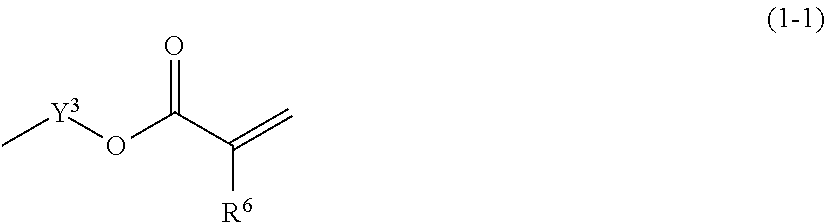


Applications Claiming Priority (2)
| Application Number | Priority Date | Filing Date | Title |
|---|---|---|---|
| JP2016193996A JP6700542B2 (en) | 2016-09-30 | 2016-09-30 | Laminated film |
| JP2016-193996 | 2016-09-30 |
Publications (2)
| Publication Number | Publication Date |
|---|---|
| US20180094164A1 US20180094164A1 (en) | 2018-04-05 |
| US10696865B2 true US10696865B2 (en) | 2020-06-30 |
Family
ID=61757836
Family Applications (1)
| Application Number | Title | Priority Date | Filing Date |
|---|---|---|---|
| US15/721,747 Expired - Fee Related US10696865B2 (en) | 2016-09-30 | 2017-09-30 | Laminated film |
Country Status (2)
| Country | Link |
|---|---|
| US (1) | US10696865B2 (en) |
| JP (1) | JP6700542B2 (en) |
Cited By (2)
| Publication number | Priority date | Publication date | Assignee | Title |
|---|---|---|---|---|
| US11945968B2 (en) | 2022-08-08 | 2024-04-02 | Hyundai Motor Company | Anti-fingerprint film for automobile interior parts containing fluorine-based compound and method of manufacturing same |
| US12570785B2 (en) | 2019-04-24 | 2026-03-10 | Mitsubishi Chemical Corporation | Thermoplastic polyurethane resin elastomers |
Families Citing this family (27)
| Publication number | Priority date | Publication date | Assignee | Title |
|---|---|---|---|---|
| US20170031525A1 (en) | 2010-05-14 | 2017-02-02 | Racing Optics, Inc. | Touch screen shield |
| US9295297B2 (en) | 2014-06-17 | 2016-03-29 | Racing Optics, Inc. | Adhesive mountable stack of removable layers |
| SG11201909944PA (en) * | 2017-05-23 | 2019-11-28 | Lintec Corp | Roll and method for producing roll |
| JP6856475B2 (en) * | 2017-08-24 | 2021-04-07 | リンテック株式会社 | Adhesive film and its manufacturing method |
| JP7270486B2 (en) * | 2018-08-02 | 2023-05-10 | 信越化学工業株式会社 | Stretchable membrane and method for forming the same |
| JP7128161B2 (en) | 2018-09-27 | 2022-08-30 | 信越化学工業株式会社 | Stretchable film and method for forming stretchable film |
| CN113227184A (en) * | 2018-12-20 | 2021-08-06 | 3M创新有限公司 | Polyurethane mask |
| US11524493B2 (en) | 2019-02-01 | 2022-12-13 | Racing Optics, Inc. | Thermoform windshield stack with integrated formable mold |
| US11846788B2 (en) | 2019-02-01 | 2023-12-19 | Racing Optics, Inc. | Thermoform windshield stack with integrated formable mold |
| US11364715B2 (en) | 2019-05-21 | 2022-06-21 | Racing Optics, Inc. | Polymer safety glazing for vehicles |
| US11912001B2 (en) | 2019-12-03 | 2024-02-27 | Ro Technologies, Llc | Method and apparatus for reducing non-normal incidence distortion in glazing films |
| US11648723B2 (en) | 2019-12-03 | 2023-05-16 | Racing Optics, Inc. | Method and apparatus for reducing non-normal incidence distortion in glazing films |
| JP6868083B1 (en) | 2019-12-06 | 2021-05-12 | 日本マタイ株式会社 | Multilayer film |
| CN113263718B (en) * | 2020-02-17 | 2022-12-13 | 华为技术有限公司 | Protective film and its preparation method, bonding method and terminal |
| US20210285661A1 (en) | 2020-03-10 | 2021-09-16 | Wolf Steel Ltd. | Heating and cooling appliance |
| US11548356B2 (en) | 2020-03-10 | 2023-01-10 | Racing Optics, Inc. | Protective barrier for safety glazing |
| JP6767596B1 (en) | 2020-03-27 | 2020-10-14 | 日本マタイ株式会社 | Multilayer film |
| US11490667B1 (en) | 2021-06-08 | 2022-11-08 | Racing Optics, Inc. | Low haze UV blocking removable lens stack |
| US11709296B2 (en) | 2021-07-27 | 2023-07-25 | Racing Optics, Inc. | Low reflectance removable lens stack |
| US11307329B1 (en) | 2021-07-27 | 2022-04-19 | Racing Optics, Inc. | Low reflectance removable lens stack |
| US12140781B2 (en) | 2021-07-27 | 2024-11-12 | Laminated Film Llc | Low reflectance removable lens stack |
| US12162330B2 (en) | 2022-02-08 | 2024-12-10 | Ro Technologies, Llc | Multi-layer windshield film having progressive thickness layers |
| US11933943B2 (en) | 2022-06-06 | 2024-03-19 | Laminated Film Llc | Stack of sterile peelable lenses with low creep |
| KR102721311B1 (en) * | 2022-06-30 | 2024-10-28 | 주식회사 상보 | Paint Protection Film |
| KR102689507B1 (en) | 2022-08-23 | 2024-07-29 | 니폰 페인트 오토모티브 코팅스 가부시키가이샤 | Laminated films and articles |
| US11808952B1 (en) | 2022-09-26 | 2023-11-07 | Racing Optics, Inc. | Low static optical removable lens stack |
| WO2025071336A1 (en) * | 2023-09-27 | 2025-04-03 | 주식회사 레이노코리아 | Paint protection film |
Citations (6)
| Publication number | Priority date | Publication date | Assignee | Title |
|---|---|---|---|---|
| US20070014018A1 (en) * | 2004-12-30 | 2007-01-18 | Wheatley John A | Internal components of optical device comprising hardcoat |
| JP2008539107A (en) | 2005-04-29 | 2008-11-13 | スリーエム イノベイティブ プロパティズ カンパニー | Multilayer polyurethane protective film |
| US20130258482A1 (en) * | 2010-10-18 | 2013-10-03 | Jnc Corporation | Laminate body and manufacturing method thereof |
| WO2015019726A1 (en) * | 2013-08-05 | 2015-02-12 | 日東電工株式会社 | Adhesive sheet |
| JP2016020079A (en) | 2014-07-15 | 2016-02-04 | 株式会社スミロン | Manufacture of laminates, surface protection articles and laminates |
| WO2016152631A1 (en) * | 2015-03-26 | 2016-09-29 | リンテック株式会社 | Coating film protective film |
Family Cites Families (3)
| Publication number | Priority date | Publication date | Assignee | Title |
|---|---|---|---|---|
| JP4886969B2 (en) * | 2004-03-24 | 2012-02-29 | リンテック株式会社 | Adhesive sheet |
| JP2015174902A (en) * | 2014-03-14 | 2015-10-05 | 日東電工株式会社 | Aquatic organism adhesion prevention adhesive tape |
| CN106794678B (en) * | 2014-07-15 | 2019-02-01 | 捷恩智株式会社 | Laminate, surface protection article, and method for producing the laminate |
-
2016
- 2016-09-30 JP JP2016193996A patent/JP6700542B2/en active Active
-
2017
- 2017-09-30 US US15/721,747 patent/US10696865B2/en not_active Expired - Fee Related
Patent Citations (6)
| Publication number | Priority date | Publication date | Assignee | Title |
|---|---|---|---|---|
| US20070014018A1 (en) * | 2004-12-30 | 2007-01-18 | Wheatley John A | Internal components of optical device comprising hardcoat |
| JP2008539107A (en) | 2005-04-29 | 2008-11-13 | スリーエム イノベイティブ プロパティズ カンパニー | Multilayer polyurethane protective film |
| US20130258482A1 (en) * | 2010-10-18 | 2013-10-03 | Jnc Corporation | Laminate body and manufacturing method thereof |
| WO2015019726A1 (en) * | 2013-08-05 | 2015-02-12 | 日東電工株式会社 | Adhesive sheet |
| JP2016020079A (en) | 2014-07-15 | 2016-02-04 | 株式会社スミロン | Manufacture of laminates, surface protection articles and laminates |
| WO2016152631A1 (en) * | 2015-03-26 | 2016-09-29 | リンテック株式会社 | Coating film protective film |
Cited By (2)
| Publication number | Priority date | Publication date | Assignee | Title |
|---|---|---|---|---|
| US12570785B2 (en) | 2019-04-24 | 2026-03-10 | Mitsubishi Chemical Corporation | Thermoplastic polyurethane resin elastomers |
| US11945968B2 (en) | 2022-08-08 | 2024-04-02 | Hyundai Motor Company | Anti-fingerprint film for automobile interior parts containing fluorine-based compound and method of manufacturing same |
Also Published As
| Publication number | Publication date |
|---|---|
| US20180094164A1 (en) | 2018-04-05 |
| JP6700542B2 (en) | 2020-05-27 |
| JP2018053193A (en) | 2018-04-05 |
Similar Documents
| Publication | Publication Date | Title |
|---|---|---|
| US20180094164A1 (en) | Laminated film | |
| JP6673128B2 (en) | Laminated film | |
| US7785713B2 (en) | Active energy ray-curable coating composition and molded article having cured coating film of the composition | |
| US20190359775A1 (en) | Coating liquid and its use article | |
| US10472465B2 (en) | Method for producing polycarbonate diol, polycarbonate diol and polyurethane using same | |
| US10316130B2 (en) | Polycarbonate diol and polyurethane using same | |
| JP7238772B2 (en) | laminated film | |
| JP6465316B2 (en) | Curable composition | |
| US11339288B2 (en) | Photocurable composition and coating layer including cured product thereof | |
| CN102459378A (en) | Stain-proofing composition, stain-proofing film, stain-proofing laminate film, transfer film, resin laminate, and method for producing resin laminate | |
| JP2020164677A (en) | Photopolymerizable coating composition and article obtained using the same | |
| US12043773B2 (en) | Coating liquid and article using same | |
| US20200298540A1 (en) | Surface-modified film for automotive interior/exterior components | |
| JP2021121653A (en) | Coating composition and product using the same | |
| WO2012091161A2 (en) | Curable composition and article having a cured layer from the composition | |
| JP2017197650A (en) | Urethane (meth) acrylate resin and laminated film | |
| JP6388116B2 (en) | Curable composition | |
| WO2025126876A1 (en) | Photopolymerizable coating composition and product using same | |
| JPWO2019073953A1 (en) | Surface modification film for automobile interior and exterior parts | |
| JP2014218577A (en) | Antifouling resin composition | |
| JP2014181329A (en) | Antifouling resin composition |
Legal Events
| Date | Code | Title | Description |
|---|---|---|---|
| FEPP | Fee payment procedure |
Free format text: ENTITY STATUS SET TO UNDISCOUNTED (ORIGINAL EVENT CODE: BIG.); ENTITY STATUS OF PATENT OWNER: LARGE ENTITY |
|
| AS | Assignment |
Owner name: JNC CORPORATION, JAPAN Free format text: ASSIGNMENT OF ASSIGNORS INTEREST;ASSIGNORS:ITO, KENYA;IIZUKA, HIROYUKI;SATO, SHINO;AND OTHERS;REEL/FRAME:043801/0333 Effective date: 20170927 |
|
| STPP | Information on status: patent application and granting procedure in general |
Free format text: DOCKETED NEW CASE - READY FOR EXAMINATION |
|
| STPP | Information on status: patent application and granting procedure in general |
Free format text: NON FINAL ACTION MAILED |
|
| STPP | Information on status: patent application and granting procedure in general |
Free format text: RESPONSE TO NON-FINAL OFFICE ACTION ENTERED AND FORWARDED TO EXAMINER |
|
| STPP | Information on status: patent application and granting procedure in general |
Free format text: NON FINAL ACTION MAILED |
|
| STPP | Information on status: patent application and granting procedure in general |
Free format text: FINAL REJECTION MAILED |
|
| STPP | Information on status: patent application and granting procedure in general |
Free format text: RESPONSE AFTER FINAL ACTION FORWARDED TO EXAMINER |
|
| STPP | Information on status: patent application and granting procedure in general |
Free format text: NOTICE OF ALLOWANCE MAILED -- APPLICATION RECEIVED IN OFFICE OF PUBLICATIONS |
|
| STCF | Information on status: patent grant |
Free format text: PATENTED CASE |
|
| FEPP | Fee payment procedure |
Free format text: MAINTENANCE FEE REMINDER MAILED (ORIGINAL EVENT CODE: REM.); ENTITY STATUS OF PATENT OWNER: LARGE ENTITY |
|
| LAPS | Lapse for failure to pay maintenance fees |
Free format text: PATENT EXPIRED FOR FAILURE TO PAY MAINTENANCE FEES (ORIGINAL EVENT CODE: EXP.); ENTITY STATUS OF PATENT OWNER: LARGE ENTITY |
|
| STCH | Information on status: patent discontinuation |
Free format text: PATENT EXPIRED DUE TO NONPAYMENT OF MAINTENANCE FEES UNDER 37 CFR 1.362 |
|
| FP | Lapsed due to failure to pay maintenance fee |
Effective date: 20240630 |