US10696022B2 - Composite plate and production method therefor - Google Patents

Composite plate and production method therefor Download PDF

Info

Publication number
US10696022B2
US10696022B2 US14/408,989 US201314408989A US10696022B2 US 10696022 B2 US10696022 B2 US 10696022B2 US 201314408989 A US201314408989 A US 201314408989A US 10696022 B2 US10696022 B2 US 10696022B2
Authority
US
United States
Prior art keywords
composite plate
sintered body
zirconia sintered
base material
thickness
Prior art date
Legal status (The legal status is an assumption and is not a legal conclusion. Google has not performed a legal analysis and makes no representation as to the accuracy of the status listed.)
Active, expires
Application number
US14/408,989
Other versions
US20150174863A1 (en
Inventor
Isao Yamashita
Kohei Imai
Shoichi Yamauchi
Koji Tsukuma
Current Assignee (The listed assignees may be inaccurate. Google has not performed a legal analysis and makes no representation or warranty as to the accuracy of the list.)
Tosoh Corp
Original Assignee
Tosoh Corp
Priority date (The priority date is an assumption and is not a legal conclusion. Google has not performed a legal analysis and makes no representation as to the accuracy of the date listed.)
Filing date
Publication date
Application filed by Tosoh Corp filed Critical Tosoh Corp
Assigned to TOSOH CORPORATION reassignment TOSOH CORPORATION ASSIGNMENT OF ASSIGNORS INTEREST (SEE DOCUMENT FOR DETAILS). Assignors: IMAI, KOHEI, TSUKUMA, KOJI, YAMASHITA, ISAO, YAMAUCHI, SHOICHI
Publication of US20150174863A1 publication Critical patent/US20150174863A1/en
Application granted granted Critical
Publication of US10696022B2 publication Critical patent/US10696022B2/en
Active legal-status Critical Current
Adjusted expiration legal-status Critical

Links

Images

Classifications

    • BPERFORMING OPERATIONS; TRANSPORTING
    • B32LAYERED PRODUCTS
    • B32BLAYERED PRODUCTS, i.e. PRODUCTS BUILT-UP OF STRATA OF FLAT OR NON-FLAT, e.g. CELLULAR OR HONEYCOMB, FORM
    • B32B5/00Layered products characterised by the non- homogeneity or physical structure, i.e. comprising a fibrous, filamentary, particulate or foam layer; Layered products characterised by having a layer differing constitutionally or physically in different parts
    • B32B5/16Layered products characterised by the non- homogeneity or physical structure, i.e. comprising a fibrous, filamentary, particulate or foam layer; Layered products characterised by having a layer differing constitutionally or physically in different parts characterised by features of a layer formed of particles, e.g. chips, powder or granules
    • BPERFORMING OPERATIONS; TRANSPORTING
    • B32LAYERED PRODUCTS
    • B32BLAYERED PRODUCTS, i.e. PRODUCTS BUILT-UP OF STRATA OF FLAT OR NON-FLAT, e.g. CELLULAR OR HONEYCOMB, FORM
    • B32B15/00Layered products comprising a layer of metal
    • B32B15/16Layered products comprising a layer of metal next to a particulate layer
    • BPERFORMING OPERATIONS; TRANSPORTING
    • B32LAYERED PRODUCTS
    • B32BLAYERED PRODUCTS, i.e. PRODUCTS BUILT-UP OF STRATA OF FLAT OR NON-FLAT, e.g. CELLULAR OR HONEYCOMB, FORM
    • B32B15/00Layered products comprising a layer of metal
    • B32B15/20Layered products comprising a layer of metal comprising aluminium or copper
    • BPERFORMING OPERATIONS; TRANSPORTING
    • B32LAYERED PRODUCTS
    • B32BLAYERED PRODUCTS, i.e. PRODUCTS BUILT-UP OF STRATA OF FLAT OR NON-FLAT, e.g. CELLULAR OR HONEYCOMB, FORM
    • B32B17/00Layered products essentially comprising sheet glass, or glass, slag, or like fibres
    • B32B17/06Layered products essentially comprising sheet glass, or glass, slag, or like fibres comprising glass as the main or only constituent of a layer, next to another layer of a specific material
    • BPERFORMING OPERATIONS; TRANSPORTING
    • B32LAYERED PRODUCTS
    • B32BLAYERED PRODUCTS, i.e. PRODUCTS BUILT-UP OF STRATA OF FLAT OR NON-FLAT, e.g. CELLULAR OR HONEYCOMB, FORM
    • B32B18/00Layered products essentially comprising ceramics, e.g. refractory products
    • BPERFORMING OPERATIONS; TRANSPORTING
    • B32LAYERED PRODUCTS
    • B32BLAYERED PRODUCTS, i.e. PRODUCTS BUILT-UP OF STRATA OF FLAT OR NON-FLAT, e.g. CELLULAR OR HONEYCOMB, FORM
    • B32B37/00Methods or apparatus for laminating, e.g. by curing or by ultrasonic bonding
    • B32B37/12Methods or apparatus for laminating, e.g. by curing or by ultrasonic bonding characterised by using adhesives
    • BPERFORMING OPERATIONS; TRANSPORTING
    • B32LAYERED PRODUCTS
    • B32BLAYERED PRODUCTS, i.e. PRODUCTS BUILT-UP OF STRATA OF FLAT OR NON-FLAT, e.g. CELLULAR OR HONEYCOMB, FORM
    • B32B37/00Methods or apparatus for laminating, e.g. by curing or by ultrasonic bonding
    • B32B37/14Methods or apparatus for laminating, e.g. by curing or by ultrasonic bonding characterised by the properties of the layers
    • B32B37/16Methods or apparatus for laminating, e.g. by curing or by ultrasonic bonding characterised by the properties of the layers with all layers existing as coherent layers before laminating
    • B32B37/18Methods or apparatus for laminating, e.g. by curing or by ultrasonic bonding characterised by the properties of the layers with all layers existing as coherent layers before laminating involving the assembly of discrete sheets or panels only
    • BPERFORMING OPERATIONS; TRANSPORTING
    • B32LAYERED PRODUCTS
    • B32BLAYERED PRODUCTS, i.e. PRODUCTS BUILT-UP OF STRATA OF FLAT OR NON-FLAT, e.g. CELLULAR OR HONEYCOMB, FORM
    • B32B7/00Layered products characterised by the relation between layers; Layered products characterised by the relative orientation of features between layers, or by the relative values of a measurable parameter between layers, i.e. products comprising layers having different physical, chemical or physicochemical properties; Layered products characterised by the interconnection of layers
    • B32B7/04Interconnection of layers
    • B32B7/12Interconnection of layers using interposed adhesives or interposed materials with bonding properties
    • CCHEMISTRY; METALLURGY
    • C04CEMENTS; CONCRETE; ARTIFICIAL STONE; CERAMICS; REFRACTORIES
    • C04BLIME, MAGNESIA; SLAG; CEMENTS; COMPOSITIONS THEREOF, e.g. MORTARS, CONCRETE OR LIKE BUILDING MATERIALS; ARTIFICIAL STONE; CERAMICS; REFRACTORIES; TREATMENT OF NATURAL STONE
    • C04B35/00Shaped ceramic products characterised by their composition; Ceramics compositions; Processing powders of inorganic compounds preparatory to the manufacturing of ceramic products
    • C04B35/01Shaped ceramic products characterised by their composition; Ceramics compositions; Processing powders of inorganic compounds preparatory to the manufacturing of ceramic products based on oxide ceramics
    • C04B35/48Shaped ceramic products characterised by their composition; Ceramics compositions; Processing powders of inorganic compounds preparatory to the manufacturing of ceramic products based on oxide ceramics based on zirconium or hafnium oxides, zirconates, zircon or hafnates
    • C04B35/486Fine ceramics
    • CCHEMISTRY; METALLURGY
    • C04CEMENTS; CONCRETE; ARTIFICIAL STONE; CERAMICS; REFRACTORIES
    • C04BLIME, MAGNESIA; SLAG; CEMENTS; COMPOSITIONS THEREOF, e.g. MORTARS, CONCRETE OR LIKE BUILDING MATERIALS; ARTIFICIAL STONE; CERAMICS; REFRACTORIES; TREATMENT OF NATURAL STONE
    • C04B35/00Shaped ceramic products characterised by their composition; Ceramics compositions; Processing powders of inorganic compounds preparatory to the manufacturing of ceramic products
    • C04B35/01Shaped ceramic products characterised by their composition; Ceramics compositions; Processing powders of inorganic compounds preparatory to the manufacturing of ceramic products based on oxide ceramics
    • C04B35/48Shaped ceramic products characterised by their composition; Ceramics compositions; Processing powders of inorganic compounds preparatory to the manufacturing of ceramic products based on oxide ceramics based on zirconium or hafnium oxides, zirconates, zircon or hafnates
    • C04B35/486Fine ceramics
    • C04B35/488Composites
    • C04B35/4885Composites with aluminium oxide
    • CCHEMISTRY; METALLURGY
    • C04CEMENTS; CONCRETE; ARTIFICIAL STONE; CERAMICS; REFRACTORIES
    • C04BLIME, MAGNESIA; SLAG; CEMENTS; COMPOSITIONS THEREOF, e.g. MORTARS, CONCRETE OR LIKE BUILDING MATERIALS; ARTIFICIAL STONE; CERAMICS; REFRACTORIES; TREATMENT OF NATURAL STONE
    • C04B35/00Shaped ceramic products characterised by their composition; Ceramics compositions; Processing powders of inorganic compounds preparatory to the manufacturing of ceramic products
    • C04B35/622Forming processes; Processing powders of inorganic compounds preparatory to the manufacturing of ceramic products
    • C04B35/626Preparing or treating the powders individually or as batches ; preparing or treating macroscopic reinforcing agents for ceramic products, e.g. fibres; mechanical aspects section B
    • C04B35/63Preparing or treating the powders individually or as batches ; preparing or treating macroscopic reinforcing agents for ceramic products, e.g. fibres; mechanical aspects section B using additives specially adapted for forming the products, e.g.. binder binders
    • C04B35/632Organic additives
    • C04B35/634Polymers
    • C04B35/63448Polymers obtained otherwise than by reactions only involving carbon-to-carbon unsaturated bonds
    • C04B35/63452Polyepoxides
    • CCHEMISTRY; METALLURGY
    • C04CEMENTS; CONCRETE; ARTIFICIAL STONE; CERAMICS; REFRACTORIES
    • C04BLIME, MAGNESIA; SLAG; CEMENTS; COMPOSITIONS THEREOF, e.g. MORTARS, CONCRETE OR LIKE BUILDING MATERIALS; ARTIFICIAL STONE; CERAMICS; REFRACTORIES; TREATMENT OF NATURAL STONE
    • C04B35/00Shaped ceramic products characterised by their composition; Ceramics compositions; Processing powders of inorganic compounds preparatory to the manufacturing of ceramic products
    • C04B35/622Forming processes; Processing powders of inorganic compounds preparatory to the manufacturing of ceramic products
    • C04B35/64Burning or sintering processes
    • C04B35/645Pressure sintering
    • CCHEMISTRY; METALLURGY
    • C04CEMENTS; CONCRETE; ARTIFICIAL STONE; CERAMICS; REFRACTORIES
    • C04BLIME, MAGNESIA; SLAG; CEMENTS; COMPOSITIONS THEREOF, e.g. MORTARS, CONCRETE OR LIKE BUILDING MATERIALS; ARTIFICIAL STONE; CERAMICS; REFRACTORIES; TREATMENT OF NATURAL STONE
    • C04B37/00Joining burned ceramic articles with other burned ceramic articles or other articles by heating
    • C04B37/008Joining burned ceramic articles with other burned ceramic articles or other articles by heating by means of an interlayer consisting of an organic adhesive, e.g. phenol resin or pitch
    • CCHEMISTRY; METALLURGY
    • C04CEMENTS; CONCRETE; ARTIFICIAL STONE; CERAMICS; REFRACTORIES
    • C04BLIME, MAGNESIA; SLAG; CEMENTS; COMPOSITIONS THEREOF, e.g. MORTARS, CONCRETE OR LIKE BUILDING MATERIALS; ARTIFICIAL STONE; CERAMICS; REFRACTORIES; TREATMENT OF NATURAL STONE
    • C04B37/00Joining burned ceramic articles with other burned ceramic articles or other articles by heating
    • C04B37/02Joining burned ceramic articles with other burned ceramic articles or other articles by heating with metallic articles
    • C04B37/028Joining burned ceramic articles with other burned ceramic articles or other articles by heating with metallic articles by means of an interlayer consisting of an organic adhesive, e.g. phenol resin or pitch
    • CCHEMISTRY; METALLURGY
    • C04CEMENTS; CONCRETE; ARTIFICIAL STONE; CERAMICS; REFRACTORIES
    • C04BLIME, MAGNESIA; SLAG; CEMENTS; COMPOSITIONS THEREOF, e.g. MORTARS, CONCRETE OR LIKE BUILDING MATERIALS; ARTIFICIAL STONE; CERAMICS; REFRACTORIES; TREATMENT OF NATURAL STONE
    • C04B37/00Joining burned ceramic articles with other burned ceramic articles or other articles by heating
    • C04B37/04Joining burned ceramic articles with other burned ceramic articles or other articles by heating with articles made from glass
    • C04B37/047Joining burned ceramic articles with other burned ceramic articles or other articles by heating with articles made from glass by means of an interlayer consisting of an organic adhesive, e.g. phenol resin or pitch
    • GPHYSICS
    • G04HOROLOGY
    • G04BMECHANICALLY-DRIVEN CLOCKS OR WATCHES; MECHANICAL PARTS OF CLOCKS OR WATCHES IN GENERAL; TIME PIECES USING THE POSITION OF THE SUN, MOON OR STARS
    • G04B37/00Cases
    • G04B37/22Materials or processes of manufacturing pocket watch or wrist watch cases
    • HELECTRICITY
    • H05ELECTRIC TECHNIQUES NOT OTHERWISE PROVIDED FOR
    • H05KPRINTED CIRCUITS; CASINGS OR CONSTRUCTIONAL DETAILS OF ELECTRIC APPARATUS; MANUFACTURE OF ASSEMBLAGES OF ELECTRICAL COMPONENTS
    • H05K5/00Casings, cabinets or drawers for electric apparatus
    • H05K5/02Details
    • BPERFORMING OPERATIONS; TRANSPORTING
    • B32LAYERED PRODUCTS
    • B32BLAYERED PRODUCTS, i.e. PRODUCTS BUILT-UP OF STRATA OF FLAT OR NON-FLAT, e.g. CELLULAR OR HONEYCOMB, FORM
    • B32B2264/00Composition or properties of particles which form a particulate layer or are present as additives
    • B32B2264/10Inorganic particles
    • B32B2264/102Oxide or hydroxide
    • BPERFORMING OPERATIONS; TRANSPORTING
    • B32LAYERED PRODUCTS
    • B32BLAYERED PRODUCTS, i.e. PRODUCTS BUILT-UP OF STRATA OF FLAT OR NON-FLAT, e.g. CELLULAR OR HONEYCOMB, FORM
    • B32B2307/00Properties of the layers or laminate
    • B32B2307/30Properties of the layers or laminate having particular thermal properties
    • B32B2307/306Resistant to heat
    • BPERFORMING OPERATIONS; TRANSPORTING
    • B32LAYERED PRODUCTS
    • B32BLAYERED PRODUCTS, i.e. PRODUCTS BUILT-UP OF STRATA OF FLAT OR NON-FLAT, e.g. CELLULAR OR HONEYCOMB, FORM
    • B32B2307/00Properties of the layers or laminate
    • B32B2307/40Properties of the layers or laminate having particular optical properties
    • B32B2307/402Coloured
    • B32B2307/4026Coloured within the layer by addition of a colorant, e.g. pigments, dyes
    • BPERFORMING OPERATIONS; TRANSPORTING
    • B32LAYERED PRODUCTS
    • B32BLAYERED PRODUCTS, i.e. PRODUCTS BUILT-UP OF STRATA OF FLAT OR NON-FLAT, e.g. CELLULAR OR HONEYCOMB, FORM
    • B32B2307/00Properties of the layers or laminate
    • B32B2307/50Properties of the layers or laminate having particular mechanical properties
    • B32B2307/54Yield strength; Tensile strength
    • BPERFORMING OPERATIONS; TRANSPORTING
    • B32LAYERED PRODUCTS
    • B32BLAYERED PRODUCTS, i.e. PRODUCTS BUILT-UP OF STRATA OF FLAT OR NON-FLAT, e.g. CELLULAR OR HONEYCOMB, FORM
    • B32B2307/00Properties of the layers or laminate
    • B32B2307/50Properties of the layers or laminate having particular mechanical properties
    • B32B2307/554Wear resistance
    • BPERFORMING OPERATIONS; TRANSPORTING
    • B32LAYERED PRODUCTS
    • B32BLAYERED PRODUCTS, i.e. PRODUCTS BUILT-UP OF STRATA OF FLAT OR NON-FLAT, e.g. CELLULAR OR HONEYCOMB, FORM
    • B32B2307/00Properties of the layers or laminate
    • B32B2307/50Properties of the layers or laminate having particular mechanical properties
    • B32B2307/558Impact strength, toughness
    • BPERFORMING OPERATIONS; TRANSPORTING
    • B32LAYERED PRODUCTS
    • B32BLAYERED PRODUCTS, i.e. PRODUCTS BUILT-UP OF STRATA OF FLAT OR NON-FLAT, e.g. CELLULAR OR HONEYCOMB, FORM
    • B32B2307/00Properties of the layers or laminate
    • B32B2307/70Other properties
    • B32B2307/72Density
    • BPERFORMING OPERATIONS; TRANSPORTING
    • B32LAYERED PRODUCTS
    • B32BLAYERED PRODUCTS, i.e. PRODUCTS BUILT-UP OF STRATA OF FLAT OR NON-FLAT, e.g. CELLULAR OR HONEYCOMB, FORM
    • B32B2439/00Containers; Receptacles
    • BPERFORMING OPERATIONS; TRANSPORTING
    • B32LAYERED PRODUCTS
    • B32BLAYERED PRODUCTS, i.e. PRODUCTS BUILT-UP OF STRATA OF FLAT OR NON-FLAT, e.g. CELLULAR OR HONEYCOMB, FORM
    • B32B2457/00Electrical equipment
    • CCHEMISTRY; METALLURGY
    • C04CEMENTS; CONCRETE; ARTIFICIAL STONE; CERAMICS; REFRACTORIES
    • C04BLIME, MAGNESIA; SLAG; CEMENTS; COMPOSITIONS THEREOF, e.g. MORTARS, CONCRETE OR LIKE BUILDING MATERIALS; ARTIFICIAL STONE; CERAMICS; REFRACTORIES; TREATMENT OF NATURAL STONE
    • C04B2235/00Aspects relating to ceramic starting mixtures or sintered ceramic products
    • C04B2235/02Composition of constituents of the starting material or of secondary phases of the final product
    • C04B2235/30Constituents and secondary phases not being of a fibrous nature
    • C04B2235/32Metal oxides, mixed metal oxides, or oxide-forming salts thereof, e.g. carbonates, nitrates, (oxy)hydroxides, chlorides
    • C04B2235/3217Aluminum oxide or oxide forming salts thereof, e.g. bauxite, alpha-alumina
    • CCHEMISTRY; METALLURGY
    • C04CEMENTS; CONCRETE; ARTIFICIAL STONE; CERAMICS; REFRACTORIES
    • C04BLIME, MAGNESIA; SLAG; CEMENTS; COMPOSITIONS THEREOF, e.g. MORTARS, CONCRETE OR LIKE BUILDING MATERIALS; ARTIFICIAL STONE; CERAMICS; REFRACTORIES; TREATMENT OF NATURAL STONE
    • C04B2235/00Aspects relating to ceramic starting mixtures or sintered ceramic products
    • C04B2235/02Composition of constituents of the starting material or of secondary phases of the final product
    • C04B2235/30Constituents and secondary phases not being of a fibrous nature
    • C04B2235/32Metal oxides, mixed metal oxides, or oxide-forming salts thereof, e.g. carbonates, nitrates, (oxy)hydroxides, chlorides
    • C04B2235/3217Aluminum oxide or oxide forming salts thereof, e.g. bauxite, alpha-alumina
    • C04B2235/3222Aluminates other than alumino-silicates, e.g. spinel (MgAl2O4)
    • CCHEMISTRY; METALLURGY
    • C04CEMENTS; CONCRETE; ARTIFICIAL STONE; CERAMICS; REFRACTORIES
    • C04BLIME, MAGNESIA; SLAG; CEMENTS; COMPOSITIONS THEREOF, e.g. MORTARS, CONCRETE OR LIKE BUILDING MATERIALS; ARTIFICIAL STONE; CERAMICS; REFRACTORIES; TREATMENT OF NATURAL STONE
    • C04B2235/00Aspects relating to ceramic starting mixtures or sintered ceramic products
    • C04B2235/02Composition of constituents of the starting material or of secondary phases of the final product
    • C04B2235/30Constituents and secondary phases not being of a fibrous nature
    • C04B2235/32Metal oxides, mixed metal oxides, or oxide-forming salts thereof, e.g. carbonates, nitrates, (oxy)hydroxides, chlorides
    • C04B2235/3224Rare earth oxide or oxide forming salts thereof, e.g. scandium oxide
    • CCHEMISTRY; METALLURGY
    • C04CEMENTS; CONCRETE; ARTIFICIAL STONE; CERAMICS; REFRACTORIES
    • C04BLIME, MAGNESIA; SLAG; CEMENTS; COMPOSITIONS THEREOF, e.g. MORTARS, CONCRETE OR LIKE BUILDING MATERIALS; ARTIFICIAL STONE; CERAMICS; REFRACTORIES; TREATMENT OF NATURAL STONE
    • C04B2235/00Aspects relating to ceramic starting mixtures or sintered ceramic products
    • C04B2235/02Composition of constituents of the starting material or of secondary phases of the final product
    • C04B2235/30Constituents and secondary phases not being of a fibrous nature
    • C04B2235/32Metal oxides, mixed metal oxides, or oxide-forming salts thereof, e.g. carbonates, nitrates, (oxy)hydroxides, chlorides
    • C04B2235/3224Rare earth oxide or oxide forming salts thereof, e.g. scandium oxide
    • C04B2235/3225Yttrium oxide or oxide-forming salts thereof
    • CCHEMISTRY; METALLURGY
    • C04CEMENTS; CONCRETE; ARTIFICIAL STONE; CERAMICS; REFRACTORIES
    • C04BLIME, MAGNESIA; SLAG; CEMENTS; COMPOSITIONS THEREOF, e.g. MORTARS, CONCRETE OR LIKE BUILDING MATERIALS; ARTIFICIAL STONE; CERAMICS; REFRACTORIES; TREATMENT OF NATURAL STONE
    • C04B2235/00Aspects relating to ceramic starting mixtures or sintered ceramic products
    • C04B2235/02Composition of constituents of the starting material or of secondary phases of the final product
    • C04B2235/30Constituents and secondary phases not being of a fibrous nature
    • C04B2235/32Metal oxides, mixed metal oxides, or oxide-forming salts thereof, e.g. carbonates, nitrates, (oxy)hydroxides, chlorides
    • C04B2235/3231Refractory metal oxides, their mixed metal oxides, or oxide-forming salts thereof
    • C04B2235/3244Zirconium oxides, zirconates, hafnium oxides, hafnates, or oxide-forming salts thereof
    • C04B2235/3248Zirconates or hafnates, e.g. zircon
    • CCHEMISTRY; METALLURGY
    • C04CEMENTS; CONCRETE; ARTIFICIAL STONE; CERAMICS; REFRACTORIES
    • C04BLIME, MAGNESIA; SLAG; CEMENTS; COMPOSITIONS THEREOF, e.g. MORTARS, CONCRETE OR LIKE BUILDING MATERIALS; ARTIFICIAL STONE; CERAMICS; REFRACTORIES; TREATMENT OF NATURAL STONE
    • C04B2235/00Aspects relating to ceramic starting mixtures or sintered ceramic products
    • C04B2235/02Composition of constituents of the starting material or of secondary phases of the final product
    • C04B2235/30Constituents and secondary phases not being of a fibrous nature
    • C04B2235/32Metal oxides, mixed metal oxides, or oxide-forming salts thereof, e.g. carbonates, nitrates, (oxy)hydroxides, chlorides
    • C04B2235/3262Manganese oxides, manganates, rhenium oxides or oxide-forming salts thereof, e.g. MnO
    • CCHEMISTRY; METALLURGY
    • C04CEMENTS; CONCRETE; ARTIFICIAL STONE; CERAMICS; REFRACTORIES
    • C04BLIME, MAGNESIA; SLAG; CEMENTS; COMPOSITIONS THEREOF, e.g. MORTARS, CONCRETE OR LIKE BUILDING MATERIALS; ARTIFICIAL STONE; CERAMICS; REFRACTORIES; TREATMENT OF NATURAL STONE
    • C04B2235/00Aspects relating to ceramic starting mixtures or sintered ceramic products
    • C04B2235/02Composition of constituents of the starting material or of secondary phases of the final product
    • C04B2235/30Constituents and secondary phases not being of a fibrous nature
    • C04B2235/32Metal oxides, mixed metal oxides, or oxide-forming salts thereof, e.g. carbonates, nitrates, (oxy)hydroxides, chlorides
    • C04B2235/327Iron group oxides, their mixed metal oxides, or oxide-forming salts thereof
    • C04B2235/3272Iron oxides or oxide forming salts thereof, e.g. hematite, magnetite
    • CCHEMISTRY; METALLURGY
    • C04CEMENTS; CONCRETE; ARTIFICIAL STONE; CERAMICS; REFRACTORIES
    • C04BLIME, MAGNESIA; SLAG; CEMENTS; COMPOSITIONS THEREOF, e.g. MORTARS, CONCRETE OR LIKE BUILDING MATERIALS; ARTIFICIAL STONE; CERAMICS; REFRACTORIES; TREATMENT OF NATURAL STONE
    • C04B2235/00Aspects relating to ceramic starting mixtures or sintered ceramic products
    • C04B2235/02Composition of constituents of the starting material or of secondary phases of the final product
    • C04B2235/30Constituents and secondary phases not being of a fibrous nature
    • C04B2235/32Metal oxides, mixed metal oxides, or oxide-forming salts thereof, e.g. carbonates, nitrates, (oxy)hydroxides, chlorides
    • C04B2235/327Iron group oxides, their mixed metal oxides, or oxide-forming salts thereof
    • C04B2235/3275Cobalt oxides, cobaltates or cobaltites or oxide forming salts thereof, e.g. bismuth cobaltate, zinc cobaltite
    • CCHEMISTRY; METALLURGY
    • C04CEMENTS; CONCRETE; ARTIFICIAL STONE; CERAMICS; REFRACTORIES
    • C04BLIME, MAGNESIA; SLAG; CEMENTS; COMPOSITIONS THEREOF, e.g. MORTARS, CONCRETE OR LIKE BUILDING MATERIALS; ARTIFICIAL STONE; CERAMICS; REFRACTORIES; TREATMENT OF NATURAL STONE
    • C04B2235/00Aspects relating to ceramic starting mixtures or sintered ceramic products
    • C04B2235/02Composition of constituents of the starting material or of secondary phases of the final product
    • C04B2235/30Constituents and secondary phases not being of a fibrous nature
    • C04B2235/32Metal oxides, mixed metal oxides, or oxide-forming salts thereof, e.g. carbonates, nitrates, (oxy)hydroxides, chlorides
    • C04B2235/327Iron group oxides, their mixed metal oxides, or oxide-forming salts thereof
    • C04B2235/3279Nickel oxides, nickalates, or oxide-forming salts thereof
    • CCHEMISTRY; METALLURGY
    • C04CEMENTS; CONCRETE; ARTIFICIAL STONE; CERAMICS; REFRACTORIES
    • C04BLIME, MAGNESIA; SLAG; CEMENTS; COMPOSITIONS THEREOF, e.g. MORTARS, CONCRETE OR LIKE BUILDING MATERIALS; ARTIFICIAL STONE; CERAMICS; REFRACTORIES; TREATMENT OF NATURAL STONE
    • C04B2235/00Aspects relating to ceramic starting mixtures or sintered ceramic products
    • C04B2235/02Composition of constituents of the starting material or of secondary phases of the final product
    • C04B2235/30Constituents and secondary phases not being of a fibrous nature
    • C04B2235/34Non-metal oxides, non-metal mixed oxides, or salts thereof that form the non-metal oxides upon heating, e.g. carbonates, nitrates, (oxy)hydroxides, chlorides
    • C04B2235/3418Silicon oxide, silicic acids or oxide forming salts thereof, e.g. silica sol, fused silica, silica fume, cristobalite, quartz or flint
    • CCHEMISTRY; METALLURGY
    • C04CEMENTS; CONCRETE; ARTIFICIAL STONE; CERAMICS; REFRACTORIES
    • C04BLIME, MAGNESIA; SLAG; CEMENTS; COMPOSITIONS THEREOF, e.g. MORTARS, CONCRETE OR LIKE BUILDING MATERIALS; ARTIFICIAL STONE; CERAMICS; REFRACTORIES; TREATMENT OF NATURAL STONE
    • C04B2235/00Aspects relating to ceramic starting mixtures or sintered ceramic products
    • C04B2235/65Aspects relating to heat treatments of ceramic bodies such as green ceramics or pre-sintered ceramics, e.g. burning, sintering or melting processes
    • C04B2235/656Aspects relating to heat treatments of ceramic bodies such as green ceramics or pre-sintered ceramics, e.g. burning, sintering or melting processes characterised by specific heating conditions during heat treatment
    • C04B2235/6562Heating rate
    • CCHEMISTRY; METALLURGY
    • C04CEMENTS; CONCRETE; ARTIFICIAL STONE; CERAMICS; REFRACTORIES
    • C04BLIME, MAGNESIA; SLAG; CEMENTS; COMPOSITIONS THEREOF, e.g. MORTARS, CONCRETE OR LIKE BUILDING MATERIALS; ARTIFICIAL STONE; CERAMICS; REFRACTORIES; TREATMENT OF NATURAL STONE
    • C04B2235/00Aspects relating to ceramic starting mixtures or sintered ceramic products
    • C04B2235/70Aspects relating to sintered or melt-casted ceramic products
    • C04B2235/74Physical characteristics
    • C04B2235/77Density
    • CCHEMISTRY; METALLURGY
    • C04CEMENTS; CONCRETE; ARTIFICIAL STONE; CERAMICS; REFRACTORIES
    • C04BLIME, MAGNESIA; SLAG; CEMENTS; COMPOSITIONS THEREOF, e.g. MORTARS, CONCRETE OR LIKE BUILDING MATERIALS; ARTIFICIAL STONE; CERAMICS; REFRACTORIES; TREATMENT OF NATURAL STONE
    • C04B2235/00Aspects relating to ceramic starting mixtures or sintered ceramic products
    • C04B2235/70Aspects relating to sintered or melt-casted ceramic products
    • C04B2235/96Properties of ceramic products, e.g. mechanical properties such as strength, toughness, wear resistance
    • CCHEMISTRY; METALLURGY
    • C04CEMENTS; CONCRETE; ARTIFICIAL STONE; CERAMICS; REFRACTORIES
    • C04BLIME, MAGNESIA; SLAG; CEMENTS; COMPOSITIONS THEREOF, e.g. MORTARS, CONCRETE OR LIKE BUILDING MATERIALS; ARTIFICIAL STONE; CERAMICS; REFRACTORIES; TREATMENT OF NATURAL STONE
    • C04B2235/00Aspects relating to ceramic starting mixtures or sintered ceramic products
    • C04B2235/70Aspects relating to sintered or melt-casted ceramic products
    • C04B2235/96Properties of ceramic products, e.g. mechanical properties such as strength, toughness, wear resistance
    • C04B2235/9646Optical properties
    • C04B2235/9661Colour
    • CCHEMISTRY; METALLURGY
    • C04CEMENTS; CONCRETE; ARTIFICIAL STONE; CERAMICS; REFRACTORIES
    • C04BLIME, MAGNESIA; SLAG; CEMENTS; COMPOSITIONS THEREOF, e.g. MORTARS, CONCRETE OR LIKE BUILDING MATERIALS; ARTIFICIAL STONE; CERAMICS; REFRACTORIES; TREATMENT OF NATURAL STONE
    • C04B2237/00Aspects relating to ceramic laminates or to joining of ceramic articles with other articles by heating
    • C04B2237/30Composition of layers of ceramic laminates or of ceramic or metallic articles to be joined by heating, e.g. Si substrates
    • C04B2237/32Ceramic
    • C04B2237/34Oxidic
    • C04B2237/345Refractory metal oxides
    • C04B2237/348Zirconia, hafnia, zirconates or hafnates
    • CCHEMISTRY; METALLURGY
    • C04CEMENTS; CONCRETE; ARTIFICIAL STONE; CERAMICS; REFRACTORIES
    • C04BLIME, MAGNESIA; SLAG; CEMENTS; COMPOSITIONS THEREOF, e.g. MORTARS, CONCRETE OR LIKE BUILDING MATERIALS; ARTIFICIAL STONE; CERAMICS; REFRACTORIES; TREATMENT OF NATURAL STONE
    • C04B2237/00Aspects relating to ceramic laminates or to joining of ceramic articles with other articles by heating
    • C04B2237/30Composition of layers of ceramic laminates or of ceramic or metallic articles to be joined by heating, e.g. Si substrates
    • C04B2237/40Metallic
    • CCHEMISTRY; METALLURGY
    • C04CEMENTS; CONCRETE; ARTIFICIAL STONE; CERAMICS; REFRACTORIES
    • C04BLIME, MAGNESIA; SLAG; CEMENTS; COMPOSITIONS THEREOF, e.g. MORTARS, CONCRETE OR LIKE BUILDING MATERIALS; ARTIFICIAL STONE; CERAMICS; REFRACTORIES; TREATMENT OF NATURAL STONE
    • C04B2237/00Aspects relating to ceramic laminates or to joining of ceramic articles with other articles by heating
    • C04B2237/30Composition of layers of ceramic laminates or of ceramic or metallic articles to be joined by heating, e.g. Si substrates
    • C04B2237/40Metallic
    • C04B2237/401Cermets
    • CCHEMISTRY; METALLURGY
    • C04CEMENTS; CONCRETE; ARTIFICIAL STONE; CERAMICS; REFRACTORIES
    • C04BLIME, MAGNESIA; SLAG; CEMENTS; COMPOSITIONS THEREOF, e.g. MORTARS, CONCRETE OR LIKE BUILDING MATERIALS; ARTIFICIAL STONE; CERAMICS; REFRACTORIES; TREATMENT OF NATURAL STONE
    • C04B2237/00Aspects relating to ceramic laminates or to joining of ceramic articles with other articles by heating
    • C04B2237/50Processing aspects relating to ceramic laminates or to the joining of ceramic articles with other articles by heating
    • C04B2237/70Forming laminates or joined articles comprising layers of a specific, unusual thickness
    • CCHEMISTRY; METALLURGY
    • C04CEMENTS; CONCRETE; ARTIFICIAL STONE; CERAMICS; REFRACTORIES
    • C04BLIME, MAGNESIA; SLAG; CEMENTS; COMPOSITIONS THEREOF, e.g. MORTARS, CONCRETE OR LIKE BUILDING MATERIALS; ARTIFICIAL STONE; CERAMICS; REFRACTORIES; TREATMENT OF NATURAL STONE
    • C04B2237/00Aspects relating to ceramic laminates or to joining of ceramic articles with other articles by heating
    • C04B2237/50Processing aspects relating to ceramic laminates or to the joining of ceramic articles with other articles by heating
    • C04B2237/70Forming laminates or joined articles comprising layers of a specific, unusual thickness
    • C04B2237/704Forming laminates or joined articles comprising layers of a specific, unusual thickness of one or more of the ceramic layers or articles
    • CCHEMISTRY; METALLURGY
    • C04CEMENTS; CONCRETE; ARTIFICIAL STONE; CERAMICS; REFRACTORIES
    • C04BLIME, MAGNESIA; SLAG; CEMENTS; COMPOSITIONS THEREOF, e.g. MORTARS, CONCRETE OR LIKE BUILDING MATERIALS; ARTIFICIAL STONE; CERAMICS; REFRACTORIES; TREATMENT OF NATURAL STONE
    • C04B2237/00Aspects relating to ceramic laminates or to joining of ceramic articles with other articles by heating
    • C04B2237/50Processing aspects relating to ceramic laminates or to the joining of ceramic articles with other articles by heating
    • C04B2237/70Forming laminates or joined articles comprising layers of a specific, unusual thickness
    • C04B2237/706Forming laminates or joined articles comprising layers of a specific, unusual thickness of one or more of the metallic layers or articles
    • CCHEMISTRY; METALLURGY
    • C04CEMENTS; CONCRETE; ARTIFICIAL STONE; CERAMICS; REFRACTORIES
    • C04BLIME, MAGNESIA; SLAG; CEMENTS; COMPOSITIONS THEREOF, e.g. MORTARS, CONCRETE OR LIKE BUILDING MATERIALS; ARTIFICIAL STONE; CERAMICS; REFRACTORIES; TREATMENT OF NATURAL STONE
    • C04B2237/00Aspects relating to ceramic laminates or to joining of ceramic articles with other articles by heating
    • C04B2237/50Processing aspects relating to ceramic laminates or to the joining of ceramic articles with other articles by heating
    • C04B2237/70Forming laminates or joined articles comprising layers of a specific, unusual thickness
    • C04B2237/708Forming laminates or joined articles comprising layers of a specific, unusual thickness of one or more of the interlayers
    • HELECTRICITY
    • H04ELECTRIC COMMUNICATION TECHNIQUE
    • H04MTELEPHONIC COMMUNICATION
    • H04M1/00Substation equipment, e.g. for use by subscribers
    • H04M1/02Constructional features of telephone sets
    • H04M1/0202Portable telephone sets, e.g. cordless phones, mobile phones or bar type handsets
    • YGENERAL TAGGING OF NEW TECHNOLOGICAL DEVELOPMENTS; GENERAL TAGGING OF CROSS-SECTIONAL TECHNOLOGIES SPANNING OVER SEVERAL SECTIONS OF THE IPC; TECHNICAL SUBJECTS COVERED BY FORMER USPC CROSS-REFERENCE ART COLLECTIONS [XRACs] AND DIGESTS
    • Y10TECHNICAL SUBJECTS COVERED BY FORMER USPC
    • Y10TTECHNICAL SUBJECTS COVERED BY FORMER US CLASSIFICATION
    • Y10T428/00Stock material or miscellaneous articles
    • Y10T428/13Hollow or container type article [e.g., tube, vase, etc.]
    • Y10T428/131Glass, ceramic, or sintered, fused, fired, or calcined metal oxide or metal carbide containing [e.g., porcelain, brick, cement, etc.]
    • Y10T428/1317Multilayer [continuous layer]
    • YGENERAL TAGGING OF NEW TECHNOLOGICAL DEVELOPMENTS; GENERAL TAGGING OF CROSS-SECTIONAL TECHNOLOGIES SPANNING OVER SEVERAL SECTIONS OF THE IPC; TECHNICAL SUBJECTS COVERED BY FORMER USPC CROSS-REFERENCE ART COLLECTIONS [XRACs] AND DIGESTS
    • Y10TECHNICAL SUBJECTS COVERED BY FORMER USPC
    • Y10TTECHNICAL SUBJECTS COVERED BY FORMER US CLASSIFICATION
    • Y10T428/00Stock material or miscellaneous articles
    • Y10T428/24Structurally defined web or sheet [e.g., overall dimension, etc.]
    • Y10T428/24942Structurally defined web or sheet [e.g., overall dimension, etc.] including components having same physical characteristic in differing degree
    • Y10T428/2495Thickness [relative or absolute]
    • Y10T428/24967Absolute thicknesses specified

Definitions

  • the present invention relates to a composite plate including a zirconia sintered body having abrasion resistance and shock resistance and a base material having a specific elastic modulus or to a composite plate including the zirconia sintered body and a base material formed from at least one selected from the group consisting of tempered glass, Bakelite, aluminum, and magnesium.
  • the present invention also relates to methods of producing these composite plates.
  • a currently used material is tempered glass strengthened by ion exchange.
  • a tempered layer of several tens of micrometers is formed on the surface of the glass by ion exchange to generate compressive stress on the surface, whereby propagation of cracks is prevented.
  • the strengthening mechanism of the tempered glass is due to the tempered layer, the tempered glass is broken immediately when a crack propagates across the tempered layer.
  • the Vickers hardness of the glass is about 600. Therefore, a problem with the glass is that it is easily flawed by contact with metal, concrete, etc. and the strength is reduced significantly by flaws formed during use.
  • Ceramics are excellent in heat resistance, wear resistance, and corrosion resistance and are therefore widely used for industrial component applications.
  • zirconia sintered bodies have high strength, high toughness, high hardness, and abrasion resistance, and their design can be easily improved by coloration. Therefore, the zirconia sintered bodies are being increasingly used for watch components etc.
  • the use of zirconia sintered bodies for exterior components of mobile electronic devices etc. is also contemplated.
  • the thickness of the zirconia sintered body must be increased in order to improve shock resistance. Therefore, the weight of the component becomes high, which is not practically advantageous. When the thickness is reduced to reduce the weight, resistance to impact of falling, collision, etc. becomes insufficient, and the zirconia sintered body is easily cracked and becomes unusable.
  • Patent Literatures 1 and 2 To improve the shock resistance of a ceramic component, a method similar to laminated glass has been proposed (for example, Patent Literatures 1 and 2). Specifically, the ceramic component is joined to a fiber-reinforced plastic to prevent a flying object such as a cannonball from piercing the ceramic component. Unfortunately, this method is for the purpose of preventing the penetration of the flying object, and cracking of the ceramic due to collision cannot be prevented.
  • Patent Literature 3 describes a watch cover glass produced by joining sapphire and inorganic glass.
  • the purpose of this cover glass is to improve its abrasion resistance by disposing high-hardness sapphire on the surface of the watch cover glass, and high shock resistance required for the mobile electronic device applications cannot be obtained using this method.
  • shock resistant component that is used for a zirconia sintered body plate having a thickness of several millimeters and has improved resistance to cracking due to impact of falling, collision, etc., and there has been no method of producing such a shock resistant component.
  • the present invention relates to a composite plate including a zirconia sintered body with improved shock resistance, particularly improved resistance to cracking due to impact, and a base material having a specific elastic modulus or to a composite plate including the zirconia sintered body and a base material formed from at least one selected from the group consisting of tempered glass, Bakelite, aluminum, and magnesium.
  • the present invention also relates to methods of producing these composite plates.
  • the present inventors have conducted detailed studies on a fracture phenomenon of a zirconia sintered body thin plate when a steel ball is dropped thereonto.
  • the present inventors have found that the ceramic plate is bent by the impact of the dropped steel ball and a bending moment is thereby generated to cause tensile fracture to occur from the vicinity of the impact point on a side opposite to the impact side.
  • the present inventors have also found that a material having a smaller elastic modulus is more likely to be deformed largely by the impact and absorbs the impact over a long time, so that the absolute value of the maximum tensile stress acting on the side opposite to the impact side is reduced.
  • a base material formed from at least one material selected from the group consisting of tempered glass, Bakelite, aluminum, and magnesium is disposed on the rear side of the zirconia sintered body thin plate (elastic modulus: 200 GPa).
  • the elastic modulus of the at least one material is equal to or less than one half that of the zirconia sintered body thin plate (the elastic modulus of the at least one material is about 70 GPa).
  • the base material and the zirconia sintered body thin plate are firmly bonded to each other, and the ability to deform upon impact is thereby imparted to the zirconia sintered body thin plate to reduce the maximum tensile stress.
  • the base material is disposed on the rear side on which tensile stress is generated, and the zirconia sintered body thin plate is disposed on the impact side on which compressive stress is mainly generated.
  • the present invention relates to a composite plate (composite plate 1 ) comprising a laminate including a zirconia sintered body, an adhesive layer, and a base material having an elastic modulus of 100 GPa or less, and the composite plate has a thickness of 2 mm or less and an apparent density of 4.3 g/cm 3 or less.
  • the present invention also relates to a composite plate (composite plate 2 ) comprising a laminate including, in the following order, a zirconia sintered body, a bonding layer, and a base material formed from at least one selected from the group consisting of tempered glass, Bakelite, aluminum, and magnesium, wherein the ratio of the thickness of the zirconia sintered body to the thickness of the base material (the thickness of the zirconia sintered body/the thickness of the base material) is 0.1 to 1, and the composite plate has a thickness of 2 mm or less and the apparent density of the composite plate is 4.3 g/cm 3 or less.
  • the present invention also relates to methods of producing these composite plates.
  • the composite plate 1 of the present invention is a composite plate comprising a laminate including a zirconia sintered body, an adhesive layer, and a base material having an elastic modulus of 100 GPa or less, and the composite plate has a thickness of 2 mm or less and an apparent density of 4.3 g/cm 3 or less.
  • the base material examples include tempered glass, Bakelite, aluminum, and magnesium.
  • the elastic modulus of the base material is 100 GPa or less, preferably 3 to 100 GPa, and particularly preferably 5 to 70 GPa. This is because the deformability of the base material can be improved to reduce the maximum tensile stress and the base material can be disposed on the rear side on which tensile stress is generated.
  • the composite plate 2 of the present invention is a composite plate comprising a laminate including, in the following order, a zirconia sintered body, an adhesive layer, and a base material formed from at least one selected from the group consisting of tempered glass, Bakelite, aluminum, and magnesium, the composite plate having a thickness of 2 mm or less.
  • the ratio of the thickness of the zirconia sintered body to the thickness of the base material is 0.1 to 1.
  • the composite plate can be a shock resistant composite plate having high abrasion resistance and light-weight.
  • the ratio is preferably 0.1 to 0.75 and more preferably 0.1 to 0.5. This is because a reduction in shock resistant strength can be suppressed while an increase in the apparent density of the composite plate due to an increase in the thickness of the zirconia sintered body sintered body is suppressed and because a reduction in abrasion resistance due to a reduction in the thickness of the zirconia sintered body can be suppressed.
  • the apparent density ( ⁇ (composite plate)) is given by formula (1) using the theoretical density of the zirconia sintered body ( ⁇ (zirconia sintered body)) and the theoretical density of a base material or the theoretical density of a base material formed from at least one selected from the group consisting of tempered glass, Bakelite, aluminum, and magnesium ( ⁇ (base material)).
  • the density of aluminosilicate-based tempered glass is used as the density of the tempered glass. Since the density ( ⁇ (base material)) when Bakelite, aluminum, or magnesium is used varies depending on components constituting each of the base materials, the density of each of the base materials must be measured.
  • the base material in the composite plate 1 of the present invention or the base material in the composite plate 2 that is formed from at least one selected from the group consisting of tempered glass, Bakelite, aluminum, and magnesium is bonded through the adhesive layer.
  • the thickness of the adhesive layer is preferably 200 ⁇ m or less.
  • the thickness of the adhesive layer is preferably 100 ⁇ m or less and more preferably 50 ⁇ m or less.
  • the zirconia sintered body is preferably yttria-stabilized zirconia having high strength, wear resistance, and high toughness.
  • the zirconia sintered body is zirconia containing 2-10 mol % of yttria. More preferably, the amount of yttria is 2-4 mol %.
  • a stabilizer other than yttria can be used for the zirconia sintered body. Examples of the other stabilizers include calcia, magnesia, and ceria.
  • the zirconia sintered body may further contain, for example, a coloring agent to improve its design.
  • the coloring agent contained is, for example, a white pigment such as alumina or a coloring pigment such as a transition metal oxide.
  • the white pigment used may be an oxide such as alumina, silica, mullite, or spinel.
  • any general inorganic pigment can be used.
  • spinel-based composite oxides containing transition metals such as Fe, Co, Ni, and Mn and oxides of rare-earth metals such as erbium, neodymium, and praseodymium can be used.
  • zircon including a transition metal added thereto may also be used.
  • An oxide of a transition metal such as nickel or iron can also be used as a pigment.
  • the zirconia sintered body has a relative density of preferably 97% or higher.
  • the relative density is more preferably 98% or higher and still more preferably 99% or higher, in order to further improve the abrasion resistance and to suppress a reduction in design due to irregularities on the surface of the sintered body caused by residual pores when the surface is mirror-polished.
  • the zirconia sintered body has a Vickers hardness of preferably 1,000 or more and more preferably 1,100 or more, in order to obtain sufficient abrasion resistance.
  • the tempered glass in the exemplifications in the composite plate 1 of the present invention and the tempered glass used in the composite plate 2 are preferably chemically strengthened aluminosilicate glass.
  • Other examples of the tempered glass include thermally tempered glass.
  • the chemically strengthened glass is preferred.
  • the chemically strengthened glass used can be general silica-based soda lime glass, borosilicate glass, etc. It is preferable to use aluminosilicate glass having high shock resistance.
  • the Bakelite in the exemplifications in the composite plate 1 of the present invention and the Bakelite used in the composite plate 2 are, generally, a thermosetting resin formed from phenol and formaldehyde as raw materials and are referred to also as phenolic resin.
  • a thermosetting resin formed from phenol and formaldehyde as raw materials and are referred to also as phenolic resin.
  • cloth Bakelite prepared by applying a phenolic resin used as a raw material to cloth and then thermo-setting the phenolic resin are preferred.
  • the aluminum in the exemplifications in the composite plate 1 of the present invention and the aluminum used in the composite plate 2 are preferably aluminum or an aluminum alloy.
  • the aluminum alloy is a binary or higher alloy containing aluminum as the component contained in the largest amount, and examples of the component of the alloy include Si, Fe, Cu, Mn, Mg, Cr, Zn, and Ti.
  • the magnesium in the exemplifications in the composite plate 1 of the present invention and the magnesium used in the composite plate 2 are preferably magnesium or a magnesium alloy.
  • the magnesium alloy is a binary or higher alloy containing magnesium as the component contained in the largest amount, and examples of the component of the alloy include Al, Zn, Zr, Mn, Fe, Si, Cu, Ni, and Ca.
  • the shock resistance (crack resistance) is high.
  • the shock resistance value i.e., the height that causes a crack to occur in the zirconia sintered body (fracture height)
  • the fracture height is 10 cm or more, preferably 15 cm or more, and more preferably 20 cm or more.
  • a laminate of two or more types of base materials may be used in the composite plate 1
  • a laminate of two or more types of base materials selected from the group consisting of tempered glass, Bakelite, aluminum, and magnesium may be used in the composite plate 2 .
  • the composite plate 1 of the present invention can be produced, for example, by bonding the zirconia sintered body and the base material using an epoxy-based thermosetting adhesive at a temperature of 300° C. or lower.
  • the adhesive used for bonding is preferably an epoxy-based thermosetting adhesive. This is because the epoxy-based thermosetting adhesive may not cause a reduction in the strength of the base material due to relaxation of compressive stress acting on the tempered layer of the base material during heating for bonding, and because high bonding strength is obtained between the zirconia sintered body and the base material and the epoxy-based thermosetting adhesive has high heat resistance and high shock resistance.
  • a filler such as inorganic particles may be added to the adhesive to improve the stiffness of the adhesive layer.
  • the thin plate can be produced using a general ceramic molding process.
  • the molding process include a pressing method, an extrusion method, a slip casting method, an injection molding method, and a sheet molding method.
  • a sheet molding method using a doctor blade is preferred.
  • a slurry prepared by mixing zirconia powder and an organic binder is used to forma green sheet having a thickness of 0.1 to 1 mm using a doctor blade, and the green sheet is sintered at 1,300 to 1,500° C. to obtain a zirconia sintered body.
  • the zirconia sintered body is bonded to the base material, and the surface of the zirconia sintered body is ground and polished, whereby the composite plate can be produced.
  • the sintering is performed generally in air, but vacuum sintering, hot-pressing, a hot isostatic pressing (HIP) method, etc. may also be used.
  • the composite plate 2 of the present invention can be produced, for example, by bonding the zirconia sintered body and the base material formed from at least one selected from the group consisting of tempered glass, Bakelite, aluminum, and magnesium, using an epoxy-based thermosetting adhesive at a temperature of 300° C. or lower.
  • the adhesive used for bonding is preferably an epoxy-based thermosetting adhesive.
  • the epoxy-based thermosetting adhesive may not cause a reduction in glass strength due to relaxation of compressive stress acting on the tempered layer of the base material formed from at least one selected from the group consisting of tempered glass, Bakelite, aluminum, and magnesium during heating for bonding, and because high bonding strength is obtained between the zirconia sintered body and the base material formed from at least one selected from the group consisting of tempered glass, Bakelite, aluminum, and magnesium and the epoxy-based thermosetting adhesive has high heat resistance and high shock resistance.
  • a filler such as inorganic particles may be added to the adhesive to improve the stiffness of the adhesive layer.
  • the thin plate can be produced using a general ceramic molding process.
  • the molding process include a pressing method, an extrusion method, a slip casting method, an injection molding method, and a sheet molding method.
  • a sheet molding method using a doctor blade is preferred.
  • a slurry prepared by mixing zirconia powder and an organic binder is used to form a green sheet having a thickness of 0.1 to 1 mm using a doctor blade, and the green sheet is sintered at 1,300 to 1,500° C. to obtain a zirconia sintered body.
  • the zirconia sintered body is bonded to the base material formed from at least one selected from the group consisting of tempered glass, Bakelite, aluminum, and magnesium, and the surface of the zirconia sintered body is ground and polished, whereby the composite plate can be produced.
  • the sintering is performed generally in air, but vacuum sintering, hot-pressing, a hot isostatic pressing (HIP) method, etc. may also be used.
  • Each of the composite plates 1 and 2 of the present invention has a thin-plate shape, has high shock resistance and high abrasion resistance, and can therefore be used as casing components for mobile electronic devices such as smartphones, tablet devices, notebook PCs, and portable music players.
  • the composite plates 1 and 2 can also be used as components of input devices such as touch pads.
  • tempered glass or Bakelite is used as the base material of the composite plate 2
  • the composite plate 2 has dielectric characteristics comparable to those of tempered glass and therefore can also be used for components required to have radio wave permeability such as protective members of antennas.
  • a colored zirconia sintered body is used, the design of the composite plate can be easily improved, and therefore the composite plate can also be used as a watch component.
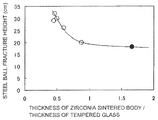
  • FIG. 1 is a diagram showing the correlation between steel ball fracture height and the ratio of the thickness of a zirconia sintered body and the thickness of tempered glass in composite plates using white zirconia (product name “3YS20A,” manufactured by TOSOH Corporation).
  • Open circle
  • Examples 1 to 4 and 14 compact plate thickness: about 1 mm
  • Solid circle
  • Comparative Example 1 comparativative Example 1 (composite plate thickness: 1.49 mm).
  • the density of a sample was measured using the Archimedes method. The obtained density was used to determine the relative density with respect to the theoretical density.
  • the theoretical densities of sintered bodies obtained by sintering of powers used in the following Examples and Comparative Examples are as follows.
  • a sintered body using a zirconia powder product name “3YSE,” manufactured by TOSOH Corporation): 6.09 g/cm 3 .
  • Powders prepared by adding high-purity alumina in amounts of 40 wt % and 60 wt % to a zirconia powder are denoted by 3YS40A and 3YS60A.
  • the theoretical densities of their sintered bodies are 3YS40A: 5.03 g/cm 3 and 3YS60A: 4.63 g/cm 3 .
  • the impact strength of a composite plate was evaluated using a steel ball drop test.
  • a method similar to ISO14368-3 in the specifications of “Dimensions of watch glass and test method” was used for the steel ball drop test.
  • one of the composite plates obtained in the Examples and Comparative Examples was secured to a 5 mm-thick flat aluminum alloy (50 mm ⁇ 52 mm) using a 0.1 mm-thick double-sided tape (product number “4511-100,” manufactured by 3M). Then a steel ball of 130 g was freely falled onto the central position of the composite plate from a any height, and the fracture height was determined in steps of 1 cm.
  • the impact surface used was a mirror polished surface with a surface roughness Ra of 0.02 ⁇ m or less.
  • the measurement of dielectric constant was performed by a capacitance method using an impedance analyzer. A surface bonded to an electrode was mirror polished, and the dielectric constant and dielectric loss tangent were measured at room temperature and a frequency of 1 GHz.
  • the bending strength of a composite plate was measured according to biaxial bending strength measurement (ISO/DIS6872). The measurement was performed as follows. The radius of a support was set to 6 mm, and the center of the composite plate was placed on the support with the zirconia sintered body thin plate on the front side and the base material surface on the rear side. An indenter was placed such that a load was applied to the center of the zirconia sintered body thin plate. To compute the bending strength, a reduced diameter using a flat plate area was used. The zirconia sintered body used had opposite surfaces mirror-polished to a surface roughness Ra of 0.02 ⁇ m or less.
  • Each of a white zirconia powder (product name “3YS20A,” manufactured by TOSOH Corporation), a black zirconia powder (product name “TZ-Black,” manufactured by TOSOH Corporation), and a zirconia powder (product name “3YSE,” manufactured by TOSOH Corporation) were molded at a pressure of 50 MPa using a die press.
  • Each of the obtained compacts was further molded at a pressure of 200 MPa using a cold isostatic press (CIP) to obtain a disk-shaped compact.
  • CIP cold isostatic press
  • Zirconia powders (3YS40A and 3YS60A) were produced as follows. A high-purity alumina powder was added in an amount of 40 wt % or 60 wt % to a zirconia powder containing 3 mol % of yttria (product name “TZ-3YS,” manufactured by TOSOH Corporation), and the mixture was subjected to ball mill mixing in an ethanol solvent using zirconia-made balls with a diameter of 10 mm and then dried to obtain a raw material powder. The obtained raw material powder was molded under the same conditions as above.
  • TZ-3YS manufactured by TOSOH Corporation
  • Each of the obtained compacts was sintered in air at a temperature rising rate of 100° C./h and a sintering temperature of 1,400 to 1,500° C. to obtain a sintered body of ⁇ 17 mm.
  • the properties of the obtained sintered body are shown in TABLE 6 as a reference example.
  • the opposite sides of the obtained sintered body were grounded and polished to a prescribed thickness to thereby obtain a zirconia sintered body thin plate.
  • Hv10 represents a Vickers hardness measured using an indenter load of 10 kgf.
  • the surface of the obtained zirconia sintered body thin plate and the surface of aluminosilicate-based chemically strengthened glass (32 mm ⁇ 25 mm) were washed with acetone. Then these bonding surfaces were coated uniformly with an epoxy-based thermosetting resin (product number “XN1245SR,” manufactured by Nagase ChemteX Corporation). With a load applied uniformly to the upper and lower surfaces of the composite plate, the zirconia sintered body and the chemically strengthened glass were bonded to each other under the condition of 140° C. for 30 minutes. The thicknesses of the layers of the obtained composite plate are shown in TABLE 1.
  • the results of evaluation are shown in TABLE 1.
  • the apparent densities of all the composite plates were 4.3 g/cm 3 or less, and the Vickers hardnesses of all the composite plates were 1,000 or higher.
  • the results of the shock resistance test were 10 cm or more for all the composite plates, and the composite plates were found to have high shock resistance.
  • a composite plate was produced under the same conditions as in Example 1 except that a zirconia sintered body thin plate having dimensions of 32 mm ⁇ 25 mm was obtained using the white zirconia powder (product name “3YS20A,” manufactured by TOSOH Corporation). The result of the shock resistance test is shown in TABLE 1. Cracking of the composite plate occurred at 29 cm, and the composite plate was found to have high shock resistance.
  • a composite plate was produced under the same conditions as in Example 1 except that the adhesive used was a two-part epoxy-based adhesive (product numbers “XNR3324” and “XNH3324,” manufactured by Nagase ChemteX Corporation). The bonding was performed at 100° C. for 30 minutes. The result of the shock resistance test is shown in TABLE 1. The fracture height of the composite plate was 24 cm, and the composite plate was found to have high shock resistance.
  • a 3YS20A composite plate of 32 mm ⁇ 25 mm was produced by the same method as in Example 14. #100 sand paper was placed on the surface of the zirconia sintered body thin plate of the produced composite plate, and an iron-made weight of 3 kg was used to apply a load. The iron-made weight was moved a distance of 30 cm on the sand paper and reciprocated 5 times to flaw the composite plate. The result of the steel ball drop test on the composite plate subjected to flaw treatment is shown in TABLE 1. The steel ball fracture height was 30 cm, and no reduction in impact strength due to the flaw treatment was found.
  • a 3YS20A composite plate of 32 mm ⁇ 25 mm was produced by the same method as in Example 14. The bonding was performed under the condition of 140° C. for 30 minutes using a hot press such that a pressure of 4 MPa was applied to the plate. The thickness of the adhesive layer of the obtained composite plate was 7 ⁇ m. The steel ball fracture height was 47 cm, and the composite plate was found to have high shock resistance.
  • 3YS20A composite plates of 32 mm ⁇ 25 mm were produced by the same method as in Example 14.
  • the relative dielectric constant and dielectric loss tangent of each of the composite plates at room temperature and 1 GHz are shown in TABLE 2.
  • the relative dielectric constant and dielectric loss tangent of each composite plate were found to be comparable to those of aluminosilicate glass.
  • the relative dielectric constant of the aluminosilicate glass measured separately at room temperature and 1 GHz was 7.5, and its dielectric loss tangent was 0.0125.
  • the dielectric constant of 3YS20A was 28.4, and its dielectric loss tangent was 0.003.
  • the relative dielectric constant computed from these values under the assumption of a series model was 9.5 and agreed well with the measured values. It was found that the relative dielectric constant of a composite plate can be reproduced using the series model of the zirconia sintered body and the tempered glass.
  • 3YS20A composite plates of 32 mm ⁇ 25 mm were produced by the same method as in Example 14, and their biaxial bending strength was measured.
  • the bending strength was found to be a high value of about 940 MPa.
  • the bending elastic modulus was estimated from the load-displacement curve in the test and found to be about 80 GPa.
  • Each of these composite plates was found to have an elastic modulus comparable to that of tempered glass (70 GPa).
  • Example 2 Using the same method as in Example 1, a composite plate in which the ratio of the thickness of the zirconia sintered body/the thickness of the tempered glass was 0.09 was produced using 3YS20A. The results are shown in TABLE 4. Although the composite plate exhibited high shock resistance, the Vickers hardness was 800, and the abrasion resistance was slightly low.
  • TZ-3YS powder 700 g of TZ-3YS powder, 14 g of a commercial polycarboxylate macromolecular dispersant used as a dispersant, 3.5 g of commercial polyethylene glycol mono-para-iso-octylphenyl ester used as an antifoaming agent, 245 g of ethyl acetate used as a solvent, 245 g of n-butyl acetate used as a solvent, 49 g of butyral resin (degree of polymerization: about 1,000) powder used as a binder, and 42 g of industrial dioctyl phthalate used as a plasticizer were added to a ball mill and mixed for 48 hours.
  • a green sheet was formed on PET used as a carrier film using a doctor blade device and a doctor blade.
  • the obtained green sheet was placed on a porous alumina setter and sintered with an alumina setter used as a weight placed on the green sheet.
  • temperature was increased from room temperature to 450° C. at 5° C./h, and the green sheet was held at 450° C. for 10 hours to perform degreasing. Then the temperature was increased from 450° C. to 1,000° C. at 50° C./h, and the green sheet was held at 1,000° C. for 5 hours. Then the green sheet was held at 1,450° C. for two hours to perform sintering.
  • the relative density of the obtained sintered body was 99% or higher.
  • the obtained sintered body was bonded to a 0.698 mm-thick chemically strengthened glass of 32 mm ⁇ 25 mm using an epoxy-based thermosetting resin (product number “XN1245SR,” manufactured by Nagase ChemteX Corporation) in the same manner as in Example 1.
  • the surface of the zirconia sintered body thin plate of the bonded composite plate was ground and polished to produce a composite plate.
  • the thickness of the sintered body was 0.302 mm, and the thickness of the adhesive layer was 45 ⁇ m.
  • the thickness of the zirconia sintered body/the thickness of the glass was 0.43.
  • the apparent density of the composite plate was 3.55 g/cm 3 , and its Vickers hardness was 1,430.
  • the shock resistance test using the steel ball dropped as in Example 1 was performed, and the fracture height of the composite plate was found to be 26 cm.
  • Example 2 Using the same method as in Example 1, a composite plate in which the ratio of the thickness of the zirconia sintered body/the thickness of the tempered glass was 1.66 was produced using 3YS20A. The results are shown in TABLE 4. The apparent density of the composite plate was higher than 4.3 g/cm 3 .
  • the steel ball drop test was performed under the condition of no adhesive by the same method as in Example 1 using 3YS20A. The results are shown in TABLE 4. When the zirconia sintered body was placed directly on the glass with no adhesive, fracture occurred at about 3 cm, and it was found that the shock resistance characteristics were significantly low.
  • Flaw treatment was performed on the surfaces of aluminosilicate-based tempered glasses with different thicknesses (32 mm ⁇ 25 mm, thickness: 0.55 mm, 0.7 mm, 1.1 mm) by the same method as in Example 15 to evaluate their shock resistance before and after the flaw treatment. The results are shown in TABLE 5. When the thickness was 0.55 mm, the base material was cracked by the flaw treatment. For the tempered glasses with thicknesses of 0.7 and 1.1 mm, the flaw treatment caused the steel ball fracture height to be reduced by about one half.
  • the steel ball fracture height was less than 10 cm, and the shock resistance characteristics were lower than those of the composite plate using the zirconia sintered body. This may be because, since the elastic modulus of sapphire is about twice that of the zirconia sintered body (the elastic modulus of sapphire is 400 GPa), tensile stress occurs on the sapphire side.
  • a composite plate of 32 mm ⁇ 25 mm was produced using 3YS20A and using, as the base material, one of an aluminum (97 wt %)-magnesium alloy (#5052, manufactured by Eggs), a magnesium (90 wt %)-aluminum-zinc alloy (product name “AZ91D,” manufactured by MG Precision Co., Ltd.), cloth Bakelite, and paper Bakelite (manufactured by Fuso Rubber Co., Ltd.).
  • a composite plate of 32 mm ⁇ 25 mm was produced using 3YS20A and using rigid polyvinyl chloride (MISUMI Group Inc.) by the same method as in Example 1 except that cyanoacrylate was used as the adhesive.
  • the results of evaluation are shown in TABLE 8.
  • the apparent densities of all the composite plates were 4.3 g/cm 3 or less, and the Vickers hardnesses of all the composite plates were 1,000 or more.
  • the results of the shock resistance test were 10 cm or more for all the composite plates, and the composite plates were found to have high shock resistance.
  • the composite plate of the present invention including a zirconia sintered body sintered body and a base material formed from at least one selected from the group consisting of tempered glass, Bakelite, aluminum, and magnesium has shock resistance and abrasion resistance and can therefore be used preferably for small and thin components such as components of mobile electronic devices and watch components.

Landscapes

  • Chemical & Material Sciences (AREA)
  • Engineering & Computer Science (AREA)
  • Ceramic Engineering (AREA)
  • Organic Chemistry (AREA)
  • Manufacturing & Machinery (AREA)
  • Materials Engineering (AREA)
  • Structural Engineering (AREA)
  • Composite Materials (AREA)
  • Inorganic Chemistry (AREA)
  • Wood Science & Technology (AREA)
  • Chemical Kinetics & Catalysis (AREA)
  • Life Sciences & Earth Sciences (AREA)
  • Physics & Mathematics (AREA)
  • General Physics & Mathematics (AREA)
  • Laminated Bodies (AREA)
  • Compositions Of Oxide Ceramics (AREA)
  • Microelectronics & Electronic Packaging (AREA)
  • Ceramic Products (AREA)

Abstract

A composite plate having a thickness of no more than 2 mm, and having laminated therein a zirconia sintered body, an adhesive layer, and a base material, the elasticity of the base material being no more than 100 GPa, and the apparent density of the composite plate being no more than 4.3 g/cm3.

Description

This application is the U.S. national phase of International Application No. PCT/JP2013/004006 filed Jun. 26, 2013 which designated the U.S. and claims priority to JP 2012-144677 filed Jun. 27, 2012, the entire contents of each of which are hereby incorporated by reference.
TECHNICAL FIELD
The present invention relates to a composite plate including a zirconia sintered body having abrasion resistance and shock resistance and a base material having a specific elastic modulus or to a composite plate including the zirconia sintered body and a base material formed from at least one selected from the group consisting of tempered glass, Bakelite, aluminum, and magnesium. The present invention also relates to methods of producing these composite plates.
BACKGROUND ART
In recent years, demand for components having high abrasion resistance and shock resistance is increasing in mobile electronic devices typified by smartphones. Particularly, since exterior components of mobile electronic devices have a thin plate shape with a thickness of about 1 to about 2 mm and must withstand impact such as falling impact, a particularly high-shock resistant material is required for these exterior components.
A currently used material is tempered glass strengthened by ion exchange. A tempered layer of several tens of micrometers is formed on the surface of the glass by ion exchange to generate compressive stress on the surface, whereby propagation of cracks is prevented. However, since the strengthening mechanism of the tempered glass is due to the tempered layer, the tempered glass is broken immediately when a crack propagates across the tempered layer. The Vickers hardness of the glass is about 600. Therefore, a problem with the glass is that it is easily flawed by contact with metal, concrete, etc. and the strength is reduced significantly by flaws formed during use.
Ceramics are excellent in heat resistance, wear resistance, and corrosion resistance and are therefore widely used for industrial component applications. Particularly, zirconia sintered bodies have high strength, high toughness, high hardness, and abrasion resistance, and their design can be easily improved by coloration. Therefore, the zirconia sintered bodies are being increasingly used for watch components etc. The use of zirconia sintered bodies for exterior components of mobile electronic devices etc. is also contemplated. Particularly, when a zirconia sintered body is used for an exterior component of a mobile electronic device, the thickness of the zirconia sintered body must be increased in order to improve shock resistance. Therefore, the weight of the component becomes high, which is not practically advantageous. When the thickness is reduced to reduce the weight, resistance to impact of falling, collision, etc. becomes insufficient, and the zirconia sintered body is easily cracked and becomes unusable.
To improve the shock resistance of a ceramic component, a method similar to laminated glass has been proposed (for example, Patent Literatures 1 and 2). Specifically, the ceramic component is joined to a fiber-reinforced plastic to prevent a flying object such as a cannonball from piercing the ceramic component. Unfortunately, this method is for the purpose of preventing the penetration of the flying object, and cracking of the ceramic due to collision cannot be prevented.
Patent Literature 3 describes a watch cover glass produced by joining sapphire and inorganic glass. However, the purpose of this cover glass is to improve its abrasion resistance by disposing high-hardness sapphire on the surface of the watch cover glass, and high shock resistance required for the mobile electronic device applications cannot be obtained using this method.
Therefore, there has been no shock resistant component that is used for a zirconia sintered body plate having a thickness of several millimeters and has improved resistance to cracking due to impact of falling, collision, etc., and there has been no method of producing such a shock resistant component.
CITATION LIST Patent Literature
  • Patent Literature 1: Japanese Patent No. 4869915 (Japanese Patent Application Laid-Open No. 2008-162164)
  • Patent Literature 2: Japanese Patent Application Laid-Open No. 2009-264692
  • Patent Literature 3: Japanese Patent Application Laid-Open No. Hei. 6-242260
SUMMARY OF INVENTION Technical Problem
To improve the shock resistance of a zirconia sintered body, its thickness must be increased, and such a thick component is not suitable for mobile electronic devices. The present invention relates to a composite plate including a zirconia sintered body with improved shock resistance, particularly improved resistance to cracking due to impact, and a base material having a specific elastic modulus or to a composite plate including the zirconia sintered body and a base material formed from at least one selected from the group consisting of tempered glass, Bakelite, aluminum, and magnesium. The present invention also relates to methods of producing these composite plates.
Solution to Problem
In view of the above problems, the present inventors have conducted detailed studies on a fracture phenomenon of a zirconia sintered body thin plate when a steel ball is dropped thereonto. The present inventors have found that the ceramic plate is bent by the impact of the dropped steel ball and a bending moment is thereby generated to cause tensile fracture to occur from the vicinity of the impact point on a side opposite to the impact side. The present inventors have also found that a material having a smaller elastic modulus is more likely to be deformed largely by the impact and absorbs the impact over a long time, so that the absolute value of the maximum tensile stress acting on the side opposite to the impact side is reduced.
The present inventors have conducted extensive studies based on the above findings and found that the shock resistance of a zirconia sintered body thin plate can be improved by realizing the following structure, and thus the present invention has been completed. Specifically, a base material formed from at least one material selected from the group consisting of tempered glass, Bakelite, aluminum, and magnesium is disposed on the rear side of the zirconia sintered body thin plate (elastic modulus: 200 GPa). The elastic modulus of the at least one material is equal to or less than one half that of the zirconia sintered body thin plate (the elastic modulus of the at least one material is about 70 GPa). The base material and the zirconia sintered body thin plate are firmly bonded to each other, and the ability to deform upon impact is thereby imparted to the zirconia sintered body thin plate to reduce the maximum tensile stress. In this structure, the base material is disposed on the rear side on which tensile stress is generated, and the zirconia sintered body thin plate is disposed on the impact side on which compressive stress is mainly generated.
Accordingly, the present invention relates to a composite plate (composite plate 1) comprising a laminate including a zirconia sintered body, an adhesive layer, and a base material having an elastic modulus of 100 GPa or less, and the composite plate has a thickness of 2 mm or less and an apparent density of 4.3 g/cm3 or less. The present invention also relates to a composite plate (composite plate 2) comprising a laminate including, in the following order, a zirconia sintered body, a bonding layer, and a base material formed from at least one selected from the group consisting of tempered glass, Bakelite, aluminum, and magnesium, wherein the ratio of the thickness of the zirconia sintered body to the thickness of the base material (the thickness of the zirconia sintered body/the thickness of the base material) is 0.1 to 1, and the composite plate has a thickness of 2 mm or less and the apparent density of the composite plate is 4.3 g/cm3 or less. The present invention also relates to methods of producing these composite plates.
The present invention will next be described in detail.
The composite plate 1 of the present invention is a composite plate comprising a laminate including a zirconia sintered body, an adhesive layer, and a base material having an elastic modulus of 100 GPa or less, and the composite plate has a thickness of 2 mm or less and an apparent density of 4.3 g/cm3 or less.
Examples of the base material include tempered glass, Bakelite, aluminum, and magnesium. The elastic modulus of the base material is 100 GPa or less, preferably 3 to 100 GPa, and particularly preferably 5 to 70 GPa. This is because the deformability of the base material can be improved to reduce the maximum tensile stress and the base material can be disposed on the rear side on which tensile stress is generated.
The composite plate 2 of the present invention is a composite plate comprising a laminate including, in the following order, a zirconia sintered body, an adhesive layer, and a base material formed from at least one selected from the group consisting of tempered glass, Bakelite, aluminum, and magnesium, the composite plate having a thickness of 2 mm or less. In the composite plate of the present invention, the ratio of the thickness of the zirconia sintered body to the thickness of the base material (the thickness of the zirconia sintered body/the thickness of the base material) is 0.1 to 1. When the ratio of the thickness of the zirconia sintered body to the thickness of the base material is 0.1 to 1, the composite plate can be a shock resistant composite plate having high abrasion resistance and light-weight. The ratio is preferably 0.1 to 0.75 and more preferably 0.1 to 0.5. This is because a reduction in shock resistant strength can be suppressed while an increase in the apparent density of the composite plate due to an increase in the thickness of the zirconia sintered body sintered body is suppressed and because a reduction in abrasion resistance due to a reduction in the thickness of the zirconia sintered body can be suppressed.
In the composite plates 1 and 2 of the present invention, the apparent density (ρ (composite plate)) is given by formula (1) using the theoretical density of the zirconia sintered body (ρ (zirconia sintered body)) and the theoretical density of a base material or the theoretical density of a base material formed from at least one selected from the group consisting of tempered glass, Bakelite, aluminum, and magnesium (ρ (base material)).
ρ(composite plate)=ρ(zirconia sintered body)×volume ratio of zirconia sintered body+ρ(base material)×volume ratio of base material=ρ(zirconia sintered body)×thickness ratio of zirconia sintered body+ρ(base material)×thickness ratio of base material   (1)
Here, the density of aluminosilicate-based tempered glass, 2.45 g/cm3, is used as the density of the tempered glass. Since the density (ρ(base material)) when Bakelite, aluminum, or magnesium is used varies depending on components constituting each of the base materials, the density of each of the base materials must be measured.
In the composite plates 1 and 2 of the present invention, when the apparent density is 4.3 g/cm3 or less, light weight feeling sufficient for use as an exterior component can be obtained.
The base material in the composite plate 1 of the present invention or the base material in the composite plate 2 that is formed from at least one selected from the group consisting of tempered glass, Bakelite, aluminum, and magnesium is bonded through the adhesive layer. The thickness of the adhesive layer is preferably 200 μm or less. The thickness of the adhesive layer is preferably 100 μm or less and more preferably 50 μm or less. When the thickness of the adhesive layer is set as described above, the zirconia sintered body and the base material are deformed together and absorb impact, so that the shock resistance can be improved.
In the composite plates 1 and 2 of the present invention, the zirconia sintered body is preferably yttria-stabilized zirconia having high strength, wear resistance, and high toughness. Preferably, the zirconia sintered body is zirconia containing 2-10 mol % of yttria. More preferably, the amount of yttria is 2-4 mol %. When the compositional ratio of yttria with respect to zirconia is 2-10 mol %, high strength, wear resistance, and high toughness can be obtained. A stabilizer other than yttria can be used for the zirconia sintered body. Examples of the other stabilizers include calcia, magnesia, and ceria.
In the composite plates 1 and 2 of the present invention, the zirconia sintered body may further contain, for example, a coloring agent to improve its design. Preferably, the coloring agent contained is, for example, a white pigment such as alumina or a coloring pigment such as a transition metal oxide. The white pigment used may be an oxide such as alumina, silica, mullite, or spinel. For colors other than white, any general inorganic pigment can be used. For example, spinel-based composite oxides containing transition metals such as Fe, Co, Ni, and Mn and oxides of rare-earth metals such as erbium, neodymium, and praseodymium can be used. For example, zircon including a transition metal added thereto may also be used. An oxide of a transition metal such as nickel or iron can also be used as a pigment.
In the composite plates 1 and 2 of the present invention, the zirconia sintered body has a relative density of preferably 97% or higher. The relative density is more preferably 98% or higher and still more preferably 99% or higher, in order to further improve the abrasion resistance and to suppress a reduction in design due to irregularities on the surface of the sintered body caused by residual pores when the surface is mirror-polished.
In the composite plates 1 and 2 of the present invention, the zirconia sintered body has a Vickers hardness of preferably 1,000 or more and more preferably 1,100 or more, in order to obtain sufficient abrasion resistance.
The tempered glass in the exemplifications in the composite plate 1 of the present invention and the tempered glass used in the composite plate 2 are preferably chemically strengthened aluminosilicate glass. Other examples of the tempered glass include thermally tempered glass. However, the impact strength of the thermally tempered glass after strengthening is low, and it is difficult to form the thermally tempered glass into a thin-plate shape. Therefore, the chemically strengthened glass is preferred. The chemically strengthened glass used can be general silica-based soda lime glass, borosilicate glass, etc. It is preferable to use aluminosilicate glass having high shock resistance.
The Bakelite in the exemplifications in the composite plate 1 of the present invention and the Bakelite used in the composite plate 2 are, generally, a thermosetting resin formed from phenol and formaldehyde as raw materials and are referred to also as phenolic resin. Specifically, cloth Bakelite prepared by applying a phenolic resin used as a raw material to cloth and then thermo-setting the phenolic resin, paper Bakelite prepared by applying a phenolic resin used as a raw material to paper and then thermo-setting the phenolic resin, etc. are preferred.
The aluminum in the exemplifications in the composite plate 1 of the present invention and the aluminum used in the composite plate 2 are preferably aluminum or an aluminum alloy. The aluminum alloy is a binary or higher alloy containing aluminum as the component contained in the largest amount, and examples of the component of the alloy include Si, Fe, Cu, Mn, Mg, Cr, Zn, and Ti.
The magnesium in the exemplifications in the composite plate 1 of the present invention and the magnesium used in the composite plate 2 are preferably magnesium or a magnesium alloy. The magnesium alloy is a binary or higher alloy containing magnesium as the component contained in the largest amount, and examples of the component of the alloy include Al, Zn, Zr, Mn, Fe, Si, Cu, Ni, and Ca.
In the composite plates 1 and 2 of the present invention, the shock resistance (crack resistance) is high. Specifically, when each of the composite plates 1 and 2 is subjected to an impact test in which the composite plate is bonded to an aluminum alloy using a 0.1 mm-thick double-sided tape and a steel ball of 130 g is freely falled from a any height, the shock resistance value, i.e., the height that causes a crack to occur in the zirconia sintered body (fracture height), is 10 cm or more, preferably 15 cm or more, and more preferably 20 cm or more. When the fracture height is 10 cm or more, shock resistance to impact of falling, collision, etc. can be imparted to the composite plate when it is used for the casings of mobile electronic devices.
In the present invention, a laminate of two or more types of base materials may be used in the composite plate 1, and a laminate of two or more types of base materials selected from the group consisting of tempered glass, Bakelite, aluminum, and magnesium may be used in the composite plate 2.
A production method of the composite plate 1 of the present invention will next be described in detail.
The composite plate 1 of the present invention can be produced, for example, by bonding the zirconia sintered body and the base material using an epoxy-based thermosetting adhesive at a temperature of 300° C. or lower. The adhesive used for bonding is preferably an epoxy-based thermosetting adhesive. This is because the epoxy-based thermosetting adhesive may not cause a reduction in the strength of the base material due to relaxation of compressive stress acting on the tempered layer of the base material during heating for bonding, and because high bonding strength is obtained between the zirconia sintered body and the base material and the epoxy-based thermosetting adhesive has high heat resistance and high shock resistance. A filler such as inorganic particles may be added to the adhesive to improve the stiffness of the adhesive layer.
In the production method of a thin plate of the zirconia sintered body in the composite plate 1 of the present invention, the thin plate can be produced using a general ceramic molding process. Examples of the molding process include a pressing method, an extrusion method, a slip casting method, an injection molding method, and a sheet molding method. Of these, a sheet molding method using a doctor blade is preferred. Specifically, a slurry prepared by mixing zirconia powder and an organic binder is used to forma green sheet having a thickness of 0.1 to 1 mm using a doctor blade, and the green sheet is sintered at 1,300 to 1,500° C. to obtain a zirconia sintered body. Then the zirconia sintered body is bonded to the base material, and the surface of the zirconia sintered body is ground and polished, whereby the composite plate can be produced. The sintering is performed generally in air, but vacuum sintering, hot-pressing, a hot isostatic pressing (HIP) method, etc. may also be used.
Next, a production method of the composite plate 2 of the present invention will be described in detail.
The composite plate 2 of the present invention can be produced, for example, by bonding the zirconia sintered body and the base material formed from at least one selected from the group consisting of tempered glass, Bakelite, aluminum, and magnesium, using an epoxy-based thermosetting adhesive at a temperature of 300° C. or lower. The adhesive used for bonding is preferably an epoxy-based thermosetting adhesive. This is because the epoxy-based thermosetting adhesive may not cause a reduction in glass strength due to relaxation of compressive stress acting on the tempered layer of the base material formed from at least one selected from the group consisting of tempered glass, Bakelite, aluminum, and magnesium during heating for bonding, and because high bonding strength is obtained between the zirconia sintered body and the base material formed from at least one selected from the group consisting of tempered glass, Bakelite, aluminum, and magnesium and the epoxy-based thermosetting adhesive has high heat resistance and high shock resistance. A filler such as inorganic particles may be added to the adhesive to improve the stiffness of the adhesive layer.
In the production method of a thin plate of the zirconia sintered body in the composite plate 2 of the present invention, the thin plate can be produced using a general ceramic molding process. Examples of the molding process include a pressing method, an extrusion method, a slip casting method, an injection molding method, and a sheet molding method. Of these, a sheet molding method using a doctor blade is preferred. Specifically, a slurry prepared by mixing zirconia powder and an organic binder is used to form a green sheet having a thickness of 0.1 to 1 mm using a doctor blade, and the green sheet is sintered at 1,300 to 1,500° C. to obtain a zirconia sintered body. Then the zirconia sintered body is bonded to the base material formed from at least one selected from the group consisting of tempered glass, Bakelite, aluminum, and magnesium, and the surface of the zirconia sintered body is ground and polished, whereby the composite plate can be produced. The sintering is performed generally in air, but vacuum sintering, hot-pressing, a hot isostatic pressing (HIP) method, etc. may also be used.
Advantageous Effects of Invention
Each of the composite plates 1 and 2 of the present invention has a thin-plate shape, has high shock resistance and high abrasion resistance, and can therefore be used as casing components for mobile electronic devices such as smartphones, tablet devices, notebook PCs, and portable music players. The composite plates 1 and 2 can also be used as components of input devices such as touch pads. When tempered glass or Bakelite is used as the base material of the composite plate 2, the composite plate 2 has dielectric characteristics comparable to those of tempered glass and therefore can also be used for components required to have radio wave permeability such as protective members of antennas. When a colored zirconia sintered body is used, the design of the composite plate can be easily improved, and therefore the composite plate can also be used as a watch component.
BRIEF DESCRIPTION OF DRAWING
FIG. 1 is a diagram showing the correlation between steel ball fracture height and the ratio of the thickness of a zirconia sintered body and the thickness of tempered glass in composite plates using white zirconia (product name “3YS20A,” manufactured by TOSOH Corporation). ◯ (Open circle): Examples 1 to 4 and 14 (composite plate thickness: about 1 mm). ● (Solid circle): Comparative Example 1 (composite plate thickness: 1.49 mm).
EXAMPLES
The present invention will be specifically described by way of Examples and Comparative Examples.
(Relative Density)
The density of a sample was measured using the Archimedes method. The obtained density was used to determine the relative density with respect to the theoretical density. The theoretical densities of sintered bodies obtained by sintering of powers used in the following Examples and Comparative Examples are as follows. A sintered body using a white zirconia powder (3YS20A): 5.51 g/cm3. A sintered body using a black zirconia powder (product name “TZ-Black,” manufactured by TOSOH Corporation): 6.06 g/cm3. A sintered body using a zirconia powder (product name “3YSE,” manufactured by TOSOH Corporation): 6.09 g/cm3. Powders prepared by adding high-purity alumina in amounts of 40 wt % and 60 wt % to a zirconia powder (product name “3YS,” manufactured by TOSOH Corporation) are denoted by 3YS40A and 3YS60A. The theoretical densities of their sintered bodies are 3YS40A: 5.03 g/cm3 and 3YS60A: 4.63 g/cm3.
(Measurement of Impact Strength)
The impact strength of a composite plate was evaluated using a steel ball drop test. A method similar to ISO14368-3 in the specifications of “Dimensions of watch glass and test method” was used for the steel ball drop test. Specifically, one of the composite plates obtained in the Examples and Comparative Examples was secured to a 5 mm-thick flat aluminum alloy (50 mm×52 mm) using a 0.1 mm-thick double-sided tape (product number “4511-100,” manufactured by 3M). Then a steel ball of 130 g was freely falled onto the central position of the composite plate from a any height, and the fracture height was determined in steps of 1 cm. The impact surface used was a mirror polished surface with a surface roughness Ra of 0.02 μm or less.
(Measurement of Dielectric Constant)
The measurement of dielectric constant was performed by a capacitance method using an impedance analyzer. A surface bonded to an electrode was mirror polished, and the dielectric constant and dielectric loss tangent were measured at room temperature and a frequency of 1 GHz.
(Biaxial Bending Measurement)
The bending strength of a composite plate was measured according to biaxial bending strength measurement (ISO/DIS6872). The measurement was performed as follows. The radius of a support was set to 6 mm, and the center of the composite plate was placed on the support with the zirconia sintered body thin plate on the front side and the base material surface on the rear side. An indenter was placed such that a load was applied to the center of the zirconia sintered body thin plate. To compute the bending strength, a reduced diameter using a flat plate area was used. The zirconia sintered body used had opposite surfaces mirror-polished to a surface roughness Ra of 0.02 μm or less.
Examples 1-13 Production of Zirconia Sintered Bodies
Each of a white zirconia powder (product name “3YS20A,” manufactured by TOSOH Corporation), a black zirconia powder (product name “TZ-Black,” manufactured by TOSOH Corporation), and a zirconia powder (product name “3YSE,” manufactured by TOSOH Corporation) were molded at a pressure of 50 MPa using a die press. Each of the obtained compacts was further molded at a pressure of 200 MPa using a cold isostatic press (CIP) to obtain a disk-shaped compact.
Zirconia powders (3YS40A and 3YS60A) were produced as follows. A high-purity alumina powder was added in an amount of 40 wt % or 60 wt % to a zirconia powder containing 3 mol % of yttria (product name “TZ-3YS,” manufactured by TOSOH Corporation), and the mixture was subjected to ball mill mixing in an ethanol solvent using zirconia-made balls with a diameter of 10 mm and then dried to obtain a raw material powder. The obtained raw material powder was molded under the same conditions as above.
Each of the obtained compacts was sintered in air at a temperature rising rate of 100° C./h and a sintering temperature of 1,400 to 1,500° C. to obtain a sintered body of φ17 mm. The properties of the obtained sintered body are shown in TABLE 6 as a reference example. The opposite sides of the obtained sintered body were grounded and polished to a prescribed thickness to thereby obtain a zirconia sintered body thin plate. In TABLEs, Hv10 represents a Vickers hardness measured using an indenter load of 10 kgf.
The surface of the obtained zirconia sintered body thin plate and the surface of aluminosilicate-based chemically strengthened glass (32 mm×25 mm) were washed with acetone. Then these bonding surfaces were coated uniformly with an epoxy-based thermosetting resin (product number “XN1245SR,” manufactured by Nagase ChemteX Corporation). With a load applied uniformly to the upper and lower surfaces of the composite plate, the zirconia sintered body and the chemically strengthened glass were bonded to each other under the condition of 140° C. for 30 minutes. The thicknesses of the layers of the obtained composite plate are shown in TABLE 1.
The results of evaluation are shown in TABLE 1. The apparent densities of all the composite plates were 4.3 g/cm3 or less, and the Vickers hardnesses of all the composite plates were 1,000 or higher. The results of the shock resistance test were 10 cm or more for all the composite plates, and the composite plates were found to have high shock resistance.
Example 14
A composite plate was produced under the same conditions as in Example 1 except that a zirconia sintered body thin plate having dimensions of 32 mm×25 mm was obtained using the white zirconia powder (product name “3YS20A,” manufactured by TOSOH Corporation). The result of the shock resistance test is shown in TABLE 1. Cracking of the composite plate occurred at 29 cm, and the composite plate was found to have high shock resistance.
Example 15
A composite plate was produced under the same conditions as in Example 1 except that the adhesive used was a two-part epoxy-based adhesive (product numbers “XNR3324” and “XNH3324,” manufactured by Nagase ChemteX Corporation). The bonding was performed at 100° C. for 30 minutes. The result of the shock resistance test is shown in TABLE 1. The fracture height of the composite plate was 24 cm, and the composite plate was found to have high shock resistance.
Example 16
A 3YS20A composite plate of 32 mm×25 mm was produced by the same method as in Example 14. #100 sand paper was placed on the surface of the zirconia sintered body thin plate of the produced composite plate, and an iron-made weight of 3 kg was used to apply a load. The iron-made weight was moved a distance of 30 cm on the sand paper and reciprocated 5 times to flaw the composite plate. The result of the steel ball drop test on the composite plate subjected to flaw treatment is shown in TABLE 1. The steel ball fracture height was 30 cm, and no reduction in impact strength due to the flaw treatment was found.
Example 17
A 3YS20A composite plate of 32 mm×25 mm was produced by the same method as in Example 14. The bonding was performed under the condition of 140° C. for 30 minutes using a hot press such that a pressure of 4 MPa was applied to the plate. The thickness of the adhesive layer of the obtained composite plate was 7 μm. The steel ball fracture height was 47 cm, and the composite plate was found to have high shock resistance.
Examples 18 and 19
3YS20A composite plates of 32 mm×25 mm were produced by the same method as in Example 14. The relative dielectric constant and dielectric loss tangent of each of the composite plates at room temperature and 1 GHz are shown in TABLE 2. The relative dielectric constant and dielectric loss tangent of each composite plate were found to be comparable to those of aluminosilicate glass.
The relative dielectric constant of the aluminosilicate glass measured separately at room temperature and 1 GHz was 7.5, and its dielectric loss tangent was 0.0125. The dielectric constant of 3YS20A was 28.4, and its dielectric loss tangent was 0.003. The relative dielectric constant computed from these values under the assumption of a series model was 9.5 and agreed well with the measured values. It was found that the relative dielectric constant of a composite plate can be reproduced using the series model of the zirconia sintered body and the tempered glass.
Examples 20 and 21
3YS20A composite plates of 32 mm×25 mm were produced by the same method as in Example 14, and their biaxial bending strength was measured. The bending strength was found to be a high value of about 940 MPa. The bending elastic modulus was estimated from the load-displacement curve in the test and found to be about 80 GPa. Each of these composite plates was found to have an elastic modulus comparable to that of tempered glass (70 GPa).
Example 22
Using the same method as in Example 1, a composite plate in which the ratio of the thickness of the zirconia sintered body/the thickness of the tempered glass was 0.09 was produced using 3YS20A. The results are shown in TABLE 4. Although the composite plate exhibited high shock resistance, the Vickers hardness was 800, and the abrasion resistance was slightly low.
Example 23
700 g of TZ-3YS powder, 14 g of a commercial polycarboxylate macromolecular dispersant used as a dispersant, 3.5 g of commercial polyethylene glycol mono-para-iso-octylphenyl ester used as an antifoaming agent, 245 g of ethyl acetate used as a solvent, 245 g of n-butyl acetate used as a solvent, 49 g of butyral resin (degree of polymerization: about 1,000) powder used as a binder, and 42 g of industrial dioctyl phthalate used as a plasticizer were added to a ball mill and mixed for 48 hours. A green sheet was formed on PET used as a carrier film using a doctor blade device and a doctor blade.
The obtained green sheet was placed on a porous alumina setter and sintered with an alumina setter used as a weight placed on the green sheet. During the sintering, temperature was increased from room temperature to 450° C. at 5° C./h, and the green sheet was held at 450° C. for 10 hours to perform degreasing. Then the temperature was increased from 450° C. to 1,000° C. at 50° C./h, and the green sheet was held at 1,000° C. for 5 hours. Then the green sheet was held at 1,450° C. for two hours to perform sintering. The relative density of the obtained sintered body was 99% or higher.
The obtained sintered body was bonded to a 0.698 mm-thick chemically strengthened glass of 32 mm×25 mm using an epoxy-based thermosetting resin (product number “XN1245SR,” manufactured by Nagase ChemteX Corporation) in the same manner as in Example 1. The surface of the zirconia sintered body thin plate of the bonded composite plate was ground and polished to produce a composite plate.
The thickness of the sintered body was 0.302 mm, and the thickness of the adhesive layer was 45 μm. The thickness of the zirconia sintered body/the thickness of the glass was 0.43. The apparent density of the composite plate was 3.55 g/cm3, and its Vickers hardness was 1,430. The shock resistance test using the steel ball dropped as in Example 1 was performed, and the fracture height of the composite plate was found to be 26 cm.
Comparative Example 1
Using the same method as in Example 1, a composite plate in which the ratio of the thickness of the zirconia sintered body/the thickness of the tempered glass was 1.66 was produced using 3YS20A. The results are shown in TABLE 4. The apparent density of the composite plate was higher than 4.3 g/cm3.
Comparative Example 2
The steel ball drop test was performed under the condition of no adhesive by the same method as in Example 1 using 3YS20A. The results are shown in TABLE 4. When the zirconia sintered body was placed directly on the glass with no adhesive, fracture occurred at about 3 cm, and it was found that the shock resistance characteristics were significantly low.
Comparative Examples 3 to 5
Flaw treatment was performed on the surfaces of aluminosilicate-based tempered glasses with different thicknesses (32 mm×25 mm, thickness: 0.55 mm, 0.7 mm, 1.1 mm) by the same method as in Example 15 to evaluate their shock resistance before and after the flaw treatment. The results are shown in TABLE 5. When the thickness was 0.55 mm, the base material was cracked by the flaw treatment. For the tempered glasses with thicknesses of 0.7 and 1.1 mm, the flaw treatment caused the steel ball fracture height to be reduced by about one half.
Comparative Examples 6 and 7
Using the same method as in Example 1, composite plates were produced using sapphire single crystals (manufactured by ORBE PIONEER Ltd.) (32 mm×25 mm) instead of the zirconia sintered body, and the steel ball drop test was performed under the same conditions. The results are shown in TABLE 7. The density of the sapphire was 3.99 g/cm3.
In the composite plates using sapphire, the steel ball fracture height was less than 10 cm, and the shock resistance characteristics were lower than those of the composite plate using the zirconia sintered body. This may be because, since the elastic modulus of sapphire is about twice that of the zirconia sintered body (the elastic modulus of sapphire is 400 GPa), tensile stress occurs on the sapphire side.
Examples 24 to 28
Using the same method as in Example 1, a composite plate of 32 mm×25 mm was produced using 3YS20A and using, as the base material, one of an aluminum (97 wt %)-magnesium alloy (#5052, manufactured by Eggs), a magnesium (90 wt %)-aluminum-zinc alloy (product name “AZ91D,” manufactured by MG Precision Co., Ltd.), cloth Bakelite, and paper Bakelite (manufactured by Fuso Rubber Co., Ltd.).
A composite plate of 32 mm×25 mm was produced using 3YS20A and using rigid polyvinyl chloride (MISUMI Group Inc.) by the same method as in Example 1 except that cyanoacrylate was used as the adhesive.
The results of evaluation are shown in TABLE 8. The apparent densities of all the composite plates were 4.3 g/cm3 or less, and the Vickers hardnesses of all the composite plates were 1,000 or more. The results of the shock resistance test were 10 cm or more for all the composite plates, and the composite plates were found to have high shock resistance.
TABLE 1
STEEL
THICKNESS RATIO BALL
MATERIAL ZIR- ADHE- ZIR- APPARENT VICKERS FRACTURE
ZIR- CONIA GLASS SIVE TOTAL CONIA/ DENSITY HARDNESS HEIGHT
CONIA GLASS ADHESIVE mm mm mm mm GLASS g/cm3 Hv10 cm
Example 1 3YS20A TEMPERED XN1245SR 0.322 0.699 0.033 1.054 0.46 3.42 1430 32
GLASS
Example 2 3YS20A TEMPERED XN1245SR 0.342 0.684 0.030 1.056 0.50 3.47 1430 30
GLASS
Example 3 3YS20A TEMPERED XN1245SR 0.330 0.550 0.041 0.921 0.60 3.60 1430 26
GLASS
Example 4 3YS20A TEMPERED XN1245SR 0.485 0.551 0.036 1.072 0.88 3.88 1430 20
GLASS
Example 5 3YS20A TEMPERED XN1245SR 0.496 0.701 0.080 1.277 0.71 3.72 1430 25
GLASS
Example 6 3YS20A TEMPERED XN1245SR 0.309 1.103 0.037 1.449 0.28 3.12 1430 30
GLASS
Example 7 3YS20A TEMPERED XN1245SR 0.487 1.094 0.030 1.611 0.45 3.39 1430 25
GLASS
Example 8 3YS20A TEMPERED XN1245SR 0.783 1.100 0.035 1.918 0.71 3.72 1430 20
GLASS
Example 9 3YS20A TEMPERED XN1245SR 0.343 0.545 0.159 1.047 0.63 3.63 1430 12
GLASS
Example 10 3YS40A TEMPERED XN1245SR 0.297 0.693 0.035 1.025 0.43 3.22 1480 21
GLASS
Example 11 3YS60A TEMPERED XN1245SR 0.312 0.691 0.031 1.034 0.45 3.13 1530 25
GLASS
Example 12 TZ-Black TEMPERED XN1245SR 0.251 0.697 0.032 0.980 0.36 3.41 1240 29
GLASS
Example 13 3YSE TEMPERED XN1245SR 0.276 0.696 0.024 0.996 0.40 3.48 1240 35
GLASS
Example 14 3YS20A TEMPERED XN1245SR 0.311 0.692 0.048 1.051 0.45 3.40 1430 29
GLASS
Example 15 3YS20A TEMPERED XNR/H3324 0.285 0.701 0.024 1.010 0.41 3.33 1430 24
GLASS
Example 16 3YS20A TEMPERED XN1245SR 0.285 0.693 0.047 1.025 0.41 3.34 1430 30
GLASS
Example 17 3YS20A TEMPERED XN1245SR 0.315 1.103 0.007 1.425 0.29 3.13 1430 47
GLASS
TABLE 2
DIELECTRIC DIELECTRIC
CONSTANT LOSS TANGENT
THICKNESS RATIO ROOM ROOM
MATERIAL ZIR- ADHE- ZIR- TEMPER- TEMPER-
ZIR- CONIA GLASS SIVE TOTAL CONIA/ ATURE, ATURE,
CONIA GLASS ADHESIVE mm mm mm mm GLASS 1 GHz 1 GHz
Example 18 3YS20A TEMPERED XN1245SR 0.324 0.696 0.025 1.045 0.47 11.1 0.011
GLASS
Example 19 3YS20A TEMPERED XN1245SR 0.190 0.549 0.028 0.767 0.35 10.1 0.012
GLASS
TABLE 3
THICKNESS RATIO FRAC- BENDING
MATERIAL ZIR- ADHE- ZIR- TURE BENDING ELASTIC
ZIR- CONIA GLASS SIVE TOTAL CONIA/ LOAD STRENGTH MODULUS
CONIA GLASS ADHESIVE mm mm mm mm GLASS kgf MPa GPa
Example 20 3YS20A TEMPERED XN1245SR 0.269 0.694 0.026 0.989 0.39 59.0 947 81
GLASS
Example 21 3YS20A TEMPERED XN1245SR 0.203 0.692 0.036 0.931 0.29 52.9 940 84
GLASS
TABLE 4
STEEL
THICKNESS RATIO BALL
MATERIAL ZIR- ADHE- ZIR- APPARENT VICKERS FRACTURE
ZIR- CONIA GLASS SIVE TOTAL CONIA/ DENSITY HARDNESS HEIGHT
CONIA GLASS ADHESIVE mm mm mm mm GLASS g/cm3 Hv10 cm
Example 22 3YS20A TEMPERED XN1245SR 0.098 1.103 0.040 1.241 0.09 2.70 800 25
GLASS
Comparative 3YS20A TEMPERED XN1245SR 0.916 0.551 0.026 1.493 1.66 4.36 1430 18
Example 1 GLASS
Comparative 3YS20A TEMPERED NONE 0.296 0.702 0.998 0.42 3.36 1430 3
Example 2 GLASS
TABLE 5
THICK- STEEL STEEL
NESS BALL BALL
OF FRACTURE FRACTURE
TEMPERED HEIGHT HEIGHT
GLASS VIRGIN FLAWED REDUCTION
mm cm cm RATIO
Comparative 0.55 42 CRACKED
Example 3 DUE TO
FLAWS
Comparative 0.7 31 18 42%
Example 4
Comparative 1.1 50 25 50%
Example 5
TABLE 6
REFERENCE EXAMPLE
RELATIVE DIELECTRIC
FRACTURE DIELECTRIC LOSS TANGENT
BENDING TOUGHNESS VICKERS CONSTANT ROOM ROOM TEMPER-
RELATIVE STRENGTH VALUE HARDNESS TEMPERATURE, ATURE,
SINTERING DENSITY DENSITY JISR1601 JISR1607 JISR1610 1 GHz 1 GHz
TEMPERATURE g/cm3 % MPa MPa m0.5 Hv10
3YS20A 1500° C.-2 h 5.473 99.3 1300 4.7 1430 28.4 0.0003
3YS40A 1500° C.-2 h 5.001 99.4 1340 4.7 1480 21.6 0.0014
3YS60A 1500° C.-2 h 4.588 99.1 1160 4.0 1530 16.7 0.0009
3YSE 1450° C.-2 h 6.073 99.8 1400 4.7 1240 36.6 0.0022
TZ-Black 1400° C.-1 h 5.993 99.0 1199 5.1 1240 37.5 0.0053
TABLE 7
STEEL
THICKNESS RATIO BALL
SAP- ADHE- SAP- APPARENT VICKERS FRACTURE
MATERIAL PHIRE GLASS SIVE TOTAL PHIRE/ DENSITY HARDNESS HEIGHT
GLASS ADHESIVE mm mm mm mm GLASS g/cm3 Hv10 cm
Comparative SAP- TEMPERED XN1245SR 0.346 0.700 0.024 1.070 0.49 2.45 1800 6
Example 6 PHIRE GLASS
Comparative SAP- TEMPERED XN1245SR 0.837 1.100 0.030 1.967 0.76 2.96 1800 9
Example 7 PHIRE GLASS
TABLE 8
THICKNESS RATIO APPAR- STEEL
MATERIAL FOR BASE MATERIAL BASE ADHE- ZIR- ENT VICKERS BALL
BASE ELASTIC ZIR- MATE- SIVE CONIA/ DEN- HARD- FRACTURE
MATE- MODULUS DENSITY CONIA RIAL LAYER TOTAL BASE SITY NESS HEIGHT
RIAL GPa g/cm3 mm mm mm mm MATERIAL g/cm3 Hv cm
Example 24 ALUMINUM 70 2.7 0.154 0.470 0.026 0.650 0.33 3.25 1430 20
ALLOY
Example 25 MAGNESIUM 45 1.81 0.204 0.527 0.022 0.753 0.39 2.75 1430 25
ALLOY
Example 26 CLOTH 8 1.4 0.254 0.462 0.025 0.741 0.55 2.75 1430 15
BAKELITE
Example 27 PAPER 6.5 1.4 0.246 0.507 0.022 0.775 0.49 2.65 1430 15
BAKELITE
Example 28 POLYVINYL 3.1 1.43 0.171 0.516 0.038 0.725 0.33 2.31 1430 10
CHLORIDE
INDUSTRIAL APPLICABILITY
The composite plate of the present invention including a zirconia sintered body sintered body and a base material formed from at least one selected from the group consisting of tempered glass, Bakelite, aluminum, and magnesium has shock resistance and abrasion resistance and can therefore be used preferably for small and thin components such as components of mobile electronic devices and watch components.

Claims (12)

The invention claimed is:
1. A composite plate comprising a laminate including a zirconia sintered body, an adhesive layer, and a base material having an elastic modulus of 100 GPa or less, and the composite plate has a thickness of 2 mm or less, wherein
the base material comprising tempered glass,
the zirconia sintered body and the base material are bonded to each other through the adhesive layer,
a ratio of thickness of the zirconia sintered body to a thickness of the base material (the thickness of the zirconia sintered body/the thickness of the base material) is 0.1 to 0.88 and wherein the composite plate has an apparent density of 4.3 g/cm3 or less.
2. The composite plate according to claim 1, wherein the zirconia sintered body is zirconia containing 2-10 mol % of yttria.
3. The composite plate according to claim 1, wherein the zirconia sintered body is zirconia containing at least one selected from the group consisting of a white pigment, a transition metal oxide, and a coloring pigment.
4. The composite plate according to claim 1, wherein the zirconia sintered body has a relative density of 97% or higher.
5. The composite plate according to claim 1, wherein the zirconia sintered body has a Vickers hardness of 1,000 or more.
6. The composite plate according to claim 1, wherein the tempered glass is chemically strengthened aluminosilicate glass.
7. The composite plate according to claim 1, wherein the composite plate has a high shock resistance being a fracture height of 10 cm or more in a test in which a steel ball of 130 g is freely falled.
8. A casing of a mobile electronic device, comprising the composite plate according to claim 1.
9. A watch component comprising the composite plate according to claim 1.
10. A production method of the composite plate according to claim 1, the method comprising bonding the zirconia sintered body and the base material using an epoxy-based thermosetting adhesive at a temperature of 300° C. or lower.
11. A production method of the composite plate according to claim 2, the method comprising bonding the zirconia sintered body and the base material comprising tempered glass using an epoxy-based thermosetting adhesive at a temperature of 300° C. or lower.
12. The production method according to claim 10, wherein the zirconia sintered body is obtained by forming a green sheet having a thickness of 0.1 to 1 mm using a slurry prepared by mixing zirconia powder and an organic binder, and then sintering the green sheet at 1,300 to 1,500° C.
US14/408,989 2012-06-27 2013-06-26 Composite plate and production method therefor Active 2036-03-23 US10696022B2 (en)

Applications Claiming Priority (3)

Application Number Priority Date Filing Date Title
JP2012-144677 2012-06-27
JP2012144677 2012-06-27
PCT/JP2013/004006 WO2014002498A1 (en) 2012-06-27 2013-06-26 Composite plate and production method therefor

Publications (2)

Publication Number Publication Date
US20150174863A1 US20150174863A1 (en) 2015-06-25
US10696022B2 true US10696022B2 (en) 2020-06-30

Family

ID=49782685

Family Applications (1)

Application Number Title Priority Date Filing Date
US14/408,989 Active 2036-03-23 US10696022B2 (en) 2012-06-27 2013-06-26 Composite plate and production method therefor

Country Status (6)

Country Link
US (1) US10696022B2 (en)
EP (1) EP2868642B1 (en)
JP (1) JP6020564B2 (en)
KR (1) KR102004575B1 (en)
CN (1) CN104411657B (en)
WO (1) WO2014002498A1 (en)

Families Citing this family (7)

* Cited by examiner, † Cited by third party
Publication number Priority date Publication date Assignee Title
JP6252113B2 (en) * 2013-11-06 2017-12-27 東ソー株式会社 Composite plate and manufacturing method thereof
JP2016088842A (en) * 2014-10-29 2016-05-23 京セラ株式会社 Communication equipment exterior parts and communication equipment comprising the same
JP7767715B2 (en) * 2019-12-10 2025-11-12 東ソー株式会社 Sintered body with excellent impact resistance
JP2021091602A (en) * 2019-12-10 2021-06-17 東ソー株式会社 Sintered body having excellent impact resistance
KR20220110750A (en) * 2019-12-10 2022-08-09 도소 가부시키가이샤 Sintered body with excellent impact resistance
EP4123390A1 (en) * 2021-07-19 2023-01-25 Comadur S.A. Multi-coloured item made from cermet and/or ceramic and manufacturing method thereof
EP4488232A1 (en) * 2022-02-28 2025-01-08 Tosoh Corporation Sintered body, method for manufacturing sintered body, powder, and pre-sintered body

Citations (17)

* Cited by examiner, † Cited by third party
Publication number Priority date Publication date Assignee Title
JPS60131875A (en) 1983-12-20 1985-07-13 三菱重工業株式会社 Method of bonding ceramic and metal
US4742030A (en) * 1985-09-06 1988-05-03 Toray Industries, Inc. Sintered zirconia material and method for manufacturing the material
JPH01271234A (en) 1988-04-25 1989-10-30 Toshiba Corp Joined body of ceramic-metal
JPH06242260A (en) 1993-02-12 1994-09-02 Kyocera Corp Cover glass for watches
JP2005298915A (en) 2004-04-13 2005-10-27 Seiko Epson Corp Surface treatment method, ornaments and watches
US20060268528A1 (en) * 2004-07-02 2006-11-30 Apple Computer, Inc. Handheld computing device
JP2007275144A (en) 2006-04-03 2007-10-25 Seiko Epson Corp Ornaments and watches
JP2008162164A (en) 2006-12-28 2008-07-17 Kyocera Chemical Corp Compound bulletproof plate
WO2009017080A1 (en) 2007-07-31 2009-02-05 Namiki Seimitsu Houseki Kabushiki Kaisha Wrist watch case
JP2009203097A (en) 2008-02-26 2009-09-10 Kyocera Corp Metallized substrate, joined body, and method for producing joined body
JP2009264692A (en) 2008-04-28 2009-11-12 Kyocera Chemical Corp Composite bulletproof plate
CN101844920A (en) 2010-05-13 2010-09-29 清华大学 Preparation method of colored zirconia ceramics
CN101988327A (en) 2010-08-25 2011-03-23 吕孟龙 Composite glass wall tiles
WO2011086860A1 (en) * 2010-01-18 2011-07-21 住友電気工業株式会社 Composite structural member
US20110183091A1 (en) * 2010-01-26 2011-07-28 Shenzhen Futaihong Precision Industry Co., Ltd. Housing for electronic device and method of fabricating the same
US20110201490A1 (en) * 2009-08-21 2011-08-18 Barefoot Kristen L Crack and scratch resistant glass and enclosures made therefrom
US20120069517A1 (en) * 2010-09-17 2012-03-22 Apple Inc. Glass enclosure

Family Cites Families (5)

* Cited by examiner, † Cited by third party
Publication number Priority date Publication date Assignee Title
JPS5138846B2 (en) 1971-12-27 1976-10-25
JPS5113486B2 (en) * 1973-08-15 1976-04-30
JPS54113621A (en) * 1978-02-24 1979-09-05 Matsushita Electric Works Ltd Production of substrateeglass composite
US5948516A (en) * 1997-02-06 1999-09-07 The Board Of Trustees Of The University Of Illinois High-strength, flaw-tolerant, oxide ceramic composite
WO2008060451A2 (en) * 2006-11-09 2008-05-22 New York University Graded glass/zirconia/glass structures for damage resistant ceramic dental and orthopedic prostheses

Patent Citations (19)

* Cited by examiner, † Cited by third party
Publication number Priority date Publication date Assignee Title
JPS60131875A (en) 1983-12-20 1985-07-13 三菱重工業株式会社 Method of bonding ceramic and metal
US4763828A (en) 1983-12-20 1988-08-16 Mitsubishi Jukogyo Kabushiki Kaisha Method for bonding ceramics and metals
US4742030A (en) * 1985-09-06 1988-05-03 Toray Industries, Inc. Sintered zirconia material and method for manufacturing the material
JPH01271234A (en) 1988-04-25 1989-10-30 Toshiba Corp Joined body of ceramic-metal
JPH06242260A (en) 1993-02-12 1994-09-02 Kyocera Corp Cover glass for watches
JP2005298915A (en) 2004-04-13 2005-10-27 Seiko Epson Corp Surface treatment method, ornaments and watches
US20060268528A1 (en) * 2004-07-02 2006-11-30 Apple Computer, Inc. Handheld computing device
JP2007275144A (en) 2006-04-03 2007-10-25 Seiko Epson Corp Ornaments and watches
JP2008162164A (en) 2006-12-28 2008-07-17 Kyocera Chemical Corp Compound bulletproof plate
WO2009017080A1 (en) 2007-07-31 2009-02-05 Namiki Seimitsu Houseki Kabushiki Kaisha Wrist watch case
JP2009203097A (en) 2008-02-26 2009-09-10 Kyocera Corp Metallized substrate, joined body, and method for producing joined body
JP2009264692A (en) 2008-04-28 2009-11-12 Kyocera Chemical Corp Composite bulletproof plate
US20110201490A1 (en) * 2009-08-21 2011-08-18 Barefoot Kristen L Crack and scratch resistant glass and enclosures made therefrom
WO2011086860A1 (en) * 2010-01-18 2011-07-21 住友電気工業株式会社 Composite structural member
US20120301668A1 (en) * 2010-01-18 2012-11-29 Sumitomo Electric Industries, Ltd. Composite structural member
US20110183091A1 (en) * 2010-01-26 2011-07-28 Shenzhen Futaihong Precision Industry Co., Ltd. Housing for electronic device and method of fabricating the same
CN101844920A (en) 2010-05-13 2010-09-29 清华大学 Preparation method of colored zirconia ceramics
CN101988327A (en) 2010-08-25 2011-03-23 吕孟龙 Composite glass wall tiles
US20120069517A1 (en) * 2010-09-17 2012-03-22 Apple Inc. Glass enclosure

Non-Patent Citations (6)

* Cited by examiner, † Cited by third party
Title
Azom ("Aluminum-Specifications, Properties, Classifications and Classes, Supplier Data by Aalco," p. 1-13, May 17, 2005). *
Azom ("Aluminum—Specifications, Properties, Classifications and Classes, Supplier Data by Aalco," p. 1-13, May 17, 2005). *
International Preliminary Report on Patentability issued in PCT/JP2013/004006 (dated Jan. 8, 2015).
International Search Report for PCT/JP2013/004006, dated Sep. 17, 2013, two pages.
Karaulov (Karaulov, et al., "Sintering zirconia with ytrrium oxide," Ukrainian Scientific-Research Institute for Refractories, No. 2, p. 54-58, Feb. 1975). *
Tosoh ("Zirconia", Tosoh, http://www.eskens.com/wp-content/uploads/2014/05/ZIRCONIA-BROCHURE.pdf, p. 1-12, accessed Jun. 17, 2017). *

Also Published As

Publication number Publication date
JP6020564B2 (en) 2016-11-02
EP2868642B1 (en) 2016-09-28
KR102004575B1 (en) 2019-07-26
WO2014002498A1 (en) 2014-01-03
EP2868642A1 (en) 2015-05-06
EP2868642A4 (en) 2016-03-09
KR20150032675A (en) 2015-03-27
CN104411657B (en) 2017-02-22
CN104411657A (en) 2015-03-11
JPWO2014002498A1 (en) 2016-05-30
US20150174863A1 (en) 2015-06-25

Similar Documents

Publication Publication Date Title
US10696022B2 (en) Composite plate and production method therefor
US10682831B2 (en) Composite plate and method for producing same
US9919971B2 (en) Zirconia sintered body and use thereof
CN108546117A (en) The manufacturing method of ceramic shell, mobile terminal and ceramic shell
CN107337450A (en) High toughness ceramics, its preparation method and application
JP6841825B2 (en) Magnetic field shielding unit for wireless power transmission and wireless power transmission module including this
CN108437574A (en) Impact-resistant shell material, preparation method thereof, preparation method of digital product shell and digital product shell
JP6237130B2 (en) Composite plate and manufacturing method thereof
CN207108835U (en) A layered composite ceramic board and mobile terminal equipment
CN104329988A (en) Bulletproof ceramic chip and preparation method thereof
KR20160027314A (en) manufacturing method of high strength ceramic sheet for firing electronic ceramic and high strength ceramic sheet manufactured by the same
CN212160261U (en) Magnesium aluminate spinel transparent ceramic and polyurethane filling lens
RU2735350C2 (en) Transparent ceramic material as a component of unbreakable optical glasses
JP7605125B2 (en) Sack and manufacturing method thereof
JP6252113B2 (en) Composite plate and manufacturing method thereof
WO2020108142A1 (en) Transparent substrate, preparation method therefor, and electronic device
EP1564776A3 (en) Method for producing spacer for flat panel display
KR101547229B1 (en) Deaerated laminate sheet and preparation method thereof
CN117185807A (en) Yttria-stabilized zirconia ceramic material, preparation method thereof and electronic equipment
CN117329927A (en) Silicon carbide bulletproof ceramic lining, and preparation method and application thereof
KR20170038751A (en) Magnetic shielding unit for wireless power transmission, wireless power transmission module comprising the same and electronic device comprising the same

Legal Events

Date Code Title Description
AS Assignment

Owner name: TOSOH CORPORATION, JAPAN

Free format text: ASSIGNMENT OF ASSIGNORS INTEREST;ASSIGNORS:YAMASHITA, ISAO;IMAI, KOHEI;YAMAUCHI, SHOICHI;AND OTHERS;REEL/FRAME:034539/0357

Effective date: 20141111

STPP Information on status: patent application and granting procedure in general

Free format text: DOCKETED NEW CASE - READY FOR EXAMINATION

STPP Information on status: patent application and granting procedure in general

Free format text: NON FINAL ACTION MAILED

STPP Information on status: patent application and granting procedure in general

Free format text: RESPONSE TO NON-FINAL OFFICE ACTION ENTERED AND FORWARDED TO EXAMINER

STCF Information on status: patent grant

Free format text: PATENTED CASE

MAFP Maintenance fee payment

Free format text: PAYMENT OF MAINTENANCE FEE, 4TH YEAR, LARGE ENTITY (ORIGINAL EVENT CODE: M1551); ENTITY STATUS OF PATENT OWNER: LARGE ENTITY

Year of fee payment: 4