US10695852B2 - Low-profile mechanical retention - Google Patents

Low-profile mechanical retention Download PDF

Info

Publication number
US10695852B2
US10695852B2 US16/727,581 US201916727581A US10695852B2 US 10695852 B2 US10695852 B2 US 10695852B2 US 201916727581 A US201916727581 A US 201916727581A US 10695852 B2 US10695852 B2 US 10695852B2
Authority
US
United States
Prior art keywords
button
retainer
solder
assembly
frame wall
Prior art date
Legal status (The legal status is an assumption and is not a legal conclusion. Google has not performed a legal analysis and makes no representation as to the accuracy of the status listed.)
Active
Application number
US16/727,581
Other versions
US20200147708A1 (en
Inventor
Teodor Dabov
II John Bernard Ardisana
Ashutosh Y. Shukla
Current Assignee (The listed assignees may be inaccurate. Google has not performed a legal analysis and makes no representation or warranty as to the accuracy of the list.)
Snap Inc
Original Assignee
Snap Inc
Priority date (The priority date is an assumption and is not a legal conclusion. Google has not performed a legal analysis and makes no representation as to the accuracy of the date listed.)
Filing date
Publication date
Application filed by Snap Inc filed Critical Snap Inc
Priority to US16/727,581 priority Critical patent/US10695852B2/en
Publication of US20200147708A1 publication Critical patent/US20200147708A1/en
Assigned to SNAP INC. reassignment SNAP INC. ASSIGNMENT OF ASSIGNORS INTEREST (SEE DOCUMENT FOR DETAILS). Assignors: ARDISANA, JOHN BERNARD, II, DABOV, TEODOR, SHUKLA, ASHUTOSH Y.
Application granted granted Critical
Publication of US10695852B2 publication Critical patent/US10695852B2/en
Active legal-status Critical Current
Anticipated expiration legal-status Critical

Links

Images

Classifications

    • BPERFORMING OPERATIONS; TRANSPORTING
    • B23MACHINE TOOLS; METAL-WORKING NOT OTHERWISE PROVIDED FOR
    • B23KSOLDERING OR UNSOLDERING; WELDING; CLADDING OR PLATING BY SOLDERING OR WELDING; CUTTING BY APPLYING HEAT LOCALLY, e.g. FLAME CUTTING; WORKING BY LASER BEAM
    • B23K1/00Soldering, e.g. brazing, or unsoldering
    • B23K1/0008Soldering, e.g. brazing, or unsoldering specially adapted for particular articles or work
    • B23K1/0016Brazing of electronic components
    • HELECTRICITY
    • H01ELECTRIC ELEMENTS
    • H01HELECTRIC SWITCHES; RELAYS; SELECTORS; EMERGENCY PROTECTIVE DEVICES
    • H01H13/00Switches having rectilinearly-movable operating part or parts adapted for pushing or pulling in one direction only, e.g. push-button switch
    • H01H13/02Details
    • H01H13/12Movable parts; Contacts mounted thereon
    • H01H13/14Operating parts, e.g. push-button
    • BPERFORMING OPERATIONS; TRANSPORTING
    • B23MACHINE TOOLS; METAL-WORKING NOT OTHERWISE PROVIDED FOR
    • B23KSOLDERING OR UNSOLDERING; WELDING; CLADDING OR PLATING BY SOLDERING OR WELDING; CUTTING BY APPLYING HEAT LOCALLY, e.g. FLAME CUTTING; WORKING BY LASER BEAM
    • B23K1/00Soldering, e.g. brazing, or unsoldering
    • B23K1/19Soldering, e.g. brazing, or unsoldering taking account of the properties of the materials to be soldered
    • BPERFORMING OPERATIONS; TRANSPORTING
    • B23MACHINE TOOLS; METAL-WORKING NOT OTHERWISE PROVIDED FOR
    • B23KSOLDERING OR UNSOLDERING; WELDING; CLADDING OR PLATING BY SOLDERING OR WELDING; CUTTING BY APPLYING HEAT LOCALLY, e.g. FLAME CUTTING; WORKING BY LASER BEAM
    • B23K33/00Specially-profiled edge portions of workpieces for making soldering or welding connections; Filling the seams formed thereby
    • GPHYSICS
    • G02OPTICS
    • G02CSPECTACLES; SUNGLASSES OR GOGGLES INSOFAR AS THEY HAVE THE SAME FEATURES AS SPECTACLES; CONTACT LENSES
    • G02C11/00Non-optical adjuncts; Attachment thereof
    • G02C11/10Electronic devices other than hearing aids
    • HELECTRICITY
    • H01ELECTRIC ELEMENTS
    • H01HELECTRIC SWITCHES; RELAYS; SELECTORS; EMERGENCY PROTECTIVE DEVICES
    • H01H11/00Apparatus or processes specially adapted for the manufacture of electric switches
    • HELECTRICITY
    • H01ELECTRIC ELEMENTS
    • H01RELECTRICALLY-CONDUCTIVE CONNECTIONS; STRUCTURAL ASSOCIATIONS OF A PLURALITY OF MUTUALLY-INSULATED ELECTRICAL CONNECTING ELEMENTS; COUPLING DEVICES; CURRENT COLLECTORS
    • H01R12/00Structural associations of a plurality of mutually-insulated electrical connecting elements, specially adapted for printed circuits, e.g. printed circuit boards [PCB], flat or ribbon cables, or like generally planar structures, e.g. terminal strips, terminal blocks; Coupling devices specially adapted for printed circuits, flat or ribbon cables, or like generally planar structures; Terminals specially adapted for contact with, or insertion into, printed circuits, flat or ribbon cables, or like generally planar structures
    • HELECTRICITY
    • H01ELECTRIC ELEMENTS
    • H01RELECTRICALLY-CONDUCTIVE CONNECTIONS; STRUCTURAL ASSOCIATIONS OF A PLURALITY OF MUTUALLY-INSULATED ELECTRICAL CONNECTING ELEMENTS; COUPLING DEVICES; CURRENT COLLECTORS
    • H01R13/00Details of coupling devices of the kinds covered by groups H01R12/70 or H01R24/00 - H01R33/00
    • H01R13/40Securing contact members in or to a base or case; Insulating of contact members
    • H01R13/42Securing in a demountable manner
    • H01R13/426Securing by a separate resilient retaining piece supported by base or case, e.g. collar or metal contact-retention clip
    • BPERFORMING OPERATIONS; TRANSPORTING
    • B23MACHINE TOOLS; METAL-WORKING NOT OTHERWISE PROVIDED FOR
    • B23KSOLDERING OR UNSOLDERING; WELDING; CLADDING OR PLATING BY SOLDERING OR WELDING; CUTTING BY APPLYING HEAT LOCALLY, e.g. FLAME CUTTING; WORKING BY LASER BEAM
    • B23K2101/00Articles made by soldering, welding or cutting
    • B23K2101/36Electric or electronic devices
    • HELECTRICITY
    • H01ELECTRIC ELEMENTS
    • H01HELECTRIC SWITCHES; RELAYS; SELECTORS; EMERGENCY PROTECTIVE DEVICES
    • H01H2221/00Actuators
    • H01H2221/024Transmission element
    • H01H2221/03Stoppers for on or off position
    • HELECTRICITY
    • H01ELECTRIC ELEMENTS
    • H01HELECTRIC SWITCHES; RELAYS; SELECTORS; EMERGENCY PROTECTIVE DEVICES
    • H01H2227/00Dimensions; Characteristics
    • H01H2227/036Minimise height

Definitions

  • FIG. 1 is a three-dimensional view of a housing assembly that includes a low-profile mechanical retention mechanism, according to one example embodiment
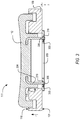
  • FIGS. 2A and 2B are cross-sectional side views of the example housing mechanism of FIG. 1 , an example mounted component in the form of a button mounted to a housing by a low-profile soldered retention mechanism according to one example embodiment being shown in FIG. 2A in a default position, and being shown in FIG. 2B in a depressed position.
  • FIG. 3 is a cross-sectional side view, on an enlarged scale, of part of the housing assembly of FIG. 1 , according to an example embodiment.
  • FIGS. 4A-4D are a series of views showing a sequence of operations for assembling a housing assembly according to one example embodiment.
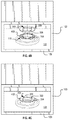
  • FIG. 4B is a schematic three-dimensional view of the housing assembly before engagement of a retainer ring with a connector forming part of the example button assembly.
  • FIG. 4C corresponds to FIG. 4B , showing the retainer ring being positioned in engagement with the connector.
  • FIG. 4D shows a view corresponding to FIG. 4C , illustrating the formation of solder joints between the retainer ring and the connector by use of a solder iron.
  • FIG. 5 is a three-dimensional partial cross-section of an assembly in accordance with an example embodiment
  • FIG. 6 is a schematic three-dimensional view of an eyewear device that includes an assembly analogous to that described with reference to FIGS. 1-5 .
  • solder joint e.g., between plate metal components
  • a solder joint provides for a low height bond that allows a system of which it forms part to substantially maximize available space for other components.
  • FIG. 1 shows an assembly according to one example embodiment, in this example being a housing assembly 100 for button-controllable electronics to be incorporated in an electronics-enabled eyewear device such as the example pair of smart glasses 600 illustrated in FIG. 6 .
  • the housing assembly 100 comprises a framework in the example form of a generally box-shaped housing 103 that defines a housing cavity 106 in which electronic components are to be housed.
  • the housing assembly 100 further includes a mounted component in the example form of a button 112 mounted on the housing 103 for allowing user control of the electronics located within the housing cavity 106 , in use.
  • the button 112 forms part of a button assembly 111 that includes a low-profile solder connection by which the button 112 is mounted on the housing 103 .
  • the housing 103 includes a frame wall on which the button 112 is mounted, in this case being an operatively uppermost wall 109 defining a roof of the housing cavity 106 .
  • the roof wall 109 has an exterior surface 118 on an outer or obverse side, and has an opposite interior surface 121 on an inner or reverse side.
  • the button assembly 111 is mounted on the roof wall 109 to be displaceable in a direction transverse to the roof wall 109 (in the orientation of FIGS. 2A and 2B , being movable relative to the roof wall 109 in the up-and-down direction, indicated as the z-dimension), allowing user control of electronic components 213 located in the housing cavity 106 .
  • the button assembly 111 is shown in a default or dormant condition, while the button assembly 111 in FIG. 2B is shown in a pressed condition in which the button 112 is moved maximally downward by manual user engagement therewith.
  • the assembly 100 includes a bias mechanism acting on the button assembly 111 to urge it to the default condition.
  • the bias mechanism may be provided by interaction of the button assembly with the electronics 213 .
  • the bias mechanism may comprises a resilient element or compressions spring arrangement located in a ring recess 250 defined in the upper surface 118 of the roof wall 109 .
  • FIGS. 2A and 2B The physical ambit of the electronic components 213 is shown in broken lines in FIGS. 2A and 2B , from which it will be noticed that the available z-dimensional space for a retention connection to attach the button 112 to the roof wall 109 (here being shown as the distance between the electronic components 213 and the interior surface 121 of the roof wall 109 ) is extremely limited.
  • the space constraints are particularly severe, considering that due to design constraints imposed by the eyewear device 600 in which the housing assembly 100 is to be incorporated, the available z-dimensional spacing between the roof wall 109 and the electronics 213 is here about 1 mm. Considering that this spacing is to allow also for travel of the button assembly, the value of limiting the z-dimensional extent of the retention mechanism will be appreciated.
  • Various aspects of an example low-profile retention connection that provides for mounting of the button 112 on the roof wall 109 with minimal z-thickness is further described below.
  • a button opening 115 extends transversely through the roof wall 109 , with a cylindrical shank or skirt of the button 112 being complementary to the button opening 115 and being co-axially received therein to be slidable relative to the roof wall 109 .
  • the button 112 is in this example embodiment of a hard polymeric plastics material.
  • a generally tubular mild steel connector 204 is embedded at its operatively upper end in the plastics material of the button 112 , projecting away from the button 112 such that its distal end is located somewhat beyond the interior surface 121 of the roof wall 109 . Observe that the embedded end of the connector 204 is flattened or bent inwards to promote positive connection between the steel connector 204 and the plastic button 112 to which it is thus attached.
  • a metal retainer in the example form of a mild steel retainer ring 209 (best seen in FIG. 4A ) is fastened to the tubular connector 204 on the interior side of the roof wall 109 , being oriented substantially parallel to the roof wall 109 . In this manner, part of the roof wall 109 is sandwiched between the retainer ring 209 and the button 112 , thus retaining the button assembly 111 on the roof wall 109 with limited z-dimensional travel.
  • the retainer ring 209 is attached to the tubular connector 204 by a solder connection consisting in this example embodiment of four circumferentially spaced solder joints 219 .
  • the retention ring 209 in this example embodiment has a plurality of connection cavities in the example form of four regularly circumferentially spaced mortise holes 303 extending transversely through the sheet metal retainer ring 209 .
  • the operatively lower end of the barrel connector 204 i.e., the upper end in the orientation of FIG. 4A ) defines four tenons 306 that are complementary to and correspond in spatial arrangement to the mortise holes 303 .
  • Inner surfaces 412 of the mortise holes 303 are provided with a nickel coating, thereby forming respective solder-promoting surfaces.
  • the tenons 306 are likewise nickel-coated, providing solder-promoting surfaces on the tenons 306 .
  • the solder surfaces 408 and 412 are hatched in FIG. 4A .
  • the coated surfaces 408 , 412 define target zones for the respective solder joints that are to be formed in overlapping regions of the retainer ring 209 and the connector 204 , when the tenons 306 are received in the complementary mortise holes 303 .
  • FIG. 3 therein is shown the button assembly 111 mounted on the housing wall 109 and being disposed in the default condition, in which the retainer ring 209 bears against the inner surface 121 of the roof wall 109 .
  • the tenons 306 are a loose fit in the corresponding mortise holes 303 , with solder material of the respective solder joints 219 attaching to the parallel solder-promoting interface surfaces 408 , 412 of the connector 204 and the retainer ring 209 respectively.
  • the solder joints 219 are thus in their dimensional extent (also referred to herein as the height of the solder joints 219 ) restricted substantially to the thickness dimension of the sheet metal retaining ring 209 .
  • the thickness of the retainer ring 209 is about 0.2 mm, so that the low-profile soldered connection of the example embodiment similarly has a z-dimensional height (h) of about 0.2 mm.
  • FIG. 4A shows the button assembly 111 in pre-assembled condition and in inverted orientation relative to its operative orientation illustrated in FIGS. 1-3 .
  • the solder-promoting surfaces 408 , 412 are provided on the barrel connector 204 and the retainer ring 209 by applying the targeted nickel layer or coating previously described.
  • the nickel layers are deposited by brush application, but in other embodiments the solder-promoting surfaces 408 , 412 can be formed in any suitable manner, such as dipping or electro-plating.
  • the inverted orientation of the FIG. 4A is the orientation in which the retainer ring 209 is in this example embodiment soldered to the tubular connector 204 , thus utilizing gravity to promote filling of available spaces between the parallel interface surfaces of the tenons 306 and the mortise holes 303 , and thereby promoting proper solder attachment to the nickel-coated solder surfaces 408 , 412 .
  • a hollow cylindrical skirt portion 402 that projects from a head 403 of the button 112 and within which the barrel connector 204 is co-axially located has a circumferentially spaced series of recesses 404 in register with and located immediately below the respective tenons 306 of the connector 204 . These recesses 404 provides evacuation space for draining of excess solder from the mortise holes 303 during assembly.
  • a first step of assembly ( FIG. 4B ) the housing 103 is placed on a substantially horizontal support surface in an inverted position, with the button 112 located on the housing 103 such that the cylindrical button skirt 403 is co-axial with and extends through the button opening 115 .
  • the distal end of the barrel connector 204 is substantially flush with the inner surface 121 of the roof wall 109 .
  • the retainer ring 209 is placed flat on the inner surface 121 of the wall 109 , the connector tenons 306 being received in the complementary mating mortise holes 303 with sufficient clearance between the closely spaced, parallel solder-promoting surfaces 408 , 412 to receive solder material therein.
  • a hand solder iron 424 and solder wire accesses the mortise holes 303 via an open mouth of the housing 103 , depositing molten solder material in the respective mortise holes 303 .
  • the solder material flows under gravity into the clearance space between the walls of the mortise holes 303 and the respective tenons 306 , and there solidifies, thus creating a substantially permanent connection between the retainer ring 209 and the connector 204 .
  • Tin-Silver-Copper solder is used, but any suitable solder material may be used in other embodiments.
  • the provision of the respective solder-promoting surfaces 408 , 412 promotes creation of the solder joints 219 at the target interface surfaces defined by the respective solder-promoting surfaces 408 , 412 . This is due in part to the relatively poor solderability of typical steel sheet metal, which inhibits adherence of the solder material to either the connector 204 or the retainer ring 209 outside of the solder-promoting surfaces 408 , 412 .
  • FIG. 5 shows a two-dimensional cross-sectional view of two of the solder joints 219 after the described assembly oppression.
  • each solder joint 219 is shown as comprising solder material not only between the side faces of the tenons 306 and the parallel interface surfaces of the mortise holes 303 , but also includes solder material of about equal thickness on the end faces of the tenons 306 .
  • solder material may in some instances occur due to surface tension of the solder material in fluid form during soldering, it is somewhat exaggerated in the drawings and is not of significant importance to the structural integrity of the solder joints 219 .
  • the extent of solder material the solder joints 219 is limited to the z-dimensional overlap between the tenons 306 and the thickness of the retainer ring 209 .
  • the electronic components 213 ( FIG. 2A ) are inserted in the housing 103 that operationally coupled to the button assembly 111 to allow user control of one or more functionalities of the electronics 213 by operation of the button 112 .
  • the final housing assembly 100 is incorporated in an end product device, in this example embodiment being an eyewear device in the example form of a pair of smart glasses 600 illustrated schematically in FIG. 6 .
  • FIG. 6 shows a front perspective view of an eyewear device in the form of a pair of smart glasses 600 that includes a housing 100 including the low-profile soldered retention mechanism as described with reference to the example embodiment of FIGS. 1-5 .
  • the glasses 600 include a body comprising a front piece or frame 606 and a pair of temples 609 connected to the frame 606 for supporting the frame 606 in position on a user's face when the glasses 600 are worn.
  • the frame 606 can be made from any suitable material such as plastics or metal, including any suitable shape memory alloy.
  • the glasses 600 have a pair of optical elements in the form of a pair of lenses 612 held by corresponding optical element holders in the form of a pair of rims 615 forming part of the frame 606 .
  • the rims 615 are connected by a bridge 618 .
  • one or both of the optical elements can be a display (e.g., to provide a virtual reality display), a display assembly, or a lens and display combination (e.g., to provide augmented reality functionalities).
  • the frame 606 includes a pair of end pieces 621 defining lateral end portions of the frame 606 .
  • a variety of electronics components are housed in one or both of the end pieces 621 , the housing assembly 100 , with its internal electronics 213 is integrated in the lateral end piece 621 .
  • the button 112 of the housing assembly 100 projects through a complementary opening in the end piece 621 to be accessible for user operation.
  • the frame 606 is formed of a single piece of material, so as to have a unitary or monolithic construction.
  • the whole of the body can be of the unitary or monolithic construction.
  • the temples 609 are coupled to the respective end pieces 621 .
  • the temples 609 are coupled to the frame 606 by respective hinges so as to be hingedly movable between a wearable mode (as shown in FIG. 6 ) and a collapsed mode in which the temples 609 are pivoted towards the frame 606 to lie substantially flat against it.
  • Each of the temples 609 includes a front portion that is coupled to the frame 606 and a suitable rear portion for coupling to the ear of the user.
  • the glasses 600 has onboard electronics 624 including a computing device, such as a computer, which can in different embodiments be of any suitable type so as to be carried by the eyewear device body.
  • various components comprising the onboard electronics 624 are at least partially housed in one or both of the temples 609 .
  • various components of the onboard electronics 624 are in this example embodiment housed in the housing 100 within the lateral end pieces 621 of the frame 606 .
  • the onboard electronics 624 includes one or more processors with memory, wireless communication circuitry, and a power source (this example embodiment being a rechargeable battery, e.g. a lithium-ion battery).
  • the onboard electronics 624 comprises low-power, high-speed circuitry, and, in some embodiments, a display processor.
  • Various embodiments may include these elements in different configurations or integrated together in different ways.
  • the onboard electronics 624 includes a rechargeable battery.
  • the battery is disposed in one of the temples 609 . In this example embodiment, however, the battery is housed in one of the end pieces 621 , being electrically coupled to the remainder of the onboard electronics 624 .
  • the glasses 600 is camera-enabled, in this example comprising a camera 630 mounted in one of the end pieces 621 and facing forwards so as to be aligned more or less with the direction of view of a wearer of the glasses 600 .
  • the camera 630 is configured to capture digital as well as digital video content. Operation of the camera 630 is controlled by a camera controller provided by the onboard electronics 624 , image data representative of images or video captured by the camera 630 being temporarily stored on a memory forming part of the onboard electronics 624 .
  • the glasses 600 can have a pair of cameras 630 , e.g. housed by the respective end pieces 621 .
  • the glasses 600 further include one or more input and output devices permitting communication with and control of the camera 630 .
  • the glasses 600 include one or more input mechanisms for enabling user control of one or more functions of the glasses 600 .
  • the input mechanism comprises the button 112 .
  • a photo capture command can be issued by a single, relatively short button press (e.g., shorter than a second), while a video capture command can be issued by a press-and-hold action.
  • a framework that includes a frame wall having an obverse side and an opposite reverse side;
  • a mounted component that is mounted on the frame wall such as to be exposed on the obverse side of the frame wall;
  • a metal connector that is fast with the mounted component and that projects from the mounted component transversely through at least part of the frame wall;
  • the retainer is of sheet metal construction oriented such that a thickness dimension of the retainer is transverse to the frame wall at the mounted component, e.g. comprising a sheet steel ring lying flat against the frame wall.
  • the retainer has one or more connection cavities or openings in which part of the connector is received tenon/mortise-fashion, the solder joint being located at least in part in the one or more cavities.
  • the solder joint in such embodiments has a height dimension that is oriented transversely to the frame wall at the mounted component, with the height dimension coinciding substantially with an overlap between the retainer and the connector, so that the height dimension of the solder joint is substantially equal to or smaller than the thickness dimension of the retainer.
  • the height or z-dimensional thickness of the joint between the retainer and the connector is defined by the thickness of the sheet metal retainer, thus being small relative to the size of the mounted component, the connector, and the frame wall.
  • the connector projects through the retainer substantially no further than a major outer face of the retainer on the reverse side.
  • At least one of the retainer and the connector includes a solder-promoting surface that coincides with an overlap between the connector and the retainer, the solder joint being of a different metal material than both the connector and the retainer, and the solder joint attaching to the solder-promoting surface.
  • both the connector and the retainer have respective solder-promoting surfaces, the solder joint attaching to the solder-promoting surfaces of both the retainer and the connector. Provision of the solder-promoting surfaces effectively allows for targeting the specific location of the solder joints.
  • the solder-promoting surfaces on the connector and the retainer respectively are in some embodiments localized metal coatings, each localized coating for example comprising a nickel coating.
  • the term “or” may be construed in either an inclusive or exclusive sense. Moreover, plural instances may be provided for resources, operations, or structures described herein as a single instance. Additionally, boundaries between various resources, operations, modules, engines, and data stores are somewhat arbitrary, and particular operations are illustrated in a context of specific illustrative configurations. Other allocations of functionality are envisioned and may fall within a scope of various embodiments of the present disclosure. In general, structures and functionality presented as separate resources in the example configurations may be implemented as a combined structure or resource. Similarly, structures and functionality presented as a single resource may be implemented as separate resources. These and other variations, modifications, additions, and improvements fall within a scope of embodiments of the present disclosure as represented by the appended claims. The specification and drawings are, accordingly, to be regarded in an illustrative rather than a restrictive sense.

Landscapes

  • Physics & Mathematics (AREA)
  • Engineering & Computer Science (AREA)
  • Health & Medical Sciences (AREA)
  • Mechanical Engineering (AREA)
  • Ophthalmology & Optometry (AREA)
  • General Health & Medical Sciences (AREA)
  • Otolaryngology (AREA)
  • General Physics & Mathematics (AREA)
  • Acoustics & Sound (AREA)
  • Optics & Photonics (AREA)
  • Chemical & Material Sciences (AREA)
  • Materials Engineering (AREA)
  • Manufacturing & Machinery (AREA)
  • Casings For Electric Apparatus (AREA)
  • Telephone Set Structure (AREA)
  • Coupling Device And Connection With Printed Circuit (AREA)

Abstract

An assembly of mechanical components includes a solder joint between two metal components. A mounted component is retained on one side of a support structure by a solder joint on the other side of the support structure between a retainer and a connector that is fast with the mounted component and extends through the support structure. The retainer is of sheet metal construction, so that a height of the solder joint is no more than the thickness of the retainer, thus providing a low-profile joint.

Description

PRIORITY
This application is a continuation of and claims the benefit of priority of U.S. patent application Ser. No. 16/293,270, filed on Mar. 5, 2019, which is a continuation of and claims the benefit of priority of U.S. patent application Ser. No. 15/782,526, filed on Oct. 12, 2017, which is hereby incorporated by reference herein in its entirety
BACKGROUND
Many mechanical assemblies include the mounting of components on a framework or housing in an environment where there are significant constraints not only on the physical dimensions of a mounting or retention mechanism for mounted components. Such applications often additionally present considerable difficulties with respect to access for assembly.
Mechanical retention mechanisms for such applications, such as machine screws or heat-stakes, have physical dimensions and/or access requirements such that the retention mechanism itself imposes size restraints on other components of the assembly. This is often the case in the construction of physical components for electronic devices, particularly where space is at a premium such as in wearable electronic devices. Non-mechanical solutions, such as gluing or laser welding, are however often non-viable options due to unreliability, long-term deterioration of the connection, additional complexity in tooling, and/or cost considerations.
BRIEF DESCRIPTION OF THE DRAWINGS
Various ones of the appended drawings merely illustrate example embodiments of the present disclosure and cannot be considered as limiting its scope. To facilitate collation of numbered items in the description to the drawings, the first digit of each numbered item corresponds to the figure in which that item first appears. In the drawings:
FIG. 1 is a three-dimensional view of a housing assembly that includes a low-profile mechanical retention mechanism, according to one example embodiment
FIGS. 2A and 2B are cross-sectional side views of the example housing mechanism of FIG. 1, an example mounted component in the form of a button mounted to a housing by a low-profile soldered retention mechanism according to one example embodiment being shown in FIG. 2A in a default position, and being shown in FIG. 2B in a depressed position.
FIG. 3 is a cross-sectional side view, on an enlarged scale, of part of the housing assembly of FIG. 1, according to an example embodiment.
FIGS. 4A-4D are a series of views showing a sequence of operations for assembling a housing assembly according to one example embodiment. FIG. 4B is a schematic three-dimensional view of the housing assembly before engagement of a retainer ring with a connector forming part of the example button assembly. FIG. 4C corresponds to FIG. 4B, showing the retainer ring being positioned in engagement with the connector. FIG. 4D shows a view corresponding to FIG. 4C, illustrating the formation of solder joints between the retainer ring and the connector by use of a solder iron.
FIG. 5 is a three-dimensional partial cross-section of an assembly in accordance with an example embodiment
FIG. 6 is a schematic three-dimensional view of an eyewear device that includes an assembly analogous to that described with reference to FIGS. 1-5.
The headings provided herein are merely for convenience and do not necessarily affect the scope or meaning of the terms used.
DETAILED DESCRIPTION
The description that follows includes devices, systems, methods, techniques, instruction sequences, and computing machine program products that embody illustrative embodiments of the disclosure. In the following description, for the purposes of explanation, numerous specific details are set forth in order to provide an understanding of various embodiments of the disclosed subject matter. It will be evident, however, to those skilled in the art, that embodiments of the disclosed subject matter may be practiced without these specific details. In general, well-known instruction instances, protocols, structures, and techniques are not necessarily shown in detail.
One aspect of the disclosure provides for utilizing a solder joint or connection as a mechanical joint. As will be illustrated with reference to the example embodiment that follows, such a solder joint, e.g., between plate metal components, provides for a low height bond that allows a system of which it forms part to substantially maximize available space for other components.
FIG. 1 shows an assembly according to one example embodiment, in this example being a housing assembly 100 for button-controllable electronics to be incorporated in an electronics-enabled eyewear device such as the example pair of smart glasses 600 illustrated in FIG. 6. The housing assembly 100 comprises a framework in the example form of a generally box-shaped housing 103 that defines a housing cavity 106 in which electronic components are to be housed.
The housing assembly 100 further includes a mounted component in the example form of a button 112 mounted on the housing 103 for allowing user control of the electronics located within the housing cavity 106, in use. As will be described below, the button 112 forms part of a button assembly 111 that includes a low-profile solder connection by which the button 112 is mounted on the housing 103. As can be seen in FIG. 1, the housing 103 includes a frame wall on which the button 112 is mounted, in this case being an operatively uppermost wall 109 defining a roof of the housing cavity 106. The roof wall 109 has an exterior surface 118 on an outer or obverse side, and has an opposite interior surface 121 on an inner or reverse side.
As illustrated schematically in FIGS. 2A and 2B, the button assembly 111 is mounted on the roof wall 109 to be displaceable in a direction transverse to the roof wall 109 (in the orientation of FIGS. 2A and 2B, being movable relative to the roof wall 109 in the up-and-down direction, indicated as the z-dimension), allowing user control of electronic components 213 located in the housing cavity 106. In FIG. 2A, the button assembly 111 is shown in a default or dormant condition, while the button assembly 111 in FIG. 2B is shown in a pressed condition in which the button 112 is moved maximally downward by manual user engagement therewith.
Although not shown in the drawings, the assembly 100 includes a bias mechanism acting on the button assembly 111 to urge it to the default condition. In some embodiments, the bias mechanism may be provided by interaction of the button assembly with the electronics 213. In another embodiment, the bias mechanism may comprises a resilient element or compressions spring arrangement located in a ring recess 250 defined in the upper surface 118 of the roof wall 109.
The physical ambit of the electronic components 213 is shown in broken lines in FIGS. 2A and 2B, from which it will be noticed that the available z-dimensional space for a retention connection to attach the button 112 to the roof wall 109 (here being shown as the distance between the electronic components 213 and the interior surface 121 of the roof wall 109) is extremely limited. In the illustrated example embodiment, the space constraints are particularly severe, considering that due to design constraints imposed by the eyewear device 600 in which the housing assembly 100 is to be incorporated, the available z-dimensional spacing between the roof wall 109 and the electronics 213 is here about 1 mm. Considering that this spacing is to allow also for travel of the button assembly, the value of limiting the z-dimensional extent of the retention mechanism will be appreciated. Various aspects of an example low-profile retention connection that provides for mounting of the button 112 on the roof wall 109 with minimal z-thickness is further described below.
As can be seen in FIG. 2A, a button opening 115 extends transversely through the roof wall 109, with a cylindrical shank or skirt of the button 112 being complementary to the button opening 115 and being co-axially received therein to be slidable relative to the roof wall 109. The button 112 is in this example embodiment of a hard polymeric plastics material. A generally tubular mild steel connector 204 is embedded at its operatively upper end in the plastics material of the button 112, projecting away from the button 112 such that its distal end is located somewhat beyond the interior surface 121 of the roof wall 109. Observe that the embedded end of the connector 204 is flattened or bent inwards to promote positive connection between the steel connector 204 and the plastic button 112 to which it is thus attached.
A metal retainer in the example form of a mild steel retainer ring 209 (best seen in FIG. 4A) is fastened to the tubular connector 204 on the interior side of the roof wall 109, being oriented substantially parallel to the roof wall 109. In this manner, part of the roof wall 109 is sandwiched between the retainer ring 209 and the button 112, thus retaining the button assembly 111 on the roof wall 109 with limited z-dimensional travel. As will be described in greater detail with reference to FIG. 3-5 below, the retainer ring 209 is attached to the tubular connector 204 by a solder connection consisting in this example embodiment of four circumferentially spaced solder joints 219.
Referring briefly to FIG. 4A (in which the relevant components are shown in exploded view and in an inverted orientation), it will be seen that the retention ring 209 in this example embodiment has a plurality of connection cavities in the example form of four regularly circumferentially spaced mortise holes 303 extending transversely through the sheet metal retainer ring 209. The operatively lower end of the barrel connector 204 (i.e., the upper end in the orientation of FIG. 4A) defines four tenons 306 that are complementary to and correspond in spatial arrangement to the mortise holes 303. Inner surfaces 412 of the mortise holes 303 are provided with a nickel coating, thereby forming respective solder-promoting surfaces. The tenons 306 are likewise nickel-coated, providing solder-promoting surfaces on the tenons 306. For clarity of illustration, the solder surfaces 408 and 412 are hatched in FIG. 4A. Observe that the remainder of the exposed metal surfaces of the connector ring 209 and the connector 204 are uncoated. In this manner, the coated surfaces 408, 412 define target zones for the respective solder joints that are to be formed in overlapping regions of the retainer ring 209 and the connector 204, when the tenons 306 are received in the complementary mortise holes 303.
Turning now to FIG. 3, therein is shown the button assembly 111 mounted on the housing wall 109 and being disposed in the default condition, in which the retainer ring 209 bears against the inner surface 121 of the roof wall 109. Note that the tenons 306 are a loose fit in the corresponding mortise holes 303, with solder material of the respective solder joints 219 attaching to the parallel solder-promoting interface surfaces 408, 412 of the connector 204 and the retainer ring 209 respectively. The solder joints 219 are thus in their dimensional extent (also referred to herein as the height of the solder joints 219) restricted substantially to the thickness dimension of the sheet metal retaining ring 209. In this example embodiment, the thickness of the retainer ring 209 is about 0.2 mm, so that the low-profile soldered connection of the example embodiment similarly has a z-dimensional height (h) of about 0.2 mm. Referring again briefly to FIGS. 2A and 2B, it will be seen that this relatively low profile of the retention mechanism allows for mounting the button 112 on the housing 103 with relatively minimal effects on available space for the electronic components 213 in the housing cavity 106, when compared to existing mounting mechanisms for such applications.
An example method of manufacturing the housing assembly 100 according to the previously described example embodiment will now be briefly described with reference to FIGS. 4 and 5. As described previously, FIG. 4A shows the button assembly 111 in pre-assembled condition and in inverted orientation relative to its operative orientation illustrated in FIGS. 1-3. Prior to assembly, the solder-promoting surfaces 408, 412 are provided on the barrel connector 204 and the retainer ring 209 by applying the targeted nickel layer or coating previously described. In this example, the nickel layers are deposited by brush application, but in other embodiments the solder-promoting surfaces 408, 412 can be formed in any suitable manner, such as dipping or electro-plating.
The inverted orientation of the FIG. 4A is the orientation in which the retainer ring 209 is in this example embodiment soldered to the tubular connector 204, thus utilizing gravity to promote filling of available spaces between the parallel interface surfaces of the tenons 306 and the mortise holes 303, and thereby promoting proper solder attachment to the nickel-coated solder surfaces 408, 412. To this end, a hollow cylindrical skirt portion 402 that projects from a head 403 of the button 112 and within which the barrel connector 204 is co-axially located has a circumferentially spaced series of recesses 404 in register with and located immediately below the respective tenons 306 of the connector 204. These recesses 404 provides evacuation space for draining of excess solder from the mortise holes 303 during assembly.
In a first step of assembly (FIG. 4B), the housing 103 is placed on a substantially horizontal support surface in an inverted position, with the button 112 located on the housing 103 such that the cylindrical button skirt 403 is co-axial with and extends through the button opening 115. In this position, the distal end of the barrel connector 204 is substantially flush with the inner surface 121 of the roof wall 109. Thereafter, as shown in FIG. 4C, the retainer ring 209 is placed flat on the inner surface 121 of the wall 109, the connector tenons 306 being received in the complementary mating mortise holes 303 with sufficient clearance between the closely spaced, parallel solder-promoting surfaces 408, 412 to receive solder material therein.
As shown in FIG. 4D, a hand solder iron 424 and solder wire (not shown) in this condition accesses the mortise holes 303 via an open mouth of the housing 103, depositing molten solder material in the respective mortise holes 303. The solder material flows under gravity into the clearance space between the walls of the mortise holes 303 and the respective tenons 306, and there solidifies, thus creating a substantially permanent connection between the retainer ring 209 and the connector 204. In this example embodiment, Tin-Silver-Copper solder is used, but any suitable solder material may be used in other embodiments. Note that the provision of the respective solder-promoting surfaces 408, 412 promotes creation of the solder joints 219 at the target interface surfaces defined by the respective solder-promoting surfaces 408, 412. This is due in part to the relatively poor solderability of typical steel sheet metal, which inhibits adherence of the solder material to either the connector 204 or the retainer ring 209 outside of the solder-promoting surfaces 408, 412.
FIG. 5 shows a two-dimensional cross-sectional view of two of the solder joints 219 after the described assembly oppression. Note that in the FIG. 3 and FIG. 5 of the drawings, each solder joint 219 is shown as comprising solder material not only between the side faces of the tenons 306 and the parallel interface surfaces of the mortise holes 303, but also includes solder material of about equal thickness on the end faces of the tenons 306. Although the illustrated effect may in some instances occur due to surface tension of the solder material in fluid form during soldering, it is somewhat exaggerated in the drawings and is not of significant importance to the structural integrity of the solder joints 219. In many instances, the extent of solder material the solder joints 219 is limited to the z-dimensional overlap between the tenons 306 and the thickness of the retainer ring 209.
After the solder joints 219 have been allowed to set, the electronic components 213 (FIG. 2A) are inserted in the housing 103 that operationally coupled to the button assembly 111 to allow user control of one or more functionalities of the electronics 213 by operation of the button 112. Thereafter, the final housing assembly 100 is incorporated in an end product device, in this example embodiment being an eyewear device in the example form of a pair of smart glasses 600 illustrated schematically in FIG. 6.
FIG. 6 shows a front perspective view of an eyewear device in the form of a pair of smart glasses 600 that includes a housing 100 including the low-profile soldered retention mechanism as described with reference to the example embodiment of FIGS. 1-5. The glasses 600 include a body comprising a front piece or frame 606 and a pair of temples 609 connected to the frame 606 for supporting the frame 606 in position on a user's face when the glasses 600 are worn. The frame 606 can be made from any suitable material such as plastics or metal, including any suitable shape memory alloy.
The glasses 600 have a pair of optical elements in the form of a pair of lenses 612 held by corresponding optical element holders in the form of a pair of rims 615 forming part of the frame 606. The rims 615 are connected by a bridge 618. In other embodiments, one or both of the optical elements can be a display (e.g., to provide a virtual reality display), a display assembly, or a lens and display combination (e.g., to provide augmented reality functionalities).
The frame 606 includes a pair of end pieces 621 defining lateral end portions of the frame 606. In this example, a variety of electronics components are housed in one or both of the end pieces 621, the housing assembly 100, with its internal electronics 213 is integrated in the lateral end piece 621. The button 112 of the housing assembly 100 projects through a complementary opening in the end piece 621 to be accessible for user operation. In some embodiments, the frame 606 is formed of a single piece of material, so as to have a unitary or monolithic construction. In some embodiments, the whole of the body (including both the frame 606 and the temples 609) can be of the unitary or monolithic construction.
The temples 609 are coupled to the respective end pieces 621. In this example, the temples 609 are coupled to the frame 606 by respective hinges so as to be hingedly movable between a wearable mode (as shown in FIG. 6) and a collapsed mode in which the temples 609 are pivoted towards the frame 606 to lie substantially flat against it. Each of the temples 609 includes a front portion that is coupled to the frame 606 and a suitable rear portion for coupling to the ear of the user.
The glasses 600 has onboard electronics 624 including a computing device, such as a computer, which can in different embodiments be of any suitable type so as to be carried by the eyewear device body. In some embodiments, various components comprising the onboard electronics 624 are at least partially housed in one or both of the temples 609. As mentioned, various components of the onboard electronics 624 are in this example embodiment housed in the housing 100 within the lateral end pieces 621 of the frame 606. The onboard electronics 624 includes one or more processors with memory, wireless communication circuitry, and a power source (this example embodiment being a rechargeable battery, e.g. a lithium-ion battery). The onboard electronics 624 comprises low-power, high-speed circuitry, and, in some embodiments, a display processor. Various embodiments may include these elements in different configurations or integrated together in different ways.
As mentioned, the onboard electronics 624 includes a rechargeable battery. In some embodiments, the battery is disposed in one of the temples 609. In this example embodiment, however, the battery is housed in one of the end pieces 621, being electrically coupled to the remainder of the onboard electronics 624.
The glasses 600 is camera-enabled, in this example comprising a camera 630 mounted in one of the end pieces 621 and facing forwards so as to be aligned more or less with the direction of view of a wearer of the glasses 600. The camera 630 is configured to capture digital as well as digital video content. Operation of the camera 630 is controlled by a camera controller provided by the onboard electronics 624, image data representative of images or video captured by the camera 630 being temporarily stored on a memory forming part of the onboard electronics 624. In some embodiments, the glasses 600 can have a pair of cameras 630, e.g. housed by the respective end pieces 621.
The glasses 600 further include one or more input and output devices permitting communication with and control of the camera 630. In particular, the glasses 600 include one or more input mechanisms for enabling user control of one or more functions of the glasses 600. In this embodiment, the input mechanism comprises the button 112. In the current example embodiment, a photo capture command can be issued by a single, relatively short button press (e.g., shorter than a second), while a video capture command can be issued by a press-and-hold action.
It is a benefit of the described method of mounting the button 112 on the housing 103 that it provides a low profile (i.e., relatively small z-thickness) retention solution for bonding to metal parts as part of the button assembly 111. It will be seen from the description of example embodiments of that such assemblies are often located in narrow, difficult to access cavities, such as the housing cavity 106 of the example embodiment. In such relatively small, limited access environments, conventional alternative methods of attachment present various challenges that are avoided or overcome by the disclosed connection methods. For example, alternative methods like using machine screws, a heat stake, or laser welding are frustrated by restricted access, and require additional complexity in tooling, fixturing, and cost. Adhesive attachments like gluing are insufficiently robust, being prone to deterioration or creep over time, particularly when exposed to heat such as that generated in use by the electronic components 213.
Problematically, many such conventional attachment methods almost invariably adds significantly to the z-dimensional extent of the mounted assembly (e.g., to the button assembly 111) and/or requires more space to implement. In contrast, the disclosed detection mechanisms uses solder joints 219 as a mechanical joint. The low-height bound provided by the solder joints 219 allows the system to substantially maximize space available for other components. Thus, the use of the disclosed low-profile (in some cases being substantially zero-height) solder bonding in spatially restricted or difficult to access systems allows greater mechanical freedom, better packaging, and improved miniaturization of consumer products. In some cases, use of the disclosed techniques enables a metal-to-metal bond where screw access is impossible, and where providing larger heatstake or ultrasonic welding fixtures are not feasible or practical.
Note that although the low-profile soldered connection for retaining a mounted component on a support structure is in this example embodiment described with reference to a housing for electronics to be incorporated in the example eyewear device 600, the mounting and retention techniques described herein can be implemented in a variety of different applications. The disclosed mechanism is particularly useful in applications where z-dimensional space is at a premium, with minimal additional space restriction being provided by the low profile soldered joint.
Overview
From the above-described example embodiments, it will be observed that one aspect of the disclosure provides for an assembly comprising:
a framework that includes a frame wall having an obverse side and an opposite reverse side;
a mounted component that is mounted on the frame wall such as to be exposed on the obverse side of the frame wall;
a metal connector that is fast with the mounted component and that projects from the mounted component transversely through at least part of the frame wall;
a metal retainer that is located on the reverse side of the frame wall such that part of the frame wall is sandwiched between the mounted component and the retainer; and
a solder joint that fastens the retainer to the connector, thereby retaining the mounted component on the frame wall.
In some embodiments, the retainer is of sheet metal construction oriented such that a thickness dimension of the retainer is transverse to the frame wall at the mounted component, e.g. comprising a sheet steel ring lying flat against the frame wall. In such embodiments, the retainer has one or more connection cavities or openings in which part of the connector is received tenon/mortise-fashion, the solder joint being located at least in part in the one or more cavities. The solder joint in such embodiments has a height dimension that is oriented transversely to the frame wall at the mounted component, with the height dimension coinciding substantially with an overlap between the retainer and the connector, so that the height dimension of the solder joint is substantially equal to or smaller than the thickness dimension of the retainer. In this manner, the height or z-dimensional thickness of the joint between the retainer and the connector is defined by the thickness of the sheet metal retainer, thus being small relative to the size of the mounted component, the connector, and the frame wall. To this end, the connector projects through the retainer substantially no further than a major outer face of the retainer on the reverse side.
In some embodiments, at least one of the retainer and the connector includes a solder-promoting surface that coincides with an overlap between the connector and the retainer, the solder joint being of a different metal material than both the connector and the retainer, and the solder joint attaching to the solder-promoting surface. In some embodiments, both the connector and the retainer have respective solder-promoting surfaces, the solder joint attaching to the solder-promoting surfaces of both the retainer and the connector. Provision of the solder-promoting surfaces effectively allows for targeting the specific location of the solder joints. The solder-promoting surfaces on the connector and the retainer respectively are in some embodiments localized metal coatings, each localized coating for example comprising a nickel coating.
Language
Throughout this specification, plural instances may implement components, operations, or structures described as a single instance. Although individual operations of one or more methods are illustrated and described as separate operations, one or more of the individual operations may be performed concurrently, and nothing requires that the operations be performed in the order illustrated. Structures and functionality presented as separate components in example configurations may be implemented as a combined structure or component. Similarly, structures and functionality presented as a single component may be implemented as separate components. These and other variations, modifications, additions, and improvements fall within the scope of the subject matter herein.
Although an overview of the disclosed matter has been described with reference to specific example embodiments, various modifications and changes may be made to these embodiments without departing from the broader scope of embodiments of the present disclosure. Such embodiments of the inventive subject matter may be referred to herein, individually or collectively, by the term “invention” merely for convenience and without intending to voluntarily limit the scope of this application to any single disclosure or inventive concept if more than one is, in fact, disclosed.
The embodiments illustrated herein are described in sufficient detail to enable those skilled in the art to practice the teachings disclosed. Other embodiments may be used and derived therefrom, such that structural and logical substitutions and changes may be made without departing from the scope of this disclosure. The Detailed Description, therefore, is not to be taken in a limiting sense, and the scope of various embodiments is defined only by the appended claims, along with the full range of equivalents to which such claims are entitled.
As used herein, the term “or” may be construed in either an inclusive or exclusive sense. Moreover, plural instances may be provided for resources, operations, or structures described herein as a single instance. Additionally, boundaries between various resources, operations, modules, engines, and data stores are somewhat arbitrary, and particular operations are illustrated in a context of specific illustrative configurations. Other allocations of functionality are envisioned and may fall within a scope of various embodiments of the present disclosure. In general, structures and functionality presented as separate resources in the example configurations may be implemented as a combined structure or resource. Similarly, structures and functionality presented as a single resource may be implemented as separate resources. These and other variations, modifications, additions, and improvements fall within a scope of embodiments of the present disclosure as represented by the appended claims. The specification and drawings are, accordingly, to be regarded in an illustrative rather than a restrictive sense.

Claims (17)

What is claimed, is:
1. An assembly comprising:
a framework that includes a frame wall having an obverse side and an opposite reverse side, the framework defining a housing cavity;
electronics components located in the housing cavity;
a button that is located on the obverse side of the frame wall, the button being of a polymeric plastics material and being manually operable to control one or more functionalities of the electronics components;
a tubular metal connector that is connected to the button by partial embedment thereof in the button, the connector projecting from the button transversely through the frame wall, an end of the connector furthest from the button defining a plurality of tenons projecting axially from the connector;
a sheet metal retainer oriented transversely to the tubular metal connector, the retainer being located on the reverse side of the frame wall such that part of the frame wall is located between the button and the retainer, the retainer defining a plurality of mortise holes complementary to the plurality of tenons of the connector, each tenon being matingly received in a corresponding mortise hole; and
a plurality of solder joints, each of which connects a respective tenon to the retainer at the corresponding mortise hole, thereby retaining the button on the frame wall.
2. The assembly of claim 1, wherein the sheet metal retainer is oriented such that a thickness dimension of the retainer is normal to a longitudinal axis of the tubular metal connector.
3. The assembly of claim 2, wherein each solder joint is located at least partially in the corresponding mortise hole.
4. The assembly of claim 3, wherein each solder joint has a height dimension that is substantially parallel to a longitudinal axis of the tubular metal connector and that coincides substantially with an overlap between the respective tenon and the retainer, the height dimension of the solder joint being substantially equal to or smaller than the thickness dimension of the retainer.
5. The assembly of claim 1, wherein each of the plurality of tenons projects through the retainer substantially no further than a major outer face of the retainer furthest from the frame wall.
6. The assembly of claim 1, wherein, for each solder joint, a solder-promoting surface is provided on at least one of the corresponding tenon and the corresponding mortise hole.
7. The assembly of claim 6, wherein the solder joint is of a material different than both the connector and the retainer, the solder joint attaching to the solder-promoting surface.
8. The assembly of claim 7, wherein both, for each solder joint, both the corresponding tenon and the corresponding mortise hole have respective solder-promoting surfaces, the solder joint attaching to the solder-promoting surfaces of both the tenon and the mortise hole.
9. The assembly of claim 7, wherein each solder-promoting surface is a localized metal coating.
10. The assembly of claim 9, wherein each localized coating comprises a nickel coating.
11. The assembly of claim 1, wherein the button is displaceably mounted on the frame wall to allow travel thereof in a direction transverse to the frame wall, an extent of travel of the button away from the frame wall being limited by abutment of the retainer against the frame wall on the reverse side thereof.
12. The assembly of claim 11, further comprising a biasing mechanism to bias the button away from the frame wall.
13. The assembly of claim 12, wherein the biasing mechanism comprises a compression spring held captive between the button and the frame wall on the obverse side thereof.
14. A method comprising:
positioning a button component of polymeric plastics material on an obverse side of a frame wall provided by a framework that defines a housing cavity, such that a tubular metal connector that is connected to the button component by partial embedment thereof in the button component projects transversely through the frame wall to an obverse side thereof;
receiving a plurality of tenons projecting longitudinally from an end of the tubular metal connector furthest from the button component in a plurality of complementary mating mortise holes defined by a sheet metal retainer oriented transversely to the tubular metal connector and located on a reverse side of the frame wall furthest from the button component; and
creating a solder connection between the connector and the retainer by creating a respective solder joint that connects each of the plurality of tenons to the corresponding mortise hole in which it is received, thereby retaining the button component on the frame wall.
15. The method of claim 14, further comprising a prior operation of creating a solder-promoting surface on at least one of: the plurality of mortise holes, and the plurality of tenons.
16. The method of claim 15, wherein the creating of the solder-promoting surfaces comprises creating a respective solder-promoting surface in each of the plurality of mortise holes and on each of the plurality of tenons.
17. The method of claim 15, wherein the creating of each solder-promoting surface comprises applying on their respective area a metal alloy coating that is more receptive to soldiering than the material of the retainer and the material of the connector.
US16/727,581 2017-10-12 2019-12-26 Low-profile mechanical retention Active US10695852B2 (en)

Priority Applications (1)

Application Number Priority Date Filing Date Title
US16/727,581 US10695852B2 (en) 2017-10-12 2019-12-26 Low-profile mechanical retention

Applications Claiming Priority (3)

Application Number Priority Date Filing Date Title
US15/782,526 US10300545B2 (en) 2017-10-12 2017-10-12 Low-profile mechanical retention
US16/293,270 US10543547B2 (en) 2017-10-12 2019-03-05 Low-profile mechanical retention
US16/727,581 US10695852B2 (en) 2017-10-12 2019-12-26 Low-profile mechanical retention

Related Parent Applications (1)

Application Number Title Priority Date Filing Date
US16/293,270 Continuation US10543547B2 (en) 2017-10-12 2019-03-05 Low-profile mechanical retention

Publications (2)

Publication Number Publication Date
US20200147708A1 US20200147708A1 (en) 2020-05-14
US10695852B2 true US10695852B2 (en) 2020-06-30

Family

ID=64184184

Family Applications (3)

Application Number Title Priority Date Filing Date
US15/782,526 Active US10300545B2 (en) 2017-10-12 2017-10-12 Low-profile mechanical retention
US16/293,270 Active US10543547B2 (en) 2017-10-12 2019-03-05 Low-profile mechanical retention
US16/727,581 Active US10695852B2 (en) 2017-10-12 2019-12-26 Low-profile mechanical retention

Family Applications Before (2)

Application Number Title Priority Date Filing Date
US15/782,526 Active US10300545B2 (en) 2017-10-12 2017-10-12 Low-profile mechanical retention
US16/293,270 Active US10543547B2 (en) 2017-10-12 2019-03-05 Low-profile mechanical retention

Country Status (5)

Country Link
US (3) US10300545B2 (en)
EP (2) EP4546387A3 (en)
KR (2) KR102454743B1 (en)
CN (2) CN111194428B (en)
WO (1) WO2019075103A1 (en)

Families Citing this family (4)

* Cited by examiner, † Cited by third party
Publication number Priority date Publication date Assignee Title
US10300545B2 (en) 2017-10-12 2019-05-28 Snap Inc. Low-profile mechanical retention
US11822081B2 (en) 2019-08-29 2023-11-21 Apple Inc. Optical module for head-mounted device
US11885965B1 (en) 2019-09-23 2024-01-30 Apple Inc. Head-mounted display and display modules thereof
US12277632B2 (en) 2022-04-26 2025-04-15 Snap Inc. Augmented reality experiences with dual cameras

Citations (19)

* Cited by examiner, † Cited by third party
Publication number Priority date Publication date Assignee Title
US631892A (en) 1899-05-29 1899-08-29 Louis F Johnson Electric push-button.
US3715708A (en) 1970-10-21 1973-02-06 Pace Inc Electrical connector
US3783607A (en) 1972-06-12 1974-01-08 Feurer Bros Inc Pusher for electronic digital watch
US3977907A (en) 1975-11-28 1976-08-31 The Gates Rubber Company Rechargeable battery enclosure
US4004121A (en) * 1974-04-04 1977-01-18 Mechanical Enterprises, Inc. Electrical switch with wire beam spring contact closer
US4394059A (en) 1981-08-03 1983-07-19 Amp Incorporated Connector of a type used with dry cell batteries and manufacturing method
US4400594A (en) * 1978-11-29 1983-08-23 Serras Paulet Edouard Control keyboard for electric or electronic devices
US4613736A (en) 1981-03-20 1986-09-23 Sony Corporation Operating panel
US5046971A (en) 1988-12-14 1991-09-10 Olin Corporation Terminal pins for flexible circuits
US5664973A (en) 1995-01-05 1997-09-09 Motorola, Inc. Conductive contact
US7034237B2 (en) 2003-09-23 2006-04-25 Asulab S.A. Portable electronic instrument including at least one control member arranged for also transmitting electric signals
US7361064B2 (en) 2005-09-16 2008-04-22 Hon Hai Precision Industry Co., Ltd. Conductive contact and electronic apparatus employing the same
US20090190026A1 (en) 2006-01-11 2009-07-30 Leo Chen Pair of Spectacles with Miniature Camera
US20090301852A1 (en) 2005-11-09 2009-12-10 Abatek International Ag Integrated Switch or Integrated Button
US20110255259A1 (en) 2010-04-19 2011-10-20 Trent Weber Mounting structures for components in electronic devices
US8279588B2 (en) 2010-08-19 2012-10-02 Apple Inc. Self capturing and keyed mobile device button
US20130250233A1 (en) 2007-05-04 2013-09-26 Pixeloptics, Inc. Moisture-resistant eye wear
US8651900B1 (en) 2012-10-25 2014-02-18 Po-Kai Hsu Connector terminal
US20190111508A1 (en) 2017-10-12 2019-04-18 Snap Inc. Low-profile mechanical retention

Family Cites Families (15)

* Cited by examiner, † Cited by third party
Publication number Priority date Publication date Assignee Title
TW446616B (en) * 1999-01-27 2001-07-21 Taisei Plastics Co Ltd Control panel having sheet-formed pushbutton unit and method of producing the same
CN2864735Y (en) * 2006-01-11 2007-01-31 陈笠 Spectacle with camera device
US20080273166A1 (en) * 2007-05-04 2008-11-06 William Kokonaski Electronic eyeglass frame
CN200997345Y (en) * 2006-11-27 2007-12-26 梅特勒-托利多仪器(上海)有限公司 Press key with clutching opening
CN101312102B (en) * 2007-05-25 2012-08-22 深圳富泰宏精密工业有限公司 Keyboard module and portable electronic device provided with the keyboard module
CN101388297B (en) * 2007-09-11 2010-09-29 徐孝海 A thin film circuit micro switch
CN101604587B (en) * 2008-06-13 2012-09-26 鸿富锦精密工业(深圳)有限公司 Button structure
CN201262912Y (en) * 2008-07-29 2009-06-24 达方电子股份有限公司 Welding structure and keyboard with same
CN102129944B (en) * 2011-04-25 2014-01-08 上海科特高分子材料有限公司 Thin type temperature fuse and production method thereof
CN201966099U (en) * 2011-05-03 2011-09-07 余正明 Minitype side key switch
CN202564098U (en) * 2012-05-04 2012-11-28 合肥市宏键精工模具有限责任公司 Lamp-provided waterproof key switch
CN202996653U (en) * 2012-12-26 2013-06-12 浙江沈海防爆灯具有限公司 Explosion-proof button sleeve connecting structure
CN204927136U (en) * 2015-09-01 2015-12-30 江西益昕电子科技有限公司 Direction type silica gel key
CN105390319B (en) * 2015-12-03 2017-11-10 赛诺威盛科技(北京)有限公司 A kind of press-key structure
CN106128827B (en) * 2016-07-08 2017-11-24 广东欧珀移动通信有限公司 Side key structure and mobile terminal

Patent Citations (23)

* Cited by examiner, † Cited by third party
Publication number Priority date Publication date Assignee Title
US631892A (en) 1899-05-29 1899-08-29 Louis F Johnson Electric push-button.
US3715708A (en) 1970-10-21 1973-02-06 Pace Inc Electrical connector
US3783607A (en) 1972-06-12 1974-01-08 Feurer Bros Inc Pusher for electronic digital watch
US4004121A (en) * 1974-04-04 1977-01-18 Mechanical Enterprises, Inc. Electrical switch with wire beam spring contact closer
US3977907A (en) 1975-11-28 1976-08-31 The Gates Rubber Company Rechargeable battery enclosure
US4400594A (en) * 1978-11-29 1983-08-23 Serras Paulet Edouard Control keyboard for electric or electronic devices
US4613736A (en) 1981-03-20 1986-09-23 Sony Corporation Operating panel
US4394059A (en) 1981-08-03 1983-07-19 Amp Incorporated Connector of a type used with dry cell batteries and manufacturing method
US5046971A (en) 1988-12-14 1991-09-10 Olin Corporation Terminal pins for flexible circuits
US5664973A (en) 1995-01-05 1997-09-09 Motorola, Inc. Conductive contact
US7034237B2 (en) 2003-09-23 2006-04-25 Asulab S.A. Portable electronic instrument including at least one control member arranged for also transmitting electric signals
US7361064B2 (en) 2005-09-16 2008-04-22 Hon Hai Precision Industry Co., Ltd. Conductive contact and electronic apparatus employing the same
US20090301852A1 (en) 2005-11-09 2009-12-10 Abatek International Ag Integrated Switch or Integrated Button
US20090190026A1 (en) 2006-01-11 2009-07-30 Leo Chen Pair of Spectacles with Miniature Camera
US20130250233A1 (en) 2007-05-04 2013-09-26 Pixeloptics, Inc. Moisture-resistant eye wear
US20110255259A1 (en) 2010-04-19 2011-10-20 Trent Weber Mounting structures for components in electronic devices
US8279588B2 (en) 2010-08-19 2012-10-02 Apple Inc. Self capturing and keyed mobile device button
US8651900B1 (en) 2012-10-25 2014-02-18 Po-Kai Hsu Connector terminal
US20190111508A1 (en) 2017-10-12 2019-04-18 Snap Inc. Low-profile mechanical retention
WO2019075103A1 (en) 2017-10-12 2019-04-18 Snap Inc. Low-profile mechanical retention
US10300545B2 (en) * 2017-10-12 2019-05-28 Snap Inc. Low-profile mechanical retention
US20190193179A1 (en) 2017-10-12 2019-06-27 Snap Inc. Low-profile mechanical retention
US10543547B2 (en) * 2017-10-12 2020-01-28 Snap Inc. Low-profile mechanical retention

Non-Patent Citations (10)

* Cited by examiner, † Cited by third party
Title
"International Application Serial No. PCT/US2018/055268, International Search Report dated Jan. 25, 2019", 4 pgs.
"International Application Serial No. PCT/US2018/055268, Written Opinion dated Jan. 25, 2019", 8 pgs.
"U.S. Appl. No. 15/782,526, Non Final Office Action dated Jul. 30, 2018", 5 pgs.
"U.S. Appl. No. 15/782,526, Notice of Allowability dated Mar. 29, 2019", 2 pgs.
"U.S. Appl. No. 15/782,526, Notice of Allowance dated Nov. 28, 2018", 5 pgs.
"U.S. Appl. No. 15/782,526, PTO Response to Rule 312 Communication dated Apr. 25, 2019", 2 pgs.
"U.S. Appl. No. 15/782,526, Response filed Oct. 30, 2018 to Non Final Office Action dated Jul. 30, 2018", 11 pgs.
"U.S. Appl. No. 16/293,270, Non Final Office Action dated Apr. 25, 2019", 7 pgs.
"U.S. Appl. No. 16/293,270, Notice of Allowance dated Sep. 19, 2019", 7 pgs.
"U.S. Appl. No. 16/293,270, Response filed Aug. 29, 2019 to Non Final Office Action dated Apr. 25, 2019", 13 pgs.

Also Published As

Publication number Publication date
CN111194428A (en) 2020-05-22
US10543547B2 (en) 2020-01-28
CN111194428B (en) 2022-03-29
KR102336354B1 (en) 2021-12-08
EP4546387A3 (en) 2025-07-09
US20200147708A1 (en) 2020-05-14
EP3695272B1 (en) 2025-03-19
EP3695272A1 (en) 2020-08-19
CN114582651B (en) 2024-12-03
WO2019075103A1 (en) 2019-04-18
KR102454743B1 (en) 2022-10-17
KR20210152000A (en) 2021-12-14
US20190193179A1 (en) 2019-06-27
CN114582651A (en) 2022-06-03
EP4546387A2 (en) 2025-04-30
US10300545B2 (en) 2019-05-28
KR20200062312A (en) 2020-06-03
US20190111508A1 (en) 2019-04-18

Similar Documents

Publication Publication Date Title
US10695852B2 (en) Low-profile mechanical retention
US12222584B2 (en) Wearable device with heat transfer pathway
US11422384B2 (en) Conductive connection through eyewear hinge
CN206294241U (en) Array camera module and double camera modules and its circuit board module and electronic equipment
CN208609068U (en) Camera lens, camera module and electronic equipment
CN107517287B (en) A casing assembly, a mobile terminal and a method for installing the camera thereof
EP4660692A2 (en) Eyewear device hinge assembly
JP2020092334A (en) Imaging device, imaging system and industrial robot
JP5539475B2 (en) Electronics
JP2010128179A (en) Camera module and method of assembling the same
JPS59171462U (en) Mounting structure of solid-state image sensor
JP2003315886A (en) camera

Legal Events

Date Code Title Description
FEPP Fee payment procedure

Free format text: ENTITY STATUS SET TO UNDISCOUNTED (ORIGINAL EVENT CODE: BIG.); ENTITY STATUS OF PATENT OWNER: LARGE ENTITY

AS Assignment

Owner name: SNAP INC., CALIFORNIA

Free format text: ASSIGNMENT OF ASSIGNORS INTEREST;ASSIGNORS:DABOV, TEODOR;ARDISANA, JOHN BERNARD, II;SHUKLA, ASHUTOSH Y.;REEL/FRAME:052757/0122

Effective date: 20171010

STCF Information on status: patent grant

Free format text: PATENTED CASE

MAFP Maintenance fee payment

Free format text: PAYMENT OF MAINTENANCE FEE, 4TH YEAR, LARGE ENTITY (ORIGINAL EVENT CODE: M1551); ENTITY STATUS OF PATENT OWNER: LARGE ENTITY

Year of fee payment: 4