US10695515B2 - Rodent intubation system - Google Patents

Rodent intubation system Download PDF

Info

Publication number
US10695515B2
US10695515B2 US16/030,822 US201816030822A US10695515B2 US 10695515 B2 US10695515 B2 US 10695515B2 US 201816030822 A US201816030822 A US 201816030822A US 10695515 B2 US10695515 B2 US 10695515B2
Authority
US
United States
Prior art keywords
port
main body
body member
intubation
lumen
Prior art date
Legal status (The legal status is an assumption and is not a legal conclusion. Google has not performed a legal analysis and makes no representation as to the accuracy of the status listed.)
Active
Application number
US16/030,822
Other versions
US20190009043A1 (en
Inventor
Vahagn Ohanyan
Current Assignee (The listed assignees may be inaccurate. Google has not performed a legal analysis and makes no representation or warranty as to the accuracy of the list.)
Individual
Original Assignee
Individual
Priority date (The priority date is an assumption and is not a legal conclusion. Google has not performed a legal analysis and makes no representation as to the accuracy of the date listed.)
Filing date
Publication date
Application filed by Individual filed Critical Individual
Priority to US16/030,822 priority Critical patent/US10695515B2/en
Publication of US20190009043A1 publication Critical patent/US20190009043A1/en
Application granted granted Critical
Publication of US10695515B2 publication Critical patent/US10695515B2/en
Active legal-status Critical Current
Anticipated expiration legal-status Critical

Links

Images

Classifications

    • AHUMAN NECESSITIES
    • A61MEDICAL OR VETERINARY SCIENCE; HYGIENE
    • A61MDEVICES FOR INTRODUCING MEDIA INTO, OR ONTO, THE BODY; DEVICES FOR TRANSDUCING BODY MEDIA OR FOR TAKING MEDIA FROM THE BODY; DEVICES FOR PRODUCING OR ENDING SLEEP OR STUPOR
    • A61M16/00Devices for influencing the respiratory system of patients by gas treatment, e.g. ventilators; Tracheal tubes
    • A61M16/04Tracheal tubes
    • A61M16/0465Tracheostomy tubes; Devices for performing a tracheostomy; Accessories therefor, e.g. masks, filters
    • A61M16/0472Devices for performing a tracheostomy
    • AHUMAN NECESSITIES
    • A61MEDICAL OR VETERINARY SCIENCE; HYGIENE
    • A61BDIAGNOSIS; SURGERY; IDENTIFICATION
    • A61B1/00Instruments for performing medical examinations of the interior of cavities or tubes of the body by visual or photographical inspection, e.g. endoscopes; Illuminating arrangements therefor
    • A61B1/06Instruments for performing medical examinations of the interior of cavities or tubes of the body by visual or photographical inspection, e.g. endoscopes; Illuminating arrangements therefor with illuminating arrangements
    • A61B1/07Instruments for performing medical examinations of the interior of cavities or tubes of the body by visual or photographical inspection, e.g. endoscopes; Illuminating arrangements therefor with illuminating arrangements using light-conductive means, e.g. optical fibres
    • AHUMAN NECESSITIES
    • A61MEDICAL OR VETERINARY SCIENCE; HYGIENE
    • A61BDIAGNOSIS; SURGERY; IDENTIFICATION
    • A61B1/00Instruments for performing medical examinations of the interior of cavities or tubes of the body by visual or photographical inspection, e.g. endoscopes; Illuminating arrangements therefor
    • A61B1/00163Optical arrangements
    • A61B1/00188Optical arrangements with focusing or zooming features
    • AHUMAN NECESSITIES
    • A61MEDICAL OR VETERINARY SCIENCE; HYGIENE
    • A61BDIAGNOSIS; SURGERY; IDENTIFICATION
    • A61B1/00Instruments for performing medical examinations of the interior of cavities or tubes of the body by visual or photographical inspection, e.g. endoscopes; Illuminating arrangements therefor
    • A61B1/267Instruments for performing medical examinations of the interior of cavities or tubes of the body by visual or photographical inspection, e.g. endoscopes; Illuminating arrangements therefor for the respiratory tract, e.g. laryngoscopes, bronchoscopes
    • AHUMAN NECESSITIES
    • A61MEDICAL OR VETERINARY SCIENCE; HYGIENE
    • A61MDEVICES FOR INTRODUCING MEDIA INTO, OR ONTO, THE BODY; DEVICES FOR TRANSDUCING BODY MEDIA OR FOR TAKING MEDIA FROM THE BODY; DEVICES FOR PRODUCING OR ENDING SLEEP OR STUPOR
    • A61M16/00Devices for influencing the respiratory system of patients by gas treatment, e.g. ventilators; Tracheal tubes
    • A61M16/04Tracheal tubes
    • A61M16/0463Tracheal tubes combined with suction tubes, catheters or the like; Outside connections
    • AHUMAN NECESSITIES
    • A61MEDICAL OR VETERINARY SCIENCE; HYGIENE
    • A61MDEVICES FOR INTRODUCING MEDIA INTO, OR ONTO, THE BODY; DEVICES FOR TRANSDUCING BODY MEDIA OR FOR TAKING MEDIA FROM THE BODY; DEVICES FOR PRODUCING OR ENDING SLEEP OR STUPOR
    • A61M16/00Devices for influencing the respiratory system of patients by gas treatment, e.g. ventilators; Tracheal tubes
    • A61M16/04Tracheal tubes
    • A61M16/0488Mouthpieces; Means for guiding, securing or introducing the tubes
    • AHUMAN NECESSITIES
    • A61MEDICAL OR VETERINARY SCIENCE; HYGIENE
    • A61BDIAGNOSIS; SURGERY; IDENTIFICATION
    • A61B2503/00Evaluating a particular growth phase or type of persons or animals
    • A61B2503/40Animals
    • AHUMAN NECESSITIES
    • A61MEDICAL OR VETERINARY SCIENCE; HYGIENE
    • A61BDIAGNOSIS; SURGERY; IDENTIFICATION
    • A61B2503/00Evaluating a particular growth phase or type of persons or animals
    • A61B2503/42Evaluating a particular growth phase or type of persons or animals for laboratory research
    • AHUMAN NECESSITIES
    • A61MEDICAL OR VETERINARY SCIENCE; HYGIENE
    • A61MDEVICES FOR INTRODUCING MEDIA INTO, OR ONTO, THE BODY; DEVICES FOR TRANSDUCING BODY MEDIA OR FOR TAKING MEDIA FROM THE BODY; DEVICES FOR PRODUCING OR ENDING SLEEP OR STUPOR
    • A61M16/00Devices for influencing the respiratory system of patients by gas treatment, e.g. ventilators; Tracheal tubes
    • A61M16/08Bellows; Connecting tubes ; Water traps; Patient circuits
    • A61M16/0816Joints or connectors
    • A61M16/0833T- or Y-type connectors, e.g. Y-piece
    • AHUMAN NECESSITIES
    • A61MEDICAL OR VETERINARY SCIENCE; HYGIENE
    • A61MDEVICES FOR INTRODUCING MEDIA INTO, OR ONTO, THE BODY; DEVICES FOR TRANSDUCING BODY MEDIA OR FOR TAKING MEDIA FROM THE BODY; DEVICES FOR PRODUCING OR ENDING SLEEP OR STUPOR
    • A61M16/00Devices for influencing the respiratory system of patients by gas treatment, e.g. ventilators; Tracheal tubes
    • A61M16/10Preparation of respiratory gases or vapours
    • A61M16/104Preparation of respiratory gases or vapours specially adapted for anaesthetics
    • AHUMAN NECESSITIES
    • A61MEDICAL OR VETERINARY SCIENCE; HYGIENE
    • A61MDEVICES FOR INTRODUCING MEDIA INTO, OR ONTO, THE BODY; DEVICES FOR TRANSDUCING BODY MEDIA OR FOR TAKING MEDIA FROM THE BODY; DEVICES FOR PRODUCING OR ENDING SLEEP OR STUPOR
    • A61M39/00Tubes, tube connectors, tube couplings, valves, access sites or the like, specially adapted for medical use
    • A61M39/02Access sites
    • A61M39/06Haemostasis valves, i.e. gaskets sealing around a needle, catheter or the like, closing on removal thereof
    • A61M2039/062Haemostasis valves, i.e. gaskets sealing around a needle, catheter or the like, closing on removal thereof used with a catheter
    • AHUMAN NECESSITIES
    • A61MEDICAL OR VETERINARY SCIENCE; HYGIENE
    • A61MDEVICES FOR INTRODUCING MEDIA INTO, OR ONTO, THE BODY; DEVICES FOR TRANSDUCING BODY MEDIA OR FOR TAKING MEDIA FROM THE BODY; DEVICES FOR PRODUCING OR ENDING SLEEP OR STUPOR
    • A61M39/00Tubes, tube connectors, tube couplings, valves, access sites or the like, specially adapted for medical use
    • A61M39/02Access sites
    • A61M39/06Haemostasis valves, i.e. gaskets sealing around a needle, catheter or the like, closing on removal thereof
    • A61M2039/0626Haemostasis valves, i.e. gaskets sealing around a needle, catheter or the like, closing on removal thereof used with other surgical instruments, e.g. endoscope, trocar
    • AHUMAN NECESSITIES
    • A61MEDICAL OR VETERINARY SCIENCE; HYGIENE
    • A61MDEVICES FOR INTRODUCING MEDIA INTO, OR ONTO, THE BODY; DEVICES FOR TRANSDUCING BODY MEDIA OR FOR TAKING MEDIA FROM THE BODY; DEVICES FOR PRODUCING OR ENDING SLEEP OR STUPOR
    • A61M2205/00General characteristics of the apparatus
    • A61M2205/07General characteristics of the apparatus having air pumping means
    • A61M2205/071General characteristics of the apparatus having air pumping means hand operated
    • A61M2205/075Bulb type
    • AHUMAN NECESSITIES
    • A61MEDICAL OR VETERINARY SCIENCE; HYGIENE
    • A61MDEVICES FOR INTRODUCING MEDIA INTO, OR ONTO, THE BODY; DEVICES FOR TRANSDUCING BODY MEDIA OR FOR TAKING MEDIA FROM THE BODY; DEVICES FOR PRODUCING OR ENDING SLEEP OR STUPOR
    • A61M2205/00General characteristics of the apparatus
    • A61M2205/58Means for facilitating use, e.g. by people with impaired vision
    • A61M2205/583Means for facilitating use, e.g. by people with impaired vision by visual feedback
    • A61M2205/585Means for facilitating use, e.g. by people with impaired vision by visual feedback having magnification means, e.g. magnifying glasses
    • AHUMAN NECESSITIES
    • A61MEDICAL OR VETERINARY SCIENCE; HYGIENE
    • A61MDEVICES FOR INTRODUCING MEDIA INTO, OR ONTO, THE BODY; DEVICES FOR TRANSDUCING BODY MEDIA OR FOR TAKING MEDIA FROM THE BODY; DEVICES FOR PRODUCING OR ENDING SLEEP OR STUPOR
    • A61M2205/00General characteristics of the apparatus
    • A61M2205/60General characteristics of the apparatus with identification means
    • A61M2205/6063Optical identification systems
    • A61M2205/6081Colour codes
    • AHUMAN NECESSITIES
    • A61MEDICAL OR VETERINARY SCIENCE; HYGIENE
    • A61MDEVICES FOR INTRODUCING MEDIA INTO, OR ONTO, THE BODY; DEVICES FOR TRANSDUCING BODY MEDIA OR FOR TAKING MEDIA FROM THE BODY; DEVICES FOR PRODUCING OR ENDING SLEEP OR STUPOR
    • A61M2250/00Specially adapted for animals

Definitions

  • the present application relates generally to an intubation system, and more particularly, to a hand operated intubation system for use in connection with surgical procedures for rodents such as mice and rats.
  • a second method used by researchers is exposure of the trachea (by making a skin incision and dissecting salivary glands). For survival surgeries this is also not desirable because of increased risk of damaging the glottis and vocal cords, insertion into the wrong location (if inserted into the esophagus the animal will die), and increased chance of infection due to the skin incision.
  • the outer diameter of the fiber optic wire is small (0.4-1 mm) which allows the fiber wire to be inserted into the angio-catheter for easy use.
  • the light intensity may be adjusted.
  • the position of the esophagus is very close to the trachea, so it is easy to go into the trachea, which may harm the animal.
  • a new system for rodent intubation is provided for use in research laboratories which require animal intubation, or where animals have to be intubated involving survival or non-survival surgery experiments which require positive pressure ventilation, such as cardiovascular and pulmonary research labs.
  • This intubation system is useful for all researchers who need to intubate mice and rats for open-chest surgical procedures. Using this system is easy to learn and perform an intubation, requires less practice time, and enables researchers to be successful after practicing on 2-3 rodents.
  • the present rodent intubation system comprises a main body member including a first port, a second port and a third port.
  • the main body member further includes a magnification lens of approximately 3 to 7 ⁇ magnification power, which lens is connected to the main body member so that an animal being intubated may be viewed through the magnification lens during use of the system.
  • An intubation catheter is releasably connected to the second port.
  • An inflation bulb is removably connected to the third port.
  • the first port is sized and dimensioned to receive a fiber optic cable there through.
  • the main body member of the system includes a first lumen extending between the first and second ports, and a second lumen that extends from the second port into fluid or air communication with the first lumen.
  • the magnification lens extends radially away from the main body member at an angle relative to the main body member.
  • the angle of the magnification lens with respect to the main body member is generally from about 70 degrees to about 89 degrees, and preferably about 80 to 85 degrees, which angle enables the focal point of the magnification lens to be aimed at the intubation catheter for optimal viewing.
  • the location or position of the magnification lens along the main body member is also provided at a distance to enable optimal viewing of the animal being intubated during use of the system.
  • the magnification lens extends away from the main body member in a direction opposite the second port and inflation bulb.
  • the main body member also includes an internal seal within the first port, which is configured to prevent unwanted movement of the fiber optic cable during intubation.
  • the intubation catheter is provided with a mating attachment to enable removable attachment with the second port, so that application of a torque to a proximal end of the intubation catheter causes the intubation catheter to rotate and release from the first port of the main body member.
  • the new intubation system of this application uses the new intubation system of this application to intubate animals in several seconds. It is unnecessary to anesthetize animals using a systemic anesthetic, and an additional surgical procedure is not needed.
  • the present intubation system provides an easier system to use, which enables faster and safer intubation procedures to be performed by researchers.
  • FIG. 1 shows a perspective view of the new rodent intubation system of this application.
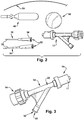
  • FIG. 2 shows an exploded view of the components of the rodent intubation system of this application.
  • FIG. 3 shows the Y shaped main body member of the rodent intubation system.
  • FIGS. 4-6 illustrate schematic, stylized views of the device from an upper side perspective view, side view and perspective rear view, respectively.
  • FIG. 7 shows side perspective view of an alternate embodiment of the new rodent intubation system having a threaded connector positioned intermediate the Y shaped main body member and the second port and magnification lens.
  • FIG. 8 shows a side perspective view of the embodiment of FIG. 7 , with the Y shaped main body member and the second port and magnification lens disconnected at the threaded connector.
  • FIG. 9 schematically illustrates a rodent positioned for intubation using the rodent intubation system of this application.
  • the present application is for a rodent intubation system having a variety of advantages over current procedures and devices used for intubation.
  • FIGS. 1 to 9 illustrate the rodent intubation system 10 of this application.
  • the system components are shown in FIG. 2 , and are illustrated at least including:
  • a valve 12 which is a conventional hemostasis valve, or a Y shaped main body member, as shown in FIG. 3 , having at least three ports;
  • An intubation angio-catheter 30 where the size of catheter used ranges from 15-22 G (gauge), with a proximal end for removable attachment to a port on the main body member;
  • a flexible polymer inflation bulb 40 removably attached to a port of the main body member
  • a fiber optic light wire 50 having a size ranging from 0.4-2 mm, but preferably 0.4-1 mm engaged into one port of the main body member and out through a second port;
  • a polymer magnification lens 60 having a magnification strength of from 3-7 ⁇ power.
  • the new intubation system of this application has at least the following advantages:
  • the inflation bulb 40 is removably connected to a lower port 18 of the three port system, so it is easy to check the position of the catheter 30 —since by squeezing the manually operated bulb, the rodents lungs can be seen to expand. Also there is no need to disconnect the catheter 30 from the system 10 to check the catheter position.
  • the system 10 is adjustable for the use of different sized fiber optic wires 50 , depending on rodent size.
  • magnification lens 60 or loop An important component of the system is the magnification lens 60 or loop, preferably having a 3-7 ⁇ magnification strength. This feature allows the user clearly to visualize the vocal cords, glottis and all anatomical structures needed for performing a proper intubation procedure.
  • the magnification lens 60 is rotatable a full 360 degrees to view the adjacent intubation catheter 30 from any desired angle, for ease of adjustment and use by both right and left handed researchers.
  • the intubation system 10 of this application does not require systemic Ketamine/Xylazine anesthesia to be administered to the rodent during use. Instead, by using the intubation system with only Isoflurane administered, the animals can be intubated for less time, or from 10-30 seconds. This enables a safer procedure for the animals.
  • the rodent intubation system 10 of this application is a novel intubation system not currently available in the market. While several companies sell fiber optic wire, such devices do not have magnification or attached magnification lenses, nor do they have magnification combined with an inflation bulb to test whether or not intubation is successful.
  • a fiber optic light wire available in the market as the Biolite system for example at www.braintreesci.com.
  • This prior art device is a fiber optic wire connected to light source. Kent Scientific provides a similar prior art kit product available from www.kentscientific.com. Available systems also fail to provide an interconnected inflation bulb and there is no magnification ability or loop.
  • the problems encountered when using these currently available devices, and the failure to provide a tool or system for easy and efficient performance of a rodent intubation procedure, are solved by the rodent intubation system 10 of this application.
  • the present system is:
  • the present system facilitates single-handed operation by the user.
  • the system is small in size, measured at between 11 and 13 cm, preferably 12 cm, from the end of the installed inflation bulb 40 to the magnification lens 60 .
  • the main body member 12 which is a conventional Y-shaped hemostasis valve, is of the type available, for example, from Medline Industries, Inc., www.medline.com.
  • the main body member 12 has a seal end or port 14 (blue colored in commercial products, or located at the top and rear of the valve 12 during use) which provides security that the fiber optic wire 50 will stay in place during use, and will enable easy adjustment of the wire length.
  • This first port 14 is sized to allow insertion of up to 2 mm diameter fiber optic wires, however, for example, for a 6 to 15 mg mouse, a fiber optic wire with an outer diameter (OD) of 0.4 to 0.55 mm, would be used.
  • a fiber optic wire with an OD of 0.55 to 0.65 mm would be used.
  • a fiber optic wire with an OD of 0.7 to 1 mm may be appropriate, with up to a 2 mm outer diameter available if needed for a larger animal.
  • the fiber optic wire 50 is positioned to illuminate the rodent organs, and extends from a conventional light source (not shown) through the first port 14 , through a first lumen 20 of the valve 12 , which connects the first and second ports 14 , 16 , and out a distal end 36 of the intubation angio-catheter 30 secured to the second port 16 to illuminate the rodent for intubation.
  • the third port, open end or port 18 , of the hemostasis valve 12 located at the bottom and rear of the valve during use, or spaced from and below the first seal port 14 , enables connection of a removable inflation bulb 40 , for example, by threaded or press fit engagement.
  • a removable inflation bulb 40 for example, by threaded or press fit engagement.
  • the position of the distal end 36 of the catheter 30 may be checked.
  • the researcher may visually confirm by the rise and fall of the rodent chest (lungs) that the catheter is properly positioned.
  • the catheter 30 need not be removed or taken out of the system to check the position of the intubation catheter.
  • the properly angled and located magnified optic polymer lens 60 which is secured to the rotatable connector attachment 24 of the main body member 12 adjacent the second port 16 , allows clear visualization of the rodent anatomical structures to enable successful intubation of the animal.
  • the angle A at which the lens 60 is secured in position is in the range of 89 to 75 degrees, or less than 90 degrees.
  • the lens 60 is secured to the rotatable connector attachment 24 on a side of the main body member 12 opposite the third port 18 and inflation bulb 40 .
  • the ability of the lens 60 to rotate 360 degrees around the intubation catheter, in the direction of the arrow L shown in FIG. 9 enables viewing of the animal R from any desired angle.
  • the device 10 is able to be used by either right handed or left handed researchers, as the lens may be moved to any convenient angle for visualizing the animal.
  • a two-piece male-female threaded connector 70 is provided as an additional component.
  • the connector 70 preferably of medical grade stainless steel, is positioned with a female end 72 engaged in communication with the first lumen 20 , and a male end 74 secured to the rotatable connector attachment 24 and second port 16 .
  • a central opening 76 through both portions of the connector 70 is sized to enable the light wire 50 to pass from the first port 14 to the intubation catheter 30 .
  • the animal R may be connected to a ventilator system, which provides both anesthesia and oxygen via the catheter.
  • a method for intubating a rodent is disclosed using the system described which DOES NOT require intubation surgery or the use or administration of a Ketamine/Xylazine anesthesia cocktail to the rodent. Only a gas anesthesia is used. Gas anesthesia has many advantages, such as easy and fast induction of the anesthesia and a shorter recovery period for the animal.

Landscapes

  • Health & Medical Sciences (AREA)
  • Life Sciences & Earth Sciences (AREA)
  • Surgery (AREA)
  • Pulmonology (AREA)
  • Heart & Thoracic Surgery (AREA)
  • Veterinary Medicine (AREA)
  • Public Health (AREA)
  • General Health & Medical Sciences (AREA)
  • Animal Behavior & Ethology (AREA)
  • Engineering & Computer Science (AREA)
  • Biomedical Technology (AREA)
  • Medical Informatics (AREA)
  • Biophysics (AREA)
  • Molecular Biology (AREA)
  • Radiology & Medical Imaging (AREA)
  • Pathology (AREA)
  • Optics & Photonics (AREA)
  • Nuclear Medicine, Radiotherapy & Molecular Imaging (AREA)
  • Physics & Mathematics (AREA)
  • Anesthesiology (AREA)
  • Emergency Medicine (AREA)
  • Hematology (AREA)
  • Otolaryngology (AREA)
  • Physiology (AREA)
  • Catching Or Destruction (AREA)

Abstract

A rodent intubation system includes a main body member including a first port, a second port and a third port. The main body member further includes a magnification lens of approximately 3 to 7× magnification power, which lens is rotatably connected to the main body member so that an animal being intubated may be viewed through the magnification lens during use of the system. An intubation catheter is releasably connected to one port. An inflation bulb is removably connected to another port. Yet another port of the three port system is sized and dimensioned to receive a fiber optic cable there through.

Description

CROSS REFERENCE TO RELATED APPLICATION
This application claims priority from U.S. Provisional Application No. 62/529,993 filed Jul. 7, 2017, the entirety of which is incorporated herein by reference.
FIELD
The present application relates generally to an intubation system, and more particularly, to a hand operated intubation system for use in connection with surgical procedures for rodents such as mice and rats.
BACKGROUND
In order to conduct a variety of medical research, it is necessary to perform small animal surgical procedures. To perform open chest experiments and surgical procedures in rodents, for example, rats and mice, researchers need to intubate the animal. Because of the difficulty with intubation, many research groups use a surgical approach, tracheostomy. This method is not desirable for chronic and survival surgeries, because of increased risk for infection, inflammation, narrowing of the trachea (postsurgical) and bronchial secretions, which all may lead to respiratory failure.
A second method used by researchers is exposure of the trachea (by making a skin incision and dissecting salivary glands). For survival surgeries this is also not desirable because of increased risk of damaging the glottis and vocal cords, insertion into the wrong location (if inserted into the esophagus the animal will die), and increased chance of infection due to the skin incision.
Several years ago, fiber optic light technology came to be used in research experiments and many labs are using fiber optic wires as a light source for intubation procedures. The advantages and disadvantages of this prior art technique are:
Advantages:
1. The outer diameter of the fiber optic wire is small (0.4-1 mm) which allows the fiber wire to be inserted into the angio-catheter for easy use.
2. By using an adjustable light source, the light intensity may be adjusted.
Disadvantages:
1. The prior art technique requires many hours of practice and assistance.
2. The position of the esophagus is very close to the trachea, so it is easy to go into the trachea, which may harm the animal.
3. The glottis and vocal cords are very small and it is difficult to visualize the organs during a procedure without magnification (the current approach does not use magnification).
4. After intubation, it is necessary to remove the catheter and check the position of the catheter. This takes time and if it is not correct, the animal may be sacrificed.
5. For this prior art intubation technique researchers need to use drugs such as Ketamine/Xylazine (or a similar long-acting anesthetic) for a sufficient period of time to perform the tracheal cannulation. These anesthetics depress respiration and can cause death in the animals; especially in older animals and in those with cardiovascular risk factors.
Given the disadvantages of prior art systems, a safer, easier and faster system for performing rodent intubation procedures is needed.
SUMMARY OF THE INVENTION
A new system for rodent intubation is provided for use in research laboratories which require animal intubation, or where animals have to be intubated involving survival or non-survival surgery experiments which require positive pressure ventilation, such as cardiovascular and pulmonary research labs. This intubation system is useful for all researchers who need to intubate mice and rats for open-chest surgical procedures. Using this system is easy to learn and perform an intubation, requires less practice time, and enables researchers to be successful after practicing on 2-3 rodents.
The present rodent intubation system comprises a main body member including a first port, a second port and a third port. The main body member further includes a magnification lens of approximately 3 to 7× magnification power, which lens is connected to the main body member so that an animal being intubated may be viewed through the magnification lens during use of the system. An intubation catheter is releasably connected to the second port. An inflation bulb is removably connected to the third port. The first port is sized and dimensioned to receive a fiber optic cable there through.
The main body member of the system includes a first lumen extending between the first and second ports, and a second lumen that extends from the second port into fluid or air communication with the first lumen. The magnification lens extends radially away from the main body member at an angle relative to the main body member. The angle of the magnification lens with respect to the main body member is generally from about 70 degrees to about 89 degrees, and preferably about 80 to 85 degrees, which angle enables the focal point of the magnification lens to be aimed at the intubation catheter for optimal viewing. Additionally, the location or position of the magnification lens along the main body member is also provided at a distance to enable optimal viewing of the animal being intubated during use of the system. The magnification lens extends away from the main body member in a direction opposite the second port and inflation bulb.
The main body member also includes an internal seal within the first port, which is configured to prevent unwanted movement of the fiber optic cable during intubation. In addition, the intubation catheter is provided with a mating attachment to enable removable attachment with the second port, so that application of a torque to a proximal end of the intubation catheter causes the intubation catheter to rotate and release from the first port of the main body member.
Using the new intubation system of this application, researchers are able to intubate animals in several seconds. It is unnecessary to anesthetize animals using a systemic anesthetic, and an additional surgical procedure is not needed. The present intubation system provides an easier system to use, which enables faster and safer intubation procedures to be performed by researchers.
DRAWING DESCRIPTIONS
FIG. 1 shows a perspective view of the new rodent intubation system of this application.
FIG. 2 shows an exploded view of the components of the rodent intubation system of this application.
FIG. 3 shows the Y shaped main body member of the rodent intubation system.
FIGS. 4-6 illustrate schematic, stylized views of the device from an upper side perspective view, side view and perspective rear view, respectively.
FIG. 7 shows side perspective view of an alternate embodiment of the new rodent intubation system having a threaded connector positioned intermediate the Y shaped main body member and the second port and magnification lens.
FIG. 8 shows a side perspective view of the embodiment of FIG. 7, with the Y shaped main body member and the second port and magnification lens disconnected at the threaded connector.
FIG. 9 schematically illustrates a rodent positioned for intubation using the rodent intubation system of this application.
DETAILED DESCRIPTION
The present application is for a rodent intubation system having a variety of advantages over current procedures and devices used for intubation.
FIGS. 1 to 9 illustrate the rodent intubation system 10 of this application. The system components are shown in FIG. 2, and are illustrated at least including:
A valve 12, which is a conventional hemostasis valve, or a Y shaped main body member, as shown in FIG. 3, having at least three ports;
An intubation angio-catheter 30, where the size of catheter used ranges from 15-22 G (gauge), with a proximal end for removable attachment to a port on the main body member;
A flexible polymer inflation bulb 40, removably attached to a port of the main body member;
A fiber optic light wire 50, having a size ranging from 0.4-2 mm, but preferably 0.4-1 mm engaged into one port of the main body member and out through a second port; and
A polymer magnification lens 60, having a magnification strength of from 3-7× power.
In order to see the glottis, vocal cords and trachea of the rodent clearly (as schematically illustrated in FIG. 9), the system components are assembled into one device (a single unit) to provide the user with a magnified view of the animal, which makes the intubation procedure easier and faster. The new intubation system of this application has at least the following advantages:
A) Single-handed manual operation.
B) Small size.
C) The inflation bulb 40 is removably connected to a lower port 18 of the three port system, so it is easy to check the position of the catheter 30—since by squeezing the manually operated bulb, the rodents lungs can be seen to expand. Also there is no need to disconnect the catheter 30 from the system 10 to check the catheter position.
D) The system 10 is adjustable for the use of different sized fiber optic wires 50, depending on rodent size.
E) An important component of the system is the magnification lens 60 or loop, preferably having a 3-7× magnification strength. This feature allows the user clearly to visualize the vocal cords, glottis and all anatomical structures needed for performing a proper intubation procedure. The magnification lens 60 is rotatable a full 360 degrees to view the adjacent intubation catheter 30 from any desired angle, for ease of adjustment and use by both right and left handed researchers.
F) The intubation system 10 of this application does not require systemic Ketamine/Xylazine anesthesia to be administered to the rodent during use. Instead, by using the intubation system with only Isoflurane administered, the animals can be intubated for less time, or from 10-30 seconds. This enables a safer procedure for the animals.
G) The use of a rotatable connector attachment 17 between a second port 16 of the Y shaped main body member and the intubation catheter 30, enables easy removal of the catheter from the second port 16 of the main body member 12 after successful intubation.
H) The system of this application provides a safe, easy and fast intubation procedure for rodents.
The rodent intubation system 10 of this application is a novel intubation system not currently available in the market. While several companies sell fiber optic wire, such devices do not have magnification or attached magnification lenses, nor do they have magnification combined with an inflation bulb to test whether or not intubation is successful. For example, a fiber optic light wire available in the market as the Biolite system, for example at www.braintreesci.com. This prior art device is a fiber optic wire connected to light source. Kent Scientific provides a similar prior art kit product available from www.kentscientific.com. Available systems also fail to provide an interconnected inflation bulb and there is no magnification ability or loop.
The problems encountered when using these currently available devices, and the failure to provide a tool or system for easy and efficient performance of a rodent intubation procedure, are solved by the rodent intubation system 10 of this application. The present system is:
A) Safer for the animal being intubated, since less anesthesia is required and surgery can be shorter, resulting in a higher success rate.
B) Easy to operate, so the intubation procedures performed can be conducted faster and with less practice.
C) Less expensive to manufacture and to purchase.
Again, the use of an intubation system of this application provides the following advantages over prior systems:
The present system facilitates single-handed operation by the user. The system is small in size, measured at between 11 and 13 cm, preferably 12 cm, from the end of the installed inflation bulb 40 to the magnification lens 60.
The main body member 12, which is a conventional Y-shaped hemostasis valve, is of the type available, for example, from Medline Industries, Inc., www.medline.com. The main body member 12 has a seal end or port 14 (blue colored in commercial products, or located at the top and rear of the valve 12 during use) which provides security that the fiber optic wire 50 will stay in place during use, and will enable easy adjustment of the wire length. This first port 14 is sized to allow insertion of up to 2 mm diameter fiber optic wires, however, for example, for a 6 to 15 mg mouse, a fiber optic wire with an outer diameter (OD) of 0.4 to 0.55 mm, would be used. For a 15 to 60 mg mouse, a fiber optic wire with an OD of 0.55 to 0.65 mm would be used. For a rat, a fiber optic wire with an OD of 0.7 to 1 mm may be appropriate, with up to a 2 mm outer diameter available if needed for a larger animal.
The second end or port 16 (red colored in commercial products, or located at the top and front of the valve 12 during use) of the main body member 12 includes a fully rotatable connector attachment 24 with an internally threaded end 17 for mating engagement with mating structure 32 provided on the intubation angio-catheter 30. This port attachment 17 allows easy attachment and removal of the intubation angio-catheter 30 from the connector attachment 24 secured to the main body member 12. The size of the intubation angio-catheter 30 attached, at a proximal end 34 having the mating structure 32 engaged with the second port 16 may, for example, for a 6 to 15 mg mouse be in the range of 21-22 G. For a 15 to 60 mg mouse, an intubation angio-catheter of 20 G would be used. For a rat, an intubation angio-catheter of 15-16 G would be used. As shown in FIGS. 1 and 9, during use, the fiber optic wire 50 is positioned to illuminate the rodent organs, and extends from a conventional light source (not shown) through the first port 14, through a first lumen 20 of the valve 12, which connects the first and second ports 14, 16, and out a distal end 36 of the intubation angio-catheter 30 secured to the second port 16 to illuminate the rodent for intubation.
The third port, open end or port 18, of the hemostasis valve 12, located at the bottom and rear of the valve during use, or spaced from and below the first seal port 14, enables connection of a removable inflation bulb 40, for example, by threaded or press fit engagement. After intubation and removal of the light wire, the position of the distal end 36 of the catheter 30 may be checked. By squeezing the flexible polymer inflation bulb 40, to manually inflate and deflate the flexible inflation bulb, the researcher may visually confirm by the rise and fall of the rodent chest (lungs) that the catheter is properly positioned. Thus, the catheter 30 need not be removed or taken out of the system to check the position of the intubation catheter.
The properly angled and located magnified optic polymer lens 60, which is secured to the rotatable connector attachment 24 of the main body member 12 adjacent the second port 16, allows clear visualization of the rodent anatomical structures to enable successful intubation of the animal. As shown in FIG. 1, the angle A at which the lens 60 is secured in position, as measured from near the proximal end 34 of the intubation catheter 30, is in the range of 89 to 75 degrees, or less than 90 degrees. The lens 60 is secured to the rotatable connector attachment 24 on a side of the main body member 12 opposite the third port 18 and inflation bulb 40. The ability of the lens 60 to rotate 360 degrees around the intubation catheter, in the direction of the arrow L shown in FIG. 9, enables viewing of the animal R from any desired angle. As a result, the device 10 is able to be used by either right handed or left handed researchers, as the lens may be moved to any convenient angle for visualizing the animal.
In the alternate embodiment shown in FIGS. 7 and 8, a two-piece male-female threaded connector 70 is provided as an additional component. The connector 70, preferably of medical grade stainless steel, is positioned with a female end 72 engaged in communication with the first lumen 20, and a male end 74 secured to the rotatable connector attachment 24 and second port 16. A central opening 76 through both portions of the connector 70 is sized to enable the light wire 50 to pass from the first port 14 to the intubation catheter 30. By using connector 70 at the location indicated, the attached magnification lens 60 may be removed and replaced, together with the connector attachment 24, in the event the lens becomes scratched or blurry after multiple uses and sterilizations.
Use of the system enables rodents to be intubated very quickly, or within 10-20 seconds. Once the intubation catheter 30 is properly placed, the animal R may be connected to a ventilator system, which provides both anesthesia and oxygen via the catheter.
A method for intubating a rodent is disclosed using the system described which DOES NOT require intubation surgery or the use or administration of a Ketamine/Xylazine anesthesia cocktail to the rodent. Only a gas anesthesia is used. Gas anesthesia has many advantages, such as easy and fast induction of the anesthesia and a shorter recovery period for the animal.
While certain embodiments of the invention have been described with specificity in order to improve understanding of the invention, many variations and modifications will become apparent to a person of ordinary skill in the art. It is therefore expected and intended that the certain changes and modifications may be practiced which will still fall within the scope of the appended claims.

Claims (12)

I claim:
1. A rodent intubation system comprising:
a main body member including a first port, a second port and a third port, the main body member further including a magnification lens connected thereto adjacent a port;
an intubation catheter releasably connected to the second port; and
a flexible inflation bulb connected to the third port;
wherein the first port is sized and dimensioned to receive and seal a fiber optic cable there through.
2. The system of claim 1, wherein the main body member includes a first lumen, having a central axis, and the first lumen extends between the first and second ports, and a second lumen that extends from the third port into atmospheric communication with the first lumen.
3. The system of claim 2, wherein the magnification lens is rotatable about the central axis of the first lumen for adjustment of the magnification lens location with respect to the adjacent port.
4. The system of claim 2, further comprising a two-piece male-female connector having a central opening, the connector positioned intermediate the first lumen and the second port.
5. The system of claim 4, wherein the first port of the main body member further includes an internal seal configured to prevent unwanted movement of the fiber optic cable during intubation.
6. The system of claim 1, wherein the magnification lens extends radially away from the main body member at an angle relative to the main body member.
7. The system of claim 6, wherein the magnification lens is at an angle with respect to the main body of about 70 degrees to about 89 degrees, in a direction toward the intubation tube catheter.
8. The system of claim 1, wherein the first port of the main body member further includes an internal seal configured to prevent unwanted movement of the fiber optic cable during intubation.
9. The system of claim 1, wherein the intubation catheter includes a mating attachment at a proximal end for engagement with the second port so that application of a torque to a proximal end of the intubation catheter causes the intubation catheter to rotate and release from the main body member.
10. The system of claim 1, wherein the magnification lens is configured to provide a magnification power of about 3-7×.
11. A rodent intubation system comprising:
a main body member including a first port, a second port and a third port, the main body member further including a magnification lens of 3-7× connected for rotation with respect to the main body member at a position adjacent the second port, and the magnification lens extends radially away from the main body member at an angle relative to the main body member of less than 90 degrees;
an intubation catheter releasably connected to the second port;
a flexible inflation bulb connected to the third port; and
the first port, main body member, second port and intubation catheter are sized and dimensioned to receive a fiber optic cable there through.
12. The system of claim 11, wherein the main body member includes a first lumen, having a central axis, and the first lumen extends between the first and second ports, and a second lumen that extends from the third port into atmospheric communication with the first lumen and the intubation catheter.
US16/030,822 2017-07-07 2018-07-09 Rodent intubation system Active US10695515B2 (en)

Priority Applications (1)

Application Number Priority Date Filing Date Title
US16/030,822 US10695515B2 (en) 2017-07-07 2018-07-09 Rodent intubation system

Applications Claiming Priority (2)

Application Number Priority Date Filing Date Title
US201762529993P 2017-07-07 2017-07-07
US16/030,822 US10695515B2 (en) 2017-07-07 2018-07-09 Rodent intubation system

Publications (2)

Publication Number Publication Date
US20190009043A1 US20190009043A1 (en) 2019-01-10
US10695515B2 true US10695515B2 (en) 2020-06-30

Family

ID=64904001

Family Applications (1)

Application Number Title Priority Date Filing Date
US16/030,822 Active US10695515B2 (en) 2017-07-07 2018-07-09 Rodent intubation system

Country Status (1)

Country Link
US (1) US10695515B2 (en)

Families Citing this family (1)

* Cited by examiner, † Cited by third party
Publication number Priority date Publication date Assignee Title
CN112370628B (en) * 2020-02-29 2022-12-06 深圳市瑞沃德生命科技有限公司 Animal endotracheal intubation device

Citations (1)

* Cited by examiner, † Cited by third party
Publication number Priority date Publication date Assignee Title
US20030225313A1 (en) * 2002-06-04 2003-12-04 German Borodulin Vaginal speculum with insertable one-lens colposcope

Patent Citations (1)

* Cited by examiner, † Cited by third party
Publication number Priority date Publication date Assignee Title
US20030225313A1 (en) * 2002-06-04 2003-12-04 German Borodulin Vaginal speculum with insertable one-lens colposcope

Non-Patent Citations (2)

* Cited by examiner, † Cited by third party
Title
Biolite Intubation System, sold at least as early as Jul. 7, 2016, Braintree Scientific, Inc., Braintree, MA, USA, www.braintreesci.com.
Kent Scientific Mouse Intubation Kit, sold at least as early as Jul. 7, 2016, Kent Scientific Corporation, Torrington, CT, USA, www.kentscientific.com.

Also Published As

Publication number Publication date
US20190009043A1 (en) 2019-01-10

Similar Documents

Publication Publication Date Title
US10335023B2 (en) Endotracheal tube insertion device
AU691299B2 (en) A fibreoptic intubating laryngeal mask airway
JP7133110B2 (en) Endotracheal tube insertion device
US10286171B2 (en) Endotracheal tube insertion device
US10149602B2 (en) Endobronchial tube with integrated image sensor and a cleaning nozzle arrangement
WO2009025843A1 (en) Laryngeal airway nerve monitor
US20180064895A1 (en) Devices, systems and methods for improved intubation and management of airways
Hagberg Special devices and techniques
Aston et al. Equipment in Anaesthesia and Critical Care: A complete guide for the FRCA
US10695515B2 (en) Rodent intubation system
CN109675164B (en) A visual intubation device
Lee et al. Transection of a Coopdech bronchial blocker tip during bronchial resection for right upper lobectomy: a case report
US11975147B2 (en) Curved bougie guide
US8343408B2 (en) Method of molding an endotracheal tube for tracheal intubation
US11413416B2 (en) Endopharyngeal airway positive pressure ventilation device
Ghosh et al. The Papworth BiVent tube: a feasibility study of a novel double-lumen endotracheal tube and bronchial blocker in human cadavers
Watkins et al. Airway choices in maxillofacial trauma
CN210844764U (en) Auxiliary tracheal endoscopy respirator tube
BR102021020594A2 (en) BLADE WITH ARTICULABLE SEGMENTS FOR LARYNGOSCOPY AND OROTRACHEAL INTUBATION
US20220355054A1 (en) Endotracheal tube applied to built-in video endoscope and capable of full-time video monitoring
Ball Equipment for airway management
Chowdhury et al. Airway management in patient with retropharyngeal cerebrospinal fluid collection with pre-existing multiple airway problems
Tay et al. Massive blood clot following traumatic tracheal intubation: misdiagnosis using the C‐MAC® Flexible Intubation Video Endoscope
Rai et al. 13 Tracheal intubation: flexible fibreoptic
Decoste et al. Airway Management: Methods of Oxygenation

Legal Events

Date Code Title Description
FEPP Fee payment procedure

Free format text: ENTITY STATUS SET TO UNDISCOUNTED (ORIGINAL EVENT CODE: BIG.); ENTITY STATUS OF PATENT OWNER: SMALL ENTITY

FEPP Fee payment procedure

Free format text: ENTITY STATUS SET TO SMALL (ORIGINAL EVENT CODE: SMAL); ENTITY STATUS OF PATENT OWNER: SMALL ENTITY

STPP Information on status: patent application and granting procedure in general

Free format text: DOCKETED NEW CASE - READY FOR EXAMINATION

STPP Information on status: patent application and granting procedure in general

Free format text: NON FINAL ACTION MAILED

STPP Information on status: patent application and granting procedure in general

Free format text: RESPONSE TO NON-FINAL OFFICE ACTION ENTERED AND FORWARDED TO EXAMINER

STPP Information on status: patent application and granting procedure in general

Free format text: NOTICE OF ALLOWANCE MAILED -- APPLICATION RECEIVED IN OFFICE OF PUBLICATIONS

STPP Information on status: patent application and granting procedure in general

Free format text: PUBLICATIONS -- ISSUE FEE PAYMENT VERIFIED

STCF Information on status: patent grant

Free format text: PATENTED CASE

MAFP Maintenance fee payment

Free format text: PAYMENT OF MAINTENANCE FEE, 4TH YR, SMALL ENTITY (ORIGINAL EVENT CODE: M2551); ENTITY STATUS OF PATENT OWNER: SMALL ENTITY

Year of fee payment: 4